WO2014168069A1 - Film de protection de surface auto-adhésif - Google Patents
Film de protection de surface auto-adhésif Download PDFInfo
- Publication number
- WO2014168069A1 WO2014168069A1 PCT/JP2014/059821 JP2014059821W WO2014168069A1 WO 2014168069 A1 WO2014168069 A1 WO 2014168069A1 JP 2014059821 W JP2014059821 W JP 2014059821W WO 2014168069 A1 WO2014168069 A1 WO 2014168069A1
- Authority
- WO
- WIPO (PCT)
- Prior art keywords
- styrene
- weight
- adhesive
- film
- layer
- Prior art date
- Legal status (The legal status is an assumption and is not a legal conclusion. Google has not performed a legal analysis and makes no representation as to the accuracy of the status listed.)
- Ceased
Links
Images


Classifications
-
- C—CHEMISTRY; METALLURGY
- C09—DYES; PAINTS; POLISHES; NATURAL RESINS; ADHESIVES; COMPOSITIONS NOT OTHERWISE PROVIDED FOR; APPLICATIONS OF MATERIALS NOT OTHERWISE PROVIDED FOR
- C09J—ADHESIVES; NON-MECHANICAL ASPECTS OF ADHESIVE PROCESSES IN GENERAL; ADHESIVE PROCESSES NOT PROVIDED FOR ELSEWHERE; USE OF MATERIALS AS ADHESIVES
- C09J153/00—Adhesives based on block copolymers containing at least one sequence of a polymer obtained by reactions only involving carbon-to-carbon unsaturated bonds; Adhesives based on derivatives of such polymers
- C09J153/02—Vinyl aromatic monomers and conjugated dienes
-
- B—PERFORMING OPERATIONS; TRANSPORTING
- B32—LAYERED PRODUCTS
- B32B—LAYERED PRODUCTS, i.e. PRODUCTS BUILT-UP OF STRATA OF FLAT OR NON-FLAT, e.g. CELLULAR OR HONEYCOMB, FORM
- B32B27/00—Layered products comprising a layer of synthetic resin
- B32B27/06—Layered products comprising a layer of synthetic resin as the main or only constituent of a layer, which is next to another layer of the same or of a different material
- B32B27/08—Layered products comprising a layer of synthetic resin as the main or only constituent of a layer, which is next to another layer of the same or of a different material of synthetic resin
-
- B—PERFORMING OPERATIONS; TRANSPORTING
- B32—LAYERED PRODUCTS
- B32B—LAYERED PRODUCTS, i.e. PRODUCTS BUILT-UP OF STRATA OF FLAT OR NON-FLAT, e.g. CELLULAR OR HONEYCOMB, FORM
- B32B27/00—Layered products comprising a layer of synthetic resin
- B32B27/30—Layered products comprising a layer of synthetic resin comprising vinyl (co)polymers; comprising acrylic (co)polymers
- B32B27/302—Layered products comprising a layer of synthetic resin comprising vinyl (co)polymers; comprising acrylic (co)polymers comprising aromatic vinyl (co)polymers, e.g. styrenic (co)polymers
-
- B—PERFORMING OPERATIONS; TRANSPORTING
- B32—LAYERED PRODUCTS
- B32B—LAYERED PRODUCTS, i.e. PRODUCTS BUILT-UP OF STRATA OF FLAT OR NON-FLAT, e.g. CELLULAR OR HONEYCOMB, FORM
- B32B27/00—Layered products comprising a layer of synthetic resin
- B32B27/32—Layered products comprising a layer of synthetic resin comprising polyolefins
-
- B—PERFORMING OPERATIONS; TRANSPORTING
- B32—LAYERED PRODUCTS
- B32B—LAYERED PRODUCTS, i.e. PRODUCTS BUILT-UP OF STRATA OF FLAT OR NON-FLAT, e.g. CELLULAR OR HONEYCOMB, FORM
- B32B7/00—Layered products characterised by the relation between layers; Layered products characterised by the relative orientation of features between layers, or by the relative values of a measurable parameter between layers, i.e. products comprising layers having different physical, chemical or physicochemical properties; Layered products characterised by the interconnection of layers
- B32B7/04—Interconnection of layers
- B32B7/06—Interconnection of layers permitting easy separation
-
- B—PERFORMING OPERATIONS; TRANSPORTING
- B32—LAYERED PRODUCTS
- B32B—LAYERED PRODUCTS, i.e. PRODUCTS BUILT-UP OF STRATA OF FLAT OR NON-FLAT, e.g. CELLULAR OR HONEYCOMB, FORM
- B32B7/00—Layered products characterised by the relation between layers; Layered products characterised by the relative orientation of features between layers, or by the relative values of a measurable parameter between layers, i.e. products comprising layers having different physical, chemical or physicochemical properties; Layered products characterised by the interconnection of layers
- B32B7/04—Interconnection of layers
- B32B7/12—Interconnection of layers using interposed adhesives or interposed materials with bonding properties
-
- C—CHEMISTRY; METALLURGY
- C09—DYES; PAINTS; POLISHES; NATURAL RESINS; ADHESIVES; COMPOSITIONS NOT OTHERWISE PROVIDED FOR; APPLICATIONS OF MATERIALS NOT OTHERWISE PROVIDED FOR
- C09J—ADHESIVES; NON-MECHANICAL ASPECTS OF ADHESIVE PROCESSES IN GENERAL; ADHESIVE PROCESSES NOT PROVIDED FOR ELSEWHERE; USE OF MATERIALS AS ADHESIVES
- C09J109/00—Adhesives based on homopolymers or copolymers of conjugated diene hydrocarbons
- C09J109/06—Copolymers with styrene
-
- C—CHEMISTRY; METALLURGY
- C09—DYES; PAINTS; POLISHES; NATURAL RESINS; ADHESIVES; COMPOSITIONS NOT OTHERWISE PROVIDED FOR; APPLICATIONS OF MATERIALS NOT OTHERWISE PROVIDED FOR
- C09J—ADHESIVES; NON-MECHANICAL ASPECTS OF ADHESIVE PROCESSES IN GENERAL; ADHESIVE PROCESSES NOT PROVIDED FOR ELSEWHERE; USE OF MATERIALS AS ADHESIVES
- C09J7/00—Adhesives in the form of films or foils
- C09J7/20—Adhesives in the form of films or foils characterised by their carriers
- C09J7/22—Plastics; Metallised plastics
-
- C—CHEMISTRY; METALLURGY
- C09—DYES; PAINTS; POLISHES; NATURAL RESINS; ADHESIVES; COMPOSITIONS NOT OTHERWISE PROVIDED FOR; APPLICATIONS OF MATERIALS NOT OTHERWISE PROVIDED FOR
- C09J—ADHESIVES; NON-MECHANICAL ASPECTS OF ADHESIVE PROCESSES IN GENERAL; ADHESIVE PROCESSES NOT PROVIDED FOR ELSEWHERE; USE OF MATERIALS AS ADHESIVES
- C09J7/00—Adhesives in the form of films or foils
- C09J7/30—Adhesives in the form of films or foils characterised by the adhesive composition
- C09J7/38—Pressure-sensitive adhesives [PSA]
-
- B—PERFORMING OPERATIONS; TRANSPORTING
- B32—LAYERED PRODUCTS
- B32B—LAYERED PRODUCTS, i.e. PRODUCTS BUILT-UP OF STRATA OF FLAT OR NON-FLAT, e.g. CELLULAR OR HONEYCOMB, FORM
- B32B2307/00—Properties of the layers or laminate
- B32B2307/70—Other properties
- B32B2307/748—Releasability
-
- B—PERFORMING OPERATIONS; TRANSPORTING
- B32—LAYERED PRODUCTS
- B32B—LAYERED PRODUCTS, i.e. PRODUCTS BUILT-UP OF STRATA OF FLAT OR NON-FLAT, e.g. CELLULAR OR HONEYCOMB, FORM
- B32B2405/00—Adhesive articles, e.g. adhesive tapes
-
- C—CHEMISTRY; METALLURGY
- C09—DYES; PAINTS; POLISHES; NATURAL RESINS; ADHESIVES; COMPOSITIONS NOT OTHERWISE PROVIDED FOR; APPLICATIONS OF MATERIALS NOT OTHERWISE PROVIDED FOR
- C09J—ADHESIVES; NON-MECHANICAL ASPECTS OF ADHESIVE PROCESSES IN GENERAL; ADHESIVE PROCESSES NOT PROVIDED FOR ELSEWHERE; USE OF MATERIALS AS ADHESIVES
- C09J2423/00—Presence of polyolefin
- C09J2423/10—Presence of homo or copolymers of propene
- C09J2423/106—Presence of homo or copolymers of propene in the substrate
-
- C—CHEMISTRY; METALLURGY
- C09—DYES; PAINTS; POLISHES; NATURAL RESINS; ADHESIVES; COMPOSITIONS NOT OTHERWISE PROVIDED FOR; APPLICATIONS OF MATERIALS NOT OTHERWISE PROVIDED FOR
- C09J—ADHESIVES; NON-MECHANICAL ASPECTS OF ADHESIVE PROCESSES IN GENERAL; ADHESIVE PROCESSES NOT PROVIDED FOR ELSEWHERE; USE OF MATERIALS AS ADHESIVES
- C09J2453/00—Presence of block copolymer
Definitions
- the present invention relates to an adhesive film.
- the adhesive film of the present invention is a member such as a prism sheet used for optical applications, a synthetic resin plate (for example, for building materials), a stainless plate (for example, for building materials), an aluminum plate, a decorative plywood, a steel plate, and a glass plate.
- a synthetic resin plate for example, for building materials
- a stainless plate for example, for building materials
- an aluminum plate for example, a decorative plywood, a steel plate, and a glass plate.
- Home appliances, precision machinery to protect the surface of automobile bodies during manufacturing, to protect articles from being scratched when stacked, stored, transported, transported in the manufacturing process, and articles Can be suitably used for protecting from scratches during secondary processing (for example, bending or pressing).
- the above-mentioned coverings have been diversified, and there are many not only those with a smooth coating surface but also surface irregularities.
- Examples of the covering having surface irregularities include a prism type lens portion of a prism sheet used for an optical member.
- the adhesive layer has a high adhesive force so that the adhesive force can be obtained even if the contact area is small. Can be considered.
- fluorine-based resin silicon-based resin (see, for example, Patent Documents 1 and 2) or saturated fatty acid bisamide is used for the base layer. (For example, refer to Patent Document 3 etc.) has been studied, but any of these resins may migrate to the adhesive layer when stored in a roll state, and the adhesive strength is reduced. Concerns such as letting it go and contaminating the covering cannot be wiped off.
- the problem to be solved by the present invention is that the adhesive film is stored in a roll state while showing strong adhesive strength to the covering and can be used for various coverings. It is an object of the present invention to provide a self-adhesive surface protective film which is less prone to problems such as partial elongation or deformation and has excellent processability of the film.
- the present invention is obtained by laminating an adhesive layer on one side of a base material layer made of a polypropylene resin and a release layer on the opposite side by coextrusion, and the adhesive layer has a styrene content of 5 to 40% by weight.
- the adhesive film is stored in a roll state and can be used for various coverings while exhibiting strong adhesive strength against the covering. It is possible to obtain a self-adhesive surface protective film which hardly causes problems such as stretching and deformation and has excellent processability of the film.
- the peeling force of the pressure-sensitive adhesive surface of the pressure-sensitive adhesive film to the release surface is 200 cN / 40 mm or less at 23 ° C.
- the delivery sound when a film roll having a film width of 550 mm and a winding length of 1000 m is fed out by 300 m at a speed of 20 m / min is less than 90 dB.
- the MFR (230 ° C., 2.16 Kgf) of the styrene-based elastomer A or the styrene-based elastomer B in the adhesive layer is preferably 0.5 to 8 g / 10 minutes.
- the MFR (230 ° C., 2.16 Kgf) of the polypropylene resin in the base material layer is 1.0 to 15 g / 10 min.
- the resin used for the release layer is a non-silicon resin.
- the pressure-sensitive adhesive film according to the present invention exhibits a strong adhesive force to the covering and can be used for various coverings. However, when the pressure-sensitive adhesive film is stored in a roll state and then fed out, the film is partially The film has the advantage that the film is not easily stretched or deformed, and is excellent in processability of the film.
- the present invention provides a styrene having a pressure-sensitive adhesive layer laminated on one side of a base material layer made of polypropylene resin and a release layer on the opposite side by coextrusion, and the pressure-sensitive adhesive layer has a styrene content of 5 to 40% by weight.
- Hydrogenated product of styrene elastomer A which is a hydrogenated product of a block copolymer of a polymer block and a butadiene polymer block and a random copolymer of styrene and butadiene having a styrene content of 40 to 70% by weight
- the weight ratio of the styrene elastomer A to the sum of these two kinds of styrene elastomers is 5% by weight or more and 80% by weight or less, and the sum of these two kinds of styrene elastomers,
- a self-adhesive surface protective film wherein 5 to 25 parts by weight of a tackifying resin is mixed with 100 parts by weight.
- Adhesive layer As a resin constituting the pressure-sensitive adhesive layer of the present invention, when a film stored in a roll state is unfolded while exhibiting high adhesive strength, problems such as partial elongation or deformation of the film are less likely to occur. It is necessary to use at least two kinds of styrene elastomers and tackifying resins. In order to control the adhesive force, an olefin resin such as a polyethylene resin, a tackifier resin, a softening agent, polystyrene, and the like can be mixed as necessary.
- an olefin resin such as a polyethylene resin, a tackifier resin, a softening agent, polystyrene, and the like can be mixed as necessary.
- styrene elastomers used is a hydrogenated product of a block copolymer of a styrene polymer block and a butadiene polymer block (hereinafter referred to as styrene elastomer A).
- styrene elastomer A a hydrogenated product of a block copolymer of a styrene polymer block and a butadiene polymer block
- examples thereof include an AB type block polymer such as butadiene-styrene and an AB type block polymer such as styrene-butadiene copolymer.
- the other of the two types of styrene elastomers used is a hydrogenated product of a random copolymer of styrene and butadiene (hereinafter referred to as styrene elastomer B), which is a styrene random copolymer such as styrene-butadiene rubber.
- styrene elastomer B a hydrogenated product of a random copolymer of styrene and butadiene
- examples include hydrogenated polymers.
- the melt flow rate (MFR: 230 ° C., 2.16 Kgf) of the styrene-based elastomer A or styrene-based elastomer B used is preferably in the range of 0.5 to 8 g / 10 min in terms of film forming properties, and is preferably 2.0 to The range of 7.0 g / 10 min is more preferable.
- the total amount of the styrene-based elastomer in the adhesive layer is such that the weight ratio with respect to the entire resin composition constituting the adhesive layer is 60% by weight or more, in order to express high adhesive strength and roll out of the film from the roll state. It is preferable that it is below wt%. If the total amount of the styrene-based elastomer is less than 60% by weight, the adhesive strength is lowered, and it becomes difficult to obtain the required adhesive strength.
- the total amount of styrenic elastomer in the adhesive layer is preferably in the range of 65% by weight to 95% by weight.
- a styrene elastomer other than the styrene elastomer A and the styrene elastomer B may be used.
- the adhesive layer is composed of a styrene elastomer A which is a hydrogenated product of a block copolymer of a styrene polymer block and a butadiene polymer block, and a styrene elastomer B which is a hydrogenated product of a random copolymer of styrene and butadiene.
- the weight ratio of the styrene elastomer A which is a hydrogenated product of a copolymer of a styrene polymer block and a butadiene polymer block to the total amount of the styrene elastomer A and the styrene elastomer B is preferable.
- the weight ratio of the styrene elastomer A which is a hydrogenated block copolymer of a styrene polymer block and a butadiene polymer block, is less than 5% by weight, the adhesive strength is reduced, and the required adhesive strength is obtained. It becomes difficult.
- the weight ratio of the styrene elastomer A to the total amount of the styrene elastomer A and the styrene elastomer B is more preferably 8% by weight or more, and particularly preferably 20% by weight or more.
- the weight ratio of styrene elastomer A which is a hydrogenated block copolymer of styrene polymer block and butadiene polymer block, to the total amount of styrene elastomer A and styrene elastomer B is 80% by weight or less. preferable.
- the weight ratio of the styrene elastomer A is more preferably 60% by weight or less, further preferably 50% by weight or less, and particularly preferably 40% by weight or less.
- the weight ratio of the styrene component of the styrene elastomer A which is a hydrogenated block copolymer of a styrene polymer block and a butadiene polymer block is preferably 5% by weight or more and 40% by weight or less. If the weight ratio is less than 5% by weight, granulation at the time of preparing the resin becomes difficult. If the weight ratio exceeds 40% by weight, a blend of styrene elastomer B, which is a hydrogenated product of a random copolymer of styrene and butadiene. If it performs, adhesive force will fall and it will become difficult to obtain the adhesive force required.
- the styrene component weight ratio of the styrene elastomer A which is a hydrogenated block copolymer of a styrene polymer block and a butadiene polymer block, is preferably in the range of 5 wt% or more and 20 wt% or less. Is more preferable, and the range of 5 wt% or more and 13 wt% or less is most preferable, and the adhesive force is more easily developed.
- the weight ratio of the styrene component in the styrene elastomer B which is a hydrogenated product of a random copolymer of styrene and butadiene, is preferably 40% by weight or more and 70% by weight or less.
- a blend of the styrene elastomer A which is a hydrogenated product of a block copolymer of a styrene polymer block and a butadiene polymer block is used.
- the styrene component of the styrene elastomer B which is a hydrogenated product of a random copolymer of styrene and butadiene, is preferably in the range of 45% by weight to 65% by weight.
- the tackifier resin examples include aliphatic hydrocarbon resins, aromatic hydrocarbon resins, terpene resins, coumarone / indene resins, styrene resins, and rosin resins.
- the molecular weight of the tackifying resin is not particularly limited and can be set appropriately.However, if the molecular weight is small, there is a risk of causing material transfer from the adhesive layer to the adherend or heavy peeling, while the molecular weight is large. Therefore, the number-average molecular weight of the tackifier resin is preferably about 1,000 to 100,000. The number average molecular weight can be measured by gel permeation chromatography or the like.
- the weight ratio of the content of the tackifying resin in the resin composition constituting the adhesive layer is in the range of 5% by weight to 25% by weight with respect to the total amount of the styrene elastomer A and the styrene elastomer B.
- the content of the tackifying resin exceeds 25% by weight with respect to the total amount of the styrene-based elastomer A and the styrene-based elastomer B, the melt viscosity becomes extremely low because the molecular weight of the tackifying resin is low, and a T-die or the like was used.
- the content of the tackifying resin is preferably 6% by weight or more and 24% by weight or less, more preferably 7% by weight or more and 23% by weight or less, based on 100 parts by weight of the sum of the two types of styrene elastomers.
- the base material can be added by adding about 1% to 15% by weight of polystyrene resin to the entire resin composition constituting the adhesive layer.
- the difference in melt viscosity between the layer and the adhesive layer can be improved, and lamination can be facilitated.
- the amount of polystyrene resin at that time is preferably 5% by weight or more and 10% by weight or less.
- the adhesive force to the coated body having surface irregularities is easily developed.
- the softening agent include low molecular weight diene polymers, polyisobutylene, hydrogenated polyisoprene, hydrogenated polybutadiene and derivatives thereof, and polybutene.
- the molecular weight of the softening agent is not particularly limited and can be set appropriately, but if the molecular weight is small, there is a risk of causing material transfer from the adhesive layer to the adherend or heavy peeling, while the molecular weight is large.
- the number average molecular weight of the softening agent is preferably about 1,000 to 100,000 because the effect of improving the adhesive strength tends to be poor. The number average molecular weight can be measured by the same method as in the case of the tackifier resin.
- the tackifying resin and softening agent used in the adhesive layer are liquids or powders depending on the type, and there are things that contaminate the extruder during extrusion.
- Such problems can be improved by using a tackifier resin or softener as a masterbatch with a polyethylene resin or polyolefin resin, so that the tackifier resin or softener can be a masterbatch with a polyethylene resin or polyolefin resin. It is more preferable to use it after making it.
- the pressure-sensitive adhesive film of the present invention can contain a polyolefin resin in order to improve the feeding property.
- Polyolefin-based resin is not particularly limited, crystalline polypropylene, copolymer of propylene and a small amount of ⁇ -olefin, low density polyethylene, high density polyethylene, copolymer of ethylene and a small amount of ⁇ olefin, ethylene and vinyl acetate and And the like.
- polyethylene resins have a low elastic modulus and can be suitably used because they are easy to improve the feeding property without reducing the adhesive force.
- the content of the polyolefin-based resin in the adhesive layer is preferably in the range of 1% by weight to 30% by weight with respect to the entire resin composition constituting the adhesive layer. If the content of the polyolefin resin exceeds 30% by weight, the adhesive strength may be lowered depending on the resin used, and sufficient adhesive strength may not be obtained.
- the content of the polyolefin resin in the adhesive layer is preferably mixed at a ratio of 25% by weight or less.
- the pressure-sensitive adhesive film of the present invention can contain known additives as necessary.
- a lubricant, an antiblocking agent, a heat stabilizer, an antioxidant, an antistatic agent, a light resistance agent, an impact resistance improvement agent and the like may be contained.
- these components have a relatively low molecular weight, and may bleed out to the surface of the adhesive layer to reduce the adhesive strength of the adhesive layer. Therefore, when using an additive, it is preferable that the low molecular weight substance on the surface of the adhesive layer is less than 1 mg / m 2 .
- the measurement of the low molecular weight substance on the surface of the adhesive layer was carried out by the following procedure.
- the organic solvent that does not erode the resin constituting the adhesive layer such as ethanol
- the organic solvent is removed from the cleaning solution with an evaporator, and the residue obtained by weighing the residue is washed. It was obtained by dividing by the surface area of the layer surface.
- the residue is present in an amount of 1 mg / m 2 or more, foreign matter exists between the surface of the adhesive layer and the adherend surface, which reduces the contact area and decreases the van der Waals force. It is lowered and not preferable.
- the adhesive strength of the pressure-sensitive adhesive film of the present invention is preferably in the range of 150 to 800 cN / 25 mm with respect to the acrylic plate at 23 ° C. in consideration of use in various coatings.
- the acrylic board used for this evaluation uses what contains methacrylic resin 88% or more.
- the adhesive strength is less than 150 cN / 25 mm, turning may occur when protecting depending on the covering, and the function as a protective film may not be carried.
- the adhesive strength exceeds 800 cN / 25 mm, there is a possibility that the film cannot be smoothly peeled when the film is peeled from the covering.
- the range of 2 to 20 cN / 25 mm with respect to the prism sheet is preferable in consideration of use.
- the adhesive strength is less than 2 cN / 25 mm, turning or the like occurs when protecting, and the function as a protective film cannot be carried.
- the adhesive strength exceeds 20 cN / 25 mm, there is a possibility that the film cannot be smoothly peeled when the film is peeled off.
- the adhesive force can be appropriately set by changing the resin composition, thickness, etc. of the adhesive layer.
- the feeding sound of the pressure-sensitive adhesive film of the present invention is preferably less than 90 dB when a film roll having a film width of 550 mm and a winding length of 1000 m is fed at a speed of 20 m / min. If the delivery sound exceeds 90 dB, it is not preferable because it is necessary to wear a soundproof protective equipment. More preferably, it is less than 88 dB, More preferably, it is less than 85 dB. On the other hand, although the delivery sound has never been small, since it is a film having an adhesive layer that adheres strongly to the acrylic plate, a practical value of about 70 dB is the lower limit of the delivery sound.
- the pressure-sensitive adhesive film of the present invention requires a base material layer mainly composed of a polypropylene-based resin.
- the polypropylene-based resin used here includes crystalline polypropylene, random copolymerization of propylene and a small amount of ⁇ -olefin, and block copolymerization. More specifically, as a crystalline polypropylene resin, an n-heptane-insoluble isotactic propylene homopolymer used in ordinary extrusion molding or the like or propylene containing 60% by weight or more of propylene And other ⁇ -olefin copolymers.
- the base material layer preferably contains 60% by weight or more of propylene units, more preferably 70% by weight or more. If the propylene content is less than 60% by weight, the film may lose a feeling of back and handling may be difficult. In addition, when the propylene content is less than 50% by weight or a polyethylene resin is used, the film becomes flexible and easily stretched, and problems such as partial stretching or deformation of the film occur when the film is fed out. It becomes easy.
- the insolubility of n-heptane is indicative of the crystallinity of polypropylene and at the same time shows safety.
- n-heptane insolubility 25 ° C., 60 ° It is a preferred embodiment to use one that is compatible with an elution amount of 150 pPm or less (if the operating temperature exceeds 100 ° C., 30 PPm or less) at the time of partial extraction.
- the ⁇ -olefin copolymerization component of the copolymer of propylene and other ⁇ -olefins includes ⁇ -olefins having 2 to 8 carbon atoms such as ethylene, 1-butene, 1-pentene, 1-hexene, 4 -C4 or higher ⁇ -olefins such as methyl-1-pentene.
- the copolymer is preferably a random or block copolymer obtained by polymerizing one or more of the ⁇ -olefins exemplified above with propylene.
- the melt flow rate (MFR: 230 ° C., 2.16 Kgf) of the polypropylene resin used is preferably in the range of 1.0 to 15 g / 10 minutes, more preferably in the range of 2.0 to 10.0 g / 10 minutes. Further, two or more kinds of copolymers of propylene and other ⁇ -olefins can be mixed and used. Furthermore, the waste film produced when the film obtained in the present invention is processed into a product can be re-granulated as a recovered raw material and added to the base material layer. By using the recovered raw material, the production cost can be reduced.
- the pressure-sensitive adhesive film of the present invention forms a release layer on the surface opposite to the pressure-sensitive adhesive layer laminated on one side of the base material layer, so that even if the pressure-sensitive adhesive films are stacked, there is little blocking between the pressure-sensitive adhesive films, In particular, when the pressure-sensitive adhesive film is stored in a roll state and then fed out, problems such as partial stretching or deformation of the film hardly occur, and the film has excellent workability. In order to prevent blocking of the adhesive films even when the adhesive films are stacked, it is effective to form surface irregularities on the release layer to reduce the contact area with the adhesive layer.
- the incompatible resin to be mixed at this time include polyethylene resins and polymethylpentene resins.
- the content of the ethylene component in the propylene-ethylene block copolymer is preferably 3 to 18% by weight.
- an incompatible resin such as a polyethylene resin or a polymethylpentene resin to the propylene-ethylene block copolymer.
- the total content of incompatible resins such as polyethylene resin and polymethylpentene resin in the polyolefin resin constituting the release layer is preferably in the range of 3 to 40 wt%.
- ⁇ -olefin (co) polymers having 4 or more carbon atoms such as low density polyethylene and 4-methylpentene-1 (co) polymer are preferably used.
- Other examples include linear low density polyethylene, high density polyethylene, copolymers of ethylene and a small amount of ⁇ -olefin, copolymers of ethylene and vinyl acetate, polystyrene, polyester resins, polyamide resins, and the like. It is done.
- 4-methylpentene-1 (co) polymer not only roughens the surface like a mat, but also improves the peelability by lowering the surface free energy of the film surface.
- the peel strength of the pressure-sensitive adhesive surface of the pressure-sensitive adhesive film of the present application with respect to the release surface is preferably in the range of 250 cN / 40 mm or less at 23 ° C. from the viewpoint of the film payout property when the pressure-sensitive adhesive film is in roll form. If the peeling force exceeds 250 cN / 40 mm, problems such as partial stretching or deformation of the film occur when the film is fed out when the adhesive film is rolled. In addition, the lower limit of the peeling force with respect to the release surface of the pressure-sensitive adhesive surface of the pressure-sensitive adhesive film is about 1 cN / 40 mm, more preferably about 3 cN / 40 mm as a practical value.
- the three-dimensional average surface roughness SRa of the release layer surface is 0.10 ⁇ m or more and 0.50 ⁇ m or less. By doing so, blocking resistance and the protection performance of a covering can be improved.
- the surface roughness of the release layer is lower than 0.10 ⁇ m, the film feedability when the film is in roll form may be deteriorated.
- the surface roughness of the release layer is higher than 0.50 ⁇ m, the surface irregularities of the release layer may be transferred to the surface of the adhesive layer, and the adhesive force may be significantly reduced.
- the surface unevenness of the release layer is more preferably a surface having an average surface roughness SRa of 0.25 ⁇ m or more and 0.45 ⁇ m or less.
- the three-dimensional average surface roughness SRa of the release layer surface means the average roughness at the center plane when the surface roughness curve is approximated by a sine curve, and can be measured by a surface roughness measuring device or the like.
- the thickness of the pressure-sensitive adhesive layer of the present invention is preferably 1 ⁇ m or more and less than 30 ⁇ m.
- the thickness of the adhesive layer is preferably 2 ⁇ m or more and 20 ⁇ m or less, more preferably 3 ⁇ m or more and 15 ⁇ m or less, and particularly preferably 4 ⁇ m or more and 10 ⁇ m or less.
- the thickness of the base material layer of the present invention is preferably 5 ⁇ m or more and less than 100 ⁇ m, more preferably 10 ⁇ m or more and less than 75 ⁇ m, and further preferably 15 ⁇ m or more and less than 40 ⁇ m.
- the thickness of the base material layer is less than 5 ⁇ m, there is a problem that the waist feeling is weak, wrinkles etc. are easily formed when pasted to a covering as a protective film, and sufficient adhesive strength cannot be obtained. If it is above, the film is disadvantageous in terms of cost.
- the thickness of the release layer of the present invention is preferably 1 ⁇ m or more and less than 30 ⁇ m. If the thickness of the adhesive film is less than 1 ⁇ m, stable film formation by coextrusion becomes difficult, and if it is 30 ⁇ m or more, the film is disadvantageous in terms of cost.
- the thickness of the release layer is preferably 2 ⁇ m or more and 20 ⁇ m or less, and more preferably 3 ⁇ m or more and 15 ⁇ m or less.
- the thickness of the self-adhesive surface protective film of this invention is 10 micrometers or more and 150 micrometers or less, More preferably, they are 15 micrometers or more and 120 micrometers or less, More preferably, they are 20 micrometers or more and 100 micrometers or less. If the total thickness of the film is too thin, it may be inferior in handling, and if it is too thick, the rigidity becomes high and handling properties are inferior, and the film may be disadvantageous in terms of cost.
- the self-adhesive surface protective film of the present invention is composed of a substrate layer containing the above resin component, an adhesive layer, and a release layer, and the resin constituting each layer is, for example, a single-screw or biaxial extruder. It is obtained by being fed into a feed block type or multi-manifold type T die while being in a molten state and laminated and extruded with three or more layers.
- the temperature of the extruder of each layer may be appropriately adjusted in consideration of the molding temperature of the components used in each layer in order to bring each layer into a molten state. For example, it may be adjusted in the range of 200 ° C. to 260 ° C. Also good.
- the temperature of the T die may be the same as the above temperature.
- the pressure-sensitive adhesive film of the present invention is preferably in the form of a roll in terms of handling.
- the upper limit of the width and winding length of the film roll is not particularly limited. However, in view of ease of handling, generally, the width is 1600 mm or less, and the winding length is preferably 5000 m or less when the film thickness is 40 ⁇ m.
- a winding core a plastic core and metal cores, such as 3 inches, 6 inches, and 8 inches, can usually be used.
- the adhesive film of the present invention is a member such as a prism sheet used for optical applications, a synthetic resin plate (for example, for building materials), a stainless plate (for example, for building materials), an aluminum plate, a decorative plywood, a steel plate, and a glass plate.
- a synthetic resin plate for example, for building materials
- a stainless plate for example, for building materials
- an aluminum plate for example, a decorative plywood, a steel plate, and a glass plate.
- Home appliances, precision machinery to protect the surface of automobile bodies during manufacturing, to protect articles from being scratched when stacked, stored, transported, transported in the manufacturing process, and articles Can be used for protecting from scratches during secondary processing (for example, bending or pressing).
- the present invention will be further described with reference to examples.
- the present invention is not limited to the following examples without departing from the gist thereof.
- the evaluation method of the physical property in a following example and a comparative example is as follows.
- Adhesive tape / adhesive sheet test method As an adherend, acrylic plate (Mitsubishi Rayon Co., Ltd .: Acrylite 3 mm thickness) 50 mm ⁇ 150 mm, prism sheet (the lens part is composed of a triangular prism, the height of the triangular prism is 25 ⁇ m, the width of the triangular prism is 50 ⁇ m) 50 mm ⁇ 150 mm
- a test piece a test piece of 150 mm in the winding direction at the time of film production and 25 mm in a direction perpendicular thereto is cut out, and a rubber roll having a mass of 2000 g (roller surface spring hardness 80 Hs, thickness 6 mm rubber layer)
- the adherend and the test piece were reciprocated once at a speed of 5 mm / second and pressure-bonded using a coating having a width of 45 mm and a diameter (including a rubber layer) of
- 180 degree peeling means holding the peeling angle between the acrylic plate and the film at the time of measuring the resistance value at the time of peeling at 180 degrees.
- a polyester sheet having a thickness of 190 ⁇ m and a size of 25 mm ⁇ 170 mm is prepared as a grip margin for the measurement sample, and the width of the paste margin is 15 mm at the end of the measurement sample obtained by pressure-bonding the adhesive film and the acrylic plate. Attached with cellophane tape as a grip for measurement.
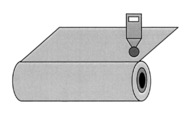
- a schematic diagram of the measurement sample is shown in FIG. The measurement was performed three times for one sample, and the average value was defined as the adhesive strength of the sample.
- a test piece of 150 mm in the winding direction at the time of film production and 40 mm in a direction perpendicular thereto is cut out, and the release surface of the test piece attached to the adhesive surface and the acrylic plate via a double-sided adhesive tape is used.
- a release surface using a rubber roll having a mass of 2000 g (with a spring hardness of 80 Hs on the roller surface and a width of 45 mm and a diameter (including the rubber layer) of 95 mm covered with a rubber layer having a thickness of 6 mm).
- the test piece was reciprocated once at a speed of 5 mm / second and pressed.
- a load of 60 kg was applied to a total area of 4000 mm 2 of 100 mm in the winding direction and 40 mm in the direction perpendicular to it, left in an environment of temperature 40 ° C. and relative humidity 65% for 24 hours, and then cooled to 23 ° C.
- the sample was peeled 180 degrees at a rate of 300 mm / min using “Autograph” (AGS-J) manufactured by Shimadzu Corporation.
- a polyester sheet having a thickness of 190 ⁇ m and a size of 40 mm ⁇ 170 mm is prepared as a grip allowance for the measurement sample, and is attached to the end of a test piece of 150 mm ⁇ 40 mm with a cellophane tape with a width of 15 mm of paste. It was the time to grab.
- the average resistance value when peeling from 40 mm to 60 mm out of the 100 mm crimping portion of the test piece was defined as the peel strength [cN / 40 mm] of the test piece. The measurement was carried out three times, and the average value was taken as the final peel force.
- Feeding sound from roll The feeding sound when a film roll having a film width of 550 mm and a winding length of 1000 m was fed 300 m at a speed of 20 m / min was measured.
- a sound level meter Lion Co., Ltd., NL-20 was used as the delivery sound, the microphone was pointed directly below, 100 mm directly above the film roll and film peeling point, and La value at a position 50 mm away from the end of the film roll. (A characteristic) was measured.
- Example 1 (Creation of base material layer) 100% by weight of a homopolypropylene resin (manufactured by Sumitomo Chemical Co., Ltd .: FLX80E4, 230 ° C. MFR: 7.5 g / 10 min) was melt-extruded at 240 ° C. with a 90 mm ⁇ single screw extruder to obtain a base material layer.
- (Creation of adhesive layer) Hydrogenated block copolymer of styrene polymer block and butadiene polymer block (Asahi Kasei Chemicals: Tuftec H1221, styrene component ratio 12% by weight, 230 ° C.
- the film width is 600 mm, and the film length.
- a three-kind three-layer unstretched film having a length of 1100 m was obtained. Further, the film was slit at a slitting speed of 50 m / min, a take-up tension of 40 N, and a rubber roll with a contact pressure of 50 N with respect to the film width to obtain an unstretched film having a film width of 550 mm and a film length of 1000 m.
- Example 2 The base material layer and the release layer were the same as in Example 1, but the adhesive layer was changed to the following content, and a three-kind three-layer unstretched film was obtained by the same production method as in Example 1.
- Hydrogenated block copolymer of styrene polymer block and butadiene polymer block (Asahi Kasei Chemicals: Tuftec H1221, styrene component ratio 12 wt%, 230 ° C.
- MFR 4.5 g / 10 min
- styrene Hydrogenated product of random copolymer of butadiene and butadiene manufactured by Asahi Kasei Chemicals: SOE L606, styrene component ratio 46% by weight, MFR: 2.9 g / 10 min
- petroleum resin manufactured by Arakawa Chemical: 10% by weight of Alcon P125
- Example 3 The base material layer and the release layer were the same as in Example 1, but the adhesive layer was changed to the following content, and a three-kind three-layer unstretched film was obtained by the same production method as in Example 1.
- Hydrogenated block copolymer of styrene polymer block and butadiene polymer block (Asahi Kasei Chemicals: Tuftec H1221, styrene component ratio 12% by weight, 230 ° C.
- MFR 4.5 g / 10 min
- styrene Hydrogenated product of random copolymer of butadiene and butadiene manufactured by Asahi Kasei Chemicals: SOE L606, styrene component ratio 46% by weight, MFR: 2.9 g / 10 min
- petroleum resin manufactured by Arakawa Chemical: Alcon P125
- ethylene- ⁇ -olefin copolymer (Sumitomo Chemical Co., Ltd .: CX3007, 190 ° C.
- MFR 3.7 g / 10 min) 5% were melt-extruded at 210 ° C. with a 40 mm ⁇ single screw extruder, and the adhesive layer It was.
- Example 4 The base material layer and the release layer were the same as in Example 1, but the adhesive layer was changed to the following content, and a three-kind three-layer unstretched film was obtained by the same production method as in Example 1.
- Hydrogenated block copolymer of styrene polymer block and butadiene polymer block (Asahi Kasei Chemicals: Tuftec H1221, styrene component ratio 12% by weight, 230 ° C.
- MFR 4.5 g / 10 min 20% by weight and styrene Hydrogenated product of random copolymer of butadiene and butadiene (manufactured by Asahi Kasei Chemicals: SOE L606, styrene component ratio 46% by weight, MFR: 2.9 g / 10 min) and petroleum resin (manufactured by Arakawa Chemical: Alcon P125) 10% by weight and ethylene- ⁇ -olefin copolymer (Sumitomo Chemical Co., Ltd .: CX3007, 190 ° C. MFR: 3.7 g / 10 min) 20% were melt extruded at 210 ° C. with a 40 mm ⁇ single screw extruder, and the adhesive layer It was.
- Example 1 The base material layer and the release layer were the same as in Example 1, but the adhesive layer was changed to the following content, and a three-kind three-layer unstretched film was obtained by the same production method as in Example 1.
- Hydrogenated block copolymer of styrene polymer block and butadiene polymer block (Asahi Kasei Chemicals: Tuftec H1221, styrene component ratio 12% by weight, 230 ° C.
- Example 2 The base material layer and the release layer were the same as in Example 1, but the adhesive layer was changed to the following content, and a three-kind three-layer unstretched film was obtained by the same production method as in Example 1.
- Hydrogenated block copolymer of styrene polymer block and butadiene polymer block (Asahi Kasei Chemicals: Tuftec H1221, styrene component ratio 12% by weight, 230 ° C.
- Example 4 The base material layer and the release layer were the same as in Example 1, but the adhesive layer was changed to the following content, and a three-kind three-layer unstretched film was obtained by the same production method as in Example 1.
- Hydrogenated block copolymer of styrene polymer block and butadiene polymer block (Asahi Kasei Chemicals: Tuftec H1221, styrene component ratio 12% by weight, 230 ° C.
- MFR 4.5 g / 10 min
- styrene Hydrogenated product of random copolymer of butadiene and butadiene manufactured by Asahi Kasei Chemicals: SOE L606, styrene component ratio 46% by weight, MFR: 2.9 g / 10 min
- petroleum resin manufactured by Arakawa Chemical: 10% by weight of Alcon P125
- the films obtained in Examples 1 to 4 have practically sufficient adhesive strength when used as a protective film, and also have good drawability when the film is fed as a roll. Met.
- the films obtained in Comparative Examples 1 and 2 and 4 had a large sound when the film was drawn out as a roll, and the drawing ability was not good.
- the film obtained in Comparative Example 3 could not be said to have sufficient adhesion to the covering.
- all the films obtained in the comparative examples were inferior in quality and low in practicality.
Landscapes
- Chemical & Material Sciences (AREA)
- Organic Chemistry (AREA)
- Chemical Kinetics & Catalysis (AREA)
- Laminated Bodies (AREA)
- Adhesives Or Adhesive Processes (AREA)
- Adhesive Tapes (AREA)
Abstract
L'invention concerne un film de protection de surface auto-adhésif caractérisé en ce qu'il est produit en stratifiant une couche adhésive sur une surface d'une couche de base comprenant une résine polypropylénique et en stratifiant également une couche de séparation sur la surface opposée de la couche de base par co-extrusion, la couche adhésive comprenant un élastomère styrène (A) qui est un produit hydrogéné d'un copolymère séquencé d'un bloc polymère styrène et d'un bloc polymère butadiène et a une teneur en styrène de 5 à 40 % en poids, et un élastomère styrène (B) qui est un produit hydrogéné d'un copolymère aléatoire de styrène et butadiène et a une teneur en styrène de 40 à 70 % en poids, le rapport du poids de l'élastomère styrène (A) sur le poids total des deux élastomères styrène est de 5 à 80 % en poids inclus, une résine conférant une adhésivité étant contenue à raison de 5 à 25 parties en poids par rapport à la somme totale, à savoir, 100 parties en poids, des deux élastomères styrène.
Priority Applications (1)
| Application Number | Priority Date | Filing Date | Title |
|---|---|---|---|
| JP2015511233A JP6323690B2 (ja) | 2013-04-11 | 2014-04-03 | 自己粘着性表面保護フィルム |
Applications Claiming Priority (2)
| Application Number | Priority Date | Filing Date | Title |
|---|---|---|---|
| JP2013082934 | 2013-04-11 | ||
| JP2013-082934 | 2013-04-11 |
Publications (1)
| Publication Number | Publication Date |
|---|---|
| WO2014168069A1 true WO2014168069A1 (fr) | 2014-10-16 |
Family
ID=51689479
Family Applications (1)
| Application Number | Title | Priority Date | Filing Date |
|---|---|---|---|
| PCT/JP2014/059821 Ceased WO2014168069A1 (fr) | 2013-04-11 | 2014-04-03 | Film de protection de surface auto-adhésif |
Country Status (3)
| Country | Link |
|---|---|
| JP (1) | JP6323690B2 (fr) |
| TW (1) | TWI621683B (fr) |
| WO (1) | WO2014168069A1 (fr) |
Cited By (5)
| Publication number | Priority date | Publication date | Assignee | Title |
|---|---|---|---|---|
| WO2015194059A1 (fr) * | 2014-06-18 | 2015-12-23 | 東洋紡株式会社 | Film de protection à surface autoadhésive |
| WO2016100763A1 (fr) | 2014-12-19 | 2016-06-23 | Tredegar Film Products Corporation | Film de protection de surface |
| JP2016164235A (ja) * | 2015-03-06 | 2016-09-08 | 積水化学工業株式会社 | 表面保護フィルム、及び、表面保護フィルム付きプリズムシート |
| WO2016194917A1 (fr) * | 2015-06-01 | 2016-12-08 | 富士フイルム株式会社 | Adhésif de fixation temporaire, film adhésif, corps de support d'adhésif, stratifié et kit |
| US11732161B2 (en) | 2018-12-18 | 2023-08-22 | Tredegar Surface Protection, Llc | Masking film for protecting sensitive substrates |
Citations (5)
| Publication number | Priority date | Publication date | Assignee | Title |
|---|---|---|---|---|
| JPH10176148A (ja) * | 1996-12-18 | 1998-06-30 | Sekisui Chem Co Ltd | 表面保護フィルム |
| JP2003064337A (ja) * | 2001-06-12 | 2003-03-05 | Kuraray Co Ltd | 粘着剤用組成物 |
| JP2008265307A (ja) * | 2007-03-22 | 2008-11-06 | Japan Polypropylene Corp | プロピレン系表面保護用フィルム |
| JP2012255071A (ja) * | 2011-06-08 | 2012-12-27 | Kuraray Co Ltd | 表面保護フィルム |
| JP2013234321A (ja) * | 2012-04-10 | 2013-11-21 | Toyobo Co Ltd | 自己粘着性表面保護フィルム |
Family Cites Families (3)
| Publication number | Priority date | Publication date | Assignee | Title |
|---|---|---|---|---|
| JP5288733B2 (ja) * | 2007-05-31 | 2013-09-11 | 出光ユニテック株式会社 | 表面保護フィルム |
| JPWO2010084832A1 (ja) * | 2009-01-21 | 2012-07-19 | Dic株式会社 | 表面保護フィルム |
| JP5987293B2 (ja) * | 2010-12-01 | 2016-09-07 | 東洋紡株式会社 | 粘着剤及び粘着フィルム |
-
2014
- 2014-04-03 WO PCT/JP2014/059821 patent/WO2014168069A1/fr not_active Ceased
- 2014-04-03 JP JP2015511233A patent/JP6323690B2/ja active Active
- 2014-04-10 TW TW103113252A patent/TWI621683B/zh not_active IP Right Cessation
Patent Citations (5)
| Publication number | Priority date | Publication date | Assignee | Title |
|---|---|---|---|---|
| JPH10176148A (ja) * | 1996-12-18 | 1998-06-30 | Sekisui Chem Co Ltd | 表面保護フィルム |
| JP2003064337A (ja) * | 2001-06-12 | 2003-03-05 | Kuraray Co Ltd | 粘着剤用組成物 |
| JP2008265307A (ja) * | 2007-03-22 | 2008-11-06 | Japan Polypropylene Corp | プロピレン系表面保護用フィルム |
| JP2012255071A (ja) * | 2011-06-08 | 2012-12-27 | Kuraray Co Ltd | 表面保護フィルム |
| JP2013234321A (ja) * | 2012-04-10 | 2013-11-21 | Toyobo Co Ltd | 自己粘着性表面保護フィルム |
Cited By (10)
| Publication number | Priority date | Publication date | Assignee | Title |
|---|---|---|---|---|
| WO2015194059A1 (fr) * | 2014-06-18 | 2015-12-23 | 東洋紡株式会社 | Film de protection à surface autoadhésive |
| JPWO2015194059A1 (ja) * | 2014-06-18 | 2017-04-20 | 東洋紡株式会社 | 自己粘着性表面保護フィルム |
| WO2016100763A1 (fr) | 2014-12-19 | 2016-06-23 | Tredegar Film Products Corporation | Film de protection de surface |
| KR20170097130A (ko) * | 2014-12-19 | 2017-08-25 | 트레데가르 필름 프로덕츠 코포레이션 | 표면 보호 필름 |
| US10150896B2 (en) | 2014-12-19 | 2018-12-11 | Tredegar Film Products Corporation | Surface protection film |
| KR102434242B1 (ko) * | 2014-12-19 | 2022-08-18 | 트레데가르 서피스 프로텍션, 엘엘씨 | 표면 보호 필름 |
| JP2016164235A (ja) * | 2015-03-06 | 2016-09-08 | 積水化学工業株式会社 | 表面保護フィルム、及び、表面保護フィルム付きプリズムシート |
| WO2016194917A1 (fr) * | 2015-06-01 | 2016-12-08 | 富士フイルム株式会社 | Adhésif de fixation temporaire, film adhésif, corps de support d'adhésif, stratifié et kit |
| JPWO2016194917A1 (ja) * | 2015-06-01 | 2018-04-26 | 富士フイルム株式会社 | 仮止め接着剤、接着フィルム、接着性支持体、積層体およびキット |
| US11732161B2 (en) | 2018-12-18 | 2023-08-22 | Tredegar Surface Protection, Llc | Masking film for protecting sensitive substrates |
Also Published As
| Publication number | Publication date |
|---|---|
| TW201443194A (zh) | 2014-11-16 |
| JP6323690B2 (ja) | 2018-05-16 |
| TWI621683B (zh) | 2018-04-21 |
| JPWO2014168069A1 (ja) | 2017-02-16 |
Similar Documents
| Publication | Publication Date | Title |
|---|---|---|
| JP6569723B2 (ja) | 自己粘着性表面保護フィルム | |
| JP6015352B2 (ja) | ポリオレフィン系フィルム | |
| KR101867113B1 (ko) | 점착성 수지 조성물 및 점착 필름 | |
| JP6056378B2 (ja) | ポリオレフィン系フィルム | |
| JP6506556B2 (ja) | 自己粘着性表面保護フィルム | |
| JP6323690B2 (ja) | 自己粘着性表面保護フィルム | |
| JP6508383B2 (ja) | 自己粘着性表面保護フィルム | |
| JP6515917B2 (ja) | 自己粘着性表面保護フィルム | |
| JP2016196650A (ja) | 粘着剤及び粘着フィルム |
Legal Events
| Date | Code | Title | Description |
|---|---|---|---|
| 121 | Ep: the epo has been informed by wipo that ep was designated in this application |
Ref document number: 14783030 Country of ref document: EP Kind code of ref document: A1 |
|
| ENP | Entry into the national phase |
Ref document number: 2015511233 Country of ref document: JP Kind code of ref document: A |
|
| NENP | Non-entry into the national phase |
Ref country code: DE |
|
| 122 | Ep: pct application non-entry in european phase |
Ref document number: 14783030 Country of ref document: EP Kind code of ref document: A1 |