WO2014175042A1 - ポリアセタール共重合体の製造方法 - Google Patents
ポリアセタール共重合体の製造方法 Download PDFInfo
- Publication number
- WO2014175042A1 WO2014175042A1 PCT/JP2014/059957 JP2014059957W WO2014175042A1 WO 2014175042 A1 WO2014175042 A1 WO 2014175042A1 JP 2014059957 W JP2014059957 W JP 2014059957W WO 2014175042 A1 WO2014175042 A1 WO 2014175042A1
- Authority
- WO
- WIPO (PCT)
- Prior art keywords
- acid
- polyacetal copolymer
- polymerization
- monomer
- reaction
- Prior art date
- Legal status (The legal status is an assumption and is not a legal conclusion. Google has not performed a legal analysis and makes no representation as to the accuracy of the status listed.)
- Ceased
Links
Images
Classifications
-
- C—CHEMISTRY; METALLURGY
- C08—ORGANIC MACROMOLECULAR COMPOUNDS; THEIR PREPARATION OR CHEMICAL WORKING-UP; COMPOSITIONS BASED THEREON
- C08G—MACROMOLECULAR COMPOUNDS OBTAINED OTHERWISE THAN BY REACTIONS ONLY INVOLVING UNSATURATED CARBON-TO-CARBON BONDS
- C08G2/00—Addition polymers of aldehydes or cyclic oligomers thereof or of ketones; Addition copolymers thereof with less than 50 molar percent of other substances
- C08G2/12—Polymerisation of acetaldehyde or cyclic oligomers thereof
-
- C—CHEMISTRY; METALLURGY
- C08—ORGANIC MACROMOLECULAR COMPOUNDS; THEIR PREPARATION OR CHEMICAL WORKING-UP; COMPOSITIONS BASED THEREON
- C08G—MACROMOLECULAR COMPOUNDS OBTAINED OTHERWISE THAN BY REACTIONS ONLY INVOLVING UNSATURATED CARBON-TO-CARBON BONDS
- C08G2/00—Addition polymers of aldehydes or cyclic oligomers thereof or of ketones; Addition copolymers thereof with less than 50 molar percent of other substances
- C08G2/10—Polymerisation of cyclic oligomers of formaldehyde
-
- C—CHEMISTRY; METALLURGY
- C08—ORGANIC MACROMOLECULAR COMPOUNDS; THEIR PREPARATION OR CHEMICAL WORKING-UP; COMPOSITIONS BASED THEREON
- C08G—MACROMOLECULAR COMPOUNDS OBTAINED OTHERWISE THAN BY REACTIONS ONLY INVOLVING UNSATURATED CARBON-TO-CARBON BONDS
- C08G2/00—Addition polymers of aldehydes or cyclic oligomers thereof or of ketones; Addition copolymers thereof with less than 50 molar percent of other substances
- C08G2/06—Catalysts
-
- C—CHEMISTRY; METALLURGY
- C08—ORGANIC MACROMOLECULAR COMPOUNDS; THEIR PREPARATION OR CHEMICAL WORKING-UP; COMPOSITIONS BASED THEREON
- C08G—MACROMOLECULAR COMPOUNDS OBTAINED OTHERWISE THAN BY REACTIONS ONLY INVOLVING UNSATURATED CARBON-TO-CARBON BONDS
- C08G2/00—Addition polymers of aldehydes or cyclic oligomers thereof or of ketones; Addition copolymers thereof with less than 50 molar percent of other substances
- C08G2/18—Copolymerisation of aldehydes or ketones
- C08G2/22—Copolymerisation of aldehydes or ketones with epoxy compounds
-
- C—CHEMISTRY; METALLURGY
- C08—ORGANIC MACROMOLECULAR COMPOUNDS; THEIR PREPARATION OR CHEMICAL WORKING-UP; COMPOSITIONS BASED THEREON
- C08G—MACROMOLECULAR COMPOUNDS OBTAINED OTHERWISE THAN BY REACTIONS ONLY INVOLVING UNSATURATED CARBON-TO-CARBON BONDS
- C08G4/00—Condensation polymers of aldehydes or ketones with polyalcohols; Addition polymers of heterocyclic oxygen compounds containing in the ring at least once the grouping —O—C—O—
-
- C—CHEMISTRY; METALLURGY
- C08—ORGANIC MACROMOLECULAR COMPOUNDS; THEIR PREPARATION OR CHEMICAL WORKING-UP; COMPOSITIONS BASED THEREON
- C08L—COMPOSITIONS OF MACROMOLECULAR COMPOUNDS
- C08L59/00—Compositions of polyacetals; Compositions of derivatives of polyacetals
- C08L59/04—Copolyoxymethylenes
Definitions
- the present invention relates to a method for producing a polyacetal copolymer.
- Cationic active catalysts used in these copolymers include Lewis acids, especially boron, tin, titanium, phosphorus, arsenic and antimony halides such as boron trifluoride, tin tetrachloride, titanium tetrachloride, phosphorus pentachloride, pentachloride.
- protic acids such as perchloric acid
- esters of protic acids especially esters of perchloric acid and lower aliphatic alcohols
- perchloric acid-tertiary butyl ester anhydrides of protonic acids, especially mixed anhydrides of perchloric acid and lower aliphatic carboxylic acids, such as acetyl perchlorate, or also trimethyloxonium hexafluorophosphate, triphenyl- Methyl hexafluoroarsenate, acetyl tetrafluoroborate, acetyl Kisa fluor phosphate and acetyl hexafluoroacetylacetone ARUZE diisocyanate and the like have been proposed.
- polymerization catalysts such as boron trifluoride compounds have a rapid decrease in the polymerization rate in the late stage of polymerization, and it is extremely difficult to obtain a polymerization conversion rate close to 100% in a short time.
- the catalyst promotes the decomposition of the produced polymer, which is relatively dominant, not only lowering the molecular weight but also lowering the quality such as thermal stability. Result.
- the amount of the polymerization catalyst is increased, the polymerization rate is accelerated as a whole, and the polymerization conversion rate is also improved.
- the quality of the produced crude polymer is further deteriorated, and a complicated stabilization process is required in the subsequent process. Overall it is by no means a preferred method.
- a method is widely used in which a solution containing a catalyst deactivator is added at a stage where the polymerization conversion rate is relatively low to stop the polymerization, and the remaining unreacted monomer is washed, recovered, purified, and reused. ing.
- Patent Document 1 a technique for improving the polymerization conversion rate per apparatus by tilting the polymerization machine by 1 to 10 °
- Patent Document 2 a technique for providing a weir at the outlet of the polymerization machine
- Patent Documents 3 and 4 All of these techniques are effective in improving the polymerization conversion rate when a boron trifluoride-based polymerization catalyst is used.
- Patent Document 5 a method (Patent Document 5) is proposed in which a highly active and non-volatile polymerization catalyst is used to recover unreacted monomers directly without deactivation or washing of the crude polymer in the late stage of polymerization and reuse it. Yes.
- This method can recover monomers directly from the crude polymer before deactivation, which has been difficult with the boron trifluoride system that has been generally used in the past, and at the stage of reaching a high conversion rate. Since this side reaction is less likely to occur compared to a boron trifluoride-based polymerization catalyst, a crude polymer having few unreacted monomers and excellent thermal stability can be obtained by a very simple process.
- the obtained crude polymer contains 10% by weight or more of unreacted monomers, and in practical use, it is necessary to go through deactivation and washing steps, and in addition, In the boron fluoride-based polymerization catalyst, there still remains a problem that side reactions such as decomposition at the stage where the high conversion rate is reached cannot be avoided.
- Patent Document 5 has room for improvement in terms of improving the quality and reducing the cost of the polyacetal copolymer.
- an object of the present invention is to economically produce a high-quality polyacetal copolymer by a simple process.
- the present inventors have made extensive studies on the polymerization reaction of trioxane.
- a non-volatile protonic acid is used as a polymerization catalyst
- the rotation axis of the reaction apparatus is set to the reaction apparatus.
- the raw material polymerization reaction is performed in a state of being inclined 1 to 6 ° upward from the horizontal direction from the inlet to the outlet, so that it is significantly higher than when a conventional boron trifluoride-based polymerization catalyst is used.
- the inventors found that a high conversion ratio and a high-quality polyacetal copolymer can be obtained, and the present invention has been completed.
- the present invention provides the following.
- the present invention includes two parallel shafts rotating in the same direction or in different directions, a number of paddles mounted on each shaft, and a barrel close to the outer periphery of the paddle,
- the major axis end of the paddle is configured to be close to the other minor axis end
- the raw material is charged from the inlet provided at one end in the axial direction, and the reaction mixture and the plurality of outlets provided at the other end
- a polymerization reaction step for obtaining a reaction mixture by performing a polymerization reaction of the raw material in a state inclined at an angle of 1 to 6 ° with respect to the horizontal direction from the inlet to the outlet, and evaporating and separating unreacted monomers from the reaction mixture.
- a monomer A newly supplied to the reaction apparatus comprising: an unreacted monomer resupply step for supplying to the raw material supply step; and a polyacetal copolymer recovery step for recovering a polyacetal copolymer from the reaction mixture;
- the weight ratio D / C of the polyacetal copolymer D to the total supply monomer C defined by the sum of the monomer B recovered and resupplied from the reactor is 0.7 or more, and is newly supplied to the reactor It is a manufacturing method of the polyacetal copolymer whose weight ratio D / A of the said polyacetal copolymer D with respect to the monomer A made is 0.85 or more.
- the content of unreacted monomers contained in the polyacetal copolymer is 1.0% by weight or less, and the polyacetal copolymer has a particle size of 11.2 mm or less.
- L / d defined by a ratio of a length L of the reaction device to a radial length D of the rotation shaft of the reaction device to a length L of the rotation shaft is 5 or more and 20 or less.
- the present invention provides the polyacetal copolymer according to any one of (1) to (3), wherein the nonvolatile protonic acid includes at least one selected from a heteropolyacid, an isopolyacid, or an acid salt thereof. It is a manufacturing method of a polymer.
- the present invention provides the polyacetal copolymer according to any one of (1) to (3), wherein the nonvolatile protonic acid includes a heteropolyacid represented by the following general formula (1) or an acid salt thereof: It is a manufacturing method of coalescence.
- H x [M m ⁇ M ' n O l] ⁇ yH 2 O ⁇
- M represents a central element selected from P and / or Si
- M ′ represents one or more coordination elements selected from W, Mo, and V.
- l is 10 to 100
- m is 1 to 10
- n 6 to 40
- x is 1 or more
- y is 0 to 50.
- the heteropolyacid or an acid salt thereof is selected from the group consisting of phosphomolybdic acid, phosphotungstic acid, phosphomolybdotungstic acid, phosphomolybdovanadic acid, phosphomolybdotungstovanadic acid, lintongtovanadic acid,
- the method for producing a polyacetal copolymer according to (5) including at least one compound selected from silicotungstic acid, silicomolybdic acid, silicoribed tungstic acid, silicoribed tungstovanadic acid, or acidic salts thereof. is there.
- this invention is described in any one of (1) to (3) in which the said non-volatile protonic acid contains the isopolyacid shown by following General formula (2) or (3), or its acidic salt.
- This is a method for producing a polyacetal copolymer.
- M I is hydrogen, it may be partially substituted with a metal.
- MV represents one or more elements selected from V, Nb, and Ta of Group V of the periodic table.
- M VI represents one or more elements selected from Cr, Mo, W, and U of the VI group of the periodic table.
- p and x are 1 or more, and y is 0 to 50. ]
- the isopolyacid or an acid salt thereof is a small amount selected from paratungstic acid, metatungstic acid, paramolybdic acid, metamolybdic acid, paravanadate acid, metavanadate acid or an acid salt thereof. It is a manufacturing method of the polyacetal copolymer as described in (7) containing a kind of compound.
- the comonomer includes at least one selected from 1,3-dioxolane, diethylene glycol formal, 1,4-butanediol formal, and ethylene oxide. It is a manufacturing method of the polyacetal copolymer of description.
- a high-quality polyacetal copolymer can be economically produced by a simple process.
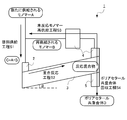
- FIG. 1 is a schematic diagram for explaining a reaction apparatus 1.
- FIG. 1 is a schematic diagram for explaining a reaction apparatus 1.
- the production method of the present invention includes (S1) a raw material supply step, (S2) a polymerization reaction step, (S3) an unreacted monomer resupply step, and (S4) a polyacetal copolymer recovery step.
- FIG. 1 is a schematic diagram for explaining the reaction apparatus 1.
- the reaction apparatus 1 includes an inlet 2 for introducing raw materials, a mixing portion 3 for performing a polymerization reaction of the raw materials to obtain a reaction mixture, a vaporization separation portion 4 for vaporizing and separating unreacted monomers from the reaction mixture, and a reaction mixture.
- a polyacetal copolymer recovery unit 5 that recovers the polyacetal copolymer.
- the mixing unit 3 includes two parallel shafts rotating in the same direction or in different directions, a number of paddles mounted on each shaft, and a barrel close to the outer periphery of the paddle, and periodically
- the long axis end of the paddle is configured so as to be close to the other short axis end, the raw material is charged from the inlet provided at one end in the axial direction, and the reaction mixture and unreacted from the plurality of outlets provided at the other end It is a continuous stirring mixer for obtaining monomers.
- the outlet side is lifted, and the rotation axis is 1 to 6 ° with respect to the horizontal direction H from the inlet (inlet 2) of the reactor 1 to the outlet (polyacetal copolymer recovery unit 5).
- the inclination angle ( ⁇ ) is less than 1 °, the residence time of the raw material in the reaction apparatus 1 is too short, which is not preferable because a sufficient polymerization conversion rate may not be obtained. If the tilt angle is less than 1 °, the recovered polyacetal copolymer has a large particle size, resulting in an excessive amount of residual monomer in the copolymer, resulting in poor economic efficiency and quality. If the inclination angle exceeds 6 °, a considerable burden is imposed on the mechanism portion that supports the rotating shaft and gives the rotational power, which is not preferable because it may hinder long-time operation.
- the mixing unit 3 has a temperature adjusting jacket, and can adjust the temperature by flowing a liquid or gas.
- a plurality of jackets may be provided in the axial direction, each of which can be adjusted in temperature.
- the size of the reaction apparatus 1 is not particularly limited, but the inner diameter d of the rotation axis of the reaction apparatus 1 with respect to the length L in the rotation axis direction of the reaction apparatus 1 is the radial direction (direction perpendicular to the rotation axis).
- L / D defined by the ratio is preferably 5 or more and 20 or less. If L / d is less than 5, a sufficient polymerization conversion rate may not be obtained. If L / d is more than 20, clearance fluctuation and bias are likely to occur due to the deflection of the rotating shaft, and work accuracy and operational stability can be improved. It is not preferable from the point.
- the clearance between the tip of the paddle and the inner surface of the barrel is preferably 2% or less, more preferably 1% or less of the diameter of the circumscribed circle of the paddle.
- the rotational speed of the paddle is not particularly limited, but the rotational peripheral speed at the tip of the paddle is preferably 1.5 m / second or less.
- rotation directions of the two rotation shafts may be the same or different from each other.
- the raw material supply step is a step of supplying a raw material containing trioxane, a comonomer copolymerized with the trioxane, and a non-volatile protonic acid to the reaction apparatus 1 described above.
- the raw material supply step is a step of supplying a raw material containing trioxane, a comonomer copolymerized with the trioxane, and a non-volatile protonic acid to the reaction apparatus 1 described above.
- FIG. 1 it is described that a mixture of all raw materials is input to the input port 2, but this is not a limitation, and all the raw materials are finally input. It is enough if it is put into the mouth 2.
- comonomer a compound selected from cyclic ether and cyclic formal having at least one carbon-carbon bond is used.
- Typical examples of the compound used as a comonomer include 1,3-dioxolane, diethylene glycol formal, 1,4-butanediol formal, 1,3-dioxane, ethylene oxide, propylene oxide, epichlorohydrin and the like.
- 1,3-dioxolane, diethylene glycol formal, 1,4-butanediol formal, 1,3-dioxane, ethylene oxide and the like are preferable in view of polymerization stability.
- cyclic esters such as ⁇ -propiolactone and vinyl compounds such as styrene can be used.
- a monofunctional cyclic ether having a substituent unit such as butyl glycidyl ether or 2-ethylhexyl glycidyl ether or cyclic formal can be used.
- a compound having two polymerizable cyclic ether groups or cyclic formal groups such as diglycidyl ether or diformal of alkylene glycol, for example, butanediol dimethylidene glyceryl ether, butanediol diglycidyl ether,
- a compound having three or more polymerizable cyclic ether groups or cyclic formal groups such as glycidyl ether, trimethylolpropane triglycidyl ether, and pentaerythritol tetraglycidyl ether can also be used.
- a polyacetal copolymer in which a branched structure or a crosslinked structure is thereby formed is also an object of the present invention.
- the amount of the compound selected from cyclic ether and cyclic formal used as a comonomer is 0.1 to 20 mol% as a ratio in the total monomer (total amount of trioxane and comonomer as main monomers), preferably 0.2 to 10 mol%. If it is less than 0.1 mol%, the unstable terminal part of the crude polyacetal copolymer produced by the polymerization will increase and the stability will deteriorate, and if the amount of comonomer is excessive, the produced copolymer will become soft and the melting point will decrease. It is not desirable to occur.
- a known chain transfer agent for example, a low molecular weight linear acetal such as methylal is added to adjust the degree of polymerization. Is also possible.
- the polymerization reaction is preferably carried out in a state in which impurities having active hydrogen, for example, water, methanol, formic acid and the like are substantially absent, for example, in a state where each of them is 10 ppm or less. It is desirable to use trioxane, cyclic ether and / or cyclic formal prepared so as not to contain as much as possible as the main monomer or comonomer.
- Non-volatile protonic acid functions as a polymerization catalyst.
- a non-volatile protonic acid is used as a polymerization catalyst instead of a boron trifluoride-based catalyst, the polymerization conversion rate can be increased compared to the case where a boron trifluoride-based catalyst is used as a polymerization catalyst. .
- non-volatile protonic acid examples include compounds containing at least one selected from heteropolyacids, isopolyacids, or acidic salts thereof.
- Heteropolyacid is a polyacid produced by dehydration condensation of dissimilar oxygen acids, and a mononuclear or dinuclear nucleus formed by condensation of condensed acid groups sharing a oxygen atom with a specific dissimilar element at the center. Has complex ions.
- the isopolyacid is also referred to as an isopolyacid, a homonuclear condensed acid, or a homopolyacid, and refers to a high molecular weight inorganic oxygen acid comprising a condensate of inorganic oxygen acids having a single V-valent or VI-valent metal. .
- heteropolyacid or its acid salt [Heteropoly acid or its acid salt] First, the heteropolyacid or its acid salt will be described in detail.
- the heteropolyacid or its acid salt can be represented by the general formula (1).
- the heteropolyacid particularly effective as the polymerization catalyst of the present invention is at least one element selected from P and / or Si as the central element M in the above composition formula, and the coordination element M ′ is W, Mo, V This is a case of one or more elements selected from the above. From the viewpoint of polymerization activity, the coordination element M ′ is more preferably W or Mo.
- l is 10 to 100
- m is 1 to 10
- n is 6 to 40
- x is 1 or more
- y is 0 to 50.
- the acidic salts H x in the general formula (1) is substituted by a variety of metals it can also be used as catalysts of the present invention.
- heteropolyacids include phosphomolybdic acid, phosphotungstic acid, phosphomolybdotungstic acid, phosphomolybdovanadic acid, phosphomolybdotungstovanadic acid, phosphotungstovanadic acid, silicotungstic acid, silicomolybdic acid, and cimomolybdo Examples include tungstic acid and silicoribed tungsten tovanadate.
- the heteropolyacid is preferably selected from silicomolybdic acid, silicotungstic acid, phosphomolybdic acid, and phosphotungstic acid.
- the isopolyacid or its acid salt can be represented by the general formula (2) or the general formula (3). xM I 2 O ⁇ pM V 2 O 6 ⁇ yH 2 O (2) xM I 2 O ⁇ pM VI 2 O 6 ⁇ yH 2 O (3)
- M I is hydrogen, but a part thereof may be substituted with a metal.
- MV represents one or more elements selected from V, Nb, and Ta of Group V of the periodic table.
- M VI represents one or more elements selected from Cr, Mo, W, and U of the VI group of the periodic table.
- p and x are 1 or more, and y is 0 to 50.
- the isopolyacid is prepared by various methods such as a method of treating an isopolyacid salt solution with an ion exchange resin and a method of adding a mineral acid to a concentrated solution of an isopolyacid salt and extracting it with ether.
- a method of treating an isopolyacid salt solution with an ion exchange resin and a method of adding a mineral acid to a concentrated solution of an isopolyacid salt and extracting it with ether.
- an isopolyacid salt may be any of the above general formulas (2) and (3), but is preferably an isopolyacid of the general formula (3) or an acid salt thereof from the viewpoint of polymerization activity.
- isopolyacids include isopolytungstic acid exemplified by paratungstic acid, metatungstic acid, etc., isopolymolybdic acid exemplified by paramolybdic acid, metamolybdic acid, etc., metapolyvanadate, isopoly Examples thereof include vanadium acid. Of these, isopolytungstic acid is preferable from the viewpoint of polymerization activity.
- the non-volatile protonic acid is preferably diluted with an inert solvent that does not adversely affect the polymerization and added to trioxane and / or a comonomer.
- inert solvents examples include low molecular weight carboxylic acids having 1 to 10 carbon atoms such as formic acid, acetic acid, propionic acid, butyric acid, methanol, ethanol, 1-propanol, 2-propanol, 1-butanol, 2-butanol, 2- Esters obtained by condensation of low molecular weight alcohols having 1 to 10 carbon atoms such as methyl-1-propanol, 2-methyl-2-propanol, 1-pentanol, 3-methyl-1-butanol and 1-hexanol
- Preferred examples include low molecular weight ketones having 1 to 10 carbon atoms such as acetone, 2-butanone, 2-pentanone, 3-pentanone, 2-hexanone, 3-hexanone, methyl isobutyl ketone, and methyl-t-butyl ketone.
- the polymerization catalyst is preferably dissolved in the above inert solvent at a concentration of 1 to 30% by weight / weight, but is not limited thereto.
- a predetermined amount of a non-volatile protonic acid is mixed in advance with a part or all of one or more of trioxane, comonomer, molecular weight regulator, etc., and this solution is added to the polymerization system for polymerization.
- a method is also preferred.
- the polymerization method is not particularly limited, but for example, the method described in JP-A-11-302349 is suitable.
- this method trioxane, a comonomer, and a non-volatile protonic acid are sufficiently mixed in advance while maintaining a liquid phase state, and the resultant reaction raw material mixture is supplied to the polymerization apparatus 1 to perform a copolymerization reaction.
- the amount of non-volatile protonic acid as a catalyst can be suppressed, and as a result, it is advantageous to obtain a polyacetal copolymer with a smaller amount of formaldehyde emission.
- the polymerization temperature is not particularly limited, but is preferably performed at 60 to 115 ° C, more preferably at 65 to 110 ° C.
- the temperature is lower than 60 ° C., the monomer may be precipitated, and when the temperature exceeds 115 ° C., the monomer boils and the ratio of the polymer in the reaction mixture finally obtained may decrease.
- the unreacted monomer refeeding step is a step of vaporizing and separating unreacted monomers from the reaction mixture and supplying them to the reaction apparatus 1 again.
- the method of vaporization separation is not particularly limited, but the activity of the non-volatile protonic acid that is a polymerization catalyst is very high, a high conversion rate can be obtained in a short time, and further from the viewpoint of process simplicity,
- the vaporization / separation unit 4 it is preferable to perform vaporization and separation of the unreacted monomer by providing a mechanism for reducing pressure, suction, or an inert gas flow.
- polymerization is performed to a predetermined polymerization rate in the former polymerization apparatus using two or more polymerization apparatuses, and then transferred to the subsequent apparatus to continue the polymerization reaction and simultaneously remove unreacted monomers.
- the unreacted monomers are removed without going through steps such as catalyst deactivation or washing.
- the polyacetal copolymer recovery step is a step of recovering the polyacetal copolymer from the reaction mixture.
- the recovered polyacetal copolymer preferably contains 90% by weight or more of particles having a particle size of 11.2 mm or less. This is because if the particle diameter exceeds 11.2 mm, the amount of residual monomer in the recovered polyacetal copolymer may become excessive. In the present specification, unless otherwise specified, the particle diameter is based on the mesh opening of the sieve through which the copolymer has passed.
- the recovered polyacetal copolymer is added with a solid basic compound as it is without washing or the like as disclosed in Japanese Patent Application Laid-Open No. 2003-26746, that is, the polyacetal copolymer is melted.
- deactivation of the polymerization catalyst (nonvolatile protonic acid) contained in the polyacetal copolymer can be completed.
- the weight ratio D / A of the polyacetal copolymer D with respect to the monomer A newly supplied to the reaction apparatus 1 will be 0.85 or more.
- Table 1 Abbreviations in Table 1 are as follows.
- DOXO 1,3-dioxolane
- DOXP 1,3-dioxepane
- HPA phosphomolybdic acid (nonvolatile protonic acid)
- IPA Paratungstic acid (nonvolatile protonic acid)
- BF 3 Boron trifluoride (dibutyl ether complex) (a conventionally known polymerization catalyst)
- the unreacted monomer is vaporized from the vaporization separation unit 4 and separated and removed from the reaction system, guided to an aggregator (not shown), collected, and introduced into the reaction apparatus 1 from the inlet 2 together with the newly supplied monomer. While supplying again, the polyacetal copolymer was recovered from the polyacetal copolymer recovery section 5.
- the evaluation of the polymerization conversion rate of the raw material is based on two types: the weight ratio (%) of the recovered polyacetal copolymer to the total supply monomer and the weight ratio (%) of the recovered polyacetal copolymer to the monomer contained in the raw material. This was done by measuring. First, the weight A of the monomer contained in the raw material and the weight C of all the supplied monomers were measured. Subsequently, the obtained product after the polymerization reaction was washed with a quencher solution (triethylamine 2 wt% aqueous solution) and then dried to measure the weight D of the polymer. And D / Cx100 and D / Ax100 were calculated. The results are shown in Table 2.
- the residual monomer content was determined by washing the recovered polyacetal copolymer with a 2 wt% triethylamine aqueous solution, and determining the monomer content in the washing liquid by gas chromatography.
- Table 2 shows the weight percent of the monomer content with respect to the recovered polyacetal copolymer content.
- Example 2 or 5 is compared with Comparative Example 3 and Example 4 or 6 is compared with Comparative Example 4, the weight ratio D / C can be greatly improved by using a non-volatile protonic acid as a catalyst for the polymerization reaction. confirmed.
- the boron trifluoride-based polymerization catalyst is volatile, so that the polymerization catalyst that has volatilized together with the recovered monomer causes a polymerization reaction, a large amount of polymer is generated, and the monomer recovery path is blocked.
- a polyacetal copolymer suitable for the subsequent steps can be obtained in a simple and energy-efficient step as compared with the conventional method.
Landscapes
- Chemical & Material Sciences (AREA)
- Health & Medical Sciences (AREA)
- Chemical Kinetics & Catalysis (AREA)
- Medicinal Chemistry (AREA)
- Polymers & Plastics (AREA)
- Organic Chemistry (AREA)
- Polyoxymethylene Polymers And Polymers With Carbon-To-Carbon Bonds (AREA)
Abstract
Description
Hx[Mm・M’nOl]・yH2O ・・・(1)
〔一般式(1)において、MはP及び/又はSiから選ばれる中心元素を示し、M’はW、Mo、Vより選ばれる一種以上の配位元素を示す。lは10~100であり、mは1~10であり、nは6~40であり、xは1以上であり、yは0~50である。〕
xMI 2O・pMV 2O6・yH2O ・・・(2)
xMI 2O・pMVI 2O6・yH2O ・・・(3)
〔一般式(2)及び(3)において、MIは水素であるが、一部が金属で置換されていてもよい。MVは周期律表V族のV、Nb、Taより選ばれる一種以上の元素を示す。MVIは周期律表VI族のCr、Mo、W、Uより選ばれる一種以上の元素を示す。p及びxは1以上であり、yは0~50である。〕
工程(S1)~(S4)を説明するにあたり、まずは、図1を参照しながら反応装置1の概略構成について説明する。図1は、反応装置1を説明するための概略図である。反応装置1は、原料を投入する投入口2と、この原料の重合反応を行い、反応混合物を得る混合部3と、反応混合物から未反応モノマーを気化分離する気化分離部4と、反応混合物からポリアセタール共重合体を回収するポリアセタール共重合体回収部5とを備える。
続いて、(S1)原料供給工程について説明する。原料供給工程は、上記の反応装置1に、トリオキサン、このトリオキサンと共重合するコモノマー、及び不揮発性のプロトン酸を含む原料を供給する工程である。なお、理解を容易にするため、図1では、全ての原料の混合物が投入口2に投入されるように記載されているが、この態様に限るものでなく、最終的に全ての原料が投入口2に投入されれば足りる。
コモノマーとしては、少なくとも一つの炭素-炭素結合を有する環状エーテル及び環状ホルマールから選ばれる化合物が使用される。コモノマーとして使用する化合物の代表的な例としては、例えば、1,3-ジオキソラン、ジエチレングリコールホルマール、1,4-ブタンジオールホルマール、1,3-ジオキサン、エチレンオキシド、プロピレンオキシド、エピクロルヒドリン等が挙げられる。中でも、重合の安定性から考慮して、1,3-ジオキソラン、ジエチレングリコールホルマール、1,4-ブタンジオールホルマール、1,3-ジオキサン、エチレンオキシド等が好ましい。更に、環状エステル、例えばβ-プロピオラクトンや、ビニル化合物、例えばスチレン等も使用できる。また、コモノマーとして、ブチルグリシジルエーテル、2-エチルヘキシルグリシジルエーテルの如き、置換基単位を有する単官能の環状エーテルや環状ホルマールを用いることも可能である。さらに、コモノマーとして、アルキレングリコールのジグリシジルエーテルやジホルマールの如き2個の重合性環状エーテル基又は環状ホルマール基を有する化合物、例えば、ブタンジオールジメチリデングリセリルエーテル、ブタンジオールジグリシジルエーテル等や、グリセリントリグリシジルエーテル、トリメチロールプロパントリグリシジルエーテル、ペンタエリスリトールテトラグリシジルエーテル等の如き3個以上の重合性環状エーテル基又は環状ホルマール基を有する化合物を用いることもできる。これによって分岐構造や架橋構造が形成されたポリアセタール共重合体も本発明の対象である。
本発明において、不揮発性のプロトン酸は重合触媒として機能する。本発明では、三フッ化ホウ素系触媒でなく、不揮発性のプロトン酸を重合触媒として用いているため、三フッ化ホウ素系触媒を重合触媒とした場合に比べ、重合転化率を高めることができる。
まず、ヘテロポリ酸又はその酸性塩について詳しく説明する。ヘテロポリ酸又はその酸性塩は、一般式(1)で表すことができる。
Hx[Mm・M’nOl]・yH2O ・・・(1)
続いて、イソポリ酸又はその酸性塩について詳しく説明する。イソポリ酸又はその酸性塩は、一般式(2)又は一般式(3)で表すことができる。
xMI 2O・pMV 2O6・yH2O ・・・(2)
xMI 2O・pMVI 2O6・yH2O ・・・(3)
重合反応を均一に行うため、不揮発性のプロトン酸は、重合に悪影響のない不活性な溶剤で希釈して、トリオキサン及び/又はコモノマーに添加して使用することが好ましい。不活性な溶媒として、ギ酸、酢酸、プロピオン酸、酪酸等の炭素数1~10の低分子量カルボン酸と、メタノール、エタノール、1-プロバノール、2-プロパノール、1-ブタノール、2-ブタノール、2-メチル-1-プロパノール、2-メチル-2-プロパノール、1-ペンタノール、3-メチル-1-ブタノール、1-へキサノール等の炭素数1~10の低分子量のアルコールが縮合して得られるエステル;アセトン、2-ブタノン、2-ペンタノン、3-ペンタノン、2-ヘキサノン、3-へキサノン、メチルイソブチルケトン、メチル-t-ブチルケトン等の炭素数1~10の低分子量のケトン類が好ましく挙げられるが、これらに限定されるものではない。工業的な入手しやすさ等も勘案すると、ギ酸メチル、ギ酸エチル、酢酸メチル、酢酸エチル、酢酸ブチル、アセトン、2-ブタノン、メチルイソブチルケトン等が最も好適である。重合触媒は、上記不活性溶媒に、好適には濃度1~30重量/重量%で溶解されるが、これに限定されるものではない。また、トリオキサン、コモノマー、分子量調節剤等のいずれか一種又は複数種の一部量又は全量に、不揮発性のプロトン酸の所定量を予め混合し、この溶液を重合系に添加して重合を行う方法も好ましい。
続いて、(S2)重合反応工程について説明する。(S2)重合反応工程は、回転軸を、反応装置1の入口(投入口2)から出口(ポリアセタール共重合体回収部5)に向けて水平方向Hに対して1~6°上方に傾斜させた状態で原料の重合反応を行い、反応混合物を得る工程である。
この傾斜を有する重合反応工程において、上述のヘテロポリ酸のような不揮発性のプロトン酸が従来のBF3触媒と比較し、反応装置での高い重合率を与えることを見出したのである。
(S3)未反応モノマー再供給工程は、反応混合物から未反応モノマーを気化分離させ、反応装置1に再度供給する工程である。
(S4)ポリアセタール共重合体回収工程は、反応混合物からポリアセタール共重合体を回収する工程である。
はない。

表1における略称は次のとおりである。
(コモノマー)
DOXO:1,3-ジオキソラン
DOXP:1,3-ジオキセパン
(重合触媒)
HPA:リンモリブデン酸(不揮発性のプロトン酸)
IPA:パラタングステン酸(不揮発性のプロトン酸)
BF3:三フッ化ホウ素(ジブチルエーテル錯体)(従来公知の重合触媒)
図1に示す反応装置1を用い、ジャケットに85℃の温水を通し、パドルの先端の回転周速度が0.5m/秒になるように2本の回転軸を一定の速度で同方向に回転させ、投入口2より、表1に示すコモノマーを3.0重量%、分子量調節剤としてメチラール700ppmを含有するトリオキサンを連続的に供給し、同時に、表1に示す重合触媒を、全供給モノマーに対する重合触媒量が表1に示す量になるようにギ酸メチルで調整して連続添加することで、トリオキサンとコモノマーとの共重合を行った。共重合の際、回転軸を、反応装置1の入口(投入口2)から出口(ポリアセタール共重合体回収部5)に向けて水平方向Hに対して、表1に示す角度だけ上方に傾斜させた。
実施例及び比較例について、反応装置1の滞留時間、原料の重合転化率、回収したポリアセタール共重合体の粒径及び残存モノマー含量を測定した。
滞留時間の評価は1wt%のカーボンブラックを原料供給部2より供給し、重合体回収部5より排出されるまでの時間を計測した。
原料の重合転化率の評価は、回収したポリアセタール共重合体の全供給モノマーに対する重量比(%)と、回収したポリアセタール共重合体の原料に含まれるモノマーに対する重量比(%)との2種類を測定することによって行った。まず、原料に含まれるモノマーの重量Aと、全供給モノマーの重量Cとを測定した。続いて、重合反応後の取得生成物を失活剤溶液(トリエチルアミン2wt%水溶液)で洗浄後、乾燥して得られたその重合体の重量Dを測定した。
そして、D/C×100及びD/A×100を計算した。結果を表2に示す。
回収したポリアセタール共重合体の粒径を測定した。目開き11.2mmの篩を通った粒径が11.2mm以下のものの割合を表2に示す。
残存モノマーの含量は、回収したポリアセタール共重合体をトリエチルアミン2wt%水溶液で洗浄し、その洗浄液中のモノマーの含量をガスクロマトグラフィーにて求めた。モノマーの含量の回収したポリアセタール共重合体の含量に対する重量%を表2に示す。
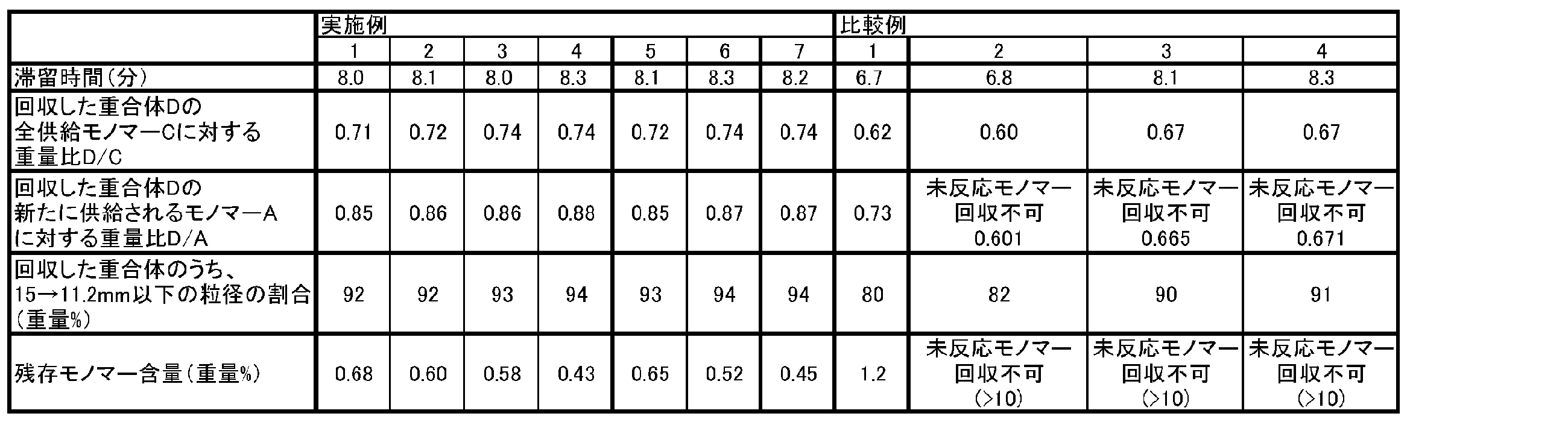
実施例1~4と比較例1とを対比すると、反応装置1の回転軸を、反応装置1の入口(投入口2)から出口(ポリアセタール共重合体回収部5)に向けて水平方向Hに対して1~6°上方に傾斜させた状態で原料の重合反応を行い、反応混合物を得ることで、原料の反応装置1内部での滞留時間を長くすることができ、その結果、重量比D/Cを大きく改善できることが確認された。また、回収ポリアセタール共重合体の粒径も小さいことが確認された。
重合反応の触媒として不揮発性のプロトン酸を用いた場合、ポリアセタール共重合体から未反応モノマーを回収できた(実施例1~7)。一方、重合反応の触媒として三フッ化ホウ素(ジブチルエーテル錯体)を用いた場合、ポリアセタール共重合体から未反応モノマーを回収することはできなかった(比較例2~4)。これは、三フッ化ホウ素系の重合触媒は揮発性であるため、回収モノマーとともに揮発した重合触媒が重合反応を起こし、重合物が多量に生成し、モノマー回収経路の閉塞を起こすためである。
実施例2又は5と比較例3、実施例4又は6と比較例4を対比すると、重合反応の触媒として不揮発性のプロトン酸を用いることで、重量比D/Aを大きく改善できることが分かる。重合反応の触媒として三フッ化ホウ素(ジブチルエーテル錯体)を用いた場合、前述の通り、未反応モノマーは回収できなかった(比較例2~4)。
2 投入口
3 混合部
4 気化分離部
5 ポリアセタール共重合体回収部
Claims (9)
- 2本の平行して互いに同方向又は異方向に回転する軸と、各軸上に取り付けられた多数のパドルと、該パドル外周に近接するバレルとを有し、周期的にパドルの長軸端が相手側の短軸端に近接するように構成され、軸方向の一端に設けた投入口から原料が仕込まれ、他端に設けた複数の取出し口から反応混合物及び未反応モノマーを得る連続撹拌混合機タイプの反応装置に、トリオキサン、このトリオキサンと共重合するコモノマー、及び不揮発性のプロトン酸を含む原料を供給する原料供給工程と、
前記回転軸を、前記反応装置の入口から出口に向けて水平方向に対して1~6°上方に傾斜させた状態で前記原料の重合反応を行い、反応混合物を得る重合反応工程と、
前記反応混合物から未反応モノマーを気化分離させ、前記原料供給工程へ供給する未反応モノマー再供給工程と、
前記反応混合物からポリアセタール共重合体を回収するポリアセタール共重合体回収工程とを含み、
前記反応装置に新たに供給されるモノマーAと、前記反応装置から回収及び再供給されるモノマーBとの和で規定される全供給モノマーCに対する前記ポリアセタール共重合体Dの重量比D/Cが0.7以上であり、
前記反応装置に新たに供給されるモノマーAに対する前記ポリアセタール共重合体Dの重量比D/Aが0.85以上である、ポリアセタール共重合体の製造方法。 - 前記ポリアセタール共重合体に含まれる未反応モノマーの含有量は1.0重量%以下であり、前記ポリアセタール共重合体は、粒径が11.2mm以下のものを90重量%以上含むものである、請求項1に記載のポリアセタール共重合体の製造方法。
- 前記反応装置の前記回転軸方向の長さLに対する前記反応装置の前記回転軸の半径方向の内径dに対する比で規定されるL/dは5以上20以下である、請求項1又は2に記載のポリアセタール共重合体の製造方法。
- 前記不揮発性のプロトン酸は、ヘテロポリ酸、イソポリ酸又はこれらの酸性塩から選ばれる少なくとも一種を含む、請求項1から3のいずれかに記載のポリアセタール共重合体の製造方法。
- 前記不揮発性のプロトン酸が下記一般式(1)で示されるヘテロポリ酸又はその酸性塩を含む、請求項1から3のいずれかに記載のポリアセタール共重合体の製造方法。
Hx[Mm・M’nOl]・yH2O ・・・(1)
〔一般式(1)において、MはP及び/又はSiから選ばれる中心元素を示し、M’はW、Mo、Vより選ばれる一種以上の配位元素を示す。lは10~100であり、mは1~10であり、nは6~40であり、xは1以上であり、yは0~50である。〕 - 前記ヘテロポリ酸又はその酸性塩は、リンモリブデン酸、リンタングステン酸、リンモリブドタングステン酸、リンモリブドバナジン酸、リンモリブドタングストバナジン酸、リンタングストバナジン酸、ケイタングステン酸、ケイモリブデン酸、ケイモリブドタングステン酸、ケイモリブドタングストバナジン酸又はこれらの酸性塩から選ばれる少なとも一種の化合物を含む、請求項5に記載のポリアセタール共重合体の製造方法。
- 前記不揮発性のプロトン酸が下記一般式(2)又は(3)で示されるイソポリ酸又はその酸性塩を含む、請求項1から3のいずれかに記載のポリアセタール共重合体の製造方法。
xMI 2O・pMV 2O6・yH2O ・・・(2)
xMI 2O・pMVI 2O6・yH2O ・・・(3)
〔一般式(2)及び(3)において、MIは水素であるが、一部が金属で置換されていてもよい。MVは周期律表V族のV、Nb、Taより選ばれる一種以上の元素を示す。MVIは周期律表VI族のCr、Mo、W、Uより選ばれる一種以上の元素を示す。p及びxは1以上であり、yは0~50である。〕 - 前記イソポリ酸又はその酸性塩は、パラタングステン酸、メタタングステン酸、パラモリブデン酸、メタモリブデン酸、パラバナジウム酸、メタバナジウム酸又はこれらの酸性塩から選ばれる少なとも一種の化合物を含む、請求項7に記載のポリアセタール共重合体の製造方法。
- 前記コモノマーは、1,3-ジオキソラン、ジエチレングリコールホルマール、1,4-ブタンジオールホルマール、エチレンオキシドから選ばれる少なくとも一種を含む、請求項1から8のいずれかに記載のポリアセタール共重合体の製造方法。
Priority Applications (6)
| Application Number | Priority Date | Filing Date | Title |
|---|---|---|---|
| EP14787765.8A EP2990426B1 (en) | 2013-04-25 | 2014-04-04 | Method for producing polyacetal copolymer |
| US14/786,246 US9550853B2 (en) | 2013-04-25 | 2014-04-04 | Method for producing polyacetal copolymer |
| MYPI2015703460A MY181923A (en) | 2013-04-25 | 2014-04-04 | Method for producing polyacetal copolymer |
| CN201480022751.1A CN105143294B (zh) | 2013-04-25 | 2014-04-04 | 聚缩醛共聚物的制造方法 |
| KR1020157033116A KR101983763B1 (ko) | 2013-04-25 | 2014-04-04 | 폴리아세탈 공중합체의 제조방법 |
| SA515370022A SA515370022B1 (ar) | 2013-04-25 | 2015-10-20 | طريقة لانتاج بوليمر اسهامي من متعدد أسيتال |
Applications Claiming Priority (2)
| Application Number | Priority Date | Filing Date | Title |
|---|---|---|---|
| JP2013092810A JP6022993B2 (ja) | 2013-04-25 | 2013-04-25 | ポリアセタール共重合体の製造方法 |
| JP2013-092810 | 2013-04-25 |
Publications (1)
| Publication Number | Publication Date |
|---|---|
| WO2014175042A1 true WO2014175042A1 (ja) | 2014-10-30 |
Family
ID=51791623
Family Applications (1)
| Application Number | Title | Priority Date | Filing Date |
|---|---|---|---|
| PCT/JP2014/059957 Ceased WO2014175042A1 (ja) | 2013-04-25 | 2014-04-04 | ポリアセタール共重合体の製造方法 |
Country Status (9)
| Country | Link |
|---|---|
| US (1) | US9550853B2 (ja) |
| EP (1) | EP2990426B1 (ja) |
| JP (1) | JP6022993B2 (ja) |
| KR (1) | KR101983763B1 (ja) |
| CN (1) | CN105143294B (ja) |
| MY (1) | MY181923A (ja) |
| SA (1) | SA515370022B1 (ja) |
| TW (1) | TWI616465B (ja) |
| WO (1) | WO2014175042A1 (ja) |
Families Citing this family (1)
| Publication number | Priority date | Publication date | Assignee | Title |
|---|---|---|---|---|
| JP5814414B2 (ja) * | 2014-03-31 | 2015-11-17 | ポリプラスチックス株式会社 | ポリアセタール共重合体の製造方法 |
Citations (9)
| Publication number | Priority date | Publication date | Assignee | Title |
|---|---|---|---|---|
| JPS61238812A (ja) * | 1985-04-17 | 1986-10-24 | Polyplastics Co | トリオキサンの連続重合方法 |
| JPH0255854A (ja) | 1988-08-19 | 1990-02-26 | Mitsubishi Electric Corp | エンジンの燃料噴射制御装置 |
| WO1996013534A1 (en) | 1994-10-27 | 1996-05-09 | Asahi Kasei Kogyo Kabushiki Kaisha | Process for producing polyoxymethylene |
| JPH09278852A (ja) | 1996-04-12 | 1997-10-28 | Polyplastics Co | ポリアセタール共重合体の製造方法 |
| JPH10330443A (ja) * | 1997-06-03 | 1998-12-15 | Polyplastics Co | ポリアセタール共重合体の製造方法 |
| JPH11124422A (ja) | 1997-08-22 | 1999-05-11 | Polyplastics Co | ポリアセタール樹脂の連続製造方法 |
| JPH11302349A (ja) | 1998-04-15 | 1999-11-02 | Polyplastics Co | ポリアセタール共重合体の製造方法 |
| JP2003026746A (ja) | 2001-07-12 | 2003-01-29 | Polyplastics Co | ポリアセタール共重合体の製造方法 |
| JP2007538122A (ja) * | 2004-05-19 | 2007-12-27 | ビーエーエスエフ アクチェンゲゼルシャフト | ポリオキシメチレンから残留モノマーを除去する方法 |
Family Cites Families (6)
| Publication number | Priority date | Publication date | Assignee | Title |
|---|---|---|---|---|
| US4105637A (en) * | 1974-10-11 | 1978-08-08 | Celanese Corporation | Process for producing a polyacetal polymer |
| JPS5659824A (en) * | 1979-10-23 | 1981-05-23 | Mitsubishi Gas Chem Co Inc | Continuous polymerization of trioxane |
| JPS6296515A (ja) * | 1985-05-13 | 1987-05-06 | Polyplastics Co | トリオキサンの重合体又は共重合体の連続製造法 |
| JPH0737504B2 (ja) * | 1987-12-25 | 1995-04-26 | ポリプラスチックス株式会社 | アセタール重合体又は共重合体の製造法 |
| JPH058725A (ja) | 1991-07-03 | 1993-01-19 | Hitachi Ltd | 鉄道車両用台車 |
| JP3850546B2 (ja) | 1998-03-09 | 2006-11-29 | ポリプラスチックス株式会社 | ポリアセタール樹脂の連続製造方法 |
-
2013
- 2013-04-25 JP JP2013092810A patent/JP6022993B2/ja active Active
-
2014
- 2014-04-04 WO PCT/JP2014/059957 patent/WO2014175042A1/ja not_active Ceased
- 2014-04-04 MY MYPI2015703460A patent/MY181923A/en unknown
- 2014-04-04 EP EP14787765.8A patent/EP2990426B1/en active Active
- 2014-04-04 US US14/786,246 patent/US9550853B2/en active Active
- 2014-04-04 CN CN201480022751.1A patent/CN105143294B/zh active Active
- 2014-04-04 KR KR1020157033116A patent/KR101983763B1/ko active Active
- 2014-04-10 TW TW103113175A patent/TWI616465B/zh active
-
2015
- 2015-10-20 SA SA515370022A patent/SA515370022B1/ar unknown
Patent Citations (10)
| Publication number | Priority date | Publication date | Assignee | Title |
|---|---|---|---|---|
| JPS61238812A (ja) * | 1985-04-17 | 1986-10-24 | Polyplastics Co | トリオキサンの連続重合方法 |
| JPH058725B2 (ja) | 1985-04-17 | 1993-02-03 | Polyplastics Kk | |
| JPH0255854A (ja) | 1988-08-19 | 1990-02-26 | Mitsubishi Electric Corp | エンジンの燃料噴射制御装置 |
| WO1996013534A1 (en) | 1994-10-27 | 1996-05-09 | Asahi Kasei Kogyo Kabushiki Kaisha | Process for producing polyoxymethylene |
| JPH09278852A (ja) | 1996-04-12 | 1997-10-28 | Polyplastics Co | ポリアセタール共重合体の製造方法 |
| JPH10330443A (ja) * | 1997-06-03 | 1998-12-15 | Polyplastics Co | ポリアセタール共重合体の製造方法 |
| JPH11124422A (ja) | 1997-08-22 | 1999-05-11 | Polyplastics Co | ポリアセタール樹脂の連続製造方法 |
| JPH11302349A (ja) | 1998-04-15 | 1999-11-02 | Polyplastics Co | ポリアセタール共重合体の製造方法 |
| JP2003026746A (ja) | 2001-07-12 | 2003-01-29 | Polyplastics Co | ポリアセタール共重合体の製造方法 |
| JP2007538122A (ja) * | 2004-05-19 | 2007-12-27 | ビーエーエスエフ アクチェンゲゼルシャフト | ポリオキシメチレンから残留モノマーを除去する方法 |
Non-Patent Citations (1)
| Title |
|---|
| See also references of EP2990426A4 |
Also Published As
| Publication number | Publication date |
|---|---|
| EP2990426A4 (en) | 2016-12-14 |
| EP2990426B1 (en) | 2017-11-29 |
| CN105143294A (zh) | 2015-12-09 |
| KR101983763B1 (ko) | 2019-05-29 |
| JP2014214224A (ja) | 2014-11-17 |
| EP2990426A1 (en) | 2016-03-02 |
| TWI616465B (zh) | 2018-03-01 |
| US9550853B2 (en) | 2017-01-24 |
| CN105143294B (zh) | 2017-09-05 |
| KR20160004315A (ko) | 2016-01-12 |
| MY181923A (en) | 2021-01-14 |
| TW201446824A (zh) | 2014-12-16 |
| SA515370022B1 (ar) | 2017-07-02 |
| JP6022993B2 (ja) | 2016-11-09 |
| US20160075815A1 (en) | 2016-03-17 |
Similar Documents
| Publication | Publication Date | Title |
|---|---|---|
| KR930000373B1 (ko) | 아세탈 중합체 또는 공중합체의 제조방법 | |
| US9745400B2 (en) | Method for producing polyacetal copolymer | |
| US5886139A (en) | Process for producing polyacetal copolymer | |
| JP6282805B2 (ja) | ポリアセタール共重合体の製造方法 | |
| JP6022993B2 (ja) | ポリアセタール共重合体の製造方法 | |
| JP3916787B2 (ja) | ポリアセタール共重合体の製造方法 | |
| CN111770945B (zh) | 聚缩醛共聚物的制造方法 | |
| JP3181535B2 (ja) | ポリアセタール共重合体の製造方法 | |
| KR100248646B1 (ko) | 폴리아세탈 공중합체의 제조방법 | |
| JP2014095000A (ja) | ポリアセタール共重合体の製造方法 | |
| JP2014095001A (ja) | ポリアセタール共重合体の製造方法 | |
| MXPA97010062A (en) | Procedure to produce a polyace copolymer |
Legal Events
| Date | Code | Title | Description |
|---|---|---|---|
| WWE | Wipo information: entry into national phase |
Ref document number: 201480022751.1 Country of ref document: CN |
|
| 121 | Ep: the epo has been informed by wipo that ep was designated in this application |
Ref document number: 14787765 Country of ref document: EP Kind code of ref document: A1 |
|
| REEP | Request for entry into the european phase |
Ref document number: 2014787765 Country of ref document: EP |
|
| WWE | Wipo information: entry into national phase |
Ref document number: 2014787765 Country of ref document: EP |
|
| WWE | Wipo information: entry into national phase |
Ref document number: 14786246 Country of ref document: US |
|
| NENP | Non-entry into the national phase |
Ref country code: DE |
|
| ENP | Entry into the national phase |
Ref document number: 20157033116 Country of ref document: KR Kind code of ref document: A |