WO2014189092A1 - Structure de refroidissement de film à double jet et son procédé de production - Google Patents
Structure de refroidissement de film à double jet et son procédé de production Download PDFInfo
- Publication number
- WO2014189092A1 WO2014189092A1 PCT/JP2014/063517 JP2014063517W WO2014189092A1 WO 2014189092 A1 WO2014189092 A1 WO 2014189092A1 JP 2014063517 W JP2014063517 W JP 2014063517W WO 2014189092 A1 WO2014189092 A1 WO 2014189092A1
- Authority
- WO
- WIPO (PCT)
- Prior art keywords
- passage
- wall surface
- branch
- main passage
- cooling structure
- Prior art date
- Legal status (The legal status is an assumption and is not a legal conclusion. Google has not performed a legal analysis and makes no representation as to the accuracy of the status listed.)
- Ceased
Links
Images




Classifications
-
- F—MECHANICAL ENGINEERING; LIGHTING; HEATING; WEAPONS; BLASTING
- F01—MACHINES OR ENGINES IN GENERAL; ENGINE PLANTS IN GENERAL; STEAM ENGINES
- F01D—NON-POSITIVE DISPLACEMENT MACHINES OR ENGINES, e.g. STEAM TURBINES
- F01D5/00—Blades; Blade-carrying members; Heating, heat-insulating, cooling or antivibration means on the blades or the members
- F01D5/12—Blades
- F01D5/14—Form or construction
- F01D5/18—Hollow blades, i.e. blades with cooling or heating channels or cavities; Heating, heat-insulating or cooling means on blades
- F01D5/186—Film cooling
-
- B—PERFORMING OPERATIONS; TRANSPORTING
- B23—MACHINE TOOLS; METAL-WORKING NOT OTHERWISE PROVIDED FOR
- B23H—WORKING OF METAL BY THE ACTION OF A HIGH CONCENTRATION OF ELECTRIC CURRENT ON A WORKPIECE USING AN ELECTRODE WHICH TAKES THE PLACE OF A TOOL; SUCH WORKING COMBINED WITH OTHER FORMS OF WORKING OF METAL
- B23H1/00—Electrical discharge machining, i.e. removing metal with a series of rapidly recurring electrical discharges between an electrode and a workpiece in the presence of a fluid dielectric
- B23H1/04—Electrodes specially adapted therefor or their manufacture
-
- B—PERFORMING OPERATIONS; TRANSPORTING
- B23—MACHINE TOOLS; METAL-WORKING NOT OTHERWISE PROVIDED FOR
- B23H—WORKING OF METAL BY THE ACTION OF A HIGH CONCENTRATION OF ELECTRIC CURRENT ON A WORKPIECE USING AN ELECTRODE WHICH TAKES THE PLACE OF A TOOL; SUCH WORKING COMBINED WITH OTHER FORMS OF WORKING OF METAL
- B23H9/00—Machining specially adapted for treating particular metal objects or for obtaining special effects or results on metal objects
- B23H9/10—Working turbine blades or nozzles
-
- B—PERFORMING OPERATIONS; TRANSPORTING
- B23—MACHINE TOOLS; METAL-WORKING NOT OTHERWISE PROVIDED FOR
- B23H—WORKING OF METAL BY THE ACTION OF A HIGH CONCENTRATION OF ELECTRIC CURRENT ON A WORKPIECE USING AN ELECTRODE WHICH TAKES THE PLACE OF A TOOL; SUCH WORKING COMBINED WITH OTHER FORMS OF WORKING OF METAL
- B23H9/00—Machining specially adapted for treating particular metal objects or for obtaining special effects or results on metal objects
- B23H9/14—Making holes
-
- F—MECHANICAL ENGINEERING; LIGHTING; HEATING; WEAPONS; BLASTING
- F01—MACHINES OR ENGINES IN GENERAL; ENGINE PLANTS IN GENERAL; STEAM ENGINES
- F01D—NON-POSITIVE DISPLACEMENT MACHINES OR ENGINES, e.g. STEAM TURBINES
- F01D9/00—Stators
- F01D9/06—Fluid supply conduits to nozzles or the like
- F01D9/065—Fluid supply or removal conduits traversing the working fluid flow, e.g. for lubrication-, cooling-, or sealing fluids
-
- F—MECHANICAL ENGINEERING; LIGHTING; HEATING; WEAPONS; BLASTING
- F23—COMBUSTION APPARATUS; COMBUSTION PROCESSES
- F23R—GENERATING COMBUSTION PRODUCTS OF HIGH PRESSURE OR HIGH VELOCITY, e.g. GAS-TURBINE COMBUSTION CHAMBERS
- F23R3/00—Continuous combustion chambers using liquid or gaseous fuel
- F23R3/02—Continuous combustion chambers using liquid or gaseous fuel characterised by the air-flow or gas-flow configuration
- F23R3/04—Air inlet arrangements
- F23R3/06—Arrangement of apertures along the flame tube
-
- F—MECHANICAL ENGINEERING; LIGHTING; HEATING; WEAPONS; BLASTING
- F05—INDEXING SCHEMES RELATING TO ENGINES OR PUMPS IN VARIOUS SUBCLASSES OF CLASSES F01-F04
- F05D—INDEXING SCHEME FOR ASPECTS RELATING TO NON-POSITIVE-DISPLACEMENT MACHINES OR ENGINES, GAS-TURBINES OR JET-PROPULSION PLANTS
- F05D2230/00—Manufacture
- F05D2230/10—Manufacture by removing material
- F05D2230/12—Manufacture by removing material by spark erosion methods
-
- F—MECHANICAL ENGINEERING; LIGHTING; HEATING; WEAPONS; BLASTING
- F05—INDEXING SCHEMES RELATING TO ENGINES OR PUMPS IN VARIOUS SUBCLASSES OF CLASSES F01-F04
- F05D—INDEXING SCHEME FOR ASPECTS RELATING TO NON-POSITIVE-DISPLACEMENT MACHINES OR ENGINES, GAS-TURBINES OR JET-PROPULSION PLANTS
- F05D2240/00—Components
- F05D2240/10—Stators
- F05D2240/11—Shroud seal segments
-
- F—MECHANICAL ENGINEERING; LIGHTING; HEATING; WEAPONS; BLASTING
- F05—INDEXING SCHEMES RELATING TO ENGINES OR PUMPS IN VARIOUS SUBCLASSES OF CLASSES F01-F04
- F05D—INDEXING SCHEME FOR ASPECTS RELATING TO NON-POSITIVE-DISPLACEMENT MACHINES OR ENGINES, GAS-TURBINES OR JET-PROPULSION PLANTS
- F05D2240/00—Components
- F05D2240/80—Platforms for stationary or moving blades
- F05D2240/81—Cooled platforms
-
- F—MECHANICAL ENGINEERING; LIGHTING; HEATING; WEAPONS; BLASTING
- F05—INDEXING SCHEMES RELATING TO ENGINES OR PUMPS IN VARIOUS SUBCLASSES OF CLASSES F01-F04
- F05D—INDEXING SCHEME FOR ASPECTS RELATING TO NON-POSITIVE-DISPLACEMENT MACHINES OR ENGINES, GAS-TURBINES OR JET-PROPULSION PLANTS
- F05D2250/00—Geometry
- F05D2250/10—Two-dimensional
- F05D2250/14—Two-dimensional elliptical
-
- F—MECHANICAL ENGINEERING; LIGHTING; HEATING; WEAPONS; BLASTING
- F05—INDEXING SCHEMES RELATING TO ENGINES OR PUMPS IN VARIOUS SUBCLASSES OF CLASSES F01-F04
- F05D—INDEXING SCHEME FOR ASPECTS RELATING TO NON-POSITIVE-DISPLACEMENT MACHINES OR ENGINES, GAS-TURBINES OR JET-PROPULSION PLANTS
- F05D2250/00—Geometry
- F05D2250/20—Three-dimensional
- F05D2250/23—Three-dimensional prismatic
- F05D2250/231—Three-dimensional prismatic cylindrical
-
- F—MECHANICAL ENGINEERING; LIGHTING; HEATING; WEAPONS; BLASTING
- F05—INDEXING SCHEMES RELATING TO ENGINES OR PUMPS IN VARIOUS SUBCLASSES OF CLASSES F01-F04
- F05D—INDEXING SCHEME FOR ASPECTS RELATING TO NON-POSITIVE-DISPLACEMENT MACHINES OR ENGINES, GAS-TURBINES OR JET-PROPULSION PLANTS
- F05D2250/00—Geometry
- F05D2250/70—Shape
- F05D2250/75—Shape given by its similarity to a letter, e.g. T-shaped
-
- F—MECHANICAL ENGINEERING; LIGHTING; HEATING; WEAPONS; BLASTING
- F05—INDEXING SCHEMES RELATING TO ENGINES OR PUMPS IN VARIOUS SUBCLASSES OF CLASSES F01-F04
- F05D—INDEXING SCHEME FOR ASPECTS RELATING TO NON-POSITIVE-DISPLACEMENT MACHINES OR ENGINES, GAS-TURBINES OR JET-PROPULSION PLANTS
- F05D2260/00—Function
- F05D2260/20—Heat transfer, e.g. cooling
- F05D2260/202—Heat transfer, e.g. cooling by film cooling
-
- F—MECHANICAL ENGINEERING; LIGHTING; HEATING; WEAPONS; BLASTING
- F23—COMBUSTION APPARATUS; COMBUSTION PROCESSES
- F23R—GENERATING COMBUSTION PRODUCTS OF HIGH PRESSURE OR HIGH VELOCITY, e.g. GAS-TURBINE COMBUSTION CHAMBERS
- F23R2900/00—Special features of, or arrangements for continuous combustion chambers; Combustion processes therefor
- F23R2900/03042—Film cooled combustion chamber walls or domes
Definitions
- the present invention provides a jet opening on a wall surface facing a hot gas passage such as a moving blade, a stationary blade, and an inner cylinder of a combustor in a gas turbine engine, and a cooling medium jetted from the jet opening along the wall surface.
- the present invention relates to a film cooling structure for cooling a wall surface by flowing.
- a wall surface such as a moving blade in a gas turbine engine (hereinafter simply referred to as “gas turbine”) has been provided with a number of ejection openings directed in the same direction, such as air ejected from these ejection openings.
- the wall surface exposed to the high temperature gas is cooled by the film flow of the cooling medium.
- a circular hole is provided in the wall so as to be inclined toward the downstream side of the high-temperature gas, and the cooling medium is ejected from an elliptical ejection port opened in the wall surface.
- an improved cooling structure having, for example, a structure in which the jet outlet to the wall surface of the cooling medium has a double leaf piece shape (Patent Document 1) and a pair of jet outlets Some have a distribution unit (Patent Document 2).
- JP 2008-8288 A Japanese Patent No. 4954309
- the cooling effect can be enhanced by expanding the width of the cooling medium along the wall surface. This is presumably because the film efficiency indicating the cooling efficiency on the wall surface is increased.
- Tg is the temperature of the high temperature gas
- Tf is the surface temperature of the wall surface
- Tc is the temperature of the cooling medium on the wall surface.
- the shape of the central portion of the jet outlet is not a simple ellipse but a curved line having a plurality of radii of curvature (paragraphs 0016-0017), the number of manufacturing steps increases.
- the said patent document 2 although peeling from the wall surface of a cooling medium can be suppressed and film efficiency can be improved, since the said distribution part becomes undercut seeing from a wall surface side, a
- the present invention provides a film cooling structure that can efficiently cool wall surfaces such as gas turbine movements and stationary blades while suppressing the separation of the cooling medium film from the wall surfaces.
- the purpose is to do.
- a double jet film cooling structure comprises: The wall facing the hot gas passage is provided with an ejection opening for ejecting the cooling medium toward the downstream side of the passage, A main passage composed of a straight circular hole for supplying the cooling medium to the ejection opening, and a pair of branch passages composed of a straight circular hole branching from a branch point on the main passage and having the ejection opening as an outlet; A communication passage that communicates the main passage and the branch passage and has the ejection opening as an outlet is formed in the wall, The ejection direction of the cooling medium ejected from the pair of branch passages is set to be inclined with respect to the flow direction of the high-temperature gas so as to form a vortex in a direction in which the cooling medium is pressed against the wall surface.
- the cross sections of the main passage and the branch passage have the same constant inner diameter
- the communication path has an envelope surface that connects a group of straight circular holes having the constant inner diameter through the branch point,
- a lateral ejection angle ⁇ along the wall surface with respect to the flow direction of the high-temperature gas in each ejection direction from the pair of branch passages is set so as to face opposite directions across the flow direction,
- a main longitudinal angle ⁇ 1 formed by the axial direction of the main passage and the wall surface is set to be larger than a branch vertical angle ⁇ 2 formed by the axial direction of the branch passage and the wall surface.
- the lateral ejection angles along the wall surface with respect to the flow direction of the high-temperature gas in the respective ejection directions of the cooling medium from the pair of ejection holes are opposite to each other across the flow direction. Since it is set to face, a wide film flow of the cooling medium is effectively formed on the wall surface along the flow direction of the hot gas, and the film efficiency is improved.
- the main longitudinal angle ⁇ 1 formed by the axial direction of the main passage and the wall surface is set to be larger than the branch vertical angle ⁇ 2 formed by the axial direction of the branch passage and the wall surface.
- the cooling medium ejected is separated by the cooling medium ejected from the main passage to form a pair of straight flow with high directivity. Since a low pressure part with sufficiently low pressure is generated between the pair of straight flow with high directivity, the vortex flow formed by the straight flow causes a strong flow toward the wall surface from around the straight flow to the low pressure part. It is formed. For this reason, it is suppressed that a cooling medium peels from a wall surface, the film efficiency on a wall surface is improved, and a wall surface is cooled effectively.
- the cross sections of the main passage and the branch passage have the same constant inner diameter
- the communication passage connecting the main passage and the branch passage is a straight circular hole that passes through the branch point and has the constant inner diameter. Since it has an envelope surface that connects groups, all of the main passage, branch passage and communication passage can be processed from the wall surface side by a single cylindrical processing tool, for example, a machining electrode for electric discharge machining. It becomes easy.
- the wall surface can be efficiently cooled by suppressing the separation of the cooling medium on the wall surface exposed to the high-temperature gas and generating a good film flow on the wall surface.
- a cooling structure can be easily formed.
- the angle difference ⁇ between the main longitudinal angle ⁇ 1 and the branching longitudinal angle ⁇ 2 is 3 to 15 °.
- the main passage is between the pair of branching passages. Therefore, the cooling medium ejected from the pair of branch passages is sufficiently separated from each other, and a low-pressure portion is reliably formed between the straight flow of the cooling medium. Strongly presses the flow against the wall to improve film efficiency.
- a rear surface portion of the envelope surface forming the communication path is flat.
- the “rear surface portion” refers to a surface located on the downstream side in the flow direction of the hot gas.
- a ratio Lc / H of a branch point height Lc to a height H in the orthogonal direction perpendicular to the wall surface of the main passage is 0.3 to 0.9.
- the cooling medium is smoothly branched from the main passage to the branch passage.
- the lateral ejection angle ⁇ from each branch passage is in the range of 10 to 45 °.
- the main longitudinal angle ⁇ 1 of the main passage is preferably 10 to 45 °, and the distance W along the wall surface between the outlets of the pair of branch passages is relative to the constant inner diameter D of the main passage. It is preferably set to 1.0 to 5.0D. According to these preferable configurations, a strong vortex flowing toward the wall surface is generated, and the wall surface can be cooled more effectively.
- the manufacturing method according to the present invention is a method of forming the double jet film cooling structure of the present invention by electric discharge machining, On the wall surface facing the passage of the high-temperature gas, the main passage having the constant inner diameter is formed by a cylindrical processing electrode having a predetermined outer diameter, A discharge passage is continuously formed from the communication passage to the branch passage by discharging the machining electrode while inclining the machining electrode with respect to the axis of the main passage. According to this method, all of the main passage, the branch passage, and the communication passage can be processed from the wall surface side by a single cylindrical processing electrode, so that manufacturing is facilitated.
- FIG. 1 is a plan view of a wall surface 1 to which a double jet film cooling structure according to an embodiment of the present invention is applied.
- the wall surface 1 is exposed to a high-temperature gas G flowing in the direction of the arrow, and an ejection opening 2 through which a cooling medium such as air is injected into the passage GP of the high-temperature gas G is provided in the wall surface 1
- a plurality are arranged side by side in a substantially orthogonal direction (vertical direction in FIG. 1).
- the upstream side along the flow direction of the hot gas G is referred to as the front side
- the downstream side is referred to as the rear side.
- each ejection opening 2 has a main passage 3 formed inside a wall 10 having a wall surface 1 as an upper surface, branch passages 4 and 5 branched from the main passage 3, and main passages 3.
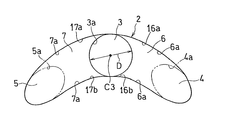
- the passage 3 and the branch passages 4 and 5 are connected to communication passages 6 and 7 that communicate with each other. That is, the ejection opening 2 is formed by the outlets 3a, 4a, 5a, 6a, 7a of these passages 3-6.
- the main passage 3 is parallel to the flow direction of the hot gas G in a plan view as viewed from the direction orthogonal to the wall surface 1, and the branch passages 4 and 5 extend from the main passage 3 to the flow direction of the hot gas G.
- the communication passages 6 and 7 are configured so that the main passage 3 and the branch passages 4 and 5 are respectively transverse to the flow direction (vertical direction in FIG. 1). ).
- These passages 3 to 7 include the axis C3 of the main passage 3, have a plane-symmetric shape with respect to the orthogonal plane VP orthogonal to the wall surface 1, and are formed by, for example, electric discharge machining as will be described later.
- the branch passages 4 and 5 are branched from the same branch point P on the axis C3 of the main passage 3.
- the branch angle of the branch passages 4 and 5 viewed from the direction orthogonal to the wall surface 1, that is, the branch angle ⁇ shown in FIG. 2, is preferably 5 to 30 °, and more preferably 10 to 20 °.
- the jetting directions A and B of the cooling media CL4 and CL5 jetted from the branch passage outlets 4a and 5a do not coincide with the axial centers C4 and C5 of the branch passages 4 and 5, and as described below, the jet opening 2 It is influenced by the shape.
- the branch passages 4 and 5 are set so as to be directed in different directions on the surface along the wall surface 1, that is, in a plan view as viewed from a direction orthogonal to the wall surface 1.
- both the cooling media CL4 and CL5 passing through the branch passages 4 and 5 are ejected in directions away from each other.
- the ejection directions A and B are opposite to each other across the flow direction of the hot gas G in plan view, and along the wall surface 1 in the ejection directions A and B with respect to the flow direction of the hot gas G.
- the lateral injection angle ⁇ is set to be the same.
- the branch passage outlets 4a and 5a included in the ejection opening 2 have an elliptical shape with the axis C4 and C5 of the branch passages 4 and 5 as major axes.
- the lateral injection angle ⁇ is determined based on the front end 2f of the ejection opening 2, that is, the front end of the intersection 2f between the axis C3 of the main passage 3 and the front edge of the ejection opening 2 in the plan view of FIG. It is defined as an angle (an angle along the wall surface 1) formed by a straight line passing through 2f and the centers O1 and O2 of the branch passage outlets 4a and 5a and the axis C3.
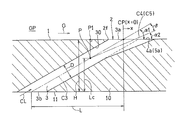
- a portion CL3 of the cooling medium CL introduced into the main passage 3 flows into the passage downstream of the branch point P in the main passage 3 (hereinafter referred to as “main passage downstream portion”) 30, and the shaft 3 exits from the outlet 3a. It is ejected in the direction along the heart C3.
- Each of the main passage 3 and the branch passages 4 and 5 is formed by a straight circular hole having a constant inner diameter D.
- the communication paths 6 and 7 each include a straight path group passing through the branch point P, and are formed by an envelope surface connecting the path groups.
- Each passage forming the passage group has a constant inner diameter D which is the same as that of the main passage 3 and the branch passages 4 and 5 in cross section. Accordingly, as shown in FIG. 3 as viewed from the direction of the axis C3 of the main passage 3, the communication passage outlets 6a and 7a draw a smooth curve connecting the main passage outlet 3a and the branch passage outlets 4a and 5a.
- the circular holes forming the passages 3 to 7 are indicated by two-dot chain lines in the right column of FIG.
- the main passage 3 formed through the wall 10 opens to the inner surface 11 of the wall 10, and allows a cooling medium CL such as air to pass from the inside of the wall 10.
- An introduction opening 3 b for introduction into the main passage 3 is provided.
- the axis C3 of the main passage 3 is inclined toward the downstream side in the flow direction of the hot gas G from the introduction opening 3b toward the outlet 3a of the wall surface 1 which is the outer surface.
- the branch passages 4 and 5 have their axes C4 and C5 inclined toward the downstream side in the flow direction of the hot gas G from the branch point P toward the outlets 4a and 5a.
- the cooling media CL3 to CL5 are injected from the outlets 3a to 5a along the axes C3 to C5 of the main passage 3 and the branch passages 4 and 5 into the high temperature gas passage GP.
- Part of the cooling medium CL6, CL7 is also ejected from the outlets 6a, 7a of the communication passages 6, 7.
- the main longitudinal angle ⁇ 1 formed by the axis C3 and the wall surface 1 shown in FIG. 4 is larger than the branching vertical angle ⁇ 2 formed by the wall surfaces 1 by the shaft centers C4 and C5 of the branch passages 4 and 5.
- the branch longitudinal angles ⁇ 2 and ⁇ 2 of both branch passages 4 and 5 are the same.
- the axis C4 and C5 of the branch passages 4 and 5 are inclined in the horizontal direction (the direction of the front and back surfaces in FIG. 4) with respect to the vertical cross section in FIG. 4 does not appear correctly.
- This branching longitudinal direction angle ⁇ 2 is accurately shown in FIG. 5 which is a perspective view, and the virtual point P1 on the wall surface 1 directly above the branching point P and the centers O1 and O2 of the branch passage outlets 4a and 5a.
- the main passage outlet 3a and the branch passage outlets 4a and 5a included in the opening 2 are all elliptical. Further, since the main vertical direction angle ⁇ 1 is larger than the branch vertical direction angle ⁇ 2, the branch passage outlets 4a and 5a are located behind the main passage outlet 3a, that is, downstream of the hot gas G.
- the envelope surfaces 16 and 17 forming the communication passages 6 and 7 have smooth curved surfaces on the front surface portions 16a and 17a on the upstream side of the high temperature gas G, whereas the rear surface portions 16b and 17b are directed rearward. It is a flat surface with wide width. Therefore, each of the communication passage outlets 6a and 7a is a straight line having a width S. Since both the branch passages 4 and 5 are clearly separated in shape by the flat surfaces 16b and 17b, separation of the cooling media CL4 and CL5 ejected from the branch passages 4 and 5 is promoted.
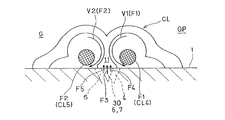
- the cooling media CL4 and CL5 ejected from the branch passage outlets 4a and 5a of the ejection opening 2 affect each other and act so as to press the opponent against the wall surface 1. This will be described with reference to FIGS.
- a part of the cooling medium CL introduced into the main passage 3 flows into the branch passages 4 and 5.
- Most of the cooling medium flowing in the branch passages 4 and 5 becomes straight refrigerant flows F1 and F2 from the branch passage outlets 4a and 5a as branch passage components CL4 and CL5 with a lateral jet angle ⁇ . It is ejected into the gas passage GP.
- the rear ends 4aa and 5aa of the branch passage outlets 4a and 5a are located behind the rear end 3aa of the main passage outlet 3a, they are located behind the main passage outlet 3a in the branch passage outlets 4a and 5a.
- the straight refrigerant flows F1 and F2 ejected from the portion are formed as highly directional flows.
- most of the cooling medium CL flowing through the main passage downstream portion 30 out of the cooling medium CL that has passed through the main passage 3 is a straight passage directing in the direction along the axis C3 from the outlet 3a as the main passage component CL3.
- the main separated flow F3 is jetted into the high temperature gas passage GP.
- This separated flow F3 enters between the straight refrigerant flows F1 and F2 and has an action of separating the straight refrigerant flows F1 and F2.
- a part of the cooling mediums CL3 to CL5 flowing into the main passage downstream portion 30 and the branch passages 4 and 5 flows into the communication passages 6 and 7 and becomes sub-separated flows F4 and F5 from the outlets 6a and 7a. It is ejected into the gas passage GP and promotes separation of the straight refrigerant flows F1 and F2.
- FIG. 7 shows a cross section of the hot gas passage GP perpendicular to the flow direction of the hot gas G. Due to the main separation flow F3 and the sub-separation flows F4 and F5 from the main passage downstream portion 30 and the communication passages 6 and 7, the straight refrigerant flows F1 and F2 having high directivity from the branch passages 4 and 5 are parallel to the wall surface 1. As a result of the separation in the direction, a strong low pressure portion 11 is generated between the straight refrigerant flows F1 and F2. Thereby, the flow which goes to the wall surface 1 arises in the inner side part of each straight-ahead refrigerant
- the two branch passage outlets 4a and 5a in FIG. 6 are suitable for forming the vortex flows V1 and V2 by effectively generating the low-pressure part 11 and pressing the cooling medium C against the wall surface 1. It is necessary to dispose them by a distance.
- the branch passage outlets 4a and 5a at the ejection opening 2 facing the wall surface 1 have a substantially elliptical shape with the axes C4 and C5 of the branch passages 4 and 5 as major axes.
- the distance W along the wall surface 1 between the center points O1 and O2 of the pair of branch passage outlets 4a and 5a is preferably 1.0 to 5.0D with respect to the constant inner diameter D. More preferably, it is ⁇ 4.0D.
- the lateral ejection angle ⁇ between the ejection directions A and B from the branch passages 4 and 5 and the flow direction of the hot gas G is in the range of 10 to 45 °.
- the lateral ejection angle ⁇ is more preferably in the range of 20 to 40 °, and further preferably in the range of 25 to 35 °. If the lateral jet angle ⁇ is less than the above range, it is difficult to separate the vortex flows V1 and V2, and if it exceeds the above range, the straightness of the straight refrigerant flows F1 and F2 becomes insufficient, and the desired strength The eddy currents V1 and V2 cannot be obtained.
- the lateral injection angles ⁇ and ⁇ formed by the injection directions A and B from the branch passages 4 and 5 and the flow direction of the hot gas G may be different from each other.
- the ejection directions A and B from both the branch passages 4 and 5 are set symmetrically with respect to the axis C3 of the main passage 3.
- the lateral jet angle ⁇ with respect to the hot gas G is different between the branch passages 4 and 5.
- the main longitudinal direction angle ⁇ 1 formed between the axis C3 of the main passage 3 and the wall surface 1 shown in FIG. 4 is preferably in the range of 10 to 45 °, and more preferably in the range of 20 to 40 °.
- the branching longitudinal angle ⁇ 2 formed by the branch passages 4 and 5 and the wall surface 1 is preferably in the range of 5 to 40 °, and more preferably in the range of 10 to 35 °. If the main longitudinal direction angle ⁇ 1 and the branch injection angle ⁇ 2 are less than the above range, the vortex flows V1 and V2 in FIG. The vortex flows V1 and V2 having the desired strength cannot be obtained.
- the angle difference ⁇ ⁇ 1 ⁇ 2 between the main and branch longitudinal angles ⁇ 1 and ⁇ 2 in FIG. 4 is preferably 3 to 15 °, and more preferably 5 to 12.
- the angle difference ⁇ is out of the above range, the separating action of the vortices V1 and V2 in FIG. 7 by the separated flow F3 from the main passage 3 in FIG. 6 is reduced, and the vortex flows V1 and V2 having a desired strength cannot be obtained.
- the ratio corresponds to the ratio between the portion of the main passage 3 upstream of the branch point P and the total length L of the main passage 3. If the length ratio Lc / H is less than the above range, the straightness of the separated flow F3 ejected from the main passage 3 in FIG. 6 is reduced, and the straight flow F1 and F2 from the branch passages 4 and 5 are separated. The action to do decreases. When the length ratio Lc / H exceeds the above range, the supply amount of the cooling media CL4 and CL5 to the branch passages 4 and 5 becomes insufficient. Therefore, the vortex flows V1 and V2 having a desired strength cannot be obtained in any case.
- the total length L of the main passage 3 is preferably 2 to 10D in relation to the constant inner diameter D. If it is less than 2D, the directivity of the cooling medium ejected from the main passage 3 and the branch passages 4 and 5 decreases, and if it exceeds 10D, the passage resistance increases.
- the main passage 3, the branch passages 4, 5 and the communication passages 6, 7 are all machined from the wall surface 1 side using a cylindrical machining electrode 41 of the electric discharge machine.
- the processing electrode 41 has a predetermined outer diameter slightly smaller than the constant inner diameter D so as to form the passages 3 to 7 having the constant inner diameter D.
- the main passage 3 is formed by electric discharge machining using the machining electrode 41.
- the machining electrodes are discharged while being inclined with respect to the axis C3 of the main passage 3, whereby the communication passages 6 and 7 to the branch passages 4 and 5 are continuously formed.
- the branch passages 4, 5 and the communication passages 6, 7 can be processed from the wall surface 1 side. Easy to manufacture.
- the cooling media CL4 and CL5 from the pair of branch passages 4 and 5 are pressed against the wall surface 1 by the vortex flows V1 and V2 entangled in the low-pressure part 11, A film flow of the cooling medium CL is formed in contact with a wide range of the wall surface 1. In this way, the cooling medium CL is suppressed from peeling from the wall surface 1, the film efficiency on the wall surface 1 is increased, and the wall surface 1 is effectively cooled.
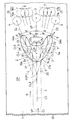
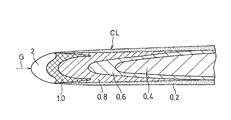
- FIG. 8 shows an isoline diagram of the film efficiency ⁇ f, ad obtained on the wall surface 1 when the parameters including the dimensions and ratios shown in FIGS.
- Length ratio Lc / H 0.625
- Main longitudinal angle ⁇ 1 30 ° Long / short axis ratio
- De / D 2.0 at the center of the jet opening
- Ejection angle difference ⁇ 10 °
- Lateral ejection angle ⁇ 32 °
- Straight line length of communication passage outlet S / D 0.2
- Front end position of ejection opening x / D -1.0 (Here, x is the distance from the center point CP where the axis C3 of the main passage 3 and the wall surface 1 shown in FIG. 4 intersect to the downstream of the hot gas G.
- the minus sign is the origin CP. (Indicates the distance in the upstream direction.)
- the cooling medium CL ejected from the ejection opening 2 has a film efficiency of 1.0 in the vicinity of the downstream thereof, a film efficiency of 0.8 in the rear thereof, and a width direction thereof.
- An area with a film efficiency of 0.6 is formed near the center, an area with a film efficiency of 0.4 is formed near the center, and an area with a film efficiency of 0.2 is formed on the outermost side over a wide area.
- the gas turbine includes a compressor that compresses air, a combustor that supplies and burns fuel to the compressed air from the compressor, and a turbine that is driven by high-temperature and high-pressure combustion gas from the combustor.
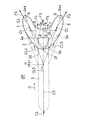
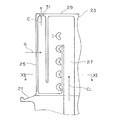
- the turbine has a large number of blades 23 implanted on the outer periphery of a turbine disk 21 shown in FIG.
- Six jet openings 2 are arranged side by side in the radial direction of the rotor blade 23 at a portion slightly rearward from the front edge 25 on the blade surface (wall surface 1) of the rotor blade 23, and these jet openings 2 are arranged adjacent to each other. It faces the hot gas (combustion gas) passage GP between the blades 23.
- a folded cooling medium passage 27 shown in FIG. 10 is formed inside the rotor blade 23, and the ejection opening 2 communicates with a middle portion of the cooling medium passage 27.
- a cooling medium CL composed of air extracted from the compressor is introduced from the passage in the turbine disk 21 to the cooling medium passage 27 and injected from the outlet opening 2, and then the passage from the outlet hole 31 opened to the blade tip 29. It is ejected into the GP. In this way, a film flow CF of the cooling medium C is formed on the blade surface 1 by the cooling medium CL injected from the ejection opening 2 opened on the blade surface which is the wall surface 1 shown in FIG. To be cooled.
- the example in which the plurality of ejection openings 2 are arranged at equal intervals in the vertical direction has been described, but the number and arrangement of the plurality of ejection openings 2 may be appropriately selected.
- two rows in which a plurality of ejection openings 2 are arranged at equal intervals in the radial direction are provided apart from each other in the front-rear direction, and the radial position of the ejection openings 2 in the front row and the ejection openings 2 in the rear row are provided.
- the positions in the radial direction may be shifted from each other.
- the present invention can be widely applied to wall surfaces facing a passage of high-temperature gas, such as a stationary blade and an inner cylinder of a combustor, in addition to a moving blade of a gas turbine.
Landscapes
- Engineering & Computer Science (AREA)
- Mechanical Engineering (AREA)
- General Engineering & Computer Science (AREA)
- Physics & Mathematics (AREA)
- Thermal Sciences (AREA)
- Manufacturing & Machinery (AREA)
- Chemical & Material Sciences (AREA)
- Combustion & Propulsion (AREA)
- Fluid Mechanics (AREA)
- Turbine Rotor Nozzle Sealing (AREA)
- Electrical Discharge Machining, Electrochemical Machining, And Combined Machining (AREA)
Abstract
La présente invention concerne une structure de refroidissement de film, qui empêche un film d'agent de refroidissement de peler la surface de paroi, qui refroidit efficacement la surface de paroi et dont la production est aisée. La structure de refroidissement de film comprend un passage (3) principal continu, doté d'une ouverture (2) de jet disposée dans une surface (1) de paroi en regard d'un passage pour un gaz (G) à haute température, une paire de passages (4, 5) de dérivation destinés à la dérivation à partir du passage (3) principal et des passages (6, 7) de communication dans lesquels lesdits passages communiquent entre eux. Les directions (A, B) de jet des agents (CL4, CL5) de refroidissement à partir de la paire de passages (4, 5) de dérivation sont réglées pour être inclinées par rapport à la direction d'écoulement du gaz (G) à haute température, de manière que des écoulements (V1, V2) turbulents dans les directions dans lesquelles les agents de refroidissement sont mutuellement comprimés contre la surface (1) de paroi, sont formés. Des sections transversales du passage (3) principal et des passages (4, 5) de dérivation présentent le même diamètre (D) intérieur constant, les passages (6, 7) de communication présentent des surfaces (16, 17) d'enveloppe, chacune étant un trou circulaire droit continu dont le diamètre (D) intérieur est constant. Un angle (α1) de direction longitudinale principal, formé entre l'axe (C3) du passage principal et la surface (1) de paroi, est supérieur à un angle (α2) de direction longitudinale de dérivation formé entre les axes (C4, C5) des passages (4, 5) de dérivation et la surface (1) de paroi.
Priority Applications (4)
| Application Number | Priority Date | Filing Date | Title |
|---|---|---|---|
| CN201480029137.8A CN105308267B (zh) | 2013-05-22 | 2014-05-21 | 双射流式气膜冷却构造及其制造方法 |
| EP14800768.5A EP3000971B1 (fr) | 2013-05-22 | 2014-05-21 | Structure de refroidissement par film à double jet pour une paroi et procédé de manufacture associé |
| CA2912828A CA2912828A1 (fr) | 2013-05-22 | 2014-05-21 | Structure de refroidissement de film a double jet et son procede de production |
| US14/944,503 US9945233B2 (en) | 2013-05-22 | 2015-11-18 | Double-jet film cooling structure and method for manufacturing same |
Applications Claiming Priority (2)
| Application Number | Priority Date | Filing Date | Title |
|---|---|---|---|
| JP2013108333A JP5530001B1 (ja) | 2013-05-22 | 2013-05-22 | ダブルジェット式フイルム冷却構造とその製造方法 |
| JP2013-108333 | 2013-05-22 |
Related Child Applications (1)
| Application Number | Title | Priority Date | Filing Date |
|---|---|---|---|
| US14/944,503 Continuation US9945233B2 (en) | 2013-05-22 | 2015-11-18 | Double-jet film cooling structure and method for manufacturing same |
Publications (1)
| Publication Number | Publication Date |
|---|---|
| WO2014189092A1 true WO2014189092A1 (fr) | 2014-11-27 |
Family
ID=51175816
Family Applications (1)
| Application Number | Title | Priority Date | Filing Date |
|---|---|---|---|
| PCT/JP2014/063517 Ceased WO2014189092A1 (fr) | 2013-05-22 | 2014-05-21 | Structure de refroidissement de film à double jet et son procédé de production |
Country Status (6)
| Country | Link |
|---|---|
| US (1) | US9945233B2 (fr) |
| EP (1) | EP3000971B1 (fr) |
| JP (1) | JP5530001B1 (fr) |
| CN (1) | CN105308267B (fr) |
| CA (1) | CA2912828A1 (fr) |
| WO (1) | WO2014189092A1 (fr) |
Cited By (2)
| Publication number | Priority date | Publication date | Assignee | Title |
|---|---|---|---|---|
| CN105298649A (zh) * | 2015-11-20 | 2016-02-03 | 清华大学 | 一种用于燃气涡轮发动机薄壁热端部件的气膜冷却孔结构 |
| US11359495B2 (en) | 2019-01-07 | 2022-06-14 | Rolls- Royce Corporation | Coverage cooling holes |
Families Citing this family (25)
| Publication number | Priority date | Publication date | Assignee | Title |
|---|---|---|---|---|
| US11313235B2 (en) * | 2015-03-17 | 2022-04-26 | General Electric Company | Engine component with film hole |
| US10208602B2 (en) * | 2015-04-27 | 2019-02-19 | United Technologies Corporation | Asymmetric diffuser opening for film cooling holes |
| CA2933884A1 (fr) * | 2015-06-30 | 2016-12-30 | Rolls-Royce Corporation | Tuile de combustor |
| US10267161B2 (en) * | 2015-12-07 | 2019-04-23 | General Electric Company | Gas turbine engine with fillet film holes |
| US20170298743A1 (en) * | 2016-04-14 | 2017-10-19 | General Electric Company | Component for a turbine engine with a film-hole |
| US10697301B2 (en) | 2017-04-07 | 2020-06-30 | General Electric Company | Turbine engine airfoil having a cooling circuit |
| EP3450682A1 (fr) | 2017-08-30 | 2019-03-06 | Siemens Aktiengesellschaft | Paroi d'un composant pour gaz chaud et composant associé |
| US10648342B2 (en) * | 2017-12-18 | 2020-05-12 | General Electric Company | Engine component with cooling hole |
| CN108843403B (zh) * | 2018-06-13 | 2022-10-25 | 中国科学院宁波材料技术与工程研究所 | 一种在基体表面产生连续气膜的方法 |
| CN108590777B (zh) * | 2018-06-13 | 2021-11-30 | 中国科学院宁波材料技术与工程研究所 | 一种基体表面连续气膜的发生结构 |
| CN109763868B (zh) * | 2019-03-13 | 2020-05-19 | 北京航空航天大学 | 一种新型分叉气膜孔 |
| CN111829009A (zh) * | 2020-07-10 | 2020-10-27 | 中国空气动力研究与发展中心 | 一种基于楔形体的燃料组合喷注结构 |
| CN112443361A (zh) * | 2020-11-04 | 2021-03-05 | 西北工业大学 | 一种用于涡轮叶片的凹坑逆向气膜孔结构 |
| US11674686B2 (en) * | 2021-05-11 | 2023-06-13 | Honeywell International Inc. | Coating occlusion resistant effusion cooling holes for gas turbine engine |
| US11542831B1 (en) | 2021-08-13 | 2023-01-03 | Raytheon Technologies Corporation | Energy beam positioning during formation of a cooling aperture |
| US11913119B2 (en) | 2021-08-13 | 2024-02-27 | Rtx Corporation | Forming cooling aperture(s) in a turbine engine component |
| US11732590B2 (en) | 2021-08-13 | 2023-08-22 | Raytheon Technologies Corporation | Transition section for accommodating mismatch between other sections of a cooling aperture in a turbine engine component |
| US11673200B2 (en) | 2021-08-13 | 2023-06-13 | Raytheon Technologies Corporation | Forming cooling aperture(s) using electrical discharge machining |
| US11813706B2 (en) | 2021-08-13 | 2023-11-14 | Rtx Corporation | Methods for forming cooling apertures in a turbine engine component |
| US11603769B2 (en) | 2021-08-13 | 2023-03-14 | Raytheon Technologies Corporation | Forming lined cooling aperture(s) in a turbine engine component |
| US11898465B2 (en) | 2021-08-13 | 2024-02-13 | Rtx Corporation | Forming lined cooling aperture(s) in a turbine engine component |
| US12123839B2 (en) | 2021-08-13 | 2024-10-22 | Rtx Corporation | Forming and/or inspecting cooling aperture(s) in a turbine engine component |
| WO2023211485A2 (fr) * | 2021-10-22 | 2023-11-02 | Raytheon Technologies Corporation | Élément de moteur à turbine à gaz à trous de refroidissement destiné à réduire le refoulement |
| KR102737646B1 (ko) * | 2022-05-24 | 2024-12-03 | 국립창원대학교 산학협력단 | 터빈 블레이드의 표면 막 냉각홀 구조 및 그 가공방법 |
| CN116085117A (zh) * | 2023-04-10 | 2023-05-09 | 清华大学 | 导向结构 |
Citations (6)
| Publication number | Priority date | Publication date | Assignee | Title |
|---|---|---|---|---|
| JP2001012204A (ja) * | 1999-06-30 | 2001-01-16 | Toshiba Corp | ガスタービン翼 |
| JP2006009785A (ja) * | 2004-06-23 | 2006-01-12 | General Electric Co <Ge> | シェブロンフィルム冷却式壁 |
| JP2008008288A (ja) | 2006-06-29 | 2008-01-17 | United Technol Corp <Utc> | ガスタービンエンジンならびに部品およびその冷却口の形状を最適化する方法 |
| US20110123312A1 (en) * | 2009-11-25 | 2011-05-26 | Honeywell International Inc. | Gas turbine engine components with improved film cooling |
| JP2011247248A (ja) * | 2010-05-28 | 2011-12-08 | General Electric Co <Ge> | 山形フィルム冷却穴を有する物品と関連の加工処理 |
| JP4954309B2 (ja) | 2010-03-24 | 2012-06-13 | 川崎重工業株式会社 | ダブルジェット式フィルム冷却構造 |
Family Cites Families (13)
| Publication number | Priority date | Publication date | Assignee | Title |
|---|---|---|---|---|
| US8733111B2 (en) | 2012-02-15 | 2014-05-27 | United Technologies Corporation | Cooling hole with asymmetric diffuser |
| US9598979B2 (en) | 2012-02-15 | 2017-03-21 | United Technologies Corporation | Manufacturing methods for multi-lobed cooling holes |
| US8689568B2 (en) | 2012-02-15 | 2014-04-08 | United Technologies Corporation | Cooling hole with thermo-mechanical fatigue resistance |
| US8850828B2 (en) | 2012-02-15 | 2014-10-07 | United Technologies Corporation | Cooling hole with curved metering section |
| US8584470B2 (en) | 2012-02-15 | 2013-11-19 | United Technologies Corporation | Tri-lobed cooling hole and method of manufacture |
| US9482100B2 (en) | 2012-02-15 | 2016-11-01 | United Technologies Corporation | Multi-lobed cooling hole |
| US8763402B2 (en) | 2012-02-15 | 2014-07-01 | United Technologies Corporation | Multi-lobed cooling hole and method of manufacture |
| US8707713B2 (en) | 2012-02-15 | 2014-04-29 | United Technologies Corporation | Cooling hole with crenellation features |
| US8683813B2 (en) | 2012-02-15 | 2014-04-01 | United Technologies Corporation | Multi-lobed cooling hole and method of manufacture |
| US9273560B2 (en) | 2012-02-15 | 2016-03-01 | United Technologies Corporation | Gas turbine engine component with multi-lobed cooling hole |
| US9024226B2 (en) | 2012-02-15 | 2015-05-05 | United Technologies Corporation | EDM method for multi-lobed cooling hole |
| US9410435B2 (en) * | 2012-02-15 | 2016-08-09 | United Technologies Corporation | Gas turbine engine component with diffusive cooling hole |
| US9316104B2 (en) * | 2012-10-25 | 2016-04-19 | United Technologies Corporation | Film cooling channel array having anti-vortex properties |
-
2013
- 2013-05-22 JP JP2013108333A patent/JP5530001B1/ja active Active
-
2014
- 2014-05-21 CN CN201480029137.8A patent/CN105308267B/zh active Active
- 2014-05-21 CA CA2912828A patent/CA2912828A1/fr not_active Abandoned
- 2014-05-21 WO PCT/JP2014/063517 patent/WO2014189092A1/fr not_active Ceased
- 2014-05-21 EP EP14800768.5A patent/EP3000971B1/fr active Active
-
2015
- 2015-11-18 US US14/944,503 patent/US9945233B2/en active Active
Patent Citations (6)
| Publication number | Priority date | Publication date | Assignee | Title |
|---|---|---|---|---|
| JP2001012204A (ja) * | 1999-06-30 | 2001-01-16 | Toshiba Corp | ガスタービン翼 |
| JP2006009785A (ja) * | 2004-06-23 | 2006-01-12 | General Electric Co <Ge> | シェブロンフィルム冷却式壁 |
| JP2008008288A (ja) | 2006-06-29 | 2008-01-17 | United Technol Corp <Utc> | ガスタービンエンジンならびに部品およびその冷却口の形状を最適化する方法 |
| US20110123312A1 (en) * | 2009-11-25 | 2011-05-26 | Honeywell International Inc. | Gas turbine engine components with improved film cooling |
| JP4954309B2 (ja) | 2010-03-24 | 2012-06-13 | 川崎重工業株式会社 | ダブルジェット式フィルム冷却構造 |
| JP2011247248A (ja) * | 2010-05-28 | 2011-12-08 | General Electric Co <Ge> | 山形フィルム冷却穴を有する物品と関連の加工処理 |
Cited By (2)
| Publication number | Priority date | Publication date | Assignee | Title |
|---|---|---|---|---|
| CN105298649A (zh) * | 2015-11-20 | 2016-02-03 | 清华大学 | 一种用于燃气涡轮发动机薄壁热端部件的气膜冷却孔结构 |
| US11359495B2 (en) | 2019-01-07 | 2022-06-14 | Rolls- Royce Corporation | Coverage cooling holes |
Also Published As
| Publication number | Publication date |
|---|---|
| JP2014227914A (ja) | 2014-12-08 |
| EP3000971A1 (fr) | 2016-03-30 |
| US20160069192A1 (en) | 2016-03-10 |
| CN105308267A (zh) | 2016-02-03 |
| US9945233B2 (en) | 2018-04-17 |
| CA2912828A1 (fr) | 2014-11-27 |
| CN105308267B (zh) | 2017-06-13 |
| JP5530001B1 (ja) | 2014-06-25 |
| EP3000971B1 (fr) | 2020-04-08 |
| EP3000971A4 (fr) | 2017-03-08 |
Similar Documents
| Publication | Publication Date | Title |
|---|---|---|
| JP5530001B1 (ja) | ダブルジェット式フイルム冷却構造とその製造方法 | |
| JP4954309B2 (ja) | ダブルジェット式フィルム冷却構造 | |
| CN102089498B (zh) | 用于燃气涡轮机的涡轮机叶片和用于制造这样的涡轮机叶片的型芯 | |
| US8079812B2 (en) | Turbine component | |
| EP1788193B1 (fr) | Agencement de refroidissement par film à double jet | |
| US9228440B2 (en) | Turbine blade airfoils including showerhead film cooling systems, and methods for forming an improved showerhead film cooled airfoil of a turbine blade | |
| US10018053B2 (en) | Turbine blade cooling structure | |
| JP2005186268A (ja) | 案内装置 | |
| JP7188586B2 (ja) | フィルム冷却構造及びガスタービンエンジン用タービン翼 | |
| CN110529191B (zh) | 一种用于改善涡轮冷却效果的冷却结构 | |
| JP6659823B2 (ja) | タービンブレードの冷却配置 | |
| US9562437B2 (en) | Turbine blade airfoils including film cooling systems, and methods for forming an improved film cooled airfoil of a turbine blade | |
| US20160186574A1 (en) | Interior cooling channels in turbine blades | |
| KR20140014252A (ko) | 터빈 동익 | |
| BR102012027855A2 (pt) | aerofólio e motor de turbina a gás | |
| US20130236301A1 (en) | Apparatus And System For Directing Hot Gas | |
| JP2009293411A (ja) | タービン流路面のフィルム冷却構造 | |
| JP2005015923A (ja) | 水噴射式織機の緯入れノズル | |
| EP3085898A1 (fr) | Boîte de tuyère de turbine | |
| US10208606B2 (en) | Airfoil for turbomachine and airfoil cooling method | |
| JP6583780B2 (ja) | 翼及びこれを備えるガスタービン | |
| US10196905B2 (en) | Airfoil for turbomachine and method of cooling same | |
| US20180216475A1 (en) | Component for a gas turbine engine |
Legal Events
| Date | Code | Title | Description |
|---|---|---|---|
| WWE | Wipo information: entry into national phase |
Ref document number: 201480029137.8 Country of ref document: CN |
|
| 121 | Ep: the epo has been informed by wipo that ep was designated in this application |
Ref document number: 14800768 Country of ref document: EP Kind code of ref document: A1 |
|
| ENP | Entry into the national phase |
Ref document number: 2912828 Country of ref document: CA |
|
| NENP | Non-entry into the national phase |
Ref country code: DE |
|
| WWE | Wipo information: entry into national phase |
Ref document number: 2014800768 Country of ref document: EP |