WO2014208250A1 - Poudre d'argent lamellaire, pâte conductrice et procédé pour la production de poudre d'argent lamellaire - Google Patents
Poudre d'argent lamellaire, pâte conductrice et procédé pour la production de poudre d'argent lamellaire Download PDFInfo
- Publication number
- WO2014208250A1 WO2014208250A1 PCT/JP2014/063938 JP2014063938W WO2014208250A1 WO 2014208250 A1 WO2014208250 A1 WO 2014208250A1 JP 2014063938 W JP2014063938 W JP 2014063938W WO 2014208250 A1 WO2014208250 A1 WO 2014208250A1
- Authority
- WO
- WIPO (PCT)
- Prior art keywords
- silver powder
- flaky silver
- range
- weight
- value
- Prior art date
- Legal status (The legal status is an assumption and is not a legal conclusion. Google has not performed a legal analysis and makes no representation as to the accuracy of the status listed.)
- Ceased
Links
Images



Classifications
-
- B—PERFORMING OPERATIONS; TRANSPORTING
- B22—CASTING; POWDER METALLURGY
- B22F—WORKING METALLIC POWDER; MANUFACTURE OF ARTICLES FROM METALLIC POWDER; MAKING METALLIC POWDER; APPARATUS OR DEVICES SPECIALLY ADAPTED FOR METALLIC POWDER
- B22F9/00—Making metallic powder or suspensions thereof
- B22F9/16—Making metallic powder or suspensions thereof using chemical processes
- B22F9/18—Making metallic powder or suspensions thereof using chemical processes with reduction of metal compounds
- B22F9/24—Making metallic powder or suspensions thereof using chemical processes with reduction of metal compounds starting from liquid metal compounds, e.g. solutions
-
- B—PERFORMING OPERATIONS; TRANSPORTING
- B22—CASTING; POWDER METALLURGY
- B22F—WORKING METALLIC POWDER; MANUFACTURE OF ARTICLES FROM METALLIC POWDER; MAKING METALLIC POWDER; APPARATUS OR DEVICES SPECIALLY ADAPTED FOR METALLIC POWDER
- B22F1/00—Metallic powder; Treatment of metallic powder, e.g. to facilitate working or to improve properties
- B22F1/05—Metallic powder characterised by the size or surface area of the particles
- B22F1/052—Metallic powder characterised by the size or surface area of the particles characterised by a mixture of particles of different sizes or by the particle size distribution
-
- B—PERFORMING OPERATIONS; TRANSPORTING
- B22—CASTING; POWDER METALLURGY
- B22F—WORKING METALLIC POWDER; MANUFACTURE OF ARTICLES FROM METALLIC POWDER; MAKING METALLIC POWDER; APPARATUS OR DEVICES SPECIALLY ADAPTED FOR METALLIC POWDER
- B22F1/00—Metallic powder; Treatment of metallic powder, e.g. to facilitate working or to improve properties
- B22F1/06—Metallic powder characterised by the shape of the particles
- B22F1/068—Flake-like particles
-
- B—PERFORMING OPERATIONS; TRANSPORTING
- B22—CASTING; POWDER METALLURGY
- B22F—WORKING METALLIC POWDER; MANUFACTURE OF ARTICLES FROM METALLIC POWDER; MAKING METALLIC POWDER; APPARATUS OR DEVICES SPECIALLY ADAPTED FOR METALLIC POWDER
- B22F1/00—Metallic powder; Treatment of metallic powder, e.g. to facilitate working or to improve properties
- B22F1/10—Metallic powder containing lubricating or binding agents; Metallic powder containing organic material
-
- C—CHEMISTRY; METALLURGY
- C09—DYES; PAINTS; POLISHES; NATURAL RESINS; ADHESIVES; COMPOSITIONS NOT OTHERWISE PROVIDED FOR; APPLICATIONS OF MATERIALS NOT OTHERWISE PROVIDED FOR
- C09D—COATING COMPOSITIONS, e.g. PAINTS, VARNISHES OR LACQUERS; FILLING PASTES; CHEMICAL PAINT OR INK REMOVERS; INKS; CORRECTING FLUIDS; WOODSTAINS; PASTES OR SOLIDS FOR COLOURING OR PRINTING; USE OF MATERIALS THEREFOR
- C09D5/00—Coating compositions, e.g. paints, varnishes or lacquers, characterised by their physical nature or the effects produced; Filling pastes
- C09D5/24—Electrically-conducting paints
-
- H—ELECTRICITY
- H01—ELECTRIC ELEMENTS
- H01B—CABLES; CONDUCTORS; INSULATORS; SELECTION OF MATERIALS FOR THEIR CONDUCTIVE, INSULATING OR DIELECTRIC PROPERTIES
- H01B1/00—Conductors or conductive bodies characterised by the conductive materials; Selection of materials as conductors
- H01B1/02—Conductors or conductive bodies characterised by the conductive materials; Selection of materials as conductors mainly consisting of metals or alloys
-
- H—ELECTRICITY
- H01—ELECTRIC ELEMENTS
- H01B—CABLES; CONDUCTORS; INSULATORS; SELECTION OF MATERIALS FOR THEIR CONDUCTIVE, INSULATING OR DIELECTRIC PROPERTIES
- H01B1/00—Conductors or conductive bodies characterised by the conductive materials; Selection of materials as conductors
- H01B1/20—Conductive material dispersed in non-conductive organic material
- H01B1/22—Conductive material dispersed in non-conductive organic material the conductive material comprising metals or alloys
-
- B—PERFORMING OPERATIONS; TRANSPORTING
- B22—CASTING; POWDER METALLURGY
- B22F—WORKING METALLIC POWDER; MANUFACTURE OF ARTICLES FROM METALLIC POWDER; MAKING METALLIC POWDER; APPARATUS OR DEVICES SPECIALLY ADAPTED FOR METALLIC POWDER
- B22F9/00—Making metallic powder or suspensions thereof
- B22F9/16—Making metallic powder or suspensions thereof using chemical processes
- B22F9/18—Making metallic powder or suspensions thereof using chemical processes with reduction of metal compounds
- B22F9/24—Making metallic powder or suspensions thereof using chemical processes with reduction of metal compounds starting from liquid metal compounds, e.g. solutions
- B22F2009/245—Reduction reaction in an Ionic Liquid [IL]
-
- B—PERFORMING OPERATIONS; TRANSPORTING
- B22—CASTING; POWDER METALLURGY
- B22F—WORKING METALLIC POWDER; MANUFACTURE OF ARTICLES FROM METALLIC POWDER; MAKING METALLIC POWDER; APPARATUS OR DEVICES SPECIALLY ADAPTED FOR METALLIC POWDER
- B22F2301/00—Metallic composition of the powder or its coating
- B22F2301/25—Noble metals, i.e. Ag Au, Ir, Os, Pd, Pt, Rh, Ru
- B22F2301/255—Silver or gold
-
- B—PERFORMING OPERATIONS; TRANSPORTING
- B22—CASTING; POWDER METALLURGY
- B22F—WORKING METALLIC POWDER; MANUFACTURE OF ARTICLES FROM METALLIC POWDER; MAKING METALLIC POWDER; APPARATUS OR DEVICES SPECIALLY ADAPTED FOR METALLIC POWDER
- B22F2304/00—Physical aspects of the powder
- B22F2304/10—Micron size particles, i.e. above 1 micrometer up to 500 micrometer
Definitions
- the present invention relates to a method for producing flaky silver powder, a conductive paste, and flaky silver powder.
- the present invention relates to a flaky silver powder having a predetermined average particle diameter and the like and a low bulk density, a conductive paste using such a flaky silver powder, and an efficient method for producing such a flaky silver powder.
- a conductive paste in which a predetermined amount of metal powder is uniformly mixed and dispersed in an electrically insulating resin has been used.
- a metal powder mixed and dispersed in such a conductive paste for example, flat silver particles using a wet reduction method have been proposed (see, for example, Patent Document 1). More specifically, it is a flat silver powder made of flat particles obtained by a wet reduction method, and the average major axis of primary particles obtained by image analysis of a scanning electron microscope image (SEM) is 0.1 ⁇ m to 1. It is a flat silver powder characterized in that it is 0 ⁇ m, the average primary particle thickness is 10 nm to 100 nm, and the average major axis CV value is 0.3 or less.
- the average particle diameter (D 50 ) of the flat silver powder by the laser diffraction / scattering particle size distribution measuring method is a value within the range of 0.1 ⁇ m to 0.8 ⁇ m.
- the ratio P 200 / P 111 of the (200) plane peak P 200 to the (111) plane peak P 111 obtained by XRD measurement is 0.3 or less, and
- the shape is a flat silver particle having a triangular outline when viewed in plan, and having an average particle diameter of 0.01 to 1 ⁇ m and an average thickness of 0.001 to 0.15 ⁇ m.
- this flat silver particle in the state which made carboxylic acids, amines, or thiols coexist in the aqueous solution containing a water-soluble silver compound, it heated at 60 degreeC or more, and in that state, water-soluble silver It is characterized by sequentially adding a reducing agent to an aqueous solution containing a compound.
- the flat silver particles disclosed in Patent Document 1 have an average major axis that is excessively small, from 0.1 ⁇ m to 1.0 ⁇ m.
- the average particle size (D 50 ) of the obtained flat silver particles is too small, 0.1 ⁇ m to 0.8 ⁇ m, and the contact resistance increases due to the increase in the number of contacts between the particles during conduction. There was a problem that it became difficult to handle.
- the flat silver particles disclosed in Patent Document 2 also have a problem that not only the average particle diameter (D 50 ) is excessively small from 0.01 ⁇ m to 1 ⁇ m, but also the planar shape is generally limited to a triangle. .
- a reducing agent is added to the aqueous solution heated to 60 ° C. or higher in a state where carboxylic acids, amines or thiols coexist in the aqueous solution containing the water-soluble silver compound.
- sequential addition was performed over a sufficient period of time, and it took a long manufacturing time.
- the flat silver particles disclosed in Patent Documents 1 and 2 have a flat shape, the average particle diameter (D 50 ) is extremely small, so that the deformability is poor.
- the adhesive not only the adhesive but also the electrically insulating particles having a predetermined average particle diameter, there was a problem that conduction was not substantially obtained.
- the present inventors have determined that the bulk density can be reduced without using gelatin (protective colloid agent) by using nitric acid and organic acid in combination when producing silver powder using the wet reduction method.
- a flaky silver powder having a low average particle size (D 50 ) and the like can be efficiently obtained.
- handling is facilitated, and good electrical characteristics (
- the inventors have found that a specific resistance can be obtained and completed the present invention. That is, the present invention relates to a flaky silver powder having a predetermined bulk density and an average particle diameter (D 50 ), a conductive paste using such a flaky silver powder and good electrical characteristics, and such a flaky silver powder.
- An object of the present invention is to provide an efficient manufacturing method.
- a flaky silver powder obtained by a wet reduction method has an average particle diameter (D 50 ) in the range of 1.1 to 30 ⁇ m as a circle-equivalent diameter when the flaky silver powder is viewed in plan.
- the flaky silver powder is characterized in that the thickness of the flaky silver powder is 0.01 to 2 ⁇ m and the bulk density of the flaky silver powder is 0.1 to 4 g / cm 3.
- D 50 average particle diameter
- the shape when the flaky silver powder is viewed in plan is at least one shape selected from the group consisting of a circle, an ellipse, and a hexagon. With such a shape, it becomes easy to control the average particle diameter (D 50), further, it can be made better handling properties.
- the flaky silver powder of this invention when comprising the flaky silver powder of this invention, it is preferable to have a notch part in the edge of a flaky silver powder.
- the electrical contact between adjacent flaky silver powders becomes good, and on the surface of the electrically insulating particles contained in the conductive paste. Along the way, it can be easily deformed.
- the surface of the flaky silver powder is preferably subjected to an organic acid treatment. If surface treatment with such an organic acid has been performed, it is possible to effectively prevent agglomeration of a plurality of flaky silver powders, and when forming a conductive paste, the affinity between the electrically insulating resin is increased. Can be increased.
- another aspect of the present invention is a conductive paste comprising a flaky silver powder obtained by a wet reduction method and an electrically insulating resin, wherein the flaky silver powder is viewed in plan view.
- the average particle diameter (D 50 ) as the equivalent diameter is set to a value in the range of 1.1 to 30 ⁇ m, the thickness of the flaky silver powder is 0.01 to 2 ⁇ m, and the bulk density of the flaky silver powder is 0.1 to 4 g.
- the electrically insulating resin is at least one selected from the group consisting of an epoxy resin, a phenol resin, a thermosetting acrylic resin, a thermosetting urethane resin, and a silicone resin. It is preferable to contain a thermosetting resin. By including such a thermosetting resin, good adhesive properties can be obtained, and good electrical properties can be stably maintained even when the environmental properties are greatly changed.
- the electrically insulating resin contains at least one thermoplastic resin selected from the group consisting of a polyester resin, a polyolefin resin, a polyamide resin, and a polyurethane resin.
- a thermoplastic resin By including such a thermoplastic resin, predetermined adhesive properties can be obtained, and when a problem occurs in the electrical properties between the adherends, they can be easily repaired.
- the resin particles are further included, and the flaky silver powder is adhered along the outer peripheral surface of the resin particles.
- the resin particles are further included, and the flaky silver powder is adhered along the outer peripheral surface of the resin particles.
- the amount of the flaky silver powder is preferably set to a value within the range of 10 to 300 parts by weight with respect to 100 parts by weight of the electrically insulating resin.
- Still another embodiment of the present invention is based on a wet reduction method, and is obtained by reacting a first aqueous solution containing silver nitrate with a second aqueous solution containing a silver nitrate reducing agent.
- the average particle diameter (D 50 ) is a value in the range of 1.1 to 30 ⁇ m
- the thickness is a value in the range of 0.01 to 2 ⁇ m
- the bulk density is 0.1 to 4 g / cm 3.
- the total amount of nitric acid is a value within the range of 0.1 to 10% by weight with respect to the total amount of the first aqueous solution and the second aqueous solution.
- the total amount of the organic acid is preferably set to a value in the range of 0.001 to 1% by weight.
- the amount of silver nitrate in the first aqueous solution may be set to a value in the range of 1 to 20% by weight with respect to the total amount of the first aqueous solution. preferable.
- the blending amount of silver nitrate and producing flaky silver powder flaky silver powder having a low bulk density and a predetermined average particle diameter (D 50 ) can be obtained more efficiently. .
- the amount of the silver nitrate reducing agent in the second aqueous solution is within the range of 0.5 to 20% by weight relative to the total amount of the second aqueous solution. It is preferable to use a value. In this way, by defining the blending amount of the silver nitrate reducing agent and producing the flaky silver powder, the flaky silver powder having a low bulk density and a predetermined average particle diameter (D 50 ) can be obtained more efficiently. be able to.
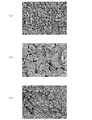
- FIGS. 1A to 1C are electron micrographs (each with a magnification of 500) of flaky silver powder (three types) having different average particle diameters.
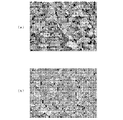
- FIGS. 2A to 2B are electron micrographs (each with a magnification of 500) of flaky silver powder (two types) produced under different conditions of the organic acid in the first aqueous solution.
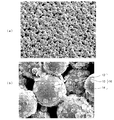
- 3A and 3B are electron micrographs (magnifications of 50 and 500) of conductive paste (thermoplastic resin) using flaky silver powder, respectively.
- FIG. 4 is an electron micrograph (magnification 1000) showing the state of the flaky silver powder after curing of the conductive paste of the present invention (Example 1).
- FIG. 1A to 1C are electron micrographs (each with a magnification of 500) of flaky silver powder (three types) having different average particle diameters.
- FIGS. 2A to 2B are electron micrographs (each with a magnification of 500) of flaky silver powder (two types
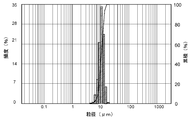
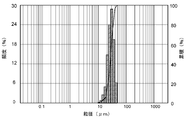
- FIG. 5 is a diagram provided for explaining the particle size distribution of flaky silver powder (Example 1).
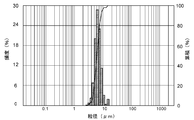
- FIG. 6 is a diagram provided for explaining the particle size distribution of another flaky silver powder (Example 2).
- FIG. 7 is a diagram provided to explain yet another particle size distribution of flaky silver powder (Example 5).
- FIGS. 8A to 8B show the relationship between the amount of flaky silver powder blended and the specific resistance of the conductive paste (thermosetting resin) and the specific resistance of the conductive paste (thermoplastic resin). It is a figure provided in order to demonstrate each.
- FIG. 9 is an electron micrograph (magnification 10,000) of the flaky silver powder produced under the condition using the organic acid salt in the second aqueous solution.
- the first embodiment is a flaky silver powder obtained by a wet reduction method, and corresponds to a circle when the flaky silver powder is viewed in plan.
- the average particle diameter (D 50 ) as a diameter is set to a value in the range of 1.1 to 30 ⁇ m
- the thickness of the flaky silver powder is 0.01 to 2 ⁇ m
- the bulk density of the flaky silver powder is 0.1 to 4 g /
- It is a flaky silver powder characterized by having a value within the range of cm 3 .
- the flaky silver powder of the first embodiment will be specifically described with reference to the drawings as appropriate.
- Form (1) Flaky shape As illustrated in FIGS. 1 (a) to 1 (c), FIGS. 2 (a) to (b), and FIG. 9, the shape of the silver powder of the first embodiment is flaky. It is characterized by. This is because, if the form of the silver powder is flaky, the bulk density of the silver powder is reduced and the silver powder is easily deformed. That is, when mixed with an electrically insulating resin to form a conductive paste, the density of the conductive paste can be reduced. Further, as shown in FIGS.
- the average thickness of the flaky silver powder described later / the average particle diameter (D 50 ) as the equivalent circle diameter in plan view is preferably set to a value within a range of 1/3 to 1/1000. A value within the range of 1/10 to 1/500 is more preferable, and a value within the range of 1/20 to 1/300 is even more preferable.
- the shape when the flaky silver powder is viewed in plan that is, the plane
- the shape is preferably at least one shape selected from the group consisting of a circle, an ellipse, and a hexagon.
- D 50 average particle diameter of the flaky silver powder described later, and further improves the handleability. It is.
- the average shape of the flaky silver powder can be observed directly from an electron micrograph, and can be calculated from the electron micrograph using an image processing apparatus.
- Average particle diameter (D 50 ) As an equivalent circle diameter when the flaky silver powder is viewed in plan is set to a value within a range of 1.1 to 30 ⁇ m.
- the reason for this is that when the average particle size of the flaky silver powder is less than 1.1 ⁇ m, it is necessary to use a special device such as ultrafiltration when washing, which requires manufacturing time and manufacturing cost and is economical. This is disadvantageous, because not only is it difficult to handle due to aggregation, but it is also difficult to deform, and furthermore, electrical characteristics may be deteriorated.
- the average particle size of the flaky silver powder is more preferably set to a value within the range of 3 to 20 ⁇ m, and further preferably set to a value within the range of 5 to 10 ⁇ m.
- the average particle diameter (D 50 ) of the flaky silver powder can be measured by a laser diffraction / scattering particle size distribution measuring device as a circle-equivalent diameter in a plan view as illustrated in FIGS. Alternatively, it can be actually measured from an electron micrograph, and can also be calculated from the electron micrograph using an image processing apparatus.
- the average thickness of the flaky silver powder is set to a value within the range of 0.01 to 2 ⁇ m. This is because when the average thickness of the flaky silver powder is less than 0.01 ⁇ m, the mechanical strength may be lowered or it may be difficult to produce stably. On the other hand, when the average thickness of the flaky silver powder exceeds 2 ⁇ m, it becomes difficult to deform, it becomes difficult to uniformly mix and disperse in the resin, or the manufacturing time becomes excessively long. Because there is. Accordingly, the average thickness of the flaky silver powder is more preferably set to a value within the range of 0.02 to 0.5 ⁇ m, and further preferably set to a value within the range of 0.05 to 0.2 ⁇ m. The average thickness of the flaky silver powder can be measured from an electron micrograph as shown in FIG. 4, and can be calculated from the electron micrograph using an image processing apparatus.
- the edge shape of the flaky silver powder has a cutout portion along the edge, and the entire shape is jagged. It is preferable. The reason for this is that, in the form having such a cut-out portion at the peripheral edge, the flaky silver powder is more easily deformed, and when a conductive paste is formed, even better electrical characteristics can be obtained. is there. That is, as shown in FIG. 4, it can be easily deformed along the surface of the electrically insulating particles contained in the conductive paste, and the electrical contact between adjacent flaky silver powders is good. Furthermore, it is because the value of the bulk density described later can be effectively reduced.
- a cutout portion having a depth of 0.01 to 3 ⁇ m more preferably having a cutout portion having a depth of 0.05 to 2 ⁇ m along the edge of the flaky silver powder. More preferably, it has a notch with a depth of 0.1 to 1 ⁇ m. It has been found that it is preferable to set the blending amount of the organic acid to a value within the range of 0.001 to 1% by weight as the manufacturing condition for providing such a notch.
- the degree of circularity can be determined using an image processing apparatus. It can be calculated and replaced.
- the height of the fine protrusion is not particularly limited, but is preferably a value in the range of 0.001 to 1 ⁇ m, for example, and a value in the range of 0.005 to 0.5 ⁇ m. It is more preferable to set the value within the range of 0.01 to 0.2 ⁇ m. Then, it has been found that it is preferable to set the blending amount of the organic acid to a value within the range of 0.001 to 1% by weight as the manufacturing condition for providing such a microprojection.
- the height of the minute protrusions on the surface of the flaky silver powder can be directly measured as an arithmetic average value using a surface roughness meter, or can be illuminated with a scale from an electron micrograph. It can be indirectly measured as an arithmetic average value.
- the bulk density of the flaky silver powder is set to a value in the range of 0.1 to 4 g / cm 3 .
- the reason for this is that when the bulk density of the flaky silver powder is less than 0.1 g / cm 3 , the shape retention of the flaky silver powder is remarkably lowered, the production process is complicated, and the yield during production is remarkably increased. This is because it may decrease.
- the bulk density of the flaky silver powder exceeds 4 g / cm 3 , dispersion in the resin may become extremely difficult or conductivity may be lowered.
- the bulk density of the flaky silver powder is preferably set to a value within the range of 0.5 to 3 g / cm 3 , more preferably set to a value within the range of 0.7 to 3 g / cm 3. More preferably, the value is within the range of 2 g / cm 3 .
- the bulk density of the flaky silver powder can be measured according to JIS K5101 tap method.
- the gelatin content is 0.1% by weight based on the total amount of the first aqueous solution and the second aqueous solution. It is characterized by being a value less than. This is because flaky silver powder can be obtained by controlling the gelatin content. That is, when the silver powder is obtained from the silver nitrate solution and the reducing agent solution using the wet reduction method, the flaky silver powder cannot be obtained unless the amount of gelatin in the silver nitrate solution and the reducing agent solution is set to a predetermined value or less.
- the gelatin content is more preferably less than 0.01% by weight with respect to the total amount of the first aqueous solution and the second aqueous solution, and the gelatin content is markedly 0, It can be said that it is more preferable not to use gelatin in the production of flaky silver powder.
- the surface of the flaky silver powder is treated with an organic acid (including an organic acid salt).
- an organic acid including an organic acid salt.
- the type of organic acid is not particularly limited as long as it is a carboxyl group or a compound in which it is converted to a salt with a base, but specifically, saturated fatty acid, saturated fatty acid salt, unsaturated fatty acid, unsaturated Examples include fatty acid salts, unsaturated carboxylic acids, unsaturated carboxylic acid salts, aromatic carboxylic acids, and aromatic carboxylic acid salts. Saturated fatty acids and saturated fatty acid salts are more preferable, and more specifically, malonic acid, succinic acid, glutamic acid, adipic acid, lauric acid, myristic acid, palmitic acid, stearic acid, oleic acid, succinic acid.
- It is preferably at least one selected from the group consisting of a salt, a glutarate, an adipate, a laurate, a myristate, a palmitate, a stearate, and an oleate. This is because the use of such a fatty acid or fatty acid salt further improves the balance between the shape retention of the flaky silver powder and the electrical conductivity.
- lauric acid, myristic acid, palmitic acid, stearic acid, lauric acid salt, myristic acid salt, palmitic acid salt, stearic acid salt Even at least one selected from the group consisting of:
- the type may be the same as or different from an organic acid (including an organic acid salt) as a form control agent described later.
- alcohols such as hexanol, octanol, 2-ethylhexanol, decanol, lauryl alcohol, and amines such as hexylamine, octylamine, 2-ethylhexylamine, decylamine, dodecylamine can be used. It is preferable for effectively preventing aggregation of the flaky silver powders.
- the second embodiment is a conductive paste including a flaky silver powder obtained by a wet reduction method and an electrically insulating resin.
- the average particle diameter (D 50 ) as the equivalent circle diameter when the flaky silver powder is viewed in plan is a value in the range of 1.1 to 30 ⁇ m, and the thickness of the flaky silver powder is 0.01 to 2 ⁇ m.
- the conductive paste is characterized in that the bulk density of the flaky silver powder is set to a value in the range of 0.1 to 4 g / cm 3 .
- the conductive paste of the second embodiment will be specifically described with reference to the drawings as appropriate.
- Form of flaky silver powder (1) The form of flaky silver powder used in the conductive paste is as shown in FIGS. 1 (a) to (c), FIGS. 2 (a) to (b), and FIG. It can be set as the form similar to the flaky silver powder of 1 embodiment.
- the blending amount of the flaky silver powder can be appropriately selected according to the intended use and the like, but is usually within the range of 10 to 300 parts by weight with respect to 100 parts by weight of the electrically insulating resin. It is preferable to set the value of. This is because the balance between the electrical properties of the conductive paste and the mechanical strength can be improved by limiting the blending amount of the flaky silver powder to such a range. More specifically, when the amount of the flaky silver powder added is less than 10 parts by weight, the specific resistance of the obtained conductive paste may be excessively increased. On the other hand, when the added amount of the flaky silver powder exceeds 300 parts by weight, the adhesive strength of the obtained conductive paste may decrease, the viscosity may increase excessively, and handling may be difficult. . Therefore, the amount of flaky silver powder added is more preferably in the range of 50 to 200 parts by weight and more preferably in the range of 80 to 100 parts by weight with respect to 100 parts by weight of the electrically insulating resin. More preferably.
- FIGS. 8A to 8B the blending amount (% by weight) of the flaky silver powder in two types of conductive pastes (thermosetting resin and thermoplastic resin) and the conductive paste
- the relationship with the specific resistance ( ⁇ ⁇ cm) will be described. That is, the horizontal axis of FIGS. 8 (a) to 8 (b) shows the blending amount (% by weight) of the flaky silver powder in the conductive paste, respectively, and the vertical axis shows the specific resistance ( ⁇ ⁇ cm) is shown.
- the larger the amount of flaky silver powder the smaller the specific resistance ( ⁇ ⁇ cm) when the conductive paste is cured.
- the specific resistance When the blending amount of the flaky silver powder was 15% by weight, the specific resistance was 7.9 ⁇ 10 ⁇ 2 ⁇ ⁇ cm, but when the blending amount of the flaky silver powder was 20% by weight, the specific resistance was 5.4 ⁇ It decreases rapidly to 10 ⁇ 3 ⁇ ⁇ cm. In addition, the specific resistance decreases to 9.4 ⁇ 10 ⁇ 4 ⁇ ⁇ cm when the amount of the flaky silver powder is 40% by weight, but the specific resistance is approximately 50% by weight even when the amount of the flaky silver powder is 50 to 60% by weight. 1 ⁇ 10 ⁇ 3 to 1 ⁇ 10 ⁇ 4 ⁇ ⁇ cm and a substantially constant value are shown. Further, as understood from the characteristic curve of FIG.
- the specific resistance of the conductive paste is determined by the blended amount of the flaky silver powder. It can be understood that it can be adjusted with high accuracy.
- thermosetting resin (1) Type 1 it is preferable to include at least one thermosetting resin selected from the group consisting of an epoxy resin, a phenol resin, a thermosetting acrylic resin, a thermosetting urethane resin, and a silicone resin as the type of electrically insulating resin. .
- a thermosetting resin By including such a thermosetting resin, good adhesive properties can be obtained, and good electrical properties can be maintained even when environmental properties have changed significantly. It is also preferable to use an ultraviolet curable resin or an anaerobic curable resin.
- an electrically insulating resin is an epoxy resin or the like
- a curing agent include one or a combination of two or more of an imidazole compound, a secondary amine compound, a tertiary amine compound, a modified aliphatic amine compound, and an epoxy resin amine adduct compound.
- an epoxy resin amine adduct compound is a preferred curing agent because it has high potential at room temperature and is fast curable at 60 to 90 ° C.
- epoxy resin amine adduct compounds for example, Amicure PN-23, PN-31, PN-40, MY-24 (above, manufactured by Ajinomoto Fine Techno Co., Ltd.), Cureduct P-0505 (Shikoku) Chemical Industry Co., Ltd.).
- the addition amount of the curing agent is preferably set to a value within the range of 10 to 35 parts by weight with respect to 100 parts by weight of the epoxy resin.
- the reason for this is that when the amount of the curing agent added is less than 10 parts by weight, the curing becomes insufficient and the adhesive properties may be significantly deteriorated.
- the amount of the curing agent added exceeds 35 parts by weight, the conductivity may be lowered or the potential may be lowered. Therefore, the amount of the curing agent added is more preferably set to a value within the range of 13 to 30 parts by weight and more preferably within a range of 15 to 25 parts by weight with respect to 100 parts by weight of the epoxy resin. Is more preferable.
- curing agent means the total amount in the state also including that, when a reactive diluent is included.
- thermoplastic resin selected from the group consisting of a polyester resin, a polyolefin resin, a polyamide resin, and a polyurethane resin is included for the kind of the electrically insulating resin.
- a thermoplastic resin selected from the group consisting of a polyester resin, a polyolefin resin, a polyamide resin, and a polyurethane resin is included for the kind of the electrically insulating resin.
- a diluent a reactive diluent is included
- blend a diluent a reactive diluent is included
- a diluent include one or a combination of two or more of an aliphatic monofunctional epoxy compound, an aliphatic bifunctional epoxy compound, an aromatic monofunctional epoxy compound, and the like.
- o-sec-butylphenyl glycidyl ether cyclohexane dimethylol type epoxy resin
- phenyl glycidyl ether o-cresyl glycidyl ether, p-tert-butylphenyl glycidyl ether, o-phenylphenyl glycidyl ether , Nonylphenyl glycidyl ether, phenol (EO) 5 glycidyl ether, diethylene glycol diglycidyl ether, polyethylene glycol diglycidyl ether, polypropylene glycol diglycidyl ether, glycerol polyglycidyl ether, trimethylolpropane polyglycidyl ether, 1,6-hexanediol di Glycidyl ether, 1,4-butanediol diglycidyl ether, 2-ethylhexyl gly
- the addition amount of the diluent is a value within the range of 5 to 30% by weight with respect to the total amount of the electrically insulating resin.
- the reason for this is that if the amount of the diluent added is less than 5% by weight, the effect of addition may not be obtained.
- the amount of the diluent added exceeds 30% by weight, the adhesiveness may be significantly reduced. Therefore, the amount of the diluent added is more preferably in the range of 8 to 25% by weight with respect to the total amount of the electrically insulating resin, and is preferably in the range of 10 to 22% by weight. More preferably.
- Resin Particles As illustrated in FIG. 3B, it is preferable that resin particles (particulate filler) 14 are blended in the conductive paste 16 together with the flaky silver powder 10 and the electrically insulating resin 12. .
- the reason for this is that, by including such resin particles, good electrical characteristics can be obtained even when the flaky silver powder adheres to the periphery of the resin particles and the blending amount of the flaky silver powder is smaller. It is because it can do. Moreover, it is because the mechanical strength, heat resistance, etc. of an electrically conductive paste can be controlled by mix
- resin particles such as olefin resin particles, acrylic resin particles, styrene resin particles, phenol resin particles, inorganic particles (aluminum oxide, glass, etc.) as the resin particles.
- the average particle size (D 50 ) of the resin particles is usually preferably in the range of 1 to 200 ⁇ m. The reason for this is that when the average particle size of the resin particles is less than 1 ⁇ m, the effect of addition may not be obtained. On the other hand, if the average particle size of the resin particles exceeds 200 ⁇ m, the electrical characteristics and adhesiveness may be significantly reduced. Therefore, the average particle size of the resin particles is usually more preferably in the range of 5 to 100 ⁇ m, and even more preferably in the range of 10 to 50 ⁇ m.
- the average particle diameter (D 50 ) of the resin particles can be measured according to JIS Z 8901: 2006.
- the specific resistance of the conductive paste containing flaky silver powder in a predetermined amount is 1 ⁇ 10 ⁇ 5 to 1 ⁇ 10 ⁇ 1.
- a value within the range of ⁇ ⁇ cm is preferable. The reason for this is that, when the specific resistance of the conductive paste is less than 1 ⁇ 10 ⁇ 5 ⁇ ⁇ cm, the types of flaky silver powder that can be used are excessively limited, or the production of suitable flaky silver powder is difficult. This is because the yield may decrease excessively.
- the specific resistance exceeds 1 ⁇ 10 ⁇ 1 ⁇ ⁇ cm the conduction resistance during use increases and the drive voltage may increase.
- the specific resistance of the flaky silver powder in the state of containing the resin is more preferably set to a value in the range of 1 ⁇ 10 ⁇ 4 to 5 ⁇ 10 ⁇ 2 ⁇ ⁇ cm, and 5 ⁇ 10 ⁇ 4 to 1 ⁇ . More preferably, the value is within the range of 10 ⁇ 3 ⁇ ⁇ cm.
- the specific resistance of the conductive paste containing a predetermined amount of flaky silver powder can be measured by the measurement method shown in Example 1 described later.
- various additives such as antioxidants, ultraviolet absorbers, metal ion scavengers, viscosity modifiers, inorganic fillers, organic fillers, carbon fibers, colorants, coupling agents, etc. It is also preferable to add.
- an antioxidant an amine-based antioxidant, a phenol-based antioxidant, a phosphate-based antioxidant, or the like Is preferably added in the range of 0.1 to 10% by weight with respect to the total amount of the conductive paste.
- the density of the conductive paste is preferably set to a value within the range of 1 to 3.5 g / cm 3 .
- the reason for this is that when the density of the conductive paste is less than 1 g / cm 3 , the conductivity may be significantly reduced or the types of usable electrically insulating resins may be excessively limited. It is.
- the density of the conductive paste exceeds 3.5 g / cm 3 , the handleability may be lowered, or the conductive paste may be easily peeled off from an adherend such as copper or silver.
- the density of the conductive paste is more preferably set to a value within the range of 1.2 to 3 g / cm 3 , and further preferably set to a value within the range of 1.4 to 2.5 g / cm 3. .
- the electrically conductive paste of this invention uses the flaky silver powder with a very small bulk density, it can adjust easily to a desired range by adjusting the compounding quantity.
- the production method of the conductive paste using the flaky silver powder is not particularly limited. For example, using a propeller mixer, a planetary mixer, a three-roll, a kneader, a spatula, etc. It is preferable to manufacture by mixing and dispersing a predetermined amount of flaky silver powder. For example, when a planetary mixer is used, it is understood that a conductive paste having a specific resistivity is obtained after curing regardless of the mixing time when the mixing time is in the range of 10 to 120 minutes.
- the viscosity of the electrically insulating resin is set to a value within the range of 1,000 to 100,000 mPa ⁇ sec (temperature: 25 ° C.) so that the flaky silver powder and the electrically insulating resin are more uniformly mixed.
- the value is preferably in the range of 10,000 to 50,000 mPa ⁇ sec.
- the flaky silver powder is preliminarily treated with a coupling agent so that the flaky silver powder and the electrically insulating resin are more uniformly mixed.
- ⁇ -aminopropyltriethoxysilane or the like is added to and mixed with 100 parts by weight of flaky silver powder, and then the flaky silver powder thus treated with a coupling agent is added to the resin. It is preferable to mix and disperse.
- the flocculated silver powder agglomerates and dust are filtered and removed using a filter or the like.
- the flaky silver powder of the present invention is flaky and easily deformed, so that when it is mixed in an electrically insulating resin, there is little generation of aggregates. There is an advantage that it can be easily filtered using a 200 ⁇ m mesh filter or the like.
- the third embodiment is based on a wet reduction method, and is obtained by reacting a first aqueous solution containing silver nitrate with a second aqueous solution containing a silver nitrate reducing agent.
- the diameter (D 50 ) is a value within the range of 1.1 to 30 ⁇ m
- the thickness is within the range of 0.01 to 2 ⁇ m
- the bulk density is within the range of 0.1 to 4 g / cm 3 .
- a method for producing flaky silver powder characterized in that nitric acid and organic acid are blended in each of the first aqueous solution and the second aqueous solution, or one of the aqueous solutions. It is.
- the manufacturing method of the flaky silver powder of the third embodiment will be specifically described.
- the amount of silver nitrate in the first aqueous solution is usually preferably in the range of 1 to 20% by weight. The reason for this is that when the amount of silver nitrate is less than 1% by weight, the production rate of the flaky silver powder is excessively reduced, and the production efficiency may be significantly reduced. On the other hand, if the blending amount of silver nitrate exceeds 20% by weight, the viscosity of the slurry deposited by reaction increases, which may make it difficult to control the reaction. Therefore, the amount of silver nitrate contained in the first aqueous solution is more preferably set to a value within the range of 7 to 17% by weight, and further preferably set to a value within the range of 10 to 15% by weight.
- Nitric acid can be blended only in the second aqueous solution, as will be described later.
- the blending amount of the first aqueous solution is changed. A value of 20% by weight or less is preferable based on the total amount. That is, if the amount of nitric acid exceeds 20% by weight, a plurality of minute protrusions may grow abnormally on the surface (front and back surfaces) of the flaky silver powder as a surface state. However, if the amount of nitric acid is excessively reduced, the effect of addition may not be exhibited stably.
- the amount of nitric acid is a value within the range of 0.1 to 10% by weight, and a value within the range of 0.5 to 5% by weight with respect to the total amount of the first aqueous solution. More preferably.
- Organic acids including organic acid salts
- the organic acid can also be blended in the second aqueous solution.
- the blending amount is adjusted to the total amount of the first aqueous solution.
- the value is preferably 2% by weight or less. That is, when the blending amount of the organic acid exceeds 2% by weight, the shape of the silver powder is not flaky but may be almost spherical. However, if the amount of the organic acid is excessively reduced, the effect of addition may not be exhibited stably.
- the blending amount of the organic acid is more preferably in the range of 0.001 to 1% by weight, more preferably in the range of 0.01 to 0.5% by weight with respect to the total amount of the first aqueous solution. More preferably, the value of
- the organic acid as the form control agent, citric acid (including citric acid monohydrate), succinic acid, malic acid (including D-malic acid and L-malic acid), tartaric acid (monotartaric acid Hydrate, etc.), malonic acid, glutaric acid, adipic acid, formic acid, acetic acid, propionic acid, butyric acid and the like alone or in combination of two or more.
- the amount of the organic acid salt is within the range of 0.001 to 1% by weight with respect to the total amount of the first aqueous solution, and the range of 0.01 to 0.5% by weight.
- organic acid salt as such a form control agent, ammonium polyacrylate, ammonium citrate, ammonium succinate, ammonium malate, ammonium tartrate, ammonium malonate, ammonium glutarate, ammonium adipate, ammonium formate, ammonium acetate , Organic acid ammonium salts such as ammonium propionate and ammonium butyrate, organic acid sodium salts such as sodium polyacrylate, sodium citrate and sodium succinate, potassium organic acid potassium such as potassium polyacrylate, potassium citrate and potassium succinate Examples thereof include a single salt or a combination of two or more organic acid amine salts such as polyethanol monoethanolamine and monoethanolamine citrate.
- Ammonia and / or amine compound (hereinafter sometimes simply referred to as ammonia or the like) can also be blended in the second aqueous solution as described later.
- blending with a 1st aqueous solution as a form control agent it is preferable to make the compounding quantity into the value of 2 weight% or less with respect to the whole quantity of a 1st aqueous solution. That is, if the amount of ammonia or the like exceeds 2% by weight, the particle size of the obtained flaky silver powder may be too small. However, when the amount of ammonia or the like is excessively small, the mixing effect cannot be obtained, and it may be difficult to control the average particle size.
- the blending amount of ammonia or the like is within a range of 0.1 to 1.5% by weight with respect to the total amount of the first aqueous solution, and it is within a range of 0.5 to 1% by weight. More preferably, it is a value.
- ammonia etc. can be mix
- amine compounds monoethanolamine, diethanolamine, triethanolamine, monoisopropanolamine, diisopropanolamine, triisopropanolamine, N-methylmonoethanolamine, N-ethylmonoethanolamine, N-butylmonoethanol Amine, N-methyldiethanolamine, N-ethyldiethanolamine, N-butyldiethanolamine, N-cyclohexyldiethanolamine, N, N-dimethylmonoethanolamine, N, N-diethylmonoethanolamine, N, N-dibutylmonoethanolamine, amino Alcoholamine compounds such as methylpropanol, aminoethylpropanediol, aminomethylpropanediol, aminobutanol, methylamine, di
- the amount of water is the remaining amount of silver nitrate, nitric acid, ammonia water, etc., and water is sufficient to make the total amount of the first aqueous solution composed of these components 100% by weight. It shall be blended.
- Blending Example Accordingly, as a blending example of the first aqueous solution, silver nitrate, nitric acid, ammonia water, and water are blended, and the total amount of the first aqueous solution (100% by weight).
- the amount of silver nitrate is within a range of 1 to 20% by weight, the amount of nitric acid is 20% by weight or less, the amount of ammonia water or the like is 2% by weight or less, and the remaining amount of water is mixed. It is preferable to use an amount.
- the first aqueous solution silver nitrate, nitric acid, aqueous ammonia, etc., an organic acid (including an organic acid salt), and water are blended, respectively, and the entire first aqueous solution
- the amount of silver nitrate is within a range of 1 to 20% by weight (100% by weight)
- the amount of nitric acid is 20% by weight or less
- the amount of ammonia water or the like is 2% by weight or less
- organic acid Is preferably 2% by weight or less organic acid
- nitric acid, aqueous ammonia, and the like, and organic acid can be blended in the second aqueous solution, as described later.
- the blending amount of nitric acid, aqueous ammonia, and the organic acid in the first aqueous solution can be changed as appropriate. More specifically, when nitric acid is blended in the first aqueous solution and the second aqueous solution, the total amount of nitric acid is set to a value within the range of 0.1 to 10% by weight with respect to the total amount thereof. Is preferred. Similarly, when ammonia water or the like and an organic acid are blended in the first aqueous solution and the second aqueous solution, respectively, the total amount of ammonia water or the like and the organic acid, respectively, A value within the range of 0.001 to 1% by weight is preferred.
- Second Aqueous Solution (1) Types of Silver Nitrate Reducing Agents As reducing agents contained in the second aqueous solution, formaldehyde, sodium boron erythorbate, hydrazine, hydrazine compounds, hydroquinone, L-ascorbic acid, L-ascorbate, formic acid , Anhydrous sodium sulfite, L (+) tartaric acid, ammonium formate, Rongalite, pyrocatechol and the like alone or in combination of two or more. Of these reducing agents, it is more preferable to use L-ascorbic acid or a combination of L-ascorbic acid and pyrocatechol because the reduction reaction with respect to silver nitrate can be easily controlled.
- reducing agents contained in the second aqueous solution formaldehyde, sodium boron erythorbate, hydrazine, hydrazine compounds, hydroquinone, L-ascorbic acid, L-ascorbate,
- the blending amount of the silver nitrate reducing agent in the second aqueous solution is usually preferably in the range of 0.5 to 20% by weight.
- the reason for this is that when the amount of the reducing agent is less than 0.5% by weight, the production rate of the flaky silver powder is excessively reduced, and the production efficiency may be significantly reduced.
- the amount of the reducing agent exceeds 20% by weight, it may not be dissolved in water. Therefore, the amount of the reducing agent contained in the second aqueous solution is more preferably in the range of 4 to 18% by weight, and even more preferably in the range of 7 to 15% by weight.
- Nitric acid can be blended in the first aqueous solution.
- the blending amount is adjusted to the entire second aqueous solution.
- a value of 20% by weight or less is preferable based on the amount. That is, if the amount of nitric acid exceeds 20% by weight, a plurality of minute protrusions may grow abnormally on the surface (front and back surfaces) of the flaky silver powder as a surface state. However, if the amount of the organic acid is excessively reduced, the effect of addition may not be exhibited stably.
- the blending amount of nitric acid is a value within the range of 0.1 to 10% by weight, and a value within the range of 0.5 to 5% by weight with respect to the total amount of the second aqueous solution. More preferably.
- Organic acids including organic acid salts
- the organic acid can be blended in the first aqueous solution, but when blending the organic acid as the form control agent in the second aqueous solution,
- the value is preferably 2% by weight or less with respect to the total amount of the second aqueous solution. That is, when the blending amount of the organic acid exceeds 2% by weight, the shape of the silver powder is not flaky but may be almost spherical. However, if the amount of the organic acid is excessively reduced, the effect of addition may not be exhibited stably.
- the blending amount of the organic acid is more preferably in the range of 0.001 to 1% by weight, more preferably in the range of 0.01 to 0.5% by weight with respect to the total amount of the second aqueous solution. More preferably, the value of
- ammonia and / or amine compound can also be blended in the first aqueous solution.
- the blending amount thereof Is preferably 2% by weight or less with respect to the total amount of the second aqueous solution. That is, if the amount of ammonia or the like exceeds 2% by weight, the particle size of the silver powder may be too small.
- the amount of ammonia or the like is excessively small, the mixing effect cannot be obtained, and it may be difficult to control the average particle size.
- the blending amount of ammonia or the like is a value within the range of 0.1 to 1.5% by weight with respect to the total amount of the second aqueous solution, and within the range of 0.5 to 1% by weight. More preferably, it is a value.
- the amount of water is the remaining amount of silver nitrate reducing agent, nitric acid, organic acid, aqueous ammonia, etc., and the total amount of the second aqueous solution comprising these components is 100% by weight. It is preferable that
- Blending Example As a blending example of the second aqueous solution, a silver nitrate reducing agent, nitric acid, an organic acid or organic acid salt, and water are blended, respectively, and the total amount of the second aqueous solution (100 wt. %), The amount of silver nitrate reducing agent in the range of 0.5 to 20% by weight, the amount of nitric acid in the amount of 20% by weight or less, and organic acid (including organic acid salt) The amount is preferably 2% by weight or less and the remaining amount of water.
- a silver nitrate reducing agent, nitric acid, an organic acid, ammonia, and water are blended, respectively, and the total amount of the second aqueous solution (100 wt. %),
- the amount of silver nitrate reducing agent is within a range of 0.5 to 20% by weight, the amount of nitric acid is 20% by weight or less, and the amount of organic acid is 2% by weight or less. It is preferable that the value and the blending amount of ammonia or the like be 2% by weight or less and the remaining amount of water.
- nitric acid, aqueous ammonia, and organic acid can be blended in the first aqueous solution.
- the blending amount of nitric acid, aqueous ammonia, and organic acid in the second aqueous solution is as follows. It can be changed as appropriate.
- reaction temperature is more preferably set to a value within the range of 10 to 50 ° C., and further preferably set to a value within the range of 20 to 40 ° C.
- the treatment amount of the organic acid or the organic acid salt may be set to a value within the range of 0.001 to 5 parts by weight with respect to 100 parts by weight of the flaky silver powder. preferable.
- the treatment amount of the organic acid is preferably set to a value within the range of 0.01 to 1 part by weight with respect to 100 parts by weight of the flaky silver powder, and within a range of 0.05 to 0.5 part by weight. More preferably, the value of
- Drying treatment Moreover, it is preferable to provide a drying step and heat-treat the flaky silver powder subjected to a predetermined surface treatment. That is, for example, it is preferable to heat-treat at a temperature of 30 ° C. or higher for 30 minutes or more after performing a predetermined surface treatment on the flaky silver powder obtained by the wet reduction method.
- the reason for this is that the heat treatment can effectively disperse the liquid remaining inside the flaky silver powder, such as water, and as a result, the shape retention of the flaky silver powder can be remarkably improved. Because. In other words, if the flaky silver powder obtained by the liquid phase reduction method is left as it is in a wet state, the shape of the flaky silver powder tends to collapse. Therefore, in order to obtain better shape retention, it is preferable to perform heat treatment at a temperature of 40 to 150 ° C. for about 1 to 48 hours using a vacuum oven or a thermostatic bath.
- Example 1 Production of flaky silver powder and conductive paste
- a first aqueous solution containing silver nitrate, ion-exchanged water, an organic acid, and nitric acid was prepared. That is, in a container with a stirrer (container A), 4 g of silver nitrate, 24 g of ion-exchanged water, 0.02 g of citric acid (citric acid monohydrate), 1 g of nitric acid (concentration: 69% by weight), And stirred using a magnetic stirrer until uniform.
- a second aqueous solution containing a reducing agent and ion-exchanged water was prepared.
- the precipitated flaky silver powder is washed with ion-exchanged water, and then a predetermined amount of the organic acid is treated at a ratio of 0.02 parts by weight with respect to 100 parts by weight of the flaky silver powder.
- An aqueous ammonium stearate solution (0.5 wt%) was added to the mixed solution, and surface treatment with an organic acid was performed.
- the surface-treated flaky silver powder is filtered off and dried using a vacuum oven at 100 ° C. for 3 hours to obtain flaky silver powder (A1, average particle diameter (D 50 ): 10.7 ⁇ m, bulk density: 1.3 g / cm 3 ).
- the thickness of the obtained flaky silver powder (A1) was measured using an electron microscope at five points, the average value was calculated, and the average thickness was evaluated according to the following criteria. The obtained evaluation results are shown in Table 1.
- ⁇ The average thickness is a value in the range of 0.001 to 3 ⁇ m, and excluding the value in the range of 0.01 to 2 ⁇ m.
- X The average thickness is a value less than 0.001 ⁇ m or a value exceeding 3 ⁇ m.
- Adhesive strength (Evaluation 5)
- the obtained conductive paste was screen-printed in the form of a pattern (length 12.5 mm ⁇ width 25 mm ⁇ thickness 0.5 mm) on the edge of a copper plate 120 mm long ⁇ 25 mm wide ⁇ 2 mm thick and then vertically printed from above.
- a copper plate of 120 mm ⁇ width 25 mm ⁇ thickness 2 mm was laminated. Subsequently, it was heat-cured on the conditions of 180 degreeC x 30 minutes, and it was set as the adhesive force measurement sample.
- a tensile shear force was measured using a Tensilon type universal testing machine RTC-1310A (manufactured by Orientec Co., Ltd.) and evaluated according to the following criteria.
- the obtained evaluation results are shown in Table 1.
- ⁇ The tensile shear force is a value of 4 kgf / cm 2 or more.
- X The tensile shear force is a value less than 2 kgf / cm 2 .
- Density (Evaluation 6) The density of the obtained conductive paste was measured according to JIS Z 8807 and evaluated according to the following criteria. The obtained evaluation results are shown in Table 1.
- X The density of the conductive paste is a value exceeding 3.5 g / cm 3 .
- Example 2 to 7 In Examples 2 to 7, when the second aqueous solution in Example 1 was prepared, the amount of nitric acid was changed, and the influence on the bulk density and average particle size of the flaky silver powder was examined. That is, in Example 2, flakes were formed in the same manner as in Example 1 except that nitric acid was blended in the first aqueous solution and the second aqueous solution, the organic acid was blended only in the second aqueous solution, and the reaction temperature was 20 ° C. Silver powder (A2) and a conductive paste were produced therefrom and evaluated.
- Example 3 nitric acid and organic acid were respectively added to the second aqueous solution, and the flaky silver powder (A3) and the conductive paste were then used in the same manner as in Example 1 except that the reaction temperature was 20 ° C. Manufactured and evaluated.
- Example 4 nitric acid was blended into the first aqueous solution and the second aqueous solution, an organic acid was blended only into the second aqueous solution, and ammonia water (a product having a concentration of 28% by weight) was blended only into the first aqueous solution, Except that the reaction temperature was 20 ° C., flaky silver powder (A4) and a conductive paste were produced and evaluated in the same manner as in Example 1.
- Example 5 nitric acid and organic acid were blended only in the second aqueous solution, ammonia water (concentration 28 wt% product) was blended only in the first aqueous solution, and the reaction temperature was 20 ° C.
- the organic acid was blended only in the second aqueous solution, the amine compound (triethanolamine) was blended only in the first aqueous solution, and the reaction temperature was 35 ° C.
- flaky silver powder (A6) and a conductive paste were produced therefrom and evaluated.
- Example 7 is the same as Example 1 except that the organic acid is blended only in the second aqueous solution, the amine compound (diethanolamine) is blended only in the first aqueous solution, and the reaction temperature is 35 ° C.
- a flaky silver powder (A7) and a conductive paste were produced therefrom and evaluated. The evaluation results obtained are shown in Table 1.
- Comparative Example 1 In Comparative Example 1, when preparing the first aqueous solution and the second aqueous solution in Example 1, at least nitric acid was not blended at all, as in Example 1, silver powder (silver powder having needle-like protrusions (B1 )) And conductive pastes produced therefrom and evaluated. The obtained evaluation results are shown in Table 1.
- Examples 8 to 12 In Examples 8 to 12, as shown in Table 2, the type of the electrically insulating resin in the conductive paste is changed to an epoxy resin powder primer (Nissin Powder EP758-047 Epoxy Primer manufactured by Takashi Kubo Paint Co., Ltd.). In addition, with respect to 85 parts by weight, 80 parts by weight, 70 parts by weight, 60 parts by weight, and 50 parts by weight, the amount of flaky silver powder (A1) is 15 parts by weight, 20 parts by weight, 30 parts by weight, 40 parts by weight, respectively. A conductive paste was prepared in the same manner as in Example 1 except that the weight was 50 parts by weight, and the solvent (Exsol Mobil Exol D80 manufactured by ExxonMobil) was 50 parts by weight. did. The evaluation results obtained are shown in Table 2.
- Example 13 to 16 In Examples 13 to 16, as shown in Table 3, the type of electrically insulating resin in the conductive paste was changed to polyester resin (byron UR-3210, manufactured by Toyobo Co., Ltd.), and 12 parts by weight. 58 parts by weight, 49.5 parts by weight, 41. parts by weight of acrylic resin particles (manufactured by Aika Industry Co., Ltd., Ganzpearl GM-2810) with respect to 10.5 parts by weight, 8.5 parts by weight, and 7 parts by weight.
- polyester resin byron UR-3210, manufactured by Toyobo Co., Ltd.
- acrylic resin particles manufactured by Aika Industry Co., Ltd., Ganzpearl GM-2810
- a conductive paste was prepared in the same manner as in Example 1 except that 55 parts by weight, 60 parts by weight, 60 parts by weight, and 65 parts by weight were used. The obtained results are shown in Table 3.
- Example 17 to 18 the type of organic acid as the form control agent was flaky silver powder (A8, A8, respectively) as in Example 1 except that succinic acid and tartaric acid were used instead of citric acid. A9) and a conductive paste were produced therefrom, and the specific resistance and the like were measured in the same manner. Table 4 shows the obtained results.
- Example 19 to 20, Comparative Example 2 In Examples 19 to 20, as shown in Table 5, instead of the organic acid as the form control agent, an ammonium polyacrylate that is an organic acid salt (manufactured by Wako Pure Chemical Industries, Ltd., an ammonium polyacrylate solution, Except for using 0.04 parts by weight and 0.2 parts by weight, respectively, in the same manner as in Example 1, flaky silver powder (A10, A11) and a conductive paste were prepared therefrom. The specific resistance and the like were measured in the same manner. The obtained results are shown in Table 5.
- an ammonium polyacrylate that is an organic acid salt manufactured by Wako Pure Chemical Industries, Ltd., an ammonium polyacrylate solution, Except for using 0.04 parts by weight and 0.2 parts by weight, respectively, in the same manner as in Example 1, flaky silver powder (A10, A11) and a conductive paste were prepared therefrom. The specific resistance and the like were measured in the same manner. The obtained results are shown in Table 5.
- the flaky silver powder of the present invention has a predetermined bulk density, an average particle diameter (D 50 ) and the like using a wet reduction method, is easy to handle, and constitutes a conductive paste.
- a flaky silver powder that can provide good electrical properties can be obtained. Then, by adjusting the manufacturing conditions, providing a notch on the edge of the flaky silver powder to make it jagged, or providing a plurality of minute protrusions on the surface of the flaky silver powder, the deformation of the flaky silver powder etc. Not only can this be facilitated, but the bulk density value can be drastically reduced.
- the conductive paste of the present invention has a predetermined bulk density, an average particle diameter (D 50 ), and the like, and by blending a predetermined amount of flaky silver powder into an electrically insulating resin, it has electrical characteristics. In addition to being excellent, a low-density conductive paste can be obtained. Further, by further mixing and dispersing resin particles and inorganic particles in the electrically insulating resin, not only can the mechanical strength of the conductive paste itself be increased, but also the flaky silver powder is along the curved surface of the resin particles. As a result, it becomes easy to be deformed, and good electrical characteristics can be obtained even with a relatively small amount.
- the method for producing flaky silver powder of the present invention by using a predetermined wet reduction method, a flaky shape having a predetermined bulk density, an average particle diameter (D 50 ), and the like and easy to handle. Silver powder can be obtained efficiently. Therefore, the flaky silver powder of the present invention and the conductive paste using the same are expected to be suitably used in conductive applications such as various electric products, electronic parts, automobile products, and grounding and shielding applications. .
Landscapes
- Chemical & Material Sciences (AREA)
- Engineering & Computer Science (AREA)
- General Chemical & Material Sciences (AREA)
- Chemical Kinetics & Catalysis (AREA)
- Spectroscopy & Molecular Physics (AREA)
- Dispersion Chemistry (AREA)
- Physics & Mathematics (AREA)
- Nanotechnology (AREA)
- Materials Engineering (AREA)
- Organic Chemistry (AREA)
- Wood Science & Technology (AREA)
- Life Sciences & Earth Sciences (AREA)
- Conductive Materials (AREA)
- Powder Metallurgy (AREA)
- Manufacture Of Metal Powder And Suspensions Thereof (AREA)
- Non-Insulated Conductors (AREA)
- Battery Electrode And Active Subsutance (AREA)
Abstract
Priority Applications (5)
| Application Number | Priority Date | Filing Date | Title |
|---|---|---|---|
| JP2015514265A JP5763869B2 (ja) | 2013-06-25 | 2014-05-27 | 薄片状銀粉、導電性ペースト、および薄片状銀粉の製造方法 |
| KR1020157032624A KR101729885B1 (ko) | 2013-06-25 | 2014-05-27 | 박편상 은분, 도전성 페이스트, 및 박편상 은분의 제조 방법 |
| US14/779,075 US10071420B2 (en) | 2013-06-25 | 2014-05-27 | Flake-like silver powder, conductive paste, and method for producing flake-like silver powder |
| CN201480016867.4A CN105050755B (zh) | 2013-06-25 | 2014-05-27 | 薄片状银粉、导电性糊剂及薄片状银粉的制造方法 |
| EP14816104.5A EP3015195B1 (fr) | 2013-06-25 | 2014-05-27 | Poudre d'argent lamellaire, pâte conductrice et procédé pour la production de poudre d'argent lamellaire |
Applications Claiming Priority (2)
| Application Number | Priority Date | Filing Date | Title |
|---|---|---|---|
| JP2013-132174 | 2013-06-25 | ||
| JP2013132174 | 2013-06-25 |
Publications (1)
| Publication Number | Publication Date |
|---|---|
| WO2014208250A1 true WO2014208250A1 (fr) | 2014-12-31 |
Family
ID=52141602
Family Applications (1)
| Application Number | Title | Priority Date | Filing Date |
|---|---|---|---|
| PCT/JP2014/063938 Ceased WO2014208250A1 (fr) | 2013-06-25 | 2014-05-27 | Poudre d'argent lamellaire, pâte conductrice et procédé pour la production de poudre d'argent lamellaire |
Country Status (7)
| Country | Link |
|---|---|
| US (1) | US10071420B2 (fr) |
| EP (1) | EP3015195B1 (fr) |
| JP (1) | JP5763869B2 (fr) |
| KR (1) | KR101729885B1 (fr) |
| CN (1) | CN105050755B (fr) |
| TW (1) | TWI518038B (fr) |
| WO (1) | WO2014208250A1 (fr) |
Cited By (4)
| Publication number | Priority date | Publication date | Assignee | Title |
|---|---|---|---|---|
| JP2018523758A (ja) * | 2015-08-12 | 2018-08-23 | エルエスニッコカッパー インコーポレイテッドLs−Nikko Copper Inc. | 高温焼結型導電性ペースト用銀粉末の製造方法 |
| JP2022510291A (ja) * | 2018-11-30 | 2022-01-26 | エルエスニッコカッパー インコーポレイテッド | 収縮率の調節が可能な銀粉末の製造方法 |
| CN114734033A (zh) * | 2022-04-14 | 2022-07-12 | 宁夏中色新材料有限公司 | 适用于异质节太阳能电池导电胶的片状银粉及其制备方法 |
| JP2023152128A (ja) * | 2022-04-01 | 2023-10-16 | 太陽ホールディングス株式会社 | 導電性組成物およびその製造方法、ならびに導電性組成物を用いた導電体および積層構造体 |
Families Citing this family (16)
| Publication number | Priority date | Publication date | Assignee | Title |
|---|---|---|---|---|
| CN106062682B (zh) * | 2013-12-30 | 2019-05-21 | 株式会社高可科 | 用于计算机装置的标识符提供装置 |
| DE202014010576U1 (de) * | 2014-06-12 | 2016-01-07 | Pfisterer Kontaktsysteme Gmbh | Vorrichtung zum Kontaktieren eines elektrischen Leiters sowie Anschluss- oder Verbindungseinrichtung mit einer solchen Vorrichtung |
| JP6428339B2 (ja) * | 2015-02-13 | 2018-11-28 | 三菱マテリアル株式会社 | 銀粉及びペースト状組成物並びに銀粉の製造方法 |
| JP6239067B2 (ja) * | 2015-08-24 | 2017-11-29 | Dowaエレクトロニクス株式会社 | 銀粉およびその製造方法、ならびに導電性ペースト |
| CN111148586B (zh) * | 2017-09-27 | 2022-12-02 | 同和电子科技有限公司 | 银粉混合物及其制造方法以及导电性糊剂 |
| CN107716944B (zh) * | 2017-10-31 | 2019-10-08 | 长春黄金研究院有限公司 | 化学法制备纳米级片状银粉的方法 |
| KR101989022B1 (ko) * | 2018-06-08 | 2019-06-13 | 주식회사 솔루에타 | 도전성 조성물 및 이의 제조방법 |
| KR102129172B1 (ko) * | 2018-08-17 | 2020-07-06 | 주식회사 에스아이피 | 정전기 제거용 도전성 잉크 조성물 |
| CN111922348A (zh) * | 2020-08-11 | 2020-11-13 | 河南金渠银通金属材料有限公司 | 一种高频陶瓷多层片式电感器用银粉的制备方法及其制品 |
| CN112309605B (zh) * | 2020-11-11 | 2022-07-12 | 上海大洲电子材料有限公司 | 一种提高银浆工艺性和银层致密度的银浆配方及制备工艺 |
| CN113369491B (zh) * | 2021-05-27 | 2022-12-16 | 东方电气集团科学技术研究院有限公司 | 一种球形、片状混合银粉及其制造方法 |
| CN116213745B (zh) * | 2023-01-03 | 2025-08-15 | 中国乐凯集团有限公司 | 薄膜状银粉及其制备方法和应用 |
| CN117047120B (zh) * | 2023-08-18 | 2025-11-04 | 中南大学 | 一种低振实密度片状银粉的制备方法 |
| CN117564283A (zh) * | 2023-11-20 | 2024-02-20 | 深圳先进电子材料国际创新研究院 | 一种银粒子、制备方法及应用 |
| CN120551407B (zh) * | 2025-07-28 | 2025-10-31 | 长春黄金研究院有限公司 | 雾化银粉及其制备方法 |
| CN121289499B (zh) * | 2025-12-11 | 2026-03-31 | 长春黄金研究院有限公司 | 银粉及其制备方法 |
Citations (5)
| Publication number | Priority date | Publication date | Assignee | Title |
|---|---|---|---|---|
| JP2007107057A (ja) * | 2005-10-14 | 2007-04-26 | Toyo Ink Mfg Co Ltd | 金属微粒子分散体の製造方法、該方法で製造された金属微粒子分散体を用いた導電性インキ、および導電性パターン。 |
| JP2009013449A (ja) | 2007-07-02 | 2009-01-22 | Mitsui Mining & Smelting Co Ltd | 扁平銀粉、扁平銀粉の製造方法、及び導電性ペースト |
| JP2012036481A (ja) | 2010-08-11 | 2012-02-23 | Mitsui Mining & Smelting Co Ltd | 扁平銀粒子及びその製造方法 |
| WO2012147945A1 (fr) * | 2011-04-28 | 2012-11-01 | Dowaエレクトロニクス株式会社 | Particule d'argent tabulaire, procédé de fabrication associé, colle utilisant celle-ci et circuit imprimé utilisant la colle |
| JP2013036116A (ja) * | 2011-08-05 | 2013-02-21 | China Steel Corp | ミクロスケールのフレーク状銀粒子及びその製造方法 |
Family Cites Families (9)
| Publication number | Priority date | Publication date | Assignee | Title |
|---|---|---|---|---|
| JP2005199267A (ja) | 2003-12-15 | 2005-07-28 | Nippon Sheet Glass Co Ltd | 金属担持体の製造方法及び金属担持体 |
| EP1952918B1 (fr) * | 2005-10-14 | 2013-05-22 | Toyo Ink Mfg. Co., Ltd | Procédé de production de dispersion de particules métalliques, encre conductrice utilisant ladite dispersion et pellicule de revêtement conductrice |
| US7648557B2 (en) * | 2006-06-02 | 2010-01-19 | E. I. Du Pont De Nemours And Company | Process for making highly dispersible spherical silver powder particles and silver particles formed therefrom |
| CN100531975C (zh) * | 2006-12-14 | 2009-08-26 | 中国科学院理化技术研究所 | 片状微米银粉的化学制备方法 |
| CN101380680B (zh) * | 2008-10-13 | 2011-01-05 | 彩虹集团公司 | 一种片状银粉的制备方法 |
| JP5847516B2 (ja) | 2010-10-01 | 2016-01-20 | Dowaエレクトロニクス株式会社 | フレーク状銀粉及び導電性ペースト |
| CN103008677B (zh) * | 2011-09-27 | 2015-04-08 | 中国钢铁股份有限公司 | 微米级片状银粒及其制造方法 |
| JP5310967B1 (ja) * | 2011-11-18 | 2013-10-09 | 住友金属鉱山株式会社 | 銀粉の製造方法 |
| CN105290420B (zh) * | 2012-11-29 | 2017-11-21 | 江苏理工学院 | 制备片状纳米银粉的方法 |
-
2014
- 2014-05-27 JP JP2015514265A patent/JP5763869B2/ja active Active
- 2014-05-27 KR KR1020157032624A patent/KR101729885B1/ko active Active
- 2014-05-27 CN CN201480016867.4A patent/CN105050755B/zh active Active
- 2014-05-27 US US14/779,075 patent/US10071420B2/en active Active
- 2014-05-27 EP EP14816104.5A patent/EP3015195B1/fr active Active
- 2014-05-27 WO PCT/JP2014/063938 patent/WO2014208250A1/fr not_active Ceased
- 2014-06-10 TW TW103119989A patent/TWI518038B/zh active
Patent Citations (5)
| Publication number | Priority date | Publication date | Assignee | Title |
|---|---|---|---|---|
| JP2007107057A (ja) * | 2005-10-14 | 2007-04-26 | Toyo Ink Mfg Co Ltd | 金属微粒子分散体の製造方法、該方法で製造された金属微粒子分散体を用いた導電性インキ、および導電性パターン。 |
| JP2009013449A (ja) | 2007-07-02 | 2009-01-22 | Mitsui Mining & Smelting Co Ltd | 扁平銀粉、扁平銀粉の製造方法、及び導電性ペースト |
| JP2012036481A (ja) | 2010-08-11 | 2012-02-23 | Mitsui Mining & Smelting Co Ltd | 扁平銀粒子及びその製造方法 |
| WO2012147945A1 (fr) * | 2011-04-28 | 2012-11-01 | Dowaエレクトロニクス株式会社 | Particule d'argent tabulaire, procédé de fabrication associé, colle utilisant celle-ci et circuit imprimé utilisant la colle |
| JP2013036116A (ja) * | 2011-08-05 | 2013-02-21 | China Steel Corp | ミクロスケールのフレーク状銀粒子及びその製造方法 |
Non-Patent Citations (1)
| Title |
|---|
| See also references of EP3015195A4 |
Cited By (6)
| Publication number | Priority date | Publication date | Assignee | Title |
|---|---|---|---|---|
| JP2018523758A (ja) * | 2015-08-12 | 2018-08-23 | エルエスニッコカッパー インコーポレイテッドLs−Nikko Copper Inc. | 高温焼結型導電性ペースト用銀粉末の製造方法 |
| JP2022510291A (ja) * | 2018-11-30 | 2022-01-26 | エルエスニッコカッパー インコーポレイテッド | 収縮率の調節が可能な銀粉末の製造方法 |
| JP7249726B2 (ja) | 2018-11-30 | 2023-03-31 | エルエス・エムエヌエム・インコーポレイテッド | 収縮率の調節が可能な銀粉末の製造方法 |
| JP2023152128A (ja) * | 2022-04-01 | 2023-10-16 | 太陽ホールディングス株式会社 | 導電性組成物およびその製造方法、ならびに導電性組成物を用いた導電体および積層構造体 |
| JP7840768B2 (ja) | 2022-04-01 | 2026-04-06 | 太陽ホールディングス株式会社 | 導電性組成物およびその製造方法、ならびに導電性組成物を用いた導電体および積層構造体 |
| CN114734033A (zh) * | 2022-04-14 | 2022-07-12 | 宁夏中色新材料有限公司 | 适用于异质节太阳能电池导电胶的片状银粉及其制备方法 |
Also Published As
| Publication number | Publication date |
|---|---|
| EP3015195A4 (fr) | 2017-05-03 |
| EP3015195B1 (fr) | 2018-05-23 |
| KR101729885B1 (ko) | 2017-04-24 |
| CN105050755B (zh) | 2017-03-15 |
| US10071420B2 (en) | 2018-09-11 |
| TWI518038B (zh) | 2016-01-21 |
| JPWO2014208250A1 (ja) | 2017-02-23 |
| US20160114390A1 (en) | 2016-04-28 |
| EP3015195A1 (fr) | 2016-05-04 |
| TW201500290A (zh) | 2015-01-01 |
| JP5763869B2 (ja) | 2015-08-12 |
| KR20150143758A (ko) | 2015-12-23 |
| CN105050755A (zh) | 2015-11-11 |
Similar Documents
| Publication | Publication Date | Title |
|---|---|---|
| JP5763869B2 (ja) | 薄片状銀粉、導電性ペースト、および薄片状銀粉の製造方法 | |
| JP6201875B2 (ja) | 銀粉及びその製造方法 | |
| JP5632852B2 (ja) | 低温焼結性銀ナノ粒子組成物および該組成物を用いて形成された電子物品 | |
| TWI574761B (zh) | Silver powder and its manufacturing method | |
| JPWO2012099161A1 (ja) | 金属粒子粉末およびそれを用いたペースト組成物 | |
| CN106573300A (zh) | 银粉及其制备方法、以及导电性浆料 | |
| JP5344099B2 (ja) | 銀粉及びその製造方法 | |
| JP5278627B2 (ja) | 銀粉及びその製造方法 | |
| JP2007254845A (ja) | フレーク銀粉及びその製造方法 | |
| JP2012251222A (ja) | 銀ナノ粒子の製造方法およびインク | |
| JP5510531B1 (ja) | 銀粉及び銀ペースト | |
| JP2016138310A (ja) | 銀粉及びその製造方法、並びに感光性銀ペースト | |
| WO2010073420A1 (fr) | Particules d'argent contenant du cuivre, procédé de production de ces particules, et dispersion utilisant ces particules | |
| TW201637994A (zh) | 銀微粒子組成物 | |
| JP6414085B2 (ja) | 金属ナノ微粒子の製造方法 | |
| JP5254659B2 (ja) | 導電粉および導電性組成物 | |
| JPWO2016125355A1 (ja) | 導電性の微小粒子 | |
| KR102243970B1 (ko) | 복합체 및 그 제조방법 | |
| HK1213221B (en) | Silver powder | |
| HK1213221A1 (zh) | 银粉 |
Legal Events
| Date | Code | Title | Description |
|---|---|---|---|
| WWE | Wipo information: entry into national phase |
Ref document number: 201480016867.4 Country of ref document: CN |
|
| 121 | Ep: the epo has been informed by wipo that ep was designated in this application |
Ref document number: 14816104 Country of ref document: EP Kind code of ref document: A1 |
|
| ENP | Entry into the national phase |
Ref document number: 2015514265 Country of ref document: JP Kind code of ref document: A |
|
| WWE | Wipo information: entry into national phase |
Ref document number: 14779075 Country of ref document: US |
|
| ENP | Entry into the national phase |
Ref document number: 20157032624 Country of ref document: KR Kind code of ref document: A |
|
| WWE | Wipo information: entry into national phase |
Ref document number: 2014816104 Country of ref document: EP |
|
| NENP | Non-entry into the national phase |
Ref country code: DE |