WO2015002183A1 - ポジ型感光性樹脂組成物、それを硬化させてなる硬化膜およびそれを具備する光学デバイス - Google Patents
ポジ型感光性樹脂組成物、それを硬化させてなる硬化膜およびそれを具備する光学デバイス Download PDFInfo
- Publication number
- WO2015002183A1 WO2015002183A1 PCT/JP2014/067507 JP2014067507W WO2015002183A1 WO 2015002183 A1 WO2015002183 A1 WO 2015002183A1 JP 2014067507 W JP2014067507 W JP 2014067507W WO 2015002183 A1 WO2015002183 A1 WO 2015002183A1
- Authority
- WO
- WIPO (PCT)
- Prior art keywords
- group
- compounds
- carbon atoms
- compound
- organosilane
- Prior art date
- Legal status (The legal status is an assumption and is not a legal conclusion. Google has not performed a legal analysis and makes no representation as to the accuracy of the status listed.)
- Ceased
Links
Classifications
-
- G—PHYSICS
- G03—PHOTOGRAPHY; CINEMATOGRAPHY; ANALOGOUS TECHNIQUES USING WAVES OTHER THAN OPTICAL WAVES; ELECTROGRAPHY; HOLOGRAPHY
- G03F—PHOTOMECHANICAL PRODUCTION OF TEXTURED OR PATTERNED SURFACES, e.g. FOR PRINTING, FOR PROCESSING OF SEMICONDUCTOR DEVICES; MATERIALS THEREFOR; ORIGINALS THEREFOR; APPARATUS SPECIALLY ADAPTED THEREFOR
- G03F7/00—Photomechanical, e.g. photolithographic, production of textured or patterned surfaces, e.g. printing surfaces; Materials therefor, e.g. comprising photoresists; Apparatus specially adapted therefor
- G03F7/004—Photosensitive materials
- G03F7/075—Silicon-containing compounds
- G03F7/0757—Macromolecular compounds containing Si-O, Si-C or Si-N bonds
-
- C—CHEMISTRY; METALLURGY
- C08—ORGANIC MACROMOLECULAR COMPOUNDS; THEIR PREPARATION OR CHEMICAL WORKING-UP; COMPOSITIONS BASED THEREON
- C08G—MACROMOLECULAR COMPOUNDS OBTAINED OTHERWISE THAN BY REACTIONS ONLY INVOLVING UNSATURATED CARBON-TO-CARBON BONDS
- C08G77/00—Macromolecular compounds obtained by reactions forming a linkage containing silicon with or without sulfur, nitrogen, oxygen or carbon in the main chain of the macromolecule
- C08G77/04—Polysiloxanes
- C08G77/14—Polysiloxanes containing silicon bound to oxygen-containing groups
-
- C—CHEMISTRY; METALLURGY
- C09—DYES; PAINTS; POLISHES; NATURAL RESINS; ADHESIVES; COMPOSITIONS NOT OTHERWISE PROVIDED FOR; APPLICATIONS OF MATERIALS NOT OTHERWISE PROVIDED FOR
- C09D—COATING COMPOSITIONS, e.g. PAINTS, VARNISHES OR LACQUERS; FILLING PASTES; CHEMICAL PAINT OR INK REMOVERS; INKS; CORRECTING FLUIDS; WOODSTAINS; PASTES OR SOLIDS FOR COLOURING OR PRINTING; USE OF MATERIALS THEREFOR
- C09D183/00—Coating compositions based on macromolecular compounds obtained by reactions forming in the main chain of the macromolecule a linkage containing silicon, with or without sulfur, nitrogen, oxygen, or carbon only; Coating compositions based on derivatives of such polymers
- C09D183/04—Polysiloxanes
- C09D183/06—Polysiloxanes containing silicon bound to oxygen-containing groups
-
- G—PHYSICS
- G03—PHOTOGRAPHY; CINEMATOGRAPHY; ANALOGOUS TECHNIQUES USING WAVES OTHER THAN OPTICAL WAVES; ELECTROGRAPHY; HOLOGRAPHY
- G03F—PHOTOMECHANICAL PRODUCTION OF TEXTURED OR PATTERNED SURFACES, e.g. FOR PRINTING, FOR PROCESSING OF SEMICONDUCTOR DEVICES; MATERIALS THEREFOR; ORIGINALS THEREFOR; APPARATUS SPECIALLY ADAPTED THEREFOR
- G03F7/00—Photomechanical, e.g. photolithographic, production of textured or patterned surfaces, e.g. printing surfaces; Materials therefor, e.g. comprising photoresists; Apparatus specially adapted therefor
- G03F7/004—Photosensitive materials
- G03F7/0047—Photosensitive materials characterised by additives for obtaining a metallic or ceramic pattern, e.g. by firing
-
- G—PHYSICS
- G03—PHOTOGRAPHY; CINEMATOGRAPHY; ANALOGOUS TECHNIQUES USING WAVES OTHER THAN OPTICAL WAVES; ELECTROGRAPHY; HOLOGRAPHY
- G03F—PHOTOMECHANICAL PRODUCTION OF TEXTURED OR PATTERNED SURFACES, e.g. FOR PRINTING, FOR PROCESSING OF SEMICONDUCTOR DEVICES; MATERIALS THEREFOR; ORIGINALS THEREFOR; APPARATUS SPECIALLY ADAPTED THEREFOR
- G03F7/00—Photomechanical, e.g. photolithographic, production of textured or patterned surfaces, e.g. printing surfaces; Materials therefor, e.g. comprising photoresists; Apparatus specially adapted therefor
- G03F7/004—Photosensitive materials
- G03F7/022—Quinonediazides
-
- G—PHYSICS
- G03—PHOTOGRAPHY; CINEMATOGRAPHY; ANALOGOUS TECHNIQUES USING WAVES OTHER THAN OPTICAL WAVES; ELECTROGRAPHY; HOLOGRAPHY
- G03F—PHOTOMECHANICAL PRODUCTION OF TEXTURED OR PATTERNED SURFACES, e.g. FOR PRINTING, FOR PROCESSING OF SEMICONDUCTOR DEVICES; MATERIALS THEREFOR; ORIGINALS THEREFOR; APPARATUS SPECIALLY ADAPTED THEREFOR
- G03F7/00—Photomechanical, e.g. photolithographic, production of textured or patterned surfaces, e.g. printing surfaces; Materials therefor, e.g. comprising photoresists; Apparatus specially adapted therefor
- G03F7/004—Photosensitive materials
- G03F7/022—Quinonediazides
- G03F7/023—Macromolecular quinonediazides; Macromolecular additives, e.g. binders
-
- G—PHYSICS
- G03—PHOTOGRAPHY; CINEMATOGRAPHY; ANALOGOUS TECHNIQUES USING WAVES OTHER THAN OPTICAL WAVES; ELECTROGRAPHY; HOLOGRAPHY
- G03F—PHOTOMECHANICAL PRODUCTION OF TEXTURED OR PATTERNED SURFACES, e.g. FOR PRINTING, FOR PROCESSING OF SEMICONDUCTOR DEVICES; MATERIALS THEREFOR; ORIGINALS THEREFOR; APPARATUS SPECIALLY ADAPTED THEREFOR
- G03F7/00—Photomechanical, e.g. photolithographic, production of textured or patterned surfaces, e.g. printing surfaces; Materials therefor, e.g. comprising photoresists; Apparatus specially adapted therefor
- G03F7/004—Photosensitive materials
- G03F7/022—Quinonediazides
- G03F7/023—Macromolecular quinonediazides; Macromolecular additives, e.g. binders
- G03F7/0233—Macromolecular quinonediazides; Macromolecular additives, e.g. binders characterised by the polymeric binders or the macromolecular additives other than the macromolecular quinonediazides
-
- G—PHYSICS
- G03—PHOTOGRAPHY; CINEMATOGRAPHY; ANALOGOUS TECHNIQUES USING WAVES OTHER THAN OPTICAL WAVES; ELECTROGRAPHY; HOLOGRAPHY
- G03F—PHOTOMECHANICAL PRODUCTION OF TEXTURED OR PATTERNED SURFACES, e.g. FOR PRINTING, FOR PROCESSING OF SEMICONDUCTOR DEVICES; MATERIALS THEREFOR; ORIGINALS THEREFOR; APPARATUS SPECIALLY ADAPTED THEREFOR
- G03F7/00—Photomechanical, e.g. photolithographic, production of textured or patterned surfaces, e.g. printing surfaces; Materials therefor, e.g. comprising photoresists; Apparatus specially adapted therefor
- G03F7/004—Photosensitive materials
- G03F7/039—Macromolecular compounds which are photodegradable, e.g. positive electron resists
-
- H—ELECTRICITY
- H10—SEMICONDUCTOR DEVICES; ELECTRIC SOLID-STATE DEVICES NOT OTHERWISE PROVIDED FOR
- H10F—INORGANIC SEMICONDUCTOR DEVICES SENSITIVE TO INFRARED RADIATION, LIGHT, ELECTROMAGNETIC RADIATION OF SHORTER WAVELENGTH OR CORPUSCULAR RADIATION
- H10F39/00—Integrated devices, or assemblies of multiple devices, comprising at least one element covered by group H10F30/00, e.g. radiation detectors comprising photodiode arrays
- H10F39/80—Constructional details of image sensors
- H10F39/805—Coatings
-
- H—ELECTRICITY
- H10—SEMICONDUCTOR DEVICES; ELECTRIC SOLID-STATE DEVICES NOT OTHERWISE PROVIDED FOR
- H10F—INORGANIC SEMICONDUCTOR DEVICES SENSITIVE TO INFRARED RADIATION, LIGHT, ELECTROMAGNETIC RADIATION OF SHORTER WAVELENGTH OR CORPUSCULAR RADIATION
- H10F39/00—Integrated devices, or assemblies of multiple devices, comprising at least one element covered by group H10F30/00, e.g. radiation detectors comprising photodiode arrays
- H10F39/80—Constructional details of image sensors
- H10F39/805—Coatings
- H10F39/8053—Colour filters
-
- H—ELECTRICITY
- H10—SEMICONDUCTOR DEVICES; ELECTRIC SOLID-STATE DEVICES NOT OTHERWISE PROVIDED FOR
- H10F—INORGANIC SEMICONDUCTOR DEVICES SENSITIVE TO INFRARED RADIATION, LIGHT, ELECTROMAGNETIC RADIATION OF SHORTER WAVELENGTH OR CORPUSCULAR RADIATION
- H10F39/00—Integrated devices, or assemblies of multiple devices, comprising at least one element covered by group H10F30/00, e.g. radiation detectors comprising photodiode arrays
- H10F39/80—Constructional details of image sensors
- H10F39/806—Optical elements or arrangements associated with the image sensors
- H10F39/8063—Microlenses
-
- H—ELECTRICITY
- H10—SEMICONDUCTOR DEVICES; ELECTRIC SOLID-STATE DEVICES NOT OTHERWISE PROVIDED FOR
- H10P—GENERIC PROCESSES OR APPARATUS FOR THE MANUFACTURE OR TREATMENT OF DEVICES COVERED BY CLASS H10
- H10P14/00—Formation of materials, e.g. in the shape of layers or pillars
- H10P14/60—Formation of materials, e.g. in the shape of layers or pillars of insulating materials
- H10P14/63—Formation of materials, e.g. in the shape of layers or pillars of insulating materials characterised by the formation processes
- H10P14/6326—Deposition processes
- H10P14/6342—Liquid deposition, e.g. spin-coating, sol-gel techniques or spray coating
-
- H—ELECTRICITY
- H10—SEMICONDUCTOR DEVICES; ELECTRIC SOLID-STATE DEVICES NOT OTHERWISE PROVIDED FOR
- H10P—GENERIC PROCESSES OR APPARATUS FOR THE MANUFACTURE OR TREATMENT OF DEVICES COVERED BY CLASS H10
- H10P14/00—Formation of materials, e.g. in the shape of layers or pillars
- H10P14/60—Formation of materials, e.g. in the shape of layers or pillars of insulating materials
- H10P14/69—Inorganic materials
- H10P14/692—Inorganic materials composed of oxides, glassy oxides or oxide-based glasses
- H10P14/6921—Inorganic materials composed of oxides, glassy oxides or oxide-based glasses containing silicon
- H10P14/6922—Inorganic materials composed of oxides, glassy oxides or oxide-based glasses containing silicon the material containing Si, O and at least one of H, N, C, F or other non-metal elements, e.g. SiOC, SiOC:H or SiONC
-
- H—ELECTRICITY
- H10—SEMICONDUCTOR DEVICES; ELECTRIC SOLID-STATE DEVICES NOT OTHERWISE PROVIDED FOR
- H10P—GENERIC PROCESSES OR APPARATUS FOR THE MANUFACTURE OR TREATMENT OF DEVICES COVERED BY CLASS H10
- H10P50/00—Etching of wafers, substrates or parts of devices
- H10P50/20—Dry etching; Plasma etching; Reactive-ion etching
- H10P50/28—Dry etching; Plasma etching; Reactive-ion etching of insulating materials
-
- H—ELECTRICITY
- H10—SEMICONDUCTOR DEVICES; ELECTRIC SOLID-STATE DEVICES NOT OTHERWISE PROVIDED FOR
- H10P—GENERIC PROCESSES OR APPARATUS FOR THE MANUFACTURE OR TREATMENT OF DEVICES COVERED BY CLASS H10
- H10P76/00—Manufacture or treatment of masks on semiconductor bodies, e.g. by lithography or photolithography
- H10P76/20—Manufacture or treatment of masks on semiconductor bodies, e.g. by lithography or photolithography of masks comprising organic materials
- H10P76/204—Manufacture or treatment of masks on semiconductor bodies, e.g. by lithography or photolithography of masks comprising organic materials of organic photoresist masks
- H10P76/2041—Photolithographic processes
Definitions
- the present invention is an ultraviolet ray suitable for manufacturing a light-collecting microlens formed in a solid-state imaging device or the like that requires high transparency and a high refractive index, a white (transparent) color filter, and an optical waveguide connecting an optical sensor unit.
- a positive photosensitive resin composition for example, Patent Document 3 containing a polyamic acid, a compound having a phenolic hydroxyl group, a quinonediazide compound and inorganic particles, a silsesquioxane having a phenol unit, and a condensed polycyclic carbonization.
- a silicone copolymer having a hydrogen group has been proposed.
- the polyamic acid or the phenolic hydroxyl group is colored, there is a problem that transparency is lowered.
- Examples of the material having both high refractive index and transparency include coating compositions containing organosilane, siloxane oligomer and metal oxide fine particles and / or sol (see, for example, Patent Document 5), metal oxide particles and alkoxy.
- a siloxane-based resin composition copolymerized with silane (for example, see Patent Document 6) is disclosed. Since these materials are non-photosensitive, the pattern is usually processed by a wet etching method using a chemical solution or a dry etching method using plasma.
- a siloxane-based resin composition having a high refractive index and transparency due to positive photosensitivity (for example, see Patent Document 7) has been proposed.
- Patent Document 5 and Patent Document 6 that have both high refractive index and high transparency, pattern formation by an etching method is indispensable in the case of non-photosensitivity. There is a problem that the wiring part deteriorates due to the chemical solution or plasma. Therefore, the present inventors decided to study the photosensitive material.
- the material of Patent Document 7 cannot maintain high sensitivity and resolution in exposure after long-term storage at room temperature. Further, low temperature curing at 200 to 220 ° C. has no solvent resistance of the cured film, and a high curing temperature is essential. That is, there was a problem in productivity.
- the object of the present invention is to maintain high sensitivity and resolution in exposure even after long-term storage at room temperature without impairing the properties of high refractive index and high transparency, and resolution and solvent resistance after pattern formation even at low temperature curing. It is to develop a positive photosensitive resin composition having excellent properties.
- R 1 represents hydrogen, an alkyl group having 1 to 10 carbon atoms, an alkenyl group having 2 to 10 carbon atoms, or an aryl group having 6 to 16 carbon atoms.
- R 2 represents hydrogen or carbon number. Represents an alkyl group having 1 to 6, an acyl group having 2 to 6 carbon atoms, or an aryl group having 6 to 16 carbon atoms, n represents an integer of 0 to 3.
- a plurality of R 1 are each (In addition, when n is 2 or less, the plurality of R 2 may be the same or different.) Or (a ′) one or more metals selected from the presence of particles of one or more metal compounds selected from aluminum compounds, tin compounds, titanium compounds and zirconium compounds, or from aluminum compounds, tin compounds, titanium compounds and zirconium compounds
- an organosilane represented by the following general formula (1) and an organosilane having a carboxyl group and / or dicarboxylic anhydride structure in the presence of composite particles of a compound and a silicon compound
- a positive photosensitive resin composition comprising a synthesized metal compound-containing particle-containing polysiloxane, (b) a naphthoquinonediazide compound, and (c) a solvent.
- R 1 represents hydrogen, an alkyl group having 1 to 10 carbon atoms, an alkenyl group having 2 to 10 carbon atoms, or an aryl group having 6 to 16 carbon atoms.
- R 2 represents hydrogen or carbon number. Represents an alkyl group having 1 to 6, an acyl group having 2 to 6 carbon atoms, or an aryl group having 6 to 16 carbon atoms, n represents an integer of 0 to 3. When n is 2 or more, a plurality of R 1 are each (In addition, when n is 2 or less, the plurality of R 2 may be the same or different.)
- the photosensitive composition of the present invention has high sensitivity in exposure even after long-term storage at room temperature without impairing properties of high refractive index and high transparency, and resolution after pattern formation even at low-temperature curing.
- a positive photosensitive composition capable of obtaining a cured film excellent in solvent resistance.
- the photosensitive composition of the present invention is obtained by hydrolyzing and partially condensing an organosilane represented by the following general formula (1) and an organosilane having a carboxyl group and / or a dicarboxylic acid anhydride structure.
- One or more metal compounds selected from polysiloxane (d) one or more metal compounds selected from aluminum compounds, tin compounds, titanium compounds and zirconium compounds, or one or more metals selected from aluminum compounds, tin compounds, titanium compounds and zirconium compounds
- a positive photosensitive resin composition comprising composite particles of a compound and a silicon compound, (b) a naphthoquinonediazide compound, and (c) a solvent.
- R 1 represents hydrogen, an alkyl group having 1 to 10 carbon atoms, an alkenyl group having 2 to 10 carbon atoms, or an aryl group having 6 to 16 carbon atoms.
- R 2 represents hydrogen or carbon number. Represents an alkyl group having 1 to 6, an acyl group having 2 to 6 carbon atoms, or an aryl group having 6 to 16 carbon atoms, n represents an integer of 0 to 3.
- the photosensitive composition of the present invention comprises (a ′) one or more metal compound particles selected from aluminum compounds, tin compounds, titanium compounds and zirconium compounds, or aluminum compounds, tin compounds, titanium compounds and In the presence of composite particles of one or more metal compounds selected from zirconium compounds and silicon compounds, an organosilane represented by the following general formula (1) and an organosilane having a carboxyl group and / or a dicarboxylic anhydride structure:
- a positive photosensitive resin composition comprising a metal compound-containing particle-containing polysiloxane synthesized by hydrolysis and partial condensation, (b) a naphthoquinonediazide compound, and (c) a solvent.
- R 1 represents hydrogen, an alkyl group having 1 to 10 carbon atoms, an alkenyl group having 2 to 10 carbon atoms, or an aryl group having 6 to 16 carbon atoms.
- R 2 represents hydrogen, an alkyl group having 1 to 6 carbon atoms, an acyl group having 2 to 6 carbon atoms, or an aryl group having 6 to 16 carbon atoms.
- n represents an integer of 0 to 3. When n is 2 or more, the plurality of R 1 may be the same or different from each other. When n is 2 or less, the plurality of R 2 may be the same or different.
- the positive photosensitive resin composition of the present invention is selected from (d) one or more metal compound particles selected from aluminum compounds, tin compounds, titanium compounds and zirconium compounds, or aluminum compounds, tin compounds, titanium compounds and zirconium compounds.
- Composite particles of one or more metal compounds and a silicon compound hereinafter collectively referred to as metal compound-containing particles).
- the positive photosensitive resin composition of the present invention contains a metal compound-containing particle-containing polysiloxane.
- the metal compound-containing particle-containing polysiloxane By using the metal compound-containing particle-containing polysiloxane, it is possible to obtain a positive type photosensitive resin composition that is very excellent in dispersion stability. This is presumably because the matrix polysiloxane and the metal compound-containing particles are bonded. This bonded state can be known by observing the boundary portion between the metal compound-containing particles and the polysiloxane with a scanning electron microscope or a transmission electron microscope. When both are bonded, the interface between them is unclear.
- the metal compound-containing particles include particles of metal compounds such as oxides, sulfides and hydroxides of aluminum, tin, titanium or zirconium, and composite particles of these metal compounds and silicon compounds.
- the metal compound may be one kind or a plurality of kinds may be mixed.
- Composite particles of metal compound and silicon compound include silicon oxide-metal compound composite particles obtained by synthesizing metal compound particles in the presence of a silicon oxide compound, and silane surface-coated metal obtained by reacting metal compound particles with a silane coupling agent. Compound particles and the like can be mentioned.
- titanium compound particles, zirconium compound particles, or composite particles of a titanium compound or a zirconium compound and a silicon compound are preferable. Moreover, you may contain 2 or more types of these.
- a cured film can have a high refractive index.
- tin oxide-titanium oxide particles “OPTRAIK TR-502”, “OPTRAIK TR-504”, and silicon oxide-titanium oxide composite particles.
- OPTRAKE TR-503 “ OPTRAKE TR-513 ”,“ OPTRAKE TR-520 ”,“ OPTRAKE TR-527 ”,“ OPTRAKE TR-528 ”,“ OPTRAKE TR-529 ”,“ OPTRAIK “TR-543”, “OPTRAIK TR-544”, “OPTRAIK TR-550”, “OPTRAIK TR-505” of titanium oxide particles (trade name, manufactured by Catalyst Chemical Industry Co., Ltd.), zirconium oxide particles (Manufactured by High-Purity Chemical Laboratory Co., Ltd.), tin oxide-zirconium oxide particles (manufactured by Catalyst Kasei Kogyo Co., Ltd.), tin oxide particles (manufactured by Takashi
- the number average particle diameter of the metal compound-containing particles is preferably 1 nm or more from the viewpoint of suppressing the occurrence of cracks during the formation of a thick film. Moreover, from a viewpoint of improving the transparency with respect to visible light of a cured film, 200 nm or less is preferable and 70 nm or less is more preferable.
- the number average particle size of the metal compound-containing particles is generally a gas adsorption method, a dynamic light scattering method, an X-ray small angle scattering method, a method of directly measuring the particle size using a transmission electron microscope or a scanning electron microscope, etc. Can be measured. However, in the present invention, it refers to a value measured by a dynamic light scattering method.
- the apparatus to be used is not particularly limited, and examples thereof include a dynamic light scattering altimeter DLS-8000 (manufactured by Otsuka Electronics Co., Ltd.).
- the total amount of the metal compound-containing particles of the organosilane represented by the general formula (1) and the organosilane having a carboxyl group and / or dicarboxylic anhydride structure is 100.
- the amount is preferably 10 parts by weight or more and 500 parts by weight or less with respect to parts by weight.
- the positive photosensitive resin composition of the present invention is obtained by hydrolyzing (a) an organosilane represented by the following general formula (1) and an organosilane having a carboxyl group and / or a dicarboxylic acid anhydride structure to form a partial condensation.
- Polysiloxane hereinafter sometimes referred to as (a) polysiloxane synthesized.
- R 1 represents hydrogen, an alkyl group having 1 to 10 carbon atoms, an alkenyl group having 2 to 10 carbon atoms, or an aryl group having 6 to 16 carbon atoms.
- R 2 represents hydrogen, an alkyl group having 1 to 6 carbon atoms, an acyl group having 2 to 6 carbon atoms, or an aryl group having 6 to 16 carbon atoms.
- n represents an integer of 0 to 3. Assumes tetrafunctional TMOS and TEOS. When n is 2 or more, the plurality of R 1 may be the same or different from each other. When n is 2 or less, the plurality of R 2 may be the same or different.
- (a) polysiloxane and (a ′) metal compound-containing particle-containing polysiloxane may be collectively referred to as polysiloxane.
- R 1 represents hydrogen, an alkyl group having 1 to 10 carbon atoms, an alkenyl group having 2 to 10 carbon atoms, or an aryl group having 6 to 16 carbon atoms.
- R 2 represents hydrogen, an alkyl group having 1 to 6 carbon atoms, an acyl group having 2 to 6 carbon atoms, or an aryl group having 6 to 16 carbon atoms.
- n represents an integer of 0 to 3. Assumes tetrafunctional TMOS and TEOS. When n is 2 or more, the plurality of R 1 may be the same or different from each other. When n is 2 or less, the plurality of R 2 may be the same or different.
- any of the alkyl group, alkenyl group, aryl group, and acyl group may be substituted.
- substituents include a hydroxy group, an alkoxy group, an epoxy group, an oxetanyl group, a fluoro group, an amino group, a mercapto group, Examples thereof include an isocyanate group, an acryloxy group, a methacryloxy group, and a carboxy group.
- the carbon number of the alkyl group, alkenyl group, aryl group, and acyl group does not include the carbon number contained in the substituent.
- alkyl group and its substituent include methyl group, ethyl group, n-propyl group, isopropyl group, n-butyl group, t-butyl group, n-hexyl group, n-decyl group, trifluoromethyl group 3,3,3-trifluoropropyl group, 3-glycidoxypropyl group, 2- (3,4-epoxycyclohexyl) ethyl group, [(3-ethyl-3-oxetanyl) methoxy] propyl group, 3- Examples include aminopropyl group, 3-mercaptopropyl group, 3-isocyanatopropyl group and the like.
- alkenyl group and substituted products thereof include a vinyl group.
- aryl group and its substituent include a phenyl group, a tolyl group, a p-hydroxyphenyl group, a naphthyl group which is a condensed polycyclic aromatic hydrocarbon group, a phenanthrenyl group, a fluorenyl group, a pyrenyl group, an indenyl group, An acenaphthenyl group etc. are mentioned.
- Specific examples of the acyl group and substituted products thereof include an acetyl group.
- R 1 of the organosilane represented by the general formula (1) contains an aryl group having 6 to 16 carbon atoms.
- the content of Si atoms bonded to R 1 which is an aryl group in the polysiloxane is preferably 30 mol% or more, more preferably 40 mol% or more, based on the total content of Si atoms derived from organosilane. .
- the phase separation between polysiloxane and (b) naphthoquinonediazide compound in the coating, drying, thermosetting process, etc. during the preparation of the cured film can be suppressed, and a uniform cured film can be easily formed. Can do.
- a part or all of the aryl group having 6 to 16 carbon atoms is a condensed polycyclic aromatic hydrocarbon group. That is, it is more preferable that R 1 of the organosilane represented by the general formula (1) contains a condensed polycyclic aromatic hydrocarbon group.
- R 1 of the organosilane represented by the general formula (1) contains a condensed polycyclic aromatic hydrocarbon group.
- the sensitivity can be further improved, and further, a reduction in resolution due to a minute undissolved residue can be suppressed.
- the condensed polycyclic aromatic hydrocarbon group include naphthyl group, anthracenyl group, phenanthrenyl group, fluorenyl group, pyrenyl group, indenyl group, acenaphthenyl group and the like.
- the content ratio of the organosilane in which R 1 contains a condensed polycyclic aromatic hydrocarbon group is that of the entire polysiloxane derived from the organosilane.
- the molar ratio of Si atoms to the number of moles of Si atoms is preferably 10 mol% or more.
- the sensitivity and resolution of the positive photosensitive resin composition can be further improved, and the refractive index of the cured film can be further improved.
- 60 mol% or less is preferable and 50 mol% or less is more preferable from the viewpoint of suppressing minute dissolution residue during development and further improving the resolution of the positive photosensitive resin composition.
- the Si atom molar ratio of the organosilane represented by the general formula (1) in which R 1 contains a condensed polycyclic aromatic hydrocarbon group to the total number of Si atoms of the polysiloxane derived from the organosilane is Measure the 29Si-NMR spectrum of siloxane, and obtain it from the ratio of the peak area of Si to which the condensed polycyclic aromatic hydrocarbon group is bonded to the peak area of Si to which the condensed polycyclic aromatic hydrocarbon group is not bonded. Can do.
- N in the general formula (1) represents an integer of 0 to 3.
- organosilane represented by the general formula (1) include tetrafunctional silanes such as tetramethoxysilane, tetraethoxysilane, tetraacetoxysilane, and tetraphenoxysilane, methyltrimethoxysilane, methyltriethoxysilane, and methyl.
- R 1 is a condensed polycyclic aromatic hydrocarbon group such as 1-naphthyltrimethoxysilane, 1-naphthyltriethoxysilane, 1-naphthyltri-n-propoxysilane, 2-naphthyltrimethoxysilane, 1-anthraceni Rutrimethoxysilane, 9-anthracenyltrimethoxysilane, 9-phenanthrenyltrimethoxysilane, 9-fluorenyltrimethoxysilane, 2-fluorenyltrimethoxysilane, 2-fluorenyltrimethoxysilane, 2-fluorenonyltrimethoxysilane, 1-pyre Nyltrimethoxysilane, 2-indenyl
- the polysiloxane in the positive photosensitive composition of the present invention is synthesized by hydrolyzing and partially condensing an organosilane having a carboxyl group and / or a dicarboxylic anhydride structure.
- an organosilane having a carboxyl group and / or a dicarboxylic anhydride structure By having a carboxyl group in the polysiloxane, it is possible to improve alkali solubility (developability), suppress residues after development, and maintain high exposure sensitivity and resolution even after long-term storage at room temperature. .
- the content ratio of the organosilane having the carboxyl group and / or dicarboxylic anhydride structure is Si atom mole relative to the number of moles of Si atoms in the whole polysiloxane derived from the organosilane.
- the ratio is preferably 5 mol% or more and 30 mol% or less. Within this range, it is possible to obtain a film having good solvent resistance and high sensitivity and high resolution even after long-term storage at room temperature.
- the content of the carboxyl group in the polysiloxane is determined, for example, by measuring the 29Si-nuclear magnetic resonance spectrum of the polysiloxane, and from the ratio of the peak area of Si bonded to the carboxyl group to the peak area of Si bonded to the carboxyl group. Can be sought.
- the carboxyl group content of the entire polysiloxane is calculated from the integral ratio between the peak derived from the carboxyl group and the other peaks excluding silanol groups from the 1H-nuclear magnetic resonance spectrum. Then, the content of the carboxyl group bonded indirectly is calculated together with the result of the 29Si-nuclear magnetic resonance spectrum.
- the carboxyl group content can also be calculated by calculating the ratio of carboxyl groups to silanol groups from the 1H-nuclear magnetic resonance spectrum and then measuring the acid value.
- organosilane compound having a carboxyl group and / or a dicarboxylic anhydride structure constituting the polysiloxane will be specifically described.
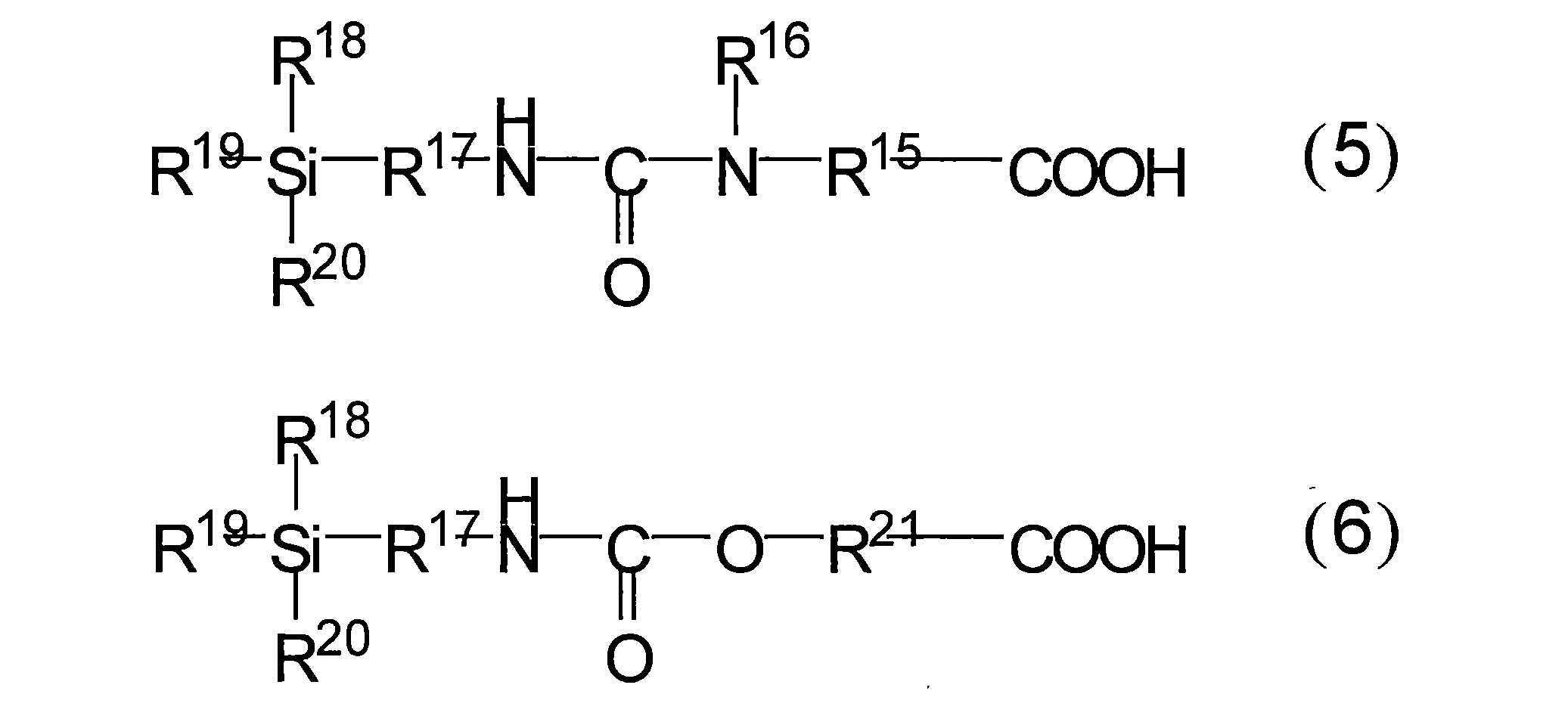
- organosilane compound having a carboxyl group examples include a urea group-containing organosilane compound represented by the following general formula (5) or a urethane group-containing organosilane compound represented by the following general formula (6). Two or more of these may be used.
- R 15 , R 17 and R 21 represent a divalent organic group having 1 to 20 carbon atoms.
- R 16 represents a hydrogen atom or an alkyl group having 1 to 3 carbon atoms.
- R 18 to R 20 may be the same or different and each has an alkyl group having 1 to 6 carbon atoms, an alkoxy group having 1 to 6 carbon atoms, a phenyl group, a phenoxy group, or an alkyl having 2 to 6 carbon atoms.
- a carbonyloxy group or a substituted product thereof is represented.
- at least one of R 18 to R 20 is an alkoxy group, a phenoxy group or an acetoxy group.
- R 15 and R 21 in the general formulas (5) and (6) are a methylene group, an ethylene group, an n-propylene group, an n-butylene group, a phenylene group, —CH 2 —C 6 H 4 —.
- hydrocarbon groups such as CH 2 — and —CH 2 —C 6 H 4 —.
- a hydrocarbon group having an aromatic ring such as a phenylene group, —CH 2 —C 6 H 4 —CH 2 —, —CH 2 —C 6 H 4 — or the like is preferable from the viewpoint of heat resistance.
- R 16 in the general formula (5) is preferably hydrogen or a methyl group from the viewpoint of reactivity.
- R 17 in the general formulas (5) and (6) include a methylene group, an ethylene group, and hydrocarbon groups such as n-propylene group, n-butylene group and n-pentylene group, oxymethylene group, oxyethylene group, oxy n-propylene group, oxy n-butylene group and oxy n-pentylene group. .
- methylene group, ethylene group, n-propylene group, n-butylene group, oxymethylene group, oxyethylene group, oxy n-propylene group, and oxy n-butylene group are preferable from the viewpoint of easy synthesis.
- alkyl group examples include a methyl group, an ethyl group, an n-propyl group, and an isopropyl group. From the viewpoint of ease of synthesis, a methyl group or an ethyl group is preferable.
- Specific examples of the alkoxy group include methoxy group, ethoxy group, n-propoxy group, isopropoxy group and the like. From the viewpoint of ease of synthesis, a methoxy group or an ethoxy group is preferable.
- substituent of the substituent examples include a methoxy group and an ethoxy group. Specific examples include a 1-methoxypropyl group and a methoxyethoxy group.
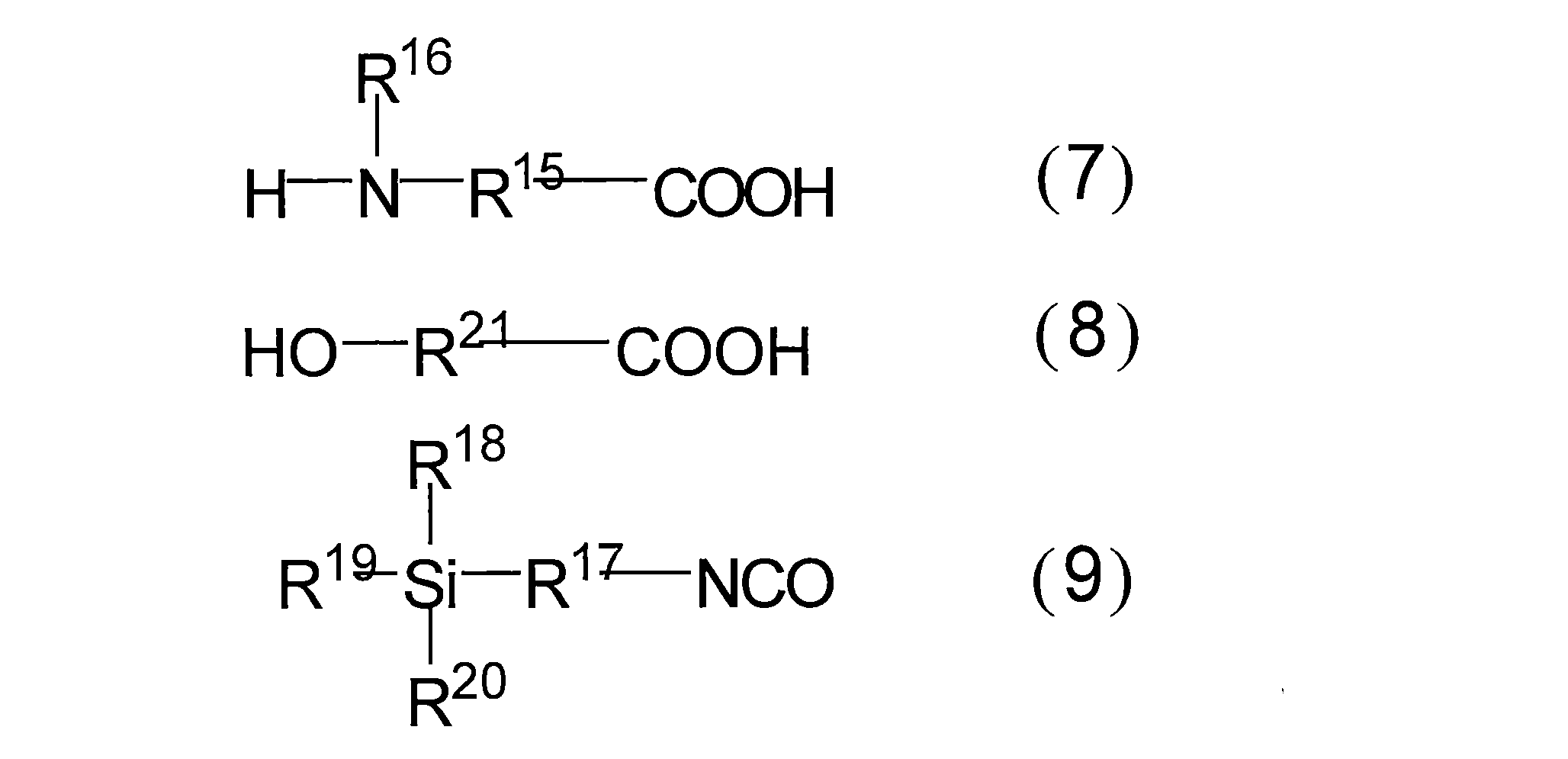
- the urea group-containing organosilane compound represented by the general formula (5) includes an aminocarboxylic acid compound represented by the following general formula (7) and an isocyanate group-containing organosilane compound represented by the following general formula (9). From the above, it can be obtained by a known urea reaction.
- the urethane group-containing organosilane compound represented by the general formula (6) has a hydroxycarboxylic acid compound represented by the following general formula (8) and an isocyanate group represented by the following general formula (9). It can be obtained from an organosilane compound by a known urethanization reaction.
- R 15 , R 17 and R 21 represent a divalent organic group having 1 to 20 carbon atoms.
- R 16 represents a hydrogen atom or an alkyl group having 1 to 3 carbon atoms.
- R 18 to R 20 each represents an alkyl group having 1 to 6 carbon atoms, an alkoxy group having 1 to 6 carbon atoms, a phenyl group, a phenoxy group, an alkylcarbonyloxy group having 2 to 6 carbon atoms, or a substituted product thereof.
- at least one of R 18 to R 20 is an alkoxy group, a phenoxy group or an acetoxy group.
- Preferred examples of R 15 - R 21 are as described above for R 15 - R 21 in the general formula (5) to (6).
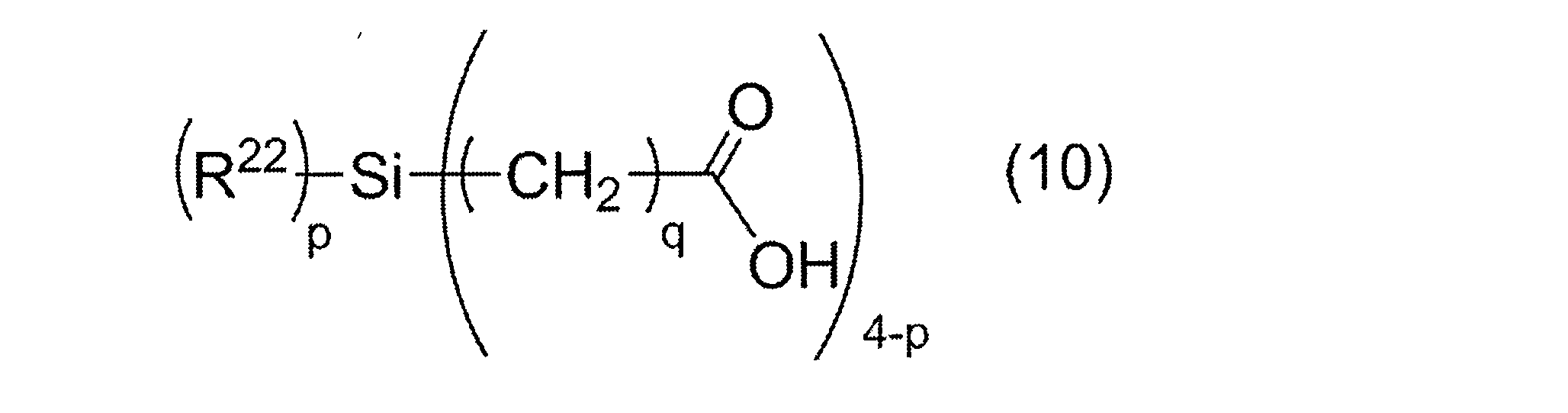
- organosilane compound having a carboxyl group examples include compounds represented by the general formula (10).
- R 22 represents an alkyl group having 1 to 6 carbon atoms, an alkoxy group having 1 to 6 carbon atoms, a phenyl group, a phenoxy group, an alkylcarbonyloxy group having 2 to 6 carbon atoms, or a substituted product thereof.
- R ⁇ 22> may be same or different and at least one is an alkoxy group, a phenoxy group, or an acetoxy group.
- p represents an integer of 1 to 3.
- q represents an integer of 2 to 20.
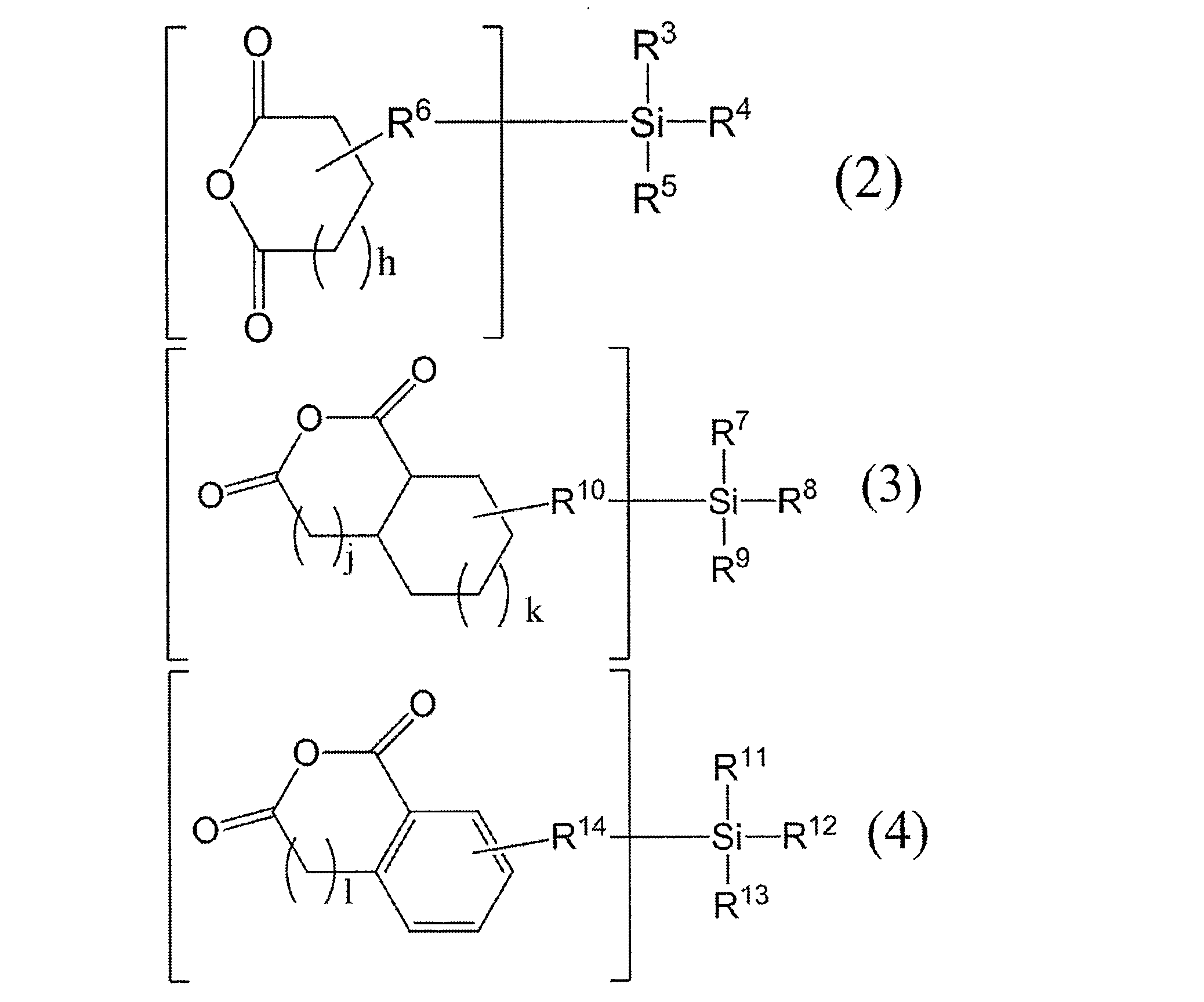
- organosilane compound having a dicarboxylic acid anhydride structure examples include organosilane compounds represented by any one of the following general formulas (2) to (4). Two or more of these may be used.
- R 3 to R 5 , R 7 to R 9 and R 11 to R 13 are each an alkyl group having 1 to 6 carbon atoms, an alkoxy group having 1 to 6 carbon atoms, phenyl Group, a phenoxy group or an alkylcarbonyloxy group having 2 to 6 carbon atoms.
- R 6 , R 10 and R 14 each represents a single bond, a chain aliphatic hydrocarbon group having 1 to 10 carbon atoms, a cyclic aliphatic hydrocarbon group having 3 to 16 carbon atoms, or an alkylcarbonyloxy having 2 to 6 carbon atoms.
- the hydrogen atoms of these groups are alkyl groups having 1 to 10 carbon atoms, alkenyl groups having 2 to 10 carbon atoms, aryl groups having 6 to 16 carbon atoms, alkylcarbonyloxy groups having 2 to 6 carbon atoms, hydroxy groups, amino groups , May be substituted with a carboxyl group or a thiol group.
- h, j, k, and l represent integers of 0 to 3.
- R 6 , R 10 and R 14 include —C 2 H 4 —, —C 3 H 6 —, —C 4 H 8 —, —O—, —C 3 H 6 OCH 2 CH (OH). Examples thereof include CH 2 O 2 C—, —CO—, —CO 2 —, —CONH—, and organic groups listed below.
- organosilane compound represented by the above general formula (2) include 3-trimethoxysilylpropyl succinic anhydride, 3-triethoxysilylsilylpropyl succinic anhydride, 3-triphenoxysilylpropyl succinic acid. An anhydride etc. are mentioned.
- Specific examples of the organosilane compound represented by the general formula (3) include 3-trimethoxysilylsilylpropylcyclohexyl dicarboxylic acid anhydride.
- organosilane compound represented by the general formula (4) include 3-trimethoxysilylsilylpropylphthalic anhydride.
- the polysiloxane in the present invention is synthesized by hydrolyzing and partially condensing an organosilane represented by the general formula (1) and a monomer such as an organosilane having a carboxyl group and / or a dicarboxylic anhydride structure.
- partial condensation refers to not allowing all of the hydrolyzate Si—OH to be condensed, but partially leaving Si—OH in the resulting polysiloxane. In general condensation conditions described later, it is common that Si—OH partially remains. In the present invention, the amount of Si—OH remaining is not limited.
- another organosilane may be used.
- a general method can be used for hydrolysis and partial condensation. For example, a method of adding a solvent, water and, if necessary, a catalyst to the organosilane mixture and heating and stirring at 50 to 150 ° C. for about 0.5 to 100 hours can be mentioned. During the stirring, if necessary, hydrolysis by-products (alcohols such as methanol) and condensation by-products (water) may be distilled off by distillation.
- the reaction solvent is not particularly limited, but the same solvent as the solvent (c) described later is usually used.
- the addition amount of the solvent is preferably 10 to 1500 parts by weight with respect to 100 parts by weight of the monomer such as organosilane.
- the amount of water used for the hydrolysis reaction is preferably 0.5 to 5 mol with respect to 1 mol of the hydrolyzable group.
- the catalyst added as necessary, but an acid catalyst and a base catalyst are preferably used.
- the acid catalyst include hydrochloric acid, nitric acid, sulfuric acid, hydrofluoric acid, phosphoric acid, acetic acid, trifluoroacetic acid, formic acid, polyvalent carboxylic acid or anhydride thereof, and ion exchange resin.
- the base catalyst examples include triethylamine, tripropylamine, tributylamine, tripentylamine, trihexylamine, triheptylamine, trioctylamine, diethylamine, triethanolamine, diethanolamine, sodium hydroxide, potassium hydroxide, amino
- the base catalyst include triethylamine, tripropylamine, tributylamine, tripentylamine, trihexylamine, triheptylamine, trioctylamine, diethylamine, triethanolamine, diethanolamine, sodium hydroxide, potassium hydroxide, amino
- the addition amount of the catalyst is preferably 0.01 to 10 parts by weight with respect to 100 parts by weight of the monomer such as organosilane.
- the polysiloxane solution after hydrolysis and partial condensation does not contain the catalyst, and the catalyst can be removed as necessary.
- the removal method is not particularly limited, but water washing and / or ion exchange resin treatment is preferable from the viewpoint of easy operation and removability.
- Water washing is a method of concentrating an organic layer obtained by diluting a polysiloxane solution with an appropriate hydrophobic solvent and then washing several times with water with an evaporator or the like.
- the treatment with an ion exchange resin is a method of bringing a polysiloxane solution into contact with an appropriate ion exchange resin.
- the positive photosensitive composition of the present invention contains (b) a naphthoquinonediazide compound.
- a naphthoquinonediazide compound By containing a naphthoquinonediazide compound, the photosensitivity in which the exposed portion is removed with a developer is exhibited.
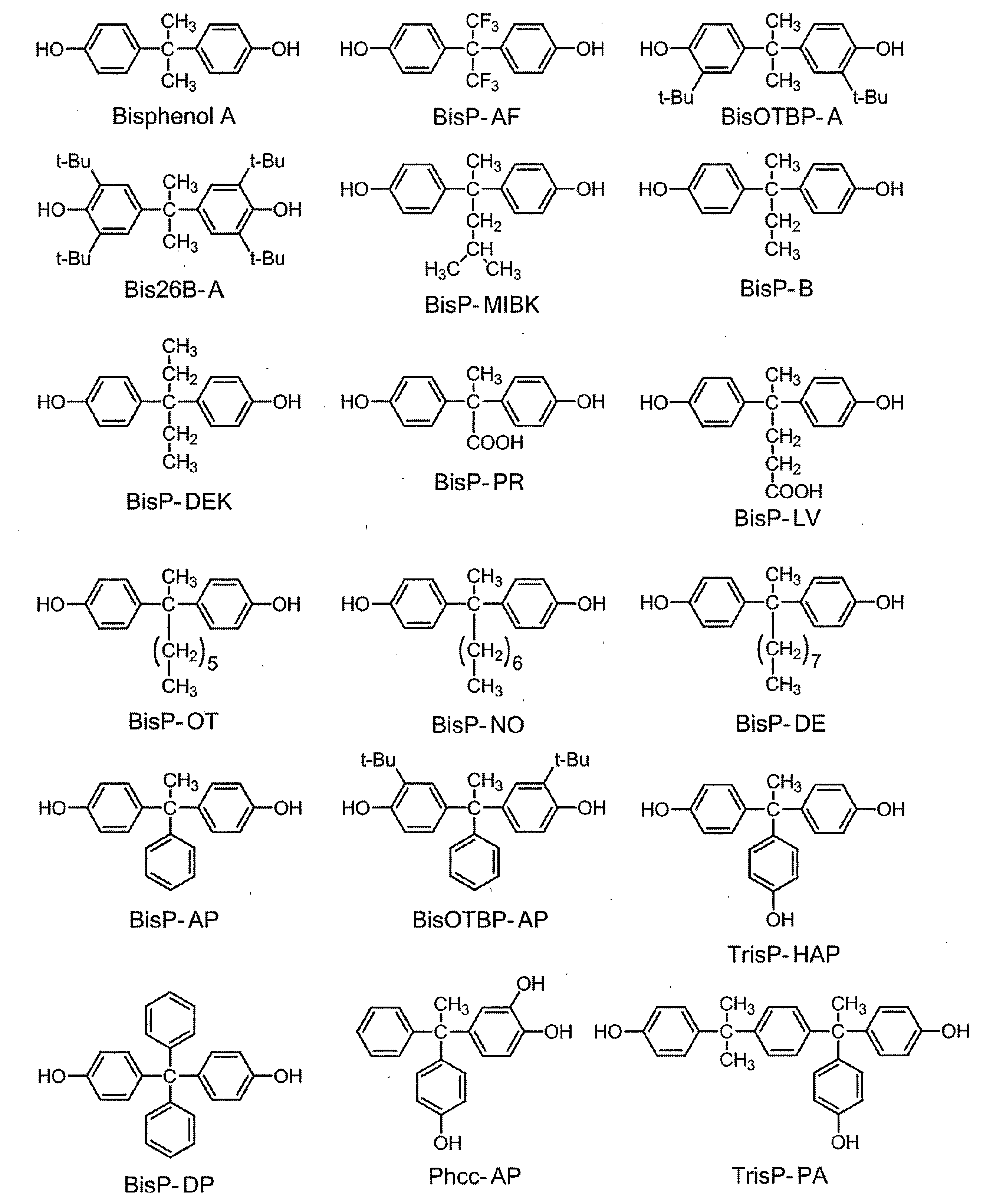
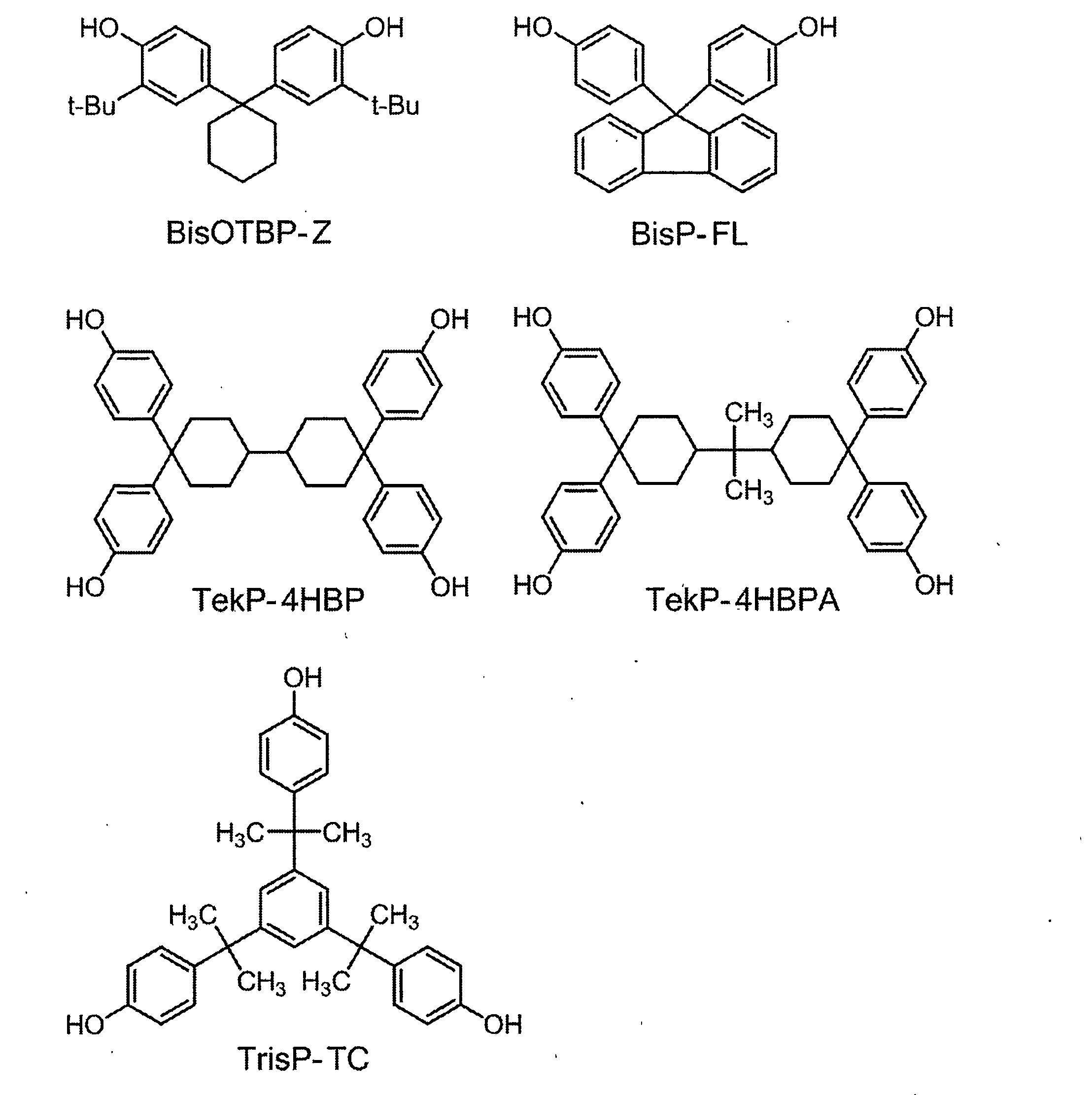
- the naphthoquinone diazide compound a compound in which naphthoquinone diazide sulfonic acid is ester-bonded to a compound having a phenolic hydroxyl group is preferable.
- the naphthoquinone diazide compound can be synthesized by a known esterification reaction between a compound having a phenolic hydroxyl group and naphthoquinone diazide sulfonic acid chloride.
- a compound having a phenolic hydroxyl group and naphthoquinone diazide sulfonic acid chloride.
- the naphthoquinone diazide sulfonic acid chloride used as a raw material 4-naphthoquinone diazide sulfonic acid chloride or 5-naphthoquinone diazide sulfonic acid chloride can be used. Since 4-naphthoquinonediazide sulfonic acid ester compound has absorption in the i-line (wavelength 365 nm) region, it is suitable for i-line exposure.
- the 5-naphthoquinonediazide sulfonic acid ester compound has absorption in a wide wavelength range and is therefore suitable for exposure in a wide wavelength range. It is preferable to select a 4-naphthoquinone diazide sulfonic acid ester compound or a 5-naphthoquinone diazide sulfonic acid ester compound depending on the wavelength to be exposed. A combination of 4-naphthoquinone diazide sulfonic acid ester compound and 5-naphthoquinone diazide sulfonic acid ester compound can also be used.
- the content of the (b) naphthoquinone diazide compound in the positive photosensitive resin composition of the present invention is not particularly limited, but (a) with respect to a total of 100 parts by weight of the polysiloxane and the metal compound-containing particles, or (a ′ ) 1 part by weight or more is preferable with respect to 100 parts by weight of the metal compound-containing particle-containing polysiloxane, and more preferably 3 parts by weight or more.
- 30 parts by weight or less is preferable from the viewpoint of suppressing the decrease in compatibility with polysiloxane and coloring due to decomposition during thermosetting, and further improving the transparency of the positive photosensitive resin composition and the cured film. More preferred are parts by weight or less.
- the positive photosensitive resin composition of the present invention contains (c) a solvent.
- a solvent Although there is no restriction
- the solvent having an alcoholic hydroxyl group is not particularly limited, but a compound having a boiling point of 110 to 250 ° C. under atmospheric pressure is preferable.
- the boiling point is 110 ° C. or higher, drying during the formation of the coating film proceeds moderately, and a coating film with a good surface appearance can be easily obtained.
- the boiling point is 250 ° C. or lower, the solvent can be easily removed.
- solvent having an alcoholic hydroxyl group examples include acetol (boiling point: 147 ° C.), 3-hydroxy-3-methyl-2-butanone (boiling point: 140 ° C.), 4-hydroxy-3-methyl-2-butanone ( Boiling point: 73 ° C), 5-hydroxy-2-pentanone (boiling point: 144 ° C), 4-hydroxy-4-methyl-2-pentanone (diacetone alcohol) (boiling point: 166 ° C), ethyl lactate (boiling point: 151 ° C) ), Butyl lactate (boiling point: 186 ° C.), propylene glycol monomethyl ether (boiling point: 118 ° C.), propylene glycol monoethyl ether (boiling point: 132 ° C.), propylene glycol mono n-propyl ether (boiling point: about 150 ° C.), propylene Glycol mono
- solvents may be contained together with or in place of the above solvents.
- Other solvents include ethyl acetate, n-propyl acetate, isopropyl acetate, n-butyl acetate, isobutyl acetate, propylene glycol monomethyl ether acetate, 3-methoxy-1-butyl acetate, 3-methyl-3-methoxy-1- Esters such as butyl acetate and ethyl acetoacetate, ketones such as methyl isobutyl ketone, diisopropyl ketone, diisobutyl ketone and acetylacetone, ethers such as diethyl ether, diisopropyl ether, di-n-butyl ether, diphenyl ether, diethylene glycol ethyl methyl ether and diethylene glycol dimethyl ether ⁇ -butyrolactone, ⁇ -valerolactone, ⁇ -valerolactone
- the (c) solvent in the positive photosensitive resin composition of this invention is (a) with respect to a total of 100 weight part of polysiloxane and a metal compound containing particle, or (a ') The amount is in the range of 100 to 2,000 parts by weight with respect to 100 parts by weight of the metal compound-containing particle-containing polysiloxane.
- the positive photosensitive resin composition of the present invention may contain various surfactants such as various fluorine-based surfactants and silicone-based surfactants in order to improve the flowability during coating.
- various surfactants such as various fluorine-based surfactants and silicone-based surfactants in order to improve the flowability during coating.
- type of surfactant for example, “Megafac (registered trademark)” F142D, F172, F173, F183, F445, F470, F475, F477 (above, Dainippon Ink Chemicals, Inc.) Kogyo Co., Ltd.), NBX-15, FTX-218, DFX-18 (manufactured by Neos Co., Ltd.) and other fluorosurfactants, BYK-333, BYK-301, BYK-331, BYK-345, BYK Silicone surfactants such as ⁇ 307 (manufactured by BYK Japan), polyalkylene oxide surfactants, poly (meth)
- the positive type photosensitive resin composition of the present invention comprises a silane coupling agent, a crosslinking agent, a crosslinking accelerator, a sensitizer, a thermal radical generator, a dissolution accelerator, a dissolution inhibitor, and a stabilizer as necessary. Further, additives such as an antifoaming agent can be contained.
- the positive photosensitive resin composition of the present invention is applied onto a substrate by a known method such as spin coating or slit coating, and heated (prebaked) using a heating device such as a hot plate or oven.
- the prebaking is preferably performed at a temperature range of 50 to 150 ° C. for 30 seconds to 30 minutes.
- the film thickness after pre-baking is preferably 0.1 to 15 ⁇ m.
- UV-visible exposure machine such as a stepper, mirror projection mask aligner (MPA), parallel light mask aligner (PLA), etc., and pattern about 10 to 4000 J / m 2 (wavelength 365 nm exposure dose conversion) through the desired mask Exposure.
- the exposed portion is dissolved and removed by development to obtain a positive pattern.
- the resolution of the pattern is Preferably it is 8 micrometers or less.
- a developing method it is preferable to immerse in a developing solution for 5 seconds to 10 minutes by a method such as showering, dipping, or paddle.
- the developer a known alkali developer can be used.
- inorganic alkali such as alkali metal hydroxide, carbonate, phosphate, silicate, borate, 2-diethylaminoethanol, mono Examples include amines such as ethanolamine and diethanolamine, and aqueous solutions of quaternary ammonium salts such as tetramethylammonium hydroxide (TMAH) and choline. Two or more of these may be used.
- TMAH tetramethylammonium hydroxide
- two or more of these may be used.
- it is preferable to rinse with water after development, and if necessary, dehydration drying baking may be performed at a temperature range of
- the entire surface is preferably exposed (bleaching exposure) by about 100 to 20,000 J / m 2 (wavelength 365 nm exposure amount conversion) using an ultraviolet-visible exposure machine such as PLA.
- bleaching exposure the unreacted naphthoquinonediazide compound remaining in the development film can be photodecomposed, and the transparency of the resulting cured film can be further improved.
- the film subjected to bleaching exposure is heated (soft bake) for 30 seconds to 30 minutes in a temperature range of 50 to 250 ° C with a heating device such as a hot plate or oven, if necessary, and then heated in a hot plate or oven.
- a cured film is obtained by heating for about 30 seconds to 2 hours in a temperature range of 150 to 450 ° C., that is, curing.
- the positive photosensitive resin composition of the present invention from the viewpoint of productivity in the pattern formation, it is preferable that the sensitivity at the time of exposure is 1500 J / m 2 or less, more preferably 1000 J / m 2 or less.
- Such high sensitivity can be easily obtained by a positive photosensitive resin composition containing polysiloxane using an organosilane having a carboxyl group and / or a dicarboxylic acid anhydride structure, for example.
- the sensitivity at the time of exposure is obtained by the following method.
- the positive photosensitive resin composition is spin-coated on a silicon wafer at an arbitrary rotation number using a spin coater, and prebaked at 120 ° C. for 3 minutes using a hot plate to prepare a prebaked film having a thickness of 1 ⁇ m.
- PLA PLA-501F manufactured by Canon Inc.
- the pre-baked film is exposed through a gray scale mask having a line and space pattern of 1 to 10 ⁇ m for sensitivity measurement with an ultra-high pressure mercury lamp, and then automatically developed.
- the positive photosensitive resin composition of the present invention preferably has a cured resolution of 10 ⁇ m or less, more preferably 5 ⁇ m or less in order to form a fine hole pattern.
- a positive photosensitive resin composition containing polysiloxane using, for example, an organosilane having a carboxyl group and / or a dicarboxylic anhydride structure.
- the resolution after curing is obtained by the following method. Similar to the above-described method for obtaining the sensitivity at the time of exposure, an exposure amount for resolving a 10 ⁇ m line and space pattern with a one-to-one width is obtained as sensitivity. Then, a cured film is prepared by curing at 220 ° C. for 5 minutes using a hot plate, and the minimum pattern dimension in sensitivity is obtained as the post-cure resolution.
- the cured film obtained by curing the positive photosensitive resin composition of the present invention preferably has a light transmittance of 90% or more per film thickness of 1 ⁇ m at a wavelength of 400 nm, more preferably 92% or more.
- a high transmittance can be easily obtained by, for example, a positive photosensitive resin composition using a highly transparent polysiloxane as a resin component.
- the transmittance per 1 ⁇ m of film thickness at a wavelength of 400 nm of the cured film is determined by the following method.
- the positive photosensitive resin composition is spin-coated on a Tempax glass plate at an arbitrary rotation number using a spin coater, and prebaked at 100 ° C. for 3 minutes using a hot plate. Then, as bleaching exposure, using PLA, the entire surface of the film was exposed to an ultrahigh pressure mercury lamp at 5000 J / m 2 (wavelength 365 nm exposure amount conversion), and thermally cured at 220 ° C. in the atmosphere for 5 minutes using a hot plate. A cured film having a thickness of 1 ⁇ m is prepared.
- the ultraviolet-visible absorption spectrum of the obtained cured film is measured using MultiSpec-1500 manufactured by Shimadzu Corporation, and the transmittance at a wavelength of 400 nm is determined.
- the positive photosensitive resin composition and the cured film of the present invention are suitably used for optical devices such as a solid-state imaging device, an optical filter, and a display. More specifically, a condensing microlens formed on a solid-state imaging device, a white (transparent) color filter or an optical waveguide, an antireflection film installed as an optical filter, a flattening material for a display TFT substrate, a liquid crystal Examples thereof include a color filter such as a display, a protective film thereof, a phase shifter, and the like.
- a condensing microlens formed on a solid-state imaging device since it is possible to achieve both high transparency and a high refractive index, a condensing microlens formed on a solid-state imaging device, a white (transparent) color filter or an optical waveguide connecting the condensing microlens and the optical sensor unit. And is particularly preferably used. Further, it can be used as a buffer coat, an interlayer insulating film, and various protective films of a semiconductor device. Since the positive photosensitive resin composition of the present invention does not require pattern formation by an etching method, the operation can be simplified, and deterioration of the wiring portion due to an etching chemical or plasma can be avoided.
- Synthesis Example 3 Synthesis of metal compound-containing particle-containing polysiloxane solution (PS-1) In a 500 ml three-necked flask, 8.17 g (0.06 mol) of methyltrimethoxysilane and 19.83 g (0.10 mol) of phenyltrimethoxysilane “OPTRAIK” TR-550 (trade name, JGC Catalysts) which is 15.37 g (0.04 mol) of a carboxyl group-containing silane compound (A) and a methanol dispersion of 20.6 wt% titanium oxide-silicon oxide composite particles 147.03 g (100% by weight of the particle when the organosilane is completely condensed (30.29 g), 100 parts by weight of the particle content) and DAA of 112 .50 g was charged and stirred at room temperature with 11.52 g of water and 0.217 g of phosphoric acid (0.50 to the charged monomer).
- PS-1 metal compound-containing particle-containing
- Phosphoric acid aqueous solution prepared by dissolving the amount%) was added over 10 minutes.
- the number average particle diameter was measured by a dynamic light scattering method using a dynamic light scattering altimeter DLS-8000 (manufactured by Otsuka Electronics Co., Ltd.). Thereafter, the flask was immersed in a 40 ° C. oil bath and stirred for 60 minutes, and then the oil bath was heated to 115 ° C. over 30 minutes. One hour after the start of temperature increase, the internal temperature of the solution reached 100 ° C., and was then heated and stirred for 2 hours (internal temperature was 100 to 110 ° C.) to obtain a polysiloxane solution (PS-1).
- PS-1 polysiloxane solution
- Synthesis Example 4 Synthesis of Metal Compound-Containing Particle-Containing Polysiloxane Solution (PS-2) In a 500 ml three-necked flask, 8.17 g (0.06 mol) of methyltrimethoxysilane and 19.83 g (0.10 mol) of phenyltrimethoxysilane "OPTRAIK" TR-550 (trade name, JGC Catalysts) which is 15.41 g (0.04 mol) of a carboxyl group-containing silane compound (B) and a methanol dispersion of 20.6 wt% titanium oxide-silicon oxide composite particles 147.23 g (made by Kasei Co., Ltd.) (100 parts by weight of particle content with respect to 100 parts by weight when organosilane is completely condensed (30.33 g)), and 112.65 g of DAA are charged and stirred at room temperature.
- PS-2 Metal Compound-Containing Particle-Cont
- Phosphoric acid in which 0.217 g of phosphoric acid (0.50% by weight based on the charged monomer) was dissolved in 11.52 g of water The solution was added over a period of 10 minutes. Thereafter, the mixture was heated and stirred in the same manner as in Synthesis Example 3 to obtain a polysiloxane solution (PS-2). During the reaction, a total of 127.35 g of methanol and water as by-products were distilled out. The solid content concentration of the obtained metal compound-containing particle-containing polysiloxane solution (PS-2) was 34% by weight.
- Synthesis Example 5 Synthesis of Metal Compound-Containing Particle-Containing Polysiloxane Solution (PS-3) In a 500 ml three-necked flask, 8.17 g (0.06 mol) of methyltrimethoxysilane and 19.83 g (0.10 mol) of phenyltrimethoxysilane , "OPTRAIK" TR-550 (trade name, JGC Catalysts & Chemicals Co., Ltd.), a methanol dispersion of 8.32 g (0.04 mol), 20.6 wt% titanium oxide-silicon oxide, 4-trimethoxysilylbutanoic acid 112.84 g (manufactured by Co., Ltd.) (particle weight 100 parts by weight with respect to 100 parts by weight when organosilane is completely condensed (23.25 g)), and 86.34 g of DAA are charged and stirred at room temperature.
- PS-3 Metal Compound-Conta
- an aqueous phosphoric acid solution prepared by dissolving 0.182 g of phosphoric acid (0.50% by weight with respect to the charged monomer) in 11.52 g of water was 1 It was added over a period of minutes. Thereafter, the mixture was heated and stirred in the same manner as in Synthesis Example 3 to obtain a polysiloxane solution (PS-3). During the reaction, a total of 102.78 g of methanol and water as by-products were distilled out. The obtained metal compound-containing particle-containing polysiloxane solution (PS-3) had a solid content concentration of 35% by weight.
- Synthesis Example 6 Synthesis of Metal Compound-Containing Particle-Containing Polysiloxane Solution (PS-4) In a 500 ml three-necked flask, 8.17 g (0.06 mol) of methyltrimethoxysilane and 19.83 g (0.10 mol) of phenyltrimethoxysilane , "OPTRAIK" TR-550 (trade name, JGC Catalysts), a methanol dispersion of 10.49 g (0.04 mol), 20.6 wt% titanium oxide-silicon oxide composite particles of 3-trimethoxysilylpropyl succinic acid (Made by Kasei Co., Ltd.) 123.37 g (100 parts by weight of the particle content with respect to 100 parts by weight when the organosilane is completely condensed (25.42 g)), and 94.40 g of DAA were charged and stirred at room temperature.
- PS-4 Metal Compound-Contain
- Phosphoric acid in which 0.192 g of phosphoric acid (0.50% by weight based on the charged monomer) was dissolved in 11.52 g of water The solution was added over a period of 10 minutes. Thereafter, the mixture was heated and stirred in the same manner as in Synthesis Example 3 to obtain a polysiloxane solution (PS-4). During the reaction, a total of 110.30 g of methanol and water as by-products were distilled out. The resulting metal compound-containing particle-containing polysiloxane solution (PS-4) had a solid content concentration of 33% by weight.
- Synthesis Example 7 Synthesis of metal compound-containing particle-containing polysiloxane solution (PS-5) In a 500 ml three-necked flask, 12.26 g (0.09 mol) of methyltrimethoxysilane and 19.83 g (0.10 mol) of phenyltrimethoxysilane , "OPTRAIK" TR-550 (trade name, JGC Catalysts) which is 2.62 g (0.01 mol) of 3-trimethoxysilylpropyl succinic acid and 20.6 wt% titanium oxide-silicon oxide composite particle methanol dispersion Kasei Chemical Co., Ltd.) 102.38 g (100 parts by weight of the particle content with respect to 100 parts by weight when the organosilane is completely condensed (21.09 g)), and 78.34 g of DAA were charged and stirred at room temperature.
- PS-5 metal compound-containing particle-containing polysiloxane solution
- Phosphoric acid in which 0.174 g of phosphoric acid (0.50% by weight based on the charged monomers) was dissolved in 10.98 g of water The solution was added over a period of 10 minutes. Thereafter, the mixture was heated and stirred in the same manner as in Synthesis Example 3 to obtain a polysiloxane solution (PS-5). During the reaction, a total of 95.30 g of methanol and water as by-products were distilled out. The obtained metal compound-containing particle-containing polysiloxane solution (PS-5) had a solid content concentration of 33% by weight.
- Synthesis Example 8 Synthesis of metal compound-containing particle-containing polysiloxane solution (PS-6) In a 500 ml three-necked flask, 10.90 g (0.08 mol) of methyltrimethoxysilane and 19.83 g (0.10 mol) of phenyltrimethoxysilane "OPTRAIK" TR-550 (trade name, JGC Catalysts) which is a methanol dispersion of 5.25 g (0.02 mol), 20.6 wt% titanium oxide-silicon oxide composite particles of 3-trimethoxysilylpropyl succinic acid 109.38 g (made by Kasei Co., Ltd.) (100 parts by weight of particle content with respect to 100 parts by weight when organosilane is completely condensed (22.53 g)), 83.69 g of DAA were charged and stirred at room temperature However, phosphoric acid in which 0.180 g of phosphoric acid (0.50 wt% with respect to the
- Synthesis Example 9 Synthesis of metal compound-containing particle-containing polysiloxane solution (PS-7) In a 500 ml three-necked flask, 5.45 g (0.04 mol) of methyltrimethoxysilane and 19.83 g (0.10 mol) of phenyltrimethoxysilane , "OPTRAIK" TR-550 (trade name, JGC Catalysts), 15.74 g (0.06 mol) of 3-trimethoxysilylpropyl succinic acid, a methanol dispersion of 20.6% by weight of titanium oxide-silicon oxide composite particles 137.37 g (made by Kasei Co., Ltd.) (particle weight 100 parts by weight with respect to 100 parts by weight when organosilane is completely condensed (28.30 g)) and 105.11 g of DAA were charged and stirred at room temperature Phosphorus in which 0.205 g of phosphoric acid (0.50% by weight based on the charged mono
- Synthesis Example 10 Synthesis of metal compound-containing particle-containing polysiloxane solution (PS-8) In a 500 ml three-necked flask, 17.71 g (0.13 mol) of methyltrimethoxysilane and 9.92 g (0.05 mol) of phenyltrimethoxysilane "OPTRAIK" TR-550 (trade name, JGC Catalysts) which is a methanol dispersion of 5.25 g (0.02 mol), 20.6 wt% titanium oxide-silicon oxide composite particles of 3-trimethoxysilylpropyl succinic acid 94.31 g (made by Kasei Co., Ltd.) (100 parts by weight of the particle content with respect to 100 parts by weight when the organosilane is completely condensed (19.43 g)) and 72.16 g of DAA are charged and stirred at room temperature.
- PS-8 metal compound-containing particle-containing polysiloxane solution
- Synthesis Example 11 Synthesis of metal compound-containing particle-containing polysiloxane solution (PS-9) In a 500 ml three-necked flask, 13.62 g (0.10 mol) of methyltrimethoxysilane and 15.86 g (0.08 mol) of phenyltrimethoxysilane "OPTRAIK" TR-550 (trade name, JGC Catalysts) which is a methanol dispersion of 5.25 g (0.02 mol), 20.6 wt% titanium oxide-silicon oxide composite particles of 3-trimethoxysilylpropyl succinic acid (Made by Kasei Co., Ltd.) 103.35 g (100 parts by weight of the particle content with respect to 100 parts by weight when the organosilane is completely condensed (21.29 g)), and 79.08 g of DAA were charged and stirred at room temperature.
- PS-9 Synthesis of metal compound-containing particle-containing polysiloxane solution (
- Phosphoric acid in which 0.174 g of phosphoric acid (0.50% by weight based on the charged monomers) was dissolved in 11.16 g of water The aqueous solution was added over 10 minutes. Thereafter, the mixture was heated and stirred in the same manner as in Synthesis Example 3 to obtain a polysiloxane solution (PS-9). During the reaction, a total of 96.00 g of methanol and water as by-products were distilled out. The obtained metal compound-containing particle-containing polysiloxane solution (PS-9) had a solid content concentration of 33% by weight.
- Synthesis Example 12 Synthesis of metal compound-containing particle-containing polysiloxane solution (PS-10) In a 500 ml three-necked flask, 27.76 g (0.14 mol) of phenyltrimethoxysilane and 15.74 g of 3-trimethoxysilylpropylsuccinic acid ( 0.06 mol) 149.43 g of “OPTRAIK” TR-550 (trade name, manufactured by JGC Catalysts & Chemicals Co., Ltd.), which is a methanol dispersion of 20.6% by weight of titanium oxide-silicon oxide composite particles. The total weight (30.78 g) is 100 parts by weight, and the particle content is 100 parts by weight.
- PS-10 metal compound-containing particle-containing polysiloxane solution
- Synthesis Example 13 Synthesis of metal compound-containing particle-containing polysiloxane solution (PS-11) In a 500 ml three-necked flask, 21.79 g (0.16 mol) of methyltrimethoxysilane and 39.66 g (0.20 mol) of phenyltrimethoxysilane , "OPTRAIK" TR-550 (trade name, JGC Catalysts), a methanol dispersion of 10.49 g (0.04 mol), 20.6 wt% titanium oxide-silicon oxide composite particles of 3-trimethoxysilylpropyl succinic acid (Made by Kasei Co., Ltd.) 109.38 g (100 parts by weight when organosilane is completely condensed (45.07 g), particle content 50 parts by weight), DAA 125.54 g were charged and stirred at room temperature Then, 0.360 g of phosphoric acid (0.50% by weight based on the charged monomers) was dissolved in
- the phosphate solution was added over 10 minutes. Thereafter, the mixture was heated and stirred in the same manner as in Synthesis Example 3 to obtain a polysiloxane solution (PS-11). During the reaction, a total of 122.44 g of methanol and water as by-products were distilled out.
- the obtained metal compound-containing particle-containing polysiloxane solution (PS-11) had a solid content concentration of 34% by weight.
- Synthesis Example 14 Synthesis of metal compound-containing particle-containing polysiloxane solution (PS-12) In a 500 ml three-necked flask, 10.90 g (0.08 mol) of methyltrimethoxysilane and 19.83 g (0.10 mol) of phenyltrimethoxysilane "OPTRAIK" TR-550 (trade name, JGC Catalysts) which is a methanol dispersion of 5.25 g (0.02 mol), 20.6 wt% titanium oxide-silicon oxide composite particles of 3-trimethoxysilylpropyl succinic acid 218.76 g (made by Kasei Co., Ltd.) (particle content: 200 parts by weight with respect to 100 parts by weight when organosilane is completely condensed (22.53 g)), and 125.54 g of DAA were charged and stirred at room temperature While 0.116 g of phosphoric acid (0.50% by weight based on the charged monomer) was dissolved
- the phosphate solution was added over 10 minutes. Thereafter, the mixture was heated and stirred in the same manner as in Synthesis Example 3 to obtain a polysiloxane solution (PS-12). During the reaction, a total of 178.47 g of methanol and water as by-products were distilled out.
- the obtained metal compound-containing particle-containing polysiloxane solution (PS-12) had a solid content concentration of 33% by weight.
- Synthesis Example 15 Synthesis of metal compound-containing particle-containing polysiloxane solution (PS-13) In a 500 ml three-necked flask, 5.45 g (0.04 mol) of methyltrimethoxysilane and 9.92 g (0.05 mol) of phenyltrimethoxysilane , "OPTRAIK" TR-550 (trade name, JGC Catalysts) which is 2.62 g (0.01 mol) of 3-trimethoxysilylpropyl succinic acid and 20.6 wt% titanium oxide-silicon oxide composite particle methanol dispersion 218.76 g (made by Kasei Co., Ltd.) (particle weight 100 parts by weight with respect to 100 parts by weight when organosilane is completely condensed (22.53 g)), and DAA 104.62 g were charged and stirred at room temperature Phosphoric acid in which 0.090 g of phosphoric acid (0.50% by weight based on the charged monomer
- Synthesis Example 16 Synthesis of polysiloxane solution containing metal compound-containing particles (PS-14) 10.90 g (0.08 mol) of methyltrimethoxysilane and 15.86 (0.08 mol) of phenyltrimethoxysilane in a 500 ml three-necked flask Dispersion of 5.25 g (0.02 mol) of 3-trimethoxysilylpropylsuccinic acid, 4.97 g (0.02 mol) of 1-naphthyltrimethoxysilane, 20.6 wt% of titanium oxide-silicon oxide composite particles in methanol “OPTRAIK” TR-550 (trade name, manufactured by JGC Catalysts & Chemicals Co., Ltd.), a liquid, contains 114.24 g (100 parts by weight when organosilane is completely condensed (22.53 g)).
- Synthesis Example 17 Synthesis of metal compound-containing particle-containing polysiloxane solution (PS-15) In a 500 ml three-necked flask, 10.90 g (0.08 mol) of methyltrimethoxysilane and 9.92 g (0.05 mol) of phenyltrimethoxysilane Dispersion of 5.25 g (0.02 mol) of 3-trimethoxysilylpropyl succinic acid, 12.42 g (0.05 mol) of 1-naphthyltrimethoxysilane, 20.6 wt% titanium oxide-silicon oxide composite particles in methanol “OPTRAIK” TR-550 (trade name, manufactured by JGC Catalysts & Chemicals Co., Ltd.), which is a liquid, contains particles with respect to 100 parts by weight of 100.5 parts by weight (25.04 g) when organosilane is completely condensed.
- PTRAIK metal compound-containing particle-containing polysiloxane solution
- Synthesis Example 18 Synthesis of metal compound-containing particle-containing polysiloxane solution (PS-16) In a 500 ml three-necked flask, 10.90 g (0.08 mol) of methyltrimethoxysilane and 5.25 g of 3-trimethoxysilylpropylsuccinic acid ( 0.02 mol), 24.84 g (0.10 mol) of 1-naphthyltrimethoxysilane, “OPTRAIK” TR-550 (trade name, 20.6 wt% titanium oxide-silicon oxide composite particle methanol dispersion) JGC Catalysts Chemical Co., Ltd.) 121.53g (100 parts by weight of the particle content with respect to 100 parts by weight when the organosilane is completely condensed (25.04g)), and 102.28g of DAA were charged at room temperature.
- PS-16 metal compound-containing particle-containing polysiloxane solution
- Synthesis Example 19 Synthesis of metal compound-containing particle-containing polysiloxane solution (PS-17) In a 500 ml three-necked flask, 5.45 g (0.04 mol) of methyltrimethoxysilane and 5.25 g of 3-trimethoxysilylpropylsuccinic acid ( 0.02 mol), 34.77 g (0.14 mol) of 1-naphthyltrimethoxysilane, “OPTRAIK” TR-550 (trade name, 20.6 wt% titanium oxide-silicon oxide composite particle methanol dispersion) 155.55 g (manufactured by JGC Catalysts & Chemicals Co., Ltd.) (100 parts by weight of the particle content with respect to 100 parts by weight when the organosilane is completely condensed (32.02 g)), and 118.94 g of DAA are charged at room temperature.
- Synthesis Example 20 Synthesis of metal compound-containing particle-containing polysiloxane solution (PS-18) In a 500 ml three-necked flask, 19.07 g (0.14 mol) of methyltrimethoxysilane and 5.25 g of 3-trimethoxysilylpropylsuccinic acid ( 0.02 mol), 9.93 g (0.04 mol) of 1-naphthyltrimethoxysilane, 20.6% by weight of titanium oxide-silicon oxide composite particle methanol dispersion “OPTRAIK” TR-550 (trade name, 101.01 g (manufactured by JGC Catalysts & Chemicals Co., Ltd.) (100 parts by weight of particle content with respect to 100 parts by weight when organosilane is completely condensed (20.81 g)), 77.29 g of DAA were charged at room temperature While stirring at 1.71 g of water, 0.171 g of phosphoric acid (0.50% by weight based on
- the phosphate solution was added over 10 minutes. Thereafter, the mixture was heated and stirred in the same manner as in Synthesis Example 3 to obtain a polysiloxane solution (PS-18). During the reaction, a total of 94.32 g of methanol and water as by-products were distilled out.
- the obtained metal compound-containing particle-containing polysiloxane solution (PS-18) had a solid content concentration of 33% by weight.
- Synthesis Example 21 Synthesis of metal compound-containing particle-containing polysiloxane solution (PS-19) In a 500 ml three-necked flask, 13.62 g (0.10 mol) of methyltrimethoxysilane and 19.83 g (0.10 mol) of phenyltrimethoxysilane 95.39g of "OPTRAIK" TR-550 (trade name, manufactured by JGC Catalysts & Chemicals Co., Ltd.), a methanol dispersion of 20.6% by weight of titanium oxide-silicon oxide composite particles (when organosilane is completely condensed) The weight (19.65 g) is 100 parts by weight and the particle content is 100 parts by weight), 72.99 g of DAA is charged, and 0.167 g of phosphoric acid is added to 10.80 g of water while stirring at room temperature (based on the charged monomers).
- Synthesis Example 22 Synthesis of polysiloxane solution (PS-20) In a 500 ml three-necked flask, 27.24 g (0.20 mol) of methyltrimethoxysilane, 49.58 g (0.25 mol) of phenyltrimethoxysilane, 3-trimethoxy 13.12 g (0.05 mol) of silylpropyl succinic acid and 104.62 g of DAA were charged, and 0.450 g of phosphoric acid (0.50% by weight based on the charged monomer) was dissolved in 27.90 g of water while stirring at room temperature. An aqueous phosphoric acid solution was added over 10 minutes.
- PS-20 Polysiloxane solution
- Synthesis Example 23 Synthesis of polysiloxane solution (PS-21) In a 500 ml three-necked flask, 27.24 g (0.20 mol) of methyltrimethoxysilane, 49.58 g (0.25 mol) of phenyltrimethoxysilane, 2- (3 , 4-epoxycyclohexyl) ethyltrimethoxysilane, 12.32 g (0.05 mol) and 101.47 g of DAA were charged, and stirred at room temperature, 27.00 g of water was added with 0.446 g of phosphoric acid (0.004 g based on the charged monomers). 50% by weight) of phosphoric acid solution was added over 10 minutes.
- PS-21 Polysiloxane solution
- the triethylamine salt was filtered and the filtrate was poured into water. Thereafter, the deposited precipitate was collected by filtration. The precipitate was dried with a vacuum dryer to obtain a quinonediazide compound (QD-1) having the following structure.
- the triethylamine salt was filtered and the filtrate was poured into water. Thereafter, the deposited precipitate was collected by filtration. This precipitate was dried with a vacuum dryer to obtain a quinonediazide compound (QD-2) having the following structure.
- the photosensitive properties and cured film properties of the compositions were evaluated by the following methods.
- a silicon wafer substrate was used for the following evaluations (1) to (5) and (7), and a Tempax glass substrate was used for the evaluation (6).
- Residual film ratio (%) film thickness of unexposed part after development / film thickness of pre-baked film ⁇ 100.
- the exposure amount (hereinafter referred to as the optimal exposure amount) for forming a 10 ⁇ m line-and-space pattern in a one-to-one width after development was defined as photosensitivity.
- the cured film (on a 6-inch silicon wafer) prepared in 1) and the cured film (on a 6-inch silicon wafer) prepared after storing the composition at room temperature for 1 month were measured.
- Example 1 69.49 g of the polysiloxane solution (PS-1) obtained in Synthesis Example 3, 2.06 g of the quinonediazide compound (QD-1) obtained in Synthesis Example 24, DFX-18 (fluorine surfactant, Co., Ltd.) Neos) (100 ppm), DAA (13.44 g), and PGMEA (14.70 g) were mixed and stirred under a yellow light to obtain a homogeneous solution, which was then filtered through a 0.20 ⁇ m filter to prepare Composition 1.
- composition 1 Immediately after preparation of composition 1, spin coating was performed on a 6-inch silicon wafer using a spin coater (1H-360S manufactured by Mikasa Co., Ltd.), and then using a hot plate (SCW-636 manufactured by Dainippon Screen Mfg. Co., Ltd.). A pre-baked film having a thickness of 1.0 ⁇ m was produced by heating at 100 ° C. for 3 minutes.
- a spin coater (1H-360S manufactured by Mikasa Co., Ltd.
- SCW-636 manufactured by Dainippon Screen Mfg. Co., Ltd.
- PLA PLA-501F manufactured by Canon Inc.
- pattern exposure of the pre-baked film through a gray scale mask for sensitivity measurement using an ultra-high pressure mercury lamp followed by an automatic developing device (AD-2000 manufactured by Takizawa Sangyo Co., Ltd.)
- AD-2000 manufactured by Takizawa Sangyo Co., Ltd.
- PLA PLA (PLA-501F manufactured by Canon Inc.) was used, and the entire surface of the film was exposed to 5000 J / m 2 (wavelength 365 nm exposure amount conversion) with an ultrahigh pressure mercury lamp. Then, it cured for 5 minutes at 220 degreeC using the hotplate, and produced the cured film (on 6-inch silicon wafer).
- a cured film (on a 6-inch silicon wafer) was prepared in the same manner as above except that the composition 1 was stored for 1 month at room temperature.
- a cured film (on a Tempax glass substrate) was prepared in the same manner as above except that the composition 1 was spin-coated on a Tempax glass substrate instead of spin-coating the composition 1 on a 6-inch silicon wafer.
- Table 3 shows the composition of the composition
- Table 5 shows the evaluation results of the photosensitive characteristics and the cured film characteristics.
Landscapes
- Physics & Mathematics (AREA)
- Chemical & Material Sciences (AREA)
- General Physics & Mathematics (AREA)
- Spectroscopy & Molecular Physics (AREA)
- Chemical Kinetics & Catalysis (AREA)
- Organic Chemistry (AREA)
- Engineering & Computer Science (AREA)
- Medicinal Chemistry (AREA)
- Polymers & Plastics (AREA)
- Health & Medical Sciences (AREA)
- Life Sciences & Earth Sciences (AREA)
- Materials Engineering (AREA)
- Wood Science & Technology (AREA)
- Ceramic Engineering (AREA)
- Materials For Photolithography (AREA)
Abstract
Description

あるいは、(a’)アルミニウム化合物、スズ化合物、チタン化合物およびジルコニウム化合物から選ばれる1以上の金属化合物の粒子の存在下、またはアルミニウム化合物、スズ化合物、チタン化合物およびジルコニウム化合物から選ばれる1以上の金属化合物とケイ素化合物との複合粒子の存在下、下記一般式(1)で表されるオルガノシランとカルボキシル基および/またはジカルボン酸無水物構造を有するオルガノシランとを加水分解し、部分縮合させることによって合成される金属化合物含有粒子含有ポリシロキサン、(b)ナフトキノンジアジド化合物ならびに(c)溶剤を含むことを特徴とするポジ型感光性樹脂組成物である。


あるいは、本発明の感光性組成物は、(a’)アルミニウム化合物、スズ化合物、チタン化合物およびジルコニウム化合物から選ばれる1以上の金属化合物の粒子の存在下、またはアルミニウム化合物、スズ化合物、チタン化合物およびジルコニウム化合物から選ばれる1以上の金属化合物とケイ素化合物との複合粒子の存在下、下記一般式(1)で表されるオルガノシランとカルボキシル基および/またはジカルボン酸無水物構造を有するオルガノシランとを加水分解し、部分縮合させることによって合成される金属化合物含有粒子含有ポリシロキサン、(b)ナフトキノンジアジド化合物ならびに(c)溶剤を含むことを特徴とするポジ型感光性樹脂組成物である。



n-プロピレン基、n-ブチレン基、n-ペンチレン基などの炭化水素基や、オキシメチレン基、オキシエチレン基、オキシn-プロピレン基、オキシn-ブチレン基、オキシn-ペンチレン基などが挙げられる。これらの中でも、合成の容易性の観点から、メチレン基、エチレン基、n-プロピレン基、n-ブチレン基、オキシメチレン基、オキシエチレン基、オキシn-プロピレン基、オキシn-ブチレン基が好ましい。

好ましくは8μm以下である。現像方法としては、シャワー、ディップ、パドル等の方法で現像液に5秒~10分間浸漬することが好ましい。現像液としては、公知のアルカリ現像液を用いることができ、例えば、アルカリ金属の水酸化物、炭酸塩、リン酸塩、ケイ酸塩、ホウ酸塩等の無機アルカリ、2-ジエチルアミノエタノール、モノエタノールアミン、ジエタノールアミン等のアミン類、水酸化テトラメチルアンモニウム(TMAH)、コリン等の4級アンモニウム塩の水溶液等が挙げられる。これらを2種以上用いてもよい。また、現像後は水でリンスすることが好ましく、必要であればホットプレート、オーブン等の加熱装置で50~150℃の温度範囲で脱水乾燥ベークを行ってもよい。
透過率=exp(-4πkt/λ)
ただし、kは消衰係数、tは膜厚、λは測定膜厚を表す。
PGMEA:プロピレングリコールモノメチルエーテルアセテート
DAA:ジアセトンアルコール
ポリシロキサン溶液の固形分濃度は、以下の方法により求めた。アルミカップにポリシロキサン溶液を1.5g秤取し、ホットプレートを用いて250℃で30分間加熱して液分を蒸発させた。加熱後のアルミカップに残った固形分を秤量して、ポリシロキサン溶液の固形分濃度を求めた。
300mlのナスフラスコにp-アミノ安息香酸を23.23g、プロピレングリコールモノメチルエーテルアセテート(PGMEA)を209.05g仕込み、室温にて30分間撹拌してp-アミノ安息香酸を溶解させた。得られた溶液に、イソシアネートプロピルトリエトキシシランを46.53g、ジラウリン酸ジブチルスズを1.19g仕込み、70℃のオイルバスで1時間撹拌した。その後室温まで放冷し、析出した固体をガラスフィルターにて濾取、乾燥させ、カルボキシル基含有シラン化合物(A)を得た。収量は46.7gだった。
300mlのナスフラスコにp-ヒドロキシ安息香酸を23.39g、PGMEAを210.5g仕込み、室温にて30分間撹拌してp-ヒドロキシ安息香酸を溶解させた。得られた溶液に、イソシアネートプロピルトリエトキシシランを46.53g、ジラウリン酸ジブチルスズを1.19g仕込み、40℃のオイルバスで3時間撹拌した。その後室温まで放冷し、析出した固体をガラスフィルターにて濾取、乾燥させ、カルボキシル基含有シラン化合物(B)を得た。収量は42.4gだった。
500mlの三口フラスコにメチルトリメトキシシランを8.17g(0.06mol)、フェニルトリメトキシシランを19.83g(0.10mol)、カルボキシル基含有シラン化合物(A)を15.37g(0.04mol)、20.6重量%の酸化チタン-酸化ケイ素複合粒子メタノール分散液である“オプトレイク”TR-550(商品名、日揮触媒化成(株)製、数平均粒子径は15nm)を147.03g(オルガノシランが完全縮合した場合の重量(30.29g)100重量部に対して、粒子含有量100重量部)、DAAを112.50g仕込み、室温で撹拌しながら水11.52gにリン酸0.217g(仕込みモノマーに対して0.50重量%)を溶かしたリン酸水溶液を10分間かけて添加した。なお数平均粒子径はダイナミック光散乱高度計DLS-8000(大塚電子(株)製)などを用いて、動的光散乱法により測定した。その後、フラスコを40℃のオイルバスに浸けて60分間撹拌した後、オイルバスを30分間かけて115℃まで昇温した。昇温開始1時間後に溶液の内温が100℃に到達し、そこから2時間加熱撹拌し(内温は100~110℃)、ポリシロキサン溶液(PS-1)を得た。なお、昇温および加熱撹拌中、窒素を0.05l(リットル)/分流した。反応中に副生成物であるメタノール、水が合計127.21g留出した。得られた金属化合物含有粒子含有ポリシロキサン溶液(PS-1)の固形分濃度は33重量%であった。
500mlの三口フラスコにメチルトリメトキシシランを8.17g(0.06mol)、フェニルトリメトキシシランを19.83g(0.10mol)、カルボキシル基含有シラン化合物(B)を15.41g(0.04mol)、20.6重量%の酸化チタン-酸化ケイ素複合粒子メタノール分散液である“オプトレイク”TR-550(商品名、日揮触媒化成(株)製)を147.23g(オルガノシランが完全縮合した場合の重量(30.33g)100重量部に対して、粒子含有量100重量部)、DAAを112.65g仕込み、室温で撹拌しながら水11.52gにリン酸0.217g(仕込みモノマーに対して0.50重量%)を溶かしたリン酸水溶液を10分間かけて添加した。その後、合成例3と同様に加熱撹拌してポリシロキサン溶液(PS-2)を得た。反応中に副生成物であるメタノール、水が合計127.35g留出した。得られた金属化合物含有粒子含有ポリシロキサン溶液(PS-2)の固形分濃度は34重量%であった。
500mlの三口フラスコにメチルトリメトキシシランを8.17g(0.06mol)、フェニルトリメトキシシランを19.83g(0.10mol)、4-トリメトキシシリルブタン酸を8.32g(0.04mol)、20.6重量%の酸化チタン-酸化ケイ素複合粒子メタノール分散液である“オプトレイク”TR-550(商品名、日揮触媒化成(株)製)を112.84g(オルガノシランが完全縮合した場合の重量(23.25g)100重量部に対して、粒子含有量100重量部)、DAAを86.34g仕込み、室温で撹拌しながら水11.52gにリン酸0.182g(仕込みモノマーに対して0.50重量%)を溶かしたリン酸水溶液を10分間かけて添加した。その後、合成例3と同様に加熱撹拌してポリシロキサン溶液(PS-3)を得た。反応中に副生成物であるメタノール、水が合計102.78g留出した。得られた金属化合物含有粒子含有ポリシロキサン溶液(PS-3)の固形分濃度は35重量%であった。
500mlの三口フラスコにメチルトリメトキシシランを8.17g(0.06mol)、フェニルトリメトキシシランを19.83g(0.10mol)、3-トリメトキシシリルプロピルコハク酸を10.49g(0.04mol)、20.6重量%の酸化チタン-酸化ケイ素複合粒子メタノール分散液である“オプトレイク”TR-550(商品名、日揮触媒化成(株)製)を123.37g(オルガノシランが完全縮合した場合の重量(25.42g)100重量部に対して、粒子含有量100重量部)、DAAを94.40g仕込み、室温で撹拌しながら水11.52gにリン酸0.192g(仕込みモノマーに対して0.50重量%)を溶かしたリン酸水溶液を10分間かけて添加した。その後、合成例3と同様に加熱撹拌してポリシロキサン溶液(PS-4)を得た。反応中に副生成物であるメタノール、水が合計110.30g留出した。得られた金属化合物含有粒子含有ポリシロキサン溶液(PS-4)の固形分濃度は33重量%であった。
500mlの三口フラスコにメチルトリメトキシシランを12.26g(0.09mol)、フェニルトリメトキシシランを19.83g(0.10mol)、3-トリメトキシシリルプロピルコハク酸を2.62g(0.01mol)、20.6重量%の酸化チタン-酸化ケイ素複合粒子メタノール分散液である“オプトレイク”TR-550(商品名、日揮触媒化成(株)製)を102.38g(オルガノシランが完全縮合した場合の重量(21.09g)100重量部に対して、粒子含有量100重量部)、DAAを78.34g仕込み、室温で撹拌しながら水10.98gにリン酸0.174g(仕込みモノマーに対して0.50重量%)を溶かしたリン酸水溶液を10分間かけて添加した。その後、合成例3と同様に加熱撹拌してポリシロキサン溶液(PS-5)を得た。反応中に副生成物であるメタノール、水が合計95.30g留出した。得られた金属化合物含有粒子含有ポリシロキサン溶液(PS-5)の固形分濃度は33重量%であった。
500mlの三口フラスコにメチルトリメトキシシランを10.90g(0.08mol)、フェニルトリメトキシシランを19.83g(0.10mol)、3-トリメトキシシリルプロピルコハク酸を5.25g(0.02mol)、20.6重量%の酸化チタン-酸化ケイ素複合粒子メタノール分散液である“オプトレイク”TR-550(商品名、日揮触媒化成(株)製)を109.38g(オルガノシランが完全縮合した場合の重量(22.53g)100重量部に対して、粒子含有量100重量部)、DAAを83.69g仕込み、室温で撹拌しながら水11.16gにリン酸0.180g(仕込みモノマーに対して0.50重量%)を溶かしたリン酸水溶液を10分間かけて添加した。その後、合成例3と同様に加熱撹拌してポリシロキサン溶液(PS-6)を得た。反応中に副生成物であるメタノール、水が合計100.30g留出した。得られた金属化合物含有粒子含有ポリシロキサン溶液(PS-6)の固形分濃度は33重量%であった。
500mlの三口フラスコにメチルトリメトキシシランを5.45g(0.04mol)、フェニルトリメトキシシランを19.83g(0.10mol)、3-トリメトキシシリルプロピルコハク酸を15.74g(0.06mol)、20.6重量%の酸化チタン-酸化ケイ素複合粒子メタノール分散液である“オプトレイク”TR-550(商品名、日揮触媒化成(株)製)を137.37g(オルガノシランが完全縮合した場合の重量(28.30g)100重量部に対して、粒子含有量100重量部)、DAAを105.11g仕込み、室温で撹拌しながら水11.88gにリン酸0.205g(仕込みモノマーに対して0.50重量%)を溶かしたリン酸水溶液を10分間かけて添加した。その後、合成例3と同様に加熱撹拌してポリシロキサン溶液(PS-7)を得た。反応中に副生成物であるメタノール、水が合計120.30g留出した。得られた金属化合物含有粒子含有ポリシロキサン溶液(PS-7)の固形分濃度は33重量%であった。
500mlの三口フラスコにメチルトリメトキシシランを17.71g(0.13mol)、フェニルトリメトキシシランを9.92g(0.05mol)、3-トリメトキシシリルプロピルコハク酸を5.25g(0.02mol)、20.6重量%の酸化チタン-酸化ケイ素複合粒子メタノール分散液である“オプトレイク”TR-550(商品名、日揮触媒化成(株)製)を94.31g(オルガノシランが完全縮合した場合の重量(19.43g)100重量部に対して、粒子含有量100重量部)、DAAを72.16g仕込み、室温で撹拌しながら水11.16gにリン酸0.164g(仕込みモノマーに対して0.50重量%)を溶かしたリン酸水溶液を10分間かけて添加した。その後、合成例3と同様に加熱撹拌してポリシロキサン溶液(PS-8)を得た。反応中に副生成物であるメタノール、水が合計89.53g留出した。得られた金属化合物含有粒子含有ポリシロキサン溶液(PS-8)の固形分濃度は33重量%であった。
500mlの三口フラスコにメチルトリメトキシシランを13.62g(0.10mol)、フェニルトリメトキシシランを15.86g(0.08mol)、3-トリメトキシシリルプロピルコハク酸を5.25g(0.02mol)、20.6重量%の酸化チタン-酸化ケイ素複合粒子メタノール分散液である“オプトレイク”TR-550(商品名、日揮触媒化成(株)製)を103.35g(オルガノシランが完全縮合した場合の重量(21.29g)100重量部に対して、粒子含有量100重量部)、DAAを79.08g仕込み、室温で撹拌しながら水11.16gにリン酸0.174g(仕込みモノマーに対して0.50重量%)を溶かしたリン酸水溶液を10分間かけて添加した。その後、合成例3と同様に加熱撹拌してポリシロキサン溶液(PS-9)を得た。反応中に副生成物であるメタノール、水が合計96.00g留出した。得られた金属化合物含有粒子含有ポリシロキサン溶液(PS-9)の固形分濃度は33重量%であった。
500mlの三口フラスコにフェニルトリメトキシシランを27.76g(0.14mol)、3-トリメトキシシリルプロピルコハク酸を15.74g(0.06mol)、20.6重量%の酸化チタン-酸化ケイ素複合粒子メタノール分散液である“オプトレイク”TR-550(商品名、日揮触媒化成(株)製)を149.43g(オルガノシランが完全縮合した場合の重量(30.78g)100重量部に対して、粒子含有量100重量部)、DAAを114.33g仕込み、室温で撹拌しながら水11.88gにリン酸0.218g(仕込みモノマーに対して0.50重量%)を溶かしたリン酸水溶液を10分間かけて添加した。その後、合成例3と同様に加熱撹拌してポリシロキサン溶液(PS-10)を得た。反応中に副生成物であるメタノール、水が合計128.92g留出した。得られた金属化合物含有粒子含有ポリシロキサン溶液(PS-10)の固形分濃度は33重量%であった。
500mlの三口フラスコにメチルトリメトキシシランを21.79g(0.16mol)、フェニルトリメトキシシランを39.66g(0.20mol)、3-トリメトキシシリルプロピルコハク酸を10.49g(0.04mol)、20.6重量%の酸化チタン-酸化ケイ素複合粒子メタノール分散液である“オプトレイク”TR-550(商品名、日揮触媒化成(株)製)を109.38g(オルガノシランが完全縮合した場合の重量(45.07g)100重量部に対して、粒子含有量50重量部)、DAAを125.54g仕込み、室温で撹拌しながら水22.32gにリン酸0.360g(仕込みモノマーに対して0.50重量%)を溶かしたリン酸水溶液を10分間かけて添加した。その後、合成例3と同様に加熱撹拌してポリシロキサン溶液(PS-11)を得た。反応中に副生成物であるメタノール、水が合計122.44g留出した。得られた金属化合物含有粒子含有ポリシロキサン溶液(PS-11)の固形分濃度は34重量%であった。
500mlの三口フラスコにメチルトリメトキシシランを10.90g(0.08mol)、フェニルトリメトキシシランを19.83g(0.10mol)、3-トリメトキシシリルプロピルコハク酸を5.25g(0.02mol)、20.6重量%の酸化チタン-酸化ケイ素複合粒子メタノール分散液である“オプトレイク”TR-550(商品名、日揮触媒化成(株)製)を218.76g(オルガノシランが完全縮合した場合の重量(22.53g)100重量部に対して、粒子含有量200重量部)、DAAを125.54g仕込み、室温で撹拌しながら水11.16gにリン酸0.180g(仕込みモノマーに対して0.50重量%)を溶かしたリン酸水溶液を10分間かけて添加した。その後、合成例3と同様に加熱撹拌してポリシロキサン溶液(PS-12)を得た。反応中に副生成物であるメタノール、水が合計178.47g留出した。得られた金属化合物含有粒子含有ポリシロキサン溶液(PS-12)の固形分濃度は33重量%であった。
500mlの三口フラスコにメチルトリメトキシシランを5.45g(0.04mol)、フェニルトリメトキシシランを9.92g(0.05mol)、3-トリメトキシシリルプロピルコハク酸を2.62g(0.01mol)、20.6重量%の酸化チタン-酸化ケイ素複合粒子メタノール分散液である“オプトレイク”TR-550(商品名、日揮触媒化成(株)製)を218.76g(オルガノシランが完全縮合した場合の重量(22.53g)100重量部に対して、粒子含有量100重量部)、DAAを104.62g仕込み、室温で撹拌しながら水5.58gにリン酸0.090g(仕込みモノマーに対して0.50重量%)を溶かしたリン酸水溶液を10分間かけて添加した。その後、合成例3と同様に加熱撹拌してポリシロキサン溶液(PS-13)を得た。反応中に副生成物であるメタノール、水が合計167.40g留出した。得られた金属化合物含有粒子含有ポリシロキサン溶液(PS-13)の固形分濃度は33重量%であった。
500mlの三口フラスコにメチルトリメトキシシランを10.90g(0.08mol)、フェニルトリメトキシシランを15.86(0.08mol)、3-トリメトキシシリルプロピルコハク酸を5.25g(0.02mol)、1-ナフチルトリメトキシシランを4.97g(0.02mol)、20.6重量%の酸化チタン-酸化ケイ素複合粒子メタノール分散液である“オプトレイク”TR-550(商品名、日揮触媒化成(株)製)を114.24g(オルガノシランが完全縮合した場合の重量(22.53g)100重量部に対して、粒子含有量400重量部)、DAAを87.41g仕込み、室温で撹拌しながら水11.16gにリン酸0.185g(仕込みモノマーに対して0.50重量%)を溶かしたリン酸水溶液を10分間かけて添加した。その後、合成例3と同様に加熱撹拌してポリシロキサン溶液(PS-14)を得た。反応中に副生成物であるメタノール、水が合計103.78g留出した。得られた金属化合物含有粒子含有ポリシロキサン溶液(PS-14)の固形分濃度は33重量%であった。
500mlの三口フラスコにメチルトリメトキシシランを10.90g(0.08mol)、フェニルトリメトキシシランを9.92g(0.05mol)、3-トリメトキシシリルプロピルコハク酸を5.25g(0.02mol)、1-ナフチルトリメトキシシランを12.42g(0.05mol)、20.6重量%の酸化チタン-酸化ケイ素複合粒子メタノール分散液である“オプトレイク”TR-550(商品名、日揮触媒化成(株)製)を121.53g(オルガノシランが完全縮合した場合の重量(25.04g)100重量部に対して、粒子含有量100重量部)、DAAを92.99g仕込み、室温で撹拌しながら水11.16gにリン酸0.192g(仕込みモノマーに対して0.50重量%)を溶かしたリン酸水溶液を10分間かけて添加した。その後、合成例3と同様に加熱撹拌してポリシロキサン溶液(PS-15)を得た。反応中に副生成物であるメタノール、水が合計108.99g留出した。得られた金属化合物含有粒子含有ポリシロキサン溶液(PS-15)の固形分濃度は33重量%であった。
500mlの三口フラスコにメチルトリメトキシシランを10.90g(0.08mol)、3-トリメトキシシリルプロピルコハク酸を5.25g(0.02mol)、1-ナフチルトリメトキシシランを24.84g(0.10mol)、20.6重量%の酸化チタン-酸化ケイ素複合粒子メタノール分散液である“オプトレイク”TR-550(商品名、日揮触媒化成(株)製)を121.53g(オルガノシランが完全縮合した場合の重量(25.04g)100重量部に対して、粒子含有量100重量部)、DAAを102.28g仕込み、室温で撹拌しながら水11.16gにリン酸0.205g(仕込みモノマーに対して0.50重量%)を溶かしたリン酸水溶液を10分間かけて添加した。その後、合成例3と同様に加熱撹拌してポリシロキサン溶液(PS-16)を得た。反応中に副生成物であるメタノール、水が合計117.67g留出した。得られた金属化合物含有粒子含有ポリシロキサン溶液(PS-16)の固形分濃度は33重量%であった。
500mlの三口フラスコにメチルトリメトキシシランを5.45g(0.04mol)、3-トリメトキシシリルプロピルコハク酸を5.25g(0.02mol)、1-ナフチルトリメトキシシランを34.77g(0.14mol)、20.6重量%の酸化チタン-酸化ケイ素複合粒子メタノール分散液である“オプトレイク”TR-550(商品名、日揮触媒化成(株)製)を155.45g(オルガノシランが完全縮合した場合の重量(32.02g)100重量部に対して、粒子含有量100重量部)、DAAを118.94g仕込み、室温で撹拌しながら水11.16gにリン酸0.227g(仕込みモノマーに対して0.50重量%)を溶かしたリン酸水溶液を10分間かけて添加した。その後、合成例3と同様に加熱撹拌してポリシロキサン溶液(PS-17)を得た。反応中に副生成物であるメタノール、水が合計133.23g留出した。得られた金属化合物含有粒子含有ポリシロキサン溶液(PS-17)の固形分濃度は33重量%であった。
500mlの三口フラスコにメチルトリメトキシシランを19.07g(0.14mol)、3-トリメトキシシリルプロピルコハク酸を5.25g(0.02mol)、1-ナフチルトリメトキシシランを9.93g(0.04mol)、20.6重量%の酸化チタン-酸化ケイ素複合粒子メタノール分散液である“オプトレイク”TR-550(商品名、日揮触媒化成(株)製)を101.01g(オルガノシランが完全縮合した場合の重量(20.81g)100重量部に対して、粒子含有量100重量部)、DAAを77.29g仕込み、室温で撹拌しながら水11.16gにリン酸0.171g(仕込みモノマーに対して0.50重量%)を溶かしたリン酸水溶液を10分間かけて添加した。その後、合成例3と同様に加熱撹拌してポリシロキサン溶液(PS-18)を得た。反応中に副生成物であるメタノール、水が合計94.32g留出した。得られた金属化合物含有粒子含有ポリシロキサン溶液(PS-18)の固形分濃度は33重量%であった。
500mlの三口フラスコにメチルトリメトキシシランを13.62g(0.10mol)、フェニルトリメトキシシランを19.83g(0.10mol)、20.6重量%の酸化チタン-酸化ケイ素複合粒子メタノール分散液である“オプトレイク”TR-550(商品名、日揮触媒化成(株)製)を95.39g(オルガノシランが完全縮合した場合の重量(19.65g)100重量部に対して、粒子含有量100重量部)、DAAを72.99g仕込み、室温で撹拌しながら水10.80gにリン酸0.167g(仕込みモノマーに対して0.50重量%)を溶かしたリン酸水溶液を10分間かけて添加した。その後、合成例3と同様に加熱撹拌してポリシロキサン溶液(PS-19)を得た。反応中に副生成物であるメタノール、水が合計90.30g留出した。得られた金属化合物含有粒子含有ポリシロキサン溶液(PS-19)の固形分濃度は34重量%であった。
500mlの三口フラスコにメチルトリメトキシシランを27.24g(0.20mol)、フェニルトリメトキシシランを49.58g(0.25mol)、3-トリメトキシシリルプロピルコハク酸を13.12g(0.05mol)、DAAを104.62g仕込み、室温で撹拌しながら水27.90gにリン酸0.450g(仕込みモノマーに対して0.50重量%)を溶かしたリン酸水溶液を10分間かけて添加した。その後、合成例3と同様に加熱撹拌してポリシロキサン溶液(PS-20)を得た。反応中に副生成物であるメタノール、水が合計55.35g留出した。得られた金属化合物含有粒子含有ポリシロキサン溶液(PS-20)の固形分濃度は34重量%であった。
500mlの三口フラスコにメチルトリメトキシシランを27.24g(0.20mol)、フェニルトリメトキシシランを49.58g(0.25mol)、2-(3,4-エポキシシクロヘキシル)エチルトリメトキシシランを12.32g(0.05mol)、DAAを101.47g仕込み、室温で撹拌しながら水27.00gにリン酸0.446g(仕込みモノマーに対して0.50重量%)を溶かしたリン酸水溶液を10分間かけて添加した。その後、合成例3と同様に加熱撹拌してポリシロキサン溶液(PS-21)を得た。反応中に副生成物であるメタノール、水が合計55.35g留出した。得られた金属化合物含有粒子含有ポリシロキサン溶液(PS-21)の固形分濃度は33重量%であった。


乾燥窒素気流下、Ph-cc-AP-MF(商品名、本州化学工業(株)製)15.32g(0.05mol)と5-ナフトキノンジアジドスルホニル酸クロリド37.62g(0.14mol)を1,4-ジオキサン450gに溶解させ、室温にした。ここに、1,4-ジオキサン50gと混合させたトリエチルアミン15.58g(0.154mol)を系内が35℃以上にならないように滴下した。滴下後30℃で2時間撹拌した。トリエチルアミン塩を濾過し、濾液を水に投入した。その後、析出した沈殿を濾過で集めた。この沈殿を真空乾燥機で乾燥させ、下記構造のキノンジアジド化合物(QD-1)を得た。
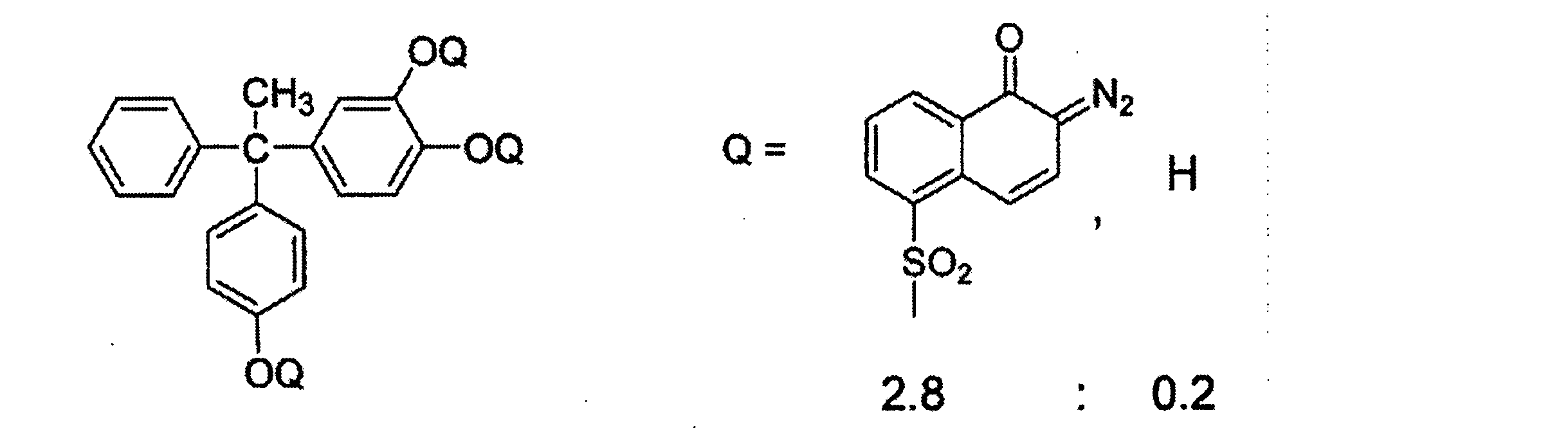
乾燥窒素気流下、TrisP-HAP(商品名、本州化学工業(株)製)15.32g(0.05mol)と5-ナフトキノンジアジドスルホニル酸クロリド22.84g(0.085mol)を1,4-ジオキサン450gに溶解させ、室温にした。ここに、1,4-ジオキサン50gと混合させたトリエチルアミン9.46g(0.0935mol)を系内が35℃以上にならないように滴下した。滴下後30℃で2時間攪拌した。トリエチルアミン塩を濾過し、濾液を水に投入させた。その後、析出した沈殿を濾過で集めた。この沈殿を真空乾燥機で乾燥させ、下記構造のキノンジアジド化合物(QD-2)を得た。
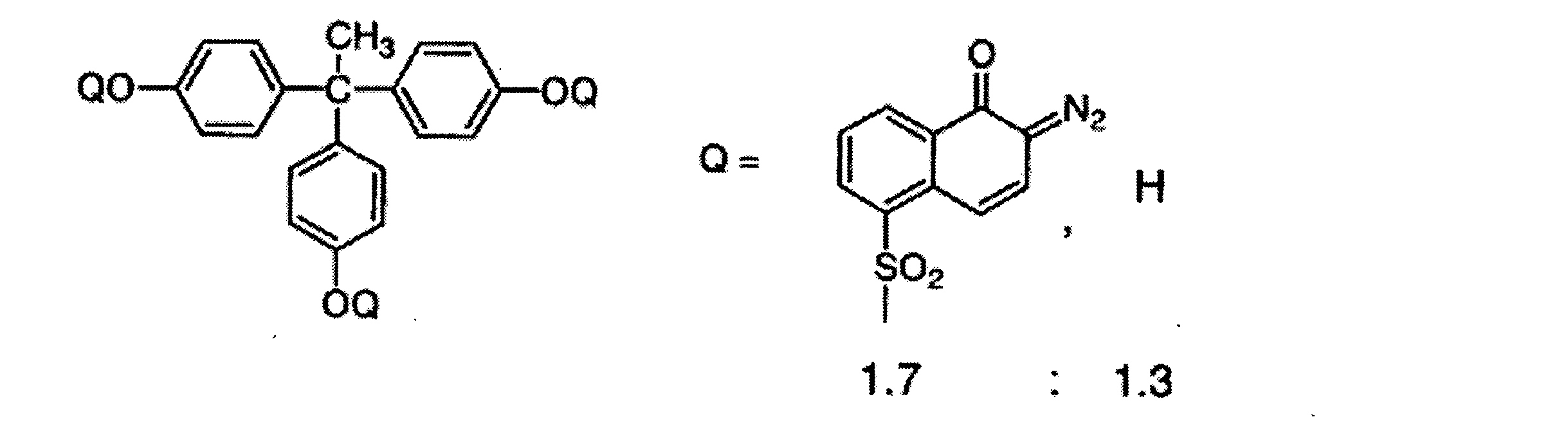
ラムダエースSTM-602(商品名、大日本スクリーン製)を用いて、屈折率1.70でプリベーク膜および硬化膜の厚さを測定した。
残膜率は以下の式に従って算出した。
残膜率(%)=現像後の未露光部膜厚÷プリベーク膜の膜厚×100。
現像後、10μmのライン・アンド・スペースパターンを1対1の幅に形成する露光量(以下、これを最適露光量という)を感光感度とし、組成物を調製した直後に作製した硬化膜(6インチシリコンウェハー上)および組成物を室温下で1ヶ月保管した後に作製した硬化膜(6インチシリコンウェハー上)それぞれについて測定した。
最適露光量における現像後の最小パターン寸法を現像後解像度、キュア後の最小パターン寸法をキュア後解像度とし、組成物を調製した直後に作製した硬化膜(6インチシリコンウェハー上)および組成物を室温下で1ヶ月保管した後に作製した硬化膜(6インチシリコンウェハー上)それぞれについて測定した。
6インチシリコンウェハーに作製した硬化膜について、大塚電子(株)製分光エリプソメータFE5000を用いて、22℃での550nmにおける屈折率および膜厚を測定した。
MultiSpec-1500(商品名、(株)島津製作所製)を用いて、まずテンパックスガラス基板のみを測定し、その紫外可視吸収スペクトルをリファレンスとした。次にテンパックスガラス基板上に組成物の硬化膜を膜厚約1μmとなるように形成(パターン露光は行わない)し、このサンプルをシングルビームで測定し、波長400nmでの光透過率をランベルトの法則により膜厚1μm当たりに換算したものを求め、リファレンスとの差異を硬化膜の光透過率とした。
6インチシリコンウェハーに作製した硬化膜について、PGMEA溶剤に25℃2分間浸漬し、その前後での残膜率が99%以上のとき良好であると判定した。なお残膜率は以下の式に従って算出した。
残膜率(%)=PGMEA溶剤浸漬後膜厚÷PGMEA溶剤浸漬前膜厚×100。
合成例3で得られたポリシロキサン溶液(PS-1)69.49g、合成例24で得られたキノンジアジド化合物(QD-1)2.06g、DFX-18(フッ素系界面活性剤、(株)ネオス製)を100ppm、DAA13.44g、PGMEA14.70gを黄色灯下で混合、撹拌して均一溶液とした後、0.20μmのフィルターで濾過して組成物1を調製した。
組成物1と同様にして、表3、4に示す組成の組成物2~28を調製した。得られた各組成物を用いて、実施例1と同様にして硬化膜を作製した。評価結果を表5、6に示す。


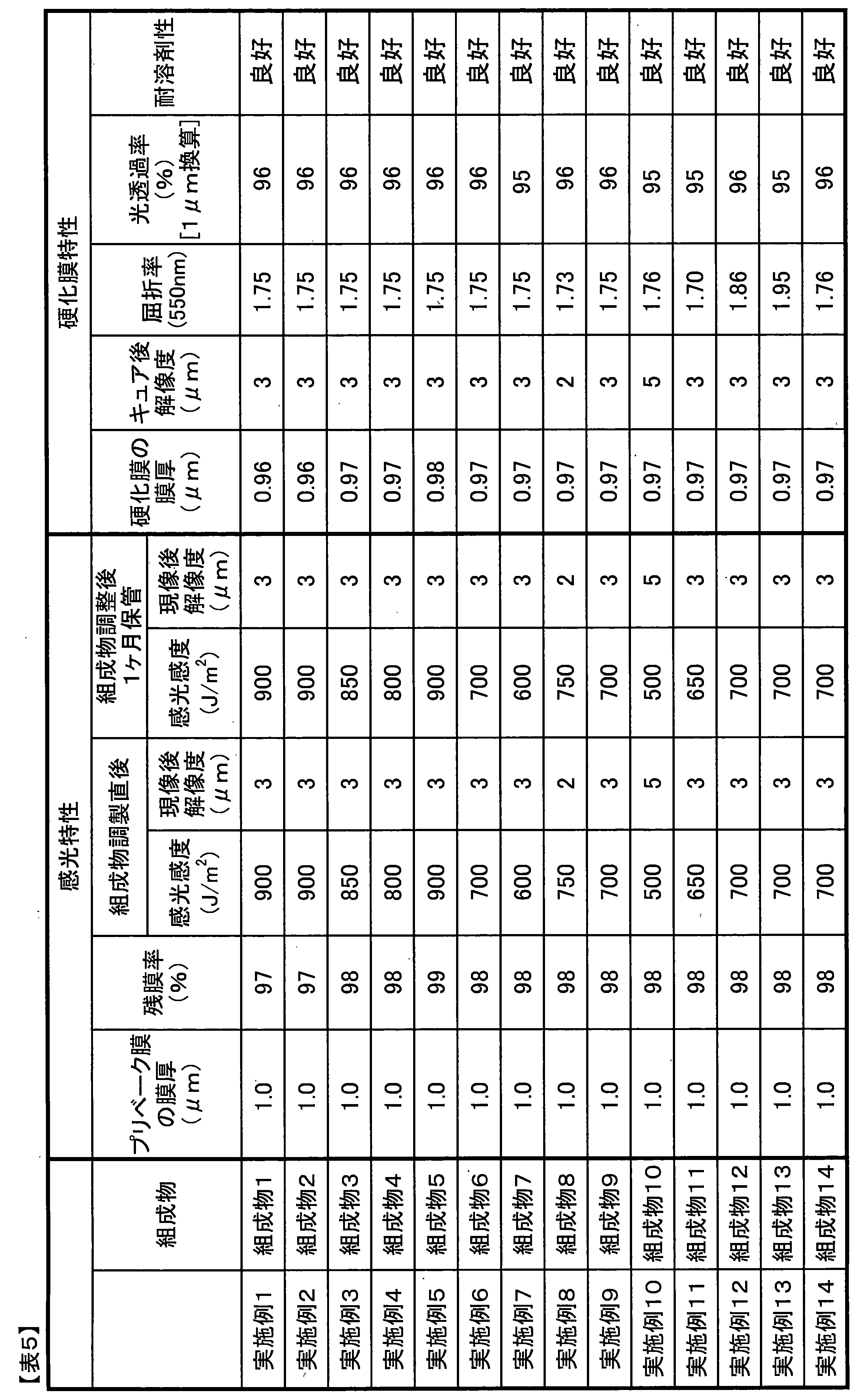

Claims (11)
- (a)下記一般式(1)で表されるオルガノシランとカルボキシル基および/またはジカルボン酸無水物構造を有するオルガノシランとを加水分解し、部分縮合させることによって合成されるポリシロキサン、(d)アルミニウム化合物、スズ化合物、チタン化合物およびジルコニウム化合物から選ばれる1以上の金属化合物の粒子、またはアルミニウム化合物、スズ化合物、チタン化合物およびジルコニウム化合物から選ばれる1以上の金属化合物とケイ素化合物との複合粒子、(b)ナフトキノンジアジド化合物ならびに(c)溶剤を含むことを特徴とするポジ型感光性樹脂組成物。

- (a’)アルミニウム化合物、スズ化合物、チタン化合物およびジルコニウム化合物から選ばれる1以上の金属化合物の粒子の存在下、またはアルミニウム化合物、スズ化合物、チタン化合物およびジルコニウム化合物から選ばれる1以上の金属化合物とケイ素化合物との複合粒子の存在下、下記一般式(1)で表されるオルガノシランとカルボキシル基および/またはジカルボン酸無水物構造を有するオルガノシランとを加水分解し、部分縮合させることによって合成される金属化合物含有粒子含有ポリシロキサン、(b)ナフトキノンジアジド化合物ならびに(c)溶剤を含むことを特徴とするポジ型感光性樹脂組成物。

- 前記一般式(1)で表されるオルガノシランのR1が、縮合多環式芳香族炭化水素基を含有することを特徴とする請求項1または2に記載のポジ型感光性樹脂組成物。
- 前記カルボキシル基および/またはジカルボン酸無水物構造を有するオルガノシランが、下記一般式(2)~(4)のいずれかで表されるジカルボン酸無水物であることを特徴とする請求項1~3ののいずれかに記載のポジ型感光性樹脂組成物。

- 前記カルボキシル基および/またはジカルボン酸無水物構造を有するオルガノシランの含有比が、オルガノシランに由来するポリシロキサン全体のSi原子モル数に対するSi原子モル比で、5モル%以上30モル%以下であることを特徴とする請求項1~4のいずれかに記載のポジ型感光性樹脂組成物。
- 前記一般式(1)で表されるオルガノシランのうち、R1が縮合多環式芳香族炭化水素基を含有するオルガノシランが、オルガノシランに由来するポリシロキサン全体のSi原子モル数に対するSi原子モル比で、10モル%以上であることを特徴とする請求項3~5のいずれかに記載のポジ型感光性樹脂組成物。
- 前記アルミニウム化合物、スズ化合物、チタン化合物およびジルコニウム化合物から選ばれる1以上の金属化合物の粒子またはアルミニウム化合物、スズ化合物、チタン化合物およびジルコニウム化合物から選ばれる1以上の金属化合物とケイ素化合物との複合粒子の数平均粒子径が、1nm~200nmであることを特徴とする請求項1~6のいずれかに記載のポジ型感光性樹脂組成物。
- 前記アルミニウム化合物、スズ化合物、チタン化合物およびジルコニウム化合物から選ばれる1以上の金属化合物の粒子またはアルミニウム化合物、スズ化合物、チタン化合物およびジルコニウム化合物から選ばれる1以上の金属化合物とケイ素化合物との複合粒子が、チタン化合物の粒子、ジルコニウム化合物の粒子またはチタン化合物もしくはジルコニウム化合物とケイ素化合物との複合粒子であることを特徴とする請求項1~7のいずれかに記載のポジ型感光性樹脂組成物。
- 前記アルミニウム化合物、スズ化合物、チタン化合物およびジルコニウム化合物から選ばれる1以上の金属化合物の粒子またはアルミニウム化合物、スズ化合物、チタン化合物およびジルコニウム化合物から選ばれる1以上の金属化合物とケイ素化合物との複合粒子が、前記一般式(1)で表されるオルガノシランとカルボキシル基および/またはジカルボン酸無水物構造を有するオルガノシランの合計量100重量部に対して、10重量部以上500重量部以下であることを特徴とする請求項1~8のいずれかに記載のポジ型感光性樹脂組成物。
- 請求項1~9のいずれかに記載のポジ型感光性樹脂組成物を硬化させてなる硬化膜。
- 請求項10に記載の硬化膜を具備する光学デバイス。
Priority Applications (6)
| Application Number | Priority Date | Filing Date | Title |
|---|---|---|---|
| US14/902,411 US9989852B2 (en) | 2013-07-02 | 2014-07-01 | Positive photosensitive resin composition, cured film formed by curing same, and optical device equipped with same |
| SG11201510719YA SG11201510719YA (en) | 2013-07-02 | 2014-07-01 | Positive photosensitive resin composition, cured film formed by curing same, and optical device equipped with same |
| CN201480037500.0A CN105359037B (zh) | 2013-07-02 | 2014-07-01 | 正型感光性树脂组合物、使其固化而成的固化膜及具有其的光学设备 |
| EP14820140.3A EP3018532B1 (en) | 2013-07-02 | 2014-07-01 | Positive photosensitive resin composition, cured film formed by curing same, and use of the film in an optical device |
| KR1020157035617A KR102245396B1 (ko) | 2013-07-02 | 2014-07-01 | 포지티브형 감광성 수지 조성물, 그것을 경화시켜서 이루어지는 경화막 및 그것을 구비하는 광학 디바이스 |
| JP2014531799A JP6172150B2 (ja) | 2013-07-02 | 2014-07-01 | ポジ型感光性樹脂組成物、それを硬化させてなる硬化膜およびそれを具備する光学デバイス |
Applications Claiming Priority (2)
| Application Number | Priority Date | Filing Date | Title |
|---|---|---|---|
| JP2013-138754 | 2013-07-02 | ||
| JP2013138754 | 2013-07-02 |
Publications (1)
| Publication Number | Publication Date |
|---|---|
| WO2015002183A1 true WO2015002183A1 (ja) | 2015-01-08 |
Family
ID=52143755
Family Applications (1)
| Application Number | Title | Priority Date | Filing Date |
|---|---|---|---|
| PCT/JP2014/067507 Ceased WO2015002183A1 (ja) | 2013-07-02 | 2014-07-01 | ポジ型感光性樹脂組成物、それを硬化させてなる硬化膜およびそれを具備する光学デバイス |
Country Status (8)
| Country | Link |
|---|---|
| US (1) | US9989852B2 (ja) |
| EP (1) | EP3018532B1 (ja) |
| JP (1) | JP6172150B2 (ja) |
| KR (1) | KR102245396B1 (ja) |
| CN (1) | CN105359037B (ja) |
| SG (1) | SG11201510719YA (ja) |
| TW (1) | TWI628233B (ja) |
| WO (1) | WO2015002183A1 (ja) |
Cited By (2)
| Publication number | Priority date | Publication date | Assignee | Title |
|---|---|---|---|---|
| JP2017037989A (ja) * | 2015-08-11 | 2017-02-16 | 東京応化工業株式会社 | レジストパターン形成装置およびレジストパターン形成方法 |
| JP2018123234A (ja) * | 2017-01-31 | 2018-08-09 | 東京応化工業株式会社 | 重合性組成物、硬化膜の製造方法、及び硬化膜 |
Families Citing this family (4)
| Publication number | Priority date | Publication date | Assignee | Title |
|---|---|---|---|---|
| KR102493962B1 (ko) | 2016-10-19 | 2023-02-01 | 롬엔드하스전자재료코리아유한회사 | 감광성 수지 조성물 및 이로부터 제조된 경화막 |
| WO2019167771A1 (ja) * | 2018-02-28 | 2019-09-06 | セントラル硝子株式会社 | 珪素含有層形成組成物およびそれを用いたパターン付き基板の製造方法 |
| KR102331157B1 (ko) * | 2019-10-23 | 2021-11-26 | (주)휴넷플러스 | 폴리실록산 공중합체, 이의 제조방법 및 이를 포함하는 수지 조성물 |
| CN118240447B (zh) * | 2022-12-23 | 2026-04-14 | 财团法人工业技术研究院 | 涂料、涂层、与发光装置 |
Citations (8)
| Publication number | Priority date | Publication date | Assignee | Title |
|---|---|---|---|---|
| JP2001081404A (ja) | 1999-09-17 | 2001-03-27 | Jsr Corp | コーティング組成物および硬化体 |
| JP2003075997A (ja) | 2001-06-22 | 2003-03-12 | Toray Ind Inc | ポジ型感光性樹脂組成物 |
| JP2006293337A (ja) | 2005-03-18 | 2006-10-26 | Toray Ind Inc | 感光性シロキサン組成物、それから形成された硬化膜、および硬化膜を有する素子 |
| JP2006312717A (ja) | 2005-04-04 | 2006-11-16 | Toray Fine Chemicals Co Ltd | 縮合多環式炭化水素基を有するシリコーン共重合体及びその製造方法 |
| JP2007246877A (ja) | 2005-10-03 | 2007-09-27 | Toray Ind Inc | シロキサン系樹脂組成物、光学物品およびシロキサン系樹脂組成物の製造方法 |
| JP2008024832A (ja) | 2006-07-21 | 2008-02-07 | Tokyo Ohka Kogyo Co Ltd | 高屈折率材料 |
| WO2011040248A1 (ja) | 2009-09-29 | 2011-04-07 | 東レ株式会社 | ポジ型感光性樹脂組成物、それを用いた硬化膜および光学デバイス |
| JP2012123391A (ja) * | 2010-12-01 | 2012-06-28 | Chi Mei Corp | 光硬化性ポリシロキサン組成物、及び、当該組成物により形成された保護膜 |
Family Cites Families (13)
| Publication number | Priority date | Publication date | Assignee | Title |
|---|---|---|---|---|
| JPS63204254A (ja) * | 1987-02-20 | 1988-08-23 | Nippon Telegr & Teleph Corp <Ntt> | ホトレジストの現像方法 |
| JP2700655B2 (ja) * | 1988-03-02 | 1998-01-21 | 富士写真フイルム株式会社 | フォトレジスト組成物 |
| JP4270708B2 (ja) * | 1999-04-23 | 2009-06-03 | 富士通株式会社 | ケイ素含有ポリマ、その製造方法、それを用いたレジスト組成物、パターン形成方法および電子デバイスの製造方法 |
| JP4141625B2 (ja) * | 2000-08-09 | 2008-08-27 | 東京応化工業株式会社 | ポジ型レジスト組成物およびそのレジスト層を設けた基材 |
| JP4853228B2 (ja) * | 2006-10-25 | 2012-01-11 | 東レ株式会社 | 感光性シロキサン組成物、それから形成された硬化膜、および硬化膜を有する素子、並びにパターン形成方法 |
| JP2008208342A (ja) * | 2007-01-31 | 2008-09-11 | Toray Ind Inc | 樹脂組成物、硬化膜、および硬化膜を有するカラーフィルタ |
| WO2010061744A1 (ja) * | 2008-11-27 | 2010-06-03 | 東レ株式会社 | シロキサン樹脂組成物およびそれを用いたタッチパネル用保護膜 |
| JP2012158743A (ja) * | 2011-01-14 | 2012-08-23 | Toray Ind Inc | 非感光性樹脂組成物、それから形成された硬化膜、および硬化膜を有するタッチパネル用素子 |
| DE102011084183A1 (de) * | 2011-03-25 | 2012-09-27 | Evonik Degussa Gmbh | Wässrige Korrosionsschutzformulierung auf Silanebasis |
| WO2013099785A1 (ja) * | 2011-12-26 | 2013-07-04 | 東レ株式会社 | 感光性樹脂組成物および半導体素子の製造方法 |
| JP6115115B2 (ja) * | 2012-12-18 | 2017-04-19 | 東レ株式会社 | ポジ型感光性樹脂組成物、それを用いた硬化パターンの製造方法、凸パターン基板の製造方法および発光素子の製造方法 |
| TWI479269B (zh) * | 2012-12-25 | 2015-04-01 | Chi Mei Corp | 感光性聚矽氧烷組成物及其應用 |
| WO2015111607A1 (ja) * | 2014-01-24 | 2015-07-30 | 東レ株式会社 | ネガ型感光性樹脂組成物、それを硬化させてなる硬化膜およびその製造方法ならびにそれを具備する光学デバイスおよび裏面照射型cmosイメージセンサ |
-
2014
- 2014-07-01 CN CN201480037500.0A patent/CN105359037B/zh active Active
- 2014-07-01 JP JP2014531799A patent/JP6172150B2/ja active Active
- 2014-07-01 SG SG11201510719YA patent/SG11201510719YA/en unknown
- 2014-07-01 WO PCT/JP2014/067507 patent/WO2015002183A1/ja not_active Ceased
- 2014-07-01 TW TW103122672A patent/TWI628233B/zh not_active IP Right Cessation
- 2014-07-01 EP EP14820140.3A patent/EP3018532B1/en not_active Not-in-force
- 2014-07-01 US US14/902,411 patent/US9989852B2/en active Active
- 2014-07-01 KR KR1020157035617A patent/KR102245396B1/ko active Active
Patent Citations (8)
| Publication number | Priority date | Publication date | Assignee | Title |
|---|---|---|---|---|
| JP2001081404A (ja) | 1999-09-17 | 2001-03-27 | Jsr Corp | コーティング組成物および硬化体 |
| JP2003075997A (ja) | 2001-06-22 | 2003-03-12 | Toray Ind Inc | ポジ型感光性樹脂組成物 |
| JP2006293337A (ja) | 2005-03-18 | 2006-10-26 | Toray Ind Inc | 感光性シロキサン組成物、それから形成された硬化膜、および硬化膜を有する素子 |
| JP2006312717A (ja) | 2005-04-04 | 2006-11-16 | Toray Fine Chemicals Co Ltd | 縮合多環式炭化水素基を有するシリコーン共重合体及びその製造方法 |
| JP2007246877A (ja) | 2005-10-03 | 2007-09-27 | Toray Ind Inc | シロキサン系樹脂組成物、光学物品およびシロキサン系樹脂組成物の製造方法 |
| JP2008024832A (ja) | 2006-07-21 | 2008-02-07 | Tokyo Ohka Kogyo Co Ltd | 高屈折率材料 |
| WO2011040248A1 (ja) | 2009-09-29 | 2011-04-07 | 東レ株式会社 | ポジ型感光性樹脂組成物、それを用いた硬化膜および光学デバイス |
| JP2012123391A (ja) * | 2010-12-01 | 2012-06-28 | Chi Mei Corp | 光硬化性ポリシロキサン組成物、及び、当該組成物により形成された保護膜 |
Cited By (2)
| Publication number | Priority date | Publication date | Assignee | Title |
|---|---|---|---|---|
| JP2017037989A (ja) * | 2015-08-11 | 2017-02-16 | 東京応化工業株式会社 | レジストパターン形成装置およびレジストパターン形成方法 |
| JP2018123234A (ja) * | 2017-01-31 | 2018-08-09 | 東京応化工業株式会社 | 重合性組成物、硬化膜の製造方法、及び硬化膜 |
Also Published As
| Publication number | Publication date |
|---|---|
| JP6172150B2 (ja) | 2017-08-02 |
| TW201502207A (zh) | 2015-01-16 |
| US20160370703A1 (en) | 2016-12-22 |
| KR102245396B1 (ko) | 2021-04-28 |
| JPWO2015002183A1 (ja) | 2017-02-23 |
| EP3018532B1 (en) | 2020-08-19 |
| CN105359037A (zh) | 2016-02-24 |
| SG11201510719YA (en) | 2016-01-28 |
| US9989852B2 (en) | 2018-06-05 |
| EP3018532A1 (en) | 2016-05-11 |
| KR20160026881A (ko) | 2016-03-09 |
| EP3018532A4 (en) | 2017-03-22 |
| CN105359037B (zh) | 2020-02-28 |
| TWI628233B (zh) | 2018-07-01 |
Similar Documents
| Publication | Publication Date | Title |
|---|---|---|
| JP5423802B2 (ja) | ポジ型感光性樹脂組成物、それを用いた硬化膜および光学デバイス | |
| JP4784283B2 (ja) | ポジ型感光性シロキサン組成物、それから形成された硬化膜、および硬化膜を有する素子 | |
| JP5696665B2 (ja) | 感光性シロキサン組成物、それから形成された硬化膜および硬化膜を有する素子 | |
| JP5444704B2 (ja) | 感光性組成物、それから形成された硬化膜、および硬化膜を有する素子 | |
| JP6318634B2 (ja) | 感光性シロキサン組成物、硬化膜及び素子 | |
| JP6172150B2 (ja) | ポジ型感光性樹脂組成物、それを硬化させてなる硬化膜およびそれを具備する光学デバイス | |
| JP2013114238A (ja) | ポジ型感光性組成物、そのポジ型感光性組成物から形成された硬化膜、およびその硬化膜を有する素子。 | |
| JP6569211B2 (ja) | 感光性樹脂組成物、それを硬化させてなる硬化膜ならびにそれを具備する発光素子および固体撮像素子 | |
| JP5659561B2 (ja) | 感光性シロキサン組成物、それから形成された硬化膜、および硬化膜を有する素子 | |
| TW202020024A (zh) | 樹脂組成物、其硬化膜、固體攝像元件、有機電致發光元件、顯示裝置 | |
| JP2012053381A (ja) | ポジ型感光性組成物、それから形成された硬化膜、および硬化膜を有する素子 | |
| JP5343649B2 (ja) | 感光性組成物、それから形成された硬化膜、および硬化膜を有する素子 | |
| JP5540632B2 (ja) | 感光性組成物、それから形成された硬化膜、および硬化膜を有する素子 | |
| JP5233526B2 (ja) | 感光性組成物、それから形成された硬化膜、および硬化膜を有する素子 | |
| JP4910646B2 (ja) | 感光性シロキサン組成物およびその製造方法、感光性シロキサン組成物から形成された硬化膜、および硬化膜を有する素子 | |
| JP6186766B2 (ja) | 感光性シロキサン組成物、それから形成された硬化膜、およびその硬化膜を有する素子 | |
| JP2013174872A (ja) | 感光性シロキサン組成物、それから形成された硬化膜、およびその硬化膜を有する素子 | |
| WO2023181812A1 (ja) | ポジ型感光性樹脂組成物、その硬化物およびそれを具備する表示装置 |
Legal Events
| Date | Code | Title | Description |
|---|---|---|---|
| WWE | Wipo information: entry into national phase |
Ref document number: 201480037500.0 Country of ref document: CN |
|
| ENP | Entry into the national phase |
Ref document number: 2014531799 Country of ref document: JP Kind code of ref document: A |
|
| 121 | Ep: the epo has been informed by wipo that ep was designated in this application |
Ref document number: 14820140 Country of ref document: EP Kind code of ref document: A1 |
|
| WWE | Wipo information: entry into national phase |
Ref document number: 2014820140 Country of ref document: EP |
|
| ENP | Entry into the national phase |
Ref document number: 20157035617 Country of ref document: KR Kind code of ref document: A |
|
| WWE | Wipo information: entry into national phase |
Ref document number: 14902411 Country of ref document: US |
|
| NENP | Non-entry into the national phase |
Ref country code: DE |