WO2015011981A1 - Procédé de fabrication de briquettes et de fer réduit - Google Patents
Procédé de fabrication de briquettes et de fer réduit Download PDFInfo
- Publication number
- WO2015011981A1 WO2015011981A1 PCT/JP2014/063829 JP2014063829W WO2015011981A1 WO 2015011981 A1 WO2015011981 A1 WO 2015011981A1 JP 2014063829 W JP2014063829 W JP 2014063829W WO 2015011981 A1 WO2015011981 A1 WO 2015011981A1
- Authority
- WO
- WIPO (PCT)
- Prior art keywords
- heat
- powder
- heat treatment
- iron
- iron oxide
- Prior art date
- Legal status (The legal status is an assumption and is not a legal conclusion. Google has not performed a legal analysis and makes no representation as to the accuracy of the status listed.)
- Ceased
Links
Images

Classifications
-
- C—CHEMISTRY; METALLURGY
- C21—METALLURGY OF IRON
- C21B—MANUFACTURE OF IRON OR STEEL
- C21B13/00—Making spongy iron or liquid steel, by direct processes
- C21B13/14—Multi-stage processes processes carried out in different vessels or furnaces
- C21B13/146—Multi-step reduction without melting
-
- C—CHEMISTRY; METALLURGY
- C22—METALLURGY; FERROUS OR NON-FERROUS ALLOYS; TREATMENT OF ALLOYS OR NON-FERROUS METALS
- C22B—PRODUCTION AND REFINING OF METALS; PRETREATMENT OF RAW MATERIALS
- C22B1/00—Preliminary treatment of ores or scrap
- C22B1/14—Agglomerating; Briquetting; Binding; Granulating
- C22B1/16—Sintering; Agglomerating
-
- C—CHEMISTRY; METALLURGY
- C21—METALLURGY OF IRON
- C21B—MANUFACTURE OF IRON OR STEEL
- C21B13/00—Making spongy iron or liquid steel, by direct processes
- C21B13/0046—Making spongy iron or liquid steel, by direct processes making metallised agglomerates or iron oxide
-
- C—CHEMISTRY; METALLURGY
- C21—METALLURGY OF IRON
- C21B—MANUFACTURE OF IRON OR STEEL
- C21B13/00—Making spongy iron or liquid steel, by direct processes
- C21B13/0066—Preliminary conditioning of the solid carbonaceous reductant
-
- C—CHEMISTRY; METALLURGY
- C22—METALLURGY; FERROUS OR NON-FERROUS ALLOYS; TREATMENT OF ALLOYS OR NON-FERROUS METALS
- C22B—PRODUCTION AND REFINING OF METALS; PRETREATMENT OF RAW MATERIALS
- C22B1/00—Preliminary treatment of ores or scrap
- C22B1/02—Roasting processes
-
- C—CHEMISTRY; METALLURGY
- C22—METALLURGY; FERROUS OR NON-FERROUS ALLOYS; TREATMENT OF ALLOYS OR NON-FERROUS METALS
- C22B—PRODUCTION AND REFINING OF METALS; PRETREATMENT OF RAW MATERIALS
- C22B1/00—Preliminary treatment of ores or scrap
- C22B1/14—Agglomerating; Briquetting; Binding; Granulating
- C22B1/24—Binding; Briquetting ; Granulating
- C22B1/2406—Binding; Briquetting ; Granulating pelletizing
-
- C—CHEMISTRY; METALLURGY
- C21—METALLURGY OF IRON
- C21B—MANUFACTURE OF IRON OR STEEL
- C21B13/00—Making spongy iron or liquid steel, by direct processes
-
- C—CHEMISTRY; METALLURGY
- C22—METALLURGY; FERROUS OR NON-FERROUS ALLOYS; TREATMENT OF ALLOYS OR NON-FERROUS METALS
- C22B—PRODUCTION AND REFINING OF METALS; PRETREATMENT OF RAW MATERIALS
- C22B1/00—Preliminary treatment of ores or scrap
- C22B1/14—Agglomerating; Briquetting; Binding; Granulating
- C22B1/24—Binding; Briquetting ; Granulating
Definitions
- the present invention relates to a technique for effectively using a fine iron oxide-containing powder having a 50% particle diameter of 2 ⁇ m or less as an iron source.
- a method for producing reduced iron from an iron oxide-containing substance such as iron ore for example, a gas reduction method using natural gas is known.
- a method for producing reduced iron developed in recent years an agglomerate obtained by mixing an iron oxide-containing substance and a carbonaceous reducing agent such as a carbonaceous material is heated at a high temperature of 1300 ° C. or more to produce a reduced agglomerate.
- a FASTMET method and an ITmk3 method in which the reduced agglomerate is further heated to reduce and separate reduced iron and slag to produce granular reduced iron.
- water and a binder are mixed in the mixer using the iron oxide-containing substance as a raw material, and granulated by a granulator to obtain an agglomerate having a diameter of 13 to 18 mm. Things are used.
- the agglomeration method of the powder for example, a pelletizing method and a sintering method are known, and an appropriate granulation method as a pretreatment is determined according to the particle size range of the powder (for example, non-patent document). 1). Specifically, in the rolling granulation method in the pelletizing method, it is recommended that the 50% particle size is 4 ⁇ m or more, and in the sintering method, the 50% particle size is about 0.11 mm to about 3 mm. It is recommended that there be.
- valuable metals other than iron include Ni, Al, Ti and the like. These valuable metals are separated and recovered as Ni, Al, and Ti from Ni-containing ores such as saprolite, Al-containing ores such as red mud, and Ti-containing ores such as ilmenite.
- the HPAL method High Pressure Acid Leach
- Ni can be extracted and recovered by stably reacting Ni-containing ore with sulfuric acid in a high-temperature and high-pressure state. After extracting and recovering Ni, a precipitate separation product is generated as a residue.
- This residue contains a large amount of iron oxide, and this oxide is mainly hematite (Fe 2 O 3 ). Further, the amount of water contained in the residue is 20% or more, the form is mud, and the 50% particle size is very fine as about 0.6 ⁇ m.
- tailing the residue from which the target component is recovered by the beneficiation operation
- the residue from which the target component is recovered by the beneficiation operation may contain a large amount of iron oxide such as hematite, for example. Therefore, it is conceivable to reduce the iron oxide contained in the tailings and use it as an iron source.
- tailings are usually very fine, it is difficult to granulate by the tumbling granulation method described above and use it as an iron-making raw material. That is, when the particles are very fine, the particles easily stick to each other during the stirring process in the mixer, and the particles form pseudo particles.
- pseudo particles When these pseudo particles are granulated by a granulator, the pseudo particles are bonded to each other and grow to form a pellet having protrusions on the surface like konpeito.
- the pellet having such a shape cannot be used as an iron-making raw material because the internal structure is not uniform and the strength is low. Therefore, it is difficult to agglomerate tailings and use it as a raw material for iron making and effectively use it as an iron source.
- the present invention has been made paying attention to the above-mentioned circumstances, and its purpose is to granulate a fine iron oxide-containing powder having a 50% particle size of 2 ⁇ m or less so that it can be used as an iron-making raw material.
- the object is to provide a method for producing the composition.
- Another object of the present invention is to provide a technique for producing reduced iron from an agglomerate obtained by agglomeration.
- the inventors of the present invention have intensively studied to granulate and agglomerate fine iron oxide-containing powder and use it as a raw material for iron making. As a result, it was found that if the iron oxide-containing powder having a 50% particle size of 2 ⁇ m or less is heat-treated at a predetermined temperature, the particles can be granulated because they are sintered together and coarsened, and an agglomerate can be produced.
- the present invention has been completed.
- the method for producing an agglomerate according to the present invention which was able to solve the above problems, was obtained by heat-treating an iron oxide-containing powder having a 50% particle size of 2 ⁇ m or less at a heating temperature of 900 to 1200 ° C. And a step of producing an agglomerate by granulating the heat-treated powder.
- the granulation may be performed by a rolling granulation method.
- the heat treatment is preferably performed so that the 50% particle diameter of the heat treated powder is 4 ⁇ m or more, and the heating time may be, for example, 30 minutes or more.
- the heat treatment is preferably performed while rolling the iron oxide-containing powder.
- tailings can be used.
- the tailing for example, a residue after recovering Ni from Ni-containing ore can be used.
- the present invention also includes a method of producing reduced iron by using the agglomerate obtained by the above production method as a raw material and heating it to reduce iron oxide.
- the agglomerate may further contain, for example, a carbonaceous reducing agent.
- the iron oxide-containing powder having a 50% particle size of 2 ⁇ m or less is heat-treated at a heating temperature of 900 to 1200 ° C., whereby the particles can be coarsened.
- the composition can be manufactured.
- the obtained agglomerate can be used as a raw material for iron making.
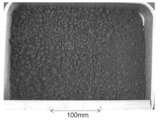
- FIG. 1 is a drawing-substituting photograph in which a heat-treated powder obtained by heat treatment at a heating temperature of 400 ° C. is photographed.
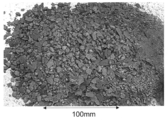
- FIG. 2 is a drawing-substituting photograph in which a heat-treated powder obtained by heat treatment at a heating temperature of 1200 ° C. is photographed.
- FIG. 3 is a graph showing the particle size distribution of the heat-treated powder.
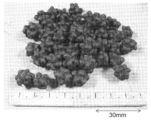
- FIG. 4 is a drawing-substituting photograph in which an agglomerated product obtained by granulating a heat-treated powder obtained by heat treatment at a heating temperature of 400 ° C. with a ball mill is photographed.
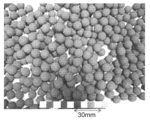
- FIG. 5 is a drawing-substituting photograph in which an agglomerated product obtained by granulating a heat-treated powder obtained by heat-treating at a heating temperature of 1200 ° C. with a ball mill is photographed.
- the method of the present invention A step of heat-treating an iron oxide-containing powder having a 50% particle size of 2 ⁇ m or less at a heating temperature of 900 to 1200 ° C. (hereinafter sometimes referred to as a heat treatment step); A step of granulating the obtained heat-treated powder as a raw material to produce an agglomerate (hereinafter sometimes referred to as an agglomeration step); Is included.
- a heat treatment step A step of heat-treating an iron oxide-containing powder having a 50% particle size of 2 ⁇ m or less at a heating temperature of 900 to 1200 ° C.
- tailing can be used as the iron oxide-containing powder having a 50% particle size of 2 ⁇ m or less.
- the tailing means a residue obtained by recovering the target component by the beneficiation operation, and the type of mineral before the beneficiation is not particularly limited.
- tailings for example, residues after beneficiation from iron ore, residues after recovering Al from Al-containing ores, residues after recovering Ti from Ti-containing ores, and after recovering Ni from Ni-containing ores Residues, etc. can be used.
- Red mud is used as the Al-containing ore
- ilmenite is used as the Ti-containing ore
- saprolite is used as the Ni-containing ore.
- the above-described HPAL method is known, and the residue after separating and recovering Ni has a 50% particle size of 2 ⁇ m or less.
- the iron oxide-containing powder having a 50% particle size of 2 ⁇ m or less is heat-treated at a heating temperature of 900 to 1200 ° C.
- a heating temperature 900 to 1200 ° C.
- the iron oxide-containing powder is oxidized, sintered, and coarsened. As a result, it can be grown to a size that allows granulation in the steps described below.
- the heating temperature is lower than 900 ° C., the effect of coarsening cannot be obtained, and granulation cannot be performed or even if granulation can be performed, a spherical agglomerate cannot be obtained. Therefore, the heating temperature is 900 ° C. or higher, preferably 950 ° C.
- the heating temperature is 1200 ° C. or lower, preferably 1150 ° C. or lower, more preferably 1100 ° C. or lower.
- the heating temperature may be controlled based on this temperature by inserting a thermocouple into the furnace and measuring the ambient temperature in the center of the furnace.
- the heating time may be controlled in consideration of the heating temperature so that the 50% particle diameter of the heat treated powder is 4 ⁇ m or more.
- the heating time is preferably 30 minutes or longer, for example.
- the heating time is more preferably 40 minutes or more, and further preferably 50 minutes or more.
- the upper limit of the heating time is not particularly limited, but even if the heating time is increased, the effect of coarsening the particle diameter is saturated, but the productivity is lowered. Therefore, the heating time may be 60 minutes or less, for example.
- the heat treatment may be performed in an oxidizing atmosphere, for example, in an air atmosphere.
- the heat treatment is preferably performed while rolling to uniformly heat the iron oxide-containing powder.
- a rotary heating furnace may be used as the heating furnace.
- the rotary heating furnace refers to a furnace in which a furnace surface that is a heating surface rotates around a rotation axis, and the rotation axis is horizontal or more and less than vertical.
- the heat treated powder obtained in the heat treatment step is used as a raw material, and the heat treated powder is granulated to produce an agglomerated product.
- a rolling granulation method As a method for granulating the above heat treated powder, for example, a rolling granulation method can be mentioned.
- the above heat-treated powder is preferably granulated so that the particle size of the agglomerate is, for example, 10 to 16 mm.
- the heat-treated powder may be pulverized or pulverized prior to granulation.
- a well-known thing can be used as a crusher or a grinder, for example, a ball mill, a roller mill, a roll crusher etc. can be used.
- the agglomerate obtained in the agglomeration process can be used as a raw material for iron making. For example, after heat-curing the obtained agglomerate, by putting in a blast furnace or heat-cured product obtained by heat-curing treatment, further reducing the iron oxide by heating in a reducing gas atmosphere, Reduced iron can be produced.
- reduced iron can be produced by blending the heat-treated powder with a carbonaceous reducing agent or binder to form an agglomerate and heating it in a heating furnace.
- the iron oxide-containing powder having a 50% particle size of 2 ⁇ m or less can be coarsened to a granulated particle size by heat treatment in a predetermined temperature range, When granulated as a raw material, an agglomerate having a uniform structure in which the heat-treated powder has grown in a snowball manner can be produced.
- An iron oxide-containing powder having a 50% particle size of 2 ⁇ m or less was heat-treated, and the obtained heat-treated powder was granulated to produce an agglomerate. Details will be described below.
- the above tailings were left outdoors and exposed to the sun to make the water content about 19%.
- the tailing whose water content was adjusted to about 19% was reddish brown. This was charged in 2 kg into a rotary heating furnace and heat-treated while rolling the tailing to dry and sinter.
- the heating temperature during the heat treatment was set to 400 ° C., 800 ° C., 1100 ° C., or 1200 ° C.
- the heating time was about 60 minutes when the heating temperature was 400 ° C, and about 30 minutes when the heating temperature was 800 ° C, 1100 ° C, or 1200 ° C.
- the heating atmosphere was under air circulation.
- FIG. 1 shows a drawing-substituting photograph in which a powder obtained by heat treatment at a heating temperature of 400 ° C. is photographed. Moreover, the drawing substitute photograph which image
- the heat-treated powder cooled to room temperature was crushed or pulverized with a ball mill, and this was used as a granulation sample.
- heat-treated powder obtained by heat treatment at a heating temperature of 400 ° C., 800 ° C. or 1100 ° C. for a heat treatment powder obtained by crushing for about 30 seconds with a ball mill and heat treatment at a heating temperature of 1200 ° C. For about 20 minutes.
- the particle size distribution of each heat-treated powder was measured, and the results are shown in FIG.
- the horizontal axis in FIG. 3 indicates the particle diameter ( ⁇ m), and the vertical axis indicates the total sieve mass (mass%).
- the 50% particle size As shown in FIG. 3, when the particle size distribution is determined with the mass of the heat treated powder as a whole being 100%, the particle size at which the integrated sieve mass becomes 50% is called the 50% particle size.
- the powder obtained by heat treatment at a heating temperature of 400 ° C. or 800 ° C. has a 50% particle size almost the same as the raw material powder before the heat treatment, and the particle size is less than 1 ⁇ m.
- the total sieve mass of was also almost the same. Therefore, the raw material powder and the powder obtained by heat treatment at a heating temperature of 400 ° C. or 800 ° C. all had a particle size of less than 10 ⁇ m and almost the same particle size constitution.
- the powder obtained by heat treatment at a heating temperature of 1100 ° C. has a 50% particle size that is approximately 8.6 times larger than the raw material powder before the heat treatment, and the particles are coarsened by the heat treatment. I understand that.
- the powder obtained by heat treatment at a heating temperature of 1200 ° C. has a 50% particle size that is about 53.5 times larger than the raw material powder before the heat treatment, and the cumulative sieving mass with a particle size of less than 1 ⁇ m is It can be reduced to 4.4% by mass, and it can be seen that the particles are coarsened by the heat treatment.
- the coarsening of the particles can also be read from the results of the accumulated sieving mass with a particle size of less than 1 ⁇ m and the accumulated sieving mass with a particle size of less than 10 ⁇ m. That is, when the raw material powder or the heating temperature was heat treated at 400 ° C. or 800 ° C., the particle diameter was only less than 10 ⁇ m, whereas the heat treatment was carried out at a heating temperature of 1200 ° C. so that the particle diameter was less than 10 ⁇ m.
- the ratio of the powder was 20.9%, and the ratio of the coarse powder having a particle diameter of 10 ⁇ m or more could be about 80%.
- the specific surface area (calculated value) of the powder obtained by heat treatment at a heating temperature of 400 ° C. or 800 ° C. was 27400 to 29380 cm 2 / g.
- the specific surface area (calculated value) of the powder obtained by heat treatment at a heating temperature of 1100 ° C. is 8520 cm 2 / g
- the specific surface area of the powder obtained by heat treatment at a heating temperature of 1200 ° C. (calculated value). was 1920 cm 2 / g. From these results, it can be seen that the higher the heating temperature, the smaller the specific surface area and the larger the particles.
- FIG. 4 shows a drawing-substituting photograph in which an agglomerate obtained by granulating a pulverized product of heat-treated powder obtained by heat treatment at a heating temperature of 400 ° C. is photographed.
- FIG. 5 shows a photograph substituted for a drawing of a pellet obtained by granulating a pulverized product of the heat-treated powder obtained by heat treatment at a heating temperature of 1200 ° C.
- the crushing strength may be referred to as a crushing load (hereinafter referred to as a crushing load) by placing one pellet between two flat plates and applying a load to the flat plate so that the pellet is compressed. kg) was measured with a strength tester. The crush load was measured for 10 pellets, and the average value was obtained. The results are shown in Table 2 below.
- the porosity (%) was obtained by calculation from the apparent specific gravity value measured based on the buoyancy of the pellet immersed in mercury and the true specific gravity value of the mixed raw material powder. The results are shown in Table 2 below.
- the heat-treated powder obtained by heat treatment at a heating temperature of 1100 ° C. or 1200 ° C. is granulated, the moisture content, crushing strength, and porosity contained in the resulting pellet are manufactured by a conventional pelletizing plant. It was confirmed that it was almost the same as the raw pellet.
- iron pellets can be produced after heat-curing treatment, for example, by heating in a reducing gas atmosphere.
- reduced iron can be produced by preparing pellets by mixing a carbonaceous reducing agent, a binder or the like with the heat-treated powder and heating the pellets.
- an iron oxide-containing powder having a 50% particle size of 2 ⁇ m or less can be heat treated at a heating temperature of 900 to 1200 ° C. to obtain a granulated particle size. Can be manufactured. This agglomerate can be effectively used as an iron source.
Landscapes
- Chemical & Material Sciences (AREA)
- Engineering & Computer Science (AREA)
- Manufacturing & Machinery (AREA)
- Organic Chemistry (AREA)
- Metallurgy (AREA)
- Materials Engineering (AREA)
- Geochemistry & Mineralogy (AREA)
- Geology (AREA)
- Life Sciences & Earth Sciences (AREA)
- Mechanical Engineering (AREA)
- General Life Sciences & Earth Sciences (AREA)
- Environmental & Geological Engineering (AREA)
- Manufacture And Refinement Of Metals (AREA)
- Manufacture Of Iron (AREA)
Abstract
Priority Applications (6)
| Application Number | Priority Date | Filing Date | Title |
|---|---|---|---|
| EP14829405.1A EP3026129A4 (fr) | 2013-07-25 | 2014-05-26 | Procédé de fabrication de briquettes et de fer réduit |
| AU2014294413A AU2014294413B2 (en) | 2013-07-25 | 2014-05-26 | Method for manufacturing briquettes and reduced iron |
| CN201480041173.6A CN105452496A (zh) | 2013-07-25 | 2014-05-26 | 团块及还原铁的制造方法 |
| US14/908,055 US20160168654A1 (en) | 2013-07-25 | 2014-05-26 | Method for manufacturing agglomerate and reduced iron |
| RU2016102002A RU2638487C2 (ru) | 2013-07-25 | 2014-05-26 | Способ изготовления агломератов и восстановленного железа |
| PH12016500149A PH12016500149B1 (en) | 2013-07-25 | 2016-01-21 | Method for manufacturing agglomerate and reduced iron |
Applications Claiming Priority (2)
| Application Number | Priority Date | Filing Date | Title |
|---|---|---|---|
| JP2013154793A JP5827648B2 (ja) | 2013-07-25 | 2013-07-25 | 塊成物の製造方法 |
| JP2013-154793 | 2013-07-25 |
Publications (1)
| Publication Number | Publication Date |
|---|---|
| WO2015011981A1 true WO2015011981A1 (fr) | 2015-01-29 |
Family
ID=52393037
Family Applications (1)
| Application Number | Title | Priority Date | Filing Date |
|---|---|---|---|
| PCT/JP2014/063829 Ceased WO2015011981A1 (fr) | 2013-07-25 | 2014-05-26 | Procédé de fabrication de briquettes et de fer réduit |
Country Status (8)
| Country | Link |
|---|---|
| US (1) | US20160168654A1 (fr) |
| EP (1) | EP3026129A4 (fr) |
| JP (1) | JP5827648B2 (fr) |
| CN (1) | CN105452496A (fr) |
| AU (1) | AU2014294413B2 (fr) |
| PH (1) | PH12016500149B1 (fr) |
| RU (1) | RU2638487C2 (fr) |
| WO (1) | WO2015011981A1 (fr) |
Families Citing this family (6)
| Publication number | Priority date | Publication date | Assignee | Title |
|---|---|---|---|---|
| JP7234712B2 (ja) * | 2019-03-14 | 2023-03-08 | 日本製鉄株式会社 | 粉体塊成物および粉体塊成物の製造方法 |
| RU2706273C1 (ru) * | 2019-03-27 | 2019-11-15 | федеральное государственное бюджетное образовательное учреждение высшего образования "Санкт-Петербургский горный университет" | Способ получения гранулированного шлака |
| DE102019207824A1 (de) * | 2019-05-28 | 2020-12-03 | Thyssenkrupp Steel Europe Ag | Verfahren zur Herstellung von Eisenpulver |
| BR102021018716B1 (pt) * | 2021-09-20 | 2023-04-04 | Tecnored Desenvolvimento Tecnologico S.A | Aglomerado sólido prensado a frio, e, processo de produção do mesmo |
| EP4407054A4 (fr) * | 2021-09-24 | 2025-06-25 | Nippon Steel Corporation | Minerai aggloméré et procédé pour la production de celui-ci |
| WO2025166433A1 (fr) | 2024-02-07 | 2025-08-14 | Samarco Mineração S.a. | Procédé de récupération de matériaux ultrafins provenant du traitement du minerai de fer pour la production de microboulettes |
Citations (2)
| Publication number | Priority date | Publication date | Assignee | Title |
|---|---|---|---|---|
| JP2009144240A (ja) * | 2007-11-22 | 2009-07-02 | Jfe Steel Corp | 焼結鉱製造用成形原料の製造方法 |
| JP2010043354A (ja) * | 2008-07-18 | 2010-02-25 | Jfe Steel Corp | 尾鉱の処理方法 |
Family Cites Families (7)
| Publication number | Priority date | Publication date | Assignee | Title |
|---|---|---|---|---|
| BR7802010A (pt) * | 1978-03-31 | 1979-11-20 | Mineracao Brasileiras Reunidas | Processo para transformar finos de minerio de ferro ou manganes de granulometria inferior a 150 micra em materia prima para a sinterizacao atraves de aglomeracao e cura a temperaturas inferiores a 300grad c |
| US5560762A (en) * | 1994-03-24 | 1996-10-01 | Metallgesellschaft Ag | Process for the heat treatment of fine-grained iron ore and for the conversion of the heat treated iron ore to metallic iron |
| AT407346B (de) * | 1999-07-27 | 2001-02-26 | Voest Alpine Ind Anlagen | Verfahren zum aufbereiten von feinkörnigem erz |
| JP2002167602A (ja) * | 2000-11-30 | 2002-06-11 | Kawasaki Steel Corp | 鉄粉、その製造方法および汚染された土壌、水、ガスの浄化方法 |
| BRPI0520278B1 (pt) * | 2005-05-10 | 2014-09-23 | Nippon Steel & Sumitomo Metal Corporation | Método para o pré-tratamento de material de sinterização |
| JP5571345B2 (ja) * | 2009-09-29 | 2014-08-13 | 株式会社神戸製鋼所 | ブリケットの製造方法、還元金属の製造方法、及び亜鉛若しくは鉛の分離方法 |
| RU105625U1 (ru) * | 2010-12-13 | 2011-06-20 | Владимир Евгеньевич Черных | Технологическая линия для производства чугуна передельного высококачественного гранулированного |
-
2013
- 2013-07-25 JP JP2013154793A patent/JP5827648B2/ja not_active Expired - Fee Related
-
2014
- 2014-05-26 US US14/908,055 patent/US20160168654A1/en not_active Abandoned
- 2014-05-26 AU AU2014294413A patent/AU2014294413B2/en not_active Ceased
- 2014-05-26 EP EP14829405.1A patent/EP3026129A4/fr not_active Withdrawn
- 2014-05-26 RU RU2016102002A patent/RU2638487C2/ru not_active IP Right Cessation
- 2014-05-26 CN CN201480041173.6A patent/CN105452496A/zh active Pending
- 2014-05-26 WO PCT/JP2014/063829 patent/WO2015011981A1/fr not_active Ceased
-
2016
- 2016-01-21 PH PH12016500149A patent/PH12016500149B1/en unknown
Patent Citations (2)
| Publication number | Priority date | Publication date | Assignee | Title |
|---|---|---|---|---|
| JP2009144240A (ja) * | 2007-11-22 | 2009-07-02 | Jfe Steel Corp | 焼結鉱製造用成形原料の製造方法 |
| JP2010043354A (ja) * | 2008-07-18 | 2010-02-25 | Jfe Steel Corp | 尾鉱の処理方法 |
Non-Patent Citations (2)
| Title |
|---|
| "Tetsutohagane", RELATION BETWEEN ORE-GRINDABILITY AND OPTIMUM SIZE FOR PELLETIZING NIHON TEKKO KYOKAI-SHI, 49TH YEAR, no. 3, 1963, pages 346 - 348 |
| See also references of EP3026129A4 |
Also Published As
| Publication number | Publication date |
|---|---|
| AU2014294413A1 (en) | 2016-02-18 |
| PH12016500149A1 (en) | 2016-04-18 |
| PH12016500149B1 (en) | 2019-10-04 |
| US20160168654A1 (en) | 2016-06-16 |
| JP2015025164A (ja) | 2015-02-05 |
| EP3026129A4 (fr) | 2017-03-08 |
| EP3026129A1 (fr) | 2016-06-01 |
| RU2638487C2 (ru) | 2017-12-13 |
| JP5827648B2 (ja) | 2015-12-02 |
| CN105452496A (zh) | 2016-03-30 |
| RU2016102002A (ru) | 2017-08-30 |
| AU2014294413B2 (en) | 2016-09-15 |
Similar Documents
| Publication | Publication Date | Title |
|---|---|---|
| JP5827648B2 (ja) | 塊成物の製造方法 | |
| CA2956509C (fr) | Procede pour la production de boulettes et procede pour la production d'alliage de fer-nickel | |
| CN106488990B (zh) | 颗粒的制造方法及铁镍合金的制造方法 | |
| EP3252178B1 (fr) | Procédé de fusion de minerai de saprolite | |
| JP6314781B2 (ja) | ニッケル酸化鉱の製錬方法 | |
| JP7342692B2 (ja) | 酸化鉱石の製錬方法 | |
| JP2021120476A (ja) | 酸化鉱石の製錬方法 | |
| JP5839090B1 (ja) | ニッケル酸化鉱の製錬方法、ペレットの装入方法 | |
| WO2016017400A1 (fr) | Procédé pour la fusion de minerai d'oxyde de nickel | |
| JP2003293019A (ja) | 高炉湿ダストを用いた還元鉄製造方法および粗酸化亜鉛製造方法 |
Legal Events
| Date | Code | Title | Description |
|---|---|---|---|
| WWE | Wipo information: entry into national phase |
Ref document number: 201480041173.6 Country of ref document: CN |
|
| 121 | Ep: the epo has been informed by wipo that ep was designated in this application |
Ref document number: 14829405 Country of ref document: EP Kind code of ref document: A1 |
|
| WWE | Wipo information: entry into national phase |
Ref document number: 2014829405 Country of ref document: EP |
|
| WWE | Wipo information: entry into national phase |
Ref document number: 12016500149 Country of ref document: PH |
|
| NENP | Non-entry into the national phase |
Ref country code: DE |
|
| WWE | Wipo information: entry into national phase |
Ref document number: IDP00201600489 Country of ref document: ID |
|
| ENP | Entry into the national phase |
Ref document number: 2014294413 Country of ref document: AU Date of ref document: 20140526 Kind code of ref document: A |
|
| ENP | Entry into the national phase |
Ref document number: 2016102002 Country of ref document: RU Kind code of ref document: A |