WO2015019441A1 - Polyvinylacétal et couche intermédiaire pour verre feuilleté le comprenant - Google Patents
Polyvinylacétal et couche intermédiaire pour verre feuilleté le comprenant Download PDFInfo
- Publication number
- WO2015019441A1 WO2015019441A1 PCT/JP2013/071343 JP2013071343W WO2015019441A1 WO 2015019441 A1 WO2015019441 A1 WO 2015019441A1 JP 2013071343 W JP2013071343 W JP 2013071343W WO 2015019441 A1 WO2015019441 A1 WO 2015019441A1
- Authority
- WO
- WIPO (PCT)
- Prior art keywords
- polyvinyl acetal
- molecular weight
- pva
- film
- peak top
- Prior art date
- Legal status (The legal status is an assumption and is not a legal conclusion. Google has not performed a legal analysis and makes no representation as to the accuracy of the status listed.)
- Ceased
Links
Images

Classifications
-
- C—CHEMISTRY; METALLURGY
- C08—ORGANIC MACROMOLECULAR COMPOUNDS; THEIR PREPARATION OR CHEMICAL WORKING-UP; COMPOSITIONS BASED THEREON
- C08F—MACROMOLECULAR COMPOUNDS OBTAINED BY REACTIONS ONLY INVOLVING CARBON-TO-CARBON UNSATURATED BONDS
- C08F8/00—Chemical modification by after-treatment
- C08F8/28—Condensation with aldehydes or ketones
-
- C—CHEMISTRY; METALLURGY
- C08—ORGANIC MACROMOLECULAR COMPOUNDS; THEIR PREPARATION OR CHEMICAL WORKING-UP; COMPOSITIONS BASED THEREON
- C08F—MACROMOLECULAR COMPOUNDS OBTAINED BY REACTIONS ONLY INVOLVING CARBON-TO-CARBON UNSATURATED BONDS
- C08F116/00—Homopolymers of compounds having one or more unsaturated aliphatic radicals, each having only one carbon-to-carbon double bond, and at least one being terminated by an alcohol, ether, aldehydo, ketonic, acetal or ketal radical
- C08F116/38—Homopolymers of compounds having one or more unsaturated aliphatic radicals, each having only one carbon-to-carbon double bond, and at least one being terminated by an alcohol, ether, aldehydo, ketonic, acetal or ketal radical by a acetal or ketal radical
-
- C—CHEMISTRY; METALLURGY
- C08—ORGANIC MACROMOLECULAR COMPOUNDS; THEIR PREPARATION OR CHEMICAL WORKING-UP; COMPOSITIONS BASED THEREON
- C08F—MACROMOLECULAR COMPOUNDS OBTAINED BY REACTIONS ONLY INVOLVING CARBON-TO-CARBON UNSATURATED BONDS
- C08F118/00—Homopolymers of compounds having one or more unsaturated aliphatic radicals, each having only one carbon-to-carbon double bond, and at least one being terminated by an acyloxy radical of a saturated carboxylic acid, of carbonic acid or of a haloformic acid
- C08F118/02—Esters of monocarboxylic acids
- C08F118/04—Vinyl esters
- C08F118/08—Vinyl acetate
-
- C—CHEMISTRY; METALLURGY
- C08—ORGANIC MACROMOLECULAR COMPOUNDS; THEIR PREPARATION OR CHEMICAL WORKING-UP; COMPOSITIONS BASED THEREON
- C08K—Use of inorganic or non-macromolecular organic substances as compounding ingredients
- C08K5/00—Use of organic ingredients
- C08K5/04—Oxygen-containing compounds
- C08K5/10—Esters; Ether-esters
- C08K5/101—Esters; Ether-esters of monocarboxylic acids
- C08K5/103—Esters; Ether-esters of monocarboxylic acids with polyalcohols
-
- C—CHEMISTRY; METALLURGY
- C08—ORGANIC MACROMOLECULAR COMPOUNDS; THEIR PREPARATION OR CHEMICAL WORKING-UP; COMPOSITIONS BASED THEREON
- C08K—Use of inorganic or non-macromolecular organic substances as compounding ingredients
- C08K5/00—Use of organic ingredients
- C08K5/0008—Organic ingredients according to more than one of the "one dot" groups of C08K5/01 - C08K5/59
- C08K5/0016—Plasticisers
Definitions
- the present invention relates to polyvinyl acetal.
- the present invention also relates to an interlayer film for laminated glass containing the polyvinyl acetal, and a laminated glass using the interlayer film.
- Polyvinyl acetal is obtained by an acetalization reaction in water under acidic conditions using polyvinyl alcohol (hereinafter sometimes abbreviated as “PVA”) and an aldehyde compound.
- PVA polyvinyl alcohol
- Polyvinyl acetal films are used in various applications because they are tough and have a unique structure that has both hydrophilic hydroxy groups and hydrophobic acetal groups.
- Various polyvinyl acetals have been proposed. Yes. Among them, polyvinyl formal produced from PVA and formaldehyde, polyvinyl acetal in a narrow sense produced from PVA and acetaldehyde, and polyvinyl butyral produced from PVA and butyraldehyde occupy commercially important positions.
- polyvinyl butyral is widely used as an interlayer film for laminated glass of automobiles and buildings, and occupies a particularly important position commercially.
- polyvinyl acetal has a problem that it is easily colored by heating; a foreign substance (undissolved part) is likely to be generated in the polyvinyl acetal film.
- Various proposals have been made to solve these problems.
- Patent Documents 1 and 2 describe a method for suppressing coloring of polyvinyl acetal by acetalization at a specific hydroxide ion concentration under high temperature and high pressure.
- Patent Document 3 describes a method of suppressing coloring of the obtained polyvinyl acetal by adding a reducing agent after neutralization by acetalization reaction.
- Patent Document 4 describes a method of suppressing the generation of coarse particles by adjusting the concentration of the obtained resin particle slurry in the neutralization reaction after the acetalization reaction.
- Patent Document 5 describes a method for suppressing the generation of coarse particles by defining the relationship between an acid catalyst and a surfactant used in the acetalization reaction.
- foreign matters were likely to be generated in the film produced using the polyvinyl acetal obtained by the methods described in Patent Documents 4 and 5.
- the film was easily colored by heating. For these reasons, there is a strong demand for polyvinyl acetals in which all the above-mentioned problems are solved.
- An object of the present invention is to provide a polyvinyl acetal capable of obtaining a film with little coloring due to heating and less foreign matter (undissolved content) and a method for producing the same. Moreover, it aims at providing the laminated glass using the polyvinyl acetal composition containing the said polyvinyl acetal, the intermediate film for laminated glasses which consists of the said composition, and the said intermediate film.
- the above-mentioned problem is a polyvinyl acetal having an acetalization degree of 40 to 90 mol%, a vinyl ester monomer unit content of 0.1 to 20 mol%, and a viscosity average polymerization degree of 200 to 5000, which is 230 ° C.
- the molecular weight of the polyvinyl acetal heated for 3 hours in gel permeation chromatography (hereinafter sometimes abbreviated as GPC) and the peak molecular weight (A) measured with a differential refractive index detector and the spectrophotometric detection
- the peak molecular weight (B) measured with a vessel (measurement wavelength 280 nm) is the following formula (1) (AB) / A ⁇ 0.60 (1)
- a polyvinyl acetal having an absorbance at a peak molecular weight (B) of 0.50 ⁇ 10 ⁇ 3 to 1.00 ⁇ 10 ⁇ 2 is solved.
- hexafluoroisopropanol may be abbreviated as HFIP.
- Sample concentration 1.00 mg / ml
- Sample injection volume 100 ⁇ l
- Absorbance detector cell length 10 mm It is.
- the peak molecular weight (A) measured with a differential refractive index detector and the peak molecular weight (C) measured with an absorptiometric detector (measurement wavelength: 320 nm) are expressed by the following formula (2).
- the absorbance at the peak molecular weight (C) is preferably 0.35 ⁇ 10 ⁇ 3 to 4.50 ⁇ 10 ⁇ 3 .
- the ratio Mw / Mn of the weight average molecular weight Mw to the number average molecular weight Mn of the polyvinyl acetal obtained by a differential refractive index detector is preferably 2.8 to 12.0.
- the polyvinyl acetal is polyvinyl butyral.
- a polyvinyl acetal composition containing the polyvinyl acetal of the present invention and a plasticizer is a preferred embodiment of the present invention.
- the plasticizer is preferably triethylene glycol-di-2-ethylhexanoate.
- An interlayer film for laminated glass made of the polyvinyl acetal composition is also a preferred embodiment of the present invention.
- a laminated glass formed by bonding a plurality of glass plates using the interlayer film for laminated glass is also a preferred embodiment of the present invention.
- the above-mentioned problem is a method for producing the polyvinyl acetal for acetalizing polyvinyl alcohol, wherein the polyvinyl alcohol has a saponification degree of 50 to 99.99 mol%, a viscosity average polymerization degree of 200 to 5000, and an alkali metal of a carboxylic acid. Measured with a differential refractive index detector when the content of salt is 0.5% by mass or less in terms of the mass of alkali metal and the polyvinyl alcohol heated at 120 ° C. for 3 hours is measured by gel permeation chromatography.
- the peak top molecular weight (D) and the peak top molecular weight (E) measured with an absorptiometric detector (measurement wavelength 280 nm) are the following formula (3) (DE) / D ⁇ 0.75 (3) And a manufacturing method characterized in that the absorbance at the peak top molecular weight (E) is 0.25 ⁇ 10 ⁇ 3 to 3.00 ⁇ 10 ⁇ 3 .
- hexafluoroisopropanol may be abbreviated as HFIP.
- Sample concentration 1.00 mg / ml
- Sample injection volume 100 ⁇ l
- Absorbance detector cell length 10 mm It is.
- the polyvinyl acetal of the present invention can obtain a film with little coloring by heating and less foreign matter (undissolved content).
- a film produced using such a polyvinyl acetal has less foreign matter (undissolved content) and is less colored by heating. Therefore, since the trim etc. which generate
- the interlayer film for laminated glass obtained by using the polyvinyl acetal composition containing the polyvinyl acetal has little foreign matter (undissolved content) and is less colored by heating. Therefore, a laminated glass is manufactured with high productivity by using the interlayer film for laminated glass. According to the production method of the present invention, the polyvinyl acetal can be easily produced.
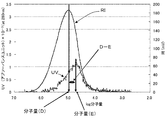
- Example 1 In the polyvinyl acetal of Example 1, the relationship between the molecular weight and the value measured by the differential refractive index detector (RI), and the relationship between the molecular weight and the absorbance measured by the absorptiometric detector (UV) (measurement wavelength 280 nm). It is the graph which showed.
- PVA-1 of Example 1 the relationship between the molecular weight and the value measured by the differential refractive index detector (RI), and the molecular weight and the absorbance measured by the absorptiometric detector (UV) (measurement wavelength 280 nm). It is the graph which showed the relationship.
- the polyvinyl acetal of the present invention is a polyvinyl acetal having an acetalization degree of 50 to 85 mol%, a vinyl ester monomer unit content of 0.1 to 20 mol%, and a viscosity average polymerization degree of 200 to 5000.
- acetalization degree 50 to 85 mol%
- vinyl ester monomer unit content 0.1 to 20 mol%
- a viscosity average polymerization degree 200 to 5000.
- the peak molecular weight (A) measured with a differential refractive index detector and the peak molecular weight measured with an absorptiometric detector (measurement wavelength 280 nm) (B) is the following formula (1) (AB) / A ⁇ 0.60 (1)
- the absorbance at the peak molecular weight (B) is 0.50 ⁇ 10 ⁇ 3 to 1.00 ⁇ 10 ⁇ 2 .
- a GPC apparatus having a differential refractive index detector and an absorptiometric detector and capable of simultaneously performing measurement by these detectors.
- the absorptiometric detector needs to be capable of measuring absorbance at a wavelength of 280 nm, and preferably is capable of simultaneously measuring absorbance at a wavelength of 280 nm and absorbance at a wavelength of 320 nm.
- a cell having a cell length (optical path length) of 10 mm is used as the cell of the detection unit of the absorptiometer.
- the absorptiometric detector may measure the absorption of ultraviolet light having a specific wavelength, or may measure the absorption of ultraviolet light having a specific range of wavelengths.
- the polyvinyl acetal subjected to the measurement is separated into each molecular weight component by a GPC column.
- the signal intensity by the differential refractive index detector is approximately proportional to the polyvinyl acetal concentration (mg / ml).
- polyvinyl acetal detected by an absorptiometric detector is only one having absorption at a predetermined wavelength.
- HFIP containing sodium trifluoroacetate at a concentration of 20 mmol / l is used as the solvent and mobile phase used for dissolving the polyvinyl acetal measured in the GPC measurement.
- HFIP can dissolve polyvinyl acetal and polymethyl methacrylate (hereinafter abbreviated as PMMA). Further, by adding sodium trifluoroacetate, adsorption of polyvinyl acetal to the column filler is prevented.
- the flow rate in the GPC measurement is 1 ml / min, and the column temperature is 40 ° C.
- standard PMMA monodisperse PMMA
- Several types of standard PMMA with different molecular weights are measured, and a calibration curve is created from the GPC elution volume and the molecular weight of the standard PMMA.
- a calibration curve created using the detector is used for measurement by the differential refractive index detector, and a calibration curve created using the detector is used for measurement by the absorptiometric detector.
- the GPC elution volume is converted into the molecular weight, and the peak top molecular weight (A) and the peak top molecular weight (B) are determined.
- the polyvinyl acetal is heated at 230 ° C. for 3 hours.
- polyvinyl acetal is heated by the following method.
- the thickness of the film at this time is 600 to 800 ⁇ m, and is preferably about 760 ⁇ m, which is the thickness of a normal laminated glass interlayer film.
- a heated polyvinyl acetal is dissolved in the above-mentioned solvent to obtain a measurement sample.
- the concentration of polyvinyl acetal in the measurement sample is 1.00 mg / ml, and the injection volume is 100 ⁇ l.
- the viscosity average polymerization degree of the polyvinyl acetal exceeds 2400, the excluded volume increases, and therefore the polyvinyl acetal concentration may not be measured with good reproducibility at a concentration of 1.00 mg / ml.
- an appropriately diluted sample injection amount 100 ⁇ l
- Absorbance is proportional to the concentration of polyvinyl acetal. Therefore, the absorbance when the polyvinyl acetal concentration is 1.00 mg / ml is determined using the concentration of the diluted sample and the actually measured absorbance.
- FIG. 1 shows the relationship between the molecular weight obtained by GPC measurement of polyvinyl acetal and the value measured by the differential refractive index detector, and the molecular weight and the absorptiometric detector (measurement wavelength). It is the graph which showed the relationship with the light absorbency measured by 280 nm.
- the chromatogram represented by “RI” is a plot of values measured by a differential refractive index detector against the molecular weight (horizontal axis) of polyvinyl acetal converted from the elution volume.
- the molecular weight at the peak position in the chromatogram is defined as peak top molecular weight (A).
- peak top molecular weight (A) the molecular weight at the peak position where the peak height is the highest is the peak top molecular weight (A).
- the chromatogram indicated by “UV” is a plot of the absorbance measured with an absorptiometric detector (measurement wavelength 280 nm) against the molecular weight (horizontal axis) of polyvinyl acetal converted from the elution volume. is there.
- the molecular weight at the peak position in the chromatogram is defined as peak top molecular weight (B).
- peak top molecular weight (B) the molecular weight at the peak position where the peak height is the highest is the peak top molecular weight (B).
- the polyvinyl acetal of the present invention has a peak top molecular weight (A) measured with a differential refractive index detector and a peak top measured with an absorptiometric detector (measurement wavelength 280 nm) when GPC measurement is performed by the above-described method.
- the molecular weight (B) satisfies the following formula (1). (AB) / A ⁇ 0.60 (1)
- the peak top molecular weight (A) is a value that serves as an index of the molecular weight of polyvinyl acetal.
- the peak top molecular weight (B) is derived from a component present in polyvinyl acetal and having absorption at 280 nm.
- (AB) / A becomes a positive value.
- the low molecular weight component contains more components that absorb ultraviolet light having a wavelength of 280 nm. In this case, it is difficult to improve the coloring of the obtained polyvinyl acetal and the foreign matter (undissolved content) in the film produced using the polyvinyl acetal in a well-balanced manner. Therefore, the reuse of film (trim etc.) is hindered.
- (AB) / A is preferably less than 0.55, more preferably less than 0.50.
- the polyvinyl acetal of the present invention must have an absorbance (measurement wavelength of 280 nm) at a peak top molecular weight (B) of 0.50 ⁇ 10 ⁇ 3 to 1.00 ⁇ 10 ⁇ 2 when GPC measurement is performed by the above-described method. There is.
- the absorbance is less than 0.50 ⁇ 10 ⁇ 3 , foreign matter (undissolved content) in the film produced using polyvinyl acetal increases.
- the absorbance exceeds 1.00 ⁇ 10 ⁇ 2 , the resulting polyvinyl acetal and a film produced using the same are colored.
- the absorbance is preferably 1.00 ⁇ 10 ⁇ 3 to 8.00 ⁇ 10 ⁇ 3, and more preferably 1.50 ⁇ 10 ⁇ 3 to 6.50 ⁇ 10 ⁇ 3 .
- the peak top molecular weight (C) is measured in the same manner as the peak top molecular weight (B) except that the measurement wavelength in the absorptiometric detector is 320 nm.
- a peak top molecular weight (C) originates in the component which has absorption in 320 nm which exists in polyvinyl acetal.
- (AC) / A becomes a positive value.
- the low molecular weight component contains more components that absorb ultraviolet light having a wavelength of 320 nm. In this case, there is a possibility that balance between suppression of coloring of the obtained polyvinyl acetal and reduction of foreign matters (undissolved content) in a film produced using the polyvinyl acetal cannot be achieved.
- (AC) / A is more preferably less than 0.60, and still more preferably less than 0.55.
- the polyvinyl acetal of the present invention has an absorbance (measurement wavelength of 320 nm) at a peak top molecular weight (C) of 0.35 ⁇ 10 ⁇ 3 to 4.50 ⁇ 10 ⁇ 3 when GPC measurement is performed by the method described above. Is preferred. When the absorbance is less than 0.35 ⁇ 10 ⁇ 3 , foreign matter (undissolved content) in the film produced using polyvinyl acetal may increase. On the other hand, when the absorbance exceeds 4.50 ⁇ 10 ⁇ 3 , the resulting polyvinyl acetal and a film produced using the same may be easily colored.
- the absorbance is more preferably 0.50 ⁇ 10 ⁇ 3 to 3.50 ⁇ 10 ⁇ 3 , and further preferably 1.00 ⁇ 10 ⁇ 3 to 2.50 ⁇ 10 ⁇ 3 .
- the ratio Mw / Mn of the weight average molecular weight Mw to the number average molecular weight Mn of the polyvinyl acetal obtained by a differential refractive index detector in the GPC measurement is 2.8 to 12.0.
- Mw and Mn are determined from the chromatogram obtained by plotting the values measured by the differential refractive index detector with respect to the molecular weight of the polyvinyl acetal described above.
- Mw and Mn in the present invention are values in terms of PMMA.
- Mn is an average molecular weight that is strongly influenced by a low molecular weight component
- Mw is an average molecular weight that is strongly influenced by a high molecular weight component.
- Mw / Mn is generally used as an index of molecular weight distribution of a polymer. When Mw / Mn is small, it indicates that the polymer has a small proportion of low molecular weight component, and when Mw / Mn is large, it indicates that the polymer has a large proportion of low molecular weight component.
- Mw / Mn when Mw / Mn is less than 2.8, it indicates that the proportion of the low molecular weight component is small in the polyvinyl acetal.
- Mw / Mn is more preferably 2.9 or more, and further preferably 3.1 or more.
- Mw / Mn exceeds 12.0, it shows that the ratio of a low molecular weight component is large in polyvinyl acetal.
- Mw / Mn exceeds 12.0, the obtained polyvinyl acetal or a film produced using the same may be easily colored.
- Mw / Mn is more preferably 11.0 or less, and even more preferably 8.0 or less.
- the degree of acetalization of the polyvinyl acetal of the present invention is 40 to 90 mol%, preferably 50 to 85 mol%, more preferably 55 to 82 mol%, still more preferably 60 to 78 mol%, particularly preferably 65. ⁇ 75 mol%.
- the degree of acetalization is less than 40 mol%, the compatibility with a plasticizer or the like decreases. Moreover, there exists a possibility that the foreign material (undissolved part) in the film manufactured using polyvinyl acetal may increase. On the other hand, when the degree of acetalization exceeds 90 mol%, the efficiency of the acetalization reaction is significantly reduced. Moreover, there exists a possibility that the polyvinyl acetal obtained and the film manufactured using it may become colored easily.
- the degree of acetalization represents the ratio of the acetalized vinyl alcohol monomer unit to the total monomer units constituting the polyvinyl acetal.
- the vinyl alcohol monomer units in the raw material PVA those that are not acetalized remain in the resulting polyvinyl acetal as vinyl alcohol monomer units.
- the viscosity average polymerization degree of the polyvinyl acetal of the present invention is represented by the viscosity average polymerization degree of the raw material PVA measured according to JIS-K6726. That is, after re-saponifying and purifying PVA to a saponification degree of 99.5 mol% or more, it can be obtained from the intrinsic viscosity [ ⁇ ] measured in water at 30 ° C. by the following equation.
- the viscosity average polymerization degree of PVA and the viscosity average polymerization degree of polyvinyl acetal obtained by acetalizing it are substantially the same.
- P ([ ⁇ ] ⁇ 10000 / 8.29) (1 / 0.62)
- the viscosity average polymerization degree of the polyvinyl acetal of the present invention is 200 to 5,000.
- the viscosity average degree of polymerization is preferably 250 or more, more preferably 300 or more, and still more preferably 400 or more.
- the viscosity average degree of polymerization is preferably 4500 or less, more preferably 4000 or less, and further preferably 3500 or less.
- the viscosity average polymerization degree is preferably 500 to 5000, more preferably 800 to 3500, and further preferably 1000 to 2500.
- the degree of polymerization is less than 500, there is a possibility that sufficient strength as an interlayer film for laminated glass cannot be obtained.
- the viscosity average polymerization degree exceeds 5000, the melt viscosity becomes too high and film formation becomes difficult.
- the content of the vinyl ester monomer unit of the polyvinyl acetal of the present invention is 0.1 to 20 mol%, preferably 0.3 to 18 mol%, more preferably 0.5 to 15 mol%. More preferably, it is 0.7 to 13 mol%.
- the content of the vinyl ester monomer unit is less than 0.1 mol%, the polyvinyl acetal cannot be stably produced and the film cannot be formed.
- the content of the vinyl ester monomer unit exceeds 20 mol%, the obtained polyvinyl acetal and a film produced using the polyvinyl acetal may be easily colored.
- the content of monomer units other than acetalized monomer units, vinyl ester monomer units and vinyl alcohol monomer units in the polyvinyl acetal of the present invention is preferably 20 mol% or less, more preferably Is 10 mol% or less.
- the polyvinyl acetal of the present invention is usually produced by acetalizing PVA.
- the saponification degree of the raw material PVA is preferably 80 to 99.99 mol%, more preferably 82 to 99.7 mol%, still more preferably 85 to 99.5 mol%, and most preferably 87 to 99.3 mol%. Mol%. If the degree of saponification is less than 80 mol%, there is a risk that foreign matter (undissolved content) in the film produced using polyvinyl acetal will increase, and the resulting polyvinyl acetal and the film produced using it will be colored. May be easier. On the other hand, when the degree of saponification exceeds 99.9 mol%, PVA may not be produced stably.
- the degree of saponification of PVA is measured according to JIS-K6726.
- vinyl ester monomers used for the production of raw material PVA include vinyl formate, vinyl acetate, vinyl propionate, vinyl valelate, vinyl caprate, vinyl laurate, vinyl stearate, vinyl benzoate, vinyl pivalate, and versa.
- vinyl tick acid examples include vinyl tick acid, and vinyl acetate is particularly preferable.
- the raw material PVA can also be produced by polymerizing vinyl ester monomers in the presence of thiol compounds such as 2-mercaptoethanol, n-dodecyl mercaptan, mercaptoacetic acid, 3-mercaptopropionic acid, and saponifying the resulting polyvinyl ester. You can also By this method, PVA in which a functional group derived from a thiol compound is introduced at the terminal is obtained.
- thiol compounds such as 2-mercaptoethanol, n-dodecyl mercaptan, mercaptoacetic acid, 3-mercaptopropionic acid
- Examples of the method for polymerizing the vinyl ester monomer include known methods such as a bulk polymerization method, a solution polymerization method, a suspension polymerization method, and an emulsion polymerization method.
- a bulk polymerization method performed without a solvent or a solution polymerization method performed using a solvent such as alcohol is usually employed.
- a solution polymerization method in which polymerization is performed together with a lower alcohol is preferable.
- the lower alcohol is not particularly limited, but an alcohol having 3 or less carbon atoms such as methanol, ethanol, propanol and isopropanol is preferable, and methanol is usually used.
- the reaction can be carried out by either a batch method or a continuous method.
- the initiator used in the polymerization reaction include 2,2′-azobisisobutyronitrile, 2,2′-azobis (2,4-dimethyl-valeronitrile), 2,2′-azobis (4-methoxy).
- Azo initiators such as -2,4-dimethylvaleronitrile
- organic peroxide initiators such as benzoyl peroxide, n-propyl peroxycarbonate, peroxydicarbonate, etc., within a range that does not impair the effects of the present invention.
- organic oxide-based initiators having a half-life of 10 to 110 minutes at 60 ° C. are particularly preferable, and peroxydicarbonate is particularly preferable.
- the polymerization temperature for carrying out the polymerization reaction but a range of 5 ° C to 200 ° C is suitable.
- a copolymerizable monomer can be copolymerized as necessary as long as the effects of the present invention are not impaired.
- a monomer include ⁇ -olefins such as ethylene, propylene, 1-butene, isobutene, and 1-hexene; carboxylic acids such as fumaric acid, maleic acid, itaconic acid, maleic anhydride, and itaconic anhydride; Derivatives thereof; acrylic acid or salts thereof; acrylic acid esters such as methyl acrylate, ethyl acrylate, n-propyl acrylate, isopropyl acrylate; methacrylic acid or salts thereof; methyl methacrylate, ethyl methacrylate, n methacrylate Methacrylic acid esters such as propyl and isopropyl methacrylate; Acrylamide derivatives such as acrylamide, N-methylacrylamide and N-eth
- the amount of monomers that can be copolymerized with these vinyl ester monomers varies depending on the purpose and application of use, but is usually based on all monomers used for copolymerization.
- the ratio is 20 mol% or less, preferably 10 mol% or less.
- PVA can be obtained by saponifying the polyvinyl ester obtained by the above method in an alcohol solvent.
- an alkaline substance is usually used, and examples thereof include alkali metal hydroxides such as potassium hydroxide and sodium hydroxide, and alkali metal alkoxides such as sodium methoxide.
- the amount of the alkaline substance used is preferably in the range of 0.002 to 0.2, in the range of 0.004 to 0.1, in terms of molar ratio based on the vinyl ester monomer unit of the polyvinyl ester. It is particularly preferred that The saponification catalyst may be added all at once in the early stage of the saponification reaction, or a part thereof may be added in the early stage of the saponification reaction, and the rest may be added and added during the saponification reaction.
- Examples of the solvent that can be used for the saponification reaction include methanol, methyl acetate, dimethyl sulfoxide, diethyl sulfoxide, and dimethylformamide. Of these solvents, methanol is preferably used. At this time, the water content of methanol is preferably adjusted to 0.001 to 1% by mass, more preferably 0.003 to 0.9% by mass, and particularly preferably 0.005 to 0.8% by mass.
- the saponification reaction is preferably performed at a temperature of 5 to 80 ° C., more preferably 20 to 70 ° C.
- the saponification reaction is preferably performed for 5 minutes to 10 hours, more preferably for 10 minutes to 5 hours.
- the saponification reaction can be performed by either a batch method or a continuous method.
- the remaining catalyst may be neutralized as necessary.
- Usable neutralizing agents include organic acids such as acetic acid and lactic acid, and ester compounds such as methyl acetate.
- the alkaline substance containing an alkali metal added during the saponification reaction is usually neutralized by an ester such as methyl acetate generated by the progress of the saponification reaction, or neutralized by a carboxylic acid such as acetic acid added after the reaction. At this time, an alkali metal salt of a carboxylic acid such as sodium acetate is formed.
- the raw material PVA preferably contains an alkali metal salt of carboxylic acid in an amount of 0.5% by mass or less in terms of the mass of the alkali metal. In order to obtain such PVA, the PVA may be washed after saponification.
- Examples of the cleaning liquid used in this case include a lower alcohol such as methanol, a solution composed of 100 parts by weight of the lower alcohol and 20 parts by weight or less of water, and a solution composed of the lower alcohol and an ester such as methyl acetate produced in the saponification step. It is done.
- the content of the ester in the solution composed of the lower alcohol and the ester is not particularly limited, but is preferably 1000 parts by mass or less with respect to 100 parts by mass of the lower alcohol.
- the amount of the cleaning liquid added is preferably 100 parts by mass to 10000 parts by mass, more preferably 150 parts by mass to 5000 parts by mass with respect to 100 parts by mass of the gel obtained by saponification and swollen with PVA by alcohol.
- Part by mass to 1000 parts by mass is more preferable.
- the addition amount of the cleaning liquid is less than 100 parts by mass, the alkali metal salt amount of the carboxylic acid may exceed the above range.
- the addition amount of the cleaning liquid exceeds 10,000 parts by mass, the improvement of the cleaning effect by increasing the addition amount cannot be expected.
- the washing method for example, a step of adding a gel (PVA) and a washing solution into a tank and stirring or standing at 5 to 100 ° C. for about 5 to 180 minutes and then removing the liquid is performed.
- a batch method that repeats until the content of the alkali metal salt is within a predetermined range may be mentioned.
- there is a continuous method in which PVA is continuously added from the top of the column at the same temperature and for the same time as the batch method, and a lower alcohol is continuously added from the bottom of the column, and the two are brought into contact with each other.
- the raw material PVA preferably contains an alkali metal salt of carboxylic acid.
- the content is preferably 0.50% by mass or less, more preferably 0.37% by mass or less, still more preferably 0.28% by mass or less, and particularly preferably 0.23% by mass or less in terms of alkali metal mass. is there.
- content of the alkali metal salt of carboxylic acid exceeds 0.5 mass%, the obtained polyvinyl acetal or a film produced using the same may be easily colored.
- the content of alkali metal salt of carboxylic acid (calculated in terms of alkali metal mass) is obtained from the amount of alkali metal ions obtained by ashing PVA with a platinum crucible and then measuring the resulting ash content by ICP emission analysis. Can do.
- alkali metal salt of carboxylic acid examples include those obtained by neutralizing an alkali catalyst used in the above-described saponification step, for example, sodium hydroxide, potassium hydroxide, sodium methylate with carboxylic acid, and a vinyl ester described later.
- Carboxylic acid added for the purpose of suppressing alcoholysis of the vinyl ester monomer such as vinyl acetate used in the polymerization step is neutralized in the saponification step, added to stop radical polymerization
- a carboxylic acid having a conjugated double bond is used as an inhibitor, those obtained by neutralizing the carboxylic acid in the saponification step or those intentionally added are included.
- Specific examples include sodium acetate, potassium acetate, sodium propionate, potassium propionate, sodium glycerate, potassium glycerate, sodium malate, potassium malate, sodium citrate, potassium citrate, sodium lactate, potassium lactate, tartaric acid Sodium, potassium tartrate, sodium salicylate, potassium salicylate, sodium malonate, potassium malonate, sodium succinate, potassium succinate, sodium maleate, potassium maleate, sodium phthalate, potassium phthalate, sodium oxalate, potassium oxalate , Sodium glutarate, potassium glutarate, sodium abietic acid, potassium abietic acid, sodium sorbate, potassium sorbate, 2,4,6-octatri Sodium 1,1-carboxylate, potassium 2,4,6-octatriene-1-carboxylate, sodium eleostearate, potassium eleostearate, sodium 2,4,6,8-decatetraene-1-carboxylate 2,4,6,8-decatetraene-1-carboxylate, sodium reti
- a method of adjusting each value obtained by GPC measurement so as to fall within the above-described range includes a method of using specific PVA as a raw material for polyvinyl acetal.
- Such a raw material PVA has a saponification degree of 50 to 99.99 mol%, a viscosity average polymerization degree of 200 to 5000, and an alkali metal salt content of carboxylic acid of 0.5% by mass or less in terms of the mass of the alkali metal.
- the absorbance at the peak top molecular weight (E) is preferably 0.25 ⁇ 10 ⁇ 3 to 3.00 ⁇ 10 ⁇ 3 .
- GPC measurement at this time is performed in the same manner as the GPC measurement method for polyvinyl acetal described above, except that PVA heated under the following conditions is measured instead of polyvinyl acetal.
- the PVA film After casting an aqueous solution in which PVA powder is dissolved, it is dried at 20 ° C. and 65% RH to obtain a PVA film.
- the PVA film has a thickness of 30 to 75 ⁇ m, preferably 40 to 60 ⁇ m.
- the film is heated at 120 ° C. for 3 hours using a hot air dryer. From the viewpoint of suppressing heat treatment errors between samples, a gear oven is preferable as the hot air dryer.
- the PVA thus heated is subjected to GPC measurement.
- the peak top molecular weight (D) of the PVA is determined in the same manner as the peak top molecular weight (A) of the polyvinyl acetal described above, and the peak top molecular weight (E) of the raw material PVA is the peak top molecular weight (B) of the polyvinyl acetal described above. Find in the same way as
- the PVA has a peak top molecular weight (D) measured by a differential refractive index detector and a peak top molecular weight (E) measured by an absorptiometric detector (measurement wavelength 280 nm) when GPC measurement is performed by the above-described method. )
- D peak top molecular weight
- E peak top molecular weight
- absorptiometric detector measurement wavelength 280 nm
- the peak top molecular weight (D) is a value serving as an index of the molecular weight of PVA.
- the peak top molecular weight (E) is derived from a component present in PVA and having absorption at 280 nm.
- (DE) / D becomes a positive value.
- the low molecular weight component contains more components that absorb ultraviolet light having a wavelength of 280 nm. In this case, there is a possibility that the foreign matter of the film manufactured using the obtained polyvinyl acetal or polyvinyl acetal increases.
- (DE) / D is more preferably less than 0.70, and still more preferably less than 0.65.
- the PVA preferably has an absorbance (measurement wavelength: 280 nm) at a peak top molecular weight (E) of 0.25 ⁇ 10 ⁇ 3 to 3.00 ⁇ 10 ⁇ 3 when GPC measurement is performed by the method described above.
- E peak top molecular weight
- the absorbance is less than 0.25 ⁇ 10 ⁇ 3 , foreign matter (undissolved content) in the film produced using polyvinyl acetal may increase.
- the absorbance exceeds 3.00 ⁇ 10 ⁇ 3 , the obtained polyvinyl acetal and a film produced using the polyvinyl acetal may be easily colored.
- the absorbance is preferably 0.50 ⁇ 10 ⁇ 3 to 2.80 ⁇ 10 ⁇ 3, and more preferably 0.75 ⁇ 10 ⁇ 3 to 2.50 ⁇ 10 ⁇ 3 .
- the PVA has a peak top molecular weight (D) measured by a differential refractive index detector and a peak top molecular weight (F) measured by an absorptiometric detector (measurement wavelength: 320 nm) when GPC measurement is performed by the method described above. It is more preferable that the following formula (4) is satisfied. (DF) / D ⁇ 0.75 (4)
- the peak top molecular weight (F) is measured in the same manner as the peak top molecular weight (E) except that the measurement wavelength in the absorptiometric detector is 320 nm.
- the peak top molecular weight (F) is derived from a component having absorption at 320 nm, which is present in the raw material PVA.
- (DF) / D becomes a positive value.
- the low molecular weight component contains more components that absorb ultraviolet light having a wavelength of 320 nm. In this case, there is a possibility that the foreign matter of the film manufactured using the obtained polyvinyl acetal or polyvinyl acetal increases.
- (D ⁇ F) / D is more preferably less than 0.70, and particularly preferably less than 0.65.
- the PVA has an absorbance (measurement wavelength: 320 nm) at a peak top molecular weight (F) of 0.20 ⁇ 10 ⁇ 3 to 2.90 ⁇ 10 ⁇ 3 when GPC measurement is performed by the method described above. .
- F peak top molecular weight
- the absorbance is less than 0.20 ⁇ 10 ⁇ 3 , foreign matter (undissolved content) in a film produced using polyvinyl acetal may increase.
- the absorbance exceeds 2.90 ⁇ 10 ⁇ 3 , the resulting polyvinyl acetal and a film produced using the same may be easily colored.
- the absorbance is more preferably 0.40 ⁇ 10 ⁇ 3 to 2.70 ⁇ 10 ⁇ 3 , and particularly preferably 0.60 ⁇ 10 ⁇ 3 to 2.40 ⁇ 10 ⁇ 3 .
- the ratio Mw / Mn of the weight average molecular weight Mw to the number average molecular weight Mn of the PVA, which is determined by a differential refractive index detector is preferably 2.2 to 6.0.
- Mw and Mn are obtained from a chromatogram obtained by plotting the value measured by the differential refractive index detector with respect to the molecular weight of PVA used when obtaining the peak top molecular weight (D) described above. Therefore, Mw and Mn calculated
- Mw / Mn When Mw / Mn is less than 2.2, it indicates that the proportion of low molecular weight components is small in PVA. When Mw / Mn is less than 2.2, there is a possibility that foreign matter (undissolved content) in the film produced using polyvinyl acetal increases. It is more preferable that Mw / Mn is 2.3 or more. On the other hand, when Mw / Mn exceeds 6.0, it shows that the ratio of a low molecular weight component is large in PVA. When Mw / Mn exceeds 6.0, the obtained polyvinyl acetal and a film produced using the same may be easily colored. Mw / Mn is more preferably 3.5 or less, and further preferably 3.0 or less.
- Examples of the adjustment method include the following methods.
- a vinyl ester monomer from which a radical polymerization inhibitor contained in the raw material vinyl ester monomer has been removed in advance is used for polymerization.
- Impurities include aldehydes such as acetaldehyde, crotonaldehyde, and acrolein; acetals such as acetaldehyde dimethyl acetal, crotonaldehyde dimethyl acetal, and acrolein dimethyl acetal obtained by acetalizing the aldehyde with a solvent alcohol; ketones such as acetone; methyl acetate and ethyl acetate And esters.
- Organic acids specifically hydroxycarboxylic acids such as glycolic acid, glyceric acid, malic acid, citric acid, lactic acid, tartaric acid, salicylic acid; malonic acid, succinic acid, maleic acid, phthalic acid, oxalic acid, glutaric acid, etc.
- a carboxylic acid or the like is added to suppress the generation of aldehydes such as acetaldehyde generated by decomposition as much as possible.
- the addition amount of the organic acid is preferably 1 to 500 ppm, more preferably 3 to 300 ppm, and still more preferably 5 to 100 ppm with respect to the raw material vinyl ester monomer.
- the impurities contained in the solvent include those described above as the impurities contained in the raw material vinyl ester monomer.
- Organic peroxide is used as a radical polymerization initiator used for radical polymerization of a vinyl ester monomer.
- Organic peroxides include acetyl peroxide, isobutyl peroxide, diisopropyl peroxycarbonate, diallyl peroxydicarbonate, di-n-propyl peroxydicarbonate, dimyristyl peroxydicarbonate, di (2-ethoxyethyl) peroxide Examples include oxydicarbonate, di (2-ethylhexyl) peroxydicarbonate, di (methoxyisopropyl) peroxydicarbonate, and di (4-tert-butylcyclohexyl) peroxydicarbonate. It is preferable to use peroxydicarbonate with a period of 10 to 110 minutes.
- an inhibitor When an inhibitor is added after radical polymerization of the vinyl ester monomer in order to suppress the polymerization, an inhibitor of 5 molar equivalents or less is added to the remaining undecomposed radical polymerization initiator.
- the inhibitor include a compound having a conjugated double bond having a molecular weight of 1000 or less and a compound that stabilizes a radical and inhibits a polymerization reaction.
- isoprene 2,3-dimethyl-1,3-butadiene, 2,3-diethyl-1,3-butadiene, 2-t-butyl-1,3-butadiene, 1,3-pentadiene, , 3-dimethyl-1,3-pentadiene, 2,4-dimethyl-1,3-pentadiene, 3,4-dimethyl-1,3-pentadiene, 3-ethyl-1,3-pentadiene, 2-methyl-1 , 3-pentadiene, 3-methyl-1,3-pentadiene, 4-methyl-1,3-pentadiene, 1,3-hexadiene, 2,4-hexadiene, 2,5-dimethyl-2,4-hexadiene, , 3-octadiene, 1,3-cyclopentadiene, 1,3-cyclohexadiene, 1-methoxy-1,3-butadiene, 2-methoxy-1,3-butadiene, 1-
- Polyenes such as conjugated polyene consisting Motoni double bond of four or more conjugated structure. Any one having a plurality of stereoisomers such as 1,3-pentadiene, myrcene, and farnesene may be used.
- a polyvinyl ester alcohol solution from which the remaining vinyl ester monomer is removed as much as possible is used for the saponification reaction.
- the residual monomer removal rate is 99% or more, more preferably 99.5% or more, still more preferably 99.8% or more.
- the desired PVA can be obtained by appropriately combining A) to H).
- the PVA thus obtained is preferably acetalized to obtain the polyvinyl acetal of the present invention.
- the acetalization of PVA can be performed, for example, under the following reaction conditions, but is not limited thereto.
- PVA is dissolved in water by heating to 80 to 100 ° C., and then gradually cooled over 10 to 60 minutes to obtain a 3 to 40% by mass aqueous solution of PVA.
- an aldehyde and an acid catalyst are added to the aqueous solution, and an acetalization reaction is performed for 30 to 300 minutes while keeping the temperature constant.
- polyvinyl acetal having reached a certain degree of acetalization is precipitated.
- the temperature of the reaction solution is raised to 25 to 80 ° C.
- aggregated particles made of polyvinyl acetal are generated in such a reaction or processing step, and coarse particles are easily formed.
- coarse particles are generated, there is a risk of causing variation between batches.
- specific PVA is used as a raw material, the generation of coarse particles is suppressed as compared with the conventional product, and as a result, when the resulting polyvinyl acetal is melt-formed, foreign matter (undissolved content) is further reduced. Film can be obtained.
- the acid catalyst used in the acetalization reaction is not particularly limited, and any of organic acids and inorganic acids can be used.
- acetic acid, p-toluenesulfonic acid, nitric acid, sulfuric acid, hydrochloric acid and the like can be mentioned.
- hydrochloric acid, sulfuric acid, and nitric acid are preferably used.
- nitric acid when nitric acid is used, the reaction rate of the acetalization reaction is increased, and improvement in productivity can be expected.
- the obtained polyvinyl acetal particles tend to be coarse and the variation between batches tends to increase. is there.
- the aldehyde used for the acetalization reaction is not particularly limited, but a known aldehyde having 1 to 8 carbon atoms is preferable, an aldehyde having 4 to 6 carbon atoms is more preferable, and n-butyraldehyde is particularly preferably used.
- polyvinyl acetal obtained by using two or more aldehydes in combination can also be used.
- a polyvinyl acetal composition containing the polyvinyl acetal of the present invention and a plasticizer is a preferred embodiment of the present invention.
- the plasticizer is not particularly limited as long as the effects of the present invention are not impaired and there is no problem in compatibility with polyvinyl acetal.
- a mono- or diester of an oligoalkylene glycol having a hydroxyl group at both ends and a carboxylic acid, a diester of a dicarboxylic acid and a hydroxyl group-containing compound, or the like can be used. These can be used alone or in combination of two or more.
- oligoalkylene glycols having hydroxyl groups at both ends include ethylene glycol, diethylene glycol, triethylene glycol, tetraethylene glycol, 1,2-propylene glycol, 1,2-propylene glycol dimer and trimer, 1,3 -Propylene glycol, 1,3-propylene glycol dimer and trimer, 1,2-butylene glycol, 1,2-butylene glycol dimer and trimer, 1,4-butylene glycol, 1, 4-butylene glycol dimer and trimer, 1,2-hexanediol, 1,6-hexanediol, 3-methyl-1,5-pentanediol, 1,2-octanediol, 1,8-octane Diol, 1,9-nonanediol, 2-methyl-1,8-octanediol, , 2-decanediol, 1,4-cyclohexane diol.
- Examples of the carboxylic acid include acetic acid, propanoic acid, butanoic acid, pentanoic acid, hexanoic acid, heptanoic acid, octanoic acid, 2-ethylhexanoic acid, nonanoic acid and decanoic acid.
- the combination of oligoalkylene glycol and carboxylic acid is arbitrary, and may be a combination of a plurality of oligoalkylene glycols and a plurality of carboxylic acids. Of these, monoesters and diesters of triethylene glycol and 2-ethylhexanoic acid are preferable from the viewpoint of handleability (volatility during molding).
- Dicarboxylic acids include alkylene dicarboxylic acids such as oxalic acid, malonic acid, succinic acid, glutaric acid, adipic acid, pimelic acid, suberic acid, and sebacic acid, and aromatic dicarboxylic acids such as phthalic acid, isophthalic acid, and terephthalic acid. An acid etc. are mentioned.
- Examples of the hydroxyl group-containing compound include methanol, ethanol, propanol, butanol, pentanol, hexanol, cyclohexanol, heptanol, octanol, 2-ethylhexanol, nonaol, decanol, 2-methoxyethanol, 2-ethoxyethanol, 2-propoxyethanol, Examples include 2-butoxyethanol.
- the combination of dicarboxylic acid and a hydroxyl-containing compound is arbitrary, and the combination of several dicarboxylic acid and several hydroxyl-containing compound may be sufficient.
- the addition amount of the plasticizer in the composition is not particularly limited, but is preferably 0 to 200 parts by mass, more preferably 2 to 150 parts by mass, and further preferably 5 to 100 parts by mass with respect to 100 parts by mass of the polyvinyl acetal. Part. When the added amount of the plasticizer exceeds 200 parts by mass, the plasticizer may easily bleed out.
- the amount of the plasticizer added is preferably 5 to 100 parts by weight, more preferably 10 to 90 parts by weight, more preferably 100 parts by weight of polyvinyl acetal. The amount is preferably 15 to 80 parts by mass.
- the plasticizer addition amount is less than 5 parts by mass, desired flexibility as an interlayer film for laminated glass may not be obtained. If it exceeds 100 parts by mass, the desired mechanical properties, particularly the penetration resistance of the laminated glass, may decrease.
- the polyvinyl acetal composition of the present invention may contain an antioxidant, an ultraviolet absorber, an adhesion improver, a pigment, a dye, and other conventionally known additives, as long as not departing from the gist of the present invention.
- the type of the antioxidant is not particularly limited, and examples thereof include phenolic antioxidants, phosphorus antioxidants, sulfur antioxidants, etc. Among them, phenolic antioxidants are preferable, alkyl Substituted phenolic antioxidants are particularly preferred.
- phenolic antioxidants include 2-t-butyl-6- (3-t-butyl-2-hydroxy-5-methylbenzyl) -4-methylphenyl acrylate, 2,4-di-t-amyl- Acrylate compounds such as 6- (1- (3,5-dit-amyl-2-hydroxyphenyl) ethyl) phenyl acrylate, 2,6-dit-butyl-4-methylphenol, 2,6-dit -Butyl-4-ethylphenol, octadecyl-3- (3,5-) di-t-butyl-4-hydroxyphenyl) propionate, 2,2'-methylene-bis (4-methyl-6-t-butylphenol), 4,4′-butylidene-bis (4-methyl-6-tert-butylphenol), 4,4′-butylidene-bis (6-tert-butyl-m-cresol), 4,4′-thiobi (3-methyl-6-tert-butylphenol), bis (3-cyclo
- phosphorus antioxidants include triphenyl phosphite, diphenylisodecyl phosphite, phenyl diisodecyl phosphite, tris (nonylphenyl) phosphite, tris (dinonylphenyl) phosphite, tris (2-t-butyl).
- sulfur-based antioxidant examples include dilauryl 3,3′-thiodipropionate, distearyl 3,3′-thiodipropionate, lauryl stearyl 3,3′-thiodipropionate, pentaerythritol-tetrakis- ( ⁇ -lauryl-thiopropionate), 3,9-bis (2-dodecylthioethyl) -2,4,8,10-tetraoxaspiro [5,5] undecane.
- antioxidants can be used alone or in combination of two or more.
- the blending amount of the antioxidant is not particularly limited, but is preferably 0.001 to 5 parts by mass, more preferably 0.01 to 1 part by mass with respect to 100 parts by mass of the polyvinyl acetal.
- the polyvinyl acetal composition of the present invention may contain an ultraviolet absorber.
- the ultraviolet absorber used include 2- (5-methyl-2-hydroxyphenyl) benzotriazole, 2- (2-hydroxy-3,5-bis ( ⁇ , ⁇ 'dimethylbenzyl) phenyl) -2H-benzo Triazole, 2- (3,5-di-t-butyl-2-hydroxyphenyl) benzotriazole, 2- (3-t-butyl-5-methyl-2-hydroxyphenyl) -5-chlorobenzotriazole, 2- ( 3,5-di-t-butyl-5-methyl-2-hydroxyphenyl) -5-chlorobenzotriazole, 2- (3,5-di-t-amyl-2-hydroxyphenyl) benzotriazole, 2- (2 ′ -Hydroxy-5′-t-octylphenyl) benzotriazole UV absorbers such as benzotriazole; 2,2,6,6-tetramethyl-4-pi
- the content of the ultraviolet absorber in the polyvinyl acetal composition is not particularly limited, but the total amount of the ultraviolet absorber is preferably 10 to 50,000 ppm on a mass basis, and is in the range of 100 to 10,000 ppm. Is more preferable. If the addition amount is less than 10 ppm, sufficient effects may not be exhibited, and even if the addition amount is more than 50,000 ppm, the improvement of the effect by increasing the content cannot be expected.
- the glass transition temperature of the polyvinyl acetal composition of the present invention is not particularly limited and can be appropriately selected depending on the purpose, but is preferably in the range of 0 to 50 ° C, more preferably 0 to 45 ° C. The temperature is more preferably 0 to 40 ° C. In particular, when the polyvinyl acetal composition of the present invention is formed into a sheet and used as a laminated glass interlayer, the glass transition temperature is preferably within the above range.
- an interlayer film for laminated glass made of the polyvinyl acetal composition is also a preferred embodiment of the present invention.
- the polyvinyl acetal composition may contain an adhesiveness adjusting agent.
- the adhesion adjusting agent conventionally known ones can be used. For example, acetic acid, propionic acid, butanoic acid, hexanoic acid, 2-ethylbutanoic acid, sodium salt of organic acid such as 2-ethylhexanoic acid, potassium salt, A magnesium salt or the like is used. These can be used alone or in combination of two or more.
- the optimum content of the adhesion modifier varies depending on the adhesion modifier used, but the adhesion of the resulting film to glass is determined by the Pummel test (described in International Publication No. WO2003 / 033583). In general, it is preferable to adjust to 3 to 10. In particular, when high penetration resistance is required, the content is preferably adjusted to 3 to 6, and when high glass scattering prevention property is required, the content is adjusted to 7 to 10. It is preferable. When high glass scattering prevention property is required, it is also a useful method not to add an adhesion modifier.
- the content of the adhesion adjusting agent in the polyvinyl acetal composition is preferably 0.0001 to 1% by mass, more preferably 0.0005 to 0.1% by mass, and 0.001 to 0.00%. 03 mass% is still more preferable.
- a silane coupling agent can be mentioned.
- the content of the silane coupling agent in the polyvinyl acetal composition is preferably 0.01 to 5% by mass.
- the interlayer film for laminated glass of the present invention is excellent in transparency and flexibility.
- the thickness of the interlayer film for laminated glass is not particularly limited, but is preferably 0.05 to 5.0 mm, more preferably 0.1 to 2.0 mm, and 0.1 to 1.2 mm. More preferably.
- the interlayer film for laminated glass comprising the polyvinyl acetal composition is obtained by forming a polyvinyl acetal composition obtained by mixing the polyvinyl acetal, the plasticizer, and other components by a conventionally known method.
- Examples include a method of melt-kneading a dissolved or dispersed material together with polyvinyl acetal to form a film.
- a method of forming a film using an extruder is particularly preferably used.
- the resin temperature at the time of extrusion is preferably 150 to 250 ° C, more preferably 170 to 230 ° C.
- the resin temperature becomes too high, polyvinyl acetal is decomposed, and the content of volatile substances in the intermediate film after film formation increases.
- the temperature is too low, the removal of volatile matter in the extruder becomes insufficient, and the content of volatile substances in the intermediate film after film formation increases.
- the interlayer film for laminated glass of the present invention as a raw material polyvinyl acetal, only virgin resin (not containing recycled polyvinyl acetal) may be used. May be used.
- film formation is carried out, for example, in a film forming apparatus in which an extruder is equipped with a measuring machine such as a gear pump and a die such as a T die.
- a measuring machine such as a gear pump
- a die such as a T die.
- both ends (trims) of a film (used as an interlayer film for laminated glass) are cut off. It is very important to collect and reuse such trims from the viewpoints of energy saving, effective utilization of resources and improvement of yield.
- an off-spec product produced during the production of a film having irregularities on the surface is useful because it can be reused in the same manner as the trim.
- the formation of coarse particles is suppressed during the acetalization reaction, and as a result, when the obtained polyvinyl acetal is melt-formed, a film with reduced foreign matter (undissolved content) is obtained. Can do. Since the film obtained from the polyvinyl acetal of the present invention is less colored when heat-treated, the trim and off-spec products can be effectively reused.
- Retrieving the trim or off-spec film that has been collected on the roll as a method of re-feeding the collected trim or off-spec film to the extruder examples include a method in which a spec product wound on a roll is cut into a certain size and then re-entered into an extruder.
- the ratio of the virgin resin and the recovered film (virgin resin: recovered film) in the raw material can be arbitrarily changed between 0: 100 and 100: 0.
- the shape of the surface of the interlayer film for laminated glass of the present invention is not particularly limited.
- the surface in contact with the glass is conventionally known, such as melt fracture and embossing. It is preferable that the concavo-convex structure is formed by the method.
- the emboss height is not particularly limited, but is preferably 5 ⁇ m to 500 ⁇ m, more preferably 7 ⁇ m to 300 ⁇ m, and still more preferably 10 ⁇ m to 200 ⁇ m.
- embossing height is less than 5 ⁇ m, bubbles formed between the glass and the intermediate film may not be efficiently removed when laminating to glass, and when it exceeds 500 ⁇ m, it is difficult to form embossing.
- embossing may be given to the single side
- the embossed concavo-convex pattern is not particularly limited as long as it satisfies the specific conditions described above, and may be regularly distributed or randomly distributed.
- the embossing roll method In order to form such embossing, the embossing roll method, the profile extrusion method, An extrusion lip embossing method using a melt fracture is employed.
- the embossing roll method is suitable for stably obtaining an embossed film on which uniform and fine irregularities are formed.
- the embossing roll used in the embossing roll method can be produced by, for example, using an engraving mill (mother mill) having a desired concavo-convex pattern and transferring the concavo-convex pattern onto the surface of the metal roll. It can also be produced using laser etching. Further, after forming a fine concavo-convex pattern on the roll surface as described above, blasting is performed on the surface using an abrasive such as aluminum oxide, silicon oxide, or glass beads to form a finer concavo-convex pattern. You can also.
- the embossing roll used in the embossing roll method is preferably subjected to a release treatment.
- a roll without mold release treatment When a roll without mold release treatment is used, troubles that cannot be peeled off from the roll easily occur depending on conditions.
- known techniques such as silicone treatment, Teflon (registered trademark) treatment, plasma treatment and the like can be used.
- a laminated glass obtained by bonding a plurality of glass plates using the interlayer film for laminated glass of the present invention is a preferred embodiment of the present invention.
- the laminated glass of the present invention can be produced by sandwiching the interlayer film of the present invention between at least two glass plates and heating and bonding the interlayer film.
- the glass used for the laminated glass of the present invention is not particularly limited.
- inorganic glass such as float plate glass, tempered plate glass, polished plate glass, mold plate glass, netted plate glass, heat ray absorbing plate glass, and the like
- a well-known organic glass etc. can be used. These may be colorless, colored, transparent or non-transparent. Moreover, these may be used independently and may use 2 or more types together.
- the thickness of glass is not specifically limited, It is preferable that it is 100 mm or less.
- the shape of the glass is not particularly limited, and may be a simple flat plate glass or a glass having a curvature such as an automobile windshield.
- the laminated glass of the present invention can be produced by a conventionally known method, and examples thereof include a method using a vacuum laminator device, a method using a vacuum bag, a method using a vacuum ring, and a method using a nip roll. Further, there is a method in which the obtained laminate is put into an autoclave after being temporarily pressed using these methods.
- an example of the production conditions is as follows.
- the glass and the interlayer film are heated at a temperature of 100 to 200 ° C., particularly 130 to 160 ° C. under a reduced pressure of 1 ⁇ 10 ⁇ 6 to 3 ⁇ 10 ⁇ 2 MPa.
- a method using a vacuum bag or a vacuum ring is described in, for example, European Patent No. 1235683, and is laminated at 130 to 145 ° C. under a pressure of about 2 ⁇ 10 ⁇ 2 MPa, for example.
- a production method using a nip roll there is a method in which after degassing with a roll at a temperature not higher than the flow start temperature of the polyvinyl acetal composition, press bonding is performed at a temperature close to the flow start temperature. Specifically, for example, there is a method of heating to 30 to 70 ° C. with an infrared heater or the like, then degassing with a roll, further heating to 50 to 120 ° C., and then pressing with a roll.
- the operating conditions of the autoclave process are appropriately selected depending on the thickness and configuration of the laminated glass. For example, 1.0 to 1.5 MPa The treatment is preferably carried out at a temperature of 130 to 145 ° C. for 0.5 to 3 hours under pressure.
- GPC measurement was performed using “GPCmax” manufactured by VISCOTECH.
- TDA305 manufactured by VISCOTECH was used.
- UV Detector 2600 manufactured by VISCOTECH was used as an ultraviolet-visible absorption detector.
- the optical path length of the detection cell of the absorptiometric detector is 10 mm.
- GPC column “GPC HFIP-806M” manufactured by Showa Denko KK was used.
- OmniSEC (Version 4.7.0.406) attached to the apparatus was used as analysis software.
- the mobile phase 20 mmol / l sodium trifluoroacetate-containing HFIP was used.
- the mobile phase flow rate was 1.0 ml / min.
- the sample injection amount was 100 ⁇ l, and measurement was performed at a GPC column temperature of 40 ° C.
- the sample in which the viscosity average polymerization degree of PVA exceeded 2400 performed GPC measurement using the sample (100 microliters) diluted suitably.
- the absorbance at a sample concentration of 1.00 mg / ml was calculated from the measured value according to the following formula. ⁇ (mg / ml) is the concentration of the diluted sample.
- Absorbance at a sample concentration of 1.00 mg / ml (1.00 / ⁇ ) ⁇ measured value of absorbance
- PMMA polymethyl methacrylate
- Agilent Technologies peak top molecular weight: 1944000, 790000, 467400, 271400, 144000, 79250, 35300, 13300, 7100, 1960, 1020, 690
- a calibration curve for converting the elution volume into the PMMA molecular weight was prepared for each of the differential refractive index detector and the absorptiometric detector.
- the analytical software was used to create each calibration curve. In this measurement, a column in a state where the peaks of the standard samples having both molecular weights of 1944000 and 271400 can be separated in the measurement of polymethyl methacrylate was used.
- the peak intensity obtained from the differential refractive index detector is mV (millivolt), and the peak intensity obtained from the UV detector is represented by absorbance (abs unit: Absorbance unit).
- the polymerization degree was measured using a part of the methanol solution of PVAc-1 obtained.
- a 10% methanol solution of sodium hydroxide was added to the methanol solution of PVAc-1 so that the molar ratio of sodium hydroxide to vinyl acetate units in polyvinyl acetate was 0.1.
- the gelled product was formed, the gel was pulverized and subjected to Soxhlet extraction with methanol for 3 days.
- the obtained polyvinyl alcohol was dried and subjected to viscosity average polymerization degree measurement.
- the degree of polymerization was 1700.
- PVAc-2 to PVAc-20 Polyvinyl acetate (PVAc-2 to PVAc-20) was obtained in the same manner as PVAc-1, except that the conditions were changed to those described in Table 1.
- “ND” means less than 1 ppm.
- the degree of polymerization of each polyvinyl acetate obtained was determined in the same manner as PVAc-1. The results are shown in Table 1.
- the polymerization degree and saponification degree of PVA-1 were determined by the method described in JIS-K6726.
- the degree of polymerization was 1700, and the degree of saponification was 99.1 mol%.
- These physical property data are also shown in Table 2.
- the sodium acetate content of PVA-1 was determined by measuring the amount of sodium in the obtained ash using an ICP emission analyzer “IRIS AP” manufactured by Jarrel Ash. .
- the sodium acetate content was 0.7% (0.20% in terms of sodium).
- FIG. 2 is a graph showing the relationship between molecular weight and the value measured with a differential refractive index detector (RI), and the relationship between molecular weight and the absorbance measured with an absorptiometric detector (measurement wavelength 280 nm) (UV). It is.
- the molecular weight at this time is one converted from the elution volume using a calibration curve (PMMA equivalent molecular weight).
- the peak top molecular weight (D) measured by the differential refractive index detector obtained from FIG. 2 was 100,000, and the peak top molecular weight (E) measured by the absorptiometric detector (280 nm) was 53,000. It was.
- the obtained value is expressed by the following formula (DE) / D
- the value obtained by substituting for was 0.47.
- the absorbance (280 nm) at the peak top molecular weight (E) was 1.30 ⁇ 10 ⁇ 3 .
- the ratio Mw / Mn of the weight average molecular weight Mw to the number average molecular weight Mn obtained from the chromatogram (RI) in FIG. 2 was 2.6.
- the peak top molecular weight (F) measured with an absorptiometric detector (320 nm) obtained in the same manner as the method for obtaining the peak top molecular weight (E) was 50,000.
- the peak top molecular weight (D) and the peak top molecular weight (F) are expressed by the following formula (DF) / D The value obtained by substituting for was 0.50.
- the absorbance (320 nm) at the peak top molecular weight (F) was 1.05 ⁇ 10 ⁇ 3 .
- PVA-2-8, comparative PVA-1-5 Each PVA was synthesized in the same manner as PVA-1, except that the conditions shown in Table 2 were changed. The polymerization degree, saponification degree, and sodium acetate content (sodium mass conversion) of the obtained PVA were measured in the same manner as PVA-1. GPC measurement was performed in the same manner as PVA-1. The results are shown in Table 2.
- PVA-9, comparative PVA-6-8 Each PVA was synthesized in the same manner as PVA-1, except that the conditions shown in Table 3 were changed. The polymerization degree, saponification degree, and sodium acetate content (sodium mass conversion) of the obtained PVA were measured in the same manner as PVA-1. GPC measurement was performed in the same manner as PVA-1. The results are shown in Table 3.
- PVA-10, comparative PVA-9 and 10 Each PVA was synthesized in the same manner as PVA-1, except that the conditions shown in Table 4 were changed. The polymerization degree, saponification degree, and sodium acetate content (sodium mass conversion) of the obtained PVA were measured in the same manner as PVA-1. GPC measurement was performed in the same manner as PVA-1. The results are shown in Table 4.
- PVA-11, comparative PVA-11 and 12 Each PVA was synthesized in the same manner as PVA-1, except that the conditions shown in Table 5 were changed. The polymerization degree, saponification degree, and sodium acetate content (sodium mass conversion) of the obtained PVA were measured in the same manner as PVA-1. GPC measurement was performed in the same manner as PVA-1. The results are shown in Table 5.
- PVA-12, comparative PVA-13-15 Each PVA was synthesized in the same manner as in Example 1 except that the conditions were changed to those shown in Table 6.
- the polymerization degree, saponification degree, and sodium acetate content (sodium mass conversion) of the obtained PVA were measured in the same manner as PVA-1.
- GPC measurement was performed in the same manner as PVA-1. The results are shown in Table 6.
- PVA-13-19, comparative PVA-16-19 Each PVA was synthesized in the same manner as PVA-1, except that the conditions shown in Table 7 were changed. The polymerization degree, saponification degree, and sodium acetate content (sodium mass conversion) of the obtained PVA were measured in the same manner as PVA-1. GPC measurement was performed in the same manner as PVA-1. The results are shown in Table 7.
- PVA-20, comparative PVA-20 and 21 Each PVA was synthesized in the same manner as PVA-1, except that the conditions shown in Table 8 were changed. The polymerization degree, saponification degree, and sodium acetate content (sodium mass conversion) of the obtained PVA were measured in the same manner as PVA-1. GPC measurement was performed in the same manner as PVA-1. The results are shown in Table 8.
- Comparative PVA-22 Water with respect to vinyl acetate monomer units in methanol and polyvinyl acetate so that the total solid concentration (saponification concentration) is 40% by mass with respect to a 55% by mass methanol solution of polyvinyl acetate in PVAc-3.
- An 8% methanol solution of sodium hydroxide was added with stirring so that the molar ratio of sodium oxide was 0.005, and the saponification reaction was started at 40 ° C. Note that saponification reaction was performed by adding distilled water so that the water content in the system was 3.0%.
- One hour after adding the methanol solution of sodium hydroxide, 0.8 mol equivalent of 1% aqueous acetic acid and a large amount of distilled water were added to stop the saponification reaction.
- the resulting solution was transferred to a dryer, dried at 65 ° C. for 12 hours, and then dried at 100 ° C. for 2 hours to obtain Comparative PVA-22.
- the polymerization degree, saponification degree, and sodium acetate content of comparative PVA-22 were measured in the same manner as PVA-1.
- the degree of polymerization was 300, the degree of saponification was 45.3 mol%, and the sodium acetate content was 1.2% (0.34% in terms of sodium).
- the results are shown in Table 8. Since Comparative PVA-22 was insoluble in water, film preparation for GPC measurement could not be performed, and GPC measurement could not be performed.
- Comparative PVA-23 Water with respect to vinyl acetate monomer units in methanol and polyvinyl acetate so that the total solid concentration (saponification concentration) is 40% by mass with respect to a 55% by mass methanol solution of polyvinyl acetate in PVAc-3.
- An 8% methanol solution of sodium hydroxide was added with stirring so that the molar ratio of sodium oxide was 0.005, and the saponification reaction was started at 40 ° C. Note that saponification reaction was performed by adding distilled water so that the water content in the system was 1.2%.
- One hour after adding the methanol solution of sodium hydroxide, 0.8 mol equivalent of 1% aqueous acetic acid and a large amount of distilled water were added to stop the saponification reaction.
- the resulting solution was transferred to a dryer, dried at 65 ° C. for 12 hours, and then dried at 100 ° C. for 2 hours to obtain Comparative PVA-23.
- the polymerization degree, saponification degree, and sodium acetate content of comparative PVA-23 were measured in the same manner as PVA-1.
- the degree of polymerization was 300, the degree of saponification was 60.2 mol%, and the sodium acetate content was 1.3% (0.36% in terms of sodium).
- GPC measurement was performed in the same manner as PVA-1. The results are shown in Table 8.
- PVA-21, comparative PVA-24 and 25 Each PVA was synthesized in the same manner as PVA-1, except that the conditions shown in Table 9 were changed. The polymerization degree, saponification degree, and sodium acetate content (sodium mass conversion) of the obtained PVA were measured in the same manner as PVA-1. GPC measurement was performed in the same manner as PVA-1. The results are shown in Table 9.
- PVA-22, comparative PVA-26 and 27 Each PVA was synthesized in the same manner as PVA-1, except that the conditions shown in Table 10 were changed. The polymerization degree, saponification degree, and sodium acetate content (sodium mass conversion) of the obtained PVA were measured in the same manner as PVA-1. GPC measurement was performed in the same manner as PVA-1. The results are shown in Table 10.
- PVA-23, comparative PVA-28 and 29 Each PVA was synthesized in the same manner as PVA-1, except that the conditions shown in Table 11 were changed. The polymerization degree, saponification degree, and sodium acetate content (sodium mass conversion) of the obtained PVA were measured in the same manner as PVA-1. GPC measurement was performed in the same manner as PVA-1. The results are shown in Table 11.
- Example 1 A 10-liter glass container equipped with a reflux condenser, thermometer, and squid-type stirring blade was charged with 8100 g of ion-exchanged water and 660 g of PVA-1 (PVA concentration 7.5%), and the content was raised to 95 ° C. Warm to completely dissolve the PVA. Next, the contents were gradually cooled to 10 ° C. over about 30 minutes while stirring at 120 rpm, and then 384 g of n-butyraldehyde and 540 mL of 20% hydrochloric acid were added to the vessel, and a butyralization reaction was performed for 150 minutes. It was. Thereafter, the temperature was raised to 60 ° C. over 60 minutes, held at 60 ° C.
- composition of polyvinyl butyral The degree of butyralization (degree of acetalization) of polyvinyl butyral, the content of vinyl acetate monomer units, and the content of vinyl alcohol monomer units were measured according to JIS K6728.
- the resulting polyvinyl butyral has a butyralization degree (acetalization degree) of 68.2 mol%, a vinyl acetate monomer unit content of 0.9 mol%, and a vinyl alcohol monomer unit content of 30. It was 9 mol%.
- Table 12 The results are also shown in Table 12.
- FIG. 1 is a graph showing the relationship between molecular weight and the value measured with a differential refractive index detector (RI), and the relationship between molecular weight and the absorbance measured with an absorptiometric detector (measurement wavelength 280 nm) (UV). It is.
- the molecular weight at this time is one converted from the elution volume using a calibration curve (PMMA equivalent molecular weight).
- the peak top molecular weight (A) measured with the differential refractive index detector obtained from FIG. 1 was 90000, and the peak top molecular weight (B) measured with the absorptiometric detector (280 nm) was 68900.
- the obtained value is expressed by the following formula (AB) / A
- the value obtained by substituting for was 0.23.
- the absorbance at the peak top molecular weight (B) was 2.21 ⁇ 10 ⁇ 3 .
- the ratio Mw / Mn of the weight average molecular weight Mw to the number average molecular weight Mn obtained from the chromatogram (RI) in FIG. 1 was 3.4.
- the peak top molecular weight (C) measured by an absorptiometric detector (320 nm) obtained in the same manner as the method for obtaining the peak top molecular weight (B) was 60000.
- the peak top molecular weight (A) and the peak top molecular weight (C) are expressed by the following formula (AC) / A The value obtained by substituting for was 0.33.
- the absorbance at the peak top molecular weight (C) was 1.26 ⁇ 10 ⁇ 3 .
- a synthetic polyvinyl acetal powder of 50 parts by mass and a plasticizer of 19 parts by mass of triethylene glycol di-2-ethylhexanoate were used at 170 ° C. using a lab plast mill “C model” manufactured by Toyo Seiki Seisakusho Co., Ltd. For 5 minutes at 50 rpm. During melt kneading, nitrogen (100 mL / min) was continuously blown into the container. The obtained kneaded material was hot-pressed at 150 ° C. and 5 MPa for 30 minutes to prepare a sheet having a thickness of 800 ⁇ m.
- the obtained sheet was sandwiched between two transparent glass plates (20 cm ⁇ 20 cm), and preliminary adhesion was performed by passing a press roll at 110 ° C. while extruding air between the glass plate and the sheet.
- the laminated body after the preliminary adhesion was allowed to stand at 135 ° C. and 1.2 MPa for 30 minutes in an autoclave to produce a laminated glass (20 sheets in total).
- the number of foreign matters in the laminated glass obtained using a magnifying glass was counted by visual observation.
- the total number of foreign substances in 20 laminated glasses was determined and evaluated according to the following criteria. The results are shown in Table 12.
- C 2-3 (pieces / 20 pieces)
- E 9 or more (pieces / 20 sheets)
- a kneaded product of polyvinyl acetal and triethylene glycol-di-2-ethylhexanoate was obtained in the same manner as in the above “undissolved part in the film”.
- 25 parts by mass of a new polyvinyl acetal powder (the same as that used for the preparation of the kneaded product) and triethylene glycol di-2-ethylhexanoate as a plasticizer
- the mixture was melt-kneaded again using a lab plast mill under the same conditions as the above “undissolved content in the film”.
- the yellowness of the laminated glass obtained here (using repeatedly heated polyvinyl acetal) and the laminated glass obtained using the above “undissolved portion in film” (using virgin polyvinyl acetal) ( YI) was measured, and the colorability was evaluated according to the following criteria based on the difference in yellowness ( ⁇ YI) between the two.
- the measurement was performed according to JIS K 7105 using an SM color computer “SM-TH” manufactured by Suga Test Instruments Co., Ltd. The results are shown in Table 12.
- Examples 2-8 Polyvinyl butyral was synthesized and evaluated in the same manner as in Example 1 except that the raw material PVA was changed to that shown in Table 12. The results are shown in Table 12.
- Example 9 Polyvinyl butyral was synthesized in the same manner as in Example 1 except that the amount of n-butyraldehyde added was changed to 271 g.
- the polyvinyl butyral obtained in the same manner as in Example 1 was evaluated except that the plasticizer was changed to dibutoxyethyl adipate in the evaluation of the undissolved content in the film and the evaluation of the colorability of the film. The results are shown in Table 12.
- Example 10 Polyvinyl butyral was synthesized in the same manner as in Example 1 except that the amount of n-butyraldehyde added was changed to 320 g.
- the polyvinyl butyral obtained in the same manner as in Example 1 was evaluated except that the plasticizer was changed to dibutoxyethyl adipate in the evaluation of the undissolved content in the film and the evaluation of the colorability of the film. The results are shown in Table 12.
- Example 11 Polyvinyl butyral was synthesized in the same manner as in Example 1 except that the amount of n-butyraldehyde added was changed to 362 g.
- the polyvinyl butyral obtained in the same manner as in Example 1 was evaluated except that the plasticizer was changed to dibutoxyethyl adipate in the evaluation of the undissolved content in the film and the evaluation of the colorability of the film. The results are shown in Table 12.
- Example 12 Polyvinyl butyral was synthesized and evaluated in the same manner as in Example 1 except that the amount of n-butyraldehyde added was changed to 449 g. The results are shown in Table 12.
- Example 13 A 10-liter glass container equipped with a reflux condenser, thermometer, and squid-type stirring blade was charged with 8100 g of ion-exchanged water and 660 g of PVA-1 (PVA concentration 7.5%), and the content was raised to 95 ° C. Warm to completely dissolve the PVA. Next, the contents were gradually cooled to 10 ° C. over about 30 minutes while stirring at 120 rpm, and then 740 g of n-butyraldehyde and 810 mL of 20% hydrochloric acid were added to the vessel, and a butyralization reaction was performed for 150 minutes. It was. Thereafter, the temperature was raised to 80 ° C. over 90 minutes, kept at 80 ° C.
- Comparative Examples 1-5 Polyvinyl butyral was synthesized and evaluated in the same manner as in Example 1 except that the raw material PVA was changed to that shown in Table 12. The results are shown in Table 12.
- Comparative Example 7 Polyvinyl butyral was synthesized and evaluated in the same manner as in Example 10 except that the raw material PVA was changed to Comparative PVA-1. The results are shown in Table 12.
- Comparative Example 8 Polyvinyl butyral was synthesized and evaluated in the same manner as in Example 12 except that the raw material PVA was changed to Comparative PVA-1. The results are shown in Table 12.
- Comparative Example 9 Polyvinyl butyral was synthesized and evaluated in the same manner as in Comparative Example 6 except that the raw material PVA was changed to Comparative PVA-2. The results are shown in Table 12.
- Comparative Example 10 Polyvinyl butyral was synthesized and evaluated in the same manner as in Example 10 except that the raw material PVA was changed to Comparative PVA-2. The results are shown in Table 12.
- Comparative Example 11 Polyvinyl butyral was synthesized and evaluated in the same manner as in Example 12 except that the raw material PVA was changed to Comparative PVA-2. The results are shown in Table 12.
- Table 12 shows the evaluation results of polyvinyl acetal using a completely saponified PVA having a polymerization degree of 1700 as a raw material.
- production of the undissolved part in the film which consists of a composition containing the polyvinyl acetal (Examples 1-13) of this invention was suppressed. Further, even when the material obtained by repeatedly heating the polyvinyl acetal of the present invention was used as a raw material, the resulting film was less colored. On the other hand, any performance of polyvinyl acetal (Comparative Examples 1 to 11) that did not satisfy the conditions defined in the present invention decreased.
- Example 14 A 10-liter glass container equipped with a reflux condenser, thermometer, and squid type stirring blade was charged with 8100 g of ion-exchanged water and 660 g of PVA-9 (PVA concentration 7.5%), and the contents were heated to 95 ° C. Thus, the PVA was completely dissolved. Next, the contents were gradually cooled to 1 ° C. over about 30 minutes while stirring at 120 rpm, and then 422 g of n-butyraldehyde and 540 mL of 20% hydrochloric acid were added to the vessel, and a butyralization reaction was performed for 120 minutes. It was. Thereafter, the temperature was raised to 45 ° C. over 60 minutes, held at 45 ° C.
- the composition of the obtained polyvinyl butyral was measured in the same manner as in Example 1.
- the degree of butyralization degree of acetalization
- the content of vinyl acetate monomer units was 1.1 mol%
- the content of vinyl alcohol monomer units was 30.8 mol%. It was.
- the obtained polyvinyl acetal was evaluated in the same manner as in Example 1 (GPC measurement, undissolved content in the film, and colorability of the film).
- the amount of polyvinyl butyral powder used for kneading in the evaluation of “undissolved content in the film” was changed to 61.4 parts by mass, and the amount of triethylene glycol di-2-ethylhexanoate was 7.6.
- Comparative Examples 12-14 Polyvinyl butyral was synthesized and evaluated in the same manner as in Example 14 except that the raw material PVA was changed to that shown in Table 13. The results are shown in Table 13.
- Table 13 shows the evaluation results of polyvinyl acetal using a fully saponified PVA having a polymerization degree of 300 or 150 as a raw material.
- production of the undissolved part in the film which consists of a composition containing the polyvinyl acetal (Example 14) of this invention was suppressed. Further, even when the material obtained by repeatedly heating the polyvinyl acetal of the present invention was used as a raw material, the resulting film was less colored.
- the polyvinyl acetal (Comparative Examples 12 and 13) that does not satisfy the conditions defined in the present invention, either performance deteriorated.
- the polyvinyl acetal having a polymerization degree of 150 (Comparative Example 14) having a polymerization degree smaller than the lower limit defined in the present invention was insufficient in any performance.
- Example 15 A 10-liter glass container equipped with a reflux condenser, thermometer, and squid type stirring blade was charged with 8100 g of ion-exchanged water and 660 g of PVA-10 (PVA concentration 7.5%), and the contents were raised to 95 ° C. Warm to completely dissolve the PVA. Next, the mixture was gradually cooled to 5 ° C. over about 30 minutes with stirring at 120 rpm, and 402 g of n-butyraldehyde and 540 mL of 20% hydrochloric acid were added to carry out a butyralization reaction for 120 minutes. Thereafter, the temperature was raised to 50 ° C. over 60 minutes, held at 50 ° C. for 120 minutes, and then cooled to room temperature.
- the precipitated resin was washed with ion-exchanged water and then neutralized by adding an excessive amount of aqueous sodium hydroxide solution. Subsequently, it was rewashed with ion-exchanged water and dried to obtain polyvinyl butyral.
- the composition of the obtained polyvinyl butyral was measured in the same manner as in Example 1.
- the resulting polyvinyl butyral has a butyralization degree (acetalization degree) of 68.5 mol%, a vinyl acetate monomer unit content of 1.5 mol%, and a vinyl alcohol monomer unit content of 30. 0.0 mol%.
- the obtained polyvinyl acetal was evaluated in the same manner as in Example 1 (GPC measurement, undissolved content in the film, and colorability of the film).
- Comparative Examples 15 and 16 Polyvinyl butyral was synthesized and evaluated in the same manner as in Example 15 except that the raw material PVA was changed to that shown in Table 14. The results are shown in Table 14.
- Table 14 shows the evaluation results of polyvinyl acetal using a completely saponified PVA having a polymerization degree of 500 as a raw material.
- production of the undissolved part in the film which consists of a composition containing the polyvinyl acetal (Example 15) of this invention was suppressed. Further, even when the material obtained by repeatedly heating the polyvinyl acetal of the present invention was used as a raw material, the resulting film was less colored. On the other hand, any performance of the polyvinyl acetal (Comparative Examples 15 and 16) that did not satisfy the conditions defined in the present invention decreased.
- Example 16 A 10-liter glass container equipped with a reflux condenser, thermometer, and squid-type stirring blade was charged with 8234 g of ion-exchanged water and 526 g of PVA-11 (PVA concentration 6.0%), and the contents were raised to 95 ° C. Warm to dissolve completely. Next, the contents were gradually cooled to 15 ° C. over about 30 minutes while stirring at 120 rpm, and then 307 g of n-butyraldehyde and 540 mL of 20% hydrochloric acid were added to the vessel, and a butyralization reaction was performed for 120 minutes. It was. Thereafter, the temperature was raised to 60 ° C. over 60 minutes, held at 60 ° C.
- the resulting polyvinyl butyral has a butyralization degree (acetalization degree) of 68.2 mol%, a vinyl acetate monomer unit content of 1.3 mol%, and a vinyl alcohol monomer unit content of 30. It was 5 mol%.
- the composition of the obtained polyvinyl butyral was measured in the same manner as in Example 1.
- the degree of butyralization (degree of acetalization) was 68.2 mol%, the content of vinyl acetate monomer units was 1.3 mol%, and the content of vinyl alcohol monomer units was 30.5 mol%. It was.
- the obtained polyvinyl acetal was evaluated in the same manner as in Example 1 (GPC measurement, undissolved content in the film, and colorability of the film).
- Comparative Examples 17 and 18 Polyvinyl butyral was synthesized and evaluated in the same manner as in Example 16 except that the raw material PVA was changed to that shown in Table 15. The results are shown in Table 15.
- Table 15 shows the evaluation results of polyvinyl acetal using a completely saponified PVA having a polymerization degree of 2400 as a raw material.
- production of the undissolved part in the film which consists of a composition containing the polyvinyl acetal (Example 16) of this invention was suppressed. Further, even when the material obtained by repeatedly heating the polyvinyl acetal of the present invention was used as a raw material, the resulting film was less colored. On the other hand, any performance of polyvinyl acetal (Comparative Examples 17 and 18) that did not satisfy the conditions defined in the present invention decreased.
- Example 17 A 10-liter glass container equipped with a reflux condenser, thermometer, and squid-type stirring blade was charged with 8322 g of ion-exchanged water and 438 g of PVA-12 (PVA concentration 5.0%), and the contents were raised to 95 ° C. Warm to completely dissolve the PVA. Next, the contents are gradually cooled to 20 ° C. over about 30 minutes while stirring at 120 rpm, and then 256 g of n-butyraldehyde and 540 mL of 20% hydrochloric acid are added to the vessel, and a butyralization reaction is performed for 120 minutes. It was. Thereafter, the temperature was raised to 60 ° C. over 60 minutes, held at 60 ° C.
- the composition of the obtained polyvinyl butyral was measured in the same manner as in Example 1.
- the degree of butyralization degree of acetalization
- the content of vinyl acetate monomer units was 1.5 mol%
- the content of vinyl alcohol monomer units was 30.4 mol%. It was.
- the obtained polyvinyl acetal was evaluated in the same manner as in Example 1 (GPC measurement, undissolved content in the film, and colorability of the film).
- the amount of polyvinyl butyral powder used for kneading was changed to 40.6 parts by mass, and the amount of triethylene glycol-di-2-ethylhexanoate was changed to 28.
- Comparative Examples 19-21 Polyvinyl butyral was synthesized and evaluated in the same manner as in Example 17 except that the raw material PVA was changed to that shown in Table 16. The results are shown in Table 16. However, in Comparative Example 21, in the evaluation of the undissolved content in the film and the colorability of the film, the torque was too high during the kneading in the lab plast mill, and the melt kneading could not be performed.
- Table 16 shows the evaluation of polyvinyl acetal using a completely saponified PVA having a polymerization degree of 3600 or a polymerization degree of 5500 as a raw material.
- production of the undissolved part in the film which consists of a composition containing the polyvinyl acetal (Example 17) of this invention was suppressed. Further, even when the material obtained by repeatedly heating the polyvinyl acetal of the present invention was used as a raw material, the resulting film was less colored.
- any performance of the polyvinyl acetal (Comparative Examples 19 and 20) not satisfying the conditions defined in the present invention was lowered. Moreover, the polyvinyl acetal (comparative example 21) having a degree of polymerization exceeding 5000 could not be evaluated because the melt viscosity became too high to be melt kneaded by a lab plast mill.
- Example 18 A 10 liter glass container equipped with a reflux condenser, thermometer and squid type stirring blade was charged with 8100 g of ion-exchanged water and 660 g of PVA-13 (PVA concentration 7.5%), and the contents were raised to 95 ° C. Warm to dissolve completely. Next, the contents are gradually cooled to 15 ° C. over about 30 minutes while stirring at 120 rpm, and then 432 g of n-butyraldehyde and 540 mL of 20% hydrochloric acid are added to the vessel, and a butyralization reaction is performed for 90 minutes. It was. Thereafter, the temperature was raised to 45 ° C. over 30 minutes, held at 45 ° C. for 180 minutes, and then cooled to room temperature.
- the precipitated resin was washed with ion-exchanged water and then neutralized by adding an excessive amount of aqueous sodium hydroxide solution. Subsequently, it was rewashed with ion-exchanged water and dried to obtain polyvinyl butyral.
- the composition of the obtained polyvinyl butyral was measured in the same manner as in Example 1.
- the degree of butyralization (degree of acetalization) was 74.1 mol%, the content of vinyl acetate monomer units was 8.1 mol%, and the content of vinyl alcohol monomer units was 17.8 mol%. It was.
- the obtained polyvinyl acetal was evaluated in the same manner as in Example 1 (GPC measurement, undissolved content in the film).
- the amount of polyvinyl butyral powder used for kneading is 40 parts by mass
- the amount of triethylene glycol-di-2-ethylhexanoate is 24 parts by mass
- the melt kneading temperature is 160 ° C.
- the hot press temperature is 140 parts. Changed to ° C respectively.
- Table 17 The results are shown in Table 17.
- a synthetic polyvinyl acetal powder of 40 parts by mass and a plasticizer of 24 parts by mass of triethylene glycol di-2-ethylhexanoate were used at 160 ° C. using a lab plast mill “C model” manufactured by Toyo Seiki Seisakusho Co., Ltd. For 5 minutes at 50 rpm. During melt kneading, nitrogen (100 mL / min) was continuously blown into the container. The obtained kneaded material was hot-pressed at 140 ° C. and 5 MPa for 30 minutes to prepare a sheet having a thickness of 800 ⁇ m (using only virgin polyvinyl acetal as a raw material resin).
- the yellowness (YI) of each laminated glass was measured, and the colorability was evaluated according to the following criteria based on the difference in yellowness ( ⁇ YI) between the two.
- the measurement was performed according to JIS K 7105 using an SM color computer “SM-TH” manufactured by Suga Test Instruments Co., Ltd.
- SM-TH SM color computer “SM-TH” manufactured by Suga Test Instruments Co., Ltd.
- the evaluation results are shown in Table 17.
- Examples 19-24 Polyvinyl butyral was synthesized and evaluated in the same manner as in Example 18 except that the raw material PVA was changed to that shown in Table 17. The results are shown in Table 17.
- Example 25 Polyvinyl butyral was synthesized in the same manner as in Example 18 except that the amount of n-butyraldehyde added was changed to 225 g. Polyvinyl butyral obtained in the same manner as in Example 18 was evaluated except that the plasticizer was changed to dibutoxyethyl adipate in the evaluation of “undissolved content in the film” and the evaluation of “film colorability”. The results are shown in Table 17.
- Example 26 Polyvinyl butyral was synthesized in the same manner as in Example 18 except that the amount of n-butyraldehyde added was changed to 269 g. Polyvinyl butyral obtained in the same manner as in Example 18 was evaluated except that the plasticizer was changed to dibutoxyethyl adipate in the evaluation of “undissolved content in the film” and the evaluation of “film colorability”. The results are shown in Table 17.
- Example 27 Polyvinyl butyral was synthesized and evaluated in the same manner as in Example 18 except that the amount of n-butyraldehyde added was changed to 307 g. The results are shown in Table 17.
- Example 28 Polyvinyl butyral was synthesized and evaluated in the same manner as in Example 18 except that the amount of n-butyraldehyde added was changed to 458 g. The results are shown in Table 17.
- Example 29 A 10 liter glass container equipped with a reflux condenser, thermometer and squid type stirring blade was charged with 8100 g of ion-exchanged water and 660 g of PVA-13 (PVA concentration 7.5%), and the contents were raised to 95 ° C. Warm to dissolve completely. Next, the content is gradually cooled to 15 ° C. over about 30 minutes while stirring at 120 rpm, 837 g of n-butyraldehyde and 810 mL of 20% hydrochloric acid are added to the vessel, and a butyralization reaction is performed for 90 minutes. It was. Thereafter, the temperature was raised to 60 ° C. over 60 minutes, kept at 60 ° C. for 24 hours, and then cooled to room temperature.
- the precipitated resin was washed with ion-exchanged water and then neutralized by adding an excessive amount of aqueous sodium hydroxide solution. Subsequently, it was rewashed with ion-exchanged water and dried to obtain polyvinyl butyral.
- the polyvinyl butyral obtained in the same manner as in Example 18 was evaluated. The results are shown in Table 17.
- Comparative Example 26 Polyvinyl butyral was synthesized in the same manner as in Example 18 except that the raw material PVA was changed to comparative PVA-16 and the amount of n-butyraldehyde added was changed to 225 g. Polyvinyl butyral obtained in the same manner as in Example 18 was evaluated except that the plasticizer was changed to dibutoxyethyl adipate in the evaluation of “undissolved content in the film” and the evaluation of “film colorability”. The results are shown in Table 17.
- Comparative Example 27 Polyvinyl butyral was synthesized and evaluated in the same manner as in Example 26 except that the raw material PVA was changed to Comparative PVA-16. The results are shown in Table 17.
- Comparative Example 28 Polyvinyl butyral was synthesized and evaluated in the same manner as in Example 28 except that the raw material PVA was changed to Comparative PVA-16. The results are shown in Table 17.
- Comparative Example 29 Polyvinyl butyral was synthesized in the same manner as in Example 18 except that the raw material PVA was changed to comparative PVA-17 and the addition amount of n-butyraldehyde was changed to 225 g. Polyvinyl butyral obtained in the same manner as in Example 18 was evaluated except that the plasticizer was changed to dibutoxyethyl adipate in the evaluation of “undissolved content in the film” and the evaluation of “film colorability”. The results are shown in Table 17.
- Comparative Example 30 Polyvinyl butyral was synthesized and evaluated in the same manner as in Example 26 except that the raw material PVA was changed to Comparative PVA-17. The results are shown in Table 17.
- Comparative Example 31 Polyvinyl butyral was synthesized and evaluated in the same manner as in Example 28 except that the raw material PVA was changed to Comparative PVA-17. The results are shown in Table 17.
- Table 17 shows the evaluation of polyvinyl acetal using a partially saponified PVA having a polymerization degree of 1700 (saponification degree: about 88 mol%) as a raw material.
- the generation of undissolved content in the film comprising the composition containing the polyvinyl acetal of the present invention (Examples 18 to 29) was suppressed in the same manner as the polyvinyl acetal made from fully saponified PVA having a polymerization degree of 1700. Further, even when the material obtained by repeatedly heating the polyvinyl acetal of the present invention was used as a raw material, the resulting film was less colored.
- polyvinyl acetal Comparative Examples 22 to 31
- that did not satisfy the conditions defined in the present invention had any performance deterioration.
- Example 30 A 10-liter glass container equipped with a reflux condenser, thermometer and squid type stirring blade was charged with 8100 g of ion-exchanged water and 660 g of PVA-20 (PVA concentration 7.5%), and the contents were raised to 95 ° C. Warm to completely dissolve the PVA. Next, the contents are gradually cooled to 1 ° C. over about 60 minutes while stirring at 120 rpm, and then 468 g of n-butyraldehyde and 540 mL of 20% hydrochloric acid are added to the vessel, and a butyralization reaction is performed for 90 minutes. It was. Thereafter, the temperature was raised to 25 ° C. over 30 minutes, held at 25 ° C.
- the composition of the obtained polyvinyl butyral was measured in the same manner as in Example 1.
- the degree of butyralization degree of acetalization
- the content of vinyl acetate monomer units was 8.0 mol%
- the content of vinyl alcohol monomer units was 18.8 mol%. It was.
- the obtained polyvinyl acetal was evaluated in the same manner as in Example 18 (GPC measurement, undissolved content in the film, and colorability of the film).
- the amount of polyvinyl butyral powder used for kneading was changed to 55.7 parts by mass, and the amount of triethylene glycol-di-2-ethylhexanoate was changed to 8.
- Comparative Examples 32 and 33 Polyvinyl butyral was synthesized and evaluated in the same manner as in Example 30 except that the raw material PVA was changed to that shown in Table 18. The results are shown in Table 18.
- Reference example 1 Synthesis of polyvinyl butyral was attempted in the same manner as in Example 30 except that the raw material PVA was changed to Comparative PVA-22. However, the synthesis was stopped because the aqueous solution of comparative PVA-22 was insufficient and an aqueous solution could not be obtained.
- Comparative Example 34 Polyvinyl butyral was synthesized and evaluated in the same manner as in Example 30 except that the raw material PVA was changed to Comparative PVA-23. The results are shown in Table 18.
- Table 18 shows the evaluation of polyvinyl acetal using partially saponified PVA having a polymerization degree of 300 as a raw material.
- production of the undissolved part in the film which consists of a composition containing the polyvinyl acetal (Example 30) of this invention was suppressed. Further, even when the material obtained by repeatedly heating the polyvinyl acetal of the present invention was used as a raw material, the resulting film was less colored.
- polyvinyl acetal (Comparative Examples 32 to 34) that does not satisfy the conditions defined in the present invention deteriorated in any performance.
- Example 31 A 10 L liter glass container equipped with a reflux condenser, thermometer, and squid type stirring blade was charged with 8100 g of ion-exchanged water and 660 g of PVA-21 (PVA concentration 7.5%), and the contents were raised to 95 ° C. Warm to completely dissolve the PVA. Next, the contents were gradually cooled to 5 ° C. over about 60 minutes while stirring at 120 rpm, and then 450 g of n-butyraldehyde and 540 mL of 20% hydrochloric acid were added to the vessel, and a butyralization reaction was performed for 90 minutes. It was. Thereafter, the temperature was raised to 30 ° C. over 30 minutes, held at 30 ° C.
- the composition of the obtained polyvinyl butyral was measured in the same manner as in Example 1.
- the degree of butyralization degree of acetalization
- the content of vinyl acetate monomer units was 7.9 mol%
- the content of vinyl alcohol monomer units was 17.8 mol%. It was.
- the obtained polyvinyl acetal was evaluated in the same manner as in Example 18 (GPC measurement, undissolved content in the film, and colorability of the film).
- the amount of polyvinyl butyral powder used for kneading was changed to 49.2 parts by mass, and the amount of triethylene glycol-di-2-ethylhexanoate was changed to 14.
- the amount was changed to 8 parts by mass.
- the amount of the polyvinyl butyral powder as the raw material of the sheet to be prepared first was 49.2 parts by mass, and triethylene glycol-
- the amount of di2-ethylhexanoate was changed to 14.8 parts by mass, and the amount of polyvinyl butyral powder mixed with the obtained sheet was changed to 24.6 parts by mass.
- the amount of di-2-ethylhexanoate was changed to 7.4 parts by mass, respectively.
- Table 19 The results are shown in Table 19.
- Comparative Examples 35 and 36 Polyvinyl butyral was synthesized and evaluated in the same manner as in Example 31 except that the raw material PVA was changed to that shown in Table 19. The results are shown in Table 19.
- Table 19 shows the evaluation of polyvinyl acetal using a partially saponified PVA having a polymerization degree of 500 (saponification degree of about 88 mol%) as a raw material.
- production of the undissolved part in the film which consists of a composition containing the polyvinyl acetal (Example 31) of this invention was suppressed. Further, even when the material obtained by repeatedly heating the polyvinyl acetal of the present invention was used as a raw material, the resulting film was less colored. On the other hand, the performance of either polyvinyl acetal (Comparative Examples 35 and 36) that did not satisfy the conditions defined in the present invention decreased.
- Example 32 A 10 L liter glass container equipped with a reflux condenser, thermometer, and Ikari-type stirring blade was charged with 8234 g of ion-exchanged water and 526 g of PVA-22 (PVA concentration 6.0%), and the contents were raised to 95 ° C. Warm to completely dissolve the PVA. Next, the contents are gradually cooled to 15 ° C. over about 60 minutes while stirring at 120 rpm, and then 344 g of n-butyraldehyde and 540 mL of 20% hydrochloric acid are added to the vessel, and a butyralization reaction is performed for 90 minutes. It was. Thereafter, the temperature was raised to 45 ° C. over 30 minutes, held at 45 ° C.
- the composition of the obtained polyvinyl butyral was measured in the same manner as in Example 1.
- the degree of butyralization degree of acetalization
- the content of vinyl acetate monomer units was 8.3 mol%
- the content of vinyl alcohol monomer units was 17.1 mol%. It was.
- the obtained polyvinyl acetal was evaluated in the same manner as in Example 18 (GPC measurement, undissolved content in the film, and colorability of the film).
- the amount of polyvinyl butyral powder used for kneading was changed to 36.6 parts by mass, and the amount of triethylene glycol-di-2-ethylhexanoate was changed to 27.
- the amount was changed to 4 parts by mass.
- the amount of polyvinyl butyral powder as the raw material of the sheet to be prepared first (using only virgin polyvinyl acetal as the raw material resin) was 36.6 parts by mass, and triethylene glycol-
- the amount of di-2-ethylhexanoate was changed to 27.4 parts by mass, and the amount of polyvinyl butyral powder mixed with the obtained sheet was changed to 18.3 parts by mass.
- the amount of di-2-ethylhexanoate was changed to 13.7 parts by mass, respectively.
- Table 20 The results are shown in Table 20.
- Comparative Examples 37 and 38 Polyvinyl butyral was synthesized and evaluated in the same manner as in Example 32 except that the raw material PVA was changed to that shown in Table 20. The results are shown in Table 20.
- Table 20 shows the evaluation of polyvinyl acetal using partially saponified PVA having a polymerization degree of 2400 (saponification degree of about 88 mol%) as a raw material.
- production of the undissolved part in the film which consists of a composition containing the polyvinyl acetal (Example 32) of this invention was suppressed. Further, even when the material obtained by repeatedly heating the polyvinyl acetal of the present invention was used as a raw material, the resulting film was less colored.
- the polyvinyl acetal (Comparative Examples 37 and 38) that does not satisfy the conditions defined in the present invention has a reduced performance.
- Example 33 A 10-liter glass container equipped with a reflux condenser, thermometer, and squid type stirring blade was charged with 8234 g of ion-exchanged water and 438 g of PVA-23 (PVA concentration 5.0%), and the contents were raised to 95 ° C. Warm to completely dissolve the PVA. Next, the contents are gradually cooled to 15 ° C. over about 60 minutes while stirring at 120 rpm, and then 265 g of n-butyraldehyde and 540 mL of 20% hydrochloric acid are added to the vessel, and a butyralization reaction is performed for 90 minutes. It was. Thereafter, the temperature was raised to 45 ° C. over 30 minutes, held at 45 ° C.
- the composition of the obtained polyvinyl butyral was measured in the same manner as in Example 1.
- the degree of butyralization (average degree of acetalization) of polyvinyl butyral is 73.2 mol%
- the content of vinyl acetate monomer units is 8.1 mol%
- the content of vinyl alcohol monomer units is 18.7. Mol%.
- the obtained polyvinyl acetal was evaluated in the same manner as in Example 18 (GPC measurement, undissolved content in the film, and colorability of the film).
- the amount of the polyvinyl butyral powder as the raw material of the sheet to be prepared first was 32 parts by mass, and triethylene glycol di-2 -The amount of ethyl hexanoate was changed to 32 parts by mass, and the amount of polyvinyl butyral powder mixed with the obtained sheet was changed to 16 parts by mass to triethylene glycol di-2-ethylhexanoate. The amount of ate was changed to 16 parts by mass. The results are shown in Table 21.
- Comparative Examples 39 and 40 Polyvinyl butyral was synthesized and evaluated in the same manner as in Example 33 except that the raw material PVA was changed to that shown in Table 21. The results are shown in Table 21.
- Table 21 shows the evaluation of polyvinyl acetal using a partially saponified PVA having a polymerization degree of 3600 (saponification degree of about 88 mol%) as a raw material.
- production of the undissolved part in the film which consists of a composition containing the polyvinyl acetal (Example 33) of this invention was suppressed. Further, even when the material obtained by repeatedly heating the polyvinyl acetal of the present invention was used as a raw material, the resulting film was less colored. On the other hand, any performance of polyvinyl acetal (Comparative Examples 39 and 40) that did not satisfy the conditions defined in the present invention decreased.
- the film made of the composition containing the polyvinyl acetal of the present invention has a small amount of undissolved components contained therein. Furthermore, even when polyvinyl acetal that has been repeatedly heated is used as a raw material, the resulting film is less colored. On the other hand, any performance of polyvinyl acetal that does not satisfy the conditions specified in the present invention is clearly deteriorated.
Landscapes
- Chemical & Material Sciences (AREA)
- Health & Medical Sciences (AREA)
- Chemical Kinetics & Catalysis (AREA)
- Medicinal Chemistry (AREA)
- Polymers & Plastics (AREA)
- Organic Chemistry (AREA)
- General Chemical & Material Sciences (AREA)
- Addition Polymer Or Copolymer, Post-Treatments, Or Chemical Modifications (AREA)
- Joining Of Glass To Other Materials (AREA)
- Compositions Of Macromolecular Compounds (AREA)
- Laminated Bodies (AREA)
Abstract
L'invention concerne un polyvinylacétal qui présente un degré d'acétalisation de 40 à 90 % en mole, une teneur en unité monomère d'ester de vinyle de 0,1 à 20 % en mole et un degré moyen de polymérisation en viscosité de 200 à 5000, où, lorsque le polyvinylacétal est chauffé pendant trois heures à 230°C et soumis à une chromatographie par perméation de gel, un poids moléculaire de sommet de pic (A) mesuré par un détecteur différentiel de l'indice de réfraction et un poids moléculaire de sommet de pic (B) mesuré par un détecteur d'absorbance (longueur d'onde de mesure 280 nm) satisfont à la formule (1), (A-B)/A<0,60 (1), et l'absorbance au poids moléculaire de sommet de pic (B) est de 0,50×10⁻³ à 1,00×10⁻². Conformément, on peut obtenir un polyvinylacétal à partir duquel on peut obtenir un film qui présente une coloration due à la chaleur plus faible et moins de matières étrangères (fractions non dissoutes)
Priority Applications (2)
| Application Number | Priority Date | Filing Date | Title |
|---|---|---|---|
| PCT/JP2013/071343 WO2015019441A1 (fr) | 2013-08-07 | 2013-08-07 | Polyvinylacétal et couche intermédiaire pour verre feuilleté le comprenant |
| JP2013537715A JP5420805B1 (ja) | 2013-08-07 | 2013-08-07 | ポリビニルアセタールおよびそれを含有する合わせガラス用中間膜 |
Applications Claiming Priority (1)
| Application Number | Priority Date | Filing Date | Title |
|---|---|---|---|
| PCT/JP2013/071343 WO2015019441A1 (fr) | 2013-08-07 | 2013-08-07 | Polyvinylacétal et couche intermédiaire pour verre feuilleté le comprenant |
Publications (1)
| Publication Number | Publication Date |
|---|---|
| WO2015019441A1 true WO2015019441A1 (fr) | 2015-02-12 |
Family
ID=50287231
Family Applications (1)
| Application Number | Title | Priority Date | Filing Date |
|---|---|---|---|
| PCT/JP2013/071343 Ceased WO2015019441A1 (fr) | 2013-08-07 | 2013-08-07 | Polyvinylacétal et couche intermédiaire pour verre feuilleté le comprenant |
Country Status (2)
| Country | Link |
|---|---|
| JP (1) | JP5420805B1 (fr) |
| WO (1) | WO2015019441A1 (fr) |
Cited By (2)
| Publication number | Priority date | Publication date | Assignee | Title |
|---|---|---|---|---|
| WO2015122514A1 (fr) * | 2014-02-17 | 2015-08-20 | 株式会社クラレ | Liant pour la formation d'une céramique ou pouvant être utilisé dans une pâte conductrice, et son utilisation |
| US12109783B2 (en) | 2019-07-02 | 2024-10-08 | Sekisui Chemical Co., Ltd. | Intermediate film for laminated glass, and laminated glass |
Families Citing this family (2)
| Publication number | Priority date | Publication date | Assignee | Title |
|---|---|---|---|---|
| JP5799192B1 (ja) * | 2014-02-18 | 2015-10-21 | 株式会社クラレ | 高接着性樹脂組成物及びそれからなる成形体並びに積層体 |
| EP3202739B1 (fr) * | 2014-09-30 | 2024-07-31 | Sekisui Chemical Co., Ltd. | Utilisation d'un film de résine pour obtenir un stratifié contenant une plaque de verre, stratifié contenant une plaque de verre et méthode de production d'un film de résine |
Citations (8)
| Publication number | Priority date | Publication date | Assignee | Title |
|---|---|---|---|---|
| JPH0931124A (ja) * | 1994-11-24 | 1997-02-04 | Sekisui Chem Co Ltd | ポリビニルアセタールの製造方法、ポリビニルアセタール、合わせガラス用中間膜及び合わせガラス |
| JPH09316110A (ja) * | 1996-03-29 | 1997-12-09 | Kuraray Co Ltd | 酢酸ビニル系重合体の製造方法 |
| JPH1180272A (ja) * | 1997-09-10 | 1999-03-26 | Nof Corp | エチレン−酢酸ビニル共重合体けん化物の製造方法 |
| JP2005029764A (ja) * | 2003-07-11 | 2005-02-03 | Kuraray Co Ltd | ビニルアセタール系重合体およびその製造法 |
| JP2008214435A (ja) * | 2007-03-01 | 2008-09-18 | Denki Kagaku Kogyo Kk | ポリビニルアセタール樹脂及びその製造方法 |
| JP2011508802A (ja) * | 2007-12-21 | 2011-03-17 | セキスイ・スペシャルティ・ケミカルズ・アメリカ・エルエルシー | 低色ポリビニルアルコールの作成方法 |
| WO2011108152A1 (fr) * | 2010-03-03 | 2011-09-09 | 電気化学工業株式会社 | Procédé d'obtention de résine d'alcool polyvinylique |
| JP2011241234A (ja) * | 2009-04-28 | 2011-12-01 | Nippon Synthetic Chem Ind Co Ltd:The | ポリビニルアルコール系樹脂組成物 |
-
2013
- 2013-08-07 WO PCT/JP2013/071343 patent/WO2015019441A1/fr not_active Ceased
- 2013-08-07 JP JP2013537715A patent/JP5420805B1/ja not_active Expired - Fee Related
Patent Citations (8)
| Publication number | Priority date | Publication date | Assignee | Title |
|---|---|---|---|---|
| JPH0931124A (ja) * | 1994-11-24 | 1997-02-04 | Sekisui Chem Co Ltd | ポリビニルアセタールの製造方法、ポリビニルアセタール、合わせガラス用中間膜及び合わせガラス |
| JPH09316110A (ja) * | 1996-03-29 | 1997-12-09 | Kuraray Co Ltd | 酢酸ビニル系重合体の製造方法 |
| JPH1180272A (ja) * | 1997-09-10 | 1999-03-26 | Nof Corp | エチレン−酢酸ビニル共重合体けん化物の製造方法 |
| JP2005029764A (ja) * | 2003-07-11 | 2005-02-03 | Kuraray Co Ltd | ビニルアセタール系重合体およびその製造法 |
| JP2008214435A (ja) * | 2007-03-01 | 2008-09-18 | Denki Kagaku Kogyo Kk | ポリビニルアセタール樹脂及びその製造方法 |
| JP2011508802A (ja) * | 2007-12-21 | 2011-03-17 | セキスイ・スペシャルティ・ケミカルズ・アメリカ・エルエルシー | 低色ポリビニルアルコールの作成方法 |
| JP2011241234A (ja) * | 2009-04-28 | 2011-12-01 | Nippon Synthetic Chem Ind Co Ltd:The | ポリビニルアルコール系樹脂組成物 |
| WO2011108152A1 (fr) * | 2010-03-03 | 2011-09-09 | 電気化学工業株式会社 | Procédé d'obtention de résine d'alcool polyvinylique |
Cited By (3)
| Publication number | Priority date | Publication date | Assignee | Title |
|---|---|---|---|---|
| WO2015122514A1 (fr) * | 2014-02-17 | 2015-08-20 | 株式会社クラレ | Liant pour la formation d'une céramique ou pouvant être utilisé dans une pâte conductrice, et son utilisation |
| JPWO2015122514A1 (ja) * | 2014-02-17 | 2017-03-30 | 株式会社クラレ | セラミック成形用又は導電ペースト用のバインダー、及びそれらの用途 |
| US12109783B2 (en) | 2019-07-02 | 2024-10-08 | Sekisui Chemical Co., Ltd. | Intermediate film for laminated glass, and laminated glass |
Also Published As
| Publication number | Publication date |
|---|---|
| JPWO2015019441A1 (ja) | 2017-03-02 |
| JP5420805B1 (ja) | 2014-02-19 |
Similar Documents
| Publication | Publication Date | Title |
|---|---|---|
| JP5469286B1 (ja) | 複層フィルム及びそれからなる合わせガラス用中間膜 | |
| JP5420804B1 (ja) | ポリビニルアセタールを含有するフィルム | |
| JP6259307B2 (ja) | 合わせガラス用中間膜およびそれを用いた合わせガラス | |
| JP6441307B2 (ja) | 合わせガラス用中間膜 | |
| JP5420808B1 (ja) | ポリビニルアセタールを含有するフィルム | |
| JP6541758B2 (ja) | シート | |
| JP5469288B1 (ja) | 複層フィルム及びそれからなる合わせガラス用中間膜 | |
| JPWO2014147841A1 (ja) | 透明性に優れる組成物 | |
| JP5469287B1 (ja) | 複層フィルム及びそれからなる合わせガラス用中間膜 | |
| JP5420805B1 (ja) | ポリビニルアセタールおよびそれを含有する合わせガラス用中間膜 | |
| JP5420806B1 (ja) | ポリビニルアセタール及びそれを含有する合わせガラス用中間膜 | |
| TWI650364B (zh) | 薄膜及其製造方法 | |
| JP5469289B1 (ja) | 複層フィルム及びそれからなる合わせガラス用中間膜 | |
| JP6300150B2 (ja) | ラジカル重合性樹脂組成物 | |
| JP6254381B2 (ja) | ビニルアセタール系重合体を含有するフィルム | |
| JP6221147B2 (ja) | インキ又は塗料用バインダー及びその用途 |
Legal Events
| Date | Code | Title | Description |
|---|---|---|---|
| ENP | Entry into the national phase |
Ref document number: 2013537715 Country of ref document: JP Kind code of ref document: A |
|
| 121 | Ep: the epo has been informed by wipo that ep was designated in this application |
Ref document number: 13891256 Country of ref document: EP Kind code of ref document: A1 |
|
| NENP | Non-entry into the national phase |
Ref country code: DE |
|
| 122 | Ep: pct application non-entry in european phase |
Ref document number: 13891256 Country of ref document: EP Kind code of ref document: A1 |