WO2015019598A1 - リチウム二次電池の電極用結着剤、該結着剤を用いて製造された電極、該電極を使用したリチウム二次電池 - Google Patents
リチウム二次電池の電極用結着剤、該結着剤を用いて製造された電極、該電極を使用したリチウム二次電池 Download PDFInfo
- Publication number
- WO2015019598A1 WO2015019598A1 PCT/JP2014/004074 JP2014004074W WO2015019598A1 WO 2015019598 A1 WO2015019598 A1 WO 2015019598A1 JP 2014004074 W JP2014004074 W JP 2014004074W WO 2015019598 A1 WO2015019598 A1 WO 2015019598A1
- Authority
- WO
- WIPO (PCT)
- Prior art keywords
- mass
- parts
- binder
- electrode
- active hydrogen
- Prior art date
- Legal status (The legal status is an assumption and is not a legal conclusion. Google has not performed a legal analysis and makes no representation as to the accuracy of the status listed.)
- Ceased
Links
Classifications
-
- H—ELECTRICITY
- H01—ELECTRIC ELEMENTS
- H01M—PROCESSES OR MEANS, e.g. BATTERIES, FOR THE DIRECT CONVERSION OF CHEMICAL ENERGY INTO ELECTRICAL ENERGY
- H01M4/00—Electrodes
- H01M4/02—Electrodes composed of, or comprising, active material
- H01M4/62—Selection of inactive substances as ingredients for active masses, e.g. binders, fillers
- H01M4/621—Binders
- H01M4/622—Binders being polymers
-
- C—CHEMISTRY; METALLURGY
- C08—ORGANIC MACROMOLECULAR COMPOUNDS; THEIR PREPARATION OR CHEMICAL WORKING-UP; COMPOSITIONS BASED THEREON
- C08G—MACROMOLECULAR COMPOUNDS OBTAINED OTHERWISE THAN BY REACTIONS ONLY INVOLVING UNSATURATED CARBON-TO-CARBON BONDS
- C08G18/00—Polymeric products of isocyanates or isothiocyanates
- C08G18/06—Polymeric products of isocyanates or isothiocyanates with compounds having active hydrogen
- C08G18/08—Processes
- C08G18/0804—Manufacture of polymers containing ionic or ionogenic groups
- C08G18/0819—Manufacture of polymers containing ionic or ionogenic groups containing anionic or anionogenic groups
- C08G18/0823—Manufacture of polymers containing ionic or ionogenic groups containing anionic or anionogenic groups containing carboxylate salt groups or groups forming them
-
- C—CHEMISTRY; METALLURGY
- C08—ORGANIC MACROMOLECULAR COMPOUNDS; THEIR PREPARATION OR CHEMICAL WORKING-UP; COMPOSITIONS BASED THEREON
- C08G—MACROMOLECULAR COMPOUNDS OBTAINED OTHERWISE THAN BY REACTIONS ONLY INVOLVING UNSATURATED CARBON-TO-CARBON BONDS
- C08G18/00—Polymeric products of isocyanates or isothiocyanates
- C08G18/06—Polymeric products of isocyanates or isothiocyanates with compounds having active hydrogen
- C08G18/28—Polymeric products of isocyanates or isothiocyanates with compounds having active hydrogen characterised by the compounds used containing active hydrogen
- C08G18/30—Low-molecular-weight compounds
- C08G18/32—Polyhydroxy compounds; Polyamines; Hydroxyamines
- C08G18/3203—Polyhydroxy compounds
- C08G18/3206—Polyhydroxy compounds aliphatic
-
- C—CHEMISTRY; METALLURGY
- C08—ORGANIC MACROMOLECULAR COMPOUNDS; THEIR PREPARATION OR CHEMICAL WORKING-UP; COMPOSITIONS BASED THEREON
- C08G—MACROMOLECULAR COMPOUNDS OBTAINED OTHERWISE THAN BY REACTIONS ONLY INVOLVING UNSATURATED CARBON-TO-CARBON BONDS
- C08G18/00—Polymeric products of isocyanates or isothiocyanates
- C08G18/06—Polymeric products of isocyanates or isothiocyanates with compounds having active hydrogen
- C08G18/28—Polymeric products of isocyanates or isothiocyanates with compounds having active hydrogen characterised by the compounds used containing active hydrogen
- C08G18/30—Low-molecular-weight compounds
- C08G18/34—Carboxylic acids; Esters thereof with monohydroxyl compounds
- C08G18/348—Hydroxycarboxylic acids
-
- C—CHEMISTRY; METALLURGY
- C08—ORGANIC MACROMOLECULAR COMPOUNDS; THEIR PREPARATION OR CHEMICAL WORKING-UP; COMPOSITIONS BASED THEREON
- C08G—MACROMOLECULAR COMPOUNDS OBTAINED OTHERWISE THAN BY REACTIONS ONLY INVOLVING UNSATURATED CARBON-TO-CARBON BONDS
- C08G18/00—Polymeric products of isocyanates or isothiocyanates
- C08G18/06—Polymeric products of isocyanates or isothiocyanates with compounds having active hydrogen
- C08G18/28—Polymeric products of isocyanates or isothiocyanates with compounds having active hydrogen characterised by the compounds used containing active hydrogen
- C08G18/40—High-molecular-weight compounds
- C08G18/42—Polycondensates having carboxylic or carbonic ester groups in the main chain
- C08G18/44—Polycarbonates
-
- C—CHEMISTRY; METALLURGY
- C08—ORGANIC MACROMOLECULAR COMPOUNDS; THEIR PREPARATION OR CHEMICAL WORKING-UP; COMPOSITIONS BASED THEREON
- C08G—MACROMOLECULAR COMPOUNDS OBTAINED OTHERWISE THAN BY REACTIONS ONLY INVOLVING UNSATURATED CARBON-TO-CARBON BONDS
- C08G18/00—Polymeric products of isocyanates or isothiocyanates
- C08G18/06—Polymeric products of isocyanates or isothiocyanates with compounds having active hydrogen
- C08G18/28—Polymeric products of isocyanates or isothiocyanates with compounds having active hydrogen characterised by the compounds used containing active hydrogen
- C08G18/40—High-molecular-weight compounds
- C08G18/62—Polymers of compounds having carbon-to-carbon double bonds
-
- C—CHEMISTRY; METALLURGY
- C08—ORGANIC MACROMOLECULAR COMPOUNDS; THEIR PREPARATION OR CHEMICAL WORKING-UP; COMPOSITIONS BASED THEREON
- C08G—MACROMOLECULAR COMPOUNDS OBTAINED OTHERWISE THAN BY REACTIONS ONLY INVOLVING UNSATURATED CARBON-TO-CARBON BONDS
- C08G18/00—Polymeric products of isocyanates or isothiocyanates
- C08G18/06—Polymeric products of isocyanates or isothiocyanates with compounds having active hydrogen
- C08G18/28—Polymeric products of isocyanates or isothiocyanates with compounds having active hydrogen characterised by the compounds used containing active hydrogen
- C08G18/40—High-molecular-weight compounds
- C08G18/62—Polymers of compounds having carbon-to-carbon double bonds
- C08G18/6204—Polymers of olefins
-
- C—CHEMISTRY; METALLURGY
- C08—ORGANIC MACROMOLECULAR COMPOUNDS; THEIR PREPARATION OR CHEMICAL WORKING-UP; COMPOSITIONS BASED THEREON
- C08G—MACROMOLECULAR COMPOUNDS OBTAINED OTHERWISE THAN BY REACTIONS ONLY INVOLVING UNSATURATED CARBON-TO-CARBON BONDS
- C08G18/00—Polymeric products of isocyanates or isothiocyanates
- C08G18/06—Polymeric products of isocyanates or isothiocyanates with compounds having active hydrogen
- C08G18/28—Polymeric products of isocyanates or isothiocyanates with compounds having active hydrogen characterised by the compounds used containing active hydrogen
- C08G18/40—High-molecular-weight compounds
- C08G18/62—Polymers of compounds having carbon-to-carbon double bonds
- C08G18/6204—Polymers of olefins
- C08G18/6208—Hydrogenated polymers of conjugated dienes
-
- C—CHEMISTRY; METALLURGY
- C08—ORGANIC MACROMOLECULAR COMPOUNDS; THEIR PREPARATION OR CHEMICAL WORKING-UP; COMPOSITIONS BASED THEREON
- C08G—MACROMOLECULAR COMPOUNDS OBTAINED OTHERWISE THAN BY REACTIONS ONLY INVOLVING UNSATURATED CARBON-TO-CARBON BONDS
- C08G18/00—Polymeric products of isocyanates or isothiocyanates
- C08G18/06—Polymeric products of isocyanates or isothiocyanates with compounds having active hydrogen
- C08G18/28—Polymeric products of isocyanates or isothiocyanates with compounds having active hydrogen characterised by the compounds used containing active hydrogen
- C08G18/67—Unsaturated compounds having active hydrogen
- C08G18/69—Polymers of conjugated dienes
-
- C—CHEMISTRY; METALLURGY
- C08—ORGANIC MACROMOLECULAR COMPOUNDS; THEIR PREPARATION OR CHEMICAL WORKING-UP; COMPOSITIONS BASED THEREON
- C08G—MACROMOLECULAR COMPOUNDS OBTAINED OTHERWISE THAN BY REACTIONS ONLY INVOLVING UNSATURATED CARBON-TO-CARBON BONDS
- C08G18/00—Polymeric products of isocyanates or isothiocyanates
- C08G18/06—Polymeric products of isocyanates or isothiocyanates with compounds having active hydrogen
- C08G18/70—Polymeric products of isocyanates or isothiocyanates with compounds having active hydrogen characterised by the isocyanates or isothiocyanates used
- C08G18/72—Polyisocyanates or polyisothiocyanates
- C08G18/721—Two or more polyisocyanates not provided for in one single group C08G18/73 - C08G18/80
- C08G18/722—Combination of two or more aliphatic and/or cycloaliphatic polyisocyanates
-
- C—CHEMISTRY; METALLURGY
- C08—ORGANIC MACROMOLECULAR COMPOUNDS; THEIR PREPARATION OR CHEMICAL WORKING-UP; COMPOSITIONS BASED THEREON
- C08G—MACROMOLECULAR COMPOUNDS OBTAINED OTHERWISE THAN BY REACTIONS ONLY INVOLVING UNSATURATED CARBON-TO-CARBON BONDS
- C08G18/00—Polymeric products of isocyanates or isothiocyanates
- C08G18/06—Polymeric products of isocyanates or isothiocyanates with compounds having active hydrogen
- C08G18/70—Polymeric products of isocyanates or isothiocyanates with compounds having active hydrogen characterised by the isocyanates or isothiocyanates used
- C08G18/72—Polyisocyanates or polyisothiocyanates
- C08G18/73—Polyisocyanates or polyisothiocyanates acyclic
-
- C—CHEMISTRY; METALLURGY
- C08—ORGANIC MACROMOLECULAR COMPOUNDS; THEIR PREPARATION OR CHEMICAL WORKING-UP; COMPOSITIONS BASED THEREON
- C08G—MACROMOLECULAR COMPOUNDS OBTAINED OTHERWISE THAN BY REACTIONS ONLY INVOLVING UNSATURATED CARBON-TO-CARBON BONDS
- C08G18/00—Polymeric products of isocyanates or isothiocyanates
- C08G18/06—Polymeric products of isocyanates or isothiocyanates with compounds having active hydrogen
- C08G18/70—Polymeric products of isocyanates or isothiocyanates with compounds having active hydrogen characterised by the isocyanates or isothiocyanates used
- C08G18/72—Polyisocyanates or polyisothiocyanates
- C08G18/74—Polyisocyanates or polyisothiocyanates cyclic
- C08G18/75—Polyisocyanates or polyisothiocyanates cyclic cycloaliphatic
- C08G18/758—Polyisocyanates or polyisothiocyanates cyclic cycloaliphatic containing two or more cycloaliphatic rings
-
- C—CHEMISTRY; METALLURGY
- C09—DYES; PAINTS; POLISHES; NATURAL RESINS; ADHESIVES; COMPOSITIONS NOT OTHERWISE PROVIDED FOR; APPLICATIONS OF MATERIALS NOT OTHERWISE PROVIDED FOR
- C09D—COATING COMPOSITIONS, e.g. PAINTS, VARNISHES OR LACQUERS; FILLING PASTES; CHEMICAL PAINT OR INK REMOVERS; INKS; CORRECTING FLUIDS; WOODSTAINS; PASTES OR SOLIDS FOR COLOURING OR PRINTING; USE OF MATERIALS THEREFOR
- C09D175/00—Coating compositions based on polyureas or polyurethanes; Coating compositions based on derivatives of such polymers
- C09D175/04—Polyurethanes
-
- H—ELECTRICITY
- H01—ELECTRIC ELEMENTS
- H01M—PROCESSES OR MEANS, e.g. BATTERIES, FOR THE DIRECT CONVERSION OF CHEMICAL ENERGY INTO ELECTRICAL ENERGY
- H01M10/00—Secondary cells; Manufacture thereof
- H01M10/05—Accumulators with non-aqueous electrolyte
- H01M10/052—Li-accumulators
- H01M10/0525—Rocking-chair batteries, i.e. batteries with lithium insertion or intercalation in both electrodes; Lithium-ion batteries
-
- C—CHEMISTRY; METALLURGY
- C08—ORGANIC MACROMOLECULAR COMPOUNDS; THEIR PREPARATION OR CHEMICAL WORKING-UP; COMPOSITIONS BASED THEREON
- C08L—COMPOSITIONS OF MACROMOLECULAR COMPOUNDS
- C08L75/00—Compositions of polyureas or polyurethanes; Compositions of derivatives of such polymers
- C08L75/04—Polyurethanes
- C08L75/14—Polyurethanes having carbon-to-carbon unsaturated bonds
-
- C—CHEMISTRY; METALLURGY
- C09—DYES; PAINTS; POLISHES; NATURAL RESINS; ADHESIVES; COMPOSITIONS NOT OTHERWISE PROVIDED FOR; APPLICATIONS OF MATERIALS NOT OTHERWISE PROVIDED FOR
- C09D—COATING COMPOSITIONS, e.g. PAINTS, VARNISHES OR LACQUERS; FILLING PASTES; CHEMICAL PAINT OR INK REMOVERS; INKS; CORRECTING FLUIDS; WOODSTAINS; PASTES OR SOLIDS FOR COLOURING OR PRINTING; USE OF MATERIALS THEREFOR
- C09D175/00—Coating compositions based on polyureas or polyurethanes; Coating compositions based on derivatives of such polymers
- C09D175/04—Polyurethanes
- C09D175/06—Polyurethanes from polyesters
-
- C—CHEMISTRY; METALLURGY
- C09—DYES; PAINTS; POLISHES; NATURAL RESINS; ADHESIVES; COMPOSITIONS NOT OTHERWISE PROVIDED FOR; APPLICATIONS OF MATERIALS NOT OTHERWISE PROVIDED FOR
- C09J—ADHESIVES; NON-MECHANICAL ASPECTS OF ADHESIVE PROCESSES IN GENERAL; ADHESIVE PROCESSES NOT PROVIDED FOR ELSEWHERE; USE OF MATERIALS AS ADHESIVES
- C09J175/00—Adhesives based on polyureas or polyurethanes; Adhesives based on derivatives of such polymers
- C09J175/04—Polyurethanes
- C09J175/14—Polyurethanes having carbon-to-carbon unsaturated bonds
-
- H—ELECTRICITY
- H01—ELECTRIC ELEMENTS
- H01M—PROCESSES OR MEANS, e.g. BATTERIES, FOR THE DIRECT CONVERSION OF CHEMICAL ENERGY INTO ELECTRICAL ENERGY
- H01M10/00—Secondary cells; Manufacture thereof
- H01M10/05—Accumulators with non-aqueous electrolyte
- H01M10/052—Li-accumulators
-
- H—ELECTRICITY
- H01—ELECTRIC ELEMENTS
- H01M—PROCESSES OR MEANS, e.g. BATTERIES, FOR THE DIRECT CONVERSION OF CHEMICAL ENERGY INTO ELECTRICAL ENERGY
- H01M4/00—Electrodes
- H01M4/02—Electrodes composed of, or comprising, active material
- H01M4/13—Electrodes for accumulators with non-aqueous electrolyte, e.g. for lithium-accumulators; Processes of manufacture thereof
-
- Y—GENERAL TAGGING OF NEW TECHNOLOGICAL DEVELOPMENTS; GENERAL TAGGING OF CROSS-SECTIONAL TECHNOLOGIES SPANNING OVER SEVERAL SECTIONS OF THE IPC; TECHNICAL SUBJECTS COVERED BY FORMER USPC CROSS-REFERENCE ART COLLECTIONS [XRACs] AND DIGESTS
- Y02—TECHNOLOGIES OR APPLICATIONS FOR MITIGATION OR ADAPTATION AGAINST CLIMATE CHANGE
- Y02E—REDUCTION OF GREENHOUSE GAS [GHG] EMISSIONS, RELATED TO ENERGY GENERATION, TRANSMISSION OR DISTRIBUTION
- Y02E60/00—Enabling technologies; Technologies with a potential or indirect contribution to GHG emissions mitigation
- Y02E60/10—Energy storage using batteries
Definitions
- the present invention relates to a binder for an electrode of a lithium secondary battery, an electrode manufactured using the binder, and a lithium secondary battery using the electrode.
- Lithium secondary batteries have high voltage and good energy density, and have been widely used as power sources for portable electronic devices.
- the display industry has been reduced in size and weight, there is a need for a battery that is further reduced in size and weight, resulting in higher driving voltage, longer life, and longer life than conventional lithium secondary batteries. Improved battery characteristics such as high energy density are required.
- the characteristics of the battery are greatly influenced by the electrode, electrolyte and other battery materials used.
- the characteristics are determined by the electrode active material, the current collector, and the binder that provides an adhesive force between them. Is determined.
- the amount and type of active material used can determine the amount of lithium ions that can bind to the active material, the higher the amount of active material and the higher the specific capacity active material, the higher the capacity.
- a battery can be obtained.
- the binder has an excellent adhesive force between the active materials and between the active material and the current collector, electrons and lithium ions move smoothly in the electrode, and the internal resistance of the electrode is reduced. Therefore, highly efficient charging / discharging becomes possible.
- a composite electrode such as carbon and graphite, carbon and silicon is required as an anode active material, but volume expansion and contraction of the active material greatly occur during charging and discharging.
- the above-mentioned binder is required to have excellent elasticity in addition to excellent adhesive force, and is required to maintain the original adhesive force and restoring force even when the electrode volume repeatedly undergoes considerable expansion and contraction. Is done.
- a binder for obtaining such an electrode a material obtained by dissolving a fluororesin such as polytetrafluoroethylene or polyvinylidene fluoride in an organic solvent is known.
- a fluororesin such as polytetrafluoroethylene or polyvinylidene fluoride
- the fluororesin is not sufficiently high in adhesion to the metal constituting the current collector and is not sufficiently high in flexibility, it can be obtained particularly when manufacturing a wound battery.
- a crack occurs in the obtained electrode layer, or peeling between the obtained electrode layer and the current collector occurs.
- a large amount of use is necessary, so there is a limit to downsizing, and since it is used by mixing with an organic solvent, it is disadvantageous in that the production is complicated. There is.
- a binder made of styrene-butadiene latex is known as a binder capable of forming a highly flexible electrode layer having high adhesion to the metal constituting the current collector.
- SBR styrene-butadiene latex
- the obtained electrode layer has low flexibility and is likely to be cracked. There is a problem that charge / discharge cycle characteristics cannot be obtained.
- the present invention has been made on the basis of the circumstances as described above, and its purpose is to have high adhesion to the current collector, no peeling during press working, high flexibility,
- An object of the present invention is to provide a lithium secondary battery excellent in charge / discharge characteristics using a binding agent excellent in adhesion property and resistance to electrolytic solution and an electrode manufactured using the binding agent.
- the present inventors have high adhesion to the current collector, do not cause peeling at the time of press processing, have high flexibility, and have binding properties and electrolyte resistance.
- intensive research was repeated.
- A a polyisocyanate
- B a compound having two or more active hydrogen groups
- C a compound having one or more active hydrogen groups and a hydrophilic group
- D a polyurethane comprising a chain extender.
- the binder for an electrode of the lithium secondary battery of the present invention includes (A) polyisocyanate, (B) a compound having two or more active hydrogen groups, (C) one or more active hydrogen groups and a hydrophilic group. And (D) a binder for an electrode of a lithium secondary battery containing an aqueous dispersion of polyurethane comprising a chain extender, and (B) a compound having two or more active hydrogen groups, An olefin-based polyol and / or a carbonate diol having a carbon number between the carbonate bond chains of less than 6 shall be contained.
- the olefinic polyol contained as the component (B) is preferably contained in a proportion of 40% by mass or more and 90% by mass or less with respect to the polyurethane.
- the polycarbonate diol having a carbon number between the carbonate bond chains contained as the component (B) of less than 6 is preferably contained in a proportion of 50 to 90% by mass with respect to the polyurethane.
- the polyurethane preferably has a crosslinking density of 0.01 or more and 0.50 or less per 1000 molecular weight of the polyurethane.
- the polyurethane preferably has a urethane bond equivalent of 200 g / eq or more and 2000 g / eq or less.
- the olefinic polyol contained as the component (B) may be one or more selected from polybutadiene polyol, polyisoprene polyol, hydrogenated polybutadiene polyol, and hydrogenated polyisoprene polyol. it can.
- the compound (C) having one or more active hydrogen groups and a hydrophilic group preferably contains a carboxyl group as the hydrophilic group.
- the (A) polyisocyanate preferably contains an alicyclic isocyanate and / or an aromatic isocyanate.
- the electrode of the present invention is manufactured using the binder for an electrode of the lithium secondary battery, and the lithium secondary battery of the present invention has the electrode of the present invention.
- the binder for an electrode of the lithium secondary battery of the present invention has high adhesion to the current collector, does not cause peeling during press processing, has high flexibility, and has excellent binding properties.
- the component is an olefin-based polyol
- the electrolytic solution resistance is also excellent.
- the binder for an electrode of the lithium secondary battery of the present invention has (A) polyisocyanate, (B) a compound having two or more active hydrogen groups, and (C) one or more active hydrogen groups and a hydrophilic group.
- the polyisocyanate as the component (A) is not particularly limited, and polyisocyanates generally used in this technical field can be used. Specific examples include aliphatic polyisocyanates, alicyclic polyisocyanates, aromatic polyisocyanates, and araliphatic polyisocyanates.
- Aliphatic polyisocyanates include tetramethylene diisocyanate, dodecamethylene diisocyanate, hexamethylene diisocyanate, 2,2,4-trimethylhexamethylene diisocyanate, 2,4,4-trimethylhexamethylene diisocyanate, lysine diisocyanate, 2-methylpentane-1 , 5-diisocyanate, 3-methylpentane-1,5-diisocyanate and the like.
- alicyclic polyisocyanates examples include isophorone diisocyanate, hydrogenated xylylene diisocyanate, 4,4′-dicyclohexylmethane diisocyanate, 1,4-cyclohexane diisocyanate, methylcyclohexylene diisocyanate, 1,3-bis (isocyanatomethyl) cyclohexane, and the like. Can be mentioned.
- Aromatic polyisocyanates include tolylene diisocyanate, 2,2′-diphenylmethane diisocyanate, 2,4′-diphenylmethane diisocyanate, 4,4′-diphenylmethane diisocyanate (MDI), 4,4′-dibenzyl diisocyanate, 1,5 -Naphthylene diisocyanate, xylylene diisocyanate, 1,3-phenylene diisocyanate, 1,4-phenylene diisocyanate and the like.
- MDI 4,4′-diphenylmethane diisocyanate
- araliphatic polyisocyanate examples include dialkyldiphenylmethane diisocyanate, tetraalkyldiphenylmethane diisocyanate, and ⁇ , ⁇ , ⁇ , ⁇ -tetramethylxylylene diisocyanate.
- modified bodies such as dimer or trimer of these organic polyisocyanate, and buret-ized isocyanate, can be mentioned. In addition, these can also be used individually by 1 type and can also use 2 or more types together.
- polyisocyanates Of these polyisocyanates, alicyclic and / or aromatic isocyanates are preferred from the viewpoints of binding properties and resistance to electrolytic solution. Specifically, 4,4′-dicyclohexylmethane diisocyanate, isophorone diisocyanate, 1,3-bis (isocyanatomethyl) cyclohexane is preferred. As the polyisocyanate used in combination with the above preferred alicyclic and / or aromatic isocyanate, aliphatic hexamethylene diisocyanate is preferable from the viewpoint of flexibility.
- Examples of the olefinic polyol used as the component (B) include polyols such as polybutadiene polyol, polyisoprene polyol and polychloroprene polyol, hydrogenated polyols thereof, and polybutadiene polyols including styrene, ethylene, vinyl acetate, and acrylate esters.
- the polyol which copolymerized olefin compounds, such as, the hydrogenated polyol, etc. are mentioned.
- polybutadiene polyol, polyisoprene polyol, hydrogenated polybutadiene polyol, and hydrogenated polyisoprene polyol are preferable.
- these can also be used individually by 1 type and can also use 2 or more types together.
- the content of the polyolefin polyol as the component (B) is preferably 40% by mass or more and 90% by mass or less with respect to the polyurethane in the polyurethane water dispersion. When the content is within this range, the binding property and the electrolytic solution resistance are particularly excellent.
- polycarbonate diol having less than 6 carbon atoms between carbonate bond chains can be used in addition to the olefinic polyol.
- the number of carbon atoms between the carbonate bond chains is less than 6, the affinity with the electrolytic solution is good, and the ionic conductivity is improved.
- the polycarbonate diol can be obtained by transesterifying a carbonate ester and a diol and removing the alcohol produced by means such as distillation.
- diol examples include linear, cyclic, or branched aliphatic diols having 2 to 5 carbon atoms. More specifically, 1,3-butanediol, 1,3-propanediol, 1,4-butanediol, 2,3-butanediol, ethylene glycol, diethylene glycol, propylene glycol, dipropylene glycol, 1,5- Pentanediol, neopentyl glycol (hereinafter abbreviated as NPG), 2-methyl-1,3-propanediol, 2,2-methyl-1,3-propanediol, 2-ethyl-1,3-propanediol, 2 , 2-diethyl-1,3-propanediol and the like.
- NPG neopentyl glycol
- 2-methyl-1,3-propanediol 2,2-methyl-1,3-propanediol, 2-ethyl-1,3
- Examples of the carbonate ester include alkylene carbonate, dialkyl carbonate, and diaryl carbonate.
- alkylene carbonate include ethylene carbonate, trimethylene carbonate, 1,2-propylene carbonate, 1,2-butylene carbonate, 1,3-butylene carbonate, and 1,2-pentylene carbonate.
- Examples of the dialkyl carbonate include dimethyl carbonate, diethyl carbonate, and di-n-butyl carbonate.
- Examples of the diaryl carbonate include diphenyl carbonate. Of these, ethylene carbonate, dimethyl carbonate, diethyl carbonate, and di-n-butyl carbonate are preferably used.
- the catalyst used for the transesterification reaction between the carbonate ester and the aliphatic diol is not particularly limited, but suitable catalysts include alkali metal and alkaline earth metal hydroxides such as sodium hydroxide and potassium hydroxide, sodium Metal alcoholates such as methylate, potassium methylate, titanium tetraisopropylate and zirconium tetraisopropylate, titanium compounds such as tetraisopropoxytitanium, tetra-n-butoxytitanium, magnesium acetate, calcium acetate, zinc acetate, lead acetate, etc. And metal salts of acetic acid.
- alkali metal and alkaline earth metal hydroxides such as sodium hydroxide and potassium hydroxide
- sodium Metal alcoholates such as methylate, potassium methylate, titanium tetraisopropylate and zirconium tetraisopropylate
- titanium compounds such as tetraisopropoxytitanium, tetra-
- polycarbonate diol of the said (B) obtained above can also be used individually by 1 type, and can also use 2 or more types.
- the content of the polycarbonate diol as the component (B) is preferably 50% by mass or more and 90% by mass or less with respect to the polyurethane in the polyurethane water dispersion.
- the content is 50% by mass or more, the binding property is particularly excellent, and when it is 90% by mass or less, the electrolytic solution resistance is particularly excellent.
- the molecular weight of the component (B) is preferably 500 or more and 5,000 or less in terms of number average molecular weight. When the number average molecular weight is within this range, the binding property is particularly excellent, and when the component (B) is an olefin polyol, the electrolytic solution resistance is also particularly excellent.
- the compound having two or more active hydrogen groups includes, for example, polyether, polyester, polyether ester, polycarbonate, polythioether, polyacetal, acrylic, polysiloxane, fluorine, or vegetable oil.
- a system compound or the like can also be used in combination.
- alkylene oxide examples include ethylene oxide, propylene oxide, and butylene oxide. These compounds having two or more active hydrogen groups may be used alone or in combination of two or more. Among these, the combined use of polycarbonate polyol, castor oil-based polyol, or dimer acid-based polyol is preferable.
- the number average molecular weight of the compound used in combination is preferably 500 or more and 5000 or less.
- the component (C) used in the present invention is a compound having one or more active hydrogen groups and a hydrophilic group.
- the hydrophilic group include an anionic hydrophilic group, a cationic hydrophilic group, and a nonionic hydrophilic group.
- examples of the anionic hydrophilic group include a carboxyl group and a salt thereof, a sulfonic acid group and a salt thereof.
- examples of cationic hydrophilic groups include tertiary ammonium salts and quaternary ammonium salts.
- Nonionic hydrophilic groups include groups composed of ethylene oxide repeating units, ethylene oxide repeating units and other alkylene oxide repeating units. Examples thereof include groups consisting of units.
- Examples of the compound containing one or more active hydrogen groups and a carboxyl group include 2,2-dimethylolpropionic acid, 2,2-dimethylolbutyric acid, 2,2-dimethylolvaleric acid, dioxymaleic acid, 2,
- carboxylic acid-containing compounds such as 6-dioxybenzoic acid and 3,4-diaminobenzoic acid, derivatives thereof, and salts thereof, polyester polyols obtained using these may be mentioned.
- amino acids such as alanine, aminobutyric acid, aminocaproic acid, glycine, glutamic acid, aspartic acid, and histidine
- carboxylic acids such as succinic acid, adipic acid, maleic anhydride, phthalic acid, and trimellitic anhydride.
- Examples of the compound having one or more active hydrogen groups and sulfonic acid groups and salts thereof include, for example, 2-oxyethanesulfonic acid, phenolsulfonic acid, sulfobenzoic acid, sulfosuccinic acid, 5-sulfoisophthalic acid, sulfanilic acid, Sulfonic acid-containing compounds such as 3,4-phenylenediamine-4,6-disulfonic acid and 2,4-diaminotoluene-5-sulfonic acid and derivatives thereof, and polyester polyols, polyamide polyols obtained by copolymerizing these, Examples thereof include polyamide polyester polyol.
- carboxyl groups or sulfonic acid groups can be neutralized into salts to make the finally obtained polyurethane water-dispersible.
- neutralizing agents include non-volatile bases such as sodium hydroxide and potassium hydroxide, tertiary amines such as trimethylamine, triethylamine, dimethylethanolamine, methyldiethanolamine and triethanolamine, and volatilization of ammonia and the like. And the like. Neutralization can be performed before, during or after the urethanization reaction.
- Examples of the compound containing one or more active hydrogen groups and a tertiary ammonium salt include alkanolamines such as methylaminoethanol and methyldiethanolamine.
- alkanolamines such as methylaminoethanol and methyldiethanolamine.
- an organic carboxylic acid such as formic acid or acetic acid, or an inorganic acid such as hydrochloric acid or sulfuric acid to form a salt
- the polyurethane can be made water-dispersible. Neutralization can be performed before, during or after the urethanization reaction.
- those obtained by neutralizing methyldiethanolamine with an organic carboxylic acid are preferable.
- the compound having one or more active hydrogen groups and a quaternary ammonium salt is obtained by using the above-mentioned alkanolamine such as methylaminoethanol or methyldiethanolamine, an alkyl halide such as methyl chloride or methyl bromide, or a dialkyl sulfate such as dimethylsulfate.
- alkanolamine such as methylaminoethanol or methyldiethanolamine
- an alkyl halide such as methyl chloride or methyl bromide
- a dialkyl sulfate such as dimethylsulfate.
- the compound having one or more active hydrogen groups and a nonionic hydrophilic group is not particularly limited, but is preferably a compound containing at least 30% by mass of repeating units of ethylene oxide and having a number average molecular weight of 300 to 20,000.
- Nonionics such as polyoxyethylene glycol or polyoxyethylene-polyoxypropylene copolymer glycol, polyoxyethylene-polyoxybutylene copolymer glycol, polyoxyethylene-polyoxyalkylene copolymer glycol or monoalkyl ethers thereof And a polyester polyether polyol obtained by copolymerizing these compounds.
- the said compound may be used individually by 1 type, and may be used in combination of 2 or more type.
- the content of the component (C) is preferably 5 to 50 mgKOH / g, and more preferably 5 to 45 mgKOH / g, representing the anionic hydrophilic group content. It is more preferable.
- the acid value is 5 mgKOH / g or more, the dispersibility in water is particularly good, and when the acid value is 50 mgKOH / g or less, the electrolytic solution resistance is particularly excellent.
- the acid value can be determined from the amount of KOH (mg) required to neutralize free carboxyl groups contained in 1 g of the solid content of the polyurethane water dispersion in accordance with JIS K0070-1992.
- the nonionic group-containing compound When used, it is preferably 1 to 30 parts by mass, particularly preferably 5 to 20 parts by mass.
- the component (C) is preferably a compound containing one or more active hydrogen groups and a carboxyl group in the molecule from the viewpoint of adhesion to the current collector.
- a chain extender generally used in this technical field can be used.
- Diamine and polyamine can be used specifically.
- the diamine include ethylene diamine, trimethylene diamine, piperazine, and isophorone diamine
- examples of the polyamine include diethylene triamine, dipropylene triamine, and triethylene tetramine.
- the number average molecular weight of the polyurethane contained in the binder of the present invention is preferably as large as possible by introducing a branched structure or an internal cross-linked structure, and is preferably 50,000 or more. By increasing the molecular weight and making it insoluble in a solvent, it becomes easy to obtain a coating film excellent in electrolytic solution resistance.
- the method for producing the aqueous dispersion of polyurethane of the present invention is not particularly limited, and for example, the following method is used.
- a cationic hydrophilic group is neutralized or quaternized as necessary.
- generate can also be used.
- these solvents include dioxane, methyl ethyl ketone, dimethylformamide, tetrahydrofuran, N-methyl-2-pyrrolidone, toluene, and propylene glycol monomethyl ether acetate. These hydrophilic organic solvents used in the reaction are preferably finally removed.
- the average particle size of the polyurethane water dispersion used in the present invention is preferably in the range of 0.005 to 0.5 ⁇ m from the viewpoints of addition amount, coating property and binding property.
- the polyurethane used in the present invention preferably has a crosslink density of 0.01 to 0.50 per 1000 molecular weight of the polyurethane resin.
- the crosslink density is 0.01 or more, the electrolytic solution resistance and heat resistance are particularly excellent, and when it is 0.50 or less, the flexibility of the urethane resin is obtained, and the binding property is particularly excellent.
- the crosslinking density can be obtained by calculation according to the following equation 1. That is, the polyisocyanate (A) having the molecular weight MW A1 and the functional group number F A1 is WA A1 g, the polyisocyanate (A) having the molecular weight MW A2 and the functional group number F A2 is WA 2 g, the molecular weight MW Aj and the functional group number F Aj.
- the active hydrogen group-containing compound (B) of F B2 is W B2 g
- the active hydrogen group-containing compound (B) having the molecular weight MW Bk and the number of functional groups F Bk is WBkg (k is an integer of 1 or more)
- the chain of chain extender having a molecular weight
- the urea bond equivalent of the polyurethane is preferably 400 to 10,000 g / eq. If the urea bond equivalent is 400 g / eq or more, the polyurethane is particularly excellent in flexibility and binding properties, and if it is 10,000 g / eq or less, the workability at the time of synthesis is good, and the electrolytic solution resistance and heat resistance are also particularly excellent. .
- the urea bond equivalent of the polyurethane is 300 to 20000 g / eq. It is preferably 400 to 10,000 g / eq.
- the urea bond equivalent is 300 g / eq or more, the polyurethane is particularly excellent in flexibility and binding properties, and when it is 20000 g / eq or less, the workability at the time of synthesis is good and the electrolytic solution resistance and heat resistance are also excellent. .
- the urea bond equivalent of polyurethane is the number average molecular weight per urea bond in one molecule of polyurethane, and can be determined by calculation according to the following formula 2.
- the character in a formula represents the same thing as the character in the said Numerical formula 1.
- the polyurethane of the present invention when the compound having two or more active hydrogen groups contains an olefinic polyol preferably has a urethane bond equivalent of 300 to 1500 g / eq.
- the urethane bond equivalent is 300 g / eq or more, the flexibility of the polyurethane is sufficient, and the electrolytic solution resistance and the binding property are particularly excellent.
- the urethane bond equivalent is 1500 g / eq or less, the binding property is particularly excellent.
- the polyurethane of the present invention in which the compound having two or more active hydrogen groups contains a carbonate diol having less than 6 carbon atoms between the carbonate bond chains has a urethane bond equivalent of 200 to 2000 g / eq. It is preferable that it is 300 to 1000 g / eq. When the urethane bond equivalent is within this range, the binding property and the electrolytic solution resistance are particularly excellent.
- the urethane bond equivalent of polyurethane is the number average molecular weight per urethane bond in one molecule of polyurethane, and can be obtained by calculation according to the following equation 3.
- the character in a formula represents the same thing as the character in the said Numerical formula 1.
- the carbonate bond equivalent of the polyurethane of the present invention is preferably 500 g / eq or less.
- the affinity with the electrolytic solution is good, and the charge / discharge characteristics are particularly excellent.
- the carbonate bond equivalent of polyurethane is the number average molecular weight per carbonate bond in one molecule of polyurethane. That is, the polyisocyanate (A) having the molecular weight MW A1 and the functional group number F A1 is WA A1 g, the polyisocyanate (A) having the molecular weight MW A2 and the functional group number F A2 is WA 2 g, the molecular weight MW Aj and the functional group number F Aj.
- the active hydrogen group-containing compound (B) of F B2 is W B2 g
- the active hydrogen group-containing compound (B) having the molecular weight MW Bk and the number of functional groups F Bk is WBkg (k is an integer of 1 or more)
- the chain of chain extender having a molecular weight
- a crosslinking agent may be used in the production of the polyurethane aqueous dispersion.
- the crosslinking agent include aziridine, oxazoline, modified polyisocyanate, polyepoxide compound and the like, and these crosslinking agents may be used alone or in combination of two or more.
- a positive electrode and a negative electrode used for a lithium secondary battery are composed of an electrode active material, a conductive agent, a binder that binds the electrode active material and the conductive agent to a current collector, and the like.
- the lithium secondary battery of this invention is comprised using the electrode manufactured using the binder containing the aqueous dispersion of the said polyurethane.
- the binder can be used for either the positive electrode or the negative electrode.
- polyvinylidene fluoride, polyvinylidene fluoride and hexafluoro Polyvinylidene fluoride copolymer resins such as copolymers with propylene, perfluoromethyl vinyl ether and tetrafluoroethylene, fluorine resins such as polytetrafluoroethylene and fluororubber, styrene-butadiene rubber, ethylene-propylene rubber, styrene -Polymers such as acrylonitrile copolymers can be used, but are not limited thereto.
- the positive electrode active material used for the positive electrode of the lithium secondary battery of the present invention is not particularly limited as long as it can insert and desorb lithium ions.
- Examples include CuO, Cu 2 O, MnO 2 , MoO 3 , V 2 O 5 , CrO 3 , MoO 3 , Fe 2 O 3 , Ni 2 O 3 , CoO 3 and other metal oxides, Li x CoO 2 , Composite oxides of lithium and transition metals such as Li x NiO 2 , Li x Mn 2 O 4 , LiFePO 4 , metal chalcogenides such as TiS 2 , MoS 2 , NbSe 3 , polyacene, polyparaphenylene, polypyrrole, polyaniline And the like, and the like.
- a composite oxide of lithium and at least one selected from transition metals such as cobalt, nickel and manganese which is generally called a high voltage system, is capable of obtaining lithium ion release properties and high voltage.
- transition metals such as cobalt, nickel and manganese
- any known active material can be used without particular limitation as long as it can insert / extract metallic lithium or lithium ions.
- carbon materials such as natural graphite, artificial graphite, non-graphitizable carbon, and graphitizable carbon can be used.
- metallic materials such as metallic lithium, alloys, tin compounds, lithium transition metal nitrides, crystalline metal oxides, amorphous metal oxides, silicon compounds, conductive polymers, etc. can be used. , Li 4 Ti 5 O 12 , NiSi 5 C 6 and the like.
- a conductive agent is used for the positive electrode and the negative electrode of the lithium secondary battery of the present invention.
- the conductive agent any electronic conductive material that does not adversely affect the battery performance can be used without particular limitation.
- carbon black such as acetylene black and kettin black is used, but natural graphite (scale-like graphite, scale-like graphite, earth-like graphite, etc.), artificial graphite, carbon whisker, carbon fiber and metal (copper, nickel, aluminum)
- conductive materials such as powder, metal fibers, and conductive ceramic materials can be used. These can also be used as a mixture of two or more.
- the addition amount is preferably 0.1 to 30% by mass, more preferably 0.2 to 20% by mass with respect to the amount of active material.
- the current collector for the electrode active material of the lithium secondary battery of the present invention can be used without particular limitation as long as it is an electronic conductor that does not adversely affect the battery constructed.
- a positive electrode current collector aluminum, titanium, stainless steel, nickel, calcined carbon, conductive polymer, conductive glass, etc., in addition to aluminum for the purpose of improving adhesiveness, conductivity, and oxidation resistance.
- a material obtained by treating the surface of copper or copper with carbon, nickel, titanium, silver or the like can be used.
- the current collector for negative electrode copper, stainless steel, nickel, aluminum, titanium, calcined carbon, conductive polymer, conductive glass, Al—Cd alloy, etc., adhesiveness, conductivity, oxidation resistance
- adhesiveness, conductivity, oxidation resistance it is possible to use a surface of copper or the like treated with carbon, nickel, titanium, silver or the like.
- the surface of these current collector materials can be oxidized.
- molded bodies such as a film form, a sheet form, a net form, the punched or expanded thing, a lath body, a porous body, and a foam other than foil shape, are also used.
- the thickness is not particularly limited, but a thickness of 1 to 100 ⁇ m is usually used.
- the electrode of the lithium secondary battery of the present invention is a slurry obtained by mixing an electrode active material, a conductive agent, a current collector of the electrode active material, and a binder that binds the electrode active material and the conductive agent to the current collector.
- a thickener such as a water-soluble polymer can be used as a slurry viscosity modifier.
- celluloses such as carboxymethylcellulose salt, methylcellulose, ethylcellulose, hydroxymethylcellulose, hydroxypropylmethylcellulose, and hydroxyethylmethylcellulose; polycarboxylic acid compounds such as polyacrylic acid and polyacrylic acid soda; vinylpyrrolidone such as polyvinylpyrrolidone Compound having structure: One or more selected from polyacrylamide, polyethylene oxide, polyvinyl alcohol, sodium alginate, xanthan gum, carrageenan, guar gum, agar, starch, etc. can be used, among which carboxymethyl cellulose salt is preferred .
- the method and order of mixing the electrode materials are not particularly limited.
- the active material and the conductive agent can be mixed in advance and used in such a case.
- a ball mill such as a shaker type ball mill, a mechano-fusion, or the like can be used.
- a separator used in a normal lithium secondary battery can be used without particular limitation, and examples thereof include porous materials made of polyethylene, polypropylene, polyolefin, polytetrafluoroethylene, and the like. Resin, ceramic, non-woven fabric and the like.
- an organic electrolytic solution and an ionic liquid that have been conventionally used in lithium secondary batteries can be used without any particular limitation.
- the electrolyte salt used in the lithium secondary battery of the present invention is not particularly limited. Examples thereof include LiPF 6 , LiBF 4 , LiClO 4 , LiAsF 6 , LiCl, LiBr, LiCF 3 SO 3 , LiN (CF 3 SO 2 ) 2 , LiC (CF 3 SO 2 ) 3 , LiI, LiAlCl 4 , NaClO 4 , NaBF 4 , NaI and the like, and particularly inorganic lithium salts such as LiPF 6 , LiBF 4 , LiClO 4 and LiAsF 6
- An organic lithium salt represented by LiN (SO 2 C x F 2x + 1 ) (SO 2 C y F 2y + 1 ) can be given.
- x and y represent 0 or an integer of 1 to 4, and x + y is an integer of 2 to 8.
- the organic lithium salt LiN (SO 2 F) 2 , LiN (SO 2 CF 3 ) (SO 2 C 2 F 5 ), LiN (SO 2 CF 3 ) (SO 2 C 3 F 7 ) LiN (SO 2 CF 3 ) (SO 2 C 4 F 9 ), LiN (SO 2 C 2 F 5 ) 2 , LiN (SO 2 C 2 F 5 ) (SO 2 C 3 F 7 ), LiN (SO 2 C 2 F 5 ) (SO 2 C 4 F 9 ) and the like.
- LiPF 6 LiBF 4 , LiN (CF 3 SO 2 ) 2 , LiN (SO 2 F) 2 , LiN (SO 2 C 2 F 5 ) 2 or the like as the electrolyte because it has excellent electrical characteristics.
- the said electrolyte salt can also be used individually by 1 type, and can also be used 2 or more types.
- Such a lithium salt is desirably contained in the electrolytic solution at a concentration of usually 0.1 to 2.0 mol / liter, preferably 0.3 to 1.5 mol / liter.
- the organic solvent for dissolving the electrolyte salt of the lithium secondary battery of the present invention is not particularly limited as long as it is an organic solvent used for a non-aqueous electrolyte solution of a normal lithium secondary battery.
- a carbonate compound, a lactone compound examples include ether compounds, sulfolane compounds, dioxolane compounds, ketone compounds, nitrile compounds, and halogenated hydrocarbon compounds.
- organic solvents it is particularly preferable to contain one or more non-aqueous solvents selected from the group consisting of carbonates from the viewpoint of excellent solubility, dielectric constant and viscosity of the electrolyte.
- a polymer compound having an ether structure such as polyethylene oxide is particularly preferable.
- the liquid battery is an electrolyte
- the gel battery is a precursor solution in which a polymer is dissolved in the electrolyte
- the solid electrolyte battery is a polymer before crosslinking in which an electrolyte salt is dissolved.
- the lithium secondary battery according to the present invention can be formed into a cylindrical shape, a coin shape, a square shape, or any other shape, and the basic configuration of the battery is the same regardless of the shape, and the design is changed according to the purpose. Can be implemented.
- a wound body in which a negative electrode formed by applying a negative electrode active material to a negative electrode current collector and a positive electrode formed by applying a positive electrode active material to a positive electrode current collector are wound through a separator. It is housed in a battery can, sealed with a non-aqueous electrolyte injected, and insulating plates placed on top and bottom.
- a disc-shaped negative electrode, a separator, a disc-shaped positive electrode, and a stainless steel plate are stacked and stored in a coin-type battery can, and a non-aqueous electrolyte is injected, Sealed.
- the solution was cooled to 45 ° C., neutralized by adding 11.6 parts by mass of triethylamine, 900 parts by mass of water was gradually added, and the mixture was emulsified and dispersed using a homogenizer. Subsequently, an aqueous solution obtained by diluting 5.1 parts by mass of ethylenediamine (number of active hydrogen groups 2) with 100 parts by mass of water was added to carry out a chain extension reaction for 1 hour. The solvent was removed while heating at 50 ° C. under reduced pressure to obtain a polyurethane water dispersion 1A having a nonvolatile content of about 30%.
- the solution was cooled to 45 ° C., 9.5 parts by mass of triethylamine was added to neutralize, 900 parts by mass of water was gradually added, and the mixture was emulsified and dispersed using a homogenizer. Subsequently, an aqueous solution obtained by diluting 4.6 parts by mass of diethylenetriamine (number of active hydrogen groups 3) with 100 parts by mass of water was added, and a chain extension reaction was performed for 1 hour. The solvent was removed while heating at 50 ° C. under reduced pressure to obtain a polyurethane water dispersion 1B having a nonvolatile content of about 30%.
- a methyl ethyl ketone solution of a urethane prepolymer having a free isocyanate group content of 1.5% based on the nonvolatile content The solution was cooled to 45 ° C., neutralized by adding 11.6 parts by mass of triethylamine, 900 parts by mass of water was gradually added, and the mixture was emulsified and dispersed using a homogenizer. Subsequently, an aqueous solution obtained by diluting 3.0 parts by mass of ethylenediamine (number of active hydrogen groups 2) with 100 parts by mass of water was added to carry out a chain extension reaction for 1 hour. The solvent was removed while heating at 50 ° C. under reduced pressure to obtain a polyurethane water dispersion 1C having a nonvolatile content of about 30%.
- a methyl ethyl ketone solution of a urethane prepolymer having a free isocyanate group content of 1.5% based on the nonvolatile content The solution was cooled to 45 ° C., neutralized by adding 11.6 parts by mass of triethylamine, 900 parts by mass of water was gradually added, and the mixture was emulsified and dispersed using a homogenizer. Subsequently, an aqueous solution obtained by diluting 2.9 parts by mass of ethylenediamine (number of active hydrogen groups 2) with 100 parts by mass of water was added to carry out a chain extension reaction for 1 hour. The solvent was removed while heating at 50 ° C. under reduced pressure to obtain a polyurethane water dispersion 1D having a nonvolatile content of about 30%.
- the solution was cooled to 45 ° C., 9.5 parts by mass of triethylamine was added to neutralize, 900 parts by mass of water was gradually added, and the mixture was emulsified and dispersed using a homogenizer. Subsequently, an aqueous solution obtained by diluting 4.5 parts by mass of ethylenediamine (number of active hydrogen groups 2) with 100 parts by mass of water was added, and a chain extension reaction was performed for 1 hour. The solvent was removed while heating at 50 ° C. under reduced pressure to obtain a polyurethane water dispersion 1E having a nonvolatile content of about 30%.
- Synthesis Example 1-6 Synthesis of Polyurethane Water Dispersion 1F A polybutadiene polyol (manufactured by Idemitsu Kosan Co., Ltd., PolybdR-15HT, average hydroxyl value) was added to a four-necked flask equipped with a stirrer, a reflux condenser, a thermometer, and a nitrogen blowing tube.
- the solution was cooled to 45 ° C., 9.5 parts by mass of triethylamine was added to neutralize, 900 parts by mass of water was gradually added, and the mixture was emulsified and dispersed using a homogenizer. Subsequently, an aqueous solution obtained by diluting 4.8 parts by mass of ethylenediamine (number of active hydrogen groups 2) with 100 parts by mass of water was added, and a chain extension reaction was performed for 1 hour. The solvent was removed while heating at 50 ° C. under reduced pressure to obtain a polyurethane water dispersion 1F having a nonvolatile content of about 30%.
- a methyl ethyl ketone solution of a urethane prepolymer having a free isocyanate group content of 2.5% based on the nonvolatile content The solution was cooled to 45 ° C., 9.5 parts by mass of triethylamine was added to neutralize, 900 parts by mass of water was gradually added, and the mixture was emulsified and dispersed using a homogenizer. Subsequently, an aqueous solution obtained by diluting 4.8 parts by mass of ethylenediamine (number of active hydrogen groups 2) with 100 parts by mass of water was added, and a chain extension reaction was performed for 1 hour. The solvent was removed while heating at 50 ° C. under reduced pressure to obtain a polyurethane water dispersion 1G having a nonvolatile content of about 30%.
- a methyl ethyl ketone solution of a urethane prepolymer having a free isocyanate group content of 2.1% based on the nonvolatile content The solution was cooled to 45 ° C., 9.5 parts by mass of triethylamine was added to neutralize, 900 parts by mass of water was gradually added, and the mixture was emulsified and dispersed using a homogenizer. Subsequently, an aqueous solution in which 4.1 parts by mass of ethylenediamine (number of active hydrogen groups 2) was diluted with 100 parts by mass of water was added, and a chain extension reaction was performed for 1 hour. The solvent was removed while heating at 50 ° C. under reduced pressure to obtain a polyurethane water dispersion 1H having a nonvolatile content of about 30%.
- the solution was cooled to 45 ° C., 9.5 parts by mass of triethylamine was added to neutralize, 900 parts by mass of water was gradually added, and the mixture was emulsified and dispersed using a homogenizer. Subsequently, an aqueous solution obtained by diluting 4.4 parts by mass of ethylenediamine (number of active hydrogen groups 2) with 100 parts by mass of water was added, and a chain extension reaction was performed for 1 hour. The solvent was removed while heating at 50 ° C. under reduced pressure to obtain a polyurethane water dispersion 1I having a nonvolatile content of about 30%.
- a methyl ethyl ketone solution of a urethane prepolymer having a free isocyanate group content of 2.2% with respect to was obtained.
- the solution was cooled to 45 ° C., 9.5 parts by mass of triethylamine was added to neutralize, 900 parts by mass of water was gradually added, and the mixture was emulsified and dispersed using a homogenizer.
- an aqueous solution in which 4.1 parts by mass of ethylenediamine (number of active hydrogen groups 2) was diluted with 100 parts by mass of water was added, and a chain extension reaction was performed for 1 hour.
- the solvent was removed while heating at 50 ° C. under reduced pressure to obtain a polyurethane water dispersion 1J having a nonvolatile content of about 30%.
- the solution was cooled to 45 ° C., 8.8 parts by mass of triethylamine was added to neutralize, 900 parts by mass of water was gradually added, and the mixture was emulsified and dispersed using a homogenizer. Subsequently, an aqueous solution obtained by diluting 8.5 parts by mass of diethylenetriamine (number of active hydrogen groups 3) with 100 parts by mass of water was added, and a chain extension reaction was performed for 1 hour. The solvent was removed while heating at 50 ° C. under reduced pressure to obtain a polyurethane water dispersion 1K having a nonvolatile content of about 30%.
- a methyl ethyl ketone solution of urethane prepolymer having a free isocyanate group content of 1.8% based on the nonvolatile content was obtained.
- the solution was cooled to 45 ° C., 9.5 parts by mass of triethylamine was added to neutralize, 900 parts by mass of water was gradually added, and the mixture was emulsified and dispersed using a homogenizer.
- an aqueous solution obtained by diluting 3.5 parts by mass of ethylenediamine (2 active hydrogen groups) with 100 parts by mass of water was added, and a chain extension reaction was performed for 1 hour.
- the solvent was removed while heating at 50 ° C. under reduced pressure to obtain a polyurethane water dispersion 1L having a nonvolatile content of about 30%.
- methyl ethyl ketone solution 1 part by mass and 200 parts by mass of methyl ethyl ketone were added and reacted at 75 ° C. for 4 hours to obtain a methyl ethyl ketone solution of a urethane prepolymer having a free isocyanate group content of 2.1% based on the nonvolatile content.
- the solution was cooled to 45 ° C., 9.5 parts by mass of triethylamine was added to neutralize, 900 parts by mass of water was gradually added, and the mixture was emulsified and dispersed using a homogenizer.
- methyl ethyl ketone solution 90 parts by mass and 200 parts by mass of methyl ethyl ketone were added and reacted at 75 ° C. for 4 hours to obtain a methyl ethyl ketone solution of a urethane prepolymer having a free isocyanate group content of 3.4% based on the nonvolatile content.
- the solution was cooled to 45 ° C., 9.5 parts by mass of triethylamine was added to neutralize, 900 parts by mass of water was gradually added, and the mixture was emulsified and dispersed using a homogenizer.
- Synthesis Example 1-15 Synthesis of Polyurethane Water Dispersion 1O Polybutadiene polyol (manufactured by Idemitsu Kosan Co., Ltd., PolybdR-15HT, average hydroxyl value) was added to a four-necked flask equipped with a stirrer, reflux condenser, thermometer and nitrogen blowing tube.
- Table 1 shows the free isocyanate group content with respect to the nonvolatile content of the methyl ethyl ketone solution of the urethane prepolymer synthesized by the reaction.
- Nonvolatile content of polyurethane water dispersion Measured according to JIS K 6828.
- Crosslink density in resin solid content of polyurethane water dispersion calculated from Equation 1 above.
- Acid value of polyurethane resin Measured according to JIS K 0070-1992.
- Urea bond equivalent, urethane bond equivalent calculated from the above formulas 2 and 3.
- Measurement of average particle size of polyurethane aqueous dispersion The average particle size was measured with Microtrac UPA-UZ152 (manufactured by Nikkiso Co., Ltd.), and the 50% average value was calculated as the particle size.
- Table 2 below shows the binder used for the production of the electrodes.
- Negative electrode 1-1 100 g of natural graphite as a negative electrode active material, 0.5 g of carbon black as a conductive agent (Supercal-P, manufactured by Timcal) and carboxymethylcellulose sodium salt as a thickener (Daiichi Kogyo Seiyaku Co., Ltd., product name: Serogen WS-C) ) 100 g of a 2% by mass aqueous solution and 6.7 g of a 30% by mass solution of polyurethane water dispersion 1A as a binder were mixed with a planetary mixer to prepare a negative electrode slurry so as to have a solid content of 50%.
- This negative electrode slurry was coated on an electrolytic copper foil having a thickness of 10 ⁇ m with a coating machine, dried at 120 ° C., and then subjected to a roll press process, to obtain a negative electrode 1-1 having a negative electrode active material of 7 mg / cm 2 .
- the polyurethane water dispersion 1A was prepared in the same manner as the negative electrode 1-1 except that the polyurethane water dispersion shown in Table 2 and styrene butadiene rubber (SBR) were changed.
- SBR styrene butadiene rubber
- Niobium electrode 1-17 As a negative electrode active material, 100 g of SiO (average particle size 4.5 ⁇ m, specific surface area 5.5 m 2 / g), 5 g of carbon black (manufactured by Timcal, Super-P) as a conductive agent and carboxymethyl cellulose sodium salt (as a thickener) Made by Daiichi Kogyo Seiyaku Co., Ltd., product name: Serogen WS-C) 100 g of a 2% by mass aqueous solution and 6.7 g of a 30% by mass polyurethane aqueous dispersion A as a binder were mixed with a planetary mixer, and the solid content was 50%.
- SiO average particle size 4.5 ⁇ m, specific surface area 5.5 m 2 / g
- carbon black manufactured by Timcal, Super-P
- carboxymethyl cellulose sodium salt (as a thickener)
- Serogen WS-C 100 g of a 2% by mass aqueous solution and
- a negative electrode slurry was prepared so that This negative electrode slurry was coated on an electrolytic copper foil having a thickness of 10 ⁇ m with a coating machine, dried at 120 ° C., and then subjected to a roll press treatment, to obtain a negative electrode 1-17 having a negative electrode active material of 2.5 mg / cm 2 .
- a negative electrode 1-18 was produced in the same manner as the negative electrode 1-17, except that the polyurethane water dispersion M was changed to SBR.
- This negative electrode slurry was coated on an electrolytic copper foil having a thickness of 10 ⁇ m with a coating machine, dried at 120 ° C., and then subjected to a roll press treatment, to obtain a negative electrode 1-19 having a negative electrode active material of 9.7 mg / cm 2 .
- a negative electrode 1-20 was produced in the same manner as the negative electrode 1-19, except that the polyurethane water dispersion G was changed to SBR.
- Positive electrode LiNi 1/3 Co 1/3 Mn 1/3 O 2 100 g as the positive electrode active material, 7.8 g of carbon black (Super-P, manufactured by Timcal) as a conductive agent, 6 g of polyvinylidene fluoride as a binder, dispersed As a medium, 61.3 g of N-methyl-2-pyrrolidone was mixed with a planetary mixer to prepare a positive electrode slurry to a solid content of 65%.
- Carbon black Super-P, manufactured by Timcal
- This positive electrode slurry was coated on an aluminum foil having a thickness of 20 ⁇ m with a coating machine, dried at 130 ° C., and then subjected to a roll press process, to obtain a positive electrode 1-1 having a positive electrode active material of 13.8 mg / cm 2 .
- LiNi 1/3 Co 1/3 Mn 1/3 O 2 100 g as a positive electrode active material, 7.8 g of carbon black (manufactured by Timcal, Super-P) as a conductive agent, carboxymethyl cellulose sodium salt (No. 1) as a thickener Made by Ichi Kogyo Seiyaku Co., Ltd., product name: Serogen WS-C) 100 g of a 2% by weight aqueous solution and 6.7 g of a 30% by weight polyurethane water dispersion listed in Table 2 as a binder were mixed with a planetary mixer to obtain a solid.
- a positive electrode slurry was prepared so as to have a content of 50%.
- the positive electrode slurry is coated on an aluminum foil having a thickness of 20 ⁇ m with a coating machine, dried at 130 ° C., and then subjected to a roll press treatment, whereby positive electrodes 1-2 and 1-3 having a positive electrode active material of 13.8 mg / cm 2 are obtained. Obtained.
- a positive electrode slurry was coated on an aluminum foil having a thickness of 20 ⁇ m with a coating machine, dried at 130 ° C., and then subjected to a roll press process to obtain a positive electrode 1-4 having a positive electrode active material of 22 mg / cm 2 .
- LiMn 2 O 4 100 g as a positive electrode active material, carbon black (Supercal-P, manufactured by Timcal Co., Ltd.) 5 g as a conductive agent, carboxymethylcellulose sodium salt (Daiichi Kogyo Seiyaku Co., Ltd., product name: Cellogen WS-) as a thickener C) 100 g of a 2% by weight aqueous solution and 6.7 g of a 30% by weight solution of polyurethane water dispersion 1D as a binder were mixed with a planetary mixer to prepare a positive electrode slurry so that the solid content was 50%.
- This positive electrode slurry was coated on an aluminum foil having a thickness of 20 ⁇ m with a coating machine, dried at 130 ° C., and then subjected to a roll press treatment to obtain a positive electrode 1-5 having a positive electrode active material of 22 mg / cm 2 .
- LiFePO 4 100 g LiFePO 4 as a positive electrode active material
- 5 g carbon black manufactured by Timcal, Super-P
- 6 g polyvinylidene fluoride as a binder
- 135.7 g N-methyl-2-pyrrolidone as a dispersion medium
- a positive electrode slurry was prepared so as to have a solid content of 45% by mixing with a mold mixer.
- This positive electrode slurry was coated on an aluminum foil having a thickness of 20 ⁇ m with a coating machine, dried at 130 ° C., and then subjected to a roll press treatment to obtain a positive electrode 1-6 having a positive electrode active material of 14.5 mg / cm 2 .
- a positive slurry was prepared by mixing 100 g of a 2 mass% aqueous solution and 6.7 g of a 30 mass% solution of polyurethane water dispersion 1D as a binder with a planetary mixer.
- This positive electrode slurry was coated on an aluminum foil having a thickness of 20 ⁇ m with a coating machine, dried at 130 ° C., and then subjected to a roll press treatment to obtain a positive electrode 1-7 having a positive electrode active material of 14.5 mg / cm 2 .
- Synthesis Example 2-4 Synthesis of Polycarbonate Diol D Same as Synthesis Example 2-1, except that 1,3-propanediol was changed to 73.0 g of 1,4-butanediol and 84.3 g of 1,5-pentanediol. To obtain a polycarbonate diol D having a hydroxyl value of 37.5 mgKOH and comprising 1,4-butanediol and 1,5-pentanediol as constituent components.
- Synthesis Example 2-6 Synthesis of Polycarbonate Diol F The synthesis was conducted in the same manner as in Synthesis Example 2-1, except that 1,3-propanediol was changed to 146.0 g of 2-methyl-1,3-propanediol, and the hydroxyl value was 56.2 mg KOH of polycarbonate diol F was obtained.
- a methyl ethyl ketone solution of a urethane prepolymer having a free isocyanate group content of 2.0% was obtained.
- the solution was cooled to 45 ° C., 8.3 parts by mass of triethylamine was added to neutralize, 900 parts by mass of water was gradually added, and the mixture was emulsified and dispersed using a homogenizer.
- an aqueous solution obtained by diluting 3.9 parts by mass of ethylenediamine (number of active hydrogen groups 2) with 100 parts by mass of water was added, and a chain extension reaction was performed for 1 hour.
- the solvent was removed while heating at 50 ° C. under reduced pressure to obtain a polyurethane water dispersion 2A having a nonvolatile content of about 30%.
- a methyl ethyl ketone solution of a urethane prepolymer having a free isocyanate group content of 1.3% was obtained.
- the solution was cooled to 45 ° C., neutralized by adding 9.8 parts by mass of triethylamine, and then 900 parts by mass of water was gradually added and emulsified and dispersed using a homogenizer.
- an aqueous solution obtained by diluting 2.5 parts by mass of ethylenediamine (2 active hydrogen groups) with 100 parts by mass of water was added, and a chain extension reaction was performed for 1 hour.
- the solvent was removed while heating at 50 ° C. under reduced pressure to obtain a polyurethane water dispersion 2B having a nonvolatile content of about 30%.
- a methyl ethyl ketone solution of a urethane prepolymer having a free isocyanate group content of 1.3% was obtained.
- the solution was cooled to 45 ° C., neutralized by adding 9.8 parts by mass of triethylamine, and then 900 parts by mass of water was gradually added and emulsified and dispersed using a homogenizer.
- an aqueous solution obtained by diluting 2.9 parts by mass of diethylenetriamine (number of active hydrogen groups 3) with 100 parts by mass of water was added to carry out a chain extension reaction for 1 hour.
- the solvent was removed while heating at 50 ° C. under reduced pressure to obtain a polyurethane water dispersion 2C having a nonvolatile content of about 30%.
- a methyl ethyl ketone solution of urethane prepolymer having a free isocyanate group content of 1.8% was obtained.
- the solution was cooled to 45 ° C., 9.0 parts by mass of triethylamine was added for neutralization, 900 parts by mass of water was gradually added, and the mixture was emulsified and dispersed using a homogenizer.
- an aqueous solution obtained by diluting 3.5 parts by mass of ethylenediamine (2 active hydrogen groups) with 100 parts by mass of water was added, and a chain extension reaction was performed for 1 hour.
- the solvent was removed while heating at 50 ° C. under reduced pressure to obtain a polyurethane water dispersion 2D having a nonvolatile content of about 30%.
- Synthesis Example 2-14 Synthesis of Polyurethane Water Dispersion 2E
- a four-necked flask equipped with a stirrer, a reflux condenser, a thermometer, and a nitrogen blowing tube was mixed with 210.0 parts by mass of polycarbonate diol B, trimethylolpropane (number of active hydrogen groups 3 ) 3.50 parts by mass, 12.0 parts by mass of dimethylolpropionic acid (number of active hydrogen groups 2), 74.5 parts by mass of polymeric MDI, 200 parts by mass of methyl ethyl ketone, reacted at 75 ° C.
- a methyl ethyl ketone solution of urethane prepolymer having an isocyanate group content of 1.6% was obtained.
- the solution was cooled to 45 ° C., 9.0 parts by mass of triethylamine was added for neutralization, 900 parts by mass of water was gradually added, and the mixture was emulsified and dispersed using a homogenizer.
- an aqueous solution in which 3.1 parts by mass of ethylenediamine (number of active hydrogen groups 2) was diluted with 100 parts by mass of water was added, and a chain extension reaction was performed for 1 hour.
- the solvent was removed while heating at 50 ° C. under reduced pressure to obtain a polyurethane water dispersion 2E having a nonvolatile content of about 30%.
- a methyl ethyl ketone solution of urethane prepolymer having a free isocyanate group content of 1.4% was obtained.
- This solution was cooled to 45 ° C., neutralized by adding 9.4 parts by mass of triethylamine, 900 parts by mass of water was gradually added, and the mixture was emulsified and dispersed using a homogenizer.
- an aqueous solution obtained by diluting 2.7 parts by mass of ethylenediamine (number of active hydrogen groups 2) with 100 parts by mass of water was added, and a chain extension reaction was performed for 1 hour.
- the solvent was removed while heating at 50 ° C. under reduced pressure to obtain a polyurethane water dispersion 2F having a nonvolatile content of about 30%.
- Synthesis Example 2-16 Synthesis of Polyurethane Water Dispersion 2G A four-necked flask equipped with a stirrer, a reflux condenser, a thermometer, and a nitrogen blowing tube was charged with 216.7 parts by mass of polycarbonate diol E, trimethylolpropane (number of active hydrogen groups 3 ) 3.30 parts by mass, 12.5 parts by mass of dimethylolpropionic acid (2 active hydrogen groups), 67.50 parts by mass of dicyclohexylmethane diisocyanate, and 200 parts by mass of methyl ethyl ketone were added and reacted at 75 ° C. for 4 hours.
- polycarbonate diol E trimethylolpropane (number of active hydrogen groups 3 ) 3.30 parts by mass, 12.5 parts by mass of dimethylolpropionic acid (2 active hydrogen groups), 67.50 parts by mass of dicyclohexylmethane diisocyanate, and 200 parts by mass of methyl
- a methyl ethyl ketone solution of urethane prepolymer having a free isocyanate group content of 1.4% was obtained.
- This solution was cooled to 45 ° C., neutralized by adding 9.4 parts by mass of triethylamine, 900 parts by mass of water was gradually added, and the mixture was emulsified and dispersed using a homogenizer.
- an aqueous solution obtained by diluting 2.7 parts by mass of ethylenediamine (number of active hydrogen groups 2) with 100 parts by mass of water was added, and a chain extension reaction was performed for 1 hour.
- the solvent was removed while heating at 50 ° C. under reduced pressure to obtain a polyurethane water dispersion 2G having a nonvolatile content of about 30%.
- Synthesis Example 2-20 Synthesis of Polyurethane Water Dispersion 2K Polycarbonate diol G208.7 parts by mass, trimethylolpropane (active hydrogen group number 3) were added to a four-necked flask equipped with a stirrer, a reflux condenser, a thermometer, and a nitrogen blowing tube. ) 3.3 parts by mass, 12.0 parts by mass of dimethylolpropionic acid (number of active hydrogen groups 2), 76.0 parts by mass of hexamethylene diisocyanate, 200 parts by mass of methyl ethyl ketone, and reacted for 4 hours at 75 ° C.
- a methyl ethyl ketone solution of urethane prepolymer having a free isocyanate group content of 1.4% was obtained.
- the solution was cooled to 45 ° C., 9.0 parts by mass of triethylamine was added for neutralization, 900 parts by mass of water was gradually added, and the mixture was emulsified and dispersed using a homogenizer.
- an aqueous solution obtained by diluting 2.9 parts by mass of ethylenediamine (number of active hydrogen groups 2) with 100 parts by mass of water was added to carry out a chain extension reaction for 1 hour.
- the solvent was removed while heating at 50 ° C. under reduced pressure to obtain a polyurethane water dispersion 2K having a nonvolatile content of about 30%.
- a methyl ethyl ketone solution of a urethane prepolymer having a free isocyanate group content of 4.0% was obtained.
- the solution was cooled to 45 ° C., 9.0 parts by mass of triethylamine was added for neutralization, 900 parts by mass of water was gradually added, and the mixture was emulsified and dispersed using a homogenizer.
- an aqueous solution obtained by diluting 8.8 parts by mass of ethylenediamine (number of active hydrogen groups 2) with 100 parts by mass of water was added, and a chain extension reaction was performed for 1 hour.
- the solvent was removed while heating at 50 ° C. under reduced pressure to obtain a polyurethane water dispersion 2M having a nonvolatile content of about 30%.
- a methyl ethyl ketone solution was obtained.
- the solution was cooled to 45 ° C., 9.0 parts by mass of triethylamine was added for neutralization, 900 parts by mass of water was gradually added, and the mixture was emulsified and dispersed using a homogenizer.
- an aqueous solution obtained by diluting 3.7 parts by mass of ethylenediamine (number of active hydrogen groups 2) with 100 parts by mass of water was added to carry out a chain extension reaction for 1 hour.
- the solvent was removed while heating at 50 ° C. under reduced pressure to obtain a polyurethane water dispersion 2N having a nonvolatile content of about 30%.
- Nonvolatile content of polyurethane water dispersion Measured according to JIS K 6828.
- Crosslink density in resin solid content of polyurethane water dispersion calculated from Equation 1 above.
- Acid value of polyurethane resin Measured according to JIS K 0070-1992.
- Carbonate bond equivalent, urea bond equivalent, urethane bond equivalent calculated from Equation 2, Equation 3, and Equation 4, respectively.
- Measurement of average particle size of polyurethane aqueous dispersion The average particle size was measured with Microtrac UPA-UZ152 (manufactured by Nikkiso Co., Ltd.), and the 50% average value was calculated as the particle size.
- Table 5 below shows the binder used for the production of the electrodes.
- Negative electrode 2-1 100 g of natural graphite as a negative electrode active material, 0.5 g of carbon black as a conductive agent (Supercal-P, manufactured by Timcal) and carboxymethylcellulose sodium salt as a thickener (Daiichi Kogyo Seiyaku Co., Ltd., product name: Serogen WS-C) ) 100 g of a 2% by weight aqueous solution and 6.7 g of a 30% by weight solution of polyurethane water dispersion 2A as a binder were mixed with a planetary mixer to prepare a negative electrode slurry so as to have a solid content of 50%.
- Supercal-P manufactured by Timcal
- carboxymethylcellulose sodium salt as a thickener
- This negative electrode slurry was coated on an electrolytic copper foil having a thickness of 10 ⁇ m with a coating machine, dried at 120 ° C., and then subjected to a roll press process, to obtain a negative electrode 2-1 having a negative electrode active material of 7 mg / cm 2 .
- Negative electrodes 2-2 to 2-15 were prepared in the same manner as the negative electrode 2-1, except that the polyurethane water dispersion 2A was changed to the polyurethane water dispersion or SBR shown in Table 5.
- NiO negative electrode active material
- SiO average particle size 4.5 ⁇ m, specific surface area 5.5 m 2 / g
- a conductive agent 5 g of carbon black (manufactured by Timcal, Super-P) and as a thickener carboxymethylcellulose sodium salt ( Made by Daiichi Kogyo Seiyaku Co., Ltd., product name: Serogen WS-C) 100 g of a 2% by weight aqueous solution and 6.7 g of a 30% by weight polyurethane water dispersion C as a binder were mixed with a planetary mixer, and the solid content was 50%.
- a negative electrode slurry was prepared so that This negative electrode slurry was coated on an electrolytic copper foil having a thickness of 10 ⁇ m by a coating machine, dried at 120 ° C., and then subjected to a roll press treatment, to obtain a negative electrode 2-16 having a negative electrode active material of 2.5 mg / cm 2 .
- a negative electrode 2-17 was produced in the same manner as the negative electrode 16, except that the polyurethane water dispersion C was changed to SBR.
- This negative electrode slurry was coated on an electrolytic copper foil having a thickness of 10 ⁇ m with a coating machine, dried at 120 ° C., and then subjected to a roll press process, to obtain a negative electrode 2-18 having a negative electrode active material of 9.7 mg / cm 2 .
- a negative electrode 2-19 was produced in the same manner as the negative electrode 2-18, except that the polyurethane water dispersion 2H was changed to SBR.
- Positive electrode 2-1 LiNi 1/3 Co 1/3 Mn 1/3 O 2 100 g as the positive electrode active material, 7.8 g of carbon black (Super-P, manufactured by Timcal) as a conductive agent, 6 g of polyvinylidene fluoride as a binder, dispersed As a medium, 61.3 g of N-methyl-2-pyrrolidone was mixed with a planetary mixer to prepare a positive electrode slurry to a solid content of 65%.
- Carbon black Super-P, manufactured by Timcal
- This positive electrode slurry was coated on an aluminum foil having a thickness of 20 ⁇ m with a coating machine, dried at 130 ° C., and then subjected to a roll press process to obtain a positive electrode 2-1 having a positive electrode active material of 13.8 mg / cm 2 .
- LiNi 1/3 Co 1/3 Mn 1/3 O 2 100 g as a positive electrode active material, 7.8 g of carbon black (manufactured by Timcal, Super-P) as a conductive agent, carboxymethyl cellulose sodium salt (No. 1) as a thickener Made by Ichi Kogyo Seiyaku Co., Ltd., product name: Serogen WS-C) 100 g of a 2% by weight aqueous solution and 6.7 g of a 30% by weight polyurethane water dispersion listed in Table 5 as a binder were mixed with a planetary mixer to obtain a solid.
- a positive electrode slurry was prepared so as to have a content of 50%.
- This positive electrode slurry is coated on an aluminum foil having a thickness of 20 ⁇ m with a coating machine, dried at 130 ° C., and then subjected to a roll press treatment, whereby positive electrodes 2-2 and 2-3 having a positive electrode active material of 13.8 mg / cm 2 are obtained. Obtained.
- LiMn 2 O 4 100 g as a positive electrode active material, 5 g of carbon black (Super-P, manufactured by Timcal) as a conductive agent, 6 g of polyvinylidene fluoride as a binder, 59.8 g of N-methyl-2-pyrrolidone as a dispersion medium
- a positive electrode slurry was coated on an aluminum foil having a thickness of 20 ⁇ m with a coating machine, dried at 130 ° C., and then subjected to a roll press process to obtain a positive electrode 2-4 having a positive electrode active material of 22 mg / cm 2 .
- LiMn 2 O 4 100 g as a positive electrode active material, carbon black (Supercal-P, manufactured by Timcal Co., Ltd.) 5 g as a conductive agent, carboxymethylcellulose sodium salt (Daiichi Kogyo Seiyaku Co., Ltd., product name: Cellogen WS-) as a thickener C) 100 g of a 2% by mass aqueous solution and 6.7 g of a 30% by mass solution of polyurethane water dispersion 2F as a binder were mixed with a planetary mixer to prepare a positive electrode slurry so as to have a solid content of 50%.
- a planetary mixer 100 g of a 2% by mass aqueous solution and 6.7 g of a 30% by mass solution of polyurethane water dispersion 2F as a binder were mixed with a planetary mixer to prepare a positive electrode slurry so as to have a solid content of 50%.
- This positive electrode slurry was coated on an aluminum foil having a thickness of 20 ⁇ m with a coating machine, dried at 130 ° C., and then subjected to a roll press treatment to obtain a positive electrode 2-5 having a positive electrode active material of 22 mg / cm 2 .
- LiFePO 4 100 g LiFePO 4 as a positive electrode active material
- 5 g carbon black manufactured by Timcal, Super-P
- 6 g polyvinylidene fluoride as a binder
- 135.7 g N-methyl-2-pyrrolidone as a dispersion medium
- a positive electrode slurry was prepared so as to have a solid content of 45% by mixing with a mold mixer.
- This positive electrode slurry was coated on an aluminum foil having a thickness of 20 ⁇ m with a coating machine, dried at 130 ° C., and then subjected to a roll press treatment to obtain a positive electrode 2-6 having a positive electrode active material of 14.5 mg / cm 2 .
- a positive slurry was prepared by mixing 100 g of a 2 mass% aqueous solution and 6.7 g of a 30 mass% solution of polyurethane water dispersion H as a binder with a planetary mixer.
- This positive electrode slurry was coated on an aluminum foil having a thickness of 20 ⁇ m with a coating machine, dried at 130 ° C., and then subjected to a roll press treatment to obtain a positive electrode 2-7 having a positive electrode active material of 14.5 mg / cm 2 .
- Cell impedance For the cell impedance, an impedance analyzer (manufactured by ZAHNER) was used to measure the resistance value at a frequency of 1 kHz.
- CC constant current
- CV constant voltage
- CC constant current charging is performed up to 4.2 V at a current density equivalent to 1 C, and then After switching to CV (constant voltage) charging at 4.2V and charging for 1.5 hours, 50 cycles of CC discharge to 2.7V at a current density equivalent to 1C were performed at 20 ° C, and the initial 1C discharge at this time
- the 1C discharge capacity ratio after 50 cycles with respect to the capacity was defined as the 1C charge / discharge cycle retention rate.
- the cell impedance is lower when the polyurethane water dispersion of the present invention is used than when the conventionally used styrene butadiene rubber or polyvinylidene fluoride is used. It can be seen that the capacity retention after the cycle characteristics is kept high.
- the binder of the present invention can be used as a binder for electrodes for lithium secondary batteries, and the electrodes produced therefrom are used for the production of various lithium secondary batteries.
- the obtained lithium secondary battery is a medium- or large-sized lithium battery mounted on various portable devices such as mobile phones, notebook computers, personal digital assistants (PDAs), video cameras, and digital cameras, as well as electric bicycles and electric vehicles. It can be used for secondary batteries.
Landscapes
- Chemical & Material Sciences (AREA)
- Chemical Kinetics & Catalysis (AREA)
- Organic Chemistry (AREA)
- Health & Medical Sciences (AREA)
- Medicinal Chemistry (AREA)
- Polymers & Plastics (AREA)
- Engineering & Computer Science (AREA)
- Electrochemistry (AREA)
- General Chemical & Material Sciences (AREA)
- Manufacturing & Machinery (AREA)
- Materials Engineering (AREA)
- Life Sciences & Earth Sciences (AREA)
- Wood Science & Technology (AREA)
- Battery Electrode And Active Subsutance (AREA)
- Polyurethanes Or Polyureas (AREA)
Abstract
Description
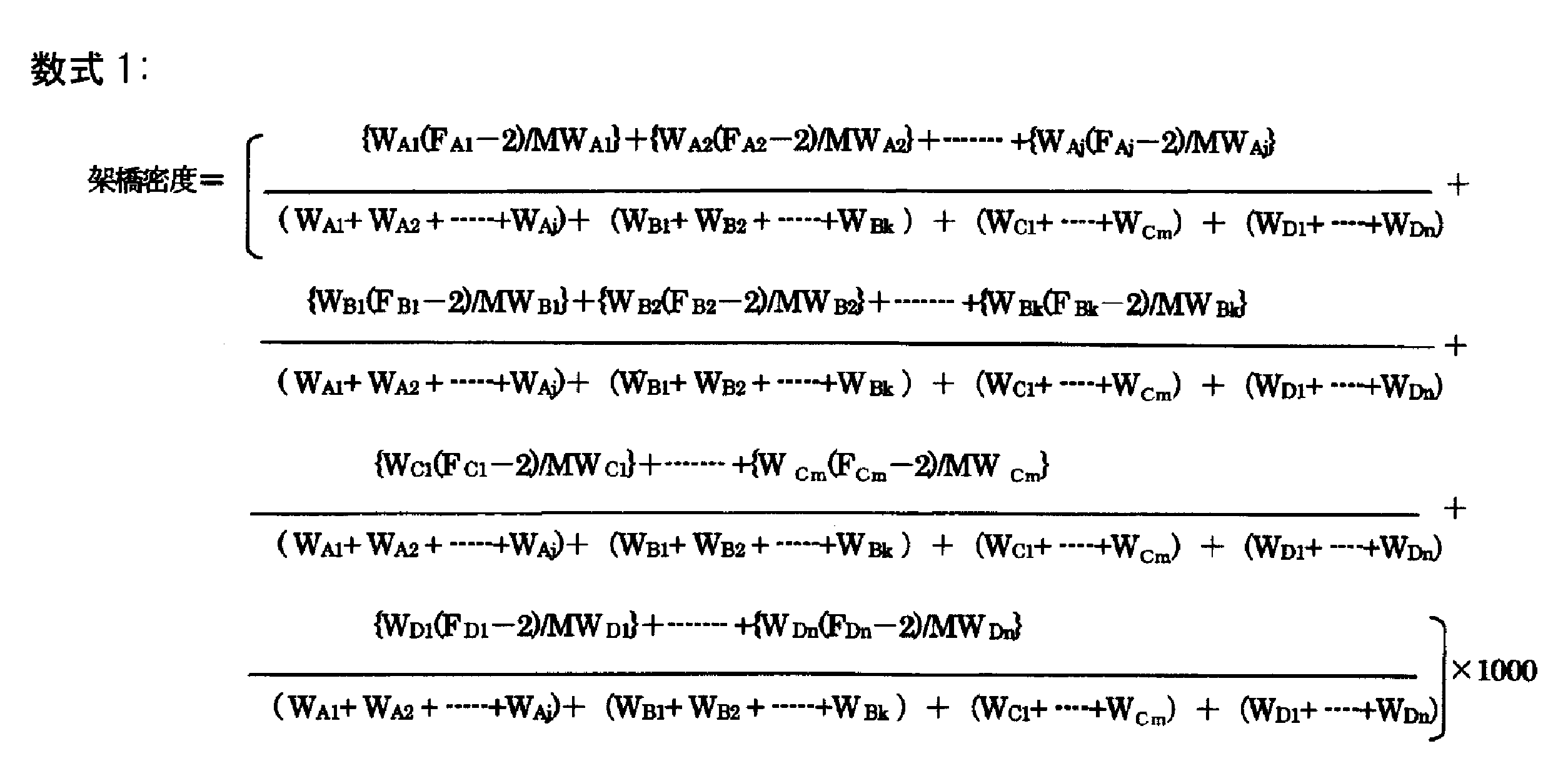

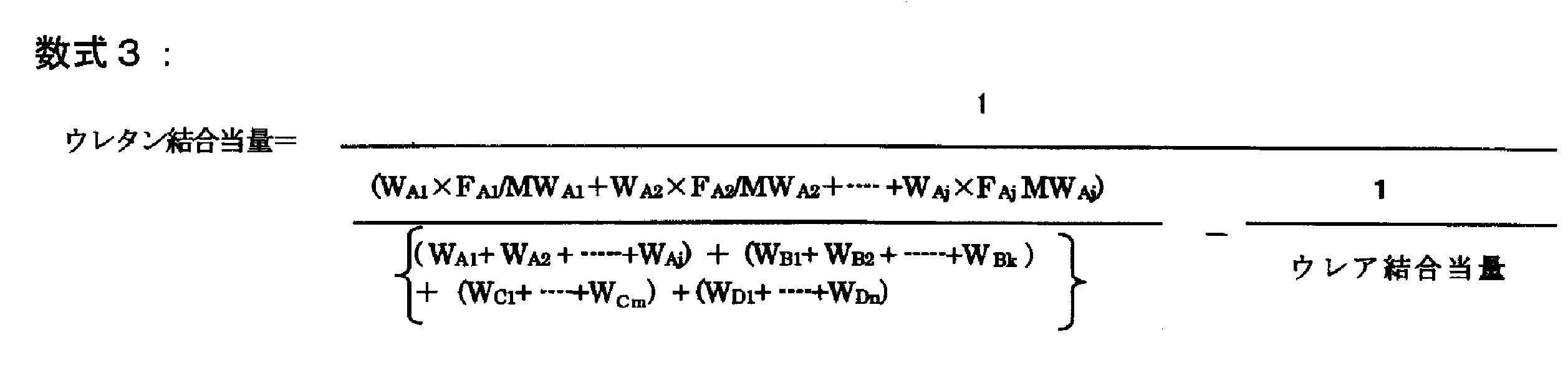
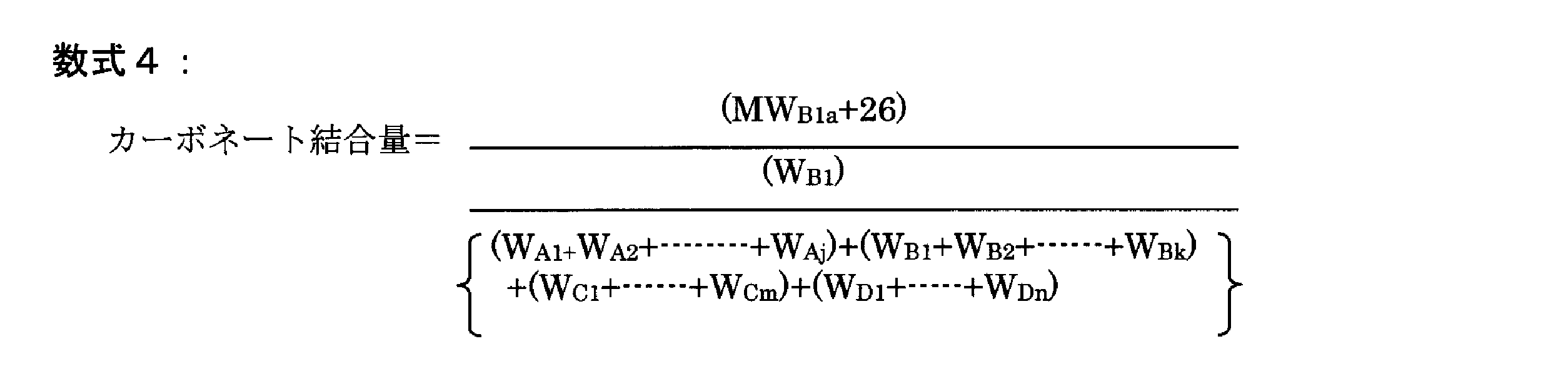
(合成例1-1)ポリウレタン水分散体1Aの合成
攪拌機、還流冷却管、温度計及び窒素吹き込み管を備えた4つ口フラスコにポリブタジエンポリオール(出光興産株式会社製、PolybdR-15HT、平均水酸基価102.7mgKOH/g、活性水素基数2.30)184.1質量部、ジメチロールプロピオン酸(活性水素基数2)15.4質量部、ジシクロヘキシルメタンジイソシアネート100.5質量部、メチルエチルケトン200質量部を加え、75℃で4時間反応させ、不揮発分に対する遊離のイソシアネート基含有量2.7%であるウレタンプレポリマーのメチルエチルケトン溶液を得た。この溶液を45℃まで冷却し、トリエチルアミンを11.6質量部加えて中和後、水900質量部を徐々に加えてホモジナイザーを使用して乳化分散させた。続いて、エチレンジアミン(活性水素基数2)5.1質量部を水100質量部で希釈した水溶液を加え、1時間鎖伸長反応を行った。これを減圧、50℃での加熱下、脱溶剤を行い、不揮発分約30%のポリウレタン水分散体1Aを得た。
攪拌機、還流冷却管、温度計及び窒素吹き込み管を備えた4つ口フラスコにポリブタジエンポリオール(出光興産株式会社製、PolybdR-15HT、平均水酸基価102.7mgKOH/g、活性水素基数2.30)195.0質量部、ジメチロールプロピオン酸(活性水素基数2)12.6質量部、ジシクロヘキシルメタンジイソシアネート92.4質量部、メチルエチルケトン200質量部を加え、75℃で4時間反応させ、不揮発分に対する遊離のイソシアネート基含有量が2.1%であるウレタンプレポリマーのメチルエチルケトン溶液を得た。この溶液を45℃まで冷却し、トリエチルアミンを9.5質量部加えて中和後、水900質量部を徐々に加えてホモジナイザーを使用して乳化分散させた。続いて、ジエチレントリアミン(活性水素基数3)4.6質量部を水100質量部で希釈した水溶液を加え、1時間鎖伸長反応を行った。これを減圧、50℃での加熱下、脱溶剤を行い、不揮発分約30%のポリウレタン水分散体1Bを得た。
攪拌機、還流冷却管、温度計及び窒素吹き込み管を備えた4つ口フラスコにポリブタジエンポリオール(出光興産株式会社製、PolybdR-45HT、平均水酸基価46.5mgKOH/g、活性水素基数2.32)215.3質量部、ジメチロールプロピオン酸(活性水素基数2)15.4質量部、ジシクロヘキシルメタンジイソシアネート69.3質量部、メチルエチルケトン200質量部を加え、75℃で4時間反応させ、不揮発分に対する遊離のイソシアネート基含有量1.5%であるウレタンプレポリマーのメチルエチルケトン溶液を得た。この溶液を45℃まで冷却し、トリエチルアミンを11.6質量部加えて中和後、水900質量部を徐々に加えてホモジナイザーを使用して乳化分散させた。続いて、エチレンジアミン(活性水素基数2)3.0質量部を水100質量部で希釈した水溶液を加え、1時間鎖伸長反応を行った。これを減圧、50℃での加熱下、脱溶剤を行い、不揮発分約30%のポリウレタン水分散体1Cを得た。
攪拌機、還流冷却管、温度計及び窒素吹き込み管を備えた4つ口フラスコに水素添加ポリイソプレンポリオール(出光興産株式会社製、エポール、平均水酸基価50.5mgKOH/g、活性水素基数2.25)213.6質量部、ジメチロールプロピオン酸(活性水素基数2)15.4質量部、ジシクロヘキシルメタンジイソシアネート71.0質量部、メチルエチルケトン200質量部を加え、75℃で4時間反応させ、不揮発分に対する遊離のイソシアネート基含有量1.5%であるウレタンプレポリマーのメチルエチルケトン溶液を得た。この溶液を45℃まで冷却し、トリエチルアミンを11.6質量部加えて中和後、水900質量部を徐々に加えてホモジナイザーを使用して乳化分散させた。続いて、エチレンジアミン(活性水素基数2)2.9質量部を水100質量部で希釈した水溶液を加え、1時間鎖伸長反応を行った。これを減圧、50℃での加熱下、脱溶剤を行い、不揮発分約30%のポリウレタン水分散体1Dを得た。
攪拌機、還流冷却管、温度計及び窒素吹き込み管を備えた4つ口フラスコにポリブタジエンポリオール(出光興産株式会社製、PolybdR-15HT、平均水酸基価102.7mgKOH/g、活性水素基数2.30)202.1質量部、ジメチロールプロピオン酸(活性水素基数2)12.6質量部、ジシクロヘキシルメタンジイソシアネート64.56質量部、ヘキサメチレンジイソシアネート20.73質量部、メチルエチルケトン200質量部を加え、75℃で4時間反応させ、不揮発分に対する遊離のイソシアネート基含有量2.4%であるウレタンプレポリマーのメチルエチルケトン溶液を得た。この溶液を45℃まで冷却し、トリエチルアミンを9.5質量部加えて中和後、水900質量部を徐々に加えてホモジナイザーを使用して乳化分散させた。続いて、エチレンジアミン(活性水素基数2)4.5質量部を水100質量部で希釈した水溶液を加え、1時間鎖伸長反応を行った。これを減圧、50℃での加熱下、脱溶剤を行い、不揮発分約30%のポリウレタン水分散体1Eを得た。
攪拌機、還流冷却管、温度計及び窒素吹き込み管を備えた4つ口フラスコにポリブタジエンポリオール(出光興産株式会社製、PolybdR-15HT、平均水酸基価102.7mgKOH/g、活性水素基数2.30)206.2質量部、ジメチロールプロピオン酸(活性水素基数2)12.6質量部、ジシクロヘキシルメタンジイソシアネート49.5質量部、ヘキサメチレンジイソシアネート31.74質量部、メチルエチルケトン200質量部を加え、75℃で4時間反応させ、不揮発分に対する遊離のイソシアネート基含有量2.5%であるウレタンプレポリマーのメチルエチルケトン溶液を得た。この溶液を45℃まで冷却し、トリエチルアミンを9.5質量部加えて中和後、水900質量部を徐々に加えてホモジナイザーを使用して乳化分散させた。続いて、エチレンジアミン(活性水素基数2)4.8質量部を水100質量部で希釈した水溶液を加え、1時間鎖伸長反応を行った。これを減圧、50℃での加熱下、脱溶剤を行い、不揮発分約30%のポリウレタン水分散体1Fを得た。
攪拌機、還流冷却管、温度計及び窒素吹き込み管を備えた4つ口フラスコにポリブタジエンポリオール(出光興産株式会社製、PolybdR-15HT、平均水酸基価102.7mgKOH/g、活性水素基数2.30)147.6質量部、1,9-ノナンジオールとメチルオクタンジオール質量比65/35を構成成分とするポリカーボネートポリオール(クラレ株式会社製、クラポールC-2065N、平均水酸基価58.1mgKOH/g、活性水素基数2)63.27質量部、ジメチロールプロピオン酸(活性水素基数2)12.6質量部、ジシクロヘキシルメタンジイソシアネート46.62質量部、ヘキサメチレンジイソシアネート29.94質量部、メチルエチルケトン200質量部を加え、75℃で4時間反応させ、不揮発分に対する遊離のイソシアネート基含有量2.5%であるウレタンプレポリマーのメチルエチルケトン溶液を得た。この溶液を45℃まで冷却し、トリエチルアミンを9.5質量部加えて中和後、水900質量部を徐々に加えてホモジナイザーを使用して乳化分散させた。続いて、エチレンジアミン(活性水素基数2)4.8質量部を水100質量部で希釈した水溶液を加え、1時間鎖伸長反応を行った。これを減圧、50℃での加熱下、脱溶剤を行い、不揮発分約30%のポリウレタン水分散体1Gを得た。
攪拌機、還流冷却管、温度計及び窒素吹き込み管を備えた4つ口フラスコにポリブタジエンポリオール(出光興産株式会社製、PolybdR-45HT、平均水酸基価46.5mgKOH/g、活性水素基数2.32)220.4質量部、ジメチロールプロピオン酸(活性水素基数2)12.6質量部、ポリメリックMDI67.0質量部、メチルエチルケトン200質量部を加え、75℃で4時間反応させ、不揮発分に対する遊離のイソシアネート基含有量2.1%であるウレタンプレポリマーのメチルエチルケトン溶液を得た。この溶液を45℃まで冷却し、トリエチルアミンを9.5質量部加えて中和後、水900質量部を徐々に加えてホモジナイザーを使用して乳化分散させた。続いて、エチレンジアミン(活性水素基数2)4.1質量部を水100質量部で希釈した水溶液を加え、1時間鎖伸長反応を行った。これを減圧、50℃での加熱下、脱溶剤を行い、不揮発分約30%のポリウレタン水分散体1Hを得た。
攪拌機、還流冷却管、温度計及び窒素吹き込み管を備えた4つ口フラスコにポリイソプレンポリオール(出光興産株式会社製、Polyip、平均水酸基価46.56mgKOH/g、活性水素基数2.08)216.0質量部、ジメチロールプロピオン酸(活性水素基数2)12.6質量部、ジシクロヘキシルメタンジイソシアネート71.40質量部、メチルエチルケトン200質量部を加え、75℃で4時間反応させ、不揮発分に対する遊離のイソシアネート基含有量2.3%であるウレタンプレポリマーのメチルエチルケトン溶液を得た。この溶液を45℃まで冷却し、トリエチルアミンを9.5質量部加えて中和後、水900質量部を徐々に加えてホモジナイザーを使用して乳化分散させた。続いて、エチレンジアミン(活性水素基数2)4.4質量部を水100質量部で希釈した水溶液を加え、1時間鎖伸長反応を行った。これを減圧、50℃での加熱下、脱溶剤を行い、不揮発分約30%のポリウレタン水分散体1Iを得た。
攪拌機、還流冷却管、温度計及び窒素吹き込み管を備えた4つ口フラスコにポリブタジエンポリオール(出光興産株式会社製、PolybdR-45HT、平均水酸基価46.5mgKOH/g、活性水素基数2.32)172.8質量部、1,9-ノナンジオールとメチルオクタンジオール質量比65/35を構成成分とするポリカーボネートポリオール(クラレ株式会社製、クラポールC-2065N、平均水酸基価58.1mgKOH/g、活性水素基数2)43.2質量部、ジメチロールプロピオン酸(活性水素基数2)12.6質量部、ジシクロヘキシルメタンジイソシアネート71.40質量部、メチルエチルケトン200質量部を加え、75℃で4時間反応させ、不揮発分に対する遊離のイソシアネート基含有量2.2%であるウレタンプレポリマーのメチルエチルケトン溶液を得た。この溶液を45℃まで冷却し、トリエチルアミンを9.5質量部加えて中和後、水900質量部を徐々に加えてホモジナイザーを使用して乳化分散させた。続いて、エチレンジアミン(活性水素基数2)4.1質量部を水100質量部で希釈した水溶液を加え、1時間鎖伸長反応を行った。これを減圧、50℃での加熱下、脱溶剤を行い、不揮発分約30%のポリウレタン水分散体1Jを得た。
攪拌機、還流冷却管、温度計及び窒素吹き込み管を備えた4つ口フラスコにポリブタジエンポリオール(出光興産株式会社製、PolybdR-15HT、平均水酸基価102.7mgKOH/g、活性水素基数2.30)180.0質量部、ジメチロールプロピオン酸(活性水素基数2)13.0質量部、ジシクロヘキシルメタンジイソシアネート107.00質量部、メチルエチルケトン200質量部を加え、75℃で4時間反応させ、不揮発分に対する遊離のイソシアネート基含有量4.0%であるウレタンプレポリマーのメチルエチルケトン溶液を得た。この溶液を45℃まで冷却し、トリエチルアミンを8.8質量部加えて中和後、水900質量部を徐々に加えてホモジナイザーを使用して乳化分散させた。続いて、ジエチレントリアミン(活性水素基数3)8.5質量部を水100質量部で希釈した水溶液を加え、1時間鎖伸長反応を行った。これを減圧、50℃での加熱下、脱溶剤を行い、不揮発分約30%のポリウレタン水分散体1Kを得た。
攪拌機、還流冷却管、温度計及び窒素吹き込み管を備えた4つ口フラスコにポリテトラメチレンエーテルグリコール(BASF社製、PolyTHF1000、平均水酸基価110mgKOH/g、活性水素基数2)222.4質量部、ジメチロールプロピオン酸(活性水素基数2)12.6質量部、ヘキサメチレンジイソシアネート65.0質量部、メチルエチルケトン200質量部を加え、75℃で4時間反応させ、不揮発分に対する遊離のイソシアネート基含有量1.8%であるウレタンプレポリマーのメチルエチルケトン溶液を得た。この溶液を45℃まで冷却し、トリエチルアミンを9.5質量部加えて中和後、水900質量部を徐々に加えてホモジナイザーを使用して乳化分散させた。続いて、エチレンジアミン(活性水素基数2)3.5質量部を水100質量部で希釈した水溶液を加え、1時間鎖伸長反応を行った。これを減圧、50℃での加熱下、脱溶剤を行い、不揮発分約30%のポリウレタン水分散体1Lを得た。
攪拌機、還流冷却管、温度計及び窒素吹き込み管を備えた4つ口フラスコにポリテトラメチレンエーテルグリコール(BASF社製、PolyTHF1000、平均水酸基価110mgKOH/g、活性水素基数2)220.0質量部、トリメチロールプロパン(活性水素基数3)0.30質量部、ジメチロールプロピオン酸(活性水素基数2)12.6質量部、ヘキサメチレンジイソシアネート67.1質量部、メチルエチルケトン200質量部を加え、75℃で4時間反応させ、不揮発分に対する遊離のイソシアネート基含有量2.1%であるウレタンプレポリマーのメチルエチルケトン溶液を得た。この溶液を45℃まで冷却し、トリエチルアミンを9.5質量部加えて中和後、水900質量部を徐々に加えてホモジナイザーを使用して乳化分散させた。続いて、エチレンジアミン(活性水素基数2)4.1質量部を水100質量部で希釈した水溶液を加え、1時間鎖伸長反応を行った。これを減圧、50℃での加熱下、脱溶剤を行い、不揮発分約30%のポリウレタン水分散体1Mを得た。
攪拌機、還流冷却管、温度計及び窒素吹き込み管を備えた4つ口フラスコにポリテトラメチレンエーテルグリコール(BASF社製、PolyTHF1000、平均水酸基価110mgKOH/g、活性水素基数2)182.8質量部、トリメチロールプロパン(活性水素基数3)12.70質量部、ジメチロールプロピオン酸(活性水素基数2)12.6質量部、ヘキサメチレンジイソシアネート91.90質量部、メチルエチルケトン200質量部を加え、75℃で4時間反応させ、不揮発分に対する遊離のイソシアネート基含有量3.4%であるウレタンプレポリマーのメチルエチルケトン溶液を得た。この溶液を45℃まで冷却し、トリエチルアミンを9.5質量部加えて中和後、水900質量部を徐々に加えてホモジナイザーを使用して乳化分散させた。続いて、ジエチレントリアミン(活性水素基数3)7.6質量部を水100質量部で希釈した水溶液を加え、1時間鎖伸長反応を行った。これを減圧、50℃での加熱下、脱溶剤を行い、不揮発分約30%のポリウレタン水分散体1Nを得た。
攪拌機、還流冷却管、温度計及び窒素吹き込み管を備えた4つ口フラスコにポリブタジエンポリオール(出光興産株式会社製、PolybdR-15HT、平均水酸基価102.7mgKOH/g、活性水素基数2.30)117.0質量部、1,4-ブタンジオール(活性水素基数2)40.0質量部、ジメチロールプロピオン酸(活性水素基数2)15.0質量部、ヘキサメチレンジイソシアネート128.0質量部、メチルエチルケトン200質量部を加え、75℃で4時間反応させ、不揮発分に対する遊離のイソシアネート基含有量2.6%であるウレタンプレポリマーのメチルエチルケトン溶液を得た。この溶液にモノエチルアミン1.3質量部添加して反応を行い、その後45℃まで冷却し、トリエチルアミンを11.3質量部加えて中和後、水900質量部を徐々に加えてホモジナイザーを使用して乳化分散させた。これを減圧、50℃での加熱下、脱溶剤を行い、不揮発分約30%のポリウレタン水分散体1Oを得た。
反応によって合成されたウレタンプレポリマーのメチルエチルケトン溶液の不揮発分に対する遊離のイソシアネート基含有量を下記表1に示す。
ポリウレタン水分散体の不揮発分の重量:JIS K 6828に準じて測定した。
ポリウレタン水分散体の樹脂固形分中の架橋密度:上記数式1より算出した。
ポリウレタン樹脂の酸価:JIS K 0070-1992に準じて測定した。
ウレア結合当量、ウレタン結合当量:上記数式2及び数式3よりそれぞれ算出した。
ポリウレタン水分散体の平均粒子径測定:平均粒子径は、Microtrac UPA-UZ152(日機装社製)にて測定し、50%平均値を粒子径として算出した。

電極の作製に用いた結着剤を下記表2に示す。

(負極1-1)
負極活物質として、天然黒鉛100g、導電剤としてカーボンブラック0.5g(Timcal社製、Super-P)と増粘剤としてカルボキシメチルセルロースナトリウム塩(第一工業製薬株式会社製、品名:セロゲンWS-C)2質量%水溶液100g、結着剤としてポリウレタン水分散体1Aの30質量%溶液6.7gを遊星型ミキサーで混合し、固形分50%になるように負極スラリーを調製した。この負極スラリーを塗工機で厚み10μmの電解銅箔上にコーティングを行い、120℃で乾燥後、ロールプレス処理を行い、負極活物質7mg/cm2の負極1-1を得た。
上記ポリウレタン水分散体1Aを、表2に記載のポリウレタン水分散体、スチレンブタジエンゴム(SBR)に変更した以外は負極1-1と同様の方法で作成した。
負極活物質として、SiO(平均粒径4.5μm、比表面積5.5m2/g)100g、導電剤としてカーボンブラック(Timcal社製、Super-P)5gと増粘剤としてカルボキシメチルセルロースナトリウム塩(第一工業製薬株式会社製、品名:セロゲンWS-C)2質量%水溶液100g、結着剤としてポリウレタン水分散体Aの30質量%溶液6.7gを遊星型ミキサーで混合し、固形分50%になるように負極スラリーを調製した。この負極スラリーを塗工機で厚み10μmの電解銅箔上にコーティングを行い、120℃で乾燥後、ロールプレス処理を行い、負極活物質2.5mg/cm2の負極1-17を得た。
上記ポリウレタン水分散体MをSBRに変更した以外は負極1-17と同様の方法で負極1-18を作成した。
負極活物質として、Li4Ti5O12100g、導電剤としてカーボンブラック5g(Timcal社製、Super-P)と増粘剤としてカルボキシメチルセルロースナトリウム塩(第一工業製薬株式会社製、品名:セロゲンWS-C)2質量%水溶液100g、結着剤としてポリウレタン水分散体GIの30質量%溶液6.7gを遊星型ミキサーで混合し、固形分50%になるように負極スラリーを調製した。この負極スラリーを塗工機で厚み10μmの電解銅箔上にコーティングを行い、120℃で乾燥後、ロールプレス処理を行い、負極活物質9.7mg/cm2の負極1-19を得た。
上記ポリウレタン水分散体GをSBRに変更した以外は負極1-19と同様の方法で負極1-20を作成した。
(正極1-1)
正極活物質であるLiNi1/3Co1/3Mn1/3O2100g、導電剤としてカーボンブラック(Timcal社製、Super-P)を7.8g、結着剤としてポリフッ化ビニリデン6g、分散媒としてN-メチル-2-ピロリドン61.3gを遊星型ミキサーで混合し、固形分65%になるように正極スラリーを調製した。この正極スラリーを塗工機で厚み20μmのアルミニウム箔上にコーティングを行い、130℃で乾燥後、ロールプレス処理を行い、正極活物質13.8mg/cm2の正極1-1を得た。
正極活物質であるLiNi1/3Co1/3Mn1/3O2100g、導電剤としてカーボンブラック(Timcal社製、Super-P)を7.8g、増粘剤としてカルボキシメチルセルロースナトリウム塩(第一工業製薬株式会社製、品名:セロゲンWS-C)2質量%水溶液100g、結着剤として表2に記載のポリウレタン水分散体の30質量%溶液6.7gを遊星型ミキサーで混合し、固形分50%になるように正極スラリーを調製した。この正極スラリーを塗工機で厚み20μmのアルミニウム箔上にコーティングを行い、130℃で乾燥後、ロールプレス処理を行い、正極活物質13.8mg/cm2の正極1-2及び1-3を得た。
正極活物質であるLiMn2O4100g、導電剤としてカーボンブラック(Timcal社製、Super-P)を5g、結着剤としてポリフッ化ビニリデン6g、分散媒としてN-メチル-2-ピロリドン59.8gを遊星型ミキサーで混合し、固形分65%になるように正極スラリーを調製した。この正極スラリーを塗工機で厚み20μmのアルミニウム箔上にコーティングを行い、130℃で乾燥後、ロールプレス処理を行い、正極活物質22mg/cm2の正極1-4を得た。
正極活物質であるLiMn2O4100g、導電剤としてカーボンブラック(Timcal社製、Super-P)を5g、増粘剤としてカルボキシメチルセルロースナトリウム塩(第一工業製薬株式会社製、品名:セロゲンWS-C)2質量%水溶液100g、結着剤としてポリウレタン水分散体1Dの30質量%溶液6.7gを遊星型ミキサーで混合し、固形分50%になるように正極スラリーを調製した。この正極スラリーを塗工機で厚み20μmのアルミニウム箔上にコーティングを行い、130℃で乾燥後、ロールプレス処理を行い、正極活物質22mg/cm2の正極1-5を得た。
正極活物質であるLiFePO4100g、導電剤としてカーボンブラック(Timcal社製、Super-P)を5g、結着剤としてポリフッ化ビニリデン6g、分散媒としてN-メチル-2-ピロリドン135.7gを遊星型ミキサーで混合し、固形分45%になるように正極スラリーを調製した。この正極スラリーを塗工機で厚み20μmのアルミニウム箔上にコーティングを行い、130℃で乾燥後、ロールプレス処理を行い、正極活物質14.5mg/cm2の正極1-6を得た。
正極活物質であるLiFePO4100g、導電剤としてカーボンブラック(Timcal社製、Super-P)を5g、増粘剤としてカルボキシメチルセルロースナトリウム塩(第一工業製薬株式会社製、品名:セロゲンWS-C)2質量%水溶液100g、結着剤としてポリウレタン水分散体1Dの30質量%溶液6.7gを遊星型ミキサーで混合し、固形分50%になるように正極スラリーを調製した。この正極スラリーを塗工機で厚み20μmのアルミニウム箔上にコーティングを行い、130℃で乾燥後、ロールプレス処理を行い、正極活物質14.5mg/cm2の正極1-7を得た。
得られた電極について以下の評価を実施した。評価結果を表3に示す。
評価基準;
5点:0%脱落
4点:25%脱落
3点:50%脱落
2点:75%脱落
1点:100%脱落
評価基準;
○:塗膜に変化無し
△:塗膜に膨れ数点発生
×:塗膜が剥がれる

(合成例2-1)ポリカーボネートジオールAの合成
温度計、窒素シール管、撹拌器を取り付けた500mlのセパラブルフラスコに、ジエチルカーボネート177.1g及び1,3-プロパンジオール146.0g入れ、触媒としてテトラ-n-ブトキシチタンを濃度100ppmになるように加え、窒素流入下において、200℃で約15時間エステル交換反応を行った。発生したエタノール及び過剰のジエチルカーボネートを減圧下で除去して、水酸基価56.2mgKOHのポリカーボネートジオールAを得た。
1,3-プロパンジオールを1,3-プロパンジオール73.0gと1,4-ブタンジオール73.0gに変更した以外は合成例2-1と同様に製造し、1,3-プロパンジオールと1,4-ブタンジオールを構成成分とする、水酸基価56.1mgKOHのポリカーボネートジオールBを得た。
1,3-プロパンジオールを1,4-ブタンジオール146.0gに変更した以外は合成例2-1と同様に製造し、水酸基価56.2mgKOHのポリカーボネートジオールCを得た。
1,3-プロパンジオールを1,4-ブタンジオール73.0gと1,5-ペンタンジオール84.3gに変更した以外は合成例2-1と同様に製造し、1,4-ブタンジオールと1,5-ペンタンジオールを構成成分とする、水酸基価37.5mgKOHのポリカーボネートジオールDを得た。
1,3-プロパンジオールを1,5-ペンタンジオール167.0gに変更した以外は合成例2-1と同様に製造し、水酸基価37.4mgKOHのポリカーボネートジオールEを得た。
1,3-プロパンジオールを2-メチル-1,3-プロパンジオール146.0g に変更した以外は合成例2-1と同様に製造し、水酸基価56.2mgKOHのポリカーボネートジオールFを得た。
1,3-プロパンジオールを1,4-ブタンジオール117.0gと1,6-ヘキサンンジオール38.3gに変更した以外は合成例2-1と同様に製造し、1,4-ブタンジオールと1,6-ペンタンジオールを構成成分とする水酸基価56.2mgKOHのポリカーボネートジオールGを得た。
1,3-プロパンジオールを1,6-ヘキサンジオール192.0gに変更した以外は合成例2-1と同様に製造し、水酸基価56.1mgKOHのポリカーボネートジオールHを得た。
1,3-プロパンジオールを1,9-ノナンジオール260.0gに変更した以外は合成例2-1と同様に製造し、水酸基価56.1mgKOHのポリカーボネートジオールIを得た。
(合成例2-10)ポリウレタン水分散体2Aの合成
攪拌機、還流冷却管、温度計及び窒素吹き込み管を備えた4つ口フラスコにポリカーボネートジオールA208.0質量部、トリメチロールプロパン(活性水素基数3)3.0質量部、ジメチロールプロピオン酸(活性水素基数2)11.0質量部、ジシクロヘキシルメタンジイソシアネート78.0質量部、メチルエチルケトン200質量部を加え、75℃で4時間反応させ、不揮発分に対する遊離のイソシアネート基含有量2.0%であるウレタンプレポリマーのメチルエチルケトン溶液を得た。この溶液を45℃まで冷却し、トリエチルアミンを8.3質量部加えて中和後、水900質量部を徐々に加えてホモジナイザーを使用して乳化分散させた。続いて、エチレンジアミン(活性水素基数2)3.9質量部を水100質量部で希釈した水溶液を加え、1時間鎖伸長反応を行った。これを減圧、50℃での加熱下、脱溶剤を行い、不揮発分約30%のポリウレタン水分散体2Aを得た。
攪拌機、還流冷却管、温度計及び窒素吹き込み管を備えた4つ口フラスコにポリカーボネートジオールB206.4質量部、トリメチロールプロパン(活性水素基数3)3.6質量部、ジメチロールプロピオン酸(活性水素基数2)13.0質量部、ジシクロヘキシルメタンジイソシアネート77.0質量部、メチルエチルケトン200質量部を加え、75℃で4時間反応させ、不揮発分に対する遊離のイソシアネート基含有量1.3%であるウレタンプレポリマーのメチルエチルケトン溶液を得た。この溶液を45℃まで冷却し、トリエチルアミンを9.8質量部加えて中和後、水900質量部を徐々に加えてホモジナイザーを使用して乳化分散させた。続いて、エチレンジアミン(活性水素基数2)2.5質量部を水100質量部で希釈した水溶液を加え、1時間鎖伸長反応を行った。これを減圧、50℃での加熱下、脱溶剤を行い、不揮発分約30%のポリウレタン水分散体2Bを得た。
攪拌機、還流冷却管、温度計及び窒素吹き込み管を備えた4つ口フラスコにポリカーボネートジオールB206.4質量部、トリメチロールプロパン(活性水素基数3)3.6質量部、ジメチロールプロピオン酸(活性水素基数2)13.0質量部、ジシクロヘキシルメタンジイソシアネート77.0質量部、メチルエチルケトン200質量部を加え、75℃で4時間反応させ、不揮発分に対する遊離のイソシアネート基含有量1.3%であるウレタンプレポリマーのメチルエチルケトン溶液を得た。この溶液を45℃まで冷却し、トリエチルアミンを9.8質量部加えて中和後、水900質量部を徐々に加えてホモジナイザーを使用して乳化分散させた。続いて、ジエチレントリアミン(活性水素基数3)2.9質量部を水100質量部で希釈した水溶液を加え、1時間鎖伸長反応を行った。これを減圧、50℃での加熱下、脱溶剤を行い、不揮発分約30%のポリウレタン水分散体2Cを得た。
攪拌機、還流冷却管、温度計及び窒素吹き込み管を備えた4つ口フラスコにポリカーボネートジオールC205.5質量部、トリメチロールプロパン(活性水素基数3)3.50質量部、ジメチロールプロピオン酸(活性水素基数2)12.0質量部、ジシクロヘキシルメタンジイソシアネート69.50質量部、メチルエチルケトン200質量部を加え、75℃で4時間反応させ、不揮発分に対する遊離のイソシアネート基含有量1.8%であるウレタンプレポリマーのメチルエチルケトン溶液を得た。この溶液を45℃まで冷却し、トリエチルアミンを9.0質量部加えて中和後、水900質量部を徐々に加えてホモジナイザーを使用して乳化分散させた。続いて、エチレンジアミン(活性水素基数2)3.5質量部を水100質量部で希釈した水溶液を加え、1時間鎖伸長反応を行った。これを減圧、50℃での加熱下、脱溶剤を行い、不揮発分約30%のポリウレタン水分散体2Dを得た。
攪拌機、還流冷却管、温度計及び窒素吹き込み管を備えた4つ口フラスコにポリカーボネートジオールB210.0質量部、トリメチロールプロパン(活性水素基数3)3.50質量部、ジメチロールプロピオン酸(活性水素基数2)12.0質量部、ポリメリックMDI74.5質量部、メチルエチルケトン200質量部を加え、75℃で4時間反応させ、不揮発分に対する遊離のイソシアネート基含有量1.6%であるウレタンプレポリマーのメチルエチルケトン溶液を得た。この溶液を45℃まで冷却し、トリエチルアミンを9.0質量部加えて中和後、水900質量部を徐々に加えてホモジナイザーを使用して乳化分散させた。続いて、エチレンジアミン(活性水素基数2)3.1質量部を水100質量部で希釈した水溶液を加え、1時間鎖伸長反応を行った。これを減圧、50℃での加熱下、脱溶剤を行い、不揮発分約30%のポリウレタン水分散体2Eを得た。
攪拌機、還流冷却管、温度計及び窒素吹き込み管を備えた4つ口フラスコにポリカーボネートジオールD216.7質量部、トリメチロールプロパン(活性水素基数3)3.30質量部、ジメチロールプロピオン酸(活性水素基数2)12.5質量部、ジシクロヘキシルメタンジイソシアネート67.50質量部、メチルエチルケトン200質量部を加え、75℃で4時間反応させ、不揮発分に対する遊離のイソシアネート基含有量1.4%であるウレタンプレポリマーのメチルエチルケトン溶液を得た。この溶液を45℃まで冷却し、トリエチルアミンを9.4質量部加えて中和後、水900質量部を徐々に加えてホモジナイザーを使用して乳化分散させた。続いて、エチレンジアミン(活性水素基数2)2.7質量部を水100質量部で希釈した水溶液を加え、1時間鎖伸長反応を行った。これを減圧、50℃での加熱下、脱溶剤を行い、不揮発分約30%のポリウレタン水分散体2Fを得た。
攪拌機、還流冷却管、温度計及び窒素吹き込み管を備えた4つ口フラスコにポリカーボネートジオールE216.7質量部、トリメチロールプロパン(活性水素基数3)3.30質量部、ジメチロールプロピオン酸(活性水素基数2)12.5質量部、ジシクロヘキシルメタンジイソシアネート67.50質量部、メチルエチルケトン200質量部を加え、75℃で4時間反応させ、不揮発分に対する遊離のイソシアネート基含有量1.4%であるウレタンプレポリマーのメチルエチルケトン溶液を得た。この溶液を45℃まで冷却し、トリエチルアミンを9.4質量部加えて中和後、水900質量部を徐々に加えてホモジナイザーを使用して乳化分散させた。続いて、エチレンジアミン(活性水素基数2)2.7質量部を水100質量部で希釈した水溶液を加え、1時間鎖伸長反応を行った。これを減圧、50℃での加熱下、脱溶剤を行い、不揮発分約30%のポリウレタン水分散体2Gを得た。
攪拌機、還流冷却管、温度計及び窒素吹き込み管を備えた4つ口フラスコにポリカーボネートジオールF205.5質量部、トリメチロールプロパン(活性水素基数3)3.50質量部、ジメチロールプロピオン酸(活性水素基数2)12.0質量部、ジシクロヘキシルメタンジイソシアネート79.0質量部、メチルエチルケトン200質量部を加え、75℃で4時間反応させ、不揮発分に対する遊離のイソシアネート基含有量1.6%であるウレタンプレポリマーのメチルエチルケトン溶液を得た。この溶液を45℃まで冷却し、トリエチルアミンを9.0質量部加えて中和後、水900質量部を徐々に加えてホモジナイザーを使用して乳化分散させた。続いて、エチレンジアミン(活性水素基数2)3.5質量部を水100質量部で希釈した水溶液を加え、1時間鎖伸長反応を行った。これを減圧、50℃での加熱下、脱溶剤を行い、不揮発分約30%のポリウレタン水分散体2Hを得た。
攪拌機、還流冷却管、温度計及び窒素吹き込み管を備えた4つ口フラスコにポリカーボネートジオールF174.0質量部、トリメチロールプロパン(活性水素基数3)8.0質量部、ジメチロールプロピオン酸(活性水素基数2)12.0質量部、ジシクロヘキシルメタンジイソシアネート79.0質量部、メチルエチルケトン200質量部を加え、75℃で4時間反応させ、不揮発分に対する遊離のイソシアネート基含有量3.7%であるウレタンプレポリマーのメチルエチルケトン溶液を得た。この溶液を45℃まで冷却し、トリエチルアミンを9.0質量部加えて中和後、水900質量部を徐々に加えてホモジナイザーを使用して乳化分散させた。続いて、ジエチレントリアミン(活性水素基数2)8.2質 量部を水100質量部で希釈した水溶液を加え、1時間鎖伸長反応を行った。これを減圧、50℃での加熱下、脱溶剤を行い、不揮発分約30%のポリウレタン水分散体2Iを得た。
攪拌機、還流冷却管、温度計及び窒素吹き込み管を備えた4つ口フラスコにポリカーボネートジオールC235.0質量部、トリメチロールプロパン(活性水素基数3)3.0質量部、ジメチロールプロピオン酸(活性水素基数2)12.0質量部、ヘキサメチレンジイソシアネート50.00質量部、メチルエチルケトン200質量部を加え、75℃で4時間反応させ、不揮発分に対する遊離のイソシアネート基含有量1.4%であるウレタンプレポリマーのメチルエチルケトン溶液を得た。この溶液を45℃まで冷却し、トリエチルアミンを9.0質量部加えて中和後、水900質量部を徐々に加えてホモジナイザーを使用して乳化分散させた。続いて、エチレンジアミン(活性水素基数2)2.7質量部を水100質量部で希釈した水溶液を加え、1時間鎖伸長反応を行った。これを減圧、50℃での加熱下、脱溶剤を行い、不揮発分約30%のポリウレタン水分散体2Jを得た。
攪拌機、還流冷却管、温度計及び窒素吹き込み管を備えた4つ口フラスコにポリカーボネートジオールG208.7質量部、トリメチロールプロパン(活性水素基数3)3.3質量部、ジメチロールプロピオン酸(活性水素基数2)12.0質量部、ヘキサメチレンジイソシアネート76.0質量部、メチルエチルケトン200質量部を加え、75℃で4時間反応させ、不揮発分に対する遊離のイソシアネート基含有量1.4%であるウレタンプレポリマーのメチルエチルケトン溶液を得た。この溶液を45℃まで冷却し、トリエチルアミンを9.0質量部加えて中和後、水900質量部を徐々に加えてホモジナイザーを使用して乳化分散させた。続いて、エチレンジアミン(活性水素基数2)2.9質量部を水100質量部で希釈した水溶液を加え、1時間鎖伸長反応を行った。これを減圧、50℃での加熱下、脱溶剤を行い、不揮発分約30%のポリウレタン水分散体2Kを得た。
攪拌機、還流冷却管、温度計及び窒素吹き込み管を備えた4つ口フラスコにポリカーボネートジオールH239.8質量部、トリメチロールプロパン(活性水素基数3)0.30質量部、ジメチロールプロピオン酸(活性水素基数2)12.0質量部、ヘキサメチレンジイソシアネート47.90質量部、メチルエチルケトン200質量部を加え、75℃で4時間反応させ、不揮発分に対する遊離のイソシアネート基含有量1.8%であるウレタンプレポリマーのメチルエチルケトン溶液を得た。この溶液を45℃まで冷却し、トリエチルアミンを9.0質量部加えて中和後、水900質量部を徐々に加えてホモジナイザーを使用して乳化分散させた。続いて、エチレンジアミン(活性水素基数2)3.5質量部を水100質量部で希釈した水溶液を加え、1時間鎖伸長反応を行った。これを減圧、50℃での加熱下、脱溶剤を行い、不揮発分約30%のポリウレタン水分散体2Lを得た。
攪拌機、還流冷却管、温度計及び窒素吹き込み管を備えた4つ口フラスコにポリカーボネートジオールH195.7質量部、トリメチロールプロパン(活性水素基数3)12.3質量部、ジメチロールプロピオン酸(活性水素基数2)12.0質量部、ヘキサメチレンジイソシアネート80.0質量部、メチルエチルケトン200質量部を加え、75℃で4時間反応させ、不揮発分に対する遊離のイソシアネート基含有量4.0%であるウレタンプレポリマーのメチルエチルケトン溶液を得た。この溶液を45℃まで冷却し、トリエチルアミンを9.0質量部加えて中和後、水900質量部を徐々に加えてホモジナイザーを使用して乳化分散させた。続いて、エチレンジアミン(活性水素基数2)8.8質量部を水100質量部で希釈した水溶液を加え、1時間鎖伸長反応を行った。これを減圧、50℃での加熱下、脱溶剤を行い、不揮発分約30%のポリウレタン水分散体2Mを得た。
攪拌機、還流冷却管、温度計及び窒素吹き込み管を備えた4つ口フラスコにポリカーボネートジオールI240.0質量部、ジメチロールプロピオン酸(活性水素基数2)12.0質量部、ヘキサメチレンジイソシアネート48.00質量部、メチルエチルケトン200質量部を加え、75℃で4時間反応させ、不揮発分に対する遊離のイソシアネート基含有量1.9%であるウレタンプレポリマーのメチルエチルケトン溶液を得た。この溶液を45℃まで冷却し、トリエチルアミンを9.0質量部加えて中和後、水900質量部を徐々に加えてホモジナイザーを使用して乳化分散させた。続いて、エチレンジアミン(活性水素基数2)3.7質量部を水100質量部で希釈した水溶液を加え、1時間鎖伸長反応を行った。これを減圧、50℃での加熱下、脱溶剤を行い、不揮発分約30%のポリウレタン水分散体2Nを得た。
上記により得られたポリウレタン水分散体につき、以下の各測定を行った。その結果を下記表4に示す。
ポリウレタン水分散体の樹脂固形分中の架橋密度:上記数式1より算出した。
ポリウレタン樹脂の酸価:JIS K 0070-1992に準じて測定した。
カーボネート結合当量、ウレア結合当量、ウレタン結合当量:数式2、数式3、数式4よりそれぞれ算出した。
ポリウレタン水分散体の平均粒子径測定:平均粒子径は、Microtrac UPA-UZ152(日機装社製)にて測定し、50%平均値を粒子径として算出した。

電極の作製に用いた結着剤を下記表5に示す。

(負極2-1)
負極活物質として、天然黒鉛100g、導電剤としてカーボンブラック0.5g(Timcal社製、Super-P)と増粘剤としてカルボキシメチルセルロースナトリウム塩(第一工業製薬株式会社製、品名:セロゲンWS-C)2質量%水溶液100g、結着剤としてポリウレタン水分散体2Aの30質量%溶液6.7gを遊星型ミキサーで混合し、固形分50%になるように負極スラリーを調製した。この負極スラリーを塗工機で厚み10μmの電解銅箔上にコーティングを行い、120℃で乾燥後、ロールプレス処理を行い、負極活物質7mg/cm2の負極2-1を得た。
上記ポリウレタン水分散体2Aを表5に記載のポリウレタン水分散体又はSBRに変更した以外は負極2-1と同様の方法で負極2-2~2-15を作成した。
負極活物質として、SiO(平均粒径4.5μm、比表面積5.5m2/g)100g、導電剤としてカーボンブラック5g(Timcal社製、Super-P)と増粘剤としてカルボキシメチルセルロースナトリウム塩(第一工業製薬株式会社製、品名:セロゲンWS-C)2質量%水溶液100g、結着剤としてポリウレタン水分散体Cの30質量%溶液6.7gを遊星型ミキサーで混合し、固形分50%になるように負極スラリーを調製した。この負極スラリーを塗工機で厚み10μmの電解銅箔上にコーティングを行い、120℃で乾燥後、ロールプレス処理を行い、負極活物質2.5mg/cm2の負極2-16を得た。
上記ポリウレタン水分散体CをSBRに変更した以外は負極16と同様の方法で負極2-17を作成した。
負極活物質として、Li4Ti5O12100g、導電剤としてカーボンブラック5g(Timcal社製、Super-P)と増粘剤としてカルボキシメチルセルロースナトリウム塩(第一工業製薬株式会社製、品名:セロゲンWS―C)2質量%水溶液100g、結着剤としてポリウレタン水分散体Hの30質量%溶液6.7gを遊星型ミキサーで混合し、固形分50%になるように負極スラリーを調製した。この負極スラリーを塗工機で厚み10μmの電解銅箔上にコーティングを行い、120℃で乾燥後、ロールプレス処理を行い、負極活物質9.7mg/cm2の負極2-18を得た。
上記ポリウレタン水分散体2HをSBRに変更した以外は負極2-18と同様の方法で負極2-19を作成した。
(正極2-1)
正極活物質であるLiNi1/3Co1/3Mn1/3O2100g、導電剤としてカーボンブラック(Timcal社製、Super-P)を7.8g、結着剤としてポリフッ化ビニリデン6g、分散媒としてN-メチル-2-ピロリドン61.3gを遊星型ミキサーで混合し、固形分65%になるように正極スラリーを調製した。この正極スラリーを塗工機で厚み20μmのアルミニウム箔上にコーティングを行い、130℃で乾燥後、ロールプレス処理を行い、正極活物質13.8mg/cm2の正極2-1を得た。
正極活物質であるLiNi1/3Co1/3Mn1/3O2100g、導電剤としてカーボンブラック(Timcal社製、Super-P)を7.8g、増粘剤としてカルボキシメチルセルロースナトリウム塩(第一工業製薬株式会社製、品名:セロゲンWS-C)2質量%水溶液100g、結着剤として表5に記載のポリウレタン水分散体の30質量%溶液6.7gを遊星型ミキサーで混合し、固形分50%になるように正極スラリーを調製した。この正極スラリーを塗工機で厚み20μmのアルミニウム箔上にコーティングを行い、130℃で乾燥後、ロールプレス処理を行い、正極活物質13.8mg/cm2の正極2-2、2-3を得た。
正極活物質であるLiMn2O4100g、導電剤としてカーボンブラック(Timcal社製、Super-P)を5g、結着剤としてポリフッ化ビニリデン6g、分散媒としてN-メチル-2-ピロリドン59.8gを遊星型ミキサーで混合し、固形分65%になるように正極スラリーを調製した。この正極スラリーを塗工機で厚み20μmのアルミニウム箔上にコーティングを行い、130℃で乾燥後、ロールプレス処理を行い、正極活物質22mg/cm2の正極2-4を得た。
正極活物質であるLiMn2O4100g、導電剤としてカーボンブラック(Timcal社製、Super-P)を5g、増粘剤としてカルボキシメチルセルロースナトリウム塩(第一工業製薬株式会社製、品名:セロゲンWS-C)2質量%水溶液100g、結着剤としてポリウレタンン水分散体2Fの30質量%溶液6.7gを遊星型ミキサーで混合し、固形分50%になるように正極スラリーを調製した。この正極スラリーを塗工機で厚み20μmのアルミニウム箔上にコーティングを行い、130℃で乾燥後、ロールプレス処理を行い、正極活物質22mg/cm2の正極2-5を得た。
正極活物質であるLiFePO4100g、導電剤としてカーボンブラック(Timcal社製、Super-P)を5g、結着剤としてポリフッ化ビニリデン6g、分散媒としてN-メチル-2-ピロリドン135.7gを遊星型ミキサーで混合し、固形分45%になるように正極スラリーを調製した。この正極スラリーを塗工機で厚み20μmのアルミニウム箔上にコーティングを行い、130℃で乾燥後、ロールプレス処理を行い、正極活物質14.5mg/cm2の正極2-6を得た。
正極活物質であるLiFePO4100g、導電剤としてカーボンブラック(Timcal社製、Super-P)を5g、増粘剤としてカルボキシメチルセルロースナトリウム塩(第一工業製薬株式会社製、品名:セロゲンWS-C)2質量%水溶液100g、結着剤としてポリウレタン水分散体Hの30質量%溶液6.7gを遊星型ミキサーで混合し、固形分50%になるように正極スラリーを調製した。この正極スラリーを塗工機で厚み20μmのアルミニウム箔上にコーティングを行い、130℃で乾燥後、ロールプレス処理を行い、正極活物質14.5mg/cm2の正極2-7を得た。
得られた電極について上記と同じ方法に従い結着性評価を実施した。評価結果を表6に示す。

上記により得られた正極及び負極を下記表7及び8のようにそれぞれ組み合わせて、電極間にセパレータとしてポリオレフィン系(PE/PP)セパレータを挟んで積層し、各正負極に正極端子と負極端子を超音波溶接した。この積層体をアルミラミネート包材に入れ、注液用の開口部を残しヒートシールした。正極面積18cm2、負極面積19.8cm2とした注液前電池を作製した。次にエチレンカーボネートとジエチルカーボネート(30/70vol比)とを混合した溶媒にLiPF6(1.0mol/L)を溶解させた電解液を注液し、開口部をヒートシールし、評価用電池を得た。


作製したリチウム二次電池について、20℃における性能試験を行った。試験方法は下記の通りである。試験結果を表9及び10に示す。
セルインピーダンスは、インピーダンスアナライザー(ZAHNER社製)を用いて、周波数1kHzでの抵抗値を測定した。
充放電サイクル特性を、以下の条件で測定した。
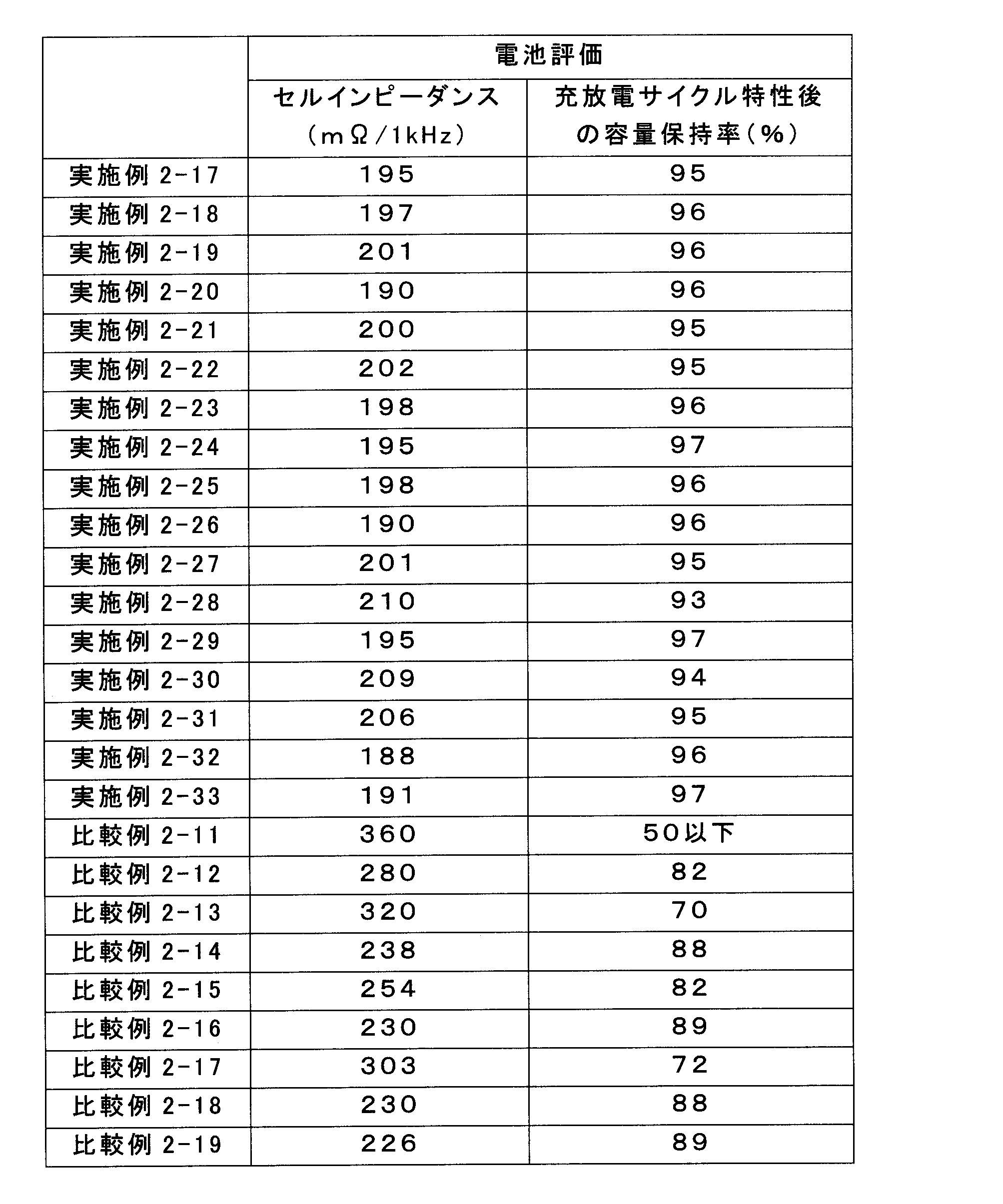
Claims (10)
- (A)ポリイソシアネート、(B)2個以上の活性水素基を有する化合物、(C)1個以上の活性水素基と親水基を有する化合物、及び(D)鎖伸長剤からなるポリウレタンの水分散体を含有するリチウム二次電池の電極用結着剤であって、
前記(B)2個以上の活性水素基を有する化合物が、オレフィン系ポリオール及び/又はカーボネート結合鎖間の炭素数が6未満であるカーボネートジオールを含有する
ことを特徴とするチウム二次電池の電極用結着剤。 - 前記(B)成分として含有されるオレフィン系ポリオールが、前記ポリウレタンに対して40質量%以上90質量%以下の割合で含有されることを特徴とする、請求項1に記載のリチウム二次電池の電極用結着剤。
- 前記(B)成分として含有されるカーボネート結合鎖間の炭素数が6未満であるポリカーボネートジオールが、前記ポリウレタンに対して50質量以上90質量%以下の割合で含有されることを特徴とする、請求項1に記載のリチウム二次電池の電極用結着剤。
- 前記ポリウレタンがポリウレタンの1000分子量あたり0.01以上0.50以下である架橋密度を有することを特徴とする、請求項1~3のいずれか1項に記載のリチウム二次電池の電極用結着剤。
- 前記ポリウレタンのウレタン結合当量が200g/eq以上2000g/eq以下であることを特徴とする、請求項1~4のいずれか1項に記載のリチウム二次電池の電極用結着剤。
- 前記(B)成分として含有されるオレフィン系ポリオールが、ポリブタジエンポリオール、ポリイソプレンポリオール、水添化ポリブタジエンポリオール、及び水添化ポリイソプレンポリオールの中から選択された1種又は2種以上であることを特徴とする、請求項1~5のいずれか1項に記載のリチウム二次電池の電極用結着剤。
- 前記(C)1個以上の活性水素基と親水基を有する化合物が、親水基としてカルボキシル基を含有することを特徴とする、請求項1~6のいずれか1項に記載のリチウム二次電池の電極用結着剤。
- 前記(A)ポリイソシアネートが、脂環族系イソシアネート及び/又は芳香系イソシアネートを含有することを特徴とする、請求項1~7のいずれか1項に記載のリチウム二次電池の電極用結着剤。
- 請求項1~8のいずれか1項に記載のリチウム二次電池の電極用結着剤を用いて製造された電極。
- 請求項9に記載された電極を有することを特徴とするリチウム二次電池。
Priority Applications (5)
| Application Number | Priority Date | Filing Date | Title |
|---|---|---|---|
| US14/908,857 US10003076B2 (en) | 2013-08-06 | 2014-08-04 | Binder for electrode in lithium secondary cell, electrode manufactured using said binder, and lithium secondary cell in which said electrode is used |
| KR1020167000311A KR102255775B1 (ko) | 2013-08-06 | 2014-08-04 | 리튬 2 차 전지의 전극용 결착제, 그 결착제를 이용하여 제조된 전극, 그 전극을 사용한 리튬 2 차 전지 |
| JP2014556668A JP5713515B1 (ja) | 2013-08-06 | 2014-08-04 | リチウム二次電池の電極用結着剤、該結着剤を用いて製造された電極、該電極を使用したリチウム二次電池 |
| CN201480040114.7A CN105378988B (zh) | 2013-08-06 | 2014-08-04 | 锂二次电池的电极用粘合剂、电极及锂二次电池 |
| US15/981,251 US10553872B2 (en) | 2013-08-06 | 2018-05-16 | Binder for electrode in lithium secondary cell, electrode manufactured using said binder, and lithium secondary cell in which said electrode is used |
Applications Claiming Priority (4)
| Application Number | Priority Date | Filing Date | Title |
|---|---|---|---|
| JP2013163549 | 2013-08-06 | ||
| JP2013-163548 | 2013-08-06 | ||
| JP2013163548 | 2013-08-06 | ||
| JP2013-163549 | 2013-08-06 |
Related Child Applications (2)
| Application Number | Title | Priority Date | Filing Date |
|---|---|---|---|
| US14/908,857 A-371-Of-International US10003076B2 (en) | 2013-08-06 | 2014-08-04 | Binder for electrode in lithium secondary cell, electrode manufactured using said binder, and lithium secondary cell in which said electrode is used |
| US15/981,251 Continuation US10553872B2 (en) | 2013-08-06 | 2018-05-16 | Binder for electrode in lithium secondary cell, electrode manufactured using said binder, and lithium secondary cell in which said electrode is used |
Publications (1)
| Publication Number | Publication Date |
|---|---|
| WO2015019598A1 true WO2015019598A1 (ja) | 2015-02-12 |
Family
ID=52460954
Family Applications (1)
| Application Number | Title | Priority Date | Filing Date |
|---|---|---|---|
| PCT/JP2014/004074 Ceased WO2015019598A1 (ja) | 2013-08-06 | 2014-08-04 | リチウム二次電池の電極用結着剤、該結着剤を用いて製造された電極、該電極を使用したリチウム二次電池 |
Country Status (6)
| Country | Link |
|---|---|
| US (2) | US10003076B2 (ja) |
| JP (1) | JP5713515B1 (ja) |
| KR (1) | KR102255775B1 (ja) |
| CN (1) | CN105378988B (ja) |
| TW (1) | TWI565777B (ja) |
| WO (1) | WO2015019598A1 (ja) |
Cited By (10)
| Publication number | Priority date | Publication date | Assignee | Title |
|---|---|---|---|---|
| WO2016072145A1 (ja) * | 2014-11-04 | 2016-05-12 | 第一工業製薬株式会社 | 水系ポリウレタン樹脂組成物 |
| WO2016132589A1 (ja) * | 2015-02-20 | 2016-08-25 | 第一工業製薬株式会社 | リチウム二次電池の電極用結着剤、該結着剤を用いて製造された電極、該電極を使用したリチウム二次電池 |
| JP2017190358A (ja) * | 2016-04-11 | 2017-10-19 | 宇部興産株式会社 | ポリカーボネートポリオール |
| JP2018513233A (ja) * | 2015-03-12 | 2018-05-24 | ヘンケル・アクチェンゲゼルシャフト・ウント・コムパニー・コマンディットゲゼルシャフト・アウフ・アクチェンHenkel AG & Co. KGaA | 水性ポリウレタン分散体 |
| WO2019107200A1 (ja) * | 2017-11-28 | 2019-06-06 | 株式会社デンソー | 硬化性樹脂組成物およびこれを用いた電装部品 |
| WO2020217730A1 (ja) * | 2019-04-22 | 2020-10-29 | 第一工業製薬株式会社 | 電極用結着剤組成物、電極用塗料組成物、蓄電デバイス用電極、および蓄電デバイス |
| WO2022085462A1 (ja) * | 2020-10-21 | 2022-04-28 | 第一工業製薬株式会社 | リチウム二次電池に用いる結着剤用ポリウレタン樹脂水分散体、電極用結着剤及びリチウム二次電池 |
| JP7161078B1 (ja) | 2022-07-14 | 2022-10-25 | 第一工業製薬株式会社 | リチウム二次電池の電極用結着剤、電極用結着剤組成物、負極、およびリチウム二次電池 |
| WO2024122483A1 (ja) * | 2022-12-08 | 2024-06-13 | 第一工業製薬株式会社 | 電極用バインダー組成物及びその製造方法並びに電極用塗工液組成物 |
| JP7832395B1 (ja) * | 2025-04-28 | 2026-03-17 | 第一工業製薬株式会社 | リチウム二次電池の電極用結着剤、電極用結着剤組成物、負極、及びリチウム二次電池 |
Families Citing this family (13)
| Publication number | Priority date | Publication date | Assignee | Title |
|---|---|---|---|---|
| JP6062091B1 (ja) * | 2016-04-14 | 2017-01-18 | 第一工業製薬株式会社 | ポリイミド水分散体、電極用結着剤、電極、二次電池およびポリイミド水分散体の製造方法 |
| CN108473663A (zh) * | 2016-10-13 | 2018-08-31 | 宁德新能源科技有限公司 | 粘结剂及其电化学储能装置 |
| CN108219104A (zh) * | 2018-01-24 | 2018-06-29 | 西安交通大学 | 端硅氧烷基聚合物粘合剂及其制备方法和应用 |
| USD1044825S1 (en) | 2018-09-14 | 2024-10-01 | Boxkingz | Display screen with a graphical user interface for a grid for an online gaming application |
| CN111384397B (zh) * | 2018-12-27 | 2022-03-25 | 中创新航科技股份有限公司 | 一种硅基锂离子电池负极用复合粘结剂及其制备方法、硅基锂离子电池 |
| CN113544189B (zh) | 2019-03-07 | 2023-02-24 | 旭化成株式会社 | 聚碳酸酯二醇及其用途 |
| CN110010849A (zh) * | 2019-04-09 | 2019-07-12 | 合肥国轩高科动力能源有限公司 | 一种柔性锂离子电池正极极片及其制备方法 |
| CN111769287B (zh) * | 2020-07-20 | 2021-11-05 | 珠海鹏辉能源有限公司 | 电池用水性粘合剂及应用、锂离子电池正极材料、锂离子电池正极片和锂离子电池 |
| CN112341598A (zh) * | 2020-11-25 | 2021-02-09 | 华南理工大学 | 一种绝缘型水性聚氨酯分散体及其制备方法与应用 |
| CN116601731A (zh) * | 2020-12-28 | 2023-08-15 | 第一工业制药株式会社 | 电解质和蓄电设备 |
| IT202200023601A1 (it) * | 2022-11-16 | 2024-05-16 | Eptatech S R L Socio Unico | Composto chimico adesivo a base d'acqua ed elettricamente conduttivo per applicazioni metrologiche |
| CN118290661A (zh) * | 2023-01-05 | 2024-07-05 | 万华化学集团股份有限公司 | 一种水性聚氨酯粘接剂及其制备方法和用途 |
| CN118978879A (zh) * | 2024-08-13 | 2024-11-19 | 福建蓝海黑石新材料科技有限公司 | 一种涂炭铝箔水性粘合剂及其制备方法与应用 |
Citations (6)
| Publication number | Priority date | Publication date | Assignee | Title |
|---|---|---|---|---|
| JPH111676A (ja) * | 1997-06-11 | 1999-01-06 | Nippon Polyurethane Ind Co Ltd | 電池電極用結着剤、及びその製造方法 |
| JP2006294615A (ja) * | 2005-04-14 | 2006-10-26 | Samsung Sdi Co Ltd | 電極、その製造方法、バインダ組成物及びそれらを採用したリチウム電池 |
| JP2007200897A (ja) * | 2006-01-27 | 2007-08-09 | Samsung Sdi Co Ltd | ポリウレタンバインダ、これを含む電極及び該電極を採用したリチウム電池 |
| WO2013114849A1 (ja) * | 2012-02-02 | 2013-08-08 | 第一工業製薬株式会社 | リチウム二次電池の電極用結着剤、該結着剤を用いて製造された電極を使用したリチウム二次電池 |
| JP2013206627A (ja) * | 2012-03-27 | 2013-10-07 | Dai Ichi Kogyo Seiyaku Co Ltd | リチウム二次電池の電極用結着剤、該結着剤を用いて製造された電極を使用したリチウム二次電池。 |
| JP2013206626A (ja) * | 2012-03-27 | 2013-10-07 | Dai Ichi Kogyo Seiyaku Co Ltd | リチウム二次電池の電極用結着剤、該結着剤を用いて製造された電極を使用したリチウム二次電池。 |
Family Cites Families (9)
| Publication number | Priority date | Publication date | Assignee | Title |
|---|---|---|---|---|
| GB8721533D0 (en) * | 1987-09-14 | 1987-10-21 | Polyvinyl Chemical Ind | Aqueous dispersions |
| JP3062304B2 (ja) | 1991-07-16 | 2000-07-10 | 東芝電池株式会社 | 非水溶媒二次電池 |
| KR19990000506A (ko) | 1997-06-05 | 1999-01-15 | 손욱 | 니켈-수소 전지용 음극 활물질 조성물 및 이를 이용한 니켈-수소 전지용 음극의 제조 방법 |
| JP2001210318A (ja) | 2000-01-26 | 2001-08-03 | Matsushita Electric Ind Co Ltd | 非水電解液二次電池用負極板の製造法 |
| DE10249304B4 (de) * | 2002-10-22 | 2006-09-28 | Cytec Surface Specialties Germany Gmbh & Co. Kg | Wäßrige Beschichtungsmittel |
| SE528577C2 (sv) * | 2005-03-23 | 2006-12-19 | Perstorp Specialty Chem Ab | Vattenburen polyuretandispersion samt användning därav |
| KR101372456B1 (ko) * | 2009-06-15 | 2014-03-11 | 토요잉크Sc홀딩스주식회사 | 우레탄 수지, 활성 에너지선 경화성 접착제, 및 태양전지용 이면 보호 시트 |
| JP2012204010A (ja) * | 2011-03-23 | 2012-10-22 | Toyo Ink Sc Holdings Co Ltd | 非水系二次電池電極用組成物、及びそれを用いた非水系二次電池 |
| WO2014202749A1 (en) * | 2013-06-21 | 2014-12-24 | Technical University Of Denmark | Novel non-platinum metal catalyst material |
-
2014
- 2014-08-04 JP JP2014556668A patent/JP5713515B1/ja active Active
- 2014-08-04 CN CN201480040114.7A patent/CN105378988B/zh active Active
- 2014-08-04 US US14/908,857 patent/US10003076B2/en active Active
- 2014-08-04 KR KR1020167000311A patent/KR102255775B1/ko active Active
- 2014-08-04 WO PCT/JP2014/004074 patent/WO2015019598A1/ja not_active Ceased
- 2014-08-05 TW TW103126766A patent/TWI565777B/zh active
-
2018
- 2018-05-16 US US15/981,251 patent/US10553872B2/en active Active
Patent Citations (6)
| Publication number | Priority date | Publication date | Assignee | Title |
|---|---|---|---|---|
| JPH111676A (ja) * | 1997-06-11 | 1999-01-06 | Nippon Polyurethane Ind Co Ltd | 電池電極用結着剤、及びその製造方法 |
| JP2006294615A (ja) * | 2005-04-14 | 2006-10-26 | Samsung Sdi Co Ltd | 電極、その製造方法、バインダ組成物及びそれらを採用したリチウム電池 |
| JP2007200897A (ja) * | 2006-01-27 | 2007-08-09 | Samsung Sdi Co Ltd | ポリウレタンバインダ、これを含む電極及び該電極を採用したリチウム電池 |
| WO2013114849A1 (ja) * | 2012-02-02 | 2013-08-08 | 第一工業製薬株式会社 | リチウム二次電池の電極用結着剤、該結着剤を用いて製造された電極を使用したリチウム二次電池 |
| JP2013206627A (ja) * | 2012-03-27 | 2013-10-07 | Dai Ichi Kogyo Seiyaku Co Ltd | リチウム二次電池の電極用結着剤、該結着剤を用いて製造された電極を使用したリチウム二次電池。 |
| JP2013206626A (ja) * | 2012-03-27 | 2013-10-07 | Dai Ichi Kogyo Seiyaku Co Ltd | リチウム二次電池の電極用結着剤、該結着剤を用いて製造された電極を使用したリチウム二次電池。 |
Cited By (21)
| Publication number | Priority date | Publication date | Assignee | Title |
|---|---|---|---|---|
| WO2016072145A1 (ja) * | 2014-11-04 | 2016-05-12 | 第一工業製薬株式会社 | 水系ポリウレタン樹脂組成物 |
| JPWO2016072145A1 (ja) * | 2014-11-04 | 2017-04-27 | 第一工業製薬株式会社 | 水系ポリウレタン樹脂組成物 |
| WO2016132589A1 (ja) * | 2015-02-20 | 2016-08-25 | 第一工業製薬株式会社 | リチウム二次電池の電極用結着剤、該結着剤を用いて製造された電極、該電極を使用したリチウム二次電池 |
| CN107251288A (zh) * | 2015-02-20 | 2017-10-13 | 第工业制药株式会社 | 锂二次电池的电极用粘结剂、使用所述粘结剂制造的电极、使用所述电极的锂二次电池 |
| JPWO2016132589A1 (ja) * | 2015-02-20 | 2017-11-30 | 第一工業製薬株式会社 | リチウム二次電池の電極用結着剤、該結着剤を用いて製造された電極、該電極を使用したリチウム二次電池 |
| JP2018513233A (ja) * | 2015-03-12 | 2018-05-24 | ヘンケル・アクチェンゲゼルシャフト・ウント・コムパニー・コマンディットゲゼルシャフト・アウフ・アクチェンHenkel AG & Co. KGaA | 水性ポリウレタン分散体 |
| US10808069B2 (en) | 2015-03-12 | 2020-10-20 | Henkel Ag & Co. Kgaa | Aqueous polyurethane dispersions |
| JP2017190358A (ja) * | 2016-04-11 | 2017-10-19 | 宇部興産株式会社 | ポリカーボネートポリオール |
| WO2019107200A1 (ja) * | 2017-11-28 | 2019-06-06 | 株式会社デンソー | 硬化性樹脂組成物およびこれを用いた電装部品 |
| JPWO2020217730A1 (ja) * | 2019-04-22 | 2021-09-13 | 第一工業製薬株式会社 | 電極用結着剤組成物、電極用塗料組成物、蓄電デバイス用電極、および蓄電デバイス |
| WO2020217730A1 (ja) * | 2019-04-22 | 2020-10-29 | 第一工業製薬株式会社 | 電極用結着剤組成物、電極用塗料組成物、蓄電デバイス用電極、および蓄電デバイス |
| US12244016B2 (en) | 2019-04-22 | 2025-03-04 | Dks Co. Ltd. | Electrode binder composition, electrode coating composition, power storage device electrode, and power storage device |
| WO2022085462A1 (ja) * | 2020-10-21 | 2022-04-28 | 第一工業製薬株式会社 | リチウム二次電池に用いる結着剤用ポリウレタン樹脂水分散体、電極用結着剤及びリチウム二次電池 |
| JP2022067953A (ja) * | 2020-10-21 | 2022-05-09 | 第一工業製薬株式会社 | リチウム二次電池に用いる結着剤用ポリウレタン樹脂水分散体、電極用結着剤及びリチウム二次電池 |
| JP7161078B1 (ja) | 2022-07-14 | 2022-10-25 | 第一工業製薬株式会社 | リチウム二次電池の電極用結着剤、電極用結着剤組成物、負極、およびリチウム二次電池 |
| WO2024014232A1 (ja) | 2022-07-14 | 2024-01-18 | 第一工業製薬株式会社 | リチウム二次電池の電極用結着剤、電極用結着剤組成物、負極、およびリチウム二次電池 |
| JP2024011468A (ja) * | 2022-07-14 | 2024-01-25 | 第一工業製薬株式会社 | リチウム二次電池の電極用結着剤、電極用結着剤組成物、負極、およびリチウム二次電池 |
| KR20250039327A (ko) | 2022-07-14 | 2025-03-20 | 다이이치 고교 세이야쿠 가부시키가이샤 | 리튬 이차 전지의 전극용 결착제, 전극용 결착제 조성물, 부극, 및 리튬 이차 전지 |
| WO2024122483A1 (ja) * | 2022-12-08 | 2024-06-13 | 第一工業製薬株式会社 | 電極用バインダー組成物及びその製造方法並びに電極用塗工液組成物 |
| JP2024082658A (ja) * | 2022-12-08 | 2024-06-20 | 第一工業製薬株式会社 | 電極用バインダー組成物及びその製造方法並びに電極用塗工液組成物 |
| JP7832395B1 (ja) * | 2025-04-28 | 2026-03-17 | 第一工業製薬株式会社 | リチウム二次電池の電極用結着剤、電極用結着剤組成物、負極、及びリチウム二次電池 |
Also Published As
| Publication number | Publication date |
|---|---|
| TWI565777B (zh) | 2017-01-11 |
| KR102255775B1 (ko) | 2021-05-24 |
| JP5713515B1 (ja) | 2015-05-07 |
| US10553872B2 (en) | 2020-02-04 |
| US20180261846A1 (en) | 2018-09-13 |
| CN105378988B (zh) | 2017-09-22 |
| KR20160040511A (ko) | 2016-04-14 |
| US20160181616A1 (en) | 2016-06-23 |
| TW201512356A (zh) | 2015-04-01 |
| US10003076B2 (en) | 2018-06-19 |
| JPWO2015019598A1 (ja) | 2017-03-02 |
| CN105378988A (zh) | 2016-03-02 |
Similar Documents
| Publication | Publication Date | Title |
|---|---|---|
| JP5713515B1 (ja) | リチウム二次電池の電極用結着剤、該結着剤を用いて製造された電極、該電極を使用したリチウム二次電池 | |
| JP6009469B2 (ja) | リチウム二次電池の電極用結着剤、該結着剤を用いて製造された電極を使用したリチウム二次電池 | |
| JP5794943B2 (ja) | リチウム二次電池の電極用結着剤、該結着剤を用いて製造された電極を使用したリチウム二次電池。 | |
| KR102859534B1 (ko) | 전극용 결착제 조성물, 전극용 도료 조성물, 축전 디바이스용 전극, 및 축전 디바이스 | |
| KR102233321B1 (ko) | 리튬 이차 전지의 전극용 결착제 | |
| JP6124645B2 (ja) | リチウム二次電池の電極用結着剤、該結着剤を用いて製造された電極を使用したリチウム二次電池 | |
| JP6927874B2 (ja) | リチウム二次電池の電極用結着剤、該結着剤を用いて製造された電極、該電極を使用したリチウム二次電池 | |
| JP5794942B2 (ja) | リチウム二次電池の電極用結着剤、該結着剤を用いて製造された電極を使用したリチウム二次電池。 | |
| CN115917793B (zh) | 锂二次电池中使用的粘结剂用聚氨酯树脂水分散体、电极用粘结剂及锂二次电池 | |
| JP2015023027A (ja) | リチウム二次電池の負極用結着剤 |
Legal Events
| Date | Code | Title | Description |
|---|---|---|---|
| ENP | Entry into the national phase |
Ref document number: 2014556668 Country of ref document: JP Kind code of ref document: A |
|
| 121 | Ep: the epo has been informed by wipo that ep was designated in this application |
Ref document number: 14835383 Country of ref document: EP Kind code of ref document: A1 |
|
| ENP | Entry into the national phase |
Ref document number: 20167000311 Country of ref document: KR Kind code of ref document: A |
|
| WWE | Wipo information: entry into national phase |
Ref document number: 14908857 Country of ref document: US |
|
| NENP | Non-entry into the national phase |
Ref country code: DE |
|
| 122 | Ep: pct application non-entry in european phase |
Ref document number: 14835383 Country of ref document: EP Kind code of ref document: A1 |