WO2015019681A1 - Procédé pour l'amélioration du rendement thermique d'un dispositif de chauffage et dispositif pour l'amélioration du rendement thermique d'un dispositif de chauffage - Google Patents
Procédé pour l'amélioration du rendement thermique d'un dispositif de chauffage et dispositif pour l'amélioration du rendement thermique d'un dispositif de chauffage Download PDFInfo
- Publication number
- WO2015019681A1 WO2015019681A1 PCT/JP2014/063849 JP2014063849W WO2015019681A1 WO 2015019681 A1 WO2015019681 A1 WO 2015019681A1 JP 2014063849 W JP2014063849 W JP 2014063849W WO 2015019681 A1 WO2015019681 A1 WO 2015019681A1
- Authority
- WO
- WIPO (PCT)
- Prior art keywords
- thermal efficiency
- improving
- heating device
- inorganic
- oxide
- Prior art date
- Legal status (The legal status is an assumption and is not a legal conclusion. Google has not performed a legal analysis and makes no representation as to the accuracy of the status listed.)
- Ceased
Links
Images


Classifications
-
- F—MECHANICAL ENGINEERING; LIGHTING; HEATING; WEAPONS; BLASTING
- F28—HEAT EXCHANGE IN GENERAL
- F28F—DETAILS OF HEAT-EXCHANGE AND HEAT-TRANSFER APPARATUS, OF GENERAL APPLICATION
- F28F13/00—Arrangements for modifying heat-transfer, e.g. increasing, decreasing
-
- B—PERFORMING OPERATIONS; TRANSPORTING
- B32—LAYERED PRODUCTS
- B32B—LAYERED PRODUCTS, i.e. PRODUCTS BUILT-UP OF STRATA OF FLAT OR NON-FLAT, e.g. CELLULAR OR HONEYCOMB, FORM
- B32B18/00—Layered products essentially comprising ceramics, e.g. refractory products
-
- C—CHEMISTRY; METALLURGY
- C04—CEMENTS; CONCRETE; ARTIFICIAL STONE; CERAMICS; REFRACTORIES
- C04B—LIME, MAGNESIA; SLAG; CEMENTS; COMPOSITIONS THEREOF, e.g. MORTARS, CONCRETE OR LIKE BUILDING MATERIALS; ARTIFICIAL STONE; CERAMICS; REFRACTORIES; TREATMENT OF NATURAL STONE
- C04B35/00—Shaped ceramic products characterised by their composition; Ceramics compositions; Processing powders of inorganic compounds preparatory to the manufacturing of ceramic products
- C04B35/515—Shaped ceramic products characterised by their composition; Ceramics compositions; Processing powders of inorganic compounds preparatory to the manufacturing of ceramic products based on non-oxide ceramics
- C04B35/56—Shaped ceramic products characterised by their composition; Ceramics compositions; Processing powders of inorganic compounds preparatory to the manufacturing of ceramic products based on non-oxide ceramics based on carbides or oxycarbides
- C04B35/565—Shaped ceramic products characterised by their composition; Ceramics compositions; Processing powders of inorganic compounds preparatory to the manufacturing of ceramic products based on non-oxide ceramics based on carbides or oxycarbides based on silicon carbide
- C04B35/571—Shaped ceramic products characterised by their composition; Ceramics compositions; Processing powders of inorganic compounds preparatory to the manufacturing of ceramic products based on non-oxide ceramics based on carbides or oxycarbides based on silicon carbide obtained from Si-containing polymer precursors or organosilicon monomers
-
- C—CHEMISTRY; METALLURGY
- C04—CEMENTS; CONCRETE; ARTIFICIAL STONE; CERAMICS; REFRACTORIES
- C04B—LIME, MAGNESIA; SLAG; CEMENTS; COMPOSITIONS THEREOF, e.g. MORTARS, CONCRETE OR LIKE BUILDING MATERIALS; ARTIFICIAL STONE; CERAMICS; REFRACTORIES; TREATMENT OF NATURAL STONE
- C04B35/00—Shaped ceramic products characterised by their composition; Ceramics compositions; Processing powders of inorganic compounds preparatory to the manufacturing of ceramic products
- C04B35/515—Shaped ceramic products characterised by their composition; Ceramics compositions; Processing powders of inorganic compounds preparatory to the manufacturing of ceramic products based on non-oxide ceramics
- C04B35/56—Shaped ceramic products characterised by their composition; Ceramics compositions; Processing powders of inorganic compounds preparatory to the manufacturing of ceramic products based on non-oxide ceramics based on carbides or oxycarbides
- C04B35/565—Shaped ceramic products characterised by their composition; Ceramics compositions; Processing powders of inorganic compounds preparatory to the manufacturing of ceramic products based on non-oxide ceramics based on carbides or oxycarbides based on silicon carbide
- C04B35/573—Shaped ceramic products characterised by their composition; Ceramics compositions; Processing powders of inorganic compounds preparatory to the manufacturing of ceramic products based on non-oxide ceramics based on carbides or oxycarbides based on silicon carbide obtained by reaction sintering or recrystallisation
-
- C—CHEMISTRY; METALLURGY
- C04—CEMENTS; CONCRETE; ARTIFICIAL STONE; CERAMICS; REFRACTORIES
- C04B—LIME, MAGNESIA; SLAG; CEMENTS; COMPOSITIONS THEREOF, e.g. MORTARS, CONCRETE OR LIKE BUILDING MATERIALS; ARTIFICIAL STONE; CERAMICS; REFRACTORIES; TREATMENT OF NATURAL STONE
- C04B35/00—Shaped ceramic products characterised by their composition; Ceramics compositions; Processing powders of inorganic compounds preparatory to the manufacturing of ceramic products
- C04B35/515—Shaped ceramic products characterised by their composition; Ceramics compositions; Processing powders of inorganic compounds preparatory to the manufacturing of ceramic products based on non-oxide ceramics
- C04B35/58—Shaped ceramic products characterised by their composition; Ceramics compositions; Processing powders of inorganic compounds preparatory to the manufacturing of ceramic products based on non-oxide ceramics based on borides, nitrides, i.e. nitrides, oxynitrides, carbonitrides or oxycarbonitrides or silicides
- C04B35/584—Shaped ceramic products characterised by their composition; Ceramics compositions; Processing powders of inorganic compounds preparatory to the manufacturing of ceramic products based on non-oxide ceramics based on borides, nitrides, i.e. nitrides, oxynitrides, carbonitrides or oxycarbonitrides or silicides based on silicon nitride
- C04B35/589—Shaped ceramic products characterised by their composition; Ceramics compositions; Processing powders of inorganic compounds preparatory to the manufacturing of ceramic products based on non-oxide ceramics based on borides, nitrides, i.e. nitrides, oxynitrides, carbonitrides or oxycarbonitrides or silicides based on silicon nitride obtained from Si-containing polymer precursors or organosilicon monomers
-
- C—CHEMISTRY; METALLURGY
- C04—CEMENTS; CONCRETE; ARTIFICIAL STONE; CERAMICS; REFRACTORIES
- C04B—LIME, MAGNESIA; SLAG; CEMENTS; COMPOSITIONS THEREOF, e.g. MORTARS, CONCRETE OR LIKE BUILDING MATERIALS; ARTIFICIAL STONE; CERAMICS; REFRACTORIES; TREATMENT OF NATURAL STONE
- C04B35/00—Shaped ceramic products characterised by their composition; Ceramics compositions; Processing powders of inorganic compounds preparatory to the manufacturing of ceramic products
- C04B35/515—Shaped ceramic products characterised by their composition; Ceramics compositions; Processing powders of inorganic compounds preparatory to the manufacturing of ceramic products based on non-oxide ceramics
- C04B35/58—Shaped ceramic products characterised by their composition; Ceramics compositions; Processing powders of inorganic compounds preparatory to the manufacturing of ceramic products based on non-oxide ceramics based on borides, nitrides, i.e. nitrides, oxynitrides, carbonitrides or oxycarbonitrides or silicides
- C04B35/584—Shaped ceramic products characterised by their composition; Ceramics compositions; Processing powders of inorganic compounds preparatory to the manufacturing of ceramic products based on non-oxide ceramics based on borides, nitrides, i.e. nitrides, oxynitrides, carbonitrides or oxycarbonitrides or silicides based on silicon nitride
- C04B35/593—Shaped ceramic products characterised by their composition; Ceramics compositions; Processing powders of inorganic compounds preparatory to the manufacturing of ceramic products based on non-oxide ceramics based on borides, nitrides, i.e. nitrides, oxynitrides, carbonitrides or oxycarbonitrides or silicides based on silicon nitride obtained by pressure sintering
-
- C—CHEMISTRY; METALLURGY
- C04—CEMENTS; CONCRETE; ARTIFICIAL STONE; CERAMICS; REFRACTORIES
- C04B—LIME, MAGNESIA; SLAG; CEMENTS; COMPOSITIONS THEREOF, e.g. MORTARS, CONCRETE OR LIKE BUILDING MATERIALS; ARTIFICIAL STONE; CERAMICS; REFRACTORIES; TREATMENT OF NATURAL STONE
- C04B35/00—Shaped ceramic products characterised by their composition; Ceramics compositions; Processing powders of inorganic compounds preparatory to the manufacturing of ceramic products
- C04B35/622—Forming processes; Processing powders of inorganic compounds preparatory to the manufacturing of ceramic products
- C04B35/626—Preparing or treating the powders individually or as batches ; preparing or treating macroscopic reinforcing agents for ceramic products, e.g. fibres; mechanical aspects section B
- C04B35/628—Coating the powders or the macroscopic reinforcing agents
- C04B35/62844—Coating fibres
- C04B35/62847—Coating fibres with oxide ceramics
-
- C—CHEMISTRY; METALLURGY
- C04—CEMENTS; CONCRETE; ARTIFICIAL STONE; CERAMICS; REFRACTORIES
- C04B—LIME, MAGNESIA; SLAG; CEMENTS; COMPOSITIONS THEREOF, e.g. MORTARS, CONCRETE OR LIKE BUILDING MATERIALS; ARTIFICIAL STONE; CERAMICS; REFRACTORIES; TREATMENT OF NATURAL STONE
- C04B35/00—Shaped ceramic products characterised by their composition; Ceramics compositions; Processing powders of inorganic compounds preparatory to the manufacturing of ceramic products
- C04B35/622—Forming processes; Processing powders of inorganic compounds preparatory to the manufacturing of ceramic products
- C04B35/626—Preparing or treating the powders individually or as batches ; preparing or treating macroscopic reinforcing agents for ceramic products, e.g. fibres; mechanical aspects section B
- C04B35/628—Coating the powders or the macroscopic reinforcing agents
- C04B35/62844—Coating fibres
- C04B35/62847—Coating fibres with oxide ceramics
- C04B35/62849—Silica or silicates
-
- C—CHEMISTRY; METALLURGY
- C04—CEMENTS; CONCRETE; ARTIFICIAL STONE; CERAMICS; REFRACTORIES
- C04B—LIME, MAGNESIA; SLAG; CEMENTS; COMPOSITIONS THEREOF, e.g. MORTARS, CONCRETE OR LIKE BUILDING MATERIALS; ARTIFICIAL STONE; CERAMICS; REFRACTORIES; TREATMENT OF NATURAL STONE
- C04B35/00—Shaped ceramic products characterised by their composition; Ceramics compositions; Processing powders of inorganic compounds preparatory to the manufacturing of ceramic products
- C04B35/622—Forming processes; Processing powders of inorganic compounds preparatory to the manufacturing of ceramic products
- C04B35/626—Preparing or treating the powders individually or as batches ; preparing or treating macroscopic reinforcing agents for ceramic products, e.g. fibres; mechanical aspects section B
- C04B35/628—Coating the powders or the macroscopic reinforcing agents
- C04B35/62844—Coating fibres
- C04B35/62847—Coating fibres with oxide ceramics
- C04B35/62852—Alumina or aluminates
-
- C—CHEMISTRY; METALLURGY
- C04—CEMENTS; CONCRETE; ARTIFICIAL STONE; CERAMICS; REFRACTORIES
- C04B—LIME, MAGNESIA; SLAG; CEMENTS; COMPOSITIONS THEREOF, e.g. MORTARS, CONCRETE OR LIKE BUILDING MATERIALS; ARTIFICIAL STONE; CERAMICS; REFRACTORIES; TREATMENT OF NATURAL STONE
- C04B35/00—Shaped ceramic products characterised by their composition; Ceramics compositions; Processing powders of inorganic compounds preparatory to the manufacturing of ceramic products
- C04B35/622—Forming processes; Processing powders of inorganic compounds preparatory to the manufacturing of ceramic products
- C04B35/626—Preparing or treating the powders individually or as batches ; preparing or treating macroscopic reinforcing agents for ceramic products, e.g. fibres; mechanical aspects section B
- C04B35/628—Coating the powders or the macroscopic reinforcing agents
- C04B35/62844—Coating fibres
- C04B35/62857—Coating fibres with non-oxide ceramics
- C04B35/62865—Nitrides
- C04B35/62868—Boron nitride
-
- C—CHEMISTRY; METALLURGY
- C04—CEMENTS; CONCRETE; ARTIFICIAL STONE; CERAMICS; REFRACTORIES
- C04B—LIME, MAGNESIA; SLAG; CEMENTS; COMPOSITIONS THEREOF, e.g. MORTARS, CONCRETE OR LIKE BUILDING MATERIALS; ARTIFICIAL STONE; CERAMICS; REFRACTORIES; TREATMENT OF NATURAL STONE
- C04B35/00—Shaped ceramic products characterised by their composition; Ceramics compositions; Processing powders of inorganic compounds preparatory to the manufacturing of ceramic products
- C04B35/622—Forming processes; Processing powders of inorganic compounds preparatory to the manufacturing of ceramic products
- C04B35/626—Preparing or treating the powders individually or as batches ; preparing or treating macroscopic reinforcing agents for ceramic products, e.g. fibres; mechanical aspects section B
- C04B35/628—Coating the powders or the macroscopic reinforcing agents
- C04B35/62844—Coating fibres
- C04B35/62857—Coating fibres with non-oxide ceramics
- C04B35/62865—Nitrides
- C04B35/62871—Silicon nitride
-
- C—CHEMISTRY; METALLURGY
- C04—CEMENTS; CONCRETE; ARTIFICIAL STONE; CERAMICS; REFRACTORIES
- C04B—LIME, MAGNESIA; SLAG; CEMENTS; COMPOSITIONS THEREOF, e.g. MORTARS, CONCRETE OR LIKE BUILDING MATERIALS; ARTIFICIAL STONE; CERAMICS; REFRACTORIES; TREATMENT OF NATURAL STONE
- C04B35/00—Shaped ceramic products characterised by their composition; Ceramics compositions; Processing powders of inorganic compounds preparatory to the manufacturing of ceramic products
- C04B35/622—Forming processes; Processing powders of inorganic compounds preparatory to the manufacturing of ceramic products
- C04B35/626—Preparing or treating the powders individually or as batches ; preparing or treating macroscopic reinforcing agents for ceramic products, e.g. fibres; mechanical aspects section B
- C04B35/628—Coating the powders or the macroscopic reinforcing agents
- C04B35/62844—Coating fibres
- C04B35/62857—Coating fibres with non-oxide ceramics
- C04B35/62873—Carbon
-
- C—CHEMISTRY; METALLURGY
- C04—CEMENTS; CONCRETE; ARTIFICIAL STONE; CERAMICS; REFRACTORIES
- C04B—LIME, MAGNESIA; SLAG; CEMENTS; COMPOSITIONS THEREOF, e.g. MORTARS, CONCRETE OR LIKE BUILDING MATERIALS; ARTIFICIAL STONE; CERAMICS; REFRACTORIES; TREATMENT OF NATURAL STONE
- C04B35/00—Shaped ceramic products characterised by their composition; Ceramics compositions; Processing powders of inorganic compounds preparatory to the manufacturing of ceramic products
- C04B35/622—Forming processes; Processing powders of inorganic compounds preparatory to the manufacturing of ceramic products
- C04B35/626—Preparing or treating the powders individually or as batches ; preparing or treating macroscopic reinforcing agents for ceramic products, e.g. fibres; mechanical aspects section B
- C04B35/628—Coating the powders or the macroscopic reinforcing agents
- C04B35/62892—Coating the powders or the macroscopic reinforcing agents with a coating layer consisting of particles
-
- C—CHEMISTRY; METALLURGY
- C04—CEMENTS; CONCRETE; ARTIFICIAL STONE; CERAMICS; REFRACTORIES
- C04B—LIME, MAGNESIA; SLAG; CEMENTS; COMPOSITIONS THEREOF, e.g. MORTARS, CONCRETE OR LIKE BUILDING MATERIALS; ARTIFICIAL STONE; CERAMICS; REFRACTORIES; TREATMENT OF NATURAL STONE
- C04B35/00—Shaped ceramic products characterised by their composition; Ceramics compositions; Processing powders of inorganic compounds preparatory to the manufacturing of ceramic products
- C04B35/622—Forming processes; Processing powders of inorganic compounds preparatory to the manufacturing of ceramic products
- C04B35/626—Preparing or treating the powders individually or as batches ; preparing or treating macroscopic reinforcing agents for ceramic products, e.g. fibres; mechanical aspects section B
- C04B35/628—Coating the powders or the macroscopic reinforcing agents
- C04B35/62894—Coating the powders or the macroscopic reinforcing agents with more than one coating layer
-
- C—CHEMISTRY; METALLURGY
- C04—CEMENTS; CONCRETE; ARTIFICIAL STONE; CERAMICS; REFRACTORIES
- C04B—LIME, MAGNESIA; SLAG; CEMENTS; COMPOSITIONS THEREOF, e.g. MORTARS, CONCRETE OR LIKE BUILDING MATERIALS; ARTIFICIAL STONE; CERAMICS; REFRACTORIES; TREATMENT OF NATURAL STONE
- C04B35/00—Shaped ceramic products characterised by their composition; Ceramics compositions; Processing powders of inorganic compounds preparatory to the manufacturing of ceramic products
- C04B35/71—Ceramic products containing macroscopic reinforcing agents
- C04B35/78—Ceramic products containing macroscopic reinforcing agents containing non-metallic materials
- C04B35/80—Fibres, filaments, whiskers, platelets, or the like
-
- F—MECHANICAL ENGINEERING; LIGHTING; HEATING; WEAPONS; BLASTING
- F27—FURNACES; KILNS; OVENS; RETORTS
- F27D—DETAILS OR ACCESSORIES OF FURNACES, KILNS, OVENS OR RETORTS, IN SO FAR AS THEY ARE OF KINDS OCCURRING IN MORE THAN ONE KIND OF FURNACE
- F27D1/00—Casings; Linings; Walls; Roofs
- F27D1/04—Casings; Linings; Walls; Roofs characterised by the form, e.g. shape of the bricks or blocks used
- F27D1/042—Bricks shaped for use in regenerators
-
- F—MECHANICAL ENGINEERING; LIGHTING; HEATING; WEAPONS; BLASTING
- F27—FURNACES; KILNS; OVENS; RETORTS
- F27D—DETAILS OR ACCESSORIES OF FURNACES, KILNS, OVENS OR RETORTS, IN SO FAR AS THEY ARE OF KINDS OCCURRING IN MORE THAN ONE KIND OF FURNACE
- F27D17/00—Arrangements for using waste heat; Arrangements for using, or disposing of, waste gases
- F27D17/10—Arrangements for using waste heat
-
- F—MECHANICAL ENGINEERING; LIGHTING; HEATING; WEAPONS; BLASTING
- F27—FURNACES; KILNS; OVENS; RETORTS
- F27D—DETAILS OR ACCESSORIES OF FURNACES, KILNS, OVENS OR RETORTS, IN SO FAR AS THEY ARE OF KINDS OCCURRING IN MORE THAN ONE KIND OF FURNACE
- F27D17/00—Arrangements for using waste heat; Arrangements for using, or disposing of, waste gases
- F27D17/30—Arrangements for extraction or collection of waste gases; Hoods therefor
- F27D17/302—Constructional details of ancillary components, e.g. waste gas conduits or seals
-
- C—CHEMISTRY; METALLURGY
- C04—CEMENTS; CONCRETE; ARTIFICIAL STONE; CERAMICS; REFRACTORIES
- C04B—LIME, MAGNESIA; SLAG; CEMENTS; COMPOSITIONS THEREOF, e.g. MORTARS, CONCRETE OR LIKE BUILDING MATERIALS; ARTIFICIAL STONE; CERAMICS; REFRACTORIES; TREATMENT OF NATURAL STONE
- C04B2235/00—Aspects relating to ceramic starting mixtures or sintered ceramic products
- C04B2235/02—Composition of constituents of the starting material or of secondary phases of the final product
- C04B2235/50—Constituents or additives of the starting mixture chosen for their shape or used because of their shape or their physical appearance
- C04B2235/52—Constituents or additives characterised by their shapes
- C04B2235/5208—Fibers
- C04B2235/5216—Inorganic
- C04B2235/522—Oxidic
-
- C—CHEMISTRY; METALLURGY
- C04—CEMENTS; CONCRETE; ARTIFICIAL STONE; CERAMICS; REFRACTORIES
- C04B—LIME, MAGNESIA; SLAG; CEMENTS; COMPOSITIONS THEREOF, e.g. MORTARS, CONCRETE OR LIKE BUILDING MATERIALS; ARTIFICIAL STONE; CERAMICS; REFRACTORIES; TREATMENT OF NATURAL STONE
- C04B2235/00—Aspects relating to ceramic starting mixtures or sintered ceramic products
- C04B2235/02—Composition of constituents of the starting material or of secondary phases of the final product
- C04B2235/50—Constituents or additives of the starting mixture chosen for their shape or used because of their shape or their physical appearance
- C04B2235/52—Constituents or additives characterised by their shapes
- C04B2235/5208—Fibers
- C04B2235/5216—Inorganic
- C04B2235/522—Oxidic
- C04B2235/5228—Silica and alumina, including aluminosilicates, e.g. mullite
-
- C—CHEMISTRY; METALLURGY
- C04—CEMENTS; CONCRETE; ARTIFICIAL STONE; CERAMICS; REFRACTORIES
- C04B—LIME, MAGNESIA; SLAG; CEMENTS; COMPOSITIONS THEREOF, e.g. MORTARS, CONCRETE OR LIKE BUILDING MATERIALS; ARTIFICIAL STONE; CERAMICS; REFRACTORIES; TREATMENT OF NATURAL STONE
- C04B2235/00—Aspects relating to ceramic starting mixtures or sintered ceramic products
- C04B2235/02—Composition of constituents of the starting material or of secondary phases of the final product
- C04B2235/50—Constituents or additives of the starting mixture chosen for their shape or used because of their shape or their physical appearance
- C04B2235/52—Constituents or additives characterised by their shapes
- C04B2235/5208—Fibers
- C04B2235/5216—Inorganic
- C04B2235/524—Non-oxidic, e.g. borides, carbides, silicides or nitrides
- C04B2235/5244—Silicon carbide
-
- C—CHEMISTRY; METALLURGY
- C04—CEMENTS; CONCRETE; ARTIFICIAL STONE; CERAMICS; REFRACTORIES
- C04B—LIME, MAGNESIA; SLAG; CEMENTS; COMPOSITIONS THEREOF, e.g. MORTARS, CONCRETE OR LIKE BUILDING MATERIALS; ARTIFICIAL STONE; CERAMICS; REFRACTORIES; TREATMENT OF NATURAL STONE
- C04B2235/00—Aspects relating to ceramic starting mixtures or sintered ceramic products
- C04B2235/02—Composition of constituents of the starting material or of secondary phases of the final product
- C04B2235/50—Constituents or additives of the starting mixture chosen for their shape or used because of their shape or their physical appearance
- C04B2235/52—Constituents or additives characterised by their shapes
- C04B2235/5208—Fibers
- C04B2235/5216—Inorganic
- C04B2235/524—Non-oxidic, e.g. borides, carbides, silicides or nitrides
- C04B2235/5248—Carbon, e.g. graphite
-
- C—CHEMISTRY; METALLURGY
- C04—CEMENTS; CONCRETE; ARTIFICIAL STONE; CERAMICS; REFRACTORIES
- C04B—LIME, MAGNESIA; SLAG; CEMENTS; COMPOSITIONS THEREOF, e.g. MORTARS, CONCRETE OR LIKE BUILDING MATERIALS; ARTIFICIAL STONE; CERAMICS; REFRACTORIES; TREATMENT OF NATURAL STONE
- C04B2235/00—Aspects relating to ceramic starting mixtures or sintered ceramic products
- C04B2235/02—Composition of constituents of the starting material or of secondary phases of the final product
- C04B2235/50—Constituents or additives of the starting mixture chosen for their shape or used because of their shape or their physical appearance
- C04B2235/54—Particle size related information
- C04B2235/5418—Particle size related information expressed by the size of the particles or aggregates thereof
- C04B2235/5445—Particle size related information expressed by the size of the particles or aggregates thereof submicron sized, i.e. from 0,1 to 1 micron
-
- C—CHEMISTRY; METALLURGY
- C04—CEMENTS; CONCRETE; ARTIFICIAL STONE; CERAMICS; REFRACTORIES
- C04B—LIME, MAGNESIA; SLAG; CEMENTS; COMPOSITIONS THEREOF, e.g. MORTARS, CONCRETE OR LIKE BUILDING MATERIALS; ARTIFICIAL STONE; CERAMICS; REFRACTORIES; TREATMENT OF NATURAL STONE
- C04B2235/00—Aspects relating to ceramic starting mixtures or sintered ceramic products
- C04B2235/60—Aspects relating to the preparation, properties or mechanical treatment of green bodies or pre-forms
- C04B2235/616—Liquid infiltration of green bodies or pre-forms
-
- C—CHEMISTRY; METALLURGY
- C04—CEMENTS; CONCRETE; ARTIFICIAL STONE; CERAMICS; REFRACTORIES
- C04B—LIME, MAGNESIA; SLAG; CEMENTS; COMPOSITIONS THEREOF, e.g. MORTARS, CONCRETE OR LIKE BUILDING MATERIALS; ARTIFICIAL STONE; CERAMICS; REFRACTORIES; TREATMENT OF NATURAL STONE
- C04B2235/00—Aspects relating to ceramic starting mixtures or sintered ceramic products
- C04B2235/70—Aspects relating to sintered or melt-casted ceramic products
- C04B2235/74—Physical characteristics
- C04B2235/78—Grain sizes and shapes, product microstructures, e.g. acicular grains, equiaxed grains, platelet-structures
- C04B2235/785—Submicron sized grains, i.e. from 0,1 to 1 micron
-
- C—CHEMISTRY; METALLURGY
- C04—CEMENTS; CONCRETE; ARTIFICIAL STONE; CERAMICS; REFRACTORIES
- C04B—LIME, MAGNESIA; SLAG; CEMENTS; COMPOSITIONS THEREOF, e.g. MORTARS, CONCRETE OR LIKE BUILDING MATERIALS; ARTIFICIAL STONE; CERAMICS; REFRACTORIES; TREATMENT OF NATURAL STONE
- C04B2235/00—Aspects relating to ceramic starting mixtures or sintered ceramic products
- C04B2235/70—Aspects relating to sintered or melt-casted ceramic products
- C04B2235/80—Phases present in the sintered or melt-cast ceramic products other than the main phase
- C04B2235/85—Intergranular or grain boundary phases
-
- C—CHEMISTRY; METALLURGY
- C04—CEMENTS; CONCRETE; ARTIFICIAL STONE; CERAMICS; REFRACTORIES
- C04B—LIME, MAGNESIA; SLAG; CEMENTS; COMPOSITIONS THEREOF, e.g. MORTARS, CONCRETE OR LIKE BUILDING MATERIALS; ARTIFICIAL STONE; CERAMICS; REFRACTORIES; TREATMENT OF NATURAL STONE
- C04B2235/00—Aspects relating to ceramic starting mixtures or sintered ceramic products
- C04B2235/70—Aspects relating to sintered or melt-casted ceramic products
- C04B2235/94—Products characterised by their shape
-
- C—CHEMISTRY; METALLURGY
- C04—CEMENTS; CONCRETE; ARTIFICIAL STONE; CERAMICS; REFRACTORIES
- C04B—LIME, MAGNESIA; SLAG; CEMENTS; COMPOSITIONS THEREOF, e.g. MORTARS, CONCRETE OR LIKE BUILDING MATERIALS; ARTIFICIAL STONE; CERAMICS; REFRACTORIES; TREATMENT OF NATURAL STONE
- C04B2237/00—Aspects relating to ceramic laminates or to joining of ceramic articles with other articles by heating
- C04B2237/30—Composition of layers of ceramic laminates or of ceramic or metallic articles to be joined by heating, e.g. Si substrates
- C04B2237/32—Ceramic
- C04B2237/36—Non-oxidic
- C04B2237/365—Silicon carbide
-
- C—CHEMISTRY; METALLURGY
- C04—CEMENTS; CONCRETE; ARTIFICIAL STONE; CERAMICS; REFRACTORIES
- C04B—LIME, MAGNESIA; SLAG; CEMENTS; COMPOSITIONS THEREOF, e.g. MORTARS, CONCRETE OR LIKE BUILDING MATERIALS; ARTIFICIAL STONE; CERAMICS; REFRACTORIES; TREATMENT OF NATURAL STONE
- C04B2237/00—Aspects relating to ceramic laminates or to joining of ceramic articles with other articles by heating
- C04B2237/30—Composition of layers of ceramic laminates or of ceramic or metallic articles to be joined by heating, e.g. Si substrates
- C04B2237/32—Ceramic
- C04B2237/36—Non-oxidic
- C04B2237/368—Silicon nitride
-
- C—CHEMISTRY; METALLURGY
- C04—CEMENTS; CONCRETE; ARTIFICIAL STONE; CERAMICS; REFRACTORIES
- C04B—LIME, MAGNESIA; SLAG; CEMENTS; COMPOSITIONS THEREOF, e.g. MORTARS, CONCRETE OR LIKE BUILDING MATERIALS; ARTIFICIAL STONE; CERAMICS; REFRACTORIES; TREATMENT OF NATURAL STONE
- C04B2237/00—Aspects relating to ceramic laminates or to joining of ceramic articles with other articles by heating
- C04B2237/30—Composition of layers of ceramic laminates or of ceramic or metallic articles to be joined by heating, e.g. Si substrates
- C04B2237/32—Ceramic
- C04B2237/38—Fiber or whisker reinforced
-
- C—CHEMISTRY; METALLURGY
- C04—CEMENTS; CONCRETE; ARTIFICIAL STONE; CERAMICS; REFRACTORIES
- C04B—LIME, MAGNESIA; SLAG; CEMENTS; COMPOSITIONS THEREOF, e.g. MORTARS, CONCRETE OR LIKE BUILDING MATERIALS; ARTIFICIAL STONE; CERAMICS; REFRACTORIES; TREATMENT OF NATURAL STONE
- C04B2237/00—Aspects relating to ceramic laminates or to joining of ceramic articles with other articles by heating
- C04B2237/30—Composition of layers of ceramic laminates or of ceramic or metallic articles to be joined by heating, e.g. Si substrates
- C04B2237/32—Ceramic
- C04B2237/38—Fiber or whisker reinforced
- C04B2237/385—Carbon or carbon composite
-
- F—MECHANICAL ENGINEERING; LIGHTING; HEATING; WEAPONS; BLASTING
- F28—HEAT EXCHANGE IN GENERAL
- F28F—DETAILS OF HEAT-EXCHANGE AND HEAT-TRANSFER APPARATUS, OF GENERAL APPLICATION
- F28F2255/00—Heat exchanger elements made of materials having special features or resulting from particular manufacturing processes
- F28F2255/14—Heat exchanger elements made of materials having special features or resulting from particular manufacturing processes molded
-
- F—MECHANICAL ENGINEERING; LIGHTING; HEATING; WEAPONS; BLASTING
- F28—HEAT EXCHANGE IN GENERAL
- F28F—DETAILS OF HEAT-EXCHANGE AND HEAT-TRANSFER APPARATUS, OF GENERAL APPLICATION
- F28F2270/00—Thermal insulation; Thermal decoupling
Definitions
- the present invention is provided in a heating gas passage of a heating device, for example, in an exhaust port of a heating furnace or in an exhaust gas path communicating with the exhaust port, and is heated by a passing heating gas (exhaust gas) and from inside the heating furnace. It is related with the thermal efficiency improvement method of the heating equipment which reduces the heat which flows out out of the inside of a heating furnace, and the thermal efficiency improvement apparatus of a heating equipment by radiating the radiant heat of this in a heating furnace.
- the most prominent heat loss in a gas combustion type or atmosphere control heating furnace is the heat brought out by high-temperature exhaust gas that passes through an exhaust port provided in the heating chamber of the heating furnace and is released to the outside of the heating furnace. is there. Therefore, by installing a heat-resistant cloth member in the exhaust port of the heating furnace along the flow of the exhaust gas passing through and heating the cloth member, by radiating radiant heat into the heating furnace by the heated cloth member, There has been proposed a method and an apparatus for improving the thermal efficiency of a heating furnace that reduce the heat flowing out from the exhaust port (see, for example, Patent Document 1).
- the present invention has been made in view of such circumstances, and can be easily and stably installed in an arbitrary place in a heating gas passage of a heating device for a long period of time, and is heated with a passing heating gas.
- a method for improving the thermal efficiency of a heating device is a method of passing a heat-resistant inorganic composite molded product into a passage of heated gas generated from a heating device, along the passage, and through the passage. Installing without interrupting the flow of the heated gas, heating the inorganic composite molded product with a heating gas, returning the radiant heat from the heated inorganic composite molded product into the heating device, and A method for improving the thermal efficiency of a heating device that reduces heat flowing out from the device, wherein the inorganic composite molded article includes an inner layer and an outer layer made of an inorganic material coating that protects the inner layer from the heated gas. Is provided.
- the inner layer is formed of a reinforcing material formed of heat-resistant inorganic fibers and a ceramic matrix filled in the voids of the reinforcing material, and the reinforcing material further includes a cloth member or a processed fiber product. Can be formed.
- the inorganic composite molded product includes 1) a flat plate, 2) a disc, and 3) a plurality of flat plates in a lattice shape in plan view. 4) a cylindrical body, 5) a hollow truncated cone, 6) a hollow polygonal column, or 7) a structure having a blade-shaped member.
- the structure having a blade-shaped member is, for example, a rotating blade (rotary impeller) or a fixed blade (a casing to which a fixed blade is attached) used for an impeller (wind turbine) of an air blower, an axial flow fan or an axial flow compressor. Including).
- the inorganic composite molded product may be installed in the passage via a support member.
- the cloth member is made of a woven fabric having a thickness of 0.2 mm or more and 10 mm or less and an opening ratio of 30% or less. , Three-dimensional weave, and multiaxial weave.
- the cloth member can also be made from a nonwoven fabric having a thickness of 1 mm to 10 mm and a volume porosity of 50% to 97%.
- the cloth member has a thickness of 0.2 mm to 10 mm, an opening ratio of 30% or less, a thickness of 1 mm to 10 mm, and a volume porosity of 50%. You may form from the cloth material laminated body produced by superimposing any one or both of 97% or less of nonwoven fabrics.
- the processed fiber product is a one-way aligned laminate of long fibers made of the heat-resistant fibers, or cut fibers having a length of 1 to 70 mm (short) made of the heat-resistant fibers. Fiber).
- the heat-resistant inorganic fiber is a composite inorganic fiber having a multilayer structure having an inner shell structure and an outer shell structure, and the outer shell structure is made of Al.
- the solid solution oxide constituting the outer shell structure has Y, Yb, Er, Ho, and Dy elements as the second group, and Y, Yb, Each element of Er, Ho, Dy, Gd, Sm, Nd, and Lu is a third group, at least one element selected from the second group is Q, and at least one element selected from the third group is selected.
- the element is R, it is preferably composed of one or more of the general formulas Q 2 Si 2 O 7 , QSiO 5 , R 3 Al 5 O 12 , and RAlO 3 .
- the inner shell structure is inorganic containing Si, C, O, and Me, where Me is one metal component selected from Ti, Zr, and Al. It is preferable that it is comprised with the substance.
- the inner shell structure has Me as one metal component selected from Ti, Zr, and Al, and one metal component selected from Ti and Zr.
- Particle size containing 1) ⁇ -SiC, 2) MsC, 3) solid solution of ⁇ -SiC and MsC and / or MsC 1-x (0 ⁇ x ⁇ 1) where Ms and its carbide are MsC Can be constituted by an aggregate of crystalline ultrafine particles having a diameter of 700 nm or less and amorphous inorganic materials containing Si, C, O, and Me existing between the crystalline ultrafine particles.
- the inner shell structure may be composed of an amorphous inorganic substance containing Si, C, and O.
- the inner shell structure includes ⁇ -SiC crystal mass fine particles having a particle diameter of 700 nm or less, and Si, C, and C existing between the crystalline ultrafine particles. You may comprise with the aggregate with the amorphous inorganic substance containing O.
- the inner shell structure may be composed of a crystalline inorganic substance made of ⁇ -SiC microcrystals.
- a C, BN, Si 3 N 4 , or Si—N amorphous material is interposed between the inner shell structure and the outer shell structure of the composite inorganic fiber. It is preferable that an intervening layer having a thickness of 0.1 to 3.0 ⁇ m is formed of one or a combination of two or more of an inorganic substance and a Si—N—O-based amorphous inorganic substance.
- the heat-resistant inorganic fiber is an inorganic material containing Si, C, O, and Me, where Me is one metal component selected from Ti, Zr, and Al. It is preferable that it is comprised with the substance.
- the heat-resistant inorganic fiber may be composed of an inorganic substance containing Si, C, and O.
- the heat-resistant inorganic fiber may be composed of a crystalline inorganic substance made of ⁇ -SiC microcrystals.
- the heat-resistant inorganic fiber may be composed of an inorganic substance containing Al, Si, and O.
- the heat-resistant inorganic fibers are C, BN, Si 3 N 4 , Si—N amorphous inorganic material, and Si—N—O amorphous. It is preferable to have a coating layer made of any one or a combination of two or more inorganic substances and having a thickness of 0.1 to 3.0 ⁇ m.
- the ceramic matrix is a mineralized product obtained by pyrolyzing polymetallocarbosilane, and is selected from Ti, Zr, and Al. It is preferable that the metal component is composed of an inorganic substance containing Si, C, O, and Md with Md.
- the ceramic matrix is a mineralized product obtained by pyrolyzing polymetallocarbosilane, and is selected from Ti, Zr, and Al.
- the metal component is Md
- one metal component selected from Ti and Zr is Mp
- its carbide is MpC.
- the ceramic matrix is a mineralized product obtained by thermally decomposing polycarbosilane, and has a ⁇ -SiC crystalline material having a particle size of 700 nm or less.
- the ceramic matrix includes a polyaluminocarbosilane pyrolysis product, a polycarbosilane pyrolysis product, a carbonization reaction product of molten silicon and carbon, a melt Any one of a carbonization reaction product of silicon and a carbon compound and a sintering reaction product of SiC fine powder containing a sintering aid, which is composed of a crystalline inorganic substance composed of ⁇ -SiC microcrystals You can also
- the ceramic matrix is 1) an inorganic product obtained by pyrolyzing a silazane-based polymer containing Si and N, Crystalline inorganic material, Si—N—O amorphous inorganic material, Si 3 N 4 crystalline ultrafine particles, Si—N amorphous inorganic material and Si 3 N 4 crystalline ultrafine particles, and Si—N— Si composed of any one of O-based amorphous inorganic substance and Si 3 N 4 crystalline ultrafine particles, or 2) Si 3 N 4 fine powder containing a sintering aid It may be composed of 3 N 4 crystalline ultrafine particles.
- the inorganic material coating forming the outer layer is made of Al, Ti, Cr, Fe, Si, Co, Ni, Cu, Y, Zr, Nb, Tc. , Ru, Rh, Pd, Ag, La, Ce, Pr, Nd, Pm, Sm, Eu, Gd, Tb, Dy, Ho, Er, Tm, Yb, Lu, Hf, Ta, Re, and Os (1) an oxide of one element selected from the first group, (2) a complex oxide consisting of two or more elements selected from the first group, (3) the first group A solid solution oxide of two or more elements selected from one group; (4) the oxide and the composite oxide; (5) the oxide and the solid solution oxide; and (6) the composite oxide and the solid solution oxidation. And (7) any of the oxide, the composite oxide, and the solid solution oxide Is formed of a material A consisting of 1, the thickness of the outer layer is preferably 0.2 ⁇ m or more 10 ⁇ m or less.
- the solid solution oxide includes Y, Yb, Er, Ho, and Dy elements in the second group, and Y, Yb, Er, Ho, Dy, Gd. , Sm, Nd, and Lu as a third group, when at least one element selected from the second group is Q, and at least one element selected from the third group is R, It is preferably composed of one or more of general formulas Q 2 Si 2 O 7 , QSiO 5 , R 3 Al 5 O 12 , and RAlO 3 .
- a thermal efficiency improving device for a heating device according to a second invention that meets the above-mentioned object is a thermal efficiency improving device for a heating device used in the thermal efficiency improving method for a heating device according to the first invention, wherein the inorganic composite molded article
- the inner layer is formed of a reinforcing material formed of heat-resistant inorganic fibers and a ceramic matrix filled in the voids of the reinforcing material, and further, the reinforcing material is formed with a cloth member or a fiber processed product. ing.
- the inorganic composite molded product is: 1) a flat plate, 2) a disc, and 3) a plurality of flat plates are assembled in a lattice shape in plan view. 4) a cylindrical body, 5) a hollow truncated cone, 6) a hollow polygonal column, or 7) a structure having a blade-shaped member.
- the inorganic composite molded product can be installed in the passage via a support member.
- the cloth member is made of a woven fabric having a thickness of 0.2 mm to 10 mm and an opening ratio of 30% or less.
- the woven fabric includes plain weave, satin weave, twill weave. , Three-dimensional weave, and multiaxial weave.
- the cloth member can be made of a nonwoven fabric having a thickness of 1 mm to 10 mm and a volume porosity of 50% to 97%.
- the cloth member has a woven fabric having a thickness of 0.2 mm to 10 mm and an opening ratio of 30% or less, a thickness of 1 mm to 10 mm and a volume porosity of 50%. You may form from the cloth material laminated body produced by superimposing any one or both of 97% or less of nonwoven fabrics.
- the processed fiber product is a one-way aligned laminate of long fibers made of the heat-resistant inorganic fibers or a length of 1 to 70 mm made of the heat-resistant inorganic fibers. It can be a short fiber.
- the heat-resistant inorganic fiber is a composite inorganic fiber having a multilayer structure having an inner shell structure and an outer shell structure, and the outer shell structure is made of Al.
- the solid solution oxide includes Y, Yb, Er, Ho, and Dy elements as a second group, and Y, Yb, Er, Ho, Dy, Gd. , Sm, Nd, and Lu as a third group, when at least one element selected from the second group is Q, and at least one element selected from the third group is R, It is preferably composed of one or more of general formulas Q 2 Si 2 O 7 , QSiO 5 , R 3 Al 5 O 12 , and RAlO 3 .
- the inner shell structure is inorganic containing Si, C, O, and Me, where Me is one metal component selected from Ti, Zr, and Al. It is preferable that it is comprised with the substance.
- the inner shell structure has Me as one metal component selected from Ti, Zr, and Al, and one metal component selected from Ti and Zr.
- Particle size containing 1) ⁇ -SiC, 2) MsC, 3) solid solution of ⁇ -SiC and MsC and / or MsC 1-x (0 ⁇ x ⁇ 1) where Ms and its carbide are MsC Can be constituted by an aggregate of crystalline ultrafine particles having a diameter of 700 nm or less and amorphous inorganic materials containing Si, C, O, and Me existing between the crystalline ultrafine particles.
- the inner shell structure may be composed of an amorphous inorganic substance containing Si, C, and O.
- the inner shell structure includes ⁇ -SiC crystalline ultrafine particles having a particle diameter of 700 nm or less and Si, C, And an aggregate with an amorphous inorganic material containing O.
- the inner shell structure may be composed of a crystalline inorganic substance made of ⁇ -SiC microcrystals.
- a C, BN, Si 3 N 4 , Si—N amorphous material is provided between the inner shell structure and the outer shell structure of the composite inorganic fiber. It is preferable that an intervening layer having a thickness of 0.1 to 3.0 ⁇ m is formed of one or a combination of two or more of an inorganic substance and a Si—N—O-based amorphous inorganic substance.
- the heat-resistant inorganic fiber is an inorganic material containing Si, C, O, and Me, where Me is one metal component selected from Ti, Zr, and Al. It is preferable that it is comprised with the substance.
- the heat-resistant inorganic fiber can be composed of an inorganic substance containing Si, C, and O.
- the heat-resistant inorganic fiber may be composed of a crystalline inorganic substance made of ⁇ -SiC microcrystals.
- the heat-resistant inorganic fiber may be composed of an inorganic substance containing Al, Si, and O.
- the heat-resistant inorganic fibers are C, BN, Si 3 N 4 , Si—N amorphous inorganic material, and Si—N—O amorphous. It is preferable to have a coating layer made of any one or a combination of two or more inorganic substances and having a thickness of 0.1 to 3.0 ⁇ m.
- the ceramic matrix is a mineralized product obtained by pyrolyzing polymetallocarbosilane, and one metal selected from Ti, Zr, and Al
- the component is preferably composed of an inorganic substance containing Si, C, O, and Md with Md.
- the ceramic matrix is a mineralized product obtained by pyrolyzing polymetallocarbosilane, and one metal selected from Ti, Zr, and Al
- the component is Md
- one metal component selected from Ti and Zr is Mp
- its carbide is MpC.
- the ceramic matrix is a mineralized product obtained by pyrolyzing polycarbosilane, and has a ⁇ -SiC crystalline ultra-fine particle size of 700 nm or less.
- An aggregate of fine particles and an amorphous inorganic material containing Si, C, and O present between the crystalline fine particles, or an amorphous inorganic material composed of Si, C, and O may be used.
- the ceramic matrix includes a polyaluminocarbosilane pyrolysis product, a polycarbosilane pyrolysis product, a carbonization reaction product of molten silicon and carbon, a melt Any one of a carbonization reaction product of silicon and a carbon compound and a sintering reaction product of SiC fine powder containing a sintering aid, which is composed of a crystalline inorganic substance composed of ⁇ -SiC microcrystals You can also
- the ceramic matrix is 1) an inorganic product obtained by pyrolyzing a silazane-based polymer containing Si and N, wherein Crystalline inorganic material, Si—N—O amorphous inorganic material, Si 3 N 4 crystalline ultrafine particles, Si—N amorphous inorganic material and Si 3 N 4 crystalline ultrafine particles, and Si—N— Si composed of any one of O-based amorphous inorganic substance and Si 3 N 4 crystalline ultrafine particles, or 2) Si 3 N 4 fine powder containing a sintering aid It may be composed of 3 N 4 crystalline ultrafine particles.
- the inorganic material coating forming the outer layer is made of Al, Ti, Cr, Fe, Si, Co, Ni, Cu, Y, Zr, Nb, Tc. , Ru, Rh, Pd, Ag, La, Ce, Pr, Nd, Pm, Sm, Eu, Gd, Tb, Dy, Ho, Er, Tm, Yb, Lu, Hf, Ta, Re, and Os (1) an oxide of one element selected from the first group, (2) a complex oxide consisting of two or more elements selected from the first group, (3) the first group A solid solution oxide of two or more elements selected from one group; (4) the oxide and the composite oxide; (5) the oxide and the solid solution oxide; and (6) the composite oxide and the solid solution oxidation. And (7) any of the oxide, the composite oxide, and the solid solution oxide Is formed of a material A consisting of 1, the thickness of the outer layer is preferably 0.2 ⁇ m or more 10 ⁇ m or less.
- the solid solution oxide includes Y, Yb, Er, Ho, and Dy elements as a second group, and Y, Yb, Er, Ho, Dy, Gd. , Sm, Nd, and Lu as a third group, when at least one element selected from the second group is Q, and at least one element selected from the third group is R, It is preferably composed of one or more of general formulas Q 2 Si 2 O 7 , QSiO 5 , R 3 Al 5 O 12 , and RAlO 3 .
- the inorganic composite molded product is installed in the passage of the heated gas generated from the heating equipment.
- the heat flowing out from the device to the outside through the heating gas can be efficiently reduced, and the energy consumption of the heating device can be reduced. Further, since the heat flowing out from the heating device is reduced, the temperature distribution in the heating device can be made uniform. Furthermore, since the flow of the heating gas is not interrupted even if the inorganic composite molded product is installed, the flow of the heating gas in the heating device does not change, and there is no risk of an increase in pressure in the heating device. It can be easily applied to the heated gas passage.
- the inorganic composite molded article protects the inner layer and the inner layer from the heated gas. Therefore, the deterioration of the inner layer can be prevented, and the scope of the heating apparatus capable of installing the inorganic composite molded product can be expanded.
- the inner layer is filled in the reinforcing material formed of heat-resistant inorganic fibers and the voids of the reinforcing material
- the strength, toughness, thermal shock resistance, and weight of the inorganic composite molded product can be improved, and the temperature of the inorganic composite molded product can be controlled against the temperature fluctuation of the heated gas. It can be made to follow easily.
- the inner layer is formed of a reinforcing material formed of heat-resistant inorganic fibers and a ceramic matrix filled in the voids of the reinforcing material
- the desired shape and size can be adjusted by adjusting the shape of the reinforcing material. It is possible to easily produce an inorganic composite molded product having the same.
- the inorganic composite molded product is 1) a flat plate, 2) a disc, and 3) a plurality of flat plates. 4) a cylindrical body, 5) a hollow truncated cone, 6) a hollow polygonal column, or 7) a structure having a blade-shaped member.
- the inorganic composite molded product can be efficiently heated with the heated gas passing through the heated gas passage.
- the inorganic composite molded product when the inorganic composite molded product is installed in the passage through the support member, the inorganic composite molded product Can be stably installed in any place of the passage.
- the cloth member is made from a woven fabric having a thickness of 0.2 mm to 10 mm and an opening ratio of 30% or less.
- inner layers (reinforcing materials) having various thicknesses can be easily produced.
- the fabric is any one of plain weave, satin weave, twill weave, three-dimensional weave, and multiaxial weave
- an optimal inner layer (reinforcing material) according to the purpose can be selected by selecting the type of fabric. Can be produced.
- the cloth member is a nonwoven fabric having a thickness of 1 mm to 10 mm and a volume porosity of 50% to 97%.
- an inner layer (reinforcing material) having various thicknesses can be easily manufactured.
- the fabric member has a thickness of 0.2 mm to 10 mm and an opening ratio of 30% or less. Is formed from a fabric laminate produced by superimposing one or both of nonwoven fabrics having a volume porosity of 1% to 10 mm and a volume porosity of 50% to 97%, by changing the number of woven fabrics and nonwoven fabrics.
- the inner layer (reinforcing material) having various thicknesses can be easily formed.
- the processed fiber product is a one-way aligned laminate of long fibers made of the heat-resistant inorganic fiber.
- an inner layer (reinforcing material) having high strength can be produced.
- the fiber processed product is a short fiber having a length of 1 to 70 mm made of a heat-resistant inorganic fiber, an inner layer (reinforcing material) having a complicated shape can be easily produced.
- the heat-resistant inorganic fiber is a composite inorganic material having a multilayer structure having an inner shell structure and an outer shell structure.
- the outer shell structure is Al, Ti, Cr, Fe, Si, Co, Ni, Cu, Y, Zr, Nb, Tc, Ru, Rh, Pd, Ag, La, Ce, Pr, Nd,
- Each element of Pm, Sm, Eu, Gd, Tb, Dy, Ho, Er, Tm, Yb, Lu, Hf, Ta, Re, and Os is a first group, and (1) 1 selected from the first group (2) a complex oxide composed of two or more elements selected from the first group, (3) a solid solution oxide of two or more elements selected from the first group, (4) an oxide And composite oxide, (5) oxide and solid solution oxide, (6) composite oxide and solid solution oxide, (7) An inorganic substance that is composed of a material A composed of any one of oxide, composite oxide, and solid solution oxide, and that has a thermal expansion coefficient value of an inorganic substance that forms an outer shell structure.
- the thermal expansion coefficient is within the range of ⁇ 10% and the thickness of the outer shell structure is not less than 0.2 ⁇ m and not more than 10 ⁇ m, the outer shell structure even if temperature fluctuation occurs in the inner layer (reinforcing material) Can be prevented from peeling off from the inner shell structure.
- the solid solution oxide constituting the outer shell structure is each of Y, Yb, Er, Ho, and Dy.
- the element is a second group, each element of Y, Yb, Er, Ho, Dy, Gd, Sm, Nd, and Lu is a third group, and at least one element selected from the second group is Q,
- at least one element selected from the three groups is R, a solid solution in the case of any one or more of the general formulas Q 2 Si 2 O 7 , QSiO 5 , R 3 Al 5 O 12 , and RAlO 3
- the heat resistance and corrosion resistance of the oxide (outer shell structure) can be improved.
- the inner shell structure is (1) one metal component selected from Ti, Zr, and Al.
- Me is composed of an inorganic substance containing Si, C, O, and Me
- one metal component selected from Ti, Zr, and Al is Me, and selected from Ti and Zr.
- C, BN, Si 3 are provided between the inner shell structure and the outer shell structure of the composite inorganic fiber.
- An intervening layer comprising one or a combination of two or more of N 4 , Si—N amorphous inorganic material, and Si—N—O amorphous inorganic material, and having a thickness of 0.1 to 3.0 ⁇ m Is present, the intervening layer functions as a slip layer between the outer shell structure and the inner shell structure, so that brittle fracture of the inner shell structure can be prevented and the toughness of the composite inorganic fiber can be increased.
- the heat-resistant inorganic fiber comprises (1) one metal component selected from Ti, Zr and Al.
- Me is composed of an inorganic substance containing Si, C, O, and Me
- (2) When it is composed of an inorganic substance containing Si, C, and O, or (3) ⁇ -
- the specific heat of the cloth member (reinforcing material) is small, and the radiation efficiency of radiant heat can be increased when heated.
- the heat-resistant inorganic fiber is composed of an inorganic substance containing Al, Si, and O
- the radiant heat radiation efficiency is inferior, but the fabric member (reinforcing material) is deteriorated even when used in an oxidizing atmosphere. Can be prevented.
- the heat-resistant inorganic fiber is C, BN, Si 3 N 4 , Si—N amorphous inorganic
- the coating layer has a coating layer with a thickness of 0.1 to 3.0 ⁇ m, consisting of a combination of one or more of a substance and a Si—N—O-based amorphous inorganic substance
- the coating layer is a heat-resistant inorganic Since it acts as a sliding layer between the fiber and the ceramic matrix, brittle fracture of the heat-resistant inorganic fiber can be prevented and the toughness of the inorganic composite molded product can be increased.
- the ceramic matrix is (1) an inorganic product obtained by pyrolyzing polymetallocarbosilane.
- Md is one metal component selected from Ti, Zr, and Al
- polymetallocarbosilane is heated by using an inorganic substance containing Si, C, O, and Md.
- a mineralized product obtained by decomposition wherein one metal component selected from Ti, Zr, and Al is Md, one metal component selected from Ti, Zr is Mp, and its carbide is MpC 1) ⁇ -SiC, 2) MpC, 3) ⁇ -SiC and MpC solid solution and / or MpC 1-x (0 ⁇ x ⁇ 1)
- fine particles mineralization produced by thermal decomposition of polycarbosilane when composed of aggregates with amorphous inorganic materials containing Si, C, O, and Md existing between ultrafine particles
- the ceramic matrix is obtained by thermally decomposing a silazane polymer containing 1) Si and N.
- Si 3 N containing a sintering aid When composed of 4 fine powder sintering reaction products of Si 3 N 4 crystalline ultrafine particles, the hardness and wear resistance of the ceramic matrix can be improved.
- the inorganic material coating forming the outer layer is made of Al, Ti, Cr, Fe, Si, Co, Ni, Cu, Y, Zr, Nb, Tc, Ru, Rh, Pd, Ag, La, Ce, Pr, Nd, Pm, Sm, Eu, Gd, Tb, Dy, Ho, Er, Tm, Yb, Lu,
- Each element of Hf, Ta, Re, and Os is a first group, (1) an oxide of one element selected from the first group, and (2) two or more elements selected from the first group.
- Complex oxide (3) solid solution oxide of two or more elements selected from the first group, (4) oxide and complex oxide, (5) oxide and solid solution oxide, (6) complex oxide A solid solution oxide, and (7) any one of an oxide, a complex oxide, and a solid solution oxide Charge consists of A, the thickness of the outer layer, if it is 0.2 ⁇ m or more 10 ⁇ m or less, even if the temperature variation occurs in the internal layer (reinforcement), it is possible to prevent the outer layer is peeled off from the inner layer.
- the solid solution oxide comprises each element of Y, Yb, Er, Ho, and Dy as the second group. , Y, Yb, Er, Ho, Dy, Gd, Sm, Nd, and Lu as the third group, at least one element selected from the second group as Q, and selected from the third group
- at least one element is R
- it is composed of one or more of the general formulas Q 2 Si 2 O 7 , QSiO 5 , R 3 Al 5 O 12 , and RAlO 3
- a solid solution oxide (inorganic material coating) The heat resistance and corrosion resistance of the product can be improved.
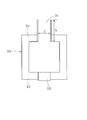
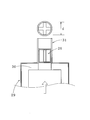
- FIG. 1 It is sectional drawing of the heating furnace which mounts an inorganic compounding molding. It is explanatory drawing which shows the mounting state of an inorganic compounding molding.
- a thermal efficiency improving device 10 for a heating device is a heating furnace 11 that is an example of a heating device.
- the heat-resistant inorganic material is disposed along the flow of the first example) so as not to block the flow of the exhaust gas (inserted directly into the exhaust gas passage 15 without using a support member) and heated by the exhaust gas.
- the composite molded product 16 is included. Thereby, the radiant heat radiated from the heated inorganic composite molded product 16 is returned to the heating chamber 12 through the exhaust gas passage 15 and the exhaust port 14, thereby reducing the heat flowing away from the heating chamber 12 to the outside. I am letting. Details will be described below.
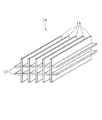
- the inorganic composite molded product 16 is an assembled body (aggregate) formed by incorporating a plurality of plate-like materials 17 and 18 in a lattice shape in plan view. Body).
- the exhaust gas flows along the flat objects 17 and 18 and the side portions of the exhaust gas path 15. And when exhaust gas passes along the flat objects 17 and 18, heat exchange is performed between the flat objects 17 and 18, and the flat objects 17 and 18 (inorganic composite molding 16) are carried out. Heated.
- the inorganic composite molded product 16 may be fixed in the exhaust gas path 15 via a support member in addition to being directly installed in the exhaust gas path 15.
- the supporting member is manufactured using a heat-resistant iron-chromium wire and its wire mesh, a high heat-resistant oxide (for example, alumina), or a high heat-resistant non-oxide (for example, silicon carbide, silicon nitride, sialon). To do. As a result, deformation and breakage of the support member at a high temperature can be prevented, and the support member can be used stably over a long period of time.
- the structure having a blade-shaped member is, for example, an inorganic composite molded product that covers (heat shields) a fan blade installed in a passage through which heated gas passes or forms a blade itself, or a passage.
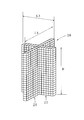
- the flat object 17 has a half of the length L1 of the flat object 17 along the longitudinal direction at a portion that divides the length W1 of the flat object 17 into six equal parts.
- a notch 19 (width T1 is 0.5 to 1 mm larger than the thickness of the flat plate 18) is formed, and the flat plate 18 has a width W2 of the flat plate 18 in the width direction.
- a cut 20 having a length half the length L2 of the flat plate 18 along the longitudinal direction (width T2 is 0.5 to 1 mm larger than the thickness of the flat plate 17) is formed in a portion equally divided into three. Is formed. Then, the notch 19 of the flat plate 17 and the notch 20 of the flat plate 18 are inserted and combined along the cuts 19 and 20, thereby forming the inorganic composite molded product 16 shown in FIG.
- the flat objects 17 and 18 include an inner layer and an outer layer made of an inorganic material coating that protects the inner layer from the heated gas.
- the inner layer is formed of a reinforcing material made of a cloth member formed of heat-resistant inorganic fibers and a ceramic matrix filled in the space of the reinforcing material.
- a fiber processed product using heat-resistant inorganic fibers for example, a one-way aligned laminate of long fibers made of heat-resistant inorganic fibers, It is possible to use a reinforcing material formed using a short-fiber 1-70 mm short fiber cross-complex or oriented body made of heat-resistant inorganic fibers).
- the cloth member is formed by cutting a cloth material formed from a woven fabric having a thickness of 0.2 to 10 mm and an opening ratio of 30% or less, or a nonwoven fabric having a thickness of 1 to 10 mm and a volume porosity of 50 to 97%.
- the woven fabric is any one of plain weave, satin weave, twill weave, three-dimensional weave, and multiaxial weave. Thereby, the optimal cloth member according to the objective can be obtained by selecting the kind of textiles.
- the cloth member is either one or both of a woven fabric having a thickness of 0.2 mm to 10 mm, an opening ratio of 30% or less, and a nonwoven fabric having a thickness of 1 mm to 10 mm and a volume porosity of 50% to 97%. It can also be formed from a laminated fabric laminate.
- the cloth member is manufactured by cutting a cloth material composed of composite inorganic fibers (an example of heat-resistant inorganic fibers) having a multilayer structure having an inner shell structure and an outer shell structure.
- the inner shell structure is (1) an inorganic substance containing Si, C, O, and Me, where Me is one metal component selected from Ti, Zr, and Al, and (2) Ti, Zr, One metal component selected from Al and Al is Me, one metal component selected from Ti and Zr is Ms, and its carbide is MsC.
- the outer shell structure is Al, Ti, Cr, Fe, Si, Co, Ni, Cu, Y, Zr, Nb, Tc, Ru, Rh, Pd, Ag, La, Ce, Pr, Nd, Pm, Sm. , Eu, Gd, Tb, Dy, Ho, Er, Tm, Yb, Lu, Hf, Ta, Re, and Os as the first group, (1) of one element selected from the first group Oxide, (2) a composite oxide composed of two or more elements selected from the first group, (3) a solid solution oxide of two or more elements selected from the first group, and (4) a composite oxidation with oxides (5) oxide and solid solution oxide, (6) composite oxide and solid solution oxide, and (7) oxide, composite oxide and solid solution oxide. .
- the value of the thermal expansion coefficient of the inorganic substance forming the outer shell structure is within ⁇ 10% of the value of the thermal expansion coefficient of the inorganic substance forming the inner shell structure, and the thickness of the outer shell structure is It is 0.2 ⁇ m or more and 10 ⁇ m or less. Thereby, even if temperature variation occurs in the composite inorganic fiber, it is possible to prevent the outer shell structure from being separated from the inner shell structure.
- each element of Y, Yb, Er, Ho, and Dy is a second group
- each element of Y, Yb, Er, Ho, Dy, Gd, Sm, Nd, and Lu is a third group.
- the general formulas Q 2 Si 2 O 7 , QSiO 5 , R 3 It consists of one or more of Al 5 O 12 and RAlO 3 .
- any one of C, BN, Si 3 N 4 , Si—N amorphous inorganic material, and Si—N—O amorphous inorganic material is provided between the inner shell structure and the outer shell structure.
- an intervening layer consisting of a combination of two or more and having a thickness of 0.1 to 3.0 ⁇ m is present. Thereby, the brittle fracture of the inner shell structure can be prevented.
- an internal layer is formed by forming a ceramic matrix with the following method, for example.
- the cloth member is immersed (impregnated) in a solution in which the organosilicon compound is dissolved at room temperature and then taken out from the solution.
- a non-oxidizing atmosphere for example, a nitrogen gas atmosphere
- a non-oxidizing atmosphere for example, a nitrogen gas atmosphere
- the ceramic matrix which consists of the mineralization product obtained from an organosilicon compound can be filled into the space
- the impregnation of the organosilicon compound and the heat treatment are further repeated, so that the filling rate of the ceramic matrix existing in the voids of the composite inorganic fibers is increased. Can be improved.
- the ceramic matrix is (1) inorganic containing Si, C, O, and Md, where Md is one metal component selected from Ti, Zr, and Al. (2) One metal component selected from Ti, Zr, and Al is Md, one metal component selected from Ti, Zr is Mp, and its carbide is MpC.
- ⁇ -SiC 1) Between crystalline ultrafine particles having a particle diameter of 700 nm or less containing MpC, 3) a solid solution of ⁇ -SiC and MpC and / or MpC 1-x (0 ⁇ x ⁇ 1), and crystalline ultrafine particles And any one of the aggregates with the amorphous inorganic substance containing Si, C, O, and Md.
- the ceramic matrix contains (3) Si, C, and O present between the crystalline ultrafine particles of ⁇ -SiC having a particle diameter of 700 nm or less and the crystalline fine particles And (4) an amorphous inorganic material composed of Si, C, and O, and (5) a crystalline inorganic material composed of ⁇ -SiC microcrystals.
- the ceramic matrix is composed of (6) a crystalline inorganic substance composed of ⁇ -SiC microcrystals.
- the ceramic matrix is made of (7) a crystalline inorganic substance composed of ⁇ -SiC microcrystals, which are carbonization reaction products, by injecting molten silicon after carbon is present in the voids of the composite inorganic fiber, (8) A crystalline inorganic substance composed of microcrystals of ⁇ -SiC, which is a carbonization reaction product, by injecting molten silicon and a carbon compound (for example, methane, ethane) into the voids of the composite inorganic fiber and reacting them.
- a carbon compound for example, methane, ethane
- the composite inorganic fiber with SiC fine powder containing a sintering aid and heating it, it is composed of any one of crystalline inorganic substances consisting of ⁇ -SiC microcrystals that are sintering reaction products You can also
- the organosilicon compound a silazane-based polymer containing Si and N can also be used.
- the ceramic matrix is composed of (10) Si—N amorphous inorganic material, (11) Si—N—O amorphous inorganic material, (12) Si 3 N 4 crystalline Fine particles, (13) Si—N amorphous inorganic substance and Si 3 N 4 crystalline ultrafine particles, (14) Si—N—O amorphous inorganic substance and Si 3 N 4 crystalline ultrafine particles 1 is composed.
- Si 3 N 4 fine powder containing a sintering aid is filled in the voids of the composite inorganic fiber and heated, and heated, and Si 3 N 4 crystalline ultrafine particles as a sintered reaction product are heated. Any one of the above can also be used.
- the inorganic material coating forming the outer layer is Al, Ti, Cr, Fe, Si, Co, Ni, Cu, Y, Zr, Nb, Tc, Ru, Rh, Pd, Ag, La, Ce, Pr, Nd. , Pm, Sm, Eu, Gd, Tb, Dy, Ho, Er, Tm, Yb, Lu, Hf, Ta, Re, and Os as the first group, (1) selected from the first group 1) an oxide of one element, (2) a composite oxide composed of two or more elements selected from the first group, (3) a solid solution oxide of two or more elements selected from the first group, (4) oxidation A material A composed of any one of (5) oxide and solid solution oxide, (6) complex oxide and solid solution oxide, and (7) oxide, complex oxide and solid solution oxide.
- the outer layer has a thickness of 0.2 ⁇ m or more and 10 ⁇ m or less. Thereby, the long-term durability under high temperature and severe conditions of the inorganic composite molded product can be improved.
- the solid solution oxide includes Y, Yb, Er, Ho, and Dy elements as the second group, and Y, Yb, Er, Ho, Dy, Gd, Sm, Nd, and Lu elements as the third group.
- the general formulas Q 2 Si 2 O 7 , QSiO 5 , R 3 Al It consists of any one or more of 5 O 12 and RAlO 3 .
- the outer layer made of the inorganic material coating that protects the inner layer from the heated gas is formed, for example, by the following method.
- the inner layer (a cloth member in which the ceramic matrix is filled in the voids) is immersed in a solution in which the material A is dispersed, and the powder of the material A is adhered to the surface of the inner layer by electrophoresis.
- the internal layer to which the powder of the material A is adhered is taken out from the solution, dried, and then heat-treated in a non-oxidizing atmosphere, whereby the powder of the material A is sintered and fixed to the internal layer.
- an inorganic material covering made of a sintered layer of the material A is formed as an outer layer outside the inner layer.
- the heat treatment conditions in the non-oxidizing atmosphere (for example, the type of the non-oxidizing atmosphere, the heat treatment temperature, the heat treatment time, the atmospheric pressure during the heat treatment, etc.) are determined based on the composition of the material A.
- one metal component selected from Ti, Zr and Al is defined as Me, and is composed of an inorganic substance containing Si, C, O, and Me.
- Made of heat-resistant inorganic fiber (2) heat-resistant inorganic fiber made of inorganic material containing Si, C, and O, or (3) made of crystalline inorganic material made of ⁇ -SiC microcrystals
- Fabric M formed using heat-resistant inorganic fibers in the case of woven fabric, the thickness is 0.2 to 10 mm and the opening ratio is 30% or less, and in the case of nonwoven fabric, the thickness is 1 to 10 mm and the volume porosity is
- the fabric member M can also be manufactured from the above.
- the particle size contains 1) ⁇ -SiC, 2) MpC, 3) a solid solution of ⁇ -SiC and MpC and / or MpC 1-x (0 ⁇ x ⁇ 1).
- An aggregate of crystalline ultrafine particles of 700 nm or less and an amorphous inorganic material containing Si, C, O, and Md existing between the crystalline ultrafine particles is included.
- the inorganic substance containing Si, C, and O includes an amorphous material containing Si, C, and O present between the crystalline ultrafine particles of ⁇ -SiC having a particle diameter of 700 nm or less and the crystalline fine particles. Aggregates with fine inorganic substances are included.
- the method of filling the voids of the fabric member M with the ceramic matrix can be performed in the same manner as in the case of using a fabric member composed of composite inorganic fibers.
- the fabric material M used to fabricate the fabric member M contains chemical fibers (for example, rayon fibers), or when a sizing agent is applied to the fabric material.
- the fabric member M produced by cutting M is heat-treated in an inert gas atmosphere (nitrogen gas atmosphere, preferably argon gas atmosphere) at a temperature of 800 to 1200 ° C. for 0.5 to 5 hours to be completely inorganic. (Chemical fiber is completely decomposed and removed, or part is decomposed and removed, and the remainder is carbonized, and the sizing agent is completely removed).
- an inert gas atmosphere nitrogen gas atmosphere, preferably argon gas atmosphere
- C, BN, Si 3 N 4 , Si—N-based amorphous inorganic material, and Si—N—O-based non-coated material are formed on the surface of the heat-resistant inorganic fiber constituting the fabric member M that has been completely inorganicized.
- a coating layer made of any one or a combination of two or more crystalline inorganic substances and having a thickness of 0.1 to 3.0 ⁇ m is provided.
- the fabric member M was produced from the fabric material M formed using heat-resistant inorganic fibers having no inner shell structure and outer shell structure, and the gap of the fabric member M was filled with the ceramic matrix.
- the surface of the heat-resistant inorganic fiber is formed by, for example, attaching the powder of the material A by electrophoresis on the outside of the heat-resistant inorganic fiber forming the cloth member M and performing heat treatment.
- a sintered layer made of the material A may be fixed to.
- the heat resistant inorganic fiber which forms the cloth member M can be changed into the state of a composite inorganic fiber, and the corrosion resistance of the heat resistant inorganic fiber can be improved.
- C, BN, Si 3 N 4 , Si—N amorphous inorganic substance, and Si—N—O amorphous inorganic substance are formed on the surface of the heat resistant inorganic fiber forming the cloth member M. It is preferable that an intervening layer comprising any one or a combination of two or more and having a thickness of 0.1 to 3.0 ⁇ m is present. Thereby, the brittle fracture
- the thermal efficiency improvement method of the heating apparatus using the thermal efficiency improvement apparatus 10 of the heating furnace which concerns on one Example of this invention is demonstrated.
- the exhaust gas is a flat plate 17 constituting the inorganic composite molded product 16
- the gaps between the plates 18 and the flat objects 17 and 18 and the side portions of the exhaust gas passage 15 flow along the exhaust gas passage 15 and are discharged to the outside.
- the inorganic composite molded product 16 flat plates 17 and 18
- the inorganic composite in the exhaust gas path 15 is radiated by the radiant heat radiated from the heated inorganic composite molded product 16.
- the region upstream of the position where the molded product 16 is installed is heated and the temperature rises.
- the radiant heat radiated from the upstream region of the exhaust gas passage 15 increases, and a part of the heat enters the heating chamber 11 to reduce the heat flowing out of the heating furnace 11 to the outside. it can.
- the exhaust gas flows along the exhaust gas path 15 through the gap between the flat objects 17 and 18 and the gap between the flat objects 17 and 18 and the side of the exhaust gas path 15. Since the passage of the exhaust gas is not hindered even if the composite molded product 16 is installed, the flow of the gas in the furnace in the heating chamber 12 is the same as the case where the inorganic composite molded product 16 is not installed in the exhaust gas path 15.
- the thermal efficiency improving apparatus 10 can be easily applied to the existing heating furnace 11 without fear of an increase in furnace pressure. Furthermore, since the inorganic composite molded product 16 can be easily attached to and removed from the exhaust gas passage 15, maintenance management of the thermal efficiency improvement device 10 is facilitated.
- the inorganic composite molded product 16 includes an inner layer and an outer layer made of an inorganic material covering for protecting the inner layer, and the inorganic material covering forming the outer layer is made of Al, Ti, Cr, Fe. Si, Co, Ni, Cu, Y, Zr, Nb, Tc, Ru, Rh, Pd, Ag, La, Ce, Pr, Nd, Pm, Sm, Eu, Gd, Tb, Dy, Ho, Er, Tm , Yb, Lu, Hf, Ta, Re, and Os as a first group, (1) an oxide of one element selected from the first group, (2) 2 selected from the first group (3) a solid solution oxide of two or more elements selected from the first group, (4) an oxide and a complex oxide, (5) an oxide and a solid solution oxide, (6) 1) any of complex oxide and solid solution oxide, and (7) oxide, complex oxide and solid solution oxide.
- the thickness of the outer layer since a 0.2 ⁇ m or 10 ⁇ m or less, even if the temperature variation occurs in the outer layer, it is possible to prevent the outer layer is peeled off from the inner layer.
- the exhaust gas contains a component that degrades the inner layer, the deterioration of the characteristics (for example, the decrease in strength, the decrease in thermal emissivity, etc.) due to the material change of the inner layer is suppressed.
- the solid solution oxide includes Y, Yb, Er, Ho, and Dy elements as the second group, and Y, Yb, Er, Ho, Dy, Gd, Sm, Nd, and Lu elements as the second group.
- the third group when at least one element selected from the second group is Q and at least one element selected from the third group is R, the general formulas Q 2 Si 2 O 7 , QSiO 5 , R 3 When composed of one or more of Al 5 O 12 and RAlO 3 , the heat resistance and corrosion resistance of the solid solution oxide (that is, the outer layer) can be improved, so that the material change of the inner layer is surely prevented. And the stability of the inner layer can be further enhanced.
- the inorganic composite molded product can easily follow the temperature fluctuation of the heating gas regardless of the material of the outer layer and becomes high temperature. In particular, the radiation efficiency of radiant heat can be increased.
- the inner shell structure and outer shell structure of the composite inorganic fiber forming the reinforcing material of the inner layer are each formed of the inorganic material having the composition shown above, even if temperature fluctuation occurs in the outer shell structure The outer shell structure can be prevented from peeling from the inner shell structure, the inner shell structure can be protected from the heated gas, and the stability of the inner shell structure can be enhanced.
- reference numeral 23 denotes a manual damper
- 24 denotes an opening that is normally closed with a refractory brick.
- the dimensions a, b, and c of the heating chamber 12 are, for example, 700 mm, 400 mm, and 455 mm, but the present invention is not limited to this dimension.
- the opening 24 acts as a cold air vent when the refractory brick is removed.
- Non-woven fabric produced using heat-resistant inorganic fibers formed of an inorganic substance containing Si, C, O, and Zr fiber diameter is 11 ⁇ m, fiber basis weight is 240 g / m 2 , volume porosity is 95%, chemical fiber 2) containing 20% by mass of rayon fiber, which is an example of a roll having a width of 500 mm, a thickness of 5 mm, and a length of 10 m, and cutting two substrates having a length L1 of 320 mm and a width W1 of 200 mm
- Five substrates having a length L2 of 320 mm and a width W2 of 110 mm were produced.
- the base material is set in a heat treatment furnace, and heat-treated at 800 ° C. for 1 hour in an argon gas atmosphere to decompose and remove part of the rayon fibers contained in the base material (nonwoven fabric) to carbonize the remainder.
- the sizing agent (organic matter) applied to the substrate was removed (first step).
- the heat-treated substrate is bonded by two stainless steel meshes serving as anode electrodes, and yttrium monosilicate (Y 2 SiO 5 ), which is a solid solution oxide composed of Si and Y elements selected from the first group.
- Y 2 SiO 5 yttrium monosilicate
- Dispersion (with a particle diameter of 1 ⁇ m or less) uniformly dispersed in an ethanol solvent (100 parts of ethanol, 2.5 parts of Y 2 SiO 5 fine powder, 0.02 part of cyclohexanol-based dispersant, 0 polyvinyl butyral as a binder) 0.02 parts added and ultrasonically dispersed and adjusted) and placed between two cathode electrodes made of C / C composite that face each other at a distance.
- ethanol solvent 100 parts of ethanol, 2.5 parts of Y 2 SiO 5 fine powder, 0.02 part of cyclohexanol-based dispersant, 0 polyvinyl butyral as a binder
- the substrate was taken out from the dispersion solution, drained, air-dried for 2 hours, and hot-air dried for 6 hours at 40 ° C. in the air atmosphere (third step), and then under a slight pressure of 0.5 MPa in an argon gas atmosphere
- the refractory inorganic fiber is made to have an inner shell structure by sintering at 1400 ° C. for 3 hours to sinter the yttrium monosilicate powder adhered to the outside of the refractory inorganic fiber and fix it to the refractory inorganic fiber.
- the cloth member After immersing the cloth member in a solution of 30% by weight of polyzirconocarbosilane uniformly dissolved in a xylene solvent at room temperature, the cloth member is taken out from the solution and dried in a nitrogen gas atmosphere at 150 ° C. for 2 hours to be included in the cloth member.
- the xylene solvent was removed to prepare 7 fabric members (contained in the voids of the fabric member) containing polyzirconocarbosilane (fifth step).
- Si, C, O which are mineralized products obtained by baking a cloth member containing polyzirconocarbosilane for 1 hour at 1200 ° C.
- the fifth step and the sixth step are further repeated three times to obtain a fabric member ( A non-woven fabric composed of composite inorganic fibers) and a ceramic matrix comprising an inorganic substance containing Si, C, O and Zr, which are mineralized products obtained by thermal decomposition of polyzirconocarbosilane
- a fabric member A non-woven fabric composed of composite inorganic fibers
- a ceramic matrix comprising an inorganic substance containing Si, C, O and Zr, which are mineralized products obtained by thermal decomposition of polyzirconocarbosilane
- the molded body obtained in the eighth step is bonded with two stainless steel metal meshes serving as anode electrodes, and a solid solution oxide yttrium monosilicate (Y 2 SiO 5 ) powder (particle size of 1 ⁇ m or less) is placed in an ethanol solvent.
- Uniformly dispersed solution 100 parts of ethanol, 2.5 parts of Y 2 SiO 5 fine powder, 0.02 part of cyclohexanol dispersant, 0.02 part of polyvinyl butyral as a binder is added, and ultrasonically dispersed to adjust
- a DC voltage of 100 V was applied for 30 minutes from a DC stabilized power source at 25 ° C., and yttrium monosilicate powder was adhered to the surface of the molded body by electrophoresis (9th step).
- the molded product was taken out from the dispersion, drained, air-dried for 2 hours, and hot-air dried at 40 ° C. for 6 hours in the air atmosphere (10th step), and then subjected to a slight pressure of 0.5 MPa in an argon gas atmosphere. Then, heat treatment is performed at 1400 ° C. for 3 hours to sinter the yttrium monosilicate powder adhering to the surface of the molded body and fix it to the molded body, so that the inner layer portion is a cloth member (composite inorganic fiber).
- the outer layer portion is formed of a reinforcing material of a configured non-woven fabric) and a ceramic matrix made of an inorganic substance containing Si, C, O, and Zr, which are mineralized products obtained by thermal decomposition of polyzirconocarbosilane.
- inorganic composite moldings that are inorganic material coatings made of yttrium monosilicate for further improving the durability (length L1 is 320 mm, width W1 is 200 mm, thickness 3) m is two, vertical L2 is 320 mm, the lateral W2 is 110 mm, a thickness of 3mm is 5 sheets) were prepared (eleventh step).
- the seven inorganic composite molded products obtained in the eleventh step are assembled in a lattice shape as shown in FIG. 2 using the provided incisions, and the installation location is fixed with an alumina-based heat-resistant adhesive.
- An apparatus for improving the thermal efficiency of a heating device made of an inorganic composite molded product incorporated in a lattice shape was produced.
- the inorganic composite molded product 16 that is the thermal efficiency improving device 10 of the heating device was inserted along the flow of the heated gas into the exhaust gas passage 15 that is the passage of the heated gas.
- the high-temperature gas kiln is a ceiling arch type gas kiln equipped with six to three pairs of LPG venturi burners.
- the hearth 13 has a width of 19 to 29 mm and a length of, for example, 200 mm to 450 mm. Are arranged side by side, and the heated gas in the furnace flows into the exhaust gas path 15 through the exhaust port 14, passes through the inorganic composite molded product 16, and then has a manual damper 23 provided on the downstream side of the exhaust gas path 15. After that, it is released to the outside.
- the furnace pressure is finely adjusted by the manual damper 23.
- the temperature was raised from room temperature in 7.2 hours until the furnace temperature showed 1200 ° C., and the furnace temperature was kept constant at 1200 ° C.
- Time operation was performed, and the amount of LPG consumed was compared and compared with the case where the inorganic composite molded product was not attached.
- the total consumption of the fuel LPG when the inorganic composite molded product is mounted is 10080 liters (the LPG gas instantaneous average flow rate is 15 liters / minute), and the total consumption when the inorganic composite molded product is not mounted is 11424 liters.
- the LPG gas instantaneous average flow rate is 17 liters / minute. From this result, it is possible to reduce the LPG consumption rate by about 11.8% by mounting the inorganic composite molded product. It was found that the heating device showed excellent thermal efficiency improvement effect. In addition, almost the same result was obtained in the confirmation test of the same operation for 10 times thereafter, and no deterioration was found in the inorganic composite molded product recovered after the 10 confirmation tests. However, even at a high temperature of 1200 ° C., it was confirmed that stable performance could be maintained over a long period of time.
- Example 2 A plain fabric composed of heat-resistant inorganic fibers formed of an inorganic substance containing Si, C, and O (fiber basis weight is 289 g / m 2 , width is 500 mm, thickness is 0.33 mm, and length is 5 m. From a roll), one cloth member having a length of 200 mm, a width of 60 mm, and a thickness of 0.33 mm and two cloth members having a length of 200 mm, a width of 30 mm, and a thickness of 0.33 mm were cut out (first step).
- the fabric member is immersed at room temperature in a solution in which perhydropolysilazane, —Si (H 2 ) —NH—n, is uniformly dissolved in a xylene solvent at 20 wt%, and then taken out from the solution.
- the xylene solvent contained in the cloth member was removed by drying at 0 ° C. for 2 hours.
- the cloth member from which the xylene solvent has been removed is baked at 1200 ° C. for 1 hour in a nitrogen gas atmosphere, and the surface of the heat-resistant inorganic fiber constituting the plain fabric as the cloth member is Si—N-based (containing a trace amount of O).
- An inorganic substance amorphous inorganic substance composed of Si, N and / or Si 3 N 4 microcrystalline substance was coated (second step).
- the cloth member obtained in the second step (a plain woven fabric composed of heat-resistant inorganic fibers coated with Si-N inorganic material) was dissolved in a solution of 30% by weight of polycarbosilane uniformly dissolved in a xylene solvent at room temperature. After being soaked under the cloth, it is taken out from the solution and dried in a nitrogen gas atmosphere at 150 ° C. for 2 hours to remove the xylene solvent contained in the cloth member to contain the polycarbosilane (contained in the gap of the cloth member) 3 A sheet was produced (third step). Next, the cloth member containing polycarbosilane is fired at 1300 ° C.
- the third step and the fourth step were repeated twice more to obtain a cloth member (Si—N
- a molded body (finished body) formed in (5) was produced.
- using the molded body obtained in the fifth step instead of the solid solution oxide yttrium monosilicate (Y 2 SiO 4 ) powder used in Experimental Example 1, zircon (zirconium monosilicate), which is a solid solution oxide, is used.
- the treatment was performed in the same manner as the ninth step and the tenth step in Experimental Example 1 (the sixth step and the seventh step). Further, in the eleventh step of Experimental Example 1, 1400 ° C.
- the inner layer of the cloth member (inorganic coated with Si—N inorganic material) was treated in exactly the same way as the eleventh step of Experimental Example 1 except that the heat treatment was performed at 1500 ° C. for 0.5 hour instead of the heat treatment for 3 hours.
- the outer layer is a flat plate of a multilayer structure, which is an inorganic material coating made of zircon to further improve the durability (length 200 mm, width 60 mm, thickness 0.2 mm one, length 200 mm , Width 30 mm, thickness 0.2 mm 2 sheets) (8th step).
- the three flat plates obtained in the eighth step are cruciform lattices with wire meshes 26 and 27 of heat-resistant iron-chromium wires (wire diameter: 1 mm, 15 mesh).
- An inorganic composite molded product incorporated in a shape was formed to produce a thermal efficiency improving device 28 of a heating device (9th step).
- L3 and L4 are, for example, 60 mm
- H is, for example, 200 mm.
- the thermal efficiency improving device 28 for a heating device made of the obtained inorganic composite molded product has an inner diameter d of 60 mm and a height h formed at the center of the ceiling portion 30 of the electric furnace 29. Is inserted from the inlet side (furnace inside) of the 450 mm exhaust port 31, and the state of the iron-chromium wire meshes 26 and 27 sandwiching the inorganic composite molded product is prevented so that the inorganic composite molded product does not fall off. It was mounted while adjusting (mounted so that one end of the inorganic composite molded product coincided with the inlet position of the exhaust port 31).
- the electric furnace 29 is always kept at 800 ° C. (controlled by the temperature at the center of the electric furnace) Then, air is circulated in the electric furnace 29 at a flow rate of 1 liter / min from the air inlet 33 formed in the center portion of the hearth 32 of the electric furnace 29, and the power consumption W1 of the electric furnace 29 at that time is reduced. The rate was examined.
- the reduction rate of the power consumption P1 is such that air is discharged from the air inlet 33 in the center of the hearth at a flow rate of 1 liter / min without installing a thermal efficiency improvement device in the exhaust port 31 of the electric furnace 29.
- the electric power is calculated by 100 ⁇ (P0 ⁇ P1) / P0.
- the thermal efficiency improvement device 28 was installed, the power consumption reduction rate showed a value of 12% compared to the case where it was not installed, and this reduction rate was constant without changing over 10 hours.
- the inorganic composite molded product has an excellent radiant heat radiation action, which greatly contributes to energy saving in the operation of the electric furnace 29, and as a result, it is suggested that it greatly contributes to reduction of CO 2 generation. It was.
- Nonwoven fabric composed of heat-resistant inorganic fibers formed of an inorganic substance containing Si, C, O and Ti (fiber diameter is 11 ⁇ m, fiber basis weight is 240 g / m 2 , volume porosity is 95%, an example of chemical fiber 20% by weight of rayon fiber, and rolled into a roll having a width of 500 mm, a thickness of 5 mm, and a length of 10 m), and a single substrate having a length of 200 mm, a width of 60 mm, and a thickness of 5 mm, Two substrates having a thickness of 200 mm, a width of 30 mm, and a thickness of 5 mm were produced.
- the base material is set in a heat treatment furnace, and heat-treated at 800 ° C. for 1 hour in an argon gas atmosphere to decompose and remove part of the rayon fibers contained in the base material (nonwoven fabric) to carbonize the remainder.
- the sizing agent (organic matter) applied to the substrate was removed (first step).
- the heat-treated base material is bonded with two stainless steel meshes serving as anode electrodes, and zircon (also called zirconium monosilicate, ZrSO 4 ), which is a solid solution oxide composed of elements of Si and Zr selected from the first group.
- zircon also called zirconium monosilicate, ZrSO 4
- Dispersion solution 100 parts ethanol, 2.5 parts zircon powder, 0.02 parts cyclohexanol dispersant, 0.02 part polyvinyl butyral as a binder
- a powder particle size of 1 ⁇ m or less
- the distance between the two cathode electrodes made of C / C composite disposed opposite to each other is provided.
- the substrate was taken out of the dispersion solution, drained, air-dried for 2 hours, and hot-air dried for 6 hours at 40 ° C. in the air atmosphere (third step), and then under a slight pressure of 0.5 MPa in an argon gas atmosphere, Heat treatment is performed at 1500 ° C. for 0.5 hours to sinter the zircon powder adhered to the outside of the heat-resistant inorganic fiber and fix it to the heat-resistant inorganic fiber.
- a cloth member made of a nonwoven fabric composed of composite inorganic fibers having a thickness of 1 mm, a length of 200 mm, a width of 30 mm, and a thickness of 2 mm was prepared (fourth step).
- the cloth member is immersed in a solution in which 30% by weight of polytitanocarbosilane is uniformly dissolved in a xylene solvent at room temperature, then taken out from the solution and dried in a nitrogen gas atmosphere at 150 ° C. for 2 hours to be contained in the cloth member.
- the xylene solvent was removed, and three cloth members (contained in the voids of the cloth member) containing polytitanocarbosilane were produced (fifth step).
- the cloth member containing polytitanocarbosilane is heat treated at 1300 ° C.
- Si, C, O which are mineralized products obtained by thermal decomposition of polytitanocarbosilane.
- an inorganic substance containing Ti and producing a primary body of a molded body formed of a reinforcing material for a cloth member and a ceramic matrix made of an inorganic substance containing Si, C, O and Ti. (6th process).
- the fifth step and the sixth step are repeated four more times to form a cloth member (composed of composite inorganic fibers).
- a non-woven fabric reinforcement and a molded body made of a ceramic matrix made of an inorganic substance containing Si, C, O, and Ti, which are mineralized products obtained by thermal decomposition of polytitanocarbosilane Body) (seventh step).
- the molded body obtained in the seventh step was used in exactly the same manner as in the ninth to eleventh steps of Experimental Example 1, and the inner layer was made of a cloth member (composed of composite inorganic fibers).
- Non-woven fabric and a ceramic matrix composed of an inorganic substance containing Si, C, O and Ti, which are mineralized products obtained by thermal decomposition of polytitanocarbosilane, and the outer layer is
- Three inorganic composite moldings with a multilayer structure which is an inorganic material coating made of yttrium monosilicate for further improving durability (200 mm in length, 60 mm in width, 1 in 3 mm in thickness, 200 mm in length, 30 mm in width) , 2 mm in thickness 3 mm) were produced (eighth step).
- the thermal efficiency improvement device When the thermal efficiency improvement device was installed in this test, the power consumption reduction rate showed a high value of 20% compared to the case where it was not installed, and this reduction rate remained constant for 300 hours and was incorporated into a cross shape. It was confirmed that the inorganic composite molded product has an excellent radiant heat radiation effect, and it was suggested that it greatly contributes to energy saving in the operation of the electric furnace and consequently contributes greatly to reduction of CO 2 generation. In addition, when the inorganic composite molded product recovered after the test was observed, no change such as deterioration was observed, and it was confirmed that it could maintain a constant performance at a high temperature of 1200 ° C. for a long period of time. .
- the present invention has been described above with reference to the embodiments. However, the present invention is not limited to the configurations described in the above-described embodiments, and is within the scope of the matters described in the claims. Other possible embodiments and modifications are also included. Further, the present invention includes a combination of components included in the present embodiment and other embodiments and modifications. For example, in this embodiment, non-oxide heat-resistant inorganic fibers are used, but heat-resistant inorganic fibers made of an inorganic material containing Al, Si, and O can also be used.
- Heating the inorganic composite molded product with heated gas and returning the radiant heat from the heated inorganic composite molded product into the heating device reduces the heat that flows out of the heating device, increasing the efficiency of the heating device. Energy loss can be reduced.
Landscapes
- Engineering & Computer Science (AREA)
- Chemical & Material Sciences (AREA)
- Ceramic Engineering (AREA)
- Manufacturing & Machinery (AREA)
- Materials Engineering (AREA)
- Structural Engineering (AREA)
- Organic Chemistry (AREA)
- Inorganic Chemistry (AREA)
- General Engineering & Computer Science (AREA)
- Mechanical Engineering (AREA)
- Chemical Kinetics & Catalysis (AREA)
- Environmental & Geological Engineering (AREA)
- Physics & Mathematics (AREA)
- Thermal Sciences (AREA)
- Waste-Gas Treatment And Other Accessory Devices For Furnaces (AREA)
- Resistance Heating (AREA)
- Ceramic Products (AREA)
Abstract
L'invention porte sur un procédé pour l'amélioration du rendement thermique d'un dispositif de chauffage, suivant lequel un produit moulé composite inorganique résistant à la chaleur (16) est installé le long d'un passage (15) pour du gaz chauffé produit à partir d'un dispositif de chauffage (11), sans blocage de la circulation du gaz chauffé passant dans le passage (15), et le produit moulé composite inorganique (16) est chauffé par le gaz chauffé et la chaleur rayonnante provenant du produit moulé composite inorganique chauffé (16) est renvoyée vers l'intérieur du dispositif de chauffage (11), ce qui réduit de cette manière la chaleur qui part vers l'extérieur du dispositif de chauffage (11). Le produit moulé composite inorganique (16) est pourvu d'une couche interne et d'une couche externe qui comprend un revêtement de matériau inorganique et qui protège la couche interne du gaz chauffé.
Priority Applications (2)
| Application Number | Priority Date | Filing Date | Title |
|---|---|---|---|
| EP14833696.9A EP3032207B1 (fr) | 2013-08-09 | 2014-05-26 | Procédé pour l'amélioration du rendement thermique d'un dispositif de chauffage et dispositif pour l'amélioration du rendement thermique d'un dispositif de chauffage |
| US14/910,714 US10267579B2 (en) | 2013-08-09 | 2014-05-26 | Method and apparatus for improving thermal efficiency of heating device |
Applications Claiming Priority (2)
| Application Number | Priority Date | Filing Date | Title |
|---|---|---|---|
| JP2013-166612 | 2013-08-09 | ||
| JP2013166612A JP5640123B1 (ja) | 2013-08-09 | 2013-08-09 | 加熱機器の熱効率改善方法及び加熱機器の熱効率改善装置 |
Publications (1)
| Publication Number | Publication Date |
|---|---|
| WO2015019681A1 true WO2015019681A1 (fr) | 2015-02-12 |
Family
ID=52145710
Family Applications (1)
| Application Number | Title | Priority Date | Filing Date |
|---|---|---|---|
| PCT/JP2014/063849 Ceased WO2015019681A1 (fr) | 2013-08-09 | 2014-05-26 | Procédé pour l'amélioration du rendement thermique d'un dispositif de chauffage et dispositif pour l'amélioration du rendement thermique d'un dispositif de chauffage |
Country Status (4)
| Country | Link |
|---|---|
| US (1) | US10267579B2 (fr) |
| EP (1) | EP3032207B1 (fr) |
| JP (1) | JP5640123B1 (fr) |
| WO (1) | WO2015019681A1 (fr) |
Families Citing this family (3)
| Publication number | Priority date | Publication date | Assignee | Title |
|---|---|---|---|---|
| US20180085826A1 (en) * | 2016-09-28 | 2018-03-29 | Tyco Electronics Corporation | Method and device for controlling printing zone temperature |
| JP6989878B2 (ja) * | 2017-11-27 | 2022-01-12 | 株式会社Ihi | 繊維強化複合材料に利用される耐環境性の被覆強化繊維 |
| EP3819280A1 (fr) * | 2019-11-06 | 2021-05-12 | Orkli, S. Coop. | Surfaces composites continues et surfaces de brûleurs |
Citations (5)
| Publication number | Priority date | Publication date | Assignee | Title |
|---|---|---|---|---|
| JP3136873U (ja) * | 2007-08-14 | 2007-11-08 | 株式会社サン・フロンティア・テクノロジー | 高温ガス顕熱回収マット |
| JP4801789B1 (ja) | 2010-10-07 | 2011-10-26 | 株式会社超高温材料研究センター | 加熱炉の熱効率改善方法及び加熱炉の熱効率改善装置 |
| JP2011220601A (ja) * | 2010-04-08 | 2011-11-04 | Japan Ultra-High Temperature Materials Research Center | 加熱炉の熱遮蔽兼熱輻射反射装置及びその製造方法 |
| JP2011231959A (ja) * | 2010-04-26 | 2011-11-17 | Japan Ultra-High Temperature Materials Research Center | 通気性輻射熱反射体及びその製造方法 |
| JP2012247108A (ja) * | 2011-05-26 | 2012-12-13 | Japan Ultra-High Temperature Materials Research Center | 熱処理炉の熱効率改善方法及び熱処理炉 |
Family Cites Families (10)
| Publication number | Priority date | Publication date | Assignee | Title |
|---|---|---|---|---|
| DE2952216C2 (de) * | 1979-12-22 | 1983-01-27 | Mannesmann AG, 4000 Düsseldorf | Verfahren und Vorrichtung zur Rückgewinnung und Wiederverwertung von Wärme aus den Abgasen metallurgischer Prozesse |
| US4666403A (en) * | 1986-08-06 | 1987-05-19 | Morgan Construction Company | Air preheating system for continuous fired furnace |
| US4966101A (en) * | 1988-05-17 | 1990-10-30 | Ube Industries, Ltd. | Fluidized bed apparatus |
| KR950001255A (ko) * | 1993-06-22 | 1995-01-03 | 조안 엠. 젤사 | 재복사식 로 시스템 |
| US6572370B1 (en) * | 2002-03-07 | 2003-06-03 | Chris Hampden | Heat regulating unit |
| JP4325758B2 (ja) * | 2006-08-10 | 2009-09-02 | 財団法人特殊無機材料研究所 | 物品の省エネルギー加熱方法及び加熱炉 |
| FR2928846B1 (fr) * | 2008-03-20 | 2010-10-22 | Fondis Sa | Dispositif d'epuration a catalyseur des gaz et fumees de combustion d'un appareil de chauffage a combustible solide. |
| WO2015134804A1 (fr) * | 2014-03-05 | 2015-09-11 | Lance Carl Grace | Dispositif de réduction d'émissions pour un chauffage à bois |
| ES2572686T3 (es) * | 2014-05-05 | 2016-06-01 | Refractory Intellectual Property Gmbh & Co. Kg | Elemento cerámico refractario de barrido con gas |
| DE112016002290T5 (de) * | 2015-05-21 | 2018-03-01 | Ngk Insulators, Ltd. | Wärmeaustauschkomponente |
-
2013
- 2013-08-09 JP JP2013166612A patent/JP5640123B1/ja not_active Expired - Fee Related
-
2014
- 2014-05-26 US US14/910,714 patent/US10267579B2/en not_active Expired - Fee Related
- 2014-05-26 EP EP14833696.9A patent/EP3032207B1/fr not_active Not-in-force
- 2014-05-26 WO PCT/JP2014/063849 patent/WO2015019681A1/fr not_active Ceased
Patent Citations (5)
| Publication number | Priority date | Publication date | Assignee | Title |
|---|---|---|---|---|
| JP3136873U (ja) * | 2007-08-14 | 2007-11-08 | 株式会社サン・フロンティア・テクノロジー | 高温ガス顕熱回収マット |
| JP2011220601A (ja) * | 2010-04-08 | 2011-11-04 | Japan Ultra-High Temperature Materials Research Center | 加熱炉の熱遮蔽兼熱輻射反射装置及びその製造方法 |
| JP2011231959A (ja) * | 2010-04-26 | 2011-11-17 | Japan Ultra-High Temperature Materials Research Center | 通気性輻射熱反射体及びその製造方法 |
| JP4801789B1 (ja) | 2010-10-07 | 2011-10-26 | 株式会社超高温材料研究センター | 加熱炉の熱効率改善方法及び加熱炉の熱効率改善装置 |
| JP2012247108A (ja) * | 2011-05-26 | 2012-12-13 | Japan Ultra-High Temperature Materials Research Center | 熱処理炉の熱効率改善方法及び熱処理炉 |
Non-Patent Citations (1)
| Title |
|---|
| See also references of EP3032207A4 |
Also Published As
| Publication number | Publication date |
|---|---|
| US20160187078A1 (en) | 2016-06-30 |
| EP3032207A1 (fr) | 2016-06-15 |
| JP5640123B1 (ja) | 2014-12-10 |
| EP3032207B1 (fr) | 2018-09-05 |
| US10267579B2 (en) | 2019-04-23 |
| JP2015034682A (ja) | 2015-02-19 |
| EP3032207A4 (fr) | 2017-03-22 |
Similar Documents
| Publication | Publication Date | Title |
|---|---|---|
| US6365233B1 (en) | Silicon-doped boron nitride coated fibers in silicon melt infiltrated composites | |
| JP5112681B2 (ja) | 部品の環境障壁コーティング及びタービンエンジン部品 | |
| JP7599674B2 (ja) | 炭化ケイ素セラミックス | |
| EP2970017B1 (fr) | Composites à matrices céramiques à base de sic dotés de matrices en couches et procédés de fabrication de composites à matrices céramiques à base de sic dotés de matrices en couches | |
| WO2016129588A1 (fr) | Élément revêtu, matériau de revêtement et procédé de production d'élément revêtu | |
| JP4801789B1 (ja) | 加熱炉の熱効率改善方法及び加熱炉の熱効率改善装置 | |
| WO2014143649A1 (fr) | Composite à matrice céramique et procédé et articles de fabrication | |
| JP5640123B1 (ja) | 加熱機器の熱効率改善方法及び加熱機器の熱効率改善装置 | |
| EP1059274B1 (fr) | Fibres revêtues de nitrure de bore dopé au silicium dans des composites infiltrés par du silicium fondue | |
| JPWO2011114810A1 (ja) | 繊維束用無機繊維及びその製造方法、その繊維束用無機繊維から構成される複合材料用無機繊維束、並びにその繊維束で強化されたセラミックス基複合材料 | |
| US20110148011A1 (en) | Polycrystalline sic electrical devices and methods for fabricating the same | |
| KR100838825B1 (ko) | 탄화규소 섬유 강화 반응소결 탄화규소 다공체 및 이의제조방법 | |
| JP2017024922A (ja) | セラミック複合材およびその製造方法 | |
| JP5563360B2 (ja) | 通気性輻射熱反射体の製造方法 | |
| JP4394345B2 (ja) | 非酸化物セラミックス焼結用焼成炉と非酸化物セラミックス焼結体の製造方法 | |
| US20240141179A1 (en) | High temperature coatings | |
| JPWO2010143608A1 (ja) | 複合化無機繊維及びその製造方法、並びに複合化無機繊維加工品及びその製造方法 | |
| JP5775746B2 (ja) | 熱処理炉の熱効率改善方法 | |
| JP5862234B2 (ja) | 平滑表面を有するセラミックス基複合部材およびその製造方法 | |
| JP5523904B2 (ja) | 加熱炉の熱遮蔽兼熱輻射反射装置及びその製造方法 | |
| JPH05306180A (ja) | 炭素繊維強化炭素−無機化合物複合材料の製造方法 | |
| JP3574583B2 (ja) | 放熱材及びその製造方法 | |
| JP5427480B2 (ja) | 焼成用容器及び焼成用搬送台車 | |
| JP3246632U (ja) | 加熱装置 | |
| US20250019313A1 (en) | Fast densified carbon-carbon composites and fabrication method |
Legal Events
| Date | Code | Title | Description |
|---|---|---|---|
| 121 | Ep: the epo has been informed by wipo that ep was designated in this application |
Ref document number: 14833696 Country of ref document: EP Kind code of ref document: A1 |
|
| WWE | Wipo information: entry into national phase |
Ref document number: 14910714 Country of ref document: US |
|
| NENP | Non-entry into the national phase |
Ref country code: DE |
|
| WWE | Wipo information: entry into national phase |
Ref document number: 2014833696 Country of ref document: EP |