WO2015029083A1 - Machine de triage par poids, et système de conditionnement et de mesure - Google Patents
Machine de triage par poids, et système de conditionnement et de mesure Download PDFInfo
- Publication number
- WO2015029083A1 WO2015029083A1 PCT/JP2013/005008 JP2013005008W WO2015029083A1 WO 2015029083 A1 WO2015029083 A1 WO 2015029083A1 JP 2013005008 W JP2013005008 W JP 2013005008W WO 2015029083 A1 WO2015029083 A1 WO 2015029083A1
- Authority
- WO
- WIPO (PCT)
- Prior art keywords
- weight
- value
- product
- packaged
- defective
- Prior art date
- Legal status (The legal status is an assumption and is not a legal conclusion. Google has not performed a legal analysis and makes no representation as to the accuracy of the status listed.)
- Ceased
Links
Images





Classifications
-
- G—PHYSICS
- G01—MEASURING; TESTING
- G01G—WEIGHING
- G01G15/00—Arrangements for check-weighing of materials dispensed into removable containers
-
- G—PHYSICS
- G01—MEASURING; TESTING
- G01G—WEIGHING
- G01G19/00—Weighing apparatus or methods adapted for special purposes not provided for in the preceding groups
- G01G19/62—Over or under weighing apparatus
Definitions
- a predetermined amount of an article discharged from a combination weigher is filled and packaged in a packaging material such as a packaging bag, and the weight of the packaged article is measured to produce a packaged product having an appropriate content weight.
- the present invention relates to a suitable package weighing system and a weight sorter used therefor.
- a packaging weighing system a combination weigher that combines and weighs articles such as confectionery, a packaging machine that fills a packaging bag with an article discharged from the combination weigher, and a packaged product packaged by the packaging machine And a weight sorter that sorts non-defective products and defective products by measuring the weight (see, for example, Patent Document 1).
- the average weight value of the non-defective product that is, the product of the packaged product group that can be sold ⁇ the nominal weight Qn of the product.
- the ratio (content ratio) of the packaged product group that defines TNE and that can be sold includes the packaged product with the product weight exceeding the second lower limit weight value T2 below the first lower limit weight value T1 is 2.5% or less. There is.
- the packaged product group that can be sold does not include packaged products with a product weight equal to or lower than the second lower limit weight value T2.
- a manufacturer of a packaged product needs to comply with the EC regulations described above in order to manufacture and sell a packaged product having a nominal weight Qn within the EC range.
- Patent Document 1 a combination weigher that combines and discharges articles such as confectionery, a packaging machine that fills and packs the articles discharged from the combination weigher into a packaging bag, and packaging with the packaging machine
- a packaged product that complies with EC regulations is manufactured in a package weighing system that includes a weight sorter that measures the weight of the packaged product and selects non-defective and defective products.
- a target combination weight value Wt and a larger upper limit weight value Wu are set, and the total weight value (combination weight value) is obtained by variously combining and combining the weight values of articles supplied to a plurality of weighing hoppers. ) Selects the weighing hopper that is the combination closest to the target combination weight value among the combinations of the predetermined weight range defined by the target combination weight value (lower limit value) Wt and the upper limit weight value Wu as the optimum combination.
- the articles discharged from the weighing hopper selected as the optimal combination that is, the articles selected as the combination are put into a packaging machine installed after the combination weigher and filled into a packaging bag as a packaging material by the packaging machine.
- a packaging machine installed after the combination weigher and filled into a packaging bag as a packaging material by the packaging machine.
- One packaged product One packaged product.
- the weighing hopper that is the closest combination to the target combination weight value among the combinations of the predetermined weight range defined by the target combination weight value (lower limit value) Wt and the upper limit weight value Wu is the optimum combination. Therefore, the distribution of the combination weight (commodity weight) of the articles selected for combination based on the weight measurement value by the measuring instrument of the combination weigher is a region close to the target combination weight value Wt as shown by the broken line in FIG. The distribution becomes larger as it goes in the direction of the upper limit weight value Wu, and the distribution becomes smaller. The distribution is not distributed in a region less than the target combination weight value Wt and a region greater than the upper limit weight value Wu.
- the true weight distribution of the articles selected for the combination is distributed in a region below the target combination weight value Wt as shown by the one-dot chain line in FIG. It is also distributed in the region of the weight value Wu or more.
- the average weight value Wxa of the articles selected for the combination that is, the contents (products) of the packaged goods is larger than the target combination weight value Wt as shown in FIG.
- the weight measurement values by the sorter are distributed with some variation up and down around the average weight value Wxa.
- the target combination weight value Wt of the combination weigher is set and the combination weighing is performed so that the average weight value Wxa of the combination weight is larger than the nominal weight Qn.
- the weights are measured and sorted in the order of the packaged goods to be conveyed.
- the weight sorter in order to apply the above condition (1), the weight of the packaged product from the packaging machine is measured, and the weight of the packaged product is subtracted from the measured weight value of the packaged product, and the content weight Every time the product is acquired, the integrated value is updated by adding the content weight of the packaged product acquired this time to the integrated value of the content weight of the packaged product that has been determined to be non-defective until then.
- the average weight value Wxa is calculated by dividing the number of packaged goods determined to be non-defective products by the number of the current one plus one, and the average weight value Wxa is compared with the nominal weight Qn. It can be considered to determine whether or not the condition 1) is satisfied.
- the target combination weight value Wt is set by the combination weigher so that the average weight value Wxa of the contents of the packaged product acquired by the weight sorter becomes a value close to the nominal weight Qn
- the average weight value Wxa of the content at that time will be less than the nominal weight Qn. Even if a packaged product sufficiently larger than the nominal weight Qn is conveyed, the preceding packaged product with a small content weight is removed as a defective product.
- the packaged goods excluded as defective products depend on the nature of the contents, the contents cannot usually be used again and must be discarded, resulting in a lower efficiency of use of raw materials.
- the package product is transported in a slightly lower order than the nominal weight Qn. If a packaged product with a small content weight is continuously conveyed, or if one packaged product with a content weight considerably smaller than the nominal weight Qn is conveyed, then the package is sufficiently larger than the nominal weight Qn. If the product is transported and the average weight value Wxa is calculated including that large packaged product, even if it is not necessary to remove the previous packaged product with a small content weight as a defective product, The packaged product having a small content weight is removed as a defective product, and the use efficiency of the raw material is lowered.
- the combination weigher In order to reduce the number of packaged goods to be removed as defective products, the combination weigher is used so that the average weight value Wxa of the contents obtained by the weight sorter has a value sufficiently larger than the nominal weight Qn.
- the target combination weight value Wt must be set to a large value, which means that the manufacturer has to increase the content weight of the packaged product, that is, to use more raw materials. The use efficiency is poor, which leads to profit loss.
- the present invention has been made in view of the above points, and an object thereof is to increase raw material use efficiency by suppressing raw material loss while complying with predetermined regulations.
- the present invention is configured as follows.
- a packaging weighing system of the present invention includes a weight sorter that measures the weight of a packaged product, and a sorting device that sorts the packaged product whose weight is measured by the weight sorter and sorts non-defective products, A packaging and weighing system for selecting so as to satisfy the regulation condition that defines the lower limit of the average weight value or the accumulated weight value of the contents of the packaged goods selected as non-defective products, The packaged goods whose weight is measured by the weight sorter are classified into a group consisting of a plurality of the packaged goods, and are grouped based on the weight measurement value of the packaged goods measured by the weight sorter.
- each individual packaged product that satisfies the above-mentioned regulation condition is determined in the divided group unit, and the packaged product that does not satisfy the above-mentioned regulation condition is excluded as a defective product.
- the number of the packaged products constituting the group can exist in the transport path for transporting the packaged products whose weights are measured by the weight sorter to the sorting device.
- the packaging weighing system of the present invention whether or not the regulation condition that defines the lower limit of the average weight value or the accumulated weight value of the contents of the packaged product regarded as a non-defective product is satisfied for each individual packaged product. Since the determination is not made in order but in a group unit consisting of a plurality of packaged products without distinction of the preceding and following transport, the conventional determination method for each individual packaged product uses the weight of one preceding packaged product.
- the measured value is small and does not satisfy the regulations, and the single packaged product is judged as a defective product and excluded, it is not the preceding one packaged product when judged in groups
- the average weight value and integrated weight value can be increased if the group unit is satisfied, and the regulation can be satisfied.
- the preceding 1 Packaging products may need not be excluded as a defective product, it is possible to reduce the number of excluded prepackage as defective.
- the raw material that is the contents of the packaged product must be packed in the packaging material in a sufficiently large amount, but in the present invention, since the determination is made on a group basis, the influence of the variation amount can be suppressed, and for each individual packaged product. Compared with the case where it determines, the filling amount to the packaging material of a raw material can be reduced.
- a conveyance conveyor is provided on the conveyance path for carrying the packaged goods by the number of the articles constituting the group and conveying them to the sorting device.
- this transport conveyor it is preferable to place and transport the packaged products by the number of pieces constituting the group, but the number of packaged products included in the next group exceeds the number of pieces constituting the group. May also be placed and transported.
- the packaged product whose weight is measured by the weight sorter is transported to the sorting device, more than the number of packaged products constituting the group are placed, so that the group is configured. While a plurality of packaged products are present on the conveyor, it is possible to determine whether the packaged products are good or not by determining whether or not the above-mentioned regulations are satisfied regardless of the preceding or following transfer of the group. .
- the control means when the control means does not satisfy the restriction condition, includes a plurality of packaged goods constituting the group so as to satisfy the restriction condition.
- the packaged goods are determined as defective products in order from the smallest weight measurement value to the largest weight measurement value.
- the packaged product with the smallest weight measurement value is determined as a defective product in order in the group so that the regulation condition is satisfied, regardless of the preceding and succeeding transport.
- the number of the packaged products to be confirmed as defective products is reduced compared to the case where the packaged products that do not satisfy the regulation conditions are determined to be inferior products in order of precedence, i.e., It is possible to increase the number of packaged products selected as non-defective products.
- the regulation condition that defines the lower limit of the average weight value or the integrated weight value of the contents of the packaged product selected as the non-defective product is defined as the first regulation condition
- the control means determines whether the packaged product satisfies the first regulation condition and the second regulation condition for each group, and controls distribution of the packaged product by the sorting device.
- the packaged product satisfying the first regulation condition that defines the lower limit of the average weight value or the integrated weight value of the contents of the packaged product and the second regulation condition that defines the weight range of the contents of the packaged product. Obtainable.
- the regulation condition is that the average weight value or the integrated weight value of the contents of the packaged product selected as the non-defective product is greater than or equal to the nominal weight of the packaged product or It is determined that the nominal weight is equal to or greater than a value obtained by multiplying the number of packaged products selected as non-defective products by the distribution device.
- the average weight value or integrated weight value of the contents of the packaged product is equal to or greater than the nominal weight of the packaged product, or a value obtained by multiplying the nominal weight by the number of packaged products to be selected as non-defective products by the sorting device. It is possible to obtain a packaged product that satisfies the regulation conditions that define the above.
- the control means determines whether the weight of the contents of the packaged product is within a management range based on the latest determination results of the plurality of groups. To judge, When the control means determines that the weight of the contents of the packaged product is not within the management range, the control means includes notification means for notifying that effect.
- the weight sorter of the present invention is a weight sorter that controls the sorting device that measures the weight of the packaged product and sorts the packaged product whose weight is measured to sort the non-defective product,
- the packaged goods whose weight is measured are classified into a plurality of groups of the packaged goods, and the packaged goods are selected as the non-defective products in the divided group units based on the measured weight values of the packaged goods. Determining whether or not a regulation condition that defines a lower limit of the average weight value or the integrated weight value of the contents is included, and includes control means for controlling the distribution of the packaged goods by the distribution device,
- the number of the packaged products constituting the group can exist in a transport path for transporting the packaged products whose weights are measured by the weight sorter to the sorting device.
- whether or not to satisfy the regulation condition that sets the lower limit of the average weight value or the accumulated weight value of the contents of the packaged product that is regarded as a non-defective product is determined in the order in which the transport is preceded for each individual packaged product.
- the weight measurement value of one preceding packaged product Even if it is a case where one of the packaged products is determined to be defective even if the regulation condition is not satisfied due to the small size, if it is determined in units of groups, it will follow in addition to the preceding one packaged product As a result of the inclusion of other packaged products with large weight measurement values in the packaged product, the average weight value or the integrated weight value can be increased to satisfy the regulation, and the preceding one packaged product is Without excluding it as a good product In some cases, the number of packaged products to be excluded as defective products can be reduced.
- the raw material that is the contents of the packaged product must be packed in the packaging material in a sufficiently large amount, but in the present invention, since the determination is made on a group basis, the influence of the variation amount can be suppressed, and for each individual packaged product. Compared with the case where it determines, the filling amount to the packaging material of a raw material can be reduced.
- whether or not the regulation condition is satisfied is not determined for each individual packaged product in the order in which the conveyance precedes, but regardless of the preceding and following of the conveyance in a group unit including a plurality of packaged products. Since defective products are determined based on predetermined regulations in order from the smallest weight measurement value, loss of raw materials can be suppressed and the use efficiency of raw materials can be enhanced while complying with the predetermined regulations.
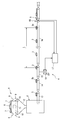
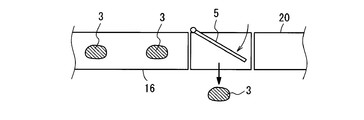
- FIG. 1 is a schematic configuration diagram of a packaging weighing system according to an embodiment of the present invention. It is a schematic plan view which shows operation
- FIG. 2 is a schematic configuration diagram of a packaging weighing system according to an embodiment of the present invention.
- the system of this embodiment uses a combination weigher to produce a packaged product that satisfies the above EC regulations.
- a combination product 1 and a packaging machine 2 constitute a packaged product manufacturing apparatus that manufactures a packaged product 3, and a weight sorter 4 that measures the weight of the packaged product 3 from the packaging machine 2,
- a sorting device 5 that sorts the packaged goods 3 according to a command from the weight sorter 4 is provided.
- the combination weigher 1 that combines and weighs articles such as confectionery
- an article is supplied from a supply device (not shown) to the center of the dispersion feeder 6, and the dispersion feeder 6 vibrates the article by its vibration.
- the sheet is fed in the direction and conveyed to a plurality of linear feeders 7 that are radially installed around the dispersion feeder 6.
- a vibration device is attached to each linear feeder 7, and each linear feeder 7 is vibrated to convey an article and put it into a plurality of supply hoppers 8 disposed below the conveyance end of the linear feeder 7.
- Each supply hopper 8 temporarily holds the article, opens a discharge gate that can be opened and closed at the bottom, and puts the article into each weighing hopper 9 disposed below each supply hopper 8.
- each weight sensor 10 such as a plurality of load cells.
- each weight sensor 10 The detection output of each weight sensor 10 is given to a control device 11 arranged in the combination scale 1, and the control device 11 performs a combination calculation based on the weight value of each weight sensor 10, thereby obtaining a combination weight as a target.
- the weighing hopper 9 that becomes the combination closest to the target combination weight value is selected as the optimum combination, and the weighing hopper 9 of the selected optimum combination is selected.
- the discharge gate is opened to discharge the articles weighed in combination, and is put into the packaging machine 2 through the collecting chute 12.
- the bag packaging machine 2 receives the articles discharged from the weighing hopper 9 of the optimum combination of the combination scale 1, packs and packs the articles with a packaging material such as a packaging bag, and discharges the articles as a packaged product 3 to the transfer conveyor 13.
- the weight sorter 4 includes a weighing conveyor 15 that measures the weight of the packaged product 3 that is carried in via the transfer conveyor 13 and the carry-in conveyor 14, a load cell 19 that supports the weighing conveyor 15, and a load signal from the load cell 19. And a given control device 17. Based on the weight measurement value of the packaged product 3 measured by the weighing conveyor 15, the control device 17 determines the quality of the packaged product 3 as described below.
- the packaged goods 3 determined to be defective are excluded from the main conveying line 20 of the conveyor by operating the flipper which is the sorting device 5 as shown in the schematic plan view of FIG.
- the control device 17 of the weight sorter 4 includes, for example, a touch panel type setting display section (not shown), and can perform various settings by operating the setting display section, and can also display the number of non-defective products, alarms, etc. Various displays can be performed.
- the control device 17 includes an arithmetic circuit that performs various aggregation calculations for control, and the arithmetic circuit includes various counters and registers described later.
- the control device 17 of the weight sorter 4 includes a later-described reference weight value Qt for determining a defective product with respect to the content weight of the packaged product 3 and first and second tolerances in order to sort the packaged product 3 that satisfies the EC regulations.
- the lower limit weight values T1 ′, T2 ′ and the like are set from the setting display unit, and defective products are determined based on the weight measurement values of the packaged goods 3 measured by the weighing conveyor 15.
- This embodiment is configured as follows in order to suppress the loss of raw materials and increase the use efficiency of raw materials while complying with the EC regulations.
- the EC regulation is satisfied for each of the packaged goods 3.
- the packaged goods 3 whose weights have been measured are divided into a predetermined number of groups, and in each group, the EC is not related to the preceding and following transports. It is determined whether or not the regulation is satisfied.
- the sorting device 5 is arranged immediately after the weight sorter 4, it is necessary to determine whether or not the EC regulation is satisfied as soon as the measurement value of the content weight of the packaged product 3 is obtained in the order of conveyance. That is, it is necessary to make an individual determination for each of the packaged products 3 in the order in which they are transported, and to determine whether or not the EC regulation is satisfied for each group composed of a predetermined number of packaged products 3. Can not.
- the packaged product 3 is transported between the weighing conveyor 15 of the weight sorter 4 and the distribution device 5. On the path, a conveyor 16 is provided that can transport the packaged product 3 and allow the predetermined number of packaged products 3 to exist.
- This transport conveyor 16 is a short time before the packaged product 3 whose weight has been measured by the weighing conveyor 15 of the weight sorter 4 reaches the sorting article sensor 18 comprising a photoelectric sensor or the like provided in front of the sorting device 5.
- the package product 3 whose weight has been measured has a length L that allows a maximum of P, which is a predetermined number, including the package product 3 that has not yet been detached from the weighing conveyor 15.
- the number of P is not particularly limited as long as it is plural, but the more is preferable. In this embodiment, for example, about ten or more.
- the transport conveyor 16 is installed between the weight sorter 4 and the distribution device 5 to transport a maximum of P number of packaged goods 3 constituting one group while being transported, the weight sorter 4 Whether the weight measurement values of the content weights of all the packaged products 3 constituting one group are acquired, and whether the EC regulations are satisfied in order from the smallest weight measurement value regardless of the preceding and following transport of the group. After the determination is made, the packaged product 3 can be sorted by the sorting device 5.
- the weight sorter 4 divides one batch of packaged goods 3 consisting of a maximum of P pieces existing between the weight sorter 4 and the sorting device 5 into one group, and the package of each divided group. Based on the weight measurement value of the contents of the product 3 as one unit, it is determined whether or not the conditions of EC regulations (1) to (3) are satisfied, and the distribution of the packaged products 3 is controlled.
- T2 ′ is defined as follows.
- the reference weight value Qt set in the weight sorter 4 is determined in consideration of the measurement variation error and the drift component Df that the weight sorter 4 has.
- the standard deviation of the variation amount is ⁇ w.
- the content weight of the packaged product 3 measured by the weight sorter 4 is Qn + 3 ⁇ ⁇ w may occur due to the measurement error of. Furthermore, the content weight of the packaged product 3 measured by the weight sorter 4 may be Qn + 3 ⁇ ⁇ w + Df due to the drift component Df.
- the EC regulation condition (1) is that, using the reference weight value Qt, the average weight value of the products in the packaged product group ⁇ the reference weight value Qt of the product.
- the average weight value of the packaged product 3 and the reference weight value Qt are compared on a group basis, the average weight value will be smaller as the number of objects of the average calculation is larger than the one, so one individually.
- the difference between the average weight value of the weight measurement values and the reference weight value Qt can be reduced as compared with the individual determination method in which each weight measurement value is compared with the reference weight value Qt. Therefore, the target combination weight in the combination weigher 1 can be set to a low value close to the reference weight value Qt, and the use amount of raw materials can be increased by suppressing the amount of articles filled in the packaging bag.
- each of the packaged products 3 is individually determined, when two packaged products 3 having weight measurement values considerably smaller than the reference weight value Qt are continued and the second product is put into a non-defective product, If the average weight value until is less than the reference weight value Qt, the second must be excluded as a defective product.
- the measured weight value of the packaged product 3 following the packaged product 3 smaller than the reference weight value Qt is larger than the reference weight value Qt, and the deficiency due to the previous packaged product 3 is reduced. Since it may be able to cancel out, it is possible to make a good product without excluding the small packaged product 3.
- Integrated weight value of packaged product group ⁇ Integrated reference weight value N ⁇ Qt And N is the number of packaged products regarded as non-defective products in the packaged product group.
- the deviation error of the N weight measurement values by the weight sorter 4 is as follows: the standard deviation is N 1/2 ⁇ ⁇ w for the integrated value, and the standard deviation is (1 / N 1/2 ) ⁇ ⁇ w for the average value. Therefore, it is preferable to introduce the statistical value because the integrated reference weight value N ⁇ Qt and the reference weight value Qt are both small in view of the use efficiency of the raw materials.
- the integrated reference weight value Qtt is It can be expressed as a function of the number Nx of packaged goods as follows.
- Reference weight value Qta Qn + 3. (1 / Nx1 / 2 ) .sigma.w + Df Since the influence of the variation amount becomes smaller as the number Nx increases, the reference weight value can be lowered.
- the sigma value that is the maximum variation value is not limited to “3” but may be set to “2” or “3.5”.
- the first allowable lower limit weight value T1 ′ and the second allowable lower limit weight value T2 are determined.
- the first lower limit weight value T1 and the second lower limit weight value T2 are determined in consideration of a weighing error in one weight measurement value of the weight sorter 4.
- the standard deviation ⁇ w of the variation error of the weight sorter 4 is the same weighing condition (conveyor speed, etc.) as in the operation operation using the packaged product 3 manufactured to a weight close to a predetermined nominal weight with the combination weigher 1 as a sample product. Then, the adjustment operation is performed in advance, and the weight of the sample product is repeatedly measured, and obtained from the obtained plurality of weight measurements. The obtained standard deviation ⁇ w is set in the weight sorter 4.
- the drift component Df varies depending on the use conditions such as the environmental conditions in which the weight sorter 4 is installed and the state of zero correction, and the user sets an arbitrary value in the weight sorter 4.
- Control is performed by setting the standard deviation ⁇ w, the drift component Df, the nominal weight value Qn, and the first and second lower limit weight values T1, T2 by operating the setting display unit of the control device 17 of the weight sorter 4.
- the device 17 can calculate the reference weight value Qt, the integrated reference weight value Qtt, the first and second allowable lower limit weight values T1 ′, T2 ′, and the like.
- the average weight value Wpa of the packaging material for packaging the article (product) of the packaged product 3 is also set in the weight sorter 4.
- the packaging material itself is lighter than the content weight of the packaged product 3, and the variation amount ⁇ pa in the packaging material is sufficiently smaller than ⁇ w, and is often negligible.
- the content weight Wx of the packaged product 3 is calculated by the following equation, assuming that the weight measured value Wx ′ of the packaged product 3 in the weight sorter 4 is:
- one batch of packaged goods 3 consisting of a maximum of P pieces existing between the weight sorter 4 and the sorting device 5 is divided into one group, and the weight measurement value for each group is taken as one unit. It is determined whether or not the conditions of EC regulations are satisfied, and if the conditions are not satisfied, the weight measurement values are measured in ascending order instead of the order in which they are transported from the packaged goods constituting the group so as to satisfy the conditions. The process of determining as a defective product is performed.
- the packaged goods 3 that have been weighed are divided into a predetermined number of groups, and the weight measurement values of the content weight of one batch of the packaged goods 3 for each of the divided groups are ranked in order from the smallest, for example, by comparing the magnitudes. wear.
- a packaged product having a weight measurement value of the content weight of the packaged product equal to or less than the second allowable lower limit T2 ′ is determined as a defective product. It is determined whether or not the packaged product 3 excluding the determined defective product satisfies the condition (1) of the EC regulations.
- the packaged product with the smallest weight measurement value is determined as a new defective product. It is determined whether or not the packaged product excluding the confirmed defective product satisfies the condition (1) of EC regulations.
- the packaged product with the smallest weight value of the content weight is confirmed as a new defective product among the packaged products excluding newly confirmed defective products. Then, for the packaged product excluding the newly determined defective product, it is determined whether or not the condition (1) of the EC regulations is satisfied, and the same is performed in the same manner until the condition (1) is satisfied. It is newly determined as a defective product one by one in the order of packaged products with the smallest value, and it is determined whether or not the condition (1) of the EC regulations is satisfied.
- condition (1) of the EC regulation it is determined whether or not the condition (2) of the EC regulation is satisfied for the packaged product excluding the confirmed defective product.
- the packaged goods excluding the confirmed defective products satisfy the conditions (1), (2), (3) of the EC regulations. .
- packaged products that satisfy the conditions (1), (2), and (3) of EC regulations are obtained on a group basis.
- the non-defective product is described as a non-defective product.
- a non-defective product having a different weight range that is, a non-defective product that exceeds the first allowable lower limit weight value T1 ′, and the first allowable lower limit weight value T1 ′ or less.
- Some non-defective products exceed the allowable lower limit weight value T2 ′.
- the packaged product has a weight range exceeding the first allowable lower limit weight value T1 ′, or a packaged product exceeding the first allowable lower limit weight value T1 ′ and exceeding the second allowable lower limit weight value T2 ′.
- whether or not the condition (1) of the EC regulation is satisfied is determined not by the average weight value but by the integrated weight value as will be described later.
- the packaged product 3 is at the head of one batch if the packaged product 3a at the top of one batch if the weight measurement value is acquired when the timer for batch identification is not in operation.
- the group of one batch of packaged products 3 includes all the packaged products 3 whose weight measurement values are acquired while the one-batch identification timer is operating. When the one-batch identification timer is turned off, the one-batch identification timer is restarted from the time when the weight measurement value of the next packaged product 3b is acquired, and the next batch of packaged product groups is divided.
- the arithmetic circuit of the control device 17 of the weight sorter 4 includes four types of registers shown in FIG. 4, that is, a weight measurement value register, a magnitude order value register, a defective product sign register, and a distribution register. .
- Any register can store P pieces of data, which is the maximum number of packaged goods 3 that can exist on the conveyor 16, at a corresponding address.
- one batch of weight measurement values of the contents of the packaged product obtained by measurement by the weight sorter 4 is sequentially stored at addresses (Ap + 1) to (Ap + P). Therefore, in FIG. 4, the older weight measurement value is stored in the left address, and the new weight measurement value is stored in the right address.
- the large and small rank value register stores the rank value of the size in one batch of the weight measurement value stored in the corresponding address of the weight measurement value register.
- the ranking value increases as the weight measurement value increases. Therefore, the rank values of the magnitudes of the weight measurement values stored in the addresses (Ap + 1) to (Ap + P) of the weight measurement value registers are respectively stored in the addresses (Ap ′ + 1) to (Ap ′ + P) of the large and small rank value registers. Each is stored.
- the defective product sign register stores “1”, which is a sign indicating that the product is defective, at an address corresponding to the weight measurement value of the packaged product determined to be defective.
- the defective product sign register has an address (Ap + 1).
- the defective product sign “1” is stored in the corresponding address (Ap ′′ +1) of the defective product sign register.
- the contents of the defective product sign register are transferred in a batch after the non-defective product and defective product of one batch of package composing one group are confirmed and the content of the defective product sign register is confirmed.
- the sign is called sequentially from the left side of the defective product sign register in response to the arrival of one batch of packaged goods at the distribution position of the distribution device 5, and the sign “1”. In this case, that is, in the case of a defective product, it is excluded from the distribution by the distribution device 5 as a defective product.
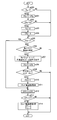
- step n1 It is determined whether or not the operation switch of the control device 17 of the weight sorter 4 is in operation (step n1).
- step n2 When the operation is in operation, one batch of packaged goods constituting one group is determined.
- the number counter Cu for counting the number is reset to “0” (step n2), and it is determined whether or not the packaged product is weighed and the weight measurement value Wx of the content weight is obtained (step n3).
- Wx is acquired, the weight measurement value Wx is stored in a predetermined address number of the weight measurement value register of FIG. 4, specifically, the address of Ap + Cu (step n4), and the number counter Cu is incremented.
- step n5 one batch processing a batch process start flag F B that indicates that has started is set to "1" to operate the batch identification timer (scan -Up n6).
- step n11 When a new weight measurement value Wx is acquired before the time for one batch identification timer expires (step n11), the weight measurement value Wx is stored at an address of a predetermined address number in the weight measurement value register ( In step n12), the number counter Cu is incremented and the process returns to step n7 (step n13).
- the weight measurement values Wx acquired during the operation of the one-batch identification timer are sequentially stored as group data in one batch from the address numbers 1 to P of the weight measurement value register in FIG.
- the weight measurement value register can store a maximum of P weight measurement values Wx.
- a shortage may occur due to zero adjustment on the combination weigher 1 side.
- the count value of one batch of Cu, that is, the number of packaged products constituting one group may not match P.
- step n7 when one batch identification timer expires, it is assumed that the weight measurement value Wx of the content weight of one batch of packaged goods constituting one group is stored in the weight measurement value register. Based on the stored weight measurement value Wx, calculation processing for determining whether or not the conditions (1), (2), and (3) of the EC regulation are satisfied is performed as described later (step n8), As a result, a sign “1” indicating that the product is defective is written in the address of the defective product sign register of FIG. 4 corresponding to the packaged product determined to be defective. The data is transferred to the distribution register (step n9), and the weight measurement value register, the large / low rank value register, and the defective product sign register in FIG. 4 can cope with the weight measurement value of the next batch.
- Step n10 is set to the counter CfA used for designating the address of the register for distribution by the distribution device 5, and the process returns to step n1 (step n10). Steps n9 and n10 are performed until the first batch of packaged goods constituting the next group arrives at the weighing conveyor 15.
- the weight measurement values Wx of the contents of the packaged product 3 for one batch obtained separately for each group are ranked in magnitude.
- the larger the value of the weight measurement value Wx the larger the ranking value. Therefore, the rank value is smaller as the weight measurement value Wx is smaller.
- the order of the magnitude of the weight measurement value Wx of the packaged goods for one batch stored in the weight measurement value register is determined, and the magnitude order value corresponding to the address number in which each weight measurement value Wx is stored. Store the rank value at the register address.
- FIG. 6 is a flowchart showing a procedure for determining the ranking value.
- the count value of the number counter Cu indicating the number of weight measurement values for one batch stored in the weight measurement value register of FIG. 4 is set in the counter Cp (step n101). That is, the number of weight measurement values stored in the weight measurement value register is set in the counter Cp, and the value of the counter Cp becomes a rank value indicating the magnitude of the weight measurement value as described later. Start with a higher ranking value.
- step n102 the data of all the addresses in the large and small rank value register of FIG. 4 is set to “0” indicating that the rank value is undetermined.
- a counter CA indicating the address of the magnitude order value register and a counter CB indicating the address of the weight measurement value storing the weight measurement value to be compared are set to “1” (step n103).
- step n104 the rank value of the address is read (step n104). It is determined whether or not the read rank value is “0”, that is, the rank is undetermined (step n105). If the rank is not undetermined, that is, the rank is fixed, the counter CA is set to advance to the next address. Increment and return to step n104 (step n114).
- the weight measurement value at the address (AP + CA) of the weight measurement value register that is, the weight measurement value whose rank is undecided, is read and stored in the reference memory A shown in FIG. .
- the contents of the counter CA that is, the address number is stored in the reference memory B (step n106). Therefore, the reference memory A stores a weight measurement value whose order is undetermined, and the reference memory B stores the address number of the weight measurement value register in which the weight measurement value is stored.
- step n107 the weight measurement value in the weight measurement value register at the address (AP + CB) is called using the count value of the counter CB (step n107), and whether the called weight measurement value is larger than the weight measurement value in the reference memory A or not. Is determined (step n108), and if not, the process proceeds to step n110.
- step n108 when the called weight measurement value is larger than the weight measurement value of the reference memory A, the called weight measurement value is stored in the reference memory A, that is, the weight measurement value of the reference memory A is stored in the called weight. Replace with measured value.
- the contents of the counter CB indicating the address number of the called weight measurement value are stored in the reference memory B, that is, the address number of the reference memory B is stored in the weight measurement value register in which the called weight measurement value is stored. Replace with the address number (step n109).
- step n110 it is determined whether or not the count value of the counter CB has reached the count value of the number counter Cu (step n110). In order to compare with the weight measurement value of the next address, the counter CB is incremented and the process returns to step n107 (step n115).
- step n110 when the count value of the counter CB reaches the count value of the number counter Cu, it is assumed that one rank value has been determined by completing the magnitude comparison with the weight measurement value for one batch, and the counter Cp is counted.
- the numerical value is set as a rank value and stored in the address (Ap ′ + contents of the reference memory B) of the magnitude rank value register (step n111). That is, the count value of the counter Cp is stored as an order value at an address specified by the address number of the reference memory B of the magnitude order value register.
- the rank value of the largest weight measurement value is determined, and the largest rank value is stored in the address of the large and small rank value register corresponding to the address of the weight measurement value register in which the weight measurement value is stored. Will be stored.
- step n112 the counter Cp is decremented in order to determine the rank value of the next largest weight measurement value (step n112), whether or not the counter Cp has become “0”, that is, the smallest rank value “1”. (Step n113), and if it is not “0”, the process returns to step n103 again, and the same processing is performed to determine the next rank value. Further, when the counter Cp becomes “0” in step n113, it is determined that the order of all the weight measurement values has been determined, and the process proceeds to step n114 in FIG.
- the weight measurement value with the smallest address number is placed in the reference memory A in the order of the weight measurement value with the larger address number, and the weight measurement value is called and compared in the order of the weight measurement value with the smallest address number to the largest address number. If the weight measurement value stored in the memory A is larger than the weight measurement value, the contents of the reference memory A are exchanged. Therefore, when there are a plurality of weight measurement values having the same size, the rank value becomes larger as the weight measurement value has a smaller address number.
- the rank value is not the same, but for each batch of packaged goods that constitutes one group, the rank value is different by one from the weight measurement value to the smaller one. Can be determined.
- the rank values of the weight measurement values for one batch stored in the weight measurement register are determined in descending order, and the rank values are stored in the corresponding addresses of the large and small rank value registers.
- the weight measurement value Wx in the process of determining whether or not one batch of packaged goods satisfies the conditions (1), (2), and (3) of the EC regulations.
- the packaged goods are defined as follows. -Defective product: packaged product having a weight measurement value Wx of Wx ⁇ T2 ′, or does not satisfy the EC regulation condition (1) even if the weight measurement value Wx is Wx> T2 ′, or EC regulation Packaged products / temporary non-defective products that do not satisfy the condition (2): Weight measurement value Wx is T2 ′ ⁇ Wx ⁇ T1 ′, but still satisfies the conditions (1) and (2) of the EC regulations Packaged products at an unknown stage.
- Temporary non-defective product The weight measurement value Wx is T2 ′ ⁇ Wx ⁇ T1 ′, and the EC regulation (1) is satisfied, but whether the condition (2) is satisfied is unknown.
- Semi-defective product a packaged product satisfying the conditions (1) and (2) of the EC regulations, where the weight measurement value Wx is T2 ′ ⁇ Wx ⁇ T1 ′.
- Temporary product The weight measurement value Wx is Wx> T1 ′, but the packaged product is in an unknown stage whether or not the condition (1) of the EC regulations is satisfied.
- Non-defective product a packaged product satisfying the condition (1) of the EC regulations, with the weight measurement value Wx being Wx> T1 ′.
- the above definitions are for convenience in explaining the process of determining whether or not the conditions (1), (2), and (3) of the EC regulations are satisfied.
- the packaged product is determined as a defective product, a semi-defective product, and a non-defective product.
- Semi-good products and non-defective products are all non-defective products that satisfy the requirements of EC regulations (1), (2), and (3), but are classified because of different weight ranges and different handling in judgment processing. is there.
- the determination process proceeds, if the conditions (1) and (2) are not satisfied as described above, a small weight measurement value is determined as a defective product so as to satisfy the conditions. Therefore, the smallest weight measurement value among certain defined packaged goods is determined as a defective product, and the certain defined packaged product excluding this defective product is If the condition is satisfied, the packaged product becomes a packaged product with a different definition as the determination process proceeds, such as a packaged product with another definition.
- a provisionally good product is a packaged product in which the weight measurement value Wx is T2 ′ ⁇ Wx ⁇ T1 ′, and whether it satisfies the conditions (1) and (2) of the EC regulations is unknown.
- the weight measurement value Wx is T2 ′ ⁇ Wx ⁇ T1 ′ at that time, and the condition (1) of the EC regulation is satisfied.
- the packaged product with the smallest weight measurement value is determined as a defective product.
- a product with a small weight measurement value among the quasi-quality products should be determined as a defective product.
- the quasi-quality product with a small weight measurement value is a defective product.
- step n114 the data of all addresses in the defective product sign register of FIG. 4 is set to “0” indicating that the product is not defective, and the temporary good product integration register for integrating the weight measurement values of the temporary good products for one batch. Is set to “0”.
- the counter CA for address designation is set to “1”
- the defective product number counter Cf and the quasi-quasi-good product number counter Ch are set to “0”.
- step n115 the weight measurement value at the address (Ap + CA) of the weight measurement value register in FIG. 4 is called (step n115), and it is determined whether or not the called weight measurement value Wx is larger than the second allowable lower limit weight value T2 ′.
- Step n116 If not large, the condition (3) of the EC regulations is not satisfied and the product is a defective product. Therefore, the address (Ap ′′ + CA) of the defective product sign register in FIG. Is set to an address corresponding to the address of the weight measurement value register from which the call is made (step n117), the defective product counter Cf is incremented, and the process proceeds to step n119 (step n118).
- step n120 When the called weight measurement value Wx is larger than the second allowable lower limit weight value T2 ′ in step n116, it is determined whether or not the weight measurement value Wx is larger than the first allowable lower limit weight value T1 ′ (step n120). If it is larger, it is a temporary good product, and the process moves to step n119. In step n120, when the weight measurement value Wx is not larger than the first allowable lower limit weight value T1 ′, it is a pseudo-quality product that is larger than the second allowable lower limit weight value T2 ′ and less than or equal to the first allowable lower limit weight value T1 ′. At this time, the provisional-quality product counter Ch for counting the number of provisionally-quality products is incremented, and the process proceeds to Step n119 (Step n121).
- step n119 it is determined whether or not the counter CA matches the number counter Cu counting the number of batches, that is, whether or not the processing for the weight measurement value for one batch is completed. If not, the counter CA is incremented and the process returns to step n115 (step n122).
- step n119 when the counter CA matches the number counter Cu, the second allowable lower limit weight value T2 ′ is set for all the weight measurement values for one batch of the weight measurement value register of FIG.
- the following defective products were determined to be either a non-defective product that is larger than the second allowable lower limit weight value T2 ′ and lower than the first allowable lower limit weight value T1 ′, or a temporary good product that is larger than the first allowable lower limit weight value T1 ′. become.
- the total number of provisionally good quality products and temporary good products is a value obtained by subtracting the count value of the defective product number counter Cf from the count value of the number counter Cu (Cu-Cf).
- the weight measurement values of the non-defective temporary quality products and the temporary quality products are sequentially accumulated for one batch from a small value to a large value.
- the defective product is a packaged product having a small weight measurement value equal to or smaller than the second allowable lower limit weight value T2 ′.
- the large and small rank value register of FIG. If the number of defective products, for example, the number of defective products is two, it is a packaged product with a weight measurement value up to the second place. Accordingly, the order of the provisionally non-defective products and the non-defective products is higher than the number of defective products in the defective product counter Cf. If the number of defective products is 2, the number of batches from 3rd to 1st batch. It is a packaged product of rank (3 to Cu) up to the count value of the counter Cu, and these weight measurement values are integrated.
- step n123 of FIG. 9 “1” is set to the counter CA for designating the address, and the rank value of the address (Ap ′ + CA) of the large and small rank value register of FIG. 4 is called (step n124). ), It is determined whether or not the called rank value is larger than the number of defective products, which is a count value of the defective product counter Cf (step n125). The process returns to n124 (step n126).
- step n125 when the called rank value is larger than the count value of the defective product counter Cf, it is determined that the product is a provisional non-defective product or temporary good product other than the defective product, and the weight value measurement register of FIG. From the address (Ap + CA), the weight measurement value Wr of the temporary good product or the temporary good product is called (step n127), and the called weight measurement value Wr is integrated to integrate the weight measurement values of the temporary good product and the temporary good product in one batch.
- the integrated value ⁇ Wr is integrated to update the integrated value ⁇ Wr (step n128), and whether or not the counter CA matches the number counter Cu, that is, the weights of all the quasi-quality products and temporary products for one batch. It is determined whether or not the integration of the measured values has been completed (step n129). Decrement to return to step n124 (step n126).
- step n129 when the counter CA matches the number counter Cu, it is determined that the integration of one batch of the weight measurement values of all the non-defective products and the non-defective products is completed, and the condition of EC regulation (1) Is determined as follows.
- the arithmetic circuit of the control device 17 of the weight sorter 4 is provided with a non-defective / semi-good count counter Cg that accumulates the number of good and semi-defective products from the start of operation to the previous batch, and from the start of operation to the previous time. It is equipped with a good / semi-good weight accumulation register that accumulates the weight measurement values of good and semi-good products up to the batch.
- the non-defective product / counter-good product count Cg of the non-defective product / semi-good product counter Cg up to the previous batch is added to the number of non-defective products for the current batch, that is, the count of the defective product counter Cf is calculated from the count value of the number counter Cu.
- the number ⁇ Cg + (Cu-Cf) ⁇ obtained by adding the number obtained by subtracting the numerical value (Cu-Cf) ⁇ is set as the cumulative number Nx of non-defective products and semi-defective products from the start of operation to the current batch (step n130). Move.
- the number of non-defective products (Cu-Cf) for the current batch is the number of provisionally quasi-good products and tentatively good products. When these are assumed to be good products and quasi-good products, the conditions of EC regulation (1) are met. Determine if you are satisfied.
- the semi-defective product and the non-defective product are categories for convenience as described above, and only have different weight ranges, and all satisfy the conditions (1), (2), and (3) of EC regulations. Therefore, it can be grasped as a non-defective product.
- step n130 the total number Nx of non-defective products from the start of operation to the current batch is calculated when all of the quasi-quasi-goods and temporary good products for the current batch are assumed to be non-defective products.
- step n131 whether or not the condition (1) of the EC regulation is satisfied is determined as follows.
- step n131 the integrated value obtained by integrating the weight measurement values of the temporary good products and the quasi-quasi-good products for the current batch to the integrated value ⁇ Wx ′ obtained by integrating the heavy measurement values of the good products and the semi-good products from the start of operation to the previous batch.
- the integrated value ( ⁇ Wx ′ + ⁇ Wr) obtained by adding ⁇ Wr is equal to or greater than the integrated reference weight value Fq (Nx)
- the condition (1) of the EC regulation is satisfied, and the process proceeds to step n135 in FIG.
- the temporary good product is determined as a good product
- the temporary quarterly good product becomes a temporary good product
- the temporary good product number counter Ch becomes a temporary good product counter Ch indicating the number of temporary good products.
- the defective product counter Cf indicates the number of defective products that do not satisfy the condition (3) of the EC regulations and the number of defective products that do not satisfy the condition (1).
- step n131 the integrated value obtained by integrating the weight measurement values of the temporary good product and the temporary good quality product for the current batch to the integrated value ⁇ Wx ′ obtained by integrating the heavy measurement values of the good product and the semi-good product from the start of operation to the previous batch.
- the integrated value ( ⁇ Wx ′ + ⁇ Wr) obtained by adding ⁇ Wr is not equal to or greater than the integrated reference weight value Fq (Nx), that is, when the condition (1) of the EC regulations is not satisfied.
- the defective product number counter Cf is incremented (step n132), and the address number of the magnitude order value register whose rank value matches the incremented count value of the defective product number counter Cf, that is, temporary An address number in which a rank value having the smallest weight measurement value is stored in the non-defective product and the quasi-quasi-quality product is searched, and the defective product sign register having the same address number is set to “1” (step n133). That is, “1” is stored in the address of the defective product sign register corresponding to the address of the weight measurement value register in which the smallest weight measurement value is stored in the temporary good product and the temporary good product, and the packaging corresponding to the address is stored. Confirm the product as defective.
- the defective product sign register having the same address as the address of the weight measurement value register in which the minimum weight measurement value is stored among the temporary quality products and the temporary good products for the current batch is defective. “1” is set, and the packaged product with the smallest weight measurement value is determined as a new defective product, and the number of defective products is increased by one.
- step n134 it is determined whether or not the defective product number counter Cf matches the number counter Cu, that is, whether or not all the packaged products for this batch are confirmed as defective products. If it is determined that all of the defect sign registers are “1”, the process proceeds to step n146 in FIG.
- step n134 the process returns to step n123 to satisfy the condition (1) of the EC regulation in the same manner as described above with one defective product added. If the condition (1) is not satisfied, the provisional non-defective product that has not yet been selected as a defective product and the one with the smallest weight measurement value are confirmed as new defective products. The same process is repeated until the condition (1) is satisfied or until the defective product number counter Cf matches the number counter Cu.
- step n131 when the condition (1) of EC regulation is satisfied, the process proceeds to step n135 in FIG.
- the arithmetic circuit of the control device 17 of the weight sorter 4 includes a semi-good product number counter Ck that counts the number of semi-good products from the start of operation to the previous batch.
- the count value of the counter Ch which counts the number of provisional semi-defective products, is added to the count value of the semi-defective product number counter Ck. This added value (Ck + Ch) is the number of semi-defective products from the start of operation to the current batch when the current temporary semi-defective product is assumed to be a semi-defective product.
- the count value of the non-defective product / semi-good product counter Cg that counts the number of non-defective products and semi-defective products from the start of operation to the previous batch is counted as a non-defective product from the current batch, that is, the defective product from the number counter Cu.
- the number (Cu-Cf) obtained by subtracting the number counter Cf is added.
- step n136 a value [(Ck + Ch) obtained by dividing the number of semi-defective products from the start of operation to the current batch (Ck + Ch) by the number of non-defective products from the start of operation to the current batch ⁇ Cg + (Cu ⁇ Cf) ⁇ . / ⁇ Cg + (Cu ⁇ Cf) ⁇ ] is determined to be 0.025 or less. If it is 0.025 or less, it is determined that the condition (2) of the EC regulation is satisfied, and the process proceeds to Step n145. .
- step n136 when it is not 0.025 or less, that is, when the condition of EC regulation (2) is not satisfied, among the provisional non-defective products, one by one is determined as a defective product in order from a packaged product with a small weight measurement value, It is determined whether or not the condition (2) is satisfied.
- step n137 the rank value of the address (Ap ′ + CA) of the large and small rank value register is called (step n138), and the rank value called is the defective product counter. It is determined whether or not the value obtained by adding 1 to the number of defective products by Cf (Cf + 1), that is, the ranking value that is called is one larger than the ranking value of the largest defective product, that is, among the provisional non-defective products. In step n139, it is determined whether or not the rank value is the smallest rank value (step n139). (Step n140).
- step n139 when the called rank value becomes a value (Cf + 1) obtained by adding 1 to the number of defective products by the defective product counter Cf, it is assumed that the rank value is the smallest among the provisional non-defective products.
- the defective product sign register at the address (Ap ′′ + CA) corresponding to the address (Ap ′ + CA) of the large / small ranking value register in which the ranking value is stored is set to “1” indicating that it is a defective product (step n141). ).
- the provisional non-defective product having the smallest rank value among the temporary good products, that is, the smallest weight measurement value is determined as a defective product.
- the provisional non-defective product with the smallest weight measurement value is determined as a defective product and the number of defective products is increased by 1, the number of defective products counter Cf is incremented (step n142), and the counter Ch indicating the number of provisional non-defective products Is decremented (step n143), and it is determined whether or not the counter Ch has become “0”, that is, whether or not the provisional non-defective product has been lost (step n144).
- step n144 When the counter Ch becomes “0” in step n144, since there is no provisional non-defective product, it is determined that there is no need to determine the condition (2) of the EC regulation, and the process proceeds to step n145.
- step n144 the process returns to step n136 to determine whether or not the condition (2) is satisfied in the same manner as above with one defective product added. However, if the condition (2) is not satisfied, the provisional non-defective product that has not yet been selected as a defective product is determined to have a minimum weight measurement value as a new defective product, and the condition (2) is satisfied. The same process is repeated until satisfied or until there is no provisional non-defective product.
- step n136 the value [(Ck + Ch) / ⁇ Cg + (Cu ⁇ Cf) ⁇ ] obtained by dividing the number of semi-defective products from the start of operation (Ck + Ch) by the number of non-defective products from the start of operation ⁇ Cg + (Cu ⁇ Cf) ⁇ . Is 0.025 or less, that is, when the condition (2) of the EC regulation is satisfied, the process proceeds to step n145, but when the condition (2) of the EC regulation is satisfied, the provisional A non-defective product is confirmed as a semi-defective product. Therefore, at this time, the count value of the counter Ch indicates the number of semi-defective products for the current batch.
- step n145 the count value of the counter Ch, which is the number of semi-good products for the current batch, is added to the semi-good product counter Ck for counting the number of semi-good products from the start of operation to the previous batch (Ch + Ck). The number of semi-defective products from the start of operation to the current batch.
- step n146 the number of defective product sign registers whose value is not “1”, that is, the number obtained by subtracting the defective product number counter Cf from the number counter Cu (Cu ⁇ Cf) is the number of determined semi-defective products and non-defective products.
- This number (Cu-Cf) is added to a good / semi-good product counter Cg that counts the number of non-defective and semi-defective products from the start of operation to the previous batch, Number of non-defective products and non-defective products.
- step n147 the counter Ch, the counter Cf, and (Cu-Cf), which are the data of one batch at this time, are displayed on the setting display unit of the control device 17.
- the counter Ck and the counter Cg are displayed.
- the weight measurement value in which “1” which is a defective product sign is not set in the defective product sign register satisfies all the conditions (1), (2) and (3) of EC regulations. Therefore, the weight measurement value without “1”, which is a sign of inferior goods in the current batch, that is, the weight measurement value of the semi-defective product and the non-defective product is summed and the batch is started from the start of operation. Add to the total weight value up to.
- step n148 of FIG. 11 the integration value ⁇ Wr of the integration register that integrates the weight measurement values of the semi-defective product and the non-defective product for one batch is reset to “0”, and “1” is set to the counter CA (step n149). ),
- the signature data is called from the address (Ap ′′ + CA) of the defective product sign register (step n150), and it is determined whether or not the called signature data is “1” indicating that it is a defective product (step n151). ) If “1”, it is determined that the product is defective and it is not necessary to integrate the weight measurement value, and the process proceeds to step n154.
- step n151 If the sign data is not “1” in step n151, that is, if it is not defective, the weight measurement value is determined from the address (Ap + CA) of the weight measurement value register corresponding to the address of the read sign data as being a non-defective product or a non-defective product. Is added (step n152), and the called weight value Wr is added to the integrated value ⁇ Wr of the integration register that integrates the weight measurement values of one batch of semi-defective products and non-defective products to update the integrated value ⁇ Wr (step n153). Then, the process proceeds to step n154.
- step n154 it is determined whether or not the counter CA matches the number counter Cu, that is, whether or not the integration of the weight measurement values for one batch has been completed. If they do not match, the counter CA is incremented. Then, the process returns to step n150 (step n155), and the above processing is repeated to integrate the weight measurement values of the non-defective product and the semi-defective product for one batch of this time.
- step n154 when the counter CA matches the number counter Cu, it is determined that the integration of the weight measurement values of the non-defective product and the semi-defective product for the current batch is finished, and the non-defective product and the semi-good product from the start of operation to the previous batch.
- the integrated value ⁇ Wx for this batch is added to the integrated value ⁇ Wx of the non-defective product / semi-good product weight integrating register that integrates the weight measurement value of the current product to update the integrated value ⁇ Wx (step n156), and the updated integrated value ⁇ Wx is updated.
- the information is displayed on the setting display unit of the control device 17 (step n157), and the process proceeds to step n158 in FIG.
- the target combination weight value of the combination weigher 1 which is a product manufacturing apparatus can be manually adjusted according to the occurrence state of defective products and the like. Yes.
- the number of packaged products processed as defective products is calculated as a defective product rate and managed so as to obtain an appropriate defective product rate. To do.
- the setting display unit of the control device 17 of the weight sorter 4 is operated, and the determination mode based on the defective product rate and the allowable upper limit value FU and the allowable lower limit value FL of the defective product rate are preset as management ranges.
- the defective product rate FX for the V batch which is the latest multiple batches is always obtained for each batch processing, and the judgment mode based on the defective product rate and the allowable upper limit value FU and allowable lower limit value FL are set. If you have FX> FU When the average weight value of the packaged product is too close to the reference weight value Qta, the defective product rate FX is high. FX ⁇ FL In the case where the average weight value of the packaged product is too larger than the reference weight value Qta, an alarm is displayed on the setting display unit as the notification means of the control device 17, respectively.
- the average weight value Wxma of the weight measurement values of the semi-defective product and the non-defective product for the latest V batch is calculated and displayed.
- the control unit 17 sets the average weight value when the number of defects is too small as the allowable upper limit average weight value WUa for comparison and the average weight value when the number of defects is too large as the allowable lower limit average weight value WLa.
- An allowable upper limit average weight value WUa and an allowable lower limit average weight value WLa for defining the management range are set while operating the allowable value storage switch of the display unit to store the switch beforehand.
- the target combination weight value of the combination weigher 1 is readjusted by these values. An alarm for doing so may be displayed and output.
- the average weight value at the time when FX> FU is established is set as the allowable lower limit average weight value WLa, and the average weight at the time when FX ⁇ FL is established.
- the value is stored as the allowable upper limit average weight value WUa in the control device 17 as a comparative allowable value, and if both comparative allowable values are stored, the determination based on the comparative allowable value is given priority. Wxma ⁇ WLa or Wxma> WUa If so, an alarm may be given.
- the operator sets the target combination weight of the combination weigher 1 as a step increase / decrease amount on a setting display unit (not shown) of the combination weigher 1 because it is out of the proper management range. Increase gradually with the setting key switch.
- the target combination weight of the combination scale 1 can be increased or decreased step by step, for example, by the minimum weight display amount of the weight sorter 4.
- the operator gradually decreases the target combination weight of the combination scale 1 using the step increase / decrease amount setting key switch, assuming that the proper management range has been exceeded.
- the number Cu of weight measurement values per batch unit is set in the arithmetic circuit of the control device 17 of the weight sorter 4 and the latest V
- a third shift register for storing ⁇ Wr for the latest V batches Each time the latest one batch of data is input, each shift register VSR1, 2, 3 shifts the data, outputs the oldest data, discards it, and stores the latest V batch data.
- the count value of the number counter Cu which is the number of weight measurement values for the current batch, is input to the first shift register VSR1 (step n158), and the number of defective products for the current batch. Is input to the second shift register VSR2 (step n159), and the integrated value ⁇ Wr of the weight measurement values of the quasi-good product and the non-defective product for the current batch is supplied to the third shift register VSR3. (Step n160), and the process proceeds to step n161.
- the shift registers VSR1, VSR, and VSR3 each have the number of weight measurement values for the latest V batch including the current one batch, the number of defective products, and the integrated value ⁇ Wr of the weight measurement values of semi-defective products and non-defective products. Stored.
- step n161 the defective product ratio Fx for the latest V batch is calculated according to the following equation.
- FX (total number of second shift register VSR2) / (total number of first shift register VSR1)
- the total number of second shift registers VSR2 is the total number of defective products Cf for the latest V batch.
- the total number of first shift registers VSR1 is the total number of weight measurement values for the latest V batch, that is, the total number of packaged products for which the weight for the latest V batch is measured.
- step n162 the average weight value Wxma of the semi-defective product and the non-defective product for the latest V batch is calculated according to the following formula, and the process proceeds to step n163 in FIG.
- step n163 in FIG. 13 it is determined whether or not the determination mode based on the defective product rate is set.
- the allowable upper limit value FU and the allowable lower limit value FL are set. Whether or not the defective product rate Fx is larger than the allowable upper limit value FU (step n165).
- step n166 a warning indicating that the number of defective products is excessive is displayed on the setting display section of the control device 17 (step n166).
- this state means that the average weight of the packaged goods manufactured by the combination weigher 1 is too close to or smaller than the reference weight value. Therefore, the operator gradually increases the target combination weight of the combination scale 1 with the step increase / decrease amount setting key switch so as to increase the average weight.
- step n165 If the defective product rate Fx is not greater than the allowable upper limit value FU in step n165, it is determined whether or not the defective product rate Fx is smaller than the allowable lower limit value FL (step n167). Assuming that there is an inferior product number under alarm, a warning is output (step n168). In other words, this state means that the average weight of the packaged goods manufactured by the combination weigher 1 is far from the reference weight value. Therefore, the operator gradually decreases the target combination weight of the combination scale 1 with the step increase / decrease amount setting key switch so as to reduce the average weight.
- step n169 it is determined whether or not the determination mode based on the average weight value Wxma of the semi-defective product / good product is set (step n169). It is determined whether or not the allowable upper limit average weight value WUa and the allowable lower limit average weight value WLa are set (step n170), and when set, the average weight value Wxma of the semi-defective product and the non-defective product is determined as the allowable lower limit average weight value. It is determined whether or not it is smaller than WLa (step n171), and if it is smaller, a product underweight warning is displayed and output (step n172).
- step n171 If the average weight value Wxma of the semi-defective product / good product is not smaller than the allowable lower limit average weight value WLa in step n171, it is determined whether the average weight value Wxma of the semi-good product / good product is larger than the allowable upper limit average weight value WUa. If it is larger than the allowable upper limit average weight value WUa (step n173), a commodity weight excess warning is displayed and output (step n174).
- FIG. 14 is an interrupt process executed at predetermined time intervals, for example, 1 msec, which is executed with priority over the processes shown in FIGS. 6 and 8 to 13.
- the timer time of the one batch identification timer is counted and the defective product is distributed by the distribution device 5, for example, interrupt processing performed with the highest priority at an interval of 1 msec.
- Step n 200 it is determined whether a batch process start flag F B is set to "1" (Step n 200), when not being set to “1", the sequence proceeds to step N205, is set to "1" If it is, the 1-batch time measurement counter Cf B is incremented (step n201), and it is determined whether or not the count value of the 1-batch time measurement counter Cf B has reached the 1-batch time Tp (step n202). When the batch time Tp is not reached, the process proceeds to step n205.
- step n202 when 1 batch time Tp is reached, the 1 batch processing start flag F B is reset to “0” (step n203), and the 1 batch time measurement counter Cf B is reset to “0”. (Step n204).
- step n205 it is determined whether or not “1” is set in the distribution timer flag Ftt indicating that the distribution timer for measuring the distribution time is in operation. If “1” is set, the distribution operation is performed. Assuming that it is in the middle, the process proceeds to step n212. When “1” is not set in the distribution timer flag Ftt, it is determined whether or not the distributed article sensor 18 is turned on (step n206).
- the defective product sign data is read by the distribution register address (Bp + Cf A ) in FIG. 4 (step n207), and the distribution register address designation counter Cf A is set. It is incremented (step n208), and it is determined whether or not the read sign data is “1” indicating that it is a defective product (step n209). If it is not “1”, there is no need to distribute it as a defective product.
- the distribution timer flag Ftt is set to “1” (step n210)
- the drive signal for driving the flipper which is the distribution device 5 is turned on (step n211)
- the drive time measurement timer Cff for measuring the drive time is incremented (step 212) It is determined whether or not the time measured by the drive time measurement timer Cff has reached the predetermined drive time Tr (step n213). If not, the process ends and the predetermined drive time Tr At this time, the flipper drive signal is turned off, the drive time measurement timer Cff and the distribution timer flag Ftt are reset to “0”, and the process ends (step n214).
- the contents of the sorting register are called up every time the sorting product sensor 18 detects the packaged product a in the first batch, and if the signature data is “1”, the flipper is set to a predetermined value. For only the driving time, and the packaged product is removed as a defective product.
- the product manufacturing apparatus for manufacturing a packaged product has been described as being applied to the combination weigher 1. It may be a quantitative filling machine such as a quantitative weight filling machine or a quantitative volume filling machine that manufactures a packaged product by filling a predetermined amount.
- the target filling weight and the target filling volume of the quantitative filling machine can be manually adjusted according to the occurrence state of defective products and the like, as in the above embodiment.
Landscapes
- Physics & Mathematics (AREA)
- General Physics & Mathematics (AREA)
- Sorting Of Articles (AREA)
Abstract
[Problème] La présente invention a pour objet de supprimer la perte de matière première et d'augmenter l'efficacité de l'utilisation de la matière première tout en répondant aux réglementations prédéterminées. [Solution] La présente invention comporte un moyen de commande (17) pour: diviser des produits conditionnés (3), dont le poids est mesuré par une machine de triage par poids (4), en des groupes comportant une pluralité de produits conditionnés (3); déterminer par unités de groupes divisés si les produits conditionnés (3) répondent à une condition de réglementation en fonction d'une valeur de mesure de poids des produits conditionnés (3) mesurée par la machine de triage par poids (4); et contrôler la distribution des produits conditionnés (3) par un dispositif de distribution (5), un système de transport (16) pouvant comprendre le nombre de produits conditionnés (3) constituant le groupe étant mis en œuvre dans un chemin de transport dans lequel les produits conditionnés (3) pesés par la machine de triage par poids (4) sont transportés jusqu'au dispositif de distribution (5).
Priority Applications (2)
| Application Number | Priority Date | Filing Date | Title |
|---|---|---|---|
| PCT/JP2013/005008 WO2015029083A1 (fr) | 2013-08-26 | 2013-08-26 | Machine de triage par poids, et système de conditionnement et de mesure |
| EP13892698.5A EP3009814B1 (fr) | 2013-08-26 | 2013-08-26 | Machine de triage par poids, et système de conditionnement et de mesure |
Applications Claiming Priority (1)
| Application Number | Priority Date | Filing Date | Title |
|---|---|---|---|
| PCT/JP2013/005008 WO2015029083A1 (fr) | 2013-08-26 | 2013-08-26 | Machine de triage par poids, et système de conditionnement et de mesure |
Publications (1)
| Publication Number | Publication Date |
|---|---|
| WO2015029083A1 true WO2015029083A1 (fr) | 2015-03-05 |
Family
ID=52585708
Family Applications (1)
| Application Number | Title | Priority Date | Filing Date |
|---|---|---|---|
| PCT/JP2013/005008 Ceased WO2015029083A1 (fr) | 2013-08-26 | 2013-08-26 | Machine de triage par poids, et système de conditionnement et de mesure |
Country Status (2)
| Country | Link |
|---|---|
| EP (1) | EP3009814B1 (fr) |
| WO (1) | WO2015029083A1 (fr) |
Cited By (2)
| Publication number | Priority date | Publication date | Assignee | Title |
|---|---|---|---|---|
| CN108816776A (zh) * | 2018-05-21 | 2018-11-16 | 江苏卓威智能科技有限公司 | 一种转盘分拣机的控制系统及控制方法 |
| JP2023124416A (ja) * | 2022-02-25 | 2023-09-06 | 大和製衡株式会社 | 組合せ計数装置 |
Families Citing this family (1)
| Publication number | Priority date | Publication date | Assignee | Title |
|---|---|---|---|---|
| CN114527718B (zh) * | 2022-02-25 | 2024-01-09 | 江苏鑫亿鼎石英科技股份有限公司 | 一种石英砂数据化智能生产控制系统 |
Citations (2)
| Publication number | Priority date | Publication date | Assignee | Title |
|---|---|---|---|---|
| JP4073858B2 (ja) * | 2003-10-31 | 2008-04-09 | アンリツ産機システム株式会社 | 物品に対する計量または検査を行う装置 |
| JP2010175514A (ja) | 2009-02-02 | 2010-08-12 | Yamato Scale Co Ltd | 組合せ秤及び計量システム |
Family Cites Families (1)
| Publication number | Priority date | Publication date | Assignee | Title |
|---|---|---|---|---|
| EP2018528B1 (fr) * | 2006-05-19 | 2015-10-21 | Marel A/S | Procédé et système de mise en lots d'objets |
-
2013
- 2013-08-26 WO PCT/JP2013/005008 patent/WO2015029083A1/fr not_active Ceased
- 2013-08-26 EP EP13892698.5A patent/EP3009814B1/fr active Active
Patent Citations (2)
| Publication number | Priority date | Publication date | Assignee | Title |
|---|---|---|---|---|
| JP4073858B2 (ja) * | 2003-10-31 | 2008-04-09 | アンリツ産機システム株式会社 | 物品に対する計量または検査を行う装置 |
| JP2010175514A (ja) | 2009-02-02 | 2010-08-12 | Yamato Scale Co Ltd | 組合せ秤及び計量システム |
Cited By (3)
| Publication number | Priority date | Publication date | Assignee | Title |
|---|---|---|---|---|
| CN108816776A (zh) * | 2018-05-21 | 2018-11-16 | 江苏卓威智能科技有限公司 | 一种转盘分拣机的控制系统及控制方法 |
| JP2023124416A (ja) * | 2022-02-25 | 2023-09-06 | 大和製衡株式会社 | 組合せ計数装置 |
| JP7820040B2 (ja) | 2022-02-25 | 2026-02-25 | 大和製衡株式会社 | 組合せ計数装置 |
Also Published As
| Publication number | Publication date |
|---|---|
| EP3009814A4 (fr) | 2017-03-15 |
| EP3009814B1 (fr) | 2020-05-06 |
| EP3009814A1 (fr) | 2016-04-20 |
Similar Documents
| Publication | Publication Date | Title |
|---|---|---|
| EP2336735B1 (fr) | Dispositif de mesure | |
| JP4904214B2 (ja) | 組合せ秤 | |
| WO2015029083A1 (fr) | Machine de triage par poids, et système de conditionnement et de mesure | |
| JP2014232006A (ja) | 重量選別機及び充填計量システム | |
| JPH01274883A (ja) | 自動重量選別機 | |
| CN112844216A (zh) | 一种多秤称量混料的补料方法及混料设备 | |
| JP5100566B2 (ja) | 組合せ計量装置 | |
| JP5000762B2 (ja) | 動的に計量検査を行うための方法および装置 | |
| JP2013101061A (ja) | 計量装置 | |
| JP6521220B2 (ja) | 計量装置 | |
| JP2016102716A (ja) | 計量装置及び物品搬送システム | |
| JP2018066600A (ja) | 計量装置 | |
| JP6086756B2 (ja) | 重量選別機 | |
| JP6180921B2 (ja) | 組合せ秤 | |
| JP4112074B2 (ja) | 重量選別方法及び重量選別機 | |
| JP2005144263A (ja) | 重量選別装置 | |
| JP6157975B2 (ja) | 計数秤 | |
| JP2014222193A (ja) | 重量選別機及び充填計量システム | |
| JP6203615B2 (ja) | 組合せ計数装置 | |
| JP6022248B2 (ja) | 重量選別機 | |
| US20240328847A1 (en) | Combination weighing apparatus | |
| JP6305781B2 (ja) | 組合せ秤 | |
| JP4864361B2 (ja) | 重量式選別装置及びその選別方法 | |
| JP6391492B2 (ja) | 供給物選択装置及び選択対象物の供給方法 | |
| CN209858041U (zh) | 双终检秤机构 |
Legal Events
| Date | Code | Title | Description |
|---|---|---|---|
| 121 | Ep: the epo has been informed by wipo that ep was designated in this application |
Ref document number: 13892698 Country of ref document: EP Kind code of ref document: A1 |
|
| WWE | Wipo information: entry into national phase |
Ref document number: 2013892698 Country of ref document: EP |
|
| NENP | Non-entry into the national phase |
Ref country code: DE |
|
| NENP | Non-entry into the national phase |
Ref country code: JP |