WO2015091021A1 - Zusammensetzung, geeignet zur herstellung von polyurethanschäumen, enthaltend mindestens ein hfo-treibmittel - Google Patents
Zusammensetzung, geeignet zur herstellung von polyurethanschäumen, enthaltend mindestens ein hfo-treibmittel Download PDFInfo
- Publication number
- WO2015091021A1 WO2015091021A1 PCT/EP2014/076712 EP2014076712W WO2015091021A1 WO 2015091021 A1 WO2015091021 A1 WO 2015091021A1 EP 2014076712 W EP2014076712 W EP 2014076712W WO 2015091021 A1 WO2015091021 A1 WO 2015091021A1
- Authority
- WO
- WIPO (PCT)
- Prior art keywords
- acid
- foams
- surfactant
- composition
- hfo
- Prior art date
- Legal status (The legal status is an assumption and is not a legal conclusion. Google has not performed a legal analysis and makes no representation as to the accuracy of the status listed.)
- Ceased
Links
Classifications
-
- C—CHEMISTRY; METALLURGY
- C08—ORGANIC MACROMOLECULAR COMPOUNDS; THEIR PREPARATION OR CHEMICAL WORKING-UP; COMPOSITIONS BASED THEREON
- C08J—WORKING-UP; GENERAL PROCESSES OF COMPOUNDING; AFTER-TREATMENT NOT COVERED BY SUBCLASSES C08B, C08C, C08F, C08G or C08H
- C08J9/00—Working-up of macromolecular substances to porous or cellular articles or materials; After-treatment thereof
- C08J9/0004—Use of compounding ingredients, the chemical constitution of which is unknown, broadly defined, or irrelevant
-
- C—CHEMISTRY; METALLURGY
- C08—ORGANIC MACROMOLECULAR COMPOUNDS; THEIR PREPARATION OR CHEMICAL WORKING-UP; COMPOSITIONS BASED THEREON
- C08G—MACROMOLECULAR COMPOUNDS OBTAINED OTHERWISE THAN BY REACTIONS ONLY INVOLVING UNSATURATED CARBON-TO-CARBON BONDS
- C08G18/00—Polymeric products of isocyanates or isothiocyanates
- C08G18/06—Polymeric products of isocyanates or isothiocyanates with compounds having active hydrogen
- C08G18/08—Processes
- C08G18/14—Manufacture of cellular products
-
- C—CHEMISTRY; METALLURGY
- C08—ORGANIC MACROMOLECULAR COMPOUNDS; THEIR PREPARATION OR CHEMICAL WORKING-UP; COMPOSITIONS BASED THEREON
- C08G—MACROMOLECULAR COMPOUNDS OBTAINED OTHERWISE THAN BY REACTIONS ONLY INVOLVING UNSATURATED CARBON-TO-CARBON BONDS
- C08G18/00—Polymeric products of isocyanates or isothiocyanates
- C08G18/06—Polymeric products of isocyanates or isothiocyanates with compounds having active hydrogen
- C08G18/08—Processes
- C08G18/16—Catalysts
- C08G18/161—Catalysts containing two or more components to be covered by at least two of the groups C08G18/166, C08G18/18 or C08G18/22
- C08G18/163—Catalysts containing two or more components to be covered by at least two of the groups C08G18/166, C08G18/18 or C08G18/22 covered by C08G18/18 and C08G18/22
-
- C—CHEMISTRY; METALLURGY
- C08—ORGANIC MACROMOLECULAR COMPOUNDS; THEIR PREPARATION OR CHEMICAL WORKING-UP; COMPOSITIONS BASED THEREON
- C08G—MACROMOLECULAR COMPOUNDS OBTAINED OTHERWISE THAN BY REACTIONS ONLY INVOLVING UNSATURATED CARBON-TO-CARBON BONDS
- C08G18/00—Polymeric products of isocyanates or isothiocyanates
- C08G18/06—Polymeric products of isocyanates or isothiocyanates with compounds having active hydrogen
- C08G18/08—Processes
- C08G18/16—Catalysts
- C08G18/18—Catalysts containing secondary or tertiary amines or salts thereof
-
- C—CHEMISTRY; METALLURGY
- C08—ORGANIC MACROMOLECULAR COMPOUNDS; THEIR PREPARATION OR CHEMICAL WORKING-UP; COMPOSITIONS BASED THEREON
- C08G—MACROMOLECULAR COMPOUNDS OBTAINED OTHERWISE THAN BY REACTIONS ONLY INVOLVING UNSATURATED CARBON-TO-CARBON BONDS
- C08G18/00—Polymeric products of isocyanates or isothiocyanates
- C08G18/06—Polymeric products of isocyanates or isothiocyanates with compounds having active hydrogen
- C08G18/08—Processes
- C08G18/16—Catalysts
- C08G18/22—Catalysts containing metal compounds
- C08G18/225—Catalysts containing metal compounds of alkali or alkaline earth metals
-
- C—CHEMISTRY; METALLURGY
- C08—ORGANIC MACROMOLECULAR COMPOUNDS; THEIR PREPARATION OR CHEMICAL WORKING-UP; COMPOSITIONS BASED THEREON
- C08G—MACROMOLECULAR COMPOUNDS OBTAINED OTHERWISE THAN BY REACTIONS ONLY INVOLVING UNSATURATED CARBON-TO-CARBON BONDS
- C08G18/00—Polymeric products of isocyanates or isothiocyanates
- C08G18/06—Polymeric products of isocyanates or isothiocyanates with compounds having active hydrogen
- C08G18/28—Polymeric products of isocyanates or isothiocyanates with compounds having active hydrogen characterised by the compounds used containing active hydrogen
- C08G18/40—High-molecular-weight compounds
- C08G18/48—Polyethers
- C08G18/4804—Two or more polyethers of different physical or chemical nature
-
- C—CHEMISTRY; METALLURGY
- C08—ORGANIC MACROMOLECULAR COMPOUNDS; THEIR PREPARATION OR CHEMICAL WORKING-UP; COMPOSITIONS BASED THEREON
- C08J—WORKING-UP; GENERAL PROCESSES OF COMPOUNDING; AFTER-TREATMENT NOT COVERED BY SUBCLASSES C08B, C08C, C08F, C08G or C08H
- C08J9/00—Working-up of macromolecular substances to porous or cellular articles or materials; After-treatment thereof
- C08J9/0061—Working-up of macromolecular substances to porous or cellular articles or materials; After-treatment thereof characterized by the use of several polymeric components
-
- C—CHEMISTRY; METALLURGY
- C08—ORGANIC MACROMOLECULAR COMPOUNDS; THEIR PREPARATION OR CHEMICAL WORKING-UP; COMPOSITIONS BASED THEREON
- C08J—WORKING-UP; GENERAL PROCESSES OF COMPOUNDING; AFTER-TREATMENT NOT COVERED BY SUBCLASSES C08B, C08C, C08F, C08G or C08H
- C08J9/00—Working-up of macromolecular substances to porous or cellular articles or materials; After-treatment thereof
- C08J9/04—Working-up of macromolecular substances to porous or cellular articles or materials; After-treatment thereof using blowing gases generated by a previously added blowing agent
- C08J9/12—Working-up of macromolecular substances to porous or cellular articles or materials; After-treatment thereof using blowing gases generated by a previously added blowing agent by a physical blowing agent
- C08J9/14—Working-up of macromolecular substances to porous or cellular articles or materials; After-treatment thereof using blowing gases generated by a previously added blowing agent by a physical blowing agent organic
- C08J9/143—Halogen containing compounds
- C08J9/144—Halogen containing compounds containing carbon, halogen and hydrogen only
-
- C—CHEMISTRY; METALLURGY
- C08—ORGANIC MACROMOLECULAR COMPOUNDS; THEIR PREPARATION OR CHEMICAL WORKING-UP; COMPOSITIONS BASED THEREON
- C08J—WORKING-UP; GENERAL PROCESSES OF COMPOUNDING; AFTER-TREATMENT NOT COVERED BY SUBCLASSES C08B, C08C, C08F, C08G or C08H
- C08J9/00—Working-up of macromolecular substances to porous or cellular articles or materials; After-treatment thereof
- C08J9/04—Working-up of macromolecular substances to porous or cellular articles or materials; After-treatment thereof using blowing gases generated by a previously added blowing agent
- C08J9/12—Working-up of macromolecular substances to porous or cellular articles or materials; After-treatment thereof using blowing gases generated by a previously added blowing agent by a physical blowing agent
- C08J9/14—Working-up of macromolecular substances to porous or cellular articles or materials; After-treatment thereof using blowing gases generated by a previously added blowing agent by a physical blowing agent organic
- C08J9/143—Halogen containing compounds
- C08J9/144—Halogen containing compounds containing carbon, halogen and hydrogen only
- C08J9/146—Halogen containing compounds containing carbon, halogen and hydrogen only only fluorine as halogen atoms
-
- F—MECHANICAL ENGINEERING; LIGHTING; HEATING; WEAPONS; BLASTING
- F16—ENGINEERING ELEMENTS AND UNITS; GENERAL MEASURES FOR PRODUCING AND MAINTAINING EFFECTIVE FUNCTIONING OF MACHINES OR INSTALLATIONS; THERMAL INSULATION IN GENERAL
- F16L—PIPES; JOINTS OR FITTINGS FOR PIPES; SUPPORTS FOR PIPES, CABLES OR PROTECTIVE TUBING; MEANS FOR THERMAL INSULATION IN GENERAL
- F16L59/00—Thermal insulation in general
- F16L59/02—Shape or form of insulating materials, with or without coverings integral with the insulating materials
- F16L59/028—Compositions for or methods of fixing a thermally insulating material
-
- C—CHEMISTRY; METALLURGY
- C08—ORGANIC MACROMOLECULAR COMPOUNDS; THEIR PREPARATION OR CHEMICAL WORKING-UP; COMPOSITIONS BASED THEREON
- C08G—MACROMOLECULAR COMPOUNDS OBTAINED OTHERWISE THAN BY REACTIONS ONLY INVOLVING UNSATURATED CARBON-TO-CARBON BONDS
- C08G2101/00—Manufacture of cellular products
-
- C—CHEMISTRY; METALLURGY
- C08—ORGANIC MACROMOLECULAR COMPOUNDS; THEIR PREPARATION OR CHEMICAL WORKING-UP; COMPOSITIONS BASED THEREON
- C08J—WORKING-UP; GENERAL PROCESSES OF COMPOUNDING; AFTER-TREATMENT NOT COVERED BY SUBCLASSES C08B, C08C, C08F, C08G or C08H
- C08J2201/00—Foams characterised by the foaming process
- C08J2201/02—Foams characterised by the foaming process characterised by mechanical pre- or post-treatments
- C08J2201/022—Foams characterised by the foaming process characterised by mechanical pre- or post-treatments premixing or pre-blending a part of the components of a foamable composition, e.g. premixing the polyol with the blowing agent, surfactant and catalyst and only adding the isocyanate at the time of foaming
-
- C—CHEMISTRY; METALLURGY
- C08—ORGANIC MACROMOLECULAR COMPOUNDS; THEIR PREPARATION OR CHEMICAL WORKING-UP; COMPOSITIONS BASED THEREON
- C08J—WORKING-UP; GENERAL PROCESSES OF COMPOUNDING; AFTER-TREATMENT NOT COVERED BY SUBCLASSES C08B, C08C, C08F, C08G or C08H
- C08J2203/00—Foams characterized by the expanding agent
- C08J2203/14—Saturated hydrocarbons, e.g. butane; Unspecified hydrocarbons
- C08J2203/142—Halogenated saturated hydrocarbons, e.g. H3C-CF3
-
- C—CHEMISTRY; METALLURGY
- C08—ORGANIC MACROMOLECULAR COMPOUNDS; THEIR PREPARATION OR CHEMICAL WORKING-UP; COMPOSITIONS BASED THEREON
- C08J—WORKING-UP; GENERAL PROCESSES OF COMPOUNDING; AFTER-TREATMENT NOT COVERED BY SUBCLASSES C08B, C08C, C08F, C08G or C08H
- C08J2203/00—Foams characterized by the expanding agent
- C08J2203/16—Unsaturated hydrocarbons
- C08J2203/162—Halogenated unsaturated hydrocarbons, e.g. H2C=CF2
-
- C—CHEMISTRY; METALLURGY
- C08—ORGANIC MACROMOLECULAR COMPOUNDS; THEIR PREPARATION OR CHEMICAL WORKING-UP; COMPOSITIONS BASED THEREON
- C08J—WORKING-UP; GENERAL PROCESSES OF COMPOUNDING; AFTER-TREATMENT NOT COVERED BY SUBCLASSES C08B, C08C, C08F, C08G or C08H
- C08J2205/00—Foams characterised by their properties
- C08J2205/04—Foams characterised by their properties characterised by the foam pores
- C08J2205/052—Closed cells, i.e. more than 50% of the pores are closed
-
- C—CHEMISTRY; METALLURGY
- C08—ORGANIC MACROMOLECULAR COMPOUNDS; THEIR PREPARATION OR CHEMICAL WORKING-UP; COMPOSITIONS BASED THEREON
- C08J—WORKING-UP; GENERAL PROCESSES OF COMPOUNDING; AFTER-TREATMENT NOT COVERED BY SUBCLASSES C08B, C08C, C08F, C08G or C08H
- C08J2205/00—Foams characterised by their properties
- C08J2205/10—Rigid foams
-
- C—CHEMISTRY; METALLURGY
- C08—ORGANIC MACROMOLECULAR COMPOUNDS; THEIR PREPARATION OR CHEMICAL WORKING-UP; COMPOSITIONS BASED THEREON
- C08J—WORKING-UP; GENERAL PROCESSES OF COMPOUNDING; AFTER-TREATMENT NOT COVERED BY SUBCLASSES C08B, C08C, C08F, C08G or C08H
- C08J2375/00—Characterised by the use of polyureas or polyurethanes; Derivatives of such polymers
- C08J2375/04—Polyurethanes
- C08J2375/08—Polyurethanes from polyethers
-
- C—CHEMISTRY; METALLURGY
- C08—ORGANIC MACROMOLECULAR COMPOUNDS; THEIR PREPARATION OR CHEMICAL WORKING-UP; COMPOSITIONS BASED THEREON
- C08J—WORKING-UP; GENERAL PROCESSES OF COMPOUNDING; AFTER-TREATMENT NOT COVERED BY SUBCLASSES C08B, C08C, C08F, C08G or C08H
- C08J2483/00—Characterised by the use of macromolecular compounds obtained by reactions forming in the main chain of the macromolecule a linkage containing silicon with or without sulfur, nitrogen, oxygen, or carbon only; Derivatives of such polymers
- C08J2483/10—Block- or graft-copolymers containing polysiloxane sequences
- C08J2483/12—Block- or graft-copolymers containing polysiloxane sequences containing polyether sequences
Definitions
- composition suitable for the production of polyurethane foams containing at least one HFO propellant containing at least one HFO propellant
- the present invention relates to compositions suitable for the production of polyurethane foams, the at least one polyol component, at least one blowing agent, a catalyst which catalyzes the formation of a urethane or isocyanurate bond, a silicon-containing foam stabilizer and optionally further additives and optionally an isocyanate Component, characterized in that it contains as blowing agent at least one unsaturated chlorofluorocarbon or fluorocarbon and additionally at least one surfactant TD, which has no silicon atom and an HLB value less than 10, preferably less than 7, more preferably less than 6, the proportion the sum of the surfactants TD in the composition of 0.05 and 20 parts by mass per 100 parts by mass of polyol components, a process for the preparation of polyurethane or Polyisocyanuratschaumstoffen, in particular rigid foams, starting from these Polyolzusammenset tongues, the use of the foams, in particular as insulation materials and the insulating materials themselves.
- a propellant gas In order for a foam to form, a propellant gas is required.
- propellants here are hydrocarbons, (partially) halogenated saturated and unsaturated Kohlenwassen für and C0 2 -generating substances.
- preferred blowing agents are characterized by a low gas phase thermal conductivity and by a low global warming potential (GWP).
- GWP global warming potential
- unsaturated halocarbons so-called HFO propellants, have been identified as particularly effective propellants in the past.
- HFO blowing agents for the production of polyurethane foams is used, for example, in documents
- EP 2154223 A1 EP 2197 935 B1 and US 2009/0305875 A1.
- a trouble-free production process can be ensured by a sufficient storage stability of a pre-formulated A component in large-scale foaming process. For example, for longer Plant downtime, eg during maintenance or over the weekend, a separation of the system in pipes and storage tanks are avoided, which would inevitably lead to severe foam disturbances when restarting the system.
- the object of the present invention was therefore to provide a composition
- a composition comprising at least one polyol component, at least one blowing agent characterized in that it is an unsaturated halogenated hydrocarbon, a catalyst which catalyzes the formation of a urethane or isocyanurate bond, and optionally further additives, wherein the composition is characterized in that it is separation stable for at least three days.
- WO 2007/094780 describes polyol mixtures containing hydrocarbons as blowing agent, wherein an ethoxylate-propoxylate surfactant is added to the mixtures to improve the solubility of the blowing agent in the mixture.
- WO 98/42764 likewise describes polyol mixtures containing hydrocarbons as blowing agent, wherein the mixtures for improving the solubility of the blowing agent in the mixture, a C12-C15 started polyether is added as a surfactant.
- WO 96/12759 also describes polyol blends containing hydrocarbons as propellant, wherein the mixtures to improve the solubility of the propellant in the mixture, a surfactant is added, which has an alkyl radical having at least 5 carbon atoms.
- EP 0767199 A1 describes the use of diethanolamides of fatty acids of natural origin as a surfactant for the preparation of polyol mixtures which contain hydrocarbons as blowing agents.
- EP 1520873 A2 describes mixtures of halohydrocarbon propellants and propellant enhancers having a molecular weight of less than 500 g / mol, the propellant enhancers comprising polyethers or monoalcohols, e.g.
- blowing agent B can be ethanol, propanol, butanol, hexanol, nonanol or decanol.
- the ratio of blowing agent to blowing agent enhancer is reported as 60 to 95 mass% to 40 to 5 mass%.
- the halogenated hydrocarbons used are not HFO propellants. It is not disclosed in this document, whether the propellant used booster lead to a compatibilization of the blowing agent in polyols.
- WO 2013/026813 describes microemulsions of polyols and non-polar organic compounds which are obtained by using at least one halogen-free compound which contains at least one amphiphilic compound selected from nonionic surfactants, polymers and mixtures thereof and at least one compound other than this compound and their use in the production of polyurethanes.
- the nonpolar compounds used may also contain proportionate fluorinated compounds.
- Polyol-based microemulsions containing only halogenated non-polar compounds are not described in this document. Since the solution properties of halogenated hydrocarbons fundamentally differ from those of non-fluorinated hydrocarbons, a transferability of the additives proposed for hydrocarbon-based blowing agents to the present problem is not possible.
- separation-stable compositions of polyol (s), additives and HFO propellants can be provided if a surfactant which has an HLB value of less than 10, preferably less than 7, particularly preferably less than 6, is additionally added to the mixture.
- a surfactant which has an HLB value of less than 10, preferably less than 7, particularly preferably less than 6, is additionally added to the mixture.
- the HLB value is used to select emulsifiers for the production of oil-water emulsions. It was therefore not foreseeable that a such value is also useful for the selection of surfactants for non-water based polyol systems.
- the HLB value of a surfactant can be determined according to Griffin's increment method (WC Griffin, J. Cos. Cosmet.
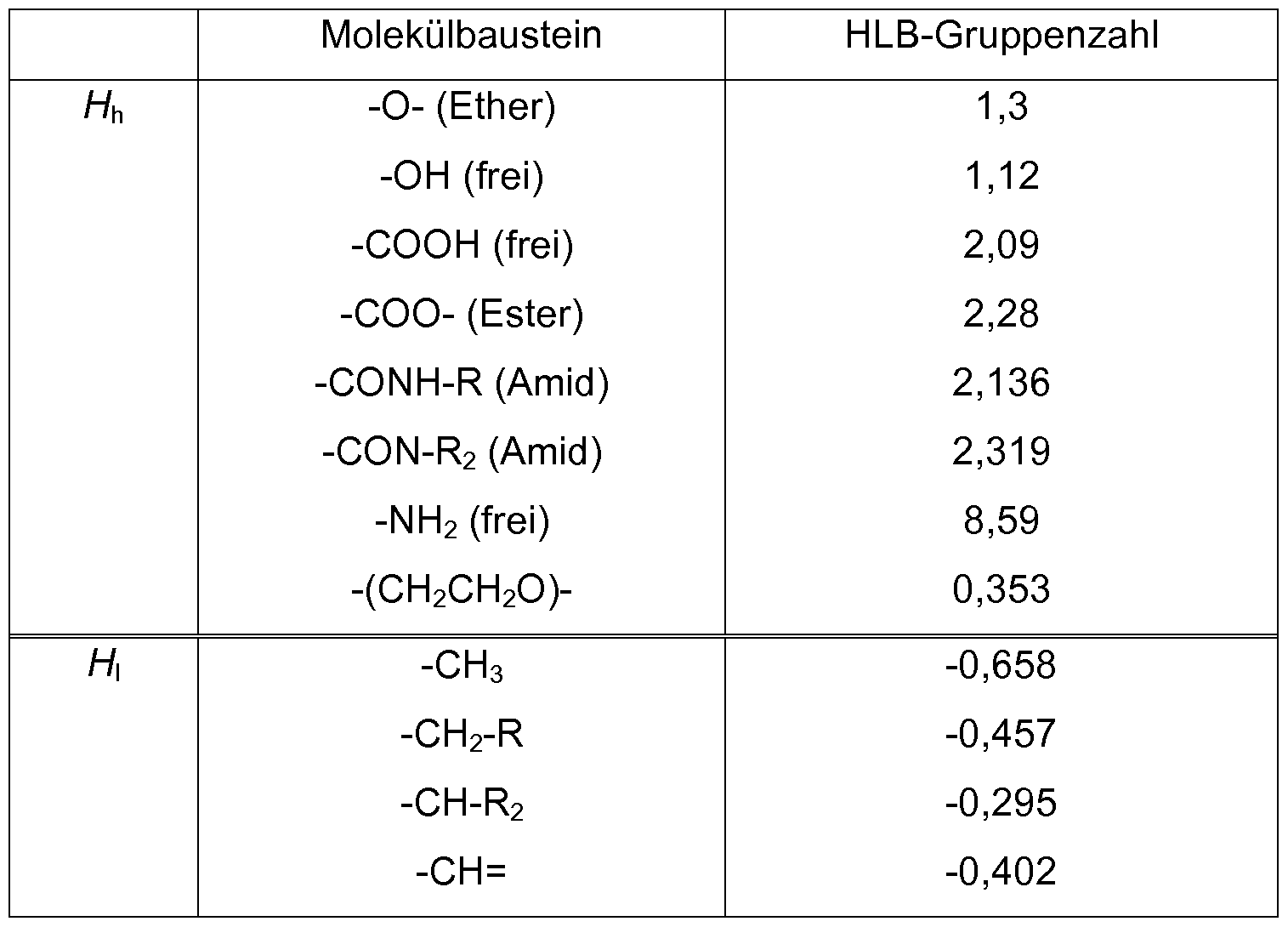
- the HLB value of a molecule can be composed of individual increments of its molecular building blocks according to Equation 1.
- H h and H ⁇ here are the HLB group numbers of the individual hydrophilic or lipophilic molecular building blocks. Typical values for H h and H ⁇ are listed in Table 1 below. Tab. 1: HLB group numbers of different molecular building blocks (see also Table 3 in R. Sowada and JC McGowan, Surfactants Surfactants Detergents, 1992, 29, 109)
- the present invention therefore relates to compositions suitable for the production of polyurethane foams which contain at least one polyol component, at least one blowing agent, a catalyst which catalyzes the formation of a urethane or isocyanurate bond, a silicon-containing foam stabilizer and optionally further additives and optionally one isocyanate component which are characterized in that they contain as blowing agent at least one unsaturated chlorofluorohydrocarbon or unsaturated fluorohydrocarbon and additionally at least one surfactant TD, which has no silicon atom and an HLB value less than 10, preferably less than 7, particularly preferably less than 6, wherein the Concentration of the surfactant TD in the composition of 0.05 and 20 wt .-% based on the total composition.
- polyurethane or polyisocyanurate foams in particular rigid foams, starting from these polyol compositions, the use of the foams, in particular as insulating materials, and the insulating materials themselves.
- Another object of the present invention are polyurethane foams, which were prepared based on the method described above.
- compositions of the present invention have the advantage that larger amounts of HFO propellant can be incorporated into the compositions without the compositions, even after 72 hours of storage, showing phase separation recognizable to the naked eye.
- compositions according to the invention are those which would otherwise have a negative effect on the compatibility of polyol and blowing agent without resulting in a phase separation mixture can also be used in them.
- polyurethane foam is understood as meaning foam which is obtained as a reaction product based on isocyanates and polyols or compounds with isocyanate-reactive groups.
- PU foam is understood as meaning foam which is obtained as a reaction product based on isocyanates and polyols or compounds with isocyanate-reactive groups.
- further functional groups such as e.g. Allophanates, biurets, ureas or isocyanurates.
- PU foams are therefore understood as meaning both polyurethane foams (PUR foams) and polyisocyanurate foams (PIR foams).
- Preferred polyurethane foams are rigid polyurethane foams.
- Unsaturated halogenated hydrocarbons are also referred to as HFO in the context of the present applications.
- Halohydrocarbons may have one or more identical or different halogens.
- Propellants based on unsaturated halogenated hydrocarbons are accordingly referred to as HFOmaschinem means.
- composition according to the invention suitable for the production of polyurethane foams containing at least one polyol component, at least one blowing agent, a catalyst catalyzing the formation of a urethane or isocyanurate bond, a silicon-containing foam stabilizer and optionally further additives and optionally an isocyanate component is characterized in that it contains at least one unsaturated halogenated hydrocarbon, preferably an unsaturated hydrocarbon, as propellant
- the compositions of the invention preferably have from 0.1 to 15 and preferably from 0.5 to 10 parts by mass of surfactants TD per 100 parts by mass of polyol component.
- the composition according to the invention preferably comprises at least one compound of the formula (I)
- R is a linear, branched or cyclic, saturated or unsaturated, preferably saturated hydrocarbon radical, having at least 4, preferably from 8 to 30, preferably from 9 to 20 and particularly preferably 9 to 18 carbon atoms
- Particularly preferred surfactants TD are those which have at least one hydrocarbon radical having at least 4 carbon atoms, preferably having at least 8 carbon atoms and particularly preferably having 9 to 18 carbon atoms, and which have an HLB value of less than 10, preferably less than 7, particularly preferably less than 6 ,
- the preparation of corresponding fatty alcohol alkoxylates can be carried out as described in the prior art.
- the surfactants TD are particularly preferably ethoxylates of these amines.
- glycerol mono- and diethers of saturated or unsaturated alcohols such as octanol, nonanol, isononanol, capryl alcohol, lauryl alcohol, tridecanol, isotridecanol, myristyl alcohol, cetyl alcohol, stearyl alcohol or isostearyl alcohol are particularly preferred.
- Butyric acid (butanoic acid), caproic acid (hexanoic acid), caprylic acid (octanoic acid), capric acid (decanoic acid), lauric acid (dodecanoic acid), myristic acid (tetradecanoic acid), palmitic acid (hexadecanoic acid), stearic acid (octadecanoic acid), arachidic acid (eicosanoic acid), behenic acid (docosanoic acid ), Lignoceric acid (tetracosanoic acid), palmitoleic acid ((Z) - 9-hexadecenoic acid), oleic acid ((Z) -9-hexadecenoic acid), elaidic acid ((E) -9-octadecenoic acid), cis-vaccenic acid ((Z) -1 Octadecenoic acid), linoleic acid ((9Z.12Z) - 9,12-
- Octadecatrienoic acid gamma-linolenic acid ((6Z, 9Z, 12Z) -6,9,12-octadecatrienoic acid), di-homo-gamma-linolenic acid ((8Z, 11Z, 14Z) -8,1 1,14-eicosatrienoic acid )
- Arachidonic acid ((5Z, 8Z, 11Z, 14Z) -5,8,1,14-eicosatetraenoic acid), erucic acid ((Z) -13-docosenoic acid), nervonic acid ((Z) -15-tetracenoic acid), ricinoleic acid, Hydroxystearic acid and undecenylic acid, and mixtures thereof.
- the composition as surfactant TD preferably contains mono- or digylcerides, particularly preferred are mono- and digylcerides of straight-chain saturated or unsaturated fatty acids having up to 30 carbon atoms, such as.
- Octadecatrienoic acid gamma-linolenic acid ((6Z, 9Z, 12Z) -6,9,12-octadecatrienoic acid), di-homo-gamma-linolenic acid ((8Z, 11Z, 14Z) -8,1 1,14-eicosatrienoic acid ), Arachidonic acid ((5Z, 8Z, 11Z, 14Z) -5,8,1,14-eicosatetraenoic acid), erucic acid ((Z) -13-docosenoic acid), nervonic acid ((Z) -15-tetracenoic acid), Rizinolic acid, hydroxystearic acid and undecenylic acid, and mixtures thereof.
- surfactant TD a fatty acid amide of a mono- or dialkanolamine, more preferably diisopropanolamine or diethanolamine.
- the preparation of acid amides can according to the known in the art, such as. In DE 1802500; DE 1802503, DE 1745443, DE 1745459 or US 3578612, carried out. It can be used as raw materials z. B. the corresponding carboxylic acids are used and amide formation take place with dehydration.
- carboxylic esters for example methyl esters, in which case methanol is split off.
- carboxylic esters for example methyl esters, in which case methanol is split off.
- glycerides from the naturally occurring fats and oils, wherein the resulting in the amidation glycerol may remain in the reaction mixture.
- di- and mono-glycerides may still be present in the reaction mixture if the reaction conditions have been selected accordingly.
- carboxylic acid esters are used, appropriate catalysts, such as, for example, alkoxides, are used which allow amidation under relatively mild conditions compared to the abovementioned elimination of water.
- amides When using Of higher-functional amines (DETA, AEEA, TRIS) may also be in the production of amides to form corresponding cyclic amides such as imidazolines or oxazolines.
- a basic catalyst is used in the amidation, it may be advantageous to subsequently neutralize with an appropriate amount of organic or inorganic acid. Suitable compounds are known to the person skilled in the art. Particularly preferred is the neutralization, the amides prepared by basic catalysis, with organic anhydrides of dicarboxylic acids, since these can react with the available OH or NH functions and are thereby connected, and thus later in the finished foam not in the form of free Carboxylic acids can occur as an emission.
- z. B. in the use of alkali alcoholates in the neutralization then formed corresponding esters, so that the free alcohols can not escape from the system.
- Preferred organic anhydrides are cyclic anhydrides such as succinic anhydride, maleic anhydride, alkyl succinic anhydrides such as dodecyl succinic anhydride or polyisobutylene succinic anhydride, adducts of maleic anhydride to corresponding polyolefins such as polybutadienes, copolymers of maleic anhydride and olefins, styrene-maleic anhydride copolymers, vinyl ether-maleic anhydride copolymers , and generally copolymers containing maleic anhydride as a monomer, phthalic anhydride, Benzophenontetracarboxyldianhydrid,
- alkyl radicals of the monocarboxylic acids are, for example: methyl, ethyl, propyl, butyl, pentyl, hexyl, heptyl, octyl, nonyl or decyl, and the like, preferably 2-ethylhexanoic acid, nonanoic acid, isononanoic acid.
- alkenyl groups include, for example, ethenyl, propenyl, butenyl, pentenyl, hexenyl, heptenyl, octenyl, nonenyl, decenyl, and the like.
- aromatic acids are, for.
- aryl and alkylaryl (alkylaryl is defined as an aryl-substituted alkyl or arylalkyl group) such as: phenyl, alkyl-substituted phenyl, naphthyl, alkyl-substituted naphthyl tolyl, benzyl, dimethylphenyl, trimethylphenyl, phenylethyl, phenylpropyl, phenylbutyl , Propyl-2-phenylethyl, salicyl and the like.
- Aromatic dicarboxylic acids may, for. As: isophthalic acid, terephthalic acid or phthalic acid.
- aliphatic dicarboxylic acids which may be used are: succinic acid, malonic acid, adipic acid, dodecanedicarboxylic acid, maleic acid, fumaric acid, itaconic acid, citraconic acid, mesaconic acid, tartaric acid, malic acid, malonic acid, glutaric acid, adipic acid, pimelic acid, suberic acid, azelaic acid, sebacic acid, citric acid.
- trimesic acid trimesic acid, pyromellitic acid, Benzophenontetracarbonklare
- Preferred acids are straight-chain saturated or unsaturated fatty acids having up to 40 carbon atoms, such as. Butyric acid (butanoic acid), caproic acid (hexanoic acid), caprylic acid (octanoic acid), capric acid (decanoic acid), lauric acid (dodecanoic acid), myristic acid (tetradecanoic acid), palmitic acid (hexadecanoic acid), stearic acid (octadecanoic acid), arachidic acid (eicosanoic acid), behenic acid (docosanoic acid ), Lignoceric acid (tetracosanic acid), palmitoleic acid ((Z) -9-hexadecenoic acid), oleic acid ((Z) -9-hexadecenoic acid), elaidic acid ((E) -9-octadecenoic acid), cis-vaccenic acid ((Z) -11 Octade
- Sources of Suitable Fatty Acids or Fatty Acid Esters Especially glycerides can be vegetable or animal fat, oils or waxes.
- vegetable or animal fat, oils or waxes there may be used: lard, beef tallow, goose fat, duck fat, chicken fat, horse fat, whale oil, fish oil, palm oil, olive oil, avocado oil, seed kernel oil, coconut oil, palm kernel oil, cocoa butter, cottonseed oil, pumpkin seed oil, corn oil, sunflower oil, wheat germ oil, grapeseed oil, sesame oil, linseed oil , Soybean oil, peanut oil, lupine oil, rapeseed oil, mustard oil, castor oil, jatropa oil, walnut oil, jojoba oil, lecithin eg based on soybean oilseed rape or sunflower oil, bone oil, claw oil, lanolin, emu oil, deer tallow, marmot oil, mink oil, borage oil, thistle oil, hemp oil, pumpkin oil, evening primrose oil, tall
- suitable hydroxylamine having at least one OH function are, for example: diethanolamine, monoethanolamine, diisopropanolamine, isopropanolamine, diglycolamine (2- (2-aminoethoxy) ethanol), 3-amino 1 -propanol and polyetheramines such as polyetheramine D 2000 (BASF), polyetheramine D 230 (BASF), polyetheramine T 403 (BASF), polyetheramine T 5000 (BASF) or also corresponding Jeffamine types from Huntsman.
- the amidation is carried out with a deficiency of amine, so that as little or no free amine as possible is present in the end product. Since amines generally have no beneficial toxicological properties due to their irritating or corrosive action, minimizing amine levels is desirable and advantageous.
- the Armin contents in the blend used according to the invention, in particular the proportions of compounds carrying primary and secondary amine groups, are preferably less than 5% by weight, more preferably less than 3% by weight, particularly preferably less than 1% by weight, based on the sum of amines and amides.
- the composition according to the invention contains one or more polyols.
- the polyol component is preferably different from the surfactants TD present in the composition.
- Suitable polyols for the purposes of this invention are all organic substances having a plurality of isocyanate-reactive groups and their preparations.
- Preferred polyols are all polyether polyols and polyester polyols commonly used to make polyurethane foams.
- Polyether polyols are obtained by reacting polyhydric alcohols or amines with alkylene oxides.
- Polyester polyols are based on esters of polybasic carboxylic acids (usually phthalic acid or terephthalic acid) with polyhydric alcohols (usually glycols).
- corresponding polyols are used, such as for example, described in: US 2007/0072951 A1, WO 2007/1 1 1828 A2, US 2007/0238800, US 6359022 B1 or WO 96 12759 A2.
- preferably usable vegetable oil-based polyols are described in various patents, for example in WO 2006/094227, WO 2004/096882, US 2002/0103091, WO 2006/1 16456 and EP 1 678 232.
- composition of the invention preferably contains at least one physical blowing agent, i. a volatile (boiling temperature less than 100 ° C, preferably less than 70 ° C) liquid or a gas based on an unsaturated halogenated hydrocarbon, preferably unsaturated fluorohydrocarbon and / or chlorofluorohydrocarbon.
- unsaturated halogenated hydrocarbon preferably unsaturated fluorohydrocarbon and / or chlorofluorohydrocarbon.
- Halohydrocarbons are trans-1,3,3,3-tetrafluoro-1-propene (HFO-1234zeE), 2,3,3,3-tetrafluoro-1-propene (HFO-1234yf), cis-1, 1, 1, 4,4,4-hexafluoro-2-butene (HFO-1336mzzZ), trans-1, 1, 1, 4,4,4-hexafluoro-2-butene (HFO-1336mzzE) and trans-1-chloro-3, 3,3-trifluoro-1-propene (HFO-1233zd-E).
- the HFO propellant may optionally be combined with other physical co-propellants, which are preferably not hydrocarbons.
- Preferred co-blowing agents are, for example, saturated or unsaturated fluorohydrocarbons, more preferably 1,1,1,2-tetrafluoroethane (HFC-134a), 1,1,3,3,3-pentafluoropropane (HFC-245fa), 1,1,1 , 3,3-pentafluorobutane (HFC-365mfc), 1,1,1,3,3,3,3-heptafluoropropane (HFC-227ea) 1,1-difluoroethane (HFC-152a), saturated chlorofluorocarbons, more preferably 1, 1-dichloro-1-fluoroethane (HCFC-141 b), oxygen-containing compounds, more preferably methyl formate or dimethoxymethane, or chlorinated hydrocarbons, more preferably 1, 2-dichloroethane, or mixtures of these blowing agents.
- HFC-134a 1,1,1,2-tetrafluoroethane
- HFC-245fa 1,
- compositions according to the invention have as physical blowing agents no hydrocarbons, such as. As n-pentane, isopentane or cyclopentane.
- the preferred levels of physical blowing agent are dictated by the desired density of the foam to be produced and are typically in the range of 5 to 40 parts by mass, based on 100 parts by mass of polyol.
- physical blowing agents and chemical blowing agents may be included, which react with isocyanates to gas evolution, such as water or formic acid.
- the composition according to the invention contains at least one silicon-containing foam stabilizer, which is different from the surfactants TD.
- Preferred silicon-containing foam stabilizers are organic polyether siloxanes, such as. B. polyether-polydimethylsiloxane copolymers.
- Typical use amounts of silicon-containing foam stabilizers are 0.5 to 5 parts by mass per 100 parts by mass of polyol, preferably 1 to 3 parts by mass per 100 parts by mass of polyol.
- Suitable silicon-containing Schaumstabilisatorn be z.
- the preparation of the siloxanes can be carried out as described in the prior art. Particularly suitable examples for the preparation are, for. In US 4,147,847, EP 0493836 and US 4,855,379.
- compositions according to the invention may contain further components, such as further foam stabilizers, catalysts, crosslinkers, flame retardants, fillers, dyes, antioxidants and thickener / rheology additives. These further components are preferably not surfactants TD or different from these.
- the composition according to the invention preferably comprises one or more catalysts for the catalyst isocyanate-polyol and / or isocyanate-water and / or isocyanate-trimerization.
- Suitable catalysts for the purposes of this invention are preferably catalysts which catalyze the gel reaction (isocyanate-polyol), the blowing reaction (isocyanate-water) and / or the di- or trimerization of the isocyanate.
- Suitable catalysts are the amines triethylamine, dimethylcyclohexylamine, tetramethylethylenediamine, tetramethylhexanediamine, pentamethyldiethylenetriamine, pentamethyldipropylenetriamine, triethylenediamine, dimethylpiperazine, 1, 2-dimethylimidazole, N-ethylmorpholine, tris (dimethylaminopropyl) hexahydro-1,3,5-triazine, dimethylaminoethanol , Dimethylaminoethoxyethanol and Bis (dimethylaminoethyl) ether, tin compounds such as dibutyltin dilaurate and potassium salts such as potassium acetate and potassium 2-ethylhexanoate.
- Suitable catalysts are mentioned, for example, in EP 1985642, EP 1985644, EP 1977825, US 2008/0234402, EP 0656382 B1, US 2007/0282026 A1 and the
- a flame retardant composition of the invention may comprise all known and suitable for the production of polyurethane foams flame retardants.
- Suitable flame retardants in the context of this invention are preferably liquid organic phosphorus compounds, such as halogen-free organic phosphates, e.g. Triethyl phosphate (TEP), halogenated phosphates, e.g. Tris (1-chloro-2-propyl) phosphate (TCPP) and tris (2-chloroethyl) phosphate (TCEP) and organic phosphonates, e.g. Dimethylmethanephosphonate (DMMP), dimethylpropanephosphonate (DMPP), or solids such as ammonium polyphosphate (APP) and red phosphorus.
- halogenated compounds for example halogenated polyols, and solids, such as expandable graphite and melamine, are suitable as flame retardants.
- additives may be included in the composition optionally also known in the art further components, such as. Polyethers, nonylphenol ethoxylates or nonionic surfactants, all of which are not surfactants as defined for the TD surfactants.
- compositions of the invention may, for. B are used for the production of polyurethane foams, in particular rigid polyurethane foams.
- the compositions of the invention can be used in a process according to the invention for the production of polyurethane or Polyisocyanuratschaumstoffen (polyurethane foams), in particular for the production of rigid polyurethane foams, which are characterized in that a composition according to the invention is implemented.
- the isocyanate component all isocyanate compounds suitable for producing polyurethane foams, in particular polyurethane foams or polyisocyanurate rigid foams, can be used.
- the isocyanate component comprises one or more organic isocyanates having two or more isocyanate functions.
- Suitable isocyanates in the context of this invention are, for. B. all polyfunctional organic isocyanates, such as 4,4'-diphenylmethane diisocyanate (MDI), toluene diisocyanate (TDI), hexamethylene diisocyanate (HMDI) and isophorone diisocyanate (IPDI).
- polymeric MDI ("crudeMDI) of MDI and higher condensed analogues having an average functionality of 2 to 4.
- suitable isocyanates are described in EP 1 712 578 A1, EP 1 161 474, WO 058383 A1, US 2007/0072951 A1, EP 1 678 232 A2 and WO 2005/085310.
- the ratio of isocyanate to polyol is preferably in the range from 40 to 500, preferably 100 to 350.
- the index describes the ratio of actually used isocyanate to calculated isocyanate (for a stoichiometric reaction with polyol).
- An index of 100 indicates a molar ratio of the reactive groups of 1 to 1.
- the process according to the invention for producing polyurethane foams can be carried out by the known methods, for example by hand mixing or preferably by means of foaming machines. If the process is carried out by means of foaming machines, high-pressure or low-pressure machines can be used.
- the process according to the invention can be carried out both batchwise and continuously.
- a preferred polyurethane or polyisocyanurate rigid foam formulation according to this invention would give a density of 20 to 150 kg / m 3 and preferably has the composition mentioned in Table 2.
- Table 2 Composition of a polyurethane or polyisocyanurate hard foam formulation
- Polyurethane foams according to the invention are also distinguished by the fact that they are obtainable by the process according to the invention.
- Preferred polyurethane foams according to the invention in particular rigid polyurethane foams prepared by using the composition according to the invention, have a thermal conductivity of less than 21 mW / nVK, preferably less than 20 mW / nVK measured in fresh (ie cured for 24 h at room temperature) at 23 ° C ( Determined by means of a 2-plate heat conductivity measuring device "Lambda Control" from Hesto.
- polyurethane foams according to the invention can be used as or for the production of insulating materials, preferably insulating boards, refrigerators, insulating foams or spray foams.
- Cooling apparatuses according to the invention are distinguished by the fact that they have as insulating material a polyurethane foam according to the invention (polyurethane or polyisocyanurate foam), in particular rigid polyurethane foam.
- a foamable A component 72.0 parts by weight (GT) of a polyol A (containing an aliphatic polyether polyol and an MDA-initiated polyether polyol, 2.3 parts by weight of water, and a mixture of amine catalysts DMCHA and PMDETA) was 24 , 5 parts of the HFO propellant Trans-1 -Chloro-3,3,3-trifluoro-1-propene (HFO-1233zd-E) available under the trade name Solsitce LBA (Honeywell) mixed. In addition, this mixture was added 4 parts of various polyether-based foam stabilizers, available as TEGOSTAB ® Bxxxx types at Evonik Industries AG. The exact composition of this mixture is summarized in Table 3.
- Table 4 Composition of surfactant-containing foamable A components based on the polyol A and the HFO propellant 1233zd-E
Landscapes
- Chemical & Material Sciences (AREA)
- Polymers & Plastics (AREA)
- Organic Chemistry (AREA)
- Health & Medical Sciences (AREA)
- Chemical Kinetics & Catalysis (AREA)
- Medicinal Chemistry (AREA)
- Engineering & Computer Science (AREA)
- Materials Engineering (AREA)
- General Chemical & Material Sciences (AREA)
- General Engineering & Computer Science (AREA)
- Mechanical Engineering (AREA)
- Manufacturing & Machinery (AREA)
- Polyurethanes Or Polyureas (AREA)
- Manufacture Of Porous Articles, And Recovery And Treatment Of Waste Products (AREA)
- Compositions Of Macromolecular Compounds (AREA)
Abstract
Description


Claims
Priority Applications (7)
| Application Number | Priority Date | Filing Date | Title |
|---|---|---|---|
| JP2016535696A JP6513090B2 (ja) | 2013-12-19 | 2014-12-05 | ポリウレタンフォームの製造に適し、少なくとも1種のhfo発泡剤を含む組成物 |
| BR112016014329A BR112016014329A2 (pt) | 2013-12-19 | 2014-12-05 | composição que é adequada para a produção de espumas de poliuretano e contém pelo menos um agente de expansão hfo |
| KR1020167018751A KR102254280B1 (ko) | 2013-12-19 | 2014-12-05 | 하나 이상의 hfo 발포제를 함유하는 폴리우레탄 발포체의 제조에 적합한 조성물 |
| EP14815274.7A EP3083786A1 (de) | 2013-12-19 | 2014-12-05 | Zusammensetzung, geeignet zur herstellung von polyurethanschäumen, enthaltend mindestens ein hfo-treibmittel |
| MX2016008097A MX2016008097A (es) | 2013-12-19 | 2014-12-05 | Composicion que es adecuada para producir espumas de poliuretano y que contienen al menos un agente soplador de hfo. |
| CN201480069227.XA CN105873993B (zh) | 2013-12-19 | 2014-12-05 | 适于制备聚氨酯泡沫且含有至少一种hfo发泡剂的组合物 |
| US15/103,015 US10023679B2 (en) | 2013-12-19 | 2014-12-05 | Composition which is suitable for producing polyurethane foams and contains at least one HFO blowing agent |
Applications Claiming Priority (2)
| Application Number | Priority Date | Filing Date | Title |
|---|---|---|---|
| DE102013226575.1 | 2013-12-19 | ||
| DE102013226575.1A DE102013226575B4 (de) | 2013-12-19 | 2013-12-19 | Zusammensetzung, geeignet zur Herstellung von Polyurethanschäumen, enthaltend mindestens einen ungesättigten Fluorkohlenwasserstoff oder ungesättigten Fluorkohlenwasserstoff als Treibmittel, Polyurethanschäume, Verfahren zu deren Herstellung und deren Verwendung |
Publications (1)
| Publication Number | Publication Date |
|---|---|
| WO2015091021A1 true WO2015091021A1 (de) | 2015-06-25 |
Family
ID=52130228
Family Applications (1)
| Application Number | Title | Priority Date | Filing Date |
|---|---|---|---|
| PCT/EP2014/076712 Ceased WO2015091021A1 (de) | 2013-12-19 | 2014-12-05 | Zusammensetzung, geeignet zur herstellung von polyurethanschäumen, enthaltend mindestens ein hfo-treibmittel |
Country Status (9)
| Country | Link |
|---|---|
| US (1) | US10023679B2 (de) |
| EP (1) | EP3083786A1 (de) |
| JP (1) | JP6513090B2 (de) |
| KR (1) | KR102254280B1 (de) |
| CN (1) | CN105873993B (de) |
| BR (1) | BR112016014329A2 (de) |
| DE (1) | DE102013226575B4 (de) |
| MX (1) | MX2016008097A (de) |
| WO (1) | WO2015091021A1 (de) |
Cited By (8)
| Publication number | Priority date | Publication date | Assignee | Title |
|---|---|---|---|---|
| JP2017206693A (ja) * | 2016-05-17 | 2017-11-24 | 東ソー株式会社 | ハロアルケン発泡ポリウレタン製造用のアミン触媒組成物 |
| WO2017206822A1 (zh) * | 2016-05-31 | 2017-12-07 | 金发科技股份有限公司 | 一种制冷设备环保节能结构层及其应用 |
| WO2017206823A1 (zh) * | 2016-05-31 | 2017-12-07 | 金发科技股份有限公司 | 一种制冷设备环保节能结构层及其应用 |
| WO2017206818A1 (zh) * | 2016-05-31 | 2017-12-07 | 金发科技股份有限公司 | 一种制冷设备环保节能结构层及其应用 |
| WO2017206819A1 (zh) * | 2016-05-31 | 2017-12-07 | 金发科技股份有限公司 | 一种制冷设备环保节能结构层及其应用 |
| WO2017206821A1 (zh) * | 2016-05-31 | 2017-12-07 | 金发科技股份有限公司 | 一种制冷设备环保节能结构层及其应用 |
| KR20190022910A (ko) * | 2016-07-25 | 2019-03-06 | 허니웰 인터내셔날 인코포레이티드 | Hf0-1336mzzm(z)를 함유하는 폴리에스테르 폴리올 조성물 |
| AT18035U3 (de) * | 2016-07-20 | 2024-01-15 | Brugg Rohr Ag Holding | Thermisch gedämmte Mediumrohre mit HFO – haltigem Zellgas |
Families Citing this family (25)
| Publication number | Priority date | Publication date | Assignee | Title |
|---|---|---|---|---|
| DE102014215384A1 (de) | 2014-08-05 | 2016-02-11 | Evonik Degussa Gmbh | Stickstoffhaltige Verbindungen, geeignet zur Verwendung bei der Herstellung von Polyurethanen |
| DE102014215388A1 (de) | 2014-08-05 | 2016-02-11 | Evonik Degussa Gmbh | Stickstoffhaltige Verbindungen, geeignet zur Verwendung bei der Herstellung von Polyurethanen |
| DE102014215382A1 (de) | 2014-08-05 | 2016-02-11 | Evonik Degussa Gmbh | Stickstoffhaltige Verbindungen, geeignet zur Verwendung bei der Herstellung von Polyurethanen |
| PL3115389T3 (pl) | 2015-07-07 | 2020-09-07 | Evonik Operations Gmbh | Wytwarzanie pianki poliuretanowej |
| US10370493B2 (en) | 2016-01-29 | 2019-08-06 | Evonik Degussa Gmbh | Polyglycerol alkoxylate esters and preparation and use thereof |
| EP3487945B1 (de) | 2016-07-19 | 2020-05-13 | Evonik Operations GmbH | Verwendung von polyolestern zur herstellung poröser kunststoffbeschichtungen |
| CN110267641A (zh) | 2017-02-10 | 2019-09-20 | 赢创德固赛有限公司 | 含有至少一种生物表面活性剂和氟化物的口腔护理组合物 |
| KR102628190B1 (ko) | 2017-03-20 | 2024-01-25 | 더 케무어스 컴퍼니 에프씨, 엘엘씨 | 트랜스-1,1,1,4,4,4-헥사플루오로-2-부텐의 조성물 및 용도 |
| CN108727551A (zh) * | 2017-04-19 | 2018-11-02 | 科思创德国股份有限公司 | 一种硬质聚氨酯泡沫及其制备方法与应用 |
| JP7428637B2 (ja) | 2017-08-30 | 2024-02-06 | エボニック オペレーションズ ゲーエムベーハー | 多孔質プラスチック被覆を製造するためのポリオールエーテルの使用 |
| WO2019055441A1 (en) | 2017-09-14 | 2019-03-21 | Huntsman International Llc | POLYURETHANE ISOLATION FOAM COMPOSITION COMPRISING HALOGENATED OLEFINS AND TERTIARY AMINE COMPOUND |
| US10787464B2 (en) | 2017-10-17 | 2020-09-29 | Evonik Operations Gmbh | Zinc ketoiminate complexes as catalysts for the production of polyurethanes |
| ES2834450T3 (es) | 2018-03-05 | 2021-06-17 | Evonik Operations Gmbh | Copolímeros en bloques de poliéter-siloxano reticulados, así como su empleo para la producción de espumas de poliuretano |
| CN112368315B (zh) * | 2018-06-27 | 2023-07-04 | 巴斯夫欧洲公司 | 制备硬质聚氨酯泡沫的方法及其作为绝热材料的用途 |
| WO2020055559A1 (en) | 2018-09-13 | 2020-03-19 | Huntsman International Llc | Polyurethane insulation foam composition comprising a stabilizing compound |
| MX2021008058A (es) | 2019-01-07 | 2021-08-05 | Evonik Operations Gmbh | Produccion de espuma rigida de poliuretano. |
| CN114829441A (zh) * | 2019-12-17 | 2022-07-29 | 巴斯夫欧洲公司 | 制备绝热制品的弹性的发泡方法 |
| KR102154865B1 (ko) * | 2020-03-17 | 2020-09-10 | 최규술 | 폴리우레탄 발포폼 제조용 키트 및 이를 이용한 폴리우레탄 발포폼 제조방법 |
| KR102154864B1 (ko) * | 2020-03-17 | 2020-09-10 | 최규술 | 준불연 폴리우레탄 폼블록 조성물 및 그 제조방법 |
| US12503567B2 (en) | 2020-05-19 | 2025-12-23 | Huntsman International Llc | Process for recycling a polyurethane material |
| US12122890B2 (en) | 2020-08-20 | 2024-10-22 | Evonik Operations Gmbh | Production of polyurethane foam |
| WO2022085544A1 (ja) * | 2020-10-22 | 2022-04-28 | Agc株式会社 | 電気設備 |
| US12252588B2 (en) | 2020-12-10 | 2025-03-18 | Evonik Operations Gmbh | Polyether-siloxane block copolymers for the production of polyurethane foams |
| EP4112674A1 (de) | 2021-06-30 | 2023-01-04 | Evonik Operations GmbH | Verfahren zur herstellung hochreiner hydrosilylierungsprodukte |
| US11753516B2 (en) | 2021-10-08 | 2023-09-12 | Covestro Llc | HFO-containing compositions and methods of producing foams |
Citations (49)
| Publication number | Priority date | Publication date | Assignee | Title |
|---|---|---|---|---|
| DE1802503A1 (de) | 1967-10-12 | 1969-05-29 | Eggers Lura Aldo Maria Andrea | Polyurethane und Verfahren zu deren Herstellung |
| US3578612A (en) | 1968-07-29 | 1971-05-11 | Schering Ag | Polyurethane forms based on dimer fatty acid polyalkanolamides |
| DE1745443A1 (de) | 1967-01-31 | 1971-05-13 | Schering Ag | Verfahren zur Herstellung von Schaumstoffen |
| DE1745459A1 (de) | 1967-07-29 | 1971-09-09 | Schering Ag | Verfahren zur Herstellung von Schaumstoffen |
| US3933695A (en) | 1972-12-29 | 1976-01-20 | Union Carbide Corporation | Hydroxyalkenylsiloxane rigid poly urethane foam stabilizers |
| DE2533074A1 (de) | 1974-08-30 | 1976-03-11 | Goldschmidt Ag Th | Verfahren zur herstellung von hochelastischen polyurethanweichschaeumen |
| US4147847A (en) | 1973-11-14 | 1979-04-03 | Dow Corning Corporation | Method of preparing flexible flame retardant polyether based one-shot polyurethane foams and compositions therefore |
| US4855379A (en) | 1988-03-08 | 1989-08-08 | Union Carbide Corporation | Silicone surfactants containing cyclic siloxane pendants |
| EP0493836A1 (de) | 1990-12-31 | 1992-07-08 | OSi Specialties, Inc. | Tenside zur Polyurethanschaumstoffherstellung |
| EP0533202A1 (de) | 1991-09-20 | 1993-03-24 | Union Carbide Chemicals & Plastics Technology Corporation | Verwendung von blockierten oberflächenaktiven Mitteln zur Herstellung von Polyurethan-Hartschaumstoffen gebläht mittels Fluorchlorkohlenwasserstoffen |
| DE4229402A1 (de) | 1992-09-03 | 1994-03-10 | Goldschmidt Ag Th | Polysiloxan-Polyoxyalkylen-Blockmischpolymerisat mit unterschiedlichen Polyoxyalkylenblöcken im durchschnittlichen Molekül |
| DE4239054A1 (de) | 1992-11-20 | 1994-05-26 | Goldschmidt Ag Th | Polysiloxan-Polyoxyalkylen-Blockmischpolymerisat mit unterschiedlichen Polyoxyalkylenblöcken im durchschnittlichen Molekül |
| WO1996012759A2 (en) | 1994-10-20 | 1996-05-02 | The Dow Chemical Company | A process for preparing polyurethane foam in the presence of a hydrocarbon blowing agent |
| EP0767199A1 (de) | 1995-10-06 | 1997-04-09 | Ediltec S.r.l. | Polyurethanschaumstoff |
| EP0780414A2 (de) | 1995-12-22 | 1997-06-25 | Air Products And Chemicals, Inc. | Ein Verfahren zur Herstellung von weichen Polyurethanschäumen |
| EP0839852A2 (de) | 1996-10-31 | 1998-05-06 | OSi Specialties, Inc. | Hydrosilierung in Gegenwart eines hochsiedenden naturellen pflanzlichen Öls |
| EP0656382B1 (de) | 1993-12-03 | 1998-08-26 | Nisshinbo Industries, Inc. | Verfahren zur Herstellung modifizierter Polyisocyanuratschaumstoffen |
| EP0867464A1 (de) | 1997-03-26 | 1998-09-30 | Th. Goldschmidt AG | Verwendung von organofunktionell modifizierten Polysiloxanen bei der Herstellung von Polyurethanschaum |
| WO1998042764A1 (en) | 1997-03-20 | 1998-10-01 | Huntsman Ici Chemicals Llc | Process for rigid polyurethane foams |
| EP1161474A1 (de) | 1999-02-13 | 2001-12-12 | Bayer Ag | Feinzellige, wassergetriebene polyurethanhartschaumstoffe |
| US6359022B1 (en) | 1997-10-10 | 2002-03-19 | Stepan Company | Pentane compatible polyester polyols |
| US20020103091A1 (en) | 2001-01-29 | 2002-08-01 | Kodali Dharma R. | Reactive oil compositions and uses thereof |
| US6472446B1 (en) | 2001-03-09 | 2002-10-29 | Basf Corporation | Phase stable polyol composition containing hydrocarbon as the blowing agent |
| WO2004096882A1 (en) | 2003-04-25 | 2004-11-11 | Dow Global Technologies, Inc. | Vegetable oil based polyols and polyurethanes made therefrom |
| WO2005008383A2 (en) | 2003-07-08 | 2005-01-27 | Paybyclick Corporation | Using account hierarchy and locking accounts |
| EP1520873A2 (de) | 2003-09-26 | 2005-04-06 | Air Products And Chemicals, Inc. | Treibmittelförderer für die Herstellung von Polyurethanschaumstoff |
| EP1537159A1 (de) | 2002-08-28 | 2005-06-08 | Basf Aktiengesellschaft | Verfahren zur herstellung von emissionsarmen polyurethan-weichschaumstoffen |
| EP1544235A1 (de) | 2003-12-15 | 2005-06-22 | Air Products And Chemicals, Inc. | Silikon-Schaumstabilisatoren für Polyurethan-Hartschäume hergestellt mit Kohlenwasserstoff-Treibmitteln |
| DE102004001408A1 (de) | 2004-01-09 | 2005-07-28 | Goldschmidt Ag | Verwendung blockweise aufgebauter Polyethersiloxane als Stabilisatoren in Polyurethanschäumen |
| WO2005085310A2 (de) | 2004-03-08 | 2005-09-15 | Rathor Ag | Phasenstabile polyurethanprepolymere |
| WO2005118668A1 (en) | 2004-05-25 | 2005-12-15 | General Electric Company | Process for preparing polyurethane foams having reduced voc emissions |
| EP1678232A2 (de) | 2003-09-30 | 2006-07-12 | Cargill, Incorporated | Mit polyolen auf basis von modifiziertem pflanzenöl hergestellte polyurethan-weichschaumstoffe |
| WO2006094227A2 (en) | 2005-03-03 | 2006-09-08 | South Dakota Soybean Processors, Llc | Novel polyols derived from a vegetable oil using an oxidation process |
| EP1712578A1 (de) | 2005-04-13 | 2006-10-18 | Bayer MaterialScience LLC | Aus Pflanzenölhydroxylaten, Polymerpolyolen und aliphatischen Polyhydroxyalkoholen hergestellte Polyurethanschäume |
| WO2006116456A1 (en) | 2005-04-25 | 2006-11-02 | Cargill, Incorporated | Polyurethane foams comprising oligomeric polyols |
| US20070072951A1 (en) | 2005-09-27 | 2007-03-29 | Bender Jared D | Silanol-functionalized compounds for the preparation of polyurethane foams |
| WO2007094780A1 (en) | 2006-02-15 | 2007-08-23 | Stepan Company | Compatibilizing surfactants for polyurethane polyols and resins |
| WO2007111828A2 (en) | 2006-03-23 | 2007-10-04 | Dow Global Technologies Inc. | Low density, natural oil based polyurethane foam without silicone based cell stabilizing additive |
| US20070238800A1 (en) | 2006-04-11 | 2007-10-11 | Bayer Materialscience Llc | Storage stable isocyanate-reactive component containing vegetable oil-based polyol |
| US20070282026A1 (en) | 2003-07-24 | 2007-12-06 | Huntsman Petrochemical Corporation | Low-Odor Catalyst for Isocyanate-Derived Foams and Elastomers |
| EP1873209A2 (de) | 2006-07-01 | 2008-01-02 | Evonik Goldschmidt GmbH | Siliconstabilisatoren für flammgeschützte Polyurethan- bzw. Polyisocyanurat-Hartschaumstoffe |
| US20080234402A1 (en) | 2005-09-01 | 2008-09-25 | Basf Se | Polyisocyanurate Rigid Foam and Method for the Production Thereof |
| EP1977825A1 (de) | 2006-07-13 | 2008-10-08 | Air Products and Chemicals, Inc. | N,N,N'-Trimethyl-Bi-(Aminoethyl-)Ether und seine Derivate als Katalysatoren für Polyurethane |
| EP1985642A1 (de) | 2007-04-25 | 2008-10-29 | Air Products and Chemicals, Inc. | Zusatzstoffe zur verbesserten Flächenhärtung und dimensionale Stabilität von Polyurethan-Schäumen |
| EP1985644A1 (de) | 2007-04-26 | 2008-10-29 | Air Products and Chemicals, Inc. | Polyaminzusammensetzung |
| US20090305875A1 (en) | 2006-05-31 | 2009-12-10 | Borealis Technology Oy | Catalyst with al-alkoxy component |
| EP2154223A1 (de) | 2005-06-24 | 2010-02-17 | Honeywell International Inc. | Wärmeisolierender Schaumstoff, der HFO-1233zd als Treimbittel enthält |
| WO2013026813A1 (de) | 2011-08-23 | 2013-02-28 | Basf Se | Mikroemulsionen |
| EP2197935B1 (de) | 2007-10-12 | 2013-08-21 | Honeywell International Inc. | Stabilisierung von polyurethanschaumstoff-polyol-vormischungen mit halogenierten olefin-blasmitteln |
Family Cites Families (59)
| Publication number | Priority date | Publication date | Assignee | Title |
|---|---|---|---|---|
| DE1745443U (de) | 1957-03-07 | 1957-05-23 | Peter Kuepper K G | Muetze, insbesondere sportmuetze. |
| DE1802503U (de) | 1959-10-07 | 1959-12-17 | Octave Tarravello | Spanner, insbesondere zur befestigung von planen. |
| DE1802500U (de) | 1959-10-22 | 1959-12-17 | Stromag Maschf | Elektromagnet-reibscheibenkupplung. |
| JPH0586223A (ja) * | 1991-09-26 | 1993-04-06 | Toyota Motor Corp | ポリウレタンフオ−ムの製法 |
| US6888028B2 (en) * | 2000-10-17 | 2005-05-03 | Asahi Kasei Kabushiki Kaisha | Process for preparation polyisocyanate composition |
| DE102005034052A1 (de) | 2005-07-21 | 2007-01-25 | Goldschmidt Gmbh | Trimerisierungskatalysatoren |
| DE102005050473A1 (de) | 2005-10-21 | 2007-04-26 | Goldschmidt Gmbh | Verfahren zur Herstellung von Polyurethan-Kaltschäumen |
| DE102005056246A1 (de) | 2005-11-25 | 2007-06-06 | Goldschmidt Gmbh | Gepfropfte Polyether-Copolymerisate und deren Verwendung zur Stabilisierung von Schaumstoffen |
| DE102006042338A1 (de) | 2006-09-08 | 2008-03-27 | Evonik Goldschmidt Gmbh | Verwendung von Urethan- oder Harnstoffgruppen enthaltenden Polyethern zur Stabilisierung von Polyurethanschäumen |
| GB0618103D0 (en) | 2006-09-14 | 2006-10-25 | Ibm | A method, apparatus and software for processing data to maintain a simulation of a running median |
| US8303843B2 (en) | 2006-12-15 | 2012-11-06 | Evonik Goldschmidt Gmbh | Aqueous cold-cure flexible stabilizer formulations |
| DE102006060115A1 (de) | 2006-12-20 | 2008-06-26 | Evonik Goldschmidt Gmbh | Cyclische Siloxane und deren Verwendung |
| US7785962B2 (en) | 2007-02-26 | 2010-08-31 | Micron Technology, Inc. | Methods of forming a plurality of capacitors |
| DE102007046736A1 (de) | 2007-09-28 | 2009-04-02 | Evonik Goldschmidt Gmbh | Verwendung linearer Siloxane und Verfahren zu deren Herstellung |
| US20090099273A1 (en) * | 2007-10-12 | 2009-04-16 | Williams David J | Non-silicone surfactants for polyurethane or polyisocyanurate foam containing halogenated olefins as blowing agents |
| US8439907B2 (en) | 2007-11-07 | 2013-05-14 | Mirabilis Medica Inc. | Hemostatic tissue tunnel generator for inserting treatment apparatus into tissue of a patient |
| KR20100114047A (ko) | 2008-01-24 | 2010-10-22 | 에보니크 골트슈미트 게엠베하 | 폴리우레탄 단열 발포체의 제조 방법 |
| DE102008000243A1 (de) | 2008-02-06 | 2009-08-13 | Evonik Goldschmidt Gmbh | Neuartige Kompatibilisierungsmittel zur Verbesserung der Lagerstabilität von Polyolmischungen |
| DE102008000255A1 (de) | 2008-02-08 | 2009-08-20 | Evonik Goldschmidt Gmbh | Siloxanzusammensetzungen |
| EP2153889A3 (de) | 2008-08-15 | 2014-08-13 | Evonik Degussa GmbH | Nanoemulsionen und Verfahren zu deren Herstellung, sowie deren Verwendung als Formulierungen von Pflanzenschutz- und/oder Schädlingsbekämpfungsmitteln und/oder kosmetischen Zubereitungen |
| DE102008043343A1 (de) | 2008-10-31 | 2010-05-06 | Evonik Goldschmidt Gmbh | Silikonpolyetherblock-Copolymere mit definierter Polydispersität im Polyoxyalkylenteil und deren Verwendung als Stabilisatoren zur Herstellung von Polyurethanschäumen |
| DE102008055115A1 (de) | 2008-12-23 | 2010-07-01 | Evonik Goldschmidt Gmbh | Wässrige Siloxanformulierungen für die Herstellung von hochelastischen Polyurethankaltweichschäumen |
| DE102009000194A1 (de) | 2009-01-14 | 2010-07-15 | Evonik Goldschmidt Gmbh | Verfahren zur Herstellung von Kaltschäumen |
| DE102009001595A1 (de) | 2009-03-17 | 2010-09-23 | Evonik Goldschmidt Gmbh | Kompatibilisierungsmittel zur Verbesserung der Lagerstabilität von Polyolmischungen |
| DE102009003274A1 (de) | 2009-05-20 | 2010-11-25 | Evonik Goldschmidt Gmbh | Zusammensetzungen enthaltend Polyether-Polysiloxan-Copolymere |
| DE102009028061A1 (de) | 2009-07-29 | 2011-02-10 | Evonik Goldschmidt Gmbh | Verfahren zur Herstellung von Polyurethanschaum |
| US8906914B2 (en) | 2009-08-18 | 2014-12-09 | Janssen Pharmaceutica Nv | Ethylene diamine modulators of fatty acid hydrolase |
| DE102009029089A1 (de) | 2009-09-02 | 2011-03-03 | Evonik Goldschmidt Gmbh | Phosphorarme Laminieradditive mit geringer Emission, verbesserter Anfangshaftung und verbesserter Hydrolysestabilität |
| DE102009029363A1 (de) | 2009-09-11 | 2011-03-24 | Evonik Goldschmidt Gmbh | Lecithin enthaltende Zusammensetzung geeignet zur Herstellung von Polyurethanhartschäumen |
| DE102009060750B4 (de) | 2009-12-30 | 2025-04-10 | OSRAM Opto Semiconductors Gesellschaft mit beschränkter Haftung | Optoelektronischer Halbleiterchip und Verfahren zu dessen Herstellung |
| DE102010001528A1 (de) | 2010-02-03 | 2011-08-04 | Evonik Goldschmidt GmbH, 45127 | Neue Partikel und Kompositpartikel, deren Verwendungen und ein neues Verfahren zu deren Herstellung aus Alkoxysilylgruppen tragenden Alkoxylierungsprodukten |
| DE102010029235A1 (de) | 2010-05-21 | 2011-11-24 | Evonik Degussa Gmbh | Hydrophile Polyisocyanate |
| DE202010011131U1 (de) | 2010-08-06 | 2011-11-23 | Liebherr-Werk Ehingen Gmbh | Gitterstück und Kran |
| DE102010039140A1 (de) | 2010-08-10 | 2012-02-16 | Evonik Goldschmidt Gmbh | Dispergiermittel und Verfahren zu deren Herstellung |
| DE102010063241A1 (de) | 2010-12-16 | 2012-06-21 | Evonik Goldschmidt Gmbh | Siliconstabilisatoren für Polyurethan- oder Polyisocyanurat-Hartschaumstoffe |
| DE102010063237A1 (de) | 2010-12-16 | 2012-06-21 | Evonik Goldschmidt Gmbh | Siliconstabilisatoren für Polyurethan- oder Polyisocyanurat-Hartschaumstoffe |
| DE102011003090A1 (de) | 2011-01-25 | 2012-07-26 | Evonik Goldschmidt Gmbh | Verwendung von Siliconmethacrylat-Partikeln in kosmetischen Formulierungen |
| DE102011003148A1 (de) | 2011-01-26 | 2012-07-26 | Evonik Goldschmidt Gmbh | Verwendung von Silikonpolyetherblock-Copolymere mit hochmolekularen nicht endverkappten Polyetherresten als Stabilisatoren zur Herstellung von Polyuretherschäumen niedriger Dichte |
| DE102011003150A1 (de) | 2011-01-26 | 2012-07-26 | Evonik Goldschmidt Gmbh | Silikonpolyetherblock-Copolymere mit hochmolekularen Polyetherresten und deren Verwendung als Stabilisatoren zur Herstellung von Polyurethanschäumen |
| DE102011007468A1 (de) | 2011-04-15 | 2012-10-18 | Evonik Goldschmidt Gmbh | Zusammensetzung, enthaltend spezielle Carbamat-artige Verbindungen, geeignet zur Herstellung von Polyurethanschäumen |
| DE102011007479A1 (de) | 2011-04-15 | 2012-10-18 | Evonik Goldschmidt Gmbh | Zusammensetzung, enthaltend spezielle Amide und organomodifizierte Siloxane, geeignet zur Herstellung von Polyurethanschäumen |
| DE102011109541A1 (de) | 2011-08-03 | 2013-02-07 | Evonik Goldschmidt Gmbh | Verwendung von Polysiloxanen enthaltend verzweigte Polyetherreste zur Herstellung von Polyurethanschäumen |
| US8735524B2 (en) * | 2011-09-09 | 2014-05-27 | Air Products And Chemicals, Inc. | Silicone containing compositions and uses thereof |
| DE102011083017A1 (de) | 2011-09-20 | 2013-03-21 | Evonik Industries Ag | Verbundwerkstoffe umfassend eine offenzellige Polymermatrix und darin eingebettete Granulate |
| DE102011083011A1 (de) | 2011-09-20 | 2013-03-21 | Evonik Goldschmidt Gmbh | Verbundwerkstoffe umfassend eine Polymermatrix und darin eingebetteteGranulate |
| KR101187510B1 (ko) | 2011-12-14 | 2012-10-02 | 부전전자 주식회사 | 고출력 마이크로스피커 |
| EP2716673B1 (de) | 2012-10-04 | 2016-04-06 | Evonik Degussa GmbH | Formteile auf Basis von Reaktionsprodukten aus Polyolen und Isocyanaten |
| US20140202339A1 (en) | 2012-10-17 | 2014-07-24 | Avantec, Llc | Vertical conveyor oven with advanced airflow |
| DE102013201829A1 (de) | 2013-02-05 | 2014-08-07 | Evonik Industries Ag | Amine, geeignet zur Verwendung bei der Herstellung von Polyurethanen |
| JP6100026B2 (ja) | 2013-03-06 | 2017-03-22 | エスアイアイ・セミコンダクタ株式会社 | 半導体装置 |
| KR102120896B1 (ko) | 2013-07-25 | 2020-06-10 | 삼성디스플레이 주식회사 | 대향 타겟 스퍼터링 장치를 이용한 유기발광표시장치 및 그 제조방법 |
| WO2015047358A1 (en) | 2013-09-28 | 2015-04-02 | Intel Corporation | Multi-function key in a keyboard for an electronic device |
| JP2015070192A (ja) | 2013-09-30 | 2015-04-13 | サンケン電気株式会社 | 半導体装置の製造方法、半導体装置 |
| ITPN20130062A1 (it) | 2013-10-16 | 2015-04-17 | Tmci Padovan S P A | Pressa per prodotti ortofrutticoli e relativo metodo di pressatura |
| US20160020199A1 (en) | 2014-07-15 | 2016-01-21 | Mediatek Inc. | Semiconductor structure with spare cell region |
| US9583380B2 (en) | 2014-07-17 | 2017-02-28 | Globalfoundries Inc. | Anisotropic material damage process for etching low-K dielectric materials |
| US10056293B2 (en) | 2014-07-18 | 2018-08-21 | International Business Machines Corporation | Techniques for creating a local interconnect using a SOI wafer |
| CN105321869A (zh) | 2014-07-18 | 2016-02-10 | 联华电子股份有限公司 | 填沟介电层及其制作方法与应用 |
| US10186450B2 (en) | 2014-07-21 | 2019-01-22 | Asm Ip Holding B.V. | Apparatus and method for adjusting a pedestal assembly for a reactor |
-
2013
- 2013-12-19 DE DE102013226575.1A patent/DE102013226575B4/de active Active
-
2014
- 2014-12-05 BR BR112016014329A patent/BR112016014329A2/pt not_active Application Discontinuation
- 2014-12-05 CN CN201480069227.XA patent/CN105873993B/zh active Active
- 2014-12-05 EP EP14815274.7A patent/EP3083786A1/de not_active Ceased
- 2014-12-05 KR KR1020167018751A patent/KR102254280B1/ko active Active
- 2014-12-05 MX MX2016008097A patent/MX2016008097A/es unknown
- 2014-12-05 JP JP2016535696A patent/JP6513090B2/ja active Active
- 2014-12-05 US US15/103,015 patent/US10023679B2/en active Active
- 2014-12-05 WO PCT/EP2014/076712 patent/WO2015091021A1/de not_active Ceased
Patent Citations (50)
| Publication number | Priority date | Publication date | Assignee | Title |
|---|---|---|---|---|
| DE1745443A1 (de) | 1967-01-31 | 1971-05-13 | Schering Ag | Verfahren zur Herstellung von Schaumstoffen |
| DE1745459A1 (de) | 1967-07-29 | 1971-09-09 | Schering Ag | Verfahren zur Herstellung von Schaumstoffen |
| DE1802503A1 (de) | 1967-10-12 | 1969-05-29 | Eggers Lura Aldo Maria Andrea | Polyurethane und Verfahren zu deren Herstellung |
| DE1802500A1 (de) | 1967-10-12 | 1969-05-29 | Eggers Lura Aldo Maria Andrea | Polyurethane aus Fettsaeuren und Verfahren zur Herstellung derselben |
| US3578612A (en) | 1968-07-29 | 1971-05-11 | Schering Ag | Polyurethane forms based on dimer fatty acid polyalkanolamides |
| US3933695A (en) | 1972-12-29 | 1976-01-20 | Union Carbide Corporation | Hydroxyalkenylsiloxane rigid poly urethane foam stabilizers |
| US4147847A (en) | 1973-11-14 | 1979-04-03 | Dow Corning Corporation | Method of preparing flexible flame retardant polyether based one-shot polyurethane foams and compositions therefore |
| DE2533074A1 (de) | 1974-08-30 | 1976-03-11 | Goldschmidt Ag Th | Verfahren zur herstellung von hochelastischen polyurethanweichschaeumen |
| US4855379A (en) | 1988-03-08 | 1989-08-08 | Union Carbide Corporation | Silicone surfactants containing cyclic siloxane pendants |
| EP0493836A1 (de) | 1990-12-31 | 1992-07-08 | OSi Specialties, Inc. | Tenside zur Polyurethanschaumstoffherstellung |
| EP0533202A1 (de) | 1991-09-20 | 1993-03-24 | Union Carbide Chemicals & Plastics Technology Corporation | Verwendung von blockierten oberflächenaktiven Mitteln zur Herstellung von Polyurethan-Hartschaumstoffen gebläht mittels Fluorchlorkohlenwasserstoffen |
| DE4229402A1 (de) | 1992-09-03 | 1994-03-10 | Goldschmidt Ag Th | Polysiloxan-Polyoxyalkylen-Blockmischpolymerisat mit unterschiedlichen Polyoxyalkylenblöcken im durchschnittlichen Molekül |
| DE4239054A1 (de) | 1992-11-20 | 1994-05-26 | Goldschmidt Ag Th | Polysiloxan-Polyoxyalkylen-Blockmischpolymerisat mit unterschiedlichen Polyoxyalkylenblöcken im durchschnittlichen Molekül |
| EP0656382B1 (de) | 1993-12-03 | 1998-08-26 | Nisshinbo Industries, Inc. | Verfahren zur Herstellung modifizierter Polyisocyanuratschaumstoffen |
| WO1996012759A2 (en) | 1994-10-20 | 1996-05-02 | The Dow Chemical Company | A process for preparing polyurethane foam in the presence of a hydrocarbon blowing agent |
| EP0767199A1 (de) | 1995-10-06 | 1997-04-09 | Ediltec S.r.l. | Polyurethanschaumstoff |
| EP0780414A2 (de) | 1995-12-22 | 1997-06-25 | Air Products And Chemicals, Inc. | Ein Verfahren zur Herstellung von weichen Polyurethanschäumen |
| EP0839852A2 (de) | 1996-10-31 | 1998-05-06 | OSi Specialties, Inc. | Hydrosilierung in Gegenwart eines hochsiedenden naturellen pflanzlichen Öls |
| WO1998042764A1 (en) | 1997-03-20 | 1998-10-01 | Huntsman Ici Chemicals Llc | Process for rigid polyurethane foams |
| EP0867464A1 (de) | 1997-03-26 | 1998-09-30 | Th. Goldschmidt AG | Verwendung von organofunktionell modifizierten Polysiloxanen bei der Herstellung von Polyurethanschaum |
| US6359022B1 (en) | 1997-10-10 | 2002-03-19 | Stepan Company | Pentane compatible polyester polyols |
| EP1161474A1 (de) | 1999-02-13 | 2001-12-12 | Bayer Ag | Feinzellige, wassergetriebene polyurethanhartschaumstoffe |
| US20020103091A1 (en) | 2001-01-29 | 2002-08-01 | Kodali Dharma R. | Reactive oil compositions and uses thereof |
| US6472446B1 (en) | 2001-03-09 | 2002-10-29 | Basf Corporation | Phase stable polyol composition containing hydrocarbon as the blowing agent |
| EP1537159A1 (de) | 2002-08-28 | 2005-06-08 | Basf Aktiengesellschaft | Verfahren zur herstellung von emissionsarmen polyurethan-weichschaumstoffen |
| WO2004096882A1 (en) | 2003-04-25 | 2004-11-11 | Dow Global Technologies, Inc. | Vegetable oil based polyols and polyurethanes made therefrom |
| WO2005008383A2 (en) | 2003-07-08 | 2005-01-27 | Paybyclick Corporation | Using account hierarchy and locking accounts |
| US20070282026A1 (en) | 2003-07-24 | 2007-12-06 | Huntsman Petrochemical Corporation | Low-Odor Catalyst for Isocyanate-Derived Foams and Elastomers |
| EP1520873A2 (de) | 2003-09-26 | 2005-04-06 | Air Products And Chemicals, Inc. | Treibmittelförderer für die Herstellung von Polyurethanschaumstoff |
| EP1678232A2 (de) | 2003-09-30 | 2006-07-12 | Cargill, Incorporated | Mit polyolen auf basis von modifiziertem pflanzenöl hergestellte polyurethan-weichschaumstoffe |
| EP1544235A1 (de) | 2003-12-15 | 2005-06-22 | Air Products And Chemicals, Inc. | Silikon-Schaumstabilisatoren für Polyurethan-Hartschäume hergestellt mit Kohlenwasserstoff-Treibmitteln |
| DE102004001408A1 (de) | 2004-01-09 | 2005-07-28 | Goldschmidt Ag | Verwendung blockweise aufgebauter Polyethersiloxane als Stabilisatoren in Polyurethanschäumen |
| WO2005085310A2 (de) | 2004-03-08 | 2005-09-15 | Rathor Ag | Phasenstabile polyurethanprepolymere |
| WO2005118668A1 (en) | 2004-05-25 | 2005-12-15 | General Electric Company | Process for preparing polyurethane foams having reduced voc emissions |
| WO2006094227A2 (en) | 2005-03-03 | 2006-09-08 | South Dakota Soybean Processors, Llc | Novel polyols derived from a vegetable oil using an oxidation process |
| EP1712578A1 (de) | 2005-04-13 | 2006-10-18 | Bayer MaterialScience LLC | Aus Pflanzenölhydroxylaten, Polymerpolyolen und aliphatischen Polyhydroxyalkoholen hergestellte Polyurethanschäume |
| WO2006116456A1 (en) | 2005-04-25 | 2006-11-02 | Cargill, Incorporated | Polyurethane foams comprising oligomeric polyols |
| EP2154223A1 (de) | 2005-06-24 | 2010-02-17 | Honeywell International Inc. | Wärmeisolierender Schaumstoff, der HFO-1233zd als Treimbittel enthält |
| US20080234402A1 (en) | 2005-09-01 | 2008-09-25 | Basf Se | Polyisocyanurate Rigid Foam and Method for the Production Thereof |
| US20070072951A1 (en) | 2005-09-27 | 2007-03-29 | Bender Jared D | Silanol-functionalized compounds for the preparation of polyurethane foams |
| WO2007094780A1 (en) | 2006-02-15 | 2007-08-23 | Stepan Company | Compatibilizing surfactants for polyurethane polyols and resins |
| WO2007111828A2 (en) | 2006-03-23 | 2007-10-04 | Dow Global Technologies Inc. | Low density, natural oil based polyurethane foam without silicone based cell stabilizing additive |
| US20070238800A1 (en) | 2006-04-11 | 2007-10-11 | Bayer Materialscience Llc | Storage stable isocyanate-reactive component containing vegetable oil-based polyol |
| US20090305875A1 (en) | 2006-05-31 | 2009-12-10 | Borealis Technology Oy | Catalyst with al-alkoxy component |
| EP1873209A2 (de) | 2006-07-01 | 2008-01-02 | Evonik Goldschmidt GmbH | Siliconstabilisatoren für flammgeschützte Polyurethan- bzw. Polyisocyanurat-Hartschaumstoffe |
| EP1977825A1 (de) | 2006-07-13 | 2008-10-08 | Air Products and Chemicals, Inc. | N,N,N'-Trimethyl-Bi-(Aminoethyl-)Ether und seine Derivate als Katalysatoren für Polyurethane |
| EP1985642A1 (de) | 2007-04-25 | 2008-10-29 | Air Products and Chemicals, Inc. | Zusatzstoffe zur verbesserten Flächenhärtung und dimensionale Stabilität von Polyurethan-Schäumen |
| EP1985644A1 (de) | 2007-04-26 | 2008-10-29 | Air Products and Chemicals, Inc. | Polyaminzusammensetzung |
| EP2197935B1 (de) | 2007-10-12 | 2013-08-21 | Honeywell International Inc. | Stabilisierung von polyurethanschaumstoff-polyol-vormischungen mit halogenierten olefin-blasmitteln |
| WO2013026813A1 (de) | 2011-08-23 | 2013-02-28 | Basf Se | Mikroemulsionen |
Non-Patent Citations (3)
| Title |
|---|
| "Ullmann's Encyclopedia of Industrial Chemistry", vol. A21, 1992, VCH, pages: 665 - 715 |
| J. C. MCGOWAN, TENSIDE SURFACTANTS DETERGENTS, vol. 27, 1990, pages 229 |
| W. C. GRIFFIN, J. COS. COSMET. CHEM., vol. 311, no. 5, 1950, pages 249 |
Cited By (13)
| Publication number | Priority date | Publication date | Assignee | Title |
|---|---|---|---|---|
| JP2017206693A (ja) * | 2016-05-17 | 2017-11-24 | 東ソー株式会社 | ハロアルケン発泡ポリウレタン製造用のアミン触媒組成物 |
| WO2017206822A1 (zh) * | 2016-05-31 | 2017-12-07 | 金发科技股份有限公司 | 一种制冷设备环保节能结构层及其应用 |
| WO2017206823A1 (zh) * | 2016-05-31 | 2017-12-07 | 金发科技股份有限公司 | 一种制冷设备环保节能结构层及其应用 |
| WO2017206818A1 (zh) * | 2016-05-31 | 2017-12-07 | 金发科技股份有限公司 | 一种制冷设备环保节能结构层及其应用 |
| WO2017206819A1 (zh) * | 2016-05-31 | 2017-12-07 | 金发科技股份有限公司 | 一种制冷设备环保节能结构层及其应用 |
| WO2017206821A1 (zh) * | 2016-05-31 | 2017-12-07 | 金发科技股份有限公司 | 一种制冷设备环保节能结构层及其应用 |
| AT18035U3 (de) * | 2016-07-20 | 2024-01-15 | Brugg Rohr Ag Holding | Thermisch gedämmte Mediumrohre mit HFO – haltigem Zellgas |
| KR20190022910A (ko) * | 2016-07-25 | 2019-03-06 | 허니웰 인터내셔날 인코포레이티드 | Hf0-1336mzzm(z)를 함유하는 폴리에스테르 폴리올 조성물 |
| JP2019522095A (ja) * | 2016-07-25 | 2019-08-08 | ハネウェル・インターナショナル・インコーポレーテッドHoneywell International Inc. | Hf0−1336mzzm(z)を含有するポリエステルポリオール組成物 |
| JP2024084857A (ja) * | 2016-07-25 | 2024-06-25 | ハネウェル・インターナショナル・インコーポレーテッド | Hf0-1336mzzm(z)を含有するポリエステルポリオール組成物 |
| KR102709456B1 (ko) * | 2016-07-25 | 2024-09-24 | 허니웰 인터내셔날 인코포레이티드 | Hf0-1336mzzm(z)를 함유하는 폴리에스테르 폴리올 조성물 |
| KR20240145050A (ko) * | 2016-07-25 | 2024-10-04 | 허니웰 인터내셔날 인코포레이티드 | Hf0-1336mzzm(z)를 함유하는 폴리에스테르 폴리올 조성물 |
| KR102884000B1 (ko) | 2016-07-25 | 2025-11-10 | 허니웰 인터내셔날 인코포레이티드 | Hf0-1336mzzm(z)를 함유하는 폴리에스테르 폴리올 조성물 |
Also Published As
| Publication number | Publication date |
|---|---|
| US20160311961A1 (en) | 2016-10-27 |
| MX2016008097A (es) | 2016-09-16 |
| KR102254280B1 (ko) | 2021-05-21 |
| JP6513090B2 (ja) | 2019-05-15 |
| CN105873993A (zh) | 2016-08-17 |
| DE102013226575A1 (de) | 2015-06-25 |
| EP3083786A1 (de) | 2016-10-26 |
| US10023679B2 (en) | 2018-07-17 |
| BR112016014329A2 (pt) | 2018-05-22 |
| DE102013226575B4 (de) | 2021-06-24 |
| KR20160101963A (ko) | 2016-08-26 |
| JP2017504678A (ja) | 2017-02-09 |
| CN105873993B (zh) | 2019-07-09 |
Similar Documents
| Publication | Publication Date | Title |
|---|---|---|
| WO2015091021A1 (de) | Zusammensetzung, geeignet zur herstellung von polyurethanschäumen, enthaltend mindestens ein hfo-treibmittel | |
| EP3083785B1 (de) | Zusammensetzung, geeignet zur herstellung von polyurethanschäumen, enthaltend mindestens ein nukleierungsmittel | |
| EP2511315B1 (de) | Zusammensetzung, enthaltend spezielle Amide und organomodifizierte Siloxane, geeignet zur Herstellung von Polyurethanschäumen | |
| EP2511328B1 (de) | Zusammensetzung, enthaltend spezielle Carbamat-artige Verbindungen, geeignet zur Herstellung von Polyurethanschäumen | |
| DE69711033T2 (de) | Azeotropartige zusammensetzungen von 1,1,1,3,3-pentafluorpropan und kohlenwasserstoffe | |
| DE69804483T2 (de) | Polyolgemische zur herstellung kohlenwasserstoff-getriebener polyurethan- und polyisocyanuratschaumstoffe | |
| EP0946630B1 (de) | Gemische mit 1,1,1,3,3-pentafluorbutan | |
| DE2507161C3 (de) | Verfahren zur Herstellung von vernetzten, elastischen, offenzelligen Urethangruppen aufweisenden Schaumstoffen | |
| EP3010951A1 (de) | Isocyanat-siloxanpolyether-zusammensetzung | |
| CN112204066B (zh) | 多元醇共混物和具有改进的低温r值的硬质泡沫 | |
| DE102013207117A1 (de) | PUR-Schaum mit vergröberter Zellstruktur | |
| DE19812174A1 (de) | Verfahren zur Herstellung von Polyesterpolyolen | |
| EP4526372A1 (de) | Herstellung von polyurethanschaum | |
| EP2057233B1 (de) | Neuartige hoch wasserhaltige polyurethane, verfahren zu ihrer herstellung und anwendung | |
| EP4301800A1 (de) | Herstellung von polyurethanschaum | |
| EP4678675A1 (de) | Herstellung von polyurethanschaumstoff | |
| EP4581072A1 (de) | Herstellung von polyurethanschaum |
Legal Events
| Date | Code | Title | Description |
|---|---|---|---|
| 121 | Ep: the epo has been informed by wipo that ep was designated in this application |
Ref document number: 14815274 Country of ref document: EP Kind code of ref document: A1 |
|
| REEP | Request for entry into the european phase |
Ref document number: 2014815274 Country of ref document: EP |
|
| WWE | Wipo information: entry into national phase |
Ref document number: 2014815274 Country of ref document: EP |
|
| ENP | Entry into the national phase |
Ref document number: 2016535696 Country of ref document: JP Kind code of ref document: A |
|
| WWE | Wipo information: entry into national phase |
Ref document number: 15103015 Country of ref document: US |
|
| WWE | Wipo information: entry into national phase |
Ref document number: MX/A/2016/008097 Country of ref document: MX |
|
| NENP | Non-entry into the national phase |
Ref country code: DE |
|
| ENP | Entry into the national phase |
Ref document number: 20167018751 Country of ref document: KR Kind code of ref document: A |
|
| REG | Reference to national code |
Ref country code: BR Ref legal event code: B01A Ref document number: 112016014329 Country of ref document: BR |
|
| ENP | Entry into the national phase |
Ref document number: 112016014329 Country of ref document: BR Kind code of ref document: A2 Effective date: 20160617 |