WO2015092898A1 - キャパシタ用セパレータ及びキャパシタ - Google Patents
キャパシタ用セパレータ及びキャパシタ Download PDFInfo
- Publication number
- WO2015092898A1 WO2015092898A1 PCT/JP2013/084075 JP2013084075W WO2015092898A1 WO 2015092898 A1 WO2015092898 A1 WO 2015092898A1 JP 2013084075 W JP2013084075 W JP 2013084075W WO 2015092898 A1 WO2015092898 A1 WO 2015092898A1
- Authority
- WO
- WIPO (PCT)
- Prior art keywords
- cellulose
- fiber
- capacitor
- separator
- regenerated
- Prior art date
- Legal status (The legal status is an assumption and is not a legal conclusion. Google has not performed a legal analysis and makes no representation as to the accuracy of the status listed.)
- Ceased
Links
Images


Classifications
-
- H—ELECTRICITY
- H01—ELECTRIC ELEMENTS
- H01G—CAPACITORS; CAPACITORS, RECTIFIERS, DETECTORS, SWITCHING DEVICES, LIGHT-SENSITIVE OR TEMPERATURE-SENSITIVE DEVICES OF THE ELECTROLYTIC TYPE
- H01G9/00—Electrolytic capacitors, rectifiers, detectors, switching devices, light-sensitive or temperature-sensitive devices; Processes of their manufacture
- H01G9/004—Details
- H01G9/02—Diaphragms; Separators
-
- H—ELECTRICITY
- H01—ELECTRIC ELEMENTS
- H01G—CAPACITORS; CAPACITORS, RECTIFIERS, DETECTORS, SWITCHING DEVICES, LIGHT-SENSITIVE OR TEMPERATURE-SENSITIVE DEVICES OF THE ELECTROLYTIC TYPE
- H01G11/00—Hybrid capacitors, i.e. capacitors having different positive and negative electrodes; Electric double-layer [EDL] capacitors; Processes for the manufacture thereof or of parts thereof
- H01G11/52—Separators
-
- H—ELECTRICITY
- H01—ELECTRIC ELEMENTS
- H01G—CAPACITORS; CAPACITORS, RECTIFIERS, DETECTORS, SWITCHING DEVICES, LIGHT-SENSITIVE OR TEMPERATURE-SENSITIVE DEVICES OF THE ELECTROLYTIC TYPE
- H01G9/00—Electrolytic capacitors, rectifiers, detectors, switching devices, light-sensitive or temperature-sensitive devices; Processes of their manufacture
- H01G9/004—Details
- H01G9/04—Electrodes or formation of dielectric layers thereon
- H01G9/042—Electrodes or formation of dielectric layers thereon characterised by the material
- H01G9/045—Electrodes or formation of dielectric layers thereon characterised by the material based on aluminium
-
- Y—GENERAL TAGGING OF NEW TECHNOLOGICAL DEVELOPMENTS; GENERAL TAGGING OF CROSS-SECTIONAL TECHNOLOGIES SPANNING OVER SEVERAL SECTIONS OF THE IPC; TECHNICAL SUBJECTS COVERED BY FORMER USPC CROSS-REFERENCE ART COLLECTIONS [XRACs] AND DIGESTS
- Y02—TECHNOLOGIES OR APPLICATIONS FOR MITIGATION OR ADAPTATION AGAINST CLIMATE CHANGE
- Y02E—REDUCTION OF GREENHOUSE GAS [GHG] EMISSIONS, RELATED TO ENERGY GENERATION, TRANSMISSION OR DISTRIBUTION
- Y02E60/00—Enabling technologies; Technologies with a potential or indirect contribution to GHG emissions mitigation
- Y02E60/13—Energy storage using capacitors
Definitions
- the present invention relates to a capacitor separator and a capacitor.
- an aluminum electrolytic capacitor is manufactured by winding a separator between an anode aluminum foil and a cathode aluminum foil to produce a capacitor element.
- the capacitor element is impregnated with an electrolytic solution, sealed in a case, and then sealed. After that, it is aged and produced.
- the capacitance of the capacitor is represented by the following formula (1).
- C ⁇ ⁇ S / d Formula (1)
- C Capacitance (F) ⁇ : dielectric constant of dielectric (F / m)
- S Area of electrode (m 2 )
- d Distance between electrodes (m)
- the separator in the capacitor element is impregnated with the electrolytic solution, so that the electrolytic solution impregnated in the separator becomes a true cathode, and the extremely thin oxidation formed on the surface of the anode aluminum foil by electrolytic oxidation (chemical conversion) The film becomes a dielectric.
- the relative permittivity [ ⁇ in the formula (1)] depends on the type of dielectric, in order to increase the capacitance [C in the formula (1)] of the aluminum electrolytic capacitor, the area of the electrode [formula (1 It is effective to increase the S] of) and to reduce the distance between the electrodes [d in equation (1)]. Since an oxide film has a high withstand voltage per unit thickness and can form an oxide film having an arbitrary thickness, an aluminum electrolytic capacitor has a smaller distance d between electrodes than other capacitors such as a ceramic capacitor and a film capacitor.
- the effective area can be increased by about 20 to 120 times compared to the apparent area, so that the electrode area S is large. Therefore, aluminum electrolytic capacitors have the greatest feature that they can realize a small size and a large capacity compared to other capacitors.
- Low impedance can provide many advantages such as reduction of power loss, low voltage / high speed operation of semiconductor operating power, and improvement of frequency characteristics.
- a ripple current when applied to the electrolytic capacitor, it self-heats due to heat loss. Heat generation due to ripple current can be suppressed due to low impedance.
- the heat generation for the electrolytic capacitor is a factor that directly affects the life, and the fact that the small heat generation directly leads to a long life, the demand for lowering the impedance is further increased.
- the main role of the separator is to separate both electrode foils and hold the electrolyte.
- the material of the separator is required to have electrical insulation, and hydrophilicity and lipophilicity are required for holding various types of electrolytes.
- Cellulose has both of these characteristics, and electrolytic paper, which is cellulose paper, is used for the separator.
- the element of the aluminum electrolytic capacitor is manufactured by winding a separator between the anode aluminum foil and the cathode aluminum foil.
- the separator is made thinner, the anode aluminum foil length can be increased in an element of the same volume, so the area of the oxide film as a dielectric [S in the above formula (1)] can be increased, and the capacity of the aluminum electrolytic capacitor can be increased. Can be realized.
- the volume of the element is reduced by making the separator thinner without changing the area of the oxide film [S in the above formula (1)] at the same capacity, it is possible to reduce the size of the aluminum electrolytic capacitor.
- Electrolyte and separator are known to greatly affect the impedance characteristics of capacitors.
- means such as reducing the resistance of the electrolyte, reducing the thickness of the separator, and reducing the density are used.
- the reduction in thickness and density of the separator lowers the separator's electrode separation force, which causes a decrease in withstand voltage and an increase in the short-circuit defect rate in the capacitor manufacturing process.
- Aluminum electrolytic capacitor short-circuit due to thinning of the separator is due to mechanical problems such as penetration and breakage of the separator due to burrs at the tab portion, electrode foil end, or burr at the electrode foil and lead wire connection, vibration, impact, etc. Examples include stress of separators due to stress, electrical stress such as spark discharge, aging process during capacitor production, and oxide film breakdown due to oxide film defects. Making the separator thinner reduces the resistance to these short-circuit causes (hereinafter referred to as “short-circuit resistance”). In order to maintain the same short-circuit resistance even if the separator is thinned, it is effective to make the separator more uniform and dense and to increase the density.
- Patent Document 1 It is known that fibrils with high rigidity and small fiber diameter are generated when beating regenerated cellulose fibers are highly beaten. By making paper using highly refined regenerated cellulose fibers, it is possible to produce a microporous and highly dense paper (Patent Document 1).
- Patent Documents 2 to 5 have been proposed as microporous separators mainly composed of cellulose similar to electrolytic paper.
- the layer made of regenerated cellulose uses a porous sheet substantially made of a cellulose film produced by a viscose method.
- a cellulose microporous film substantially manufactured by a copper ammonia rayon method is used as a separator.
- Non-patent Document 1 lithium chloride / dimethylacetamide-based cellulose solvents
- Non-patent Document 6 lithium hydroxide / urea-based cellulose solvents
- Patent Document 7 sodium hydroxide / thio Urea-based cellulose solvents
- Non-Patent Document 2 ionic liquids
- a porous film mainly composed of a polyolefin resin used as a separator for a lithium ion battery. It cannot be used as a separator for an aluminum electrolytic capacitor that requires dimensional stability or chemical stability at a temperature of °C or higher.
- the electrolytic solution of the aluminum electrolytic capacitor is liable to dry up and the life is shortened. If the absolute amount of the electrolytic solution to be held is small, the electrolytic solution does not spread over the oxide film surface, the electrode area is reduced, and the capacitance of the electrolytic capacitor may not be developed as designed.
- the cellulose film produced by the viscose method described in Patent Documents 2 and 3 contains sulfate in terms of the production method.
- a separator having a high sulfate content is used, sulfate ions are eluted in the electrolytic solution, which corrodes an oxide film serving as an insulator for the anode aluminum foil of the aluminum electrolytic capacitor.
- the missing portion of the oxide film causes a short circuit failure and an increase in leakage current.
- the cellulose film produced by the viscose method needs to lower the polymerization degree of cellulose in order to make the viscosity of the cellulose solution at the time of production appropriate.
- a decrease in the degree of polymerization decreases the strength of the cellulose film and the resistance to the electrolytic solution.
- the cellulose film produced by the copper ammonia rayon method described in Patent Document 4 and Patent Document 5 contains a large amount of copper ions in addition to containing sulfate ions.
- copper ions dissolve into the electrolyte, and when reverse voltage is applied while the capacitor is repeatedly charging and discharging, it precipitates as copper oxide on the defects in the oxide film of the anode aluminum foil.
- a failure that becomes a dendrite and penetrates the separator to cause a short circuit occurs.
- Lithium hydroxide / urea-based cellulose solvents, sodium hydroxide / urea-based cellulose solvents, sodium hydroxide / thiourea-based cellulose solvents Practically, dilute sulfuric acid is used in the coagulation bath for alkali neutralization, so that the sulfate content increases.
- Non-Patent Document 2 it is known that 1-butyl-3-methylimidazolium salt having Cl-, Br-, SCN-, BF4-, PF6-, etc. as anions dissolves cellulose.
- the ionic liquid that dissolves cellulose uses reactive chlorine or other halogen as the anion. Since residual components of chlorine and halogen corrode the oxide film of the anode aluminum foil more than sulfate ions, it is not suitable to use a porous cellulose membrane manufactured using a cellulose solvent such as these ionic liquids as a separator. In addition, since the ionic liquid is very expensive, it is not suitable for manufacturing a constituent member of an aluminum electrolytic capacitor characterized by being inexpensive.
- Cellulose porous membrane has hydrophilic and lipophilic properties and has the characteristics of cellulose, which is excellent in electrical insulation, and it can be controlled arbitrarily with thickness and density, so it is difficult to achieve with electrolytic paper that is a laminate of fibers.
- a separator having characteristics can be realized.
- the cellulose porous membrane has been proposed as a separator for an electricity storage device as described above, it cannot be used as a separator for an aluminum electrolytic capacitor due to a problem of chemical impurities.
- the present invention has been made for the purpose of solving the above-described problems.
- the present invention has the following configuration. That is, it is interposed between the anode aluminum foil and the cathode aluminum foil of the aluminum electrolytic capacitor, and in the separator for the aluminum electrolytic capacitor used for impregnation and holding of the electrolytic solution for preventing the short circuit without forming the cellulose derivative.
- the separator for an aluminum electrolytic capacitor is characterized by comprising a porous membrane composed of the regenerated cellulose (A) dissolved and regenerated and the fiber-shaped component (B).
- the fiber-shaped component (B) is at least one selected from plant-derived pulp, regenerated cellulose fiber, cellulosic fiber, animal fiber, inorganic fiber, and synthetic fiber that can be used as a papermaking raw material. It is characterized by that.
- it is composed of a porous film having a chlorine content of 2 ppm or less, a sulfate content of 10 ppm or less, a film thickness of 3 to 70 ⁇ m, a density of 0.1 g / cm 3 or more, and an average pore diameter of 5 ⁇ m or less.
- a cellulose solution in which cellulose is dissolved in an amine oxide solvent is formed into a film, and the cellulose is solidified and regenerated by immersing it in water or a poor solvent of an amine oxide solvent, and the regenerated cellulose is washed with water. Then, after removing the amine oxide solvent, it is characterized by comprising a porous membrane containing regenerated cellulose (A) obtained by drying.
- the main component of the amine oxide solvent is N-methylmorpholine-N-oxide.
- it is set as the separator for aluminum electrolytic capacitors characterized by comprising the porous component membrane which reproduced
- An aluminum electrolytic capacitor characterized by using the aluminum electrolytic capacitor separator as described above.
- a separator constituting an aluminum electrolytic capacitor a porous film made of regenerated cellulose (A) dissolved and regenerated without forming a cellulose derivative and a fiber-shaped component (B) is used as an anode. It is set as the structure interposed between aluminum foil and cathode aluminum foil.
- an amine oxide solvent can be used as a solvent that can be used to dissolve and regenerate cellulose without forming a cellulose derivative.
- Tertiary amine oxide is preferably used as the amine oxide which is the main component of the amine oxide solvent.
- any tertiary amine oxide can be used as long as it dissolves cellulose and mixes with water and is stable to water.
- N-methylmorpholine-N-oxide hereinafter referred to as “NMMO”
- NMMO N-methylmorpholine-N-oxide
- the tertiary amine oxide which is stable to water means that it does not cause a chemical reaction with water.
- the ratio of NMMO / water / cellulose in the cellulose solution used in the embodiment of the present invention is such that NMMO is 70 to 95% by weight, water is 4 to 28% by weight, and cellulose is 21 to 20% by weight. It is preferable.
- the ratio of NMMO is less than 70% by weight, dissolution of cellulose becomes difficult. If the concentration of cellulose in the solution is less than 2% by weight, a large amount of cellulose solution is required to produce a cellulose film, resulting in poor production efficiency. If the concentration exceeds 20% by weight, the viscosity of the cellulose solution increases. This is unsuitable for the production of thin films.
- cellulose can be dissolved well and a uniform solution can be obtained, but the dissolution conditions differ depending on the type of solvent, molding apparatus, and molding conditions, so the composition of the cellulose solution is limited to this. is not.
- the porous membrane comprising the regenerated cellulose (A) and the fiber-shaped component (B) is produced using, for example, a method of regenerating cellulose after the fibers are uniformly dispersed in a cellulose solution and formed into a film shape. Can do.
- the cellulose used as the material of the regenerated cellulose (A) is desirably chlorine-free (TCF) bleached or unbleached so that the chlorine content of the porous membrane is 2 ppm or less. If the chlorine content in the separator is more than 2 ppm, the corrosiveness to the oxide film becomes strong, causing a short circuit failure and an increase in leakage current, so that it is not suitable as a separator for an aluminum electrolytic capacitor.
- the chlorine content is a value measured by the method described in JIS C 2300 Electrical Cellulose Paper Part 2 Test Method Chlorine Content Ion Chromatography (Extraction Method).
- cellulose having a sulfate content of 400 ppm or less it is preferable to use cellulose having a sulfate content of 400 ppm or less. Sulfate decreases in the washing step after coagulation described later, etc. However, if cellulose with a content of 400 ppm or more is used, the sulfate content in the porous membrane may exceed 10 ppm when washing is insufficient. . When the sulfate content in the separator exceeds 10 ppm, the corrosiveness to the oxide film becomes strong, causing short circuit failure and increase in leakage current. In addition, let sulfate content here be the value which measured the extract used for the above-mentioned chlorine content measurement with the ion chromatograph.
- Wood pulp, non-wood pulp, mercerized pulp, dissolving pulp, and regenerated cellulose can be used as the material for the regenerated cellulose (A).
- regenerated cellulose one kind or a combination of two or more kinds can be used, and paper and non-woven fabric made from these cellulose materials can also be used. It is particularly preferable to use dissolving pulp or cotton linter pulp as the cellulose material.
- Dissolved pulp and cotton linter pulp have an ⁇ -cellulose content of 90% or more and high cellulose purity, and are therefore suitable for producing uniform and homogeneous regenerated cellulose (A). It is possible to adjust the characteristics of the porous membrane obtained by the difference in chemical properties and physical properties of the cellulose material.
- Fiber-shaped component (B) for example, plant-derived pulp, regenerated cellulose fiber, cellulose fiber made of cellulose derivative, animal fiber, inorganic fiber, or fiber made of synthetic fiber can be used.
- Synthetic fibers include, for example, polyvinyl alcohol fiber, polyamide fiber, semi-aromatic polyamide fiber, wholly aromatic polyamide fiber, acrylic fiber, polyester fiber, wholly aromatic polyester fiber, polyimide fiber, polyketone fiber, polyurethane fiber, polyethylene fiber, polypropylene Fibers, polystyrene fibers, polytetrafluoroethylene fibers, polyurea fibers and the like can be used. If the fiber has sufficient resistance to the cellulose solvent, it is possible to add the fiber in advance before dissolving the cellulose.
- the difference in dissolution rate between the cellulose material having a low degree of polymerization and the cellulose material having a high degree of polymerization is utilized to reduce the degree of polymerization. It is also possible to use undissolved, highly polymerized cellulose material present in the cellulose solution in which the cellulose material is dissolved as the fiber.
- the length of the fiber used as the fiber-shaped component (B) 0.5 mm to 10 mm is preferable in practice.
- the fiber length is longer than 10 mm because it is greatly influenced by the aspect ratio and the fiber rigidity, but when the fiber is uniformly dispersed in the cellulose solution, the fiber-shaped components are easily entangled.
- the minimum length is preferably such that the distance between the electrodes can be maintained and the strength of the porous membrane can be supported.
- the diameter of the fiber used as the fiber-shaped component (B) is not limited, but the maximum diameter is preferably up to the same size as the thickness of the porous film, and the minimum diameter can maintain the distance between the electrodes, and can increase the strength of the porous film. The extent that it can be supported is preferred.
- the content of the fiber-shaped component of the porous membrane composed of the regenerated cellulose (A) and the fiber-shaped component (B) is not particularly limited, but the upper limit is preferably 80% by weight. When the content is more than 80% by weight, the proportion of regenerated cellulose is reduced, and the denseness is lowered. On the other hand, the lower limit is preferably such that the strength of the porous membrane can be ensured.
- the mixed liquid of cellulose (A) and fibers (B) is passed through a heated extrusion die. Extruded into a coagulation bath composed of water or a poor solvent of NMMO. Alternatively, it may be fed through a slight air gap between the heated extrusion die and the coagulation bath into a coagulation bath composed of water or a poor solvent of NMMO.
- the temperature of water used in the coagulation bath may be fluid even if it is boiling, and the temperature of the poor solvent of NMMO is the same.
- the obtained membrane composed of the regenerated cellulose (A) and the fiber-shaped component (B) is washed with ion-exchanged water and dried to obtain a porous membrane.
- a film forming method in addition to a heated extrusion die, a method of performing casting with a predetermined clearance on a substrate such as a heated polyethylene terephthalate (hereinafter referred to as PET) film, or a mixed liquid on a substrate using a heated roll Or a method of applying the mixed solution to a heated roll and then peeling it from the roll.
- a substrate such as a heated polyethylene terephthalate (hereinafter referred to as PET) film
- PET heated polyethylene terephthalate
- a mixed liquid on a substrate using a heated roll or a mixed liquid on a substrate using a heated roll
- a method of applying the mixed solution to a heated roll and then peeling it from the roll.
- the characteristics of the porous film obtained may differ depending on the degree of stretching during cellulose regeneration. It is possible to adjust the characteristics of the porous membrane by changing the manufacturing conditions.
- a method for making a membrane composed of regenerated cellulose (A) and a fiber-shaped component (B) adds a water-soluble polymer compatible with an amine oxide / cellulose solution, and dissolves and removes the water-soluble polymer after film formation. Addition of particles that do not dissolve in amine oxide / cellulose solution to dissolve and remove particles after film formation, organic solvent replacement method, freeze drying method, subcritical drying method, supercritical drying method, hydrogen bond inhibitor added Then, a method such as a drying method can be used, and a combination of these methods can also be used.
- a capacitor element may be formed using a film in which a substance dissolved in an electrolytic solution is added as a separator, and the substance added when impregnated with the electrolytic solution may be dissolved to form a porous film.
- the fiber-shaped component contained in the porous membrane can also be used as a component that dissolves when the electrolytic solution is dissolved.
- the amine oxide cellulose solution is saponified at 98% or less and a polymerization degree of 500 to 2500-% by weight of 2500 polyvinyl alcohol (hereinafter referred to as PVA) is added to the cellulose and dissolved.
- PVA polyvinyl alcohol
- PET fiber is added to the obtained amine oxide / cellulose / PVA solution to form a film, regenerated in a coagulation bath, washed with hot water to extract and remove PVA, and dried to obtain a porous film. be able to.
- PVA polyvinyl alcohol
- polyethylene oxide hereinafter referred to as PEO
- polyacrylamide hereinafter referred to as PAM
- starch saccharides
- plant gum cellulose derivatives
- acrylic acid polymers polyethyleneimine
- polyvinylpyrrolidone etc.
- Any polymer that can be dissolved and removed with water or hot water in the washing step after film formation can be used.
- the water-soluble polymer may be added before the cellulose is dissolved in the amine oxide, or may be added after the cellulose is dissolved.
- Substances that chemically act on cellulose are added in an amount of 0.1% by weight or more, more preferably 0.3% by weight or more with respect to cellulose, whereby an amine oxide / cellulose solution Fine cellulose aggregates can be formed.
- an amine oxide / cellulose solution in this state, a porous membrane can be obtained.
- silicone fine particles having a particle diameter of 0.1 to 10 ⁇ m are added to cellulose in an amount of 5 to 300 with respect to cellulose.
- a porous membrane can be obtained by adding 10% by weight, preferably 10 to 200% by weight, and extracting and removing silicone fine particles in an alkaline aqueous solution after the film formation, washing with water and drying.
- silicone it is also possible to use a method in which particles soluble in an organic solvent such as polymethyl methacrylate and polystyrene are extracted and removed with an organic solvent after film formation.
- the particles may be added before dissolving cellulose in amine oxide, or may be added after dissolving.
- Particles and fibers such as polylactic acid can be used.
- porous methods include organic solvent replacement methods in which water in the membrane is replaced with an organic solvent such as ethanol, acetone, or isopropanol after film formation, and lyophilization methods or subcritical drying methods in which the solvent is sublimated after freezing. Or a supercritical drying method can also be used. These drying methods can also be used in combination with the above-described method using a water-soluble polymer and the method using particles.
- Substances that inhibit hydrogen bond formation in amine oxide / cellulose solutions such as oil-based nonionic surfactants and sugar alcohols having a polyoxyalkylene structure consisting of oxyethylene groups and oxypropylene groups used as bulking agents in papermaking
- the addition of chemicals such as nonionic surfactants and sugar-based nonionic surfactants, and the addition of bulking agents before drying the porous membrane in the washing process Thickness and density can be controlled.
- a porous film can be obtained by the above-described method, characteristics such as the density and average pore diameter of the porous film to be formed can be controlled by changing the porous method and the porous conditions.
- a plasticizer such as glycol or glycerin may be added to the amine oxide / cellulose solution as necessary.
- the thickness of the porous membrane is preferably 3 to 70 ⁇ m.
- the porous membrane of the present invention comprising the regenerated cellulose (A) and the fiber-shaped component (B) has a fiber-shaped component (B), and the fiber-shaped component (B) is in the production direction at the time of film formation. Since it is oriented, the tear strength is superior to that of a porous membrane made only of regenerated cellulose. Since the tear strength of the porous membrane is improved and the fiber-shaped component (B) is present as a column in the porous membrane, it is possible to reduce breakage trouble in the porous membrane production process, and regenerated cellulose.
- the thickness of the porous film is less than 3 ⁇ m, a decrease in mechanical strength is inevitable, and problems in the manufacturing process such as cutting in the porous film manufacturing process and the aluminum electrolytic capacitor element manufacturing process occur. . Further, it is weak against burrs on the anode aluminum foil and the cathode aluminum foil, and it is difficult to use as a separator because of its low short-circuit resistance.
- the thickness of the porous film is greater than 70 ⁇ m, the ratio of the separator to the capacitor element increases, which is disadvantageous for increasing the capacity.
- the thickness is greater than 70 ⁇ m, the influence of increasing the distance between the anode aluminum foil and the cathode aluminum foil is increased, and the impedance characteristics are likely to deteriorate.
- the density of the porous membrane composed of regenerated cellulose (A) and the fiber-shaped component (B) is desirably 0.10 g / cm 3 or more. If the density is lower than 0.10 g / cm 3, the mechanical strength will be extremely low, causing problems in the process, and the void ratio will be too high, so the short-circuit resistance will be reduced, and the short-circuit rate of the capacitor This is because of the increase.
- the average pore diameter of the porous membrane composed of regenerated cellulose (A) and the fiber-shaped component (B) is preferably 5 ⁇ m or less. When the average pore diameter is larger than 5 ⁇ m, the short circuit resistance is remarkably reduced.
- a capacitor element is manufactured by winding a porous membrane composed of the regenerated cellulose (A) thus obtained and a fiber-shaped component (B) between the anode aluminum foil and the cathode aluminum foil as a separator.
- the capacitor element is immersed in a liquid electrolyte solution, impregnated with an electrolyte, sealed in a case, and then manufactured by aging to reduce the size and / or increase the capacity and / or reduce the impedance.
- Aluminum electrolytic capacitors can be manufactured.
- the porous membrane may be used alone or in combination with other separators such as electrolytic paper.
- the thickness measurement 10 samples were stacked and the thickness was measured at three or more points using an automatic stop type outside micrometer, and the average value per sheet was calculated to obtain the sample thickness.
- the measurement of the density the measurement was performed according to the B method (method for obtaining the density in the absolutely dry state).
- the basis weight was calculated from the values of thickness and density.
- the manufactured extract was measured using the “17.2.2.3” ion chromatographic method according to the fifth method of “17.2.4.2” extraction.
- the sulfate content was also measured using the same method as the chlorine content.
- the average pore size (pore size) was determined from the pore size distribution measured by the bubble point method (ASTMF316-86, JIS K3832) using a Palm-Porometer manufactured by PMI.
- a capacitor element is manufactured by winding a separator so that the anode aluminum foil and the cathode aluminum foil subjected to the etching process and the oxide film formation process do not come into contact with each other. After putting in, an aluminum electrolytic capacitor having a diameter of 10 mm, a height of 20 mm, and a rated voltage of 16 WV, 63 WV, or 450 WV was manufactured.
- Capacitance of aluminum electrolytic capacitor The capacitance of the electrolytic capacitor was measured using an LCR meter at a frequency of 20 ° C. and 120 Hz.
- the impedance of the electrolytic capacitor was measured using an LCR meter at a frequency of 20 ° C., 100 kHz or 20 ° C., 1 kHz.
- a coagulation bath consisting of water (H 2 O)
- IPA isopropyl alcohol
- the cellulose was regenerated by dipping in a poor solvent coagulation bath of 20% by weight of NMMO.
- the regenerated cellulose was washed with 3 baths of ion-exchanged water and then freeze-dried to produce a porous membrane having a thickness of 29.6 ⁇ m, a density of 0.11 g / cm 3 and an average pore size of 4.97 ⁇ m. .
- the regenerated cellulose was washed with 3 baths of ion-exchanged water, and then freeze-dried to prepare a porous film having a thickness of 28.8 ⁇ m, a density of 0.12 g / cm 3 , and an average pore diameter of 4.55 ⁇ m. .
- the cellulose was regenerated by extruding into a coagulation bath made of water with a slit width of 0.10 mm using a machine.
- the regenerated cellulose was washed with 3 baths of ion-exchanged water, then solvent-replaced with 3 baths of ethanol, and dried with a drum dryer, resulting in a thickness of 15.2 ⁇ m and a density of 0.41 g / cm. 3.
- a porous membrane having an average pore diameter of 0.72 ⁇ m was prepared.
- the cellulose was regenerated by extruding into a poor solvent coagulation bath of NMMO.
- the regenerated cellulose is washed with three baths of ion-exchanged water, and then dried with a drum dryer, thereby obtaining a porous material having a thickness of 3.1 ⁇ m, a density of 0.89 g / cm 3 , and an average pore size of 0.15 ⁇ m.
- a membrane was prepared.
- the regenerated cellulose was washed with 3 baths of ion-exchanged water, then solvent-replaced with 3 baths of ethanol, and dried with a drum dryer, resulting in a thickness of 40.5 ⁇ m and a density of 0.49 g / cm. 3.
- a porous membrane having an average pore diameter of 4.84 ⁇ m was produced.
- the regenerated cellulose was washed with 3 baths of ion-exchanged water, solvent-replaced with 3 baths of ethanol, and then dried with a drum dryer to obtain a thickness of 37.6 ⁇ m and a density of 0.28 g / cm. 3.
- a porous membrane having an average pore diameter of 1.35 ⁇ m was prepared.
- the obtained porous film was immersed in a GBL ( ⁇ -butyllactone) bath to dissolve and remove the polylactic acid fiber, and then dried to obtain a thickness of 37.6 ⁇ m, a density of 0.14 g / cm 3 , and an average pore diameter of 2.89 ⁇ m.
- a porous membrane was obtained.
- the cellulose / PVA membrane was regenerated by dipping in a coagulation bath of 5 wt% NMMO poor solvent.
- the regenerated membrane is immersed in 3 baths of 95 ° C. ion exchange water bath and washed to remove PVA, replace the solvent with 3 baths of ethanol, and then dry in a drum dryer to obtain a thickness of 25
- the cellulose was regenerated by dipping in a poor solvent coagulation bath of 20% by weight of NMMO.
- the regenerated cellulose was washed with 3 baths of ion-exchanged water, and then the solvent was replaced with 3 baths of IPA bath, followed by drying with a drum dryer, resulting in a thickness of 61.4 ⁇ m and a density of 0.57 g / cm 3.
- a porous film having an average pore diameter of 0.38 ⁇ m was prepared.
- the regenerated cellulose was washed with 3 baths of ion-exchanged water, then solvent-replaced with 3 baths of ethanol, and dried with a drum dryer, resulting in a thickness of 67.2 ⁇ m and a density of 0.67 g / cm. 3.
- a porous membrane having an average pore size of 0.13 ⁇ m was prepared.
- An oil-based nonionic surfactant having a polyoxyalkylene structure consisting of an oxyethylene group and an oxypropylene group used as a bulking agent in a cellulose / NMMO solution is added to cellulose in an amount of 3% by weight, and a T-die type Was extruded into a poor solvent coagulation bath of 20% by weight of NMMO with a slit width of 0.40 mm.
- the regenerated cellulose was washed with 3 baths of ion-exchanged water, and then dried with a drum dryer, whereby a porous material having a thickness of 25.1 ⁇ m, a density of 0.93 g / cm 3 , and an average pore size of 0.05 ⁇ m.
- a membrane was prepared.
- the regenerated cellulose was washed with 3 baths of ion-exchanged water and then freeze-dried to produce a porous membrane having a thickness of 31.4 ⁇ m, a density of 0.09 g / cm 3 , and an average pore size of 5.48 ⁇ m. .
- the regenerated cellulose was washed with 3 baths of ion-exchanged water, then solvent-replaced with 3 baths of ethanol, and dried with a drum dryer, resulting in a thickness of 47.3 ⁇ m and a density of 0.53 g / cm. 3.
- a porous membrane having an average pore diameter of 7.66 ⁇ m was produced.
- the regenerated cellulose was washed with 3 baths of ion-exchanged water, then solvent-replaced with 3 baths of ethanol, and dried with a drum dryer, resulting in a thickness of 71.5 ⁇ m and a density of 0.68 g / cm. 3.
- a porous membrane having an average pore size of 0.12 ⁇ m was prepared.
- the regenerated cellulose was washed with 3 baths of ion-exchanged water, solvent-replaced with 3 baths of ethanol, and then dried with a drum dryer, resulting in a thickness of 31.2 ⁇ m and a density of 0.79 g / cm. 3.
- a porous membrane having an average pore size of 0.16 ⁇ m was prepared.
- the regenerated cellulose was washed with 3 baths of ion-exchanged water, solvent-replaced with 3 baths of ethanol, and then dried with a drum dryer, resulting in a thickness of 28.9 ⁇ m and a density of 0.77 g / cm. 3.
- a porous membrane having an average pore diameter of 0.18 ⁇ m was prepared.
- the regenerated cellulose was washed with 3 tanks of ion-exchanged water, solvent-replaced with 3 tanks of ethanol bath, and then dried with a drum dryer, resulting in a thickness of 29.7 ⁇ m, density of 0.83 g / cm 3 , average A porous membrane having a pore diameter of 0.15 ⁇ m was prepared.
- a raw material composed of 50% by weight of Manila hemp pulp and 50% by weight of esparto pulp is beaten to CSF 600 ml with a beater, and paper is made with a three-layer paper machine, thickness is 48.7 ⁇ m, density is 0.35 g / cm 3 , average Circular mesh triple paper (electrolytic paper) having a pore diameter of 13.6 ⁇ m was produced.
- a long net single paper (electrolytic paper) was produced.
- Conveying softwood kraft pulp to a CSF of 5 ml or less with a beating machine is used as a papermaking raw material for a long web, and while making high-density paper with a thickness of 25.2 ⁇ m and a density of 0.86 g / cm 3 on the long web, in thickness the raw material beaten softwood kraft pulp CSF400ml 35.9 ⁇ m, combined paper making and paper making paper of density 0.67 g / cm 3, thickness 61.1Myuemu, Fourdrinier circle of density 0.75 g / cm @ 3 A mesh double paper (electrolytic paper) was produced. The average pore size was too small to be measured by the bubble point method.
- the regenerated cellulose was washed with 3 baths of ion-exchanged water and then freeze-dried to produce a cellulose porous membrane having a thickness of 28.1 ⁇ m, a density of 0.11 g / cm 3 , and an average pore size of 4.53 ⁇ m. did.
- porous membranes obtained in Examples 1 to 7 the porous membranes obtained in Comparative Examples 1 and 2, the electrolytic paper obtained in Conventional Examples 1 and 2, the cellulose porous membrane obtained in Reference Example 1, 1000 16WV aluminum electrolytic capacitors using a system electrolyte were manufactured, the defect rate was measured, and the impedance (100 kHz) and capacitance were measured.
- the workability when producing a capacitor element using the cellulose porous membrane obtained in Reference Example 1 was ⁇ , which was a level that could be used as a separator for an aluminum electrolytic capacitor, but the regeneration obtained in Examples 2 and 3
- the workability when producing a capacitor element using a porous film composed of cellulose (A) and a fiber-shaped component (B) was good.
- the thickness and density of the porous membranes obtained in Examples 2 and 3 are substantially the same as the cellulose porous membrane obtained in Reference Example 1.
- the content of the fiber-shaped component (B) in the porous membrane obtained in Example 3 is 0.5% by weight, but a capacitor element is manufactured as compared with the cellulose porous membrane obtained in Reference Example 1. The workability at that time was improved, and it was confirmed that the strength improving effect was exhibited even if the content of the fiber-shaped component (B) was small.
- FIG. 1 shows the measurement results of the defect rate after aging of the capacitor and the impedance measured at 100 kHz.
- the electrolytic paper When the electrolytic paper is used to improve the defective rate of the aluminum electrolytic capacitor, the electrolytic paper having a higher basis weight is used so that the separator is changed from the electrolytic paper obtained in Conventional Example 1 to the electrolytic paper obtained in Conventional Example 2. Changes are generally made. In this case, as apparent from the relationship shown in FIG. 1, the defect rate can be improved, but at the same time, the impedance characteristics deteriorate.
- the separator from the electrolytic paper obtained in Conventional Example 1 By changing the separator from the electrolytic paper obtained in Conventional Example 1 to the porous film obtained in Example 1, the short-circuit rate after aging is reduced to 0% and the impedance of the aluminum electrolytic capacitor is reduced by about 24%. I was able to.
- the aluminum electrolytic capacitors using the porous membranes obtained in Examples 2 to 7 the defect rate reduction and impedance reduction can be realized simultaneously as compared with the aluminum electrolytic capacitors using the electrolytic paper obtained in Conventional Example 1. did it.
- the porous film of the present embodiment can have a lower density than the electrolytic paper, the basis weight can be reduced while maintaining the thickness. Lowering the basis weight leads to lower impedance of the aluminum electrolytic capacitor.
- the porous film of this invention can manufacture the porous film which has arbitrary average pore diameters by adjusting manufacturing conditions. By reducing the average pore diameter of the separator, sufficient short-circuit resistance can be ensured even if the basis weight is reduced and the thickness is further reduced.
- the porous film obtained in Example 2 has a low density, a large amount of electrolyte can be held inside. Since the aluminum electrolytic capacitor using the porous membrane obtained in Example 2 has a large amount of electrolyte and low impedance, it has excellent resistance to ripple current and can maintain good characteristics even after long-term use.
- the porous film containing 80% by weight of the glass fiber obtained in Example 6 is a separator having excellent heat resistance, it is used for an aluminum electrolytic capacitor used for applications requiring high temperature response such as in an in-vehicle engine room. Suitable as a separator.
- the porous membrane was impregnated with the GBL-based electrolytic solution, so that the polylactic acid fiber was dissolved in the GBL-based electrolytic solution, and the porous membrane Density decreases.
- the use of a porous membrane containing polylactic acid fibers is superior in strength compared to the case of using a porous membrane in which polylactic acid fibers have been dissolved and removed in advance and further reduced in density. As a result, the productivity is improved and the handling property in the element winding process of the aluminum electrolytic capacitor is improved.
- the aluminum electrolytic capacitor using the porous film having the thickness of 31.4 ⁇ m, the density of 0.09 g / cm 3 and the average pore diameter of 5.48 ⁇ m obtained in Comparative Example 1 was 29.6 ⁇ m in thickness and the density obtained in Example 2
- the impedance was hardly changed and the defect rate was greatly deteriorated. Since the porous membrane of Example 2 has a sufficiently low density and the effect of the separator on the impedance of the aluminum electrolytic capacitor is small, even if the density is further reduced, the impedance of the aluminum electrolytic capacitor is difficult to decrease.
- the density is less than 0.10 g / cm 3 or the average pore diameter is more than 5 ⁇ m, the denseness of the porous film is greatly lowered, so that the short-circuit resistance as a separator is lowered and the defective rate of the aluminum electrolytic capacitor is large. Increased.
- the aluminum electrolytic capacitor using the cellulose porous membrane obtained in Reference Example 1 had a lower impedance and defect rate than the aluminum electrolytic capacitor using the electrolytic paper of Conventional Examples 1 and 2.
- the porous membrane obtained in Example 2 has almost the same thickness and density as the cellulose porous membrane obtained in Reference Example 1, but the aluminum electrolytic capacitor using the porous membrane obtained in Example 2 was used. However, the impedance and the defect rate were lower than those of the aluminum electrolytic capacitor using the cellulose porous membrane obtained in Reference Example 1.
- the porous membrane obtained in Example 2 contains 50% by weight of the fiber-shaped component, it has a slightly rough structure with fewer regenerated cellulose components compared to the cellulose porous membrane obtained in Reference Example 1, and the impedance of the aluminum electrolytic capacitor is Tend to be lower.
- Example 2 Since the porous membrane obtained in Example 2 is slightly inferior to the cellulose porous membrane obtained in Reference Example 1, the average pore size is large. On the other hand, since the fiber-shaped component (B) in the porous membrane obtained in Example 2 has higher rigidity than that of the regenerated cellulose (A), Example 2 when it was incorporated into an aluminum electrolytic capacitor as a separator.
- the porous membrane obtained in (1) is superior to the cellulose porous membrane obtained in Reference Example 1 in ensuring the distance between the anode aluminum foil and the cathode aluminum foil. Therefore, the distance between the electrodes can be secured even when a stress is applied to the tab portion when manufacturing the aluminum electrolytic capacitor, and the aluminum electrolytic capacitor can be prevented from being short-circuited.
- the porous membrane obtained in Example 2 is actually used as a separator for an aluminum electrolytic capacitor, although the density of the separator alone is slightly inferior to that of the cellulose porous membrane obtained in Reference Example 1. It can be said that the overall short-circuit resistance is equivalent or slightly better.
- the measurement result of the impedance measured is shown in FIG.
- the thickness of the porous film obtained in Example 1 was 29.8 ⁇ m, whereas the thickness of the electrolytic paper obtained in Conventional Example 1 was 48.7 ⁇ m.
- the separator can be significantly thinned. Therefore, as shown in FIG. 2, the capacitance of the aluminum electrolytic capacitor using the porous film obtained in Example 1 was increased by about 17% compared with the aluminum electrolytic capacitor obtained in Conventional Example 1. Considering the verification in FIG. 1, it can be said that the defective rate reduction, the impedance reduction, and the capacitance improvement can be realized at the same time by replacing the separator from the electrolytic paper of Conventional Example 1 to the porous film of Example 1.
- the capacitance increased compared to the aluminum electrolytic capacitors using the electrolytic paper obtained in Conventional Examples 1 and 2.
- the capacitance of the aluminum electrolytic capacitor using the porous film obtained in Example 5 was increased by about 55% compared to the capacitance of the aluminum electrolytic capacitor using the electrolytic paper obtained in Conventional Example 1.
- the porous membrane obtained in Example 5 has a high density of 0.89 g / cm 3 , the impedance of the aluminum electrolytic capacitor tends to be relatively high, but the thickness is as thin as 3.1 ⁇ m. In the aluminum electrolytic capacitor, the capacitance can be greatly increased by increasing the area of the electrode foil.
- Example 8 Using the porous membrane obtained in Example 8, the electrolytic paper obtained in Conventional Example 3, and the polyolefin porous film in Reference Example 2, 1000 63 WV aluminum electrolytic capacitors using a GBL-based electrolytic solution were produced. The defect rate was measured, and the impedance (100 kHz) and capacitance were measured.
- Table 3 shows the porous membrane obtained in Example 8, the electrolytic paper obtained in Conventional Example 3, the various physical properties of the polyolefin-based porous film in Reference Example 2, the workability during the production of the capacitor element, and the evaluation results of the aluminum electrolytic capacitor. Show.
- the thickness, basis weight, and density of the porous film obtained in Example 8 were almost the same as those of the electrolytic paper of Conventional Example 3.
- the porous membrane has a very dense structure composed of regenerated cellulose having a small diameter and PET fibers having a fiber diameter of 0.7 ⁇ m, the average pore diameter was less than half that of the electrolytic paper of Conventional Example 3. Therefore, the defective rate of the aluminum electrolytic capacitor using the electrolytic paper of Conventional Example 3 was 0.7%, whereas the defective rate of the aluminum electrolytic capacitor using the porous film of Example 5 was 0%. .
- the defect rate could be greatly reduced.
- the impedance of the aluminum electrolytic capacitor using the polyolefin-based porous film of Reference Example 1 as a separator was 0.314 ⁇ , and the impedance of the aluminum electrolytic capacitor was greatly deteriorated as compared with Conventional Example 3.
- the cause is considered that the average pore diameter of the polyolefin-based porous film of Reference Example 1 is small.
- the capacitance of the aluminum electrolytic capacitor is reduced to 87.5% compared to Example 7. This is considered to be because the electrolytic solution could not be spread over the entire surface of the oxide film of the anode aluminum foil because the holding power of the electrolytic solution was low, and the effective electrode area was reduced. Since it was confirmed by initial evaluation that the capacitance of the aluminum electrolytic capacitor is small, when it is used for a long period of time, there is a high possibility that the rate of decrease in capacitance is faster than that of the cellulose separator. From the above, polyolefin porous films are not suitable as separators for aluminum electrolytic capacitors.
- the porous membrane composed of the regenerated cellulose (A) and the fiber-shaped component (B) according to the present embodiment has an excellent electrolyte solution holding power, and therefore the fiber-shaped component (B). Even when a synthetic fiber or inorganic fiber having a low electrolyte holding power is used, a sufficient amount of the electrolyte can be held.
- Example 9 Using the porous film obtained in Example 9, the electrolytic paper obtained in Conventional Example 4 and Reference Example 3, 1000 450 WV aluminum electrolytic capacitors using a GBL-based electrolytic solution were manufactured, and the defect rate was measured. Impedance (100 kHz) and capacitance were measured. Table 4 shows the physical properties of the porous film obtained in Example 9, the properties of the electrolytic paper obtained in Conventional Example 4 and Reference Example 3, the workability when manufacturing the capacitor element, and the evaluation results of the aluminum electrolytic capacitor.
- the thickness of the electrolytic paper of Conventional Example 4 is 90 ⁇ m.
- the electrolytic paper of Reference Example 3 is the same as the thickness of the porous film obtained in Example 9 (60 ⁇ m).
- the separator When the separator was changed from the electrolytic paper of Conventional Example 4 to the electrolytic paper of Reference Example 3, although the impedance was reduced and the capacitance was improved, the defect rate deteriorated to 21.8%. When the separator is replaced with a thin electrolytic paper from the electrolytic paper, the defective rate of the aluminum electrolytic capacitor is greatly deteriorated. However, the porous film obtained in Example 9 has a smaller average pore diameter than the electrolytic paper obtained in Conventional Example 4, and thus has a thickness. Even if the thickness is reduced, the defect rate does not decrease.
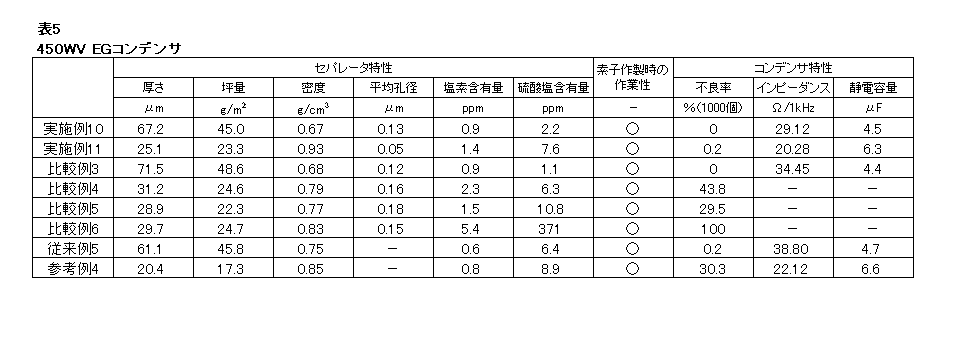
- porous membrane obtained in Examples 10 and 11 the porous membrane obtained in Comparative Examples 3 to 6, and the electrolytic paper obtained in Conventional Example 5 and Reference Example 4, an EG (ethylene glycol) electrolyte solution was used. 1000 450 WV aluminum electrolytic capacitors were manufactured, the defect rate was measured, and the impedance (1 kHz) and capacitance were measured.
- EG ethylene glycol
- Porous membranes obtained in Examples 10 and 11 porous membranes obtained in Comparative Examples 3 to 6, various physical properties of electrolytic paper obtained in Conventional Example 5 and Reference Example 4, workability at the time of manufacturing capacitor elements, and aluminum electrolysis Table 5 shows the evaluation results of the capacitors.
- porous film produced by the viscose method obtained in Comparative Example 6 had a high chlorine content and sulfate content, the total number was poor in the post-aging process.
- a porous film manufactured by using the viscose method is not suitable for the porous film of this embodiment.
- the defect rate of the aluminum electrolytic capacitor using the electrolytic paper of Conventional Example 5 was 0.2%, and the impedance was 38.80 ⁇ .
- the separator was changed to the electrolytic paper of Reference Example 4 for the purpose of impedance reduction, as shown in FIG. 3, although the impedance could be reduced to 22.12 ⁇ , the defect rate deteriorated to 30.3%.
- the separator from the electrolytic paper obtained in Conventional Example 5 By changing the separator from the electrolytic paper obtained in Conventional Example 5 to the porous membrane obtained in Example 10, the defective rate of the aluminum electrolytic capacitor could be reduced to 0% and at the same time the impedance could be greatly reduced. Further, by changing the separator from the electrolytic paper obtained in Conventional Example 5 to the porous film obtained in Example 11, the impedance could be almost halved while maintaining the defective rate of the aluminum electrolytic capacitor.
- the capacitance of the aluminum electrolytic capacitor was increased by about 34%.
- the separator from the electrolytic paper obtained in Conventional Example 5 to the porous film obtained in Example 11 the impedance is reduced by half while maintaining the defective rate of the aluminum electrolytic capacitor, and at the same time, the capacitance is increased. I was able to.
- the porous membrane obtained in Comparative Example 3 had a thickness of 71.5 ⁇ m.
- the aluminum electrolytic capacitor using the porous film obtained in Comparative Example 3 has a lower capacitance and impedance than the aluminum electrolytic capacitor using the 67.2 ⁇ m thick porous film obtained in Example 10. Was greatly worsened. It is considered that the thickness is thicker than 70 ⁇ m and the influence of opening the distance between the anode aluminum foil and the cathode aluminum foil is large. If the thickness exceeds 70 ⁇ m, the impedance characteristics of the aluminum electrolytic capacitor are likely to deteriorate, so the thickness of the porous film is desirably 70 ⁇ m or less.
- the porous membrane of the present invention comprising the regenerated cellulose (A) and the fiber-shaped component (B) has the characteristics of cellulose that is hydrophilic / lipophilic and excellent in electrical insulation, and has a thickness and density. Since it can be controlled arbitrarily, it is possible to realize a separator having characteristics that are difficult to achieve with electrolytic paper which is a laminate of fibers.
- the porous film of the present invention that does not contain the oxide film corrosive substance of the anode aluminum foil, it is possible to reduce the size and / or increase the capacity of the aluminum electrolytic capacitor, which could not be realized with electrolytic paper or a conventional cellulose porous film. It is possible to provide a separator for an aluminum electrolytic capacitor capable of realizing low impedance and an aluminum electrolytic capacitor using the separator.
- a porous film can be manufactured using cellulose having a high degree of polymerization. . Therefore, a porous film can be obtained using cellulose having a high degree of polymerization and a high degree of polymerization and excellent resistance to an electrolytic solution.
- the porous film according to the present embodiment is thinner than the electrolytic paper, and it is possible to manufacture a separator having a lower density.
- most of the strength of the paper depends on the physical entanglement between the fibers, so if you reduce the number of overlapping fibers to produce thin paper, paper breakage may occur becomes higher.
- the porous membrane according to this embodiment is thinner than the papermaking method because it is manufactured by forming an amine oxide / cellulose solution containing the fiber-shaped component (B) into a membrane and then regenerating it in a coagulation bath. A sheet can be obtained. Since the fiber-shaped component (B) is contained, it is possible to produce a porous film having a thickness of 5 ⁇ m or less, which is excellent in strength characteristics and difficult to produce with a porous film made only of regenerated cellulose.
- the density of the porous film according to the present embodiment can be controlled at an arbitrary ratio by adjusting the method or conditions for making the porous film, a separator having a density of 0.25 g / cm 3 or less that is difficult to realize with paper is obtained. Can do.
- Electrolytic paper is an aggregate of pulp bonded by physical entanglement between pulps and hydrogen bonding of contacts, whereas the porous membrane of the present invention comprises regenerated cellulose (A) and fiber-shaped components (B ) Can be ensured with a strength that does not break in the capacitor element manufacturing process even in a low density region such as 0.10 to 0.25 g / cm 3 .
- a separator having high strength, low impedance and excellent short-circuit resistance can be realized even in a density range of 0.25 to 1.00 g / cm 3 of commonly used electrolytic paper.
- the porous membrane according to the present embodiment is excellent in short-circuit resistance due to its microporous and dense structure.
- a fiber-shaped component with higher rigidity than regenerated cellulose the performance to ensure the distance between the anode aluminum foil and the cathode aluminum foil when incorporated in an aluminum electrolytic capacitor is improved. Can do.
- the porous membrane according to this embodiment has a dense structure and excellent short-circuit resistance, a lower density or thinner separator is used when the separator of the aluminum electrolytic capacitor is replaced with a porous membrane from electrolytic paper. Therefore, it is possible to reduce the size, increase the capacity, lower the impedance, and extend the life of the aluminum electrolytic capacitor.
- the porous membrane may be used alone or in combination with other separators such as electrolytic paper.
- the porous membrane of this embodiment is not only a separator for aluminum electrolytic capacitors, but also a separator for conductive polymer aluminum electrolytic capacitors, a separator for electric double layer capacitors, a separator for lithium ion capacitors, a separator for lithium ion batteries, It can be used as a separator for various electricity storage devices such as a separator for alkaline manganese batteries, and can also be used as various filters.
- the capacitor can be reduced in size and / or increased in capacity by using a porous membrane composed of regenerated cellulose (A) and a fiber-shaped component (B) as a separator. And / or the separator for aluminum electrolytic capacitors which implement
Landscapes
- Engineering & Computer Science (AREA)
- Power Engineering (AREA)
- Microelectronics & Electronic Packaging (AREA)
- Chemical & Material Sciences (AREA)
- Materials Engineering (AREA)
- Electric Double-Layer Capacitors Or The Like (AREA)
- Cell Separators (AREA)
- Manufacture Of Porous Articles, And Recovery And Treatment Of Waste Products (AREA)
- Manufacture Of Macromolecular Shaped Articles (AREA)
Abstract
Description
C=ε・S/d・・・式(1)
C:静電容量(F)
ε:誘電体の比誘電率(F/m)
S:電極の面積(m2)
d:電極間の距離(m)
特許文献2および特許文献3に記載の発明では再生セルロースからなる層は、実質的にビスコース法により作製したセルロースフィルムからなる多孔性シートを用いている。特許文献4及び特許文献5に記載された発明では、実質的に銅アンモニアレーヨン法で作製したセルロース系微多孔膜をセパレータとして用いている。
塩素やハロゲンの残留成分は硫酸イオン以上に陽極アルミ箔の酸化皮膜を腐食するため、これらのイオン液体などのセルロース溶剤を用いて製作されたセルロース多孔質膜をセパレータとして使用することは適さない。またイオン液体は非常に高価なため、安価であることを特徴とするアルミ電解コンデンサの構成部材の製造には適さない。
即ち、アルミ電解コンデンサの陽極アルミ箔と陰極アルミ箔の間に介在させ、ショートの防止と駆動用電解液を含浸及び保持するために使用するアルミ電解コンデンサ用セパレータにおいて、セルロース誘導体を形成せずに溶解・再生された再生セルロース(A)と、繊維形状の成分(B)とからなる多孔質膜で構成することを特徴とするアルミ電解コンデンサ用セパレータとする。
NMMOの割合が70重量%を下回るとセルロースの溶解が困難になる。なお、溶液中のセルロースの濃度が2重量%を下回るとセルロースフィルムを作製する際に多くのセルロース溶液が必要になるため生産効率が悪くなり、20重量%を超えるとセルロース溶液の粘度が高くなり、薄膜の製作に不適となる。
再生セルロース(A)と繊維形状の成分(B)とからなる多孔質膜は、例えばセルロース溶液に繊維を均一分散させて膜状に成形した後、セルロースを再生する方法などを用いて製作することができる。
再生セルロース(A)の材料となるセルロースは多孔質膜の塩素含有量を2ppm以下にするため無塩素(TCF)漂白、あるいは未漂白のものを使用することが望ましい。セパレータ中の塩素含有量が2ppmより多くなると酸化皮膜に対する腐食性が強くなり、ショート不良や漏れ電流の増大を引き起こすため、アルミ電解コンデンサ用セパレータとして適さない。なお、ここでの塩素含有量はJIS C 2300 電気用セルロース紙 第2部 試験方法の塩素含有量 イオンクロマトグラフ法(抽出法)に記載の方法で測定した値とする。
繊維形状の成分(B)としては、例えば植物由来のパルプ、再生セルロース繊維、セルロース誘導体からなるセルロース系繊維、動物繊維、無機繊維、合成繊維の少なくとも1種類以上からなる繊維が使用できる。合成繊維としては、例えばポリビニルアルコール繊維、ポリアミド繊維、半芳香族ポリアミド繊維、全芳香族ポリアミド繊維、アクリル繊維、ポリエステル繊維、全芳香族ポリエステル繊維、ポリイミド繊維、ポリケトン繊維、ポリウレタン繊維、ポリエチレン繊維、ポリプロピレン繊維、ポリスチレン繊維、ポリテトラフルオロエチレン繊維、ポリ尿素繊維などが使用できる。セルロース溶媒に対して十分な耐性を持つ繊維であれば、セルロースを溶解する前に予め繊維を添加しておくことも可能である。
再生セルロース(A)と繊維形状の成分(B)とからなる多孔質膜の平均孔径は5μm以下が望ましい。5μmより平均孔径が大きい場合は耐ショート性の低下が顕著になる。
以上に説明した本発明に係る一発明の実施の形態例の再生セルロース(A)と繊維形状の成分(B)とからなる多孔質膜をセパレータとして用いた場合の当該セパレータ及び該セパレータを用いたアルミ電解コンデンサの実施例を以下説明する。
各実施例、比較例、従来例及び参考例において説明するセパレータとしての各実験結果の測定方法、評価方法は以下の通りである。
厚さ、坪量、密度、塩素含有量は、JIS C 2300[電気用セルロース紙]の試験方法に準じて行った。
密度の測定では、B法(絶乾状態の密度を求める方法)に準じて測定を行った。
坪量は厚さと密度の値から算出した。
硫酸塩含有量も塩素含有量と同様の方法を用いて測定した。
平均孔径(ポアサイズ)の測定では、PMI社製Parm-Porometerを用いて、バブルポイント法(ASTMF316-86,JIS K3832)により測定される孔径分布から、その平均孔径(μm)を求めた。
エッチング処理および酸化皮膜形成処理を行った陽極アルミ箔と陰極アルミ箔が接触しないようにセパレータを介在させて捲回してコンデンサ素子を製作し、このコンデンサ素子に所定の電解液を含浸させ、ケースに入れた後、封口し直径10mm、高さ20mm、定格電圧16WVあるいは63WVあるいは450WVのアルミ電解コンデンサを製作した。
各コンデンサ素子1000個を作製する際に、同一作製条件下でセパレータの破断発生回数を計測し、発生回数が1回以下のものを○、4回以下のものを△、5回以上のものを×とした。
各コンデンサ試料1000個について、定格電圧の約110%まで徐々に昇圧していき、エージングを行った。エージングショート、防爆弁の作動、液漏れ、封口部の膨れなどの外観異常も含めた不良コンデンサの個数を1000で除して百分率をもって不良率とした。
電解コンデンサの静電容量は20℃、120Hzの周波数でLCRメータを用いて測定した。
〔アルミ電解コンデンサのインピーダンス〕
電解コンデンサのインピーダンスは20℃、100kHzあるいは20℃、1kHzの周波数でLCRメータを用いて測定した。
重合度700のTCF溶解パルプを用いて、セルロース/NMMO=5/95(重量%、以下同じ)となるセルロース/NMMO溶液を得た。得られたセルロース/NMMO溶液に直径3μm・繊維長1.0mmのPET繊維をセルロース/PET繊維=70/30となる量添加し、Tダイ式の押出成形機を用いて0.15mmのスリット幅で水(H2O)からなる凝固浴中に押出し、セルロースを再生した。再生したセルロースを3槽のイオン交換水の洗浄浴で洗浄した後、3槽のイソプロピルアルコール(以下IPA)浴で溶媒置換し、ドラム式乾燥機で乾燥することにより、厚さ29.8μm、密度0.31g/cm3、平均孔径0.24μmの多孔質膜を作製した。
重合度1500のTCFコットンリンターパルプを用いて、セルロース/NMMO=10/90となるセルロース/NMMO溶液を得た。得られたセルロース/NMMO溶液に直径3μm・繊維長1.5mmのPET繊維をセルロース/PET繊維=50/50となる量添加し、Tダイ式の押出成形機を用いて0.04mmのスリット幅で押出し、10mmの空気間隙を通した後、20重量%のNMMOの貧溶媒の凝固浴に浸漬しセルロースを再生した。再生したセルロースを3槽のイオン交換水の洗浄浴で洗浄した後、凍結乾燥することにより、厚さ29.6μm、密度0.11g/cm3、平均孔径4.97μmの多孔質膜を作製した。
重合度1500のTCFコットンリンターパルプを用いて、セルロース/NMMO=10/90となるセルロース/NMMO溶液を得た。得られたセルロース/NMMO溶液に直径0.7μm・繊維長0.5mmのPET繊維をセルロース/PET繊維=99.5/0.5となる量添加し、Tダイ式の押出成形機を用いて0.04mmのスリット幅で押出し、10mmの空気間隙を通した後、20重量%のNMMOの貧溶媒の凝固浴に浸漬しセルロースを再生した。再生したセルロースを3槽のイオン交換水の洗浄浴で洗浄した後、凍結乾燥することにより、厚さ28.8μm、密度0.12g/cm3、平均孔径4.55μmの多孔質膜を作製した。
重合度700のTCF溶解パルプを用いて、セルロース/NMMO=10/90となるセルロース/NMMO溶液を得た。得られたセルロース/NMMO溶液に直径12μm・繊維長6.0mmの叩解可能な再生セルロース繊維である溶剤紡糸レーヨンをセルロース/溶剤紡糸レーヨン=90/10となる量添加し、Tダイ式の押出成形機を用いて0.10mmのスリット幅で水からなる凝固浴中に押出し、セルロースを再生した。再生したセルロースを3槽のイオン交換水の洗浄浴で洗浄した後、3槽のエタノール浴で溶媒置換し、ドラム式乾燥機で乾燥することにより、厚さ15.2μm、密度0.41g/cm3、平均孔径0.72μmの多孔質膜を作製した。
重合度700のTCF溶解パルプを用いて、セルロース/NMMO=5/95となるセルロース/NMMO溶液を得た。得られたセルロース/NMMO溶液に直径0.7μm・繊維長1.0mmのPET繊維をセルロース/PET繊維=80/20となる量添加し、さらに嵩高剤として使用されるオキシエチレン基とオキシプロピレン基とからなるポリオキシアルキレン構造を有する油脂系非イオン界面活性剤を対セルロースで固形分を3重量%添加し、Tダイ式の押出成形機を用いて0.10mmのスリット幅で20重量%のNMMOの貧溶媒の凝固浴中に押出し、セルロースを再生した。再生したセルロースを3槽のイオン交換水の洗浄浴で洗浄した後、ドラム式乾燥機で乾燥することにより、厚さ3.1μm、密度0.89g/cm3、平均孔径0.15μmの多孔質膜を作製した。
重合度1500のTCFコットンリンターパルプを用いて、セルロース/NMMO=3/97となるセルロース/NMMO溶液を得た。得られたセルロース/NMMO溶液に直径13μm・繊維長3.0mmのガラス繊維をセルロース/ガラス繊維=20/80となる量添加し、Tダイ式の押出成形機を用いて0.30mmのスリット幅で水からなる凝固浴中に押出し、セルロースを再生した。再生したセルロースを3槽のイオン交換水の洗浄浴で洗浄した後、3槽のエタノール浴で溶媒置換し、ドラム式乾燥機で乾燥することにより、厚さ40.5μm、密度0.49g/cm3、平均孔径4.84μmの多孔質膜を作製した。
重合度1500のTCFコットンリンターパルプを用いて、セルロース/NMMO=5/95となるセルロース/NMMO溶液を得た。得られたセルロース/NMMO溶液に直径10μm・繊維長1.0mmのポリ乳酸繊維をセルロース/ポリ乳酸繊維=50/50となる量添加し、Tダイ式の押出成形機を用いて0.15mmのスリット幅で押出し、10mmの空気間隙を通した後、20重量%のNMMO貧溶媒の凝固浴に浸漬しセルロースを再生した。再生したセルロースを3槽のイオン交換水の洗浄浴で洗浄し、3槽のエタノール浴で溶媒置換した後、ドラム式乾燥機で乾燥することにより、厚さ37.6μm、密度0.28g/cm3、平均孔径1.35μmの多孔質膜を作製した。得られた多孔質膜をGBL(γ‐ブチルラクトン)浴に浸漬してポリ乳酸繊維を溶解除去し乾燥することで厚さ37.6μm、密度0.14g/cm3、平均孔径2.89μmの多孔質膜となった。ポリ乳酸繊維が存在する多孔質膜を用いてコンデンサ素子を形成しGBL系電解液を含浸することで、アルミ電解コンデンサ中で多孔質膜の密度を低下させることができた。
重合度700のTCF溶解パルプおよび重合度2000、ケン化度80%のPVAを用いて、セルロース/PVA/NMMO=5/5/90となるセルロース/PVA/NMMO溶液を得た。得られたセルロース/PVA/NMMO溶液に直径0.7μm・繊維長1mmのPET繊維をセルロース/PET繊維=80/20となる量添加し、Tダイ式の押出成形機を用いて0.30mmのスリット幅で押出し、10mmの空気間隙を通した後、5重量%のNMMO貧溶媒の凝固浴に浸漬しセルロース/PVA膜を再生した。再生した膜を3槽の95℃のイオン交換水浴に浸漬して洗浄してPVAを除去し、3槽のエタノール浴で溶媒を置換した後、ドラム式乾燥機で乾燥することにより、厚さ25.0μm、密度0.43g/cm3、平均孔径0.26μmの多孔質膜を作製した。
重合度700のTCF溶解パルプをセルロース/NMMO=5/95の割合で用い、さらに直径8μm・繊維長2mmのアラミド繊維をセルロース/アラミド繊維=70/30となる量添加してセルロースを溶解し、アラミド繊維混合セルロース/NMMO溶液を得た。得られたセルロース/NMMO溶液に凝集剤として使用されるPAMを有効成分で対セルロース5重量%添加し、Tダイ式の押出成形機を用いて0.60mmのスリット幅で押出し、10mmの空気間隙を通した後、20重量%のNMMOの貧溶媒の凝固浴に浸漬しセルロースを再生した。再生したセルロースを3槽のイオン交換水の洗浄浴で洗浄した後、3槽のIPA浴で溶媒置換し、ドラム式乾燥機で乾燥することにより、厚さ61.4μm、密度0.57g/cm3、平均孔径0.38μmの多孔質膜を作製した。
重合度1500のTCFコットンリンターパルプを用いて、セルロース/NMMO=5/95となるセルロース/NMMO溶液を得た。得られたセルロース/NMMO溶液に可塑剤としてグリセリンを対セルロースで0.1重量%添加し、さらに直径18μm・繊維長3.5mmのマニラ麻パルプをセルロース/マニラ麻パルプ=70/30となる量添加し、Tダイ式の押出成形機を用いて0.70mmのスリット幅で水からなる凝固浴中に押出し、セルロースを再生した。再生したセルロースを3槽のイオン交換水の洗浄浴で洗浄した後、3槽のエタノール浴で溶媒置換し、ドラム式乾燥機で乾燥することにより、厚さ67.2μm、密度0.67g/cm3、平均孔径0.13μmの多孔質膜を作製した。
重合度500のTCF溶解パルプおよび重合度1500のTCFコットンリンターパルプを溶解パルプ/コットンリンターパルプ/NMMO=3/3/94の割合で用いて、溶解パルプが溶解しかつコットンリンターパルプが溶け残った状態のセルロース/NMMO溶液を得た。セルロース/NMMO溶液に嵩高剤として使用されるオキシエチレン基とオキシプロピレン基とからなるポリオキシアルキレン構造を有する油脂系非イオン界面活性剤を対セルロースで固形分を3重量%添加し、Tダイ式の押出成形機を用いて0.40mmのスリット幅で20重量%のNMMOの貧溶媒の凝固浴中に押出し、セルロースを再生した。再生したセルロースを3槽のイオン交換水の洗浄浴で洗浄した後、ドラム式乾燥機で乾燥することにより、厚さ25.1μm、密度0.93g/cm3、平均孔径0.05μmの多孔質膜を作製した。
重合度1500のTCFコットンリンターパルプを用いて、セルロース/NMMO=8/92となるセルロース/NMMO溶液を得た。得られたセルロース/NMMO溶液に直径3μm・繊維長1.5mmのPET繊維をセルロース/PET繊維=50/50となる量添加し、Tダイ式の押出成形機を用いて0.04mmのスリット幅で押出し、10mmの空気間隙を通した後、20重量%のNMMOの貧溶媒の凝固浴に浸漬しセルロースを再生した。再生したセルロースを3槽のイオン交換水の洗浄浴で洗浄した後、凍結乾燥することにより、厚さ31.4μm、密度0.09g/cm3、平均孔径5.48μmの多孔質膜を作製した。
重合度1500のTCFコットンリンターパルプを用いて、セルロース/NMMO=3/97となるセルロース/NMMO溶液を得た。得られたセルロース/NMMO溶液に直径13μm・繊維長3.0mmのガラス繊維をセルロース/ガラス繊維=15/85となる量添加し、Tダイ式の押出成形機を用いて0.35mmのスリット幅で水からなる凝固浴中に押出し、セルロースを再生した。再生したセルロースを3槽のイオン交換水の洗浄浴で洗浄した後、3槽のエタノール浴で溶媒置換し、ドラム式乾燥機で乾燥することにより、厚さ47.3μm、密度0.53g/cm3、平均孔径7.66μmの多孔質膜を作製した。
重合度1500のTCFコットンリンターパルプを用いて、セルロース/NMMO=5/95となるセルロース/NMMO溶液を得た。得られたセルロース/NMMO溶液に可塑剤としてグリセリンを対セルロースで0.1重量%添加し、さらに直径18μm・繊維長3.5mmのマニラ麻パルプをセルロース/マニラ麻パルプ=70/30となる量添加し、Tダイ式の押出成形機を用いて0.75mmのスリット幅で水からなる凝固浴中に押出し、セルロースを再生した。再生したセルロースを3槽のイオン交換水の洗浄浴で洗浄した後、3槽のエタノール浴で溶媒置換し、ドラム式乾燥機で乾燥することにより、厚さ71.5μm、密度0.68g/cm3、平均孔径0.12μmの多孔質膜を作製した。
重合度700のECF漂白溶解パルプを用いて、セルロース/NMMO=5/95となるセルロース/NMMO溶液を得た。得られたセルロース/NMMO溶液に直径3μm・繊維長1mmのPET繊維をセルロース/PET繊維=80/20となる量添加し、Tダイ式の押出成形機を用いて0.40mmのスリット幅で20重量%のNMMOの貧溶媒の凝固浴中に押出し、セルロースを再生した。再生したセルロースを3槽のイオン交換水の洗浄浴で洗浄し、3槽のエタノール浴で溶媒置換した後、ドラム式乾燥機で乾燥することにより、厚さ31.2μm、密度0.79g/cm3、平均孔径0.16μmの多孔質膜を作製した。
重合度700の硫酸イオン含有量が500ppmの溶解パルプを用いて、セルロース/NMMO=5/95となるセルロース/NMMO溶液を得た。得られたセルロース/NMMO溶液に直径3μm・繊維長1mmのPET繊維をセルロース/PET繊維=80/20となる量添加し、Tダイ式の押出成形機を用いて0.40mmのスリット幅で20重量%のNMMOの貧溶媒の凝固浴中に押出し、セルロースを再生した。再生したセルロースを3槽のイオン交換水の洗浄浴で洗浄し、3槽のエタノール浴で溶媒置換した後、ドラム式乾燥機で乾燥することにより、厚さ28.9μm、密度0.77g/cm3、平均孔径0.18μmの多孔質膜を作製した。
ECF溶解パルプを水酸化ナトリウムで処理した後、二硫化炭素で処理することでビスコースを作製した。得られたビスコースに直径3μm・繊維長1mmのPET繊維をセルロース/PET繊維=80/20となる量添加し、Tダイ式の押出成形機を用いて希硫酸中に押出しセルロースを再生した。再生したセルロースを3槽のイオン交換水で洗浄し、3槽のエタノール浴で溶媒置換した後、ドラム式乾燥機で乾燥することにより、厚さ29.7μm、密度0.83g/cm3、平均孔径0.15μmの多孔質膜を作製した。
重合度700のTCF溶解パルプを用いて、セルロース/NMMO=5/95となるセルロース/NMMO溶液を得た。得られたセルロース/NMMO溶液に直径0.7μm・繊維長1mmのPET繊維をセルロース/PET繊維=80/20となる量添加し、さらに嵩高剤として使用されるオキシエチレン基とオキシプロピレン基とからなるポリオキシアルキレン構造を有する油脂系非イオン界面活性剤を対セルロースで固形分を3重量%添加し、Tダイ式の押出成形機を用いて0.08mmのスリット幅で水からなる凝固浴中に押出し、セルロースを再生した。再生したセルロースを3槽のイオン交換水の洗浄浴で洗浄した後、3槽のエタノール浴で溶媒置換し、ドラム式乾燥機で乾燥することにより、厚さ2.5μmの多孔質膜を作製しようと試みたが、乾燥工程において破断が相次ぎ、多孔質膜を得ることができなかった。
マニラ麻パルプ50重量%とエスパルトパルプ50重量%とからなる原料を叩解機でCSF600mlまで叩解し、円網三層抄紙機で抄紙して厚さ48.7μm、密度0.35g/cm3、平均孔径13.6μmの円網三重紙(電解紙)を製作した。
マニラ麻パルプ50重量%とエスパルトパルプ50重量%とからなる原料を叩解機でCSF500mlまで叩解し円網二層抄紙機で抄紙して厚さ51.7μm、密度0.49g/cm3、平均孔径6.89μmの円網二重紙(電解紙)を製作した。
叩解可能な再生セルロース繊維である溶剤紡糸レーヨンを叩解機でCSF5ml以下まで叩解した原料を長網抄紙機で抄紙して厚さ24.5μm、密度0.44g/cm3、平均孔径0.53μmの長網一重紙(電解紙)を製作した。
マニラ麻パルプ50重量%とエスパルトパルプ50重量%とからなる原料を叩解機でCSF400mlまで叩解し円網二層抄紙機で抄紙して厚さ90.6μm、密度0.61g/cm3、平均孔径3.27μmの円網二重紙(電解紙)を製作した。
針葉樹クラフトパルプを叩解機でCSF5ml以下まで叩解したものを長網の抄紙原料とし、厚さ25.2μm、密度0.86g/cm3の高密度紙を長網部分で抄紙しつつ、円網部分では針葉樹クラフトパルプをCSF400mlに叩解した原料で厚さ35.9μm、密度0.67g/cm3の紙を抄紙して抄き合わせ、厚さ61.1μm、密度0.75g/cm3の長網円網二重紙(電解紙)を製作した。平均孔径は小さすぎるためバブルポイント法では測定できなかった。
重合度1500のTCFコットンリンターパルプを用いて、セルロース/NMMO=10/90となるセルロース/NMMO溶液を得た。得られたセルロース/NMMO溶液をTダイ式の押出成形機を用いて0.05mmのスリット幅で押出し、10mmの空気間隙を通した後、20重量%のNMMOの貧溶媒の凝固浴に浸漬しセルロースを再生した。再生したセルロースを3槽のイオン交換水の洗浄浴で洗浄した後、凍結乾燥することにより、厚さ28.1μm、密度0.11g/cm3、平均孔径4.53μmのセルロース多孔質膜を作製した。
市販のポリオレフィン系多孔質フィルムである旭化成イーマテリアルズ(株)製ハイポアH6022は、厚さ27.0μm、密度0.47g/cm3、平均孔径0.12μmであった。
マニラ麻パルプ50重量%とエスパルトパルプ50重量%とからなる原料を叩解機でCSF400mlまで叩解し円網二層抄紙機で抄紙して厚さ60.7μm、密度0.61g/cm3、平均孔径5.09μmの円網二重紙(電解紙)を製作した。
未漂白針葉樹クラフトパルプを叩解機でCSF5ml以下まで叩解した原料を長網抄紙機で抄紙して厚さ20.4μm、密度0.85g/cm3の長網一重紙(電解紙)を製作した。平均孔径は小さすぎるためバブルポイント法では測定できなかった。


実施例9で得た多孔質膜、従来例4及び参考例3で得た電解紙の諸物性、コンデンサ素子製作時の作業性及びアルミ電解コンデンサの評価結果を表4に示す。

Claims (8)
- キャパシタの陽極と陰極の間に介在させ、ショートの防止と駆動用電解液を含浸及び保持するために使用するキャパシタ用セパレータにおいて、
セルロース誘導体を形成せずに溶解・再生された再生セルロース(A)と、繊維形状の成分(B)とからなる多孔質膜で構成することを特徴とするキャパシタ用セパレータ。 - 前記繊維形状の成分(B)は、製紙用原料として使用可能な植物由来のパルプ、再生セルロース繊維、セルロース系繊維、動物繊維、無機繊維、合成繊維から選択される1種以上であることを特徴とする請求項1記載のキャパシタ用セパレータ。
- 塩素含有量が2ppm以下、硫酸塩含有量が10ppm以下、膜厚が3~70μm、密度が0.1g/cm3以上、平均孔径が5μm以下である多孔質膜で構成することを特徴とする請求項1又は請求項2に記載のキャパシタ用セパレータ。
- アミンオキシド系溶媒にセルロースを溶解したセルロース溶液を膜状に成形し、水またはアミンオキシド系溶媒の貧溶媒に浸漬することによりセルロースを凝固して再生し、再生したセルロースを水で洗浄してアミンオキシド系溶媒を除去した後、乾燥することにより得られた再生セルロース(A)を含む多孔質膜で構成したことを特徴とする請求項1乃至請求項3のいずれかに記載のキャパシタ用セパレータ。
- 前記アミンオキシド系溶媒の主成分がN‐メチルモルホリン‐N‐オキシドであることを特徴とする請求項1乃至請求項4のいずれかに記載のキャパシタ用セパレータ。
- セルロース溶液に前記繊維形状の成分(B)を混合して膜状に成形した後、セルロースを再生した多孔質膜で構成することを特徴とする請求項1乃至請求項5のいずれかに記載のキャパシタ用セパレータ。
- 請求項1乃至請求項6のいずれかに記載のセパレータを用いることを特徴とするキャパシタ。
- 請求項7記載のキャパシタがアルミ電解コンデンサまたは電気二重層キャパシタまたはリチウムイオンキャパシタ。
Priority Applications (5)
| Application Number | Priority Date | Filing Date | Title |
|---|---|---|---|
| EP13899671.5A EP3086338A4 (en) | 2013-12-19 | 2013-12-19 | Capacitor separator and capacitor |
| CN201380081716.2A CN105917429A (zh) | 2013-12-19 | 2013-12-19 | 电容器用隔膜及电容器 |
| PCT/JP2013/084075 WO2015092898A1 (ja) | 2013-12-19 | 2013-12-19 | キャパシタ用セパレータ及びキャパシタ |
| JP2015553286A JPWO2015092898A1 (ja) | 2013-12-19 | 2013-12-19 | キャパシタ用セパレータ及びキャパシタ |
| US15/184,157 US20160293338A1 (en) | 2013-12-19 | 2016-06-16 | Capacitor separator and capacitor |
Applications Claiming Priority (1)
| Application Number | Priority Date | Filing Date | Title |
|---|---|---|---|
| PCT/JP2013/084075 WO2015092898A1 (ja) | 2013-12-19 | 2013-12-19 | キャパシタ用セパレータ及びキャパシタ |
Related Child Applications (1)
| Application Number | Title | Priority Date | Filing Date |
|---|---|---|---|
| US15/184,157 Continuation US20160293338A1 (en) | 2013-12-19 | 2016-06-16 | Capacitor separator and capacitor |
Publications (1)
| Publication Number | Publication Date |
|---|---|
| WO2015092898A1 true WO2015092898A1 (ja) | 2015-06-25 |
Family
ID=53402293
Family Applications (1)
| Application Number | Title | Priority Date | Filing Date |
|---|---|---|---|
| PCT/JP2013/084075 Ceased WO2015092898A1 (ja) | 2013-12-19 | 2013-12-19 | キャパシタ用セパレータ及びキャパシタ |
Country Status (5)
| Country | Link |
|---|---|
| US (1) | US20160293338A1 (ja) |
| EP (1) | EP3086338A4 (ja) |
| JP (1) | JPWO2015092898A1 (ja) |
| CN (1) | CN105917429A (ja) |
| WO (1) | WO2015092898A1 (ja) |
Cited By (1)
| Publication number | Priority date | Publication date | Assignee | Title |
|---|---|---|---|---|
| CN108807794A (zh) * | 2018-06-19 | 2018-11-13 | 佛山腾鲤新能源科技有限公司 | 一种高机械强度纤维基锂电池隔膜材料的制备方法 |
Families Citing this family (14)
| Publication number | Priority date | Publication date | Assignee | Title |
|---|---|---|---|---|
| JP2018121013A (ja) * | 2017-01-27 | 2018-08-02 | ニッポン高度紙工業株式会社 | 電気化学素子用セパレータ及び電気化学素子 |
| JP6932534B2 (ja) * | 2017-04-19 | 2021-09-08 | ニッポン高度紙工業株式会社 | 電気化学素子用セパレータ及び電気化学素子 |
| CN107910183B (zh) * | 2017-12-15 | 2019-09-20 | 肇庆绿宝石电子科技股份有限公司 | 一种耐-40℃低温的高压铝电解电容器及其制造方法 |
| JP6989414B2 (ja) * | 2018-02-27 | 2022-01-05 | ニッポン高度紙工業株式会社 | 電気化学素子用セパレータ及び電気化学素子 |
| JP6442097B1 (ja) * | 2018-03-29 | 2018-12-19 | ニッポン高度紙工業株式会社 | アルミニウム電解コンデンサ用セパレータおよび該セパレータを用いたアルミニウム電解コンデンサ |
| US11052346B2 (en) * | 2018-05-23 | 2021-07-06 | Molecule Works Inc. | Device and method for separation of water from mixtures |
| CN109616327B (zh) * | 2018-12-19 | 2021-07-13 | 横店集团东磁有限公司 | 一种铝电解电容器及其制造方法 |
| WO2021131396A1 (ja) * | 2019-12-25 | 2021-07-01 | 株式会社クラレ | 電気化学素子用セパレータ |
| WO2021131235A1 (ja) * | 2019-12-27 | 2021-07-01 | 株式会社村田製作所 | フィルムコンデンサ、及び、フィルムコンデンサ用フィルム |
| CN111077267B (zh) * | 2020-01-14 | 2022-04-29 | 东莞东阳光科研发有限公司 | 测定电子光箔中铅含量的方法 |
| JP6850921B1 (ja) | 2020-03-16 | 2021-03-31 | ニッポン高度紙工業株式会社 | 電気化学素子用セパレータおよび電気化学素子 |
| CN113363076B (zh) * | 2021-08-09 | 2021-11-02 | 南通江海电容器股份有限公司 | 过压自动短路保护电容器 |
| CN114347338A (zh) * | 2021-12-06 | 2022-04-15 | 可健可康(青岛)集团股份有限公司 | 一种电解水制氢质子交换膜的制备工艺 |
| CN117888396B (zh) * | 2024-02-19 | 2025-08-01 | 仙鹤股份有限公司 | 一种高抗压电解电容器纸的制备方法 |
Citations (9)
| Publication number | Priority date | Publication date | Assignee | Title |
|---|---|---|---|---|
| JPH05267103A (ja) | 1992-03-19 | 1993-10-15 | Nippon Koudoshi Kogyo Kk | 電解コンデンサ |
| JPH103898A (ja) | 1996-06-14 | 1998-01-06 | Mitsubishi Chem Corp | 電池用セパレーター |
| JPH1186827A (ja) | 1997-09-05 | 1999-03-30 | Miki Tokushu Seishi Kk | セロファン膜セパレーター |
| JP2000507737A (ja) * | 1996-04-02 | 2000-06-20 | コートールズ ファイバース(ホールディングス)リミティド | セルロースの電池セパレータ |
| JP2007141498A (ja) | 2005-11-15 | 2007-06-07 | Asahi Kasei Fibers Corp | 蓄電デバイス用セパレーター |
| WO2008139619A1 (ja) | 2007-05-14 | 2008-11-20 | Asahi Kasei Fibers Corporation | 蓄電デバイス用セパレーター及び蓄電デバイス |
| JP2008542560A (ja) | 2005-05-30 | 2008-11-27 | 江▲蘇▼▲竜▼▲馬▼緑色▲繊▼▲維▼有限公司 | セルロース製品のパイロットスケール(pilotscale)製造のための非毒性プロセスおよびシステム |
| JP2009508015A (ja) | 2006-04-21 | 2009-02-26 | ジャングー ロンマ グリーン ファイバーズ カンパニー リミテッド | パイロット規模でのセルロース製品の製造における水酸化ナトリウム/チオ尿素水溶液の使用 |
| WO2013069146A1 (ja) * | 2011-11-11 | 2013-05-16 | ニッポン高度紙工業株式会社 | 電解コンデンサ用セパレータ及び電解コンデンサ |
Family Cites Families (3)
| Publication number | Priority date | Publication date | Assignee | Title |
|---|---|---|---|---|
| CN100559526C (zh) * | 2004-04-16 | 2009-11-11 | 三菱制纸株式会社 | 电化学元件用隔膜 |
| JP2006054127A (ja) * | 2004-08-12 | 2006-02-23 | Du Pont Teijin Advanced Paper Kk | セパレーターおよびそれを用いた電気電子部品 |
| JP2013201406A (ja) * | 2012-03-26 | 2013-10-03 | Nippon Kodoshi Corp | アルミ電解コンデンサ用セパレータ及びアルミ電解コンデンサ |
-
2013
- 2013-12-19 JP JP2015553286A patent/JPWO2015092898A1/ja active Pending
- 2013-12-19 WO PCT/JP2013/084075 patent/WO2015092898A1/ja not_active Ceased
- 2013-12-19 EP EP13899671.5A patent/EP3086338A4/en not_active Withdrawn
- 2013-12-19 CN CN201380081716.2A patent/CN105917429A/zh active Pending
-
2016
- 2016-06-16 US US15/184,157 patent/US20160293338A1/en not_active Abandoned
Patent Citations (9)
| Publication number | Priority date | Publication date | Assignee | Title |
|---|---|---|---|---|
| JPH05267103A (ja) | 1992-03-19 | 1993-10-15 | Nippon Koudoshi Kogyo Kk | 電解コンデンサ |
| JP2000507737A (ja) * | 1996-04-02 | 2000-06-20 | コートールズ ファイバース(ホールディングス)リミティド | セルロースの電池セパレータ |
| JPH103898A (ja) | 1996-06-14 | 1998-01-06 | Mitsubishi Chem Corp | 電池用セパレーター |
| JPH1186827A (ja) | 1997-09-05 | 1999-03-30 | Miki Tokushu Seishi Kk | セロファン膜セパレーター |
| JP2008542560A (ja) | 2005-05-30 | 2008-11-27 | 江▲蘇▼▲竜▼▲馬▼緑色▲繊▼▲維▼有限公司 | セルロース製品のパイロットスケール(pilotscale)製造のための非毒性プロセスおよびシステム |
| JP2007141498A (ja) | 2005-11-15 | 2007-06-07 | Asahi Kasei Fibers Corp | 蓄電デバイス用セパレーター |
| JP2009508015A (ja) | 2006-04-21 | 2009-02-26 | ジャングー ロンマ グリーン ファイバーズ カンパニー リミテッド | パイロット規模でのセルロース製品の製造における水酸化ナトリウム/チオ尿素水溶液の使用 |
| WO2008139619A1 (ja) | 2007-05-14 | 2008-11-20 | Asahi Kasei Fibers Corporation | 蓄電デバイス用セパレーター及び蓄電デバイス |
| WO2013069146A1 (ja) * | 2011-11-11 | 2013-05-16 | ニッポン高度紙工業株式会社 | 電解コンデンサ用セパレータ及び電解コンデンサ |
Non-Patent Citations (3)
| Title |
|---|
| "Experimental and analytical methods of cellulose'' series No. 15, Dissolution of cellulose in alkaline-urea solvent and regenerative gelatinization thereof", KUGA, SHIGENORI, CAI JIE CELLULOSE COMMUNICATIONS, vol. 15, no. 2, 2008 |
| FUKAYA, YUKINOBU; OHNO, HIROYUKI: "Ionic Liquid II", CMC PUBLISHING CO., LTD. |
| See also references of EP3086338A4 * |
Cited By (1)
| Publication number | Priority date | Publication date | Assignee | Title |
|---|---|---|---|---|
| CN108807794A (zh) * | 2018-06-19 | 2018-11-13 | 佛山腾鲤新能源科技有限公司 | 一种高机械强度纤维基锂电池隔膜材料的制备方法 |
Also Published As
| Publication number | Publication date |
|---|---|
| JPWO2015092898A1 (ja) | 2017-03-16 |
| CN105917429A (zh) | 2016-08-31 |
| US20160293338A1 (en) | 2016-10-06 |
| EP3086338A1 (en) | 2016-10-26 |
| EP3086338A4 (en) | 2017-12-27 |
Similar Documents
| Publication | Publication Date | Title |
|---|---|---|
| WO2015092898A1 (ja) | キャパシタ用セパレータ及びキャパシタ | |
| WO2014098180A1 (ja) | アルミ電解コンデンサ用セパレータ及びアルミ電解コンデンサ | |
| WO2013069146A1 (ja) | 電解コンデンサ用セパレータ及び電解コンデンサ | |
| EP3447779B1 (en) | Separator for electrochemical element and electrochemical element | |
| KR102583728B1 (ko) | 전기 화학 소자용 세퍼레이터 및 전기 화학 소자 | |
| RU2698471C2 (ru) | Сепаратор для аккумулирующего устройства и алюминиевый электролитический конденсатор | |
| JP2010239094A (ja) | 電解コンデンサ用セパレータおよび電解コンデンサ | |
| JP2015088703A (ja) | キャパシタ用セパレータおよび該セパレータを用いたキャパシタ | |
| JP2000331663A (ja) | セパレータ及び該セパレータを使用した電解コンデンサ,電気二重層コンデンサ,非水系電池 | |
| JP2015133389A (ja) | セパレータ及び該セパレータを用いたコンデンサ | |
| CN107993847A (zh) | 铝电解电容器用隔膜以及铝电解电容器 | |
| KR102799197B1 (ko) | 전기화학소자용 세퍼레이터 및 전기화학소자 | |
| JP5485739B2 (ja) | 電解コンデンサ用セパレータ及びそれを用いた電解コンデンサ | |
| JP2013201406A (ja) | アルミ電解コンデンサ用セパレータ及びアルミ電解コンデンサ | |
| JPWO2013069146A1 (ja) | 電解コンデンサ用セパレータ及び電解コンデンサ | |
| CN113228213B (zh) | 铝电解电容器用分隔件及铝电解电容器 | |
| JP7273497B2 (ja) | 固体電解コンデンサ又はハイブリッド電解コンデンサ用セパレータ及びそれを用いてなる固体電解コンデンサ又はハイブリッド電解コンデンサ | |
| JP2014222706A (ja) | アルミ電解コンデンサ用セパレータおよびアルミ電解コンデンサ | |
| JP2024122009A (ja) | 固体電解コンデンサ又はハイブリッド電解コンデンサ用セパレータ及び固体電解コンデンサ又はハイブリッド電解コンデンサ | |
| JP5695475B2 (ja) | 電解コンデンサ用セパレータ及びそれを用いた電解コンデンサ | |
| JP2005268401A (ja) | キャパシタ用セパレーター | |
| JP2003282366A (ja) | 電気二重層キャパシタ | |
| WO2020129952A1 (ja) | アルミニウム電解コンデンサ用セパレータ及びアルミニウム電解コンデンサ | |
| JP2015060930A (ja) | キャパシタ用セパレータ | |
| JP2010239093A (ja) | 電解コンデンサの製造方法 |
Legal Events
| Date | Code | Title | Description |
|---|---|---|---|
| 121 | Ep: the epo has been informed by wipo that ep was designated in this application |
Ref document number: 13899671 Country of ref document: EP Kind code of ref document: A1 |
|
| ENP | Entry into the national phase |
Ref document number: 2015553286 Country of ref document: JP Kind code of ref document: A |
|
| NENP | Non-entry into the national phase |
Ref country code: DE |
|
| REEP | Request for entry into the european phase |
Ref document number: 2013899671 Country of ref document: EP |
|
| WWE | Wipo information: entry into national phase |
Ref document number: 2013899671 Country of ref document: EP |