WO2015093370A1 - 高溶解性変性エポキシ樹脂組成物 - Google Patents
高溶解性変性エポキシ樹脂組成物 Download PDFInfo
- Publication number
- WO2015093370A1 WO2015093370A1 PCT/JP2014/082695 JP2014082695W WO2015093370A1 WO 2015093370 A1 WO2015093370 A1 WO 2015093370A1 JP 2014082695 W JP2014082695 W JP 2014082695W WO 2015093370 A1 WO2015093370 A1 WO 2015093370A1
- Authority
- WO
- WIPO (PCT)
- Prior art keywords
- epoxypropyl
- isocyanurate
- tris
- type
- epoxy resin
- Prior art date
- Legal status (The legal status is an assumption and is not a legal conclusion. Google has not performed a legal analysis and makes no representation as to the accuracy of the status listed.)
- Ceased
Links
Classifications
-
- C—CHEMISTRY; METALLURGY
- C08—ORGANIC MACROMOLECULAR COMPOUNDS; THEIR PREPARATION OR CHEMICAL WORKING-UP; COMPOSITIONS BASED THEREON
- C08G—MACROMOLECULAR COMPOUNDS OBTAINED OTHERWISE THAN BY REACTIONS ONLY INVOLVING UNSATURATED CARBON-TO-CARBON BONDS
- C08G59/00—Polycondensates containing more than one epoxy group per molecule; Macromolecules obtained by polymerising compounds containing more than one epoxy group per molecule using curing agents or catalysts which react with the epoxy groups
- C08G59/18—Macromolecules obtained by polymerising compounds containing more than one epoxy group per molecule using curing agents or catalysts which react with the epoxy groups ; e.g. general methods of curing
- C08G59/40—Macromolecules obtained by polymerising compounds containing more than one epoxy group per molecule using curing agents or catalysts which react with the epoxy groups ; e.g. general methods of curing characterised by the curing agents used
- C08G59/42—Polycarboxylic acids; Anhydrides, halides or low molecular weight esters thereof
- C08G59/4238—Polycarboxylic acids; Anhydrides, halides or low molecular weight esters thereof heterocyclic
-
- C—CHEMISTRY; METALLURGY
- C08—ORGANIC MACROMOLECULAR COMPOUNDS; THEIR PREPARATION OR CHEMICAL WORKING-UP; COMPOSITIONS BASED THEREON
- C08G—MACROMOLECULAR COMPOUNDS OBTAINED OTHERWISE THAN BY REACTIONS ONLY INVOLVING UNSATURATED CARBON-TO-CARBON BONDS
- C08G59/00—Polycondensates containing more than one epoxy group per molecule; Macromolecules obtained by polymerising compounds containing more than one epoxy group per molecule using curing agents or catalysts which react with the epoxy groups
- C08G59/14—Polycondensates modified by chemical after-treatment
- C08G59/1433—Polycondensates modified by chemical after-treatment with organic low-molecular-weight compounds
- C08G59/1438—Polycondensates modified by chemical after-treatment with organic low-molecular-weight compounds containing oxygen
- C08G59/1455—Monocarboxylic acids, anhydrides, halides, or low-molecular-weight esters thereof
-
- C—CHEMISTRY; METALLURGY
- C08—ORGANIC MACROMOLECULAR COMPOUNDS; THEIR PREPARATION OR CHEMICAL WORKING-UP; COMPOSITIONS BASED THEREON
- C08G—MACROMOLECULAR COMPOUNDS OBTAINED OTHERWISE THAN BY REACTIONS ONLY INVOLVING UNSATURATED CARBON-TO-CARBON BONDS
- C08G59/00—Polycondensates containing more than one epoxy group per molecule; Macromolecules obtained by polymerising compounds containing more than one epoxy group per molecule using curing agents or catalysts which react with the epoxy groups
- C08G59/18—Macromolecules obtained by polymerising compounds containing more than one epoxy group per molecule using curing agents or catalysts which react with the epoxy groups ; e.g. general methods of curing
- C08G59/20—Macromolecules obtained by polymerising compounds containing more than one epoxy group per molecule using curing agents or catalysts which react with the epoxy groups ; e.g. general methods of curing characterised by the epoxy compounds used
- C08G59/32—Epoxy compounds containing three or more epoxy groups
-
- C—CHEMISTRY; METALLURGY
- C08—ORGANIC MACROMOLECULAR COMPOUNDS; THEIR PREPARATION OR CHEMICAL WORKING-UP; COMPOSITIONS BASED THEREON
- C08G—MACROMOLECULAR COMPOUNDS OBTAINED OTHERWISE THAN BY REACTIONS ONLY INVOLVING UNSATURATED CARBON-TO-CARBON BONDS
- C08G59/00—Polycondensates containing more than one epoxy group per molecule; Macromolecules obtained by polymerising compounds containing more than one epoxy group per molecule using curing agents or catalysts which react with the epoxy groups
- C08G59/18—Macromolecules obtained by polymerising compounds containing more than one epoxy group per molecule using curing agents or catalysts which react with the epoxy groups ; e.g. general methods of curing
- C08G59/20—Macromolecules obtained by polymerising compounds containing more than one epoxy group per molecule using curing agents or catalysts which react with the epoxy groups ; e.g. general methods of curing characterised by the epoxy compounds used
- C08G59/32—Epoxy compounds containing three or more epoxy groups
- C08G59/3227—Compounds containing acyclic nitrogen atoms
-
- C—CHEMISTRY; METALLURGY
- C08—ORGANIC MACROMOLECULAR COMPOUNDS; THEIR PREPARATION OR CHEMICAL WORKING-UP; COMPOSITIONS BASED THEREON
- C08G—MACROMOLECULAR COMPOUNDS OBTAINED OTHERWISE THAN BY REACTIONS ONLY INVOLVING UNSATURATED CARBON-TO-CARBON BONDS
- C08G59/00—Polycondensates containing more than one epoxy group per molecule; Macromolecules obtained by polymerising compounds containing more than one epoxy group per molecule using curing agents or catalysts which react with the epoxy groups
- C08G59/18—Macromolecules obtained by polymerising compounds containing more than one epoxy group per molecule using curing agents or catalysts which react with the epoxy groups ; e.g. general methods of curing
- C08G59/20—Macromolecules obtained by polymerising compounds containing more than one epoxy group per molecule using curing agents or catalysts which react with the epoxy groups ; e.g. general methods of curing characterised by the epoxy compounds used
- C08G59/32—Epoxy compounds containing three or more epoxy groups
- C08G59/3236—Heterocylic compounds
- C08G59/3245—Heterocylic compounds containing only nitrogen as a heteroatom
-
- C—CHEMISTRY; METALLURGY
- C08—ORGANIC MACROMOLECULAR COMPOUNDS; THEIR PREPARATION OR CHEMICAL WORKING-UP; COMPOSITIONS BASED THEREON
- C08G—MACROMOLECULAR COMPOUNDS OBTAINED OTHERWISE THAN BY REACTIONS ONLY INVOLVING UNSATURATED CARBON-TO-CARBON BONDS
- C08G59/00—Polycondensates containing more than one epoxy group per molecule; Macromolecules obtained by polymerising compounds containing more than one epoxy group per molecule using curing agents or catalysts which react with the epoxy groups
- C08G59/18—Macromolecules obtained by polymerising compounds containing more than one epoxy group per molecule using curing agents or catalysts which react with the epoxy groups ; e.g. general methods of curing
- C08G59/40—Macromolecules obtained by polymerising compounds containing more than one epoxy group per molecule using curing agents or catalysts which react with the epoxy groups ; e.g. general methods of curing characterised by the curing agents used
- C08G59/4007—Curing agents not provided for by the groups C08G59/42 - C08G59/66
- C08G59/4014—Nitrogen containing compounds
- C08G59/4028—Isocyanates; Thioisocyanates
-
- C—CHEMISTRY; METALLURGY
- C08—ORGANIC MACROMOLECULAR COMPOUNDS; THEIR PREPARATION OR CHEMICAL WORKING-UP; COMPOSITIONS BASED THEREON
- C08L—COMPOSITIONS OF MACROMOLECULAR COMPOUNDS
- C08L63/00—Compositions of epoxy resins; Compositions of derivatives of epoxy resins
-
- C—CHEMISTRY; METALLURGY
- C08—ORGANIC MACROMOLECULAR COMPOUNDS; THEIR PREPARATION OR CHEMICAL WORKING-UP; COMPOSITIONS BASED THEREON
- C08G—MACROMOLECULAR COMPOUNDS OBTAINED OTHERWISE THAN BY REACTIONS ONLY INVOLVING UNSATURATED CARBON-TO-CARBON BONDS
- C08G59/00—Polycondensates containing more than one epoxy group per molecule; Macromolecules obtained by polymerising compounds containing more than one epoxy group per molecule using curing agents or catalysts which react with the epoxy groups
- C08G59/18—Macromolecules obtained by polymerising compounds containing more than one epoxy group per molecule using curing agents or catalysts which react with the epoxy groups ; e.g. general methods of curing
- C08G59/40—Macromolecules obtained by polymerising compounds containing more than one epoxy group per molecule using curing agents or catalysts which react with the epoxy groups ; e.g. general methods of curing characterised by the curing agents used
- C08G59/42—Polycarboxylic acids; Anhydrides, halides or low molecular weight esters thereof
- C08G59/4215—Polycarboxylic acids; Anhydrides, halides or low molecular weight esters thereof cycloaliphatic
Definitions
- the present invention relates to a liquid-modified epoxy resin that has been modified without greatly degrading the original cured properties of the polyfunctional epoxy resin and has improved the solubility and storage stability in solvents and curing agents, thereby expanding the application range. is there.
- a crystalline epoxy resin has high heat resistance because its main chain skeleton is rigid or polyfunctional, and is used in fields that require heat-resistant reliability such as electric and electronic fields.
- molding can be performed only by a liquid composition such as casting molding depending on the application, and crystalline epoxy resins are mainly used for applications using solid materials such as transfer molding.
- epoxy resins used for liquid molding such as casting molding are liquid epoxy resins, such as heat resistance, which are becoming increasingly demanding in recent fields of adhesion, casting, sealing, molding, lamination, etc.
- the demand for improved cured properties cannot be fully satisfied. Therefore, there is an increasing demand for liquefying a crystalline polyfunctional epoxy resin that gives a cured product having high heat resistance.
- the demand for stability of cured products in a short wavelength region such as white LEDs and blue LEDs is also increasing.
- Patent Document 1 discloses a compound having two or more phenolic hydroxyl groups and / or carboxyl groups in one molecule and a compound having one phenolic hydroxyl group and / or carboxyl group in one molecule in a crystalline epoxy resin.
- a modified liquid epoxy resin obtained by reacting is disclosed.
- Patent Document 2 a mixture containing a crystalline epoxy resin and a liquid acid anhydride curing agent is melt-mixed for 10 minutes or more at a temperature equal to or higher than the melting point of the epoxy resin, and the mixture is reacted to produce an amorphous epoxy resin.
- the manufacturing method of the liquid epoxy resin composition which has fluidity
- Patent Document 3 discloses that 100 parts by weight of a low melting point stereoisomer of tris- (2,3-epoxypropyl) -isocyanurate having a melting point of 98 to 107 ° C. and an epoxy value of 9.9 or more, and a curing agent.
- the tris- (2,3-epoxypropyl) -liquid at room temperature consisting of parts by weight with a proportion of 0.5 to 1.5 carboxylic acid anhydride to one epoxy group in all epoxy resins
- An isocyanurate composition is disclosed.
- Patent Document 4 as a method for preventing solidification due to recrystallization of a liquid composition containing a trivalent epoxy compound having a triazine nucleus as a skeleton and an acid anhydride curing agent, the moisture content in the composition is determined.
- a method for preventing crystallization is disclosed, which is characterized in that the content is 0.5% by weight or less.
- Patent Document 5 discloses a liquid epoxy resin composition obtained by reacting highly soluble ⁇ -type crystal tris- (2,3-epoxypropyl) -isocyanurate with an acid anhydride such as acetic anhydride.
- JP 7-62060 A Japanese Patent Publication No. 6-68014 JP-A-4-264123 JP-A-4-81420 International Publication WO2006 / 035641 Pamphlet
- liquid epoxy resins have been conventionally used for potting, coating, casting and the like because of their features such as good handling and few production troubles such as viscosity increase due to crystallization. Therefore, for the purpose of obtaining excellent properties such as liquid epoxy resins, it is used to liquefy crystalline epoxy resins that give cured products with excellent physical properties such as high heat resistance such as polyfunctional epoxy resins.
- an epoxy resin that improves the solubility in solvents and curing agents, which are disadvantages, and has high storage stability while maintaining the heat resistance and the like that are the advantages of the cured polyfunctional epoxy resin.
- the present invention modifies crystalline tris- (2,3-epoxypropyl) -isocyanurate with a low content of ⁇ -type crystals having low solubility with an acid anhydride, A liquid or solid epoxy resin composition having excellent solubility in solvents and curing agents and high storage stability is provided.
- 1 to 3 glycidyl groups in the molecule are represented by the formula (1): Wherein R 1 and R 2 are each independently an alkyl group, alkenyl group, alkynyl group, aryl group, aralkyl group, heterocyclic group, or a halogenated, aminated, or nitrated derivative thereof.
- ⁇ -type tris- (2,3-epoxypropyl) -isocyanurate in a proportion of 2 to 15% by mass and ⁇ -type in the remaining proportion Lys - (2,3-epoxypropyl) - modified epoxy resin composition characterized in that it consists isocyanurate
- the modified epoxy resin composition according to the first aspect wherein the molar ratio of compound A: compound B is 90:10 to 30:70
- tris- (2,3-epoxypropyl) -isocyanurate before the substitution in Compound A and tris- (2,3-epoxypropyl) -isocyanurate in Compound B are both From 2 to 10% by weight of ⁇ -type tris- (2,3-epoxypropyl) -isocyanurate and the balance of ⁇ -type tris- (2,3-epoxypropyl) -isocyanurate based on the total weight
- the modified epoxy resin composition according to the first aspect wherein the molar ratio
- the method for producing a modified epoxy resin composition according to the fourth aspect wherein the extraction in step (ii) is performed with a heated solvent
- the solvent in the tris- (2,3-epoxypropyl) -isocyanurate solution in step (i) is methyl ethyl ketone, acetone, acetonitrile, ethyl acetate, or epichlorohydrin.
- a method for producing a modified epoxy resin composition of as a seventh aspect, according to the fourth to sixth aspects, the solvent for extracting ⁇ -type tris- (2,3-epoxypropyl) -isocyanurate in step (ii) is methyl ethyl ketone, acetone, methanol, ethanol, or isopropanol.
- the modified epoxy resin composition according to any one of the first to third aspects, including the following steps (A), (B), (i ′), (ii ′), and (iii): Manufacturing method: Step (A): 1 mol of cyanuric acid is reacted with 5 to 180 mol of epichlorohydrin to form an epichlorohydrin adduct of cyanuric acid, followed by dehydrochlorination of the adduct to obtain tris- (2,3- Obtaining a solution containing epoxypropyl) -isocyanurate; Step (B): A step of preparing a solution containing tris- (2,3-epoxypropyl) -isocyanurate obtained in Step (A) into a solution having a solid content concentration of 10 to 50% by mass; Step (i ′): ⁇ -type tris- (2,3-epoxypropyl) -isocyanurate
- the modified epoxy resin composition of the present invention is liquid or solid at room temperature, has excellent stability, and has excellent solubility and high storage stability while maintaining the heat resistance characteristic of the cured polyfunctional epoxy resin. Give sex.
- the modified epoxy resin composition of the present invention can be used in application fields such as casting molding and transfer molding.
- the modified epoxy resin composition of the present invention comprises a compound A comprising tris- (2,3-epoxypropyl) -isocyanurate in which 1 to 3 glycidyl groups in the molecule are substituted with a functional group represented by the formula (1).
- Tris- (2,3-epoxypropyl) -isocyanurate has a proportion of 2 to 15% by weight of ⁇ -type tris- (2,3-epoxypropyl) -isocyanurate based on the total weight of both, and the balance
- a modified epoxy resin composition comprising a proportion of ⁇ -type tris- (2,3-epoxypropyl) -isocyanurate.
- ⁇ -form tris- (2,3-epoxypropyl) -isocyanurate is tris- (2,3-epoxypropyl) -isocyanurate before compounding in compound A and tris-
- the proportion contained in (2,3-epoxypropyl) -isocyanurate is 2 to 15% by mass, or 2 to 10% by mass, or 3 to 15% by mass, or 3 to 10% based on the total mass of both. It is in the range of mass% or 4 to 10 mass%.
- tris- (2,3-epoxypropyl) -isocyanurate before the substitution in compound A and ⁇ -type tris-containing tris- (2,3-epoxypropyl) -isocyanurate in compound B The content ratio of (2,3-epoxypropyl) -isocyanurate is 98 to 85% by mass, or 98 to 90% by mass, or 97 to 85% by mass, or 97 to 90% by mass based on the total mass of both. Or 96 to 90% by mass.
- ⁇ -type tris- (2,3-epoxypropyl) -isocyanurate is a high melting point type crystal of about 150 ° C., and its solubility is very low.
- the content is preferably 15% by mass or less, and exceeds 15% by weight. And the solubility in a solvent is remarkably lowered.
- ⁇ -type tris- (2,3-epoxypropyl) -isocyanurate is less than 2% by mass, and if it is too small, the melting point becomes high and the solubility is lowered. In other words, the crystallinity is improved by increasing the purity of the ⁇ -form, and not only the dissolution rate is lowered but also the solubility is lowered by increasing the crystallinity.
- the content of ⁇ -type tris- (2,3-epoxypropyl) -isocyanurate in the -epoxypropyl) -isocyanurate is 2 to 15% by weight based on the total mass of both, preferably 2 to 10% by mass, preferably 3 to 10% by mass.
- a preferable range in terms of achieving both a preferable melting point and high solubility in use is 4 to 10% by mass, or 4 to 8% by mass, or 2 to 10% by mass, or 2 to 8% by mass.
- Preparation of tris- (2,3-epoxypropyl) -isocyanurate for the modified epoxy resin composition of the present invention comprises the following steps. First, ⁇ -type tris- (2,3-epoxypropyl) -isocyanurate contained in the tris- (2,3-epoxypropyl) -isocyanurate solution is separated as a solid, and ⁇ -type tris- ( A step (i) of obtaining a crystal having an increased content of 2,3-epoxypropyl) -isocyanurate.
- the crystal having an increased content ratio of ⁇ -type tris- (2,3-epoxypropyl) -isocyanurate according to the present invention is usually 25 mass in tris- (2,3-epoxypropyl) -isocyanurate.
- the solvent used here is not limited, but preferably has high solubility in ⁇ -type tris- (2,3-epoxypropyl) -isocyanurate, and ⁇ -type tris- (2,3-epoxy Preference is given to solvents which have a low solubility in propyl) -isocyanurate, ie a large difference in solubility between the two. Examples thereof include methyl ethyl ketone, acetone, acetonitrile, ethyl acetate, epichlorohydrin and the like.
- the ⁇ -type tris- (2,3-epoxypropyl) is obtained from the crystal having an increased content ratio of ⁇ -type tris- (2,3-epoxypropyl) -isocyanurate obtained in the step (i). Extracting isocyanurate with a solvent to obtain a tris- (2,3-epoxypropyl) -isocyanurate crystal having a further increased content of ⁇ -type tris- (2,3-epoxypropyl) -isocyanurate Including (ii).
- the extraction performed in the step (ii) can be performed with a heated solvent.
- the solvent heating temperature is a temperature not lower than 10 ° C. higher than room temperature but not higher than the boiling point at normal pressure of the solvent used. The temperature is preferably around the boiling point of the solvent used at normal pressure.
- step (ii) ⁇ -type tris- (2,3-epoxy) in which ⁇ -type tris- (2,3-epoxypropyl) -isocyanurate obtained by the method of step (i) is 15% by mass or less.
- Propyl) - ⁇ -type tris- (2,3-epoxypropyl) -isocyanurate is extracted from a crystal with an increased content ratio of isocyanurate with a solvent, and ⁇ -type tris- (2,3-epoxypropyl)- A crystal having a high isocyanurate content ratio can be produced.
- ⁇ -type tris- (2,3-epoxypropyl) -isocyanurate and ⁇ -type tris- (2,3-epoxypropyl) -isocyanurate have a small solubility difference.
- 3-epoxypropyl) -isocyanurate can be extracted and removed to increase the content ratio of ⁇ -type tris- (2,3-epoxypropyl) -isocyanurate.
- ⁇ -form is crystallized and fractionated using a solvent such as acetone having a large difference in solubility between the ⁇ -form and ⁇ -form of about 20: 1, and the filtrate is concentrated to obtain ⁇ -tris- (2,3 -Epoxypropyl) -isocyanurate and ⁇ -type tris- (2,3-epoxypropyl) -isocyanurate having a weight ratio of 94: 6, and then, methyl ethyl ketone, acetone, methanol, ethanol, isopropanol, etc.
- a solvent such as acetone having a large difference in solubility between the ⁇ -form and ⁇ -form of about 20: 1
- the filtrate is concentrated to obtain ⁇ -tris- (2,3 -Epoxypropyl) -isocyanurate and ⁇ -type tris- (2,3-epoxypropyl) -isocyanurate having a weight ratio of 94: 6, and
- a crystal having an increased content of ⁇ -type tris- (2,3-epoxypropyl) -isocyanurate can also be obtained by combining the above methods simultaneously. For example, once ⁇ -type tris- (2,3-epoxypropyl) -isocyanurate is extracted with a solvent, ⁇ -type tris- (2,3-epoxypropyl) -isocyanurate is filtered off, and the filtrate's solvent is concentrated. ⁇ -form tris- (2,3-epoxypropyl) -isocyanurate can be precipitated, and then the crystals can be filtered.
- Step (i ′): ⁇ -type tris- (2,3-epoxypropyl) -isocyanurate contained in the tris- (2,3-epoxypropyl) -isocyanurate solution obtained in step (B) Is then separated as a solid, and then a crystal having an increased content of ⁇ -type tris- (2,3-epoxypropyl) -isocyanurate is obtained from the solution.
- ⁇ -type tris- (2,3 is obtained from the crystal having an increased content ratio of ⁇ -type tris- (2,3-epoxypropyl) -isocyanurate obtained in step (i ′).
- -Epoxypropyl) -isocyanurate was extracted with a solvent to further increase the content ratio of ⁇ -type tris- (2,3-epoxypropyl) -isocyanurate.
- the extraction performed at process (ii ') can be performed with the heated solvent.
- the solvent heating temperature is a temperature not lower than 10 ° C. higher than room temperature but not higher than the boiling point at normal pressure of the solvent used. The temperature is preferably around the boiling point of the solvent used at normal pressure.
- the modified epoxy resin composition of the present invention has a glycidyl group of tris- (2,3-epoxypropyl) -isocyanurate having an increased content ratio of ⁇ -type tris- (2,3-epoxypropyl) -isocyanurate.
- the content ratio of the compound A consisting of tris- (2,3-epoxypropyl) -isocyanurate substituted with the functional group represented by (1) and the ⁇ -type tris- (2,3-epoxypropyl) -isocyanurate is A mixture of compound B consisting of elevated tris- (2,3-epoxypropyl) -isocyanurate.
- the molar ratio of compound A: compound B can be 90:10 to 30:70.
- Compound A is an acid anhydride of the following formula (2) on the glycidyl group of tris- (2,3-epoxypropyl) -isocyanurate with an increased content ratio of ⁇ -type tris- (2,3-epoxypropyl) -isocyanurate Is a mixture of one added compound, two added compounds, and three added compounds.
- the modified epoxy resin composition of the present invention comprises a glycidyl group and an acid in tris- (2,3-epoxypropyl) -isocyanurate with an increased content ratio of ⁇ -type tris- (2,3-epoxypropyl) -isocyanurate. It is obtained by reacting the molar ratio of anhydride at a ratio of 1: 0.05 to 0.5.
- Compound A is a compound in which one acid anhydride of formula (2) is added to the glycidyl group of tris- (2,3-epoxypropyl) -isocyanurate, two added compounds, and three added compounds. It is preferable that the mixture remains as it is.
- the modified epoxy resin composition of the present invention comprises, as step (iii), tris- (2,3-epoxypropyl) -isocyanate obtained from step (i ′), step (ii) or (ii ′).
- the nurate crystal is reacted with an acid anhydride in a molar ratio of glycidyl group: acid anhydride of tris- (2,3-epoxypropyl) -isocyanurate in a ratio of 1: 0.05 to 0.5.
- the acid anhydride [formula (2)] used in the production of the modified epoxy resin composition of the present invention is an acid anhydride obtained from so-called two molecules of monocarboxylic acid, and is used as a curing agent for the epoxy resin. Unlike the acid anhydride obtained from the dicarboxylic acid used, it does not have a function as a curing agent for the epoxy resin.
- R 1 and R 2 have the same meaning as in the above formula (1).
- the total sum of the glycidyl groups of compound A synthesized and the glycidyl groups of compound B on average is preferably 2 or more in terms of one molecule (the total number of glycidyl groups divided by the total number of molecules). If it is less than 2, the physical properties of the cured product, particularly the heat resistance, is lowered, which is not preferable.
- R 1 and R 2 are each independently an alkyl group, an alkenyl group, an alkynyl group, an aryl group, an aralkyl group.
- the alkyl group is an alkyl group having 1 to 18 carbon atoms, for example, methyl group, ethyl group, n-propyl group, isopropyl group, n-butyl group, isobutyl group, t-butyl group, n-heptyl group, cyclohexyl group. Etc.
- the alkenyl group is an alkenyl group having 2 to 6 carbon atoms, and examples thereof include a vinyl group, a 1-propenyl group, and a 2-propenyl group.
- the alkynyl group is an alkynyl group having 2 to 6 carbon atoms, and examples thereof include an ethynyl group and a propargyl group.
- the aryl group is an aryl group having 6 to 20 carbon atoms, and examples thereof include a phenyl group, a tolyl group, a naphthyl group, a methylnaphthyl group, an anthryl group, and an ethylanthryl group.
- the aralkyl group is an aralkyl group having 7 to 22 carbon atoms, and examples thereof include a benzyl group, a phenethyl group, a naphthylmethyl group, a naphthylethyl group, an anthryl group, and an anthrylmethyl group.
- the heterocyclic group include imidazole group, pyrazole group, pyridazine group, pyrimidine group, quinoline group, benzoxazole group, thiophene group, dithiol group, thiazole group, thiadiazole group, and benzothiazole group.
- alkyl groups, alkenyl groups, alkynyl groups, aryl groups, aralkyl groups, and heterocyclic groups can also be used as halogenated (fluorinated, chlorinated, brominated, iodinated), aminated, or nitrated derivative groups. . Examples thereof include a chloromethyl group, a dichloromethyl group, a trichloromethyl group, a trifluoromethyl group, an aminophenyl group, and a nitrobenzyl group.
- R 1 and R 2 can be the same or different.
- Examples of R 1 and R 2 in the above formula (2) are functional groups that substitute tris- (2,3-epoxypropyl) -isocyanurate, and R 1 and R 2 in the formula (1) It is also an example.
- Acid anhydrides of formula (2) containing R 1 and R 2 are, for example, acetic anhydride, propionic anhydride, n-butyric anhydride, n-valeric anhydride, n-hexanoic anhydride, trifluoroacetic anhydride, etc. .
- R 1 and R 2 in the formula (1) are determined depending on the type of the acid anhydride [formula (2)], and R 1 and R 2 are preferably hydrocarbon groups having 1 to 5 carbon atoms.
- the solvent used for the reaction only needs to be inert to the reaction.
- typical solvents include ketones such as acetone and methyl ethyl ketone, nitriles such as acetonitrile, ethers such as tetrahydrofuran and dioxane, esters such as ethyl acetate, aromatic hydrocarbons such as chlorobenzene and toluene, chloroform and dichloroethane. And halogenated hydrocarbons.
- Tris- (2,3-epoxypropyl) -isocyanurate is dissolved alone or as a mixed solvent.
- tertiary amines such as triethylamine, tripropylamine, 1,8-diazabicyclo-5,4,0-undecan-7-ene, and halogens such as triphenylethylphosphonium bromide are used as catalysts.
- Quaternary phosphonium salts such as triphenylmonoalkylphosphonium fluoride, imidazole compounds such as 2-ethyl-4-methylimidazole, quaternary ammonium salts such as tetraethylammonium bromide, and phosphorus compounds such as triphenylphosphine. Can be used.
- the reaction temperature is from 60 ° C. to the reflux temperature of the solvent until the peak of the acid anhydride added by GC analysis disappears. After completion of the reaction, the solvent is distilled off to obtain a modified epoxy resin composition.
- the resulting modified epoxy resin composition was obtained by adding two compounds in which one acid anhydride of formula (2) was added to the glycidyl group of tris- (2,3-epoxypropyl) -isocyanurate.
- the compound contained a compound and a mixture of three added compounds (compound A) and unreacted tris- (2,3-epoxypropyl) -isocyanurate (compound B).
- the acid anhydride of the modifying compound used in the present invention is different from the dicarboxylic acid anhydride usually used as a curing agent for epoxy resins, and after reaction with tris- (2,3-epoxypropyl) -isocyanurate.
- This is a modified tris- (2,3-epoxypropyl) -isocyanurate, which does not react during storage, does not cause a reaction due to heating or gelation.
- tris- (2,3-epoxypropyl) -isocyanurate as an epoxy resin with high crystallinity, not only heat resistance but also other cured products with excellent weather resistance, light resistance, and transparency can be obtained. Is to give.
- tris- (2,3-epoxypropyl) -isocyanurate has a triazine skeleton and therefore has less UV absorption and less oxidative degradation than many epoxy resins with aromatic rings. There is little and transparency is high.
- a cured product using the modified epoxy resin composition of the present invention gives a cured product having low water absorption and high mechanical strength while maintaining high heat resistance.
- the modified epoxy resin composition of the present invention can be mixed and dissolved with a liquid acid anhydride curing agent if necessary.
- the liquid acid anhydride used here is usually an acid anhydride used as a curing agent for epoxy resins.
- at least one selected from the group consisting of methyl hymic anhydride, methyl hexahydrophthalic anhydride, methyl tetrahydrophthalic anhydride, etc. is used, and it can be used alone or in a mixture of two or more. .
- the modified epoxy resin composition of the present invention can be used by dissolving in a liquid epoxy resin at room temperature, which is commercially available.
- the liquid epoxy resin is preferably 100 parts by weight or less with respect to 100 parts by weight of the modified epoxy resin composition of the present invention. This is because when the amount exceeds 100 parts by weight, the performance of the modified epoxy resin composition inherent in the present invention becomes dilute.
- the epoxy resin which is liquid at room temperature used here is not particularly limited.
- bisphenol-A type liquid epoxy resin, bisphenol-F type liquid epoxy resin, hexahydrobisphenol-A type liquid epoxy resin, dimer Examples include acid diglycidyl ester.
- a curing agent generally used for epoxy resins can be used.
- phenol resins such as phenol novolac resin and cresol novolac resin, methyl hymic anhydride, methyl hexahydrophthalic anhydride, hexahydrophthalic anhydride, methyl tetrahydrophthalic anhydride, tetrahydrophthalic anhydride, pyro
- acid anhydrides such as merit acid
- amines such as diethylenetriamine, isophoronediamine, diaminodiphenylmethane, and diaminodiphenylsulfone.
- a hardening accelerator when obtaining the said hardened
- Curing accelerators include imidazoles such as 2-methylimidazole and 2-ethyl-4methylimidazole, amines such as 2,4,6-tris (dimethylaminomethyl) phenol and benzyldimethylamine, triphenylphosphine and tributylphosphine.
- quaternary phosphonium salts such as halogenated triphenyl monoalkylphosphonium typified by triphenylethylphosphonium bromide and the like.
- HPLC Apparatus LC-20A system manufactured by Shimadzu (analyzing ⁇ -type and ⁇ -type compositions)
- GC Apparatus GC-2010 system manufactured by Shimadzu Corporation (analyzing the composition of modification)
- Viscosity measurement E type viscometer made by Tokimec (VISCONIC ED type)
- Transmittance measurement UV / visible / near infrared spectrophotometer (UV-3600) manufactured by Shimadzu Corporation
- Bending test Precision universal testing machine (AGS-X series) manufactured by Shimadzu Corporation
- Measurement of linear expansion coefficient and glass transition temperature Thermomechanical measurement device (TMA Q400) manufactured by TA Instruments
- sample crystals are dissolved in acetonitrile, diluted with an eluent, injected into HPLC, and chromatographed to separate ⁇ -type tris- ( 2,3-epoxypropyl) -isocyanurate elutes at 11.1 minutes and 13.2 minutes, and ⁇ -form tris- (2,3-epoxypropyl) -isocyanurate dissolves at 11.7 minutes and 12.4 minutes. Elute. The ratio of ⁇ type and ⁇ type of the entire crystal was calculated by the area ratio of each peak.
- the generated vapor is cooled in a condenser, and the liquefied epichlorohydrin is continuously refluxed into the whole flask, and the liquefied water is discharged out of the flask for 5 hours. Reached. At this point, heating was stopped and the reaction mixture was cooled to obtain a reaction product having a temperature of 45 ° C. Unreacted isocyanuric acid was not detected in this product. Then, while maintaining the total amount of the reaction product in the flask at 50 ° C., 256 g of a 50 mass% aqueous solution of sodium hydroxide (3.2 mol as NaOH) was added dropwise to the reaction product under a reduced pressure of 100 mmHg. To form a reaction mixture.
- the content of the compound having 2-hydroxy-3-chloropropyl group contained in the obtained slurry was 1% or less.
- Example 16 (Solubility test for acid anhydride as a curing agent)
- Example 16 4.0 g of epoxy resin composition (i-1) was added to a product name Portugalcid MH-700 (manufactured by Shin Nippon Rika Co., Ltd., 4-methylhexahydrophthalic anhydride and hexahydrophthalic anhydride in a 70/30 liquid mass ratio) 4.8 g of the mixture) is added and mixed with an apparatus (trade name: Awatori Rentaro, manufactured by Shinki Co., Ltd.) for stirring and defoaming, defoamed to prepare a composition, and it is colorless and transparent and uniformly dissolved I confirmed that Then, after leaving at 25 degreeC for 40 days, the external appearance of the composition was confirmed visually.
- an apparatus trade name: Awatori Rentaro, manufactured by Shinki Co., Ltd.
- Example 17 0.40 g of the epoxy resin composition (i-4) was added to a liquid name of Rikacid MH-700 (manufactured by Shin Nippon Rika Co., Ltd., 4-methylhexahydrophthalic anhydride and hexahydrophthalic anhydride in a mass ratio of 70/30). Mixture) Add 0.48g, mix with a stirrer and deaerator (trade name: Awatori Rentaro, Shinki Co., Ltd.), defoam to prepare a composition, and dissolve in a colorless, transparent, and uniform solution I confirmed that Then, after leaving at 25 ° C. for 1 week, the appearance of the composition was visually confirmed.
- a stirrer and deaerator trade name: Awatori Rentaro, Shinki Co., Ltd.
- Comparative Example 11 4.0 g of epoxy resin composition (i-5) was added to a product name Rikacid MH-700 (manufactured by Shin Nippon Chemical Co., Ltd., 4-methylhexahydrophthalic anhydride and hexahydrophthalic anhydride in a liquid mass ratio of 70/30). 4.8 g of the mixture) is added and mixed with an apparatus (trade name: Awatori Rentaro, manufactured by Shinki Co., Ltd.) for stirring and defoaming, defoamed to prepare a composition, and it is colorless and transparent and uniformly dissolved I confirmed that Then, after leaving at 25 degreeC for 40 days, the external appearance of the composition was confirmed visually.
- an apparatus trade name: Awatori Rentaro, manufactured by Shinki Co., Ltd.
- thermoset 20.0 g of the epoxy resin composition (i-1) and 23.9 g of the acid anhydride curing agent Ricacid MH700 (trade name, manufactured by Shin Nippon Chemical Co., Ltd., components are 4-methylhexahydrophthalic anhydride and hexahydrophthalic anhydride And a curing accelerator Hishicolin PX-4ET (trade name, manufactured by Nippon Synthetic Chemical Industry Co., Ltd., the component is tetrabutylphosphonium diethylphosphorodithioate) The mixture was mixed with an apparatus for stirring and defoaming (trade name: Awatori Rentaro, manufactured by Shinki Co., Ltd.) and defoamed to prepare a composition.
- an apparatus for stirring and defoaming trade name: Awatori Rentaro, manufactured by Shinki Co., Ltd.
- This mixture was poured into a glass plate treated with a release agent sandwiched with 3 mm silicone rubber (treated with release agent SR-2410 (trade name) manufactured by Toray Dow Corning Co., Ltd. for 1 hour at 150 ° C.). Precuring was performed at 100 ° C. for 2 hours, and main curing was performed at 150 ° C. for 5 hours.
- Example 19 In the same manner as in Example 18, 20.0 g of the epoxy resin composition (i-2), 21.0 g of Jamaicacid MH-700 and 0.20 g of Hishicolin PX-4ET were charged and cured.
- Example 20 In the same manner as in Example 18, 20.0 g of the epoxy resin composition (i-3), 18.6 g of Jamaicacid MH-700 and 0.20 g of Hishicolin PX-4ET were charged and cured.
- Comparative Example 12 20.0 g of the epoxy resin composition (i-5), 24.2 g of Jamaicacid MH-700 and 0.20 g of Hishicolin PX-4ET were charged in the same manner as in Example 18 and cured. Comparative Example 13 In the same manner as in Example 18, 20.0 g of the epoxy resin composition (i-6), 20.9 g of Jamaicacid MH-700, and 0.20 g of Hishicolin PX-4ET were charged and cured.
- the obtained cured product was measured for a three-point bending test (bending strength and bending elastic modulus), transmittance, glass transition temperature, and linear expansion coefficient.
- the transmittance at 400 nm was measured using a spectrophotometer.
- Tg glass transition temperature
- the linear expansion coefficient was measured based on JIS K-6911. The thickness of the test piece was accurately measured and measured by a TMA (thermomechanical analysis) expansion / compression method at a load of 0.05 N and a temperature increase rate of 5 ° C./min.
- the epoxy resin composition (i-5) modified with tris- (2,3-epoxypropyl) -isocyanurate which is: 25 exhibited almost the same cured product characteristics.
- the mass ratio of ⁇ -type: ⁇ -type to the epoxy resin composition (i-2) modified with tris- (2,3-epoxypropyl) -isocyanurate in which ⁇ -type: ⁇ -type mass ratio 97: 3
- the mass ratio of ⁇ -type: ⁇ -type to the epoxy resin composition (i-3) modified with tris- (2,3-epoxypropyl) -isocyanurate having a mass ratio of ⁇ -type: ⁇ -type 97: 3
- the epoxy resin composition (i-7) modified with tris- (2,3-epoxypropyl) -isocyanurate in which 75: 25 also exhibited almost the same cured product characteristics.
- the present invention can provide an epoxy resin composition having excellent solubility and high storage stability in a liquid or solid state by modifying a crystalline epoxy resin.
Landscapes
- Chemical & Material Sciences (AREA)
- Health & Medical Sciences (AREA)
- Chemical Kinetics & Catalysis (AREA)
- Medicinal Chemistry (AREA)
- Polymers & Plastics (AREA)
- Organic Chemistry (AREA)
- Emergency Medicine (AREA)
- General Chemical & Material Sciences (AREA)
- Epoxy Resins (AREA)
- Polyurethanes Or Polyureas (AREA)
Abstract
Description
しかしながら、用途によってはキャスティング成型など液状組成物でないと成型できない分野もあり、結晶性であるエポキシ樹脂はトランスファー成型など固形材料を使用する用途に主に用いられる。
特許文献5には、溶解性の高いα型結晶のトリス-(2,3-エポキシプロピル)-イソシアヌレートと無水酢酸等の酸無水物を反応させた液状エポキシ樹脂組成物が開示されている。しかしながら、溶解性の低いβ型結晶を含まないα型結晶のみのトリス-(2,3-エポキシプロピル)-イソシアヌレートの製造方法は何ら記載されていない。また、β型結晶を含まないα型結晶のみのトリス-(2,3-エポキシプロピル)-イソシアヌレートを製造するためには、β型結晶を除去するために再結晶を繰り返さなければいけないため、回収率が低く、工業的な製造方法としては好ましくない。
そこで、液状エポキシ樹脂のような優れた特性を得ることを狙い、多官能エポキシ樹脂などの高い耐熱性等、優れた物性を有する硬化物を与える結晶性のエポキシ樹脂を液状化させ、使用する用途範囲を広げようとする要求は高まっている。
また、多官能エポキシ樹脂硬化物の長所である耐熱性等を維持しながら、欠点である溶剤や硬化剤に対する溶解性を向上させ及び高い保存安定性を有するエポキシ樹脂の要求も高まっている。

(式中、R1及びR2はそれぞれ独立して、アルキル基、アルケニル基、アルキニル基、アリール基、アラルキル基、複素環基、又はそれらのハロゲン化、アミノ化、若しくはニトロ化誘導体である。)で示される官能基に置換されたトリス-(2,3-エポキシプロピル)-イソシアヌレートからなる化合物Aと、トリス-(2,3-エポキシプロピル)-イソシアヌレートからなる化合物Bとを含み、化合物Aにおいて前記置換がなされる前のトリス-(2,3-エポキシプロピル)-イソシアヌレート並びに化合物Bにおけるトリス-(2,3-エポキシプロピル)-イソシアヌレートは、これら両者の全質量に基づいて2乃至15質量%の割合のβ型トリス-(2,3-エポキシプロピル)-イソシアヌレートと、残部の割合のα型トリス-(2,3-エポキシプロピル)-イソシアヌレートからなることを特徴とする変性エポキシ樹脂組成物、
第2観点として、化合物A:化合物Bのモル比が90:10乃至30:70である第1観点に記載の変性エポキシ樹脂組成物、
第3観点として、化合物Aにおいて前記置換がなされる前のトリス-(2,3-エポキシプロピル)-イソシアヌレート並びに化合物Bにおけるトリス-(2,3-エポキシプロピル)-イソシアヌレートが、これら両者の全質量に基づいて2乃至10質量%の割合のβ型トリス-(2,3-エポキシプロピル)-イソシアヌレートと、残部の割合のα型トリス-(2,3-エポキシプロピル)-イソシアヌレートからなる第1観点又は第2観点に記載の変性エポキシ樹脂組成物、
第4観点として、トリス-(2,3-エポキシプロピル)-イソシアヌレート溶液から、該溶液に含まれるβ型トリス-(2,3-エポキシプロピル)-イソシアヌレートを固体として分離し、次いで該溶液からα型トリス-(2,3-エポキシプロピル)-イソシアヌレートの含有比率を高めた結晶体を得る工程(i)、工程(i)で得られた該結晶体からβ型トリス-(2,3-エポキシプロピル)-イソシアヌレートを溶剤で抽出してα型トリス-(2,3-エポキシプロピル)-イソシアヌレートの含有比率を更に高めたトリス-(2,3-エポキシプロピル)-イソシアヌレート結晶体を得る工程(ii)、及び工程(ii)で得られた該トリス-(2,3-エポキシプロピル)-イソシアヌレート結晶体を酸無水物と、(グリシジル基):(酸無水物)のモル比が1:0.05乃至0.5となる割合で反応させる工程(iii)を含む第1観点乃至第3観点のいずれか一つに記載の変性エポキシ樹脂組成物の製造方法、
第5観点として、工程(ii)におけるの抽出が加熱した溶剤で行われる第4観点に記載の変性エポキシ樹脂組成物の製造方法、
第6観点として、工程(i)におけるトリス-(2,3-エポキシプロピル)-イソシアヌレート溶液中の溶剤がメチルエチルケトン、アセトン、アセトニトリル、酢酸エチル、又はエピクロルヒドリンである第4観点又は第5観点に記載の変性エポキシ樹脂組成物の製造方法、
第7観点として、工程(ii)においてβ型トリス-(2,3-エポキシプロピル)-イソシアヌレートを抽出する溶剤がメチルエチルケトン、アセトン、メタノール、エタノール、又はイソプロパノールである第4観点乃至第6観点のいずれか一つに記載の変性エポキシ樹脂組成物の製造方法、
第8観点として、下記工程(A)、(B)、(i’)、及び(iii)を含む第1観点乃至第3観点のいずれか一つに記載の変性エポキシ樹脂組成物の製造方法:
工程(A):1モルのシアヌール酸を5乃至180モルのエピクロルヒドリンと反応させてシアヌール酸のエピクロルヒドリン付加体を生成し、続いて該付加体を脱塩酸することにより、トリス-(2,3-エポキシプロピル)-イソシアヌレートを含有する溶液を得る工程、
工程(B):工程(A)で得られたトリス-(2,3-エポキシプロピル)-イソシアヌレートを含有する溶液を、その固形分濃度で10乃至50質量%の溶液に調製する工程、
工程(i’):工程(B)で得られたトリス-(2,3-エポキシプロピル)-イソシアヌレート溶液から、該溶液に含まれるβ型トリス-(2,3-エポキシプロピル)-イソシアヌレートを固体として分離し、次いで該溶液からα型トリス-(2,3-エポキシプロピル)-イソシアヌレートの含有比率を高めたトリス-(2,3-エポキシプロピル)-イソシアヌレート結晶体を得る工程、
工程(iii):工程(i’)で得られたトリス-(2,3-エポキシプロピル)-イソシアヌレート結晶体を酸無水物と、(グリシジル基):(酸無水物)のモル比が1:0.05乃至0.5となる割合で反応させる工程、
第9観点として、下記工程(A)、(B)、(i’)、(ii’)、及び(iii)を含む第1観点乃至第3観点のいずれか一つに記載の変性エポキシ樹脂組成物の製造方法:
工程(A):1モルのシアヌール酸を5乃至180モルのエピクロルヒドリンと反応させてシアヌール酸のエピクロルヒドリン付加体を生成し、続いて該付加体を脱塩酸することにより、トリス-(2,3-エポキシプロピル)-イソシアヌレートを含有する溶液を得る工程、
工程(B):工程(A)で得られたトリス-(2,3-エポキシプロピル)-イソシアヌレートを含有する溶液を、その固形分濃度で10乃至50質量%の溶液に調製する工程、
工程(i’):工程(B)で得られたトリス-(2,3-エポキシプロピル)-イソシアヌレート溶液から、該溶液に含まれるβ型トリス-(2,3-エポキシプロピル)-イソシアヌレートを固体として分離し、次いで該溶液からα型トリス-(2,3-エポキシプロピル)-イソシアヌレートの含有比率を高めた結晶体を得る工程、
工程(ii’):工程(i’)で得られた該結晶体からβ型トリス-(2,3-エポキシプロピル)-イソシアヌレートを溶剤で抽出して、α型トリス-(2,3-エポキシプロピル)-イソシアヌレートの含有比率を更に高めたトリス-(2,3-エポキシプロピル)-イソシアヌレート結晶体を得る工程、
工程(iii):工程(ii’)得られたトリス-(2,3-エポキシプロピル)-イソシアヌレート結晶体を酸無水物と、(グリシジル基):(酸無水物)のモル比が1:0.05乃至0.5となる割合で反応させる工程、
第10観点として、工程(ii’)における抽出が加熱した溶剤で行われる第9観点に記載の製造方法、
第11観点として、工程(i’)におけるトリス-(2,3-エポキシプロピル)-イソシアヌレート溶液中の溶剤がエピクロルヒドリンである第8観点乃至第10観点のいずれか一つに記載の製造方法、及び
第12観点として、工程(ii’)においてβ型トリス-(2,3-エポキシプロピル)-イソシアヌレートを抽出する溶剤がメチルエチルケトン、アセトン、メタノール、エタノール、又はイソプロパノールである第9観点乃至第11観点のいずれか一つに記載の製造方法である。
より詳細にはβ型トリス-(2,3-エポキシプロピル)-イソシアヌレートが、化合物Aにおいて前記置換がなされる前のトリス-(2,3-エポキシプロピル)-イソシアヌレート並びに化合物Bにおけるトリス-(2,3-エポキシプロピル)-イソシアヌレートに含有される割合はこれら両者の全質量に基づいて、2乃至15質量%、又は2乃至10質量%、又は3乃至15質量%、又は3乃至10質量%、又は4乃至10質量%の範囲となる。従って、化合物Aにおいて前記置換がなされる前のトリス-(2,3-エポキシプロピル)-イソシアヌレート並びに化合物Bにおけるトリス-(2,3-エポキシプロピル)-イソシアヌレートに含有されるα型トリス-(2,3-エポキシプロピル)-イソシアヌレートの含有比率は、これら両者の全質量に基づいて98乃至85質量%、又は98乃至90質量%、又は97乃至85質量%、又は97乃至90質量%、又は96乃至90質量%である。
ここでβ型トリス-(2,3-エポキシプロピル)-イソシアヌレートは150℃程度の高融点型結晶であり溶解度が非常に低いため含有量としては15質量%以下が好ましく、15重量%を越えると溶剤への溶解度が著しく低くなるために好ましくない。一方、β型トリス-(2,3-エポキシプロピル)-イソシアヌレートが2質量%未満となり、少なくなり過ぎると、融点が高くなり、溶解度も低下する。これはすなわちα体の純度が高まることにより結晶性が向上し、結晶化度が高くなることで溶解速度の低下を招くだけでなく、溶解度が低くなる。また、β型トリス-(2,3-エポキシプロピル)-イソシアヌレートを2質量%未満まで除去するためには再結晶を繰り返さなければいけないため、回収率が低くなってしまい、工業的な製造方法としては好ましくない。
それゆえ本発明では、化合物Aにおいては前記置換がなされる前の、並びに化合物Bにおける、α型トリス-(2,3-エポキシプロピル)-イソシアヌレートの含有比率を高めたトリス-(2,3-エポキシプロピル)-イソシアヌレート中のβ型トリス-(2,3-エポキシプロピル)-イソシアヌレートの含有量はこれら両者の全質量に基づいて2乃至15重量%の割合であり、好ましくは2乃至10質量%、好ましくは3乃至10質量%である。使用上好ましい融点と高い溶解度を両立する点で好ましい範囲としては4乃至10質量%、又は4乃至8質量%、又は2乃至10質量%、又は2乃至8質量%である。
まず、トリス-(2,3-エポキシプロピル)-イソシアヌレート溶液から、該溶液に含まれるβ型トリス-(2,3-エポキシプロピル)-イソシアヌレートを固体として分離して、α型トリス-(2,3-エポキシプロピル)-イソシアヌレートの含有比率を高めた結晶体を得る工程(i)を含む。
具体的には、本発明のα型トリス-(2,3-エポキシプロピル)-イソシアヌレートの含有比率を高めた結晶体は、通常トリス-(2,3-エポキシプロピル)-イソシアヌレートに25質量%含まれるβ型トリス-(2,3-エポキシプロピル)-イソシアヌレートを溶剤に不溶な成分として分離することにより得られる。すなわちα型を主成分とするトリス-(2,3-エポキシプロピル)-イソシアヌレートを溶剤へ溶解し、溶け残ったβ型トリス-(2,3-エポキシプロピル)-イソシアヌレートをろ別し、さらにこの溶液から溶剤を取り除く方法で得られる。
ここで使用される溶剤は限定されるものではないが、好ましくはα型トリス-(2,3-エポキシプロピル)-イソシアヌレートに対して高い溶解度を持ち、β型トリス-(2,3-エポキシプロピル)-イソシアヌレートに対して低い溶解度、すなわちこの両者の溶解度の差が大きい溶剤が好ましいのである。
例えば、メチルエチルケトン、アセトン、アセトニトリル、酢酸エチル、エピクロルヒドリン等が挙げられる。
ここで、工程(ii)で行われる抽出は、加熱した溶剤で行うことができる。
溶剤の加熱温度は室温より10℃以上高い温度から、使用する溶剤の常圧での沸点以下の温度である。好ましくは使用する溶剤の常圧での沸点付近の温度である。
例えば一旦溶剤でα型トリス-(2,3-エポキシプロピル)-イソシアヌレートを抽出したのちβ型トリス-(2,3-エポキシプロピル)-イソシアヌレートをろ別し、ろ液の溶剤を濃縮してα型トリス-(2,3-エポキシプロピル)-イソシアヌレートを析出させ、その後結晶をろ過することによって得ることができる。この場合、各温度によるα型トリス-(2,3-エポキシプロピル)-イソシアヌレートとβ型トリス-(2,3-エポキシプロピル)-イソシアヌレートとの溶解度差を利用することによってより効率的にβ型トリス-(2,3-エポキシプロピル)-イソシアヌレートを2乃至15重量%の割合で包含するα型トリス-(2,3-エポキシプロピル)-イソシアヌレートの含有比率を高めた結晶体を得ることができる。
すなわち、下記工程(A)、(B)及び(i’):
工程(A):1モルのイソシアヌール酸を5乃至180モルのエピクロルヒドリンと反応させてイソシアヌール酸のエピクロルヒドリン付加体を生成し、続いて該付加体を脱塩酸することにより、トリス-(2,3-エポキシプロピル)-イソシアヌレートを含有する溶液を得る工程、
工程(B):工程(A)で得られたトリス-(2,3-エポキシプロピル)-イソシアヌレートを含有する溶液を、その固形分濃度で10乃至50質量%の溶液に調製する工程、
工程(i’):工程(B)で得られたトリス-(2,3-エポキシプロピル)-イソシアヌレート溶液から、該溶液に含まれるβ型トリス-(2,3-エポキシプロピル)-イソシアヌレートを固体として分離し、次いで該溶液からα型トリス-(2,3-エポキシプロピル)-イソシアヌレートの含有比率を高めた結晶体を得る工程を含むものである。
そして、工程(ii’)で行われる抽出は、加熱した溶剤で行うことができる。
溶剤の加熱温度は室温より10℃以上高い温度から、使用する溶剤の常圧での沸点以下の温度である。好ましくは使用する溶剤の常圧での沸点付近の温度である。
また、上記工程(ii’)で用いられる溶剤はメチルエチルケトン、アセトン、メタノール、エタノール、イソプロパノール等が用いられる。
本発明の変性エポキシ樹脂組成物において、化合物A:化合物Bのモル比を90:10乃至30:70にすることができる。
本発明の変性エポキシ樹脂組成物は、α型トリス-(2,3-エポキシプロピル)-イソシアヌレートの含有比率を高めたトリス-(2,3-エポキシプロピル)-イソシアヌレート中のグリシジル基と酸無水物のモル比を、1:0.05乃至0.5の割合で反応して得られる。
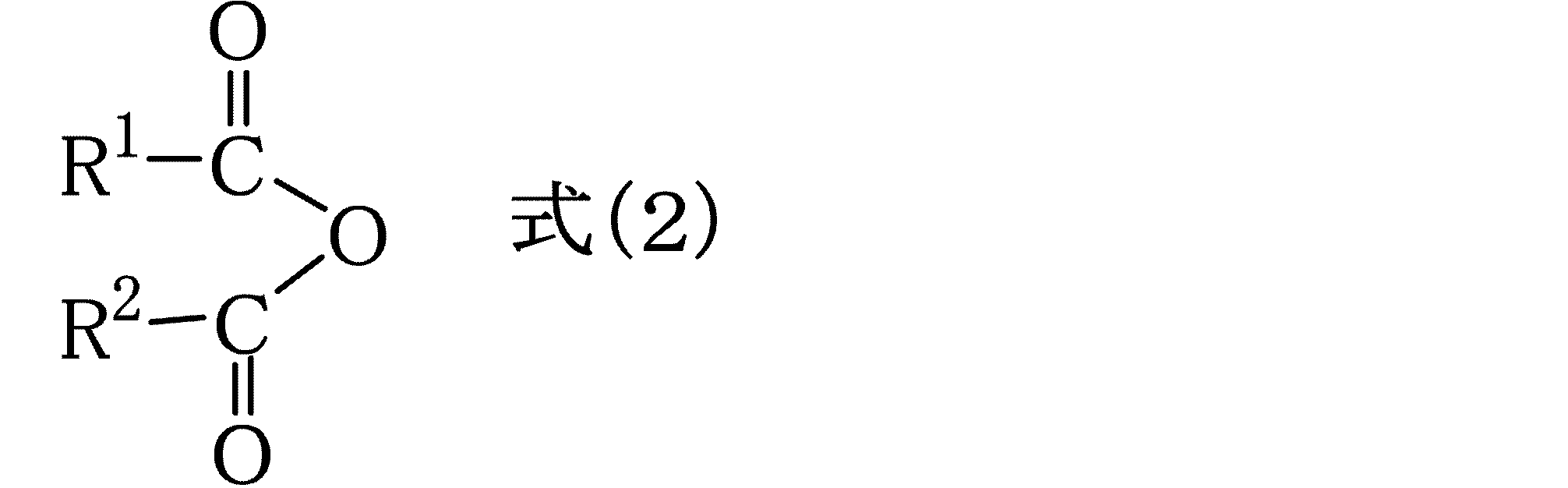
(式中、R1とR2は上述の式(1)と同じ意味を示す。)
合成された化合物Aのグリシジル基と化合物Bのグリシジル基の総和は、平均して、1分子に換算して(総グリシジル基数を総分子数で割る)2個以上であるのが好ましい。2個未満では硬化物の物性、特に耐熱性が低下して好ましくない。
・HPLC
装置:島津製作所製 LC-20Aシステム(α型、β型の組成を分析)
・GC
装置:島津製作所製 GC-2010システム(変性の組成を分析)
・粘度測定:トキメック製E型粘度計(VISCONIC ED型)
・透過率測定:島津製作所製 紫外・可視・近赤外分光光度計(UV-3600)
・曲げ試験:島津製作所製 精密万能試験機(AGS-X シリーズ)
・線膨張率、ガラス転移温度測定:ティー・エイ・インスツルメント製 熱機械測定装置(TMA Q400)
HPLCに市販の光学分割用カラム、商品名CHIRALPAK AS-3(ダイセル化学工業(株)製(0.46cm径×10cm長))を用い、溶離液としてn-ヘキサン/エタノール(60/40 w/w)、カラム温度40℃、流量0.4ml/分の条件で行い、試料の結晶をアセトニトリルに溶解し、さらに溶離液で希釈してHPLCに注入し、クロマト分離させる事によってβ型トリス-(2,3-エポキシプロピル)-イソシアヌレートが11.1分および13.2分に溶出し、α型トリス-(2,3-エポキシプロピル)-イソシアヌレートが11.7分および12.4分に溶出する。結晶全体のα型とβ型の比率は、それぞれのピークの面積比によって算出した。
GCに市販のカラム、商品名HP-5(アジレントテクノロジー社製)(30m×0.32mm×0.25μm)を用い、インジェクター温度250℃、検出器温度300℃、オーブン温度40℃(5分)→20℃/分→300℃(12分)、キャリアガス:窒素、ガス圧力89.1kPa、全流量74.4ml/分、カラム流量3.4ml/分、線速度50cm/秒の条件で行い、試料をアセトニトリルに溶解して、測定を行った。トリス-(2,3-エポキシプロピル)-イソシアヌレートが16.5分、トリス-(2,3-エポキシプロピル)-イソシアヌレートへの無水プロピオン酸の1付加体が18.4分、トリス-(2,3-エポキシプロピル)-イソシアヌレートへの無水プロピオン酸の2付加体が20.9分、トリス-(2,3-エポキシプロピル)-イソシアヌレートへの無水プロピオン酸の3付加体が25.1分に検出された。トリス-(2,3-エポキシプロピル)-イソシアヌレートとその変性体の比率はそれぞれのピークの面積比から算出した。
撹拌機を備えた内容積2 リットルの反応フラスコに、30gの水と、5.5 g のテトラメチルアンモニウムクロライドと、1388g(15モル)のエピクロルヒドリンと、129g(1モル)のイソシアヌール酸とを投入して反応混合物を形成させた。次いで当該フラスコ中の反応混合物を撹拌下加熱して昇温させた。反応混合物の温度が89℃に至ると、反応混合物は大気圧下で沸騰し始めたがそのまま加熱を続けた。発生した蒸気は、凝縮器で冷却して、液化したエピクロルヒドリンは全量フラスコ内へ連続的に還流し、液化した水はフラスコ外へ排出することを5時間続けることにより、反応混合物の温度を120℃に到達させた。この時点で加熱を停止し、反応混合物を冷却することにより、温度45℃の反応生成物を得た。この生成物中には未反応イソシアヌール酸は検出されなかった。
次いで上記フラスコ中の反応生成物全量を50℃に保ちながら、この反応生成物に、水酸化ナトリウムの50質量%水溶液256g(NaOHとして3.2モル)を滴下することを100mmHgの減圧下に開始することにより反応混合物を形成させた。同時に、強撹拌下この反応混合物から水とエピクロルヒドリンを蒸発させた。徐々に減圧度を高めながら、蒸気は凝縮器で冷却して、液化したエピクロルヒドリンは全量フラスコ内へ連続的に還流させ、液化した水はフラスコ外へ排出することを続けて、減圧度が60mmHgに到達した時点で上記滴下を完了することにより析出塩化ナトリウムを含有するスラリーを得た。上記滴下を開始してからこの完了までに6時間を要し、この間、上記撹拌下の反応混合物は析出塩化ナトリウムで白濁したが、終始均一に維持された。液体クロマトグラフィー分析によれば、得られたスラリーに含まれる2-ヒドロキシ-3-クロルプロピル基を有する化合物の含有率は1%以下であった。
得られたトリス-(2,3-エポキシプロピル)-イソシアヌレートは(結晶体中のα型結晶:β型結晶の質量比=75:25)であった。
合成例1で製造した高純度トリス-(2,3-エポキシプロピル)-イソシアヌレートを80.0kg(269mol)とアセトンを680kg混合し、9℃で攪拌した。その後結晶をろ過し、α型を多く含むろ液を得た。これを40℃で減圧濃縮した後、メタノール243kgを添加し、20℃に冷却した。その後ろ過を行い、得られた結晶を減圧乾燥してトリス-(2,3-エポキシプロピル)-イソシアヌレート(結晶体中のα型結晶:β型結晶の質量比=98:2)の37.3kg(125mol)を得た。
合成例1で製造した高純度トリス-(2,3-エポキシプロピル)-イソシアヌレートを5.0g(17mmol)とエピクロルヒドリンを42.5g混合し、6℃で攪拌した。その後結晶をろ過し、α型を多く含むろ液を得た。ここにメタノール785gを添加し、-78℃に冷却した。その後ろ過を行い、得られた結晶を減圧乾燥してトリス-(2,3-エポキシプロピル)-イソシアヌレート(結晶体中のα型結晶:β型結晶の質量比=92:8)の3.2g(11mmol)を得た。
合成例2で製造したトリス-(2,3-エポキシプロピル)-イソシアヌレート(α型結晶:β型結晶の質量比=98:2)を42.5gとアセトニトリルを11.0gと無水プロピオン酸を7.63g(グリシジル基:酸無水物のモル比=1:0.13)とトリエチルホスホニウムエチルブロミドを23.8mg混合し、100℃で2時間撹拌した。その後、減圧濃縮し、液状の変性エポキシ樹脂組成物47.8gを得た。
生成物中のトリス-(2,3-エポキシプロピル)-イソシアヌレートへの無水プロピオン酸の1付加体、トリス-(2,3-エポキシプロピル)-イソシアヌレートへの無水プロピオン酸の2付加体、トリス-(2,3-エポキシプロピル)-イソシアヌレートへの無水プロピオン酸の3付加体、トリス-(2,3-エポキシプロピル)-イソシアヌレート(未付加体)のモル比の割合はGC分析の結果、39.7:8.1:0.4:51.8であった(化合物A:化合物Bのモル比=48.2:51.8)。エポキシ当量は138.1g/eq、粘度は60℃で4090mPa・sであった。このエポキシ樹脂組成物を(i-1)とした。
合成例2で製造したトリス-(2,3-エポキシプロピル)-イソシアヌレート(α型結晶:β型結晶の質量比=98:2)を42.5gとアセトニトリルを11.0gと無水プロピオン酸を11.2g(グリシジル基:酸無水物のモル比=1:0.20)とトリエチルホスホニウムエチルブロミドを23.8mg混合し、100℃で4時間撹拌した。その後、減圧濃縮し、液状の変性エポキシ樹脂組成物52.4gを得た。
生成物中のトリス-(2,3-エポキシプロピル)-イソシアヌレートへの無水プロピオン酸の1付加体、トリス-(2,3-エポキシプロピル)-イソシアヌレートへの無水プロピオン酸の2付加体、トリス-(2,3-エポキシプロピル)-イソシアヌレートへの無水プロピオン酸の3付加体、トリス-(2,3-エポキシプロピル)-イソシアヌレート(未付加体)のモル比の割合はGC分析の結果、46.0:14.5:1.3:38.2であった(化合物A:化合物Bのモル比=61.8:38.2)。エポキシ当量は157.2g/eq、粘度は60℃で3344mPa・sであった。このエポキシ樹脂組成物を(i-2)とした。
合成例2で製造したトリス-(2,3-エポキシプロピル)-イソシアヌレート(α型結晶:β型結晶の質量比=98:2)を85.0gとトルエンを46.8gと無水プロピオン酸を29.8g(グリシジル基:酸無水物のモル比=1:0.27)とトリエチルホスホニウムエチルブロミドを48.6mg混合し、100℃で8時間、120℃で3時間撹拌した。その後、減圧濃縮し、液状の変性エポキシ樹脂組成物112.8gを得た。
生成物中のトリス-(2,3-エポキシプロピル)-イソシアヌレートへの無水プロピオン酸の1付加体、トリス-(2,3-エポキシプロピル)-イソシアヌレートへの無水プロピオン酸の2付加体、トリス-(2,3-エポキシプロピル)-イソシアヌレートへの無水プロピオン酸の3付加体、トリス-(2,3-エポキシプロピル)-イソシアヌレート(未付加体)のモル比の割合はGC分析の結果、52.5:22.3:2.2:23.1(化合物A:化合物Bのモル比=76.9:23.1)であった。エポキシ当量は177.4g/eq、粘度は60℃で2610mPa・sであった。このエポキシ樹脂組成物を(i-3)とした。
合成例3で製造したトリス-(2,3-エポキシプロピル)-イソシアヌレート(α型結晶:β型結晶の質量比=92:8)を2.70gとアセトニトリルを0.71gと無水プロピオン酸を0.49g(グリシジル基:酸無水物のモル比=1:0.13)とトリエチルホスホニウムエチルブロミドを1.5mg混合し、110℃で6時間撹拌した。その後、減圧濃縮し、液状の変性エポキシ樹脂組成物2.97gを得た。
生成物中のトリス-(2,3-エポキシプロピル)-イソシアヌレートへの無水プロピオン酸の1付加体、トリス-(2,3-エポキシプロピル)-イソシアヌレートへの無水プロピオン酸の2付加体、トリス-(2,3-エポキシプロピル)-イソシアヌレートへの無水プロピオン酸の3付加体、トリス-(2,3-エポキシプロピル)-イソシアヌレート(未付加体)のモル比の割合はGC分析の結果、40.2:5.0:0.2:54.6であった(化合物A:化合物Bのモル比=45.4:54.6)。エポキシ当量は134.4g/eq、粘度は60℃で4280mPa・sであった。このエポキシ樹脂組成物を(i-4)とした。
合成例1で製造したトリス-(2,3-エポキシプロピル)-イソシアヌレート(α型:β型の質量比=75:25)を42.5gとアセトニトリルを11.0gと無水プロピオン酸を7.63g(グリシジル基:酸無水物のモル比=1:0.13)とトリエチルホスホニウムエチルブロミドを23.8mg混合し、100℃で2時間撹拌した。その後、減圧濃縮し、液状の変性エポキシ樹脂組成物48.3gを得た。
生成物中のトリス-(2,3-エポキシプロピル)-イソシアヌレートへの無水プロピオン酸の1付加体、トリス-(2,3-エポキシプロピル)-イソシアヌレートへの無水プロピオン酸の2付加体、トリス-(2,3-エポキシプロピル)-イソシアヌレートへの無水プロピオン酸の3付加体、トリス-(2,3-エポキシプロピル)-イソシアヌレート(未付加体)のモル比の割合はGC分析の結果、37.7:7.9:0.6:53.8であった(化合物A:化合物Bのモル比=46.2:53.8)。エポキシ当量は136.4g/eq、粘度は60℃で4640mPa・sであった。このエポキシ樹脂組成物を(i-5)とした。
合成例1で製造したトリス-(2,3-エポキシプロピル)-イソシアヌレート(α型:β型の質量比=75:25)を42.5gとアセトニトリルを11.0gと無水プロピオン酸を11.2g(グリシジル基:酸無水物のモル比=1:0.20)とトリエチルホスホニウムエチルブロミドを23.8mg混合し、100℃で4時間撹拌した。その後、減圧濃縮し、液状の変性エポキシ樹脂組成物52.1gを得た。
生成物中のトリス-(2,3-エポキシプロピル)-イソシアヌレートへの無水プロピオン酸の1付加体、トリス-(2,3-エポキシプロピル)-イソシアヌレートへの無水プロピオン酸の2付加体、トリス-(2,3-エポキシプロピル)-イソシアヌレートへの無水プロピオン酸の3付加体、トリス-(2,3-エポキシプロピル)-イソシアヌレート(未付加体)のモル比の割合はGC分析の結果、45.2:14.3:1.5:39.1であった(化合物A:化合物Bのモル比=60.9:39.1)。エポキシ当量は157.9g/eq、粘度は60℃で3748mPa・sであった。このエポキシ樹脂組成物を(i-6)とした。
合成例1で製造したトリス-(2,3-エポキシプロピル)-イソシアヌレート(α型:β型の質量比=75:25)を85.0gとトルエンを46.8gと無水プロピオン酸を29.8g(グリシジル基:酸無水物のモル比=1:0.27)とトリエチルホスホニウムエチルブロミドを48.6mg混合し、100℃で8時間、120℃で1時間撹拌した。その後、減圧濃縮し、液状の変性エポキシ樹脂組成物113.3gを得た。
生成物中のトリス-(2,3-エポキシプロピル)-イソシアヌレートへの無水プロピオン酸の1付加体、トリス-(2,3-エポキシプロピル)-イソシアヌレートへの無水プロピオン酸の2付加体、トリス-(2,3-エポキシプロピル)-イソシアヌレートへの無水プロピオン酸の3付加体、トリス-(2,3-エポキシプロピル)-イソシアヌレート(未付加体)のモル比の割合はGC分析の結果、51.0:22.9:2.6:23.5であった(化合物A:化合物Bのモル比=76.5:23.5)。エポキシ当量は181.8g/eq、粘度は60℃で2681mPa・sであった。このエポキシ樹脂組成物を(i-7)とした。
各溶剤100gに各エポキシ樹脂組成物を下記に示す量仕込み、25℃で1週間以上放置した。その後、目視で結晶が析出しているかどうかを確認し、まったく結晶が出ていない場合を(○)、結晶が析出している場合を(×)とし、表1乃至表5に示した。また、(-)は溶解性試験が行われていない場合を示した。表中のPGMEはプロピレングリコールモノメチルエーテルを表し、PGMEAはプロピレングリコールモノメチルエーテルアセテートを表し、MEKはメチルエチルケトンを表した。


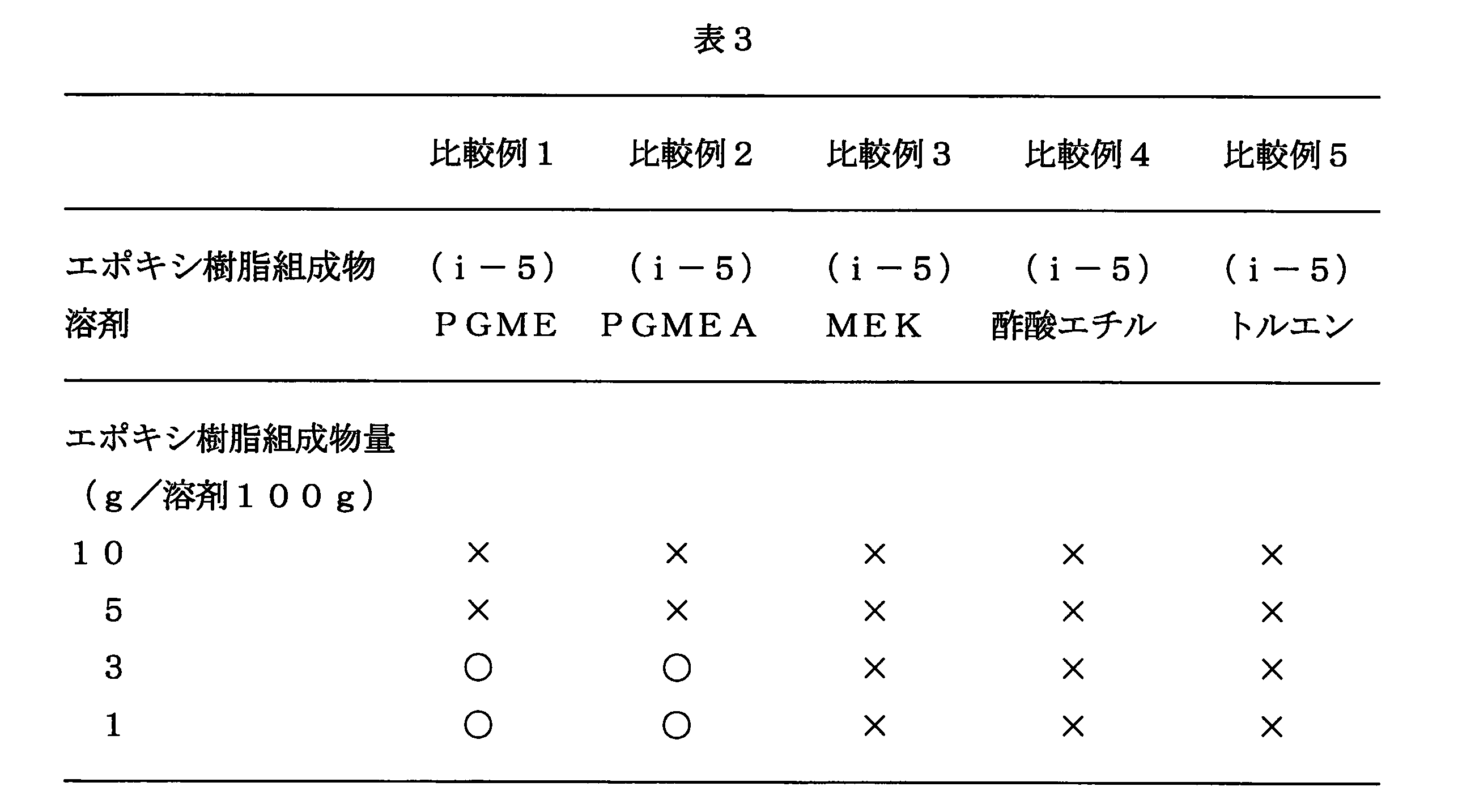


α型:β型の質量比=97:3であるトリス-(2,3-エポキシプロピル)-イソシアヌレートを変性したエポキシ樹脂組成物(i-3)は、α型:β型の質量比=75:25であるトリス-(2,3-エポキシプロピル)-イソシアヌレートを変性したエポキシ樹脂組成物(i-7)と比較していずれの溶媒においても溶解性が向上した。
実施例16
エポキシ樹脂組成物(i-1)4.0gに、商品名リカシッドMH-700(新日本理化株式会社製、4-メチルヘキサヒドロ無水フタル酸とヘキサヒドロ無水フタル酸が質量比で70/30の液状混合物)4.8gを加えて、攪拌と脱泡を行う装置(商品名:あわとり錬太郎、シンキ株式会社製)で混合し、脱泡して組成物を調製し、無色透明で均一に溶解していることを確認した。その後、25℃で40日放置後、組成物の外観を目視で確認した。
エポキシ樹脂組成物(i-4)0.40gに、商品名リカシッドMH-700(新日本理化株式会社製、4-メチルヘキサヒドロ無水フタル酸とヘキサヒドロ無水フタル酸が質量比で70/30の液状混合物)0.48gを加えて、攪拌と脱泡を行う装置(商品名:あわとり錬太郎、シンキ株式会社製)で混合し、脱泡して組成物を調製し、無色透明で均一に溶解していることを確認した。その後、25℃で1週間放置後、組成物の外観を目視で確認した。
エポキシ樹脂組成物(i-5)4.0gに、商品名リカシッドMH-700(新日本理化株式会社製、4-メチルヘキサヒドロ無水フタル酸とヘキサヒドロ無水フタル酸が質量比で70/30の液状混合物)4.8gを加えて、攪拌と脱泡を行う装置(商品名:あわとり錬太郎、シンキ株式会社製)で混合し、脱泡して組成物を調製し、無色透明で均一に溶解していることを確認した。その後、25℃で40日放置後、組成物の外観を目視で確認した。

α型:β型の質量比=97:3であるトリス-(2,3-エポキシプロピル)-イソシアヌレートを変性したエポキシ樹脂組成物(i-1)およびα型:β型の質量比=92:8であるトリス-(2,3-エポキシプロピル)-イソシアヌレートを変性したエポキシ樹脂組成物(i-4)は放置後も硬化剤に均一に溶解していたが、α型:β型の質量比=75:25であるトリス-(2,3-エポキシプロピル)-イソシアヌレートを変性したエポキシ樹脂組成物(i-5)は溶解性が低いため、結晶が析出し、白濁していた。
実施例18
20.0gのエポキシ樹脂組成物(i-1)に23.9gの酸無水物硬化剤リカシッドMH700(商品名、新日本理化社製、成分は4-メチルヘキサヒドロ無水フタル酸とヘキサヒドロ無水フタル酸を70:30のモル比で混合したもの)と硬化促進剤ヒシコーリンPX-4ET(商品名、日本合成化学工業社製、成分はテトラブチルフォスフォニウムジエチルフォスフォロジチオエート)0.2gを加えて、攪拌と脱泡を行う装置(商品名:あわとり錬太郎、シンキ株式会社製)で混合し、脱泡して組成物を調製した。
この混合物を3mmのシリコーンラバーを挟み込んだ離型剤処理したガラス板(離型剤SR-2410(商品名)東レ・ダウコーニング社製を用い150℃で1時間処理した。)の間に流し込んで、予備硬化100℃で2時間、本硬化150℃で5時間の硬化を行った。
20.0gのエポキシ樹脂組成物(i-2)、21.0gのリカシッドMH-700、0.20gのヒシコーリンPX-4ETを実施例18と同様に仕込み、硬化を行った。
20.0gのエポキシ樹脂組成物(i-3)、18.6gのリカシッドMH-700、0.20gのヒシコーリンPX-4ETを実施例18と同様に仕込み、硬化を行った。
20.0gのエポキシ樹脂組成物(i-5)、24.2gのリカシッドMH-700、0.20gのヒシコーリンPX-4ETを実施例18と同様に仕込み、硬化を行った。
比較例13
20.0gのエポキシ樹脂組成物(i-6)、20.9gのリカシッドMH-700、0.20gのヒシコーリンPX-4ETを実施例18と同様に仕込み、硬化を行った。
20.0gのエポキシ樹脂組成物(i-7)、18.1gのリカシッドMH-700、0.20gのヒシコーリンPX-4ETを実施例18と同様に仕込み、硬化を行った。
万能試験機によりJIS K-6911に基づき測定した。
試験片の高さ及び幅を測定し、試験片を支え、その中央に加圧くさびで荷重を加え、試験片が折れたときの荷重を測定し、曲げ強度(σ)を算出した。
曲げ強度σ:(MPa){kgf/mm2}、P:試験片が折れたときの荷重(N){kgf}、L:支点間距離(mm)、W:試験片の幅(mm)、h:試験片の高さ(mm)とした。
σ=(3PL)/(2Wh2)
曲げ弾性率(E):(MPa){kgf/mm2}は、F/Y:荷重-たわみ曲線の直線部分のこう配(N/mm){kgf/mm}とすると、
E=〔L3/(4Wh3)〕×〔F/Y〕
分光光度計を用いて400nmの透過率を測定した。
試験片の厚みを正確に測定してTMA(熱機械分析)の膨張・圧縮法にて荷重0.05N,昇温速度5℃/分で測定した。ガラス転移点の前後の曲線に接線を引き、この接線の交点からTgを求めた。
線膨張率の測定の測定は、JIS K-6911に基づき測定した。試験片の厚みを正確に測定してTMA(熱機械分析)膨張・圧縮法にて荷重0.05N、昇温速度5℃/分で測定した。
線膨張係数α1は30℃乃至80℃の長さの変化量(ΔL1)/試験片の初期の長さ(L)×50=α1で求めた。

α型:β型の質量比=97:3であるトリス-(2,3-エポキシプロピル)-イソシアヌレートを変性したエポキシ樹脂組成物(i-1)とα型:β型の質量比=75:25であるトリス-(2,3-エポキシプロピル)-イソシアヌレートを変性したエポキシ樹脂組成物(i-5)はほぼ同等の硬化物特性を示した。また、α型:β型の質量比=97:3であるトリス-(2,3-エポキシプロピル)-イソシアヌレートを変性したエポキシ樹脂組成物(i-2)とα型:β型の質量比=75:25であるトリス-(2,3-エポキシプロピル)-イソシアヌレートを変性したエポキシ樹脂組成物(i-6)もほぼ同等の硬化物特性を示した。また、α型:β型の質量比=97:3であるトリス-(2,3-エポキシプロピル)-イソシアヌレートを変性したエポキシ樹脂組成物(i-3)とα型:β型の質量比=75:25であるトリス-(2,3-エポキシプロピル)-イソシアヌレートを変性したエポキシ樹脂組成物(i-7)もほぼ同等の硬化物特性を示した。
Claims (12)
- 分子内の1乃至3個のグリシジル基が式(1):

(式中、R1及びR2はそれぞれ独立して、アルキル基、アルケニル基、アルキニル基、アリール基、アラルキル基、複素環基、又はそれらのハロゲン化、アミノ化、若しくはニトロ化誘導体である。)で示される官能基に置換されたトリス-(2,3-エポキシプロピル)-イソシアヌレートからなる化合物Aと、トリス-(2,3-エポキシプロピル)-イソシアヌレートからなる化合物Bとを含み、化合物Aにおいて前記置換がなされる前のトリス-(2,3-エポキシプロピル)-イソシアヌレート並びに化合物Bにおけるトリス-(2,3-エポキシプロピル)-イソシアヌレートは、これら両者の全質量に基づいて2乃至15質量%の割合のβ型トリス-(2,3-エポキシプロピル)-イソシアヌレートと、残部の割合のα型トリス-(2,3-エポキシプロピル)-イソシアヌレートからなることを特徴とする変性エポキシ樹脂組成物。 - 化合物A:化合物Bのモル比が90:10乃至30:70である請求項1に記載の変性エポキシ樹脂組成物。
- 化合物Aにおいて前記置換がなされる前のトリス-(2,3-エポキシプロピル)-イソシアヌレート並びに化合物Bにおけるトリス-(2,3-エポキシプロピル)-イソシアヌレートが、これら両者の全質量に基づいて2乃至10質量%の割合のβ型トリス-(2,3-エポキシプロピル)-イソシアヌレートと、残部の割合のα型トリス-(2,3-エポキシプロピル)-イソシアヌレートからなる請求項1又は請求項2に記載の変性エポキシ樹脂組成物。
- トリス-(2,3-エポキシプロピル)-イソシアヌレート溶液から、該溶液に含まれるβ型トリス-(2,3-エポキシプロピル)-イソシアヌレートを固体として分離し、次いで該溶液からα型トリス-(2,3-エポキシプロピル)-イソシアヌレートの含有比率を高めた結晶体を得る工程(i)、工程(i)で得られた該結晶体からβ型トリス-(2,3-エポキシプロピル)-イソシアヌレートを溶剤で抽出して、α型トリス-(2,3-エポキシプロピル)-イソシアヌレートの含有比率を更に高めたトリス-(2,3-エポキシプロピル)-イソシアヌレート結晶体を得る工程(ii)、及び工程(ii)で得られた該トリス-(2,3-エポキシプロピル)-イソシアヌレート結晶体を酸無水物と、(グリシジル基):(酸無水物)のモル比が1:0.05乃至0.5となる割合で反応させる工程(iii)を含む請求項1乃至請求項3のいずれか1項に記載の変性エポキシ樹脂組成物の製造方法。
- 工程(ii)における抽出が加熱した溶剤で行われる請求項4に記載の変性エポキシ樹脂組成物の製造方法。
- 工程(i)におけるトリス-(2,3-エポキシプロピル)-イソシアヌレート溶液中の溶剤がメチルエチルケトン、アセトン、アセトニトリル、酢酸エチル、又はエピクロルヒドリンである請求項4又は請求項5に記載の変性エポキシ樹脂組成物の製造方法。
- 工程(ii)においてβ型トリス-(2,3-エポキシプロピル)-イソシアヌレートを抽出する溶剤がメチルエチルケトン、アセトン、メタノール、エタノール、又はイソプロパノールである請求項4乃至請求項6のいずれか1項に記載の変性エポキシ樹脂組成物の製造方法。
- 下記工程(A)、(B)、(i’)、及び(iii)を含む請求項1乃至請求項3のいずれか1項に記載の変性エポキシ樹脂組成物の製造方法:
工程(A):1モルのシアヌール酸を5乃至180モルのエピクロルヒドリンと反応させてシアヌール酸のエピクロルヒドリン付加体を生成し、続いて該付加体を脱塩酸することにより、トリス-(2,3-エポキシプロピル)-イソシアヌレートを含有する溶液を得る工程、
工程(B):工程(A)で得られたトリス-(2,3-エポキシプロピル)-イソシアヌレートを含有する溶液を、その固形分濃度で10乃至50質量%の溶液に調製する工程、
工程(i’):工程(B)で得られたトリス-(2,3-エポキシプロピル)-イソシアヌレート溶液から、該溶液に含まれるβ型トリス-(2,3-エポキシプロピル)-イソシアヌレートを固体として分離し、次いで該溶液からα型トリス-(2,3-エポキシプロピル)-イソシアヌレートの含有比率を高めたトリス-(2,3-エポキシプロピル)-イソシアヌレート結晶体を得る工程、
工程(iii):工程(i’)で得られたトリス-(2,3-エポキシプロピル)-イソシアヌレート結晶体を酸無水物と、(グリシジル基):(酸無水物)のモル比が1:0.05乃至0.5となる割合で反応させる工程。 - 下記工程(A)、(B)、(i’)、(ii’)、及び(iii)を含む請求項1乃至請求項3のいずれか1項に記載の変性エポキシ樹脂組成物の製造方法:
工程(A):1モルのシアヌール酸を5乃至180モルのエピクロルヒドリンと反応させてシアヌール酸のエピクロルヒドリン付加体を生成し、続いて該付加体を脱塩酸することにより、トリス-(2,3-エポキシプロピル)-イソシアヌレートを含有する溶液を得る工程、
工程(B):工程(A)で得られたトリス-(2,3-エポキシプロピル)-イソシアヌレートを含有する溶液を、その固形分濃度で10乃至50質量%の溶液に調製する工程、
工程(i’):工程(B)で得られたトリス-(2,3-エポキシプロピル)-イソシアヌレート溶液から、該溶液に含まれるβ型トリス-(2,3-エポキシプロピル)-イソシアヌレートを固体として分離し、次いで該溶液からα型トリス-(2,3-エポキシプロピル)-イソシアヌレートの含有比率を高めた結晶体を得る工程、
工程(ii’):工程(i’)で得られた該結晶体からβ型トリス-(2,3-エポキシプロピル)-イソシアヌレートを溶剤で抽出して、α型トリス-(2,3-エポキシプロピル)-イソシアヌレートの含有比率を更に高めたトリス-(2,3-エポキシプロピル)-イソシアヌレート結晶体を得る工程、
工程(iii):工程(ii’)で得られたトリス-(2,3-エポキシプロピル)-イソシアヌレート結晶体を酸無水物と、(グリシジル基):(酸無水物)のモル比が1:0.05乃至0.5となる割合で反応させる工程。 - 工程(ii’)における抽出が加熱した溶剤で行われる請求項9に記載の製造方法。
- 工程(i’)におけるトリス-(2,3-エポキシプロピル)-イソシアヌレート溶液中の溶剤がエピクロルヒドリンである請求項8乃至請求項10のいずれか1項に記載の製造方法。
- 工程(ii’)においてβ型トリス-(2,3-エポキシプロピル)-イソシアヌレートを抽出する溶剤がメチルエチルケトン、アセトン、メタノール、エタノール、又はイソプロパノールである請求項9乃至請求項11のいずれか1項に記載の製造方法。
Priority Applications (6)
| Application Number | Priority Date | Filing Date | Title |
|---|---|---|---|
| EP14871666.5A EP3085721B1 (en) | 2013-12-17 | 2014-12-10 | High-solubility modified epoxy resin composition |
| CN201480068798.1A CN105829387B (zh) | 2013-12-17 | 2014-12-10 | 高溶解性改性环氧树脂组合物 |
| JP2015553501A JP6512411B2 (ja) | 2013-12-17 | 2014-12-10 | 高溶解性変性エポキシ樹脂組成物 |
| US15/105,935 US10174153B2 (en) | 2013-12-17 | 2014-12-10 | Highly soluble modified epoxy resin composition |
| KR1020167015195A KR102171607B1 (ko) | 2013-12-17 | 2014-12-10 | 고용해성 변성 에폭시 수지 조성물 |
| US16/176,251 US10899872B2 (en) | 2013-12-17 | 2018-10-31 | Highly soluble modified epoxy resin composition |
Applications Claiming Priority (2)
| Application Number | Priority Date | Filing Date | Title |
|---|---|---|---|
| JP2013-259971 | 2013-12-17 | ||
| JP2013259971 | 2013-12-17 |
Related Child Applications (2)
| Application Number | Title | Priority Date | Filing Date |
|---|---|---|---|
| US15/105,935 A-371-Of-International US10174153B2 (en) | 2013-12-17 | 2014-12-10 | Highly soluble modified epoxy resin composition |
| US16/176,251 Continuation US10899872B2 (en) | 2013-12-17 | 2018-10-31 | Highly soluble modified epoxy resin composition |
Publications (1)
| Publication Number | Publication Date |
|---|---|
| WO2015093370A1 true WO2015093370A1 (ja) | 2015-06-25 |
Family
ID=53402718
Family Applications (1)
| Application Number | Title | Priority Date | Filing Date |
|---|---|---|---|
| PCT/JP2014/082695 Ceased WO2015093370A1 (ja) | 2013-12-17 | 2014-12-10 | 高溶解性変性エポキシ樹脂組成物 |
Country Status (7)
| Country | Link |
|---|---|
| US (2) | US10174153B2 (ja) |
| EP (1) | EP3085721B1 (ja) |
| JP (1) | JP6512411B2 (ja) |
| KR (1) | KR102171607B1 (ja) |
| CN (1) | CN105829387B (ja) |
| TW (1) | TWI668244B (ja) |
| WO (1) | WO2015093370A1 (ja) |
Cited By (1)
| Publication number | Priority date | Publication date | Assignee | Title |
|---|---|---|---|---|
| JP2017128546A (ja) * | 2016-01-22 | 2017-07-27 | 四国化成工業株式会社 | (メタ)アクリルエポキシイソシアヌレート化合物、その合成方法および該イソシアヌレート化合物の利用 |
Families Citing this family (4)
| Publication number | Priority date | Publication date | Assignee | Title |
|---|---|---|---|---|
| JP7527270B2 (ja) * | 2019-03-08 | 2024-08-02 | 株式会社Adeka | 繊維強化プラスチック用樹脂組成物、及び該組成物を含有する繊維強化プラスチック |
| CN112694856B (zh) * | 2019-06-26 | 2022-04-08 | 苏州太湖电工新材料股份有限公司 | 一种双组份环氧灌封胶 |
| JP7316237B2 (ja) * | 2020-03-02 | 2023-07-27 | 信越化学工業株式会社 | 有機膜形成材料、有機膜形成方法、パターン形成方法及び化合物 |
| CN111825627B (zh) * | 2020-07-28 | 2023-04-25 | 清远高新华园科技协同创新研究院有限公司 | 一种高固体份羟基树脂的制备方法 |
Citations (6)
| Publication number | Priority date | Publication date | Assignee | Title |
|---|---|---|---|---|
| JPH0481420A (ja) | 1990-07-24 | 1992-03-16 | Mitsubishi Electric Corp | 結晶化防止方法 |
| JPH04264123A (ja) | 1991-02-19 | 1992-09-18 | Nissan Chem Ind Ltd | トリグリシジルイソシアヌレート組成物 |
| JPH0668014B2 (ja) | 1985-11-13 | 1994-08-31 | 三菱電機株式会社 | エポキシ樹脂組成物の製造方法 |
| JPH0762060A (ja) | 1993-08-20 | 1995-03-07 | Yuka Shell Epoxy Kk | 変性液状エポキシ樹脂組成物 |
| WO2006035641A1 (ja) | 2004-09-29 | 2006-04-06 | Nissan Chemical Industries, Ltd. | 変性エポキシ樹脂組成物 |
| WO2014109309A1 (ja) * | 2013-01-11 | 2014-07-17 | 日産化学工業株式会社 | 高溶解性トリス-(2,3-エポキシプロピル)-イソシアヌレート及び製造方法 |
Family Cites Families (6)
| Publication number | Priority date | Publication date | Assignee | Title |
|---|---|---|---|---|
| US3496122A (en) * | 1967-07-14 | 1970-02-17 | Ciba Ltd | Modified triglycidylisocyanurate resins |
| JPH0668014A (ja) | 1992-08-17 | 1994-03-11 | Fujitsu Ltd | 入出力制御装置 |
| JP4221549B2 (ja) * | 2000-10-12 | 2009-02-12 | 日産化学工業株式会社 | β型トリス−(2,3−エポキシプロピル)−イソシアヌレート結晶体中の残留有機溶媒の低減化方法 |
| WO2009008509A1 (ja) * | 2007-07-11 | 2009-01-15 | Nissan Chemical Industries, Ltd. | 無機粒子を含有した液状エポキシ樹脂形成用製剤 |
| KR101565513B1 (ko) * | 2008-02-12 | 2015-11-03 | 닛산 가가쿠 고교 가부시키가이샤 | 실리카콜로이드입자, 이의 제조방법, 유기용매분산실리카졸, 중합성화합물분산실리카졸 및 디카르본산무수물분산실리카졸 |
| JP5353629B2 (ja) * | 2008-11-14 | 2013-11-27 | 信越化学工業株式会社 | 熱硬化性樹脂組成物 |
-
2014
- 2014-12-10 KR KR1020167015195A patent/KR102171607B1/ko active Active
- 2014-12-10 JP JP2015553501A patent/JP6512411B2/ja active Active
- 2014-12-10 EP EP14871666.5A patent/EP3085721B1/en active Active
- 2014-12-10 WO PCT/JP2014/082695 patent/WO2015093370A1/ja not_active Ceased
- 2014-12-10 CN CN201480068798.1A patent/CN105829387B/zh active Active
- 2014-12-10 US US15/105,935 patent/US10174153B2/en active Active
- 2014-12-16 TW TW103143887A patent/TWI668244B/zh active
-
2018
- 2018-10-31 US US16/176,251 patent/US10899872B2/en active Active
Patent Citations (6)
| Publication number | Priority date | Publication date | Assignee | Title |
|---|---|---|---|---|
| JPH0668014B2 (ja) | 1985-11-13 | 1994-08-31 | 三菱電機株式会社 | エポキシ樹脂組成物の製造方法 |
| JPH0481420A (ja) | 1990-07-24 | 1992-03-16 | Mitsubishi Electric Corp | 結晶化防止方法 |
| JPH04264123A (ja) | 1991-02-19 | 1992-09-18 | Nissan Chem Ind Ltd | トリグリシジルイソシアヌレート組成物 |
| JPH0762060A (ja) | 1993-08-20 | 1995-03-07 | Yuka Shell Epoxy Kk | 変性液状エポキシ樹脂組成物 |
| WO2006035641A1 (ja) | 2004-09-29 | 2006-04-06 | Nissan Chemical Industries, Ltd. | 変性エポキシ樹脂組成物 |
| WO2014109309A1 (ja) * | 2013-01-11 | 2014-07-17 | 日産化学工業株式会社 | 高溶解性トリス-(2,3-エポキシプロピル)-イソシアヌレート及び製造方法 |
Non-Patent Citations (1)
| Title |
|---|
| VIKORIA VARGHA: "Binary solid-liquid phase diagram of the two diastereomer racemates of triglycidyl isocyanurate (TGIC", EUROPEAN POLYMER JOURNAL, vol. 43, 22 August 2007 (2007-08-22), pages 4762 - 4769, XP022318831 * |
Cited By (1)
| Publication number | Priority date | Publication date | Assignee | Title |
|---|---|---|---|---|
| JP2017128546A (ja) * | 2016-01-22 | 2017-07-27 | 四国化成工業株式会社 | (メタ)アクリルエポキシイソシアヌレート化合物、その合成方法および該イソシアヌレート化合物の利用 |
Also Published As
| Publication number | Publication date |
|---|---|
| CN105829387B (zh) | 2018-11-23 |
| TW201536828A (zh) | 2015-10-01 |
| EP3085721A1 (en) | 2016-10-26 |
| EP3085721A4 (en) | 2017-07-05 |
| US20190062491A1 (en) | 2019-02-28 |
| US10174153B2 (en) | 2019-01-08 |
| US20160340469A1 (en) | 2016-11-24 |
| EP3085721B1 (en) | 2018-07-18 |
| US10899872B2 (en) | 2021-01-26 |
| JPWO2015093370A1 (ja) | 2017-03-16 |
| CN105829387A (zh) | 2016-08-03 |
| KR102171607B1 (ko) | 2020-10-29 |
| TWI668244B (zh) | 2019-08-11 |
| JP6512411B2 (ja) | 2019-05-15 |
| KR20160099551A (ko) | 2016-08-22 |
Similar Documents
| Publication | Publication Date | Title |
|---|---|---|
| US10899872B2 (en) | Highly soluble modified epoxy resin composition | |
| JP5082445B2 (ja) | 変性エポキシ樹脂組成物 | |
| JP7556347B2 (ja) | エポキシ樹脂及びその製造方法 | |
| JP4655490B2 (ja) | エポキシ樹脂組成物及びその硬化体 | |
| JP6521448B2 (ja) | ビスフェノールフルオレン骨格を有するエポキシ樹脂 | |
| JP4023594B2 (ja) | エポキシ樹脂組成物、及びその硬化物 | |
| JP4743824B2 (ja) | 液状エポキシ樹脂、エポキシ樹脂組成物及びその硬化物 | |
| JP5088952B2 (ja) | エポキシ樹脂、その製造方法及びその用途 | |
| JP2003277468A (ja) | エポキシ樹脂、エポキシ樹脂組成物及びその硬化物 | |
| JP5051150B2 (ja) | 結晶性エポキシ樹脂の製造方法 | |
| JP4969818B2 (ja) | 液状エポキシ樹脂、エポキシ樹脂組成物、および硬化物 | |
| JP4466907B2 (ja) | 液状エポキシ樹脂、エポキシ樹脂組成物及びその硬化物 | |
| JP2025077529A (ja) | イソフタル酸化合物およびその利用 | |
| JP5004147B2 (ja) | 液状エポキシ樹脂、エポキシ樹脂組成物およびその硬化物 | |
| JP2004010878A (ja) | 液状エポキシ樹脂、エポキシ樹脂組成物及びその硬化物 | |
| JP2005220205A (ja) | エポキシ樹脂用硬化剤及びエポキシ樹脂組成物 | |
| JPH09176144A (ja) | エポキシ化合物、その製造法、硬化性組成物及び硬化物 | |
| JP2004035762A (ja) | 結晶性エポキシ樹脂及びその製法、エポキシ樹脂組成物及びその硬化物 | |
| JP2025077530A (ja) | テレフタル酸化合物およびその利用 | |
| JP2005112899A (ja) | 液状エポキシ樹脂、エポキシ樹脂組成物及びその硬化物 | |
| JP2006316163A (ja) | 液状エポキシ樹脂、エポキシ樹脂組成物及びその硬化物 |
Legal Events
| Date | Code | Title | Description |
|---|---|---|---|
| 121 | Ep: the epo has been informed by wipo that ep was designated in this application |
Ref document number: 14871666 Country of ref document: EP Kind code of ref document: A1 |
|
| ENP | Entry into the national phase |
Ref document number: 2015553501 Country of ref document: JP Kind code of ref document: A |
|
| ENP | Entry into the national phase |
Ref document number: 20167015195 Country of ref document: KR Kind code of ref document: A |
|
| NENP | Non-entry into the national phase |
Ref country code: DE |
|
| WWE | Wipo information: entry into national phase |
Ref document number: 15105935 Country of ref document: US |
|
| REEP | Request for entry into the european phase |
Ref document number: 2014871666 Country of ref document: EP |
|
| WWE | Wipo information: entry into national phase |
Ref document number: 2014871666 Country of ref document: EP |