WO2015114832A1 - Escalope en tranches superposées non frite - Google Patents
Escalope en tranches superposées non frite Download PDFInfo
- Publication number
- WO2015114832A1 WO2015114832A1 PCT/JP2014/052446 JP2014052446W WO2015114832A1 WO 2015114832 A1 WO2015114832 A1 WO 2015114832A1 JP 2014052446 W JP2014052446 W JP 2014052446W WO 2015114832 A1 WO2015114832 A1 WO 2015114832A1
- Authority
- WO
- WIPO (PCT)
- Prior art keywords
- cutlet
- meat
- oil
- sliced
- casing
- Prior art date
- Legal status (The legal status is an assumption and is not a legal conclusion. Google has not performed a legal analysis and makes no representation as to the accuracy of the status listed.)
- Ceased
Links
Images


Classifications
-
- A—HUMAN NECESSITIES
- A23—FOODS OR FOODSTUFFS; TREATMENT THEREOF, NOT COVERED BY OTHER CLASSES
- A23B—PRESERVATION OF FOODS, FOODSTUFFS OR NON-ALCOHOLIC BEVERAGES; CHEMICAL RIPENING OF FRUIT OR VEGETABLES
- A23B2/00—Preservation of foods or foodstuffs, in general
- A23B2/80—Freezing; Subsequent thawing; Cooling
-
- A—HUMAN NECESSITIES
- A23—FOODS OR FOODSTUFFS; TREATMENT THEREOF, NOT COVERED BY OTHER CLASSES
- A23L—FOODS, FOODSTUFFS OR NON-ALCOHOLIC BEVERAGES, NOT OTHERWISE PROVIDED FOR; PREPARATION OR TREATMENT THEREOF
- A23L13/00—Meat products; Meat meal; Preparation or treatment thereof
-
- A—HUMAN NECESSITIES
- A23—FOODS OR FOODSTUFFS; TREATMENT THEREOF, NOT COVERED BY OTHER CLASSES
- A23L—FOODS, FOODSTUFFS OR NON-ALCOHOLIC BEVERAGES, NOT OTHERWISE PROVIDED FOR; PREPARATION OR TREATMENT THEREOF
- A23L13/00—Meat products; Meat meal; Preparation or treatment thereof
- A23L13/03—Coating with a layer; Stuffing, laminating, binding, or compressing of original meat pieces
Definitions
- the present invention relates to a non-oiled cutlet that can easily provide a soft and juicy cutlet in an optimal state while maintaining the texture of a cutlet made of a single piece of meat by frying.
- Cutlets using pork, beef or chicken are widely eaten as a general dish.
- pork cutlet with pork use a knife tip on a piece of pork loin, Make a shallow cut, tap the surface lightly with a kitchen knife back or meat tap, and season with salt and pepper.
- the fried food material is packaged in a vacuum package or the like, and using a heating means, the center temperature of the material is the temperature range where the protein of the material solidifies and the core is in the low temperature range below the water separation action starting temperature.
- Patent Document 3 There are known methods for producing frozen foods for fried foods (Patent Document 3), etc. that improve the texture and flavor without fluctuating, improving shape retention, and not having to be fried in oil. ing.
- Patent Document 4 An unheated tonkatsu manufacturing method (Patent Document 4), which is characterized by massaging in a rotating drum, has been proposed.
- cutlets are manufactured from a single piece of meat, so depending on the thickness and quality of the piece of meat, the meat may become hard and difficult to bite.
- the overlapped cutlet of sliced meat as in Patent Document 1 has a soft texture and ease of biting compared to a cutlet made of a single piece of meat. There is a side lacking in eating response.
- cutlets when manufacturing cutlets at the factory, it is generally provided or eaten by cooking and cooking (oil-like) unheated cutlets at convenience stores, supermarkets, and homes.
- cooking and cooking (oil-like) unheated cutlets at convenience stores, supermarkets, and homes.
- the succulent feeling may be impaired, and the cutlet may not be provided under optimal conditions.
- the inventor easily maintains a soft and juicy cutlet in an optimal state while maintaining the texture of the cutlet made of one piece of meat by frying as a result of daily trial and error.
- Invented a non-oil-like superposition cutlet that can be provided on the factory scale and can be provided on a factory scale.
- the non-oil-like superposition cutlet of the present invention is a non-oil-like superposition cutlet that has not yet been fried with oil, and is composed of a plurality of superposed sliced meats and clothing that covers the surface. , Slicing a rod-shaped molded product made of livestock meat, and manufacturing the plurality of sliced meats while maintaining the positional continuity of muscle fibers with the sliced meats adjacent to each other, and then the plurality of slices Filling the casing with meat, then heating the plurality of sliced meats filled in the casing, then removing the casing from the plurality of sliced meats, and then the plurality of slices It is manufactured by the process of attaching clothes to meat.
- the heating of the plurality of sliced meats in the present invention is performed at least until the adjacent sliced meats are bound by protein denaturation.
- the livestock meat in the present invention is characterized in that it is pork thigh.
- the rod-shaped product in the present invention is in a state where at least the surface of the rod-shaped product is frozen while the livestock meat is filled in another casing, and then the other casing is removed and sliced. It is characterized by that.
- the casing according to the present invention is a breathable casing.
- the other casing in the present invention is a breathable casing.
- non-oil-like layered cutlet according to the present invention is characterized by being frozen or cooled after being dressed.
- rod-shaped molded product according to the present invention is characterized by being composed of one or a plurality of meat chunks.
- non-oil-like layered cutlet according to the present invention is characterized in that it can be eaten only by frying it until the garment is colored.
- the present invention since the present invention is manufactured from a plurality of sliced meats, it is soft and easy to bite, unlike a single piece meat that is hard to bite due to its thickness and quality.
- the present invention produces a plurality of sliced meats while maintaining the positional continuity of the muscle fibers with the sliced meats adjacent to each other, thus maintaining a soft and easy to bite texture It has the same eating response (meat texture) as one piece of meat.
- the present invention slices and uses a rod-shaped molded product made of livestock meat, various processes for softening livestock, such as holing and massage, which have been conventionally performed in manufacturing cutlets at a factory are required. It is possible to provide a soft cutlet.
- the present invention is that the sliced meat group has already been heated in the factory, so that the sliced meat adjacent to each other causes binding due to protein denaturation. Since it becomes possible to hold between sliced meat without leaking, it is possible to maintain a juicy state full of gravy.
- the present invention is that the sliced meat group is already heated in the factory in an optimal state, that is, a juicy state overflowing with gravy, and when it is provided or eaten at a convenience store, supermarket, home, the outer clothing part It is possible to provide the cutlet in an optimal state only by heating (oil tone) to the extent that it is deep-fried.
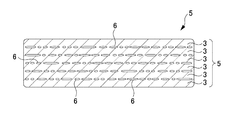
- FIG. 6 is a schematic cross-sectional view of a sliced meat group in a state where the rod-shaped molded product of FIG. 5 is heated and then cut at a constant thickness.
- the non-oil-like superposition cutlet of the present invention heats a plurality of superposed sliced meats in a factory while maintaining the positional continuity of muscle fibers with the adjacent sliced meats.
- the soft and juicy cutlet can be easily provided in an optimal state while maintaining the texture of the cutlet made of one piece of meat by frying, and provided on a factory scale. Is possible.
- non-oil-like superposition cutlet means a cutlet before oiling that becomes a cutlet by cooking with oil (oil-like), and as a method of oiling, especially if it is a cooking method using oil
- the method of frying with oil as usual is performed (frying)
- the method of heating the oil film layer formed on the surface by attaching the oil in the frozen state microcapsules
- Specific examples include a method of heating the oiled fats and oils attached to the surface.
- FIG. 1 is a schematic cross-sectional view of a non-oil-like superposition cutlet according to the present invention.
- the non-oil-like layered cutlet 1 according to the present invention is not different from a known cutlet in appearance with a garment 7, but a sliced meat group 5 in which a plurality of sliced meats 3 are stacked. It has a characteristic in the structure.
- a plurality of sliced meats 3 are sliced while maintaining the positional continuity of muscle fibers with adjacent sliced meats 3.
- the garment 7 is attached to the sliced meat group 5.
- livestock meat which comprises the sliced meat 3 (sliced meat group 5) in this invention
- various livestock meats such as pork, beef, and chicken
- pork has little fat like meat. Even if it is cheap livestock meat, it can be eaten while the meat juice from the red meat part is confined in the slice flesh, so it is healthy by making use of its leanness and juicy by the meat juice produced from the red meat part It can be provided as a cutlet full of feeling.
- processed starch, soy protein, spices, seasonings, salt, water, and the like are injected (injected) into the livestock as needed as a pickle solution.
- the garment 7 is configured by mixing bread crumbs, flour, batter powder, salt, spices, seasonings, water, and the like.
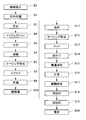
- FIG. 2 is a flowchart of a method for manufacturing a non-oil-like superposition cutlet according to the present invention.
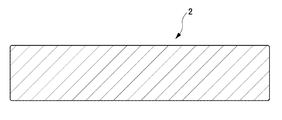
- FIG. 3 is a schematic cross-sectional view in the longitudinal direction of a rod-shaped molded product used in the production of the non-oil-like layered cutlet according to the present invention.
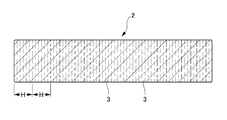
- FIG. 4 is a schematic view of a state in which the rod-shaped molded product of FIG. 3 is sliced while maintaining the positional continuity of muscle fibers.
- FIG. 3 is a schematic cross-sectional view in the longitudinal direction of a rod-shaped molded product used in the production of the non-oil-like layered cutlet according to the present invention.
- FIG. 4 is a schematic view of a state in which the rod-shaped molded product of FIG. 3 is sliced while maintaining the positional continuity of muscle fibers.
- FIG. 5 is a schematic view of a state in which the rod-shaped molded product of FIG. 4 is heated.
- FIG. 6 is a schematic cross-sectional view of a sliced meat group in a state where the rod-shaped molded product of FIG. 5 is heated and then cut with a constant thickness.
- pork thigh meat such as pork thigh, which is the main raw material of unoiled superposition cutlet 1 according to the present invention is received (raw material acceptance: step 1), and portions such as streaks of livestock meat that are not suitable for eating are removed. (Material processing: Step 2).
- the lump of livestock meat from which streaks and the like have been removed is adjusted to a shape and size suitable for the subsequent process (shaping: step 3).
- an injection is performed to improve the meat quality by injecting a pickle solution that softens or increases the meat quality (injection: step 4).
- the injection is performed under the condition of a salting coefficient of 140% (pickling liquid 40% with respect to 100% of raw meat).
- one or a plurality of livestock meat chunks that have been injected are filled into a casing (not shown) (filling: step 5).
- a casing not shown
- filling: step 5 By filling the casing with livestock meat, it is useful for stabilizing the shape of livestock meat and improving the yield.
- the type of the casing is not limited, but when the rod-shaped molded product 2 is manufactured with a plurality of meat chunks, the air between the meat chunks remains after the plurality of meat chunks are filled into the casing. Then, since the air portion remains as a space in the rod-shaped molded product 2 and the product has a hole, the air remaining between the meat chunks is transferred from the casing to the casing by using a breathable casing. It is possible to discharge to the outside and prevent the generation of a space (perforation).
- a casing having a folding diameter of 110 mm, 130 mm, 150 mm, or the like is appropriately selected and used. What is necessary is just to use a suitable thing suitably by the price of a casing, the purchase condition of a casing, the weight of the desired cutlet, etc. Thereby, it becomes a size suitable for eating as a cutlet.
- step 6 the rod-shaped molding 2 filled in the casing is frozen.
- This freezing step is performed to slice the rod-shaped molding 2 later, and therefore the casing is removed.
- the shape of the rod-shaped molded product 2 is set to a fixed state. Therefore, it is not necessary to freeze the entire rod-shaped molded product 2, and it is possible to freeze only the surface.
- FIG. 4 is cut to produce a large number of sliced meats 3 as shown in FIG. 4 (slice: step 8).
- a large number of sliced meats 3 are sliced while maintaining the positional continuity of muscle fibers with adjacent sliced meats 3.
- the hatching in FIG. 4 indicates that the positional continuity of the muscle fibers of the rod-shaped molded product 2 in FIG. 3 is maintained.
- the positional continuity of the muscle fibers means that the muscle fibers themselves are cut by slicing but maintain the same positional relationship of the muscle fibers after cutting.
- the non-oil-like layered cutlet 1 of the present invention is manufactured from a plurality of sliced meats, so that it is soft and easy to bite, unlike a single piece meat that is hard to bite due to its thickness and quality.
- the plurality of sliced meats 3 are manufactured while maintaining the positional continuity of the muscle fibers with the adjacent sliced meats 3, while maintaining a soft and easy to bite texture, Eating response (meat texture) equivalent to a piece of meat.
- the positional continuity of the muscle fibers of the rod-shaped molded product 2 after this slicing can be realized, for example, by the following method.
- the sliced meat 3 (see FIG. 4) is manufactured by cutting the rod-shaped molded product 2 from which the casing in the state of FIG. 3 is removed to a predetermined thickness with a rotary cutting blade (not shown). Then, when the sliced meat 3 is cut from the rod-shaped molded product 2, it is bounced off by the centrifugal force of the rotary cutting blade and falls onto the sliced meat receiving base 9 shown in FIG. 4.
- each sliced meat 3 is jumped to the same location by the centrifugal force of the rotary cutting blade, and the sliced meat 3 maintains the positional continuity of muscle fibers as shown in FIG. It is piled up in the state. Thereby, the plurality of sliced meats 3 are manufactured while maintaining the positional continuity of the muscle fibers with the adjacent sliced meats 3 and sliced while maintaining the overall shape of the rod-shaped molded product 2 before slicing. (FIG. 4).
- the sliced meat 3 is manufactured by cutting the rod-shaped molded product 2 from which the casing in the state of FIG. 3 is removed to a predetermined thickness with a rotary cutting blade (not shown). Then, the sliced meat 3 is cut off from the rod-shaped product before slicing by cutting from the rod-shaped molded product 2. The cut sliced meat is placed on a sliced meat receiving table (not shown) so that one whole cut surface is in contact with it, and the next cut sliced meat is covered thereabove.
- each sliced meat 3 is stacked at the same location on the sliced meat receiving table, and the sliced meat 3 maintains the positional continuity of muscle fibers as shown in FIG. It will be piled up. Thereby, the plurality of sliced meats 3 are manufactured while maintaining the positional continuity of the muscle fibers with the adjacent sliced meats 3 and sliced while maintaining the overall shape of the rod-shaped molded product 2 before slicing. It becomes the state.
- the slice meat receiving part may be constantly or intermittently moved by the conveying means due to the necessity of the manufacturing process, and in that case, the sliced sliced meat is predetermined on the slice meat receiving table.
- the gaps are stacked in a staircase pattern (not shown).
- the sliced meat stacked in a staircase shape can be easily corrected manually to a state in which the positional continuity of muscle fibers is maintained.
- the thickness of the sliced meat 3 is appropriately selected in consideration of eating response, texture, etc., for example, sliced to a thickness of 1.5 mm.
- the rod-shaped molding 2 after slicing shown in FIG. 4 is filled into a casing (not shown) (filling: step 9).
- the shape of the sliced rod-shaped molded product 2 is stabilized, and it is also useful for improving the yield by preventing the sliced-shaped molded product 2 from falling apart. .
- the type of the casing is not limited, but a breathable casing is suitable for appropriately removing the moisture of the rod-shaped product 2 in the subsequent heating step.
- a casing having the same folding diameter as the casing used in step 5 (filling) is used. This corresponds to the casing used in step 5, and this makes it possible to fill the rod-shaped molded product 2 after slicing just well.
- the sliced rod-shaped molded product 2 filled in the casing is heated using heat treatment equipment (heat treatment: step 10).
- the heating to the rod-shaped molded product 2 is performed at least until the adjacent sliced meats 3 are bound by protein denaturation. For example, heating is performed at a center temperature of 70 ° C. for 1 minute or longer.
- the heated rod-shaped molded product 2 is cut into a predetermined thickness to produce a sliced meat group (cut: step 13).
- a sliced meat group For example, it cuts with the thickness of H (for example, 10 mm) in FIG. 5 so that each cut meat group may be about 45 g / piece.
- the sliced meat group 5 shown in FIG. 6 is brought into a state, and as shown in the cross section, the meat juice 6 overflows between the sliced meat 3 and another sliced meat 3 adjacent thereto, and is heated. Because of the binding caused by protein denaturation in the sliced meat 3 adjacent to each other, it becomes possible to hold between the sliced meat 3 without leaking out the broth overflowing between the sliced meat 3 and the sliced meat, It is possible to maintain a juicy state full of gravy.
- the sliced meat group 5 is dressed (clothing: step 14), and the state shown in FIG. 1 is obtained, and the non-oil-like superposed cutlet 1 of the present invention can be obtained.
- the non-oil-like layered cutlet 1 after the dressing is finished for example, is quickly frozen at ⁇ 35 ° C. or less (rapid freezing: step 15), and is weighed, for example, 60 g or more. Excluded (weighing: step 16).
- step 17 X-ray inspection and metal detection for quality control are performed (foreign matter inspection: step 17), and after quality is confirmed, the product is packed in a bag (packing: step 18) and packed (boxing: step 19). ), For example, stored at ⁇ 18 ° C. or lower (storage: step 20), and is ready for shipment.
- the non-oil-like superposition cutlet 1 will be provided or eaten at convenience stores, supermarkets, and homes.
- the sliced meat group is already heated in the factory in an optimum state, that is, a juicy state full of gravy.
- the cutlet can be eaten in an optimal state only by heating (oil tone) to such an extent that the outer garment is colored deeply.
Landscapes
- Life Sciences & Earth Sciences (AREA)
- Engineering & Computer Science (AREA)
- Chemical & Material Sciences (AREA)
- Food Science & Technology (AREA)
- Polymers & Plastics (AREA)
- Health & Medical Sciences (AREA)
- Nutrition Science (AREA)
- Wood Science & Technology (AREA)
- Zoology (AREA)
- Meat, Egg Or Seafood Products (AREA)
- Freezing, Cooling And Drying Of Foods (AREA)
Abstract
La présente invention vise à fournir une escalope en tranches superposées non frite permettant d'obtenir facilement, lorsqu'elle est frite, une escalope tendre et juteuse dans un état optimal, tout en préservant les sensations en bouche d'une escalope préparée à partir d'une seule tranche de viande, et qui peut être préparée à l'échelle industrielle. A cet effet, la présente invention concerne une escalope en tranches superposées non frite (1) préparée à partir d'une pluralité de tranches de viande superposées (3). Dans un état dans lequel la continuité de position des fibres musculaires entre des tranches de viande adjacentes (3) est maintenue, les tranches de viande sont chauffées en usine, puis un enrobage (7) est appliqué sur le groupe de tranches de viande (5).
Priority Applications (2)
| Application Number | Priority Date | Filing Date | Title |
|---|---|---|---|
| PCT/JP2014/052446 WO2015114832A1 (fr) | 2014-02-03 | 2014-02-03 | Escalope en tranches superposées non frite |
| JP2014551458A JP5753954B1 (ja) | 2014-02-03 | 2014-02-03 | 未油調重ね合わせカツ |
Applications Claiming Priority (1)
| Application Number | Priority Date | Filing Date | Title |
|---|---|---|---|
| PCT/JP2014/052446 WO2015114832A1 (fr) | 2014-02-03 | 2014-02-03 | Escalope en tranches superposées non frite |
Publications (1)
| Publication Number | Publication Date |
|---|---|
| WO2015114832A1 true WO2015114832A1 (fr) | 2015-08-06 |
Family
ID=53638131
Family Applications (1)
| Application Number | Title | Priority Date | Filing Date |
|---|---|---|---|
| PCT/JP2014/052446 Ceased WO2015114832A1 (fr) | 2014-02-03 | 2014-02-03 | Escalope en tranches superposées non frite |
Country Status (2)
| Country | Link |
|---|---|
| JP (1) | JP5753954B1 (fr) |
| WO (1) | WO2015114832A1 (fr) |
Citations (7)
| Publication number | Priority date | Publication date | Assignee | Title |
|---|---|---|---|---|
| JPS5070550A (fr) * | 1973-10-24 | 1975-06-12 | ||
| JPS6196969A (ja) * | 1984-10-15 | 1986-05-15 | Hamakei:Kk | 肉類加工品の製造法 |
| JPH099886A (ja) * | 1995-06-29 | 1997-01-14 | Fuji Foods Kk | 即席揚げ物用の冷凍食品およびその製造方法 |
| JP2002065214A (ja) * | 2000-08-31 | 2002-03-05 | Gfr:Kk | カツレツまたは天ぷら材料とそれから得られるカツレツまたは天ぷら |
| WO2007148717A1 (fr) * | 2006-06-21 | 2007-12-27 | Kimukatsu Foods Inc. | Matière pour préparer des côtelettes de porc |
| JP2009106209A (ja) * | 2007-10-31 | 2009-05-21 | Integration:Kk | 肉材料、カツレツ材料、及びカツレツ |
| JP2009207427A (ja) * | 2008-03-05 | 2009-09-17 | Integration:Kk | カツレツ調理材料 |
Family Cites Families (3)
| Publication number | Priority date | Publication date | Assignee | Title |
|---|---|---|---|---|
| JPH0584052A (ja) * | 1991-09-26 | 1993-04-06 | Fine Foods Kenkyu Kyodo Kumiai | 冷凍トンカツの製造方法 |
| JP3231030B2 (ja) * | 1999-12-28 | 2001-11-19 | 伊藤ハム株式会社 | コンバイン食肉、該食肉の加工方法と加工装置 |
| JP3654577B2 (ja) * | 2000-05-25 | 2005-06-02 | プリマハム株式会社 | 未加熱トンカツの製造方法 |
-
2014
- 2014-02-03 JP JP2014551458A patent/JP5753954B1/ja active Active
- 2014-02-03 WO PCT/JP2014/052446 patent/WO2015114832A1/fr not_active Ceased
Patent Citations (7)
| Publication number | Priority date | Publication date | Assignee | Title |
|---|---|---|---|---|
| JPS5070550A (fr) * | 1973-10-24 | 1975-06-12 | ||
| JPS6196969A (ja) * | 1984-10-15 | 1986-05-15 | Hamakei:Kk | 肉類加工品の製造法 |
| JPH099886A (ja) * | 1995-06-29 | 1997-01-14 | Fuji Foods Kk | 即席揚げ物用の冷凍食品およびその製造方法 |
| JP2002065214A (ja) * | 2000-08-31 | 2002-03-05 | Gfr:Kk | カツレツまたは天ぷら材料とそれから得られるカツレツまたは天ぷら |
| WO2007148717A1 (fr) * | 2006-06-21 | 2007-12-27 | Kimukatsu Foods Inc. | Matière pour préparer des côtelettes de porc |
| JP2009106209A (ja) * | 2007-10-31 | 2009-05-21 | Integration:Kk | 肉材料、カツレツ材料、及びカツレツ |
| JP2009207427A (ja) * | 2008-03-05 | 2009-09-17 | Integration:Kk | カツレツ調理材料 |
Also Published As
| Publication number | Publication date |
|---|---|
| JPWO2015114832A1 (ja) | 2017-03-23 |
| JP5753954B1 (ja) | 2015-07-22 |
Similar Documents
| Publication | Publication Date | Title |
|---|---|---|
| CN104000218A (zh) | 一种花猪肉干制作方法及花猪肉干 | |
| KR101920179B1 (ko) | Iqf 돈등심 또는 돈안심 돈까스의 제조방법 | |
| KR101598345B1 (ko) | 2번의 압착 과정을 거친 전자렌지 조리용 유탕 처리 돈까스의 제조 방법 | |
| CN101623110B (zh) | 一种重组肉制品加工方法 | |
| NO883331L (no) | Kjoettprodukt og fremgangsmaate til tilberedning. | |
| JP3051403B1 (ja) | 串カツ用加工食材およびその製造方法 | |
| KR101693451B1 (ko) | 냉동 돈육을 이용한 편육 및 그 제조 방법 | |
| CN104472621A (zh) | 一种蔬菜鸡肉饼配方及制作方法 | |
| CN103815426A (zh) | 香酥灯盏的制作方法 | |
| KR102709724B1 (ko) | 냉동 닭정육 제조방법 | |
| KR20180119807A (ko) | 치즈김치삼겹살꼬치구이 | |
| US20070110884A1 (en) | Additive for meat product, meat product and method for making same | |
| JP5753954B1 (ja) | 未油調重ね合わせカツ | |
| KR20020020581A (ko) | 돈까스 제조방법 | |
| JP5828677B2 (ja) | 冷凍油ちょう食品の製造方法 | |
| JP4796609B2 (ja) | 鮪のテールシチューの製法 | |
| KR20030050686A (ko) | 참치패티 제조방법 | |
| JP3654577B2 (ja) | 未加熱トンカツの製造方法 | |
| JP2007202458A (ja) | ジューシーな鶏肉の唐揚げとその製造方法 | |
| KR102898763B1 (ko) | 짜조피를 이용한 경장육사 만두 및 이의 제조방법 | |
| KR101468365B1 (ko) | 고로케 돈까스 및 그 제조방법 | |
| TW202110339A (zh) | 日式燒肉包的製作方法 | |
| JP2020174572A (ja) | 豚ハラミの焼肉用加工方法 | |
| JP3722669B2 (ja) | 大判未加熱トンカツの製造方法 | |
| JPH099886A (ja) | 即席揚げ物用の冷凍食品およびその製造方法 |
Legal Events
| Date | Code | Title | Description |
|---|---|---|---|
| ENP | Entry into the national phase |
Ref document number: 2014551458 Country of ref document: JP Kind code of ref document: A |
|
| NENP | Non-entry into the national phase |
Ref country code: DE |
|
| 121 | Ep: the epo has been informed by wipo that ep was designated in this application |
Ref document number: 14881225 Country of ref document: EP Kind code of ref document: A1 |
|
| 122 | Ep: pct application non-entry in european phase |
Ref document number: 14881225 Country of ref document: EP Kind code of ref document: A1 |