WO2015115385A1 - Système et procédé de régulation de puissance, et système et procédé de commande d'aptitude à la communication d'informations - Google Patents
Système et procédé de régulation de puissance, et système et procédé de commande d'aptitude à la communication d'informations Download PDFInfo
- Publication number
- WO2015115385A1 WO2015115385A1 PCT/JP2015/052091 JP2015052091W WO2015115385A1 WO 2015115385 A1 WO2015115385 A1 WO 2015115385A1 JP 2015052091 W JP2015052091 W JP 2015052091W WO 2015115385 A1 WO2015115385 A1 WO 2015115385A1
- Authority
- WO
- WIPO (PCT)
- Prior art keywords
- power consumption
- power
- value
- information
- elements
- Prior art date
- Legal status (The legal status is an assumption and is not a legal conclusion. Google has not performed a legal analysis and makes no representation as to the accuracy of the status listed.)
- Ceased
Links
Images







Classifications
-
- H—ELECTRICITY
- H02—GENERATION; CONVERSION OR DISTRIBUTION OF ELECTRIC POWER
- H02J—ELECTRIC POWER NETWORKS; CIRCUIT ARRANGEMENTS OR SYSTEMS FOR SUPPLYING OR DISTRIBUTING ELECTRIC POWER; SYSTEMS FOR STORING ELECTRIC ENERGY
- H02J13/00—Circuit arrangements for providing remote monitoring or remote control of equipment in a power distribution network
- H02J13/18—Circuit arrangements for providing remote monitoring or remote control of equipment in a power distribution network characterised by the remotely-controlled equipment, e.g. converters or transformers
- H02J13/333—Circuit arrangements for providing remote monitoring or remote control of equipment in a power distribution network characterised by the remotely-controlled equipment, e.g. converters or transformers the equipment forming part of substations
-
- H—ELECTRICITY
- H04—ELECTRIC COMMUNICATION TECHNIQUE
- H04L—TRANSMISSION OF DIGITAL INFORMATION, e.g. TELEGRAPHIC COMMUNICATION
- H04L12/00—Data switching networks
- H04L12/02—Details
- H04L12/12—Arrangements for remote connection or disconnection of substations or of equipment thereof
-
- H—ELECTRICITY
- H02—GENERATION; CONVERSION OR DISTRIBUTION OF ELECTRIC POWER
- H02J—ELECTRIC POWER NETWORKS; CIRCUIT ARRANGEMENTS OR SYSTEMS FOR SUPPLYING OR DISTRIBUTING ELECTRIC POWER; SYSTEMS FOR STORING ELECTRIC ENERGY
- H02J13/00—Circuit arrangements for providing remote monitoring or remote control of equipment in a power distribution network
-
- G—PHYSICS
- G05—CONTROLLING; REGULATING
- G05B—CONTROL OR REGULATING SYSTEMS IN GENERAL; FUNCTIONAL ELEMENTS OF SUCH SYSTEMS; MONITORING OR TESTING ARRANGEMENTS FOR SUCH SYSTEMS OR ELEMENTS
- G05B19/00—Program-control systems
- G05B19/02—Program-control systems electric
- G05B19/04—Program control other than numerical control, i.e. in sequence controllers or logic controllers
- G05B19/042—Program control other than numerical control, i.e. in sequence controllers or logic controllers using digital processors
-
- H—ELECTRICITY
- H02—GENERATION; CONVERSION OR DISTRIBUTION OF ELECTRIC POWER
- H02J—ELECTRIC POWER NETWORKS; CIRCUIT ARRANGEMENTS OR SYSTEMS FOR SUPPLYING OR DISTRIBUTING ELECTRIC POWER; SYSTEMS FOR STORING ELECTRIC ENERGY
- H02J3/00—Circuit arrangements for AC mains or AC distribution networks
- H02J3/12—Arrangements for adjusting voltage in AC networks by changing a characteristic of the network load
-
- G—PHYSICS
- G05—CONTROLLING; REGULATING
- G05B—CONTROL OR REGULATING SYSTEMS IN GENERAL; FUNCTIONAL ELEMENTS OF SUCH SYSTEMS; MONITORING OR TESTING ARRANGEMENTS FOR SUCH SYSTEMS OR ELEMENTS
- G05B2219/00—Program-control systems
- G05B2219/20—Pc systems
- G05B2219/26—Pc applications
- G05B2219/2639—Energy management, use maximum of cheap power, keep peak load low
-
- Y—GENERAL TAGGING OF NEW TECHNOLOGICAL DEVELOPMENTS; GENERAL TAGGING OF CROSS-SECTIONAL TECHNOLOGIES SPANNING OVER SEVERAL SECTIONS OF THE IPC; TECHNICAL SUBJECTS COVERED BY FORMER USPC CROSS-REFERENCE ART COLLECTIONS [XRACs] AND DIGESTS
- Y02—TECHNOLOGIES OR APPLICATIONS FOR MITIGATION OR ADAPTATION AGAINST CLIMATE CHANGE
- Y02B—CLIMATE CHANGE MITIGATION TECHNOLOGIES RELATED TO BUILDINGS, e.g. HOUSING, HOUSE APPLIANCES OR RELATED END-USER APPLICATIONS
- Y02B70/00—Technologies for an efficient end-user side electric power management and consumption
- Y02B70/30—Systems integrating technologies related to power network operation and communication or information technologies for improving the carbon footprint of the management of residential or tertiary loads, i.e. smart grids as climate change mitigation technology in the buildings sector, including also the last stages of power distribution and the control, monitoring or operating management systems at local level
-
- Y—GENERAL TAGGING OF NEW TECHNOLOGICAL DEVELOPMENTS; GENERAL TAGGING OF CROSS-SECTIONAL TECHNOLOGIES SPANNING OVER SEVERAL SECTIONS OF THE IPC; TECHNICAL SUBJECTS COVERED BY FORMER USPC CROSS-REFERENCE ART COLLECTIONS [XRACs] AND DIGESTS
- Y02—TECHNOLOGIES OR APPLICATIONS FOR MITIGATION OR ADAPTATION AGAINST CLIMATE CHANGE
- Y02B—CLIMATE CHANGE MITIGATION TECHNOLOGIES RELATED TO BUILDINGS, e.g. HOUSING, HOUSE APPLIANCES OR RELATED END-USER APPLICATIONS
- Y02B70/00—Technologies for an efficient end-user side electric power management and consumption
- Y02B70/30—Systems integrating technologies related to power network operation and communication or information technologies for improving the carbon footprint of the management of residential or tertiary loads, i.e. smart grids as climate change mitigation technology in the buildings sector, including also the last stages of power distribution and the control, monitoring or operating management systems at local level
- Y02B70/3225—Demand response systems, e.g. load shedding, peak shaving
-
- Y—GENERAL TAGGING OF NEW TECHNOLOGICAL DEVELOPMENTS; GENERAL TAGGING OF CROSS-SECTIONAL TECHNOLOGIES SPANNING OVER SEVERAL SECTIONS OF THE IPC; TECHNICAL SUBJECTS COVERED BY FORMER USPC CROSS-REFERENCE ART COLLECTIONS [XRACs] AND DIGESTS
- Y04—INFORMATION OR COMMUNICATION TECHNOLOGIES HAVING AN IMPACT ON OTHER TECHNOLOGY AREAS
- Y04S—SYSTEMS INTEGRATING TECHNOLOGIES RELATED TO POWER NETWORK OPERATION, COMMUNICATION OR INFORMATION TECHNOLOGIES FOR IMPROVING THE ELECTRICAL POWER GENERATION, TRANSMISSION, DISTRIBUTION, MANAGEMENT OR USAGE, i.e. SMART GRIDS
- Y04S20/00—Management or operation of end-user stationary applications or the last stages of power distribution; Controlling, monitoring or operating thereof
- Y04S20/20—End-user application control systems
- Y04S20/221—General power management systems
-
- Y—GENERAL TAGGING OF NEW TECHNOLOGICAL DEVELOPMENTS; GENERAL TAGGING OF CROSS-SECTIONAL TECHNOLOGIES SPANNING OVER SEVERAL SECTIONS OF THE IPC; TECHNICAL SUBJECTS COVERED BY FORMER USPC CROSS-REFERENCE ART COLLECTIONS [XRACs] AND DIGESTS
- Y04—INFORMATION OR COMMUNICATION TECHNOLOGIES HAVING AN IMPACT ON OTHER TECHNOLOGY AREAS
- Y04S—SYSTEMS INTEGRATING TECHNOLOGIES RELATED TO POWER NETWORK OPERATION, COMMUNICATION OR INFORMATION TECHNOLOGIES FOR IMPROVING THE ELECTRICAL POWER GENERATION, TRANSMISSION, DISTRIBUTION, MANAGEMENT OR USAGE, i.e. SMART GRIDS
- Y04S20/00—Management or operation of end-user stationary applications or the last stages of power distribution; Controlling, monitoring or operating thereof
- Y04S20/20—End-user application control systems
- Y04S20/222—Demand response systems, e.g. load shedding, peak shaving
Definitions
- the present invention relates to a system and method for dynamically and efficiently allocating resources according to the priority of each element, particularly while reducing the traffic, while satisfying the constraints on the total amount of resources (power and information transmission capability). .
- the situation related to the demand peak can be drastically improved by flattening the peak by avoiding the generation of instantaneous peak power by carrying out the power “handling” at each home, office or the like.
- the current use of electrical appliances at homes, offices, etc. is not performed in consideration of flattening. Except for some dwelling units, power control in houses, office buildings, etc. It has not been realized and popularized.
- Japanese Patent Laid-Open No. 11-313438 Fault Protection Device for Power Distribution System
- the device group collects information via communication by the server, It is completely different in that the dynamic power management is performed by coordinating the power constraint and the required amount in consideration of the priority.
- the invention presupposes a method that does not collect / aggregate information from the device group, but in the present invention, the device group performs dynamic power management in coordination with the power constraints and required amount in consideration of priority. It is completely different in what it does.
- Japanese Unexamined Patent Publication No. 2013-38885 “In-house Power Generation System”
- the present invention deals with a power generator, but the present invention conversely supplies negative power.
- JP 2012-85511 A "Vehicle Charging System Having Charging Efficiency Control and Providing Adaptive Charging Service"
- power management is not performed in the charging station group, but the existence of a management station and the existence of a smart grid are assumed.
- the present invention is completely different in that dynamic power management is performed in cooperation with consideration of power constraints, necessary amounts, and priorities regardless of the presence of a management station or a smart grid.
- the present invention relates to a connection establishment method in power line communication.
- the present invention does not specify a communication method and does not state that establishment of communication should be solved.
- power line communication is listed as one of communication means, but connection establishment there is not listed as a problem to be solved.
- Japanese Patent Publication No. 2003-511842 “Contactor Breaker” In the present invention, fault detection and control based thereon are performed within the same individual.
- the present invention The device group is completely different in that it dynamically manages power in consideration of power constraints, required amount, and priority.
- JP 2013-70569 A "Distributed Power Supply System”
- failure detection and control are performed within the same individual, but in the present invention, in the device group, It is completely different in that it performs dynamic power management in cooperation with the power constraints, required amount, and priority.
- JP 2010-148125 A "System for Remote Acquisition of Electric Energy Consumption Including Home Use and Remote Control of Distributed Target Users"
- the present invention presupposes centralized management via a communication structure such as a central server, concentrator, and meter, but in the present invention, in the group of devices, dynamic power is coordinated in consideration of power constraints, required amount, and priority. This is completely different in that the starting point of the configuration is that the management is independently performed in a distributed local group.
- JP 2005-513900 A "System for remote acquisition of electric energy consumption including for home use and remote control of distributed target users"
- the present invention presupposes centralized management via a communication structure such as a central server, concentrator, and meter, but in the present invention, in the group of devices, dynamic power is coordinated in consideration of power constraints, required amount, and priority. This is completely different in that the starting point of the configuration is that the management is independently performed in a distributed local group.
- the power shut-off device referred to in the present invention is premised on a centralized management configuration that forms a tree or star system around it.
- the present invention is completely different in that dynamic power management is performed cooperatively in consideration of power constraints, necessary amounts, and priorities in the device group.
- the power shut-off device referred to in the present invention is premised on a centralized management configuration that forms a tree or star system around it.
- the present invention is completely different in that dynamic power management is performed cooperatively in consideration of power constraints, necessary amounts, and priorities in the device group.
- the power shut-off device referred to in the present invention is premised on a centralized management configuration that forms a tree or star system around it.
- the present invention is completely different in that dynamic power management is performed cooperatively in consideration of power constraints, necessary amounts, and priorities in the device group.
- the present invention is premised on the existence of a central supervisory control system.
- the present invention is completely different in that dynamic power management is performed cooperatively in consideration of power constraints, necessary amounts, and priorities in the device group.
- JP 2012-161202 A “Hierarchical Supply and Demand Control Device and Power System Control System”
- it constitutes a hierarchy, it is a centralized monitoring control system that aggregates information, and in one embodiment of the present invention, information collection and control within a group is performed in an independent and distributed manner with other groups and hierarchies. There is no point to do and it is completely different.
- JP 2010-279238 A "System Monitoring and Control System" Although the present invention constitutes a hierarchy, there is no point that information collection and control within a group is performed in an independent and distributed manner with other groups and hierarchies, which is an embodiment of the present invention. is there.
- the “independent distributed” control in the present invention is independence between types of controllers such as lighting and air conditioners. It does not mean that is done autonomously.
- the first feature is that dynamic power allocation is performed independently of other groups and hierarchies in consideration of the priority among members under the control. Is similar to The method is quite different.
- the “hierarchy” in the present invention refers to a hierarchy in the operation mode of time zone, cooperative energy saving, and peak, but the hierarchy in one embodiment of the present invention is applied to the present invention. Is a hierarchy consisting of a group whose members are stores, or a hierarchy consisting of a group whose members are representatives of regional stores. The name is a “hierarchy”, but the definition is fundamental. Different. In one embodiment of the present invention, on any one of those hierarchies, the first feature is to perform dynamic power allocation considering the priority between groups independently of other groups and hierarchies, The method is quite different.
- the hierarchy and distributed monitoring control referred to in the present invention is based on decentralization of an execution unit, an information exchange unit, and an interface unit.
- a dynamic is determined according to the priority among members under given power constraints. Is fundamentally different from the one that provides a way to determine the power allocation.
- the supervisory control referred to in the present invention does not perform autonomous control among members.
- a dynamic is determined according to the priority among members under given power constraints. Is fundamentally different from the one that provides a way to determine the power allocation.
- Japanese Unexamined Patent Application Publication No. 2008-90607 “Autonomous Decentralized Control with Resource Constraints” Distribution in the present invention refers to not specifying a server, but the present invention teaches that control is performed in subdivided units so that it can be handled locally and flexibly, not global batch control. is doing.
- the server may be specified or fixed.
- the present invention proposes a specific method for performing policy / decision processing, in the present invention, a server may be determined by some method, and the method for dynamically allocating the processing is not limited. . There is no need to use the card game system, and the server function “Change (Shift ) ”Is not specifically required.
- the server function can be changed in order of serial number or fixed.
- the purpose is to maintain and achieve performance by the input of resources.
- the power as a resource is not input, but the power is cut off permanently or intermittently.
- it is not a control to maximize the supply power that is the total resource, but based on the priority when the power consumption exceeds the allowable value or the target value, the required power amount and the power amount restriction are taken into consideration and the permanent power consumption is considered.
- the electric power that is input as a resource is determined by the control side, it is known in advance, whereas in the present invention, it is information that should be measured and acquired.
- the present invention aims at demonstrating “a control function that achieves and maintains the performance of the entire system”, and “a method for controlling the individual performance of all elements while satisfying the constraints of the total resources (sum of resources)” (Claim 1 of the same publication)
- the system performance can be reduced by aggressively sacrificing the achievement and maintenance of performance.
- the purpose is to prevent damage.
- JP 2013-38470 A “Control Device and Control System for Electrical Equipment”
- the restriction of the power that is a resource is not taken into consideration, and a solution that satisfies the restriction is not guaranteed. Only a certain operation preset in feed-forward is performed. It should be noted that “setting” in the claims of the same document refers to predefining. In the present invention, It is completely different from the invention described in this document in that the constraint of resources is handled explicitly and the operation to satisfy it is guaranteed.
- the operation proposed in this document is a command operation by so-called simultaneous transmission part processing.
- the Web site discloses an example of disconnecting a device with a predetermined priority. Compared with the present invention, at least the following points are different. (1) Whereas the example disclosed on the website performs control in units of outlets, the present invention is in units of equipment and does not limit the place of use. (2) Although the example of the website is configured to perform permanent interruption, the present invention is capable of continuously reducing power as well as permanent interruption. (3) Although the example of the Web site performs static priority setting for each outlet, the present invention can perform dynamic priority setting for each device. (4) The present invention has a structure in which power consumption allocation is dynamically determined within a group, independent control is performed between groups, a hierarchy is configured, and power consumption allocation is similarly determined dynamically in a higher hierarchy. Have it.
- a group in a domain an aggregate composed of individuals participating in power control (which is a power consuming element and also participates in control). It is defined as a minimum aggregate that performs power control while sharing the same information.
- f 1, f 2 the power consumption value to be assigned to each power consuming elements contained in, ..., f n, and f is a vector in which these are arranged vertically.
- the optimal solution is obtained as follows by counting the weights (priorities) in the group and performing partial differentiation as described above. (4) (5)
- the reassigned power consumption should be obtained as the power closest to the current consumption state of each power consumption element in the current group. Therefore, the solution is the current allocation state of power consumption as shown in equation (5) above. Depends on.
- the expansion evaluation function in the case of starting from a state where no power is consumed in the domain in the initial stage is a power consumption value to be assigned to each power consumption element included in the group in the domain as f 1, opt , If f 2, opt ,..., f n, opt and a vector in which these are arranged vertically are defined as f opt , the following expression (6) is obtained. (6)
- the optimal solution is to aggregate the weights (priorities) within the group, and the above equation (6) using f i, opt and ⁇ From the condition that the partial differential value of the enlargement evaluation function is zero, it is obtained as follows. (7) (8)
- the power consumed by each element in the current group and the priority information of each element are aggregated (FIGS. 1a and 1b) and reassigned. (Fig. 1c) and notify each element (Fig. 1d. Note that each element controls its own power consumption according to the allocated power as shown in Fig. 1e).
- Priorities include the margin for power control at each point in time, the number of people at the location of use, illuminance or temperature, etc. It can be dynamically changed depending on the situation where each element is placed, and is not necessarily fixed in advance in the group, but is grasped and defined by each element.
- this operation When this operation is performed on a server element provided in the domain, first, the server performs an operation for inquiring power consumption and priority for each element included in the group in the domain. Then, it is necessary to solve the optimization problem, and then notify or instruct the newly determined and updated allocated power for each device element.
- This operation especially increases the number of elements that make up the group related to power control in the domain, and dramatically increases the amount of communication. Power control is performed at high speed, that is, feedback is performed in real time and resource constraints are imposed. Make it difficult to optimize. If the group contained in the domain is small and consists of only 2 to 3 elements, the communication volume is not so high, but a group consisting of several hundred elements performs high-speed control.
- the present invention does not require one-to-one two-way communication between a server and individual clients. Therefore, even if the number of power consuming elements subject to power control increases, the amount of communication increases rapidly. It is an object of the present invention to provide a power control system and method excellent in expandability because it does not increase and setting work for one-to-one communication is unnecessary. Furthermore, the present invention provides It is an object of the present invention to provide an information transmission capability control system and method that can be implemented according to the same principle.
- broadcast as described in the present invention is defined. Means for delivering information to be shared to all individuals in the domain by only transmitting information in one direction or one direction in a significantly shorter time than the control time interval. Broadcast "or" broadcast transmission ". Depending on the method of configuring the network, information may be delivered in multiple steps, but “broadcast” or “broadcast transmission” described in the present invention does not describe strict synchronization. These cases are referred to as “broadcast” or “broadcast transmission” below.
- the present invention comprises a broadcast transmission element and one or more power consumption elements that are individually given or determined a priority.
- a power consumption update value to be used for updating its own power consumption is determined as a power consumption element other than itself among one or more power consumption elements and Provided is a power control system configured to control the total power consumption in a group by determining in parallel independently of broadcast transmission elements and controlling the power consumption of itself based on the power consumption update value .
- the total power consumption adjustment instruction value may be a function of system sensitivity.
- the power control system can be further configured such that the priority is dynamically changed in at least one of the one or more power consuming elements.
- System sensitivity differs depending on whether the current value of total power consumption is larger or smaller than the reference value of total power consumption.
- the system sensitivity when the current value is larger than the reference value is smaller than the reference value.
- the power control system can be further configured to improve the stability so that the response of the reduction is higher than the increase of the total power consumption in the control of the total power consumption by making the system sensitivity higher than the above case. it can.
- the power to be consumed by each of the one or more power consuming elements is provided with an upper limit value and a lower limit value, and self power consumption control based on the updated power consumption value is performed in each of the one or more power consuming elements.
- the power control system can be further configured to be performed within a power consumption range that does not exceed the upper limit value and does not fall below the lower limit value.
- the broadcast transmission element or the total power consumption monitoring element monitors the transition of the current value of the total power consumption adjusted by repeating the control of the total power consumption in the group,
- the value of the difference between the current value of the total power consumption and the reference value when the control is repeated k times is defined as x k ( k is an integer greater than or equal to 0), when the value at the time when control is repeated k + 1 times is x k + 1
- a power control system can be further configured.
- the broadcast transmission element further calculates at least one sub-constraint integrated power consumption adjustment instruction value, and broadcasts at least one sub-constraint information representing the sub-constraint integrated power consumption adjustment instruction value in the group,
- the power consumption element further receives the broadcasted sub-constraint information, and among the one or more power consumption elements, the power consumption element to be controlled based on the sub-constraint information is further given to itself.
- the sub-constraint power consumption adjustment instruction value is used to determine the sub-constraint power consumption update value, and the power control system is configured to further control its own power consumption based on the sub-constraint power consumption update value. can do.
- the power control system can be further configured to allow bi-directional communication between the broadcast transmission element and at least one of the one or more power consuming elements.
- the present invention also provides a broadcast transmission element that is given or determined an upper layer priority; One or more power consumption elements that are individually given or determined lower hierarchy priority, and The broadcast transmission element is configured to receive upper layer information representing an upper layer total power consumption adjustment instruction value broadcast from the upper layer broadcast transmission element and includes one or more power consumption elements. Measure the total power consumption of the lower tier within the tier group, and calculate the lower tier total power consumption by calculating the lower tier total power consumption, the upper tier priority, and the upper tier total power consumption adjustment value.
- Determine the lower layer total power consumption adjustment instruction value to be used for updating generate lower layer information to be shared in the lower layer group representing the lower layer total power consumption adjustment instruction value, and store the lower layer information in the lower layer group Configured to broadcast to one or more power consuming elements, It is configured to receive the lower layer information broadcast from the broadcast transmission element, and each of the one or more power consumption elements is given to or determined by the lower layer priority and the lower layer total power consumption.
- the power consumption update value to be used for updating its own power consumption is paralleled independently of one or more power consumption elements other than itself and the broadcast transmission element.
- a power control system configured to control total power consumption in a lower layer group by calculating and controlling self power consumption based on a power consumption update value.
- the lower layer total power consumption adjustment instruction value may be a function of lower layer system sensitivity.
- the power control system can be further configured so that the upper layer priority is dynamically changed.
- the lower layer total power consumption adjustment instruction value is a value that instructs the reduction of the total power consumption in the lower layer group
- the total consumption can be increased by increasing the lower layer system sensitivity than when it is an increase instruction value.
- the power control system can be further configured so that the response of the reduction is higher than the increase of the total power consumption and the stability is improved.
- Upper and lower limits are set for the total power consumption to be consumed in the lower layer group, and the lower layer total power consumption adjustment instruction value determined in the broadcast transmission element is determined by the total in the updated lower layer group.
- the power control system can be further configured so that the broadcast transmission element determines that the power consumption does not exceed the upper limit value and does not fall below the lower limit value.
- the broadcast transmission element or the total power consumption monitoring element monitors the transition of the current value of the total power consumption adjusted by repeating the control of the total power consumption in the lower hierarchy group, and the current value and reference value of the total power consumption are monitored.
- the value at the time when the control is repeated k times is x k (k is an integer of 0 or more), and the value at the time when the control is repeated k + 1 times is x k + 1.
- a power control system can be further configured.
- the broadcast transmission element further calculates at least one sub-constrained integrated power consumption adjustment instruction value, and broadcasts at least one sub-constraint information representing the sub-constraint integrated power consumption adjustment instruction value in the lower layer group.
- the above power consumption elements further receive the sub-constraint information broadcasted, and among the one or more power consumption elements, the power consumption element to be controlled based on the sub-constraint information is further given to itself.
- the sub-constraint power consumption update value is determined by calculation using the determined lower hierarchy priority and the sub-constraint integrated power consumption adjustment instruction value, and the self-power consumption is further controlled based on the sub-constraint power consumption update value.
- the power control system can be configured.
- the power control system can be further configured to allow bi-directional communication between the broadcast transmission element and at least one of the one or more power consuming elements.
- One or more power consuming elements are one or more power consuming devices belonging to a specific dwelling unit, office, building, or area, or a group of a plurality of power consuming devices belonging to a set of a specific dwelling unit, office, building, or region. It may be. In other words, one power consuming device may be defined as a power consuming element, or a plurality of power consuming devices may be regarded as one power consuming element.
- the one or more power consuming elements may be a mobile body or a collection of mobile bodies.
- the power consuming device may be a mobile object such as a portable information terminal.
- the present invention also includes a broadcast transmission element and one or more information transmission elements that are individually given or determined priority, and the broadcast transmission element includes a group of one or more information transmission elements. Measure the difference between the current value of the total information transmission capacity occupied by and the reference value of the total information transmission capacity, determine the total information transmission capacity adjustment instruction value as a function of the difference, and determine the total information transmission capacity adjustment instruction value Generating information to be shared within the group representing, broadcasting information within the group, receiving one or more information transmission elements, and each of the one or more information transmission elements comprising: An information transmission capability update value to be used for updating its own information transmission capability by calculation using the priority given to or determined by the self and the total information transmission capability adjustment instruction value, and one or more information transmission elements
- Information transmission elements other than self and broadcast transmission elements Provides an information transmission capability control system that is configured to control the total information transmission capability within a group by independently calculating in parallel and controlling its own information transmission capability based on the information transmission capability update value. To do.
- the broadcast transmission element is a communication server
- the information transmission element may be a client machine
- the information transmission capability may be a communication speed.
- the present invention provides a broadcast transmission element having a current value of total power consumption consumed in a group including one or more power consumption elements individually given priority or determined, and the total power consumption
- the step of measuring the difference from the reference value, and the broadcast transmission element determines a total power adjustment instruction value that is a function of the difference, and generates information to be shared within the group that represents the total power adjustment instruction value.
- the broadcast transmitting element broadcasts information within the group, the one or more power consuming elements receive broadcast information, and each of the one or more power consuming elements Given the, Or by calculating using the determined priority and the total power consumption adjustment instruction value, a power consumption update value to be used for updating its own power consumption is determined as a power consumption element other than itself among one or more power consumption elements and Controls the total power consumption in the group by determining in parallel independently of the broadcast transmission elements, and each of the one or more power consumption elements controlling its own power consumption based on the power consumption update value
- a power control method comprising the steps of:
- the determination of the total power consumption adjustment instruction value by the broadcast transmission element may be performed by determining the total power consumption adjustment instruction value as a function of the system sensitivity in addition to the difference.
- the power control method may further include dynamically changing the priority in at least one of the one or more power consuming elements.
- System sensitivity differs depending on whether the current value of total power consumption is larger or smaller than the reference value of total power consumption.
- the system sensitivity when the current value is larger than the reference value is smaller than the reference value.
- the power control method may be further configured to improve the stability so that the response of the reduction becomes higher than the increase of the total power consumption in the control of the total power consumption by making the system sensitivity higher in the case. it can.
- the power to be consumed by each of the one or more power consumption elements is provided with an upper limit value and a lower limit value, and the own power consumption is controlled based on the power consumption update value performed in each of the one or more power consumption elements.
- the power control method can be further configured such that the stage is performed within a power consumption range that does not exceed the upper limit value and does not fall below the lower limit value.
- the broadcast transmission element or the total power consumption monitoring element monitors the transition of the current value of the total power consumption adjusted by repeating the control of the total power consumption in the group, and the total power consumption
- the value of the difference between the current value and the reference value when the control is repeated k times is set to x k (k is an integer of 0 or more), and the value when the control is repeated k + 1 times is set to x k + 1 .
- the broadcast transmission element further calculates at least one sub-constrained integrated power consumption adjustment instruction value, and at least one sub-constraint information representing the sub-constraint integrated power consumption adjustment instruction value in the group. Broadcasting, one or more power consumption elements further receiving broadcast-transmitted sub-constraint information, and of the one or more power consumption elements, power to be controlled based on the sub-constraint information
- the consumption factor is further determined by the calculation using the priority given to or determined by the self and the sub-constrained integrated power consumption adjustment instruction value, and based on the sub-constraint power consumption update value. And further controlling the power consumption of the device.
- the power control method may further include performing bidirectional communication between the broadcast transmission element and at least one of the one or more power consumption elements in addition to the broadcast transmission.
- the present invention provides higher layer information representing an upper layer total power consumption adjustment instruction value in which a broadcast transmission element to which a higher layer priority is given or determined is broadcast from an upper layer broadcast transmission element.
- the broadcast transmission element measures the lower layer total power consumption consumed in the lower layer group that is individually given lower layer priority or includes one or more determined power consumption elements.
- the broadcast transmission element should be used for updating the lower layer total power consumption by calculating using the lower layer total power consumption, the upper layer priority, and the upper layer total power consumption adjustment instruction value.
- Determining a total hierarchical power consumption adjustment instruction value generating lower hierarchical information to be shared in a lower hierarchical group representing the lower hierarchical total power consumption adjustment instruction value, and a broadcast transmission element, within the group Comprising the steps of multicast transmission, one or more power elements, the method comprising: receiving lower layer information transmitted broadcast from broadcast transmission element, each of the one or more power consuming elements, The power consumption update value to be used for updating own power consumption is calculated by using the lower layer priority and the lower layer total power consumption adjustment instruction value given to or determined by itself.
- a power control method including a step of controlling the total power consumption in the lower layer group is provided.
- the lower layer total power consumption adjustment instruction value by the broadcast transmission element is determined by the lower layer total power consumption, It may be performed by determining the lower layer total power consumption adjustment instruction value by calculation using the lower layer system sensitivity in addition to the upper layer priority and the upper layer total power consumption adjustment instruction value.
- the power control method may further include a step of dynamically changing the upper layer priority.
- the lower layer total power consumption adjustment instruction value is a value that instructs the reduction of the total power consumption in the lower layer group
- the total consumption can be increased by increasing the lower layer system sensitivity than when it is an increase instruction value.
- the power control method can be further configured so that the reduction response is higher than the increase in the total power consumption and the stability is improved.
- Upper and lower limits are set for the total power consumption to be consumed in the lower layer group, and the lower layer total power consumption adjustment instruction value determined in the broadcast transmission element is determined by the total in the updated lower layer group.
- the power control method can be further configured so that the broadcast transmission element determines that the power consumption does not exceed the upper limit value and does not fall below the lower limit value.
- the broadcast transmission element or the total power consumption monitoring element monitors the transition of the current value of the total power consumption adjusted by repeating the control of the total power consumption in the lower layer group, and the total power consumption
- the value of the difference between the current power value and the reference value at the time when the control is repeated k times is defined as x k (k is an integer of 0 or more), and the value at the time when the control is repeated k + 1 times is denoted by x k + 1.
- the broadcast transmission element further calculates at least one sub-constraint integrated power consumption adjustment instruction value, and at least one sub-constraint information representing the sub-constraint integrated power consumption adjustment instruction value
- a broadcast transmission step one or more power consumption elements further receiving broadcast broadcast sub-restriction information, and one or more power consumption elements of the control target based on the sub-constraint information
- the sub-constraint power consumption is further determined by calculating the sub-constraint power consumption update value by calculation using the lower-layer priority and the sub-constraint integrated power consumption adjustment instruction value given to or determined by itself. And further controlling the power consumption of the device based on the updated value.
- the power control method may further include performing bidirectional communication between the broadcast transmission element and at least one of the one or more power consumption elements in addition to the broadcast transmission.
- the one or more power consuming elements are a specific dwelling unit, office, building, It may be one or more power consuming devices belonging to a region, or a group of a plurality of power consuming devices belonging to a specific dwelling unit, office, building, or region group.
- the one or more power consuming elements may be a mobile object or a collection of mobile objects.
- the present invention also provides a current value of total information transmission capability occupied in a group including one or more information transmission elements to which broadcast transmission elements are individually given or determined priority, and total information transmission.
- the step of measuring the difference from the reference value of the capability, and the broadcast transmission element should determine the total information transmission capability adjustment indication value that is a function of the difference and share it within the group representing the total information transmission capability adjustment indication value
- Each element has an information transmission capability update value to be used for updating its own information transmission capability by calculation using the priority given to or determined by itself and the total information transmission capability adjustment instruction value.
- Information transmission other than self among the above information transmission elements A step of calculating in parallel independently from hydrogen and broadcast transmission element, Each of the one or more information transfer elements controls its own information transfer capability based on the information transfer capability update value, thereby controlling the total information transfer capability within the group. provide.
- the broadcast transmission element may be a communication server, the information transmission element may be a client machine, and the information transmission capability may be a communication speed.
- the present invention includes a broadcast transmission element and one or more power consumption elements which have a function of directly consuming power or opening / closing power supply and which are individually given or determined priority.
- a multi-variable indicating a current value as a multivariate indicating a total power consumption or a power supply state, and a total power consumption or a power supply state being consumed in a group in which the broadcast transmission element includes one or more power consumption elements
- the broadcast transmission element includes one or more power consumption elements
- multivariate information that should be shared with each other is generated, the information is broadcast in the group, one or more power consumption elements receive the broadcast information, and each of the one or more power consumption elements , Given to self, or The calculation using the constant is the priority and the power adjustment value, Based on the power update value, the power update value to be used for updating its own power consumption or switching power is calculated in parallel independently of one or more power consumption elements other than its
- the present invention also includes a broadcast transmission element to which higher layer priority is given or determined, and a function of directly consuming power or switching power supply, and individually giving lower layer priority.
- One or more power consumption elements determined or determined, and the broadcast transmission element is calculated from the total power consumption or power supply status in the upper layer, which is broadcast from the upper layer broadcast transmission element.
- the lower layer total power consumption or power supply state is configured to receive upper layer information representing a multivariate power adjustment instruction value and is consumed in a lower layer group including one or more power consumption elements.
- Lower layer total power consumption or power supply status calculation using lower layer priority and upper layer power adjustment indication value, lower layer total power consumption or power supply state Determine the generally multivariate lower tier power adjustment indication value to be used for updating, or receive lower tier power adjustment indication values from other elements and share them within lower tier groups representing lower tier power adjustment indication values
- Power lower layer information is generated and the lower layer information is broadcasted in the lower layer group, so that one or more power consuming elements receive the lower layer information broadcast from the broadcast transmission element
- Each of the one or more power consuming elements is configured to calculate its own power consumption or power supply state by a calculation using the lower layer priority and the lower layer power adjustment instruction value given to or determined by itself.
- the power update value to be used for updating is calculated in parallel from one or more of the power consumption elements other than itself and the broadcast transmission element in parallel, and the power consumption is calculated based on the power update value.
- the present invention also includes one or more power consuming elements, each of which has a function of directly consuming power or opening / closing a power supply, and which is individually given or determined priority. Measures the difference between the current value as a multivariate indicating the total power consumption or power supply status consumed within the group and the reference value as a multivariate indicating the total power consumption or power supply status, and is a function of the difference.
- the multivariate power adjustment instruction value is determined, or the power adjustment instruction value is received from another element, and generally the multivariate information to be shared in the group representing the power adjustment instruction value is generated.
- one or more power consuming elements receive broadcast information, and each of the one or more power consuming elements is given or determined priority and power adjustment to itself Calculation using the indicated value
- the power update value to be used for updating its own power consumption or switching power is calculated in parallel independently of power consumption elements other than itself and broadcast transmission elements among one or more power consumption elements.
- a power control method configured to control the total power consumption or the power supply state in the group by controlling its own power consumption or switching power based on the above is provided.
- the present invention calculates from the total power consumption or the power supply state in the upper layer, in which the broadcast transmission element to which the upper layer priority is given or determined is broadcast from the upper layer broadcast transmission element.
- it has received the upper layer information representing the multivariate power adjustment instruction value, and has the function of directly consuming power or opening / closing the power supply, and individually assigned lower layer priority.
- the lower layer total power consumption or power supply state consumed in the lower layer group including one or more determined power consumption elements is measured, the lower layer total power consumption or power supply state, and the upper layer priority
- a multivariate lower layer power adjustment instruction value to be used for updating the lower layer total power consumption or the power supply state by the calculation using the upper layer power adjustment instruction value.
- ⁇ receive lower layer power adjustment instruction values from other elements, generate lower layer information to be shared in lower layer groups representing lower layer power adjustment instruction values, and store lower layer information in lower layer groups.
- Broadcast and one or more power consumption elements Receiving lower layer information broadcast from the broadcast transmission element, each of the one or more power consumption elements, A power update value to be used for updating own power consumption or power supply state by calculation using lower layer priority and lower layer power adjustment instruction value given to or determined by self, By calculating in parallel independently of power consumption elements other than self and broadcast transmission elements among one or more power consumption elements, and controlling their own power consumption or switching power based on the power update value, Provided is a power control method configured to control total power consumption or power supply status in a lower layer group.
- the priority of each power consumption element only needs to be grasped by the element and does not need to be collected by a server or the like. Further, in the power control system and method of the present invention, it is not necessary for the server or the like to collect the current value of the power consumption of each element.
- the only information that must be shared within the domain is the total power adjustment indication value, which is determined by the broadcast transmission element itself by measurement or provided with the measurement value, and broadcast within the group. To share. By identifying and separating information that should be shared within the domain and information that only needs to be grasped by individual power consumption elements, it is possible to greatly reduce the amount of communication by distributing power control. It becomes. If the same principle is applied to the domain to which the information transmission element belongs, it is possible to control the information transmission capability in the domain without requiring a large amount of communication.
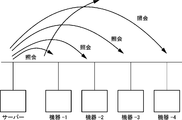
- the figure showing the processing flow of the power control proposed in Japanese Patent Application No. 2014-12924 (inquiry of power consumption, priority, etc. from the server).
- the figure showing the processing flow of the power control proposed in Japanese Patent Application No. 2014-12924 (the response of each device to the inquiry from the server).
- the figure showing the processing flow of the power control proposed in Japanese Patent Application No. 2014-12924 (calculation of power consumption allocation using collected information by the server).
- the figure showing the processing flow of the electric power control proposed in Japanese Patent Application No. 2014-12924 distributedtion of the allocation electric power to each apparatus by a server).
- the figure showing the processing flow of the power control proposed in Japanese Patent Application No. 2014-12924 (implementation of power consumption control according to the allocated power in each device).
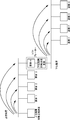
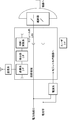
- the block diagram of the power control system comprised as one Embodiment of this invention which performs the power control of a lower hierarchy based on the information broadcast-transmitted from the upper hierarchy.
- the power control according to an embodiment of the present invention is a simplified expression of the solution of the optimization problem shown in the above equation (5) when Q is a diagonal matrix in the above equation (3).
- the following formula (14) (14) (14) Based on.
- f i, k is the i-th (in the group) at the time point when power control is repeated k times in the system (k is an integer of 0 or more) (referred to as “current time”).
- i is an integer greater than or equal to 1)
- the above equation (14) represents the power consumption f i, k + 1 of the i-th power consumption element to be realized in the (k + 1) th power control. This is a formula for determining.
- Q ii is a priority given to the i-th power consumption element.
- ⁇ P is a reference value of the total power consumption based on the current value of the total power consumption in the group (measured by the broadcast transmission element or received by the broadcast transmission element from another element to be measured). This is the difference obtained by subtracting the sum of the rated power consumption of each power consumption element included in the group. It can also be said to be a power consumption value (if the difference is negative, it corresponds to the power to be recovered).
- S t is the power to be reduced when controlling the total power consumption in the group, ⁇ P (if negative, ⁇ P The absolute value of is equivalent to the power to be recovered. The same applies to the following.
- system sensitivity is theoretically preferably “1”, but does not prevent other sensitivity from being set intentionally.
- a value obtained by multiplying the difference between the current value and the reference value by the system sensitivity is set as a total power consumption adjustment instruction value, and information indicating this is transmitted to the power transmission element by the broadcast transmission element.
- the total power consumption adjustment instruction value may be the difference value itself, and in this case, it is not necessary to use the system sensitivity (this is equivalent to the case where the system sensitivity is fixed to “1”).
- the constraint condition is described as a linear sum of power consumed by each power consumption element.
- the constraint condition is calculated from the power consumed by each power consumption element. It may be non-linear information that is determined. For example, it may be an absolute difference between the maximum power consumption and the minimum power in all elements.
- the broadcast information is the total power consumption or the power supply status.
- the information transmitted by broadcast need not be limited to the scalar quantity, and may include a case of taking a multivariate depending on the content of the constraint condition.
- the information transmission and the calculation of the power allocation amount are shared between the broadcast transmission element and the power consumption element. Can be made.
- the broadcast transmission element does not need to collect information from each power consumption element, and the processing in each power consumption element can be executed simultaneously by all the power consumption elements. Processing time is greatly reduced.
- each power consumption is obtained by obtaining f i, k + 1 by setting f i, k to zero (turning off the operation of each power consumption element in the group once).
- An optimal solution may be obtained using elements. There is a theoretical relationship between the system sensitivity and each power consumption element priority, and there are conditions that can be converged by this repetition. The range in which the stability can be ensured is very wide, and it will be described later that this method is effective in implementation.
- the system sensitivity St is typically stored as a specified value such as “1” in the broadcast transmission element, but this value may be dynamically changed.
- the system sensitivity S t when ⁇ P in the above formula (14) is positive (when the current value of the total power consumption in the group is larger than the reference value).
- the system sensitivity S t where ⁇ P is negative if the current value of the group in the total power consumption is smaller than the reference value, in the control group in the total power consumption than the increase of the total power
- the responsiveness of reduction can also be increased (such determination processing is performed by a determination / execution system circuit or the like in the broadcast transmission element). In addition, stability can be improved.
- the self-priority Q ii of each power consuming element is set to an arbitrary interval (typically from the interval at which the control of the above equation (14) is performed by each power consuming element in order to avoid an increase in communication volume. Can be transmitted to the broadcast transmission element at a sufficiently long interval. (Bidirectional communication between the broadcast transmission element and the power consumption element. Note that the self-priority is transmitted by the power included in the group.
- the broadcast transmission element has an ideal system sensitivity (referred to as effective system sensitivity).
- the information representing the above formula total power consumption adjustment value obtained by multiplying ⁇ P to system sensitivity S t (15) and broadcasts, the power consumption of the self each power consuming element is the formula (14) using the same
- the updated power consumption matches the optimal solution given by the above equation (5).
- total power consumption adjustment instruction value is information that does not require identification of a specific element at the destination
- information sharing can be performed by broadcast communication (broadcast communication). it can.
- the current power consumption and priority required only on each power consumption element do not need to be transmitted externally from each power consumption element, and each power consumption element is information indicating the total power consumption adjustment instruction value.
- the number of elements belonging to the domain is 1 Even in the case of tens or tens of thousands, this distributed processing type power control system can maintain a high-speed response without requiring an increase in control cycle time. Rather than acquiring information on all power consumption elements in server-client communication and realizing an ideal control solution in one cycle, the processing is shared between the broadcast transmission element and the power consumption element, and round-trip communication is performed.
- the use of the overwhelmingly high speed when the number of iterations is repeated while performing one-way communication is the basis of the measure that enables high-speed operation by power control of this embodiment. This is one of the biggest features.
- ⁇ P in the above equation (14) is obtained by subtracting the reference value of the total power consumption from the current value of the total power consumption in the group at the time when the power control in the system is repeated k times.
- ⁇ P k is a relative current total power consumption, that is, a total power consumption to be reduced or recovered, as viewed from a reference value of the total power consumption in the group.
- the total power consumption ⁇ P k + 1 to be reduced or recovered from the total power consumption in the group in the (k + 1) th power control process is expressed by the following equation (16).
- the simplest control method listed in 20) is the problem of reassigning the amount obtained by multiplying the total power consumption ⁇ P k to be reduced or recovered by the sum of ⁇ i as shown in the above equation (21). We can confirm that it is equivalent to the solution.
- the sum is the following formula (22) (22) If it satisfies, it can be understood that an optimization solution that satisfies the central condition of the above-described stability condition and reallocates the power consumption to be reduced or recovered, which is the original problem, is provided.
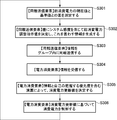
- a broadcast transmission element (such as a smart meter) configured as shown in FIG. 7 described later measures the difference between the current value of the total power consumption in the group and the reference value (step S301).
- Measure the current value of total power consumption within the group by connecting a broadcast transmission element equipped with a power meter to the switchboard, etc., and add up the rated power consumption of the power consumption elements included in the group ( In one example, it is stored in advance in a memory or the like included in the broadcast transmission element. ) Is subtracted from the current value to measure the difference.
- the broadcast transmission element multiplies the difference by the system sensitivity to determine a total power consumption adjustment instruction value, and generates information representing this (step S302).
- the system sensitivity is typically “1”, but other values may be used.
- the system sensitivity is typically stored in advance in the memory of the broadcast transmission element.
- the difference itself may be used as the total power consumption adjustment instruction value (the system sensitivity may not be used), and when the difference is positive, for example, than when it is negative. As described above, if the system sensitivity is increased, the reduction response becomes higher than the increase in the total power consumption.
- the broadcast transmission element broadcasts the information in the group (step S303). No address designation is required in the broadcast transmission, and information is broadcast from the broadcast transmission element at a specific radio frequency, for example.
- each power consumption element included in the group receives the information (step S3). 04).
- the power consumption element is an element configured by attaching, for example, a module shown in FIGS. 8 and 9 to an electric device (if the electric device has a function to be given by the module, the module is unnecessary) ), For example, using an antenna or various communication circuits, the information transmitted at the radio frequency is received.
- each power consumption element determines a power consumption update value from the received information and its own priority (step S305).
- the total power consumption adjustment instruction value ( ⁇ P ⁇ S t ) obtained from the received information is added to the reciprocal of its own priority (1 / Q ii ) To determine the power consumption update value.
- Each power consumption element only needs to store its own priority Q ii , and this priority can be dynamically changed at an arbitrary timing ( As shown in FIG. 8 and FIG. 9, a user interface may be provided in the power consumption element, and the user may set the priority via this, or may be changed by the operation of an arbitrary determination / implementation circuit. ).
- each power consumption element controls its own power consumption based on the power consumption update value determined by itself (step 306).
- each power consumption element reduces its own power consumption by the value of the power consumption update value under the control of the circuit breaker and inverter (FIGS. 8 and 9) provided therein (or the above formula (14)). If ⁇ P is negative, it is recovered). However, when an upper limit value and a lower limit value are provided for the power to be consumed in each power consumption element, control is performed within a power consumption range that does not exceed the upper limit value and does not fall below the lower limit value.
- the power consumption factor becomes inoperable if the power consumption is reduced by the power consumption update value, the power consumption is reduced only to the lowest operable level, or the power consumption is updated by the value of the power consumption update value. If the power consumption of the power consumption element is recovered, the rated power consumption of the power consumption element may be exceeded. Thereby, the total power consumption in the group is controlled.
- the system of the present embodiment can be configured to form part of a hierarchical structure.
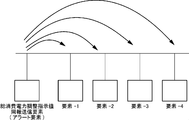
- the broadcast transmission element is between the upper and lower layers, and the upper layer is a member element (behaves like a power consuming element and is reduced within the lower layer group using information received from the upper layer broadcast transmission element. Alternatively, the total power consumption to be recovered is determined.), And the broadcast transmission element (alert element) is provided in the lower hierarchy (FIG. 4).
- Such a broadcast transmission element (lower-layer broadcast transmission element) is referred to as a “soft breaker”.
- the specific configuration of the soft breaker is the same as the broadcast transmission element already described (FIG. 7), but not only the broadcast transmission function for the lower layer group but also the upper layer broadcasted from the upper layer broadcast transmission element. The difference is that it also has a function of receiving information.
- the soft breaker is the upper layer total power consumption adjustment instruction value (upper layer system sensitivity in the upper layer domain) that is sent by broadcast transmission from the upper layer broadcast element (alert element) of the upper layer domain. And the product of the total power consumption to be reduced or recovered), and based on the priority of the upper layer possessed by itself, for example, the upper layer total power consumption adjustment instruction value with the upper layer priority
- the total power consumption to be reduced or recovered, which is allocated in the lower hierarchy group that it is in charge of, is calculated by, for example, dividing. It is not necessary for the soft breaker to transmit to the higher-layer broadcast transmission element (however, as a smart grid client or the like, it does not prevent transmitting information for “visualization” based on the request).
- the higher layer priority may be transmitted at a certain timing, etc.). Thereafter, as already described, the lower layer total power consumption adjustment instruction value is determined by arbitrarily multiplying this value by the system sensitivity (lower layer system sensitivity), and information indicating this (lower layer information) Is broadcast to the lower layer group. It is not necessary to perform any reception from the power consumption elements belonging to the lower domain (as described above, the lower layer priority may be received at an arbitrary timing).
- the power consumption factor in the lower layer group that received the lower layer information is reduced from its own power consumption using the priority (lower layer priority) given to itself or determined by itself as described above. Alternatively, the power consumption update value to be recovered is determined, and its own power consumption is controlled based on this value.
- the upper layer priority and the lower layer priority can be dynamically changed at an arbitrary timing (FIG. 8).
- a user interface may be provided in the power consumption element as shown in FIG. 9, and the user may set the priority via this, or may be changed by the operation of an arbitrary determination / implementation circuit. ).
- the lower layer system sensitivity if the lower layer total power consumption adjustment instruction value is a value that instructs the reduction of the total power consumption in the lower layer group, the lower layer system sensitivity is more than the value that instructs the increase. As described above, the higher the power consumption, the higher the reduction response than the increase in the total power consumption in the lower layer group.
- upper and lower limits are set for the total power consumption to be consumed in the lower hierarchy group, and the lower hierarchy total is within the range that the soft breaker determines that the total power consumption does not exceed the upper limit and does not fall below the lower limit. It is preferable to determine power consumption.
- the updated total power consumption After the soft breaker measures the total power consumption in the lower layer group, if the total power consumption is reduced and restored by the lower layer total power adjustment indication value, the updated total power consumption The total power consumption after the update will be reduced if the value falls below the operable lower limit value or exceeds the upper limit rated total power consumption (the total rated power consumption of the power consumption elements in the lower layer group) Can be operated such as changing the lower layer total power consumption adjustment instruction value so that the value falls between the upper limit value and the lower limit value.
- Numerical Example 1 by Numerical Calculation Numerical Example-1 shown in Table 1 to Table 8 below has six different power consumption elements, and when different priorities are defined for them, all elements are initially turned on. And the excess power is 20 This is a result of numerical calculation when the power control according to the present embodiment is simulated seven times from the situation of 0 W (unit of power is W).
- the system sensitivity is assumed to be “1” in the broadcast transmission element (alert element).
- the power consumption elements in the system have their priorities set independently, and the effective system sensitivity is 0. 75.
- the results in Tables 1 to 8 correspond to an example in which the broadcast transmission element repeats without excessive control requests by 4/3 times.
- the system sensitivity at the time of recovery of the total power consumption that is, non-linear control is not performed. From the results in Tables 1 to 8, it can be seen that control is achieved promptly within the domain.
- Tables 9 to 16 below show the results of the simulation implementation (Numerical Example-2) performed with the power consumption factor E having a very high priority.
- the effective system sensitivity is a value greatly different from the system sensitivity of the broadcast transmission element due to the independent definition in each power consumption element.
- a method of transmitting the priority of each power consumption element to the broadcast transmission element by low-speed bidirectional communication in parallel with high-speed power control by broadcast transmission and collecting information from each power consumption element there is a method for confirming the soundness by estimating the effective system sensitivity while ensuring the dispersibility based on the original concept of the distributed processing required in the present invention. As a result, the performance is also improved.
- the power control in this embodiment requires more repetitions than the ideal power control that converges once.
- Total power consumption to be reduced or recovered difference between the current value of the total power consumption and the reference value
- X k k corresponds to the number of times of executing power control
- the equivalent transition ratio is not always constant. For example, the following equation (26) (26) As shown in FIG.
- the broadcast transmission element is typically (in addition to the broadcast transmission element, for example, a separate total power consumption monitoring element having a similar function in the system may be provided, and this may be performed. The same applies to the following), and it is possible to estimate the soundness by estimating the equivalent transition ratio C k, eq using the Kalman filter.
- Effective system sensitivity is an external factor such as adjustable power margin, number of users, illuminance, It can vary slowly depending on the temperature.
- the Kalman filter for estimating the system sensitivity ratio S t / S t * is expressed by the following equation (29). (29)
- the broadcast transmission element (or the total power consumption monitoring element, etc.) monitors the transition of the current value of the total power consumption adjusted by repeating the control of the total power consumption in the group,
- the value of the difference between the current value of the total power consumption and the reference value when the control is repeated k times is defined as x k (k is an integer of 0 or more), and the value when the control is repeated k + 1 times is denoted as x k.
- the broadcast transmission element (or the total power consumption monitoring element or the like) estimates the equivalent transition ratio C k, eq given by the above equation (27) when +1 is set based on the above equation (29).
- x k is first determined by measuring the difference between the current value of the total power consumption and the reference value, and then multiplied by the current estimated value of the equivalent transition ratio C k, eq to obtain C k, eq x k.
- Y k is determined as the difference between the current total power consumption after power control and the reference value, and an estimation error is calculated by subtracting C k, eq x k from y k , which is multiplied by K.
- the convergence value of the equivalent transition ratio can be obtained by repeating the procedure of updating the estimated value to C k + 1 , eq by adding the value to the current estimated value C k, eq . If this convergence value is close to zero, the power control method, It can be said that the soundness of the system is high.
- the true system sensitivity matches the system sensitivity recognized by the alert element, C k, eq * is zero, and the equivalent transition ratio estimate C k, eq is also zero. Should be. Equivalently, the transition of the total power consumption ⁇ P k to be reduced or recovered does not become zero due to the influence of the transient response of each element, that is, the influence of f and the recognition error of the system sensitivity.
- f should be set to a sufficiently small value, which means that the time period for repeating this Kalman filter is shorter than the transient response time constant of each element in the domain. Indicates that it should be kept large enough. That is, the repetition period of the Kalman filter should be sufficiently longer than the control period.
- the estimation of soundness of power control can be similarly performed when the broadcast transmission element is a soft breaker.
- the operation maintenance limit is set as the lower limit, and conversely the calculated negative
- operation such as setting the rated power consumption as the upper limit is performed.
- i-th equipment rated maximum reducible power in devices a [Delta] P imax obtained by subtracting the power consumption P imin of lower operable from the rated power P imax, instantaneous reducible power is currently consumed in the device This is ⁇ P i obtained by subtracting the operable lower limit power consumption P imin from the power P i (FIG. 5).
- the power or duty currently consumed is measured (performed by the galvanometer and detector I / F in FIGS. 8 and 9), and this is calculated by each device.
- the basic system sensitivity of the entire domain is set to approximately “1”. It is a feature of this method that even if the priority is manually increased on the individual device side, the control stability is not affected.
- / Instantaneous power reduction ”x“ Total number of inverter control devices in the domain ”x“ Standard illuminance / actual illuminance ” Can be employed in the LED lighting domain.
- the operation maintenance limit is set as the lower limit.
- the calculated negative reduction amount exceeds the rated power, the rated power is used.
- the rated maximum reducible power within the domain is the total of the device rated maximum reducible power for each device included in the group.
- priority numbers are fixed and the system is very stable. By doing so, the basic system sensitivity of the entire domain is set to approximately “1”. Note that the characteristic of this method is that control stability is not affected even if the priority is manually increased on the individual device side.
- “priority of each device” “maximum rating within the domain” Reducible power / instantaneous reducible power ”x“ reference illuminance / actual illuminance ” Can be employed in the LED lighting domain.
- the operation maintenance limit is set as the lower limit.
- the rated power is used.
- control stability is not affected even if the priority is manually increased on the individual device side.
- priority of each device “maximum rating within the domain”
- Reducible power / instantaneous reducible power ”x“ reference illuminance / actual illuminance ” Can be employed in the LED lighting domain.
- the operation maintenance limit is set as the lower limit.
- the calculated negative reduction amount exceeds the rated power, it is limited to the rated power.
- the “in-domain power adjustment degree” is defined by the following equation (35).
- In-domain power adjustment level (35)
- This “intra-domain power adjustment” is the actual (effective) system sensitivity in the domain. The value can be calculated by collecting information from member elements. In this power control method, the alert element has a predetermined sensitivity value unless otherwise specified in order to reduce the communication required for it. 1 ”is assumed. In fact, if all of the member elements are operating at rated power, Take 1 ”. The intra-domain power adjustment is used to calculate a priority representing a lower layer domain in which the member element becomes an alert element in the upper layer when the system is hierarchized.
- Prioritization related to power reduction is almost always a fixed value of type 1 in the case where a domain is composed of many devices of the same scale. In a case where a dwelling unit or the like is composed of devices of different scales, there is usually no problem with a fixed value of approximately type 3. In a case where a dwelling unit or the like is composed of devices of different scales and when responsiveness is to be pursued as much as possible, a type 4 prioritization method that is state dependent can be taken.
- N be the total number of power consumption elements in the domain.
- the simple method of setting the sum of the reciprocal of the sum of priorities to approximately “1” is the lowest priority, that is, (N / 2) is the element that contributes to power reduction, and (N) is the most on average.
- 2N For high-priority elements that do not want to participate in power reduction ( 2N) to (3N).
- the effective system sensitivity can be 6/7.
- the effective system sensitivity can be 70/79.
- the method of setting the effective system sensitivity to approximately 1, that is, the method of giving priority to the convergence of the control was shown.
- the higher the effective system sensitivity of the domain the lower the convergence, but the lower the priority.
- the degree to N and the highest priority to 2N to 3N, the robustness becomes higher.
- the priority is 3,4.5,6, the effective system sensitivity is 18/13, and for the five elements, the priority is 5,6,7,8,10.
- the effective system sensitivity is 840/617.
- the priority setting described above corresponds to a safe setting for making the actual system sensitivity smaller than one.
- the calculation may be performed based on the power of a rational number of “rated maximum reducible power / instantaneous reducible power in device or domain” instantaneously, and the function type is not particularly limited.
- “Priority of each device” “[3-2.5 ⁇ (power that can be instantaneously reduced / power that can be reduced to the maximum rated device) ⁇ 2] ⁇ “ total value of the number of inverter control devices in the domain ”” ( ⁇ 2 represents square). According to this, the lowest priority is N / 2 and the highest priority is 3N.
- Trapezoid policy A simple method for qualitative setting.
- Linear priority A method of mathematically setting based on the driving situation of each individual.
- Hyperbolic priority A method of mathematically setting based on the driving situation of each individual.
- Trapezoid policy A simple method for qualitative setting. While considering the average priority in the domain as N. N / 2 from lowest priority to highest priority Is a qualitative method from 2N to 3N and does not require quantitative evaluation (FIGS. 10 and 11). Increasing effective system sensitivity is inferior to transient response but leads to improved stability. In this case, from the lowest priority to the highest priority, from N to (2N) or N It may be practical to put (3N). Qualitatively, the system sensitivity can be approximated by trapezoidal integration.
- Linear priority A method of mathematically setting based on the driving situation of each individual.
- X (instantaneous reducible power / equipment rated maximum reducible power) can be considered to cause random fluctuations between 0 and 1.
- “Priority of each device” “[A ⁇ (A ⁇ 1 / 2) X] ⁇ “ total value of the number of inverter control devices in the domain ”
- the priority can be linearly changed from the lowest value N / 2 to 2N or 3N (FIG. 12).
- type 4 instead of “the total value of the number of inverter control devices in the domain”, for example, a method using “(rated maximum reducible power in the domain / power rated maximum reducible power in the domain)” is supported.
- Hyperbolic priority A method of mathematically setting based on the driving situation of each individual.
- X (Power that can be instantaneously reduced / Power that can be reduced to the maximum rated equipment)
- X (Power that can be instantaneously reduced / Power that can be reduced to the maximum rated equipment)
- X Power that can be instantaneously reduced / Power that can be reduced to the maximum rated equipment
- “Priority of each device” “X ⁇ ( ⁇ ⁇ ) / ( ⁇ + 1)”
- ⁇ is an arbitrary positive real number.
- the reciprocal of the priority is integrated between X intervals [0-1] and the reciprocal is taken to calculate the effective system sensitivity, it can be set to “1”, and it can be seen that an excellent control system can be configured.
- the system sensitivity (upper layer system sensitivity) in the upper layer domain is basically “1”. This soft breaker does not require any setting or monitoring. Even in the upper layer, as already explained using Equations (25) to (32), real-time estimation is performed using the alert element (upper layer broadcast transmission element) to evaluate system health and perform inspection. Is possible.
- the system sensitivity used by this soft breaker as an alert element in the lower hierarchical domain is also basically “1”. If necessary, different values may be set with this soft breaker. In the lower hierarchy, this soft breaker can perform real-time estimation as an alert element, evaluate the system soundness as already described using the equations (25) to (32), and perform an inspection. In the upper hierarchy, this soft breaker functions as one member element.
- the priority (upper hierarchy priority) possessed as one member element in this upper hierarchy can be set as the priorities of types 1 to 4 described above. In the simplest priority setting, for example, in a hierarchy composed of a plurality of domains of the same scale in a smart grid, the priority may be fixed to the number of domains, that is, the number of member elements (type 1 priority setting).
- the value obtained by dividing the total power that can be reduced in the upper layer by the power that can be reduced in the entire lower layer domain of this soft breaker is defined as the priority as one member element in the upper layer. Also good.
- This is an effective setting method in a hierarchy composed of multiple domains of different scales in a smart grid (type 3 priority setting) .
- the priority of the soft breaker in this higher layer domain is "Lower-layer power adjustment in domain” x "Number of members in upper-layer domain” Can be defined.
- “Lower-layer domain power adjustment” x “(Maximum rated power that can be reduced in higher-level domains) / (Rated maximum power that can be reduced in lower-level subordinates)” May be defined.
- equation (36) This setting can also be performed on each power consumption element. According to this, when the priority at the time of reduction is 2, 3 and 6 in the domain to which the three power consumption elements belong (the reciprocal sum is taken as 1), the priority at the time of return is 4, 3 , 2.4. In the type 1 priority setting described above, the priority is the total number N of individuals in the domain. In this case, the priority at the time of return is the same N. In this way, when power reduction is required within the domain and when power can be restored, depending on the sign of the total power consumption adjustment value indicated by the broadcast information, It is also possible to change the priority asymmetrically in the calculation in.
- the ratio assigned by the priority at the time of reduction and the ratio assigned by the priority at the time of restoration should satisfy a complementary relationship.
- the priority at the time of return is determined by the following equation (38). (38) According to this, in the domain to which the three elements belong, when the priority at the time of reduction is 2, 3 and 6 (the reciprocal sum is taken as 1), the priority at the time of return is set to 6, The opposite priority can be taken as 3 and 2.
- the reciprocal sum of the priorities at the time of reduction is less than “1”, and therefore the reciprocal sum of the priorities at the time of return is greater than “1”. That is, the effective system sensitivity at the time of return is less than “1”.
- this state is not preferable in the case where the system sensitivity assumed on the alert element side is excessive, and the reciprocal priority sum at the time of reduction and the reciprocal priority sum at the time of restoration are 2 / N. Instead, a device such as 3 / (2N) or 1 / N is required.
- the reciprocal priority sum at the time of return is less than “1”, the effective system sensitivity is set higher than “1”, and the robustness is improved.
- the reciprocal sum of the priority at the time of return is “1”, and the normalization condition is automatically satisfied.
- the effective system sensitivity in the recovery process is lower than “1”, which is not preferable. Instead of 2 / N, contrivance is required such as 3 / (2N) or 1 / N. Similarly, in the priority setting method at the time of return described above, the reciprocal priority sum at the time of return is less than “1”, and the effective system sensitivity is set higher than “1” to improve the robustness.
- the second method is advantageous from the viewpoint of setting the priority at return with an emphasis on performance, but the priority setting at the time of reduction in types 2 and 4 is advantageous.
- the robustness is lowered in setting the priority at the time of return, and thus a device is necessary for application.
- the main constraint condition is that the total power consumed by the power consumption elements included in the group is the designated power condition (equation (1)).
- An optimization method was considered. However, this control method can be further expanded and applied to optimization in the case where a sub-constraint is imposed.
- the original constraint represented by the above equation (1) is -0th order, and the sub-constraint is Consider an optimization using an expansion evaluation function expressed by the following equation (39), with a ⁇ 1 order, ⁇ 2 order,... ⁇ m order.
- e 0 T is an n-th unit row vector (T is a transposed symbol), and e 1 T to e m T Is an integration (row) vector corresponding to each sub-constraint, ⁇ 0 to ⁇ m are Lagrange's undetermined multipliers, and P 0 is a constraint value for the total power consumption in the group (P t in the above equation (1)). P 1 to P m are constraint values for integrated power consumption corresponding to the respective sub constraints.
- the current power consumption consumed by each power consumption element in the group is expressed as f * 1 , f * 2 ,... f * n, and a vector in which these are arranged vertically is f * .
- Other variables are defined in the same manner as the above formulas (1) to (3).
- the broadcast transmission element measures or determines an amount corresponding to f * ⁇ P i to determine m sub-constraint integrated power consumption adjustment instruction values, and m sub-constraint information representing this is already described.
- a group from a broadcast transmission element a soft breaker if the system has a hierarchical structure
- a lower hierarchical group if the system has a hierarchical structure. The same applies below. ) Is further broadcasted.
- Each power consumption element included in the group receives the above information and m pieces of sub-constraint information, and is given a total power consumption adjustment instruction value and m sub-constraint integrated power consumption adjustment instruction values. Or the self-determined (lower layer) priority according to the above equation (40) (in the equation for determining f, S 0 ⁇ P 0 , ⁇ P i are respectively received total power consumption adjustment instructions) value, Replace with the sub-constrained integrated power consumption adjustment instruction value. ) Update control of own power consumption. However, it is assumed that the secondary system sensitivity S i or its approximate value “N / (number of non-zero components of e i )” is stored in advance in the power consumption element subject to the secondary constraint. Control of the power consumption corresponding to the sub-constraint information is performed only by the power consumption element that is the target of each sub-constraint.
- a typical alert element should be transmitted by broadcasting the main restriction mode “0” and the total power consumption adjustment instruction value obtained by multiplying the power ⁇ P 0 to be adjusted by the system sensitivity.
- “I” and the sub-constrained integrated power consumption adjustment value given as the sub-constrained integrated power consumption ⁇ P i to be adjusted are continuously broadcast for i of 1 to m. For example, 0, ⁇ P 0 ⁇ (system sensitivity),..., I, ⁇ P i ,. In this way, broadcast transmission is also performed including sub-constraint conditions.
- the sub-constraint integrated power consumption adjustment instruction value ⁇ P i is multiplied by the sub-system sensitivity, and this is divided by the reduction or return priority of each element to each element. Calculate the imposed power allocation. Unlike S 0 , S i does not have a value close to “1” depending on the sub-constraint mode, and must be stored in advance for each individual.
- control by sub-constraint A specific example of control by sub-constraint will be described by dividing it into ideal optimal control and actual control.
- FIG. 7 is a diagram schematically showing a circuit configuration of the broadcast transmission element.
- the broadcast transmission element is configured as a smart meter connected to a switchboard, and is connected to a power supply port (outlet) or has a built-in battery.
- the broadcast transmission element is a communication system for performing broadcast transmission and receiving priority from the power consumption element, communication system I / F (interface), and power for measuring the total power consumption in the group Meter, detector I / F, total power consumption adjustment instruction value and sub-constrained integrated power consumption adjustment instruction value determination, information representing these, generation of sub-constraint information, estimation of system health, etc. It comprises a decision / implementation circuit that is responsible for information processing in general, and a power supply system for supplying power to these circuits.
- the rated power consumption of each device is stored in, for example, a storage circuit in the communication system I / F or a separate in-module memory (not shown).
- FIG. 8 shows a schematic configuration of an inverter-equipped module for operating an electric device as a power consuming element in the power consumption allocation of the present invention.
- the module is a communication system (such as an antenna for wireless communication, a modem for power line communication, etc.) for receiving the above information and sub-constraint information from the broadcast transmission element and transmitting priority if necessary.
- Communication system I / F communication circuit for general communication processing, including signal encoding, decoding, etc.
- galvanometer for measuring the power consumption of the device (for example, if the priority is a fixed value, the measurement of the power consumption is unnecessary) Yes, galvanometer is not required.)
- Detector I / F Power consumption measurement value is converted into digital signal and communication system I / F It also includes a circuit for transmitting to the network. If power consumption measurement is not required, detector I / F is also unnecessary.
- Judgment / implementation circuit that performs general information processing for updating its own power consumption using the information received from the broadcast transmission element as described above, and receives instructions from the judgment / implementation circuit to the device It comprises a circuit breaker that controls power consumption by intermittently interrupting power supply, a power supply system for supplying power to these, and the like.
- Rated power consumption, priority, subsystem sensitivity etc. For example, it is stored in a storage circuit in the communication system I / F or a separate in-module memory (not shown).
- the electric device can be operated as a client in power consumption allocation.
- the power consuming element is configured as a mobile body, the module and the battery may be built in the electric device.
- a user I / F may be provided to change the priority of power consumption elements.
- FIG. 9 shows a schematic configuration of an inverter control type module that is typically built in an electric device such as an air conditioner for operating the electric device as a power consuming element in the power consumption allocation of the present invention.
- an inverter controller included in a device such as a duty-off pulse accumulator / subtractor and a PWM (Pulse Width Modulation) modulator instead of the circuit breaker.
- a circuit is provided.
- the modulation pulse is inverted and then the logical product with the ON pulse that is the original drive signal of the air conditioner is taken to change the width of the ON pulse, thereby modulating the motor, etc. Any circuit that can adjust the rate may be used.
- Information transmission capability control system and method The series of measures for power consumption control described so far can be applied as they are even if information transmission capability is used as a resource instead of power, and power consumption is occupied as information transmission capability. Is possible.
- a transmission speed that is, a resource that is an information transmission capability
- Each subsystem or measuring device in the domain to which information is to be delivered must use its information transmission capability at a certain ratio, but multiple subsystems or measurement devices (member elements) have partial transmission capability. Requesting occupancy may deviate from the domain information transmission capability as a resource.
- each member element it is conceivable to change the priority dynamically, but even in such a case, it is necessary to perform optimal resource allocation in consideration of the priority of each member element.
- the total information transmission capability is measured in the domain, and the information generated using the system sensitivity of the domain based on the difference from the total rated capability (reference value)
- a software breaker can also be introduced for information transmission capability.
- the system includes a communication server (broadcast transmission element) and one or more client machines (information transmission elements) that are individually given or determined priority.
- the communication server measures the current value of the total communication speed (total information transmission capability) occupied in a group including one or more client machines, for example, by executing a communication speed detection application on the communication server. Measure the difference between the value and the reference value (total value of the reference communication speed defined for each client machine), multiply the difference by the system sensitivity, etc. to determine the total information transmission capability adjustment instruction value, Information to be shared within the group representing this is generated and broadcasted within the group.
- Each client machine receives the broadcast information, and uses the priority given to it or the determined priority and the total information transmission capability adjustment instruction value (the total information transmission described so far). It may be an operation such as multiplying the capability adjustment instruction value by the reciprocal of its own priority, etc.), and the information transmission capability update value to be used to update its own communication speed (information transmission capability) And the communication speed setting is changed by, for example, reducing the communication speed by an amount corresponding to the information transmission capability update value (for example, executing the communication application on each client machine). ) Control the total information transmission capability within the group by controlling its own information transmission capability.
- the present invention can be used in any system that uses electrical equipment or information transmission equipment, such as homes, offices, schools, and commercial facilities.
Landscapes
- Engineering & Computer Science (AREA)
- Power Engineering (AREA)
- Physics & Mathematics (AREA)
- General Physics & Mathematics (AREA)
- Automation & Control Theory (AREA)
- Computer Networks & Wireless Communication (AREA)
- Signal Processing (AREA)
- Remote Monitoring And Control Of Power-Distribution Networks (AREA)
- Supply And Distribution Of Alternating Current (AREA)
- Management, Administration, Business Operations System, And Electronic Commerce (AREA)
Abstract
Priority Applications (4)
| Application Number | Priority Date | Filing Date | Title |
|---|---|---|---|
| US15/113,573 US10050799B2 (en) | 2014-01-28 | 2015-01-27 | Power control system and method, and information communication ability control system and method |
| KR1020167022662A KR101950077B1 (ko) | 2014-01-28 | 2015-01-27 | 전력 제어 시스템, 방법 및 정보 전달 능력 제어 시스템, 방법 |
| EP15742751.9A EP3101617B1 (fr) | 2014-01-28 | 2015-01-27 | Système et procédé de régulation de puissance, et système et procédé de commande d'aptitude à la communication d'informations |
| CN201580006283.3A CN105940425B (zh) | 2014-01-28 | 2015-01-27 | 电力控制系统、方法及信息传达能力控制系统、方法 |
Applications Claiming Priority (4)
| Application Number | Priority Date | Filing Date | Title |
|---|---|---|---|
| JP2014-012924 | 2014-01-28 | ||
| JP2014012924A JP2015141482A (ja) | 2014-01-28 | 2014-01-28 | 電力管理方法、及びシステム |
| JP2014153348 | 2014-07-28 | ||
| JP2014-153348 | 2014-07-28 |
Publications (1)
| Publication Number | Publication Date |
|---|---|
| WO2015115385A1 true WO2015115385A1 (fr) | 2015-08-06 |
Family
ID=53756958
Family Applications (1)
| Application Number | Title | Priority Date | Filing Date |
|---|---|---|---|
| PCT/JP2015/052091 Ceased WO2015115385A1 (fr) | 2014-01-28 | 2015-01-27 | Système et procédé de régulation de puissance, et système et procédé de commande d'aptitude à la communication d'informations |
Country Status (5)
| Country | Link |
|---|---|
| US (1) | US10050799B2 (fr) |
| EP (1) | EP3101617B1 (fr) |
| KR (1) | KR101950077B1 (fr) |
| CN (1) | CN105940425B (fr) |
| WO (1) | WO2015115385A1 (fr) |
Cited By (6)
| Publication number | Priority date | Publication date | Assignee | Title |
|---|---|---|---|---|
| WO2017033292A1 (fr) * | 2015-08-26 | 2017-03-02 | 川口淳一郎 | Système et procédé de commande de stabilisation de puissance |
| JPWO2018047263A1 (ja) * | 2016-09-08 | 2019-03-07 | 三菱電機株式会社 | 消費電力調整装置、消費電力調整システム、消費電力調整方法、及び、プログラム |
| CN111725844A (zh) * | 2019-03-20 | 2020-09-29 | 丰田自动车株式会社 | 供需控制装置 |
| WO2020194010A1 (fr) * | 2019-03-22 | 2020-10-01 | 日産自動車株式会社 | Procédé de commande de réception d'énergie d'éléments de réception d'énergie, et dispositif de commande de réception d'énergie |
| US11843271B2 (en) | 2019-03-22 | 2023-12-12 | Nissan Motor Co., Ltd. | Power reception control method for power storage element and power reception control device |
| CN120300792A (zh) * | 2025-06-11 | 2025-07-11 | 国网经济技术研究院有限公司 | 一种配电网资源自适应调度方法、系统、设备及介质 |
Families Citing this family (11)
| Publication number | Priority date | Publication date | Assignee | Title |
|---|---|---|---|---|
| CA2927482A1 (fr) * | 2016-04-20 | 2017-10-20 | Hydro Quebec | Etalonnnage en ligne de compteurs et detection de non-conformites electriques |
| CN108302742B (zh) * | 2018-04-13 | 2020-05-29 | 珠海格力电器股份有限公司 | 空调机组的控制器和空调器 |
| CN109561426A (zh) * | 2018-11-20 | 2019-04-02 | 浙江威星智能仪表股份有限公司 | 一种无线射频gfsk组网通讯的可靠性方法 |
| US12166351B2 (en) | 2019-05-16 | 2024-12-10 | Astronics Advanced Electronic Systems Corp. | Method for managing flow equalization among consumers on a common distribution network |
| CN116745796B (zh) * | 2021-02-10 | 2024-10-18 | 日产自动车株式会社 | 充放电控制方法以及充放电控制装置 |
| EP4293604B1 (fr) | 2021-02-10 | 2025-12-24 | Nissan Motor Co., Ltd. | Procédé de réduction de perte de charge/décharge et dispositif de réduction de perte de charge/décharge |
| US12280686B2 (en) | 2021-02-10 | 2025-04-22 | Nissan Motor Co., Ltd. | Charge-discharge control system and charge-discharge control method |
| WO2022172045A1 (fr) | 2021-02-10 | 2022-08-18 | 日産自動車株式会社 | Procédé de commande de charge/décharge pour élément de charge/décharge et dispositif de commande de charge/décharge pour élément de charge/décharge |
| AU2021429428B2 (en) * | 2021-02-26 | 2024-09-26 | Mitsubishi Electric Corporation | Voltage management device, voltage command device, power system monitoring system, measurement device, voltage management method, and voltage management program |
| CN114296420A (zh) * | 2021-04-30 | 2022-04-08 | 华为数字能源技术有限公司 | 一种用于车辆的控制系统和车辆 |
| JP7614466B1 (ja) * | 2024-06-20 | 2025-01-15 | 三菱電機株式会社 | 遠隔制御システム、遠隔制御装置、ゲートウェイ、遠隔制御方法、制御方法、およびプログラム |
Citations (51)
| Publication number | Priority date | Publication date | Assignee | Title |
|---|---|---|---|---|
| US4481774A (en) | 1978-01-18 | 1984-11-13 | Snook Stephen Robert | Solar canopy and solar augmented wind power station |
| JPH0313438A (ja) | 1989-06-09 | 1991-01-22 | Hitachi Cable Ltd | 合成樹脂光伝送体を用いた光反射型用紙検知装置 |
| JPH0731013A (ja) | 1993-07-13 | 1995-01-31 | Sekisui Chem Co Ltd | 屋内電気配線システム |
| JPH07308036A (ja) | 1994-03-18 | 1995-11-21 | Hitachi Ltd | 配電系統監視方法,配電系統制御方法およびそれら装置 |
| JPH08182194A (ja) * | 1994-12-27 | 1996-07-12 | Mark Tec:Kk | 最大需要電力制御装置 |
| US5581130A (en) | 1992-04-22 | 1996-12-03 | Valoe Electronique | Circuit board for the control and/or power supply of electrical function devices of a vehicle |
| JPH0993820A (ja) | 1995-09-22 | 1997-04-04 | Omron Corp | 太陽光発電装置 |
| JPH1042481A (ja) | 1996-07-25 | 1998-02-13 | Hitachi Ltd | 車両用電源制御装置 |
| JPH1145101A (ja) | 1997-07-25 | 1999-02-16 | Tokyo Electric Power Co Inc:The | 監視制御システム |
| JPH11313438A (ja) | 1998-03-23 | 1999-11-09 | Electric Boat Corp | 電力配電系統用障害保護装置 |
| JP2000016200A (ja) | 1998-07-03 | 2000-01-18 | Hitachi Ltd | 車両用電源制御装置 |
| US6030718A (en) | 1997-11-20 | 2000-02-29 | Avista Corporation | Proton exchange membrane fuel cell power system |
| JP2001069668A (ja) | 1999-08-27 | 2001-03-16 | Matsushita Seiko Co Ltd | 電力管理装置 |
| US6310439B1 (en) | 1999-03-15 | 2001-10-30 | Lutron Electronics Company, Inc. | Distributed parallel semiconductor device spaced for improved thermal distribution and having reduced power dissipation |
| JP2002027686A (ja) | 2000-07-10 | 2002-01-25 | Fuji Electric Co Ltd | 店舗内機器の消費電力制御方法 |
| JP2003511842A (ja) | 1999-10-11 | 2003-03-25 | シュネーデル、エレクトリック、インダストリーズ、エスアーエス | コンタクタ・ブレーカー |
| JP2004208393A (ja) | 2002-08-08 | 2004-07-22 | Tai-Her Yang | 優先の電源供給順序が設定できるマルチ出力回路装置 |
| JP2004328184A (ja) | 2003-04-23 | 2004-11-18 | Daikin Ind Ltd | 管理制御システム、情報伝送方法、通信方法、ネットワークノード、送受信装置、情報共有装置、空調機器及び集中制御装置 |
| JP2004348411A (ja) | 2003-05-22 | 2004-12-09 | Matsushita Electric Ind Co Ltd | 中央監視制御システム一体型分散型受配電設備 |
| JP2005513900A (ja) | 2001-12-20 | 2005-05-12 | エネル ディストリビュズィオーネ ソシエタ ペル アチオニ | 家庭向けを含む電気エネルギー消費の遠隔取得及び分散した目標ユーザの遠隔制御のためのシステム |
| JP2005178778A (ja) | 2005-02-14 | 2005-07-07 | Hitachi Ltd | 自動車用電源端末装置及び自動車の電力供給システム |
| US6961641B1 (en) | 1994-12-30 | 2005-11-01 | Power Measurement Ltd. | Intra-device communications architecture for managing electrical power distribution and consumption |
| US6965269B2 (en) | 2002-01-31 | 2005-11-15 | Kabushiki Kaisha Toshiba | Microwave phase shifter having an active layer under the phase shifting line and power amplifier using such a phase shifter |
| JP2007228234A (ja) | 2006-02-23 | 2007-09-06 | Daikin Ind Ltd | 伝送制御装置、機器管理システム及び伝送制御方法 |
| JP2007240084A (ja) | 2006-03-09 | 2007-09-20 | Daikin Ind Ltd | 空気調和機および空気調和機におけるアドレス設定方法 |
| JP2007311950A (ja) * | 2006-05-17 | 2007-11-29 | Nec Corp | 無線システム、基地局、携帯端末及びそれらに用いる基地局電力制御方法並びにそのプログラム |
| US7320218B2 (en) | 2004-10-12 | 2008-01-22 | Guy Silver | Method and system for generation of power using stirling engine principles |
| JP2008090607A (ja) | 2006-10-02 | 2008-04-17 | Japan Aerospace Exploration Agency | 資源の制約をともなう自律分散型制御 |
| US7421601B2 (en) | 2006-02-17 | 2008-09-02 | International Business Machines Corporation | Method and system for controlling power in a chip through a power-performance monitor and control unit |
| JP2009094768A (ja) | 2007-10-09 | 2009-04-30 | Panasonic Corp | 電力線通信装置及び電力線通信装置の自動登録方法 |
| JP2009272966A (ja) | 2008-05-08 | 2009-11-19 | Daikin Ind Ltd | 機器設備管理システム |
| JP2010019530A (ja) | 2008-07-14 | 2010-01-28 | Daikin Ind Ltd | 空調システム及び通信トラフィック調整方法 |
| US7755111B2 (en) | 2005-11-23 | 2010-07-13 | Lsi Corporation | Programmable power management using a nanotube structure |
| US7805621B2 (en) | 2006-09-29 | 2010-09-28 | Broadcom Corporation | Method and apparatus for providing a bus interface with power management features |
| US7825325B2 (en) | 2006-09-27 | 2010-11-02 | Kennedy & Violich Architecture Ltd. | Portable lighting and power-generating system |
| JP2010279238A (ja) | 2009-04-28 | 2010-12-09 | Tokyo Electric Power Co Inc:The | 系統監視制御システム |
| US7970374B2 (en) | 2005-10-03 | 2011-06-28 | Broadcom Corporation | Multi-wideband communications over power lines |
| JP2011234561A (ja) | 2010-04-28 | 2011-11-17 | Nf Corp | インテリジェント分電盤、分電装置、停電対策システム及び分電方法 |
| JP2011242030A (ja) | 2010-05-17 | 2011-12-01 | Daikin Industries Ltd | 空調制御装置 |
| JP2012085511A (ja) | 2010-10-08 | 2012-04-26 | Taida Electronic Ind Co Ltd | 充電効率制御を有し且つ適応性充電サービスを提供する車両充電システム |
| JP2012161202A (ja) | 2011-02-02 | 2012-08-23 | Mitsubishi Electric Corp | 階層型需給制御装置および電力系統制御システム |
| US8276002B2 (en) | 2009-11-23 | 2012-09-25 | International Business Machines Corporation | Power delivery in a heterogeneous 3-D stacked apparatus |
| JP2013038470A (ja) | 2011-08-03 | 2013-02-21 | Daikin Ind Ltd | 電気機器の制御装置および制御システム |
| JP2013038885A (ja) | 2011-08-06 | 2013-02-21 | Takayasu Kanemura | 自家発電システム |
| JP2013070569A (ja) | 2011-09-26 | 2013-04-18 | Aisin Seiki Co Ltd | 分散型電源システム |
| US8466760B2 (en) | 2007-05-09 | 2013-06-18 | Innovative Micro Technology | Configurable power supply using MEMS switch |
| US8504214B2 (en) | 2010-06-18 | 2013-08-06 | General Electric Company | Self-healing power grid and method thereof |
| US8508540B2 (en) | 2009-07-08 | 2013-08-13 | Nvidia Corporation | Resonant induction to power a graphics processing unit |
| JP2013219661A (ja) * | 2012-04-11 | 2013-10-24 | Bluemouse Technology Co Ltd | 電力線通信装置 |
| US8588991B1 (en) | 2012-07-31 | 2013-11-19 | Causam Holdings, LLC | System, method, and apparatus for electric power grid and network management of grid elements |
| JP2014012924A (ja) | 2009-06-26 | 2014-01-23 | Nippon Paper Industries Co Ltd | 印刷用紙 |
Family Cites Families (31)
| Publication number | Priority date | Publication date | Assignee | Title |
|---|---|---|---|---|
| US5963457A (en) | 1994-03-18 | 1999-10-05 | Hitachi, Ltd. | Electrical power distribution monitoring system and method |
| US7265652B2 (en) | 2001-07-10 | 2007-09-04 | Yingco Electronic Inc. | Controllable electronic switch |
| US6861956B2 (en) | 2001-07-10 | 2005-03-01 | Yingco Electronic Inc. | Remotely controllable wireless energy control unit |
| US6636141B2 (en) | 2001-07-10 | 2003-10-21 | Yingco Electronic Inc. | Controllable electronic switch |
| US6825750B2 (en) | 2001-07-10 | 2004-11-30 | Yingco Electronic Inc. | Controllable electronic switch with interposable non-conductive element to break circuit path |
| US6832135B2 (en) | 2001-07-10 | 2004-12-14 | Yingco Electronic Inc. | System for remotely controlling energy distribution at local sites |
| US7324876B2 (en) | 2001-07-10 | 2008-01-29 | Yingco Electronic Inc. | System for remotely controlling energy distribution at local sites |
| WO2003049248A2 (fr) | 2001-11-30 | 2003-06-12 | Yingco Electronic Inc. | Systeme permettant de commander a distance la distribution d'energie a des sites locaux |
| JP4032903B2 (ja) | 2002-09-27 | 2008-01-16 | ダイキン工業株式会社 | 目標電力制御システム |
| EP1566875A1 (fr) | 2004-02-19 | 2005-08-24 | Alcatel | Procédé de gestion d'énergie |
| JP2006050862A (ja) | 2004-08-09 | 2006-02-16 | Inter Db:Kk | 電力制御システム |
| US7917166B2 (en) | 2006-06-16 | 2011-03-29 | Samsung Electronics Co., Ltd. | System and method for controlling power in a communication system |
| US8019373B2 (en) | 2006-06-16 | 2011-09-13 | Samsung Electronics Co., Ltd | System and method for controlling power in a communication system |
| KR100978787B1 (ko) | 2006-06-16 | 2010-08-30 | 삼성전자주식회사 | 통신 시스템에서의 전력 제어 방법 및 장치 |
| DE102008040272B4 (de) | 2008-07-09 | 2025-12-04 | Robert Bosch Gmbh | Steuereinrichtung und Verfahren zum Steuern eines an eine Energieversorgung angeschlossenen Geräts |
| JP4823322B2 (ja) | 2009-01-28 | 2011-11-24 | 株式会社東芝 | 分散協調型需給制御ノード、ローカル電力系統の分散協調型需給制御システム及びその分散協調型需給制御方法 |
| US8355746B2 (en) * | 2009-06-12 | 2013-01-15 | Samsung Electronics Co., Ltd. | Method and apparatus for transmitting and receiving group resource deallocation information in a communication system |
| EP2354890B1 (fr) * | 2010-01-25 | 2014-10-15 | Samsung Electronics Co., Ltd. | Procédé et appareil permettant de contrôler les fonctionnements de dispositifs en fonction des informations associées à la consommation d'énergie des dispositifs |
| JP2013027211A (ja) | 2011-07-22 | 2013-02-04 | Toshiba Corp | 電気機器制御システム及び電気機器制御装置 |
| JP5578284B2 (ja) | 2011-08-11 | 2014-08-27 | 三菱電機株式会社 | 設備機器のデマンド制御装置 |
| JP2013048326A (ja) | 2011-08-29 | 2013-03-07 | Nippon Telegr & Teleph Corp <Ntt> | 家電機器制御システムおよび家電機器制御方法 |
| US8621026B2 (en) * | 2011-09-11 | 2013-12-31 | Microsoft Corporation | Batching notifications to optimize for battery life |
| JP2013098672A (ja) | 2011-10-31 | 2013-05-20 | Hitachi Consumer Electronics Co Ltd | 制御装置及び制御対象機器 |
| JP5743881B2 (ja) * | 2011-12-28 | 2015-07-01 | 株式会社東芝 | 電力管理システム、電力管理方法、需要家端末及び電力管理装置 |
| JP5731416B2 (ja) | 2012-01-12 | 2015-06-10 | 株式会社日立製作所 | 電力制御システム、電力制御装置及び電力制御方法 |
| JP5843690B2 (ja) | 2012-05-11 | 2016-01-13 | 三菱電機ビルテクノサービス株式会社 | 電気制御装置及び使用電力制御システム |
| EP2874264A4 (fr) | 2012-07-13 | 2016-03-30 | Nitto Denko Corp | Système de gestion de multiples sources de puissance à la demande, programme de système de gestion de multiples sources de puissance à la demande et support d'enregistrement lisible par ordinateur sur lequel ledit programme est enregistré |
| US20140371942A1 (en) | 2013-01-11 | 2014-12-18 | Nitto Denko Corporation | On-demand power control system, on-demand power control system program, and computer-readable recording medium recording the same program |
| JP6150624B2 (ja) | 2013-06-10 | 2017-06-21 | 協立電機株式会社 | 電力制御装置 |
| WO2015029194A1 (fr) | 2013-08-29 | 2015-03-05 | 株式会社日立システムズ | Système de gestion de zone étendue, dispositif de gestion de zone étendue, dispositif de gestion de bâtiments et procédé de gestion de zone étendue |
| JP6289502B2 (ja) | 2013-11-26 | 2018-03-07 | 三菱電機株式会社 | エネルギー管理システム、システムコントローラ及びエネルギー管理方法 |
-
2015
- 2015-01-27 WO PCT/JP2015/052091 patent/WO2015115385A1/fr not_active Ceased
- 2015-01-27 CN CN201580006283.3A patent/CN105940425B/zh active Active
- 2015-01-27 US US15/113,573 patent/US10050799B2/en active Active
- 2015-01-27 KR KR1020167022662A patent/KR101950077B1/ko active Active
- 2015-01-27 EP EP15742751.9A patent/EP3101617B1/fr active Active
Patent Citations (53)
| Publication number | Priority date | Publication date | Assignee | Title |
|---|---|---|---|---|
| US4481774A (en) | 1978-01-18 | 1984-11-13 | Snook Stephen Robert | Solar canopy and solar augmented wind power station |
| JPH0313438A (ja) | 1989-06-09 | 1991-01-22 | Hitachi Cable Ltd | 合成樹脂光伝送体を用いた光反射型用紙検知装置 |
| US5581130A (en) | 1992-04-22 | 1996-12-03 | Valoe Electronique | Circuit board for the control and/or power supply of electrical function devices of a vehicle |
| JPH0731013A (ja) | 1993-07-13 | 1995-01-31 | Sekisui Chem Co Ltd | 屋内電気配線システム |
| JPH07308036A (ja) | 1994-03-18 | 1995-11-21 | Hitachi Ltd | 配電系統監視方法,配電系統制御方法およびそれら装置 |
| JPH08182194A (ja) * | 1994-12-27 | 1996-07-12 | Mark Tec:Kk | 最大需要電力制御装置 |
| US6961641B1 (en) | 1994-12-30 | 2005-11-01 | Power Measurement Ltd. | Intra-device communications architecture for managing electrical power distribution and consumption |
| JPH0993820A (ja) | 1995-09-22 | 1997-04-04 | Omron Corp | 太陽光発電装置 |
| JPH1042481A (ja) | 1996-07-25 | 1998-02-13 | Hitachi Ltd | 車両用電源制御装置 |
| JPH1145101A (ja) | 1997-07-25 | 1999-02-16 | Tokyo Electric Power Co Inc:The | 監視制御システム |
| US6030718A (en) | 1997-11-20 | 2000-02-29 | Avista Corporation | Proton exchange membrane fuel cell power system |
| JPH11313438A (ja) | 1998-03-23 | 1999-11-09 | Electric Boat Corp | 電力配電系統用障害保護装置 |
| JP2000016200A (ja) | 1998-07-03 | 2000-01-18 | Hitachi Ltd | 車両用電源制御装置 |
| US6310439B1 (en) | 1999-03-15 | 2001-10-30 | Lutron Electronics Company, Inc. | Distributed parallel semiconductor device spaced for improved thermal distribution and having reduced power dissipation |
| JP2001069668A (ja) | 1999-08-27 | 2001-03-16 | Matsushita Seiko Co Ltd | 電力管理装置 |
| JP2003511842A (ja) | 1999-10-11 | 2003-03-25 | シュネーデル、エレクトリック、インダストリーズ、エスアーエス | コンタクタ・ブレーカー |
| JP2002027686A (ja) | 2000-07-10 | 2002-01-25 | Fuji Electric Co Ltd | 店舗内機器の消費電力制御方法 |
| JP2005513900A (ja) | 2001-12-20 | 2005-05-12 | エネル ディストリビュズィオーネ ソシエタ ペル アチオニ | 家庭向けを含む電気エネルギー消費の遠隔取得及び分散した目標ユーザの遠隔制御のためのシステム |
| JP2010148125A (ja) | 2001-12-20 | 2010-07-01 | Enel Distribuzione Spa | 家庭向けを含む電気エネルギー消費の遠隔取得及び分散した目標ユーザの遠隔制御のためのシステム |
| US6965269B2 (en) | 2002-01-31 | 2005-11-15 | Kabushiki Kaisha Toshiba | Microwave phase shifter having an active layer under the phase shifting line and power amplifier using such a phase shifter |
| JP2004208393A (ja) | 2002-08-08 | 2004-07-22 | Tai-Her Yang | 優先の電源供給順序が設定できるマルチ出力回路装置 |
| JP2004328184A (ja) | 2003-04-23 | 2004-11-18 | Daikin Ind Ltd | 管理制御システム、情報伝送方法、通信方法、ネットワークノード、送受信装置、情報共有装置、空調機器及び集中制御装置 |
| JP2004348411A (ja) | 2003-05-22 | 2004-12-09 | Matsushita Electric Ind Co Ltd | 中央監視制御システム一体型分散型受配電設備 |
| US7320218B2 (en) | 2004-10-12 | 2008-01-22 | Guy Silver | Method and system for generation of power using stirling engine principles |
| JP2005178778A (ja) | 2005-02-14 | 2005-07-07 | Hitachi Ltd | 自動車用電源端末装置及び自動車の電力供給システム |
| US7970374B2 (en) | 2005-10-03 | 2011-06-28 | Broadcom Corporation | Multi-wideband communications over power lines |
| US7755111B2 (en) | 2005-11-23 | 2010-07-13 | Lsi Corporation | Programmable power management using a nanotube structure |
| US8112642B2 (en) | 2006-02-17 | 2012-02-07 | International Business Machines Corporation | Method and system for controlling power in a chip through a power-performance monitor and control unit |
| US7421601B2 (en) | 2006-02-17 | 2008-09-02 | International Business Machines Corporation | Method and system for controlling power in a chip through a power-performance monitor and control unit |
| JP2007228234A (ja) | 2006-02-23 | 2007-09-06 | Daikin Ind Ltd | 伝送制御装置、機器管理システム及び伝送制御方法 |
| JP2007240084A (ja) | 2006-03-09 | 2007-09-20 | Daikin Ind Ltd | 空気調和機および空気調和機におけるアドレス設定方法 |
| JP2007311950A (ja) * | 2006-05-17 | 2007-11-29 | Nec Corp | 無線システム、基地局、携帯端末及びそれらに用いる基地局電力制御方法並びにそのプログラム |
| US7825325B2 (en) | 2006-09-27 | 2010-11-02 | Kennedy & Violich Architecture Ltd. | Portable lighting and power-generating system |
| US7805621B2 (en) | 2006-09-29 | 2010-09-28 | Broadcom Corporation | Method and apparatus for providing a bus interface with power management features |
| JP2008090607A (ja) | 2006-10-02 | 2008-04-17 | Japan Aerospace Exploration Agency | 資源の制約をともなう自律分散型制御 |
| US8466760B2 (en) | 2007-05-09 | 2013-06-18 | Innovative Micro Technology | Configurable power supply using MEMS switch |
| JP2009094768A (ja) | 2007-10-09 | 2009-04-30 | Panasonic Corp | 電力線通信装置及び電力線通信装置の自動登録方法 |
| JP2009272966A (ja) | 2008-05-08 | 2009-11-19 | Daikin Ind Ltd | 機器設備管理システム |
| JP2010019530A (ja) | 2008-07-14 | 2010-01-28 | Daikin Ind Ltd | 空調システム及び通信トラフィック調整方法 |
| JP2010279238A (ja) | 2009-04-28 | 2010-12-09 | Tokyo Electric Power Co Inc:The | 系統監視制御システム |
| JP2014012924A (ja) | 2009-06-26 | 2014-01-23 | Nippon Paper Industries Co Ltd | 印刷用紙 |
| US8508540B2 (en) | 2009-07-08 | 2013-08-13 | Nvidia Corporation | Resonant induction to power a graphics processing unit |
| US8276002B2 (en) | 2009-11-23 | 2012-09-25 | International Business Machines Corporation | Power delivery in a heterogeneous 3-D stacked apparatus |
| JP2011234561A (ja) | 2010-04-28 | 2011-11-17 | Nf Corp | インテリジェント分電盤、分電装置、停電対策システム及び分電方法 |
| JP2011242030A (ja) | 2010-05-17 | 2011-12-01 | Daikin Industries Ltd | 空調制御装置 |
| US8504214B2 (en) | 2010-06-18 | 2013-08-06 | General Electric Company | Self-healing power grid and method thereof |
| JP2012085511A (ja) | 2010-10-08 | 2012-04-26 | Taida Electronic Ind Co Ltd | 充電効率制御を有し且つ適応性充電サービスを提供する車両充電システム |
| JP2012161202A (ja) | 2011-02-02 | 2012-08-23 | Mitsubishi Electric Corp | 階層型需給制御装置および電力系統制御システム |
| JP2013038470A (ja) | 2011-08-03 | 2013-02-21 | Daikin Ind Ltd | 電気機器の制御装置および制御システム |
| JP2013038885A (ja) | 2011-08-06 | 2013-02-21 | Takayasu Kanemura | 自家発電システム |
| JP2013070569A (ja) | 2011-09-26 | 2013-04-18 | Aisin Seiki Co Ltd | 分散型電源システム |
| JP2013219661A (ja) * | 2012-04-11 | 2013-10-24 | Bluemouse Technology Co Ltd | 電力線通信装置 |
| US8588991B1 (en) | 2012-07-31 | 2013-11-19 | Causam Holdings, LLC | System, method, and apparatus for electric power grid and network management of grid elements |
Non-Patent Citations (4)
| Title |
|---|
| "Smart Home", RENESAS ELECTRONICS INC. |
| See also references of EP3101617A4 |
| TMC NEWS HITACHI OFFERS CONNECTED AIR CONDITIONERS WITH YITRAN'S IT800 POWER LINE COMMUNICATION CHIP, 27 September 2005 (2005-09-27), Retrieved from the Internet <URL:URL:http://technews.tmcnet.com/ivr/news/2005/sep/1186941.htm> |
| TMC NEWS HITACHI OFFERS CONNECTED AIR CONDITIONERS WITH YITRAN'S IT800 POWER LINE COMMUNICATION CHIP, Retrieved from the Internet <URL:URL:http://technews.tmcnet.com/ivr/news/2005/sep/1186941.htm> |
Cited By (10)
| Publication number | Priority date | Publication date | Assignee | Title |
|---|---|---|---|---|
| WO2017033292A1 (fr) * | 2015-08-26 | 2017-03-02 | 川口淳一郎 | Système et procédé de commande de stabilisation de puissance |
| JPWO2018047263A1 (ja) * | 2016-09-08 | 2019-03-07 | 三菱電機株式会社 | 消費電力調整装置、消費電力調整システム、消費電力調整方法、及び、プログラム |
| CN111725844A (zh) * | 2019-03-20 | 2020-09-29 | 丰田自动车株式会社 | 供需控制装置 |
| CN111725844B (zh) * | 2019-03-20 | 2024-05-03 | 丰田自动车株式会社 | 供需控制装置 |
| WO2020194010A1 (fr) * | 2019-03-22 | 2020-10-01 | 日産自動車株式会社 | Procédé de commande de réception d'énergie d'éléments de réception d'énergie, et dispositif de commande de réception d'énergie |
| JPWO2020194010A1 (fr) * | 2019-03-22 | 2020-10-01 | ||
| US11390186B2 (en) | 2019-03-22 | 2022-07-19 | Nissan Motor Co., Ltd. | Power reception control method for power reception element and power reception control device |
| JP7213335B2 (ja) | 2019-03-22 | 2023-01-26 | 日産自動車株式会社 | 受電要素の受電制御方法、及び受電制御装置 |
| US11843271B2 (en) | 2019-03-22 | 2023-12-12 | Nissan Motor Co., Ltd. | Power reception control method for power storage element and power reception control device |
| CN120300792A (zh) * | 2025-06-11 | 2025-07-11 | 国网经济技术研究院有限公司 | 一种配电网资源自适应调度方法、系统、设备及介质 |
Also Published As
| Publication number | Publication date |
|---|---|
| EP3101617B1 (fr) | 2020-07-15 |
| US10050799B2 (en) | 2018-08-14 |
| EP3101617A4 (fr) | 2017-11-29 |
| KR101950077B1 (ko) | 2019-02-19 |
| EP3101617A1 (fr) | 2016-12-07 |
| CN105940425B (zh) | 2020-11-24 |
| CN105940425A (zh) | 2016-09-14 |
| US20170010595A1 (en) | 2017-01-12 |
| KR20160114095A (ko) | 2016-10-04 |
Similar Documents
| Publication | Publication Date | Title |
|---|---|---|
| US10050799B2 (en) | Power control system and method, and information communication ability control system and method | |
| JP6168528B2 (ja) | 電力制御システム、方法、及び、情報伝達能力制御システム、方法 | |
| US8731732B2 (en) | Methods and system to manage variability in production of renewable energy | |
| US10048666B2 (en) | System and method for the distributed control and management of a microgrid | |
| Setiawan et al. | A new technique for simultaneous load current sharing and voltage regulation in DC microgrids | |
| CN103534661B (zh) | 排队接入共享电源 | |
| CN101809839B (zh) | 控制电力分配 | |
| US11145012B2 (en) | Using cyber-physical system-enabled microgrid system for optimal power utilization and supply strategy | |
| CN110114766B (zh) | 对分配电能的现有电网进行构造的方法 | |
| WO2018113265A1 (fr) | Procédé, dispositif et système de commande de puissance réactive | |
| US9996060B2 (en) | Controlling device and method for controlling power consumption in a system of power consuming devices | |
| US20100191996A1 (en) | Supply-and-demand control system of distributed and coordinated type, for use in power systems | |
| CN107408816A (zh) | 可变馈出能量管理 | |
| JP2010279238A (ja) | 系統監視制御システム | |
| CN110957807B (zh) | 分布式能源的配电网能量信息管控系统及方法 | |
| WO2019148976A1 (fr) | Procédé de traitement d'informations énergétiques et dispositif associé, et système internet d'énergie | |
| JP7102182B2 (ja) | 電力システム、制御装置、電力管理方法、プログラム、及び、電力管理サーバ | |
| CN103138293A (zh) | 火电厂厂级负荷优化分配方法及系统 | |
| JP2019510464A (ja) | 電力資産コマンドおよび制御アーキテクチャ | |
| JP2015141482A (ja) | 電力管理方法、及びシステム | |
| WO2017033292A1 (fr) | Système et procédé de commande de stabilisation de puissance | |
| WO2019117071A1 (fr) | Système de gestion de groupes, dispositif de régulation de puissance, procédé de transmission et programme | |
| US20230155414A1 (en) | Network for Distributing Electrical Energy | |
| Stefani et al. | Grid optimization using DER grid support functions | |
| WO2018181731A1 (fr) | Procédé, dispositif et système de gestion d'énergie |
Legal Events
| Date | Code | Title | Description |
|---|---|---|---|
| 121 | Ep: the epo has been informed by wipo that ep was designated in this application |
Ref document number: 15742751 Country of ref document: EP Kind code of ref document: A1 |
|
| NENP | Non-entry into the national phase |
Ref country code: DE |
|
| ENP | Entry into the national phase |
Ref document number: 20167022662 Country of ref document: KR Kind code of ref document: A |
|
| WWE | Wipo information: entry into national phase |
Ref document number: 15113573 Country of ref document: US Ref document number: IDP00201605537 Country of ref document: ID |
|
| REEP | Request for entry into the european phase |
Ref document number: 2015742751 Country of ref document: EP |
|
| WWE | Wipo information: entry into national phase |
Ref document number: 2015742751 Country of ref document: EP |