WO2015125224A1 - 近赤外線反射・透過性アゾ顔料、近赤外線反射・透過性アゾ顔料の製造方法、これらのアゾ顔料を用いた着色剤組成物、物品の着色方法及び着色物品 - Google Patents
近赤外線反射・透過性アゾ顔料、近赤外線反射・透過性アゾ顔料の製造方法、これらのアゾ顔料を用いた着色剤組成物、物品の着色方法及び着色物品 Download PDFInfo
- Publication number
- WO2015125224A1 WO2015125224A1 PCT/JP2014/053856 JP2014053856W WO2015125224A1 WO 2015125224 A1 WO2015125224 A1 WO 2015125224A1 JP 2014053856 W JP2014053856 W JP 2014053856W WO 2015125224 A1 WO2015125224 A1 WO 2015125224A1
- Authority
- WO
- WIPO (PCT)
- Prior art keywords
- pigment
- azo pigment
- group
- azo
- component
- Prior art date
- Legal status (The legal status is an assumption and is not a legal conclusion. Google has not performed a legal analysis and makes no representation as to the accuracy of the status listed.)
- Ceased
Links
Classifications
-
- C—CHEMISTRY; METALLURGY
- C09—DYES; PAINTS; POLISHES; NATURAL RESINS; ADHESIVES; COMPOSITIONS NOT OTHERWISE PROVIDED FOR; APPLICATIONS OF MATERIALS NOT OTHERWISE PROVIDED FOR
- C09B—ORGANIC DYES OR CLOSELY-RELATED COMPOUNDS FOR PRODUCING DYES, e.g. PIGMENTS; MORDANTS; LAKES
- C09B56/00—Azo dyes containing other chromophoric systems
- C09B56/02—Azomethine-azo dyes
-
- C—CHEMISTRY; METALLURGY
- C09—DYES; PAINTS; POLISHES; NATURAL RESINS; ADHESIVES; COMPOSITIONS NOT OTHERWISE PROVIDED FOR; APPLICATIONS OF MATERIALS NOT OTHERWISE PROVIDED FOR
- C09D—COATING COMPOSITIONS, e.g. PAINTS, VARNISHES OR LACQUERS; FILLING PASTES; CHEMICAL PAINT OR INK REMOVERS; INKS; CORRECTING FLUIDS; WOODSTAINS; PASTES OR SOLIDS FOR COLOURING OR PRINTING; USE OF MATERIALS THEREFOR
- C09D11/00—Inks
- C09D11/02—Printing inks
- C09D11/03—Printing inks characterised by features other than the chemical nature of the binder
- C09D11/037—Printing inks characterised by features other than the chemical nature of the binder characterised by the pigment
-
- C—CHEMISTRY; METALLURGY
- C09—DYES; PAINTS; POLISHES; NATURAL RESINS; ADHESIVES; COMPOSITIONS NOT OTHERWISE PROVIDED FOR; APPLICATIONS OF MATERIALS NOT OTHERWISE PROVIDED FOR
- C09B—ORGANIC DYES OR CLOSELY-RELATED COMPOUNDS FOR PRODUCING DYES, e.g. PIGMENTS; MORDANTS; LAKES
- C09B29/00—Monoazo dyes prepared by diazotising and coupling
- C09B29/32—Monoazo dyes prepared by diazotising and coupling from coupling components containing a reactive methylene group
- C09B29/33—Aceto- or benzoylacetylarylides
-
- C—CHEMISTRY; METALLURGY
- C09—DYES; PAINTS; POLISHES; NATURAL RESINS; ADHESIVES; COMPOSITIONS NOT OTHERWISE PROVIDED FOR; APPLICATIONS OF MATERIALS NOT OTHERWISE PROVIDED FOR
- C09B—ORGANIC DYES OR CLOSELY-RELATED COMPOUNDS FOR PRODUCING DYES, e.g. PIGMENTS; MORDANTS; LAKES
- C09B29/00—Monoazo dyes prepared by diazotising and coupling
- C09B29/34—Monoazo dyes prepared by diazotising and coupling from other coupling components
- C09B29/36—Monoazo dyes prepared by diazotising and coupling from other coupling components from heterocyclic compounds
- C09B29/3604—Monoazo dyes prepared by diazotising and coupling from other coupling components from heterocyclic compounds containing only a nitrogen as heteroatom
- C09B29/3608—Monoazo dyes prepared by diazotising and coupling from other coupling components from heterocyclic compounds containing only a nitrogen as heteroatom containing a five-membered heterocyclic ring with only one nitrogen as heteroatom
-
- C—CHEMISTRY; METALLURGY
- C09—DYES; PAINTS; POLISHES; NATURAL RESINS; ADHESIVES; COMPOSITIONS NOT OTHERWISE PROVIDED FOR; APPLICATIONS OF MATERIALS NOT OTHERWISE PROVIDED FOR
- C09D—COATING COMPOSITIONS, e.g. PAINTS, VARNISHES OR LACQUERS; FILLING PASTES; CHEMICAL PAINT OR INK REMOVERS; INKS; CORRECTING FLUIDS; WOODSTAINS; PASTES OR SOLIDS FOR COLOURING OR PRINTING; USE OF MATERIALS THEREFOR
- C09D11/00—Inks
- C09D11/30—Inkjet printing inks
- C09D11/32—Inkjet printing inks characterised by colouring agents
- C09D11/322—Pigment inks
-
- C—CHEMISTRY; METALLURGY
- C09—DYES; PAINTS; POLISHES; NATURAL RESINS; ADHESIVES; COMPOSITIONS NOT OTHERWISE PROVIDED FOR; APPLICATIONS OF MATERIALS NOT OTHERWISE PROVIDED FOR
- C09D—COATING COMPOSITIONS, e.g. PAINTS, VARNISHES OR LACQUERS; FILLING PASTES; CHEMICAL PAINT OR INK REMOVERS; INKS; CORRECTING FLUIDS; WOODSTAINS; PASTES OR SOLIDS FOR COLOURING OR PRINTING; USE OF MATERIALS THEREFOR
- C09D5/00—Coating compositions, e.g. paints, varnishes or lacquers, characterised by their physical nature or the effects produced; Filling pastes
- C09D5/004—Reflecting paints; Signal paints
-
- C—CHEMISTRY; METALLURGY
- C09—DYES; PAINTS; POLISHES; NATURAL RESINS; ADHESIVES; COMPOSITIONS NOT OTHERWISE PROVIDED FOR; APPLICATIONS OF MATERIALS NOT OTHERWISE PROVIDED FOR
- C09D—COATING COMPOSITIONS, e.g. PAINTS, VARNISHES OR LACQUERS; FILLING PASTES; CHEMICAL PAINT OR INK REMOVERS; INKS; CORRECTING FLUIDS; WOODSTAINS; PASTES OR SOLIDS FOR COLOURING OR PRINTING; USE OF MATERIALS THEREFOR
- C09D5/00—Coating compositions, e.g. paints, varnishes or lacquers, characterised by their physical nature or the effects produced; Filling pastes
- C09D5/32—Radiation-absorbing paints
Definitions
- the present invention relates to a near-infrared reflective / transmissive azo pigment (dye), a method for producing a near-infrared reflective / transmissive azo pigment, a colorant composition using these azo pigments, and a coloring method using the colorant composition And a colored article. More specifically, the present invention relates to an azo pigment obtained by performing diazotization and coupling reaction in an organic solvent, a production method thereof, a colorant using the same, a coloring method thereof and a colored article, unlike ordinary azo pigments.
- the exteriors are easily contaminated and observed, so dark paint is used to make the contamination inconspicuous.
- the pigment used for the dark paint is carbon black or iron oxide black.
- these pigments absorb light having a wavelength from the ultraviolet region to the far infrared region, they easily absorb heat rays, that is, infrared rays, and indoors such as buildings and automobiles are heated to high temperatures by direct sunlight. There is a problem that it is easy to become.
- Patent Document 1 discloses a heat-reflective enamel that is a combination of a light-resistant vehicle, a pigment, and an extender pigment, which is useful as a thermal barrier paint for aircraft.
- titanium white as a white pigment is disclosed.
- zinc oxide pigment red pigment, iron oxide pigment, quinacridone pigment, yellow pigment, iron oxide pigment, iron hydroxide pigment, chromic pigment, azo pigment, blue
- phthalocyanine blue or complex oxide pigments as pigments
- chrome green or phthalocyanine green pigments as green pigments.
- it is not desirable from the viewpoint of environmental hygiene in that it contains a heavy metal such as chromium, and a solar heat reflective paint having sufficient heat reflectivity that does not use these is desired.
- the present invention has been made in view of the above-mentioned circumstances, and the main object of the present invention is a colorant for paint, plastic, synthetic fiber, printing ink, stationery or image recording, image display In particular, it is also useful as a thermal barrier paint for exteriors such as roofs and outer walls of buildings, and has various near-infrared reflection and transmission properties even in dark systems where dirt is not noticeable. It is to provide an article. Furthermore, an object of the present invention is to make it possible to provide articles useful as printing inks in the security field as described above, particularly for pigments that develop dark and black colors.
- the present invention relates to an azo compound exhibiting near-infrared reflectivity / transmittance having a maximum reflectance wavelength of one point in the wavelength region of 600 to 900 nm in the spectral reflectance spectrum of black in the wavelength region of 500 to 1500 nm.
- a diazonium compound which is a pigment and is represented by the following formula (1) is a diazo component, and the diazo component is composed of compounds represented by the following general formulas (2), (3) and (4)
- a near-infrared reflective / transmissive azo pigment characterized by being coupled to any coupling component selected from the group.
- R 1 to R 3 in the above general formulas (2) to (4) each independently represent any one of a hydrogen atom, a halogen atom, a methyl group, a methoxy group, an ethoxy group, and an acetylamino group. . ]
- a paint is prepared by adding and dispersing the azo pigment in a solid content of 100 parts by mass of the melamine alkyd resin so as to be 10 parts by mass.
- the L * value is 10 or more in the CIE LAB (L * a * b * ) color system.
- the solid content of the melamine alkyd resin is a solvent contained in the melamine alkyd resin varnish used for the paint forming material, for example, an aromatic solvent such as xylene, an aliphatic solvent such as 1-butanol, a dilution such as thinner. It means the resin content excluding the agent.
- the present invention provides the following method for producing a near-infrared reflective / transmissive azo pigment. That is, a method for producing the above-mentioned near-infrared reflective / transmissive azo pigment, which comprises 3- (4-aminophenylimino) -1-oxo-4,5,6,7-tetrachloroiso A process for preparing a diazo component in which indoline is dispersed in an organic solvent having a boiling point of 120 ° C.
- the step of synthesizing the azo pigment by dropping the solution of the diazonium salt prepared in the above step and performing a coupling reaction, and then heating the above organic solvent containing the synthesized azo pigment Melting A step of pigmenting (crystallizing) an azo pigment at a temperature of 120 to 200 ° C.
- a method for producing a near-infrared reflective / transmissive azo pigment characterized by comprising:
- R 1 to R 3 in the above general formulas (2) to (4) each independently represent any one of a hydrogen atom, a halogen atom, a methyl group, a methoxy group, an ethoxy group, and an acetylamino group. . ]
- the organic solvent having a boiling point of 120 ° C. or higher may be chlorobenzene, o-dichlorobenzene, ethyl cellosolve, butyl cellosolve, nitrobenzene, o-nitrotoluene, N, Examples thereof include use of at least one selected from the group consisting of N-dimethylformamide, N, N-dimethylacetamide, N-methyl-2-pyrrolidone and 1,3-dimethyl-2-imidazolidinone dimethyl.
- the present invention is a liquid or solid colorant composition containing a pigment component in a liquid dispersion medium or a solid dispersion medium.
- a colorant composition characterized by being either a transparent azo pigment or a near-infrared reflective / transmissive azo pigment obtained by the above production method.
- the liquid dispersion medium contains a film-forming component
- the film-forming component has a polymer that may have a reactive group, an oligomer that may have a reactive group, and a reactive group. It is at least one selected from the group consisting of monomers that may be used, and the film-forming component itself is in a liquid state or is in a liquid state with a solvent and / or water.
- the solid dispersion medium is a solid containing at least one solid dispersion medium selected from the group consisting of a thermoplastic resin, a thermosetting resin, a wax, a fatty acid amide, and a fatty acid metal soap; It may be any of coloring for paint, plastic, synthetic fiber, printing ink, stationery or image recording, and image display.
- the present invention provides a coloring method for coloring an article having a transparent substrate using the colorant composition, wherein the colorant composition is formed on the surface of the transparent substrate.
- the product is colored by any method selected from the group consisting of painting, painting, dyeing, printing, writing, drawing, inkjet printing, electrophotographic printing, and electrostatic printing, or the above colorant composition
- a method for coloring an article characterized in that the inside of the article is colored by a method of kneading or impregnating the article into a material for forming the article.
- the present invention provides, as another embodiment, a colored article that is colored by the above-described coloring method of the article.
- a novel azo pigment having a specific chemical structure that absorbs light in the visible region and exhibits light reflection / transmission in the near infrared region, which has a high degree of contribution to heat.
- the azo pigment provided by the present invention is a colorant that can be applied to various uses such as paints, plastics, synthetic fibers, printing inks, stationery or image recording, and image display.
- it is applied to the surface of an article as a thermal barrier paint (infrared reflective paint), or a molded product made of plastic colored by kneading or impregnating into the article forming material. And so on, even when exposed to direct sunlight, it is difficult to reach a high temperature and can exhibit an excellent heat shielding effect.
- the azo pigment of the present invention is an infrared reflective ink or an image recording ink, particularly when it is colored in a dark color system or a black color system.
- an infrared reader or the like can be used. It is possible to form an image that can be read, and infrared information that cannot be identified with the naked eye can be formed.
- the azo pigment of the present invention as a colorant such as ink, security is emphasized, such as prevention of counterfeiting in hidden bar coats, hidden two-dimensional codes, securities, passports, various certificates, etc. It is possible to provide various printed materials in a certain field.
- the near-infrared reflective / transmissive azo pigment of the present invention is an azo pigment having a azomethine group and a plurality of azo group chromophores in the molecule, which is obtained by coupling a diazo component and a coupling component.
- the diazo component and the coupling component are both specific. Specifically, the diazo component diazotizes 3- (4-aminophenylimino) -1-oxo-4,5,6,7-tetrachloroisoindoline represented by the formula (1) listed above.
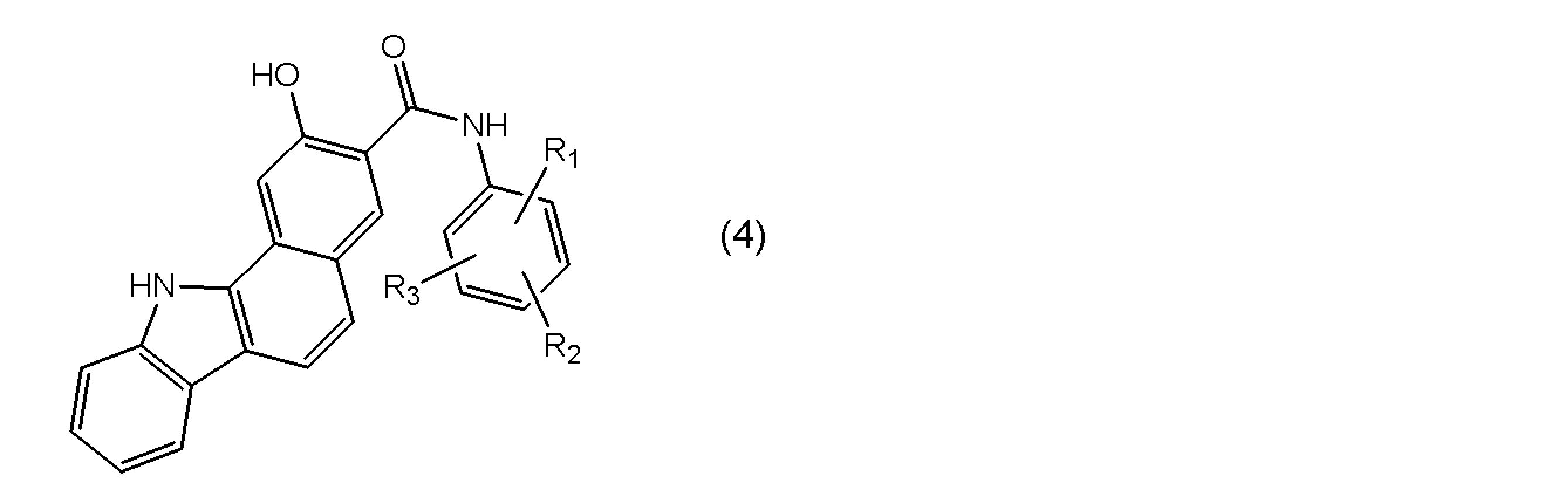
- a compound having a 3-hydroxy-2-naphthoic acid anilide residue, and a 2-hydroxy-11H-benzo [a] carbazole-3-carboxamide residue represented by the general formula (4) mentioned above It is any compound selected from the group consisting of:
- the azo pigment of the present invention is a diazonium compound of the compound represented by the following formula (1) from the group consisting of compounds represented by the following general formulas (2), (3) and (4). It is characterized in that it is coupled to a selected coupling component, and further, as its optical characteristics, it absorbs in the visible region, and in a spectral reflectance spectrum with a black base in a wavelength region of 500 to 1500 nm, it has a wavelength of 600 to 900 nm. It has a maximum reflectance wavelength of one point in the wavelength region.
- the “azo pigment” means a pigment having a plurality of chromophores of azomethine group and azo group in the molecule.
- R 1 to R 3 in the above general formulas (2) to (4) each independently represent any one of a hydrogen atom, a halogen atom, a methyl group, a methoxy group, an ethoxy group, and an acetylamino group. . ]
- the present inventors have intensively studied to develop a characteristic azo pigment that absorbs in the visible light region and reflects and transmits from the visible light region to the near infrared region. At that time, a pigment having a plurality of chromophores in the molecule and resonating them was examined. This pigment was added by adding 10 parts by mass of the azo pigment to 100 parts by mass of the melamine alkyd resin.
- the L * value is 10 in the CIE LAB (L * a * b * ) color system. It has been found that the above is more preferable.
- the method for producing an azo pigment having a specific chemical structure according to the present invention will be described below.
- the present inventors have a plurality of chromophores of azomethine group and azo group in the molecule as a pigment that reflects and transmits from the visible light region to the near infrared region.
- the diazo component used in the coupling reaction of 3-azol is a diazo component of 3- (4-aminophenylimino) -1-oxo-4,5,6,7-tetrachloroisoindoline represented by the formula (1) listed above.
- the diazo component used in producing the pigment of the present invention is 3- (4-aminophenylimino) -1-oxo-4,5,6,7-tetrachloroisoindoline represented by the following formula (1):
- the diazonium compounds are known compounds disclosed in, for example, Japanese Patent Publication No. 49-24561.
- the compound of the following formula (1) is advantageously obtained from 3-imino-1-oxoisoindoline or 3,3′-dichloro-1-oxoisoindoline and p-phenylenediamine according to a known method.
- the coupling component used in the production of the azo pigment of the present invention is a compound having a 3-oxobutanamide residue of the following general formula (2), 3-hydroxy-2-naphthoic acid of the following general formula (3)
- the compound is selected from the group consisting of a compound having an anilide residue and a compound having a 2-hydroxy-11H-benzo [a] -carboxamide residue of the following general formula (4).
- Such compounds are well known as coupling components for azo dyes and pigments.
- R 1 to R 3 in the above general formulas (2) to (4) each independently represent any one of a hydrogen atom, a halogen atom, a methyl group, a methoxy group, an ethoxy group, and an acetylamino group. . ]
- Examples of the compound having a 3-oxobutanamide residue of the general formula (2) include acetoacetanilide, 2′-methylacetoacetanilide, 4′-methylacetoacetanilide, 2′-methoxyacetoacetanilide, 4′-methoxy.
- Examples include acetanilide, 2 ′, 5′-dimethoxyacetoacetanilide, 5′-chloro-2′-methoxyacetoacetanilide, 4-chloro-2 ′, 5′-dimethoxyacetoacetanilide and the like.
- Examples of the compound having a 3-hydroxy-2-naphthoic acid anilide residue of the general formula (3) include N-phenyl-3-hydroxy-2-naphthoic acid anilide, 3-hydroxy-2′-methoxy-2, and the like.
- -Naphthoic acid anilide 3-hydroxy-4'-methoxy-2-naphthoic acid anilide, 2'-ethoxy-3-hydroxycy-2-naphthoic acid anilide, 5'-chloro-3-hydroxy-2'-methyl- 2-naphthoanilide, 5′-chloro-2 ′, 4′-dimethoxy-3-hydroxy-2-naphthoic acid anilide, 4′-chloro-2 ′, 5′-dimethoxy-3-hydroxy-2-naphthoic acid anilide, And 5′-chloro-3-hydroxy-2′-methoxy-2-naphthoic acid anilide.
- Examples of the compound having the 2-hydroxy-11H-benzo [a] carbazole-3-carboxamide residue of the general formula (4) include N- (2-methyl-4-methoxyphenyl) -2-hydroxy-11H. -Benzo [a] carbazole-3-carboxamide, N- (4-methoxyphenyl) -2-hydroxy-11H-benzo [a] carbazole-3-carboxamide.
- the diazo component a diazonium compound obtained by diazotizing the compound of the formula (1) produced by the above-described method by the following method is used, and this diazo component is listed above.
- An azo pigment having a specific structure is obtained by coupling to a coupling component.
- a compound of formula (1) is dispersed in an organic solvent having a boiling point of 120 ° C. or higher (partially dissolved depending on the type of solvent used), converted into hydrochloride with concentrated hydrochloric acid, and nitrite dissolved in water To produce a diazonium salt.
- a coupling component selected from the group consisting of the compounds represented by the above general formulas (2), (3) and (4) is dispersed in an organic solvent having a boiling point of 120 ° C. or higher to obtain an organic solvent solution.
- the diazonium salt solution prepared as described above is dropped into the organic solvent solution to perform a coupling reaction to produce an azo pigment.
- the components having a boiling point of 120 ° C. or lower are distilled (deliquesed) from the organic solvent containing the synthesized azo pigment by heating, and the boiling point is 120 to 200 ° C. in the organic solvent having a boiling point of 120 ° C. or higher.
- the compound of the formula (1) is diazotized, and the resulting diazonium compound and a specific coupling component are used for a coupling reaction (this series of steps is referred to as “diazotization / coupling reaction”).
- this series of steps is referred to as “diazotization / coupling reaction”.
- chlorobenzene o-dichlorobenzene, ethyl cellosolve, butyl cellosolve, nitrobenzene, o-nitrotoluene, N, N-dimethylformamide, N, N-dimethylacetamide, Examples thereof include N-methyl-2-pyrrolidone and 1,3-dimethyl-2-imidazolidinone dimethyl.
- organic solvents can be used alone or in combination of two or more.
- the diazotization / coupling reaction is carried out in an organic solvent having a boiling point of 120 ° C. or higher. With this configuration, the diazotization / coupling reaction is performed. Subsequent pigmentation (crystallization) can be carried out smoothly following the coupling reaction.
- the object of final pigmentation (crystallization) in the method for producing an azo pigment of the present invention is as follows. As will be described later, since the diazotization / coupling reaction is carried out at a relatively low temperature (0 ° C. to 50 ° C.), the primary particles are fine and not sized, and the crystal form is relatively amorphous. Generally close to.
- the diazotization / coupling reaction is carried out in an organic solvent having a boiling point of 120 ° C. or higher.
- a colorant composition that can be applied as a colorant for various uses can be obtained.
- the configuration other than the use of the azo pigment of the present invention may be optimized according to the purpose of coloring, application, usage method, and the like.
- a pigment component containing the azo pigment of the present invention may be used as a liquid colorant composition containing a liquid dispersion medium, or a solid state containing the pigment component in a solid dispersion medium. It may be used as a colorant composition.
- the azo pigment of the present invention may be used alone, or a chromatic pigment, a white pigment, a black pigment, and Other pigments such as extender pigments may be used in combination with one or more selected according to the target color.
- pigments that can be used in combination with the above-described azo pigment of the present invention as a constituent of the colorant composition of the present invention will be described.
- a known pigment can be used.
- Organic pigments such as dioxazine pigments, quinophthalone pigments, nickel azo pigments, metal complex pigments, insoluble azo pigments, soluble azo pigments, high molecular weight azo pigments, azomethine azo black pigments, aniline black pigments, and carbon black pigments
- At least one pigment selected from inorganic pigments such as composite oxide pigments, iron oxide pigments, titanium
- organic pigments described above include the following.
- yellow pigments include C.I. I. Pigment Yellow (abbreviated as PY) 74, PY83, PY93, PY94, PY95, PY97, PY109, PY110, PY120, PY128, PY138, PY139, PY147, PY150, PY151, PY154, PY155, PY166, PY175, PY180, PY175, PY180 PY185, PY191, etc. are mentioned.
- orange pigment include C.I. I. Pigment orange (abbreviated as PO) 61, PO64, PO71, PO73, and the like.
- red pigments include C.I. I.
- Pigment Red (abbreviated as PR) 4, PR5, PR23, PR48: 2, PR48: 4, PR57: 1, PR112, PR122, PR144, PR146, PR147, PR150, PR166, PR170, PR177, PR184, PR185, PR202, PR207, PR214, PR220, PR221, PR242, PR254, PR255, PR264, PR272 and the like can be mentioned.
- C.I. I. Pigment blue (abbreviated as PB) 15: 1, PB15: 2, PB15: 3, PB15: 4, PB15: 5, PB15: 6, PB16, PB17: 1, PB60, PB80, and aluminum phthalocyanine blue.
- green pigments include C.I. I. Pigment green (abbreviated as PG) 7, PG36, PG58, poly (13-16) bromophthalocyanine, and the like.
- I. Pigment violet (abbreviated as PV) 19, PV23, PV37 and the like.
- black pigments include aniline black pigments, carbon black pigments, and titanium oxide black pigments.
- liquid colorant composition A liquid colorant composition in which a pigment component containing the azo pigment of the present invention is dispersed in a liquid dispersion medium will be described.
- the liquid colorant composition is mainly used as a colorant for coating, impregnating, drawing, printing, etc. on the surface of an article. It can be used for various purposes such as image display or image display.
- the liquid dispersion medium used in this case is at least one selected from a polymer that may have a reactive group, an oligomer that may have a reactive group, and a monomer that may have a reactive group. It is possible to use a material that contains various film-forming materials and is in a liquid state, or further contains a solvent and / or water.
- a pigment to be used in advance is prepared in advance as a high-concentration pigment processed product in which a high-concentration pigment is finely dispersed in a liquid dispersion medium. If it is used for, the manufacture of the colorant composition for various uses can be facilitated.
- the high-concentration pigment dispersion which is a liquid high-concentration pigment processed product, is called “base color” or “base ink” and is widely used.
- Solid colorant composition A solid colorant composition in which a pigment component containing the azo pigment of the present invention is dispersed in a solid dispersion medium will be described.
- the solid colorant composition is mainly used as a colorant used for plastics and for internal coloration of synthetic fibers.
- a high-concentration pigment processed product high-concentration pigment dispersion
- the azo pigment of the present invention is finely dispersed in advance in a solid dispersion medium, a master powder, a master batch, and the like, and the whole It is provided in a known product shape such as colored pellets.
- a medium containing at least one solid dispersion medium selected from thermoplastic resins, thermosetting resins, waxes, fatty acid amides, fatty acid metal soaps and the like can be used.
- the product obtained has a visible light region and an infrared region.
- Appropriate coloring is made according to the optical required performance (purpose) of the region.
- the article is formed of a transparent substrate, and the transparent colorant composition is used to form the transparent material.
- the colorant composition of the present invention is used to form a surface of a conductive substrate by painting, coating, dyeing, printing, writing, drawing, inkjet printing, electrophotographic printing, electrostatic printing, or the like, or as an article forming material. May be kneaded or impregnated to color the interior.
- the article to be colored when coloring an article that absorbs light in the visible region and reflects light in the infrared region, the article to be colored itself has light reflectivity, or This is achieved by using a light-reflective substrate previously formed on an article and coating and coloring it on the colorant composition of the present invention.
- the coloring method may be a known method such as painting, painting, undiluted solution coloring, textile printing, dip dyeing, printing, writing, drawing, ink jet printing, electrophotographic printing, electrostatic printing, or the like.
- various resin binders as described below can be used as the film forming material.
- a resin binder referred to as “vehicle” or “varnish” depending on the application
- a baking type resin binder and a photosensitive resin binder can be used.
- the room temperature drying type or baking type resin binder include resin binders used for image recording materials such as printing agents, paints or printing inks, stationery, ink jet printing, electrophotographic printing, and electrostatic printing.
- the photosensitive resin binder include photosensitive resin binders used for various ultraviolet curable or electron beam curable paints, coating agents, printing inks, inkjet inks, and the like.
- room temperature drying type resin binders or baking type resin binders include, for example, synthetic rubber resins, acrylic resins, styrene (co) polymers, vinyl resins such as polyvinyl butyral resins, polyester resins, and amino resins.
- Modified polyester resins polyurethane resins, acrylic polyol urethane resins, soluble polyamide resins, soluble polyimide resins, soluble polyamideimide resins, soluble polyesterimide resins, alkyd resins, aminoalkyd resins, epoxy resins, chlorides Rubber resin, silicon resin, fluorine resin, cellulose acetate resin, nitrocellulose resin, hydroxyethyl cellulose, water-soluble salt of styrene-maleic acid ester copolymer, (meth) acrylic acid ester (co) polymer Soluble salts, water-soluble aminoalkyd resins, and water-soluble amino polyester resin and a water-soluble polyamide resins. These can be used alone or in combination of two or more.
- Examples of the reactive group possessed by the reactive resin binder include a methylol group, an alkylmethylol group, an isocyanate group, a masked isocyanate group, and an epoxy group.
- an oligomer or a monomer is used depending on the application, and a crosslinking agent such as a methylolmelamine-based, isocyanate-based, or epoxy-based crosslinking agent is also used in combination.
- photosensitive resin binders such as ultraviolet curable resin systems and electron beam curable resin systems
- photosensitive resin binders include photosensitive cyclized rubber resins and photosensitive phenol resins.
- plastics that can be colored include the following.
- thermoplastics such as polyethylene, ethylene copolymer, polypropylene and other polyolefins, polystyrene, ABS, AS, styrene copolymer, vinyl chloride resin, methacrylic resin, polycarbonate, polyamide, polyacetal, thermoplastic polyester, cellulose series
- plastics phenylene oxide resins, fluororesins, thermoplastic elastomers, and the like
- thermosetting plastics such as unsaturated polyester resins, epoxy resins, silicone resins, polyurethane resins, melamine resins, and phenol resins.
- the content of the azo pigment of the present invention contained in the above-described colorant composition of the present invention varies depending on the application and purpose of use, and is not generally determined.
- the content of the azo pigment of the present invention contained in the colorant is small because the film thickness is thin. Is about 3% to 80%, preferably about 5% to 60%.
- the content of the coloring agent is approximately 0. 0 depending on the thickness of the colored product. It is preferably in the range of 05% to 20%, preferably about 0.1% to 10%.
- Example 1-Production example of each color pigment In the following manner, orange, red, purple and black color pigments of the examples of the present invention were prepared.
- the diazo component used in the coupling reaction is 3- (4-aminophenylimino) -1-oxo-4,5,6,7-tetrachloroisoindoline represented by the above formula (1), Thus diazotized to prepare a diazonium salt solution. Specifically, 7.5 g (0.02 mol) of 3- (4-aminophenylimino) -1-oxo-4,5,6,7-tetrachloroisoindoline was added to 188 g of N, N-dimethylacetamide.
- 4-chloro-2 ′, 5′-dimethoxyacetoacetanilide which is a compound represented by the general formula (2), is used as a coupling component, and a coupling reaction is performed as described below to produce an azo pigment.
- a coupling reaction is performed as described below to produce an azo pigment.
- 5.5 g (0.02 mol) of the above compound is dispersed in 80 g of DMAc, and 40 g of 30% aqueous sodium hydroxide solution is added thereto and stirred. The mixture is prepared in advance while stirring at a temperature of 20 to 30 ° C. The diazonium salt solution was added dropwise. Further, the coupling reaction is carried out while maintaining the temperature at 30 to 40 ° C. for 5 to 6 hours.
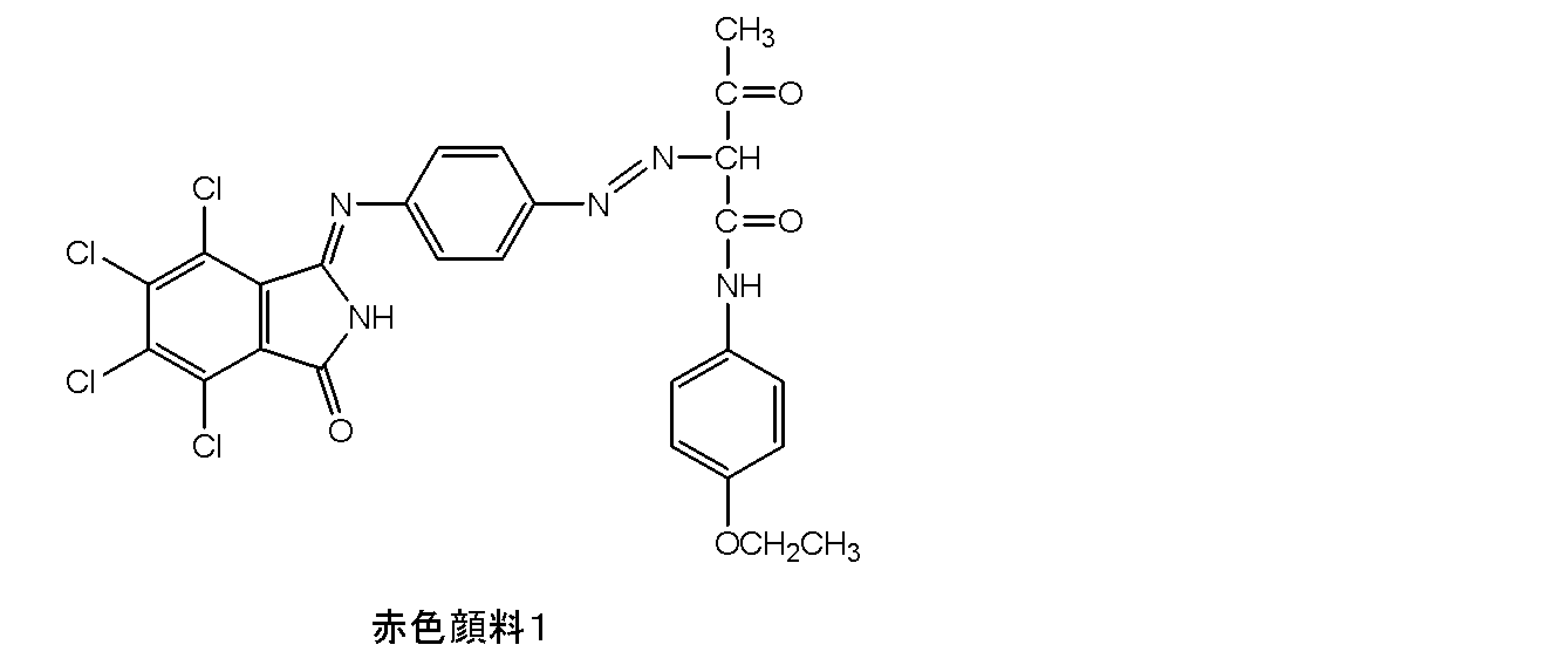
- the mixture is heated gradually and heated at 150 ° C. for 4 hours while removing the liquid (dehydration). went. Subsequently, filtration, washing with methanol, washing with water, drying and pulverization were carried out to obtain an orange pigment 1 which is an azo pigment of the example of the present invention.
- the decomposition temperature in air was measured and found to be 354 ° C. In the present invention, the decomposition temperature was measured with a differential thermal balance thermoplus EVO8120 (trade name) manufactured by Rigaku Corporation in any case.
- the coupling reaction is carried out while maintaining the temperature at 30 to 40 ° C. for 5 to 6 hours. After that, the mixture is heated gradually and heated at 150 ° C. for 4 hours while removing the liquid (dehydration). went. Subsequently, filtration, methanol washing, water washing, drying and pulverization were carried out to obtain a red pigment 1 which is an azo pigment according to an example of the present invention. About the obtained red pigment 1, when the decomposition temperature in the air was measured, it was 340 degreeC.
- 2-hydroxy-3-naphthoic acid-3-chloro-4,6-dimethoxyanilide which is a compound represented by the general formula (3)
- the coupling component was used as the coupling component, and the coupling was performed as follows. Reaction was performed to prepare an azo pigment. First, 5.5 g (0.02 mol) of the above compound was dispersed in 80 g of ODB, and 1.2 g of caustic soda dissolved in 40 g of methanol was added and stirred. While stirring at a temperature of 20 to 30 ° C., the above diazonium salt solution was added dropwise. Further, the coupling reaction is carried out by maintaining the temperature at 30 to 40 ° C.
- 4-chloro-2 ′, 5′-dimethoxyacetoacetanilide which is a compound represented by the general formula (2), is used as a coupling component, and a coupling reaction is performed as described below to produce an azo pigment.
- a coupling reaction is performed as described below to produce an azo pigment.
- 5.5 g (0.02 mol) of the above compound was dispersed in 80 g of water, and 40 g of 30% aqueous sodium hydroxide solution was added thereto and stirred. The mixture was prepared previously while stirring at a temperature of 20 to 30 ° C. A diazonium salt solution was added dropwise. Further, the coupling reaction was carried out by maintaining the temperature at 30 to 40 ° C. for 5 to 6 hours, and then the mixture was heated to 95 ° C.
- orange pigment 2 which is an azo pigment of a comparative example of the present invention.
- the decomposition temperature in the air was measured and found to be 345 ° C.
- the mixture was stirred for about 1 hour to obtain a hydrochloride, and 4.0 g of 40% aqueous sodium nitrate solution was added thereto, and the mixture was stirred for about 1 hour at the same temperature to prepare a yellow diazonium salt solution.
- N- (2-methyl-4methoxyphenyl) -2-hydroxy-11H-benzo [a] carbazole-3-carboxamide which is a compound represented by the general formula (4), is used as the coupling component.
- a coupling reaction was performed as follows to prepare an azo pigment. First, 5.5 g (0.02 mol) of the above compound was dispersed in 80 g of methanol, and 1.2 g of caustic soda dissolved in 40 g of methanol was added and stirred, and stirred at a temperature of 20-30 ° C. Then, the previously prepared diazonium salt solution was added dropwise. Further, the coupling reaction is carried out by maintaining at a temperature of 30 to 40 ° C.
- a black pigment 2 which is an azo pigment of a comparative example of the present invention.
- the decomposition temperature in the air was measured and found to be 343 ° C.
- Example 2-Production example of paint using each color pigment of Example 1 and preparation of sample for evaluation (Preparation of paint containing orange pigment 1 and preparation of colored paper coated with the paint)
- an orange paint was prepared according to the following formulation. Specifically, 1.5 parts of orange pigment 1, 15.5 parts of melamine alkyd resin varnish, 3 parts of thinner and 25 parts of glass beads are placed in a 50-volume plastic bottle and shaken for 90 minutes with a paint shaker. Then, 10 parts of melamine alkyd resin was added and further shaken with the same machine for 10 minutes to prepare a thermosetting alkyd paint.
- the melamine alkyd resin varnish used in the above formulation was composed of 30% Super Becamine J-820 (trade name, manufactured by DIC) and 70% Phthalkid 133-60 (manufactured by Hitachi Chemical).
- the resin content of the varnish is 60%. Therefore, about 10 parts of the azo pigment is contained with respect to 100 parts of the solid content of the melamine alkyd resin.
- the thinner used in the above formulation consists of 80% xylene and 20% 1-butanol.
- the orange paint containing the orange pigment 1 prepared above was applied to a black belt colored paper with a 10 mil applicator and dried (baked) according to a conventional method.
- the film thickness after drying was about 485 nm.
- this is referred to as an orange colored paper.
- Red paint and red color paper were obtained in the same manner except that the orange pigment 1 used in the preparation of the paint described above was changed to the red pigment 1 obtained in Example 1.
- purple paint, purple color paper, black paint and black color paper were obtained in the same manner except that the orange pigment 1 was changed to the purple pigment 1 or black pigment obtained in Example 1, respectively.
- a comparative orange paint was prepared in the same manner except that the orange pigment 1 used in the preparation of the paint described above was changed to the orange pigment 2 obtained in Comparative Example 1.
- comparative orange-colored colored paper was prepared using this.
- the viscosity of the obtained comparative orange paint was slightly higher than that of the orange paint of Example 2.
- a comparative black paint was prepared in the same manner except that the orange pigment 1 was changed to the black pigment 2 obtained in Comparative Example 1.
- a comparatively black-colored colored paper was created using this.
- the viscosity of the obtained comparative black paint was considerably higher than that of the black paint of Example 2. This is considered to be because, in particular, in the case of the black pigment 2, since the pigmentation with the organic solvent of the present invention is not performed, the pigment particles are quite fine.
- Each of the color paints prepared in Example 2 described above was used, applied to a transparent quartz glass plate with a 6 mil applicator, and dried according to a conventional method. The film thickness after drying was about 320 nm in all cases.
- permeability of a visible part and a near-infrared part were measured for the coating board which consists of a transparent substrate obtained using the coating material of each color with 330 type
- Tables 2 and 3 show the results of the maximum reflectance wavelength and the reflectance at each wavelength when the base is black. The transmittance results are shown in Table 4.
- Example 3 the reflectance in the case of Comparative Example 3 is smaller, and the transmittance in the case of Comparative Example 3 is lower than that in Example 3 as shown in Table 4.
- the reason for this is as follows.
- the diazo component and the coupling component of each pigment prepared in Example 2 and Comparative Example 2 are the same, respectively, orange paint and comparative orange paint, and black paint and comparative black paint are used.
- the chemical structure of the same color pigment is the same.
- finer particles have higher transmittance and lower reflectance. From this, the pigment used in the case of the coated plate of Comparative Example 3 is different from the solvent in the example, and good pigmentation with a solvent having a boiling point of 120 ° C.
- Comparative Example 3 is more reflective than that of Example 3. It is thought that the transmittance was small and the transmittance was large. As in the case of Comparative Example 3, good crystallization is not achieved, and the pigment particle size is small and the particle size is not adjusted. For example, when a pigment dispersion such as a paint is used, fluidity is deteriorated. As a pigment, it is inferior in practicality.
- 71 parts of a press cake containing 25 parts of the solid content of the red pigment 1 obtained in Example 1 10 parts of a nonionic pigment dispersant, 1 part of an antifoaming agent, and 18 parts of water, glass is used as a dispersion medium.
- the pigment was dispersed with a horizontal continuous medium disperser using beads to prepare a high-concentration dispersion (red color base) containing a red pigment.
- Example 5 Production of black gravure printing ink using the black pigment 1 prepared in Example 1, creation of printed matter for evaluation using the same, and evaluation result 4 (visible light shielding / infrared transmission) sex)] 11 parts of the black pigment 1 obtained in Example 1 and 30 parts of a 40% methyl ethyl ketone / toluene (1: 3) mixed solvent solution of a polyurethane resin in which the isocyanate-terminated polyester is chain-extended with a diamine were added, and the cationic polymer dispersant was added.
Landscapes
- Chemical & Material Sciences (AREA)
- Organic Chemistry (AREA)
- Wood Science & Technology (AREA)
- Life Sciences & Earth Sciences (AREA)
- Engineering & Computer Science (AREA)
- Materials Engineering (AREA)
- General Chemical & Material Sciences (AREA)
- Chemical Kinetics & Catalysis (AREA)
- Inks, Pencil-Leads, Or Crayons (AREA)
- Paints Or Removers (AREA)
- Pigments, Carbon Blacks, Or Wood Stains (AREA)
- Ink Jet Recording Methods And Recording Media Thereof (AREA)
- Compositions Of Macromolecular Compounds (AREA)
Abstract
Description


上記したように、本発明のアゾ顔料は、下記式(1)で表される化合物のジアゾニウム化合物を、下記一般式(2)、(3)及び(4)で表される化合物からなる群から選ばれるカップリング成分にカップリングすることを特徴とし、更に、その光学的特性として、可視領域は吸収し、500~1500nmの波長領域における、下地が黒の分光反射率スペクトルにおいて、600~900nmの波長域で1点の極大反射率波長を有することを特徴とする。本発明において、「アゾ顔料」とは、分子中にアゾメチン基とアゾ基の複数個の発色団を有する顔料を意味する。

本発明の特定の化学構造を有するアゾ顔料の製造方法について、以下説明する。先に述べたように、本発明者らは、可視光領域から近赤外領域において反射及び透過する顔料として、分子中にアゾメチン基とアゾ基の複数個の発色団を有し、合成する際のカップリング反応に用いるジアゾ成分が、先に挙げた式(1)で表される3-(4-アミノフェニルイミノ)-1-オキソ-4,5,6,7-テトラクロロイソインドリンをジアゾ化したジアゾニウム化合物であり、且つ、カップリング成分の少なくとも一つが、3-オキソブタンアミド残基を持つ化合物、3-ヒドロキシ-2-ナフタレンカルボアミド残基を持つ化合物、2-ヒドロキシ-11H-ベンゾ[a]カルバゾール-3-カルボアミド残基を持つ化合物からなる群から選ばれる化合物である場合に、機能性に優れるアゾ顔料となることを見出した。



本発明のアゾ顔料は、液体分散媒体或いは固体分散媒体中に含有させることで、多様な用途に着色剤として適用可能な着色剤組成物とすることができる。本発明の着色剤組成物は、本発明のアゾ顔料を用いること以外の構成は、その着色目的、用途、使用方法などに応じて最適なものとすればよい。具体的には、本発明のアゾ顔料を含む顔料成分を、液体分散媒体中に含む液状の着色剤組成物として使用してもよいし、或いは、該顔料成分を固体分散媒体中に含む固体状の着色剤組成物として使用してもよい。このような本発明の着色剤組成物を調製する場合におけるアゾ顔料を含む顔料成分としては、本発明のアゾ顔料を単独で用いてもよいが、或いは、有彩色顔料、白色顔料、黒色顔料及び体質顔料などの他の顔料を、目的とする色彩に合わせて1種または2種以上を選択して、併用してもよい。
上記した本発明のアゾ顔料と併用して、本発明の着色剤組成物の構成成分として使用できる他の顔料について説明する。併用する顔料としては、公知の顔料を使用することができる。例えば、アンスラキノン系顔料、キナクリドン系顔料、ジケトピロロピロール系顔料、インジゴ・チオインジゴ系顔料、ペリノン系顔料、ペリレン系顔料、フタロシアニン系顔料、インドリン系顔料、イソインドリン系顔料、イソインドリノン系顔料、ジオキサジン系顔料、キノフタロン顔料、ニッケルアゾ顔料、金属錯体顔料、不溶性アゾ系顔料、溶性アゾ系顔料、高分子量アゾ系顔料、アゾメチンアゾ系ブラック顔料、アニリンブラック系顔料などの有機顔料及び、カーボンブラック顔料及び複合酸化物系顔料、酸化鉄顔料、酸化チタン系顔料などの無機顔料から選ばれる少なくとも1種の顔料、或いは2種以上の顔料の混合物、混晶顔料を使用することができる。
本発明のアゾ顔料を含む顔料成分が、液体分散媒体中に分散されてなる液状の着色剤組成物について説明する。液状の着色剤組成物は、主に物品の表面を塗布、含浸、描画、印字などをさせる着色剤として使用され、塗料用、プラスチック着色用、繊維着色用、印刷インキ用、文房具用、画像記録用、或いは、画像表示用など種々の用途で使用することができる。この際に用いる液体分散媒体としては、反応性基を有してもよい重合体、反応性基を有してもよいオリゴマー及び反応性基を有してもよい単量体から選ばれる少なくとも1種の皮膜形成材料を含み、且つ、それ自体が液状であるか、或いは、更に溶剤及び/または水を含有されて液状となっているものが使用できる。
本発明のアゾ顔料を含む顔料成分が、固体分散媒体中に分散されてなる固体状の着色剤組成物について説明する。固体状の着色剤組成物は、主としてプラスチック用や合成繊維の内部着色用に使用される着色剤として利用される。この場合は、例えば、固体分散媒体中に、予め本発明のアゾ顔料を高濃度に微分散した高濃度顔料加工品(高濃度顔料分散物)である、マスターパウダー、マスターバッチなど、及び、全体に着色されたカラードペレットなど公知の製品形状で提供される。この際に用いる固体分散媒体としては、熱可塑性樹脂製、熱硬化性樹脂製、ワックス、脂肪酸アミド及び脂肪酸金属石鹸などから選ばれる少なくとも1種の固体分散媒体を含有するものが使用できる。
上記で説明したようにして得られる、本発明のアゾ顔料を用いてなる液状或いは固体状の着色剤組成物を使用して物品を着色することで、得られる製品は、可視光領域及び赤外領域の光学的な要求性能(目的)によって適切な着色がなされたものとなる。例えば、可視光領域の光を網羅して吸収させ、赤外領域の光を透過させる着色を行う場合には、物品を透明性基材で形成し、液状の着色剤組成物を用いて該透明性基材を、塗装、塗付、染色、印刷、筆記、描画、インクジェット印刷、電子写真印刷或いは静電印刷などで表面着色するか、或いは、物品の形成材料に、本発明の着色剤組成物を混練または含浸させて内部着色すればよい。
それぞれ下記のようにして、本発明の実施例の、橙色、赤色、紫色及び黒色の各色顔料を調製した。
(橙色顔料1の合成例)
カップリング反応に用いるジアゾ成分を、前記した式(1)で表される、3-(4-アミノフェニルイミノ)-1-オキソ-4,5,6,7-テトラクロロイソインドリンを、下記のようにしてジアゾ化してジアゾニウム塩の溶液を調製した。具体的には、3-(4-アミノフェニルイミノ)-1-オキソ-4,5,6,7-テトラクロロイソインドリン7.5g(0.02モル)を、188gのN,N-ジメチルアセトアミド(沸点165℃、以下、DMAcと略記)中に分散し、これに濃塩酸7.4gを加えて、温度を5~10℃に保ち、約1時間撹拌して塩酸塩とし、これに40%硝酸ナトリウム水溶液4.0gを加え、約1時間、同温度にて撹拌して黄色のジアゾニウム塩の溶液を調製した。

先の橙色顔料1の合成例の場合と同様にして、式(1)で表される化合物のジアゾニウム塩の溶液を調製した。一方、カップリング成分には、前記一般式(2)で表される化合物である4’-エトキシアセトアセトアニリドを用い、下記のようにしてカップリング反応を行ってアゾ顔料を調製した。まず、上記化合物4.4g(0.02モル)を、80gのDMAc中に分散し、これに30%苛性ソーダ水溶液40gを加えて撹拌し、20~30℃の温度で撹拌しながら、先に調製したジアゾニウム塩溶液を滴下した。更に、30~40℃の温度に5~6時間保ってカップリング反応を行い、その後、徐々に加温し、脱液(脱水)しながら、150℃の温度で4時間加熱して顔料化を行った。次いで、濾過、メタノール洗浄、水洗、乾燥及び粉砕して本発明の実施例のアゾ顔料である赤色顔料1を得た。得られた赤色顔料1について、空気中における分解温度を測定したところ、340℃であった。
この例では、ジアゾ成分として、前記した式(1)で表される、3-(4-アミノフェニルイミノ)-1-オキソ-4,5,6,7-テトラクロロイソインドリンを、下記のようにしてジアゾ化してジアゾニウム塩の溶液を調製し、これをカップリング反応に用いた。具体的には、上記化合物7.5g(0.02モル)を、188gのo-ジクロロベンゼン(沸点180℃、以下、ODBと略記)中に分散し、これに濃塩酸7.4gを加えて、温度を5~10℃に保ち、約1時間撹拌して塩酸塩とし、これに40%硝酸ナトリウム水溶液4.0gを加え、約1時間、同温度にて撹拌して黄色のジアゾニウム塩の溶液を調製した。

先述した紫色顔料1の合成例の場合と同様にして、前記した式(1)で表される化合物をジアゾ化してジアゾニウム塩溶液を調製した。一方、カップリング成分には、前記一般式(4)で表される化合物であるN-(2-メチル-4メトキシフェニル)-2-ヒドロキシ-11H-ベンゾ[a]カルバゾール-3-カルボアミドを用い、下記のようにしてカップリング反応を行ってアゾ顔料を調製した。まず、上記化合物5.5g(0.02モル)を80gのODB中に分散し、これに1.2gの苛性ソーダをメタノール40gに溶解したものを加えて撹拌し、20~30℃の温度で撹拌しながら、先に調製したジアゾニウム塩溶液を滴下した。更に、30~40℃の温度に5~6時間保ってカップリング反応を行い、その後、徐々に加温し、脱液(脱水)しながら、170℃の温度で4時間加熱して顔料化を行った。次いで、濾過、メタノール洗浄、水洗、乾燥及び粉砕して本発明の実施例のアゾ顔料である黒色顔料1を得た。得られた黒色顔料1について、空気中における分解温度を測定したところ、347℃であった。

(橙色顔料2の比較合成例)
カップリング反応に用いるジアゾ成分を、下記のようにして調製した。前記した式(1)で表される、3-(4-アミノフェニルイミノ)-1-オキソ-4,5,6,7-テトラクロロイソインドリン7.5g(0.02モル)を、188gの水中に分散し、これに濃塩酸7.4gを加えて、温度を5~10℃に保ち、約1時間撹拌して塩酸塩とし、これに40%硝酸ナトリウム水溶液4.0gを加え、約1時間、同温度にて撹拌してジアゾ化し、黄色のジアゾニウム塩の溶液を調製した。
この例では、ジアゾ成分として、前記した式(1)で表される3-(4-アミノフェニルイミノ)-1-オキソ-4,5,6,7-テトラクロロイソインドリンを、下記のようにしてジアゾ化してジアゾニウム塩の溶液を調製し、これをカップリング反応に用いた。具体的には、上記化合物7.5g(0.02モル)を、188gのメタノール(沸点64.7℃)中に分散し、これに濃塩酸7.4gを加えて、温度を5~10℃に保ち、約1時間撹拌して塩酸塩とし、これに40%硝酸ナトリウム水溶液4.0gを加え、約1時間、同温度にて撹拌して黄色のジアゾニウム塩の溶液を調製した。
(橙色顔料1を含む塗料の調製と、該塗料で塗装した展色紙の調製)
実施例1で得た橙色顔料1を用いて下記の処方で橙色塗料の調製を行った。具体的には、橙色顔料1を1.5部、メラミンアルキッド樹脂ワニス15.5部、シンナー3部及びガラスビーズ25部を50容量部のポリ瓶に取り、ペイントシェーカーで90分間振とうした後、メラミンアルキッド樹脂を10部追加し、更に10分間同機にて振とうし、熱硬化アルキッド塗料を調製した。上記処方において使用した、メラミンアルキッド樹脂ワニスは、スーパーベッカミンJ-820(商品名、DIC社製)30%と、フタルキッド133-60(日立化成社製)70%よりなるものであり、調製したワニスの樹脂分は60%である。よって、メラミンアルキッド樹脂の固形分100部に対し、アゾ顔料は約10部含有されたものである。上記処方において使用したシンナーは、キシレン80%と1-ブタノール20%よりなるものである。
先に説明した塗料の調製において使用した橙色顔料1を、実施例1で得た赤色顔料1に変えた以外は、同様にして、赤色塗料及び赤色展色紙を得た。同様に、橙色顔料1を、実施例1で得た紫色顔料1又は黒色顔料にそれぞれ変えた以外は同様にして、紫色塗料、紫色展色紙、黒色塗料及び黒色展色紙を得た。
先に説明した塗料の調製において使用した橙色顔料1を、比較例1で得た橙色顔料2に変えた以外は同様にして、比較橙色塗料を調製した。また、これを用いて比較橙色展色紙を作成した。但し、得られた比較橙色塗料の粘度は、実施例2の橙色塗料に比べて少し高かった。同様に、橙色顔料1を、比較例1で得た黒色顔料2に変えた以外は同様にして、比較黒色塗料を調製した。また、これを用いて比較黒色展色紙を作成した。但し、得られた比較黒色塗料の粘度は、実施例2の黒色塗料に比べて、かなり高かった。これは、特に黒色顔料2の場合、本発明の有機溶剤による顔料化を実施していないので、顔料粒子がかなり微細であるからだと考えられる。
実施例2と比較例2で上記のようにして作成した各色の展色紙について、CM-3600d分光光度計〔商品名、コニカミノルタ社製、SCE(正反射光除去)方式、標準の光D65 10°視野〕を用いて測色した。その結果を表1にまとめて示した。

先に説明した実施例2で調製した各色の塗料をそれぞれに用い、透明の石英ガラス板に、6ミルのアプリケーターで塗布し、常法に従い乾燥させた。乾燥後の膜厚は、何れも約320nmであった。こうして各色の塗料を用いて得られた透明基板からなる塗装板を、330型自記分光光度計(日立製作所製)にて可視部及び近赤外部の反射率及び透過率を測定した。その際に、下記のようにして、下地を白及び黒としてそれぞれ測定した。具体的には、下地が白の場合には、それぞれのガラス板の裏面に白色板(酸化マグネシウム板)を当てて測定し、下地が黒の場合には黒色板(カーボンブラック板)を裏面に当てて測定した。そして、下地が黒の場合の極大反射率波長と各波長における反射率の結果を表2と表3に示した。また、透過率の結果を表4に示した。
実施例3と同様の方法で評価し、結果を表2~4にまとめて示した。


実施例1で得た赤色顔料1を固形分で25部を含むプレスケーキ71部、ノニオン系顔料分散剤10部、消泡剤1部、水18部を十分予備混合した後、分散媒体としてガラスビーズを使用した横型連続媒体分散機にて顔料を分散し、赤色顔料を含有する高濃度分散液(赤色カラーベース)を調製した。このようにして得た赤色カラーベース20部、反応性アクリル酸アルキルエステルラテックス(固形分40%)25部、消泡剤0.5部、分散剤1部、水中油滴型乳化用分散安定剤3部、ミネラルターペン38部、水12.5部をホモジナイザー(強力乳化分散機)にて乳化分散させ、水中油滴型赤色エマルジョンペーストを調製した。更に、そこへ、カルボジイミド系の架橋剤(固形分40%)を2部添加し、十分混合して赤色の捺染糊を調製した。得られた赤色捺染糊を用いてポリエステル-綿混紡布上に全面プリントし、120℃で15分間のキュアーを行うことにより、赤色の無地捺染布を得た。得られた赤色の無地捺染布は、熱線を遮蔽することができるものであることを確認した。
実施例1で得た黒色顔料1を11部、イソシアネート末端ポリエステルをジアミンで鎖長延長したポリウレタン樹脂の、40%メチルエチルケトン・トルエン(1:3)混合溶媒溶液30部を加え、カチオン性ポリマー分散剤2部、トリレンジイソシアネートからのポリカルボジイミド化合物の40%トルエン溶液を2.5部、メチルエチルケトン・トルエン・イソプロピルアルコール(50:30:20)混合溶媒54.5部を加えて高速撹拌機で十分混合した。そして、分散メディアとしてガラスビーズを使用した横型連続媒体分散機にて顔料を分散し、黒色グラビア印刷インキを調製した。グラビア印刷機を用いて、ポリアミドフィルム、ポリエステルフィルム及びポリプロピレンフィルムにそれぞれ印刷を行ない、それぞれの材質のフィルムを基材とする黒色フィルムを得た。いずれの黒色フィルムも、可視光を遮蔽し、赤外線を透過することができるものであることを確認した。
Claims (10)
- 500~1500nmの波長領域における、下地が黒の分光反射率スペクトルにおいて、600~900nmの波長域で1点の極大反射率波長を有する、近赤外線反射・透過性を示すアゾ顔料であり、且つ、下記式(1)で表される化合物のジアゾニウム化合物をジアゾ成分とし、該ジアゾ成分を、下記一般式(2)、(3)及び(4)で表される化合物からなる群から選ばれるいずれかのカップリング成分にカップリングさせてなることを特徴とする近赤外線反射・透過性アゾ顔料。
[但し、上記一般式(2)~(4)中にあるR1~R3は、それぞれ独立に、水素原子、ハロゲン原子、メチル基、メトキシ基、エトキシ基又はアセチルアミノ基のいずれかを表す。]
- メラミンアルキッド樹脂の固形分100質量部に、前記アゾ顔料が10質量部となるように添加して分散させて塗料を作製し、10ミルのアプリケーターで展色紙に塗布したものを分光光度計で測色した時、CIE LAB(L*a*b*)表色系においてL*値が10以上である請求項1に記載の近赤外線反射・透過性アゾ顔料。
- 請求項1又は2に記載の近赤外線反射・透過性アゾ顔料の製造方法であって、下記式(1)の3-(4-アミノフェニルイミノ)-1-オキソ-4,5,6,7-テトラクロロイソインドリンを、沸点が120℃以上の有機溶媒中に分散させ、濃塩酸で塩酸塩にし、これを水に溶解した亜硝酸塩でジアゾ化してジアゾニウム塩とする、ジアゾ成分を調製する工程と、
下記一般式(2)、(3)及び(4)で表される化合物からなる群から選ばれるいずれかをカップリング成分として用い、該カップリング成分を、沸点が120℃以上の有機溶剤中に分散させて得た有機溶剤溶液中に、上記工程で調製したジアゾニウム塩の溶液を滴下してカップリング反応を行ってアゾ顔料を合成する工程と、
次いで、加熱して、合成したアゾ顔料を含む上記有機溶剤中から、沸点が120℃以下の成分を蒸留(脱液)しながら、沸点が120℃以上の有機溶剤中で120~200℃の温度でアゾ顔料を顔料化(結晶化)する工程、とを有することを特徴とする近赤外線反射・透過性アゾ顔料の製造方法。
[但し、上記一般式(2)~(4)中にあるR1~R3は、それぞれ独立に、水素原子、ハロゲン原子、メチル基、メトキシ基、エトキシ基又はアセチルアミノ基のいずれかを表す。]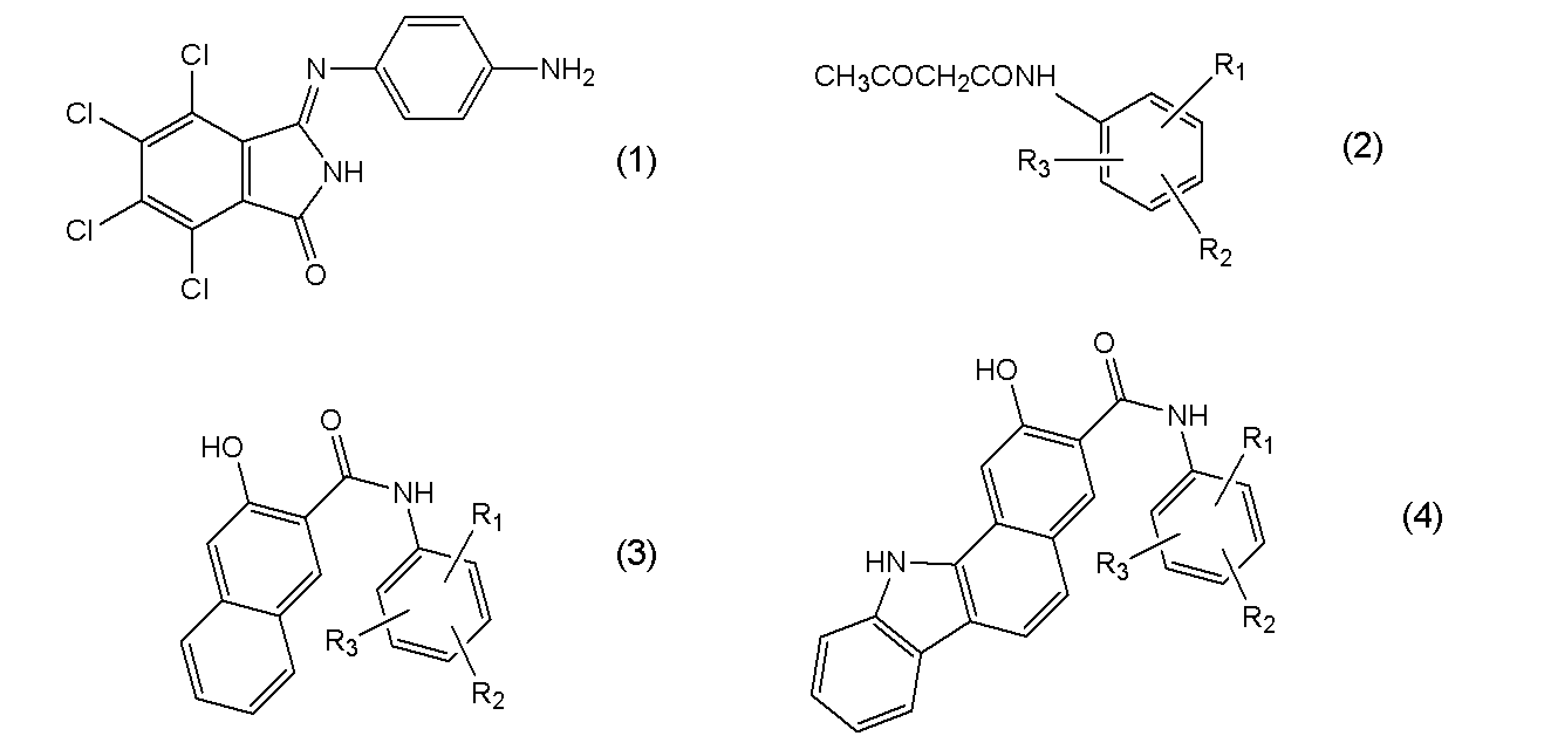
- 前記沸点が120℃以上の有機溶剤として、クロロベンゼン、o-ジクロロベンゼン、エチルセロソルブ、ブチルセロソルブ、ニトロベンゼン、o-ニトロトルエン、N,N-ジメチルホルムアミド、N,N-ジメチルアセトアミド、N-メチル-2-ピロリドン及び1,3-ジメチル-2-イミダゾリジノンジメチルからなる群から選ばれる少なくともいずれかを使用する請求項3に記載の近赤外線反射・透過性アゾ顔料の製造方法。
- 液体分散媒体或いは固体分散媒体中に顔料成分が含有された液状或いは固体状の着色剤組成物であり、該顔料成分が、請求項1又は2に記載の近赤外線反射・透過性アゾ顔料のいずれかであるか、請求項3又は4に記載の製造方法によって得られた近赤外線反射・透過性アゾ顔料のいずれかであることを特徴とする着色剤組成物。
- 前記液体分散媒体が皮膜形成成分を含み、該皮膜形成成分が、反応性基を有していてもよい重合体、反応性基を有していてもよいオリゴマー及び反応性基を有していてもよい単量体からなる群から選ばれる少なくとも1種であり、且つ、該皮膜形成成分自体が液状であるか、或いは、溶剤及び/または水が含有されて液状となっている請求項5に記載の着色剤組成物。
- 前記固体分散媒体が、熱可塑性樹脂製、熱硬化性樹脂製、ワックス、脂肪酸アミド及び脂肪酸金属石鹸からなる群から選ばれる少なくとも1種の固体分散媒体を含有してなる固体状のものである請求項5に記載の着色剤組成物。
- 塗料用、プラスチック用、合成繊維用、印刷インキ用、文房具用又は画像記録用、画像表示用の着色用いずれかである請求項5~7のいずれか1項に記載の着色剤組成物。
- 請求項8に記載の着色剤組成物を用いて透明性基材を有する物品に着色を施す着色方法であって、透明性基材の表面に、上記着色剤組成物を用いて、塗装、塗付、染色、印刷、筆記、描画、インクジェット印刷、電子写真印刷及び静電印刷からなる群から選ばれたいずれかの方法で着色するか、或いは、上記着色剤組成物を物品の形成材料中に混練又は含浸させる方法によって物品の内部の着色をすることを特徴とする物品の着色方法。
- 請求項9に記載の物品の着色方法で着色が施されていることを特徴とする着色物品。
Priority Applications (8)
| Application Number | Priority Date | Filing Date | Title |
|---|---|---|---|
| KR1020167024637A KR101854064B1 (ko) | 2014-02-19 | 2014-02-19 | 근적외선 반사·투과성 아조 안료, 근적외선 반사·투과성 아조 안료의 제조방법, 이들 아조 안료를 이용한 착색제 조성물, 물품의 착색방법 및 착색물품 |
| AU2014383447A AU2014383447B2 (en) | 2014-02-19 | 2014-02-19 | Near infrared-reflecting/transmitting azo pigment, method for manufacturing near infrared-reflecting/transmitting azo pigment, colorant composition using said azo pigments, item-coloring method and colored item |
| EP14883211.6A EP3109283A4 (en) | 2014-02-19 | 2014-02-19 | Near infrared-reflecting/transmitting azo pigment, method for manufacturing near infrared-reflecting/transmitting azo pigment, colorant composition using said azo pigments, item-coloring method and colored item |
| CN201480076050.6A CN106029787B (zh) | 2014-02-19 | 2014-02-19 | 近红外线反射‑透射性偶氮颜料、近红外线反射‑透射性偶氮颜料的制造方法、使用了这些偶氮颜料的着色剂组合物、物品的着色方法和着色物品 |
| PCT/JP2014/053856 WO2015125224A1 (ja) | 2014-02-19 | 2014-02-19 | 近赤外線反射・透過性アゾ顔料、近赤外線反射・透過性アゾ顔料の製造方法、これらのアゾ顔料を用いた着色剤組成物、物品の着色方法及び着色物品 |
| US15/110,056 US9822266B2 (en) | 2014-02-19 | 2014-02-19 | Near infrared-reflecting/transmitting azo pigment, method for manufacturing near infrared-reflecting/transmitting azo pigment, colorant composition using said azo pigments, item-coloring method and colored item |
| JP2016503815A JP6196370B2 (ja) | 2014-02-19 | 2014-02-19 | 近赤外線反射・透過性アゾ顔料、近赤外線反射・透過性アゾ顔料の製造方法、これらのアゾ顔料を用いた着色剤組成物、物品の着色方法及び着色物品 |
| PH12016501627A PH12016501627B1 (en) | 2014-02-19 | 2016-08-15 | Near infrared-reflecting/transmitting azo pigment, method for manufacturing near infrared-reflecting/transmitting azo pigment, colorant composition using said azo pigments, item-coloring method and colored item |
Applications Claiming Priority (1)
| Application Number | Priority Date | Filing Date | Title |
|---|---|---|---|
| PCT/JP2014/053856 WO2015125224A1 (ja) | 2014-02-19 | 2014-02-19 | 近赤外線反射・透過性アゾ顔料、近赤外線反射・透過性アゾ顔料の製造方法、これらのアゾ顔料を用いた着色剤組成物、物品の着色方法及び着色物品 |
Publications (1)
| Publication Number | Publication Date |
|---|---|
| WO2015125224A1 true WO2015125224A1 (ja) | 2015-08-27 |
Family
ID=53877762
Family Applications (1)
| Application Number | Title | Priority Date | Filing Date |
|---|---|---|---|
| PCT/JP2014/053856 Ceased WO2015125224A1 (ja) | 2014-02-19 | 2014-02-19 | 近赤外線反射・透過性アゾ顔料、近赤外線反射・透過性アゾ顔料の製造方法、これらのアゾ顔料を用いた着色剤組成物、物品の着色方法及び着色物品 |
Country Status (8)
| Country | Link |
|---|---|
| US (1) | US9822266B2 (ja) |
| EP (1) | EP3109283A4 (ja) |
| JP (1) | JP6196370B2 (ja) |
| KR (1) | KR101854064B1 (ja) |
| CN (1) | CN106029787B (ja) |
| AU (1) | AU2014383447B2 (ja) |
| PH (1) | PH12016501627B1 (ja) |
| WO (1) | WO2015125224A1 (ja) |
Cited By (1)
| Publication number | Priority date | Publication date | Assignee | Title |
|---|---|---|---|---|
| JP2017193689A (ja) * | 2016-04-22 | 2017-10-26 | 大日精化工業株式会社 | 黒色アゾ顔料及び着色剤 |
Families Citing this family (6)
| Publication number | Priority date | Publication date | Assignee | Title |
|---|---|---|---|---|
| JP6496293B2 (ja) * | 2016-10-27 | 2019-04-03 | クラリアント・インターナシヨナル・リミテツド | 遮熱塗料用黒色顔料組成物、それを用いた遮熱塗料、並びに調色、塗装のためのそれの使用 |
| WO2018199969A1 (en) * | 2017-04-27 | 2018-11-01 | Hewlett-Packard Development Company, L.P. | Ink inlcuding an inorganic near infrared scattering pigment |
| EP3676319B1 (en) | 2017-09-01 | 2025-11-19 | Sun Chemical Corporation | Ir-reflective ink, film and tape |
| TWI707905B (zh) * | 2019-08-21 | 2020-10-21 | 南亞塑膠工業股份有限公司 | 一種未包含金屬成分的深色紅外線反射纖維、其製造方法、及深色紅外線反射纖維紡織品 |
| CN114933818B (zh) * | 2022-06-28 | 2024-01-16 | 绍兴文理学院 | 一种吲哚啉分散染料及其制备方法 |
| KR102951014B1 (ko) | 2024-06-10 | 2026-04-10 | 주식회사 선우켐텍 | 카본 블랙이 함유된 열경화성 수지용 착색제 조성물 |
Citations (4)
| Publication number | Priority date | Publication date | Assignee | Title |
|---|---|---|---|---|
| JPS5430221A (en) * | 1977-08-11 | 1979-03-06 | Dainichi Seika Kogyo Kk | Preparation of azo pigments |
| JPS54141821A (en) * | 1978-04-27 | 1979-11-05 | Dainichi Seika Kogyo Kk | Azo pigment |
| JPS5649757A (en) * | 1980-08-01 | 1981-05-06 | Dainichi Seika Kogyo Kk | Azo pigment |
| JP2002256165A (ja) * | 2000-12-26 | 2002-09-11 | Dainichiseika Color & Chem Mfg Co Ltd | 近赤外線透過性黒色アゾ顔料および顔料組成物 |
Family Cites Families (19)
| Publication number | Priority date | Publication date | Assignee | Title |
|---|---|---|---|---|
| JPS5931545B2 (ja) | 1980-01-22 | 1984-08-02 | マリア・アブラモブナ・シユテルン | 熱反射エナメル |
| CH643870A5 (en) | 1980-12-01 | 1984-06-29 | Ciba Geigy Ag | Process for preparing iminoisoindolinone dyes |
| JPS6230166A (ja) * | 1985-08-01 | 1987-02-09 | Dainichi Color & Chem Mfg Co Ltd | 迷彩用材料 |
| JPS6232149A (ja) * | 1986-03-07 | 1987-02-12 | Dainichi Color & Chem Mfg Co Ltd | アゾ化合物および着色組成物 |
| DE3633696A1 (de) | 1986-10-03 | 1988-04-14 | Froescher August Gmbh Co Kg | Stuhl |
| US4869532A (en) * | 1986-10-07 | 1989-09-26 | Dainichiseika Color & Chemicals Mfg. Co., Ltd. | Prints and production method thereof |
| JPS6391283A (ja) * | 1986-10-07 | 1988-04-21 | Dainichi Color & Chem Mfg Co Ltd | 印刷物およびその製造方法 |
| JP2783422B2 (ja) | 1988-11-18 | 1998-08-06 | 株式会社クラレ | 全芳香族ポリアミド組成物 |
| JPH04246478A (ja) * | 1991-01-31 | 1992-09-02 | Nippon Paint Co Ltd | 濃色塗装物 |
| JP3406505B2 (ja) * | 1998-02-20 | 2003-05-12 | 大日精化工業株式会社 | 近赤外線透過性暗色アゾ系顔料組成物 |
| JP4275306B2 (ja) * | 2000-12-12 | 2009-06-10 | 大日精化工業株式会社 | アゾ顔料の製造方法 |
| TW593569B (en) * | 2000-12-21 | 2004-06-21 | Dainichiseika Color Chem | Near-infrared reflecting composite pigments |
| DE60113957T2 (de) * | 2000-12-26 | 2006-04-20 | Dainichiseika Color & Chemicals Mfg. Co. Ltd., Nihonbashi | Im nahen Infrarot durchlaessige schwarze Azo-Pigmente |
| JP4279996B2 (ja) * | 2001-03-12 | 2009-06-17 | 大日精化工業株式会社 | 印刷インキ組成物および印刷物 |
| CN100353190C (zh) * | 2002-08-21 | 2007-12-05 | 住友金属矿山株式会社 | 可见光吸收膜和有该可见光吸收膜的结构体及形成该可见光吸收膜的可见光吸收油墨 |
| US8293443B2 (en) * | 2007-10-12 | 2012-10-23 | Lexmark International, Inc. | Black toners containing infrared transmissive and reflecting colorants |
| JP5430221B2 (ja) | 2009-05-18 | 2014-02-26 | キヤノン株式会社 | 画像形成装置、その制御方法及びプログラム |
| TWI652941B (zh) | 2011-11-03 | 2019-03-01 | 太陽專利信託 | 用於解區塊之有效修整技術(二) |
| JP6170673B2 (ja) * | 2012-12-27 | 2017-07-26 | 富士フイルム株式会社 | カラーフィルタ用組成物、赤外線透過フィルタ及びその製造方法、並びに赤外線センサー |
-
2014
- 2014-02-19 KR KR1020167024637A patent/KR101854064B1/ko active Active
- 2014-02-19 WO PCT/JP2014/053856 patent/WO2015125224A1/ja not_active Ceased
- 2014-02-19 JP JP2016503815A patent/JP6196370B2/ja active Active
- 2014-02-19 AU AU2014383447A patent/AU2014383447B2/en active Active
- 2014-02-19 CN CN201480076050.6A patent/CN106029787B/zh active Active
- 2014-02-19 US US15/110,056 patent/US9822266B2/en active Active
- 2014-02-19 EP EP14883211.6A patent/EP3109283A4/en active Pending
-
2016
- 2016-08-15 PH PH12016501627A patent/PH12016501627B1/en unknown
Patent Citations (4)
| Publication number | Priority date | Publication date | Assignee | Title |
|---|---|---|---|---|
| JPS5430221A (en) * | 1977-08-11 | 1979-03-06 | Dainichi Seika Kogyo Kk | Preparation of azo pigments |
| JPS54141821A (en) * | 1978-04-27 | 1979-11-05 | Dainichi Seika Kogyo Kk | Azo pigment |
| JPS5649757A (en) * | 1980-08-01 | 1981-05-06 | Dainichi Seika Kogyo Kk | Azo pigment |
| JP2002256165A (ja) * | 2000-12-26 | 2002-09-11 | Dainichiseika Color & Chem Mfg Co Ltd | 近赤外線透過性黒色アゾ顔料および顔料組成物 |
Non-Patent Citations (1)
| Title |
|---|
| See also references of EP3109283A4 * |
Cited By (4)
| Publication number | Priority date | Publication date | Assignee | Title |
|---|---|---|---|---|
| JP2017193689A (ja) * | 2016-04-22 | 2017-10-26 | 大日精化工業株式会社 | 黒色アゾ顔料及び着色剤 |
| WO2017183577A1 (ja) * | 2016-04-22 | 2017-10-26 | 大日精化工業株式会社 | 黒色アゾ顔料及び着色剤 |
| US10344166B2 (en) | 2016-04-22 | 2019-07-09 | Dainichiseika Color & Chemicals Mfg. Co., Ltd. | Black azo pigment and colorant |
| AU2017252871B2 (en) * | 2016-04-22 | 2019-08-22 | Dainichiseika Color & Chemicals Mfg. Co., Ltd. | Black azo pigment and colorant |
Also Published As
| Publication number | Publication date |
|---|---|
| KR101854064B1 (ko) | 2018-05-02 |
| KR20160118338A (ko) | 2016-10-11 |
| EP3109283A1 (en) | 2016-12-28 |
| AU2014383447A1 (en) | 2016-07-14 |
| EP3109283A4 (en) | 2018-09-12 |
| PH12016501627A1 (en) | 2017-02-06 |
| CN106029787B (zh) | 2018-04-06 |
| US9822266B2 (en) | 2017-11-21 |
| JPWO2015125224A1 (ja) | 2017-03-30 |
| AU2014383447B2 (en) | 2017-11-30 |
| JP6196370B2 (ja) | 2017-09-13 |
| CN106029787A (zh) | 2016-10-12 |
| PH12016501627B1 (en) | 2019-03-01 |
| US20160333202A1 (en) | 2016-11-17 |
Similar Documents
| Publication | Publication Date | Title |
|---|---|---|
| JP6196370B2 (ja) | 近赤外線反射・透過性アゾ顔料、近赤外線反射・透過性アゾ顔料の製造方法、これらのアゾ顔料を用いた着色剤組成物、物品の着色方法及び着色物品 | |
| JP5324387B2 (ja) | アゾ顔料、着色組成物、着色方法および着色物品 | |
| US7855041B2 (en) | Pigment preparation based on an azo pigment | |
| US6623556B2 (en) | Near-infrared transmitting black azo pigments | |
| JP2003089756A (ja) | 微細化顔料および着色用組成物 | |
| EP3447092B1 (en) | Black azo pigment and colorant | |
| JP2010533745A (ja) | 微粒子状イプシロン−銅フタロシアニン−顔料調合物 | |
| KR101428348B1 (ko) | 비대칭형 폴리아조 색소, 그 제조방법, 착색제 및 착색방법 | |
| TWI612102B (zh) | 近紅外線反射或穿透性偶氮顏料、近紅外線反射或穿透性偶氮顏料之製造方法、使用該等偶氮顏料之著色劑組成物、物品之著色方法及著色物品 | |
| KR101406378B1 (ko) | 색소 유도체, 착색제 및 착색 방법 | |
| WO2004108833A1 (ja) | モノアゾ化合物およびその製造方法 | |
| TWI772405B (zh) | 喹吖酮固溶體顏料之製造方法、顏料分散液及噴墨用墨水 | |
| JP2017512240A (ja) | ピリドン着色剤組成物 |
Legal Events
| Date | Code | Title | Description |
|---|---|---|---|
| 121 | Ep: the epo has been informed by wipo that ep was designated in this application |
Ref document number: 14883211 Country of ref document: EP Kind code of ref document: A1 |
|
| ENP | Entry into the national phase |
Ref document number: 2016503815 Country of ref document: JP Kind code of ref document: A |
|
| WWE | Wipo information: entry into national phase |
Ref document number: 15110056 Country of ref document: US |
|
| ENP | Entry into the national phase |
Ref document number: 2014383447 Country of ref document: AU Date of ref document: 20140219 Kind code of ref document: A |
|
| REEP | Request for entry into the european phase |
Ref document number: 2014883211 Country of ref document: EP |
|
| WWE | Wipo information: entry into national phase |
Ref document number: 2014883211 Country of ref document: EP |
|
| WWE | Wipo information: entry into national phase |
Ref document number: 12016501627 Country of ref document: PH |
|
| NENP | Non-entry into the national phase |
Ref country code: DE |
|
| ENP | Entry into the national phase |
Ref document number: 20167024637 Country of ref document: KR Kind code of ref document: A |