WO2015137304A1 - Composé, matériau semi-conducteur organique le contenant, encre semi-conductrice organique et transistor organique - Google Patents
Composé, matériau semi-conducteur organique le contenant, encre semi-conductrice organique et transistor organique Download PDFInfo
- Publication number
- WO2015137304A1 WO2015137304A1 PCT/JP2015/056935 JP2015056935W WO2015137304A1 WO 2015137304 A1 WO2015137304 A1 WO 2015137304A1 JP 2015056935 W JP2015056935 W JP 2015056935W WO 2015137304 A1 WO2015137304 A1 WO 2015137304A1
- Authority
- WO
- WIPO (PCT)
- Prior art keywords
- group
- substituted
- carbon atoms
- mmol
- aromatic hydrocarbon
- Prior art date
- Legal status (The legal status is an assumption and is not a legal conclusion. Google has not performed a legal analysis and makes no representation as to the accuracy of the status listed.)
- Ceased
Links
- 0 Cc1cc(ccc(*)c2)c2cc1* Chemical compound Cc1cc(ccc(*)c2)c2cc1* 0.000 description 5
- JGVMMOHSBUDFEM-UHFFFAOYSA-N C=[I]c(c1c(c([I]=C)c2[I]=C)[nH]c3c1[nH]c(c([I]=C)c1[I]=C)c3c([I]=C)c1[I]=C)c2[I]=C Chemical compound C=[I]c(c1c(c([I]=C)c2[I]=C)[nH]c3c1[nH]c(c([I]=C)c1[I]=C)c3c([I]=C)c1[I]=C)c2[I]=C JGVMMOHSBUDFEM-UHFFFAOYSA-N 0.000 description 1
- YBMAGQZLXPKLJK-UHFFFAOYSA-N CC(C#Cc1ccccc1)(OC)SC Chemical compound CC(C#Cc1ccccc1)(OC)SC YBMAGQZLXPKLJK-UHFFFAOYSA-N 0.000 description 1
- FRFDZJQPXQMAPB-UHFFFAOYSA-N CC12c3ccccc3C11NC1=C(C1(C)C=CC=CC11C)C1=C2 Chemical compound CC12c3ccccc3C11NC1=C(C1(C)C=CC=CC11C)C1=C2 FRFDZJQPXQMAPB-UHFFFAOYSA-N 0.000 description 1
- ISDSFEXTWVVJKX-UHFFFAOYSA-N COc(ccc1c2ccc(OC)c1Br)c2Br Chemical compound COc(ccc1c2ccc(OC)c1Br)c2Br ISDSFEXTWVVJKX-UHFFFAOYSA-N 0.000 description 1
- ADUDEWHQVASGSJ-UHFFFAOYSA-N CSc(cc(cc(cc1)C#Cc2ccccc2)c1c1)c1O Chemical compound CSc(cc(cc(cc1)C#Cc2ccccc2)c1c1)c1O ADUDEWHQVASGSJ-UHFFFAOYSA-N 0.000 description 1
- MYNAUOACWMEWCQ-UHFFFAOYSA-N Cc1cc([s]c2c3[s]c(Br)c2)c3[s]1 Chemical compound Cc1cc([s]c2c3[s]c(Br)c2)c3[s]1 MYNAUOACWMEWCQ-UHFFFAOYSA-N 0.000 description 1
- NRCMAYZCPIVABH-UHFFFAOYSA-N O=C(c1ccccc1Nc1c2)c1cc(Nc1ccccc11)c2C1=O Chemical compound O=C(c1ccccc1Nc1c2)c1cc(Nc1ccccc11)c2C1=O NRCMAYZCPIVABH-UHFFFAOYSA-N 0.000 description 1
- COJNHIANORGBGY-UHFFFAOYSA-N Oc(ccc1c2ccc(O)c1Br)c2Br Chemical compound Oc(ccc1c2ccc(O)c1Br)c2Br COJNHIANORGBGY-UHFFFAOYSA-N 0.000 description 1
- UNFNDEBRXYKADR-UHFFFAOYSA-N c1c[s]c2ccc(c3c(cc4)[s]cc3)c4c12 Chemical compound c1c[s]c2ccc(c3c(cc4)[s]cc3)c4c12 UNFNDEBRXYKADR-UHFFFAOYSA-N 0.000 description 1
Images
Classifications
-
- C—CHEMISTRY; METALLURGY
- C07—ORGANIC CHEMISTRY
- C07D—HETEROCYCLIC COMPOUNDS
- C07D495/00—Heterocyclic compounds containing in the condensed system at least one hetero ring having sulfur atoms as the only ring hetero atoms
- C07D495/02—Heterocyclic compounds containing in the condensed system at least one hetero ring having sulfur atoms as the only ring hetero atoms in which the condensed system contains two hetero rings
- C07D495/04—Ortho-condensed systems
-
- C—CHEMISTRY; METALLURGY
- C07—ORGANIC CHEMISTRY
- C07D—HETEROCYCLIC COMPOUNDS
- C07D333/00—Heterocyclic compounds containing five-membered rings having one sulfur atom as the only ring hetero atom
- C07D333/02—Heterocyclic compounds containing five-membered rings having one sulfur atom as the only ring hetero atom not condensed with other rings
- C07D333/04—Heterocyclic compounds containing five-membered rings having one sulfur atom as the only ring hetero atom not condensed with other rings not substituted on the ring sulphur atom
- C07D333/06—Heterocyclic compounds containing five-membered rings having one sulfur atom as the only ring hetero atom not condensed with other rings not substituted on the ring sulphur atom with only hydrogen atoms, hydrocarbon or substituted hydrocarbon radicals, directly attached to the ring carbon atoms
- C07D333/14—Radicals substituted by singly bound hetero atoms other than halogen
- C07D333/18—Radicals substituted by singly bound hetero atoms other than halogen by sulfur atoms
-
- C—CHEMISTRY; METALLURGY
- C07—ORGANIC CHEMISTRY
- C07D—HETEROCYCLIC COMPOUNDS
- C07D333/00—Heterocyclic compounds containing five-membered rings having one sulfur atom as the only ring hetero atom
- C07D333/50—Heterocyclic compounds containing five-membered rings having one sulfur atom as the only ring hetero atom condensed with carbocyclic rings or ring systems
- C07D333/76—Dibenzothiophenes
-
- C—CHEMISTRY; METALLURGY
- C07—ORGANIC CHEMISTRY
- C07D—HETEROCYCLIC COMPOUNDS
- C07D339/00—Heterocyclic compounds containing rings having two sulfur atoms as the only ring hetero atoms
- C07D339/02—Five-membered rings
-
- C—CHEMISTRY; METALLURGY
- C07—ORGANIC CHEMISTRY
- C07D—HETEROCYCLIC COMPOUNDS
- C07D471/00—Heterocyclic compounds containing nitrogen atoms as the only ring hetero atoms in the condensed system, at least one ring being a six-membered ring with one nitrogen atom, not provided for by groups C07D451/00 - C07D463/00
- C07D471/02—Heterocyclic compounds containing nitrogen atoms as the only ring hetero atoms in the condensed system, at least one ring being a six-membered ring with one nitrogen atom, not provided for by groups C07D451/00 - C07D463/00 in which the condensed system contains two hetero rings
- C07D471/04—Ortho-condensed systems
-
- C—CHEMISTRY; METALLURGY
- C07—ORGANIC CHEMISTRY
- C07D—HETEROCYCLIC COMPOUNDS
- C07D471/00—Heterocyclic compounds containing nitrogen atoms as the only ring hetero atoms in the condensed system, at least one ring being a six-membered ring with one nitrogen atom, not provided for by groups C07D451/00 - C07D463/00
- C07D471/02—Heterocyclic compounds containing nitrogen atoms as the only ring hetero atoms in the condensed system, at least one ring being a six-membered ring with one nitrogen atom, not provided for by groups C07D451/00 - C07D463/00 in which the condensed system contains two hetero rings
- C07D471/06—Peri-condensed systems
-
- C—CHEMISTRY; METALLURGY
- C07—ORGANIC CHEMISTRY
- C07D—HETEROCYCLIC COMPOUNDS
- C07D493/00—Heterocyclic compounds containing oxygen atoms as the only ring hetero atoms in the condensed system
- C07D493/02—Heterocyclic compounds containing oxygen atoms as the only ring hetero atoms in the condensed system in which the condensed system contains two hetero rings
- C07D493/04—Ortho-condensed systems
-
- C—CHEMISTRY; METALLURGY
- C07—ORGANIC CHEMISTRY
- C07D—HETEROCYCLIC COMPOUNDS
- C07D495/00—Heterocyclic compounds containing in the condensed system at least one hetero ring having sulfur atoms as the only ring hetero atoms
- C07D495/12—Heterocyclic compounds containing in the condensed system at least one hetero ring having sulfur atoms as the only ring hetero atoms in which the condensed system contains three hetero rings
- C07D495/14—Ortho-condensed systems
-
- C—CHEMISTRY; METALLURGY
- C07—ORGANIC CHEMISTRY
- C07D—HETEROCYCLIC COMPOUNDS
- C07D495/00—Heterocyclic compounds containing in the condensed system at least one hetero ring having sulfur atoms as the only ring hetero atoms
- C07D495/22—Heterocyclic compounds containing in the condensed system at least one hetero ring having sulfur atoms as the only ring hetero atoms in which the condensed system contains four or more hetero rings
-
- C—CHEMISTRY; METALLURGY
- C09—DYES; PAINTS; POLISHES; NATURAL RESINS; ADHESIVES; COMPOSITIONS NOT OTHERWISE PROVIDED FOR; APPLICATIONS OF MATERIALS NOT OTHERWISE PROVIDED FOR
- C09D—COATING COMPOSITIONS, e.g. PAINTS, VARNISHES OR LACQUERS; FILLING PASTES; CHEMICAL PAINT OR INK REMOVERS; INKS; CORRECTING FLUIDS; WOODSTAINS; PASTES OR SOLIDS FOR COLOURING OR PRINTING; USE OF MATERIALS THEREFOR
- C09D11/00—Inks
- C09D11/52—Electrically conductive inks
-
- H—ELECTRICITY
- H10—SEMICONDUCTOR DEVICES; ELECTRIC SOLID-STATE DEVICES NOT OTHERWISE PROVIDED FOR
- H10K—ORGANIC ELECTRIC SOLID-STATE DEVICES
- H10K85/00—Organic materials used in the body or electrodes of devices covered by this subclass
- H10K85/60—Organic compounds having low molecular weight
- H10K85/649—Aromatic compounds comprising a hetero atom
- H10K85/657—Polycyclic condensed heteroaromatic hydrocarbons
- H10K85/6576—Polycyclic condensed heteroaromatic hydrocarbons comprising only sulfur in the heteroaromatic polycondensed ring system, e.g. benzothiophene
-
- H—ELECTRICITY
- H10—SEMICONDUCTOR DEVICES; ELECTRIC SOLID-STATE DEVICES NOT OTHERWISE PROVIDED FOR
- H10K—ORGANIC ELECTRIC SOLID-STATE DEVICES
- H10K10/00—Organic devices specially adapted for rectifying, amplifying, oscillating or switching; Organic capacitors or resistors having potential barriers
- H10K10/40—Organic transistors
- H10K10/46—Field-effect transistors, e.g. organic thin-film transistors [OTFT]
- H10K10/462—Insulated gate field-effect transistors [IGFETs]
- H10K10/466—Lateral bottom-gate IGFETs comprising only a single gate
Definitions
- the present invention relates to a compound having a mesogenic skeleton, an organic semiconductor material containing the compound, an organic semiconductor ink, and an organic transistor.
- a thin film transistor (TFT) using amorphous silicon or polycrystalline silicon has been widely used as a switching element for liquid crystal display devices, organic EL display devices and the like.
- TFT thin film transistor
- the CVD apparatus used for manufacturing these TFTs using silicon is expensive, manufacturing a large TFT element causes an increase in manufacturing cost.
- a silicon material is formed at a high temperature, it cannot be applied to plastic substrates, which are flexible display substrate candidates, due to heat resistance problems.
- an organic TFT using an organic semiconductor material for a channel (semiconductor layer) instead of a silicon semiconductor has been proposed.
- Organic semiconductor materials can be printed and formed at low temperatures by converting them into inks, so they do not require large-scale manufacturing facilities and can be applied to plastic substrates with poor heat resistance, and are expected to be applied to flexible electronics. Yes.
- organic semiconductor materials have lower semiconductor characteristics (mobility) than silicon semiconductors, and as a result, the response speed of TFTs has been a problem for practical use, but in recent years it has surpassed the mobility of amorphous silicon.
- Organic semiconductor materials have been developed.
- Patent Document 1 discloses a compound having a dinaphtho [2,3-b: 2 ′, 3′-f] thieno [3,2-b] thiophene skeleton (hereinafter, dinaphthothienothiophene is abbreviated as DNTT).
- DNTT dinaphthothienothiophene
- Patent Document 2 discloses a compound having a V-shaped structure having various substituents, and a film formed by coating by a special method called an edge casting method has a high mobility of ⁇ 11 cm 2 / Vs. it shows, also in Patent Document 3, is reported such as by naphthodifuran chalcogen compounds of phenyl-substituted indicates the mobility of ⁇ 0.7 cm 2 / Vs, the mobility of amorphous silicon ( ⁇ 0.5cm 2 / Vs ) There are many reports of materials exceeding. This is a result obtained by employing a molecule with expanded ⁇ -conjugate and producing a homogeneous organic semiconductor film so as to secure a carrier flow path.
- Patent Document 4 discloses an anthracene derivative having a phenylethynyl group, but its mobility is ⁇ 0.1 cm 2 / Vs.
- a compound having a high mobility is a polycyclic aromatic compound, and therefore has poor solvent solubility necessary for ink production.
- many of the compounds have poor wet film-forming properties, and the film of the compound formed by a wet method cannot obtain high mobility such as partial crystallization.
- Patent Document 5 discloses a material having a higher-order liquid crystal phase close to a crystal phase, and an organic semiconductor film having high alignment order is obtained, and therefore it indicates high mobility.
- an object of the present invention is to provide a film with high mobility, which has excellent solubility in a solvent and can be easily obtained without going through a complicated process (that is, only by casting ink droplets and drying them).
- the object is to provide a compound to be provided, and an organic semiconductor material using the compound, and to provide an organic semiconductor ink capable of easily producing an organic transistor having a practical configuration.
- a compound comprising a mesogen skeleton having a specific substituent has suitability as an organic semiconductor ink because of its excellent solvent solubility, and does not require complicated heat treatment and is simple.
- a wet method that is, only a method of “casting ink droplets and drying them”
- an organic semiconductor film having a uniform and high mobility can be formed, and the present invention has been completed. It was.
- a compound having excellent solubility in a solvent and high mobility an organic semiconductor material containing the compound, an organic semiconductor ink, and an organic transistor can be provided.
- R 1 represents an aromatic hydrocarbon group or a heteroaromatic cyclic group, and one or two or more hydrogen atoms in the aromatic hydrocarbon group and the heteroaromatic cyclic group are acyclic or cyclic.
- the alkyl group having 1 to 20 carbon atoms in the formula, a halogeno group, an aromatic hydrocarbon group, a heteroaromatic ring group, or a nitrile group may be substituted, and the alkyl group is one of the alkyl groups or Two or more —CH 2 — are optionally —O—, —CH ⁇ CH—, —CO—, —OCO—, —COO—, so that an oxygen atom, sulfur atom and nitrogen atom are not directly adjacent to each other.
- R 2 represents a phenylene group (—C 6 H 4 —), and p represents an integer of 0 or 1.
- MSG (A) Mesogenic skeleton selected from general formulas (2) to (10) (except for aromatic hydrocarbon, chemical formula (11), chemical formula (13), thienothiophene, dithienothiophene, and terthiophene) ) Or (B) a mesogenic skeleton selected from the group consisting of chemical formula (11), thienothiophene, dithienothiophene, terthiophene, and general formula (12), MSG is (a) a mesogen skeleton selected from general formulas (2) to (10) (however, aromatic hydrocarbon, chemical formula (11), chemical formula (13), thienothiophene, dithienothiophene, and terthiophene).
- the hydrogen atom of the MSG is substituted with a R 1 —C ⁇ C— (R 2 ) p — group, and the other hydrogen atom is a halogeno group, acyclic Alternatively, it may be substituted with a cyclic alkyl group having 1 to 20 carbon atoms, an aromatic hydrocarbon group having 1 to 20 carbon atoms as a substituent, or a nitrile group.
- —CH 2 — are optionally —O—, —CH ⁇ CH—, —CO—, —OCO—, —, so that the oxygen, sulfur and nitrogen atoms are not directly adjacent.
- COO-, -S-,- O 2 -, - SO -, - NH -, - NR'- or -C ⁇ C- may be substituted with, one or more hydrogen atoms are optionally halogeno group or a nitrile group in the alkyl group (Wherein R ′ represents an acyclic or cyclic alkyl group having 1 to 20 carbon atoms),
- R ′ represents an acyclic or cyclic alkyl group having 1 to 20 carbon atoms
- MSG is a mesogenic skeleton selected from the group consisting of (b) chemical formula (11), thienothiophene, dithienothiophene, terthiophene, and general formula (12)
- one of the two terminal rings Is substituted with an R 1 —C ⁇ C— (R 2 ) p — group
- the other hydrogen atom is an acyclic or cyclic alkyl group having 2 to 20 carbon atoms, carbon
- —NR′— or —C ⁇ C— and one or more hydrogen atoms in the alkyl group may be optionally substituted with a halogeno group or a nitrile group (provided that R 'Represents an acyclic or cyclic alkyl group having 1 to 20 carbon atoms).
- K and l are each independently an integer of 0 to 3
- X represents a chalcogen atom
- Ar is a tetravalent group forming a condensed ring selected from formulas (14) to (51).
- the compound represented by the general formula (1) is a compound in which a triple bond (acetylene moiety) is bonded to a mesogen skeleton having a specific structure via a single bond or a phenylene group.
- the mesogenic skeleton has a feature that is a group represented by the general formulas (2) to (12).
- R 1, R 2, p and MSG (mesogen groups) of the present compounds represent the following, respectively.
- R 1 represents an aromatic hydrocarbon group or a heteroaromatic cyclic group, and one or two or more hydrogen atoms in the aromatic hydrocarbon group and the heteroaromatic cyclic group are acyclic or cyclic.
- the alkyl group may be substituted with an alkyl group having 1 to 20 carbon atoms, a halogen atom, an aromatic hydrocarbon group, a heteroaromatic ring group, or a nitrile group, and the alkyl group is one or two of the alkyl groups.
- —CH 2 — is optionally —O—, —CH ⁇ CH—, —CO—, —OCO—, —COO—, —S, so that the oxygen atom, sulfur atom and nitrogen atom are not directly adjacent to each other.
- —, —SO 2 —, —SO—, —NH—, —NR′— or —C ⁇ C— may be substituted, and one or more hydrogen atoms in the alkyl group are optionally halogen atoms Or may be substituted with a nitrile group (wherein R ′ has 1 to 20 carbon atoms) It represents an acyclic or cyclic alkyl group).
- R 2 represents a phenylene group (—C 6 H 4 —).
- P represents an integer of 0 or 1.
- MSG is a mesogenic skeleton selected from the general formulas (2) to (12), When MSG is (2) to (10) (except for the case of aromatic hydrocarbon, chemical formula (11), chemical formula (13), tinothiophene, dithienothiophene, and terthiophene), One of the hydrogen atoms is substituted with a R 1 —C ⁇ C— (R 2 ) p — group, and the other hydrogen atoms are halogeno groups, acyclic or cyclic carbon atoms having 1 to 20 carbon atoms.
- An alkyl group, an aromatic hydrocarbon group having an alkyl group having 1 to 20 carbon atoms as a substituent, or a nitrile group may be substituted, and one or more —CH 2 — in the alkyl group may be substituted.
- —O—, —CH ⁇ CH—, —CO—, —OCO—, —COO—, —S—, —SO 2 — are optionally —O—, —CH ⁇ CH—, —CO—, —OCO—, —COO—, —S—, —SO 2 —, so that the oxygen, sulfur and nitrogen atoms are not directly adjacent.
- -SO-, -NH-, -NR'- May be substituted with —C ⁇ C—, and one or more hydrogen atoms in the alkyl group may be optionally substituted with a halogeno group or a nitrile group (where R ′ is the number of carbon atoms) 1 to 20 acyclic or cyclic alkyl groups)
- MSG is a mesogenic skeleton selected from the group consisting of chemical formula (11), thienothiophene, dithienothiophene, terthiophene, and general formula (12)
- a hydrogen atom is substituted with a R 1 —C ⁇ C— (R 2 ) p — group
- the hydrogen atom of the other ring is an acyclic or cyclic alkyl group having 2 to 20 carbon atoms, a carbon atom Substituted with an aromatic hydrocarbon group which may be substituted with an alkyl group having 2 to 20 carbon atoms or a heteroaromatic ring group which may be substituted with an alkyl group having 2 to 20 carbon atoms
- the hydrogen atom is an acyclic or cyclic alkyl group having 2 to 20 carbon atoms, an aromatic hydrocarbon group which may be substituted with an alkyl group having 2 to 20 carbon atoms, or 2 to 20 carbon atoms.
- a trialkylsilyl ethynyl group may be substituted with halogeno group or a nitrile group, one or more -CH 2 in the alkyl group - is optionally an oxygen atom, —O—, —CH ⁇ CH—, —CO—, —OCO—, —COO—, —S—, —SO 2 —, —SO—, —NH— so that the sulfur and nitrogen atoms are not directly adjacent to each other.
- —NR′— or —C ⁇ C— and one or more hydrogen atoms in the alkyl group may be optionally substituted with a halogeno group or a nitrile group (provided that R 'Represents an acyclic or cyclic alkyl group having 1 to 20 carbon atoms).
- R 1 represents an aromatic hydrocarbon group or a heteroaromatic cyclic group, and one or more hydrogen atoms thereof are acyclic or cyclic alkyl groups having 1 to 20 carbon atoms, halogeno groups, phenyl groups
- An aromatic hydrocarbon group such as a group or naphthyl group, a heteroaromatic ring group such as a thienyl group, a furyl group or a pyrrolyl group, or a nitrile group
- the alkyl group is one of the alkyl groups.
- —CH 2 — optionally have —O—, —CH ⁇ CH—, —CO—, —OCO—, —COO— so that the oxygen, sulfur and nitrogen atoms are not directly adjacent.
- R ′ represents an acyclic or cyclic alkyl group having 1 to 20 carbon atoms).
- the aromatic hydrocarbon group or heteroaromatic ring group in R 1 is (A-1) an unsubstituted aromatic hydrocarbon group or heteroaromatic ring group, or (A-2) a halogenated aromatic group.
- the aromatic hydrocarbon group and the heteroaromatic ring group in R 1 are (A-1) an unsubstituted aromatic hydrocarbon group or a heteroaromatic group.
- An aromatic hydrocarbon group or heteroaromatic ring group (A-15) an alkylsulfanylalkyl group-substituted aromatic hydrocarbon group or heteroaromatic ring group having 2 to 19 carbon atoms, (A-20) number of carbon atoms 1-19 alkylamino group-substituted aromatic hydrocarbon group or heteroaromatic ring group, (A-21) alkylaminoalkyl group-substituted aromatic hydrocarbon group or heteroaromatic ring group having 2 to 19 carbon atoms (A-22) an alkynyl group-substituted aromatic hydrocarbon group or heteroaromatic cyclic group having 2 to 20 carbon atoms, In order to obtain a compound with higher mobility, (A-1) an unsubstituted aromatic hydrocarbon group or heteroaromatic ring group, (A-2) a halogenated aromatic hydrocarbon group or heteroaromatic ring group, (A-3) an aromatic hydrocarbon group or heteroaromatic ring group in which an aromatic hydrocarbon group
- the straight chain or branched alkyl group having 1 to 20 carbon atoms includes methyl group, ethyl group, n-propyl group, n-butyl group, n-pentyl group, n-hexyl group.
- a linear alkyl group such as a group, n-heptadecyl group, n-octadecyl group, n-eicosyl group; Isopropyl group, isobutyl group, isopentyl group, neopentyl group, 1-methylpentyl group, 4-methyl-2-pentyl group, 3,3-dimethylbutyl group, 2-ethylbutyl group, 1-methylhexyl group, cyclohexylmethyl group, tert-octyl group, 1-methylheptyl
- Examples of the alicyclic alkyl group having 3 to 20 carbon atoms include a cyclopentyl group, a cyclohexyl group, a 4-methylcyclohexyl group, a cycloheptyl group, and a cyclooctyl group.
- alkoxy group having 1 to 19 carbon atoms examples include methoxy group, ethoxy group, propoxy group, butoxy group, pentyloxy group, hexyloxy group, heptyloxy group, octyloxy group, nonyloxy group, decyloxy group, undecyl group.
- alkoxy group having 1 to 19 carbon atoms examples include methoxy group, ethoxy group, propoxy group, butoxy group, pentyloxy group, hexyloxy group, heptyloxy group, octyloxy group, nonyloxy group, decyloxy group, undecyl group.
- examples thereof include an oxy group, a dodecyloxy group, a tridecyloxy group, a tetradecyloxy group, a hexadecyloxy group, and a stearyloxy group.
- alkoxyalkyl group having 2 to 19 carbon atoms examples include 2-methoxyethyl group, 2-ethoxyethyl group, 2-n-propoxyethyl group, 2-isopropoxyethyl group, 2-n-butoxyethyl group, 2-n-hexyloxyethyl group, 2- (2′-ethylbutyloxy) ethyl group, 2-n-heptyloxyethyl group, 2-n-octyloxyethyl group, 2- (2′-ethylhexyloxy) ethyl Group, 2-n-decyloxyethyl group, 2-n-dodecyloxyethyl group, 2-n-tetradecyloxyethyl group, 2-cyclohexyloxyethyl group, 2-methoxypropyl group, 3-methoxypropyl group, 3 -Ethoxypropyl group, 3-n-propoxypropyl group, 3-
- R 1 an unsubstituted aromatic hydrocarbon group or a heteroaromatic cyclic group: a phenyl group, a naphthyl group, an azulenyl group, an acenaphthenyl group, an anthranyl group, An unsubstituted monocyclic or polycyclic aromatic hydrocarbon group having 6 to 24 carbon atoms, such as a phenanthryl group, a naphthacenyl group, a fluorenyl group, a pyrenyl group, a chrycenyl group, and a perylenyl group; Pyrrolyl, indolyl, furyl, thienyl, imidazolyl, benzofuryl, triazolyl, benzotriazolyl, benzothienyl, pyrazolyl, indolizinyl, quinolinyl, isoquinolinyl, carb
- the halogenated aromatic hydrocarbon group or heteroaromatic ring group includes a 4-fluorophenyl group, a 2,6-fluorophenyl group, a 4-chlorophenyl group, 2,3,4,5,6-
- the aromatic hydrocarbon group or heteroaromatic ring group such as a perfluorophenyl group, a fluoropyridinyl group, or a fluoroindolyl group is substituted with a halogeno group such as a fluoro group, a chloro group, a bromo group, or an iodo group Things.
- An aromatic hydrocarbon group or heteroaromatic ring group in which an aromatic hydrocarbon group or a heteroaromatic ring group is linked by a single bond includes a biphenyl group, a terphenyl group, a binaphthyl group, a bipyridyl group, a bithienyl group.
- a linear or branched alkyl group-substituted aromatic hydrocarbon group or heteroaromatic cyclic group having 1 to 20 carbon atoms includes a tolyl group, a xylyl group, an ethylphenyl group, an n-propylphenyl group, Isopropylphenyl group, n-butylphenyl group, tert.
- (A-6) C1-C20 alicyclic alkyl group-substituted aromatic hydrocarbon group or heteroaromatic ring group includes cyclohexylphenyl group, 4-methylcyclohexylphenyl group, 4-ethylcyclohexylphenyl group, etc. Is mentioned.
- An alkoxy group-substituted aromatic hydrocarbon group or heteroaromatic ring group having 1 to 19 carbon atoms includes a methoxyphenyl group, an ethoxyphenyl group, a propoxyphenyl group, an isopropoxyphenyl group, a butoxyphenyl group Pentyloxyphenyl group, hexyloxyphenyl group, heptyloxyphenyl group, octyloxyphenyl group, 2-ethylhexyloxyphenyl group, decyloxyphenyl group, dodecyloxyphenyl group, stearyloxyphenyl group and the like.
- an alkoxyalkyl group-substituted aromatic hydrocarbon group or heteroaromatic ring group having 2 to 19 carbon atoms may be a 4- (2-ethoxyethyl) phenyl group, 4- (2-n -Hexyloxyethyl) phenyl group, 4- (2-n-heptyloxyethyl) phenyl group, 4- (2-n-tetradecyloxyethyl) phenyl group, 4- (2-cyclohexyloxyethyl) phenyl group, 4 -(12-ethoxydodecyl) phenyl group, 4- (cyclohexyloxyethyl) phenyl group, 5- (2-ethoxyethyl) thienyl group, 5- (2-n-tetradecyloxyethyl) thienyl group, 5- (2 -Cyclohexyloxyethyl) thienyl group
- MSG (mesogenic group) of the compound represented by the general formula (1) of the present invention
- MSG is a mesogen skeleton selected from general formulas (2) to (10) (except for aromatic hydrocarbon, chemical formula (11), chemical formula (13), thienothiophene, dithienothiophene, and terthiophene).
- One of the hydrogen atoms of the MSG is substituted with an R 1 —C ⁇ C— (R 2 ) p — group, and the other hydrogen atoms are halogeno groups, acyclic or cyclic Which may be substituted with an alkyl group having 1 to 20 carbon atoms, an aromatic hydrocarbon group having an alkyl group having 1 to 20 carbon atoms as a substituent, or a nitrile group, Two or more —CH 2 — are optionally —O—, —CH ⁇ CH—, —CO—, —OCO—, —COO—, so that an oxygen atom, sulfur atom and nitrogen atom are not directly adjacent to each other.
- R ′ represents an acyclic or cyclic alkyl group having 1 to 20 carbon atoms
- MSG is a mesogenic skeleton selected from the group consisting of chemical formula (11), thienothiophene, dithienothiophene, terthiophene, and general formula (12)
- a hydrogen atom in one of the two terminal rings Is substituted with an R 1 —C ⁇ C— (R 2 ) p — group
- the hydrogen atom of the other ring is an acyclic or cyclic alkyl group having 2 to 20 carbon atoms, 2 carbon atoms
- An aromatic hydrocarbon group that may be substituted with an alkyl group of ⁇ 20 or a
- a trialkylsilyl ethynyl group may be substituted with halogeno group or a nitrile group, one or more -CH 2 in the alkyl group - is optionally an oxygen atom, a sulfur —O—, —CH ⁇ CH—, —CO—, —OCO—, —COO—, —S—, —SO 2 —, —SO—, —NH—, so that the atom and nitrogen atom are not directly adjacent to each other.
- -NR'- or -C ⁇ C- may be substituted, and one or more hydrogen atoms in the alkyl group may be optionally substituted by a halogeno group or a nitrile group (provided that R ' Represents an acyclic or cyclic alkyl group having 1 to 20 carbon atoms).
- MSG is a mesogen skeleton selected from general formulas (2) to (10) (provided that aromatic hydrocarbon, chemical formula (11), chemical formula (13), thienothiophene, dithienothiophene, and terthiophene). Specifically, it can be exemplified by Chemical Formulas 17 to 19. In Chemical Formulas 17 to 19, X represents an oxygen atom, a sulfur atom, or a selenium atom.
- the number of condensed rings of MSG (mesogen group) increases, the ⁇ conjugation tends to expand and the mobility tends to increase, but the solubility in a solvent decreases. Therefore, from the balance of mobility and solubility, the number of condensed rings of the mesogenic group is preferably 3 to 8, and more preferably 4 to 7.
- the mesogenic group contains a heteroaromatic ring
- the mobility of the resulting compound increases due to the increase in electron density, and the atmospheric stability of the resulting compound tends to be improved. Therefore, when the compound of the present invention is used as an organic semiconductor ink, the mesogenic group is particularly preferably a heteroaromatic ring group rather than an aromatic hydrocarbon group.
- a particularly preferred mesogenic skeleton is specifically represented by Chemical Formula 20.
- one of the hydrogen atoms is substituted with an R 1 —C ⁇ C— (R 2 ) p — group, and the other hydrogen atoms are It may be substituted with a halogeno group such as a fluoro group, a chloro group, a bromo group or an iodo group, a nitrile group, or an acyclic or cyclic alkyl group having 1 to 20 carbon atoms.
- a halogeno group such as a fluoro group, a chloro group, a bromo group or an iodo group, a nitrile group, or an acyclic or cyclic alkyl group having 1 to 20 carbon atoms.
- one or more —CH 2 — in the alkyl group is optionally —O—, —CH ⁇ CH—, —, so that an oxygen atom, a sulfur atom and a nitrogen atom are not directly adjacent to each other.
- CO—, —OCO—, —COO—, —S—, —SO 2 —, —SO—, —NH—, —NR′— or —C ⁇ C— may be substituted.
- One or more hydrogen atoms may be optionally substituted by a halogeno group or a nitrile group (where R ′ represents an acyclic or cyclic alkyl group having 1 to 20 carbon atoms).
- —CH 2 — which is a substituent of the mesogenic group of the present invention, is —O—, —CH ⁇ CH—, —CO—, —OCO—, —COO—, —S—, —SO 2 —, —SO— , —NH—, —NR′—, or alkyl optionally substituted by —C ⁇ C— is (B-1) a linear or branched alkyl group having 1 to 20 carbon atoms, (B-2) An alicyclic alkyl group having 3 to 20 carbon atoms, (B-3) an alkoxy group having 1 to 19 carbon atoms, (B-4) an alkoxyalkyl group having 2 to 19 carbon atoms, and (B-5) a carbon atom.
- An alkenyl group having 2 to 20 carbon atoms (B-6) an alkanoyl group having 2 to 20 carbon atoms, (B-7) an alkanoylalkyl group having 3 to 20 carbon atoms, and (B-8) 2 to 20 carbon atoms.
- (B-1) A chain or branched alkyl group, (B-2) an alicyclic alkyl group having 3 to 20 carbon atoms, (B-3) an alkoxy group having 1 to 19 carbon atoms, and (B-4) having 2 to 19 carbon atoms.
- a (B-18) alkynyl group having 2 to 20 carbon atoms and in order to obtain a compound with high mobility, the above group is (B-1) 1 to 20 carbon atoms.
- alkyl group examples include (B-1) a linear or branched alkyl group having 1 to 20 carbon atoms, such as a methyl group, an ethyl group, an n-propyl group, an n-butyl group, and an n-pentyl group.
- Linear alkyl groups such as n-hexadecyl group, n-heptadecyl group, n-octadecyl group and n-eicosyl group; Isopropyl group, isobutyl group, isopentyl group, neopentyl group, 1-methylpentyl group, 4-methyl-2-pentyl group, 3,3-dimethylbutyl group, 2-ethylbutyl group, 1-methylhexyl group, cyclohexylmethyl group, tert-octyl group, 1-methyl
- the alkoxy group having 1 to 19 carbon atoms includes methoxy group, ethoxy group, propoxy group, butoxy group, pentyloxy group, hexyloxy group, heptyloxy group, octyloxy group, nonyloxy group, Examples include a decyloxy group, an undecyloxy group, a dodecyloxy group, a tridecyloxy group, a tetradecyloxy group, a hexadecyloxy group, and a stearyloxy group.
- alkoxyalkyl groups having 2 to 19 carbon atoms include 2-methoxyethyl group, 2-ethoxyethyl group, 2-n-propoxyethyl group, 2-isopropoxyethyl group, 2-n -Butoxyethyl group, 2-n-hexyloxyethyl group, 2- (2'-ethylbutyloxy) ethyl group, 2-n-heptyloxyethyl group, 2-n-octyloxyethyl group, 2- (2 ' -Ethylhexyloxy) ethyl group, 2-n-decyloxyethyl group, 2-n-dodecyloxyethyl group, 2-n-tetradecyloxyethyl group, 2-cyclohexyloxyethyl group, 2-methoxypropyl group, 3- Methoxypropyl group, 3-ethoxypropyl group, 3-n-propoxypropyl group, 3-
- MSG is a mesogenic skeleton selected from the group consisting of chemical formula (11), thienothiophene, dithienothiophene, terthiophene, and general formula (12)
- a hydrogen atom is substituted with a R 1 —C ⁇ C— (R 2 ) p — group
- the hydrogen atom of the other ring is an acyclic or cyclic alkyl group having 2 to 20 carbon atoms, a carbon atom It is substituted with an aromatic hydrocarbon group which may be substituted with an alkyl group having 2 to 20 carbon atoms or a heteroaromatic ring group which may be substituted with an alkyl group having 2 to 20 carbon atoms.
- Examples of the heteroaromatic cyclic group which may be substituted with an alkyl group include the groups described in the above (A-5), (A-6) and (B-1).
- R 2 of the compound represented by the general formula (1) of the present invention is a 1,2-phenylene group, a 1,3-phenylene group, or a 1,4-phenylene group, and p is 0 or 1 Is an integer.
- p is 1, since the MSG and the phenylene group are linked to function as one charge transport unit, a compound with high mobility can be obtained even when the number of condensed rings of the MSG is small.
- the phenylene group is preferably a 1,4-phenylene group.
- the number of condensed rings of MSG is preferably 2 to 7, and considering the balance between mobility and solubility, 3 to 6 More preferably it is.
- Chemical Formula 22 can be mentioned.
- a more preferred structure of the mesogen skeleton includes Chemical Formula 23.
- a preferred structure according to the present invention includes the following general formula (52).
- R 3 represents an aromatic hydrocarbon group or a heteroaromatic cyclic group, and one or two or more hydrogen atoms in the aromatic hydrocarbon group and the heteroaromatic cyclic group are acyclic or cyclic.
- the alkyl group may be substituted with —O—, —CH ⁇ CH—, —S—, —NH—, —NR ′, or —C ⁇ C— so that the sulfur atom and the nitrogen atom are not directly adjacent to each other.
- One or more hydrogen atoms therein may be optionally substituted by a halogeno group or a nitrile group (wherein R ′ represents an acyclic or cyclic alkyl group having 1 to 20 carbon atoms) .
- MSG ′ is a mesogenic skeleton selected from the general formulas (2) to (10) or the general formula (11), thienothiophene, dithienothiophene, and terthiophene, and one of the hydrogen atoms of the MSG ′ is R 3 —C ⁇ C— (R 2 ) p — is substituted, and other hydrogen atoms may be substituted with acyclic or cyclic alkyl groups having 1 to 20 carbon atoms.
- One or more —CH 2 — in the alkyl group is optionally —O—, —CH ⁇ CH—, —S— so that the oxygen, sulfur and nitrogen atoms are not directly adjacent.
- —NH—, —NR′— or —C ⁇ C— and one or more hydrogen atoms in the alkyl group may be optionally substituted with a halogeno group or a nitrile group (Where R ′ is an acyclic or 1-20 carbon atom or It represents a cyclic alkyl group).
- R 2 and p are as defined above.
- the number of condensed rings of the mesogenic group is preferably 2 to 7, and more preferably 3 to 6.
- the MSG ′ contains a heteroaromatic ring
- the mobility of the resulting compound is increased by increasing the electron density, and the atmospheric stability of the resulting compound tends to be improved. Therefore, when the compound of the present invention is used as an organic semiconductor ink, the MSG ′ is particularly preferably a heteroaromatic ring group rather than an aromatic hydrocarbon group.
- a particularly preferred MSG ′ skeleton is specifically represented by the chemical formula 20 described above.
- skeleton is represented by Chemical Formula 21 described above.
- the compound of the present invention is particularly preferably a compound represented by the following general formula (53).
- R 4 represents an aromatic hydrocarbon group or a heteroaromatic cyclic group, and one or two or more hydrogen atoms in the aromatic hydrocarbon group and the heteroaromatic cyclic group are acyclic or cyclic.
- MSG ′′ is a mesogenic skeleton selected from the general formulas (2) to (10) or the general formula (11), thienothiophene, dithienothiophene, and terthiophene, and among the hydrogen atoms of the MSG ′′ One is substituted with an R 4 —C ⁇ C— (R 2 ) p — group, and at least one of the other hydrogen atoms is substituted with R 5 .
- R 5 represents an acyclic or cyclic alkyl group having 1 to 20 carbon atoms, and one or two or more —CH 2 — in the alkyl group is optionally not directly adjacent to an oxygen atom. In addition, it may be substituted with -O-.
- R 2 and p are as defined above.
- the number of condensed rings of the mesogenic group is preferably 2 to 7, and more preferably 3 to 6.
- the MSG ′′ contains a heteroaromatic ring
- the mobility is increased due to the increase in electron density, and the atmospheric stability of the resulting compound tends to be improved.
- the MSG ′′ is particularly preferably a heteroaromatic ring group rather than an aromatic hydrocarbon group.
- a particularly preferred MSG ′′ skeleton is specifically represented by the chemical formula 20 described above.
- a preferred MSG ′′ skeleton is represented by Chemical Formula 21 described above.
- specific compounds of the present invention can include, but are not limited to, Chemical Formulas 26 to 29.
- the compound of the present invention can be synthesized by a combination of known and commonly used methods.
- An example of a synthetic route can include the following.
- halogenating agent examples include chlorinating agents such as chlorine and sulfuryl chloride; brominating agents such as bromine, sodium N-bromoisocyanurate, N-bromosuccinic imide and N-bromophthalic imide; iodine and iodine chloride And iodinating agents such as N-iodosuccinic imide, and the like can be used alone or in combination of two or more.
- the amount of the halogenating agent used is not limited as long as the target dihalogen can be obtained, but is generally 1 to 50 equivalents relative to dihydroquinaphthalene, which increases the yield of the dihalogen. In order to suppress the by-product of the halogen compound, 1.8 to 5 equivalents are preferable.
- the solvent is not particularly limited as long as it is inert to the reaction, and examples thereof include ether solvents such as diethyl ether, tetrahydrofuran, 1,4-dioxane, dimethoxyethane, dibutyl ether, and esters such as ethyl acetate, isopropyl acetate, and amyl acetate.
- Solvents aliphatic hydrocarbon solvents such as n-hexane, heptane, octane, cyclohexane, cyclopentane, halogenated solvents such as dichloromethane, chloroform, carbon tetrachloride, 1,2-dichloroethane, aromatics such as toluene, benzene, xylene Hydrocarbon solvents, amide solvents such as N, N-dimethylformamide, N, N-dimethylacetamide, N-methylpyrodinone, sulfur-containing solvents such as dimethyl sulfoxide, sulfolane, nitrile solvents such as acetonitrile, valeronitrile, benzonitrile, Acetic acid, Propionic acid, there may be mentioned carboxylic acid solvents such as butyric, these solvents may be used singly or in combination.
- carboxylic acid solvents such as butyric, these solvents may be used singly or
- the reaction temperature is not particularly limited as long as the target dihalogen can be obtained.
- the reaction temperature may be in the range of ⁇ 20 ° C. to 200 ° C.
- This reaction proceeds without using a catalyst, but catalysts such as iron powder, iron trichloride, iron tribromide, aluminum chloride, aluminum bromide, and iodine are used to shorten the reaction time and enhance the reaction selectivity. May be used.
- catalysts can be used alone or in combination, and the amount used is not particularly limited, and may be, for example, 0.001 to 10 equivalents relative to the halogenating agent.
- (4-2a) is reacted with an acylating agent to obtain diacyloxydihalogenonaphthalene (4-2b).
- an acylating agent a carboxylic anhydride derived from a known carboxylic acid or a carboxylic acid halide can be used.
- carboxylic acid examples include acetic acid, n-propionic acid, n-butyric acid, n-valeric acid, n-hexanoic acid, n-heptanoic acid, i-heptanoic acid, n-octanoic acid, 2-ethylhexanoic acid, n -Nonanoic acid, 3,5,5-trimethylhexanoic acid, n-decanoic acid, n-undecanoic acid, lauric acid, myristic acid, palmitic acid, stearic acid, isostearic acid, behenic acid and other fatty acids, benzoic acid, methylbenzoic acid Examples thereof include aromatic carboxylic acids such as acid and octylbenzoic acid.
- the amount used is usually 1.5 to 50 equivalents relative to dihalogenodihydroquinaphthalene, and preferably 2 to 5 equivalents to increase the reaction yield.
- the solvent of the said description can be used, These solvents may be used individually or in combination of 2 or more types.
- the reaction temperature is not particularly limited as long as (4-2b) can be obtained.
- the reaction temperature is ⁇ 20 ° C. to 200 ° C., preferably about 0 ° C. to 150 ° C.
- the reaction proceeds without using a catalyst, but a catalyst may be used to shorten the reaction time or improve the yield.
- a catalyst include trimethylamine, triethylamine, tributylamine, diisopropylethylamine, N-methylmorpholine, N-methylpyrrolidine, N-methylpiperidine, 1,8-diaza-bicyclo [5.4.0] undec-7-ene.
- Tertiary amines such as 1,4-diaza-bicyclo [2.2.2] octane, monoalkyl-substituted pyridines such as pyridine, picoline, ethylpyridine, propylpyridine, butylpyridine, t-butylpyridine, 2 , 3-dimethylpyridine, 2,4-dimethylpyridine, 2,5-dimethylpyridine, 2,6-dimethylpyridine, 3,5-dimethylpyridine, 2-methyl-5-ethyl-pyridine, 2,6-diisopropylpyridine Dialkylpyridines such as 2,6-di-tert-butylpyridine Include such pyridine derivatives, these catalysts can be used singly or in combination, the amount used may be a 0.001 to 10 equivalents based on the acylating agent.
- diacyloxydihalogenonaphthalene and silylated terminal acetylene are subjected to Sonogashira coupling reaction in the presence of palladium catalyst, copper catalyst and amine to obtain bis (silylated ethynyl) acyloxynaphthalene (4-2c).
- the silylated terminal acetylene include trimethylsilylacetylene, triethylsilylacetylene, triisopropylsilylacetylene, etc., and the amount used is usually 1.5 to 50 equivalents relative to (4-2b), increasing the reaction yield. Therefore, 2 to 5 equivalents are preferable.
- the palladium catalyst examples include tetrakis (triphenylphosphine) palladium (0), tris (dibenzylideneacetone) dipalladium (0), bis (dibenzylideneacetone) palladium (0), bis [1,2-bis (diphenyl).
- the palladium catalysts can be used singly or in combination of two or more, and the amount used is not particularly limited as
- a ligand may be used in combination.
- the ligand include monodentate phosphine-based ligands such as trimethylphosphine, triethylphosphine, tri (n-butyl) phosphine, tri-t-butylphosphine, tricyclohexylphosphine, triphenylphosphine, and tri (o-tolyl) phosphine.
- phosphine-based ligands such as ferrocene.
- the ligands can be used alone or in combination of two or more, and the amount used thereof is not particularly limited as long as (4-2c) can be obtained. 10 equivalents.
- the copper catalyst examples include copper iodide, copper bromide, copper chloride, copper acetate, copper trifluoroacetate, copper cyanide, copper trifluoromethanesulfonate, and the like.
- a combination of two or more species may be used, and the amount used is not particularly limited as long as (4-2c) can be obtained, and is, for example, 0.001 to 10 equivalents relative to diacyloxydihalogenonaphthalene, preferably Is 0.01 to 1 equivalent.
- amines include primary amines such as ammonia, methylamine, ethylamine, and propylamine, secondary amines such as dimethylamine, diethylamine, dipropylamine, diisopropylamine, morpholine, piperidine, and pyrrolidine, triethylamine, tributylamine, There may be mentioned tertiary amines such as diisopropylethylamine, 1,8-diaza-bicyclo [5.4.0] undec-7-ene, 1,4-diaza-bicyclo [2.2.2] octane.
- primary amines such as ammonia, methylamine, ethylamine, and propylamine
- secondary amines such as dimethylamine, diethylamine, dipropylamine, diisopropylamine, morpholine, piperidine, and pyrrolidine, triethylamine, tributylamine
- the amines can be used alone or in combination of two or more, and the amount used is not particularly limited as long as (4-2c) can be obtained, and 0.01 equivalent or more with respect to (4-2b) Any amine may be used as a reaction solvent.
- a solvent inert to the reaction can be used, and examples thereof include the various solvents described above.
- the reaction temperature is not particularly limited as long as (4-2c) can be obtained, and may be in the range of ⁇ 20 ° C. to 200 ° C.
- (4-2c) is treated with a base to give unsubstituted dinaphthodifuran (4-2d).
- the base is not particularly limited as long as it has sufficient basicity to act on an acyl group.
- carbonates such as sodium carbonate, potassium carbonate, cesium carbonate, lithium hydroxide, sodium hydroxide, water
- Hydroxides such as potassium oxide, cesium hydroxide, fluorides such as potassium fluoride, cesium fluoride, tetrabutylammonium fluoride, n-butyllithium, sec-butyllithium, t-butyllithium, isopropylmagnesium bromide, etc.
- the bases can be used alone or in combination of two or more, and the amount used is not particularly limited as long as (4-2d) can be obtained.
- the solvent is not particularly limited as long as it is inert to the reaction, and examples thereof include the solvents described above.
- the reaction temperature is not particularly limited as long as (4-2d) can be obtained, and is, for example, about ⁇ 100 ° C. to 300 ° C., preferably about ⁇ 80 ° C. to 200 ° C.
- (4-2d) is orthometalated and then reacted with an alkylating agent to give monoalkyldinaphthodifuran (4-2e).
- the orthometalation method include a method in which an organic metal such as n-butyllithium, sec-butyllithium, t-butyllithium or isopropylmagnesium bromide is allowed to act. These may be used alone or in combination of two or more. Can be used.
- the amount of the organic metal used is not particularly limited as long as (4-2e) can be obtained. For example, it is 0.5 to 3 equivalents relative to unsubstituted dinaphthodifuran to increase the yield of monoalkyl compounds. 0.8 to 1.6 equivalents are preferred.
- Ortho metalation proceeds without using a catalyst, but a catalyst may be used to increase the yield.
- a catalyst include N, N, N ′, N′-tetramethylethylenediamine, hexamethylphosphoric triamide, and the like. These can be used alone or in combination of two or more, and the amount used is (4- 2e) is not particularly limited as long as it can be obtained, and is, for example, 0.01 to 100 equivalents relative to the organic metal.
- reaction with an alkylating agent may be facilitated by adding a metal salt after orthometalation to perform metal exchange.
- Usable metal salts include zinc salts such as zinc chloride, zinc bromide and zinc iodide, copper salts such as copper chloride, copper bromide and copper iodide, tin chloride such as trimethyltin chloride and tributyltin chloride, etc. These may be added as a powder or may be added as a solution.
- the amount of the organic metal used is not particularly limited as long as (4-2e) can be obtained, but is generally equivalent to or more than the above ortho-metalating agent.
- alkylating agent examples include alkyl halides such as alkyl chloride, alkyl bromide and alkyl iodide, and sulfonic acid esters such as alkyl methanesulfonic acid ester and alkyl p-toluenesulfonic acid ester.
- the amount of the alkylating agent to be used is not particularly limited as long as (4-2e) can be obtained. For example, it is 1 to 10 equivalents, preferably 1 to 3 equivalents, relative to unsubstituted dinaphthodifuran.
- the solvent is not particularly limited as long as it is inert to the reaction.
- ether solvents such as diethyl ether, tetrahydrofuran, 1,4-dioxane, dimethoxyethane, dibutyl ether, n-hexane, heptane, octane, cyclohexane, cyclohexane
- examples thereof include aliphatic hydrocarbon solvents such as pentane and aromatic hydrocarbon solvents such as toluene, benzene and xylene.
- the reaction temperature is not particularly limited as long as (4-2e) can be obtained.
- the reaction temperature is ⁇ 100 ° C. to 200 ° C., preferably about ⁇ 80 ° C. to 150 ° C.
- (4-2e) is reacted with a halogenating agent to obtain monoalkylmonohalogenodinaphthodifuran (4-2f).
- This reaction can be performed under the same conditions as the halogenation reaction of (4-2a) above.
- (4-2f) and arylated terminal acetylene are subjected to Sonogami coupling in the presence of a palladium catalyst, a copper catalyst, and an amine in the same manner as in the above (4-2c) to obtain the target (4-2). Can be obtained.
- arylated terminal acetylene examples include ethynylbenzene, 4-methylethynylbenzene, 4-ethylethynylbenzene, 4-propylethynylbenzene, 4-butylethynylbenzene, alkyl ethynylbenzene such as 4-pentylethynylbenzene, 4-methoxyethynylbenzene, Examples thereof include alkoxyethynylbenzene such as 4-phenoxyethynylbenzene, heteroaryl acetylene such as 2-pyridylacetylene, 3-pyridylacetylene, 2-thienylacetylene and 3-thienylacetylene.
- the amount of the arylated terminal acetylene used is not particularly limited as long as (4-2) can be obtained, and is, for example, 1 to 10 equivalents, preferably 1 to 3 equivalents with respect to (4-2f).
- the synthesis method of (IV-2) in the above chemical formula 26 by using 1,5-dihydroxynaphthalene or 2,6-dihydroxynaphthalene as a starting material and performing a similar synthesis, it is shown in chemical formula 26 or chemical formula 27.
- the compounds (IV-1) to (IV-16) can be obtained.
- dinaphthothienothiophene derivative (IV-18) exemplified in Chemical formula 27 is a compound represented by (4-18d) and a compound represented by (4-18h) by the scheme shown in Chemical formula 31, for example. Can be obtained by coupling reaction.
- an alkoxyhalogenonaphthalene and a Grignard reagent are reacted under a nickel catalyst to obtain an alkoxyalkylnaphthalene (4-18a).
- an alkoxyhalogenonaphthalene one obtained by substituting one alkoxy group and a halogen atom such as fluorine, chlorine, bromine or iodine at the beta position of each of the two benzene rings of naphthalene is used.
- alkoxy group examples include methoxy group, methoxymethoxy group, benzyloxymethoxy group, methoxyethoxymethoxy group, 2- (trimethylsilyl) ethoxymethyl group, methylthiomethyl group, phenylthiomethyl group, azidomethoxy group, cyanomethoxy group, t -Butyldiphenylsilylethoxy group, 2-tetrahydropyranyl ether group and the like.
- Grignard reagent commercially available Grignard reagents such as methylmagnesium chloride or bromide, ethylmagnesium chloride or bromide, isopropylmagnesium chloride or bromide, butylmagnesium chloride or bromide may be used, or prepared from an alkyl halide and metallic magnesium. It doesn't matter.
- the amount of Grignard reagent to be used is not particularly limited as long as (4-18a) can be obtained. For example, 0.5 to 10 equivalents relative to alkoxyhalogenonaphthalene, preferably 0.1 to increase the reaction yield. 9 to 3 equivalents.
- nickel catalyst examples include zero-valent nickel compounds such as nickel (0) powder, tetrakis (triphenylphosphine) nickel (0), (ethylene) bis (triphenylphosphine) nickel (0); Dichlorobis (triphenylphosphine) nickel (II), nickel chloride (II), nickel bromide (II), nickel iodide (II), nickel sulfate (II), nickel nitrate (II), nickel acetate (II), nickel (II) Acetylacetonate, dichloro [1,2-bis (diphenylphosphino) ethane] nickel (II), dichloro [1,2-bis (diphenylphosphino) propane] nickel (II), dichloro (tri-t -Butylphosphine) nickel (II), dichloro [1,2-bis (dicyclohexylphosphino) ethane] nickel (II), dichlorobis (tricyclohexyl
- the nickel catalysts may be used singly or in combination of two or more, and the amount used is not particularly limited as long as (4-18a) is obtained.
- the nickel catalyst is 0 with respect to alkoxyhalogenonaphthalene. 0.005 to 50 equivalents, preferably 0.05 to 5 equivalents.
- the solvent is not particularly limited as long as it is inert to the reaction.
- ether solvents such as diethyl ether, tetrahydrofuran, 1,4-dioxane, dimethoxyethane, dibutyl ether, n-hexane, heptane, octane, cyclohexane, cyclohexane
- examples thereof include aliphatic hydrocarbon solvents such as pentane and aromatic hydrocarbon solvents such as toluene, benzene and xylene.
- the reaction temperature is not particularly limited as long as (4-18a) can be obtained, and is, for example, ⁇ 100 ° C. to 200 ° C., preferably ⁇ 80 ° C. to 150 ° C.
- (3-18a) is orthometalated and then reacted with a thioalkylating agent to give thioalkoxyalkoxyalkylnaphthalene (4-18b).
- a thioalkylating agent examples include disulfides such as dimethyl disulfide, diethyl sulfide, and dipropyl disulfide; and S-alkylthiosulfonates such as S-methylmethylthiosulfonate and S-methylphenylthiosulfonate.
- the amount of the thioalkylating agent to be used is not particularly limited as long as (4-18b) can be obtained.
- it is 0.5 to 100 equivalents, preferably 1 to 10 equivalents, relative to the alkoxyhalogenonaphthalene.
- (4-18b) is reacted with a dealkylating agent to give thioalkoxyhydroxyalkylnaphthalene (4-18c).
- a dealkylating agent for the dealkylation reaction, the 5th edition, Experimental Chemistry Course, Vol. 14, pages 307-314 (Maruzen Co., Ltd.) can be referred to.
- the dealkylating agent include trimethylsilane bromide, trimethylsilane iodide, tetrachloride.
- Silicon reagents such as silicon-sodium iodide, methyl silicon trichloride-sodium iodide, boron trichloride, boron tribromide, aluminum chloride, hydrobromic acid, hydroiodic acid, trifluoroacetic acid and other Lewis acids, sodium Examples thereof include nucleophilic reagents such as methoxide, sodium thioethoxide, potassium thiophenoxide, and catalytic hydrogenation reagents such as H2 / Pd-C, H2 / Pd (OH) 2, and H2 / PdO2.
- the amount of the dealkylating agent is not particularly limited as long as (4-18c) can be obtained.
- the solvent is not particularly limited as long as it is inert to the reaction.
- an aliphatic hydrocarbon solvent such as n-hexane, heptane, octane, cyclohexane, cyclopentane, dichloromethane, chloroform, carbon tetrachloride, 1,2-
- the reaction temperature that can include halogenated solvents such as dichloroethane, aromatic hydrocarbon solvents such as toluene, benzene, xylene, nitrile solvents such as acetonitrile, valeronitrile, benzonitrile, and the like (4-18c) are obtained.
- the conditions are not particularly limited and are, for example, about ⁇ 100 ° C. to 200 ° C., preferably about ⁇ 80 ° C. to 150 °
- (4-18c) is reacted with trifluoromethanesulfonic anhydride to give a thioalkoxyalkylnaphthyl triflate (4-18d).
- the amount of trifluoromethanesulfonic anhydride used is not particularly limited as long as (4-18d) can be obtained. For example, 1 to 100 equivalents, preferably 1 to 10 equivalents, relative to thioalkoxyhydroxyalkylnaphthalene. is there.
- Examples of the catalyst include trimethylamine, triethylamine, tributylamine, diisopropylethylamine, N-methylmorpholine, N-methylpyrrolidine, N-methylpiperidine, 1,8-diaza-bicyclo [5.4.0] undec-7-ene.
- Tertiary amines such as 1,4-diaza-bicyclo [2.2.2] octane, monoalkyl-substituted pyridines such as pyridine, picoline, ethylpyridine, propylpyridine, butylpyridine, t-butylpyridine, 2 , 3-dimethylpyridine, 2,4-dimethylpyridine, 2,5-dimethylpyridine, 2,6-dimethylpyridine, 3,5-dimethylpyridine, 2-methyl-5-ethyl-pyridine, 2,6-diisopropylpyridine Dialkylpyridines such as 2,6-di-tert-butylpyridine And the like can be used pyridine derivatives.
- the catalysts may be used alone or in combination of two or more, and the amount used is 0.001 to 1000 equivalents, preferably 0.01 to 100 equivalents, relative to trifluoromethanesulfonic anhydride.
- Any solvent can be used as long as it is inert to the reaction. Examples thereof include ether solvents such as diethyl ether, tetrahydrofuran, 1,4-dioxane, dimethoxyethane, dibutyl ether, n-hexane, heptane, octane.
- Aliphatic hydrocarbon solvents such as cyclohexane and cyclopentane, ketone solvents such as acetone, methyl ethyl ketone, methyl isobutyl ketone, diisobutyl ketone and cyclohexanone, halogenated solvents such as dichloromethane, chloroform, carbon tetrachloride and 1,2-dichloroethane, toluene , Aromatic hydrocarbon solvents such as benzene and xylene, and nitrile solvents such as acetonitrile, valeronitrile, and benzonitrile.
- the reaction temperature is not particularly limited as long as (4-18d) can be obtained, and is, for example, ⁇ 20 ° C. to 200 ° C., preferably 0 ° C. to 150 ° C.
- alkoxyhalogenonaphthalene and arylated terminal acetylene are subjected to Sonogashira coupling reaction in the presence of a palladium catalyst, a copper catalyst, and an amine to obtain an alkoxyaryl.
- Ethynylnaphthalene (4-18e) is obtained. This reaction can be carried out under the same conditions as in the above reaction (4-2).
- (4-18e) is orthometalated and then reacted with a thioalkylating agent to give thioalkoxyalkoxyarylethynylnaphthalene (4-18f).
- a thioalkylating agent for this reaction, the above synthesis method (4-18b) can be referred to.
- (4-18f) is reacted with a dealkylating agent to give thioalkoxyhydroxyarylethynylnaphthalene (4-18 g).
- a dealkylating agent for this reaction, the synthesis method of (4-18c) described above can be referred to.
- (4-18 g) is reacted with a trifluoromethane sulfonating agent to obtain thioalkaryl arylethynyl naphthyl triflate (4-18 h).
- a trifluoromethane sulfonating agent for this reaction, the above synthesis method (4-18d) can be referred to.
- a dinaphthylethylene derivative was prepared by coupling reaction with trans-1,2-bis (tributyltin) ethylene in the presence of a palladium catalyst.
- a palladium catalyst As the palladium catalyst and the reaction solvent, those described in the above synthesis method (4-2c) can be used. This reaction proceeds with only the palladium catalyst, but a cocatalyst may be used to shorten the reaction time or improve the yield. Examples of the cocatalyst include metal halides such as lithium chloride, sodium chloride, and zinc chloride, and coordination compounds such as triphenylphosphine and triphenylarsine.
- the amount of the cocatalyst used is not particularly limited as long as (4-18i) can be obtained, and is, for example, 0.01 to 200 equivalents, preferably 0.1 to 20 equivalents, relative to the palladium catalyst.
- the amount ratio of (4-18d), (4-18h) and bis (dibutyltin) ethylene is not particularly limited as long as the desired (4-18i) can be obtained.
- (4-18d) / (4-18h) / bis (dibutyltin) ethylene 1 / 0.1 to 10 / 0.05 to 5.
- the reaction temperature is not particularly limited as long as (4-18i) can be obtained, and is, for example, ⁇ 20 ° C. to 300 ° C., preferably 0 ° C. to 200 ° C.
- (4-18i) is reacted with a halogenating agent, ring-closed, and alkylarylethynylnaphtho [2,3-b: 2 ′, 3′-f] thieno [3,2-b] thiophene (4-18 )
- halogenating agent those described in the above synthesis method (4-2a) can be used as they are.
- a catalyst may be used to shorten the reaction time or improve the yield.
- the catalyst for example, copper catalysts such as copper iodide, copper bromide, copper chloride, copper acetate, copper trifluoroacetate, copper cyanide, copper trifluoromethanesulfonate, and the like can be used.
- the copper catalysts can be used alone or in combination of two or more, and the amount used is not particularly limited as long as (4-18) can be obtained. For example, 0.001 relative to the dinaphthylethylene derivative. ⁇ 10 equivalents, preferably 0.01 to 1 equivalents.
- the solvent is not particularly limited as long as it is inert to the reaction, and examples thereof include ether solvents such as diethyl ether, tetrahydrofuran, 1,4-dioxane, dimethoxyethane, dibutyl ether, and esters such as ethyl acetate, isopropyl acetate, and amyl acetate.
- ether solvents such as diethyl ether, tetrahydrofuran, 1,4-dioxane, dimethoxyethane, dibutyl ether, and esters such as ethyl acetate, isopropyl acetate, and amyl acetate.
- Solvent aliphatic hydrocarbon solvent such as n-hexane, heptane, octane, cyclohexane, cyclopentane, etc., ketone solvent such as acetone, methyl ethyl ketone, methyl isobutyl ketone, diisobutyl ketone, cyclohexanone, dichloromethane, chloroform, carbon tetrachloride, 1, 2 -Halogenated solvents such as dichloroethane, aromatic hydrocarbon solvents such as toluene, benzene and xylene; amide solvents such as N, N-dimethylformamide, N, N-dimethylacetamide and N-methylpyrodinone; Kishido, sulfur-containing solvents such as sulfolane, acetonitrile, valeronitrile, nitrile solvents such as benzonitrile, acetic acid, propionic acid, and carb
- the energy levels of the HOMO and LUMO of the core part are also important.
- the HOMO and LUMO levels of an organic semiconductor material provide a measure of electrical contact with the anode and cathode, respectively, and charge injection is limited by the size of the energy barrier determined by the difference from the work function of the electrode material. So be careful.
- the work function of a metal is often silver (Ag) 4.0 eV, aluminum (Al) 4.28 eV, gold (Au) 5.1 eV, calcium (Ca) 2.87 eV, as examples of materials used as electrodes.
- the work function difference between the organic semiconductor material and the electrode substance is preferably 1 eV or less, more preferably 0.8 eV or less. More preferably, it is 0.6 eV or less.
- the work function of the metal the following documents can be referred to as necessary. Document D: Handbook of Chemistry Fundamentals Revised 5th Edition II-608-610 14.1 b Work Function (Maruzen Publishing Co., Ltd.) (2004)
- the mobility when the compound of the present invention is used as an organic semiconductor material is the mobility of carriers such as holes and electrons, and serves as an index representing the semiconductor performance of the organic semiconductor material.
- the mobility includes mobility by the TOF (Time-of-Flight) method ( ⁇ TOF : unit cm 2 / V ⁇ s) and mobility obtained by the transistor ( ⁇ FET : unit cm 2 / V ⁇ s).
- ⁇ TOF and ⁇ FET is high, it will be easy carriers flow.
- the mobility ( ⁇ TOF ) is obtained by the following formula (i), where V is the voltage between the electrodes of the TOF measurement cell, d is the distance between the electrodes, and Tr is the time crossing the film thickness calculated from the photocurrent waveform. It is done.
- the mobility ( ⁇ FET ) is obtained by the following equation (ii) using a transfer characteristic curve obtained by fixing the drain voltage V d and changing the gate voltage V sg . In the following, ⁇ FET may be simply expressed as ⁇ .
- C is the capacitance per unit area of the gate insulating film
- I d is the drain current
- L is the channel length
- W is the channel width
- VT is the threshold voltage.
- Organic semiconductor ink When the compound of the present invention is used as an organic semiconductor material, a semiconductor film may be formed by vacuum deposition, but it is preferably used as a printing ink that can be formed at a low temperature and has excellent productivity.
- the compound of the present invention is dissolved in a solvent, and in order not to impair the semiconductor performance, a leveling agent such as a fluorine-based or silicon-based material, polystyrene, acrylic resin, etc. These polymer compounds can also be added as a viscosity modifier. Any organic solvent may be used, or two or more organic solvents may be mixed and used.
- aliphatic solvents such as n-hexane, n-octane, n-decane, and n-dodecane
- alicyclic solvents such as cyclohexane
- Aromatic solvents such as tetrahydrofuran, dioxane, ethylene glycol diethyl ether, anisole, benzyl ethyl ether, ethyl phenyl ether, diphenyl ether, methyl-t-butyl ether; methyl acetate, ethyl acetate, ethyl cellosolve, propylene glycol methyl ether Ester solvents such as acetate; alcohol solvents such as methanol, ethanol and isopropanol; ketone solvents such as acetone, methyl ethyl ketone, cyclohexanone, 2-hexanone, 2-heptanone and 3-heptanone; other dimethylformamide, dimethyl sulfoxide, diethylformamide However, it is not limited to these.
- the concentration of the compound of the present invention in the prepared liquid composition is preferably 0.01 to 20% by weight, more preferably 0.1 to 10% by weight.
- One kind of organic solvent may be used, but a plurality of kinds of solvents may be mixed and used in order to obtain a desired thin film with high homogeneity.
- the organic semiconductor ink of the present invention includes other organic semiconductor materials, that is, electron donating materials, electron accepting materials, electron transporting materials, hole transporting materials, light emitting materials, light An absorbent material or the like may be included. Examples of such materials include ⁇ -conjugated polymers that exhibit semiconducting properties, non- ⁇ conjugated polymers that exhibit semiconducting properties, and low molecular organic semiconductor compounds.
- the organic semiconductor ink of the present invention provides a homogeneous organic semiconductor film having a high order of molecular arrangement. Therefore, the obtained organic semiconductor film can exhibit high mobility. In addition, in order to obtain a highly ordered film with molecular arrangement, there is no need to perform special printing or special treatment such as thermal annealing. High mobility organic semiconductors can be obtained simply by dropping and drying the ink. A membrane is obtained.
- the organic semiconductor device of the present invention is an organic semiconductor device containing the compound of the present invention in an active layer portion (semiconductor layer).
- organic semiconductor devices include: diodes; memories; photoelectric conversion elements such as photodiodes, solar cells, and light receiving elements; transistors such as field effect transistors, electrostatic induction transistors, and bipolar transistors; electroluminescence elements (organic EL) Light emitting devices such as and transistors; Temperature sensors, chemical sensors, gas sensors, humidity sensors, radiation sensors, biosensors, blood sensors, immune sensors, artificial retinas, taste sensors, pressure sensors, etc .; Logic circuit units such as RFID However, it is not limited to these.
- the organic-semiconductor material of this invention has a high charge mobility of 0.1 cm ⁇ 2 > / Vs or more, the application to an organic transistor or a light emitting transistor is especially useful.
- the organic transistor can be suitably used as a switching transistor, a signal driver circuit element, a memory circuit element, a signal processing circuit element, or the like of a pixel constituting the display.
- Examples of the display include a liquid crystal display, a dispersive liquid crystal display, an electrophoretic display, a particle rotating display element, an electrochromic display, an organic electroluminescence display, and electronic paper.
- An organic transistor usually includes a source electrode, a drain electrode and a gate electrode, a gate insulating layer, and an organic semiconductor layer, and there are various types of transistors depending on the arrangement of each electrode and each layer.
- This compound is not limited to the type of transistor and can be used for any transistor.
- Aldrich Basic Material Science No. 6 Basics of Organic Transistors”.
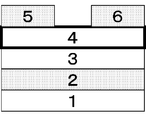
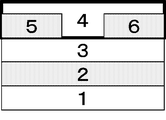
- FIG. 1 shows a conceptual diagram of a top contact transistor (hereinafter referred to as TC type), and FIG. 2 shows a conceptual diagram of a bottom contact type transistor (hereinafter referred to as BC type).
- TC type top contact transistor
- BC type bottom contact type transistor
- 1 is a substrate
- 2 is a gate electrode
- 3 is a gate insulating layer
- 4 is an organic semiconductor
- 5 is a source electrode
- 6 is a drain electrode.
- the BC type is a semiconductor material that is inferior to other element forming materials (metals for electrode materials and resins for gate insulating materials) in terms of heat resistance, weather resistance and solvent resistance. Since it is handled, it is superior in wet process suitability (suitability for producing elements by printing, coating, etc.) and has a more practical structure.
- the BC type tends to be inferior to the device characteristics as compared to the TC type (Aldrich Basic Material Science No. 6 “Basics of Organic Transistors”, section 2.2).
- the characteristic of the compound of the present invention is that the known and conventional semiconductor compounds show high characteristics in the TC type, but the characteristics are not reproduced in the BC type, but the BC type is equivalent to the TC type as described later. It is to show the characteristics. This is presumably because the compound of the present invention is self-organized in the vicinity of the electrode as described above, and the electrical contact between the electrode and the semiconductor film interface is optimized.
- the substrate 1 can be made of silicon, glass, various resin materials, or the like.
- Various resin materials include, for example, polyethylene terephthalate (PET), polyethylene naphthalate (PEN), polyethersulfone (PES), polyetherimide, polyetheretherketone, polyphenylene sulfide, polyarylate, polyimide, polycarbonate (PC). , Cellulose triacetate (TAC), cellulose acetate propionate (CAP), acrylic resin, and the like.
- the electrode material of the gate electrode, source electrode, or drain electrode is not particularly limited as long as it is a conductive material.
- a conductive material For example, platinum, gold, silver, nickel, chromium, copper, iron, tin, tin oxide / antimony, oxidation Indium tin (ITO), fluorine-doped zinc oxide, carbon, graphite, glassy carbon, silver paste and carbon paste, lithium, beryllium, sodium, magnesium, potassium, calcium, scandium, titanium, manganese, zirconium, gallium, niobium, sodium , Sodium-potassium alloy, magnesium, lithium, aluminum, magnesium / copper mixture, magnesium / silver mixture, magnesium / aluminum mixture, magnesium / indium mixture, aluminum / aluminum oxide mixture, lithium It can be cited metal material such as aluminum mixture.
- conductive polymers whose conductivity has been improved by doping or the like, for example, conductive polyaniline, conductive polypyrrole, conductive polythiophene, “complex of polyethylene dioxythiophene and polystyrene sulfonic acid” or the like are also preferably used.
- the above materials are used as raw materials, such as a vacuum deposition method, a molecular beam epitaxial growth method, an ion cluster beam method, a low energy ion beam method, an ion plating method, a CVD method, a sputtering method, and an atmospheric pressure plasma method.
- Dry process inkjet method, gravure printing method, gravure offset printing method, offset printing method, relief printing method, relief printing method, screen printing method, micro contact printing method, reverse coater method, air doctor coater method, blade coater method Air knife coater method, roll coater method, squeeze coater method, impregnation coater method, transfer roll coater method, kiss coater method, cast coater method, spray coater method, electrostatic coater method, ultrasonic spray coater method, die coater method A spin coating method, a bar coater method, a slit coater method, include wet process drop casting, it may be appropriately used depending on the material.
- a method of etching using a resist by inkjet or the like may be used.
- the conductive fine particle dispersion or the conductive polymer solution or dispersion may be directly patterned by a wet process such as an ink jet method, a screen printing method, a gravure offset printing method, a letterpress reverse printing method, or a micro contact printing method. Then, after forming a solid film by coating film formation, patterning may be performed by a known and commonly used photolithography method-etching method combination or laser ablation method, or a wet process and a photolithography method-lift-off method. Patterning may be performed in combination.
- Gate insulating layer is a thermoplastic resin such as parylene, polystyrene, acrylic resin, polyester resin; thermosetting resin such as epoxy resin, urethane resin, phenol resin, unsaturated polyester resin, alkyd resin, melamine resin; UV curable resin
- An organic thin film such as a silicon oxide film can be preferably used, but an inorganic material such as a silicon oxide film can also be used.
- the gate insulating layer is formed by a spin coating method, a casting method, a dipping method, an ink jet method, a doctor blade method, a screen printing method, an offset printing method, a letterpress printing method, a reverse printing method, a micro contact printing method, a wire bar coating method, a spray coating method.
- a thin film can be prepared by a known wet film forming method such as a dispensing method, and may be patterned into a necessary shape by a photolithographic method, if necessary.
- the organic semiconductor layer can be produced by a known and common production method such as a vacuum vapor deposition method, but the organic semiconductor layer can be easily formed by a printing method using an organic semiconductor ink as a material.
- printing methods include inkjet method, gravure printing method, gravure offset printing method, offset printing method, relief printing method, relief printing method, screen printing method, micro contact printing method, reverse coater method, air doctor coater method , Blade coater method, air knife coater method, roll coater method, squeeze coater method, impregnation coater method, transfer roll coater method, kiss coater method, cast coater method, spray coater method, electrostatic coater method, ultrasonic spray coater method, die coater It is possible to produce a thin film by a known wet film forming method such as a method, a spin coater method, a bar coater method, a slit coater method, a drop cast method, or a dispense method.
- the organic transistor of the present invention can be suitably used as a switching transistor, a signal driver circuit element, a memory circuit element, a signal processing circuit element or the like of a pixel constituting a display.
- the display include a liquid crystal display, a dispersed liquid crystal display, an electrophoretic display, a particle rotating display element, an electrochromic display, an organic electroluminescence display, and electronic paper.
- Acetic acid 350 mL was added to 1,5-dihydroquinaphthalene (10.0 g, 62.4 mmol) and iodine (130 mg), and the mixture was stirred at room temperature.
- the reaction solution was heated to 80 ° C., and a solution of 6.5 mL (127 mmol) of bromine in 28 mL of acetic acid was slowly added dropwise. After stirring at 80 ° C. for 5 minutes, the reaction solution was air-cooled to room temperature. The precipitated green needle crystal was collected by filtration. The obtained solid was recrystallized from 200 mL of acetic acid to obtain 11.8 g (yield, 62.1%) of 2,6-dibromo-1,5-dihydroxynaphthalene.
- the aqueous phase was further extracted with dichloromethane, the organic phases were combined, dried over magnesium sulfate and concentrated to dryness.
- the obtained crude product was crystallized from cyclohexane to obtain 10.2 g (yield, 80%) of 1,5-dibromo-2,6-bis (trimethylethynyl) naphthalene.
- This reaction solution was extracted three times with 100 mL of diethyl ether, and the extract was washed three times with 100 mL of saturated brine, dried over anhydrous magnesium sulfate, and concentrated to dryness to obtain a crude liquid.
- This reaction solution was extracted 3 times with 50 mL of dichloromethane, washed 3 times with 50 mL of saturated brine, dried over anhydrous magnesium sulfate, and concentrated to dryness to obtain a crude solid.
- the reaction solution was added to 500 mL of water. Further, the produced solid was washed with 100 mL of acetone. After dissolving the solid in 150 mL of dichloromethane, 30 g of a metal scavenger was added to prepare a slurry. The slurry was removed by filtration, and the filtrate was dried over anhydrous magnesium sulfate and then concentrated to dryness to obtain a crude solid. The crude solid was recrystallized from cyclohexane to obtain 7.0 g (yield 65%) of 2-methoxy-6- (phenylethynyl) naphthalene as white crystals.
- This reaction solution was extracted three times with 70 mL of dichloromethane, washed three times with 100 mL of saturated brine, dried over anhydrous magnesium sulfate, and concentrated to dryness to obtain a crude solid.
- This crude solid was separated and purified by silica gel column chromatography (toluene) to obtain 1.5 g (yield 52%) of 3-methylthio-6- (phenylethynyl) -2-naphthol as a white solid.
- 3-methylthio-6- (phenylethynyl) -2-naphthol (1.4 g, 4.8 mmol) is dissolved in dichloromethane (12 mL), pyridine (1.3 mL, 16 mmol) is added, and the mixture is stirred at about 0 ° C. under an argon atmosphere with stirring. After cooling to 1.66 g (5.88 mmol) of trifluoromethanesulfonic anhydride, the mixture was warmed to room temperature and stirred for 4 hours.
- dissolved in 5 mL of mixed solvents of acetic acid 50/50, 1.24 g (4.89 mmol) of iodine was added, stirring under argon atmosphere, and it stirred under recirculation
- 6-decyl-2-iodo-3methoxynaphthalene 6.0 g (14 mmol), 3-methoxy-6-phenylethynylnaphthalen-2-ylboronic acid pinacol 4.3 g (14 mmol), tetrakis (triphenylphosphine) palladium (0) 0.64 g (0.7 mmol) was dissolved in 85 mL of tetrahydrofuran under an argon atmosphere and stirred at room temperature. Thereto was added 42 mL of an aqueous solution in which 7.8 g (56 mmol) of potassium carbonate was dissolved, and the mixture was heated to reflux for 48 hours.
- the yellow solid obtained by drying was added to 300 mL of pyridine, followed by stirring at 120 ° C. for 28 h under a nitrogen atmosphere. After concentrating this reaction solution, it was added to 500 mL of acetone, the precipitate was filtered off, chloroform was added, transferred to a separatory funnel, the machine layer was separated and washed with water and brine, dried over magnesium sulfate, Concentrated.
- 2-octyl-TTBDT 1.18 g (2.85 mmol) was dissolved in 80 mL of chloroform and then cooled to 0 ° C., and bromine 0.97 mL (3.56 mmol) was added dropwise over 20 minutes. The mixture was further stirred at 0 ° C. for 0.5 hour, then warmed to room temperature and stirred for 3 hours to stop the reaction. A 0.5 M aqueous sodium thiosulfate solution was added for liquid separation, and the lower layer was taken and concentrated to dryness to obtain a crude solid. This solid was recrystallized from an acetone / THF mixed solvent to obtain 0.51 g (yield, 36%) of 2-bromo-7-octyl-TTBDT white crystals.
- Example 1 Evaluation of Organic Transistor Characteristics of Compound of Synthesis Example 1 (Evaluation of Compound Solubility)
- the p-xylene solution prepared so that the concentration of the compound obtained in Synthesis Example 1 was 0.4% by mass was heated to 60 ° C. to completely dissolve the compound. After the solution was stored at room temperature for 1 day, the presence or absence of a precipitate was visually confirmed, and it was confirmed that there was no precipitate.
- the solution thus obtained is hereinafter referred to as “p-xylene solution in which 0.4% by mass of the compound of Synthesis Example 1 is dissolved”.
- the solubility evaluation of the compound of the present invention the case where there was no precipitate was indicated as ⁇ , the case where there was a precipitate was indicated as x, and the results are shown in Table 1.
- the TC transistor shown in FIG. 1 was manufactured as follows. First, the glass substrate was ultrasonically cleaned in this order with a neutral detergent aqueous solution, distilled water, acetone and ethanol (each 30 minutes ⁇ 3 times), and then a platinum film was formed by sputtering (film thickness: 30 nm). A gate electrode was prepared. Next, the glass substrate provided with this platinum gate electrode is set in a thermal CVD apparatus (LABCOTERPDS 2010, manufactured by Parylene, Japan), and a dichloro-di-p-xylylene polymer film (paraxylylene) having a film thickness of 1 ⁇ m under predetermined conditions. Ren polymer film) was prepared as a gate insulating layer.
- the substrate thus obtained is hereinafter referred to as “a glass substrate having a gate electrode and a gate insulating layer”.
- a glass substrate having a gate electrode and a gate insulating layer Next, 0.05 ⁇ L of “p-xylene solution in which 0.4% by mass of the compound of Synthesis Example 1” was dropped on the “glass substrate including the gate electrode and the gate insulating layer”, and the semiconductor layer (channel Layer).
- gold was patterned on the substrate on which the semiconductor layer was formed via a metal mask (vacuum deposition under 4 ⁇ 10 ⁇ 6 Torr) to produce source / drain electrodes (film thickness: 30 nm, channel Length (L) / channel width (W): 100 ⁇ m / 1000 ⁇ m).
- the transistor thus obtained was evaluated by applying a sweep voltage (V sg : +40 to ⁇ 60 V) to the gate electrode using a digital multimeter (SMU237, manufactured by Keithley) in the atmosphere.
- the measurement was performed by measuring the current (I d ) between the drain electrodes.
- the voltage (V sd ) applied between the source and drain electrodes is ⁇ 80V.
- the mobility was 1.1.
- the mobility was obtained from the slope of ⁇ I d ⁇ V sg using the following equation (iii).
- the unit is cm 2 / Vs.
- the BC transistor shown in FIG. 2 was manufactured as follows. On the “glass substrate provided with a gate electrode and a gate insulating layer”, gold was subjected to pattern deposition (vacuum deposition under 4 ⁇ 10 ⁇ 6 Torr) through a metal mask to form source / drain electrodes (film) Thickness: 30 nm, channel length (L) / channel width (W): 100 ⁇ m / 1000 ⁇ m). Next, the substrate on which the source / drain electrodes were formed was immersed in an ethanol solution of pentafluorobenzenethiol adjusted to 0.08 mass% for 1 hour, rinsed with ethanol, and then “the compound of Synthesis Example 1 was added.
- Example 2 Evaluation of Organic Transistor Characteristics of Compound of Synthesis Example 2 The same as Example 1 except that the compound obtained in Synthesis Example 2 was used in place of the compound obtained in Synthesis Example 1 as the material for the organic semiconductor layer. Then, TC and BC type transistors were fabricated and their characteristics were evaluated. The results are shown in Table 1.
- Example 3 Evaluation of Organic Transistor Characteristics of Compound of Synthesis Example 3
- the same as Example 1 except that the compound obtained in Synthesis Example 3 was used instead of the compound obtained in Synthesis Example 1.
- TC and BC type transistors were fabricated and their characteristics were evaluated. The results are shown in Table 1.
- Example 4 Evaluation of Organic Transistor Characteristics of Compound of Synthesis Example 4 As Example 1 except that the compound obtained in Synthesis Example 4 was used instead of the compound obtained in Synthesis Example 1 as the material of the organic semiconductor layer. Then, TC and BC type transistors were fabricated and their characteristics were evaluated. The results are shown in Table 1.
- Example 5 Evaluation of organic transistor characteristics of compound of Synthesis Example 5 As the material of the organic semiconductor layer, the same as Example 1 except that the compound obtained in Synthesis Example 5 was used instead of the compound obtained in Synthesis Example 1. Then, TC and BC type transistors were fabricated and their characteristics were evaluated. The results are shown in Table 1.
- Example 6 Evaluation of Organic Transistor Characteristics of Compound of Synthesis Example 6 As Example 1 except that the compound obtained in Synthesis Example 5 was used instead of the compound obtained in Synthesis Example 1 as the material of the organic semiconductor layer. Then, TC and BC type transistors were fabricated and their characteristics were evaluated. The results are shown in Table 1.
- Example 7 Evaluation of organic transistor characteristics of compound of synthesis example 7 As the material of the organic semiconductor layer, the compound obtained in synthesis example 5 was used instead of the compound obtained in synthesis example 1, and the same as in example 1 Then, TC and BC type transistors were fabricated and their characteristics were evaluated. The results are shown in Table 1.
- Example 8 Evaluation of organic transistor characteristics of compound of Synthesis Example 8 As the material of the organic semiconductor layer, the same as Example 1 except that the compound obtained in Synthesis Example 5 was used instead of the compound obtained in Synthesis Example 1. Then, TC and BC type transistors were fabricated and their characteristics were evaluated. The results are shown in Table 1.
- Comparative Example 2 When the compound obtained in Comparative Synthesis Example 2 was used in place of the compound obtained in Synthesis Example 1 as the material for the organic semiconductor layer and the solubility of the compound was evaluated in the same manner as in Example 1, the compound was found to be p. -The transistor could not be produced because it was not dissolved in xylene.
- the compound of the present invention is excellent in solvent solubility, and the known and conventional methods shown in Comparative Example 1 are used in both cases of a TC transistor and a BC transistor in which a semiconductor layer is simply formed by a wet method. It exhibits a higher mobility than that of the compound. Surprisingly, a BC type transistor that has been difficult to express characteristics conventionally exhibits higher characteristics than a TC type transistor. From the above, it is clear that the compound of the present invention has practically preferable performance as described above, and is superior to known and commonly used compounds.
- the compound of the present invention can be used as an organic semiconductor, and can be used for an organic transistor using the organic semiconductor material as an organic semiconductor layer.
Landscapes
- Chemical & Material Sciences (AREA)
- Organic Chemistry (AREA)
- Engineering & Computer Science (AREA)
- Materials Engineering (AREA)
- Life Sciences & Earth Sciences (AREA)
- Wood Science & Technology (AREA)
- Physics & Mathematics (AREA)
- Spectroscopy & Molecular Physics (AREA)
- Heterocyclic Carbon Compounds Containing A Hetero Ring Having Oxygen Or Sulfur (AREA)
- Thin Film Transistor (AREA)
Abstract
Le problème abordé par la présente invention est de pourvoir à un composé qui possède une solubilité supérieure dans un solvant, permettant d'obtenir facilement une membrane présentant une mobilité élevée même sans subir un processus complexe, le composé étant représenté par la formule générale (1), et de pourvoir à un matériau semi-conducteur organique l'utilisant ; et de pourvoir en outre à une encre semi-conductrice organique permettant de préparer facilement un transistor organique ayant une configuration pratique. Le composé, qui comprend un squelette mésogène ayant un groupe substituant spécifique, est approprié en tant qu'encre semi-conductrice organique du fait qu'il présente une excellente solubilité dans le solvant, ne nécessite pas de traitement thermique compliqué, et permet de résoudre le problème susmentionné, y compris au moyen d'un procédé par voie humide simple. Les groupes R1, R2, p, et MSG dans la formule générale (1) sont tels que définis dans la revendication 1.
Priority Applications (1)
| Application Number | Priority Date | Filing Date | Title |
|---|---|---|---|
| JP2016507745A JP6047261B2 (ja) | 2014-03-12 | 2015-03-10 | 化合物、並びにそれを含有する有機半導体材料、有機半導体インク及び有機トランジスタ |
Applications Claiming Priority (2)
| Application Number | Priority Date | Filing Date | Title |
|---|---|---|---|
| JP2014-048793 | 2014-03-12 | ||
| JP2014048793 | 2014-03-12 |
Publications (1)
| Publication Number | Publication Date |
|---|---|
| WO2015137304A1 true WO2015137304A1 (fr) | 2015-09-17 |
Family
ID=54071748
Family Applications (1)
| Application Number | Title | Priority Date | Filing Date |
|---|---|---|---|
| PCT/JP2015/056935 Ceased WO2015137304A1 (fr) | 2014-03-12 | 2015-03-10 | Composé, matériau semi-conducteur organique le contenant, encre semi-conductrice organique et transistor organique |
Country Status (3)
| Country | Link |
|---|---|
| JP (1) | JP6047261B2 (fr) |
| TW (1) | TWI609021B (fr) |
| WO (1) | WO2015137304A1 (fr) |
Cited By (9)
| Publication number | Priority date | Publication date | Assignee | Title |
|---|---|---|---|---|
| JP2017017216A (ja) * | 2015-07-02 | 2017-01-19 | Dic株式会社 | 半導体組成物、半導体インク |
| WO2017038286A1 (fr) * | 2015-08-28 | 2017-03-09 | Dic株式会社 | Composé organique, procédé de fabrication de celui-ci, matériau semi-conducteur organique contenant celui-ci, et transistor organique contenant celui-ci |
| JP2017154983A (ja) * | 2016-02-29 | 2017-09-07 | 日本化薬株式会社 | 縮合多環芳香族化合物及びその用途 |
| WO2017159657A1 (fr) * | 2016-03-18 | 2017-09-21 | Dic株式会社 | Nouveau composé et matériau semi-conducteur organique le contenant |
| US10056563B2 (en) | 2016-04-08 | 2018-08-21 | Samsung Electronics Co., Ltd. | Synthetic method of fused heteroaromatic compound and fused heteroaromatic compound, and intermediate thereof |
| KR20180117175A (ko) | 2016-02-29 | 2018-10-26 | 고쿠리츠켄큐카이하츠호진 상교기쥬츠 소고켄큐쇼 | 유기 반도체 조성물 및 그들로 이루어지는 유기 박막, 그리고 그의 용도 |
| US10707424B2 (en) | 2016-11-08 | 2020-07-07 | Samsung Electronics Co., Ltd. | Synthetic method of fused heteroaromatic compound and fused heteroaromatic compound and intermediate therefor and synthetic method of intermediate |
| CN111655684A (zh) * | 2017-10-19 | 2020-09-11 | Clap有限公司 | 用于有机电子材料的新型取代苯并萘噻吩化合物 |
| US12384796B2 (en) | 2016-06-03 | 2025-08-12 | Lg Chem, Ltd. | Electroactive compounds |
Families Citing this family (2)
| Publication number | Priority date | Publication date | Assignee | Title |
|---|---|---|---|---|
| JP6116018B2 (ja) | 2015-01-29 | 2017-04-19 | 国立大学法人 東京大学 | 有機半導体素子 |
| CN120829780A (zh) * | 2024-04-17 | 2025-10-24 | 华为技术有限公司 | 液晶化合物及其制备方法、液晶组合物和应用 |
Citations (15)
| Publication number | Priority date | Publication date | Assignee | Title |
|---|---|---|---|---|
| JP2000109843A (ja) * | 1998-10-08 | 2000-04-18 | Dainippon Ink & Chem Inc | ネマチック液晶組成物及びこれを用いた液晶表示装置 |
| JP2000119653A (ja) * | 1998-10-16 | 2000-04-25 | Dainippon Ink & Chem Inc | ネマチック液晶組成物及びこれを用いた液晶表示装置 |
| JP2000355560A (ja) * | 1999-06-15 | 2000-12-26 | Dainippon Ink & Chem Inc | 2−フルオロナフタレン誘導体である新規液晶性化合物とそれを含有する液晶組成物 |
| JP2001072977A (ja) * | 1999-06-30 | 2001-03-21 | Dainippon Ink & Chem Inc | ネマチック液晶組成物及びこれを用いた液晶表示装置 |
| JP2003073382A (ja) * | 2001-07-09 | 2003-03-12 | Merck Patent Gmbh | チエノチオフェン誘導体 |
| JP2003137888A (ja) * | 2001-07-09 | 2003-05-14 | Merck Patent Gmbh | 反応性チエノチオフェン |
| JP2004534100A (ja) * | 2001-07-09 | 2004-11-11 | メルク パテント ゲゼルシャフト ミット ベシュレンクテル ハフトング | 重合性電荷移動化合物 |
| JP2006520098A (ja) * | 2003-03-06 | 2006-08-31 | メルク パテント ゲゼルシャフト ミット ベシュレンクテル ハフトング | 有機発光材料およびこれらの材料を含む発光デバイス |
| JP2008010541A (ja) * | 2006-06-28 | 2008-01-17 | Konica Minolta Holdings Inc | 有機半導体材料、有機半導体膜、有機薄膜トランジスタ及び有機薄膜トランジスタの製造方法 |
| JP2012020987A (ja) * | 2010-06-15 | 2012-02-02 | Ricoh Co Ltd | 置換基脱離化合物とそれから得られる有機半導体材料、それを用いた有機電子デバイス、有機薄膜トランジスタおよびディスプレイ装置 |
| JP2012216669A (ja) * | 2011-03-31 | 2012-11-08 | Ricoh Co Ltd | 芳香環を有するπ電子共役系化合物を含有する膜状体の製法、及び該π電子共役系化合物の製法 |
| JP2013026448A (ja) * | 2011-07-21 | 2013-02-04 | Ricoh Co Ltd | 薄膜トランジスタ及びそれを用いた電子デバイス |
| JP2013035814A (ja) * | 2011-08-11 | 2013-02-21 | Ricoh Co Ltd | 新規な有機半導体材料およびそれを用いた電子デバイス |
| WO2014038708A1 (fr) * | 2012-09-10 | 2014-03-13 | Dic株式会社 | Dérivé du benzothiénobenzothiophène, matériau semi-conducteur organique et transistor organique |
| WO2014136898A1 (fr) * | 2013-03-07 | 2014-09-12 | Dic株式会社 | Couche mince organique, dispositif semi-conducteur organique, et transistor organique l'utilisant |
Family Cites Families (7)
| Publication number | Priority date | Publication date | Assignee | Title |
|---|---|---|---|---|
| JP5284677B2 (ja) * | 2008-04-25 | 2013-09-11 | 山本化成株式会社 | 有機トランジスタ |
| CN102666643B (zh) * | 2009-12-25 | 2014-08-13 | 住友化学株式会社 | 高分子化合物、含有该高分子化合物的薄膜和墨液组合物 |
| JP2011165747A (ja) * | 2010-02-05 | 2011-08-25 | Yamamoto Chem Inc | 有機トランジスタ |
| JP5634758B2 (ja) * | 2010-06-14 | 2014-12-03 | 山本化成株式会社 | チオフェン化合物、および該化合物を含有してなる有機トランジスタ |
| TW201348241A (zh) * | 2011-12-30 | 2013-12-01 | Imp Innovations Ltd | 有機半導體材料之非習用性化學摻雜 |
| JP2013159584A (ja) * | 2012-02-07 | 2013-08-19 | Univ Of Tokyo | 電子材料およびこれを用いた電子素子 |
| JP2013181071A (ja) * | 2012-02-29 | 2013-09-12 | Sumitomo Chemical Co Ltd | 高分子化合物、これを含む組成物、インク組成物、薄膜及び素子 |
-
2015
- 2015-03-10 WO PCT/JP2015/056935 patent/WO2015137304A1/fr not_active Ceased
- 2015-03-10 JP JP2016507745A patent/JP6047261B2/ja active Active
- 2015-03-12 TW TW104107976A patent/TWI609021B/zh active
Patent Citations (15)
| Publication number | Priority date | Publication date | Assignee | Title |
|---|---|---|---|---|
| JP2000109843A (ja) * | 1998-10-08 | 2000-04-18 | Dainippon Ink & Chem Inc | ネマチック液晶組成物及びこれを用いた液晶表示装置 |
| JP2000119653A (ja) * | 1998-10-16 | 2000-04-25 | Dainippon Ink & Chem Inc | ネマチック液晶組成物及びこれを用いた液晶表示装置 |
| JP2000355560A (ja) * | 1999-06-15 | 2000-12-26 | Dainippon Ink & Chem Inc | 2−フルオロナフタレン誘導体である新規液晶性化合物とそれを含有する液晶組成物 |
| JP2001072977A (ja) * | 1999-06-30 | 2001-03-21 | Dainippon Ink & Chem Inc | ネマチック液晶組成物及びこれを用いた液晶表示装置 |
| JP2003073382A (ja) * | 2001-07-09 | 2003-03-12 | Merck Patent Gmbh | チエノチオフェン誘導体 |
| JP2003137888A (ja) * | 2001-07-09 | 2003-05-14 | Merck Patent Gmbh | 反応性チエノチオフェン |
| JP2004534100A (ja) * | 2001-07-09 | 2004-11-11 | メルク パテント ゲゼルシャフト ミット ベシュレンクテル ハフトング | 重合性電荷移動化合物 |
| JP2006520098A (ja) * | 2003-03-06 | 2006-08-31 | メルク パテント ゲゼルシャフト ミット ベシュレンクテル ハフトング | 有機発光材料およびこれらの材料を含む発光デバイス |
| JP2008010541A (ja) * | 2006-06-28 | 2008-01-17 | Konica Minolta Holdings Inc | 有機半導体材料、有機半導体膜、有機薄膜トランジスタ及び有機薄膜トランジスタの製造方法 |
| JP2012020987A (ja) * | 2010-06-15 | 2012-02-02 | Ricoh Co Ltd | 置換基脱離化合物とそれから得られる有機半導体材料、それを用いた有機電子デバイス、有機薄膜トランジスタおよびディスプレイ装置 |
| JP2012216669A (ja) * | 2011-03-31 | 2012-11-08 | Ricoh Co Ltd | 芳香環を有するπ電子共役系化合物を含有する膜状体の製法、及び該π電子共役系化合物の製法 |
| JP2013026448A (ja) * | 2011-07-21 | 2013-02-04 | Ricoh Co Ltd | 薄膜トランジスタ及びそれを用いた電子デバイス |
| JP2013035814A (ja) * | 2011-08-11 | 2013-02-21 | Ricoh Co Ltd | 新規な有機半導体材料およびそれを用いた電子デバイス |
| WO2014038708A1 (fr) * | 2012-09-10 | 2014-03-13 | Dic株式会社 | Dérivé du benzothiénobenzothiophène, matériau semi-conducteur organique et transistor organique |
| WO2014136898A1 (fr) * | 2013-03-07 | 2014-09-12 | Dic株式会社 | Couche mince organique, dispositif semi-conducteur organique, et transistor organique l'utilisant |
Non-Patent Citations (3)
| Title |
|---|
| INTERNATIONAL JOURNAL OF PHARMACEUTICS, vol. 376, 2009, pages 141 - 152, XP026185238 * |
| JOURNAL OF PHYSICAL CHEMISTRY C, vol. 114, no. 28, 2010, pages 12325 - 12334, XP055224016 * |
| JOURNAL OF PHYSICAL CHEMISTRY C, vol. 115, no. 14, 2011, pages 6922 - 6932, XP055224030 * |
Cited By (15)
| Publication number | Priority date | Publication date | Assignee | Title |
|---|---|---|---|---|
| JP2017017216A (ja) * | 2015-07-02 | 2017-01-19 | Dic株式会社 | 半導体組成物、半導体インク |
| WO2017038286A1 (fr) * | 2015-08-28 | 2017-03-09 | Dic株式会社 | Composé organique, procédé de fabrication de celui-ci, matériau semi-conducteur organique contenant celui-ci, et transistor organique contenant celui-ci |
| JP6112269B1 (ja) * | 2015-08-28 | 2017-04-12 | Dic株式会社 | 有機化合物、その製造法、それを含有する有機半導体材料及びそれを含有する有機トランジスタ |
| US10516115B2 (en) | 2015-08-28 | 2019-12-24 | Dic Corporation | Organic compound, method for preparing same, organic semiconductor material containing same, and organic transistor containing same |
| US11198698B2 (en) | 2016-02-29 | 2021-12-14 | National Institute Of Advanced Industrial Science And Technology | Organic semiconductor composition, organic thin film comprising same, and use thereof |
| JP2017154983A (ja) * | 2016-02-29 | 2017-09-07 | 日本化薬株式会社 | 縮合多環芳香族化合物及びその用途 |
| KR20180117175A (ko) | 2016-02-29 | 2018-10-26 | 고쿠리츠켄큐카이하츠호진 상교기쥬츠 소고켄큐쇼 | 유기 반도체 조성물 및 그들로 이루어지는 유기 박막, 그리고 그의 용도 |
| WO2017159657A1 (fr) * | 2016-03-18 | 2017-09-21 | Dic株式会社 | Nouveau composé et matériau semi-conducteur organique le contenant |
| JPWO2017159657A1 (ja) * | 2016-03-18 | 2018-03-22 | Dic株式会社 | 新規化合物およびそれを含有する半導体材料 |
| US10056563B2 (en) | 2016-04-08 | 2018-08-21 | Samsung Electronics Co., Ltd. | Synthetic method of fused heteroaromatic compound and fused heteroaromatic compound, and intermediate thereof |
| US10600973B2 (en) | 2016-04-08 | 2020-03-24 | Samsung Electronics Co., Ltd. | Synthetic method of fused heteroaromatic compound and fused heteroaromatic compound, and intermediate thereof |
| US12384796B2 (en) | 2016-06-03 | 2025-08-12 | Lg Chem, Ltd. | Electroactive compounds |
| US10707424B2 (en) | 2016-11-08 | 2020-07-07 | Samsung Electronics Co., Ltd. | Synthetic method of fused heteroaromatic compound and fused heteroaromatic compound and intermediate therefor and synthetic method of intermediate |
| CN111655684A (zh) * | 2017-10-19 | 2020-09-11 | Clap有限公司 | 用于有机电子材料的新型取代苯并萘噻吩化合物 |
| CN111655684B (zh) * | 2017-10-19 | 2023-07-07 | Clap有限公司 | 用于有机电子材料的新型取代苯并萘噻吩化合物 |
Also Published As
| Publication number | Publication date |
|---|---|
| TW201538507A (zh) | 2015-10-16 |
| JPWO2015137304A1 (ja) | 2017-04-06 |
| TWI609021B (zh) | 2017-12-21 |
| JP6047261B2 (ja) | 2016-12-21 |
Similar Documents
| Publication | Publication Date | Title |
|---|---|---|
| JP6047261B2 (ja) | 化合物、並びにそれを含有する有機半導体材料、有機半導体インク及び有機トランジスタ | |
| He et al. | Asymmetric conjugated molecules based on [1] benzothieno [3, 2-b][1] benzothiophene for high-mobility organic thin-film transistors: influence of alkyl chain length | |
| Minemawari et al. | Enhanced layered-herringbone packing due to long alkyl chain substitution in solution-processable organic semiconductors | |
| CN105102462B (zh) | 含有氧族元素的有机化合物、其制造方法以及用途 | |
| US9537110B2 (en) | Chalcogen-containing organic compound and use thereof | |
| CN104769735B (zh) | 苯并噻吩并苯并噻吩衍生物、有机半导体材料、及有机晶体管 | |
| KR20100135834A (ko) | [1]벤조티에노[3,2-b][1]벤조티오펜 화합물 및 이의 제조 방법, 및 이를 이용한 유기 전자 소자 | |
| JP5502923B2 (ja) | 二価結合を有する小分子チオフェン化合物を備える装置 | |
| JP6112269B1 (ja) | 有機化合物、その製造法、それを含有する有機半導体材料及びそれを含有する有機トランジスタ | |
| JP6656508B2 (ja) | ベンゾチエノベンゾチオフェン誘導体、有機半導体材料、及び有機トランジスタ | |
| KR102539063B1 (ko) | 나프토인다세노디티오펜 및 중합체 | |
| JP2006008679A (ja) | 小分子チオフェン化合物の製造方法 | |
| WO2007029547A1 (fr) | Polymère à unité comprenant un anneau fluorocyclopentane fondu avec un noyau aromatique, et mince film organique et élément dudit film comprenant ce polymère | |
| JP6656506B2 (ja) | ベンゾチエノベンゾチオフェン誘導体、有機半導体材料、及び有機トランジスタ | |
| JP2006013483A (ja) | 小分子チオフェン化合物を備える装置 | |
| JPWO2017170245A1 (ja) | 新規有機高分子及びその製造方法 | |
| JP5637985B2 (ja) | ジアザボロール化合物、およびそれを含有した電界効果トランジスタ | |
| JP2017017216A (ja) | 半導体組成物、半導体インク | |
| JP5747352B2 (ja) | チエノピリジン誘導体を用いた有機半導体デバイス | |
| WO2012111533A1 (fr) | Composé pour transistor organique | |
| TW201038619A (en) | Oligomeric and polymeric semiconductors based on thienothiazoles |
Legal Events
| Date | Code | Title | Description |
|---|---|---|---|
| 121 | Ep: the epo has been informed by wipo that ep was designated in this application |
Ref document number: 15762237 Country of ref document: EP Kind code of ref document: A1 |
|
| ENP | Entry into the national phase |
Ref document number: 2016507745 Country of ref document: JP Kind code of ref document: A |
|
| NENP | Non-entry into the national phase |
Ref country code: DE |
|
| 122 | Ep: pct application non-entry in european phase |
Ref document number: 15762237 Country of ref document: EP Kind code of ref document: A1 |