WO2015141015A9 - Élément élémentaire - Google Patents
Élément élémentaire Download PDFInfo
- Publication number
- WO2015141015A9 WO2015141015A9 PCT/JP2014/059380 JP2014059380W WO2015141015A9 WO 2015141015 A9 WO2015141015 A9 WO 2015141015A9 JP 2014059380 W JP2014059380 W JP 2014059380W WO 2015141015 A9 WO2015141015 A9 WO 2015141015A9
- Authority
- WO
- WIPO (PCT)
- Prior art keywords
- particle
- particles
- energy
- ratio
- absorption
- Prior art date
- Legal status (The legal status is an assumption and is not a legal conclusion. Google has not performed a legal analysis and makes no representation as to the accuracy of the status listed.)
- Ceased
Links
Images


Classifications
-
- H—ELECTRICITY
- H01—ELECTRIC ELEMENTS
- H01J—ELECTRIC DISCHARGE TUBES OR DISCHARGE LAMPS
- H01J1/00—Details of electrodes, of magnetic control means, of screens, or of the mounting or spacing thereof, common to two or more basic types of discharge tubes or lamps
- H01J1/02—Main electrodes
- H01J1/30—Cold cathodes, e.g. field-emissive cathode
- H01J1/304—Field-emissive cathodes
- H01J1/3042—Field-emissive cathodes microengineered, e.g. Spindt-type
- H01J1/3044—Point emitters
-
- H—ELECTRICITY
- H05—ELECTRIC TECHNIQUES NOT OTHERWISE PROVIDED FOR
- H05H—PLASMA TECHNIQUE; PRODUCTION OF ACCELERATED ELECTRICALLY-CHARGED PARTICLES OR OF NEUTRONS; PRODUCTION OR ACCELERATION OF NEUTRAL MOLECULAR OR ATOMIC BEAMS
- H05H3/00—Production or acceleration of neutral particle beams, e.g. molecular or atomic beams
- H05H3/02—Molecular or atomic-beam generation, e.g. resonant beam generation
-
- H—ELECTRICITY
- H01—ELECTRIC ELEMENTS
- H01J—ELECTRIC DISCHARGE TUBES OR DISCHARGE LAMPS
- H01J37/00—Discharge tubes with provision for introducing objects or material to be exposed to the discharge, e.g. for the purpose of examination or processing thereof
- H01J37/02—Details
- H01J37/04—Arrangements of electrodes and associated parts for generating or controlling the discharge, e.g. electron-optical arrangement or ion-optical arrangement
- H01J37/06—Electron sources; Electron guns
- H01J37/073—Electron guns using field emission, photo emission, or secondary emission electron sources
-
- B—PERFORMING OPERATIONS; TRANSPORTING
- B82—NANOTECHNOLOGY
- B82Y—SPECIFIC USES OR APPLICATIONS OF NANOSTRUCTURES; MEASUREMENT OR ANALYSIS OF NANOSTRUCTURES; MANUFACTURE OR TREATMENT OF NANOSTRUCTURES
- B82Y30/00—Nanotechnology for materials or surface science, e.g. nanocomposites
-
- H—ELECTRICITY
- H01—ELECTRIC ELEMENTS
- H01J—ELECTRIC DISCHARGE TUBES OR DISCHARGE LAMPS
- H01J2237/00—Discharge tubes exposing object to beam, e.g. for analysis treatment, etching, imaging
- H01J2237/06—Sources
- H01J2237/063—Electron sources
- H01J2237/06383—Spin polarised electron sources
Definitions
- the present invention relates to a basic element having a particle emission / absorption source containing electromagnetic waves, electrons, holes, atoms / molecules, etc., and particles entering / exiting between other basic elements, interaction between these particles, chemical reaction, etc.
- Modifiers that allow time-varying mechanical / electromagnetic forces to the particle moving part face the emission / absorption edge of the basic element or are in the space created by the emission / absorption edge of one or more basic elements, Emission and absorption of low-energy particles that suppress the influence on the S / N ratio due to the steric structure and lattice of the constituent material of the particle moving part between the absorption edges and their three-dimensional structure and lattice, and the heat of the device
- the present invention relates to a basic element to be controlled and an apparatus, module, and system constructed from the plurality of basic elements.
- a beam of electromagnetic waves, particles, etc. (hereinafter abbreviated as a generic name when no particle is specified) is irradiated to the sample to analyze the physicochemical structure of the sample or to irradiate the material. It is used for physical or chemical processing or as an energy source.
- an electron beam is used in a scanning electron microscope, a transmission electron microscope, an electron beam exposure apparatus, a thermionic emission electron gun, a field emission electron gun, and the like.
- the electron emission area can be reduced, the cathode tip spherical surface having a radius of 0.4 ⁇ m is heated to 1800 K, and the electric field applied to the electron emission surface is ⁇ 10 8 V / m. It becomes a high-intensity electron beam about three orders of magnitude higher than a gun.
- the electric field (Schottky) emission type gun requires heating of the cathode, the Schottky shield, the first and second anodes, and the cathode.
- a pierce-type electron gun structure having a concave-shaped cathode having self-focusing characteristics is used, the electron flow is focused as a laminar flow.
- Non-patent document 1 Non-patent document 2
- Non-patent Document 3 in the electric field (Schottky) emission electron gun using single-walled or multi-walled carbon nanotubes, the height from the cathode is 1.6 ⁇ m and the radius is 7.5 nm.
- Particle beams are used for physical and chemical processing, and include molecular beam epitaxy, ion beam lithography, and ion implantation. With a focused ion beam, the target material can be processed in nano-order. It is also used to excite gas, control discharge, and plasma ignition. An atomic or molecular particle beam is called an ion beam or a radical beam depending on how the particles are charged. Moreover, what uses electromagnetic waves, such as a light beam, as a beam can also be considered. Such is a polarized beam.
- a positron also becomes a particle beam.
- a positron is generated by using an icosolid combination in which a plurality of hollow 24-hedrons are combined.
- the electrical resistance due to conduction electrons in the conductor decreases, scattering due to lattice vibration and interaction between conduction electrons becomes negligible, and a residual resistance that is usually governed by impurity scattering remains.
- the electric conductivity varies greatly depending on the type of constituent atoms and the crystal structure. According to Anderson localization, the electric conductivity in a conductor having a two or less dimension in a random potential field becomes zero when the size of the system increases (Non-Patent Document 4).
- two different waves of free electrons at off-diagonal positions r ′ 0 and r> 0 of the conduction electrons.
- the conduction electron wave correlation function of a spherical wave expressed by the product of the function term and the state density of the conductor expressed by the Fermi distribution function is attenuated by the square of the radius r of the sphere, but the conduction electron wave function of the spherical wave. Is not disturbed by the temperature, and the density of states of the conduction electrons changes depending on the atomic species constituting the conductor, and the way of attenuation changes greatly.
- the conduction electron wave function in a quasi-one-dimensional system Although depending on the density of states of conduction electrons in the conductor, when c increases, the conduction electron wave function ⁇ in the quasi-one-dimensional system attenuates to exp ( ⁇ / ⁇ (c)).
- the variable of the conduction direction is ⁇ .
- the conduction electron wave correlation function in a quasi-one-dimensional system decays in the same way as ⁇ . When the temperature of the quasi-one-dimensional system rises, the electrical resistance is scattered by the interaction between electrons reflecting the lattice vibration and the difference of constituent atoms, and the conduction electron wave correlation function in the conductor is attenuated.
- ⁇ (c) becomes a function ⁇ (c, T) of the temperature T (Non-patent Document 5).
- the electrical resistance due to the conduction electrons in the conductor varies greatly depending on the magnitude relationship of ⁇ (c, T), L and the elastic scattering length l e of the conduction electrons.
- the scattering between conduction electrons in ⁇ (c, T) is taken into account by the density of states of the equation for calculating the conduction electron correlation function, the following case is considered. Then, the current due to conduction electrons is attenuated and no conduction occurs. Then, conduction electrons are scattered between lattice vibrations, impurities, and conduction electrons, and conduction electrons become diffusion conduction.
- Non-Patent Document 5 the particle beam in the conductor depends on the atomic type and the three-dimensional structure of the conductor other than the particle beam in the conductor including the conduction electron in the conductor, the attenuation depending on the conductor temperature, and the impurity concentration in the conductor. It has a damping coefficient of the wave function.
- Particle beams generated from electromagnetic wave, neutral or ionized atom and electron beam generating / absorbing elements are generated by the heat of the particle beam generating / absorbing elements.
- the particle beam flow is disturbed by the lattice vibration, and the SN ratio is deteriorated.
- the S / N ratio deteriorates due to disturbance due to Coulomb interaction and correlation interaction of charged particles in the particle beam flow, impurities in the particle beam generation / absorption element, disturbance due to external fields, and fluid around the particle beam.
- the particle beam flow rate is determined depending on the atomic species constituting the beam generating / absorbing element.
- the particle energy state in the particle beam element calculated by quantum mechanics is caused by the lattice vibration in the particle beam generating / absorbing element and the disturbance of impurities, constituent atoms, and molecules.
- the thermal noise of the particle beam generating / absorbing element causes a transition between energy levels in the particle beam.
- the influence of the heat of the beam generating / absorbing element on the S / N ratio is determined by the temperature and becomes small at low temperatures.
- NEA Near Electron Affinity
- Non-Patent Document 6 since the emission area of the NEA cold cathode is made extremely small and many electrons are arranged close to each other and the emission electron flow can be controlled by a bias current, the thermoelectrons emitted from the heated cathode are transferred between the cathode and the anode. Compared to a thermionic cathode electron gun having a portion to which an accelerating voltage is applied, the energy consumption is significantly less than that of a thermionic cathode and quick control can be performed. However, since a stable NEA surface is required, NEA devices have problems with emission efficiency and lifetime.
- the photocathode has a long wavelength limit, but this long wavelength limit eliminates the NEA device, and the negative voltage control electrode, the acceleration electrode, and the beam limiting aperture required in the case of the hot cathode are essential, but the NEA surface is unnecessary. Therefore, since a stable NEA surface is necessary, the NEA device has a problem of emission efficiency and lifetime. Since the NEA surface is indispensable for a photocathode for a spin-polarized electron source with high luminance and low emittance, the above-mentioned drawbacks become a problem.
- a photocathode for a spin-polarized electron source using a GaAs crystal on a pyramidal PEA Pulsitive Electron Affinity
- a circularly polarized laser is irradiated onto the GaAs crystal on the surface of the pyramidal PEA, and specific spin electrons are selectively excited from the valence band to the conduction band.
- the excited specific spin electron population is disturbed by thermal noise in the GaAs crystal before being emitted from the PEA surface, but the quantum efficiency and spin polarization of the specific spin electrons are increased by the tunnel.
- Thermoelectric conversion is an element that converts thermal energy and electrical energy by using the difference between the electromotive force of each charged conductor and the thermal energy carried by the charged substance. It is possible to cool or heat by obtaining electric energy from exhaust heat or by flowing electricity.
- the thermoelectric conversion element that improves the figure of merit of thermoelectric conversion uses the electromotive force generated by the thermoelectric material in the element, and the thermal noise distribution of the motion velocity distribution in the quasi-primary direction of the charged particles using the quasi-one-dimensional part in the element.
- Patent Document 2 and Patent Document 3 The working substance source is a conductor or semiconductor of an electric circuit.
- a large amount of noble metal anode catalyst is used in a membrane electrode assembly (MEA) that contacts an aqueous methanol solution and an aqueous methanol solution using oxygen gas. Even if used, methanol oxidation rate is slow.
- MEA membrane electrode assembly
- the product at the time of CO 2 generation at the anode comes into contact with an alkaline electrolyte used as an electrolyte, such as a potassium hydroxide solution, and becomes a carbonate, thereby reducing the lifetime of the alkaline electrolyte, poisoning, and reducing the penetration of methanol into the alkaline electrolyte, etc.
- PEFC polymer electrolyte membrane
- MFC methanol fuel cell
- Both PEFC and methanol fuel cell (MFC) operating from room temperature to 100 ° C or less are made of polymer electrolyte membrane (PEM) with two electrodes consisting of a porous support layer + an anode catalyst layer and a porous support layer + a cathode catalyst layer. It has an MEA sandwiched between. This MEA is sandwiched between separators to constitute a single fuel cell.
- PEM polymer electrolyte membrane
- the PEFC PEM operated with hydrogen gas and oxygen in the air in the MEA requires the polymer electrolyte membrane to be humidified to maintain proton conductivity, but this PEM can be converted into a polymer electrolyte that operates with no or low humidity. Improvement of hydrogen gas by PEM, and management of generated water in MEA in contact with air are required.
- the catalyst layer which is one of the most important element materials of MEA is required to have high catalytic activity for the target reaction, have electrical conductivity, hardly corrode, and hardly be poisoned. .
- a catalyst for an oxidation reaction using oxygen as an oxidizing agent has been vigorously developed, and a noble metal having a diameter of 10 nm or less.
- a metal catalyst that uses nanoparticles as active sites.
- Conventionally used oxidants such as metal oxides are generally highly toxic and require cleaner oxidants. In that respect, the oxidation reaction using gaseous oxygen as the oxidant is a clean product with only by-product water. Reaction can be realized.
- the catalyst that causes the oxygen oxidation reaction of alcohol using a gold catalyst immobilized (encapsulated) in a polymer has not only high activity and easy handling, but also has advantages such as recovery and reuse.
- a bimetallic nanocluster catalyst composed of gold and platinum is immobilized on a polymer, thereby achieving higher activity.
- metal nanoclusters As described mainly on anode and cathode catalyst layers and metal nanoclusters used in fuel cells, it was reported by Associate Professor Hidehiro Sakurai of the Institute for Molecular Science that metal nanoclusters generally have the following three characteristics. ing. That is, 1. Changes in reactivity due to changes in metal surface shape and surface area: In the cluster state, the electronic state due to the quantum size effect varies greatly depending on the size and shape, and the chemical and physical properties depend on the size and shape accordingly. 2.
- Metal clusters as an efficient source of catalytically active species:
- the metal cluster often supplies the active species continuously to the reaction system, which recombines to the cluster again after the end of the catalyst cycle.
- Acts as a mediator that prevents the formation of inert bulk metals.
- the catalytically active species is not a cluster itself but a bare monoatomic state or a few atomic state generated by being scraped from the cluster (leaching).
- the true active species is not a palladium complex itself but a cluster that decomposes and generates in the reaction system. 3.
- Cluster-specific activity due to quantum size effects For example, there is surface plasmon resonance as a feature of gold clusters. However, when the cluster size is reduced and the particle size becomes 2 nm or less, surface plasmon resonance is no longer observed, and it is expected that it will no longer be a metal but a molecule. Has been. In a room temperature aqueous solution, the air oxidation activity of gold clusters under homogeneous conditions increases dramatically when the particle size is 2 nm or less. This is a significant change compared to the lack of catalytic activity in bulk gold. On the other hand, the oxide ion electrolyte used in a typical solid oxide fuel cell (SOFC) has many fluorite structures.
- SOFC solid oxide fuel cell
- CeO 2 , ThO 2 , CaF 2 , ZrO 2 , HfO 2, etc. take a fluorite structure in the temperature range from room temperature to the melting point.
- These oxide hosts and alkaline earth oxides such as CaO as guest, or rare earth oxides such as Y 2 O 2 form a solid solution in a wide range, and even if various lattice defects occur, basic fluorite It is known that the mold structure is easily maintained (Non-patent Document 9).
- the oxide ion electrolyte is an empty space in the fluorite-type structure electrolyte that participates in oxygen ion conduction under the assumption that the fluorite-type structure is maintained even if guest substitution is incorporated into a part of the host constituting the fluorite-type structure.
- Numerical analysis of the first approximate Helmholtz free energy leading to the concentration of vacancies and the dependence of the vacancy concentration on the nearest neighbor interaction was performed.
- Non-patent document 10 Non-patent document 11
- the local orbit was extended to the extended plane wave method linearized by ab initio method of a single crystal of Nd 9.20 (SiO 4 ) 6 O 1.8 substituted with neodymium instead of lanthanum (L) APW + lo method
- WIEN2K band calculation by WIEN2K, it has been confirmed that very small electron conduction occurs.
- energy storage include storage batteries and batteries. In the former storage battery, two electrodes are provided with an external load circuit and a circuit that causes oxidation / reduction, with some electrolytes in between.
- a ferromagnetic layer having a lattice mismatch rate of 5% or less and a ferroelectric layer are joined, and the spin polarization rate is varied depending on the voltage.
- elements other than the particle beam state determined by Equations 1 to 3 are generated.
- the physical properties of the device vary greatly depending on the atoms and molecules contained in the device.
- the particle beam component in the element surrounded by an outer wall that blocks disturbance from the outside world is also a system in which volume change occurs.
- the constituent parts to which the particles move are A.
- Particle beams in metals, intermetallic and quasicrystalline alloys, semiconductors, ionic materials including fast ionic conductors, metallic and oxide glasses and nanomaterial devices are A-1. Diffusion movement, A-2.
- Liquid or gas motion B.
- the particle beam has a Newtonian motion.
- Equation 4 is used to examine the flow rate of the particle beam in the system taking into account the volume change of the component A-1, the concentration change of atoms / molecules contained therein, the temperature change, etc. (Non-patent document 13).
- the transport equation of the irreversible process of neutral to ionized atoms, heat and electrons the phenomenological response of the i-type flux to n total fluxes consisting of these neutral to ionized atoms, heat or electrons, etc.
- L ij does not depend on the generalized thermodynamic force, and is a phenomenological coefficient or a transport coefficient of a function such as temperature and pressure.
- the applied temperature gradient generates a generalized diffusive force from the generalized force or chemical potential gradient related to the heat flow, the heat flow that is the diffusion response corresponding to the former is the thermal conductivity, and the latter is the diffusion coefficient of the material flow rate . That is, a part of the L matrix composed of L ij is composed of diagonal components L ii linking each generalized force and its conjugate flux.
- the off-diagonal coefficient L ij determines the effect of generalized thermodynamic forces on the non-conjugated flux.
- the elastic deformation and flow in A-1 and A-2 are studied by rheology, and the fluid including turbulent flow in A-2 is studied by liquid or gas theory.
- gas theory or fluid dynamics including a turbulent state is applied to the beam flow.
- Neutral charge particle beam is created by accelerating ions to charge exchange with neutral gas molecules.
- defects are generated by charge accumulation or vacuum ultraviolet light.
- the ion sheath decelerates or the trajectory is bent. Neutral charged particle beams are less likely to be charged up and are less likely to damage the object being irradiated, and have been used to create highly accurate devices.
- Non-Patent Document 14 a neutral charged particle beam is created by charge exchange between negative ions and gas molecules by utilizing the fact that negative ions require less energy to neutralize charges.
- -Particles in the beam with low kinetic energy are scattered by the target atoms / molecules and affect only the target sample surface. It is used to investigate the surface state using this, but there is a difference in energy called low kinetic energy depending on the particle.
- the incident direction is close to parallel to the target sample surface with a few keV or less.
- LEED It is ⁇ 100 eV, ⁇ 50 eV for plasma, and ⁇ 5 meV for cold neutrons.
- Kiyoshi Kobayashi Elucidation of the inverse Frenkel defect equilibrium in apatite-type lanthanum and silicon oxide, Grant-in-Aid for Scientific Research Grants (subsidized by Grants-in-Aid for Scientific Research), June 22, 2012 H. Mailer Diffusion in the solid Translated by Junichiro Fujikawa Maruzen Publishing 2007 J. et al. Plasma Fusion Res. Vol. 85, no. 4 (2009) 199
- a particle beam is applied to a sample to check its physical properties, or by irradiating the material, the physicochemical properties and shape of the material are changed.
- a device with a part that can adjust the flow rate of generated particles a device that has particle flow control at the suction part like a tunnel microscope, and a particle flow source control with one particle emission source end and another absorption source end
- transistors for input / output control, secondary particle emission source ends upon absorption of incident particles or photoelectric devices having the absorption source ends and the common part of such operation is an element in many fields.
- the physicochemical properties of the particle beam irradiation object or the particle beam generation source can be examined in more detail.
- the irradiation damage of the particle beam irradiation sample can be reduced, and the energy required for cryogenic temperature can be reduced in order to produce a high quality material.
- control of the input and output of the transistor which controls the input and output of the particles by controlling the diffusion flow of particles at the particle emission source end and the absorption source end, as well as the catalytic action to control the input and output of neutral to ionized atoms and molecules
- the responsiveness is much better, the resistance to external field noise including external radiation, and the energy consumption required to operate transistors at a low temperature can be reduced.
- the number of particles in low energy particle emission or absorption, the direction of particle beam, Element that generates particle kinetic energy distribution Element that controls emission / absorption of low energy particles with low influence on S / N ratio, such as low error due to atoms / molecules and heat, or high quantum efficiency and spin polarization (
- the conventional particle beam requires a particle beam generation heat source, and there is no reduction in the heat of particles in the moving part to the particle emission source, and the area of the particle generation part and particle beam absorption source is large, so the SN ratio in particle beam control is large. Increases the S / N ratio of the particle beam flow.
- Electron / hole emission / absorption sources flowing in electronic devices such as transistors are conductors and semiconductors, and working substance emission / absorption sources flowing in thermoelectric conversion elements are conductors, semiconductors, macroscopic quantum systems, metal nanoclusters, etc. There are various emission / absorption sources of particles, such as metal nanoclusters.
- a collection of atoms, molecules, etc. constituting the part where the particle beam flow is generated is defined as an aggregate.
- Quantum mechanics applied to aggregates in the outer wall of a certain shape is the energy state allowed for particles in the material that does not undergo large structural changes such as structural phase changes in the aggregate structure, dislocations in the aggregate, structure, dislocations, etc. Determined by.
- the grain boundary diffusion high-speed diffusion path, the columnar layer porous structure and the lamellar structure, etc., or the outer wall is constituted by an outer wall shape such as a polymer electrolyte membrane (PEM) or a cell membrane.
- PEM polymer electrolyte membrane
- the particle beam is limited to one direction. It is assumed that the particle beam in the outer wall of the basic element has a geometrical shape with a length L of the basic element parallel to the conduction direction of the particle beam and a cross-sectional area S perpendicular thereto.
- the outer wall -It On its outer wall -It has a particle emission / absorption source member corresponding to each particle beam. Because the particle beam has neutral species, the outer wall ⁇ Parts that can be split into other particle beams, mixed, shaped, modified by chemical reaction, and related parts. In order to change S of the aggregate including time fluctuation, it has a member that changes the shape of the outer wall. -It is a low energy particle with little influence on S / N ratio, and L of an aggregate is the length containing the above-mentioned modification part. Note that the number of the members is zero or more. Hereinafter, these members are abbreviated as modification portions for the sake of simplicity.
- Several product species are generated in various catalytic reactions and oxidation / reduction reactions in the catalyst layer of a fuel cell.
- a basic element corresponding to each particle beam is provided. Have.
- a basic element group that optimizes the S / N ratio of the S spatial shape and L of each beam group is defined as an apparatus.
- the basic elements are assembled in the vicinity by assembling the device from the supporting or connecting members on the outer walls of the respective basic elements, the outer wall of the device is provided with a lightweight and efficient supporting or connecting member.
- a reaction field such as a coupling reaction, a metathesis reaction, a Ziegler-Natta catalyst, a transistor, a fuel cell, a storage battery, or a battery
- a plurality of assemblies in the device are connected to zero or more lead wires.
- a module is assembled from basic elements, devices, and a plurality of basic elements or devices, paying attention to the wiring.
- each of the multiple modules is a high-level module with multiple lead wires connected to zero or more external external loads or current / voltage source terminals, further high-level modules ...
- On the module outer wall there is a lighter and more efficient carrying or connecting member similar to the lighter and more efficient outer wall of the device when the device is constructed from basic elements. Have. It is desirable that the supporting or connecting member for the module outer wall is common to the basic element, the device, and the module.
- Basic elements other than particle beams and particle beams inside high-speed diffusion paths such as diffusion in nanomaterials, outer walls such as columnar layer porous structures and lamellar structures, or outer walls such as polymer electrolyte membranes (PEM) and cell membranes
- PEM polymer electrolyte membranes
- d Exclude atoms, molecules, etc. other than the particle beam like an electron gun, and maximize the particle beam flow in which the spread of the kinetic energy distribution in the direction perpendicular to the particle beam flow direction is much smaller than the thermal energy. If the aggregate is a to d, the following design is possible. a.
- An aggregate in which a particle beam flow is generated inside the entire basic element of nano-size or larger is a crystal structure member.
- the energy level allowed by the thermal motion in the aggregate and the disorder of the arrangement of side interface atoms / molecules such as the protective outer wall that contains impurities and separates the outside from the outside and the crystal structure is complicated.
- the allowed energy state of the particle flow in the cross section space is completely determined by quantum mechanics. .
- the minimum energy level of the assembly which is the length L of the basic element in the quasi-one-dimensional ballistic conduction direction and the size of the cross-sectional area S perpendicular to the basic element, has a high probability of existence at the center of the cross section and is around the cross section.
- Decide S which is less affected by the disturbance of constituent atoms and molecules.
- the particle moving part inside the aggregate conducts diffusion conduction while interacting with lattice vibration, particles, etc., but if the cross-sectional area becomes narrow, it becomes a quasi-one-dimensional motion.
- the cross-sectional area becomes narrower and the distance becomes shorter by one digit or more than the attenuation coefficient of particles moving perpendicular to the cross-section, quasi-one-dimensional ballistic conduction can occur.
- the scattering of impurities such as constituent atoms and molecules around the aggregate can be ignored, and the SN ratio is further improved. Therefore, the design of an assembly of nano-order or more that has an impurity concentration c inside the assembly and is optimal for quasi-one-dimensional ballistic conduction such as hydrogen, electrons, and holes is a-1.
- the geometric shape of the aggregate is determined to be a certain shape.
- a-2. Decide the types of atoms / molecules and vacancies in the atoms / molecules constituting the aggregate and their hybrid ratio, and then Child spatial position vector, where Where V is the geometric volume of the aggregate.
- Quantum mechanics is applied to the assembly whose arrangement has been determined, and energy states are determined as L and S variables.
- a-4. Although it depends on the distribution and density of states of conductive particles due to heat, the conduction particle wave function ⁇ in a quasi-one-dimensional system as a function of c depends on the arrangement of impurity atoms and molecules including vacancies.
- the particle is a charged or magnetic charge particle from the initial shape determined in (2), not only the S that changes depending on the location of L and the quasi-one-dimensional system, including the influence of the space-time varying electromagnetic field in the modifier,
- the body shape is changed to optimize the influence on the S / N ratio.
- the direction along the L is the x-axis direction, and at time t + ⁇ , the x-axis value is ⁇ , and the concentration C of the diffusing particles that fluctuates in the vertical plane at L is in the vertical plane.
- Time-dependent concentration of diffusing particles, C which derives the diffusion or master equation from the equilibrium for ( ⁇ X, t) d
- Equation 11 The two items on the right side of Equation 11 are flux J in the phenomenological response of i-type flux. i
- Each of its generalized thermodynamic forces ⁇ j There is a relationship of Equation (4), and the effect of fluctuations on the conducting particles other than the quasi-unidirectional quasi-ballistic conducting particles is ⁇ X 2 > ave Therefore, it is related to the diffusion coefficient of the quasi-unidirectional quasi-ballistic conducting particles. b-6.
- the particle beam is conducted in a quasi-one direction along a hole-shaped high-speed diffusion path L in a cross section S perpendicular to L limited by the outer wall. Is an aggregate in a gas or liquid state due to thermal vibration.
- c-b In a basic element in which L and S are in a columnar layer porous structure, a lamella structure, etc. are aligned L, the above ca-a. Columnar layers, pillars of lamellar structure, partition walls, and the like are arranged perpendicularly to S, and the particle beam is conducted in a quasi-one direction along L, but the other particles are in a gas or liquid state by thermal vibration.
- the particle beam is conducted in a quasi-one direction along L by a member that maintains the film shape of the basic element or a member that facilitates conduction in the quasi-one direction.
- other particles are aggregates in a gas or liquid state due to thermal vibration.
- the concentration C of particles corresponding to a particle beam, fine particles composed of particles, or molecules chemically bonded to other atoms and molecules d Is determined by Equation 12.
- the particle beam that suppresses the influence on the S / N ratio in a quasi-one direction along L at S solves Equation 11 in consideration of the boundary condition of L at S.
- the design is c-1. Said ca. ⁇ cc.
- Energy spread ⁇ E> ⁇ E from the set energy E on the target quasi-unidirectional trajectory of the particles in the group of particle beams ⁇ > + ⁇ E ⁇ ⁇ E> / E, which is the ratio of E> to E, is obtained by rheology for elastic deformation and flow, and the gas / liquid phase including the turbulent state is obtained by using gas theory / liquid theory.
- ⁇ E ⁇ ⁇ Has an energy spread due to the movement in the direction perpendicular to the one-dimensional direction.
- ⁇ A> is an average for particles affected by the outer wall in the aggregate of physical quantity A. c-3.
- ⁇ A> is an average with respect to the particle beam affected by the outer wall in the aggregate of the physical quantity A. d-5.
- ⁇ E ⁇ > / E and ⁇ E ⁇ > / E is changed to include the distribution of charged / magnetic or neutral particles in the aggregate and the spatio-temporal variation of the aggregate shape to optimize the influence on the S / N ratio.
- aggregates cannot be classified neatly according to the above a to c.
- the design of an aggregate of nano-order or more optimum for the above-mentioned aggregate is an example and is not specified.
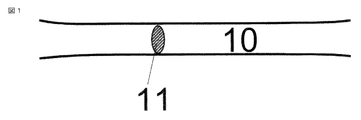
- the aggregate 10 in the particle from the particle emission source end or aggregate 10 to the particle absorption source end in FIG. 1, is provided with a portion having a small vertical cross section 11 in which the particles can move in the direction of particle movement.
- the disturbance of the composition, or the particles having little influence on the S / N ratio due to the heat of the basic element may be emitted from the particle emission source end or absorbed from the particle absorption end, or other aggregates It is possible to release particles to the reaction field or to absorb particles in a uniform state from the particle population.
- atoms / ions / molecular particles can only move in the hole direction.
- the particles can interact with each other from the substances constituting the aggregate and can selectively flow.
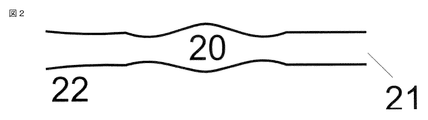
- the aggregate of particles in the modifying portion can change the thickness and constituent atoms / molecules, whereby the moving particles can be changed or the flow rate can be adjusted.
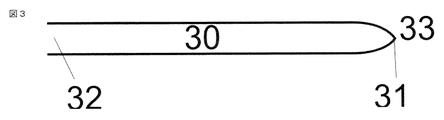
- the shape of the quasi-one-dimensional assembly 30 varies depending on the type of particle. A.
- the degree of each thermal noise depends on the disturbance around the cross section of the aggregate and the temperature of the basic element. If the square root of the cross-sectional area S is reduced, even when the temperature of the basic element is room temperature, the transition from the occupied ground state of electrons / holes to the unoccupied state of electrons / holes due to thermal noise does not occur, and When the holes enter the macroscopic quantum state, the SN ratio of the basic element is further improved.
- the atom / ion / molecular particle has a spatial structure having a hole shape, other basic elements are formed between the particles in the particle beam in the aggregate 30, the particles other than the particle beam, the outer wall, and the modification portion.
- the SN ratio of the basic element is improved by the force from the above. C.
- the flow is controlled including laminar flow or turbulent flow.
- energy consumption for maintaining the cooling of the apparatus can be reduced.
- the structure 31 having a protrusion at the particle emission source end or the absorption source end increases the electric field at the end of the particle emission source or near the absorption source end due to the charge at the counter electrode or the target charged particle. This also has the effect of facilitating the release and absorption of particles.
- there is a temperature difference between the particle moving part and the particle emission / absorption source end 1.
- Heat conduction from the particle emission source end to the particle absorption source end other than the thermal energy of the charged particles is suppressed by making the structure other than the assembly 30 vacuum so that heat other than radiation is not easily transmitted. 2.
- a thermoelectric material or thermoelectric conversion element for the aggregate portion 30 where the particle flow or particle beam flow is generated inside the entire absorption / emission basic element, the NEA or PEA effect is enhanced, 3.
- the catalytic effect of a basic element having a particle emission source end or particle absorption source end is enhanced. Collision particles are unlikely to change energy even if their momentum changes due to collision with particles of larger mass.
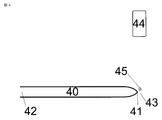
- low-kinetic energy particles having a good S / N ratio due to the three-dimensional structure of the constituent material, the lattice disturbance, or the heat of the basic element are strongly oozed out to the local nano-order absorption source end 41 using the particles.
- the SN ratio can be reduced with a low kinetic energy particle having a good basic element SN ratio and a larger mass.
- the target particle 45 is improved and a bound target particle energy state having a good S / N ratio is generated.
- charge transfer occurs and a combined target particle flow or particle beam having a good S / N ratio can be produced.
- Aggregates can use holes through which ions are transmitted, holes formed in the membrane, and the like, and can selectively pass particles.
- 52 and 53 indicate that the materials can be different, and the membrane 54 can selectively pass particles.
- Claim 5 is the particle 60 in FIG. 6 where the particle is moved by arranging a portion that generates an electromagnetic field in the vicinity of a spatially narrow place at the modification portion reaching the particle emission source end or the absorption source end 61. It is characterized by controlling the physical and chemical properties. By using an electric field generation source as 62, the voltage-current characteristics of the charged particle flow can be controlled.
- a magnetic field generating source as 62, magnetic atoms are added to the part where the particle flow flows, and by aligning the spins of the magnetic atoms with the magnetic field, the quantum efficiency can be increased by improving the spin polarization rate of the particles. Further, the particle and particle spin diffusion flow due to the concentration gradient field generated when the cross-sectional area of the fine wire obtained by crosslinking the particle emission source and the particle absorption source is about several square nm can be controlled in the same manner. Charged particles or the like adhere to the particle emission source end / particle absorption source end 31 during use or are deformed.
- Possible devices include photocathodes, thermoelectric devices, transistors, diodes, cold cathode tubes, and fuel cells. It is also possible to incorporate these. 7.
- a basic element comprising a combination of the basic elements of claim 6 in series or parallel, or a combination of series and parallel, or a basic element that requires a part other than the part controlling particle flow other than claim 6 or in series or parallel. It is conceivable to use an apparatus composed of a hybrid combination of the above, or a combination of basic elements other than claims 6 to 6 in series or parallel, or a combination of series and parallel.
- modules comprising combinations of these devices and devices and other basic elements are also contemplated in accordance with the scope and spirit of the present invention.
- a system having a low energy particle emission / absorption source with less influence on the S / N ratio than the module according to the claimed invention can be constructed.
- numerous embodiments may be employed to provide methods for implementing devices, modules and systems constructed from basic elements.
- the basic element used here has good energy efficiency because the SN ratio of the basic element is good. Any actuators, modules and systems used to describe this application should not be construed as critical or essential to the invention unless otherwise indicated.
- the influence of the heat of the basic element on the SN ratio can be reduced by reducing the cross-sectional area of the particle emission / absorption source. Since the emission source area is extremely small and a large number of them are arranged close to each other and the emission electron flow can be controlled by a bias current, the energy consumption used for cooling the system is significantly less than that of the hot cathode, and quick control can be performed. Furthermore, by adding magnetic atoms and molecules in the quasi-one-dimensional system, high spin polarization and high quantum efficiency can be obtained with little electron spin depolarization by an external magnetic field.
- Double qubits used in quantum computers are stable charge states in which excess electrons are tunneled between two quantum dots. (Phys. Rev. Lett. 91, 226804-2 (2003)) This control can be performed by applying a drain pulse. Immediate movement can be given by making this high speed.
- Aggregate part of particle absorption and emission basic element Aggregate part of particle absorption and emission basic element. Aggregate part of particle absorption and emission basic element. Basic element for particle absorption and emission. Particle absorption and emission basic element with a separate particle source. Basic element for particle absorption and emission. Particle absorption / release source with control unit.
- Aggregate part which is particle moving part 11 Cross section 20 of aggregate 20 Aggregate part 21 which is particle moving part Particle emission source end 22 Particle absorption source end 30 Aggregate part 31 which is particle moving part Particle emission source end or particle absorption Source end 32 Particle absorption source end or particle emission source end 33 Reaction field 40 close to particle emission / absorption source end Aggregate part 41 as particle movement site Particle emission source end or particle absorption source end 42 Particle absorption source end or particle Release source end 43 Reaction field 44 close to particle emission / absorption source end Target particle emission source 45 Target particle 50 Aggregate parts 51a, 51b and 51c which are particle moving parts Aggregate part 52 which is a particle moving part, 53 Part 54 Aggregate part or boundary between parts 60 Particle movement part 61 Control part
Landscapes
- Physics & Mathematics (AREA)
- Spectroscopy & Molecular Physics (AREA)
- Chemical & Material Sciences (AREA)
- Analytical Chemistry (AREA)
- Engineering & Computer Science (AREA)
- Plasma & Fusion (AREA)
- Physical Or Chemical Processes And Apparatus (AREA)
- Fuel Cell (AREA)
- Electron Sources, Ion Sources (AREA)
- Cold Cathode And The Manufacture (AREA)
Abstract
Priority Applications (6)
| Application Number | Priority Date | Filing Date | Title |
|---|---|---|---|
| RU2016140537A RU2696344C2 (ru) | 2014-03-17 | 2014-03-17 | Элементарный элемент |
| CN201480078944.9A CN106458577A (zh) | 2014-03-17 | 2014-03-17 | 基本元件 |
| JP2016508439A JPWO2015141015A1 (ja) | 2014-03-17 | 2014-03-17 | 基本素子 |
| EP14886203.0A EP3121146A4 (fr) | 2014-03-17 | 2014-03-17 | Élément élémentaire |
| US15/125,166 US20170231079A1 (en) | 2014-03-17 | 2014-03-17 | Elementary element |
| PCT/JP2014/059380 WO2015141015A1 (fr) | 2014-03-17 | 2014-03-17 | Élément élémentaire |
Applications Claiming Priority (1)
| Application Number | Priority Date | Filing Date | Title |
|---|---|---|---|
| PCT/JP2014/059380 WO2015141015A1 (fr) | 2014-03-17 | 2014-03-17 | Élément élémentaire |
Publications (2)
| Publication Number | Publication Date |
|---|---|
| WO2015141015A1 WO2015141015A1 (fr) | 2015-09-24 |
| WO2015141015A9 true WO2015141015A9 (fr) | 2016-11-24 |
Family
ID=54144015
Family Applications (1)
| Application Number | Title | Priority Date | Filing Date |
|---|---|---|---|
| PCT/JP2014/059380 Ceased WO2015141015A1 (fr) | 2014-03-17 | 2014-03-17 | Élément élémentaire |
Country Status (6)
| Country | Link |
|---|---|
| US (1) | US20170231079A1 (fr) |
| EP (1) | EP3121146A4 (fr) |
| JP (1) | JPWO2015141015A1 (fr) |
| CN (1) | CN106458577A (fr) |
| RU (1) | RU2696344C2 (fr) |
| WO (1) | WO2015141015A1 (fr) |
Families Citing this family (3)
| Publication number | Priority date | Publication date | Assignee | Title |
|---|---|---|---|---|
| EP3477390A1 (fr) * | 2017-10-25 | 2019-05-01 | ASML Netherlands B.V. | Outil d'inspection, appareil lithographique, source de faisceau d'électrons et procédé d'inspection |
| CN113952894B (zh) * | 2020-07-21 | 2025-02-14 | 李辉雄 | 减容或有机物分解反应装置 |
| CN114927396B (zh) * | 2022-04-24 | 2023-05-12 | 电子科技大学 | 一种实时控制NEA GaN电子源扩散长度的方法 |
Family Cites Families (5)
| Publication number | Priority date | Publication date | Assignee | Title |
|---|---|---|---|---|
| JP4069624B2 (ja) * | 2000-03-31 | 2008-04-02 | 株式会社日立製作所 | 走査電子顕微鏡 |
| JP4751635B2 (ja) * | 2005-04-13 | 2011-08-17 | 株式会社日立ハイテクノロジーズ | 磁界重畳型電子銃 |
| JP2007149659A (ja) * | 2005-10-27 | 2007-06-14 | Sumitomo Electric Ind Ltd | 電界放出型電子銃、電子顕微鏡、及び電子ビーム露光機 |
| WO2012086419A1 (fr) * | 2010-12-22 | 2012-06-28 | 株式会社日立ハイテクノロジーズ | Canon à émission de particules chargées et appareil à rayon de particules chargées |
| JP2014046451A (ja) * | 2012-09-02 | 2014-03-17 | Masato Mabuchi | 熱によるsn比への影響の少ない低エネルギー粒子放出装置乃至粒子吸収装置 |
-
2014
- 2014-03-17 EP EP14886203.0A patent/EP3121146A4/fr not_active Ceased
- 2014-03-17 JP JP2016508439A patent/JPWO2015141015A1/ja active Pending
- 2014-03-17 US US15/125,166 patent/US20170231079A1/en not_active Abandoned
- 2014-03-17 CN CN201480078944.9A patent/CN106458577A/zh active Pending
- 2014-03-17 RU RU2016140537A patent/RU2696344C2/ru active
- 2014-03-17 WO PCT/JP2014/059380 patent/WO2015141015A1/fr not_active Ceased
Also Published As
| Publication number | Publication date |
|---|---|
| RU2016140537A (ru) | 2018-04-18 |
| WO2015141015A1 (fr) | 2015-09-24 |
| EP3121146A1 (fr) | 2017-01-25 |
| JPWO2015141015A1 (ja) | 2017-04-13 |
| RU2696344C2 (ru) | 2019-08-01 |
| CN106458577A (zh) | 2017-02-22 |
| US20170231079A1 (en) | 2017-08-10 |
| EP3121146A4 (fr) | 2018-04-25 |
Similar Documents
| Publication | Publication Date | Title |
|---|---|---|
| Zhang et al. | Metal single‐atoms toward electromagnetic wave‐absorbing materials: insights and perspective | |
| Yang et al. | The role of geometric sites in 2D materials for energy storage | |
| Huang et al. | Recent progress in the application of ion beam technology in the modification and fabrication of nanostructured energy materials | |
| Wang et al. | Tuning oxygen reduction reaction activity via controllable dealloying: a model study of ordered Cu3Pt/C intermetallic nanocatalysts | |
| Xiao et al. | Hierarchically porous graphene as a lithium–air battery electrode | |
| Rahman et al. | Semiconductor thermionics for next generation solar cells: photon enhanced or pure thermionic? | |
| Yang et al. | A stable, magnetic, and metallic Li3O4 compound as a discharge product in a Li–air battery | |
| Safari et al. | Kinetics of oxygen reduction in aprotic Li–O2 cells: a model-based study | |
| Schindler et al. | Surface photovoltage-induced ultralow work function material for thermionic energy converters | |
| Diao et al. | Photon-enhanced thermionic emission solar energy converters with GaAs wire array cathode under external electric field | |
| Chung et al. | Understanding a degradation mechanism of direct methanol fuel cell using TOF-SIMS and XPS | |
| Nojeh | Carbon nanotube electron sources: from electron beams to energy conversion and optophononics | |
| Ashok et al. | Plasma‐Induced Nanocrystalline Domain Engineering and Surface Passivation in Mesoporous Chalcogenide Semiconductor Thin Films | |
| Yang et al. | First principles studies of nitrogen doped carbon nanotubes for dioxygen reduction | |
| Li et al. | Machine-learning-accelerated screening of single metal atoms anchored on MnPS 3 monolayers as promising bifunctional oxygen electrocatalysts | |
| WO2015141015A9 (fr) | Élément élémentaire | |
| Diao et al. | Comparative study of negative electron affinity GaAs nanowire photocathodes with Cs/O and with Cs/NF3 from first‐principles | |
| Li | Stationary Direct Methanol Fuel Cells Using Pure Methanol | |
| Zhao et al. | Access to ultrafast surface and interface carrier dynamics simultaneously in space and time | |
| Lu et al. | Ultrahigh lithium storage capacity of Al2C monolayer in a restricted multilayered growth mechanism | |
| Chae et al. | Tunable Onset of Hydrogen Evolution in Graphene with Hot Electrons | |
| Ashraf et al. | Aligned Bilayer of Single-Walled Carbon Nanotubes Suppresses the Polysulfide Shuttle in Li–S Batteries | |
| Dhobi et al. | Scattering of free electrons with hydrogen atoms in proton exchange membrane fuel cell system | |
| Song et al. | An Ultra‐Low Discharge and High Energy Efficiency Li‐CO2 Battery Enabled by Plasmon‐Enhanced AuRu‐TiO2 Bifunctional Cathode | |
| JP2010272383A (ja) | 燃料電池電極及びその製造方法 |
Legal Events
| Date | Code | Title | Description |
|---|---|---|---|
| 121 | Ep: the epo has been informed by wipo that ep was designated in this application |
Ref document number: 14886203 Country of ref document: EP Kind code of ref document: A1 |
|
| ENP | Entry into the national phase |
Ref document number: 2016508439 Country of ref document: JP Kind code of ref document: A |
|
| NENP | Non-entry into the national phase |
Ref country code: DE |
|
| REEP | Request for entry into the european phase |
Ref document number: 2014886203 Country of ref document: EP |
|
| WWE | Wipo information: entry into national phase |
Ref document number: 2014886203 Country of ref document: EP |
|
| ENP | Entry into the national phase |
Ref document number: 2016140537 Country of ref document: RU Kind code of ref document: A |