WO2015147215A1 - エチレン/α-オレフィン共重合体および潤滑油 - Google Patents
エチレン/α-オレフィン共重合体および潤滑油 Download PDFInfo
- Publication number
- WO2015147215A1 WO2015147215A1 PCT/JP2015/059487 JP2015059487W WO2015147215A1 WO 2015147215 A1 WO2015147215 A1 WO 2015147215A1 JP 2015059487 W JP2015059487 W JP 2015059487W WO 2015147215 A1 WO2015147215 A1 WO 2015147215A1
- Authority
- WO
- WIPO (PCT)
- Prior art keywords
- group
- ethylene
- olefin
- olefin copolymer
- lubricating oil
- Prior art date
- Legal status (The legal status is an assumption and is not a legal conclusion. Google has not performed a legal analysis and makes no representation as to the accuracy of the status listed.)
- Ceased
Links
Classifications
-
- C—CHEMISTRY; METALLURGY
- C08—ORGANIC MACROMOLECULAR COMPOUNDS; THEIR PREPARATION OR CHEMICAL WORKING-UP; COMPOSITIONS BASED THEREON
- C08F—MACROMOLECULAR COMPOUNDS OBTAINED BY REACTIONS ONLY INVOLVING CARBON-TO-CARBON UNSATURATED BONDS
- C08F210/00—Copolymers of unsaturated aliphatic hydrocarbons having only one carbon-to-carbon double bond
- C08F210/16—Copolymers of ethene with alpha-alkenes, e.g. EP rubbers
-
- C—CHEMISTRY; METALLURGY
- C08—ORGANIC MACROMOLECULAR COMPOUNDS; THEIR PREPARATION OR CHEMICAL WORKING-UP; COMPOSITIONS BASED THEREON
- C08F—MACROMOLECULAR COMPOUNDS OBTAINED BY REACTIONS ONLY INVOLVING CARBON-TO-CARBON UNSATURATED BONDS
- C08F2/00—Processes of polymerisation
- C08F2/38—Polymerisation using regulators, e.g. chain terminating agents, e.g. telomerisation
-
- C—CHEMISTRY; METALLURGY
- C08—ORGANIC MACROMOLECULAR COMPOUNDS; THEIR PREPARATION OR CHEMICAL WORKING-UP; COMPOSITIONS BASED THEREON
- C08F—MACROMOLECULAR COMPOUNDS OBTAINED BY REACTIONS ONLY INVOLVING CARBON-TO-CARBON UNSATURATED BONDS
- C08F4/00—Polymerisation catalysts
- C08F4/42—Metals; Metal hydrides; Metallo-organic compounds; Use thereof as catalyst precursors
- C08F4/44—Metals; Metal hydrides; Metallo-organic compounds; Use thereof as catalyst precursors selected from light metals, zinc, cadmium, mercury, copper, silver, gold, boron, gallium, indium, thallium, rare earths or actinides
- C08F4/60—Metals; Metal hydrides; Metallo-organic compounds; Use thereof as catalyst precursors selected from light metals, zinc, cadmium, mercury, copper, silver, gold, boron, gallium, indium, thallium, rare earths or actinides together with refractory metals, iron group metals, platinum group metals, manganese, rhenium technetium or compounds thereof
- C08F4/62—Refractory metals or compounds thereof
- C08F4/64—Titanium, zirconium, hafnium or compounds thereof
- C08F4/659—Component covered by group C08F4/64 containing a transition metal-carbon bond
- C08F4/65912—Component covered by group C08F4/64 containing a transition metal-carbon bond in combination with an organoaluminium compound
-
- C—CHEMISTRY; METALLURGY
- C08—ORGANIC MACROMOLECULAR COMPOUNDS; THEIR PREPARATION OR CHEMICAL WORKING-UP; COMPOSITIONS BASED THEREON
- C08F—MACROMOLECULAR COMPOUNDS OBTAINED BY REACTIONS ONLY INVOLVING CARBON-TO-CARBON UNSATURATED BONDS
- C08F4/00—Polymerisation catalysts
- C08F4/42—Metals; Metal hydrides; Metallo-organic compounds; Use thereof as catalyst precursors
- C08F4/44—Metals; Metal hydrides; Metallo-organic compounds; Use thereof as catalyst precursors selected from light metals, zinc, cadmium, mercury, copper, silver, gold, boron, gallium, indium, thallium, rare earths or actinides
- C08F4/60—Metals; Metal hydrides; Metallo-organic compounds; Use thereof as catalyst precursors selected from light metals, zinc, cadmium, mercury, copper, silver, gold, boron, gallium, indium, thallium, rare earths or actinides together with refractory metals, iron group metals, platinum group metals, manganese, rhenium technetium or compounds thereof
- C08F4/62—Refractory metals or compounds thereof
- C08F4/64—Titanium, zirconium, hafnium or compounds thereof
- C08F4/659—Component covered by group C08F4/64 containing a transition metal-carbon bond
- C08F4/6592—Component covered by group C08F4/64 containing a transition metal-carbon bond containing at least one cyclopentadienyl ring, condensed or not, e.g. an indenyl or a fluorenyl ring
- C08F4/65922—Component covered by group C08F4/64 containing a transition metal-carbon bond containing at least one cyclopentadienyl ring, condensed or not, e.g. an indenyl or a fluorenyl ring containing at least two cyclopentadienyl rings, fused or not
- C08F4/65927—Component covered by group C08F4/64 containing a transition metal-carbon bond containing at least one cyclopentadienyl ring, condensed or not, e.g. an indenyl or a fluorenyl ring containing at least two cyclopentadienyl rings, fused or not two cyclopentadienyl rings being mutually bridged
-
- C—CHEMISTRY; METALLURGY
- C10—PETROLEUM, GAS OR COKE INDUSTRIES; TECHNICAL GASES CONTAINING CARBON MONOXIDE; FUELS; LUBRICANTS; PEAT
- C10M—LUBRICATING COMPOSITIONS; USE OF CHEMICAL SUBSTANCES EITHER ALONE OR AS LUBRICATING INGREDIENTS IN A LUBRICATING COMPOSITION
- C10M107/00—Lubricating compositions characterised by the base-material being a macromolecular compound
- C10M107/02—Hydrocarbon polymers; Hydrocarbon polymers modified by oxidation
-
- C—CHEMISTRY; METALLURGY
- C10—PETROLEUM, GAS OR COKE INDUSTRIES; TECHNICAL GASES CONTAINING CARBON MONOXIDE; FUELS; LUBRICANTS; PEAT
- C10M—LUBRICATING COMPOSITIONS; USE OF CHEMICAL SUBSTANCES EITHER ALONE OR AS LUBRICATING INGREDIENTS IN A LUBRICATING COMPOSITION
- C10M107/00—Lubricating compositions characterised by the base-material being a macromolecular compound
- C10M107/02—Hydrocarbon polymers; Hydrocarbon polymers modified by oxidation
- C10M107/06—Hydrocarbon polymers; Hydrocarbon polymers modified by oxidation containing propene
-
- C—CHEMISTRY; METALLURGY
- C10—PETROLEUM, GAS OR COKE INDUSTRIES; TECHNICAL GASES CONTAINING CARBON MONOXIDE; FUELS; LUBRICANTS; PEAT
- C10M—LUBRICATING COMPOSITIONS; USE OF CHEMICAL SUBSTANCES EITHER ALONE OR AS LUBRICATING INGREDIENTS IN A LUBRICATING COMPOSITION
- C10M107/00—Lubricating compositions characterised by the base-material being a macromolecular compound
- C10M107/02—Hydrocarbon polymers; Hydrocarbon polymers modified by oxidation
- C10M107/10—Hydrocarbon polymers; Hydrocarbon polymers modified by oxidation containing aliphatic monomer having more than 4 carbon atoms
-
- C—CHEMISTRY; METALLURGY
- C10—PETROLEUM, GAS OR COKE INDUSTRIES; TECHNICAL GASES CONTAINING CARBON MONOXIDE; FUELS; LUBRICANTS; PEAT
- C10M—LUBRICATING COMPOSITIONS; USE OF CHEMICAL SUBSTANCES EITHER ALONE OR AS LUBRICATING INGREDIENTS IN A LUBRICATING COMPOSITION
- C10M177/00—Special methods of preparation of lubricating compositions; Chemical modification by after-treatment of components or of the whole of a lubricating composition, not covered by other classes
-
- C—CHEMISTRY; METALLURGY
- C08—ORGANIC MACROMOLECULAR COMPOUNDS; THEIR PREPARATION OR CHEMICAL WORKING-UP; COMPOSITIONS BASED THEREON
- C08F—MACROMOLECULAR COMPOUNDS OBTAINED BY REACTIONS ONLY INVOLVING CARBON-TO-CARBON UNSATURATED BONDS
- C08F2500/00—Characteristics or properties of obtained polyolefins; Use thereof
- C08F2500/03—Narrow molecular weight distribution, i.e. Mw/Mn < 3
-
- C—CHEMISTRY; METALLURGY
- C08—ORGANIC MACROMOLECULAR COMPOUNDS; THEIR PREPARATION OR CHEMICAL WORKING-UP; COMPOSITIONS BASED THEREON
- C08F—MACROMOLECULAR COMPOUNDS OBTAINED BY REACTIONS ONLY INVOLVING CARBON-TO-CARBON UNSATURATED BONDS
- C08F2500/00—Characteristics or properties of obtained polyolefins; Use thereof
- C08F2500/17—Viscosity
-
- C—CHEMISTRY; METALLURGY
- C08—ORGANIC MACROMOLECULAR COMPOUNDS; THEIR PREPARATION OR CHEMICAL WORKING-UP; COMPOSITIONS BASED THEREON
- C08F—MACROMOLECULAR COMPOUNDS OBTAINED BY REACTIONS ONLY INVOLVING CARBON-TO-CARBON UNSATURATED BONDS
- C08F4/00—Polymerisation catalysts
- C08F4/42—Metals; Metal hydrides; Metallo-organic compounds; Use thereof as catalyst precursors
- C08F4/44—Metals; Metal hydrides; Metallo-organic compounds; Use thereof as catalyst precursors selected from light metals, zinc, cadmium, mercury, copper, silver, gold, boron, gallium, indium, thallium, rare earths or actinides
- C08F4/60—Metals; Metal hydrides; Metallo-organic compounds; Use thereof as catalyst precursors selected from light metals, zinc, cadmium, mercury, copper, silver, gold, boron, gallium, indium, thallium, rare earths or actinides together with refractory metals, iron group metals, platinum group metals, manganese, rhenium technetium or compounds thereof
- C08F4/62—Refractory metals or compounds thereof
- C08F4/64—Titanium, zirconium, hafnium or compounds thereof
- C08F4/659—Component covered by group C08F4/64 containing a transition metal-carbon bond
- C08F4/65908—Component covered by group C08F4/64 containing a transition metal-carbon bond in combination with an ionising compound other than alumoxane, e.g. (C6F5)4B-X+
-
- C—CHEMISTRY; METALLURGY
- C10—PETROLEUM, GAS OR COKE INDUSTRIES; TECHNICAL GASES CONTAINING CARBON MONOXIDE; FUELS; LUBRICANTS; PEAT
- C10M—LUBRICATING COMPOSITIONS; USE OF CHEMICAL SUBSTANCES EITHER ALONE OR AS LUBRICATING INGREDIENTS IN A LUBRICATING COMPOSITION
- C10M2203/00—Organic non-macromolecular hydrocarbon compounds and hydrocarbon fractions as ingredients in lubricant compositions
- C10M2203/10—Petroleum or coal fractions, e.g. tars, solvents, bitumen
- C10M2203/1006—Petroleum or coal fractions, e.g. tars, solvents, bitumen used as base material
-
- C—CHEMISTRY; METALLURGY
- C10—PETROLEUM, GAS OR COKE INDUSTRIES; TECHNICAL GASES CONTAINING CARBON MONOXIDE; FUELS; LUBRICANTS; PEAT
- C10M—LUBRICATING COMPOSITIONS; USE OF CHEMICAL SUBSTANCES EITHER ALONE OR AS LUBRICATING INGREDIENTS IN A LUBRICATING COMPOSITION
- C10M2203/00—Organic non-macromolecular hydrocarbon compounds and hydrocarbon fractions as ingredients in lubricant compositions
- C10M2203/10—Petroleum or coal fractions, e.g. tars, solvents, bitumen
- C10M2203/102—Aliphatic fractions
- C10M2203/1025—Aliphatic fractions used as base material
-
- C—CHEMISTRY; METALLURGY
- C10—PETROLEUM, GAS OR COKE INDUSTRIES; TECHNICAL GASES CONTAINING CARBON MONOXIDE; FUELS; LUBRICANTS; PEAT
- C10M—LUBRICATING COMPOSITIONS; USE OF CHEMICAL SUBSTANCES EITHER ALONE OR AS LUBRICATING INGREDIENTS IN A LUBRICATING COMPOSITION
- C10M2205/00—Organic macromolecular hydrocarbon compounds or fractions, whether or not modified by oxidation as ingredients in lubricant compositions
- C10M2205/02—Organic macromolecular hydrocarbon compounds or fractions, whether or not modified by oxidation as ingredients in lubricant compositions containing acyclic monomers
- C10M2205/022—Ethene
-
- C—CHEMISTRY; METALLURGY
- C10—PETROLEUM, GAS OR COKE INDUSTRIES; TECHNICAL GASES CONTAINING CARBON MONOXIDE; FUELS; LUBRICANTS; PEAT
- C10M—LUBRICATING COMPOSITIONS; USE OF CHEMICAL SUBSTANCES EITHER ALONE OR AS LUBRICATING INGREDIENTS IN A LUBRICATING COMPOSITION
- C10M2205/00—Organic macromolecular hydrocarbon compounds or fractions, whether or not modified by oxidation as ingredients in lubricant compositions
- C10M2205/02—Organic macromolecular hydrocarbon compounds or fractions, whether or not modified by oxidation as ingredients in lubricant compositions containing acyclic monomers
- C10M2205/024—Propene
- C10M2205/0245—Propene used as base material
-
- C—CHEMISTRY; METALLURGY
- C10—PETROLEUM, GAS OR COKE INDUSTRIES; TECHNICAL GASES CONTAINING CARBON MONOXIDE; FUELS; LUBRICANTS; PEAT
- C10M—LUBRICATING COMPOSITIONS; USE OF CHEMICAL SUBSTANCES EITHER ALONE OR AS LUBRICATING INGREDIENTS IN A LUBRICATING COMPOSITION
- C10M2205/00—Organic macromolecular hydrocarbon compounds or fractions, whether or not modified by oxidation as ingredients in lubricant compositions
- C10M2205/02—Organic macromolecular hydrocarbon compounds or fractions, whether or not modified by oxidation as ingredients in lubricant compositions containing acyclic monomers
- C10M2205/026—Butene
-
- C—CHEMISTRY; METALLURGY
- C10—PETROLEUM, GAS OR COKE INDUSTRIES; TECHNICAL GASES CONTAINING CARBON MONOXIDE; FUELS; LUBRICANTS; PEAT
- C10M—LUBRICATING COMPOSITIONS; USE OF CHEMICAL SUBSTANCES EITHER ALONE OR AS LUBRICATING INGREDIENTS IN A LUBRICATING COMPOSITION
- C10M2205/00—Organic macromolecular hydrocarbon compounds or fractions, whether or not modified by oxidation as ingredients in lubricant compositions
- C10M2205/02—Organic macromolecular hydrocarbon compounds or fractions, whether or not modified by oxidation as ingredients in lubricant compositions containing acyclic monomers
- C10M2205/028—Organic macromolecular hydrocarbon compounds or fractions, whether or not modified by oxidation as ingredients in lubricant compositions containing acyclic monomers containing aliphatic monomers having more than four carbon atoms
- C10M2205/0285—Organic macromolecular hydrocarbon compounds or fractions, whether or not modified by oxidation as ingredients in lubricant compositions containing acyclic monomers containing aliphatic monomers having more than four carbon atoms used as base material
-
- C—CHEMISTRY; METALLURGY
- C10—PETROLEUM, GAS OR COKE INDUSTRIES; TECHNICAL GASES CONTAINING CARBON MONOXIDE; FUELS; LUBRICANTS; PEAT
- C10M—LUBRICATING COMPOSITIONS; USE OF CHEMICAL SUBSTANCES EITHER ALONE OR AS LUBRICATING INGREDIENTS IN A LUBRICATING COMPOSITION
- C10M2207/00—Organic non-macromolecular hydrocarbon compounds containing hydrogen, carbon and oxygen as ingredients in lubricant compositions
- C10M2207/28—Esters
- C10M2207/281—Esters of (cyclo)aliphatic monocarboxylic acids
-
- C—CHEMISTRY; METALLURGY
- C10—PETROLEUM, GAS OR COKE INDUSTRIES; TECHNICAL GASES CONTAINING CARBON MONOXIDE; FUELS; LUBRICANTS; PEAT
- C10M—LUBRICATING COMPOSITIONS; USE OF CHEMICAL SUBSTANCES EITHER ALONE OR AS LUBRICATING INGREDIENTS IN A LUBRICATING COMPOSITION
- C10M2209/00—Organic macromolecular compounds containing oxygen as ingredients in lubricant compositions
- C10M2209/02—Macromolecular compounds obtained by reactions only involving carbon-to-carbon unsaturated bonds
- C10M2209/08—Macromolecular compounds obtained by reactions only involving carbon-to-carbon unsaturated bonds containing monomers having an unsaturated radical bound to a carboxyl radical, e.g. acrylate type
- C10M2209/084—Acrylate; Methacrylate
-
- C—CHEMISTRY; METALLURGY
- C10—PETROLEUM, GAS OR COKE INDUSTRIES; TECHNICAL GASES CONTAINING CARBON MONOXIDE; FUELS; LUBRICANTS; PEAT
- C10N—INDEXING SCHEME ASSOCIATED WITH SUBCLASS C10M RELATING TO LUBRICATING COMPOSITIONS
- C10N2020/00—Specified physical or chemical properties or characteristics, i.e. function, of component of lubricating compositions
- C10N2020/01—Physico-chemical properties
- C10N2020/02—Viscosity; Viscosity index
-
- C—CHEMISTRY; METALLURGY
- C10—PETROLEUM, GAS OR COKE INDUSTRIES; TECHNICAL GASES CONTAINING CARBON MONOXIDE; FUELS; LUBRICANTS; PEAT
- C10N—INDEXING SCHEME ASSOCIATED WITH SUBCLASS C10M RELATING TO LUBRICATING COMPOSITIONS
- C10N2020/00—Specified physical or chemical properties or characteristics, i.e. function, of component of lubricating compositions
- C10N2020/01—Physico-chemical properties
- C10N2020/04—Molecular weight; Molecular weight distribution
-
- C—CHEMISTRY; METALLURGY
- C10—PETROLEUM, GAS OR COKE INDUSTRIES; TECHNICAL GASES CONTAINING CARBON MONOXIDE; FUELS; LUBRICANTS; PEAT
- C10N—INDEXING SCHEME ASSOCIATED WITH SUBCLASS C10M RELATING TO LUBRICATING COMPOSITIONS
- C10N2030/00—Specified physical or chemical properties which is improved by the additive characterising the lubricating composition, e.g. multifunctional additives
- C10N2030/02—Pour-point; Viscosity index
-
- C—CHEMISTRY; METALLURGY
- C10—PETROLEUM, GAS OR COKE INDUSTRIES; TECHNICAL GASES CONTAINING CARBON MONOXIDE; FUELS; LUBRICANTS; PEAT
- C10N—INDEXING SCHEME ASSOCIATED WITH SUBCLASS C10M RELATING TO LUBRICATING COMPOSITIONS
- C10N2030/00—Specified physical or chemical properties which is improved by the additive characterising the lubricating composition, e.g. multifunctional additives
- C10N2030/68—Shear stability
-
- C—CHEMISTRY; METALLURGY
- C10—PETROLEUM, GAS OR COKE INDUSTRIES; TECHNICAL GASES CONTAINING CARBON MONOXIDE; FUELS; LUBRICANTS; PEAT
- C10N—INDEXING SCHEME ASSOCIATED WITH SUBCLASS C10M RELATING TO LUBRICATING COMPOSITIONS
- C10N2040/00—Specified use or application for which the lubricating composition is intended
- C10N2040/04—Oil-bath; Gear-boxes; Automatic transmissions; Traction drives
-
- C—CHEMISTRY; METALLURGY
- C10—PETROLEUM, GAS OR COKE INDUSTRIES; TECHNICAL GASES CONTAINING CARBON MONOXIDE; FUELS; LUBRICANTS; PEAT
- C10N—INDEXING SCHEME ASSOCIATED WITH SUBCLASS C10M RELATING TO LUBRICATING COMPOSITIONS
- C10N2040/00—Specified use or application for which the lubricating composition is intended
- C10N2040/04—Oil-bath; Gear-boxes; Automatic transmissions; Traction drives
- C10N2040/042—Oil-bath; Gear-boxes; Automatic transmissions; Traction drives for automatic transmissions
-
- C—CHEMISTRY; METALLURGY
- C10—PETROLEUM, GAS OR COKE INDUSTRIES; TECHNICAL GASES CONTAINING CARBON MONOXIDE; FUELS; LUBRICANTS; PEAT
- C10N—INDEXING SCHEME ASSOCIATED WITH SUBCLASS C10M RELATING TO LUBRICATING COMPOSITIONS
- C10N2040/00—Specified use or application for which the lubricating composition is intended
- C10N2040/04—Oil-bath; Gear-boxes; Automatic transmissions; Traction drives
- C10N2040/044—Oil-bath; Gear-boxes; Automatic transmissions; Traction drives for manual transmissions
-
- C—CHEMISTRY; METALLURGY
- C10—PETROLEUM, GAS OR COKE INDUSTRIES; TECHNICAL GASES CONTAINING CARBON MONOXIDE; FUELS; LUBRICANTS; PEAT
- C10N—INDEXING SCHEME ASSOCIATED WITH SUBCLASS C10M RELATING TO LUBRICATING COMPOSITIONS
- C10N2040/00—Specified use or application for which the lubricating composition is intended
- C10N2040/08—Hydraulic fluids, e.g. brake-fluids
-
- C—CHEMISTRY; METALLURGY
- C10—PETROLEUM, GAS OR COKE INDUSTRIES; TECHNICAL GASES CONTAINING CARBON MONOXIDE; FUELS; LUBRICANTS; PEAT
- C10N—INDEXING SCHEME ASSOCIATED WITH SUBCLASS C10M RELATING TO LUBRICATING COMPOSITIONS
- C10N2040/00—Specified use or application for which the lubricating composition is intended
- C10N2040/25—Internal-combustion engines
-
- C—CHEMISTRY; METALLURGY
- C10—PETROLEUM, GAS OR COKE INDUSTRIES; TECHNICAL GASES CONTAINING CARBON MONOXIDE; FUELS; LUBRICANTS; PEAT
- C10N—INDEXING SCHEME ASSOCIATED WITH SUBCLASS C10M RELATING TO LUBRICATING COMPOSITIONS
- C10N2060/00—Chemical after-treatment of the constituents of the lubricating composition
- C10N2060/02—Reduction, e.g. hydrogenation
Definitions
- the present invention relates to an ethylene / ⁇ -olefin copolymer, and more specifically, ethylene / ⁇ -olefin obtained by copolymerizing ethylene and ⁇ -olefin in the presence of a catalyst for olefin polymerization containing a specific bridged metallocene compound. -Relates to olefin copolymers and their uses.
- PAO poly- ⁇ -olefins
- Such PAO can be obtained by oligomerizing a higher ⁇ -olefin with an acid catalyst (see, for example, Patent Documents 1 to 3).
- an ethylene / ⁇ -olefin copolymer can also be used as a synthetic lubricating oil excellent in viscosity index, oxidation stability, shear stability, and heat resistance (see, for example, Patent Document 4).
- the viscosity of the lubricating oil itself is being lowered to reduce the stirring resistance of the lubricating oil.
- the lubricant is designed in consideration of the environment in which it is used and the balance between the load and the viscosity of the lubricant. At this time, it is necessary to consider a decrease in viscosity due to deterioration of the lubricating oil due to use, specifically, molecular cutting of the lubricating oil material mainly due to shear stress.
- an ethylene / ⁇ -olefin copolymer used as a synthetic lubricating oil a method using a vanadium-based catalyst comprising a vanadium compound and an organoaluminum compound has been conventionally used (see, for example, Patent Documents 5 and 6). ).
- an ethylene / ⁇ -olefin copolymer an ethylene / propylene copolymer is mainly used.
- Patent Document 9 discloses a method for producing a synthetic lubricating oil comprising an ethylene / ⁇ -olefin copolymer obtained by using a catalyst system in which a specific metallocene catalyst and an aluminoxane are combined.
- the ethylene / ⁇ -olefin copolymer used in the lubricating oil is a highly random copolymer in order to satisfy the requirements for low-temperature viscosity characteristics.
- polymerization at a high temperature is preferable because it leads to an improvement in productivity.
- the randomness of the olefin polymer to be produced decreases. It is well known to contractors. Therefore, there are many problems that the upper limit of the polymerization temperature is restricted.
- a polymerization catalyst that generates an olefin polymer having high randomness even in high-temperature polymerization.
- the ethylene / ⁇ -olefin copolymer used in the lubricating oil is required to have oxidation stability, it is desirable that the amount of double bonds in the copolymer is small. Although it is possible to reduce by hydrogenation after copolymerization, it is desirable in the process that the amount of double bonds is small from the time of copolymerization. Therefore, there is a need for a polymerization catalyst that produces a copolymer with a small amount of double bonds. It has been.
- the problem to be solved by the present invention in view of such problems in the prior art is that an ethylene / ⁇ -olefin copolymer having high randomness and a small amount of double bonds in the copolymer, and a method for producing the same Is to provide.
- Another object of the present invention is to provide a lubricating oil having both excellent shear stability and low temperature viscosity characteristics using an ethylene / ⁇ -olefin copolymer from the viewpoint of fuel efficiency and energy saving in automobiles and industrial machinery.
- P E represents the mole fraction of ethylene component
- P 2 O represents the mole fraction of ⁇ -olefin component
- P OE represents the mole fraction of ethylene / ⁇ -olefin chain of all dyad chains. Indicates the rate.
- R 1 , R 2 , R 3 , R 4 , R 5 , R 6 , R 7 , R 8 , R 9 , R 10 , R 11 and R 12 are a hydrogen atom, a hydrocarbon group having 1 to 20 carbon atoms, silicon
- R 13 and R 14 are selected from the group consisting of hydrogen atoms, hydrocarbon groups having 1 to 20 carbon atoms, aryl groups, substituted aryl groups, silicon-containing groups, nitrogen-containing groups, oxygen-containing groups, halogen atoms and halogen-containing groups.
- Atoms or substituents which may be the same or different, Adjacent substituents from R 1 to R 14 may be bonded to each other to form a ring;
- Y is selected from group 14 atoms;
- M is a titanium atom, a zirconium atom or a hafnium atom,
- Q is selected from a halogen atom, a hydrocarbon group having 1 to 20 carbon atoms, an anionic ligand and a neutral ligand capable of coordinating with a lone electron pair in the same or different combinations;
- n is an integer from 1 to 4, j is an integer of 1 to 4.
- a lubricating oil composition comprising the ethylene / ⁇ -olefin copolymer described in any one of [1] to [9].
- a lubricating oil composition comprising an ethylene / ⁇ -olefin copolymer obtained by the production method according to any one of items [14] to [23].
- the lubricating oil for automobiles according to [25] which is used as transmission oil for automobiles and has a kinematic viscosity at 100 ° C. of 7.5 mm 2 / s or less.
- the present invention by the method of copolymerizing ethylene and ⁇ -olefin in the presence of an olefin polymerization catalyst containing a crosslinked metallocene compound having a specific structure, the amount of double bonds in the copolymer is small, and the randomness High ethylene / ⁇ -olefin copolymer can be produced. Further, when the ethylene / ⁇ -olefin copolymer obtained by the above production method is used, the shear stability and low temperature viscosity characteristics of the lubricating oil can be further improved.
- the ethylene / ⁇ -olefin copolymer according to the present invention (hereinafter sometimes simply referred to as “the copolymer of the present invention”), the production method thereof and the lubricating oil will be described in detail.
- the copolymer of the present invention includes a bridged metallocene compound (A) represented by the following general formula [I], an organometallic compound (B-1), an organoaluminum oxy compound (B-2), and the bridged metallocene compound.
- A a bridged metallocene compound represented by the following general formula [I]
- an organometallic compound (B-1) an organoaluminum oxy compound (B-2), and the bridged metallocene compound.
- the bridged metallocene compound (A) is represented by the above formula [I]. Y, M, R 1 to R 14 , Q, n, and j in the formula [I] will be described below.
- Y is a group 14 atom, and examples thereof include a carbon atom, a silicon atom, a germanium atom, and a tin atom, preferably a carbon atom or a silicon atom, and more preferably a carbon atom.
- M is a titanium atom, a zirconium atom or a hafnium atom, preferably a zirconium atom.
- R 1 to R 12 are atoms or substituents selected from the group consisting of a hydrogen atom, a hydrocarbon group having 1 to 20 carbon atoms, a silicon-containing group, a nitrogen-containing group, an oxygen-containing group, a halogen atom and a halogen-containing group. These may be the same or different. Further, adjacent substituents from R 1 to R 12 may be bonded to each other to form a ring, or may not be bonded to each other.
- hydrocarbon group having 1 to 20 carbon atoms an alkyl group having 1 to 20 carbon atoms, a cyclic saturated hydrocarbon group having 3 to 20 carbon atoms, a chain unsaturated hydrocarbon group having 2 to 20 carbon atoms
- examples thereof include cyclic unsaturated hydrocarbon groups having 3 to 20 carbon atoms, alkylene groups having 1 to 20 carbon atoms, and arylene groups having 6 to 20 carbon atoms.
- alkyl group having 1 to 20 carbon atoms examples include methyl, ethyl, n-propyl, allyl, n-butyl, n-pentyl, and n-hexyl, which are linear saturated hydrocarbon groups.
- n-heptyl group n-octyl group, n-nonyl group, n-decanyl group, etc., branched saturated hydrocarbon groups such as isopropyl group, isobutyl group, s-butyl group, t-butyl group, t-amyl group Group, neopentyl group, 3-methylpentyl group, 1,1-diethylpropyl group, 1,1-dimethylbutyl group, 1-methyl-1-propylbutyl group, 1,1-propylbutyl group, 1,1-dimethyl group Examples include 2-methylpropyl group, 1-methyl-1-isopropyl-2-methylpropyl group, cyclopropylmethyl group and the like.
- the alkyl group preferably has 1 to 6 carbon atoms.
- Examples of the cyclic saturated hydrocarbon group having 3 to 20 carbon atoms include cyclopropyl group, cyclobutyl group, cyclopentyl group, cyclohexyl group, cycloheptyl group, cyclooctyl group, norbornenyl group, 1-adamantyl group, which are cyclic saturated hydrocarbon groups, 3-methylcyclopentyl group, 3-methylcyclohexyl group, 4-methylcyclohexyl group, which is a group in which a hydrogen atom of a cyclic saturated hydrocarbon group such as 2-adamantyl group is replaced with a hydrocarbon group having 1 to 17 carbon atoms, 4 Examples include -cyclohexylcyclohexyl group and 4-phenylcyclohexyl group.
- the number of carbon atoms of the cyclic saturated hydrocarbon group is preferably 5 to 11.
- Examples of the chain unsaturated hydrocarbon group having 2 to 20 carbon atoms include ethenyl group (vinyl group), 1-propenyl group, 2-propenyl group (allyl group), 1-methylethenyl group (isopropenyl group) which are alkenyl groups. Examples thereof include ethynyl group, 1-propynyl group, 2-propynyl group (propargyl group), which are alkynyl groups.
- the chain unsaturated hydrocarbon group preferably has 2 to 4 carbon atoms.
- cyclic unsaturated hydrocarbon group having 3 to 20 carbon atoms examples include cyclopentadienyl group, norbornyl group, phenyl group, naphthyl group, indenyl group, azulenyl group, phenanthryl group, anthracenyl group and the like, which are cyclic unsaturated hydrocarbon groups 3-methylphenyl group (m-tolyl group), 4-methylphenyl group (p-tolyl group), which is a group in which a hydrogen atom of a cyclic unsaturated hydrocarbon group is replaced with a hydrocarbon group having 1 to 15 carbon atoms 4-ethylphenyl group, 4-t-butylphenyl group, 4-cyclohexylphenyl group, biphenylyl group, 3,4-dimethylphenyl group, 3,5-dimethylphenyl group, 2,4,6-trimethylphenyl group ( A group in which a hydrogen atom of a linear hydrocarbon group or a
- alkylene group having 1 to 20 carbon atoms examples include a methylene group, an ethylene group, a dimethylmethylene group (isopropylidene group), an ethylmethylene group, a methylethylene group, and an n-propylene group.
- the alkylene group preferably has 1 to 6 carbon atoms.
- arylene group having 6 to 20 carbon atoms examples include o-phenylene group, m-phenylene group, p-phenylene group, 4,4′-biphenylylene group and the like.
- the arylene group preferably has 6 to 12 carbon atoms.
- Examples of the silicon-containing group include alkyl groups such as a trimethylsilyl group, a triethylsilyl group, a t-butyldimethylsilyl group, and a triisopropylsilyl group, each of which is a hydrocarbon group having 1 to 20 carbon atoms in which a carbon atom is replaced with a silicon atom.
- Examples thereof include arylsilyl groups such as silyl group, dimethylphenylsilyl group, methyldiphenylsilyl group and t-butyldiphenylsilyl group, pentamethyldisiranyl group and trimethylsilylmethyl group.
- the alkylsilyl group preferably has 1 to 10 carbon atoms
- the arylsilyl group preferably has 6 to 18 carbon atoms.
- Examples of the nitrogen-containing group, or an amino group, a group in a hydrocarbon group or a silicon-containing group of the above-mentioned carbon number of 1 ⁇ 20, CH- structural unit is replaced by a nitrogen atom, -CH 2 - structural units carbons
- Examples include amino group, diethylamino group, N-morpholinyl group, dimethylaminomethyl group, cyano group, pyrrolidinyl group, piperidinyl group, pyridinyl group, N-morpholinyl group and nitro group.
- a dimethylamino group and an N-morpholinyl group are preferable.
- oxygen-containing group a hydroxyl group, a group in which the —CH 2 — structural unit is replaced by an oxygen atom or a carbonyl group in the above-described hydrocarbon group having 1 to 20 carbon atoms, a silicon-containing group or a nitrogen-containing group, or —
- halogen atoms include group 17 elements such as fluorine, chlorine, bromine and iodine.
- halogen-containing group examples include a trifluoromethyl group, a tribromo group in which a hydrogen atom is substituted with a halogen atom in the above-described hydrocarbon group having 1 to 20 carbon atoms, silicon-containing group, nitrogen-containing group or oxygen-containing group.
- examples include a methyl group, a pentafluoroethyl group, a pentafluorophenyl group, and the like.
- Q is selected from the same or different combinations from a halogen atom, a hydrocarbon group having 1 to 20 carbon atoms, an anionic ligand, and a neutral ligand capable of coordinating with a lone electron pair.
- halogen atom and the hydrocarbon group having 1 to 20 carbon atoms are as described above.
- Q is a halogen atom
- a chlorine atom is preferable.
- Q is a hydrocarbon group having 1 to 20 carbon atoms
- the hydrocarbon group preferably has 1 to 7 carbon atoms.
- anionic ligands include alkoxy groups such as methoxy group, t-butoxy group and phenoxy group, carboxylate groups such as acetate and benzoate, and sulfonate groups such as mesylate and tosylate.
- Neutral ligands that can be coordinated by lone pairs include organophosphorus compounds such as trimethylphosphine, triethylphosphine, triphenylphosphine, diphenylmethylphosphine, tetrahydrofuran, diethyl ether, dioxane, 1,2-dimethoxyethane, etc.
- organophosphorus compounds such as trimethylphosphine, triethylphosphine, triphenylphosphine, diphenylmethylphosphine, tetrahydrofuran, diethyl ether, dioxane, 1,2-dimethoxyethane, etc.
- An ether compound etc. can be illustrated.
- J is an integer of 1 to 4, preferably 2.
- N is an integer of 1 to 4, preferably 1 or 2, and more preferably 1.
- R 13 and R 14 are selected from the group consisting of hydrogen atoms, hydrocarbon groups having 1 to 20 carbon atoms, aryl groups, substituted aryl groups, silicon-containing groups, nitrogen-containing groups, oxygen-containing groups, halogen atoms and halogen-containing groups.
- An atom or a substituent which may be the same or different.
- R 13 and R 14 may be bonded to each other to form a ring, or may not be bonded to each other.
- hydrocarbon group having 1 to 20 carbon atoms the silicon-containing group, the nitrogen-containing group, the oxygen-containing group, the halogen atom and the halogen-containing group are as described above.
- the aryl group partially overlaps with the above-described examples of the cyclic unsaturated hydrocarbon group having 3 to 20 carbon atoms, but is a phenyl group, a 1-naphthyl group, a 2-naphthyl group which is a substituent derived from an aromatic compound.
- Groups, anthracenyl group, phenanthrenyl group, tetracenyl group, chrysenyl group, pyrenyl group, indenyl group, azulenyl group, pyrrolyl group, pyridyl group, furanyl group, thiophenyl group and the like are exemplified.
- a phenyl group or a 2-naphthyl group is preferable.
- aromatic compounds examples include aromatic hydrocarbons and heterocyclic aromatic compounds such as benzene, naphthalene, anthracene, phenanthrene, tetracene, chrysene, pyrene, indene, azulene, pyrrole, pyridine, furan, and thiophene.
- the substituted aryl group partially overlaps with the above-described examples of the cyclic unsaturated hydrocarbon group having 3 to 20 carbon atoms, but one or more hydrogen atoms of the aryl group are hydrocarbon groups having 1 to 20 carbon atoms, Examples include groups substituted with at least one substituent selected from the group consisting of aryl groups, silicon-containing groups, nitrogen-containing groups, oxygen-containing groups, halogen atoms, and halogen-containing groups.
- 3-methyl Phenyl group (m-tolyl group), 4-methylphenyl group (p-tolyl group), 3-ethylphenyl group, 4-ethylphenyl group, 3,4-dimethylphenyl group, 3,5-dimethylphenyl group, biphenylyl Group, 4- (trimethylsilyl) phenyl group, 4-aminophenyl group, 4- (dimethylamino) phenyl group, 4- (diethylamino) phenyl group, 4-morpholinylphenyl group, 4-methoxyphenyl group, 4-ethoxy group Siphenyl group, 4-phenoxyphenyl group, 3,4-dimethoxyphenyl group, 3,5-dimethoxyphenyl group, 3-methyl-4-methoxyphenyl group, 3,5-dimethyl-4-methoxyphenyl group, 3- ( (Trifluoromethyl) phenyl group, 4- (trifluoromethyl) phenyl group, 3-chlorophen
- bridged metallocene compound (A) represented by the above formula [I] n is preferably 1.
- bridged metallocene compound (A-1) is represented by the following general formula [II].
- the bridged metallocene compound (A-1) has a simplified production process and reduced production costs compared to the compound in which n in the above formula [I] is an integer of 2 to 4, and as a result, the bridged metallocene compound (A-).
- n in the above formula [I] is an integer of 2 to 4
- the bridged metallocene compound (A-) By using 1), the production cost of the ethylene / ⁇ -olefin copolymer can be reduced.
- bridged metallocene compound (A-1) represented by the above formula [II]
- R 1 , R 2 , R 3 and R 4 are preferably all hydrogen.
- Such a bridged metallocene compound (hereinafter also referred to as “bridged metallocene compound (A-2)”) is represented by the following general formula [III].
- the bridged metallocene compound (A-2) has a production process as compared with a compound in which at least one of R 1 , R 2 , R 3 and R 4 in the formula [I] is substituted with a substituent other than a hydrogen atom.
- the production cost is reduced, and by using this bridged metallocene compound (A-2), the production cost of the ethylene / ⁇ -olefin copolymer is reduced.
- it is known that the randomness of the ethylene / ⁇ -olefin copolymer is reduced by high-temperature polymerization, but in the presence of an olefin polymerization catalyst containing the crosslinked metallocene compound (A-2).
- any one of R 13 and R 14 is preferably an aryl group or a substituted aryl group.
- Such a bridged metallocene compound (A-3) has a dimer in the ethylene / ⁇ -olefin copolymer to be produced as compared to the case where both R 13 and R 14 are substituents other than aryl groups and substituted aryl groups. The advantage that the amount of heavy bonds is small is obtained.
- bridged metallocene compound (A-3) one of R 13 and R 14, an aryl group or a substituted aryl group, more preferably the other is an alkyl group having 1 to 20 carbon atoms, R 13 and It is particularly preferred that any one of R 14 is an aryl group or a substituted aryl group, and the other is a methyl group.
- bridged metallocene compound (A-4) Such a bridged metallocene compound (hereinafter also referred to as “bridged metallocene compound (A-4)”) is produced in comparison with the case where both R 13 and R 14 are aryl groups or substituted aryl groups.
- the balance between the amount of double bonds in the olefin copolymer and the polymerization activity is excellent, and the use of this crosslinked metallocene compound provides the advantage that the production cost of the ethylene / ⁇ -olefin copolymer is reduced.
- the increase in the hydrogen partial pressure due to the introduction of hydrogen causes a decrease in the partial pressure of the olefin as a polymerization monomer.
- the polymerization reactor has a limited total internal pressure that is allowed in its design, particularly when excessive hydrogen introduction is required when producing a low molecular weight olefin polymer, the olefin partial pressure is significantly reduced. Polymerization activity may decrease.
- the ethylene / ⁇ -olefin copolymer of the present invention is produced using the bridged metallocene compound (A-4), it is introduced into the polymerization reactor as compared with the case where the bridged metallocene compound (A-3) is used.
- the advantage is that the amount of hydrogen is reduced, the polymerization activity is improved, and the production cost of the ethylene / ⁇ -olefin copolymer is reduced.
- R 6 and R 11 may be bonded to adjacent substituents to form a ring, and may be a ring having 1 to 20 carbon atoms and 1 to 20 carbon atoms.
- An alkylene group is preferred.
- R 6 and R 11 are substituted groups other than alkyl groups having 1 to 20 carbon atoms and alkylene groups having 1 to 20 carbon atoms.
- the production process is simplified and the production cost is reduced.
- the production cost of an ethylene / ⁇ -olefin copolymer is reduced. The advantage is that
- Bridged metallocene compound (A) represented by the above general formula [I] bridged metallocene compound (A-1) represented by the above general formula [II]
- bridged metallocene compound represented by the above general formula [III] In A-2) and the bridged metallocene compounds (A-3), (A-4) and (A-5)
- M is more preferably a zirconium atom.
- bridged metallocene compound (A) As such a bridged metallocene compound (A), [Dimethylmethylene ( ⁇ 5 -cyclopentadienyl) ( ⁇ 5 -fluorenyl)] zirconium dichloride, [Dimethylmethylene ( ⁇ 5 -cyclopentadienyl) ( ⁇ 5 -2,7-di-t-butylfluorenyl) )] Zirconium dichloride, [dimethylmethylene ( ⁇ 5 -cyclopentadienyl) ( ⁇ 5 -3,6-di-t-butylfluorenyl)] zirconium dichloride, [dimethylmethylene ( ⁇ 5 -cyclopentadienyl) ( ⁇ 5 -octamethyloctahydrodibenzofluorenyl)] zirconium dichloride, [dimethylmethylene ( ⁇ 5 -cyclopentadienyl) ( ⁇ 5 -fluorenyl)
- crosslinking metallocene compound (A) is not limited to these illustrations.
- ⁇ 5 -tetramethyloctahydrodibenzofluorenyl which is a constituent part of the exemplified bridged metallocene compound (A) is 4,4,7,7-tetramethyl- (5a, 5b, 11a, 12,12a- ⁇ 5 ) -1,2,3,4,7,8,9,10-octahydrodibenzo [b, h] fluorenyl group
- ⁇ 5 -octamethyloctahydrodibenzofluorenyl is 1,1,4,4, 7,7,10,10-octamethyl- (5a, 5b, 11a, 12,12a- ⁇ 5 ) -1,2,3,4,7,8,9,10-octahydrodibenzo [b, h] fluorenyl
- Each group is represented.
- the polymerization catalyst used in the present invention reacts with the above-mentioned bridged metallocene compound (A), organometallic compound (B-1), organoaluminum oxy compound (B-2) and bridged metallocene compound (A) to produce ions. It includes at least one compound (B) selected from the group consisting of compound (B-3) forming a pair.
- organometallic compound (B-1) specifically, the following organometallic compounds of Groups 1, 2 and 12, 13 of the periodic table are used.
- Such compounds include tri-n-alkylaluminums such as trimethylaluminum, triethylaluminum, tri-n-butylaluminum, tri-n-hexylaluminum, tri-n-octylaluminum, Tri-branched alkyl aluminum such as triisopropyl aluminum, triisobutyl aluminum, tri sec-butyl aluminum, tri-t-butyl aluminum, tri-2-methylbutyl aluminum, tri-3-methylhexyl aluminum, tri-2-ethylhexyl aluminum , Tricycloalkylaluminum such as tricyclohexylaluminum, tricyclooctylaluminum, Triarylaluminum such as triphenylaluminum, tri (4-methylphenyl) aluminum, Dialkylaluminum hydrides such as diisopropylaluminum hydride and diisobutylaluminum hydride, Such as isoprenylaluminum represented
- Alkylaluminum aryloxides such as diethylaluminum phenoxide, diethylaluminum (2,6-di-t-butyl-4-methylphenoxide), Dialkylaluminum halides such as dimethylaluminum chloride, diethylaluminum chloride, dibutylaluminum chloride, diethylaluminum bromide, diisobutylaluminum chloride, Alkylaluminum sesquichlorides such as ethylaluminum sesquichloride, butylaluminum sesquichloride, ethylaluminum sesquibromide, Partially halogenated alkylaluminums such as alkylaluminum dihalides such as ethylaluminum dichloride, Dialkylaluminum hydrides such as diethylaluminum hydride and dibutylaluminum hydride, Alkyl aluminum dihydrides such as ethyl
- a compound similar to the compound represented by the general formula R a m Al (OR b ) n H p X q can also be used.
- a compound can be mentioned. Specific examples of such a compound include (C 2 H 5 ) 2 AlN (C 2 H 5 ) Al (C 2 H 5 ) 2 .
- Examples of such compounds include LiAl (C 2 H 5 ) 4 and LiAl (C 7 H 15 ) 4 .
- R a and R b may be the same or different from each other and each represent a hydrocarbon group having 1 to 15 carbon atoms, preferably 1 to 4 carbon atoms, and M 3 is Mg, Zn or Cd.
- organoaluminum oxy compound (B-2) a conventionally known aluminoxane can be used as it is.
- Specific examples include compounds represented by the following general formula [IV] and / or the following general formula [V].
- R represents a hydrocarbon group having 1 to 10 carbon atoms, and n represents an integer of 2 or more.
- methylaluminoxane in which R is a methyl group and n is 3 or more, preferably 10 or more is used.
- These aluminoxanes may be mixed with some organoaluminum compounds.
- a benzene-insoluble organoaluminum oxy compound as exemplified in JP-A-2-78687 is also applied. be able to.
- the “benzene-insoluble organoaluminum oxy compound” that may be used in the present invention means that the Al component dissolved in benzene at 60 ° C. is usually 10% or less, preferably 5% or less, particularly preferably in terms of Al atoms. It is a compound that is 2% or less and is insoluble or hardly soluble in benzene.
- organoaluminum oxy compound (B-2) examples include modified methylaluminoxane represented by the following general formula [VI].
- R represents a hydrocarbon group having 1 to 10 carbon atoms, and m and n each independently represents an integer of 2 or more.
- This modified methylaluminoxane is prepared using trimethylaluminum and an alkylaluminum other than trimethylaluminum.
- a compound is generally called MMAO.
- MMAO can be prepared by the methods listed in US4960878 and US5041584.
- Tosoh Finechem Co., Ltd. and the like prepared using trimethylaluminum and triisobutylaluminum and having R as an isobutyl group are commercially available under the names MMAO and TMAO.
- Such MMAO is an aluminoxane having improved solubility in various solvents and storage stability.
- the MMAO is insoluble or hardly soluble in benzene among the compounds represented by the above formulas [IV] and [V]. Unlike these compounds, it is soluble in aliphatic hydrocarbons and alicyclic hydrocarbons.
- organoaluminum oxy compound (B-2) an organoaluminum oxy compound containing boron represented by the following general formula [VII] can also be exemplified.
- R c represents a hydrocarbon group having 1 to 10 carbon atoms.
- R d may be the same or different from each other, and represents a hydrogen atom, a halogen atom or a hydrocarbon group having 1 to 10 carbon atoms.
- the compound (B-3) that forms an ion pair by reacting with the bridged metallocene compound (A) (hereinafter, may be abbreviated as “ionized ionic compound” or simply “ionic compound”)
- ionized ionic compound or simply “ionic compound”
- heteropoly compounds and isopoly compounds can also be mentioned.
- the ionized ionic compound preferably used in the present invention is a boron compound represented by the following general formula [VIII].
- R e + includes H + , carbenium cation, oxonium cation, ammonium cation, phosphonium cation, cycloheptyltrienyl cation, ferrocenium cation having a transition metal, and the like.
- R f to R i may be the same as or different from each other, and are substituents selected from a hydrocarbon group having 1 to 20 carbon atoms, a silicon-containing group, a nitrogen-containing group, an oxygen-containing group, a halogen atom and a halogen-containing group. Yes, preferably a substituted aryl group.
- carbenium cation examples include trisubstituted carbenium cations such as triphenylcarbenium cation, tris (4-methylphenyl) carbenium cation, and tris (3,5-dimethylphenyl) carbenium cation. .
- ammonium cation examples include trialkyl-substituted ammonium such as trimethylammonium cation, triethylammonium cation, tri (n-propyl) ammonium cation, triisopropylammonium cation, tri (n-butyl) ammonium cation, and triisobutylammonium cation.
- N, N-dialkylanilinium cations such as cation, N, N-dimethylanilinium cation, N, N-diethylanilinium cation, N, N-2,4,6-pentamethylanilinium cation, diisopropylammonium cation, And dialkylammonium cations such as dicyclohexylammonium cations.
- phosphonium cation examples include triarylphosphonium cations such as triphenylphosphonium cation, tris (4-methylphenyl) phosphonium cation, and tris (3,5-dimethylphenyl) phosphonium cation.
- R e + is preferably a carbenium cation, an ammonium cation or the like, and particularly preferably a triphenylcarbenium cation, an N, N-dimethylanilinium cation or an N, N-diethylanilinium cation.
- triphenylcarbenium tetraphenylborate triphenylcarbeniumtetrakis (pentafluorophenyl) borate
- tris (4-methylphenyl) carbenium tetrakis (pentafluorophenyl) borate tris (3,5-dimethylphenyl) carbenium tetrakis (pentafluorophenyl) borate It can be illustrated.
- the compounds containing a trialkyl-substituted ammonium cation include triethylammonium tetraphenylborate, tripropylammonium tetraphenylborate, tri (n-butyl) ammonium tetraphenylborate, and trimethylammonium.
- N, N-dimethylanilinium tetraphenylborate, N, N-dimethylanilinium tetrakis (pentafluorophenyl) is used as a compound containing an N, N-dialkylanilinium cation.
- examples of the compound containing a dialkylammonium cation include di-n-propylammonium tetrakis (pentafluorophenyl) borate and dicyclohexylammonium tetraphenylborate.
- ionic compounds disclosed by the present applicant can be used without limitation.
- the above ionic compounds (B-3) may be used singly or in combination of two or more.
- organometallic compound (B-1) trimethylaluminum, triethylaluminum and triisobutylaluminum that are easily available for commercial products are preferable. Of these, triisobutylaluminum that is easy to handle is particularly preferred.
- organoaluminum oxy compound (B-2) methylaluminoxane, which is easily available for commercial products, and MMAO prepared using trimethylaluminum and triisobutylaluminum are preferable. Of these, MMAO having improved solubility in various solvents and storage stability is particularly preferred.
- triphenylcarbenium tetrakis (pentafluorophenyl) borate and N, N-dimethylaniline are easily obtained as a commercial product and greatly contribute to the improvement of polymerization activity.
- Nitrikis (pentafluorophenyl) borate is preferred.
- an ionic compound (B-3) is preferable. Selected from ethylene and ⁇ -olefins having 3 to 20 carbon atoms in the presence of an olefin polymerization catalyst containing the bridged metallocene compound (A) represented by the above general formula [I] and the ionic compound (B-3) When copolymerizing with one or more monomers, there is an advantage that high polymerization activity is expressed and the production cost of the ethylene / ⁇ -olefin copolymer is reduced.
- Carrier (C)> In this invention, you may use a support
- the carrier (C) that may be used in the present invention is an inorganic or organic compound, and is a granular or particulate solid.
- the inorganic compound porous oxides, inorganic chlorides, clays, clay minerals or ion-exchangeable layered compounds are preferable.
- porous oxide specifically, SiO 2 , Al 2 O 3 , MgO, ZrO, TiO 2 , B 2 O 3 , CaO, ZnO, BaO, ThO 2 and the like, or a composite or mixture containing them, for example,
- Use natural or synthetic zeolite, SiO 2 -MgO, SiO 2 -Al 2 O 3 , SiO 2 -TiO 2 , SiO 2 -V 2 O 5 , SiO 2 -Cr 2 O 3 , SiO 2 -TiO 2 -MgO, etc. can do.
- those containing SiO 2 and / or Al 2 O 3 as main components are preferred.
- the carrier preferably used in the present invention has a particle size of 0.5 to 300 ⁇ m, preferably 1.0 to 200 ⁇ m, and a specific surface area of 50 to 1000 m. 2 / g, preferably in the range of 100 to 700 m 2 / g and the pore volume in the range of 0.3 to 3.0 cm 3 / g.
- a carrier is used after calcining at 100 to 1000 ° C., preferably 150 to 700 ° C., if necessary.
- the inorganic chloride MgCl 2 , MgBr 2 , MnCl 2 , MnBr 2 or the like is used.
- the inorganic chloride may be used as it is or after being pulverized by a ball mill or a vibration mill.
- an inorganic chloride dissolved in a solvent such as alcohol and then precipitated in a fine particle form by a precipitating agent may be used.
- Clay is usually composed mainly of clay minerals.
- the ion-exchangeable layered compound is a compound having a crystal structure in which the surfaces to be formed are stacked in parallel with a weak binding force by ionic bonds or the like, and the contained ions can be exchanged.
- Most clay minerals are ion-exchangeable layered compounds.
- these clays, clay minerals, and ion-exchange layered compounds are not limited to natural products, and artificial synthetic products can also be used.
- clay mineral or ion-exchangeable layered compound clay, clay mineral, ionic crystalline compound having a layered crystal structure such as hexagonal fine packing type, antimony type, CdCl 2 type, CdI 2 type, etc. It can be illustrated.
- clays and clay minerals examples include kaolin, bentonite, kibushi clay, gyrome clay, allophane, hysinger gel, pyrophyllite, ummo group, montmorillonite group, vermiculite, ryokdeite group, palygorskite, kaolinite, nacrite, dickite
- ionizable layered compounds include ⁇ -Zr (HAsO 4 ) 2 ⁇ H 2 O, ⁇ -Zr (HPO 4 ) 2 , ⁇ -Zr (KPO 4 ) 2 ⁇ 3H 2 O, ⁇ -Ti (HPO 4 ) 2 , ⁇ -Ti (HAsO 4 ) 2 .H 2 O, ⁇ -Sn (HPO 4 ) 2 .H 2 O, ⁇ -Zr (HPO 4 ) 2 , ⁇ -Ti (HPO 4 ) 2 and crystalline acid salts of polyvalent metals such as ⁇ -Ti (NH 4
- the clay and clay mineral used in the present invention are preferably subjected to chemical treatment.
- chemical treatment any of a surface treatment that removes impurities adhering to the surface and a treatment that affects the crystal structure of clay can be used.
- Specific examples of the chemical treatment include acid treatment, alkali treatment, salt treatment, and organic matter treatment.
- the ion-exchangeable layered compound may be a layered compound in which the layers are expanded by exchanging the exchangeable ions between the layers with another large and bulky ion using the ion-exchangeability.
- Such bulky ions play a role of supporting pillars to support the layered structure and are usually called pillars.
- the introduction of another substance (guest compound) between the layered compounds in this way is called intercalation.
- Guest compounds include cationic inorganic compounds such as TiCl 4 and ZrCl 4 , metal alkoxides such as Ti (OR) 4 , Zr (OR) 4 , PO (OR) 3 and B (OR) 3 (R is a hydrocarbon) Group), metal hydroxide ions such as [Al 13 O 4 (OH) 24 ] 7+ , [Zr 4 (OH) 14 ] 2+ , and [Fe 3 O (OCOCH 3 ) 6 ] +. . These compounds are used alone or in combination of two or more.
- clay or clay mineral preferred are clay or clay mineral, and particularly preferred are montmorillonite, vermiculite, pectolite, teniolite and synthetic mica.
- Examples of the organic compound as the carrier (C) include granular or particulate solids having a particle size in the range of 0.5 to 300 ⁇ m.
- a (co) polymer produced mainly from an ⁇ -olefin having 2 to 14 carbon atoms such as ethylene, propylene, 1-butene, 4-methyl-1-pentene, vinylcyclohexane, styrene (Co) polymers produced by the main component, and their modified products.
- the method for producing a copolymer of the present invention is characterized by comprising a step of copolymerizing ethylene and an ⁇ -olefin having 3 to 20 carbon atoms in the presence of the olefin polymerization catalyst.
- Examples of the ⁇ -olefin used in the present invention include propylene, 1-butene, 1-pentene, 3-methyl-1-butene, 1-hexene, 4-methyl-1-pentene, 3-methyl-1-pentene, 1 -Examples of linear or branched ⁇ -olefins having 3 to 20 carbon atoms, such as octene, 1-decene, 1-dodecene, 1-tetradecene, 1-hexadecene, 1-octadecene, 1-eicocene, vinylcyclohexane be able to.
- ⁇ -olefin a linear or branched ⁇ -olefin having 3 to 10 carbon atoms is preferable, and propylene, 1-butene, 1-hexene and 1-octene are more preferable.
- the resulting copolymer was used.
- Propylene is most preferred from the viewpoint of the shear stability of the lubricating oil.
- the polymerization can be carried out by allowing at least one selected from a polar group-containing monomer, an aromatic vinyl compound, and a cyclic olefin to coexist in the reaction system.
- the other monomer can be used in an amount of, for example, 20 parts by mass or less, preferably 10 parts by mass or less with respect to 100 parts by mass in total of ethylene and the ⁇ -olefin having 3 to 20 carbon atoms.
- polar group-containing monomers examples include ⁇ , ⁇ -unsaturated carboxylic acids such as acrylic acid, methacrylic acid, fumaric acid and maleic anhydride, and metal salts such as sodium salts thereof, methyl acrylate, ethyl acrylate, acrylic acid ⁇ , ⁇ -unsaturated carboxylic esters such as n-propyl, methyl methacrylate and ethyl methacrylate, vinyl esters such as vinyl acetate and vinyl propionate, unsaturated glycidyl such as glycidyl acrylate and glycidyl methacrylate, etc. Can be illustrated.
- carboxylic acids such as acrylic acid, methacrylic acid, fumaric acid and maleic anhydride
- metal salts such as sodium salts thereof
- Aromatic vinyl compounds include styrene, o-methyl styrene, m-methyl styrene, p-methyl styrene, o, p-dimethyl styrene, methoxy styrene, vinyl benzoic acid, methyl vinyl benzoate, vinyl benzyl acetate, hydroxystyrene, Examples thereof include p-chlorostyrene, divinylbenzene, ⁇ -methylstyrene, and allylbenzene.
- cyclic olefins examples include cyclic olefins having 3 to 30 carbon atoms, preferably 3 to 20 carbon atoms such as cyclopentene, cycloheptene, norbornene, 5-methyl-2-norbornene, and tetracyclododecene.
- the method for producing a copolymer of the present invention is a method of copolymerizing ethylene and an ⁇ -olefin having 3 to 20 carbon atoms in the presence of the above-mentioned olefin polymerization catalyst, wherein each monomer in the polymer is copolymerized.
- the molar ratio between the structural unit derived from ethylene and the structural unit derived from ⁇ -olefin having 3 to 20 carbon atoms can be within the above range by adjusting the monomer ratio of the raw material.
- High-temperature polymerization is possible by a polymerization method using an olefin polymerization catalyst capable of producing a highly random ethylene / ⁇ -olefin copolymer. That is, by using the olefin polymerization catalyst, it is possible to suppress a decrease in randomness of the ethylene / ⁇ -olefin copolymer generated during high temperature polymerization.
- the viscosity of the polymerization solution containing the produced ethylene / ⁇ -olefin copolymer decreases at a high temperature. Therefore, the concentration of the ethylene / ⁇ -olefin copolymer in the polymerization vessel should be increased compared to the low temperature polymerization.
- the copolymerization of ethylene and ⁇ -olefin in the present invention can be carried out by any of liquid phase polymerization methods such as solution polymerization and suspension polymerization (slurry polymerization) or gas phase polymerization methods.
- Solution polymerization is particularly preferable from the viewpoint of obtaining the maximum amount of water.
- each component of the olefin polymerization catalyst is arbitrarily selected. Moreover, at least 2 or more of each component in a catalyst may be contacted previously.
- the bridged metallocene compound (A) (hereinafter also referred to as “component (A)”) is usually 10 ⁇ 9 to 10 ⁇ 1 mol, preferably 10 ⁇ 8 to 10 ⁇ 2 mol per liter of reaction volume. Used in quantity.
- the organometallic compound (B-1) (hereinafter also referred to as “component (B-1)”) has a molar ratio of the component (B-1) to the transition metal atom (M) in the component (A) [( B-1) / M] is usually used in an amount of 0.01 to 50000, preferably 0.05 to 10000.
- the organoaluminum oxy compound (B-2) (hereinafter also referred to as “component (B-2)”) comprises an aluminum atom in component (B-2) and a transition metal atom (M) in component (A).
- component (B-2) comprises an aluminum atom in component (B-2) and a transition metal atom (M) in component (A).
- the molar ratio [(B-2) / M] is usually 10 to 5000, preferably 20 to 2000.
- the ionic compound (B-3) (hereinafter also referred to as “component (B-3)”) has a molar ratio of the component (B-3) to the transition metal atom (M) in the component (A) [( B-3) / M] is usually used in an amount of 1 to 10000, preferably 1 to 5000.
- the polymerization temperature is usually from -50 ° C to 300 ° C, preferably from 100 ° C to 250 ° C, more preferably from 130 ° C to 200 ° C. In the polymerization temperature range of the above range, as the temperature increases, the solution viscosity at the time of polymerization decreases, and the heat of polymerization is easily removed.
- the polymerization pressure is usually from normal pressure to 10 MPa gauge pressure (MPa-G), preferably from normal pressure to 8 MPa-G.
- the polymerization reaction can be carried out in any of batch, semi-continuous and continuous methods. Furthermore, it is possible to carry out the polymerization continuously in two or more polymerization vessels having different reaction conditions.
- the molecular weight of the obtained copolymer can be adjusted by changing the hydrogen concentration or polymerization temperature in the polymerization system. Furthermore, it can also adjust with the quantity of the component (B) to be used. When hydrogen is added, the amount is suitably about 0.001 to 5000 NL per 1 kg of the produced copolymer.
- the polymerization solvent used in the liquid phase polymerization method is usually an inert hydrocarbon solvent, preferably a saturated hydrocarbon having a boiling point of 50 ° C. to 200 ° C. under normal pressure.
- the polymerization solvent include aliphatic hydrocarbons such as propane, butane, pentane, hexane, heptane, octane, decane, dodecane, and kerosene, and alicyclic hydrocarbons such as cyclopentane, cyclohexane, and methylcyclopentane. Particularly preferred are hexane, heptane, octane, decane, and cyclohexane.
- the ⁇ -olefin itself that is the object of polymerization can also be used as a polymerization solvent.
- Aromatic hydrocarbons such as benzene, toluene, and xylene, and halogenated hydrocarbons such as ethylene chloride, chlorobenzene, and dichloromethane can also be used as polymerization solvents.
- benzene, toluene, and xylene, and halogenated hydrocarbons such as ethylene chloride, chlorobenzene, and dichloromethane.
- halogenated hydrocarbons such as ethylene chloride, chlorobenzene, and dichloromethane
- the kinematic viscosity of an olefin polymer at 100 ° C. depends on the molecular weight of the polymer. That is, if the molecular weight is high, the viscosity is high, and if the molecular weight is low, the viscosity is low. Therefore, the kinematic viscosity at 100 ° C. is adjusted by adjusting the molecular weight. Moreover, the molecular weight distribution (Mw / Mn) of the polymer obtained can be adjusted to 3 or less by removing the low molecular weight component of the polymer obtained by a conventionally known method such as vacuum distillation. Further, the obtained polymer may be hydrogenated by a conventionally known method. If the double bond of the polymer obtained by hydrogenation is reduced, oxidation stability and heat resistance are improved.
- the glass transition point (Tg) of the olefin polymer can be adjusted, for example, by changing the ethylene concentration, hydrogen concentration, polymerization temperature, etc. in the polymerization system.
- the copolymer of the present invention has an ethylene unit content as a constituent unit of preferably 30 to 70 mol%, more preferably 40 to 65 mol%, particularly preferably 45 to 60 mol%.
- the content of olefin units is preferably in the range of 30 to 70 mol%, more preferably 35 to 60 mol%, particularly preferably 40 to 55 mol%.
- the weight average molecular weight of the copolymer of the present invention is in the range of 1,000 to 50,000, preferably 2,000 to 40,000, more preferably 2,000 to 20,000, and particularly preferably 5,000. ⁇ 20,000. When it is within this range, it is excellent in viscosity increase and shear stability with respect to the base oil when used in a lubricating oil.
- the molecular weight distribution (Mw / Mn) of the copolymer of the present invention is 2.5 or less, preferably in the range of 1.1 to 2.5, more preferably in the range of 1.2 to 2.2. . If it exists in this range, the shear stability of the lubricating oil composition obtained will be excellent.
- the number average molecular weight and the weight average molecular weight of the copolymer can be measured by gel permeation chromatography (GPC) calibrated using a standard substance of known molecular weight (monodisperse polystyrene (PSt)).
- GPC gel permeation chromatography
- PSt monodisperse polystyrene
- Mw / Mn molecular weight distribution
- a broad molecular weight distribution increases the higher molecular weight components and / or lower molecular weight components that deviate from the desired molecular weight contained in the ⁇ -olefin (co) polymer, and the high molecular weight components are shear stable for the reasons described above. Reduce sex.
- the copolymer of the present invention has a glass transition point (Tg) measured by differential scanning calorimetry (DSC) of usually less than ⁇ 50 ° C., preferably ⁇ 55 to ⁇ 90 ° C., more preferably It is in the range of ⁇ 60 to ⁇ 80 ° C. When in this range, the lubricating oil composition containing the copolymer is superior in fluidity at a low temperature as compared with the conventional lubricating oil composition.
- Tg glass transition point measured by differential scanning calorimetry
- the glass transition point (Tg) of the copolymer by differential scanning calorimetry is measured by the following method: The sample pan was placed in the DSC cell, and the DSC cell was heated from 30 ° C. (room temperature) to 150 ° C. at a rate of 10 ° C./min in a nitrogen atmosphere, then held at 150 ° C. for 5 minutes, and then 10 ° C./min. The DSC cell is cooled to ⁇ 100 ° C. (temperature lowering process). Next, after holding at 100 ° C.
- the glass transition point (Tg) was determined based on JIS K7121 9.3.
- the copolymer in the present invention has a B value represented by the following formula [1] of 1.1 or more, preferably 1.2 or more.
- P E represents the mole fraction of ethylene component
- P 2 O represents the mole fraction of ⁇ -olefin component
- P OE represents the mole fraction of ethylene / ⁇ -olefin chain of all dyad chains. Indicates the rate.
- the length of the block chain affects the properties of the copolymer in terms of physical properties. The larger the B value, the shorter the block chain, the lower the pour point, and the better low temperature characteristics.
- the B value is an index indicating the randomness of the copolymer monomer chain distribution in the copolymer.
- P E , P O and P OE in the above formula [1] are obtained by measuring a 13 C NMR spectrum, JC Randall [Macromolecules, 15, 353 (1982)], J. Ray [Macromolecules, 10, 773 (1977)] et al.
- the sum of vinyl, vinylidene, disubstituted olefin and trisubstituted olefin of molecular chain double bonds measured by 1 H-NMR is preferably 8 per 1000 carbons before the hydrogenation operation. Less than 0.0, more preferably less than 5.0, and still more preferably less than 3.5. The lower limit is preferably 0 per 1000 carbons.
- the molecular chain double bond amount is within the range, the unsaturated site is sufficiently hydrogenated during the hydrogenation operation, which is preferable from the viewpoint of oxidation stability.
- the molecular chain double bond amount after the hydrogenation operation is preferably less than 1.0, more preferably less than 0.5, and even more preferably less than 0.3, it is obtained when used in a lubricating oil composition.
- the heat resistance of the lubricating oil composition is improved.
- the copolymer of the present invention has an intrinsic viscosity ([ ⁇ ]) measured at 135 ° C. using a decalin solvent, preferably in the range of 0.02 to 0.4, more preferably 0.04 to 0. .38, more preferably 0.04 to 0.25, particularly preferably 0.08 to 0.25. When it is within this range, it is excellent in viscosity increase and shear stability with respect to the base oil when used in a lubricating oil.
- the intrinsic viscosity ([ ⁇ ]) of the copolymer is measured by the following method: About 20 mg of the polymer is dissolved in 15 ml of decalin, and the specific viscosity ⁇ sp is measured in an oil bath at 135 ° C. After adding 5 ml of decalin solvent to the decalin solution for dilution, the specific viscosity ⁇ sp is measured in the same manner. This dilution operation is further repeated twice, and the value of ⁇ sp / C when the concentration (C) is extrapolated to 0 is adopted as the limiting viscosity.
- the lubricating oil composition of the present invention contains the copolymer of the present invention.
- the content of the copolymer of the present invention is preferably 1% by mass to 100% by mass, more preferably 1% by mass to 90% by mass, and particularly preferably 2% by mass with respect to 100% by mass of the lubricating oil composition. It is 70 mass% or less.
- a low-viscosity base oil may be added to the lubricating oil composition of the present invention as necessary.
- the low-viscosity base oil used in the lubricating oil composition of the present invention is selected from conventionally known mineral oils, synthetic hydrocarbon oils, and ester oils having a kinematic viscosity at 100 ° C. in the range of 2 to 40 mm 2 / s. At least one base oil is used.
- Mineral oil has several grades depending on the method of refining, but mineral oil containing 0.5-10% wax is generally used.
- mineral oil containing 0.5-10% wax is generally used.
- a highly refined oil having a composition mainly composed of isoparaffin having a low pour point and a high viscosity index produced by a hydrogenolysis refining method can be used.
- GTL base oils are, for example, EP0776959, EP0668342, WO97 / 21788, WO00 / 15736, WO00 / 14188, WO00 / 14187, WO00 / 14183, WO00 / 14179, WO00 / 08115, WO99 / 41332, EP1029029, WO01 / 18156 and WO01 / 57166.
- Examples of the synthetic hydrocarbon oil include ⁇ -olefin oligomers, alkylbenzenes, alkylnaphthalenes, and the like, and these can be used alone or in combination of two or more.
- ⁇ -olefin oligomer a low molecular weight oligomer (excluding the copolymer of the present invention) of at least one olefin selected from olefins having 8 to 12 carbon atoms can be used.
- a lubricating oil composition having extremely excellent temperature viscosity characteristics, low temperature viscosity characteristics, and heat resistance can be obtained.
- Such an ⁇ -olefin oligomer can be produced by cationic polymerization, thermal polymerization, or radical polymerization using a Ziegler catalyst or a Lewis acid as a catalyst. It is also commercially available, and a product having a kinematic viscosity at 100 ° C. of 2 mm 2 / s to 100 mm 2 / s is commercially available.
- a product having a kinematic viscosity at 100 ° C. of 2 mm 2 / s to 100 mm 2 / s is commercially available.
- NEXTBASE manufactured by NESTE Spectrayn manufactured by ExxonMobil Chemical
- Durasyn manufactured by Ineos Oligmers Synfluid manufactured by Chevron Phillips Chemical, and the like can be mentioned.
- alkylbenzenes and alkylnaphthalenes are usually dialkylbenzene or dialkylnaphthalene having an alkyl chain length of 6 to 14 carbon atoms.
- Such alkylbenzenes or alkylnaphthalenes are free of benzene or naphthalene and olefin.
- the alkylated olefin used in the production of alkylbenzenes or alkylnaphthalenes may be a linear or branched olefin or a combination thereof.
- the ester is preferably a fatty acid ester from the viewpoint of compatibility with the copolymer.
- a synthetic hydrocarbon oil is used as the low-viscosity base oil of the lubricating oil composition, the ester is added to the lubricating oil sealant. Swelling suppression effect can be obtained.
- fatty acid ester which consists only of carbon, oxygen, and hydrogen is mentioned.
- Monoesters made from monobasic acids and alcohols diesters made from dibasic acids and alcohols, or diols and monobasic acids or acid mixtures; diols, triols (eg trimethylolpropane), tetraols (eg Pentaerythritol), hexaol (for example, dipentaerythritol) and the like, and a polyol ester produced by reacting a monobasic acid or an acid mixture.
- triols eg trimethylolpropane
- tetraols eg Pentaerythritol
- hexaol for example, dipentaerythritol
- esters examples include tridecyl pelargonate, di-2-ethylhexyl adipate, di-2-ethylhexyl azelate, trimethylolpropane triheptanoate, pentaerythritol tetraheptanoate and the like.
- the alcohol moiety constituting the ester is preferably an alcohol having a bifunctional or higher hydroxyl group
- the fatty acid moiety is preferably a fatty acid having 8 or more carbon atoms.
- fatty acids having a carbon number of 20 or less which are industrially easily available, are superior in terms of production cost.
- the fatty acid which comprises ester may be 1 type, and even the 2 or more types of acid mixture fully exhibits the performance disclosed by this invention.
- examples include trimethylolpropane lauric acid stearic acid mixed triester and diisodecyl adipate, which include a saturated hydrocarbon component such as a copolymer, an antioxidant having a polar group, which will be described later, and corrosion prevention.
- a saturated hydrocarbon component such as a copolymer
- an antioxidant having a polar group which will be described later
- corrosion prevention from the viewpoint of compatibility with stabilizers such as an agent, an antiwear agent, a friction modifier, a pour point depressant, a rust inhibitor and an antifoaming agent.
- the lubricating oil composition of the present invention may contain a fatty acid ester in an amount of 5 to 20% by mass when the total lubricating oil composition is 100% by mass. preferable.
- a fatty acid ester By containing 5 mass% or more fatty acid ester, favorable compatibility is obtained with respect to lubricating oil sealing materials such as resins and elastomers in various internal combustion engines and industrial machines. Specifically, swelling of the lubricating oil sealing material can be suppressed.
- the amount of ester is preferably 20% by mass or less.
- the fatty acid ester is not always necessary because the mineral oil itself has the effect of suppressing swelling of the lubricating oil sealant.
- the lubricating oil composition of the present invention comprises an extreme pressure agent, a cleaning dispersant, a viscosity index improver, an antioxidant, a corrosion inhibitor, an antiwear agent, a friction modifier, a pour point depressant, a rust inhibitor and a disinfectant.
- Additives such as foaming agents may be included.
- Examples of the additive used in the lubricating oil composition of the present invention include the following, and these may be used alone or in combination of two or more.
- Extreme pressure agent A general term for substances that have an effect of preventing seizure when various internal combustion engines and industrial machines are exposed to high load conditions, and are not particularly limited, but sulfides, sulfoxides, sulfones, thiophosphinates.
- Sulfur extreme pressure agents such as thiocarbonates, sulfurized fats and oils, sulfurized olefins; phosphoric acids such as phosphate esters, phosphites, phosphate ester amine salts and phosphite amines; chlorinated hydrocarbons, etc. Examples thereof include halogen compounds. Two or more of these compounds may be used in combination.
- the lubricating oil composition in the present invention is mainly composed of a saturated hydrocarbon such as a copolymer, and therefore, together with other additives used in advance, mineral oil or synthetic hydrocarbon Addition in a state dissolved in a lubricating base oil such as oil is preferred from the viewpoint of dispersibility.
- a lubricating oil composition is prepared by selecting a so-called extreme pressure agent package in which various components such as an extreme pressure agent component are blended in advance and further dissolved in a lubricating base oil such as mineral oil or synthetic hydrocarbon oil. The method of adding to is more preferable.
- extreme pressure agents include LUBRZOL's Anglamol-98A, AFTONTCHEMICAL's HITEC1532, AFTON CHEMICAL's HITEC307, AFTON CHEMICAL's HITEC3339, and RHEIN CHEMIE's Addin RC94.
- Clean dispersants metal sulfonates, metal phenates, metal phosphonates, succinimides and the like.
- the detergent dispersant is used in the range of 0 to 15% by mass with respect to 100% by mass of the lubricating oil composition as necessary.
- DI package This is also commercially available as a DI package which is blended with other so-called additives and dissolved in a lubricating oil such as a mineral oil or a synthetic hydrocarbon oil. Is mentioned.
- Antiwear agent Inorganic or organic molybdenum compounds such as molybdenum disulfide, graphite, antimony sulfide, polytetrafluoroethylene and the like can be exemplified.
- the antiwear agent is used in the range of 0 to 3% by mass with respect to 100% by mass of the lubricating oil composition as necessary.
- Antioxidant Phenolic and amine compounds such as 2,6-di-tert-butyl-4-methylphenol.
- the antioxidant is used in the range of 0 to 3% by mass with respect to 100% by mass of the lubricating oil composition as necessary.
- Rust preventive examples include various amine compounds, carboxylic acid metal salts, polyhydric alcohol esters, phosphorus compounds, sulfonates and the like.
- the rust inhibitor is used in the range of 0 to 3% by mass with respect to 100% by mass of the lubricating oil composition as required.
- Defoaming agent examples include silicone compounds such as dimethylsiloxane and silica gel dispersion, alcohol compounds and ester compounds.
- the antifoaming agent is used in the range of 0 to 0.2% by mass with respect to 100% by mass of the lubricating oil composition as necessary.
- pour point depressant various known pour point depressants can be used. Specifically, a polymer compound containing an organic acid ester group is used, and a vinyl polymer containing an organic acid ester group is particularly preferably used. Examples of vinyl polymers containing organic acid ester groups include alkyl methacrylate (co) polymers, alkyl acrylate (co) polymers, alkyl fumarate (co) polymers, and alkyl maleate (co). Examples include polymers and alkylated naphthalene.
- Such a pour point depressant has a melting point of ⁇ 13 ° C. or lower, preferably ⁇ 15 ° C., more preferably ⁇ 17 ° C. or lower.
- the melting point of the pour point depressant is measured using a differential scanning calorimeter (DSC). Specifically, about 5 mg of a sample was packed in an aluminum pan, heated to 200 ° C., held at 200 ° C. for 5 minutes, cooled to ⁇ 40 ° C. at 10 ° C./min, and held at ⁇ 40 ° C. for 5 minutes. Thereafter, it is determined from an endothermic curve when the temperature is raised at 10 ° C./min.
- the pour point depressant further has a polystyrene equivalent weight average molecular weight obtained by gel permeation chromatography in the range of 20,000 to 400,000, preferably 30,000 to 300,000, more preferably 40,000. It is in the range of ⁇ 200,000.
- the pour point depressant is usually used in the range of 0 to 2% by mass.
- demulsifiers In addition to the above additives, demulsifiers, colorants, oiliness agents (oiliness improvers) and the like can be used as necessary.
- the lubricating oil composition of the present invention contains a specific copolymer, it has excellent shear stability.
- Shear stability is evaluated by a KRL shear stability test according to the method described in German Industrial Standard DIN 52350-6. Specifically, the lubricating oil composition is placed under shearing conditions (1450 rpm) at 60 ° C. for 20 hours, and the rate of decrease in kinematic viscosity at 100 ° C. after the test relative to the kinematic viscosity at 100 ° C. before the test is determined. It represents that it is excellent in shear stability, so that this value is small.
- the lubricating oil composition of the present invention can be used as an industrial lubricating oil (gear oil, hydraulic oil) and a grease base oil, and is particularly suitable as an automotive lubricating oil. Further, it can also be suitably used for automotive gear oil such as differential gear oil, or automotive drive oil such as manual transmission oil, automatic transmission oil, continuously variable transmission oil, and the like. Furthermore, it can be used for automobile engine oil and marine cylinder oil.
- the lubricating oil composition of the present invention adjusts the kinematic viscosity at 100 ° C. to 7.5 mm 2 / s or less, preferably 6.5 mm 2 / s or less, more preferably 5.5 mm 2 / s as a transmission oil for automobiles. If it does, it demonstrates excellent fuel efficiency.
- P E represents the mole fraction of ethylene component
- P 2 O represents the mole fraction of ⁇ -olefin component
- P OE represents the mole fraction of ethylene / ⁇ -olefin chain of all dyad chains. Indicates the rate.
- Mw / Mn Molecular weight distribution
- [ ⁇ ] lim ( ⁇ sp / C) (C ⁇ 0) ⁇ Molecular chain double bond amount> Using o-dichlorobenzene-d 4 as the measurement solvent, the measurement temperature was 120 ° C., the spectrum width was 20 ppm, the pulse repetition time was 7.0 seconds, the pulse width was 6.15 ⁇ sec (45 o pulse), and the 1 H NMR spectrum (400 MHz, JEOL ECX400P) was measured and calculated.
- ⁇ DSC measurement> Using Seiko Instruments' X-DSC-7000, place approximately 8 mg of ethylene / ⁇ -olefin copolymer in an aluminum sample pan that can be easily sealed, and place it in the DSC cell. The temperature was raised to 150 ° C. at 10 ° C./min, then held at 150 ° C. for 5 minutes, and then the temperature was lowered at 10 ° C./min to cool the DSC cell to ⁇ 100 ° C. (temperature lowering process). Next, after holding at 100 ° C.
- the glass transition point (Tg) was determined based on JIS K7121 9.3.
- ⁇ Viscosity characteristics> The 100 ° C. kinematic viscosity, 40 ° C. kinematic viscosity, and viscosity index were measured and calculated by the method described in JIS K2283.
- ⁇ KRL shear stability> The shear stability of the lubricating oil composition was evaluated using a KRL shear stability tester in accordance with the method described in DIN 52350-6. The blended oil was placed under shearing conditions (1450 rpm) at 60 ° C. for 20 hours, and the rate of decrease in kinematic viscosity at 100 ° C. before and after the test was evaluated.
- the ultrasonic shear stability of the lubricating oil composition was evaluated by the rate of decrease in kinematic viscosity at 100 ° C. before and after the test by performing ultrasonic irradiation for 60 minutes in accordance with JASO M347.
- the solid obtained by distilling off the solvent under reduced pressure was brought into a glove box, washed with hexane, and extracted with dichloromethane. After evaporating the solvent under reduced pressure and concentrating, a small amount of hexane was added and the mixture was allowed to stand at ⁇ 20 ° C. to precipitate a red-orange solid. This solid was washed with a small amount of hexane, and then dried under reduced pressure to give [methylphenylmethylene ( ⁇ 5 -cyclopentadienyl) ( ⁇ 5 -2,7-di-t-butylfurane as a red-orange solid.
- the obtained bilayer solution was transferred to a 500 mL separatory funnel, and the organic layer was washed 3 times with 100 mL of water and once with 100 mL of saturated brine. After drying over anhydrous magnesium sulfate for 30 minutes, the solvent was distilled off under reduced pressure to obtain an orange brown solid. Separation by silica gel chromatography (300 g, hexane) was performed to obtain a red solution. The solvent was distilled off under reduced pressure to obtain 2.09 g (7.29 mmol) of 1-methyl-3-i-propyl-6,6-diphenylfulvene as a red oil. 1-Methyl-3-i-propyl-6,6-diphenylfulvene was identified by 1 H NMR spectrum.
- Example 1 [Ethylene ( ⁇ 5 -cyclopentadienyl) ( ⁇ 5 -2,7-di-t-butylfluorenyl)] ethylene / propylene copolymerization with zirconium dichloride (50 ° C) After charging 250 mL of heptane into a 1 L glass polymerization vessel sufficiently purged with nitrogen and raising the temperature in the system to 50 ° C., ethylene was 25 L / hr, propylene 75 L / hr, and hydrogen 100 L / hr. The polymer was continuously fed into the polymerization vessel at a flow rate of hr and stirred at a stirring speed of 600 rpm.
- the obtained polymer solution was washed 3 times with 100 mL of 0.2 mol / l hydrochloric acid and then 3 times with 100 mL of distilled water, dried over magnesium sulfate, and then the solvent was distilled off under reduced pressure. The resulting polymer was dried overnight under reduced pressure at 80 ° C. As a result, 1.43 g of an ethylene-propylene copolymer was obtained.
- Example 2 [Diphenylmethylene ( ⁇ 5 -2-methyl-4-t-butylcyclopentadienyl) ( ⁇ 5 -2,7-di-t-butylfluorenyl)] Zirconium dichloride copolymerized with ethylene / propylene (50 ° C ) [Ethylene ( ⁇ 5 -cyclopentadienyl) ( ⁇ 5 -2,7-di-t-butylfluorenyl)] zirconium dichloride instead of 0.00230 mmol [diphenylmethylene ( ⁇ 5 -2-methyl-4-t -Butylcyclopentadienyl) ( ⁇ 5 -2,7-di-t-butylfluorenyl)] zirconium dichloride 0.00202 mmol, MMAO 0.688 mmol instead of MMAO 0.607 mmol, ethylene flow rate 25 L / Polymerization was performed in the same manner as in Example 1
- Example 3 [Dimethylmethylene ( ⁇ 5 -cyclopentadienyl) ( ⁇ 5 -2,7-di-t-butylfluorenyl)] ethylene / propylene copolymerization with zirconium dichloride (50 ° C) [Ethylene ( ⁇ 5 -cyclopentadienyl) ( ⁇ 5 -2,7-di-t-butylfluorenyl)] zirconium dichloride instead of 0.00230 mmol [dimethylmethylene ( ⁇ 5 -cyclopentadienyl) ( ⁇ 5 -2,7-di-t-butylfluorenyl)] zirconium dichloride 0.00215 mmol, MMAO 0.688 mmol instead of MMAO 0.645 mmol, ethylene flow rate changed from 25 L / hr to 55 L / hr, Polymerization was carried out in the same manner as in Example 1 except that the flow rate of prop
- Example 4 [Diphenylsilylene ( ⁇ 5 -cyclopentadienyl) ( ⁇ 5 -2,7-di-t-butylfluorenyl)] ethylene / propylene copolymerization with zirconium dichloride (50 ° C) [Ethylene ( ⁇ 5 -cyclopentadienyl) ( ⁇ 5 -2,7-di-t-butylfluorenyl)] zirconium dichloride instead of 0.00230 mmol [diphenylsilylene ( ⁇ 5 -cyclopentadienyl) ( ⁇ 5 -2,7-di-t-butylfluorenyl)] zirconium dichloride 0.00288 mmol, MMAO 0.868 mmol instead of MMAO 0.688 mmol, ethylene flow rate changed from 25 L / hr to 35 L / hr, Polymerization was carried out in the same manner as in Example 1, except that
- Example 5 [Methylphenylmethylene ( ⁇ 5 -cyclopentadienyl) ( ⁇ 5 -2,7-di-t-butylfluorenyl)] ethylene / propylene copolymerization with zirconium dichloride (50 ° C) [Ethylene ( ⁇ 5 -cyclopentadienyl) ( ⁇ 5 -2,7-di-t-butylfluorenyl)] zirconium dichloride instead of 0.00230 mmol [methylphenylmethylene ( ⁇ 5 -cyclopentadienyl) ( ⁇ 5 -2,7-di-t-butylfluorenyl)] Zirconium dichloride 0.00397 mmol, MMAO 0.688 mmol instead of MMAO 1.192 mmol, and ethylene flow rate changed from 25 L / hr to 55 L / hr The polymerization was carried out in the same manner as in Example 1 except
- Example 6 [Methylphenylmethylene ( ⁇ 5 -cyclopentadienyl) ( ⁇ 5 -2,7-di-t-butylfluorenyl)] ethylene / propylene copolymerization with zirconium dichloride (130 ° C) 250 mL of decane was charged into a 1 L glass polymerization vessel sufficiently purged with nitrogen, the temperature in the system was raised to 130 ° C., ethylene was 25 L / hr, propylene 75 L / hr, and hydrogen 100 L / hr. The polymer was continuously fed into the polymerization vessel at a flow rate of hr and stirred at a stirring speed of 600 rpm.
- Example 7 [Diphenylmethylene ( ⁇ 5 -2-methyl-4-i-propylcyclopentadienyl) ( ⁇ 5 -octamethyloctahydrodibenzoolenyl)] ethylene / propylene copolymerization with zirconium dichloride
- a stainless steel autoclave was charged with 780 mL of heptane and 110 g of propylene, the temperature in the system was raised to 110 ° C., and hydrogen was supplied at 1.35 MPa and ethylene at 0.44 MPa to make the total pressure 3 MPaG.
- the obtained polymer had an ethylene content of 55.1 mol%, Mw of 12110, Mw / Mn of 1.8, [ ⁇ ] of 0.17 dl / g, Tg of -64 ° C, and a B value of 1.1.
- Example 8 [Diphenylmethylene ( ⁇ 5 -cyclopentadienyl) ( ⁇ 5 -2,7-di-t- butylfluorenyl )] 740 mL of ethylene / propylene copolymerized heptane with zirconium dichloride and 130 g of propylene were charged.
- the obtained polymer had an ethylene content of 53.8 mol%, Mw of 10700, Mw / Mn of 1.8, [ ⁇ ] of 0.16 dl / g, Tg of ⁇ 65 ° C., and a B value of 1.2.
- Example 9 [Methylphenylmethylene ( ⁇ 5 -cyclopentadienyl) ( ⁇ 5 -2,7-di-t- butylfluorenyl )] 850 mL of ethylene / propylene copolymerized heptane with zirconium dichloride and 75 g of propylene were charged.
- the obtained polymer had an ethylene content of 48.8 mol%, Mw of 3570, Mw / Mn of 1.8, [ ⁇ ] of 0.06 dl / g, Tg of -76 ° C, and a B value of 1.1.
- Example 10 [Methylphenylmethylene ( ⁇ 5 -cyclopentadienyl) ( ⁇ 5 -2,7-di-t- butylfluorenyl )] 710 mL of ethylene / propylene copolymerized heptane with zirconium dichloride and 145 g of propylene were charged.
- the obtained polymer had an ethylene content of 53.1 mol%, Mw of 9660, Mw / Mn of 1.9, [ ⁇ ] of 0.14 dl / g, Tg of ⁇ 66 ° C., and a B value of 1.2.
- the obtained polymer had an ethylene content of 51.9 mol%, Mw of 2680, Mw / Mn of 1.6, [ ⁇ ] of 0.05 dl / g, Tg of -77 ° C, and a B value of 1.1.
- the total pressure was changed to 3 MPaG by supplying 300 mL of ethylene 0.32 MPa, and [diphenylmethylene ( ⁇ 5 -2-methyl-4-i-propylcyclopentadienyl) ( ⁇ 5 -octamethyloctahydrodibenzoolenyl) ] Zirconium dichloride 0.00025 mmol and N, N-dimethylanilinium tetrakis (pentafluorophenyl) borate 0.0010 mmol instead of [bis ( ⁇ 5 -1,3-dimethylcyclopentadienyl)] zirconium dichloride 0.00030 mmol and N, Except that 0.003 mmol of N-dimethylanilinium tetrakis (pentafluorophenyl) borate was used and polymerized at 80 ° C.
- Example 7 Polymerization was carried out in the same manner as in Example 7. As a result, 23.3 g of an ethylene-propylene copolymer was obtained.
- the obtained polymer had an ethylene content of 52.2 mol%, Mw of 4420, Mw / Mn of 2.2, [ ⁇ ] of 0.08 dl / g, Tg of -74 ° C, and a B value of 1.0.
- Example 7 Except Polymerization was carried out in the same manner as in Example 7. As a result, 45.6 g of an ethylene-propylene copolymer was obtained.
- the obtained polymer had an ethylene content of 51.6 mol%, Mw of 4530, Mw / Mn of 2.1, [ ⁇ ] of 0.08 dl / g, Tg of -75 ° C, and a B value of 1.0.
- component (A), component (B-1) and component (B-2) in Table 1 are as follows.
- component (A), component (B-1) and component (B-3) in Table 2 are as follows.
- Low viscosity base oil 100 ° C. kinematic viscosity of 5.8 mm 2 / s synthetic hydrocarbon oil PAO (Neste Corporation NEXBASE2006, PAO-6), 100 °C kinematic viscosity of 3.0mm 2 / s API (American Petroleum Institute) Group II mineral oil (SK LUBRICANTS Co. Yubase-L3 (mineral oil a)), as well as API Group III mineral oils (respectively SK LUBRICANTS Co. 100 ° C.
- Polymethacrylate Viscoplex 0-220 (number average molecular weight 23,000, PMA-A) and VISCOPLEX 0-110 (number average molecular weight 9,100, PMA-B) manufactured by EVONIK Polybutene: Nippon Polybutene HV-1900 (PB-A) and HV-300 (PB-B) manufactured by JX Nippon Steel Fatty acid ester; SYNAFIVE ES TSTC manufactured by BASF Extreme pressure agent package; HITEC-3339 manufactured by AFTONCHEMICAL DI package for automatic transmission oil; HITEC-2426 manufactured by AFTON CHEMICAL Pour point depressant; IRGAFLO 720P manufactured by BASF ⁇ Automotive gear oil>
- blending was adjusted so that the kinematic viscosity of
- Table 3 shows the lubricating oil characteristics of the lubricating oil compositions obtained in the following formulation examples and comparative formulation examples.
- Example 1 The copolymer after hydrogenation operation obtained in Example 9 was blended so as to be 40.5% by mass, the fatty acid ester was 15.0% by mass, and the extreme pressure agent package was 3.9% by mass. PAO-6 was added to adjust the whole to 100% by mass.
- Example 2 The copolymer after the hydrogenation operation obtained in Example 10 was blended so as to be 14.0% by mass, the fatty acid ester was 15.0% by mass, and the extreme pressure agent package was 3.9% by mass. PAO-6 was added to adjust the whole to 100% by mass.
- Example 3 The copolymer after the hydrogenation operation obtained in Example 8 was blended so as to be 12.5% by mass, the fatty acid ester was 15.0% by mass, and the extreme pressure agent package was 6.5% by mass. PAO-6 was added to adjust the whole to 100% by mass.
- This gear oil of this viscosity can be used suitably for automobile differential gear oil, manual transmission oil, and the like.
- the lubricating oil composition using the copolymer obtained in the present invention is greatly superior in shear stability compared to Comparative Formulation Example 1 using PMA-A, which is generally used for automobile gear oil. As a result.
- Comparative Formulation Example 2 in which the shear stability was improved from Comparative Formulation Example 1 the shear stability was the same, but the low temperature viscosity was excellent.
- Formulation examples 4 and 5 use a DI package for automatic transmission fluid, and are blended so as to be less than 5.5 mm 2 / s to match the 100 ° C kinematic viscosity of a commercially available automatic transmission fluid (Autofluid WS manufactured by Toyota Motor Corporation). Adjustments were made. Table 4 shows the lubricating oil characteristics of the resulting lubricating oil composition.
- Example 4 The copolymer after the hydrogenation operation obtained in Example 10 was blended so as to be 2.8% by mass, the DI package was 8.0% by mass, and the pour point depressant was 0.5% by mass. A low-viscosity base oil adjusted so that the mineral oil A and the mineral oil B were 2: 3 in terms of mass ratio was added, and the whole was adjusted to 100 mass%.
- Example 5 The copolymer after the hydrogenation operation obtained in Example 8 was blended so as to be 2.5% by mass, the DI package was 8.0% by mass, and the pour point depressant was 0.5% by mass. A low-viscosity base oil adjusted so that the mineral oil A and the mineral oil B were 2: 3 in terms of mass ratio was added, and the whole was adjusted to 100 mass%.
- the copolymer obtained in the present invention When the copolymer obtained in the present invention is used in an automatic transmission fluid, it exhibits extremely excellent shear stability in addition to the viscosity index and low temperature viscosity equivalent to those of commercially available oils. That is, the initial viscosity at the time of manufacture can be further lowered by using the copolymer obtained in the present invention.
- the same effect can be obtained in the continuously variable transmission oil by the same blending adjustment, and if the extreme pressure agent package is used instead of the DI package, it can be suitably used as a manual transmission oil.
- Formulation examples 6 and 7 were blended and adjusted so that the kinematic viscosity at 40 ° C. was about 288 to 352 mm 2 / s (ISO VG320) in accordance with the viscosity standard 320 by International Organization for Standardization (ISO).
- Table 5 shows lubricating oil characteristics of lubricating oil compositions obtained in the following blending examples and comparative blending examples.
- Example 6 The copolymer after the hydrogenation operation obtained in Example 10 was blended so as to be 32.2% by mass, the pour point depressant 0.5% by mass, and the extreme pressure agent package 1.2% by mass. Mineral oil C was added to this and the whole was adjusted to 100% by mass.
- Example 7 The hydrogenated copolymer obtained in Example 8 was blended so as to be 28.1% by mass, the pour point depressant 0.5% by mass, and the extreme pressure agent package 1.2% by mass. Mineral oil C was added to this and the whole was adjusted to 100% by mass.
- PB-A was compounded to 28.6% by mass, pour point depressant 0.5% by mass, and extreme pressure agent package 1.2% by mass, and mineral oil C was added thereto to make 100% by mass as a whole. It adjusted so that it might become.
- PB-B was compounded to 41.4% by mass, pour point depressant 0.5% by mass, and extreme pressure agent package 1.2% by mass, and mineral oil C was added thereto to make 100% by mass as a whole. It adjusted so that it might become.
- the lubricating oil composition using the copolymer obtained in the present invention was greatly superior in low-temperature viscosity as compared with the comparative blending example using polybutene.
Landscapes
- Chemical & Material Sciences (AREA)
- Chemical Kinetics & Catalysis (AREA)
- Organic Chemistry (AREA)
- Oil, Petroleum & Natural Gas (AREA)
- General Chemical & Material Sciences (AREA)
- Medicinal Chemistry (AREA)
- Health & Medical Sciences (AREA)
- Polymers & Plastics (AREA)
- Materials Engineering (AREA)
- Engineering & Computer Science (AREA)
- Crystallography & Structural Chemistry (AREA)
- Transition And Organic Metals Composition Catalysts For Addition Polymerization (AREA)
- Addition Polymer Or Copolymer, Post-Treatments, Or Chemical Modifications (AREA)
- Lubricants (AREA)
Abstract
Description
(B)有機金属化合物(B-1)、有機アルミニウムオキシ化合物(B-2)および前記架橋メタロセン化合物(A)と反応してイオン対を形成する化合物(B-3)からなる群より選ばれる少なくとも1種の化合物
を含むオレフィン重合触媒の存在下で、エチレンと炭素数が3~20のα-オレフィンとを共重合することにより得られ、下記条件(1)~(4)を満たすことを特徴とするエチレン/α-オレフィン共重合体:
(1)重量平均分子量が1,000~50,000の範囲にあること;
(2)ゲルパーミエーションクロマトグラフィー(GPC)によって測定した分子量分布(Mw/Mn、Mw:重量平均分子量、Mn:数平均分子量)が2.5以下であること;
(3)示差熱熱量計(DSC)により測定されるガラス転移点(Tg)が-50℃未満であること;
(4)下記式[1]で表されるB値が1.1以上であること。


R1、R2、R3、R4、R5、R6、R7、R8、R9、R10、R11およびR12は水素原子、炭素数1~20の炭化水素基、ケイ素含有基、窒素含有基、酸素含有基、ハロゲン原子およびハロゲン含有基からなる群より選ばれる原子または置換基であり、それぞれ同一でも異なっていてもよく、
R13およびR14は水素原子、炭素数1~20の炭化水素基、アリール基、置換アリール基、ケイ素含有基、窒素含有基、酸素含有基、ハロゲン原子およびハロゲン含有基からなる群より選ばれる原子または置換基であり、それぞれ同一でも異なっていてもよく、
R1からR14までの隣接した置換基は互いに結合して環を形成していてもよく、
Yは第14族原子から選ばれ、
Mはチタン原子、ジルコニウム原子またはハフニウム原子であり、
Qはハロゲン原子、炭素数1~20の炭化水素基、アニオン配位子および孤立電子対で配位可能な中性配位子から同一のまたは異なる組合せで選ばれ、
nは1~4の整数であり、
jは1~4の整数である。
(B)有機金属化合物(B-1)、有機アルミニウムオキシ化合物(B-2)および前記架橋メタロセン化合物(A)と反応してイオン対を形成する化合物(B-3)からなる群より選ばれる少なくとも1種の化合物
を含むオレフィン重合触媒の存在下で、エチレンと炭素数が3~20のα-オレフィンとを共重合する工程を含むことを特徴とする、下記条件(1)~(4)を満たすエチレン/α-オレフィン共重合体の製造方法:
(1)重量平均分子量が1,000~50,000の範囲にあること;
(2)ゲルパーミエーションクロマトグラフィー(GPC)によって測定した分子量分布(Mw/Mn、Mw:重量平均分子量、Mn:数平均分子量)が2.5以下であること;
(3)示差熱熱量計(DSC)により測定されるガラス転移点(Tg)が-50℃未満であること;
(4)上記式[1]で表されるB値が1.1以上であること。

架橋メタロセン化合物(A)は、上記式[I]で表される。式[I]中のY、M、R1~R14、Q、nおよびjを以下に説明する。
Yは、第14族原子であり、例えば、炭素原子、ケイ素原子、ゲルマニウム原子およびスズ原子が挙げられ、好ましくは炭素原子またはケイ素原子であり、より好ましくは炭素原子である。
R13およびR14は水素原子、炭素数1~20の炭化水素基、アリール基、置換アリール基、ケイ素含有基、窒素含有基、酸素含有基、ハロゲン原子およびハロゲン含有基からなる群より選ばれる原子または置換基であり、それぞれ同一でも異なっていてもよい。また、R13およびR14は互いに結合して環を形成していてもよく、互いに結合していなくてもよい。
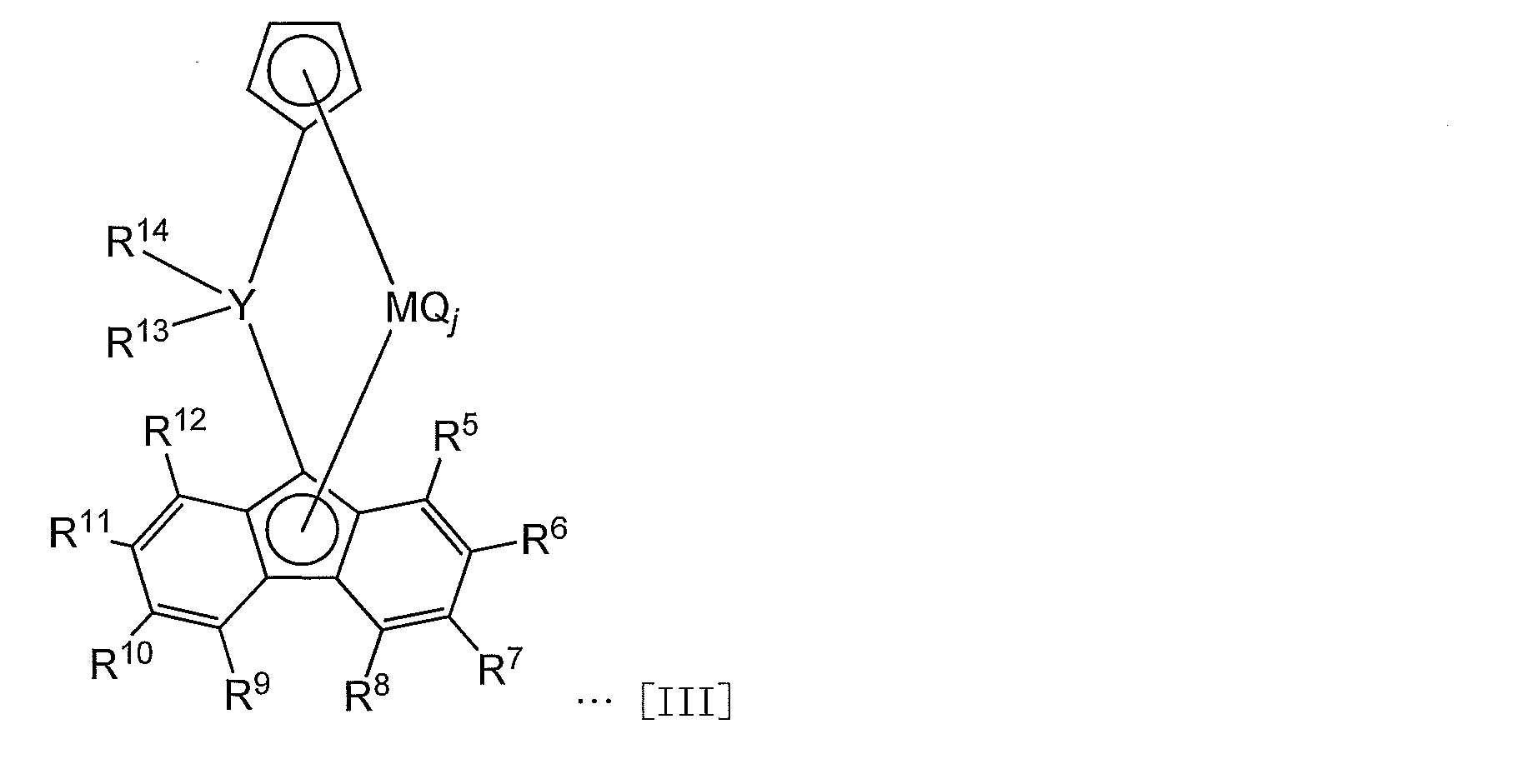
このような架橋メタロセン化合物(A)としては、
[ジメチルメチレン(η5-シクロペンタジエニル)(η5-フルオレニル)]ジルコニウムジクロリド、[ジメチルメチレン(η5-シクロペンタジエニル)(η5-2,7-ジ-t-ブチルフルオレニル)]ジルコニウムジクロリド、[ジメチルメチレン(η5-シクロペンタジエニル)(η5-3,6-ジ-t-ブチルフルオレニル)]ジルコニウムジクロリド、 [ジメチルメチレン(η5-シクロペンタジエニル)(η5-オクタメチルオクタヒドロジベンゾフルオレニル)]ジルコニウムジクロリド、[ジメチルメチレン(η5-シクロペンタジエニル)(η5-テトラメチルオクタヒドロジベンゾフルオレニル)]ジルコニウムジクロリド、[シクロヘキシリデン(η5-シクロペンタジエニル)(η5-フルオレニル)]ジルコニウムジクロリド、[シクロヘキシリデン(η5-シクロペンタジエニル)(η5-2,7-ジ-t-ブチルフルオレニル)]ジルコニウムジクロリド、[シクロヘキシリデン(η5-シクロペンタジエニル)(η5-3,6-ジ-t-ブチルフルオレニル)]ジルコニウムジクロリド、 [シクロヘキシリデン(η5-シクロペンタジエニル)(η5-オクタメチルオクタヒドロジベンゾフルオレニル)]ジルコニウムジクロリド、[シクロヘキシリデン(η5-シクロペンタジエニル)(η5-テトラメチルオクタヒドロジベンゾフルオレニル)]ジルコニウムジクロリド、[ジフェニルメチレン(η5-シクロペンタジエニル)(η5-フルオレニル)]ジルコニウムジクロリド、[ジフェニルメチレン(η5-シクロペンタジエニル)(η5-2,7-ジ-t-ブチルフルオレニル)]ジルコニウムジクロリド、ジフェニルメチレン(η5-2-メチル-4-t-ブチルシクロペンタジエニル)(η5-2,7-ジ-t-ブチルフルオレニル)]ジルコニウムジクロリド、[ジフェニルメチレン(η5-シクロペンタジエニル)(η5-3,6-ジ-t-ブチルフルオレニル)]ジルコニウムジクロリド、 [ジフェニルメチレン(η5-シクロペンタジエニル)(η5-オクタメチルオクタヒドロジベンゾフルオレニル)]ジルコニウムジクロリド、ジフェニルメチレン[η5-(2-メチル-4-i-プロピルシクロペンタジエニル)](η5-オクタメチルオクタヒドロジベンゾフルオレニル)]ジルコニウムジクロリド、[ジフェニルメチレン(η5-シクロペンタジエニル)(η5-テトラメチルオクタヒドロジベンゾフルオレニル)]ジルコニウムジクロリド、[メチルフェニルメチレン(η5-シクロペンタジエニル)(η5-フルオレニル)]ジルコニウムジクロリド、[メチルフェニルメチレン(η5-シクロペンタジエニル)(η5-2,7-ジ-t-ブチルフルオレニル)]ジルコニウムジクロリド、[メチルフェニルメチレン(η5-シクロペンタジエニル)(η5-3,6-ジ-t-ブチルフルオレニル)]ジルコニウムジクロリド、 [メチルフェニルメチレン(η5-シクロペンタジエニル)(η5-オクタメチルオクタヒドロジベンゾフルオレニル)]ジルコニウムジクロリド、[メチルフェニルメチレン(η5-シクロペンタジエニル)(η5-テトラメチルオクタヒドロジベンゾフルオレニル)]ジルコニウムジクロリド、[メチル(3-メチルフェニル)メチレン(η5-シクロペンタジエニル)(η5-フルオレニル)]ジルコニウムジクロリド、[メチル(3-メチルフェニル)メチレン(η5-シクロペンタジエニル)(η5-2,7-ジ-t-ブチルフルオレニル)]ジルコニウムジクロリド、[メチル(3-メチルフェニル)メチレン(η5-シクロペンタジエニル)(η5-3,6-ジ-t-ブチルフルオレニル)]ジルコニウムジクロリド、 [メチル(3-メチルフェニル)メチレン(η5-シクロペンタジエニル)(η5-オクタメチルオクタヒドロジベンゾフルオレニル)]ジルコニウムジクロリド、[メチル(3-メチルフェニル)メチレン(η5-シクロペンタジエニル)(η5-テトラメチルオクタヒドロジベンゾフルオレニル)]ジルコニウムジクロリド、[ジフェニルシリレン(η5-シクロペンタジエニル)(η5-フルオレニル)]ジルコニウムジクロリド、[ジフェニルシリレン(η5-シクロペンタジエニル)(η5-2,7-ジ-t-ブチルフルオレニル)]ジルコニウムジクロリド、[ジフェニルシリレン(η5-シクロペンタジエニル)(η5-3,6-ジ-t-ブチルフルオレニル)]ジルコニウムジクロリド、 [ジフェニルシリレン(η5-シクロペンタジエニル)(η5-オクタメチルオクタヒドロジベンゾフルオレニル)]ジルコニウムジクロリド、[ジフェニルシリレン(η5-シクロペンタジエニル)(η5-テトラメチルオクタヒドロジベンゾフルオレニル)]ジルコニウムジクロリド、[ビス(3-メチルフェニル)シリレン(η5-シクロペンタジエニル)(η5-フルオレニル)]ジルコニウムジクロリド、[ビス(3-メチルフェニル)シリレン(η5-シクロペンタジエニル)(η5-2,7-ジ-t-ブチルフルオレニル)]ジルコニウムジクロリド、[ビス(3-メチルフェニル)シリレン(η5-シクロペンタジエニル)(η5-3,6-ジ-t-ブチルフルオレニル)]ジルコニウムジクロリド、 [ビス(3-メチルフェニル)シリレン(η5-シクロペンタジエニル)(η5-オクタメチルオクタヒドロジベンゾフルオレニル)]ジルコニウムジクロリド、[ビス(3-メチルフェニル)シリレン(η5-シクロペンタジエニル)(η5-テトラメチルオクタヒドロジベンゾフルオレニル)]ジルコニウムジクロリド、[ジシクロヘキシルシリレン(η5-シクロペンタジエニル)(η5-フルオレニル)]ジルコニウムジクロリド、[ジシクロヘキシルシリレン(η5-シクロペンタジエニル)(η5-2,7-ジ-t-ブチルフルオレニル)]ジルコニウムジクロリド、[ジシクロヘキシルシリレン(η5-シクロペンタジエニル)(η5-3,6-ジ-t-ブチルフルオレニル)]ジルコニウムジクロリド、 [ジシクロヘキシルシリレン(η5-シクロペンタジエニル)(η5-オクタメチルオクタヒドロジベンゾフルオレニル)]ジルコニウムジクロリド、[ジシクロヘキシルシリレン(η5-シクロペンタジエニル)(η5-テトラメチルオクタヒドロジベンゾフルオレニル)]ジルコニウムジクロリド、[エチレン(η5-シクロペンタジエニル)(η5-フルオレニル)]ジルコニウムジクロリド、[エチレン(η5-シクロペンタジエニル)(η5-2,7-ジ-t-ブチルフルオレニル)]ジルコニウムジクロリド、[エチレン(η5-シクロペンタジエニル)(η5-3,6-ジ-t-ブチルフルオレニル)]ジルコニウムジクロリド、 [エチレン(η5-シクロペンタジエニル)(η5-オクタメチルオクタヒドロジベンゾフルオレニル)]ジルコニウムジクロリド、[エチレン(η5-シクロペンタジエニル)(η5-テトラメチルオクタヒドロジベンゾフルオレニル)]ジルコニウムジクロリド、
これらの化合物のジルコニウム原子をハフニウム原子に置き換えた化合物またはクロロ配位子をメチル基に置き換えた化合物
などが例示されるが、架橋メタロセン化合物(A)はこれらの例示に限定されない。尚、例示した架橋メタロセン化合物(A)の構成部分であるη5-テトラメチルオクタヒドロジベンゾフルオレニルは4,4,7,7-テトラメチル-(5a,5b,11a,12,12a-η5)-1,2,3,4,7,8,9,10-オクタヒドロジベンゾ[b,h]フルオレニル基、η5-オクタメチルオクタヒドロジベンゾフルオレニルは1,1,4,4,7,7,10,10-オクタメチル-(5a,5b,11a,12,12a-η5)-1,2,3,4,7,8,9,10-オクタヒドロジベンゾ[b,h]フルオレニル基をそれぞれ表わす。
本発明で使用される重合触媒は、上記の架橋メタロセン化合物(A)、ならびに有機金属化合物(B-1)、有機アルミニウムオキシ化合物(B-2)および架橋メタロセン化合物(A)と反応してイオン対を形成する化合物(B-3)からなる群より選ばれる少なくとも1種の化合物(B)を含む。
(式中、RaおよびRbは、互いに同一でも異なっていてもよく、炭素数1~15、好ましくは1~4の炭化水素基を示し、Xはハロゲン原子を示し、mは0<m≦3、nは0≦n<3、pは0≦p<3、qは0≦q<3の数であり、かつm+n+p+q=3である)
で表される有機アルミニウム化合物。
トリイソプロピルアルミニウム、トリイソブチルアルミニウム、トリsec-ブチルアルミニウム、トリ-t-ブチルアルミニウム、トリ-2-メチルブチルアルミニウム、トリ-3-メチルヘキシルアルミニウム、トリ-2-エチルヘキシルアルミニウムなどのトリ分岐状アルキルアルミニウム、
トリシクロヘキシルアルミニウム、トリシクロオクチルアルミニウムなどのトリシクロアルキルアルミニウム、
トリフェニルアルミニウム、トリ(4-メチルフェニル)アルミニウムなどのトリアリールアルミニウム、
ジイソプロピルアルミニウムハイドライド、ジイソブチルアルミニウムハイドライドなどのジアルキルアルミニウムハイドライド、
一般式(i-C4H9)xAly(C5H10)z(式中、x、y、zは正の数であり、z≦2xである。)で表されるイソプレニルアルミニウムなどのアルケニルアルミニウム、
イソブチルアルミニウムメトキシド、イソブチルアルミニウムエトキシドなどのアルキルアルミニウムアルコキシド、
ジメチルアルミニウムメトキシド、ジエチルアルミニウムエトキシド、ジブチルアルミニウムブトキシドなどのジアルキルアルミニウムアルコキシド、
エチルアルミニウムセスキエトキシド、ブチルアルミニウムセスキブトキシドなどのアルキルアルミニウムセスキアルコキシド、
一般式Ra 2.5Al(ORb)0.5などで表される平均組成を有する部分的にアルコキシ化されたアルキルアルミニウム、
ジエチルアルミニウムフェノキシド、ジエチルアルミニウム(2,6-ジ-t-ブチル-4-メチルフェノキシド)などのアルキルアルミニウムアリーロキシド、
ジメチルアルミニウムクロリド、ジエチルアルミニウムクロリド、ジブチルアルミニウムクロリド、ジエチルアルミニウムブロミド、ジイソブチルアルミニウムクロリドなどのジアルキルアルミニウムハライド、
エチルアルミニウムセスキクロリド、ブチルアルミニウムセスキクロリド、エチルアルミニウムセスキブロミドなどのアルキルアルミニウムセスキハライド、
エチルアルミニウムジクロリドなどのアルキルアルミニウムジハライドなどの部分的にハロゲン化されたアルキルアルミニウム、
ジエチルアルミニウムヒドリド、ジブチルアルミニウムヒドリドなどのジアルキルアルミニウムヒドリド、
エチルアルミニウムジヒドリド、プロピルアルミニウムジヒドリドなどのアルキルアルミニウムジヒドリドおよびその他の部分的に水素化されたアルキルアルミニウム、
エチルアルミニウムエトキシクロリド、ブチルアルミニウムブトキシクロリド、エチルアルミニウムエトキシブロミドなどの部分的にアルコキシ化およびハロゲン化されたアルキルアルミニウム
などを例示することができる。また、上記一般式Ra mAl(ORb)nHpXqで表される化合物に類似する化合物も使用することができ、例えば窒素原子を介して2以上のアルミニウム化合物が結合した有機アルミニウム化合物を挙げることができる。このような化合物として具体的には、(C2H5)2AlN(C2H5)Al(C2H5)2などを挙げることができる。
(式中、M2はLi、NaまたはKを示し、Raは炭素数1~15、好ましくは1~4の炭化水素基を示す。)
で表される周期律表第1族金属とアルミニウムとの錯アルキル化物。
(式中、RaおよびRbは、互いに同一でも異なっていてもよく、炭素数1~15、好ましくは1~4の炭化水素基を示し、M3はMg、ZnまたはCdである。)
で表される周期律表第2族または第12族金属のジアルキル化合物。
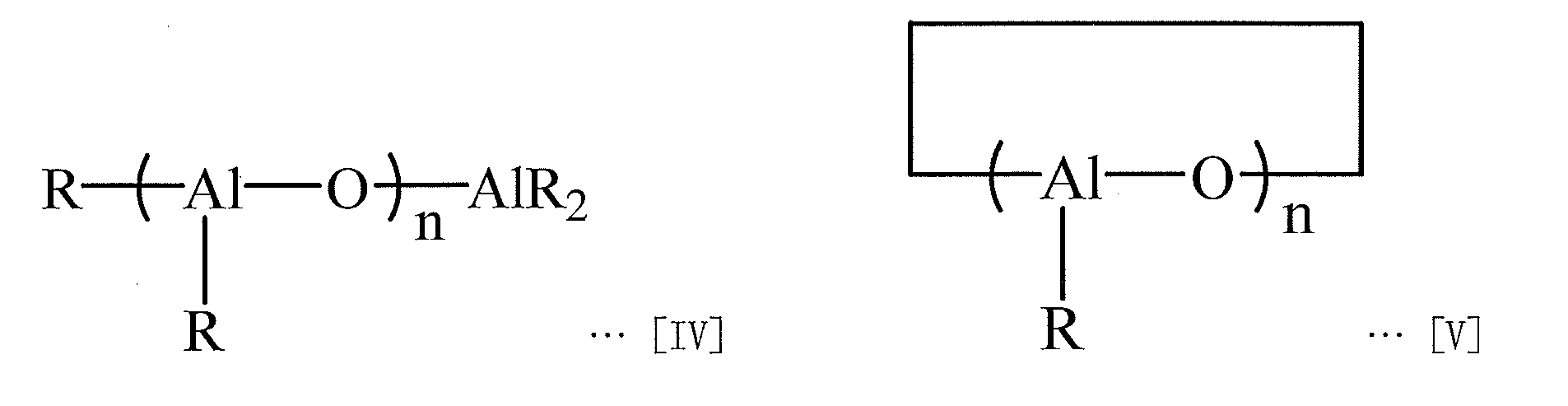



本発明では、オレフィン重合触媒の構成成分として、必要に応じて担体(C)を用いてもよい。
本発明の共重合体の製造方法は、上記オレフィン重合触媒の存在下で、エチレンと炭素数が3~20のα-オレフィンとを共重合する工程を含むことを特徴としている。
本発明の共重合体は、構成単位であるエチレン単位の含量が、好ましくは30~70モル%、より好ましくは40~65モル%、特に好ましくは45~60モル%の範囲であり、α-オレフィン単位の含量が、好ましくは30~70モル%、より好ましくは35~60モル%、特に好ましくは40~55モル%の範囲である。各単位の組成が上記範囲にあることにより、得られる潤滑油組成物として優れた温度・粘度特性を発揮することができる。
サンプルパンをDSCセルに配置し、DSCセルを窒素雰囲気下にて30℃(室温)から150℃まで10℃/分で昇温し、次いで、150℃で5分間保持した後、10℃/分で降温し、DSCセルを-100℃まで冷却する(降温過程)。次いで、100℃で5分間保持した後、10℃/分で昇温し、昇温過程で得られるエンタルピー曲線の変曲点での接線の交点をガラス転移点(Tg)とする。ガラス転移点の(Tg)の求め方はJIS K7121 9.3に基づいて行った。

重合体約20 mgをデカリン15 mlに溶解し、135℃のオイルバス中で比粘度ηspを測定する。このデカリン溶液にデカリン溶媒を5 ml追加して希釈後、同様にして比粘度ηspを測定する。この希釈操作をさらに2回繰り返し、濃度(C)を0に外挿した時のηsp/Cの値を極限粘度として採用する。
<潤滑油組成物>
本発明の潤滑油組成物は、本発明の共重合体を含んでいる。本発明の共重合体の含有量は、潤滑油組成物100質量%に対し、好ましくは1質量%以上100質量%以下、より好ましくは1質量%以上90質量%以下、特に好ましくは2質量%以上70質量%以下である。
本発明の潤滑油組成物は、工業用潤滑油(ギア油、作動油)およびグリース用基油として用いることが可能であり、特に自動車用潤滑油として好適である。また、ディファレンシャルギア油のような自動車用ギア油、または手動変速機油、自動変速機油、無段変速機油などのような自動車用駆動油にも好適に使用できる。さらには自動車エンジン油、船舶シリンダ油にも使用することができる。本発明の潤滑油組成物は、自動車用変速機油として、100℃における動粘度を7.5mm2/s以下、好ましくは6.5mm2/s以下、さらに好ましくは5.5mm2/sに調整した場合、優れた省燃費性能を発揮する。
下記実施例および比較例等において、エチレン/α-オレフィン共重合体および潤滑油組成物の物性等は以下の方法で測定した。
日本分光社製フーリエ変換赤外分光光度計FT/IR-610またはFT/IR-6100を用い、長鎖メチレン基の横揺れ振動に基づく721cm-1付近の吸収とプロピレンの骨格振動に基づく1155cm-1付近の吸収との吸光度比(D1155cm-1/D721cm-1)を算出し、予め作成しておいた検量線(ASTM D3900での標準試料を使って作成)よりエチレン含有量(重量%)を求めた。続いて、100重量%から上記の方法で求めたエチレン含有量(重量%)を減じてプロピレン含有量(重量%)を求めた。次に、得られたエチレン含有量(重量%)およびプロピレン含有量(重量%)を用い、下記式に従ってエチレン含有量(mol%)を求めた。

o-ジクロロベンゼン/ベンゼン-d6(4/1[vol/vol%])を測定溶媒とし、測定温度120℃、スペクトル幅250ppm、パルス繰り返し時間5.5秒、パルス幅4.7・sec(45Oパルス)測定条件下(100 MHz、日本電子ECX400P)、または測定温度120℃、スペクトル幅250ppm、パルス繰り返し時間5.5秒、パルス幅5.0・sec(45Oパルス)測定条件下(125 MHz、ブルカー・バイオスピンAVANCEIIIcryo-500)にて13C NMRスペクトルを測定し、下記式[1]に基づき算出した。

数平均分子量(Mn)および分子量分布(Mw/Mn)は、東ソー株式会社製のGPC(HLC-8320GPC)を用いて以下のようにして測定した。分離カラムとして、TSKgel SuperMultiporeHZ-M(4本)を用い、カラム温度を40℃とし、移動相にはテトラヒドロフラン(和光純薬社製)を用い、展開速度を0.35ml/分とし、試料濃度を5.5g/Lとし、試料注入量を20マイクロリットルとし、検出器として示差屈折計を用いた。標準ポリスチレンとしては、東ソー社製(PStQuick MP-M)のものを用いた。各種平均分子量は、汎用校正の手順に従い、ポリスチレン分子量換算として計算した。
デカリン溶媒を用いて、135℃で測定した。重合体約20 mgをデカリン15 mlに溶解し、135℃のオイルバス中で比粘度ηspを測定した。このデカリン溶液にデカリン溶媒を5 ml追加して希釈後、同様にして比粘度ηspを測定した。この希釈操作をさらに2回繰り返し、濃度(C)を0に外挿した時のηsp/Cの値を極限粘度として採用した。
<分子鎖二重結合量>
o-ジクロロベンゼン-d4を測定溶媒とし、測定温度120℃、スペクトル幅20ppm、パルス繰り返し時間7.0秒、パルス幅6.15μsec(45oパルス)測定条件下にて、1H NMRスペクトル(400 MHz、日本電子ECX400P)を測定し、算出した。
セイコーインスツルメント社X-DSC-7000を用い、簡易密閉できるアルミサンプルパンに約8mgのエチレン/α-オレフィン共重合体を入れてDSCセルに配置し、DSCセルを窒素雰囲気下にて室温から150℃まで10℃/分で昇温し、次いで、150℃で5分間保持した後、10℃/分で降温し、DSCセルを-100℃まで冷却した(降温過程)。次いで、100℃で5分間保持した後、10℃/分で昇温し、昇温過程で得られるエンタルピー曲線の変曲点での接線の交点をガラス転移点(Tg)とした。ガラス転移点(Tg)の求め方はJIS K7121 9.3に基づいて行った。
100℃動粘度、40℃動粘度および粘度指数は、JIS K2283に記載の方法により、測定、算出した。
潤滑油組成物の剪断安定性は、DIN 52350-6に記載の方法に準拠し、KRL剪断安定性試験機を用いて評価した。配合油を60℃で20hrの間、剪断条件下(1450rpm)におき、試験前後での100℃での動粘度の低下率を評価した。
潤滑油組成物の超音波剪断安定性は、JASO M347に準拠し、60分の超音波照射を行い、試験前後での100℃での動粘度の低下率を評価した。
低温粘度は、ASTM D2983に準拠して、所定の温度にてブルックフィールド粘度計により測定した。
実施例および比較例で用いたメタロセン化合物の合成方法を以下に示す。なお、合成したメタロセン化合物およびその前駆体の構造は、1H NMRスペクトル(270 MHz、日本電子GSH-270)、FD-質量(以下「FD-MS」と称する。)スペクトル(日本電子SX-102A)等を測定して決定した。
[メチルフェニルメチレン(η5-シクロペンタジエニル)(η5-2,7-ジ-t-ブチルフルオレニル)]ジルコニウムジクロリドの合成
(i)6-メチル-6-フェニルフルベンの合成
窒素雰囲気下、200mL三口フラスコにリチウムシクロペンタジエン 7.3g (101.6 mmol)および脱水テトラヒドロフラン100mLを加えて攪拌した。溶液をアイスバスで冷却し、アセトフェノン15.0g(111.8 mmol)を滴下した。その後、室温で20時間攪拌し、得られた溶液を希塩酸水溶液でクエンチした。ヘキサン100mLを加えて可溶分を抽出し、この有機層を水、飽和食塩水で洗浄後 無水硫酸マグネシウムで乾燥した。その後、溶媒を留去し、得られた粘性液体をカラムクロマトグラフィー(ヘキサン)で分離し、目的物(赤色粘性液体)を得た。(収量14.7 g、収率78%)。6-メチル-6-フェニルフルベンの同定は1H NMRスペクトルにて行った。以下にその測定値を示す。
1H NMRスペクトル(270 MHz, CDCl3): δ/ppm 7.39 (m, 5H), 6.64 (m, 1H), 6.57 (m, 1H), 6.48 (m, 1H), 6.18 (m, 1H), 2.54 (s, 3H)。
窒素雰囲気下、100mL三口フラスコに2,7-ジ-t-ブチルフルオレン 2.01g(7.20 mmol)および脱水t-ブチルメチルエーテル50mLを添加した。氷浴で冷却しながらn-ブチルリチウム/ヘキサン溶液 (1.65 M) 4.60mL(7.59 mmol)を徐々に添加し、室温で16時間攪拌した。6-メチル-6-フェニルフルベン1.66 g (9.85 mmol)を添加した後、加熱還流下で1時間攪拌した。氷浴で冷却しながら水50mLを徐々に添加し、得られた二層の溶液を200mL分液漏斗に移した。ジエチルエーテル50mLを加えて数回振った後水層を除き、有機層を水50mLで3回、飽和食塩水50mLで1回洗った。無水硫酸マグネシウムで30分間乾燥した後、減圧下で溶媒を留去した。少量のヘキサンを加えて得た溶液に超音波を当てたところ固体が析出したので、これを採取して少量のヘキサンで洗浄した。減圧下で乾燥し、白色固体としてメチル(シクロペンタジエニル)(2,7-ジ-t-ブチルフルオレニル)(フェニル)メタン2.83 g (6.34 mmol、88.1 %)を得た。メチル(シクロペンタジエニル)(2,7-ジ-t-ブチルフルオレニル)(フェニル)メタンの同定はFD-MSスペクトルにて行った。以下にその測定値を示す。
FD-MSスペクトル:M/z 446 (M+)。
窒素雰囲気下、100mLシュレンク管にメチル(シクロペンタジエニル)(2,7-ジ-t-ブチルフルオレニル)(フェニル)メタン1.50 g (3.36 mmol)、脱水トルエン50mLおよびTHF 570μL (7.03 mmol)を順次添加した。氷浴で冷却しながらn-ブチルリチウム/ヘキサン溶液 (1.65 M)4.20mL(6.93 mmol)を徐々に添加し、45℃で5時間攪拌した。減圧下で溶媒を留去し、脱水ジエチルエーテル40mLを添加して赤色溶液とした。メタノール/ドライアイス浴で冷却 しながら四塩化ジルコニウム 728 mg(3.12 mmol)を添加し、室温まで徐々に昇温しながら16時間攪拌したところ、赤橙色スラリーが得られた。減圧下で溶媒を留去して得られた固体をグローブボックス内に持ち込み、ヘキサンで洗浄した後、ジクロロメタンで抽出した。減圧下で溶媒を留去して濃縮した後、少量のヘキサンを加え、-20℃で放置したところ赤橙色固体が析出した。この固体を少量のヘキサンで洗浄した後、減圧下で乾燥することにより、赤橙色固体として[メチルフェニルメチレン(η5-シクロペンタジエニル)(η5-2,7-ジ-t-ブチルフルオレニル)]ジルコニウムジクロリド 1.20 g (1.98 mmol、63.3%)を得た。[メチルフェニルメチレン(η5-シクロペンタジエニル)(η5-2,7-ジ-t-ブチルフルオレニル)]ジルコニウムジクロリドの同定は1H NMRスペクトルにて行った。以下にその測定値を示す。
1H NMRスペクトル(270 MHz, CDCl3): δ/ppm 8.02 (d, J = 8.9 Hz, 1H), 7.96 (d, J = 9.1 Hz, 1H), 7.89-7.86 (br, 1H), 7.78 (br, 1H), 7.69-7.62(m, 2H), 7.59-7.50 (m, 2H), 7.44-7.38 (m, 2H), 6.40-6.37 (m, 1H), 6.28-6.25 (m, 1H), 6.05 (br, 1H), 5.81-5.78 (m, 1H), 5.60-5.57 (m, 1H), 2.53 (s, 3H) , 1.37 (s, 9H), 0.95 (s, 9H)。
[ジフェニルメチレン[η5-(2-メチル-4-i-プロピルシクロペンタジエニル)](η5-オクタメチルオクタヒドロジベンゾフルオレニル)]ジルコニウムジクロリドの合成
(i)1-メチル-3-i-プロピル-6,6-ジフェニルフルベンの合成
窒素雰囲気下、200mL三口フラスコに1-メチル-3-i-プロピルシクロペンタジエン(GC純度:88.5%)2.13 gおよび脱水THF 100mLを加えた。氷浴で冷却しながらn-ブチルリチウム/ヘキサン溶液 (1.63 M) 10.7mL (17.4 mmol)を徐々に添加した後、室温で4時間撹拌した。再び氷浴で冷却しながらDMI 2.37 g (20.7 mmol)を徐々に添加し、室温で30分間撹拌した。その後、ベンゾフェノン 3.49 g (19.2 mmol)を加え、加熱還流下で20時間撹拌した。氷浴で冷却しながら水 50mLを徐々に添加し、更にジエチルエーテル 50mLを加えて室温で30分間攪拌した。得られた二層の溶液を500mL分液漏斗に移し、有機層を水 100mLで3回、飽和食塩水100mLで1回洗った。無水硫酸マグネシウムで30分間乾燥した後、減圧下で溶媒を留去して橙褐色固体を得た。シリカゲルクロマトグラフ(300 g、ヘキサン)による分離を行い、赤色溶液を得た。減圧下で溶媒を留去し、赤色油状物として1-メチル-3-i-プロピル-6,6-ジフェニルフルベン 2.09 g (7.29 mmol)を得た。1-メチル-3-i-プロピル-6,6-ジフェニルフルベンの同定は1H NMRスペクトルにて行った。以下にその測定値を示す。
1H NMRスペクトル(270 MHz, CDCl3): δ/ppm 7.36-7.22 (m, 10H), 6.25-6.23 (m, 1H), 5.74-5.73 (m, 1H), 2.68-2.52 (m, 1H), 1.48 (d, J = 1.4 Hz, 3H), 1.12 (d, J = 6.8 Hz, 6H)。
窒素雰囲気下、200mL三口フラスコにオクタメチルオクタヒドロジベンゾフルオレン 1.73 g(4.46 mmol)および脱水t-ブチルメチルエーテル70mLを添加した。氷浴で冷却しながらn-ブチルリチウム/ヘキサン溶液 (1.63 M)2.90mL(4.73 mmol)を徐々に添加し、その後室温で7時間攪拌した。1-メチル-3-i-プロピル-6,6-ジフェニルフルベン834mg (2.91 mmol)を添加した後、加熱還流下で17時間撹拌した。室温まで冷却した後、氷浴で冷却しながら水50mL、続いてジエチルエーテル50mLを徐々に添加し、得られた二層の溶液を500mL分液漏斗に移した。数回振った後水層を除き、有機層を水100mLで3回、飽和食塩水100mLで1回洗った。無水硫酸マグネシウムで30分間乾燥した後、減圧下で溶媒を留去して固体を得た。得られた固体をメタノールで洗浄した後、シリカゲルクロマトグラフ(60 g、ヘキサン)による分離を行い、無色の溶液を得た。減圧下で溶媒を留去し、白色固体として(2-メチル-4-i-プロピルシクロペンタジエニル)(オクタメチルオクタヒドロジベンゾフルオレニル)ジフェニルメタン 1.03 g (1.53 mmol、52.5%)を得た。(2-メチル-4-i-プロピルシクロペンタジエニル)(オクタメチルオクタヒドロジベンゾフルオレニル)ジフェニルメタンの同定はFD-MSスペクトルにて行った。以下にその測定値を示す。
FD-MSスペクトル: M/z 673 (M+)。
窒素雰囲気下、100mLシュレンク管に(2-メチル-4-i-プロピルシクロペンタジエニル)(オクタメチルオクタヒドロジベンゾフルオレニル)ジフェニルメタン 926 mg (1.38 mmol)、脱水トルエン30mLおよび脱水THF 0.24mL(3.0 mmol)を順次添加した。氷浴で冷却しながらn-ブチルリチウム/ヘキサン溶液 (1.63 M) 1.80mL(2.93 mmol)を徐々に添加し、45℃で4時間攪拌したところ赤色溶液が得られた。減圧下で溶媒を留去し、脱水ジエチルエーテル 30mLを添加して再び赤色溶液とした。メタノール/ドライアイス浴で冷却しながら四塩化ジルコニウム280 mg(4.27 mmol)を添加し、室温まで徐々に昇温しながら17時間攪拌したところ、赤色スラリーが得られた。減圧下で溶媒を留去して得られた固体をグローブボックス内に持ち込み、ヘキサンで抽出した。減圧下で溶媒を留去して濃縮し、-20℃で再結晶した。析出した固体を少量のヘキサンで洗浄し、減圧下で乾燥することにより、赤色固体として[ジフェニルメチレン[η5-(2-メチル-4-i-プロピルシクロペンタジエニル)](η5-オクタメチルオクタヒドロジベンゾフルオレニル)]ジルコニウムジクロリド 345 mg (0.414 mmol、34.5%)を得た。[ジフェニルメチレン[η5-(2-メチル-4-i-プロピルシクロペンタジエニル)](η5-オクタメチルオクタヒドロジベンゾフルオレニル)]ジルコニウムジクロリドの同定は1H NMRスペクトルおよびFD-MSスペクトルにて行った。以下にその測定値を示す。
1H NMRスペクトル(270 MHz, CDCl3): δ/ppm 8.07-7.93 (m, 5H), 7.80-7.76 (m, 1H), 7.48-7.19 (m, 6H), 6.96 (s, 1H), 6.04 (s, 1H), 5.99 (d, J = 3.0 Hz, 1H), 5.40 (d, J = 3.0 Hz, 1H), 2.57 (sep, J = 7.0 Hz, 1H), 1.85 (s, 3H), 1.7-1.6 (br m, 8H), 1.50 (s, 3H), 1.47 (s, 3H), 1.43 (s, 3H), 1.40 (s, 3H), 1.11 (d, J = 7.0 Hz, 3H), 1.07 (s, 3H), 1.01 (d, J = 7.0 Hz, 3H), 0.88 (s, 3H), 0.86 (s, 3H), 0.77 (s, 3H)
FD-MSスペクトル: M/z 832 (M+)。
[エチレン(η5-シクロペンタジエニル)(η5-2,7-ジ-t-ブチルフルオレニル)]ジルコニウムジクロリドは、特許第4367687号公報に記載の方法で合成した。
以下の実施例および比較例においてエチレン/α-オレフィン共重合体を製造した。なお、得られたエチレン/α-オレフィン共重合体について、必要に応じて、下記方法で水添操作を実施した。各実施例および比較例における製造条件、ならびに得られたエチレン/α-オレフィン共重合体の物性等については、表1および表2に示す。
内容積1Lのステンレス製オートクレーブに0.5質量%Pd/アルミナ触媒のヘキサン溶液100mLおよびエチレン/α-オレフィン共重合体の30質量%ヘキサン溶液500mLを加え、オートクレーブを密閉した後、窒素置換を行なった。次いで、撹拌をしながら140℃まで昇温し、系内を水素置換した後、水素で1.5MPaまで昇圧して15分間水添反応を実施した。
[エチレン(η 5 -シクロペンタジエニル)(η 5 -2,7-ジ-t-ブチルフルオレニル)]ジルコニウムジクロリドによるエチレン/プロピレン共重合(50℃)
充分に窒素置換した内容積1Lのガラス製重合器にヘプタン250mLを装入し、系内の温度を50℃に昇温した後、エチレンを25L/hr、プロピレンを75L/hr、水素を100L/hrの流量で連続的に重合器内に供給し、撹拌回転数600rpmで撹拌した。次にトリイソブチルアルミニウム0.2mmolを重合器に装入し、次いでMMAO 0.688 mmolと[エチレン(η5-シクロペンタジエニル)(η5-2,7-ジ-t-ブチルフルオレニル)]ジルコニウムジクロリド0.00230 mmolをトルエン中で15分以上予備混合したものを重合器に装入することにより重合を開始した。その後、エチレン、プロピレン、水素の連続的供給を継続し、50℃で15分間重合を行った。少量のイソブチルアルコールを系内に添加することにより重合を停止した後、未反応のモノマーをパージした。得られたポリマー溶液を、0.2 mol/lの塩酸100mLで3回、次いで蒸留水100mLで3回洗浄し、硫酸マグネシウムで乾燥後、溶媒を減圧留去した。得られたポリマーを80℃の減圧下で一晩乾燥した。その結果、エチレン-プロピレン共重合体1.43 gを得た。得られたポリマーのエチレン含有量は48.4 mol%、Mwは17430、Mw/Mnは2.1、[η]は0.23 dl/g、Tgは-63℃、B値は1.3、分子鎖二重結合量(個/1000炭素)はビニル = 0.05、ビニリデン = 0.29、二置換オレフィン<0.01、三置換オレフィン = 0.09であった。
[ジフェニルメチレン(η 5 -2-メチル-4-t-ブチルシクロペンタジエニル)(η 5 -2,7-ジ-t-ブチルフルオレニル)]ジルコニウムジクロリドによるエチレン/プロピレン共重合(50℃)
[エチレン(η5-シクロペンタジエニル)(η5-2,7-ジ-t-ブチルフルオレニル)]ジルコニウムジクロリド0.00230 mmolの代わりに[ジフェニルメチレン(η5-2-メチル-4-t-ブチルシクロペンタジエニル)(η5-2,7-ジ-t-ブチルフルオレニル)]ジルコニウムジクロリド0.00202 mmolを用い、MMAO 0.688 mmolの代わりにMMAO 0.607 mmolを用い、エチレンの流量を25L/hrから55L/hrに変更し、プロピレンの流量を75L/hrから45L/hrに変更したこと以外は、実施例1と同様の操作で重合を行った。その結果、エチレン-プロピレン共重合体1.60 gを得た。得られたポリマーのエチレン含有量は51.3 mol%、Mwは18380、Mw/Mnは1.8、[η]は0.24 dl/g、Tgは-62℃、B値は1.1、分子鎖二重結合量(個/1000炭素)はビニル = 0.04、ビニリデン = 0.12、二置換オレフィン<0.01、三置換オレフィン = 0.06であった。
[ジメチルメチレン(η 5 -シクロペンタジエニル)(η 5 -2,7-ジ-t-ブチルフルオレニル)]ジルコニウムジクロリドによるエチレン/プロピレン共重合(50℃)
[エチレン(η5-シクロペンタジエニル)(η5-2,7-ジ-t-ブチルフルオレニル)]ジルコニウムジクロリド0.00230 mmolの代わりに[ジメチルメチレン(η5-シクロペンタジエニル)(η5-2,7-ジ-t-ブチルフルオレニル)]ジルコニウムジクロリド0.00215 mmolを用い、MMAO 0.688 mmolの代わりにMMAO 0.645 mmolを用い、エチレンの流量を25L/hrから55L/hrに変更し、プロピレンの流量を75L/hrから45L/hrに変更したこと以外は、実施例1と同様の操作で重合を行った。その結果、エチレン-プロピレン共重合体1.40 gを得た。得られたポリマーのエチレン含有量は54.3 mol%、Mwは28805、Mw/Mnは1.9、[η]は0.34 dl/g、Tgは-60℃、B値は1.3、分子鎖二重結合量(個/1000炭素)はビニル = 0.13、ビニリデン = 1.10、二置換オレフィン<0.01、三置換オレフィン = 0.29であった。
[ジフェニルシリレン(η 5 -シクロペンタジエニル)(η 5 -2,7-ジ-t-ブチルフルオレニル)]ジルコニウムジクロリドによるエチレン/プロピレン共重合(50℃)
[エチレン(η5-シクロペンタジエニル)(η5-2,7-ジ-t-ブチルフルオレニル)]ジルコニウムジクロリド0.00230 mmolの代わりに[ジフェニルシリレン(η5-シクロペンタジエニル)(η5-2,7-ジ-t-ブチルフルオレニル)]ジルコニウムジクロリド0.00288 mmolを用い、MMAO 0.688 mmolの代わりにMMAO 0.868 mmolを用い、エチレンの流量を25L/hrから35L/hrに変更し、プロピレンの流量を75L/hrから65L/hrに変更したこと以外は、実施例1と同様の操作で重合を行った。その結果、エチレン-プロピレン共重合体2.31 gを得た。得られたポリマーのエチレン含有量は50.6 mol%、Mwは27184、Mw/Mnは1.9、[η]は0.32 dl/g、Tgは-61℃、B値は1.3、分子鎖二重結合量(個/1000炭素)はビニル<0.01、ビニリデン = 0.14、二置換オレフィン<0.01、三置換オレフィン<0.01であった。
[メチルフェニルメチレン(η 5 -シクロペンタジエニル)(η 5 -2,7-ジ-t-ブチルフルオレニル)]ジルコニウムジクロリドによるエチレン/プロピレン共重合(50℃)
[エチレン(η5-シクロペンタジエニル)(η5-2,7-ジ-t-ブチルフルオレニル)]ジルコニウムジクロリド0.00230 mmolの代わりに[メチルフェニルメチレン(η5-シクロペンタジエニル)(η5-2,7-ジ-t-ブチルフルオレニル)]ジルコニウムジクロリド0.00397 mmolを用い、MMAO 0.688 mmolの代わりにMMAO 1.192 mmolを用い、エチレンの流量を25L/hrから55L/hrに変更し、プロピレンの流量を75L/hr から45L/hrに変更したこと以外は、実施例1と同様の操作で重合を行った。その結果、エチレン-プロピレン共重合体1.59 gを得た。得られたポリマーのエチレン含有量は49.9 mol%、Mwは34238、Mw/Mnは1.9、[η]は0.40 dl/g、Tgは-60℃、B値は1.3、分子鎖二重結合量(個/1000炭素)はビニル = 0.08、ビニリデン = 0.90、二置換オレフィン<0.01、三置換オレフィン = 0.22であった。
[メチルフェニルメチレン(η 5 -シクロペンタジエニル)(η 5 -2,7-ジ-t-ブチルフルオレニル)]ジルコニウムジクロリドによるエチレン/プロピレン共重合(130℃)
充分に窒素置換した内容積1Lのガラス製重合器にデカン250mLを装入し、系内の温度を130℃に昇温した後、エチレンを25L/hr、プロピレンを75L/hr、水素を100L/hrの流量で連続的に重合器内に供給し、撹拌回転数600rpmで撹拌した。次にトリイソブチルアルミニウム0.2 mmolを重合器に装入し、次いでMMAO 1.213 mmolと[メチルフェニルメチレン(η5-シクロペンタジエニル)(η5-2,7-ジ-t-ブチルフルオレニル)]ジルコニウムジクロリド0.00402 mmolをトルエン中で15分以上予備混合したものを重合器に装入することにより重合を開始した。その後、エチレン、プロピレン、水素の連続的供給を継続し、130℃で15分間重合を行った。少量のイソブチルアルコールを系内に添加することにより重合を停止した後、未反応のモノマーをパージした。得られたポリマー溶液を、0.2 mol/lの塩酸100mLで3回、次いで蒸留水100mLで3回洗浄し、硫酸マグネシウムで乾燥後、溶媒を減圧留去した。得られたポリマーを80℃の減圧下で一晩乾燥した。その結果、エチレン-プロピレン共重合体0.77 gを得た。得られたポリマーのエチレン含有量は54.9 mol%、Mwは4987、Mw/Mnは1.8、[η]は0.08 dl/g、Tgは-71℃、B値は1.2、分子鎖二重結合量(個/1000炭素)はビニル = 1.09、ビニリデン = 1.74、二置換オレフィン = 0.11、三置換オレフィン = 0.28であった。
[ジフェニルメチレン(η 5 -2-メチル-4-i-プロピルシクロペンタジエニル)(η 5 -オクタメチルオクタヒドロジベンゾオレニル)]ジルコニウムジクロリドによるエチレン/プロピレン共重合
充分に窒素置換した内容積2Lのステンレス製オートクレーブにヘプタン780mLおよびプロピレン110 gを装入し、系内の温度を110℃に昇温した後、水素1.35 MPa、エチレン0.44 MPaを供給することにより全圧を3 MPaGとした。次にトリイソブチルアルミニウム0.4 mmol、[ジフェニルメチレン(η5-2-メチル-4-i-プロピルシクロペンタジエニル)(η5-オクタメチルオクタヒドロジベンゾオレニル)]ジルコニウムジクロリド0.00025 mmolおよびN,N-ジメチルアニリニウムテトラキス(ペンタフルオロフェニル)ボレート0.0010 mmolを窒素で圧入し、攪拌回転数を400 rpmにすることにより重合を開始した。その後、エチレンのみを連続的に供給することにより全圧を3 MPaGに保ち、110℃で8分間重合を行った。少量のエタノールを系内に添加することにより重合を停止した後、未反応のエチレン、プロピレン、水素をパージした。得られたポリマー溶液を、0.2 mol/lの塩酸1000mLで3回、次いで蒸留水1000mLで3回洗浄し、硫酸マグネシウムで乾燥後、溶媒を減圧留去した。得られたポリマーを80℃の減圧下で一晩乾燥した。その結果、エチレン-プロピレン共重合体45.6 gを得た。得られたポリマーのエチレン含有量は55.1 mol%、Mwは12110、Mw/Mnは1.8、[η]は0.17 dl/g、Tgは-64℃、B値は1.1であった。また、分子鎖二重結合量(個/1000炭素)はビニル = 0.10、ビニリデン = 0.14、二置換オレフィン<0.01、三置換オレフィン<0.01であり、水添操作後の分子鎖二重結合量の合計(個/1000炭素)は0.1未満であった。
[ジフェニルメチレン(η 5 -シクロペンタジエニル)(η 5 -2,7-ジ-t-ブチルフルオレニル)]ジルコニウムジクロリドによるエチレン/プロピレン共重合
ヘプタン740mLおよびプロピレン130 gを装入し、系内の温度を150℃に昇温した後、水素0.65 MPa、エチレン0.26 MPaを供給することにより全圧を3 MPaGとし、[ジフェニルメチレン(η5-2-メチル-4-i-プロピルシクロペンタジエニル)(η5-オクタメチルオクタヒドロジベンゾオレニル)]ジルコニウムジクロリド 0.00025 mmolおよびN,N-ジメチルアニリニウムテトラキス(ペンタフルオロフェニル)ボレート0.0010 mmolの代わりに[ジフェニルメチレン(η5-シクロペンタジエニル)(η5-2,7-ジ-t-ブチルフルオレニル)]ジルコニウムジクロリド 0.000075 mmolおよびN,N-ジメチルアニリニウムテトラキス(ペンタフルオロフェニル)ボレート0.00075 mmolを用い、150℃で5分間重合を行ったこと以外は、実施例7と同様の操作で重合を行った。その結果、エチレン-プロピレン共重合体18.0 gを得た。得られたポリマーのエチレン含有量は53.8 mol%、Mwは10700、Mw/Mnは1.8、[η]は0.16 dl/g、Tgは-65℃、B値は1.2であった。また、分子鎖二重結合量(個/1000炭素)はビニル = 0.35、ビニリデン = 0.96、二置換オレフィン = 0.05、三置換オレフィン= 0.07であり、水添操作後の分子鎖二重結合量の合計(個/1000炭素)は0.3であった。
[メチルフェニルメチレン(η 5 -シクロペンタジエニル)(η 5 -2,7-ジ-t-ブチルフルオレニル)]ジルコニウムジクロリドによるエチレン/プロピレン共重合
ヘプタン850mL、プロピレン75gを装入し、系内の温度を150℃に昇温した後、水素1.56 MPa、エチレン0.11MPaを供給することにより全圧を3MPaGとし、[ジフェニルメチレン(η5-2-メチル-4-i-プロピルシクロペンタジエニル)(η5-オクタメチルオクタヒドロジベンゾオレニル)]ジルコニウムジクロリド 0.00025 mmolおよびN,N-ジメチルアニリニウムテトラキス(ペンタフルオロフェニル)ボレート0.0010 mmolの代わりに、[メチルフェニルメチレン(η5-シクロペンタジエニル)(η5-2,7-ジ-t-ブチルフルオレニル)]ジルコニウムジクロリド0.00015 mmolおよびN,N-ジメチルアニリニウムテトラキス(ペンタフルオロフェニル)ボレート0.0015 mmolを用い、150℃で5分間重合を行ったこと以外は、実施例7と同様の操作で重合を行った。その結果、エチレン-プロピレン共重合体25.1 gを得た。得られたポリマーのエチレン含有量は48.8 mol%、Mwは3570、Mw/Mnは1.8、[η]は0.06 dl/g、Tgは-76℃、B値は1.1であった。また、分子鎖二重結合量(個/1000炭素)はビニル = 0.70、ビニリデン = 2.51、二置換オレフィン = 0.02、三置換オレフィン = 0.15であり、水添操作後の分子鎖二重結合量の合計(個/1000炭素)は0.1未満であった。
[メチルフェニルメチレン(η 5 -シクロペンタジエニル)(η 5 -2,7-ジ-t-ブチルフルオレニル)]ジルコニウムジクロリドによるエチレン/プロピレン共重合
ヘプタン710mL、プロピレン145 gを装入し、系内の温度を150℃に昇温した後、水素0.40 MPa、エチレン0.27 MPaを供給することにより全圧を3 MPaGとし、 [ジフェニルメチレン(η5-2-メチル-4-i-プロピルシクロペンタジエニル)(η5-オクタメチルオクタヒドロジベンゾオレニル)]ジルコニウムジクロリド 0.00025 mmolおよびN,N-ジメチルアニリニウムテトラキス(ペンタフルオロフェニル)ボレート0.0010 mmolの代わりに、[メチルフェニルメチレン(η5-シクロペンタジエニル)(η5-2,7-ジ-t-ブチルフルオレニル)]ジルコニウムジクロリド 0.00010 mmolおよびN,N-ジメチルアニリニウムテトラキス(ペンタフルオロフェニル)ボレート0.001 mmolを用い、150℃で5分間重合を行ったこと以外は、実施例7と同様の操作で重合を行った。その結果、エチレン-プロピレン共重合体52.2 gを得た。得られたポリマーのエチレン含有量は53.1 mol%、Mwは9660、Mw/Mnは1.9、[η]は0.14 dl/g、Tgは-66℃、B値は1.2であった。また、分子鎖二重結合量(個/1000炭素)はビニル = 0.59、ビニリデン = 2.14、二置換オレフィン = 0.06、三置換オレフィン = 0.25であり、水添操作後の分子鎖二重結合量の合計(個/1000炭素)は0.2であった。
[メチルフェニルメチレン(η 5 -シクロペンタジエニル)(η 5 -2,7-ジ-t-ブチルフルオレニル)]ジルコニウムジクロリドによるエチレン/プロピレン共重合
ヘプタン910mL、プロピレン45 gを装入し、系内の温度を130 ℃に昇温した後、水素2.24 MPa、エチレン0.09 MPaを供給することにより全圧を3 MPaGとし、[ジフェニルメチレン(η5-2-メチル-4-i-プロピルシクロペンタジエニル)(η5-オクタメチルオクタヒドロジベンゾオレニル)]ジルコニウムジクロリド 0.00025 mmolおよびN,N-ジメチルアニリニウムテトラキス(ペンタフルオロフェニル)ボレート0.0010 mmolの代わりに、[メチルフェニルメチレン(η5-シクロペンタジエニル)(η5-2,7-ジ-t-ブチルフルオレニル)]ジルコニウムジクロリド 0.00060 mmolおよびN,N-ジメチルアニリニウムテトラキス(ペンタフルオロフェニル)ボレート0.006 mmolを用い、130℃で5分間重合を行ったこと以外は、実施例7と同様の操作で重合を行った。その結果、エチレン-プロピレン共重合体22.9 gを得た。得られたポリマーのエチレン含有量は51.9 mol%、Mwは2680、Mw/Mnは1.6、[η]は0.05 dl/g、Tgは-77℃、B値は1.1であった。また、分子鎖二重結合量(個/1000炭素)はビニル = 0.24、ビニリデン = 1.39、二置換オレフィン = 0.17、三置換オレフィン = 0.05であり、水添操作後の分子鎖二重結合量の合計(個/1000炭素)は0.1未満であった。
[ビス(η 5 -1,3-ジメチルシクロペンタジエニル)]ジルコニウムジクロリドによるエチレン/プロピレン共重合
ヘプタン210mL、プロピレン395 gを装入し、系内の温度を80℃に昇温した後、水素300mL、エチレン0.32 MPaを供給することにより全圧を3 MPaGとし、[ジフェニルメチレン(η5-2-メチル-4-i-プロピルシクロペンタジエニル)(η5-オクタメチルオクタヒドロジベンゾオレニル)]ジルコニウムジクロリド 0.00025 mmolおよびN,N-ジメチルアニリニウムテトラキス(ペンタフルオロフェニル)ボレート0.0010 mmolの代わりに、[ビス(η5-1,3-ジメチルシクロペンタジエニル)]ジルコニウムジクロリド0.00030 mmolおよびN,N-ジメチルアニリニウムテトラキス(ペンタフルオロフェニル)ボレート0.003 mmolを用い、80℃で5分間重合を行ったこと以外は、実施例7と同様の操作で重合を行った。その結果、エチレン-プロピレン共重合体23.3 gを得た。得られたポリマーのエチレン含有量は52.2 mol%、Mwは4420、Mw/Mnは2.2、[η]は0.08 dl/g、Tgは-74℃、B値は1.0であった。また、分子鎖二重結合量(個/1000炭素)はビニル = 0.08、ビニリデン = 9.11、二置換オレフィン = 0.08、三置換オレフィン = 0.20であり、水添操作後の分子鎖二重結合量の合計(個/1000炭素)はは1を超えて残存していた。
[ビス(η 5 -1-メチル-3-n-ブチルシクロペンタジエニル)]ジルコニウムジクロリドによるエチレン/プロピレン共重合
ヘプタン210mL、プロピレン395 gを装入し、系内の温度を80℃に昇温した後、水素300mL、エチレン0.32 MPaを供給することにより全圧を3 MPaGとし、 [ジフェニルメチレン(η5-2-メチル-4-i-プロピルシクロペンタジエニル)(η5-オクタメチルオクタヒドロジベンゾオレニル)]ジルコニウムジクロリド 0.00025 mmolおよびN,N-ジメチルアニリニウムテトラキス(ペンタフルオロフェニル)ボレート0.0010 mmolの代わりに、[ビス(η5-1-メチル-3-n-ブチルシクロペンタジエニル)]ジルコニウムジクロリド0.00030 mmolおよびN,N-ジメチルアニリニウムテトラキス(ペンタフルオロフェニル)ボレート0.003 mmolを用い、80℃で5分間重合を行ったこと以外は、実施例7と同様の操作で重合を行った。その結果、エチレン-プロピレン共重合体45.6 gを得た。得られたポリマーのエチレン含有量は51.6 mol%、Mwは4530、Mw/Mnは2.1、[η]は0.08 dl/g、Tgは-75℃、B値は1.0であった。また、分子鎖二重結合量(個/1000炭素)はビニル = 0.07、ビニリデン = 8.98、二置換オレフィン = 0.11、三置換オレフィン = 0.13であり、水添操作後の分子鎖二重結合量の合計(個/1000炭素)は1を超えて残存していた。
[ビス(η 5 -1,3-ジメチルシクロペンタジエニル)]ジルコニウムジクロリドによるエチレン/プロピレン共重合(50℃)
[エチレン(η5-シクロペンタジエニル)(η5-2,7-ジ-t-ブチルフルオレニル)]ジルコニウムジクロリド0.00230 mmolの代わりに[ビス(η5-1,3-ジメチルシクロペンタジエニル)]ジルコニウムジクロリド0.00622 mmolを用い、MMAO 0.688 mmolの代わりにMMAO 1.871 mmolを用い、エチレンの流量を25L/hrから5L/hrに変更し、プロピレンの流量を75L/hr から95L/hrに変更し、水素の流量を100L/hrから0L/hrに変更したこと以外は、実施例1と同様の操作で重合を行った。その結果、エチレン-プロピレン共重合体0.72 gを得た。得られたポリマーのエチレン含有量は52.5 mol%、Mwは4620、Mw/Mnは2.0、[η]は0.08 dl/g、Tgは-73℃、B値は1.2、分子鎖二重結合量(個/1000炭素)はビニル = 0.07、ビニリデン = 10.68、二置換オレフィン = 0.08、三置換オレフィン = 0.13であった。
[ビス(η 5 -1-メチル-3-n-ブチルシクロペンタジエニル)]ジルコニウムジクロリドによるエチレン/プロピレン共重合(50℃)
[エチレン(η5-シクロペンタジエニル)(η5-2,7-ジ-t-ブチルフルオレニル)]ジルコニウムジクロリド0.00230 mmolの代わりに[ビス(η5-1-メチル-3-n-ブチルシクロペンタジエニル)]ジルコニウムジクロリド0.00720 mmolを用い、MMAO 0.688 mmolの代わりにMMAO 2.160 mmolを用い、エチレンの流量を25L/hrから10L/hrに変更し、プロピレンの流量を75L/hr から90L/hrに変更し、水素の流量を100L/hrから0L/hrに変更したこと以外は、実施例1と同様の操作で重合を行った。その結果、エチレン-プロピレン共重合体1.19 gを得た。得られたポリマーのエチレン含有量は46.9 mol%、Mwは3627、Mw/Mnは2.0、[η]は0.06 dl/g、Tgは-76℃、B値は1.2、分子鎖二重結合量(個/1000炭素)はビニル = 0.05、ビニリデン = 12.35、二置換オレフィン = 0.06、三置換オレフィン = 0.11であった。

<成分(A)>
i : [エチレン(η5-シクロペンタジエニル)(η5-2,7-ジ-t-ブチルフルオレニル)]ジルコニウムジクロリド
ii : [ジフェニルメチレン(η5-2-メチル-4-t-ブチルシクロペンタジエニル)(η5-2,7-ジ-t-ブチルフルオレニル)]ジルコニウムジクロリド
iii : [ジメチルメチレン(η5-シクロペンタジエニル)(η5-2,7-ジ-t-ブチルフルオレニル)]ジルコニウムジクロリド
iv : [ジフェニルシリレン(η5-シクロペンタジエニル)(η5-2,7-ジ-t-ブチルフルオレニル)]ジルコニウムジクロリド
v : [メチルフェニルメチレン(η5-シクロペンタジエニル)(η5-2,7-ジ-t-ブチルフルオレニル)]ジルコニウムジクロリド
viii : [ビス(η5-1,3-ジメチルシクロペンタジエニル)]ジルコニウムジクロリド
ix : [ビス(η5-1-メチル-3-n-ブチルシクロペンタジエニル)]ジルコニウムジクロリド
<成分(B-1)>
a : トリイソブチルアルミニウム
<成分(B-2)>
b : MMAO
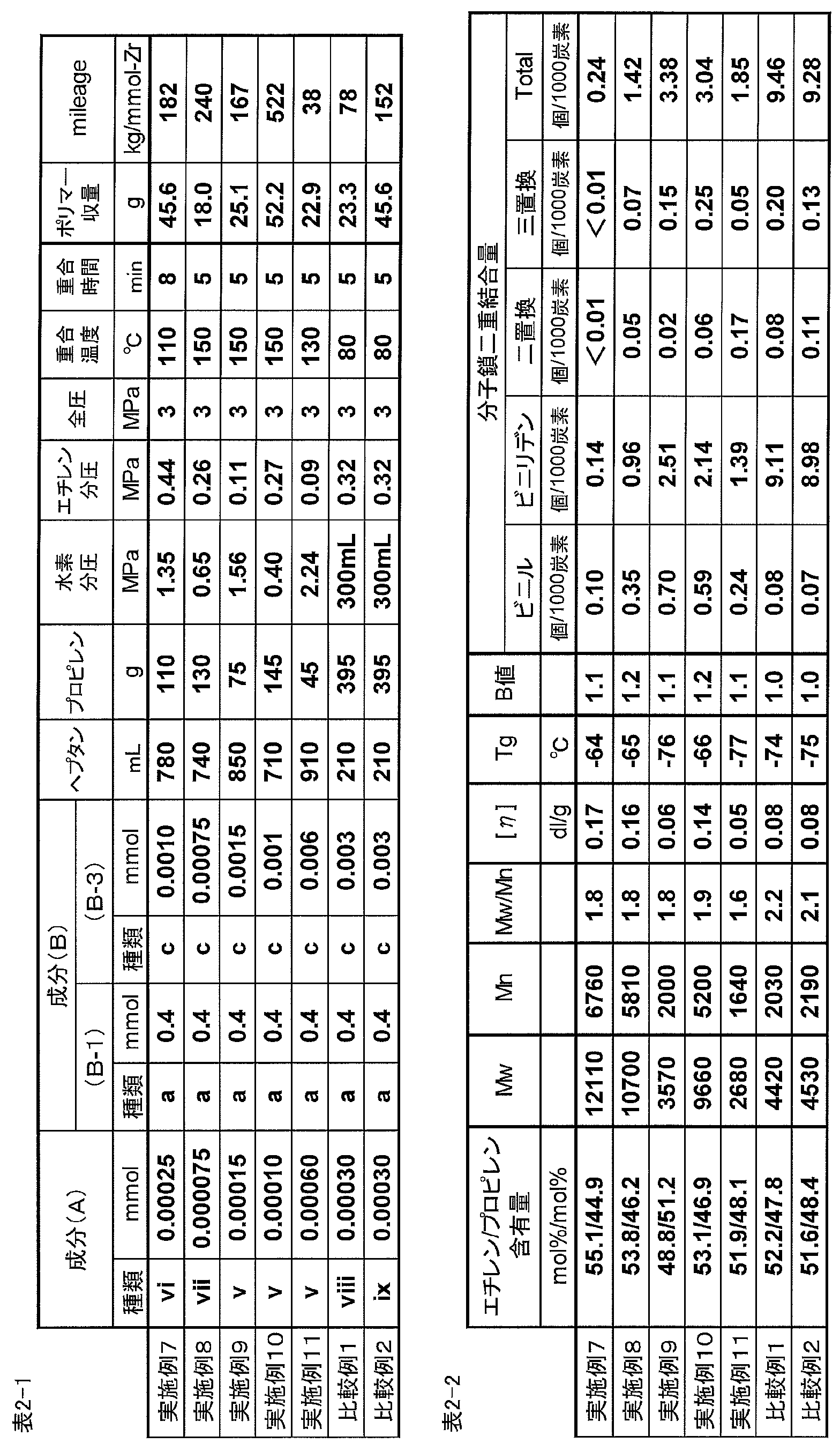
<成分(A)>
vi : [ジフェニルメチレン(η5-2-メチル-4-i-プロピルシクロペンタジエニル)(η5-オクタメチルオクタヒドロジベンゾフルオレニル)]ジルコニウムジクロリド
vii : [ジフェニルメチレン(η5-シクロペンタジエニル)(η5-2,7-ジ-t-ブチルフルオレニル)]ジルコニウムジクロリド
v : [メチルフェニルメチレン(η5-シクロペンタジエニル)(η5-2,7-ジ-t-ブチルフルオレニル)]ジルコニウムジクロリド
viii : [ビス(η5-1,3-ジメチルシクロペンタジエニル)]ジルコニウムジクロリド
ix : [ビス(η5-1-メチル-3-n-ブチルシクロペンタジエニル)]ジルコニウムジクロリド
<成分(B-1)>
a : トリイソブチルアルミニウム
<成分(B-3)>
c : N,N-ジメチルアニリニウムテトラキス(ペンタフルオロフェニル)ボレート
[潤滑油組成物の調製]
以下の潤滑油組成物の調製において用いられたエチレン/α-オレフィン共重合体以外の成分は以下のとおりである。
ポリメタクリレート;EVONIK社製VISCOPLEX 0-220(数平均分子量23,000、PMA-A)およびVISCOPLEX 0-110(数平均分子量9,100、PMA-B)
ポリブテン;JX日鋼日石社製日石ポリブテンHV-1900(PB-A)およびHV-300(PB-B)
脂肪酸エステル;BASF社製SYNATIVE ES TSTC
極圧剤パッケージ;AFTONCHEMICAL社製HITEC-3339
自動変速機油用DIパッケージ;AFTON CHEMICAL社製HITEC-2426
流動点降下剤;BASF社製IRGAFLO 720P
<自動車用ギア油>
配合例1~3では、Sciety of Automobile Engineers(SAE)によるギア油粘度規格90に合わせ、100℃動粘度が約14.0mm2/sとなるよう配合調整を行った。下記配合例および比較配合例で得られた潤滑油組成物の潤滑油特性を表3に示す。
実施例9で得られた水添操作後の共重合体を40.5質量%、脂肪酸エステルを15.0質量%、極圧剤パッケージを3.9質量%となるように配合し、これにPAO-6を加え全体を100質量%となるよう調整した。
実施例10で得られた水添操作後の共重合体を14.0質量%、脂肪酸エステルを15.0質量%、極圧剤パッケージを3.9質量%となるように配合し、これにPAO-6を加え全体を100質量%となるよう調整した。
実施例8で得られた水添操作後の共重合体を12.5質量%、脂肪酸エステルを15.0質量%、極圧剤パッケージを6.5質量%となるように配合し、これにPAO-6を加え全体を100質量%となるよう調整した。
PMA-Aを18.4質量%、脂肪酸エステルを15.0質量%、極圧剤パッケージを3.9質量%となるように配合し、これにPAO-6を加え全体を100質量%となるよう調整した。
PMA-Bを31.4質量%、エステルを15.0質量%、極圧剤パッケージを3.9質量%となるように配合し、これにPAO-6を加え全体を100質量%となるよう調整した。

配合例4および5は、自動変速機油用DIパッケージを用い、市販の自動変速機油(トヨタ自動車社製オートフルードWS)の100℃動粘度と合わせるため、5.5mm2/s未満となるよう配合調整を行った。得られた潤滑油組成物の潤滑油特性を表4に示す。
実施例10で得られた水添操作後の共重合体を2.8質量%、DIパッケージを8.0質量%、流動点降下剤を0.5質量%となるように配合し、これに鉱油Aと鉱油Bが質量比にて2:3となるよう調整した低粘度基油を加え全体を100質量%となるよう調整した。
実施例8で得られた水添操作後の共重合体を2.5質量%、DIパッケージを8.0質量%、流動点降下剤を0.5質量%となるように配合し、これに鉱油Aと鉱油Bが質量比にて2:3となるよう調整した低粘度基油を加え全体を100質量%となるよう調整した。

配合例6および7は、International Organization for Standardization(ISO)による粘度規格320に合わせ、40℃動粘度が約288~352mm2/s(ISO VG320)となるよう配合調整を行った。下記配合例および比較配合例で得られた潤滑油組成物の潤滑油特性を表5に示す。
実施例10にて得られた水添操作後の共重合体を32.2質量%、流動点降下剤0.5質量%、並びに極圧剤パッケージを1.2質量%となるように配合し、これに鉱油Cを加え全体を100質量%となるよう調整した。
実施例8にて得られた水添操作後の共重合体を28.1質量%、流動点降下剤0.5質量%、並びに極圧剤パッケージを1.2質量%となるように配合し、これに鉱油Cを加え全体を100質量%となるよう調整した。
PB-Aを28.6質量%、流動点降下剤0.5質量%、並びに極圧剤パッケージを1.2質量%となるように配合し、これに鉱油Cを加え全体を100質量%となるよう調整した。
PB-Bを41.4質量%、流動点降下剤0.5質量%、並びに極圧剤パッケージを1.2質量%となるように配合し、これに鉱油Cを加え全体を100質量%となるよう調整した。
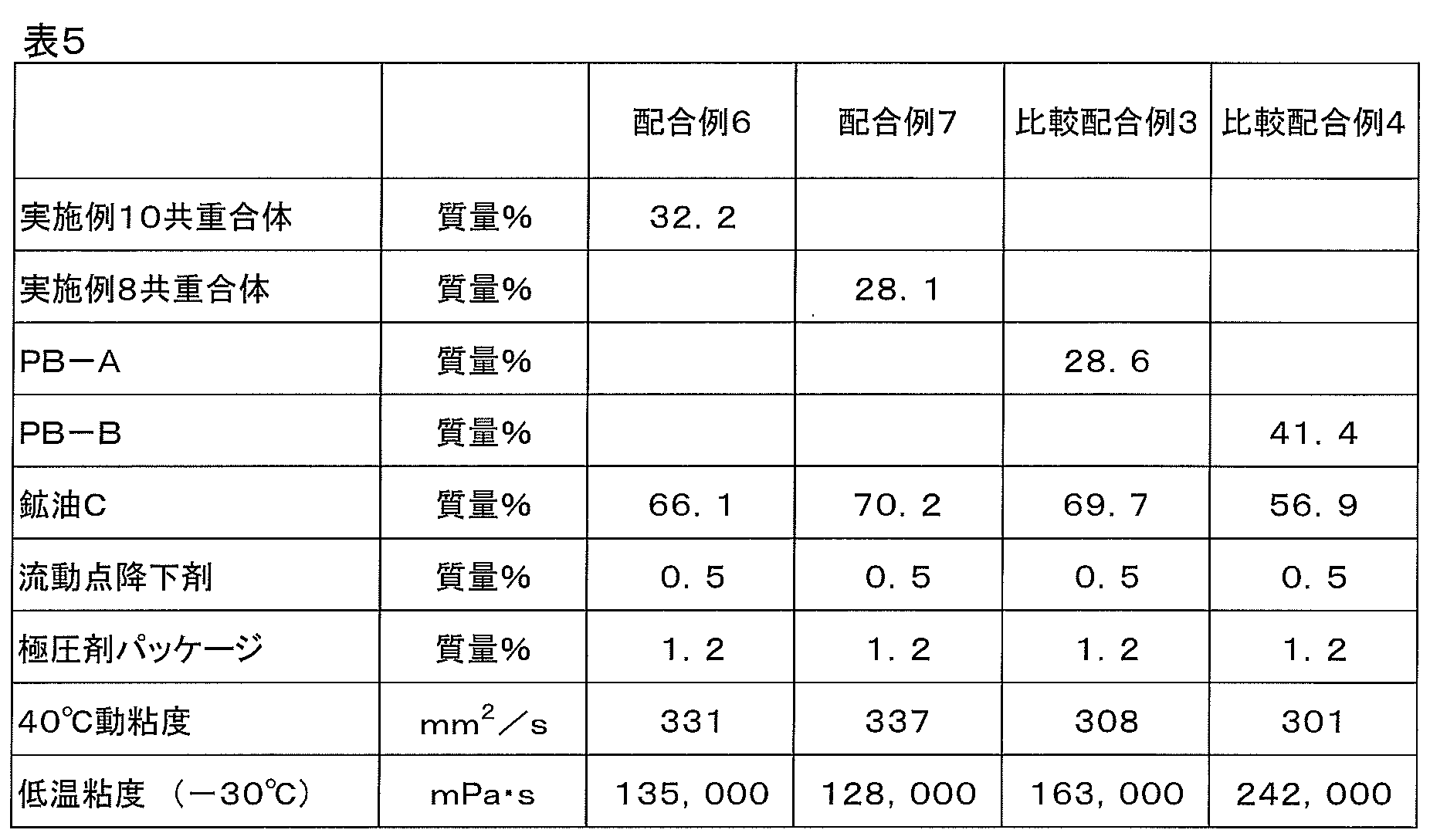
Claims (27)
- (A)下記一般式[I]で表される架橋メタロセン化合物、ならびに
(B)有機金属化合物(B-1)、有機アルミニウムオキシ化合物(B-2)および前記架橋メタロセン化合物(A)と反応してイオン対を形成する化合物(B-3)からなる群より選ばれる少なくとも1種の化合物
を含むオレフィン重合触媒の存在下で、エチレンと炭素数が3~20のα-オレフィンとを共重合することにより得られ、下記条件(1)~(4)を満たすことを特徴とするエチレン/α-オレフィン共重合体:
(1)重量平均分子量が1,000~50,000の範囲にあること;
(2)ゲルパーミエーションクロマトグラフィー(GPC)によって測定した分子量分布(Mw/Mn、Mw:重量平均分子量、Mn:数平均分子量)が2.5以下であること;
(3)示差熱熱量計(DSC)により測定されるガラス転移点(Tg)が-50℃未満であること;
(4)下記式[1]で表されるB値が1.1以上であること。


R1、R2、R3、R4、R5、R6、R7、R8、R9、R10、R11およびR12は水素原子、炭素数1~20の炭化水素基、ケイ素含有基、窒素含有基、酸素含有基、ハロゲン原子およびハロゲン含有基からなる群より選ばれる原子または置換基であり、それぞれ同一でも異なっていてもよく、
R13およびR14は水素原子、炭素数1~20の炭化水素基、アリール基、置換アリール基、ケイ素含有基、窒素含有基、酸素含有基、ハロゲン原子およびハロゲン含有基からなる群より選ばれる原子または置換基であり、それぞれ同一でも異なっていてもよく、
R1からR14までの隣接した置換基は互いに結合して環を形成していてもよく、
Yは第14族原子から選ばれ、
Mはチタン原子、ジルコニウム原子またはハフニウム原子であり、
Qはハロゲン原子、炭素数1~20の炭化水素基、アニオン配位子および孤立電子対で配位可能な中性配位子から同一のまたは異なる組合せで選ばれ、
nは1~4の整数であり、
jは1~4の整数である。) - 前記一般式[I]におけるnが1であることを特徴とする、請求項1に記載のエチレン/α-オレフィン共重合体。
- 前記一般式[I]におけるR1、R2、R3およびR4が全て水素原子であることを特徴とする、請求項2に記載のエチレン/α-オレフィン共重合体。
- 前記一般式[I]におけるR13およびR14のいずれか一方が、アリール基または置換アリール基であることを特徴とする、請求項3に記載のエチレン/α-オレフィン共重合体。
- 前記一般式[I]におけるR13およびR14のいずれか一方が、アリール基または置換アリール基であり、他方が炭素数1~20のアルキル基であることを特徴とする、請求項4に記載のエチレン/α-オレフィン共重合体。
- 前記一般式[I]におけるMがジルコニウム原子であることを特徴とする、請求項1~5のいずれか1項に記載のエチレン/α-オレフィン共重合体。
- 前記成分(B)として前記化合物(B-3)を用いることを特徴とする、請求項1~6のいずれか1項に記載のエチレン/α-オレフィン共重合体。
- 前記共重合の重合温度が130℃以上であることを特徴とする、請求項1~7のいずれか1項に記載のエチレン/α―オレフィン共重合体。
- 前記共重合体中のエチレン由来の構成単位が30~70mol%の範囲にあることを特徴とする、請求項1~8のいずれか1項に記載のエチレン/α-オレフィン共重合体。
- 請求項1~9のいずれか1項に記載のエチレン/α-オレフィン共重合体を含有してなる潤滑油組成物。
- 請求項10に記載の潤滑油組成物を含有してなる自動車用潤滑油。
- 自動車用変速機油として用いられ、100℃動粘度が7.5mm2/s以下であることを特徴とする請求項11に記載の自動車用潤滑油。
- 請求項10に記載の潤滑油組成物を含有してなる工業用潤滑油。
- (A)下記一般式[I]で表される架橋メタロセン化合物、ならびに
(B)有機金属化合物(B-1)、有機アルミニウムオキシ化合物(B-2)および前記架橋メタロセン化合物(A)と反応してイオン対を形成する化合物(B-3)からなる群より選ばれる少なくとも1種の化合物
を含むオレフィン重合触媒の存在下で、エチレンと炭素数が3~20のα-オレフィンとを共重合する工程を含むことを特徴とする、下記条件(1)~(4)を満たすエチレン/α-オレフィン共重合体の製造方法:
(1)重量平均分子量が1,000~50,000の範囲にあること;
(2)ゲルパーミエーションクロマトグラフィー(GPC)によって測定した分子量分布(Mw/Mn、Mw:重量平均分子量、Mn:数平均分子量)が2.5以下であること;
(3)示差熱熱量計(DSC)により測定されるガラス転移点(Tg)が-50℃未満であること;
(4)下記式[1]で表されるB値が1.1以上であること。

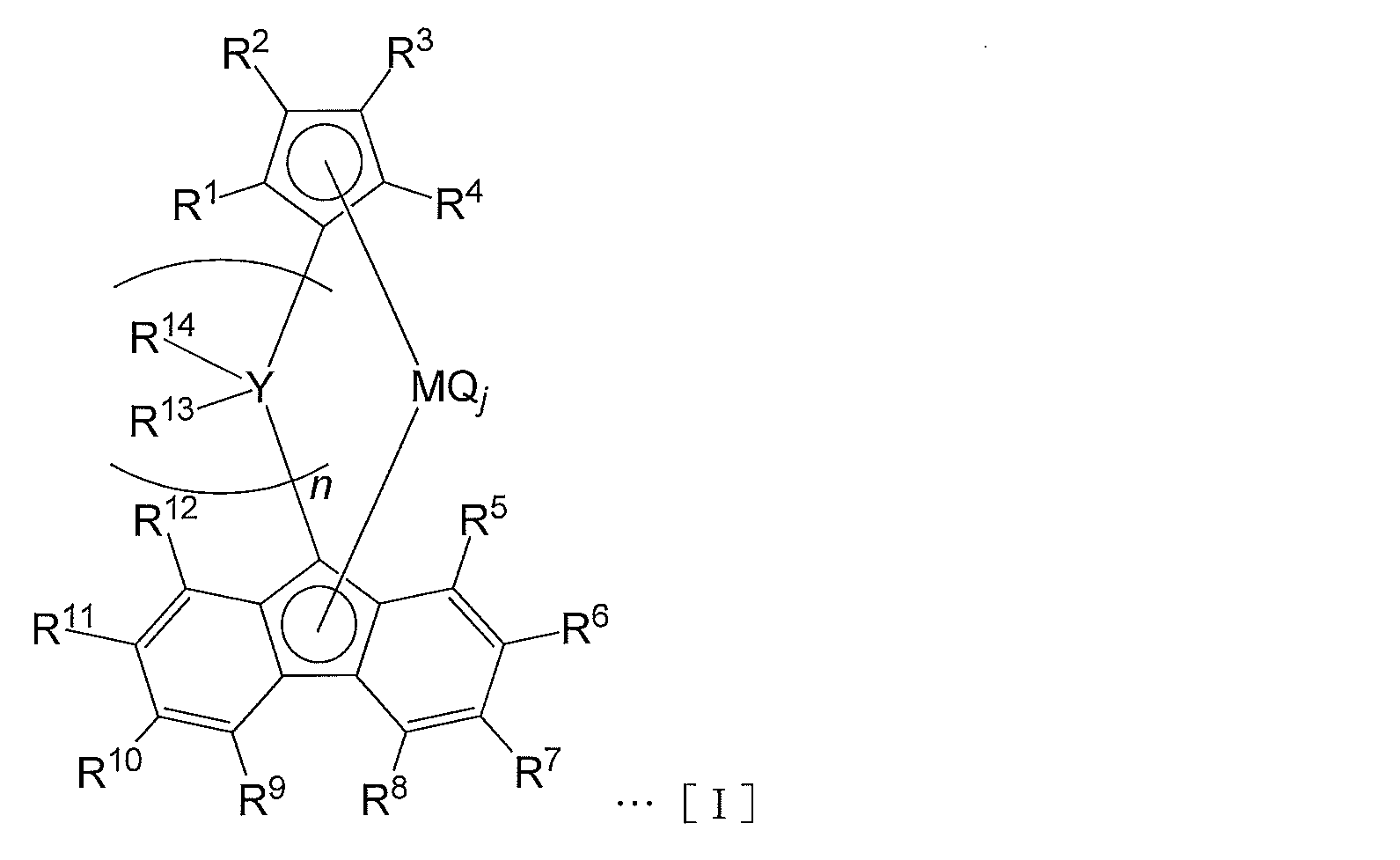
R1、R2、R3、R4、R5、R6、R7、R8、R9、R10、R11およびR12は水素原子、炭素数1~20の炭化水素基、ケイ素含有基、窒素含有基、酸素含有基、ハロゲン原子およびハロゲン含有基からなる群より選ばれる原子または置換基であり、それぞれ同一でも異なっていてもよく、
R13およびR14は水素原子、炭素数1~20の炭化水素基、アリール基、置換アリール基、ケイ素含有基、窒素含有基、酸素含有基、ハロゲン原子およびハロゲン含有基からなる群より選ばれる原子または置換基であり、それぞれ同一でも異なっていてもよく、
R1からR14までの隣接した置換基は互いに結合して環を形成していてもよく、
Yは第14族原子から選ばれ、
Mはチタン原子、ジルコニウム原子またはハフニウム原子であり、
Qはハロゲン原子、炭素数1~20の炭化水素基、アニオン配位子および孤立電子対で配位可能な中性配位子から同一のまたは異なる組合せで選ばれ、
nは1~4の整数であり、
jは1~4の整数である。) - 前記一般式[I]におけるnが1であることを特徴とする、請求項14に記載のエチレン/α-オレフィン共重合体の製造方法。
- 前記一般式[I]におけるR1、R2、R3およびR4が全て水素原子であることを特徴とする、請求項15に記載のエチレン/α-オレフィン共重合体の製造方法。
- 前記一般式[I]におけるR13およびR14のいずれか一方が、アリール基または置換アリール基であることを特徴とする、請求項16に記載のエチレン/α-オレフィン共重合体の製造方法。
- 前記一般式[I]におけるR13およびR14のいずれか一方が、アリール基または置換アリール基であり、他方が炭素数1~20のアルキル基であることを特徴とする、請求項17に記載のエチレン/α-オレフィン共重合体の製造方法。
- 前記一般式[I]におけるMがジルコニウム原子であることを特徴とする、請求項14~18のいずれか1項に記載のエチレン/α-オレフィン共重合体の製造方法。
- 前記成分(B)として前記化合物(B-3)を用いることを特徴とする、請求項14~19のいずれか1項に記載のエチレン/α-オレフィン共重合体の製造方法。
- 前記共重合の重合温度が130℃以上であることを特徴とする、請求項14~20のいずれか1項に記載のエチレン/α-オレフィン共重合体。
- 前記α-オレフィンがプロピレンであることを特徴とする、請求項14~21のいずれか1項に記載のエチレン/α-オレフィン共重合体の製造方法。
- 前記共重合体中のエチレン由来の構成単位が30~70mol%の範囲にあることを特徴とする、請求項14~22のいずれか1項に記載のエチレン/α-オレフィン共重合体の製造方法。
- 請求項14~23のいずれか1項に記載の製造方法により得られたエチレン/α-オレフィン共重合体を含有してなる潤滑油組成物。
- 請求項24に記載の潤滑油組成物を含有してなる自動車用潤滑油。
- 自動車用変速機油として用いられ、100℃動粘度が7.5mm2/s以下であることを特徴とする請求項25に記載の自動車用潤滑油。
- 請求項24に記載の潤滑油組成物を含有してなる工業用潤滑油。
Priority Applications (7)
| Application Number | Priority Date | Filing Date | Title |
|---|---|---|---|
| CN201580015347.6A CN106133006B (zh) | 2014-03-28 | 2015-03-26 | 乙烯/α‑烯烃共聚物及润滑油 |
| EP15767983.8A EP3124505B1 (en) | 2014-03-28 | 2015-03-26 | Ethylene/alpha-olefin copolymer and lubricating oil |
| KR1020167025225A KR101814320B1 (ko) | 2014-03-28 | 2015-03-26 | 에틸렌/α-올레핀 공중합체 및 윤활유 |
| ES15767983T ES3018472T3 (es) | 2014-03-28 | 2015-03-26 | Copolímero de etileno/alfa-olefina y aceite lubricante |
| US15/129,325 US10040884B2 (en) | 2014-03-28 | 2015-03-26 | Ethylene/α-olefin copolymers and lubricating oils |
| JP2016510508A JP6618891B2 (ja) | 2014-03-28 | 2015-03-26 | エチレン/α−オレフィン共重合体および潤滑油 |
| US15/993,745 US10329366B2 (en) | 2014-03-28 | 2018-05-31 | Ethylene/α-olefin copolymers and lubricating oils |
Applications Claiming Priority (2)
| Application Number | Priority Date | Filing Date | Title |
|---|---|---|---|
| JP2014068586 | 2014-03-28 | ||
| JP2014-068586 | 2014-03-28 |
Related Child Applications (2)
| Application Number | Title | Priority Date | Filing Date |
|---|---|---|---|
| US15/129,325 A-371-Of-International US10040884B2 (en) | 2014-03-28 | 2015-03-26 | Ethylene/α-olefin copolymers and lubricating oils |
| US15/993,745 Division US10329366B2 (en) | 2014-03-28 | 2018-05-31 | Ethylene/α-olefin copolymers and lubricating oils |
Publications (1)
| Publication Number | Publication Date |
|---|---|
| WO2015147215A1 true WO2015147215A1 (ja) | 2015-10-01 |
Family
ID=54195719
Family Applications (1)
| Application Number | Title | Priority Date | Filing Date |
|---|---|---|---|
| PCT/JP2015/059487 Ceased WO2015147215A1 (ja) | 2014-03-28 | 2015-03-26 | エチレン/α-オレフィン共重合体および潤滑油 |
Country Status (7)
| Country | Link |
|---|---|
| US (2) | US10040884B2 (ja) |
| EP (1) | EP3124505B1 (ja) |
| JP (1) | JP6618891B2 (ja) |
| KR (1) | KR101814320B1 (ja) |
| CN (1) | CN106133006B (ja) |
| ES (1) | ES3018472T3 (ja) |
| WO (1) | WO2015147215A1 (ja) |
Cited By (23)
| Publication number | Priority date | Publication date | Assignee | Title |
|---|---|---|---|---|
| JP2016069404A (ja) * | 2014-09-26 | 2016-05-09 | 三井化学株式会社 | 潤滑油組成物 |
| JP2016069405A (ja) * | 2014-09-26 | 2016-05-09 | 三井化学株式会社 | 潤滑油組成物 |
| JP2018145284A (ja) * | 2017-03-06 | 2018-09-20 | 三井化学株式会社 | エチレン/α−オレフィン共重合体の製造方法 |
| WO2019203210A1 (ja) * | 2018-04-17 | 2019-10-24 | 三井化学株式会社 | 潤滑油組成物および潤滑油用粘度調整剤 |
| WO2020194544A1 (ja) * | 2019-03-26 | 2020-10-01 | 三井化学株式会社 | 工業ギア用潤滑油組成物およびその製造方法 |
| WO2020194545A1 (ja) * | 2019-03-26 | 2020-10-01 | 三井化学株式会社 | 作動油用潤滑油組成物およびその製造方法 |
| WO2020194551A1 (ja) * | 2019-03-26 | 2020-10-01 | 三井化学株式会社 | 圧縮機油用潤滑油組成物およびその製造方法 |
| WO2020194548A1 (ja) * | 2019-03-26 | 2020-10-01 | 三井化学株式会社 | 自動車ギア用潤滑油組成物およびその製造方法 |
| WO2020194550A1 (ja) * | 2019-03-26 | 2020-10-01 | 三井化学株式会社 | グリース組成物およびその製造方法 |
| WO2020194542A1 (ja) * | 2019-03-26 | 2020-10-01 | 三井化学株式会社 | 潤滑油組成物およびその製造方法 |
| WO2020194547A1 (ja) * | 2019-03-26 | 2020-10-01 | 三井化学株式会社 | 自動車変速機油用潤滑油組成物およびその製造方法 |
| WO2020218367A1 (ja) * | 2019-04-26 | 2020-10-29 | 出光興産株式会社 | 変速機用潤滑油組成物、その製造方法、変速機用潤滑油組成物を用いた潤滑方法及び変速機 |
| JP2021501823A (ja) * | 2017-11-07 | 2021-01-21 | ノヴァ ケミカルズ(アンテルナショナル)ソシエテ アノニム | エチレンインターポリマー生成物及びフィルム |
| JP2021501822A (ja) * | 2017-11-07 | 2021-01-21 | ノヴァ ケミカルズ(アンテルナショナル)ソシエテ アノニム | エチレンインターポリマー生成物を製造する改善されたプロセス |
| JP2021507977A (ja) * | 2017-11-10 | 2021-02-25 | ハンファ ソリューションズ コーポレーション | オレフィン重合触媒用遷移金属化合物、それを含むオレフィン重合触媒およびそれを用いて重合されたポリオレフィン |
| JP2021516284A (ja) * | 2018-03-21 | 2021-07-01 | ハンファ ソリューションズ コーポレーション | オレフィン重合触媒用遷移金属化合物、それを含むオレフィン重合触媒およびそれを用いて重合されたポリオレフィン |
| KR20210141611A (ko) * | 2019-03-26 | 2021-11-23 | 미쓰이 가가쿠 가부시키가이샤 | 윤활유 조성물 및 그의 제조 방법 |
| JP2022512356A (ja) * | 2018-12-11 | 2022-02-03 | ハンファ ソリューションズ コーポレーション | ポリオレフィンおよびその製造方法 |
| JPWO2022186053A1 (ja) * | 2021-03-05 | 2022-09-09 | ||
| WO2023176788A1 (ja) * | 2022-03-17 | 2023-09-21 | 三井化学株式会社 | 熱可塑性樹脂組成物 |
| WO2023182473A1 (ja) | 2022-03-24 | 2023-09-28 | 三井化学株式会社 | エチレン・α-オレフィン・5-ビニル-2-ノルボルネン共重合体、当該共重合体を含む組成物、および、架橋体 |
| JP2024007403A (ja) * | 2022-07-05 | 2024-01-18 | ハンファ トータルエナジーズ ペトロケミカル カンパニー リミテッド | 新規な遷移金属化合物、それを含む遷移金属触媒組成物、およびそれを用いたエチレンとα-オレフィンの共重合体の製造方法 |
| US12398338B2 (en) | 2021-07-20 | 2025-08-26 | Mitsui Chemicals, Inc. | Viscosity modifier for lubricating oil and lubricating oil composition for hydraulic fluid |
Families Citing this family (12)
| Publication number | Priority date | Publication date | Assignee | Title |
|---|---|---|---|---|
| EP3564346A4 (en) * | 2016-12-27 | 2020-09-02 | Mitsui Chemicals, Inc. | LUBRICATING OIL COMPOSITION, LUBRICATING OIL VISCOSITY MODIFIER, AND LUBRICATING OIL ADDITIVE COMPOSITION |
| US11028192B2 (en) * | 2017-03-27 | 2021-06-08 | Exxonmobil Chemical Patents Inc. | Solution process to make ethylene copolymers |
| US10968290B2 (en) * | 2017-03-28 | 2021-04-06 | Exxonmobil Chemical Patents Inc. | Metallocene-catalyzed polyalpha-olefins |
| US11767404B2 (en) | 2018-03-07 | 2023-09-26 | Mitsui Chemicals, Inc. | Resin composition for masterbatch |
| KR102111865B1 (ko) * | 2018-11-27 | 2020-05-18 | 대림산업 주식회사 | 균일한 구조를 가지는 폴리알파올레핀 및 이의 제조방법 |
| KR102097232B1 (ko) * | 2019-02-28 | 2020-04-06 | 대림산업 주식회사 | 기어유용 윤활유 조성물 |
| EP4023737A4 (en) | 2019-08-29 | 2023-08-30 | Mitsui Chemicals, Inc. | Lubricating oil composition |
| CN112745415B (zh) * | 2019-10-30 | 2022-09-09 | 中国石油化工股份有限公司 | 一种制备高粘度指数聚α-烯烃的方法 |
| US20230365794A1 (en) * | 2020-10-06 | 2023-11-16 | Mitsui Chemicals, Inc. | Resin composition |
| EP4279547A4 (en) * | 2021-01-18 | 2024-12-11 | Mitsui Chemicals, Inc. | AQUEOUS DISPERSION COMPOSITION, METHOD FOR PREPARING THE AQUEOUS DISPERSION COMPOSITION AND ACID-MODIFIED ETHYLENE-ALPHA-OLEFIN COPOLYMER |
| CN115010838B (zh) * | 2021-03-05 | 2024-06-04 | 中国石油化工股份有限公司 | 一种烯烃聚合方法及其所得聚烯烃 |
| KR102888044B1 (ko) * | 2022-01-13 | 2025-11-18 | 한화솔루션 주식회사 | 올레핀계 중합체 및 그 제조방법 |
Citations (5)
| Publication number | Priority date | Publication date | Assignee | Title |
|---|---|---|---|---|
| JP2008505932A (ja) * | 2004-07-08 | 2008-02-28 | エクソンモービル・ケミカル・パテンツ・インク | オレフィン重合触媒系およびその使用方法 |
| JP2011001489A (ja) * | 2009-06-19 | 2011-01-06 | Mitsui Chemicals Inc | ゴム組成物およびその用途 |
| JP2011001497A (ja) * | 2009-06-19 | 2011-01-06 | Mitsui Chemicals Inc | ゴム組成物およびその用途 |
| JP2011219777A (ja) * | 2005-03-18 | 2011-11-04 | Mitsui Chemicals Inc | プロピレン系重合体組成物からなるペレット、熱可塑性重合体用改質剤、熱可塑性重合体組成物の製造方法 |
| JP2013177641A (ja) * | 2005-03-18 | 2013-09-09 | Mitsui Chemicals Inc | プロピレン系重合体組成物、該組成物からなる成形体、プロピレン系重合体組成物の製造方法 |
Family Cites Families (109)
| Publication number | Priority date | Publication date | Assignee | Title |
|---|---|---|---|---|
| US3780128A (en) | 1971-11-03 | 1973-12-18 | Ethyl Corp | Synthetic lubricants by oligomerization and hydrogenation |
| US3909432A (en) | 1973-11-26 | 1975-09-30 | Continental Oil Co | Preparation of synthetic hydrocarbon lubricants |
| US4032591A (en) | 1975-11-24 | 1977-06-28 | Gulf Research & Development Company | Preparation of alpha-olefin oligomer synthetic lubricant |
| EP0060609B2 (en) | 1981-01-13 | 1994-09-28 | Mitsui Petrochemical Industries, Ltd. | Process for producing an ethylene/alpha-olefin copolymer |
| JPS57123205A (en) | 1981-01-13 | 1982-07-31 | Mitsui Petrochem Ind Ltd | Production of low-molecular weight copolymer |
| JPS57117595A (en) | 1981-01-13 | 1982-07-22 | Mitsui Petrochem Ind Ltd | Synthetic lubricating oil |
| CA1263498A (en) | 1985-03-26 | 1989-11-28 | Mitsui Chemicals, Incorporated | Liquid ethylene-type random copolymer, process for production thereof, and use thereof |
| JP2500262B2 (ja) | 1985-03-26 | 1996-05-29 | 三井石油化学工業 株式会社 | 液状α−オレフイン共重合体の製法 |
| US4668834B1 (en) | 1985-10-16 | 1996-05-07 | Uniroyal Chem Co Inc | Low molecular weight ethylene-alphaolefin copolymer intermediates |
| US7163907B1 (en) | 1987-01-30 | 2007-01-16 | Exxonmobil Chemical Patents Inc. | Aluminum-free monocyclopentadienyl metallocene catalysts for olefin polymerization |
| IL85097A (en) | 1987-01-30 | 1992-02-16 | Exxon Chemical Patents Inc | Catalysts based on derivatives of a bis(cyclopentadienyl)group ivb metal compound,their preparation and their use in polymerization processes |
| US5384299A (en) | 1987-01-30 | 1995-01-24 | Exxon Chemical Patents Inc. | Ionic metallocene catalyst compositions |
| PL276385A1 (en) | 1987-01-30 | 1989-07-24 | Exxon Chemical Patents Inc | Method for polymerization of olefines,diolefins and acetylene unsaturated compounds |
| US5621126A (en) | 1987-01-30 | 1997-04-15 | Exxon Chemical Patents Inc. | Monocyclopentadienyl metal compounds for ethylene-α-olefin-copolymer production catalysts |
| US5264405A (en) | 1989-09-13 | 1993-11-23 | Exxon Chemical Patents Inc. | Monocyclopentadienyl titanium metal compounds for ethylene-α-olefin-copolymer production catalysts |
| US5241025A (en) | 1987-01-30 | 1993-08-31 | Exxon Chemical Patents Inc. | Catalyst system of enhanced productivity |
| US5096867A (en) | 1990-06-04 | 1992-03-17 | Exxon Chemical Patents Inc. | Monocyclopentadienyl transition metal olefin polymerization catalysts |
| US5055438A (en) | 1989-09-13 | 1991-10-08 | Exxon Chemical Patents, Inc. | Olefin polymerization catalysts |
| US5408017A (en) | 1987-01-30 | 1995-04-18 | Exxon Chemical Patents Inc. | High temperature polymerization process using ionic catalysts to produce polyolefins |
| US5391629A (en) | 1987-01-30 | 1995-02-21 | Exxon Chemical Patents Inc. | Block copolymers from ionic catalysts |
| US5153157A (en) | 1987-01-30 | 1992-10-06 | Exxon Chemical Patents Inc. | Catalyst system of enhanced productivity |
| US4874880A (en) | 1987-03-10 | 1989-10-17 | Chisso Corporation | Bis(di-, tri- or tetra-substituted-cyclopentadienyl)-zirconium dihalides |
| JPH0662642B2 (ja) | 1987-03-10 | 1994-08-17 | チッソ株式会社 | ビス(2置換シクロペンタジエニル)ジルコニウムジハライド |
| FI80891C (fi) | 1987-11-12 | 1990-08-10 | Neste Oy | Foerfarande foer framstaellning av smoerjmedel av poly- -olefintyp. |
| JPH0224701A (ja) | 1988-07-13 | 1990-01-26 | Sekisui Chem Co Ltd | 電気機器の駆動制御装置 |
| US5223468A (en) | 1988-07-15 | 1993-06-29 | Fina Technology, Inc. | Process and catalyst for producing syndiotactic polymers |
| US5243002A (en) | 1988-07-15 | 1993-09-07 | Fina Technology, Inc. | Process and catalyst for producing syndiotactic polymers |
| US5225500A (en) | 1988-07-15 | 1993-07-06 | Fina Technology, Inc. | Process and catalyst for producing syndiotactic polyolefins |
| US5223467A (en) | 1988-07-15 | 1993-06-29 | Fina Technology, Inc. | Process and catalyst for producing syndiotactic polymers |
| US5162278A (en) | 1988-07-15 | 1992-11-10 | Fina Technology, Inc. | Non-bridged syndiospecific metallocene catalysts and polymerization process |
| US5158920A (en) | 1988-07-15 | 1992-10-27 | Fina Technology, Inc. | Process for producing stereospecific polymers |
| US5304523A (en) | 1988-07-15 | 1994-04-19 | Fina Technology, Inc. | Process and catalyst for producing crystalline polyolefins |
| US5292838A (en) | 1988-07-15 | 1994-03-08 | Fina Technology, Inc. | Process and catalyst for producing syndiotactic polymers |
| US4892851A (en) | 1988-07-15 | 1990-01-09 | Fina Technology, Inc. | Process and catalyst for producing syndiotactic polyolefins |
| US5155080A (en) | 1988-07-15 | 1992-10-13 | Fina Technology, Inc. | Process and catalyst for producing syndiotactic polyolefins |
| JP2693517B2 (ja) | 1988-09-14 | 1997-12-24 | 三井石油化学工業株式会社 | ベンゼン不溶性の有機アルミニウムオキシ化合物の製造方法 |
| KR930002411B1 (ko) | 1988-09-14 | 1993-03-30 | 미쓰이세끼유 가가꾸고오교오 가부시끼가이샤 | 벤젠불용성 유기알루미늄 옥시화합물 및 그 제조방법 |
| JP2741893B2 (ja) | 1988-09-14 | 1998-04-22 | 三井化学株式会社 | ベンゼン不溶性の有機アルミニウムオキシ化合物の製造方法 |
| US5041584A (en) | 1988-12-02 | 1991-08-20 | Texas Alkyls, Inc. | Modified methylaluminoxane |
| US4960878A (en) | 1988-12-02 | 1990-10-02 | Texas Alkyls, Inc. | Synthesis of methylaluminoxanes |
| US5504169A (en) | 1989-09-13 | 1996-04-02 | Exxon Chemical Patents Inc. | Process for producing amorphous poly-α-olefins with a monocyclopentadienyl transition metal catalyst system |
| US6265338B1 (en) | 1989-09-13 | 2001-07-24 | Exxon Chemical Patents, Inc. | Monocyclopentadienyl titanium metal compounds for ethylene-α-olefin copolymer production catalysts |
| US7041841B1 (en) | 1989-09-13 | 2006-05-09 | Exxonmobil Chemical Patents Inc. | Process for producing crystalline poly-α-olefins with a monocyclopentadienyl transition metal catalyst system |
| US5026798A (en) | 1989-09-13 | 1991-06-25 | Exxon Chemical Patents Inc. | Process for producing crystalline poly-α-olefins with a monocyclopentadienyl transition metal catalyst system |
| US5420217A (en) | 1989-09-13 | 1995-05-30 | Exxon Chemical Patents Inc. | Process for producing amorphous poly-α-olefins with a monocyclopentadienyl transition metal catalyst system |
| US5547675A (en) | 1989-09-13 | 1996-08-20 | Exxon Chemical Patents Inc. | Modified monocyclopentadienyl transition metal/alumoxane catalyst system for polymerization of olefins |
| US5057475A (en) | 1989-09-13 | 1991-10-15 | Exxon Chemical Patents Inc. | Mono-Cp heteroatom containing group IVB transition metal complexes with MAO: supported catalyst for olefin polymerization |
| US5227440A (en) | 1989-09-13 | 1993-07-13 | Exxon Chemical Patents Inc. | Mono-Cp heteroatom containing Group IVB transition metal complexes with MAO: supported catalysts for olefin polymerization |
| JPH03103407A (ja) | 1989-09-18 | 1991-04-30 | Idemitsu Kosan Co Ltd | オレフィン系重合体の製造法 |
| US5763549A (en) | 1989-10-10 | 1998-06-09 | Fina Technology, Inc. | Cationic metallocene catalysts based on organoaluminum anions |
| CA2027145C (en) | 1989-10-10 | 2002-12-10 | Michael J. Elder | Metallocene catalysts with lewis acids and aluminum alkyls |
| JP2796376B2 (ja) | 1989-10-18 | 1998-09-10 | 出光興産株式会社 | 合成潤滑油の製造法 |
| EP0426637B2 (en) | 1989-10-30 | 2001-09-26 | Fina Technology, Inc. | Preparation of metallocene catalysts for polymerization of olefins |
| ES2086397T5 (es) | 1989-10-30 | 2005-07-16 | Fina Technology, Inc. | Adicion de alkiloaluminio para un catalizador metaloceno mejorado. |
| US5387568A (en) | 1989-10-30 | 1995-02-07 | Fina Technology, Inc. | Preparation of metallocene catalysts for polymerization of olefins |
| US6294625B1 (en) | 1990-03-20 | 2001-09-25 | Exxonmobil Chemical Patents Inc. | Catalyst system of enhanced productivity and its use in polymerization process |
| FR2662756B1 (fr) | 1990-06-05 | 1992-08-14 | Snecma | Dispositif de transmission etanche entre deux arbres coaxiaux montes dans des boitiers fixes l'un a l'autre, autorisant une intervention rapide notamment en cas de fuite. |
| US5801113A (en) | 1990-06-22 | 1998-09-01 | Exxon Chemical Patents, Inc. | Polymerization catalyst systems, their production and use |
| JP2545006B2 (ja) | 1990-07-03 | 1996-10-16 | ザ ダウ ケミカル カンパニー | 付加重合触媒 |
| JPH0469394A (ja) | 1990-07-09 | 1992-03-04 | Mitsui Toatsu Chem Inc | 新規遷移金属化合物及びこれを用いたシンジオタクチックポリ―α―オレフィンの製造方法 |
| US5401817A (en) | 1991-05-09 | 1995-03-28 | Phillips Petroleum Company | Olefin polymerization using silyl-bridged metallocenes |
| US5281679A (en) | 1991-11-07 | 1994-01-25 | Exxon Chemical Patents Inc. | Catalyst and method of broadening polymer molecular weight distribution and increasing polymer tensile impact strength and products made thereof |
| US5359015A (en) | 1991-11-07 | 1994-10-25 | Exxon Chemical Patents Inc. | Metallocene catalysts and their production and use |
| DE69309726T2 (de) | 1992-01-23 | 1997-08-21 | Mitsui Petrochemical Ind | Ethylen/Alpha-Olefin/7-Methyl-1,6-Octadien Copolymerisat-Kautschuk und Zusammensetzungen desselben |
| US6143854A (en) | 1993-08-06 | 2000-11-07 | Exxon Chemical Patents, Inc. | Polymerization catalysts, their production and use |
| JPH06172433A (ja) | 1992-12-03 | 1994-06-21 | Mitsubishi Petrochem Co Ltd | α‐オレフィン重合用触媒成分およびその使用 |
| CA2168883C (en) | 1993-08-06 | 2000-07-04 | Moses Olukayode Jejelowo | Polymerization catalysts, their production and use |
| JPH07121969A (ja) | 1993-10-22 | 1995-05-12 | Funai Techno Syst Kk | ディスク再生装置 |
| EP0668342B1 (en) | 1994-02-08 | 1999-08-04 | Shell Internationale Researchmaatschappij B.V. | Lubricating base oil preparation process |
| EP1365005B1 (en) | 1995-11-28 | 2005-10-19 | Shell Internationale Researchmaatschappij B.V. | Process for producing lubricating base oils |
| DE69632920T3 (de) | 1995-12-08 | 2011-05-12 | Exxonmobil Research And Engineering Co. | Verfahren zur herstellung von biologisch abbaubare hochleistungs-kohlenwasserstoff-basisöle |
| US6090989A (en) | 1997-10-20 | 2000-07-18 | Mobil Oil Corporation | Isoparaffinic lube basestock compositions |
| US6059955A (en) | 1998-02-13 | 2000-05-09 | Exxon Research And Engineering Co. | Low viscosity lube basestock |
| US6008164A (en) | 1998-08-04 | 1999-12-28 | Exxon Research And Engineering Company | Lubricant base oil having improved oxidative stability |
| US6103099A (en) | 1998-09-04 | 2000-08-15 | Exxon Research And Engineering Company | Production of synthetic lubricant and lubricant base stock without dewaxing |
| US6080301A (en) | 1998-09-04 | 2000-06-27 | Exxonmobil Research And Engineering Company | Premium synthetic lubricant base stock having at least 95% non-cyclic isoparaffins |
| US6165949A (en) | 1998-09-04 | 2000-12-26 | Exxon Research And Engineering Company | Premium wear resistant lubricant |
| US6475960B1 (en) | 1998-09-04 | 2002-11-05 | Exxonmobil Research And Engineering Co. | Premium synthetic lubricants |
| US6332974B1 (en) | 1998-09-11 | 2001-12-25 | Exxon Research And Engineering Co. | Wide-cut synthetic isoparaffinic lubricating oils |
| US6417120B1 (en) | 1998-12-31 | 2002-07-09 | Kimberly-Clark Worldwide, Inc. | Particle-containing meltblown webs |
| FR2798136B1 (fr) | 1999-09-08 | 2001-11-16 | Total Raffinage Distribution | Nouvelle huile de base hydrocarbonee pour lubrifiants a indice de viscosite tres eleve |
| US20020155776A1 (en) | 1999-10-15 | 2002-10-24 | Mitchler Patricia Ann | Particle-containing meltblown webs |
| US7067049B1 (en) | 2000-02-04 | 2006-06-27 | Exxonmobil Oil Corporation | Formulated lubricant oils containing high-performance base oils derived from highly paraffinic hydrocarbons |
| US6858767B1 (en) | 2000-08-11 | 2005-02-22 | Uniroyal Chemical Company, Inc. | Process for producing liquid polyalphaolefin polymer, metallocene catalyst therefor, the resulting polymer and lubricant containing same |
| JP2004051676A (ja) | 2002-07-16 | 2004-02-19 | Mitsui Chemicals Inc | エチレン系共重合体の製造方法 |
| US20060025545A1 (en) | 2002-09-20 | 2006-02-02 | Patrick Brant | Polymer production at supercritical conditions |
| US7807769B2 (en) | 2002-09-20 | 2010-10-05 | Exxonmobil Chemical Patents Inc. | Isotactic polypropylene produced from supercritical polymerization process |
| US8008412B2 (en) | 2002-09-20 | 2011-08-30 | Exxonmobil Chemical Patents Inc. | Polymer production at supersolution conditions |
| WO2004026923A2 (en) | 2002-09-20 | 2004-04-01 | Exxonmobil Chemical Patents Inc. | Supercritical polymerization process and polymers produced therefrom |
| US20080153997A1 (en) | 2006-12-20 | 2008-06-26 | Exxonmobil Research And Engineering | Polymer production at supercritical conditions |
| EP2465879B1 (en) | 2002-09-27 | 2019-04-24 | Mitsui Chemicals, Inc. | Bridged metallocene compound for olefin polymerization and method of polymerizing olefin using the same |
| JP2004149673A (ja) * | 2002-10-30 | 2004-05-27 | Mitsui Chemicals Inc | エチレン系ワックスの製造方法 |
| JP4367687B2 (ja) | 2002-11-26 | 2009-11-18 | 三井化学株式会社 | オレフィン重合用の架橋メタロセン化合物およびそれを用いたオレフィンの重合方法 |
| KR101087179B1 (ko) | 2003-03-28 | 2011-11-25 | 미쓰이 가가쿠 가부시키가이샤 | 폴리올레핀 수지 조성물 |
| JP2005200451A (ja) | 2004-01-13 | 2005-07-28 | Mitsui Chemicals Inc | α−オレフィン(共)重合体の製造方法 |
| EP1661921B1 (en) | 2004-11-26 | 2019-07-17 | Mitsui Chemicals, Inc. | Synthetic lubricating oil and lubricating oil composition thereof |
| WO2006098452A1 (ja) * | 2005-03-18 | 2006-09-21 | Mitsui Chemicals, Inc. | プロピレン系重合体組成物、その用途、および熱可塑性重合体組成物の製造方法 |
| US8143352B2 (en) | 2006-12-20 | 2012-03-27 | Exxonmobil Research And Engineering Company | Process for fluid phase in-line blending of polymers |
| US8242237B2 (en) | 2006-12-20 | 2012-08-14 | Exxonmobil Chemical Patents Inc. | Phase separator and monomer recycle for supercritical polymerization process |
| US8080610B2 (en) | 2007-03-06 | 2011-12-20 | Exxonmobil Research And Engineering Company | Monomer recycle process for fluid phase in-line blending of polymers |
| JP2010529253A (ja) | 2007-06-04 | 2010-08-26 | エクソンモービル・ケミカル・パテンツ・インク | 非常に均一なプロピレンの溶液重合法 |
| WO2009101936A1 (ja) | 2008-02-14 | 2009-08-20 | Mitsui Chemicals, Inc. | 共重合体、その共重合体の製造方法、潤滑油粘度調整剤および潤滑油組成物 |
| JP5319992B2 (ja) | 2008-09-08 | 2013-10-16 | 三井化学株式会社 | ギヤ油用潤滑油組成物 |
| JP5319996B2 (ja) | 2008-09-16 | 2013-10-16 | 三井化学株式会社 | 低粘度エンジン油組成物 |
| JP5319995B2 (ja) | 2008-09-16 | 2013-10-16 | 三井化学株式会社 | グリース組成物 |
| WO2011037585A1 (en) | 2009-09-28 | 2011-03-31 | Mitsui Chemicals, Inc. | Viscosity modifier for lubricating oils, additive composition for lubricating oils, and lubricating oil composition |
| EP2526133B1 (en) | 2010-01-22 | 2015-04-22 | ExxonMobil Chemical Patents Inc. | Ethylene copolymers, methods for their production, and use |
| CN103189996B (zh) | 2010-11-02 | 2016-04-13 | 三井化学株式会社 | 太阳能电池密封材料及太阳能电池模块 |
| KR101394943B1 (ko) * | 2012-11-19 | 2014-05-14 | 대림산업 주식회사 | 에틸렌과 알파-올레핀의 공중합체 및 그 제조방법 |
-
2015
- 2015-03-26 JP JP2016510508A patent/JP6618891B2/ja active Active
- 2015-03-26 CN CN201580015347.6A patent/CN106133006B/zh active Active
- 2015-03-26 ES ES15767983T patent/ES3018472T3/es active Active
- 2015-03-26 WO PCT/JP2015/059487 patent/WO2015147215A1/ja not_active Ceased
- 2015-03-26 US US15/129,325 patent/US10040884B2/en active Active
- 2015-03-26 EP EP15767983.8A patent/EP3124505B1/en active Active
- 2015-03-26 KR KR1020167025225A patent/KR101814320B1/ko active Active
-
2018
- 2018-05-31 US US15/993,745 patent/US10329366B2/en active Active
Patent Citations (5)
| Publication number | Priority date | Publication date | Assignee | Title |
|---|---|---|---|---|
| JP2008505932A (ja) * | 2004-07-08 | 2008-02-28 | エクソンモービル・ケミカル・パテンツ・インク | オレフィン重合触媒系およびその使用方法 |
| JP2011219777A (ja) * | 2005-03-18 | 2011-11-04 | Mitsui Chemicals Inc | プロピレン系重合体組成物からなるペレット、熱可塑性重合体用改質剤、熱可塑性重合体組成物の製造方法 |
| JP2013177641A (ja) * | 2005-03-18 | 2013-09-09 | Mitsui Chemicals Inc | プロピレン系重合体組成物、該組成物からなる成形体、プロピレン系重合体組成物の製造方法 |
| JP2011001489A (ja) * | 2009-06-19 | 2011-01-06 | Mitsui Chemicals Inc | ゴム組成物およびその用途 |
| JP2011001497A (ja) * | 2009-06-19 | 2011-01-06 | Mitsui Chemicals Inc | ゴム組成物およびその用途 |
Cited By (43)
| Publication number | Priority date | Publication date | Assignee | Title |
|---|---|---|---|---|
| JP2016069405A (ja) * | 2014-09-26 | 2016-05-09 | 三井化学株式会社 | 潤滑油組成物 |
| JP2016069404A (ja) * | 2014-09-26 | 2016-05-09 | 三井化学株式会社 | 潤滑油組成物 |
| JP2018145284A (ja) * | 2017-03-06 | 2018-09-20 | 三井化学株式会社 | エチレン/α−オレフィン共重合体の製造方法 |
| JP2021501823A (ja) * | 2017-11-07 | 2021-01-21 | ノヴァ ケミカルズ(アンテルナショナル)ソシエテ アノニム | エチレンインターポリマー生成物及びフィルム |
| JP7030976B2 (ja) | 2017-11-07 | 2022-03-07 | ノヴァ ケミカルズ(アンテルナショナル)ソシエテ アノニム | エチレンインターポリマー生成物及びフィルム |
| JP7030975B2 (ja) | 2017-11-07 | 2022-03-07 | ノヴァ ケミカルズ(アンテルナショナル)ソシエテ アノニム | エチレンインターポリマー生成物を製造する改善されたプロセス |
| JP2021501822A (ja) * | 2017-11-07 | 2021-01-21 | ノヴァ ケミカルズ(アンテルナショナル)ソシエテ アノニム | エチレンインターポリマー生成物を製造する改善されたプロセス |
| JP2021507977A (ja) * | 2017-11-10 | 2021-02-25 | ハンファ ソリューションズ コーポレーション | オレフィン重合触媒用遷移金属化合物、それを含むオレフィン重合触媒およびそれを用いて重合されたポリオレフィン |
| US11384108B2 (en) | 2018-03-21 | 2022-07-12 | Hanwha Solutions Corporation | Transition metal compound for olefin polymerization catalyst, olefin polymerization catalyst including same, and polyolefin polymerized by using olefin polymerization catalyst |
| JP7039723B2 (ja) | 2018-03-21 | 2022-03-22 | ハンファ ソリューションズ コーポレーション | オレフィン重合触媒用遷移金属化合物、それを含むオレフィン重合触媒およびそれを用いて重合されたポリオレフィン |
| JP2021516284A (ja) * | 2018-03-21 | 2021-07-01 | ハンファ ソリューションズ コーポレーション | オレフィン重合触媒用遷移金属化合物、それを含むオレフィン重合触媒およびそれを用いて重合されたポリオレフィン |
| US11655428B2 (en) | 2018-04-17 | 2023-05-23 | Mitsui Chemicals, Inc. | Lubricating oil compositions and lubricating oil viscosity modifiers |
| WO2019203210A1 (ja) * | 2018-04-17 | 2019-10-24 | 三井化学株式会社 | 潤滑油組成物および潤滑油用粘度調整剤 |
| JPWO2019203210A1 (ja) * | 2018-04-17 | 2021-04-01 | 三井化学株式会社 | 潤滑油組成物および潤滑油用粘度調整剤 |
| JP7189941B2 (ja) | 2018-04-17 | 2022-12-14 | 三井化学株式会社 | 潤滑油組成物および潤滑油用粘度調整剤 |
| JP2022512356A (ja) * | 2018-12-11 | 2022-02-03 | ハンファ ソリューションズ コーポレーション | ポリオレフィンおよびその製造方法 |
| US12187824B2 (en) | 2018-12-11 | 2025-01-07 | Hanwha Solutions Corporation | Polyolefin and method for preparing same |
| JP7223139B2 (ja) | 2018-12-11 | 2023-02-15 | ハンファ ソリューションズ コーポレーション | ポリオレフィンおよびその製造方法 |
| WO2020194544A1 (ja) * | 2019-03-26 | 2020-10-01 | 三井化学株式会社 | 工業ギア用潤滑油組成物およびその製造方法 |
| KR102730694B1 (ko) | 2019-03-26 | 2024-11-18 | 미쓰이 가가쿠 가부시키가이샤 | 윤활유 조성물 및 그의 제조 방법 |
| WO2020194548A1 (ja) * | 2019-03-26 | 2020-10-01 | 三井化学株式会社 | 自動車ギア用潤滑油組成物およびその製造方法 |
| WO2020194551A1 (ja) * | 2019-03-26 | 2020-10-01 | 三井化学株式会社 | 圧縮機油用潤滑油組成物およびその製造方法 |
| WO2020194545A1 (ja) * | 2019-03-26 | 2020-10-01 | 三井化学株式会社 | 作動油用潤滑油組成物およびその製造方法 |
| US20220169939A1 (en) * | 2019-03-26 | 2022-06-02 | Mitsui Chemicals, Inc. | Lubricating oil and method for producing the same |
| US20220169948A1 (en) * | 2019-03-26 | 2022-06-02 | Mitsui Chemicals, Inc. | Lubricating oil composition for compressor oils and method for producing the same |
| US20220186133A1 (en) * | 2019-03-26 | 2022-06-16 | Mitsui Chemicals, Inc. | Lubricating oil composition for industrial gears and method for producing the same |
| KR20210141611A (ko) * | 2019-03-26 | 2021-11-23 | 미쓰이 가가쿠 가부시키가이샤 | 윤활유 조성물 및 그의 제조 방법 |
| WO2020194547A1 (ja) * | 2019-03-26 | 2020-10-01 | 三井化学株式会社 | 自動車変速機油用潤滑油組成物およびその製造方法 |
| WO2020194550A1 (ja) * | 2019-03-26 | 2020-10-01 | 三井化学株式会社 | グリース組成物およびその製造方法 |
| WO2020194542A1 (ja) * | 2019-03-26 | 2020-10-01 | 三井化学株式会社 | 潤滑油組成物およびその製造方法 |
| JP2020180266A (ja) * | 2019-04-26 | 2020-11-05 | 出光興産株式会社 | 変速機用潤滑油組成物、その製造方法、変速機用潤滑油組成物を用いた潤滑方法及び変速機 |
| JP7348747B2 (ja) | 2019-04-26 | 2023-09-21 | 出光興産株式会社 | 変速機用潤滑油組成物、その製造方法、変速機用潤滑油組成物を用いた潤滑方法及び変速機 |
| US11820954B2 (en) | 2019-04-26 | 2023-11-21 | Idemitsu Kosan Co., Ltd. | Lubricant composition for transmission, production method thereof, lubricating method using lubricant composition for transmission, and transmission |
| WO2020218367A1 (ja) * | 2019-04-26 | 2020-10-29 | 出光興産株式会社 | 変速機用潤滑油組成物、その製造方法、変速機用潤滑油組成物を用いた潤滑方法及び変速機 |
| JPWO2022186053A1 (ja) * | 2021-03-05 | 2022-09-09 | ||
| JP7621455B2 (ja) | 2021-03-05 | 2025-01-24 | 三井化学株式会社 | 熱可塑性エラストマー組成物 |
| US12398338B2 (en) | 2021-07-20 | 2025-08-26 | Mitsui Chemicals, Inc. | Viscosity modifier for lubricating oil and lubricating oil composition for hydraulic fluid |
| JPWO2023176788A1 (ja) * | 2022-03-17 | 2023-09-21 | ||
| WO2023176788A1 (ja) * | 2022-03-17 | 2023-09-21 | 三井化学株式会社 | 熱可塑性樹脂組成物 |
| JP7793753B2 (ja) | 2022-03-17 | 2026-01-05 | 三井化学株式会社 | 熱可塑性樹脂組成物 |
| WO2023182473A1 (ja) | 2022-03-24 | 2023-09-28 | 三井化学株式会社 | エチレン・α-オレフィン・5-ビニル-2-ノルボルネン共重合体、当該共重合体を含む組成物、および、架橋体 |
| JP2024007403A (ja) * | 2022-07-05 | 2024-01-18 | ハンファ トータルエナジーズ ペトロケミカル カンパニー リミテッド | 新規な遷移金属化合物、それを含む遷移金属触媒組成物、およびそれを用いたエチレンとα-オレフィンの共重合体の製造方法 |
| JP7681063B2 (ja) | 2022-07-05 | 2025-05-21 | ハンファ トータルエナジーズ ペトロケミカル カンパニー リミテッド | 新規な遷移金属化合物、それを含む遷移金属触媒組成物、およびそれを用いたエチレンとα-オレフィンの共重合体の製造方法 |
Also Published As
| Publication number | Publication date |
|---|---|
| US20170114166A1 (en) | 2017-04-27 |
| JP6618891B2 (ja) | 2019-12-11 |
| EP3124505A1 (en) | 2017-02-01 |
| EP3124505B1 (en) | 2025-03-19 |
| US10329366B2 (en) | 2019-06-25 |
| US20180273662A1 (en) | 2018-09-27 |
| KR20160121566A (ko) | 2016-10-19 |
| EP3124505C0 (en) | 2025-03-19 |
| JPWO2015147215A1 (ja) | 2017-04-13 |
| KR101814320B1 (ko) | 2018-01-02 |
| EP3124505A4 (en) | 2017-12-06 |
| US10040884B2 (en) | 2018-08-07 |
| CN106133006A (zh) | 2016-11-16 |
| CN106133006B (zh) | 2018-04-03 |
| ES3018472T3 (es) | 2025-05-16 |
Similar Documents
| Publication | Publication Date | Title |
|---|---|---|
| JP6618891B2 (ja) | エチレン/α−オレフィン共重合体および潤滑油 | |
| JP6741790B2 (ja) | 自動車ギア用潤滑油組成物 | |
| JP6320262B2 (ja) | 潤滑油組成物 | |
| JP6326355B2 (ja) | 潤滑油組成物 | |
| JP6392055B2 (ja) | 潤滑油組成物 | |
| JP6326337B2 (ja) | 工業ギア用潤滑油組成物 | |
| JP6326340B2 (ja) | グリース組成物 | |
| JP6326339B2 (ja) | 作動油用潤滑油組成物 | |
| JP6490086B2 (ja) | 潤滑油組成物 | |
| JP6326354B2 (ja) | 潤滑油組成物 | |
| JP6326338B2 (ja) | 圧縮機油用潤滑油組成物 | |
| JP6773567B2 (ja) | 自動車ギア用潤滑油組成物 | |
| US12398338B2 (en) | Viscosity modifier for lubricating oil and lubricating oil composition for hydraulic fluid | |
| WO2023167307A1 (ja) | 潤滑油組成物 | |
| JP6496523B2 (ja) | 潤滑油組成物およびその用途 | |
| JP7785531B2 (ja) | 自動車変速機用潤滑油組成物 | |
| JP6840544B2 (ja) | 自動車変速機用潤滑油組成物 | |
| JP6773566B2 (ja) | 自動車ギア用潤滑油組成物 |
Legal Events
| Date | Code | Title | Description |
|---|---|---|---|
| 121 | Ep: the epo has been informed by wipo that ep was designated in this application |
Ref document number: 15767983 Country of ref document: EP Kind code of ref document: A1 |
|
| ENP | Entry into the national phase |
Ref document number: 2016510508 Country of ref document: JP Kind code of ref document: A |
|
| ENP | Entry into the national phase |
Ref document number: 20167025225 Country of ref document: KR Kind code of ref document: A |
|
| WWE | Wipo information: entry into national phase |
Ref document number: 15129325 Country of ref document: US |
|
| NENP | Non-entry into the national phase |
Ref country code: DE |
|
| REEP | Request for entry into the european phase |
Ref document number: 2015767983 Country of ref document: EP |
|
| WWE | Wipo information: entry into national phase |
Ref document number: 2015767983 Country of ref document: EP |