WO2015152157A1 - Plaque de polarisation, dispositif d'affichage d'image et dispositif d'affichage à cristaux liquides - Google Patents
Plaque de polarisation, dispositif d'affichage d'image et dispositif d'affichage à cristaux liquides Download PDFInfo
- Publication number
- WO2015152157A1 WO2015152157A1 PCT/JP2015/059939 JP2015059939W WO2015152157A1 WO 2015152157 A1 WO2015152157 A1 WO 2015152157A1 JP 2015059939 W JP2015059939 W JP 2015059939W WO 2015152157 A1 WO2015152157 A1 WO 2015152157A1
- Authority
- WO
- WIPO (PCT)
- Prior art keywords
- polarizing plate
- film
- polarizer
- liquid crystal
- thickness
- Prior art date
- Legal status (The legal status is an assumption and is not a legal conclusion. Google has not performed a legal analysis and makes no representation as to the accuracy of the status listed.)
- Ceased
Links
Images




Classifications
-
- G—PHYSICS
- G02—OPTICS
- G02B—OPTICAL ELEMENTS, SYSTEMS OR APPARATUS
- G02B5/00—Optical elements other than lenses
- G02B5/30—Polarising elements
- G02B5/3016—Polarising elements involving passive liquid crystal elements
-
- G—PHYSICS
- G02—OPTICS
- G02B—OPTICAL ELEMENTS, SYSTEMS OR APPARATUS
- G02B5/00—Optical elements other than lenses
- G02B5/30—Polarising elements
- G02B5/3025—Polarisers, i.e. arrangements capable of producing a definite output polarisation state from an unpolarised input state
- G02B5/3033—Polarisers, i.e. arrangements capable of producing a definite output polarisation state from an unpolarised input state in the form of a thin sheet or foil, e.g. Polaroid
-
- G—PHYSICS
- G02—OPTICS
- G02F—OPTICAL DEVICES OR ARRANGEMENTS FOR THE CONTROL OF LIGHT BY MODIFICATION OF THE OPTICAL PROPERTIES OF THE MEDIA OF THE ELEMENTS INVOLVED THEREIN; NON-LINEAR OPTICS; FREQUENCY-CHANGING OF LIGHT; OPTICAL LOGIC ELEMENTS; OPTICAL ANALOGUE/DIGITAL CONVERTERS
- G02F1/00—Devices or arrangements for the control of the intensity, colour, phase, polarisation or direction of light arriving from an independent light source, e.g. switching, gating or modulating; Non-linear optics
- G02F1/01—Devices or arrangements for the control of the intensity, colour, phase, polarisation or direction of light arriving from an independent light source, e.g. switching, gating or modulating; Non-linear optics for the control of the intensity, phase, polarisation or colour
- G02F1/13—Devices or arrangements for the control of the intensity, colour, phase, polarisation or direction of light arriving from an independent light source, e.g. switching, gating or modulating; Non-linear optics for the control of the intensity, phase, polarisation or colour based on liquid crystals, e.g. single liquid crystal display cells
- G02F1/133—Constructional arrangements; Operation of liquid crystal cells; Circuit arrangements
- G02F1/1333—Constructional arrangements; Manufacturing methods
- G02F1/1335—Structural association of cells with optical devices, e.g. polarisers or reflectors
- G02F1/133528—Polarisers
-
- G—PHYSICS
- G02—OPTICS
- G02F—OPTICAL DEVICES OR ARRANGEMENTS FOR THE CONTROL OF LIGHT BY MODIFICATION OF THE OPTICAL PROPERTIES OF THE MEDIA OF THE ELEMENTS INVOLVED THEREIN; NON-LINEAR OPTICS; FREQUENCY-CHANGING OF LIGHT; OPTICAL LOGIC ELEMENTS; OPTICAL ANALOGUE/DIGITAL CONVERTERS
- G02F2201/00—Constructional arrangements not provided for in groups G02F1/00 - G02F7/00
- G02F2201/50—Protective arrangements
-
- G—PHYSICS
- G02—OPTICS
- G02F—OPTICAL DEVICES OR ARRANGEMENTS FOR THE CONTROL OF LIGHT BY MODIFICATION OF THE OPTICAL PROPERTIES OF THE MEDIA OF THE ELEMENTS INVOLVED THEREIN; NON-LINEAR OPTICS; FREQUENCY-CHANGING OF LIGHT; OPTICAL LOGIC ELEMENTS; OPTICAL ANALOGUE/DIGITAL CONVERTERS
- G02F2201/00—Constructional arrangements not provided for in groups G02F1/00 - G02F7/00
- G02F2201/54—Arrangements for reducing warping-twist
Definitions
- the present invention relates to a polarizing plate, an image display device, and a liquid crystal display device.
- a polarizer is manufactured using a polyvinyl alcohol-type resin film. More specifically, it is produced by adsorbing and orienting a dichroic dye or dichroic dye such as iodine on a polyvinyl alcohol-based resin film and then uniaxially stretching. Since such a polarizer is inferior in mechanical strength, a polarizer protective film (protective film) such as TAC (film made of saponified triacetyl cellulose) is bonded to the polarizer and used as a polarizing plate. has been.
- Patent Document 1 discloses a polarizing plate including a polarizer and one polarizing plate protective film (claim 1, paragraph [0171], etc.).
- an object of the present invention is to provide a polarizing plate that is less likely to curl due to environmental changes, and an image display device and a liquid crystal display device including the polarizing plate.
- the present inventors have found that curling due to environmental changes is suppressed by using a release film having a specific elastic modulus and thickness, and have reached the present invention. That is, the present inventors have found that the above problem can be solved by the following configuration.
- a polarizing plate comprising a polarizer, a protective film, and a release film in this order,
- the elastic modulus of the release film is 2.0 GPa or more
- a polarizing plate comprising a liquid crystal layer, The polarizing plate as described in said (1) or (2) provided with the said liquid-crystal layer, the said polarizer, the said protective film, and the said peeling film in this order.
- An image display device comprising the polarizing plate according to any one of (1) to (3) and a display element.
- a liquid crystal display device comprising the polarizing plate according to any one of (1) to (3) and a liquid crystal cell.
- a polarizing plate that hardly causes curling due to environmental changes (that is, excellent in curling resistance), and an image display device and a liquid crystal display device including the polarizing plate.
- the (meth) acryloyl group represents an acryloyl group or a methacryloyl group.
- a numerical range expressed using “to” means a range including numerical values described before and after “to” as a lower limit value and an upper limit value.
- the polarizing plate of the present invention is a polarizing plate comprising a polarizer, a protective film, and a release film in this order, and the elastic modulus of the release film is 2.0 GPa or more, and the thickness P [ ⁇ m] of the polarizer.
- the thickness Q [ ⁇ m] of the protective film and the thickness T [ ⁇ m] of the release film satisfy the formula (A) described later.
- the polarizing plate of the present invention is considered to exhibit excellent curl resistance by taking such a configuration. The reason is not clear, but it is presumed that it is as follows.
- the polarizing plate is a laminate composed of a plurality of members (polarizer, protective film, etc.).
- each member constituting the polarizing plate has a different coefficient of thermal expansion or a coefficient of linear expansion (humidity dimensional change)
- the polarizing plate of the present invention includes a release film having a specific elastic modulus. Therefore, even if the environment to which the polarizing plate is exposed is changed, it is considered that the release film can suppress the dimensional change of each member.
- the thickness of the release film satisfies a specific relationship with the thickness of the polarizer and the thickness of the protective film, the balance of stress generated inside the polarizing plate is extremely high.
- the specific relational expression indicates that the greater the thickness of the polarizer, the thicker the release film necessary to suppress curling, and vice versa. This is based on the knowledge obtained by the inventor's study that the thickness of the film is reduced. As a result, the polarizing plate of the present invention is considered to suppress curling even if the environment to which the polarizing plate is exposed changes.
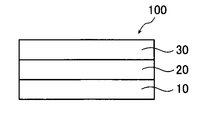
- the polarizing plate of this invention As a 1st embodiment of the polarizing plate of this invention, the polarizing plate provided with a polarizer, a protective film, and a peeling film in this order is mentioned.
- the release film is usually released from the polarizing plate after the polarizing plate is bonded to the adherend.
- FIG. 1 is a schematic cross-sectional view of a polarizing plate 100 which is a first embodiment of the polarizing plate of the present invention.
- the polarizing plate 100 includes a polarizer 10, a protective film 20, and a release film 30 in this order.
- polarizer the polarizer, the protective film, and the release film will be described.
- the polarizer may be a member having a function of converting light into specific linearly polarized light.
- an absorbing polarizer, a reflective polarizer, or the like can be used.
- an iodine polarizer, a dye polarizer using a dichroic dye, a polyene polarizer, and the like are used.
- Iodine polarizers and dye polarizers include coating polarizers and stretchable polarizers, both of which can be applied, but polarizers made by adsorbing iodine or dichroic dyes to stretched polyvinyl alcohol Is preferred.
- a polarizer in which thin films having different birefringence are stacked, a wire grid polarizer, a polarizer in which a cholesteric liquid crystal having a selective reflection region and a quarter wavelength plate are combined, or the like is used.
- a polyvinyl alcohol (PVA) resin in particular, at least one selected from the group consisting of polyvinyl alcohol and an ethylene-vinyl alcohol copolymer
- PVA polyvinyl alcohol
- it is a polarizer containing.
- the elastic modulus of the polarizer is not particularly limited, but is preferably 1.0 to 20.0 GPa, more preferably 5.0 to 10.0 GPa.
- the elastic modulus in the present invention is a value in a direction in which the elastic modulus is calculated eight times by changing the measurement direction by 45 ° with respect to the sample by the following method, and the curl is maximum.
- the curl evaluation method is as described in ⁇ Evaluation of curl resistance> described later.
- the thickness of the polarizer is not particularly limited as long as the following formula (A) is satisfied. However, the thickness is preferably 1.0 to 50.0 ⁇ m, and among these, 2.0 to 20 for the reason that the curl resistance is more excellent. The thickness is more preferably 0.0 ⁇ m, and even more preferably 3.0 to 10.0 ⁇ m.
- the protective film is mainly a film for protecting the above-described polarizer.
- a cellulose polymer Acrylic polymer which has acrylic ester polymer, such as a polymethylmethacrylate and a lactone ring containing polymer; Thermoplastic norbornene-type polymer; Polycarbonate-type polymer Polyester polymers such as polyethylene terephthalate and polyethylene naphthalate; styrene polymers such as polystyrene and acrylonitrile / styrene copolymer (AS resin); polyolefin polymers such as polyethylene, polypropylene and ethylene / propylene copolymer; vinyl chloride Amide polymers such as nylon and aromatic polyamide; imide polymers; sulfone polymers; polyether sulfone polymers; polyether ether ketone poly Chromatography; polyphenylene sulf
- a cellulose polymer represented by triacetyl cellulose (hereinafter also referred to as “cellulose acylate”), which has been used as a transparent protective film of a conventionally known polarizing plate, can be preferably used.
- cellulose acylate triacetyl cellulose
- acrylic polymer examples include polymethyl methacrylate and lactone ring-containing polymers described in paragraphs [0017] to [0107] of JP-A-2009-98605.
- the elastic modulus of the protective film is not particularly limited, but is preferably 1.0 to 20.0 GPa, and more preferably 1.0 to 15.0 GPa for the reason that the curl resistance is more excellent. It is more preferably 2.0 to 12.0 GPa, particularly preferably 2.0 to 10.0 GPa.
- the method for measuring the elastic modulus is as described above.
- the thickness of the protective film is not particularly limited as long as the following formula (A) is satisfied.
- the thickness is preferably 1.0 to 100.0 ⁇ m, among which 10.0 to 80 for the reason that the curl resistance is more excellent.
- the thickness is more preferably 0.0 ⁇ m, and further preferably 10.0 to 40.0 ⁇ m.
- the humidity dimension change of the protective film is not particularly limited.
- the change in humidity dimension is a value measured by the following method. That is, prepare a sample with a length of 12 cm (measurement direction) and a width of 3 cm, and make pin holes in the sample at an interval of 10 cm, and after conditioning for 6 hours at 25 ° C. and a relative humidity of 10%, To measure the length (measured value is L 0 ). Next, the sample is conditioned for 6 hours at 25 ° C. and a relative humidity of 80%, and the distance between the pin holes is measured with a pin gauge (measured value is L 1 ). Using these measured values, change in humidity dimension is obtained by the following equation.
- Humidity dimensional change (L 1 ⁇ L 0 ) ⁇ 100 / L 0
- the humidity dimensional change in the direction in which the curl is generated is defined as the humidity dimensional change.
- the release film is a layer provided on the main surface opposite to the one provided with the polarizer among the two main surfaces of the protective film, and is in close contact with the protective film so as to be peelable.
- the protective film is peelably adhered to the protective film via an adhesive layer.
- the release film is preferably a film having a surface treated with a silicone-based release agent or other release agent, or a film itself having peelability.
- the material constituting the release film include polyolefin such as polypropylene and polyethylene, polyester (preferably PET film), nylon, polyvinyl chloride, and the like.
- the thickness of the release film is not particularly limited as long as the following formula (A) is satisfied, but is preferably 10.0 to 200.0 ⁇ m.
- the elastic modulus of the release film is 2.0 GPa or more. Of these, 2.0 to 20.0 GPa is preferable, and among them, the curling resistance is more excellent, and 3.0 to 15.0 GPa is more preferable, and 4.0 to 10.0 GPa. More preferably.
- the method for measuring the elastic modulus is as described above.
- the thickness T [ ⁇ m] of the release film is obtained by subtracting the value obtained by multiplying 1.2 by the thickness Q [ ⁇ m] of the protective film from the value obtained by multiplying 2.8 by the thickness P [ ⁇ m] of the polarizer. It is more than the value obtained by adding 50 to the obtained value.
- the thickness P of the polarizer is 5.0 ⁇ m and the thickness Q of the protective film is 25.0 ⁇ m
- the right side of the formula (A) is larger than zero. That is, (2.8 ⁇ P ⁇ 1.2 ⁇ Q) is larger than ⁇ 50.
- the method for producing the polarizing plate of the first embodiment is not particularly limited, and a known method can be adopted. For example, a method of attaching a polarizer to one main surface of the protective film using an adhesive (preferably a polyvinyl alcohol-based adhesive) and further attaching a release film to the other main surface of the protective film, etc. It is done.
- an adhesive preferably a polyvinyl alcohol-based adhesive
- the polarizing plate of this invention As a 2nd embodiment of the polarizing plate of this invention, the polarizing plate provided with a polarizer, a protective film, an adhesion layer, and a peeling film in this order is mentioned.
- the polarizing plate of the present invention preferably includes an adhesive layer between the protective film and the release film as in the second embodiment because the release film stably adheres.
- a peeling film and an adhesion layer are normally peeled from a polarizing plate, after bonding a polarizing plate to a to-be-adhered body.
- FIG. 2 is a schematic cross-sectional view of a polarizing plate 110 which is a second embodiment of the polarizing plate of the present invention.
- the polarizing plate 110 includes the polarizer 10, the protective film 20, the adhesive layer 40, and the release film 30 in this order.
- the polarizer, protective film and release film are as described above.
- the adhesive layer will be described.
- An adhesion layer is a layer which improves the adhesiveness of a protective film and a peeling film.
- the material of the adhesive layer is not particularly limited.
- rubber adhesives acrylic adhesives, silicone adhesives, urethane adhesives, vinyl alkyl ether adhesives, polyvinyl alcohol adhesives, polyvinyl pyrrolidone adhesives.
- Agents polyacrylamide adhesives, cellulose adhesives, and the like.
- an acrylic pressure-sensitive adhesive is preferable from the viewpoints of transparency, weather resistance, heat resistance, and the like.
- the method for producing the polarizing plate of the second embodiment is not particularly limited, and a known method can be adopted.
- a polarizer is attached to one main surface of the protective film using an adhesive (preferably a polyvinyl alcohol-based adhesive), and an adhesive layer is formed on the other main surface of the protective film.
- an adhesive preferably a polyvinyl alcohol-based adhesive
- the method in particular of forming an adhesion layer is not restrict
- the method of application is not particularly limited, and specific methods include a double roll coater, slit coater, air knife coater, wire bar coater, slide hopper, spray coating, blade coater, doctor coater, squeeze coater, reverse roll coater, transfer.
- Known methods such as a roll coater, an extrusion coater, a curtain coater, a dip coater, a die coater, a gravure roll coating method, an extrusion coating method, and a roll coating method can be used.
- the polarizing plate of this invention As a 3rd embodiment of the polarizing plate of this invention, the polarizing plate provided with a polarizer, a protective film, a hard-coat layer, an adhesion layer, and a peeling film in this order is mentioned. In addition, a peeling film and an adhesion layer are normally peeled from a polarizing plate, after bonding a polarizing plate to a to-be-adhered body.
- FIG. 3 shows a schematic cross-sectional view of a polarizing plate 120 which is a third embodiment of the polarizing plate of the present invention.
- the polarizing plate 120 includes the polarizer 10, the protective film 20, the hard coat layer 50, the adhesive layer 40, and the release film 30 in this order.
- the polarizer, protective film, adhesive layer, and release film are as described above.
- the hard coat layer will be described.
- the hard coat layer is mainly a layer for imparting the physical strength of the polarizing plate.
- the hard coat layer is preferably formed by a crosslinking reaction or a polymerization reaction of an ionizing radiation curable compound.
- the ionizing radiation curable compound is not particularly limited, but is preferably a photocurable compound. Although it does not restrict
- the thickness of the hard coat layer is not particularly limited, but is preferably more than 0 ⁇ m and 20 ⁇ m or less, and more preferably more than 0 ⁇ m and 10 ⁇ m or less.
- the method for producing the polarizing plate of the third embodiment is not particularly limited, and a known method can be adopted.
- a polarizer is attached to one main surface of the protective film using an adhesive (preferably a polyvinyl alcohol-based adhesive), and further, a hard coat layer is formed on the other main surface of the protective film, Examples thereof include a method of forming an adhesive layer on the formed hard coat layer, and further attaching a release film on the formed adhesive layer.
- the method in particular of forming a hard-coat layer is not restrict
- cure by ultraviolet irradiation after that etc. are mentioned.
- coating the composition for hard-coat layer formation is the same as the composition for adhesion layer formation mentioned above.
- the method for forming the adhesive layer is the same as in the second embodiment described above.
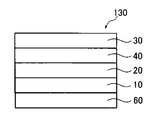
- the polarizing plate As a 4th embodiment of the polarizing plate of this invention, the polarizing plate provided with a liquid crystal layer, a polarizer, a protective film, an adhesion layer, and a peeling film in this order is mentioned.
- a peeling film and an adhesion layer are normally peeled from a polarizing plate, after bonding a polarizing plate to a to-be-adhered body.
- FIG. 4 shows a schematic cross-sectional view of a polarizing plate 130 which is a fourth embodiment of the polarizing plate of the present invention.
- the polarizing plate 130 includes the liquid crystal layer 60, the polarizer 10, the protective film 20, the adhesive layer 40, and the release film 30 in this order.
- the polarizer, protective film, adhesive layer, and release film are as described above.
- the liquid crystal layer will be described.
- the liquid crystal layer is not particularly limited as long as it contains a liquid crystal compound, but when the polarizing plate of the present invention is used in a liquid crystal display device, it is preferably an optical anisotropic layer such as an optical compensation layer.
- the optical compensation layer is not particularly limited, but negative-C-plate, A-plate and negative-C-plate are preferably used in the VA mode, and biaxial-plate or positive- in the IPS mode. C-plate or the like is preferably used.
- a hybrid-aligned discotic liquid crystal layer or the like is preferably used.
- biaxial-plate or the like is preferably used.
- the thickness of the liquid crystal layer is not particularly limited, but is preferably more than 0 ⁇ m and 20 ⁇ m or less, and more preferably more than 0 ⁇ m and 10 ⁇ m or less.
- the method for producing the polarizing plate of the fourth embodiment is not particularly limited, and a known method can be adopted.
- a polarizer is attached to one main surface of the protective film using an adhesive (preferably a polyvinyl alcohol-based adhesive), and an adhesive layer is formed on the other main surface of the protective film.
- an adhesive preferably a polyvinyl alcohol-based adhesive
- a method of forming a liquid crystal layer on the main surface opposite to the main surface on which the release film is attached on the adhesive layer and the protective film for the polarizer is attached.
- a method for forming the liquid crystal layer is not particularly limited, and examples thereof include a method of applying a composition containing a liquid crystal compound and then irradiating ultraviolet rays or the like to fix the alignment state.
- the method for forming the adhesive layer is the same as in the second embodiment described above.
- the fourth embodiment may include a hard coat layer between the protective film and the adhesive layer.
- the polarizing plate As a 5th embodiment of the polarizing plate of this invention, the polarizing plate provided with a hard-coat layer, a polarizer, a protective film, an adhesion layer, and a peeling film in this order is mentioned.
- a peeling film and an adhesion layer are normally peeled from a polarizing plate, after bonding a polarizing plate to a to-be-adhered body.
- FIG. 5 is a schematic cross-sectional view of a polarizing plate 140 that is the fourth embodiment of the polarizing plate of the present invention.
- the polarizing plate 140 includes the hard coat layer 52, the polarizer 10, the protective film 20, the adhesive layer 40, and the release film 30 in this order.
- the hard coat layer, polarizer, protective film, adhesive layer, and release film are as described above.
- the method for producing the polarizing plate of the fifth embodiment is not particularly limited, and a known method can be adopted.
- a polarizer is attached to one main surface of the protective film using an adhesive (preferably a polyvinyl alcohol-based adhesive), and an adhesive layer is formed on the other main surface of the protective film.
- an adhesive preferably a polyvinyl alcohol-based adhesive
- examples include a method in which a release film is attached on the adhesive layer thus formed, and a hard coat layer is formed on the main surface opposite to the main surface on which the protective film of the polarizer is attached.
- the method for forming the adhesive layer is the same as in the second embodiment described above.
- the method for forming the hard coat layer is the same as in the third embodiment described above.
- the fifth embodiment may include a hard coat layer between the protective film and the adhesive layer.
- the polarizing plate of the present invention of the two main surfaces of the polarizer, on the main surface opposite to the main surface including the protective film, another polarizing film is not provided from the viewpoint that the polarizing plate can be thinned. preferable.
- the image display apparatus of the present invention is an image display apparatus having the polarizing plate of the present invention described above and a display element (for example, a liquid crystal cell, an organic EL display panel, etc.).
- a display element for example, a liquid crystal cell, an organic EL display panel, etc.
- the display element used for the image display device of the present invention is not particularly limited, and examples thereof include a liquid crystal cell, an organic EL display panel, a plasma display panel, and the like. Among these, a liquid crystal cell and an organic EL display panel are preferable, and a liquid crystal cell is more preferable. That is, the image display device of the present invention is preferably a liquid crystal display device using a liquid crystal cell as a display element, and an organic EL display device using an organic EL display panel as a display element, and is a liquid crystal display device. More preferred.
- the liquid crystal cell used in the present invention is preferably a VA mode, an OCB mode, an IPS mode, or a TN mode, but is not limited thereto.
- a TN mode liquid crystal cell rod-like liquid crystal molecules are substantially horizontally aligned when no voltage is applied, and are twisted and aligned at 60 to 120 °.
- the TN mode liquid crystal cell is most frequently used as a color TFT liquid crystal display device, and is described in many documents.
- a VA mode liquid crystal cell rod-like liquid crystalline molecules are aligned substantially vertically when no voltage is applied.
- the VA mode liquid crystal cell includes: (1) a narrowly defined VA mode liquid crystal cell in which rod-like liquid crystalline molecules are aligned substantially vertically when no voltage is applied, and substantially horizontally when a voltage is applied (Japanese Patent Laid-Open No. Hei 2-). 176625) (2) Liquid crystal cell (SID97, Digest of tech. Papers (Preliminary Proceed) 28 (1997) 845 in which the VA mode is converted into a multi-domain (MVA mode) for widening the viewing angle.
- VA mode liquid crystal cell includes: (1) a narrowly defined VA mode liquid crystal cell in which rod-like liquid crystalline molecules are aligned substantially vertically when no voltage is applied, and substantially horizontally when a voltage is applied (Japanese Patent Laid-Open No. Hei 2-). 176625) (2) Liquid crystal cell (SID97, Digest of tech. Papers (Preliminary Proceed) 28 (1997) 845 in which the VA mode is converted into a multi-domain (MVA mode) for widening the
- a liquid crystal cell in which rod-like liquid crystalline molecules are substantially vertically aligned when no voltage is applied and twisted multi-domain alignment is applied when a voltage is applied (Preliminary collections 58-59 of the Japan Liquid Crystal Society) (1998)) and (4) SURVIVAL mode liquid crystal cells (announced at LCD International 98).
- any of a PVA (Patterned Vertical Alignment) type, a photo-alignment type (Optical Alignment), and a PSA (Polymer-Stained Alignment) may be used. Details of these modes are described in JP-A-2006-215326 and JP-T 2008-538819.
- JP-A-10-54982, JP-A-11-202323, and JP-A-9-292522 are methods for reducing leakage light during black display in an oblique direction and improving the viewing angle using an optical compensation sheet. No. 11-133408, No. 11-305217, No. 10-307291, and the like.
- the organic EL display panel used in the present invention is a display panel constituted by using an organic EL element in which an organic light emitting layer (organic electroluminescence layer) is sandwiched between electrodes (between a cathode and an anode).
- the configuration of the organic EL display panel is not particularly limited, and a known configuration is adopted.
- an organic EL display device which is an example of the image display device of the present invention, for example, from the viewing side, the polarizing plate of the present invention and a plate having a ⁇ / 4 function (hereinafter also referred to as “ ⁇ / 4 plate”). And an organic EL display panel in this order.
- the “plate having a ⁇ / 4 function” refers to a plate having a function of converting linearly polarized light having a specific wavelength into circularly polarized light (or circularly polarized light into linearly polarized light).
- a ⁇ / 4 plate Specific examples of the embodiment in which is a single layer structure include a stretched polymer film, a retardation film provided with an optically anisotropic layer having a ⁇ / 4 function on a support, and the like.
- the four plates have a multilayer structure, specifically, there is a broadband ⁇ / 4 plate formed by laminating a ⁇ / 4 plate and a ⁇ / 2 plate.
- the liquid crystal display device of the present invention is a liquid crystal display device comprising the above-described polarizing plate of the present invention and a liquid crystal cell.
- the liquid crystal cell is as described above.
- the polarizing plate of the present invention is preferably used as the polarizing plate on the front side, and the polarizing plate of the present invention is used as the polarizing plate on the front side and the rear side. Is more preferable.
- FIG. 6 is a schematic cross-sectional view of a liquid crystal display device 200 which is an embodiment of the liquid crystal display device of the present invention.
- the liquid crystal display device 200 includes a liquid crystal cell 70 and polarizing plates 130 provided on both sides of the liquid crystal cell 70 with an adhesive layer 42 interposed therebetween.
- the polarizing plate 130 is the same as the polarizing plate 130 described above.
- the adhesive layer 42 is the same as the adhesive layer described above.
- the liquid crystal cell 70 carries a liquid crystal layer between two electrode substrates (not shown).
- the liquid crystal display device 200 is normally used in a mode (liquid crystal display device 210) in which the release film 30 and the adhesive layer 40 are peeled as shown in FIG.
- ⁇ Preparation of release film> Polyethylene terephthalate is melted and extruded from a die, cooled and solidified on a casting drum at 25 ° C., and then the film is first heated multiple times by a roll heated to 110 ° C. and a radiation heater to be stretched 4.8 times in the longitudinal direction. The film was stretched twice, and then stretched 4.1 times in the width direction at 110 ° C. with a tenter, and further heat treated (200 ° C.) in a heat treatment zone subsequent to the tenter to obtain a PET film (release film).
- the thickness and elastic modulus were adjusted by changing the extrusion amount and stretching conditions, respectively, and the following release films 1 to 15 were obtained.
- -Release film 1 PET film (thickness: 20.0 ⁇ m, elastic modulus: 2.2 GPa)
- -Release film 2 PET film (thickness: 40.0 ⁇ m, elastic modulus: 2.2 GPa)
- -Release film 3 PET film (thickness: 60.0 ⁇ m, elastic modulus: 2.2 GPa)
- -Release film 4 PET film (thickness: 20.0 ⁇ m, elastic modulus: 5.2 GPa) -Release film 5: PET film (thickness: 30.0 ⁇ m, elastic modulus: 5.2 GPa)
- -Release film 6 PET film (thickness: 40.0 ⁇ m, elastic modulus: 5.2 GPa)
- -Release film 7 PET film (thickness: 50.0 ⁇ m, elastic modulus: 5.2 GPa)
- -Release film 8 PET film (thickness: 60.0 ⁇ m, elastic modulus: 5.2 GPa)
- ⁇ Preparation of protective film (Protective films 1, 3 to 8)> 1.
- Preparation of Core Layer Cellulose Acylate Solution The following “Components of Core Layer Cellulose Acylate Solution” were placed in a mixing tank and dissolved by stirring to prepare a core layer cellulose acetate solution.
- Outer Cellulose Acylate Solution 10 parts by weight of a matting agent solution comprising the following “components of matting agent solution” was added to 90 parts by weight of the core layer cellulose acylate solution to prepare an outer layer cellulose acetate solution.
- the casting amount was adjusted, and cellulose acylate films having thicknesses of 25 ⁇ m (protective film 4) and 5 ⁇ m (protective film 3) were produced.
- the elastic modulus in the transverse direction was measured for the protective films 3 to 5, it was 5.7 GPa.
- a cellulose acylate film having a thickness of 25 ⁇ m, an elastic modulus of 2.7 GPa in the lateral direction and a humidity dimensional change of 0.2%, a thickness of 25 ⁇ m and Cellulose acylate film (protective film 7) having a lateral elastic modulus of 2.7 GPa and a humidity dimensional change of 0.0%, a cellulose acylate having a thickness of 25 ⁇ m, a lateral elastic modulus of 8.7 GPa and a humidity dimensional change of 0.2%
- a rate film protecting film 6
- a cellulose acylate film having a thickness of 25 ⁇ m, a lateral elastic modulus of 8.7 GPa, and a humidity dimensional change of 0.4% were also produced.
- the above-described elastic modulus in the lateral direction corresponds to the elastic modulus in the direction in which the curl is large in ⁇ Evaluation of curl resistance> described later.
- a thin film polarizer was produced as follows. Specifically, first, isophthalic acid copolymerized polyethylene terephthalate copolymerized with 6 mol% of isophthalic acid was prepared as an amorphous ester thermoplastic resin substrate. On this resin base material, a PVA resin layer was formed by coating. After the resin base material and the PVA resin layer are integrally stretched in a two-stage stretching process consisting of air-assisted stretching and boric acid water stretching, the PVA resin layer is dyed with a dichroic dye, A polarizer was produced by peeling off the crystalline ester-based thermoplastic resin substrate. The obtained polarizer is referred to as a polarizer 1. The thickness of the polarizer 1 was 5.0 ⁇ m. The elastic modulus was 6.8 GPa. The evaluation method of the elastic modulus is as described above.
- ⁇ Production of Polarizer 2> The polyvinyl alcohol film was stretched about 6 times in warm water at 40 ° C. This was immersed in an aqueous solution of 0.5 g / l iodine and 50 g / l potassium iodide at 30 ° C. for 1 minute. Subsequently, it was immersed in an aqueous solution of boric acid 100 g / l and potassium iodide 60 g / l at 70 ° C. for 5 minutes. Furthermore, it was washed with water at 20 ° C. for 10 seconds and dried at 80 ° C. for 5 minutes to obtain an iodine-based polarizer. The obtained iodine polarizer is referred to as a polarizer 2. The thickness of the polarizer 2 was 15.0 ⁇ m. The elastic modulus was 6.8 GPa. The evaluation method of the elastic modulus is as described above.
- Polarizer 3 An iodine type polarizer was obtained according to the same procedure as that of the polarizer 2 except that the thickness of the polyvinyl alcohol film to be used was changed. The obtained iodine-based polarizer is referred to as a polarizer 3. The thickness of the polarizer 3 was 30.0 ⁇ m. The elastic modulus was 6.8 GPa. The evaluation method of the elastic modulus is as described above.
- ⁇ Preparation of adhesive coating solution 96.5 parts by mass of butyl acrylate, 3 parts by mass of acrylic acid, 0.5 parts by mass of 2-hydroxyethyl acrylate, 0.15 parts by mass of 2,2′-azobisisobutyronitrile, and 100 parts by mass of ethyl acetate Then, after sufficiently purging with nitrogen, the mixture was reacted at 60 ° C. for 8 hours with stirring under a nitrogen stream to obtain an acrylic polymer solution having a weight average molecular weight of 1,650,000.
- Example 1 The polarizer 1 was attached to one main surface of the protective film 3 (cellulose acylate film, thickness: 5.0 ⁇ m, elastic modulus: 5.7 GPa) using a polyvinyl alcohol-based adhesive.
- the release film 8 PET film, thickness: 60.0 ⁇ m, elastic modulus: 5.2 GPa
- the 1st drying process was given by sending the wind of wind speed 14m / sec for 1 minute in 70 degreeC oven.
- the 2nd drying process was given by sending the wind of temperature 155 degreeC, and the wind speed of 15 m / sec for 2 minutes, and the adhesion layer was formed.
- the surface opposite to the release film 8 of the adhesive layer and the surface opposite to the polarizer 1 of the protective film 3 to which the polarizer 1 was bonded as described above were bonded.
- a polarizing plate including a polarizer, a protective film, an adhesive layer, and a release film in this order was obtained.
- Example 1 A polarizer shown in Table 1 (indicated by a circle in Table 1) is used instead of the polarizer 1, and a protective film shown in Table 1 is used instead of the protective film 3 (in Table 1).
- Example 1 with the exception of using a release film shown in Table 1 (indicated by a circle in Table 1) instead of the release film 8. According to the same procedure, a polarizing plate provided with a polarizer, a protective film, an adhesive layer, and a release film in this order was obtained.
- Release films 1 to 15 shown in Table 1 represent release films 1 to 15 produced as described above.
- the protective films 1 to 8 listed in Table 1 represent the protective films 1 to 8 produced as described above.
- the humidity dimension change of the protective film 1 is 0.2%
- the humidity dimension change of the protective film 6 is 0.2%
- the humidity dimension change of the protective film 7 is 0.0%
- the protective film 8 The humidity dimensional change is 0.4%.
- the humidity dimensional change is a humidity dimensional change in the direction in which the curl is generated.
- Polarizers 1 to 3 listed in Table 1 represent the polarizers 1 to 3 produced as described above.
- an evaluation sample is prepared by punching out a square with a side of 10 cm such that the absorption axis direction (MD direction) and the transmission axis direction (TD direction) of the obtained polarizing plate are diagonal lines.
- the punched sample for evaluation was conditioned for 2 days at 25 ° C. and 60% relative humidity, and the curl radius of curvature x (cm) was measured, and then conditioned for 2 days at 25 ° C. and 40% relative humidity.
- the curvature radius y (cm) is measured.
- “required lower limit value of release film thickness [ ⁇ m]” is the lower limit value of required release film thickness calculated from the formula (A) for each example and comparative example. Represents.
- the thickness of the polarizer is 5.0 ⁇ m
- Examples 1 to 24 all exhibited excellent curl resistance. Comparison with Examples 3 and 4, Comparison with Examples 11 and 12, Comparison with Examples 13 and 14, Comparison with Examples 15 and 16, Comparison with Examples 17 and 18, Examples 21 and 22 In comparison with Examples 23 and 24 and Examples 23 and 24, Examples 4, 12, 14, 16, 18, 22, and 24 in which the thickness of the release film is 50.0 ⁇ m or more are more excellent in curling resistance Showed sex. Further, from the comparison between Examples 3 and 11 and 13 and the comparison between Examples 4 and 12 and 14, the elastic modulus of the peeled film of Examples 3, 4, 13 and 14 is 3.0 GPa or more. Showed better curl resistance. Among them, Examples 13 and 14 in which the release film had an elastic modulus of 6.0 GPa or more showed further excellent curl resistance.
- Example 4 in which the thickness of the polarizer was 10.0 ⁇ m or less showed better curl resistance. Further, from the comparison between Examples 8 and 9, Example 8 in which the thickness of the polarizer was 20.0 ⁇ m or less showed better curl resistance.
Landscapes
- Physics & Mathematics (AREA)
- General Physics & Mathematics (AREA)
- Optics & Photonics (AREA)
- Nonlinear Science (AREA)
- Chemical & Material Sciences (AREA)
- Crystallography & Structural Chemistry (AREA)
- Mathematical Physics (AREA)
- Polarising Elements (AREA)
- Liquid Crystal (AREA)
Abstract
Priority Applications (4)
| Application Number | Priority Date | Filing Date | Title |
|---|---|---|---|
| JP2016511883A JPWO2015152157A1 (ja) | 2014-03-31 | 2015-03-30 | 偏光板、画像表示装置および液晶表示装置 |
| KR1020167028513A KR20160134749A (ko) | 2014-03-31 | 2015-03-30 | 편광판, 화상 표시 장치 및 액정 표시 장치 |
| CN201580018190.2A CN106164720B (zh) | 2014-03-31 | 2015-03-30 | 偏振片、图像显示装置及液晶显示装置 |
| US15/279,812 US20170017026A1 (en) | 2014-03-31 | 2016-09-29 | Polarizing plate, image display device, and liquid crystal display device |
Applications Claiming Priority (2)
| Application Number | Priority Date | Filing Date | Title |
|---|---|---|---|
| JP2014074254 | 2014-03-31 | ||
| JP2014-074254 | 2014-03-31 |
Related Child Applications (1)
| Application Number | Title | Priority Date | Filing Date |
|---|---|---|---|
| US15/279,812 Continuation US20170017026A1 (en) | 2014-03-31 | 2016-09-29 | Polarizing plate, image display device, and liquid crystal display device |
Publications (1)
| Publication Number | Publication Date |
|---|---|
| WO2015152157A1 true WO2015152157A1 (fr) | 2015-10-08 |
Family
ID=54240480
Family Applications (1)
| Application Number | Title | Priority Date | Filing Date |
|---|---|---|---|
| PCT/JP2015/059939 Ceased WO2015152157A1 (fr) | 2014-03-31 | 2015-03-30 | Plaque de polarisation, dispositif d'affichage d'image et dispositif d'affichage à cristaux liquides |
Country Status (6)
| Country | Link |
|---|---|
| US (1) | US20170017026A1 (fr) |
| JP (2) | JPWO2015152157A1 (fr) |
| KR (1) | KR20160134749A (fr) |
| CN (1) | CN106164720B (fr) |
| TW (1) | TW201543087A (fr) |
| WO (1) | WO2015152157A1 (fr) |
Cited By (5)
| Publication number | Priority date | Publication date | Assignee | Title |
|---|---|---|---|---|
| CN109074763A (zh) * | 2016-04-27 | 2018-12-21 | 日本瑞翁株式会社 | 膜传感器构件及其制造方法、圆偏振片及其制造方法、以及图像显示装置 |
| WO2020080171A1 (fr) * | 2018-10-15 | 2020-04-23 | 日東電工株式会社 | Plaque polarisante à couche de déphasage et dispositif d'affichage d'images utilisant une telle plaque |
| JP2020064290A (ja) * | 2018-10-15 | 2020-04-23 | 日東電工株式会社 | 位相差層付偏光板およびそれを用いた画像表示装置 |
| JP2021059112A (ja) * | 2019-10-07 | 2021-04-15 | 日東電工株式会社 | 印刷層付フィルム積層体、該印刷層付フィルム積層体を含む光学積層体、およびこれらを用いた画像表示装置 |
| JP2022039929A (ja) * | 2020-08-26 | 2022-03-10 | 日東電工株式会社 | 光学フィルム、光学フィルムの製造方法、光学部材および画像表示装置 |
Families Citing this family (2)
| Publication number | Priority date | Publication date | Assignee | Title |
|---|---|---|---|---|
| JP7257907B2 (ja) * | 2019-07-22 | 2023-04-14 | 日東電工株式会社 | 薄型円偏光板の製造方法 |
| KR102760603B1 (ko) * | 2020-11-12 | 2025-01-24 | 동우 화인켐 주식회사 | 편광판 및 이를 포함하는 화상표시장치 |
Citations (4)
| Publication number | Priority date | Publication date | Assignee | Title |
|---|---|---|---|---|
| JPH0643322A (ja) * | 1992-07-27 | 1994-02-18 | Hitachi Ltd | 粘着偏光板 |
| JP2005326531A (ja) * | 2004-05-13 | 2005-11-24 | Nitto Denko Corp | 保護フィルム付き偏光板、その製造方法及びそれを用いた画像表示装置 |
| JP2009258294A (ja) * | 2008-04-15 | 2009-11-05 | Nitto Denko Corp | 光学フィルム用粘着剤組成物、粘着型光学フィルムおよび画像表示装置 |
| JP2010229342A (ja) * | 2009-03-27 | 2010-10-14 | Lintec Corp | 光学用粘着剤、光学用粘着シート及び粘着剤付き光学部材 |
Family Cites Families (13)
| Publication number | Priority date | Publication date | Assignee | Title |
|---|---|---|---|---|
| JPH09193305A (ja) * | 1996-01-23 | 1997-07-29 | Kureha Chem Ind Co Ltd | 積層フィルム及び電子部品用包装袋 |
| JP3165100B2 (ja) * | 1998-02-09 | 2001-05-14 | 日本電気株式会社 | 液晶表示装置とその製造方法 |
| JP3818451B2 (ja) * | 2004-11-22 | 2006-09-06 | 日東電工株式会社 | 積層体の切断方法 |
| JPWO2007102327A1 (ja) * | 2006-03-08 | 2009-07-23 | コニカミノルタオプト株式会社 | 偏光板及び液晶表示装置 |
| JP2008203400A (ja) * | 2007-02-19 | 2008-09-04 | Nitto Denko Corp | 表面保護フィルム付偏光板、表面保護フィルム付液晶パネル、および画像表示装置 |
| JP2009229956A (ja) * | 2008-03-25 | 2009-10-08 | Fujifilm Corp | 帯電防止型偏光板、及び液晶表示装置 |
| JP5493523B2 (ja) * | 2009-07-10 | 2014-05-14 | 東洋紡株式会社 | 粘着シート離型用積層フィルム |
| JP4774121B2 (ja) * | 2010-01-29 | 2011-09-14 | ダイセル化学工業株式会社 | 位相差フィルム用セルロースジアセテート |
| JP5727844B2 (ja) | 2010-06-04 | 2015-06-03 | 富士フイルム株式会社 | 偏光板および液晶表示装置 |
| US8836879B2 (en) * | 2010-06-10 | 2014-09-16 | Apple Inc. | Displays with minimized curtain mura |
| US20120327510A1 (en) * | 2011-06-23 | 2012-12-27 | Nitto Denko Corporation | Polarizing plate having pressure-sensitive adhesive layer and image display device |
| KR101978721B1 (ko) * | 2012-10-08 | 2019-05-16 | 삼성디스플레이 주식회사 | 편광판, 액정 표시 장치 및 이를 제조하는 방법 |
| JP2016027354A (ja) * | 2013-07-19 | 2016-02-18 | 富士フイルム株式会社 | 偏光板用積層体、これを含む偏光板および液晶表示装置 |
-
2015
- 2015-03-30 KR KR1020167028513A patent/KR20160134749A/ko not_active Ceased
- 2015-03-30 CN CN201580018190.2A patent/CN106164720B/zh active Active
- 2015-03-30 JP JP2016511883A patent/JPWO2015152157A1/ja active Pending
- 2015-03-30 WO PCT/JP2015/059939 patent/WO2015152157A1/fr not_active Ceased
- 2015-03-31 TW TW104110382A patent/TW201543087A/zh unknown
-
2016
- 2016-09-29 US US15/279,812 patent/US20170017026A1/en not_active Abandoned
-
2018
- 2018-01-11 JP JP2018002472A patent/JP2018077522A/ja active Pending
Patent Citations (4)
| Publication number | Priority date | Publication date | Assignee | Title |
|---|---|---|---|---|
| JPH0643322A (ja) * | 1992-07-27 | 1994-02-18 | Hitachi Ltd | 粘着偏光板 |
| JP2005326531A (ja) * | 2004-05-13 | 2005-11-24 | Nitto Denko Corp | 保護フィルム付き偏光板、その製造方法及びそれを用いた画像表示装置 |
| JP2009258294A (ja) * | 2008-04-15 | 2009-11-05 | Nitto Denko Corp | 光学フィルム用粘着剤組成物、粘着型光学フィルムおよび画像表示装置 |
| JP2010229342A (ja) * | 2009-03-27 | 2010-10-14 | Lintec Corp | 光学用粘着剤、光学用粘着シート及び粘着剤付き光学部材 |
Cited By (7)
| Publication number | Priority date | Publication date | Assignee | Title |
|---|---|---|---|---|
| CN109074763A (zh) * | 2016-04-27 | 2018-12-21 | 日本瑞翁株式会社 | 膜传感器构件及其制造方法、圆偏振片及其制造方法、以及图像显示装置 |
| CN109074763B (zh) * | 2016-04-27 | 2021-06-15 | 日本瑞翁株式会社 | 膜传感器构件及其制造方法、圆偏振片及其制造方法、以及图像显示装置 |
| WO2020080171A1 (fr) * | 2018-10-15 | 2020-04-23 | 日東電工株式会社 | Plaque polarisante à couche de déphasage et dispositif d'affichage d'images utilisant une telle plaque |
| JP2020064290A (ja) * | 2018-10-15 | 2020-04-23 | 日東電工株式会社 | 位相差層付偏光板およびそれを用いた画像表示装置 |
| JP2021059112A (ja) * | 2019-10-07 | 2021-04-15 | 日東電工株式会社 | 印刷層付フィルム積層体、該印刷層付フィルム積層体を含む光学積層体、およびこれらを用いた画像表示装置 |
| JP2022039929A (ja) * | 2020-08-26 | 2022-03-10 | 日東電工株式会社 | 光学フィルム、光学フィルムの製造方法、光学部材および画像表示装置 |
| JP7663388B2 (ja) | 2020-08-26 | 2025-04-16 | 日東電工株式会社 | 光学フィルム、光学フィルムの製造方法、光学部材および画像表示装置 |
Also Published As
| Publication number | Publication date |
|---|---|
| JPWO2015152157A1 (ja) | 2017-04-13 |
| TW201543087A (zh) | 2015-11-16 |
| US20170017026A1 (en) | 2017-01-19 |
| JP2018077522A (ja) | 2018-05-17 |
| KR20160134749A (ko) | 2016-11-23 |
| CN106164720A (zh) | 2016-11-23 |
| CN106164720B (zh) | 2019-01-11 |
Similar Documents
| Publication | Publication Date | Title |
|---|---|---|
| JP6360821B2 (ja) | 位相差層付偏光板および画像表示装置 | |
| CN101855578B (zh) | 起偏振器的制造方法、起偏振器、偏振片、光学薄膜和图像显示装置 | |
| JP2018077522A (ja) | 偏光板、画像表示装置および液晶表示装置 | |
| TWI732231B (zh) | 偏光薄膜、附黏著劑層之偏光薄膜及影像顯示裝置 | |
| US20160209548A1 (en) | Method for manufacturing polarizing plate | |
| JP7046127B6 (ja) | 光学積層体および該光学積層体の位相差層付偏光板を含む画像表示装置 | |
| JP2003121641A (ja) | 積層位相差板、偏光部材及び液晶表示装置 | |
| WO2015046225A1 (fr) | Plaque de polarisation et dispositif d'affichage d'images | |
| JP2019082719A (ja) | 偏光板 | |
| JP2013152430A (ja) | 光学フィルム、積層フィルム、及びそれらの製造方法 | |
| JP7533719B2 (ja) | 偏光板 | |
| JP2025061550A (ja) | 位相差層付偏光板および画像表示装置 | |
| JP2002365428A (ja) | 光学フィルムの製造方法及びそれを用いた積層偏光板、液晶表示装置 | |
| WO2022244301A1 (fr) | Plaque de polarisation circulaire et dispositif d'affichage d'image l'utilisant | |
| JP2023007352A (ja) | 積層体及びその製造方法、並びに、偏光フィルムの製造方法 | |
| JP2024111076A (ja) | 積層体および画像表示パネルの製造方法 | |
| TW202001308A (zh) | 偏光薄膜、附黏著劑層之偏光薄膜及影像顯示裝置 | |
| WO2023013275A1 (fr) | Plaque de polarisation équipée d'une couche de retard et dispositif d'affichage d'image l'utilisant | |
| JP2003139952A (ja) | 偏光板 | |
| WO2020162298A1 (fr) | Dispositif d'affichage d'images et son procédé de fabrication | |
| KR20220058951A (ko) | 적층체, 적층체의 제조 방법, 편광판의 제조 방법 | |
| JP2009282482A (ja) | 位相差フィルム、積層体、偏光板及び画像表示装置 | |
| JP7685823B2 (ja) | 位相差層付偏光板および画像表示装置 | |
| JP4325317B2 (ja) | 光学積層体、光学素子、液晶表示装置、及び光学積層体の製造方法 | |
| JP2025184234A (ja) | 光学積層部材および光学積層体の製造方法 |
Legal Events
| Date | Code | Title | Description |
|---|---|---|---|
| 121 | Ep: the epo has been informed by wipo that ep was designated in this application |
Ref document number: 15773492 Country of ref document: EP Kind code of ref document: A1 |
|
| ENP | Entry into the national phase |
Ref document number: 2016511883 Country of ref document: JP Kind code of ref document: A |
|
| NENP | Non-entry into the national phase | ||
| ENP | Entry into the national phase |
Ref document number: 20167028513 Country of ref document: KR Kind code of ref document: A |
|
| 122 | Ep: pct application non-entry in european phase |
Ref document number: 15773492 Country of ref document: EP Kind code of ref document: A1 |