WO2015163411A1 - Plaque de verre absorbant le rayonnement thermique, et son procédé de production - Google Patents
Plaque de verre absorbant le rayonnement thermique, et son procédé de production Download PDFInfo
- Publication number
- WO2015163411A1 WO2015163411A1 PCT/JP2015/062379 JP2015062379W WO2015163411A1 WO 2015163411 A1 WO2015163411 A1 WO 2015163411A1 JP 2015062379 W JP2015062379 W JP 2015062379W WO 2015163411 A1 WO2015163411 A1 WO 2015163411A1
- Authority
- WO
- WIPO (PCT)
- Prior art keywords
- glass plate
- heat ray
- absorbing glass
- less
- ray absorbing
- Prior art date
- Legal status (The legal status is an assumption and is not a legal conclusion. Google has not performed a legal analysis and makes no representation as to the accuracy of the status listed.)
- Ceased
Links
Images
Classifications
-
- C—CHEMISTRY; METALLURGY
- C03—GLASS; MINERAL OR SLAG WOOL
- C03C—CHEMICAL COMPOSITION OF GLASSES, GLAZES OR VITREOUS ENAMELS; SURFACE TREATMENT OF GLASS; SURFACE TREATMENT OF FIBRES OR FILAMENTS MADE FROM GLASS, MINERALS OR SLAGS; JOINING GLASS TO GLASS OR OTHER MATERIALS
- C03C3/00—Glass compositions
- C03C3/04—Glass compositions containing silica
- C03C3/076—Glass compositions containing silica with 40% to 90% silica, by weight
- C03C3/083—Glass compositions containing silica with 40% to 90% silica, by weight containing aluminium oxide or an iron compound
- C03C3/085—Glass compositions containing silica with 40% to 90% silica, by weight containing aluminium oxide or an iron compound containing an oxide of a divalent metal
- C03C3/087—Glass compositions containing silica with 40% to 90% silica, by weight containing aluminium oxide or an iron compound containing an oxide of a divalent metal containing calcium oxide, e.g. common sheet or container glass
-
- C—CHEMISTRY; METALLURGY
- C03—GLASS; MINERAL OR SLAG WOOL
- C03C—CHEMICAL COMPOSITION OF GLASSES, GLAZES OR VITREOUS ENAMELS; SURFACE TREATMENT OF GLASS; SURFACE TREATMENT OF FIBRES OR FILAMENTS MADE FROM GLASS, MINERALS OR SLAGS; JOINING GLASS TO GLASS OR OTHER MATERIALS
- C03C3/00—Glass compositions
- C03C3/04—Glass compositions containing silica
- C03C3/076—Glass compositions containing silica with 40% to 90% silica, by weight
- C03C3/095—Glass compositions containing silica with 40% to 90% silica, by weight containing rare earths
-
- C—CHEMISTRY; METALLURGY
- C03—GLASS; MINERAL OR SLAG WOOL
- C03C—CHEMICAL COMPOSITION OF GLASSES, GLAZES OR VITREOUS ENAMELS; SURFACE TREATMENT OF GLASS; SURFACE TREATMENT OF FIBRES OR FILAMENTS MADE FROM GLASS, MINERALS OR SLAGS; JOINING GLASS TO GLASS OR OTHER MATERIALS
- C03C4/00—Compositions for glass with special properties
- C03C4/02—Compositions for glass with special properties for coloured glass
-
- C—CHEMISTRY; METALLURGY
- C03—GLASS; MINERAL OR SLAG WOOL
- C03C—CHEMICAL COMPOSITION OF GLASSES, GLAZES OR VITREOUS ENAMELS; SURFACE TREATMENT OF GLASS; SURFACE TREATMENT OF FIBRES OR FILAMENTS MADE FROM GLASS, MINERALS OR SLAGS; JOINING GLASS TO GLASS OR OTHER MATERIALS
- C03C4/00—Compositions for glass with special properties
- C03C4/08—Compositions for glass with special properties for glass selectively absorbing radiation of specified wave lengths
-
- C—CHEMISTRY; METALLURGY
- C03—GLASS; MINERAL OR SLAG WOOL
- C03C—CHEMICAL COMPOSITION OF GLASSES, GLAZES OR VITREOUS ENAMELS; SURFACE TREATMENT OF GLASS; SURFACE TREATMENT OF FIBRES OR FILAMENTS MADE FROM GLASS, MINERALS OR SLAGS; JOINING GLASS TO GLASS OR OTHER MATERIALS
- C03C4/00—Compositions for glass with special properties
- C03C4/08—Compositions for glass with special properties for glass selectively absorbing radiation of specified wave lengths
- C03C4/082—Compositions for glass with special properties for glass selectively absorbing radiation of specified wave lengths for infrared absorbing glass
-
- C—CHEMISTRY; METALLURGY
- C03—GLASS; MINERAL OR SLAG WOOL
- C03C—CHEMICAL COMPOSITION OF GLASSES, GLAZES OR VITREOUS ENAMELS; SURFACE TREATMENT OF GLASS; SURFACE TREATMENT OF FIBRES OR FILAMENTS MADE FROM GLASS, MINERALS OR SLAGS; JOINING GLASS TO GLASS OR OTHER MATERIALS
- C03C4/00—Compositions for glass with special properties
- C03C4/08—Compositions for glass with special properties for glass selectively absorbing radiation of specified wave lengths
- C03C4/085—Compositions for glass with special properties for glass selectively absorbing radiation of specified wave lengths for ultraviolet absorbing glass
Definitions
- the present invention relates to a heat ray absorbing glass plate and a method for producing the same.
- the heat ray absorbing glass plate is required to have low solar transmittance and high visible light transmittance. That is, the solar radiation transmittance defined in JIS R 3106 (1998) (hereinafter also referred to as Te. In this application, the thickness is converted to 4 mm) and the visible light transmittance defined in JIS R 3106 (1998) (A light source, 2 degrees).
- the ratio Tv / Te is required to be high (field of view) (hereinafter also referred to as Tv. In this application, the thickness is converted to 4 mm).
- Patent Document 1 has been proposed as a heat ray absorbing glass plate.
- redox is 0.38 to 0.60
- soda lime silica glass containing SO 3 0.005 to 0.18% and substantially free of polysulfide in terms of mass percentage based on oxide.
- a heat-absorbing glass plate containing any one of I) to V) as a coloring component in terms of mass percentage or mass percentage.
- SiO 2 65 to 75%, Al 2 O 3 : more than 3%, 6% or less, MgO: 0% to less than 2%, CaO: 7 to 10%, total iron converted to Fe 2 O 3 : 45 to 0.65%, TiO 2 : 0.2 to 0.8%, substantially free of any one selected from the group consisting of CoO, Cr 2 O 3 , V 2 O 5 and MnO,
- a heat-absorbing glass plate in which the ratio (Redox) of the total iron mass and the divalent FeO mass in which the iron amount is converted to Fe 2 O 3 is more than 42% and 60% or less.
- Patent Document 3 includes iron, tin, and sulfur elements, and includes total sulfur converted to SO 3 in terms of oxide-based mass percentage: 0.025% or more, and converted to Fe 2 O 3 .
- the ratio (Redox) of divalent iron converted to Fe 2 O 3 in the total iron is 60 to 80% in terms of mass percentage, and the ratio of divalent tin in the total tin is 0 in terms of mole percentage.
- a colored glass plate made of alkali-containing silica glass of 1% or more has been proposed.
- Some of the heat-absorbing glass plates of Patent Document 1 have a low Te and a high Tv, but if the total iron amount is small, the value of Tv / Te is low, and if the total iron amount is large, the solar transmittance is high. However, the value of Tv / Te was high, but the value of Tv / Te with respect to the total iron content was not sufficient.
- some glasses having a high redox have a high Tv / Te value. However, since redox is high, amber coloring may occur when SO 3 is included.
- the glass plate of Patent Document 3 can suppress amber color development because it contains tin, but Te is high because the total iron amount is small.
- the present invention provides a heat-absorbing glass plate that simultaneously satisfies a low solar transmittance and a high visible light transmittance with suppressed amber color development, and a method for producing the same.
- the heat-absorbing glass plate of the present invention contains each element of iron, tin, and sulfur, and the total iron content converted to Fe 2 O 3 is 0.3% or more in terms of oxide-based mass percentage, and SnO 2
- the total tin amount converted is less than 0.4%, and the ratio of the total tin amount to the total sulfur amount converted to SO 3 (SnO 2 / SO 3 ) is 0.2 to 100.
- the heat ray absorbing glass plate of the present invention has a ratio Tv / Te of visible light transmittance Tv (A light source, 2 degree visual field) defined by JIS R 3106 (1998) and solar radiation transmittance Te defined by JIS R 3106 (1998),
- Tv visible light transmittance
- Te solar radiation transmittance Te
- the total iron amount t-Fe 2 O 3 converted to Fe 2 O 3 in terms of oxide-based mass percentage may be expressed by the following equation as a 4 mm thickness converted value of the glass plate.
- Tv / Te 1.70
- Tv / Te 1.60
- Tv / Te 1.960 when t-Fe 2 O 3 is 0.559% or more.
- the heat ray absorbing glass plate of the present invention may have a principal wavelength Dw of transmitted light as defined in JIS Z 8701 (1982) of less than 492 nm in terms of a 4 mm thickness converted value of the glass plate. .
- the heat ray absorbing glass plate of the present invention may have a main wavelength Dw of transmitted light defined by JIS Z 8701 (1982) of 492 nm or more in terms of a 4 mm thickness converted value of the glass plate. .
- the heat ray absorbing glass plate of the present invention has a ratio Tv / Te of the visible light transmittance Tv (A light source, 2 degree visual field) defined by JIS R 3106 (1998) and the solar transmittance Te defined by JIS R 3106 (1998). It may be 2.0 or more in terms of a 4 mm thickness converted value of the glass plate.
- the heat ray absorbing glass plate of the present invention has a solar transmittance Te defined in JIS R 3106 (1998) of 50% or less in terms of a 4 mm thickness converted value of the glass plate, and a visible light transmittance Tv defined in JIS R 3106 (1998).
- a light source, 2 degree visual field may be 60% or more in terms of a 4 mm thickness converted value of the glass plate.
- the heat ray absorbing glass plate of the present invention may be expressed in mass percentage on an oxide basis, and the total sulfur amount converted to SO 3 may be 0.005% or more and 0.1% or less.
- the percentage of divalent iron in terms of Fe 2 O 3 in the total iron in terms of Fe 2 O 3 may be 55% or more.
- the ratio of SnO 2 / SO 3 to Fe-redox (SnO 2 / SO 3 ) / Fe-redox may be 0.0025 to 5.
- the heat ray absorbing glass plate of the present invention may be a soda lime silica glass containing the following composition in terms of oxide based mass percentage. SiO 2 : 65 to 75%, Al 2 O 3 : more than 3% and 6% or less, MgO: 0% or more, less than 2%, CaO: 7-10%, Na 2 O: 5 to 18%, K 2 O: 0 to 5%, Total iron converted to Fe 2 O 3 : 0.3 to 0.9%, Total tin converted to SnO 2 : 0.02 to 0.3%.
- the heat ray absorbing glass plate of the present invention does not need to contain TiO 2 substantially. “Substantially free” means not containing any inevitable impurities (hereinafter the same).
- the heat ray absorbing glass plate of the present invention substantially contains TiO 2 in order to reduce the ultraviolet transmittance and obtain a green or yellow glass plate, and the content of TiO 2 is expressed in terms of mass percentage on the basis of oxide. It may be 3% or less.
- the heat ray absorbing glass plate of the present invention may contain substantially no CeO 2 in order to keep the cost low.
- Heat ray absorbing glass plate of the present invention in order to reduce the ultraviolet transmittance comprises a substantially CeO 2, as represented by mass percentage based on oxides, the content of CeO 2 may be 3% or less.
- ⁇ -OH may be 0.15 mm ⁇ 1 or more.
- the method for producing a heat-absorbing glass plate of the present invention is the production of soda-lime silica glass that melts and forms a glass raw material, and the glass after molding contains elements of iron, tin, and sulfur, and is based on an oxide.
- the total iron amount converted to Fe 2 O 3 is 0.3% or more
- the total tin amount converted to SnO 2 is less than 0.4%
- a heat-absorbing glass plate having a ratio (SnO 2 / SO 3 ) of 0.2 to 100 is obtained.
- the term “to” indicating the above numerical range is used in the sense that the numerical values described before and after it are used as the lower limit value and the upper limit value, and unless otherwise specified, “to” is the same in the following specification. Used with meaning.
- the heat ray absorbing glass plate of the present invention simultaneously satisfies a low solar transmittance and a high visible light transmittance.
- the ratio Tv / Te of the visible light transmittance is higher than the conventional ratio to the total iron amount t-Fe 2 O 3 converted to Fe 2 O 3 in terms of mass percentage on the basis of oxide. High heat ray absorbing glass can be obtained.
- the heat ray absorbing glass plate of one embodiment of the present invention contains each element of iron, tin and sulfur, and the total iron amount converted to Fe 2 O 3 , the total tin amount converted to SnO 2 , and the total tin amount
- the total iron amount t ⁇ converted to Fe 2 O 3 in terms of Tv / Te and oxide-based mass percentage Fe 2 O 3 is characterized by satisfying the relationship of the following formula in terms of a 4 mm thickness converted value of the glass plate.
- Tv / Te 1.70
- Tv / Te 1.60
- Tv / Te 1.960 when t-Fe 2 O 3 is 0.559% or more.
- the heat ray absorbing glass plate of the present embodiment is an oxide-based mass percentage display, and the total iron amount converted to Fe 2 O 3 is 0.3% or more. If the total iron content converted to Fe 2 O 3 is 0.3% or more, Te can be kept low. Te decreases as the total iron amount converted to Fe 2 O 3 decreases, but Tv also decreases.
- the total iron amount in terms of Fe 2 O 3 is more preferably 0.3 to 0.9%, more preferably 0.4 to 0.8%, and more preferably 0.5 to 0.00% in terms of oxide-based mass percentage. 75% is particularly preferable, and 0.60 to 0.70% is most preferable.
- the heat ray absorbing glass plate of this embodiment contains tin, and the total tin amount converted to SnO 2 is less than 0.4% in terms of oxide-based mass percentage.
- SnO 2 acts as a buffer material for redox reaction of iron or sulfur, and suppresses amber color development. If the total tin amount converted to SnO 2 is less than 0.4%, the volatilization of SnO 2 is small and the cost can be kept low.
- the total amount of tin converted to SnO 2 is preferably 0.02 to 0.3%, more preferably 0.05% to 0.25%, and more preferably 0.09 to 0.23% in terms of mass percentage based on oxide. Is more preferable, and 0.15 to 0.22% is particularly preferable.
- the total sulfur content converted to SO 3 in the heat-absorbing glass plate of the present embodiment is preferably 0.005% or more and 0.1% or less in terms of oxide-based mass percentage. If the total sulfur content converted to SO 3 is 0.005% or more, the clarification effect at the time of melting the glass is good, and no foam residue is generated.
- the content of SO 3 is more preferably 0.008% or more, further preferably 0.01% or more, and particularly preferably 0.013% or more in terms of oxide-based mass percentage. On the other hand, if SO 3 increases too much, Tv decreases due to amber color development.
- the content of SO 3 is more preferably 0.05% or less, more preferably 0.03% or less, particularly preferably less than 0.02%, and most preferably less than 0.016% in terms of mass percentage on an oxide basis. .
- the ratio of the total tin amount to the total sulfur amount (SnO 2 / SO 3 ) in the heat ray absorbing glass plate of this embodiment is 0.2 to 100. If the ratio of the total tin amount to the total sulfur amount (SnO 2 / SO 3 ) is 0.2 or more, the occurrence of amber coloring can be suppressed. If it is 100 or less, there is little volatilization and cost can be suppressed low.
- SnO 2 / SO 3 is more preferably 1 to 50, further preferably 3 to 30, and particularly preferably 5 to 20.
- MgO is preferably 4.5% or less in terms of oxide based mass percentage.
- MgO is a component that promotes the melting of the glass raw material and improves the weather resistance. If the content of MgO is 4.5% or less, devitrification becomes difficult. Further, a heat ray absorbing glass plate having an MgO content of 4.5% or less has a low Te when compared with the same Tv as a heat ray absorbing glass plate having an MgO content exceeding 4.5%. Therefore, if the MgO content is 4.5% or less, the heat ray absorbability can be easily improved without impairing the visible light transmittance.
- the content of MgO is preferably 0% or more and less than 2.0%, expressed as a mass percentage based on oxide, more preferably 0 to 1.0%, further preferably 0 to 0.5%, and more preferably 0% to 0%. .2% is particularly preferable, and it is most preferable that it is not substantially contained.
- the total iron content is expressed as the amount of Fe 2 O 3 according to the standard analysis method, but not all iron present in the glass is present as trivalent iron.
- divalent iron is present in the glass.
- Divalent iron has an absorption peak near a wavelength of 1100 nm
- trivalent iron has an absorption peak near a wavelength of 400 nm. Therefore, when attention is paid to the infrared absorption ability, it is preferable that there is more divalent iron (Fe 2+ ) than trivalent iron (Fe 3+ ). Therefore, in order to keep Te low, the ratio of the total iron mass converted to Fe 2 O 3 and the divalent FeO mass (hereinafter, this ratio is also referred to as Fe-redox. That is, Fe-redox (% ) Is represented by Fe 2+ / (Fe 2+ + Fe 3+ ).
- the Fe-redox in the heat ray absorbing glass plate of this embodiment is preferably 55% or more. If Fe-redox is 55% or more, Te can be kept low. Fe-redox is preferably 57% or more, and more preferably 59% or more. On the other hand, if the Fe-redox becomes too high, the glass raw material melting process becomes complicated. Fe-redox is preferably 80% or less, more preferably 70% or less, and even more preferably 65% or less.
- the ratio of SnO 2 / SO 3 and Fe-redox (SnO 2 / SO 3 ) / Fe-redox) is preferably 0.0025 to 5. If it is 0.0025 or more, the occurrence of amber coloring can be suppressed. If it is 5 or less, there is little volatilization and cost can be suppressed low. 0.05 to 3 is more preferable, 0.08 to 2 is further preferable, 0.15 to 1 is particularly preferable, and 0.2 to 0.5 is most preferable.
- the heat ray absorbing glass plate of the present embodiment is preferably a soda lime silica glass containing the following composition in terms of an oxide-based mass percentage.
- the heat ray absorbing glass plate of the present embodiment is preferably made of soda lime silica glass having the following composition in terms of mass percentage based on oxide. SiO 2 : 65 to 75%, Al 2 O 3 : more than 3% and 6% or less, MgO: 0% or more, less than 2%, CaO: 7-10%, Na 2 O: 5 to 18%, K 2 O: 0 to 5%, Total iron converted to Fe 2 O 3 : 0.3 to 0.9%, Total tin converted to SnO 2 : 0.02 to 0.3%.
- the content of SiO 2 is preferably 67 to 73%, more preferably 68 to 71% in terms of mass percentage based on oxide.
- Al 2 O 3 is a component that improves weather resistance. If the content of Al 2 O 3 exceeds 3%, the weather resistance will be good. If the content of Al 2 O 3 is 6% or less, the meltability will be good.
- the content of Al 2 O 3 is preferably 3.1 to 5%, more preferably 3.2 to 4% in terms of oxide based mass percentage.
- CaO is a component that promotes the melting of the glass raw material and improves the weather resistance. When the content of CaO is 7% or more, the meltability and weather resistance are good. If the content of CaO is 10% or less, devitrification becomes difficult.
- the content of CaO is preferably 7.5 to 9.5%, more preferably 8 to 9% in terms of mass percentage based on oxide.
- Na 2 O is a component that promotes melting of the glass raw material. When the content of Na 2 O is more than 5%, a good meltability. When the content of Na 2 O is 18% or less, the weather resistance is good.
- the content of Na 2 O is preferably 10 to 17%, more preferably 12 to 16%, and particularly preferably 14 to 15% in terms of mass percentage based on oxide.
- K 2 O is a component that promotes melting of the glass raw material. If is less than 5% the content of K 2 O, weather resistance is improved.
- the content of K 2 O is preferably 0.5 to 3%, more preferably 1 to 2%, and further preferably 1.3 to 1.7% in terms of mass percentage based on oxide.
- the heat ray absorbing glass plate of the present embodiment may contain SrO in order to promote melting of the glass raw material.
- the content of SrO is preferably 0 to 5%, more preferably 0 to 3% in terms of mass percentage based on oxide. More preferably, it is preferably 1% or less, more preferably 0.5% or less, and further not substantially contained. If the SrO content is 5% or less, the melting of the glass raw material can be promoted sufficiently.
- the heat ray absorbing glass plate of this embodiment may contain BaO in order to promote melting of the glass raw material.
- the content of BaO is preferably 0 to 5%, more preferably 0 to 3% in terms of mass percentage based on oxide. More preferably, it is preferably 1% or less, more preferably 0.5% or less, and further not substantially contained. If the content of BaO is 5% or less, melting of the glass raw material can be sufficiently promoted.
- the heat ray absorbing glass plate of the present embodiment does not need to contain TiO 2 substantially.
- the heat ray absorbing glass plate of the present embodiment contains a content of TiO 2 exceeding 0% in terms of oxide-based mass percentage. May be. If the content exceeds 0%, the ultraviolet transmittance decreases, and a green or yellow glass plate can be obtained. 0.1% or more is more preferable, 0.3% or more is more preferable, and 0.5% or more is particularly preferable. On the other hand, if the content of TiO 2 is 3% or less, Tv can be increased. 2% or less is more preferable, and 1% or less is more preferable.
- the heat ray absorbing glass plate of the present embodiment may contain substantially no CeO 2 in order to keep costs low.
- the heat ray absorbing glass plate of this embodiment reduces the ultraviolet transmittance when the CeO 2 content exceeds 0% in terms of oxide-based mass percentage. be able to. 0.1% or more is more preferable, 0.3% or more is more preferable, and 0.5% or more is particularly preferable. On the other hand, if the CeO 2 content is 3% or less, Tv can be increased, and the cost can be kept low. It is more preferably 2% or less, further preferably 1% or less, particularly preferably less than 0.8%, and most preferably less than 0.6%.
- the specific gravity of the heat ray absorbing glass plate of this embodiment is preferably 2.48 to 2.55, more preferably 2.50 to 2.53.
- the specific gravity of the heat ray absorbing glass plate of this embodiment can be adjusted by adjusting the glass composition.
- the mass ratio of SiO 2 / (MgO + CaO) is preferably 6.0 to 9.0, and more preferably 6.7 to 8.7.
- the mass ratio of SiO 2 / (MgO + CaO + SrO + BaO) is preferably 6.0 to 9.0, and preferably 6.7 to 8.7. Is more preferable.
- the heat ray absorbing glass plate of the present embodiment has a principal wavelength Dw of transmitted light as defined in JIS Z 8701 (1982) of less than 492 nm in terms of a 4 mm thickness converted value of the glass plate. Is preferred. It is more preferably less than 491 nm, further preferably less than 490 nm, and particularly preferably less than 489 nm.
- the heat ray absorbing glass plate of the present embodiment has a main wavelength Dw of transmitted light as defined in JIS Z 8701 (1982) of 492 nm or more in terms of a 4 mm thickness converted value of the glass plate. Is preferred. It is more preferably 494 to 565 nm, further preferably 496 to 560 nm, particularly preferably 498 to 530 nm, and most preferably 499 to 510 nm.
- Tv / Te is greatly dependent on the Zentetsuryou t-Fe 2 O 3 in terms of Fe 2 O 3. If the amount of t-Fe 2 O 3 is small, it is difficult to increase Tv / Te. If the amount of t-Fe 2 O 3 is large, it is relatively easy to increase Tv / Te.
- the heat ray absorbing glass plate of the present embodiment is characterized in that Tv / Te is larger than that of the conventional heat ray absorbing glass plate.
- Tv / Te of the heat ray absorbing glass plate of the present embodiment is larger than 1.70 when t-Fe 2 O 3 is 0.30% or more and less than 0.351% as a 4 mm thickness converted value of the glass plate. If Tv / Te is larger than 1.70, low solar transmittance and high visible light transmittance can be satisfied at the same time. Tv / Te is preferably greater than 1.75, and more preferably greater than 1.80. When t-Fe 2 O 3 is 0.351% or more and less than 0.559%, Tv / Te is larger than the value obtained by “1.252 ⁇ (t-Fe 2 O 3 ) +1.260”.
- Tv / Te may be larger than a value obtained by “1.252 ⁇ (t-Fe 2 O 3 ) +1.260”.
- Tv / Te is more preferably greater than the value determined by "1.252 ⁇ (t-Fe 2 O 3) +1.270 ", "1.252 ⁇ (t-Fe 2 O 3) +1.280 " More preferably, it is larger than the required value.
- Tv / Te When t-Fe 2 O 3 is 0.559% or more, Tv / Te is larger than 1.960. If Tv / Te is larger than 1.960, low solar transmittance and high visible light transmittance can be satisfied at the same time.
- Tv / Te When t-Fe 2 O 3 is 0.567% or more, Tv / Te is preferably greater than 1.970, and when t-Fe 2 O 3 is 0.575% or more, it is preferably greater than 1.980. More preferably, when t-Fe 2 O 3 is 0.583% or more, it is particularly preferably larger than 1.990, and when t-Fe 2 O 3 is 0.591% or more, it is larger than 2.0. Most preferred.
- Te of the heat ray absorbing glass plate of this embodiment is preferably 50% or less, more preferably 45% or less, further preferably 40% or less, and particularly preferably 35% or less.
- Te of the heat ray absorbing glass plate means a value of Te when the thickness of the heat ray absorbing glass plate is converted to a thickness of 4 mm. In this specification, simply “4 mm Also referred to as “thickness conversion (value)”. Te is the solar radiation transmittance calculated by measuring the transmittance with a spectrophotometer according to JIS R 3106 (1998) (hereinafter simply referred to as JIS R 3106).
- the Tv of the heat ray absorbing glass plate of this embodiment is preferably 60% or more, more preferably 65% or more, and further preferably 70% or more.
- the Tv of the heat ray absorbing glass plate means a value of Tv when the thickness of the heat ray absorbing glass plate is converted to a thickness of 4 mm. Also referred to as “thickness conversion (value)”.
- Tv is the visible light transmittance calculated by measuring the transmittance with a spectrophotometer in accordance with JIS R 3106. As a coefficient, a standard A light source and a value of a 2-degree visual field are used.
- beta-OH is preferably from 0.15 ⁇ 0.45 mm -1, and more preferably 0.20 ⁇ 0.35 mm -1, more preferably 0.23 ⁇ 0.30mm -1, 0.25 ⁇ 0.28mm -1 is particularly preferred.
- ⁇ -OH is a value obtained by the following equation.
- T 3500 cm -1 is a wave number (wave number) 3500cm transmittance -1 (%)
- T 4000 cm -1 is the transmittance of the wave number 4000cm -1 (%)
- t is The thickness (mm) of the glass plate.
- the heat ray absorbing glass plate of the present embodiment can be used for both vehicles and buildings, and is particularly suitable as building glass.
- a window glass for automobiles it is used as necessary, such as laminated glass in which a plurality of glass plates are sandwiched between interlayer films, glass obtained by processing flat glass into a curved surface, or glass that has been tempered.
- a multilayer glass for construction it uses as a multilayer glass which consists of two sheets of the heat ray absorption glass plate of this invention, or the heat ray absorption glass plate of this invention, and another glass plate.
- the heat ray absorbing glass plate of the present embodiment is manufactured, for example, through the following steps (i) to (v) in order.
- a glass raw material is prepared by mixing silica sand, other glass mother composition raw materials, a coloring component raw material such as an iron source, a reducing agent, a refining agent, and the like so as to obtain a target glass composition.
- a glass raw material is continuously supplied to a melting kiln, heated to about 1400 ° C. to 1550 ° C. (for example, about 1500 ° C.) with heavy oil, natural gas, etc., and melted to obtain molten glass.
- the molten glass is clarified, it is formed into a glass plate having a predetermined thickness by a glass plate forming method such as a float method.
- a glass plate forming method such as a float method.
- the cut glass plate may be tempered, processed into a laminated glass, or processed into a multilayer glass.
- glass matrix composition raw material examples include those used as raw materials for ordinary soda lime silica glass, such as silica sand, soda ash, limestone, and feldspar.
- iron source examples include iron powder, iron oxide powder, and bengara.
- reducing agent examples include carbon and coke. The reducing agent is for suppressing the oxidation of iron in the molten glass and adjusting the target Fe-redox.
- the total iron amount converted to Fe 2 O 3 including each element of iron, tin and sulfur, and the total tin amount converted to SnO 2 , and By adjusting the ratio between the total tin amount and the total sulfur amount (SnO 2 / SO 3 ), the total iron amount t-Fe 2 converted to Fe 2 O 3 in terms of Tv / Te and the oxide-based mass percentage.
- O 3 satisfies the relationship of the following formula in terms of a 4 mm thickness converted value of the glass plate.
- Tv / Te 1.70
- Tv / Te 1.60
- Tv / Te 1.960 when t-Fe 2 O 3 is 0.559% or more.
- Fe-redox was calculated from the spectrum curve of the glass measured with a spectrophotometer.
- the visible light transmittance (Tv) defined in JIS R3106 (A light source, a value under measurement conditions of a two-degree visual field) was obtained as a 4 mm thickness converted value.
- ⁇ -OH was calculated from the infrared absorption spectrum curve of the glass measured by FT-IR based on the following formula.
- ⁇ -OH (mm ⁇ 1 ) ⁇ log 10 (T 3500 cm ⁇ 1 / T 4000 cm ⁇ 1 ) / t
- T 3500 cm -1 is the wave number transmittance (wave number) 3500cm -1 (% )
- T 4000 cm -1 is the transmittance of the wave number 4000cm -1 (%)
- t is It is the thickness (mm) of the glass plate.
- glass matrix composition materials such as silica sand, coke, iron source, SnO 2 , and mirabilite (Na 2 SO 4 ) were mixed so as to have the glass compositions shown in Tables 1 to 5 to prepare glass materials.
- the glass raw material was put in a crucible and heated at 1500 ° C. for 2 hours to obtain molten glass.
- Molten glass was poured onto a carbon plate and cooled. Both surfaces of the obtained plate glass were polished to obtain a glass plate having a thickness of 4 mm.
- permeability was measured for every 1 nm using the spectrophotometer (The Perkin Elmer company make, Lambda950), and Te, Tv, and Dw were calculated
- the glass was polished to a thickness of 2 mm, and the transmittance of this glass plate was measured every 1 cm ⁇ 1 using FT-IR (Thermo Nicolet Avatar 370, manufactured by Thermo Nicolet), based on the above formula, ⁇ -OH was obtained.
- FT-IR Thermo Nicolet Avatar 370, manufactured by Thermo Nicolet
- Examples 1 to 15 and 30 to 33 are examples, and examples 16 to 29 are comparative examples.
- Examples 16 to 22 are examples described in Patent Document 2 (International Publication No. 2012/102176)
- Examples 23 to 25 are examples described in Patent Document 3 (International Publication No. 2011/093284)
- Examples 26 to 29 were taken from the examples described in Patent Document 1 (US Pat. No. 6,673,730).
- LTA was used as an indicator of visible light transmittance
- TSET was used as an indicator of solar radiation transmittance.
- LTA and Tv, and TSET and Te were compared as the same.
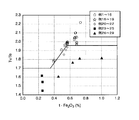
- the relationship between t-Fe 2 O 3 and Tv / Te in Examples 1 to 29 is shown in FIG.
- the heat ray absorbing glass plates of Examples 1 to 15 and 30 to 33 of the present invention satisfy the following formula, and Tv / Te was a large value.
- Tv / Te was a large value.
- Tv / Te is 0.30% or more and less than 0.351%
- Tv / Te > 1.70
- Tv / Te > 0.351% or more and less than 0.559%
- the boundary line of the relational expression is indicated by a solid line.
- the glass plates of Examples 16 to 19, which are comparative examples have a large Tv / Te, but do not contain SnO 2, and therefore exhibit amber coloration due to the inclusion of SO 3 , resulting in non-uniform colors. Since the glass plates of Examples 20 to 22, which are comparative examples, do not contain SnO 2 , Fe-redox had to be lowered in order to suppress amber color development.
- the heat-absorbing glass plate of the present invention has a feature of satisfying low solar transmittance and high visible light transmittance at the same time, and is therefore useful as a glass plate for vehicles and buildings, and particularly for architectural glass. It is suitable as a plate.
Landscapes
- Chemical & Material Sciences (AREA)
- Life Sciences & Earth Sciences (AREA)
- Engineering & Computer Science (AREA)
- Chemical Kinetics & Catalysis (AREA)
- General Chemical & Material Sciences (AREA)
- Geochemistry & Mineralogy (AREA)
- Materials Engineering (AREA)
- Organic Chemistry (AREA)
- Glass Compositions (AREA)
Abstract
Priority Applications (4)
| Application Number | Priority Date | Filing Date | Title |
|---|---|---|---|
| JP2016515200A JP6561983B2 (ja) | 2014-04-23 | 2015-04-23 | 熱線吸収ガラス板およびその製造方法 |
| EP15783490.4A EP3135642B1 (fr) | 2014-04-23 | 2015-04-23 | Plaque de verre absorbant le rayonnement thermique |
| CN201580020971.5A CN106232539A (zh) | 2014-04-23 | 2015-04-23 | 热线吸收玻璃板及其制造方法 |
| US15/290,428 US9862636B2 (en) | 2014-04-23 | 2016-10-11 | Heat-ray-absorbing glass plate and method for producing same |
Applications Claiming Priority (2)
| Application Number | Priority Date | Filing Date | Title |
|---|---|---|---|
| JP2014-089454 | 2014-04-23 | ||
| JP2014089454 | 2014-04-23 |
Related Child Applications (1)
| Application Number | Title | Priority Date | Filing Date |
|---|---|---|---|
| US15/290,428 Continuation US9862636B2 (en) | 2014-04-23 | 2016-10-11 | Heat-ray-absorbing glass plate and method for producing same |
Publications (1)
| Publication Number | Publication Date |
|---|---|
| WO2015163411A1 true WO2015163411A1 (fr) | 2015-10-29 |
Family
ID=54332573
Family Applications (1)
| Application Number | Title | Priority Date | Filing Date |
|---|---|---|---|
| PCT/JP2015/062379 Ceased WO2015163411A1 (fr) | 2014-04-23 | 2015-04-23 | Plaque de verre absorbant le rayonnement thermique, et son procédé de production |
Country Status (5)
| Country | Link |
|---|---|
| US (1) | US9862636B2 (fr) |
| EP (1) | EP3135642B1 (fr) |
| JP (1) | JP6561983B2 (fr) |
| CN (1) | CN106232539A (fr) |
| WO (1) | WO2015163411A1 (fr) |
Cited By (1)
| Publication number | Priority date | Publication date | Assignee | Title |
|---|---|---|---|---|
| WO2022004809A1 (fr) * | 2020-06-30 | 2022-01-06 | 日本板硝子株式会社 | Composition de verre pour trempe chimique, et article en verre trempé chimiquement |
Families Citing this family (1)
| Publication number | Priority date | Publication date | Assignee | Title |
|---|---|---|---|---|
| JP7439760B2 (ja) * | 2018-09-14 | 2024-02-28 | Agc株式会社 | 電波透過性基板 |
Citations (5)
| Publication number | Priority date | Publication date | Assignee | Title |
|---|---|---|---|---|
| JPH04502304A (ja) * | 1989-08-18 | 1992-04-23 | リビー―オーウェンズ―フォード・カンパニー | 赤外線吸収青色ガラス組成 |
| JPH09208254A (ja) * | 1995-11-30 | 1997-08-12 | Central Glass Co Ltd | 紫外線赤外線吸収緑色系ガラス |
| JP2005132709A (ja) * | 2003-10-31 | 2005-05-26 | Central Glass Co Ltd | 紫外線赤外線吸収緑色系ガラス |
| JP2005162537A (ja) * | 2003-12-03 | 2005-06-23 | Central Glass Co Ltd | 紫外線赤外線吸収緑色系ガラス |
| JP2009242131A (ja) * | 2008-03-28 | 2009-10-22 | Nihon Yamamura Glass Co Ltd | アンバーガラス組成物、及びアンバーガラスの製造方法 |
Family Cites Families (11)
| Publication number | Priority date | Publication date | Assignee | Title |
|---|---|---|---|---|
| US5069826A (en) * | 1989-08-18 | 1991-12-03 | Libbey-Owens-Ford Co. | Infrared radiation absorbing blue glass composition |
| US5688727A (en) * | 1996-06-17 | 1997-11-18 | Ppg Industries, Inc. | Infrared and ultraviolet radiation absorbing blue glass composition |
| ES2239813T3 (es) | 1997-10-20 | 2005-10-01 | Ppg Industries Ohio, Inc. | Composicion de vidrio azul que absorbe las radiaciones infrarrojas y ultravioletas. |
| US7598190B2 (en) * | 2004-10-29 | 2009-10-06 | Central Glass Company, Limited | Ultraviolet and infrared absorptive greenish glass |
| JP4715258B2 (ja) * | 2005-03-22 | 2011-07-06 | 旭硝子株式会社 | ガラスおよびガラス製造方法 |
| JP2009167018A (ja) | 2006-04-26 | 2009-07-30 | Nippon Sheet Glass Co Ltd | 赤外線吸収ガラス組成物 |
| CN102596839B (zh) * | 2009-10-22 | 2016-02-10 | 旭硝子株式会社 | 热线吸收玻璃板及其制造方法 |
| BR112012018543A2 (pt) * | 2010-01-26 | 2016-05-03 | Asahi Glass Co Ltd | chapa de vidro colorido |
| WO2012102176A1 (fr) * | 2011-01-25 | 2012-08-02 | 旭硝子株式会社 | Plaque en verre absorbant les rayons thermiques et son procédé de production |
| CN106232545A (zh) * | 2014-04-23 | 2016-12-14 | 旭硝子株式会社 | 着色玻璃板及其制造方法 |
| WO2015163412A1 (fr) * | 2014-04-23 | 2015-10-29 | 旭硝子株式会社 | Plaque de verre absorbant les rayons thermiques et son procédé de production |
-
2015
- 2015-04-23 CN CN201580020971.5A patent/CN106232539A/zh active Pending
- 2015-04-23 EP EP15783490.4A patent/EP3135642B1/fr active Active
- 2015-04-23 WO PCT/JP2015/062379 patent/WO2015163411A1/fr not_active Ceased
- 2015-04-23 JP JP2016515200A patent/JP6561983B2/ja active Active
-
2016
- 2016-10-11 US US15/290,428 patent/US9862636B2/en active Active
Patent Citations (5)
| Publication number | Priority date | Publication date | Assignee | Title |
|---|---|---|---|---|
| JPH04502304A (ja) * | 1989-08-18 | 1992-04-23 | リビー―オーウェンズ―フォード・カンパニー | 赤外線吸収青色ガラス組成 |
| JPH09208254A (ja) * | 1995-11-30 | 1997-08-12 | Central Glass Co Ltd | 紫外線赤外線吸収緑色系ガラス |
| JP2005132709A (ja) * | 2003-10-31 | 2005-05-26 | Central Glass Co Ltd | 紫外線赤外線吸収緑色系ガラス |
| JP2005162537A (ja) * | 2003-12-03 | 2005-06-23 | Central Glass Co Ltd | 紫外線赤外線吸収緑色系ガラス |
| JP2009242131A (ja) * | 2008-03-28 | 2009-10-22 | Nihon Yamamura Glass Co Ltd | アンバーガラス組成物、及びアンバーガラスの製造方法 |
Non-Patent Citations (1)
| Title |
|---|
| See also references of EP3135642A4 * |
Cited By (4)
| Publication number | Priority date | Publication date | Assignee | Title |
|---|---|---|---|---|
| WO2022004809A1 (fr) * | 2020-06-30 | 2022-01-06 | 日本板硝子株式会社 | Composition de verre pour trempe chimique, et article en verre trempé chimiquement |
| JP2022011681A (ja) * | 2020-06-30 | 2022-01-17 | 日本板硝子株式会社 | 化学強化用ガラス組成物、及び化学強化ガラス物品 |
| JP7652542B2 (ja) | 2020-06-30 | 2025-03-27 | 日本板硝子株式会社 | 化学強化用ガラス組成物、及び化学強化ガラス物品 |
| US12391599B2 (en) | 2020-06-30 | 2025-08-19 | Nippon Sheet Glass Company, Limited | Glass composition for chemical strengthening and chemically strengthened glass article |
Also Published As
| Publication number | Publication date |
|---|---|
| CN106232539A (zh) | 2016-12-14 |
| US20170029316A1 (en) | 2017-02-02 |
| EP3135642A1 (fr) | 2017-03-01 |
| EP3135642B1 (fr) | 2020-02-12 |
| JPWO2015163411A1 (ja) | 2017-04-20 |
| US9862636B2 (en) | 2018-01-09 |
| JP6561983B2 (ja) | 2019-08-21 |
| EP3135642A4 (fr) | 2017-10-25 |
Similar Documents
| Publication | Publication Date | Title |
|---|---|---|
| JP5867415B2 (ja) | 熱線吸収ガラス板およびその製造方法 | |
| JP5853700B2 (ja) | 熱線吸収ガラス板およびその製造方法 | |
| US9878937B2 (en) | Heat ray-absorbing glass plate and method for producing same | |
| JP5999111B2 (ja) | 着色ガラス板およびその製造方法 | |
| WO2016039251A1 (fr) | Article en verre absorbant les ultraviolets | |
| JP6561983B2 (ja) | 熱線吸収ガラス板およびその製造方法 | |
| JP5999110B2 (ja) | 着色ガラス板およびその製造方法 | |
| JP5999112B2 (ja) | 着色ガラス板およびその製造方法 | |
| JP6631512B2 (ja) | 熱線吸収ガラス板およびその製造方法 | |
| US9957189B2 (en) | Heat-absorbing glass plate and method for manufacturing same | |
| JP7127654B2 (ja) | ガラス板 |
Legal Events
| Date | Code | Title | Description |
|---|---|---|---|
| 121 | Ep: the epo has been informed by wipo that ep was designated in this application |
Ref document number: 15783490 Country of ref document: EP Kind code of ref document: A1 |
|
| ENP | Entry into the national phase |
Ref document number: 2016515200 Country of ref document: JP Kind code of ref document: A |
|
| REEP | Request for entry into the european phase |
Ref document number: 2015783490 Country of ref document: EP |
|
| WWE | Wipo information: entry into national phase |
Ref document number: 2015783490 Country of ref document: EP |
|
| NENP | Non-entry into the national phase |
Ref country code: DE |