WO2015178151A1 - 難燃性樹脂組成物、及び、これを用いたケーブル - Google Patents
難燃性樹脂組成物、及び、これを用いたケーブル Download PDFInfo
- Publication number
- WO2015178151A1 WO2015178151A1 PCT/JP2015/062207 JP2015062207W WO2015178151A1 WO 2015178151 A1 WO2015178151 A1 WO 2015178151A1 JP 2015062207 W JP2015062207 W JP 2015062207W WO 2015178151 A1 WO2015178151 A1 WO 2015178151A1
- Authority
- WO
- WIPO (PCT)
- Prior art keywords
- parts
- mass
- flame retardant
- compound
- group
- Prior art date
- Legal status (The legal status is an assumption and is not a legal conclusion. Google has not performed a legal analysis and makes no representation as to the accuracy of the status listed.)
- Ceased
Links
- 0 CC1CC(*)(*)N(*)C(*)(*)C1 Chemical compound CC1CC(*)(*)N(*)C(*)(*)C1 0.000 description 1
Images

Classifications
-
- C—CHEMISTRY; METALLURGY
- C08—ORGANIC MACROMOLECULAR COMPOUNDS; THEIR PREPARATION OR CHEMICAL WORKING-UP; COMPOSITIONS BASED THEREON
- C08K—Use of inorganic or non-macromolecular organic substances as compounding ingredients
- C08K3/00—Use of inorganic substances as compounding ingredients
- C08K3/18—Oxygen-containing compounds, e.g. metal carbonyls
- C08K3/24—Acids; Salts thereof
- C08K3/26—Carbonates; Bicarbonates
-
- C—CHEMISTRY; METALLURGY
- C08—ORGANIC MACROMOLECULAR COMPOUNDS; THEIR PREPARATION OR CHEMICAL WORKING-UP; COMPOSITIONS BASED THEREON
- C08K—Use of inorganic or non-macromolecular organic substances as compounding ingredients
- C08K3/00—Use of inorganic substances as compounding ingredients
- C08K3/34—Silicon-containing compounds
-
- C—CHEMISTRY; METALLURGY
- C08—ORGANIC MACROMOLECULAR COMPOUNDS; THEIR PREPARATION OR CHEMICAL WORKING-UP; COMPOSITIONS BASED THEREON
- C08K—Use of inorganic or non-macromolecular organic substances as compounding ingredients
- C08K5/00—Use of organic ingredients
- C08K5/04—Oxygen-containing compounds
- C08K5/09—Carboxylic acids; Metal salts thereof; Anhydrides thereof
- C08K5/098—Metal salts of carboxylic acids
-
- C—CHEMISTRY; METALLURGY
- C08—ORGANIC MACROMOLECULAR COMPOUNDS; THEIR PREPARATION OR CHEMICAL WORKING-UP; COMPOSITIONS BASED THEREON
- C08K—Use of inorganic or non-macromolecular organic substances as compounding ingredients
- C08K5/00—Use of organic ingredients
- C08K5/16—Nitrogen-containing compounds
- C08K5/34—Heterocyclic compounds having nitrogen in the ring
- C08K5/3412—Heterocyclic compounds having nitrogen in the ring having one nitrogen atom in the ring
- C08K5/3432—Six-membered rings
- C08K5/3435—Piperidines
-
- C—CHEMISTRY; METALLURGY
- C08—ORGANIC MACROMOLECULAR COMPOUNDS; THEIR PREPARATION OR CHEMICAL WORKING-UP; COMPOSITIONS BASED THEREON
- C08L—COMPOSITIONS OF MACROMOLECULAR COMPOUNDS
- C08L23/00—Compositions of homopolymers or copolymers of unsaturated aliphatic hydrocarbons having only one carbon-to-carbon double bond; Compositions of derivatives of such polymers
- C08L23/02—Compositions of homopolymers or copolymers of unsaturated aliphatic hydrocarbons having only one carbon-to-carbon double bond; Compositions of derivatives of such polymers not modified by chemical after-treatment
-
- C—CHEMISTRY; METALLURGY
- C08—ORGANIC MACROMOLECULAR COMPOUNDS; THEIR PREPARATION OR CHEMICAL WORKING-UP; COMPOSITIONS BASED THEREON
- C08L—COMPOSITIONS OF MACROMOLECULAR COMPOUNDS
- C08L23/00—Compositions of homopolymers or copolymers of unsaturated aliphatic hydrocarbons having only one carbon-to-carbon double bond; Compositions of derivatives of such polymers
- C08L23/02—Compositions of homopolymers or copolymers of unsaturated aliphatic hydrocarbons having only one carbon-to-carbon double bond; Compositions of derivatives of such polymers not modified by chemical after-treatment
- C08L23/04—Homopolymers or copolymers of ethene
- C08L23/06—Polyethylene
-
- C—CHEMISTRY; METALLURGY
- C08—ORGANIC MACROMOLECULAR COMPOUNDS; THEIR PREPARATION OR CHEMICAL WORKING-UP; COMPOSITIONS BASED THEREON
- C08L—COMPOSITIONS OF MACROMOLECULAR COMPOUNDS
- C08L23/00—Compositions of homopolymers or copolymers of unsaturated aliphatic hydrocarbons having only one carbon-to-carbon double bond; Compositions of derivatives of such polymers
- C08L23/02—Compositions of homopolymers or copolymers of unsaturated aliphatic hydrocarbons having only one carbon-to-carbon double bond; Compositions of derivatives of such polymers not modified by chemical after-treatment
- C08L23/04—Homopolymers or copolymers of ethene
- C08L23/08—Copolymers of ethene
- C08L23/0807—Copolymers of ethene with unsaturated hydrocarbons only containing four or more carbon atoms
- C08L23/0815—Copolymers of ethene with unsaturated hydrocarbons only containing four or more carbon atoms with aliphatic 1-olefins containing one carbon-to-carbon double bond
-
- C—CHEMISTRY; METALLURGY
- C08—ORGANIC MACROMOLECULAR COMPOUNDS; THEIR PREPARATION OR CHEMICAL WORKING-UP; COMPOSITIONS BASED THEREON
- C08L—COMPOSITIONS OF MACROMOLECULAR COMPOUNDS
- C08L53/00—Compositions of block copolymers containing at least one sequence of a polymer obtained by reactions only involving carbon-to-carbon unsaturated bonds; Compositions of derivatives of such polymers
-
- C—CHEMISTRY; METALLURGY
- C08—ORGANIC MACROMOLECULAR COMPOUNDS; THEIR PREPARATION OR CHEMICAL WORKING-UP; COMPOSITIONS BASED THEREON
- C08L—COMPOSITIONS OF MACROMOLECULAR COMPOUNDS
- C08L83/00—Compositions of macromolecular compounds obtained by reactions forming in the main chain of the macromolecule a linkage containing silicon with or without sulfur, nitrogen, oxygen or carbon only; Compositions of derivatives of such polymers
- C08L83/04—Polysiloxanes
-
- C—CHEMISTRY; METALLURGY
- C09—DYES; PAINTS; POLISHES; NATURAL RESINS; ADHESIVES; COMPOSITIONS NOT OTHERWISE PROVIDED FOR; APPLICATIONS OF MATERIALS NOT OTHERWISE PROVIDED FOR
- C09K—MATERIALS FOR MISCELLANEOUS APPLICATIONS, NOT PROVIDED FOR ELSEWHERE
- C09K21/00—Fireproofing materials
- C09K21/02—Inorganic materials
-
- G—PHYSICS
- G02—OPTICS
- G02B—OPTICAL ELEMENTS, SYSTEMS OR APPARATUS
- G02B6/00—Light guides; Structural details of arrangements comprising light guides and other optical elements, e.g. couplings
- G02B6/44—Mechanical structures for providing tensile strength and external protection for fibres, e.g. optical transmission cables
- G02B6/4401—Optical cables
- G02B6/4429—Means specially adapted for strengthening or protecting the cables
- G02B6/4436—Heat resistant
-
- H—ELECTRICITY
- H01—ELECTRIC ELEMENTS
- H01B—CABLES; CONDUCTORS; INSULATORS; SELECTION OF MATERIALS FOR THEIR CONDUCTIVE, INSULATING OR DIELECTRIC PROPERTIES
- H01B3/00—Insulators or insulating bodies characterised by the insulating materials; Selection of materials for their insulating or dielectric properties
- H01B3/18—Insulators or insulating bodies characterised by the insulating materials; Selection of materials for their insulating or dielectric properties mainly consisting of organic substances
- H01B3/30—Insulators or insulating bodies characterised by the insulating materials; Selection of materials for their insulating or dielectric properties mainly consisting of organic substances plastics; resins; waxes
- H01B3/44—Insulators or insulating bodies characterised by the insulating materials; Selection of materials for their insulating or dielectric properties mainly consisting of organic substances plastics; resins; waxes vinyl resins; acrylic resins
-
- H—ELECTRICITY
- H01—ELECTRIC ELEMENTS
- H01B—CABLES; CONDUCTORS; INSULATORS; SELECTION OF MATERIALS FOR THEIR CONDUCTIVE, INSULATING OR DIELECTRIC PROPERTIES
- H01B3/00—Insulators or insulating bodies characterised by the insulating materials; Selection of materials for their insulating or dielectric properties
- H01B3/18—Insulators or insulating bodies characterised by the insulating materials; Selection of materials for their insulating or dielectric properties mainly consisting of organic substances
- H01B3/30—Insulators or insulating bodies characterised by the insulating materials; Selection of materials for their insulating or dielectric properties mainly consisting of organic substances plastics; resins; waxes
- H01B3/44—Insulators or insulating bodies characterised by the insulating materials; Selection of materials for their insulating or dielectric properties mainly consisting of organic substances plastics; resins; waxes vinyl resins; acrylic resins
- H01B3/441—Insulators or insulating bodies characterised by the insulating materials; Selection of materials for their insulating or dielectric properties mainly consisting of organic substances plastics; resins; waxes vinyl resins; acrylic resins from alkenes
-
- H—ELECTRICITY
- H01—ELECTRIC ELEMENTS
- H01B—CABLES; CONDUCTORS; INSULATORS; SELECTION OF MATERIALS FOR THEIR CONDUCTIVE, INSULATING OR DIELECTRIC PROPERTIES
- H01B3/00—Insulators or insulating bodies characterised by the insulating materials; Selection of materials for their insulating or dielectric properties
- H01B3/18—Insulators or insulating bodies characterised by the insulating materials; Selection of materials for their insulating or dielectric properties mainly consisting of organic substances
- H01B3/30—Insulators or insulating bodies characterised by the insulating materials; Selection of materials for their insulating or dielectric properties mainly consisting of organic substances plastics; resins; waxes
- H01B3/46—Insulators or insulating bodies characterised by the insulating materials; Selection of materials for their insulating or dielectric properties mainly consisting of organic substances plastics; resins; waxes silicones
-
- H—ELECTRICITY
- H01—ELECTRIC ELEMENTS
- H01B—CABLES; CONDUCTORS; INSULATORS; SELECTION OF MATERIALS FOR THEIR CONDUCTIVE, INSULATING OR DIELECTRIC PROPERTIES
- H01B7/00—Insulated conductors or cables characterised by their form
- H01B7/17—Protection against damage caused by external factors, e.g. sheaths or armouring
- H01B7/29—Protection against damage caused by extremes of temperature or by flame
- H01B7/295—Protection against damage caused by extremes of temperature or by flame using material resistant to flame
-
- C—CHEMISTRY; METALLURGY
- C08—ORGANIC MACROMOLECULAR COMPOUNDS; THEIR PREPARATION OR CHEMICAL WORKING-UP; COMPOSITIONS BASED THEREON
- C08L—COMPOSITIONS OF MACROMOLECULAR COMPOUNDS
- C08L2201/00—Properties
- C08L2201/02—Flame or fire retardant/resistant
-
- C—CHEMISTRY; METALLURGY
- C08—ORGANIC MACROMOLECULAR COMPOUNDS; THEIR PREPARATION OR CHEMICAL WORKING-UP; COMPOSITIONS BASED THEREON
- C08L—COMPOSITIONS OF MACROMOLECULAR COMPOUNDS
- C08L2201/00—Properties
- C08L2201/08—Stabilised against heat, light or radiation or oxydation
-
- C—CHEMISTRY; METALLURGY
- C08—ORGANIC MACROMOLECULAR COMPOUNDS; THEIR PREPARATION OR CHEMICAL WORKING-UP; COMPOSITIONS BASED THEREON
- C08L—COMPOSITIONS OF MACROMOLECULAR COMPOUNDS
- C08L2203/00—Applications
- C08L2203/20—Applications use in electrical or conductive gadgets
- C08L2203/202—Applications use in electrical or conductive gadgets use in electrical wires or wirecoating
-
- C—CHEMISTRY; METALLURGY
- C08—ORGANIC MACROMOLECULAR COMPOUNDS; THEIR PREPARATION OR CHEMICAL WORKING-UP; COMPOSITIONS BASED THEREON
- C08L—COMPOSITIONS OF MACROMOLECULAR COMPOUNDS
- C08L23/00—Compositions of homopolymers or copolymers of unsaturated aliphatic hydrocarbons having only one carbon-to-carbon double bond; Compositions of derivatives of such polymers
- C08L23/02—Compositions of homopolymers or copolymers of unsaturated aliphatic hydrocarbons having only one carbon-to-carbon double bond; Compositions of derivatives of such polymers not modified by chemical after-treatment
- C08L23/04—Homopolymers or copolymers of ethene
- C08L23/08—Copolymers of ethene
- C08L23/0846—Copolymers of ethene with unsaturated hydrocarbons containing atoms other than carbon or hydrogen
- C08L23/0869—Copolymers of ethene with unsaturated hydrocarbons containing atoms other than carbon or hydrogen with unsaturated acids, e.g. [meth]acrylic acid; with unsaturated esters, e.g. [meth]acrylic acid esters
Definitions
- the present invention relates to a flame retardant resin composition and a cable using the same.
- eco-materials are widely used for cable coverings, cable jackets, tubes, tapes, packaging materials, building materials, and the like.
- composition comprising a polyolefin resin and calcium carbonate as a flame retardant, silicone oil or magnesium stearate as a flame retardant aid, and an antioxidant is known ( See Patent Document 1 below).
- composition described in Patent Document 1 has the following problems.
- the present invention has been made in view of the above circumstances, and an object thereof is to provide a flame retardant resin composition capable of improving weather resistance while ensuring excellent flame retardancy, and a cable using the same.
- the present inventors have repeatedly studied to solve the above problems. For example, in order to improve the weather resistance of the composition, the present inventors tried to blend benzotriazole known as a light stabilizer. However, it has been found that the blending of benzotriazole does not sufficiently improve the weather resistance, but the blending of benzotriazole significantly reduces the flame retardancy. Therefore, the present inventors tried to blend a hindered amine compound in place of benzotriazole.
- a fatty acid is used as the fatty acid-containing compound
- the fatty acid and the hindered amine compound that is a base cause a neutralization reaction, and the function of the hindered amine compound may be inhibited.
- the present invention provides a base resin containing a polyolefin compound, a silicone compound, a fatty acid metal salt, at least one flame retardant selected from the group consisting of calcium carbonate particles and silicate compound particles, and a hindered A phenolic compound and a hindered amine compound, wherein the silicone compound is blended at a ratio of 0.1 parts by mass or more and 10 parts by mass or less with respect to 100 parts by mass of the base resin, and the fatty acid metal salt is It mix
- the hindered phenol compound is not less than 0.05 parts by weight and not more than 10 parts by weight with respect to 100 parts by weight of the base resin.
- the hindered amine compound is compounded at a ratio of 0.05 parts by mass or more and 10 parts by mass or less with respect to 100 parts by mass of the base resin, and the hindered amine compound is represented by the following formula (1).
- It is a flame retardant resin composition having a divalent group or a divalent group represented by the following formula (2).
- R 1 represents an alkyl group or alkoxy group having 1 to 30 carbon atoms
- R 2 to R 5 each independently represents an alkyl group having 1 to 6 carbon atoms
- R 6 represents an alkylene group having 1 to 30 carbon atoms
- R 7 to R 10 each independently represents an alkyl group having 1 to 6 carbon atoms
- thermo resistance can be improved while ensuring excellent flame retardancy.
- the present inventors infer the reason why excellent flame retardancy is obtained in the flame retardant resin composition of the present invention as follows.
- the use of calcium carbonate particles or calcium silicate particles, a silicone compound, and a fatty acid metal salt may increase the flame retardant effect of the resin composition by forming a surface barrier layer during combustion.
- the fatty acid metal salt and the hindered amine compound By using a compound having a monovalent group represented by the above formula (1) or a divalent group represented by the above formula (2) as the hindered amine compound, the fatty acid metal salt and the hindered amine compound It is considered that the interaction can be reduced.
- the monovalent group represented by the above formula (1) when R 1 is a hydrogen atom, the fatty acid metal salt and the hindered amine compound easily interact, and the original function of the hindered amine compound is reduced. Decreases. Thus, the present inventors speculate that the weather resistance can be improved in the flame-retardant resin composition of the present invention.
- the silicone compound is blended in a proportion greater than 0.2 parts by mass with respect to 100 parts by mass of the base resin, and the fatty acid metal salt is based on 100 parts by mass of the base resin. More than 3 parts by mass, the hindered amine compound is compounded at a ratio of 0.05 parts by mass or more and less than 1 part by mass with respect to 100 parts by mass of the base resin, and the molecular weight of the hindered amine compound is 1000 or more. It is preferable that
- the hindered amine compound preferably has a molecular weight of 1000 or more.
- the molecular weight of the hindered amine compound is preferably 3000 or less.
- the said silicone type compound is mix
- this invention has a jacket and the transmission medium which is provided inside the said jacket, and is comprised with a conductor or an optical fiber, and the said jacket is comprised with the flame-retardant resin composition mentioned above. It is.
- the jacket of the present invention is composed of the above-mentioned flame retardant resin composition, and this flame retardant resin composition can improve weather resistance while ensuring excellent flame retardancy. It is also useful as a cable that runs through.
- “molecular weight” refers to a value calculated from a calibration curve created by measuring a retention time by gel permeation chromatography (GPC) and measuring a polystyrene standard sample.
- a flame retardant resin composition capable of improving weather resistance while ensuring excellent flame retardancy, and a cable using the same are provided.
- FIG. 2 is a cross-sectional view taken along line II-II in FIG. It is sectional drawing which shows other embodiment of the cable of this invention.
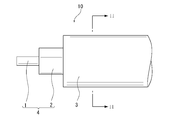
- FIG. 1 is a partial side view showing an embodiment of a cable according to the present invention.
- FIG. 2 is a sectional view taken along line II-II in FIG.
- the cable 10 includes an insulated wire 4 and a tube-like outer jacket 3 that covers the insulated wire 4.
- An example of such a cable 10 is a round cable.
- the insulated wire 4 includes an inner conductor 1 as a transmission medium and a tubular insulator 2 that covers the inner conductor 1. That is, in the cable 10, the inner conductor 1 is provided inside the tubular insulator 2 and is provided inside the tubular jacket 3.
- the tubular insulator 2 and the jacket 3 are made of a flame retardant resin composition
- the flame retardant resin composition includes a base resin containing a polyolefin compound, a silicone compound, a fatty acid It contains a metal salt, a flame retardant comprising at least one selected from the group consisting of calcium carbonate particles and silicate compound particles, a hindered phenol compound, and a hindered amine compound.
- the silicone compound is blended at a ratio of 0.1 parts by mass or more and 10 parts by mass or less with respect to 100 parts by mass of the base resin
- the fatty acid metal salt is 0.1 parts by mass with respect to 100 parts by mass of the base resin.
- the flame retardant is blended at a ratio of 5 parts by mass or more and 200 parts by mass or less with respect to 100 parts by mass of the base resin, and the hindered phenol compound is blended at a ratio of 100 parts by mass of the base resin.
- the hindered amine compound is blended at a ratio of 0.05 to 10 parts by mass with respect to 100 parts by mass of the base resin.
- the hindered amine compound has a monovalent group represented by the following formula (1) or a divalent group represented by the following formula (2).
- R 1 represents an alkyl group or alkoxy group having 1 to 30 carbon atoms
- R 2 to R 5 each independently represents an alkyl group having 1 to 6 carbon atoms
- R 6 represents an alkylene group having 1 to 30 carbon atoms
- R 7 to R 10 each independently represents an alkyl group having 1 to 6 carbon atoms
- the insulator 2 and the jacket 3 made of the flame retardant resin composition can improve the weather resistance while ensuring excellent flame retardancy. Therefore, the cable 10 is useful as a cable that passes outdoors.
- an inner conductor 1 as a transmission medium is prepared.
- the inner conductor 1 may be composed of only one strand, or may be configured by bundling a plurality of strands. Further, the inner conductor 1 is not particularly limited with respect to the conductor diameter, the material of the conductor, and the like, and can be appropriately determined according to the application.
- the flame retardant resin composition is prepared.
- the flame retardant resin composition is at least one selected from the group consisting of a base resin containing a polyolefin compound, a silicone compound, a fatty acid metal salt, calcium carbonate particles, and silicate compound particles.
- the flame retardant which consists of, a hindered phenol type compound, and a hindered amine type compound are included.
- the base resin may contain a polyolefin compound.
- the polyolefin-based compound include polyethylene (PE), ethylene-based copolymer, polypropylene (PP), propylene-based copolymer, modified polyolefin, and olefin-based thermoplastic elastomer. These can be used alone or in combination of two or more.
- ethylene copolymer examples include ethylene-ethyl acrylate copolymer (EEA), ethylene-methyl acrylate copolymer (EMA), ethylene vinyl acetate copolymer (EVA), ethylene-propylene copolymer, ethylene -Butene copolymer, ethylene-hexene copolymer and ethylene-octene copolymer. These can be used alone or in combination of two or more.
- ESA ethylene-ethyl acrylate copolymer
- EMA ethylene-methyl acrylate copolymer
- EVA ethylene vinyl acetate copolymer
- ethylene-propylene copolymer examples include ethylene-propylene copolymer and a random polypropylene copolymer.
- the base resin may be a mixed resin of a polyolefin compound and other resins.
- the resin other than the polyolefin-based compound for example, styrene-based thermoplastic elastomer ester such as styrene-butadiene rubber (SBR), hydrogenated SBR, styrene ethylene butylene styrene block copolymer (SEBS), engineering such as polycarbonate resin, etc.
- SBR styrene-based thermoplastic elastomer ester
- SEBS styrene ethylene butylene styrene block copolymer
- plastic for example, plastic.
- the content of the polyolefin-based compound in the base resin is not particularly limited, but is preferably 30 to 100% by mass, more preferably 50 to 100% by mass.
- the silicone compound functions as a flame retardant aid, and examples of the silicone compound include polyorganosiloxane.
- the polyorganosiloxane has a siloxane bond as a main chain and an organic group in a side chain.
- the organic group include a methyl group, a vinyl group, an ethyl group, a propyl group, and a phenyl group.
- polyorganosiloxane examples include dimethylpolysiloxane, methylethylpolysiloxane, methyloctylpolysiloxane, methylvinylpolysiloxane, methylphenylpolysiloxane, and methyl (3,3,3-trifluoropropyl) polysiloxane. Is mentioned.
- the polyorganosiloxane is used in the form of silicone oil, silicone powder, silicone gum or silicone resin. Among these, the polyorganosiloxane is preferably used in the form of silicone gum. In this case, bloom is less likely to occur.
- the silicone compound is blended at a ratio of 0.1 parts by mass or more and 10 parts by mass or less with respect to 100 parts by mass of the base resin.
- more excellent flame retardancy can be obtained as compared with the case where the blending ratio of the silicone compound is less than 0.1 parts by mass.
- the compounding ratio of the silicone compound with respect to 100 parts by mass of the base resin is within the above range, the non-uniformity in flame retardancy and weather resistance is less than when the compounding ratio of the silicone compound is larger than 10 parts by mass. Become. This is because the silicone compound is easily mixed with the base resin evenly, and it is difficult for partial formation of lumps.
- the blending ratio of the silicone compound to 100 parts by mass of the base resin is preferably 1 part by mass or more. In this case, more excellent flame retardancy can be obtained as compared with the case where the blending ratio of the silicone compound is less than 1 part by mass.
- the silicone compound may be attached in advance to the surface of the flame retardant. In this case, segregation of the silicone compound is less likely to occur in the flame retardant resin composition, and the uniformity of characteristics in the flame retardant resin composition is further improved.
- the silicone compound is added to the flame retardant and mixed to obtain a mixture, and then the mixture is dried at 40 to 75 ° C. for 10 to 40 minutes.
- the dried mixture can be obtained by grinding with a Henschel mixer, an atomizer or the like.
- the fatty acid metal salt functions as a flame retardant aid.
- a fatty acid having 12 to 28 carbon atoms is used as the fatty acid.
- fatty acids include lauric acid, myristic acid, palmitic acid, stearic acid, tuberculostearic acid, oleic acid, linoleic acid, arachidonic acid, behenic acid and montanic acid.
- stearic acid or tuberculostearic acid is preferable, and stearic acid is particularly preferable. In this case, more excellent flame retardancy can be obtained as compared with the case of using a fatty acid other than stearic acid or tuberculostearic acid.
- the metal constituting the fatty acid metal salt examples include magnesium, calcium, zinc and lead.
- the fatty acid metal salt magnesium stearate or calcium stearate is preferable. In this case, more excellent flame retardancy can be obtained as compared with the case of using a fatty acid metal salt other than magnesium stearate and calcium stearate.
- the fatty acid metal salt is blended at a ratio of 0.1 parts by mass or more and 20 parts by mass or less with respect to 100 parts by mass of the base resin. In this case, more excellent flame retardancy can be obtained as compared with the case where the proportion of the fatty acid metal salt is less than 0.1 parts by mass. Further, when the blending ratio of the fatty acid metal salt with respect to 100 parts by mass of the base resin is within the above range, the weather resistance is more excellent than when the blending ratio of the fatty acid metal salt with respect to 100 parts by mass of the base resin is larger than 20 parts by mass. Is obtained.
- the blending ratio of the fatty acid metal salt with respect to 100 parts by weight of the base resin is blended at a ratio larger than 3 parts by weight. In this case, more excellent flame retardancy can be obtained as compared with the case where the blending ratio of the fatty acid metal salt with respect to 100 parts by mass of the base resin is 3 parts by mass or less.
- the fatty acid metal salt may be attached to the surface of the flame retardant together with the silicone compound. In this case, segregation of the silicone compound and the fatty acid metal salt is less likely to occur in the flame retardant resin composition, and the uniformity of characteristics in the flame retardant resin composition is further improved.
- the silicone compound and the fatty acid metal salt are added to the flame retardant and mixed to obtain a mixture, and then the mixture is heated to 40 to 75 ° C. For 10 to 40 minutes, and the dried mixture is pulverized with a Henschel mixer, an atomizer or the like.
- the flame retardant comprises at least one selected from the group consisting of calcium carbonate particles and silicate compound particles. Therefore, the flame retardant may be composed only of calcium carbonate particles, may be composed only of silicate compound particles, or may be composed of a mixture thereof.
- the calcium carbonate particles may be either heavy calcium carbonate or light calcium carbonate.
- Silicate compound particles are particles composed of a silicate compound.
- the silicate compound include talc and clay.
- the clay include kaolin clay, wax clay, fired clay obtained by firing them, and modified clay whose surface is modified with a silane coupling agent. These can be used alone or in combination of two or more. Of these, kaolin clay is preferable. In this case, there is an advantage that the content of impurities is small and coloring is difficult.
- the flame retardant is blended at a ratio of 5 parts by mass or more and 200 parts by mass or less with respect to 100 parts by mass of the base resin. In this case, more excellent flame retardancy can be obtained as compared with the case where the ratio of the flame retardant is less than 5 parts by mass with respect to 100 parts by mass of the base resin.
- the flame retardant resin composition has a proportion greater than 200 parts by mass with respect to 100 parts by mass of the base resin. Mechanical properties can be further improved.
- the blending ratio of the flame retardant with respect to 100 parts by mass of the base resin is preferably 10 parts by mass or more and 80 parts by mass or less, more preferably 30 parts by mass or more and 70 parts by mass or less, and 40 parts by mass or more and 60 parts by mass. It is particularly preferred that When the blending ratio of the flame retardant with respect to 100 parts by mass of the base resin is within the above range, compared to the case where the blending ratio is out of the above ranges, the flame retarding resin composition has sufficient flame retardancy, and the machine The physical characteristics can be improved more sufficiently.
- Hindered phenolic compound is a compound having at least one monovalent group in the molecule having a substituent at the ortho position relative to the phenolic hydroxyl group represented by the following general formula (3). .
- R 11 and R 12 each independently represent a hydrogen atom or an alkyl group, and at least one of R 11 and R 12 is an alkyl group having 1 to 6 carbon atoms. .
- Examples of the alkyl group represented by R 11 and R 12 include those having 1 to 6 carbon atoms such as a methyl group, an ethyl group, a propyl group, a butyl group, and an amyl group. Among these, it is preferable that both R 11 and R 12 are bulky branched alkyl groups such as a t-butyl group.
- hindered phenol compounds include pentaerythritol-tetrakis [3- (3,5-di-t-butyl-4-hydroxyphenyl) propionate], octadecyl-3- (3,5-di-t.
- the hindered phenol compound is blended at a ratio of 0.05 parts by mass or more and 10 parts by mass or less with respect to 100 parts by mass of the base resin.
- the blending ratio of the hindered phenol compound to 100 parts by mass of the base resin is preferably 0.1 parts by mass or more and 3 parts by mass or less.
- the flame retardancy of the flame retardant resin composition is sufficiently ensured as compared with the blending ratio outside the above ranges.
- the mechanical characteristics can be improved more sufficiently.
- Hindered amine compound The hindered amine compound is a compound having at least one monovalent group represented by the above formula (1) or at least one divalent group represented by the above formula (2) in the molecule.
- R 1 represents an alkyl group or alkoxy group having 1 to 30 carbon atoms.
- the alkyl group include a methyl group, an ethyl group, a propyl group, a butoxy group, a pentyl group, a hexyl group, a heptyl group, an octyl group, a nonyl group, a decyl group, an undecyl group, a dodecyl group, a tridecyl group, a tetradecyl group, and a pentadecyl group.
- a methyl group is preferred as the alkyl group.
- alkoxy group examples include methoxy, ethoxy, propoxy, butoxy, pentyloxy, hexyloxy, heptyloxy, octyloxy, nonyloxy, decyloxy, undecyloxy, dodecyloxy, tri Decyloxy, tetradecyloxy, pentadecyloxy, hexadecyloxy, heptadecyloxy, octadecyloxy, nonadecyloxy, icosyloxy, henocosyloxy, docosyloxy, tricosyloxy, tetracosyloxy
- Examples include a ruoxy group, a pentacosyloxy group, a hexacosyloxy group, a heptacosyloxy group, an octacosyloxy group, a nonacosyloxy group, and a triacontyloxy group.
- R 2 to R 5 each independently represents an alkyl group having 1 to 6 carbon atoms.
- an alkyl group for example, a methyl group, an ethyl group, a propyl group, a butoxy group, a pentyl group, or a hexyl group can be used.
- R 6 represents an alkylene group having 1 to 30 carbon atoms.
- alkylene group examples include methylene group, ethylene group, propylene group, butylene group, pentylene group, hexylene group, heptylene group, octylene group, nonylene group, decylene group, undecylene group, dodecylene group, tridecylene group, tetradecylene group and pentadecylene group.
- R 7 to R 10 each independently represents an alkyl group having 1 to 6 carbon atoms.
- R 7 to R 10 the same alkyl groups represented by R 2 to R 5 can be used.
- the molecular weight of the hindered amine compound is preferably 1000 or more. In this case, superior weather resistance can be obtained as compared with the case where the molecular weight is less than 1000.
- the molecular weight of the hindered amine compound is more preferably 1600 or more.
- the molecular weight of the hindered amine compound is preferably 3000 or less, more preferably 2100 or less, and particularly preferably 1900 or less.
- R 1 represents an alkyl group in the formula (1) and the formula (2). In this case, more excellent weather resistance can be obtained.
- hindered amine compounds include 1,2,3,4-butanetetracarboxylic acid, tetramethyl ester, 1,2,2,6,6-pentamethyl-4-piperidinol, ⁇ , ⁇ , ⁇ ′, ⁇ '-tetramethyl-2,4,8,10-tetraoxaspiro [5.5] undecane-3,9-diethanol reaction product, bis (1,2,2,6,6-pentamethyl-4-piperidyl ) Sebacate, bis (1-undecanoxy-2,2,6,6-tetramethylpiperidin-4-yl) carbonate, 1,2,2,6,6-pentamethyl-4-piperidyl methacrylate, formaldehyde polycondensate and ⁇ 2,4,6-trichloro-1,3,5-triazine / [N, N′-bis (2,2,6,6-tetramethylpiperidin-4-yl) hexane-1,6-di Rudiamine] ⁇ morpholine polymer
- the hindered amine compound is blended at a ratio of 0.05 parts by mass or more and 10 parts by mass or less with respect to 100 parts by mass of the base resin.
- the blending ratio of the hindered amine compound is less than 0.05 parts by mass with respect to 100 parts by mass of the base resin.
- the flame retardant resin composition is compared with the case where the blending ratio of the hindered amine compound to 100 parts by mass of the base resin is larger than 10 parts by mass. The mechanical properties of the object can be further improved.
- the blending ratio of the hindered amine compound to 100 parts by mass of the base resin is preferably 0.2 parts by mass or more and 1 part by mass or less.
- the flame retardancy of the flame retardant resin composition is sufficiently ensured as compared with the blending ratio outside the above range, The mechanical properties can be improved more sufficiently.
- the silicone compound is blended in a proportion greater than 0.2 parts by weight with respect to 100 parts by weight of the base resin, and the fatty acid metal salt is blended in a proportion greater than 3 parts by weight with respect to 100 parts by weight of the base resin.
- the hindered amine compound is preferably blended at a ratio of 0.05 parts by mass or more and less than 1 part by mass with respect to 100 parts by mass of the base resin.
- the molecular weight of the hindered amine compound is more preferably 1600 or more.
- the molecular weight of the hindered amine compound is preferably 3000 or less.
- the molecular weight of the hindered amine compound is more preferably 2100 or less, and particularly preferably 1900 or less.
- the silicone compound is blended in a proportion larger than 1 part by mass with respect to 100 parts by mass of the base resin, the hindered amine compound has a monovalent group represented by the formula (1), and in the formula (1) R 1 preferably represents an alkyl group.
- alkyl group includes not only an unsubstituted alkyl group but also a substituted alkyl group.
- substituted alkyl group those obtained by substituting the hydrogen atom of the unsubstituted alkyl group with a halogen atom such as chlorine can be used.
- alkoxy group includes not only an unsubstituted alkoxy group but also a substituted alkoxy group.
- substituted alkoxy group those obtained by substituting a hydrogen atom of an unsubstituted alkoxy group with a halogen atom such as chlorine can be used.
- the flame retardant resin composition may further contain an additive as necessary.
- the additive is composed of a material different from the above-described base resin, silicone compound, fatty acid metal salt, flame retardant, hindered phenol compound, and hindered amine compound.
- antioxidants include antioxidants, ultraviolet degradation inhibitors, processing aids (lubricants), colorants, and antistatic agents. These can be used alone or in combination of two or more.
- an antioxidant, an ultraviolet degradation inhibitor, a processing aid, a colorant and an antistatic agent are all contained in the above-mentioned flame retardant resin composition, so that the flame retardant resin composition has flame retardancy. Refers to additives that do not improve.
- “does not improve the flame retardancy of the flame retardant resin composition” means a flame retardant resin composition containing an antioxidant, an ultraviolet degradation inhibitor, a processing aid, a colorant or an antistatic agent.
- the evaluation results by the vertical single-line combustion test used for the evaluation of the flame retardancy of the flame retardant resin composition are an antioxidant, an ultraviolet degradation inhibitor, a processing aid, a colorant and a charge. It says that it is the same or inferior to the flame retardant evaluation results for flame retardant resin compositions that differ only in that none of the inhibitors are included.
- antioxidants examples include phenolic antioxidants, amine antioxidants, sulfur antioxidants, phosphorus antioxidants, hydrazine antioxidants, amide antioxidants, phosphoric acid and citric acid. It is done. These can be used alone or in combination of two or more.
- a phenol-based antioxidant is particularly preferable.
- UV degradation inhibitor examples include benzophenone UV degradation inhibitors, salicylate UV degradation inhibitors, acrylonitrile UV degradation inhibitors, and metal complex UV degradation inhibitors. These can be used alone or in combination of two or more.
- processing aids include hydrocarbon processing aids, fatty acid processing aids, fatty acid amide processing aids, ester processing aids, alcohol processing aids, metal soaps and waxes. These can be used alone or in combination of two or more.
- a hydrocarbon processing aid is particularly preferable.
- the colorant examples include inorganic pigments, organic pigments, dyes, and carbon black. These can be used alone or in combination of two or more. Here, an inorganic pigment is particularly preferable as the colorant.
- inorganic pigments include chromates, ferrocyan compounds, sulfides, oxides, sulfates, silicates, carbonates and phosphates. These can be used alone or in combination of two or more.
- organic pigments examples include azo pigments, phthalocyanine pigments, vat dye pigments, dyed lake pigments, quinacridone pigments, and dioxazine pigments. These can be used alone or in combination of two or more.
- the dye examples include anthraquinone dyes, indigoid dyes, and azo dyes. These can be used alone or in combination of two or more.
- the antistatic agent examples include a cationic active agent, an anionic active agent, a nonionic active agent, and an amphoteric active agent. These can be used alone or in combination of two or more.
- a cationic activator is particularly preferable.
- cationic activator examples include primary amine salts, tertiary amines, quaternary ammonium compounds and pyridine derivatives. These can be used alone or in combination of two or more.
- anionic activator examples include sulfated oil, soap, sulfated ester oil, sulfated amide oil, sulfate esters, sulfonic acids and phosphate esters. These can be used alone or in combination of two or more.
- nonionic activators include polyhydric alcohol fatty acid esters and ethylene oxide adducts. These can be used alone or in combination of two or more.
- amphoteric activators include carboxylic acid derivatives and imidazoline derivatives. These can be used alone or in combination of two or more.
- the compounding quantity of the additive with respect to 100 parts by mass of the base resin is not particularly limited, it is more preferably 2 parts by mass or less, and particularly preferably less than 1 part by mass. However, it is preferable that the compounding quantity of the additive with respect to 100 mass parts of base resins is 0.1 mass part or more.
- the flame retardant resin composition is obtained by kneading a base resin, a silicone compound, a fatty acid metal salt, a flame retardant, a hindered phenol compound, a hindered amine compound, and an additive added as necessary. Can do.
- the kneading can be performed with a kneading machine such as a Banbury mixer, a tumbler, a pressure kneader, a kneading extruder, a twin screw extruder, a mixing roll, and the like.
- a part of the base resin and the silicone compound are kneaded, and the obtained master batch (MB) is mixed with the remaining base resin, fatty acid metal salt, difficulty You may knead
- the inner conductor 1 is covered with the flame retardant resin composition.
- the flame retardant resin composition is melt kneaded using an extruder to form a tubular extrudate. Then, the tubular extrudate is continuously coated on the inner conductor 1. Thus, the insulated wire 4 is obtained.
- ⁇ Coat> Finally, one insulated wire 4 obtained as described above is prepared, and these insulated wires 4 are covered with a jacket 3 made using the above-mentioned flame-retardant resin composition.
- the outer jacket 3 is a so-called sheath and protects the insulator 2 from physical or chemical damage.
- the cable 10 is obtained as described above.
- the present invention is not limited to the above embodiment.
- the cable 10 has one insulated wire 4 in the above embodiment
- the cable of the present invention may have two or more insulated wires 4 inside the jacket 3.
- a resin portion made of polypropylene or the like may be provided between the jacket 3 and the insulated wire 4.
- the insulator 2 and the jacket 3 of the insulated wire 4 are comprised with said flame-retardant resin composition
- the insulator 2 is comprised with normal insulation resin, and only the jacket 3 is The flame retardant resin composition constituting the insulator 2 may be used.
- the insulator 2 is not necessarily required and can be omitted.
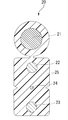
- FIG. 3 is a cross-sectional view showing a drop-type optical fiber cable as an example of an optical fiber cable.
- the optical fiber cable 20 includes a support wire 21, two tension members 22 and 23, an optical fiber 24, and a jacket 25 that covers them.
- the jacket 25 is composed of a flame-retardant resin composition that constitutes the insulator 2 and the jacket 3 of the insulated wire 4 in the above embodiment.
- Examples 1 to 38 and Comparative Examples 1 to 17 Base resin, silicone masterbatch (silicone MB), silicone, fatty acid metal salt, flame retardant, hindered phenol compound, hindered amine compound or benzotriazole are blended in the blending amounts shown in Tables 1 to 5, and Banbury mixer Were kneaded at 160 ° C. for 15 minutes to obtain a flame retardant resin composition.
- the unit of the blending amount of each blending component is part by mass.
- Tables 1 to 5 there are examples and comparative examples in which the blending amount of the base resin is not 100 parts by mass. In these examples and comparative examples, a part of the base resin is also present in the silicone MB. The total amount of the base resin and the amount of the base resin in the silicone MB is 100 parts by mass.
- A Base resin (A-1) Polyethylene (PE1) LLDPE, Excellen GMH GH030 (trade name, manufactured by Sumitomo Chemical Co., Ltd.) (A-2) Polyethylene (PE2) LLDPE, Evolue SP9018 (trade name, manufactured by Prime Polymer Co., Ltd.) (A-3) Polyethylene (PE3) LDPE, C150 (trade name, manufactured by Ube Maruzen Polyethylene) (A-4) Ethylene copolymer 1 Ethylene-butene copolymer, TAFMER DF940 (trade name, manufactured by Mitsui Chemicals) (A-5) Ethylene copolymer 2 Ethylene ethyl acrylate copolymer (EEA), A1150 (trade name, manufactured by Nippon Polyethylene) (A-6) Ethylene copolymer 3 Ethylene vinyl acetate copolymer (EVA), EV460 (trade name, manufactured by Mitsui DuPont Polychemical Co., Ltd.)
- Silicone MB (B-1) Silicone MB1 X-22-2125H (trade name, manufactured by Shin-Etsu Chemical Co., Ltd.) Contains 50% silicone gum (dimethylpolysiloxane) and 50% PE by weight (B-2) Silicone MB2 X-22-2101 (trade name, manufactured by Shin-Etsu Chemical Co., Ltd.) Contains 50% by weight silicone gum (dimethylpolysiloxane) and 50% by weight PP
- D Fatty acid metal salt
- D-1 Fatty acid metal salt 1 Magnesium stearate, Fcochem MGS (trade name, manufactured by ADEKA)
- D-2) Fatty acid metal salt 2 Calcium stearate, SC-P (trade name, manufactured by Sakai Chemical Co., Ltd.)
- E Flame retardant (E-1) Calcium carbonate particles NCC-P (trade name, manufactured by Nitto Flour Chemical Co., Ltd.) (E-2) Silicate compound particle talc particles, NANO ACE D-1000 (trade name, manufactured by Nippon Talc Co., Ltd.), average particle diameter of 1.0 ⁇ m
- Hindered amine compound (G-1) Hindered amine A Siasorb UV-3529 (trade name, manufactured by Cytec Industries, N-alkyl type, molecular weight 1700 ⁇ 10%
- G-2 Hindered amine B ADK STAB LA-63P (trade name, manufactured by ADEKA, N-alkyl type, molecular weight of about 2000)
- G-3 Hindered amine C Tinuvin 622SF (trade name, manufactured by BASF, N-alkylene type, molecular weight 3100 to 4000)
- Hindered amine D LA-81 (trade name, manufactured by ADEKA, N-alkoxy type, molecular weight 681)
- G-5 Hindered amine E Tinuvin 765 (trade name, manufactured by BASF, N-alkyl type, molecular weight 509)
- G-6 Hindered amine F CHIMASSORB 2020FDL (trade name, manufactured by BASF, NH type, molecular weight 2600-3400
- N-alkyl type is a hindered amine compound in which R 1 is an alkyl group in the formula (1)
- N-alkoxy type is a hindered amine compound in which R 1 is an alkoxy group in the formula (1)
- NH type is a hindered amine compound in which R 1 is a hydrogen atom in formula (1)
- N-alkylene type is a compound having a divalent group represented by formula (2) Means.
- Benzotriazole tinuvin (TINUVIN) 234 (trade name, manufactured by BASF, benzotriazole ultraviolet absorber, molecular weight 447)
- ⁇ Weather resistance> The resin compositions of Examples 1 to 38 and Comparative Examples 1 to 9 were press-pressed at 160 ° C. for 5 minutes to obtain sheet samples having a thickness of 1 mm. Thereafter, punching was performed with a JIS K 6251 No. 3 dumbbell-shaped punching blade to prepare a dumbbell-shaped test piece. Then, ultraviolet rays (UV light) were applied to the test piece using a metal halide lamp type light resistance tester (Iwasaki Electric Co., Ltd., Eye Super UV Tester “Model: SUV-W13, illuminance: 70 mW / cm 2 ).
- UV light ultraviolet rays
- the test piece was subjected to a tensile test in accordance with JIS K7350, and the tensile elongation residual rate was measured, and the results are shown in Tables 1 to 5.
- the tensile elongation residual rate is 50%. In the case of the following, it was judged as unacceptable in terms of weather resistance, and in the case where the residual tensile elongation exceeded 50%, it was regarded as acceptable in terms of weather resistance.
Landscapes
- Chemical & Material Sciences (AREA)
- Organic Chemistry (AREA)
- Health & Medical Sciences (AREA)
- Chemical Kinetics & Catalysis (AREA)
- Medicinal Chemistry (AREA)
- Polymers & Plastics (AREA)
- Physics & Mathematics (AREA)
- Spectroscopy & Molecular Physics (AREA)
- Inorganic Chemistry (AREA)
- Engineering & Computer Science (AREA)
- Materials Engineering (AREA)
- General Physics & Mathematics (AREA)
- Optics & Photonics (AREA)
- Compositions Of Macromolecular Compounds (AREA)
- Insulated Conductors (AREA)
- Organic Insulating Materials (AREA)
Priority Applications (4)
| Application Number | Priority Date | Filing Date | Title |
|---|---|---|---|
| US15/305,734 US10106743B2 (en) | 2014-05-23 | 2015-04-22 | Flame retardant resin composition and cable using the same |
| CN201580008200.4A CN105980470B (zh) | 2014-05-23 | 2015-04-22 | 阻燃性树脂组合物和使用该阻燃性树脂组合物的缆线 |
| EP15796065.9A EP3147322B1 (de) | 2014-05-23 | 2015-04-22 | Flammhemmende harzzusammensetzung und damit hergestelltes kabel |
| US16/140,732 US10800973B2 (en) | 2014-05-23 | 2018-09-25 | Flame-retardant resin composition and cable using same |
Applications Claiming Priority (2)
| Application Number | Priority Date | Filing Date | Title |
|---|---|---|---|
| JP2014106653A JP5852179B2 (ja) | 2014-05-23 | 2014-05-23 | 難燃性樹脂組成物、及び、これを用いたケーブル |
| JP2014-106653 | 2014-05-23 |
Related Child Applications (2)
| Application Number | Title | Priority Date | Filing Date |
|---|---|---|---|
| US15/305,734 A-371-Of-International US10106743B2 (en) | 2014-05-23 | 2015-04-22 | Flame retardant resin composition and cable using the same |
| US16/140,732 Continuation US10800973B2 (en) | 2014-05-23 | 2018-09-25 | Flame-retardant resin composition and cable using same |
Publications (1)
| Publication Number | Publication Date |
|---|---|
| WO2015178151A1 true WO2015178151A1 (ja) | 2015-11-26 |
Family
ID=54553827
Family Applications (1)
| Application Number | Title | Priority Date | Filing Date |
|---|---|---|---|
| PCT/JP2015/062207 Ceased WO2015178151A1 (ja) | 2014-05-23 | 2015-04-22 | 難燃性樹脂組成物、及び、これを用いたケーブル |
Country Status (6)
| Country | Link |
|---|---|
| US (2) | US10106743B2 (de) |
| EP (1) | EP3147322B1 (de) |
| JP (1) | JP5852179B2 (de) |
| CN (2) | CN105980470B (de) |
| TW (1) | TWI557217B (de) |
| WO (1) | WO2015178151A1 (de) |
Cited By (11)
| Publication number | Priority date | Publication date | Assignee | Title |
|---|---|---|---|---|
| WO2018034173A1 (ja) * | 2016-08-16 | 2018-02-22 | 株式会社フジクラ | 難燃性樹脂組成物、これを用いた絶縁電線、メタルケーブル、光ファイバケーブル及び成形品 |
| WO2018034174A1 (ja) * | 2016-08-16 | 2018-02-22 | 株式会社フジクラ | 難燃性樹脂組成物、これを用いた絶縁電線、メタルケーブル、光ファイバケーブル及び成形品 |
| US20180371220A1 (en) * | 2015-12-14 | 2018-12-27 | Fujikura Ltd. | Flame retardant resin composition and metal cable, optical fiber cable, and molded article using the same |
| CN109642061A (zh) * | 2016-11-22 | 2019-04-16 | 株式会社藤仓 | 阻燃性树脂组合物、使用其的绝缘电线、金属线缆、光纤线缆和成型品 |
| EP3375815A4 (de) * | 2015-12-14 | 2019-09-18 | Fujikura Ltd. | Flammhemmende harzzusammensetzung, metallkabel damit, faseroptisches kabel und formkörper |
| JP2020097715A (ja) * | 2018-12-18 | 2020-06-25 | 株式会社フジクラ | 難燃性樹脂組成物、これを用いたケーブル、成形体及び難燃剤マスターバッチ |
| WO2020129871A1 (ja) * | 2018-12-18 | 2020-06-25 | 株式会社フジクラ | 難燃性樹脂組成物、ケーブル用難燃性樹脂組成物、これを用いたケーブル、成形体及び難燃剤マスターバッチ並びに難燃剤 |
| JP2020097716A (ja) * | 2018-12-18 | 2020-06-25 | 株式会社フジクラ | 難燃性樹脂組成物、ケーブル用難燃性樹脂組成物、これを用いたケーブル、成形体及び難燃剤マスターバッチ並びに難燃剤 |
| WO2021014858A1 (ja) * | 2019-07-20 | 2021-01-28 | 株式会社フジクラ | 難燃性樹脂組成物及びこれを用いたケーブル |
| KR20210110602A (ko) * | 2018-12-03 | 2021-09-08 | 이탈마치 케미칼스 에스피에이 | 무기 하이포아인산 금속염을 포함하는 폴리올레핀 무할로겐 난연 성형 조성물 |
| US11462340B2 (en) * | 2017-05-09 | 2022-10-04 | Borealis Ag | Cable insulation |
Families Citing this family (9)
| Publication number | Priority date | Publication date | Assignee | Title |
|---|---|---|---|---|
| WO2016208656A1 (ja) * | 2015-06-24 | 2016-12-29 | 株式会社フジクラ | 難燃性樹脂組成物、及び、これを用いたケーブル並びに光ファイバケーブル |
| JP2018039903A (ja) * | 2016-09-07 | 2018-03-15 | 株式会社フジクラ | 難燃性樹脂組成物、これを用いた絶縁電線、メタルケーブル、光ファイバケーブル、自動車用ワイヤハーネス、及び成形品 |
| JP2018039902A (ja) * | 2016-09-07 | 2018-03-15 | 株式会社フジクラ | 難燃性樹脂組成物、これを用いた絶縁電線、メタルケーブル、光ファイバケーブル、自動車用ワイヤハーネス、及び成形品 |
| EP3548553B1 (de) * | 2016-12-01 | 2021-03-31 | Dow Global Technologies LLC | Peroxidhärtbare polyolefinzusammensetzung |
| JP6938026B2 (ja) * | 2018-02-22 | 2021-09-22 | 北川工業株式会社 | 難燃高減衰材料 |
| JP6475880B1 (ja) | 2018-03-22 | 2019-02-27 | 株式会社フジクラ | 難燃性樹脂組成物、これを用いた絶縁電線、ケーブル及び光ファイバケーブル |
| KR20210144771A (ko) | 2019-03-29 | 2021-11-30 | 가부시키가이샤 아데카 | 난연제 조성물 및 난연성 합성 수지 조성물 |
| CN110982162A (zh) * | 2019-11-15 | 2020-04-10 | 西安思后网络科技有限公司 | 一种乙烯阻燃硅橡胶缆料及其制备方法 |
| CN110903526A (zh) * | 2019-11-18 | 2020-03-24 | 西安思后网络科技有限公司 | 一种交联乙烯阻燃缆料及其制备方法 |
Citations (6)
| Publication number | Priority date | Publication date | Assignee | Title |
|---|---|---|---|---|
| JPH09169918A (ja) * | 1995-11-11 | 1997-06-30 | Alcatel Alsthom Co General Electricite | 高い耐延焼性を有する組成物 |
| JPH1143568A (ja) * | 1997-07-25 | 1999-02-16 | Sumitomo Bakelite Co Ltd | 塩化ビニル系樹脂組成物及びそのケーブル |
| JP2001011262A (ja) * | 1999-06-28 | 2001-01-16 | Fujikura Ltd | ノンハロゲン難燃性樹脂組成物およびこれを用いた難燃性電線・ケーブル |
| JP2006519895A (ja) * | 2003-02-18 | 2006-08-31 | ユニオン・カーバイド・ケミカルズ・アンド・プラスティックス・テクノロジー・コーポレイション | 難燃性組成物 |
| WO2009146831A1 (en) * | 2008-06-05 | 2009-12-10 | Borealis Ag | Flame retardant polyolefin composition comprising a high amount of inorganic filler |
| JP2013108053A (ja) * | 2011-10-28 | 2013-06-06 | Fujikura Ltd | 難燃性樹脂組成物、及び、これを用いたケーブル |
Family Cites Families (13)
| Publication number | Priority date | Publication date | Assignee | Title |
|---|---|---|---|---|
| DE19542157B4 (de) * | 1995-11-11 | 2004-09-02 | Alcatel Kabel Ag & Co. | Flammfeste, vernetzte oder unvernetzte Polymermischung |
| EP0774488A1 (de) | 1995-11-11 | 1997-05-21 | Alcatel | Brandausbreitung verhinderende Zusammensetzung |
| JP2001089611A (ja) * | 1999-09-24 | 2001-04-03 | Japan Polyolefins Co Ltd | ポリオレフィン系樹脂組成物、そのフィルムおよび農業用フィルム |
| CN1916067A (zh) * | 2006-09-07 | 2007-02-21 | 浙江俊尔新材料有限公司 | 一种改性耐候聚丙烯材料 |
| US20100022683A1 (en) * | 2008-07-24 | 2010-01-28 | General Cable Technologies Corporation | Hard grade epr insulation compositions |
| CN102382371B (zh) * | 2010-12-14 | 2012-11-14 | 重庆文理学院 | 一种汽车内饰件材料及其制备方法 |
| US8633265B2 (en) * | 2011-01-19 | 2014-01-21 | Sabic Innovative Plastics Ip B.V. | UV stabilization of isosorbide polycarbonates |
| BR112014007395B1 (pt) | 2011-09-30 | 2020-12-01 | Dow Global Technologies Llc | composição, bainha isolante de fio e fio |
| JPWO2013047618A1 (ja) | 2011-09-30 | 2015-03-26 | 株式会社Adeka | 難燃性樹脂組成物及びこれを用いた電線 |
| JP5167428B1 (ja) | 2011-10-28 | 2013-03-21 | 株式会社フジクラ | 難燃性樹脂組成物、及び、これを用いたケーブル |
| JPWO2013081161A1 (ja) | 2011-12-02 | 2015-04-27 | 帝人株式会社 | ポリカーボネート−ポリジオルガノシロキサン共重合樹脂を含有する難燃性樹脂組成物およびその成形品 |
| US20140017494A1 (en) * | 2012-07-12 | 2014-01-16 | General Cable Technologies Corporation | Insulations containing non-migrating antistatic agent |
| CN103589073A (zh) * | 2013-10-24 | 2014-02-19 | 合肥会通新材料有限公司 | 一种耐uv聚丙烯复合材料及其制备方法 |
-
2014
- 2014-05-23 JP JP2014106653A patent/JP5852179B2/ja active Active
-
2015
- 2015-04-22 CN CN201580008200.4A patent/CN105980470B/zh active Active
- 2015-04-22 WO PCT/JP2015/062207 patent/WO2015178151A1/ja not_active Ceased
- 2015-04-22 CN CN201710908130.9A patent/CN107759830B/zh active Active
- 2015-04-22 EP EP15796065.9A patent/EP3147322B1/de active Active
- 2015-04-22 US US15/305,734 patent/US10106743B2/en active Active
- 2015-05-06 TW TW104114410A patent/TWI557217B/zh active
-
2018
- 2018-09-25 US US16/140,732 patent/US10800973B2/en active Active
Patent Citations (6)
| Publication number | Priority date | Publication date | Assignee | Title |
|---|---|---|---|---|
| JPH09169918A (ja) * | 1995-11-11 | 1997-06-30 | Alcatel Alsthom Co General Electricite | 高い耐延焼性を有する組成物 |
| JPH1143568A (ja) * | 1997-07-25 | 1999-02-16 | Sumitomo Bakelite Co Ltd | 塩化ビニル系樹脂組成物及びそのケーブル |
| JP2001011262A (ja) * | 1999-06-28 | 2001-01-16 | Fujikura Ltd | ノンハロゲン難燃性樹脂組成物およびこれを用いた難燃性電線・ケーブル |
| JP2006519895A (ja) * | 2003-02-18 | 2006-08-31 | ユニオン・カーバイド・ケミカルズ・アンド・プラスティックス・テクノロジー・コーポレイション | 難燃性組成物 |
| WO2009146831A1 (en) * | 2008-06-05 | 2009-12-10 | Borealis Ag | Flame retardant polyolefin composition comprising a high amount of inorganic filler |
| JP2013108053A (ja) * | 2011-10-28 | 2013-06-06 | Fujikura Ltd | 難燃性樹脂組成物、及び、これを用いたケーブル |
Cited By (21)
| Publication number | Priority date | Publication date | Assignee | Title |
|---|---|---|---|---|
| US10640634B2 (en) | 2015-12-14 | 2020-05-05 | Fujikura Ltd. | Flame retardant resin composition and metal cable, optical fiber cable, and molded article using the same |
| US20180371220A1 (en) * | 2015-12-14 | 2018-12-27 | Fujikura Ltd. | Flame retardant resin composition and metal cable, optical fiber cable, and molded article using the same |
| EP3385323A4 (de) * | 2015-12-14 | 2019-09-04 | Fujikura Ltd. | Flammhemmende harzzusammensetzung, metallkabel und faseroptisches kabel damit und formkörper |
| EP3375815A4 (de) * | 2015-12-14 | 2019-09-18 | Fujikura Ltd. | Flammhemmende harzzusammensetzung, metallkabel damit, faseroptisches kabel und formkörper |
| WO2018034174A1 (ja) * | 2016-08-16 | 2018-02-22 | 株式会社フジクラ | 難燃性樹脂組成物、これを用いた絶縁電線、メタルケーブル、光ファイバケーブル及び成形品 |
| JPWO2018034173A1 (ja) * | 2016-08-16 | 2019-02-21 | 株式会社フジクラ | 難燃性樹脂組成物、これを用いた絶縁電線、メタルケーブル、光ファイバケーブル及び成形品 |
| JPWO2018034174A1 (ja) * | 2016-08-16 | 2019-03-28 | 株式会社フジクラ | 難燃性樹脂組成物、これを用いた絶縁電線、メタルケーブル、光ファイバケーブル及び成形品 |
| WO2018034173A1 (ja) * | 2016-08-16 | 2018-02-22 | 株式会社フジクラ | 難燃性樹脂組成物、これを用いた絶縁電線、メタルケーブル、光ファイバケーブル及び成形品 |
| CN109642061B (zh) * | 2016-11-22 | 2021-06-11 | 株式会社藤仓 | 阻燃性树脂组合物、使用其的绝缘电线、金属线缆、光纤线缆和成型品 |
| US11028257B2 (en) | 2016-11-22 | 2021-06-08 | Fujikura Ltd. | Flame-retardant resin composition, and insulating wire, metal cable, optical fiber cable and molded article using the same |
| CN109642061A (zh) * | 2016-11-22 | 2019-04-16 | 株式会社藤仓 | 阻燃性树脂组合物、使用其的绝缘电线、金属线缆、光纤线缆和成型品 |
| US11462340B2 (en) * | 2017-05-09 | 2022-10-04 | Borealis Ag | Cable insulation |
| KR20210110602A (ko) * | 2018-12-03 | 2021-09-08 | 이탈마치 케미칼스 에스피에이 | 무기 하이포아인산 금속염을 포함하는 폴리올레핀 무할로겐 난연 성형 조성물 |
| KR102675718B1 (ko) | 2018-12-03 | 2024-06-14 | 이탈마치 케미칼스 에스피에이 | 무기 하이포아인산 금속염을 포함하는 폴리올레핀 무할로겐 난연 성형 조성물 |
| JP2020097715A (ja) * | 2018-12-18 | 2020-06-25 | 株式会社フジクラ | 難燃性樹脂組成物、これを用いたケーブル、成形体及び難燃剤マスターバッチ |
| WO2020129871A1 (ja) * | 2018-12-18 | 2020-06-25 | 株式会社フジクラ | 難燃性樹脂組成物、ケーブル用難燃性樹脂組成物、これを用いたケーブル、成形体及び難燃剤マスターバッチ並びに難燃剤 |
| JP2020097716A (ja) * | 2018-12-18 | 2020-06-25 | 株式会社フジクラ | 難燃性樹脂組成物、ケーブル用難燃性樹脂組成物、これを用いたケーブル、成形体及び難燃剤マスターバッチ並びに難燃剤 |
| JP2020097717A (ja) * | 2018-12-18 | 2020-06-25 | 株式会社フジクラ | 難燃性樹脂組成物、これを用いたケーブル、成形体及び難燃剤マスターバッチ並びに難燃剤 |
| EP3882305A4 (de) * | 2018-12-18 | 2022-08-31 | Fujikura Ltd. | Flammhemmende harzzusammensetzung, flammhemmende harzzusammensetzung für kabel, kabel, formkörper und flammhemmendes masterbatch damit und flammschutzmittel |
| WO2021014858A1 (ja) * | 2019-07-20 | 2021-01-28 | 株式会社フジクラ | 難燃性樹脂組成物及びこれを用いたケーブル |
| JPWO2021014858A1 (ja) * | 2019-07-20 | 2021-12-09 | 株式会社フジクラ | 難燃性樹脂組成物及びこれを用いたケーブル |
Also Published As
| Publication number | Publication date |
|---|---|
| TWI557217B (zh) | 2016-11-11 |
| EP3147322A4 (de) | 2018-01-10 |
| EP3147322A1 (de) | 2017-03-29 |
| CN107759830B (zh) | 2020-09-22 |
| US20170051208A1 (en) | 2017-02-23 |
| CN105980470A (zh) | 2016-09-28 |
| US20190023989A1 (en) | 2019-01-24 |
| JP2015221865A (ja) | 2015-12-10 |
| CN107759830A (zh) | 2018-03-06 |
| CN105980470B (zh) | 2019-01-18 |
| JP5852179B2 (ja) | 2016-02-03 |
| US10800973B2 (en) | 2020-10-13 |
| EP3147322B1 (de) | 2018-06-06 |
| US10106743B2 (en) | 2018-10-23 |
| TW201610114A (zh) | 2016-03-16 |
Similar Documents
| Publication | Publication Date | Title |
|---|---|---|
| JP5852179B2 (ja) | 難燃性樹脂組成物、及び、これを用いたケーブル | |
| JP6053236B2 (ja) | 難燃性樹脂組成物を用いたケーブル | |
| CN105916930A (zh) | 阻燃性树脂组合物和使用其的缆线 | |
| EP3375816B1 (de) | Flammhemmende harzzusammensetzung, metallkabel damit, glasfaserkabel und formkörper | |
| JP7176525B2 (ja) | 光ファイバ用又は電線用の外被 | |
| CN108026339B (zh) | 阻燃性树脂组合物、使用该阻燃性树脂组合物的金属缆线、光纤缆线和成型品 | |
| JP6209569B2 (ja) | 難燃性樹脂組成物、及び、これを用いたケーブル | |
| TWI663200B (zh) | 阻燃性樹脂組成物、使用此組成物之金屬電纜及光纖電纜以及成形品 | |
| JP6563016B2 (ja) | 難燃性樹脂組成物、及び、これを用いたケーブル並びに光ファイバケーブル | |
| JP2020097717A (ja) | 難燃性樹脂組成物、これを用いたケーブル、成形体及び難燃剤マスターバッチ並びに難燃剤 | |
| CN102666717A (zh) | 阻燃性高且不含卤素的有色热收缩管 | |
| WO2018096794A1 (ja) | 難燃性樹脂組成物、これを用いた絶縁電線、メタルケーブル、光ファイバケーブル及び成形品 |
Legal Events
| Date | Code | Title | Description |
|---|---|---|---|
| 121 | Ep: the epo has been informed by wipo that ep was designated in this application |
Ref document number: 15796065 Country of ref document: EP Kind code of ref document: A1 |
|
| REEP | Request for entry into the european phase |
Ref document number: 2015796065 Country of ref document: EP |
|
| WWE | Wipo information: entry into national phase |
Ref document number: 2015796065 Country of ref document: EP |
|
| WWE | Wipo information: entry into national phase |
Ref document number: 15305734 Country of ref document: US |
|
| NENP | Non-entry into the national phase |
Ref country code: DE |