WO2015190042A1 - Dispositif d'évaluation d'activité, dispositif de traitement d'évaluation, et programme - Google Patents
Dispositif d'évaluation d'activité, dispositif de traitement d'évaluation, et programme Download PDFInfo
- Publication number
- WO2015190042A1 WO2015190042A1 PCT/JP2015/002578 JP2015002578W WO2015190042A1 WO 2015190042 A1 WO2015190042 A1 WO 2015190042A1 JP 2015002578 W JP2015002578 W JP 2015002578W WO 2015190042 A1 WO2015190042 A1 WO 2015190042A1
- Authority
- WO
- WIPO (PCT)
- Prior art keywords
- user
- activity
- evaluation
- degree
- presentation
- Prior art date
- Legal status (The legal status is an assumption and is not a legal conclusion. Google has not performed a legal analysis and makes no representation as to the accuracy of the status listed.)
- Ceased
Links
Images







Classifications
-
- A—HUMAN NECESSITIES
- A61—MEDICAL OR VETERINARY SCIENCE; HYGIENE
- A61B—DIAGNOSIS; SURGERY; IDENTIFICATION
- A61B5/00—Measuring for diagnostic purposes; Identification of persons
- A61B5/103—Measuring devices for testing the shape, pattern, colour, size or movement of the body or parts thereof, for diagnostic purposes
- A61B5/11—Measuring movement of the entire body or parts thereof, e.g. head or hand tremor or mobility of a limb
-
- G—PHYSICS
- G16—INFORMATION AND COMMUNICATION TECHNOLOGY [ICT] SPECIALLY ADAPTED FOR SPECIFIC APPLICATION FIELDS
- G16H—HEALTHCARE INFORMATICS, i.e. INFORMATION AND COMMUNICATION TECHNOLOGY [ICT] SPECIALLY ADAPTED FOR THE HANDLING OR PROCESSING OF MEDICAL OR HEALTHCARE DATA
- G16H50/00—ICT specially adapted for medical diagnosis, medical simulation or medical data mining; ICT specially adapted for detecting, monitoring or modelling epidemics or pandemics
- G16H50/20—ICT specially adapted for medical diagnosis, medical simulation or medical data mining; ICT specially adapted for detecting, monitoring or modelling epidemics or pandemics for computer-aided diagnosis, e.g. based on medical expert systems
-
- A—HUMAN NECESSITIES
- A61—MEDICAL OR VETERINARY SCIENCE; HYGIENE
- A61B—DIAGNOSIS; SURGERY; IDENTIFICATION
- A61B5/00—Measuring for diagnostic purposes; Identification of persons
- A61B5/16—Devices for psychotechnics; Testing reaction times ; Devices for evaluating the psychological state
-
- G—PHYSICS
- G16—INFORMATION AND COMMUNICATION TECHNOLOGY [ICT] SPECIALLY ADAPTED FOR SPECIFIC APPLICATION FIELDS
- G16H—HEALTHCARE INFORMATICS, i.e. INFORMATION AND COMMUNICATION TECHNOLOGY [ICT] SPECIALLY ADAPTED FOR THE HANDLING OR PROCESSING OF MEDICAL OR HEALTHCARE DATA
- G16H20/00—ICT specially adapted for therapies or health-improving plans, e.g. for handling prescriptions, for steering therapy or for monitoring patient compliance
- G16H20/30—ICT specially adapted for therapies or health-improving plans, e.g. for handling prescriptions, for steering therapy or for monitoring patient compliance relating to physical therapies or activities, e.g. physiotherapy, acupressure or exercising
-
- G—PHYSICS
- G16—INFORMATION AND COMMUNICATION TECHNOLOGY [ICT] SPECIALLY ADAPTED FOR SPECIFIC APPLICATION FIELDS
- G16H—HEALTHCARE INFORMATICS, i.e. INFORMATION AND COMMUNICATION TECHNOLOGY [ICT] SPECIALLY ADAPTED FOR THE HANDLING OR PROCESSING OF MEDICAL OR HEALTHCARE DATA
- G16H20/00—ICT specially adapted for therapies or health-improving plans, e.g. for handling prescriptions, for steering therapy or for monitoring patient compliance
- G16H20/70—ICT specially adapted for therapies or health-improving plans, e.g. for handling prescriptions, for steering therapy or for monitoring patient compliance relating to mental therapies, e.g. psychological therapy or autogenous training
-
- G—PHYSICS
- G16—INFORMATION AND COMMUNICATION TECHNOLOGY [ICT] SPECIALLY ADAPTED FOR SPECIFIC APPLICATION FIELDS
- G16H—HEALTHCARE INFORMATICS, i.e. INFORMATION AND COMMUNICATION TECHNOLOGY [ICT] SPECIALLY ADAPTED FOR THE HANDLING OR PROCESSING OF MEDICAL OR HEALTHCARE DATA
- G16H40/00—ICT specially adapted for the management or administration of healthcare resources or facilities; ICT specially adapted for the management or operation of medical equipment or devices
- G16H40/60—ICT specially adapted for the management or administration of healthcare resources or facilities; ICT specially adapted for the management or operation of medical equipment or devices for the operation of medical equipment or devices
Definitions
- the present invention is generally an activity evaluation device, an evaluation processing device, and a program, and more specifically, an activity evaluation device that evaluates a user's activity, an evaluation processing device used in the activity evaluation device, and a computer as the evaluation processing device It relates to a program to make it function.
- Document 1 Japanese Patent Publication No. 2014-33739 describes that a user's gait is estimated using the output of an acceleration sensor worn on the user's body. Further, in rehabilitation, the gait is described. It has been proposed to evaluate the differences. Reference 1 describes that a measured gait is compared with a reference gait.
- An object of the present invention is to provide an activity evaluation device that enables an active user to know the evaluation result for the activity. Furthermore, an object of the present invention is to provide an evaluation processing apparatus used for the activity evaluation apparatus, and to provide a program for causing a computer to function as the evaluation processing apparatus.
- An activity evaluation device generates a measurement device that measures a user's physical activity or mental activity, and uses the output of the measurement device to generate evaluation information related to the user's physical activity or mental activity, and And a processing unit that generates presentation information to be presented to the user based on the evaluation information.
- An evaluation processing apparatus includes an input unit that receives an output of a measurement device that measures a user's physical activity or mental activity, and an output of the measurement device that is input to the input unit. And a processing unit that generates evaluation information related to an activity or mental activity and generates presentation information to be presented to the user based on the evaluation information.
- the program according to the present invention causes a computer to function as an evaluation processing device.
- FIG. 6 is a diagram illustrating a display example on a presentation device according to Embodiment 1.
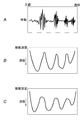
- FIG. 6B shows a temporal change in sleep depth according to the vibration component related to body movement
- FIG. 6C shows an ideal sleep depth time. It is a figure which shows a change.
- FIG. 10 is a diagram illustrating a display example on a presentation device according to a fourth embodiment.
- FIG. 10 is a diagram illustrating a display example on a presentation device according to a fourth embodiment.
- FIG. 10 is a diagram illustrating a display example on a presentation device according to a fourth embodiment.
- FIG. 10 is a diagram illustrating a display example on a presentation device according to a fourth embodiment.
- FIG. 10 is a diagram illustrating a display example on a presentation device according to a fourth embodiment.
- FIG. 10 is a diagram illustrating a display example on a presentation device according to a fourth embodiment.
- FIG. 10 is a diagram illustrating a display example on a presentation device according to a fourth embodiment.
- FIG. 10 is a diagram illustrating a display example on a presentation device according to a fourth embodiment.
- FIG. 10 is a diagram illustrating a display example on a presentation device according to a fourth embodiment.
- FIG. 10 is a diagram illustrating a display example on a presentation device according to a fourth embodiment. It is a block diagram which shows the structure of the activity evaluation apparatus in Embodiment 5.
- FIG. 10 is a schematic configuration diagram illustrating a measurement device used in a fifth embodiment. It is a figure which shows the time change of the pupil diameter in Embodiment 5.
- FIG. It is the schematic which shows the usage example of the presentation apparatus in Embodiment 6.
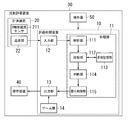
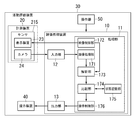
- the activity evaluation device 30 described below includes a measurement device 20 and an evaluation processing device 10 as shown in FIG.
- the evaluation processing apparatus 10 includes a device that operates according to a program. This type of device is selected from a microcomputer (Microcontroller) provided with a memory and a processor, and a CPU (Central Processing Unit) provided with a memory separately from the processor. This device constitutes a processing unit 11 in the evaluation processing apparatus 10.
- the evaluation processing apparatus 10 includes a device that functions as an interface unit in order to receive an output from the measurement apparatus 20 that measures a user's physical activity or mental activity. This device constitutes an input unit 12 that receives the output of the measuring apparatus 20.
- the evaluation processing apparatus 10 can be realized by executing a program described below on a general-purpose personal computer.
- products such as game machines for electronic games, smartphones, and tablet terminals include devices that operate according to a program, this type of product may be used as the evaluation processing apparatus 10.
- the evaluation processing apparatus 10 When this type of product is used as the evaluation processing apparatus 10, it may be possible to shorten the time until it can be used after being taken out, compared with the case where a personal computer is used. In addition, as will be described later, there are cases where the activity of the user can be measured using a sensor built in this type of product. Therefore, if a program that operates on these products is provided, the activity evaluation device 30 can be simplified. Can be built.
- the evaluation processing device 10 includes an output unit 13 that outputs presentation information to the presentation device 40.
- the presentation device 40 for example, a display device capable of displaying a moving image is used.
- the presentation device 40 may be configured to output audio instead of a display device.
- the presentation device 40 is a display device
- the form of presentation information presented to the presentation device 40 may include a user's avatar.
- the user's avatar is displayed on the presentation device 40, the user can objectively know the evaluation regarding himself / herself.
- the activity evaluation device 30 includes the measurement device 20 and the processing unit 11.
- the measuring device 20 measures a user's physical activity or mental activity.
- the processing unit 11 uses the output of the measuring device 20 to generate evaluation information related to the user's physical activity or mental activity, and generates presentation information to be presented to the user based on the evaluation information.
- the evaluation processing apparatus 10 includes an input unit 12 and a processing unit 11.
- the input unit 12 receives the output of the measuring device 20 that measures the physical activity or mental activity of the user.
- the processing unit 11 uses the output of the measuring device 20 input to the input unit 12 to generate evaluation information related to the user's physical activity or mental activity. Further, the processing unit 11 generates presentation information to be presented to the user based on the evaluation information.
- the evaluation processing device 10 and the activity evaluation device 30 evaluate a user's physical activity or mental activity and generate presentation information corresponding to the evaluation, the user performs an objective evaluation on his / her physical activity or mental activity. I can know.
- the measurement device 20 is provided separately from the evaluation processing device 10 as an example.
- the measurement device 20 may be provided integrally with the evaluation processing device 10.
- an activity evaluation device 30 that evaluates a gait, which is a kind of physical activity of a user, using the output of the measurement device 20 and presents the result of the evaluation to the user will be described.
- the measuring device 20 includes a three-axis acceleration sensor 211 that is worn on the user's body.
- the triaxial acceleration sensor 211 can measure accelerations in three directions orthogonal to each other.
- the measurement device 20 may include a gyro sensor in addition to the triaxial acceleration sensor 211.
- the three-axis acceleration sensor 211 constituting the measuring device 20 is housed in a case 200 attached to a belt 201 wound around the waist or abdomen of the user M1 as shown in FIG.
- the case 200 also houses the transmitter 22 in order to notify the evaluation processing apparatus 10 of the output of the triaxial acceleration sensor 211.
- the transmission unit 22 can adopt a configuration in which the transmission unit 22 is connected to the input unit 12 of the evaluation processing device 10 by wire, but is configured to perform wireless communication with the input unit 12 using radio waves as a transmission medium. It is desirable.
- the measuring device 20 be mounted near the center in the left-right direction on the user's waist or abdomen.
- the measuring device 20 is configured to be put in a pocket or a bag, like the pedometer, by analyzing the components included in the output of the three-axis acceleration sensor 211, the vicinity of the center in the left-right direction in the waist or abdomen The same analysis as that when the measuring device 20 is mounted on is possible.
- the processing unit 11 provided in the evaluation processing device 10 analyzes the gait of the user using the output of the triaxial acceleration sensor 211 received by the input unit 12 from the measurement device 20.
- the processing unit 11 includes an analysis unit 111 that extracts a feature amount from a signal for each axis output from the triaxial acceleration sensor 211.
- the analysis unit 111 extracts a signal having a frequency of interest for the signal for each axis.
- a signal component that is a frequency range corresponding to the walking speed represents the back and forth, left and right, and up and down movements of the waist accompanying walking, and reflects the movement of the legs and the movement of the trunk.
- a part of signal component of a frequency higher than this component contains the component reflecting the motion of the joint bent and stretched with walking.
- a two-axis signal component is combined and plotted on a two-dimensional plane having two axes of the back and forth movement of the waist associated with walking, a figure similar to a Lissajous figure can be obtained. If the feature amount of this figure is extracted, it is possible to determine whether the left and right center-of-gravity movement is balanced or unbalanced during walking.
- the processing unit 11 includes a comparison unit 112 that collates the feature amount extracted by the analysis unit 111 with the feature amount in a known gait.
- a feature amount in a known gait is stored in advance in the gait storage unit 113.
- the gait storage unit 113 stores not only gaits but also feature quantities classified by items such as age group, gender, and occupation. When an item is instructed using the operation unit 50, the corresponding item is stored. Is selected.
- the evaluation processing device 10 is configured by a product selected from a game machine, a smartphone, a tablet terminal, or the like, the operation device 50 is realized by a touch panel attached to this type of product.
- the gait classification stored in the gait storage unit 113 includes a gait that slowly steps on the ground (in terms of mimetic words, nocturnal), a gait that walks barefoot (in terms of mimetic words, petapeta), and the like. .
- the gait classification may include a gait described as snatching, flapping, stinging, etc.
- a gait described with a snatch is a gait that walks on the ground
- a gait described with a flap is a gait that walks lightly.
- a gait that is described in a simple manner is a gait that walks in a hurry.
- the gait storage unit 113 stores a feature amount corresponding to each of the plurality of gaits on a one-to-one basis.
- Occupations among items that classify gaits stored in the gait storage unit 113 are classified in order to give names to characteristic gait types such as top model, ninja, samurai, and wrestler. It is included in the item.
- the gait feature quantity stored in the gait storage unit 113 is selected using these names, the user's gait feature quantity is compared with the gait feature quantity selected by these names. It becomes possible to do. That is, the comparison unit 112 compares the feature amount related to the user's gait extracted by the analysis unit 111 with the feature amount of the gait selected from the gait storage unit 113.
- the processing unit 11 includes a determination unit 114, and the determination unit 114 performs a first operation for determining the type of gait of the user, a user's gait, and a gait according to an instruction from the operation device 50.
- the second operation for evaluating the degree of difference from the gait selected from the content storage unit 113 is selected.
- the determination unit 114 instructs the comparison unit 112 to compare the feature amounts extracted by the analysis unit 111 with the feature amounts of a plurality of types of gaits stored in the gait storage unit 113. .
- the feature amount extracted by the analysis unit 111 is compared with the feature amount of all gaits stored in the gait storage unit 113 in principle.
- the determination unit 114 extracts a gait having the highest similarity to the feature amount of the gait extracted by the analysis unit 111 from the feature amounts of the gait stored in the gait storage unit 113.
- the similarity is evaluated using the Euclidean distance or the Mahalanobis distance. That is, the determination unit 114 generates evaluation information indicating which of the types of gaits stored in the gait storage unit 113 is the user's gait.
- the evaluation information output from the determination unit 114 is input to the presentation control unit 115, and the presentation information to be presented to the presentation device 40 is generated. This presentation information is presented to the presentation device 40 through the output unit 13.
- the presentation information is generated not only to present the name of the type of gait but also the user's avatar displayed on the screen of the presentation device 40 so as to simulate the user's gait. That is, the presentation control unit 115 generates presentation information for causing the gait determined by the determination unit 114 to be displayed on the screen of the presentation device 40 as a moving image by the user's avatar.
- the user can confirm his / her gait through the avatar.
- age and gender are presented regarding the type of gait, if there is a difference between the age or gender corresponding to the user's gait and the actual age or gender, the user will be motivated to practice walking Become.
- the determination unit 114 compares the feature amount extracted by the analysis unit 111 with the feature amount of one type of gait selected from the gait storage unit 113 using the operation device 50.
- the comparison unit 112 is instructed.
- the determination unit 114 obtains similarity as evaluation information for the gait feature quantities compared by the comparison unit 112.
- the presentation control unit 115 generates presentation information to be presented to the presentation device 40 from the evaluation information.
- the presentation information is generated so that the user's avatar that simulates the user's gait and the dummy avatar that simulates the gait selected from the gait storage unit 113 are presented side by side.
- the occupation can be designated from the controller 50
- the user can select various gaits of profession, and his gait and the gait of the selected occupation. Can be compared.
- the gait of the top model and the gait of the user are presented in the presentation device 40 so as to be comparable, the user can practice to imitate the gait of the top model.
- the determination unit 114 since the determination unit 114 generates evaluation information that evaluates the similarity of gaits, it is desirable to display the similarity as evaluation information on the screen of the presentation device 40.
- the user can confirm the degree of similarity with the gait of the occupation selected from the operation device 50, and the user can devise the gait so as to further increase the degree of similarity, thereby providing the user with entertainment. Can be practiced walking.
- the presentation apparatus 40 it is desirable to employ
- the presentation device 40 may be selected from a wristwatch-type display device, a smartphone, a tablet terminal, or the like if the screen is small.
- the determination unit 114 evaluates the degree of similarity between the user's gait and the ideal gait stored in the gait storage unit 113.
- the determination unit 114 may evaluate the degree of difference in the user's gait with respect to the ideal gait stored in the gait storage unit 113.
- the feature amount of the corresponding gait may be selected from the gait storage unit 113 by inputting the age and sex of the user from the operation unit 50.
- the determination unit 114 generates evaluation information indicating the degree of difference between the feature amount selected from the gait storage unit 113 and the actual feature amount obtained from the user.
- the evaluation information representing the degree of difference the above-described similarity may be used.
- a value used for similarity evaluation is used for evaluation information of the degree of difference. In other words, when the degree of similarity is low, the degree of difference is large. Either the degree of similarity or the degree of difference may be used for the evaluation information.
- the determination unit 114 when an ideal gait is set and the ideal gait is different from the user's gait, the determination unit 114 generates evaluation information that serves as an index related to the health level of the user. May be. For example, by generating a graphic similar to the Lissajous figure as described above and paying attention to the feature amount of this graphic, it is possible to determine whether the right and left centroid movement of the user is balanced or unbalanced. . Further, since the three-axis acceleration sensor 211 is used in the measuring device 20, it is possible to estimate not only the center of gravity movement but also the movement time of the left and right feet, the stepping force of the left and right feet, and the stride. Further, regarding these pieces of information, when the transition with the passage of time is obtained, information about the endurance of the user can be obtained.
- the determination unit 114 obtains an index indicating the gait soundness, the level of physical strength, and the like regarding the user. Below, these indicators are referred to as health levels.
- the degree of health is expressed by the determination unit 114 as a numerical value and a state using the health of the gait and the level of physical strength.
- the presentation control unit 115 desirably generates the presentation information so that the avatar to be presented to the presentation device 40 is expressed in a posture corresponding to the health level.
- 3A to 3C are examples of the posture of the avatar A1 corresponding to the health level.
- FIG. 3A is a case where the health level is greater than or equal to a predetermined reference value
- FIG. 3B is a case where the health level is poor.
- FIG. 3C shows an example where the health level is less than a predetermined reference value. Note that the reference value corresponding to FIG. 3A and the reference value corresponding to FIG. 3C may be different.
- the posture shown in FIG. 3 is an example, and the categories related to the health level are not limited to three.
- the health level is represented by the posture of the avatar A1
- an intuitive stimulus can be given to the user as compared with the case where the health level is represented by a numerical value. That is, the user can easily be aware of the health level. Further, since the health level is presented to the user using the avatar A1 and the user performs health management in a game sense, the user's motivation for health management is improved.
- the plurality of activity evaluation devices 30 are configured to communicate through an electric communication line such as the Internet or a mobile communication network, the health level of other users is confirmed by the posture of the avatar A1. It becomes possible.
- the avatars of other families can be confirmed. It becomes possible to do. Therefore, it is possible for the user not only to check his / her own health level but also to check the health level of a family living together, a family living far away, an elderly family, and the like. If the health level of other users is confirmed in this way, it can lead to consideration of the health level of others and can also be used to watch over the family.
- a doctor or a health advisor may have a presentation device 40 that receives the presentation information output from the evaluation processing device 10 and may be used for health management related to the user of the evaluation processing device 10.
- the determination unit 114 extracts evaluation information on the health level from these pieces of information.
- the presentation control unit 115 may be configured to generate meal content or a meal recipe suitable for the health condition of the user as the presentation information.
- the presentation information generated by the presentation control unit 115 may be individually held by the evaluation processing device 10, but this type of information can be shared by a plurality of evaluation processing devices 10. For this reason, it is desirable that the presentation control unit 115 acquires meal contents or meal recipes suitable for the health condition from the web server through an electric communication line such as the Internet.
- the web server may be composed of a plurality of computers instead of a single computer, and may be a cloud computing system.
- this embodiment can be used for walking practice or practice of imitating a gait. Therefore, various rewards may be given to practice in order to further improve the entertainment characteristics of such practice.
- This type of reward includes, for example, the provision of points that can be used in the virtual space, the expansion of the range that can be acted on in the virtual space, and the provision of tools that improve the superiority in other games.
- a point that can be exchanged for a product or service in the virtual space may be given as the health level improves.
- a product or service related to the avatar's dwelling in the virtual space or the avatar's fashion in the virtual space can be exchanged for points, storing points is a motivation to improve health.
- 100 points are given for a certain degree of health, and the post attached to the residence is set to 2000 points.
- 500 points for a skirt, 500 points for a jacket, 500 points for a hairstyle shortcut, etc. are set.
- the range in which they can act in the virtual space is narrowed, and the range in which they can act in the virtual space is increased as the health level increases. Also good.
- information related to the virtual space that is outside the current action range may be included in the presentation information so as to make the user aware of information about the virtual space that is outside the current action range. desirable.
- the presentation information includes a signboard of a store that exists outside the current action range in the virtual space
- the user is directed to the corresponding store, and as a result, the current action range Motivate to expand the range of action outside.
- the action range in the virtual space is expanded with the improvement of the health level, so that the motivation is increased to further increase the health level.
- Points can be determined according to the degree of improvement in health level, but instructions are given to exercise to improve health levels, and given points are given when the specified content is achieved, or instructions are given. Points may be awarded according to the degree of achievement of the contents. For example, when an instruction of running of 3 km or more is given and the user achieves this exercise, 200 points may be given to the user.
- the above-described operation associates the health level with the virtual space in which the avatar acts.
- the presentation control unit 115 can generate the presentation information so that the presentation device 40 shows the rank regarding the integrated value of points.
- points may be used to improve the fighting ability, or points may be exchanged for weapons that improve the fighting ability.
- the fighting ability may be either attack power or defense power.
- the rules and contents of the game are defined in the game unit 14. Therefore, characters used in the game, character movements, and the like are determined in the game unit 14.
- the activity evaluation apparatus 30 When the ranking of the accumulated value of points is used as the presentation information, the activity evaluation apparatus 30 is configured to communicate with the server through an electric communication line such as the Internet, and the rank regarding the accumulated value of points is obtained in the server.
- the accumulated value of points may increase as the time during which the activity evaluation device 30 is used, unless a time limit is set, it is selected from a past predetermined period (for example, 3 months, 6 months, etc.). It is desirable to show the ranking in
- points associated with a competitive game it is desirable to increase or decrease the fighting ability exchanged for points according to the points. For example, when a point is exchanged with a weapon, it is determined that 200 points are exchanged when the weapon is a sword, and 500 points are exchanged when the weapon is a shield. In this case, the shield has a higher combat ability than the sword.
- the game that correlates the user's walking motion is not limited to a competitive game.
- the walking motion may be associated with a game that simulates a board game on the screen of the presentation device 40.
- the configuration example illustrated in FIG. 4 is configured such that a square LT is displayed on the screen of the presentation device 40 and the user can move forward by one square when the user walks a predetermined number of steps.
- the direction of the user is also taken into consideration, and if the user changes the direction, the user can proceed to the grid in the corresponding direction.
- the screen of the presentation device 40 also displays the user's avatar A1 (or an appropriate character), and the avatar A1 operates according to the user's gait. That is, if the user walks at a low speed, the avatar A1 also moves at a low speed, and if the user runs, the avatar A1 also runs.
- the current position (P1) of the avatar A1 and the goal position (P2) are shown. The game is established by the user walking so as to move from the current position (P1) to the goal position (P2).
- the user when the user walks, it does not necessarily mean that the user moves forward by walking, and stepping at the same position is also included in walking.
- the presentation device 40 when the presentation device 40 is portable, the user may actually walk outdoors.
- a triaxial acceleration sensor built into this type of product may be used for detecting a gait. That is, in this type of product, it is possible to execute a program (so-called application if it is a smartphone) that functions as the evaluation processing device 10 and analyze the output of the three-axis acceleration sensor built in the product. Is possible.
- an attachment for fixing the game machine or the smart phone is provided on a belt wound around the user's waist or stomach. Therefore, by providing such a belt and the above-described program, a game machine or a smartphone can be used as the evaluation processing device 10.
- the measurement apparatus 20 includes a three-axis acceleration sensor 211 that is worn on the user's body.
- the processing unit 11 uses the output of the triaxial acceleration sensor 211 to generate evaluation information related to the user's gait. Therefore, the user can know objectively the evaluation regarding his gait.
- the measurement device 20 includes a sleep sensor 212, and the output of the measurement device 20 is given to the evaluation processing device 10.
- the sleep sensor 212 for example, a three-axis acceleration sensor is used.
- the measuring device 20 is placed on the bedding, and the vibration component due to the user's body movement is extracted.
- the user's sleep state is estimated by analyzing this vibration.
- the measuring device 20 of the present embodiment is preferably configured to be worn and carried by the user. In this configuration, the measuring device 20 can also be used for measuring the amount of activity when the user is active. Therefore, the measurement apparatus 20 of the present embodiment includes a case 200 (see FIG. 2) attached to the belt 201 wound around the waist, as in the first embodiment, or a wristwatch-type case 200 and a pendant-type case 200. Etc. can also be used.
- the vibration component related to the user's body movement output from the sleep sensor 212 includes a period in which the amplitude is relatively large and a period in which the amplitude is relatively small, as shown in FIG. 6A, for example.
- FIG. 6A it is known that body movement decreases when sleep deepens, and body movement increases when sleep becomes shallow. From this, when the vibration component of body motion as shown in FIG. 6A is used, it is estimated that the time change of the sleep depth becomes as shown in FIG. 6B.
- the processing unit 11 of the present embodiment includes an analysis unit 116 that extracts the amplitude of the vibration component output from the measurement device 20 and estimates the sleep depth based on the time elapsed from falling asleep to waking up and the amplitude of the vibration component.
- Sleeping means the time when the sleep depth first becomes maximum after going to bed, and waking up means the time when the sleep depth finally becomes minimum.
- the processing unit 11 includes a comparison unit 117 that compares the temporal change in the sleep depth of the user estimated by the analysis unit 116 with the temporal change in the ideal sleep depth shown in FIG. 6C.
- the comparison unit 117 has a function of obtaining a correlation coefficient between the time change of the user's sleep depth and the time change of the ideal sleep depth and scoring the correlation coefficient. This score is called “sleep score”.
- the comparison unit 117 also scores the time from bedtime to falling asleep and the rising characteristics of sleep depth when waking up by comparing the time change of the user's sleep depth with the time change of the ideal sleep depth. .
- the sleeping score, sleeping score, and waking up score are all 100 points, and the higher the score, the better the quality of sleep. For example, the sleeping score is calculated as 85, the sleeping score is 60, and the sleeping score is 45. These scores are generated as evaluation information.
- the evaluation information generated by the comparison unit 117 is given to the presentation control unit 118 and presented to the presentation device 40 through the output unit 13.
- the evaluation information is digitized as the number of sleep points, the number of sleeping points, and the number of sleeping points, so the presentation control unit 118 presents these numerical values to the presentation device 40 as presentation information.
- the evaluation processing apparatus 10 includes a communication unit 15 for transmitting the score obtained by the processing unit 11 to the server.
- the score obtained by the comparison unit 117 is transmitted to the server through an electric communication line such as the Internet or a mobile telephone network.
- the server is not necessarily configured by a single computer, but may be configured by a plurality of computers, or may be a cloud computing system.
- the server receives the scores from the plurality of evaluation processing devices 10 and arranges the received sleep score, the sleep score and the sleep score in descending order from the highest score, and assigns ranks as shown in Table 1.
- Table 1 the ranking is given using the scores of all the participants, but the clustering of the participants may be performed to be divided into a plurality of groups, and the ranking may be given within the group.
- clustering it is desirable to use not only the score but also other attributes such as age group and gender.
- the analysis unit 116 analyzes the vibration component output from the measurement device 20, it is possible not only to estimate temporal changes in sleep depth but also to extract information such as turning over and snoring. By using these pieces of information extracted by the analysis unit 116 as evaluation information, the user's sleep state can be notified to the user.
- the presentation control unit 118 When this type of information is used for the evaluation information, the presentation control unit 118 generates an avatar A1 (or character) representing the sleep state, and generates the presentation information so that the posture of the avatar A1 changes according to the evaluation information. .
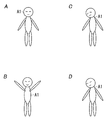
- FIG. 7A shows a state where the depth of sleep is deep
- FIG. 7B shows a state where snoring is occurring
- FIG. 7C shows a state where the sleep depth is shallow and turning over. Since these states change with the passage of time during sleep, the presentation control unit 118 expresses the motion of the avatar A1 as a moving image. That is, the user can know the relationship between the sleeping time and the sleeping state. It is possible to change the reproduction method of this moving image by operating the operation unit 50.
- the operation device 50 can select, for example, 0.8 ⁇ speed playback, 1.3 ⁇ speed playback, fast forward, and the like.
- the user can recognize the change in the sleep state with time.
- the user is aware of the sleep state, knows the possibility of sleep apnea syndrome, and is able to show the snoring state to the family, snoring has become a nuisance to the family Will know.
- the sleep sensor 212 of the measuring device 20 used in the present embodiment can be used for measuring the amount of activity as described above.
- the analysis unit 116 also has a function of estimating the amount of sleep and the amount of activity based on the output of the measurement device 20.
- the analysis unit 116 calculates the sleep amount using the sleep time and the sleep depth as parameters.
- the amount of activity is calculated based on the integrated value of acceleration.
- the comparison unit 117 compares the amount of sleep and the amount of activity with a predetermined reference value set for each. Further, the comparison unit 117 evaluates that the sleep amount and the activity amount are both equal to or greater than the reference value, and that the sleep amount and the activity amount are both less than the reference value, and the activity amount is equal to or greater than the reference value. Even so, if the amount of sleep is less than the reference value, it is evaluated that sleep is insufficient. In addition, since there is a possibility of disturbing sleep if the amount of activity is excessive, it is desirable to set an upper limit for the amount of activity. Furthermore, since the time period during which the amount of activity increases also affects the quality of sleep, it is desirable to use the time change of the activity amount for sleep evaluation.
- the presentation control unit 118 uses the evaluation result of the comparison unit 117 to generate presentation information using the user's avatar A1 (or an appropriate character) as shown in FIG. To present. 8A shows an initial state, FIG. 8B shows a healthy state, FIG. 8C shows an unhealthy state, and FIG. 8D shows an insufficient sleep state.
- the display example shown in the figure is an example, and the type of classification and the form of display can be changed as appropriate.
- the processing unit 11 communicates with the server, the avatar A1 (or the evaluation result of the comparison unit 117) generated by the presentation control unit 118 is transmitted to the server, so that the avatar can be used by a plurality of people who use the activity evaluation device 30. It becomes possible to see A1. For example, it can be used for the purpose of watching the health of an elderly family living in a remote place with an avatar A1.
- the measurement device 20 may be configured to estimate the sleep state using information other than acceleration.
- a technique for estimating a sleep state using information other than acceleration a configuration in which a pressure sensor is provided in a bedding and a user's body movement is measured, and a camera that captures a moving image of the user during sleep is used and used.
- a configuration in which a person's movement is measured can be adopted as the measuring device 20.
- the measurement device 20 includes a sleep sensor 212 that measures the sleep state of the user. Moreover, the process part 11 produces
- the user can objectively know his / her sleep state.
- the activity evaluation device 30 evaluates the user's concentration using the output of the measuring device 20, and recovers the user's concentration when a decrease in the concentration is detected (that is, refresh). It has the composition to make it. That is, the measuring device 20 of this embodiment measures a user's mental activity.
- the measuring device 20 includes a three-axis acceleration sensor 213 that monitors a user's body movement and respiration as shown in FIG.
- the measuring device 20 is configured to be attached to the user's torso in order to monitor the user's body movement and respiration. That is, a configuration that is worn on the user's lower back, a configuration that is worn on the user's chest, or the like is employed as in the first embodiment.
- the user's breathing is also monitored. It is known that when the user's arousal level is low, the respiratory rhythm is regular, whereas when the user's arousal level is high, the respiratory rhythm is irregular. . That is, by monitoring respiration in addition to the user's body movement, it is possible to determine whether the user is concentrated or not. Here, a state in which the degree of concentration is reduced is interpreted as a state in which the degree of fatigue has increased.
- the output of the measuring device 20 is given to the processing unit 11 through the input unit 12 as shown in FIG.
- the processing unit 11 includes an analysis unit 161 that separates a component corresponding to the user's body movement and respiration from the vibration component output by the three-axis acceleration sensor 213. Further, the processing unit 11 includes a determination unit 162 that determines whether or not the user is concentrated using the body movement component and the respiration component separated by the analysis unit 161.
- the determination unit 162 determines the degree of body movement and the rhythm of breathing as described above. That is, the determination unit 162 shifts from a state where the amplitude of body motion is smaller than a predetermined reference value to a large state during a period in which it is determined that the breathing rhythm is irregular, and this state continues for a predetermined time. If it continues, it will determine with having shifted from the state with a high concentration degree to the state where the concentration degree fell. This determination result becomes evaluation information regarding the mental activity of the user.
- the presentation control unit 163 When the presentation control unit 163 provided in the processing unit 11 receives evaluation information indicating that the user's concentration level has decreased from the determination unit 162, the presentation control unit 163 generates presentation information for refreshing the user.
- the presentation device 40 a device that provides visual stimulation, auditory stimulation, olfactory stimulation, cold stimulation, or the like is used.
- a lighting device capable of light control and color adjustment may be used as the presentation device 40.
- the presentation information is generated so as to realize a color tone that reduces the illuminance and calms the nerve such as green, blue, and purple.
- the presentation information is generated so as to realize a color tone that increases the illuminance and excites the nerve like red and yellow after a predetermined time has passed in this state.
- the output unit 13 is configured to output an optical wireless signal similar to that of the remote control device that controls the lighting device.
- the visual stimulus can be given by a device that displays an image such as a television receiver, a display device of a personal computer, or a projector that projects an image.
- the presentation information is generated so as to display an image so as to excite the nerve after relaxing the user, as in the case of controlling the lighting device.
- the presentation information is generated so as to display an image that gives a slight stress to the user in the separate room.
- An image that gives stress means an image in which adrenaline is secreted, such as an image as if skiing down or a roller coaster.
- a simple planetarium may be used as the presentation device 40.
- the simple planetarium In addition to the function of projecting a starry sky, the simple planetarium is known to have a configuration capable of projecting a still image or a moving image. When this type of presentation device 40 is used, a refresh effect can be expected.
- Auditory stimulation, olfactory stimulation, and cold stimulation can be used alone, but the effect is enhanced when combined with other stimuli.
- the measurement apparatus 20 includes a three-axis acceleration sensor 213 that is worn on the user's body.
- the processing unit 11 uses the output of the triaxial acceleration sensor 213 to generate evaluation information related to the user's concentration level or fatigue level. According to this configuration, the user can objectively know the concentration level or the fatigue level, which is a mental activity.
- the activity evaluation device 30 of the present embodiment is configured to estimate the state of emotion as mental activity.
- the measurement device 20 includes a brain activity sensor 214.
- the brain activity sensor 214 is configured to be wrapped around or put on the user's head, and a configuration including an electrode for detecting electrical activity of the brain is employed, or a configuration of measuring brain blood flow is employed. .
- the emotional state is classified by combining the degree of comfort and the degree of arousal.
- the state of emotion is classified as shown in Table 2, for example.
- the processing unit 11 estimates the degree of comfort and the degree of arousal using the output of the brain activity sensor 214. That is, the processing unit 11 includes an analysis unit 164 that extracts a plurality of types of physiological indices related to brain activity from the output of the brain activity sensor 214 received through the input unit 12. The physiological index is extracted as a state of brain activity for each part of the brain.
- the physiological index extracted by the analysis unit 164 is given to the estimation unit 165 provided in the processing unit 11.
- the estimation unit 165 compares the data stored in the state storage unit 166 provided in the processing unit 11 with a plurality of types of physiological indices extracted by the analysis unit 164, and the degree of comfort and arousal of the user. Is estimated.
- the state storage unit 166 stores a correspondence relationship between the degree of comfort and the degree of arousal and the physiological index. Therefore, the estimation unit 165 estimates the degree of comfort and arousal of the user as evaluation information using the physiological index extracted by the analysis unit 164 and the data stored in the state storage unit 166.
- the degree of comfort and arousal regarding the user estimated by the estimation unit 165 are given to the presentation control unit 167 provided in the processing unit 11.
- the presentation control unit 167 plots the combination of the degree of comfort and the degree of arousal estimated by the estimation unit 165 on a plane having two axes of the degree of comfort and the degree of arousal. Generate presentation information.
- the plotted position is represented by a black circle on the plane.
- An emotional state is shown on the plane, and the emotional state of the user is indicated by the positional relationship between the plotted position and the emotional state.
- the presentation control unit 167 stores the emotional state of each person, It has a function to display the status at the same time.
- the processing unit 11 may be configured to receive the outputs of the plurality of measuring devices 20 and estimate the emotional state corresponding to the outputs of the individual measuring devices 20. Even if this configuration is adopted, the emotional states of a plurality of persons can be displayed simultaneously on the same plane.
- the processing unit 11 may have a function of registering a user's face image. In this case, it is desirable that the processing unit 11 has a function of automatically generating a facial expression corresponding to the emotional state of the user using the facial image of the user during normal times. For example, the processing unit 11 extracts a dimension relating to a predetermined part from the user's face image, and performs image processing for adjusting the relationship of the extracted dimension according to the emotional state, thereby corresponding to the emotional state. Generate facial expressions.
- the presentation control unit 167 causes the presentation device 40 to display an expression corresponding to the emotional state on a screen that displays a plane representing the emotional state.
- the presentation control unit 167 may generate the presentation information so that the screen that displays the plane representing the emotional state and the screen that displays the facial expression corresponding to the emotional state are separate screens.
- the state of emotion is estimated using the output of the brain activity sensor 214
- the state of emotion of various people is estimated
- the degree of concentration is related to the degree of concentration or fatigue as in the third embodiment. It is possible to use it like a game. For example, by comparing emotional states of people such as family members, friends, and colleagues, it can be used as a communication tool that provides a topic.
- motivation for intellectual work such as learning or work can be expressed as a state of emotion.
- Table 2 and FIG. 11 motivation is positioned in a state where the degree of comfort is relatively high and the degree of arousal is high. Since the motivation is quantitatively represented by a combination of the degree of comfort and the degree of awakening, the processing unit 11 obtains the degree of motivation using the degree of comfort and the degree of awakening as parameters. For example, in the example shown in FIG. 12, the degree of arousal (degree of arousal) is 73% and the degree of comfort (degree of comfort) is 88%, and the degree of motivation is determined to be 78% using both as parameters.
- FIG. 13 shows an example in which the estimated degree of motivation is displayed on the screen of the presentation device 40.
- a threshold can be set for the degree of motivation.
- the threshold is set to 50% or the like, and the motivation is reduced to 41%. Therefore, a program for improving the motivation is shown in the presentation device 40. That is, in the illustrated example, icons C1 to C4 for selecting “music”, “video”, “meditation”, and “enjoy” are shown as the types of programs for improving motivation.
- the user selects one icon desired by the user among the desired icons C1 to C4
- the user can select a desired program that improves motivation. Note that when meditation is selected, for example, a breath-inducing rhythm sound is output.
- the time can be set on the screen shown in the figure.
- the time is the time for using the program corresponding to the icon selected from the icons C1 to C4, and it is possible to set either the time for using the program or the time for ending the program.
- the start button Bs is operated after setting the time to use the selected program, the content corresponding to the time to be used is selected from the corresponding program types.
- ⁇ When a program that improves motivation is executed, it may be verified whether or not motivation has improved.
- a screen for verifying the improvement in motivation is configured as shown in FIG. 14, for example.
- the screen shown in the figure shows the degree of motivation obtained after executing the program in the upper part, and shows the change in the degree of motivation before and after the execution of the program in the lower part.
- the processing unit 11 has a function of evaluating the degree of change in motivation.
- the processing unit 11 sets conditions such as when the degree of motivation increases by 20% or when the degree of motivation becomes 80% or more, and when this condition is satisfied, the reward for the user's brain is paid.
- the given information is displayed on the screen of the presentation device 40. This information may be shown in words or figures that praise the user, for example. Further, when the degree of motivation increases, for example, as shown in FIG. 15, the rankings may be displayed in order of increasing degree or in order of increasing motivation after execution of the program. .
- ⁇ Presentation of this kind of information on the presentation device 40 makes it possible to increase the motivation of the user and motivate the execution of a program that improves motivation. Further, the processing unit 11 records the degree of increase in motivation for each program executed by the user, and extracts a program having a high degree of increase in motivation for the user by analyzing the recorded data. Good. With this configuration, it is possible to preferentially present a program with a high degree of motivation for the corresponding user.
- the degree of motivation was obtained using the degree of arousal and the degree of comfort as parameters.
- the degree of motivation is obtained using the other parameters. Is possible.
- the degree of motivation can be obtained using three or more parameters.
- the processing unit 11 may estimate the degree of stress instead of the degree of arousal and comfort based on the physiological index output from the brain activity sensor 214.
- the state storage unit 166 stores data in which the physiological index extracted by the analysis unit 164 is associated with the degree of stress.
- the estimation unit 165 compares the physiological index extracted by the analysis unit 164 with the data stored in the state storage unit 166, and estimates the degree of user stress.
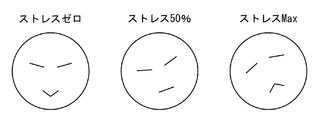
- the presentation control unit 167 may generate the presentation information so that a facial expression representing the degree of stress is displayed on the screen of the presentation device 40, for example.
- the example shown in FIG. 16 is a facial expression displayed on the presentation device 40 by such presentation information.
- the user avatar or an appropriate character is used, but various facial expressions may be generated by image processing using a photograph of the user's face.
- the measurement apparatus 20 includes a brain activity sensor 214 that measures a user's brain activity.
- the processing unit 11 uses the output of the brain activity sensor 214 to generate evaluation information related to the degree of comfort and the degree of arousal, and combines the degree of comfort and the degree of arousal, which are evaluation information, to thereby provide user emotions. Is generated as presentation information. According to this configuration, the user can objectively know the state of his / her emotion based on the brain activity which is a mental activity.
- the measuring device 20 includes a sensor 215 that measures a physiological index related to the user's eyes, and the evaluation processing device 10 uses the physiological index related to the eyes to determine the degree of fatigue of the user. And evaluation information on the aging degree of the brain function.
- the fatigue level includes fatigue levels of both the brain and eyes.
- the sensor 215 is formed in a glasses shape like a head-mounted display, and as shown in FIGS. 17 and 18, a display device 23 that presents video to the user, and a camera 24 that captures the user's eyes E1. Is provided.
- the processing unit 11 by using the display content of the display device 23 and the state of the user's eyes E1 captured by the camera 24, the processing unit 11 generates evaluation information relating to the fatigue level and the aging level of the user. It becomes possible.
- an indicator is displayed on the display device 23, and the processing unit 11 includes an image processing unit 171 that extracts information about the eyes such as the pupil diameter of the user using an image captured by the camera 24.
- the pupil diameter uses a width dimension in the left-right direction of the pupil.
- the processing unit 11 includes a video control unit 172 that generates video information for displaying video on the display device 23.
- the processing unit 11 shown in the figure includes an analysis unit 173 that observes a change in pupil diameter measured by the image processing unit 171 when the video control unit 172 presents a predetermined brightness index on the display device 23.
- the analysis unit 173 extracts information such as pupil contraction rate (pupil contraction rate), contraction speed or acceleration, pupil position fluctuation, and the like using the temporal change in pupil diameter as shown in FIG. In FIG. 19, time T1 represents the period during which the index is presented.
- the processing unit 11 includes a comparison unit 174 and a state storage unit 175.
- the state storage unit 175 stores data in which the miosis rate, the contraction speed or acceleration, the fluctuation of the pupil position, and the like are associated with the fatigue level and the aging level.
- the comparison unit 174 estimates the degree of fatigue and aging by comparing information such as the miosis rate, contraction speed or acceleration, and pupil position fluctuation obtained by the analysis unit 173 with the data stored in the state storage unit 175. To do.
- the fatigue level and the aging level estimated by the comparison unit 174 are presented to the presentation device 40 using an avatar or an appropriate character in the same manner as the avatar A1 (see FIG. 3) showing the health level in the first embodiment. That is, the presentation control unit 176 generates presentation information so that an avatar (or character) with a posture corresponding to the degree of fatigue and the degree of aging can be presented. Only one of the fatigue level and the aging level may be estimated. In addition, the presentation control unit 176 may have a function of generating meal content or a meal recipe as presentation information according to the degree of fatigue.
- the degree of fatigue and the degree of aging are extracted using a change in pupil diameter when a predetermined brightness index is presented on the display device 23.
- the video to be displayed on the display device 23 is not limited to a predetermined brightness index, and various patterns can be adopted, and the display time and brightness can be set as appropriate.
- the information about the eyes extracted using the image captured by the camera 24 is not limited to the pupil diameter, and if information such as the direction of the line of sight and blinks is also extracted, the fatigue level and the aging level of the user are estimated. Can be performed with higher accuracy.
- the eyeglass-type sensor 215 is used.
- the display device 23 and the camera 24 may be diverted from a display device and a camera attached to a device selected from a smartphone, a tablet terminal, a game machine, and the like. Is possible.
- the measurement apparatus 20 includes a sensor 215 that measures a physiological index related to the user's eyes.
- the processing unit 11 uses the output of the sensor 215 to generate evaluation information related to the user's fatigue level and aging level. According to this configuration, the user can objectively know the fatigue level and the aging level.
- Embodiment 6 In Embodiment 3, the example which displays the image
- a head-mounted display 41 that is worn on the head of the user M1
- a sensation presentation device that gives a sensation of the hand being pulled by the user M1. 42 is used for the presentation device 40.
- the head mounted display 41 is assumed to be a see-through type. That is, the head mounted display 41 is configured not only to see the image displayed on the presentation device 40 but also to see the surroundings through the head mounted display 41.
- the sensory presentation device 42 incorporates an actuator including a weight that virtually gives a force sense.
- the processing unit 11 generates presentation information for simulating the state in which the animal is walked by the head mounted display 41 and the sensory presentation device 42.
- presentation information for simulating the state in which the animal is walked by the head mounted display 41 and the sensory presentation device 42.
- the appearance of the virtual animal A2 is displayed on the head mounted display 41, and a force sense pulled by the sensory presentation device 42 is generated according to the movement of the virtual animal A2 displayed on the head mounted display 41. Presentation information is generated.
- the present embodiment can be adopted when it is desirable to increase the amount of activity of the user for improving the sleep state or when it is desirable to move the body for refreshing.
- the user since the state in which the pet is walked is simulated, the user is more motivated than taking a walk alone.
- the kind of animals to be walked can be arbitrarily selected, and even animals that cannot be kept generally such as lions can be walked, and the animals to be walked can be changed depending on the situation. is there. Since it is a virtual animal, size, personality, etc. can be selected. For example, in the case of an animal having a large size, the presentation information is generated so as to increase the force sense transmitted from the sensory presentation device 42. Also, if the personality is not enough, the presentation information is generated so as to be pulled slowly, and if the personality is active, the presentation information is generated so as to be pulled vigorously.
- the entertainment property can be further enhanced.
- the processing unit 11 In the activity evaluation device 30 of the present embodiment, the processing unit 11 generates an image to be displayed on the head mounted display 41 attached to the head of the user M1 as presentation information.
- the presentation information is an image for simulating an animal to be walked.
- the processing unit 11 simulates a state where an animal is walked using the head mounted display 41 and the sensory presentation device 42. According to this configuration, the user can virtually walk the animal, which contributes to refreshing the user.
Landscapes
- Health & Medical Sciences (AREA)
- Engineering & Computer Science (AREA)
- Life Sciences & Earth Sciences (AREA)
- Medical Informatics (AREA)
- Public Health (AREA)
- General Health & Medical Sciences (AREA)
- Biomedical Technology (AREA)
- Primary Health Care (AREA)
- Epidemiology (AREA)
- Biophysics (AREA)
- Pathology (AREA)
- Hospice & Palliative Care (AREA)
- Psychology (AREA)
- Social Psychology (AREA)
- Physics & Mathematics (AREA)
- Child & Adolescent Psychology (AREA)
- Psychiatry (AREA)
- Heart & Thoracic Surgery (AREA)
- Molecular Biology (AREA)
- Surgery (AREA)
- Animal Behavior & Ethology (AREA)
- Developmental Disabilities (AREA)
- Veterinary Medicine (AREA)
- Physical Education & Sports Medicine (AREA)
- Dentistry (AREA)
- Physiology (AREA)
- Data Mining & Analysis (AREA)
- Databases & Information Systems (AREA)
- Oral & Maxillofacial Surgery (AREA)
- Educational Technology (AREA)
- Measurement Of The Respiration, Hearing Ability, Form, And Blood Characteristics Of Living Organisms (AREA)
- Medical Treatment And Welfare Office Work (AREA)
Abstract
La présente invention rend possible, pour des utilisateurs ne possédant aucune connaissance spécialisée, d'utiliser des informations présentées. Un dispositif d'évaluation d'activité (30) est pourvu d'un dispositif de mesure (20) et d'une unité de traitement (11). Le dispositif de mesure (20) mesure l'activité physique ou l'activité mentale d'un utilisateur. A l'aide de la sortie du dispositif de mesure (20), l'unité de traitement (11) génère des informations d'évaluation se rapportant à l'activité physique ou l'activité mentale de l'utilisateur, et génère les informations présentées qui sont présentées à l'utilisateur sur la base des informations d'évaluation.
Applications Claiming Priority (2)
| Application Number | Priority Date | Filing Date | Title |
|---|---|---|---|
| JP2014122297A JP2016002109A (ja) | 2014-06-13 | 2014-06-13 | 活動評価装置、評価処理装置、プログラム |
| JP2014-122297 | 2014-06-13 |
Publications (1)
| Publication Number | Publication Date |
|---|---|
| WO2015190042A1 true WO2015190042A1 (fr) | 2015-12-17 |
Family
ID=54833160
Family Applications (1)
| Application Number | Title | Priority Date | Filing Date |
|---|---|---|---|
| PCT/JP2015/002578 Ceased WO2015190042A1 (fr) | 2014-06-13 | 2015-05-22 | Dispositif d'évaluation d'activité, dispositif de traitement d'évaluation, et programme |
Country Status (2)
| Country | Link |
|---|---|
| JP (1) | JP2016002109A (fr) |
| WO (1) | WO2015190042A1 (fr) |
Cited By (2)
| Publication number | Priority date | Publication date | Assignee | Title |
|---|---|---|---|---|
| JP2017169884A (ja) * | 2016-03-24 | 2017-09-28 | トヨタ自動車株式会社 | 睡眠状態推定装置 |
| WO2022244222A1 (fr) * | 2021-05-21 | 2022-11-24 | 日本電気株式会社 | Dispositif d'estimation, système d'estimation, procédé d'estimation et support d'enregistrement |
Families Citing this family (13)
| Publication number | Priority date | Publication date | Assignee | Title |
|---|---|---|---|---|
| JP6600837B2 (ja) * | 2014-08-20 | 2019-11-06 | 株式会社北電子 | 睡眠情報表示制御プログラム |
| JP6828890B2 (ja) * | 2017-02-22 | 2021-02-10 | 日新ビジネス開発株式会社 | 仮想通貨付与システム |
| US20200060546A1 (en) * | 2017-05-08 | 2020-02-27 | Akash Madnani | A System and Method for Monitoring Human Performance |
| JP6839818B2 (ja) * | 2017-05-17 | 2021-03-10 | パナソニックIpマネジメント株式会社 | コンテンツ提供方法、コンテンツ提供装置及びコンテンツ提供プログラム |
| JP6719780B2 (ja) * | 2017-10-20 | 2020-07-08 | まくら株式会社 | 睡眠改善支援プログラム及びその方法 |
| JP2020044222A (ja) | 2018-09-21 | 2020-03-26 | 株式会社ポケモン | ゲームサーバ、プログラム、方法、ゲームシステムおよび情報処理端末 |
| KR20210130724A (ko) | 2019-02-22 | 2021-11-01 | 가부시키가이샤 한도오따이 에네루기 켄큐쇼 | 안경형 전자 기기 |
| JP7401264B2 (ja) * | 2019-11-05 | 2023-12-19 | 株式会社ハピネスプラネット | 心理状態計測システム及び心理状態計測方法 |
| JP6786137B2 (ja) * | 2020-05-14 | 2020-11-18 | 株式会社ノーニューフォークスタジオ | 歩行教示システム、歩行教示方法 |
| JP7281508B2 (ja) * | 2020-10-19 | 2023-05-25 | 株式会社ポケモン | ゲームサーバ、プログラム、方法、ゲームシステムおよび情報処理端末 |
| WO2022107288A1 (fr) * | 2020-11-19 | 2022-05-27 | 日本電信電話株式会社 | Dispositif d'estimation, procédé d'estimation et programme d'estimation |
| JP7523614B2 (ja) * | 2023-03-07 | 2024-07-26 | 株式会社カプコン | 情報処理システム、情報処理方法およびプログラム ~デジタルツイン環境を支援する技術~ |
| JP7402370B1 (ja) | 2023-04-25 | 2023-12-20 | 株式会社ポケモン | プログラム、方法、情報処理装置、システム |
Citations (3)
| Publication number | Priority date | Publication date | Assignee | Title |
|---|---|---|---|---|
| JP2012024449A (ja) * | 2010-07-27 | 2012-02-09 | Omron Healthcare Co Ltd | 歩行変化判定装置 |
| JP2012050759A (ja) * | 2010-09-03 | 2012-03-15 | Hitachi Ltd | 視覚疲労度検出装置、視覚疲労度制御装置及び視覚疲労度検出方法 |
| JP2013027570A (ja) * | 2011-07-28 | 2013-02-07 | Panasonic Corp | 心理状態評価装置、心理状態評価システム、心理状態評価方法およびプログラム |
-
2014
- 2014-06-13 JP JP2014122297A patent/JP2016002109A/ja active Pending
-
2015
- 2015-05-22 WO PCT/JP2015/002578 patent/WO2015190042A1/fr not_active Ceased
Patent Citations (3)
| Publication number | Priority date | Publication date | Assignee | Title |
|---|---|---|---|---|
| JP2012024449A (ja) * | 2010-07-27 | 2012-02-09 | Omron Healthcare Co Ltd | 歩行変化判定装置 |
| JP2012050759A (ja) * | 2010-09-03 | 2012-03-15 | Hitachi Ltd | 視覚疲労度検出装置、視覚疲労度制御装置及び視覚疲労度検出方法 |
| JP2013027570A (ja) * | 2011-07-28 | 2013-02-07 | Panasonic Corp | 心理状態評価装置、心理状態評価システム、心理状態評価方法およびプログラム |
Cited By (2)
| Publication number | Priority date | Publication date | Assignee | Title |
|---|---|---|---|---|
| JP2017169884A (ja) * | 2016-03-24 | 2017-09-28 | トヨタ自動車株式会社 | 睡眠状態推定装置 |
| WO2022244222A1 (fr) * | 2021-05-21 | 2022-11-24 | 日本電気株式会社 | Dispositif d'estimation, système d'estimation, procédé d'estimation et support d'enregistrement |
Also Published As
| Publication number | Publication date |
|---|---|
| JP2016002109A (ja) | 2016-01-12 |
Similar Documents
| Publication | Publication Date | Title |
|---|---|---|
| WO2015190042A1 (fr) | Dispositif d'évaluation d'activité, dispositif de traitement d'évaluation, et programme | |
| US11832971B2 (en) | Wearable device utilizing flexible electronics | |
| US10300371B2 (en) | Method and system for interacting with a virtual environment | |
| KR102649074B1 (ko) | 신경 생리학적 상태의 검출을 위한 사회적 상호작용 애플리케이션 | |
| JP6054381B2 (ja) | 仮想パフォーマンスシステム | |
| JP3931889B2 (ja) | 画像表示システム、画像表示装置、画像表示方法 | |
| US11771955B2 (en) | System and method for neurological function analysis and treatment using virtual reality systems | |
| JP6429946B2 (ja) | リモート共同ワークアウトセッション用のユーザインタフェース及びフィットネスメーター | |
| US11791026B2 (en) | Cloud-based healthcare diagnostics and treatment platform | |
| CN110236555B (zh) | 姿势和深呼吸改善装置、系统和方法 | |
| US11823781B2 (en) | Cloud-based gaming platform with health-related data collection | |
| US11612786B2 (en) | System and method for targeted neurological therapy using brainwave entrainment with passive treatment | |
| CN108135473A (zh) | 生理反应 | |
| Hänsel et al. | Wearable computing for health and fitness: exploring the relationship between data and human behaviour | |
| US11951355B2 (en) | Health-related data collection system for healthcare diagnostics and treatment platforms | |
| US12478833B2 (en) | System and method for targeted neurological therapy using brainwave entrainment with passive treatment | |
| KR102885697B1 (ko) | 메타버스 서비스를 이용한 운동 관리 시스템 | |
| JP7662240B1 (ja) | 情報処理装置、方法、プログラム、およびシステム | |
| Chickella et al. | 1.2. PERVASIVE AND PERSUASIVE TECHNOLOGIES IN MOTIVATING PEOPLE TO PHYSICAL ACTIVITIES OUTDOOR IN FITNESS PARKS | |
| Oh | Exploring Design Opportunities for Technology-Supported Yoga Practices at Home | |
| Sposaro | Performance Gains Through Sensory Systems: A Dissertation | |
| Yumak et al. | Survey of sensor-based wellness applications |
Legal Events
| Date | Code | Title | Description |
|---|---|---|---|
| 121 | Ep: the epo has been informed by wipo that ep was designated in this application |
Ref document number: 15806012 Country of ref document: EP Kind code of ref document: A1 |
|
| NENP | Non-entry into the national phase |
Ref country code: DE |
|
| 122 | Ep: pct application non-entry in european phase |
Ref document number: 15806012 Country of ref document: EP Kind code of ref document: A1 |