WO2015190618A1 - Tôle d'acier de nitruration douce, son procédé de fabrication et acier nitruré par nitruration douce - Google Patents
Tôle d'acier de nitruration douce, son procédé de fabrication et acier nitruré par nitruration douce Download PDFInfo
- Publication number
- WO2015190618A1 WO2015190618A1 PCT/JP2015/067217 JP2015067217W WO2015190618A1 WO 2015190618 A1 WO2015190618 A1 WO 2015190618A1 JP 2015067217 W JP2015067217 W JP 2015067217W WO 2015190618 A1 WO2015190618 A1 WO 2015190618A1
- Authority
- WO
- WIPO (PCT)
- Prior art keywords
- steel
- less
- steel sheet
- nitride
- hardness
- Prior art date
- Legal status (The legal status is an assumption and is not a legal conclusion. Google has not performed a legal analysis and makes no representation as to the accuracy of the status listed.)
- Ceased
Links
Images

Classifications
-
- C—CHEMISTRY; METALLURGY
- C23—COATING METALLIC MATERIAL; COATING MATERIAL WITH METALLIC MATERIAL; CHEMICAL SURFACE TREATMENT; DIFFUSION TREATMENT OF METALLIC MATERIAL; COATING BY VACUUM EVAPORATION, BY SPUTTERING, BY ION IMPLANTATION OR BY CHEMICAL VAPOUR DEPOSITION, IN GENERAL; INHIBITING CORROSION OF METALLIC MATERIAL OR INCRUSTATION IN GENERAL
- C23C—COATING METALLIC MATERIAL; COATING MATERIAL WITH METALLIC MATERIAL; SURFACE TREATMENT OF METALLIC MATERIAL BY DIFFUSION INTO THE SURFACE, BY CHEMICAL CONVERSION OR SUBSTITUTION; COATING BY VACUUM EVAPORATION, BY SPUTTERING, BY ION IMPLANTATION OR BY CHEMICAL VAPOUR DEPOSITION, IN GENERAL
- C23C8/00—Solid state diffusion of only non-metal elements into metallic material surfaces; Chemical surface treatment of metallic material by reaction of the surface with a reactive gas, leaving reaction products of surface material in the coating, e.g. conversion coatings, passivation of metals
- C23C8/06—Solid state diffusion of only non-metal elements into metallic material surfaces; Chemical surface treatment of metallic material by reaction of the surface with a reactive gas, leaving reaction products of surface material in the coating, e.g. conversion coatings, passivation of metals using gases
- C23C8/08—Solid state diffusion of only non-metal elements into metallic material surfaces; Chemical surface treatment of metallic material by reaction of the surface with a reactive gas, leaving reaction products of surface material in the coating, e.g. conversion coatings, passivation of metals using gases only one element being applied
- C23C8/24—Nitriding
- C23C8/26—Nitriding of ferrous surfaces
-
- C—CHEMISTRY; METALLURGY
- C22—METALLURGY; FERROUS OR NON-FERROUS ALLOYS; TREATMENT OF ALLOYS OR NON-FERROUS METALS
- C22C—ALLOYS
- C22C38/00—Ferrous alloys, e.g. steel alloys
- C22C38/04—Ferrous alloys, e.g. steel alloys containing manganese
-
- C—CHEMISTRY; METALLURGY
- C21—METALLURGY OF IRON
- C21D—MODIFYING THE PHYSICAL STRUCTURE OF FERROUS METALS; GENERAL DEVICES FOR HEAT TREATMENT OF FERROUS OR NON-FERROUS METALS OR ALLOYS; MAKING METAL MALLEABLE, e.g. BY DECARBURISATION OR TEMPERING
- C21D8/00—Modifying the physical properties of ferrous metals or ferrous alloys by deformation combined with, or followed by, heat treatment
- C21D8/02—Modifying the physical properties of ferrous metals or ferrous alloys by deformation combined with, or followed by, heat treatment during manufacturing of plates or strips
- C21D8/0221—Modifying the physical properties of ferrous metals or ferrous alloys by deformation combined with, or followed by, heat treatment during manufacturing of plates or strips characterised by the working steps
- C21D8/0226—Hot rolling
-
- C—CHEMISTRY; METALLURGY
- C21—METALLURGY OF IRON
- C21D—MODIFYING THE PHYSICAL STRUCTURE OF FERROUS METALS; GENERAL DEVICES FOR HEAT TREATMENT OF FERROUS OR NON-FERROUS METALS OR ALLOYS; MAKING METAL MALLEABLE, e.g. BY DECARBURISATION OR TEMPERING
- C21D8/00—Modifying the physical properties of ferrous metals or ferrous alloys by deformation combined with, or followed by, heat treatment
- C21D8/02—Modifying the physical properties of ferrous metals or ferrous alloys by deformation combined with, or followed by, heat treatment during manufacturing of plates or strips
- C21D8/0247—Modifying the physical properties of ferrous metals or ferrous alloys by deformation combined with, or followed by, heat treatment during manufacturing of plates or strips characterised by the heat treatment
-
- C—CHEMISTRY; METALLURGY
- C21—METALLURGY OF IRON
- C21D—MODIFYING THE PHYSICAL STRUCTURE OF FERROUS METALS; GENERAL DEVICES FOR HEAT TREATMENT OF FERROUS OR NON-FERROUS METALS OR ALLOYS; MAKING METAL MALLEABLE, e.g. BY DECARBURISATION OR TEMPERING
- C21D8/00—Modifying the physical properties of ferrous metals or ferrous alloys by deformation combined with, or followed by, heat treatment
- C21D8/02—Modifying the physical properties of ferrous metals or ferrous alloys by deformation combined with, or followed by, heat treatment during manufacturing of plates or strips
- C21D8/0278—Modifying the physical properties of ferrous metals or ferrous alloys by deformation combined with, or followed by, heat treatment during manufacturing of plates or strips involving a particular surface treatment
-
- C—CHEMISTRY; METALLURGY
- C21—METALLURGY OF IRON
- C21D—MODIFYING THE PHYSICAL STRUCTURE OF FERROUS METALS; GENERAL DEVICES FOR HEAT TREATMENT OF FERROUS OR NON-FERROUS METALS OR ALLOYS; MAKING METAL MALLEABLE, e.g. BY DECARBURISATION OR TEMPERING
- C21D9/00—Heat treatment, e.g. annealing, hardening, quenching or tempering, adapted for particular articles; Furnaces therefor
- C21D9/46—Heat treatment, e.g. annealing, hardening, quenching or tempering, adapted for particular articles; Furnaces therefor for sheet metals
-
- C—CHEMISTRY; METALLURGY
- C22—METALLURGY; FERROUS OR NON-FERROUS ALLOYS; TREATMENT OF ALLOYS OR NON-FERROUS METALS
- C22C—ALLOYS
- C22C38/00—Ferrous alloys, e.g. steel alloys
-
- C—CHEMISTRY; METALLURGY
- C22—METALLURGY; FERROUS OR NON-FERROUS ALLOYS; TREATMENT OF ALLOYS OR NON-FERROUS METALS
- C22C—ALLOYS
- C22C38/00—Ferrous alloys, e.g. steel alloys
- C22C38/001—Ferrous alloys, e.g. steel alloys containing N
-
- C—CHEMISTRY; METALLURGY
- C22—METALLURGY; FERROUS OR NON-FERROUS ALLOYS; TREATMENT OF ALLOYS OR NON-FERROUS METALS
- C22C—ALLOYS
- C22C38/00—Ferrous alloys, e.g. steel alloys
- C22C38/002—Ferrous alloys, e.g. steel alloys containing In, Mg, or other elements not provided for in one single group C22C38/001 - C22C38/60
-
- C—CHEMISTRY; METALLURGY
- C22—METALLURGY; FERROUS OR NON-FERROUS ALLOYS; TREATMENT OF ALLOYS OR NON-FERROUS METALS
- C22C—ALLOYS
- C22C38/00—Ferrous alloys, e.g. steel alloys
- C22C38/02—Ferrous alloys, e.g. steel alloys containing silicon
-
- C—CHEMISTRY; METALLURGY
- C22—METALLURGY; FERROUS OR NON-FERROUS ALLOYS; TREATMENT OF ALLOYS OR NON-FERROUS METALS
- C22C—ALLOYS
- C22C38/00—Ferrous alloys, e.g. steel alloys
- C22C38/06—Ferrous alloys, e.g. steel alloys containing aluminium
-
- C—CHEMISTRY; METALLURGY
- C22—METALLURGY; FERROUS OR NON-FERROUS ALLOYS; TREATMENT OF ALLOYS OR NON-FERROUS METALS
- C22C—ALLOYS
- C22C38/00—Ferrous alloys, e.g. steel alloys
- C22C38/12—Ferrous alloys, e.g. steel alloys containing tungsten, tantalum, molybdenum, vanadium, or niobium
-
- C—CHEMISTRY; METALLURGY
- C22—METALLURGY; FERROUS OR NON-FERROUS ALLOYS; TREATMENT OF ALLOYS OR NON-FERROUS METALS
- C22C—ALLOYS
- C22C38/00—Ferrous alloys, e.g. steel alloys
- C22C38/14—Ferrous alloys, e.g. steel alloys containing titanium or zirconium
-
- C—CHEMISTRY; METALLURGY
- C22—METALLURGY; FERROUS OR NON-FERROUS ALLOYS; TREATMENT OF ALLOYS OR NON-FERROUS METALS
- C22C—ALLOYS
- C22C38/00—Ferrous alloys, e.g. steel alloys
- C22C38/18—Ferrous alloys, e.g. steel alloys containing chromium
-
- C—CHEMISTRY; METALLURGY
- C22—METALLURGY; FERROUS OR NON-FERROUS ALLOYS; TREATMENT OF ALLOYS OR NON-FERROUS METALS
- C22C—ALLOYS
- C22C38/00—Ferrous alloys, e.g. steel alloys
- C22C38/18—Ferrous alloys, e.g. steel alloys containing chromium
- C22C38/22—Ferrous alloys, e.g. steel alloys containing chromium with molybdenum or tungsten
-
- C—CHEMISTRY; METALLURGY
- C22—METALLURGY; FERROUS OR NON-FERROUS ALLOYS; TREATMENT OF ALLOYS OR NON-FERROUS METALS
- C22C—ALLOYS
- C22C38/00—Ferrous alloys, e.g. steel alloys
- C22C38/18—Ferrous alloys, e.g. steel alloys containing chromium
- C22C38/24—Ferrous alloys, e.g. steel alloys containing chromium with vanadium
-
- C—CHEMISTRY; METALLURGY
- C22—METALLURGY; FERROUS OR NON-FERROUS ALLOYS; TREATMENT OF ALLOYS OR NON-FERROUS METALS
- C22C—ALLOYS
- C22C38/00—Ferrous alloys, e.g. steel alloys
- C22C38/18—Ferrous alloys, e.g. steel alloys containing chromium
- C22C38/26—Ferrous alloys, e.g. steel alloys containing chromium with niobium or tantalum
-
- C—CHEMISTRY; METALLURGY
- C22—METALLURGY; FERROUS OR NON-FERROUS ALLOYS; TREATMENT OF ALLOYS OR NON-FERROUS METALS
- C22C—ALLOYS
- C22C38/00—Ferrous alloys, e.g. steel alloys
- C22C38/18—Ferrous alloys, e.g. steel alloys containing chromium
- C22C38/28—Ferrous alloys, e.g. steel alloys containing chromium with titanium or zirconium
-
- C—CHEMISTRY; METALLURGY
- C22—METALLURGY; FERROUS OR NON-FERROUS ALLOYS; TREATMENT OF ALLOYS OR NON-FERROUS METALS
- C22C—ALLOYS
- C22C38/00—Ferrous alloys, e.g. steel alloys
- C22C38/18—Ferrous alloys, e.g. steel alloys containing chromium
- C22C38/38—Ferrous alloys, e.g. steel alloys containing chromium with more than 1.5% by weight of manganese
-
- C—CHEMISTRY; METALLURGY
- C23—COATING METALLIC MATERIAL; COATING MATERIAL WITH METALLIC MATERIAL; CHEMICAL SURFACE TREATMENT; DIFFUSION TREATMENT OF METALLIC MATERIAL; COATING BY VACUUM EVAPORATION, BY SPUTTERING, BY ION IMPLANTATION OR BY CHEMICAL VAPOUR DEPOSITION, IN GENERAL; INHIBITING CORROSION OF METALLIC MATERIAL OR INCRUSTATION IN GENERAL
- C23G—CLEANING OR DE-GREASING OF METALLIC MATERIAL BY CHEMICAL METHODS OTHER THAN ELECTROLYSIS
- C23G1/00—Cleaning or pickling metallic material with solutions or molten salts
- C23G1/02—Cleaning or pickling metallic material with solutions or molten salts with acid solutions
- C23G1/08—Iron or steel
-
- C—CHEMISTRY; METALLURGY
- C21—METALLURGY OF IRON
- C21D—MODIFYING THE PHYSICAL STRUCTURE OF FERROUS METALS; GENERAL DEVICES FOR HEAT TREATMENT OF FERROUS OR NON-FERROUS METALS OR ALLOYS; MAKING METAL MALLEABLE, e.g. BY DECARBURISATION OR TEMPERING
- C21D1/00—General methods or devices for heat treatment, e.g. annealing, hardening, quenching or tempering
- C21D1/06—Surface hardening
-
- C—CHEMISTRY; METALLURGY
- C21—METALLURGY OF IRON
- C21D—MODIFYING THE PHYSICAL STRUCTURE OF FERROUS METALS; GENERAL DEVICES FOR HEAT TREATMENT OF FERROUS OR NON-FERROUS METALS OR ALLOYS; MAKING METAL MALLEABLE, e.g. BY DECARBURISATION OR TEMPERING
- C21D2211/00—Microstructure comprising significant phases
- C21D2211/005—Ferrite
Definitions
- the present invention relates to a steel sheet for nitrocarburizing treatment and a method for producing the same, and more particularly to a steel plate for nitrocarburizing treatment that is subjected to soft nitriding treatment after press working and a method for producing the same.
- the present invention also relates to nitrocarburized steel, and in particular, to nitrocarburized steel excellent in press formability before nitriding and fatigue characteristics after nitriding.
- the surface hardening treatment is a treatment that hardens the surface of the steel and at the same time generates residual stress on the surface of the steel to improve the wear resistance and fatigue resistance.
- carburizing treatment and nitriding treatment may be mentioned.
- the carburizing process is a process in which the temperature of the steel is raised to the ⁇ region and carbon is diffused and penetrated into the surface of the steel.
- the temperature is raised to a high temperature range, deep hardening hardness is obtained.
- hardening and tempering are necessary after carburizing, the steel is likely to be distorted.
- the carburized steel cannot be used for parts used in a part accompanying rotation, such as a transmission of an automobile.
- distortion can be removed by performing a special treatment such as press tempering after quenching, the occurrence of time and cost loss due to the special treatment is inevitable.
- the nitriding treatment is a treatment for diffusing and permeating nitrogen at a temperature of A 1 point or less.
- the heating temperature is as low as 500 to 550 ° C., and no phase transformation is caused by heating, so that the steel is not distorted unlike the carburizing treatment.
- the treatment time is remarkably long as 50 to 100 hours, and it is necessary to remove the brittle compound layer formed on the surface even after the treatment. In this case, the occurrence of time and cost loss is inevitable.
- a method called soft nitriding treatment has been developed.
- nitrocarburizing treatment the steel sheet was heated to a temperature below the A 1 transformation point, to diffuse-permeate nitrogen from the steel sheet surface.
- carbon is additionally diffused and permeated by using a carburizing atmosphere. Since there is no quenching unlike carburizing treatment, there is no distortion associated with phase transformation. Further, since the treatment is performed at a relatively low temperature, the thermal strain is small. Therefore, the steel sheet surface layer can be cured without reducing the shape accuracy of the parts. Furthermore, the processing time is about half that of nitriding. Therefore, in recent years, it has been rapidly spreading as a method for surface hardening treatment of parts used in machine structures.
- the soft nitriding treatment is often performed after pressing into a desired part shape.
- mechanical structure parts such as automobile transmission parts are pressed from the viewpoint of productivity.
- steel sheets for soft nitriding with excellent formability which are suitable for materials for machine structural parts such as transmission parts of automobiles, and various techniques have been proposed to date.
- Patent Document 1 discloses a method for manufacturing a nitrided steel member excellent in cold forgeability and fatigue characteristics
- Patent Document 2 discloses a method for manufacturing a nitrided steel member with less heat treatment strain.
- Patent Documents 3 and 4 disclose a nitriding steel plate having excellent formability.
- Patent Document 5 discloses a soft nitriding steel that is inexpensive and has good press workability.
- Patent Document 6 discloses a thin steel sheet for nitriding treatment that can obtain a high surface hardness and a sufficient hardening depth after nitriding treatment.
- Patent Document 7 discloses a steel sheet for soft nitriding that has both workability and fatigue characteristics, and Patent Document 8 discloses soft nitriding that is excellent in formability and strength stability after soft nitriding.
- a steel sheet for processing is disclosed.
- the nitrided steel members disclosed in Patent Documents 1 and 2 have a high C content of 0.10% or more and a high Cr and V content, so that workability such as elongation is inferior.
- the C content is 0.01 to less than 0.08%
- the C content is extremely low, 0.01% or less.
- the steel sheets disclosed in Patent Documents 3 and 4 have a problem that the manufacturing cost increases because a large amount of expensive elements such as Cr and V are contained. *
- Patent Document 5 Although it has been clarified that an excellent result is obtained by evaluating the surface hardness, hardening depth and adhesion bendability after nitrocarburizing treatment, the fatigue characteristics in actual parts are examined. There is no room for improvement. Although the technique described in Patent Document 6 is intended to improve durability, only the surface hardness and the curing depth are evaluated, and fatigue characteristics are not sufficiently considered. *
- Patent Documents 7 and 8 the fatigue characteristics are improved by adjusting the base material strength by adding a very small amount of Nb while hardening the nitride layer by containing Cr as a nitride-forming element.
- the plane bending fatigue strength of the steel sheets described in Patent Documents 7 and 8 is about 300 to 420 MPa, and there is a problem that the steel sheet cannot be applied to mechanical structural parts that are used in a state where a large stress is applied.
- the present invention intends to improve fatigue properties that are not sufficient in the prior art, and aims to provide a steel sheet for nitrocarburizing treatment that has both workability and fatigue properties after nitrocarburizing treatment, and a method for producing the same.
- the present invention is intended to improve fatigue characteristics that are not sufficient in the prior art without reducing productivity and cost, and has excellent workability before nitrocarburizing treatment, while performing nitrocarburizing treatment. It is an object of the present invention to provide a nitrocarburized steel having high fatigue characteristics by applying.
- the inventors of the present invention have made extensive studies on a technique for obtaining a nitrocarburized steel having both workability before nitrocarburizing treatment and fatigue characteristics after nitrocarburizing treatment. As a result, the following knowledge was obtained.
- the crystal composition of the nitride deposited at this time is M 3 N 2 (M represents an alloy element) mainly composed of Mn.
- M 3 N 2 requires less nitrogen to form nitrides than M 1 N 1 nitrides with other crystal compositions. Therefore, nitrogen comes to diffuse to a deeper position of the steel plate, and a large hardening depth can be obtained.
- the hardness at a depth of 50 ⁇ m from the outermost surface of steel is 600 HV or more in terms of Vickers hardness, and the hardening depth is 0.35 mm or more. It is important to form a hardened layer.
- the present invention has been made on the basis of the above knowledge, and the gist of the present invention is the following steel materials, their production methods, and nitrocarburized steels.
- Chemical composition is mass%, C: 0.02% or more and less than 0.07%, Si: 0.10% or less, Mn: 1.1 to 1.8% P: 0.05% or less, S: 0.01% or less, Al: 0.10 to 0.45%, N: 0.01% or less, Ti: 0.01 to 0.10%, Nb: 0 to 0.1%, Mo: 0 to 0.1% V: 0 to 0.1%, Cr: 0 to 0.2%, Balance: Fe and impurities, Satisfying the following formula (i) The total content of Ti, Nb, Mo, V and Cr existing as precipitates in the steel sheet is less than 0.03% by mass%, A steel sheet for nitrocarburizing treatment having a metal structure in which an area ratio of ferrite is 80% or more and a ferrite dislocation density at a position of 50 ⁇ m from the steel sheet surface is 1 ⁇ 10 14 to 1 ⁇ 10 16 m ⁇ 2 . Mn + Al ⁇ 1.5 (i) However, each element symbol in a formula represents content (i)
- the chemical composition is mass%, Nb: 0.005 to 0.1%, Mo: 0.005 to 0.1%, V: 0.005 to 0.1%, Cr: 0.005 to 0.2%,
- Chemical composition is mass%, C: 0.02% or more and less than 0.07%, Si: 0.10% or less, Mn: 1.1 to 1.8% P: 0.05% or less, S: 0.01% or less, Al: 0.10 to 0.45%, Ti: 0.01 to 0.10%, Nb: 0 to 0.1%, Mo: 0 to 0.1% V: 0 to 0.1%, Cr: 0 to 0.2%, Balance: Fe and impurities, Nitride is precipitated on the ⁇ 001 ⁇ plane in the ferrite crystal at a depth of 50 ⁇ m from the outermost surface, The average maximum length of each nitride is 5 to 10 nm, A nitrocarburized steel having a nitride number density of 1 ⁇ 10 24 m ⁇ 3 or more.
- the chemical composition is mass%, Nb: 0.01 to 0.1%, Mo: 0.01 to 0.1%, V: 0.01 to 0.1% and Cr: 0.01 to 0.2%,
- the “steel strip for soft nitriding” in the present invention includes “steel strip” which is a strip-shaped steel. Further, depending on the surface treatment conditions, an iron nitride layer of about several tens of ⁇ m may be formed on the surface of the steel after soft nitriding, but the “outermost surface of steel” in the present invention refers to the above iron It shall refer to the surface of the steel containing the nitrided layer.
- a steel sheet for nitrocarburizing treatment that is excellent in press formability such as stretch flangeability and hole expansibility before soft nitriding without impairing productivity and economy.
- a nitrocarburized steel excellent in fatigue characteristics in which a hardened layer having a sufficient thickness is formed from the surface after the nitrocarburizing treatment can be obtained.
- the steel sheet for soft nitriding treatment of the present invention having such characteristics is suitable for use as a general structural part such as an automobile part after being processed into a predetermined part shape and then subjected to soft nitriding treatment.
- the nitrocarburized steel of the present invention is suitable for use as a general structural component such as an automotive component.
- pressing refers to a processing method that collectively refers to deep drawing, bending, ironing, punching, etc., and “excellent press workability” does not add great strength to steel. Also, it means that press working is possible, and when the press working is performed, a crack or the like that can be substantially a defect does not occur in the press-formed body.
- C 0.02% or more and less than 0.07%
- C is an element that improves strength by bonding with carbide-forming elements to precipitate carbides, and is a base material after steel press workability and soft nitriding treatment Contributes to hardness.
- the lower the C content the lower the cementite precipitation density and the better the press workability.
- the amount of carbide precipitation during nitrocarburizing treatment is reduced, and sufficient base metal hardness is achieved in the steel sheet after nitrocarburizing treatment. Cannot be obtained. Therefore, the C content is 0.02% or more.
- the C content is preferably 0.03% or more, and preferably 0.06% or less.
- Si 0.10% or less
- Si is an element useful as a deoxidizer in the steelmaking stage, but does not contribute to the improvement of surface hardness in the nitriding treatment, and decreases the hardening depth. Therefore, the Si content is set to 0.10% or less.
- the Si content is preferably 0.05% or less.
- Si content is 0.01% or more.
- Mn 1.1 to 1.8% Mn has an effect of increasing the surface hardness by forming a nitride by soft nitriding, and is an extremely important element in the present invention.
- Mn content is less than 1.1%, the effect of increasing the surface hardness due to nitride formation is not sufficient, and a desired hardness distribution cannot be obtained after soft nitriding treatment, and good wear resistance and fatigue characteristics are obtained. I can't.
- the Mn content exceeds 1.8%, the influence of center segregation is significant, and the workability of the steel sheet is lowered. Therefore, the Mn content is 1.1 to 1.8%.
- the Mn content is preferably 1.2% or more, and preferably 1.7% or less.
- P 0.05% or less
- P is an impurity contained in the hot metal, and is an element that segregates at the grain boundary and decreases toughness as the content increases. For this reason, the lower the P content, the better. If the P content exceeds 0.05%, the workability is adversely affected, so the content is limited to 0.05% or less. In particular, considering the hole expandability and weldability, the P content is preferably 0.02% or less. In addition, since it is difficult on the operation to make P 0%, 0% is not included.
- S 0.01% or less S is an impurity contained in the hot metal. If the content is too large, not only will the toughness be reduced or cracking during hot rolling will be caused, but also the hole expandability will be degraded. Let For this reason, the content of S should be reduced as much as possible. Since the S content is acceptable if it is 0.01% or less, it is limited to 0.01% or less. In addition, since it is difficult in operation to set S to 0%, 0% is not included.
- Al 0.10 to 0.45%
- Al has an effect of increasing the surface hardness by forming a nitride in the soft nitriding treatment, and is an extremely important element in the present invention. Therefore, the Al content needs to be 0.10% or more. On the other hand, if the Al content exceeds 0.45%, the curing depth becomes small and the fatigue characteristics are inferior. Therefore, the Al content is set to 0.10 to 0.45%.
- the Al content is preferably 0.15% or more, and preferably 0.40% or less.
- N 0.01% or less
- N When N is contained in an amount exceeding 0.01% before the soft nitriding treatment, it combines with Al or Ti in the steel sheet to form a nitride, thereby deteriorating the workability of the steel sheet. Further, since Ti in a solid solution state in the steel sheet is reduced, sufficient base material hardness cannot be obtained after soft nitriding. Therefore, the N content is 0.01% or less. The N content is preferably 0.008% or less. Note that after the nitrocarburizing treatment, N diffuses during the treatment, thereby producing a concentration gradient in the thickness direction. N after the soft nitriding treatment is dissolved in Fe and forms a nitride precipitate, and the precipitate density depends on the N concentration.
- the fatigue characteristics do not depend on the solute N, and can be ensured when the precipitation density and size are satisfied.
- the nitrocarburized steel contains N that forms a solid solution in Fe and N that forms nitrided precipitates. However, not the amount of N but only the number density of nitrides is defined in the claims. Also, in Table 3 described later, the amount of solute N (EPMA) at a depth of 50 ⁇ m from the surface layer is described so that it can be seen that there is no dependency.
- Ti 0.01 to 0.1% Ti precipitates as carbides in the base metal during the soft nitriding treatment, has an effect of increasing the base material hardness, and is an extremely important component in the present invention. When the Ti content is less than 0.01%, the above effect is not sufficient. On the other hand, if the Ti content exceeds 0.1%, the heating temperature for solutionizing Ti carbonitride in hot rolling is high, the heating time is lengthened, and the production cost is increased. Therefore, the Ti content is set to 0.01 to 0.1%.
- the Ti content is preferably 0.02% or more, and preferably 0.09% or less.
- Nb, Mo, V, and Cr are elements having an effect of increasing the hardness of the base material by forming carbides in the base material in the soft nitriding treatment. Therefore, you may contain 1 or more types selected from said element. However, if Nb, Mo, V is contained in an amount exceeding 0.1%, and Cr is contained in an amount exceeding 0.2%, the heating temperature for solutionizing carbonitride in hot rolling is high, Heating time is lengthened and manufacturing cost is increased. For this reason, the content of each element needs to be 0.1% or less. When it is desired to obtain the above effect, the content of one or more selected from these elements is preferably 0.005% or more. When two or more of the above elements are contained in a composite manner, the total content is preferably 0.005 to 0.1%.
- each element symbol in a formula represents content (mass%) of each element contained in a steel plate.
- the steel material of the present invention has a chemical composition composed of the above-described elements from C to Cr, the balance Fe and impurities.
- impurities are components that are mixed due to various factors of raw materials such as ores and scraps and manufacturing processes when industrially manufacturing steel sheets, and are permitted within a range that does not adversely affect the present invention. Means something. *
- the total content of Ti, Nb, Mo, V and Cr present as precipitates is an important indicator.
- the hardness (surface hardness) of the steel sheet surface but also the hardness (base metal hardness) inside the steel sheet must be high.
- carbide inside the steel plate during the soft nitriding treatment it is possible to increase the base material hardness by precipitation strengthening. Therefore, in the steel sheet for nitrocarburizing treatment, Ti, Nb, Mo, V, and Cr that are carbide forming elements need to be in a solid solution state in a certain amount or more.
- the total content of Ti, Nb, Mo, V and Cr existing as precipitates is 0.03% or more by mass%, the solid solution concentration becomes small, and sufficient precipitation strengthening cannot be obtained. Hardness decreases, and fatigue characteristics deteriorate. Therefore, in the present invention, the total content of Ti, Nb, Mo, V and Cr in the precipitates present in the steel sheet is less than 0.03% by mass.
- the contents of Ti, Nb, Mo, V and Cr existing as precipitates are determined by the following extraction residue analysis.
- a test piece was taken from the steel sheet for nitronitriding treatment, immersed in an electrolytic solution (10% acetylacetone-1% tetramethylammonium chloride-remainder methanol) and subjected to constant current electrolysis, and then filtered with a filter having a filtration diameter of 0.2 ⁇ m. Filter to obtain an extraction residue (carbide).
- the extraction residue is dissolved to form a solution, and then analyzed by ICP emission spectroscopy (ICP-OES) to measure the concentrations of Ti, Nb, Mo, V, and Cr in the solution, respectively. Then, the content of Ti, Nb, Mo, V, and Cr existing as precipitates in the steel sheet is calculated by dividing the obtained concentration by the mass of the electrolyzed test piece.
- ICP emission spectroscopy ICP emission spectroscopy
- the steel sheet of the present invention has an area ratio of ferrite of 80% or more and a ferrite dislocation density at a position of 50 ⁇ m from the steel sheet surface. It has a metallographic structure that is 1 ⁇ 10 14 to 1 ⁇ 10 16 m ⁇ 2 .
- Area ratio of ferrite 80% or more
- the area ratio of ferrite is an important index for improving the workability of the steel sheet. If other metal structures of ferrite are included and the area ratio of ferrite is less than 80%, it becomes difficult to achieve both elongation and hole expansion properties of the steel sheet. Other metal structures refer to austenite, pearlite, bainite, and martensite. Further, in order to achieve a balance between strength, elongation and hole expandability, it is desirable that the ferrite crystal grain size be less than 20 ⁇ m.
- Dislocation density of ferrite at 50 ⁇ m position from the steel sheet surface 1 ⁇ 10 14 to 1 ⁇ 10 16 m ⁇ 2
- the ferrite dislocation density at a position of 50 ⁇ m from the steel sheet surface is a very important index for controlling the precipitation of nitride in the soft nitriding treatment.
- the dislocation density of the steel sheet surface layer is increased, nitrides are preferentially generated on the dislocations, the precipitation can be promoted, and the surface hardness can be increased.
- the dislocation density of the steel sheet surface layer becomes too high, the workability deteriorates and it becomes difficult to form a part shape.
- the dislocation density at a position of 50 ⁇ m from the steel sheet surface is set to 1 ⁇ 10 14 m ⁇ 2 or more in order to obtain sufficient surface hardness in the soft nitriding treatment, and 1 to ensure the workability of the steel sheet. ⁇ 10 16 m -2 or less.
- the dislocation density can be determined as follows. After the steel plate is mechanically polished, it is polished to a predetermined thickness direction position by electrolytic polishing. After calculating the lattice strain ⁇ using the Williamson-Hall plot from the integrated intensities of the ⁇ 110 ⁇ , ⁇ 211 ⁇ , and ⁇ 220 ⁇ peaks obtained by the X-ray diffraction method, the dislocation density ⁇ is calculated based on the following equation. .
- the Williamson-Hall plot is disclosed in, for example, a well-known document “Iron and Steel, Vol. 100 (2014) No. 10 Tanaka et al.”.
- Nitride of nitrocarburized steel after nitrocarburizing treatment As described above, in order to improve the fatigue characteristics of nitrocarburized steel, the hardness at a depth of 50 ⁇ m from the outermost surface of the steel reduces the test force to 0. It is important to form a hardened layer having a Vickers hardness of 600 HV or more and a hardening depth of 0.35 mm or more when set to 3 kgf.
- plate-like nitride is precipitated on the ⁇ 001 ⁇ face in the ferrite crystal at least at a depth of 50 ⁇ m from the outermost surface of the steel. Need to be. And it is necessary to prescribe
- the nitride precipitated on the ⁇ 001 ⁇ plane in the ferrite crystal is plate-shaped, it generates a large matching strain in the ferrite crystal lattice and effectively acts on the increase in hardness.
- the maximum length of the nitride needs to be 5 to 10 nm. When the maximum length is less than 5 nm, a sufficiently large matching strain cannot be generated in the ferrite crystal lattice. On the other hand, if the maximum length exceeds 10 nm, inconsistency increases, and the hardness is rather lowered.
- the nitride precipitated by nitriding treatment contains Mn, Al and N as main components and exhibits a crystal composition of (Mn, Al) xNy.
- Mn, Al nitride existing in the nitrocarburized steel
- Mn and Al constituting the nitride are Among the contained metal elements, the Mn concentration is 80 at% or more.
- (Mn, Al) 1N1 having a NaCl-type crystal structure this nitride consumes less during precipitation of solute N penetrating from the steel surface. Therefore, N is further deepened even in the same soft nitriding time. Penetrates and the curing depth increases. Therefore, the Mn concentration in the metal element of nitride existing at a depth of 50 ⁇ m from the outermost surface is 80 at% or more.
- Mn has been considered to have only a weak action as a nitride-forming element.
- the formation of nitrides mainly composed of Mn and Al is promoted by containing a predetermined amount in the steel together with Al having a strong nitride forming action.
- This nitride does not show much action of being formed only on the extreme surface and inhibiting the subsequent diffusion of nitrogen into the interior. Therefore, it becomes possible to form nitride effectively from the steel surface to a sufficient depth region, and a large hardening depth can be obtained.
- the number density of the nitride is set to 1 ⁇ 10 24 m ⁇ 3 or more.
- the number density of the nitride is preferably 2 ⁇ 10 24 m ⁇ 3 or more.
- the maximum length and number density of the nitride at a depth position of 50 ⁇ m from the outermost surface of the steel are quantified by, for example, observing and analyzing precipitates in the hardened layer of the surface layer using TEM. be able to.
- the TEM observation is desirably performed under the condition that the [001] direction of the ferrite is parallel to the incident direction of the electron beam.
- the maximum length is preferably evaluated by the average value of nitrides included in the observed visual field. Note that it is preferable that the nitride is obtained by photographing five fields of view having an area of 50 nm ⁇ 50 nm, extracting at least 50 nitrides in total, and obtaining an average value.
- the number of nitrides on the (001) plane, (100) plane, and (010) plane is counted for the nitride deposited on the ⁇ 001 ⁇ plane in the ferrite crystal.
- the total number can be obtained.
- the number of nitrides on the (100) plane and the (010) plane is counted, and the total number is multiplied by 1.5. Is possible.
- the thickness of the TEM sample in the observed region can be measured by using the Log-ratio method of EELS (Electron Energy Loss Spectroscopy).
- the number density can be determined by dividing the number of observed nitrides by the volume determined by the product of the area of the viewing field and the thickness. In calculating the number density, at least 5 fields or more from different crystal grains are photographed at a magnification of 1 to 2 million times, the number density is obtained in each field, and the average value of the number density obtained in each field is obtained. It is preferable to adopt.
- the Mn concentration in the metal element constituting the nitride a value quantified by elemental analysis by TEM-EDS (Energy persion X-ray Spectroscopy) is adopted.
- Samples used for TEM observation are electropolishing and FIB. What is necessary is just to produce by general TEM sample preparation methods, such as a lift-out method and Ar ion polishing method.
- Manufacturing method Although there is no restriction
- Rolling is started after the steel material is heated to a temperature of 1150 ° C. or higher, and rolling is finished at a finishing temperature of 900 ° C. or higher.
- the pre-rolling heating temperature of the slab By setting the pre-rolling heating temperature of the slab to 1150 ° C. or higher in a heating furnace, the precipitated elements contained in the steel can be sufficiently formed into a solution.
- heating temperature is preferable at 1300 degrees C or less.
- the rolling finishing temperature is less than 900 ° C., the deformation resistance increases and the load on the rolling mill increases.
- the winding temperature is preferably 470 ° C. or higher.
- the winding temperature is preferably 470 to 530 ° C.
- the pickling is intended to remove scale on the surface of the steel sheet, and may be performed by a known method.
- Skin pass rolling is applied to the pickled steel sheet.
- the purpose of skin pass rolling is not only to suppress yield elongation by introducing movable dislocations, but also to increase the dislocation density on the steel sheet surface.
- the rolling reduction in skin pass rolling is preferably 0.5 to 5.0%. If the rolling reduction is less than 0.5%, the yield elongation may not be suppressed, and if it exceeds 5.0%, the dislocation may be introduced to the center in the plate thickness direction, thereby reducing ductility.
- the surface layer is hardened by soft nitriding the part.
- the nitrocarburizing process which adjusted process conditions was performed with respect to the steel material for nitrocarburizing processes obtained by the said manufacturing method, and it is aimed. It can be manufactured by generating a nitride in a predetermined precipitation form up to the depth. From the viewpoint of quality and manufacturing cost, it is preferable to adopt a gas soft nitriding method as the soft nitriding method.
- the gas soft nitriding treatment is preferably performed in a gas atmosphere of NH 3 : N 2 : CO 2 at a heating temperature of 560 to 580 ° C. and a treatment time of 1 to 3 hours.
- Increasing the heating temperature during soft nitriding or increasing the processing time leads to a decrease in productivity and an increase in cost. Further, it may cause coarsening of the deposited nitride, obstruct the generation of matching strain in the ferrite crystal lattice, and cause inconsistency, which may cause a decrease in hardness. Therefore, soft nitriding with a lower heating temperature and a shorter processing time is preferable in terms of productivity improvement and cost reduction.
- the soft nitriding treatment need not be limited to the gas soft nitriding treatment as described above, but the surface hardened layer limited in the present invention by adjusting the conditions when soft nitriding the steel material having the composition defined in the present invention. Any material can be used if it can be formed.
- the dislocation density ⁇ was calculated based on the following equation.
- a test piece for evaluating precipitates was collected from the steel sheet and subjected to extraction residue analysis.
- the collected test piece was immersed in an electrolytic solution (10% acetylacetone-1% tetramethylammonium chloride-remainder methanol) and subjected to constant current electrolysis, and then filtered through a filter having a filtration diameter of 0.2 ⁇ m to obtain an extraction residue. .
- the extraction residue was dissolved to form a solution, and then analyzed by ICP emission spectroscopy (ICP-OES) to measure the concentrations of Ti, Nb, Mo, V and Cr in the solution, respectively.
- ICP-OES ICP emission spectroscopy
- gas holding was performed for 2 hours, followed by gas soft nitriding with oil cooling at an oil temperature of 80 ° C.
- the Vickers hardness was measured at a position of 50 ⁇ m from the surface of the steel plate after the soft nitriding treatment and the central portion of the plate thickness.
- the condition of the hardness test was a test force of 0.3 kgf (2.942 N), and the average value of the measurement results at five locations was obtained.
- the hardness at a position of 50 ⁇ m from the surface of the steel sheet was defined as the surface hardness, and the hardness at the center of the sheet thickness was defined as the base material hardness.
- the distance from the steel plate surface to a depth 50Hv harder than the base material hardness was defined as the hardening depth. *
- Table 3 shows the ferrite area ratio, the dislocation density, the total content of Ti, Nb, Mo, V and Cr existing as precipitates, the measurement results of mechanical properties, and the evaluation results of fatigue properties.
- El having 25% or more and ⁇ of 120% or more was evaluated as having good workability.
- those having a surface hardness of 600 Hv or more, a base material hardness of 180 Hv or more, and a curing depth of 0.35 mm or more were evaluated as having good curing characteristics.
- fatigue strength was 600 MPa or more, fatigue characteristics were good ( ⁇ ), and less than 600 MPa, fatigue characteristics were inferior (x).
- Test Nos. 1 to 6 which are comparative examples that deviate from the chemical composition defined in the present invention, all resulted in poor workability or fatigue properties.
- Sample No. 1 has a low C content and a small amount of carbide precipitation during gas soft nitriding, so the base metal hardness is low and the fatigue characteristics are also poor.
- Sample No. 2 has a low Mn content and insufficient precipitation of Mn nitride in gas soft nitriding, so that the surface hardness is low and the fatigue characteristics are inferior.
- Sample No. 3 has a high Mn content, center segregation of the steel sheet is remarkable, and workability is inferior.
- Sample No. 4 has a low Al content and insufficient precipitation of Al nitride, resulting in low surface hardness and poor fatigue characteristics.
- Sample No. 5 has a large amount of Al, a reduced curing depth, and inferior fatigue characteristics.
- Sample No. 6 has a low Ti content and a low amount of carbide precipitation during gas soft nitriding, so the base metal hardness is low and the fatigue properties are poor.
- Test Nos. 11 to 16 which are comparative examples that satisfy the chemical composition defined in the present invention but the metal structure deviates from the regulation, all resulted in inferior workability or fatigue characteristics.
- Sample No. 11 was low in heating temperature and could not sufficiently dissolve Ti, so that there was little precipitation of carbide during gas soft nitriding, the base metal hardness was inferior, and consequently the fatigue characteristics were inferior.
- the cooling rate was slow, and carbides precipitated during cooling, resulting in insufficient carbide precipitation in the base metal during gas soft nitriding, resulting in poor base material hardness and poor fatigue characteristics.
- Sample No. 13 has a high cooling rate, a bainite structure is formed, and the ferrite area ratio is reduced, so that the workability is inferior.
- Sample No. 14 has a low coiling temperature, a low-temperature transformation structure such as bainite or martensite is formed, and the ferrite area ratio is reduced, so that the workability is inferior.
- Sample No. 15 had a high winding temperature, and precipitation of carbide progressed during winding, resulting in coarse carbide during gas soft nitriding, poor base metal hardness, and poor fatigue characteristics.
- Sample No. 16 had a small skin pass rolling condition F / T, and the dislocation density of the steel sheet surface layer did not increase sufficiently. Therefore, the surface hardness in gas soft nitriding was low, and as a result, fatigue characteristics were inferior. *
- Sample Nos. 7 to 10 which are all examples of the present invention that satisfy all the requirements of the present invention, exhibit good curing characteristics, and the base material hardness is sufficiently increased by the gas soft nitriding treatment. It can be seen that it also has fatigue characteristics.
- steel having the chemical composition shown in Table 4 was melted to produce an ingot. After these ingots were heated at 1250 ° C. for 1 h, hot rolling was performed under conditions where the finishing temperature was 900 ° C. and the finishing thickness was 3 mm. And after winding up at the temperature of 500 degreeC, the scale was removed with 7% hydrochloric acid aqueous solution, and the steel plate was manufactured.
- Steel C deviating from the component composition range defined in the present invention has a total elongation (El) of 21% and a hole expansion rate of 97%, both of which are insufficient and the press formability is low. It was a result.
- steels A, B, and D to F are steels that fall outside the range of the component composition defined in the present invention, but the total elongation (El) is 25% or more and the hole expansion ratio is 120% or more. Sex was enough.
- all the steels G to J within the range of the component composition defined in the present invention have a total elongation (El) of 25% or more and a hole expansion ratio of 120% or more, and excellent press formability. have.
- the steels A, B, and D to J which had good press formability, were subjected to soft nitriding treatment by the method described below, and then the characteristics as soft nitriding steel were examined.
- a sample for TEM observation at a depth of 50 ⁇ m from the outermost surface was produced from the above test piece for hardness measurement by mechanical polishing or electrolytic polishing. Then, using TEM, the shape, maximum length, and number density of the nitride, and the Mn concentration in the metal element constituting the nitride were measured. The observation was performed under the condition that the [001] direction of the ferrite was parallel to the incident direction of the electron beam. The maximum length of the nitride was evaluated by the average value of the nitride included in the observed visual field.
- the number density of nitrides was evaluated as follows. Of the nitrides deposited on the ⁇ 001 ⁇ plane in the ferrite crystal, the nitrides deposited on the (001) plane are difficult to observe, so the nitrides on the (100) plane and (010) plane The number was counted and the total number was multiplied by 1.5. The thickness of the TEM sample in the observed region was measured using the Log-ratio method of EELS (Electron Energy Loss Spectroscopy). The number density was determined by dividing the number of observed nitrides by the volume determined by the product of the area of the viewing field and the thickness.
- EELS Electro Energy Loss Spectroscopy
- the Mn concentration in the metal elements constituting the nitride was determined by measuring the Mn concentration in 10 nitrides by TEM-EDS and calculating the average value. These results are also shown in Table 6.
- the Vickers hardness was measured at a position of 50 ⁇ m from the surface of the steel plate after the soft nitriding treatment and the central portion of the plate thickness.
- the condition of the hardness test was a test force of 0.3 kgf (2.942 N), and the average value of the measurement results at five locations was obtained.
- the hardness at a position of 50 ⁇ m from the surface of the steel sheet was defined as the surface hardness, and the hardness at the center of the sheet thickness was defined as the base material hardness.
- the distance from the steel plate surface to a depth 50HV harder than the base material hardness was defined as the hardening depth.
- Fatigue properties were evaluated with a Schenk type plane bending fatigue tester in accordance with the plane bending fatigue test of a metal flat plate described in JIS Z 2275 (1978).
- the frequency was 25 Hz
- the fatigue strength was evaluated by the number of repetitions: 107 times the time strength.
- a material having a surface hardness of 600 HV or more, a base material hardness of 180 HV or more, and a curing depth of 0.35 mm or more was evaluated as having good curing characteristics. Furthermore, regarding the plane bending fatigue test, fatigue strength was 600 MPa or more, fatigue characteristics were good ( ⁇ ), and less than 600 MPa, fatigue characteristics were inferior (x).
- FIG. 1 and 2 show the observation results of nitride using TEM at a depth position of 50 ⁇ m from the outermost surface of Test No. 6.
- FIG. FIG. 1 is an image taken by an annular dark field STEM method, which is one of the observation methods by TEM, and an average 6 nm plate-like alloy nitride aligned with the parent phase is densely distributed on the ⁇ 001 ⁇ plane. It is recognized that he is.
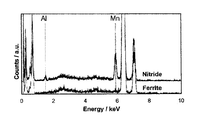
- FIG. 2 is a spectrum of TEM-EDS obtained from the ferrite which is a nitride and a parent phase. From FIG. 2, it can be seen that the nitride observed in FIG. 1 is a nitride mainly composed of Mn and Al.
- test numbers 1 to 5 which are comparative examples that deviate from the chemical composition defined in the present invention, all resulted in poor fatigue properties.
- Sample No. 1 has a low C content and insufficient precipitation of carbides in the base material, so that the base material hardness is low and fatigue characteristics are inferior.
- Sample No. 2 has a low Mn content, so that the solid solution nitrogen entering from the surface was not consumed as nitride near the surface, but the hardening depth was sufficient, but the size of the formed nitride was small, The number density was also lowered. Therefore, precipitation strengthening is not sufficient, surface hardness is lowered, and fatigue properties are inferior.
- Sample No. 3 had a low Al content, and the nitride formation was not sufficiently promoted, resulting in a low number density and insufficient precipitation strengthening of the surface layer. Therefore, surface hardness becomes low and fatigue characteristics are inferior.
- sample No. 4 had a high Al content, the Mn concentration in the nitride was relatively low, and a nitride having a crystal composition of M1N1 was formed. Therefore, the dissolved nitrogen that has entered from the surface is consumed in the vicinity of the sample surface, and the hardening depth is reduced, resulting in poor fatigue characteristics.
- Sample No. 5 has a low Ti content and insufficient precipitation of carbides in the base material, so that the base material hardness is low and fatigue properties are inferior.
- Test Nos. 10 and 11 the chemical composition satisfies the provisions of the present invention, but the soft nitriding conditions were inadequate, so that the nitride precipitation form at a depth of 50 ⁇ m from the outermost surface is that of the present invention.
- This is a comparative example that is out of regulation.
- the precipitation strengthening was small because the size of the deposited nitride was large, misalignment had progressed, and the number density was small. As a result, the surface hardness becomes low and the fatigue characteristics are inferior.
- Sample Nos. 6 to 9 which are examples of the present invention that satisfy all the requirements of the present invention, have a surface hardness of 600 HV or more at a depth of 50 ⁇ m from the outermost surface, and a cured depth of 0. It can be seen that it is as large as 35 ⁇ m or more, and the hardness of the base material exceeds 200 HV, and it has good fatigue characteristics.
- the present invention it is excellent in press formability such as stretch flangeability and hole-expanding property before soft nitriding without impairing productivity and economy, and after the soft nitriding treatment has a sufficient thickness from the surface.
- a nitrocarburized steel having a hardened layer and excellent fatigue characteristics can be obtained.
- the nitrocarburized steel sheet and nitrocarburized steel of the present invention having such characteristics are suitable for use as general structural parts such as automobile parts.
Landscapes
- Chemical & Material Sciences (AREA)
- Engineering & Computer Science (AREA)
- Materials Engineering (AREA)
- Mechanical Engineering (AREA)
- Metallurgy (AREA)
- Organic Chemistry (AREA)
- Thermal Sciences (AREA)
- Physics & Mathematics (AREA)
- Crystallography & Structural Chemistry (AREA)
- Chemical Kinetics & Catalysis (AREA)
- General Chemical & Material Sciences (AREA)
- Heat Treatment Of Sheet Steel (AREA)
- Solid-Phase Diffusion Into Metallic Material Surfaces (AREA)
- Heat Treatment Of Steel (AREA)
Abstract
Priority Applications (9)
| Application Number | Priority Date | Filing Date | Title |
|---|---|---|---|
| BR112016029006A BR112016029006A2 (pt) | 2014-06-13 | 2015-06-15 | chapa de aço para tratamento de nitretação suave, método de fabricação da mesma e aço nitretado suave |
| KR1020177000662A KR101899739B1 (ko) | 2014-06-13 | 2015-06-15 | 연질화 처리용 강판 및 그 제조 방법과 연질화 처리 강 |
| US15/318,153 US10344371B2 (en) | 2014-06-13 | 2015-06-15 | Steel sheet for soft-nitriding treatment, method of manufacturing same, and soft-nitrided steel |
| EP15807136.5A EP3141627B1 (fr) | 2014-06-13 | 2015-06-15 | Tôle d'acier pour traitement de nitruration doux, son procédé de fabrication et acier nitruré par nitruration douce |
| JP2016527900A JP6323554B2 (ja) | 2014-06-13 | 2015-06-15 | 軟窒化処理用鋼板およびその製造方法と軟窒化処理鋼 |
| ES15807136T ES2748699T3 (es) | 2014-06-13 | 2015-06-15 | Lámina de acero para tratamiento de nitruración suave, método para fabricarla y acero con nitruración suave |
| PL15807136T PL3141627T3 (pl) | 2014-06-13 | 2015-06-15 | Blacha stalowa cienka do obróbki przez azotowanie krótkookresowe, sposób jej wytwarzania i stal poddana azotowaniu krótkookresowemu |
| CN201580031507.6A CN106460121B (zh) | 2014-06-13 | 2015-06-15 | 软氮化处理用钢板及其制造方法和软氮化处理钢 |
| MX2016015656A MX379116B (es) | 2014-06-13 | 2015-06-15 | Lámina de acero de nitruración blanda, método para fabricar la misma, y acero nitrurado blando. |
Applications Claiming Priority (4)
| Application Number | Priority Date | Filing Date | Title |
|---|---|---|---|
| JP2014-122568 | 2014-06-13 | ||
| JP2014122568 | 2014-06-13 | ||
| JP2014-209974 | 2014-10-14 | ||
| JP2014209974 | 2014-10-14 |
Publications (1)
| Publication Number | Publication Date |
|---|---|
| WO2015190618A1 true WO2015190618A1 (fr) | 2015-12-17 |
Family
ID=54833697
Family Applications (1)
| Application Number | Title | Priority Date | Filing Date |
|---|---|---|---|
| PCT/JP2015/067217 Ceased WO2015190618A1 (fr) | 2014-06-13 | 2015-06-15 | Tôle d'acier de nitruration douce, son procédé de fabrication et acier nitruré par nitruration douce |
Country Status (11)
| Country | Link |
|---|---|
| US (1) | US10344371B2 (fr) |
| EP (1) | EP3141627B1 (fr) |
| JP (1) | JP6323554B2 (fr) |
| KR (1) | KR101899739B1 (fr) |
| CN (1) | CN106460121B (fr) |
| BR (1) | BR112016029006A2 (fr) |
| ES (1) | ES2748699T3 (fr) |
| MX (1) | MX379116B (fr) |
| PL (1) | PL3141627T3 (fr) |
| TW (1) | TWI539011B (fr) |
| WO (1) | WO2015190618A1 (fr) |
Cited By (2)
| Publication number | Priority date | Publication date | Assignee | Title |
|---|---|---|---|---|
| WO2017094876A1 (fr) | 2015-12-04 | 2017-06-08 | 新日鐵住金株式会社 | Composant de plaque nitrurée et son procédé de fabrication |
| JPWO2022176984A1 (fr) * | 2021-02-18 | 2022-08-25 |
Citations (7)
| Publication number | Priority date | Publication date | Assignee | Title |
|---|---|---|---|---|
| JPH10306343A (ja) * | 1997-04-28 | 1998-11-17 | Kobe Steel Ltd | 冷間鍛造性及び耐ピッチング性に優れた軟窒化用鋼 |
| JP2002069572A (ja) * | 2000-08-29 | 2002-03-08 | Nippon Steel Corp | 曲げ疲労強度に優れた軟窒化用鋼 |
| JP2004003010A (ja) * | 2002-04-26 | 2004-01-08 | Nkk Bars & Shapes Co Ltd | 疲労特性に優れた軟窒化部品およびその製造方法 |
| JP2011236449A (ja) * | 2010-05-06 | 2011-11-24 | Kobe Steel Ltd | 機械構造用鋼、および、その製造方法、並びに、機械構造用鋼を用いた加工部品製造方法 |
| WO2012070349A1 (fr) * | 2010-11-22 | 2012-05-31 | 住友金属工業株式会社 | Acier non traité thermiquement pour une nitruration douce et composant nitruré par nitruration douce |
| WO2012141297A1 (fr) * | 2011-04-13 | 2012-10-18 | 新日本製鐵株式会社 | Acier laminé à chaud pour un nitrocarburation gazeuse et son procédé de fabrication |
| WO2013077298A1 (fr) * | 2011-11-21 | 2013-05-30 | 新日鐵住金株式会社 | Feuille d'acier laminée à chaud pour nitruration et feuille d'acier laminée à froid pour nitruration avec une excellente résistance à la fatigue et procédé de fabrication pour celles-ci, ainsi que pièces automobiles d'une excellente résistance à la fatigue les utilisant |
Family Cites Families (9)
| Publication number | Priority date | Publication date | Assignee | Title |
|---|---|---|---|---|
| JP2906996B2 (ja) | 1994-04-20 | 1999-06-21 | 日本鋼管株式会社 | 冷間鍛造性及び疲労特性に優れた窒化鋼部材の製造方法 |
| JP2907011B2 (ja) | 1994-08-03 | 1999-06-21 | 日本鋼管株式会社 | 熱処理歪みの少ない窒化鋼部材の製造方法 |
| KR100222239B1 (ko) | 1995-07-12 | 1999-10-01 | 와다 아끼히로 | 성형성과 질화성이 우수한 질화용 강판 및 그의 프레스 성형체 |
| JP3153108B2 (ja) | 1995-07-12 | 2001-04-03 | 新日本製鐵株式会社 | 深絞り性に優れた窒化用鋼板およびそのプレス成形体 |
| JPH0925543A (ja) | 1995-07-12 | 1997-01-28 | Nippon Steel Corp | 成形性に優れた窒化用鋼板およびそのプレス成形体 |
| JP3840939B2 (ja) | 2001-09-26 | 2006-11-01 | 住友金属工業株式会社 | 軟窒化処理用鋼およびその製造方法 |
| JP3928454B2 (ja) | 2002-03-26 | 2007-06-13 | Jfeスチール株式会社 | 窒化処理用薄鋼板 |
| JP5034803B2 (ja) | 2007-09-12 | 2012-09-26 | Jfeスチール株式会社 | 軟窒化処理用鋼板およびその製造方法 |
| JP5614330B2 (ja) | 2011-02-28 | 2014-10-29 | Jfeスチール株式会社 | 軟窒化処理用鋼板およびその製造方法 |
-
2015
- 2015-06-15 JP JP2016527900A patent/JP6323554B2/ja active Active
- 2015-06-15 KR KR1020177000662A patent/KR101899739B1/ko not_active Expired - Fee Related
- 2015-06-15 WO PCT/JP2015/067217 patent/WO2015190618A1/fr not_active Ceased
- 2015-06-15 TW TW104119362A patent/TWI539011B/zh not_active IP Right Cessation
- 2015-06-15 PL PL15807136T patent/PL3141627T3/pl unknown
- 2015-06-15 MX MX2016015656A patent/MX379116B/es unknown
- 2015-06-15 US US15/318,153 patent/US10344371B2/en not_active Expired - Fee Related
- 2015-06-15 ES ES15807136T patent/ES2748699T3/es active Active
- 2015-06-15 EP EP15807136.5A patent/EP3141627B1/fr active Active
- 2015-06-15 BR BR112016029006A patent/BR112016029006A2/pt active Search and Examination
- 2015-06-15 CN CN201580031507.6A patent/CN106460121B/zh not_active Expired - Fee Related
Patent Citations (7)
| Publication number | Priority date | Publication date | Assignee | Title |
|---|---|---|---|---|
| JPH10306343A (ja) * | 1997-04-28 | 1998-11-17 | Kobe Steel Ltd | 冷間鍛造性及び耐ピッチング性に優れた軟窒化用鋼 |
| JP2002069572A (ja) * | 2000-08-29 | 2002-03-08 | Nippon Steel Corp | 曲げ疲労強度に優れた軟窒化用鋼 |
| JP2004003010A (ja) * | 2002-04-26 | 2004-01-08 | Nkk Bars & Shapes Co Ltd | 疲労特性に優れた軟窒化部品およびその製造方法 |
| JP2011236449A (ja) * | 2010-05-06 | 2011-11-24 | Kobe Steel Ltd | 機械構造用鋼、および、その製造方法、並びに、機械構造用鋼を用いた加工部品製造方法 |
| WO2012070349A1 (fr) * | 2010-11-22 | 2012-05-31 | 住友金属工業株式会社 | Acier non traité thermiquement pour une nitruration douce et composant nitruré par nitruration douce |
| WO2012141297A1 (fr) * | 2011-04-13 | 2012-10-18 | 新日本製鐵株式会社 | Acier laminé à chaud pour un nitrocarburation gazeuse et son procédé de fabrication |
| WO2013077298A1 (fr) * | 2011-11-21 | 2013-05-30 | 新日鐵住金株式会社 | Feuille d'acier laminée à chaud pour nitruration et feuille d'acier laminée à froid pour nitruration avec une excellente résistance à la fatigue et procédé de fabrication pour celles-ci, ainsi que pièces automobiles d'une excellente résistance à la fatigue les utilisant |
Non-Patent Citations (1)
| Title |
|---|
| See also references of EP3141627A4 * |
Cited By (7)
| Publication number | Priority date | Publication date | Assignee | Title |
|---|---|---|---|---|
| WO2017094876A1 (fr) | 2015-12-04 | 2017-06-08 | 新日鐵住金株式会社 | Composant de plaque nitrurée et son procédé de fabrication |
| KR20180086486A (ko) | 2015-12-04 | 2018-07-31 | 신닛테츠스미킨 카부시키카이샤 | 질화 플레이트 부품 및 그 제조 방법 |
| US10808311B2 (en) | 2015-12-04 | 2020-10-20 | Nippon Steel Corporation | Nitrided plate part and method for producing the same |
| JPWO2022176984A1 (fr) * | 2021-02-18 | 2022-08-25 | ||
| WO2022176984A1 (fr) * | 2021-02-18 | 2022-08-25 | 日本製鉄株式会社 | Tôle d'acier pour nitruration douce en phase gazeuse |
| KR20230113593A (ko) | 2021-02-18 | 2023-07-31 | 닛폰세이테츠 가부시키가이샤 | 가스 연질화용 강판 |
| JP7633558B2 (ja) | 2021-02-18 | 2025-02-20 | 日本製鉄株式会社 | ガス軟窒化用鋼板 |
Also Published As
| Publication number | Publication date |
|---|---|
| JPWO2015190618A1 (ja) | 2017-04-20 |
| CN106460121A (zh) | 2017-02-22 |
| JP6323554B2 (ja) | 2018-05-16 |
| EP3141627A4 (fr) | 2018-02-07 |
| MX379116B (es) | 2025-03-10 |
| EP3141627A1 (fr) | 2017-03-15 |
| EP3141627B1 (fr) | 2019-08-14 |
| ES2748699T3 (es) | 2020-03-17 |
| US10344371B2 (en) | 2019-07-09 |
| PL3141627T3 (pl) | 2020-03-31 |
| CN106460121B (zh) | 2019-06-07 |
| KR20170015991A (ko) | 2017-02-10 |
| TW201604290A (zh) | 2016-02-01 |
| US20170130318A1 (en) | 2017-05-11 |
| KR101899739B1 (ko) | 2018-09-17 |
| BR112016029006A2 (pt) | 2017-08-22 |
| TWI539011B (zh) | 2016-06-21 |
| MX2016015656A (es) | 2017-04-13 |
Similar Documents
| Publication | Publication Date | Title |
|---|---|---|
| CN107406959B (zh) | 耐磨性和耐点蚀性优异的氮化处理部件和软氮化处理部件以及氮化处理方法、软氮化处理方法 | |
| CN110036129B (zh) | 软氮化用钢和部件 | |
| JP5821771B2 (ja) | 冷間鍛造用熱間圧延棒鋼または線材 | |
| JP4712838B2 (ja) | 耐水素脆化特性および加工性に優れた高強度冷延鋼板 | |
| WO2012067181A1 (fr) | Acier pour des objectifs de nitruration et élément nitruré | |
| CN110475892B (zh) | 高强度冷轧钢板及其制造方法 | |
| CN102089452A (zh) | 软氮化用钢和软氮化处理部件 | |
| KR101626227B1 (ko) | 피로 강도가 우수한 질화용 열연 강판, 질화용 냉연 강판 및 그들의 제조 방법 및 그들을 사용한 피로 강도가 우수한 자동차 부품 | |
| CN113631746B (zh) | 渗碳部件及其制造方法 | |
| JP5630523B2 (ja) | 窒化処理用鋼板およびその製造方法 | |
| CN110938773B (zh) | 软氮化处理用钢板及其制造方法 | |
| EP2868764B1 (fr) | Tôle d'acier destinée à la nitruration douce et son procédé de production | |
| JP6323554B2 (ja) | 軟窒化処理用鋼板およびその製造方法と軟窒化処理鋼 | |
| KR20180014092A (ko) | 고강도 박강판 및 그 제조 방법 | |
| JP5614329B2 (ja) | 軟窒化処理用鋼板およびその製造方法 | |
| JP5614330B2 (ja) | 軟窒化処理用鋼板およびその製造方法 |
Legal Events
| Date | Code | Title | Description |
|---|---|---|---|
| 121 | Ep: the epo has been informed by wipo that ep was designated in this application |
Ref document number: 15807136 Country of ref document: EP Kind code of ref document: A1 |
|
| ENP | Entry into the national phase |
Ref document number: 2016527900 Country of ref document: JP Kind code of ref document: A |
|
| WWE | Wipo information: entry into national phase |
Ref document number: MX/A/2016/015656 Country of ref document: MX |
|
| REEP | Request for entry into the european phase |
Ref document number: 2015807136 Country of ref document: EP |
|
| WWE | Wipo information: entry into national phase |
Ref document number: 2015807136 Country of ref document: EP |
|
| WWE | Wipo information: entry into national phase |
Ref document number: 15318153 Country of ref document: US |
|
| NENP | Non-entry into the national phase |
Ref country code: DE |
|
| REG | Reference to national code |
Ref country code: BR Ref legal event code: B01A Ref document number: 112016029006 Country of ref document: BR |
|
| ENP | Entry into the national phase |
Ref document number: 20177000662 Country of ref document: KR Kind code of ref document: A |
|
| ENP | Entry into the national phase |
Ref document number: 112016029006 Country of ref document: BR Kind code of ref document: A2 Effective date: 20161209 |