WO2016001981A1 - Dispositif de commande pour ascenseur et dispositif de commande de gestion de groupe d'ascenseurs - Google Patents
Dispositif de commande pour ascenseur et dispositif de commande de gestion de groupe d'ascenseurs Download PDFInfo
- Publication number
- WO2016001981A1 WO2016001981A1 PCT/JP2014/067413 JP2014067413W WO2016001981A1 WO 2016001981 A1 WO2016001981 A1 WO 2016001981A1 JP 2014067413 W JP2014067413 W JP 2014067413W WO 2016001981 A1 WO2016001981 A1 WO 2016001981A1
- Authority
- WO
- WIPO (PCT)
- Prior art keywords
- car
- floor
- call
- registered
- control device
- Prior art date
- Legal status (The legal status is an assumption and is not a legal conclusion. Google has not performed a legal analysis and makes no representation as to the accuracy of the status listed.)
- Ceased
Links
Images

Classifications
-
- B—PERFORMING OPERATIONS; TRANSPORTING
- B66—HOISTING; LIFTING; HAULING
- B66B—ELEVATORS; ESCALATORS OR MOVING WALKWAYS
- B66B1/00—Control systems of elevators in general
- B66B1/02—Control systems without regulation, i.e. without retroactive action
- B66B1/06—Control systems without regulation, i.e. without retroactive action electric
- B66B1/14—Control systems without regulation, i.e. without retroactive action electric with devices, e.g. push-buttons, for indirect control of movements
-
- B—PERFORMING OPERATIONS; TRANSPORTING
- B66—HOISTING; LIFTING; HAULING
- B66B—ELEVATORS; ESCALATORS OR MOVING WALKWAYS
- B66B1/00—Control systems of elevators in general
- B66B1/02—Control systems without regulation, i.e. without retroactive action
- B66B1/06—Control systems without regulation, i.e. without retroactive action electric
- B66B1/14—Control systems without regulation, i.e. without retroactive action electric with devices, e.g. push-buttons, for indirect control of movements
- B66B1/18—Control systems without regulation, i.e. without retroactive action electric with devices, e.g. push-buttons, for indirect control of movements with means for storing pulses controlling the movements of several cars or cages
Definitions
- the present invention relates to an elevator control device and an elevator group management control device.
- an elevator that assigns a car to a landing call when the landing call is registered, and this elevator responds to the landing call, detects that the car is assigned to a landing call in the direction opposite to its driving direction.
- Patent Document 1 Japanese Patent Document 1
- one of the plurality of cars is not stopped at the currently assigned call source floor, and then moved in the direction opposite to the direction from the source floor to the destination floor.
- a device for assigning a new call to such a car is also known in the art (see, for example, Patent Document 2).
- Patent Document 1 and Patent Document 2 do not assign a car in a traveling direction opposite to the direction of the hall call to the hall call, or oppose the hall call.
- the hall call is canceled.
- the present invention has been made to solve such a problem, and is an elevator that can improve driving efficiency when a hall call in both upward and downward directions occurs on the same floor.
- a control device and an elevator group management control device are obtained.
- the hall call registration device is provided at the landing of each floor where the elevator car can stop and can register the hall call in the upward and downward directions
- an elevator control device that controls the operation of the car, wherein the elevator control device is registered with both upward and downward landing calls by the landing call registration device on the same floor
- a car dispatching unit that determines whether or not to dispatch one of the cars at a time in response to the two-way hall call; and the car dispatching part that serves to place one of the cars in the two-way platform at a time. If it is determined that the call will be dispatched for a call, the call will be canceled when the car arrives at the floor where the two-way hall call is registered.
- a plurality of hall call registration devices that are provided at the landings of each floor where the elevator car can be stopped and that can register a landing destination call specifying a destination floor
- a group management control device that manages the operation of the car as a group
- the group management control device designates a destination floor above the floor by the hall call registration device on the same floor If a boarding destination call and a boarding destination call that designates a destination floor lower than the floor are registered, it is determined whether or not one car is assigned to both at once.
- the assigned car determining unit and the assigned car determining unit determine that one car is to be assigned to both at the same time, when the car arrives at the floor where both of them are registered
- a configuration that includes a deallocation unit for releasing the two.
- FIG. 1 and 2 relate to Embodiment 1 of the present invention.
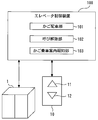
- FIG. 1 is a diagram showing an overall configuration of an elevator control device
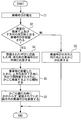
- FIG. 2 is a flowchart showing an operation flow of the elevator control device. .
- the elevator car 1 shown in FIG. 1 is installed in a hoistway (not shown) of the elevator so that it can be raised and lowered.
- the car 1 moves up and down in the hoistway across a plurality of floors of the building where the elevator is installed.
- the car 1 can be stopped on a plurality of floors of the building. Although only one car 1 is shown here, a plurality of cars 1 may be provided.
- the hall call registration apparatus 10 is installed in each of the halls of each floor.
- the hall call registration device 10 is for registering a hall call in a direction desired by a hall user.
- the hall call registration device 10 can register an upward hall call and a downward hall call.
- the hall call registration device 10 includes an upward button 11 and a downward button 12. Strictly speaking, the hall call registration device 10 on the upper floor and the lower floor only needs to include only one of the up button 11 and the down button 12.
- the up hall call is a call for calling the car 1 whose traveling direction is the upward direction to the floor where the hall call registration device 10 is installed.
- the downward landing call is a call for bringing the car 1 whose traveling direction is the downward direction to the floor where the landing call registration device 10 is installed.
- Only one hall call registration device 10 is shown in the figure, but a plurality of hall call registration devices 10 may be installed at halls on each floor as necessary.
- the operation of the car 1 is controlled by the elevator control device 100.
- the elevator control device 100 controls the operation of the car 1 to respond to the registered hall call.
- the elevator control device 100 includes a car dispatch unit 101, a call release unit 102, and a car boarding guide notification unit 103.
- the car dispatch unit 101 dispatches the car 1 that responds to the registered hall call.
- the landing call registration device 10 On a certain floor.
- the car dispatch unit 101 dispatches one car 1. Then, before the dispatched car 1 responds to the landing call, that is, before the dispatched car 1 arrives at the floor where the landing call is registered, the landing call on the same floor is made. Assume that the registration device 10 registers the other of the upward and downward hall calls.
- both the upward and downward landing calls (hereinafter simply referred to as “bidirectional landing calls”) are registered by the landing call registration device 10 on the same floor.
- the car dispatching unit 101 determines whether or not to dispatch one car 1 at a time (simultaneously) to a hall call in both directions.
- the car dispatching unit 101 always dispatches one car 1 at a time to a bi-directional hall call when a bi-directional hall call is registered by the hall call registration device 10 on the same floor. It may be determined.
- the car dispatching unit 101 decides not to dispatch one car 1 at a time for both directions. You may make it do.
- the call canceling unit 102 not only receives the hall call in the same direction as the traveling direction of the car 1, but also the boarding call.
- the hall call in the direction opposite to the traveling direction of the car 1 is also canceled. For this reason, after the car 1 stops once on the floor where the hall calls in both directions are registered, no hall call in any direction remains on the floor.
- the car 1 dispatched at one time for the two-way hall call is After stopping at the floor, the vehicle first travels to the destination floor in one of the vertical directions. After arriving at the destination floor in this one direction, the car 1 reverses the traveling direction. Then, the car 1 whose traveling direction is reversed travels to the destination floor in the other direction in the up and down direction. At this time, since the hall call in both directions is canceled when the vehicle first stops on the floor, the car 1 with the traveling direction reversed passes without stopping on the floor and moves in the other direction. I will head to the destination floor.
- the direction of travel of the car 1 at that time is the same as the traveling direction. Not only the user who registered the hall call but also the user who registered the hall call in the direction opposite to the traveling direction of the car 1 at that time must get on the car 1.
- the user who has registered the hall call in the direction opposite to the traveling direction of the car 1 at that time must go in the direction opposite to the destination floor desired by the user once.
- the car 1 moves in the direction opposite to the traveling direction.
- the time until the user who registered the hall call arrives at the desired destination floor can be shortened.
- the elevator control device 100 includes a car boarding guide notification unit 103.
- the car boarding guidance notifying unit 103 determines that the car dispatching unit 101 dispatches one car 1 at a time to the two-way hall call registered by the hall call registration device 10 on the same floor, Regardless of the travel direction of the car 1, when the car 1 arrives at the floor, the user who registered the hall call in the upper direction and the user who registered the hall call in the lower direction A notification is made to urge both of the passengers to get on the car 1.
- the car dispatch unit 101 decides to dispatch one car 1 at a time to the two-way hall call registered by the hall call registration device 10 on the same floor, It is not necessary to consider the current traveling direction for the car 1 to be dispatched. In both directions, the call for the car 1 is always the same as the direction of the car 1 and the direction of the car 1 regardless of the current direction of travel. This is because the direction of the hall call and the traveling direction of the car 1 are opposite.
- step S1 when the hall call registration device 10 is operated at a certain arbitrary floor and a hall call is registered (step S1), the process proceeds to step S2.
- step S ⁇ b> 2 the car dispatch unit 101 confirms whether or not hall calls in both the upward direction and the downward direction are registered on any same floor. If the hall call in both the upward and downward directions is not registered on any one of the same floors, the process proceeds to step S3.
- step S3 only one of the upward hall call and the downward hall call is registered in any one of the same floors. Therefore, the car dispatch unit 101 dispatches the car 1 that has the same traveling direction as the registered hall call direction to the hall call. The car 1 thus dispatched responds to the hall call. This completes the series of operation flows.
- step S4 the car dispatching unit 101 determines that one car 1 is dispatched at the same time (at a time) for both-way hall calls. Then, the dispatched car 1 responds to the hall calls in both directions at the same time.
- step S5 when the car 1 dispatched in step S4 arrives at the floor, i.e., the boarding floor, the car boarding guidance notifying unit 103 notifies each of the users heading upward and downward. A notification is given to encourage the user to get into the car 1. After step S5, the process proceeds to step S6.
- step S6 the call canceling unit 102 cancels both hall calls registered in the boarding floor regardless of the traveling direction of the car 1 that has arrived. And a series of operation
- FIG. 3 and 4 relate to Embodiment 2 of the present invention.
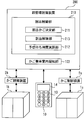
- FIG. 3 is a diagram showing the overall configuration of the elevator group management control device, and
- FIG. 4 shows the flow of operation of the elevator group management control device.
- a plurality of cars are provided.
- two cars a first car 1a and a second car 1b
- the use of two cars is merely an example, and three or more cars may be provided.
- the first car 1a and the second car 1b will be collectively referred to as "car 1".
- Each of these cars 1 is lifted and lowered in the hoistway between a plurality of floors of the building as in the first embodiment.
- Each car 1 can be stopped at a plurality of floors of the building.
- the hall call registration apparatus 10 is installed in each of the halls of each floor.
- the hall call registration device 10 is for registering a hall destination call to a destination floor desired by a hall user.
- the hall call registration device 10 can register a hall destination call specifying a destination floor. For this reason, the hall call registration device 10 includes a numeric keypad 13.
- the numeric keypad 13 includes numeric keys from “0” to “9”.
- the hall call registration device 10 includes a display unit 14 including a liquid crystal display, for example. The contents entered by the user operating the numeric keypad 13 are displayed on the display unit 14.
- the landing destination call is a call that calls the car 1 that will travel to the designated destination floor to the floor where the landing call registration device 10 is installed.
- the destination floor specified here is either the floor above the floor where the hall call registration device 10 is installed or the floor below the floor. Accordingly, landing destination calls are broadly classified into two types: those that specify a destination floor that is higher than the floor and those that specify a destination floor that is lower than the floor.
- the operation of the plurality of cars 1 is managed as a group (bank) by the group management control device 200.
- the operation of each of the plurality of cars 1 is controlled by a car control device provided for each car 1 under the management of the group management control device 200. That is, the first car control device 2a controls the operation of the first car 1a under the management of the group management control device 200.
- the second car control device 2b controls the operation of the second car 1b under the management of the group management control device 200.
- the first car control device 2a and the second car control device 2b are collectively referred to as "car control device 2".
- the group management control device 200 controls the operation of the car 1 to respond to the registered landing destination call.
- the group management control device 200 includes an allocation control unit 210 and a car boarding guide notification unit 103.
- the assignment control unit 210 is mainly in charge of controlling which one of the plurality of cars 1 is assigned to the registered landing destination call.
- the allocation control unit 210 includes an allocation car determination unit 211, an expected waiting time calculation unit 212, and an allocation cancellation unit 213.
- the assigned car determination unit 211 determines a car 1 (hereinafter referred to as “assigned car”) to be assigned to the registered landing destination call. To do. This determination is made by selecting one vehicle from a plurality of cars 1 managed by the group management control device 200 as a group.
- the optimum car 1 is selected in consideration of the current position and current traveling direction of each car 1, the call assignment status to each car 1, and the like.
- the “optimum” can be realized such that the driving efficiency is the highest.
- the “optimum” can be realized such that the average waiting time of the user is minimized.
- this latter example will be described.
- the expected waiting time calculation unit 212 calculates the average expected waiting time of the users at each landing when each of the plurality of cars 1 is assigned to the landing destination call registered by the landing call registration device 10. . Then, the assigned car determination unit 211 determines the car 1 to be assigned to the landing destination call based on the expected waiting time calculated by the expected waiting time calculating unit 212.
- a response command to the landing destination call is sent to the car management device 200 that controls the assigned car. Is output from.
- the car control device 2 controls the operation of the car 1 (assigned car) so as to respond to the landing destination call.
- the hall call registration device 10 of a certain floor registers one of the hall destination call that designates the destination floor above the floor and the hall destination call that designates the destination floor lower than the floor.
- the assigned car determination unit 211 determines an assigned car for the registered landing destination call.
- the landing call registration device 10 of the same floor It is assumed that the other one of the hall destination call specifying the destination floor higher than the floor and the hall destination call specifying the destination floor lower than the floor is registered.
- a hall destination call that designates a destination floor above the floor by the hall call registration device 10 on the same floor and a hall destination call that designates a destination floor below the floor is registered.
- the assigned car determination unit 211 determines whether or not one car 1 is assigned to a landing destination call in both directions at once.
- the assigned car determination unit 211 registers one car 1 at a time by the hall call registration device 10 on the same floor based on the expected waiting time calculated by the expected waiting time calculation unit 212. It is determined whether or not to assign to the destination call in both directions.
- the expected waiting time calculation unit 212 estimates the expected waiting time when one car 1 is assigned at a time to the landing destination calls in both directions registered by the hall call registration device 10 on the same floor (hereinafter referred to as “the waiting time”). , “First expected waiting time”). Further, the expected waiting time calculation unit 212 expects the waiting time when the car 1 is assigned separately to each of the two-way hall destination calls registered by the hall call registration device 10 on the same floor. (Hereinafter referred to as “second expected waiting time”) is calculated.
- the assigned car determination unit 211 compares the first expected waiting time with the second expected waiting time. When the first expected waiting time is shorter than the second expected waiting time, the assigned car determination unit 211 determines that one car 1 is assigned to a landing destination call in both directions at once.
- the expected waiting time calculation unit 212 registers an upward hall call at the floor landing.
- the expected waiting time of the user (hereinafter referred to as “third expected waiting time”) is calculated.
- the expected waiting time calculation unit 212 calculates the expected waiting time (hereinafter referred to as “fourth expected waiting time”) of the user who has registered a downward hall call at the landing on the floor.
- the assigned car determination unit 211 assigns one car 1 having the smallest sum of the third expected waiting time and the fourth expected waiting time to the landing destination call in both directions registered on the floor. To determine the allocation basket to be allocated at once.
- the allocation cancellation unit 213 is determined by the allocation car determination unit 211 to allocate one car 1 at a time to the landing destination calls in both directions registered by the hall call registration device 10 on the same floor. In this case, when the car 1 arrives at the floor, the landing destination calls in both directions are canceled at once.
- the deallocating unit 213 not only performs the landing destination call in the same direction as the traveling direction of the assigned car but also the assigned destination call. Also cancel the landing destination call in the direction opposite to the direction of travel of the car. For this reason, after the assigned car stops once on the floor where the landing destination call in both directions is registered, no landing destination call in any direction remains on the floor.
- the assigned car first stops after stopping on the floor. Drive to the destination floor in one of the up and down directions. After arriving at the destination floor in this one direction, the assigned car reverses the direction of travel. Then, the assigned car whose traveling direction is reversed travels to the destination floor in the other direction of the up and down direction. At this time, since the landing destination call in both directions was canceled when it first stopped on the floor, the assigned car that reversed the traveling direction passed without stopping on the floor and moved in the other direction. I will head to the destination floor.
- a user who has registered a destination call in a direction opposite to the traveling direction of the car 1 at that time must go in a direction opposite to the destination floor desired by the user.
- a landing call in the direction opposite to the traveling direction of the assigned car is made. Time until the registered user arrives at the desired destination floor can be shortened.
- the group management control device 200 includes a car boarding guide notification unit 103.
- the car boarding guidance notifying unit 103 is determined by the allocation car determining unit 211 to allocate one car 1 at a time to the landing destination calls in both directions registered by the hall call registration device 10 on the same floor. If the car 1 arrives at the floor, the destination destination call specifying the destination floor above the floor at the landing of the floor is registered regardless of the traveling direction of the car 1 To the registered user and the user who has registered a downward hall call specifying a destination floor below the floor is notified that the user is prompted to board the car 1.
- the assigned car determination unit 211 determines to assign one car 1 at a time to the two-way hall destination call registered by the hall call registration device 10 on the same floor, the two-way hall There is no need to consider the current traveling direction for the car 1 assigned to the destination call.
- step S11 when the hall call registration device 10 is operated on an arbitrary floor to register a hall destination call (step S11), the process proceeds to step S12.
- step S12 the assigned car determination unit 211 confirms whether or not landing destination calls in both directions that are upward and downward on any same floor are registered.
- the process proceeds to step S13.
- step S13 in any given floor, only one of the up-facing hall destination call and the down-facing hall destination call is registered. Therefore, the assigned car determination unit 211 determines the car 1 that has the same traveling direction as the direction of the registered landing destination call as the assigned car for the landing call. The assigned car thus determined responds to the landing destination call. This completes the series of operation flows.
- step S12 if the hall call in both the upward and downward directions is registered on any same floor, the process proceeds to step S14.
- step S14 the assigned car determination unit 211 compares the first expected waiting time calculated by the expected waiting time calculating unit 212 with the second expected waiting time. If the first expected waiting time is not shorter than the second expected waiting time, the process proceeds to step S13.
- step S15 the assigned car determination unit 211 determines that one car 1 is assigned to the landing destination calls in both directions simultaneously (at the same time). Then, the assigned car 1 responds simultaneously to the landing destination calls in both directions.
- step S16 when the car 1 dispatched in step S15 arrives at the floor, that is, the boarding floor, the car boarding guidance notifying unit 103 notifies each of the users heading upward and downward. A notification is given to encourage the user to get into the car 1. After step S16, the process proceeds to step S17.
- step S17 regardless of the traveling direction of the car 1 that has arrived, the deallocation unit 213 cancels the bi-directional landing destination call registered on the boarding floor. And a series of operation
- the present invention can be used for an elevator control device and an elevator group management control device that allocate a car to a landing call or assign a car to a landing call when a landing call or a landing destination call is registered. .
Landscapes
- Engineering & Computer Science (AREA)
- Automation & Control Theory (AREA)
- Elevator Control (AREA)
Abstract
L'invention concerne un dispositif de commande pour ascenseur et un dispositif de commande de gestion de groupe d'ascenseurs, de telle sorte qu'une augmentation de l'efficacité de fonctionnement peut être obtenue lorsque des appels de palier à la fois pour monter et pour descendre sont effectués à un même étage. A cet effet, le dispositif de commande pour ascenseur est muni d'un dispositif d'enregistrement d'appel de palier (10) qui est disposé au niveau du palier de chaque étage auquel une cage d'ascenseur (1) peut s'arrêter, et qui permet l'enregistrement d'un appel de palier pour monter et pour descendre, et un dispositif de commande d'ascenseur (100) qui commande le fonctionnement de la cage. Le dispositif de commande d'ascenseur comporte : une unité d'allocation de cage (101) qui détermine, lorsque des appels à la fois pour monter et pour descendre sont enregistrés par le dispositif d'enregistrement d'appel de palier au même étage, si une seule cage doit être allouée pour les appels de palier pour les deux directions à la fois ; et une unité d'annulation d'appel (102) qui, lorsqu'il est déterminé par l'unité d'allocation de cage qu'une seule cage doit être allouée pour les appels de palier pour les deux directions à la fois, annule les appels de palier pour les deux directions lors de l'arrivée de la cage à l'étage auquel les appels de palier pour les deux directions ont été enregistrés.
Priority Applications (1)
| Application Number | Priority Date | Filing Date | Title |
|---|---|---|---|
| PCT/JP2014/067413 WO2016001981A1 (fr) | 2014-06-30 | 2014-06-30 | Dispositif de commande pour ascenseur et dispositif de commande de gestion de groupe d'ascenseurs |
Applications Claiming Priority (1)
| Application Number | Priority Date | Filing Date | Title |
|---|---|---|---|
| PCT/JP2014/067413 WO2016001981A1 (fr) | 2014-06-30 | 2014-06-30 | Dispositif de commande pour ascenseur et dispositif de commande de gestion de groupe d'ascenseurs |
Publications (1)
| Publication Number | Publication Date |
|---|---|
| WO2016001981A1 true WO2016001981A1 (fr) | 2016-01-07 |
Family
ID=55018583
Family Applications (1)
| Application Number | Title | Priority Date | Filing Date |
|---|---|---|---|
| PCT/JP2014/067413 Ceased WO2016001981A1 (fr) | 2014-06-30 | 2014-06-30 | Dispositif de commande pour ascenseur et dispositif de commande de gestion de groupe d'ascenseurs |
Country Status (1)
| Country | Link |
|---|---|
| WO (1) | WO2016001981A1 (fr) |
Cited By (4)
| Publication number | Priority date | Publication date | Assignee | Title |
|---|---|---|---|---|
| WO2017216907A1 (fr) * | 2016-06-15 | 2017-12-21 | 三菱電機株式会社 | Système d'ascenseur |
| JPWO2018016031A1 (ja) * | 2016-07-20 | 2018-09-27 | 三菱電機株式会社 | エレベータ群管理制御装置およびエレベータ群管理制御方法 |
| JP2019151420A (ja) * | 2018-02-28 | 2019-09-12 | フジテック株式会社 | 情報通信端末、プログラム、エレベータの群管理システム |
| CN114506755A (zh) * | 2020-11-17 | 2022-05-17 | 株式会社日立制作所 | 电梯的呼梯动作控制装置和方法 |
Citations (3)
| Publication number | Priority date | Publication date | Assignee | Title |
|---|---|---|---|---|
| JPS6131704B2 (fr) * | 1980-05-23 | 1986-07-22 | Mitsubishi Electric Corp | |
| JPS6279178A (ja) * | 1985-09-30 | 1987-04-11 | 株式会社東芝 | エレベ−タの群管理制御方法 |
| JP2009051577A (ja) * | 2007-08-23 | 2009-03-12 | Mitsubishi Electric Building Techno Service Co Ltd | エレベータの制御装置 |
-
2014
- 2014-06-30 WO PCT/JP2014/067413 patent/WO2016001981A1/fr not_active Ceased
Patent Citations (3)
| Publication number | Priority date | Publication date | Assignee | Title |
|---|---|---|---|---|
| JPS6131704B2 (fr) * | 1980-05-23 | 1986-07-22 | Mitsubishi Electric Corp | |
| JPS6279178A (ja) * | 1985-09-30 | 1987-04-11 | 株式会社東芝 | エレベ−タの群管理制御方法 |
| JP2009051577A (ja) * | 2007-08-23 | 2009-03-12 | Mitsubishi Electric Building Techno Service Co Ltd | エレベータの制御装置 |
Cited By (5)
| Publication number | Priority date | Publication date | Assignee | Title |
|---|---|---|---|---|
| WO2017216907A1 (fr) * | 2016-06-15 | 2017-12-21 | 三菱電機株式会社 | Système d'ascenseur |
| JPWO2017216907A1 (ja) * | 2016-06-15 | 2018-06-21 | 三菱電機株式会社 | エレベータシステム |
| JPWO2018016031A1 (ja) * | 2016-07-20 | 2018-09-27 | 三菱電機株式会社 | エレベータ群管理制御装置およびエレベータ群管理制御方法 |
| JP2019151420A (ja) * | 2018-02-28 | 2019-09-12 | フジテック株式会社 | 情報通信端末、プログラム、エレベータの群管理システム |
| CN114506755A (zh) * | 2020-11-17 | 2022-05-17 | 株式会社日立制作所 | 电梯的呼梯动作控制装置和方法 |
Similar Documents
| Publication | Publication Date | Title |
|---|---|---|
| JP5761454B2 (ja) | エレベーターシステム | |
| CN110116943B (zh) | 电梯群管理系统和电梯群管理方法 | |
| JPWO2016142968A1 (ja) | エレベーターの群管理制御装置 | |
| JP4189013B2 (ja) | エレベータの制御装置 | |
| US9663324B2 (en) | Elevator system with an elevator group-control device for controlling a plurality of cars | |
| JP5705704B2 (ja) | エレベータ群管理システムおよびその制御方法 | |
| WO2018066057A1 (fr) | Dispositif de commande d'ascenseur et dispositif de commande de corps mobile autonome | |
| CN100503409C (zh) | 电梯组群管理控制装置 | |
| JP2016159993A (ja) | エレベータ装置 | |
| JP2015059032A (ja) | エレベータ群管理制御装置 | |
| WO2013080276A1 (fr) | Système d'ascenseur | |
| JP6202213B2 (ja) | エレベーターシステム | |
| JP2016166080A (ja) | エレベータの群管理制御装置 | |
| JPWO2018025376A1 (ja) | エレベータの利用者案内装置 | |
| CN107428494B (zh) | 电梯组群管理系统 | |
| JPWO2009081464A1 (ja) | エレベータ群管理システム | |
| JP6355136B2 (ja) | エレベータ制御装置およびエレベータシステム | |
| JP2012192998A (ja) | エレベータシステム | |
| JP5665078B2 (ja) | エレベータ | |
| JP2015199564A (ja) | エレベーター制御装置 | |
| JP2009051577A (ja) | エレベータの制御装置 | |
| JP5951737B2 (ja) | エレベータの群管理制御装置 | |
| WO2016129011A1 (fr) | Système d'ascenseur | |
| JP6624159B2 (ja) | エレベータの群管理システム | |
| JP7022830B2 (ja) | マルチカーエレベーター |
Legal Events
| Date | Code | Title | Description |
|---|---|---|---|
| 121 | Ep: the epo has been informed by wipo that ep was designated in this application |
Ref document number: 14896766 Country of ref document: EP Kind code of ref document: A1 |
|
| NENP | Non-entry into the national phase |
Ref country code: DE |
|
| NENP | Non-entry into the national phase |
Ref country code: JP |
|
| 122 | Ep: pct application non-entry in european phase |
Ref document number: 14896766 Country of ref document: EP Kind code of ref document: A1 |