WO2016009496A1 - Module à transistor de puissance - Google Patents
Module à transistor de puissance Download PDFInfo
- Publication number
- WO2016009496A1 WO2016009496A1 PCT/JP2014/068804 JP2014068804W WO2016009496A1 WO 2016009496 A1 WO2016009496 A1 WO 2016009496A1 JP 2014068804 W JP2014068804 W JP 2014068804W WO 2016009496 A1 WO2016009496 A1 WO 2016009496A1
- Authority
- WO
- WIPO (PCT)
- Prior art keywords
- conductive pattern
- pattern
- power transistor
- transistor module
- feeding point
- Prior art date
- Legal status (The legal status is an assumption and is not a legal conclusion. Google has not performed a legal analysis and makes no representation as to the accuracy of the status listed.)
- Ceased
Links
Images



Classifications
-
- H—ELECTRICITY
- H10—SEMICONDUCTOR DEVICES; ELECTRIC SOLID-STATE DEVICES NOT OTHERWISE PROVIDED FOR
- H10W—GENERIC PACKAGES, INTERCONNECTIONS, CONNECTORS OR OTHER CONSTRUCTIONAL DETAILS OF DEVICES COVERED BY CLASS H10
- H10W90/00—Package configurations
-
- H—ELECTRICITY
- H10—SEMICONDUCTOR DEVICES; ELECTRIC SOLID-STATE DEVICES NOT OTHERWISE PROVIDED FOR
- H10W—GENERIC PACKAGES, INTERCONNECTIONS, CONNECTORS OR OTHER CONSTRUCTIONAL DETAILS OF DEVICES COVERED BY CLASS H10
- H10W72/00—Interconnections or connectors in packages
-
- H—ELECTRICITY
- H10—SEMICONDUCTOR DEVICES; ELECTRIC SOLID-STATE DEVICES NOT OTHERWISE PROVIDED FOR
- H10W—GENERIC PACKAGES, INTERCONNECTIONS, CONNECTORS OR OTHER CONSTRUCTIONAL DETAILS OF DEVICES COVERED BY CLASS H10
- H10W72/00—Interconnections or connectors in packages
- H10W72/50—Bond wires
- H10W72/541—Dispositions of bond wires
- H10W72/547—Dispositions of multiple bond wires
- H10W72/5473—Dispositions of multiple bond wires multiple bond wires connected to a common bond pad
-
- H—ELECTRICITY
- H10—SEMICONDUCTOR DEVICES; ELECTRIC SOLID-STATE DEVICES NOT OTHERWISE PROVIDED FOR
- H10W—GENERIC PACKAGES, INTERCONNECTIONS, CONNECTORS OR OTHER CONSTRUCTIONAL DETAILS OF DEVICES COVERED BY CLASS H10
- H10W72/00—Interconnections or connectors in packages
- H10W72/90—Bond pads, in general
- H10W72/921—Structures or relative sizes of bond pads
- H10W72/926—Multiple bond pads having different sizes
-
- H—ELECTRICITY
- H10—SEMICONDUCTOR DEVICES; ELECTRIC SOLID-STATE DEVICES NOT OTHERWISE PROVIDED FOR
- H10W—GENERIC PACKAGES, INTERCONNECTIONS, CONNECTORS OR OTHER CONSTRUCTIONAL DETAILS OF DEVICES COVERED BY CLASS H10
- H10W90/00—Package configurations
- H10W90/701—Package configurations characterised by the relative positions of pads or connectors relative to package parts
- H10W90/751—Package configurations characterised by the relative positions of pads or connectors relative to package parts of bond wires
- H10W90/753—Package configurations characterised by the relative positions of pads or connectors relative to package parts of bond wires between laterally-adjacent chips
Definitions
- the present invention relates to a module configured by mounting a power transistor such as IGBT or MOSFET on a circuit board, and more particularly to its internal wiring structure.
- MOSFETs Metal-Oxide-Semiconductor-Field-Effect-Transistors
- IGBTs Insulated-Gate-Bipolar-Transistors
- a metal wiring pattern of a predetermined shape is disposed on one surface of a heat sink of metal or the like via an insulating substrate, and a semiconductor element is soldered on the metal wiring pattern by a method such as soldering. It is mounted and electrically connected to an external connection terminal (external lead-out terminal) by a bonding wire or the like.
- a circuit board a combination of an insulating substrate and a metal wiring pattern is referred to as a circuit board.
- a plurality of semiconductor elements may be connected in parallel on a metal wiring pattern of a predetermined shape inside the module.
- Patent Literature 1 discloses a technique for reducing variation in impedance from a semiconductor element arranged in parallel to an external lead-out terminal.
- Patent Document 1 by providing a slit in the internal connection portion, the impedance from each semiconductor element to the external lead-out terminal is equalized, and the internal connection portion also serves as a heat dissipation structure, so that the semiconductor element and the internal connection portion are arranged.
- a semiconductor device that can reduce thermal stress of a bonding wire to be connected is disclosed.
- the semiconductor device disclosed in Patent Document 1 takes out a case, a plurality of semiconductor circuit boards each having a semiconductor element mounted on an insulating substrate provided in the case and provided with a metal wiring pattern, and a main current is taken out of the case.
- An external lead-out terminal, and an internal connection portion in which a part of the external lead-out terminal extends into the case, is disposed along the plurality of semiconductor substrates, and is electrically joined to the main electrode of the semiconductor element;
- the internal connection part has a heat dissipation means for maintaining heat dissipation and a slit structure for equalizing the current path length from the semiconductor element.
- Patent Document 2 discloses a technique for forming an inductance forming region by inserting a slit for subdividing the width of the current path into the emitter pattern portion on the circuit board.
- the semiconductor elements arranged in parallel on the circuit board have non-uniform impedance to the external lead-out terminals connected to the circuit board, and therefore flow through each semiconductor element. There is a problem that the amount of current is different.
- the slit structure of the semiconductor device of Patent Document 1 is provided not in the semiconductor circuit board but in the internal connection part that connects the circuit boards, the impedance of the external lead-out terminals between the circuit boards arranged in parallel is reduced. Although uniforming is effective, the impedance uniforming effect between parallel chips mounted on a circuit board is considered to be thin.
- the internal connection portion is considered to have a large adverse effect of the interference effect due to the current of the other internal connection portions due to the laminated structure of the plurality of internal connection portions disclosed in FIG.
- the uniform effect is not perfect, and it is considered that variations in impedance remain between individual semiconductor elements arranged in parallel and circuit boards arranged in an array.
- Patent Document 2 has a slit structure on a circuit board constituting a power transistor module, and this makes the inductance values of upper and lower arm transistors constituting a half bridge uniform. The purpose is different from the equalization of impedance between parallel chips mounted on a circuit board.
- an object of the present invention is to provide a highly reliable power transistor module configured by arranging a plurality of semiconductor elements on a circuit board in parallel, with high precision and uniform impedance from each semiconductor element to an external lead-out terminal. It is to provide a power transistor module.
- the present invention provides a power transistor module including at least one circuit board in which a plurality of semiconductor elements are arranged on a main surface of an insulating substrate, wherein the circuit board is formed on the insulating substrate.
- the first conductive pattern includes, at one end thereof, a first feeding point that supplies a potential to the first conductive pattern, at least one diode element on the first conductive pattern,
- a plurality of switching elements are provided on the first conductive pattern opposite to the first feeding point across the diode element, and the second conductive pattern is provided in the vicinity of the first feeding point.
- the second conductive pattern is provided with a slit pattern that defines a connection region of the plurality of bonding wires with the second conductive pattern on the second conductive pattern. It is characterized by.
- the present invention is also a power transistor module including at least one circuit board in which a plurality of semiconductor elements are arranged on a main surface of an insulating substrate, wherein the circuit board is formed on the insulating substrate.
- a conductive pattern and a second conductive pattern formed in a region different from the first conductive pattern on the insulating substrate and electrically insulated from the first conductive pattern.
- the conductive pattern includes a first feeding point that supplies a potential to the first conductive pattern at one end thereof, and the end of the first feeding part opposite to the end provided with the first feeding part.
- a plurality of switching elements arranged along a direction toward an end of the first conductive pattern, wherein the second conductive pattern is provided in the vicinity of the first feeding point; and Different from the conductive pattern A second feeding point for supplying the second conductive pattern to the second conductive pattern, and the plurality of switching elements are electrically connected to the second conductive pattern by a plurality of bonding wires.
- the conductive pattern is provided with a slit pattern that defines a connection region of the plurality of bonding wires with the second conductive pattern on the second conductive pattern.
- the impedance from each semiconductor element to the external lead-out terminal is made uniform with high accuracy, and a highly reliable power transistor.
- a module can be realized.
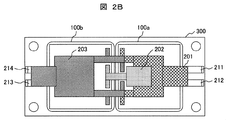
- FIG. 2A and FIG. 2B show the configuration of the power transistor module in this example.
- 2A and 2B show a cross-sectional view and a plan view of the power transistor module, respectively.
- the power transistor module 500 includes a case 400, a metal base 300, external lead-out terminals 201 to 203, control signal terminals 211 to 214, a circuit board 100, and a solder bonding layer 7.
- the case 400 determines the outer shape of the module, and is made of an insulating resin. In the following description, the description of the case 400 is omitted unless particularly necessary.
- the metal base 300 together with the case 400, determines the external shape of the module, and is generated by one or more circuit boards 100 that are made of a metal material and bonded to the heat sink (not shown) by the solder bonding layer 7. It functions as a path to dissipate the generated heat.
- External lead-out terminals 201 to 203 are terminals for connecting a metal (wiring) pattern on the circuit board 100 and a main circuit outside the module, and serve as an input / output path for the energization current of the module.
- the control signal terminals 211 to 214 are terminals for electrically connecting a metal (wiring) pattern on the circuit board 100 and a control signal generation circuit outside the module through bonding wires 61 to 64, and are used for switching elements in the module. This is the control signal path.
- the circuit board 100 includes metal (wiring) patterns 1 and 2, switching element control signal patterns 3 and 4, an insulating substrate 5, and a metal (wiring) pattern 6.
- the number of circuit boards 100 used in the power transistor module is as follows. The function is determined according to the function determined by the rated current capacity and the metal (wiring) pattern.
- the solder bonding layer 7 mechanically and electrically connects the circuit board 100 and the metal base 300.
- the power transistor module in the present embodiment is configured by using two circuit boards, a circuit board 100a and a circuit board 100b, and the external lead-out terminal 201 is connected to the circuit board 100a.
- the external lead-out terminal 202 is connected to a metal pattern at a low potential on the circuit board 100b, and the external lead-out terminal 203 is connected to a metal pattern at a low potential on the circuit board 100a. It has a function of connecting a metal pattern to be a potential.
- the positions where the high-potential and low-potential external lead-out terminals are connected are arranged close to each other as long as there is no problem in mounting technology and insulation design. This is to minimize the loop area of the path through which the current flows from the high potential metal pattern to the low potential metal pattern, and to suppress the inductance generated in the current path.
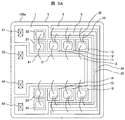
- FIG. 3A shows an example of mounting a metal (wiring) pattern and a semiconductor element on a circuit board 100a in a conventional power transistor module.
- the circuit board 100a connects the high-potential metal pattern 1, the low-potential metal pattern 2, the control signal patterns 3 and 4 of the switching element, the diode elements 21 to 24 formed of a semiconductor, the switching elements 11 to 16, and the semiconductor element It is constituted by bonding wires 31 to 33 and 41 to be performed.
- the metal pattern 1 is electrically connected to the cathode terminals of the diode elements 21 to 24 formed of a semiconductor, and is electrically connected to the collector terminals or drain terminals of the switching elements 11 to 16 formed of a semiconductor.
- feeding positions 51 and 52 for connection to the external lead-out terminal 201 are arranged.
- Anode terminals of the diode elements 21 to 24 are electrically connected to the metal pattern 2 via bonding wires 41, and collector terminals or drain terminals of the switching elements 11 to 16 are electrically connected to each other via bonding wires 31.
- feeding positions 53 and 54 for connection with the external lead-out terminal 203 are arranged.
- the control signal pattern 3 of the switching element is electrically connected to the gate terminal of the switching element via the bonding wire 32, and is connected to a control signal generating circuit (not shown) outside the module via the bonding wire 61. ing.
- the control signal pattern 4 of the switching element is electrically connected to the source terminal of the switching element via the bonding wire 33, and is connected to a control signal generating circuit (not shown) outside the module via the bonding wire 62. ing.
- the feeding positions 51 and 52 for connection with the external lead-out terminal 201 and the feeding positions 53 and 54 for connection with the external lead-out terminal 203 are close to each other in order to reduce the inductance of the current path flowing through the circuit board 100a. Deploy.
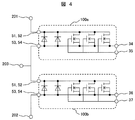
- FIG. 4 shows an equivalent circuit when the circuit board shown in FIG. 3A is mounted on the power transistor module shown in FIG. 2A.
- the switching elements mounted on the circuit boards 100a and 100b are assumed to be FET type elements. It goes without saying that the effect of the present invention does not change even if the switching element is an IGBT type element.
- the equivalent circuit of the power transistor module shown in FIG. 4 is a half-bridge circuit in which the upper arm is constituted by the circuit board 100a and the lower arm is constituted by the circuit board 100b.
- the external lead-out terminal 201 is a high potential side main terminal
- the external lead-out terminal 202 is a low potential side main terminal
- the external lead-out terminal 203 is an intermediate potential main terminal.
- the equivalent circuit of this circuit board shows an example of a parallel circuit of two diode elements and three FET elements.
- the problem to be solved by the present invention is the non-uniformity of the current between the three FET elements as described above, in particular, the non-uniformity of the transient current that occurs when the power transistor module is switched.
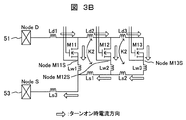
- FIG. 3B current non-uniformity of a power transistor module using a conventional circuit board, that is, a circuit board in which a metal pattern on the circuit board is not provided with a slit will be described.
- FIG. 3B is an equivalent circuit in which the upper half of the element arrangement of FIG. 3A is simplified. Since an equivalent circuit is made by paying attention to the current path when the power transistor module on which the circuit board is mounted is turned on, the diode element is omitted.
- NodeD indicates a feeding position 51 for connection to the external lead-out terminal 201 of the metal pattern 1
- inductors Ld1 to Ld3 indicate inductances of current paths on the metal pattern 1 from NodeD to the drains of the FET elements M11 to M13.
- inductors Lw1 to Lw3 are arranged as equivalent circuit representations of bonding wires, and Ls1 to Ls3 are arranged as inductances of current paths on the metal pattern 2.
- NodeS indicates a power feeding position 53 for connection to the external lead-out terminal 203 on the metal pattern 2. In the figure, the direction of current flow is indicated by arrows.
- magnetic coupling occurs between the inductor Ld2 on the metal pattern 1 and the inductor Ls1 on the metal pattern 2 through the gap between the patterns, and has a mutual inductance M2 determined by the coupling coefficient K2.
- the power feeding position 51 for connection with the external lead-out terminal 201 and the power feeding position 53 for connection with the external lead-out terminal 203 are arranged in the vicinity, and the current directions of the metal pattern 1 and the metal pattern 2 are in opposite directions. Therefore, the mutual inductance has an effect of canceling (reducing) the mutual self-inductance. The same applies to the inductor Ld3 and the inductor Ls2.
- the configuration and effect of the power transistor module in the present embodiment will be described with reference to FIGS. 5A and 5B.
- the circuit board of FIG. 5A is provided with two L-shaped slit patterns 62 in the metal pattern 2 in addition to the configuration described in the description of FIG. 3A above.
- the diode element is arranged in the vicinity
- the FET element is arranged in the distance
- the slit pattern 62 is arranged in the longitudinal direction of the slit pattern 62. It arrange
- the slit pattern 62 is formed in an L shape in the metal pattern 2, and a connection region between the plurality of bonding wires and the metal pattern 2 is for connecting the L shape slit pattern 62 and the external lead-out terminal 203.
- a connection region between the plurality of bonding wires and the metal pattern 2 is for connecting the L shape slit pattern 62 and the external lead-out terminal 203.
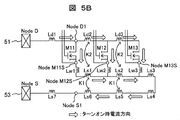
- FIG. 5B is an equivalent circuit obtained by simplifying the upper half of the element arrangement of FIG. 5A. Since an equivalent circuit is made by paying attention to the current path when the power transistor module on which the circuit board is mounted is turned on, the diode element is omitted.
- NodeD indicates a feeding position 51 for connection to the external lead-out terminal 201 of the metal pattern 1, and inductors Ld1 to Ld3 indicate inductances of current paths on the metal pattern 1 from NodeD to the drains of the FET elements M11 to M13. Show.
- Inductors Lw1 to Lw3 are arranged as equivalent circuit representations of bonding wires at the sources of the FET elements M11 to M13, and Ls1 to Ls7 are arranged as inductances of current paths on the metal pattern 2.
- the slit pattern 62 extends the current path of the metal pattern 2 and generates magnetic coupling by mutual inductance.
- NodeS indicates a power feeding position 53 for connection to the external lead-out terminal 203 on the metal pattern 2. In the figure, the direction of current flow is indicated by arrows.
- M2 increases the coupled self-inductance because the current flows in the same direction.
- the relationship between the inductor Ld3 and the inductor Ls2 is the same.
- the current direction is opposite, so the mutual inductance M1 has an effect of reducing the self-inductance.
- the relationship between the inductors Ls2 and Ls5 is the same.
- the average absolute value of the inductance is 11 nH in the case of the conventional circuit board pattern shown by the equivalent circuit in FIG. 3B and 22 nH in the case of the present embodiment. From the above description, it can be seen that the inductance variation of the current path of the FET element in which the circuit board pattern of the present embodiment in which the slit pattern 62 is introduced is arranged in parallel is reduced, and the uniformity of the inductance value is improved.
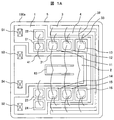
- FIG. 1A A second embodiment of the present invention and its effects will be described with reference to FIGS. 1A and 1B.
- the circuit board pattern in FIG. 1A is obtained by replacing the slit pattern 62 in FIG. 5A described in the description of the first embodiment with one U-shaped slit pattern 63 arranged inside the metal pattern 2 as shown in the figure. It is.
- the slit pattern 63 is formed in a U-shape in the metal pattern 2, and a connection region between the plurality of bonding wires and the metal pattern 2 is a connection between the U-shaped slit pattern 63 and the external lead-out terminal 203. Is provided in a region surrounded by a side opposite to one side of the metal pattern 2 in the vicinity of the power feeding position 53 for.
- the power feed position 51 for connection with the external lead-out terminal 201 arranged in the vicinity and the power feed position 53 for connection with the external lead-out terminal 203 or the external lead-out terminal 201 are connected.
- a diode element is disposed in the vicinity and an FET element is disposed far from a power feeding position 54 for connection between the power feeding position 52 for connection and the external lead-out terminal 203, and the slit pattern 63 is disposed of a plurality of FET elements.
- the slit pattern 63 is arranged so that the direction in which they are aligned is the longitudinal direction of the slit pattern 63. Further, since the slit pattern 63 is arranged inside the metal pattern 2, the following two advantages are generated.
- the first advantage is that the area of the metal pattern 2 can be reduced because it can also serve as an arrangement point of the bonding wire from the source electrode of the FET element arranged symmetrically on the circuit board 100a.
- the area where the bonding wires are arranged above and below the metal pattern is set.
- the area can also be used, and the bonding wire area can be reduced to about 1 ⁇ 2. it can.
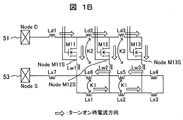
- the second advantage is that the direction of the current flowing through the circuit board 100a is reversed between all adjacent patterns. Thereby, the mutual inductance due to the magnetic coupling between the adjacent patterns has an effect of reducing the self-inductance, and an increase in the absolute value of the inductance which is a reaction due to the introduction of the slit can be suppressed. This effect will be described in detail with reference to FIG. 1B.
- FIG. 1B is an equivalent circuit obtained by simplifying the upper half of the element arrangement of FIG. 1A. Since an equivalent circuit is made by paying attention to a current path when the power transistor module on which the circuit board 100a is mounted is turned on, a diode element is omitted.
- NodeD indicates a feeding position 51 for connection to the external lead-out terminal 201 of the metal pattern 1
- inductors Ld1 to Ld3 indicate inductances of current paths on the metal pattern 1 from NodeD to the drains of the FET elements M11 to M13. Show.
- inductors Lw1 to Lw3 are arranged as equivalent circuit representations of bonding wires, and Ls1 to Ls7 are arranged as inductances of current paths on the metal pattern 2.
- the slit pattern 63 extends the current path of the metal pattern 2 and generates magnetic coupling due to mutual inductance.
- NodeS indicates a power feeding position 53 for connection to the external lead-out terminal 203 on the metal pattern 2. In the figure, the direction of current flow is indicated by arrows.
- magnetic coupling occurs between the inductor Ld2 on the metal pattern 1 and the inductor Ls6 on the metal pattern 2 through the gap between the patterns, and has a mutual inductance M2 determined by the coupling coefficient K2. .
- M2 reduces the coupled self-inductance because the direction of current flow is opposite.
- the relationship between the inductor Ld3 and the inductor Ls5 is the same.
- the average absolute value of the inductance is 11 nH in the case of the conventional circuit board pattern shown by the equivalent circuit in FIG. 3B, and is about 15 nH in this embodiment, which is higher than that in the first embodiment. It is clear that the inductance variation between the paths can be reduced while keeping the inductance low. From the above description, it can be seen that both the inductance of the current path and the inductance variation of the FET element in which the circuit board pattern of the present embodiment in which the slit pattern 63 is introduced are arranged in parallel are reduced.
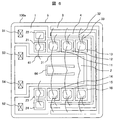
- the circuit board pattern shown in FIG. 6 is the same as the slit pattern described in the description of the second embodiment except that the power feeding position 51 for connection to the external lead-out terminal 201 and the power feed position for connection to the external lead-out terminal 203 are illustrated. 53 or the feeding position 52 for connection to the external lead-out terminal 201 and the feeding position 54 for connection to the external lead-out terminal 203, the slit width is monotonously increased widely as the distance is increased. .
- the absolute value of the inductance can be adjusted by the substantially U-shaped slit pattern 64 having the non-uniform slit width. That is, by using the circuit board 100a of the present embodiment, it is possible to obtain an advantage that the absolute value and variation value of the inductance can be adjusted by changing the design of only the slit pattern width of the circuit board.
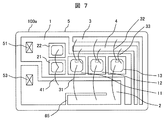
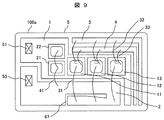
- the circuit board pattern in FIG. 7 is a circuit board pattern having the configuration of the upper half of the circuit board pattern in FIG. 1A described in the second embodiment.
- the metal pattern 1 is provided on both sides of the circuit board 100a, that is, the metal pattern 2 of the circuit board 100a in FIGS. 1A, 5A, and 6 and above and below the circuit board 100a.
- a description has been given using a configuration in which a plurality of diode elements and a plurality of switching elements are arranged on 1, as shown in FIG. 7, a plurality of diode elements and switching are provided on one side of the circuit board 100a, that is, the upper half region of FIG.
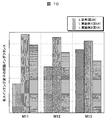
- FIG. 10 shows the effect when the circuit board 100a described in the first and second embodiments is used.
- FIG. 10 shows a relative comparison of path inductances in the switching elements M11 to M13.
- this invention is not limited to the above-mentioned Example, Various modifications are included.
- the above-described embodiments have been described in detail for easy understanding of the present invention, and are not necessarily limited to those having all the configurations described.
- a part of the configuration of one embodiment can be replaced with the configuration of another embodiment, and the configuration of another embodiment can be added to the configuration of one embodiment.
- MOSFET Metal-Oxide-Semiconductor-Field-Effect-Transistor: MOS-type field effect transistor
- J-FET Junction-type electric field
- IGBT Insulated-Gate-Bipolar-Transistor: Insulated Gate Bipolar Transistor
- the effect of the present invention is not changed by using either a PN junction diode or an SB (Shottky-Barrier-junction) diode. Further, even when a diode is formed inside the switching element and a single diode element is not mounted on the circuit board 100a described in each embodiment, a slit is formed in the metal pattern 2 as described in each embodiment. By providing the pattern, it is possible to obtain the same effect as that of each embodiment.
Landscapes
- Inverter Devices (AREA)
- Electronic Switches (AREA)
Abstract
Priority Applications (3)
| Application Number | Priority Date | Filing Date | Title |
|---|---|---|---|
| PCT/JP2014/068804 WO2016009496A1 (fr) | 2014-07-15 | 2014-07-15 | Module à transistor de puissance |
| US15/325,784 US10002858B2 (en) | 2014-07-15 | 2014-07-15 | Power transistor module |
| JP2016534021A JP6405383B2 (ja) | 2014-07-15 | 2014-07-15 | パワートランジスタモジュール |
Applications Claiming Priority (1)
| Application Number | Priority Date | Filing Date | Title |
|---|---|---|---|
| PCT/JP2014/068804 WO2016009496A1 (fr) | 2014-07-15 | 2014-07-15 | Module à transistor de puissance |
Publications (1)
| Publication Number | Publication Date |
|---|---|
| WO2016009496A1 true WO2016009496A1 (fr) | 2016-01-21 |
Family
ID=55078017
Family Applications (1)
| Application Number | Title | Priority Date | Filing Date |
|---|---|---|---|
| PCT/JP2014/068804 Ceased WO2016009496A1 (fr) | 2014-07-15 | 2014-07-15 | Module à transistor de puissance |
Country Status (3)
| Country | Link |
|---|---|
| US (1) | US10002858B2 (fr) |
| JP (1) | JP6405383B2 (fr) |
| WO (1) | WO2016009496A1 (fr) |
Cited By (11)
| Publication number | Priority date | Publication date | Assignee | Title |
|---|---|---|---|---|
| WO2017163612A1 (fr) * | 2016-03-24 | 2017-09-28 | 株式会社日立製作所 | Module à semi-conducteur de puissance |
| WO2020170553A1 (fr) * | 2019-02-18 | 2020-08-27 | 富士電機株式会社 | Dispositif à semi-conducteur |
| JP2021072293A (ja) * | 2019-10-29 | 2021-05-06 | 三菱電機株式会社 | 半導体パワーモジュール |
| JP2021141221A (ja) * | 2020-03-06 | 2021-09-16 | 富士電機株式会社 | 半導体モジュール |
| CN113630113A (zh) * | 2020-05-08 | 2021-11-09 | 株式会社东芝 | 半导体装置 |
| US11521933B2 (en) | 2018-04-18 | 2022-12-06 | Fuji Electric Co., Ltd. | Current flow between a plurality of semiconductor chips |
| JP2023134790A (ja) * | 2019-06-14 | 2023-09-27 | ウルフスピード インコーポレイテッド | パワーエレクトロニクス用のパッケージ |
| DE102023106586A1 (de) | 2022-04-25 | 2023-10-26 | Fuji Electric Co., Ltd. | Halbleitervorrichtung |
| JP2023160106A (ja) * | 2022-04-21 | 2023-11-02 | 三菱電機株式会社 | 半導体装置 |
| JP2024083398A (ja) * | 2019-10-11 | 2024-06-21 | 富士電機株式会社 | 半導体装置 |
| JPWO2024224669A1 (fr) * | 2023-04-25 | 2024-10-31 |
Families Citing this family (5)
| Publication number | Priority date | Publication date | Assignee | Title |
|---|---|---|---|---|
| JP6786416B2 (ja) * | 2017-02-20 | 2020-11-18 | 株式会社東芝 | 半導体装置 |
| CN111386604B (zh) | 2018-06-01 | 2023-12-19 | 富士电机株式会社 | 半导体装置 |
| US10763193B2 (en) * | 2018-10-30 | 2020-09-01 | Hamilton Sundstrand Corporation | Power control modules |
| JP7305603B2 (ja) * | 2020-09-18 | 2023-07-10 | 株式会社東芝 | 半導体装置 |
| CN117393546A (zh) * | 2022-06-29 | 2024-01-12 | 比亚迪半导体股份有限公司 | 半桥功率模块及其全桥功率模组、电机控制器、车辆 |
Citations (4)
| Publication number | Priority date | Publication date | Assignee | Title |
|---|---|---|---|---|
| JPH0729932A (ja) * | 1993-07-12 | 1995-01-31 | Origin Electric Co Ltd | 電力用半導体装置 |
| JP2001094035A (ja) * | 1999-09-27 | 2001-04-06 | Toshiba Corp | 半導体装置 |
| JP2002203941A (ja) * | 2001-01-04 | 2002-07-19 | Nissan Motor Co Ltd | 半導体実装構造 |
| JP2006203974A (ja) * | 2005-01-18 | 2006-08-03 | Fuji Electric Fa Components & Systems Co Ltd | 電力変換装置の配線構造 |
Family Cites Families (2)
| Publication number | Priority date | Publication date | Assignee | Title |
|---|---|---|---|---|
| JP2973799B2 (ja) | 1993-04-23 | 1999-11-08 | 富士電機株式会社 | パワートランジスタモジュール |
| JP5136343B2 (ja) | 2008-10-02 | 2013-02-06 | 三菱電機株式会社 | 半導体装置 |
-
2014
- 2014-07-15 US US15/325,784 patent/US10002858B2/en active Active
- 2014-07-15 JP JP2016534021A patent/JP6405383B2/ja active Active
- 2014-07-15 WO PCT/JP2014/068804 patent/WO2016009496A1/fr not_active Ceased
Patent Citations (4)
| Publication number | Priority date | Publication date | Assignee | Title |
|---|---|---|---|---|
| JPH0729932A (ja) * | 1993-07-12 | 1995-01-31 | Origin Electric Co Ltd | 電力用半導体装置 |
| JP2001094035A (ja) * | 1999-09-27 | 2001-04-06 | Toshiba Corp | 半導体装置 |
| JP2002203941A (ja) * | 2001-01-04 | 2002-07-19 | Nissan Motor Co Ltd | 半導体実装構造 |
| JP2006203974A (ja) * | 2005-01-18 | 2006-08-03 | Fuji Electric Fa Components & Systems Co Ltd | 電力変換装置の配線構造 |
Cited By (32)
| Publication number | Priority date | Publication date | Assignee | Title |
|---|---|---|---|---|
| WO2017163612A1 (fr) * | 2016-03-24 | 2017-09-28 | 株式会社日立製作所 | Module à semi-conducteur de puissance |
| JPWO2017163612A1 (ja) * | 2016-03-24 | 2018-09-27 | 株式会社日立製作所 | パワー半導体モジュール |
| US11521933B2 (en) | 2018-04-18 | 2022-12-06 | Fuji Electric Co., Ltd. | Current flow between a plurality of semiconductor chips |
| JPWO2020170553A1 (ja) * | 2019-02-18 | 2021-10-14 | 富士電機株式会社 | 半導体装置 |
| CN112514066B (zh) * | 2019-02-18 | 2025-01-24 | 富士电机株式会社 | 半导体装置 |
| CN112514066A (zh) * | 2019-02-18 | 2021-03-16 | 富士电机株式会社 | 半导体装置 |
| US11456244B2 (en) | 2019-02-18 | 2022-09-27 | Fuji Electric Co., Ltd. | Semiconductor device |
| WO2020170553A1 (fr) * | 2019-02-18 | 2020-08-27 | 富士電機株式会社 | Dispositif à semi-conducteur |
| JP7201066B2 (ja) | 2019-02-18 | 2023-01-10 | 富士電機株式会社 | 半導体装置 |
| JP2023024670A (ja) * | 2019-02-18 | 2023-02-16 | 富士電機株式会社 | 半導体装置 |
| JP7447979B2 (ja) | 2019-02-18 | 2024-03-12 | 富士電機株式会社 | 半導体装置 |
| US12400986B2 (en) | 2019-06-14 | 2025-08-26 | Wolfspeed, Inc. | Package for power electronics |
| JP7652840B2 (ja) | 2019-06-14 | 2025-03-27 | ウルフスピード インコーポレイテッド | パワーエレクトロニクス用のパッケージ |
| JP2023134790A (ja) * | 2019-06-14 | 2023-09-27 | ウルフスピード インコーポレイテッド | パワーエレクトロニクス用のパッケージ |
| JP7616454B2 (ja) | 2019-10-11 | 2025-01-17 | 富士電機株式会社 | 半導体装置 |
| JP2024083398A (ja) * | 2019-10-11 | 2024-06-21 | 富士電機株式会社 | 半導体装置 |
| JP2021072293A (ja) * | 2019-10-29 | 2021-05-06 | 三菱電機株式会社 | 半導体パワーモジュール |
| US11728251B2 (en) * | 2019-10-29 | 2023-08-15 | Mitsubishi Electric Corporation | Semiconductor power module with temperature sensors and shaped top plate to equalize current paths |
| JP2021141221A (ja) * | 2020-03-06 | 2021-09-16 | 富士電機株式会社 | 半導体モジュール |
| JP7428019B2 (ja) | 2020-03-06 | 2024-02-06 | 富士電機株式会社 | 半導体モジュール |
| CN113630113A (zh) * | 2020-05-08 | 2021-11-09 | 株式会社东芝 | 半导体装置 |
| JP2023099760A (ja) * | 2020-05-08 | 2023-07-13 | 株式会社東芝 | 半導体装置 |
| US11605613B2 (en) | 2020-05-08 | 2023-03-14 | Kabushiki Kaisha Toshiba | Semiconductor device |
| JP7642714B2 (ja) | 2020-05-08 | 2025-03-10 | 株式会社東芝 | 半導体装置 |
| JP2021177519A (ja) * | 2020-05-08 | 2021-11-11 | 株式会社東芝 | 半導体装置 |
| JP7647668B2 (ja) | 2022-04-21 | 2025-03-18 | 三菱電機株式会社 | 半導体装置 |
| JP2023160106A (ja) * | 2022-04-21 | 2023-11-02 | 三菱電機株式会社 | 半導体装置 |
| US12451465B2 (en) | 2022-04-21 | 2025-10-21 | Mitsubishi Electric Corporation | Semiconductor device |
| DE102023106586A1 (de) | 2022-04-25 | 2023-10-26 | Fuji Electric Co., Ltd. | Halbleitervorrichtung |
| WO2024224669A1 (fr) * | 2023-04-25 | 2024-10-31 | 三菱電機株式会社 | Module de puissance |
| JPWO2024224669A1 (fr) * | 2023-04-25 | 2024-10-31 | ||
| DE112023006259T5 (de) | 2023-04-25 | 2026-03-19 | Mitsubishi Electric Corporation | Leistungsmodul |
Also Published As
| Publication number | Publication date |
|---|---|
| US10002858B2 (en) | 2018-06-19 |
| US20170170157A1 (en) | 2017-06-15 |
| JP6405383B2 (ja) | 2018-10-17 |
| JPWO2016009496A1 (ja) | 2017-04-27 |
Similar Documents
| Publication | Publication Date | Title |
|---|---|---|
| JP6405383B2 (ja) | パワートランジスタモジュール | |
| US20250219025A1 (en) | Semiconductor power module | |
| JP6400201B2 (ja) | パワー半導体モジュール | |
| CN112750800B (zh) | 半导体功率模块 | |
| JP5893369B2 (ja) | 半導体装置 | |
| US12087752B2 (en) | Semiconductor module | |
| EP3522213B1 (fr) | Dispositif à semiconducteur | |
| US10396057B2 (en) | Half-bridge power semiconductor module and method for manufacturing same | |
| WO2010131679A1 (fr) | Dispositif a semi-conducteurs | |
| WO2017163612A1 (fr) | Module à semi-conducteur de puissance | |
| JP6541896B1 (ja) | 半導体モジュールおよび電力変換装置 | |
| JP2018074088A (ja) | 半導体装置 | |
| CN113707625B (zh) | 电力用半导体模块 | |
| US9655265B2 (en) | Electronic module | |
| US10855196B2 (en) | Semiconductor device | |
| US10950526B2 (en) | Semiconductor device | |
| JP2019140364A (ja) | 半導体装置 | |
| RU2676190C1 (ru) | Силовой полупроводниковый модуль с улучшенной структурой контактных соединителей для приваривания | |
| JP6394459B2 (ja) | 半導体装置 | |
| JP7826171B2 (ja) | パワー半導体装置 | |
| US20240321655A1 (en) | Semiconductor module |
Legal Events
| Date | Code | Title | Description |
|---|---|---|---|
| 121 | Ep: the epo has been informed by wipo that ep was designated in this application |
Ref document number: 14897732 Country of ref document: EP Kind code of ref document: A1 |
|
| ENP | Entry into the national phase |
Ref document number: 2016534021 Country of ref document: JP Kind code of ref document: A |
|
| WWE | Wipo information: entry into national phase |
Ref document number: 15325784 Country of ref document: US |
|
| NENP | Non-entry into the national phase |
Ref country code: DE |
|
| 122 | Ep: pct application non-entry in european phase |
Ref document number: 14897732 Country of ref document: EP Kind code of ref document: A1 |