WO2016047126A1 - 変性ポリビニルアルコールおよび水溶性フィルム - Google Patents
変性ポリビニルアルコールおよび水溶性フィルム Download PDFInfo
- Publication number
- WO2016047126A1 WO2016047126A1 PCT/JP2015/004796 JP2015004796W WO2016047126A1 WO 2016047126 A1 WO2016047126 A1 WO 2016047126A1 JP 2015004796 W JP2015004796 W JP 2015004796W WO 2016047126 A1 WO2016047126 A1 WO 2016047126A1
- Authority
- WO
- WIPO (PCT)
- Prior art keywords
- water
- film
- soluble film
- polyvinyl alcohol
- modified polyvinyl
- Prior art date
- Legal status (The legal status is an assumption and is not a legal conclusion. Google has not performed a legal analysis and makes no representation as to the accuracy of the status listed.)
- Ceased
Links
Images

Classifications
-
- C—CHEMISTRY; METALLURGY
- C08—ORGANIC MACROMOLECULAR COMPOUNDS; THEIR PREPARATION OR CHEMICAL WORKING-UP; COMPOSITIONS BASED THEREON
- C08F—MACROMOLECULAR COMPOUNDS OBTAINED BY REACTIONS ONLY INVOLVING CARBON-TO-CARBON UNSATURATED BONDS
- C08F8/00—Chemical modification by after-treatment
- C08F8/12—Hydrolysis
-
- B—PERFORMING OPERATIONS; TRANSPORTING
- B65—CONVEYING; PACKING; STORING; HANDLING THIN OR FILAMENTARY MATERIAL
- B65D—CONTAINERS FOR STORAGE OR TRANSPORT OF ARTICLES OR MATERIALS, e.g. BAGS, BARRELS, BOTTLES, BOXES, CANS, CARTONS, CRATES, DRUMS, JARS, TANKS, HOPPERS, FORWARDING CONTAINERS; ACCESSORIES, CLOSURES, OR FITTINGS THEREFOR; PACKAGING ELEMENTS; PACKAGES
- B65D65/00—Wrappers or flexible covers; Packaging materials of special type or form
- B65D65/38—Packaging materials of special type or form
- B65D65/46—Applications of disintegrable, dissolvable or edible materials
-
- C—CHEMISTRY; METALLURGY
- C08—ORGANIC MACROMOLECULAR COMPOUNDS; THEIR PREPARATION OR CHEMICAL WORKING-UP; COMPOSITIONS BASED THEREON
- C08F—MACROMOLECULAR COMPOUNDS OBTAINED BY REACTIONS ONLY INVOLVING CARBON-TO-CARBON UNSATURATED BONDS
- C08F216/00—Copolymers of compounds having one or more unsaturated aliphatic radicals, each having only one carbon-to-carbon double bond, and at least one being terminated by an alcohol, ether, aldehydo, ketonic, acetal or ketal radical
- C08F216/02—Copolymers of compounds having one or more unsaturated aliphatic radicals, each having only one carbon-to-carbon double bond, and at least one being terminated by an alcohol, ether, aldehydo, ketonic, acetal or ketal radical by an alcohol radical
- C08F216/04—Acyclic compounds
- C08F216/06—Polyvinyl alcohol ; Vinyl alcohol
-
- C—CHEMISTRY; METALLURGY
- C08—ORGANIC MACROMOLECULAR COMPOUNDS; THEIR PREPARATION OR CHEMICAL WORKING-UP; COMPOSITIONS BASED THEREON
- C08F—MACROMOLECULAR COMPOUNDS OBTAINED BY REACTIONS ONLY INVOLVING CARBON-TO-CARBON UNSATURATED BONDS
- C08F8/00—Chemical modification by after-treatment
- C08F8/14—Esterification
- C08F8/16—Lactonisation
-
- C—CHEMISTRY; METALLURGY
- C08—ORGANIC MACROMOLECULAR COMPOUNDS; THEIR PREPARATION OR CHEMICAL WORKING-UP; COMPOSITIONS BASED THEREON
- C08J—WORKING-UP; GENERAL PROCESSES OF COMPOUNDING; AFTER-TREATMENT NOT COVERED BY SUBCLASSES C08B, C08C, C08F, C08G or C08H
- C08J3/00—Processes of treating or compounding macromolecular substances
- C08J3/18—Plasticising macromolecular compounds
-
- C—CHEMISTRY; METALLURGY
- C08—ORGANIC MACROMOLECULAR COMPOUNDS; THEIR PREPARATION OR CHEMICAL WORKING-UP; COMPOSITIONS BASED THEREON
- C08J—WORKING-UP; GENERAL PROCESSES OF COMPOUNDING; AFTER-TREATMENT NOT COVERED BY SUBCLASSES C08B, C08C, C08F, C08G or C08H
- C08J5/00—Manufacture of articles or shaped materials containing macromolecular substances
- C08J5/18—Manufacture of films or sheets
-
- C—CHEMISTRY; METALLURGY
- C08—ORGANIC MACROMOLECULAR COMPOUNDS; THEIR PREPARATION OR CHEMICAL WORKING-UP; COMPOSITIONS BASED THEREON
- C08K—Use of inorganic or non-macromolecular organic substances as compounding ingredients
- C08K5/00—Use of organic ingredients
- C08K5/04—Oxygen-containing compounds
- C08K5/05—Alcohols; Metal alcoholates
- C08K5/053—Polyhydroxylic alcohols
-
- C—CHEMISTRY; METALLURGY
- C08—ORGANIC MACROMOLECULAR COMPOUNDS; THEIR PREPARATION OR CHEMICAL WORKING-UP; COMPOSITIONS BASED THEREON
- C08L—COMPOSITIONS OF MACROMOLECULAR COMPOUNDS
- C08L29/00—Compositions of homopolymers or copolymers of compounds having one or more unsaturated aliphatic radicals, each having only one carbon-to-carbon double bond, and at least one being terminated by an alcohol, ether, aldehydo, ketonic, acetal or ketal radical; Compositions of hydrolysed polymers of esters of unsaturated alcohols with saturated carboxylic acids; Compositions of derivatives of such polymers
- C08L29/02—Homopolymers or copolymers of unsaturated alcohols
- C08L29/04—Polyvinyl alcohol; Partially hydrolysed homopolymers or copolymers of esters of unsaturated alcohols with saturated carboxylic acids
-
- C—CHEMISTRY; METALLURGY
- C11—ANIMAL OR VEGETABLE OILS, FATS, FATTY SUBSTANCES OR WAXES; FATTY ACIDS THEREFROM; DETERGENTS; CANDLES
- C11D—DETERGENT COMPOSITIONS; USE OF SINGLE SUBSTANCES AS DETERGENTS; SOAP OR SOAP-MAKING; RESIN SOAPS; RECOVERY OF GLYCEROL
- C11D17/00—Detergent materials or soaps characterised by their shape or physical properties
- C11D17/04—Detergent materials or soaps characterised by their shape or physical properties combined with or containing other objects
- C11D17/041—Compositions releasably affixed on a substrate or incorporated into a dispensing means
- C11D17/042—Water soluble or water disintegrable containers or substrates containing cleaning compositions or additives for cleaning compositions
-
- C—CHEMISTRY; METALLURGY
- C11—ANIMAL OR VEGETABLE OILS, FATS, FATTY SUBSTANCES OR WAXES; FATTY ACIDS THEREFROM; DETERGENTS; CANDLES
- C11D—DETERGENT COMPOSITIONS; USE OF SINGLE SUBSTANCES AS DETERGENTS; SOAP OR SOAP-MAKING; RESIN SOAPS; RECOVERY OF GLYCEROL
- C11D3/00—Other compounding ingredients of detergent compositions covered in group C11D1/00
- C11D3/16—Organic compounds
- C11D3/37—Polymers
- C11D3/3746—Macromolecular compounds obtained by reactions only involving carbon-to-carbon unsaturated bonds
- C11D3/3753—Polyvinylalcohol; Ethers or esters thereof
-
- C—CHEMISTRY; METALLURGY
- C08—ORGANIC MACROMOLECULAR COMPOUNDS; THEIR PREPARATION OR CHEMICAL WORKING-UP; COMPOSITIONS BASED THEREON
- C08J—WORKING-UP; GENERAL PROCESSES OF COMPOUNDING; AFTER-TREATMENT NOT COVERED BY SUBCLASSES C08B, C08C, C08F, C08G or C08H
- C08J2300/00—Characterised by the use of unspecified polymers
- C08J2300/14—Water soluble or water swellable polymers, e.g. aqueous gels
-
- C—CHEMISTRY; METALLURGY
- C08—ORGANIC MACROMOLECULAR COMPOUNDS; THEIR PREPARATION OR CHEMICAL WORKING-UP; COMPOSITIONS BASED THEREON
- C08J—WORKING-UP; GENERAL PROCESSES OF COMPOUNDING; AFTER-TREATMENT NOT COVERED BY SUBCLASSES C08B, C08C, C08F, C08G or C08H
- C08J2329/00—Characterised by the use of homopolymers or copolymers of compounds having one or more unsaturated aliphatic radicals, each having only one carbon-to-carbon double bond, and at least one being terminated by an alcohol, ether, aldehydo, ketonic, acetal, or ketal radical; Hydrolysed polymers of esters of unsaturated alcohols with saturated carboxylic acids; Derivatives of such polymer
- C08J2329/02—Homopolymers or copolymers of unsaturated alcohols
- C08J2329/04—Polyvinyl alcohol; Partially hydrolysed homopolymers or copolymers of esters of unsaturated alcohols with saturated carboxylic acids
Definitions
- the present invention relates to a modified polyvinyl alcohol containing a specific amount of a monomer unit having two carboxyl groups and having an integral value in 1 H-NMR analysis satisfying a specific condition. Furthermore, the present invention relates to a water-soluble film and a package using the modified polyvinyl alcohol.
- Polyvinyl alcohol (hereinafter sometimes abbreviated as “PVA”) is known as a water-soluble synthetic polymer, used as a raw material for synthetic fiber vinylon, and also for paper processing, fiber processing, adhesive, emulsion polymerization and It is widely used in applications such as stabilizers for suspension polymerization, inorganic binders, and films.
- the degree of saponification of PVA increases, the crystallinity increases, and the proportion of crystal parts that do not dissolve in cold water increases.
- the degree of saponification is said to be a complete saponification type.
- partially saponified unmodified PVA has been used.
- the water-soluble film using the partially saponified non-modified PVA has features such that it is easily dissolved in cold water and has excellent mechanical strength.
- the film using the partially saponified non-modified PVA is colored and hardened when chlorine-containing compounds such as agricultural chemicals and bactericides are packaged and left standing for a long time, and the water-solubility changes over time. Since it is lowered and insolubilized or hardly soluble in water, there is a disadvantage that it becomes difficult to dissolve or disperse the drug in water while being packaged in a film. Further, since the crystallinity is low, there is a problem that the film does not have elasticity and the process passability is poor.
- Patent Document 1 discloses a water-soluble film formed by forming a PVA film containing an oxyalkylene group, a sulfonic acid group, or a cationic group.
- Patent Document 2 discloses a water-soluble film comprising a composition containing a modified PVA having a monomer unit containing a carboxyl group and / or a sulfonic acid group and a polyhydric alcohol.
- Patent Document 3 discloses a water-soluble film comprising a modified PVA containing an N-vinylamide monomer unit and a carboxyl group and / or a lactone ring.
- the present invention uses a modified PVA containing a specific amount of a monomer unit having two carboxyl groups and having an integral value in 1 H-NMR analysis that satisfies a specific condition.
- Another object of the present invention is to provide a modified polyvinyl alcohol which is excellent in practical physical properties such as strength and waist and whose deterioration of physical properties is suppressed over time even when chemicals are packaged, and a water-soluble film using the same.
- the inventors of the present invention contain a specific amount of a monomer unit having two carboxyl groups, and the integral value in 1 H-NMR analysis satisfies a specific condition.
- a satisfactory modified PVA and a water-soluble film using the modified PVA are found to be excellent in cold water solubility and practical physical properties such as strength and waist, and can suppress deterioration of various physical properties such as chemical resistance over time. It came to be completed.
- the present invention relates to the following inventions.
- It contains 0.05 to 10 mol% of a monomer unit having two carboxyl groups, and has an integral value (X) of 6.8 to 7.2 ppm and 5.3 to 1 in 1 H-NMR analysis.
- Modified polyvinyl alcohol having an integrated value (Y) of 5.5 ppm satisfying the following formula: 0.60 ⁇ X / (X + Y) ⁇ 1.0
- the above-mentioned [1] wherein the monomer unit having two carboxyl groups is derived from one or more selected from the group consisting of unsaturated dicarboxylic acids, unsaturated dicarboxylic acid anhydrides and unsaturated dicarboxylic acid esters.
- Modified polyvinyl alcohol [3]
- the monomer unit having two carboxyl groups is maleic acid, monomethyl maleate, monoethyl maleate, dimethyl maleate, diethyl maleate, maleic anhydride, itaconic acid, monomethyl itaconate, monoethyl itaconate,
- the modified polyvinyl alcohol according to the above [1] derived from a monomer having two or more carboxyl groups selected from the group consisting of dimethyl itaconate and diethyl itaconate; [4]
- R 1 is a hydrogen atom or a linear or branched alkyl group having 1 to 8 carbon atoms
- R 2 is a metal atom, a hydrogen atom, or 1 to 8 carbon atoms.
- the modified PVA of the present invention and a water-soluble film containing the same are excellent in cold water solubility, practical physical properties such as strength and waist, and can suppress deterioration of various physical properties such as chemical resistance over time. Therefore, the water-soluble film of the present invention is suitably used as a packaging material for various chemicals such as agricultural chemicals and laundry detergents.
- FIG. 2 shows a part of a 1 H-NMR (solvent: D 2 O, temperature: 80 ° C.) spectrum of a mixture adjusted to various pHs by adding modified PVA and sodium hydroxide (NaOH) according to an embodiment of the present invention.
- FIG. 2 shows a part of a 1 H-NMR (solvent: D 2 O, temperature: 80 ° C.) spectrum of a mixture adjusted to various pHs by adding modified PVA and sodium hydroxide (NaOH) according to an embodiment of the present invention.
- the modified PVA of the present invention contains 0.05 to 10 mol% of monomer units having two carboxyl groups, and has an integral value (X) of 6.8 to 7.2 ppm in 1 H-NMR analysis and
- the modified polyvinyl alcohol has an integral value (Y) of 5.3 to 5.5 ppm that satisfies the following formula. 0.60 ⁇ X / (X + Y) ⁇ 1.0
- Examples of the monomer having two carboxyl groups used as the material for the monomer unit include unsaturated dicarboxylic acids such as maleic acid, fumaric acid, citraconic acid, mesaconic acid and itaconic acid; maleic anhydride and citraconic acid Unsaturated dicarboxylic acid anhydrides, such as an anhydride; Unsaturated dicarboxylic acid ester is mentioned.
- unsaturated dicarboxylic acids such as maleic acid, fumaric acid, citraconic acid, mesaconic acid and itaconic acid
- maleic anhydride and citraconic acid Unsaturated dicarboxylic acid anhydrides, such as an anhydride
- Unsaturated dicarboxylic acid ester is mentioned.
- Examples of the unsaturated dicarboxylic acid ester include monomethyl maleate, monoethyl maleate, monomethyl fumarate, monoethyl fumarate, monomethyl citraconic acid, monoethyl citraconic acid, monomethyl mesaconic acid, monoethyl mesaconic acid, monomethyl itaconate, monoethyl itaconate, etc.
- dialkyl unsaturated dicarboxylic acid esters include these monomers having two carboxyl groups, maleic acid, monomethyl maleate, dimethyl maleate, maleic anhydride, itaconic acid, monomethyl itaconate, and dimethyl itaconate are preferable from the viewpoint of cold water solubility. Monomethyl and dimethyl maleate are particularly preferred.
- the modified PVA of this invention should just have at least 1 type of said monomer unit, and can also use 2 or more types of monomer units together.
- the content of the monomer unit having two carboxyl groups is 0.05 to 10 mol%, preferably 0.10 to 8.0 mol%, more preferably 0.15 to 7.0 mol%, 0.20 to 5.0 mol% is particularly preferable.
- the content of the monomer unit having two carboxyl groups is less than 0.05 mol%, the cold water solubility is insufficient.
- the content exceeds 10 mol%, practical physical properties such as strength are insufficient.
- the monomer unit having two carboxyl groups preferably forms a structural unit represented by the following formula (I), and is represented by the following formula (I). It is more preferable to form a 5-membered ring lactone structural unit represented by the following formula (II) together with the 6-membered ring lactone structural unit.
- the modified PVA of the present invention has a lactone ring structure represented by the following formula (I) and / or (II)
- the molecular chain of PVA becomes rigid, and practical properties such as film strength and waist are further improved.
- the lactone ring structural unit as shown in the following formula (I) and / or (II) is a monomer unit having two hydroxyl groups derived from a vinyl alcohol unit obtained by saponifying a vinyl ester unit and two carboxyl groups. It is formed by the reaction with the derived carboxyl group.
- R 1 is a hydrogen atom or a linear or branched alkyl group having 1 to 8 carbon atoms
- R 2 is a metal atom, a hydrogen atom, or 1 carbon atom. 8 to 8 linear or branched alkyl groups.
- Examples of the linear or branched alkyl group having 1 to 8 carbon atoms in R 1 and R 2 include, for example, methyl group, ethyl group, propyl group, isopropyl group, butyl group, pentyl group, hexyl group, heptyl group, An octyl group etc. are mentioned.
- the metal atom in R 2 include sodium, calcium, potassium, lithium and the like.
- R 1 is preferably a hydrogen atom or a methyl group
- R 2 is preferably a sodium atom, a methyl group or a hydrogen atom from the viewpoint of ease of synthesis and the like.
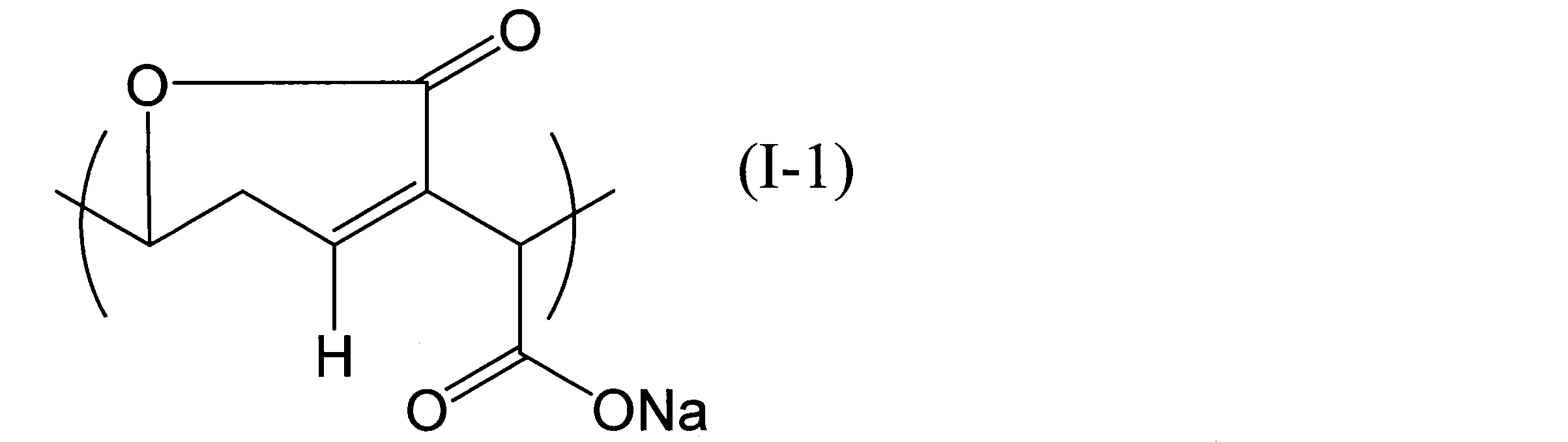
- a structural unit represented by the following formula (I-1) is particularly preferable.
- Total content of the structural units represented by the above formulas (I) and (II) (in the case where the structural unit represented by the formula (II) is not contained, the content of the structural unit represented by the formula (I)) Is not particularly limited, but is 0.05 mol% or more and less than 10 mol%, preferably 0.08 to 8.0 mol%, more preferably 0.10 to 7.0 mol%, and 0.15 to 5. 0 mol% is particularly preferred.
- the content of the structural unit is the ratio of the number of moles of the lactone ring to the total number of moles of monomer units constituting the main chain of the modified PVA.
- the modified PVA of the present invention satisfies the following formulas in the integral value (X) of 6.8 to 7.2 ppm and the integral value (Y) of 5.3 to 5.5 ppm in 1 H-NMR analysis. This is very important. 0.60 ⁇ X / (X + Y) ⁇ 1.0
- the measurement method of 1 H-NMR of the modified PVA can be specifically measured by dissolving the modified PVA in D 2 O and using 1 H-NMR of 600 MHz at 80 ° C.
- adjustment of pH is not particularly required, but regarding NMR spectrum change accompanying structural change, an example of measuring NMR while changing pH is given below. I will explain.
- Spectrum 1 in FIG. 1 is a part of the 1 H-NMR spectrum of monomethyl maleate-modified PVA obtained in Example 1 described later (pH is 6).
- Spectrum 2 is a part of the 1 H-NMR spectrum of a mixture (solution) prepared by adding sodium hydroxide (NaOH) to the measurement solution of spectrum 1 and adjusting the pH to 9.
- Spectrum 3 is a part of the 1 H-NMR spectrum of a mixture (solution) prepared at pH 11, and spectrum 4 is a mixture (solution) to which NaOH is added excessively.
- the monomethyl maleate-modified PVA produced in Example 1 described later has a structural unit (lactone ring unit) represented by the following formula (I-1), and the carbon-carbon divalent carbon in the lactone ring.
- a peak of a hydrogen atom bonded to a carbon atom forming a heavy bond is detected at 6.8 to 7.2 ppm as shown in spectrum 1 of FIG. 1 in 1 H-NMR measurement.
- two peaks were detected between 6.8 and 7.2 ppm, which is considered to be a peak derived from an isomer of the structural unit represented by the following formula (I-1). It is done.
- the lactone cyclization rate which is an index of how much lactone ring unit represented by the above formula (I-1) is formed in the molecule, of the modified PVA of the present invention satisfies the specific range described below. That is. 0.60 ⁇ X / (X + Y) ⁇ 1.0
- the integrated value (X) of 6.8 to 7.2 ppm and the integrated value (Y) of 5.3 to 5.5 ppm in the 1 H-NMR analysis of the modified PVA of the present invention examples include 1) a method of adjusting the moisture content during saponification, 2) a method of adjusting the temperature and time of the drying treatment, and 3) a method of treating the modified PVA by changing pH conditions. These methods may be used singly or in combination of two or more.
- the value of the above formula X / (X + Y) is important to be 0.60 or more and less than 1.0, preferably 0.65 to 0.98, more preferably 0.70 to 0.95, and 0.75 More preferably, ⁇ 0.90.
- the value of the above formula X / (X + Y) is less than 0.60, practical physical properties such as film strength and waist become insufficient.
- it becomes 1.0 or more the cold water solubility becomes insufficient.
- the degree of polymerization (viscosity average degree of polymerization) of the modified PVA used in the present invention is not particularly limited, but is preferably 300 to 3000, more preferably 400 to 2500, and 500 to 500 in view of the water solubility of the film. 2000 is particularly preferred.
- the viscosity average degree of polymerization of the modified PVA is in the above range, the strength and solubility of the film are further improved, and the solution viscosity or melt viscosity of the film forming raw material used when forming the film is suitable. Excellent in properties.
- the viscosity average polymerization degree P of the modified PVA is measured by the method described in JIS K 6726 (1994).
- the saponification degree of the modified PVA used in the present invention is not particularly limited, but it is 82.0 to 99.9 mol from the viewpoint that the water solubility of the film when the obtained film is packaged and stored with an alkaline substance or acidic substance is not reduced. %, More preferably 84.0 to 99.8 mol%, still more preferably 86.0 to 98.6 mol%.
- the degree of saponification of the modified PVA is measured by the method described in JIS K 6726 (1994).
- the modified PVA of the present invention uses, for example, a vinyl ester copolymer obtained by copolymerizing a vinyl ester monomer and a monomer having two carboxyl groups, using an alkali or acid catalyst in an alcohol solution. Manufactured by saponification.
- the structural unit having a lactone ring represented by the above formula (I) and / or (II) is a monomer having a hydroxyl group derived from a vinyl alcohol unit obtained by saponifying a vinyl ester unit and two carboxyl groups. It is formed by a reaction with a carboxyl group derived from a unit (hereinafter sometimes referred to as lactonization).
- vinyl ester monomer examples include vinyl formate, vinyl acetate, vinyl propionate, vinyl valelate, vinyl caprate, vinyl laurate, vinyl stearate, vinyl benzoate, vinyl pivalate, and vinyl versatate.
- vinyl acetate is particularly preferable.
- Examples of the method for copolymerizing the vinyl ester monomer and the monomer having two carboxyl groups include known methods such as bulk polymerization, solution polymerization, suspension polymerization, and emulsion polymerization. Among these methods, a bulk polymerization method performed without a solvent or a solution polymerization method performed using a solvent such as alcohol is usually employed. In terms of enhancing the effect of the present invention, a solution polymerization method in which polymerization is performed together with a lower alcohol is preferable.
- the lower alcohol is not particularly limited, but an alcohol having 3 or less carbon atoms such as methanol, ethanol, propanol and isopropanol is preferable, and methanol is preferably used.
- a batch method or a continuous method can be used as the reaction method.
- initiators can be used as long as the effects of the present invention are not impaired.
- examples of such a polymerization initiator include 2,2′-azobisisobutyronitrile, 2,2′-azobis (2,4-dimethyl-valeronitrile), 2,2′-azobis (4-methoxy-2).
- Azo initiators such as, 4-dimethylvaleronitrile); organic peroxide initiators such as benzoyl peroxide and n-propyl peroxycarbonate.
- polymerization temperature when performing the polymerization reaction, but a range of 5 to 200 ° C. is appropriate.
- vinyl ester monomers and monomers having two carboxyl groups include ⁇ -olefins such as ethylene, propylene, 1-butene, isobutene, 1-hexene; acrylamide, N Acrylamide derivatives such as methyl acrylamide and N-ethyl acrylamide; Methacrylamide derivatives such as methacrylamide, N-methyl methacrylamide and N-ethyl methacrylamide; Methyl vinyl ether, ethyl vinyl ether, n-propyl vinyl ether, isopropyl vinyl ether, n-butyl Vinyl ethers such as vinyl ethers; Hydroxy group-containing vinyl ethers such as ethylene glycol vinyl ethers, 1,3-propanediol vinyl ethers, 1,4-butanediol vinyl ethers; Allyl ethers such as teryl, butyl allyl ether, hexyl allyl ether; monomers having an
- the modified PVA can be obtained by saponifying the vinyl ester copolymer obtained by the above-described method in an alcohol solvent, followed by drying.
- the water content of the saponification raw material solution to be subjected to saponification, the PVA resin temperature during drying or the drying time is preferably within a specific range as described later, and the water content of the saponification raw material solution It is more preferable to set the PVA resin temperature at the time of drying to a specific range as described later, and the moisture content of the saponification raw material solution, the PVA resin temperature at the time of drying and the drying time should be set to a specific range as described later. Particularly preferred.
- a saponification raw material solution can be prepared by adding a small amount of water to the solution containing the vinyl ester copolymer and the solvent obtained in the copolymerization step.
- the amount of water added is preferably adjusted so that the water content of the resulting saponification raw material solution is more than 1.0% by mass and less than 2.0% by mass.
- the water content is more preferably 1.2 to 1.8% by mass.
- Examples of the solvent that can be used for the saponification reaction include methanol, methyl acetate, dimethyl sulfoxide, diethyl sulfoxide, dimethylformamide, and the like. Of these solvents, methanol is preferably used.
- an alkaline substance is usually used as a catalyst for a saponification reaction of a vinyl ester copolymer.
- alkali metal hydroxides such as potassium hydroxide and sodium hydroxide
- alkali metal alkoxides such as sodium methoxide.
- the acid catalyst include hydrochloric acid, sulfuric acid, nitric acid and the like.
- the amount of the saponification catalyst used is preferably 0.002 to 0.50, more preferably 0.003 to 0.30 in terms of a molar ratio of the vinyl ester copolymer to the vinyl ester monomer unit. It is particularly preferably 0.004 to 0.10.
- the saponification catalyst may be added all at once at the initial stage of the saponification reaction, or a part thereof may be added at the initial stage of the saponification reaction and the rest may be added and added during the saponification reaction.
- the saponification reaction is preferably performed at a temperature of 5 to 80 ° C., more preferably 20 to 70 ° C.
- the saponification reaction is preferably performed for 5 minutes to 10 hours, more preferably for 10 minutes to 5 hours.
- the saponification reaction can be performed by either a batch method or a continuous method.
- the remaining catalyst may be neutralized as necessary.
- Usable neutralizing agents include organic acids such as acetic acid and lactic acid, and ester compounds such as methyl acetate.
- a step of washing the modified PVA may be provided as necessary after saponification and neutralization.
- a solution containing a lower alcohol such as methanol as a main component and further containing water and / or an ester such as methyl acetate produced in the saponification step can be used.
- the modified PVA of the present invention can be obtained by drying.
- hot air drying using a cylindrical dryer is preferable, and the temperature of the modified PVA resin at the time of drying is more than 100 ° C., preferably less than 120 ° C., more preferably 105 to 115 ° C.
- the drying time is preferably 2 to 5 hours, more preferably 3 to 5 hours.
- the water-soluble film containing the modified PVA is also one embodiment of the present invention.
- a water-soluble film is required to have strength or toughness that can withstand use in a hot and humid region or a cold region, and particularly needs to have impact resistance at a low temperature.
- various plasticizers can be blended in the water-soluble film of the present invention in order to lower the glass transition point of the film.
- the water-soluble film of the present invention can be blended with a plasticizer for the purpose of improving the solubility in water.
- the plasticizer blended in the water-soluble film of the present invention is not particularly limited as long as it is generally used as a PVA plasticizer.
- plasticizers for the purpose of improving water solubility, it is preferable to use glycerin, diglycerin, diethylene glycol, triethylene glycol, propylene glycol, dipropylene glycol, trimethylolpropane, polyethylene glycol, and polyvinyl pyrrolidone. From the viewpoint of the effect of suppressing the decrease in water solubility of the film due to plasticizer bleed-out, it is particularly preferable to use glycerin, diglycerin, trimethylolpropane, polyethylene glycol, or polyvinylpyrrolidone.
- the molecular weight of polyethylene glycol in the case of using polyethylene glycol as a plasticizer is not particularly limited, but the number average molecular weight is 100 to 1000 from the viewpoint of compatibility with modified PVA and the effect of suppressing a decrease in water solubility due to bleeding out. It is preferable.
- the molecular weight of polyvinylpyrrolidone is not particularly limited, but is preferably 1000 to 20000 in terms of mass average molecular weight from the viewpoint of compatibility with PVA.
- the blending amount of the plasticizer is preferably 1 to 50 parts by mass with respect to 100 parts by mass of the modified PVA.
- the compounding amount of the plasticizer is less than 1 part by mass, the effect of adding the plasticizer may not be exhibited.
- the compounding amount of the plasticizer exceeds 50 parts by mass, the bleedout of the plasticizer increases, and the blocking resistance of the resulting film may be lowered.
- the waist of a film falls, and there exists a tendency for process permeability, such as a bag making machine, to deteriorate. Therefore, it is desirable to use a strong film as the raw material film to which the plasticizer is added. Evaluation of the waist of a film can be judged by the value of Young's modulus. That is, when the Young's modulus of the film is high, the film becomes stiff.
- the compounding amount of the plasticizer tends to affect the strength of the film to be obtained or the Young's modulus, but from the point of practicality of the film to be obtained, the tensile strength of the film is 2.0 kg / cm 2 or more. It is preferably 2.5 kg / cm 2 or more, more preferably 3.0 kg / cm 2 or more.
- the measurement conditions and measurement method of tensile strength are as described in the examples described later. From the viewpoint of process passability of the obtained film bag making machine or the like, the Young's modulus of the film is preferably 1.5 kg / mm 2 or more, and preferably 2.0 kg / mm 2 or more. It is more preferably 5 kg / mm 2 or more, and further preferably 3.0 kg / mm 2 or more.
- the Young's modulus measurement conditions and measurement method are as described in the examples described later.
- the water-soluble film of the present invention preferably contains a plasticizer so that a film having a Young's modulus in such a range can be obtained
- a surfactant can be blended as necessary.
- the type of the surfactant is not particularly limited, but an anionic or nonionic surfactant is preferable.
- an anionic surfactant for example, a carboxylic acid type such as potassium laurate; a sulfate ester type such as octyl sulfate; and a sulfonic acid type anionic surfactant such as dodecylbenzenesulfonate are suitable.
- nonionic surfactants examples include alkyl ether types such as polyoxyethylene lauryl ether and polyoxyethylene oleyl ether; alkylphenyl ether types such as polyoxyethylene octylphenyl ether; alkyl ester types such as polyoxyethylene laurate.
- An alkylamine type such as polyoxyethylene lauryl amino ether; an alkylamide type such as polyoxyethylene lauric acid amide; a polypropylene glycol ether type such as polyoxyethylene polyoxypropylene ether; an alkanolamide type such as oleic acid diethanolamide;
- Nonionic surfactants such as allyl phenyl ether type such as oxyalkylene allyl phenyl ether are preferred. These surfactants can be used alone or in combination of two or more.
- the blending ratio of the surfactant is 0.01 to 2 parts by mass, preferably 0.1 to 1 part by mass, more preferably 0.2 to 0.5 parts by mass with respect to 100 parts by mass of PVA. .
- the blending ratio of the surfactant is less than 0.01 parts by mass, it is not preferable because the peelability between the metal surface such as a drum of the film forming apparatus and the film formed is lowered and the production becomes difficult.
- the blending ratio is more than 2 parts by mass, it is not preferable because it dissolves on the film surface and causes blocking, and the handleability is lowered.
- saccharides can be blended as necessary.
- the saccharide include monosaccharides, oligosaccharides, polysaccharides, and chain sugar alcohols.
- monosaccharides include glucose.
- examples of the oligosaccharide include galactooligosaccharide, isomaltoligosaccharide, xylo-oligosaccharide, soybean oligosaccharide, nigero-oligosaccharide, dairy oligosaccharide, and fructooligosaccharide.
- polysaccharide examples include starch, cellulose, chitin, chitosan, hemicellulose, pectin, pullulan, agar, alginic acid, carrageenan, dextrin, trehalose and the like.
- chain sugar alcohols examples include tetrites having 4 carbon atoms such as trait and erythritol; pentites having 5 carbon atoms such as arabit and xylit; and hexits having 6 carbon atoms such as glycit, mannitol, and sorbit. These can use 1 type (s) or 2 or more types.
- starch is particularly preferred among saccharides.
- raw starch such as corn and potato, processed starch (dextrin, oxidized starch, etherified starch, cationized starch, etc.) etc. which performed physical or chemical treatment etc. can be used, for example.
- the blending amount of the saccharide is preferably 1 to 100 parts by mass, more preferably 2 to 90 parts by mass, and particularly preferably 3 to 80 parts by mass with respect to 100 parts by mass of the modified PVA.
- PVA and saccharides are poorly compatible, when a large amount of saccharide is added to PVA, the resulting film has a significant decrease in mechanical properties such as film strength, but is used in the water-soluble film of the present invention.
- the modified PVA has a feature that it is excellent in compatibility with saccharides, particularly starch, a large amount of saccharides can be added to the water-soluble film of the present invention.
- the blending amount of the saccharide is less than 1 part by mass, the effect of improving the water solubility and biodegradability of the film may not be exhibited.
- the compounding amount of the saccharide is more than 100 parts by mass, the low temperature impact resistance of the film is lowered and the bag is easily broken.
- an inorganic filler can be further blended as necessary.
- the inorganic filler used in the water-soluble film of the present invention include silica, heavy, light or surface-treated calcium carbonate, aluminum hydroxide, aluminum oxide, titanium oxide, diatomaceous earth, barium sulfate, calcium sulfate, zeolite, Examples include zinc oxide, silicic acid, silicate, mica, magnesium carbonate, kaolin, halloysite, pyrophyllite, clay, talc, and the like. These can use 1 type (s) or 2 or more types. talc is preferably used particularly from the viewpoint of dispersibility in the modified PVA.
- the average particle diameter of the inorganic filler is preferably 1 ⁇ m or more from the viewpoint of the anti-blocking property of the film, and is preferably 10 ⁇ m or less from the viewpoint of dispersibility in the modified PVA.
- An inorganic filler having an average particle size of about 1 to 7 ⁇ m is required to satisfy both of the required properties of the anti-blocking property of the film expressed by blending the inorganic filler and the dispersibility of the inorganic filler in the modified PVA. Is more preferable.
- the blending amount of the inorganic filler is preferably 0.5 to 20 parts by mass with respect to 100 parts by mass of the modified PVA, from the viewpoint of the anti-blocking property of the film and the dispersibility of the inorganic filler in the modified PVA.
- the amount is more preferably 15 parts by mass, and particularly preferably 1 to 10 parts by mass.
- the dispersibility to modified PVA will fall, an inorganic filler will aggregate, and there exists a tendency for the water solubility of the film obtained to fall.
- additives such as a colorant, a fragrance, an extender, an antifoaming agent, a release agent, and an ultraviolet absorber may be appropriately blended as necessary.
- the surfactant is blended at a ratio of 0.01 to 5 parts by mass with respect to 100 parts by mass of the modified PVA. It is preferable to do.
- the water-soluble film of the present invention if necessary, is a different type of PVA, carboxymethylcellulose, polyacrylamide, polyacrylic acid from the modified PVA used in the present invention, as long as the effects of the present invention are not impaired.
- a water-soluble polymer such as a salt thereof, methylcellulose, or hydroxymethylcellulose may be blended.
- a low viscosity type carboxymethylcellulose it is preferable to add a low viscosity type carboxymethylcellulose.
- the production raw material is blended with the modified PVA, if necessary, with a plasticizer, a saccharide, an inorganic filler and other components, and these are mixed in a stirring tank. It can be prepared by mixing by a known method such as a method of dissolving or dispersing in a solution or a method of melt-kneading in an extruder.
- the method for producing the water-soluble film of the present invention is not particularly limited, and can be produced by a known method such as a casting method or a melt extrusion method.
- the PVA resin, the plasticizer, and optionally the various additives are dissolved in an aqueous solvent (for example, water), and the resulting solution is made into a smooth casting surface.
- an aqueous solvent for example, water
- the aqueous solvent is preferably water.
- the casting surface may be any smooth and hard material such as steel, aluminum, glass, polymer (eg, polyolefin, polyethylene, polyamide, polyvinyl chloride, polycarbonate, polyhalocarbon, etc.).
- the evaporation rate of the aqueous solvent can be increased by heating the casting surface or exposing the deposited solution to, for example, heated air or infrared light.
- the casting surface may be flat or may be obtained by standard (drum-type) industrial film production casting machines and then oven dried.
- the thickness of the water-soluble film of the present invention is preferably from 10 to 200 ⁇ m, more preferably from 20 to 150 ⁇ m, particularly preferably from 30 to 120 ⁇ m from the viewpoint of the balance between film strength and water solubility.
- the surface of the water-soluble film is roll-matted as necessary, or a powder for preventing blocking such as silica or starch is applied to the water-soluble film.
- a powder for preventing blocking such as silica or starch
- Roll matting of the film surface can be performed by forming fine irregularities on the roll that comes into contact with the film before drying during film formation.
- the embossing treatment can be generally performed by nipping between an embossing roll and a rubber roll while applying heat or pressure after the film is formed.
- the application of powder has a large anti-blocking effect, it may not be used depending on the use of the film. Therefore, it is preferable to prevent blocking by applying a roll mat or embossing treatment. It is particularly preferable to make a roll mat from the viewpoint.
- the water-soluble film of the present invention has a good surface appearance as a packaging material, is excellent in cold water solubility and mechanical strength, and can suppress deterioration of various physical properties such as chemical resistance over time. It is useful in a wide range of fields such as sanitary materials. It does not specifically limit as a chemical
- medical agent A detergent for clothes, a bleaching agent, an agrochemical (for example, Bordeaux agent (active ingredient: basic copper sulfate)) etc. are mentioned.
- the form of the chemical is not particularly limited, and may be a liquid or a solid (for example, powder, granule, lump, etc.).
- the present invention includes embodiments in which the above configurations are combined in various ways within the technical scope of the present invention as long as the effects of the present invention are exhibited.
- this bag As an accelerated test for long-term storage, this bag is left in a thermostat at 40 ° C., taken out after 4 weeks, and the water solubility of the packaged film is measured by the above-described measurement method. The change with time was examined. The case where the difference in time until the film before and after the acceleration test was completely dissolved was less than 5 seconds was judged as “ ⁇ ” (good), and the case where it was 5 seconds or more was judged as “x” (bad).
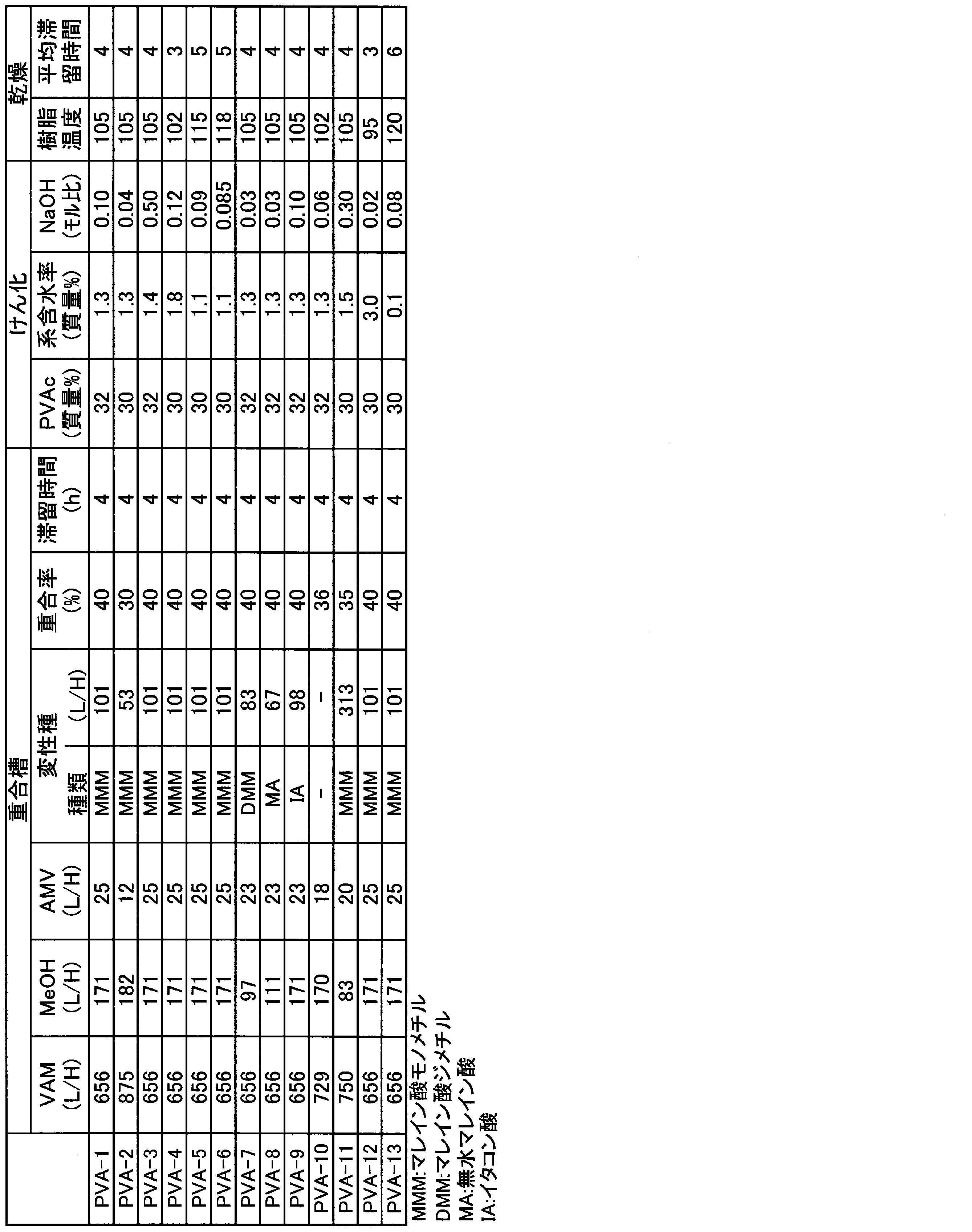
- Example 1 Synthesis of PVA-1 A polymerization vessel (continuous polymerization apparatus) equipped with a reflux condenser, raw material supply line, thermometer, nitrogen inlet and stirring blade, reflux condenser, raw material supply line, reaction liquid take-out line, thermometer A device equipped with a nitrogen inlet and a stirring blade was used.
- vinyl acetate (VAM) (656 L / H), methanol (MeOH) (171 L / H), 20% methanol solution (101 L / H) of monomethyl maleate (MMM) as a modified species, and 2,2 as an initiator
- a 2% methanol solution (25 L / H) of '-azobis (4-methoxy-2,4-dimethylvaleronitrile) (AMV) was continuously supplied using a metering pump.
- the polymerization liquid was continuously taken out from the polymerization tank so that the liquid level in the polymerization tank was constant.
- the polymerization rate of vinyl acetate in the polymerization liquid taken out from the polymerization tank was adjusted to 40%.
- the residence time in the polymerization tank was 4 hours.
- the temperature of the polymerization liquid taken out from the polymerization tank was 63 ° C.
- the polymerization solution was taken out from the polymerization tank, and methanol vapor was introduced into the polymerization solution to remove unreacted vinyl acetate to obtain a methanol solution (concentration 35%) of polyvinyl acetate (PVAc).
- a desired amount of water and methanol are added to the above methanol solution of polyvinyl acetate to prepare a polyvinyl acetate (PVAc) / methanol solution (concentration 32% by mass) having a water content of 1.3% by mass as a saponification raw material solution. did.
- a sodium hydroxide / methanol solution (concentration 4% by mass) as a saponification catalyst solution was added so that the molar ratio of sodium hydroxide to vinyl acetate units in the PVAc was 0.10.
- the saponification raw material solution and the saponification catalyst solution were mixed using a static mixer. The obtained mixture was placed on a belt and kept at a temperature of 40 ° C. for 18 minutes to allow the saponification reaction to proceed.
- the gel obtained by the saponification reaction was pulverized and drained. 600 kg / hr (resin content) of the obtained polyvinyl alcohol powder was continuously supplied to a dryer having a jacket temperature of 105 ° C. The average residence time of the powder in the dryer was 4 hours. Thereafter, pulverization was performed to obtain modified PVA (PVA-1).
- the obtained PVA-1 had a viscosity average polymerization degree of 1200, a saponification degree of 96.0 mol%, a content of monomer units having two carboxyl groups of 4.0 mol%, and 6 in 1 H-NMR analysis.
- X / (X + Y) calculated by using the integral value (X) of .8 to 7.2 ppm and the integral value (Y) of 5.3 to 5.5 ppm was 0.88.
- the water-soluble film using the modified PVA of the present invention in which X / (X + Y) calculated using the value (Y) satisfies a specific range is excellent in cold water solubility and practical physical properties such as strength and waist.
- the deterioration of various physical properties such as chemical resistance over time can be suppressed, and the surface appearance is good as a packaging material. Therefore, the water-soluble film of the present invention is useful in a wide range of fields such as clothing detergents, bleaching agents, liquids such as agricultural chemicals, powders, granules, and bulky pharmaceutical packaging materials.
Landscapes
- Chemical & Material Sciences (AREA)
- Chemical Kinetics & Catalysis (AREA)
- Organic Chemistry (AREA)
- Health & Medical Sciences (AREA)
- Medicinal Chemistry (AREA)
- Polymers & Plastics (AREA)
- Engineering & Computer Science (AREA)
- Manufacturing & Machinery (AREA)
- Life Sciences & Earth Sciences (AREA)
- General Chemical & Material Sciences (AREA)
- Oil, Petroleum & Natural Gas (AREA)
- Wood Science & Technology (AREA)
- Materials Engineering (AREA)
- Mechanical Engineering (AREA)
- Manufacture Of Macromolecular Shaped Articles (AREA)
- Wrappers (AREA)
- Addition Polymer Or Copolymer, Post-Treatments, Or Chemical Modifications (AREA)
Abstract
Description
[1]カルボキシル基を2つ有する単量体単位を0.05~10モル%含有してなり、1H-NMR解析における6.8~7.2ppmの積分値(X)及び5.3~5.5ppmの積分値(Y)の値が下記式を満足する変性ポリビニルアルコール;
0.60≦X/(X+Y)<1.0
[2]前記カルボキシル基を2つ有する単量体単位が、不飽和ジカルボン酸、不飽和ジカルボン酸無水物及び不飽和ジカルボン酸エステルからなる群から選ばれる1種以上に由来する上記[1]の変性ポリビニルアルコール;
[3]前記カルボキシル基を2つ有する単量体単位が、マレイン酸、マレイン酸モノメチル、マレイン酸モノエチル、マレイン酸ジメチル、マレイン酸ジエチル、無水マレイン酸、イタコン酸、イタコン酸モノメチル、イタコン酸モノエチル、イタコン酸ジメチル及びイタコン酸ジエチルからなる群から選ばれる1種以上のカルボキシル基を2つ有する単量体に由来する上記[1]の変性ポリビニルアルコール;
[4]前記カルボキシル基を2つ有する単量体単位の少なくとも一部が、下記式(I)で表される構造単位を形成する上記[1]~[3]のいずれかの変性ポリビニルアルコール;

[5]粘度平均重合度が300~3000、けん化度が82.0~99.9モル%である上記[1]~[4]のいずれかの変性ポリビニルアルコール;
[6]上記[1]~[5]のいずれかの変性ポリビニルアルコールを含有する水溶性フィルム;
[7]さらに可塑剤を含む上記[6]の水溶性フィルム;
[8]さらに界面活性剤を含む上記[6]又は[7]の水溶性フィルム;
[9]上記[6]~[8]のいずれかの水溶性フィルムで薬品を収容してなる包装体;及び
[10]前記薬品が農薬又は洗剤である上記[9]の包装体;
に関する。
本発明の変性PVAは、カルボキシル基を2つ有する単量体単位を0.05~10モル%含有してなり、1H-NMR解析における6.8~7.2ppmの積分値(X)及び5.3~5.5ppmの積分値(Y)の値が下記式を満足する変性ポリビニルアルコールである。
0.60≦X/(X+Y)<1.0


0.60≦X/(X+Y)<1.0

0.60≦X/(X+Y)<1.0
P=([η]×10000/8.29)(1/0.62)
以下、本発明の変性PVAの製造方法について、詳細に説明する。なお、本発明は、以下に説明する実施形態に限定されるものではない。
上記変性PVAを含有する水溶性フィルムも、本発明の実施形態の一つである。
変性PVAの重合度及びけん化度は、JIS K 6726(1994)に記載の方法により求めた。
変性PVAの1H-NMRの測定方法は、変性PVAをD2Oに溶解させ、600MHzの1H-NMRを用いて80℃で測定した。
実施例及び比較例で得られたフィルムを40mm×40mmの正方形に切り、これをスライドマウントにはさみこんだ。別途、10℃に調整した恒温バスに1リットルの蒸留水を入れた1リットルのガラスビーカーを設置し、5cmの回転子を用いて250rpmで撹拌を行った。ビーカー内の蒸留水が10℃になった後、上述のスライドマウントを、撹拌している冷水中に浸漬して水溶性の測定を開始した。この際、フィルムの溶解状態を観察し、フィルムが完全に溶解するまでの時間(秒数)を測定した。フィルムが完全に溶解するまでの時間が40秒未満の場合を「○」(良好)と判定し、40秒以上の場合を「×」(不良)と判定した。
実施例および比較例で得られたフィルムを幅10mmに切り出し、20℃、65%RHの雰囲気のもとで1週間調湿した後、オートグラフで引張り試験を行った。チャック間隔は50mm、引張り速度は500mm/minであった。ヤング率が2.0kg/mm2以上であり、引張強度が2.0kg/cm2以上の場合を「○」(良好)と判定し、ヤング率が2.0kg/mm2未満、又は引張強度が2.0kg/cm2未満の場合を「×」(不良)と判定した。
実施例および比較例で得られたフィルムを用いて10×15cm角のサンプルを2枚準備した。次いで、このフィルムを重ね合わせてヒートシーラーにて3方を140℃で熱シールした。続いて開口部から内部に薬品としてボルドー剤と珪藻土の混合物(質量比1:3)40gを入れ、残りの1方をヒートシーラーにて140℃で熱シールして密封した。この包装袋をさらにアルミニウムにポリエチレンをラミネートしたフィルムで包み、四方をヒートシーラーにて熱シールすることにより2重に密封包装し、薬品を密封した包装袋から水及び可塑剤が飛散しないようにした。この袋を長期保存の促進試験として、40℃の恒温器に入れて放置し、4週間後に取り出して、包装していたフィルムの水溶性を前述の測定方法にて測定し、薬品包装前との経時変化を調べた。促進試験前後のフィルムが完全に溶解するまでの時間の差が5秒未満の場合を「○」(良好)と判定し、5秒以上の場合を「×」(不良)と判定した。
PVA-1の合成
還流冷却器、原料供給ライン、温度計、窒素導入口、攪拌翼を備えた、重合容器(連続重合装置)と、還流冷却器、原料供給ライン、反応液取出ライン、温度計、窒素導入口、攪拌翼を備えた装置を用いた。重合槽に酢酸ビニル(VAM)(656L/H)、メタノール(MeOH)(171L/H)、変性種としてマレイン酸モノメチル(MMM)の20%メタノール溶液(101L/H)、開始剤として2,2’-アゾビス(4-メトキシ-2,4-ジメチルバレロニトリル)(AMV)の2%メタノール溶液(25L/H)を定量ポンプを用いて連続的に供給した。重合槽内の液面が一定になるように重合槽から重合液を連続的に取り出した。重合槽から取り出される重合液中の酢酸ビニルの重合率が40%になるよう調整した。重合槽の滞留時間は4時間であった。重合槽から取り出される重合液の温度は63℃であった。重合槽から重合液を取り出し、当該重合液にメタノール蒸気を導入することで未反応の酢酸ビニルの除去を行い、ポリ酢酸ビニル(PVAc)のメタノール溶液(濃度35%)を得た。
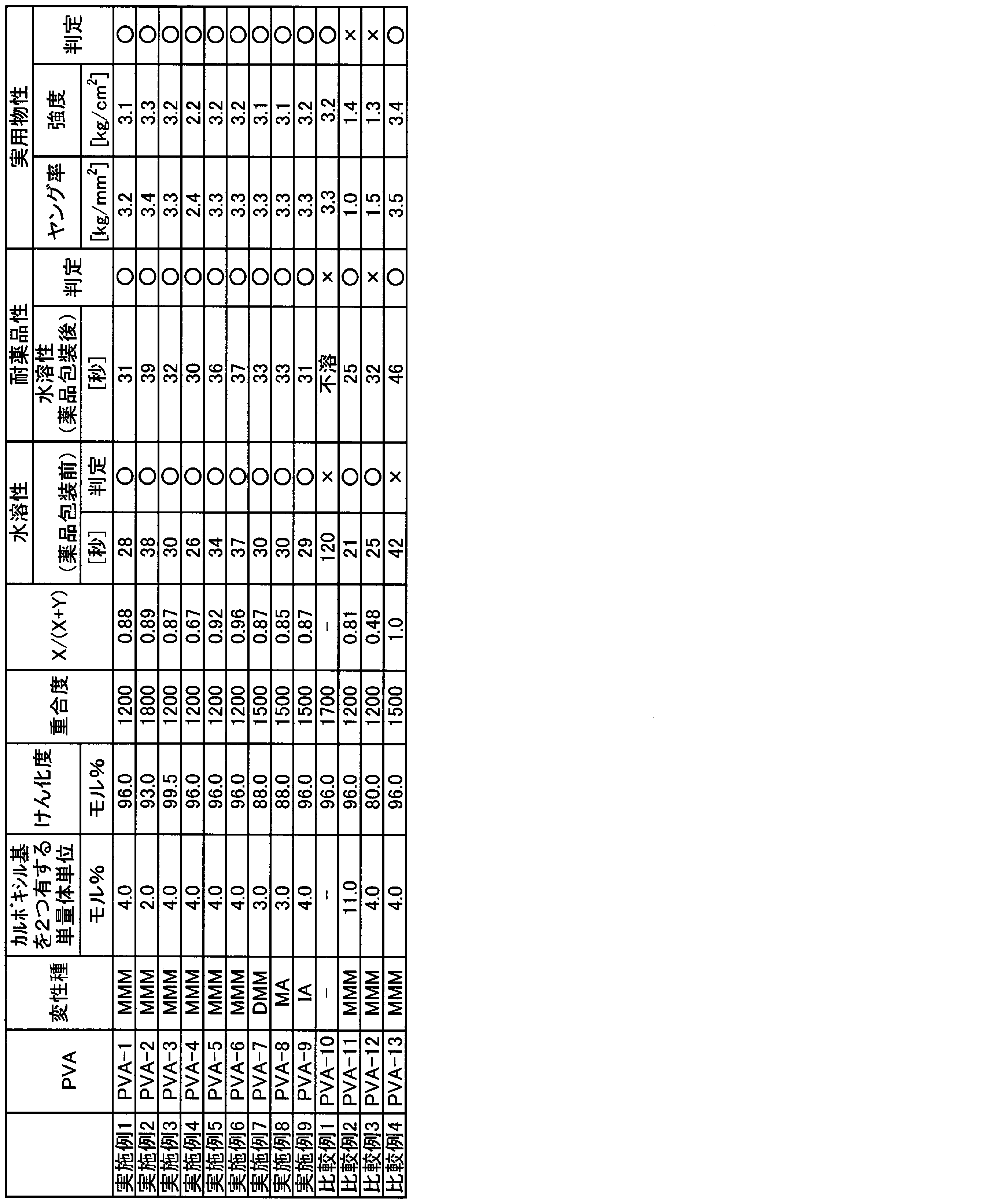
得られた水溶性フィルムを用いて、上記した方法により水溶性フィルムの溶解性、耐薬品性及び実用物性を評価し、結果を表2に示す。
PVA-2~PVA-13の合成
表1に記載した条件に変更したこと以外は、PVA-1と同様の方法により、PVA(PVA-2~PVA-13)を得た。得られたPVA-2~PVA-9及びPVA-11~PVA-13について、1H-NMR解析を行ったところ、6.8~7.2ppm及び5.3~5.5ppmにピークが検出された。
表2に示す各種PVAを用いたこと以外は実施例1と同様にして、水溶性フィルムを作製した。得られた水溶性フィルムについて、実施例1と同様にして溶解性、耐薬品性及び実用物性を評価した。結果を表2に示す。
Claims (10)
- カルボキシル基を2つ有する単量体単位を0.05~10モル%含有してなり、1H-NMR解析における6.8~7.2ppmの積分値(X)及び5.3~5.5ppmの積分値(Y)の値が下記式を満足する変性ポリビニルアルコール。
0.60≦X/(X+Y)<1.0 - 前記カルボキシル基を2つ有する単量体単位が、不飽和ジカルボン酸、不飽和ジカルボン酸無水物及び不飽和ジカルボン酸エステルからなる群から選ばれる1種以上に由来する請求項1の変性ポリビニルアルコール。
- 前記カルボキシル基を2つ有する単量体単位が、マレイン酸、マレイン酸モノメチル、マレイン酸モノエチル、マレイン酸ジメチル、マレイン酸ジエチル、無水マレイン酸、イタコン酸、イタコン酸モノメチル、イタコン酸モノエチル、イタコン酸ジメチル及びイタコン酸ジエチルからなる群から選ばれる1種以上のカルボキシル基を2つ有する単量体に由来する請求項1に記載の変性ポリビニルアルコール。
- 前記カルボキシル基を2つ有する単量体単位の少なくとも一部が、下記式(I)で表される構造単位を形成する請求項1~3のいずれか1項に記載の変性ポリビニルアルコール。

- 粘度平均重合度が300~3000、けん化度が82.0~99.9モル%である請求項1~4のいずれか1項に記載の変性ポリビニルアルコール。
- 請求項1~5のいずれか1項に記載の変性ポリビニルアルコールを含有する水溶性フィルム。
- さらに可塑剤を含有する請求項6に記載の水溶性フィルム。
- さらに界面活性剤を含有する請求項6又は7に記載の水溶性フィルム。
- 請求項6~8のいずれか1項に記載の水溶性フィルムで薬品を収容してなる包装体。
- 前記薬品が農薬又は洗剤である請求項9に記載の包装体。
Priority Applications (4)
| Application Number | Priority Date | Filing Date | Title |
|---|---|---|---|
| JP2016549951A JP6461986B2 (ja) | 2014-09-26 | 2015-09-18 | 変性ポリビニルアルコールおよび水溶性フィルム |
| US15/514,288 US10508160B2 (en) | 2014-09-26 | 2015-09-18 | Modified polyvinyl alcohol and water-soluble film |
| CN201580051718.6A CN106715493B (zh) | 2014-09-26 | 2015-09-18 | 改性聚乙烯醇和水溶性膜 |
| EP15844919.9A EP3199560B1 (en) | 2014-09-26 | 2015-09-18 | Modified polyvinyl alcohol and water-soluble film |
Applications Claiming Priority (2)
| Application Number | Priority Date | Filing Date | Title |
|---|---|---|---|
| JP2014196402 | 2014-09-26 | ||
| JP2014-196402 | 2014-09-26 |
Publications (1)
| Publication Number | Publication Date |
|---|---|
| WO2016047126A1 true WO2016047126A1 (ja) | 2016-03-31 |
Family
ID=55580673
Family Applications (1)
| Application Number | Title | Priority Date | Filing Date |
|---|---|---|---|
| PCT/JP2015/004796 Ceased WO2016047126A1 (ja) | 2014-09-26 | 2015-09-18 | 変性ポリビニルアルコールおよび水溶性フィルム |
Country Status (6)
| Country | Link |
|---|---|
| US (1) | US10508160B2 (ja) |
| EP (1) | EP3199560B1 (ja) |
| JP (1) | JP6461986B2 (ja) |
| CN (1) | CN106715493B (ja) |
| TW (1) | TWI692488B (ja) |
| WO (1) | WO2016047126A1 (ja) |
Cited By (7)
| Publication number | Priority date | Publication date | Assignee | Title |
|---|---|---|---|---|
| CN105949692A (zh) * | 2016-07-22 | 2016-09-21 | 上海洛法化工有限公司 | 一种改性聚乙烯醇及其制备工艺 |
| WO2018061272A1 (ja) * | 2016-09-28 | 2018-04-05 | 株式会社クラレ | メタノール含有量が低減された変性ビニルアルコール系重合体粉末及びその製造方法、並びに水溶性フィルム及び包装体 |
| JP2019014831A (ja) * | 2017-07-07 | 2019-01-31 | 日本合成化学工業株式会社 | 新規エチレン−ビニルアルコール系共重合体及びそれを含むフィルム、多層構造体、およびその製造方法 |
| WO2019078223A1 (ja) * | 2017-10-18 | 2019-04-25 | 日本合成化学工業株式会社 | 水溶性フィルム及び薬剤包装体 |
| JP2019105008A (ja) * | 2017-12-13 | 2019-06-27 | 株式会社クラレ | 繊維用糊剤 |
| JPWO2020218321A1 (ja) * | 2019-04-23 | 2020-10-29 | ||
| JPWO2019189000A1 (ja) * | 2018-03-26 | 2021-04-01 | 株式会社クラレ | コーティング剤、接着剤及び塗工物 |
Families Citing this family (22)
| Publication number | Priority date | Publication date | Assignee | Title |
|---|---|---|---|---|
| JP7161277B2 (ja) | 2015-11-19 | 2022-10-26 | 三菱ケミカル株式会社 | 水溶性フィルム及び薬剤包装体 |
| RU2760028C2 (ru) | 2016-04-13 | 2021-11-22 | МОНОСОЛ, ЭлЭлСи | Водорастворимая пленка, пакеты из пленки и способы их получения и применения |
| US10479965B2 (en) | 2016-06-13 | 2019-11-19 | The Procter & Gamble Company | Water-soluble unit dose articles made from a combination of different films and containing household care compositions |
| HUE068143T2 (hu) | 2016-06-13 | 2024-12-28 | Procter & Gamble | Különbözõ filmek kombinációjából készült, vízoldható, háztartási tisztítókészítményeket tartalmazó egyadagos termékek |
| WO2017218443A1 (en) | 2016-06-13 | 2017-12-21 | The Procter & Gamble Company | Water-soluble unit dose articles made from a combination of different films and containing household care compositions |
| CN109311574A (zh) | 2016-06-13 | 2019-02-05 | 蒙诺苏尔有限公司 | 水溶性小包装 |
| WO2017218414A1 (en) | 2016-06-13 | 2017-12-21 | Monosol, Llc | Use of a first film and a second film to improve seal strength of a water-soluble |
| WO2017218408A1 (en) | 2016-06-13 | 2017-12-21 | Monosol, Llc | Water-soluble unit dose articles made from a combination of different films |
| BR112019000354B1 (pt) | 2016-08-01 | 2023-01-10 | Monosol, Llc | Mistura de plastificante para estabilidade de cloro de filmes solúveis em água |
| CN106380765B (zh) * | 2016-09-05 | 2019-03-01 | 广东聚益新材有限公司 | 一种水溶性购物袋及其制备方法 |
| CN111278960A (zh) * | 2017-09-06 | 2020-06-12 | 巴斯夫欧洲公司 | 洗涤和清洁活性聚合物膜、它们的生产方法和它们的用途 |
| TWI704868B (zh) | 2018-03-08 | 2020-09-21 | 日商可樂麗股份有限公司 | 農藥用展著劑及農藥散布液 |
| TWI715947B (zh) * | 2018-03-20 | 2021-01-11 | 日商可樂麗股份有限公司 | 懸浮聚合用分散安定劑、及乙烯系聚合物之製造方法 |
| CN111936899B (zh) * | 2018-03-30 | 2022-12-02 | 积水化学工业株式会社 | 聚乙烯醇膜及偏光膜的制造方法 |
| WO2020196185A1 (ja) * | 2019-03-26 | 2020-10-01 | 積水化学工業株式会社 | 水溶性包装用フィルム |
| EP3957655A4 (en) * | 2019-04-15 | 2023-01-25 | Kuraray Co., Ltd. | ETHYLENE VINYL ALCOHOL COPOLYMER AND AQUEOUS SOLUTION WITH USE THEREOF |
| MX2022003369A (es) | 2019-09-30 | 2022-07-27 | Monosol Llc | Pelicula de dosis unitaria soluble en agua para envasado de químicos agresivos. |
| CN111087795A (zh) * | 2019-12-27 | 2020-05-01 | 佛山市三水联美化工有限公司 | 一种水性改性聚氨酯复合材料及其制备方法 |
| CN111567292B (zh) * | 2020-05-12 | 2025-07-22 | 李伯涵 | 一种可完全生物降解、可被雨水溶解的地膜及其制造方法 |
| WO2022004341A1 (ja) * | 2020-06-29 | 2022-01-06 | 株式会社クラレ | 水溶性フィルムおよび包装体 |
| CN115521563B (zh) * | 2021-06-25 | 2024-05-03 | 中国石油化工股份有限公司 | 具有中温水溶性能的热塑性低醇解度三元聚乙烯醇薄膜及其制备方法和应用 |
| EP4491641A4 (en) * | 2022-03-07 | 2026-03-25 | Sekisui Chemical Co Ltd | MODIFIED POLYVINYL ALCOHOL RESIN |
Citations (13)
| Publication number | Priority date | Publication date | Assignee | Title |
|---|---|---|---|---|
| JPH02163149A (ja) * | 1988-12-16 | 1990-06-22 | Kao Corp | ポリビニルアルコール系フィルム |
| JPH04164998A (ja) * | 1990-10-29 | 1992-06-10 | Lion Corp | 洗剤個装体 |
| JPH04170405A (ja) * | 1990-11-01 | 1992-06-18 | Kuraray Co Ltd | 水溶性フイルム |
| JPH0471243U (ja) * | 1990-11-01 | 1992-06-24 | ||
| JPH06340899A (ja) * | 1993-06-01 | 1994-12-13 | Kao Corp | 水溶性フィルムによる液体包装体 |
| JPH09272773A (ja) * | 1996-04-05 | 1997-10-21 | Kuraray Co Ltd | 水溶性のフィルム |
| JPH1060207A (ja) * | 1996-08-22 | 1998-03-03 | Dai Ichi Kogyo Seiyaku Co Ltd | 水溶性フィルム |
| JP2001322668A (ja) * | 2000-05-16 | 2001-11-20 | Nippon Synthetic Chem Ind Co Ltd:The | 薬剤包装用フィルム |
| JP2004161823A (ja) * | 2002-11-11 | 2004-06-10 | Nippon Synthetic Chem Ind Co Ltd:The | 水溶性フィルム |
| JP2005089655A (ja) * | 2003-09-18 | 2005-04-07 | Japan Vam & Poval Co Ltd | ポリビニルアルコール系樹脂およびフィルム |
| JP2005139240A (ja) * | 2003-11-04 | 2005-06-02 | Japan Vam & Poval Co Ltd | 水溶性フィルムおよび個別包装材 |
| JP2006063242A (ja) * | 2004-08-30 | 2006-03-09 | Denki Kagaku Kogyo Kk | フィルム |
| WO2015098979A1 (ja) * | 2013-12-25 | 2015-07-02 | 株式会社クラレ | 変性ポリビニルアルコールおよびそれを含有する水溶性フィルム |
Family Cites Families (9)
| Publication number | Priority date | Publication date | Assignee | Title |
|---|---|---|---|---|
| JPS6031844B2 (ja) * | 1977-01-24 | 1985-07-24 | 株式会社クラレ | カルボキシル基変性ポリビニルアルコ−ルの製造法 |
| JPH0627205B2 (ja) | 1986-12-27 | 1994-04-13 | 日本合成化学工業株式会社 | アルカリ性物質包装用のポリビニルアルコ−ルフイルム |
| US5019609A (en) * | 1988-08-02 | 1991-05-28 | Aicello Chemical Co., Ltd. | Films easily soluble in cold water |
| JP3474981B2 (ja) * | 1995-10-11 | 2003-12-08 | 花王株式会社 | 浴用剤 |
| JP3913601B2 (ja) | 2001-04-20 | 2007-05-09 | 株式会社クラレ | 水溶性フィルム |
| DE60201142T2 (de) | 2001-04-20 | 2005-10-20 | Kuraray Co., Ltd., Kurashiki | Wasserlösliche Folie und Verpackung, welche dieselbe verwendet |
| TWI240724B (en) * | 2001-12-17 | 2005-10-01 | Kuraray Co | Polyvinyl alcohol film and polarizing film |
| CN101203551B (zh) * | 2005-06-16 | 2011-09-28 | 日本合成化学工业株式会社 | 水溶性膜 |
| EP3201100A2 (en) * | 2014-10-03 | 2017-08-09 | Monosol, LLC | Degradable materials and packaging made from same |
-
2015
- 2015-09-18 WO PCT/JP2015/004796 patent/WO2016047126A1/ja not_active Ceased
- 2015-09-18 US US15/514,288 patent/US10508160B2/en active Active
- 2015-09-18 CN CN201580051718.6A patent/CN106715493B/zh active Active
- 2015-09-18 JP JP2016549951A patent/JP6461986B2/ja active Active
- 2015-09-18 EP EP15844919.9A patent/EP3199560B1/en active Active
- 2015-09-25 TW TW104131711A patent/TWI692488B/zh active
Patent Citations (13)
| Publication number | Priority date | Publication date | Assignee | Title |
|---|---|---|---|---|
| JPH02163149A (ja) * | 1988-12-16 | 1990-06-22 | Kao Corp | ポリビニルアルコール系フィルム |
| JPH04164998A (ja) * | 1990-10-29 | 1992-06-10 | Lion Corp | 洗剤個装体 |
| JPH04170405A (ja) * | 1990-11-01 | 1992-06-18 | Kuraray Co Ltd | 水溶性フイルム |
| JPH0471243U (ja) * | 1990-11-01 | 1992-06-24 | ||
| JPH06340899A (ja) * | 1993-06-01 | 1994-12-13 | Kao Corp | 水溶性フィルムによる液体包装体 |
| JPH09272773A (ja) * | 1996-04-05 | 1997-10-21 | Kuraray Co Ltd | 水溶性のフィルム |
| JPH1060207A (ja) * | 1996-08-22 | 1998-03-03 | Dai Ichi Kogyo Seiyaku Co Ltd | 水溶性フィルム |
| JP2001322668A (ja) * | 2000-05-16 | 2001-11-20 | Nippon Synthetic Chem Ind Co Ltd:The | 薬剤包装用フィルム |
| JP2004161823A (ja) * | 2002-11-11 | 2004-06-10 | Nippon Synthetic Chem Ind Co Ltd:The | 水溶性フィルム |
| JP2005089655A (ja) * | 2003-09-18 | 2005-04-07 | Japan Vam & Poval Co Ltd | ポリビニルアルコール系樹脂およびフィルム |
| JP2005139240A (ja) * | 2003-11-04 | 2005-06-02 | Japan Vam & Poval Co Ltd | 水溶性フィルムおよび個別包装材 |
| JP2006063242A (ja) * | 2004-08-30 | 2006-03-09 | Denki Kagaku Kogyo Kk | フィルム |
| WO2015098979A1 (ja) * | 2013-12-25 | 2015-07-02 | 株式会社クラレ | 変性ポリビニルアルコールおよびそれを含有する水溶性フィルム |
Cited By (21)
| Publication number | Priority date | Publication date | Assignee | Title |
|---|---|---|---|---|
| CN105949692A (zh) * | 2016-07-22 | 2016-09-21 | 上海洛法化工有限公司 | 一种改性聚乙烯醇及其制备工艺 |
| EP3521327A4 (en) * | 2016-09-28 | 2020-03-18 | Kuraray Co., Ltd. | MODIFIED VINYL ALCOHOL POLYMER POWDER WITH REDUCED METHANOL CONTENT AND PRODUCTION METHOD FOR IT AND WATER-SOLUBLE FILM AND PACKING MATERIAL |
| WO2018061272A1 (ja) * | 2016-09-28 | 2018-04-05 | 株式会社クラレ | メタノール含有量が低減された変性ビニルアルコール系重合体粉末及びその製造方法、並びに水溶性フィルム及び包装体 |
| JPWO2018061272A1 (ja) * | 2016-09-28 | 2018-09-27 | 株式会社クラレ | メタノール含有量が低減された変性ビニルアルコール系重合体粉末及びその製造方法、並びに水溶性フィルム及び包装体 |
| US10988606B2 (en) | 2016-09-28 | 2021-04-27 | Kuraray Co., Ltd. | Modified vinyl alcohol polymer powder having reduced methanol content and production method therefor, and water-soluble film and packaging material |
| CN109790254A (zh) * | 2016-09-28 | 2019-05-21 | 株式会社可乐丽 | 甲醇含量减少的改性乙烯醇系聚合物粉末和其制造方法、以及水溶性膜和包装体 |
| JP2019014831A (ja) * | 2017-07-07 | 2019-01-31 | 日本合成化学工業株式会社 | 新規エチレン−ビニルアルコール系共重合体及びそれを含むフィルム、多層構造体、およびその製造方法 |
| US12116465B2 (en) | 2017-10-18 | 2024-10-15 | Mitsubishi Chemical Corporation | Water-soluble film and chemical agent package |
| JPWO2019078223A1 (ja) * | 2017-10-18 | 2020-09-17 | 三菱ケミカル株式会社 | 水溶性フィルム及び薬剤包装体 |
| US11780976B2 (en) | 2017-10-18 | 2023-10-10 | Mitsubishi Chemical Corporation | Water-soluble film and chemical agent package |
| JP7323018B2 (ja) | 2017-10-18 | 2023-08-08 | 三菱ケミカル株式会社 | 水溶性フィルム及び薬剤包装体 |
| WO2019078223A1 (ja) * | 2017-10-18 | 2019-04-25 | 日本合成化学工業株式会社 | 水溶性フィルム及び薬剤包装体 |
| JP7124707B2 (ja) | 2017-10-18 | 2022-08-24 | 三菱ケミカル株式会社 | 水溶性フィルム及び薬剤包装体 |
| JP2022140495A (ja) * | 2017-10-18 | 2022-09-26 | 三菱ケミカル株式会社 | 水溶性フィルム及び薬剤包装体 |
| JP2019105008A (ja) * | 2017-12-13 | 2019-06-27 | 株式会社クラレ | 繊維用糊剤 |
| JP7267999B2 (ja) | 2018-03-26 | 2023-05-02 | 株式会社クラレ | コーティング剤、接着剤及び塗工物 |
| JPWO2019189000A1 (ja) * | 2018-03-26 | 2021-04-01 | 株式会社クラレ | コーティング剤、接着剤及び塗工物 |
| WO2020218321A1 (ja) * | 2019-04-23 | 2020-10-29 | 株式会社クラレ | 水溶性フィルムおよび包装体 |
| JP7398441B2 (ja) | 2019-04-23 | 2023-12-14 | 株式会社クラレ | 水溶性フィルムおよび包装体 |
| JPWO2020218321A1 (ja) * | 2019-04-23 | 2020-10-29 | ||
| US12319798B2 (en) | 2019-04-23 | 2025-06-03 | Kuraray Co., Ltd. | Water-soluble film and packaging |
Also Published As
| Publication number | Publication date |
|---|---|
| JPWO2016047126A1 (ja) | 2017-07-06 |
| CN106715493A (zh) | 2017-05-24 |
| CN106715493B (zh) | 2020-07-03 |
| US10508160B2 (en) | 2019-12-17 |
| EP3199560A1 (en) | 2017-08-02 |
| JP6461986B2 (ja) | 2019-01-30 |
| US20170275394A1 (en) | 2017-09-28 |
| EP3199560B1 (en) | 2020-11-11 |
| TWI692488B (zh) | 2020-05-01 |
| EP3199560A4 (en) | 2018-05-30 |
| TW201619215A (zh) | 2016-06-01 |
Similar Documents
| Publication | Publication Date | Title |
|---|---|---|
| JP6461986B2 (ja) | 変性ポリビニルアルコールおよび水溶性フィルム | |
| JP6093491B2 (ja) | 変性ポリビニルアルコール、樹脂組成物及びフィルム | |
| TW572962B (en) | Water-soluble resin composition and water-soluble film | |
| JP6093490B2 (ja) | 樹脂組成物及びフィルム | |
| JP6392489B2 (ja) | メタノール含有量が低減された変性ビニルアルコール系重合体粉末及びその製造方法、並びに水溶性フィルム及び包装体 | |
| JP2001329130A (ja) | 水溶性フィルムおよびその製造法 | |
| JP3913601B2 (ja) | 水溶性フィルム | |
| JP4772238B2 (ja) | 塩素含有化合物包装用水溶性フィルム | |
| JP4540809B2 (ja) | 水溶性樹脂組成物および水溶性フィルム | |
| JP4832687B2 (ja) | 酸性物質包装用水溶性フィルム | |
| JP4570742B2 (ja) | 水溶性フィルム | |
| JP4675531B2 (ja) | アルカリ性物質包装用水溶性フィルム | |
| JP3938536B2 (ja) | 包装体 |
Legal Events
| Date | Code | Title | Description |
|---|---|---|---|
| 121 | Ep: the epo has been informed by wipo that ep was designated in this application |
Ref document number: 15844919 Country of ref document: EP Kind code of ref document: A1 |
|
| ENP | Entry into the national phase |
Ref document number: 2016549951 Country of ref document: JP Kind code of ref document: A |
|
| WWE | Wipo information: entry into national phase |
Ref document number: 15514288 Country of ref document: US |
|
| NENP | Non-entry into the national phase |
Ref country code: DE |
|
| REEP | Request for entry into the european phase |
Ref document number: 2015844919 Country of ref document: EP |
|
| WWE | Wipo information: entry into national phase |
Ref document number: 2015844919 Country of ref document: EP |