WO2016052308A1 - 変性固体状ポリアルキルアルミノキサンおよびオレフィン多量化反応用触媒 - Google Patents
変性固体状ポリアルキルアルミノキサンおよびオレフィン多量化反応用触媒 Download PDFInfo
- Publication number
- WO2016052308A1 WO2016052308A1 PCT/JP2015/076975 JP2015076975W WO2016052308A1 WO 2016052308 A1 WO2016052308 A1 WO 2016052308A1 JP 2015076975 W JP2015076975 W JP 2015076975W WO 2016052308 A1 WO2016052308 A1 WO 2016052308A1
- Authority
- WO
- WIPO (PCT)
- Prior art keywords
- group
- carbon atoms
- general formula
- substituted
- atom
- Prior art date
- Legal status (The legal status is an assumption and is not a legal conclusion. Google has not performed a legal analysis and makes no representation as to the accuracy of the status listed.)
- Ceased
Links
Classifications
-
- B—PERFORMING OPERATIONS; TRANSPORTING
- B01—PHYSICAL OR CHEMICAL PROCESSES OR APPARATUS IN GENERAL
- B01J—CHEMICAL OR PHYSICAL PROCESSES, e.g. CATALYSIS OR COLLOID CHEMISTRY; THEIR RELEVANT APPARATUS
- B01J31/00—Catalysts comprising hydrides, coordination complexes or organic compounds
- B01J31/02—Catalysts comprising hydrides, coordination complexes or organic compounds containing organic compounds or metal hydrides
- B01J31/12—Catalysts comprising hydrides, coordination complexes or organic compounds containing organic compounds or metal hydrides containing organo-metallic compounds or metal hydrides
- B01J31/14—Catalysts comprising hydrides, coordination complexes or organic compounds containing organic compounds or metal hydrides containing organo-metallic compounds or metal hydrides of aluminium or boron
- B01J31/143—Catalysts comprising hydrides, coordination complexes or organic compounds containing organic compounds or metal hydrides containing organo-metallic compounds or metal hydrides of aluminium or boron of aluminium
-
- B—PERFORMING OPERATIONS; TRANSPORTING
- B01—PHYSICAL OR CHEMICAL PROCESSES OR APPARATUS IN GENERAL
- B01J—CHEMICAL OR PHYSICAL PROCESSES, e.g. CATALYSIS OR COLLOID CHEMISTRY; THEIR RELEVANT APPARATUS
- B01J31/00—Catalysts comprising hydrides, coordination complexes or organic compounds
- B01J31/16—Catalysts comprising hydrides, coordination complexes or organic compounds containing coordination complexes
- B01J31/1616—Coordination complexes, e.g. organometallic complexes, immobilised on an inorganic support, e.g. ship-in-a-bottle type catalysts
-
- B—PERFORMING OPERATIONS; TRANSPORTING
- B01—PHYSICAL OR CHEMICAL PROCESSES OR APPARATUS IN GENERAL
- B01J—CHEMICAL OR PHYSICAL PROCESSES, e.g. CATALYSIS OR COLLOID CHEMISTRY; THEIR RELEVANT APPARATUS
- B01J31/00—Catalysts comprising hydrides, coordination complexes or organic compounds
- B01J31/16—Catalysts comprising hydrides, coordination complexes or organic compounds containing coordination complexes
- B01J31/22—Organic complexes
-
- B—PERFORMING OPERATIONS; TRANSPORTING
- B01—PHYSICAL OR CHEMICAL PROCESSES OR APPARATUS IN GENERAL
- B01J—CHEMICAL OR PHYSICAL PROCESSES, e.g. CATALYSIS OR COLLOID CHEMISTRY; THEIR RELEVANT APPARATUS
- B01J31/00—Catalysts comprising hydrides, coordination complexes or organic compounds
- B01J31/16—Catalysts comprising hydrides, coordination complexes or organic compounds containing coordination complexes
- B01J31/22—Organic complexes
- B01J31/2204—Organic complexes the ligands containing oxygen or sulfur as complexing atoms
- B01J31/2208—Oxygen, e.g. acetylacetonates
- B01J31/2226—Anionic ligands, i.e. the overall ligand carries at least one formal negative charge
-
- B—PERFORMING OPERATIONS; TRANSPORTING
- B01—PHYSICAL OR CHEMICAL PROCESSES OR APPARATUS IN GENERAL
- B01J—CHEMICAL OR PHYSICAL PROCESSES, e.g. CATALYSIS OR COLLOID CHEMISTRY; THEIR RELEVANT APPARATUS
- B01J31/00—Catalysts comprising hydrides, coordination complexes or organic compounds
- B01J31/16—Catalysts comprising hydrides, coordination complexes or organic compounds containing coordination complexes
- B01J31/22—Organic complexes
- B01J31/2282—Unsaturated compounds used as ligands
- B01J31/2295—Cyclic compounds, e.g. cyclopentadienyls
-
- C—CHEMISTRY; METALLURGY
- C07—ORGANIC CHEMISTRY
- C07C—ACYCLIC OR CARBOCYCLIC COMPOUNDS
- C07C2/00—Preparation of hydrocarbons from hydrocarbons containing a smaller number of carbon atoms
- C07C2/02—Preparation of hydrocarbons from hydrocarbons containing a smaller number of carbon atoms by addition between unsaturated hydrocarbons
- C07C2/04—Preparation of hydrocarbons from hydrocarbons containing a smaller number of carbon atoms by addition between unsaturated hydrocarbons by oligomerisation of well-defined unsaturated hydrocarbons without ring formation
- C07C2/06—Preparation of hydrocarbons from hydrocarbons containing a smaller number of carbon atoms by addition between unsaturated hydrocarbons by oligomerisation of well-defined unsaturated hydrocarbons without ring formation of alkenes, i.e. acyclic hydrocarbons having only one carbon-to-carbon double bond
- C07C2/08—Catalytic processes
- C07C2/26—Catalytic processes with hydrides or organic compounds
- C07C2/30—Catalytic processes with hydrides or organic compounds containing metal-to-carbon bond; Metal hydrides
-
- C—CHEMISTRY; METALLURGY
- C07—ORGANIC CHEMISTRY
- C07C—ACYCLIC OR CARBOCYCLIC COMPOUNDS
- C07C2/00—Preparation of hydrocarbons from hydrocarbons containing a smaller number of carbon atoms
- C07C2/02—Preparation of hydrocarbons from hydrocarbons containing a smaller number of carbon atoms by addition between unsaturated hydrocarbons
- C07C2/04—Preparation of hydrocarbons from hydrocarbons containing a smaller number of carbon atoms by addition between unsaturated hydrocarbons by oligomerisation of well-defined unsaturated hydrocarbons without ring formation
- C07C2/06—Preparation of hydrocarbons from hydrocarbons containing a smaller number of carbon atoms by addition between unsaturated hydrocarbons by oligomerisation of well-defined unsaturated hydrocarbons without ring formation of alkenes, i.e. acyclic hydrocarbons having only one carbon-to-carbon double bond
- C07C2/08—Catalytic processes
- C07C2/26—Catalytic processes with hydrides or organic compounds
- C07C2/32—Catalytic processes with hydrides or organic compounds as complexes, e.g. acetyl-acetonates
-
- C—CHEMISTRY; METALLURGY
- C07—ORGANIC CHEMISTRY
- C07F—ACYCLIC, CARBOCYCLIC OR HETEROCYCLIC COMPOUNDS CONTAINING ELEMENTS OTHER THAN CARBON, HYDROGEN, HALOGEN, OXYGEN, NITROGEN, SULFUR, SELENIUM OR TELLURIUM
- C07F5/00—Compounds containing elements of Groups 3 or 13 of the Periodic Table
- C07F5/06—Aluminium compounds
- C07F5/061—Aluminium compounds with C-aluminium linkage
- C07F5/066—Aluminium compounds with C-aluminium linkage compounds with Al linked to an element other than Al, C, H or halogen (this includes Al-cyanide linkage)
- C07F5/068—Aluminium compounds with C-aluminium linkage compounds with Al linked to an element other than Al, C, H or halogen (this includes Al-cyanide linkage) preparation of alum(in)oxanes
-
- C—CHEMISTRY; METALLURGY
- C07—ORGANIC CHEMISTRY
- C07F—ACYCLIC, CARBOCYCLIC OR HETEROCYCLIC COMPOUNDS CONTAINING ELEMENTS OTHER THAN CARBON, HYDROGEN, HALOGEN, OXYGEN, NITROGEN, SULFUR, SELENIUM OR TELLURIUM
- C07F7/00—Compounds containing elements of Groups 4 or 14 of the Periodic Table
- C07F7/02—Silicon compounds
- C07F7/08—Compounds having one or more C—Si linkages
-
- C—CHEMISTRY; METALLURGY
- C08—ORGANIC MACROMOLECULAR COMPOUNDS; THEIR PREPARATION OR CHEMICAL WORKING-UP; COMPOSITIONS BASED THEREON
- C08F—MACROMOLECULAR COMPOUNDS OBTAINED BY REACTIONS ONLY INVOLVING CARBON-TO-CARBON UNSATURATED BONDS
- C08F4/00—Polymerisation catalysts
- C08F4/02—Carriers therefor
-
- C—CHEMISTRY; METALLURGY
- C08—ORGANIC MACROMOLECULAR COMPOUNDS; THEIR PREPARATION OR CHEMICAL WORKING-UP; COMPOSITIONS BASED THEREON
- C08G—MACROMOLECULAR COMPOUNDS OBTAINED OTHERWISE THAN BY REACTIONS ONLY INVOLVING UNSATURATED CARBON-TO-CARBON BONDS
- C08G79/00—Macromolecular compounds obtained by reactions forming a linkage containing atoms other than silicon, sulfur, nitrogen, oxygen, and carbon with or without the latter elements in the main chain of the macromolecule
- C08G79/10—Macromolecular compounds obtained by reactions forming a linkage containing atoms other than silicon, sulfur, nitrogen, oxygen, and carbon with or without the latter elements in the main chain of the macromolecule a linkage containing aluminium
-
- C—CHEMISTRY; METALLURGY
- C08—ORGANIC MACROMOLECULAR COMPOUNDS; THEIR PREPARATION OR CHEMICAL WORKING-UP; COMPOSITIONS BASED THEREON
- C08G—MACROMOLECULAR COMPOUNDS OBTAINED OTHERWISE THAN BY REACTIONS ONLY INVOLVING UNSATURATED CARBON-TO-CARBON BONDS
- C08G79/00—Macromolecular compounds obtained by reactions forming a linkage containing atoms other than silicon, sulfur, nitrogen, oxygen, and carbon with or without the latter elements in the main chain of the macromolecule
- C08G79/12—Macromolecular compounds obtained by reactions forming a linkage containing atoms other than silicon, sulfur, nitrogen, oxygen, and carbon with or without the latter elements in the main chain of the macromolecule a linkage containing tin
-
- B—PERFORMING OPERATIONS; TRANSPORTING
- B01—PHYSICAL OR CHEMICAL PROCESSES OR APPARATUS IN GENERAL
- B01J—CHEMICAL OR PHYSICAL PROCESSES, e.g. CATALYSIS OR COLLOID CHEMISTRY; THEIR RELEVANT APPARATUS
- B01J2231/00—Catalytic reactions performed with catalysts classified in B01J31/00
- B01J2231/20—Olefin oligomerisation or telomerisation
-
- B—PERFORMING OPERATIONS; TRANSPORTING
- B01—PHYSICAL OR CHEMICAL PROCESSES OR APPARATUS IN GENERAL
- B01J—CHEMICAL OR PHYSICAL PROCESSES, e.g. CATALYSIS OR COLLOID CHEMISTRY; THEIR RELEVANT APPARATUS
- B01J2531/00—Additional information regarding catalytic systems classified in B01J31/00
- B01J2531/40—Complexes comprising metals of Group IV (IVA or IVB) as the central metal
-
- B—PERFORMING OPERATIONS; TRANSPORTING
- B01—PHYSICAL OR CHEMICAL PROCESSES OR APPARATUS IN GENERAL
- B01J—CHEMICAL OR PHYSICAL PROCESSES, e.g. CATALYSIS OR COLLOID CHEMISTRY; THEIR RELEVANT APPARATUS
- B01J2531/00—Additional information regarding catalytic systems classified in B01J31/00
- B01J2531/40—Complexes comprising metals of Group IV (IVA or IVB) as the central metal
- B01J2531/46—Titanium
Definitions
- the present invention is a modified solid polyalkylaluminoxane and olefin multimerization catalyst, which can produce an ⁇ -olefin while suppressing the by-product polymer from adhering to the reactor wall and a stirrer, and is highly active.
- the present invention relates to a modified solid polyalkylaluminoxane capable of providing a catalyst for olefin multimerization reaction, and a catalyst for olefin multimerization reaction containing the modified solid polyalkylaluminoxane.
- ⁇ -Olefin is a compound that is widely used industrially as a raw material for polyolefin.
- the olefin multimerization reaction is a reaction that can produce an ⁇ -olefin, and in recent years, a catalyst for an olefin multimerization reaction that can produce an ⁇ -olefin with high selectivity has been developed (Patent Documents 1 to 4). 5).
- An object of the present invention is to provide a modified solid polyalkylaluminoxane capable of providing a reaction catalyst, and an olefin multimerization catalyst containing the modified solid polyalkylaluminoxane.
- the present invention is an olefin multimerization reaction having a median diameter of 0.1 ⁇ m or more and 50 ⁇ m or less and having a structural unit represented by the following general formula (a) and a structural unit represented by the following general formula (b).
- This relates to a modified solid polyalkylaluminoxane.
- R ′ in General Formula (a) is an alkyl group having 1 to 20 carbon atoms
- R ′′ in General Formula (b) is a halogenated alkoxy group having 1 to 20 carbon atoms or 6 carbon atoms.
- the halogenated aryloxy group is 20 or less.
- a modified solid-state polymer capable of producing an ⁇ -olefin and giving a highly active catalyst for olefin multimerization reaction while suppressing the by-product polymer from adhering to the reactor wall and stirrer.
- the catalyst for olefin multimerization reaction containing the alkylaluminoxane and the modified solid polyalkylaluminoxane can be provided.
- the modified solid polyalkylaluminoxane of the present invention has a median diameter of 0.1 ⁇ m or more and 50 ⁇ m or less, a structural unit represented by the following general formula (a), and a structural unit represented by the following general formula (b). It is a modified solid polyalkylaluminoxane for olefin multimerization reaction.
- the modified solid polyalkylaluminoxane is linked in a chain form even if the structural unit represented by the following general formula (a) and the structural unit represented by the following general formula (b) are linked in a cyclic manner. Or a mixture of these.
- the modified solid polyalkylaluminoxane may be one in which a structural unit represented by the following general formula (a) and a structural unit represented by the following general formula (b) are bonded in a random order. Good.
- R 'in the general formula (a) is an alkyl group having 1 to 20 carbon atoms.
- Examples of the alkyl group having 1 to 20 carbon atoms in R ′ include methyl, ethyl, n-propyl, cyclopropyl, isopropyl, n-butyl, isobutyl, sec-butyl, tert-butyl.
- a methyl group, an ethyl group, an isobutyl group, a hexyl group or an octyl group is preferred, a methyl group, an ethyl group or an isobutyl group is more preferred, and a methyl group or an isobutyl group is more preferred.
- R ′′ in the general formula (b) is a halogenated alkoxy group having 1 to 20 carbon atoms or a halogenated aryloxy group having 6 to 20 carbon atoms.
- halogenated alkoxy group having 1 to 20 carbon atoms in R ′′ examples include a fluoromethoxy group, a chloromethoxy group, a bromomethoxy group, an iodomethoxy group, a difluoromethoxy group, a dichloromethoxy group, a dibromomethoxy group, and a diiodomethoxy.
- halogenated aryloxy group having 6 to 20 carbon atoms in R ′′ examples include 2-fluorophenoxy group, 3-fluorophenoxy group, 4-fluorophenoxy group, 2,4-difluorophenoxy group, 2,6- Difluorophenoxy group, 3,4-difluorophenoxy group, 3,5-difluorophenoxy group, 2,4,6-trifluorophenoxy group, 3,4,5-trifluorophenoxy group, 2,3,5,6- Tetrafluorophenoxy group, pentafluorophenoxy group, 2,3,5,6-tetrafluoro-4- (trifluoromethyl) phenoxy group, 2,3,5,6-tetrafluoro-4- (pentafluorophenyl) phenoxy Group, perfluoro-1-naphthoxy group, perfluoro-2-naphthoxy group, 2-chlorophenoxy group 3-chlorophenoxy group, 4-chlorophenoxy group, 2,4-dichlorophen
- R ′′ is preferably a halogenated aryloxy group, more preferably a fluorinated aryloxy group, still more preferably a 2,4,6-trifluorophenoxy group, 3,4,5-trifluorophenoxy group.
- the ratio (m / (m + n)) of the number (m) of structural units is preferably 0.05 or more and 0.5 or less.
- the ratio (m / (m + n)) is a ratio of aluminum atoms, fluorine atoms, carbon atoms, oxygen atoms, and hydrogen atoms constituting the modified solid polyalkylaluminoxane obtained by elemental analysis of the modified solid polyalkylaluminoxane. Is calculated from Examples of the elemental analysis method include known methods such as ICP emission analysis and EPMA analysis.
- the modified solid polyalkylaluminoxane is in the form of particles, and the median diameter is preferably 0.1 ⁇ m to 50 ⁇ m, more preferably 1 ⁇ m to 30 ⁇ m. A narrow particle size distribution is preferred.
- the median size and particle size distribution of the modified solid polyalkylaluminoxane can be determined by a laser diffraction / scattering method in a dried hydrocarbon solvent using a laser diffraction particle size distribution measuring device.
- the particle size distribution can be expressed by a span value, and the smaller the span value, the narrower the particle size distribution.
- the Span value is more preferably 2 or less.
- the Span value is expressed by the following equation using the numerical values of D10, the cumulative distribution obtained by laser diffraction particle size distribution measurement, which is 10% particle size, D50, 50%, and D90, 90%. Can be sought.
- Span value (D90 ⁇ D10) / D50
- the modified solid polyalkylaluminoxane of the present invention is the number of moles of the aluminum compound dissolved in the solvent with respect to the number of moles of aluminum of the modified solid polyalkylaluminoxane in the equilibrium state in n-hexane or toluene at 25 ° C. Is preferably 0 mol% or more and 2 mol% or less.
- the modified solid polyalkylaluminoxane is obtained by reacting a solid polyalkylaluminoxane with a halogenated alcohol having 1 to 20 carbon atoms or a halogenated phenol having 6 to 20 carbon atoms.
- a halogenated alcohol having 1 to 20 carbon atoms or a halogenated phenol having 6 to 20 carbon atoms.
- Phenols in halogenated phenols is a general term for compounds having a hydroxy group on an aromatic ring.
- the content of aluminum atoms contained in the solid polyalkylaluminoxane is preferably 36% by weight or more and 43% by weight or less. However, the total amount of solid polyalkylaluminoxane is 100% by weight.
- the content of aluminum atoms in the solid polyalkylaluminoxane can be obtained by a known method, for example, the method described in International Publication No. 2010/055652.
- the solid polyalkylaluminoxane those having a median diameter of 50 ⁇ m or less and a narrow particle size distribution are preferable.
- the median diameter and the particle size distribution can be determined by a laser diffraction particle size distribution measuring apparatus, and the Span value, which is an index of the particle size distribution, is preferably 2 or less.
- solid polyalkylaluminoxane examples include solid polymethylaluminoxane, solid polymethylisobutylaluminoxane, solid polyisobutylaluminoxane, and the like, preferably solid polymethylaluminoxane.
- the heating temperature is preferably from 80 ° C. to 200 ° C., and the heating time is from 5 minutes to 24 hours. Preferably there is.
- the production method of polyalkylaluminoxane includes a method of reacting alkylaluminum with water, and a method of thermally decomposing an alkylaluminum compound having an aluminum-oxygen-carbon bond obtained by reacting an oxygen-containing organic compound with trialkylaluminum. Can be given. A method of thermally decomposing a compound obtained by reacting an oxygen-containing organic compound with trialkylaluminum is preferred. As the oxygen-containing organic compound, a carboxylic acid is preferable.
- halogenated phenols having 6 to 20 carbon atoms examples include 2-fluorophenol, 3-fluorophenol, 4-fluorophenol, 2,4-difluorophenol, 2,6-difluorophenol, and 3,4-difluorophenol.
- the halogenated phenol having 6 to 20 carbon atoms is preferably a fluorinated phenol, more preferably 2,4,6-trifluorophenol, 3,4,5-trifluorophenol, or pentafluorophenol. 2,6-bis (trifluoromethyl) phenol, 3,5-bis (trifluoromethyl) phenol, or 2,4,6-tris (trifluoromethyl) phenol, more preferably pentafluorophenol. .
- the use amount of the halogenated alcohol having 1 to 20 carbon atoms or the halogenated phenol having 6 to 20 carbon atoms suppresses the point that the activity of the catalyst for olefin multimerization lasts and the by-product of the polymer.
- the aluminum atom in the modified solid polyalkylaluminoxane is preferably 0.01 equivalent or more and less than 1.0 equivalent, more preferably 0.05 equivalent or more and less than 1.0 equivalent, More preferably, it is 0.1 equivalent or more and 0.7 equivalent or less, and further preferably 0.2 equivalent or more and 0.5 equivalent or less.
- the solid polyalkylaluminoxane is preferably reacted with a halogenated alcohol having 1 to 20 carbon atoms or a halogenated phenol having 6 to 20 carbon atoms in the presence of a solvent.
- a halogenated alcohol having 1 to 20 carbon atoms or a halogenated phenol having 6 to 20 carbon atoms is obtained.
- the method of adding etc. is mentioned.
- the solvent should just be inactive with respect to solid polyalkylaluminoxane.
- Examples thereof include aromatic hydrocarbon solvents such as benzene and toluene, and aliphatic hydrocarbon solvents such as hexane and heptane.
- aromatic hydrocarbon solvents such as benzene and toluene
- aliphatic hydrocarbon solvents such as hexane and heptane.
- Such solvents can be used alone or in admixture of two or more, and the amount used is preferably 1 part by weight or more and 200 parts by weight or less based on 1 part by weight of the solid polyalkylaluminoxane. More preferably, it is at least 50 parts by weight.
- the slurry obtained by the reaction in the presence of a solvent may be used as it is, or the supernatant may be removed by filtration, washed with a solvent, and dried to obtain a solid. Good.
- the temperature at the time of reacting the solid polyalkylaluminoxane with the halogenated alcohol or the halogenated phenol is preferably ⁇ 100 ° C. or higher and not higher than the boiling point of the solvent, more preferably ⁇ 80 ° C. or higher and 100 ° C. or lower. is there.
- the modified solid polyalkylaluminoxane can be used for olefin multimerization reaction.
- the olefin multimerization reaction is a reaction for obtaining an olefin having a number of carbon atoms that is a multiple of the number of carbon atoms of the olefin.
- a reaction for producing 1-butene, 1-hexene, 1-octene and the like from ethylene and a reaction for producing 4-methyl-1-pentene and the like from propylene.
- the olefin multimerization reaction using the modified solid polyalkylaluminoxane is preferably a reaction for producing an ⁇ -olefin from ethylene, and more preferably a reaction for producing 1-hexene or 1-octene from ethylene.
- the catalyst for olefin multimerization reaction contains a modified solid polyalkylaluminoxane and a transition metal complex.
- transition metal complexes include transition metal complexes represented by the following general formula (2-1), transition metal complexes represented by the following general formula (2-2), and the following general formula (2-3). Examples thereof include transition metal complexes, transition metal complexes represented by the following general formula (2-4), and transition metal complexes represented by the following general formula (2-5).
- transition metal complex represented by the general formula (2-1), the transition metal complex represented by the general formula (2-2), and the transition metal complex represented by the general formula (2-3) will be described in detail.
- [M 1 in the general formula (2-1), the general formula (2-2), and the general formula (2-3) is a group 4 transition metal atom in the periodic table.
- R 17 , R 18 , R 19 , R 20 and R 21 are each independently Hydrogen atom, halogen atom, hydrocarbyl group having 1 to 20 carbon atoms, substituted hydrocarbyl group having 1 to 20 carbon atoms, hydrocarbyloxy group having 1 to 20 carbon atoms, substitution having 1 to 20 carbon atoms A hydrocarbyloxy group, a substituted silyl group, or a disubstituted amino group.
- R 1 , R 2 , R 3 and R 4 are a hydrocarbyl group having 1 to 20 carbon atoms, a substituted hydrocarbyl group having 1 to 20 carbon atoms, and a hydrocarbyloxy having 1 to 20 carbon atoms.
- Group, or a substituted hydrocarbyloxy group having 1 to 20 carbon atoms the two selected from the above R 1 , R 2 , R 3 and R 4 are sites obtained by removing a hydrogen atom from each substituent May be combined with
- Two selected from R 5 , R 6 , R 7 , R 8 and R 9 are a hydrocarbyl group having 1 to 20 carbon atoms, a substituted hydrocarbyl group having 1 to 20 carbon atoms, and 1 to 20 carbon atoms.
- R 5 , R 6 , R 7 , R 8 and R 9 are each selected from the respective substituents. It may be bonded at a site excluding a hydrogen atom.
- R 12 , R 13 , R 14 , R 15 and R 16 are a hydrocarbyl group having 1 to 20 carbon atoms, a substituted hydrocarbyl group having 1 to 20 carbon atoms, and 1 or more carbon atoms.
- R 12 , R 13 , R 14 , R 15 and R 16 are each substituted It may be bonded at the site where the hydrogen atom is removed from the group, 2 selected from R 17 , R 18 , R 19 , R 20 and R 21 are a hydrocarbyl group having 1 to 20 carbon atoms, a substituted hydrocarbyl group having 1 to 20 carbon atoms, and 1 to 20 carbon atoms.
- R 10 in the general formula (2-1) and R 11 in the general formula (2-1) and the general formula (2-2) are each independently a hydrocarbyl group having 1 to 20 carbon atoms, 1 carbon atom A substituted hydrocarbyl group having 20 or less, a hydrocarbyloxy group having 1 to 20 carbon atoms, a substituted hydrocarbyloxy group having 1 to 20 carbon atoms, a substituted silyl group, or a disubstituted amino group.
- R 10 and R 11 may be bonded at a site obtained by removing a hydrogen atom from each substituent.
- Examples of the group 4 element in the periodic table of elements in M 1 include a titanium atom, a zirconium atom, and a hafnium atom, and a titanium atom is preferable.
- X 1 , X 2 , X 3 , R 1 , R 2 , R 3 , R 4 , R 5 , R 6 , R 7 , R 8 , R 9 , R 12 , R 13 , R 14 , R 15 , R 16 , R 17 , R 18 , R 19 , R 20 , and R 21 include a fluorine atom, a chlorine atom, a bromine atom, and an iodine atom.
- the hydrocarbyl group having 1 to 20 carbon atoms is an alkyl group having 1 to 20 carbon atoms, the number of carbon atoms Examples thereof include an aryl group having 6 to 20 carbon atoms and an aralkyl group having 7 to 20 carbon atoms.
- alkyl group having 1 to 20 carbon atoms examples include methyl group, ethyl group, n-propyl group, isopropyl group, cyclopropyl group, n-butyl group, isobutyl group, sec-butyl group, tert-butyl group, and cyclobutyl.
- n-pentyl group isopentyl group, neopentyl group, 1-methylbutyl group, 2-methylbutyl group, 1-ethylpropyl group, 1,1-dimethylpropyl group, 1,2-dimethylpropyl group, cyclopentyl group, n- Hexyl, cyclohexyl, n-heptyl, n-octyl, n-nonyl, n-decyl, n-undecyl, n-dodecyl, n-tetradecyl, n-hexadecyl, n-octadecyl , N-icosyl group, 1-adamantyl group and the like.
- the alkyl group having 1 to 20 carbon atoms is preferably an alkyl group having 1 to 10 carbon atoms, more preferably methyl, ethyl, isopropyl, n-butyl, isobutyl, sec- A butyl group, a tert-butyl group, an n-pentyl group, an isopentyl group, or a neopentyl group;
- aryl group having 6 to 20 carbon atoms examples include phenyl group, 2-methylphenyl group, 3-methylphenyl group, 4-methylphenyl group, 2,3-dimethylphenyl group, 2,4-dimethylphenyl group, 2,5-dimethylphenyl group, 2,6-dimethylphenyl group, 3,4-dimethylphenyl group, 3,5-dimethylphenyl group, 2,3,4-trimethylphenyl group, 2,3,5-trimethylphenyl Group, 2,3,6-trimethylphenyl group, 2,4,6-trimethylphenyl group, 3,4,5-trimethylphenyl group, 2,3,4,5-tetramethylphenyl group, 2,3,4 , 6-tetramethylphenyl group, 2,3,5,6-tetramethylphenyl group, pentamethylphenyl group, ethylphenyl group, n-propylphenyl group, isopropylphenol Group, n-butylphenyl group, sec-
- the aryl group having 6 to 20 carbon atoms is preferably an aryl group having 6 to 10 carbon atoms, and more preferably a phenyl group, a methylphenyl group, dimethylphenyl, or a trimethylphenyl group.
- Examples of the aralkyl group having 7 to 20 carbon atoms include 1-methyl-1-phenylethyl group, benzyl group, (2-methylphenyl) methyl group, (3-methylphenyl) methyl group, and (4-methylphenyl) Methyl group, (2,3-dimethylphenyl) methyl group, (2,4-dimethylphenyl) methyl group, (2,5-dimethylphenyl) methyl group, (2,6-dimethylphenyl) methyl group, (3, 4-dimethylphenyl) methyl, (3,5-dimethylphenyl) methyl, (2,3,4-trimethylphenyl) methyl, (2,3,5-trimethylphenyl) methyl, (2,3, 6-trimethylphenyl) methyl group, (3,4,5-trimethylphenyl) methyl group, (2,4,6-trimethylphenyl) methyl group, (2,3,4,5-tetramethylphenyl) methyl group, (2,3 4,6-t
- X 1, X 2, X 3 , R 1, R 2, R 3, R 4, R 5, R 6, R 7, R 8, R 9, R 10, R 11, R 12, R 13, R 14 R 15 , R 16 , R 17 , R 18 , R 19 , R 20 , and R 21 are preferably substituted hydrocarbyl groups having 1 to 20 carbon atoms, preferably at least one hydrogen atom present on the hydrocarbyl group One is a group substituted with a halogen atom.
- the halogen atom include a fluorine atom, a chlorine atom, a bromine atom, and an iodine atom.
- Examples of the substituted hydrocarbyl group having 1 to 20 carbon atoms include a substituted alkyl group having 1 to 20 carbon atoms, a substituted aryl group having 6 to 20 carbon atoms, and a substituted aralkyl group having 7 to 20 carbon atoms. Is mentioned.
- the substituted alkyl group having 1 to 20 carbon atoms is preferably a substituted alkyl group having 1 to 10 carbon atoms, such as a fluoromethyl group, difluoromethyl group, trifluoromethyl group, chloromethyl group, dichloromethyl group. , Trichloromethyl group, bromomethyl group, dibromomethyl group, tribromomethyl group, fluoroethyl group, perfluoropropyl group, perfluorobutyl group, perfluoropentyl group, perfluorohexyl group and the like.
- the substituted aryl group having 6 to 20 carbon atoms is preferably a substituted aryl group having 6 to 10 carbon atoms.
- examples thereof include a phenyl group, a chlorophenyl group, a bromophenyl group, and an iodophenyl group.
- the substituted aralkyl group having 7 to 20 carbon atoms is preferably a substituted aralkyl group having 7 to 10 carbon atoms, such as (fluorophenyl) methyl group, (difluorophenyl) methyl group, (trifluorophenyl) methyl. Group, (tetrafluorophenyl) methyl group, (pentafluorophenyl) methyl group, (chlorophenyl) methyl group, (bromophenyl) methyl group, (iodophenyl) methyl group and the like.
- the hydrocarbyloxy group having 1 to 20 carbon atoms is an alkoxy group or carbon atom having 1 to 20 carbon atoms. Examples thereof include an aryloxy group having 6 to 20 carbon atoms and an aralkyloxy group having 7 to 20 carbon atoms.
- alkoxy group having 1 to 20 carbon atoms examples include methoxy group, ethoxy group, n-propoxy group, isopropoxy group, n-butoxy group, sec-butoxy group, tert-butoxy group, isobutoxy group, and n-pentyloxy.
- neopentyloxy group n-hexyloxy group, n-octyloxy group, n-nonyloxy group, n-decyloxy group, n-undecyloxy group, n-dodecyloxy group, n-tridecyloxy group, n -Tetradecyloxy group, n-pentadecyloxy group, n-hexadecyloxy group, n-heptadecyloxy group, n-octadecyloxy group, n-nonadecyloxy group, n-icosyloxy group and the like.
- the alkoxy group having 1 to 20 carbon atoms is preferably an alkoxy group having 1 to 10 carbon atoms, more preferably a methoxy group, an ethoxy group, an isopropoxy group, or a tert-butoxy group.
- aryloxy group having 6 to 20 carbon atoms examples include phenoxy group, 2-methylphenoxy group, 3-methylphenoxy group, 4-methylphenoxy group, 2,3-dimethylphenoxy group, 2,4-dimethylphenoxy group 2,5-dimethylphenoxy group, 2,6-dimethylphenoxy group, 3,4-dimethylphenoxy group, 3,5-dimethylphenoxy group, 2,3,4-trimethylphenoxy group, 2,3,5-trimethyl Phenoxy group, 2,3,6-trimethylphenoxy group, 2,4,5-trimethylphenoxy group, 2,4,6-trimethylphenoxy group, 3,4,5-trimethylphenoxy group, 2,3,4,5 -Tetramethylphenoxy group, 2,3,4,6-tetramethylphenoxy group, 2,3,5,6-tetramethylphenoxy group, pen Methylphenoxy group, ethylphenoxy group, n-propylphenoxy group, isopropylphenoxy group, n-butylphenoxy group, sec-butylphenoxy group, tert
- the aryloxy group having 6 to 20 carbon atoms is preferably an aryloxy group having 6 to 10 carbon atoms, more preferably a phenoxy group, a 2-methylphenoxy group, a 3-methylphenoxy group, or 4 -A methylphenoxy group.
- Examples of the aralkyloxy group having 7 to 20 carbon atoms include benzyloxy group, (2-methylphenyl) methoxy group, (3-methylphenyl) methoxy group, (4-methylphenyl) methoxy group, (2,3- (Dimethylphenyl) methoxy group, (2,4-dimethylphenyl) methoxy group, (2,5-dimethylphenyl) methoxy group, (2,6-dimethylphenyl) methoxy group, (3,4-dimethylphenyl) methoxy group, (3,5-dimethylphenyl) methoxy group, (2,3,4-trimethylphenyl) methoxy group, (2,3,5-trimethylphenyl) methoxy group, (2,3,6-trimethylphenyl) methoxy group, (2,4,5-trimethylphenyl) methoxy group, (2,4,6-trimethylphenyl) methoxy group, (3,4,5-trimethylphenyl) methoxy group, (2
- X 1, X 2, X 3 , R 1, R 2, R 3, R 4, R 5, R 6, R 7, R 8, R 9, R 10, R 11, R 12, R 13, R 14 R 15 , R 16 , R 17 , R 18 , R 19 , R 20 , and R 21 are preferably substituted hydrocarbyloxy groups having 1 to 20 carbon atoms, preferably hydrogen atoms present on the hydrocarbyloxy group. At least one is a substituent substituted with a halogen atom.
- the halogen atom include a fluorine atom, a chlorine atom, a bromine atom, and an iodine atom.
- the substituted hydrocarbyloxy group having 1 to 20 carbon atoms includes a substituted alkoxy group having 1 to 20 carbon atoms, a substituted aryloxy group having 6 to 20 carbon atoms, and a substituted aralkyl having 7 to 20 carbon atoms.
- An oxy group etc. are mentioned.
- the substituted alkoxy group having 1 to 20 carbon atoms is preferably a substituted alkoxy group having 1 to 10 carbon atoms, for example, a fluoromethoxy group, a difluoromethoxy group, a trifluoromethoxy group, a chloromethoxy group, a dichloromethoxy group. , Trichloromethoxy group, bromomethoxy group, dibromomethoxy group, tribromomethoxy group, fluoroethoxy group, perfluoropropoxy group, perfluorobutoxy group, perfluoropentyloxy group, perfluorohexyloxy group, and the like.
- the substituted aryloxy group having 6 to 20 carbon atoms is preferably a substituted aryloxy group having 6 to 10 carbon atoms.
- a fluorophenoxy group, a difluorophenoxy group, a trifluorophenoxy group, a tetrafluorophenoxy group, A pentafluorophenoxy group, a chlorophenoxy group, a bromophenoxy group, an iodophenoxy group, and the like can be given.
- the substituted aralkyloxy group having 7 to 20 carbon atoms is preferably a substituted aralkyloxy group having 7 to 10 carbon atoms.
- (fluorophenyl) methoxy group (difluorophenyl) methoxy group, (trifluorophenyl) ) Methoxy group, (tetrafluorophenyl) methoxy group, (pentafluorophenyl) methoxy group, (chlorophenyl) methoxy group, (bromophenyl) methoxy group, (iodophenyl) methoxy group and the like.
- R 15 , R 16 , R 17 , R 18 , R 19 , R 20 , and R 21 examples include a substituent represented by the following general formula (I).
- Examples of the hydrocarbyl group in R 22 include methyl group, ethyl group, n-propyl group, isopropyl group, n-butyl group, sec-butyl group, tert-butyl group, isobutyl group, n-pentyl group, n-hexyl group, Examples thereof include alkyl groups having 1 to 10 carbon atoms such as cyclohexyl group, n-heptyl group, n-octyl group, n-nonyl group and n-decyl group; and aryl groups such as phenyl group.
- the halogenated hydrocarbyl group in R 22 is a group in which at least one of the hydrogen atoms present on the hydrocarbyl group is substituted with a halogen atom.
- the halogen atom include a fluorine atom, a chlorine atom, a bromine atom, and an iodine atom. Can be mentioned.
- the total number of carbon atoms of three R 22 is 1 or more and 20 or less, preferably 3 or more and 18 or less.
- X 1, X 2, X 3 , R 1, R 2, R 3, R 4, R 5, R 6, R 7, R 8, R 9, R 10, R 11, R 12, R 13, R 14 , R 15 , R 16 , R 17 , R 18 , R 19 , R 20 , and R 21 include, for example, a methylsilyl group, an ethylsilyl group, a phenylsilyl group, and a hydrogen atom present on these substituents.
- a monosubstituted silyl group such as a group in which at least one of them is substituted with a halogen atom; a dimethylsilyl group, a diethylsilyl group, a diphenylsilyl group, or at least one of the hydrogen atoms present on these substituents is substituted with a halogen atom
- a disubstituted silyl group such as a group; trimethylsilyl group, triethylsilyl group, tri-n-propylsilyl group, triisopropylsilyl group, tri-n-butylsilyl group, Ri-sec-butylsilyl group, tri-tert-butylsilyl group, triisobutylsilyl group, tert-butyldimethylsilyl group, tert-butyldiphenylsilyl group, tri-n-pentylsilyl group, tri-n-hexylsily
- the substituted silyl group is preferably a trisubstituted silyl group, more preferably a trimethylsilyl group, a triethylsilyl group, a tert-butyldimethylsilyl group, a triisopropylsilyl group, a triphenylsilyl group, a tert-butyldiphenylsilyl group, or these Is a group in which at least one of the hydrogen atoms present on the substituent is substituted with a halogen atom.
- R 15 , R 16 , R 17 , R 18 , R 19 , R 20 , and R 21 examples include a substituent represented by the following general formula (II).
- Examples of the hydrocarbyl group or halogenated hydrocarbyl group for R 23 include the same groups as those described above for the hydrocarbyl group and halogenated hydrocarbyl group for R 22 .
- the total number of carbon atoms of the two R 23 is 2 or more and 20 or less, preferably 2 or more and 10 or less.
- two R ⁇ 23 > may couple
- X 1, X 2, X 3 , R 1, R 2, R 3, R 4, R 5, R 6, R 7, R 8, R 9, R 10, R 11, R 12, R 13, R 14 , R 15 , R 16 , R 17 , R 18 , R 19 , R 20 , and R 21 include, for example, a dimethylamino group, a diethylamino group, a di-n-propylamino group, and a diisopropylamino group.
- the disubstituted amino group is preferably a dimethylamino group, a diethylamino group, a pyrrolidinyl group, a piperidinyl group, or a group in which at least one hydrogen atom present in these groups is substituted with a halogen atom.
- R 1 , R 2 , R 3 and R 4 are a hydrocarbyl group having 1 to 20 carbon atoms, a substituted hydrocarbyl group having 1 to 20 carbon atoms, and a hydrocarbyloxy having 1 to 20 carbon atoms.
- Group, or a substituted hydrocarbyloxy group having 1 to 20 carbon atoms the two selected from the above R 1 , R 2 , R 3 and R 4 are sites obtained by removing a hydrogen atom from each substituent May be combined with
- Two selected from R 5 , R 6 , R 7 , R 8 and R 9 are a hydrocarbyl group having 1 to 20 carbon atoms, a substituted hydrocarbyl group having 1 to 20 carbon atoms, and 1 to 20 carbon atoms.
- R 5 , R 6 , R 7 , R 8 and R 9 are each selected from the respective substituents. It may be bonded at a site excluding a hydrogen atom.
- R 12 , R 13 , R 14 , R 15 and R 16 are a hydrocarbyl group having 1 to 20 carbon atoms, a substituted hydrocarbyl group having 1 to 20 carbon atoms, and 1 or more carbon atoms.
- R 12 , R 13 , R 14 , R 15 and R 16 are each substituted It may be bonded at the site where the hydrogen atom is removed from the group, 2 selected from R 17 , R 18 , R 19 , R 20 and R 21 are a hydrocarbyl group having 1 to 20 carbon atoms, a substituted hydrocarbyl group having 1 to 20 carbon atoms, and 1 to 20 carbon atoms.
- a substituted hydrocarbyloxy group having 1 to 20 carbon atoms the two selected from R 17 , R 18 , R 19 , R 20 and R 21 are each selected from the respective substituents. It may be bonded at a site excluding a hydrogen atom. Examples of the ring formed by bonding at each site where the hydrogen atom is removed include a saturated or unsaturated hydrocarbyl ring and a saturated or unsaturated silahydrocarbyl ring.
- the ring may be substituted with a hydrocarbyl group having 1 to 20 carbon atoms.
- R 1 , R 2 , R 3 and R 4 are preferably each independently a hydrogen atom, a halogen atom, or a hydrocarbyl group having 1 to 20 carbon atoms, more preferably a hydrogen atom, a halogen atom or carbon.
- the partial structure represented by the following general formula (2) having R 1 , R 2 , R 3 and R 4 is preferably as follows. (R 1 in the general formula (2), R 2, R 3 and R 4, the general formula (2-1), R 1 in the general formula (2-2), and general formula (2-3), R 2 , R 3 , and R 4. )
- the partial structure represented by the general formula (2) includes cyclopentadienyl, methylcyclopentadienyl, ethylcyclopentadienyl, n-propylcyclopentadienyl, isopropylcyclopentadienyl, n-butylcyclopenta Dienyl, sec-butylcyclopentadienyl, tert-butylcyclopentadienyl, isobutylcyclopentadienyl, dimethylcyclopentadienyl, trimethylcyclopentadienyl, tetramethylcyclopentadienyl, phenylcyclopentadienyl, Benzylcyclopentadienyl, indenyl, fluorenyl, tetrahydroindenyl, 2-methyltetrahydroindenyl, 3-methyltetrahydroindenyl, 2,3-dimethyltetrahydroinden
- the partial structure represented by the general formula (2) is trimethylcyclopentadienyl, tetramethylcyclopentadienyl, tetrahydroindenyl, 2-methyltetrahydroindenyl, 3-methyltetrahydroindenyl, 2 , 3-dimethyltetrahydroindenyl or octahydrofluorenyl.
- R 5 , R 6 , R 7 , R 8 , R 9 , R 12 , R 13 , R 14 , R 15 , R 16 , R 17 , R 18 , R 19 , R 20 and R 21 are each preferably Independently, it is a hydrogen atom, a halogen atom, or a hydrocarbyl group having 1 to 20 carbon atoms.
- R 6 , R 8 , R 13 , R 15 , R 18 and R 20 are more preferably a substituted hydrocarbyl group having 1 to 20 carbon atoms, more preferably a substituted alkyl having 1 to 20 carbon atoms. It is a group.
- the partial structure represented by (4) and the partial structure represented by the following general formula (5) having R 17 , R 18 , R 19 , R 20 and R 21 are independently as follows: It is preferable.
- R 17 in the general formula (5), R 18, R 19, R 20 and R 21 are the same as R 17, R 18, R 19 , R 20 and R 21 in the general formula (2-3) .
- the partial structure represented by the general formula (3), the partial structure represented by the general formula (4), and the partial structure represented by the general formula (5) include phenyl, methylphenyl, dimethylphenyl, and trimethylphenyl. , Tetramethylphenyl, pentamethylphenyl, ethylphenyl, diethylphenyl, isopropylphenyl, diisopropylphenyl, tert-butylphenyl, di-tert-butylphenyl, tert-butylmethylphenyl, di-tert-butylmethylphenyl, naphthyl, anthracenyl , Chlorophenyl, dichlorophenyl, fluorophenyl, pentafluorophenyl, bis (trifluoromethyl) phenyl, biphenylyl, benzylphenyl, methoxyphenyl, phenoxyphenyl, benzyloxyphenyl, (
- the partial structure represented by the above general formula (3), the partial structure represented by the general formula (4), and the partial structure represented by the general formula (5) more preferably phenyl, methylphenyl, dimethylphenyl, Trimethylphenyl, diethylphenyl, or (trimethylsilyl) phenyl.
- the partial structure represented by the general formula (3), the partial structure represented by the general formula (4), and the partial structure represented by the general formula (5) may be the same or different. There may be.
- R 10 and R 11 are preferably each independently a hydrogen atom, a halogen atom, or a hydrocarbyl group having 1 to 20 carbon atoms, more preferably a hydrogen atom or an alkyl having 1 to 20 carbon atoms. Or an aralkyl group having 7 to 20 carbon atoms, more preferably a methyl group, an ethyl group, an n-propyl group, an isopropyl group, an n-butyl group, a sec-butyl group, a tert-butyl group, or an isobutyl group. Group or benzyl group.
- R 10 and R 11 are more preferably the same, and more preferably dimethylsilanediyl, diethylsilanediyl, or silacyclopentane-1, 1-diyl and silacyclohexane-1,1-diyl.
- X 1 , X 2 and X 3 in general formula (2-1), general formula (2-2), and general formula (2-3) are preferably each independently a halogen atom or a carbon atom number of 1 or more.
- transition metal complex represented by the general formula (2-1) examples include the following titanium chloride complexes.
- transition metal complex represented by the general formula (2-2) examples include the following titanium chloride complexes.
- a transition metal chloride complex such as a zirconium chloride complex in which “titanium” in the titanium chloride complex exemplified above is replaced with “zirconium”, a hafnium chloride complex in which “hafnium” is substituted, and “in the titanium chloride complex exemplified above, Titanium fluoride complexes in which “chloro” is replaced with “fluoro”, titanium bromide complexes in which “bromo” is replaced, titanium iodide complexes in which “iodo” is replaced, and titanium chloride complexes exemplified above Titanium hydride complexes in which “chloro” is replaced with “hydride”, alkyl titanium complexes such as methyl titanium complexes in which “methyl” is replaced, and phenyl titanium in which “chloro” in the titanium chloride complexes exemplified above is replaced with “phenyl”
- Aryl titanium complexes such as complexes, titanium chloride
- transition metal complex represented by the general formula (2-3) examples include the following titanium chloride complexes.
- a transition metal chloride complex such as a zirconium chloride complex in which “titanium” in the titanium chloride complex exemplified above is replaced with “zirconium”, a hafnium chloride complex in which “hafnium” is substituted, and “in the titanium chloride complex exemplified above, Titanium fluoride complexes in which “chloro” is replaced with “fluo”, titanium bromide complexes in which “bromo” is replaced, titanium iodide complexes in which “iodo” is replaced, and titanium chloride complexes exemplified above Titanium hydride complexes in which “chloro” is replaced with “hydride”, alkyl titanium complexes such as methyl titanium complexes in which “methyl” is replaced, and phenyl titanium in which “chloro” in the titanium chloride complexes exemplified above is replaced with “phenyl”
- Aryl titanium complexes such as complexes, titanium chloride complexe
- Examples of the method for producing the transition metal complex represented by the general formula (2-1), (2-2), or (2-3) include the methods described in JP2011-99854A and JP2013-184926A. can give.
- M 2 in the general formula (2-4) is a group 4 transition metal atom in the periodic table of elements.
- a 21 represents an oxygen atom, a nitrogen atom, a phosphorus atom or a sulfur atom
- Z 1 is group linking A 21 and N
- the number of bonds shortest connecting A 21 and N is 4 to 6
- the bond connecting A 21 and Z 1 may be a double bond.
- R 24 , R 25 , R 26 , R 27 , R 28 , X 4 , X 5 and X 6 are each independently a hydrogen atom, a halogen atom, a hydrocarbyl group having 1 to 20 carbon atoms, or a carbon atom number A substituted hydrocarbyl group having 1 to 20 carbon atoms, a hydrocarbyloxy group having 1 to 20 carbon atoms, a substituted hydrocarbyloxy group having 1 to 20 carbon atoms, a substituted silyl group, or a disubstituted amino group.
- R 24 , R 25 , R 26 , R 27 and R 28 are a hydrocarbyl group having 1 to 20 carbon atoms, a substituted hydrocarbyl group having 1 to 20 carbon atoms, and 1 to 20 carbon atoms. Or a substituted hydrocarbyloxy group having 1 to 20 carbon atoms, the two selected from R 24 , R 25 , R 26 , R 27 and R 28 are each selected from the respective substituents. It may be bonded at a site excluding a hydrogen atom.
- R 29 is a hydrogen atom, a halogen atom, a hydrocarbyl group having 1 to 20 carbon atoms, a substituted hydrocarbyl group having 1 to 20 carbon atoms, a hydrocarbylidene group having 1 to 20 carbon atoms, or the number of carbon atoms It is a substituted hydrocarbylidene group of 1 or more and 20 or less, and the bond connecting R 29 and A 21 may be a double bond. R 29 may be bonded to Z 1 . ] [M 2 in the general formula (2-5) is a group 4 transition metal atom in the periodic table of elements.
- a 22 is a nitrogen atom or a phosphorus atom
- Z 2 is a group linking A 22 and N
- the number of bonds shortest connecting A 22 and N is 4 to 6.
- R 24 , R 25 , R 26 , R 27 , R 28 , X 4 , X 5 and X 6 are each independently a hydrogen atom, a halogen atom, a hydrocarbyl group having 1 to 20 carbon atoms, or a carbon atom number
- R 24 , R 25 , R 26 , R 27 and R 28 are a hydrocarbyl group having 1 to 20 carbon atoms, a substituted hydrocarbyl group having 1 to 20 carbon atoms, and 1 to 20 carbon atoms. Or a substituted hydrocarbyloxy group having 1 to 20 carbon atoms, the two selected from R 24 , R 25 , R 26 , R 27 and R 28 are each selected from the respective substituents. It may be bonded at a site excluding a hydrogen atom.
- R 30 and R 31 are a hydrogen atom, a halogen atom, a hydrocarbyl group having 1 to 20 carbon atoms, or a substituted hydrocarbyl group having 1 to 20 carbon atoms, and R 30 or R 31 is bonded to Z 2. It may be. ]
- Examples of M 2 include a titanium atom, a zirconium atom, and a hafnium atom, and a titanium atom is preferable.
- R 24 , R 25 , R 26 , R 27 , R 28 , X 4 , X 5 and X 6 are each a hydrogen atom, a halogen atom, a hydrocarbyl group having 1 to 20 carbon atoms, or 1 to 20 carbon atoms.
- the number of carbon atoms of the hydrocarbyl group, substituted hydrocarbyl group, hydrocarbyloxy group and substituted hydrocarbyloxy group in R 24 , R 25 , R 26 , R 27 , R 28 , X 4 , X 5 and X 6 is preferably 1 or more and 10 It is as follows.
- the substituted silyl group in R 24 , R 25 , R 26 , R 27 , R 28 , X 4 , X 5 and X 6 is preferably a tri-substituted silyl group and is a hydrocarbyl group or halogenated bonded to a silicon atom
- the number of carbon atoms in the hydrocarbyl group is preferably 1 or more and 10 or less.
- the total number of carbon atoms of the hydrocarbyl group or halogenated hydrocarbyl group bonded to the silicon atom is preferably 3 or more and 18 or less.
- R 24 , R 25 , R 26 , R 27 , R 28 , X 4 , X 5 and X 6 more preferably a trimethylsilyl group, a triethylsilyl group, a triphenylsilyl group, a dimethylphenylsilyl group, Alternatively, at least one of the hydrogen atoms present on these substituents is a substituent substituted with a halogen atom.
- the number of carbon atoms of the hydrocarbyl group or halogenated hydrocarbyl group bonded to the nitrogen atom is Preferably they are 1 or more and 10 or less, More preferably, they are 1 or more and 5 or less.
- the total number of carbon atoms of the hydrocarbyl group or halogenated hydrocarbyl group bonded to the nitrogen atom is preferably 2 or more and 10 or less.
- R 24 , R 25 , R 26 , R 27 and R 28 are a hydrocarbyl group having 1 to 20 carbon atoms, a substituted hydrocarbyl group having 1 to 20 carbon atoms, and 1 to 20 carbon atoms. Or a substituted hydrocarbyloxy group having 1 to 20 carbon atoms, the two selected from R 24 , R 25 , R 26 , R 27 and R 28 are each selected from the respective substituents. It may be bonded at a site excluding a hydrogen atom.
- the ring formed by bonding at each site where a hydrogen atom is removed is a cyclopropane ring, cyclopropene ring, cyclobutane ring, cyclobutene ring, cyclopentane ring, cyclopentene ring, cyclohexane ring, cyclohexene ring, cyclohexane Examples thereof include saturated or unsaturated hydrocarbyl rings such as heptane ring, cycloheptene ring, cyclooctane ring, cyclooctene ring, benzene ring, naphthalene ring and anthracene ring. At least one hydrogen atom on the ring may be substituted with a hydrocarbyl group having 1 to 20 carbon atoms.
- R 24 is more preferably a phenyl group, a 1-methyl-1-phenylethyl group, a tert-butyl group, or a 1-adamantyl group, and more preferably a 1-adamantyl group.
- R 26 is more preferably a methyl group, a cyclohexyl group, a tert-butyl group, or a 1-adamantyl group, and even more preferably a methyl group.
- R 25 , R 27 and R 28 are more preferably a hydrogen atom.
- X 4 , X 5 and X 6 are more preferably a halogen atom or an alkyl group having 1 to 10 carbon atoms, and more preferably a chlorine atom, a bromine atom or a methyl group.
- a 21 represents an oxygen atom, a nitrogen atom, a phosphorus atom or a sulfur atom
- a 22 represents a nitrogen atom or a phosphorus atom.
- R 29 is a hydrogen atom, a halogen atom, a hydrocarbyl group having 1 to 20 carbon atoms, a substituted hydrocarbyl group having 1 to 20 carbon atoms, a hydrocarbylidene group having 1 to 20 carbon atoms, or 1 carbon atom. It represents a substituted hydrocarbylidene group of 20 or less and the bond connecting R 29 and A 21 may be a double bond.
- the definition and examples of the halogen atom, the hydrocarbyl group having 1 to 20 carbon atoms, or the substituted hydrocarbyl group having 1 to 20 carbon atoms in R 29 are as described above for X 1 , X 2 , X 3 , R 1 , R 2.
- hydrocarbylidene group having 1 to 20 carbon atoms examples include a methylidene group, an ethylidene group, a benzylidene group, and a cyclohexylidene group.
- the substituted hydrocarbylidene group having 1 to 20 carbon atoms is, for example, a substituent in which at least one of the hydrogen atoms present on the hydrocarbyl group having 1 to 20 carbon atoms is substituted with a halogen atom.
- the halogen atom examples include a fluorine atom, a chlorine atom, a bromine atom, and an iodine atom.
- the number of carbon atoms of the hydrocarbyl group, the substituted hydrocarbyl group, the hydrocarbylidene group and the substituted hydrocarbylidene group is preferably 1 or more and 10 or less, more preferably 1 or more and 5 or less.
- R 29 is preferably a hydrocarbyl group having 1 to 5 carbon atoms, more preferably a methyl group, an ethyl group, or an isopropyl group, and still more preferably a methyl group.
- R 30 and R 31 represent a hydrogen atom, a halogen atom, a hydrocarbyl group having 1 to 20 carbon atoms, a substituted hydrocarbyl group having 1 to 20 carbon atoms, and a halogen atom or carbon atom number in R 30 and R 31
- the meanings and examples of the hydrocarbyl group having 1 to 20 carbon atoms or the substituted hydrocarbyl group having 1 to 20 carbon atoms are as defined above for X 1 , X 2 , X 3 , R 1 , R 2 , R 3 , R 4 , R 5.
- R 6 , R 7 , R 8 , R 9 , R 12 , R 13 , R 14 , R 15 , R 16 , R 17 , R 18 , R 19 , R 20 , and R 21 , halogen atom, carbon atom This is the same as described for the hydrocarbyl group having 1 to 20 carbon atoms or the substituted hydrocarbyl group having 1 to 20 carbon atoms.
- the number of carbon atoms of the hydrocarbyl group and the substituted hydrocarbyl group is preferably 1 or more and 10 or less, more preferably 1 or more and 5 or less.
- R 30 is preferably a hydrocarbyl group having 1 to 5 carbon atoms, more preferably a methyl group, an ethyl group, or an isopropyl group, and still more preferably a methyl group.
- R 31 is preferably a hydrocarbyl group having 1 to 5 carbon atoms, more preferably a methyl group, an ethyl group, or an isopropyl group, and still more preferably a methyl group.
- Z 1 is a group linking the A 21 and N, the shortest number of bonds connecting the A 21 and the N is four or more and 6 or less, the bond connecting the A 21 and Z 1 is a double bond Also good.
- Z 2 is a group linking the A 22 and N, the shortest number of bonds connecting the A 22 and N is 4 to 6. The shortest number of bonds is defined by the method described in International Publication No. 2009/005003.
- Examples of Z 1 and Z 2 include structures represented by the following general formula (7).
- the carbon atom bonded to R 32 in the following general formula (7) is bonded to the nitrogen atom in the general formula (2-4) or (2-5) and bonded to R 35.
- the carbon atom bonded thereto is bonded to A 21 in the general formula (2-4) or A 22 in the general formula (2-5).
- [R 32 , R 33 , R 34 and R 35 in general formula (7) are each a hydrogen atom, a halogen atom, a hydrocarbyl group having 1 to 20 carbon atoms, or a substituted hydrocarbyl group having 1 to 20 carbon atoms.
- R 32 and R 33 are each represented by hydrogen from each substituent. It may be bonded at a site excluding atoms.
- R 34 and R 35 are a hydrocarbyl group having 1 to 20 carbon atoms, a substituted hydrocarbyl group having 1 to 20 carbon atoms, a hydrocarbyloxy group having 1 to 20 carbon atoms, or 1 to 20 carbon atoms.
- R 34 and R 35 may be bonded at a site obtained by removing a hydrogen atom from each substituent.
- R 35 is a hydrocarbyl group having 1 to 20 carbon atoms, a substituted hydrocarbyl group having 1 to 20 carbon atoms, a hydrocarbyloxy group having 1 to 20 carbon atoms, or a substituted hydrocarbyl having 1 to 20 carbon atoms.
- An oxy group, wherein R 29 in the general formula (2-4) or R 31 in the general formula (2-5) is a hydrocarbyl group having 1 to 20 carbon atoms, a substituted hydrocarbyl group having 1 to 20 carbon atoms ,
- R 35 and R 29 , or R 35 and R 31 are each hydrogen from each substituent. It may be bonded at a site excluding atoms.
- Definitions and examples of 1 to 20 substituted hydrocarbyloxy groups are as defined above for X 1 , X 2 , X 3 , R 1 , R 2 , R 3 , R 4 , R 5 , R 6 , R 7 , R 8 , R 9 , R 12 , R 13 , R 14 , R 15 , R 16 , R 17 , R 18 , R 19 , R 20 , and R 21, a hydrocarbyl group having 1 to 20 water carbon atoms, 1 carbon atom As described above for a substituted hydrocarbyl group having 20 or less, a hydrocarbyloxy group having 1 to 20 carbon atoms, and a substituted hydrocarbyloxy group having 1 to
- the number of carbon atoms of the hydrocarbyl group, substituted hydrocarbyl group, hydrocarbyloxy group and substituted hydrocarbyloxy group is preferably 1 or more and 10 or less.
- Examples of the method for producing the transition metal complex represented by the general formula (2-4) or the transition metal complex represented by the general formula (2-5) include the method described in International Publication No. 2009/005003.
- Examples of the transition metal complex represented by the general formula (2-4) or the transition metal complex represented by the general formula (2-5) include the following compounds.
- the transition metal complex represented by the general formula (2-4) or the transition metal complex represented by the general formula (2-5) is preferably represented by the following general formula (2-a) or general formula (2-b). And the transition metal complexes shown.
- [M 2 , A 21 , R 24 , R 25 , R 26 , R 27 , R 28 , X 4 , X 5 and X 6 in the general formula (2-a) are M 2 , A 21 , R 24 , R 25 , R 26 , R 27 , R 28 , X 4 , X 5 and X 6 are the same.
- R 24 , R 25 , R 26 , R 27 and R 28 may be bonded to each other at a site where a hydrogen atom is removed from each substituent, and X 4 , X 5 and X 6 are Each may be the same or different, and two or more of X 4 , X 5 and X 6 may be bonded to each other to form a ring.
- R 41 , R 42 , R 43 , R 44 , R 45 , R 46 , R 47 and R 48 each represent a hydrogen atom or a hydrocarbyl group.
- the preferred atom of M 2 in the general formula (2-a) and the general formula (2-b) is the same as the preferred atom of M 2 in the general formula (2-4) and the general formula (2-5).
- Preferred atoms or groups of R 24 , R 25 , R 26 , R 27 , R 28 and X 4 in the general formula (2-a) and the general formula (2-b) are represented by the general formula (2-4) and the general formula The same as the preferred atoms or groups of R 24 , R 25 , R 26 , R 27 , R 28 , X 4 , X 5 and X 6 in (2-5).
- R 29 Preferred groups R 29, R 30 and R 31 are in the formula (2-a) and the general formula (2-b), in the general formula (2-4) and the general formula (2-5), R 30 And the same as the preferred group of R 31 .
- R 41 , R 42 , R 43 , R 44 , R 45 , R 46 , R 47 and R 48 in the general formula (2-a) and the general formula (2-b) represent a hydrogen atom or a hydrocarbyl group.
- the hydrocarbyl group is preferably an alkyl group.
- the number of carbon atoms in the hydrocarbyl group is preferably 1 or more and 10 or less, more preferably 1 or more and 5 or less.
- Examples of the method for producing the catalyst for olefin multimerization reaction of the present invention include a method in which a modified solid polyalkylaluminoxane and a transition metal complex are brought into contact.
- a modified solid polyalkylaluminoxane and a transition metal complex are brought into contact.
- the solid polyalkylaluminoxane and the number of carbon atoms examples include a method in which a halogenated alcohol having 1 to 20 or less or a halogenated phenol having 6 to 20 carbon atoms is reacted to obtain a modified solid polyalkylaluminoxane, and then a transition metal complex is contacted.
- the reaction between the solid polyalkylaluminoxane and the halogenated alcohol having 1 to 20 carbon atoms or the halogenated phenol having 6 to 20 carbon atoms is preferably performed before the contact with the transition metal complex. Some or all of these operations may be performed in a reactor for olefin multimerization reaction.
- the catalyst for olefin multimerization reaction the slurry after contact may be used as it is, or a solid obtained by removing the solvent by filtration, decantation, distillation under reduced pressure of the solvent, or the like may be used.
- the solvent include aliphatic hydrocarbons such as butane, pentane, hexane, heptane, and octane, and aromatic hydrocarbons such as benzene and toluene.
- aliphatic hydrocarbons such as butane, pentane, hexane, heptane, and octane
- aromatic hydrocarbons such as benzene and toluene.
- Such solvents can be used alone or in admixture of two or more, and the amount used is preferably 1 part by weight or more and 200 parts by weight or less, preferably 3 parts by weight or more and 50 parts by weight or more per 1 part by weight of the modified solid polyalkylaluminoxane. Part or less is more preferable.
- the temperature at which the modified solid polyalkylaluminoxane is brought into contact with the transition metal complex is usually ⁇ 30 ° C. or higher and the boiling point of the solvent or lower, preferably ⁇ 10 ° C. or higher and 120 ° C. or lower, more preferably 0 It is 50 degreeC or more and 50 degreeC.
- the molar concentration of aluminum atoms contained in the modified solid polyalkylaluminoxane in the catalyst for olefin multimerization reaction is usually 0.01 mmol / L or more and 500 mmol / L. L or less, preferably 0.02 mmol / L or more and 100 mmol / L or less, and the molar concentration of the transition metal complex contained in the catalyst for olefin multimerization reaction is usually 0.0001 mmol / L or more and 5 mmol / L or less. Preferably, it is 0.0002 mmol / L or more and 1 mmol / L or less.
- the molar ratio of the aluminum atom contained in the modified solid polyalkylaluminoxane to the transition metal complex is usually 1 or more and 10,000 or less, preferably 10 or more and 1000 or less, more preferably 50 or more and 500 or less.
- the above olefin multimerization catalyst may be used in combination with one or more aluminum compounds (A) represented by the general formula (A).
- A aluminum compounds represented by the general formula (A).
- E 1 is a hydrocarbyl group having 1 to 8 carbon atoms
- G is a hydrogen atom or a halogen atom
- a is a number of 1 to 3 and a is 2
- the plurality of E 1 may be the same or different from each other.
- Examples of the hydrocarbyl group having 1 to 8 carbon atoms in E 1 include an alkyl group having 1 to 8 carbon atoms, and specifically include a methyl group, an ethyl group, an n-propyl group, and an isopropyl group.
- organoaluminum compound (A) examples include trialkylaluminum, dialkylaluminum chloride, alkylaluminum dichloride, and dialkylaluminum hydride.
- examples of the trialkylaluminum include trimethylaluminum, triethylaluminum, tripropylaluminum, trialkylaluminum, and the like.
- Examples of the dialkylaluminum chloride include dimethylaluminum chloride, diethylaluminum chloride, dipropylaluminum chloride, diisobutylaluminum chloride, dihexylaluminum chloride, and dioctylaluminum chloride.
- Alkyl aluminum examples include methylaluminum dichloride, ethylaluminum dichloride, propylaluminum dichloride, isobutylaluminum dichloride, hexylaluminum dichloride, octylaluminum dichloride, and the like.
- Examples of the dialkylaluminum hydride include dimethylaluminum hydride, diethylaluminum hydride, Examples include dipropylaluminum hydride, diisobutylaluminum hydride, dihexylaluminum hydride, and dioctylaluminum hydride. Trimethylaluminum, triisobutylaluminum, or trioctylaluminum is preferable.
- the molar ratio of the aluminum compound (A) to the transition metal complex is usually from 1 to 100,000, preferably from 100 to 50,000.
- the molar concentration of the organoaluminum compound (A) is usually 0.01 mmol / L or more and 500 mmol / L or less, preferably 0.1 mmol / L or more and 100 mmol / L or less.
- the olefin multimerization reaction catalyst of the present invention can be used in an olefin multimerization reaction.
- ⁇ -olefins can be produced by multimerizing olefins.
- 1-butene, 1-hexene, 1-octene and the like can be produced from ethylene.
- the catalyst for olefin multimerization reaction of the present invention is preferably used for a reaction for producing 1-hexene or 1-octene from ethylene, and more preferably for a reaction for producing 1-hexene from ethylene.
- the olefin multimerization reaction may be performed, for example, in a solvent such as an aliphatic hydrocarbon such as butane, pentane, hexane, heptane or octane, or an aromatic hydrocarbon such as benzene or toluene, or in a slurry state.
- a solvent such as an aliphatic hydrocarbon such as butane, pentane, hexane, heptane or octane, or an aromatic hydrocarbon such as benzene or toluene, or in a slurry state.
- a gaseous olefin may be used.
- the pressure of the olefin is usually from normal pressure to 10 MPa, but preferably from 0.5 MPa to 5 MPa.
- the temperature of the olefin multimerization reaction is usually ⁇ 50 ° C. or higher and 220 ° C. or lower, preferably 0 ° C. or higher and 170 ° C. or lower, more preferably 30 ° C. or higher and 100 ° C. or lower.
- the reaction time of the olefin multimerization reaction is generally appropriately determined depending on the reaction apparatus used, but is preferably 1 minute or more and 20 hours or less.
- Aluminum content of solid polymethylaluminoxane and modified solid polymethylaluminoxane was measured as follows. First, solid polymethylaluminoxane or modified solid polymethylaluminoxane was added to pure water under a nitrogen atmosphere, and this was taken out into the air and heated to evaporate all the water. Sodium carbonate was added to the precipitated solid, which was then heated and melted, and the aluminum content was determined by the ICP-AES method using Vista-PRO manufactured by Varian.
- the aluminum content of the solid polymethylaluminoxane is Xwt%
- the aluminum content of the modified solid polymethylaluminoxane is Ywt%
- the molecular weight of the halogenated alcohol or halogenated phenol is M
- Y is X
- M m / (m + n)
- Activity of catalyst for olefin multimerization reaction As an index of catalyst activity, the value obtained by dividing the weight of 1-hexene obtained by the reaction by the amount of complex substance used (t / mol complex) and obtained by the reaction The value (g / g cocatalyst) obtained by dividing the weight of the obtained 1-hexene by the weight of the cocatalyst (silica / polymethylaluminoxane, solid polymethylaluminoxane, or modified solid polymethylaluminoxane) was used.
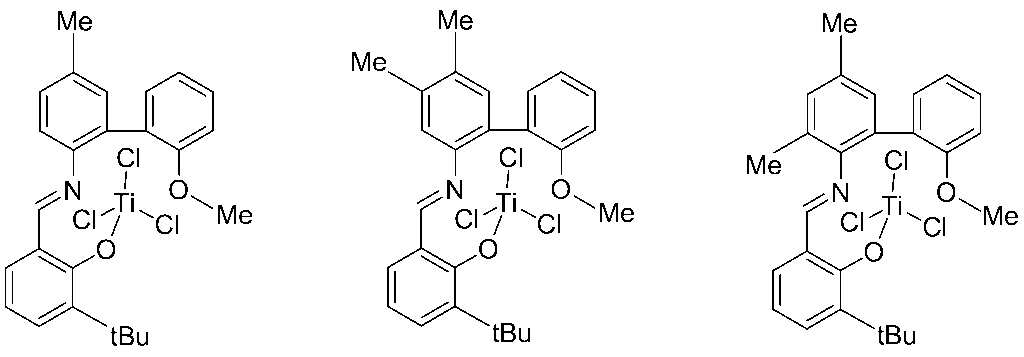
- Titanium complexes of the following formulas (8) and (9) (hereinafter referred to as “complex 1” and “complex 2”, respectively) are prepared according to known methods (Japanese Patent Laid-Open No. 2011-98954). Further, a titanium complex of the following formula (10) (hereinafter referred to as “complex 3”) was synthesized according to a known method (International Publication No. 2009/005003).
- Example 1 After drying under reduced pressure, 1600 mL of heptane was charged into a 5 liter autoclave equipped with a stirrer substituted with argon, the temperature in the system was raised to 40 ° C., and ethylene was introduced so that the partial pressure became 3.0 MPa. The temperature and pressure in the system were stabilized. Next, 1.0 mL of a hexane solution (manufactured by Tosoh Finechem) of triisobutylaluminum having a triisobutylaluminum concentration of 1.0 mmol / mL was added.
- a hexane solution manufactured by Tosoh Finechem
- Example 2 After drying under reduced pressure, 1600 mL of heptane was charged into a 5 liter autoclave with a stirrer substituted with argon, the temperature inside the system was raised to 40 ° C., and ethylene was introduced so that the partial pressure became 2.0 MPa, The temperature and pressure in the system were stabilized. Next, 1.0 mL of a hexane solution (manufactured by Tosoh Finechem) of triisobutylaluminum having a triisobutylaluminum concentration of 1.0 mmol / mL was added.
- a hexane solution manufactured by Tosoh Finechem
- Example 3 After drying under reduced pressure, in a 0.4 liter autoclave with a stirrer substituted with argon, 120 mL of heptane was charged, the temperature inside the system was raised to 40 ° C., and ethylene was introduced so that the partial pressure became 2.0 MPa. The temperature and pressure in the system were stabilized. Next, 0.40 mL of a hexane solution (manufactured by Tosoh Finechem) having a trioctylaluminum concentration of 1.01 mmol / mL was added.
- a hexane solution manufactured by Tosoh Finechem
- Example 17 After drying under reduced pressure, 120 mL of heptane was charged into a 0.4 liter autoclave with a stirrer substituted with argon, the temperature inside the system was raised to 45 ° C., and ethylene was introduced so that the partial pressure became 3.0 MPa. The temperature and pressure in the system were stabilized. Next, 0.24 mL of a toluene solution of trimethylaluminum (2.07 mmol / mL, manufactured by Tosoh Finechem) was added. Subsequently, 2 mL of toluene and a slurry composed of 152 mg of the modified solid polymethylaluminoxane obtained in Reference Example 7 were added.
- Example 12 The experiment was performed in the same manner as in Example 17 except that 69 mg of solid polymethylaluminoxane was used instead of the modified solid polymethylaluminoxane. The results are shown in Table 3.
- Example 13 The experiment was carried out in the same manner as in Example 17 except that 2.29 mL of a toluene solution of polymethylaluminoxane having an aluminum concentration of 0.44 mmol / mL (manufactured by Tosoh Finechem) was used instead of the modified solid polymethylaluminoxane. went. The results are shown in Table 3. ⁇ : Adherence of polymer to the reactor and the stirring blade was not recognized. X: Adherence of polymer was observed on the reactor and the stirring blade.
Landscapes
- Chemical & Material Sciences (AREA)
- Organic Chemistry (AREA)
- Chemical Kinetics & Catalysis (AREA)
- Engineering & Computer Science (AREA)
- Materials Engineering (AREA)
- Inorganic Chemistry (AREA)
- Health & Medical Sciences (AREA)
- Medicinal Chemistry (AREA)
- Polymers & Plastics (AREA)
- Toxicology (AREA)
- Transition And Organic Metals Composition Catalysts For Addition Polymerization (AREA)
- Catalysts (AREA)
- Polymers With Sulfur, Phosphorus Or Metals In The Main Chain (AREA)
Abstract
Description
本発明は、変性固体状ポリアルキルアルミノキサンおよびオレフィン多量化反応用触媒であって、副生したポリマーが反応器の壁や攪拌機へ付着することを抑制しながら、α-オレフィンを製造でき、高活性であるオレフィン多量化反応用触媒を与えることができる変性固体状ポリアルキルアルミノキサン、および該変性固体状ポリアルキルアルミノキサンを含有するオレフィン多量化反応用触媒に関するものである。
かかる状況のもと、本発明が解決しようとする課題は、副生したポリマーが反応器の壁や攪拌機へ付着することを抑制しながら、α-オレフィンを製造でき、且つ高活性なオレフィン多量化反応用触媒を与えることができる変性固体状ポリアルキルアルミノキサン、および該変性固体状ポリアルキルアルミノキサンを含有するオレフィン多量化反応用触媒を提供することである。

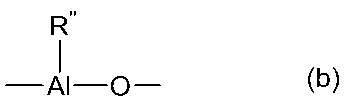
[一般式(a)におけるR’は炭素原子数1以上20以下のアルキル基であり、一般式(b)におけるR’’は炭素原子数1以上20以下のハロゲン化アルコキシ基または炭素原子数6以上20以下のハロゲン化アリールオキシ基である。]


比(m/(m+n))は、変性固体状ポリアルキルアルミノキサンを元素分析し、得られた変性固体状ポリアルキルアルミノキサンを構成するアルミニウム原子、フッ素原子、炭素原子、酸素原子、および水素原子の比率から算出される。
上記元素分析の方法としては、ICP発光分析やEPMA分析等の公知の方法が挙げられる。
Span値=(D90-D10)/D50
溶媒の存在下で反応させる方法として、例えば、溶媒中に固体状ポリアルキルアルミノキサンを懸濁させ、炭素原子数1以上20以下のハロゲン化アルコールまたは炭素原子数6以上20以下のハロゲン化フェノール類を加える方法等が挙げられる。
溶媒は、固体状ポリアルキルアルミノキサンに対し不活性なものであれば良い。例えば、ベンゼン、トルエンなどの芳香族炭化水素溶媒やヘキサン、ヘプタンなどの脂肪族炭化水素溶媒などが挙げられる。かかる溶媒は単独または2種以上を混合して用いることができ、その使用量は、固体状ポリアルキルアルミノキサン1重量部に対して、1重量部以上200重量部以下であることが好ましく、3重量部以上50重量部以下であることがより好ましい。
変性固体状ポリアルキルアルミノキサンは、溶媒の存在下で反応して得られたスラリーをそのまま用いてもよく、上澄みをろ過等で除き、溶媒で洗浄し、乾燥して得られた固体を用いてもよい。
遷移金属錯体としては、下記の一般式(2-1)で示される遷移金属錯体、下記の一般式(2-2)で示される遷移金属錯体、下記の一般式(2-3)で示される遷移金属錯体、下記の一般式(2-4)で示される遷移金属錯体、または下記の一般式(2-5)で示される遷移金属錯体が挙げられる。


[一般式(2-1)、一般式(2-2)、および一般式(2-3)におけるM1は、元素周期律表の第4族の遷移金属原子である。
一般式(2-1)、一般式(2-2)、および一般式(2-3)におけるX1、X2、X3、R1、R2、R3、R4、R5、R6、R7、R8およびR9と、一般式(2-2)および一般式(2-3)におけるR12、R13、R14、R15およびR16と、一般式(2-3)におけるR17、R18、R19、R20およびR21は、それぞれ独立に、
水素原子、ハロゲン原子、炭素原子数1以上20以下のヒドロカルビル基、炭素原子数1以上20以下の置換ヒドロカルビル基、炭素原子数1以上20以下のヒドロカルビルオキシ基、炭素原子数1以上20以下の置換ヒドロカルビルオキシ基、置換シリル基、または二置換アミノ基である。
R1、R2、R3およびR4から選ばれる2つが、炭素原子数1以上20以下のヒドロカルビル基、炭素原子数1以上20以下の置換ヒドロカルビル基、炭素原子数1以上20以下のヒドロカルビルオキシ基、または炭素原子数1以上20以下の置換ヒドロカルビルオキシ基である場合、前記のR1、R2、R3およびR4から選ばれる2つは、それぞれの置換基から水素原子を除いた部位で結合していてもよく、
R5、R6、R7、R8およびR9から選ばれる2つが、炭素原子数1以上20以下のヒドロカルビル基、炭素原子数1以上20以下の置換ヒドロカルビル基、炭素原子数1以上20以下のヒドロカルビルオキシ基、または炭素原子数1以上20以下の置換ヒドロカルビルオキシ基である場合、前記のR5、R6、R7、R8およびR9から選ばれる2つは、それぞれの置換基から水素原子を除いた部位で結合していてもよい。
また、R12、R13、R14、R15およびR16から選ばれる2つが、炭素原子数1以上20以下のヒドロカルビル基、炭素原子数1以上20以下の置換ヒドロカルビル基、炭素原子数1以上20以下のヒドロカルビルオキシ基、または炭素原子数1以上20以下の置換ヒドロカルビルオキシ基である場合、前記のR12、R13、R14、R15およびR16から選ばれる2つは、それぞれの置換基から水素原子を除いた部位で結合していてもよく、
R17、R18、R19、R20およびR21から選ばれる2つが、炭素原子数1以上20以下のヒドロカルビル基、炭素原子数1以上20以下の置換ヒドロカルビル基、炭素原子数1以上20以下のヒドロカルビルオキシ基、または炭素原子数1以上20以下の置換ヒドロカルビルオキシ基である場合、前記のR17、R18、R19、R20およびR21から選ばれる2つは、それぞれの置換基から水素原子を除いた部位で結合していてもよい。
一般式(2-1)におけるR10と、一般式(2-1)および一般式(2-2)におけるR11はそれぞれ独立に、炭素原子数1以上20以下のヒドロカルビル基、炭素原子数1以上20以下の置換ヒドロカルビル基、炭素原子数1以上20以下のヒドロカルビルオキシ基、炭素原子数1以上20以下の置換ヒドロカルビルオキシ基、置換シリル基、または二置換アミノ基である。
R10およびR11は、それぞれの置換基から水素原子を除いた部位で結合していてもよい。]
炭素原子数1以上20以下の置換ヒドロカルビル基としては、炭素原子数1以上20以下の置換アルキル基、炭素原子数6以上20以下の置換アリール基、炭素原子数7以上20以下の置換アラルキル基等が挙げられる。
炭素原子数1以上20以下の置換ヒドロカルビルオキシ基としては、炭素原子数1以上20以下の置換アルコキシ基、炭素原子数6以上20以下の置換アリールオキシ基、炭素原子数7以上20以下の置換アラルキルオキシ基等が挙げられる。
一般式(I):-Si(R22)3
(3つのR22はそれぞれ独立に、水素原子、ヒドロカルビル基またはハロゲン化ヒドロカルビル基を表し、3つのR22の炭素原子数の合計が1以上20以下である。)
R22におけるハロゲン化ヒドロカルビル基は、前記ヒドロカルビル基上に存在する水素原子の少なくとも一つがハロゲン原子に置換された基であり、ハロゲン原子としては、フッ素原子、塩素原子、臭素原子、ヨウ素原子等が挙げられる。
3つのR22の炭素原子数の合計は、1以上20以下であり、好ましくは3以上18以下である。
一般式(II):-N(R23)2
(2つのR23は、それぞれ独立に、ヒドロカルビル基またはハロゲン化ヒドロカルビル基を表し、2つのR23の炭素原子数の合計が2以上20以下である。)
X1、X2、X3、R1、R2、R3、R4、R5、R6、R7、R8、R9、R10、R11、R12、R13、R14、R15、R16、R17、R18、R19、R20、およびR21における二置換アミノ基としては、例えば、ジメチルアミノ基、ジエチルアミノ基、ジ-n-プロピルアミノ基、ジイソプロピルアミノ基、ジ-n-ブチルアミノ基、ジ-sec-ブチルアミノ基、ジ-tert-ブチルアミノ基、ジイソブチルアミノ基、tert-ブチルイソプロピルアミノ基、ジ-n-ヘキシルアミノ基、ジ-n-オクチルアミノ基、ジ-n-デシルアミノ基、ジフェニルアミノ基、ピロリジニル基、ピペリジニル基、ジヒドロインドリル基、ジヒドロイソインドリル基、これらの基に存在する水素原子の少なくとも一つがハロゲン原子に置換された基などが挙げられる。二置換アミノ基として、好ましくはジメチルアミノ基、ジエチルアミノ基、ピロリジニル基、ピペリジニル基、またはこれらの基に存在する水素原子の少なくとも一つがハロゲン原子に置換された基である。
R5、R6、R7、R8およびR9から選ばれる2つが、炭素原子数1以上20以下のヒドロカルビル基、炭素原子数1以上20以下の置換ヒドロカルビル基、炭素原子数1以上20以下のヒドロカルビルオキシ基、または炭素原子数1以上20以下の置換ヒドロカルビルオキシ基である場合、前記のR5、R6、R7、R8およびR9から選ばれる2つは、それぞれの置換基から水素原子を除いた部位で結合していてもよい。
また、R12、R13、R14、R15およびR16から選ばれる2つが、炭素原子数1以上20以下のヒドロカルビル基、炭素原子数1以上20以下の置換ヒドロカルビル基、炭素原子数1以上20以下のヒドロカルビルオキシ基、または炭素原子数1以上20以下の置換ヒドロカルビルオキシ基である場合、前記のR12、R13、R14、R15およびR16から選ばれる2つは、それぞれの置換基から水素原子を除いた部位で結合していてもよく、
R17、R18、R19、R20およびR21から選ばれる2つが、炭素原子数1以上20以下のヒドロカルビル基、炭素原子数1以上20以下の置換ヒドロカルビル基、炭素原子数1以上20以下のヒドロカルビルオキシ基、または炭素原子数1以上20以下の置換ヒドロカルビルオキシ基である場合、前記のR17、R18、R19、R20およびR21から選ばれる2つは、それぞれの置換基から水素原子を除いた部位で結合していてもよい。それぞれの置換基から水素原子を除いた部位で結合することで形成した環としては、飽和もしくは不飽和のヒドロカルビル環や飽和もしくは不飽和のシラヒドロカルビル環などが挙げられ、例えば、シクロプロパン環、シクロプロペン環、シクロブタン環、シクロブテン環、シクロペンタン環、シクロペンテン環、シクロヘキサン環、シクロヘキセン環、シクロヘプタン環、シクロヘプテン環、シクロオクタン環、シクロオクテン環、ベンゼン環、ナフタレン環、アントラセン環、シラシクロプロパン環、シラシクロブタン環、シラシクロペンタン環、シラシクロヘキサン環等が挙げられる。該環は、炭素原子数1以上20以下のヒドロカルビル基で置換されていてもよい。

(一般式(2)におけるR1、R2、R3およびR4は、一般式(2-1)、一般式(2-2)、および一般式(2-3)におけるR1、R2、R3、およびR4と同じものである。)
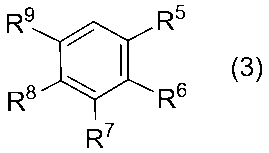

(一般式(4)におけるR12、R13、R14、R15およびR16は、一般式(2-2)および一般式(2-3)におけるR12、R13、R14、R15およびR16と同じものである。)

(一般式(5)におけるR17、R18、R19、R20およびR21は、一般式(2-3)におけるR17、R18、R19、R20およびR21と同じものである。)

(一般式(6)におけるR10およびR11は、一般式(2-1)におけるR10およびR11と同じものである。)

[一般式(2-4)におけるM2は、元素周期律表の第4族の遷移金属原子である。
A21は、酸素原子、窒素原子、リン原子または硫黄原子であり、Z1は、A21とNを連結する基であり、A21とNを結ぶ最短の結合数は4以上6以下であり、A21とZ1を結ぶ結合は二重結合であってもよい。
R24、R25、R26、R27、R28、X4、X5およびX6は、それぞれ独立して、水素原子、ハロゲン原子、炭素原子数1以上20以下のヒドロカルビル基、炭素原子数1以上20以下の置換ヒドロカルビル基、炭素原子数1以上20以下のヒドロカルビルオキシ基、炭素原子数1以上20以下の置換ヒドロカルビルオキシ基、置換シリル基、または二置換アミノ基である。
R24、R25、R26、R27およびR28から選ばれる2つが、炭素原子数1以上20以下のヒドロカルビル基、炭素原子数1以上20以下の置換ヒドロカルビル基、炭素原子数1以上20以下のヒドロカルビルオキシ基、または炭素原子数1以上20以下の置換ヒドロカルビルオキシ基である場合、前記のR24、R25、R26、R27およびR28から選ばれる2つは、それぞれの置換基から水素原子を除いた部位で結合していてもよい。
R29は、水素原子、ハロゲン原子、炭素原子数1以上20以下のヒドロカルビル基、炭素原子数1以上20以下の置換ヒドロカルビル基、炭素原子数1以上20以下のヒドロカルビリデン基、または炭素原子数1以上20以下の置換ヒドロカルビリデン基であり、R29とA21とを結ぶ結合は二重結合であってもよい。R29はZ1と結合していてもよい。]

[一般式(2-5)におけるM2は、元素周期律表の第4族の遷移金属原子である。
A22は、窒素原子またはリン原子であり、Z2は、A22とNを連結する基であり、A22とNを結ぶ最短の結合数は4以上6以下である。
R24、R25、R26、R27、R28、X4、X5およびX6は、それぞれ独立して、水素原子、ハロゲン原子、炭素原子数1以上20以下のヒドロカルビル基、炭素原子数1以上20以下の置換ヒドロカルビル基、炭素原子数1以上20以下のヒドロカルビルオキシ基、炭素原子数1以上20以下の置換ヒドロカルビルオキシ基、置換シリル基、または二置換アミノ基である。
R24、R25、R26、R27およびR28から選ばれる2つが、炭素原子数1以上20以下のヒドロカルビル基、炭素原子数1以上20以下の置換ヒドロカルビル基、炭素原子数1以上20以下のヒドロカルビルオキシ基、または炭素原子数1以上20以下の置換ヒドロカルビルオキシ基である場合、前記のR24、R25、R26、R27およびR28から選ばれる2つは、それぞれの置換基から水素原子を除いた部位で結合していてもよい。
R30およびR31は、水素原子、ハロゲン原子、炭素原子数1以上20以下のヒドロカルビル基、または炭素原子数1以上20以下の置換ヒドロカルビル基であり、R30またはR31はZ2と結合していてもよい。]
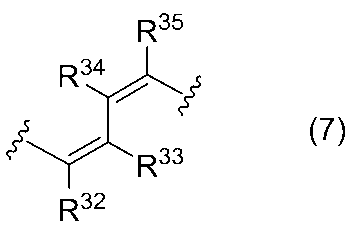
[一般式(7)におけるR32、R33、R34およびR35は、夫々、水素原子、ハロゲン原子、炭素原子数1以上20以下のヒドロカルビル基、炭素原子数1以上20以下の置換ヒドロカルビル基、炭素原子数1以上20以下のヒドロカルビルオキシ基、炭素原子数1以上20以下の置換ヒドロカルビルオキシ基を表し、R32およびR33が、炭素原子数1以上20以下のヒドロカルビル基、炭素原子数1以上20以下の置換ヒドロカルビル基、炭素原子数1以上20以下のヒドロカルビルオキシ基、または炭素原子数1以上20以下の置換ヒドロカルビルオキシ基である場合、R32およびR33は、それぞれの置換基から水素原子を除いた部位で結合していてもよい。R34およびR35が、炭素原子数1以上20以下のヒドロカルビル基、炭素原子数1以上20以下の置換ヒドロカルビル基、炭素原子数1以上20以下のヒドロカルビルオキシ基、または炭素原子数1以上20以下の置換ヒドロカルビルオキシ基である場合、R34およびR35は、それぞれの置換基から水素原子を除いた部位で結合していてもよい。]




[一般式(2-a)におけるM2、A21、R24、R25、R26、R27、R28、X4、X5およびX6は、夫々、前記のM2、A21、R24、R25、R26、R27、R28、X4、X5およびX6と同じものである。
R24、R25、R26、R27およびR28から選ばれる2つは、それぞれの置換基から水素原子を除いた部位で結合していてもよく、X4、X5およびX6は、夫々、同じでも異なっていてもよく、X4、X5およびX6のうち2つ以上が互いに結合して環を形成していてもよい。
R41、R42、R43、R44、R45、R46、R47およびR48は、夫々、水素原子、またはヒドロカルビル基を表す。]
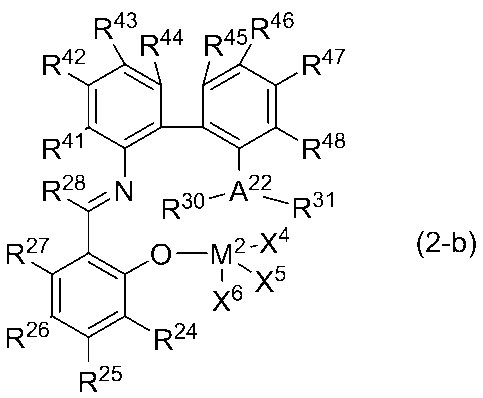
[一般式(2-b)におけるM2、A21、R24、R25、R26、R27、R28、R30、R31、X4、X5およびX6は、夫々、前記のM2、A21、R24、R25、R26、R27、R28、R30、R31、X4、X5およびX6と同じものである。
R24、R25、R26、R27およびR28から選ばれる2つは、それぞれの置換基から水素原子を除いた部位で結合していてもよく、X4、X5およびX6は、夫々、同じでも異なっていてもよく、X4、X5およびX6のうち2つ以上が互いに結合して環を形成していてもよい。
R41、R42、R43、R44、R45、R46、R47およびR48は、夫々、水素原子、またはヒドロカルビル基を表す。]
一般式(A) (E1)aAl(G)3-a
(一般式(A)中、E1は、炭素原子数1以上8以下のヒドロカルビル基であり、Gは、水素原子またはハロゲン原子であり、aは1以上3以下の数である。aが2以上である場合、複数のE1は互いに同じであっても異なっていてもよい。)
(1)1-ヘキセン、デセン類の収量
ガスクロマトグラフィーを用いて以下の条件を用いて内標法による定法により分析した。
測定装置:GC-2010(島津製作所社製)
カラム:DB-1 60m 膜厚 0.25μm 内径0.25mm
昇温パターン:50℃にて10分保持→5℃/分で200℃まで昇温→20分保持
気化室温度:230℃
検出器温度:230℃
スプリット比:39
キャリアーガス:ヘリウム
内標:n-ノナン
反応液を、エタノールとメタノールの混合溶媒に投入し、析出した組成物を濾過にて捕集し、80℃にて減圧乾燥し、重量を測定して求めた。
固体状ポリメチルアルミノキサンおよび変性固体状ポリメチルアルミノキサンのメジアン径および粒度分布は、下記の測定装置を利用し、乾燥させた下記の測定溶媒中でレーザー回折・散乱法により求めた。
測定装置:SALD-2200J
測定溶媒:n-ヘキサン
粒度分布の指標はSpan値を用いた。
Span値=(D90-D10)/D50
(ここでD10、D50、D90は、上記の方法により測定した粒度分布の累積分布関数の値がそれぞれ10%、50%、90%となるときの粒径の値である。)
固体状ポリメチルアルミノキサンおよび変性固体状ポリメチルアルミノキサンのアルミニウム含有量は次のようにして測定した。まず窒素雰囲気下で純水中に固体状ポリメチルアルミノキサンまたは変性固体状ポリメチルアルミノキサンを加え、これを空気中に取り出して加熱し、水を全て蒸発させた。析出した固体に炭酸ナトリウムを加えた後、加熱して溶融させ、Varian社製のVista-PROを使用したICP-AES法によりアルミニウム含有量を求めた。
m/(m+n)の値は次のように算出した。変性固体状ポリメチルアルミノキサンの製造において、原料である固体状ポリメチルアルミノキサンにハロゲン化アルコールまたはハロゲン化フェノール類を加えると、反応したハロゲン化アルコールまたはハロゲン化フェノール類と等モル量のメタンが生成する。このことを考慮し、固体状ポリメチルアルミノキサンのアルミニウム含有量をXwt%、変性固体状ポリメチルアルミノキサンのアルミニウム含有量をYwt%、ハロゲン化アルコールまたはハロゲン化フェノール類の分子量をMとすると、YはX、M、およびm/(m+n)を用いて次のように表すことが出来る。

したがってm/(m+n)の値は次式で求められる。

触媒活性の指標としては、反応により得られた1-ヘキセンの重量を使用した錯体の物質量で除した値(t/mol錯体)、および反応により得られた1-ヘキセンの重量を使用した共触媒(シリカ/ポリメチルアルミノキサン、固体状ポリメチルアルミノキサン、または変性固体状ポリメチルアルミノキサン)の重量で除した値(g/g共触媒)を用いた。
下記式(8)および(9)のチタン錯体(以下、それぞれ「錯体1」および「錯体2」という。)は公知の手法(特開2011-98954)に従って、また、下記式(10)のチタン錯体(以下、「錯体3」という。)は公知の手法(国際公開第2009/005003号)に従って合成した。

N,N’-ビス(ジフェニルホスフィノ)イソプロピルアミンは公知の手法(A.Bollmann,et al. J.Am.Chem.Soc. 2004,126,14712.)に従って合成した。
窒素雰囲気下300℃で5時間乾燥したシリカゲル1g(GRACE-Davison社製 Sylopol 948;メジアン径=55μm)を200mLフラスコに秤量し、これに脱水トルエン15mLを添加した。氷浴で0℃に冷却した後、トルエン溶液中に含まれるアルミニウムの濃度が3.5mmol/mLであるポリメチルアルミノキサンのトルエン溶液(東ソー・ファインケム社製)5.0mL(17.5mmol)をゆっくり30分かけて攪拌しながら滴下漏斗を用いて添加した。滴下後、95℃に昇温し、4時間攪拌した。反応終了後、室温まで冷却し、上澄み液をデカンテーションにより除去した。さらにこれにトルエン15mLを添加して攪拌し、この後静置して再度上澄み液をデカンテーションで除去した。この洗浄操作を3回行い、最後に100℃で1時間減圧乾燥して目的のシリカ/ポリメチルアルミノキサンを得た。収量は1.2gであり、元素分析(重量%)の結果、Si:24%であり、Al:19%であった。
アルゴンで置換したフラスコに、窒素雰囲気下300℃で5時間乾燥したシリカゲル(GRACE-Davison社製 Sylopol 948;メジアン径=55μm;)95.3gをとり、トルエン550mLを投入し、氷冷した。氷冷下で、1時間かけてトルエン溶液中に含まれるアルミニウムの濃度が3.4mmol/mLであるポリメチルアルミノキサンのトルエン溶液(東ソー・ファインケム社製)を滴下し、氷冷下で1時間撹拌後、50℃に昇温し、4時間撹拌した。その後、上澄みを除去し、トルエン500mLで2回、ヘキサン500mLで1回洗浄し、減圧下で乾燥し、シリカ/ポリメチルアルミノキサン140.1gを得た。
110℃で30分間以上加熱乾燥した100mL二つ口フラスコに固体状ポリメチルアルミノキサン(東ソー・ファインケム社製、アルミニウム原子=39.3重量%、メジアン径17μm、Span値=1.4)を0.81g、トルエン20mLを加えてスラリーを調製し、これを室温で攪拌しながら、ペンタフルオロフェノール0.433gを1.5mLのトルエンに溶かした溶液を加え、3時間攪拌した。ガラスフィルターを用いて濾別した後、得られた固体をトルエン20mLで2回、ヘキサン20mLで1回洗浄し、減圧下で1時間乾燥させることで、白色粉末として変性固体状ポリメチルアルミノキサン1.11gを得た。(メジアン径7μm、Span値=1.5)元素分析の結果、アルミニウム含有量は26wt%であり、一般式(1)におけるm/(m+n)の値は0.21であった。
参考例3における固体状ポリメチルアルミノキサンとペンタフルオロフェノールの使用量を変更し、同様に変性固体状ポリメチルアルミノキサンを調製した。原料の使用量と結果を表1に示す。
表1

公知の手法(特開2000-95810)に従い、固体状ポリメチルアルミノキサンを調製した。得られた固体状ポリメチルアルミノキサンを0.45g、ペンタフルオロフェノールを0.61g使用し、参考例3と同様の手法で変性固体状ポリメチルアルミノキサン0.85gを調製した。(メジアン径64μm、Span値=2.0)
内部を窒素で置換した20mLのシュレンク管に錯体1を95mg、トルエンを8mL、トリエチルアミンを112μL加えた。次にここに46mgのフェノールを2mLのトルエンに溶かした溶液を加え、室温で16時間攪拌した。生じた沈殿を窒素雰囲気下、濾過によって除去し、減圧下で溶媒および余剰のトリエチルアミンを留去した。得られた固体から生成物を3mLのヘキサンで抽出し、減圧下で1mLに濃縮した後、-20℃で一晩静置すると、式11で示すチタン錯体(以下、「錯体4」という。)が結晶として97mg得られた。

減圧乾燥後、アルゴンで置換した5リットルの撹拌機付きオートクレーブに、ヘプタンを1600mL仕込み、系内の温度を40℃まで昇温し、エチレンをその分圧が3.0MPaになるように導入し、系内の温度、圧力を安定させた。次に、トリイソブチルアルミニウムの濃度が1.0mmol/mLであるトリイソブチルアルミニウムのヘキサン溶液(東ソー・ファインケム社製)を1.0mL投入した。これに、ヘプタン2mL、参考例3で得られた変性固体状ポリメチルアルミノキサン34mg、錯体2のトルエン溶液(5μmol/mL)0.2mLを、室温で1分間接触して得られたスラリーを投入した。全圧を一定に維持するように、エチレンガスを連続的に供給しながら、40℃で5時間反応した。その後、エチレンをパージして、オートクレーブ内の内容物をエタノール-塩酸で脱灰し、ろ過した。1-ヘキセンが222g(222t/mol錯体、6530g/g共触媒)、デセン類が12.5g、重合体が4.2g得られた。撹拌翼等への不定形ポリマーの付着は見られなかった。
減圧乾燥後、アルゴンで置換した5リットルの撹拌機付きオートクレーブに、ヘプタンを1600mL仕込み、系内の温度を40℃まで昇温し、エチレンをその分圧が2.0MPaになるように導入し、系内の温度、圧力を安定させた。次に、トリイソブチルアルミニウムの濃度が1.0mmol/mLであるトリイソブチルアルミニウムのヘキサン溶液(東ソー・ファインケム社製)を1.0mL投入した。これに、ヘプタン2mL、参考例3で得られた変性固体状ポリメチルアルミノキサン63mg、錯体2のトルエン溶液(5μmol/mL)0.4mLを、室温で1分間接触して得られたスラリーを投入した。全圧を一定に維持するように、エチレンガスを連続的に供給しながら、40℃で5時間反応した。その後、エチレンをパージして、オートクレーブ内の内容物をエタノール-塩酸で脱灰し、ろ過した。1-ヘキセンが294g(147t/mol錯体、4670g/g共触媒)、デセン類が34.7g、重合体が4.7g得られた。撹拌翼等への不定形ポリマーの付着は見られなかった。
減圧乾燥後、アルゴンで置換した5リットルの撹拌機付きオートクレーブに、ヘプタンを1200mL仕込み、トルエン溶液中に含まれるアルミニウムの濃度が3.4mmol/mLであるポリメチルアルミノキサン(東ソー・ファインケム社製)のトルエン溶液を1.8mL投入した。系内の温度を40℃まで昇温し、エチレンをその分圧が2.0MPaになるように導入し、系内の温度、圧力を安定させた。これに、トルエン溶液中に含まれるアルミニウムの濃度が3.4mmol/mLであるポリメチルアルミノキサンのトルエン溶液(東ソー・ファインケム社製)0.29mLと錯体2のトルエン溶液(5μmol/mL)0.4mLとの混合物を投入した。全圧を一定に維持するように、エチレンガスを連続的に供給しながら、40℃で90分間反応した。その後、エチレンをパージして、オートクレーブ内の内容物をエタノール-塩酸で脱灰し、ろ過した。1-ヘキセンが184g(92t/mol錯体)、デセン類が23g、重合体が1.0g得られた。不定形ポリマーの撹拌翼等への付着が見られた。
減圧乾燥後、アルゴンで置換した5リットルの撹拌機付きオートクレーブに、ヘプタンを800mL仕込み、トリイソブチルアルミニウムの濃度が1.0mmol/mLであるトリイソブチルアルミニウムのヘキサン溶液(東ソー・ファインケム社製)を1.5mL投入した。系内の温度を40℃まで昇温し、エチレンをその分圧が2.0MPaになるように導入し、系内の温度、圧力を安定させた。これに、トルエン溶液中に含まれるアルミニウムの濃度が3.4mmol/mLであるポリメチルアルミノキサンのトルエン溶液(東ソー・ファインケム社製)0.29mLと錯体2のトルエン溶液(5μmol/mL)0.4mLとの混合物を投入した。全圧を一定に維持するように、エチレンガスを連続的に供給しながら、40℃で60分間反応した。その後、エチレンをパージして、オートクレーブ内の内容物をエタノール-塩酸で脱灰し、ろ過した。1-ヘキセンが18g(9t/mol錯体)、デセン類が0.05g、重合体が0.7g得られた。不定形ポリマーの撹拌翼等への付着が見られた。
窒素雰囲気下、フラスコにトルエン5mLを添加し、錯体1 0.2μmolおよび参考例1で得られたシリカ/ポリメチルアルミノキサン 194mgを添加し、5分間攪拌した。溶媒トルエンを減圧留去することにより、固体を得た。
減圧乾燥後、窒素で置換した0.4リットルの攪拌機付きオートクレーブに、トルエンを90mL、濃度が0.93mmol/mLであるトリイソブチルアルミニウムのヘキサン溶液(東ソー・ファインケム社製)2.2mLを仕込み、系内の温度を40℃まで昇温した後、エチレンを2.0MPaまで導入し、系内の温度、圧力を安定させた。これに、上記で得られた固体106mgを投入した。全圧を一定に維持するようにエチレンガスを連続的に供給しながら、40℃で60分反応し、エタノールを2.0mL投入して反応を停止した。その後、エチレンをパージして、オートクレーブ内の内容物をエタノール-塩酸で脱灰し、ろ過した。1-ヘキセンが7.6g(38t/mol錯体、72g/g共触媒)、重合体が0.5g得られた。撹拌翼等への不定形ポリマーの付着は見られなかった。
減圧乾燥後、アルゴンで置換した5リットルの撹拌機付きオートクレーブに、ヘプタンを1600mL仕込み、濃度が1.0mmol/mLであるトリイソブチルアルミニウムのヘキサン溶液(東ソー・ファインケム社製)1.0mLを仕込み、系内の温度を40℃まで昇温し、エチレンをその分圧が2.0MPaになるように導入し、系内の温度、圧力を安定させた。これに、ヘプタン4.0mL、固体状ポリメチルアルミノキサン(東ソー・ファインケム社製、アルミニウム原子=39.3重量%)294mg、および、錯体2のトルエン溶液(5μmol/mL)0.8mLとの混合物を投入した。全圧を一定に維持するように、エチレンガスを連続的に供給しながら、40℃で120分間反応した。その後、エチレンをパージして、オートクレーブ内の内容物をエタノール-塩酸で脱灰し、ろ過した。1-ヘキセンが231g(58t/mol錯体、785g/g共触媒)、デセン類が18.3g、重合体が3.5g得られた。不定形ポリマーの撹拌翼等への付着が見られた。
減圧乾燥後、アルゴンで置換した5リットルの撹拌機付きオートクレーブに、ヘプタンを1600mL仕込み、濃度が1.0mmol/mLであるトリイソブチルアルミニウムのヘキサン溶液(東ソー・ファインケム社製)1.0mLを仕込み、系内の温度を40℃まで昇温し、エチレンをその分圧が2.0MPaになるように導入し、系内の温度、圧力を安定させた。これに、ヘプタン4.0mL、固体状ポリメチルアルミノキサン(東ソー・ファインケム社製、アルミニウム原子=39.3重量%)282mg、および、錯体1のトルエン溶液(5μmol/mL)0.8mLとの混合物を投入した。全圧を一定に維持するように、エチレンガスを連続的に供給しながら、40℃で120分間反応した。その後、エチレンをパージして、オートクレーブ内の内容物をエタノール-塩酸で脱灰し、ろ過した。1-ヘキセンが230g(57t/mol錯体、815g/g共触媒)、デセン類が18.3g、重合体が3.6g得られた。不定形ポリマーの撹拌翼等への付着は見られなかった。
減圧乾燥後、アルゴンで置換した0.4リットルの撹拌機付きオートクレーブに、ヘプタンを120mL仕込み、系内の温度を40℃まで昇温し、エチレンをその分圧が2.0MPaになるように導入し、系内の温度、圧力を安定させた。次に、トリオクチルアルミニウム濃度が1.01mmol/mLであるヘキサン溶液(東ソー・ファインケム社製)を0.40mL投入した。これに、トルエン3mL、参考例3で得られた変性固体状ポリメチルアルミノキサン33mg、錯体3のトルエン溶液(1μmol/mL)1.0mLを、室温で1時間撹拌して得られたスラリーを投入した。全圧を一定に維持するように、エチレンガスを連続的に供給しながら、40℃で60分反応した。その後、エチレンをパージして、オートクレーブ内の内容物をエタノール-塩酸で脱灰し、ろ過した。1-ヘキセンが24g(24t/mol錯体、727g/g共触媒)、重合体が1.5g得られた。撹拌翼等への不定形ポリマーの付着は見られなかった。
減圧乾燥後、アルゴンで置換した0.4リットルの撹拌機付きオートクレーブに、ヘプタンを120mL仕込み、系内の温度を40℃まで昇温し、エチレンをその分圧が2.0MPaになるように導入し、系内の温度、圧力を安定させた。次に、トリオクチルアルミニウム濃度が1.01mmol/mLであるヘキサン溶液(東ソー・ファインケム社製)を0.40mL投入した。これに、トルエン3mL、参考例2で得たシリカ/ポリメチルアルミノキサン34mg、錯体3のトルエン溶液(1μmol/mL)1.0mLを、室温で1時間撹拌して得られたスラリーを投入した。全圧を一定に維持するように、エチレンガスを連続的に供給しながら、40℃で60分反応した。その後、エチレンをパージして、オートクレーブ内の内容物をエタノール-塩酸で脱灰し、ろ過した。1-ヘキセンが4.2g(4t/mol錯体、123g/g共触媒)、重合体が0.2g得られた。撹拌翼等への不定形ポリマーの付着は見られなかった。
減圧乾燥後、アルゴンで置換した0.4リットルの撹拌機付きオートクレーブに、ヘプタンを120mL仕込み、系内の温度を40℃まで昇温し、エチレンをその分圧が2.0MPaになるように導入し、系内の温度、圧力を安定させた。次に、トリオクチルアルミニウム濃度が1.01mmol/mLであるヘキサン溶液(東ソー・ファインケム社製)を0.40mL投入した。これに、トルエン3mL、固体状ポリメチルアルミノキサン(東ソー・ファインケム社製、アルミニウム原子=39.3重量%)14mg、錯体3のトルエン溶液(1μmol/mL)1.0mLを、室温で1時間撹拌して得られたスラリーを投入した。全圧を一定に維持するように、エチレンガスを連続的に供給しながら、40℃で60分反応した。その後、エチレンをパージして、オートクレーブ内の内容物をエタノール-塩酸で脱灰し、ろ過した。1-ヘキセンが17g(17t/mol錯体、1214g/g共触媒)、重合体が1.5g得られた。撹拌翼等への不定形ポリマーの付着は見られなかった。
実施例1~3、比較例1~7と同様の方法にて表2の通り錯体種、アルキルアルミニウム種、共触媒種、反応条件等を変更してエチレン3量化反応実験を実施した。検討結果を表2にまとめた。

減圧乾燥後、アルゴンで置換した0.4リットルの撹拌機付きオートクレーブに、ヘプタンを120mL仕込み、系内の温度を45℃まで昇温し、エチレンをその分圧が3.0MPaになるように導入し、系内の温度、圧力を安定させた。次に、トリメチルアルミニウムのトルエン溶液(2.07mmol/mL、東ソー・ファインケム社製)を0.24mL投入した。続いて、トルエン2mL、参考例7で得られた変性固体状ポリメチルアルミノキサン152mgから成るスラリーを投入した。さらに、トリス(2,4-ペンタンジオナト)クロム(東京化成工業社製)のトルエン溶液(20μmol/mL)0.25mLとN,N’-ビス(ジフェニルホスフィノ)イソプロピルアミンのトルエン溶液(27μmol/mL)0.25mLを混合して5分間静置したものを投入し、反応を開始した。全圧を一定に維持するように、エチレンガスを連続的に供給しながら、45℃で120分反応させた。その後、エタノールを1mL加えて反応を停止させ、エチレンをパージして、オートクレーブ内の内容物をろ過した。結果を表3に示す。
変性固体状ポリメチルアルミノキサンの代わりに固体状ポリメチルアルミノキサン69mgを使用した以外は、実施例17と同様にして実験を行った。結果を表3に示す。
変性固体状ポリメチルアルミノキサンの代わりにアルミニウム濃度が0.44mmol/mLであるポリメチルアルミノキサンのトルエン溶液(東ソー・ファインケム社製)2.29mLを使用した以外は、実施例17と同様にして実験を行った。結果を表3に示す。

○:リアクターおよび攪拌翼にポリマーの付着は認められなかった。
×:リアクターおよび攪拌翼にポリマーの付着が認められた。
Claims (6)
- メジアン径が0.1μm以上50μm以下であり、下記の一般式(a)で示される構造単位と、下記の一般式(b)で示される構造単位を有するオレフィン多量化反応用の変性固体状ポリアルキルアルミノキサン。


[一般式(a)におけるR’は炭素原子数1以上20以下のアルキル基であり、一般式(b)におけるR’’は炭素原子数1以上20以下のハロゲン化アルコキシ基または炭素原子数6以上20以下のハロゲン化アリールオキシ基である。] - 前記一般式(b)におけるR’’が、炭素原子数6以上20以下のハロゲン化アリールオキシ基である請求項1に記載の変性固体状ポリアルキルアルミノキサン。
- 前記の炭素原子数6以上20以下のハロゲン化アリールオキシ基が、ペンタフルオロフェノキシ基である請求項2に記載の変性固体状ポリアルキルアルミノキサン。
- 前記一般式(a)で示される構造単位の単位数(n)と前記一般式(b)で示される構造単位の単位数(m)の合計に対する前記一般式(b)で示される構造単位の単位数(m)の比(m/(m+n))が0.05以上0.5以下である請求項1から3のいずれか一項に記載の変性固体状ポリアルキルアルミノキサン。
- 請求項1から4のいずれか一項に記載の変性固体状ポリアルキルアルミノキサンと、下記の遷移金属錯体群から選ばれる少なくとも1種の錯体とを含有するオレフィン多量化反応用触媒。
遷移金属錯体群:下記の一般式(2-1)で示される遷移金属錯体、下記の一般式(2-2)で示される遷移金属錯体、下記の一般式(2-3)で示される遷移金属錯体、下記の一般式(2-4)で示される遷移金属錯体、および下記の一般式(2-5)で示される遷移金属錯体からなる群


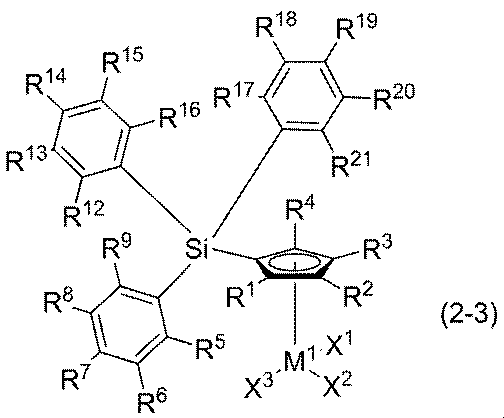
[一般式(2-1)、一般式(2-2)、および一般式(2-3)におけるM1は、元素周期律表の第4族の遷移金属原子である。
一般式(2-1)、一般式(2-2)、および一般式(2-3)におけるX1、X2、X3、R1、R2、R3、R4、R5、R6、R7、R8およびR9と、一般式(2-2)および一般式(2-3)におけるR12、R13、R14、R15およびR16と、一般式(2-3)におけるR17、R18、R19、R20およびR21は、それぞれ独立に、水素原子、ハロゲン原子、炭素原子数1以上20以下のヒドロカルビル基、炭素原子数1以上20以下の置換ヒドロカルビル基、炭素原子数1以上20以下のヒドロカルビルオキシ基、炭素原子数1以上20以下の置換ヒドロカルビルオキシ基、置換シリル基、または二置換アミノ基である。
R1、R2、R3およびR4から選ばれる2つが、炭素原子数1以上20以下のヒドロカルビル基、炭素原子数1以上20以下の置換ヒドロカルビル基、炭素原子数1以上20以下のヒドロカルビルオキシ基、または炭素原子数1以上20以下の置換ヒドロカルビルオキシ基である場合、前記のR1、R2、R3およびR4から選ばれる2つは、それぞれの置換基から水素原子を除いた部位で結合していてもよく、
R5、R6、R7、R8およびR9から選ばれる2つが、炭素原子数1以上20以下のヒドロカルビル基、炭素原子数1以上20以下の置換ヒドロカルビル基、炭素原子数1以上20以下のヒドロカルビルオキシ基、または炭素原子数1以上20以下の置換ヒドロカルビルオキシ基である場合、前記のR5、R6、R7、R8およびR9から選ばれる2つは、それぞれの置換基から水素原子を除いた部位で結合していてもよい。
また、R12、R13、R14、R15およびR16から選ばれる2つが、炭素原子数1以上20以下のヒドロカルビル基、炭素原子数1以上20以下の置換ヒドロカルビル基、炭素原子数1以上20以下のヒドロカルビルオキシ基、または炭素原子数1以上20以下の置換ヒドロカルビルオキシ基である場合、前記のR12、R13、R14、R15およびR16から選ばれる2つは、それぞれの置換基から水素原子を除いた部位で結合していてもよく、
R17、R18、R19、R20およびR21から選ばれる2つが、炭素原子数1以上20以下のヒドロカルビル基、炭素原子数1以上20以下の置換ヒドロカルビル基、炭素原子数1以上20以下のヒドロカルビルオキシ基、または炭素原子数1以上20以下の置換ヒドロカルビルオキシ基である場合、前記のR17、R18、R19、R20およびR21から選ばれる2つは、それぞれの置換基から水素原子を除いた部位で結合していてもよい。
一般式(2-1)におけるR10と、一般式(2-1)および一般式(2-2)におけるR11はそれぞれ独立に、炭素原子数1以上20以下のヒドロカルビルオキシ基、炭素原子数1以上20以下の置換ヒドロカルビル基、炭素原子数1以上20以下のヒドロカルビルオキシ基、炭素原子数1以上20以下の置換ヒドロカルビルオキシ基、置換シリル基、または二置換アミノ基である。
R10およびR11は、それぞれの置換基から水素原子を除いた部位で結合していてもよい。]

[一般式(2-4)におけるM2は、元素周期律表の第4族の遷移金属原子である。
A21は、酸素原子、窒素原子、リン原子または硫黄原子であり、Z1は、A21とNを連結する基であり、A21とNを結ぶ最短の結合数は4以上6以下であり、A21とZ1を結ぶ結合は二重結合であってもよい。
R24、R25、R26、R27、R28、X4、X5およびX6は、それぞれ独立して、水素原子、ハロゲン原子、炭素原子数1以上20以下のヒドロカルビル基、炭素原子数1以上20以下の置換ヒドロカルビル基、炭素原子数1以上20以下のヒドロカルビルオキシ基、炭素原子数1以上20以下の置換ヒドロカルビルオキシ基、置換シリル基、または二置換アミノ基である。
R24、R25、R26、R27およびR28から選ばれる2つが、炭素原子数1以上20以下のヒドロカルビル基、炭素原子数1以上20以下の置換ヒドロカルビル基、炭素原子数1以上20以下のヒドロカルビルオキシ基、または炭素原子数1以上20以下の置換ヒドロカルビルオキシ基である場合、前記のR24、R25、R26、R27およびR28から選ばれる2つは、それぞれの置換基から水素原子を除いた部位で結合していてもよい。
R29は、水素原子、ハロゲン原子、炭素原子数1以上20以下のヒドロカルビル基、炭素原子数1以上20以下の置換ヒドロカルビル基、炭素原子数1以上20以下のヒドロカルビリデン基、または炭素原子数1以上20以下の置換ヒドロカルビリデン基であり、R29とA21とを結ぶ結合は二重結合であってもよい。R29はZ1と結合していてもよい。]

[一般式(2-5)におけるM2は、元素周期律表の第4族の遷移金属原子である。
A22は、窒素原子またはリン原子であり、Z2は、A22とNを連結する基であり、A22とNを結ぶ最短の結合数は4以上6以下である。
R24、R25、R26、R27、R28、X4、X5およびX6は、それぞれ独立して、水素原子、ハロゲン原子、炭素原子数1以上20以下のヒドロカルビル基、炭素原子数1以上20以下の置換ヒドロカルビル基、炭素原子数1以上20以下のヒドロカルビルオキシ基、炭素原子数1以上20以下の置換ヒドロカルビルオキシ基、置換シリル基、または二置換アミノ基である。
R24、R25、R26、R27およびR28から選ばれる2つが、炭素原子数1以上20以下のヒドロカルビル基、炭素原子数1以上20以下の置換ヒドロカルビル基、炭素原子数1以上20以下のヒドロカルビルオキシ基、または炭素原子数1以上20以下の置換ヒドロカルビルオキシ基である場合、前記のR24、R25、R26、R27およびR28から選ばれる2つは、それぞれの置換基から水素原子を除いた部位で結合していてもよい。
R30およびR31は、水素原子、ハロゲン原子、炭素原子数1以上20以下のヒドロカルビル基、または炭素原子数1以上20以下の置換ヒドロカルビル基であり、R30またはR31はZ2と結合していてもよい。] - 請求項5に記載のオレフィン多量化反応用触媒を用いて、エチレンから1-ヘキセンを製造する1-ヘキセンの製造方法。
Priority Applications (4)
| Application Number | Priority Date | Filing Date | Title |
|---|---|---|---|
| JP2016551961A JPWO2016052308A1 (ja) | 2014-09-30 | 2015-09-24 | 変性固体状ポリアルキルアルミノキサンおよびオレフィン多量化反応用触媒 |
| US15/515,390 US10124326B2 (en) | 2014-09-30 | 2015-09-24 | Modified solid polyalkylaluminoxane and catalyst for olefin oligomerization reaction |
| CN201580052700.8A CN106715539A (zh) | 2014-09-30 | 2015-09-24 | 改性固体状聚烷基铝氧烷和烯烃低聚化反应用催化剂 |
| EP15845988.3A EP3202822A4 (en) | 2014-09-30 | 2015-09-24 | Modified solid polyalkylaluminoxane and catalyst for olefin oligomerization reaction |
Applications Claiming Priority (4)
| Application Number | Priority Date | Filing Date | Title |
|---|---|---|---|
| JP2014199907 | 2014-09-30 | ||
| JP2014-199907 | 2014-09-30 | ||
| JP2015083980 | 2015-04-16 | ||
| JP2015-083980 | 2015-04-16 |
Publications (1)
| Publication Number | Publication Date |
|---|---|
| WO2016052308A1 true WO2016052308A1 (ja) | 2016-04-07 |
Family
ID=55630346
Family Applications (1)
| Application Number | Title | Priority Date | Filing Date |
|---|---|---|---|
| PCT/JP2015/076975 Ceased WO2016052308A1 (ja) | 2014-09-30 | 2015-09-24 | 変性固体状ポリアルキルアルミノキサンおよびオレフィン多量化反応用触媒 |
Country Status (5)
| Country | Link |
|---|---|
| US (1) | US10124326B2 (ja) |
| EP (1) | EP3202822A4 (ja) |
| JP (1) | JPWO2016052308A1 (ja) |
| CN (1) | CN106715539A (ja) |
| WO (1) | WO2016052308A1 (ja) |
Cited By (3)
| Publication number | Priority date | Publication date | Assignee | Title |
|---|---|---|---|---|
| JP2018149537A (ja) * | 2017-03-14 | 2018-09-27 | 三井化学株式会社 | オレフィン多量化用触媒組成物の製造方法およびその触媒組成物存在下で行うオレフィン多量体の製造方法 |
| CN109071569A (zh) * | 2016-05-06 | 2018-12-21 | Scg化学有限公司 | 催化剂载体及其用途 |
| JP2021161122A (ja) * | 2020-03-31 | 2021-10-11 | 三井化学株式会社 | オレフィン多量化用触媒およびその触媒存在下で行うオレフィン多量体の製造方法 |
Families Citing this family (2)
| Publication number | Priority date | Publication date | Assignee | Title |
|---|---|---|---|---|
| GB201718277D0 (en) * | 2017-11-03 | 2017-12-20 | Scg Chemicals Co Ltd | Modified solid polymethylaluminoxane |
| US12503524B2 (en) * | 2019-09-30 | 2025-12-23 | Lg Chem, Ltd. | Method for purifying polyalkylaluminoxane-containing solution using hydroxy group-containing compound and catalyst composition using the same |
Citations (6)
| Publication number | Priority date | Publication date | Assignee | Title |
|---|---|---|---|---|
| JPH06329714A (ja) * | 1993-05-20 | 1994-11-29 | Idemitsu Kosan Co Ltd | アルミニウムオキシ化合物及びそれを含有する重合用触媒 |
| JPH09249707A (ja) * | 1996-03-19 | 1997-09-22 | Sumitomo Chem Co Ltd | アルミニウム化合物含有固体触媒成分、オレフィン重合用触媒及びオレフィン重合体の製造方法 |
| JP2001139617A (ja) * | 1999-08-31 | 2001-05-22 | Sumitomo Chem Co Ltd | オレフィン重合用触媒およびオレフィン重合体の製造方法 |
| JP2002508402A (ja) * | 1997-12-18 | 2002-03-19 | モービル・オイル・コーポレイション | メタロセン錯体及び、アルミナートの過フッ素化オリゴアリール誘導体に基づくオレフィン重合触媒 |
| JP2005306989A (ja) * | 2004-04-21 | 2005-11-04 | Mitsui Chemicals Inc | オレフィン重合用固体触媒及びこれを用いたオレフィン重合方法 |
| JP2009072665A (ja) * | 2007-09-19 | 2009-04-09 | Mitsui Chemicals Inc | オレフィン多量化用触媒およびエチレン多量体の製造方法 |
Family Cites Families (20)
| Publication number | Priority date | Publication date | Assignee | Title |
|---|---|---|---|---|
| JPH0742301B2 (ja) * | 1987-02-14 | 1995-05-10 | 三井石油化学工業株式会社 | 微粒子状アルミノオキサン、その製法およびその用途 |
| US5856257A (en) | 1997-05-16 | 1999-01-05 | Phillips Petroleum Company | Olefin production |
| JPH11140113A (ja) | 1997-09-03 | 1999-05-25 | Mitsui Chem Inc | 固体状オレフィン重合用触媒成分およびオレフィンの重合方法 |
| JP2000038410A (ja) | 1998-07-24 | 2000-02-08 | Mitsui Chemicals Inc | オレフィン重合用予備重合触媒の製造方法 |
| JP2000095810A (ja) | 1997-09-03 | 2000-04-04 | Mitsui Chemicals Inc | 触媒担体用固体状アルミノキサンおよびその製造方法、ならびにその用途 |
| KR100297121B1 (ko) * | 1997-09-03 | 2001-10-26 | 나까니시 히로유끼 | 촉매담체용고체상알루미녹산,촉매담체용고체상알루미녹산제조방법,및그용도 |
| JP4770044B2 (ja) | 2001-03-30 | 2011-09-07 | 住友化学株式会社 | オレフィン重合用触媒成分、オレフィン重合用触媒、およびオレフィン重合体の製造方法 |
| JP4476657B2 (ja) | 2004-03-22 | 2010-06-09 | 東ソー・ファインケム株式会社 | ポリメチルアルミノキサン調製物、その製造方法、重合触媒およびオレフィン類の重合方法 |
| EP2174928B1 (en) | 2007-07-04 | 2015-03-11 | Mitsui Chemicals, Inc. | Transition metal complex compound, olefin oligomerization catalyst containing the compound, and method for producing olefin oligomer performed in the presence of the catalyst |
| CN102239187B (zh) * | 2008-11-11 | 2014-04-30 | 东曹精细化工株式会社 | 固体状聚甲基铝氧烷组合物及其制造方法 |
| JP2011099091A (ja) | 2009-09-30 | 2011-05-19 | Sumitomo Chemical Co Ltd | エチレン系重合体の製造方法 |
| JP2011178682A (ja) | 2010-02-26 | 2011-09-15 | Mitsui Chemicals Inc | 遷移金属錯体化合物、該化合物を含むオレフィン多量化用触媒および該触媒存在下で行うオレフィン多量体の製造方法 |
| JP5856561B2 (ja) | 2010-05-11 | 2016-02-10 | 東ソー・ファインケム株式会社 | 固体状担体−ポリメチルアルミノキサン複合体、その製造方法、オレフィン類の重合触媒及びポリオレフィン類の製造方法 |
| JP2012213765A (ja) | 2011-03-30 | 2012-11-08 | Sumitomo Chemical Co Ltd | オレフィンオリゴマー化用触媒およびα−オレフィンの製造方法 |
| JP2012224842A (ja) | 2011-03-30 | 2012-11-15 | Sumitomo Chemical Co Ltd | エチレン系重合体製造用触媒およびエチレン系重合体の製造方法 |
| JP5787674B2 (ja) | 2011-08-31 | 2015-09-30 | 三井化学株式会社 | オレフィン重合用触媒、エチレン系重合体の製造方法ならびに該エチレン系重合体から得られる延伸成形体。 |
| JP2013060400A (ja) | 2011-09-14 | 2013-04-04 | Mitsui Chemicals Inc | オレフィンの製造方法 |
| JP5881370B2 (ja) | 2011-10-28 | 2016-03-09 | 三井化学株式会社 | オレフィンの製造方法 |
| KR102009005B1 (ko) * | 2012-03-28 | 2019-10-23 | 토소 화인켐 가부시키가이샤 | 작은 입자 직경을 갖는 고체상 폴리메틸알루미녹산 조성물의 제조방법 |
| EP3312200B1 (en) * | 2013-02-08 | 2019-06-19 | Mitsui Chemicals, Inc. | Solid polyaluminoxane composition, olefin polymerization catalyst, olefin polymer production method and solid polyaluminoxane composition production method |
-
2015
- 2015-09-24 JP JP2016551961A patent/JPWO2016052308A1/ja active Pending
- 2015-09-24 EP EP15845988.3A patent/EP3202822A4/en not_active Withdrawn
- 2015-09-24 WO PCT/JP2015/076975 patent/WO2016052308A1/ja not_active Ceased
- 2015-09-24 US US15/515,390 patent/US10124326B2/en not_active Expired - Fee Related
- 2015-09-24 CN CN201580052700.8A patent/CN106715539A/zh active Pending
Patent Citations (6)
| Publication number | Priority date | Publication date | Assignee | Title |
|---|---|---|---|---|
| JPH06329714A (ja) * | 1993-05-20 | 1994-11-29 | Idemitsu Kosan Co Ltd | アルミニウムオキシ化合物及びそれを含有する重合用触媒 |
| JPH09249707A (ja) * | 1996-03-19 | 1997-09-22 | Sumitomo Chem Co Ltd | アルミニウム化合物含有固体触媒成分、オレフィン重合用触媒及びオレフィン重合体の製造方法 |
| JP2002508402A (ja) * | 1997-12-18 | 2002-03-19 | モービル・オイル・コーポレイション | メタロセン錯体及び、アルミナートの過フッ素化オリゴアリール誘導体に基づくオレフィン重合触媒 |
| JP2001139617A (ja) * | 1999-08-31 | 2001-05-22 | Sumitomo Chem Co Ltd | オレフィン重合用触媒およびオレフィン重合体の製造方法 |
| JP2005306989A (ja) * | 2004-04-21 | 2005-11-04 | Mitsui Chemicals Inc | オレフィン重合用固体触媒及びこれを用いたオレフィン重合方法 |
| JP2009072665A (ja) * | 2007-09-19 | 2009-04-09 | Mitsui Chemicals Inc | オレフィン多量化用触媒およびエチレン多量体の製造方法 |
Non-Patent Citations (1)
| Title |
|---|
| See also references of EP3202822A4 * |
Cited By (7)
| Publication number | Priority date | Publication date | Assignee | Title |
|---|---|---|---|---|
| CN109071569A (zh) * | 2016-05-06 | 2018-12-21 | Scg化学有限公司 | 催化剂载体及其用途 |
| JP2019514680A (ja) * | 2016-05-06 | 2019-06-06 | エスシージー ケミカルズ カンパニー,リミテッド | 触媒担体およびその使用 |
| CN109071569B (zh) * | 2016-05-06 | 2021-07-16 | Scg化学有限公司 | 催化剂载体及其用途 |
| JP7233929B2 (ja) | 2016-05-06 | 2023-03-07 | エスシージー ケミカルズ カンパニー,リミテッド | 触媒担体およびその使用 |
| JP2018149537A (ja) * | 2017-03-14 | 2018-09-27 | 三井化学株式会社 | オレフィン多量化用触媒組成物の製造方法およびその触媒組成物存在下で行うオレフィン多量体の製造方法 |
| JP7169750B2 (ja) | 2017-03-14 | 2022-11-11 | 三井化学株式会社 | オレフィン多量化用触媒組成物の製造方法およびその触媒組成物存在下で行うオレフィン多量体の製造方法 |
| JP2021161122A (ja) * | 2020-03-31 | 2021-10-11 | 三井化学株式会社 | オレフィン多量化用触媒およびその触媒存在下で行うオレフィン多量体の製造方法 |
Also Published As
| Publication number | Publication date |
|---|---|
| US20170225155A1 (en) | 2017-08-10 |
| CN106715539A (zh) | 2017-05-24 |
| US10124326B2 (en) | 2018-11-13 |
| JPWO2016052308A1 (ja) | 2017-07-13 |
| EP3202822A1 (en) | 2017-08-09 |
| EP3202822A4 (en) | 2018-05-30 |
Similar Documents
| Publication | Publication Date | Title |
|---|---|---|
| US10124326B2 (en) | Modified solid polyalkylaluminoxane and catalyst for olefin oligomerization reaction | |
| JP3315206B2 (ja) | アクチニド触媒を用いた鎖成長方法 | |
| KR20020000120A (ko) | 전이금속 화합물, 부가중합용 촉매 및 부가중합체의제조방법 | |
| JPH05239070A (ja) | 触媒を用いた鎖伸長方法 | |
| US8937195B2 (en) | Method for producing the transition metal complex, catalyst for trimerization, method for producing 1-hexene, method for producing the substituted cyclopentadiene compound (1) | |
| US20120142988A1 (en) | Method of producing 1-hexene | |
| WO2012133921A1 (en) | CATALYST FOR OLEFIN OLIGOMERIZATION AND METHOD FOR PRODUCING α-OLEFIN | |
| CN1313789A (zh) | α-烯烃制造用催化剂及α-烯烃制造方法 | |
| JP2013166735A (ja) | 新規錯体、当該錯体を含む重合用触媒およびオリゴマー化用触媒、ならびにこれらの利用 | |
| JP2004131391A (ja) | 遷移金属錯体、オレフィン重合用触媒およびそれを用いたオレフィン重合体の製造方法 | |
| US20140012056A1 (en) | Method for producing 1-hexene | |
| JP4882391B2 (ja) | 遷移金属錯体、該遷移金属錯体の製造方法、置換フルオレン化合物、該置換フルオレン化合物の製造方法、オレフィン重合用触媒成分、オレフィン重合用触媒、および、オレフィン重合体の製造方法 | |
| JP2014198744A (ja) | オレフィン重合用触媒及びオレフィン重合体の製造方法 | |
| WO2012133929A1 (en) | Method for producing the transition metal ion complex, catalyst for trimerization, and method for producing 1-hexene | |
| US7652159B2 (en) | Process for producing metallocene compound | |
| JP4760171B2 (ja) | メタロセン化合物の製造方法 | |
| US9090527B2 (en) | Method for producing transition metal complex, catalyst for trimerization, method for producing 1-hexene, method for producing substituted cyclopentadiene compound (2) | |
| JP2012211117A (ja) | 遷移金属錯体、該遷移金属錯体の製造方法、三量化用触媒、および1−ヘキセンの製造方法 | |
| JP2013053309A (ja) | オレフィン重合用触媒、およびオレフィン重合体の製造方法 | |
| WO2012133928A1 (en) | Trimerization catalyst and method for producing 1-hexene | |
| JP4103645B2 (ja) | 接触処理物、付加重合用触媒成分、付加重合用触媒および付加重合体の製造方法 | |
| WO2004037835A1 (ja) | 遷移金属錯体および重合用触媒 | |
| JP2013166897A (ja) | オレフィン重合用触媒およびオレフィン重合体の製造方法 | |
| JP2004182659A (ja) | 遷移金属錯体、オレフィン重合用触媒およびオレフィン重合体の製造方法 | |
| WO2013133439A1 (ja) | ケイ素置換シクロペンタジエニルチタントリハライドの製造方法 |
Legal Events
| Date | Code | Title | Description |
|---|---|---|---|
| 121 | Ep: the epo has been informed by wipo that ep was designated in this application |
Ref document number: 15845988 Country of ref document: EP Kind code of ref document: A1 |
|
| REEP | Request for entry into the european phase |
Ref document number: 2015845988 Country of ref document: EP |
|
| WWE | Wipo information: entry into national phase |
Ref document number: 2015845988 Country of ref document: EP |
|
| ENP | Entry into the national phase |
Ref document number: 2016551961 Country of ref document: JP Kind code of ref document: A |
|
| WWE | Wipo information: entry into national phase |
Ref document number: 15515390 Country of ref document: US |
|
| NENP | Non-entry into the national phase |
Ref country code: DE |