WO2016078747A1 - Heterocyclische verbindungen zur verwendung in elektronischen vorrichtungen - Google Patents
Heterocyclische verbindungen zur verwendung in elektronischen vorrichtungen Download PDFInfo
- Publication number
- WO2016078747A1 WO2016078747A1 PCT/EP2015/002199 EP2015002199W WO2016078747A1 WO 2016078747 A1 WO2016078747 A1 WO 2016078747A1 EP 2015002199 W EP2015002199 W EP 2015002199W WO 2016078747 A1 WO2016078747 A1 WO 2016078747A1
- Authority
- WO
- WIPO (PCT)
- Prior art keywords
- formula
- group
- atoms
- radicals
- substituted
- Prior art date
- Legal status (The legal status is an assumption and is not a legal conclusion. Google has not performed a legal analysis and makes no representation as to the accuracy of the status listed.)
- Ceased
Links
- YHPHJCOANJUFPE-UHFFFAOYSA-N CC(C)(c(cccc1)c1-c1ccc2)c1c2N(c(cc1)ccc1-c1ccccc1)c(cc1)ccc1-c1c(c2ccc(c3ccccc3[n]3-c4ccccc4)c3c2[n]2-c3ccccc3)c2ccc1 Chemical compound CC(C)(c(cccc1)c1-c1ccc2)c1c2N(c(cc1)ccc1-c1ccccc1)c(cc1)ccc1-c1c(c2ccc(c3ccccc3[n]3-c4ccccc4)c3c2[n]2-c3ccccc3)c2ccc1 YHPHJCOANJUFPE-UHFFFAOYSA-N 0.000 description 1
- PSJBZARMZBRLJR-UHFFFAOYSA-N CC(C)(c1c-2cccc1)c1c-2c(N(c(cc2)ccc2-c2cccc3c2[o]c2ccccc32)c(cc2)ccc2-c2c(C(C)(C)c3ccccc3N3c4ccccc4)c3ccc2)ccc1 Chemical compound CC(C)(c1c-2cccc1)c1c-2c(N(c(cc2)ccc2-c2cccc3c2[o]c2ccccc32)c(cc2)ccc2-c2c(C(C)(C)c3ccccc3N3c4ccccc4)c3ccc2)ccc1 PSJBZARMZBRLJR-UHFFFAOYSA-N 0.000 description 1
- HYDLHVXWGBJLOM-UHFFFAOYSA-N CC(C)(c1ccccc1-1)c2c-1c(N(c(cc1)ccc1-c1c3Sc(cccc4)c4N(c4ccccc4)c3ccc1)c(cc1)ccc1-[n]1c3ccccc3c3c1cccc3)ccc2 Chemical compound CC(C)(c1ccccc1-1)c2c-1c(N(c(cc1)ccc1-c1c3Sc(cccc4)c4N(c4ccccc4)c3ccc1)c(cc1)ccc1-[n]1c3ccccc3c3c1cccc3)ccc2 HYDLHVXWGBJLOM-UHFFFAOYSA-N 0.000 description 1
- YSDFXXFAPBTAQE-UHFFFAOYSA-N CC(C)(c1ccccc1N(c1ccccc1)c1ccc2)c1c2-c(cc1)ccc1N(c(cc1)ccc1-c(cc1)cc(c2ccccc22)c1[n]2-c1ccccc1)c1cccc(C23c(cccc4)c4-c4c2cccc4)c1-c1c3cccc1 Chemical compound CC(C)(c1ccccc1N(c1ccccc1)c1ccc2)c1c2-c(cc1)ccc1N(c(cc1)ccc1-c(cc1)cc(c2ccccc22)c1[n]2-c1ccccc1)c1cccc(C23c(cccc4)c4-c4c2cccc4)c1-c1c3cccc1 YSDFXXFAPBTAQE-UHFFFAOYSA-N 0.000 description 1
- GIUNLBIUNRGDHB-UHFFFAOYSA-N c(cc1)ccc1-[n]1c2cccc(-c(cc3)ccc3N(c(cc3C45c6ccccc6-c6c4cccc6)ccc3-c3c5cccc3)c3c(C4(c5ccccc5-c5c4cccc5)c4ccccc4-4)c-4ccc3)c2c2ccccc12 Chemical compound c(cc1)ccc1-[n]1c2cccc(-c(cc3)ccc3N(c(cc3C45c6ccccc6-c6c4cccc6)ccc3-c3c5cccc3)c3c(C4(c5ccccc5-c5c4cccc5)c4ccccc4-4)c-4ccc3)c2c2ccccc12 GIUNLBIUNRGDHB-UHFFFAOYSA-N 0.000 description 1
- KXJJAUXWJKDMPY-UHFFFAOYSA-N c(cc1)ccc1-[n]1c2cccc(-c(cc3)ccc3N(c3c(C4(c(cccc5)c5-c5ccccc45)c4ccccc4-4)c-4ccc3)c3cccc(C45c6ccccc6-c6ccccc46)c3-c3c5cccc3)c2c2ccccc12 Chemical compound c(cc1)ccc1-[n]1c2cccc(-c(cc3)ccc3N(c3c(C4(c(cccc5)c5-c5ccccc45)c4ccccc4-4)c-4ccc3)c3cccc(C45c6ccccc6-c6ccccc46)c3-c3c5cccc3)c2c2ccccc12 KXJJAUXWJKDMPY-UHFFFAOYSA-N 0.000 description 1
- MROQQLOKCAALQG-UHFFFAOYSA-N c(cc1)ccc1-c(cc1)ccc1N(c(cc1)ccc1-c1c2Sc3ccccc3N(c3ccccc3)c2ccc1)c1c2-c3ccccc3C3(c4ccccc4-c4ccccc34)c2ccc1 Chemical compound c(cc1)ccc1-c(cc1)ccc1N(c(cc1)ccc1-c1c2Sc3ccccc3N(c3ccccc3)c2ccc1)c1c2-c3ccccc3C3(c4ccccc4-c4ccccc34)c2ccc1 MROQQLOKCAALQG-UHFFFAOYSA-N 0.000 description 1
- WDBQQQWQNQBRMN-UHFFFAOYSA-N c(cc1)ccc1-c(cc1)ccc1N(c(cc1)ccc1-c1cccc2c1Oc(cccc1)c1N2c1ccccc1)c1cccc(C23c4ccccc4-c4ccccc24)c1-c1c3cccc1 Chemical compound c(cc1)ccc1-c(cc1)ccc1N(c(cc1)ccc1-c1cccc2c1Oc(cccc1)c1N2c1ccccc1)c1cccc(C23c4ccccc4-c4ccccc24)c1-c1c3cccc1 WDBQQQWQNQBRMN-UHFFFAOYSA-N 0.000 description 1
- SHDAKXDWMJSKKI-UHFFFAOYSA-N c1ccc(C(c2ccccc2-c2ccc3)(c2c3N(c(cc2)ccc2-c(cc2)ccc2-[n]2c3ccccc3c3c2cccc3)c(cc2)ccc2-c2c(c3ccccc3[n]3-c4ccccc4)c3ccc2)c2ccccc2)cc1 Chemical compound c1ccc(C(c2ccccc2-c2ccc3)(c2c3N(c(cc2)ccc2-c(cc2)ccc2-[n]2c3ccccc3c3c2cccc3)c(cc2)ccc2-c2c(c3ccccc3[n]3-c4ccccc4)c3ccc2)c2ccccc2)cc1 SHDAKXDWMJSKKI-UHFFFAOYSA-N 0.000 description 1
- UKFWNPLNGKWKGI-UHFFFAOYSA-N c1ccc(C(c2ccccc2-c2ccc3)(c2c3N(c(cc2)ccc2-c2c(c3ccccc3[n]3-c4ccccc4)c3ccc2)c(cc2)ccc2-[n]2c3ccccc3c3ccccc23)c2ccccc2)cc1 Chemical compound c1ccc(C(c2ccccc2-c2ccc3)(c2c3N(c(cc2)ccc2-c2c(c3ccccc3[n]3-c4ccccc4)c3ccc2)c(cc2)ccc2-[n]2c3ccccc3c3ccccc23)c2ccccc2)cc1 UKFWNPLNGKWKGI-UHFFFAOYSA-N 0.000 description 1
Classifications
-
- C—CHEMISTRY; METALLURGY
- C07—ORGANIC CHEMISTRY
- C07D—HETEROCYCLIC COMPOUNDS
- C07D209/00—Heterocyclic compounds containing five-membered rings, condensed with other rings, with one nitrogen atom as the only ring hetero atom
- C07D209/56—Ring systems containing three or more rings
- C07D209/80—[b, c]- or [b, d]-condensed
- C07D209/82—Carbazoles; Hydrogenated carbazoles
- C07D209/86—Carbazoles; Hydrogenated carbazoles with only hydrogen atoms, hydrocarbon or substituted hydrocarbon radicals, directly attached to carbon atoms of the ring system
-
- C—CHEMISTRY; METALLURGY
- C07—ORGANIC CHEMISTRY
- C07D—HETEROCYCLIC COMPOUNDS
- C07D209/00—Heterocyclic compounds containing five-membered rings, condensed with other rings, with one nitrogen atom as the only ring hetero atom
- C07D209/56—Ring systems containing three or more rings
- C07D209/80—[b, c]- or [b, d]-condensed
- C07D209/94—[b, c]- or [b, d]-condensed containing carbocyclic rings other than six-membered
-
- C—CHEMISTRY; METALLURGY
- C07—ORGANIC CHEMISTRY
- C07D—HETEROCYCLIC COMPOUNDS
- C07D219/00—Heterocyclic compounds containing acridine or hydrogenated acridine ring systems
- C07D219/02—Heterocyclic compounds containing acridine or hydrogenated acridine ring systems with only hydrogen, hydrocarbon or substituted hydrocarbon radicals, directly attached to carbon atoms of the ring system
-
- C—CHEMISTRY; METALLURGY
- C07—ORGANIC CHEMISTRY
- C07D—HETEROCYCLIC COMPOUNDS
- C07D265/00—Heterocyclic compounds containing six-membered rings having one nitrogen atom and one oxygen atom as the only ring hetero atoms
- C07D265/28—1,4-Oxazines; Hydrogenated 1,4-oxazines
- C07D265/34—1,4-Oxazines; Hydrogenated 1,4-oxazines condensed with carbocyclic rings
- C07D265/38—[b, e]-condensed with two six-membered rings
-
- C—CHEMISTRY; METALLURGY
- C07—ORGANIC CHEMISTRY
- C07D—HETEROCYCLIC COMPOUNDS
- C07D401/00—Heterocyclic compounds containing two or more hetero rings, having nitrogen atoms as the only ring hetero atoms, at least one ring being a six-membered ring with only one nitrogen atom
- C07D401/02—Heterocyclic compounds containing two or more hetero rings, having nitrogen atoms as the only ring hetero atoms, at least one ring being a six-membered ring with only one nitrogen atom containing two hetero rings
- C07D401/10—Heterocyclic compounds containing two or more hetero rings, having nitrogen atoms as the only ring hetero atoms, at least one ring being a six-membered ring with only one nitrogen atom containing two hetero rings linked by a carbon chain containing aromatic rings
-
- C—CHEMISTRY; METALLURGY
- C07—ORGANIC CHEMISTRY
- C07D—HETEROCYCLIC COMPOUNDS
- C07D403/00—Heterocyclic compounds containing two or more hetero rings, having nitrogen atoms as the only ring hetero atoms, not provided for by group C07D401/00
- C07D403/02—Heterocyclic compounds containing two or more hetero rings, having nitrogen atoms as the only ring hetero atoms, not provided for by group C07D401/00 containing two hetero rings
- C07D403/12—Heterocyclic compounds containing two or more hetero rings, having nitrogen atoms as the only ring hetero atoms, not provided for by group C07D401/00 containing two hetero rings linked by a chain containing hetero atoms as chain links
-
- C—CHEMISTRY; METALLURGY
- C07—ORGANIC CHEMISTRY
- C07D—HETEROCYCLIC COMPOUNDS
- C07D405/00—Heterocyclic compounds containing both one or more hetero rings having oxygen atoms as the only ring hetero atoms, and one or more rings having nitrogen as the only ring hetero atom
- C07D405/02—Heterocyclic compounds containing both one or more hetero rings having oxygen atoms as the only ring hetero atoms, and one or more rings having nitrogen as the only ring hetero atom containing two hetero rings
- C07D405/04—Heterocyclic compounds containing both one or more hetero rings having oxygen atoms as the only ring hetero atoms, and one or more rings having nitrogen as the only ring hetero atom containing two hetero rings directly linked by a ring-member-to-ring-member bond
-
- C—CHEMISTRY; METALLURGY
- C07—ORGANIC CHEMISTRY
- C07D—HETEROCYCLIC COMPOUNDS
- C07D405/00—Heterocyclic compounds containing both one or more hetero rings having oxygen atoms as the only ring hetero atoms, and one or more rings having nitrogen as the only ring hetero atom
- C07D405/02—Heterocyclic compounds containing both one or more hetero rings having oxygen atoms as the only ring hetero atoms, and one or more rings having nitrogen as the only ring hetero atom containing two hetero rings
- C07D405/12—Heterocyclic compounds containing both one or more hetero rings having oxygen atoms as the only ring hetero atoms, and one or more rings having nitrogen as the only ring hetero atom containing two hetero rings linked by a chain containing hetero atoms as chain links
-
- C—CHEMISTRY; METALLURGY
- C07—ORGANIC CHEMISTRY
- C07D—HETEROCYCLIC COMPOUNDS
- C07D409/00—Heterocyclic compounds containing two or more hetero rings, at least one ring having sulfur atoms as the only ring hetero atoms
- C07D409/02—Heterocyclic compounds containing two or more hetero rings, at least one ring having sulfur atoms as the only ring hetero atoms containing two hetero rings
- C07D409/12—Heterocyclic compounds containing two or more hetero rings, at least one ring having sulfur atoms as the only ring hetero atoms containing two hetero rings linked by a chain containing hetero atoms as chain links
-
- C—CHEMISTRY; METALLURGY
- C07—ORGANIC CHEMISTRY
- C07D—HETEROCYCLIC COMPOUNDS
- C07D471/00—Heterocyclic compounds containing nitrogen atoms as the only ring hetero atoms in the condensed system, at least one ring being a six-membered ring with one nitrogen atom, not provided for by groups C07D451/00 - C07D463/00
- C07D471/02—Heterocyclic compounds containing nitrogen atoms as the only ring hetero atoms in the condensed system, at least one ring being a six-membered ring with one nitrogen atom, not provided for by groups C07D451/00 - C07D463/00 in which the condensed system contains two hetero rings
- C07D471/04—Ortho-condensed systems
-
- C—CHEMISTRY; METALLURGY
- C07—ORGANIC CHEMISTRY
- C07D—HETEROCYCLIC COMPOUNDS
- C07D487/00—Heterocyclic compounds containing nitrogen atoms as the only ring hetero atoms in the condensed system, not provided for by groups C07D451/00 - C07D477/00
- C07D487/02—Heterocyclic compounds containing nitrogen atoms as the only ring hetero atoms in the condensed system, not provided for by groups C07D451/00 - C07D477/00 in which the condensed system contains two hetero rings
- C07D487/04—Ortho-condensed systems
-
- C—CHEMISTRY; METALLURGY
- C07—ORGANIC CHEMISTRY
- C07D—HETEROCYCLIC COMPOUNDS
- C07D491/00—Heterocyclic compounds containing in the condensed ring system both one or more rings having oxygen atoms as the only ring hetero atoms and one or more rings having nitrogen atoms as the only ring hetero atoms, not provided for by groups C07D451/00 - C07D459/00, C07D463/00, C07D477/00 or C07D489/00
- C07D491/02—Heterocyclic compounds containing in the condensed ring system both one or more rings having oxygen atoms as the only ring hetero atoms and one or more rings having nitrogen atoms as the only ring hetero atoms, not provided for by groups C07D451/00 - C07D459/00, C07D463/00, C07D477/00 or C07D489/00 in which the condensed system contains two hetero rings
- C07D491/04—Ortho-condensed systems
- C07D491/044—Ortho-condensed systems with only one oxygen atom as ring hetero atom in the oxygen-containing ring
- C07D491/048—Ortho-condensed systems with only one oxygen atom as ring hetero atom in the oxygen-containing ring the oxygen-containing ring being five-membered
-
- C—CHEMISTRY; METALLURGY
- C07—ORGANIC CHEMISTRY
- C07D—HETEROCYCLIC COMPOUNDS
- C07D495/00—Heterocyclic compounds containing in the condensed system at least one hetero ring having sulfur atoms as the only ring hetero atoms
- C07D495/02—Heterocyclic compounds containing in the condensed system at least one hetero ring having sulfur atoms as the only ring hetero atoms in which the condensed system contains two hetero rings
- C07D495/04—Ortho-condensed systems
-
- C—CHEMISTRY; METALLURGY
- C09—DYES; PAINTS; POLISHES; NATURAL RESINS; ADHESIVES; COMPOSITIONS NOT OTHERWISE PROVIDED FOR; APPLICATIONS OF MATERIALS NOT OTHERWISE PROVIDED FOR
- C09K—MATERIALS FOR MISCELLANEOUS APPLICATIONS, NOT PROVIDED FOR ELSEWHERE
- C09K11/00—Luminescent materials, e.g. electroluminescent or chemiluminescent
- C09K11/06—Luminescent materials, e.g. electroluminescent or chemiluminescent containing organic luminescent materials
-
- H—ELECTRICITY
- H10—SEMICONDUCTOR DEVICES; ELECTRIC SOLID-STATE DEVICES NOT OTHERWISE PROVIDED FOR
- H10K—ORGANIC ELECTRIC SOLID-STATE DEVICES
- H10K85/00—Organic materials used in the body or electrodes of devices covered by this subclass
- H10K85/10—Organic polymers or oligomers
- H10K85/111—Organic polymers or oligomers comprising aromatic, heteroaromatic, or aryl chains, e.g. polyaniline, polyphenylene or polyphenylene vinylene
- H10K85/113—Heteroaromatic compounds comprising sulfur or selene, e.g. polythiophene
- H10K85/1135—Polyethylene dioxythiophene [PEDOT]; Derivatives thereof
-
- H—ELECTRICITY
- H10—SEMICONDUCTOR DEVICES; ELECTRIC SOLID-STATE DEVICES NOT OTHERWISE PROVIDED FOR
- H10K—ORGANIC ELECTRIC SOLID-STATE DEVICES
- H10K85/00—Organic materials used in the body or electrodes of devices covered by this subclass
- H10K85/10—Organic polymers or oligomers
- H10K85/141—Organic polymers or oligomers comprising aliphatic or olefinic chains, e.g. poly N-vinylcarbazol, PVC or PTFE
-
- H—ELECTRICITY
- H10—SEMICONDUCTOR DEVICES; ELECTRIC SOLID-STATE DEVICES NOT OTHERWISE PROVIDED FOR
- H10K—ORGANIC ELECTRIC SOLID-STATE DEVICES
- H10K85/00—Organic materials used in the body or electrodes of devices covered by this subclass
- H10K85/30—Coordination compounds
- H10K85/341—Transition metal complexes, e.g. Ru(II)polypyridine complexes
- H10K85/342—Transition metal complexes, e.g. Ru(II)polypyridine complexes comprising iridium
-
- H—ELECTRICITY
- H10—SEMICONDUCTOR DEVICES; ELECTRIC SOLID-STATE DEVICES NOT OTHERWISE PROVIDED FOR
- H10K—ORGANIC ELECTRIC SOLID-STATE DEVICES
- H10K85/00—Organic materials used in the body or electrodes of devices covered by this subclass
- H10K85/60—Organic compounds having low molecular weight
- H10K85/631—Amine compounds having at least two aryl rest on at least one amine-nitrogen atom, e.g. triphenylamine
- H10K85/633—Amine compounds having at least two aryl rest on at least one amine-nitrogen atom, e.g. triphenylamine comprising polycyclic condensed aromatic hydrocarbons as substituents on the nitrogen atom
-
- H—ELECTRICITY
- H10—SEMICONDUCTOR DEVICES; ELECTRIC SOLID-STATE DEVICES NOT OTHERWISE PROVIDED FOR
- H10K—ORGANIC ELECTRIC SOLID-STATE DEVICES
- H10K85/00—Organic materials used in the body or electrodes of devices covered by this subclass
- H10K85/60—Organic compounds having low molecular weight
- H10K85/631—Amine compounds having at least two aryl rest on at least one amine-nitrogen atom, e.g. triphenylamine
- H10K85/636—Amine compounds having at least two aryl rest on at least one amine-nitrogen atom, e.g. triphenylamine comprising heteroaromatic hydrocarbons as substituents on the nitrogen atom
-
- H—ELECTRICITY
- H10—SEMICONDUCTOR DEVICES; ELECTRIC SOLID-STATE DEVICES NOT OTHERWISE PROVIDED FOR
- H10K—ORGANIC ELECTRIC SOLID-STATE DEVICES
- H10K85/00—Organic materials used in the body or electrodes of devices covered by this subclass
- H10K85/60—Organic compounds having low molecular weight
- H10K85/649—Aromatic compounds comprising a hetero atom
- H10K85/657—Polycyclic condensed heteroaromatic hydrocarbons
-
- H—ELECTRICITY
- H10—SEMICONDUCTOR DEVICES; ELECTRIC SOLID-STATE DEVICES NOT OTHERWISE PROVIDED FOR
- H10K—ORGANIC ELECTRIC SOLID-STATE DEVICES
- H10K85/00—Organic materials used in the body or electrodes of devices covered by this subclass
- H10K85/60—Organic compounds having low molecular weight
- H10K85/649—Aromatic compounds comprising a hetero atom
- H10K85/657—Polycyclic condensed heteroaromatic hydrocarbons
- H10K85/6572—Polycyclic condensed heteroaromatic hydrocarbons comprising only nitrogen in the heteroaromatic polycondensed ring system, e.g. phenanthroline or carbazole
-
- H—ELECTRICITY
- H10—SEMICONDUCTOR DEVICES; ELECTRIC SOLID-STATE DEVICES NOT OTHERWISE PROVIDED FOR
- H10K—ORGANIC ELECTRIC SOLID-STATE DEVICES
- H10K85/00—Organic materials used in the body or electrodes of devices covered by this subclass
- H10K85/60—Organic compounds having low molecular weight
- H10K85/649—Aromatic compounds comprising a hetero atom
- H10K85/657—Polycyclic condensed heteroaromatic hydrocarbons
- H10K85/6576—Polycyclic condensed heteroaromatic hydrocarbons comprising only sulfur in the heteroaromatic polycondensed ring system, e.g. benzothiophene
-
- C—CHEMISTRY; METALLURGY
- C09—DYES; PAINTS; POLISHES; NATURAL RESINS; ADHESIVES; COMPOSITIONS NOT OTHERWISE PROVIDED FOR; APPLICATIONS OF MATERIALS NOT OTHERWISE PROVIDED FOR
- C09K—MATERIALS FOR MISCELLANEOUS APPLICATIONS, NOT PROVIDED FOR ELSEWHERE
- C09K2211/00—Chemical nature of organic luminescent or tenebrescent compounds
- C09K2211/10—Non-macromolecular compounds
- C09K2211/1003—Carbocyclic compounds
- C09K2211/1007—Non-condensed systems
-
- C—CHEMISTRY; METALLURGY
- C09—DYES; PAINTS; POLISHES; NATURAL RESINS; ADHESIVES; COMPOSITIONS NOT OTHERWISE PROVIDED FOR; APPLICATIONS OF MATERIALS NOT OTHERWISE PROVIDED FOR
- C09K—MATERIALS FOR MISCELLANEOUS APPLICATIONS, NOT PROVIDED FOR ELSEWHERE
- C09K2211/00—Chemical nature of organic luminescent or tenebrescent compounds
- C09K2211/10—Non-macromolecular compounds
- C09K2211/1018—Heterocyclic compounds
- C09K2211/1025—Heterocyclic compounds characterised by ligands
- C09K2211/1029—Heterocyclic compounds characterised by ligands containing one nitrogen atom as the heteroatom
-
- C—CHEMISTRY; METALLURGY
- C09—DYES; PAINTS; POLISHES; NATURAL RESINS; ADHESIVES; COMPOSITIONS NOT OTHERWISE PROVIDED FOR; APPLICATIONS OF MATERIALS NOT OTHERWISE PROVIDED FOR
- C09K—MATERIALS FOR MISCELLANEOUS APPLICATIONS, NOT PROVIDED FOR ELSEWHERE
- C09K2211/00—Chemical nature of organic luminescent or tenebrescent compounds
- C09K2211/10—Non-macromolecular compounds
- C09K2211/1018—Heterocyclic compounds
- C09K2211/1025—Heterocyclic compounds characterised by ligands
- C09K2211/1088—Heterocyclic compounds characterised by ligands containing oxygen as the only heteroatom
-
- C—CHEMISTRY; METALLURGY
- C09—DYES; PAINTS; POLISHES; NATURAL RESINS; ADHESIVES; COMPOSITIONS NOT OTHERWISE PROVIDED FOR; APPLICATIONS OF MATERIALS NOT OTHERWISE PROVIDED FOR
- C09K—MATERIALS FOR MISCELLANEOUS APPLICATIONS, NOT PROVIDED FOR ELSEWHERE
- C09K2211/00—Chemical nature of organic luminescent or tenebrescent compounds
- C09K2211/10—Non-macromolecular compounds
- C09K2211/1018—Heterocyclic compounds
- C09K2211/1025—Heterocyclic compounds characterised by ligands
- C09K2211/1092—Heterocyclic compounds characterised by ligands containing sulfur as the only heteroatom
-
- C—CHEMISTRY; METALLURGY
- C09—DYES; PAINTS; POLISHES; NATURAL RESINS; ADHESIVES; COMPOSITIONS NOT OTHERWISE PROVIDED FOR; APPLICATIONS OF MATERIALS NOT OTHERWISE PROVIDED FOR
- C09K—MATERIALS FOR MISCELLANEOUS APPLICATIONS, NOT PROVIDED FOR ELSEWHERE
- C09K2211/00—Chemical nature of organic luminescent or tenebrescent compounds
- C09K2211/18—Metal complexes
- C09K2211/185—Metal complexes of the platinum group, i.e. Os, Ir, Pt, Ru, Rh or Pd
-
- H—ELECTRICITY
- H10—SEMICONDUCTOR DEVICES; ELECTRIC SOLID-STATE DEVICES NOT OTHERWISE PROVIDED FOR
- H10K—ORGANIC ELECTRIC SOLID-STATE DEVICES
- H10K2101/00—Properties of the organic materials covered by group H10K85/00
- H10K2101/10—Triplet emission
-
- H—ELECTRICITY
- H10—SEMICONDUCTOR DEVICES; ELECTRIC SOLID-STATE DEVICES NOT OTHERWISE PROVIDED FOR
- H10K—ORGANIC ELECTRIC SOLID-STATE DEVICES
- H10K2102/00—Constructional details relating to the organic devices covered by this subclass
- H10K2102/10—Transparent electrodes, e.g. using graphene
- H10K2102/101—Transparent electrodes, e.g. using graphene comprising transparent conductive oxides [TCO]
- H10K2102/103—Transparent electrodes, e.g. using graphene comprising transparent conductive oxides [TCO] comprising indium oxides, e.g. ITO
-
- H—ELECTRICITY
- H10—SEMICONDUCTOR DEVICES; ELECTRIC SOLID-STATE DEVICES NOT OTHERWISE PROVIDED FOR
- H10K—ORGANIC ELECTRIC SOLID-STATE DEVICES
- H10K50/00—Organic light-emitting devices
- H10K50/10—OLEDs or polymer light-emitting diodes [PLED]
-
- H—ELECTRICITY
- H10—SEMICONDUCTOR DEVICES; ELECTRIC SOLID-STATE DEVICES NOT OTHERWISE PROVIDED FOR
- H10K—ORGANIC ELECTRIC SOLID-STATE DEVICES
- H10K50/00—Organic light-emitting devices
- H10K50/10—OLEDs or polymer light-emitting diodes [PLED]
- H10K50/11—OLEDs or polymer light-emitting diodes [PLED] characterised by the electroluminescent [EL] layers
-
- H—ELECTRICITY
- H10—SEMICONDUCTOR DEVICES; ELECTRIC SOLID-STATE DEVICES NOT OTHERWISE PROVIDED FOR
- H10K—ORGANIC ELECTRIC SOLID-STATE DEVICES
- H10K50/00—Organic light-emitting devices
- H10K50/10—OLEDs or polymer light-emitting diodes [PLED]
- H10K50/14—Carrier transporting layers
- H10K50/15—Hole transporting layers
-
- H—ELECTRICITY
- H10—SEMICONDUCTOR DEVICES; ELECTRIC SOLID-STATE DEVICES NOT OTHERWISE PROVIDED FOR
- H10K—ORGANIC ELECTRIC SOLID-STATE DEVICES
- H10K50/00—Organic light-emitting devices
- H10K50/10—OLEDs or polymer light-emitting diodes [PLED]
- H10K50/17—Carrier injection layers
-
- H—ELECTRICITY
- H10—SEMICONDUCTOR DEVICES; ELECTRIC SOLID-STATE DEVICES NOT OTHERWISE PROVIDED FOR
- H10K—ORGANIC ELECTRIC SOLID-STATE DEVICES
- H10K50/00—Organic light-emitting devices
- H10K50/10—OLEDs or polymer light-emitting diodes [PLED]
- H10K50/18—Carrier blocking layers
-
- H—ELECTRICITY
- H10—SEMICONDUCTOR DEVICES; ELECTRIC SOLID-STATE DEVICES NOT OTHERWISE PROVIDED FOR
- H10K—ORGANIC ELECTRIC SOLID-STATE DEVICES
- H10K85/00—Organic materials used in the body or electrodes of devices covered by this subclass
- H10K85/60—Organic compounds having low molecular weight
- H10K85/615—Polycyclic condensed aromatic hydrocarbons, e.g. anthracene
-
- H—ELECTRICITY
- H10—SEMICONDUCTOR DEVICES; ELECTRIC SOLID-STATE DEVICES NOT OTHERWISE PROVIDED FOR
- H10K—ORGANIC ELECTRIC SOLID-STATE DEVICES
- H10K85/00—Organic materials used in the body or electrodes of devices covered by this subclass
- H10K85/60—Organic compounds having low molecular weight
- H10K85/615—Polycyclic condensed aromatic hydrocarbons, e.g. anthracene
- H10K85/624—Polycyclic condensed aromatic hydrocarbons, e.g. anthracene containing six or more rings
-
- H—ELECTRICITY
- H10—SEMICONDUCTOR DEVICES; ELECTRIC SOLID-STATE DEVICES NOT OTHERWISE PROVIDED FOR
- H10K—ORGANIC ELECTRIC SOLID-STATE DEVICES
- H10K85/00—Organic materials used in the body or electrodes of devices covered by this subclass
- H10K85/60—Organic compounds having low molecular weight
- H10K85/615—Polycyclic condensed aromatic hydrocarbons, e.g. anthracene
- H10K85/626—Polycyclic condensed aromatic hydrocarbons, e.g. anthracene containing more than one polycyclic condensed aromatic rings, e.g. bis-anthracene
-
- H—ELECTRICITY
- H10—SEMICONDUCTOR DEVICES; ELECTRIC SOLID-STATE DEVICES NOT OTHERWISE PROVIDED FOR
- H10K—ORGANIC ELECTRIC SOLID-STATE DEVICES
- H10K85/00—Organic materials used in the body or electrodes of devices covered by this subclass
- H10K85/60—Organic compounds having low molecular weight
- H10K85/649—Aromatic compounds comprising a hetero atom
- H10K85/654—Aromatic compounds comprising a hetero atom comprising only nitrogen as heteroatom
-
- H—ELECTRICITY
- H10—SEMICONDUCTOR DEVICES; ELECTRIC SOLID-STATE DEVICES NOT OTHERWISE PROVIDED FOR
- H10K—ORGANIC ELECTRIC SOLID-STATE DEVICES
- H10K85/00—Organic materials used in the body or electrodes of devices covered by this subclass
- H10K85/60—Organic compounds having low molecular weight
- H10K85/649—Aromatic compounds comprising a hetero atom
- H10K85/657—Polycyclic condensed heteroaromatic hydrocarbons
- H10K85/6574—Polycyclic condensed heteroaromatic hydrocarbons comprising only oxygen in the heteroaromatic polycondensed ring system, e.g. cumarine dyes
-
- Y—GENERAL TAGGING OF NEW TECHNOLOGICAL DEVELOPMENTS; GENERAL TAGGING OF CROSS-SECTIONAL TECHNOLOGIES SPANNING OVER SEVERAL SECTIONS OF THE IPC; TECHNICAL SUBJECTS COVERED BY FORMER USPC CROSS-REFERENCE ART COLLECTIONS [XRACs] AND DIGESTS
- Y02—TECHNOLOGIES OR APPLICATIONS FOR MITIGATION OR ADAPTATION AGAINST CLIMATE CHANGE
- Y02E—REDUCTION OF GREENHOUSE GAS [GHG] EMISSIONS, RELATED TO ENERGY GENERATION, TRANSMISSION OR DISTRIBUTION
- Y02E10/00—Energy generation through renewable energy sources
- Y02E10/50—Photovoltaic [PV] energy
- Y02E10/549—Organic PV cells
Definitions
- the present invention relates to heterocyclic compounds which are suitable for use in electronic devices. Furthermore, the present invention relates to processes for their preparation and electronic devices.
- Examples include organic-based charge transport materials (e.g., triarylamine-based hole transporters) in copiers, organic or polymeric light emitting diodes (OLEDs or PLEDs), and display and display devices or organic photoreceptors in copiers.
- Organic solar cells O-SC
- organic field effect transistors O-FET
- organic thin-film transistors O-TFT
- organic switching elements O-IC
- organic optical amplifiers and organic laser diodes O-lasers
- charge injection layer for example, to compensate for unevenness of the electrode (“planarization layer”), often of a conductive, doped polymer,
- the above arrangement represents the general structure of an organic electronic device, wherein different layers can be combined, so that in the simplest case an arrangement of two electrodes results, between which an organic layer is located.
- the organic layer in this case fulfills all functions, including the emission of light in the case of OLEDs.
- Such a system is described, for example, in WO 90/13148 A1 on the basis of poly (p-phenylenes).
- These properties include in particular the energy efficiency with which an electronic device solves the given task.
- the luminous efficacy should be high, so that as little electrical power as possible has to be applied in order to achieve a specific light flux.
- the lowest possible voltage should be necessary to achieve a given luminance.
- Another problem is in particular the lifetime of the electronic devices.
- the object is to provide electron blocking materials, hole transport materials, hole injection materials and / or matrix materials which show improved properties in terms of efficiency, operating voltage and / or lifetime.
- the compounds should be as easy as possible to process, in particular show a good solubility and film formation.
- the electronic devices should be used or adapted for many purposes.
- the performance of the electronic devices should be maintained over a wide temperature range.
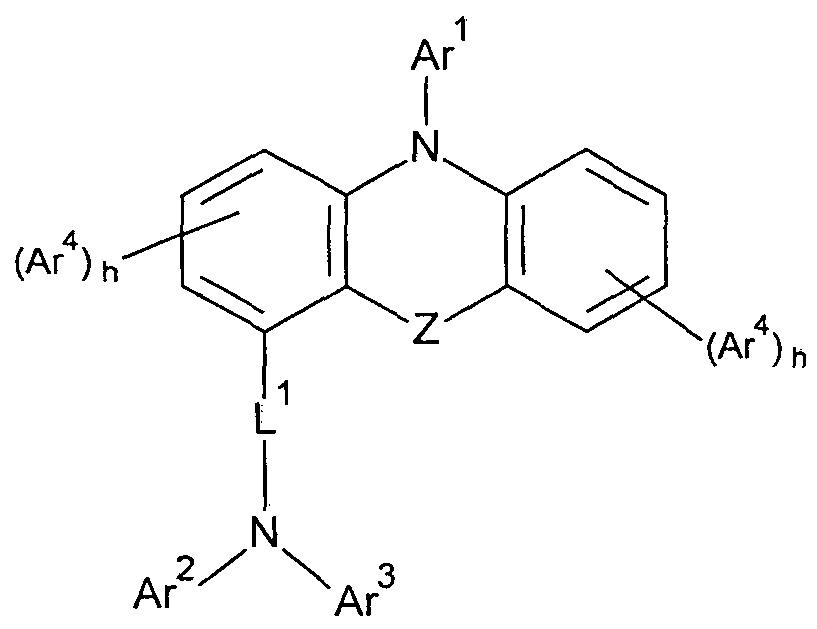
- the invention thus relates to a compound comprising at least one comprising at least one structure of the formula (I)
- X is the same or different at each occurrence N or CR 1 , preferably CR 1 , with the proviso that not more than two of the groups X are in one cycle for N;
- Z is a bond, C (R) 2, O or S;
- L is a bond, an aromatic ring system having 6 to 60, preferably 6 to 40, particularly preferably 6 to 20 C atoms or a heteroaromatic ring system having 3 to 60 C atoms, preferably 3 to 40, particularly preferably 3 to 20 which in each case may be substituted by one or more radicals R, preferably a bond, an aryl group having 6 to 60, preferably 6 to 40, particularly preferably 6 to 20 C atoms or a heteroaryl group having 3 to 60, preferably 6 to 40, particularly preferably 6 to 20 carbon atoms, which may each be substituted by one or more radicals R;
- Ar 1 , Ar 2 , Ar 3 is an aryl group having 6 to 40, preferably 6 to 20 C atoms or a heteroaryl group having 3 to 40, preferably 3 to 20 C atoms, which are each substituted by one or more radicals R 1 can;
- two or more adjacent substituents R 1 may also together form a mono- or polycyclic, aliphatic or aromatic ring system
- Heteroaryloxy devis having 5 to 40 aromatic ring atoms, which may be substituted by one or more radicals R 3 , or a combination of these systems; two or more adjacent substituents R 2 may also together form a mono- or polycyclic, aliphatic or aromatic ring system;
- R 3 is the same or different at each occurrence, H, D, F or a
- X is identical or different at each occurrence N or CR 1 , preferably CR 1 , with the proviso that not more than two of the
- Groups X are in a cycle for N;
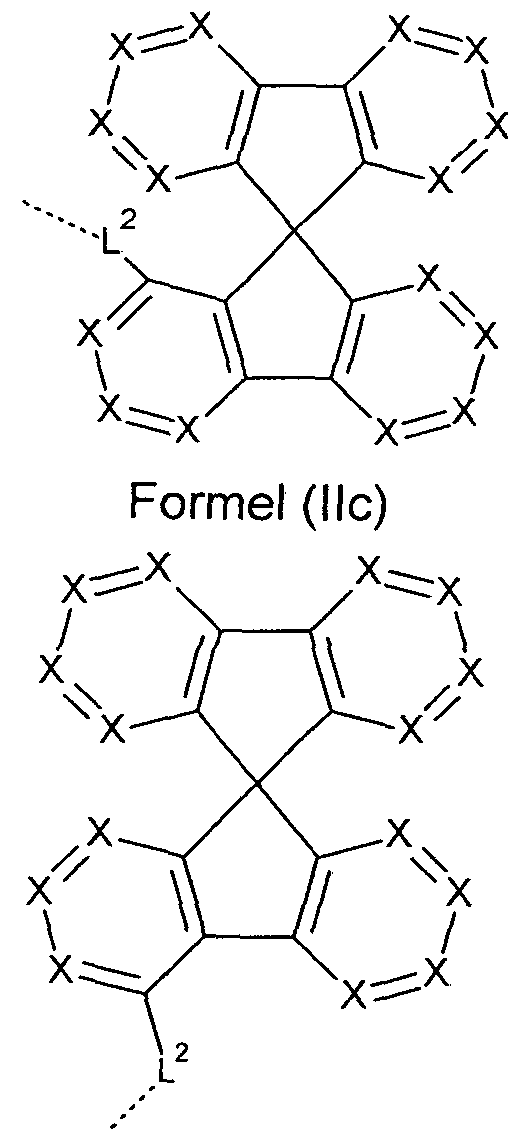
- L 2 is a bond, an aromatic ring system having 6 to 60, preferably 6 to 40, more preferably 6 to 20 C atoms or a heteroaromatic ring system having 3 to 60, preferably 3 to 40, particularly preferably 3 to 20 C atoms, each of one or more radicals R 1 may be substituted, preferably a bond, an aryl group having 6 to 60, preferably 6 to 40, particularly preferably 6 to 20 C atoms or a heteroaryl group having 3 to 60, preferably 3 to 40, particularly preferably 3 to 20 C atoms, which may each be substituted by one or more radicals R; R has the meaning given above and the dashed line has the
- Binding site so that L 2 binds to the same nitrogen atom as L 1 .
- adjacent carbon atoms means that the carbon atoms are directly bonded to each other
- adjacent radicals in the definition of the radicals means that these radicals are attached to the same carbon atom or to adjacent carbon atoms.
- An aryl group for the purposes of this invention contains 6 to 40 carbon atoms;
- a heteroaryl group contains 2 to 40 C atoms and at least one heteroatom, with the proviso that the sum of C atoms and heteroatoms gives at least 5.
- the heteroatoms are preferably selected from N, O and / or S.
- aryl group or heteroaryl either a simple aromatic cycle, ie benzene, or a simple heteroaromatic cycle, for example pyridine, pyrimidine, thiophene, etc., or a fused aryl or heteroaryl group, for example naphthalene, anthracene, phenanthrene, quinoline, isoquinoline, etc., understood.
- An aromatic ring system in the sense of this invention contains 6 to 60 carbon atoms in the ring system.
- a heteroaromatic ring system in the sense of this invention contains 3 to 60 C atoms and at least one heteroatom in the ring system, with the proviso that the sum of C atoms and heteroatoms gives at least 5.
- the heteroatoms are preferably selected from N, O and / or S.
- An aromatic or heteroaromatic ring system in the sense of this invention is to be understood as meaning a system which does not necessarily contain only aryl or heteroaryl groups but in which also several aryl or heteroaryl groups Heteroaryl groups by a non-aromatic unit (preferably less than 10% of the atoms other than H), such as.
- N or O atom or a carbonyl group may be interrupted.
- systems such as 9,9'-spirobifluorene, 9,9-diarylfluorene, triarylamine, Diaryl ethers, stilbene, etc. are understood as aromatic ring systems in the context of this invention, and also systems in which two or more aryl groups are interrupted for example by a linear or cyclic alkyl group or by a silyl group.
- systems in which two or more aryl or heteroaryl groups are bonded directly to each other, such as.
- biphenyl or terphenyl also be understood as an aromatic or heteroaromatic ring system.
- a cyclic alkyl, alkoxy or thioalkoxy group is understood as meaning a monocyclic, a bicyclic or a polycyclic group.
- a C 1 - to C 4 -alkyl group in which individual H atoms or CH groups can also be substituted by the abovementioned groups, for example the radicals methyl, ethyl, n-propyl, Propyl, cyclopropyl, n-butyl, i-butyl, s-butyl, t-butyl, cyclobutyl, 2-methylbutyl, n-pentyl, s-pentyl, t-pentyl, 2-pentyl, neo-pentyl, cyclopentyl, n- Hexyl, s-hexyl, t-hexyl, 2-hexyl, 3-hexyl, neo-hexyl, cyclohexyl, 1-methylcyclopentyl, 2-methylpentyl, n-heptyl, 2-heptyl, 3-heptyl
- alkenyl group is understood as meaning, for example, ethenyl, propenyl, butenyl, pentenyl, cyclopentenyl, hexenyl, cyclohexenyl, heptenyl, cycloheptenyl, octenyl, cyclooctenyl or cyclooctadienyl.
- alkynyl groups include ethynyl, propynyl, butynyl, pentynyl, hexynyl, heptynyl or Octinyl understood.
- a C 1 to C 4 o-alkoxy group is understood as meaning, for example, methoxy, trifluoromethoxy, ethoxy, n-propoxy, isopropoxy, n-butoxy, isobutoxy, s-butoxy, t-butoxy or 2-methylbutoxy.
- aromatic or heteroaromatic ring system having 3-60 aromatic ring atoms, which may be substituted in each case with the abovementioned radicals and which may be linked via any position on the aromatic or heteroaromatic, are understood, for example, groups which are derived from benzene, naphthalene , Anthracene, benzanthracene, phenanthrene, benzophenanthrene, pyrene, chrysene, perylene, fluoranthene, benzfluoranthene, naphthacene, pentacene, benzpyrene, biphenyl, biphenylene, terphenyl, terphenylene, fluorene, spirobifluorene, dihydrophenanthrene, dihydropyrene, tetrahydropyrene, cis- or trans- indenofluorene, cis- or trans-monobenzoindenofluorene, cis-
- h at each occurrence independently 0, 1, 2, 3 or 4, preferably 0, 1 or
- Ar 4 is an aryl group having 6 to 40 carbon atoms or a heteroaryl group with
- Fluorene structure are bound identical. As a result, a symmetrical substitution can be obtained at this position.
- both radicals R 1 which are bonded to the C atom in position 9 in the fluorene structure according to formula (IIa) or (IIb), are different.
- the two radicals R which are bonded to the C atom in position 9 in the fluorene structure of the formula (IIa) or (IIb) are particularly preferably identical.
- the two R 1 radicals attached to the C atom at position 9 in the fluorene structure according to formula (IIa) or (IIb) may each be an aromatic or heteroaromatic ring system having from 5 to 30 aromatic ring atoms and having one or more R represents R may be substituted, wherein the two ring systems are interconnected.
- compounds of the formula (I) show surprising advantages in which the two radicals R 1 which are attached to the C atom in position 9 in the Fluorene structure of formula (IIa) or (IIb) are each bonded to an aromatic or heteroaromatic ring system having 5 to 30 aromatic ring atoms, which may be substituted by one or more radicals R 1 , wherein the two ring systems are interconnected.
- radicals R 1 which are bonded to the C atom in position 9 in the fluorene structure of the formula (IIa) or (IIb) are each one aromatic or heteroaromatic ring system having 5 to 30 aromatic ring atoms, which may be substituted by one or more radicals R 1 , wherein the two ring systems are not connected to each other, or a straight-chain alkyl, alkoxy or thioalkoxy group having 1 to 40 C.
- the two radicals R 4 which are bonded to the C atom in position 9 in the fluorene structure are identical. Furthermore, it can be provided that both radicals R 4 , which are bonded to the C atom in position 9 in the fluorene structure according to formula (III) or (IIf), are different.
- the two R 4 radicals attached to the C atom at position 9 in the fluorene structure are identical in structures according to formulas (III) or (IIf).
- compounds according to formulas (I), (Ib), (IIa), (IIb), (IIc), (IIId), (IIe) and formula (IIf) show surprising advantages in not more than two, preferably not more than a group X is N, preferably all X are CR, wherein preferably at most 4, more preferably at most 3 and especially preferably at most 2 of the groups CR 1 is the X, is different from the group CH.
- radicals L 1 and L 2 are not a bond
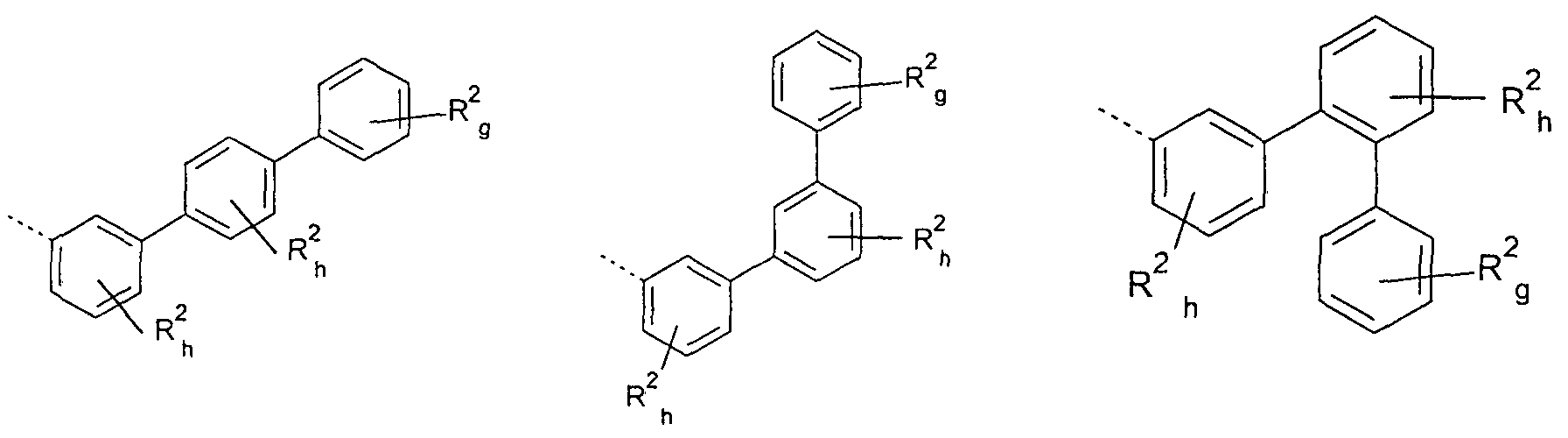
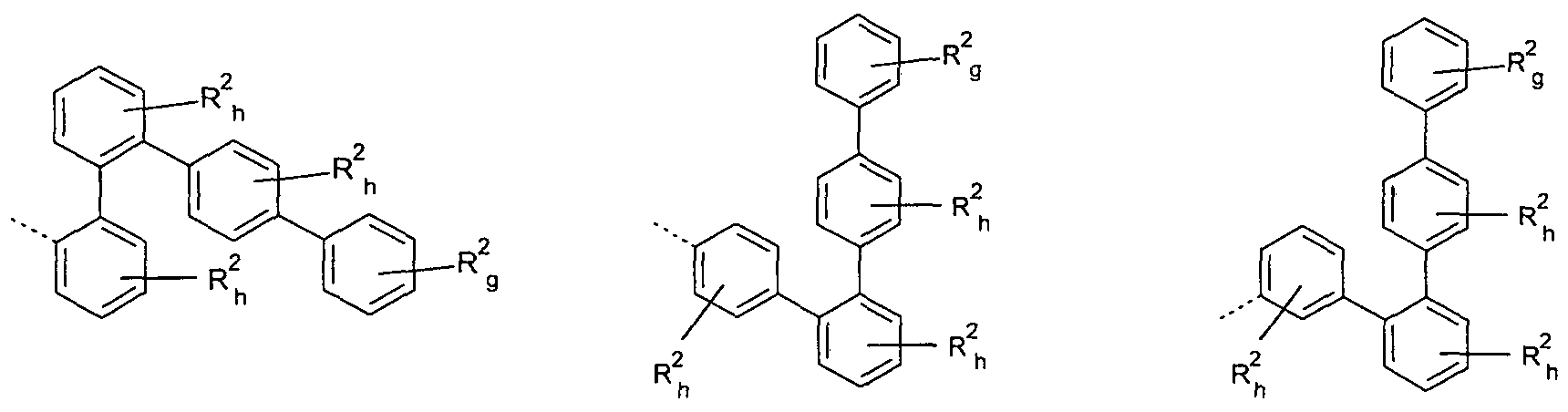
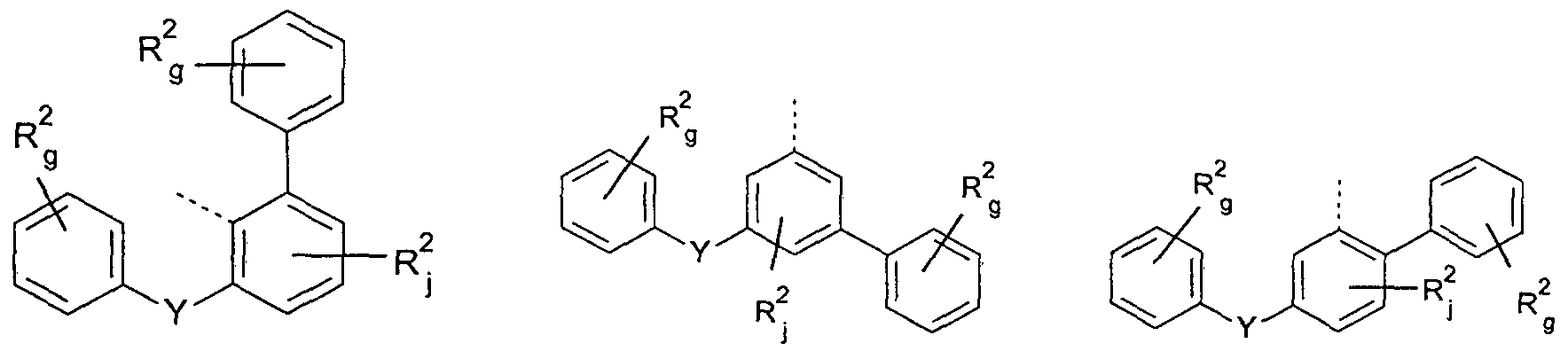
- these radicals L and L 2 preferably bind to the nitrogen atom and the fluorene group (formulas (IIa), (IIb), (IIc), (IId), (III) and (IIf )) and the heterocyclic radical shown in formulas (I), (Ia), (Ib), (Ic), preferably a carbazole group, via an aryl group or heteroaryl group.
- the subscript I is 0, 1 or 2
- the subscript g is 0, 1, 2, 3, 4 or 5
- j is independently 0, 1, 2 or 3 at each occurrence
- h is independently 0, 1, 2, 3 or 4 at each occurrence
- Y is O, S or NR 2 , preferably O or S
- R 2 may be as defined above.
- the sum of the indices I, g, h and j in the structures of the formulas (L-1) to (L-78) is at most 3, preferably at most 2 and particularly preferably at most 1.
- the group L 1 and / or L 2 according to formula (I), (IIa) and / or (IIb) particularly preferably represents an aromatic radical having 6 to 18, preferably 6 to 12 carbon atoms, structures of the formula (L-1 ) to (L-15), and structures of formula (L-1) to (L-4) are particularly preferred.
- radicals R at each occurrence are identically or differently selected from the group consisting of H, D, F, a straight-chain alkoxy group having 1 to 6 C atoms or a branched or cyclic alkoxy group having 3 to 10 C atoms, a straight-chain Alkyl group having 1 to 6 C atoms or a branched or cyclic alkyl group having 3 to 10 C atoms, where one or more H atoms may be replaced by D or F, or an aromatic or heteroaromatic ring system having 5 to 24 aromatic ring atoms, each of which may be substituted by one or more radicals R 2 ;
- two adjacent radicals R or R 1 or R or R 1 with R 2 also together form a mono- or polycyclic, aliphatic or aromatic ring system.
- at least one of R or R 1 in formula (I) may represent an aryl group or a heteroaryl group having 6 to 18 carbon atoms which may be substituted with up to three
- the compound having structures of the formula (I) can comprise radicals R 2 in which these radicals R 2 are each the same or different preferably selected from the group consisting of H, D, F, Cl, Br, I, CHO at each occurrence.
- R 2 may also together form a mono- or polycyclic, aliphatic or aromatic ring system. More preferably, at least one of R 2 in formula (I) may have an aryl group or a heteroaryl group of 6 to 18
- Y is O, S or NR 2 , preferably O or S;
- j is independently 0, 1, 2 or 3 at each occurrence
- h is independently 0, 1, 2, 3 or 4 at each occurrence
- g is independently 0, 1, 2, 3, 4 or 5 at each occurrence
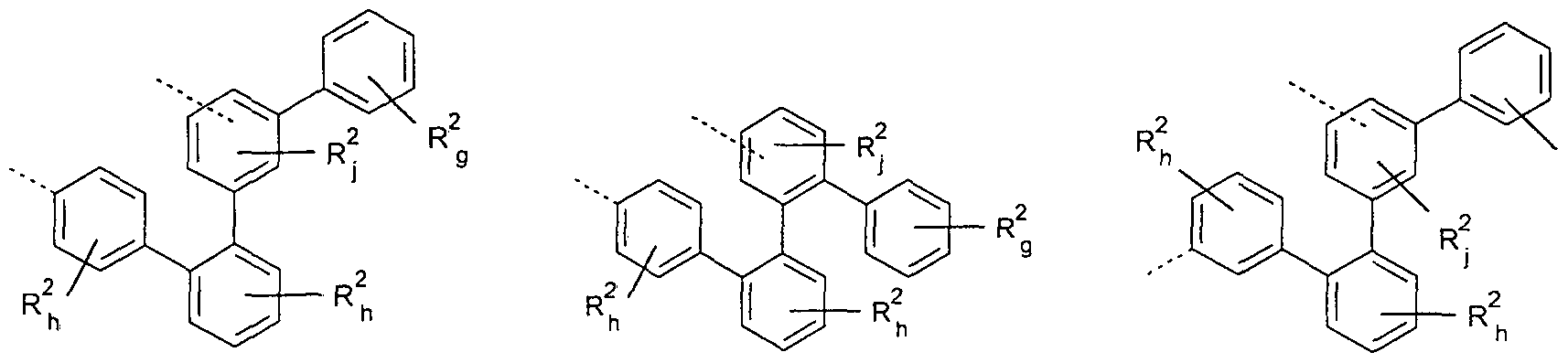
- R 2 may have the aforementioned meaning.
- the sum of the indices g, h and j in the structures of the formulas (R -1) to (R 1 -72) is at most 3, preferably at most 2 and particularly preferably at most 1.
- the group R 1 , Ar 2 , Ar 3 or Ar 4 according to formula (I), (IIa) and / or (IIb) can particularly preferably have an aromatic radical with 6 to 18, preferably Represent 6 to 12 carbon atoms, structures of the formula (R 1 -1) are preferred to (R 1 -15) and structures of the formula (R 1 -1) to (R -4) are particularly preferred.
- one of Ar 2 or Ar 3 must be a group of formula (IIa) or (IIb).
- Group L 1 is a bond and in formula (IIa) and / or (IIb) the group L 2 is a group which is selected from the formulas (L-1) to (L-78), preferably from the formulas ( L-1) to (L-15), more preferably from the formulas (L-1) to (L-5) described above.
- the group L 2 is a bond and in formula (I) the group L 1 is a group which is selected from the formulas (L -1) to (L-78), preferably from the formulas (L-1) to (L-15), more preferably from the formulas (L-1) to (L-5) described above.
- the groups L 1 and L 2 are a bond. Furthermore, it can be provided that in structure according to formula (I), (IIa) and / or (IIb) the groups L 1 and L 2 stand for a group which
- the radical Ar 1 and / or Ar 3 in structures of the formula (I) may have an aromatic ring system having 6 to 18, preferably 6 to 12
- radicals R represents aromatic ring atoms which may be substituted by one or more radicals R, wherein preferably both radicals Ar 1 and Ar 3 in structures of the formula (I) represent an aromatic ring system having 6 to 12 aromatic ring atoms.
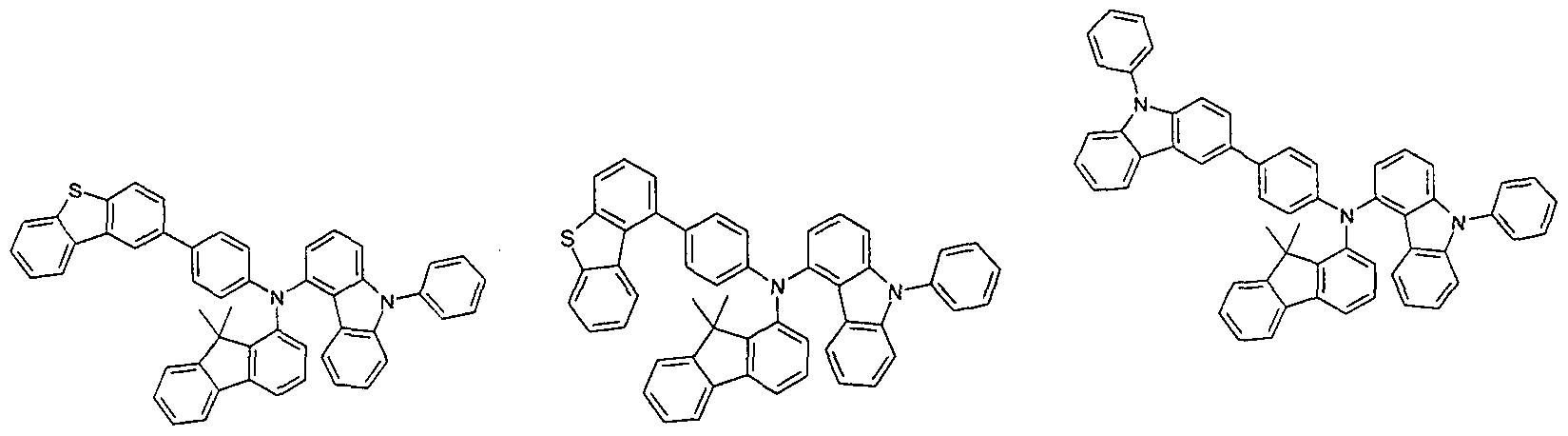
- Particularly preferred compounds include structures according to the following formulas 1 to 244:
- Embodiments can be combined with each other as desired. In a particularly preferred embodiment of the invention, the abovementioned preferred embodiments apply simultaneously.
- the compounds according to the invention can in principle be prepared by various methods. However, they have the following
- a further subject of the present invention is a process for the preparation of the compounds comprising structures of the formula (I), in which, in a coupling reaction, a group comprising at least one nitrogen-comprising heterocyclic radical, preferably a carbazole radical, with a group, comprising at least one fluorene radical is connected.
- a nitrogen-comprising heterocyclic compound preferably a carbazole compound, may be an amino group, preferably a secondary
- Amino group with a group comprising at least one fluorene radical, to be connected.
- a compound having an amino group, preferably a secondary amino group, comprising at least one fluorene group, with a nitrogen-comprising heterocyclic radical, preferably a carbazole radical are connected.
- Particularly suitable and preferred coupling reactions are those according to BUCHWALD, SUZUKI, YAMAMOTO, SILENT, HECK, NEGISHI,
- the compounds according to the invention described above in particular compounds which are substituted by reactive leaving groups, such as bromine, iodine, chlorine, boronic acid or boronic acid esters, can be used as monomers for producing corresponding oligomers, dendrimers or polymers.
- the oligomerization or polymerization is preferably carried out via the halogen functionality or the
- the synthetic route comprises two coupling reactions: first, the fluorene or
- heterocyclic nitrogen-containing group preferably the
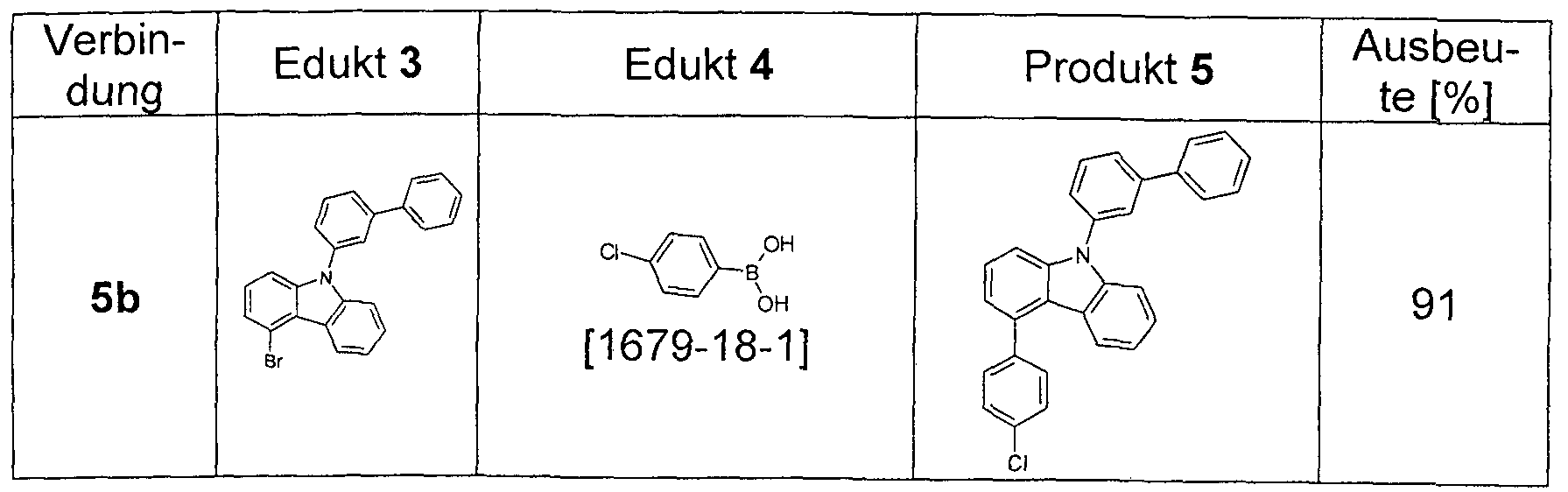
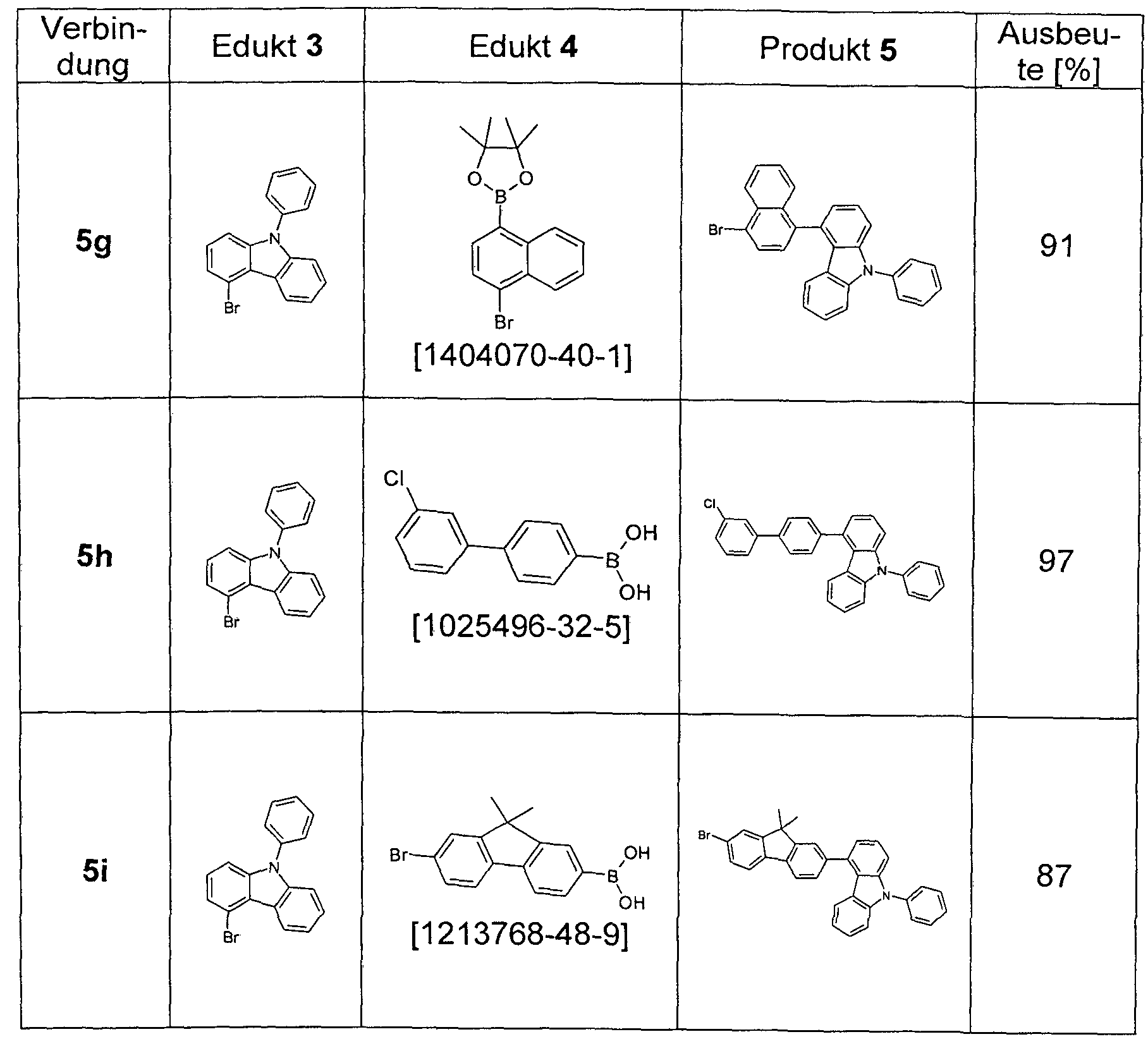
- Exemplary embodiments illustrate some explicit synthesis methods in detail.
- the present invention thus provides a process for preparing a compound of the formula (I), (Ia), (Ib) or (Ic), which comprises reacting a fluorenyl or spirobifluorenyl derivative in a first coupling reaction with an arylamino compound and reacting the resulting product in a second coupling reaction with an aromatic heterocyclic nitrogen compound, preferably a carbazole compound.
- the coupling reactions are preferably Buchwald couplings.
- the compounds of the invention comprising structures of formula (I) in high purity, preferably more than 99% (determined by means of 1 H-NMR and / or HPLC).
- the compounds of the invention may also be suitable
- substituents for example by longer alkyl groups (about 4 to 20 carbon atoms), in particular branched alkyl groups, or
- aryl groups for example xylyl, mesityl or branched terphenyl or quaterphenyl groups containing a
- Solubility in common organic solvents cause, such as toluene or xylene at room temperature in sufficient
- Concentration soluble to process the complexes from solution are particularly suitable for processing from solution, for example by printing processes.
- the compounds according to the invention comprising at least one structure of the formula (I) already have an increased solubility in these solvents.
- the compounds of the invention may also be mixed with a polymer. It is also possible to incorporate these compounds covalently into a polymer. This is particularly possible with compounds which are substituted with reactive leaving groups, such as bromine, iodine, chlorine, boronic acid or boronic acid esters, or with reactive, polymerizable groups, such as olefins or oxetanes. These can be used as monomers for the production of corresponding oligomers, dendrimers or polymers.
- the oligomerization or polymerization is preferably carried out via the halogen functionality or the boronic acid functionality or via the polymerizable group. It is also possible to crosslink the polymers via such groups.
- the compounds of the invention and polymers can be used as a crosslinked or uncrosslinked layer.
- Structures of the formula (I) or compounds according to the invention wherein one or more bonds of the compounds according to the invention or of the structures of the formula (I) to the polymer, oligomer or dendrimer are present. Depending on the linkage of the structures of the formula (I) or of the compounds, these therefore form a side chain of the oligomer or polymer or are linked in the main chain.
- the polymers, oligomers or dendrimers may be conjugated, partially conjugated or non-conjugated.
- the oligomers or polymers may be linear, branched or dendritic.
- the repeat units of the compounds according to the invention in oligomers, dendrimers and polymers have the same preferences as described above.
- the monomers according to the invention are homopolymerized or copolymerized with further monomers. Preference is given to copolymers in which the units of the formula (I) or the preferred embodiments described above are present at from 0.01 to 99.9 mol%, preferably from 5 to 90 mol%, particularly preferably from 20 to 80 mol%.
- Suitable and preferred comonomers which form the polymer backbone are selected from fluorenes (eg according to EP 842208 or WO 2000/022026), spirobifluorenes (eg according to US Pat EP 707020, EP 894107 or WO 2006/061181), para-phenylenes (eg according to WO 92/18552), carbazoles (eg according to WO 2004/070772 or WO 2004/113468), thiophenes (e.g.
- EP 1028136 dihydric phenanthrenes (eg according to WO 2005/014689), cis- and trans-indeno-fluorenes (eg according to WO 2004/041901 or WO 2004/113412), ketones (eg. According to WO 2005/040302), phenanthrenes (for example according to US Pat
- the polymers, oligomers and dendrimers may also contain other units, for example hole transport units, in particular those based on triarylamines, and / or electron transport units.
- the present compounds can be a relatively low
- a further subject of the present invention is accordingly a compound comprising one or more structures of the formula (I) which has a molecular weight of preferably less than or equal to 10000 g / mol, preferably less than or equal to 5000 g / mol, particularly preferably less than or equal to 4000 g / mol, in particular preferably less than or equal to 3000 g / mol, especially preferably less than or equal to 2000 g / mol and very particularly preferably less than or equal to 1000 g / mol.
- preferred compounds of the invention are characterized in that they are sublimable. These compounds generally have a molecular weight of less than about 1200 g / mol.
- Yet another object of the present invention is a formulation comprising a compound of the invention or an oligomer according to the invention, polymer or dendrimer and at least one further compound.
- the further compound may preferably be a solvent.
- the further compound can also be a further organic or inorganic compound which is likewise used in the electronic device, for example a matrix material.
- This further compound may also be polymeric.
- Suitable and preferred solvents are, for example, toluene, anisole, o-, m- or p-xylene, methyl benzoate, mesitylene, tetralin, veratrole, THF, methyl THF, THP, chlorobenzene, dioxane, phenoxytoluene, in particular 3-phenoxytoluene, (-) Fenchone, 1, 2,3,5-tetramethylbenzene, 2,4,5-tetra methylbenzene, 1-methylnaphthalene, 2-methylbenzothiazole, 2-phenoxyethanol, 2-pyrrolidinone, 3-methylanisole, 4-methylanisole, 3, 4-dimethylanisole, 3,5-dimethylanisole, acetophenone, ⁇ -terpineol, benzothiazole, butylbenzoate, cumene, cyclohexanol, cyclohexanone, cyclohexylbenzene, decalin, dodecy
- Yet another object of the present invention is a composition
- a composition comprising a compound of the invention and at least one further organically functional material.
- Functional materials are generally the organic or inorganic materials incorporated between the anode and cathode.
- the organically functional material is selected from the group consisting of fluorescent emitters, phosphorescent emitters, host materials, matrix materials, electron transport materials, Electron injection materials, hole conductor materials, hole injection materials, n-dopants, wide band gap materials, electron blocking materials, and hole blocking materials.
- the present invention therefore also relates to a composition comprising at least one compound comprising structures according to formula (I) and at least one further matrix material. According to a particular aspect of the present invention, the other
- a further subject of the present invention is a composition comprising at least one compound comprising at least one structure according to formula (I) and at least one wide band gap material, wherein a wide band gap material is a material in the sense of
- the additional compound may have a band gap of 2.5 eV or more, preferably 3.0 eV or more, more preferably 3.5 eV or more.
- the band gap can be calculated among other things by the energy levels of the highest occupied molecular orbital (HOMO) and the lowest unoccupied molecular orbital (LUMO).
- Molecular orbitals in particular the highest occupied molecular orbital (HOMO) and the lowest unoccupied molecular orbital (LUMO), their energy levels and the energy of the lowest triplet state Ti or the lowest excited singlet state Si of the materials are determined by quantum chemical calculations.
- HOMO highest occupied molecular orbital
- LUMO lowest unoccupied molecular orbital
- these values are to be regarded as HOMO or LUMO energy levels of the materials.
- the lowest triplet state Ti is defined as the energy of the triplet state with the lowest energy, which results from the described quantum chemical calculation.
- the lowest excited singlet state Si is defined as the energy of the excited singlet state with the lowest energy which results from the described quantum chemical calculation.
- the present invention also relates to a composition
- a composition comprising at least one compound comprising structures of the formula (I) and at least one phosphorescent emitter, the term phosphorescent emitters also being understood to mean phosphorescent dopants.
- phosphorescent dopants are typically
- phosphorescent dopants compounds containing copper, molybdenum, tungsten, rhenium, ruthenium, osmium, rhodium, iridium, palladium, platinum, silver, gold or europium are preferably used, in particular compounds containing iridium, platinum or copper.
- Phosphorescent dopants are listed in a following section.
- a dopant in a system comprising a matrix material and a dopant, is understood to mean the component whose proportion in the mixture is the smaller.
- a matrix material in a system containing a matrix material and a dopant is understood to mean the component whose proportion in the mixture is the larger.
- Preferred phosphorescent dopants for use in mixed-matrix systems are those specified below
- phosphorescent dopants can be found in applications WO 2000/70655, WO 2001/41512, WO 2002/02714, WO 2002/15645, EP 1191613, EP 1191612, EP 1191614, WO 2005/033244, WO 2005/019373 and US 2005/0258742 be removed.
- all phosphorescent complexes are suitable, as in the prior art are used for phosphorescent OLEDs and as known to those skilled in the field of organic electroluminescent devices, for use in the devices according to the invention.
- An electronic device is understood to mean a device which contains anode, cathode and at least one layer, this layer containing at least one organic or organometallic compound.
- the electronic device according to the invention thus contains anode, cathode and at least one layer which contains at least one compound comprising structures of the formula (I).
- preferred electronic devices are selected from the group consisting of organic electroluminescent devices (OLEDs, PLEDs), organic integrated circuits (O-ICs), organic field-effect transistors (O-FETs), organic
- O-TFTs Thin-film transistors (O-TFTs), organic light-emitting
- O-LETs organic solar cells
- O-SCs organic optical detectors
- O-FQDs organic field quench devices
- O-FQDs organic electrical sensors
- LOCs light-emitting electrochemical cells
- O- Laser organic laser diodes
- Active components are generally the organic or inorganic materials interposed between the anode and cathode, for example charge injection, charge transport or charge blocking materials,
- a preferred embodiment of the invention are organic electroluminescent devices.
- the organic electroluminescent device includes cathode, anode and at least one emitting layer.
- they may also contain further layers, for example in each case one or more hole injection layers, hole transport layers, hole blocking layers, electron transport layers,
- Metal oxides such as M0O3 or WO3 or with (per) fluorinated low-electron aromatics, and / or that one or more electron-transport layers are n-doped.
- Interlayers be introduced, which for example a
- Used compounds that can fluoresce or phosphoresce are used compounds that can fluoresce or phosphoresce. Particular preference is given to three-layer systems, the three layers exhibiting blue, green and orange or red emission (for the basic structure see, for example, WO 2005/011013) or systems having more than three emitting layers. It can also be a Hybrid system, wherein one or more layers fluoresce and one or more other layers phosphoresce.
- the organic electroluminescent device contains the compound according to the invention comprising structures according to formula (I) or the preferred embodiments listed above as matrix material, preferably as hole-conducting matrix material in one or more emitting
- An emitting layer comprises at least one emitting compound.
- the triplet level of the matrix material is higher than the triplet level of the emitter.
- Suitable matrix materials for the compounds of the invention are lactams, e.g. according to WO 2011 / 116865A1, WO 2013 / 064206A1, WO 2014 / 056567A1, WO 2014 / 094964A1, ketones, phosphine oxides, sulfoxides and sulfones, e.g. B. according to WO 2004/013080, WO 2004/093207, WO 2006/005627 or WO 2010/006680, triarylamines, carbazole derivatives, z.
- CBP ⁇ , ⁇ -biscarbazolylbiphenyl
- m-CBP or in
- WO 2005/039246 US 2005/0069729, JP 2004/288381, EP 1205527, WO 2008/086851 or US 2009/0134784 disclosed carbazole derivatives, indolocarbazole derivatives, for. B. according to WO 2007/063754 or
- EP 1617711, EP 1731584, JP 2005/347160 bipolar matrix materials, e.g. B. according to WO 2007/137725, silanes, z. B. according to WO 2005/11172, azaborole or boronic esters, z. B. according to WO 2006/117052, diazasilol derivatives, z. B. according to WO 2010/054729, Diazaphospholderivate, z. B. according to WO 2010/054730, triazine derivatives, z. B. according to WO 2010/015306, WO 2007/063754 or WO 2008/056746, zinc complexes, for. B.
- bipolar matrix materials e.g. B. according to WO 2007/137725, silanes, z. B. according to WO 2005/11172, azaborole or boronic esters, z. B. according to WO 2006/117052, diazasilol derivatives, z. B. according to
- a plurality of different matrix materials as a mixture, in particular at least one electron-conducting matrix material and at least one hole-conducting matrix material.
- a mixture of a charge-transporting matrix material and an electrically inert matrix material which is not or not significantly involved in charge transport, such.
- triplet emitter with the shorter-wave emission spectrum serves as a co-matrix for the triplet emitter with the longer-wave emission spectrum.
- a compound of the invention comprising structures according to formula (I) can be used as matrix material in an emission layer of an organic electronic device, in particular in an organic electroluminescent device, for example in an OLED or OLEC.
- the matrix material comprising compound comprising structures according to formula (I) is present in the electronic device in combination with one or more dopants, preferably phosphorescent dopants.
- the proportion of the matrix material in the emitting layer is in this case between 50.0 and 99.9% by volume, preferably between 80.0 and 99.5% by volume and particularly preferred for fluorescent emitting layers between 92.0 and 99.5% by volume and for phosphorescent emitting layers between 85.0 and 97.0 vol.%.
- the proportion of the dopant is between 0.1 and
- An emitting layer of an organic electroluminescent device may also contain systems comprising a plurality of matrix materials (mixed-matrix systems) and / or multiple dopants. Also in this case, the dopants are generally those materials whose proportion in the system is smaller and the matrix materials are those materials whose proportion in the system is larger.
- the dopants are generally those materials whose proportion in the system is smaller and the matrix materials are those materials whose proportion in the system is larger.
- the proportion of a single matrix material in the system may be smaller than the proportion of a single dopant.
- the compound comprising structures according to formula (I) are used as a component of mixed-matrix systems.
- the mixed-matrix systems preferably comprise two or three different matrix materials, more preferably two different matrix materials.
- one of the two materials constitutes a material with hole-transporting properties and the other material a material with electron-transporting properties.
- the desired electron-transporting and hole-transporting properties of the mixed-matrix components can also be mainly or completely combined in a single mixed-matrix component be, with the other and the other mixed-matrix components fulfill other functions.
- the two different matrix materials may be present in a ratio of 1:50 to 1: 1, preferably 1:20 to 1: 1, more preferably 1:10 to 1: 1 and most preferably 1: 4 to 1: 1.
- an electronic device preferably an organic electroluminescent device, is the subject of the present invention, which comprises one or more compounds according to the invention and / or at least one oligomer, polymer or dendrimer according to the invention one or more hole-conducting layers (HTL), as
- one or more compounds of the invention and / or at least one
- Electron blocking material in an electron-blocking layer can be used. Preference is given to using a compound according to the invention comprising structures of the formula (I) and / or at least one oligomer, polymer or dendrimer according to the invention as matrix material, preferably as hole-conducting matrix material in one or more emitting layers (EML).
- EML emitting layers
- low work function metals, metal alloys or multilayer structures of various metals are preferable, such as alkaline earth metals, alkali metals, main group metals or lanthanides (eg, Ca, Ba, Mg, Al, In, Mg, Yb, Sm, etc.).
- alloys of an alkali or alkaline earth metal and silver for example an alloy of magnesium and silver.
- further metals which have a relatively high work function such as, for example, B. Ag, which then usually combinations of metals, such as Mg / Ag, Ca / Ag or Ba / Ag are used. It may also be preferred between a metallic cathode and the
- organic semiconductors to introduce a thin intermediate layer of a material with a high dielectric constant.
- Suitable examples of these are alkali metal or alkaline earth metal fluorides, but also the corresponding oxides or carbonates (eg LiF, L 12 O, BaF 2, MgO, NaF, CsF, CS 2 CO 3, etc.).
- organic alkali metal complexes for.
- B. Liq (lithium quinolinate). The layer thickness of this layer is preferably between 0.5 and 5 nm.
- the anode high workfunction materials are preferred.
- the anode has a work function greater than 4.5 eV. Vacuum up.
- metals with a high redox potential are suitable for this purpose, such as, for example, Ag, Pt or Au.
- metal / metal oxide Electrodes eg Al / Ni / NiOx, Al / PtOx
- at least one of the electrodes must be transparent or partially transparent to allow either the irradiation of the organic material (O-SC) or the outcoupling of light (OLED / PLED, O-LASER).
- Preferred anode materials here are conductive mixed metal oxides.
- ITO indium tin oxide
- IZO indium zinc oxide
- conductive, doped organic materials in particular conductive doped polymers, for. B. PEDOT, PANI or derivatives of these polymers.
- a p-doped hole transport material is applied to the anode as a hole injection layer, wherein suitable p-dopants are metal oxides, for example M0O3 or WO3, or (per) fluorinated electron-poor aromatics.
- suitable p-dopants are HAT-CN (hexacyano-hexaazatriphenylene) or the compound NPD9 from Novaled. Such a layer simplifies the hole injection in materials with a low HOMO, ie a HOMO of large magnitude.
- the device is structured accordingly (depending on the application), contacted and finally hermetically sealed because the life of such devices drastically shortened in the presence of water and / or air.
- an electronic device in particular an organic electroluminescent device, which thereby
- Sublimation method to be coated In this case, 6 mbar, the materials in vacuum sublimation at an initial pressure of usually less than 10 "5 mbar, preferably less than 10" evaporated. It is also possible that the initial pressure is even lower or even higher, for example less than 10 7 mbar. Also preferred is an electronic device, in particular an organic electroluminescent device, which is characterized
- OVPD Organic Vapor Phase Deposition
- Carrier gas sublimation are coated.
- the materials are applied at a pressure between 10 ⁇ 5 mbar and 1 bar.
- a special case of this process is the OVJP (Organic Vapor Jet Printing) process, in which the materials are applied directly through a nozzle and thus structured (for example, BMS Arnold et al., Appl. Phys. Lett., 2008, 92, 053301).
- an electronic device in particular an organic electroluminescent device, which thereby
- one or more layers of solution such. B. by spin coating, or with any printing process, such. B. screen printing, flexographic printing, offset printing or Nozzle printing, but more preferably LITl (Light Induced Thermal Imaging, thermal transfer printing) or ink-jet printing (inkjet printing), are produced.
- LITl Light Induced Thermal Imaging, thermal transfer printing
- ink-jet printing inkjet printing
- the electronic device in particular the organic electroluminescent device, can also be manufactured as a hybrid system by applying one or more layers of solution and depositing one or more other layers.
- an emissive layer comprising a compound according to the invention comprising structures according to formula (I) and a matrix material from solution and then apply one
- the electronic devices according to the invention are distinguished by one or more of the following surprising advantages over the prior art:
- Electroluminescent devices containing compounds
- Oligomers, polymers or dendrimers having structures of the formula (I), in particular as hole-conducting materials, have a very good service life.
- Electroluminescent devices containing compounds
- Oligomers, polymers or dendrimers having structures according to formula (I) as hole-conducting materials have an excellent efficiency.
- the efficiency is significantly higher than analogous compounds containing no structural unit according to formula (I).
- Structures according to formula (I) can be avoided in electronic devices, in particular organic electroluminescent devices, the formation of optical loss channels. As a result, these devices are distinguished by a high PL and thus high EL efficiency of emitters or an excellent energy transfer of the matrices to dopants.
- Dendrimers having structures according to formula (I) in layers having structures according to formula (I) in layers
- the compounds, oligomers, polymers or dendrimers comprising structures of the formula (I) have a surprisingly high HOMO level, in particular compounds which are used as hole-conducting materials.
- Another object of the present invention is the use of a compound of the invention and / or an oligomer, polymer or dendrimer according to the invention in an electronic device as a hole transport material, hole injection material, hole blocking material, electron injection material, electron blocking material and / or
- Electron transport material preferably as hole transport material, hole injection material, hole blocking material and / or matrix material, particularly preferably hole-conducting matrix material.
- the following syntheses are carried out under an inert gas atmosphere in dried solvents.
- the metal complexes are additionally handled in the absence of light or under yellow light.
- the solvents and reagents may, for. B. from Sigma-ALDRICH or ABCR.
- the respective information in square brackets or the numbers given for individual compounds refer to the CAS numbers of the compounds known from the literature.
- the batch is transferred to a separatory funnel and extracted twice with 300 ml of water.
- the aqueous phase is extracted by shaking again with toluene and the combined organic phases dried over sodium sulfate.
- a resinous solid is obtained which is taken up in a little dichloromethane and introduced into ethanol.
- the solid obtained is purified by means of hot extraction and triple recrystallization from toluene / heptane and
- Pretreatment for Examples V1-E14 Glass plates coated with structured 50 ⁇ m thick ITO (indium tin oxide) are coated with 20 nm PEDOT: PSS for improved processing (poly (3,4-ethylenedioxythiophene) poly (styrenesulfonate ), referred to as CLEVIOS TM P VP AI 4083 from Heraeus Precious Metals GmbH Germany, spin-on from aqueous solution). These coated glass plates form the substrates to which the OLEDs are applied.
- PEDOT poly (3,4-ethylenedioxythiophene) poly (styrenesulfonate )
- the OLEDs have in principle the following layer structure: substrate / hole transport layer (HTL) / optional interlayer (IL) / electron blocking layer (EBL) / emission layer (EML) / optional hole blocking layer (HBL) / electron transport layer (ETL) / optional electron injection layer (EIL) and finally a cathode.
- the cathode is formed by a 100 nm thick aluminum layer.
- Table 1 The exact structure of the OLEDs is shown in Table 1.
- the materials needed to make the OLEDs are shown in Table 3.
- the emission layer always consists of at least one matrix material (host material, host material) and an emitting dopant (dopant, emitter), which is admixed to the matrix material or the matrix materials by co-evaporation in a specific volume fraction.
- the electron transport layer may consist of a mixture of two materials.
- the OLEDs are characterized by default. Electroluminescence spectra, current efficiency (measured in cd / A), power efficiency (measured in Im / W) and external quantum efficiency are used for this (EQE, measured in percent) as a function of the luminance, calculated from current-voltage-luminance characteristic curves (IUL characteristics) assuming a Lambertian radiation characteristic and the lifetime determined.
- the electroluminescence spectra are determined at a luminance of 1000 cd / m 2 and from this the CIE 1931 x and y color coordinates are calculated.
- the indication U1000 in Table 2 indicates the voltage required for a luminance of 1000 cd / m 2 .
- SE1000 and LE1000 indicate the power efficiency achieved at 1000 cd / m 2 .
- EQE1000 refers to external quantum efficiency at an operating luminance of 1000 cd / m 2 .
- the lifetime LD is defined as the time after which the luminance drops from the start luminance to a certain amount of Li during operation with a constant current.
- Example V1 is a comparative example according to the prior art, examples E1-E14 show data of inventive OLEDs.
- EML emission layer
- Phosphorescent OLEDs significant improvements over the prior art, especially in terms of the life of the OLEDs.
- the compounds 9a and 9h according to the invention can be a lifetime improvement of more than 50% over the
- V1 SpA1 HATCN SpMA1 IC1 SdT: TEG1 1C1 ST2: LiQ
- V2 SpA1 HATCN SpMA1 IC1 SdT2: TEG1 IC1 ST2.UQ
- E1 SpA1 HATCN SpMA1 IC1 9a: TEG1 IC1 ST2: LiQ
- E5 SpA1 HATCN SpMA1 IC1 9f: TEG1 IC1 ST2: üQ ...
Landscapes
- Chemical & Material Sciences (AREA)
- Organic Chemistry (AREA)
- Engineering & Computer Science (AREA)
- Materials Engineering (AREA)
- Physics & Mathematics (AREA)
- Spectroscopy & Molecular Physics (AREA)
- Crystallography & Structural Chemistry (AREA)
- Inorganic Chemistry (AREA)
- Electroluminescent Light Sources (AREA)
- Plural Heterocyclic Compounds (AREA)
- Indole Compounds (AREA)
- Led Devices (AREA)
Abstract
Description









Claims











Priority Applications (5)
| Application Number | Priority Date | Filing Date | Title |
|---|---|---|---|
| JP2017527611A JP6946186B2 (ja) | 2014-11-21 | 2015-11-03 | ヘテロ環化合物 |
| EP15790467.3A EP3221294B1 (de) | 2014-11-21 | 2015-11-03 | Heterocyclische verbindungen zur verwendung in elektronischen vorrichtungen |
| US15/528,310 US10957859B2 (en) | 2014-11-21 | 2015-11-03 | Heterocyclic compounds for use in electronic devices |
| KR1020177016677A KR102509655B1 (ko) | 2014-11-21 | 2015-11-03 | 전자 디바이스에서의 사용을 위한 복소환 화합물 |
| CN201580063242.8A CN107001270B (zh) | 2014-11-21 | 2015-11-03 | 用于电子器件中的杂环化合物 |
Applications Claiming Priority (2)
| Application Number | Priority Date | Filing Date | Title |
|---|---|---|---|
| EP14003925 | 2014-11-21 | ||
| EP14003925.6 | 2014-11-21 |
Publications (1)
| Publication Number | Publication Date |
|---|---|
| WO2016078747A1 true WO2016078747A1 (de) | 2016-05-26 |
Family
ID=52015794
Family Applications (1)
| Application Number | Title | Priority Date | Filing Date |
|---|---|---|---|
| PCT/EP2015/002199 Ceased WO2016078747A1 (de) | 2014-11-21 | 2015-11-03 | Heterocyclische verbindungen zur verwendung in elektronischen vorrichtungen |
Country Status (7)
| Country | Link |
|---|---|
| US (1) | US10957859B2 (de) |
| EP (1) | EP3221294B1 (de) |
| JP (1) | JP6946186B2 (de) |
| KR (1) | KR102509655B1 (de) |
| CN (1) | CN107001270B (de) |
| TW (1) | TWI703128B (de) |
| WO (1) | WO2016078747A1 (de) |
Cited By (8)
| Publication number | Priority date | Publication date | Assignee | Title |
|---|---|---|---|---|
| WO2017102064A1 (en) * | 2015-12-16 | 2017-06-22 | Merck Patent Gmbh | Materials for organic electroluminescent devices |
| WO2017105078A1 (ko) * | 2015-12-17 | 2017-06-22 | 덕산네오룩스 주식회사 | 유기전기소자용 화합물, 이를 이용한 유기전기소자 및 그 전자 장치 |
| WO2017102063A1 (en) * | 2015-12-16 | 2017-06-22 | Merck Patent Gmbh | Materials for organic electroluminescent devices |
| WO2017116044A1 (ko) * | 2015-12-28 | 2017-07-06 | 덕산네오룩스 주식회사 | 유기전기소자용 화합물, 이를 이용한 유기전기소자 및 그 전자 장치 |
| KR20180042943A (ko) * | 2016-10-19 | 2018-04-27 | (주)피엔에이치테크 | 유기발광 화합물 및 이를 포함하는 유기발광소자 |
| WO2018100029A1 (de) * | 2016-12-02 | 2018-06-07 | Merck Patent Gmbh | Heterocyclische verbindungen zur verwendung in elektronischen vorrichtungen |
| CN115160329A (zh) * | 2016-09-30 | 2022-10-11 | 默克专利有限公司 | 具有二氮杂二苯并呋喃或二氮杂二苯并噻吩结构的化合物 |
| WO2022243403A1 (de) | 2021-05-21 | 2022-11-24 | Merck Patent Gmbh | Verfahren zur kontinuierlichen aufreinigung von mindestens einem funktionalen material und vorrichtung zur kontinuierlichen aufreinigung von mindestens einem funktionalen material |
Families Citing this family (14)
| Publication number | Priority date | Publication date | Assignee | Title |
|---|---|---|---|---|
| KR102624166B1 (ko) * | 2015-06-15 | 2024-01-12 | 삼성디스플레이 주식회사 | 유기 전계 발광 소자 |
| KR102660538B1 (ko) * | 2015-07-22 | 2024-04-24 | 메르크 파텐트 게엠베하 | 유기 전계발광 소자용 재료 |
| KR102501666B1 (ko) * | 2016-01-11 | 2023-02-21 | 덕산네오룩스 주식회사 | 유기전기소자용 화합물, 이를 이용한 유기전기소자 및 그 전자 장치 |
| CN106866499B (zh) * | 2016-12-26 | 2020-01-10 | 广东阿格蕾雅光电材料有限公司 | 有机空穴传输材料 |
| CN106848060B (zh) * | 2016-12-26 | 2019-05-14 | 广东阿格蕾雅光电材料有限公司 | 基于非对称有机空穴传输材料的仅空穴半导体二极管器件 |
| KR102492216B1 (ko) * | 2017-03-16 | 2023-01-30 | 덕산네오룩스 주식회사 | 유기전기 소자용 화합물, 이를 이용한 유기전기소자 및 그 전자 장치 |
| KR102121433B1 (ko) * | 2017-09-01 | 2020-06-10 | 주식회사 엘지화학 | 신규한 화합물 및 이를 이용한 유기발광 소자 |
| KR20250035612A (ko) * | 2017-11-23 | 2025-03-12 | 메르크 파텐트 게엠베하 | 전자 디바이스용 재료 |
| JP6866333B2 (ja) | 2018-08-16 | 2021-04-28 | エルジー・ケム・リミテッド | 4又は5位に芳香族アミノ基が置換したフルオレン誘導体を繰り返し単位として主鎖に含むポリマー、その正孔輸送材料としての使用、並びにそれを含む有機電子デバイス |
| CN115135741A (zh) * | 2020-02-25 | 2022-09-30 | 默克专利有限公司 | 杂环化合物在有机电子器件中的用途 |
| WO2021175706A1 (de) * | 2020-03-02 | 2021-09-10 | Merck Patent Gmbh | Verwendung von sulfonverbindungen in einer organischen elektronischen vorrichtung |
| WO2022140878A1 (zh) * | 2020-12-28 | 2022-07-07 | 京东方科技集团股份有限公司 | 有机电致发光器件和显示装置 |
| KR20240052748A (ko) | 2021-08-26 | 2024-04-23 | 이데미쓰 고산 가부시키가이샤 | 화합물, 유기 전기발광 소자용 재료, 유기 전기발광 소자, 및 전자 기기 |
| CN113801102A (zh) * | 2021-10-11 | 2021-12-17 | 上海交通大学 | 基于吩嗪基的化合物及其制备方法与应用 |
Citations (2)
| Publication number | Priority date | Publication date | Assignee | Title |
|---|---|---|---|---|
| JP2014101275A (ja) * | 2011-10-26 | 2014-06-05 | Tosoh Corp | 4−アミノカルバゾール化合物及びその用途 |
| EP2772483A1 (de) * | 2011-10-26 | 2014-09-03 | Tosoh Corporation | 4-aminocarbazolverbindung undihre verwendung |
Family Cites Families (11)
| Publication number | Priority date | Publication date | Assignee | Title |
|---|---|---|---|---|
| KR20100106014A (ko) * | 2009-03-23 | 2010-10-01 | 다우어드밴스드디스플레이머티리얼 유한회사 | 신규한 유기 발광 화합물 및 이를 포함하고 있는 유기 전계발광 소자 |
| DE102009014513A1 (de) * | 2009-03-23 | 2010-09-30 | Merck Patent Gmbh | Organische Elektrolumineszenzvorrichtung |
| KR101983019B1 (ko) * | 2011-08-03 | 2019-05-28 | 메르크 파텐트 게엠베하 | 전자 소자용 물질 |
| KR102015765B1 (ko) * | 2012-02-14 | 2019-10-21 | 메르크 파텐트 게엠베하 | 유기 전계발광 소자용 스피로비플루오렌 화합물 |
| WO2013183851A1 (ko) * | 2012-06-04 | 2013-12-12 | (주)피엔에이치테크 | 새로운 유기전계발광소자용 화합물 및 그를 포함하는 유기전계발광소자 |
| KR20130136359A (ko) | 2012-06-04 | 2013-12-12 | (주)피엔에이치테크 | 새로운 유기전계발광소자용 화합물 및 그를 포함하는 유기전계발광소자 |
| KR101963104B1 (ko) * | 2012-10-31 | 2019-03-28 | 메르크 파텐트 게엠베하 | 전자 디바이스 |
| JP6199752B2 (ja) | 2013-01-24 | 2017-09-20 | 出光興産株式会社 | 有機エレクトロルミネッセンス素子用材料及びそれを用いた有機エレクトロルミネッセンス素子、並びに含窒素複素環化合物 |
| WO2014163228A1 (ko) * | 2013-04-04 | 2014-10-09 | (주)피엔에이치테크 | 새로운 유기전계발광소자용 화합물 및 그를 포함하는 유기전계발광소자 |
| KR101550429B1 (ko) | 2013-04-30 | 2015-09-08 | (주)피엔에이치테크 | 새로운 유기전계발광소자용 화합물 및 그를 포함하는 유기전계발광소자 |
| KR101503734B1 (ko) * | 2014-01-20 | 2015-03-19 | 덕산네오룩스 주식회사 | 유기전기 소자용 화합물, 이를 이용한 유기전기소자 및 그 전자 장치 |
-
2015
- 2015-11-03 WO PCT/EP2015/002199 patent/WO2016078747A1/de not_active Ceased
- 2015-11-03 KR KR1020177016677A patent/KR102509655B1/ko active Active
- 2015-11-03 US US15/528,310 patent/US10957859B2/en active Active
- 2015-11-03 JP JP2017527611A patent/JP6946186B2/ja active Active
- 2015-11-03 CN CN201580063242.8A patent/CN107001270B/zh active Active
- 2015-11-03 EP EP15790467.3A patent/EP3221294B1/de active Active
- 2015-11-18 TW TW104138144A patent/TWI703128B/zh not_active IP Right Cessation
Patent Citations (2)
| Publication number | Priority date | Publication date | Assignee | Title |
|---|---|---|---|---|
| JP2014101275A (ja) * | 2011-10-26 | 2014-06-05 | Tosoh Corp | 4−アミノカルバゾール化合物及びその用途 |
| EP2772483A1 (de) * | 2011-10-26 | 2014-09-03 | Tosoh Corporation | 4-aminocarbazolverbindung undihre verwendung |
Cited By (13)
| Publication number | Priority date | Publication date | Assignee | Title |
|---|---|---|---|---|
| CN108368082A (zh) * | 2015-12-16 | 2018-08-03 | 默克专利有限公司 | 用于有机电致发光器件的材料 |
| WO2017102063A1 (en) * | 2015-12-16 | 2017-06-22 | Merck Patent Gmbh | Materials for organic electroluminescent devices |
| WO2017102064A1 (en) * | 2015-12-16 | 2017-06-22 | Merck Patent Gmbh | Materials for organic electroluminescent devices |
| TWI754625B (zh) * | 2015-12-16 | 2022-02-11 | 德商麥克專利有限公司 | 用於有機電激發光裝置之材料 |
| WO2017105078A1 (ko) * | 2015-12-17 | 2017-06-22 | 덕산네오룩스 주식회사 | 유기전기소자용 화합물, 이를 이용한 유기전기소자 및 그 전자 장치 |
| WO2017116044A1 (ko) * | 2015-12-28 | 2017-07-06 | 덕산네오룩스 주식회사 | 유기전기소자용 화합물, 이를 이용한 유기전기소자 및 그 전자 장치 |
| CN115160329A (zh) * | 2016-09-30 | 2022-10-11 | 默克专利有限公司 | 具有二氮杂二苯并呋喃或二氮杂二苯并噻吩结构的化合物 |
| US12030890B2 (en) | 2016-09-30 | 2024-07-09 | Merck Patent Gmbh | Compounds with diazadibenzofurane or diazadibenzothiophene structures |
| KR102220659B1 (ko) * | 2016-10-19 | 2021-02-26 | (주)피엔에이치테크 | 유기발광 화합물 및 이를 포함하는 유기발광소자 |
| KR20180042943A (ko) * | 2016-10-19 | 2018-04-27 | (주)피엔에이치테크 | 유기발광 화합물 및 이를 포함하는 유기발광소자 |
| WO2018100029A1 (de) * | 2016-12-02 | 2018-06-07 | Merck Patent Gmbh | Heterocyclische verbindungen zur verwendung in elektronischen vorrichtungen |
| US11329233B2 (en) | 2016-12-02 | 2022-05-10 | Merck Patent Gmbh | Heterocyclic compounds for use in electronic devices |
| WO2022243403A1 (de) | 2021-05-21 | 2022-11-24 | Merck Patent Gmbh | Verfahren zur kontinuierlichen aufreinigung von mindestens einem funktionalen material und vorrichtung zur kontinuierlichen aufreinigung von mindestens einem funktionalen material |
Also Published As
| Publication number | Publication date |
|---|---|
| KR102509655B1 (ko) | 2023-03-13 |
| CN107001270A (zh) | 2017-08-01 |
| EP3221294B1 (de) | 2018-09-05 |
| TWI703128B (zh) | 2020-09-01 |
| KR20170084318A (ko) | 2017-07-19 |
| CN107001270B (zh) | 2020-09-15 |
| TW201634447A (zh) | 2016-10-01 |
| US20170324038A1 (en) | 2017-11-09 |
| JP2018503601A (ja) | 2018-02-08 |
| US10957859B2 (en) | 2021-03-23 |
| JP6946186B2 (ja) | 2021-10-06 |
| EP3221294A1 (de) | 2017-09-27 |
Similar Documents
| Publication | Publication Date | Title |
|---|---|---|
| EP3221294B1 (de) | Heterocyclische verbindungen zur verwendung in elektronischen vorrichtungen | |
| EP3519415B1 (de) | Carbazole mit diazadibenzofuran- oder diazadibenzothiophen-strukturen | |
| EP3237387B1 (de) | Heterocyclische verbindungen mit dibenzazapin-strukturen | |
| WO2017178311A1 (de) | Heterocyclische verbindungen mit dibenzofuran- und/oder dibenzothiophen-strukturen | |
| WO2018060307A1 (de) | Verbindungen mit diazadibenzofuran- oder diazadibenzothiophen-strukturen | |
| EP3548467B1 (de) | Verbindungen mit valerolaktam-strukturen | |
| WO2015090504A2 (de) | Heterocyclische spiroverbindungen | |
| WO2015000546A1 (de) | Polycyclische verbindungen | |
| WO2015049030A2 (de) | Borenthaltende verbindungen | |
| WO2018087346A1 (de) | Verbindungen mit einer akzeptor- und einer donorgruppe | |
| WO2017157983A1 (de) | Verbindungen mit spirobifluoren-strukturen | |
| WO2016102040A1 (de) | Carbazole mit zwei dibenzofuran- oder dibenzothiophensubstituenten | |
| WO2017016667A1 (de) | Verbindungen mit fluoren-strukturen | |
| WO2018166932A1 (de) | Verbindungen mit arylamin-strukturen | |
| WO2018050583A1 (de) | Verbindungen mit carbazol-strukturen | |
| WO2018077769A1 (de) | Metallkomplexe | |
| EP3197887B1 (de) | Heterocyclische verbindungen mit benzo[c]coumarin-strukturen | |
| EP3978491B1 (de) | Stickstoffhaltige heterocyclen zur verwendung in oleds | |
| EP4172164A1 (de) | Heteroaromatische verbindungen für organische elektrolumineszenzvorrichtungen | |
| DE102013013876A1 (de) | Metallkomplexe | |
| WO2018050584A1 (de) | Verbindungen mit spirobifluoren-strukturen | |
| EP3880657A1 (de) | Zur herstellung einer organischen elektronischen vorrichtung einsetzbare verbindungen | |
| EP3548481B1 (de) | Heterocyclische verbindungen zur verwendung in elektronischen vorrichtungen |
Legal Events
| Date | Code | Title | Description |
|---|---|---|---|
| 121 | Ep: the epo has been informed by wipo that ep was designated in this application |
Ref document number: 15790467 Country of ref document: EP Kind code of ref document: A1 |
|
| REEP | Request for entry into the european phase |
Ref document number: 2015790467 Country of ref document: EP |
|
| WWE | Wipo information: entry into national phase |
Ref document number: 15528310 Country of ref document: US |
|
| ENP | Entry into the national phase |
Ref document number: 2017527611 Country of ref document: JP Kind code of ref document: A |
|
| NENP | Non-entry into the national phase |
Ref country code: DE |
|
| ENP | Entry into the national phase |
Ref document number: 20177016677 Country of ref document: KR Kind code of ref document: A |