WO2016089168A1 - 폴리카보네이트 조성물 및 이를 포함하는 물품 - Google Patents
폴리카보네이트 조성물 및 이를 포함하는 물품 Download PDFInfo
- Publication number
- WO2016089168A1 WO2016089168A1 PCT/KR2015/013243 KR2015013243W WO2016089168A1 WO 2016089168 A1 WO2016089168 A1 WO 2016089168A1 KR 2015013243 W KR2015013243 W KR 2015013243W WO 2016089168 A1 WO2016089168 A1 WO 2016089168A1
- Authority
- WO
- WIPO (PCT)
- Prior art keywords
- formula
- repeating unit
- bis
- polycarbonate
- polycarbonate composition
- Prior art date
- Legal status (The legal status is an assumption and is not a legal conclusion. Google has not performed a legal analysis and makes no representation as to the accuracy of the status listed.)
- Ceased
Links
- ISWSIDIOOBJBQZ-UHFFFAOYSA-N Oc1ccccc1 Chemical compound Oc1ccccc1 ISWSIDIOOBJBQZ-UHFFFAOYSA-N 0.000 description 2
Classifications
-
- C—CHEMISTRY; METALLURGY
- C08—ORGANIC MACROMOLECULAR COMPOUNDS; THEIR PREPARATION OR CHEMICAL WORKING-UP; COMPOSITIONS BASED THEREON
- C08G—MACROMOLECULAR COMPOUNDS OBTAINED OTHERWISE THAN BY REACTIONS ONLY INVOLVING UNSATURATED CARBON-TO-CARBON BONDS
- C08G64/00—Macromolecular compounds obtained by reactions forming a carbonic ester link in the main chain of the macromolecule
- C08G64/04—Aromatic polycarbonates
- C08G64/06—Aromatic polycarbonates not containing aliphatic unsaturation
-
- C—CHEMISTRY; METALLURGY
- C08—ORGANIC MACROMOLECULAR COMPOUNDS; THEIR PREPARATION OR CHEMICAL WORKING-UP; COMPOSITIONS BASED THEREON
- C08G—MACROMOLECULAR COMPOUNDS OBTAINED OTHERWISE THAN BY REACTIONS ONLY INVOLVING UNSATURATED CARBON-TO-CARBON BONDS
- C08G64/00—Macromolecular compounds obtained by reactions forming a carbonic ester link in the main chain of the macromolecule
- C08G64/04—Aromatic polycarbonates
- C08G64/06—Aromatic polycarbonates not containing aliphatic unsaturation
- C08G64/08—Aromatic polycarbonates not containing aliphatic unsaturation containing atoms other than carbon, hydrogen or oxygen
- C08G64/085—Aromatic polycarbonates not containing aliphatic unsaturation containing atoms other than carbon, hydrogen or oxygen containing silicon
-
- C—CHEMISTRY; METALLURGY
- C08—ORGANIC MACROMOLECULAR COMPOUNDS; THEIR PREPARATION OR CHEMICAL WORKING-UP; COMPOSITIONS BASED THEREON
- C08G—MACROMOLECULAR COMPOUNDS OBTAINED OTHERWISE THAN BY REACTIONS ONLY INVOLVING UNSATURATED CARBON-TO-CARBON BONDS
- C08G64/00—Macromolecular compounds obtained by reactions forming a carbonic ester link in the main chain of the macromolecule
- C08G64/16—Aliphatic-aromatic or araliphatic polycarbonates
- C08G64/1608—Aliphatic-aromatic or araliphatic polycarbonates saturated
- C08G64/1625—Aliphatic-aromatic or araliphatic polycarbonates saturated containing atoms other than carbon, hydrogen or oxygen
- C08G64/1666—Aliphatic-aromatic or araliphatic polycarbonates saturated containing atoms other than carbon, hydrogen or oxygen containing silicon
-
- C—CHEMISTRY; METALLURGY
- C08—ORGANIC MACROMOLECULAR COMPOUNDS; THEIR PREPARATION OR CHEMICAL WORKING-UP; COMPOSITIONS BASED THEREON
- C08G—MACROMOLECULAR COMPOUNDS OBTAINED OTHERWISE THAN BY REACTIONS ONLY INVOLVING UNSATURATED CARBON-TO-CARBON BONDS
- C08G64/00—Macromolecular compounds obtained by reactions forming a carbonic ester link in the main chain of the macromolecule
- C08G64/16—Aliphatic-aromatic or araliphatic polycarbonates
- C08G64/1691—Aliphatic-aromatic or araliphatic polycarbonates unsaturated
-
- C—CHEMISTRY; METALLURGY
- C08—ORGANIC MACROMOLECULAR COMPOUNDS; THEIR PREPARATION OR CHEMICAL WORKING-UP; COMPOSITIONS BASED THEREON
- C08G—MACROMOLECULAR COMPOUNDS OBTAINED OTHERWISE THAN BY REACTIONS ONLY INVOLVING UNSATURATED CARBON-TO-CARBON BONDS
- C08G64/00—Macromolecular compounds obtained by reactions forming a carbonic ester link in the main chain of the macromolecule
- C08G64/18—Block or graft polymers
-
- C—CHEMISTRY; METALLURGY
- C08—ORGANIC MACROMOLECULAR COMPOUNDS; THEIR PREPARATION OR CHEMICAL WORKING-UP; COMPOSITIONS BASED THEREON
- C08G—MACROMOLECULAR COMPOUNDS OBTAINED OTHERWISE THAN BY REACTIONS ONLY INVOLVING UNSATURATED CARBON-TO-CARBON BONDS
- C08G64/00—Macromolecular compounds obtained by reactions forming a carbonic ester link in the main chain of the macromolecule
- C08G64/18—Block or graft polymers
- C08G64/186—Block or graft polymers containing polysiloxane sequences
-
- C—CHEMISTRY; METALLURGY
- C08—ORGANIC MACROMOLECULAR COMPOUNDS; THEIR PREPARATION OR CHEMICAL WORKING-UP; COMPOSITIONS BASED THEREON
- C08G—MACROMOLECULAR COMPOUNDS OBTAINED OTHERWISE THAN BY REACTIONS ONLY INVOLVING UNSATURATED CARBON-TO-CARBON BONDS
- C08G64/00—Macromolecular compounds obtained by reactions forming a carbonic ester link in the main chain of the macromolecule
- C08G64/20—General preparatory processes
- C08G64/22—General preparatory processes using carbonyl halides
-
- C—CHEMISTRY; METALLURGY
- C08—ORGANIC MACROMOLECULAR COMPOUNDS; THEIR PREPARATION OR CHEMICAL WORKING-UP; COMPOSITIONS BASED THEREON
- C08G—MACROMOLECULAR COMPOUNDS OBTAINED OTHERWISE THAN BY REACTIONS ONLY INVOLVING UNSATURATED CARBON-TO-CARBON BONDS
- C08G64/00—Macromolecular compounds obtained by reactions forming a carbonic ester link in the main chain of the macromolecule
- C08G64/20—General preparatory processes
- C08G64/22—General preparatory processes using carbonyl halides
- C08G64/24—General preparatory processes using carbonyl halides and phenols
-
- C—CHEMISTRY; METALLURGY
- C08—ORGANIC MACROMOLECULAR COMPOUNDS; THEIR PREPARATION OR CHEMICAL WORKING-UP; COMPOSITIONS BASED THEREON
- C08G—MACROMOLECULAR COMPOUNDS OBTAINED OTHERWISE THAN BY REACTIONS ONLY INVOLVING UNSATURATED CARBON-TO-CARBON BONDS
- C08G64/00—Macromolecular compounds obtained by reactions forming a carbonic ester link in the main chain of the macromolecule
- C08G64/20—General preparatory processes
- C08G64/26—General preparatory processes using halocarbonates
- C08G64/266—General preparatory processes using halocarbonates and alcohols
-
- C—CHEMISTRY; METALLURGY
- C08—ORGANIC MACROMOLECULAR COMPOUNDS; THEIR PREPARATION OR CHEMICAL WORKING-UP; COMPOSITIONS BASED THEREON
- C08G—MACROMOLECULAR COMPOUNDS OBTAINED OTHERWISE THAN BY REACTIONS ONLY INVOLVING UNSATURATED CARBON-TO-CARBON BONDS
- C08G64/00—Macromolecular compounds obtained by reactions forming a carbonic ester link in the main chain of the macromolecule
- C08G64/20—General preparatory processes
- C08G64/26—General preparatory processes using halocarbonates
- C08G64/28—General preparatory processes using halocarbonates and phenols
-
- C—CHEMISTRY; METALLURGY
- C08—ORGANIC MACROMOLECULAR COMPOUNDS; THEIR PREPARATION OR CHEMICAL WORKING-UP; COMPOSITIONS BASED THEREON
- C08G—MACROMOLECULAR COMPOUNDS OBTAINED OTHERWISE THAN BY REACTIONS ONLY INVOLVING UNSATURATED CARBON-TO-CARBON BONDS
- C08G64/00—Macromolecular compounds obtained by reactions forming a carbonic ester link in the main chain of the macromolecule
- C08G64/20—General preparatory processes
- C08G64/30—General preparatory processes using carbonates
- C08G64/307—General preparatory processes using carbonates and phenols
-
- C—CHEMISTRY; METALLURGY
- C08—ORGANIC MACROMOLECULAR COMPOUNDS; THEIR PREPARATION OR CHEMICAL WORKING-UP; COMPOSITIONS BASED THEREON
- C08G—MACROMOLECULAR COMPOUNDS OBTAINED OTHERWISE THAN BY REACTIONS ONLY INVOLVING UNSATURATED CARBON-TO-CARBON BONDS
- C08G64/00—Macromolecular compounds obtained by reactions forming a carbonic ester link in the main chain of the macromolecule
- C08G64/20—General preparatory processes
- C08G64/38—General preparatory processes using other monomers
-
- C—CHEMISTRY; METALLURGY
- C08—ORGANIC MACROMOLECULAR COMPOUNDS; THEIR PREPARATION OR CHEMICAL WORKING-UP; COMPOSITIONS BASED THEREON
- C08G—MACROMOLECULAR COMPOUNDS OBTAINED OTHERWISE THAN BY REACTIONS ONLY INVOLVING UNSATURATED CARBON-TO-CARBON BONDS
- C08G77/00—Macromolecular compounds obtained by reactions forming a linkage containing silicon with or without sulfur, nitrogen, oxygen or carbon in the main chain of the macromolecule
- C08G77/04—Polysiloxanes
-
- C—CHEMISTRY; METALLURGY
- C08—ORGANIC MACROMOLECULAR COMPOUNDS; THEIR PREPARATION OR CHEMICAL WORKING-UP; COMPOSITIONS BASED THEREON
- C08G—MACROMOLECULAR COMPOUNDS OBTAINED OTHERWISE THAN BY REACTIONS ONLY INVOLVING UNSATURATED CARBON-TO-CARBON BONDS
- C08G77/00—Macromolecular compounds obtained by reactions forming a linkage containing silicon with or without sulfur, nitrogen, oxygen or carbon in the main chain of the macromolecule
- C08G77/04—Polysiloxanes
- C08G77/14—Polysiloxanes containing silicon bound to oxygen-containing groups
-
- C—CHEMISTRY; METALLURGY
- C08—ORGANIC MACROMOLECULAR COMPOUNDS; THEIR PREPARATION OR CHEMICAL WORKING-UP; COMPOSITIONS BASED THEREON
- C08G—MACROMOLECULAR COMPOUNDS OBTAINED OTHERWISE THAN BY REACTIONS ONLY INVOLVING UNSATURATED CARBON-TO-CARBON BONDS
- C08G77/00—Macromolecular compounds obtained by reactions forming a linkage containing silicon with or without sulfur, nitrogen, oxygen or carbon in the main chain of the macromolecule
- C08G77/04—Polysiloxanes
- C08G77/20—Polysiloxanes containing silicon bound to unsaturated aliphatic groups
-
- C—CHEMISTRY; METALLURGY
- C08—ORGANIC MACROMOLECULAR COMPOUNDS; THEIR PREPARATION OR CHEMICAL WORKING-UP; COMPOSITIONS BASED THEREON
- C08G—MACROMOLECULAR COMPOUNDS OBTAINED OTHERWISE THAN BY REACTIONS ONLY INVOLVING UNSATURATED CARBON-TO-CARBON BONDS
- C08G77/00—Macromolecular compounds obtained by reactions forming a linkage containing silicon with or without sulfur, nitrogen, oxygen or carbon in the main chain of the macromolecule
- C08G77/04—Polysiloxanes
- C08G77/38—Polysiloxanes modified by chemical after-treatment
-
- C—CHEMISTRY; METALLURGY
- C08—ORGANIC MACROMOLECULAR COMPOUNDS; THEIR PREPARATION OR CHEMICAL WORKING-UP; COMPOSITIONS BASED THEREON
- C08G—MACROMOLECULAR COMPOUNDS OBTAINED OTHERWISE THAN BY REACTIONS ONLY INVOLVING UNSATURATED CARBON-TO-CARBON BONDS
- C08G77/00—Macromolecular compounds obtained by reactions forming a linkage containing silicon with or without sulfur, nitrogen, oxygen or carbon in the main chain of the macromolecule
- C08G77/42—Block-or graft-polymers containing polysiloxane sequences
- C08G77/448—Block-or graft-polymers containing polysiloxane sequences containing polycarbonate sequences
-
- C—CHEMISTRY; METALLURGY
- C08—ORGANIC MACROMOLECULAR COMPOUNDS; THEIR PREPARATION OR CHEMICAL WORKING-UP; COMPOSITIONS BASED THEREON
- C08J—WORKING-UP; GENERAL PROCESSES OF COMPOUNDING; AFTER-TREATMENT NOT COVERED BY SUBCLASSES C08B, C08C, C08F, C08G or C08H
- C08J5/00—Manufacture of articles or shaped materials containing macromolecular substances
-
- C—CHEMISTRY; METALLURGY
- C08—ORGANIC MACROMOLECULAR COMPOUNDS; THEIR PREPARATION OR CHEMICAL WORKING-UP; COMPOSITIONS BASED THEREON
- C08J—WORKING-UP; GENERAL PROCESSES OF COMPOUNDING; AFTER-TREATMENT NOT COVERED BY SUBCLASSES C08B, C08C, C08F, C08G or C08H
- C08J5/00—Manufacture of articles or shaped materials containing macromolecular substances
- C08J5/04—Reinforcing macromolecular compounds with loose or coherent fibrous material
- C08J5/06—Reinforcing macromolecular compounds with loose or coherent fibrous material using pretreated fibrous materials
- C08J5/08—Reinforcing macromolecular compounds with loose or coherent fibrous material using pretreated fibrous materials glass fibres
-
- C—CHEMISTRY; METALLURGY
- C08—ORGANIC MACROMOLECULAR COMPOUNDS; THEIR PREPARATION OR CHEMICAL WORKING-UP; COMPOSITIONS BASED THEREON
- C08K—Use of inorganic or non-macromolecular organic substances as compounding ingredients
- C08K5/00—Use of organic ingredients
- C08K5/0008—Organic ingredients according to more than one of the "one dot" groups of C08K5/01 - C08K5/59
- C08K5/005—Stabilisers against oxidation, heat, light, ozone
-
- C—CHEMISTRY; METALLURGY
- C08—ORGANIC MACROMOLECULAR COMPOUNDS; THEIR PREPARATION OR CHEMICAL WORKING-UP; COMPOSITIONS BASED THEREON
- C08K—Use of inorganic or non-macromolecular organic substances as compounding ingredients
- C08K5/00—Use of organic ingredients
- C08K5/16—Nitrogen-containing compounds
- C08K5/34—Heterocyclic compounds having nitrogen in the ring
- C08K5/3467—Heterocyclic compounds having nitrogen in the ring having more than two nitrogen atoms in the ring
- C08K5/3472—Five-membered rings
- C08K5/3475—Five-membered rings condensed with carbocyclic rings
-
- C—CHEMISTRY; METALLURGY
- C08—ORGANIC MACROMOLECULAR COMPOUNDS; THEIR PREPARATION OR CHEMICAL WORKING-UP; COMPOSITIONS BASED THEREON
- C08K—Use of inorganic or non-macromolecular organic substances as compounding ingredients
- C08K5/00—Use of organic ingredients
- C08K5/36—Sulfur-, selenium-, or tellurium-containing compounds
- C08K5/41—Compounds containing sulfur bound to oxygen
- C08K5/42—Sulfonic acids; Derivatives thereof
-
- C—CHEMISTRY; METALLURGY
- C08—ORGANIC MACROMOLECULAR COMPOUNDS; THEIR PREPARATION OR CHEMICAL WORKING-UP; COMPOSITIONS BASED THEREON
- C08K—Use of inorganic or non-macromolecular organic substances as compounding ingredients
- C08K5/00—Use of organic ingredients
- C08K5/49—Phosphorus-containing compounds
- C08K5/51—Phosphorus bound to oxygen
- C08K5/52—Phosphorus bound to oxygen only
- C08K5/521—Esters of phosphoric acids, e.g. of H3PO4
-
- C—CHEMISTRY; METALLURGY
- C08—ORGANIC MACROMOLECULAR COMPOUNDS; THEIR PREPARATION OR CHEMICAL WORKING-UP; COMPOSITIONS BASED THEREON
- C08K—Use of inorganic or non-macromolecular organic substances as compounding ingredients
- C08K5/00—Use of organic ingredients
- C08K5/49—Phosphorus-containing compounds
- C08K5/51—Phosphorus bound to oxygen
- C08K5/53—Phosphorus bound to oxygen bound to oxygen and to carbon only
- C08K5/5317—Phosphonic compounds, e.g. R—P(:O)(OR')2
-
- C—CHEMISTRY; METALLURGY
- C08—ORGANIC MACROMOLECULAR COMPOUNDS; THEIR PREPARATION OR CHEMICAL WORKING-UP; COMPOSITIONS BASED THEREON
- C08L—COMPOSITIONS OF MACROMOLECULAR COMPOUNDS
- C08L51/00—Compositions of graft polymers in which the grafted component is obtained by reactions only involving carbon-to-carbon unsaturated bonds; Compositions of derivatives of such polymers
- C08L51/04—Compositions of graft polymers in which the grafted component is obtained by reactions only involving carbon-to-carbon unsaturated bonds; Compositions of derivatives of such polymers grafted on to rubbers
-
- C—CHEMISTRY; METALLURGY
- C08—ORGANIC MACROMOLECULAR COMPOUNDS; THEIR PREPARATION OR CHEMICAL WORKING-UP; COMPOSITIONS BASED THEREON
- C08L—COMPOSITIONS OF MACROMOLECULAR COMPOUNDS
- C08L69/00—Compositions of polycarbonates; Compositions of derivatives of polycarbonates
-
- C—CHEMISTRY; METALLURGY
- C08—ORGANIC MACROMOLECULAR COMPOUNDS; THEIR PREPARATION OR CHEMICAL WORKING-UP; COMPOSITIONS BASED THEREON
- C08L—COMPOSITIONS OF MACROMOLECULAR COMPOUNDS
- C08L69/00—Compositions of polycarbonates; Compositions of derivatives of polycarbonates
- C08L69/005—Polyester-carbonates
-
- C—CHEMISTRY; METALLURGY
- C08—ORGANIC MACROMOLECULAR COMPOUNDS; THEIR PREPARATION OR CHEMICAL WORKING-UP; COMPOSITIONS BASED THEREON
- C08L—COMPOSITIONS OF MACROMOLECULAR COMPOUNDS
- C08L83/00—Compositions of macromolecular compounds obtained by reactions forming in the main chain of the macromolecule a linkage containing silicon with or without sulfur, nitrogen, oxygen or carbon only; Compositions of derivatives of such polymers
- C08L83/04—Polysiloxanes
-
- C—CHEMISTRY; METALLURGY
- C08—ORGANIC MACROMOLECULAR COMPOUNDS; THEIR PREPARATION OR CHEMICAL WORKING-UP; COMPOSITIONS BASED THEREON
- C08L—COMPOSITIONS OF MACROMOLECULAR COMPOUNDS
- C08L83/00—Compositions of macromolecular compounds obtained by reactions forming in the main chain of the macromolecule a linkage containing silicon with or without sulfur, nitrogen, oxygen or carbon only; Compositions of derivatives of such polymers
- C08L83/04—Polysiloxanes
- C08L83/06—Polysiloxanes containing silicon bound to oxygen-containing groups
-
- C—CHEMISTRY; METALLURGY
- C08—ORGANIC MACROMOLECULAR COMPOUNDS; THEIR PREPARATION OR CHEMICAL WORKING-UP; COMPOSITIONS BASED THEREON
- C08L—COMPOSITIONS OF MACROMOLECULAR COMPOUNDS
- C08L83/00—Compositions of macromolecular compounds obtained by reactions forming in the main chain of the macromolecule a linkage containing silicon with or without sulfur, nitrogen, oxygen or carbon only; Compositions of derivatives of such polymers
- C08L83/10—Block- or graft-copolymers containing polysiloxane sequences
-
- C—CHEMISTRY; METALLURGY
- C09—DYES; PAINTS; POLISHES; NATURAL RESINS; ADHESIVES; COMPOSITIONS NOT OTHERWISE PROVIDED FOR; APPLICATIONS OF MATERIALS NOT OTHERWISE PROVIDED FOR
- C09K—MATERIALS FOR MISCELLANEOUS APPLICATIONS, NOT PROVIDED FOR ELSEWHERE
- C09K21/00—Fireproofing materials
- C09K21/14—Macromolecular materials
-
- C—CHEMISTRY; METALLURGY
- C08—ORGANIC MACROMOLECULAR COMPOUNDS; THEIR PREPARATION OR CHEMICAL WORKING-UP; COMPOSITIONS BASED THEREON
- C08J—WORKING-UP; GENERAL PROCESSES OF COMPOUNDING; AFTER-TREATMENT NOT COVERED BY SUBCLASSES C08B, C08C, C08F, C08G or C08H
- C08J2369/00—Characterised by the use of polycarbonates; Derivatives of polycarbonates
-
- C—CHEMISTRY; METALLURGY
- C08—ORGANIC MACROMOLECULAR COMPOUNDS; THEIR PREPARATION OR CHEMICAL WORKING-UP; COMPOSITIONS BASED THEREON
- C08J—WORKING-UP; GENERAL PROCESSES OF COMPOUNDING; AFTER-TREATMENT NOT COVERED BY SUBCLASSES C08B, C08C, C08F, C08G or C08H
- C08J2383/00—Characterised by the use of macromolecular compounds obtained by reactions forming in the main chain of the macromolecule a linkage containing silicon with or without sulfur, nitrogen, oxygen, or carbon only; Derivatives of such polymers
- C08J2383/10—Block- or graft-copolymers containing polysiloxane sequences
-
- C—CHEMISTRY; METALLURGY
- C08—ORGANIC MACROMOLECULAR COMPOUNDS; THEIR PREPARATION OR CHEMICAL WORKING-UP; COMPOSITIONS BASED THEREON
- C08J—WORKING-UP; GENERAL PROCESSES OF COMPOUNDING; AFTER-TREATMENT NOT COVERED BY SUBCLASSES C08B, C08C, C08F, C08G or C08H
- C08J2451/00—Characterised by the use of graft polymers in which the grafted component is obtained by reactions only involving carbon-to-carbon unsaturated bonds; Derivatives of such polymers
- C08J2451/04—Characterised by the use of graft polymers in which the grafted component is obtained by reactions only involving carbon-to-carbon unsaturated bonds; Derivatives of such polymers grafted on to rubbers
-
- C—CHEMISTRY; METALLURGY
- C08—ORGANIC MACROMOLECULAR COMPOUNDS; THEIR PREPARATION OR CHEMICAL WORKING-UP; COMPOSITIONS BASED THEREON
- C08K—Use of inorganic or non-macromolecular organic substances as compounding ingredients
- C08K2201/00—Specific properties of additives
- C08K2201/002—Physical properties
- C08K2201/003—Additives being defined by their diameter
-
- C—CHEMISTRY; METALLURGY
- C08—ORGANIC MACROMOLECULAR COMPOUNDS; THEIR PREPARATION OR CHEMICAL WORKING-UP; COMPOSITIONS BASED THEREON
- C08K—Use of inorganic or non-macromolecular organic substances as compounding ingredients
- C08K2201/00—Specific properties of additives
- C08K2201/002—Physical properties
- C08K2201/004—Additives being defined by their length
-
- C—CHEMISTRY; METALLURGY
- C08—ORGANIC MACROMOLECULAR COMPOUNDS; THEIR PREPARATION OR CHEMICAL WORKING-UP; COMPOSITIONS BASED THEREON
- C08K—Use of inorganic or non-macromolecular organic substances as compounding ingredients
- C08K2201/00—Specific properties of additives
- C08K2201/016—Additives defined by their aspect ratio
-
- C—CHEMISTRY; METALLURGY
- C08—ORGANIC MACROMOLECULAR COMPOUNDS; THEIR PREPARATION OR CHEMICAL WORKING-UP; COMPOSITIONS BASED THEREON
- C08K—Use of inorganic or non-macromolecular organic substances as compounding ingredients
- C08K3/00—Use of inorganic substances as compounding ingredients
- C08K3/40—Glass
-
- C—CHEMISTRY; METALLURGY
- C08—ORGANIC MACROMOLECULAR COMPOUNDS; THEIR PREPARATION OR CHEMICAL WORKING-UP; COMPOSITIONS BASED THEREON
- C08K—Use of inorganic or non-macromolecular organic substances as compounding ingredients
- C08K5/00—Use of organic ingredients
- C08K5/0008—Organic ingredients according to more than one of the "one dot" groups of C08K5/01 - C08K5/59
- C08K5/0066—Flame-proofing or flame-retarding additives
-
- C—CHEMISTRY; METALLURGY
- C08—ORGANIC MACROMOLECULAR COMPOUNDS; THEIR PREPARATION OR CHEMICAL WORKING-UP; COMPOSITIONS BASED THEREON
- C08K—Use of inorganic or non-macromolecular organic substances as compounding ingredients
- C08K7/00—Use of ingredients characterised by shape
- C08K7/02—Fibres or whiskers
- C08K7/04—Fibres or whiskers inorganic
- C08K7/14—Glass
-
- C—CHEMISTRY; METALLURGY
- C08—ORGANIC MACROMOLECULAR COMPOUNDS; THEIR PREPARATION OR CHEMICAL WORKING-UP; COMPOSITIONS BASED THEREON
- C08L—COMPOSITIONS OF MACROMOLECULAR COMPOUNDS
- C08L2201/00—Properties
- C08L2201/02—Flame or fire retardant/resistant
-
- C—CHEMISTRY; METALLURGY
- C08—ORGANIC MACROMOLECULAR COMPOUNDS; THEIR PREPARATION OR CHEMICAL WORKING-UP; COMPOSITIONS BASED THEREON
- C08L—COMPOSITIONS OF MACROMOLECULAR COMPOUNDS
- C08L2201/00—Properties
- C08L2201/08—Stabilised against heat, light or radiation or oxydation
-
- C—CHEMISTRY; METALLURGY
- C08—ORGANIC MACROMOLECULAR COMPOUNDS; THEIR PREPARATION OR CHEMICAL WORKING-UP; COMPOSITIONS BASED THEREON
- C08L—COMPOSITIONS OF MACROMOLECULAR COMPOUNDS
- C08L2201/00—Properties
- C08L2201/10—Transparent films; Clear coatings; Transparent materials
-
- C—CHEMISTRY; METALLURGY
- C08—ORGANIC MACROMOLECULAR COMPOUNDS; THEIR PREPARATION OR CHEMICAL WORKING-UP; COMPOSITIONS BASED THEREON
- C08L—COMPOSITIONS OF MACROMOLECULAR COMPOUNDS
- C08L2205/00—Polymer mixtures characterised by other features
- C08L2205/02—Polymer mixtures characterised by other features containing two or more polymers of the same C08L -group
-
- C—CHEMISTRY; METALLURGY
- C08—ORGANIC MACROMOLECULAR COMPOUNDS; THEIR PREPARATION OR CHEMICAL WORKING-UP; COMPOSITIONS BASED THEREON
- C08L—COMPOSITIONS OF MACROMOLECULAR COMPOUNDS
- C08L2205/00—Polymer mixtures characterised by other features
- C08L2205/02—Polymer mixtures characterised by other features containing two or more polymers of the same C08L -group
- C08L2205/025—Polymer mixtures characterised by other features containing two or more polymers of the same C08L -group containing two or more polymers of the same hierarchy C08L, and differing only in parameters such as density, comonomer content, molecular weight, structure
-
- C—CHEMISTRY; METALLURGY
- C08—ORGANIC MACROMOLECULAR COMPOUNDS; THEIR PREPARATION OR CHEMICAL WORKING-UP; COMPOSITIONS BASED THEREON
- C08L—COMPOSITIONS OF MACROMOLECULAR COMPOUNDS
- C08L2205/00—Polymer mixtures characterised by other features
- C08L2205/03—Polymer mixtures characterised by other features containing three or more polymers in a blend
-
- C—CHEMISTRY; METALLURGY
- C08—ORGANIC MACROMOLECULAR COMPOUNDS; THEIR PREPARATION OR CHEMICAL WORKING-UP; COMPOSITIONS BASED THEREON
- C08L—COMPOSITIONS OF MACROMOLECULAR COMPOUNDS
- C08L2205/00—Polymer mixtures characterised by other features
- C08L2205/03—Polymer mixtures characterised by other features containing three or more polymers in a blend
- C08L2205/035—Polymer mixtures characterised by other features containing three or more polymers in a blend containing four or more polymers in a blend
-
- C—CHEMISTRY; METALLURGY
- C08—ORGANIC MACROMOLECULAR COMPOUNDS; THEIR PREPARATION OR CHEMICAL WORKING-UP; COMPOSITIONS BASED THEREON
- C08L—COMPOSITIONS OF MACROMOLECULAR COMPOUNDS
- C08L2205/00—Polymer mixtures characterised by other features
- C08L2205/05—Polymer mixtures characterised by other features containing polymer components which can react with one another
-
- C—CHEMISTRY; METALLURGY
- C08—ORGANIC MACROMOLECULAR COMPOUNDS; THEIR PREPARATION OR CHEMICAL WORKING-UP; COMPOSITIONS BASED THEREON
- C08L—COMPOSITIONS OF MACROMOLECULAR COMPOUNDS
- C08L2205/00—Polymer mixtures characterised by other features
- C08L2205/06—Polymer mixtures characterised by other features having improved processability or containing aids for moulding methods
-
- C—CHEMISTRY; METALLURGY
- C08—ORGANIC MACROMOLECULAR COMPOUNDS; THEIR PREPARATION OR CHEMICAL WORKING-UP; COMPOSITIONS BASED THEREON
- C08L—COMPOSITIONS OF MACROMOLECULAR COMPOUNDS
- C08L2207/00—Properties characterising the ingredient of the composition
- C08L2207/53—Core-shell polymer
-
- C—CHEMISTRY; METALLURGY
- C09—DYES; PAINTS; POLISHES; NATURAL RESINS; ADHESIVES; COMPOSITIONS NOT OTHERWISE PROVIDED FOR; APPLICATIONS OF MATERIALS NOT OTHERWISE PROVIDED FOR
- C09K—MATERIALS FOR MISCELLANEOUS APPLICATIONS, NOT PROVIDED FOR ELSEWHERE
- C09K21/00—Fireproofing materials
- C09K21/06—Organic materials
- C09K21/08—Organic materials containing halogen
Definitions
- the present invention relates to a polycarbonate composition and an article comprising the same, comprising a branched polycarbonate comprising a copolycarbonate comprising a specific siloxane structure and a branched repeat unit, thereby having a high impact strength and fluidity,
- the present invention relates to a technique for improving chemical resistance.
- Polycarbonate resins are prepared by condensation polymerization of aromatic di- like bisphenol A and carbonate precursors such as phosgene, and have excellent lamella strength, numerical stability, heat resistance and transparency, and exterior materials for automobiles, automobile parts, building materials, and optical parts. It is applied to a wide range of fields. These polycarbonate resins have recently been attempted to obtain desired physical properties by copolymerizing two or more kinds of aromatic diol compounds having different structures to introduce different units into the main chain of polycarbonate. . In particular, research into introducing a polysiloxane structure into the main chain of polycarbonate has been conducted, but most of the technologies have a disadvantage in that the production cost is high, and the flame resistance and chemical resistance are poor.
- the present inventors can improve flame retardancy and chemical resistance while maintaining high impact strength and fluidity by including a copolycarbonate including a specific siloxane structure and a branched polycarbonate including a branched repeating unit. Confirmed that the present invention was completed.
- the present invention is to provide a polycarbonate composition with improved flame resistance and chemical resistance while maintaining high impact strength and fluidity.
- the present invention also provides an article comprising the polycarbonate composition.
- the present invention (a) connecting the repeating unit represented by the following formula (1), and a plurality of repeating units of the formula (1)
- Branched polycarbonates comprising trivalent or tetravalent branched repeat units, and (b) aromatic polycarbonate-based first repeat units; And a copolycarbonate comprising an aromatic polycarbonate-based second repeating unit having at least one siloxane bond.
- Ri to 3 ⁇ 4 are each independently hydrogen, CHO alkyl, Cwo alkoxy, or halogen,
- Z is unsubstituted or substituted alkylene, unsubstituted or substituted by a beach or C 3 alkyl and phenyl-15 cycloalkylene, coming from S, SO, S0 2), or CO.
- Polycarbonate is prepared by condensation polymerization of aromatic diol compounds such as bisphenol A and carbonate precursors such as phosgene. They have excellent impact strength, numerical stability, heat resistance and transparency, and are used for exterior materials of automobiles, automobile parts, building materials, and optics. Applicable to a wide range of fields such as parts. In order to further improve the physical properties of such polycarbonate, It is possible to introduce a polysiloxane structure, thereby improving various physical properties.
- polycarbonate having a polysiloxane structure should be excellent in flame retardancy and chemical resistance in order to be suitable for various types of applications.
- various additives are one factor that degrades the inherent properties of polycarbonate.
- a copolycarbonate having a polysiloxane structure in the main chain of the polycarbonate, and further including a branched polycarbonate in which branched repeat units are introduced as described below flame retardancy is maintained while maintaining high impact strength and fluidity. And chemical resistance can be improved.
- the tetravalent branched repeating unit may be various known trivalent or tetravalent repeating units, but may be suitably a repeating unit represented by the following Chemical Formula 2. That is, a preferred example of the branched polycarbonate ( a ) may include a repeating unit represented by Formula 1 and a repeating unit represented by Formula 2 below:
- R 5 is hydrogen, alkyl, or ego
- 20 is an aryl, - to 3 ⁇ 4 Re are each independently hydrogen, du) alkyl, halogen, d-) alkoxy allyl, Cwo haloalkyl, or C 6
- nl to n4 are each independently an integer of 1 to 4;
- the repeating unit represented by the formula (1) is formed by reacting an aromatic di compound and a carbonate precursor.
- R 1 to are each independently hydrogen, methyl, chloro, or bromo.
- Z is straight or branched chain d- 10 alkylene unsubstituted or substituted with phenyl, more preferably methylene, ethane-1,1-diyl, propane-2, 2-diyl, butane -2, 2-diyl, 1-phenylethane -1, 1-diyl, or diphenylmethylene.
- Z is cyclonucleic acid-1,1-diyl, 0, S, SO, S0 2 , or CO.
- the repeating unit represented by Formula 1 is bis (4-hydroxyphenyl) methane, bis (4-hydroxyphenyl) ether, bis (4-hydroxyphenyl) sulfone, bis (4-hydroxyphenyl) ) Sulfoxide, bis (4-hydroxyphenyl) sulfide, bis (4-hydroxyphenyl) ketone, 1,1-bis (4-hydroxyphenyl) ethane, bisphenol A, 2,2-bis (4-hydroxy Hydroxyphenyl) butane, 1,1-bis (4-hydroxyphenyl) cyclonucleic acid, 2,2-bis (4-hydroxy ⁇ 3, 5-dibromophenyl) propane, 2,2-bis (4- Hydroxy ⁇ 3,5-dichlorophenyl) propane, 2,2-bis (4-hydroxy-3-bromophenyl) propane, 2, 2-bis (4-hydroxy-3-chlorophenyl)
- carbonate precursors examples include dimethyl carbonate, diethyl carbonate dibutyl carbonate, dicyclonuclear carbonate, diphenyl carbonate, ditoryl carbonate, bis (chlorophenyl) carbonate di-m-cresyl carbonate, dinaphthyl carbonate and bis ( Diphenyl) carbonate, phosgene, triphosgene, diphosgene, bromophosgene and bishaloformates can be used.
- triphosgene or phosgene can be used.
- the repeating unit represented by Formula 2 is formed by reacting an aromatic polyhydric alcohol compound and a carbonate precursor.
- R 5 is d- 6 alkyl, or And, more preferably, d- 4 alkyl, most preferably methyl.
- 3 ⁇ 4 to 3 ⁇ 4 are each independently hydrogen,
- 3 ⁇ 4 is hydrogen, CHO alkyl, or ego
- R 6 to R 9 and nl to are as defined above.
- the meaning of “derived from an aromatic polyhydric alcohol compound” means that the hydroxyl group of the aromatic polyhydric alcohol compound reacts with the carbonate precursor to form a repeating unit represented by the formula (2).
- the aromatic polyhydric alcohol compound is THPE (l, l, l-tr is (4-hydroxypheny ethane) and is polymerized with triphosphene which is a carbonate precursor
- the repeating unit represented by Formula 2 is represented by Formula 2-2. Is displayed. [Formula 2-2]
- the aromatic polyhydric alcohol compound is 4,4 ', 4' ', 4' ''-methanetetratetraphenol (4,4 ', 4' '4' '-methanetetrayltetraphenol),
- the repeating unit represented by Chemical Formula 2 is represented by the following Chemical Formula 2-3.
- the carbonate precursor that can be used to form the repeating unit of Formula 2 is the same as that described above for the carbonate precursor that can be used to form the repeating unit of Formula 1.
- the weight ratio of the repeating unit represented by Formula 1 and the repeating unit represented by Formula 2 is 1: 0.001 to 1: 0.1.
- the weight ratio as defined above corresponds to the weight ratio of the aromatic dialkyl compound and the aromatic polyhydric alcohol compound used to form the repeating units of Formulas 1 and 2.
- the branched polycarbonate (a) can be produced by polymerizing the aforementioned aromatic diol compound, aromatic polyhydric alcohol compound, and carbonate precursor.
- an interfacial polymerization method may be used as the polymerization method.
- the polymerization reaction is possible at atmospheric pressure and low temperature, and the molecular weight is easily controlled.
- the interfacial polymerization is preferably carried out in the presence of an acid binder and an organic solvent.
- the interfacial polymerization may include a step of introducing a coupling agent after prepolymerization (pre-polymer i zat ion), for example, and then polymerizing again, in which case a high molecular weight copolycarbonate may be obtained.
- the materials used for the interfacial polymerization are not particularly limited as long as the materials can be used for the polymerization of polycarbonate, and the amount of the materials used may be adjusted as necessary.
- an alkali metal hydroxide such as sodium hydroxide, potassium hydroxide, or an amine compound such as pyridine
- the organic solvent is not particularly limited as long as it is a solvent usually used for polymerization of polycarbonate, and halogenated hydrocarbons such as methylene chloride and chlorobenzene can be used as an example.
- the interfacial polymerization is a tertiary amine such as triethylamine, tetra-n-butylammonium bromide, tetra-n-butylphosphonium bromide, etc. to promote reaction.
- the reaction temperature of the interfacial polymerization is preferably 0 to 40 ° C, the reaction time is preferably 10 minutes to 5 hours.
- the pH is preferably maintained at 9 or more or 11 or more.
- the interfacial polymerization may be performed by further including a molecular weight modifier. The molecular weight modifier may be added before the start of the polymerization, during the start of the polymerization or after the start of the polymerization.
- Mono-alkylphenol may be used as the molecular weight modifier, and the mono-alkylphenol is, for example, p-tert-butylphenol, P-cumylphenol, ' decylphenol, dodecylphenol, tetradecylphenol, nuxadecylphenol, octa It is at least one selected from the group consisting of decylphenol, eicosylphenol, docosylphenol and triacontylphenol, preferably p-tert-butylphenol, in which case the molecular weight control effect is large.
- the molecular weight modifier may be, for example, 0.01 part by weight, 0, 1 part by weight, or 1 part by weight, 10 parts by weight, 6 parts by weight, or 5 parts by weight or less based on 100 parts by weight of aromatic diol compound.
- the desired molecular weight can be obtained within this range.
- the branched polycarbonate (a) has a weight average molecular weight of 1,000 to 100,000 g / mol, more preferably 15,000 to 35,000 g / mol. More preferably, the weight average molecular weight (g / mol) is at least 20,000, at least 21,000, at least 22,000, at least 23,000, at least 24,000, at least 25,000, at least 26,000, at least 27,000, or at least 28,000.
- copolycarbonate (b) The copolycarbonate (b) according to the present invention is distinguished from the branched polycarbonate (a) described above in that a polysiloxane structure is introduced into the main chain of the polycarbonate.
- the molar ratio of the aromatic polycarbonate-based first repeating unit and the aromatic polycarbonate-based second repeating unit having at least one siloxane bond is preferably 1: 0.004-0.006, and the weight ratio is preferably 1: 0.04-0.07.
- the copolycarbonate provides a copolycarbonate comprising two kinds of aromatic polycarbonate-based second repeating units having the siloxane bond.
- the aromatic polycarbonate-based first repeating unit is formed by reacting an aromatic diol compound and a carbonate precursor, preferably represented by the following Chemical Formula 3:
- R'i to R'4 are each independently hydrogen, alkyl, d- 10 alkoxy, or halogen,
- R'i to R'4 are each independently hydrogen, methyl, chloro, or bromo.
- Z ' is a straight chain unsubstituted or substituted with phenyl Or branched d- 10 alkylene, more preferably methylene, ethane - ⁇ , ⁇ -diyl, propane-2, 2-diyl, minor3 ⁇ 4-2,2-diyl, 1-phenylethane-1,1 -Diyl or diphenylmethylene.
- z ' is cyclonucleic acid -1,1—diyl, 0, S,
- the repeating unit represented by Formula 3 is bis (4-hydroxyphenyl) methane, bis (4-hydroxyphenyl) ether, bis (4-hydroxyphenyl) sulfone, bis (4-hydroxyphenyl ) Sulfoxide, bis (4-hydroxyphenyl) sulfide, bis (4-hydroxyphenyl) ketone, 1,1-bis (4-hydroxyphenyl) ethane, bisphenol A, 2,2-bis (4-hydroxy Methoxyphenyl) butane, 1,1-bis (4-hydroxyphenyl) cyclonucleic acid, 2,2-bis (4-hydroxy-3,5-dibromophenyl) propane, 2,2-bis (4- Hydroxy-3,5-dichlorophenyl) propane, 2,2-bis (4-hydroxy-3-bromophenyl) propane, 2, 2-bis (4-hydroxy-3-bromophenyl) propane, 2, 2-bis (4-hydroxy-3-bromophenyl) propane, 2, 2-bis (4-hydroxy-3-bromophenyl) propane, 2, 2-
- the term “derived from an aromatic diol compound” means that a hydroxyl group of a aromatic diol compound reacts with a carbonate precursor to form a repeating unit represented by the formula (3).
- a repeating unit represented by the formula (3) is represented by the following Formula 3-1.
- the carbonate precursor it is as described in the carbonate precursor that can be used to form the repeating unit of the formula (1) described above.
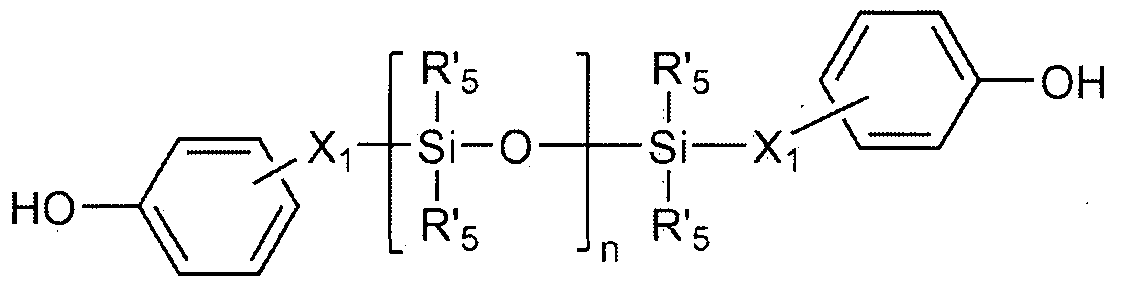
- the aromatic polycarbonate-based second repeating unit having one or more siloxane bonds is formed by reacting one or more siloxane compounds and carbonates, preferably a repeating unit represented by the following formula (4) and the following formula (5). Contains repeating units that become:
- 3 ⁇ 4 are each independently d- 10 alkylene
- Each R '5 is independently hydrogen; Unsubstituted or oxiranyl group, substituted with oxiranyl Cwo alkyl, or C 6 - 20 aryl substituted with a d- 15 alkyl; Halo ' gen; d- ⁇ ) alkoxy; Allyl; CHO haloalkyl; 20 is an aryl, - or C 6
- n is an integer from 10 to 200
- 3 ⁇ 4 are each independently d-) alkylene, ⁇ Are each independently hydrogen, d- 6 alkyl, halogen, hydroxy, d- 6 alkoxy, or C 6 - 20 aryl, and,
- Each R '6 is independently hydrogen; Unsubstituted or oxiranyl group, an alkoxy substituted by oxiranyl group, or a C 6 - 15 alkyl substituted with 20 aryl; halogen; d- 10 alkoxy; Allyl; d-uj haloalkyl; 20 is an aryl, - or C 6
- n is an integer of 10-200.
- they are each independently C 2 - 4 alkylene and is most preferably propane-1,3-diyl eu-10 alkylene, more preferably C 2.
- each of R ′ 5 is independently hydrogen, methyl, ethyl, propyl, 3-phenylpropyl, 2-phenylpropyl, 3- (oxyranylmethoxy) propyl, fluorochloro, bromo, iodo, Mesoxy, ecoxy, propoxy, allyl, 2, 2,2-trifluoroethyl, 3,3,3-trifluoropropyl, phenyl, or naphthyl.
- each R '5 is independently CHO alkyl, more preferably C alkyl, more preferably d- 3 alkyl, and most preferably methyl. Also preferably, n is 10 or more, 15 or more, 20 or more, 25 or more,
- 3 ⁇ 4 are each independently a C 2 - to 10 alkylene, more preferably C 2 - 6 alkylene and most preferably isobutylene. Also preferably, ⁇ is hydrogen.
- R '6 are each independently hydrogen, methyl, ethyl, Propyl, 3-phenylpropyl, 2-phenylpropyl, 3- (oxyranylmethoxy) propyl, fluorochloro, bromo, iodo, methoxy, ethoxy, propoxy, allyl, 2, 2,2-tri Fluoroethyl, 3, 3,3-trifluoropropyl, phenyl, or naphthyl.
- each R '6 is independently d- 10 alkyl, more preferably d- 6 alkyl, more preferably d- 3 alkyl, and most preferably methyl.
- m is at least 40, at least 45, at least 50, at least 55, at least 56, at least 57, or at least 58 and at most 80, at most 75, at most 70, at most 65, at most 64, at most 63, or at least 62.
- the repeating unit represented by the formula (4) and the repeating unit represented by the formula (5) are derived from the siloxane compound represented by the formula (4-1) and the siloxane compound represented by the formula (5-1), respectively.
- R '5 and n are as defined above.
- the definitions of 3 ⁇ 4, Yi, R '6 and m are as defined above.
- the reactions of Scheme 1 and Scheme 2 are preferably carried out under a metal catalyst.
- Pt catalyst is preferably used as the metal catalyst.
- At least one selected from the group consisting of PtCl 2 (benzonitrile) 2 , and H 2 PtBr 6 can be used.
- the metal catalyst is 0.001 part by weight, 0.005 part by weight, or 0.01 part by weight or more, 1 part by weight, 0.1 part by weight or less, or 0.05 part by weight based on 100 parts by weight of the compound represented by Formula 7 or 9. It can be used in parts or less.
- the reaction temperature is preferably 80 to 100 ° C.
- the reaction time is preferably 1 hour to 5 hours.
- the compound represented by Formula 7 or 9 may be prepared by reacting organodisiloxane and organocyclosiloxane under an acid catalyst, and n and m may be controlled by adjusting the content of the reactant.
- the reaction temperature is preferably 50 to 70 ° C.
- the reaction time is preferably 1 hour to 6 hours.
- the organodisiloxane one or more selected from the group consisting of tetramethyldisiloxane, tetraphenyldisiloxane, hexamethyldisiloxane and nuxaphenyldisiloxane can be used.
- an organocyclotetrasiloxane may be used as an example, and examples thereof include octamethylcyclotetrasiloxane, octaphenylcyclotetrasiloxane, and the like.
- the organodisiloxane may be 0.1 parts by weight or more, or 2 parts by weight or more, 10 parts by weight or less, or 8 parts by weight or less, based on 100 parts by weight of the organocyclosiloxane.
- the acid catalyst at least one selected from the group consisting of H 2 SO 4 , HC10 4 , AICI 3, SbCl 5 , SnCU, and acidic clay may be used.
- the acid catalyst may be used in an amount of 0.1 parts by weight, 0.5 parts by weight, or 1 part by weight, 10 parts by weight, 5 parts by weight, or 3 parts by weight or less based on 100 parts by weight of organocyclosiloxane. have.
- the content of the repeating unit represented by Formula 4 and the repeating unit represented by Formula 5 may be adjusted.
- the weight ratio between the repeating units may be 1:99 to 99: 1.
- it is 3: 97-97: 3, 5: 95-95: 5, 10: 90-90: 10, or 15: 85-85: 15, More preferably, it is 20: 80-80: 20.
- the weight ratio of the repeating unit is calculated by increasing the ratio of the siloxane compound, for example, the siloxane compound represented by Chemical Formula 4-1 and the siloxane compound represented by Chemical Formula 5-1.
- the repeating unit represented by Formula 4 is represented by the following Formula 4-2:
- R'5 and n are as defined above is, R '5 is methyl.
- the repeating unit represented by Formula 5 is It is represented by Formula 5-2:
- the copolycarbonate according to the present invention may be a repeating unit represented by Formula 3-1, a repeating unit represented by Formula 4-2, and Formula 5- Includes all repeat units represented by 2.
- the present invention provides a method for producing a copolycarbonate, comprising the step of polymerizing an aromatic diol compound, a carbonate precursor and at least one siloxane compound.
- the aromatic diol compound, carbonate precursor and one or more siloxane compounds are as described above. .
- the at least one siloxane compound may be present in an amount of at least 0.01 wt%, at least 0.5 wt%, at least 1 wt%, at least 1.5 wt%, based on 100 wt% of the total of the aromatic diol compound, the carbonate precursor, and the at least one siloxane compound.
- 2.0 weight% or more, 2.5 weight% or more, 2.5 weight% or more, 3.0 weight% or more, 20 weight% or less, 10 weight% or less, 7 weight% or less, 5 weight% or less, or 4 weight% or less can be used. have.
- the aromatic diol compound is at least 40% by weight, at least 50% by weight, or at least 55% by weight, at least 80% by weight, at least 70% by weight, based on 100% by weight of the total amount of the aromatic diol compound, the carbonate precursor and the at least one siloxane compound. Up to 65 weight percent.
- the carbonate precursor is 10% by weight relative to 100% by weight of the total aromatic diol compound, carbonate precursor and one or more siloxane compounds 20 weight% or more, or 30 weight%, 60 weight% or less, 50 weight% or less, or 40 weight% or less can be used.
- the polymerization method for example, an interfacial polymerization method may be used as the polymerization method.
- the polymerization reaction is possible at atmospheric pressure and low temperature, and the molecular weight is easily controlled.
- the interfacial polymerization is preferably carried out in the presence of an acid binder and an organic solvent.
- the interfacial polymerization may include a step of introducing a coupling agent after prepolymerization (pre-polymer i zat ion), for example, and then polymerizing again, in which case a high molecular weight copolycarbonate may be obtained.
- the materials used for the interfacial polymerization are not particularly limited as long as they are materials that can be used for the polymerization of polycarbonate, and the amount of the materials used may be adjusted as necessary.
- an alkali metal hydroxide such as sodium hydroxide, potassium hydroxide, or an amine compound such as pyridine
- the organic solvent is not particularly limited as long as it is a solvent usually used for polymerization of polycarbonate, and for example, halogenated hydrocarbons such as methylene chloride and chlorobenzene may be used.
- the interfacial polymerization is a reaction such as tertiary amine compounds such as triethylamine, tetra-n-butylammonium bromide, tetra-n-butylphosphonium bromide, quaternary ammonium compounds, and quaternary phosphonium compounds to promote the reaction.
- Accelerators may additionally be used.
- the reaction temperature of the interfacial polymerization is preferably 0 to 40 ° C, the reaction time is preferably 10 minutes to 5 hours. Moreover, it is preferable to maintain pH in 9 or more or 11 or more in interfacial polymerization reaction.
- the interfacial polymerization may be performed by further including a molecular weight regulator. The molecular weight modifier may be added before the start of polymerization, during the start of the polymerization, or after the start of the polymerization.
- Mono-alkylphenol may be used as the molecular weight modifier , and the mono-alkylphenol is, for example, p-tert-butylphenol ⁇ P- cumylphenol , decylphenol, dodecylphenol, tetradecylphenol, nuxadecylphenol , octadecyl It is at least one selected from the group consisting of phenol, eicosylphenol, docosylphenol and triacontylphenol, preferably p-tert-butylphenol, in which case the molecular weight control effect is large.
- the molecular weight modifier may be, for example, 0.01 part by weight, 0, 1 part by weight, or 1 part by weight, 10 parts by weight, 6 parts by weight, or 5 parts by weight or less based on 100 parts by weight of an aromatic diol compound. It is possible to obtain a desired molecular weight within this range.
- the copolycarbonate (b) has a weight average molecular weight of 1,000 to 100,000 g / irol, more preferably 15,000 to 35,000 g / mol. More preferably, the weight average molecular weight (g / mol) is at least 20,000, at least 21,000, at least 22,000, at least 23,000, at least 24,000, at least 25,000, at least 26,000, at least 27,000, or at least 28,000. In addition, the said weight average molecular weight is 34,000 or less, 33,000 or less, or 32,000 or less.
- the polycarbonate composition according to the present invention comprises the branched polycarbonate (a) and copolycarbonate (b) described above.
- the weight ratio of the branched polycarbonate and coplicarbonate is 1:99 to 99: 1. More preferably 3: 97-97: 3, 5: 95-95: 5, 10: 90-90: 10, 15: 85-85: 15, or 20: 80 to 80:20.
- the polycarbonate composition according to the present invention may be used together with an unbranched polycarbonate, if necessary.
- the unbranched polycarbonate is distinguished from the branched polycarbonate (a) and the copolycarbonate (b) in that a polysiloxane structure is not introduced into the main chain of the polycarbonate and does not include a branched repeating unit.
- the unbranched polycarbonate comprises a repeating unit represented by the following formula (6):
- R “i to R” 4 are each independently hydrogen, alkyl, Cwo alkoxy, or halogen,
- Z ′′ is C 3 — 15 cycloalkylene, 0, S, SO, S 0 2 ( or CO, unsubstituted or substituted with phenyl, unsubstituted or substituted with CHO alkyl.
- Unbranched polycarbonates have a weight average molecular weight of 15,000 to 35,000 g / m, More preferably, the weight average molecular weight (g / mol) is 20,000 or more, 21,000 or more, 22,000 or more, 23,000 or more, 24,000 or more, 25,000 or more, 26,000 or more, 27,000 or more, or 28,000 or more, and the weight average molecular weight is 34,000 or less, 33,000 or less, or 32,000 or less
- the repeating unit represented by Formula 6 is formed by reacting an aromatic diol compound and a carbonate precursor.
- Aromatic di The compound and the carbonate precursor are the same as described above in the repeating unit represented by the formula (1).
- the repeating unit represented by Chemical Formula 6 is represented by the following Chemical Formula 6-1.
- the present invention also provides an article comprising the polycarbonate composition.
- the article is an injection molded article.
- the article may be at least one selected from the group consisting of antioxidants, thermal stabilizers, photostabilizers, plasticizers, antistatic crabs, nuclear crabs, flame retardants, lubricants, impact modifiers, fluorescent brighteners, ultraviolet absorbers, pigments and dyes. It may further comprise.
- the polycarbonate composition according to the present invention and an additive such as an antioxidant is mixed by using a mixer, and then the mixture is extruded into an extruder to produce a pellet, the pellet is dried and then an injection molding machine It may include the step of injection into.
- the polycarbonate composition according to the present invention includes a copolycarbonate including a specific siloxane structure and a branched polycarbonate including a branched repeating unit, thereby providing high impact strength and While having fluidity, it is characterized by being able to improve flame retardancy and chemical resistance.
- MI Flowability
- Flame retardancy was evaluated based on UL 94V. Specifically, five flame retardant specimens of 3.0 mm thickness required for the application of flame retardant test were prepared and evaluated as follows.
- the polycarbonate composition according to the present invention by including a polycarbonate containing a copolycarbonate and a branched repeat unit containing a specific siloxane structure, it can be confirmed that it can improve the chemical resistance while having a high impact strength could.
Landscapes
- Chemical & Material Sciences (AREA)
- Organic Chemistry (AREA)
- Health & Medical Sciences (AREA)
- Chemical Kinetics & Catalysis (AREA)
- Medicinal Chemistry (AREA)
- Polymers & Plastics (AREA)
- Engineering & Computer Science (AREA)
- Materials Engineering (AREA)
- Manufacturing & Machinery (AREA)
- General Chemical & Material Sciences (AREA)
- Compositions Of Macromolecular Compounds (AREA)
- Polyesters Or Polycarbonates (AREA)
Abstract
Description




Claims


Priority Applications (5)
| Application Number | Priority Date | Filing Date | Title |
|---|---|---|---|
| US15/027,907 US9809677B2 (en) | 2014-12-04 | 2015-12-04 | Polycarbonate composition and article comprising the same |
| EP15845515.4A EP3067380B1 (en) | 2014-12-04 | 2015-12-04 | Polycarbonate composition and article comprising same |
| CN201580002903.6A CN105899610B (zh) | 2014-12-04 | 2015-12-04 | 聚碳酸酯组合物及包含该组合物的制品 |
| PL15845515T PL3067380T3 (pl) | 2014-12-04 | 2015-12-04 | Kompozycja poliwęglanowa i zawierający ją wyrób |
| JP2016536591A JP6227785B2 (ja) | 2014-12-04 | 2015-12-04 | ポリカーボネート組成物およびこれを含む物品 |
Applications Claiming Priority (2)
| Application Number | Priority Date | Filing Date | Title |
|---|---|---|---|
| KR10-2014-0173005 | 2014-12-04 | ||
| KR20140173005 | 2014-12-04 |
Publications (1)
| Publication Number | Publication Date |
|---|---|
| WO2016089168A1 true WO2016089168A1 (ko) | 2016-06-09 |
Family
ID=56092030
Family Applications (2)
| Application Number | Title | Priority Date | Filing Date |
|---|---|---|---|
| PCT/KR2015/013243 Ceased WO2016089168A1 (ko) | 2014-12-04 | 2015-12-04 | 폴리카보네이트 조성물 및 이를 포함하는 물품 |
| PCT/KR2015/013244 Ceased WO2016089169A1 (ko) | 2014-12-04 | 2015-12-04 | 폴리카보네이트계 수지 조성물 및 이를 포함하는 성형품 |
Family Applications After (1)
| Application Number | Title | Priority Date | Filing Date |
|---|---|---|---|
| PCT/KR2015/013244 Ceased WO2016089169A1 (ko) | 2014-12-04 | 2015-12-04 | 폴리카보네이트계 수지 조성물 및 이를 포함하는 성형품 |
Country Status (9)
| Country | Link |
|---|---|
| US (18) | US9745466B2 (ko) |
| EP (11) | EP3219742B1 (ko) |
| JP (13) | JP6166474B2 (ko) |
| KR (22) | KR20160067714A (ko) |
| CN (18) | CN105899576A (ko) |
| ES (1) | ES2844674T3 (ko) |
| PL (10) | PL3150652T3 (ko) |
| TW (15) | TWI586755B (ko) |
| WO (2) | WO2016089168A1 (ko) |
Cited By (1)
| Publication number | Priority date | Publication date | Assignee | Title |
|---|---|---|---|---|
| KR20180047837A (ko) * | 2016-11-01 | 2018-05-10 | 주식회사 엘지화학 | 폴리카보네이트 조성물 및 이를 포함하는 물품 |
Families Citing this family (47)
| Publication number | Priority date | Publication date | Assignee | Title |
|---|---|---|---|---|
| EP3126555A1 (en) * | 2014-04-04 | 2017-02-08 | SABIC Global Technologies B.V. | Polycarbonate fibers and substrates comprising same |
| KR101779188B1 (ko) | 2014-09-05 | 2017-09-15 | 주식회사 엘지화학 | 코폴리카보네이트 및 이를 포함하는 조성물 |
| KR101685665B1 (ko) * | 2014-12-04 | 2016-12-12 | 주식회사 엘지화학 | 코폴리카보네이트 및 이를 포함하는 조성물 |
| KR20160067714A (ko) | 2014-12-04 | 2016-06-14 | 주식회사 엘지화학 | 코폴리카보네이트 및 이를 포함하는 물품 |
| KR101948823B1 (ko) * | 2015-09-04 | 2019-02-15 | 주식회사 엘지화학 | 신규한 폴리오르가노실록산 및 이를 사용하여 제조되는 코폴리카보네이트 |
| KR101926740B1 (ko) * | 2015-11-30 | 2018-12-07 | 주식회사 엘지화학 | 열가소성 수지 조성물 및 이로부터 제조되는 성형품 |
| KR101924199B1 (ko) * | 2016-02-01 | 2018-11-30 | 주식회사 엘지화학 | 신규한 폴리오르가노실록산 및 이를 사용하여 제조되는 코폴리카보네이트 |
| JP2018059028A (ja) * | 2016-10-07 | 2018-04-12 | 出光興産株式会社 | ポリカーボネート系樹脂組成物及び成形体 |
| KR102030732B1 (ko) * | 2016-10-20 | 2019-10-11 | 주식회사 엘지화학 | 폴리카보네이트 수지 조성물 |
| KR102072223B1 (ko) * | 2016-10-20 | 2020-01-31 | 주식회사 엘지화학 | 코폴리카보네이트 및 이를 포함하는 수지 조성물 |
| KR20180043685A (ko) * | 2016-10-20 | 2018-04-30 | 주식회사 엘지화학 | 코폴리카보네이트 및 이를 포함하는 수지 조성물 |
| KR102168679B1 (ko) * | 2016-10-20 | 2020-10-21 | 주식회사 엘지화학 | 코폴리카보네이트 및 이를 포함하는 수지 조성물 |
| CN106371672B (zh) * | 2016-10-24 | 2024-04-19 | 上海天马微电子有限公司 | 柔性显示面板和装置 |
| CN106633762B (zh) * | 2016-11-16 | 2019-05-10 | 上海长伟锦磁工程塑料有限公司 | 一种耐低温低烟阻燃光扩散聚碳酸酯复合材料 |
| CN106928439B (zh) * | 2017-03-17 | 2019-05-03 | 广东新通彩材料科技有限公司 | 一种耐低温非透明高冲击无规共聚聚碳酸酯及其制备方法和用途 |
| CN107022071B (zh) * | 2017-03-17 | 2019-02-26 | 广东新通彩材料科技有限公司 | 一种聚硅氧烷嵌段的特异性封端共聚碳酸酯及其制备方法 |
| CN107082877B (zh) * | 2017-03-17 | 2019-05-03 | 广东新通彩材料科技有限公司 | 一种制备非透明型聚硅氧烷-聚碳酸酯无规共聚物的方法 |
| KR102178647B1 (ko) * | 2017-12-26 | 2020-11-13 | 주식회사 엘지화학 | 폴리카보네이트계 수지 조성물 및 이의 성형품 |
| KR102165061B1 (ko) * | 2017-12-27 | 2020-10-13 | 주식회사 엘지화학 | 폴리카보네이트 수지 조성물, 이의 제조방법 및 이를 포함하는 성형품 |
| KR102209392B1 (ko) * | 2018-05-15 | 2021-01-28 | 주식회사 엘지화학 | 폴리카보네이트 수지 조성물 및 이를 포함하는 광학 성형품 |
| KR102197159B1 (ko) | 2018-07-26 | 2020-12-31 | 롯데첨단소재(주) | 열가소성 수지 조성물 및 이로부터 제조된 성형품 |
| KR102293210B1 (ko) | 2018-08-10 | 2021-08-25 | 주식회사 엘지화학 | 폴리카보네이트 및 이의 제조방법 |
| KR102219311B1 (ko) | 2018-08-10 | 2021-02-24 | 주식회사 엘지화학 | 폴리카보네이트 및 이의 제조방법 |
| KR102293209B1 (ko) | 2018-08-10 | 2021-08-23 | 주식회사 엘지화학 | 폴리카보네이트 및 이의 제조방법 |
| WO2020085443A1 (ja) * | 2018-10-25 | 2020-04-30 | 住友電気工業株式会社 | 光ファイバケーブル用巻き取りボビン |
| CN112969758B (zh) * | 2018-11-08 | 2023-06-13 | 三菱工程塑料株式会社 | 芳香族聚碳酸酯树脂组合物 |
| KR102188340B1 (ko) | 2018-11-29 | 2020-12-08 | 롯데첨단소재(주) | 열가소성 수지 조성물 및 이를 이용한 성형품 |
| KR102114464B1 (ko) * | 2018-12-05 | 2020-05-25 | 주식회사 삼양사 | 난연성 및 내열성을 동시에 우수하게 만족시키는 폴리카보네이트 수지 조성물 및 이를 포함하는 성형품 |
| KR102725134B1 (ko) * | 2019-03-13 | 2024-10-31 | 주식회사 엘지화학 | 폴리카보네이트 수지 조성물 및 이를 포함하는 성형품 |
| CN109897386A (zh) * | 2019-03-18 | 2019-06-18 | 深圳烯湾科技有限公司 | 聚碳酸酯组合物及其制备方法和应用 |
| CN110540529B (zh) * | 2019-03-26 | 2023-01-24 | 贵州大学 | 一种二元醇基碳酸酯可聚合单体及其聚合物 |
| CN110157174A (zh) * | 2019-05-30 | 2019-08-23 | 深圳华力兴新材料股份有限公司 | 一种玻璃纤维增强的阻燃聚碳酸酯复合材料及其制备方法和应用 |
| EP3976706B1 (en) | 2019-05-31 | 2024-11-06 | SHPP Global Technologies B.V. | Thermoplastic compositions, methods of their manufacture, and articles thereof |
| KR102426547B1 (ko) * | 2019-09-02 | 2022-07-29 | 주식회사 엘지화학 | 코폴리카보네이트 및 이를 포함하는 폴리카보네이트 조성물 |
| KR102701249B1 (ko) * | 2019-09-05 | 2024-08-29 | 주식회사 엘지화학 | 디올 화합물, 폴리카보네이트 및 이의 제조방법 |
| KR102696973B1 (ko) * | 2019-09-05 | 2024-08-19 | 주식회사 엘지화학 | 디올 화합물, 폴리카보네이트 및 이의 제조방법 |
| KR102407792B1 (ko) | 2019-09-05 | 2022-06-10 | 주식회사 엘지화학 | 디올 화합물, 폴리카보네이트 및 이의 제조방법 |
| KR102929717B1 (ko) * | 2020-07-07 | 2026-02-24 | 현대모비스 주식회사 | 광투과성 성형품 및 자동차 내장재 |
| KR102624855B1 (ko) * | 2020-08-27 | 2024-01-12 | 롯데케미칼 주식회사 | 열가소성 수지 조성물 및 이로부터 형성된 성형품 |
| KR102517577B1 (ko) * | 2020-10-16 | 2023-04-04 | 주식회사 엘지화학 | 폴리카보네이트 및 이의 제조방법 |
| WO2022124817A1 (ko) * | 2020-12-11 | 2022-06-16 | (주) 엘지화학 | 열가소성 수지 조성물, 이의 제조방법 및 이를 포함하는 성형품 |
| KR102907312B1 (ko) * | 2020-12-16 | 2025-12-31 | 주식회사 엘지화학 | 폴리카보네이트 및 이로부터 형성된 성형품 |
| CN113402704B (zh) * | 2021-07-09 | 2022-09-20 | 万华化学集团股份有限公司 | 一种聚碳酸酯共聚物及其制备方法和用途 |
| CN114806124B (zh) * | 2022-03-31 | 2024-05-14 | 金发科技股份有限公司 | 一种耐候pc/聚酯合金材料及其制备方法与应用 |
| EP4382570A4 (en) * | 2022-08-19 | 2025-02-26 | LG Chem, Ltd. | Polycarbonate resin composition, preparation method therefor, and molded article comprising same |
| KR20240127814A (ko) * | 2023-02-16 | 2024-08-23 | 삼성전자주식회사 | 재생 폴리머를 가지는 전자 장치 하우징 및 이를 포함하는 전자 장치 |
| CN121969670A (zh) * | 2023-08-24 | 2026-05-01 | Sabic环球技术有限责任公司 | 制造聚碳酸酯的方法 |
Citations (5)
| Publication number | Priority date | Publication date | Assignee | Title |
|---|---|---|---|---|
| JP3457805B2 (ja) * | 1996-06-28 | 2003-10-20 | 三菱エンジニアリングプラスチックス株式会社 | ポリカーボネート系樹脂組成物 |
| WO2013175445A2 (en) * | 2012-05-24 | 2013-11-28 | Sabic Innovative Plastics Ip B.V. | Flame retardant polycarbonate compositions, methods of manufacture thereof and articles comprising the same |
| KR20140027199A (ko) * | 2011-03-31 | 2014-03-06 | 사빅 이노베이티브 플라스틱스 아이피 비.브이. | 개선된 내열성 투명 폴리카보네이트-폴리실록산 콤파운드 |
| KR20140075516A (ko) * | 2012-12-11 | 2014-06-19 | 제일모직주식회사 | 고분지형 폴리카보네이트 수지 및 그 제조방법 |
| KR20140086774A (ko) * | 2012-12-28 | 2014-07-08 | 제일모직주식회사 | 분지형 폴리카보네이트 및 이의 제조방법 |
Family Cites Families (186)
| Publication number | Priority date | Publication date | Assignee | Title |
|---|---|---|---|---|
| US2770633A (en) * | 1953-10-28 | 1956-11-13 | Dow Corning | Organosilicon esters |
| US2770631A (en) * | 1954-05-20 | 1956-11-13 | Dow Corning | Hydroxyester substituted siloxanes |
| DE2162418A1 (de) * | 1971-12-16 | 1973-06-20 | Bayer Ag | Polydiorganosiloxan-polycarbonatblockmischpolymere und verfahren zu deren herstellung |
| DE3414116A1 (de) * | 1984-04-14 | 1985-10-24 | Bayer Ag, 5090 Leverkusen | Uv-stabilisierte polycarbonatformkoerper |
| DE3506472A1 (de) * | 1985-02-23 | 1986-08-28 | Bayer Ag, 5090 Leverkusen | Neue polydiorganosiloxan-polycarbonat-blockcopolymere |
| DE3709779A1 (de) * | 1987-03-25 | 1988-10-06 | Bayer Ag | Polydiorganosiloxan-polycarbonat- blockcokondensate mit verbessertem schutz gegen uv-licht |
| JPH02138336A (ja) * | 1987-09-30 | 1990-05-28 | Mitsubishi Rayon Co Ltd | 芳香族ポリエステル−ポリオルガノシロキサンブロック共重合体 |
| US5243009A (en) * | 1989-03-06 | 1993-09-07 | General Electric Company | Hydroxyarylestersiloxanes |
| ES2080147T3 (es) | 1989-07-07 | 1996-02-01 | Idemitsu Petrochemical Co | Copolimero de policarbonato-polidimetilsiloxano y metodo de produccion del mismo. |
| JPH03292361A (ja) * | 1990-04-11 | 1991-12-24 | Mitsubishi Gas Chem Co Inc | コーポリカーボネート樹脂組成物 |
| JPH04202464A (ja) * | 1990-11-30 | 1992-07-23 | Mitsubishi Gas Chem Co Inc | 熱可塑性樹脂組成物 |
| DE69211382T2 (de) | 1991-02-22 | 1996-11-28 | Mitsubishi Gas Chemical Co | Thermoplastische Harzzusammensetzung von Siloxan-Polycarbonat |
| JP3049113B2 (ja) | 1991-06-18 | 2000-06-05 | 株式会社日立製作所 | 企業内特許抄録作成システム |
| EP0524731B1 (en) | 1991-07-01 | 2002-03-13 | General Electric Company | Polymer blends of polycarbonate-polysiloxane block copolymers with polycarbonates and polyestercarbonate copolymers |
| DE69224938T2 (de) | 1991-07-01 | 1998-10-22 | Gen Electric | Terpolymer mit aliphatischen Polyestersegmenten, Polysiloxansegmenten und Polycarbonatsegmenten |
| JPH05311079A (ja) | 1992-05-07 | 1993-11-22 | Teijin Chem Ltd | 芳香族ポリカーボネート樹脂系組成物 |
| NL9202090A (nl) | 1992-12-02 | 1994-07-01 | Gen Electric | Polymeermengsel met aromatisch polycarbonaat, styreen bevattend copolymeer en/of entpolymeer en een polysiloxaan-polycarbonaat blok copolymeer, daaruit gevormde voorwerpen. |
| US5553062A (en) | 1993-04-22 | 1996-09-03 | Interdigital Communication Corporation | Spread spectrum CDMA interference canceler system and method |
| JP3417043B2 (ja) * | 1993-05-12 | 2003-06-16 | 出光石油化学株式会社 | ガラス繊維強化ポリカーボネート系樹脂組成物 |
| US5932677A (en) | 1993-05-27 | 1999-08-03 | General Electric Company | Terpolymer having aromatic polyester, polysiloxane and polycarbonate segments |
| DE69415594T2 (de) | 1993-07-09 | 1999-08-12 | General Electric Co., Schenectady, N.Y. | Siloxanpolyestercarbonatblockterpolymerzusammensetzungen und wärmebeständiges Polycarbonat |
| JP3393616B2 (ja) | 1994-01-27 | 2003-04-07 | 出光石油化学株式会社 | ポリカーボネート−ポリオルガノシロキサントリブロック共重合体及びそれを含有する樹脂組成物 |
| JP3129374B2 (ja) | 1994-03-18 | 2001-01-29 | 出光石油化学株式会社 | 難燃性ポリカーボネート樹脂組成物 |
| US5414054A (en) | 1994-06-01 | 1995-05-09 | Miles Inc. | Copolycarbonate having improved low-temperature impact strength |
| EP0692522B1 (en) * | 1994-07-15 | 2002-09-11 | Idemitsu Petrochemical Co., Ltd. | Polycarbonate resin composition |
| JP3037588B2 (ja) * | 1994-07-15 | 2000-04-24 | 出光石油化学株式会社 | ポリカーボネート樹脂組成物 |
| US6001929A (en) | 1994-07-15 | 1999-12-14 | Idemitsu Petrochemical Co., Ltd. | Polycarbonate resin composition |
| US5530083A (en) | 1994-07-21 | 1996-06-25 | General Electric Company | Silicone-polycarbonate block copolymers and polycarbonate blends having reduced haze, and method for making |
| JPH08234468A (ja) | 1995-02-24 | 1996-09-13 | Konica Corp | 電子写真感光体 |
| DE19539290A1 (de) | 1995-10-23 | 1997-04-24 | Bayer Ag | Verfahren zur Herstellung von Poly-(diorganosiloxan)-Polycarbonat-Blockcopolymeren |
| JPH09241914A (ja) * | 1995-12-26 | 1997-09-16 | Idemitsu Petrochem Co Ltd | 耐衝撃性人体保護具 |
| JPH10204179A (ja) | 1997-01-21 | 1998-08-04 | Toray Dow Corning Silicone Co Ltd | ポリオルガノシロキサンおよびその製造方法 |
| JP4166363B2 (ja) | 1999-03-29 | 2008-10-15 | 出光興産株式会社 | 窓ガラス |
| JP2000302962A (ja) | 1999-04-23 | 2000-10-31 | Mitsubishi Engineering Plastics Corp | ポリカーボネート樹脂組成物 |
| US7605221B2 (en) | 1999-05-18 | 2009-10-20 | Sabic Innovative Plastics Ip B.V. | Weatherable, thermostable polymers having improved flow composition |
| JP4377484B2 (ja) | 1999-08-04 | 2009-12-02 | 出光興産株式会社 | ポリカーボネート樹脂組成物 |
| US6281286B1 (en) | 1999-09-09 | 2001-08-28 | Dow Corning Corporation | Toughened thermoplastic resins |
| US6252013B1 (en) | 2000-01-18 | 2001-06-26 | General Electric Company | Method for making siloxane copolycarbonates |
| TW528782B (en) * | 2000-06-28 | 2003-04-21 | Idemitsu Petrochemical Co | Polycarbonate resin composition and shaped article |
| JP5086499B2 (ja) | 2000-06-28 | 2012-11-28 | 出光興産株式会社 | ポリカーボネート樹脂組成物及び成形品 |
| US6492481B1 (en) | 2000-07-10 | 2002-12-10 | General Electric Company | Substantially single phase silicone copolycarbonates, methods, and optical articles made therefrom |
| AUPQ984400A0 (en) | 2000-09-01 | 2000-09-28 | Novapharm Research (Australia) Pty Ltd | Surfactant sytem |
| JP5290483B2 (ja) | 2000-09-06 | 2013-09-18 | 帝人株式会社 | 難燃性芳香族ポリカーボネート樹脂組成物 |
| JP5054259B2 (ja) | 2001-01-25 | 2012-10-24 | 出光興産株式会社 | 難燃性ポリカーボネート樹脂組成物及びその成形品 |
| US6660787B2 (en) | 2001-07-18 | 2003-12-09 | General Electric Company | Transparent, fire-resistant polycarbonate compositions |
| JP4786835B2 (ja) | 2001-09-05 | 2011-10-05 | 株式会社ジェイテクト | ボールねじ装置 |
| KR100477331B1 (ko) | 2002-06-03 | 2005-03-21 | 주식회사 엔투에이 | 반사형 액정표시장치용 프론트라이트 유닛 |
| JP2004035587A (ja) | 2002-06-28 | 2004-02-05 | Idemitsu Petrochem Co Ltd | ポリカーボネート樹脂組成物及び成形品 |
| US6825266B2 (en) | 2002-12-30 | 2004-11-30 | General Electric Company | Polycarbonate molding compositions and articles with improved surface aesthetics |
| JP2005008671A (ja) * | 2003-06-16 | 2005-01-13 | Mitsubishi Gas Chem Co Inc | 樹脂組成物 |
| US7135538B2 (en) | 2003-11-12 | 2006-11-14 | General Electric Company | Transparent polycarbonate-polysiloxane copolymer blend, method for the preparation thereof, and article derived therefrom |
| WO2005113638A1 (ja) | 2004-05-20 | 2005-12-01 | Idemitsu Kosan Co., Ltd. | ポリカーボネート樹脂およびこれを用いた電子写真感光体 |
| US7365125B2 (en) | 2004-08-16 | 2008-04-29 | General Electric Company | Polycarbonate compositions, articles, and method of manufacture |
| KR100676301B1 (ko) | 2004-10-21 | 2007-01-30 | 주식회사 엘지화학 | 실록산계 코폴리카보네이트의 제조방법 |
| EP1809685B1 (en) | 2004-10-21 | 2011-07-20 | LG Chem, Ltd. | Method of preparing polycarbonate resin |
| JP5021192B2 (ja) | 2004-12-06 | 2012-09-05 | 出光興産株式会社 | ポリカーボネート樹脂組成物及び成形体 |
| US7718733B2 (en) | 2004-12-20 | 2010-05-18 | Sabic Innovative Plastics Ip B.V. | Optically clear polycarbonate polyester compositions |
| US7432327B2 (en) | 2004-12-30 | 2008-10-07 | Sabic Innovative Plastics Ip B.V. | Transparent polymeric compositions comprising polysiloxane-polycarbonate copolymer, articles made therefrom and methods of making same |
| US7498401B2 (en) | 2005-03-03 | 2009-03-03 | Sabic Innovative Plastics Ip B.V. | Thermoplastic polycarbonate compositions, articles made therefrom and method of manufacture |
| US20070093629A1 (en) | 2005-09-14 | 2007-04-26 | General Electric Company | Siloxane bishchloroformates |
| US20070135569A1 (en) | 2005-12-14 | 2007-06-14 | General Electric Company | Thermoplastic polycarbonate compositions, method of manufacture, and method of use thereof |
| KR100699560B1 (ko) | 2006-02-16 | 2007-03-23 | 충주대학교 산학협력단 | 저온 내충격성이 우수한 폴리카보네이트 수지 조성물 |
| US20130003544A1 (en) | 2006-06-15 | 2013-01-03 | Michal Wermuth | Method for scheduling of packets in tdma channels |
| US20080015289A1 (en) | 2006-07-12 | 2008-01-17 | General Electric Company | Flame retardant and chemical resistant thermoplastic polycarbonate compositions |
| US7709581B2 (en) | 2006-09-29 | 2010-05-04 | Sabic Innovative Plastics Ip B.V. | Polycarbonate-polysiloxane copolymer compositions and articles formed therefrom |
| US7709562B2 (en) | 2006-09-29 | 2010-05-04 | Sabic Innovative Plastics Ip B.V. | Thermoplastic compositions, methods of making, and articles formed therefrom |
| US7524919B2 (en) | 2006-09-29 | 2009-04-28 | Sabic Innovative Plastics Ip B.V. | Polycarbonate-polysiloxane copolymers, method of making, and articles formed therefrom |
| US20080081895A1 (en) | 2006-09-29 | 2008-04-03 | General Electric Company | Polycarbonate-polysiloxane copolymers, method of making, and articles formed therefrom |
| JP5305916B2 (ja) * | 2006-10-16 | 2013-10-02 | 出光興産株式会社 | 難燃性ポリカーボネート樹脂組成物、ポリカーボネート樹脂成形品及びその製造方法 |
| US7691304B2 (en) | 2006-11-22 | 2010-04-06 | Sabic Innovative Plastics Ip B.V. | Thermoplastic composition, method of manufacture thereof, and articles derived therefrom |
| US7928168B2 (en) | 2007-03-23 | 2011-04-19 | Sabic Innovative Plastics Ip B.V. | White light-shielding compositions and articles comprising same |
| WO2008136521A1 (ja) | 2007-05-08 | 2008-11-13 | Idemitsu Kosan Co., Ltd. | ポリカーボネート重合体、塗工液、および電子写真感光体 |
| JP5315246B2 (ja) | 2007-08-01 | 2013-10-16 | 出光興産株式会社 | 光反射性ポリカーボネート樹脂組成物及びその成形体 |
| US20090087761A1 (en) | 2007-09-27 | 2009-04-02 | Noriyuki Fukushima | Resin composition for electrophotographic photoconductor and electrophotographic photoconductor using the same |
| KR100926912B1 (ko) * | 2007-10-05 | 2009-11-17 | (주)세아메카닉스 | 디스플레이 기기 |
| JP5368728B2 (ja) * | 2008-05-07 | 2013-12-18 | 出光興産株式会社 | 熱可塑性樹脂組成物及び成形体 |
| JP2009280725A (ja) | 2008-05-23 | 2009-12-03 | Idemitsu Kosan Co Ltd | 難燃性ポリカーボネート樹脂組成物および光反射部材 |
| US7994254B2 (en) | 2008-06-20 | 2011-08-09 | Sabic Innovative Plastics Ip B.V. | Polysiloxane-polycarbonate compositions, and related methods and articles |
| US20090326183A1 (en) | 2008-06-30 | 2009-12-31 | Schultz Laura G | Branched polycarbonate-polysiloxane copolymers and processes for producing the same |
| US8084134B2 (en) | 2008-11-26 | 2011-12-27 | Sabic Innovative Plastics Ip B.V. | Transparent thermoplastic compositions having high flow and ductiliy, and articles prepared therefrom |
| KR101081503B1 (ko) | 2008-12-17 | 2011-11-08 | 제일모직주식회사 | 웰드 강도가 우수한 폴리카보네이트 수지 조성물 |
| US7848025B2 (en) * | 2008-12-31 | 2010-12-07 | Sabic Innovative Plastics Ip B.V. | Transparent articles prepared from thermoplastic compositions having high flow and ductility, and method of preparing articles |
| JP5619384B2 (ja) * | 2009-07-16 | 2014-11-05 | 出光興産株式会社 | 携帯型電子機器筐体 |
| CN102471474B (zh) | 2009-07-29 | 2014-06-04 | 帝人化成株式会社 | 聚碳酸酯-聚二有机硅氧烷共聚物 |
| JP5805927B2 (ja) * | 2009-07-29 | 2015-11-10 | 帝人株式会社 | ポリカーボネート−ポリジオルガノシロキサン共重合体、成形品およびその製造方法 |
| US8552096B2 (en) | 2009-07-31 | 2013-10-08 | Sabic Innovative Plastics Ip B.V. | Flame-retardant reinforced polycarbonate compositions |
| JP5547953B2 (ja) * | 2009-12-10 | 2014-07-16 | 出光興産株式会社 | ポリカーボネート−ポリオルガノシロキサン共重合体、その製造方法及び該共重合体を含むポリカーボネート樹脂 |
| KR101256262B1 (ko) | 2009-12-16 | 2013-04-18 | 주식회사 삼양사 | 난연성 열가소성 수지 조성물 및 이를 이용한 성형품 |
| KR101256261B1 (ko) | 2009-12-23 | 2013-04-18 | 주식회사 삼양사 | 폴리카보네이트 수지 조성물 및 이를 이용한 성형품 |
| KR101289201B1 (ko) | 2010-03-29 | 2013-07-29 | 주식회사 삼양사 | 에스테르 결합을 갖는 히드록시 말단 실록산, 폴리실록산-폴리카보네이트 공중합체 및 그 제조 방법 |
| JP5679693B2 (ja) | 2010-05-07 | 2015-03-04 | 帝人株式会社 | 難燃性ポリカーボネート樹脂組成物 |
| CN102933657B (zh) * | 2010-06-09 | 2014-11-05 | 出光兴产株式会社 | 聚碳酸酯系树脂组合物及其成型品 |
| JP5507396B2 (ja) * | 2010-09-15 | 2014-05-28 | 出光興産株式会社 | ポリカーボネート樹脂組成物 |
| KR101281575B1 (ko) * | 2010-11-05 | 2013-07-03 | 제일모직주식회사 | 폴리카보네이트 수지 및 상기 폴리카보네이트 수지를 포함하는 열가소성 수지 조성물 |
| EP2635635B1 (en) | 2010-11-05 | 2019-09-18 | SABIC Global Technologies B.V. | Flame-resistant polyester-polycarbonate compositions, methods of manufacture, and articles thereof |
| US8461249B2 (en) | 2010-11-14 | 2013-06-11 | Sabic Innovative Plastics Ip B.V. | Compositions and articles of manufacture containing branched polycarbonate |
| US10174182B2 (en) * | 2010-11-15 | 2019-01-08 | Sabic Global Technologies B.V. | Compositions and articles of manufacture containing siloxane |
| JP5684548B2 (ja) | 2010-11-30 | 2015-03-11 | 帝人株式会社 | ガラス繊維強化樹脂組成物 |
| KR101362875B1 (ko) | 2010-12-30 | 2014-02-14 | 제일모직주식회사 | 폴리카보네이트-폴리실록산 공중합체 및 그의 제조 방법 |
| JP5684588B2 (ja) | 2011-01-27 | 2015-03-11 | 帝人株式会社 | ポリカーボネート樹脂組成物および成形品 |
| JP5553899B2 (ja) | 2011-03-07 | 2014-07-16 | 株式会社林原 | 2−O−α−D−グルコシル−L−アスコルビン酸無水結晶含有粉末の製造方法 |
| US8981015B2 (en) * | 2011-03-31 | 2015-03-17 | Sabic Global Technologies B.V. | Flame retardant poly(siloxane) copolymer compositions, methods of manufacture, and articles formed therefrom |
| US9006324B2 (en) | 2011-03-31 | 2015-04-14 | Sabic Global Technologies B.V. | Flame retardant polycarbonate compositions, methods of manufacture, and articles formed therefrom |
| US9453128B2 (en) | 2011-03-31 | 2016-09-27 | Sabic Global Technologies B.V. | Rail component comprising flame retardant compositions, and methods of manufacture |
| JP5966500B2 (ja) * | 2011-05-02 | 2016-08-10 | 株式会社リコー | シリコーン化合物、該シリコーン化合物を用いた光硬化型液体インク及びその製造方法 |
| JP2012236926A (ja) * | 2011-05-12 | 2012-12-06 | Teijin Chem Ltd | 分岐状ポリカーボネート−ポリオルガノシロキサン共重合体およびその製造方法 |
| US8466249B2 (en) | 2011-05-13 | 2013-06-18 | Sabic Innovative Plastics Ip Bv | Clear silicone polycarbonate elastomeric copolymers |
| JP5852797B2 (ja) | 2011-05-30 | 2016-02-03 | 出光興産株式会社 | 電池パック用ポリカーボネート樹脂組成物及び電池パック |
| US9290618B2 (en) | 2011-08-05 | 2016-03-22 | Sabic Global Technologies B.V. | Polycarbonate compositions having enhanced optical properties, methods of making and articles comprising the polycarbonate compositions |
| JP6106593B2 (ja) | 2011-10-03 | 2017-04-05 | 出光興産株式会社 | ポリカーボネート系樹脂組成物 |
| CN103930466B (zh) * | 2011-10-18 | 2016-02-17 | 出光兴产株式会社 | 聚碳酸酯-聚有机硅氧烷共聚物及其制造方法 |
| WO2013066002A1 (en) | 2011-10-31 | 2013-05-10 | Samyang Corporation | Polysiloxane-polycarbonate copolymer and method of manufacturing the same |
| KR101448058B1 (ko) | 2011-10-31 | 2014-10-10 | 주식회사 삼양사 | 저온 내충격성이 향상된 폴리카보네이트 수지 조성물 및 그 제조방법 |
| JP5808425B2 (ja) * | 2011-11-17 | 2015-11-10 | 帝人株式会社 | 導光性能を有する樹脂組成物、それからなる導光成形品および面光源体 |
| KR101492956B1 (ko) | 2011-12-26 | 2015-02-13 | 주식회사 삼양사 | 폴리실록산-폴리카보네이트 공중합체의 제조방법 |
| KR101432616B1 (ko) | 2011-12-29 | 2014-08-21 | 주식회사 삼양사 | 내화학성 열가소성 수지 조성물 및 그로부터 제조된 성형품 |
| KR101432613B1 (ko) | 2011-12-29 | 2014-08-22 | 주식회사 삼양사 | 난연성 열가소성 수지 조성물 및 이의 성형품 |
| KR101459132B1 (ko) | 2011-12-30 | 2014-11-13 | 제일모직주식회사 | 분지상 폴리카보네이트-폴리실록산 공중합체 및 그 제조방법 |
| US20130190425A1 (en) | 2012-01-19 | 2013-07-25 | Yantao Zhu | Polycarbonate-polyester compositions, methods of manufacture, and articles thereof |
| US9493265B2 (en) | 2012-01-20 | 2016-11-15 | Sabic Global Technologies B.V. | Articles prepared from thermoplastic compositions, and method of preparing such articles |
| JP5973738B2 (ja) | 2012-01-30 | 2016-08-23 | 出光興産株式会社 | ポリカーボネート樹脂組成物、成形品 |
| KR101381044B1 (ko) * | 2012-02-03 | 2014-04-17 | 주식회사 엘지화학 | 비할로겐 난연 고강성 폴리카보네이트 수지 조성물 |
| JP5828964B2 (ja) * | 2012-02-03 | 2015-12-09 | エルジー・ケム・リミテッド | 新規なポリオルガノシロキサン、これを含むポリカーボネート樹脂組成物及び改質ポリカーボネート樹脂 |
| KR101538207B1 (ko) * | 2012-02-03 | 2015-07-22 | 주식회사 엘지화학 | 폴리실록산계 코폴리카보네이트의 제조방법 |
| KR101476525B1 (ko) * | 2012-02-03 | 2014-12-24 | 주식회사 엘지화학 | 신규한 폴리오르가노실록산, 이를 포함하는 폴리카보네이트 수지 조성물 및 개질 폴리카보네이트 수지 |
| EP2820077B1 (en) * | 2012-02-29 | 2019-09-18 | SABIC Global Technologies B.V. | Thermoplastic polycarbonate copolymer compositions, methods of their manufacture, and uses thereof |
| KR101489957B1 (ko) | 2012-03-13 | 2015-02-04 | 제일모직주식회사 | 폴리카보네이트-폴리실록산 공중합체 및 그의 제조 방법 |
| JP5715083B2 (ja) | 2012-03-30 | 2015-05-07 | 信越化学工業株式会社 | 難燃性樹脂組成物 |
| RU2014145007A (ru) | 2012-04-10 | 2016-05-27 | Моментив Перформанс Матириалз Гмбх | Способ получения функциональных силоксанов с регулируемой структурой |
| JP2013238667A (ja) | 2012-05-11 | 2013-11-28 | Canon Inc | 電子写真感光体、プロセスカートリッジ、電子写真装置 |
| JP2013234298A (ja) | 2012-05-11 | 2013-11-21 | Mitsubishi Gas Chemical Co Inc | ポリカーボネート重合体およびその製造法 |
| KR101949377B1 (ko) | 2012-05-16 | 2019-02-19 | 사빅 글로벌 테크놀러지스 비.브이. | 폴리카보네이트 조성물 및 그로부터 제조된 물품 |
| KR101542615B1 (ko) | 2012-05-21 | 2015-08-06 | 제일모직주식회사 | 신규 폴리실록산, 그 제조방법 및 이를 포함하는 폴리카보네이트-폴리실록산 공중합체 |
| US20130317142A1 (en) | 2012-05-24 | 2013-11-28 | Sabic Innovative Plastics Ip B.V. | Flame retardant thermoplastic compositions, methods of manufacture thereof and articles comprising the same |
| KR101395792B1 (ko) | 2012-06-22 | 2014-05-19 | 인텔렉추얼디스커버리 주식회사 | 집적 광기전력 모듈 |
| KR101371468B1 (ko) | 2012-07-16 | 2014-03-10 | 현대자동차주식회사 | 파워 윈도우 안전장치 |
| JP5932552B2 (ja) * | 2012-07-31 | 2016-06-08 | 帝人株式会社 | 遮熱性屋外設置用ポリカーボネート系樹脂筐体 |
| KR101440536B1 (ko) | 2012-09-13 | 2014-09-15 | 주식회사 삼양사 | 난연성 폴리실록산-폴리카보네이트 수지 조성물 및 이의 성형품 |
| JP6200137B2 (ja) * | 2012-09-14 | 2017-09-20 | 出光興産株式会社 | ポリカーボネート系樹脂組成物、及び成形品 |
| JP6007058B2 (ja) * | 2012-10-12 | 2016-10-12 | 出光興産株式会社 | ポリカーボネート−ポリオルガノシロキサン共重合体の連続的な製造方法 |
| JP5823944B2 (ja) | 2012-10-16 | 2015-11-25 | 帝人株式会社 | ポリカーボネート−ポリジオルガノシロキサン共重合体およびその製造方法 |
| PL2871215T3 (pl) | 2012-10-24 | 2017-06-30 | Lg Chem, Ltd. | Kompozycja żywicy poliwęglanowej |
| KR101456213B1 (ko) | 2012-11-15 | 2014-11-04 | 주식회사 케이씨씨 | 유기변성 실리콘 폴리머 및 이를 사용하여 제조된 폴리카보네이트 수지 |
| KR101534336B1 (ko) | 2012-12-11 | 2015-07-06 | 제일모직주식회사 | 내광성 및 난연성이 우수한 폴리카보네이트 수지 조성물 |
| US9328240B2 (en) | 2012-12-21 | 2016-05-03 | Sabic Global Technologies B.V. | Polycarbonate compositions, articles formed therefrom, and methods of manufacture thereof |
| KR101510407B1 (ko) | 2012-12-27 | 2015-04-17 | 주식회사 삼양사 | 우수한 난연성 및 내충격성을 동시에 갖는 폴리실록산-폴리카보네이트 수지 조성물 및 이의 성형품 |
| US8816019B2 (en) * | 2013-01-07 | 2014-08-26 | Sabic Global Technologies B.V. | Thermoplastic compositions for laser direct structuring and methods for the manufacture and use thereof |
| WO2014119827A1 (ko) | 2013-01-29 | 2014-08-07 | 제일모직주식회사 | 폴리카보네이트계 열가소성 수지 조성물 및 성형품 |
| KR101664844B1 (ko) | 2013-01-29 | 2016-10-11 | 롯데첨단소재(주) | 폴리카보네이트계 열가소성 수지 조성물 및 성형품 |
| JP5688571B2 (ja) | 2013-02-04 | 2015-03-25 | 日本ペイント株式会社 | 複層塗膜形成方法 |
| JP5957399B2 (ja) * | 2013-03-06 | 2016-07-27 | 出光興産株式会社 | ポリカーボネート樹脂組成物及び成形体 |
| EP2970653B1 (en) | 2013-03-13 | 2020-09-02 | SABIC Global Technologies B.V. | Reinforced polyestercarbonate, polycarbonate-polydiorganosiloxane, poly(butylene-terephthalate) blend, and article comprising same |
| US9303163B2 (en) | 2013-03-15 | 2016-04-05 | Sabic Global Technologies B.V. | Photoactive additives containing siloxane |
| KR20140118274A (ko) | 2013-03-28 | 2014-10-08 | 제일모직주식회사 | 신규 폴리실록산, 그 제조방법 및 이를 포함하는 폴리카보네이트-폴리실록산 공중합체 |
| WO2014157682A1 (ja) * | 2013-03-29 | 2014-10-02 | 出光興産株式会社 | ポリオルガノシロキサン及びポリカーボネート-ポリオルガノシロキサン共重合体 |
| JP6026946B2 (ja) * | 2013-04-19 | 2016-11-16 | 出光興産株式会社 | ポリカーボネート系樹脂組成物及び成形体 |
| US9266541B2 (en) | 2013-05-01 | 2016-02-23 | Sabic Global Technologies B.V. | Interior train components having low smoke and low heat release, and methods of their manufacture |
| CN105264017A (zh) * | 2013-06-04 | 2016-01-20 | 沙特基础全球技术有限公司 | 具有改善的冲击强度和流动性的共混热塑性组合物 |
| US10100192B2 (en) * | 2013-06-13 | 2018-10-16 | Polyone Corporation | Completely non-halogenated flame retardant polycarbonate compounds |
| KR101663555B1 (ko) | 2013-06-17 | 2016-10-10 | 주식회사 삼양사 | 난연성과 투명성이 우수한 열가소성 공중합체 수지 및 그 제조방법 |
| JP6150945B2 (ja) * | 2013-07-01 | 2017-06-21 | エルジー・ケム・リミテッド | ポリオルガノシロキサン化合物、製造方法およびこれを含むコーポリカーボネート樹脂 |
| KR101563269B1 (ko) | 2013-07-01 | 2015-10-26 | 주식회사 엘지화학 | 폴리오르가노실록산 화합물 및 이를 포함하는 코폴리카보네이트 수지 |
| EP2912099B1 (en) | 2013-07-24 | 2016-04-20 | SABIC Global Technologies B.V. | Phenolic compounds as end-capping agents for polysiloxanes in polycarbonate-polysiloxane block copolymers |
| CN105358515A (zh) | 2013-07-30 | 2016-02-24 | 沙特基础全球技术有限公司 | 用于制备合成对丁香酚的方法 |
| US20150049952A1 (en) * | 2013-08-14 | 2015-02-19 | Vsp Labs, Inc. | Systems and methods of measuring facial characteristics |
| US11800991B2 (en) * | 2013-08-15 | 2023-10-31 | Intuitive Surgical Operations, Inc. | Graphical user interface for catheter positioning and insertion |
| EP3040380B1 (en) * | 2013-08-29 | 2026-02-25 | Idemitsu Kosan Co., Ltd | Polycarbonate resin composition and molded article |
| KR101579618B1 (ko) * | 2013-09-17 | 2015-12-22 | 주식회사 엘지화학 | 코폴리카보네이트 수지 및 이를 포함하는 물품 |
| ITMO20130267A1 (it) * | 2013-09-26 | 2015-03-27 | Meta System Spa | Caricabatterie per veicoli elettrici |
| KR101674246B1 (ko) | 2013-11-19 | 2016-11-08 | 롯데첨단소재(주) | 폴리카보네이트계 열가소성 수지 조성물 및 이를 포함하는 성형품 |
| US9365683B2 (en) | 2013-12-10 | 2016-06-14 | Idemitsu Kosan Co., Ltd. | Polycarbonate-polyorganosiloxane copolymer and method for producing same |
| JP6313971B2 (ja) * | 2013-12-26 | 2018-04-18 | 出光興産株式会社 | 屋外設置用成形体 |
| KR20150076534A (ko) | 2013-12-27 | 2015-07-07 | 제일모직주식회사 | 열가소성 수지 조성물 |
| US9365720B2 (en) | 2014-01-14 | 2016-06-14 | Sabic Global Technologies B.V. | Interior train components having low smoke and low heat release, and methods of their manufacture |
| US9718956B2 (en) * | 2014-01-14 | 2017-08-01 | Sabic Global Technologies B.V. | Interior aircraft components and methods of manufacture |
| KR101714739B1 (ko) * | 2014-04-16 | 2017-03-09 | 주식회사 엘지화학 | 신규한 폴리오르가노실록산, 이를 포함하는 코폴리카보네이트 수지 및 이의 성형품 |
| KR101837613B1 (ko) | 2014-05-21 | 2018-03-13 | 주식회사 삼양사 | 투명성 및 내충격성이 향상된 폴리실록산-폴리카보네이트 공중합체 및 그 제조방법 |
| WO2016004286A1 (en) | 2014-07-03 | 2016-01-07 | Momentive Performance Materials Inc. | Ester-functional polysiloxanes and copolymers made therefrom |
| KR101779188B1 (ko) | 2014-09-05 | 2017-09-15 | 주식회사 엘지화학 | 코폴리카보네이트 및 이를 포함하는 조성물 |
| CN107075121B (zh) | 2014-09-18 | 2021-01-22 | 莫门蒂夫性能材料股份有限公司 | 聚硅氧烷共聚物或三元共聚物和由其制得的聚合物 |
| EP3050908B1 (en) * | 2014-12-04 | 2019-09-04 | LG Chem, Ltd. | Copolycarbonate and composition comprising same |
| KR101685665B1 (ko) * | 2014-12-04 | 2016-12-12 | 주식회사 엘지화학 | 코폴리카보네이트 및 이를 포함하는 조성물 |
| WO2016089026A1 (ko) * | 2014-12-04 | 2016-06-09 | 주식회사 엘지화학 | 코폴리카보네이트 및 이를 포함하는 조성물 |
| KR20160067714A (ko) * | 2014-12-04 | 2016-06-14 | 주식회사 엘지화학 | 코폴리카보네이트 및 이를 포함하는 물품 |
| WO2016089137A1 (ko) * | 2014-12-04 | 2016-06-09 | 주식회사 엘지화학 | 코폴리카보네이트 조성물 및 이를 포함하는 물품 |
| WO2016089136A1 (ko) * | 2014-12-04 | 2016-06-09 | 주식회사 엘지화학 | 코폴리카보네이트 수지 조성물 |
-
2015
- 2015-07-23 KR KR1020150104643A patent/KR20160067714A/ko active Pending
- 2015-07-24 KR KR1020150105367A patent/KR20160067715A/ko active Pending
- 2015-07-27 KR KR1020150106021A patent/KR20160067716A/ko active Pending
- 2015-09-10 KR KR1020150128296A patent/KR20160067719A/ko active Pending
- 2015-11-06 KR KR1020150156121A patent/KR101676836B1/ko active Active
- 2015-11-13 KR KR1020150159658A patent/KR101696392B1/ko active Active
- 2015-11-13 KR KR1020150159987A patent/KR101759717B1/ko active Active
- 2015-11-13 KR KR1020150159660A patent/KR101698161B1/ko active Active
- 2015-11-13 KR KR1020150159657A patent/KR101685666B1/ko active Active
- 2015-11-16 JP JP2016529972A patent/JP6166474B2/ja active Active
- 2015-11-16 US US15/023,967 patent/US9745466B2/en active Active
- 2015-11-16 PL PL15840985T patent/PL3150652T3/pl unknown
- 2015-11-16 CN CN201580002908.9A patent/CN105899576A/zh active Pending
- 2015-11-16 EP EP15840984.7A patent/EP3219742B1/en active Active
- 2015-11-16 CN CN201580002720.4A patent/CN105899607B/zh active Active
- 2015-11-16 US US15/024,309 patent/US9745417B2/en active Active
- 2015-11-16 EP EP15840982.1A patent/EP3064523B1/en active Active
- 2015-11-16 CN CN201580002721.9A patent/CN105899573B/zh active Active
- 2015-11-16 PL PL15840984T patent/PL3219742T3/pl unknown
- 2015-11-16 US US15/024,664 patent/US9868818B2/en active Active
- 2015-11-16 JP JP2016529996A patent/JP6208351B2/ja active Active
- 2015-11-16 PL PL15840987T patent/PL3228647T3/pl unknown
- 2015-11-16 PL PL15840982T patent/PL3064523T3/pl unknown
- 2015-11-16 JP JP2016530000A patent/JP6322708B2/ja active Active
- 2015-11-16 JP JP2016529999A patent/JP2017501245A/ja not_active Withdrawn
- 2015-11-16 CN CN201580002907.4A patent/CN105899575B/zh active Active
- 2015-11-16 EP EP15840985.4A patent/EP3150652B1/en active Active
- 2015-11-16 US US15/023,740 patent/US9840585B2/en active Active
- 2015-11-16 EP EP15840987.0A patent/EP3228647B1/en active Active
- 2015-11-23 TW TW104138784A patent/TWI586755B/zh active
- 2015-11-23 TW TW104138791A patent/TWI592436B/zh active
- 2015-11-23 TW TW104138786A patent/TWI582128B/zh active
- 2015-11-23 TW TW104138787A patent/TWI582127B/zh active
- 2015-12-01 KR KR1020150169804A patent/KR101666669B1/ko active Active
- 2015-12-02 KR KR1020150170782A patent/KR101803960B1/ko active Active
- 2015-12-02 KR KR1020150170811A patent/KR101666670B1/ko active Active
- 2015-12-02 US US15/319,257 patent/US10174194B2/en active Active
- 2015-12-02 CN CN201580040574.4A patent/CN106574045A/zh active Pending
- 2015-12-02 JP JP2017500069A patent/JP6454775B2/ja active Active
- 2015-12-02 KR KR1020150170792A patent/KR101786568B1/ko active Active
- 2015-12-02 KR KR1020150170789A patent/KR101803959B1/ko active Active
- 2015-12-02 EP EP15864440.1A patent/EP3141571B1/en active Active
- 2015-12-02 PL PL15864440T patent/PL3141571T3/pl unknown
- 2015-12-02 KR KR1020150170809A patent/KR101804428B1/ko active Active
- 2015-12-02 KR KR1020150170828A patent/KR101804439B1/ko active Active
- 2015-12-03 CN CN201580040675.1A patent/CN106574044B/zh active Active
- 2015-12-03 EP EP15866220.5A patent/EP3228648B1/en active Active
- 2015-12-03 KR KR1020150171781A patent/KR101809649B1/ko active Active
- 2015-12-03 US US15/028,833 patent/US9777112B2/en active Active
- 2015-12-03 US US15/316,727 patent/US9902853B2/en active Active
- 2015-12-03 CN CN201580059859.2A patent/CN107001778B/zh active Active
- 2015-12-03 EP EP15845501.4A patent/EP3162853B1/en active Active
- 2015-12-03 PL PL15864965T patent/PL3159367T3/pl unknown
- 2015-12-03 CN CN201580058335.1A patent/CN107075101A/zh active Pending
- 2015-12-03 US US15/523,039 patent/US10294365B2/en active Active
- 2015-12-03 US US15/500,242 patent/US10196516B2/en active Active
- 2015-12-03 TW TW104140531A patent/TWI586701B/zh active
- 2015-12-03 KR KR1020150171780A patent/KR101691627B1/ko active Active
- 2015-12-03 TW TW104140532A patent/TWI582129B/zh active
- 2015-12-03 JP JP2017503823A patent/JP6649356B2/ja active Active
- 2015-12-03 CN CN201580039083.8A patent/CN106661219B/zh active Active
- 2015-12-03 US US15/039,341 patent/US10011716B2/en active Active
- 2015-12-03 KR KR1020150171776A patent/KR101817680B1/ko active Active
- 2015-12-03 KR KR1020150171768A patent/KR101678615B1/ko active Active
- 2015-12-03 EP EP15859998.5A patent/EP3150670B1/en active Active
- 2015-12-03 CN CN201580002905.5A patent/CN105899611A/zh active Pending
- 2015-12-03 US US15/516,619 patent/US10240037B2/en active Active
- 2015-12-03 CN CN201580055183.XA patent/CN106795297B/zh active Active
- 2015-12-03 TW TW104140534A patent/TWI586702B/zh active
- 2015-12-03 CN CN201580005529.5A patent/CN105940035B/zh active Active
- 2015-12-03 EP EP15864965.7A patent/EP3159367B1/en active Active
- 2015-12-03 JP JP2016535724A patent/JP6227784B2/ja active Active
- 2015-12-03 JP JP2017500068A patent/JP6454774B2/ja active Active
- 2015-12-03 US US15/517,136 patent/US10081730B2/en active Active
- 2015-12-03 TW TW104140537A patent/TWI591122B/zh active
- 2015-12-03 PL PL15866220T patent/PL3228648T3/pl unknown
- 2015-12-03 JP JP2016544514A patent/JP6277280B2/ja active Active
- 2015-12-03 PL PL15845501T patent/PL3162853T3/pl unknown
- 2015-12-03 TW TW104140535A patent/TWI609047B/zh active
- 2015-12-04 WO PCT/KR2015/013243 patent/WO2016089168A1/ko not_active Ceased
- 2015-12-04 US US15/027,907 patent/US9809677B2/en active Active
- 2015-12-04 KR KR1020150172405A patent/KR101898169B1/ko active Active
- 2015-12-04 EP EP15865646.2A patent/EP3181610B1/en active Active
- 2015-12-04 WO PCT/KR2015/013244 patent/WO2016089169A1/ko not_active Ceased
- 2015-12-04 TW TW104140759A patent/TWI609048B/zh active
- 2015-12-04 US US15/516,818 patent/US10240038B2/en active Active
- 2015-12-04 JP JP2016533707A patent/JP6322286B2/ja active Active
- 2015-12-04 US US15/029,081 patent/US9751979B2/en active Active
- 2015-12-04 KR KR1020150172408A patent/KR101899471B1/ko active Active
- 2015-12-04 JP JP2017515194A patent/JP6529194B2/ja active Active
- 2015-12-04 TW TW104140774A patent/TWI609040B/zh active
- 2015-12-04 CN CN201580002903.6A patent/CN105899610B/zh active Active
- 2015-12-04 US US15/513,926 patent/US20170298221A1/en not_active Abandoned
- 2015-12-04 JP JP2016536591A patent/JP6227785B2/ja active Active
- 2015-12-04 US US15/026,905 patent/US9580597B2/en active Active
- 2015-12-04 PL PL15865646T patent/PL3181610T3/pl unknown
- 2015-12-04 JP JP2016533701A patent/JP2017501251A/ja not_active Withdrawn
- 2015-12-04 PL PL15845515T patent/PL3067380T3/pl unknown
- 2015-12-04 EP EP15845515.4A patent/EP3067380B1/en active Active
- 2015-12-04 ES ES15841034T patent/ES2844674T3/es active Active
- 2015-12-04 TW TW104140769A patent/TWI582131B/zh active
- 2015-12-04 TW TW104140536A patent/TWI582130B/zh active
- 2015-12-04 CN CN201580002906.XA patent/CN105980446B/zh active Active
- 2015-12-04 CN CN201580056206.9A patent/CN107075139A/zh active Pending
- 2015-12-04 US US15/026,565 patent/US9718958B2/en active Active
- 2015-12-04 CN CN201580056804.6A patent/CN107075140B/zh active Active
- 2015-12-04 CN CN201580002739.9A patent/CN105899608B/zh active Active
- 2015-12-04 TW TW104140756A patent/TWI582164B/zh active
- 2015-12-04 TW TW104140764A patent/TWI618747B/zh active
- 2015-12-04 CN CN201580002904.0A patent/CN105899574A/zh active Pending
Patent Citations (5)
| Publication number | Priority date | Publication date | Assignee | Title |
|---|---|---|---|---|
| JP3457805B2 (ja) * | 1996-06-28 | 2003-10-20 | 三菱エンジニアリングプラスチックス株式会社 | ポリカーボネート系樹脂組成物 |
| KR20140027199A (ko) * | 2011-03-31 | 2014-03-06 | 사빅 이노베이티브 플라스틱스 아이피 비.브이. | 개선된 내열성 투명 폴리카보네이트-폴리실록산 콤파운드 |
| WO2013175445A2 (en) * | 2012-05-24 | 2013-11-28 | Sabic Innovative Plastics Ip B.V. | Flame retardant polycarbonate compositions, methods of manufacture thereof and articles comprising the same |
| KR20140075516A (ko) * | 2012-12-11 | 2014-06-19 | 제일모직주식회사 | 고분지형 폴리카보네이트 수지 및 그 제조방법 |
| KR20140086774A (ko) * | 2012-12-28 | 2014-07-08 | 제일모직주식회사 | 분지형 폴리카보네이트 및 이의 제조방법 |
Non-Patent Citations (1)
| Title |
|---|
| See also references of EP3067380A4 * |
Cited By (4)
| Publication number | Priority date | Publication date | Assignee | Title |
|---|---|---|---|---|
| KR20180047837A (ko) * | 2016-11-01 | 2018-05-10 | 주식회사 엘지화학 | 폴리카보네이트 조성물 및 이를 포함하는 물품 |
| WO2018084461A1 (ko) * | 2016-11-01 | 2018-05-11 | 주식회사 엘지화학 | 폴리카보네이트 조성물 및 이를 포함하는 물품 |
| KR102095002B1 (ko) * | 2016-11-01 | 2020-03-30 | 주식회사 엘지화학 | 폴리카보네이트 조성물 및 이를 포함하는 물품 |
| US10907040B2 (en) | 2016-11-01 | 2021-02-02 | Lg Chem Ltd. | Polycarbonate composition and article comprising same |
Also Published As
Similar Documents
| Publication | Publication Date | Title |
|---|---|---|
| WO2016089168A1 (ko) | 폴리카보네이트 조성물 및 이를 포함하는 물품 | |
| EP3048127B1 (en) | Copolycarbonate and composition containing same | |
| CN105899577B (zh) | 共聚碳酸酯和包含该共聚碳酸酯的组合物 | |
| WO2016089173A1 (ko) | 코폴리카보네이트 및 이를 포함하는 조성물 | |
| WO2016089028A1 (ko) | 폴리카보네이트 수지 조성물 | |
| WO2016089026A1 (ko) | 코폴리카보네이트 및 이를 포함하는 조성물 | |
| EP3050909B1 (en) | Copolycarbonate and composition comprising same | |
| WO2016089024A1 (ko) | 코폴리카보네이트 및 이를 포함하는 조성물 | |
| WO2016089135A2 (ko) | 코폴리카보네이트 수지 조성물 및 이를 포함하는 물품 | |
| WO2016089137A1 (ko) | 코폴리카보네이트 조성물 및 이를 포함하는 물품 | |
| WO2016089118A2 (ko) | 코폴리카보네이트 및 이를 포함하는 조성물 | |
| WO2017078470A1 (ko) | 코폴리카보네이트 및 이를 포함하는 조성물 | |
| WO2016089136A1 (ko) | 코폴리카보네이트 수지 조성물 | |
| WO2016089134A2 (ko) | 코폴리카보네이트 및 이를 포함하는 조성물 | |
| WO2016089025A1 (ko) | 코폴리카보네이트 및 이를 포함하는 조성물 | |
| WO2016036203A1 (ko) | 코폴리카보네이트 및 이를 포함하는 조성물 | |
| WO2016089170A1 (ko) | 난연성 폴리카보네이트계 수지 조성물 및 이의 성형품 |
Legal Events
| Date | Code | Title | Description |
|---|---|---|---|
| REEP | Request for entry into the european phase |
Ref document number: 2015845515 Country of ref document: EP |
|
| WWE | Wipo information: entry into national phase |
Ref document number: 2015845515 Country of ref document: EP |
|
| WWE | Wipo information: entry into national phase |
Ref document number: 15027907 Country of ref document: US |
|
| ENP | Entry into the national phase |
Ref document number: 2016536591 Country of ref document: JP Kind code of ref document: A |
|
| 121 | Ep: the epo has been informed by wipo that ep was designated in this application |
Ref document number: 15845515 Country of ref document: EP Kind code of ref document: A1 |
|
| NENP | Non-entry into the national phase |
Ref country code: DE |