WO2016104183A1 - Procédé de commande de charge et mécanisme de charge d'une batterie rechargeable au lithium-ion - Google Patents
Procédé de commande de charge et mécanisme de charge d'une batterie rechargeable au lithium-ion Download PDFInfo
- Publication number
- WO2016104183A1 WO2016104183A1 PCT/JP2015/084777 JP2015084777W WO2016104183A1 WO 2016104183 A1 WO2016104183 A1 WO 2016104183A1 JP 2015084777 W JP2015084777 W JP 2015084777W WO 2016104183 A1 WO2016104183 A1 WO 2016104183A1
- Authority
- WO
- WIPO (PCT)
- Prior art keywords
- secondary battery
- lithium ion
- ion secondary
- charging
- value
- Prior art date
- Legal status (The legal status is an assumption and is not a legal conclusion. Google has not performed a legal analysis and makes no representation as to the accuracy of the status listed.)
- Ceased
Links
Images


Classifications
-
- H—ELECTRICITY
- H01—ELECTRIC ELEMENTS
- H01M—PROCESSES OR MEANS, e.g. BATTERIES, FOR THE DIRECT CONVERSION OF CHEMICAL ENERGY INTO ELECTRICAL ENERGY
- H01M10/00—Secondary cells; Manufacture thereof
- H01M10/42—Methods or arrangements for servicing or maintenance of secondary cells or secondary half-cells
- H01M10/44—Methods for charging or discharging
-
- G—PHYSICS
- G01—MEASURING; TESTING
- G01R—MEASURING ELECTRIC VARIABLES; MEASURING MAGNETIC VARIABLES
- G01R31/00—Arrangements for testing electric properties; Arrangements for locating electric faults; Arrangements for electrical testing characterised by what is being tested not provided for elsewhere
- G01R31/36—Arrangements for testing, measuring or monitoring the electrical condition of accumulators or electric batteries, e.g. capacity or state of charge [SoC]
- G01R31/392—Determining battery ageing or deterioration, e.g. state of health
-
- H—ELECTRICITY
- H01—ELECTRIC ELEMENTS
- H01M—PROCESSES OR MEANS, e.g. BATTERIES, FOR THE DIRECT CONVERSION OF CHEMICAL ENERGY INTO ELECTRICAL ENERGY
- H01M10/00—Secondary cells; Manufacture thereof
- H01M10/05—Accumulators with non-aqueous electrolyte
- H01M10/052—Li-accumulators
- H01M10/0525—Rocking-chair batteries, i.e. batteries with lithium insertion or intercalation in both electrodes; Lithium-ion batteries
-
- H—ELECTRICITY
- H01—ELECTRIC ELEMENTS
- H01M—PROCESSES OR MEANS, e.g. BATTERIES, FOR THE DIRECT CONVERSION OF CHEMICAL ENERGY INTO ELECTRICAL ENERGY
- H01M10/00—Secondary cells; Manufacture thereof
- H01M10/42—Methods or arrangements for servicing or maintenance of secondary cells or secondary half-cells
- H01M10/48—Accumulators combined with arrangements for measuring, testing or indicating the condition of cells, e.g. the level or density of the electrolyte
-
- H—ELECTRICITY
- H02—GENERATION; CONVERSION OR DISTRIBUTION OF ELECTRIC POWER
- H02J—ELECTRIC POWER NETWORKS; CIRCUIT ARRANGEMENTS OR SYSTEMS FOR SUPPLYING OR DISTRIBUTING ELECTRIC POWER; SYSTEMS FOR STORING ELECTRIC ENERGY
- H02J50/00—Circuit arrangements or systems for wireless supply or distribution of electric power
- H02J50/10—Circuit arrangements or systems for wireless supply or distribution of electric power using inductive coupling
-
- H—ELECTRICITY
- H02—GENERATION; CONVERSION OR DISTRIBUTION OF ELECTRIC POWER
- H02J—ELECTRIC POWER NETWORKS; CIRCUIT ARRANGEMENTS OR SYSTEMS FOR SUPPLYING OR DISTRIBUTING ELECTRIC POWER; SYSTEMS FOR STORING ELECTRIC ENERGY
- H02J50/00—Circuit arrangements or systems for wireless supply or distribution of electric power
- H02J50/80—Circuit arrangements or systems for wireless supply or distribution of electric power involving the exchange of data, concerning supply or distribution of electric power, between transmitting devices and receiving devices
-
- H—ELECTRICITY
- H02—GENERATION; CONVERSION OR DISTRIBUTION OF ELECTRIC POWER
- H02J—ELECTRIC POWER NETWORKS; CIRCUIT ARRANGEMENTS OR SYSTEMS FOR SUPPLYING OR DISTRIBUTING ELECTRIC POWER; SYSTEMS FOR STORING ELECTRIC ENERGY
- H02J7/00—Circuit arrangements for charging or discharging batteries or for supplying loads from batteries
- H02J7/02—Circuit arrangements for charging or discharging batteries or for supplying loads from batteries for charging batteries from AC mains by converters
- H02J7/04—Regulation of charging current or voltage
- H02J7/06—Regulation of charging current or voltage using discharge tubes or semiconductor devices
-
- H—ELECTRICITY
- H02—GENERATION; CONVERSION OR DISTRIBUTION OF ELECTRIC POWER
- H02J—ELECTRIC POWER NETWORKS; CIRCUIT ARRANGEMENTS OR SYSTEMS FOR SUPPLYING OR DISTRIBUTING ELECTRIC POWER; SYSTEMS FOR STORING ELECTRIC ENERGY
- H02J7/00—Circuit arrangements for charging or discharging batteries or for supplying loads from batteries
- H02J7/14—Circuit arrangements for charging or discharging batteries or for supplying loads from batteries for charging batteries from dynamo-electric generators driven at varying speed, e.g. on vehicle
-
- H—ELECTRICITY
- H02—GENERATION; CONVERSION OR DISTRIBUTION OF ELECTRIC POWER
- H02J—ELECTRIC POWER NETWORKS; CIRCUIT ARRANGEMENTS OR SYSTEMS FOR SUPPLYING OR DISTRIBUTING ELECTRIC POWER; SYSTEMS FOR STORING ELECTRIC ENERGY
- H02J7/00—Circuit arrangements for charging or discharging batteries or for supplying loads from batteries
- H02J7/60—Circuit arrangements for charging or discharging batteries or for supplying loads from batteries including safety or protection arrangements
- H02J7/663—Circuit arrangements for charging or discharging batteries or for supplying loads from batteries including safety or protection arrangements using battery or load disconnect circuits
-
- H—ELECTRICITY
- H02—GENERATION; CONVERSION OR DISTRIBUTION OF ELECTRIC POWER
- H02J—ELECTRIC POWER NETWORKS; CIRCUIT ARRANGEMENTS OR SYSTEMS FOR SUPPLYING OR DISTRIBUTING ELECTRIC POWER; SYSTEMS FOR STORING ELECTRIC ENERGY
- H02J7/00—Circuit arrangements for charging or discharging batteries or for supplying loads from batteries
- H02J7/80—Circuit arrangements for charging or discharging batteries or for supplying loads from batteries including monitoring or indicating arrangements
- H02J7/84—Control of state of health [SOH]
-
- H—ELECTRICITY
- H02—GENERATION; CONVERSION OR DISTRIBUTION OF ELECTRIC POWER
- H02J—ELECTRIC POWER NETWORKS; CIRCUIT ARRANGEMENTS OR SYSTEMS FOR SUPPLYING OR DISTRIBUTING ELECTRIC POWER; SYSTEMS FOR STORING ELECTRIC ENERGY
- H02J7/00—Circuit arrangements for charging or discharging batteries or for supplying loads from batteries
- H02J7/90—Regulation of charging or discharging current or voltage
- H02J7/92—Regulation of charging or discharging current or voltage with prioritisation of loads or sources
-
- H—ELECTRICITY
- H02—GENERATION; CONVERSION OR DISTRIBUTION OF ELECTRIC POWER
- H02J—ELECTRIC POWER NETWORKS; CIRCUIT ARRANGEMENTS OR SYSTEMS FOR SUPPLYING OR DISTRIBUTING ELECTRIC POWER; SYSTEMS FOR STORING ELECTRIC ENERGY
- H02J7/00—Circuit arrangements for charging or discharging batteries or for supplying loads from batteries
- H02J7/90—Regulation of charging or discharging current or voltage
- H02J7/96—Regulation of charging or discharging current or voltage in response to battery voltage
-
- H—ELECTRICITY
- H02—GENERATION; CONVERSION OR DISTRIBUTION OF ELECTRIC POWER
- H02J—ELECTRIC POWER NETWORKS; CIRCUIT ARRANGEMENTS OR SYSTEMS FOR SUPPLYING OR DISTRIBUTING ELECTRIC POWER; SYSTEMS FOR STORING ELECTRIC ENERGY
- H02J7/00—Circuit arrangements for charging or discharging batteries or for supplying loads from batteries
- H02J7/90—Regulation of charging or discharging current or voltage
- H02J7/971—Regulation of charging or discharging current or voltage the charge cycle being controlled or terminated in response to non-electric parameters
- H02J7/975—Regulation of charging or discharging current or voltage the charge cycle being controlled or terminated in response to non-electric parameters in response to temperature
-
- H—ELECTRICITY
- H02—GENERATION; CONVERSION OR DISTRIBUTION OF ELECTRIC POWER
- H02J—ELECTRIC POWER NETWORKS; CIRCUIT ARRANGEMENTS OR SYSTEMS FOR SUPPLYING OR DISTRIBUTING ELECTRIC POWER; SYSTEMS FOR STORING ELECTRIC ENERGY
- H02J7/00—Circuit arrangements for charging or discharging batteries or for supplying loads from batteries
- H02J7/90—Regulation of charging or discharging current or voltage
- H02J7/971—Regulation of charging or discharging current or voltage the charge cycle being controlled or terminated in response to non-electric parameters
- H02J7/975—Regulation of charging or discharging current or voltage the charge cycle being controlled or terminated in response to non-electric parameters in response to temperature
- H02J7/977—Regulation of charging or discharging current or voltage the charge cycle being controlled or terminated in response to non-electric parameters in response to temperature of the battery
-
- G—PHYSICS
- G01—MEASURING; TESTING
- G01R—MEASURING ELECTRIC VARIABLES; MEASURING MAGNETIC VARIABLES
- G01R31/00—Arrangements for testing electric properties; Arrangements for locating electric faults; Arrangements for electrical testing characterised by what is being tested not provided for elsewhere
- G01R31/36—Arrangements for testing, measuring or monitoring the electrical condition of accumulators or electric batteries, e.g. capacity or state of charge [SoC]
- G01R31/374—Arrangements for testing, measuring or monitoring the electrical condition of accumulators or electric batteries, e.g. capacity or state of charge [SoC] with means for correcting the measurement for temperature or ageing
-
- G—PHYSICS
- G01—MEASURING; TESTING
- G01R—MEASURING ELECTRIC VARIABLES; MEASURING MAGNETIC VARIABLES
- G01R31/00—Arrangements for testing electric properties; Arrangements for locating electric faults; Arrangements for electrical testing characterised by what is being tested not provided for elsewhere
- G01R31/36—Arrangements for testing, measuring or monitoring the electrical condition of accumulators or electric batteries, e.g. capacity or state of charge [SoC]
- G01R31/382—Arrangements for monitoring battery or accumulator variables, e.g. SoC
-
- G—PHYSICS
- G01—MEASURING; TESTING
- G01R—MEASURING ELECTRIC VARIABLES; MEASURING MAGNETIC VARIABLES
- G01R31/00—Arrangements for testing electric properties; Arrangements for locating electric faults; Arrangements for electrical testing characterised by what is being tested not provided for elsewhere
- G01R31/36—Arrangements for testing, measuring or monitoring the electrical condition of accumulators or electric batteries, e.g. capacity or state of charge [SoC]
- G01R31/382—Arrangements for monitoring battery or accumulator variables, e.g. SoC
- G01R31/3842—Arrangements for monitoring battery or accumulator variables, e.g. SoC combining voltage and current measurements
-
- H—ELECTRICITY
- H01—ELECTRIC ELEMENTS
- H01M—PROCESSES OR MEANS, e.g. BATTERIES, FOR THE DIRECT CONVERSION OF CHEMICAL ENERGY INTO ELECTRICAL ENERGY
- H01M10/00—Secondary cells; Manufacture thereof
- H01M10/42—Methods or arrangements for servicing or maintenance of secondary cells or secondary half-cells
- H01M10/44—Methods for charging or discharging
- H01M10/443—Methods for charging or discharging in response to temperature
-
- H—ELECTRICITY
- H01—ELECTRIC ELEMENTS
- H01M—PROCESSES OR MEANS, e.g. BATTERIES, FOR THE DIRECT CONVERSION OF CHEMICAL ENERGY INTO ELECTRICAL ENERGY
- H01M10/00—Secondary cells; Manufacture thereof
- H01M10/42—Methods or arrangements for servicing or maintenance of secondary cells or secondary half-cells
- H01M10/48—Accumulators combined with arrangements for measuring, testing or indicating the condition of cells, e.g. the level or density of the electrolyte
- H01M10/486—Accumulators combined with arrangements for measuring, testing or indicating the condition of cells, e.g. the level or density of the electrolyte for measuring temperature
-
- H—ELECTRICITY
- H02—GENERATION; CONVERSION OR DISTRIBUTION OF ELECTRIC POWER
- H02J—ELECTRIC POWER NETWORKS; CIRCUIT ARRANGEMENTS OR SYSTEMS FOR SUPPLYING OR DISTRIBUTING ELECTRIC POWER; SYSTEMS FOR STORING ELECTRIC ENERGY
- H02J7/00—Circuit arrangements for charging or discharging batteries or for supplying loads from batteries
- H02J7/50—Circuit arrangements for charging or discharging batteries or for supplying loads from batteries acting upon multiple batteries simultaneously or sequentially
-
- H—ELECTRICITY
- H02—GENERATION; CONVERSION OR DISTRIBUTION OF ELECTRIC POWER
- H02J—ELECTRIC POWER NETWORKS; CIRCUIT ARRANGEMENTS OR SYSTEMS FOR SUPPLYING OR DISTRIBUTING ELECTRIC POWER; SYSTEMS FOR STORING ELECTRIC ENERGY
- H02J7/00—Circuit arrangements for charging or discharging batteries or for supplying loads from batteries
- H02J7/50—Circuit arrangements for charging or discharging batteries or for supplying loads from batteries acting upon multiple batteries simultaneously or sequentially
- H02J7/575—Parallel/serial switching of connection of batteries to charge or load circuit
-
- H—ELECTRICITY
- H02—GENERATION; CONVERSION OR DISTRIBUTION OF ELECTRIC POWER
- H02J—ELECTRIC POWER NETWORKS; CIRCUIT ARRANGEMENTS OR SYSTEMS FOR SUPPLYING OR DISTRIBUTING ELECTRIC POWER; SYSTEMS FOR STORING ELECTRIC ENERGY
- H02J7/00—Circuit arrangements for charging or discharging batteries or for supplying loads from batteries
- H02J7/90—Regulation of charging or discharging current or voltage
- H02J7/94—Regulation of charging or discharging current or voltage in response to battery current
-
- Y—GENERAL TAGGING OF NEW TECHNOLOGICAL DEVELOPMENTS; GENERAL TAGGING OF CROSS-SECTIONAL TECHNOLOGIES SPANNING OVER SEVERAL SECTIONS OF THE IPC; TECHNICAL SUBJECTS COVERED BY FORMER USPC CROSS-REFERENCE ART COLLECTIONS [XRACs] AND DIGESTS
- Y02—TECHNOLOGIES OR APPLICATIONS FOR MITIGATION OR ADAPTATION AGAINST CLIMATE CHANGE
- Y02E—REDUCTION OF GREENHOUSE GAS [GHG] EMISSIONS, RELATED TO ENERGY GENERATION, TRANSMISSION OR DISTRIBUTION
- Y02E60/00—Enabling technologies; Technologies with a potential or indirect contribution to GHG emissions mitigation
- Y02E60/10—Energy storage using batteries
-
- Y—GENERAL TAGGING OF NEW TECHNOLOGICAL DEVELOPMENTS; GENERAL TAGGING OF CROSS-SECTIONAL TECHNOLOGIES SPANNING OVER SEVERAL SECTIONS OF THE IPC; TECHNICAL SUBJECTS COVERED BY FORMER USPC CROSS-REFERENCE ART COLLECTIONS [XRACs] AND DIGESTS
- Y02—TECHNOLOGIES OR APPLICATIONS FOR MITIGATION OR ADAPTATION AGAINST CLIMATE CHANGE
- Y02T—CLIMATE CHANGE MITIGATION TECHNOLOGIES RELATED TO TRANSPORTATION
- Y02T10/00—Road transport of goods or passengers
- Y02T10/60—Other road transportation technologies with climate change mitigation effect
- Y02T10/70—Energy storage systems for electromobility, e.g. batteries
Definitions
- the present disclosure relates to a charge control method for a lithium ion secondary battery and a charging mechanism for a lithium ion secondary battery, and in particular, performs accurate life estimation in consideration of the degree of deterioration from the state of the lithium ion secondary battery during charging.
- the present invention relates to a charging control method for a lithium ion secondary battery and a charging mechanism.
- втори ⁇ ески of rechargeable batteries so-called secondary batteries, that can be charged and used repeatedly as operating power sources for portable electronic devices is in progress.
- secondary batteries a lithium ion secondary battery that can be charged and discharged by using lithium ion migration in a positive electrode, a negative electrode, and an electrolyte disposed between them has a high energy density, so-called memory effect. Therefore, it has become the mainstream of secondary batteries for power supplies including those for portable electronic devices and electric vehicles.
- Patent Document 1 charged and discharged with different number of cycles as a voltage value at the time of an open circuit after discharging.
- a method has been proposed in which a plurality of later values are measured and the lifetime is estimated from this voltage value.
- Patent Document 2 a substantial capacity at the time of charging is calculated and compared with an initial capacity from a voltage value after a predetermined time has elapsed during constant current charging when charging a lithium ion secondary battery.
- a method for estimating the degree of deterioration has been proposed.
- the lifetime estimation method of the conventional lithium ion secondary battery described in Patent Document 1 and Patent Document 2 is effective in predicting the future lifetime in the state from the initial stage to the middle stage of the use of the lithium ion secondary battery. is there.
- the above-mentioned conventional life estimation method may cause the life prediction value to change greatly due to a slight error in measuring the voltage value used as the basic data for life detection, and is calculated especially as the end of life approaches. In some cases, the number of times of use until the end of the service life increases or decreases, resulting in confusion for the user.
- the conventional life estimation method calculates a predetermined amount each time using a voltage value obtained by performing voltage value measurement a plurality of times in order to estimate the life. It is necessary to provide a circuit configuration for performing value measurement and calculation. For this reason, it cannot be said that it is very preferable as a life estimation method of a lithium ion secondary battery used as an operation power source of an electronic device that is required to be reduced in size and weight.
- the present disclosure provides a charge control method and a charge mechanism for a lithium ion secondary battery that can solve the above-described conventional problems and can more accurately determine the life of the lithium ion secondary battery with a simple configuration. Objective.
- a charging control method for a lithium ion secondary battery disclosed in the present application is a charging control method for a lithium ion secondary battery that grasps an integrated value of the number of times of charging, and is a lithium ion secondary battery before the start of charging.
- the residual voltage value which is the battery voltage value
- the elapsed time from the previous charging time of the lithium ion secondary battery are both equal to or greater than a predetermined value
- the integrated value of the number of times the lithium ion secondary battery is charged A predetermined value is added, and the life of the lithium ion secondary battery is estimated based on the integrated value of the number of times of charging.
- the charging mechanism of the lithium ion secondary battery disclosed in the present application includes a charging circuit unit, a voltage detection unit that detects a voltage of a lithium ion secondary battery to be charged, and an integration of the number of times of charging of the lithium ion secondary battery.
- a memory unit in which a value is recorded a timer unit that grasps an elapsed time from the end of the previous charging of the lithium ion secondary battery, the charging circuit, the voltage detection unit, the memory unit, and the timer unit.
- a control unit that controls the residual voltage value of the lithium ion secondary battery before the start of charging detected by the voltage detection unit and the elapsed time detected by the timer unit are both predetermined. When the value is equal to or greater than the value, a predetermined value is added to the integrated value of the number of times of charging, and the life of the lithium ion secondary battery is estimated based on the integrated value of the number of times of charging.
- the charging control method for a lithium ion secondary battery and the charging mechanism disclosed in the present application are such that when the residual voltage value before starting charging and the elapsed time from the previous charging time are both equal to or greater than a predetermined value, A predetermined numerical value is added to the number of times of charging the secondary battery, and the life of the lithium ion secondary battery is estimated based on the integrated value of the number of times of charging. For this reason, charge control based on more accurate life estimation reflecting the deterioration characteristics of the lithium ion secondary battery can be performed.
- FIG. 1 is a block diagram showing a configuration of a charging mechanism of a lithium ion secondary battery.
- FIG. 2 is a flowchart for explaining a charging operation of the lithium ion secondary battery.
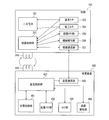
- FIG. 3 is a block diagram illustrating a configuration example of a charging mechanism when a lithium ion secondary battery is used as an operation power source of a hearing aid.
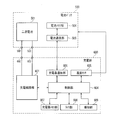
- FIG. 4 is a block diagram illustrating a configuration example of a charging mechanism when a lithium ion secondary battery is used as a secondary battery in a battery pack that is an operation power source of the portable electronic device.
- a charge control method for a lithium ion secondary battery is a charge control method for a lithium ion secondary battery that grasps an integrated value of the number of times of charging, and is a voltage value of the lithium ion secondary battery before the start of charging.
- a predetermined value is added to the integrated value of the number of times of charging the lithium ion secondary battery, The lifetime of the lithium ion secondary battery is estimated based on the integrated value of the number of times of charging.
- the charging control method for a lithium ion secondary battery grasps the residual voltage value before the start of charging and the elapsed time from the previous charging time for the lithium ion secondary battery to be charged. If the value is equal to or greater than a predetermined value, a predetermined numerical value is added to the number of times the lithium ion secondary battery is charged. For this reason, in the charge control method that estimates the life based on the integrated value of the number of times of charging, a more accurate reflecting the characteristics of the lithium ion secondary battery that the deterioration is likely to proceed if a high voltage state is maintained for a long time. Life estimation can be performed.
- the charging mechanism of the lithium ion secondary battery of the present disclosure includes a charging circuit unit, a voltage detection unit that detects a voltage of a lithium ion secondary battery to be charged, and an integrated value of the number of times of charging of the lithium ion secondary battery.
- the control unit is configured such that a residual voltage value of the lithium ion secondary battery before the start of charging detected by the voltage detection unit and the elapsed time detected by the timer unit are both predetermined. When the value is equal to or greater than the value, a predetermined value is added to the integrated value of the number of times of charging, and the life of the lithium ion secondary battery is estimated based on the integrated value of the number of times of charging.
- the charging mechanism of the lithium ion secondary battery of the present disclosure is based on the residual voltage value before the start of charging of the lithium ion secondary battery to be charged and the previous charging time of the lithium ion secondary battery. And the integrated value of the number of times of charging of the lithium ion secondary battery to be charged can be grasped. Then, when both the residual voltage value and the elapsed time are greater than or equal to a predetermined value, a predetermined numerical value is added to the number of times of charging the lithium ion secondary battery, and the life is estimated based on the integrated value of the number of times of charging. For this reason, it is possible to provide a charging mechanism that performs more accurate life estimation that reflects the characteristics of a lithium ion secondary battery in which deterioration tends to proceed when a high voltage state is maintained for a long time.
- the control unit may increase the number of times of charging by 0.5 when both the residual voltage value and the elapsed time are equal to or greater than a predetermined value. preferable. By doing in this way, the deterioration degree of a lithium ion secondary battery when the state of a high voltage is maintained for a long time can be correctly reflected on lifetime estimation.
- a temperature detection unit that detects a temperature of the lithium ion secondary battery is further provided, and the control unit sets the number of times of charging when the temperature of the lithium ion secondary battery being charged is equal to or higher than a predetermined temperature. It is preferable to increase by one. By doing in this way, deterioration of the lithium ion secondary battery by having been exposed to the high temperature during charge can be reflected in life estimation.
- control unit notifies the user that the life of the lithium ion secondary battery is approaching when the integrated value of the number of times of charging exceeds a predetermined alarm value. In this way, the user can be urged to prepare for replacement of the lithium ion secondary battery.
- control unit may notify the user that the lithium ion secondary battery has reached the end of its service life and not perform charging when the integrated value of the number of times of charging exceeds a predetermined limit value. preferable. By doing in this way, the danger of continuing using the lithium ion secondary battery which became the lifetime can be avoided.
- the charging mechanism of the lithium ion secondary battery includes: a device that operates with the lithium ion secondary battery; and a charger that charges the lithium ion secondary battery; and at least a part of the voltage detection unit; At least a part of the memory unit and at least a part of the control unit are arranged inside the device together with the lithium ion secondary battery, and constitute the charging mechanism other than the portion arranged inside the device. It is preferable that each part is arrange
- the device is a hearing aid and non-contact power supply is performed between the hearing aid and the charging device.
- FIG. 1 is a block diagram showing a schematic configuration of a charging mechanism of the lithium ion secondary battery of the present embodiment.
- FIG. 1 explains each component constituting the charging mechanism of the lithium ion secondary battery according to the present embodiment and its interrelationship from the functional aspect.
- Each block shown in FIG. It does not indicate an independent member. Therefore, one block in FIG. 1 may be separately configured as two different members, and a plurality of blocks may be configured as one member.
- the charging mechanism 200 of the lithium ion secondary battery has a function of charging the lithium ion secondary battery 100 and estimating its lifetime at the time of charging.
- the lithium ion secondary battery 100 includes a positive electrode, a negative electrode, and an electrolyte disposed between the positive electrode and the negative electrode, and charging and discharging are performed using movement of lithium ions between them.
- a battery main body 101 that is a secondary battery cell that can be connected to the battery, and a plus (+) terminal 102 and a minus ( ⁇ ) terminal 103 connected thereto.
- battery packs used as power sources for portable electronic devices include control circuits that control charging and discharging of battery bodies, battery protection circuits, output voltage conversion circuits, remaining amount detection circuits, etc. Some of these additional circuits are incorporated.
- Various components that are incorporated together with the battery body and perform additional functions in charging and discharging the battery body are grasped as components in the charging mechanism 200 that charges the lithium ion secondary battery 100 in the present embodiment.
- a battery pack having a load circuit configuration other than the main body does not correspond to the lithium ion secondary battery 100 in the present embodiment.
- the lithium ion secondary battery 100 is not limited in the shape that can be taken, such as a thin, substantially rectangular parallelepiped shape that is often used in portable electronic devices, a cylindrical shape that is compatible with a dry battery, a large capacity battery, and the like.
- Various shapes such as a box shape and a coin shape (button shape) used for a small device such as a hearing aid can be adopted.
- the charging mechanism 200 of the lithium ion secondary battery includes a charging circuit unit 201, a control unit 204, a battery identification unit 205, a temperature sensor 206, a memory unit 207, a timer unit 208, and a notification unit 209.
- the charging circuit unit 201 is a circuit block having a circuit configuration for charging the lithium ion secondary battery 100.
- a charging power source (not shown) is provided inside the charging circuit unit 201, and two charging terminals 202 connected to the positive (+) terminal 102 and the negative ( ⁇ ) terminal 103 of the lithium ion secondary battery 100, respectively. 203.
- the charging circuit unit 201 includes a voltage value of the lithium ion secondary battery 100 via the charging terminals 202 and 203 and the lithium ion secondary battery 100 from the charging terminals 202 and 203. A voltage sensor and a current sensor for detecting a current value supplied to the battery are provided. In this sense, the charging circuit unit 201 also serves as a voltage detection unit that detects the voltage value of the lithium ion secondary battery 100.
- the execution of the above-described charging program is performed under the control of the control unit 204 based on the voltage value and current value detected by the voltage sensor and current sensor of the charging circuit unit 201.
- the charging mechanism 200 of the lithium ion secondary battery 100 of the present embodiment it can be detected whether or not the lithium ion secondary battery 100 is correctly connected to the charging mechanism 200.
- a method for detecting that the lithium ion secondary battery 100 is connected to the charging mechanism 200 a method for detecting that a predetermined voltage is applied to the charging terminals 202 and 203 of the charging circuit unit 201 from the outside. Can be considered.
- the connection of the lithium ion secondary battery 100 can be detected by detecting that a current flows between the charging terminals 202 and 203 of the charging circuit unit 201. In this sense, the charging circuit unit 201 has a function as a battery mounting sensor.
- the terminals 102 and 103 of the lithium ion secondary battery 100 are short-circuited by a fine metal piece or the like.
- the lithium ion secondary battery 100 is physically insulated when foreign matter is sandwiched between the terminals 102 and 103 of the lithium ion secondary battery 100 and the charging terminals 202 and 203 of the charging mechanism 200. It is possible to detect an abnormal state such as when the battery is mounted but cannot be charged correctly.
- a detection pin (not shown) provided on the mounting portion of the lithium ion secondary battery 100 of the charging mechanism 200 may include a lithium ion secondary battery. It is possible to use a mechanical method such as detecting pressing when the 100 is attached. In addition, a method of detecting that the lithium ion secondary battery 100 is mounted at a predetermined position of the charging mechanism 200 using an optical or electromagnetic detection device can be employed.
- control unit 204 controls the charging of the lithium ion secondary battery 100 and simultaneously estimates the life of the lithium ion secondary battery 100.
- control unit 204 receives various types of information related to the lithium ion secondary battery 100 to be charged from the charging circuit unit 201, the battery identification unit 205, the temperature sensor 206, and the memory unit 207, and receives the timer unit 208. Based on the elapsed time information regarding the charging interval of the lithium ion secondary battery 100 obtained from the above, the integrated value of the number of times of charging, which is an index for estimating the life of the lithium ion secondary battery 100 to be charged, is updated.
- the control unit 204 is based on the integrated value of the number of times of charging, which is an index for estimating the life of the lithium ion secondary battery 100 to be charged.
- the notification unit 209 notifies the user to that effect. Further, when it is determined that the lithium ion secondary battery 100 to be charged has already reached the end of life, the control unit 204 notifies the user of the fact from the notification unit 209 and stops charging.
- control unit 204 determines that the lithium ion secondary battery 100 to be charged is still usable, the control unit 204 controls the charging circuit unit 201 and follows the predetermined power receiving program. To charge. Note that the control unit 204 appropriately refers to temperature information from the temperature sensor 206 when executing the charging program.
- control unit 204 when charging is completed, notifies the user of the completion of charging from the notification unit 209. Further, even when an abnormality occurs during charging and charging cannot be performed correctly, the control unit 204 notifies the user of the fact from the notification unit 209.
- the battery identification unit 205 acquires identification information of the lithium ion secondary battery 100 to be charged attached to the charging mechanism 200.
- the identification information of the lithium ion secondary battery 100 is acquired by an optical method in which the battery identification unit 205 including an optical detection unit reads information such as a barcode attached to the surface of the lithium ion secondary battery 100, for example. Can be realized. In addition, it can be realized by an electromagnetic method or a mechanical method using a contact pin. Further, in the case where information transmission means such as wireless or wired communication means capable of exchanging information is provided between the charging mechanism 200 and the lithium ion secondary battery 100, a part of the battery identification unit 205 is provided. The ID information recorded in the lithium ion secondary battery 100 can be read by using this information transmission means.
- the battery identification unit 205 detects the mounting of the lithium ion secondary battery 100 to be charged into the charging mechanism 200, the charging circuit unit 201 does not need to function as a mounting sensor. Further, the battery identification unit 205 confirms that the identification information of the attached lithium ion secondary battery 100 has been correctly obtained, and confirms that the lithium ion secondary battery 100 to be charged is attached to the charging mechanism 200. It can be used as information.
- the charging mechanism 200 of the lithium ion secondary battery according to the present embodiment is realized in an inseparable form with the lithium ion secondary battery 100, or the lithium ion secondary battery to be charged that is charged by the charging mechanism 200 When 100 is always the same, it may be assumed that the battery identification unit 205 is not provided.
- the temperature sensor 206 is a temperature detection unit that directly or indirectly detects the temperature of the mounted lithium ion secondary battery 100.
- the temperature information of the lithium ion secondary battery 100 detected by the temperature sensor 206 is used to determine the life of the lithium ion secondary battery 100 in the control unit 204 and / or to execute the charging program for the lithium ion secondary battery 100 in the control unit 204.
- the temperature sensor 206 only needs to be able to directly or indirectly measure the temperature of the lithium ion secondary battery 100, and can be an electrical element such as a thermocouple or a thermistor, an optical element such as an optical thermosensor, or the like. Various existing or novel means capable of measuring temperature can be used.
- the memory unit 207 can record various information of the lithium ion secondary battery 100 to be charged by the control unit 204 and can provide the recorded information to the control unit 204.
- an integrated value of the number of times of charging of the target lithium ion secondary battery 100 is used as an index used for estimating the life of the lithium ion secondary battery 100. Therefore, in the memory unit 207, the integrated value of the number of times of charging updated at the previous charging time of the lithium ion secondary battery 100 to be charged is associated with the battery identification information of the lithium ion secondary battery 100. To be recorded.
- control unit 204 reads the integrated value of the number of times of charging of the lithium ion secondary battery 100 to be charged recorded in the memory unit 207, determines the life, and then charges the lithium ion secondary battery 100 to newly The updated integrated value of the number of times of charging is recorded in the memory unit 207 together with the battery identification information.
- various memory elements such as a RAM capable of appropriately updating and recording information, a storage medium, and the like can be used.
- the memory unit 207 is provided in the battery pack of the lithium ion secondary battery 100 and the device operated by the lithium ion secondary battery 100 together with the lithium ion secondary battery 100 and is charged by a different charger. It is preferable to update the integrated value of the number of times of charging, which is an index for estimating the lifetime.
- the memory unit 207 includes various other progress information of the lithium ion secondary battery 100 to be charged, such as manufacturing information and usage history, specifications such as charging voltage and charging current characteristics, error occurrence history during charging, and charging.
- the history of the temperature change at the time can be stored, and can be referred to when the control unit 204 executes the charging program.
- the timer unit 208 uses the elapsed time as the charging interval of the lithium ion secondary battery 100 to be charged in the charging mechanism 200 of the lithium ion secondary battery according to the present embodiment, that is, the current charging time from the previous charging time. To know the time between.
- the control unit 204 Based on the value of the elapsed time from the previous charging of the lithium ion secondary battery 100 to be charged, which is grasped by the timer unit 208, the control unit 204 is an index indicating the life of the lithium ion secondary battery 100. It is determined whether to add a predetermined numerical value to the numerical value of the number of times of charging or keep it as it is.
- the timer unit 208 is provided in the charging mechanism 200 and can be realized as a timer counter that always counts the passage of time. Moreover, it is realized as a method of acquiring current time information for a radio timepiece at every timing of charging the lithium ion secondary battery 100 and grasping the value of the elapsed time as a charging interval based on the acquired current time information. can do.
- the notification unit 209 is a member that notifies the user of various states such as wearing and life of the lithium ion secondary battery 100 detected by the control unit 204, the progress of the charging operation in the charging mechanism 200, the occurrence of abnormality, and the like. is there.
- the notification unit 209 includes a member for displaying information appealing to the user's vision, such as one or a plurality of LED lamps, a display device such as a liquid crystal panel or an EL panel, and the user's hearing such as a buzzer, an electronic sound, and a synthesized voice.
- a member for displaying information appealing to the user's vision such as one or a plurality of LED lamps
- a display device such as a liquid crystal panel or an EL panel
- the user's hearing such as a buzzer, an electronic sound, and a synthesized voice.
- Various notification means such as voice means for appealing to the user can be used.
- the notification unit 209 is not an essential component and can be configured not to notify the user.
- the residual voltage value V which is the voltage value of the lithium ion secondary battery 100 at the start of charging, is equal to or higher than a predetermined voltage value V 0 , and
- the control unit 204 increases the number of times of charging by a predetermined value.
- the lithium ion secondary battery has a feature that its charge / discharge characteristics deteriorate even when a long time elapses while maintaining a high charge voltage.
- the sustain voltage V of the lithium ion secondary battery at the start of charging is equal to or higher than a predetermined voltage value V 0
- the elapsed time t of the lithium ion secondary battery is predetermined. If it is the time period t 0 or more, increasing the charge count value is an index showing a deterioration by determining deterioration of the lithium ion secondary battery and advanced to some extent.
- the deterioration factor of the charge / discharge characteristic peculiar to the lithium ion secondary battery is correctly reflected, and a more accurate life determination is performed. be able to.
- CLB2030 (product name) manufactured by Hitachi Maxell Co., Ltd., which is a coin-type lithium-ion secondary battery, has a charging voltage of 4.2 V and a discharge end voltage of 3.0 V, and has a capacity maintenance rate of 90% after 500 cycles of charging.
- the temperature range is 0 to + 45 ° C.
- the limit value that is the number of times of charging that reaches the end of life is set to 500 times, and the charging unit 200 according to the present embodiment is used to charge the charging time that is an index indicating the life of the controller 204 every time charging is performed.
- a numerical value CT (Charged Times) is counted by +1 and stored in the memory unit 207.
- the battery temperature T is set to a predetermined value T 0 when the lithium ion secondary battery is charged, in response to a temperature rise during charging which is considered as a deterioration factor of the lithium ion secondary battery.
- the control unit 204 sets the charge count CT to +1.
- a warning can be given in advance that the life is approaching before the user is informed that the lithium ion secondary battery to be charged has reached the end of its life.
- the charging mechanism 200 of the lithium ion secondary battery when the number of times of charging for estimating the life has not reached the numerical value 500 specified as the limit value, but approaches this value, for example, the life The alarm value is set to 450 times, which is 90% of the number of times of judgment 500, and when the number of times exceeds the alarm value, the notification unit 209 is set to warn the user that the life is approaching. be able to.
- the user can know in advance that the life of the lithium ion secondary battery is near, and can take measures such as preparing an alternative lithium ion secondary battery.
- a simple indicator may be used to notify the user of the remaining life after each charge.
- the charging mechanism 200 of the lithium ion secondary battery in addition to the original number of times of charging as described above, the number of times of long-time maintenance at a high voltage value and the high temperature during charging were obtained.
- the life of the lithium ion secondary battery can be more accurately determined by reflecting the number of times in the number of times of charging, and the value of the number of times of charging CT counted in this way is a predetermined limit value CT.
- the control unit 204 does not perform charging, and a notification unit configured as a display unit 209 such as an LED lamp indicates that the lithium ion secondary battery to be charged has reached the end of its life. I will inform you.
- the standard maintenance voltage V 0 that causes deterioration of the lithium ion secondary battery is set to 3.9 V corresponding to 93% of the rated charge voltage value.
- this standard maintenance voltage is limited to 3.9 V. It goes without saying that it is not possible.
- the reference maintenance voltage value V 0 is appropriately set according to the deterioration characteristics determined by the capacity and size of the lithium ion secondary battery charged by the charging mechanism that is the object of life estimation, the positive electrode, the negative electrode, and the electrolyte material. Should be.
- the maintenance voltage value V 0 of this standard is a value of 90% or more of the rated charge voltage value as an example.
- 12 hours is set as the reference value t 0 for the elapsed time that elapses in the high voltage state.
- This numerical value is also a value that should be appropriately determined according to the deterioration characteristics of the lithium ion secondary battery that is the object of life determination, as with the reference voltage value V 0 . In general, it is practical to set the time to approximately 12 hours or longer.
- the reference value T 0 of the temperature rise during charging as the deterioration factor of the lithium ion secondary battery is 40 ° C., but this numerical value is also the deterioration characteristic of the lithium ion secondary battery that is the object of life determination. Should be determined accordingly.
- the reference value T 0 for the temperature rise during charging is highly likely to fluctuate depending on the surrounding environmental factors of the state of the battery body of the lithium ion secondary battery during charging.
- the material of the members surrounding the secondary battery body, the number of battery bodies arranged adjacent to it, and other circuit components that serve as heat sources are arranged near the lithium ion secondary battery. It is preferable to set in consideration of these factors.
- the increase amount of the charge count value when a long time has passed at a high voltage is set to +0.5
- the increase amount of the charge count value when the battery temperature rises to a certain level or more during charging is set to +1.
- these values are also values that should be appropriately determined in consideration of various characteristics of the lithium ion secondary battery to be estimated for life.
- the number of times of charging is to determine that the lithium ion secondary battery has reached the end of life depending on whether or not the predetermined number of times (500 times in the above embodiment) is exceeded, it is too small after the decimal point. In terms of actual operation, it is preferable to perform conversion as an index in units of one time or 0.5 times shown in the present embodiment, and as a result, sufficiently accurate life estimation can be performed. it can.
- FIG. 2 is a flowchart for explaining the flow of the charging operation of the lithium ion secondary battery by the charging mechanism according to the present embodiment and the adjustment operation of the life judgment index performed simultaneously with the charging operation.
- the charging mechanism will be described as a case where the charging mechanism 200 illustrated in FIG. 1 is used in the present embodiment, and the reference numerals of the members are illustrated in FIG. 1. We will use the thing.
- Step S101 the charging operation of the lithium ion secondary battery 100 is started by the user pressing the charging start button or the like of the charger.
- control unit 204 correctly attaches the lithium ion secondary battery 100 to be charged to a predetermined position of the charging mechanism 200 based on a signal from the charging circuit unit 201 or the battery identification unit 205 or the like. It is judged whether it is (step S102).
- step S102 When the correct installation of the battery is not detected in step S102 (in the case of “No”), the control unit 204 notifies the error that the battery is not correctly installed from the notification unit 209 (step S103), and performs the charging operation. Cancel (step S104).
- the control unit 204 identifies the ID data of the attached lithium ion secondary battery 100, etc. Battery identification information is acquired from the battery identification unit 205. Moreover, the control part 204 acquires the charge frequency value CT of the lithium ion secondary battery 100 to be charged from the memory part 207 using the acquired ID data (step S105). When the charge count value CT of the lithium ion secondary battery 100 to be charged is recorded in the memory unit in the lithium ion secondary battery 100, the control unit 204 reads the battery identification information from the battery identification unit 205 at the same time. The charge count value CT of the battery is acquired.
- control unit 204 should inform the user of a warning because the charge count value CT, which is an index representing the life of the acquired lithium ion secondary battery 100, is close to the charge count determined as the life of the secondary battery. It is determined whether or not the alarm value CT is equal to or greater than 0 (step S106).
- the control unit 204 When the number of times of charging CT is not equal to or greater than CT 0 (in the case of “No”), the control unit 204 does not need to warn the user because the attached lithium ion secondary battery 100 has not yet reached the end of its life. Judgment is made and charging operation by a predetermined charging program is started.
- the control unit 204 acquires from the charging circuit unit 201 a sustain voltage value V that is a voltage value of the lithium ion secondary battery 100 in a state before the start of the charging program. Then, it is determined whether or not the obtained sustain voltage value V is greater than or equal to a predetermined reference voltage value V 0 (step S107).
- control unit 204 proceeds to step S108, and from the timer unit 208, the lithium ion to be charged An elapsed time t from the previous charging of the secondary battery 100 is acquired. Then, when the acquired elapsed time t is equal to or longer than the predetermined period value t 0 (in the case of “Yes” in Step S108), the control unit 204 proceeds to Step S109 and proceeds to the lithium ion secondary battery 100.
- the number of times of charge CT +0.5 is added to the value of CT before the start of charging.
- the lithium ion secondary battery 100 is charged according to a charging program of a predetermined procedure (step S110).
- step S107 when the acquired sustain voltage value V is not greater than or equal to the reference voltage value V 0 (in the case of “No” in step S107), or when the acquired elapsed time t is not greater than or equal to the predetermined period value t 0 (step S108).
- the control unit 204 maintains the charge count value CT of the lithium ion secondary battery 100 as it is, and in accordance with a charge program of a predetermined procedure, the lithium ion secondary battery 100 is charged (step S110).
- a constant current It can be set as the charge program which performs charge and performs constant voltage charge after that.
- the control unit 204 is based on the charging circuit unit 201. Is controlled to perform charging with a predetermined program.
- the control unit 204 sets the voltage value of the lithium ion secondary battery 100 even if a certain charging time has elapsed. If it is determined that an error has occurred during the execution of the charging program (for example, “Yes” in step S111), such as when the charging current has become larger than the setting current, Then, the notification unit 209 notifies the user of a charging error and stops the charging operation (step S113).
- the control unit 204 performs lithium charging during the charging operation based on the temperature data of the lithium ion secondary battery 100 being charged from the temperature sensor 206. Although the temperature of the ion secondary battery 100 is not a temperature until the charging operation is stopped due to a charging error, it is determined whether or not it is recognized that the ion secondary battery 100 has reached a predetermined reference temperature T 0 or more (step S114).
- step S114 When the temperature of the lithium ion secondary battery 100 being charged is equal to or higher than the reference temperature T 0 (in the case of “Yes” in step S114), the value of the charge count value CT that is an index for life detection is set. It is increased by 1 (step S115).
- the reference temperature T 0 in an abnormal state equal to or higher than the reference temperature is a state where the temperature is in the range of 40 ° C. to 45 ° C. in the coin-type lithium ion secondary battery.
- the control unit 204 the temperature of the lithium ion secondary battery 100 during charging as if it is determined that a predetermined reference temperature T 0 or more, the reference temperature T 0 or more state continues consecutively for 10 minutes
- a condition for determining the time during which the state of the reference temperature T 0 or higher is continued such as setting the state, the determination by the control unit 204 can be made more accurate.
- control unit 204 sets the charging count value CT of the lithium ion secondary battery 100 to be charged to +1 (step S116).
- the control unit 204 does not set the control for increasing the number of times of charging shown as step S116 in FIG. 2 by 1 but after a period of 30 minutes from the start of charging, rather than setting the control after the charging program is completed. It can be set to be performed when the state of charge continues.
- the control unit 204 After the end of the charging program, the control unit 204 increases the numerical value 1 and stores the number-of-charges value CT, which is a value commensurate with the current state, in the memory unit 207 as a correct numerical value as a life determination index at that time. (Step S117). As a result, the number of times of charging of the lithium ion secondary battery 100 to be charged is stored at a correct value in accordance with the current situation, and the life is determined based on this value at the next charging time.
- the control unit 204 notifies the user that the charging is completed (step S118), and the charging operation ends.
- control unit 204 determines that the charge count value CT of the lithium ion secondary battery 100 to be charged exceeds the warning value CT 0 that will soon reach the end of life (“Yes” in step S106) at the start of charging. ), the control unit 204 again determines whether the charging frequency value CT exceeds the threshold value CT 1 showing the lifetime of the lithium ion secondary cell 100 (step S119).
- the control unit 204 When the charge count value CT exceeds the alarm value CT 0 but does not exceed the limit value CT 1 , the control unit 204 notifies that the life of the lithium ion secondary battery 100 to be charged is approaching. A warning is given to the user through the unit 209 (step S120).
- control unit 204 proceeds to step S107 to perform a charging operation according to the charging program.
- step S119 When the charge count value CT exceeds the limit value CT 1 (in the case of “Yes” in step S119), the control unit 204 charges the user that the lithium ion secondary battery 100 has reached the end of its life. Even if it is notified that the desired characteristics cannot be obtained (step S121), the charging operation is stopped (step S122).
- the charge count value CT indicates the lifetime at the stage of step S106 at the time of determination immediately after the start of the charging operation. Even if it does not exceed the limit value CT 1, depending on the state of the lithium ion secondary battery 100 in the middle charge, situation in which the number of charging times CT exceeds the threshold value CT 1 may occur at the end of charge. However, in general, deterioration of a lithium ion secondary battery does not proceed greatly due to a difference in the number of times of charging, and as shown in FIG. 2, the number of times of charging CT at the start of charging is limited. if not exceed the value CT 1, the big problem is not believed to occur be used to charge as it is. In addition, in consideration of the error of the charge count value CT in this case, the limit value CT 1 may be set to a value that is smaller than the design life limit value by several times.
- the charging number value is appropriately updated by recognizing the influence on the lifetime in the charging operation, and appropriately updating the charging number value indicating the lifetime. More accurate life determination in the secondary battery can be performed.
- the lithium ion secondary battery charging mechanism 200 includes an electronic device using the lithium ion secondary battery 100 as an operating power source, and a lithium ion secondary battery as described at the beginning of the description.
- the arrangement position of each element block in relation to the device configuration is different.
- a specific example of the arrangement of the lithium ion secondary battery charging mechanism 200 according to this embodiment in a device will be described.
- FIG. 3 is a block diagram showing a device configuration example in the case where a lithium ion secondary battery is used as the power supply of the hearing aid illustrated and described in the above embodiment.
- a lithium ion secondary battery 301 is built in the hearing aid shown as the device 300.
- the user uses it continuously for a certain period of time, and the power supply from the lithium ion secondary battery stops during the continuous use. If it does not work, there is a concern that it will develop into a situation that threatens the safety of the user.
- the user cannot take out the secondary battery 301 from the hearing aid that is the device 300, and the charging device 400 that charges the hearing aid corresponds to the hearing aid that is the device 300 on a one-to-one basis. It has become.
- the receiving coil 310 and the feeding coil 410 that can supply power to the device 300 side and the charging device 400 side in a non-contact manner, Is provided. For this reason, the user can charge the secondary battery 301 inside the hearing aid only by placing or storing the hearing aid in a predetermined place during periods of non-use such as during sleep.
- FIG. 3 shows a configuration in which a strong correspondence is maintained between the device 300 in which the secondary battery 310 is accommodated and the charging device 400 in which the charging circuit unit 401 is accommodated. It is an example.
- a secondary battery 301 that is an operating power source and a device control unit 302 that controls the overall operation of the hearing aid are disposed inside the device 300 that is a hearing aid.
- the device control unit 302 serves as a control unit for the charging mechanism of the lithium ion secondary battery, and controls the operation of the hearing aid that is the device 300, and can be realized using a microcomputer or the like.
- the charging device 400 and the secondary battery 301 in the device 300 are not in contact with each other.
- a temperature sensor 303 that monitors the temperature and a voltage sensor 304 that monitors the voltage value of the secondary battery are arranged inside the device 300.
- the device 300 By further including a device memory unit 305 in the device 300, it is possible to store the ID information of the lithium ion secondary battery 301 accommodated therein, the charge count value CT of the secondary battery 301, and the like. Moreover, the apparatus alerting
- the device communication unit 307 is provided so that communication can be performed.
- the charging circuit unit 401 that supplies charging power from the power transmission coil 410 to the power receiving coil 310 and the entire charging device 400 are controlled, and exchange of information with the device 300 as necessary.
- Device control unit 402 that performs the function of the control unit in the charging mechanism while performing charging
- device memory unit 403 that stores predetermined information such as the number of charging times CT of the secondary battery on the charging device 400 side, and a lithium ion secondary battery to be charged
- device control A device communication unit 406 that is controlled by the unit 402 to exchange information with the device communication unit 307 in the device 300 is provided.
- each element block constituting the charging mechanism of the present embodiment is appropriately dispersed and arranged in a device 300 that is a hearing aid and a charging device 400, and will be described using the flowchart of FIG. 2.
- the charging operation and the life estimation operation can be executed.
- the timer unit 404 arranged in the charging device 400 can be arranged in the device 300.
- the device 300 that is a hearing aid is more strongly required to be small and light.
- members such as the timer unit 404 that can be disposed on either the device 300 side or the charging device 400 side have relatively few demands for reduction in size and weight, and use of commercial power is expected. Therefore, it is more practical to dispose the battery pack on the side of the charging device 400, which is less likely to cause a problem in terms of securing the operating power supply.
- the configuration in which the secondary battery 301 of the device 300 is charged by the wireless power feeding method is illustrated.
- the device 300 and the charging device 400 are wired to charge the secondary battery 301.
- the case where it connects can be assumed, Furthermore, it can also be set as the structure which can be switched and used for wireless feeding and wired feeding suitably.
- the communication between the device communication unit 307 and the device communication unit 405 can use either wired, wireless, or both means.
- FIG. 4 shows that the lithium-ion secondary battery to be charged is placed in a battery pack of a portable electronic device such as a mobile phone or a notebook computer, and this embodiment is implemented in a charger for charging the battery pack.
- FIG. 4 shows the example of distribution arrangement
- the battery pack 500 used as the power source of the portable electronic device is relatively easily replaced and used. For this reason, it is required to reduce the number of mounting members other than the secondary battery 501 as much as possible.
- charging of the battery pack 500 of the portable electronic device is performed when the battery pack 500 is taken out from the electronic device and charged by the charging device or when the battery pack 500 is mounted in the portable electronic device. The case where it is performed by connecting a cord etc. is assumed.
- the battery pack 500 and the charger 600 there is often no correspondence between the battery pack 500 and the charger 600, such as a case where a plurality of battery packs 500 are used together in one electronic device.
- a lithium ion secondary battery 501 in the battery pack 500, a lithium ion secondary battery 501, a battery memory unit 504 that stores a charge count value CT of the lithium ion secondary battery 501, and a battery Only the battery communication unit 505 capable of transmitting the information transmitted from the charger 600 while accommodating the information of the memory unit 504 to the charger 600 side as needed is accommodated. Note that reading of data from the battery memory unit 504 and storage of data in the battery memory unit 504 can be handled by an additional function of the battery memory unit 504.
- One charger 600 side is supplied with electric power for charging the lithium ion secondary battery 501 from the charger side charging terminals 602 and 603 connected to the charging terminals 502 and 503 of the battery pack 500, respectively.
- a charging circuit unit 601 that detects a voltage value and a charging current value of the battery 501 and a control unit 604 that controls the charging circuit unit 601 to perform charging are housed.
- the charger 600 includes a temperature sensor 605 that contacts the battery pack 500 during charging and detects the temperature of the secondary battery 501, and a battery communication unit 505 in the battery pack 500.
- a charger communication unit 606 for exchanging information of the battery memory unit 504 with the control unit 604, a charger memory unit 607 for storing predetermined information on the side of the charger 600, and a timer for grasping an elapsed time as a charging interval 608, and a notification unit 609 for notifying the user of various types of information such as the state of charge, abnormality of the lithium ion secondary battery 501, and the lifetime.
- the minimum necessary components are arranged in the battery pack 500, and main components for controlling charging are arranged in the charger 600 for charging the battery pack 500, whereby the battery pack 500 is arranged.
- the charging mechanism of the lithium ion secondary battery of this embodiment is configured when charging the battery with the charger 600, and the charging operation and the life estimation operation of the charging mechanism according to this embodiment are performed according to the flowchart described in FIG. It can be carried out.
- the configuration examples shown in FIGS. 3 and 4 are examples, and arrangement configurations other than the configurations in FIGS. 3 and 4 can be adopted in the battery pack of a hearing aid or a portable electronic device.
- the charging mechanism according to the present embodiment is divided into two members as shown in FIGS. 3 and 4, for example, this is used together with a lithium ion secondary battery to be charged.
- all the members for charging are provided in an electronic device using a lithium ion secondary battery as an operating power source, all charging mechanisms are also provided in one electronic device.
- the communication unit that transmits information between the two devices illustrated in the case of the configuration examples shown in FIGS. 3 and 4 is not necessary, and the charging mechanism can be realized with a simpler configuration.
- the charging circuit according to the present embodiment is used when the charging circuit unit that requires electric power to charge the lithium ion secondary battery is separated from other control-related mechanism units and accommodated in a device that can use a commercial power source. It can be assumed that the mechanism is distributed and arranged in three or more devices.
- the charge control method and the charging mechanism of the lithium ion secondary battery according to the present embodiment correspond to the life characteristics of the lithium ion secondary battery, and the lithium ion secondary battery maintains a high voltage. Even when a certain period of time elapses, life estimation that reflects this can be performed by converting the value into the number of times of charging that is an index representing the life. For this reason, although it is the simple structure of using the frequency
- the lithium ion secondary battery charging control method and the lithium ion secondary battery charging mechanism of the present disclosure have a simple configuration, the life estimation is more accurate in consideration of the deterioration factors unique to the lithium ion secondary battery. It can be performed. For this reason, it is useful as a charging control method and charging mechanism for lithium ion secondary batteries widely used as a power source for electronic devices.
- Charge control that controls the charging of lithium-ion secondary batteries that are used as an operating power source for devices that require continuous charge control based on accurate life judgment, such as medical aids such as hearing aids It is extremely useful as a method and a charging mechanism.
Landscapes
- Engineering & Computer Science (AREA)
- Power Engineering (AREA)
- Chemical & Material Sciences (AREA)
- Chemical Kinetics & Catalysis (AREA)
- Manufacturing & Machinery (AREA)
- Electrochemistry (AREA)
- General Chemical & Material Sciences (AREA)
- Computer Networks & Wireless Communication (AREA)
- Materials Engineering (AREA)
- Physics & Mathematics (AREA)
- General Physics & Mathematics (AREA)
- Charge And Discharge Circuits For Batteries Or The Like (AREA)
- Secondary Cells (AREA)
Abstract
L'invention concerne un procédé de commande de charge et un mécanisme de charge d'une batterie rechargeable au lithium-ion qui rendent possible de déterminer avec plus de précision la durée de vie d'une batterie rechargeable au lithium-ion à l'aide d'une configuration simple. Le procédé de commande de charge de batterie rechargeable au lithium-ion, dans lequel une valeur de comptage de charges intégrée est déterminée, est tel qu'une valeur prescrite est ajoutée à la valeur de comptage de charges intégrée pour la batterie rechargeable au lithium-ion si une valeur de tension résiduelle, qui est la valeur de tension de la batterie rechargeable au lithium-ion avant le début de la charge, et la durée qui s'est écoulée depuis la précédente charge de la batterie rechargeable au lithium-ion sont toutes les deux supérieures ou égales à des valeurs prescrites, et la durée de vie de la batterie rechargeable au lithium-ion est estimée sur la base de la valeur de comptage de charges intégrée.
Priority Applications (3)
| Application Number | Priority Date | Filing Date | Title |
|---|---|---|---|
| EP15872752.9A EP3240135B1 (fr) | 2014-12-26 | 2015-12-11 | Procédé de commande de charge et mécanisme de charge d'une batterie rechargeable au lithium-ion |
| US15/506,371 US10587014B2 (en) | 2014-12-26 | 2015-12-11 | Lithium ion secondary battery charging control method and charging mechanism |
| CN201580047573.2A CN106605349B (zh) | 2014-12-26 | 2015-12-11 | 锂离子二次电池的充电控制方法以及充电机构 |
Applications Claiming Priority (2)
| Application Number | Priority Date | Filing Date | Title |
|---|---|---|---|
| JP2014-266611 | 2014-12-26 | ||
| JP2014266611A JP6257510B2 (ja) | 2014-12-26 | 2014-12-26 | リチウムイオン二次電池の充電制御方法、および、充電機構 |
Publications (1)
| Publication Number | Publication Date |
|---|---|
| WO2016104183A1 true WO2016104183A1 (fr) | 2016-06-30 |
Family
ID=56150213
Family Applications (1)
| Application Number | Title | Priority Date | Filing Date |
|---|---|---|---|
| PCT/JP2015/084777 Ceased WO2016104183A1 (fr) | 2014-12-26 | 2015-12-11 | Procédé de commande de charge et mécanisme de charge d'une batterie rechargeable au lithium-ion |
Country Status (5)
| Country | Link |
|---|---|
| US (1) | US10587014B2 (fr) |
| EP (1) | EP3240135B1 (fr) |
| JP (1) | JP6257510B2 (fr) |
| CN (1) | CN106605349B (fr) |
| WO (1) | WO2016104183A1 (fr) |
Cited By (1)
| Publication number | Priority date | Publication date | Assignee | Title |
|---|---|---|---|---|
| EP3467527A4 (fr) * | 2017-08-25 | 2019-07-31 | Shenzhen Yun Zhong Fei Network Technology Co., Ltd. | Dispositif terminal, adaptateur et système et procédé de surveillance de la sécurité d'une batterie |
Families Citing this family (14)
| Publication number | Priority date | Publication date | Assignee | Title |
|---|---|---|---|---|
| JP6784129B2 (ja) * | 2016-10-11 | 2020-11-11 | セイコーエプソン株式会社 | 制御装置、受電装置、電子機器及び無接点電力伝送システム |
| US10491024B2 (en) * | 2016-10-28 | 2019-11-26 | Starkey Laboratories, Inc. | Charging systems for contact chargers and related methods |
| US10424955B2 (en) | 2016-10-28 | 2019-09-24 | Starkey Laboratories, Inc. | Charging system with compressible contacts |
| CN108189685A (zh) * | 2017-12-22 | 2018-06-22 | 银隆新能源股份有限公司 | 充电柜控制方法、系统、存储介质、及充电柜 |
| JP7098981B2 (ja) * | 2018-03-16 | 2022-07-12 | ソニーグループ株式会社 | 電子機器、充電制御方法及びコンピュータプログラム |
| CN108808789A (zh) * | 2018-06-29 | 2018-11-13 | 深圳市安科讯实业有限公司 | 多电池修复方法及装置 |
| KR102589313B1 (ko) * | 2018-08-30 | 2023-10-12 | 주식회사 엘지에너지솔루션 | 알람 설정 장치 |
| KR102655792B1 (ko) * | 2018-10-19 | 2024-04-09 | 삼성전자주식회사 | 배터리 충전 장치 및 방법 |
| KR20210068168A (ko) | 2019-11-29 | 2021-06-09 | 현대자동차주식회사 | 리튬이온 이차전지 제조 시스템 및 그 방법 |
| CN111707943B (zh) * | 2020-05-15 | 2025-10-21 | 中国电力科学研究院有限公司 | 一种基于电池仿真的电动汽车充电故障预警方法和系统 |
| CN112659957B (zh) * | 2020-12-31 | 2022-11-25 | 爱驰汽车有限公司 | 充电设备的远程监测方法 |
| DE102021205663B3 (de) * | 2021-06-03 | 2022-07-14 | Sivantos Pte. Ltd. | Verfahren zum Betrieb eines Hörgeräts und Hörgerät |
| JP7371966B2 (ja) * | 2021-07-15 | 2023-10-31 | 株式会社スリーダムアライアンス | 二次電池評価装置及び二次電池評価方法 |
| US20230156604A1 (en) * | 2021-11-16 | 2023-05-18 | Medtronic Minimed, Inc. | Systems and methods for non-contact hardware shutdown and/or reset of electronic devices |
Citations (3)
| Publication number | Priority date | Publication date | Assignee | Title |
|---|---|---|---|---|
| JP2001136673A (ja) * | 1999-11-10 | 2001-05-18 | Makita Corp | 充電装置 |
| JP2003017138A (ja) * | 2001-07-04 | 2003-01-17 | Matsushita Electric Ind Co Ltd | 電池パック |
| JP2013172476A (ja) * | 2012-02-17 | 2013-09-02 | Toyota Motor Corp | 情報報知システム |
Family Cites Families (15)
| Publication number | Priority date | Publication date | Assignee | Title |
|---|---|---|---|---|
| JPH0785893A (ja) * | 1993-09-17 | 1995-03-31 | Sony Corp | 電池充電方法 |
| JPH0935756A (ja) * | 1995-07-20 | 1997-02-07 | Nippon Soken Inc | 充電装置 |
| EP1100172A3 (fr) | 1999-11-10 | 2004-10-13 | Makita Corporation | Dispositif de charge de batterie |
| JP2001309568A (ja) * | 2000-04-26 | 2001-11-02 | Internatl Business Mach Corp <Ibm> | 充電システム、充電制御装置、充電制御方法及びコンピュータ |
| JP3672248B2 (ja) * | 2001-09-19 | 2005-07-20 | インターナショナル・ビジネス・マシーンズ・コーポレーション | 電気機器、コンピュータ装置、インテリジェント電池、電池診断方法、電池状態表示方法、およびプログラム |
| JP3807965B2 (ja) * | 2001-09-19 | 2006-08-09 | インターナショナル・ビジネス・マシーンズ・コーポレーション | インテリジェント電池、電気機器、コンピュータ装置及び電池の劣化度を求める方法 |
| JP2003132955A (ja) * | 2001-10-23 | 2003-05-09 | Nec Yonezawa Ltd | 非水電解質二次電池の充放電方法 |
| JP4093205B2 (ja) * | 2003-12-05 | 2008-06-04 | 松下電器産業株式会社 | 充電制御装置 |
| JP2008295169A (ja) * | 2007-05-23 | 2008-12-04 | Canon Inc | バッテリーパック、充電装置、及び電子機器 |
| EP2096452A1 (fr) * | 2007-12-13 | 2009-09-02 | Panasonic Corporation | Procédé d'estimation de la durée de vie et procédé pour empêcher la dégradation d'une pile rechargeable au lithium, estimateur de durée de vie et élément empêchant la dégradation, bloc-piles utilisant ceux-ci, et chargeur |
| JP5064204B2 (ja) * | 2007-12-27 | 2012-10-31 | 京セラ株式会社 | 携帯電子機器 |
| JP5747610B2 (ja) * | 2011-03-30 | 2015-07-15 | ソニー株式会社 | 充電制御装置、充電制御方法、プログラム及びシステム |
| JP2012235551A (ja) | 2011-04-28 | 2012-11-29 | Konica Minolta Medical & Graphic Inc | 充電システムおよび電子機器 |
| CN102938479A (zh) * | 2011-08-16 | 2013-02-20 | 杭州市电力局 | 电池充放电方法及电池循环放电设备 |
| US20140039573A1 (en) | 2012-08-03 | 2014-02-06 | International Rehabilitative Sciences, Inc. | Neuromuscular stimulator with battery monitoring, external data adapter, and simplified user interface |
-
2014
- 2014-12-26 JP JP2014266611A patent/JP6257510B2/ja active Active
-
2015
- 2015-12-11 EP EP15872752.9A patent/EP3240135B1/fr active Active
- 2015-12-11 CN CN201580047573.2A patent/CN106605349B/zh active Active
- 2015-12-11 WO PCT/JP2015/084777 patent/WO2016104183A1/fr not_active Ceased
- 2015-12-11 US US15/506,371 patent/US10587014B2/en active Active
Patent Citations (3)
| Publication number | Priority date | Publication date | Assignee | Title |
|---|---|---|---|---|
| JP2001136673A (ja) * | 1999-11-10 | 2001-05-18 | Makita Corp | 充電装置 |
| JP2003017138A (ja) * | 2001-07-04 | 2003-01-17 | Matsushita Electric Ind Co Ltd | 電池パック |
| JP2013172476A (ja) * | 2012-02-17 | 2013-09-02 | Toyota Motor Corp | 情報報知システム |
Non-Patent Citations (1)
| Title |
|---|
| See also references of EP3240135A4 * |
Cited By (1)
| Publication number | Priority date | Publication date | Assignee | Title |
|---|---|---|---|---|
| EP3467527A4 (fr) * | 2017-08-25 | 2019-07-31 | Shenzhen Yun Zhong Fei Network Technology Co., Ltd. | Dispositif terminal, adaptateur et système et procédé de surveillance de la sécurité d'une batterie |
Also Published As
| Publication number | Publication date |
|---|---|
| CN106605349B (zh) | 2019-07-09 |
| CN106605349A (zh) | 2017-04-26 |
| JP6257510B2 (ja) | 2018-01-10 |
| JP2016127701A (ja) | 2016-07-11 |
| EP3240135A4 (fr) | 2018-05-16 |
| EP3240135B1 (fr) | 2019-09-18 |
| US10587014B2 (en) | 2020-03-10 |
| EP3240135A1 (fr) | 2017-11-01 |
| US20170279165A1 (en) | 2017-09-28 |
Similar Documents
| Publication | Publication Date | Title |
|---|---|---|
| JP6257510B2 (ja) | リチウムイオン二次電池の充電制御方法、および、充電機構 | |
| KR101355218B1 (ko) | 전동 공구용 배터리 | |
| US9954384B2 (en) | Instrumented super-cell | |
| JP5198502B2 (ja) | 電池寿命判定装置及び電池寿命判定方法 | |
| JP6564647B2 (ja) | 電池の劣化状態推定装置及び、その劣化状態推定方法 | |
| KR102044559B1 (ko) | 축전 장치 및 전력 경로 개폐 장치 | |
| ES2993259T3 (en) | Battery fault determination | |
| US10840732B2 (en) | Auxiliary power system | |
| JP2010139396A (ja) | 電池寿命検出装置、蓄電装置、及び電池寿命検出方法 | |
| JP2009186235A (ja) | モバイル機器及び電池情報表示方法 | |
| KR20060059682A (ko) | 배터리팩의 모니터링 장치 및 그 방법 | |
| JP2011142036A (ja) | 電池管理方法および電子機器 | |
| KR101602848B1 (ko) | 배터리 수명 예측 방법 | |
| EP2876775B1 (fr) | Détermination du type de batterie | |
| CN103197248B (zh) | 用于机器人的蓄电池电量检测装置及方法 | |
| JP5184791B2 (ja) | 電池寿命判定装置及び電池寿命判定方法 | |
| KR102733072B1 (ko) | 배터리의 고장을 진단하기 위한 장치 및 방법과, 상기 장치를 포함하는 배터리팩 | |
| JP2017220293A (ja) | 電池の充放電曲線推定装置及び、その充放電曲線推定方法 | |
| JP2013186956A (ja) | 充電管理装置 | |
| JP5431685B2 (ja) | 電池寿命判定装置及び電池寿命判定方法 | |
| JP2013141379A (ja) | 無停電電源装置 | |
| EP2597478B1 (fr) | Système de décharge pour batterie | |
| JP2009112180A (ja) | パック電池及びその制御方法 | |
| JP2006312528A (ja) | エレベータの電力蓄積装置 | |
| EP2871701B1 (fr) | Bloc-batterie et dispositif électrique comprenant le bloc-batterie |
Legal Events
| Date | Code | Title | Description |
|---|---|---|---|
| 121 | Ep: the epo has been informed by wipo that ep was designated in this application |
Ref document number: 15872752 Country of ref document: EP Kind code of ref document: A1 |
|
| WWE | Wipo information: entry into national phase |
Ref document number: 15506371 Country of ref document: US |
|
| REEP | Request for entry into the european phase |
Ref document number: 2015872752 Country of ref document: EP |
|
| WWE | Wipo information: entry into national phase |
Ref document number: 2015872752 Country of ref document: EP |
|
| NENP | Non-entry into the national phase |
Ref country code: DE |