WO2016104751A1 - Couche jetable - Google Patents
Couche jetable Download PDFInfo
- Publication number
- WO2016104751A1 WO2016104751A1 PCT/JP2015/086346 JP2015086346W WO2016104751A1 WO 2016104751 A1 WO2016104751 A1 WO 2016104751A1 JP 2015086346 W JP2015086346 W JP 2015086346W WO 2016104751 A1 WO2016104751 A1 WO 2016104751A1
- Authority
- WO
- WIPO (PCT)
- Prior art keywords
- waist
- region
- leg
- elastic
- diaper
- Prior art date
- Legal status (The legal status is an assumption and is not a legal conclusion. Google has not performed a legal analysis and makes no representation as to the accuracy of the status listed.)
- Ceased
Links
Images




Classifications
-
- A—HUMAN NECESSITIES
- A61—MEDICAL OR VETERINARY SCIENCE; HYGIENE
- A61F—FILTERS IMPLANTABLE INTO BLOOD VESSELS; PROSTHESES; DEVICES PROVIDING PATENCY TO, OR PREVENTING COLLAPSING OF, TUBULAR STRUCTURES OF THE BODY, e.g. STENTS; ORTHOPAEDIC, NURSING OR CONTRACEPTIVE DEVICES; FOMENTATION; TREATMENT OR PROTECTION OF EYES OR EARS; BANDAGES, DRESSINGS OR ABSORBENT PADS; FIRST-AID KITS
- A61F13/00—Bandages or dressings; Absorbent pads
- A61F13/15—Absorbent pads, e.g. sanitary towels, swabs or tampons for external or internal application to the body; Supporting or fastening means therefor; Tampon applicators
-
- A—HUMAN NECESSITIES
- A61—MEDICAL OR VETERINARY SCIENCE; HYGIENE
- A61F—FILTERS IMPLANTABLE INTO BLOOD VESSELS; PROSTHESES; DEVICES PROVIDING PATENCY TO, OR PREVENTING COLLAPSING OF, TUBULAR STRUCTURES OF THE BODY, e.g. STENTS; ORTHOPAEDIC, NURSING OR CONTRACEPTIVE DEVICES; FOMENTATION; TREATMENT OR PROTECTION OF EYES OR EARS; BANDAGES, DRESSINGS OR ABSORBENT PADS; FIRST-AID KITS
- A61F13/00—Bandages or dressings; Absorbent pads
- A61F13/15—Absorbent pads, e.g. sanitary towels, swabs or tampons for external or internal application to the body; Supporting or fastening means therefor; Tampon applicators
- A61F13/45—Absorbent pads, e.g. sanitary towels, swabs or tampons for external or internal application to the body; Supporting or fastening means therefor; Tampon applicators characterised by the shape
- A61F13/49—Absorbent pads, e.g. sanitary towels, swabs or tampons for external or internal application to the body; Supporting or fastening means therefor; Tampon applicators characterised by the shape specially adapted to be worn around the waist, e.g. diapers, nappies
-
- A—HUMAN NECESSITIES
- A61—MEDICAL OR VETERINARY SCIENCE; HYGIENE
- A61F—FILTERS IMPLANTABLE INTO BLOOD VESSELS; PROSTHESES; DEVICES PROVIDING PATENCY TO, OR PREVENTING COLLAPSING OF, TUBULAR STRUCTURES OF THE BODY, e.g. STENTS; ORTHOPAEDIC, NURSING OR CONTRACEPTIVE DEVICES; FOMENTATION; TREATMENT OR PROTECTION OF EYES OR EARS; BANDAGES, DRESSINGS OR ABSORBENT PADS; FIRST-AID KITS
- A61F13/00—Bandages or dressings; Absorbent pads
- A61F13/15—Absorbent pads, e.g. sanitary towels, swabs or tampons for external or internal application to the body; Supporting or fastening means therefor; Tampon applicators
- A61F13/45—Absorbent pads, e.g. sanitary towels, swabs or tampons for external or internal application to the body; Supporting or fastening means therefor; Tampon applicators characterised by the shape
- A61F13/49—Absorbent pads, e.g. sanitary towels, swabs or tampons for external or internal application to the body; Supporting or fastening means therefor; Tampon applicators characterised by the shape specially adapted to be worn around the waist, e.g. diapers, nappies
- A61F13/496—Absorbent pads, e.g. sanitary towels, swabs or tampons for external or internal application to the body; Supporting or fastening means therefor; Tampon applicators characterised by the shape specially adapted to be worn around the waist, e.g. diapers, nappies in the form of pants or briefs
Definitions
- the present invention relates to a disposable diaper.
- Patent Literature 1 discloses a disposable diaper including a diaper body having an absorbent body and a pair of waist belts for connecting the front and rear waist regions.
- the leg opening edge of the diaper body is provided with a plurality of leg elastic bodies that can be contracted in a stretched state, and the waist belt can be contracted in a stretched state with a plurality of waist elastic bodies that extend in the longitudinal direction.
- leg elastic bodies that can be contracted in a stretched state
- waist belt can be contracted in a stretched state with a plurality of waist elastic bodies that extend in the longitudinal direction.
- the leg elastic body and the waist elastic body are parallel in a state where the diaper is extended in the vertical direction so that the inner surface of the waist belt and the inner surface of the diaper main body are in contact with each other.
- both elastic bodies partially overlap in the thickness direction.
- the whole leg elastic body is located inside the lateral direction of the waist elastic body.
- the waist belt in the manufacturing process, can be transported in the transport direction of the diaper main body, and all the constituent materials of the diaper can be transported and stacked in the same direction. Production is possible and manufacturing efficiency is excellent.
- a virtual elastic band is formed in the leg opening by the leg elastic area where the leg elastic body is arranged and the belt elastic area where the waist belt is arranged, so the leg opening edge fits the wearer's body Thus, the excrement can be prevented from leaking.
- both elastic bodies contract in the opposite directions around the leg opening and pull in the overlapping region, so that the elongation stress is desired. It becomes difficult to control the size.
- the sheet is likely to be broken by the pulling force acting on each other.
- the leg elastic body is stretched by the contracting action of the waist elastic body and fits to the body in the wearing state.
- the outermost portion of the leg opening edge where the body is not arranged is not fitted, and there is a possibility that a gap may be formed between the leg and the excrement may leak.
- An object of the present invention is an improvement of a conventional disposable diaper, in which a sheet is not torn at a part of a joining line between a waist belt and a diaper body, and the disposable diaper is excellent in the fit of a leg opening edge. On offer.
- the present invention has a longitudinal direction and a transverse direction perpendicular thereto, and a longitudinal center line that bisects the transverse dimension, and a front and rear waist region, a crotch region located between the front and rear waist regions, and an absorption
- the present invention relates to a disposable diaper comprising a diaper body having a body, a pair of waist belts for connecting the front and rear waist regions, a waist opening and a pair of leg openings.
- the pair of waist belts has a waist elastic region having a plurality of waist elastic bodies that can be expanded and contracted in the length direction thereof, and in the front and rear waist regions, from the leg opening side to the waist opening side.
- the diaper body has a leg elastic region having a plurality of leg elastic bodies extending along an edge of the leg opening; In the state where the waist elastic region and the leg elastic region are extended in the longitudinal direction, the waist elastic body and the leg elastic body are overlapped with each other in the thickness direction. Does not overlap in the thickness direction, and a part of the leg elastic body is located outside the waist elastic body in the lateral direction.
- the lateral dimension of the region where the waist elastic region and the leg elastic region overlap each other is about 10 to about the lateral dimension in the region from both side edges of the absorber to the outer edge of the leg elastic region. Since it has a size of 90%, it can be fit to the body in a planar shape in the overlapping region.
- the waist elastic region extends to the joining line in the front and rear waist regions, it is possible to prevent the entire diaper from being displaced due to the joining line being pulled downward by the leg elastic region.
- the elongation stress in the longitudinal direction of the waist elastic region is smaller than the elongation stress in the longitudinal direction of the leg elastic region, so that it is relatively high. Even when the absorbent body absorbs excrement and the mass increases due to the leg elastic region having the elongation stress, the diaper body can be prevented from sliding down.
- the elongation stress is the same or constant. It can be adjusted within range to fit the body evenly around the leg opening.
- leg elastic body located on the outer side in the lateral direction than the waist elastic body has a larger extension force than the other leg elastic bodies, excrement leaks from the leg opening edge. Can be suppressed.
- the leg elastic region further includes a leg elastic sheet extending in the longitudinal direction, and the leg elastic sheet has a portion on the joining line side located at a center portion of the waist belt located between the joining lines. Since it is wide, it is possible to prevent tearing at the intersection of the leg elastic region and the waist elastic region in the joining line.
- the waist elastic body and the leg elastic body do not overlap in the thickness direction, and a part of the leg elastic body is more lateral than the waist elastic body. Since it is located on the outside, the contraction force of each other does not concentrate in the area where both elastic bodies overlap, and the sheet does not tear, and the leg elastic body located laterally outside the waist elastic body contracts.
- the gasket cuff which can prevent the side leakage of excrement by the effect
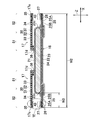
- FIG. 4 is a sectional view taken along line IV-IV in FIG. 2.
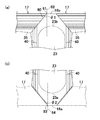
- A The partial enlarged view of the area
- each embodiment described below relates to the disposable diaper shown in FIGS. 1 to 10 as an example of the present invention, and includes not only an indispensable structure of the invention but also a selective and preferable structure.
- each elastic body to be described later is naturally gathered on the member to which each elastic body is attached by the contracting force in the lateral direction X and the longitudinal direction Y against the contracting force. It is in a state of being stretched to such an extent that it appears to be substantially lost visually.
- a diaper 10 which is an example of a disposable diaper according to the present invention includes a longitudinal direction Y and a transverse direction X orthogonal thereto, a skin facing surface and a non-skin facing surface on the opposite side thereof, A longitudinal center line P that bisects the length dimension in the direction X and a lateral center line Q that bisects the length dimension in the longitudinal direction Y; a front waist region 11; a rear waist region 12; And a crotch region 13 located between the front waist region 11 and the rear waist region 12.
- the diaper 10 is substantially symmetric with respect to the longitudinal center line P, and has a waist opening 14 and a pair of leg openings 15.
- the diaper 10 includes a diaper main body 16 having an absorber 23 and extending in the longitudinal direction Y, and a pair of waist belts 17 for connecting the front and rear waist regions 11 and 12.
- the pair of waist belts 17 is arranged substantially symmetrically with respect to the longitudinal center line P, and is formed of a plurality of independent seal portions that approach the longitudinal center line P from the leg opening 15 side toward the waist opening 14 side. It joins to the diaper main body 16 via line (seal line) 18A, 18B.
- the seal portion is applied by a known joining means, for example, various heat welding means such as hot embossing and sonic processing.
- the waist belt 17 the skin opposing surface and the skin opposing surface of the diaper main body 16 are mutually fixed in joining line 18A, 18B.
- the joining lines 18A and 18B do not touch the wearer's body and give a sense of incongruity or irritation.
- known joining means such as a hot melt adhesive can be used for the joining lines 18A and 18B in addition to the heat welding means.
- the waist belt 17 is formed by a pair of elastic panels, but can be formed from the same sheet material as the diaper body 16 by a manufacturing method described later.
- the diaper body 16 is defined by a front end edge 16a and a rear end edge 16b which are opposed to each other in the longitudinal direction Y, and both side edges 16c and 16d which are opposed to each other in the lateral direction X. It has a front end portion 20A located between the front end edges 16a, a rear end portion 20B located between the rear end edges 16b, and an intermediate portion 20C located between the front and rear end portions 20A and 20B.
- the front and rear end edges 16a and 16b are substantially symmetrical with respect to the vertical center line P and extend in a convex shape toward the outside in the vertical direction Y.
- the front and rear end portions 20A and 20B are located in the front and rear waist regions 11 and 12 of the diaper 10, respectively, and the intermediate portion 20C is located in the crotch region 13.
- the diaper main body 16 includes a liquid-permeable inner layer sheet 21 located on the skin facing surface, a liquid-impervious outer layer sheet 22 located on the non-skin facing surface, and an absorbent body located between the inner and outer layer sheets 21 and 22. 23, and a liquid-impervious or liquid-impervious leak-proof sheet 24 positioned between the absorber 23 and the outer layer sheet 22.
- a pair of side sheets 25 that are spaced apart from each other in the horizontal direction X and extend in the vertical direction Y are disposed.
- the inner layer sheet 21 has a substantially octagonal shape and has a mass of about 15 to 35 g / m 2 , preferably about 18 to 24 g / m 2, a hydrophilically treated hydrophobic air-through fiber nonwoven fabric, spunbond fiber nonwoven fabric, and point bond fiber nonwoven fabric. Etc. are preferably formed.
- the outer layer sheet 22 is approximately the same shape and size as the inner layer sheet 21, and has a hydrophobic spunbond / meltblown / spunbond (hereinafter referred to as “preferred”) having a mass of about 15-30 g / m 2 , preferably about 18-24 g / m 2. It is preferably formed from a fiber nonwoven fabric or a spunbond fiber nonwoven fabric (referred to as SMS).
- the absorbent body 23 has front and rear end edges 23a and 23b that are curved outward in the vertical direction Y, and both side edges 23c that extend in the vertical direction Y between the front and rear end edges, and is a liquid absorption molded in a required shape.
- a liquid diffusible core cover sheet such as tissue paper covering the liquid absorbent core.
- wood fluff pulp, superabsorbent polymer particles, or a mixture thereof can be used as the absorbent core.
- the liquid-absorbent core and the core cover sheet can be joined to each other using a known joining means such as a hot melt adhesive.
- the leak-proof sheet 24 is disposed so as to cover at least the entire non-skin facing surface (bottom surface) of the absorbent body 23, and a known joint such as a hot melt adhesive is interposed between the absorbent body 23 and the outer layer sheet 22. It can be joined by means.
- a liquid-permeable, preferably liquid-impervious and breathable plastic film can be used, and the leak-proof sheet 24 covers the entire non-skin facing surface of the absorbent body 23.
- the body fluid absorbed by the absorber 23 can be prevented from leaking to the outside of the diaper 10.
- the decorative element can be transmitted from the outer layer sheet 22 having a required light transmittance by using a sheet having decorative elements such as a pattern and a color as the leak-proof sheet 24.
- the pair of side sheets 25 are disposed on both sides in the lateral direction X of the absorbent body 23, and a publicly known hot melt adhesive or the like is provided between the leak-proof sheet 24 and the inner layer sheet 21. It is joined by the joining means.
- the side sheet 25 is formed of a first sheet 25A located on the absorber 23 side and a second sheet 25B located on the outer layer sheet 22 side, and both sheets 25A and 25B are joined by a known means such as a hot melt adhesive.
- a hydrophobic SMS fiber nonwoven fabric or a spunbond fiber nonwoven fabric having a mass of about 10 to 30 g / m 2 can be used.
- leg elastic bodies 26 extending in the vertical direction and the skin facing surface side of the leg elastic bodies 26 are located.
- a leg elastic sheet 27 is disposed.
- the leg elastic body 26 is formed of a plurality of string-like or strand-like elastic materials attached so as to be contractible in the longitudinal direction Y between the front end edge 16a and the rear end edge 16b of the diaper body 16.
- the leg elastic sheet 27 is a belt-like elastic member, and is formed from an elastic stretchable fiber nonwoven fabric formed from flat rubber or elastic fiber.
- leg elastic regions 40 are formed on the outer side portions in the lateral direction X of the side edges 23 c of the absorber 23.
- the leg elastic region 40 extends from the joint line 18A located in the front waist region 11 to the joint line 18B located in the rear waist region 12.
- the side sheet 25 is formed of two sheets 25A and 25B, but may be formed by bending and fixing a single fiber nonwoven fabric, or formed from an extended portion of the outer layer sheet 22. May be.
- the waist belt 17 has both end edges (front and rear end edges) 17a and 17b joined to the diaper body 16 via joining lines 18A and 18B, and both side edges 16c and 16d of the diaper body 16. It has a lower edge 17c that forms a leg opening 15 and an upper edge 17d that forms a waist opening edge.
- the waist belt 17 is divided into an upper portion 51 located on the waist opening side (first side edge side) and a lower portion 52 located on the leg opening side (second side edge side).
- the width-wise dimension of the upper part and the lower part is approximately 30 to 70% of the width dimension W1 of the waist belt 17 and preferably 50%. Therefore, for example, in the case of an M size of a normal adult diaper, the width dimension W1 of the waist belt 17 is about 70 mm, and the width dimension of the upper and lower portions 51 and 52 is about 35 mm.
- the waist belt 17 has inner and outer layers 31 and 32 formed from a waist sheet 30 made of fiber nonwoven fabric. Between the inner and outer layers 31, 32, a plurality of waist elastic bodies 33, 34 formed of a string-like or strand-like elastic material are attached so as to be contracted in an expanded state.
- the waist elastic bodies 33, 34 include an upper waist elastic body 33 disposed in the upper portion 51 and a lower waist elastic body 34 disposed in the lower portion 52.
- a waist elastic sheet 35 formed of an elastic fiber nonwoven fabric is disposed on the lower edge 17c side of the waist sheet 30.
- the waist elastic sheet 35 is disposed so that a part thereof overlaps with the lower waist elastic body 34 located at the bottom. Further, the waist sheet 30 is fixed in a state where a part thereof is bent inward on the upper edge 17d side.
- a plurality of upper waist elastic bodies 33 are arranged in the bent portion 36. Moreover, the upper waist elastic body 33 arrange
- the upper waist elastic body 33 overlapping in the thickness direction can be avoided, and fit to the body can be realized in a wide range. Furthermore, when the bent portion 36 is located at the edge of the waist opening, the light transmittance is locally lowered and a more underwear-like appearance is exhibited.
- the upper and lower waist elastic bodies 33 and 34 and the waist elastic sheet 35 overlap with the joining lines 18A and 18B, and also exhibit elastic elasticity in the portions overlapping with the joining lines 18A and 18B.
- ten upper waist elastic bodies 33 are disposed in the upper portion 51 of the waist belt 17, and six upper waist elastic bodies 33 (arranged in the bent portion 36) disposed on the waist opening side.
- the elastic body) is 450 to 500 dtex in thickness and fixed in a state of being stretched 3.0 to 3.5 times.
- the four elastic bodies arranged on the leg opening side of the upper waist elastic body 33 have a thickness of 600 to 650 dtex and are fixed while being stretched 2.5 to 3.0 times.
- Seven lower waist elastic bodies 34 are arranged in the lower portion 52, and the lower waist elastic body 34 has a thickness of 600 to 650 dtex and is fixed in a state of being stretched 2.5 to 3.0 times.
- the pitch (separation dimension) between the elastic bodies in the upper waist elastic body 33 and the lower waist elastic body 34 is an equal interval, and is 5.0 to 6.0 mm.
- the leg elastic sheet 27 may be a belt-like elastic sheet made of elastic stretchable fiber nonwoven fabric or urethane sheet. By arranging the leg elastic sheet 27 at the edge of the leg opening, the leg elastic region 40 fits in a planar shape to the wearer's body and can effectively prevent side leakage, and rubber marks due to the biting of the elastic yarn or the like Can be prevented.
- the lower waist elastic body 34 and the leg elastic sheet 27 are arranged in the lower portion 52, so that the unit of the lower portion 52 is larger than the elongation stress in the lateral direction X per unit area of the upper portion 51.
- the elongation stress in the lateral direction X per area is high.
- the waist opening can be easily expanded when worn.
- the extension stress of the lower part 52 is relatively high, it can be stably fitted to the wearer's body around the leg and can exhibit a required holding force.
- the diaper 10 is a so-called low-rise type that has a shallow crotch, where the width dimension of the waist belt 17 is smaller than the width dimension of the diaper body, and is easily displaced by the movement of the wearer during wear. Such a positional shift can be suppressed by being stably fitted to the body at 52.
- the elongation stress of the upper part 51 and the lower part 52 was measured by the following method using a tensile tester manufactured by Instron Japan Company Limited.
- the absorbent body 23 is removed from the diaper 10, and the regions forming the front and rear waist regions 11 and 12 extending in the direction around the waist are cut out to obtain an annular elastic panel.
- the annular sample 1 corresponding to the upper portion of the front and rear waist regions 11, 12 and the lower portion of the front and rear waist regions 11, 12
- An annular sample 2 is obtained, and the dimensions of the samples 1 and 2 in the contracted state are measured (K1, K2), respectively.
- the separation distance between the upper and lower hooks of the tensile tester is adjusted so as to be the length dimension K1 in the contracted state of the sample 1, and the upper hook (fixing tool) is measured.
- One end of the sample 1 (the portion corresponding to the central portion 17f in the longitudinal direction of the waist belt 17 shown in FIG. 7), the other end of the sample 1 (the longitudinal length of the waist belt 17 shown in FIG. 7) on the lower hook (movable tool).
- stretching the distance between hooks is finely adjusted so that extension stress may be set to 0.1N.
- the tensile tester is set to the cycle mode, and the upper hook is moved at a tensile speed of 300 mm / min.
- the sample 1 (upper part)
- the sample 1 is further extended 235 mm and then returned to the origin twice.
- the return stress at the time of the second extension of 181 mm was measured and used as the extension stress of Sample 1.
- the elongation stress of Sample 2 was also determined by the same measurement method as Sample 1.
- the outbound stress of sample 1 was 1.082N and the outbound stress of sample 2 was 1.083N, both of which were almost the same magnitude. Therefore, in the front and rear waist regions 11 and 12, the extension stress when stretched in the direction around the waist is substantially the same, and when worn, the entire front and rear waist regions 11 and 12 are expanded with a relatively small force. Can do.
- the return stress of Sample 1 was 3.476 N
- the return stress of Sample 2 was 4.557 N. Therefore, in a wearing state, it can be said that the leg opening side of the front and rear waist regions 11 and 12 fits the body more than the waist opening side.
- the lower waist elastic body 34 disposed in the lower portion 52 is attached at a lower expansion ratio than the upper waist elastic body 33 disposed in the upper portion 51.
- the difference between the expansion ratio of the lower waist elastic body 34 and the expansion ratio of the upper waist elastic body 33 is 0.5 times or less.
- the expansion ratio of the upper waist elastic body 33 is 3.2 to 3.7 times, and the expansion ratio of the lower waist elastic body 34 is 2.7 to 3.2 times. In this way, by setting the expansion ratio of the lower waist elastic body 34 to be relatively low, the amount of contraction of the lower portion 52 is smaller than that of the upper portion 51, and the leg opening is smaller in the contracted state than in the expanded state.
- the leg elastic sheet 27 in the lower portion 52 instead of adjusting the pitch and number of the upper waist elastic body 33 and the lower waist elastic body 34, the size of the leg opening edge in the contracted state is reduced to the leg.
- the elastic sheet 27 is larger than the state in which the elastic sheet 27 is not arranged, the leg opening can be made larger, and further, the upper and lower parts 51 and 52 are set so as to cause a difference in elongation stress. Even when 52 has a relatively high elongation stress, it fits in a planar shape and the biting into the skin is suppressed.
- the thickness of the lower waist elastic body 34 is larger than that of the upper waist elastic body 33.
- the thickness of the lower waist elastic body 34 is set to be relatively large, it is possible to exert a relatively large elongation stress at a low magnification, and to realize the fit of the leg opening edge. it can.
- the waist belt 17 has a length dimension L3 of the upper edge 17d larger than a length dimension L4 of the lower edge 17c when the diaper 10 is unfolded by peeling the joining line 18A.
- the length dimension (the length dimension of the upper portion 51) L5 of the upper edge 17d of the waist belt 17 is 550 to 600 mm
- the length dimension of the lower edge 17c. (Length dimension of lower portion 52) L6 is 300 to 350 mm
- dimension W1 in the width direction is 60 to 95 mm.
- the length dimension L6 of the lower part 52 is smaller than the length dimension L5 of the upper part 51.
- the length dimension L6 of the lower part 52 is 50 to 80% of the length dimension L5 of the upper part 51.
- the waist belt 17 is a diaper through joint lines 18A and 18B so that the first side edge 17c side is the leg opening edge side and the second side edge 17d side is the waist opening edge side.
- the main body 16 is joined to the front and rear end portions 20A and 20B so as to be contractable in an extended state. In this embodiment, it intersects perpendicularly with the waist opening edge in the intersection 61 of the boundary line 60 of the waist belt 17 and the diaper main body 16 which forms the inner edge of the joining line 18A, and a waist opening edge (it extends in parallel with the longitudinal centerline P).
- intersection angle ⁇ 1 which is the intersection angle between the imaginary line 62 and the boundary line, is the difference between the imaginary line 64 and the boundary line perpendicular to the waist opening edge at the intersection 63 of the boundary line and the waist opening edge forming the inner edge of the joint line 18B. It is the same as the intersection angle ⁇ 2. However, if necessary, the crossing angles ⁇ 1 and ⁇ 2 may be different from each other. In that case, the front side (abdominal side) and the rear side (back side) of the diaper 10 can be easily worn at the time of wearing. Can be identified.
- the wearer or the wear assistant concentrates the force to grip and lift the waist belt 17 and the force to pull the waist elastic bodies 33 and 34 in the direction around the waist.
- the stress concentrates at the intersections 61 and 63 between the waist opening and the joining line 18A, and the tearing is likely to occur.
- the joining line 18A since a plurality of sheets are joined and integrated by heat welding means instead of a hot melt adhesive, the rigidity is relatively high, and even when such force is concentrated. It is possible to suppress the diaper 10 from being broken.
- the bonding area of the entire bonding lines 18A and 18B or the portion on the intersection points 61 and 63 side is made larger than that of other portions to locally increase the bonding strength.
- the sheet strength may be increased by attaching a reinforcing sheet to a region including the portion.
- the longitudinal dimension Y2 of the absorbent body 23 is about 65 to 95% of the longitudinal dimension L1 of the diaper 10 (diaper body 16).
- the longitudinal dimension of the absorbent body is about 60% of the longitudinal dimension of the diaper, and is a portion formed only of a sheet member positioned on the outer side in the longitudinal direction from the absorbent body of the diaper. The area is relatively large.
- the absorbent body 23 has a length dimension sufficient to exhibit the required absorption performance, while comparing the area of the portion consisting only of the sheet member positioned outside in the longitudinal direction Y. By making it small, it can manufacture with fewer materials and can suppress manufacturing cost.
- the waist opening is lower than the umbilicus part in the worn state. It becomes a clean wearing aspect with low rise like that.
- the leg elastic region 40 and the lower waist elastic body 34 are A multilayer region 55 is formed in which the disposed waist elastic region overlaps in the thickness direction Z. Since the leg elastic body 26 and the lower waist elastic body 34 extend to the joining lines 18A and 18B located in the front and rear waist areas 11 and 12, the multi-layer area 55 is joined to the joining lines 18A and 18B in the front and rear waist areas 11 and 12, respectively. It is positioned so as to overlap.
- a plurality of waist elastic bodies 34a, 34b are arranged in order from the first side edge 17c side in the waist belt 17, and a plurality of stripe elastic bodies 34c, 16d in the diaper body 16 are sequentially arranged from the side edges 16c, 16d side.
- Leg elastic bodies 26a and 26b are disposed.
- the leg elastic body 26 and the lower waist elastic body 34 have such an arrangement, that is, the entire waist belt 17 is positioned inward in the lateral direction X from the outer ends of the joining lines 18A and 18B. Therefore, in the wearing state, the entire elongation stress can act on the diaper main body 16 and the whole can be interlocked with the movement of the diaper main body 16. In addition, side leakage of excrement is prevented by the wearer's thigh being surrounded by a virtual elastic band formed by the leg elastic region 40 and the waist elastic region, and the multi-layered region 55 is provided by the wearer's heel. The fitting property is improved by contacting the part.
- the leg elastic body 26 and the lower waist elastic body 34 are arranged so as not to overlap each other in the thickness direction Z.
- the lower waist elastic body 34 is located in a separated portion of the leg elastic bodies 26 adjacent in the lateral direction X
- the leg elastic body 26 is located in a separated portion of the lower waist elastic bodies 34 adjacent in the lateral direction X. is doing.
- each separation portion (pitch) means a separation dimension between opposing edges of adjacent elastic bodies.
- the direction in which the waist belt 17 expands and contracts and the direction in which the leg elastic region 40 expands and contracts is perpendicular to each other.
- the elastic bodies 34 and 26 can easily exert the stretching force.
- both elastic bodies 34 and 26 do not overlap with each other in the joining lines 18A and 18B, it is possible to prevent local tightening in the vicinity of the elastic bodies 34 and 26 and to fit them in a planar shape.
- the leg elastic body 26 can be fitted to the side edge of the leg elastic area 40 in the crotch area 13 to prevent excrement leakage. it can.
- the pitch of the leg elastic bodies 26 is about 3.0 to 6.0 mm
- the outermost waist elastic body 34a located on the outermost side in the lateral direction X has the outermost leg elasticity. It is located within the pitch between the body 26a and the leg elastic body 26b adjacent thereto.
- the dimension W2 in the lateral direction X of the layered area 55 is the dimension in the lateral direction X on both sides of the diaper 10, that is, absorption.
- About 10 to 90%, preferably 20 to 50%, more preferably 20 to 50% of the dimension W2 in the lateral direction X from the both side edges of the body 23 (side edges of the absorbent core) to the side edges 16c of the diaper body 16 % Is preferable.
- the leg elastic body is preferably positioned as far as possible in the lateral direction from the side edge of the liquid-absorbent core.
- the width dimension W2 of the multi-layered region 55 that contacts the crotch part is within a required size range with respect to the dimension W2 in the lateral direction X on both sides of the diaper 10. Also, it is fitted to the relatively wide crotch part without impairing the interlocking between the lower waist elastic body 34 and the leg elastic body 26, and also absorbs to the relatively narrow crotch part.
- the side edge portion of the body 23 can exert an appropriate fit without biting into the body.
- the joining lines 18A and 18B intersect the longitudinal center line P, when the diaper 10 is pulled up at the time of wearing, the intersection 58 There is a risk that it will be easy to break due to concentration of power.
- the leg elastic body 26 and the lower waist elastic body 34 overlap each other at the intersecting portion 58, a force that pulls the leg elastic body 26 in the opposite direction around the leg opening due to the contraction force of each other acts.
- the elastic bodies 26 and 34 do not overlap each other in plan view, and therefore, the forces pulling in the opposite directions are directly compared to the case where they overlap each other. It does not act on each other, and concentration of force to break it can be avoided.
- the leg elastic region 40 and the waist elastic region continuous around the leg opening are By tightening the body with the same extension stress, it is possible to prevent the generation of a gap due to a local change in the extension stress around the leg opening, and more effectively prevent the side leakage of excrement. Further, by increasing the elongation stress of the leg elastic region 40 more than the waist elastic region, even if the excrement is absorbed and the mass of the absorbent body 23 is increased, the crotch portion and the body are affected by the elongation stress of the leg elastic region 40.
- an elastic material having a fineness as compared with other elastic bodies is used as the outermost leg elastic body 26a located on the outermost side in the lateral direction X of the leg elastic bodies 26, and its extension force is higher than that of other elastic bodies. May be higher.
- the side leakage of excrement can be effectively prevented by appropriately setting the application amount and application pattern of the adhesive for attaching the outermost leg elastic body 26a to the sheet.
- frills are formed at the lower end edges of the front and rear waist regions 11 and 12, and an appearance like underwear can be obtained.
- the waist elastic body 34 and the leg elastic body 26 located in the overlapping region 55 are adjusted to have the same number and fineness, thereby adjusting the elongation stress within the same or constant range and uniform at the leg opening edge. Can fit your body.
- the diaper 10 has a curved shape such that the waist opening is convex downward as a whole. That is, since the position of the center part in the lateral direction of the front and rear waist regions 11 and 12 is located below the both side portions, the length dimension of the upper and lower areas is the same or the length dimension of the upper area is lower. Compared to a conventional diaper larger than the length of the side area, it can give a clean impression and is excellent in design.
- the waist elastic sheet 35 gradually becomes narrower in the upper portion 51 of the leg opening 15 from both end portions 35 ⁇ / b> A and 35 ⁇ / b> B located on the joining lines 18 ⁇ / b> A and 18 ⁇ / b> B side toward the central portion 35 ⁇ / b> C in the direction around the waist. It is the narrowest in the central part (the narrowest part) 35C.
- the leg elastic sheet 27 is gradually narrowed from both end portions 27A and 27B located on the side of the joining lines 18A and 8B toward the central portion (narrowest portion) 27C in the waist direction. The portion 27C is the narrowest.
- the waist elastic sheet 35 and the leg elastic sheet 27 have such a shape, the both ends 27A, 27B, 35A, and 35B of the two sheets located on the joining lines 18A and 18B side are within the lower body of the wearer. It fits stably at the root of the thigh where clearance is most likely to be formed between the diaper 10 and the central portions 27C and 35C are placed in contact with the vicinity of the hip bone and the outer portion of the thigh with the least movement of the body. By contacting, it is possible to achieve an appropriate fit to the body while suppressing the material cost compared to the case where the entire elastic sheet is formed with the same width dimension.
- the diaper 10 can be easily gripped when pulled up.
- the leg elastic sheet 27 is disposed in the crotch region 13 and fits in a belt-like manner without gaps, the sheet is lifted as compared with the case where only the leg elastic body 26 made of thread rubber is disposed at the edge of the leg opening. As a result, the crotch region 13 can be given a clean impression.
- the waist elastic sheet 35 and the leg elastic sheet 27 can form a belt-like elastic region around the leg opening to fit the body, but the lower waist elastic body 34 and the leg elastic body 26 are formed in the thickness direction Z. Since the outermost leg elastic body 26a is disposed outside the outermost waist elastic body 34a in the lateral direction X, leakage from the leg opening edge can be effectively prevented. .
- FIGS. 9A to 9D are diagrams showing a part of the manufacturing process of the diaper 10.
- the side sheet 25 and the waist sheet 30 of the diaper main body 16 are integrally formed from a base sheet 71 made of a fiber nonwoven fabric.
- the composite panel 70 includes a main body portion 73 serving as a base material of the diaper main body 16 on which the absorber 23 is disposed, and both side portions 74 serving as a base material of the waist belt 17 located on both sides of the main body portion 73.
- the base sheet 71 is attached to the both side portions 74 in a folded state, and continuous elastic bodies 77A and 77B forming the waist elastic bodies 33 and 34 and the leg elastic bodies 26 are arranged.
- a continuous elastic sheet 79 formed of an elastic stretchable fiber nonwoven fabric is disposed so as to overlap a part of the continuous elastic body 77A and the continuous elastic body 77B.
- a pair of elliptical slots 75 are formed between the main body portion 73 and the both side portions 74 and formed so as to extend in parallel with the absorber 23. . Further, a part of both side portions 74 is bent toward the main portion 73 along a bending line 76 extending so as to overlap the slot 75.
- the slot 75 can also be formed by making a straight cut into a part of the base sheet 71. In such a case, the sheet is likely to break from the cut end portion, and therefore, the slot 75 is predetermined by a hollowing process. Preferably, an opening having a width is formed.
- the continuous elastic sheet 79 is located, and the continuous elastic sheet 79 is cut out, whereby the waist elastic sheet 35 and the leg elastic sheet 27 are formed.
- the leg elastic sheet 27 is arranged at the edge of the leg opening by the punching process, so that the excrement can be prevented from leaking by contacting the thigh of the wearer without a gap.
- the leg opening edge can suppress sheet lifting and gather formation compared to the case where only a plurality of waist elastic bodies or leg elastic bodies made of elastic yarns are arranged at intervals. A clean appearance can be exhibited.
- the diaper 10 can be manufactured by cutting along a pair of thermal cutting lines 78.
- the pair of thermal cutting lines 78 are positioned so as to face each other with the absorber 23 interposed therebetween, and have a substantially V shape extending obliquely from both end edges of the slot 75 toward both end edges of the base sheet 71.
- the laminated constituent materials 71, 77A, 77B, 79 are joined together along the thermal cutting line 78 to form the joining lines 18A, 18B.
- a leg opening 15 formed by a slot 75 is defined between both side edges 16 c and 16 d of the diaper body 16 and the first side edge 17 c of the waist belt 17.
Landscapes
- Health & Medical Sciences (AREA)
- Epidemiology (AREA)
- Engineering & Computer Science (AREA)
- Biomedical Technology (AREA)
- Heart & Thoracic Surgery (AREA)
- Vascular Medicine (AREA)
- Life Sciences & Earth Sciences (AREA)
- Animal Behavior & Ethology (AREA)
- General Health & Medical Sciences (AREA)
- Public Health (AREA)
- Veterinary Medicine (AREA)
- Absorbent Articles And Supports Therefor (AREA)
Abstract
La présente invention concerne une couche jetable dans laquelle un déchirement de feuille ne se produit pas au niveau d'une partie d'une ligne de jonction entre une ceinture et un corps de couche, et qui s'adapte parfaitement aux bords des ouvertures de jambe. Une paire de ceintures pour la taille présente des régions élastiques de taille ayant (41) une pluralité de corps élastiques de taille (33) qui sont chacun extensible dans son sens de la longueur, et sont joints à un corps de couche (16) par des lignes de jonction (18) présentant une distance d'espacement entre elles qui diminue depuis les côtés des ouvertures de jambe (15) jusqu'au côté d'une ouverture de taille (14) dans des régions de taille avant et arrière (11), (12). Le corps de la couche (16) présente une région élastique de jambe (40) pourvue d'une pluralité de corps élastiques de jambe (26) qui s'étendent le long des bords des ouvertures de jambe (15). Dans un état dans lequel la région élastique de taille (41) et la région élastique de jambe (40) sont étirées dans une direction verticale (Y), les corps élastiques de ceinture (33) et les corps élastiques de jambe (26) se chevauchent dans une direction d'épaisseur (Z). Dans une région dans laquelle les deux régions élastiques se chevauchent, les corps élastiques de taille (33) et les corps élastiques de jambe (26) ne se chevauchent pas dans la direction de l'épaisseur (Z), et une partie de corps élastiques de jambe (26) est positionnée plus à l'extérieur que les corps élastiques de taille (33) dans une direction horizontale (X).
Priority Applications (1)
| Application Number | Priority Date | Filing Date | Title |
|---|---|---|---|
| JP2016566545A JP6479047B2 (ja) | 2014-12-26 | 2015-12-25 | 使い捨てのおむつ |
Applications Claiming Priority (2)
| Application Number | Priority Date | Filing Date | Title |
|---|---|---|---|
| JP2014266541 | 2014-12-26 | ||
| JP2014-266541 | 2014-12-26 |
Publications (1)
| Publication Number | Publication Date |
|---|---|
| WO2016104751A1 true WO2016104751A1 (fr) | 2016-06-30 |
Family
ID=56150763
Family Applications (1)
| Application Number | Title | Priority Date | Filing Date |
|---|---|---|---|
| PCT/JP2015/086346 Ceased WO2016104751A1 (fr) | 2014-12-26 | 2015-12-25 | Couche jetable |
Country Status (2)
| Country | Link |
|---|---|
| JP (1) | JP6479047B2 (fr) |
| WO (1) | WO2016104751A1 (fr) |
Cited By (7)
| Publication number | Priority date | Publication date | Assignee | Title |
|---|---|---|---|---|
| JP6145559B1 (ja) * | 2016-12-28 | 2017-06-14 | ユニ・チャーム株式会社 | パンツ型おむつ、及び、パンツ型おむつの着用方法 |
| JP2018000594A (ja) * | 2016-07-04 | 2018-01-11 | ユニ・チャーム株式会社 | 吸収性物品 |
| WO2018008401A1 (fr) * | 2016-07-04 | 2018-01-11 | ユニ・チャーム株式会社 | Article absorbant de type culotte et article absorbant |
| JP2018000592A (ja) * | 2016-07-04 | 2018-01-11 | ユニ・チャーム株式会社 | パンツ型吸収性物品 |
| JP2018000593A (ja) * | 2016-07-04 | 2018-01-11 | ユニ・チャーム株式会社 | 吸収性物品 |
| JP2018108323A (ja) * | 2017-03-22 | 2018-07-12 | ユニ・チャーム株式会社 | パンツ型おむつ、及び、パンツ型おむつの着用方法 |
| CN118516805A (zh) * | 2024-05-28 | 2024-08-20 | 黄山富田精工智造股份有限公司 | 一种弹性材料、外装体及穿着用品 |
Citations (7)
| Publication number | Priority date | Publication date | Assignee | Title |
|---|---|---|---|---|
| JPS60199903A (ja) * | 1984-03-17 | 1985-10-09 | 本州キノクロス株式会社 | 使捨ておむつ |
| JPH08507699A (ja) * | 1992-10-27 | 1996-08-20 | プロクター・アンド・ギャンブル・ファー・イースト・インク | ウエスト開口部全体を伸縮自在とした使い捨ておむつ |
| JPH0910261A (ja) * | 1995-06-29 | 1997-01-14 | Zuiko:Kk | 使い捨て着用物品およびその製造方法 |
| JPH09290003A (ja) * | 1996-02-26 | 1997-11-11 | Hakujiyuuji Kk | 使い捨ておむつ |
| JP2011139857A (ja) * | 2010-01-08 | 2011-07-21 | Unicharm Corp | 使い捨て着用物品 |
| JP2014124288A (ja) * | 2012-12-26 | 2014-07-07 | Kao Corp | パンツ型吸収性物品及びその製造方法 |
| JP2014150909A (ja) * | 2013-02-06 | 2014-08-25 | Uni Charm Corp | 低月齢児用パンツ型おむつ |
-
2015
- 2015-12-25 WO PCT/JP2015/086346 patent/WO2016104751A1/fr not_active Ceased
- 2015-12-25 JP JP2016566545A patent/JP6479047B2/ja not_active Expired - Fee Related
Patent Citations (7)
| Publication number | Priority date | Publication date | Assignee | Title |
|---|---|---|---|---|
| JPS60199903A (ja) * | 1984-03-17 | 1985-10-09 | 本州キノクロス株式会社 | 使捨ておむつ |
| JPH08507699A (ja) * | 1992-10-27 | 1996-08-20 | プロクター・アンド・ギャンブル・ファー・イースト・インク | ウエスト開口部全体を伸縮自在とした使い捨ておむつ |
| JPH0910261A (ja) * | 1995-06-29 | 1997-01-14 | Zuiko:Kk | 使い捨て着用物品およびその製造方法 |
| JPH09290003A (ja) * | 1996-02-26 | 1997-11-11 | Hakujiyuuji Kk | 使い捨ておむつ |
| JP2011139857A (ja) * | 2010-01-08 | 2011-07-21 | Unicharm Corp | 使い捨て着用物品 |
| JP2014124288A (ja) * | 2012-12-26 | 2014-07-07 | Kao Corp | パンツ型吸収性物品及びその製造方法 |
| JP2014150909A (ja) * | 2013-02-06 | 2014-08-25 | Uni Charm Corp | 低月齢児用パンツ型おむつ |
Cited By (10)
| Publication number | Priority date | Publication date | Assignee | Title |
|---|---|---|---|---|
| JP2018000594A (ja) * | 2016-07-04 | 2018-01-11 | ユニ・チャーム株式会社 | 吸収性物品 |
| WO2018008401A1 (fr) * | 2016-07-04 | 2018-01-11 | ユニ・チャーム株式会社 | Article absorbant de type culotte et article absorbant |
| JP2018000592A (ja) * | 2016-07-04 | 2018-01-11 | ユニ・チャーム株式会社 | パンツ型吸収性物品 |
| JP2018000593A (ja) * | 2016-07-04 | 2018-01-11 | ユニ・チャーム株式会社 | 吸収性物品 |
| CN109414353A (zh) * | 2016-07-04 | 2019-03-01 | 尤妮佳股份有限公司 | 内裤形吸收性物品以及吸收性物品 |
| JP6145559B1 (ja) * | 2016-12-28 | 2017-06-14 | ユニ・チャーム株式会社 | パンツ型おむつ、及び、パンツ型おむつの着用方法 |
| WO2018123072A1 (fr) * | 2016-12-28 | 2018-07-05 | ユニ・チャーム株式会社 | Couche de type culotte et procédé de port de couche de type culotte |
| JP2018102847A (ja) * | 2016-12-28 | 2018-07-05 | ユニ・チャーム株式会社 | パンツ型おむつ、及び、パンツ型おむつの着用方法 |
| JP2018108323A (ja) * | 2017-03-22 | 2018-07-12 | ユニ・チャーム株式会社 | パンツ型おむつ、及び、パンツ型おむつの着用方法 |
| CN118516805A (zh) * | 2024-05-28 | 2024-08-20 | 黄山富田精工智造股份有限公司 | 一种弹性材料、外装体及穿着用品 |
Also Published As
| Publication number | Publication date |
|---|---|
| JPWO2016104751A1 (ja) | 2017-10-12 |
| JP6479047B2 (ja) | 2019-03-06 |
Similar Documents
| Publication | Publication Date | Title |
|---|---|---|
| JP6479047B2 (ja) | 使い捨てのおむつ | |
| JP5999878B2 (ja) | 使い捨て着用物品 | |
| WO2011043373A1 (fr) | Article absorbant de type culotte | |
| JP5592737B2 (ja) | パンツ型吸収性物品 | |
| WO2017002469A1 (fr) | Article pouvant être porté jetable | |
| JP6429710B2 (ja) | 使い捨ての着用物品 | |
| JP6479046B2 (ja) | 使い捨ておむつ | |
| JP6479049B2 (ja) | 使い捨ておむつ | |
| CN109982672A (zh) | 吸收性物品 | |
| JP7129799B2 (ja) | 使い捨て着用物品 | |
| JP3206405U (ja) | 使い捨て着用物品 | |
| JP6479048B2 (ja) | 使い捨てのおむつ | |
| WO2016189906A1 (fr) | Article à porter jetable | |
| CN106572934A (zh) | 套穿式的穿着物品 | |
| JP6422811B2 (ja) | 使い捨て着用物品 | |
| JP6422810B2 (ja) | 使い捨ての着用物品 | |
| JP6419012B2 (ja) | 使い捨て着用物品 | |
| JP3206403U (ja) | 吸収性物品 | |
| JP5833270B1 (ja) | 使い捨て着用物品 | |
| JP7474665B2 (ja) | 吸収性物品 | |
| JP3206840U (ja) | 使い捨て着用物品 | |
| WO2016104749A1 (fr) | Couche jetable | |
| JP2019118544A (ja) | 使い捨て着用物品 | |
| JP6444798B2 (ja) | 使い捨ての着用物品 | |
| JP6429741B2 (ja) | 使い捨てのパンツ型おむつ |
Legal Events
| Date | Code | Title | Description |
|---|---|---|---|
| 121 | Ep: the epo has been informed by wipo that ep was designated in this application |
Ref document number: 15873319 Country of ref document: EP Kind code of ref document: A1 |
|
| ENP | Entry into the national phase |
Ref document number: 2016566545 Country of ref document: JP Kind code of ref document: A |
|
| NENP | Non-entry into the national phase |
Ref country code: DE |
|
| 122 | Ep: pct application non-entry in european phase |
Ref document number: 15873319 Country of ref document: EP Kind code of ref document: A1 |