WO2018008401A1 - Article absorbant de type culotte et article absorbant - Google Patents
Article absorbant de type culotte et article absorbant Download PDFInfo
- Publication number
- WO2018008401A1 WO2018008401A1 PCT/JP2017/022886 JP2017022886W WO2018008401A1 WO 2018008401 A1 WO2018008401 A1 WO 2018008401A1 JP 2017022886 W JP2017022886 W JP 2017022886W WO 2018008401 A1 WO2018008401 A1 WO 2018008401A1
- Authority
- WO
- WIPO (PCT)
- Prior art keywords
- main body
- absorbent article
- folded
- belt portion
- absorbent
- Prior art date
- Legal status (The legal status is an assumption and is not a legal conclusion. Google has not performed a legal analysis and makes no representation as to the accuracy of the status listed.)
- Ceased
Links
Images





Classifications
-
- A—HUMAN NECESSITIES
- A61—MEDICAL OR VETERINARY SCIENCE; HYGIENE
- A61F—FILTERS IMPLANTABLE INTO BLOOD VESSELS; PROSTHESES; DEVICES PROVIDING PATENCY TO, OR PREVENTING COLLAPSING OF, TUBULAR STRUCTURES OF THE BODY, e.g. STENTS; ORTHOPAEDIC, NURSING OR CONTRACEPTIVE DEVICES; FOMENTATION; TREATMENT OR PROTECTION OF EYES OR EARS; BANDAGES, DRESSINGS OR ABSORBENT PADS; FIRST-AID KITS
- A61F13/00—Bandages or dressings; Absorbent pads
- A61F13/15—Absorbent pads, e.g. sanitary towels, swabs or tampons for external or internal application to the body; Supporting or fastening means therefor; Tampon applicators
-
- A—HUMAN NECESSITIES
- A61—MEDICAL OR VETERINARY SCIENCE; HYGIENE
- A61F—FILTERS IMPLANTABLE INTO BLOOD VESSELS; PROSTHESES; DEVICES PROVIDING PATENCY TO, OR PREVENTING COLLAPSING OF, TUBULAR STRUCTURES OF THE BODY, e.g. STENTS; ORTHOPAEDIC, NURSING OR CONTRACEPTIVE DEVICES; FOMENTATION; TREATMENT OR PROTECTION OF EYES OR EARS; BANDAGES, DRESSINGS OR ABSORBENT PADS; FIRST-AID KITS
- A61F13/00—Bandages or dressings; Absorbent pads
- A61F13/15—Absorbent pads, e.g. sanitary towels, swabs or tampons for external or internal application to the body; Supporting or fastening means therefor; Tampon applicators
- A61F13/45—Absorbent pads, e.g. sanitary towels, swabs or tampons for external or internal application to the body; Supporting or fastening means therefor; Tampon applicators characterised by the shape
- A61F13/49—Absorbent pads, e.g. sanitary towels, swabs or tampons for external or internal application to the body; Supporting or fastening means therefor; Tampon applicators characterised by the shape specially adapted to be worn around the waist, e.g. diapers, nappies
- A61F13/496—Absorbent pads, e.g. sanitary towels, swabs or tampons for external or internal application to the body; Supporting or fastening means therefor; Tampon applicators characterised by the shape specially adapted to be worn around the waist, e.g. diapers, nappies in the form of pants or briefs
-
- A—HUMAN NECESSITIES
- A61—MEDICAL OR VETERINARY SCIENCE; HYGIENE
- A61F—FILTERS IMPLANTABLE INTO BLOOD VESSELS; PROSTHESES; DEVICES PROVIDING PATENCY TO, OR PREVENTING COLLAPSING OF, TUBULAR STRUCTURES OF THE BODY, e.g. STENTS; ORTHOPAEDIC, NURSING OR CONTRACEPTIVE DEVICES; FOMENTATION; TREATMENT OR PROTECTION OF EYES OR EARS; BANDAGES, DRESSINGS OR ABSORBENT PADS; FIRST-AID KITS
- A61F13/00—Bandages or dressings; Absorbent pads
- A61F13/15—Absorbent pads, e.g. sanitary towels, swabs or tampons for external or internal application to the body; Supporting or fastening means therefor; Tampon applicators
- A61F13/45—Absorbent pads, e.g. sanitary towels, swabs or tampons for external or internal application to the body; Supporting or fastening means therefor; Tampon applicators characterised by the shape
- A61F13/49—Absorbent pads, e.g. sanitary towels, swabs or tampons for external or internal application to the body; Supporting or fastening means therefor; Tampon applicators characterised by the shape specially adapted to be worn around the waist, e.g. diapers, nappies
-
- A—HUMAN NECESSITIES
- A61—MEDICAL OR VETERINARY SCIENCE; HYGIENE
- A61F—FILTERS IMPLANTABLE INTO BLOOD VESSELS; PROSTHESES; DEVICES PROVIDING PATENCY TO, OR PREVENTING COLLAPSING OF, TUBULAR STRUCTURES OF THE BODY, e.g. STENTS; ORTHOPAEDIC, NURSING OR CONTRACEPTIVE DEVICES; FOMENTATION; TREATMENT OR PROTECTION OF EYES OR EARS; BANDAGES, DRESSINGS OR ABSORBENT PADS; FIRST-AID KITS
- A61F13/00—Bandages or dressings; Absorbent pads
- A61F13/15—Absorbent pads, e.g. sanitary towels, swabs or tampons for external or internal application to the body; Supporting or fastening means therefor; Tampon applicators
- A61F13/45—Absorbent pads, e.g. sanitary towels, swabs or tampons for external or internal application to the body; Supporting or fastening means therefor; Tampon applicators characterised by the shape
- A61F13/49—Absorbent pads, e.g. sanitary towels, swabs or tampons for external or internal application to the body; Supporting or fastening means therefor; Tampon applicators characterised by the shape specially adapted to be worn around the waist, e.g. diapers, nappies
- A61F13/49001—Absorbent pads, e.g. sanitary towels, swabs or tampons for external or internal application to the body; Supporting or fastening means therefor; Tampon applicators characterised by the shape specially adapted to be worn around the waist, e.g. diapers, nappies having preferential bending zones, e.g. fold lines or grooves
-
- A—HUMAN NECESSITIES
- A61—MEDICAL OR VETERINARY SCIENCE; HYGIENE
- A61F—FILTERS IMPLANTABLE INTO BLOOD VESSELS; PROSTHESES; DEVICES PROVIDING PATENCY TO, OR PREVENTING COLLAPSING OF, TUBULAR STRUCTURES OF THE BODY, e.g. STENTS; ORTHOPAEDIC, NURSING OR CONTRACEPTIVE DEVICES; FOMENTATION; TREATMENT OR PROTECTION OF EYES OR EARS; BANDAGES, DRESSINGS OR ABSORBENT PADS; FIRST-AID KITS
- A61F13/00—Bandages or dressings; Absorbent pads
- A61F13/15—Absorbent pads, e.g. sanitary towels, swabs or tampons for external or internal application to the body; Supporting or fastening means therefor; Tampon applicators
- A61F13/45—Absorbent pads, e.g. sanitary towels, swabs or tampons for external or internal application to the body; Supporting or fastening means therefor; Tampon applicators characterised by the shape
- A61F13/49—Absorbent pads, e.g. sanitary towels, swabs or tampons for external or internal application to the body; Supporting or fastening means therefor; Tampon applicators characterised by the shape specially adapted to be worn around the waist, e.g. diapers, nappies
- A61F13/49007—Form-fitting, self-adjusting disposable diapers
- A61F13/49009—Form-fitting, self-adjusting disposable diapers with elastic means
- A61F13/49011—Form-fitting, self-adjusting disposable diapers with elastic means the elastic means is located at the waist region
-
- A—HUMAN NECESSITIES
- A61—MEDICAL OR VETERINARY SCIENCE; HYGIENE
- A61F—FILTERS IMPLANTABLE INTO BLOOD VESSELS; PROSTHESES; DEVICES PROVIDING PATENCY TO, OR PREVENTING COLLAPSING OF, TUBULAR STRUCTURES OF THE BODY, e.g. STENTS; ORTHOPAEDIC, NURSING OR CONTRACEPTIVE DEVICES; FOMENTATION; TREATMENT OR PROTECTION OF EYES OR EARS; BANDAGES, DRESSINGS OR ABSORBENT PADS; FIRST-AID KITS
- A61F13/00—Bandages or dressings; Absorbent pads
- A61F13/15—Absorbent pads, e.g. sanitary towels, swabs or tampons for external or internal application to the body; Supporting or fastening means therefor; Tampon applicators
- A61F13/53—Absorbent pads, e.g. sanitary towels, swabs or tampons for external or internal application to the body; Supporting or fastening means therefor; Tampon applicators characterised by the absorbing medium
- A61F13/531—Absorbent pads, e.g. sanitary towels, swabs or tampons for external or internal application to the body; Supporting or fastening means therefor; Tampon applicators characterised by the absorbing medium having a homogeneous composition through the thickness of the pad
- A61F13/532—Absorbent pads, e.g. sanitary towels, swabs or tampons for external or internal application to the body; Supporting or fastening means therefor; Tampon applicators characterised by the absorbing medium having a homogeneous composition through the thickness of the pad inhomogeneous in the plane of the pad
- A61F13/533—Absorbent pads, e.g. sanitary towels, swabs or tampons for external or internal application to the body; Supporting or fastening means therefor; Tampon applicators characterised by the absorbing medium having a homogeneous composition through the thickness of the pad inhomogeneous in the plane of the pad having discontinuous areas of compression
-
- A—HUMAN NECESSITIES
- A61—MEDICAL OR VETERINARY SCIENCE; HYGIENE
- A61F—FILTERS IMPLANTABLE INTO BLOOD VESSELS; PROSTHESES; DEVICES PROVIDING PATENCY TO, OR PREVENTING COLLAPSING OF, TUBULAR STRUCTURES OF THE BODY, e.g. STENTS; ORTHOPAEDIC, NURSING OR CONTRACEPTIVE DEVICES; FOMENTATION; TREATMENT OR PROTECTION OF EYES OR EARS; BANDAGES, DRESSINGS OR ABSORBENT PADS; FIRST-AID KITS
- A61F13/00—Bandages or dressings; Absorbent pads
- A61F13/15—Absorbent pads, e.g. sanitary towels, swabs or tampons for external or internal application to the body; Supporting or fastening means therefor; Tampon applicators
- A61F13/551—Packaging before or after use
- A61F13/55105—Packaging before or after use packaging of diapers
- A61F13/55115—Packaging before or after use packaging of diapers characterized by the features before use, e.g. how are the diapers folded or arranged in a package
Definitions
- the present invention relates to a pants-type absorbent article and an absorbent article.
- absorbent articles such as pants-type disposable diapers are known.
- the first portion 26 (one side in the left-right direction) and the third portion (the other side in the left-right direction) 30 of the front side portion 12 and the rear side portion 14 constituting the waistline portion are arranged in the left-right direction.
- a compact folded absorbent article 10 is disclosed that is folded and further folded up and down at a boundary 24.
- the problem to be solved by the present invention is at least one of the following first to third problems.
- the first problem is that when the pant-type absorbent article (diaper) of Patent Document 1 is folded in the vertical direction, the absorbent main body is also folded in the vertical direction together with the diaper. At this time, when the absorbent body has high rigidity, the absorbent main body is less likely to crease (folds) and easily returns to the flat state before folding. It is difficult to wrap compactly. On the other hand, when the rigidity of the absorbent body is low, the absorbent main body is easily creased and the folded state is easily maintained. Therefore, when the diaper is used, it may be difficult to unfold it from the folded state.
- the present invention has been made in view of the above-described problems, and the object of the present invention is to provide a pant-type absorption that is easily maintained in a folded state during packaging and can be easily deployed during use. It is to provide a sex article.
- the second problem is that in the absorbent article 1 of Patent Document 1, the absorbent article 10 in a pant-type state is folded in the vertical direction at the boundary line 24, so the first part 26 and the third part 30 are the second part. 28 is folded in the vertical direction together with the number of members folded in the vertical direction, which may make it difficult to maintain the folded state.
- the present invention has been made in view of the above problems, and its purpose is to easily maintain the folded state of the belt portion and the absorbent main body of the absorbent article and maintain a more compact packaging state. There is to do.
- the said subject becomes so remarkable that a pants-type disposable diaper is brought close to the shape like underwear.
- the length in the vertical direction (inseam) of a disposable diaper is increased to bring it closer to the shape of an underwear, the length of the absorbent core (absorbent body) in the vertical direction becomes longer, and the absorbent core is moved in the vertical direction. May need to wrap around. Even in such a case, an object is to make it easier to maintain the folded state and to maintain a more compact packaging state.
- the third problem is that such a disposable diaper is required to look like underwear.
- both side regions 23 (belt portions) are long in the lateral direction like underwear, the diaper 1 accommodated in the package 15 is There was a risk that it would not be compact.
- the present invention has been made in view of the above problems, and an object thereof is to make the absorbent article in a more compact packaging state.
- the said subject becomes so remarkable that a pants-type disposable diaper is brought close to the shape like underwear.
- the absorbent core that has been lengthened in the vertical direction is folded back in the vertical direction, There is a possibility that the belt portion that has become longer needs to be folded back in the lateral direction. Even in such a case, an object is to make it easier to maintain the folded state and to maintain a more compact packaging state.
- a main invention for achieving the first object includes a belt portion having an up-down direction, a left-right direction, and a front-rear direction intersecting each other, and constituting at least a part of a waistline opening along the left-right direction,
- An absorbent main body having both end portions connected to the belt portion along the vertical direction, and when wrapped with a packaging material, is folded at a predetermined folding position in the vertical direction, and the absorbent main body is A pants-type absorbent article that is folded from the lower side to the upper side in the up-down direction, and in the bent position, one side portion located on one side in the front-rear direction of the absorbent main body,
- the other side part located in the other side of the said front-back direction among the absorptive main bodies has a part from which rigidity differs mutually, It is a underpants type absorbent article characterized by the above-mentioned.
- a main invention for achieving the second object is to have a belt portion that has a longitudinal direction and a transverse direction intersecting each other, and that forms at least a part of a waistline opening along the transverse direction, and along the longitudinal direction.
- An absorbent main body having both end portions connected to the belt portion, and in the longitudinal direction, the opening side where the waistline opening is located and the side opposite to the opening side in the longitudinal direction
- An absorbent article having an anti-opening side, wherein both side ends of the belt portion in the lateral direction are folded back inward in the lateral direction, and the absorbent main body is opened from the anti-opening side to the opening side.
- the absorbent article is folded in the longitudinal direction so as to cover at least a part of the both side ends without folding the both side ends in the longitudinal direction.
- a main invention for achieving the third object includes a belt portion having a longitudinal direction and a transverse direction intersecting each other, forming at least a part of a waistline opening along the transverse direction, and the longitudinal direction. And an absorbent main body having both ends connected to the belt portion, and in the longitudinal direction, the opening side where the waistline opening is located is opposite to the opening side.
- An absorbent article having a side opposite opening side, wherein the belt portion includes one side portion including one side end of both side ends in the lateral direction and the other side including the other side end.
- a side portion, the both side ends of the belt portion are folded inward in the lateral direction, at least a part of the one side end overlaps the other side portion, and the absorbent main body is The both side ends from the non-opening side toward the opening side
- a absorbent article characterized in that it is folded in the longitudinal direction so as to cover at least a part.
- the effect of the present invention with respect to the first problem can provide a pant-type absorbent article that is easily maintained in a folded state at the time of packaging and that can be easily expanded from the folded state at the time of use.
- the effect of the present invention with respect to the second problem is that the absorbent main body is folded inward in the vertical direction without folding both lateral ends of the belt portion in the vertical direction.
- the number of folded members is smaller than when folded in the vertical direction, the state of the folded absorbent article is easily maintained, and a more compact packaging state can be maintained.
- the effect of the present invention with respect to the third problem can make the lateral length of the absorbent article in a packaged state shorter.
- both ends of the belt portion are folded so as to be positioned on the skin side of the absorbent main body, when trying to take out and wear the absorbent article from the packaging material, depending on the thickness of the belt portion, The abdomen and back sides of the waistline opening are separated from each other, and it becomes easy to grasp the abdomen or back part of the waistline opening from the separated waistline opening. Become.
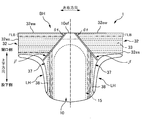
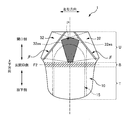
- FIG. 1 is a schematic front view of the diaper 1 viewed from the ventral side.
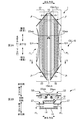
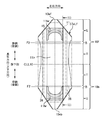
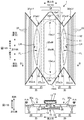
- FIG. 2A is a plan view of the diaper 1 in a state where the absorbent main body 10 and the belt portion 32 are elongated in the longitudinal direction.
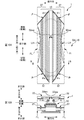
- 2B is a BB cross-sectional view of the diaper 1 in the state of FIG. 2A.
- FIG. 3A is a plan view of the diaper 1 in which the first connection portion jf and the second connection portion jb of FIG. 2A are separated and developed.
- FIG. 3B is a cross-sectional view of the diaper 1 in the state of FIG. 3A.
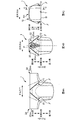
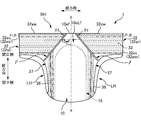
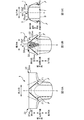
- 4A is a schematic plan view of the diaper 1 before packaging, FIG.
- FIG. 4B is a schematic plan view of the diaper 1 in a state where the belt portion 32 is folded back from the state of FIG. 4A
- FIG. 4C is a state of FIG. 4B.
- It is a plane schematic diagram of the diaper 1 in the state where the absorbent main body 10 is folded back.
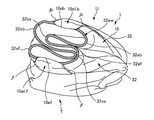
- It is a figure explaining the diaper 1 after taking out from a packaging state and carrying out predetermined time progress.
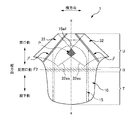
- It is a figure explaining the diaper 1 of the state of FIG. 4B.
- FIG. 4C is a schematic cross-sectional view showing the CC cross section of FIG. 4C.
- FIG. 9 is a schematic front view of the diaper 1 of the first embodiment viewed from the ventral side.
- FIG. 10A is a plan view of the diaper 1 in a state where the absorbent main body 10 and the belt portion 32 are elongated in the longitudinal direction.
- FIG. 10B is a cross-sectional view of the diaper 1 in the state of FIG. 2A.
- FIG. 11A is a plan view of the diaper 1 in which the first connection part jf and the second connection part jb of FIG. 10A are separated and developed.
- FIG. 11B is a cross-sectional view of the diaper 1 in the state of FIG. 3A.
- FIG. 12A is a schematic plan view of the diaper 1 before packaging.
- FIG. 12B is a schematic plan view of the diaper 1 in a state where the belt portion 32 is folded back from the state of FIG. 12A.
- FIG. 12C is a schematic plan view of the diaper 1 in a state where the absorbent main body 10 is folded from the state of FIG. 12B.
- Drawing 13 is a figure explaining diaper 1 taken out from a packing state and after a predetermined time progress.
- FIG. 14 is a plan view of the diaper 1 of FIG. 12C as viewed from the non-folded portion U side.
- FIG. 15 is a diagram illustrating the diaper 1 in the state of FIG. 12B.
- FIG. 16A is a plan view of the diaper 1 with the belt portion 32 folded back to the innermost side as viewed from the folded portion T side.
- FIG. 16B is a plan view of the diaper 1 of FIG. 8A as viewed from the non-folded portion U side.
- FIG. 17 is a diagram illustrating the diaper 1 when the folding position of the belt portion 32 is changed.
- FIG. 18A is a plan view of the diaper 1 before packaging.
- 18B is a plan view of the diaper 1 in a state where the belt portion 32 is folded back from the state of FIG. 18A.
- FIG. 18C is a plan view of the diaper 1 in a state where the absorbent main body 10 is folded from the state of FIG. 18B.
- a belt portion that has a vertical direction, a horizontal direction, and a front-rear direction intersecting each other, and that forms at least a part of a waistline opening along the left-right direction, and both end portions are connected to the belt portion along the vertical direction.
- the absorbent main body is provided and is wrapped at a predetermined folding position in the up-down direction when packaged with a packaging material, and the absorbent main body is folded back from the lower side in the vertical direction toward the upper side.
- a pant-type absorbent article wherein, in the bent position, one side portion located on one side in the front-rear direction of the absorbent main body and the other side in the front-rear direction of the absorbent main body
- the pants-type absorbent article, wherein the other side portion has portions having different rigidity from each other.
- a crease is easily formed and a bent state is easily maintained in one of the one side portion and the other side portion of the absorbent main body having a low rigidity.
- the rigidity is higher, the crease is less likely to be formed at the folding position, and the bent state is easily returned to the planar state. This makes it easier to maintain the folded state during wrapping and easier to unfold from the folded state during use compared to a diaper where there is no difference in rigidity between the one side part and the other side part in the folded part.
- a sex product can be realized.
- both side ends of the belt portion in the left-right direction are folded back inward in the left-right direction, and the folding position is lower than the lower ends of the side ends in the up-down direction. It is desirable to be provided on the lower side.
- pant-type absorbent article when the absorbent main body is folded at the folding position, the belt portion is prevented from being folded back and forth together with the absorbent main body. Therefore, the number of members folded at the folding portion is reduced, the folded state of the pant-type absorbent article is easily maintained, and a more compact packaging state can be maintained.
- the belly of the waistline opening depends on the thickness of the belt portion located on the skin side of the absorbent main body. Since the side portion and the back portion are separated from each other and the ventral portion or the back portion of the waist opening is easily grasped with the separated waist opening as a base point, the pant-type absorbent article can be easily spread in a wearing state.
- the rigidity at the end in the left-right direction of the absorbent main body is higher than the rigidity at a portion other than the end of the absorbent main body.
- a high rigidity region (high rigidity region) is formed only at the left and right ends of the absorbent main body, so that the skin of the wearer can be worn at the time of wearing. And the contact area between the high-rigidity region can be made as small as possible. Thereby, it can be made hard to produce a discomfort to a wearer.
- the high rigidity region is provided at both ends in the left-right direction, so that the absorbent main body can be stably bent easily at the folding position. Furthermore, since the center part in the left-right direction is a low-rigidity region, the center part makes it easy to feel when worn, and easily maintains the water absorption performance by the absorbent main body.
- the rigidity of the front portion located on the front side in the front-rear direction of the absorbent main body is at the rear side in the front-rear direction of the absorbent main body at the bent position. It is desirable that the absorbent main body be bent so that the rigidity of the rear part is lower and the front part is inside the rear part.
- the front portion having low rigidity is more easily bent than the rear portion having high rigidity at the bent position.
- a member having a predetermined thickness such as an absorbent main body
- the curvature at the inner side of the bending position is larger than the curvature at the outer side.
- the front part having low rigidity is arranged on the inner side, the front part is bent with a large curvature, so that a natural bent shape is easily formed.
- Such a pant-type absorbent article which is located at the boundary between the folded portion folded back in the vertical direction and the non-folded portion not folded, includes the folded position, and has a predetermined width in the longitudinal direction of the absorbent main body
- the absorbent body has a high-rigidity part and a low-rigidity part whose rigidity is lower than that of the high-rigidity part, and the high-rigidity part in the longitudinal direction It is desirable that a boundary with the low rigidity portion is included in the boundary region.
- a bending base point is formed when the absorbent body bends in the vertical direction at the boundary. It becomes easy to be done. Therefore, by forming a bending base point in the boundary region, the absorbent main body is more easily bent. Thereby, the folded state of the pants-type absorbent article can be easily maintained, and a more compact packaging state can be maintained.
- Such a pant-type absorbent article comprising elastic members along the longitudinal direction of the absorbent main body at both ends in the left-right direction of the absorbent main body, and stretchable in front of the longitudinal center. It is desirable that the length of the elastic member that is expressed is different from the length of the elastic member that is elastic on the rear side of the center in the longitudinal direction.
- the shrinkage dimension in the longitudinal direction of the pant-type absorbent article differs before and after the central position in the longitudinal direction, and in the pant-type state, the longitudinal direction of the absorbent main body
- the positions of the ventral end and the dorsal end of the plate easily shift up and down. That is, since the position of the upper end of the pant-type absorbent article is shifted between the back side and the abdomen side, it is easy to open the waistline opening back and forth when wearing the pant-type absorbent article.
- Such a pant-type absorbent article in the state of being wrapped with a packaging material, in the vertical direction, has an opening side where the waistline opening is located, and an opposite side opposite to the opening side,
- One end portion in the longitudinal direction of the absorbent main body is connected to the belt portion by a pair of first connection portions, and the other end portion in the longitudinal direction of the absorbent main body is connected to the belt portion by a pair of second connection portions.
- the pair of first connection portions are inclined outward in the left-right direction from the opening side toward the opposite opening side, and the pair of second connection portions are connected from the opening side.
- An angle at which the first connection portion is inclined outward in the left-right direction and an angle at which the second connection portion is inclined outward in the left-right direction. It is desirable that they are different.
- pant-type absorbent article it is possible to visually recognize that the shape of the one end part and the other end part of the pant-type absorbent article is different immediately after the absorbent article is taken out from the packaging material. This makes it easy to recognize the base point for spreading the pant-type absorbent article in a worn state.
- Such a pant-type absorbent article in the state of being wrapped with a packaging material, in the vertical direction, has an opening side where the waistline opening is located, and an opposite side opposite to the opening side,
- One end portion in the longitudinal direction of the absorbent main body is connected to the belt portion by a pair of first connection portions, and the other end portion in the longitudinal direction of the absorbent main body is connected to the belt portion by a pair of second connection portions.
- the pair of first connection portions are inclined outward in the left-right direction from the opening side toward the opposite opening side, and the pair of second connection portions are connected from the opening side.
- the belt portion has elasticity in the left-right direction, and the one end portion and the other end portion of the absorbent main body are It is desirable that it does not have elasticity in the left-right direction.
- An absorptive main body having a longitudinal direction and a transverse direction intersecting each other, forming at least a part of a waistline opening along the transverse direction, and having both ends connected to the belt part along the longitudinal direction
- an absorbent article having an opening side on which the waistline opening is positioned and an opposite side opposite to the opening side in the longitudinal direction in a state of being wrapped with a packaging material, Both lateral ends of the belt portion in the lateral direction are folded back inward in the lateral direction, and the absorbent main body is folded back in the longitudinal direction from the opposite opening side to the opening side.
- the absorbent article is folded in the longitudinal direction so as not to cover at least a part of both side ends.
- the absorbent main body is folded inward in the vertical direction without folding both lateral ends of the belt portion in the vertical direction, the absorbent main body and the belt portion are put together vertically.
- the number of members to be folded is less than when folded in the direction, the state of the folded absorbent article is easily maintained, and a more compact packaging state can be maintained.
- an absorbent article when the absorbent article is to be taken out from the packaging material and worn, it depends on the thickness of the belt portion located on the skin side of the absorbent main body and the ventral side portion and the back of the waistline opening.
- the side part is in a separated state, and it becomes easy to grasp the abdominal side part or the back side part of the waistline opening with the separated waistline opening as a base point, so that the absorbent article can be easily spread in the wearing state.
- the belt portion has one side portion including one side end of the both side ends, and the other side portion including the other side end. It is desirable that at least a part of the side end overlaps the other side part.
- the waist part opening of the abdominal part and the back part is further separated, with the separated waist part opening as a base point, Since it becomes easy to grasp the ventral part or the back part of the waistline opening, it becomes easier to spread the absorbent article depending on the wearing state.
- the end on the opening side of the one side end overlaps with the other side portion, and the end on the opposite side of the one side end overlaps with the other side portion.
- the end on the opening side of the other side end overlaps with the one side part, and the end on the opposite side of the other side end does not overlap with the one side part. desirable.
- the waist part opening of the abdominal part and the back part is further separated, with the separated waist part opening as a base point, Since it becomes easy to grasp the ventral part or the back part of the waistline opening, it becomes easier to spread the absorbent article depending on the wearing state.
- one end portion of the both end portions of the absorbent main body is connected to the belt portion by a pair of first connection portions, and one of the both end portions of the absorbent main body
- the other end portion is connected to the belt portion by a pair of second connection portions, and the pair of first connection portions is inclined outward in the lateral direction from the opening side toward the opposite opening side.
- the pair of second connection portions are inclined outward in the lateral direction from the opening side toward the opposite opening side, and the angle at which the first connection portion is inclined outward in the lateral direction; It is desirable that the angle at which the second connection portion is inclined outward in the lateral direction is different.
- the both side ends of the belt portion are folded back so as to be located on the non-skin side of the absorbent main body.
- one end portion of the both end portions of the absorbent main body is connected to the belt portion by a pair of first connection portions, and one of the both end portions of the absorbent main body
- the other end portion is connected to the belt portion by a pair of second connection portions, and the pair of first connection portions is inclined outward in the lateral direction from the opening side toward the opposite opening side.
- the pair of second connection portions are inclined outward in the lateral direction from the opening side toward the opposite opening side, and the belt portion has elasticity in the lateral direction, It is desirable that the both end portions of the absorbent main body do not have elasticity in the lateral direction.
- the absorbent main body includes a folded portion that is folded in the longitudinal direction, a non-folded portion that is not folded, and a boundary portion that is a boundary between the folded portion and the non-folded portion. It is desirable that the opposite end of the both side ends of the belt portion is in contact with the boundary portion.
- the opposite side opening end of the belt part and the part in contact with the boundary part are different in the number of overlapped members and the rigidity is changed.
- the main body can be easily folded back in the vertical direction, and the folded state can be easily maintained.
- a belt portion having a longitudinal direction and a transverse direction intersecting each other, forming at least a part of a waistline opening along the transverse direction, and an absorptivity having both end portions connected to the belt portion along the longitudinal direction.
- An absorbent article having an opening side on which the waistline opening is located and an opposite opening side opposite to the opening side in the longitudinal direction in a state of being packaged with a packaging material.
- the belt portion includes one side portion including one side end of both side ends in the lateral direction and the other side portion including the other side end, and the both side ends of the belt portion are , Folded back inward in the lateral direction, at least a part of the one side end overlaps with the other side part, and the part located between the crotch when the absorbent main body is worn is from the side opposite the opening At least one of the both side ends toward the opening side. It is an absorbent article, wherein said is folded longitudinally so as to cover.
- the length of the absorbent article in the packaged state can be further shortened.
- both ends of the belt portion are folded so as to be positioned on the skin side of the absorbent main body, when trying to take out and wear the absorbent article from the packaging material, depending on the thickness of the belt portion, The abdomen and back sides of the waistline opening are separated from each other, and it becomes easy to grasp the abdomen or back part of the waistline opening from the separated waistline opening. Become.
- an absorbent article when the absorbent article is to be taken out from the packaging material and worn, it depends on the thickness of the belt portion located on the skin side of the absorbent main body and the ventral side portion and the back of the waistline opening.
- the side part is in a separated state, and it becomes easy to grasp the abdominal side part or the back side part of the waistline opening with the separated waistline opening as a base point, so that the absorbent article can be easily spread in the wearing state.
- the folded both side ends of the belt portion are located on the opposite side of the opening side of the absorbent article in the longitudinal direction.
- an absorbent article when the absorbent article is to be taken out from the packaging material and worn, it depends on the thickness of the overlapped belt portion located on the opposite side of the opening from the end of the absorbent article.
- the ventral part and the back part of the waistline opening are separated from each other, and it becomes easy to grasp the abdomen or back part of the waistline opening from the separated waistline opening. It becomes easy.
- the absorbent main body has an absorbent core that absorbs liquid, and the folded both side ends of the belt portion are in the longitudinal direction of the absorbent core. It is desirable to be located on the side opposite to the opening from the end on the opening side.
- a portion where one belt portion and the other belt portion overlap each other becomes a cushion having a certain thickness, thereby reducing creases on the absorbent core in a packaged state. be able to.
- one end portion of the both end portions of the absorbent main body is connected to the belt portion by a first connection portion, and the other end of the both end portions of the absorbent main body.
- the portion is connected to the belt portion by a second connection portion, and the first connection portion and the second connection portion are not folded back in the lateral direction.
- the first connection portion and the second connection portion have higher rigidity than the other portions of the belt portion, and the first connection portion and the second connection portion are folded back inward in the lateral direction.
- one end portion of the both end portions of the absorbent main body is connected to the belt portion by a pair of first connection portions, and one of the both end portions of the absorbent main body
- the other end portion is connected to the belt portion by a pair of second connection portions, and the pair of first connection portions is inclined outward in the lateral direction from the opening side toward the opposite opening side.
- the pair of second connection portions are inclined outward in the lateral direction from the opening side toward the opposite opening side, and the angle at which the first connection portion is inclined outward in the lateral direction; It is desirable that the angle at which the second connection portion is inclined outward in the lateral direction is different.
- the belt portion has a folded portion obtained by folding the sheet member toward the skin side from the opening side toward the opposite opening side, and the one side end of the belt portion. It is desirable that at least a part of the belt part or at least a part of the other side end of the belt part overlap the folded part.
- an absorbent article at least a part of one side end of the belt portion is overlapped with the folded portion, so that more members are stacked on the waistline opening, and the absorbent material is absorbed from the packaging material.
- the absorbent article is easily spread in a worn state.
- the both side ends of the belt portion are folded back so as to be located on the non-skin side of the absorbent main body.
- one end portion of the both end portions of the absorbent main body is connected to the belt portion by a pair of first connection portions, and one of the both end portions of the absorbent main body
- the other end portion is connected to the belt portion by a pair of second connection portions
- the pair of first connection portions is inclined outward in the lateral direction from the opening side toward the opposite opening side
- the pair of second connection portions are inclined outward in the lateral direction from the opening side toward the opposite opening side
- the belt portion is formed of a folded portion and a non-folded portion.
- the boundary portion has two pairs of boundary lines serving as the lateral ends, and at least one of the two pairs of boundary lines includes the pair of first connection portions and the pair of second connections. It should be provided at a position different from the position where the section is provided. .
- At least one of the two pairs of boundary lines is provided at a position different from the position where the pair of first connection portions and the pair of second connection portions are provided.
- the lateral length of the packaged absorbent article can be further shortened while being in a state of being in a dry state.
- FIG. 1 is a schematic front view of the diaper 1 viewed from the ventral side.
- FIG. 2A is a plan view of the diaper 1 in a state where the absorbent main body 10 and the belt portion 32 are elongated in the longitudinal direction.
- 2B is a BB cross-sectional view of the diaper 1 in the state of FIG. 2A.
- FIG. 3A is a plan view of the diaper 1 in which the first connection portion jf and the second connection portion jb of FIG. 2A are separated and developed.
- FIG. 3B is a cross-sectional view of the diaper 1 in the state of FIG. 3A.
- the diaper 1 is in a pants-type state as shown in FIG. 1 when worn.
- the pants-type diaper 1 has “vertical direction (also referred to as“ vertical direction ”)”, “horizontal direction (also referred to as“ horizontal direction ”)”, and “front-rear direction” that are orthogonal to each other.
- the waistline side of the wearer is referred to as “trunk opening side” or “opening side”
- the crotch side of the wearer is referred to as “inseam side”.
- the abdomen side of the wearer in the front-rear direction is referred to as “front side” or “abdomen side”
- the back side of the wearer is referred to as “rear side” or “back side”.
- the diaper 1 has a waist opening BH, a pair of leg openings LH, an absorbent main body 10 along the vertical direction, a pair of leg gathers 37, and a pair of belt parts 32 along the left-right direction.
- End portions 10eLf and 10eLb in the longitudinal direction (up and down direction) of the absorbent main body 10 and belt portions 32 and 32 respectively arranged on both sides in the left and right direction are respectively a first connection portion jf and a second connection portion jb. It is connected.
- the ventral side of the diaper 1 is connected to the end portion 10eLf of the absorbent main body 10 and the belt portion 32 by a pair of first connection portions jf inclined outward in the left-right direction from the waistline opening BH toward the leg periphery opening LH. ing.
- connection method at the first connection portion jf and the second connection portion jb include known connection methods such as an adhesive, a heat seal, an ultrasonic seal, and a combination thereof.
- the end (opening side end) of the waist opening BH of the diaper 1 is composed of an abdominal side end 10ef and a back side end 10eb of the absorbent main body 10, and an end 32ew of each belt portion.
- the end 10 ef and the end 10 eb of the absorbent main body are respectively provided at the center in the left-right direction.
- a plurality of thread rubbers (hereinafter also referred to as “elastic members” or “expandable members”) 33, 33... are arranged in the vertical direction on the belt portions 32, 32 of the diaper 1 respectively.
- the belt portion 32 is provided with stretchability in the left-right direction
- the waistline opening BH is provided with fit.
- the leg gather portions 37 and 37 are provided on both sides of the absorbent main body 10 in the left-right direction.
- Each leg gather portion 37 is provided with a plurality of thread rubbers 38, 38 that are elastic members along the longitudinal direction of the absorbent main body 10, arranged in the left-right direction.
- the leg gather portion 37 is stretched in the longitudinal direction. And imparting fit to the leg opening LH.
- the diaper 1 is in a planar state as shown in FIG. 2A at the final stage of the manufacturing process.
- the planar diaper 1 has a “longitudinal direction”, a “left / right direction”, and a “thickness direction” as three directions orthogonal to each other.
- This longitudinal direction is a direction along the longitudinal direction of the absorbent main body 10, and corresponds to the vertical direction in the pants-type state (FIG. 1).
- “the state in which the diaper 1 is elongated in the longitudinal direction” means that the diaper 1 is elongated in the longitudinal direction against the contraction force by the elastic members disposed in the longitudinal direction such as the rubber threads 33 and 38. In this case, the thread rubber 33 and 38 are stretched to such an extent that no wrinkles or gathers are visible. Therefore, the shape of the diaper 1 in the state extended in the longitudinal direction is the same as the shape of the diaper 1 extending flat in a state where the contraction force by each elastic member is not expressed.
- the longitudinal directions of the absorbent main body 10, the pair of leg gathers 37, and the pair of belts 32 are aligned, and the absorbent main body 10 and the pair of leg gathers 37 are on the skin surface side. While the pair of belt portions 32 overlap, the pair of leg gather portions 37 and the pair of belt portions 32 are extended in the longitudinal direction.
- the inner end 32ew of each belt portion 32 of the flat diaper 1 in the left-right direction is opened to the outer side in the left-right direction, and each belt portion 32 is folded in half at the central portion in the longitudinal direction.
- the center part of the longitudinal direction of the diaper 1 is an area
- the center part of the longitudinal direction of the absorptive main body 10 is the center position CLL10 of FIG. 2A, and is the part most located in the crotch side in the pants-type state.
- the absorbent main body 10 has a substantially rectangular member (FIG. 3A) along the longitudinal direction cut along the first connection portion jf and the second connection portion jb, and ends in the longitudinal direction.
- 10eLf and 10eLb are sheet members each having a tapered shape in a substantially V shape in plan view.
- the absorbent main body 10 includes a liquid-permeable top sheet 12 made of a nonwoven fabric or the like, an absorbent body 11, a polyethylene film, a polypropylene film, or the like in order from the skin side in the thickness direction.
- a permeable back sheet 14 and an exterior sheet 16 such as a nonwoven fabric are stacked.
- the angle ⁇ f that tilts outward in the left-right direction of the first connection part jf of the diaper 1, that is, the smaller angle ⁇ f among the angles formed by the first connection part jf and the straight line along the left-right direction is the second connection
- the angle ⁇ f is 40 degrees and the angle ⁇ b is 34 degrees.
- the angle ⁇ f and the angle ⁇ b are substantially the same in the diaper 1 in the planar state (FIG. 2A) and the diaper 1 in the pants-type state (FIG. 1).
- the absorbent body 11 includes an absorbent core 15 that absorbs liquid and a core wrap sheet (not shown) that covers the outer peripheral surface of the absorbent core 15.
- the absorbent core 15 is formed by molding a liquid absorbent material into a predetermined shape.
- the absorbent core 15 has an elliptical shape in which both end portions in the longitudinal direction are curved.
- a liquid absorptive material liquid absorptive fibers, such as a pulp fiber, superabsorbent polymer (what is called SAP), etc. can be illustrated.
- the core wrap sheet include liquid permeable sheets such as tissue paper and nonwoven fabric.
- the absorbent core 15 may not be covered with the core wrap sheet.
- the end portions in the longitudinal direction of the absorbent body 11 are subjected to press working or the like, so that the rigidity is higher than that of other regions.
- the rigidity of the high-rigidity region 11hr, which is a shaded region, of the absorber 11 (absorbent core 15) is higher than that of the low-rigidity region 11lr, which is a non-shaded region.
- the absorbent body 11 since the belt part 32 is joined to the longitudinal end region of the absorbent main body 10 (absorber 11), the absorbent body 11 is deformed by the belt part 32 being pulled when the diaper 1 is worn. There is a risk that. Therefore, the absorber 11 can be prevented from being deformed by providing the high-rigidity region 11hr in the vicinity of the end in the longitudinal direction, which is the region where the belt portion 32 is joined.
- “rigidity” means ease of deformation when a sheet member such as the absorber 11 receives external force.
- a stiffness value for comparing the level of stiffness for example, Gurley stiffness A value obtained by dividing the value measured by the softness by the length of the sample piece can be exemplified.
- Gurley bending resistance can be measured according to JIS-L1096 using a No. 311 Gurley type flexibility tester manufactured by Yasuda Seiki Seisakusho.
- the longitudinal center position CLL15 of the absorbent core 15 and the longitudinal center position CLL10 of the absorbent main body 10 are shifted from each other.
- the center position CLL15 in the longitudinal direction of the absorbent core 15 is located on the ventral side (front side) of the center position CLL10 in the longitudinal direction of the absorbent main body 10. That is, the absorptive core 15 is shifted and disposed on the ventral side in the longitudinal direction (vertical direction). Therefore, when the wearer wears the diaper 1, the area of the absorbent core 15 disposed on the abdomen side is increased. Thereby, when urine is excreted, it becomes easy to absorb urine on the ventral side, and leakage of urine to the outside of the diaper 1 can be effectively suppressed.
- the belt portion 32 and the leg gather portion 37 are formed of the same sheet member 30.
- sheet members 30 and 30 are disposed on both sides of the absorbent main body 10 in the left-right direction, respectively.
- the sheet member 30 is formed by stacking two flexible sheets 30a and 30a such as non-woven fabrics in the thickness direction and fixing the rubber threads 33 and 38 in the longitudinal direction between the sheets 30a. .
- End portions 30eW, 30eW in the left-right direction of the respective sheet members 30, 30 are interposed between the top sheet 12, the back sheet 14, and the exterior sheet 16 constituting the absorbent main body 10, and the top sheet 12 It is joined to the back sheet 14 and the exterior sheet 16 by an adhesive or the like. Further, as shown in FIG.
- a folding line FL along the longitudinal direction is set between the portion that becomes the belt portion 32 and the portion that becomes the leg gather portion 37 in the sheet member 30.
- Each sheet member 30 has a leg opening LH penetrating in the thickness direction so as to straddle the folding line FL in the left-right direction. Therefore, the belt portion 32 and the leg gather portion 37 are formed by folding the sheet member 30 inward in the left-right direction along the folding line FL.
- the first joint portions jf and jf and the second joint portions jb and jb are the end portions 10eLf and 10eLb of the absorbent main body 10 and the end portions 37eLf and 37eLb of the leg gather portion 37 and the end portions of the belt portion 32 in the left-right direction.
- 32eLf and 32eLb are connected to form the diaper 1 in a planar state shown in FIG. 2A.
- a part of the sheet member 30 is folded twice inward in the left-right direction at the end region on the outer side in the left-right direction of the belt portion 32 and folded with a hot melt adhesive or the like.
- Folded part FLB fixed to is provided.
- the folded portion FLB is located at the end of the belt portion 32 on the opening side of the diaper 1 in the pant-type state, forms a part of the waistline opening HB, and stress due to excessive tightening around the wearer's waist To ease.
- the diaper 1 in a packaging state is demonstrated.
- the diaper 1 is folded a predetermined number of times, accommodated in a packaging material (not shown) in a state where a plurality of diapers are arranged in the thickness direction, and distributed as a product in the market.
- the packaging material is formed of, for example, a flexible sheet-like material such as polypropylene, and the shape can be appropriately changed according to the shape of the diaper 1 and the number of accommodations.
- FIG. 4A is a schematic plan view of the diaper 1 before packaging
- FIG. 4B is a schematic plan view of the diaper 1 in a state where the belt portion 32 is folded back from the state of FIG. 4A
- FIG. 4C is a state of FIG. 4B.
- It is a plane schematic diagram of the diaper 1 in the state where the absorbent main body 10 is folded back.
- Drawing 5 is a figure explaining diaper 1 taken out from a packing state and after a predetermined time progress.
- FIG. 6 is a diagram illustrating the diaper 1 in the state of FIG. 4B.
- the diaper 1 before being accommodated in the packaging material is in a pants-type state as in FIG.
- the side end 32es of the belt part 32 of the diaper 1 in the pants-type state of FIG. 4A is folded back at the folding line F1 so as to be positioned on the skin side of the absorbent main body 10. That is, the belt portion 32 is folded so that the side end 32es of the belt portion 32 is located inside the waistline opening BH.
- the side end 32es is folded back so as to be located on the crotch side with respect to the end 32ew and the ends 10ef, 10eb.
- the folding line F1 in the present embodiment is a line that forms the contour of the belt portion 32 as a result of folding the side end 32es of the belt portion so as to be positioned inward in the left-right direction.
- the folding line F1 is provided on the outer side in the left-right direction from the first joint jf and the second joint jb. By folding back the side end 32es of the belt portion 32, the state shown in FIG. 4B is obtained.
- the side end 32es on one side (left side in FIG. 4A) in the left-right direction is overlapped with the folded portion of the belt portion 32 on the other side (right side in FIG. 4A).
- the side end 32es on the other side in the left-right direction (right side in FIG. 4A) is overlapped with the folded portion of the belt portion 32 on one side (left side in FIG. 4A).
- the overlapping portion P (the diagonally downward sloping portion in FIGS. 4B and 6) where the folded belt portions 32 overlap in the thickness direction is formed.
- the folding line F2 corresponds to a “folding position” for folding the diaper 1 at a predetermined position in the vertical direction. That is, when the diaper 1 is packaged with the packaging material, the diaper 1 is folded at the folding position, and the absorbent main body 10 is folded back from the lower side in the vertical direction to the upper side.
- the boundary area B which is an area having a predetermined width, is bent.
- the boundary region B is a region where a plurality of ridges are formed by folding the diaper 1 up and down with the fold line F2 as a reference line.
- the boundary region B is located at the boundary between the folded portion T (the crotch side portion in FIG. 6) that folds the diaper 1 up and down and the non-folded portion U (the opening side portion in FIG. 6) that is not folded. It is also an area.
- the boundary region B is located on the crotch side with respect to the belt portion 32, and in FIG. 6, the crotch side end (non-opening side end) of the side end 32es of the belt portion 32 is in contact with the boundary region B. ing.
- the folded diaper 1 is approximately half the size of the diaper 1 in the state of FIG. 4B.
- the folding position (folding line F2) the side corresponding to the waist opening BH and the crotch side of the diaper 1 is referred to as "opening side", and the folding position (folding line F2) side is referred to as "anti-opening side”.
- the diaper 1 is visually recognized from the folding
- a predetermined number (for example, 10) of the folded diaper 1 shown in FIG. 4C is stacked on the folded portion T side or the non-folded portion U side, accommodated in a packaging material, and distributed as a product in the market.
- FIG. 5 shows the diaper 1 in a state accommodated in the packaging material taken out of the packaging material and viewed from the opening side when a predetermined time (for example, about 15 minutes) has elapsed.
- the diaper 1 is usually accommodated in a compressed state, and is compressed so as to have a thickness of 1/3 to 1/4 of the state of the diaper 1 shown in FIG.
- each belt portion 32 by folding the side ends 32 es of each belt portion 32 so as to be positioned on the skin side of the absorbent main body 10, the belt portion 32 on one side and the belt on the other side inside the waistline opening BH.
- the part is in a folded state.
- the end portion in the lateral direction of the belt portion 32 of the diaper 1 in the packaged state has two sides, that is, the abdominal side end portion and the back side end portion.
- the lateral ends 32ef, 32ef, 32eb, 32eb located at the lateral outer ends of the lateral ends are provided at the boundary between the folded portion and the unfolded portion of the belt portion 32.
- Each lateral end on one side and the other side forms two pairs of boundary lines.
- the waistline opening BH includes an opening side end 32ew of the belt portion 32 including the rubber thread 33 and opening side ends 10ef and 10eb of the absorbent main body 10.
- an end 32ew on the opening side of the belt portion 32 is indicated by hatching.
- the waist opening BH is composed of a stretchable end 32ew and non-stretchable ends 10ef, 10eb. A part of the stretchable belt portion 32 is folded back in the lateral direction, and the absorbent body 10 that does not stretch is stretched in the lateral direction. It is not wrapped.
- FIG. 7 is a diagram illustrating the relationship between the absorbent main body 10 and the bending position of the diaper 1 in the unfolded state.
- FIG. 8 is a schematic cross-sectional view showing the CC cross section of FIG. 4C. The position in the horizontal direction of the CC section is a position represented by (C)-(C) in FIG.
- the diaper 1 is folded at the folding lines F1 and F2 to be folded as shown in FIG.
- the absorbent main body 10 is folded at the center position CLL10 and the folding line F2 in the longitudinal direction (vertical direction). Since the central position CLL10 is arranged at a position overlapping the low-rigidity region 11lr of the absorbent main body 10, the absorbent main body 10 is firmly formed with a fold at the central position CLL10, and the bent state is easily maintained.
- the fold line F2 (folding position) is arranged at a position where the entirety overlaps with the low-rigidity region 11lr on the abdominal side, whereas a part thereof overlaps with the high-rigidity region 11hr on the dorsal side. Is arranged. That is, as shown in FIG. 8, the abdominal side portion 10 f (one side portion) located on the abdominal side in the front-rear direction and the back side portion 10 b (the other side) located on the back side in the front-rear direction of the absorbent main body 10. Part) has a part with mutually different rigidity in the fold line F2 (folding position). In the case of FIG.
- the folded state of the diaper 1 can be easily maintained as compared with the case where both the one side part and the other side part have high rigidity at the folding position. Moreover, compared with the case where rigidity is low in both the one side part and the other side part in the bending position, the diaper 1 can be easily deployed. Thereby, compared with the conventional diaper, the folded state is easily maintained at the time of packaging, and the diaper 1 that is easily unfolded from the folded state at the time of use is realized.
- the absorbent main body 10 in the boundary region B including the folding position (folding line F2), has the abdominal side portion 10f on the inside and the back side portion 10b on the outside. Is bent. Therefore, at the bending position, the bent state is easily maintained on the inner side, and the outer side is easily returned to the flat state. Since the absorbent main body 10 (diaper 1) has a predetermined thickness, in the boundary region B, the inner curvature becomes larger than the outer curvature. Therefore, by making the inner belly side portion 10f bend more easily than the outer back side portion 10b like the diaper 1, it is possible to easily form a more natural bent shape in the boundary region B.
- the rigidity differs between the ventral portion 10f and the dorsal portion 10b because the absorbent core 15 is in the longitudinal direction (vertical direction) as described with reference to FIG. This is because they are arranged to be shifted to the ventral side. Therefore, even if the absorbent core 15 is displaced on the back side in the longitudinal direction, it is possible to make the rigidity different between the abdominal side portion 10f (one side portion) and the back side portion 10b (the other side portion). In this case as well, it is possible to realize a diaper that is easily maintained in a folded state at the time of packaging and that can be easily unfolded from the folded state at the time of use.
- the high-rigidity region 11hr is formed large.
- the hard, high-rigidity region 11hr easily comes into contact with the wearer's skin, and the wearer is likely to feel discomfort and discomfort. Therefore, in the diaper 1, the high rigidity region 11 hr is formed only at the left and right ends of the absorbent body 11 (absorbent core 15) at the folding position (folding line F ⁇ b> 2), so The contact area with the rigid region 11hr is made as small as possible to make the wearer less likely to feel uncomfortable.
- the high-rigidity region 11hr is provided at both ends in the left-right direction, so that the absorbent main body 10 can be stably bent easily at the folding position (F2). Assuming that the high-rigidity region 11hr is formed only at one end in the left-right direction, the absorbent main body 10 is easily bent on one side in the left-right direction and hardly bent on the other side in the left-right direction. In this case, it is difficult to fold the diaper 1 neatly, which may make it difficult to wrap.
- the diaper 1 of this embodiment since the highly rigid area
- the central portion in the left-right direction of the absorbent body 11 is a low-rigidity region 11lr.
- 11 water absorption performance can be maintained.
- the absorber 11 (absorbent main body 10) becomes easy to bend at least in the said center part. .
- the absorptive main body 10 can be made to be able to be bent to some extent in a bending position.
- the folding position (folding line F2) is provided below the belt portion 32 in the vertical direction.
- the folding position (folding line F ⁇ b> 2) is provided below the lower end portion of the side end 32 es in the vertical direction with the side end 32 es in the left-right direction of the belt portion 32 folded back inward. Yes.
- the belt portion 32 is prevented from being folded back and forth. Therefore, the number of members to be folded is smaller than when the absorbent main body 10 and the belt portion 32 are folded together in the vertical direction, the folded state of the diaper 1 is easily maintained, and a more compact packaging state is maintained. be able to.
- both side ends 32es and 32es of the belt portion 32 are folded back so as to be positioned on the skin side of the absorbent main body 10. That is, both side ends 32es and 32es of the belt portion 32 are folded inside the diaper 1, respectively.
- the diaper 1 when taking out the diaper 1 from a packaging material and trying to wear it, as shown in FIG. 5, depending on the thickness of the belt part 32 folded so that it may be located in the skin side of the absorbent article 10, the diaper 1 The ventral portion and the back portion can be separated from each other.
- the diaper 1 When the diaper 1 is viewed from the opening side, it becomes easy to recognize the abdominal part and the back part which are separated from each other, so it is easy to grasp the end 10ef of the abdomen part and the end 10eb of the dorsal part and wear the packaged diaper 1 It becomes easy to spread to the state.
- the boundary in the longitudinal direction between the high-rigidity region 11hr and the low-rigidity region 11lr of the absorber 11 is the folding position (folding line F2). Is located in the boundary region B including At the boundary, since the rigidity of the absorbent body 11 changes greatly, a bending base point when the absorbent body 11 bends in the vertical direction is easily formed. Therefore, since the boundary between the high-rigidity region 11hr and the low-rigidity region 11lr is located in the boundary region B, the absorbent main body 10 can be easily bent in the boundary region B. Thereby, the folded state of the diaper 1 is easily maintained, and a more compact packaging state can be maintained.
- the plurality of elastic members (thread rubber 38) provided in the leg gather portion 37 are respectively on the ventral side (front side) from the center position CLL 10 in the longitudinal direction.
- the length L38f is different from the length L38b on the back side (rear side) from the center position CLL10 in the longitudinal direction.
- the said rubber thread 38 is expressing the expansion-contraction force in the whole range of length L38f and length L38b in a longitudinal direction. Therefore, the magnitude of the stretching force in the longitudinal direction acting by the elastic member (thread rubber 38) provided in the leg gather portion 37 is the front side from the central position CL110 in the longitudinal direction and the rear side from the central position CL110 in the longitudinal direction.
- the contraction dimension in the longitudinal direction of the diaper 1 is different before and after the central position CLL10, and in the pants-type state as shown in FIG. 1, the abdominal end 10ef and the back end 10eb of the absorbent body 10 It becomes easy to shift up and down. Since the position of the upper end of the diaper 1 is shifted between the back side and the abdomen side, when the diaper 1 is worn, the waistline opening BH can be easily opened forward and backward.
- both side ends 32es and 32es of the belt portion 32 are folded back so as to be positioned on the skin side of the absorbent main body 10. That is, both side ends 32es and 32es of the belt portion 32 are folded inside the diaper 1, respectively.
- the diaper 1 When the diaper 1 is viewed from the opening side, it becomes easy to recognize the abdominal part and the back part which are separated from each other, so it is easy to grasp the end 10ef of the abdomen part and the end 10eb of the dorsal part and wear the packaged diaper 1 It becomes easy to spread to the state.
- the abdominal side end portion 10eLf of the absorbent main body 10 is connected to the belt portion 32 by a pair of first connection portions jf.
- the back side end portion 10eLb of the main body 10 is connected to the belt portion 32 by a pair of second connection portions jb.
- the pair of first connection parts jf is inclined outward in the lateral direction from the opening side toward the opposite opening side, and the pair of second connection parts jb is laterally directed from the opening side toward the opposite opening side. Inclined outside.
- pants type state can be made into the shape close
- the belly side and back side of the diaper 1 of a pants-type state It is easy to distinguish.
- the smaller angle ⁇ f among the angles formed by the first connecting portion jf and the straight line along the horizontal direction is 40 degrees, and among the angles formed by the second connecting portion jb and the straight line along the horizontal direction.
- the smaller angle ⁇ b is 34 degrees.
- angle (theta) f and angle (theta) b were demonstrated using FIG.1 and FIG.2A, angle (theta) f and angle (theta) b are not changing substantially also in the diaper 1 of a packaging state.
- the belt part 32 of the diaper 1 of this embodiment has the thread rubber 33 which expands-contracts in a horizontal direction, and both ends 10eLf and 10eLb of the absorptive main body 10 are The elastic member which expands and contracts in the lateral direction is not provided. That is, the end of the waistline opening BH is composed of an end 32ew of the stretchable belt portion 32 and an end 10ef, 10eb of the non-stretchable absorbent main body 10. Accordingly, the belt portion 32 that can be smoothly deformed since it has the thread rubber 33, and the absorbent main body 10 that is difficult to deform smoothly and causes wrinkles and the like because it does not have the elastic member. Are different in properties when both side ends 32es of the belt portion 32 are folded back inward.
- FIG. 5 when the diaper 1 is viewed from the opening side, it is possible to visually recognize different properties, so that it is easy to recognize the portions of the belt portion 32 and the absorbent main body 10. For example, in the state where the diaper 1 is taken out from the packaging material, as shown in FIG. 5, it is easy to recognize the ends 10ef and 10eb of the absorbent main body 10 located in the central portion in the lateral direction. Therefore, when it is going to wear the diaper 1, it becomes easy to spread in a wearing condition by grasping the edge 10ef, 10eb of the absorptive main body 10.
- FIG. 5 when it is going to wear the diaper 1, it becomes easy to spread in a wearing condition by grasping the edge 10ef, 10eb of the absorptive main body 10.
- FIG. 9 is a schematic front view of the diaper 1 of the first embodiment viewed from the ventral side.
- FIG. 10A is a plan view of the diaper 1 in a state where the absorbent main body 10 and the belt portion 32 are elongated in the longitudinal direction.
- FIG. 10B is a cross-sectional view of the diaper 1 in the state of FIG. 10A. In each figure, the XX line is the center of the diaper 1 in the lateral direction.
- the diaper 1 is in a pants-type state as shown in FIG. 9 when worn.
- the pants-type diaper 1 has a “longitudinal direction”, a “lateral direction”, and a “front-rear direction” that are orthogonal to each other.
- the waistline side of the wearer is referred to as “trunk opening side” or “opening side”
- the crotch side of the wearer is referred to as “inseam side”.
- the abdomen side of the wearer in the front-rear direction is referred to as “front side” or “abdomen side”
- the back side of the wearer is referred to as “rear side” or “back side”.
- the diaper 1 has a waist opening BH, a pair of leg openings LH, an absorbent main body 10 along the longitudinal direction, a pair of leg gathers 37, and a pair of belts 32 along the lateral direction.
- End portions 10eLf and 10eLb in the longitudinal direction (longitudinal direction) of the absorbent main body 10 and belt portions 32 and 32 respectively disposed on both sides in the lateral direction are respectively the first connection portion jf and the second connection portion jb. It is connected.
- the belly side of the diaper 1 is a pair of first connecting portions in which the end (one end) 10eLf of the absorbent main body 10 and the belt portion 32 are inclined outward in the lateral direction from the waist opening BH toward the leg opening LH. connected by jf.
- the end 10 (other end) eLb and the belt portion 32 of the absorbent main body 10 are paired with a pair of second slanted outward in the lateral direction from the waist opening BH toward the leg opening LH. It is connected by the connection part jb. Further, the abdomen end 37eLf of the leg gathers 37, 37 and the belt part 32 are connected by the first connection part jf, and the back end 37eLb and the belt part 32 are connected by the second connection part jb.
- Examples of the connection method at the first connection portion jf and the second connection portion jb include known connection methods such as an adhesive, a heat seal, an ultrasonic seal, and a combination thereof.
- the end (opening side end) of the waist opening BH of the diaper 1 is composed of an abdominal end 10ef and a back end 10eb of the absorbent main body 10, and an end 32ew of each belt portion 32.
- the end 10 ef and the end 10 eb of the absorbent main body are respectively provided in the central part in the lateral direction.
- Each of the belt portions 32, 32 of the diaper 1 is provided with a plurality of thread rubbers 33, 33,... Arranged in the vertical direction along the horizontal direction (FIG. 9). Stretchability is imparted and fit is imparted to the waistline opening BH. Further, the leg gather portions 37 and 37 are provided on both sides of the absorbent main body 10 in the lateral direction. Each leg gather portion 37 is provided with a plurality of thread rubbers 38, 38 arranged in the lateral direction along the longitudinal direction of the absorbent main body 10, and imparts stretchability to the leg gather 37 in the longitudinal direction. Fit is imparted to the leg opening LH.
- the lateral length of the belt portion 32 of the diaper 1 of the pants-type state of the present embodiment shown in FIG. 9 is 250 mm.
- the length of the diaper 1 in the vertical direction is 220 mm.
- the length of the vertical direction of the side end 32es of each belt part 32 is 60 mm
- the length of the horizontal direction of the absorptive core 15 (after-mentioned) of the absorptive main body 10 is 100 mm
- the length from the one side end of the absorbent core 15 to the side end 32es of the one belt portion 32 is 90 mm.
- the value obtained by dividing the longitudinal length of the side end 32es of the belt portion 32 by the longitudinal length of the diaper 1 is preferably 20% to 40%, more preferably Is preferably 27.3%.
- the value obtained by dividing the length from one side end of the absorbent core 15 in the lateral direction to the side end 32es of the belt portion 32 on one side by the length in the lateral direction of the belt portion 32 is 25% to It is preferably 40%, more preferably 36.0%. Furthermore, the value obtained by dividing the length from one side end of the absorbent core 15 in the lateral direction to the side end 32es of the belt portion 32 on the one side by the length in the lateral direction of the absorbent core 15 is 80%. It is preferably ⁇ 100%, more preferably 90.0%. By doing in this way, the diaper 1 can give the impression like underwear.
- the diaper 1 is in a planar state as shown in FIG. 10A at the final stage of the manufacturing process.
- the diaper 1 in a planar state has a “longitudinal direction”, a “lateral direction”, and a “thickness direction” as three directions orthogonal to each other.
- This longitudinal direction is a direction along the longitudinal direction of the absorbent main body 10, and corresponds to the longitudinal direction in the pants-type state (FIG. 9).
- the “state in which the diaper 1 is elongated in the longitudinal direction” in FIG. 10A means that when the diaper 1 is elongated in the longitudinal direction against the contraction force of the thread rubbers 33, 38, the thread rubbers 33, 38. It is a state in which the portion where the is placed is extended to such an extent that no wrinkles or gathers can be visually recognized.
- the longitudinal directions of the absorbent main body 10, the pair of leg gather portions 37, and the pair of belt portions 32 are aligned, and the absorbent main body 10 and the pair of leg gathers 37 are on the skin surface side. While the pair of belt portions 32 overlap, the pair of leg gather portions 37 and the pair of belt portions 32 are extended in the longitudinal direction.
- Each of the belt portions 4 of the diaper 1 in the flat state is opened with the inner inner end 32ew in the lateral direction outward and the belt portions 32 are folded in half at the center in the longitudinal direction.
- the pants-type diaper 1 (FIG. 9) is obtained.
- the center part of the longitudinal direction of the absorptive main body 10 is an area
- the absorbent main body 10 has a substantially rectangular member (FIG. 11A) along the longitudinal direction cut along the first connection portion jf and the second connection portion jb, and each end portion in the longitudinal direction.
- 10eLf and 10eLb are sheet members each having a tapered shape in a substantially V shape in plan view.
- the absorbent main body 10 includes a liquid-permeable top sheet 12 made of a nonwoven fabric and the like, an absorbent body 11, a polyethylene film, a polypropylene film, and the like in order from the skin side in the thickness direction.
- a permeable back sheet 14 and an exterior sheet 16 such as a nonwoven fabric are stacked.
- the angle ⁇ f that tilts outward in the lateral direction of the first connection portion jf of the diaper 1, that is, the smaller angle ⁇ f among the angles formed by the first connection portion jf and the straight line along the lateral direction is the second connection
- the angle ⁇ f is 40 degrees and the angle ⁇ b is 34 degrees.
- the angle ⁇ f and the angle ⁇ b are substantially the same in the diaper 1 in the planar state (FIG. 10A) and the diaper 1 in the pants-type state (FIG. 9).
- the absorbent body 11 includes an absorbent core 15 that absorbs liquid and a core wrap sheet (not shown) that covers the outer peripheral surface of the absorbent core 15.
- the absorbent core 15 is formed by molding a liquid absorbent material into a predetermined shape.
- the absorbent core 15 has an elliptical shape in which both end portions in the longitudinal direction are curved.
- a liquid absorptive material liquid absorptive fibers, such as a pulp fiber, superabsorbent polymer (what is called SAP), etc. can be illustrated.
- the core wrap sheet include liquid permeable sheets such as tissue paper and nonwoven fabric.
- the absorbent core 15 may not be covered with the core wrap sheet.
- FIG. 11A is a plan view of the diaper 1 in which the first connection part jf and the second connection part jb of FIG. 10A are separated and developed.
- FIG. 11B is a cross-sectional view of the diaper 1 in the state of FIG. 11A.
- sheet members 30 and 30 are disposed on both sides of the absorbent main body 10 in the lateral direction, respectively.
- the sheet member 30 is formed by stacking two flexible sheets 30a and 30a such as non-woven fabrics in the thickness direction and fixing the rubber threads 33 and 38 in the longitudinal direction between the sheets 30a. .
- End portions 30eW, 30eW in the lateral direction of the respective sheet members 30, 30 are inserted between the top sheet 12, the back sheet 14, and the exterior sheet 16 constituting the absorbent main body 10, and the top sheet 12 It is joined to the back sheet 14 and the exterior sheet 16 by an adhesive or the like.
- a folding line FL along the longitudinal direction is set between the portion that becomes the belt portion 32 and the portion that becomes the leg gather portion 37 in the sheet member 30.
- Each sheet member 30 has a leg opening LH penetrating in the thickness direction so as to straddle the folding line FL in the lateral direction. Therefore, the belt portion 32 and the leg gather portion 37 are formed by folding the sheet member 30 inward in the lateral direction along the folding line FL.
- 32eLf and 32eLb are connected, folded back by a folding line FL, and fixed, whereby the diaper 1 in a planar state shown in FIG. 10A is formed.
- a part of the sheet member 30 is folded twice in the lateral direction and folded with a hot melt adhesive or the like.
- Folded part FLB fixed to is provided.
- the folded portion FLB is located at the end of the belt portion 32 on the opening side of the diaper 1 in the pant-type state, forms a part of the waistline opening HB, and stress due to excessive tightening around the wearer's waist To ease.
- the diaper 1 in a packaging state is demonstrated.
- the diaper 1 is folded a predetermined number of times, accommodated in a packaging material (not shown) in a state where a plurality of diapers are arranged in the thickness direction, and distributed as a product in the market.
- the packaging material is formed of, for example, a flexible sheet-like material such as polypropylene, and the shape can be appropriately changed according to the shape of the diaper 1 and the number of accommodations.
- the diaper 1 of a packaging state means the state of the diaper 1 accommodated in the packaging material, and the state of the diaper 1 folded in the horizontal direction and the vertical direction immediately after taking out from the packaging material.
- the diaper 1 of a wearing state means the diaper 1 of the underpants type state shown in FIG.
- FIG. 12A is a schematic plan view of the diaper 1 before packaging
- FIG. 12B is a schematic plan view of the diaper 1 in a state where the belt portion 32 is folded back from the state of FIG. 12A
- FIG. 12C is the state of FIG. It is a plane schematic diagram of the diaper 1 in the state where the absorbent main body 10 is folded back.
- Drawing 13 is a figure explaining diaper 1 taken out from a packing state and after a predetermined time progress.
- FIG. 14 is a plan view of the diaper 1 of FIG. 12C as viewed from the non-folded portion U side.
- FIG. 15 is a diagram illustrating the diaper 1 in the state of FIG. 12B.
- the diaper 1 before being accommodated in the packaging material is in a pants-type state as in FIG.
- the side end 32es of the belt part 32 of the diaper 1 in the pants-type state of FIG. 12A is folded back at the folding line F1 so as to be positioned on the skin side of the absorbent main body 10. That is, the belt portion 32 is folded so that the side end 32es of the belt portion 32 is located inside the waistline opening BH.
- the side end 32es is folded back so as to be located on the crotch side with respect to the end 32ew and the ends 10ef, 10eb.
- the folding line F1 in the present embodiment is a line that forms the outline of the belt portion 32 as a result of folding the side end 32es of the belt portion so as to be positioned inside in the lateral direction.
- the fold line F1 is provided on the outer side in the lateral direction from the first joint jf and the second joint jb. By turning back the side end 32es of the belt portion 32, the state shown in FIG. 12B is obtained.
- the side end 32es on one side (left side in FIG. 12A) in the lateral direction is overlapped with the folded portion of the belt portion 32 on the other side (right side in FIG. 12A).
- the side end 32es on the other side in the lateral direction is overlapped with the folded portion of the belt portion 32 on one side (left side in FIG. 12A). That is, the overlapping portion P (the diagonally downward slanting portion in FIGS. 12B and 15) where the folded belt portions 32 overlap with each other in the thickness direction is formed.
- a boundary portion B shown in FIG. 15 is a region where a plurality of wrinkles are formed by folding the diaper 1 in the vertical direction with the folding line F2 as a reference line, and the folded portion T (FIG. 15) for folding the diaper 1 in the vertical direction.
- the folding line F2 is located at the center in the vertical direction of the folding part B.
- the fold line F2 is located on the crotch side from the abdominal end 15ef and the back end 15eb of the absorbent core 15.
- the folded portion B is located on the crotch side with respect to the belt portion 32, and the crotch side end (end on the non-opening side) of the side end 32 es of the belt portion 32 is in contact with the boundary portion B.
- the size of the diaper 1 in the state of FIG. 12B is approximately half the size of the diaper 1 in the state of FIG.
- the side corresponding to the waist opening BH and the crotch side of the diaper 1 is defined as the “open side”
- the fold line F2 side is defined as the “non-open side”.
- the diaper 1 is visually recognized from the folded-back portion T side, and an inseam region of the diaper 1 in the pants-type state can be visually recognized.
- FIG. 14 shows a state of the diaper 1 as viewed from the non-folded portion U side opposite to FIG. 12C.
- the unfolded portion U (FIG. 14) also when viewed from the folded portion T (FIG. 12C) side. Even when viewed from the side, the end of the belt portion 32es cannot be visually recognized.
- a predetermined number (for example, 10) of the diapers 1 shown in FIG. 12C and FIG. 14 are stacked on the folded portion T side or the non-folded portion U side, accommodated in a packaging material, and distributed as a product in the market.
- FIG. 13 shows the diaper 1 in a state accommodated in the packaging material taken out of the packaging material and viewed from the opening side when a predetermined time (for example, about 15 minutes) has elapsed.
- the diaper 1 is usually accommodated in a compressed state, and is compressed so as to be 1/3 to 1/4 of the state of the diaper 1 shown in FIG.
- the belt portion 32 on one side and the belt on the other side are formed inside the waistline opening BH.
- the part is in a folded state.
- the end portion in the lateral direction of the belt portion 32 of the diaper 1 in the packaged state has two sides, that is, the abdominal side end portion and the back side end portion.
- the lateral ends 32ef, 32ef, 32eb, 32eb located at the lateral outer ends of the lateral ends are provided at the boundary between the folded portion and the unfolded portion of the belt portion 32.
- Each lateral end on one side and the other side forms two pairs of boundary lines.
- the waistline opening BH includes an opening side end 32ew of the belt portion 32 including the rubber thread 33 and opening side ends 10ef and 10eb of the absorbent main body 10.
- an end 32ew on the opening side of the belt portion 32 is indicated by hatching.
- the waist opening BH is composed of a stretchable end 32ew and non-stretchable ends 10ef, 10eb. A part of the stretchable belt portion 32 is folded back in the lateral direction, and the absorbent body 10 that does not stretch is stretched in the lateral direction. It is not wrapped.
- disposable diapers intended to absorb a large amount of excreta have an absorbent core (absorber) that is elongated in the longitudinal direction. Therefore, when the disposable diaper is folded in the longitudinal direction to make it into a packaged state, it is absorbed. Part of the body will be folded vertically.
- the absorbent core is formed by molding a liquid absorbent fiber material or the like, and is thicker than other sheet members, so that it is difficult for the absorbent body and the belt portion to be folded together. Even if it is folded back in the vertical direction by applying a stronger force, the folded-back state collapses, or even when it is accommodated in a packaging material, the boundary portion B that is the boundary between the folded-back portion and the non-folded portion swells. As a result, the thickness of the disposable diaper increases and the packaging state may become larger.
- both side ends 32es in the lateral direction of the belt portion 32 are folded back inward in the lateral state in a state where the diaper 1 is wrapped with a packaging material, and the absorbent main body 10 is anti-reverse.
- the both side ends 32es of the belt portion 32 are folded back in the vertical direction so as to cover the both side ends 32es of the belt portion 32 without being folded back in the vertical direction. That is, as shown in FIG. 15, the fold line F2 is located on the opposite side of the belt portion 32 of the diaper 1 and the belt portion 32 is not located at the boundary portion B, and the belt portion 32 is folded back in the vertical direction. Rather, the absorbent main body 10 is folded in the vertical direction with reference to the fold line F2.
- the diaper 1 of the present embodiment is folded so that both side ends 32es and 32es of the belt portion 32 are located on the skin side of the absorbent main body 10. That is, both side ends 32es and 32es of the belt portion 32 are folded inside the diaper 1, respectively.
- the diaper 1 when taking out the diaper 1 from the packaging material and wearing it, as shown in FIG. 13, the diaper 1 depends on the thickness of the belt portion 32 folded so as to be positioned on the skin side of the absorbent main body 10.
- the ventral portion and the back portion can be separated from each other.
- the diaper 1 When the diaper 1 is viewed from the opening side, it becomes easy to recognize the abdominal part and the back part which are separated from each other, so it is easy to grasp the end 10ef of the abdomen part and the end 10eb of the dorsal part and wear the packaged diaper 1 It becomes easy to spread to the state.
- the belt portion 32 includes one side portion (left belt portion 32 in FIG. 9) including one side end (left side in FIG. 9) and the other side (right side in FIG. 9).
- the other side part (right belt part 32 in FIG. 9) including the side end 32es is provided.
- a part of one side end 32es overlaps with the other side portion.
- a part of the other side end 32es overlaps with the one side portion.
- the overlapping portion P where one belt portion 32 and the other belt portion 32 overlap is thicker than the portion where the belt portion 32 does not overlap due to the thickness of the belt portion 32.
- the ventral portion and the back portion on the opening side of the diaper 1 are separated by the thickness of the portion where the end portions of the belt portions 32 and 32 inside the absorbent main body 10 are overlapped. It will be in the state.
- the diaper 1 is viewed from the opening side, the abdominal part and the dorsal part are separated from each other, making it easy to recognize the abdominal part and the dorsal part, and easily grasping the abdominal end 10ef and the dorsal end 10eb. Therefore, it becomes easy to spread the diaper 1 in a packaged state in a worn state.
- the abdomen side end portion 10eLf of the absorbent main body 10 is connected to the belt portion 32 by a pair of first connection portions jf.
- the back end 10eLb of the main body 10 is connected to the belt portion 32 by a pair of second connection portions jb.
- the pair of first connection portions jf is inclined outward in the lateral direction from the opening side toward the non-opening side, and the pair of second connection portions jb is formed on the opening side. It inclines to the outer side of a horizontal direction toward the anti-opening side.
- pants type state can be made into the shape close
- the angle which the 1st connection part jf inclines to the outer side of a horizontal direction differs from the angle which the 2nd connection part jb inclines to the outer side of a horizontal direction, the belly side and back side of the diaper 1 of a pants-type state It is easy to distinguish.
- the smaller angle ⁇ f of the angles formed by the first connecting portion jf and the straight line along the lateral direction is 40 degrees, and the second connecting portion jb and the lateral direction.
- the smaller angle ⁇ b among the angles formed by the straight line along the line is 34 degrees.
- angle (theta) f and angle (theta) b were demonstrated using FIG.9 and FIG.10A, also in the diaper 1 of a packaging state, angle (theta) f and angle (theta) b do not change substantially.
- FIG. 16A is a plan view of the diaper 1 with the belt portion 32 folded back to the innermost side as viewed from the folded portion T side.
- FIG. 16B is a plan view of the diaper 1 of FIG. 16A as viewed from the non-folded portion U side.
- the state in which the belt portion 32 is folded back to the innermost side refers to the first connection portion jf and the second connection portion on the inner side in the lateral direction until the belt portion 32 does not protrude from the first connection portion jf and the second connection portion jb. It is the state folded along jb, and refers to the state where the diaper 1 is folded back most compactly in the lateral direction. At this time, the outer contours of the first connection portion jf and the second connection portion jb coincide with the fold line F1.
- the difference from the case shown in FIG. 12C hardly occurs, but when viewed from the non-folded portion U side shown in FIG. jf and the second connection part jb can be visually recognized. Therefore, it becomes easy to recognize the part used as the base point for extending the diaper 1 to a wearing state, folding the diaper 1 into a more compact state.
- the belt portion 32 of the diaper 1 of the present embodiment has a thread rubber 33 that expands and contracts in the lateral direction, and both end portions 10eLf and 10eLb of the absorbent main body 10 are An elastic member that expands and contracts in the lateral direction is not provided. That is, the end of the waistline opening BH is composed of an end 32ew of the stretchable belt portion 32 and an end 10ef, 10eb of the non-stretchable absorbent main body 10.
- the belt portion 32 that can be smoothly deformed since it has the thread rubber 33, and the absorbent main body 10 that is difficult to deform smoothly and causes wrinkles and the like because it does not have the elastic member. are different in properties when both side ends 32es of the belt portion 32 are folded back inward. As shown in FIG. 13, when the diaper 1 is viewed from the opening side, it is possible to visually recognize how the properties are different, so that it is easy to recognize the respective portions of the belt portion 32 and the absorbent main body 10.
- the opposite opening side ends of the both side ends 32es of the belt portion 32 are in contact with the boundary portion B as shown in FIG.
- the portion where the opposite opening side end of both side ends 32es of the belt portion 32 and the boundary portion B are in contact with each other is a portion where the number of overlapped members changes. Therefore, since it is a part from which rigidity changes, it becomes a part which is easy to return the absorptive main body 10 to the vertical direction, and it becomes easy to maintain the packaging state of the diaper 1.
- FIG. 17 is a diagram illustrating the diaper 1 when the folding position of the belt portion 32 is changed. That is, the overlapping portion P where one belt portion 32 and the other belt portion 32 overlap is provided on the opening side of both side ends 32es and 32es.
- the opening side of the diaper 1 depends on the thickness of the belt portion 32 in which the end portions of the belt portions 32 and 32 are overlapped on the inner side of the absorbent main body 10.
- the ventral portion and the back portion are separated from each other.
- the overlapping portion P on the opening side it becomes easy to separate the abdominal part and the dorsal part on the opening side, and it becomes easy to grasp the abdominal end 10ef and the dorsal end 10eb. It becomes easy to spread the diaper 1 in a wearing state.
- the diaper 1 of this embodiment is in a state of being wrapped with a packaging material, and the belt portion 32 includes a side portion 32sl on the side including one side end 32esl of both side ends 32es in the lateral direction, and the other side end.
- 32sr is provided on the side including 32esr, both side ends 32es of the belt portion 32 are folded back inward in the lateral direction, and a part of one side end 32esl overlaps the other side portion 32sr.
- the absorptive main body 10 is turned up in the vertical direction so as to cover a part of both side ends 32es from the opposite opening side to the opening side. As shown in FIG.
- the lateral length of the diaper 1 is shortened, and further, the absorbent main body 10 is folded back in the vertical direction.
- the length of the vertical direction of the diaper 1 can also be shortened.
- the diaper 1 in a packaged state can be made more compact by folding the diaper 1 in the horizontal direction and the vertical direction.
- the length of the horizontal direction of the diaper 1 can be shortened by forming the superimposition part P larger.
- the diaper 1 of the present embodiment is folded so that both side ends 32es and 32es of the belt portion 32 are located on the skin side of the absorbent main body 10. That is, both side ends 32es and 32es of the belt portion 32 are folded inside the diaper 1, respectively.
- the diaper 1 when taking out the diaper 1 from the packaging material and wearing it, as shown in FIG. 13, the diaper 1 depends on the thickness of the belt portion 32 folded so as to be positioned on the skin side of the absorbent main body 10.
- the ventral portion and the back portion can be separated from each other.
- the diaper 1 When the diaper 1 is viewed from the opening side, it becomes easy to recognize the abdominal part and the back part which are separated from each other, so it is easy to grasp the end 10ef of the abdomen part and the end 10eb of the dorsal part and wear the packaged diaper 1 It becomes easy to spread to the state.
- both side ends 32es of the folded belt portion 32 are located on the opposite side of the opening side of the diaper 1 in the longitudinal direction.
- the belt portion 32 folded in the lateral direction includes an end 32 ew of the belt portion 32 that constitutes an opening side end of the diaper 1, and an end of the absorbent main body 10.
- the overlapping portion P which is provided on the side opposite to the opening from 10 ef and 10 eb and over which the belt portions 32 are overlapped, is located inside the diaper 1 in the vertical direction.
- the overlapping portion P overlaps the absorbent core 15 (absorber 11) of the absorbent main body 10.
- the absorbent core 15 is formed by molding a liquid absorbent fiber material or the like, and has a thickness greater than that of other sheet members. Therefore, by overlapping the absorbent core 15 and the overlapping portion P, in the packaging state, the abdominal part and the dorsal part on the opening side can be further separated, and the abdominal end 10ef and the dorsal end 10eb can be separated. It becomes easy to grasp.
- the abdominal side end portion 10eLf of the absorbent main body 10 is connected to the belt portion 32 by a pair of first connection portions jf.
- the back end 10eLb is connected to the belt portion 32 by a pair of second connection portions jb.
- the 1st connection part jf and the 2nd connection part jb are not return
- first connection part jf and the second connection part jb are parts that connect the belt part 32 and the absorbent main body 10 by a predetermined method, they are more rigid than parts other than the connection parts jf and jb of the belt part 32. Is high. Therefore, when the first connection portion jf and the second connection portion jb are folded back in the lateral direction, the first connection portion jf and the second connection portion jb are located on the skin side of the absorbent main body 10, and the absorbent main body 10 There is a risk of damaging the skin side.
- the diaper 1 has the first connecting portion jf and the second connecting portion jb that are not folded back inward in the lateral direction, so that the skin side of the absorbent main body 10 is moved by the first connecting portion jf and the second connecting portion jb. The risk of being hurt can be reduced.
- the pair of first connection portions jf is inclined outward in the lateral direction from the opening side toward the non-opening side.
- the two connecting portions jb are inclined outward in the lateral direction from the opening side toward the opposite opening side.
- pants type state can be made into the shape close
- the angle which the 1st connection part jf inclines to the outer side of a horizontal direction differs from the angle which the 2nd connection part jb inclines to the outer side of a horizontal direction, the belly side and back side of the diaper 1 of a pants-type state It is easy to distinguish.
- the smaller angle ⁇ f of the angles formed by the first connecting portion jf and the straight line along the lateral direction is 40 degrees, and the second connecting portion jb and the lateral direction.
- the smaller angle ⁇ b among the angles formed by the straight line along the line is 34 degrees.
- angle (theta) f and angle (theta) b were demonstrated using FIG.9 and FIG.10A, also in the diaper 1 of a packaging state, angle (theta) f and angle (theta) b do not change substantially.
- FIG. 16A is a plan view of the diaper 1 with the belt portion 32 folded back to the innermost side as viewed from the folded portion T side.
- FIG. 16B is a plan view of the diaper 1 of FIG. 16A as viewed from the non-folded portion U side.
- the state in which the belt portion 32 is folded back to the innermost side refers to the first connection portion jf and the second connection portion on the inner side in the lateral direction until the belt portion 32 does not protrude from the first connection portion jf and the second connection portion jb. It is the state folded along jb, and refers to the state where the diaper 1 is folded back most compactly in the lateral direction. At this time, the outer contours of the first connection portion jf and the second connection portion jb coincide with the fold line F1.
- the difference from the case shown in FIG. 12C hardly occurs, but when viewed from the non-folded portion U side shown in FIG. jf and the second connection part jb can be visually recognized. Therefore, it becomes easy to recognize the part used as the base point for extending the diaper 1 to a wearing state, folding the diaper 1 into a more compact state.
- the belt portion 32 has a folded portion FLB in which the sheet member 30 is folded toward the skin side from the opening side toward the opposite opening side.
- a part of one side end 32esl of the belt portion 32 is overlapped with the folded portion FLB.
- a part of the other side end 32 esr of the belt portion 32 is overlapped with the folded portion FLB.
- the folded portion FLB is a portion where the sheet member 30 is folded twice, so that the thickness is larger than the other portions of the belt portion 30. Therefore, in the overlapping part P, the part where the side ends 32esl and 32esr of the belt part 32 overlap with the folded part FLB is thicker, so that the abdomen and back parts of the diaper 1 are further separated. It can be made into the state made into (FIG. 13). When the diaper 1 is viewed from the opening side, it becomes easy to recognize the separated abdominal part and the back part, and it becomes easy to grasp the end 10ef of the abdomen part and the end 10eb of the dorsal part, and the diaper 1 in the packaged state is worn It becomes easy to spread.
- the abdomen side end portion 10eLf of the absorbent main body 10 is connected to the belt portion 32 by a pair of first connection portions jf.
- the back end 10eLb of the main body 10 is connected to the belt portion 32 by a pair of second connection portions jb.
- the belt part 32 has two pairs of boundary lines used as the edge 32ef, 32ef, 32eb, 32eb of the horizontal direction in the boundary part of the folded part and the part which is not folded.
- One of the two pairs of boundary lines (32ef, 32ef, 32eb, 32eb) is provided at a position different from the position where the pair of first connection portions jf and the pair of second connection portions jb are provided. It has been.
- each end (boundary line) 32ef, 32ef is provided at a position different from the first connection portion jf
- each end (boundary line). 32eb is provided at a position different from that of the second connection portion jb.
- one boundary line of the two pairs of boundary lines (32ef, 32eb) is provided at a position different from the position where the pair of first connection portions jf and the pair of second connection portions jb are provided. Even in such a state, the length of the diaper 1 in the packaged state in the lateral direction can be shortened, and a more compact packaged state can be obtained.
- the folded both side ends 32 es of the belt portion 32 may be located on the side opposite to the opening side from the openings 15 ef and 15 eb on the opening side of the absorbent core 15 in the vertical direction. That is, since the overlapping portion P where the belt portions 32 overlap each other is positioned on the side opposite to the opening from the ends 15ef and 15eb of the absorbent core, the absorbent core 15 and the overlapping portion P overlap each other.
- the portion provided with the overlapping portion P has a greater thickness, so that the ventral side portion and the back side portion of the diaper 1 can be further separated (FIG. 13), and the diaper can be opened from the opening side. If 1 is seen, it will become easy to recognize the ventral part and back part which were separated. And it becomes easy to grasp the end 10ef of the abdominal part and the end 10eb of the back part, and it becomes easy to spread the diaper 1 of a packaging state to a wearing state.
- both end portions 32es of the belt portion 32 are folded back so as to be positioned on the skin side of the absorbent main body 10, but the present invention is not limited thereto. As shown in FIGS. 18A to 18C, both side ends 32es of the belt portion 32 may be folded back so as to be positioned on the non-skin side of the absorbent main body 10.
- FIG. 18A is a plan view of the diaper 1 before packaging.
- 18B is a plan view of the diaper 1 in a state where the belt portion 32 is folded back from the state of FIG. 18A.
- FIG. 18C is a plan view of the diaper 1 in a state where the absorbent main body 10 is folded from the state of FIG. 18B.
- the side end 32es of the belt portion 32 of the diaper 1 in the pant-type state of FIG. 18A is folded inwardly toward the stomach side by a folding line F10 so as to be positioned on the non-skin side of the absorbent main body 10.
- the fold line F10 is a line that defines the outline of the belt portion 32, and is provided on the outer side in the lateral direction from the first joint portion jf and the second joint portion jb.
- FIG. 18C shows the diaper 1 viewed from the folded portion T side.
- the fold line F20 is located on the side opposite to the opening side from the side end 32es of the belt portion 32, and the belt portion 32 is not folded in the vertical direction along the fold line F20, as in the above-described embodiment. 1 becomes easier to maintain. Moreover, a more compact form can be maintained even in the state of being accommodated in the packaging material.
- both side ends 32es of the belt portion 32 are folded back so as to be positioned on the non-skin side of the absorbent main body 10, the belt portion 32 does not contact the skin side of the absorbent main body 10, and thus contacts the wearer's skin. The fear that the skin side surface of the absorbent main body 10 to be damaged can be damaged can be reduced.
- the overlapping portion P in which the belt portions 32 overlap each other is provided, but the present invention is not limited to this.
- the belt portions 32 may be folded back inward in the lateral direction so as not to overlap each other.
- the length of the belt portion 32 in the lateral direction may be shortened by turning the belt portion 32 a plurality of times inwardly in the lateral direction.
- the opposite ends of the side ends 32es of the belt portion 32 are in contact with the boundary portion B.
- the boundary portion B may be provided at a position away from the belt portion 32 by a predetermined distance. Even in such a case, the packaged diaper 1 can be easily maintained.
- the fold line F2 is provided at a substantially central position in the vertical direction of the diaper 1.
- the present invention is not limited to this. As long as the belt portion 32 does not fold back in the vertical direction, the fold line F2 can be arbitrarily arranged.
- both side ends 32es of the folded belt portion 32 are located on the opposite side of the opening side of the diaper 1 in the longitudinal direction, but the present invention is not limited to this.
- both side ends 32es of the belt portion 32 may be located on the opening side (upper side in FIG. 15) from the waistline opening (the end ew of the belt portion 32 and the ends 10ef, eb of the absorbent main body). Since both side ends 32es of the belt portion 32 are provided outside the waistline opening, when the diaper 1 is taken out from the packaging material and worn, the ends 32es of the belt portion 32 positioned outside the waistline opening are arranged. Since it becomes easy to grasp, it becomes easy to spread on the diaper 1 of a wearing condition.
- the diaper 1 of the above-mentioned embodiment has folded the diaper 1 in the vertical direction so that the both ends 32es of the belt part 32 may be covered in the packaging state, without folding both the side ends 32es of the belt part 32 in the vertical direction.
- the belt portion 32 and the absorbent main body 10 are not folded back together in the vertical direction, and the number of members folded back is reduced, so that it is easy to maintain the packaged diaper 1 that is folded back in the vertical direction. Maintaining a compact packaging state.
- folding line F2 is not limited to the substantially central position in the vertical direction of the diaper 1, but can be provided at any position, or a plurality of folding lines F2 can be provided. It can be.
- the absorbent article according to the present invention may be used for adults and may be used for infants. Moreover, not only a pants-type disposable diaper but also a tape-type disposable diaper may be used.
Landscapes
- Health & Medical Sciences (AREA)
- Epidemiology (AREA)
- Engineering & Computer Science (AREA)
- Biomedical Technology (AREA)
- Heart & Thoracic Surgery (AREA)
- Vascular Medicine (AREA)
- Life Sciences & Earth Sciences (AREA)
- Animal Behavior & Ethology (AREA)
- General Health & Medical Sciences (AREA)
- Public Health (AREA)
- Veterinary Medicine (AREA)
- Absorbent Articles And Supports Therefor (AREA)
Abstract
La présente invention concerne un article absorbant de type culotte (1) comprenant : une partie de ceinture (32) ayant une direction haut-bas, une direction gauche-droite et une direction avant-arrière, ladite partie ceinture (32) constituant au moins une partie d'une ouverture de taille le long de la direction gauche-droite; et un corps absorbant (10), dont les deux parties d'extrémité sont reliées à la partie de ceinture (32) le long de la direction haut-bas, l'article absorbant de type culotte (1) étant plié à une position de pliage prédéterminée F2 dans la direction haut-bas lorsqu'il est emballé dans un matériau d'emballage, et le corps absorbant (10) étant replié du côté inférieur vers le côté supérieur de la direction haut-bas. Une partie latérale (10f) positionnée sur un côté de la direction avant-arrière du corps absorbant (10) et l'autre partie latérale (10b) positionnée sur l'autre côté de la direction avant-arrière du corps principal absorbant au niveau de la position de pliage F2 comportent des parties de rigidité mutuellement différente.
Priority Applications (2)
| Application Number | Priority Date | Filing Date | Title |
|---|---|---|---|
| KR1020197003156A KR20190025962A (ko) | 2016-07-04 | 2017-06-21 | 팬츠형 흡수성 물품, 및 흡수성 물품 |
| CN201780041745.4A CN109414353A (zh) | 2016-07-04 | 2017-06-21 | 内裤形吸收性物品以及吸收性物品 |
Applications Claiming Priority (6)
| Application Number | Priority Date | Filing Date | Title |
|---|---|---|---|
| JP2016132189A JP6732571B2 (ja) | 2016-07-04 | 2016-07-04 | 吸収性物品 |
| JP2016-132187 | 2016-07-04 | ||
| JP2016-132189 | 2016-07-04 | ||
| JP2016-132188 | 2016-07-04 | ||
| JP2016132187A JP6726544B2 (ja) | 2016-07-04 | 2016-07-04 | パンツ型吸収性物品 |
| JP2016132188A JP6726545B2 (ja) | 2016-07-04 | 2016-07-04 | 吸収性物品 |
Publications (1)
| Publication Number | Publication Date |
|---|---|
| WO2018008401A1 true WO2018008401A1 (fr) | 2018-01-11 |
Family
ID=60912657
Family Applications (1)
| Application Number | Title | Priority Date | Filing Date |
|---|---|---|---|
| PCT/JP2017/022886 Ceased WO2018008401A1 (fr) | 2016-07-04 | 2017-06-21 | Article absorbant de type culotte et article absorbant |
Country Status (3)
| Country | Link |
|---|---|
| KR (1) | KR20190025962A (fr) |
| CN (1) | CN109414353A (fr) |
| WO (1) | WO2018008401A1 (fr) |
Families Citing this family (2)
| Publication number | Priority date | Publication date | Assignee | Title |
|---|---|---|---|---|
| CN112426274A (zh) * | 2020-12-14 | 2021-03-02 | 泉州市汉威机械制造有限公司 | 一种安心裤 |
| CN115670798A (zh) * | 2021-07-30 | 2023-02-03 | 尤妮佳股份有限公司 | 短裤型吸收性物品 |
Citations (5)
| Publication number | Priority date | Publication date | Assignee | Title |
|---|---|---|---|---|
| JP3055348U (ja) * | 1998-06-26 | 1999-01-12 | 株式会社クレシア | 完全パンツ型紙おむつの折り畳み構造 |
| JP2005500868A (ja) * | 2001-03-05 | 2005-01-13 | キンバリー クラーク ワールドワイド インコーポレイテッド | ファスナー性能を改良するための折込みファスナー |
| US20140163509A1 (en) * | 2012-05-18 | 2014-06-12 | Paul Hartmann Ag | Incontinence article in pant form |
| WO2016104751A1 (fr) * | 2014-12-26 | 2016-06-30 | ユニ・チャーム株式会社 | Couche jetable |
| WO2016104277A1 (fr) * | 2014-12-26 | 2016-06-30 | ユニ・チャーム株式会社 | Article absorbant |
Family Cites Families (4)
| Publication number | Priority date | Publication date | Assignee | Title |
|---|---|---|---|---|
| JP3807924B2 (ja) * | 2000-10-31 | 2006-08-09 | ユニ・チャーム株式会社 | パンツ型の使い捨て着用物品 |
| US6702798B2 (en) | 2001-08-16 | 2004-03-09 | Kimberly-Clark Worldwide, Inc. | Folded absorbent article |
| JP2004123171A (ja) * | 2002-10-02 | 2004-04-22 | Uni Charm Corp | おむつ収納パッケージ |
| JP4204300B2 (ja) * | 2002-10-18 | 2009-01-07 | ユニ・チャーム株式会社 | おむつ包装体 |
-
2017
- 2017-06-21 WO PCT/JP2017/022886 patent/WO2018008401A1/fr not_active Ceased
- 2017-06-21 KR KR1020197003156A patent/KR20190025962A/ko not_active Withdrawn
- 2017-06-21 CN CN201780041745.4A patent/CN109414353A/zh active Pending
Patent Citations (5)
| Publication number | Priority date | Publication date | Assignee | Title |
|---|---|---|---|---|
| JP3055348U (ja) * | 1998-06-26 | 1999-01-12 | 株式会社クレシア | 完全パンツ型紙おむつの折り畳み構造 |
| JP2005500868A (ja) * | 2001-03-05 | 2005-01-13 | キンバリー クラーク ワールドワイド インコーポレイテッド | ファスナー性能を改良するための折込みファスナー |
| US20140163509A1 (en) * | 2012-05-18 | 2014-06-12 | Paul Hartmann Ag | Incontinence article in pant form |
| WO2016104751A1 (fr) * | 2014-12-26 | 2016-06-30 | ユニ・チャーム株式会社 | Couche jetable |
| WO2016104277A1 (fr) * | 2014-12-26 | 2016-06-30 | ユニ・チャーム株式会社 | Article absorbant |
Also Published As
| Publication number | Publication date |
|---|---|
| CN109414353A (zh) | 2019-03-01 |
| KR20190025962A (ko) | 2019-03-12 |
Similar Documents
| Publication | Publication Date | Title |
|---|---|---|
| JP6412834B2 (ja) | 吸収性物品 | |
| CN105455965B (zh) | 一次性尿布 | |
| WO2016052415A1 (fr) | Article absorbant | |
| JP7097287B2 (ja) | 吸収性物品 | |
| KR20180097747A (ko) | 흡수성 물품 | |
| TWI778254B (zh) | 吸收性物品 | |
| WO2018008401A1 (fr) | Article absorbant de type culotte et article absorbant | |
| JP6725544B2 (ja) | 吸収性物品 | |
| JP6375454B2 (ja) | 着用物品 | |
| JP6019174B1 (ja) | 吸収性物品の製造方法、吸収性物品の製造装置、及び吸収性物品 | |
| WO2017199932A1 (fr) | Couche jetable de type culotte | |
| JP7109187B2 (ja) | 吸収性物品 | |
| JP6145559B1 (ja) | パンツ型おむつ、及び、パンツ型おむつの着用方法 | |
| JP6726545B2 (ja) | 吸収性物品 | |
| JP6226910B2 (ja) | 吸収性物品 | |
| JP6775554B2 (ja) | 吸収性物品 | |
| JP7241007B2 (ja) | 吸収性物品の包装体 | |
| JP7089985B2 (ja) | 使い捨ておむつ | |
| JP6726544B2 (ja) | パンツ型吸収性物品 | |
| JP6374624B1 (ja) | 吸収性物品 | |
| JP6732571B2 (ja) | 吸収性物品 | |
| JP7097260B2 (ja) | 使い捨ておむつ | |
| JP6226909B2 (ja) | 吸収性物品 | |
| JP6598351B2 (ja) | 使い捨ておむつ | |
| JP2019130278A (ja) | 吸収性物品 |
Legal Events
| Date | Code | Title | Description |
|---|---|---|---|
| 121 | Ep: the epo has been informed by wipo that ep was designated in this application |
Ref document number: 17824008 Country of ref document: EP Kind code of ref document: A1 |
|
| NENP | Non-entry into the national phase |
Ref country code: DE |
|
| ENP | Entry into the national phase |
Ref document number: 20197003156 Country of ref document: KR Kind code of ref document: A |
|
| 122 | Ep: pct application non-entry in european phase |
Ref document number: 17824008 Country of ref document: EP Kind code of ref document: A1 |