WO2016114209A1 - Article absorbant - Google Patents
Article absorbant Download PDFInfo
- Publication number
- WO2016114209A1 WO2016114209A1 PCT/JP2016/050311 JP2016050311W WO2016114209A1 WO 2016114209 A1 WO2016114209 A1 WO 2016114209A1 JP 2016050311 W JP2016050311 W JP 2016050311W WO 2016114209 A1 WO2016114209 A1 WO 2016114209A1
- Authority
- WO
- WIPO (PCT)
- Prior art keywords
- opening
- absorber
- liquid
- layer absorber
- layer
- Prior art date
- Legal status (The legal status is an assumption and is not a legal conclusion. Google has not performed a legal analysis and makes no representation as to the accuracy of the status listed.)
- Ceased
Links
Images



Classifications
-
- A—HUMAN NECESSITIES
- A61—MEDICAL OR VETERINARY SCIENCE; HYGIENE
- A61F—FILTERS IMPLANTABLE INTO BLOOD VESSELS; PROSTHESES; DEVICES PROVIDING PATENCY TO, OR PREVENTING COLLAPSING OF, TUBULAR STRUCTURES OF THE BODY, e.g. STENTS; ORTHOPAEDIC, NURSING OR CONTRACEPTIVE DEVICES; FOMENTATION; TREATMENT OR PROTECTION OF EYES OR EARS; BANDAGES, DRESSINGS OR ABSORBENT PADS; FIRST-AID KITS
- A61F13/00—Bandages or dressings; Absorbent pads
- A61F13/15—Absorbent pads, e.g. sanitary towels, swabs or tampons for external or internal application to the body; Supporting or fastening means therefor; Tampon applicators
- A61F13/53—Absorbent pads, e.g. sanitary towels, swabs or tampons for external or internal application to the body; Supporting or fastening means therefor; Tampon applicators characterised by the absorbing medium
- A61F13/534—Absorbent pads, e.g. sanitary towels, swabs or tampons for external or internal application to the body; Supporting or fastening means therefor; Tampon applicators characterised by the absorbing medium having an inhomogeneous composition through the thickness of the pad
- A61F13/535—Absorbent pads, e.g. sanitary towels, swabs or tampons for external or internal application to the body; Supporting or fastening means therefor; Tampon applicators characterised by the absorbing medium having an inhomogeneous composition through the thickness of the pad inhomogeneous in the plane of the pad, e.g. core absorbent layers being of different sizes
-
- A—HUMAN NECESSITIES
- A61—MEDICAL OR VETERINARY SCIENCE; HYGIENE
- A61F—FILTERS IMPLANTABLE INTO BLOOD VESSELS; PROSTHESES; DEVICES PROVIDING PATENCY TO, OR PREVENTING COLLAPSING OF, TUBULAR STRUCTURES OF THE BODY, e.g. STENTS; ORTHOPAEDIC, NURSING OR CONTRACEPTIVE DEVICES; FOMENTATION; TREATMENT OR PROTECTION OF EYES OR EARS; BANDAGES, DRESSINGS OR ABSORBENT PADS; FIRST-AID KITS
- A61F13/00—Bandages or dressings; Absorbent pads
- A61F13/15—Absorbent pads, e.g. sanitary towels, swabs or tampons for external or internal application to the body; Supporting or fastening means therefor; Tampon applicators
- A61F13/53—Absorbent pads, e.g. sanitary towels, swabs or tampons for external or internal application to the body; Supporting or fastening means therefor; Tampon applicators characterised by the absorbing medium
- A61F13/534—Absorbent pads, e.g. sanitary towels, swabs or tampons for external or internal application to the body; Supporting or fastening means therefor; Tampon applicators characterised by the absorbing medium having an inhomogeneous composition through the thickness of the pad
- A61F13/537—Absorbent pads, e.g. sanitary towels, swabs or tampons for external or internal application to the body; Supporting or fastening means therefor; Tampon applicators characterised by the absorbing medium having an inhomogeneous composition through the thickness of the pad characterised by a layer facilitating or inhibiting flow in one direction or plane, e.g. a wicking layer
Definitions
- the present invention relates to an absorbent article that is attached to the inseam of a wearer and absorbs and holds a liquid such as urine.
- an absorbent article to be worn on the wearer's inseam is known for the purpose of absorbing and holding excreted body fluid.
- absorbent articles are disposable diapers, absorbent pads, and sanitary napkins.
- disposable diapers for example, a pants type in which the left and right sides of the front body and the back body are joined, or a tape type that is worn with a fastening tape attached to the back body attached to the front body It has been known.
- an absorbent body composed of absorbent fibers and a super absorbent polymer (SAP) is provided between a liquid-permeable top sheet and a liquid-impermeable back sheet.
- SAP super absorbent polymer
- Such an absorbent article has a structure in which the skin-facing surface of the absorber is covered with a top sheet, and the skin-non-facing surface of the absorber is covered with a back sheet. For this reason, liquids such as urine excreted by the wearer permeate the top sheet and are absorbed and held by the absorber. Further, the liquid held in the absorber is prevented from leaking outside by a liquid-impermeable back sheet disposed on the back side of the absorber.
- Patent Document 1 discloses a technique for forming a Y-shaped opening for a single-layer absorber.
- Patent Documents 2 and 3 disclose a technique in which a plurality of absorbers are stacked in the thickness direction and an opening is formed in each absorber.
- an upper through hole is formed in the upper absorbent body
- a lower through hole is formed in the lower absorbent body
- the upper through hole and the lower through hole are arranged in a non-overlapping manner. It is said.
- the absorbent article of Patent Document 3 is provided with a first layer located on the skin facing surface side and a second layer located on the skin non-facing surface side, and side slits are formed on the left and right sides of the first layer.
- the second layer a central opening located in the center and side slits located on both the left and right sides are formed.
- the side slits of the first layer and the side slits of the second layer have substantially the same length and the same width, and are provided so as to overlap each other.
- Patent Document 1 to Patent Document 3 by forming an opening (slit) in the absorber, the surface area of the absorber that comes into contact with a liquid such as urine is increased. improves. In addition, since the liquid diffuses along the opening of the absorber, it is possible to improve the liquid diffusibility of the absorber by providing the opening in the absorber. Moreover, like the absorbent article of patent document 2 and patent document 3, the excreted liquid is absorbed by the upper layer by stacking the absorber in two or more layers and providing an opening in the upper layer absorber. It is led to the lower absorber through the body opening. As a result, it is considered that the absorption capacity of both the upper absorber and the lower absorber can be utilized. Therefore, it can be said that laminating a plurality of absorbers with openings formed is preferable from the viewpoint of enhancing the liquid absorption capacity and liquid diffusibility.
- the through hole of the upper layer absorber and the through hole of the lower layer absorber are arranged in a non-overlapping manner, and the liquid excreted by the wearer passes through the through hole of the upper layer absorber. Even so, it is not configured to flow into the through hole of the lower layer absorber. For this reason, as for the absorbent article of patent document 2, the through-hole of the lower layer absorber did not contribute to the improvement of the liquid absorbency and the liquid diffusibility.
- the absorbent article of Patent Document 3 is provided with the side slits of the first layer and the second side slits of the absorber being overlapped. For this reason, in the absorbent article of patent document 3, the liquid excreted by the wearer may pass through the side slit of the first layer and further reach the side slit of the second layer. The improvement of power is expected.
- a general absorbent article is worn on the crotch so as to be sandwiched between the legs of the wearer, and is compressed in the width direction when worn on the wearer's crotch. It becomes.
- the absorbent article of Patent Document 3 if the upper and lower openings are formed with substantially the same length and width, the liquid flowing into the upper opening is trapped by the lower absorber. Instead of gathering, it may pass through the lower opening as it is to reach the back sheet. In such a case, there was a problem that the liquid excreted by the wearer could not be efficiently collected by the lower absorber.
- the inventors of the present invention have made extensive studies on the means for solving the conventional problems, and as a result, in an absorbent article having a plurality of layers of absorbers in which openings are formed, the openings of the upper layer absorber are the openings of the lower layer absorber.
- the upper and lower openings are arranged in a superposed manner. In this way, the relatively large upper layer openings and the relatively small lower layer openings are at least partially overlapped to efficiently improve the absorption capacity, liquid diffusibility, and collection capacity of the absorber in each layer.
- the present inventors have conceived that the problems of the prior art can be solved based on the above knowledge, and have completed the present invention. More specifically, the present invention has the following configuration.
- the present invention relates to absorbent articles such as disposable diapers and absorbent pads.
- the absorbent article of the present invention has a crotch portion 3 positioned between a front body 1 located on the wearer's abdomen and a back body 2 located on the back of the wearer when worn.
- the absorbent article of the present invention includes a liquid-permeable top sheet 10 located on the skin facing surface side, a liquid-impermeable back sheet 20 located on the skin non-facing surface side, and the top sheet 10 and the back sheet.
- the plurality of absorbers include at least an upper layer absorber 30 located on the top sheet 10 side and a lower layer absorber 40 located on the back sheet 20 side.
- the upper layer absorber 30 has an upper opening 31 that extends in the longitudinal direction and has a predetermined length and width.
- the lower layer absorber 40 has a lower opening 41 that extends in the longitudinal direction and has a shorter length and width than the upper opening 31. And the upper side opening part 31 and the lower side opening part 41 have overlapped at least partially in the thickness direction.
- the upper opening 31 of the upper layer absorber 30 and the lower opening 41 of the lower layer absorber 40 are overlapped so that the liquid excreted by the wearer passes through the upper opening 31 and the lower opening 41. Therefore, the liquid can be absorbed in a wide range of each absorber. Further, by forming the upper opening 31 larger than the lower opening 41, when the absorbent article is mounted, the upper layer absorber 30 and the lower layer absorber 40 are compressed in the width direction so that the lower opening 41 is formed. Even when it is blocked, the upper opening 31 can be widened. Thereby, even in a state where the absorbent article is mounted, liquid such as urine can be guided to the lower layer absorber 40 through the upper opening 31, so that the absorbent capacity of the absorbent article can be improved.
- the liquid diffusibility of the whole absorbent article can be improved. Furthermore, by making the lower opening 41 of the lower layer absorber 40 smaller than the upper opening 31 of the upper layer absorber 30, the liquid that has passed through the upper opening 31 is easily collected by the lower layer absorber 40. Become. That is, the possibility that the excreted liquid passes through both the upper opening 31 and the lower opening 41 and reaches the back sheet 20 without being collected by the absorber can be suppressed. Therefore, according to the above configuration, it is possible to improve the absorption capability, liquid diffusibility, and collection capability of the absorbent article.
- a liquid diffusive sheet is preferably disposed between the upper layer absorber 30 and the lower layer absorber 40.
- the liquid diffusive sheet is preferably located between the upper opening 31 of the upper absorber 30 and the lower opening 41 of the lower absorber 40.
- the absorbent article of the present invention preferably further includes an SAP layer 50.
- the SAP layer 50 is a layer formed by arranging a plurality of superabsorbent polymers (SAP) between the upper layer absorber 30 and the lower layer absorber 40.
- SAP layer 50 is preferably formed at least on both the left and right sides in the width direction of the lower opening 41.
- the liquid diffused by the liquid diffusive sheet can be quickly absorbed. Further, by disposing the SAP layer 50 between the upper layer absorber 30 and the lower layer absorber 40, even if the liquid is absorbed and the volume expands, the feeling is hardly transmitted to the wearer.
- the SAP layer 50 is preferably formed on the left and right sides in the width direction of the lower opening 41 and in a region that does not overlap the upper opening 31 in the thickness direction.
- the SAP layer 50 is disposed at a position that does not overlap the upper opening 31 of the upper absorber 30, so that the SAP layer 50 is sandwiched and fixed between the upper absorber 30 and the lower absorber 40. Can do. For this reason, even if the wearer of the absorbent article moves, the superabsorbent polymer constituting the SAP layer 50 can be prevented from entering the upper opening 31 and the lower opening 41. That is, if the highly water-absorbing polymer enters the openings 31 and 41, when the polymer absorbs the liquid, the openings 31 and 41 are blocked, and the liquid diffusibility of the absorbers 30 and 40 may be impaired. is there. Moreover, since the fiber material etc.
- the absorbers 30 and 40 which comprise the absorbers 30 and 40 are not arrange
- both or one of the upper layer absorber 30 and the lower layer absorber 40 has a low density region 71 and a high density region 72.
- the low density region 71 is a region where the density of the fibers constituting the absorber is relatively low on both the left and right sides of the upper opening 31 or the lower opening 41 in the width direction.
- the high density region 72 is a region where the density of the fibers constituting the absorber is relatively high on the left and right outer sides in the width direction of the low density region 71.
- the shape retention of the absorbers 30 and 40 is improved. For this reason, even if the upper layer absorber 30 and the lower layer absorber 40 are stacked, the absorbers 30 and 40 can be less likely to be displaced.
- the absorbent body when worn, the absorbent body is compressed by being sandwiched between the legs of the wearer and is moved further in the front-rear direction. However, by making the absorbent body highly retainable, the phenomenon that the mat breaks is less likely to occur. Can do. However, if the fiber density of the absorbers 30 and 40 as a whole is increased, the absorption capacity and liquid diffusibility of the absorbers 30 and 40 may be reduced.
- the fiber density of the upper layer absorber 30 and the lower layer absorber 40 is lowered near the center in the width direction where the upper opening 31 and the lower opening 41 are formed, and the absorption capacity and Maintains liquid diffusibility.
- the absorption performance and shape retention property of the upper layer absorber 30 and the lower layer absorber 40 can be made compatible.
- the absorption capacity, liquid diffusibility, and collection capacity of the absorbers of each layer can be efficiently utilized.
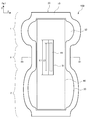
- FIG. 1 is a plan view showing an absorbent article according to the first embodiment of the first invention.
- 2 is a cross-sectional view taken along line X1-X1 shown in FIG.
- FIG. 3 is a plan view showing an absorbent article according to the second embodiment of the first invention.
- 4 is a cross-sectional view taken along line X2-X2 shown in FIG.
- FIG. 5 is a cross-sectional view of an absorbent article according to the third embodiment of the first invention.
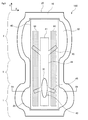
- FIG. 6 is a plan view showing the absorbent article according to the first embodiment of the second invention.
- FIG. 7 is a cross-sectional view taken along line X3-X3 shown in FIG.
- FIG. 8 is a plan view showing an absorbent article according to the second embodiment of the second invention.
- FIG. 9 is a plan view showing an absorbent article according to the third embodiment of the second invention.
- 10 is a cross-sectional view taken along line X4-X4 shown in FIG.
- the “longitudinal direction” means a direction in the absorbent article that connects the front body located on the wearer's abdomen side and the back body located on the wearer's back side.
- the “width direction” means a direction perpendicular to the longitudinal direction of the absorbent article.
- the longitudinal direction of the absorbent article is indicated by the Y axis
- the width direction of the absorbent article is indicated by the X axis.
- a “skin opposing surface” means the surface which opposes a wearer's skin at the time of wear of an absorbent article.
- the “non-skin facing surface” means a surface that does not face the wearer's skin when the absorbent article is worn.
- FIG. 1 is a plan view showing an absorbent article 100 according to the first embodiment.
- 2 is a cross-sectional view schematically showing a cross-sectional structure of the absorbent article 100 taken along the line X1-X1 shown in FIG.
- FIG. 2 in order to show the configuration of the absorbent article 100 in an easy-to-understand manner, gaps are drawn between various components, but in reality, there are no gaps between the components. Little formed.
- the absorbent article 100 relates to an absorbent pad.
- the absorbent pad can be used alone, or can be used on the inner surface side of a pants-type or tape-type disposable diaper.
- the absorbent article 100 includes a front body 1 located on the wearer's abdomen side, a back body 2 located on the wearer's back side, and a crotch 3 located therebetween. And can be divided in the longitudinal direction.
- the absorbent article 100 has a shape that can be expressed as a gourd type or an hourglass type in a plan view. In other words, the absorbent article 100 has a constricted portion at the crotch 3 which is a portion where the lateral width of the absorbent article 100 is the narrowest.
- the front body 1 and the back body 2 of the absorbent article 100 have side flaps that are portions extending from the constricted portion of the crotch 3 to the left and right outer sides in the width direction. That is, in the portion where the side flaps are formed, the width of the front body 1 and the back body 2 is wider than the width of the constricted portion of the crotch 3.
- the absorbent article 100 can be a gourd type (hourglass type).
- the shape of the absorbent article 100 can be changed as appropriate, for example, a simple rectangular shape.
- the absorbent article 100 basically includes a liquid-permeable top sheet 10, a liquid-impermeable back sheet 20, and a plurality of them interposed therebetween.
- Absorbers 30 and 40 are provided. As shown in the sectional view of FIG. 2, the plurality of absorbers 30 and 40 are stacked in the thickness direction.
- the top sheet 10 covers the skin facing surface side of the laminated absorbent bodies 30 and 40, and the back sheet 20 covers the skin non-facing surface side of the laminated absorbent bodies 30 and 40. .
- the top sheet 10 and the back sheet 20 are joined to each other around the absorbers 30 and 40. As a result, the absorbers 30 and 40 are surrounded by the joint between the top sheet 10 and the back sheet 20.
- the top sheet 10 is a sheet-like member that is in direct contact with the skin of the wearer's inseam and allows liquid such as urine to pass through the absorbers 30 and 40. For this reason, the top sheet 10 is composed of a liquid-permeable material having high flexibility.
- the liquid permeable material constituting the top sheet 10 are a woven fabric, a non-woven fabric, or a porous film.
- a fiber made of a thermoplastic resin such as polypropylene, polyethylene, polyester, or nylon, which has been subjected to a hydrophilization treatment and further made into a non-woven fabric may be used.
- the nonwoven fabric include air-through nonwoven fabric, point bond nonwoven fabric, spunbond nonwoven fabric, and melt blown nonwoven fabric.
- the back sheet 20 is a sheet-like member for preventing liquid that has passed through the top sheet 10 and absorbed by the absorbers 30 and 40 from leaking out of the diaper. For this reason, the backsheet 20 is comprised with a liquid-impermeable material.
- An example of the liquid-impermeable material constituting the backsheet 20 is a liquid-impermeable film made of polyethylene resin.
- the backsheet 20 is preferably a microporous polyethylene film in which a plurality of fine pores of 0.1 to 4 ⁇ m are formed in order to ensure air permeability while maintaining liquid impermeability.
- the absorbers 30 and 40 are members for absorbing a liquid such as urine and holding the absorbed liquid.
- the absorbers 30 and 40 are disposed between the liquid-permeable top sheet 10 and the liquid-impermeable back sheet 20.
- the absorbent article 100 includes two absorbers, an upper layer absorber 30 located on the top sheet 10 side and a lower layer absorber 40 located on the back sheet 20 side.
- Each of the upper layer absorber 30 and the lower layer absorber 40 can be made of a known absorbent material.
- As an absorptive material it is good also as using the fluff pulp formed by crushing fiber materials, such as a conifer, a super absorbent polymer (SAP), and a hydrophilic sheet, for example.
- SAP super absorbent polymer
- hydrophilic sheet for example.
- the absorbent material one kind of fluff pulp, super absorbent polymer, or hydrophilic sheet may be used alone, or two or more kinds may be used in combination.
- the upper layer absorbent body 30 is a combination of fluff pulp and a superabsorbent polymer, and has a configuration in which a plurality of granular superabsorbent polymers are supported by the fluff pulp.
- the lower layer absorber 40 consists only of fluff pulp, and the superabsorbent polymer is not distributed.
- the upper absorbent body 30 located near the skin of the wearer is made to contain the superabsorbent polymer, and the lower absorbent body 40 not containing this superabsorbent polymer is provided. This is a preferred embodiment of the present invention.
- the upper absorbent body 30 contains a superabsorbent polymer
- liquid such as urine can be quickly absorbed by the upper absorbent body 30, so that the surface of the absorbent article 100 is smooth and uncomfortable for the wearer. Can be avoided.
- the lower layer absorber 40 absorbs liquid that could not be absorbed by the upper layer absorber 30.
- the amount of liquid absorbed is more likely to absorb the liquid in a wide range of the lower layer absorber 40 without providing the superabsorbent polymer. It is effective in terms of improving For this reason, in the present embodiment, the superabsorbent polymer is sprayed only on the upper layer absorber 30 and the superabsorbent polymer is not sprinkled on the lower layer absorber 40.
- an upper opening 31 is formed in the upper absorber 30.
- the upper opening 31 is a hole (slit) penetrating in the thickness direction of the upper absorber 30.
- the upper opening 31 is formed at least in a portion of the upper-layer absorber 30 that is easy to directly touch the urine excreted by the wearer at first.
- the upper opening 31 is formed in the crotch 3.
- the upper opening 31 may be formed in a part of the crotch part 3 and extends to the front body 1 and / or the back body 2 beyond the crotch part 3. It may be formed as follows.
- the upper side opening part 31 is located in the center part of the width direction of the crotch part 3.
- the upper opening 31 is positioned at the central part of the crotch part 3. Is preferred.
- the urine excreted by the wearer diffuses in the longitudinal direction along the upper opening 31. Moreover, since the surface area of the upper layer absorber 30 is increased by forming the upper opening 31, a liquid such as urine can be quickly absorbed. Furthermore, liquid such as urine excreted on the upper layer absorber 30 can be guided to the lower layer absorber 40 through the upper opening 31. Thereby, the liquid can be efficiently absorbed by both the upper layer absorber 30 and the lower layer absorber 40.
- the upper opening 31 has a predetermined length L1 (maximum value) and a predetermined lateral width W1 (maximum value).
- the length L1 and the lateral width W1 of the upper opening 31 may be appropriately adjusted according to the size of the absorbent article 100.
- the length L1 of the upper opening 31 may be 100 mm to 300 mm, or 150 mm to 250 mm.
- the lateral width W1 of the upper opening 31 is at least shorter than the length L1, and may be, for example, 5 mm to 35 mm, or 10 mm to 30 mm.
- the upper side opening part 31 becomes a shape long in a longitudinal direction. In the example shown in FIG.
- the upper opening 31 is formed in a rectangular shape extending in the longitudinal direction.
- the shape of the upper opening 31 is not limited to the illustrated one, and various shapes such as a triangle, a pentagon, other polygons, and a circle can be adopted.
- a lower opening 41 is formed in the lower layer absorber 40.
- the lower opening 41 is a hole (slit) penetrating in the thickness direction of the lower layer absorber 40.
- the lower opening 41 has a predetermined length L2 (maximum value) and a predetermined lateral width W2 (maximum value).
- L2 and the width W2 of the lower opening 41 of the lower layer absorber 40 are shorter than the length L1 and the width W1 of the upper opening 31 of the upper layer absorber 30, respectively. (L2 ⁇ L1, W2 ⁇ W1).
- the length L2 of the lower opening 41 is preferably 40% to 95% or 50% to 90% with respect to the length L1 of the upper opening 31.
- the lateral width W2 of the lower opening 41 is preferably 30% to 95% or 40% to 90% with respect to the lateral width W1 of the upper opening 31.
- the opening area of the lower opening 41 is the opening area of the upper opening 31. Smaller than.
- the shape of the lower opening 41 is preferably a rectangular shape similar to the upper opening 31.
- the shape of the lower opening 41 may not be similar to that of the upper opening 31, and various shapes such as a triangle, a pentagon, other polygons, and a circle can be adopted.
- the lower opening 41 of the lower layer absorber 40 is formed at a position at least partially overlapping with the upper opening 31 of the upper layer absorber 30.
- the lower opening 41 preferably overlaps the upper opening 31 as a whole.
- the lower opening 41 may have a portion that does not overlap the upper opening 31.
- the lower opening 41 is such that 50% to 100% or 90% to 100% of the area overlaps with the upper opening 31.
- the liquid excreted by the wearer passes through the upper opening 31 and the lower opening 41. Therefore, the liquid can be absorbed in a wide range of the absorbers 30 and 40.
- the absorbent article 100 is attached to the wearer's crotch, it is considered that the absorbent bodies 30 and 40 are compressed in the width direction.
- each absorber 30, 40 is compressed in the width direction and the lower opening 41 is blocked.
- the space of the upper opening 31 can be maintained.
- liquid such as urine can be guided to the lower layer absorber 40 through the upper opening 31, and the absorbent capacity of the absorbent article can be improved.
- liquids, such as urine are diffused along the upper side opening part 31 of the upper layer absorber 30, and the lower side opening part 41 of the lower layer absorber 40, the liquid diffusibility of the whole absorbent article can be improved.
- the lower opening 41 of the lower layer absorber 40 smaller than the upper opening 31 of the upper layer absorber 30, the liquid that has passed through the upper opening 31 can be easily collected by the lower layer absorber 40. Become.
- the shapes of the upper layer absorber 30 and the lower layer absorber 40 are different. That is, the upper layer absorber 30 is molded into a so-called gourd type or hourglass type, whereas the lower layer absorber 40 is molded into a rectangular shape.
- the shapes of the upper layer absorber 30 and the lower layer absorber 40 can be made different.
- the upper layer absorber 30 has an extending portion 32 that extends more outward in the width direction than the lower layer absorber 40 in the front body 1 and the back body 2 when superimposed on the lower layer absorber 40. Yes. Therefore, in the present embodiment, the upper layer absorber 30 is formed larger than the lower layer absorber 40 by the extension portion 32.
- the upper layer absorber 30 when urine or the like is excreted, it can be quickly absorbed in a wide range of the upper layer absorber 30, which leads to prevention of urine leakage.
- the lower layer absorber 40 disposed below the upper layer absorber 30 may be formed into a gourd shape like the upper layer absorber 30, but the wearing feeling of the absorbent article 100 may be reduced. , Not very preferable. Therefore, as in the present embodiment, the shape of the lower layer absorbent body 40 is a rectangular shape smaller than that of the upper layer absorbent body 30, thereby increasing the amount of absorption of the entire absorbent article 100 and maintaining a good feeling of wear. can do.
- the absorbent article 100 further includes a first diffusion sheet 61, a second diffusion sheet 62, and a third diffusion sheet 63.
- the first diffusion sheet 61 is disposed between the top sheet 10 and the upper layer absorber 30.
- the second diffusion sheet 62 is disposed between the upper layer absorber 30 and the lower layer absorber 40.
- the third diffusion sheet 63 is disposed between the lower layer absorber 40 and the back sheet 20.
- the second diffusion sheet 62 and the third diffusion sheet 63 are composed of a single sheet member, and both are integrally connected so as to enclose the lower layer absorber 40. It has become a thing.
- each of the diffusion sheets 61 to 63 may be composed of separate sheet members, or may be composed of connected sheet members.
- the first diffusion sheet 61, the second diffusion sheet 62, and the third diffusion sheet 63 are sheet-like members having liquid diffusibility capable of absorbing and diffusing liquid.
- Each of the diffusion sheets 61 to 63 may be a thin paper such as tissue paper or a non-woven fabric.
- the nonwoven fabric include air-through nonwoven fabric, point bond nonwoven fabric, spunbond nonwoven fabric, and melt blown nonwoven fabric.
- the first diffusion sheet 61 covers the upper opening 31 of the upper absorbent body 30 from the skin facing surface side.
- the second diffusion sheet 62 covers the upper opening 31 of the upper absorbent body 30 from the skin non-facing surface side, and covers the lower opening 41 of the lower absorbent body 40 from the skin facing surface side.
- the third diffusion sheet 63 covers the lower opening 41 of the lower layer absorber 40 from the skin non-facing surface side.
- the absorbent article 100 further includes an SAP layer 50.
- the SAP layer 50 is formed between the upper layer absorber 30 and the lower layer absorber 40.
- the SAP layer 50 is a layer formed by collecting a plurality of granular superabsorbent polymers (SAP).
- SAP layer 50 is held between the absorbers 30 and 40 by sandwiching a plurality of superabsorbent polymers between the upper absorber 30 and the lower absorber 40.
- a known material may be used as the superabsorbent polymer (SAP).
- SAP superabsorbent polymer
- a highly water-absorbing polymer absorbs liquid about 100 to 1000 times its own weight.
- a polymer having a diameter of about 0.1 mm to 0.5 mm in a dry state before liquid absorption may be employed.
- the SAP layer 50 between the upper layer absorber 30 and the lower layer absorber 40, the liquid guided between the upper layer absorber 30 and the lower layer absorber 40 by the second diffusion sheet 62 is allowed to flow. , The SAP layer 50 can be absorbed quickly. Accordingly, the liquid that has flowed into the upper opening 31 of the upper absorber 30 can be reliably collected by the SAP layer 50 while being diffused over a wide range by the second diffusion sheet 62. Thereby, even if a large amount of liquid is discharged into the central portion of the upper-layer absorber 30 or the upper opening 31, it is possible to prevent the liquid from leaking to the outside.
- the SAP layer 50 is disposed between the upper layer absorber 30 and the lower layer absorber 40, even if the SAP layer 50 absorbs a large amount of liquid and expands its volume, the feel of the SAP layer 50 is felt to the wearer. Difficult to communicate. Therefore, it is possible to provide the wearer with a good wearing feeling that does not change between before and after liquid excretion.
- the SAP layer 50 is formed at least on both the left and right sides in the width direction of the lower opening 41.
- the SAP layer 50 is preferably formed on both the left and right sides of the lower opening 41 in the width direction and on the left and right sides of the upper opening 31 in the width direction.
- the wearer may have a risk of clogging the openings 31 and 41 when the polymer absorbs the liquid, or the rough feel of the superabsorbent polymer. There is a risk of transmission.
- the SAP layer 50 may be formed in the front-back both sides of the longitudinal direction of the upper side opening part 31 or the lower side opening part 41. As shown in FIG.
- the SAP layer 50 is formed between the upper layer absorber 30 and the lower layer absorber 40 and between the second diffusion sheet 62 and the lower layer absorber 40.
- the lower layer absorber 40 is enclosed in a single sheet member formed by connecting the second diffusion sheet 62 and the third diffusion sheet 63.
- the second diffusion sheet 62 positioned between the upper layer absorber 30 and the lower layer absorber 40 partially overlaps with each other.
- the overlapping portion of the second diffusion sheet 62 covers the skin non-facing surface side of the upper opening 31 and the skin facing surface side of the lower opening 41. In this way, the liquid that has flowed into the openings 31 and 41 is obtained by partially overlapping and thickening the second diffusion sheet 62 at the portion where the upper opening 31 and the lower opening 41 are formed. Can be diffused more efficiently.
- FIG. 3 shows a plan view of the absorbent article 100 as in FIG. 4 shows a cross-sectional view taken along line X2-X2 shown in FIG. 3, as in FIG.
- the upper layer absorber 30 and the lower layer absorber 40 have a low density region 71 and a high density region 72. This is different from the first embodiment described above.
- a low density region 71 is formed at least in the crotch 3 of the upper layer absorber 30 and the lower layer absorber 40, and a region other than the low density region 71 is a high density region 72.
- the low density region 71 is a region where the density of the fibers constituting the absorbent bodies 30 and 40 is lower than that of the high density region 72.
- the high density region 72 is a region where the density of the fibers constituting the absorbent bodies 30 and 40 is higher than that of the low density region 71.
- the low density region 71 is formed in the central portion of each absorber 30, 40 in the width direction. Further, the low density region 71 is formed over the entire longitudinal direction of each of the absorbent bodies 30 and 40 from the crotch 3 to the front body 1 and the back body 2. Thus, the low density region 71 is formed at least in the center in the width direction of the crotch 3. Further, an upper opening 31 is formed in the low density region 71 of the upper absorber 30, and a lower opening 41 is formed in the low density region 71 of the lower absorber 40.
- the low density region 71 is formed in the central portion in the width direction of each absorber 30, 40, and the openings 31, 41 are formed in the low density region 71.
- the liquid such as urine excreted by the wearer can be quickly absorbed in the low density region 71 of each absorber 30, 40.
- the openings 31 and 41 extending in the longitudinal direction are formed in the low density region 71, the liquid can be diffused throughout the low density region 71.
- the area other than the low density area 71 is a high density area 72.
- the high density regions 72 are formed on both the left and right sides of the low density region 71 in the width direction, and are divided into two regions with the low density region 71 interposed therebetween. That is, the left and right high-density regions 72 are formed over the entire longitudinal direction of each absorber 30, 40, respectively.
- the upper opening 31 of the upper absorber 30 and the lower opening 41 of the lower absorber 40 are formed only in the low density region 71 and are not formed in the high density region 72. However, it is also possible to form the openings 31 and 41 over both the low density region 71 and the high density region 72.
- the high density region 72 can be formed by pressing the upper layer absorber 30 and the lower layer absorber 40, for example.
- a press device such as a known press roller can be used for pressing the absorbers 30 and 40.
- each absorber 30, 40 becomes difficult to lose its shape.
- the high-density regions 72 on the left and right sides of the low-density region 71, even if each absorber 30, 40 is compressed in the width direction, this low-density region 72 is formed.
- the upper opening 31 and the lower opening 41 formed in the density region 71 are not easily blocked. Thereby, even at the time of wearing, the absorption capacity and liquid diffusibility of each absorber 30,40 can be maintained.
- the upper layer absorber 30 and the lower layer absorber 40 are overlapped.
- the absorbers 30 and 40 are simultaneously pressed to form the high density region 72.
- the thickness of the low density region 71 of the upper layer absorber 30 is indicated by a symbol T1
- the thickness of the high density region 72 of the upper layer absorber 30 is indicated by a symbol T2.
- the thickness T2 of the high density region 72 is thinner than the thickness T1 of the low density region 71 (T2 ⁇ T1).
- the thickness T2 of the high density region 72 is preferably 10% to 90%, and particularly preferably 10% to 50%, with respect to the thickness T1 of the low density region 71.
- the thickness of the low density region 71 may be 10 mm to 20 mm.
- the thickness of the high density region 72 may be 5 mm to 15 mm and is thinner than the low density region 71. It should be noted that the relationship between the thicknesses of the low density region 71 and the high density region 72 of the lower layer absorber 40 can be the same as that of the low density region 71 and the high density region 72 of the upper layer absorber 30 described above.
- the density of the fibers constituting the low density region 71 is preferably 10% to 90% with respect to the density of the fibers constituting the high density region 72, and 10% to 50%. It is particularly preferred that When comparing the densities of the low density region 71 and the high density region 72, test pieces of the low density region 71 and the high density region 72 having the same volume are prepared, and the weights of the respective test pieces may be compared. . For this reason, the unit of density is weight (mg) / volume (cm 3 ). For example, the density of the low density region 71 is preferably 5 to 50 mg / cm 3 .
- the density of the high density region 72 is 20 to 150 mg / cm 3 and is preferably in a range higher than the density of the low density region 71.
- the relationship between the density of the low density region 71 and the high density region 72 of the lower layer absorber 40 can be the same as that of the low density region 71 and the high density region 72 of the upper layer absorber 30 described above.
- the lateral width B1 of the low density region 71 is preferably 20% to 80%, or 30% to 70%, for example, with respect to the entire width (maximum value) of the upper layer absorber 30. .
- a region other than the low density region 71 becomes a high density region 72.
- the lateral width of the low density region 71 of the lower layer absorber 40 is made to coincide with the lateral width of the low density region 71 of the upper layer absorber 30.
- the region other than the low density region 71 becomes the high density region 72.
- the upper opening 31 is preferably formed in the low density region 71.
- the lateral width W1 of the upper opening 31 may be 10% to 90% with respect to the lateral width B1 of the low density region 71, and may be 50% to 90%. preferable.
- the lateral width of the lower opening 41 of the lower layer absorber 40 is narrower than the lateral width of the upper opening 31 of the upper layer absorber 30. Therefore, the lower opening 41 of the lower layer absorber 40 is also accommodated in the low density region 71 of the lower layer absorber 40.
- the low density region 71 and the high density region 72 are formed in both the upper layer absorber 30 and the lower layer absorber 40. It can also be formed only on one of the absorber 30 and the lower layer absorber 40.
- the low density region 71 is a single connected region, but the low density region 71 may be divided into two or more regions. Moreover, the low density area
- region 71 should just be formed in the crotch part 3 at least, and does not need to be formed in the front body 1 and the back body 2.
- FIG. 5 shows a cross-sectional view of the absorbent article 100 as in FIG.
- the absorbent article 100 according to the third embodiment includes a second lower layer absorber 80 in addition to the upper layer absorber 30 and the lower layer absorber 40.
- the absorbent article 100 may have a configuration in which three or more layers of absorbers are interposed between the top sheet 10 and the back sheet 20. That is, the absorbent article 100 according to the third embodiment includes the second lower layer absorber 80 further below the upper layer absorber 30 and the lower layer absorber 40 described above (on the skin non-facing surface side).
- the absorber positioned between the upper layer absorber 30 and the second lower layer absorber 80 is referred to as a first lower layer absorber 40.
- the opening formed in the first lower layer absorber 40 is referred to as a first lower opening 41.
- the second lower layer absorber 80 can basically have the same configuration as the first lower layer absorber 40 described above. That is, as shown in FIG. 5, the second lower layer absorber 80 may have a second lower opening 81 at the center in the width direction. In this case, the second lower opening 81 of the second lower layer absorber 80 is longer than the upper opening 31 of the upper layer absorber 30 and the first lower opening 41 of the first lower layer absorber 40. It is preferable that the width is formed short. That is, it is preferable that the length and the width are narrowed in the order of the upper opening 31, the first lower opening 41, and the second lower opening 81.
- a fourth diffusion sheet 64 is provided between the first lower layer absorber 40 and the second lower layer absorber 80.
- a fifth diffusion sheet 65 is provided between the second lower layer absorber 80 and the back sheet 20.
- the fourth diffusion sheet 64 and the fifth diffusion sheet 65 are composed of a single sheet member and encapsulate the second lower layer absorber 80.
- the fourth diffusion sheet 64 and the fifth diffusion sheet 65 may be composed of separate sheet members.
- the fourth diffusion sheet 64 and the fifth diffusion sheet 65 may be, for example, a thin paper such as tissue paper or a non-woven fabric.
- a second SAP layer 90 is formed between the first lower layer absorber 40 and the second lower layer absorber 80.
- the second SAP layer 90 is a layer formed by collecting a plurality of granular superabsorbent polymers (SAP).
- SAP granular superabsorbent polymers
- the second SAP layer 90 is preferably disposed between the fourth diffusion sheet 64 and the second lower layer absorber 80.
- the second SAP layer 90 is formed on the outer side in the width direction of the second lower opening 81 of the second lower layer absorber 80.
- the second SAP layer 90 is outside in the width direction of the second lower opening 81 of the second lower layer absorber 80 and outside in the width direction of the first lower opening 41 of the first lower layer absorber 40. It is preferable to be formed in the region. Accordingly, the second SAP layer 90 can be sandwiched and held by the first lower layer absorber 40 and the second lower layer absorber 80, and scattering of the highly water-absorbing polymer constituting the second SAP layer 90 can be prevented. .
- the absorbent article 100 according to the present invention can have a configuration in which absorbers are stacked in three or more stages.
- the absorber can be laminated in four or more stages or five or more stages.
- SAP superabsorbent polymers
- SAP has a property that the absorption speed of the liquid is slow, and once the liquid is absorbed, it forms a gel and forms a so-called gel block.
- urine leakage may occur due to the slow absorption rate of SAP when a large amount of urination occurs at one time. is there.
- the liquid may not reach the SAP, and the absorber positioned on the skin facing surface side than the SAP contains a lot of moisture. As a result, there was a risk that the liquid would return from the swollen absorbent body.
- the second invention has a high liquid diffusibility, can absorb urine effectively by SAP, and even when a large amount of urination or repeated urination occurs at once, urine leakage or urine reversion
- An absorbent article capable of preventing the above is provided.
- the inventor provides an SAP layer in which SAPs are densely arranged between a plurality of absorbers, and forms openings in the respective absorbers.
- the SAP layer was arranged.
- the excreted liquid is diffused by the opening and effectively absorbed by the SAP layer.
- a large amount of liquid can be prevented from touching the SAP layer at one time, so that the liquid can effectively penetrate into the SAP layer having a slow absorption rate. Urine leakage and urine reversion can be prevented.
- the absorbent article which concerns on 2nd invention is the liquid-permeable top sheet 10 located in the skin opposing surface side, the liquid-impermeable back sheet 20 located in the skin non-facing surface side, the top sheet 10, and the back sheet And a plurality of absorbent bodies interposed between 20 and stacked in the thickness direction.
- the absorbent article has a longitudinal direction and a width direction orthogonal to the longitudinal direction.
- the plurality of absorbers include at least an upper layer absorber 30 located on the top sheet 10 side and a lower layer absorber 40 located on the back sheet 20 side.
- the upper absorber 30 has an upper opening 31, and the lower absorber 40 has a lower opening 41.
- the lower opening 41 extends in the longitudinal direction of the absorbent article and at least partially overlaps the upper opening 31.
- the absorbent article of the present invention further includes an SAP layer 50 formed by arranging a plurality of superabsorbent polymers SAP between the upper layer absorber 30 and the lower layer absorber 40.
- the SAP layer 50 is formed at least on both the left and right sides in the width direction of the opening penetrating portion 42 where the upper opening 31 and the lower opening 41 overlap.
- the excreted urine is absorbed through these openings. Can be dispersed in the longitudinal direction. Furthermore, by forming the SAP layer 50 on both sides of the opening penetrating portion 42 where at least the upper opening 31 and the lower opening 41 overlap, the liquid diffused by the opening can be efficiently transferred by the SAP layer 50. Absorbed. As a result, even when a large amount of urination is performed at once, the liquid diffuses and is absorbed over a wide range of the SAP layer 50, so that urine leakage can be effectively prevented.
- the SAP layer 50 interposing the SAP layer 50 between the upper layer absorber 30 and the lower layer absorber 40, the liquid that has penetrated into the upper layer absorber 30 and the liquid that has penetrated into the lower layer absorber 40 are transferred to the SAP layer 50. can do.
- the SAP layer 50 that has absorbed the liquid swells and gels, making it difficult to release the liquid, and thus the liquid can be prevented from returning.
- a large amount of liquid can be prevented from touching the SAP layer 50 locally at one time, even the SAP layer 50 having a low liquid absorption rate can absorb a large amount of liquid over a wide range. , Can prevent urine leakage.
- the liquid is efficiently dispersed, so that the liquid can be absorbed over a wide range of the SAP layer 50.
- the SAP layer 50 between the upper layer absorber 30 and the lower layer absorber 40, even if the SAP layer 50 absorbs liquid and the volume expands, the feel is not easily transmitted to the wearer. This leads to a decrease in discomfort.
- the liquid is easily diffused in the longitudinal direction along the lower opening 41, and the SAP layers 50 are formed on both the left and right sides of the lower opening 41 in the width direction. It is possible to effectively prevent urine leakage from the urine.
- the opening penetrating portion 42 is formed on the abdomen side of the wearer from the center in the longitudinal direction.
- the opening penetrating portion 42 is formed at a position near the front body where excreted urine is easy to touch first, so that urine can be easily guided to the upper opening 31 and the lower opening 41. Become.
- the lower opening 41 is preferably longer in the longitudinal direction than the upper opening 31. That is, it is preferable that the lower opening 41 has a part extending to the rear body side in the longitudinal direction and a part extending to the front body side in the longitudinal direction than the upper opening 31.
- the liquid that has flowed into the lower opening 41 through the opening penetrating portion 42 is the skin non-facing surface of the upper absorber 30. Since the liquid is contained on the side, it is possible to more effectively prevent the liquid from returning. Further, once the liquid is confined in the lower opening 41, the liquid does not leak or return even if the SAP layer 50 located on both the left and right sides absorbs the liquid over a relatively long time. . Therefore, it is possible to efficiently absorb the liquid by using the SAP layer 50 having a low absorption rate.
- the lower opening 41 has a wide portion 43 that is wider in the width direction than the upper opening 31 at least in part.
- the liquid can be easily diffused in the width direction through the lower opening 41, and at the same time, The total amount of liquid that can be stored in the opening 41 increases. Thereby, the liquid can be transferred to the SAP layer 50 through the lower opening 41 over a wide range in the width direction.
- a liquid diffusive sheet 63 is disposed between the lower layer absorber 40 and the SAP layer 50 in a region covering the lower opening 41.
- the SAP layer 50 may be formed at least partially at a position overlapping the lower opening 41 in the thickness direction. In this way, by positioning the SAP layer 50 on the liquid diffusive sheet 63, even when the SAP layer 50 and the lower opening 41 overlap, the SAP constituting the SAP layer 50 is located on the lower side. It does not fall into the opening 41.
- the SAP layer 50 can be easily disposed even on the lower opening 41. For this reason, the structure that the lower side opening part 41 is located under the SAP layer 50 is realizable. In this case, the liquid diffusion effect and absorption effect can be further improved by the synergistic effect of the lower opening 41 and the SAP layer 50.
- the diffusibility of the liquid is high, the urine can be effectively absorbed by the SAP, and urine leakage and urine reversion are prevented even when a large amount of urination or repeated urination occurs at one time.
- the absorbent article which can be provided can be provided.
- FIG. 6 is a plan view showing the absorbent article 100 according to the first embodiment.
- FIG. 7 is a cross-sectional view schematically showing a cross-sectional structure of the absorbent article 100 taken along line X3-X3 shown in FIG.
- the absorbent article 100 relates to an absorbent pad.
- the absorbent pad can be used alone, or can be used on the inner surface side of a pants-type or tape-type disposable diaper.
- the absorbent article 100 includes a front body 1 located on the wearer's abdomen side, a back body 2 located on the wearer's back side, and a crotch 3 located therebetween. And can be divided in the longitudinal direction.
- the absorbent article 100 is fundamentally the liquid-permeable top sheet 10, the liquid-impermeable back sheet 20, and the some interposed between these.
- Absorbers 30 and 40 are provided.
- the plurality of absorbers 30 and 40 are stacked in the thickness direction.
- the top sheet 10 covers the skin facing surface side of the laminated absorbent bodies 30 and 40
- the back sheet 20 covers the skin non-facing surface side of the laminated absorbent bodies 30 and 40.
- the top sheet 10 and the back sheet 20 are joined to each other around the absorbers 30 and 40.
- the absorbent article 100 includes two absorbers, an upper layer absorber 30 located on the top sheet 10 side and a lower layer absorber 40 located on the back sheet 20 side.
- Each of the upper layer absorber 30 and the lower layer absorber 40 can be made of a known absorbent material.
- the upper layer absorbent body 30 is a combination of fluff pulp and a superabsorbent polymer, and has a configuration in which a plurality of granular superabsorbent polymers are supported by the fluff pulp.
- the lower layer absorber 40 consists only of fluff pulp, and the superabsorbent polymer is not distributed.
- the upper absorbent body 30 located near the skin of the wearer is made to contain the superabsorbent polymer, and the lower absorbent body 40 not containing this superabsorbent polymer is provided. This is a preferred embodiment of the present invention.
- the upper absorbent body 30 contains a superabsorbent polymer
- liquid such as urine can be quickly absorbed by the upper absorbent body 30, so that the surface of the absorbent article 100 is smooth and uncomfortable for the wearer. Can be avoided.
- the lower layer absorber 40 absorbs liquid that could not be absorbed by the upper layer absorber 30.
- the amount of liquid absorbed is more likely to absorb the liquid in a wide range of the lower layer absorber 40 without providing the superabsorbent polymer. It is effective in terms of improving For this reason, in the present embodiment, the superabsorbent polymer is sprayed only on the upper layer absorber 30 and the superabsorbent polymer is not sprinkled on the lower layer absorber 40.
- an upper opening 31 is formed in the upper absorber 30.
- the upper opening 31 is a hole (slit) penetrating in the thickness direction of the upper absorber 30.
- the upper opening 31 is formed at least in a portion of the upper-layer absorber 30 that is easy to directly touch the urine excreted by the wearer at first.
- the upper opening 31 is preferably formed in a region on the stomach side of the wearer when the upper layer absorbent body 30 is divided into two regions in the longitudinal direction.
- the upper opening 31 is preferably formed at least partially in the front body 1 of the absorbent article 100. In the embodiment shown in FIG.
- the upper opening 31 is formed from the front body 1 to the crotch 3. Further, the upper opening 31 may be formed only in the front body 1 of the absorbent article 100 and may not be formed in the crotch 3 or the back body 2. However, the position of the upper opening 31 may be formed in the crotch 3 or the back body 2 or may be formed in a length from the front body 1 through the crotch 3 to the back body 2. Good. Moreover, it is preferable that the upper side opening part 31 is located in the center part of the width direction. For example, when the upper-layer absorber 30 is equally divided into three regions of the left part, the central part, and the right part in the width direction, the upper opening 31 is preferably located at the center part in the width direction. .
- the upper opening 31 has a predetermined length L1 (maximum value) and a predetermined lateral width W1 (maximum value).
- the length L1 and the lateral width W1 of the upper opening 31 may be appropriately adjusted according to the size of the absorbent article 100.
- the length L1 of the upper opening 31 may be 10 mm to 100 mm, or 20 mm to 60 mm.
- the lateral width W1 of the upper opening 31 is at least shorter than the length L1, and may be, for example, 5 mm to 30 mm, or 10 mm to 20 mm.
- the upper side opening part 31 becomes a shape long in a longitudinal direction. In the example shown in FIG.
- the upper opening 31 is formed in a rectangular shape extending in the longitudinal direction.
- the shape of the upper opening 31 is not limited to the illustrated shape, and various shapes such as a triangle, a pentagon, other polygons, a circle, and an ellipse may be employed.
- a lower opening 41 is formed in the lower layer absorber 40.
- the lower opening 41 is a hole (slit) penetrating in the thickness direction of the lower layer absorber 40.
- the lower opening 41 has a shape extending in the longitudinal direction and is longer than the upper opening 31 in the longitudinal direction. Specifically, the lower opening 41 is longer than the upper opening 31 toward the front end in the longitudinal direction, and is longer than the upper opening 31 toward the rear end in the longitudinal direction. It has the site
- the lower opening 41 has a length extending from the front body 1 to the back body 2 beyond the crotch 3 and extending in the longitudinal direction. Also, as shown in FIG. 6, the lower opening 41 has a wide portion 43 that is partially formed wider in the width direction than the upper opening 31.
- the lower opening 41 has a predetermined length L2 (maximum value) and a predetermined lateral width W2 (maximum value).
- the length L2 and the lateral width W2 of the lower opening 41 of the lower layer absorber 40 are longer than the length L1 and the lateral width W1 of the upper opening 31 of the upper layer absorber 30, respectively.
- L2> L1, W2> W1 the length L2 of the lower opening 41 is preferably 150% to 500%, or 200% to 400% with respect to the length L1 of the upper opening 31.
- the lateral width W2 of the lower opening 41 is preferably 110% to 300%, or 150% to 200% with respect to the lateral width W1 of the upper opening 31.
- the opening area of the lower opening 41 is the opening area of the upper opening 31. Bigger than.
- the shape of the lower opening 41 is preferably a shape in which the lateral width of the wide portion 43 is partially expanded on the basis of a rectangular shape.
- the partial wide portion 43 may be a rectangle, another polygon, or a circle or an ellipse.
- the lower opening 41 of the lower layer absorber 40 is formed at a position at least partially overlapping with the upper opening 31 of the upper layer absorber 30 in the thickness direction.
- a portion where the upper opening 31 and the lower opening 41 overlap in the thickness direction is referred to as an opening penetrating portion 42.
- the lower opening 41 is wider in length and width than the upper opening 31.
- the entire upper opening 31 preferably overlaps the lower opening 41.
- the entire upper opening 31 corresponds to the opening penetrating portion 42 described above.
- the upper opening 31 of the upper-layer absorber 30 is formed in the front body 1, so that the opening through portion 42 where the upper opening 31 and the lower opening 41 overlap is also provided.
- the front body 1 is formed.
- the upper opening 31 may have a portion that does not overlap the lower opening 41.
- the upper opening 31 has 50% to 100% or 90% to 100% of the area overlapping the lower opening 41. It is preferable. In this way, by overlapping a part or all of the upper opening 31 with the lower opening 41, these two openings 31, 41 are communicated in the thickness direction.
- the urine excreted by the wearer is separated from the upper opening 31 and the lower side absorber. It diffuses in the longitudinal direction through the opening 41.
- the lower opening 41 is formed longer in the longitudinal direction than the upper opening 31, the liquid that has flowed into the lower opening 41 through the opening penetrating portion 42 is lower in the lower opening 41. It diffuses in the longitudinal direction of the absorbent article 100 so as to be contained in the absorbent article 100.
- the surface areas of the upper layer absorber 30 and the lower layer absorber 40 are increased by forming the upper opening 31 and the lower opening 41, liquid such as urine can be rapidly absorbed.
- liquid such as urine excreted on the upper layer absorber 30 can be guided to the lower layer absorber 40 through the upper opening 31. Thereby, the liquid can be efficiently absorbed by both the upper layer absorber 30 and the lower layer absorber 40.
- the wide portion 43 of the lower opening 41 overlaps the upper opening 31.
- the wide portion 43 of the lower opening 41 corresponds to the opening penetrating portion 42.
- the shapes of the upper layer absorber 30 and the lower layer absorber 40 are different. That is, the upper layer absorber 30 is molded into a so-called gourd type or hourglass type, whereas the lower layer absorber 40 is molded into a rectangular shape.
- the shapes of the upper layer absorber 30 and the lower layer absorber 40 can be made different.
- the upper layer absorber 30 has an extending portion 32 that extends more outward in the width direction than the lower layer absorber 40 in the front body 1 and the back body 2 when superimposed on the lower layer absorber 40. Yes. Therefore, in the present embodiment, the upper layer absorber 30 is formed larger than the lower layer absorber 40 by the extension portion 32.
- the upper layer absorber 30 when urine or the like is excreted, it can be quickly absorbed in a wide range of the upper layer absorber 30, which leads to prevention of urine leakage.
- the lower layer absorber 40 disposed below the upper layer absorber 30 may be formed into a gourd shape like the upper layer absorber 30, but the wearing feeling of the absorbent article 100 may be reduced. , Not very preferable. Therefore, as in the present embodiment, the shape of the lower layer absorbent body 40 is a rectangular shape smaller than that of the upper layer absorbent body 30, thereby increasing the amount of absorption of the entire absorbent article 100 and maintaining a good feeling of wear. can do.
- the absorbent article 100 includes a first diffusion sheet 61 and a second diffusion sheet 62.
- the first diffusion sheet 61 is disposed between the top sheet 10 and the upper layer absorber 30.
- the second diffusion sheet 62 is disposed between the lower layer absorbent body 40 and the back sheet 20 and has a portion that covers the skin non-facing surface of the lower layer absorbent body 40, and the side of each absorbent body 30, 40. And a portion that covers a part of the skin-facing surface of the upper-layer absorber 30.
- the first diffusion sheet 61 and the second diffusion sheet 62 are overlapped and joined to each other on the left and right sides in the width direction on the skin facing surface side of the upper absorbent body 30.
- first diffusion sheet 61 and the second diffusion sheet 62 are joined to each other so as to enclose the periphery of the upper layer absorber 30 and the lower layer absorber 40.
- the first diffusion sheet 61 and the second diffusion sheet 62 are sheet-like members having liquid diffusibility capable of absorbing and diffusing liquid.
- Each of the diffusion sheets 61 and 62 may be a thin paper such as tissue paper or a non-woven fabric.
- the absorbent article 100 further includes an SAP layer 50.
- the SAP layer 50 is formed between the upper layer absorber 30 and the lower layer absorber 40.
- the SAP layer 50 is a layer formed by collecting a plurality of granular superabsorbent polymers (SAP). Basically, the SAP layer 50 is a layer made of only a superabsorbent polymer.
- the SAP layer 50 is held between the absorbers 30 and 40 by sandwiching a plurality of superabsorbent polymers between the upper absorber 30 and the lower absorber 40.
- the thickness of the SAP layer 50 can be adjusted as appropriate, but may be, for example, about 0.1 mm to 2 mm, or about 0.5 mm to 1.5 mm.
- each of the left and right SAP layers 50 includes not only a portion located on the left and right sides of the opening penetrating portion 42 but also a portion extending to the front end side in the longitudinal direction from the opening penetrating portion 42 and the opening penetrating portion. And a portion extending further to the rear end side in the longitudinal direction than the portion 42.
- the left and right SAP layers 50 are approximately the same length as the lower opening 41 or longer than the lower opening 41, and extend along the left and right sides of the lower opening 41. Is formed.
- the lower opening portion 41 is passed through the opening penetrating portion 42.
- the liquid that has flowed into can be absorbed by the SAP layer 50. More specifically, as described above, since the upper opening 31 and the lower opening 41 are formed in each of the upper absorber 30 and the lower absorber 40, they flow into these openings 31, 41. The liquid is dispersed in the longitudinal direction of the absorbent article. Then, by forming the SAP layer 50 at least on both sides of the opening penetrating portion 42, the liquid diffused by the openings 31 and 41 is efficiently absorbed by the SAP layer 50.
- the urine leakage can be effectively prevented because it is diffused and absorbed over a wide range of the SAP layer 50.
- the SAP layer 50 by interposing the SAP layer 50 between the upper layer absorber 30 and the lower layer absorber 40, the liquid that has penetrated into the upper layer absorber 30 and the liquid that has penetrated into the lower layer absorber 40 are transferred to the SAP layer 50. can do.
- the SAP layer 50 that has absorbed the liquid swells and gels, making it difficult to release the liquid, and thus the liquid can be prevented from returning.
- a large amount of liquid can be prevented from touching the SAP layer 50 locally at one time, even the SAP layer 50 having a low liquid absorption rate can absorb a large amount of liquid over a wide range. , Can prevent urine leakage.
- the SAP layer 50 is formed on both the left and right sides of the lower opening 41 in the width direction. That is, the SAP layer 50 does not overlap the lower opening 41 in the thickness direction.
- the entire SAP layer 50 can be completely sandwiched between the upper layer absorber 30 and the lower layer absorber 40. For this reason, even when the wearer of the absorbent article moves greatly, the superabsorbent polymer constituting the SAP layer 50 can be prevented from falling into the lower opening 41.
- FIG. 8 is a plan view showing the absorbent article 100 according to the second embodiment.
- description of the same configuration as that of the first embodiment described above is omitted, and a configuration different from that of the first embodiment is described.
- the SAP layer 50 is formed only on the left and right sides in the direction. Specifically, since the opening penetrating portion 42 is formed in the front body 1 of the absorbent article 100, the SAP layer 50 is also formed in the front body 1 of the absorbent article 100. In this way, if the SAP layers 50 are formed at least on both the left and right sides of the opening penetrating portion 42 in the width direction, the liquid can be diffused in the longitudinal direction by the lower opening portion 41, and high water absorption is provided around the opening penetrating portion 42. Liquid can be collected by polymer (SAP). For this reason, the SAP layer 50 can efficiently absorb the liquid and prevent its reverse.
- SAPAP polymer
- the upper opening 31 of the upper absorbent body 30 is formed in an elliptical shape.
- the lower opening 41 of the lower layer absorber 40 is formed so that the lateral width thereof is wider than the lateral width of the upper opening 31 as a whole. As described above, the entire lateral width of the lower opening 41 may be formed wider than the lateral width of the upper opening 31.
- FIG. 9 is a plan view showing an absorbent article 100 according to the third embodiment.
- FIG. 10 is a cross-sectional view schematically showing a cross-sectional structure of the absorbent article 100 taken along line X4-X4 shown in FIG.
- the third embodiment will be described focusing on a configuration different from the above-described first embodiment.
- the lower opening 41 includes a base portion 44 extending linearly along the longitudinal direction, and a plurality of base portions 44 extending from the base portion 44 toward the left and right outer sides in the width direction. And a branch portion 45. More specifically, in the present embodiment, the main portion 44 of the lower opening 41 has a longer length in the longitudinal direction than the upper opening 31, and passes from the front body 1 through the crotch 3 to the rear. It is formed with a length that reaches the body 2. Further, the lateral width of the trunk portion 44 of the lower opening 41 is wider than the lateral width of the upper opening 31. In addition, SAP layers 50 are formed on both the left and right sides of the backbone 44 of the lower opening 41.
- the branch portions 45 are formed one by one at the left and right at the position on the front end side in the longitudinal direction, and one by one at the left and right at the position at the rear end side in the longitudinal direction. Is formed. In this manner, the branch portions 45 are formed so as to extend from the trunk portion 44 toward the left and right outer sides in the width direction. For this reason, the branch part 45 overlaps with the SAP layer 50 in the thickness direction at least partially. Further, as shown in FIG. 9, the branch portions 45 are preferably formed on the left and right sides in the width direction of the opening penetrating portion 42 where the upper opening 31 and the lower opening 41 overlap. Thus, by providing the branch portions 45 on the left and right sides of the opening penetrating portion 42, the liquid flowing from the opening penetrating portion 42 can be quickly diffused outward in the width direction.
- FIG. 10 shows a cross-sectional view at a position where the branch portion 45 of the lower opening 41 is formed.
- the SAP layer 50 overlaps the branch portion 45 of the lower opening 41 in the thickness direction. Since the SAP layer 50 is formed by accumulating a plurality of granular superabsorbent polymers (SAP), if the SAP layer 50 overlaps the branch portion 45, the superabsorbent polymer is separated into this amount. There is a risk of falling off the branch 45. Therefore, in the third embodiment, as shown in FIG. 10, a third diffusion having liquid diffusibility is provided so as to cover the lower opening 41 between the SAP layer 50 and the lower layer absorber 40. A sheet 63 is provided.
- the third diffusion sheet 63 is a sheet-like member having liquid diffusibility that can absorb and diffuse liquid.
- the third diffusion sheet 63 may be a thin paper such as tissue paper or a non-woven fabric. Examples of the nonwoven fabric include air-through nonwoven fabric, point bond nonwoven fabric, spunbond nonwoven fabric, and melt blown nonwoven fabric.
- the SAP layer 50 is formed on the third diffusion sheet 63 by providing the third diffusion sheet 63 so as to entirely cover the skin facing surface of the lower layer absorber 40. be able to.
- the superabsorbent polymer constituting the SAP layer 50 is formed in the lower opening of the lower layer absorber 40. It can prevent falling to 41.
- the liquid flowing into the lower opening 41 can be efficiently diffused.
- the absorption capability of the two absorbers 30 and 40 can be utilized effectively.
- the liquid that has flowed into the opening penetrating portion 42 can be reliably collected by the SAP layer 50 while being diffused over a wide range by the third diffusion sheet 63. Thereby, even if a large amount of liquid is discharged to the opening penetrating portion 42, it is possible to prevent the liquid from leaking to the outside.
- the SAP layer 50 is disposed between the upper layer absorber 30 and the lower layer absorber 40, even if the SAP layer 50 absorbs a large amount of liquid and expands its volume, the feel of the SAP layer 50 is felt to the wearer. Difficult to communicate. Therefore, it is possible to provide the wearer with a good wearing feeling that does not change between before and after liquid excretion.
- the branch portion 45 extends from the front side and the rear side of the trunk portion 44 toward the left and right sides.
- the shape of the lower opening 41 is not limited to this, and may be, for example, a Y-shape in which two branch portions 45 extend from the front end or the rear end of the trunk portion 44.
- the example in which the SAP layer 50 is superimposed on the branch portion 45 of the lower opening 41 has been described.
- the SAP layer 50 can be formed so as to overlap the backbone 44 of the lower opening 41. .
- the branch portion 45 of the lower opening 41 overlaps the SAP layer 50 in the thickness direction.
- the basic portion 44 is wider than the region between the left and right SAP layers 50, and the left and right side edges of the basic portion 44 overlap the SAP layer 50 in the thickness direction. May be.
- the branch 45 may not be formed in the lower opening 41. Even in this case, by disposing the third diffusion sheet 63 between the lower opening 41 and the SAP layer 50, the superabsorbent polymer forming the SAP layer 50 is dropped into the lower opening 41. Can be prevented.
- the present invention relates to absorbent articles such as disposable diapers and absorbent pads. Therefore, the present invention can be suitably used in the manufacturing industry for absorbent articles and the like.
Landscapes
- Health & Medical Sciences (AREA)
- Epidemiology (AREA)
- Engineering & Computer Science (AREA)
- Biomedical Technology (AREA)
- Heart & Thoracic Surgery (AREA)
- Vascular Medicine (AREA)
- Life Sciences & Earth Sciences (AREA)
- Animal Behavior & Ethology (AREA)
- General Health & Medical Sciences (AREA)
- Public Health (AREA)
- Veterinary Medicine (AREA)
- Absorbent Articles And Supports Therefor (AREA)
Abstract
La présente invention aborde le problème de l'augmentation de la capacité d'absorption, de la diffusibilité des liquides et de la capacité de collecte d'un article absorbant comprenant un élément absorbant multicouche. L'invention concerne un article absorbant pourvu d'une feuille de dessus perméable aux liquides (10) située sur le côté de surface face à la peau, une feuille de fond imperméable aux liquides (20) située sur le côté de surface qui ne fait pas face à la peau, et une pluralité d'éléments absorbants empilés dans la direction d'épaisseur entre la feuille de dessus (10) et la feuille de fond (20). La pluralité d'éléments absorbants comprend au moins un élément absorbant de couche supérieure (30) situé du côté de la feuille de dessus (10) et un élément absorbant de couche inférieure (40) situé du côté de la feuille de fond (20). L'élément absorbant de couche supérieure (30) comporte une ouverture supérieure (31) ayant une longueur et une largeur prescrites, l'ouverture supérieure (31) s'étendant dans la direction longitudinale, et l'élément absorbant de la couche inférieure (40) comporte une ouverture inférieure (41) ayant une longueur et une largeur plus courtes que celles de l'ouverture supérieure (31), l'ouverture inférieure (41) s'étendant dans la direction longitudinale. L'ouverture supérieure (31) et l'ouverture inférieure (41) se chevauchent au moins partiellement dans la direction de l'épaisseur.
Applications Claiming Priority (4)
| Application Number | Priority Date | Filing Date | Title |
|---|---|---|---|
| JP2015-003803 | 2015-01-13 | ||
| JP2015003803A JP6399304B2 (ja) | 2015-01-13 | 2015-01-13 | 吸収性物品 |
| JP2015-018509 | 2015-02-02 | ||
| JP2015018509A JP6399306B2 (ja) | 2015-02-02 | 2015-02-02 | 吸収性物品 |
Publications (1)
| Publication Number | Publication Date |
|---|---|
| WO2016114209A1 true WO2016114209A1 (fr) | 2016-07-21 |
Family
ID=56405756
Family Applications (1)
| Application Number | Title | Priority Date | Filing Date |
|---|---|---|---|
| PCT/JP2016/050311 Ceased WO2016114209A1 (fr) | 2015-01-13 | 2016-01-07 | Article absorbant |
Country Status (2)
| Country | Link |
|---|---|
| TW (1) | TWI594741B (fr) |
| WO (1) | WO2016114209A1 (fr) |
Cited By (14)
| Publication number | Priority date | Publication date | Assignee | Title |
|---|---|---|---|---|
| JP2018015216A (ja) * | 2016-07-27 | 2018-02-01 | 日本製紙クレシア株式会社 | 吸収性物品 |
| JP2020089476A (ja) * | 2018-12-04 | 2020-06-11 | 王子ホールディングス株式会社 | 吸収性物品 |
| WO2020116415A1 (fr) * | 2018-12-04 | 2020-06-11 | 王子ホールディングス株式会社 | Article absorbant |
| JP2020093090A (ja) * | 2018-12-04 | 2020-06-18 | 王子ホールディングス株式会社 | 吸収性物品 |
| JP2020093091A (ja) * | 2018-12-04 | 2020-06-18 | 王子ホールディングス株式会社 | 吸収性物品 |
| CN112165925A (zh) * | 2018-06-04 | 2021-01-01 | 大王制纸株式会社 | 吸收性物品 |
| US10888472B2 (en) | 2015-09-30 | 2021-01-12 | Daio Paper Corporation | Absorbent article |
| JP2021007680A (ja) * | 2019-07-02 | 2021-01-28 | 王子ホールディングス株式会社 | 吸収性物品 |
| JP2021007679A (ja) * | 2019-07-02 | 2021-01-28 | 王子ホールディングス株式会社 | 吸収性物品 |
| CN113164302A (zh) * | 2018-12-04 | 2021-07-23 | 王子控股株式会社 | 吸收性物品 |
| JP2021519123A (ja) * | 2018-03-22 | 2021-08-10 | ディーエスジー テクノロジー ホールディングス リミテッド | 使い捨て吸収性物品及びそれを組込むための吸収性コア複合物又は構成物、そのための又はその構成要素、及びそれを作るためのシステム、装置、及び方法 |
| JP2022007626A (ja) * | 2020-06-26 | 2022-01-13 | 日本製紙クレシア株式会社 | 吸収性物品 |
| WO2023120693A1 (fr) * | 2021-12-24 | 2023-06-29 | 花王株式会社 | Article absorbant |
| JP2023095511A (ja) * | 2021-12-24 | 2023-07-06 | 花王株式会社 | 吸収性物品 |
Families Citing this family (1)
| Publication number | Priority date | Publication date | Assignee | Title |
|---|---|---|---|---|
| JP7129382B2 (ja) * | 2019-06-28 | 2022-09-01 | ユニ・チャーム株式会社 | 吸収性物品 |
Citations (5)
| Publication number | Priority date | Publication date | Assignee | Title |
|---|---|---|---|---|
| JPH11216161A (ja) * | 1998-01-30 | 1999-08-10 | Uni Charm Corp | 使い捨ておむつ |
| JP2003159276A (ja) * | 2001-11-28 | 2003-06-03 | Kao Corp | 吸収体の製造方法 |
| JP2011104021A (ja) * | 2009-11-13 | 2011-06-02 | Unicharm Corp | 吸収性物品 |
| JP2012130531A (ja) * | 2010-12-22 | 2012-07-12 | Kao Corp | 吸収体の製造方法 |
| JP2013017531A (ja) * | 2011-07-07 | 2013-01-31 | Livedo Corporation | 吸収性物品 |
Family Cites Families (2)
| Publication number | Priority date | Publication date | Assignee | Title |
|---|---|---|---|---|
| JP4416441B2 (ja) * | 2003-06-19 | 2010-02-17 | 株式会社リブドゥコーポレーション | 使い捨て吸収性物品 |
| JP5679779B2 (ja) * | 2010-11-19 | 2015-03-04 | ユニ・チャーム株式会社 | 吸収性物品 |
-
2016
- 2016-01-07 WO PCT/JP2016/050311 patent/WO2016114209A1/fr not_active Ceased
- 2016-01-11 TW TW105100707A patent/TWI594741B/zh not_active IP Right Cessation
Patent Citations (5)
| Publication number | Priority date | Publication date | Assignee | Title |
|---|---|---|---|---|
| JPH11216161A (ja) * | 1998-01-30 | 1999-08-10 | Uni Charm Corp | 使い捨ておむつ |
| JP2003159276A (ja) * | 2001-11-28 | 2003-06-03 | Kao Corp | 吸収体の製造方法 |
| JP2011104021A (ja) * | 2009-11-13 | 2011-06-02 | Unicharm Corp | 吸収性物品 |
| JP2012130531A (ja) * | 2010-12-22 | 2012-07-12 | Kao Corp | 吸収体の製造方法 |
| JP2013017531A (ja) * | 2011-07-07 | 2013-01-31 | Livedo Corporation | 吸収性物品 |
Cited By (25)
| Publication number | Priority date | Publication date | Assignee | Title |
|---|---|---|---|---|
| US10888472B2 (en) | 2015-09-30 | 2021-01-12 | Daio Paper Corporation | Absorbent article |
| JP2018015216A (ja) * | 2016-07-27 | 2018-02-01 | 日本製紙クレシア株式会社 | 吸収性物品 |
| JP2021519123A (ja) * | 2018-03-22 | 2021-08-10 | ディーエスジー テクノロジー ホールディングス リミテッド | 使い捨て吸収性物品及びそれを組込むための吸収性コア複合物又は構成物、そのための又はその構成要素、及びそれを作るためのシステム、装置、及び方法 |
| US11839533B2 (en) | 2018-03-22 | 2023-12-12 | Dsg Technology Holdings Ltd. | Disposable absorbent article and absorbent core composite or construction for incorporation therewith, components therefor or thereof, and systems, apparatus and methods of making the same |
| JP7736826B2 (ja) | 2018-03-22 | 2025-09-09 | ディーエスジー テクノロジー ホールディングス リミテッド | 使い捨て吸収性物品及びそれを組込むための吸収性コア複合物又は構成物、そのための又はその構成要素、及びそれを作るためのシステム、装置、及び方法 |
| JP2024050656A (ja) * | 2018-03-22 | 2024-04-10 | ディーエスジー テクノロジー ホールディングス リミテッド | 使い捨て吸収性物品及びそれを組込むための吸収性コア複合物又は構成物、そのための又はその構成要素、及びそれを作るためのシステム、装置、及び方法 |
| US11628098B2 (en) | 2018-06-04 | 2023-04-18 | Daio Paper Corporation | Absorbent article |
| CN112165925B (zh) * | 2018-06-04 | 2022-07-15 | 大王制纸株式会社 | 吸收性物品 |
| CN112165925A (zh) * | 2018-06-04 | 2021-01-01 | 大王制纸株式会社 | 吸收性物品 |
| EP3804681A4 (fr) * | 2018-06-04 | 2021-09-15 | Daio Paper Corporation | Article absorbant |
| JP2020093090A (ja) * | 2018-12-04 | 2020-06-18 | 王子ホールディングス株式会社 | 吸収性物品 |
| CN113164302A (zh) * | 2018-12-04 | 2021-07-23 | 王子控股株式会社 | 吸收性物品 |
| JP2020093091A (ja) * | 2018-12-04 | 2020-06-18 | 王子ホールディングス株式会社 | 吸収性物品 |
| WO2020116415A1 (fr) * | 2018-12-04 | 2020-06-11 | 王子ホールディングス株式会社 | Article absorbant |
| JP2020089476A (ja) * | 2018-12-04 | 2020-06-11 | 王子ホールディングス株式会社 | 吸収性物品 |
| JP7318373B2 (ja) | 2019-07-02 | 2023-08-01 | 王子ホールディングス株式会社 | 吸収性物品 |
| JP2021007679A (ja) * | 2019-07-02 | 2021-01-28 | 王子ホールディングス株式会社 | 吸収性物品 |
| JP2021007680A (ja) * | 2019-07-02 | 2021-01-28 | 王子ホールディングス株式会社 | 吸収性物品 |
| JP2022007626A (ja) * | 2020-06-26 | 2022-01-13 | 日本製紙クレシア株式会社 | 吸収性物品 |
| JP7424928B2 (ja) | 2020-06-26 | 2024-01-30 | 日本製紙クレシア株式会社 | 吸収性物品 |
| JP2023095512A (ja) * | 2021-12-24 | 2023-07-06 | 花王株式会社 | 吸収性物品 |
| JP2023095511A (ja) * | 2021-12-24 | 2023-07-06 | 花王株式会社 | 吸収性物品 |
| WO2023120693A1 (fr) * | 2021-12-24 | 2023-06-29 | 花王株式会社 | Article absorbant |
| JP7724706B2 (ja) | 2021-12-24 | 2025-08-18 | 花王株式会社 | 吸収性物品 |
| JP7759798B2 (ja) | 2021-12-24 | 2025-10-24 | 花王株式会社 | 吸収性物品 |
Also Published As
| Publication number | Publication date |
|---|---|
| TW201632162A (zh) | 2016-09-16 |
| TWI594741B (zh) | 2017-08-11 |
Similar Documents
| Publication | Publication Date | Title |
|---|---|---|
| JP6399306B2 (ja) | 吸収性物品 | |
| JP6399304B2 (ja) | 吸収性物品 | |
| WO2016114209A1 (fr) | Article absorbant | |
| EP2509554B1 (fr) | Produit absorbant | |
| US8686217B2 (en) | Absorbent product | |
| CN105338937A (zh) | 吸收性物品 | |
| CA2630855A1 (fr) | Produit absorbant | |
| JP2015150056A (ja) | 吸収性物品 | |
| US20080300564A1 (en) | Absorbent Product | |
| JP6116942B2 (ja) | 吸収性物品 | |
| JP6575656B2 (ja) | 吸収性物品 | |
| JP2019205864A (ja) | 吸収性物品 | |
| JP2017136273A (ja) | 吸収性物品 | |
| JP2021003518A (ja) | 吸収性物品 | |
| JP6476872B2 (ja) | 吸収性物品 | |
| JP3474497B2 (ja) | 使い捨て吸収性物品 | |
| JP7757804B2 (ja) | 吸収性物品 | |
| KR102631170B1 (ko) | 흡수성 물품 및 그 제조 방법 | |
| JP2020044226A (ja) | 吸収性物品 | |
| JPH11216162A (ja) | 吸収性物品 | |
| JP2020054436A (ja) | 吸収性物品 | |
| JP7636132B2 (ja) | 吸収性物品 | |
| JP6911515B2 (ja) | 吸収性物品 | |
| JP2024122223A (ja) | 吸収性物品 | |
| JP2020093091A (ja) | 吸収性物品 |
Legal Events
| Date | Code | Title | Description |
|---|---|---|---|
| 121 | Ep: the epo has been informed by wipo that ep was designated in this application |
Ref document number: 16737280 Country of ref document: EP Kind code of ref document: A1 |
|
| NENP | Non-entry into the national phase |
Ref country code: DE |
|
| 122 | Ep: pct application non-entry in european phase |
Ref document number: 16737280 Country of ref document: EP Kind code of ref document: A1 |