WO2016114261A2 - Système d'apprentissage autonome utilisant des clips vidéo/audio - Google Patents
Système d'apprentissage autonome utilisant des clips vidéo/audio Download PDFInfo
- Publication number
- WO2016114261A2 WO2016114261A2 PCT/JP2016/050707 JP2016050707W WO2016114261A2 WO 2016114261 A2 WO2016114261 A2 WO 2016114261A2 JP 2016050707 W JP2016050707 W JP 2016050707W WO 2016114261 A2 WO2016114261 A2 WO 2016114261A2
- Authority
- WO
- WIPO (PCT)
- Prior art keywords
- video
- learning
- user terminal
- product
- user
- Prior art date
- Legal status (The legal status is an assumption and is not a legal conclusion. Google has not performed a legal analysis and makes no representation as to the accuracy of the status listed.)
- Ceased
Links
Images



Classifications
-
- G—PHYSICS
- G09—EDUCATION; CRYPTOGRAPHY; DISPLAY; ADVERTISING; SEALS
- G09B—EDUCATIONAL OR DEMONSTRATION APPLIANCES; APPLIANCES FOR TEACHING, OR COMMUNICATING WITH, THE BLIND, DEAF OR MUTE; MODELS; PLANETARIA; GLOBES; MAPS; DIAGRAMS
- G09B5/00—Electrically-operated educational appliances
- G09B5/06—Electrically-operated educational appliances with both visual and audible presentation of the material to be studied
- G09B5/065—Combinations of audio and video presentations, e.g. videotapes, videodiscs, television systems
-
- G—PHYSICS
- G09—EDUCATION; CRYPTOGRAPHY; DISPLAY; ADVERTISING; SEALS
- G09B—EDUCATIONAL OR DEMONSTRATION APPLIANCES; APPLIANCES FOR TEACHING, OR COMMUNICATING WITH, THE BLIND, DEAF OR MUTE; MODELS; PLANETARIA; GLOBES; MAPS; DIAGRAMS
- G09B19/00—Teaching not covered by other main groups of this subclass
-
- G—PHYSICS
- G09—EDUCATION; CRYPTOGRAPHY; DISPLAY; ADVERTISING; SEALS
- G09B—EDUCATIONAL OR DEMONSTRATION APPLIANCES; APPLIANCES FOR TEACHING, OR COMMUNICATING WITH, THE BLIND, DEAF OR MUTE; MODELS; PLANETARIA; GLOBES; MAPS; DIAGRAMS
- G09B19/00—Teaching not covered by other main groups of this subclass
- G09B19/0092—Nutrition
-
- G—PHYSICS
- G09—EDUCATION; CRYPTOGRAPHY; DISPLAY; ADVERTISING; SEALS
- G09B—EDUCATIONAL OR DEMONSTRATION APPLIANCES; APPLIANCES FOR TEACHING, OR COMMUNICATING WITH, THE BLIND, DEAF OR MUTE; MODELS; PLANETARIA; GLOBES; MAPS; DIAGRAMS
- G09B5/00—Electrically-operated educational appliances
- G09B5/06—Electrically-operated educational appliances with both visual and audible presentation of the material to be studied
-
- G—PHYSICS
- G09—EDUCATION; CRYPTOGRAPHY; DISPLAY; ADVERTISING; SEALS
- G09B—EDUCATIONAL OR DEMONSTRATION APPLIANCES; APPLIANCES FOR TEACHING, OR COMMUNICATING WITH, THE BLIND, DEAF OR MUTE; MODELS; PLANETARIA; GLOBES; MAPS; DIAGRAMS
- G09B5/00—Electrically-operated educational appliances
- G09B5/08—Electrically-operated educational appliances providing for individual presentation of information to a plurality of student stations
Definitions
- the present invention relates to a learning system that uses video and audio clips as teaching materials on a computer system, and more particularly to a learning system that autonomously develops and improves teaching material contents without management by a system administrator.
- a clip is a small unit of material that constitutes video / audio content, and usually includes a certain content with a length of several seconds to several tens of seconds.
- a video / audio clip includes a video only, a sound only, and a clip made up of video and audio.
- video / audio contents are widely used as learning materials.
- the instructor distributes video / audio contents as learning materials to the learner, the learner views and learns, and the result is transmitted to the instructor.
- An online learning system is used in which the instructor measures feedback and measures learning achievement, and the learner evaluates the quality of the teaching materials.
- the teaching material distribution side (instructor side) always creates a teaching material content and provides it to the learner.
- Learning material output (feeder side) is received by the teaching material distribution side (instructor side) and processed and reflected in the evaluation of the learner and improvement of the learning material.
- the system operator cannot maintain an interactive and effective online learning system unless he / she bears a huge amount of human and economic resources.
- the present invention has been made in view of such circumstances, and is not a mode in which teaching material is unilaterally distributed to the learner from the teaching material distribution side, but the learning result content output from the learner is not changed. It is intended to provide an online learning system that can be used as a learning material content for learners and that can be developed and improved autonomously without management by a system administrator.
- video / audio clip As learning material content, and only by collecting video and audio clips that let the learner image and record the implementation of the learning content and using the video and audio clips as materials for measuring learning achievement, etc.
- the present invention has been completed by devising a mechanism that itself can be used as learning material content.
- the present invention is an autonomous learning system using a learning video / audio clip, which is the same quality as a video / audio clip showing a communication function, a learning video / audio clip reproduction function, and a learning result for the video / audio clip.
- a user terminal having a product data generation function, a video / audio clip database for storing video / audio clip data, a distribution processing unit for distributing the video / audio clip data stored in the video / audio clip database to the user terminal,
- a product receiving unit that receives product data transmitted from the user terminal, evaluates a learning result for the product data, and uses the product data that has been evaluated as having achieved a predetermined level of learning result for new learning.
- Evaluation of artifacts stored in the video / audio clip database as video / audio clips Be comprised of a content server with is to provide an autonomous learning system characterized by.
- the product evaluation unit allows a learning instructor to view the product data and receives an input of evaluation of the product data from the learning instructor. It is characterized by performing evaluation. By performing manual evaluation of deliverables, detailed and comprehensive evaluation can be performed. On the other hand, the product evaluation unit may automatically evaluate the product data based on a predetermined evaluation standard. For example, automatic evaluation can be performed using methods such as comparative analysis with image / audio data as an example, image analysis, and audio analysis.
- the content server sends, to the user terminals other than the user terminal, the deliverable data evaluated that the learning result of a predetermined level is achieved among the deliverable data received from the user terminal. It is characterized by being disclosed to the public. As a result, a video / audio clip to be used as a model for another user is released, so that the user can access many teaching materials.
- the content server publishes deliverable data received from the user terminal to a user terminal other than the user terminal, and a user terminal other than the user terminal corresponding to the deliverable data. It is characterized by accepting an evaluation or comment input from. Further, the product evaluation unit evaluates the learning result of the product data received from the user terminal based on whether or not the evaluation from the user terminal other than the user terminal satisfies a predetermined level. It is characterized by that. Thereby, even if it is not necessary to manually evaluate the product, the learning result is automatically approved and the learning of the user proceeds.
- the video / audio clip database does not store video / audio clips in an initial state, and the product evaluation unit of the product data transmitted from the user terminal has a predetermined level. Only the product data evaluated as having achieved the learning result is stored in the video / audio clip database as a video / audio clip for learning.
- the system management side or the learning instruction side does not need to produce and provide video clips that are teaching material contents in advance, but the learner can generate excellent teaching material content and reuse it. A realistic learning system is established.
- the content server includes a user information database storing user attribute information and learning curriculum information, And a progress management unit that manages the distribution of video and audio clips to each user and the progress of learning by each user based on the learning curriculum information.
- the user terminal has a built-in video / audio shooting / recording function or is available from the outside, and generates and outputs product data by shooting and recording an operation performed by the user following the video / audio clip. .
- the learning result content output from the learner is not directly distributed to the learner from the one of the learning material distribution side, but the learning result content output from the learner as it is.
- An online learning system is provided that is converted into teaching material content and autonomously develops and improves teaching material content without management by a system administrator.
- FIG. 1 to 8 are diagrams illustrating embodiments of the present invention.
- the same reference numerals denote the same components, and the basic configuration and operation are the same. To do.
- FIG. 1 is a diagram showing an outline of an autonomous learning system using a video clip according to an embodiment of the present invention.
- video clips contents consisting of video and audio
- an autonomous learning system using video clips of the present invention stores a video clip as a learning material, performs information processing and distribution processing for the video clip, and manages and operates the content server.
- the administrator terminal Used by the administrator terminal, the plurality of user terminals that receive and use video clips as learning materials from the content server, and provide feedback to the content server, and the user (learner) learning instructor Client terminal.
- the user terminal is a stationary PC, a notebook PC, a portable terminal such as a smartphone or a tablet PC, or any other computer device that can communicate with any kind of video clip.
- the content server, the administrator terminal, the user terminal, and the client terminal can communicate with each other through a network.
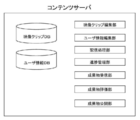
- FIG. 2 is a diagram schematically showing an internal configuration of the content server shown in FIG.
- the content server includes a video clip database for storing video clip data and the like, a user information database for storing user information, a video clip editing unit for registering and editing video clips in the video clip database, and a user information database.
- a user information editing unit that performs user information registration processing, a distribution processing unit that distributes video clips stored in the video clip database, a progress management unit that manages the progress of learning by the distributed video clips,
- a product receiving unit that receives a learning product using a video clip, a product evaluation unit that performs an evaluation process on the received learning product, and a product publishing unit that allows a user terminal and a client terminal to browse the received learning product have.
- the user terminal has a function of reproducing the distributed video clip, and has a photographing unit for recording (photographing / recording) video / audio, or it is provided outside.
- the video clip database stores video clip data for learning and associated information (for example, producer, content type / use, distribution target person, evaluator, achievement level measuring method, etc.).
- the user information database stores information on learners who use user terminals and learning instructors who use client terminals in FIG. For learners, information such as learning contents, curriculum, progress, and achievement level of each person is stored, and for learning instructors, instruction authority, object, instruction history, etc. are stored.
- the video clip editing unit receives an operation from an administrator terminal, a client terminal, or the like, and registers the video clip data and accompanying information in the video clip database. Alternatively, a video clip is registered from the user terminal.
- the user information editing unit accepts an operation from an administrator terminal, a client terminal, or the like, and registers information on a learner who uses the user terminal and a learning instructor who uses the client terminal in the user information database. Or it is good also as a structure which can register the information regarding a learner from a user terminal.
- the distribution processing unit performs distribution processing on the user (learner) terminal for each video clip stored in the video clip database.
- This distribution processing is based on a predetermined learning curriculum that is grasped from the accompanying information of the video clip stored in the video clip database and the information stored in the user information database. It shall be distributed in the form (adaptive learning).
- the progress management unit manages information regarding the progress of learning by video clips distributed to the user terminal for each learner.
- This progress management includes a predetermined learning curriculum grasped from the accompanying information of the video clip stored in the video clip database and the information stored in the user information database, and learning products and other information by the video clip from the user terminal. It shall be grasped by receipt of (not learned, not learned, etc.). Further, the progress management unit may display the learning content that the user should currently perform in a format such as a ToDo list on the user terminal.
- the deliverable receiving unit receives, from the user terminal, a video clip obtained by photographing the learner's operation or the like as a deliverable by the learner to whom the video clip has been distributed.
- the deliverable evaluation unit evaluates the learner's deliverable that appears in the video clip received from the user terminal based on a predetermined evaluation criterion or evaluation method.
- the evaluation of the video clip that captures the learner's action or the like, which is the learning product is analyzed for the difference from the reference video clip (which may be distributed to the learner or prepared separately), for example. It is also possible to use an automatic evaluation method (objective evaluation).
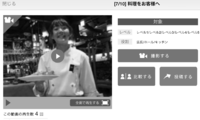
- FIG. 3 is a diagram showing a screen display example of a video clip used in the autonomous learning system using the video clip of the present invention.
- the distributed video clip can be played back and viewed on the display device of the user terminal.
- accompanying information of the video clip can be displayed.
- the video clip may be stored in the user terminal so that it can be viewed many times, or may be acquired from the content server and viewed each time.
- the autonomous learning system using the video clip of the present invention can be applied to all kinds of learning using small units and short time videos. For example, it may be applied to various learning related to human movement such as learning of customer service, learning of speech, and learning of language.
- the administrator terminal shown in FIG. 1 is a terminal for the administrator of the system to operate and manage the content server and the like, and the client terminal is the registration of the video clip by the user (learner) learning instructor.
- -It is a terminal for editing and assigning distribution contents, learning progress management, product evaluation / approval, and product reuse management.
- FIG. 4 is a flowchart schematically showing the flow of use of the autonomous learning system using the video clip of the present invention.
- the administrator of this system or the learning instructor of the user accesses the content server from the administrator terminal or the client terminal, and the user information editing unit uses the attribute information of the user who is the learner. Etc. are registered in the user information database and edited accordingly.
- the administrator of this system or the user's learning instructor accesses the content server from the administrator terminal or the client terminal, and registers video clips and accompanying information as teaching material contents in the video clip database by the video clip editing unit. Edit this as appropriate.
- the administrator of this system or the user's learning instructor can access the content server from the administrator terminal or the client terminal, and can set a learning curriculum on how to distribute which video clip to which user. .
- the learning curriculum set in this way information from distribution to result confirmation is managed by the distribution processing unit and the progress management unit of the content server.
- the video clip registered in the video clip database is distributed or acquired to the user terminal by an operation from the administrator terminal or the client terminal, or by an operation by the user's own user terminal.
- the user plays a video clip on the user terminal and learns it.
- the video clip is reproduced on the user terminal in the form shown in FIG. 3, for example.
- a product for indicating the learning result is generated.
- the product referred to here is an image taken and recorded of an action performed by the user following the action reproduced by the video clip. That is, the deliverable is also a video clip.
- FIG. 1 As shown in FIG.
- the learning video / audio clip includes (1) a clip for explaining and demonstrating the operation to the learner, (2) a clip for imitating and imitating the sample of the operation, and (3) the learner. There are clips that ask questions and answer them. For (1), a product indicating that the explanation has been understood, (2) for a product that has been photographed / recorded to imitate the behavior, and for (3), a product that has been photographed / recorded for an answer to a question. Each corresponds.
- the user uploads the generated product from the user terminal to the product receiving unit of the content server.
- the product uploaded to the content server is evaluated by the product evaluation unit to determine whether a predetermined level of learning result has been achieved.
- This evaluation may be automatically performed by detecting a difference from a video clip as a teaching material, but can also be performed by visual recognition by a learning instructor.
- the learning instructor reproduces the product obtained from the content server on the client terminal, and attaches an evaluation or approval / disapproval determination to the product.
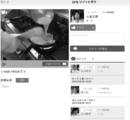
- an evaluation by a learning instructor is performed, for example, as shown in FIG. 6, the user's learning effect and motivation can be further improved by adopting an interactive evaluation method in which comments are exchanged between the user and the learning instructor. There is expected.
- the deliverables that have been recognized to achieve the predetermined level of learning results as described above are registered as approved deliverables in the video clip database.
- This approved deliverable can be used as a learning material for other users as it is, and is a target for distribution to other users together with video clips registered in advance in the video clip database.
- a video clip which is a product that has been approved for achievement, can be obtained as new teaching material content, that is, teaching materials can produce teaching materials without requiring any work by the system administrator or learning instructor.
- An extremely new and characteristic autonomous learning system will be provided (A in the flowchart of FIG. 4).
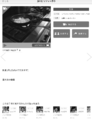
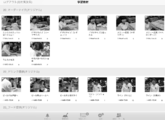
- the product publication unit of the content server has a function of publishing to the user a video clip that is a product for which achievement of a predetermined level of learning result is recognized. ing. Examples of the screen display are shown in FIGS.
- the user can select teaching material contents that he / she wants to learn from not only video clips provided by the system administrator or learning instructor but also video clips which are products produced by other users. This not only increases convenience, but also reduces the burden of teaching material production on the system administrator or learning instructor side (B in the flowchart of FIG. 4).
- the video clip database is a form in which no video clip is stored in the initial state, that is, teaching material content on the system management side or the learning instruction side. It is also possible to take a form in which video clips are not produced or provided in advance.
- the system management side or the learning instruction side presents only the template of the video clip that is the teaching material content in the initial state. For example, when only information such as “XX action, 10 seconds” is given, the user performs the action, generates a video clip that is a product of recording and recording it, and uploads it to the content server.
- this product is evaluated as having achieved a predetermined level of learning result by evaluation by a learning instructor or mutual evaluation by a user, it is accumulated in the video clip database as a video clip for learning. .
- this system if only the model of the video clip that is the educational material content is given, the user who is a learner can generate excellent educational material content by himself and use it for the learning of other users. Furthermore, a highly autonomous learning system in which educational material content increases will be constructed.
- the autonomous learning system using the video / audio clip of the present invention includes a CPU, a memory of a computer group such as a content server, a client terminal, a user terminal, and an administrator terminal,
- the present invention is realized by an OS, application software, a database, a network system, and the like constructed on hardware resources including an auxiliary storage device, a display, and an input device.
- Information processing for reusing a video / audio clip which is a product generated by a learner using a video / audio clip, that is determined to clear a predetermined standard as a video / audio clip as a learning content is the above-described hardware. Since it is specifically realized using hardware resources, it falls under the technical idea using the laws of nature and can be used industrially.
Landscapes
- Engineering & Computer Science (AREA)
- Business, Economics & Management (AREA)
- General Physics & Mathematics (AREA)
- Physics & Mathematics (AREA)
- Educational Administration (AREA)
- Educational Technology (AREA)
- Theoretical Computer Science (AREA)
- Entrepreneurship & Innovation (AREA)
- Multimedia (AREA)
- Health & Medical Sciences (AREA)
- General Health & Medical Sciences (AREA)
- Nutrition Science (AREA)
- Electrically Operated Instructional Devices (AREA)
- Management, Administration, Business Operations System, And Electronic Commerce (AREA)
Abstract
Priority Applications (4)
| Application Number | Priority Date | Filing Date | Title |
|---|---|---|---|
| EP16737332.3A EP3246896A2 (fr) | 2015-01-13 | 2016-01-12 | Système d'apprentissage autonome utilisant des clips vidéo/audio |
| JP2016560937A JP6140375B2 (ja) | 2015-01-13 | 2016-01-12 | 映像音声クリップを利用した自律的学習システム |
| CN201680005424.4A CN107210001B (zh) | 2015-01-13 | 2016-01-12 | 使用视频片段的自主学习系统 |
| US15/543,042 US20180025658A1 (en) | 2015-01-13 | 2016-01-12 | Autonomous learning system using video/audio clips |
Applications Claiming Priority (2)
| Application Number | Priority Date | Filing Date | Title |
|---|---|---|---|
| JP2015004319 | 2015-01-13 | ||
| JP2015-004319 | 2015-01-13 |
Publications (3)
| Publication Number | Publication Date |
|---|---|
| WO2016114261A2 true WO2016114261A2 (fr) | 2016-07-21 |
| WO2016114261A3 WO2016114261A3 (fr) | 2016-09-09 |
| WO2016114261A4 WO2016114261A4 (fr) | 2016-11-10 |
Family
ID=56406540
Family Applications (1)
| Application Number | Title | Priority Date | Filing Date |
|---|---|---|---|
| PCT/JP2016/050707 Ceased WO2016114261A2 (fr) | 2015-01-13 | 2016-01-12 | Système d'apprentissage autonome utilisant des clips vidéo/audio |
Country Status (5)
| Country | Link |
|---|---|
| US (1) | US20180025658A1 (fr) |
| EP (1) | EP3246896A2 (fr) |
| JP (1) | JP6140375B2 (fr) |
| CN (1) | CN107210001B (fr) |
| WO (1) | WO2016114261A2 (fr) |
Cited By (4)
| Publication number | Priority date | Publication date | Assignee | Title |
|---|---|---|---|---|
| JPWO2018061668A1 (ja) * | 2016-09-28 | 2019-08-08 | 株式会社 スプリックス | 教材共有システム、教材共有サーバ、教材共有方法 |
| JP2020004222A (ja) * | 2018-06-29 | 2020-01-09 | Co−Growth株式会社 | 学習管理システム |
| WO2020148919A1 (fr) * | 2019-01-17 | 2020-07-23 | オムロン株式会社 | Dispositif de traitement d'informations, système de présentation et programme de traitement d'informations |
| WO2020230758A1 (fr) * | 2019-05-16 | 2020-11-19 | Co-Growth株式会社 | Système de gestion d'apprentissage |
Families Citing this family (2)
| Publication number | Priority date | Publication date | Assignee | Title |
|---|---|---|---|---|
| CN111400552B (zh) * | 2020-03-31 | 2024-02-27 | 维沃移动通信有限公司 | 便签创建方法及电子设备 |
| CN116320553A (zh) * | 2021-12-20 | 2023-06-23 | 北京字跳网络技术有限公司 | 视频合集的展示方法、装置、电子设备及可读存储介质 |
Family Cites Families (16)
| Publication number | Priority date | Publication date | Assignee | Title |
|---|---|---|---|---|
| US6909874B2 (en) * | 2000-04-12 | 2005-06-21 | Thomson Licensing Sa. | Interactive tutorial method, system, and computer program product for real time media production |
| JP2003208083A (ja) * | 2002-01-11 | 2003-07-25 | Nippon Telegr & Teleph Corp <Ntt> | 教材作成方法及び装置及び教材作成プログラム及び教材作成プログラムを格納した記憶媒体 |
| JP3930402B2 (ja) * | 2002-09-05 | 2007-06-13 | 株式会社リコー | オンライン教育システム、情報処理装置、情報提供方法及びプログラム |
| US20040125127A1 (en) * | 2002-09-19 | 2004-07-01 | Beizhan Liu | System and method for video-based online interview training |
| GB2426861A (en) * | 2005-05-25 | 2006-12-06 | Playitnow Ltd | A system for providing tuition |
| JP4899383B2 (ja) * | 2005-08-31 | 2012-03-21 | ヤマハ株式会社 | 語学学習支援方法 |
| FR2904703B1 (fr) * | 2006-08-04 | 2008-12-12 | Essilor Int | Paire de lunettes ophtalmiques et procede de formation d'une nervure peripherique d'emboitement sur le chant d'une lentille |
| US9165473B2 (en) * | 2008-07-25 | 2015-10-20 | ArtistWorks, Inc. | Video management system for interactive online instruction |
| JP2012042503A (ja) * | 2010-08-12 | 2012-03-01 | Chie Yamamoto | インターアクティブ・ビデオシステム |
| EP2609516A4 (fr) * | 2010-08-23 | 2016-04-27 | Cubic Corp | Appareil et procédés pour la création, la collecte et la dissémination de modules de contenu didactique au moyen de dispositifs mobiles |
| CN101950495A (zh) * | 2010-10-19 | 2011-01-19 | 冠捷显示科技(厦门)有限公司 | 一种新型视频教育技术 |
| US20130177894A1 (en) * | 2012-01-05 | 2013-07-11 | Anthony Frank FOTENOS | Systems and methods for relative peer review |
| CN202615640U (zh) * | 2012-04-25 | 2012-12-19 | 周维玲 | 视频运动姿势学习装置 |
| CN102819969B (zh) * | 2012-08-15 | 2014-11-26 | 魔方天空科技(北京)有限公司 | 多媒体教育平台的实现方法及多媒体教育平台系统 |
| US9530325B2 (en) * | 2012-09-24 | 2016-12-27 | David Hall | Exercise training system |
| CN103745423B (zh) * | 2013-12-27 | 2016-08-24 | 浙江大学 | 一种口型示教系统与示教方法 |
-
2016
- 2016-01-12 JP JP2016560937A patent/JP6140375B2/ja active Active
- 2016-01-12 EP EP16737332.3A patent/EP3246896A2/fr not_active Withdrawn
- 2016-01-12 US US15/543,042 patent/US20180025658A1/en not_active Abandoned
- 2016-01-12 CN CN201680005424.4A patent/CN107210001B/zh not_active Expired - Fee Related
- 2016-01-12 WO PCT/JP2016/050707 patent/WO2016114261A2/fr not_active Ceased
Cited By (5)
| Publication number | Priority date | Publication date | Assignee | Title |
|---|---|---|---|---|
| JPWO2018061668A1 (ja) * | 2016-09-28 | 2019-08-08 | 株式会社 スプリックス | 教材共有システム、教材共有サーバ、教材共有方法 |
| JP2020004222A (ja) * | 2018-06-29 | 2020-01-09 | Co−Growth株式会社 | 学習管理システム |
| WO2020148919A1 (fr) * | 2019-01-17 | 2020-07-23 | オムロン株式会社 | Dispositif de traitement d'informations, système de présentation et programme de traitement d'informations |
| WO2020230758A1 (fr) * | 2019-05-16 | 2020-11-19 | Co-Growth株式会社 | Système de gestion d'apprentissage |
| JP2020187603A (ja) * | 2019-05-16 | 2020-11-19 | Co−Growth株式会社 | 学習管理システム |
Also Published As
| Publication number | Publication date |
|---|---|
| US20180025658A1 (en) | 2018-01-25 |
| WO2016114261A3 (fr) | 2016-09-09 |
| CN107210001A (zh) | 2017-09-26 |
| JPWO2016114261A1 (ja) | 2017-04-27 |
| EP3246896A4 (fr) | 2017-11-22 |
| JP6140375B2 (ja) | 2017-05-31 |
| EP3246896A2 (fr) | 2017-11-22 |
| CN107210001B (zh) | 2020-03-24 |
| WO2016114261A4 (fr) | 2016-11-10 |
Similar Documents
| Publication | Publication Date | Title |
|---|---|---|
| JP6140375B2 (ja) | 映像音声クリップを利用した自律的学習システム | |
| Köster | Video in the age of digital learning | |
| Chen et al. | Everyone can be a star: Quantifying grassroots online sellers' live streaming effects on product sales | |
| US20120208168A1 (en) | Methods and systems relating to coding and/or scoring of observations of and content observed persons performing a task to be evaluated | |
| JP2017537412A (ja) | イベントを追跡し、仮想会議のフィードバックを提供するシステム及び方法 | |
| US20140302477A1 (en) | Intelligent interactive remote teaching system | |
| CN103473297A (zh) | 一种基于智能移动终端的多媒体问答系统和方法 | |
| CN112131361B (zh) | 一种答题内容推送方法及装置 | |
| WO2018223532A1 (fr) | Procédé de recommandation de données d'enregistrement et de diffusion sur internet | |
| Limbu et al. | WEKIT. one: a sensor-based augmented reality system for experience capture and re-enactment | |
| Kumar et al. | A general model for an instructional video-based personalized programming learning environment and its practical implications | |
| JP7521886B2 (ja) | プログラム、情報処理方法、及び情報処理装置 | |
| Mihai et al. | Technical analysis of MOOCs | |
| Bibiloni et al. | Automatic collection of user behavior in 360 multimedia | |
| US20150141154A1 (en) | Interactive Experimentation | |
| Savola | Video-based analysis of mathematics classroom practice: Examples from Finland and Iceland | |
| JP6686578B2 (ja) | 情報処理装置及び情報処理プログラム | |
| Vryzas et al. | Machine-assisted reporting in the era of Mobile Journalism: the MOJO-mate platform. | |
| KR20110092633A (ko) | 웹 기반의 의료교육방법 | |
| Chunwijitra et al. | Advanced content authoring and viewing tools using aggregated video and slide synchronization by key marking for web-based e-learning system in higher education | |
| JP7380023B2 (ja) | 情報処理装置、制御方法及びプログラム | |
| CN119207184A (zh) | 交互教学方法、装置、计算设备、存储介质及程序产品 | |
| KR20130100813A (ko) | e-Book 기반 온라인 방송 학습 시스템 및 방법 | |
| CN119992898A (zh) | 一种元宇宙数字化智能教学系统、构建方法及教学方法 | |
| TWM636088U (zh) | 建立學習事件與驗證學習成效的線上學習系統 |
Legal Events
| Date | Code | Title | Description |
|---|---|---|---|
| 121 | Ep: the epo has been informed by wipo that ep was designated in this application |
Ref document number: 16737332 Country of ref document: EP Kind code of ref document: A2 |
|
| ENP | Entry into the national phase |
Ref document number: 2016560937 Country of ref document: JP Kind code of ref document: A |
|
| WWE | Wipo information: entry into national phase |
Ref document number: 15543042 Country of ref document: US |
|
| NENP | Non-entry into the national phase |
Ref country code: DE |
|
| REEP | Request for entry into the european phase |
Ref document number: 2016737332 Country of ref document: EP |