WO2016117511A1 - Corps orienté contenant de l'oxyde de fer ε, procédé et dispositif pour sa production - Google Patents
Corps orienté contenant de l'oxyde de fer ε, procédé et dispositif pour sa production Download PDFInfo
- Publication number
- WO2016117511A1 WO2016117511A1 PCT/JP2016/051304 JP2016051304W WO2016117511A1 WO 2016117511 A1 WO2016117511 A1 WO 2016117511A1 JP 2016051304 W JP2016051304 W JP 2016051304W WO 2016117511 A1 WO2016117511 A1 WO 2016117511A1
- Authority
- WO
- WIPO (PCT)
- Prior art keywords
- iron oxide
- magnetic
- oxide particles
- mixed solution
- particles
- Prior art date
- Legal status (The legal status is an assumption and is not a legal conclusion. Google has not performed a legal analysis and makes no representation as to the accuracy of the status listed.)
- Ceased
Links
Images


Classifications
-
- C—CHEMISTRY; METALLURGY
- C01—INORGANIC CHEMISTRY
- C01G—COMPOUNDS CONTAINING METALS NOT COVERED BY SUBCLASSES C01D OR C01F
- C01G49/00—Compounds of iron
- C01G49/02—Oxides; Hydroxides
-
- G—PHYSICS
- G11—INFORMATION STORAGE
- G11B—INFORMATION STORAGE BASED ON RELATIVE MOVEMENT BETWEEN RECORD CARRIER AND TRANSDUCER
- G11B5/00—Recording by magnetisation or demagnetisation of a record carrier; Reproducing by magnetic means; Record carriers therefor
- G11B5/62—Record carriers characterised by the selection of the material
- G11B5/68—Record carriers characterised by the selection of the material comprising one or more layers of magnetisable material homogeneously mixed with a bonding agent
- G11B5/70—Record carriers characterised by the selection of the material comprising one or more layers of magnetisable material homogeneously mixed with a bonding agent on a base layer
- G11B5/706—Record carriers characterised by the selection of the material comprising one or more layers of magnetisable material homogeneously mixed with a bonding agent on a base layer characterised by the composition of the magnetic material
-
- G—PHYSICS
- G11—INFORMATION STORAGE
- G11B—INFORMATION STORAGE BASED ON RELATIVE MOVEMENT BETWEEN RECORD CARRIER AND TRANSDUCER
- G11B5/00—Recording by magnetisation or demagnetisation of a record carrier; Reproducing by magnetic means; Record carriers therefor
- G11B5/84—Processes or apparatus specially adapted for manufacturing record carriers
- G11B5/842—Coating a support with a liquid magnetic dispersion
- G11B5/845—Coating a support with a liquid magnetic dispersion in a magnetic field
-
- H—ELECTRICITY
- H01—ELECTRIC ELEMENTS
- H01F—MAGNETS; INDUCTANCES; TRANSFORMERS; SELECTION OF MATERIALS FOR THEIR MAGNETIC PROPERTIES
- H01F1/00—Magnets or magnetic bodies characterised by the magnetic materials therefor; Selection of materials for their magnetic properties
- H01F1/01—Magnets or magnetic bodies characterised by the magnetic materials therefor; Selection of materials for their magnetic properties of inorganic materials
- H01F1/03—Magnets or magnetic bodies characterised by the magnetic materials therefor; Selection of materials for their magnetic properties of inorganic materials characterised by their coercivity
- H01F1/032—Magnets or magnetic bodies characterised by the magnetic materials therefor; Selection of materials for their magnetic properties of inorganic materials characterised by their coercivity of hard-magnetic materials
- H01F1/10—Magnets or magnetic bodies characterised by the magnetic materials therefor; Selection of materials for their magnetic properties of inorganic materials characterised by their coercivity of hard-magnetic materials non-metallic substances, e.g. ferrites, e.g. [(Ba,Sr)O(Fe2O3)6] ferrites with hexagonal structure
- H01F1/11—Magnets or magnetic bodies characterised by the magnetic materials therefor; Selection of materials for their magnetic properties of inorganic materials characterised by their coercivity of hard-magnetic materials non-metallic substances, e.g. ferrites, e.g. [(Ba,Sr)O(Fe2O3)6] ferrites with hexagonal structure in the form of particles
-
- H—ELECTRICITY
- H01—ELECTRIC ELEMENTS
- H01F—MAGNETS; INDUCTANCES; TRANSFORMERS; SELECTION OF MATERIALS FOR THEIR MAGNETIC PROPERTIES
- H01F1/00—Magnets or magnetic bodies characterised by the magnetic materials therefor; Selection of materials for their magnetic properties
- H01F1/01—Magnets or magnetic bodies characterised by the magnetic materials therefor; Selection of materials for their magnetic properties of inorganic materials
- H01F1/03—Magnets or magnetic bodies characterised by the magnetic materials therefor; Selection of materials for their magnetic properties of inorganic materials characterised by their coercivity
- H01F1/032—Magnets or magnetic bodies characterised by the magnetic materials therefor; Selection of materials for their magnetic properties of inorganic materials characterised by their coercivity of hard-magnetic materials
- H01F1/10—Magnets or magnetic bodies characterised by the magnetic materials therefor; Selection of materials for their magnetic properties of inorganic materials characterised by their coercivity of hard-magnetic materials non-metallic substances, e.g. ferrites, e.g. [(Ba,Sr)O(Fe2O3)6] ferrites with hexagonal structure
- H01F1/11—Magnets or magnetic bodies characterised by the magnetic materials therefor; Selection of materials for their magnetic properties of inorganic materials characterised by their coercivity of hard-magnetic materials non-metallic substances, e.g. ferrites, e.g. [(Ba,Sr)O(Fe2O3)6] ferrites with hexagonal structure in the form of particles
- H01F1/113—Magnets or magnetic bodies characterised by the magnetic materials therefor; Selection of materials for their magnetic properties of inorganic materials characterised by their coercivity of hard-magnetic materials non-metallic substances, e.g. ferrites, e.g. [(Ba,Sr)O(Fe2O3)6] ferrites with hexagonal structure in the form of particles in a bonding agent
-
- H—ELECTRICITY
- H05—ELECTRIC TECHNIQUES NOT OTHERWISE PROVIDED FOR
- H05K—PRINTED CIRCUITS; CASINGS OR CONSTRUCTIONAL DETAILS OF ELECTRIC APPARATUS; MANUFACTURE OF ASSEMBLAGES OF ELECTRICAL COMPONENTS
- H05K9/00—Screening of apparatus or components against electric or magnetic fields
Definitions
- the present invention relates to an oriented body containing ⁇ iron oxide, a manufacturing method thereof, and a manufacturing apparatus.
- ⁇ Iron oxide is an extremely rare phase among iron oxides.
- the presence of epsilon iron oxide having a nano-order particle size and a huge coercive force (Hc) of 20 kOe (1.59 ⁇ 10 6 A / m) at room temperature has been confirmed.
- Hc coercive force
- ⁇ iron oxide and ⁇ iron oxide are the most universal, and ⁇ iron oxide is one of them. Since this ⁇ iron oxide shows a huge amount of Hc, it is expected to be applied to a magnetic recording medium with a high recording density, other magnetic uses, or radio wave absorption uses.
- the easy axis of magnetization of magnetic particles is generally aligned in one direction for the purpose of particularly remarkably improving the magnetic characteristics with respect to a magnetic field in a specific direction.
- an alignment process may be performed in the manufacturing process.
- magnetic field orientation is mentioned as a typical orientation process. This is because magnetic powder particles are kneaded with a binder such as a resin to form a filling structure of a predetermined shape, and a magnetic field in one direction is applied to the filling structure while the binder is still fluid. This is a process in which the magnetization easy axis of the particles is aligned with the direction of the applied magnetic field. When the binder is cured after this orientation treatment, the particles constituting the filling structure are fixed with the easy magnetization axes aligned in a certain direction.
- the present inventors set 20 kOe (1.59 * 10 ⁇ 6 > A / m) in the magnetic hysteresis loop measured by applying the magnetic field of a parallel direction with respect to the orientation direction of an easy axis of magnetization.
- a magnetic material in which a coercive force (Hc) exceeding is observed is disclosed.
- a magnetic sheet which is a magnetic material used for a high recording density medium or a high-efficiency radio wave absorber
- the degree of orientation of the magnetic particles is defined by the value of the squareness ratio (SQ) as shown in the formula (1), those having the degree of orientation exceeding 3.5 have not been obtained.
- Degree of orientation SQ (easy magnetization axis direction) / SQ (hard magnetization axis direction) (1)
- the value of the degree of orientation of the magnetic particles in the oriented body such as a magnetic sheet increases beyond 3.5, it is considered that the magnetic behavior becomes sharp.
- an improvement in magnetic recording density and an improvement in the efficiency of the Faraday effect can be expected at a level close to a single crystal of the magnetic material.
- the present invention has been made under the above-mentioned circumstances, and the problem to be solved is an oriented body such as a magnetic sheet having a degree of orientation of the magnetic particles above 3.5 and a method for producing the same, And providing a manufacturing apparatus.
- Magnetic particles It is preferable to use ⁇ -iron oxide particles having a high coercive force (Hc) as magnetic particles.
- Magnetic particle orientation method When orienting magnetic particles in a medium, From the viewpoint of enhancing the certainty of orientation, it was found that the degree of orientation of the obtained magnetic sheet or the like can be increased beyond 3.5 by performing it under a magnetic flux density of a strong magnetic field of 2 Tesla or more. Further, when the magnetic sheet or the like according to the present invention is manufactured with the configurations of (1) and (2) above, conventionally, the magnetic powder is dispersed using an apparatus such as a planetary ball mill or an ultrasonic disperser having high dispersion ability. However, it has also been found that according to the present invention, a magnetic dispersion with high magnetic responsiveness can be produced even with a simple shaking-type dispersion stirring apparatus.
- the second invention is Mixing a mixed solution containing a solvent and a vehicle and ⁇ iron oxide particles by shaking with stirring, and dispersing the ⁇ iron oxide particles in the mixed solution; Providing a mixed solution in which the ⁇ iron oxide particles are dispersed on a predetermined substrate; And a step of obtaining an oriented body by removing the solvent while applying a magnetic field to the substrate on which the mixed solution is provided.
- the third invention is The magnetic flux density value of the magnetic field is 2 Tesla or more, and the method for producing an oriented body containing ⁇ iron oxide according to the second invention.
- the fourth invention is: A manufacturing apparatus for carrying out the second or third invention, A dispersion function of mixing a mixed solution containing a solvent and a vehicle and ⁇ iron oxide particles by shaking with stirring and dispersing the ⁇ iron oxide particles in the mixed solution; A coating function in which a mixed solution in which the ⁇ iron oxide particles are dispersed is provided on a predetermined substrate; An apparatus for producing an alignment body containing ⁇ iron oxide, characterized by having a magnetic field application function of removing the solvent while applying a magnetic field to the mixed solution in which the ⁇ iron oxide particles are dispersed.
- an oriented body such as a magnetic sheet having an orientation degree value exceeding 3.5 could be obtained.
- FIG. 2 is an enlarged view of a magnetization curve at ⁇ 30 kOe in FIG. 1.
- 4 is a graph showing a relationship between spontaneous magnetization and an angle between hard magnetization axes in an oriented body including ⁇ iron oxide according to Example 1; It is a schematic diagram of the example of the manufacturing apparatus of the oriented body containing the epsilon iron oxide based on this invention. It is a schematic diagram when the manufacturing apparatus shown in FIG. 4 is performing shaking operation. It is a schematic diagram when the manufacturing apparatus shown in FIG.
- FIG. 4 is performing the application
- magnetic particles For embodiments for carrying out the present invention, (1) magnetic particles, (2) a method of dispersing magnetic particles, (3) Magnetic particle alignment method, (4) vehicle, (5) magnetic properties of an alignment body containing ⁇ iron oxide according to the present invention, (6) an apparatus for manufacturing an alignment body including ⁇ iron oxide according to the present invention, This will be explained in the order.
- Magnetic particles used in the present invention are preferably ⁇ iron oxide particles having a high coercive force (Hc).
- Hc high coercive force
- An example of synthesis in a water-surfactant system will be described in Example 1 to be described later.
- the magnetic particles are dispersed in a predetermined manner using an ultrasonic stirring / dispersing device or a large rotating stirring / dispersing device such as a planetary ball mill. It was dispersed in the medium.
- the particles are dispersed by using a simple method and apparatus such as a shaking type stirring device. Even if it exists, it discovered that the oriented body with a high degree of orientation was obtained.
- a dispersion according to the present invention obtained by dispersing the above-described ⁇ -iron oxide particles in a predetermined solvent is provided on a substrate.
- a polyester film may be attached on a glass substrate, and the dispersion may be dropped on the film.
- the dispersion liquid according to the present invention provided on the obtained substrate is placed under a magnetic flux density of 2 Tesla or more from the viewpoint of enhancing the certainty of orientation, and the vehicle is cured by volatilizing the mixed solvent to obtain a magnetic material as an oriented body.
- a sheet was obtained.
- the vehicle used in the present invention is preferably one or more selected from urethane resins, vinyl chloride resins, and the like from the viewpoint of increasing the degree of orientation of the ⁇ iron oxide particles and maintaining the same.
- a vinyl chloride resin are preferably used in combination.
- a resin obtained by dissolving these resins in one or more solvents selected from acetylacetone, n-butyl stearate, cyclohexane, toluene, methyl ethyl ketone and the like may be used as the vehicle.
- the magnetic sheet which is an oriented body containing ⁇ iron oxide according to the present invention can be manufactured without using a dedicated manufacturing apparatus. However, if the magnetic sheet which is an oriented body containing ⁇ iron oxide according to the present invention is to be manufactured with high uniformity and productivity, it is preferable to use the manufacturing apparatus according to the present invention described later.
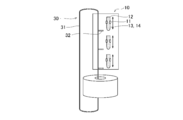
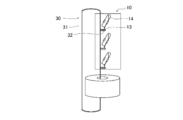
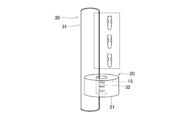
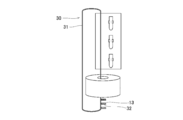
- FIG. 4 to 8 are schematic views of an example of an apparatus for producing an oriented body containing ⁇ iron oxide according to the present invention.
- FIG. 4 shows the entire apparatus
- FIGS. 5 to 8 show an operating state of the apparatus.
- the apparatus includes a shaking unit 10, a magnetic field application unit 20, and a transport unit 30.
- the shaking unit 10 is a part that shakes the container 12 with the shaking device 11.
- the shaking is, for example, up and down, the number of shaking is 100 to 3000 times / min, and the amplitude of shaking is 1 to 10 mm.
- a mixed solution 13 of ⁇ iron oxide particles, a vehicle, and a predetermined solvent, and a mixing ball 14 are loaded.
- the mixing ball is preferably a zirconia ball having a diameter of 0.1 mm ⁇ to 2 mm ⁇ .
- the magnetic field application unit 20 has an electromagnet 21 for placing a magnetic field application object in a magnetic field.
- the electromagnet 21 may be a permanent magnet or a superconducting magnet.
- the electromagnet 21 can apply a magnetic force to a magnetic field application target with a magnetic flux density of 2 Tesla or more.
- the conveyance unit 30 includes a conveyor 31 that conveys a substrate 32 that is a conveyance target to the shaking unit 10 and the magnetic field application unit 20.
- a mixture 13 of ⁇ iron oxide particles and a vehicle, a predetermined solvent, and a mixing ball 14 are loaded into a container 12. And the said container 12 is installed in the shaking apparatus 11, and it shakes, the liquid mixture 13 and the ball
- the substrate 32 is transferred to a predetermined position under the container 12 using the conveyor 31. Then, the mixed liquid 13 that is the dispersion liquid is poured onto the substrate 32 from the container 12. At this time, the container 12 may be inclined, the lower part of the container 12 may be opened, or other methods may be used. In any case, it is preferable to provide a mesh or the like on the container 12 so that the mixing balls 14 do not fall on the substrate 32.
- the substrate 32 provided with the mixed solution 13 is installed in the electromagnet 21 using the conveyor 31. Then, the substrate 32 provided with the mixed liquid 13 that has become the dispersion liquid is placed in a magnetic field having a magnetic flux density of 2 Tesla or more, and the ⁇ iron oxide in the mixed liquid 13 that has become the dispersion liquid is oriented, and the solvent is removed. Volatilize and solidify.
- the substrate 32 having the magnetic sheet solidified and formed using the conveyor 31 is carried out from the electromagnet 21. good.
- the magnetic sheet manufacturing apparatus that is an oriented body containing ⁇ iron oxide according to the present invention
- the magnetic sheet that is an oriented body containing ⁇ iron oxide according to the present invention can have high uniformity and It can be manufactured with productivity.
- ⁇ Procedure 1> Two types of solutions were prepared: a raw material solution and a neutralizer solution.
- the target ⁇ iron oxide particles were obtained.
- the obtained ⁇ -iron oxide particles had a TEM average particle size of 25.4 nm, a standard deviation of 11.1 nm, and a variation coefficient defined by (standard deviation / TEM average particle size) ⁇ 100 was 43.7%.
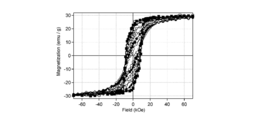
- FIG. 1 is a graph showing a magnetic hysteresis loop at normal temperature (300 K) at 70 kOe (5.57 ⁇ 10 6 A / m) of a magnetic sheet which is an alignment film containing ⁇ iron oxide particles according to Example 1.
- FIG. 2 is an enlarged view of the graph at ⁇ 30 kOe in FIG. FIGS.
- FIGS. 1 and 2 show the results of measuring the magnetic hysteresis loop every 15 °, with the hard axis direction being 0 ° and the perpendicular (90 °) direction being the easy axis direction.
- the 0 ° loop from the hard axis direction is indicated by ⁇
- the 15 ° loop is indicated by ⁇
- the 30 ° loop is indicated by ⁇
- the 45 ° loop is indicated by ⁇
- the 60 ° loop is indicated by ⁇ , 75.
- a loop of ° is plotted with ⁇
- a loop of 90 ° (easy magnetization axis) is plotted with ⁇ .
- the magnetic hysteresis loop was measured using an MPMS7 superconducting quantum interferometer (SQUID) manufactured by Quantum Design.
- the measured magnetic moment value is normalized by the mass of iron oxide. 1 and 2, it has been found that the oriented body containing ⁇ iron oxide according to the present invention exhibits properties inherent to ⁇ iron oxide.
- FIG. 3 is a graph showing the relationship between the spontaneous magnetization and the angle between the hard magnetization axis in the magnetic sheet, which is an alignment film containing ⁇ iron oxide particles according to Example 1.
- Example 2 In “(3) Preparation of magnetic sheet as alignment film containing ⁇ iron oxide particles” described in Example 1, the glass substrate on which the ⁇ iron oxide particle dispersion was dropped was placed under a superconducting magnet with a magnetic flux density of 2 Tesla.
- the magnetic sheet according to Example 2 was prepared by performing the same operation as in Example 1 except that the mixture was allowed to stand for 36 hours while the solvent was applied, and the vehicle was cured by evaporating the mixed solvent. Then, the magnetic characteristics of the magnetic sheet according to Example 2 were measured in the same manner as in Example 1.
- orientation degree SQ (easy axis direction) / SQ (difficult axis direction) was 4.8, which is 3.5 or more. It is considered that the behavior is sharp.
- the magnetic sheet which is an alignment film containing the ⁇ iron oxide particles according to Example 2 it can be expected to improve the magnetic recording density and the efficiency of the Faraday effect at a level close to that of a single crystal. The results are shown in Table 2.
- micelle solution II 4 mL of 25% aqueous ammonia was mixed with 2 mL of pure water and stirred, and further 18.3 mL of n-octane and 3.6 mL of 1-butanol were added to the solution and stirred well. To the solution, cetyltrimethylammonium bromide as a surfactant is added and dissolved in such an amount that the molar ratio of (pure water + water in ammonia) / surfactant is 30 to obtain micelle solution II. It was.
- the obtained ⁇ -Fe 2 O 3 crystal particles had a TEM average particle size of 27.6 nm, a standard deviation of the particle size of 13.0 nm, and [standard deviation of particle size] / [TEM average particle size] ⁇ 100.
- the coefficient of variation was 47.0%.
- Magnetic sheet which is an alignment film containing ⁇ iron oxide particles Tetramethoxysilane (Si (CH 3 O) 4 ) is added to the colloidal solution and hydrolytic reaction with water in a magnetic field of 2 Tesla. It was prepared by the method to produce a SiO 2 gel. First, 0.3 mL of the above colloidal solution and 0.6 mL of pure water are mixed well. 0.09 mL of tetramethoxysilane was added to this liquid, and it stirred rapidly and poured into the container (glass petri dish). The container was set in a 2 Tesla magnetic field using a superconducting magnet and waited for 24 hours. Meanwhile, the colloid gelled while receiving a magnetic field, and a magnetic sheet was obtained.
- Tetramethoxysilane Si (CH 3 O) 4
- shaking units 11 shaking devices 12 containers 13 mixed solutions 14 mixing balls 20 magnetic field applying units 21 electromagnets 30 conveying units 31 conveyors 32 substrates
Landscapes
- Engineering & Computer Science (AREA)
- Chemical & Material Sciences (AREA)
- Power Engineering (AREA)
- Organic Chemistry (AREA)
- Microelectronics & Electronic Packaging (AREA)
- Inorganic Chemistry (AREA)
- Dispersion Chemistry (AREA)
- Compounds Of Iron (AREA)
Abstract
L'invention concerne un corps orienté comme une feuille magnétique, dans lequel la valeur du degré d'orientation des particules magnétiques dépasse 3,5, un procédé de production dudit corps orienté, et un dispositif de production. Ce corps orienté comme une feuille magnétique est produit par un procédé faisant intervenir: une étape visant à mélanger, par agitation à secousses, des particules d'oxyde de fer ε et une solution mixte comprenant un solvant et un véhicule, et à disperser les particules d'oxyde de fer ε dans la solution mixte susmentionnée; une étape visant à placer la solution mixte comportant les particules dispersées d'oxyde de fer ε sur un substrat prescrit; et une étape visant à obtenir le corps orienté en éliminant le solvant tout en appliquant un champ magnétique au substrat sur lequel était placée la solution mixte.
Priority Applications (4)
| Application Number | Priority Date | Filing Date | Title |
|---|---|---|---|
| EP20155615.6A EP3671778A1 (fr) | 2015-01-19 | 2016-01-18 | Oxyde d'epsilon-fer dans un corps orienté, son procédé de production et dispositif de production associé |
| US15/544,147 US10669161B2 (en) | 2015-01-19 | 2016-01-18 | Oriented body containing e-iron oxide, method for producing the same, and device for producing the same |
| EP16740118.1A EP3249660A4 (fr) | 2015-01-19 | 2016-01-18 | Corps orienté contenant de l'oxyde de fer , procédé et dispositif pour sa production |
| CN201680006259.4A CN107210107B (zh) | 2015-01-19 | 2016-01-18 | 包含ε氧化铁的取向体和其的制造方法以及制造装置 |
Applications Claiming Priority (4)
| Application Number | Priority Date | Filing Date | Title |
|---|---|---|---|
| JP2015008160 | 2015-01-19 | ||
| JP2015-008160 | 2015-01-19 | ||
| JP2016006230A JP6756483B2 (ja) | 2015-01-19 | 2016-01-15 | ε酸化鉄を含む配向体とその製造方法、並びに製造装置 |
| JP2016-006230 | 2016-01-15 |
Publications (1)
| Publication Number | Publication Date |
|---|---|
| WO2016117511A1 true WO2016117511A1 (fr) | 2016-07-28 |
Family
ID=56417055
Family Applications (1)
| Application Number | Title | Priority Date | Filing Date |
|---|---|---|---|
| PCT/JP2016/051304 Ceased WO2016117511A1 (fr) | 2015-01-19 | 2016-01-18 | Corps orienté contenant de l'oxyde de fer ε, procédé et dispositif pour sa production |
Country Status (1)
| Country | Link |
|---|---|
| WO (1) | WO2016117511A1 (fr) |
Cited By (1)
| Publication number | Priority date | Publication date | Assignee | Title |
|---|---|---|---|---|
| CN111819642A (zh) * | 2018-03-29 | 2020-10-23 | 国立大学法人东京大学 | 铁系氧化物磁性粉及其制造方法 |
Citations (5)
| Publication number | Priority date | Publication date | Assignee | Title |
|---|---|---|---|---|
| JPS57162125A (en) * | 1981-03-03 | 1982-10-05 | Memorex Corp | Magnetic recording tape |
| WO2008029861A1 (fr) * | 2006-09-01 | 2008-03-13 | The University Of Tokyo | Cristal magnétique pour matériau d'absorption d'onde radio et absorbant d'onde radio |
| JP2008063199A (ja) * | 2006-09-08 | 2008-03-21 | Univ Of Tokyo | ε酸化鉄系の磁性材料 |
| JP2008174405A (ja) * | 2007-01-16 | 2008-07-31 | Univ Of Tokyo | ε−Fe2O3結晶の製法 |
| WO2010150853A1 (fr) * | 2009-06-24 | 2010-12-29 | 国立大学法人東京大学 | Processus de production de couche mince magnétique, couche mince magnétique et matériau magnétique |
-
2016
- 2016-01-18 WO PCT/JP2016/051304 patent/WO2016117511A1/fr not_active Ceased
Patent Citations (5)
| Publication number | Priority date | Publication date | Assignee | Title |
|---|---|---|---|---|
| JPS57162125A (en) * | 1981-03-03 | 1982-10-05 | Memorex Corp | Magnetic recording tape |
| WO2008029861A1 (fr) * | 2006-09-01 | 2008-03-13 | The University Of Tokyo | Cristal magnétique pour matériau d'absorption d'onde radio et absorbant d'onde radio |
| JP2008063199A (ja) * | 2006-09-08 | 2008-03-21 | Univ Of Tokyo | ε酸化鉄系の磁性材料 |
| JP2008174405A (ja) * | 2007-01-16 | 2008-07-31 | Univ Of Tokyo | ε−Fe2O3結晶の製法 |
| WO2010150853A1 (fr) * | 2009-06-24 | 2010-12-29 | 国立大学法人東京大学 | Processus de production de couche mince magnétique, couche mince magnétique et matériau magnétique |
Non-Patent Citations (1)
| Title |
|---|
| See also references of EP3249660A4 * |
Cited By (2)
| Publication number | Priority date | Publication date | Assignee | Title |
|---|---|---|---|---|
| CN111819642A (zh) * | 2018-03-29 | 2020-10-23 | 国立大学法人东京大学 | 铁系氧化物磁性粉及其制造方法 |
| CN111819642B (zh) * | 2018-03-29 | 2024-06-11 | 国立大学法人东京大学 | 铁系氧化物磁性粉及其制造方法 |
Similar Documents
| Publication | Publication Date | Title |
|---|---|---|
| JP6756483B2 (ja) | ε酸化鉄を含む配向体とその製造方法、並びに製造装置 | |
| Shen et al. | Chemical synthesis of magnetic nanoparticles for permanent magnet applications | |
| JP5124825B2 (ja) | ε酸化鉄系の磁性材料 | |
| Song et al. | Controlled synthesis and magnetic properties of bimagnetic spinel ferrite CoFe2O4 and MnFe2O4 nanocrystals with core–shell architecture | |
| CN102473519B (zh) | 磁性薄膜的制造方法、磁性薄膜及磁性体 | |
| JP6703548B2 (ja) | 配向体、その製造方法、その製造装置、及び磁気記録媒体 | |
| Bala et al. | Cobalt and magnesium ferrite nanoparticles: preparation using liquid foams as templates and their magnetic characteristics | |
| WO2013029200A1 (fr) | Procédé de préparation de microsphères creuses en ferrite ni-zn | |
| CN110451580A (zh) | 一种制备单分散四氧化三铁磁性纳米粒子的方法 | |
| JP6759855B2 (ja) | 希土類−鉄−窒素系合金粉末の製造方法 | |
| CN101229931B (zh) | 一种纳米Fe3O4的制备方法 | |
| CN104464999B (zh) | 软硬磁纳米双相自组装薄膜及其制备方法 | |
| CN115699227A (zh) | 各向异性氮化铁永磁体 | |
| CN107564643A (zh) | 一种纳米颗粒基各向异性双相复合磁体及制备方法 | |
| WO2016117511A1 (fr) | Corps orienté contenant de l'oxyde de fer ε, procédé et dispositif pour sa production | |
| CN109867310B (zh) | 一种原位制备SmCo5/Sm2Co17核壳结构双相复合磁性纳米粒子的方法 | |
| CN104183350A (zh) | 单分散核/壳结构稀土永磁纳米颗粒及其制备方法 | |
| Yamamoto et al. | Transformation of nano-to mesosized iron oxide cores to α-Fe within organic shells preserved intact | |
| KR102754052B1 (ko) | 이방성 사마륨 철 질소 자성 합금 분말 및 그의 제조 방법 | |
| CN102744420A (zh) | 一种粒径可调控的磁性纳米颗粒的制备方法 | |
| Wu et al. | Preparation and magnetoviscosity of nanotube ferrofluids by viral scaffolding and ALD on porous templates | |
| CN101269845B (zh) | 磁性Fe3O4纳米粒子的制备方法 | |
| Ali et al. | Chemically synthesizing PrCo5 single-crystal particles to fabricate high-performance anisotropic nanomagnets | |
| CN110422888A (zh) | 一种制备磁性四氧化三铁纳米材料的方法 | |
| JPS5812723B2 (ja) | キンゾクジセイコバルト − リンジセイビサイリユウシノ セイゾウホウホウ |
Legal Events
| Date | Code | Title | Description |
|---|---|---|---|
| 121 | Ep: the epo has been informed by wipo that ep was designated in this application |
Ref document number: 16740118 Country of ref document: EP Kind code of ref document: A1 |
|
| WWE | Wipo information: entry into national phase |
Ref document number: 15544147 Country of ref document: US |
|
| NENP | Non-entry into the national phase |
Ref country code: DE |
|
| REEP | Request for entry into the european phase |
Ref document number: 2016740118 Country of ref document: EP |