WO2016121400A1 - Mousse - Google Patents
Mousse Download PDFInfo
- Publication number
- WO2016121400A1 WO2016121400A1 PCT/JP2016/000446 JP2016000446W WO2016121400A1 WO 2016121400 A1 WO2016121400 A1 WO 2016121400A1 JP 2016000446 W JP2016000446 W JP 2016000446W WO 2016121400 A1 WO2016121400 A1 WO 2016121400A1
- Authority
- WO
- WIPO (PCT)
- Prior art keywords
- foam
- mpa
- less
- fiber
- compressed
- Prior art date
- Legal status (The legal status is an assumption and is not a legal conclusion. Google has not performed a legal analysis and makes no representation as to the accuracy of the status listed.)
- Ceased
Links
Images

Classifications
-
- C—CHEMISTRY; METALLURGY
- C04—CEMENTS; CONCRETE; ARTIFICIAL STONE; CERAMICS; REFRACTORIES
- C04B—LIME, MAGNESIA; SLAG; CEMENTS; COMPOSITIONS THEREOF, e.g. MORTARS, CONCRETE OR LIKE BUILDING MATERIALS; ARTIFICIAL STONE; CERAMICS; REFRACTORIES; TREATMENT OF NATURAL STONE
- C04B38/00—Porous mortars, concrete, artificial stone or ceramic ware; Preparation thereof
- C04B38/10—Porous mortars, concrete, artificial stone or ceramic ware; Preparation thereof by using foaming agents or by using mechanical means, e.g. adding preformed foam
-
- C—CHEMISTRY; METALLURGY
- C03—GLASS; MINERAL OR SLAG WOOL
- C03C—CHEMICAL COMPOSITION OF GLASSES, GLAZES OR VITREOUS ENAMELS; SURFACE TREATMENT OF GLASS; SURFACE TREATMENT OF FIBRES OR FILAMENTS MADE FROM GLASS, MINERALS OR SLAGS; JOINING GLASS TO GLASS OR OTHER MATERIALS
- C03C13/00—Fibre or filament compositions
-
- C—CHEMISTRY; METALLURGY
- C03—GLASS; MINERAL OR SLAG WOOL
- C03C—CHEMICAL COMPOSITION OF GLASSES, GLAZES OR VITREOUS ENAMELS; SURFACE TREATMENT OF GLASS; SURFACE TREATMENT OF FIBRES OR FILAMENTS MADE FROM GLASS, MINERALS OR SLAGS; JOINING GLASS TO GLASS OR OTHER MATERIALS
- C03C25/00—Surface treatment of fibres or filaments made from glass, minerals or slags
- C03C25/10—Coating
- C03C25/24—Coatings containing organic materials
- C03C25/40—Organo-silicon compounds
-
- C—CHEMISTRY; METALLURGY
- C04—CEMENTS; CONCRETE; ARTIFICIAL STONE; CERAMICS; REFRACTORIES
- C04B—LIME, MAGNESIA; SLAG; CEMENTS; COMPOSITIONS THEREOF, e.g. MORTARS, CONCRETE OR LIKE BUILDING MATERIALS; ARTIFICIAL STONE; CERAMICS; REFRACTORIES; TREATMENT OF NATURAL STONE
- C04B20/00—Use of materials as fillers for mortars, concrete or artificial stone according to more than one of groups C04B14/00 - C04B18/00 and characterised by shape or grain distribution; Treatment of materials according to more than one of the groups C04B14/00 - C04B18/00 specially adapted to enhance their filling properties in mortars, concrete or artificial stone; Expanding or defibrillating materials
- C04B20/10—Coating or impregnating
- C04B20/1051—Organo-metallic compounds; Organo-silicon compounds, e.g. bentone
-
- G—PHYSICS
- G10—MUSICAL INSTRUMENTS; ACOUSTICS
- G10K—SOUND-PRODUCING DEVICES; METHODS OR DEVICES FOR PROTECTING AGAINST, OR FOR DAMPING, NOISE OR OTHER ACOUSTIC WAVES IN GENERAL; ACOUSTICS NOT OTHERWISE PROVIDED FOR
- G10K11/00—Methods or devices for transmitting, conducting or directing sound in general; Methods or devices for protecting against, or for damping, noise or other acoustic waves in general
- G10K11/16—Methods or devices for protecting against, or for damping, noise or other acoustic waves in general
- G10K11/162—Selection of materials
-
- C—CHEMISTRY; METALLURGY
- C04—CEMENTS; CONCRETE; ARTIFICIAL STONE; CERAMICS; REFRACTORIES
- C04B—LIME, MAGNESIA; SLAG; CEMENTS; COMPOSITIONS THEREOF, e.g. MORTARS, CONCRETE OR LIKE BUILDING MATERIALS; ARTIFICIAL STONE; CERAMICS; REFRACTORIES; TREATMENT OF NATURAL STONE
- C04B2111/00—Mortars, concrete or artificial stone or mixtures to prepare them, characterised by specific function, property or use
- C04B2111/20—Resistance against chemical, physical or biological attack
- C04B2111/28—Fire resistance, i.e. materials resistant to accidental fires or high temperatures
-
- C—CHEMISTRY; METALLURGY
- C04—CEMENTS; CONCRETE; ARTIFICIAL STONE; CERAMICS; REFRACTORIES
- C04B—LIME, MAGNESIA; SLAG; CEMENTS; COMPOSITIONS THEREOF, e.g. MORTARS, CONCRETE OR LIKE BUILDING MATERIALS; ARTIFICIAL STONE; CERAMICS; REFRACTORIES; TREATMENT OF NATURAL STONE
- C04B2111/00—Mortars, concrete or artificial stone or mixtures to prepare them, characterised by specific function, property or use
- C04B2111/52—Sound-insulating materials
Definitions
- the present invention relates to an inorganic fibrous foam.
- the inorganic fibrous foam is produced by foaming an aqueous dispersion of inorganic fibers, molding the resulting foam-containing aqueous dispersion, and then drying.
- Inorganic fibrous foam has elasticity similar to polyurethane foam and polyethylene foam, is lightweight, heat-insulating and sound-absorbing and non-combustible, so it can be used in aircraft, rockets, ships, and other industrial equipment. It can be used as a heat insulating material for high temperature parts.
- An object of the present invention is to provide a foam having excellent deformation characteristics.
- a porous foam made of inorganic fibers excluding asbestos and having at least one selected from the following characteristics (1) to (8).
- the compressive stress when compressed at a compressibility of 0 to 90% at normal temperature is 1 MPa or less.
- the compressive stress when compressed at a compressibility of 80% at normal temperature is 0.1 MPa or less.
- the restoration rate when compressed at a compression rate of 80% at room temperature is 50% or more.
- the restoration rate when compressed at a compression rate of 0 to 90% at normal temperature is 80% or more.
- the surface of the inorganic fiber is negatively or positively charged, Stirring and foaming the dispersion containing the charged inorganic fibers and the surfactant to obtain a wet foam, Drying the wet foam;
- the manufacturing method of an inorganic fiber foam which provides a coupling agent to the said dry foam. 4).
- the surface of the inorganic fiber is negatively charged, the dispersion containing the charged inorganic fiber and the cationic surfactant is stirred and foamed to obtain a wet foam,
- a dispersion containing the charged inorganic fiber and an anionic surfactant is stirred and foamed to obtain a wet foam. 3.
- the method for producing an inorganic fiber foam according to 3. 5.
- the manufacturing method of the inorganic fiber foam of 3 or 4 which makes the surface of an inorganic fiber contact negative or positive by making it contact with an alkaline or acidic process liquid. 6). 6. The method for producing an inorganic fiber foam according to 5, wherein the dispersion liquid contains the treatment liquid and is stirred and foamed while being in contact with the treatment liquid. 7). The method for producing an inorganic fiber foam according to 5 or 6, wherein the inorganic fibers are pre-opened, dispersed and charged with the treatment liquid. 8). The method for producing an inorganic fiber foam according to any one of 3 to 7, wherein the surfactant is removed by heating after drying the wet foam and before applying a coupling agent.
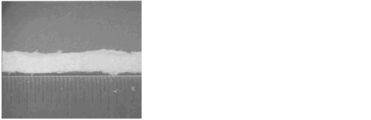
- FIG. 2 is a photograph of a cross section of the foam obtained in Example 1.
- FIG. 2 is a cross-sectional photograph of a foam obtained in Comparative Example 1.
- the foam of this embodiment is a porous body made of inorganic fibers.
- the inorganic fiber of the present embodiment is configured without containing asbestos fiber, and for example, one or more selected from ceramic fiber, biosoluble fiber (alkali earth silicate fiber, rock wool, etc.) and glass fiber can be used.
- the biologically soluble inorganic fiber is, for example, an inorganic fiber having a physiological saline dissolution rate at 40 ° C. of 1% or more.
- the physiological saline dissolution rate is measured, for example, as follows. That is, first, 1 g of a sample prepared by pulverizing inorganic fibers to 200 mesh or less and 150 mL of physiological saline are placed in an Erlenmeyer flask (volume: 300 mL) and placed in an incubator at 40 ° C. Next, a horizontal vibration of 120 revolutions per minute is continuously applied to the Erlenmeyer flask for 50 hours.
- each element (may be a main element) contained in the filtrate obtained by filtration is silicon (Si), magnesium (Mg), calcium (Ca), sodium (Na 2), potassium (K), and aluminum (Al).
- the concentration (mg / L) is measured with an ICP emission spectrometer. Then, based on the measured concentration of each element and the content (% by mass) of each element in the inorganic fiber before dissolution, the physiological saline dissolution rate (%) is calculated. That is, for example, when the measurement element is silicon (Si), magnesium (Mg), calcium (Ca), and aluminum (Al), the physiological saline dissolution rate C (%) is calculated by the following equation.
- C (%) [filtrate amount (L) ⁇ (a1 + a2 + a3 + a4) ⁇ 100] / [mass of inorganic fiber before dissolution (mg) ⁇ (b1 + b2 + b3 + b4) / 100].
- a1, a2, a3 and a4 are the measured concentrations of silicon, magnesium, calcium and aluminum (mg / L), respectively, and b1, b2, b3 and b4 are respectively in the inorganic fibers before dissolution. It is content (mass%) of silicon, magnesium, calcium, and aluminum.
- the biosoluble fiber has the following composition, for example. Total of SiO 2 , ZrO 2 , Al 2 O 3 and TiO 2 50 wt% to 82 wt% Total of 18% to 50% by weight of alkali metal oxide and alkaline earth metal oxide
- biosoluble fiber can be configured to have the following composition, for example. SiO 2 50 to 82% by weight Total 10 to 43% by weight of CaO and MgO
- the average fiber diameter is not limited, but a thinner one is preferred. For example, it can be 0.08 ⁇ m to 4.0 ⁇ m, 0.1 ⁇ m to 2.0 ⁇ m, or 0.2 ⁇ m to 1.0 ⁇ m.
- An average fiber diameter can be calculated
- the foam of this embodiment can contain an organic component in addition to an inorganic component.
- inorganic fibers occupy, for example, 50% by weight to 100% by weight of all the inorganic components contained in the foam.
- the inorganic fiber is preferably 80% by weight or more, 90% by weight or more, 96% by weight or more, or 97% by weight or more in the total inorganic components.
- the foam of this embodiment can be comprised without including inorganic binders, such as a boron oxide, a boron nitride, and a metal boride, as an inorganic component.
- the foam of this embodiment can be comprised without including an organic binder as an organic component.
- the organic binder can improve the bulk density, compression stress, and compression recovery rate at room temperature, but can be reduced in bulk density, compression stress, and compression recovery rate because it burns down under high temperature conditions (for example, 450 ° C.). That is, since the foam of this embodiment does not contain an organic binder, it can be secured without reducing bulk density, compressive stress, and compression recovery rate even under high temperature conditions, for example, unlike a rock wool mat containing an organic binder. .
- the foam of this embodiment can also be comprised including an organic binder.
- all the compressive stresses when compressed at each compression rate at a compression rate of 0 to 90% at normal temperature are preferably 2.0 MPa or less.
- it can be 1.5 MPa or less, 1.3 MPa or less, 1.0 MPa or less, 0.8 MPa or less, 0.6 MPa or less, 0.4 MPa or less, 0.2 MPa or less, 0.05 MPa or less, or 0.02 MPa or less.
- the lower limit is 0 MPa.
- the compressive stress when compressed at each compression rate of 0 to 90% at high temperature (450 ° C.) is preferably 2.3 MPa or less.
- 2.0 MPa or less, 1.7 MPa or less, 1.5 MPa or less, 1.3 MPa or less, 1.0 MPa or less, 0.8 MPa or less, 0.6 MPa or less, 0.4 MPa or less, 0.2 MPa or less, or 0.04 MPa The following can be done.
- the lower limit is 0 MPa.
- the compression stress when compressed at a compression rate of 80% at normal temperature is preferably 0.00. 5 MPa or less.
- it can be 0.3 MPa or less, 0.1 MPa or less, 0.08 MPa or less, 0.06 Pa or less, 0.04 Pa or less, 0.02 Pa or less, 0.01 MPa or less, 0.008 MPa or less, or 0.005 MPa or less.
- a minimum is not limited, Usually, it is 0.0001 MPa or more or 0.00001 MPa or more.
- the foam when the bulk density and the compressive stress are respectively high values, they tend to be hard and have low resilience (restorability).
- the compression stress when compressed at each compression rate of 0 to 90% as described above is all low, flexibility can be increased and deformation characteristics can be improved. Therefore, for example, the gap between the foam and the attached portion can be easily adjusted to the attached portion to which the foam is attached, and the sealing performance (workability) can be improved.
- high flexibility can be expressed from room temperature to high temperature (for example, 450 ° C.), and it is easy to become familiar with the attached part to which the foam is attached, between the foam and the attached part. It is possible to secure and improve the sealing performance from room temperature to high temperature by suppressing the gap.
- the apparent Young's modulus at a compression rate of 40 to 80% at normal temperature is preferably 0.7 MPa or less.
- it can be 0.6 MPa or less, 0.3 MPa or less, 0.1 MPa or less, 0.05 MPa or less, or 0.01 MPa or less.
- a minimum is not limited, Usually, it is 0.0001 Mpa or more.
- the apparent Young's modulus at a compression rate of 40 to 80% at high temperature (450 ° C.) is preferably 0.8 MPa or less.
- it can be 0.6 MPa or less, 0.1 MPa or less, 0.08 MPa or less, or 0.05 MPa or less.
- the apparent Young's modulus when compressed at each compression rate of 0 to 90% at normal temperature and high temperature (450 ° C.) is the above-mentioned low value.
- the apparent Young's modulus is low, the flexibility can be increased and the deformation characteristics can be improved.
- the apparent Young's modulus in the present invention is a value obtained by dividing the compressive stress by the predetermined compression rate when the compression rate is regarded as the amount of strain and compressed at a predetermined compression rate.
- the apparent Young's modulus at a compression rate of 80% at normal temperature is preferably 0.7 MPa or less.
- it can be 0.6 MPa or less, 0.3 MPa or less, 0.1 MPa or less, 0.05 MPa or less, or 0.01 MPa or less.
- a minimum is not limited, Usually, it is 0.0001 Mpa or more.
- the bulk density (normal temperature, compression rate 0%) is preferably 0.001 to 0.13 g / cm 3 .
- 0.002 to 0.12 g / cm 3 0.003 to 0.1 g / cm 3 , 0.004 to 0.09 g / cm 3 , 0.005 to 0.08 g / cm 3 , or 0.006 ⁇ 0.05.
- flexibility can be increased and deformation characteristics can be improved.
- the integrated value [MPa ⁇ g / cm 3 ] of the bulk density and the compressive stress at a compression rate of 40 to 80% or at a compression rate of 80% is preferably 0.30 or less. More preferably, the integrated value [MPa ⁇ g / cm 3 ] is 0.28 or less. For example, it can be 0.1 or less, 0.05 or less, 0.01 or less, 0.001 or less, or 0.0005 or less.
- the integrated value [MPa ⁇ g / cm 3 ] of the bulk density and the compressive stress is low, the bulk density and the compressive stress of the foam can be lowered, and not only the softness but also the high restorability can be expressed.
- the average equivalent circle diameter of the pore diameter is preferably 150 ⁇ m to 1000 ⁇ m.
- it can be 180 ⁇ m to 800 ⁇ m, 200 ⁇ m to 700 ⁇ m, 250 ⁇ m to 600 ⁇ m.
- the restoring force after compression is secured while maintaining the structural strength (in other words, the compression restoring rate is secured and adjusted) to ensure the sealing property. It can be improved.
- the average equivalent circle diameter of the pore diameter is small, heat conduction by convection can be suppressed to improve heat insulation, and pressure loss can be increased to improve sealing performance.
- the average equivalent circle diameter of the pore diameter can be adjusted by the expansion ratio, the amount of bubbles, the bubble diameter, etc. at the time of foaming.
- the compressive stress, bulk density, apparent Young's modulus, and average equivalent circle diameter are adjusted by, for example, a surface treatment method for inorganic fibers, the concentration (content ratio) of inorganic fibers, expansion ratio, bubble volume, bubble diameter, etc. Control).
- the foam of the present embodiment preferably has a restoration rate of 50% or more when compressed at a normal temperature and a compression rate of 80% (preferably 0 to 90%).
- a compression rate of 80% preferably 0 to 90%
- it can be 60%, 70%, 80% or more, 85% or more, 90% or more, or 95% or more.
- the upper limit is not limited, but is usually 99% or less.
- the restoration rate when compressed at a high temperature (450 ° C.) at a compression rate of 80% (preferably 0 to 90%) is 50% or more.
- it can be 60%, 70%, 80% or more, 85% or more, 90% or more, or 95% or more.
- the upper limit is not limited, but is usually 99% or less.
- the foam of this embodiment preferably has a restoration rate of 87% or more (more preferably 90% or more) when compressed at each compression rate at a compression rate of 40% at room temperature.
- the upper limit is not limited, but is usually 99% or less.
- the restoration property can be improved and the deformation characteristics can be improved. More specifically, the gap between the foam and the attached portion is easily adjusted to the attached portion to which the foam is attached, and the sealing performance from room temperature to high temperature can be secured and improved.
- the foam of the present invention can have any combination of the above properties.
- the foam of the present invention forms bubbles by the method described later. Therefore, the foam of the said embodiment can be comprised without including the fluorine mica for promoting bubble formation and gum arabic. As a different embodiment, the foam may include fluorine mica or gum arabic.
- This production method includes a creation step for creating an inorganic fiber dispersion, a foaming step for foaming the inorganic fiber dispersion, a dehydration step for drying the foam (dispersion of the dispersion medium), and a cup for applying a coupling agent.
- a ring agent application step In order to promote the adhesion of the coupling agent, a firing step of firing the foam at a predetermined temperature may be added before the coupling agent application step.
- One aspect of the preparation process is that the surface of the inorganic fiber is brought into contact with an alkaline or acidic treatment liquid to charge the surface negatively or positively, and a surfactant is added to the charged inorganic fiber to disperse the dispersion liquid. And a surfactant addition step to be created. It is preferable to add a cationic surfactant when the surface of the inorganic fiber is negatively charged, or an anionic surfactant when the surface of the inorganic fiber is positively charged.
- the zeta potential on the surface of the inorganic fiber is controlled by adjusting the pH using an alkaline or acidic treatment liquid. Specifically, the zeta potential on the surface of the inorganic fiber is set to minus or plus.
- a surfactant having a hydrophilic group with an opposite sign is added to the charged inorganic fiber, and the hydrophilic group side of the surfactant is adsorbed on the surface of the inorganic fiber to form a hydrophobic group.
- the inorganic fiber (outermost surface) is hydrophobized by arranging the side opposite to the surface of the inorganic fiber.
- foam is formed on the hydrophobic group side of the inorganic fiber surface when air is introduced and foamed by the foaming process described later. Is promoted to obtain a foam having a good foam.
- the surfactant is allowed to interact with the inorganic fiber to hydrophobize the fiber, making it easier to lock (adhere) the foam around the inorganic fiber and foam A foamed foam (sponge structure) is formed.
- the inorganic fiber ceramic fiber, biosoluble fiber (alkali earth silicate fiber, rock wool, etc.), glass fiber, etc. can be used.
- the treatment liquid may be any one that can be dissolved in water and change pH, and an acid or base of an inorganic compound or an acid or base of an organic compound can be used.
- the zeta potential on the surface of the inorganic fiber is a value other than 0, for example, ⁇ 5 mV to ⁇ 70 mV, ⁇ 7 mV to ⁇ 60 mV, ⁇ 10 mV to ⁇ 45 mV, +5 mV to +65 mV, +7 mV to +60 mV, or +10 mV to +45 mV.
- the pH for obtaining a predetermined zeta potential differs depending on the type of fiber, the pH cannot be uniquely specified. However, the pH is negatively charged, for example, at pH 7.5 to 13, and positive at pH 2 to 6. Can be charged.
- the zeta potential can be obtained by dispersing fibers in an aqueous dispersion medium adjusted to a predetermined pH and measuring the fibers using a general-purpose zeta potentiometer (for example, ModelFPA, AFG manufactured by AFG).
- the charging step and the surfactant addition step in the preparation process can be performed with time or simultaneously.
- the treatment liquid, the inorganic fibers, and the surfactant can be mixed together.
- the charging step and the surfactant addition step are performed over time, the inorganic fibers can be pre-opened with a treatment liquid, dispersed and charged, and then mixed with the surfactant.
- the production step without using a surfactant, an amphiphilic substance, a silane coupling agent having a hydrophobic functional group, a titanium coupling agent having a hydrophobic functional group, and the like It is also possible to prepare an inorganic fiber having at least a surface hydrophobized by surface treatment in a dispersion (dispersion medium).
- the coupling agent in this step is for making a hydrophobic state in order to form a foam.
- the coupling agent used in the subsequent coupling agent application step is to prevent the foam from collapsing when wet with water.
- the amount of the surfactant in the dispersion can be appropriately adjusted from the inorganic fiber, but for example, the surfactant may be 0.01 to 1.0 part by weight with respect to 100 parts by weight of the glass fiber.
- the surfactant can be preferably 0.1 to 0.8 part by weight, more preferably 0.2 to 0.7 part by weight. If the amount of the surfactant added is too small, the surface of the inorganic fiber cannot be sufficiently hydrophobized and the foaming property may be lowered. On the other hand, if the amount of the surfactant is too large, the surfactants adhere to each other. However, it can be adjusted in view of the possibility that the surface of the inorganic fiber may not be sufficiently hydrophobized.
- the dispersion can be constituted without containing an organic binder (resin emulsion, rubber (elastomer) component (such as gum arabic)) or magnesium oxide or hydroxide.
- organic binder resin emulsion, rubber (elastomer) component (such as gum arabic)
- magnesium oxide or hydroxide such as magnesium oxide or hydroxide.
- air bubbles
- an air bubble supply device to an inorganic fiber dispersion obtained by mixing a treatment liquid, inorganic fibers, and a surfactant, and foamed.
- the foam is dehydrated by drying (including natural drying) the dispersion medium contained in the dispersion at a predetermined time (for example, 4 hours), at a normal temperature or a predetermined temperature outside normal temperature.
- the foam is fired at a high temperature (for example, 450 ° C.) to remove the surfactant.
- the firing process can be performed simultaneously with the dehydration process.
- the foam, the coupling agent and water vapor are reacted and applied. Specifically, steam generated by heating the coupling agent is attached to the foam and reacted with water vapor.
- the coupling agent is hydrolyzed and dehydrated and condensed to adhere to the foam.
- the foam and the coupling agent vapor are brought into contact with each other in a closed container (a sealed container in which no gas is mixed into the container from the outside but the pressure can be increased by internal heating). After the contact, water is put into a closed container to generate water vapor and react with the coupling agent.
- the foam may be directly impregnated with the coupling agent and heated. Then contact with water vapor.
- Examples of coupling agents include silane coupling agents and titanium coupling agents.
- Examples of the silane coupling agent include methyltriethoxysilane.
- the amount of the coupling agent can be appropriately adjusted depending on the inorganic fiber and is not limited, but is, for example, about 1 to 10% by weight.
- the foam of the present invention may consist essentially of inorganic fibers, surfactants and coupling agents, or inorganic fibers and coupling agents, or may consist solely of these.
- “essentially” means that 95% by weight or more, 98% by weight or more, or 99% by weight or more is composed of these.
- 96 wt% or more, 97 wt% or more, 98 wt% or more, or 99 wt% or more of the foam of the present invention may be used as the inorganic fiber.
- Example 1 Micro glass fibers (average fiber diameter 0.4 ⁇ m) were dispersed in ammonia water having a pH of 10 to a concentration of 0.5% by weight, and the zeta potential on the fiber surface was adjusted to ⁇ 55 mV for treatment. Next, a cationic surfactant (lauryltrimethylammonium chloride (trade name; Cotamine 24P, manufactured by Kao Corporation)) is added in an amount of 0.5 parts by weight in terms of solids of the surfactant to 100 parts by weight of the fiber. And mixed with stirring. At this time, air was taken in and foamed. The obtained wet foam was dried and treated at 450 ° C. for 1 hour using an electric furnace to remove the surfactant attached to the foam.
- a cationic surfactant laauryltrimethylammonium chloride (trade name; Cotamine 24P, manufactured by Kao Corporation)
- the coupling agent is methyltriethoxysilane (trade name: KBE-13, manufactured by Shin-Etsu Chemical Co., Ltd.).
- the silane coupling agent is placed in a sealed container and heated to about 160 ° C to generate silane coupling agent vapor. And processed into a foam for 4 hours.
- 8 g of water was added into the closed container, water vapor was generated, and the foam was treated for 2 hours.
- a coupling agent of about 10 g per 1 g of foam weight was directly applied and heated at 105 ° C. for 4 hours.
- FIG. 1 A photograph of the cross section of the obtained foam is shown in FIG.
- the foam was evaluated as follows. The results are shown in Table 1. In addition to the following evaluation, the obtained foam was excellent in terms of thermal conductivity (heat insulation) and sound absorption.
- Integrated value of bulk density and compressive stress Calculated by integrating the following bulk density and compressive stress.
- a sample was cut from the produced foam, and the vertical, horizontal and height dimensions of the sample were measured using a dimension measuring device (for example, calipers). Next, the weight of the sample was measured, and the bulk density was measured by the following formula.
- Bulk density (g / cm 3 ) weight ⁇ vertical dimension ⁇ horizontal dimension ⁇ height
- Compressive stress As shown in the following formula, the area obtained by measuring the load value during sample compression during the test by the above sample dimension measurement It was calculated by dividing by (vertical dimension and horizontal dimension).
- the sample dimensions are measured in the same manner as the above bulk density, the thickness of this sample is set to 100%, the compression rate is set (0 to 90%), and the material testing machine (autograph, Shimadzu Corporation) was used as a weight when compressed to a predetermined thickness (2 mm / min).
- Compressive stress N / m 2 Measurement load (N) ⁇ Sample area (m 2 )
- a foam was punched into a ring shape having an inner diameter of 15 mm and an outer diameter of 30 mm to prepare a sample.
- the sample and the spacer were sandwiched between a pair of clamping portions, and bolts were fastened so as to achieve a predetermined compression rate (0 to 90%).
- a gas pressure was adjusted to 20 kPa from a N 2 cylinder using a differential pressure gauge, and N 2 gas was allowed to flow through one of the pair of sandwiching portions so as to penetrate the sample.
- the flow rate of N 2 gas in the system was measured with a flow meter installed inside the other of the pair of sandwiching portions.
- the leakage amount L / min ⁇ mm of N 2 gas that flows out the flow rate of N 2 gas the measurement from the other section of the clamping portion.
- Example 2 Disperse ceramic fibers (alumina approximately 50% by weight, silica approximately 50% by weight) (average fiber diameter of 2.0 ⁇ m) in ammonia water at pH 10 to a concentration of 2% by weight, so that the zeta potential on the fiber surface is ⁇ 32 mV. did.
- a cationic surfactant (lauryltrimethylammonium chloride (trade name; Cotamine 24P, manufactured by Kao Corporation)) is added in an amount of 0.5 parts by weight as a solid equivalent weight of the surfactant to 100 parts by weight of the fiber. And mixed with stirring. At this time, air was taken in and foamed. The obtained foam was subjected to drying, firing and coupling agent application treatment in the same manner as in Example 1. The average equivalent circular diameter of the foam pore diameter at the time of non-compression at room temperature was about 312 ⁇ m. The obtained foam was evaluated in the same manner as in Example 1. The results are shown in Table 2.
- Example 3 In Example 1, an anionic surfactant (sodium laurylbenzenesulfonate (trade name; Neoperex G65, manufactured by Kao Corporation)) was used instead of the cationic surfactant. A foam was prepared and evaluated. The results are shown in Table 3.
- anionic surfactant sodium laurylbenzenesulfonate (trade name; Neoperex G65, manufactured by Kao Corporation)
- Example 4 In Example 2, an anionic surfactant (sodium laurylbenzenesulfonate (trade name; Neoperex G65, manufactured by Kao Corporation)) was used instead of the cationic surfactant. A foam was prepared and evaluated. The results are shown in Table 4.
- anionic surfactant sodium laurylbenzenesulfonate (trade name; Neoperex G65, manufactured by Kao Corporation)
- Comparative Example 1 A fiber dispersion was prepared in the same manner as in Example 1, and then dehydration and drying were performed without adjusting the zeta potential of the fiber surface and performing the foaming operation.
- the average equivalent circular diameter of the pore diameter of the obtained unfoamed material (at the time of non-compression at room temperature) was about 143 ⁇ m.
- the photograph of the cross section of the obtained unfoamed body is shown in FIG. Further, the unfoamed body was evaluated in the same manner as in Example 1. The results are shown in Table 5.
- Example 2 a foam was produced in the same manner as in Example 1 except that no coupling agent was added. The obtained foam was brittle and could not be evaluated.
- the foam of the present invention can be used as, for example, a heat insulating material, a sealing material, a sound absorbing material and the like.
Landscapes
- Chemical & Material Sciences (AREA)
- Engineering & Computer Science (AREA)
- Ceramic Engineering (AREA)
- Materials Engineering (AREA)
- Organic Chemistry (AREA)
- Life Sciences & Earth Sciences (AREA)
- Structural Engineering (AREA)
- General Chemical & Material Sciences (AREA)
- Chemical Kinetics & Catalysis (AREA)
- Geochemistry & Mineralogy (AREA)
- General Life Sciences & Earth Sciences (AREA)
- Physics & Mathematics (AREA)
- Acoustics & Sound (AREA)
- Multimedia (AREA)
- Glass Compositions (AREA)
- Porous Artificial Stone Or Porous Ceramic Products (AREA)
- Manufacture Of Porous Articles, And Recovery And Treatment Of Waste Products (AREA)
- Toxicology (AREA)
- Civil Engineering (AREA)
- Health & Medical Sciences (AREA)
- Nanotechnology (AREA)
Abstract
Priority Applications (4)
| Application Number | Priority Date | Filing Date | Title |
|---|---|---|---|
| JP2016571873A JP6510565B2 (ja) | 2015-01-28 | 2016-01-28 | 発泡体 |
| US15/546,983 US10947163B2 (en) | 2015-01-28 | 2016-01-28 | Foam |
| EP16743004.0A EP3252026A4 (fr) | 2015-01-28 | 2016-01-28 | Mousse |
| CN201680007445.XA CN107207369A (zh) | 2015-01-28 | 2016-01-28 | 发泡体 |
Applications Claiming Priority (2)
| Application Number | Priority Date | Filing Date | Title |
|---|---|---|---|
| JP2015-014662 | 2015-01-28 | ||
| JP2015014662 | 2015-01-28 |
Publications (1)
| Publication Number | Publication Date |
|---|---|
| WO2016121400A1 true WO2016121400A1 (fr) | 2016-08-04 |
Family
ID=56543022
Family Applications (1)
| Application Number | Title | Priority Date | Filing Date |
|---|---|---|---|
| PCT/JP2016/000446 Ceased WO2016121400A1 (fr) | 2015-01-28 | 2016-01-28 | Mousse |
Country Status (5)
| Country | Link |
|---|---|
| US (1) | US10947163B2 (fr) |
| EP (1) | EP3252026A4 (fr) |
| JP (1) | JP6510565B2 (fr) |
| CN (1) | CN107207369A (fr) |
| WO (1) | WO2016121400A1 (fr) |
Cited By (7)
| Publication number | Priority date | Publication date | Assignee | Title |
|---|---|---|---|---|
| WO2019044028A1 (fr) * | 2017-08-28 | 2019-03-07 | ニチアス株式会社 | Matériau d'isolation thermique |
| JP2019038478A (ja) * | 2017-08-28 | 2019-03-14 | ニチアス株式会社 | 輸送機器用断熱吸音材 |
| JP2019038966A (ja) * | 2017-08-28 | 2019-03-14 | ニチアス株式会社 | シール材 |
| JP2019039554A (ja) * | 2017-08-28 | 2019-03-14 | ニチアス株式会社 | 断熱材 |
| EP3467817A4 (fr) * | 2016-06-02 | 2019-12-25 | Nichias Corporation | Matériau d'insonorisation |
| JP2019537542A (ja) * | 2016-10-14 | 2019-12-26 | サン−ゴバン イゾベール | 無機繊維の製造方法 |
| WO2020230907A1 (fr) | 2019-05-14 | 2020-11-19 | ニチアス株式会社 | Matériau poreux |
Citations (3)
| Publication number | Priority date | Publication date | Assignee | Title |
|---|---|---|---|---|
| JPS4892467A (fr) * | 1972-03-10 | 1973-11-30 | ||
| JPS60141684A (ja) * | 1983-12-28 | 1985-07-26 | ニチアス株式会社 | 無機繊維質弾性発泡体の製造法 |
| JP2014012821A (ja) * | 2012-06-07 | 2014-01-23 | Nitto Denko Corp | 樹脂発泡体及び発泡材 |
Family Cites Families (19)
| Publication number | Priority date | Publication date | Assignee | Title |
|---|---|---|---|---|
| GB722012A (en) * | 1951-07-20 | 1955-01-19 | Insulex Mineral Products Ltd | Improvements relating to thermal insulating material |
| FR1199550A (fr) * | 1957-03-14 | 1959-12-15 | Owens Corning Fiberglass Corp | Procédé de fabrication de produits composites de mousse et de fibres |
| BE638381A (fr) | 1962-10-12 | |||
| FR1447089A (fr) | 1964-09-22 | 1966-07-22 | Littil A G | Procédé pour fabriquer des corps isolants |
| GB1397308A (en) * | 1972-07-10 | 1975-06-11 | Wiggins Teape Research Dev Ltd | Non-woven fibrous material |
| SU673636A1 (ru) * | 1977-04-11 | 1979-07-15 | Уральский научно-исследовательский и проектный институт строительных материалов | Композици дл изготовлени теплло-и звукоизол ционных изделий |
| JPS55148133A (en) * | 1979-05-07 | 1980-11-18 | Otsuka Chem Co Ltd | Molded and foamed inorganic fibrous piece and manufacture thereof |
| US4374202A (en) * | 1980-12-23 | 1983-02-15 | Rm Industrial Products Company, Inc. | Ceramic fiber foam and method for making same |
| US4381199A (en) * | 1980-12-31 | 1983-04-26 | Ppg Industries, Inc. | Aqueous dispersion of glass fibers and method and composition for producing same |
| JPS5970515A (ja) * | 1982-10-14 | 1984-04-21 | Japan Vilene Co Ltd | ガラス繊維強化フエノ−ル樹脂発泡体の製造方法 |
| JPS60259414A (ja) * | 1984-06-06 | 1985-12-21 | Toyo Tire & Rubber Co Ltd | 繊維強化フオ−ムの製造方法 |
| JPH0686075B2 (ja) | 1991-01-28 | 1994-11-02 | ニチアス株式会社 | ジョイントシートの製造方法 |
| CN1944500A (zh) * | 2006-09-28 | 2007-04-11 | 湘潭大学 | 纤维增强发泡聚合物材料及其制备方法 |
| US8476330B2 (en) * | 2007-07-13 | 2013-07-02 | Momentive Performance Materials Inc. | Polyurethane foam containing synergistic surfactant combinations and process for making same |
| CN101798758B (zh) * | 2009-08-13 | 2012-09-05 | 上海宏和电子材料有限公司 | 一种电子级玻璃纤维布开纤工艺 |
| JP2013163703A (ja) | 2012-02-09 | 2013-08-22 | Sumitomo Chemical Co Ltd | ポリプロピレン樹脂組成物、および、該樹脂組成物からなる発泡成形体 |
| CN102942668A (zh) * | 2012-10-22 | 2013-02-27 | 青岛海洋新材料科技有限公司 | 一种填充功能填料的聚酰亚胺复合泡沫材料制备方法 |
| CN103408859A (zh) * | 2013-07-18 | 2013-11-27 | 吴江市利达上光制品有限公司 | 一种复合吸声塑料的制备方法 |
| CN104109365A (zh) * | 2014-08-10 | 2014-10-22 | 宁国市宁盛橡塑制品有限公司 | 一种可降解发泡塑料 |
-
2016
- 2016-01-28 EP EP16743004.0A patent/EP3252026A4/fr active Pending
- 2016-01-28 JP JP2016571873A patent/JP6510565B2/ja active Active
- 2016-01-28 CN CN201680007445.XA patent/CN107207369A/zh active Pending
- 2016-01-28 US US15/546,983 patent/US10947163B2/en active Active
- 2016-01-28 WO PCT/JP2016/000446 patent/WO2016121400A1/fr not_active Ceased
Patent Citations (3)
| Publication number | Priority date | Publication date | Assignee | Title |
|---|---|---|---|---|
| JPS4892467A (fr) * | 1972-03-10 | 1973-11-30 | ||
| JPS60141684A (ja) * | 1983-12-28 | 1985-07-26 | ニチアス株式会社 | 無機繊維質弾性発泡体の製造法 |
| JP2014012821A (ja) * | 2012-06-07 | 2014-01-23 | Nitto Denko Corp | 樹脂発泡体及び発泡材 |
Non-Patent Citations (1)
| Title |
|---|
| See also references of EP3252026A4 * |
Cited By (9)
| Publication number | Priority date | Publication date | Assignee | Title |
|---|---|---|---|---|
| EP3467817A4 (fr) * | 2016-06-02 | 2019-12-25 | Nichias Corporation | Matériau d'insonorisation |
| US11535004B2 (en) | 2016-06-02 | 2022-12-27 | Nichias Corporation | Soundproofing material |
| JP2019537542A (ja) * | 2016-10-14 | 2019-12-26 | サン−ゴバン イゾベール | 無機繊維の製造方法 |
| WO2019044028A1 (fr) * | 2017-08-28 | 2019-03-07 | ニチアス株式会社 | Matériau d'isolation thermique |
| JP2019038478A (ja) * | 2017-08-28 | 2019-03-14 | ニチアス株式会社 | 輸送機器用断熱吸音材 |
| JP2019038966A (ja) * | 2017-08-28 | 2019-03-14 | ニチアス株式会社 | シール材 |
| JP2019039554A (ja) * | 2017-08-28 | 2019-03-14 | ニチアス株式会社 | 断熱材 |
| WO2020230907A1 (fr) | 2019-05-14 | 2020-11-19 | ニチアス株式会社 | Matériau poreux |
| US12415898B2 (en) | 2019-05-14 | 2025-09-16 | Nichias Corporation | Porous body |
Also Published As
| Publication number | Publication date |
|---|---|
| JP6510565B2 (ja) | 2019-05-08 |
| CN107207369A (zh) | 2017-09-26 |
| EP3252026A4 (fr) | 2018-10-03 |
| EP3252026A1 (fr) | 2017-12-06 |
| JPWO2016121400A1 (ja) | 2017-11-02 |
| US20180016195A1 (en) | 2018-01-18 |
| US10947163B2 (en) | 2021-03-16 |
Similar Documents
| Publication | Publication Date | Title |
|---|---|---|
| JP6510565B2 (ja) | 発泡体 | |
| JP6866523B2 (ja) | 発泡体 | |
| Zhao et al. | Thermal and mechanical performances of the superflexible, hydrophobic, silica-based aerogel for thermal insulation at ultralow temperature | |
| Cilla et al. | Geopolymer foams by gelcasting | |
| Benad et al. | Mechanical properties of metal oxide aerogels | |
| CN111005213B (zh) | 绝热材料及其制造方法和使用了其的电子设备及汽车 | |
| KR102366030B1 (ko) | 멜라민 폼 및 무기 에어로겔을 포함하는 절연 복합 재료 | |
| CN109516763B (zh) | 一种纤维素纤维/SiO2复合气凝胶材料及其制备和应用 | |
| WO2021181932A1 (fr) | Matériau d'isolation thermique et son procédé de production | |
| JP2019513677A (ja) | ジオポリマーフォーム配合物 | |
| DE112017001567T5 (de) | Ein Schnellherstellungsverfahren für ein Aerogel mit einer Mikroemulsion als Prekursor | |
| CN112079585A (zh) | 一种利用微孔发泡制备的超疏水地聚合物及其制备方法 | |
| CN109095948B (zh) | 一种利用中空微球制备具有连通孔壁泡沫陶瓷的方法 | |
| Zhan et al. | Ambient-pressure-dried biomass aerogel toward robust cross-linked networks and exceptional mechanical performances during combustion | |
| Dong et al. | Fabrication and properties of lightweight SiOC fiber-based assembly aerogels with hierarchical pore structure | |
| CN102807326A (zh) | 一种聚合物改性的低温泡沫玻璃保温材料及其制备方法 | |
| CN114206801B (zh) | 多孔体 | |
| CN114436623A (zh) | 一种无机气凝胶复合材料及其制备方法 | |
| JP2019039554A (ja) | 断熱材 | |
| JP6688265B2 (ja) | 輸送機器用断熱吸音材 | |
| JP2020045284A (ja) | シール材 | |
| JP2019038966A (ja) | シール材 | |
| WO2019044028A1 (fr) | Matériau d'isolation thermique | |
| CN112939541A (zh) | 一种再生干拌复合轻集料混凝土及其制备方法 | |
| CN121318375A (zh) | 一种具有高弹性的二氧化硅气凝胶毡的制备方法 |
Legal Events
| Date | Code | Title | Description |
|---|---|---|---|
| 121 | Ep: the epo has been informed by wipo that ep was designated in this application |
Ref document number: 16743004 Country of ref document: EP Kind code of ref document: A1 |
|
| ENP | Entry into the national phase |
Ref document number: 2016571873 Country of ref document: JP Kind code of ref document: A |
|
| REEP | Request for entry into the european phase |
Ref document number: 2016743004 Country of ref document: EP |
|
| WWE | Wipo information: entry into national phase |
Ref document number: 15546983 Country of ref document: US |
|
| NENP | Non-entry into the national phase |
Ref country code: DE |