WO2016121761A1 - 分散体、その製造方法及び化粧料 - Google Patents
分散体、その製造方法及び化粧料 Download PDFInfo
- Publication number
- WO2016121761A1 WO2016121761A1 PCT/JP2016/052199 JP2016052199W WO2016121761A1 WO 2016121761 A1 WO2016121761 A1 WO 2016121761A1 JP 2016052199 W JP2016052199 W JP 2016052199W WO 2016121761 A1 WO2016121761 A1 WO 2016121761A1
- Authority
- WO
- WIPO (PCT)
- Prior art keywords
- dispersion
- oxide particles
- inorganic oxide
- weight
- oil
- Prior art date
- Legal status (The legal status is an assumption and is not a legal conclusion. Google has not performed a legal analysis and makes no representation as to the accuracy of the status listed.)
- Ceased
Links
Classifications
-
- A—HUMAN NECESSITIES
- A61—MEDICAL OR VETERINARY SCIENCE; HYGIENE
- A61K—PREPARATIONS FOR MEDICAL, DENTAL OR TOILETRY PURPOSES
- A61K8/00—Cosmetics or similar toiletry preparations
- A61K8/02—Cosmetics or similar toiletry preparations characterised by special physical form
- A61K8/04—Dispersions; Emulsions
- A61K8/06—Emulsions
-
- A—HUMAN NECESSITIES
- A61—MEDICAL OR VETERINARY SCIENCE; HYGIENE
- A61K—PREPARATIONS FOR MEDICAL, DENTAL OR TOILETRY PURPOSES
- A61K8/00—Cosmetics or similar toiletry preparations
- A61K8/18—Cosmetics or similar toiletry preparations characterised by the composition
- A61K8/19—Cosmetics or similar toiletry preparations characterised by the composition containing inorganic ingredients
-
- A—HUMAN NECESSITIES
- A61—MEDICAL OR VETERINARY SCIENCE; HYGIENE
- A61K—PREPARATIONS FOR MEDICAL, DENTAL OR TOILETRY PURPOSES
- A61K8/00—Cosmetics or similar toiletry preparations
- A61K8/18—Cosmetics or similar toiletry preparations characterised by the composition
- A61K8/19—Cosmetics or similar toiletry preparations characterised by the composition containing inorganic ingredients
- A61K8/27—Zinc; Compounds thereof
-
- A—HUMAN NECESSITIES
- A61—MEDICAL OR VETERINARY SCIENCE; HYGIENE
- A61K—PREPARATIONS FOR MEDICAL, DENTAL OR TOILETRY PURPOSES
- A61K8/00—Cosmetics or similar toiletry preparations
- A61K8/18—Cosmetics or similar toiletry preparations characterised by the composition
- A61K8/19—Cosmetics or similar toiletry preparations characterised by the composition containing inorganic ingredients
- A61K8/28—Zirconium; Compounds thereof
-
- A—HUMAN NECESSITIES
- A61—MEDICAL OR VETERINARY SCIENCE; HYGIENE
- A61K—PREPARATIONS FOR MEDICAL, DENTAL OR TOILETRY PURPOSES
- A61K8/00—Cosmetics or similar toiletry preparations
- A61K8/18—Cosmetics or similar toiletry preparations characterised by the composition
- A61K8/30—Cosmetics or similar toiletry preparations characterised by the composition containing organic compounds
- A61K8/33—Cosmetics or similar toiletry preparations characterised by the composition containing organic compounds containing oxygen
- A61K8/36—Carboxylic acids; Salts or anhydrides thereof
- A61K8/365—Hydroxycarboxylic acids; Ketocarboxylic acids
-
- A—HUMAN NECESSITIES
- A61—MEDICAL OR VETERINARY SCIENCE; HYGIENE
- A61K—PREPARATIONS FOR MEDICAL, DENTAL OR TOILETRY PURPOSES
- A61K8/00—Cosmetics or similar toiletry preparations
- A61K8/18—Cosmetics or similar toiletry preparations characterised by the composition
- A61K8/30—Cosmetics or similar toiletry preparations characterised by the composition containing organic compounds
- A61K8/33—Cosmetics or similar toiletry preparations characterised by the composition containing organic compounds containing oxygen
- A61K8/37—Esters of carboxylic acids
-
- A—HUMAN NECESSITIES
- A61—MEDICAL OR VETERINARY SCIENCE; HYGIENE
- A61K—PREPARATIONS FOR MEDICAL, DENTAL OR TOILETRY PURPOSES
- A61K8/00—Cosmetics or similar toiletry preparations
- A61K8/18—Cosmetics or similar toiletry preparations characterised by the composition
- A61K8/72—Cosmetics or similar toiletry preparations characterised by the composition containing organic macromolecular compounds
- A61K8/84—Cosmetics or similar toiletry preparations characterised by the composition containing organic macromolecular compounds obtained by reactions otherwise than those involving only carbon-carbon unsaturated bonds
- A61K8/89—Polysiloxanes
-
- A—HUMAN NECESSITIES
- A61—MEDICAL OR VETERINARY SCIENCE; HYGIENE
- A61Q—SPECIFIC USE OF COSMETICS OR SIMILAR TOILETRY PREPARATIONS
- A61Q1/00—Make-up preparations; Body powders; Preparations for removing make-up
- A61Q1/12—Face or body powders for grooming, adorning or absorbing
-
- A—HUMAN NECESSITIES
- A61—MEDICAL OR VETERINARY SCIENCE; HYGIENE
- A61Q—SPECIFIC USE OF COSMETICS OR SIMILAR TOILETRY PREPARATIONS
- A61Q17/00—Barrier preparations; Preparations brought into direct contact with the skin for affording protection against external influences, e.g. sunlight, X-rays or other harmful rays, corrosive materials, bacteria or insect stings
- A61Q17/04—Topical preparations for affording protection against sunlight or other radiation; Topical sun tanning preparations
Definitions
- the present invention provides a high-concentration dispersion of inorganic oxide particles that does not settle easily and has high storage stability.
- the dispersion obtained in the present invention is particularly useful in the field of cosmetics such as sunscreen and foundation, and can be used as a raw material thereof.
- inorganic oxide particles such as zinc oxide, iron oxide, cerium oxide, zirconium oxide, and bismuth oxide are mainly used as UV protection agents in the cosmetics field.
- Such inorganic oxide particles are sold, stored and transported as a dispersion in which the particles are dispersed in an oily medium in order to prevent aggregation and facilitate uniform mixing with other components.
- the inorganic oxide particles can be blended at a high concentration in the dispersion, it is preferable in that the influence on the prescription of the components contained in the oil phase can be reduced and the cost of storage, transportation, storage and the like can be reduced.
- sunscreens are generally prescribed in an emulsifying system, and there are mainly two types of emulsions, an oil-in-water type and a water-in-oil type.
- an oil-in-water type In order to give a refreshing feel to the oil-in-water emulsion among them, a formulation with a relatively small amount of oil may be formulated.
- inorganic oxide particles for sunscreen when using inorganic oxide particles for sunscreen as an ultraviolet shielding agent, it is generally mixed in oil. In order to obtain sufficient ultraviolet shielding performance, it is desirable to increase the blending amount of the inorganic oxide. However, it is difficult to mix a large amount of inorganic oxide particles in the oil phase in a system with little oil because there are few dispersion media.
- Patent Documents 1 and 2 disclose a dispersion in which powder is dispersed in oil in advance and used as a raw material for sunscreen and cosmetics.
- a dispersion using ester oil or silicone oil as a dispersion medium is proposed.
- Cited Document 1 only describes a dispersion using titanium oxide particles, and does not describe other inorganic oxide particles.
- the oil agent or dispersant described in the cited document 2 it is difficult to produce a dispersion having a pigment concentration exceeding 50.0% by mass, and the dispersion may be gelled.
- Patent Document 3 proposes a high-concentration zinc oxide dispersion using volatile isoparaffin as a dispersion medium.
- volatile oils are often used from the viewpoint of compatibility with other organic substances, and the system may become unstable if cyclopentasiloxane or volatile isoparaffin is used. there were.
- Patent Document 4 proposes a self-dispersing metal oxide coated with a dispersant, and in the examples, titanium oxide surface-coated with triethoxysilane and polyhydroxystearic acid is disclosed.
- this invention relates to a powder excellent in self-dispersibility, and does not consider storage stability, which is a major factor in using the dispersion as a raw material for sunscreen and the like.
- An object of the present invention is to solve the above-mentioned problems, and to provide a dispersion which is a raw material for cosmetics which contains inorganic oxide particles at a high concentration and is excellent in storage stability.
- the present invention is a dispersion in which inorganic oxide particles are dispersed in an oil-based medium, and contains an ester oil having 18 or more carbon atoms and polyhydroxystearic acid.
- the inorganic oxide particles include zinc oxide and iron oxide. And at least one selected from the group consisting of cerium oxide, zirconium oxide and bismuth oxide, and the amount of polyhydroxystearic acid is 0.5 to 8.0% by weight with respect to the total weight of the dispersion.
- the dispersion is characterized in that the compounding amount of the components is 10.0% by weight or less with respect to the total weight of the dispersion, and the inorganic oxide particles are 51.0% by weight or more of the whole dispersion.
- the dispersion preferably has a sedimentation rate of 1.0% by weight or less when allowed to stand at 50 ° C. for 60 days.
- the dispersion preferably has a viscosity at 20 ° C. immediately after dispersion of 6000 mPa ⁇ s or less and a viscosity at 20 ° C. after standing at 50 ° C. for 60 days is 6000 mPa ⁇ s or less.
- the inorganic oxide particles preferably have an average primary particle diameter of 100 nm or less and have an ultraviolet shielding effect.
- the inorganic oxide particles are preferably those whose inorganic surface is coated with a hydroxide and / or oxide of an element selected from silicon, aluminum, zinc, iron, titanium and zirconium.
- the inorganic oxide particles are preferably those whose organic surface is coated with an organosilicon compound.
- the inorganic oxide particles are preferably surface-coated with hydrous silica and / or organopolysiloxane.
- the present invention is also a method for producing a dispersion as described above, which comprises the steps of mixing, stirring and dispersing inorganic oxide particles, ester oil having 18 or more carbon atoms and polyhydroxystearic acid.
- the present invention is also a cosmetic obtained by blending the above dispersion.
- the cosmetic is preferably an oil-in-water emulsified cosmetic.
- the dispersion of the present invention is excellent in storage stability while blending inorganic oxide particles at a high ratio of 51.0% by weight or more with respect to the total weight of the dispersion. Thereby, when blending inorganic oxide particles in cosmetics, it can be suitably used as a raw material for obtaining cosmetics of various formulations without affecting the formulation.
- the dispersion of the present invention is a dispersion in which inorganic oxide particles are blended at a high blending ratio of 51.0% by weight or more based on the total weight of the dispersion.
- the range of the amount of the inorganic oxide particles is not limited, but the upper limit is preferably 80.0% by weight, and more preferably 75.0% by weight. Further, the lower limit is more preferably 55.0% by weight, still more preferably 61.0% by weight.
- the inorganic oxide particles blended in the dispersion of the present invention is at least one selected from the group consisting of zinc oxide, iron oxide, cerium oxide, zirconium oxide and bismuth oxide. Among these, it is most preferable to use zinc oxide.
- the inorganic oxide particles used in the present invention are not particularly limited, and general particles used in the cosmetic field can be used.
- the inorganic oxide particles preferably have an average particle size of 100 nm or less. Inorganic oxide particles having such a particle diameter are particularly preferable in that they have high visible light transparency and a suitable ultraviolet shielding region.
- the lower limit of the average particle diameter is not particularly limited, but is preferably 10 nm or more. When the thickness exceeds 100 nm, not only the visible light transparency is deteriorated but also the ultraviolet shielding ability may be lowered.
- the particle size of the inorganic powder was measured by a method of measuring the particle size of 200 particles randomly selected with a transmission electron microscope and calculating the average of the primary particle sizes.
- the upper limit of the average particle diameter is more preferably 80 nm, and further preferably 65 nm.
- the lower limit of the average particle diameter is more preferably 15 nm.
- the shape of the inorganic oxide particles is not particularly limited, and any shape such as a spherical shape, a rod shape, a needle shape, a spindle shape, or a plate shape can be used.
- the average particle diameter is defined by the length on the short axis side, and in the case of a plate-like particle, the average of the diagonal lengths of the surfaces.
- the inorganic oxide particles of the present invention preferably have an ultraviolet shielding effect. That is, this is because the present invention is characterized in that inorganic oxide particles having an ultraviolet shielding effect are efficiently blended in cosmetics.
- “having an ultraviolet shielding effect” means 365 nm when a coating film obtained by applying a PWC (pigment weight concentration) 50% or more paste with a 25 ⁇ m thick applicator is measured with a spectrophotometer (manufactured by JASCO Corporation). This means that the transmittance is 30% or less.
- the inorganic oxide particles may have an organic surface coating formed with an organosilicon compound.
- the inorganic surface coating may be performed with a hydroxide and / or oxide of at least one element selected from silicon, aluminum, zinc, iron, titanium and zirconium. Further, both the inorganic surface coating and the organic surface coating may be formed, or only the organic surface coating may be used. By forming such a layer, the stability of the dispersion can be further improved by the action of imparting water repellency to the powder and enhancing the lipophilicity.
- the organic surface coating is formed of a known silicone having a hydrogen-silicon bond, such as methyl hydrogen polysiloxane (dimethicone / methicone) copolymer, or triethoxysilylethyl polydimethylsiloxyethyl dimethicone having an alkoxy group-silicon bond as a reactive group (Shin-Etsu). It may be one that has been treated with a known organosilicon compound such as KF-9908) manufactured by Kagaku Kogyo, or triethoxysilylethyl polydimethylsiloxyethylhexyl dimethicone (KF-9909 manufactured by Shin-Etsu Chemical Co., Ltd.).
- a known silicone having a hydrogen-silicon bond such as methyl hydrogen polysiloxane (dimethicone / methicone) copolymer, or triethoxysilylethyl polydimethylsiloxyethyl dimethi
- the surface treatment method using the organosilicon compound is not particularly limited, and can be performed by a known method such as dry treatment or wet treatment.
- the organic surface coating is preferably 0.1 to 20.0% by weight based on the weight of the inorganic oxide particles after the surface coating. If it is less than 0.1% by weight, the effect of improving the functionality due to the surface treatment is not manifested. Specifically, it is not preferable in that water repellency and lipophilicity cannot be obtained. It is not preferable in that the powder is agglomerated by a simple treatment agent and the original ultraviolet shielding effect may not be exhibited, and it is not economical.
- the lower limit of the coating amount of the surface coating is more preferably 0.5% by weight, still more preferably 1.0% by weight.
- the upper limit of the coating amount of the surface coating is more preferably 18.0% by weight, still more preferably 15.0% by weight.
- the inorganic surface coating is made of a hydroxide and / or oxide of at least one element selected from silicon, aluminum, zinc, iron and zirconium. By carrying out the inorganic surface coating, it is preferable in that the dispersion is more stable due to the action of suppressing the surface activity of the inorganic oxide particles or improving the lipophilicity with the oil agent. .
- the inorganic surface coating may be applied to the inner layer of the organic surface coating or may be applied to the outer layer of the organic surface coating. However, in terms of the effect of improving dispersibility, It is preferably applied to the inner layer of the organic surface coating.
- Inorganic surface coating with a hydroxide and / or oxide of at least one element selected from silicon, aluminum, zinc, iron and zirconium can suppress the surface activity of the inorganic oxide particles by applying these coatings. This is preferable. Moreover, what carried out inorganic surface coating
- Method a method in which inorganic oxide particles are dispersed in water to form a water slurry, and a surface treatment agent is added to the water slurry, followed by neutralization, water washing, drying, and pulverization steps.
- the method of thermally decomposing a surface treating agent by baking after adding can be mentioned.
- Other examples include sulfates, nitrates, and chlorides of the above elements.
- the inorganic surface coating is preferably 0.1 to 30.0% by weight based on the weight of the inorganic oxide particles after the surface coating. If it is less than 0.1% by weight, it is not preferable in that the effect of improving the functionality due to the surface treatment is not manifested. In addition, the surface treatment is unfavorable in that the powder feel is poor, the cosmetic may be smeared when applied to the skin, and is not economical.
- the lower limit of the coating amount of the surface coating is more preferably 0.5% by weight, still more preferably 2% by weight.
- the upper limit of the coating amount of the surface coating is more preferably 28.0% by weight, and further preferably 22.0% by weight.
- the surface treatment is most preferably composed of a first coating layer formed of hydrous silica and a second coating layer formed of organopolysiloxane formed on the first coating layer. . That is, the inorganic oxide particles subjected to such surface treatment are preferable in that a dispersion having excellent stability when a dispersion is produced at a high concentration can be obtained.
- examples of inorganic oxide particles include FINEX-30W-LP2, FINEX-33W-LP2, FINEX-33W-LPF1, FINEX-50W-LP2, FINEX-52W-LP2, FINEX, which are hydrophobized zinc oxides manufactured by Sakai Chemical Industry Co., Ltd. -50W-LPF1 (all are trade names).
- the dispersion of the present invention contains an ester oil having 18 or more carbon atoms. That is, it contains a specific ester oil as a liquid medium. By using such an ester oil, it is preferable in that the irritation of the ester oil can be suppressed, and the influence on the human body when made into a cosmetic can be reduced.
- the ester oil having 18 or more carbon atoms is a liquid compound having an ester group, and the number of carbon atoms in one molecule exceeds 18.
- the ester oil having 18 or more carbon atoms is preferably blended at a ratio of 25.0 to 48.5% by weight. That is, it is preferably used as a main component in a liquid medium.
- an oil medium other than the ester oil having 18 or more carbon atoms may be blended.
- the oil medium other than the ester oil having 18 or more carbon atoms is blended.
- the amount is preferably 25.0% by weight or less based on the total weight of the dispersion. That is, by using an ester oil having 18 or more carbon atoms as a liquid medium, the above-described effects can be obtained. However, when other oil-based medium is used exceeding 25.0% by weight, the above-described properties are obtained. This is because there is a risk of getting worse.
- the blending amount of the oily medium other than the ester oil having 18 or more carbon atoms is more preferably less than 20.0% by weight.
- the blending amount of the silicone component needs to be 10.0% by weight or less with respect to the total weight of the dispersion.
- the blending amount of the silicone component is more preferably 5.0% by weight or less.
- Silicone components are likely to have an adverse effect on the stability of the oil dispersion of inorganic oxide particles, and moreover to the stability of oil-in-water emulsion cosmetics. Is preferred.
- the silicone-based component refers to a liquid component containing silicon in the structure, such as silicone oil and silicone-based dispersant contained in the liquid medium.
- the dispersion of the present invention contains polyhydroxystearic acid. That is, a dispersion is obtained using polyhydroxystearic acid as a dispersant. By using such a dispersant, an excellent effect can be obtained in that the inorganic oxide particles can be uniformly dispersed in the oily medium.
- the polyhydroxystearic acid is an oligomerized compound formed by forming an ester bond with hydroxystearic acid, and commercially available products include Saracos HS-6C (Nisshin Oilio Co., Ltd.), Solsperse 21000 (Nippon Lubrizol). Etc.) are sold, and these can be used.
- the degree of polymerization of the polyhydroxystearic acid is not particularly limited, but is preferably 4 to 8.
- the polyhydroxystearic acid is 0.5 to 8.0% by weight based on the total weight of the dispersion. If the amount is less than 0.5% by weight, there is a problem that the dispersion effect is insufficient and the dispersion tends to increase in viscosity. If the amount exceeds 8.0% by weight, the touch is adversely affected when blended in cosmetics. Cause problems.
- the lower limit is more preferably 0.7% by weight, and more preferably 1.0% by weight.
- the upper limit is more preferably 6.0% by weight, and more preferably 4.0% by weight.
- the dispersion of the present invention may contain other dispersants in addition to polyhydroxystearic acid as long as the effects of the present invention are not impaired.
- the blending amount of the dispersant other than polyhydroxystearic acid is preferably less than 6.0% by weight with respect to the total weight of the dispersion together with polyhydroxystearic acid.
- a silicone-based dispersant may cause a decrease in dispersion stability, it is preferable to reduce the amount of use thereof.
- the blending amount of the silicone-based dispersant is preferably less than 8.0% by weight with respect to the total weight of the dispersion.
- the dispersion of this invention may mix
- the blending amount of the components other than those described above is preferably 3.0% by weight or less with respect to the entire dispersion.
- the dispersion of the present invention preferably has a sedimentation rate of 1% by weight or less when allowed to stand at 50 ° C. for 60 days. That is, by making such a stable dispersion state having a low sedimentation rate maintained for a long period of time, it is suitable for long-term storage, transportation, etc., and is preferable in terms of distribution.
- the measuring method of the said sedimentation rate is measured by the method described in detail in the Example.
- the dispersion of the present invention preferably has a viscosity at 20 ° C. immediately after dispersion of 6000 mPa ⁇ s or less and a viscosity at 20 ° C. after standing at 50 ° C. for 60 days is 6000 mPa ⁇ s or less. That is, it is preferable that it has a relatively low viscosity and does not cause a problem that the viscosity increases when stored for a long period of time.
- the dispersion obtained by the formulation as described above basically satisfies such parameters. Thereby, it can be set as the dispersion which can be used stably as a cosmetics raw material. Note that “immediately after dispersion” means within 24 hours of standing at room temperature after the dispersion treatment.
- the method for producing the dispersion of the present invention is not particularly limited, and can be obtained by mixing and dispersing the above-described raw materials by a known method.
- a method for producing such a dispersion is also one aspect of the present invention.
- As a method for dispersing the surface hydrophobized inorganic oxide in the oily medium as described above for example, polyhydroxystearic acid is dissolved in ester oil, and the surface hydrophobized inorganic oxide is added thereto to strengthen the surface. What is necessary is just to disperse
- the dispersion treatment can be performed, for example, by a paint shaker treatment or bead mill treatment using zirconia beads having a diameter of 0.3 mm or less for the medium.
- the effect of the present invention is not sufficiently exhibited when it is prepared with a normal emulsifying disperser such as a disper or a homomixer.
- a normal emulsifying disperser such as a disper or a homomixer.
- a disper or a homomixer There are horizontal types and vertical types of bead mills, but either type may be used.
- a dispersion having better storage stability can be obtained when the temperature of the dispersion during dispersion is lower. For example, it is preferable to disperse so that the temperature of the dispersion is 10 ° C. to 40 ° C. If the dispersion time is too long, the coating layer of the surface-coated particles may be peeled off, thereby affecting the stability of the dispersion.
- the dispersion of the present invention can be suitably used as a raw material for blending cosmetics.
- Cosmetics to which the dispersion of the present invention can be blended are not particularly limited, and any form such as oil-in-water emulsified cosmetics, water-in-oil emulsified cosmetics, oil-based oily cosmetics, etc. Can be mentioned. Especially, it can use especially suitably also in cosmetics with comparatively few oil-based components among oil-in-water type cosmetics.
- a relatively large amount of inorganic oxide particles are blended even in cosmetics with a small amount of oily components, so that it has high UV protection performance. It can be.
- the oil component is 66.0% by weight or less of the entire cosmetic
- the manufacturing method of the said cosmetics is not specifically limited, It can manufacture according to a well-known arbitrary method.
- the cosmetic may be used in combination with any aqueous component or oily component that can be used in the cosmetic field.
- the aqueous component and the oil component are not particularly limited, and examples thereof include oil agents, surfactants, humectants, higher alcohols, sequestering agents, natural and synthetic polymers, water-soluble and oil-soluble polymers, UV shielding agents, Various extracts, colorants such as organic dyes, preservatives, antioxidants, pigments, thickeners, pH adjusters, fragrances, cooling agents, antiperspirants, bactericides, skin activators, other drugs, various powders It may contain components such as body.
- the oil agent is not particularly limited.
- natural animal and vegetable oils and fats for example, olive oil, mink oil, castor oil, palm oil, beef tallow, evening primrose oil, coconut oil, cacao oil, macadamia nut oil and the like
- wax for example, jojoba oil
- Higher alcohols eg lauryl alcohol, stearyl alcohol, cetyl alcohol, oleyl alcohol
- higher fatty acids eg lauric acid, palmitic acid, stearic acid, oleic acid, behenine
- higher aliphatic hydrocarbons such as liquid paraffin, solid paraffin, squalane, petrolatum, ceresin, microcrystalline wax, etc .
- silicone derivatives eg, silicone oils such as methyl silicone and methyl phenyl silicone
- oil-soluble vitamins, preservatives, whitening agents, and the like can be added.
- the surfactant examples include a lipophilic nonionic surfactant and a hydrophilic nonionic surfactant.
- the lipophilic nonionic surfactant is not particularly limited. For example, sorbitan monooleate, sorbitan monoisostearate, sorbitan monolaurate, sorbitan monopalmitate, sorbitan monostearate, sorbitan sesquioleate, sorbitan trioleate.
- sorbitan fatty acid esters such as diglycerol sorbitan penta-2-ethylhexylate, diglycerol sorbitan tetra-2-ethylhexylate, mono-cotton oil fatty acid glycerin, glyceryl monoerucate, glyceryl sesquioleate, glyceryl monostearate, ⁇ , ⁇ '-Glycerol polyglycerin fatty acids such as pyroglutamate glyceryl oleate, glyceryl monostearate malate, propylene glycol monostearate Glycol fatty acid esters, hardened castor oil derivatives, glycerin alkyl ethers and the like.
- sorbitan fatty acid esters such as diglycerol sorbitan penta-2-ethylhexylate, diglycerol sorbitan tetra-2-ethylhexylate, mono-cotton
- the hydrophilic nonionic surfactant is not particularly limited.
- POE sorbitan fatty acid esters such as POE sorbitan monooleate, POE sorbitan monostearate, POE sorbitan tetraoleate, POE sorbite monolaurate, and POE sorbite mono POE sorbite fatty acid esters such as oleate, POE sorbite pentaoleate, POE sorbite monostearate, POE glycerin fatty acid esters such as POE glycerol monostearate, POE glycerol monoisostearate, POE glycerol triisostearate, POE POE fatty acid esters such as monooleate, POE distearate, POE monodiolate, ethylene glycol stearate, POE lauryl ether, POE POE alkyl ethers such as yl ether, POE stearyl ether,
- surfactants examples include anionic surfactants such as fatty acid soaps, higher alkyl sulfates, POE lauryl sulfate triethanolamine, alkyl ether sulfates, alkyltrimethylammonium salts, alkylpyridinium salts, alkyl quaternary salts. Stability and skin irritation of cationic surfactants such as ammonium salts, alkyldimethylbenzylammonium salts, alkylamine salts, polyamine fatty acid derivatives, and amphoteric surfactants such as imidazoline amphoteric surfactants and betaine surfactants You may mix
- anionic surfactants such as fatty acid soaps, higher alkyl sulfates, POE lauryl sulfate triethanolamine, alkyl ether sulfates, alkyltrimethylammonium salts, alkylpyridinium salts, alkyl quaternary salts
- the humectant is not particularly limited, and examples thereof include xylitol, sorbitol, maltitol, chondroitin sulfate, hyaluronic acid, mucoitin sulfate, caronic acid, atelocollagen, cholesteryl-12-hydroxystearate, sodium lactate, bile salt, dl- Examples include pyrrolidone carboxylate, short-chain soluble collagen, diglycerin (EO) PO adduct, Isaiyobara extract, yarrow extract, and merirot extract.
- EO diglycerin
- the higher alcohol is not particularly limited, and examples thereof include linear alcohols such as lauryl alcohol, cetyl alcohol, stearyl alcohol, behenyl alcohol, myristyl alcohol, oleyl alcohol, cetostearyl alcohol, monostearyl glycerin ether (batyl alcohol), 2-decyl.
- linear alcohols such as lauryl alcohol, cetyl alcohol, stearyl alcohol, behenyl alcohol, myristyl alcohol, oleyl alcohol, cetostearyl alcohol, monostearyl glycerin ether (batyl alcohol), 2-decyl.
- branched chain alcohols such as tetradecinol, lanolin alcohol, cholesterol, phytosterol, hexyldodecanol, isostearyl alcohol, octyldodecanol, and the like.
- the sequestering agent is not particularly limited.
- examples thereof include sodium, gluconic acid, phosphoric acid, citric acid, ascorbic acid, succinic acid, edetic acid and the like.
- the natural water-soluble polymer is not particularly limited.
- the semi-synthetic water-soluble polymer is not particularly limited.
- starch-based polymers such as carboxymethyl starch and methylhydroxypropyl starch, methylcellulose, nitrocellulose, ethylcellulose, methylhydroxypropylcellulose, hydroxyethylcellulose, sodium cellulose sulfate, Examples thereof include cellulose polymers such as hydroxypropylcellulose, sodium carboxymethylcellulose (CMC), crystalline cellulose, and cellulose powder, and alginic acid polymers such as sodium alginate and propylene glycol alginate.
- CMC carboxymethylcellulose
- crystalline cellulose cellulose powder
- alginic acid polymers such as sodium alginate and propylene glycol alginate.
- the synthetic water-soluble polymer is not particularly limited, and examples thereof include vinyl polymers such as polyvinyl alcohol, polyvinyl methyl ether, and polyvinyl pyrrolidone, and polyoxyethylene polymers such as polyethylene glycol 20,000, 40,000, and 60,000.
- Polymer polyoxyethylene polyoxypropylene copolymer copolymer polymer, acrylic polymer such as sodium polyacrylate, polyethyl acrylate, polyacrylamide, polyglycerin, polyethyleneimine, cationic polymer, carboxyvinyl polymer, alkyl Modified carboxyvinyl polymer, (hydroxyethyl acrylate / acryloyl dimethyl taurine Na) copolymer, (Na acrylate / acryloyl dimethyl taurine Na) copolymer, (acryloyl dimethyl tantalum) Phosphorus ammonium / vinylpyrrolidone) copolymer, and (ammonium acryloyldimethyltaurate methacrylate Beheneth-25) cross-polymer.
- acrylic polymer such as sodium polyacrylate, polyethyl acrylate, polyacrylamide, polyglycerin, polyethyleneimine, cationic polymer, carboxyvinyl polymer, alkyl Modified carboxy
- the inorganic water-soluble polymer is not particularly limited, and examples thereof include bentonite, silicate AlMg (beegum), laponite, hectorite, and silicic anhydride.
- the UV screening agent is not particularly limited.
- paraaminobenzoic acid hereinafter abbreviated as PABA
- PABA paraaminobenzoic acid
- PABA monoglycerin ester N, N-dipropoxy PABA ethyl ester, N, N-diethoxy PABA ethyl ester, N, N-dimethyl
- Benzoic acid UV screening agents such as PABA ethyl ester and N, N-dimethyl PABA butyl ester
- Anthranilic acid UV screening agents such as homomenthyl-N-acetylanthranylate
- Amyl salicylate Menthyl salicylate, Homomentil salicylate, Octyl salicylate
- Salicylic acid UV screening agents such as phenyl salicylate, benzyl salicylate, p-isopropanol phenyl salicylate; octylcinnamate, ethyl-4-isoprop
- Other drug components are not particularly limited and include, for example, vitamin A oil, retinol, retinol palmitate, inosit, pyridoxine hydrochloride, benzyl nicotinate, nicotinamide, nicotinic acid DL- ⁇ -tocopherol, magnesium ascorbate phosphate, 2 Vitamins such as -O- ⁇ -D-glucopyranosyl-L-ascorbic acid, vitamin D2 (ergocaciferol), dl- ⁇ -tocopherol, dl- ⁇ -tocopherol acetate, pantothenic acid, biotin; estradiol, ethinylestradiol, etc.
- Hormones such as arginine, aspartic acid, cystine, cysteine, methionine, serine, leucine and tryptophan; anti-inflammatory agents such as allantoin and azulene; whitening agents such as arbutin; astringents such as tannic acid; L Menthol, cooling agents and sulfur camphor such as, lysozyme chloride, can be mentioned pyridoxine chloride, and the like.
- Examples of the various powders include bengara, yellow iron oxide, black iron oxide, titanium mica, iron oxide-coated mica titanium, titanium oxide-coated glass flakes and other bright colored pigments, mica, talc, kaolin, sericite, titanium dioxide,
- examples thereof include inorganic powders such as silica and organic powders such as polyethylene powder, nylon powder, crosslinked polystyrene, cellulose powder, and silicone powder.
- a part or all of the powder component is hydrophobized by a known method with a substance such as silicones, fluorine compounds, metal soaps, oils, acyl glutamates in order to improve sensory characteristics and cosmetic durability. Used. Moreover, you may mix and use the other composite powder which does not correspond to this invention.
- Example 1 Hydrophobized zinc oxide (FINEX-33W-LP2, manufactured by Sakai Chemical Industry Co., Ltd., primary particle diameter of 35 nm by observation with a transmission electron microscope, zinc oxide surface treated with hydrous silica and organopolysiloxane) 70.0 parts Weighing 28.5 parts of ethylhexyl palmitate (PALMESTER 1543, PalmOleo (Klang) Sdn. The mixture was mixed in a mayonnaise bottle with 100.0 parts of ⁇ 0.3 mm zirconia beads and then treated with a paint shaker (manufactured by Red Devil) for 1 hour to obtain a zinc oxide dispersion after bead separation.
- PALMESTER 1543 ethylhexyl palmitate
- Example 2 Hydrophobized zinc oxide (FINEX-33W-LP2, manufactured by Sakai Chemical Industry Co., Ltd., primary particle diameter of 35 nm by observation with a transmission electron microscope, zinc oxide surface treated with hydrous silica and organopolysiloxane) 70.0 parts , 28.5 parts of isotridecyl isononanoate (Saracos 913, manufactured by Nisshin Oilio, carbon number 22), 1.5 parts of polyhydroxystearic acid (Saracos HS-6C, manufactured by Nisshin Oilio), and ⁇ 0.3 mm zirconia beads After mixing with 100.0 parts in a mayonnaise bottle, the mixture was treated with a paint shaker (manufactured by Red Devil) for 1 hour to obtain a zinc oxide dispersion after bead separation.
- a paint shaker manufactured by Red Devil
- Example 3 Hydrophobized zinc oxide (FINEX-33W-LP2, manufactured by Sakai Chemical Industry Co., Ltd., primary particle diameter 35 nm by observation with a transmission electron microscope, zinc oxide surface treated with hydrous silica and organopolysiloxane) 60.0 parts Weighing 3 parts of ethylhexyl palmitate (PALMESTER 1543, PalmOleo (Klang) Sdn. The mixture was mixed in a mayonnaise bottle with 100.0 parts of ⁇ 0.3 mm zirconia beads and then treated with a paint shaker (manufactured by Red Devil) for 1 hour to obtain a zinc oxide dispersion after bead separation.
- PALMESTER 1543 ethylhexyl palmitate
- Example 4 Hydrophobized zinc oxide (FINEX-30S-LPT, manufactured by Sakai Chemical Industry Co., Ltd., primary particle size measured by transmission electron microscope 35 nm, zinc oxide surface treated with organopolysiloxane) 65.0 parts, isononanoic acid Isotridecyl (Saracos 913, manufactured by Nisshin Oilio, carbon number 22) 33.0 parts, polyhydroxystearic acid (Saracos HS-6C, manufactured by Nisshin Oilio Co., Ltd.) 2.0 parts was weighed and ⁇ 0.3 mm zirconia beads 100.0 After mixing with a part in a mayonnaise bottle, the mixture was treated with a paint shaker (manufactured by Red Devil) for 1 hour to obtain a zinc oxide dispersion after bead separation.
- a paint shaker manufactured by Red Devil
- Example 5 The raw materials were weighed under the conditions of Example 1, stirred and mixed, and then treated in a bead mill using zirconia beads having a diameter of ⁇ 0.3 mm as a medium for 6 hours. After the beads were separated, a zinc oxide dispersion was obtained.
- Example 6 The raw materials were weighed under the conditions of Example 2, mixed with stirring, and then treated in a bead mill using zirconia beads having a diameter of ⁇ 0.3 mm as a medium for 6 hours. After separation of the beads, a zinc oxide dispersion was obtained.
- Example 7 The raw materials were weighed under the conditions of Example 4, mixed with stirring, and then treated for 6 hours in a bead mill using zirconia beads having a diameter of 0.3 mm as a medium. After the beads were separated, a zinc oxide dispersion was obtained.
- the dispersions obtained by the examples and comparative examples described above were evaluated under the following conditions. [viscosity] The dispersion was put into a 50 ml screw bottle, and a rotor No. 3 and the viscosity after 60 seconds was measured. The dispersion viscosity data after dispersion is shown in Table 1.
- compositions of the dispersions of the above Examples and Comparative Examples are summarized in Table 1.
- the loss on drying refers to the weight loss rate after heating for 40 minutes at 120 ° C. when using an infrared moisture meter (FD-610: manufactured by Kett Scientific Laboratory).
- FD-610 manufactured by Kett Scientific Laboratory
- the supernatant of the dispersion stored in a 50 ml screw bottle was collected and evaluated.
- the sedimentation rate is calculated from the ignition loss value of the dispersion supernatant.
- the ignition loss value of the dispersion immediately after dispersion is X 0
- the ignition loss value of the dispersion supernatant after standing at 50 ° C. dryer for 30 days is X 1
- the ignition loss value and X 2 was calculated following 50 ° C. dryer 30 days from the formula standing settling rate Y 1 and 50 ° C. dryer 60 days standing settling rate Y 2.
- Y 1 100 ⁇ X 1 / X 0 ⁇
- Y 2 100 ⁇ X 2 / X 0 ⁇ 100
- the dispersion of the present invention has excellent storage stability and has excellent properties that hardly generate sediment even after long-term storage.
- Examples 8 and 9 A cosmetic material having the composition shown in Table 4 was prepared by the following production method, and each sample was evaluated for stability over time (stability of the cosmetic material). The results are also shown in Table 4. In addition, the numerical value in Table 4 represents a weight part.
- Example 7 * 1 Dispersion obtained in Example 7 * 2: GT-10W (manufactured by Sakai Chemical Industry Co., Ltd.) Hydrophilized titanium oxide (STR-100W, manufactured by Sakai Chemical Industry, whose primary particle diameter is 10 nm by transmission electron microscope observation and whose surface is treated with hydrous silica) 40.0% by weight, purified water 46. 0 wt%, 1,3-butylene glycol 10.0 wt%, and 1,2-pentanediol 4.0 wt% were added for 1 hr. After mixing and dispersing with a bead mill. * 3: Toray Dow Corning * 4: SEPPIC
- the dispersion of the present invention can be used for blending inorganic oxide particles in various cosmetics.
Landscapes
- Health & Medical Sciences (AREA)
- Life Sciences & Earth Sciences (AREA)
- Veterinary Medicine (AREA)
- Animal Behavior & Ethology (AREA)
- General Health & Medical Sciences (AREA)
- Public Health (AREA)
- Birds (AREA)
- Epidemiology (AREA)
- Chemical & Material Sciences (AREA)
- Inorganic Chemistry (AREA)
- Emergency Medicine (AREA)
- Dermatology (AREA)
- Dispersion Chemistry (AREA)
- Cosmetics (AREA)
Abstract
【課題】無機酸化物粒子を高濃度で配合し、貯蔵安定性にも優れた分散体を提供する。 【解決手段】無機酸化物粒子を油性媒体中に分散させた分散体であって、炭素数が18以上のエステル油及びポリヒドロキシステアリン酸を含有し、無機酸化物粒子は、酸化亜鉛、酸化鉄、酸化セリウム、酸化ジルコニウム及び酸化ビスマスからなる群より選択される少なくとも1種であり、ポリヒドロキシステアリン酸の量が分散体全重量に対して0.5~8.0重量%であり、シリコーン系成分の配合量が分散体全質重量に対して10.0重量%以下であり、無機酸化物粒子が分散体全体の51.0重量%以上である分散体。
Description
本発明は、沈降しにくく貯蔵安定性の高い、無機酸化物粒子の高濃度分散体を提供するものである。本発明で得られた分散体は、日焼け止めやファンデーションなどの化粧料の分野で特に有用であり、それらの原料として使用できる。
酸化亜鉛、酸化鉄、酸化セリウム、酸化ジルコニウム、酸化ビスマス等の各種無機酸化物粒子は、化粧料分野において紫外線防御剤として主に使用されている。このような無機酸化物粒子は、凝集を防止したり、他成分と均一混合したりすることを容易とするために、油性媒体中に粒子を分散させた分散体として販売され、保管・輸送される場合が多い。この場合、分散体中に無機酸化物粒子を高濃度で配合できれば、油相に含まれる成分の処方への影響を少なくできる点、保管・輸送・保存等のコストを下げることができる点で好ましい。
また、化粧料のなかでも、日焼け止めは一般的に乳化系で処方されており、その乳液には主に水中油型と油中水型の2種類がある。その中で水中油型の乳液において瑞々しい感触を出すためには、油量が比較的少ない処方を組む場合がある。一方、紫外線遮蔽剤として日焼け止めに無機酸化物粒子を使用する場合は、油に分散させて配合することが一般的である。充分な紫外線遮蔽性能を得るためには、無機酸化物の配合量を多くすることが望ましい。しかしながら、油が少ない系で油相中に無機酸化物粒子を多く配合することは、分散媒が少ないために困難である。
粉体を油にあらかじめ分散して、それを日焼け止めや化粧料の原料とする分散体は、例えば、特許文献1や2において開示されている。これらの文献においては、エステル油やシリコーン油を分散媒に用いた分散体が提案されている。しかし、引用文献1においては酸化チタン粒子を使用した分散体が記載されているのみで、その他の無機酸化物粒子については記載されていない。引用文献2に記載されている油剤や分散剤では50.0質量%を超える顔料濃度を持つ分散体の作製は困難であり、ゲル化してしまう場合もある。
また、特許文献3では分散媒に揮発性イソパラフィンを用いた、高濃度の酸化亜鉛の分散体が提案されている。しかし、油が少ない水中油型乳液においては、他の有機物との相溶性の観点から極性油を多く使用することがあり、シクロペンタシロキサンや揮発性イソパラフィンを使用すると系が不安定になることがあった。
特許文献4では、分散剤で被覆された自己分散性の金属酸化物が提案されており、その実施例ではトリエトキシシランとポリヒドロキシステアリン酸で表面被覆された酸化チタンが開示されている。しかしながら、この発明はあくまで自己分散性に優れた粉体に関する発明であり、分散体を日焼け止めなどの原料として使用するにあたって大きな要素となる貯蔵安定性については考慮されていない。
本発明の目的は、上記問題点を解決し、無機酸化物粒子を高濃度で配合し、貯蔵安定性にも優れた化粧料用原料である分散体を提供することである。
本発明は、無機酸化物粒子を油性媒体中に分散させた分散体であって、炭素数が18以上のエステル油及びポリヒドロキシステアリン酸を含有し、無機酸化物粒子は、酸化亜鉛、酸化鉄、酸化セリウム、酸化ジルコニウム及び酸化ビスマスからなる群より選択される少なくとも1種であり、ポリヒドロキシステアリン酸の量が分散体全重量に対して0.5~8.0重量%であり、シリコーン系成分の配合量が分散体全重量に対して10.0重量%以下であり、無機酸化物粒子が分散体全体の51.0重量%以上であることを特徴とする分散体である。
上記分散体は、50℃で60日静置した際の沈降率が1.0重量%以下であることが好ましい。
上記分散体は、分散直後の20℃における粘度が6000mPa・s以下であり、且つ、50℃で60日静置後の20℃における粘度が6000mPa・s以下であることが好ましい。
上記分散体は、分散直後の20℃における粘度が6000mPa・s以下であり、且つ、50℃で60日静置後の20℃における粘度が6000mPa・s以下であることが好ましい。
上記無機酸化物粒子は、平均一次粒子径が100nm以下であり、且つ、紫外線遮蔽効果を持つものであることが好ましい。
上記無機酸化物粒子は、珪素、アルミニウム、亜鉛、鉄、チタン及びジルコニウムから選ばれる元素の水酸化物及び/又は酸化物で無機表面被覆されたものであることが好ましい。
上記無機酸化物粒子は、有機ケイ素化合物で有機表面被覆されたものであることが好ましい。
上記無機酸化物粒子は、含水シリカ及び/又はオルガノポリシロキサンで表面被覆されたものであることが好ましい。
上記無機酸化物粒子は、珪素、アルミニウム、亜鉛、鉄、チタン及びジルコニウムから選ばれる元素の水酸化物及び/又は酸化物で無機表面被覆されたものであることが好ましい。
上記無機酸化物粒子は、有機ケイ素化合物で有機表面被覆されたものであることが好ましい。
上記無機酸化物粒子は、含水シリカ及び/又はオルガノポリシロキサンで表面被覆されたものであることが好ましい。
本発明は、無機酸化物粒子、炭素数が18以上のエステル油及びポリヒドロキシステアリン酸を混合・撹拌・分散する工程からなることを特徴とする上述した分散体の製造方法でもある。
本発明は、上記分散体を配合して得られたことを特徴とする化粧料でもある。
上記化粧料は、水中油型乳化化粧料であることが好ましい。
本発明は、上記分散体を配合して得られたことを特徴とする化粧料でもある。
上記化粧料は、水中油型乳化化粧料であることが好ましい。
本発明の分散体は、分散体全重量に対して51.0重量%以上という高い割合で無機酸化物粒子を配合したものでありながら、貯蔵安定性に優れたものである。これによって、化粧料に無機酸化物粒子を配合する際に、処方への影響を与えることなく、種々の処方の化粧料を得るための原料として好適に使用することができる。
本発明の分散体は、無機酸化物粒子が分散体全重量に対して51.0重量%以上の高配合で配合された分散体である。無機酸化物粒子の配合量の範囲は、限定されないが、上限は80.0重量%であることが好ましく、75.0重量%であることが更に好ましい。また、下限は55.0重量%であることがより好ましく、61.0重量%であることが更に好ましい。
本発明の分散体において配合される無機酸化物粒子は、酸化亜鉛、酸化鉄、酸化セリウム、酸化ジルコニウム及び酸化ビスマスからなる群から選択される少なくとも1種である。これらのなかでも、酸化亜鉛を使用することが最も好ましい。
本発明において使用する無機酸化物粒子は特に限定されるものではなく、化粧料分野において使用される一般的なものを使用することができる。上記無機酸化物粒子は、平均粒子径が100nm以下のものであることが好ましい。このような粒子径を有する無機酸化物粒子は、可視光透明性が高く、かつ、紫外線遮蔽領域が好適なものである点で特に好ましい。また、平均粒子径の下限は特に限定されるものではないが、10nm以上であることが好ましい。100nmを超えると、可視光透明性が悪くなるだけでなく紫外線遮蔽能も低下するおそれがある。なお、上記無機粉体の粒子径は、透過型電子顕微鏡でランダムに選択した200個の粒子の粒子径を測定し、その一次粒子径の平均を算出するという方法によって測定されたものである。上記平均粒子径の上限は、80nmであることがより好ましく、65nmであることが更に好ましい。上記平均粒子径の下限は、15nmであることがより好ましい。
上記無機酸化物粒子の形状は特に限定されず、球状、棒状、針状、紡錘状、板状等の任意の形状のものを使用することができる。なお、棒状、針状、紡錘状粒子の場合においては、上記平均粒子径は短軸側の長さを、板状の場合は面の対角線長さの平均で規定する。
本発明の無機酸化物粒子は、紫外線遮蔽効果を有するものであることが好ましい。すなわち、紫外線遮蔽効果を有する無機酸化物粒子を化粧料に効率よく配合する点に本発明の特徴があるためである。なお、「紫外線遮蔽効果を有する」とは、PWC(顔料重量濃度)50%以上のペーストを厚さ25μmのアプリケーターで塗布した塗膜を分光光度計(日本分光社製)で測定したときの365nmの透過率が30%以下であることを意味するものである。
上記無機酸化物粒子は、有機ケイ素化合物による有機表面被覆が形成されたものであってもよい。また、珪素、アルミニウム、亜鉛、鉄、チタン及びジルコニウムから選ばれる少なくとも1種の元素の水酸化物及び/又は酸化物で無機表面被覆されたものであってもよい。更には、上記無機表面被覆と上記有機表面被覆の両方が形成されたものであってもよいし、有機表面被覆のみであってもよい。このような層を形成したものとすることで、粉体に撥水性を付与し、親油性を高めるという作用によって、分散体の安定性をより向上させることができるものである。
上記有機表面被覆は、メチルハイドロジェンポリシロキサン(ジメチコン/メチコン)コポリマー等の水素-ケイ素結合を有する公知のシリコーン、反応基としてアルコキシ基-ケイ素結合を有するトリエトキシシリルエチルポリジメチルシロキシエチルジメチコン(信越化学工業製KF-9908)、トリエトキシシリルエチルポリジメチルシロキシエチルヘキシルジメチコン(信越化学工業製KF-9909)等の公知の有機ケイ素化合物による処理を行ったものであってもよい。これによって、分散体の安定性向上と、化粧料に配合し肌に塗布したときに微粒子由来である軋みの改善という点で利点を有するものである。上記有機ケイ素化合物による表面処理方法は、特に限定されず、乾式処理または湿式処理等の公知の方法によって行うことができる。
上記有機表面被覆は、表面被覆が処理後の無機酸化物粒子の重量に対して、0.1~20.0重量%であることが好ましい。0.1重量%未満であると、表面処理による機能性向上効果が発現しない、具体的には撥水性、親油性が得られないという点で好ましくなく、20.0重量%を超えると、過剰な処理剤によって粉体が凝集し、本来の紫外線遮蔽効果を発揮できない可能性があり、また経済的でないという点で好ましくない。上記表面被覆の被覆量の下限は、0.5重量%であることがより好ましく、1.0重量%であることが更に好ましい。上記表面被覆の被覆量の上限は、18.0重量%であることがより好ましく、15.0重量%であることが更に好ましい。
上記無機表面被覆は、珪素、アルミニウム、亜鉛、鉄及びジルコニウムから選ばれる少なくとも1種の元素の水酸化物及び/又は酸化物によるものである。上記無機表面被覆を行うことによって、無機酸化物粒子の表面活性を抑制したり、油剤との親油性を向上させたりという作用によって分散体の安定性がより高いものとなる点で好ましいものである。また、上記無機表面被覆は、上記有機表面被覆の内層に施したものであっても、有機表面被覆の外層に施したものであってもよいが、分散性を向上させる効果という点では、上記有機表面被覆の内層に施したものであることが好ましい。
珪素、アルミニウム、亜鉛、鉄及びジルコニウムから選ばれる少なくとも1種の元素の水酸化物及び/又は酸化物による無機表面被覆は、これらの被覆を施すことによって、無機酸化物粒子の表面活性を抑制できるという点で好ましいものである。また、珪素、アルミニウム、亜鉛、鉄及びジルコニウムから選ばれる元素2種以上の金属化合物によって無機表面被覆を行ったものであってもよい。これらの表面被覆の方法は特に限定されず、例えば、無機酸化物粒子を水に分散させて水スラリーとし、この水スラリーに表面処理剤を加え、乾燥・焼成・粉砕の工程を経ることによって得る方法、無機酸化物粒子を水に分散させ水スラリーとし、この水スラリーに表面処理剤を加え、中和・水洗・乾燥・粉砕の工程を経ることによって得る方法、無機酸化物粒子に表面処理剤を加えた後、焼成することで表面処理剤を熱分解させる方法等を挙げることができる。
上記無機表面被覆において使用する表面処理剤としては、ケイ酸ナトリウム、テトラメチルシリケート及びその縮合物、テトラエチルシリケート及びその縮合物等、アルミン酸ナトリウム、ジルコン酸ナトリウム、硫酸アルミニウム、硝酸アルミニウム、塩化アルミニウム、その他上記元素の硫酸塩、硝酸塩、塩化物等を挙げることができる。
上記無機表面被覆は、表面被覆が処理後の無機酸化物粒子の重量に対して、0.1~30.0重量%であることが好ましい。0.1重量%未満であると、表面処理による機能性向上効果が発現しないという点で好ましくなく、30.0重量%を超えると、酸化亜鉛の量が少なくなり、紫外線遮蔽効果が悪くなることと、表面処理により粉体感触が悪くなり、化粧料を肌に塗布した際に軋んでしまう可能性があり、また経済的でないという点で好ましくない。上記表面被覆の被覆量の下限は、0.5重量%であることがより好ましく、2重量%であることが更に好ましい。上記表面被覆の被覆量の上限は、28.0重量%であることがより好ましく、22.0重量%であることが更に好ましい。
上記表面処理は、含水シリカによって形成された第1の被覆層及び、当該第1の被覆層上に形成されたオルガノポリシロキサンによって形成された第2の被覆層からなるものであることが最も好ましい。すなわち、このような表面処理を行った無機酸化物粒子は、高濃度で分散体を製造した際の安定性が優れた分散体を得ることができるという点で好ましいものである。無機酸化物粒子としては、堺化学工業社製疎水化処理酸化亜鉛であるFINEX-30W-LP2、FINEX-33W-LP2、FINEX-33W-LPF1、FINEX-50W-LP2、FINEX-52W-LP2、FINEX-50W-LPF1(いずれも商品名)等を挙げることができる。
本発明の分散体は、炭素数が18以上のエステル油を含有する。すなわち、液体媒体として特定のエステル油を含有するものである。このようなエステル油を使用することによって、エステル油の刺激性を抑えることができ、化粧料にしたときの人体への影響を少なくできるという点で好ましいものである。
炭素数が18以上のエステル油とは、エステル基を有する液状化合物であり、1分子中の炭素数が18を超えるものである。具体的には、パルミチン酸エチルヘキシル、2-エチルヘキサン酸セチル、ミリスチン酸ブチル、パルミチン酸イソプロピル、ステアリン酸エチル、イソステアリン酸イソセチル、ステアリン酸ブチル、リノール酸エチル、リノール酸イソプロピル、オレイン酸エチル、ミリスチン酸イソセチル、ミリスチン酸イソステアリル、パルミチン酸イソステアリル、ミリスチン酸オクチルドデシル、セバシン酸ジエチル、ネオペンタン酸イソアラキル、トリ2-エチルヘキサン酸トリメチロールプロパン、トリイソステアリン酸トリメチロールプロパン、テトラ2-エチルヘキサン酸ペンタエリスリトール、カプリル酸セチル、ラウリン酸デシル、ラウリン酸ヘキシル、ミリスチン酸デシル、ミリスチン酸ミリスチル、ミリスチン酸セチル、ステアリン酸ステアリル、オレイン酸デシル、リシノレイン酸セチル、ラウリン酸イソステアリル、ミリスチン酸イソトリデシル、パルミチン酸イソセチル、ステアリン酸オクチル、ステアリン酸イソセチル、オレイン酸イソデシル、オレイン酸オクチルドデシル、リノール酸オクチルドデシル、イソステアリン酸イソプロピル、2-エチルヘキサン酸セトステアリル、2-エチルヘキサン酸ステアリル、イソステアリン酸ヘキシル、ジオクタン酸エチレングリコール、ジオレイン酸エチレングリコール、ジカプリン酸プロピレングリコール、ジ(カプリル・カプリン酸)プロピレングリコール、ジカプリル酸プロピレングリコール、ジカプリン酸ネオペンチルグリコール、ジオクタン酸ネオペンチルグリコール、ネオペンタン酸オクチルドデシル、オクタン酸イソステアリル、イソノナン酸イソトリデシル、ネオデカン酸ヘキシルデシル、ネオデカン酸オクチルドデシル、イソステアリン酸イソステアリル、イソステアリン酸オクチルデシル、炭酸ジアルキル(C12-18)、クエン酸トリイソセチル、クエン酸トリイソアラキル、クエン酸トリイソオクチル、乳酸セチル、乳酸オクチルデシル、クエン酸トリオクチル、リンゴ酸ジイソステアリル、ヒドロキシステアリン酸2-エチルヘキシル、コハク酸ジ2-エチルヘキシル、セバシン酸ジオクチル、ステアリン酸コレステリル、イソステアリン酸コレステリル、ヒドロキシステアリン酸コレステリル、オレイン酸コレステリル、オレイン酸ジヒドロコレステリル、イソステアリン酸フィトステリル、オレイン酸フィトステリル、12-ステアロイルヒドロキシステアリン酸イソセチル、12-ステアロイルヒドロキシステアリン酸ステアリル、12-ステアロイルヒドロキシステアリン酸イソステアリル等を挙げることができる。これらの2種以上を併用して使用することもできる。
本発明の分散体中、炭素数が18以上のエステル油は、25.0~48.5重量%の割合で配合されることが好ましい。すなわち、液体媒体において主成分として使用されるものであることが好ましい。
本発明の分散体においては、上記炭素数が18以上のエステル油以外の油性媒体を配合するものであってもよいが、その場合、上記炭素数が18以上のエステル油以外の油性媒体の配合量は、分散体全重量に対して25.0重量%以下であることが好ましい。すなわち、炭素数が18以上のエステル油を液体媒体として使用することで、上述した効果が得られるものであるが、25.0重量%を超えてその他の油性媒体を使用すると、上述した性質が悪化する恐れがあるためである。上記炭素数が18以上のエステル油以外の油性媒体の配合量は20.0重量%未満であることがより好ましい。
本発明においては、特に、シリコーン系成分の配合量については、分散体全重量に対して10.0重量%以下とすることが必要である。上記シリコーン系成分の配合量は、5.0重量%以下であることがより好ましい。シリコーン系成分は、無機酸化物粒子の油性分散体の安定性に悪影響を与えやすく、更に、水中油型乳化化粧料としての安定性にも悪影響を与えやすいものであることから、できるだけ使用しないことが好ましい。なお、シリコーン系成分とは、液体媒体中に含まれるシリコーン油、シリコーン系の分散剤等、構造中にケイ素を含有する液状の成分を指す。
本発明の分散体は、ポリヒドロキシステアリン酸を含有する。すなわち、分散剤としてポリヒドロキシステアリン酸を使用して分散体を得るものである。このような分散剤を使用することによって、無機酸化物粒子を油性媒体中に均一に分散させることができるという点で優れた効果が得られるものである。
上記ポリヒドロキシステアリン酸は、ヒドロキシステアリン酸がエステル結合を形成することで、オリゴマー化した化合物であり、市販のものとしては、サラコスHS-6C(日清オイリオ社製)、Solsperse 21000(日本ルーブリゾール製)等が販売されており、これらを使用することができる。上記ポリヒドロキシステアリン酸は、重合度を特に限定されるものではないが、4~8であることがより好ましい。
上記ポリヒドロキシステアリン酸は、分散体全重量に対して0.5~8.0重量%である。0.5重量%未満であると、分散効果が不十分で分散体が高粘度化しやすいという問題があり、8.0重量%を超えると、化粧料に配合したときに感触に悪影響を与えるという問題を生じる。上記下限は、0.7重量%であることがより好ましく、1.0重量%であることがより好ましい。上記上限は、6.0重量%であることがより好ましく、4.0重量%であることがより好ましい。
本発明の分散体は、本発明の効果を損なわない範囲でポリヒドロキシステアリン酸に加え、他の分散剤を配合してもよい。但し、その場合もポリヒドロキシステアリン酸以外の分散剤の配合量は、ポリヒドロキシステアリン酸と合わせて、分散体全重量に対して6.0重量%未満とすることが好ましい。特に、シリコーン系の分散剤は、分散安定性の低下を生じる恐れがあるため、その使用量を低減させることが好ましい。シリコーン系の分散剤の配合量は、分散体全重量に対して、8.0重量%未満であることが好ましい。
本発明の分散体は、必要に応じて上述した以外の成分を配合するものであってもよい。但し、その他の成分を配合した場合は、分散安定性に悪影響を与える場合があるので、上述した以外の成分の配合量は分散体全体に対して3.0重量%以下とすることが好ましい。
本発明の分散体は、50℃で60日静置した際の沈降率が1重量%以下であることが好ましい。すなわち、このような沈降率の低い安定した分散状態を長期間にわたって維持できるものとすることで、長期保管、運搬等に適したものとなるため、流通上においても好ましいものである。なお、上記沈降率の測定方法は、実施例において詳細に記載した方法で測定したものである。
本発明の分散体は、分散直後の20℃における粘度が6000mPa・s以下であり、且つ、50℃で60日静置後の20℃における粘度が6000mPa・s以下であることが好ましい。すなわち、比較的低粘度であり、かつ、長期間保存することによって粘性が高くなるという問題を生じることもないものであることが好ましい。上述したような処方によって得られた分散体は基本的にこのようなパラメータを満たすものである。これによって、安定して化粧料原料として使用することができる分散体とすることができる。なお、「分散直後」とは、分散処理後から室温静置で24時間以内を意味する。
本発明の分散体の製造方法は特に限定されるものではなく、公知の方法で上述した原料を混合し、分散することによって得ることができる。このような分散体の製造方法も本発明の一つである。上記のように表面疎水化処理された無機酸化物を油性媒体に分散させる方法としては、例えば、エステル油にポリヒドロキシステアリン酸を溶解し、これに表面疎水化無機酸化物を添加して、強力な機械的せん断力により分散させればよい。分散処理としては、例えば、メディアに径が0.3mm以下のジルコニアビーズを使用したペイントシェーカー処理やビーズミル処理により行うことができる。ディスパーやホモミキサーなどの通常の乳化分散機で調製した場合は本発明の効果が十分に発揮されない。ビーズミルには、横型と縦型が存在するが、どちらであっても構わない。分散時の分散体の温度が低いほうが貯蔵安定性良好な分散体を得ることができる。例えば、分散体の温度が10℃~40℃になるように分散することが好ましい。また分散時間が長すぎると、表面被覆粒子の被覆層がはがされることによって、分散体の安定性に影響を及ぼす場合がある。
本発明の分散体は、化粧料配合用の原料として好適に使用することができる。本発明の分散体を配合することができる化粧料としては特に限定されず、水中油型の乳化化粧料、油中水型の乳化化粧料、油剤をベースとした油性化粧料等の任意の形態を挙げることができる。なかでも、水中油型化粧料のうち油性成分が比較的少ない化粧料においても特に好適に使用することができる。
すなわち、少ない油性成分中に多量の無機酸化物粒子を分散したものであるため、油性成分が少ない化粧料においても比較的多くの無機酸化物粒子を配合することで、高い紫外線防御性能を有するものとすることができる。具体的には例えば、油性成分が化粧料全体の66.0重量%以下であるような水中油型化粧料において、無機酸化物粒子を10.0重量%以上配合するような処方においても好適に使用することができる。
上記化粧料の製造方法は特に限定されず、公知の任意の方法に従って製造することができる。
上記化粧料の製造方法は特に限定されず、公知の任意の方法に従って製造することができる。
上記化粧料は、化粧品分野において使用することができる任意の水性成分、油性成分を併用するものであってもよい。上記水性成分及び油性成分としては特に限定されず、例えば、油剤、界面活性剤、保湿剤、高級アルコール、金属イオン封鎖剤、天然及び合成高分子、水溶性及び油溶性高分子、紫外線遮蔽剤、各種抽出液、有機染料等の色剤、防腐剤、酸化防止剤、色素、増粘剤、pH調整剤、香料、冷感剤、制汗剤、殺菌剤、皮膚賦活剤、その他薬剤、各種粉体等の成分を含有するものであってもよい。
上記油剤は特に限定はないが、例えば、天然動植物油脂(例えば、オリーブ油、ミンク油、ヒマシ油、パーム油、牛脂、月見草油、ヤシ油、カカオ油、マカデミアナッツ油等);蝋(例えば、ホホバ油、ミツロウ、ラノリン、カルナウバロウ、キャンデリラロウ等);高級アルコール(例えば、ラウリルアルコール、ステアリルアルコール、セチルアルコール、オレイルアルコール等);高級脂肪酸(例えば、ラウリン酸、パルミチン酸、ステアリン酸、オレイン酸、ベヘニン酸、ラノリン脂肪酸等;高級脂肪族炭化水素例えば、流動パラフィン、固形パラフィン、スクワラン、ワセリン、セレシン、マイクロクリスタリンワックス等);シリコーン誘導体(例えば、メチルシリコーン、メチルフェニルシリコーン等のシリコーン油)などが例示できる。さらに、油溶性のビタミン、防腐剤、美白剤などを配合することもできる。
上記界面活性剤としては、親油性非イオン界面活性剤、親水性非イオン界面活性剤等を挙げることができる。上記親油性非イオン界面活性剤としては特に限定されず、例えば、ソルビタンモノオレエート、ソルビタンモノイソステアレート、ソルビタンモノラウレート、ソルビタンモノパルミテート、ソルビタンモノステアレート、ソルビタンセスキオレエート、ソルビタントリオレエート、ペンタ-2-エチルヘキシル酸ジグリセロールソルビタン、テトラ-2-エチルヘキシル酸ジグリセロールソルビタン等のソルビタン脂肪酸エステル類、モノ綿実油脂肪酸グリセリン、モノエルカ酸グリセリン、セスキオレイン酸グリセリン、モノステアリン酸グリセリン、α,α’-オレイン酸ピログルタミン酸グリセリン、モノステアリン酸グリセリンリンゴ酸等のグリセリンポリグリセリン脂肪酸類、モノステアリン酸プロピレングリコール等のプロピレングリコール脂肪酸エステル類、硬化ヒマシ油誘導体、グリセリンアルキルエーテル等を挙げることができる。
親水性非イオン界面活性剤としては特に限定されず、例えば、POEソルビタンモノオレエート、POEソルビタンモノステアレート、POEソルビタンテトラオレエート等のPOEソルビタン脂肪酸エステル類、POEソルビットモノラウレート、POEソルビットモノオレエート、POEソルビットペンタオレエート、POEソルビットモノステアレート等のPOEソルビット脂肪酸エステル類、POEグリセリンモノステアレート、POEグリセリンモノイソステアレート、POEグリセリントリイソステアレート等のPOEグリセリン脂肪酸エステル類、POEモノオレエート、POEジステアレート、POEモノジオレエート、システアリン酸エチレングリコール等のPOE脂肪酸エステル類、POEラウリルエーテル、POEオレイルエーテル、POEステアリルエーテル、POEベヘニルエーテル、POE2-オクチルドデシルエーテル、POEコレスタノールエーテル等のPOEアルキルエーテル類、POEオクチルフェニルエーテル、POEノニルフェニルエーテル、POEジノニルフェニルエーテル等のPOEアルキルフェニルエーテル類、ブルロニック等のプルアロニック型類、POE・POPセチルエーテル、POE・POP2-デシルテトラデシルエーテル、POE・POPモノブチルエーテル、POE・POP水添ラノリン、POE・POPグリセリンエーテル等のPOE・POPアルキルエーテル類、テトロニック等のテトラPOE・テトラPOPエチレンジアミン縮合物類、POEヒマシ油、POE硬化ヒマシ油、POE硬化ヒマシ油モノイソステアレート、POE硬化ヒマシ油トリイソステアレート、POE硬化ヒマシ油モノピログルタミン酸モノイソステアリン酸ジエステル、POE硬化ヒマシ油マレイン酸等のPOEヒマシ油硬化ヒマシ油誘導体、POEソルビットミツロウ等のPOEミツロウ・ラノリン誘導体、ヤシ油脂肪酸ジエタノールアミド、ラウリン酸モノエタノールアミド、脂肪酸イソプロパノールアミド等のアルカノールアミド、POEプロピレングリコール脂肪酸エステル、POEアルキルアミン、POE脂肪酸アミド、ショ糖脂肪酸エステル、POEノニルフェニルホルムアルデヒド縮合物、アルキルエトキシジメチルアミンオキシド、トリオレイルリン酸等を挙げることができる。
その他の界面活性剤としては、例えば、脂肪酸セッケン、高級アルキル硫酸エステル塩、POEラウリル硫酸トリエタノールアミン、アルキルエーテル硫酸エステル塩等のアニオン界面活性剤、アルキルトリメチルアンモニウム塩、アルキルピリジニウム塩、アルキル四級アンモニウム塩、アルキルジメチルベンジルアンモニウム塩、アルキルアミン塩、ポリアミン脂肪酸誘導体等のカチオン界面活性剤、及び、イミダゾリン系両性界面活性剤、ベタイン系界面活性剤等の両性界面活性剤を安定性及び皮膚刺激性に問題のない範囲で配合してもよい。
上記保湿剤としては特に限定されず、例えば、キシリトール、ソルビトール、マルチトール、コンドロイチン硫酸、ヒアルロン酸、ムコイチン硫酸、カロニン酸、アテロコラーゲン、コレステリル-12-ヒドロキシステアレート、乳酸ナトリウム、胆汁酸塩、dl-ピロリドンカルボン酸塩、短鎖可溶性コラーゲン、ジグリセリン(EO)PO付加物、イサイヨバラ抽出物、セイヨウノコギリソウ抽出物、メリロート抽出物等を挙げることができる。
上記高級アルコールとしては特に限定されず、例えば、ラウリルアルコール、セチルアルコール、ステアリルアルコール、ベヘニルアルコール、ミリスチルアルコール、オレイルアルコール、セトステアリルアルコール等の直鎖アルコール、モノステアリルグリセリンエーテル(バチルアルコール)、2-デシルテトラデシノール、ラノリンアルコール、コレステロール、フィトステロール、ヘキシルドデカノール、イソステアリルアルコール、オクチルドデカノール等の分枝鎖アルコール等を挙げることができる。
金属イオン封鎖剤としては特に限定されず、例えば、1-ヒドロキシエタン-1,1- ジフォスホン酸、1-ヒドロキシエタン-1,1-ジフォスホン酸四ナトリウム塩、クエン酸ナトリウム、ポリリン酸ナトリウム、メタリン酸ナトリウム、グルコン酸、リン酸、クエン酸、アスコルビン酸、コハク酸、エデト酸等を挙げることができる。
上記天然の水溶性高分子としては特に限定されず、例えば、アラアビアガム、トラガカントガム、ガラクタン、グアガム、キャロブガム、カラヤガム、カラギーナン、ペクチン、カンテン、クインスシード(マルメロ)、アルゲコロイド(カッソウエキス)、デンプン(コメ、トウモロコシ、バレイショ、コムギ)、グリチルリチン酸等の植物系高分子、キサンタンガム、デキストラン、サクシノグルカン、プルラン等の微生物系高分子、コラーゲン、カゼイン、アルブミン、ゼラチン等の動物系高分子を挙げることができる。
半合成の水溶性高分子としては特に限定されず、例えば、カルボキシメチルデンプン、メチルヒドロキシプロピルデンプン等のデンプン系高分子、メチルセルロース、ニトロセルロース、エチルセルロース、メチルヒドロキシプロピルセルロース、ヒドロキシエチルセルロース、セルロース硫酸ナトリウム、ヒドロキシプロピルセルロース、カルボキシメチルセルロースナトリウム(CMC)、結晶セルロース、セルロース末等のセルロース系高分子、アルギン酸ナトリウム、アルギン酸プロピレングリコールエステル等のアルギン酸系高分子等を挙げることができる。
合成の水溶性高分子としては特に限定されず、例えば、ポリビニルアルコール、ポリビニルメチルエーテル、ポリビニルピロリドン等のビニル系高分子、ポリエチレングリコール20,000、40,000、60,000等のポリオキシエチレン系高分子、ポリオキシエチレンポリオキシプロピレン共重合体共重合系高分子、ポリアクリル酸ナトリウム、ポリエチルアクリレート、ポリアクリルアミド等のアクリル系高分子、ポリグリセリン、ポリエチレンイミン、カチオンポリマー、カルボキシビニルポリマー、アルキル変性カルボキシビニルポリマー、(アクリル酸ヒドロキシエチル/アクリロイルジメチルタウリンNa)コポリマー、(アクリル酸Na/アクリロイルジメチルタウリンNa)コポリマー、(アクリロイルジメチルタウリンアンモニウム/ビニルピロリドン)コポリマー、(アクリロイルジメチルタウリンアンモニウムメタクリル酸ベヘネス-25)クロスポリマー等を挙げることができる。
無機の水溶性高分子としては特に限定されず、例えば、ベントナイト、ケイ酸AlMg(ビーガム)、ラポナイト、ヘクトライト、無水ケイ酸等を挙げることができる。
紫外線遮蔽剤としては特に限定されず、例えば、パラアミノ安息香酸(以下PABAと略す)、PABAモノグリセリンエステル、N,N-ジプロポキシPABAエチルエステル、N,N-ジエトキシPABAエチルエステル、N,N-ジメチルPABAエチルエステル、N,N-ジメチルPABAブチルエステル等の安息香酸系紫外線遮蔽剤;ホモメンチル-N-アセチルアントラニレート等のアントラニル酸系紫外線遮蔽剤;アミルサリシレート、メンチルサリシレート、ホモメンチルサリシレート、オクチルサリシレート、フェニルサリシレート、ベンジルサリシレート、p-イソプロパノールフェニルサリシレート等のサリチル酸系紫外線遮蔽剤;オクチルシンナメート、エチル-4-イソプロピルシンナメート、メチル-2,5-ジイソプロピルシンナメート、エチル-2,4-ジイソプロピルシンナメート、メチル-2,4-ジイソプロピルシンナメート、プロピル-p-メトキシシンナメート、イソプロピル-p-メトキシシンナメート、イソアミル-p-メトキシシンナメート、2-エトキシエチル-p-メトキシシンナメート、シクロヘキシル-p-メトキシシンナメート、エチル-α-シアノ-β-フェニルシンナメート、2-エチルヘキシル-α-シアノ-β-フェニルシンナメート、グリセリルモノ-2-エチルヘキサノイル-ジパラメトキシシンナメート等のケイ皮酸系紫外線遮蔽剤;2,4-ジヒドロキシベンゾフェノン、2,2’-ジヒドロキシ-4-メトキシベンゾフェノン、2,2’-ジヒドロキシ-4,4’-ジメトキシベンゾフェノン、2,2’,4,4’-テトラヒドロキシベンゾフェノン、2-ヒドロキシ-4-メトキシベンゾフェノン、2-ヒドロキシ-4-メトキシ-4’-メチルベンゾフェノン、2-ヒドロキシ-4-メトキシベンゾフェノン-5-スルホン酸塩、4-フェニルベンゾフェノン、2-エチルヘキシル-4’-フェニル-ベンゾフェノン-2-カルボキシレート、2-ヒドロキシ-4-n-オクトキシベンゾフェノン、4-ヒドロキシ-3-カルボキシベンゾフェノン等のベンゾフェノン系紫外線遮蔽剤;3-(4’-メチルベンジリデン)-d,l-カンファー、3-ベンジリデン-d,l-カンファー、ウロカニン酸、ウロカニン酸エチルエステル、2-フェニル-5-メチルベンゾキサゾール、2,2’-ヒドロキシ-5-メチルフェニルベンゾトリアゾール、2-(2’-ヒドロキシ-5’-t-オクチルフェニル)ベンゾトリアゾール、2-(2’-ヒドロキシ-5’-メチルフェニルベンゾトリアゾール、ジベンザラジン、ジアニソイルメタン、4-メトキシ-4’-t-ブチルジベンゾイルメタン、5-(3,3-ジメチル-2-ノルボルニリデン)-3-ペンタン-2-オン等を挙げることができる。
その他薬剤成分としては特に限定されず、例えば、ビタミンA油、レチノール、パルミチン酸レチノール、イノシット、塩酸ピリドキシン、ニコチン酸ベンジル、ニコチン酸アミド、ニコチン酸DL-α-トコフェロール、アルコルビン酸リン酸マグネシウム、2-O-α-D-グルコピラノシル-L-アスコルビン酸、ビタミンD2(エルゴカシフェロール)、dl-α-トコフェロール、酢酸dl-α-トコフェロール、パントテン酸、ビオチン等のビタミン類;エストラジオール、エチニルエストラジオール等のホルモン;アルギニン、アスパラギン酸、シスチン、システイン、メチオニン、セリン、ロイシン、トリプトファン等のアミノ酸;アラントイン、アズレン等の抗炎症剤、アルブチン等の美白剤、;タンニン酸等の収斂剤;L-メントール、カンフル等の清涼剤やイオウ、塩化リゾチーム、塩化ピリドキシン等を挙げることができる。
各種の抽出液としては特に限定されず、例えば、ドクダミエキス、オウバクエキス、メリロートエキス、オドリコソウエキス、カンゾウエキス、シャクヤクエキス、サボンソウエキス、ヘチマエキス、キナエキス、ユキノシタエキス、クララエキス、コウホネエキス、ウイキョウエキス、サクラソウエキス、バラエキス、ジオウエキス、レモンエキス、シコンエキス、アロエエキス、ショウブ根エキス、ユーカリエキス、スギナエキス、セージエキス、タイムエキス、茶エキス、海藻エキス、キューカンバーエキス、チョウジエキス、キイチゴエキス、メリッサエキス、ニンジンエキス、マロニエエキス、モモエキス、桃葉エキス、クワエキス、ヤグルマギクエキス、ハマメリスエキス、プラセンタエキス、胸腺抽出物、シルク抽出液、甘草エキス等を挙げることができる。
上記各種粉体としては、ベンガラ、黄酸化鉄、黒酸化鉄、雲母チタン、酸化鉄被覆雲母チタン、酸化チタン被覆ガラスフレーク等の光輝性着色顔料、マイカ、タルク、カオリン、セリサイト、二酸化チタン、シリカ等の無機粉末やポリエチレン末、ナイロン末、架橋ポリスチレン、セルロースパウダー、シリコーン末等の有機粉末等を挙げることができる。好ましくは、官能特性向上、化粧持続性向上のため、粉末成分の一部又は全部をシリコーン類、フッ素化合物、金属石鹸、油剤、アシルグルタミン酸塩等の物質にて、公知の方法で疎水化処理して使用される。また、本発明に該当しない他の複合粉体を混合して使用するものであってもよい。
以下、実施例に基づいて本発明を詳細に説明するが、本発明はこれらの実施例のみに限定されるものではない。尚,特に断らない限り,以下に記載する「%」は「重量%」を、「部」は「重量部」をそれぞれ意味する。
(実施例1)
疎水化処理酸化亜鉛(FINEX-33W-LP2、堺化学工業製、透過型電子顕微鏡観察による一次粒子径が35nmで、酸化亜鉛の表面を含水シリカおよびオルガノポリシロキサンで処理したもの)70.0部、パルミチン酸エチルヘキシル(PALMESTER 1543, PalmOleo(Klang)Sdn.Bhd.製、炭素数24)28.5部、ポリヒドロキシステアリン酸(サラコスHS-6C,日清オイリオ製)1.5部を秤量し、φ0.3mmジルコニアビーズ100.0部と共にマヨネーズ瓶に入れて混合した後、ペイントシェーカー(レッドデビル社製)で1時間処理し、ビーズ分離後に酸化亜鉛分散体を得た。
疎水化処理酸化亜鉛(FINEX-33W-LP2、堺化学工業製、透過型電子顕微鏡観察による一次粒子径が35nmで、酸化亜鉛の表面を含水シリカおよびオルガノポリシロキサンで処理したもの)70.0部、パルミチン酸エチルヘキシル(PALMESTER 1543, PalmOleo(Klang)Sdn.Bhd.製、炭素数24)28.5部、ポリヒドロキシステアリン酸(サラコスHS-6C,日清オイリオ製)1.5部を秤量し、φ0.3mmジルコニアビーズ100.0部と共にマヨネーズ瓶に入れて混合した後、ペイントシェーカー(レッドデビル社製)で1時間処理し、ビーズ分離後に酸化亜鉛分散体を得た。
(実施例2)
疎水化処理酸化亜鉛(FINEX-33W-LP2、堺化学工業製、透過型電子顕微鏡観察による一次粒子径が35nmで、酸化亜鉛の表面を含水シリカおよびオルガノポリシロキサンで処理したもの)70.0部、イソノナン酸イソトリデシル(サラコス913,日清オイリオ製、炭素数22)28.5部、ポリヒドロキシステアリン酸(サラコスHS-6C,日清オイリオ製)1.5部を秤量し、φ0.3mmジルコニアビーズ100.0部と共にマヨネーズ瓶に入れて混合した後、ペイントシェーカー(レッドデビル社製)で1時間処理し、ビーズ分離後に酸化亜鉛分散体を得た。
疎水化処理酸化亜鉛(FINEX-33W-LP2、堺化学工業製、透過型電子顕微鏡観察による一次粒子径が35nmで、酸化亜鉛の表面を含水シリカおよびオルガノポリシロキサンで処理したもの)70.0部、イソノナン酸イソトリデシル(サラコス913,日清オイリオ製、炭素数22)28.5部、ポリヒドロキシステアリン酸(サラコスHS-6C,日清オイリオ製)1.5部を秤量し、φ0.3mmジルコニアビーズ100.0部と共にマヨネーズ瓶に入れて混合した後、ペイントシェーカー(レッドデビル社製)で1時間処理し、ビーズ分離後に酸化亜鉛分散体を得た。
(実施例3)
疎水化処理酸化亜鉛(FINEX-33W-LP2、堺化学工業製、透過型電子顕微鏡観察による一次粒子径が35nmで、酸化亜鉛の表面を含水シリカおよびオルガノポリシロキサンで処理したもの)60.0部、パルミチン酸エチルヘキシル(PALMESTER 1543, PalmOleo(Klang)Sdn.Bhd.製、炭素数24)34.0部、ポリヒドロキシステアリン酸(サラコスHS-6C,日清オイリオ製)6.0部を秤量し、φ0.3mmジルコニアビーズ100.0部と共にマヨネーズ瓶に入れて混合した後、ペイントシェーカー(レッドデビル社製)で1時間処理し、ビーズ分離後に酸化亜鉛分散体を得た。
疎水化処理酸化亜鉛(FINEX-33W-LP2、堺化学工業製、透過型電子顕微鏡観察による一次粒子径が35nmで、酸化亜鉛の表面を含水シリカおよびオルガノポリシロキサンで処理したもの)60.0部、パルミチン酸エチルヘキシル(PALMESTER 1543, PalmOleo(Klang)Sdn.Bhd.製、炭素数24)34.0部、ポリヒドロキシステアリン酸(サラコスHS-6C,日清オイリオ製)6.0部を秤量し、φ0.3mmジルコニアビーズ100.0部と共にマヨネーズ瓶に入れて混合した後、ペイントシェーカー(レッドデビル社製)で1時間処理し、ビーズ分離後に酸化亜鉛分散体を得た。
(実施例4)
疎水化処理酸化亜鉛(FINEX-30S-LPT、堺化学工業製、透過型電子顕微鏡観察による一次粒子径が35nmで、酸化亜鉛の表面をオルガノポリシロキサンで処理したもの)65.0部、イソノナン酸イソトリデシル(サラコス913,日清オイリオ製、炭素数22)33.0部、ポリヒドロキシステアリン酸(サラコスHS-6C,日清オイリオ製)2.0部を秤量し、φ0.3mmジルコニアビーズ100.0部と共にマヨネーズ瓶に入れて混合した後、ペイントシェーカー(レッドデビル社製)で1時間処理し、ビーズ分離後に酸化亜鉛分散体を得た。
疎水化処理酸化亜鉛(FINEX-30S-LPT、堺化学工業製、透過型電子顕微鏡観察による一次粒子径が35nmで、酸化亜鉛の表面をオルガノポリシロキサンで処理したもの)65.0部、イソノナン酸イソトリデシル(サラコス913,日清オイリオ製、炭素数22)33.0部、ポリヒドロキシステアリン酸(サラコスHS-6C,日清オイリオ製)2.0部を秤量し、φ0.3mmジルコニアビーズ100.0部と共にマヨネーズ瓶に入れて混合した後、ペイントシェーカー(レッドデビル社製)で1時間処理し、ビーズ分離後に酸化亜鉛分散体を得た。
(実施例5)
実施例1の条件で原料を秤量し、撹拌混合した後、メディアに径がφ0.3mmのジルコニアビーズを使用したビーズミルにて6時間処理し、ビーズ分離後に酸化亜鉛分散体を得た。
実施例1の条件で原料を秤量し、撹拌混合した後、メディアに径がφ0.3mmのジルコニアビーズを使用したビーズミルにて6時間処理し、ビーズ分離後に酸化亜鉛分散体を得た。
(実施例6)
実施例2の条件で原料を秤量し、撹拌混合した後、メディアに径がφ0.3mmのジルコニアビーズを使用したビーズミルにて6時間処理し、ビーズ分離後に酸化亜鉛分散体を得た。
実施例2の条件で原料を秤量し、撹拌混合した後、メディアに径がφ0.3mmのジルコニアビーズを使用したビーズミルにて6時間処理し、ビーズ分離後に酸化亜鉛分散体を得た。
(実施例7)
実施例4の条件で原料を秤量し、撹拌混合した後、メディアに径がφ0.3mmのジルコニアビーズを使用したビーズミルにて6時間処理し、ビーズ分離後に酸化亜鉛分散体を得た。
実施例4の条件で原料を秤量し、撹拌混合した後、メディアに径がφ0.3mmのジルコニアビーズを使用したビーズミルにて6時間処理し、ビーズ分離後に酸化亜鉛分散体を得た。
(比較例1)
疎水化処理酸化亜鉛(FINEX-33W-LP2、堺化学工業製、透過型電子顕微鏡観察による一次粒子径が35nmで、酸化亜鉛の表面を含水シリカおよびオルガノポリシロキサンで処理したもの)70.0部、パルミチン酸エチルヘキシル(PALMESTER 1543, PalmOleo(Klang)Sdn.Bhd.製、炭素数24)21.0部、ポリヒドロキシステアリン酸(サラコスHS-6C,日清オイリオ製)9.0部を秤量し、φ0.3mmジルコニアビーズ100.0部と共にマヨネーズ瓶に入れて混合した後、ペイントシェーカー(レッドデビル社製)で1時間処理し、ビーズ分離後に酸化亜鉛分散体を得た。
疎水化処理酸化亜鉛(FINEX-33W-LP2、堺化学工業製、透過型電子顕微鏡観察による一次粒子径が35nmで、酸化亜鉛の表面を含水シリカおよびオルガノポリシロキサンで処理したもの)70.0部、パルミチン酸エチルヘキシル(PALMESTER 1543, PalmOleo(Klang)Sdn.Bhd.製、炭素数24)21.0部、ポリヒドロキシステアリン酸(サラコスHS-6C,日清オイリオ製)9.0部を秤量し、φ0.3mmジルコニアビーズ100.0部と共にマヨネーズ瓶に入れて混合した後、ペイントシェーカー(レッドデビル社製)で1時間処理し、ビーズ分離後に酸化亜鉛分散体を得た。
(比較例2)
疎水化処理酸化亜鉛(FINEX-33W-LP2、堺化学工業製、透過型電子顕微鏡観察による一次粒子径が35nmで、酸化亜鉛の表面を含水シリカおよびオルガノポリシロキサンで処理したもの)70.0部、パルミチン酸エチルヘキシル(PALMESTER 1543, PalmOleo(Klang)Sdn.Bhd.製、炭素数24)29.9部、ポリヒドロキシステアリン酸(サラコスHS-6C,日清オイリオ製)0.1部を秤量し、φ0.3mmジルコニアビーズ100.0部と共にマヨネーズ瓶に入れて混合した後、ペイントシェーカー(レッドデビル社製)で1時間処理し、ビーズ分離後に酸化亜鉛分散体を得た。
疎水化処理酸化亜鉛(FINEX-33W-LP2、堺化学工業製、透過型電子顕微鏡観察による一次粒子径が35nmで、酸化亜鉛の表面を含水シリカおよびオルガノポリシロキサンで処理したもの)70.0部、パルミチン酸エチルヘキシル(PALMESTER 1543, PalmOleo(Klang)Sdn.Bhd.製、炭素数24)29.9部、ポリヒドロキシステアリン酸(サラコスHS-6C,日清オイリオ製)0.1部を秤量し、φ0.3mmジルコニアビーズ100.0部と共にマヨネーズ瓶に入れて混合した後、ペイントシェーカー(レッドデビル社製)で1時間処理し、ビーズ分離後に酸化亜鉛分散体を得た。
(比較例3)
疎水化処理酸化亜鉛(FINEX-30S-LPT、堺化学工業製、透過型電子顕微鏡観察による一次粒子径が35nmで、酸化亜鉛の表面をオルガノポリシロキサンで処理したもの)50部、デカメチルシクロペンタシロキサン(KF-995,信越化学製)44部、ポリエーテル変性シリコーン(ES-5612,東レ・ダウコーニング製)6.0部を秤量し、φ0.3mmジルコニアビーズ100.0部と共にマヨネーズ瓶に入れて混合した後、ペイントシェーカー(レッドデビル社製)で1時間処理し、ビーズ分離後に酸化亜鉛分散体を得た。
疎水化処理酸化亜鉛(FINEX-30S-LPT、堺化学工業製、透過型電子顕微鏡観察による一次粒子径が35nmで、酸化亜鉛の表面をオルガノポリシロキサンで処理したもの)50部、デカメチルシクロペンタシロキサン(KF-995,信越化学製)44部、ポリエーテル変性シリコーン(ES-5612,東レ・ダウコーニング製)6.0部を秤量し、φ0.3mmジルコニアビーズ100.0部と共にマヨネーズ瓶に入れて混合した後、ペイントシェーカー(レッドデビル社製)で1時間処理し、ビーズ分離後に酸化亜鉛分散体を得た。
(比較例4)
疎水化処理酸化亜鉛(FINEX-33W-LP2、堺化学工業製、透過型電子顕微鏡観察による一次粒子径が35nmで、酸化亜鉛の表面を含水シリカおよびオルガノポリシロキサンで処理したもの)70.0部、ポリグリセリル-3ポリジメチルシロキシエチルジメチコン(KF-6104,信越化学製)1.5部、トリイソステアリン酸グリセリル(コスモール43V,日清オイリオ製)2.0部、デカメチルシクロペンタシロキサン(KF-995,信越化学製)10.0部、イソノナン酸イソトリデシル(サラコス913,日清オイリオ製、炭素数22)10.0部、ポリヒドロキシステアリン酸(サラコスHS-6C,日清オイリオ製)0.5部、流動パラフィン(ハイコールM-352,カネダ製)6.0部を秤量し、φ0.3mmジルコニアビーズ100.0部と共にマヨネーズ瓶に入れて混合した後、ペイントシェーカー(レッドデビル社製)で1時間処理し、ビーズ分離後に酸化亜鉛分散体を得た。
疎水化処理酸化亜鉛(FINEX-33W-LP2、堺化学工業製、透過型電子顕微鏡観察による一次粒子径が35nmで、酸化亜鉛の表面を含水シリカおよびオルガノポリシロキサンで処理したもの)70.0部、ポリグリセリル-3ポリジメチルシロキシエチルジメチコン(KF-6104,信越化学製)1.5部、トリイソステアリン酸グリセリル(コスモール43V,日清オイリオ製)2.0部、デカメチルシクロペンタシロキサン(KF-995,信越化学製)10.0部、イソノナン酸イソトリデシル(サラコス913,日清オイリオ製、炭素数22)10.0部、ポリヒドロキシステアリン酸(サラコスHS-6C,日清オイリオ製)0.5部、流動パラフィン(ハイコールM-352,カネダ製)6.0部を秤量し、φ0.3mmジルコニアビーズ100.0部と共にマヨネーズ瓶に入れて混合した後、ペイントシェーカー(レッドデビル社製)で1時間処理し、ビーズ分離後に酸化亜鉛分散体を得た。
上述した実施例及び比較例によって得られた分散体について、以下に示す条件で評価を行った。
[粘度]
50mlスクリュー瓶に分散体を入れ、B型粘度計(東京計器製)でローターNo.3使用し、60秒後の粘度を測定した。分散後の分散体粘度のデータを表1に示す。
[粘度]
50mlスクリュー瓶に分散体を入れ、B型粘度計(東京計器製)でローターNo.3使用し、60秒後の粘度を測定した。分散後の分散体粘度のデータを表1に示す。
上記実施例及び比較例の各分散体の組成を表1にまとめて記載した。

[50℃保管後の粘度]
作製した分散体を50℃に保たれた乾燥機で保管し、保管してから30日目と60日目に乾燥機から取り出し、20℃に冷却後、B型粘度計(東京計器製)でローターNo.3を使用し、60秒後の粘度を測定した。50℃で保管してから30日目と60日目の分散体粘度データを表2に示す。
作製した分散体を50℃に保たれた乾燥機で保管し、保管してから30日目と60日目に乾燥機から取り出し、20℃に冷却後、B型粘度計(東京計器製)でローターNo.3を使用し、60秒後の粘度を測定した。50℃で保管してから30日目と60日目の分散体粘度データを表2に示す。

[乾燥減量]
本願明細書において、乾燥減量は赤外線水分計(FD-610:ケツト科学研究所製)を用いた時の120℃で40分間加熱した後の重量減少率のことを言う。重量減少率を測定するサンプルは、50mlスクリュー瓶に保管した分散体の上澄みを採取し、評価した。
本願明細書において、乾燥減量は赤外線水分計(FD-610:ケツト科学研究所製)を用いた時の120℃で40分間加熱した後の重量減少率のことを言う。重量減少率を測定するサンプルは、50mlスクリュー瓶に保管した分散体の上澄みを採取し、評価した。
[強熱減量]
乾燥減量測定後の残分を磁性るつぼに秤量し、電熱ヒーター上で白煙が上がらなくなるまで加熱し、冷却後、500℃に保たれた電気炉で1時間焼成したあとの重量を測定した。
すなわち、強熱残分C1は、
C1= (m1-m2)/m1×100
m1:磁性るつぼに秤量した試料もしくは分散体の重量
m2:電気炉で焼成した後に測定した重量から磁性るつぼの重量を引いた重量
の式より求めることができる。
次式により分散体の強熱減量Xを求めることができる。
X= {1-(100-乾燥減量(%))×(1-C1/100)}×100
乾燥減量測定後の残分を磁性るつぼに秤量し、電熱ヒーター上で白煙が上がらなくなるまで加熱し、冷却後、500℃に保たれた電気炉で1時間焼成したあとの重量を測定した。
すなわち、強熱残分C1は、
C1= (m1-m2)/m1×100
m1:磁性るつぼに秤量した試料もしくは分散体の重量
m2:電気炉で焼成した後に測定した重量から磁性るつぼの重量を引いた重量
の式より求めることができる。
次式により分散体の強熱減量Xを求めることができる。
X= {1-(100-乾燥減量(%))×(1-C1/100)}×100
[沈降率]
沈降率は分散体上澄みの強熱減量値より算出する。分散直後の分散体の強熱減量値をX0とし、50℃乾燥機30日静置後の分散体上澄みの強熱減量値をX1、50℃乾燥機60日静置後の分散体上澄みの強熱減量値をX2とすると、次式より50℃乾燥機30日静置後沈降率Y1と50℃乾燥機60日静置後沈降率Y2を算出した。
Y1=100-X1/X0×100
Y2=100-X2/X0×100
沈降率は分散体上澄みの強熱減量値より算出する。分散直後の分散体の強熱減量値をX0とし、50℃乾燥機30日静置後の分散体上澄みの強熱減量値をX1、50℃乾燥機60日静置後の分散体上澄みの強熱減量値をX2とすると、次式より50℃乾燥機30日静置後沈降率Y1と50℃乾燥機60日静置後沈降率Y2を算出した。
Y1=100-X1/X0×100
Y2=100-X2/X0×100
上記の測定結果を以下の表3に示す。

以上の実施例の結果から、本発明の分散体は、保存安定性に優れ、長期保存後においても沈降物をほとんど生じない優れた性質を有するものであることが明らかとなった。
実施例8及び9
表4に示す組成の化粧料を下記の製造方法により調製し、各試料について、経時安定性(化粧料の安定性)の評価を行い、その結果も合わせて、表4に示した。なお、表4中の数値は重量部を表すものである。
表4に示す組成の化粧料を下記の製造方法により調製し、各試料について、経時安定性(化粧料の安定性)の評価を行い、その結果も合わせて、表4に示した。なお、表4中の数値は重量部を表すものである。
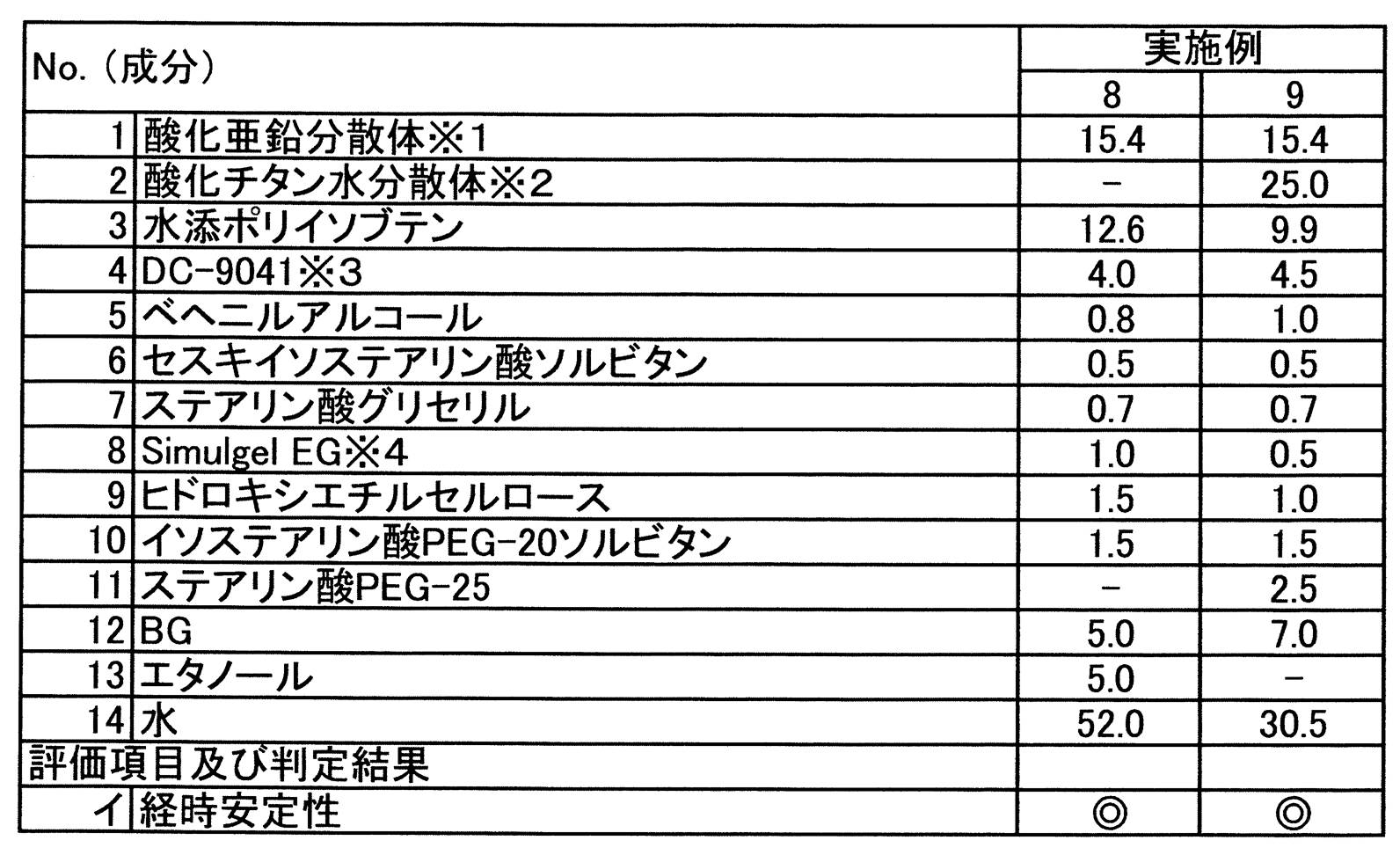
※1:実施例7で得られた分散体
※2:GT-10W(堺化学工業社製)
親水化処理酸化チタン(STR-100W、堺化学工業製、透過型電子顕微鏡観察による一次粒子径が10nmで、酸化チタンの表面を含水シリカで処理したもの)40.0重量%、精製水46.0重量%、1,3-ブチレングリコール10.0重量%、1,2-ペンタンジオール4.0重量%を撹拌機で1hr.混合した後、ビーズミルで分散したもの。
※3:東レ・ダウコーニング社製
※4:SEPPIC社製
※2:GT-10W(堺化学工業社製)
親水化処理酸化チタン(STR-100W、堺化学工業製、透過型電子顕微鏡観察による一次粒子径が10nmで、酸化チタンの表面を含水シリカで処理したもの)40.0重量%、精製水46.0重量%、1,3-ブチレングリコール10.0重量%、1,2-ペンタンジオール4.0重量%を撹拌機で1hr.混合した後、ビーズミルで分散したもの。
※3:東レ・ダウコーニング社製
※4:SEPPIC社製
(製造方法)
A:No.2、8~14を混合、加熱する。
B:No.1、3~7を混合、加熱する
C:AにBを添加して乳化し、冷却する。
A:No.2、8~14を混合、加熱する。
B:No.1、3~7を混合、加熱する
C:AにBを添加して乳化し、冷却する。
<経時安定性評価>
各試料について40℃で30日静置させ、分離及び変色を観察し、経時安定性の評価を下記4段階判定基準により判定した。
各試料について40℃で30日静置させ、分離及び変色を観察し、経時安定性の評価を下記4段階判定基準により判定した。
イ.経時安定性
4段階判定基準
(判定):(評点の平均点)
◎:分離及び変色が無い。
○:分離又は変色が多少あるが使用に支障がない。
△:分離又は変色が少し有り使用に支障がある。
×:分離又は変色が有る。
4段階判定基準
(判定):(評点の平均点)
◎:分離及び変色が無い。
○:分離又は変色が多少あるが使用に支障がない。
△:分離又は変色が少し有り使用に支障がある。
×:分離又は変色が有る。
本発明の分散体は、各種化粧料に無機酸化物粒子を配合するために使用することができる。
Claims (10)
- 無機酸化物粒子を油性媒体中に分散させた分散体であって、
炭素数が18以上のエステル油及びポリヒドロキシステアリン酸を含有し、
無機酸化物粒子は、酸化亜鉛、酸化鉄、酸化セリウム、酸化ジルコニウム及び酸化ビスマスからなる群より選択される少なくとも1種であり、
ポリヒドロキシステアリン酸の量が分散体全重量に対して0.5~8.0重量%であり、
シリコーン系成分の配合量が分散体全重量に対して10.0重量%以下であり、
無機酸化物粒子が分散体全体の51.0重量%以上であることを特徴とする分散体。 - 50℃で60日静置した際の沈降率が1重量%以下である請求項1記載の分散体。
- 分散直後の20℃における粘度が6000mPa・s以下であり、且つ、50℃で60日静置後の20℃における粘度が6000mPa・s以下である請求項1又は2記載の分散体。
- 無機酸化物粒子は、平均一次粒子径が100nm以下であり、且つ、紫外線遮蔽効果を持つものである請求項1~3のいずれかに記載の分散体。
- 無機酸化物粒子は、珪素、アルミニウム、亜鉛、鉄、チタン及びジルコニウムから選ばれる少なくとも1種の元素の水酸化物及び/又は酸化物で無機表面被覆されたものである請求項1~4のいずれかに記載の分散体。
- 無機酸化物粒子は、有機ケイ素化合物で有機表面被覆されたものである請求項1~5のいずれかに記載の分散体。
- 無機酸化物粒子は、含水シリカ及び/又はオルガノポリシロキサンで表面被覆されたものである請求項1~6のいずれかに記載の分散体。
- 無機酸化物粒子、炭素数が18以上のエステル油及びポリヒドロキシステアリン酸を混合・撹拌する工程からなることを特徴とする請求項1~7いずれかに記載の分散体の製造方法。
- 請求項1~7いずれかに記載の分散体を配合して得られたことを特徴とする化粧料。
- 水中油型乳化化粧料である請求項9記載の化粧料。
Applications Claiming Priority (2)
| Application Number | Priority Date | Filing Date | Title |
|---|---|---|---|
| JP2015014791 | 2015-01-28 | ||
| JP2015-014791 | 2015-01-28 |
Publications (1)
| Publication Number | Publication Date |
|---|---|
| WO2016121761A1 true WO2016121761A1 (ja) | 2016-08-04 |
Family
ID=56543372
Family Applications (1)
| Application Number | Title | Priority Date | Filing Date |
|---|---|---|---|
| PCT/JP2016/052199 Ceased WO2016121761A1 (ja) | 2015-01-28 | 2016-01-26 | 分散体、その製造方法及び化粧料 |
Country Status (1)
| Country | Link |
|---|---|
| WO (1) | WO2016121761A1 (ja) |
Cited By (5)
| Publication number | Priority date | Publication date | Assignee | Title |
|---|---|---|---|---|
| CN108478806A (zh) * | 2018-03-09 | 2018-09-04 | 哈尔滨工业大学深圳研究生院 | 中空介孔二氧化硅药物载体纳米孔道的可靠性封装制备方法 |
| US20210315781A1 (en) * | 2018-10-24 | 2021-10-14 | Tayca Corporation | Inorganic powder composite, method for producing same, water-in-oil emulsion composition, and sunscreen cosmetic |
| EP4470522A1 (fr) | 2023-05-26 | 2024-12-04 | Hyteck | Formules solaires anhydres |
| FR3150949A1 (fr) | 2023-05-26 | 2025-01-17 | Hyteck | Formules solaires anhydres |
| WO2025225522A1 (ja) * | 2024-04-25 | 2025-10-30 | 信越化学工業株式会社 | オルガノポリシロキサン及びこれを含有する化粧料 |
Citations (8)
| Publication number | Priority date | Publication date | Assignee | Title |
|---|---|---|---|---|
| JPS647941A (en) * | 1987-05-30 | 1989-01-11 | Tioxide Group Plc | Oil dispersion and its production |
| JPH05213618A (ja) * | 1991-10-04 | 1993-08-24 | Tioxide Specialties Ltd | 酸化亜鉛粒子分散物 |
| JP2006001886A (ja) * | 2004-06-18 | 2006-01-05 | Nikko Chemical Co Ltd | 表面疎水化処理した金属酸化物油分散体 |
| JP2012521442A (ja) * | 2009-03-23 | 2012-09-13 | コボ プロダクツ インコーポレイテッド | 自己分散性金属酸化物コーティング粉末、その製造方法及び使用 |
| JP2012184178A (ja) * | 2011-03-03 | 2012-09-27 | Kose Corp | 微粒子金属酸化物分散組成物 |
| JP2013071920A (ja) * | 2011-09-28 | 2013-04-22 | Kose Corp | 水中油型乳化化粧料 |
| JP2013071931A (ja) * | 2011-09-29 | 2013-04-22 | Kose Corp | 油中水型乳化化粧料 |
| JP2014080377A (ja) * | 2012-10-12 | 2014-05-08 | Kose Corp | 水中油型乳化化粧料 |
-
2016
- 2016-01-26 WO PCT/JP2016/052199 patent/WO2016121761A1/ja not_active Ceased
Patent Citations (8)
| Publication number | Priority date | Publication date | Assignee | Title |
|---|---|---|---|---|
| JPS647941A (en) * | 1987-05-30 | 1989-01-11 | Tioxide Group Plc | Oil dispersion and its production |
| JPH05213618A (ja) * | 1991-10-04 | 1993-08-24 | Tioxide Specialties Ltd | 酸化亜鉛粒子分散物 |
| JP2006001886A (ja) * | 2004-06-18 | 2006-01-05 | Nikko Chemical Co Ltd | 表面疎水化処理した金属酸化物油分散体 |
| JP2012521442A (ja) * | 2009-03-23 | 2012-09-13 | コボ プロダクツ インコーポレイテッド | 自己分散性金属酸化物コーティング粉末、その製造方法及び使用 |
| JP2012184178A (ja) * | 2011-03-03 | 2012-09-27 | Kose Corp | 微粒子金属酸化物分散組成物 |
| JP2013071920A (ja) * | 2011-09-28 | 2013-04-22 | Kose Corp | 水中油型乳化化粧料 |
| JP2013071931A (ja) * | 2011-09-29 | 2013-04-22 | Kose Corp | 油中水型乳化化粧料 |
| JP2014080377A (ja) * | 2012-10-12 | 2014-05-08 | Kose Corp | 水中油型乳化化粧料 |
Cited By (6)
| Publication number | Priority date | Publication date | Assignee | Title |
|---|---|---|---|---|
| CN108478806A (zh) * | 2018-03-09 | 2018-09-04 | 哈尔滨工业大学深圳研究生院 | 中空介孔二氧化硅药物载体纳米孔道的可靠性封装制备方法 |
| US20210315781A1 (en) * | 2018-10-24 | 2021-10-14 | Tayca Corporation | Inorganic powder composite, method for producing same, water-in-oil emulsion composition, and sunscreen cosmetic |
| US12156924B2 (en) * | 2018-10-24 | 2024-12-03 | Tayca Corporation | Inorganic powder composite, method for producing same, water-in-oil emulsion composition, and sunscreen cosmetic |
| EP4470522A1 (fr) | 2023-05-26 | 2024-12-04 | Hyteck | Formules solaires anhydres |
| FR3150949A1 (fr) | 2023-05-26 | 2025-01-17 | Hyteck | Formules solaires anhydres |
| WO2025225522A1 (ja) * | 2024-04-25 | 2025-10-30 | 信越化学工業株式会社 | オルガノポリシロキサン及びこれを含有する化粧料 |
Similar Documents
| Publication | Publication Date | Title |
|---|---|---|
| JP6627833B2 (ja) | 水分散体 | |
| CN102238934B (zh) | 一种水包油型化妆品 | |
| TWI459974B (zh) | Water-based emulsified cosmetic | |
| JP7404651B2 (ja) | 水中油型乳化化粧料及びその製造方法 | |
| US20080305338A1 (en) | Method of Producing Rutile Titanium Dioxide Fine Particles | |
| JP5850189B1 (ja) | 酸化亜鉛粉体、分散液、塗料、化粧料 | |
| WO2016121761A1 (ja) | 分散体、その製造方法及び化粧料 | |
| JP6802629B2 (ja) | 水系分散体、化粧料及びその製造方法 | |
| JP6291732B2 (ja) | 複合粉体分散体の製造方法 | |
| JP7695502B2 (ja) | 酸化亜鉛粒子分散体及びそれを配合した化粧料 | |
| JP6551482B2 (ja) | 酸化亜鉛粉体、分散液、塗料、化粧料 | |
| JP5907248B2 (ja) | 炭酸亜鉛塩粒子、酸化亜鉛粒子、それらの製造方法、放熱性フィラー及び化粧料 | |
| JP2019094303A (ja) | 水中油型日焼け止め化粧料及びその製造方法 | |
| JP2012240995A (ja) | 酸化亜鉛分散体及び化粧料 | |
| JP7835083B2 (ja) | 水系分散体及び化粧料 | |
| WO2016121760A1 (ja) | 分散体 | |
| JP2014201465A (ja) | 酸化亜鉛粒子、分散体及び化粧料 | |
| JP7695503B2 (ja) | 二酸化チタン粒子分散体及びそれを配合した化粧料 | |
| JP2016199437A (ja) | 酸化亜鉛粉体、分散液、塗料、化粧料 | |
| JP2014080392A (ja) | 化粧料用酸化チタン粒子の製造方法 | |
| JP7835084B2 (ja) | 油系分散体及び化粧料 | |
| KR20250109189A (ko) | 표면 소수화 처리한 무기 분체의 수분산체 및 그것을 함유하는 화장료 | |
| JP6538257B2 (ja) | ケラチン及び酸化亜鉛含有粒状複合体 | |
| WO2024024545A1 (ja) | 組成物 | |
| JP2025077995A (ja) | 乳化型日焼け止め化粧料および乳化型日焼け止め化粧料の製造方法 |
Legal Events
| Date | Code | Title | Description |
|---|---|---|---|
| 121 | Ep: the epo has been informed by wipo that ep was designated in this application |
Ref document number: 16743364 Country of ref document: EP Kind code of ref document: A1 |
|
| NENP | Non-entry into the national phase |
Ref country code: DE |
|
| 122 | Ep: pct application non-entry in european phase |
Ref document number: 16743364 Country of ref document: EP Kind code of ref document: A1 |
|
| NENP | Non-entry into the national phase |
Ref country code: JP |