WO2016129603A1 - Dispositif de jeu, procédé de commande, et support d'enregistrement lisible par ordinateur - Google Patents
Dispositif de jeu, procédé de commande, et support d'enregistrement lisible par ordinateur Download PDFInfo
- Publication number
- WO2016129603A1 WO2016129603A1 PCT/JP2016/053854 JP2016053854W WO2016129603A1 WO 2016129603 A1 WO2016129603 A1 WO 2016129603A1 JP 2016053854 W JP2016053854 W JP 2016053854W WO 2016129603 A1 WO2016129603 A1 WO 2016129603A1
- Authority
- WO
- WIPO (PCT)
- Prior art keywords
- player object
- obstacle
- transparency
- game
- player
- Prior art date
- Legal status (The legal status is an assumption and is not a legal conclusion. Google has not performed a legal analysis and makes no representation as to the accuracy of the status listed.)
- Ceased
Links
Images



Classifications
-
- A—HUMAN NECESSITIES
- A63—SPORTS; GAMES; AMUSEMENTS
- A63F—CARD, BOARD, OR ROULETTE GAMES; INDOOR GAMES USING SMALL MOVING PLAYING BODIES; VIDEO GAMES; GAMES NOT OTHERWISE PROVIDED FOR
- A63F13/00—Video games, i.e. games using an electronically generated display having two or more dimensions
- A63F13/50—Controlling the output signals based on the game progress
- A63F13/52—Controlling the output signals based on the game progress involving aspects of the displayed game scene
-
- A—HUMAN NECESSITIES
- A63—SPORTS; GAMES; AMUSEMENTS
- A63F—CARD, BOARD, OR ROULETTE GAMES; INDOOR GAMES USING SMALL MOVING PLAYING BODIES; VIDEO GAMES; GAMES NOT OTHERWISE PROVIDED FOR
- A63F13/00—Video games, i.e. games using an electronically generated display having two or more dimensions
- A63F13/55—Controlling game characters or game objects based on the game progress
-
- G—PHYSICS
- G06—COMPUTING OR CALCULATING; COUNTING
- G06T—IMAGE DATA PROCESSING OR GENERATION, IN GENERAL
- G06T19/00—Manipulating three-dimensional [3D] models or images for computer graphics
Definitions
- the present invention relates to a game device for drawing an object in a virtual game space, a control method, and a computer-readable recording medium.
- two-dimensional image data of the game space viewed from a virtual camera arranged in the virtual game space is generated and drawn.
- a method of drawing a game space viewed from a virtual camera arranged above and behind the player object is known.
- the user can easily check the surroundings of the player character and can play a game with a sense of reality from a viewpoint close to the player character.
- the virtual camera is not limited to the upper and rear sides of the player object, and may be arranged in various places.
- the user may not be able to confirm the player object and may be difficult to operate due to the obstacle.
- Patent Document 1 when there is an obstacle between the virtual camera and the player object, there is a method of making the player object easy to see through the obstacle.
- Patent Document 1 when an obstacle object exists on the line connecting the virtual camera and the player object, the obstacle is transmitted and drawn.
- an object of the present invention is to provide a game apparatus, a control method, and a computer-readable recording medium that easily determine an obstacle for a user when viewed from a virtual camera in a virtual game space.
- a game device is a game device that displays a game screen on a monitor, generates a player object in a virtual game space, and has a controller according to a user operation.
- a player object control unit that activates a player object in the game space based on the input operation signal, a non-player object control unit that generates and places a non-player object in the game space, and a virtual camera provided in the game space.
- the angle between the drawing unit for generating and drawing the viewed image data, the player object facing the non-player object, and the normal line of the abdomen of the player object and the line of sight of the virtual camera is predetermined. If the angle is larger than the angle, the non-player object is an obstacle. Comprising determining obstacle determining unit and.
- a game device a control method, and a computer-readable recording medium that easily determine an obstacle for a user when viewed from a virtual camera in a virtual game space.
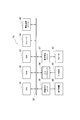
- FIG. 1 is a functional block diagram of the game device.
- FIG. 2 is a diagram illustrating a hardware configuration of the game device.
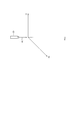
- FIG. 3 is a diagram for explaining a coordinate system of a virtual game space.
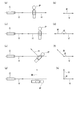
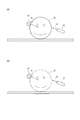
- FIG. 4 is a diagram for explaining an angle formed by the normal line of the abdomen of the player object in the virtual game space and the line of sight of the virtual camera.
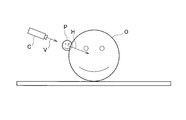
- FIG. 5 is a diagram illustrating a case where the normal line of the abdomen of the player object and the line of sight of the camera are facing the same direction.
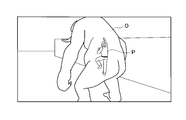
- FIG. 6 is a diagram illustrating an example of a game screen when the normal line of the abdomen of the player object and the line of sight of the camera are facing the same direction.
- FIG. 1 is a functional block diagram of the game device.
- FIG. 2 is a diagram illustrating a hardware configuration of the game device.
- FIG. 3 is a diagram for explaining a coordinate system of a virtual game space.
- FIG. 4 is a diagram for explaining an angle formed by the normal line
- FIG. 7 is a diagram illustrating a case where the normal line of the abdomen of the player object and the line of sight of the camera face each other.
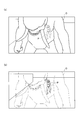
- FIG. 8 is a diagram for explaining an example of a game screen when the normal line of the abdomen of the player object and the line of sight of the camera are opposed to each other.
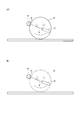
- FIG. 9 is a diagram illustrating a case where the normal line of the abdomen of the player object and the line of sight of the camera face each other, and the virtual camera is located inside the non-player object.
- FIG. 10 is a diagram for explaining an example of the game screen when the normal line of the abdomen of the player object and the line of sight of the camera face each other and the virtual camera is located inside the non-player object.
- FIG. 11 is a flowchart for explaining an example of the non-player object drawing process by the non-player object drawing unit.
- the game program 1 is executed by a computer such as the game device 3 including a CPU (processing device) 31 to provide a game to the player.
- the computer functions as each unit shown in FIG. 1 by executing the game program 1.
- the game program 1 is recorded on a computer-readable recording medium.
- the recording medium records an instruction executed by the computer by the game program, and the computer reads the recording medium and executes the instruction.
- the game program 1 proceeds with a game in which player objects and non-player objects are arranged in a virtual game space.
- the user inputs an operation signal to the game apparatus 3 using the controller 41 based on the image data viewed from the virtual camera.
- the game program 1 renders the non-player object transparently.
- the game program 1 assumes a battle game, an action game, an adventure game, etc., but is not limited to this. Although a game program in a game operated by one user will be described, the present invention may be applied to a game operated by a plurality of users. In a game operated by a plurality of users, a game space from each virtual camera provided corresponding to each player object is drawn on the game screen of each user.
- the game apparatus 3 connects a CPU 31, a RAM 32, a ROM 33, a storage 34, an image processing unit 35, an input interface 36, a sound processing unit 37, and a communication unit 38 to the bus 30.
- the RAM 32, the ROM 33, and the storage 34 store the game program 1 and data related to game progress and display.
- a monitor 40 such as a liquid crystal display is connected to the image processing unit 35.
- the monitor 40 displays the game screen processed by the image processing unit 35.
- a controller 41 such as a controller, a mouse, and a keyboard is connected to the input interface 36.
- the controller 41 inputs a user operation signal to the input interface 36.
- a speaker 42 is connected to the sound processing unit 37.
- the speaker 42 outputs sound such as sound effects and BGM that are converted into analog signals by the sound processing unit 37 and amplified.
- the game device 3 may be connected to another game device or a game server device via the communication unit 38 in a wired or wireless manner.
- the communication unit 38 transmits processing data from the CPU 31 to other devices, and inputs processing data received from other devices to the CPU 31.
- a touch panel (not shown) may be provided instead of or in addition to the monitor 40 and the controller 41. good.
- the touch panel displays a game screen generated by the image processing unit 35 and inputs the contact coordinates where the user has touched the touch panel to the input interface 36.
- the game apparatus 3 includes a control unit 10 and a drawing unit 20.
- the control unit 10 controls the progress of the game in cooperation with each unit included in the control unit 10, and outputs an instruction to draw the game screen to the drawing unit 20.
- the drawing unit 20 draws a game screen according to an instruction from the control unit 10 and displays the game screen on the monitor 40 via the image processing unit 35.
- the control unit 10 includes an operation detection unit 11, a virtual space generation unit 12, a virtual camera control unit 13, a player object control unit 14, and a non-player object control unit 15.
- the operation detection unit 11 acquires a user operation signal from the input interface 36 and inputs the operation signal to the control unit 10.
- the virtual space generation unit 12 generates a three-dimensional virtual game space according to a predetermined game progress.
- a player object operated and controlled by the player and a non-player object controlled by the CPU 31 are arranged.
- the virtual camera control unit 13 controls the virtual camera C provided in the virtual game space.
- a game space, a player object, a non-player object, and the like photographed from the virtual camera C are converted into two-dimensional image data by the drawing unit 20 described later and displayed on the monitor 40.
- the virtual camera control unit 13 controls the virtual camera C so as to move to various positions such as the front and sides of the player object as well as above and behind the player object as the game progresses. Further, the position and direction of the virtual camera C may be controlled by a user operation.
- the player object control unit 14 generates a player object in the game space and controls the player object to be active in the game space based on an operation signal input by the controller 41 according to a user operation.
- the non-player object control unit 15 generates and arranges non-player objects in the game space.
- the non-player object may be a stationary object such as a rock or a tree, or may be an action object such as an enemy character.
- the non-player object control unit 15 may move the non-player object in the game space based on predetermined processing information.
- the “predetermined processing information” is a predetermined algorithm such as AI (Artificial Intelligence), and moves the non-player object asynchronously with the operation signal input by the user and in correlation with the movement of the player object. .
- the game proceeds while the player object and the non-player object are correlated.
- the control unit 10 stores the identifier of the non-player object that is the movement target of the player object, the action type of the player object, and the like in association with each other. Enter.
- the drawing unit 20 converts the game space into image data viewed from the virtual camera and draws it.
- the drawing unit 20 draws the virtual game space, the player object, and the non-player object viewed from the virtual camera C by converting them into two-dimensional image data by projection conversion.
- the drawing unit 20 includes an obstacle determination unit 21 that determines whether or not a predetermined non-player object is an obstacle, and a non-player object drawing unit 22 that draws the non-player object.
- the obstacle determination unit 21 determines that the non-player object is an obstacle
- the non-player object drawing unit 22 performs transparent processing on the non-player object and draws it.
- the obstacle determination unit 21 determines whether (i) the player object is facing the non-player object, or (ii) the angle formed by the normal line H of the abdomen of the player object and the line of sight V of the virtual camera C is predetermined. It is determined whether the angle is larger than the angle. The obstacle determination unit 21 determines that the non-player object to be operated is an obstacle when the conditions (i) and (ii) are satisfied.
- Opasite means that the player object faces the non-player object side, and the non-player object is located in the normal direction of the abdomen of the player object.
- “opposing” means not only the state in which the player object and the non-player object face each other in front but also at least a part of the front surface of the player object regardless of the orientation of the non-player object. It may include a state in which the object is oriented. Further, “opposing” may include not only a case where the player object and the non-player object are in contact but also a case where the player object and the non-player object are not in contact.
- the obstacle determination unit 21 determines that the condition (i) is satisfied when the player object “opposites” the non-player object.
- “Opposite” is appropriately set according to the type of player object or non-player object, the type of game, or the like. For example, in the case of an action game in which a player object and a non-player object battle, the non-player object is considered to be an enemy object. In this case, “opposite” means that the player object struggles with the enemy object, the player object climbs on the enemy object, etc. It is conceivable that the player object opposes without touching the enemy object, such as throwing a weapon at the object.
- the non-player object is considered to be a rock or a tree.
- “facing” means that the player object touches the stationary object such as the player object climbing on the stationary object, holding the stationary object, or hiding behind the stationary object, It is conceivable that the player object opposes without touching the stationary object, such as throwing another object or using magic.
- the abdomen normal H is a normal to the abdomen bone obtained when the player object is generated, and the direction of the normal corresponds to the forward direction of the abdomen position of the player object.
- the line of sight V of the virtual camera C is the shooting direction of the virtual camera, and is a parameter for projection conversion processing by the drawing unit 20.
- the predetermined angle is set within a range of 180 degrees to 91 degrees, and more preferably within a range of 180 degrees to 120 degrees. This predetermined angle may be appropriately set according to the shape of the player character, or may be variably set according to the action type of the player character.
- the line of sight V direction of the virtual camera C is taken as the Z-axis direction.
- the vertical direction of the screen (vertical direction in FIG. 3) is the Y-axis direction
- the horizontal direction (front or back direction in FIG. 3) is the X-axis direction.
- 4 illustrates an angle formed by the normal line H of the abdomen of the player object P and the line of sight V of the virtual camera C in the virtual game space. 4 shows a state in which the virtual camera C and the player object are projected on the YZ plane in the game space shown in FIG.
- FIG. 4A shows a case where the normal H and the line of sight V are in the same direction, that is, as shown in FIG. 4B, the angle ⁇ formed between the normal H and the line of sight V is 0 degree. Show the case.
- the non-player object O is located at the tip of the normal line H of the player object P (on the right side in FIG. 4A).
- the player object P is positioned in front of the game space, and the non-player object O is positioned in the back. Therefore, the non-player object O is not determined as an obstacle in the image data obtained by converting the game space viewed from the virtual camera C. Therefore, even if the non-player object O is not transparently processed, the user can confirm the player object P.
- FIG. 4C shows the case where the normal H and the line of sight V are directed in opposite directions (opposite directions), that is, the angle formed between the normal H and the line of sight V as shown in FIG. The case where ⁇ is 180 degrees is shown.
- the non-player object O is located at the tip of the normal line H of the player object P (left side in FIG. 4C).
- the non-player object O is positioned in front of the game space and the player object P is positioned in the back, so the non-player object O has transformed the game space viewed from the virtual camera C. It is determined as an obstacle in the image data. Therefore, the user can confirm the player object P by the non-player object O being transparently processed.
- FIG. 4E shows a case where the normal H is obliquely upward with respect to the line of sight V, that is, as shown in FIG. 4F, the angle ⁇ formed between the normal H and the line of sight V is 91. The case where it is more than 180 degrees and less than 180 degrees is shown.
- the non-player object O is located at the tip of the normal line H of the player object P (upper left side in FIG. 4E).
- the non-player object O is positioned in front of the game space and the player object P is positioned in the back, so the non-player object O has transformed the game space viewed from the virtual camera C. It is determined as an obstacle in the image data. Therefore, the user can confirm the player object P by the non-player object O being transparently processed.
- FIG. 4G shows the case where the normal H is directed upward of the line of sight V, that is, the angle ⁇ formed by the normal H and the line of sight V is 90 degrees as shown in FIG. Indicates.
- the non-player object O is located at the tip of the normal line H of the player object P (upper side in FIG. 4E).
- the non-player object O is positioned above the game space, and the player object P is positioned below the non-player object O. Therefore, the non-player object O is viewed from the virtual camera C.
- the image data obtained by converting the game space is not determined as an obstacle. Therefore, the user can confirm the player object P even if the non-player object O is not transparently processed.
- FIGS. 5, 7 and 9 show a state in which the virtual camera C and the player object are projected onto the YZ plane in the coordinate system shown in FIG. 6, 8, and 10 are two-dimensional image data obtained by projecting and transforming the game space, the player object P, and the non-player object O by the drawing unit 20.
- the player object P that cannot be confirmed by the obstacle is indicated by a dotted line
- the non-player object O that has been subjected to the transparent process is indicated by a two-dot chain line.
- FIGS. 5 to 10 a case will be described in which the player object P is performing an opposing action of “clamping” against the non-player object O.
- FIG. 5 shows a case where the normal line H of the player object P and the line of sight V of the virtual camera C are in the same direction, and the angle formed between the normal line H and the line of sight V is 0 degree.
- the player object P since the player object P is positioned in front of the line of sight V and the non-player object O is positioned in the back, it is not determined as an obstacle, and the player object P can be confirmed from the virtual camera C as shown in FIG.
- the normal line H of the player object P and the line of sight V of the virtual camera C are directed in opposite directions (opposite directions), and the angle formed between the normal line H and the line of sight V is 180 degrees.
- the non-player object O since the non-player object O is positioned in front of the line of sight V and the player object P is positioned in the back, the player object P cannot be confirmed from the virtual camera C as shown in FIG. Accordingly, the player object P is determined as an obstacle, and the player object P is confirmed on the line of sight V from the virtual camera C by transmitting the non-player object O as shown in FIGS. 7B and 8B. it can.
- the virtual camera C is provided inside the non-player object O, and the normal line H of the player object P and the line of sight V of the virtual camera C face in opposite directions (opposite directions).
- the angle between the normal H and the line of sight V is 180 degrees.
- the player object P and the non-player are positioned as shown in FIG.
- the body part and the right foot part where the object O overlaps cannot confirm the player object P by the line of sight V from the virtual camera C. Therefore, it is determined that the object is an obstacle, and the player object P is confirmed on the line of sight V from the virtual camera C by transmitting the non-player object O as shown in FIGS. 9B and 10B. it can.
- the non-player object drawing unit 22 repeats the process of increasing the transparency of the non-player object in stages and drawing the non-player object. . After the transparency of the non-player object reaches a predetermined transparency, the obstacle determination unit 21 determines whether the non-player object is an obstacle. When it is determined that the non-player object is an obstacle, the non-player object drawing unit 22 performs a transparent process on the non-player object and draws it with a predetermined transparency. On the other hand, when the non-player object is not determined to be an obstacle, the transparency of the non-player object is lowered stepwise and the process of drawing the non-player object is repeated.
- the non-player object drawing unit 22 gradually increases the transparency of the non-player object, for example, within a range from a default value (for example, 0%) to a maximum value (for example, 60%).
- a non-player object is drawn by lowering or lowering.
- the non-player object drawing unit 22 gradually increases the transparency to a predetermined transparency and draws a plurality of continuous frame images. For example, when the maximum value is 60% and 30 frame images are drawn per second, the non-player object drawing unit 22 increases the transparency by 2% per frame image. The non-player object drawing unit 22 draws a frame image that changes in units of 2% from 0% transparency to 60% transparency over 1 second. In the meantime, even if a state where the non-player object is not an obstacle occurs, the non-player object drawing unit 22 continues the process of drawing the non-player object by increasing the transparency of the non-player object up to the maximum value.
- the obstacle determination unit 21 determines whether or not the non-player object is an obstacle. In the case of an obstacle, the non-player object drawing unit 22 continues drawing with the maximum transparency. If it is not an obstacle, the non-player object drawing unit 22 starts a process of reducing the transparency of the non-player object. For example, when the maximum value is 60% and 30 frame images are drawn per second, the non-player object drawing unit 22 decreases the frame image by 2% per frame image. The non-player object drawing unit 22 draws a frame image that changes in units of 2% from 60% transparency to 0% transparency over 1 second. In the meantime, even if a state in which the non-player object becomes an obstacle occurs, the non-player object drawing unit 22 continues the process of drawing the non-player object with the transparency of the non-player object lowered stepwise to the default value.
- the maximum value of the transparency in the transparent process and the non-transparent process are set as appropriate.
- the non-player object drawing unit 22 performs the obstacle determination process by the obstacle determination unit 21 until the non-player object starts or completes the transparent process or the non-transparent process. Continue the transparent or non-transparent process without executing it. Thereby, the transparency of the non-player object is suddenly switched, and it is possible to avoid the player from being difficult to see, and to reduce the processing load on the CPU 31.
- non-player object drawing processing by the non-player object drawing unit 22 will be described with reference to FIG.
- the process shown in FIG. 11 is an example, and the non-player object drawing process may be executed by a process different from this.
- step S1 if the obstacle determination unit 21 determines that the non-player object is an obstacle, the process proceeds to step S2, and the non-player object drawing unit 22 determines whether the transparency is the maximum value. If the transparency is the maximum value, that is, if the transparency process of the non-player object has already been completed, the process returns to step S1, and the determination process by the obstacle determination unit 21 is performed again.
- step S2 if the transparency is not the maximum value, that is, if the non-player object is changed from a non-obstacle to an obstacle, a transparency process is started in step S2. In the transparency process, until the transparency of the non-player object reaches a maximum value (for example, 60%), the process of drawing with the transparency of the non-player object increased stepwise is repeated.
- a maximum value for example, 60%
- step S1 when the obstacle determination unit 21 determines that the non-player object is not an obstacle, the process proceeds to step S4, and the non-player object drawing unit 22 determines whether the transparency is a default value (for example, 0%). judge.
- the transparency is the default value, that is, when the non-transparency process of the non-player object has already been completed, the process returns to step S1, and the determination process by the obstacle determination unit 21 is performed again.
- step S4 if the transparency is not the default value, that is, if the non-player object is changed from an obstacle to a non-obstacle, a non-transparency process is started in step S5.
- the process of drawing with the transparency of the non-player object lowered stepwise is repeated until the transparency of the non-player object reaches the default value.
- a game program 1 it is possible to easily determine an obstacle of a player object when viewed from a virtual camera in a virtual game space and provide a user-friendly screen. Can do.
- the transparency may be changed according to the angle formed by the normal line of the abdomen of the player object and the line of sight of the virtual camera.
- control may be performed such that the greater the angle, the greater the transparency of the non-player object.
Landscapes
- Engineering & Computer Science (AREA)
- Multimedia (AREA)
- Human Computer Interaction (AREA)
- Computer Graphics (AREA)
- Computer Hardware Design (AREA)
- General Engineering & Computer Science (AREA)
- Software Systems (AREA)
- Physics & Mathematics (AREA)
- General Physics & Mathematics (AREA)
- Theoretical Computer Science (AREA)
- Processing Or Creating Images (AREA)
Abstract
La présente invention concerne un dispositif de jeu 3 pourvu des éléments suivants : une unité de commande d'objet joueur 14 qui amène un objet joueur à agir dans un espace de jeu, sur la base d'une entrée de signal d'opération par un contrôleur en fonction d'une opération d'utilisateur ; une unité de commande d'objet non-joueur 15 qui génère et dispose un objet autre qu'un joueur dans l'espace de jeu ; une unité de rendu qui génère et restitue des données d'image telles qu'elles sont vues depuis une caméra virtuelle placée dans l'espace de jeu ; et une unité de détermination d'obstacle 21 qui détermine qu'un objet autre qu'un joueur est un obstacle si l'objet joueur fait face à l'objet autre qu'un joueur et un angle entre une ligne normale par rapport à une partie abdominale de l'objet de joueur et la ligne de visée de la caméra virtuelle est supérieure à un angle prescrit.
Applications Claiming Priority (2)
| Application Number | Priority Date | Filing Date | Title |
|---|---|---|---|
| JP2015023949A JP6122047B2 (ja) | 2015-02-10 | 2015-02-10 | ゲームプログラムおよびゲーム装置 |
| JP2015-023949 | 2015-02-10 |
Publications (1)
| Publication Number | Publication Date |
|---|---|
| WO2016129603A1 true WO2016129603A1 (fr) | 2016-08-18 |
Family
ID=56614696
Family Applications (1)
| Application Number | Title | Priority Date | Filing Date |
|---|---|---|---|
| PCT/JP2016/053854 Ceased WO2016129603A1 (fr) | 2015-02-10 | 2016-02-09 | Dispositif de jeu, procédé de commande, et support d'enregistrement lisible par ordinateur |
Country Status (2)
| Country | Link |
|---|---|
| JP (1) | JP6122047B2 (fr) |
| WO (1) | WO2016129603A1 (fr) |
Families Citing this family (4)
| Publication number | Priority date | Publication date | Assignee | Title |
|---|---|---|---|---|
| JP2844680B2 (ja) | 1989-06-21 | 1999-01-06 | 東洋紡績株式会社 | 異繊度異収縮混繊糸及びその製造方法 |
| JP7369556B2 (ja) * | 2018-09-06 | 2023-10-26 | 株式会社バンダイナムコエンターテインメント | プログラム、ゲーム装置、サーバ装置及びゲーム提供方法 |
| JP6993585B2 (ja) * | 2019-05-24 | 2022-01-13 | 株式会社カプコン | ゲームプログラム及びゲーム装置 |
| CN117994181B (zh) * | 2024-04-03 | 2024-06-11 | 成都力比科技有限公司 | 一种基于全屏幕的2d光照渲染方法及系统 |
Citations (4)
| Publication number | Priority date | Publication date | Assignee | Title |
|---|---|---|---|---|
| JPH11306383A (ja) * | 1998-04-24 | 1999-11-05 | Namco Ltd | 画像生成装置及び情報記憶媒体 |
| JP2000348217A (ja) * | 1995-08-10 | 2000-12-15 | Sega Enterp Ltd | 仮想画像生成装置及びその方法 |
| JP2003044868A (ja) * | 2001-07-30 | 2003-02-14 | Namco Ltd | 画像生成システム、プログラム及び情報記憶媒体 |
| JP2007164557A (ja) * | 2005-12-15 | 2007-06-28 | Namco Bandai Games Inc | プログラム、情報記録媒体および画像生成システム |
-
2015
- 2015-02-10 JP JP2015023949A patent/JP6122047B2/ja active Active
-
2016
- 2016-02-09 WO PCT/JP2016/053854 patent/WO2016129603A1/fr not_active Ceased
Patent Citations (4)
| Publication number | Priority date | Publication date | Assignee | Title |
|---|---|---|---|---|
| JP2000348217A (ja) * | 1995-08-10 | 2000-12-15 | Sega Enterp Ltd | 仮想画像生成装置及びその方法 |
| JPH11306383A (ja) * | 1998-04-24 | 1999-11-05 | Namco Ltd | 画像生成装置及び情報記憶媒体 |
| JP2003044868A (ja) * | 2001-07-30 | 2003-02-14 | Namco Ltd | 画像生成システム、プログラム及び情報記憶媒体 |
| JP2007164557A (ja) * | 2005-12-15 | 2007-06-28 | Namco Bandai Games Inc | プログラム、情報記録媒体および画像生成システム |
Also Published As
| Publication number | Publication date |
|---|---|
| JP6122047B2 (ja) | 2017-04-26 |
| JP2016146864A (ja) | 2016-08-18 |
Similar Documents
| Publication | Publication Date | Title |
|---|---|---|
| US8655015B2 (en) | Image generation system, image generation method, and information storage medium | |
| JP5148660B2 (ja) | プログラム、情報記憶媒体及び画像生成システム | |
| GB2556347B (en) | Virtual Reality | |
| US8559677B2 (en) | Image generation system, image generation method, and information storage medium | |
| US10719978B2 (en) | Storage medium, image processing system, image processing apparatus and image processing method for target object detection | |
| JP6344380B2 (ja) | 画像処理装置および方法、並びにプログラム | |
| US9199164B2 (en) | Image display device, computer readable storage medium, and game control method | |
| US20120154311A1 (en) | Information storage medium, terminal, and input determination method | |
| US20110305398A1 (en) | Image generation system, shape recognition method, and information storage medium | |
| US20130154974A1 (en) | Input direction determination system, terminal server, network system, information storage medium, and input direction determination method | |
| WO2016150292A1 (fr) | Procédé et système interactifs combinant virtualité et réalité permettant d'intégrer un environnement réel | |
| JP2012212237A (ja) | 画像生成システム、サーバシステム、プログラム及び情報記憶媒体 | |
| US11107183B2 (en) | Adaptive mesh skinning in a foveated rendering system | |
| CN106873767A (zh) | 一种虚拟现实应用的运行控制方法和装置 | |
| JP2024513744A (ja) | 仮想環境において物体をマークする方法、装置、機器、及びコンピュータプログラム | |
| WO2016129603A1 (fr) | Dispositif de jeu, procédé de commande, et support d'enregistrement lisible par ordinateur | |
| WO2013163374A1 (fr) | Système vidéo interactif | |
| JP6313937B2 (ja) | ゲームプログラムおよびゲームシステム | |
| JP2019175322A (ja) | シミュレーションシステム及びプログラム | |
| JP5539133B2 (ja) | ゲームプログラム、及びゲーム装置 | |
| CN113041616B (zh) | 游戏中控制跳字显示的方法、装置、电子设备及存储介质 | |
| JP2014184300A (ja) | ゲームプログラム、及びゲーム装置 | |
| WO2023030106A1 (fr) | Procédé et appareil d'affichage d'objet, dispositif électronique et support de stockage | |
| JP2005095387A (ja) | ゲーム装置及びコンピュータを機能させるためのプログラム | |
| JP2009061159A (ja) | プログラム、情報記憶媒体、及び、ゲームシステム |
Legal Events
| Date | Code | Title | Description |
|---|---|---|---|
| 121 | Ep: the epo has been informed by wipo that ep was designated in this application |
Ref document number: 16749247 Country of ref document: EP Kind code of ref document: A1 |
|
| NENP | Non-entry into the national phase |
Ref country code: DE |
|
| 122 | Ep: pct application non-entry in european phase |
Ref document number: 16749247 Country of ref document: EP Kind code of ref document: A1 |