WO2016132468A1 - Procédé et dispositif d'évaluation de données, et procédé et dispositif de diagnostic de panne - Google Patents
Procédé et dispositif d'évaluation de données, et procédé et dispositif de diagnostic de panne Download PDFInfo
- Publication number
- WO2016132468A1 WO2016132468A1 PCT/JP2015/054369 JP2015054369W WO2016132468A1 WO 2016132468 A1 WO2016132468 A1 WO 2016132468A1 JP 2015054369 W JP2015054369 W JP 2015054369W WO 2016132468 A1 WO2016132468 A1 WO 2016132468A1
- Authority
- WO
- WIPO (PCT)
- Prior art keywords
- data
- input
- output
- neural network
- distance
- Prior art date
- Legal status (The legal status is an assumption and is not a legal conclusion. Google has not performed a legal analysis and makes no representation as to the accuracy of the status listed.)
- Ceased
Links
Images




Classifications
-
- G—PHYSICS
- G06—COMPUTING OR CALCULATING; COUNTING
- G06N—COMPUTING ARRANGEMENTS BASED ON SPECIFIC COMPUTATIONAL MODELS
- G06N3/00—Computing arrangements based on biological models
- G06N3/02—Neural networks
- G06N3/08—Learning methods
- G06N3/09—Supervised learning
-
- G—PHYSICS
- G06—COMPUTING OR CALCULATING; COUNTING
- G06N—COMPUTING ARRANGEMENTS BASED ON SPECIFIC COMPUTATIONAL MODELS
- G06N3/00—Computing arrangements based on biological models
- G06N3/02—Neural networks
- G06N3/04—Architecture, e.g. interconnection topology
-
- G—PHYSICS
- G06—COMPUTING OR CALCULATING; COUNTING
- G06N—COMPUTING ARRANGEMENTS BASED ON SPECIFIC COMPUTATIONAL MODELS
- G06N3/00—Computing arrangements based on biological models
- G06N3/02—Neural networks
- G06N3/04—Architecture, e.g. interconnection topology
- G06N3/045—Combinations of networks
- G06N3/0455—Auto-encoder networks; Encoder-decoder networks
-
- G—PHYSICS
- G06—COMPUTING OR CALCULATING; COUNTING
- G06N—COMPUTING ARRANGEMENTS BASED ON SPECIFIC COMPUTATIONAL MODELS
- G06N3/00—Computing arrangements based on biological models
- G06N3/02—Neural networks
- G06N3/04—Architecture, e.g. interconnection topology
- G06N3/0499—Feedforward networks
-
- G—PHYSICS
- G08—SIGNALLING
- G08B—SIGNALLING SYSTEMS, e.g. PERSONAL CALLING SYSTEMS; ORDER TELEGRAPHS; ALARM SYSTEMS
- G08B31/00—Predictive alarm systems characterised by extrapolation or other computation using updated historic data
Definitions
- the present invention relates to a technique for evaluating data used by a neural network, and a technique for diagnosing equipment failure using the data.
- the neural network is a model that simulates the function of brain neurons.
- the neural network includes an input node and an output node, and when a value is input to the input node, a value corresponding to the output node input is output.
- the output value of the output node is calculated as a value obtained by converting the weighted sum of the input values for the input node by the output function f.
- a multi-layer neural network can also be constructed by connecting pairs of input nodes and output nodes in a multistage manner and using the output from the output node as an input to the input node in the next stage.
- a back-propagation algorithm is known as an algorithm that uses a pair of an input and an output to be obtained from the input as learning data and learns the weight of each node so that an input / output relationship that matches the learning data is obtained.
- One of the merits of neural networks is that it is possible to construct a system that can obtain the desired output without analyzing what kind of feature value is extracted from the input data to obtain the desired output.
- Deep neural networks have been applied to many fields such as image recognition, speech recognition, handwritten character recognition, etc., and high performance has been obtained.
- Patent Document 1 describes a technique for diagnosing a device failure using a neural network.
- the method of diagnosing a device failure using a neural network is roughly divided into the following two types: (a) Normal data using a neural network (restoration type neural network) configured to output input data as it is. (B) A neural network (discriminating neural network) that learns an input / output pair, and a signal output from the device and its signal The corresponding device status is learned to determine whether the input data is normal or abnormal.
- a typical example of a restoration type neural network is called an auto encoder.
- the fault diagnosis method using a restoration type neural network can be learned only with normal data, but there is a problem that it is difficult to identify an abnormality near the boundary when the space occupied by normal data and the space occupied by abnormal data are close to each other.
- the fault diagnosis method using the discrimination type neural network can accurately distinguish between normal data and abnormal data, but there is a problem that the determination result is undefined for unlearned data.
- the present invention has been made in view of the above-described problems, and an object of the present invention is to provide a technique capable of mutually complementing the characteristics of the restoration-type neural network and the identification-type neural network.
- the present invention determines whether the input data is within a previously learned range by restoring the input data using the restoration type neural network, and evaluates the judgment result by the discrimination type neural network using the result. To do.
- the present invention it is possible to determine whether or not the input data is within the learning range of the discriminating neural network. Thereby, the influence at the time of discriminating judgment type
- mold neural network can be suppressed.
- FIG. 3 is a graph showing a result of fault diagnosis performed using the block diagrams shown in FIGS. 1 and 2.
- FIG. It is a graph which shows the example which discriminate
- FIG. 2 is a functional block diagram of a failure diagnosis apparatus 700 according to Embodiment 1.
- FIG. It is a figure which shows the process which comprises the identification type
- FIG. It is the figure which showed typically how the feature-value space of input data 710 is distinguished by the comparator 760.
- FIG. It is the figure which showed typically how the feature-value space of the input data 710 is divided by the diagnostic result output device 730.
- FIG. 5 is a flowchart for explaining the operation of the failure diagnosis apparatus 700. It is a graph which shows the calculation result by the distance calculator 740.
- FIG. 1 is a block diagram for explaining a method of diagnosing equipment failure using an auto encoder.
- the auto encoder 120 performs learning in advance so that a signal output when a device to be diagnosed operates normally is used as learning data, and the input data is restored and output as it is. Since the auto encoder 120 learns using only normal data, when data other than normal data is input, it is expected that the output data does not match the input data.
- the signal sequence output by the device to be diagnosed is input as input data 110 to the auto encoder 120, and the restoration data 130 is acquired.
- the distance calculator 140 obtains the distance between the input data 110 and the restored data 130.
- the comparator 160 compares the distance with the reference value 150, and when the distance is greater than the reference value 150, the comparator 160 outputs a determination result 170 indicating that the input data 110 is abnormal (that is, the device has failed), When the distance is less than or equal to the reference value 150, a determination result 170 indicating that the input data 110 is normal (that is, the device is normal) is output.
- the boundary for determining whether or not the input data 110 is normal varies depending on the reference value 150.
- the reference value 150 may be a case where it is difficult to provide the reference value 150 that can satisfactorily identify all signal string patterns of the input data 110.
- FIG. 2 is a block diagram for explaining a method of diagnosing a device failure using a discrimination type neural network.
- the discriminating neural network 220 learns in advance a pair of a signal output during normal operation of the device to be diagnosed and a determination result indicating that the device is operating normally, and the device to be diagnosed is abnormal. A pair of a signal output during operation and a determination result indicating that the device is operating abnormally at that time is learned in advance.
- the discrimination type neural network 220 generally includes an intermediate layer 221 that has been learned as an auto encoder, and an identification layer 222 that associates the output of the intermediate layer 221 with a determination result.
- a signal sequence output from the diagnosis target device is input as input data 210 to the discriminating neural network 220, and the discriminating neural network 220 generates an output value according to the learning result.
- the diagnosis result output unit 230 outputs the determination result 240 by shaping the output value as necessary.
- the discriminating neural network 220 when input data 210 that has not been learned in advance by the discriminating neural network 220 is input, the discriminating neural network 220 appropriately determines whether or not the input data 210 is normal. Therefore, the accuracy of the determination result 240 is not necessarily good.
- FIG. 3 is a graph showing the results of failure diagnosis using the block diagrams shown in FIGS.
- the upper part shows the result when the auto encoder of FIG. 1 is used, and the lower part shows the result when the identification type neural network of FIG. 2 is used.
- a section 310 corresponds to normal data, and a section 330 corresponds to abnormal data.
- the portion 321 included in the section 320 should be determined as abnormal data originally, but is erroneously determined as normal. By reducing the reference value 150 (shifting downward in the vertical axis direction), the portion 321 can be determined to be abnormal. However, if so, there is a possibility that data determined to be normal in FIG. 3 exceeds the reference value 150 and erroneously determined to be abnormal. In the case shown in the upper part of FIG. 3, it is difficult to set an appropriate reference value 150 for all input data 110.
- the discriminating neural network needs to learn using both normal data and abnormal data, but has an advantage of high discrimination performance in the vicinity of the boundary between the two.
- FIG. 4 is a graph showing an example in which the discriminating neural network makes a misjudgment.
- the determination is made correctly.
- the section 430 in which noise that is not included in either normal data or abnormal data is input there is a portion 431 that is originally determined to be abnormal but is erroneously determined to be normal. . This is because there is no restriction on the determination result for an unlearned data area, and the determination result is undefined.
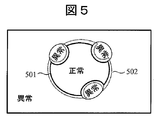
- FIG. 5 is a conceptual diagram showing the relationship between the input feature space and the diagnosis result when the fault diagnosis is performed using the auto encoder.
- the inside of the boundary 501 is normal data
- the outside of the boundary 502 is abnormal data.
- erroneous determination is likely to occur particularly in a portion where normal data and abnormal data are in contact (for example, a region between the boundaries 501 and 502). For this reason, it is difficult to accurately identify a complex boundary using only a simple one-dimensional reference value 150.
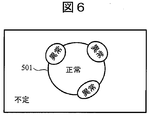
- FIG. 6 is a conceptual diagram showing the relationship between the input feature amount space and the diagnosis result when the fault diagnosis is performed using the discriminating neural network.
- the boundary between normal data and abnormal data is clear, but it is uncertain whether the determination result is normal or abnormal for an area where no learning data is given.
- ⁇ Embodiment 1> In the first embodiment of the present invention, a method for detecting a sign of an abnormality or abnormality of the device by using a signal from a sensor attached to a target device that performs abnormality detection or predictive diagnosis as an input to the neural network will be described. To do.
- FIG. 7 is a functional block diagram of the failure diagnosis apparatus 700 according to the first embodiment.
- the failure diagnosis apparatus 700 includes an identification type neural network 720 and a diagnosis result output unit 730, similarly to the configuration described in FIG. These functions are the same as those of the discrimination type neural network 220 and the diagnosis result output unit 230 described in FIG. That is, the discrimination type neural network 720 learns in advance a pair of input data 710 output from the target device and a diagnosis result corresponding to the input data 710, and the diagnosis result output unit 730 outputs the diagnosis result.
- an auto encoder that restores the input data 710 is configured.
- An identification type neural network 720 is formed by connecting an intermediate layer 721 that is a front part of the auto encoder and an identification layer 723 that outputs a diagnosis result based on the output of the intermediate layer 721. The process of forming the discrimination type neural network 720 will be described again.
- the second intermediate layer 781 with the weights between the layers reversed is temporarily connected to the output side of the intermediate layer 721 so that the input data 710 can be restored.
- the second intermediate layer 781 is removed from the discrimination type neural network 720.
- the restoration type neural network 780 is configured using the second intermediate layer 781.
- the restoration type neural network 780 is a neural network that has been learned in advance as an auto encoder, receives the output of the hidden layer 722 that is the output stage of the intermediate layer 721 at the input layer 782, and reverses the interlayer connection of the intermediate layer 721 in the opposite direction. By following this, restored data 790 obtained by restoring the input data 710 is output.
- the restoration type neural network 780 does not necessarily need to use the second intermediate layer 781 itself, as long as the signal output from the hidden layer 722 can be received by the input layer 782 and reproduced. However, since the second intermediate layer 781 can be configured only by inverting the weight W ij of the intermediate layer 721 to make W T ij , it is convenient to use this.
- the distance calculator 740 calculates a distance (for example, Euclidean distance) between the restoration data 790 and the input data 710.
- the comparator 760 determines whether or not the distance calculated by the distance calculator 740 is within the reference value 750 and outputs the result.
- the input data 710 is included in the range learned in advance in the process of configuring the discriminative neural network 720 (that is, when the input data 710 is in or near the range of the feature amount space learned in advance) It is assumed that the distance between the data 710 and the restored data 790 is small. On the other hand, when the input data 710 is not included in the previously learned range, the distance is assumed to be large.
- the comparator 760 can determine whether or not the input data 710 is included in a range learned in advance in the process of configuring the discrimination type neural network 720.
- the diagnosis result output unit 770 outputs the diagnosis result for the target device using the output of the diagnosis result output unit 730 and the output of the comparator 760. If the distance calculated by the distance calculator 740 is within the reference value 750 (that is, the input data 710 is within a previously learned range), the output of the diagnostic result output unit 730 is output as it is. If the distance calculated by the distance calculator 740 is greater than the reference value 750 (that is, the input data 710 is out of the pre-learned range), at least data indicating that the input data 710 is out of the pre-learned range is output. To do.
- FIG. 8 is a diagram illustrating a process of configuring the discrimination type neural network 720.
- a method for learning the discrimination type neural network 720 for example, Grayy Layer-Wise Training can be used. From the input layer 801 to the intermediate layer 802, learning is performed as an auto encoder for each layer. At that time, in each layer, learning is performed so that the value of the input node can be restored from the value of the output node calculated for the input node of the layer, and the output of the previous layer is used as the input of the next layer. Therefore, the configuration is such that the value of the input layer 801 is always returned when the layer is traced backward.
- a decoder that restores the input value of the input layer 801 from the output value of the intermediate layer 802 can be configured by inverting the weights from the input layer 801 to the intermediate layer 802. This decoder can be used as the restoration type neural network 780.
- the weight between the intermediate layer 802 and the output layer 803 can be learned by, for example, back propagation. Thereafter, the weight of the discrimination type neural network 720 as a whole is finely adjusted (fine tuning).
- FIG. 9 is a diagram schematically showing how the feature amount space of the input data 710 is distinguished by the comparator 760. Assuming that the space occupied by abnormal data and normal data in FIGS. 5 to 6 is within the range 901 of the learning data, the comparator 760 determines whether or not the input data 710 is within this range 901.
- FIG. 10 is a diagram schematically showing how the feature amount space of the input data 710 is divided by the diagnosis result output unit 730.
- Abnormal data and normal data learned in advance by the discriminating neural network 720 are accurately identified, and the determination result is undefined for regions outside the range of the learning data.
- the discrimination type neural network 720 outputs a normal / abnormal discrimination result even in this indefinite region, but the discrimination result is not reliable. Therefore, in the first embodiment, the diagnosis result output unit 770 uses both the output of the diagnosis result output unit 730 and the output of the comparator 760 so that such an unreliable discrimination result is not output.
- FIG. 11 is a flowchart for explaining the operation of the failure diagnosis apparatus 700. Hereinafter, each step of FIG. 11 will be described.
- the identification type neural network 720 receives the input data 710 (S1101). The identification type neural network 720 determines whether the input data 710 is normal or abnormal based on the previously learned result (S1102).
- the restoration type neural network 780 receives the output of the hidden layer 722 of the identification type neural network 720 as an input in the input layer 782 and generates restoration data 790 (S1103).
- the distance calculator 740 obtains the distance between the input data 710 and the restored data 790 (S1104).
- Steps S1105 to S1107 The comparator 760 determines whether or not the distance calculated in step S1104 is greater than the reference value 750 (S1105). When the distance is less than or equal to the reference value 750, the diagnosis result output unit 770 outputs the determination result by the discrimination type neural network 720 as it is (S1106). When the distance is greater than the reference value 750, the diagnostic result output unit 770 outputs a determination result indicating that at least the input data 710 is out of the learning range (S1107).
- FIG. 12 is a graph showing a calculation result by the distance calculator 740. Here, the calculation result for the same input data as in FIG. 4 is shown. In a section 1210 in which normal data is input and a section 1220 in which abnormal data is input, the distance between the input data 710 and the restored data 790 is small. On the other hand, in a section 1230 where noise that has not been learned in advance is input, the distance between the input data 710 and the restored data 790 is large. By setting the reference value 750 in the vicinity of the center of the vertical axis in FIG. 12, such noise can be detected when input.
- the failure diagnosis apparatus 700 generates the restoration data 790 by inputting the output of the intermediate layer 721 included in the discrimination type neural network 720 to the restoration type neural network 780, and inputs it. By comparing the data 710 and the restored data 790, it is determined whether or not the input data 710 is within the learning range. As a result, the input data 710 that cannot be accurately determined by the discriminating neural network 720 can be excluded, so that the determination accuracy can be improved.
- the restoration type neural network 780 can be formed by inverting the weight of the auto encoder created in the course of learning the discriminating type neural network 720. Thereby, the process of learning the identification type neural network 720 can be efficiently reused to improve the determination accuracy.
- the discrimination type neural network 720 determines whether the target device is normal or abnormal based on the input data 710. However, when the input data 710 suggests other states, It is also possible to learn and discriminate about states other than normal / abnormal. For example, when it is possible to determine a sign that the target device will fail based on the input data 710, a determination result to that effect can be learned in advance.
- the diagnosis result output unit 770 when the input data 710 is outside the learning range, the diagnosis result output unit 770 outputs at least a determination result to that effect.
- the diagnosis result output unit 770 may output the determination result by the comparator 760 together with the determination result by the discrimination type neural network 720.
- the determination result by the comparator 760 can be used as the reliability of the determination result by the discrimination type neural network 720.
- the diagnosis result output unit 770 may overwrite the determination result by the identification type neural network 720 and output the determination result that the target device is abnormal.
- the distance calculator 740 calculates the distance between the input data 710 and the restored data 790, but the method for calculating this distance can determine the similarity between the two data. Anything is acceptable. For example, Euclidean distance between data series, similarity, and the like can be used as the output of the distance calculator 740. Furthermore, the distance itself calculated by the distance calculator 740 can be output as the output of the diagnosis result output unit 770. In this case, the distance can be used as the reliability of the determination result by the identification type neural network 720.
- the output of the hidden layer 722 immediately before the identification layer 723 is input to the restoration type neural network 780, but the input to the restoration type neural network 780 is not limited to this.
- the restoration type neural network 780 also includes a plurality of layers obtained by inverting this. It is considered that the restoration data 790 can be generated by inputting the output at any stage of the hidden layer 722 to the corresponding layer of the restoration type neural network 780. For example, by inputting the output of the hidden layer 722 immediately before the identification layer 723 to the second layer of the restoration type neural network 780, the restoration type neural network 780 functions as an auto encoder. Similar results can be obtained.
- the present invention is not limited to the embodiments described above, and includes various modifications.
- the above embodiment has been described in detail for easy understanding of the present invention, and is not necessarily limited to the one having all the configurations described.
- a part of the configuration of one embodiment can be replaced with the configuration of another embodiment.
- the configuration of another embodiment can be added to the configuration of a certain embodiment. Further, with respect to a part of the configuration of each embodiment, another configuration can be added, deleted, or replaced.
- the failure diagnosis apparatus 700 described in the first and second embodiments, only a part for determining whether or not the input data 710 is within the learning range of the identification type neural network 720 is used. Whether it is suitable as an input to 720 can be evaluated. Specifically, the distance between the input data 710 and the restored data 790 can be acquired and the evaluation can be performed based on the distance.
- the above components, functions, processing units, processing means, etc. may be realized in hardware by designing some or all of them, for example, with an integrated circuit.
- Each of the above-described configurations, functions, and the like may be realized by software by interpreting and executing a program that realizes each function by the processor.
- Information such as programs, tables, and files for realizing each function can be stored in a recording device such as a memory, a hard disk, an SSD (Solid State Drive), or a recording medium such as an IC card, an SD card, or a DVD.
- 220 Discrimination type neural network
- 230 Diagnosis result output unit
- 710 Input data
- 720 Discrimination type neural network
- 730 Diagnosis result output unit
- 740 Distance calculator
- 750 Reference value
- 760 Comparator
- 770 Diagnosis result output unit
- 780 restoration type neural network
- 790 restoration data.
Landscapes
- Engineering & Computer Science (AREA)
- Physics & Mathematics (AREA)
- Theoretical Computer Science (AREA)
- General Physics & Mathematics (AREA)
- Computing Systems (AREA)
- General Health & Medical Sciences (AREA)
- Artificial Intelligence (AREA)
- Computational Linguistics (AREA)
- Data Mining & Analysis (AREA)
- Evolutionary Computation (AREA)
- Biomedical Technology (AREA)
- Molecular Biology (AREA)
- Biophysics (AREA)
- General Engineering & Computer Science (AREA)
- Life Sciences & Earth Sciences (AREA)
- Mathematical Physics (AREA)
- Software Systems (AREA)
- Health & Medical Sciences (AREA)
- Business, Economics & Management (AREA)
- Emergency Management (AREA)
- Testing And Monitoring For Control Systems (AREA)
Abstract
L'objectif de la présente invention est d'élaborer une technique permettant de compléter les caractéristiques d'un réseau neuronal du type restauration et d'un réseau neuronal du type reconnaissance les unes avec les autres. La présente invention utilise un réseau neuronal du type restauration (780) pour restaurer des données d'entrée et ainsi déterminer si les données d'entrée sont à l'intérieur d'une plage précédemment apprise ou non. Le résultat est utilisé pour évaluer un résultat de détermination par un réseau neuronal du type reconnaissance (720).
Priority Applications (1)
| Application Number | Priority Date | Filing Date | Title |
|---|---|---|---|
| PCT/JP2015/054369 WO2016132468A1 (fr) | 2015-02-18 | 2015-02-18 | Procédé et dispositif d'évaluation de données, et procédé et dispositif de diagnostic de panne |
Applications Claiming Priority (1)
| Application Number | Priority Date | Filing Date | Title |
|---|---|---|---|
| PCT/JP2015/054369 WO2016132468A1 (fr) | 2015-02-18 | 2015-02-18 | Procédé et dispositif d'évaluation de données, et procédé et dispositif de diagnostic de panne |
Publications (1)
| Publication Number | Publication Date |
|---|---|
| WO2016132468A1 true WO2016132468A1 (fr) | 2016-08-25 |
Family
ID=56688877
Family Applications (1)
| Application Number | Title | Priority Date | Filing Date |
|---|---|---|---|
| PCT/JP2015/054369 Ceased WO2016132468A1 (fr) | 2015-02-18 | 2015-02-18 | Procédé et dispositif d'évaluation de données, et procédé et dispositif de diagnostic de panne |
Country Status (1)
| Country | Link |
|---|---|
| WO (1) | WO2016132468A1 (fr) |
Cited By (31)
| Publication number | Priority date | Publication date | Assignee | Title |
|---|---|---|---|---|
| JP2018112863A (ja) * | 2017-01-11 | 2018-07-19 | 株式会社東芝 | 異常検知装置、異常検知方法、および異常検知プログラム |
| WO2018150616A1 (fr) * | 2017-02-15 | 2018-08-23 | 日本電信電話株式会社 | Dispositif de détection de son anormal, dispositif de calcul de degré d'anomalie, dispositif de génération de son anormal, dispositif d'apprentissage de détection de son anormal, dispositif de détection de signal anormal, dispositif d'apprentissage de détection de signal anormal, et procédés et programmes associés |
| WO2018168873A1 (fr) * | 2017-03-17 | 2018-09-20 | 株式会社フジキン | Système d'analyse du fonctionnement d'un dispositif de commande de fluide, procédé, et programme d'ordinateur |
| JP2018147443A (ja) * | 2017-03-09 | 2018-09-20 | 安川情報システム株式会社 | 故障予知方法、故障予知装置および故障予知プログラム |
| JP2018156451A (ja) * | 2017-03-17 | 2018-10-04 | 株式会社東芝 | ネットワーク学習装置、ネットワーク学習システム、ネットワーク学習方法およびプログラム |
| JP2019049778A (ja) * | 2017-09-07 | 2019-03-28 | 日本電信電話株式会社 | 検知装置、検知方法及び検知プログラム |
| GB2567850A (en) * | 2017-10-26 | 2019-05-01 | Gb Gas Holdings Ltd | Determining operating state from complex sensor data |
| CN109829538A (zh) * | 2019-02-28 | 2019-05-31 | 苏州热工研究院有限公司 | 一种基于深度神经网络的设备健康状况评估方法和装置 |
| JP2019091236A (ja) * | 2017-11-14 | 2019-06-13 | 富士通株式会社 | 特徴抽出装置、特徴抽出プログラム、および特徴抽出方法 |
| JP2019101728A (ja) * | 2017-12-01 | 2019-06-24 | 株式会社デンソー | 情報抽出装置 |
| WO2019155873A1 (fr) * | 2018-02-06 | 2019-08-15 | オムロン株式会社 | Dispositif d'évaluation, dispositif de commande d'action, procédé d'évaluation et programme d'évaluation |
| JP2019139375A (ja) * | 2018-02-07 | 2019-08-22 | 株式会社Ye Digital | 故障予知方法、故障予知システムおよび故障予知プログラム |
| JP2019212132A (ja) * | 2018-06-06 | 2019-12-12 | キヤノン株式会社 | 画像処理方法、画像処理装置、撮像装置、プログラム、および、記憶媒体 |
| JP2020009400A (ja) * | 2018-06-29 | 2020-01-16 | 学校法人慶應義塾 | データ処理装置、データ処理システム及びプログラム |
| WO2020079815A1 (fr) | 2018-10-18 | 2020-04-23 | 富士通株式会社 | Programme d'apprentissage, procédé d'apprentissage, et dispositif d'apprentissage |
| JP2020095585A (ja) * | 2018-12-14 | 2020-06-18 | 日立金属株式会社 | 評価方法、システム構築方法、及び評価システム |
| JP2020119048A (ja) * | 2019-01-18 | 2020-08-06 | 富士通株式会社 | Dnn選択プログラム、dnn選択方法および情報処理装置 |
| US10757125B2 (en) | 2017-09-27 | 2020-08-25 | Panasonic Intellectual Property Management Co., Ltd. | Anomaly detection method and recording medium |
| JP2021033705A (ja) * | 2019-08-26 | 2021-03-01 | 株式会社東芝 | 異常判定装置、学習装置、および、異常判定方法 |
| JP2021144054A (ja) * | 2018-08-23 | 2021-09-24 | 株式会社明電舎 | 異常予兆検出方法 |
| CN113701431A (zh) * | 2020-05-21 | 2021-11-26 | 东芝生活电器株式会社 | 信息处理系统 |
| JP2022500745A (ja) * | 2018-09-05 | 2022-01-04 | ザルトリウス ステディム データ アナリティクス アーベー | 異常検出および/または予知保全のためのコンピュータ実装方法、コンピュータプログラム製品およびシステム |
| US11328421B2 (en) | 2017-10-31 | 2022-05-10 | Nec Corporation | Image processing apparatus, image processing method, and storage medium |
| US11386538B2 (en) | 2018-01-29 | 2022-07-12 | Nec Corporation | Image processing apparatus, image processing method, and storage medium |
| DE102021130117A1 (de) | 2021-02-15 | 2022-08-18 | Hitachi, Ltd. | Diagnosemuster-erzeugungsverfahren und computer |
| JP2022132336A (ja) * | 2018-03-25 | 2022-09-08 | 株式会社知能フレームワーク研究所 | 予兆検知システムおよびプログラム |
| WO2022230629A1 (fr) * | 2021-04-27 | 2022-11-03 | 京セラ株式会社 | Dispositif électronique, procédé de commande de dispositif électronique et programme |
| WO2022230630A1 (fr) * | 2021-04-27 | 2022-11-03 | 京セラ株式会社 | Dispositif électronique, procédé de commande de dispositif électronique et programme |
| DE102022205858A1 (de) | 2021-07-13 | 2023-01-19 | Hitachi, Ltd. | Computer, diagnosesystem und erzeugungsverfahren |
| WO2024214282A1 (fr) * | 2023-04-14 | 2024-10-17 | 日本電信電話株式会社 | Dispositif de discrimination, procédé de discrimination et programme |
| JP2024542050A (ja) * | 2021-11-29 | 2024-11-13 | コンチネンタル・オートナマス・モビリティ・ジャーマニー・ゲゼルシャフト・ミト・ベシュレンクテル・ハフツング | 機械学習システムの出力データの不確実性を定量化する方法およびシステムならびに機械学習システムを訓練する方法 |
Citations (3)
| Publication number | Priority date | Publication date | Assignee | Title |
|---|---|---|---|---|
| JPH0383158A (ja) * | 1989-08-28 | 1991-04-09 | Toshiba Corp | ニューラルネット |
| JPH07234988A (ja) * | 1994-02-23 | 1995-09-05 | Mitsubishi Heavy Ind Ltd | 異常診断装置 |
| JP2011517990A (ja) * | 2008-04-16 | 2011-06-23 | グルコスタッツ・システム・プライヴェト・リミテッド | 血液流体中の組成を測定する方法およびシステム |
-
2015
- 2015-02-18 WO PCT/JP2015/054369 patent/WO2016132468A1/fr not_active Ceased
Patent Citations (3)
| Publication number | Priority date | Publication date | Assignee | Title |
|---|---|---|---|---|
| JPH0383158A (ja) * | 1989-08-28 | 1991-04-09 | Toshiba Corp | ニューラルネット |
| JPH07234988A (ja) * | 1994-02-23 | 1995-09-05 | Mitsubishi Heavy Ind Ltd | 異常診断装置 |
| JP2011517990A (ja) * | 2008-04-16 | 2011-06-23 | グルコスタッツ・システム・プライヴェト・リミテッド | 血液流体中の組成を測定する方法およびシステム |
Cited By (68)
| Publication number | Priority date | Publication date | Assignee | Title |
|---|---|---|---|---|
| CN110121724A (zh) * | 2017-01-11 | 2019-08-13 | 株式会社东芝 | 异常检测装置、异常检测方法及存储介质 |
| CN110121724B (zh) * | 2017-01-11 | 2023-08-08 | 株式会社东芝 | 异常检测装置、异常检测方法及存储介质 |
| JP2018112863A (ja) * | 2017-01-11 | 2018-07-19 | 株式会社東芝 | 異常検知装置、異常検知方法、および異常検知プログラム |
| WO2018150616A1 (fr) * | 2017-02-15 | 2018-08-23 | 日本電信電話株式会社 | Dispositif de détection de son anormal, dispositif de calcul de degré d'anomalie, dispositif de génération de son anormal, dispositif d'apprentissage de détection de son anormal, dispositif de détection de signal anormal, dispositif d'apprentissage de détection de signal anormal, et procédés et programmes associés |
| JPWO2018150616A1 (ja) * | 2017-02-15 | 2019-12-12 | 日本電信電話株式会社 | 異常音検出装置、異常度計算装置、異常音生成装置、異常音検出学習装置、異常信号検出装置、異常信号検出学習装置、これらの方法及びプログラム |
| JP2018147443A (ja) * | 2017-03-09 | 2018-09-20 | 安川情報システム株式会社 | 故障予知方法、故障予知装置および故障予知プログラム |
| KR20190118615A (ko) * | 2017-03-17 | 2019-10-18 | 가부시키가이샤 후지킨 | 유체 제어 기기의 동작 분석 시스템, 방법, 및 컴퓨터 프로그램 |
| JP2018156451A (ja) * | 2017-03-17 | 2018-10-04 | 株式会社東芝 | ネットワーク学習装置、ネットワーク学習システム、ネットワーク学習方法およびプログラム |
| TWI692627B (zh) * | 2017-03-17 | 2020-05-01 | 日商富士金股份有限公司 | 流體控制機器之動作分析系統、方法,以及電腦程式 |
| KR102402579B1 (ko) * | 2017-03-17 | 2022-05-26 | 가부시키가이샤 후지킨 | 유체 제어 기기의 동작 분석 시스템, 방법, 및 컴퓨터 프로그램 |
| WO2018168873A1 (fr) * | 2017-03-17 | 2018-09-20 | 株式会社フジキン | Système d'analyse du fonctionnement d'un dispositif de commande de fluide, procédé, et programme d'ordinateur |
| JPWO2018168873A1 (ja) * | 2017-03-17 | 2020-01-30 | 株式会社フジキン | 流体制御機器の動作分析システム、方法、及びコンピュータプログラム |
| JP7008938B2 (ja) | 2017-03-17 | 2022-01-25 | 株式会社フジキン | 流体制御機器の動作分析システム、方法、及びコンピュータプログラム |
| US11371627B2 (en) | 2017-03-17 | 2022-06-28 | Fujikin Incorporated | System, method, and computer program for analyzing operation of fluid control device |
| CN110352340A (zh) * | 2017-03-17 | 2019-10-18 | 株式会社富士金 | 流体控制设备的动作分析系统、方法以及计算机程序 |
| US10803388B2 (en) | 2017-03-17 | 2020-10-13 | Canon Medical Systems Corporation | Network training device, network training system, network training method, and computer program product |
| JP2019049778A (ja) * | 2017-09-07 | 2019-03-28 | 日本電信電話株式会社 | 検知装置、検知方法及び検知プログラム |
| US10757125B2 (en) | 2017-09-27 | 2020-08-25 | Panasonic Intellectual Property Management Co., Ltd. | Anomaly detection method and recording medium |
| GB2567850B (en) * | 2017-10-26 | 2020-11-04 | Gb Gas Holdings Ltd | Determining operating state from complex sensor data |
| GB2567850A (en) * | 2017-10-26 | 2019-05-01 | Gb Gas Holdings Ltd | Determining operating state from complex sensor data |
| US11328421B2 (en) | 2017-10-31 | 2022-05-10 | Nec Corporation | Image processing apparatus, image processing method, and storage medium |
| JP2019091236A (ja) * | 2017-11-14 | 2019-06-13 | 富士通株式会社 | 特徴抽出装置、特徴抽出プログラム、および特徴抽出方法 |
| JP2019101728A (ja) * | 2017-12-01 | 2019-06-24 | 株式会社デンソー | 情報抽出装置 |
| US11386538B2 (en) | 2018-01-29 | 2022-07-12 | Nec Corporation | Image processing apparatus, image processing method, and storage medium |
| CN111602137A (zh) * | 2018-02-06 | 2020-08-28 | 欧姆龙株式会社 | 评估装置、动作控制装置、评估方法以及评估程序 |
| CN111602137B (zh) * | 2018-02-06 | 2024-02-23 | 欧姆龙株式会社 | 评估装置、动作控制装置、评估方法以及存储媒介 |
| WO2019155873A1 (fr) * | 2018-02-06 | 2019-08-15 | オムロン株式会社 | Dispositif d'évaluation, dispositif de commande d'action, procédé d'évaluation et programme d'évaluation |
| JP7020156B2 (ja) | 2018-02-06 | 2022-02-16 | オムロン株式会社 | 評価装置、動作制御装置、評価方法、及び評価プログラム |
| JP2019139277A (ja) * | 2018-02-06 | 2019-08-22 | オムロン株式会社 | 評価装置、動作制御装置、評価方法、及び評価プログラム |
| JP7133315B2 (ja) | 2018-02-07 | 2022-09-08 | 株式会社Ye Digital | 故障予知システム |
| JP2019139375A (ja) * | 2018-02-07 | 2019-08-22 | 株式会社Ye Digital | 故障予知方法、故障予知システムおよび故障予知プログラム |
| JP7313610B2 (ja) | 2018-03-25 | 2023-07-25 | 株式会社知能フレームワーク研究所 | 予兆検知システムおよびプログラム |
| JP2022132336A (ja) * | 2018-03-25 | 2022-09-08 | 株式会社知能フレームワーク研究所 | 予兆検知システムおよびプログラム |
| JP2019212132A (ja) * | 2018-06-06 | 2019-12-12 | キヤノン株式会社 | 画像処理方法、画像処理装置、撮像装置、プログラム、および、記憶媒体 |
| JP7146461B2 (ja) | 2018-06-06 | 2022-10-04 | キヤノン株式会社 | 画像処理方法、画像処理装置、撮像装置、プログラム、および、記憶媒体 |
| JP7272575B2 (ja) | 2018-06-29 | 2023-05-12 | 慶應義塾 | データ処理装置、データ処理システム及びプログラム |
| JP2020009400A (ja) * | 2018-06-29 | 2020-01-16 | 学校法人慶應義塾 | データ処理装置、データ処理システム及びプログラム |
| JP2021144054A (ja) * | 2018-08-23 | 2021-09-24 | 株式会社明電舎 | 異常予兆検出方法 |
| JP7196954B2 (ja) | 2018-08-23 | 2022-12-27 | 株式会社明電舎 | 異常予兆検出方法 |
| JP2022500745A (ja) * | 2018-09-05 | 2022-01-04 | ザルトリウス ステディム データ アナリティクス アーベー | 異常検出および/または予知保全のためのコンピュータ実装方法、コンピュータプログラム製品およびシステム |
| JP7223839B2 (ja) | 2018-09-05 | 2023-02-16 | ザルトリウス ステディム データ アナリティクス アーベー | 異常検出および/または予知保全のためのコンピュータ実装方法、コンピュータプログラム製品およびシステム |
| JP7192873B2 (ja) | 2018-10-18 | 2022-12-20 | 富士通株式会社 | 情報処理プログラム、情報処理方法および学習装置 |
| WO2020079815A1 (fr) | 2018-10-18 | 2020-04-23 | 富士通株式会社 | Programme d'apprentissage, procédé d'apprentissage, et dispositif d'apprentissage |
| JPWO2020079815A1 (ja) * | 2018-10-18 | 2021-09-09 | 富士通株式会社 | 学習プログラム、学習方法および学習装置 |
| CN112912901A (zh) * | 2018-10-18 | 2021-06-04 | 富士通株式会社 | 学习程序、学习方法以及学习装置 |
| JP7099296B2 (ja) | 2018-12-14 | 2022-07-12 | 日立金属株式会社 | 評価方法、システム構築方法、及び評価システム |
| JP2020095585A (ja) * | 2018-12-14 | 2020-06-18 | 日立金属株式会社 | 評価方法、システム構築方法、及び評価システム |
| JP7151501B2 (ja) | 2019-01-18 | 2022-10-12 | 富士通株式会社 | Dnn選択プログラム、dnn選択方法および情報処理装置 |
| JP2020119048A (ja) * | 2019-01-18 | 2020-08-06 | 富士通株式会社 | Dnn選択プログラム、dnn選択方法および情報処理装置 |
| CN109829538A (zh) * | 2019-02-28 | 2019-05-31 | 苏州热工研究院有限公司 | 一种基于深度神经网络的设备健康状况评估方法和装置 |
| JP2021033705A (ja) * | 2019-08-26 | 2021-03-01 | 株式会社東芝 | 異常判定装置、学習装置、および、異常判定方法 |
| JP7068246B2 (ja) | 2019-08-26 | 2022-05-16 | 株式会社東芝 | 異常判定装置、および、異常判定方法 |
| JP2021184132A (ja) * | 2020-05-21 | 2021-12-02 | 東芝ライフスタイル株式会社 | 情報処理システム |
| CN113701431B (zh) * | 2020-05-21 | 2024-10-29 | 东芝生活电器株式会社 | 信息处理系统 |
| JP7594369B2 (ja) | 2020-05-21 | 2024-12-04 | 東芝ライフスタイル株式会社 | 情報処理システム |
| CN113701431A (zh) * | 2020-05-21 | 2021-11-26 | 东芝生活电器株式会社 | 信息处理系统 |
| DE102021130117A1 (de) | 2021-02-15 | 2022-08-18 | Hitachi, Ltd. | Diagnosemuster-erzeugungsverfahren und computer |
| CN117242486A (zh) * | 2021-04-27 | 2023-12-15 | 京瓷株式会社 | 电子设备、电子设备的控制方法以及程序 |
| JP2022169359A (ja) * | 2021-04-27 | 2022-11-09 | 京セラ株式会社 | 電子機器、電子機器の制御方法、及びプログラム |
| JP7589103B2 (ja) | 2021-04-27 | 2024-11-25 | 京セラ株式会社 | 電子機器、電子機器の制御方法、及びプログラム |
| WO2022230629A1 (fr) * | 2021-04-27 | 2022-11-03 | 京セラ株式会社 | Dispositif électronique, procédé de commande de dispositif électronique et programme |
| WO2022230630A1 (fr) * | 2021-04-27 | 2022-11-03 | 京セラ株式会社 | Dispositif électronique, procédé de commande de dispositif électronique et programme |
| JP2022169357A (ja) * | 2021-04-27 | 2022-11-09 | 京セラ株式会社 | 電子機器、電子機器の制御方法、及びプログラム |
| JP7589102B2 (ja) | 2021-04-27 | 2024-11-25 | 京セラ株式会社 | 電子機器、電子機器の制御方法、及びプログラム |
| DE102022205858A1 (de) | 2021-07-13 | 2023-01-19 | Hitachi, Ltd. | Computer, diagnosesystem und erzeugungsverfahren |
| JP2024542050A (ja) * | 2021-11-29 | 2024-11-13 | コンチネンタル・オートナマス・モビリティ・ジャーマニー・ゲゼルシャフト・ミト・ベシュレンクテル・ハフツング | 機械学習システムの出力データの不確実性を定量化する方法およびシステムならびに機械学習システムを訓練する方法 |
| JP7708973B2 (ja) | 2021-11-29 | 2025-07-15 | コンチネンタル・オートナマス・モビリティ・ジャーマニー・ゲゼルシャフト・ミト・ベシュレンクテル・ハフツング | 機械学習システムの出力データの不確実性を定量化する方法およびシステムならびに機械学習システムを訓練する方法 |
| WO2024214282A1 (fr) * | 2023-04-14 | 2024-10-17 | 日本電信電話株式会社 | Dispositif de discrimination, procédé de discrimination et programme |
Similar Documents
| Publication | Publication Date | Title |
|---|---|---|
| WO2016132468A1 (fr) | Procédé et dispositif d'évaluation de données, et procédé et dispositif de diagnostic de panne | |
| JP7430735B2 (ja) | 画像誤分類のためのセーフティモニタ | |
| CN111291817B (zh) | 图像识别方法、装置、电子设备和计算机可读介质 | |
| JP6955612B2 (ja) | 異常検出を扱うデバイス及び方法 | |
| US11507670B2 (en) | Method for testing an artificial intelligence model using a substitute model | |
| US11224359B2 (en) | Repetitive human activities abnormal motion detection | |
| US20240095906A1 (en) | Anomaly detection method, anomaly detection device, and recording medium | |
| WO2025051819A1 (fr) | Procédés et systèmes d'entraînement d'un modèle de détection d'anomalies et de prédiction de la durée de vie utile restante (rul) | |
| CN111222589A (zh) | 图像文本识别方法、装置、设备及计算机存储介质 | |
| CN113994349A (zh) | 用于训练机器学习系统的方法和设备 | |
| CN119829962B (zh) | 一种基于隐层激活的偏见幻觉检测方法 | |
| CN108170806B (zh) | 敏感词检测过滤方法、装置和计算机设备 | |
| CN112598015A (zh) | 缺值补偿方法、缺值补偿系统及非暂态计算机可读取媒体 | |
| US11645539B2 (en) | Machine learning-based techniques for representing computing processes as vectors | |
| KR102132077B1 (ko) | 설비 데이터의 이상 정도 평가 방법 | |
| JP2013182468A (ja) | パラメータ値設定誤り検出システム、パラメータ値設定誤り検出方法およびパラメータ値設定誤り検出プログラム | |
| CN115719427A (zh) | 用于确定图像的对象探测的方法和设备 | |
| JP2023180097A5 (fr) | ||
| CN114841196A (zh) | 一种基于监督学习的机械设备智能故障检测方法及系统 | |
| US20240404281A1 (en) | Abnormality analysis apparatus, abnormality analysis method, and non-transitory computer-readable medium | |
| CN119442104A (zh) | 因果驱动的反事实数据生成及其在异常检测中的应用方法、装置及存储介质 | |
| US12347183B2 (en) | Method for detecting defect of images and electronic device | |
| JP2021185465A (ja) | 音響認識システム、音響認識方法 | |
| KR20250082429A (ko) | 센서 데이터의 이상치 검출방법, 그 기록매체 및 장치 | |
| CN119357761A (zh) | 用于故障诊断的方法及设备、计算机可读介质 |
Legal Events
| Date | Code | Title | Description |
|---|---|---|---|
| 121 | Ep: the epo has been informed by wipo that ep was designated in this application |
Ref document number: 15882571 Country of ref document: EP Kind code of ref document: A1 |
|
| NENP | Non-entry into the national phase |
Ref country code: DE |
|
| 122 | Ep: pct application non-entry in european phase |
Ref document number: 15882571 Country of ref document: EP Kind code of ref document: A1 |
|
| NENP | Non-entry into the national phase |
Ref country code: JP |