WO2016133166A1 - 2-シアノアクリレート系接着剤組成物 - Google Patents
2-シアノアクリレート系接着剤組成物 Download PDFInfo
- Publication number
- WO2016133166A1 WO2016133166A1 PCT/JP2016/054736 JP2016054736W WO2016133166A1 WO 2016133166 A1 WO2016133166 A1 WO 2016133166A1 JP 2016054736 W JP2016054736 W JP 2016054736W WO 2016133166 A1 WO2016133166 A1 WO 2016133166A1
- Authority
- WO
- WIPO (PCT)
- Prior art keywords
- adhesive composition
- cyanoacrylate
- monomer
- copolymer
- group
- Prior art date
- Legal status (The legal status is an assumption and is not a legal conclusion. Google has not performed a legal analysis and makes no representation as to the accuracy of the status listed.)
- Ceased
Links
Classifications
-
- C—CHEMISTRY; METALLURGY
- C08—ORGANIC MACROMOLECULAR COMPOUNDS; THEIR PREPARATION OR CHEMICAL WORKING-UP; COMPOSITIONS BASED THEREON
- C08F—MACROMOLECULAR COMPOUNDS OBTAINED BY REACTIONS ONLY INVOLVING CARBON-TO-CARBON UNSATURATED BONDS
- C08F222/00—Copolymers of compounds having one or more unsaturated aliphatic radicals, each having only one carbon-to-carbon double bond, and at least one being terminated by a carboxyl radical and containing at least one other carboxyl radical in the molecule; Salts, anhydrides, esters, amides, imides, or nitriles thereof
- C08F222/30—Nitriles
- C08F222/32—Alpha-cyano-acrylic acid; Esters thereof
- C08F222/322—Alpha-cyano-acrylic acid ethyl ester, e.g. ethyl-2-cyanoacrylate
-
- C—CHEMISTRY; METALLURGY
- C07—ORGANIC CHEMISTRY
- C07C—ACYCLIC OR CARBOCYCLIC COMPOUNDS
- C07C255/00—Carboxylic acid nitriles
- C07C255/01—Carboxylic acid nitriles having cyano groups bound to acyclic carbon atoms
- C07C255/06—Carboxylic acid nitriles having cyano groups bound to acyclic carbon atoms of an acyclic and unsaturated carbon skeleton
- C07C255/07—Mononitriles
- C07C255/08—Acrylonitrile; Methacrylonitrile
-
- C—CHEMISTRY; METALLURGY
- C08—ORGANIC MACROMOLECULAR COMPOUNDS; THEIR PREPARATION OR CHEMICAL WORKING-UP; COMPOSITIONS BASED THEREON
- C08L—COMPOSITIONS OF MACROMOLECULAR COMPOUNDS
- C08L23/00—Compositions of homopolymers or copolymers of unsaturated aliphatic hydrocarbons having only one carbon-to-carbon double bond; Compositions of derivatives of such polymers
- C08L23/02—Compositions of homopolymers or copolymers of unsaturated aliphatic hydrocarbons having only one carbon-to-carbon double bond; Compositions of derivatives of such polymers not modified by chemical after-treatment
- C08L23/04—Homopolymers or copolymers of ethene
- C08L23/08—Copolymers of ethene
- C08L23/0846—Copolymers of ethene with unsaturated hydrocarbons containing atoms other than carbon or hydrogen
- C08L23/0869—Copolymers of ethene with unsaturated hydrocarbons containing atoms other than carbon or hydrogen with unsaturated acids, e.g. [meth]acrylic acid; with unsaturated esters, e.g. [meth]acrylic acid esters
-
- C—CHEMISTRY; METALLURGY
- C09—DYES; PAINTS; POLISHES; NATURAL RESINS; ADHESIVES; COMPOSITIONS NOT OTHERWISE PROVIDED FOR; APPLICATIONS OF MATERIALS NOT OTHERWISE PROVIDED FOR
- C09J—ADHESIVES; NON-MECHANICAL ASPECTS OF ADHESIVE PROCESSES IN GENERAL; ADHESIVE PROCESSES NOT PROVIDED FOR ELSEWHERE; USE OF MATERIALS AS ADHESIVES
- C09J11/00—Features of adhesives not provided for in group C09J9/00, e.g. additives
- C09J11/02—Non-macromolecular additives
- C09J11/06—Non-macromolecular additives organic
-
- C—CHEMISTRY; METALLURGY
- C09—DYES; PAINTS; POLISHES; NATURAL RESINS; ADHESIVES; COMPOSITIONS NOT OTHERWISE PROVIDED FOR; APPLICATIONS OF MATERIALS NOT OTHERWISE PROVIDED FOR
- C09J—ADHESIVES; NON-MECHANICAL ASPECTS OF ADHESIVE PROCESSES IN GENERAL; ADHESIVE PROCESSES NOT PROVIDED FOR ELSEWHERE; USE OF MATERIALS AS ADHESIVES
- C09J11/00—Features of adhesives not provided for in group C09J9/00, e.g. additives
- C09J11/08—Macromolecular additives
-
- C—CHEMISTRY; METALLURGY
- C09—DYES; PAINTS; POLISHES; NATURAL RESINS; ADHESIVES; COMPOSITIONS NOT OTHERWISE PROVIDED FOR; APPLICATIONS OF MATERIALS NOT OTHERWISE PROVIDED FOR
- C09J—ADHESIVES; NON-MECHANICAL ASPECTS OF ADHESIVE PROCESSES IN GENERAL; ADHESIVE PROCESSES NOT PROVIDED FOR ELSEWHERE; USE OF MATERIALS AS ADHESIVES
- C09J123/00—Adhesives based on homopolymers or copolymers of unsaturated aliphatic hydrocarbons having only one carbon-to-carbon double bond; Adhesives based on derivatives of such polymers
- C09J123/02—Adhesives based on homopolymers or copolymers of unsaturated aliphatic hydrocarbons having only one carbon-to-carbon double bond; Adhesives based on derivatives of such polymers not modified by chemical after-treatment
- C09J123/04—Homopolymers or copolymers of ethene
-
- C—CHEMISTRY; METALLURGY
- C09—DYES; PAINTS; POLISHES; NATURAL RESINS; ADHESIVES; COMPOSITIONS NOT OTHERWISE PROVIDED FOR; APPLICATIONS OF MATERIALS NOT OTHERWISE PROVIDED FOR
- C09J—ADHESIVES; NON-MECHANICAL ASPECTS OF ADHESIVE PROCESSES IN GENERAL; ADHESIVE PROCESSES NOT PROVIDED FOR ELSEWHERE; USE OF MATERIALS AS ADHESIVES
- C09J133/00—Adhesives based on homopolymers or copolymers of compounds having one or more unsaturated aliphatic radicals, each having only one carbon-to-carbon double bond, and at least one being terminated by only one carboxyl radical, or of salts, anhydrides, esters, amides, imides, or nitriles thereof; Adhesives based on derivatives of such polymers
- C09J133/18—Homopolymers or copolymers of nitriles
-
- C—CHEMISTRY; METALLURGY
- C09—DYES; PAINTS; POLISHES; NATURAL RESINS; ADHESIVES; COMPOSITIONS NOT OTHERWISE PROVIDED FOR; APPLICATIONS OF MATERIALS NOT OTHERWISE PROVIDED FOR
- C09J—ADHESIVES; NON-MECHANICAL ASPECTS OF ADHESIVE PROCESSES IN GENERAL; ADHESIVE PROCESSES NOT PROVIDED FOR ELSEWHERE; USE OF MATERIALS AS ADHESIVES
- C09J4/00—Adhesives based on organic non-macromolecular compounds having at least one polymerisable carbon-to-carbon unsaturated bond ; adhesives, based on monomers of macromolecular compounds of groups C09J183/00 - C09J183/16
Definitions
- the present invention relates to a 2-cyanoacrylate adhesive composition. More specifically, the present invention relates to an adhesive composition containing 2-cyanoacrylic acid ester, which exhibits excellent water resistance and warm water resistance without impairing curability.
- the 2-cyanoacrylate adhesive composition is polymerized by a weak anion such as a slight amount of water adhering to the surface of the adherend due to the unique anionic polymerization property of the main component 2-cyanoacrylate.
- a weak anion such as a slight amount of water adhering to the surface of the adherend due to the unique anionic polymerization property of the main component 2-cyanoacrylate.
- Various materials can be firmly bonded in a short time. Therefore, it is used as a so-called instantaneous adhesive in a wide range of fields such as industrial use, medical use, and home use.
- this adhesive composition has low heat resistance and water resistance, and there is a problem that the adhesive strength is reduced when the adhesive is used in a severe environment.
- a modification method in which various additives are blended has been proposed.
- Patent Document 1 discloses an adhesive composition in which at least one compound selected from an aromatic polyvalent carboxylic acid and its anhydride is added to 2-cyanoacrylic acid ester.
- Patent Document 2 discloses phthalic anhydride as a specific additive, and describes that adhesion durability in a humidity or high temperature environment is excellent.
- Patent Document 3 discloses a cyanoacrylate-based adhesive composition containing 2-cyanoacrylic acid ester and hydrogenated anhydride, and describes that heat resistance is improved.
- JP 52-78933 A JP-T57-501529 Special table 2014-522899 gazette
- the present invention has been made in view of the above-described conventional situation, and is an adhesive composition containing 2-cyanoacrylic acid ester, which has excellent water resistance and warm water resistance without impairing curability. It aims at providing the adhesive composition which expresses.
- the present inventor has found that the adhesive composition containing 2-cyanoacrylic acid ester and a specific phthalic anhydride derivative has both curability, water resistance and hot water resistance. As a result, the present invention has been completed.
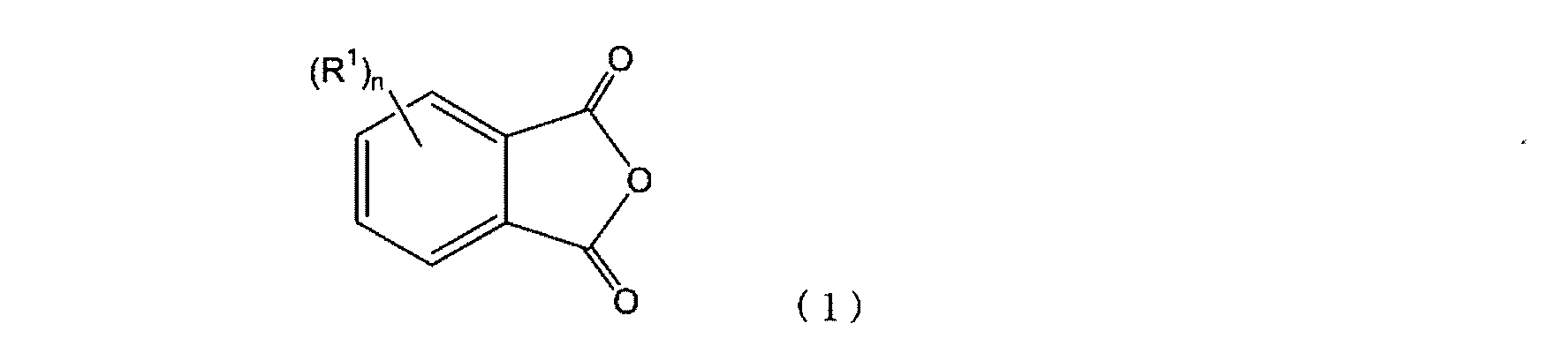
- the phthalic anhydride comprises 2-cyanoacrylic acid ester (a) and a phthalic anhydride derivative (b) represented by the following general formula (1).
- a 2-cyanoacrylate adhesive composition characterized in that the content of the derivative is 0.01 to 5% by mass relative to the total amount of the adhesive composition.
- R 1 is an alkyl group, an acyl group, an acyloxy group, an allyloxycarbonyl group, an aryl group, a hydroxy group, a chlorine atom, a bromine atom or an iodine atom
- n is an integer of 1 to 4.
- the 2-cyanoacrylate adhesive composition of the present invention further contains an elastomer (c), and the content of the elastomer is 1 to 30 relative to the total amount of the adhesive composition. % By mass.
- the elastomer (c) is a monomer that can be a hardly soluble polymer in 2-cyanoacrylate, and a single monomer that can be a polymer soluble in 2-cyanoacrylate. A copolymer comprising a monomer.
- the elastomer (c) can be a monomer that can be hardly soluble in 2-cyanoacrylate, or a polymer that is soluble in 2-cyanoacrylate. It is a copolymer comprising a monomer and a carboxy group-containing monomer.
- the monomer that can be a polymer hardly soluble in 2-cyanoacrylate is at least one selected from the group consisting of ethylene, propylene, isoprene, and butadiene.
- the monomer capable of forming a polymer soluble in 2-cyanoacrylate is at least one selected from the group consisting of acrylate and methacrylate.
- the 2-cyanoacrylate adhesive composition of the present invention contains 2-cyanoacrylate and a phthalic anhydride derivative having a specific structure, the water-resistant and warm-water resistant properties are not impaired without impairing the fast curability at the time of adhesion. It is possible to provide a cured product excellent in. Moreover, when the said adhesive composition contains an elastomer further, the warm water resistance of the hardened
- the 2-cyanoacrylate adhesive composition of the present invention (hereinafter also simply referred to as “adhesive composition”) contains a specific amount of a cyanoacrylate ester (a) and a phthalic anhydride derivative (b) having a specific structure. It is an adhesive composition.
- 2-cyanoacrylate ester (a) 2-cyanoacrylate ester generally used in this type of adhesive composition can be used without any particular limitation.
- the 2-cyanoacrylic acid ester include methyl, ethyl, chloroethyl, n-propyl, i-propyl, allyl, propargyl, n-butyl, i-butyl, n-pentyl, n-hexyl of 2-cyanoacrylic acid, Cyclohexyl, phenyl, tetrahydrofurfuryl, heptyl, 2-ethylhexyl, n-octyl, 2-octyl, n-nonyl, oxononyl, n-decyl, n-dodecyl, methoxyethyl, methoxypropyl, methoxyisopropyl, methoxybutyl, ethoxyethyl , E
- 2-cyanoacrylic acid alkyl ester having an alkyl group having 1 to 4 carbon atoms is preferable because an adhesive composition having excellent curability can be obtained.
- These 2-cyanoacrylic acid esters may be used alone or in combination of two or more.
- the adhesive composition of the present invention contains “phthalic anhydride derivative (b)” represented by the following general formula (1). Since the phthalic anhydride derivative is contained, adhesion between the adhesive layer and the adherend is improved, and as a result, durability such as heat resistance, water resistance, and warm water resistance can be improved.
- R 1 is an alkyl group, an acyl group, an acyloxy group, an allyloxycarbonyl group, an aryl group, a hydroxy group, a chlorine atom, a bromine atom or an iodine atom, and n is an integer of 1 to 4 It is. From the viewpoints of solubility in 2-cyanoacrylate, stability of the adhesive composition and curability, R 1 is preferably an alkyl group having 1 to 4 carbon atoms, a chlorine atom or a bromine atom.
- Specific compounds of the general formula (1) include, for example, 3-methylphthalic anhydride, 4-methylphthalic anhydride, 4-tert-butylphthalic anhydride, 3-hydroxyphthalic anhydride, 4-hydroxy Phthalic anhydride, 3-acetoxyphthalic anhydride, 4-benzoylphthalic anhydride, 4-phenethylphthalic anhydride, 4-phenoxycarbonylphthalic anhydride, 3-chlorophthalic anhydride, 4-chlorophthalic acid Anhydride, 3-bromophthalic anhydride, 4-bromophthalic anhydride, 3-iodophthalic anhydride, 4-iodophthalic anhydride, 3,4-dichlorophthalic anhydride, 3,5-dichlorophthalic anhydride 3,6-dichlorophthalic anhydride, 4,5-dichlorophthalic anhydride, 3,4-dibromophthalic anhydride, 3,5-dibromophthalate Acid anhydride, 3,6-dibromophthalic
- the content of the phthalic anhydride derivative is 0.01 to 5% by mass with respect to the total amount of the adhesive composition.
- the preferred content is 0.05 to 4% by mass, more preferably 0.1 to 3% by mass.
- the content is less than 0.01% by mass, the water resistance and warm water resistance of the adhesive are not improved.
- the content exceeds 5% by mass, the curability of the adhesive composition may decrease.
- the adhesive composition of the present invention preferably contains “elastomer (c)” in addition to the above components.
- the elastomer is one having rubber-like elasticity near normal temperature (20 ° C. ⁇ 15 ° C.), or one having a dynamic tangential loss tangent (tan ⁇ ) peak measured at a frequency of 1 Hz at 20 ° C. or less. It is preferably not particularly limited as long as it is soluble in 2-cyanoacrylate. Examples of elastomers having rubber-like elasticity near normal temperature (20 ° C.
- ⁇ 15 ° C. include acrylic ester copolymers, acrylonitrile-styrene copolymers, acrylonitrile-styrene-acrylic ester copolymers, and acrylonitrile-butadiene.
- Copolymer acrylonitrile-butadiene-styrene copolymer, styrene-butadiene copolymer, styrene-isoprene copolymer, ethylene-acrylic ester copolymer, ethylene-propylene copolymer, ethylene -Vinyl acetate copolymer, polyurethane copolymer, polyester copolymer, fluorine copolymer, polyisoprene copolymer, chloroprene copolymer and the like. These may be used alone or in combination of two or more.
- a core-shell type elastomer can also be used as the elastomer having a loss tangent (tan ⁇ ) peak of dynamic viscoelasticity measured at a frequency of 1 Hz at 20 ° C. or lower.
- the glass transition point of the polymer constituting the core and / or shell is preferably 20 ° C. or lower, and more preferably ⁇ 10 ° C. or lower.
- the monomer of the core phase forming such a polymer include acrylic acid esters, and acrylic acid esters having an alkyl group having 2 to 8 carbon atoms are preferable.
- the shell phase forming the outermost layer is not particularly limited as long as it is a polymer component that is easily compatible / dispersed with 2-cyanoacrylate, but a glassy polymer having a glass transition point of 60 ° C. or higher is used as the outermost layer. It is preferable to form.
- the monomer that forms the glassy polymer include methyl methacrylate and styrene.
- a monomer that can be hardly soluble in 2-cyanoacrylate and a monomer that can be soluble in 2-cyanoacrylate (however, And a copolymer formed by using (excluding the following carboxy group-containing monomer).
- This copolymer comprises a poorly soluble segment formed by polymerizing a monomer that can be hardly soluble in 2-cyanoacrylate, and a monomer that can be soluble in 2-cyanoacrylate. And a soluble segment formed by polymerization.
- the monomer that can be a polymer hardly soluble in 2-cyanoacrylate is not particularly limited, and examples thereof include ethylene, propylene, isoprene, butadiene, chloroprene, 1-hexene, and cyclopentene. These monomers may be used alone or in combination of two or more.
- ethylene, propylene, isoprene, butadiene, and chloroprene are often used, and at least one of ethylene, propylene, isoprene, and butadiene is preferable.
- the monomer that can be a polymer soluble in 2-cyanoacrylate is not particularly limited, and examples thereof include acrylic acid ester, methacrylic acid ester, vinyl chloride, vinyl acetate, vinyl ether, styrene, and acrylonitrile. It is preferable that it is at least 1 sort (s) among ester and methacrylic acid ester.
- the acrylate ester include methyl acrylate, ethyl acrylate, n-propyl acrylate, i-propyl acrylate, n-butyl acrylate, i-butyl acrylate, n-hexyl acrylate, and n-acrylate.
- Examples include heptyl, n-octyl acrylate, 2-ethylhexyl acrylate, methoxyethyl acrylate, methoxypropyl acrylate, ethoxyethyl acrylate and ethoxypropyl acrylate. These monomers may be used alone or in combination of two or more.
- examples of the methacrylic acid ester include methyl methacrylate, ethyl methacrylate, n-propyl methacrylate, i-propyl methacrylate, n-butyl methacrylate, i-butyl methacrylate, n-hexyl methacrylate, and methacrylic acid.
- examples thereof include n-heptyl, n-octyl methacrylate, 2-ethylhexyl methacrylate, methoxyethyl methacrylate, methoxypropyl methacrylate, ethoxyethyl methacrylate and ethoxypropyl methacrylate.
- These monomers may be used alone or in combination of two or more. Moreover, you may use together acrylic ester and methacrylic ester.
- the ratio of the poorly soluble segment obtained by polymerizing monomers that can be a hardly soluble polymer and the soluble segment obtained by polymerizing monomers that can be a soluble polymer is not particularly limited, and the total of these segments Is 100-mol%, the poorly soluble segment may be 5-90 mol%, preferably 10-80 mol%, and the soluble segment may be 10-95 mol%, preferably 20-90 mol%.
- This ratio is 30 to 80 mol% for the poorly soluble segment, 20 to 70 mol% for the soluble segment, particularly 40 to 80 mol% for the hardly soluble segment, 20 to 60 mol% for the soluble segment, and 50 to 50 mol% for the hardly soluble segment.
- the polymer can be appropriately dissolved in 2-cyanoacrylic acid ester, and an adhesive composition having both high shear bond strength and excellent durability can be obtained.
- the proportion of each segment can be calculated from the integral value of protons measured by proton nuclear magnetic resonance spectroscopy (hereinafter referred to as “ 1 H-NMR”).
- a monomer that can be hardly soluble in 2-cyanoacrylate a monomer that can be soluble in 2-cyanoacrylate, and a carboxy group A copolymer formed using the containing monomer is also included.
- this copolymer may contain a small amount of the carboxy group-containing monomer.
- the carboxy group-containing monomer is not particularly limited, and examples thereof include acrylic acid, methacrylic acid, maleic acid, fumaric acid, itaconic acid, crotonic acid, and cinnamic acid. These monomers may be used alone or in combination of two or more.
- carboxy group-containing monomer acrylic acid and methacrylic acid are often used, and either one of these may be used, or they may be used in combination.
- the carboxy group-containing segment obtained by polymerizing the carboxy group-containing monomer becomes a segment that is soluble in the highly hydrophilic 2-cyanoacrylate.
- the elastomer is a copolymer having a carboxy group, an adhesive composition that exhibits better adhesion durability is provided.
- the proportion of the carboxy group-containing segment is not particularly limited, but is 0.1 to 5 mol%, particularly 0.3 to 4 mol, when the total of the hardly soluble segment, the soluble segment, and the carboxy group-containing segment is 100 mol%. %, And more preferably 0.4 to 3 mol%. Further, this content is more preferably 0.5 to 2.5 mol%, particularly 0.5 to 2.3 mol%. If the carboxy group-containing segment is 0.1 to 5 mol%, particularly 0.5 to 2.3 mol%, an adhesive that cures quickly after application to an adherend and has excellent hot water resistance It can be a composition.
- the proportion of the carboxy group-containing segment can be measured by potentiometric titration method or indicator titration method according to JIS K0070.
- the copolymer for example, ethylene / methyl acrylate copolymer, ethylene / methyl acrylate / butyl acrylate copolymer, ethylene / methyl methacrylate copolymer, ethylene / vinyl acetate copolymer, A butadiene / methyl acrylate copolymer, a butadiene / acrylonitrile copolymer, a butadiene / acrylonitrile / acrylic acid ester copolymer, a butadiene / styrene / acrylonitrile / methyl acrylate copolymer, and the like can be used.
- an ethylene / methyl acrylate copolymer and an ethylene / methyl acrylate / butyl acrylate copolymer are particularly preferable.
- a copolymer obtained by polymerizing a monomer used in each of the above copolymers and a carboxy group-containing monomer such as acrylic acid and / or methacrylic acid for example, ethylene / methyl acrylate / Acrylic acid copolymer, ethylene / methyl acrylate / methacrylic acid copolymer, ethylene / methyl acrylate / butyl acrylate / acrylic acid copolymer, ethylene / methyl acrylate / butyl acrylate / methacrylic acid copolymer, etc.
- copolymers may be used alone or in combination of two or more, a copolymer that does not use a carboxy group-containing monomer, and a copolymer that uses a carboxy group-containing monomer And may be used in combination.
- the average molecular weight of the elastomer is not particularly limited, but the number average molecular weight (Mn) is preferably 5,000 to 500,000, particularly 15,000 to 150,000, and more preferably 20,000 to 100,000. When the number average molecular weight of the elastomer is 5,000 to 500,000, the elastomer can be easily dissolved in 2-cyanoacrylate, and an adhesive composition having a particularly high adhesive strength after the hot water resistance test can be obtained. Further, the weight average molecular weight (Mw) of the elastomer is preferably 5000 to 1000000, particularly preferably 10,000 to 1000000, and Mw / Mn is 1.00 to 10.0, particularly 1.00 to 8.0. preferable.
- the content of the elastomer is preferably 1 to 30% by mass with respect to the total amount of the adhesive composition. Depending on the type of 2-cyanoacrylic acid ester and the like, a more preferable content of the elastomer is 2 to 20% by mass, and an even more preferable content of the elastomer is 3 to 15% by mass. When the content of the elastomer is 1 to 30% by mass, the adhesive composition having excellent durability can be obtained without greatly reducing the curability of the adhesive composition.
- anionic polymerization accelerators, stabilizers, and plasticizers conventionally used by blending with an adhesive composition containing 2-cyanoacrylate ester , Thickeners, fumed silica, particles, fillers, colorants, fragrances, solvents, strength improvers, etc., depending on the purpose, etc., within a range that does not impair the curability and adhesive strength of the adhesive composition.
- An appropriate amount can be blended.
- anionic polymerization accelerator examples include polyalkylene oxides, crown ethers, silacrown ethers, calixarenes, cyclodextrins, and pyrogallol-based cyclic compounds.
- the polyalkylene oxides are polyalkylene oxides and derivatives thereof such as, for example, JP-B-60-37836, JP-B-1-43790, JP-A-63-128088, JP-A-3-167279, US Patent No. 4,386,193, US Pat. No. 4,424,327 and the like.
- polyalkylene oxides such as diethylene glycol, triethylene glycol, polyethylene glycol and polypropylene glycol
- polyethylene glycol monoalkyl ester such as diethylene glycol, triethylene glycol, polyethylene glycol and polypropylene glycol
- polyethylene glycol dialkyl ester such as polyethylene glycol dialkyl ester
- polypropylene glycol dialkyl ester diethylene glycol monoalkyl ether
- polyalkylene oxide derivatives such as dialkyl ether, dipropylene glycol monoalkyl ether, and dipropylene glycol dialkyl ether.
- crown ethers include those disclosed in Japanese Patent Publication No. 55-2236, Japanese Patent Laid-Open No. 3-167279, and the like.
- silacrown ethers include those disclosed in JP-A-60-168775. Specific examples include dimethylsila-11-crown-4, dimethylsila-14-crown-5, dimethylsila-17-crown-6, and the like.
- calixarenes include those disclosed in JP-A-60-179482, JP-A-62-2235379, JP-A-63-88152, and the like.
- cyclodextrins examples include those disclosed in JP-T-5-505835. Specific examples include ⁇ -, ⁇ -, and ⁇ -cyclodextrin.
- pyrogallol-based cyclic compounds examples include compounds disclosed in JP 2000-191600 A. Specifically, 3, 4, 5, 10, 11, 12, 17, 18, 19, 24, 25, 26-dodecaethoxycarbomethoxy-C-1, C-8, C-15, C-22 And tetramethyl [14] -metacyclophane.
- anionic polymerization accelerators may be used alone or in combination of two or more.
- Stabilizers include (1) aliphatic sulfonic acids such as sulfur dioxide and methanesulfonic acid, aromatic sulfonic acids such as p-toluenesulfonic acid, boron trifluoride methanol and boron trifluoride diethyl ether.
- Anionic polymerization inhibitors such as boron fluoride complex, HBF 4 and trialkylborate, and (2) radical polymerization inhibitors such as hydroquinone, hydroquinone monomethyl ether, t-butylcatechol, catechol and pyrogallol. These stabilizers may be used alone or in combination of two or more.
- the plasticizer can be contained as long as the effect of the present invention is not impaired, and a copolymer comprising a large number of monomers that can be a hardly soluble polymer, in particular, an elastomer, that is, a hardly soluble segment.
- a copolymer comprising a large number of monomers that can be a hardly soluble polymer, in particular, an elastomer, that is, a hardly soluble segment.
- the solubility can be improved by adding an appropriate amount.
- This plasticizer includes triethyl acetyl citrate, tributyl acetyl citrate, dimethyl adipate, diethyl adipate, dimethyl sebacate, dimethyl phthalate, diethyl phthalate, dibutyl phthalate, diisodecyl phthalate, dihexyl phthalate, phthalic acid Diheptyl, dioctyl phthalate, bis (2-ethylhexyl) phthalate, diisononyl phthalate, diisotridecyl phthalate, dipentadecyl phthalate, dioctyl terephthalate, diisononyl isophthalate, decyl toluate, bis (2-ethylhexyl) camphorate, 2- Ethylhexyl cyclohexyl carboxylate, diisobutyl fumarate, diisobutyl maleate, triglyceride
- tributyl acetyl citrate, dimethyl adipate, dimethyl phthalate, 2-ethylhexyl benzoate, and dipropylene glycol have good compatibility with 2-cyanoacrylate and high plasticization efficiency.
- Dibenzoate is preferred.
- These plasticizers may be used alone or in combination of two or more. Further, the content of the plasticizer is not particularly limited, but is preferably 3 to 50% by mass, particularly 10 to 45% by mass, and more preferably 20 to 40% by mass with respect to the total amount of the adhesive composition.
- the content of the plasticizer is 3 to 50% by mass, particularly when a copolymer having a large amount of poorly soluble segments as an elastomer (a copolymer having a proportion of hardly soluble segments of 65 mol% or more) is used. This makes it easy to dissolve the compound in 2-cyanoacrylic acid ester, and in particular, to improve the adhesive strength retention after the hot water resistance test.
- a thickener polymethyl methacrylate, a copolymer of methyl methacrylate and an acrylate ester, a copolymer of methyl methacrylate and other methacrylic acid ester, acrylic rubber, polyvinyl chloride, polystyrene, Examples thereof include cellulose esters, polyalkyl-2-cyanoacrylic acid esters, and ethylene-vinyl acetate copolymers.
- These thickeners may be used alone or in combination of two or more.
- the content of the thickener is not particularly limited, but is preferably 0.1 to 20% by mass, and more preferably 0.5 to 15% by mass with respect to the total amount of the adhesive composition.
- the adhesive composition can also contain fumed silica.
- This fumed silica is an ultrafine powder (primary particle diameter of 500 nm or less, particularly 1 to 200 nm) of anhydrous silica.
- This anhydrous silica is made of, for example, silicon tetrachloride as a raw material in a gas phase in a high-temperature flame.
- ultra-fine powders primary particle size of 500 nm or less, especially 1 to 200 nm
- anhydrous silica produced due to oxidation of the above, and there are hydrophilic hydrophilic silica and hydrophilic hydrophobic silica.
- any of these fumed silicas can be used, but hydrophobic silica is preferred because of its good dispersibility in 2-cyanoacrylate.
- a copolymer comprising many monomers capable of forming a polymer soluble in 2-cyanoacrylate as an elastomer that is, a copolymer having many soluble segments (including carboxy group-containing segments).
- % Of copolymer is preferably used in combination with hydrophobic silica.
- hydrophilic silica examples thereof include Aerosil 50, 130, 200, 300, and 380 (the above are trade names and manufactured by Nippon Aerosil Co., Ltd.).
- the specific surface areas of these hydrophilic silicas are 50 ⁇ 15 m 2 / g, 130 ⁇ 25 m 2 / g, 200 ⁇ 25 m 2 / g, 300 ⁇ 30 m 2 / g, and 380 ⁇ 30 m 2 / g, respectively.
- Leolosil QS-10, QS-20, QS-30, and QS-40 the above are trade names, manufactured by Tokuyama Corporation
- hydrophilic silicas are 140 ⁇ 20 m 2 / g, 220 ⁇ 20 m 2 / g, 300 ⁇ 30 m 2 / g, and 380 ⁇ 30 m 2 / g, respectively.
- hydrophilic silica such as that manufactured by CABOT can also be used.
- the specific surface area of the hydrophilic silica is preferably 20 to 600 m 2 / g.
- hydrophobic silica a product hydrophobized by treating the surface of the hydrophilic silica can be used.
- a method for obtaining hydrophobic silica by surface treatment of hydrophilic silica include, for example, a compound capable of forming a hydrophobic group by reacting with hydrophilic silica and a hydroxy group present on the surface of hydrophilic silica, or hydrophilic silica.
- Compounds used for hydrophobizing hydrophilic silica by surface treatment include various alkyl, aryl, and aralkyl silane coupling agents having a hydrophobic group such as n-octyltrialkoxysilane, methyltrichlorosilane, and dimethyldisilane.
- Examples include silylating agents such as chlorosilane and hexamethyldisilazane, silicone oils such as polydimethylsiloxane, higher alcohols such as stearyl alcohol, and higher fatty acids such as stearic acid.
- a product hydrophobized using any compound may be used.
- hydrophobic silica examples include Aerosil RY200, R202, surface-treated with silicone oil, and hydrophobized Aerosil R974, R972, R976, n-octyltriglyceride.
- Aerosil R805 surface treated with methoxysilane and hydrophobized Aerosil R811, R812 (trade name, manufactured by Nippon Aerosil Co., Ltd.) and surface treated with trimethylsilylating agent, and methyltrichlorosilane Surface-treated and hydrophobized Leolosil MT-10 (trade name, Tokuyama Co., Ltd.) and the like.
- the specific surface areas of these hydrophobic silicas are 100 ⁇ 20 m 2 / g, 100 ⁇ 20 m 2 / g, 170 ⁇ 20 m 2 / g, 110 ⁇ 20 m 2 / g, 250 ⁇ 25 m 2 / g, 150 ⁇ 20 m 2, respectively.
- / G 150 ⁇ 20 m 2 / g, 260 ⁇ 20 m 2 / g, 120 ⁇ 10 m 2 / g.
- the specific surface area of the hydrophobic silica is preferably 20 to 400 m 2 / g.
- the preferable content of fumed silica in the adhesive composition is 1 to 30% by mass with respect to the total amount of the adhesive composition.
- the more preferable content of the fumed silica is 1 to 25 mass, although it depends on the kind of 2-cyanoacrylate, the kind and ratio of the monomer used for producing the elastomer, the kind of fumed silica, and the like.
- the particularly preferred content is 2 to 20% by mass. If the content of fumed silica is 1 to 30% by mass, the adhesive composition can be obtained with good workability without impairing the curability and adhesive strength of the adhesive composition.
- test piece Iron (material specified in JIS SGD400D)
- ASA UMG ABS product name “Dialac S510” (acrylonitrile / butadiene / butyl acrylate / styrene copolymer)
- Vamac DP manufactured by DuPont Elastomer Co., Ltd.
- VamaDP ethylene / methyl acrylate copolymer
- PMMA Polymethyl methacrylate, molecular weight 1 million ⁇ fumed silica>
- RY200 Product name “Aerosil RY200” manufactured by Nippon Aerosil Co., Ltd. (hydrophobic silica, specific surface area 100 ⁇ 20 m 2 / g)
- the 2-cyanoacrylate adhesive composition of the present invention can be used as a so-called instantaneous adhesive in a wide range of products such as industrial, medical and household use. In particular, it is useful for applications requiring water resistance and warm water resistance.
Landscapes
- Chemical & Material Sciences (AREA)
- Organic Chemistry (AREA)
- Health & Medical Sciences (AREA)
- Chemical Kinetics & Catalysis (AREA)
- Medicinal Chemistry (AREA)
- Polymers & Plastics (AREA)
- Adhesives Or Adhesive Processes (AREA)
Abstract
Description
従来、このような問題点を改良するため、種々の添加剤を配合する改質方法が提案されている。例えば、特許文献1には、2-シアノアクリル酸エステルに芳香族多価カルボン酸及びその無水物から選ばれた少なくとも1種の化合物を添加した接着剤組成物が開示されている。また、特許文献2には、特定の添加剤として無水フタル酸が開示されており、湿気又は高温の環境下における接着耐久性が優れていることが記載されている。更に、特許文献3には、2-シアノアクリル酸エステル、及び水素化無水物を含むシアノアクリレート系接着剤組成物が開示されており、耐熱性が向上することが記載されている。

本発明の好ましい態様によれば、本発明の2-シアノアクリレート系接着剤組成物は、エラストマー(c)を更に含有し、前記エラストマーの含有量が、接着剤組成物全量に対して1~30質量%である。
本発明のより好ましい態様によれば、上記エラストマー(c)は、2-シアノアクリル酸エステルに難溶性の重合体となり得る単量体、及び2-シアノアクリル酸エステルに可溶性の重合体となり得る単量体を用いてなる共重合体。
本発明の別のより好ましい態様によれば、上記エラストマー(c)は、2-シアノアクリル酸エステルに難溶性の重合体となり得る単量体、2-シアノアクリル酸エステルに可溶性の重合体となり得る単量体、及びカルボキシ基含有単量体を用いてなる共重合体である。
本発明の更により好ましい態様によれば、上記2-シアノアクリル酸エステルに難溶性の重合体となり得る単量体は、エチレン、プロピレン、イソプレン及びブタジエンからなる群より選ばれた少なくとも1つであり、上記2-シアノアクリル酸エステルに可溶性の重合体となり得る単量体は、アクリル酸エステル及びメタクリル酸エステルからなる群より選ばれた少なくとも1つである。
また、当該接着剤組成物がエラストマーを更に含有する場合は、得られる硬化物の耐温水性がより向上する。
また、周波数1Hzで測定された動的粘弾性の損失正接(tanδ)のピークが20℃以下にあるエラストマーとしては、コアシェル型エラストマーも用いることができる。コアシェル型エラストマーにおいて、コア及び/又はシェルを構成する重合体のガラス転移点は20℃以下であることが好ましく、-10℃以下であることがより好ましい。このような重合体を形成するコア相の単量体としては、アクリル酸エステルが挙げられ、炭素数2~8のアルキル基を有するアクリル酸エステルが好ましい。一方、最外層を形成するシェル相は2-シアノアクリル酸エステルと相溶・分散しやすい高分子成分であれば特に限定されないが、ガラス転移点が60℃以上のガラス状重合体を最外層に形成させることが好ましい。ガラス状重合体を形成する単量体としては、メタクリル酸メチル及びスチレンなどが挙げられる。
各々のセグメントの割合は、プロトン核磁気共鳴分光法(以下「1H-NMR」と表記する)測定によるプロトンの積分値により算出することができる。
カルボキシ基含有セグメントの割合は、JIS K0070に準じ、電位差滴定法又は指示薬滴定法により測定することができる。
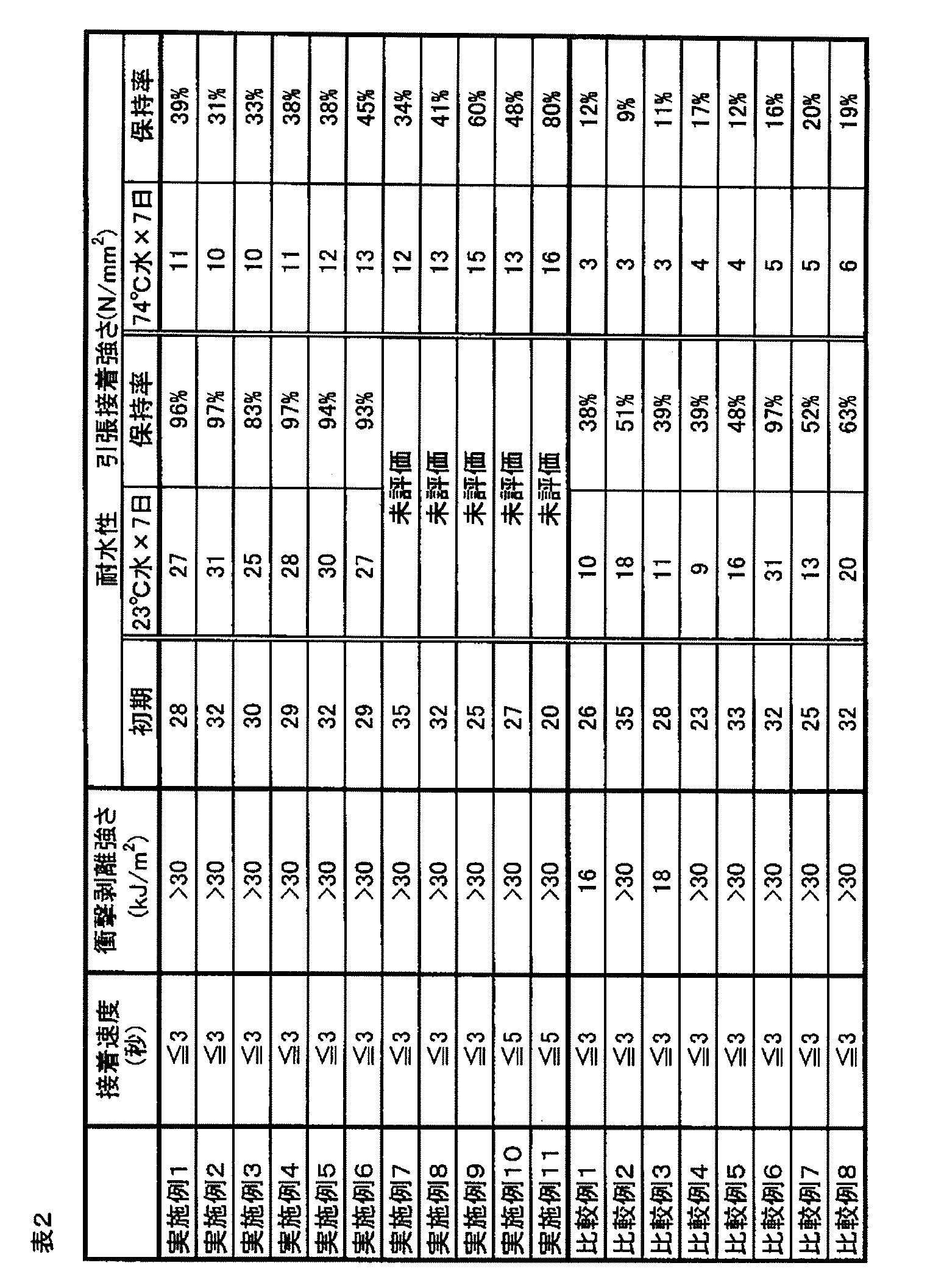
(1)接着速度
JIS K 6861「α-シアノアクリレート系接着剤の試験方法」第7.1.3項に記載された試験片を使用し、各接着剤組成物を用いて23℃、60%RH環境下で貼り合わせて測定した。使用した試験片の材質は次のとおりである。
試験片:アルミニウム(JIS A6063Sに規定された材質)
JIS K 6855「接着剤の衝撃接着強さ試験方法」に準じて、23℃、50%RH環境下で衝撃はく離接着強さを測定した。使用した試験片の材質は次のとおりである。
試験片:鉄(JIS SGD400Dに規定された材質)
JIS K 6861「α-シアノアクリレート系接着剤の試験方法」第7.1.3項に記載された試験片を使用し、各接着剤組成物を用いて23℃、60%RH環境下で貼り合わせ、23℃で1日静置して養生した後、JIS K 6861に準じて引張り接着強さを測定した(これを「初期強度」とする)。次いで、23℃又は74℃の温水に7日間浸漬した後の引張り接着強さを測定し(これを「試験後強度」とする)、下記のようにして保持率を算出した。
保持率(%)=(試験後強度/初期強度)×100
使用した試験片の材質は次のとおりである。
試験片:アルミニウム(JIS A6063Sに規定された材質)
(1)実施例1
2-シアノアクリル酸エチルに、二酸化硫黄を20ppm、ハイドロキノンを1000ppm(2-シアノアクリル酸エチルを100質量部とする)配合した。次に、接着剤組成物全量に対してテトラクロロフタル酸無水物0.5%、及びポリメタクリル酸メチル4%を配合して、23℃で1時間撹拌し、溶解させて接着剤組成物を製造した。結果は表2のとおりである。
接着剤組成物に配合する添加剤、エラストマー、増粘剤及びヒュームドシリカを表1のようにした以外は、実施例1と同様にして接着剤組成物を製造した。結果は表2のとおりである。
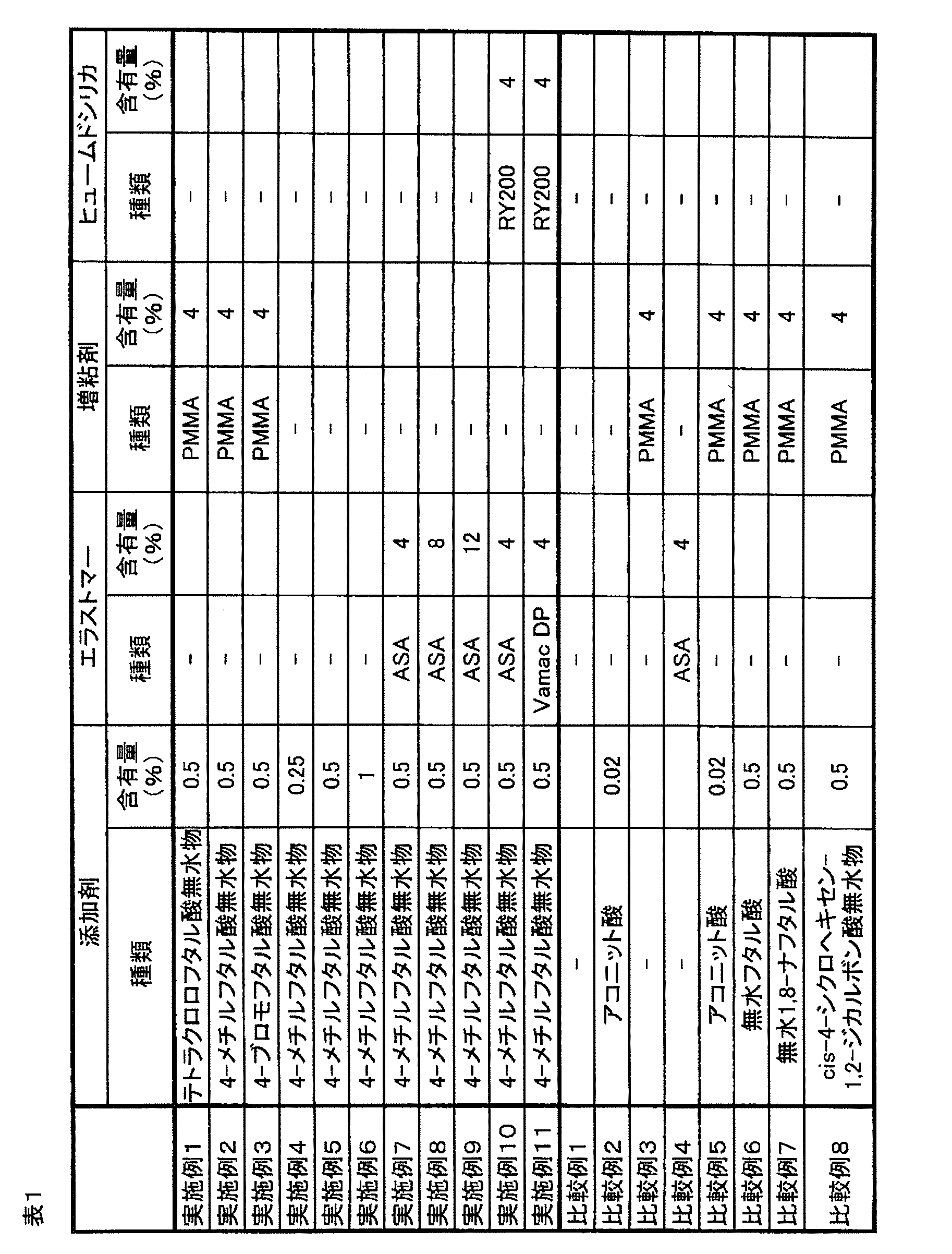
<エラストマー>
ASA:UMG ABS社製 商品名「ダイヤラックS510」(アクリロニトリル/ブタジエン/アクリル酸ブチル/スチレン共重合体)
Vamac DP:デュポンエラストマー社製 商品名「VamacDP」(エチレン/アクリル酸メチル共重合体)
<増粘剤>
PMMA:ポリメタクリル酸メチル、分子量100万
<ヒュームドシリカ>
RY200:日本アエロジル社製 商品名「アエロジルRY200」(疎水性シリカ、比表面積100±20m2/g)
Claims (5)
- 2-シアノアクリル酸エステル(a)と、下記一般式(1)で表される無水フタル酸誘導体(b)とを含有し、
前記無水フタル酸誘導体の含有量が、接着剤組成物全量に対して0.01~5質量%であることを特徴とする2-シアノアクリレート系接着剤組成物。

- エラストマー(c)を更に含有し、前記エラストマーの含有量が、接着剤組成物全量に対して1~30質量%である請求項1に記載の2-シアノアクリレート系接着剤組成物。
- 上記エラストマー(c)が、2-シアノアクリル酸エステルに難溶性の重合体となり得る単量体、及び2-シアノアクリル酸エステルに可溶性の重合体となり得る単量体を用いてなる共重合体である請求項2に記載の2-シアノアクリレート系接着剤組成物。
- 上記エラストマー(c)が、2-シアノアクリル酸エステルに難溶性の重合体となり得る単量体、2-シアノアクリル酸エステルに可溶性の重合体となり得る単量体、及びカルボキシ基含有単量体を用いてなる共重合体である請求項2又は3に記載の2-シアノアクリレート系接着剤組成物。
- 上記2-シアノアクリル酸エステルに難溶性の重合体となり得る単量体が、エチレン、プロピレン、イソプレン及びブタジエンからなる群より選ばれた少なくとも1つであり、上記2-シアノアクリル酸エステルに可溶性の重合体となり得る単量体が、アクリル酸エステル及びメタクリル酸エステルからなる群より選ばれた少なくとも1つである請求項3又は4に記載の2-シアノアクリレート系接着剤組成物。
Priority Applications (5)
| Application Number | Priority Date | Filing Date | Title |
|---|---|---|---|
| JP2017500736A JP6451828B2 (ja) | 2015-02-18 | 2016-02-18 | 2−シアノアクリレート系接着剤組成物 |
| US15/551,535 US10647888B2 (en) | 2015-02-18 | 2016-02-18 | 2-cyanoacrylate adhesive composition |
| EP16752552.6A EP3260509B1 (en) | 2015-02-18 | 2016-02-18 | 2-cyanoacrylate adhesive composition |
| CN201680010659.2A CN107250302B (zh) | 2015-02-18 | 2016-02-18 | 2-氰基丙烯酸酯系粘合剂组合物 |
| KR1020177024970A KR102379414B1 (ko) | 2015-02-18 | 2016-02-18 | 2-시아노아크릴레이트계 접착제 조성물 |
Applications Claiming Priority (2)
| Application Number | Priority Date | Filing Date | Title |
|---|---|---|---|
| JP2015029364 | 2015-02-18 | ||
| JP2015-029364 | 2015-02-18 |
Publications (1)
| Publication Number | Publication Date |
|---|---|
| WO2016133166A1 true WO2016133166A1 (ja) | 2016-08-25 |
Family
ID=56692265
Family Applications (1)
| Application Number | Title | Priority Date | Filing Date |
|---|---|---|---|
| PCT/JP2016/054736 Ceased WO2016133166A1 (ja) | 2015-02-18 | 2016-02-18 | 2-シアノアクリレート系接着剤組成物 |
Country Status (7)
| Country | Link |
|---|---|
| US (1) | US10647888B2 (ja) |
| EP (1) | EP3260509B1 (ja) |
| JP (1) | JP6451828B2 (ja) |
| KR (1) | KR102379414B1 (ja) |
| CN (1) | CN107250302B (ja) |
| TW (1) | TWI672349B (ja) |
| WO (1) | WO2016133166A1 (ja) |
Cited By (3)
| Publication number | Priority date | Publication date | Assignee | Title |
|---|---|---|---|---|
| WO2021060390A1 (ja) * | 2019-09-27 | 2021-04-01 | 東亞合成株式会社 | 被覆電線シール用組成物、及び、被覆電線 |
| WO2022009936A1 (ja) * | 2020-07-10 | 2022-01-13 | 東亞合成株式会社 | 被覆電線シール用組成物及び被覆電線 |
| KR20250009982A (ko) | 2022-05-20 | 2025-01-20 | 주식회사 쿠라레 | 수지 조성물, 경화물, 적층체 및 적층체의 제조 방법 |
Families Citing this family (2)
| Publication number | Priority date | Publication date | Assignee | Title |
|---|---|---|---|---|
| GB2567869B (en) * | 2017-10-27 | 2021-08-11 | Henkel IP & Holding GmbH | Toughened humidity/thermal resistant cyanoacrylate compositions |
| CN116716049A (zh) * | 2023-06-02 | 2023-09-08 | 宁波速达沃克新材料有限公司 | 一种硅橡胶免处理瞬干胶粘剂及其制备方法 |
Citations (9)
| Publication number | Priority date | Publication date | Assignee | Title |
|---|---|---|---|---|
| JPS5278933A (en) * | 1975-12-26 | 1977-07-02 | Toagosei Chem Ind Co Ltd | Adhesive composition |
| JPS57501529A (ja) * | 1980-08-28 | 1982-08-26 | ||
| JPH01182385A (ja) * | 1988-01-12 | 1989-07-20 | Toagosei Chem Ind Co Ltd | 接着剤組成物 |
| JPH0220581A (ja) * | 1988-07-08 | 1990-01-24 | Toagosei Chem Ind Co Ltd | 接着剤組成物 |
| JPH0657214A (ja) * | 1992-08-10 | 1994-03-01 | Taoka Chem Co Ltd | エラストマー含有接着剤組成物 |
| JPH0797550A (ja) * | 1992-10-23 | 1995-04-11 | Loctite Corp | 耐熱性の改善されたシアノアクリレート単量体接着剤組成物 |
| JP2009500517A (ja) * | 2005-07-11 | 2009-01-08 | ヘンケル コーポレイション | 強靭化シアノアクリレート組成物 |
| JP2014522899A (ja) * | 2011-07-15 | 2014-09-08 | ヘンケル アイルランド リミテッド | シアノアクリレート組成物 |
| WO2014140798A2 (en) * | 2013-03-15 | 2014-09-18 | Henkel IP & Holding GmbH | Cyanoacrylate compositions |
Family Cites Families (22)
| Publication number | Priority date | Publication date | Assignee | Title |
|---|---|---|---|---|
| JPS53115751A (en) | 1977-03-18 | 1978-10-09 | Kyoritsu Kagaku Sangyo | Adhesive composition |
| US4339457A (en) | 1980-10-20 | 1982-07-13 | Fmc Corporation | 3-(Pyrrol-1-yl)phenylmethyl esters and intermediates |
| JPS57164175A (en) * | 1981-04-03 | 1982-10-08 | Japan Synthetic Rubber Co Ltd | Impact-resistant instantaneous adhesive composition |
| JPS588771A (ja) | 1981-07-08 | 1983-01-18 | Taoka Chem Co Ltd | 接着剤組成物 |
| US4440910A (en) * | 1982-01-18 | 1984-04-03 | Loctite Corporation | Toughened cyanoacrylates containing elastomeric rubbers |
| DE3463670D1 (en) | 1983-11-10 | 1987-06-19 | Loctite Corp | Instant adhesive composition |
| JPS60179482A (ja) | 1984-01-27 | 1985-09-13 | ロクタイト.(アイルランド).リミテッド | 瞬間接着剤組成物 |
| US4695615A (en) | 1984-11-21 | 1987-09-22 | Loctite (Ireland) Limited | Instant adhesive composition utilizing mixed functionality calixarenes as accelerators |
| SU1214696A1 (ru) * | 1984-09-04 | 1986-02-28 | Предприятие П/Я В-2304 | Композици дл лить под низким давлением |
| JPH0797176B2 (ja) | 1986-10-01 | 1995-10-18 | キヤノン株式会社 | 焦点検出装置 |
| JPS63128088A (ja) | 1986-11-17 | 1988-05-31 | Koatsu Gas Kogyo Kk | α−シアノアクリレ−ト接着剤組成物 |
| JP2671528B2 (ja) | 1989-11-27 | 1997-10-29 | 東亞合成株式会社 | 瞬間接着剤組成物 |
| JPH0812946A (ja) * | 1994-06-28 | 1996-01-16 | Taoka Chem Co Ltd | 改質されたα−シアノアクリレート系接着剤組成物 |
| JPH08259899A (ja) * | 1995-03-23 | 1996-10-08 | Three Bond Co Ltd | シアノアクリレート系接着剤組成物 |
| JP2000191600A (ja) | 1998-12-28 | 2000-07-11 | Toagosei Co Ltd | 環状化合物、該環状化合物からなる2―シアノアクリレ―ト用硬化促進剤、並びに2―シアノアクリレ―ト系組成物 |
| CN1995252B (zh) * | 2006-12-21 | 2010-05-12 | 大连轻工业学院 | 一种光固化氰基丙烯酸酯粘合剂 |
| JP2009024280A (ja) * | 2007-07-20 | 2009-02-05 | Taoka Chem Co Ltd | 紙塗工用樹脂組成物 |
| US8541495B2 (en) * | 2008-12-25 | 2013-09-24 | Toagosei Co., Ltd. | Adhesive composition |
| FR2967417B1 (fr) * | 2010-11-17 | 2014-04-11 | Arkema France | Melange maitre de nanotubes de carbone et de durcisseur pour les resines thermodurcissables |
| WO2013111036A1 (en) * | 2012-01-23 | 2013-08-01 | Henkel Ireland Limited | Two-part, cyanoacrylate/free radically curable adhesive systems |
| US9550883B2 (en) * | 2012-01-25 | 2017-01-24 | Henkel IP & Holding GmbH | Cyanoacrylate compositions |
| CN103773195A (zh) * | 2012-10-22 | 2014-05-07 | 南京恒安树脂化学有限公司 | 一种醇酸树脂的防水涂料 |
-
2016
- 2016-02-03 TW TW105103622A patent/TWI672349B/zh active
- 2016-02-18 CN CN201680010659.2A patent/CN107250302B/zh active Active
- 2016-02-18 EP EP16752552.6A patent/EP3260509B1/en active Active
- 2016-02-18 JP JP2017500736A patent/JP6451828B2/ja active Active
- 2016-02-18 WO PCT/JP2016/054736 patent/WO2016133166A1/ja not_active Ceased
- 2016-02-18 KR KR1020177024970A patent/KR102379414B1/ko active Active
- 2016-02-18 US US15/551,535 patent/US10647888B2/en active Active
Patent Citations (9)
| Publication number | Priority date | Publication date | Assignee | Title |
|---|---|---|---|---|
| JPS5278933A (en) * | 1975-12-26 | 1977-07-02 | Toagosei Chem Ind Co Ltd | Adhesive composition |
| JPS57501529A (ja) * | 1980-08-28 | 1982-08-26 | ||
| JPH01182385A (ja) * | 1988-01-12 | 1989-07-20 | Toagosei Chem Ind Co Ltd | 接着剤組成物 |
| JPH0220581A (ja) * | 1988-07-08 | 1990-01-24 | Toagosei Chem Ind Co Ltd | 接着剤組成物 |
| JPH0657214A (ja) * | 1992-08-10 | 1994-03-01 | Taoka Chem Co Ltd | エラストマー含有接着剤組成物 |
| JPH0797550A (ja) * | 1992-10-23 | 1995-04-11 | Loctite Corp | 耐熱性の改善されたシアノアクリレート単量体接着剤組成物 |
| JP2009500517A (ja) * | 2005-07-11 | 2009-01-08 | ヘンケル コーポレイション | 強靭化シアノアクリレート組成物 |
| JP2014522899A (ja) * | 2011-07-15 | 2014-09-08 | ヘンケル アイルランド リミテッド | シアノアクリレート組成物 |
| WO2014140798A2 (en) * | 2013-03-15 | 2014-09-18 | Henkel IP & Holding GmbH | Cyanoacrylate compositions |
Non-Patent Citations (1)
| Title |
|---|
| See also references of EP3260509A4 * |
Cited By (8)
| Publication number | Priority date | Publication date | Assignee | Title |
|---|---|---|---|---|
| WO2021060390A1 (ja) * | 2019-09-27 | 2021-04-01 | 東亞合成株式会社 | 被覆電線シール用組成物、及び、被覆電線 |
| JPWO2021060390A1 (ja) * | 2019-09-27 | 2021-12-23 | 東亞合成株式会社 | 被覆電線シール用組成物、及び、被覆電線 |
| JP7235881B2 (ja) | 2019-09-27 | 2023-03-08 | 東亞合成株式会社 | 被覆電線シール用組成物、及び、被覆電線 |
| WO2022009936A1 (ja) * | 2020-07-10 | 2022-01-13 | 東亞合成株式会社 | 被覆電線シール用組成物及び被覆電線 |
| JP7004036B1 (ja) | 2020-07-10 | 2022-01-24 | 東亞合成株式会社 | 被覆電線シール用組成物及び被覆電線 |
| JP2022024235A (ja) * | 2020-07-10 | 2022-02-09 | 東亞合成株式会社 | 被覆電線シール用組成物及び被覆電線 |
| CN115803396A (zh) * | 2020-07-10 | 2023-03-14 | 东亚合成株式会社 | 被覆电线密封用组合物和被覆电线 |
| KR20250009982A (ko) | 2022-05-20 | 2025-01-20 | 주식회사 쿠라레 | 수지 조성물, 경화물, 적층체 및 적층체의 제조 방법 |
Also Published As
| Publication number | Publication date |
|---|---|
| US20180037772A1 (en) | 2018-02-08 |
| JPWO2016133166A1 (ja) | 2017-12-07 |
| TW201631099A (zh) | 2016-09-01 |
| EP3260509B1 (en) | 2021-04-07 |
| CN107250302A (zh) | 2017-10-13 |
| KR20170118776A (ko) | 2017-10-25 |
| TWI672349B (zh) | 2019-09-21 |
| US10647888B2 (en) | 2020-05-12 |
| EP3260509A4 (en) | 2018-10-31 |
| EP3260509A1 (en) | 2017-12-27 |
| JP6451828B2 (ja) | 2019-01-16 |
| KR102379414B1 (ko) | 2022-03-28 |
| CN107250302B (zh) | 2021-02-26 |
Similar Documents
| Publication | Publication Date | Title |
|---|---|---|
| JP5267571B2 (ja) | 接着剤組成物 | |
| JP6451828B2 (ja) | 2−シアノアクリレート系接着剤組成物 | |
| JP5326556B2 (ja) | 接着剤組成物 | |
| JP6708982B2 (ja) | 接着剤組成物 | |
| JP6112121B2 (ja) | 接着剤組成物 | |
| JP5434771B2 (ja) | 接着方法 | |
| JP5413302B2 (ja) | 接着方法 | |
| JPWO2020085334A1 (ja) | 光硬化性接着剤組成物 | |
| JP2011057733A (ja) | 接着剤組成物 | |
| JP2013112766A (ja) | 2−シアノアクリレート系接着剤組成物 | |
| JP5541226B2 (ja) | 接着剤組成物 | |
| JP2014034636A (ja) | 接着剤組成物 | |
| JP6593338B2 (ja) | 磁性を有する2−シアノアクリレート系組成物 | |
| JP7235881B2 (ja) | 被覆電線シール用組成物、及び、被覆電線 | |
| JP2013103999A (ja) | 2−シアノアクリレート系接着剤組成物 |
Legal Events
| Date | Code | Title | Description |
|---|---|---|---|
| 121 | Ep: the epo has been informed by wipo that ep was designated in this application |
Ref document number: 16752552 Country of ref document: EP Kind code of ref document: A1 |
|
| ENP | Entry into the national phase |
Ref document number: 2017500736 Country of ref document: JP Kind code of ref document: A |
|
| WWE | Wipo information: entry into national phase |
Ref document number: 15551535 Country of ref document: US |
|
| NENP | Non-entry into the national phase |
Ref country code: DE |
|
| ENP | Entry into the national phase |
Ref document number: 20177024970 Country of ref document: KR Kind code of ref document: A |
|
| REEP | Request for entry into the european phase |
Ref document number: 2016752552 Country of ref document: EP |