WO2016136191A1 - Procédé d'évaluation de charbon et procédé de fabrication de coke - Google Patents
Procédé d'évaluation de charbon et procédé de fabrication de coke Download PDFInfo
- Publication number
- WO2016136191A1 WO2016136191A1 PCT/JP2016/000808 JP2016000808W WO2016136191A1 WO 2016136191 A1 WO2016136191 A1 WO 2016136191A1 JP 2016000808 W JP2016000808 W JP 2016000808W WO 2016136191 A1 WO2016136191 A1 WO 2016136191A1
- Authority
- WO
- WIPO (PCT)
- Prior art keywords
- coal
- coke
- strength
- softening
- measured
- Prior art date
- Legal status (The legal status is an assumption and is not a legal conclusion. Google has not performed a legal analysis and makes no representation as to the accuracy of the status listed.)
- Ceased
Links
Images

Classifications
-
- G—PHYSICS
- G01—MEASURING; TESTING
- G01N—INVESTIGATING OR ANALYSING MATERIALS BY DETERMINING THEIR CHEMICAL OR PHYSICAL PROPERTIES
- G01N25/00—Investigating or analyzing materials by the use of thermal means
- G01N25/02—Investigating or analyzing materials by the use of thermal means by investigating changes of state or changes of phase; by investigating sintering
- G01N25/04—Investigating or analyzing materials by the use of thermal means by investigating changes of state or changes of phase; by investigating sintering of melting point; of freezing point; of softening point
-
- C—CHEMISTRY; METALLURGY
- C10—PETROLEUM, GAS OR COKE INDUSTRIES; TECHNICAL GASES CONTAINING CARBON MONOXIDE; FUELS; LUBRICANTS; PEAT
- C10B—DESTRUCTIVE DISTILLATION OF CARBONACEOUS MATERIALS FOR PRODUCTION OF GAS, COKE, TAR, OR SIMILAR MATERIALS
- C10B57/00—Other carbonising or coking processes; Features of destructive distillation processes in general
- C10B57/04—Other carbonising or coking processes; Features of destructive distillation processes in general using charges of special composition
- C10B57/06—Other carbonising or coking processes; Features of destructive distillation processes in general using charges of special composition containing additives
-
- C—CHEMISTRY; METALLURGY
- C10—PETROLEUM, GAS OR COKE INDUSTRIES; TECHNICAL GASES CONTAINING CARBON MONOXIDE; FUELS; LUBRICANTS; PEAT
- C10B—DESTRUCTIVE DISTILLATION OF CARBONACEOUS MATERIALS FOR PRODUCTION OF GAS, COKE, TAR, OR SIMILAR MATERIALS
- C10B45/00—Other details
-
- C—CHEMISTRY; METALLURGY
- C10—PETROLEUM, GAS OR COKE INDUSTRIES; TECHNICAL GASES CONTAINING CARBON MONOXIDE; FUELS; LUBRICANTS; PEAT
- C10B—DESTRUCTIVE DISTILLATION OF CARBONACEOUS MATERIALS FOR PRODUCTION OF GAS, COKE, TAR, OR SIMILAR MATERIALS
- C10B53/00—Destructive distillation, specially adapted for particular solid raw materials or solid raw materials in special form
- C10B53/04—Destructive distillation, specially adapted for particular solid raw materials or solid raw materials in special form of powdered coal
-
- C—CHEMISTRY; METALLURGY
- C10—PETROLEUM, GAS OR COKE INDUSTRIES; TECHNICAL GASES CONTAINING CARBON MONOXIDE; FUELS; LUBRICANTS; PEAT
- C10B—DESTRUCTIVE DISTILLATION OF CARBONACEOUS MATERIALS FOR PRODUCTION OF GAS, COKE, TAR, OR SIMILAR MATERIALS
- C10B57/00—Other carbonising or coking processes; Features of destructive distillation processes in general
- C10B57/005—After-treatment of coke, e.g. calcination desulfurization
-
- C—CHEMISTRY; METALLURGY
- C10—PETROLEUM, GAS OR COKE INDUSTRIES; TECHNICAL GASES CONTAINING CARBON MONOXIDE; FUELS; LUBRICANTS; PEAT
- C10L—FUELS NOT OTHERWISE PROVIDED FOR; NATURAL GAS; SYNTHETIC NATURAL GAS OBTAINED BY PROCESSES NOT COVERED BY SUBCLASSES C10G OR C10K; LIQUIFIED PETROLEUM GAS; USE OF ADDITIVES TO FUELS OR FIRES; FIRE-LIGHTERS
- C10L10/00—Use of additives to fuels or fires for particular purposes
-
- G—PHYSICS
- G01—MEASURING; TESTING
- G01N—INVESTIGATING OR ANALYSING MATERIALS BY DETERMINING THEIR CHEMICAL OR PHYSICAL PROPERTIES
- G01N33/00—Investigating or analysing materials by specific methods not covered by groups G01N1/00 - G01N31/00
- G01N33/22—Fuels; Explosives
- G01N33/222—Solid fuels, e.g. coal
-
- G—PHYSICS
- G01—MEASURING; TESTING
- G01N—INVESTIGATING OR ANALYSING MATERIALS BY DETERMINING THEIR CHEMICAL OR PHYSICAL PROPERTIES
- G01N33/00—Investigating or analysing materials by specific methods not covered by groups G01N1/00 - G01N31/00
- G01N33/22—Fuels; Explosives
- G01N33/225—Gaseous fuels, e.g. natural gas
-
- C—CHEMISTRY; METALLURGY
- C10—PETROLEUM, GAS OR COKE INDUSTRIES; TECHNICAL GASES CONTAINING CARBON MONOXIDE; FUELS; LUBRICANTS; PEAT
- C10B—DESTRUCTIVE DISTILLATION OF CARBONACEOUS MATERIALS FOR PRODUCTION OF GAS, COKE, TAR, OR SIMILAR MATERIALS
- C10B53/00—Destructive distillation, specially adapted for particular solid raw materials or solid raw materials in special form
-
- C—CHEMISTRY; METALLURGY
- C10—PETROLEUM, GAS OR COKE INDUSTRIES; TECHNICAL GASES CONTAINING CARBON MONOXIDE; FUELS; LUBRICANTS; PEAT
- C10B—DESTRUCTIVE DISTILLATION OF CARBONACEOUS MATERIALS FOR PRODUCTION OF GAS, COKE, TAR, OR SIMILAR MATERIALS
- C10B57/00—Other carbonising or coking processes; Features of destructive distillation processes in general
- C10B57/04—Other carbonising or coking processes; Features of destructive distillation processes in general using charges of special composition
-
- C—CHEMISTRY; METALLURGY
- C10—PETROLEUM, GAS OR COKE INDUSTRIES; TECHNICAL GASES CONTAINING CARBON MONOXIDE; FUELS; LUBRICANTS; PEAT
- C10L—FUELS NOT OTHERWISE PROVIDED FOR; NATURAL GAS; SYNTHETIC NATURAL GAS OBTAINED BY PROCESSES NOT COVERED BY SUBCLASSES C10G OR C10K; LIQUIFIED PETROLEUM GAS; USE OF ADDITIVES TO FUELS OR FIRES; FIRE-LIGHTERS
- C10L2200/00—Components of fuel compositions
- C10L2200/02—Inorganic or organic compounds containing atoms other than C, H or O, e.g. organic compounds containing heteroatoms or metal organic complexes
- C10L2200/0259—Nitrogen containing compounds
Definitions
- the present invention relates to a method for evaluating coal used as a raw material for coke, and a method for producing coke by producing a coke by dry distillation of coal blends containing coal evaluated by the evaluation method.
- coal having high caking properties As a coke raw material.
- coal with high caking properties is not mined, and coal with low caking properties is also mined. Therefore, it is usual to blend a plurality of types (brands) of coal having different properties to produce a blended coal and use the blended coal as a raw material for coke.
- the caking property of coal is a property that melts and hardens when coal is carbonized, and is an essential property for producing coke.
- the caking property is determined by the characteristics of the coal when it is softened and melted, when evaluating whether or not a certain brand of coal is suitable as a raw material for coke, a value related to the softening and melting characteristics of the coal (measured value). Or an estimated value) as an index is effective.
- Coal with high caking properties is expensive, while coal with low caking properties is often low in price, so the aggressive use of so-called non-caking coal as a coke raw material reduces raw material costs. It is effective in.
- Patent Document 1 and Patent Document 2 utilize the fact that the fluidity of coal increases with an increase in the heating rate, and the heating rate is higher than 3 ° C./min specified in JIS M8801. It describes that fluidity is measured by the Gieseler plastometer method under conditions set at ° C./min or higher.
- Patent Document 2 the maximum fluidity (MF) of non-slightly caking coal measured by increasing the rate of temperature rise, and the coke obtained by dry distillation of the coal blend prepared by blending the non-slightly caking coal. Since a good correlation is established with CSR (strength after hot CO 2 reaction), whether the method proposed in Patent Document 2 can use non-slightly caking coal as a raw material for coke. It is described that it is effective for the evaluation.
- Patent Document 3 describes a method for estimating the apparent fluidity as a value related to the softening and melting characteristics of non-coking coal.
- the fluidity A of caking coal is measured
- the fluidity B of blended coal containing non-caking coal and caking coal is measured
- the apparent fluidity D is estimated as a value related to the softening and melting characteristics of non-coking coal.
- Patent Document 1 and Patent Document 2 that measure the fluidity by the Gisela plastometer method by increasing the temperature rising rate are simple, but question the consistency of the relationship between the measured value and the coke strength. Remains. Patent Document 1 does not describe the relationship between fluidity and coke strength measured by the Gieseler plastometer method with an increased temperature rise rate.
- Patent Document 2 the MF of non-slightly caking coal measured at an increased temperature rise rate and the non-slightly caking coal are combined with coal excluding the non-slightly caking coal (hereinafter referred to as “remaining coal” as appropriate) in an outer frame.
- the apparent fluidity of non-slightly caking coal is estimated, and the non-slightly caking coal having a high apparent fluidity is evaluated as being usable as a coke raw material.
- the relationship between the strength of coke obtained by dry distillation of the blended coal and the apparent fluidity is not clear, and non-slightly caking coal may greatly reduce the coke strength. It is not clear whether it is effective in evaluating whether it can be used as a raw material for coke.
- the method of estimating the apparent fluidity of non-caking coal described in Patent Document 3 is known to affect the fluidity of blended coal because of the interaction between coals. Depending on the brand of the caking coal, the estimated value of the fluidity of the non-caking coal may change and may not be effective for the evaluation.
- Patent Document 4 discloses that the fluidity of coal is improved by adding a primary or secondary amine compound having an aromatic ring to coal used as a raw material for coke. However, Patent Document 4 does not relate to a technique for evaluating the softening and melting characteristics of non-slightly caking coal.
- the present invention has been made in view of the above problems, and the object of the present invention is to reliably measure and measure the softening and melting characteristics of coal (particularly non-caking coal) that has conventionally been difficult to evaluate the softening and melting characteristics. It is to provide a method for evaluating whether or not the coke strength is greatly reduced when the target coal is used for blended coal.
- the gist of the present invention for solving the above problems is as follows.
- the coal is evaluated.
- the coal evaluation method according to (1), wherein the coal before the amine compound is added has a Gieseler maximum fluidity MF of 20 ddpm or less.
- a measured physical property value and a coke strength of coke obtained by dry-distilling a coal blend containing the coal having the measured physical property value are obtained. From the relational expression between the value and the coke strength, the physical property value corresponding to the target value of the coke strength is specified, and the coal whose physical property value is measured more than the specified value is evaluated as being usable as a raw material for coke. 1) thru
- a method for producing coke the method for producing coke using the method for evaluating coal according to (4) above, wherein coke is produced by dry distillation of coal blend containing coal evaluated to be usable.
- coals especially non-coking coals
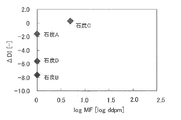
- Fig. 1 shows the common logarithm of logarithm of the highest flow rate MF (log MF [log ddpm]) of the coal to be evaluated and the drum strength of the coke obtained only from the remaining coal excluding the coal to be evaluated from the blended coal. It is a graph which shows the relationship with difference (DELTA) DI (DI (150/50) [-]) calculated by subtracting the drum strength of the coke obtained from the coal blend containing the evaluation object coal.
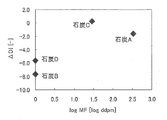
- FIG. 2 is a graph showing the relationship between coal log MF and ⁇ DI measured by increasing the heating rate.
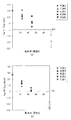
- FIG. 3 is a graph showing the relationship between the blending ratio [% by mass] of the coal to be evaluated in the blended coal and log MF of the blended coal.
- FIG. 1 shows the common logarithm of logarithm of the highest flow rate MF (log MF [log ddpm]) of the coal to be evaluated and the drum strength of the coke obtained only from the remaining coal excluding the coal to be evaluated from the
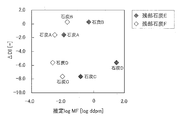
- FIG. 4 is a graph showing the relationship between log MF (estimated log MF) of the evaluation target coal estimated based on the graph of FIG. 3 and ⁇ DI.
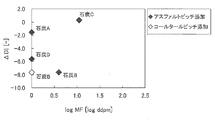
- FIG. 5 is a graph showing the relationship between log MF and ⁇ DI of the evaluation target coal to which pitch is added.
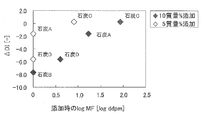
- FIG. 6 is a graph showing the relationship between log MF and ⁇ DI of coal to be evaluated to which an amine compound is added.
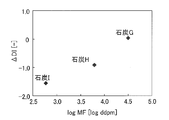
- FIG. 7 is a graph showing the relationship between log MF and ⁇ DI of coal to be evaluated in blended coal.
- FIG. 8 is a graph showing the relationship between log MF and ⁇ DI of the evaluation target coal to which the amine compound is added.
- Vitrinite average maximum reflectance Ro was determined by a method specified in JIS M 8816
- volatile matter VM was measured by a method specified in JIS M 8812.
- the ghiser cellar maximum fluidity MF was determined by a method defined in JIS M 8801.
- Table 1 shows Ro [%], VM [% dry basis] and MF [ddpm] of coals A to D.
- Gieseler maximum fluidity MF in Table 1, coal A, coal B, and coal D are non-caking coal, and coal C is a caking coal.
- the effect of non-slightly caking coal on the strength of coke when non-slightly caking coal (coal A to D) was included in the blended coal was investigated using a dry distillation test furnace.
- the blending ratio of non-slightly caking coal in the blended coal is 20% by mass, and the remaining coal has a weighted average value of 1.03 weighted by the blending ratio of each brand of each brand, and a common logarithmic value of MF ( log (MF)) (coal (remaining coal)) having an average (weighted average value weighted by the blending ratio of each brand) of 2.3 is prepared, and each of coals A to D is mixed with the remaining coal to obtain 4 Various types of blended charcoal were produced.
- the carbonized coal was filled in a dry distillation can so that the bulk density (dry weight basis) was 930 kg / m 3 .
- the bulk density of coal after coal loading is about 700 to 800 kg / m 3 , but in this dry distillation test, In order to highlight the difference due to charcoal, the test was conducted using higher bulk density conditions.
- a 10 kg weight was placed on the carbonization can, and carbonization was carried out in an electric furnace at a furnace temperature of 1050 ° C. for 6 hours, then taken out from the electric furnace and cooled with nitrogen to obtain coke.
- the mass ratio of coke with a particle size of 15 mm or more after rotation is measured 150 times at a rotational speed of 15 rpm, and the drum strength index DI (150 / 15) [-] was evaluated as the strength of coke. Further, only the remaining coal was subjected to dry distillation in the same manner as in the case of blended coal to obtain coke, and drum strength DI (150/15) [ ⁇ ] was calculated.
- Evaluation of non-slightly caking coal as a coke raw material is a difference ⁇ DI calculated by subtracting the drum strength of coke obtained only from the remaining coal from the drum strength of coke obtained from coal blends including coals A to D. It was evaluated with. Negative ⁇ DI indicates that the strength is lower than the coke obtained from the remaining coal by the addition of the non-slightly caking coal.
- Fig. 1 shows the relationship between log MF and coal DI of coals A to D.
- the MF of Coal A, Coal B, and Coal D is 0 (zero) ddpm, but for convenience, the log MF of Coal A, Coal B, and Coal D is represented as “0” in the graph of FIG.
- Table 2 shows the measurement results. The relationship between log MF and coke strength is shown in FIG. From the graph in FIG. 2, although the difference in liquidity between the brands is confirmed, ⁇ DI does not increase as log MF increases, and it cannot be confirmed whether a good positive correlation is established between log ⁇ MF and ⁇ DI. It was.
- the apparent fluidity of non-slightly caking coal (Gieseller maximum fluidity) is estimated by applying the contents of Patent Document 3 showing the conventional technology, and the non-slight coke strength is determined based on the estimated Gieseller maximum fluidity. It was examined whether the influence of caking coal could be evaluated.
- Coal that is caking coal is prepared by preparing coal blend with caking coal added to non-slightly caking coal to be evaluated and evaluating MF of coal blend, and the remaining coal excluding coals A to D from the coal blend. E and Coal F were prepared. Table 3 shows Ro, VM and MF of Coal E and Coal F.
- the blending ratio of coals A to D is 0% by mass, the blended coal is composed only of coal E or coal F.
- the common logarithm log MF of the Gieseler maximum fluidity MF is obtained from the MF in Table 3.
- FIG. 3 shows the relationship between the blending ratio [mass%] of coals A to D in the blended coal and log MF [log ddpm].
- FIG. 3 the relationship between the blending ratio of coals A to D in the blended coal with coal E as the remaining coal and the Gieseler maximum fluidity MF is shown in FIG. 3 (a), and the coal in the blended coal with coal F as the remaining coal
- FIG. 3B shows the relationship between the mixing ratios A to D and the Gieseler maximum fluidity MF.
- the white dots in the graphs of FIGS. 3 (a) and 3 (b) are the blending ratios of 0%, 25%, and 50% by weight for each of coals A to D, and the log MF corresponding thereto.
- the data obtained by extrapolation from the data set is plotted.
- the blended coal having a blending rate of 100% by mass consists of only coals A to D, and log MF at the white points is estimated as log MF of coals A to D (estimated log MF).
- Fig. 4 shows the relationship between the estimated log MF of coals A to D and the difference ⁇ DI. From the graph of FIG. 4, the correlation between the estimated log MF and the coke strength could not be confirmed, and the content of Patent Document 3 was applied to estimate the Gieseler maximum fluidity of the non-slightly caking coal. It can be seen that it is difficult to evaluate the effect on the coke strength by the type of coal (coal A to D).
- Figure 5 shows the relationship between log MF and ⁇ DI.
- log MF is set to 0 and is shown in the graph of FIG. Since the MF values measured by adding the above-mentioned two kinds of binders to Coal A, Coal C, and Coal D were equal, the plotted points overlap. Also from the graph of FIG. 5, a correlation between log ⁇ MF and ⁇ DI could not be confirmed.
- Patent Document 4 adds a primary or secondary amine compound having an aromatic ring to improve coal fluidity. It was confirmed that the quality method was described. As a result of intensive studies on whether or not this amine compound can be used in the evaluation, the present inventors have found physical properties relating to softening and melting characteristics of non-slightly caking coal to which a primary or secondary amine compound having an aromatic ring is added. It was discovered that the value was positively correlated with the strength of the coke, and the present invention was completed.
- the present invention improves the softening and melting properties of non-slightly caking coal by adding a primary or secondary amine compound having an aromatic ring to the non-slightly caking coal to be evaluated.
- Non-slightly caking coal is evaluated using physical property values relating to softening and melting characteristics as an index.
- N, N′-di-2-naphthyl-p-phenylenediamine is preferable.
- the amine compound in addition to N, N′-di-2-naphthyl-p-phenylenediamine, a compound that can be added to coal to improve the softening and melting characteristics (fluidity) of coal is used. Can do. Specifically, phenothiazine, carbazole, N-phenyl-1-naphthylamine and the like exemplified in Patent Document 4 can be used.
- the amine compound was added to the above-mentioned coals A to D in an amount of 5% by mass or 10% by mass of the coal in addition to the coal, and the Gieseler maximum fluidity MF was measured.
- Table 4 shows the measured values of the Gieseler maximum fluidity MF.
- a plurality of coals are mixed to prepare coal having a weighted average Ro of 1.03 and a weighted average log MF of 2.3 (remaining coal), and the blending ratio of coals A to D is set to 20% by mass. Then, each of the coals A to D and the remaining coal were mixed to prepare four types of blended coals. As in the case of obtaining the graph of FIG. 1, coke is obtained from four types of blended coal and drum strength is measured, or only the remaining coal is carbonized to obtain coke, drum strength is measured, and ⁇ DI is calculated. Calculated. Note that the blended coal does not contain N, N′-di-2-naphthyl-p-phenylenediamine which improves the softening and melting characteristics.
- FIG. 6 shows the relationship between log MF and ⁇ DI measured by adding 5% by mass or 10% by mass of N, N′-di-2-naphthyl-p-phenylenediamine.
- log0MF is 0 in both cases of adding 5 mass% or 10 mass% of N, N′-di-2-naphthyl-p-phenylenediamine, and the plots overlap. From the graph of FIG.
- the inventors of the present invention have a fluidity measured by adding a primary or secondary amine compound having an aromatic ring to a non-slightly caking coal and a coke strength of a coal blend containing the non-slightly caking coal.
- a primary or secondary amine compound having an aromatic ring to a non-slightly caking coal
- a coke strength of a coal blend containing the non-slightly caking coal was measured by changing the type of non-slightly caking coal to be evaluated.
- Table 5 shows the non-slightly caking coal to be evaluated.
- Coal GI shown in Table 5 is a slightly caking coal with a low Gieseler maximum fluidity MF.
- the blending ratio of the non-slightly caking coal in the blended coal is set to 0% by mass or 15% by mass, and the average quality of the blended coal is 1.05 for the average of Ro and the common logarithm of MF (log MF).
- the remaining coal is adjusted so that an average of 2.5) becomes 2.5, and three types of blended coal including the three types of coal shown in Table 5 and one type of blended coal not including the coal shown in Table 5
- a total of four types of blended charcoal were prepared.
- the dry coal can was filled so that the bulk density (based on dry weight) of the blended coal would be 725 kg / m 3 , which is a general operation level in which coal is charged from the top of the coke oven carbonization chamber, and 10 kg on the dry coal can.
- Non-slightly caking coal as a coke raw material is subtracted from the coke drum strength obtained from coal blends containing coals GI to the coke drum strength obtained from coal coals not containing coal GI.
- the difference ⁇ DI calculated as above was evaluated.
- the negative ⁇ DI indicates that the strength is lower than that of coke obtained from blended coal not containing coals GI due to the addition of the non-slightly caking coal.
- Fig. 7 shows the relationship between log MF of coals GI and ⁇ DI. From the graph of FIG. 7, it can be seen that the strength of coke obtained from the coal blend containing coal H and coal I is lower than the strength of coke obtained from the coal blend not containing coal H and coal I. Moreover, although the value of log MF of non-slightly caking coal (coal H, coal I) is lower in coal H, the strength of coke obtained from blended coal not containing non-slightly caking coal is used as a standard. It can be seen that the decrease in the strength of coke obtained from the blended coal containing coal H ( ⁇ DI in FIG. 7) is smaller than the decrease in the strength of coke obtained from the blended coal containing coal I.
- N, N'-di-2-naphthyl-p-phenylenediamine as an amine compound is added to the above-mentioned coals G to I in addition to the coal in an amount of 10% by mass.
- Table 6 shows the measurement results of the Geeseeller maximum fluidity MF.
- MF is increased by adding 10% by mass of an amine compound as compared with MF at the time of non-addition, and softening and melting characteristics are improved by adding an amine compound. I understand that. Further, it can be seen that the order of log MF measured by adding the amine compounds shown in Table 6 is different from the order of log MF shown in Table 5.
- FIG. 8 shows the relationship between log ⁇ MF and ⁇ DI measured by adding 10% by mass of N, N′-di-2-naphthyl-p-phenylenediamine. From the graph of FIG. 8, it can be seen that the higher the log MF measured by adding 10% by mass of N, N′-di-2-naphthyl-p-phenylenediamine, the smaller the negative width of ⁇ DI.
- Patent Document 4 Although it is described in Patent Document 4 that the fluidity of coal is improved by adding a primary or secondary amine compound having an aromatic ring to coal, the primary or secondary amine compound having an aromatic ring is described in Patent Document 4. It has not been known that the superiority and inferiority of coal as a coke raw material can be evaluated by the fluidity of coal measured by adding to the coal. According to the method of the present invention, it is possible to evaluate the superiority or inferiority of coal that could not be evaluated conventionally, and it is possible to clearly determine whether or not a certain coal can be used as a raw material for coke.
- ⁇ Judgment as to whether the evaluation target coal can be used as a raw material for coke may be performed as follows. As shown in FIG. 6 and FIG. 8, for each of a plurality of brands of coal, a data set of physical property values (maximum fluidity of Gieseller) and strength of coke obtained from blended coal to which the coal is added in the softening and melting characteristics of coal. Are obtained, and coal (especially non-coking coal) can be used as coal used as a raw material for coke. It can be evaluated as follows.
- a relational expression between the measured physical property value and the coke strength can be obtained.
- the relational expression can be derived by drawing a calibration curve freehand on the least square method or graph in FIGS.
- the physical property value corresponding to the target value of the coke strength ( ⁇ DI) is specified from the relational expression derived in [I] above.
- the target value is a value of an assumed strength that can be used for blast furnace operation, and is a value that can be determined in advance. For example, based on a data set obtained by conducting a dry distillation test, the difference between the strength of coke obtained from a blended coal added with non-slightly caking coal and the strength of coke obtained from the remaining blended coal (for example, ⁇ DI) Can be predicted.
- the predicted ⁇ DI is added to the strength of coke obtained from the remaining blended coal, so that the non-slightly caking coal is obtained. It is possible to specify the strength of coke obtained from blended coal to which is added. And if the strength of the coke obtained from the blended coal added with the non-slightly caking coal specified in this way exceeds the strength required for the coke, the non-slightly caking coal is used as a raw material for coke. It can be evaluated as possible. Furthermore, the physical property value regarding the softening-melting characteristic in which the strength of the coke obtained from the blended coal to which the non-slightly caking coal is added becomes equal to the strength required for the coke can be specified.
- a physical property value related to softening and melting characteristics is measured for a new coal to be measured, and when the measured value is equal to or greater than the specified physical property value, coke obtained from the blended coal containing the coal is suitable coke. It can be judged that it has strength.
- a blended coal is prepared by blending a new coal to be measured with the remaining coal at the blending ratio of coal in the blended coal from which the data set of [I] is obtained, the blended coal is manufactured.
- the coke can be expected to have a coke strength equal to or greater than a predetermined target value.
- the addition amount of the amine compound is too small, the softening and melting characteristics of the non-slightly caking coal cannot be sufficiently improved, It can be seen that it may be difficult to properly evaluate the softening and melting characteristics. Therefore, depending on the type of amine compound and non-slightly caking coal, it is presumed that there is an appropriate addition ratio of the amine compound in improving the softening and melting characteristics. Therefore, the present inventors examined a method for specifying the optimum addition amount for improving the softening and melting characteristics, which differs depending on the brand of the amine compound and the non-slightly caking coal.
- the kind and addition amount of the amine compound to be added can be determined as follows. [1] As an amine compound to be added, a compound that is added to coal and has an effect of improving fluidity is selected. [2] MF is measured by adding an arbitrary amount of the selected amine compound to a plurality of types of coal to be evaluated (preferably non-coking coal having an MF of 0). [3A] If there is a difference in the MF of the coal to be evaluated, the amount at that time and the selected amine compound can be identified as being usable in the evaluation. [3B] If there is no difference in the MF of the coal to be evaluated, increase the amount of amine compound added, or select an amine compound having a higher boiling point than the amine compound selected in [1]. Add and measure [2] again.
- coke As a coke raw material for coal, based on the physical properties related to softening and melting characteristics, which is easier to measure, without conducting laborious dry distillation tests on coal that is not known to be used as a raw material. It will be possible to judge the availability of. And it becomes possible to manufacture the coke by which intensity
- non-slightly caking coal having a maximum Gieseller fluidity MF of 20 ddpm or less is preferable.
- Coal having a Gieseller maximum fluidity MF of 0 ddpm is generally referred to as non-coking coal
- coal having a Gieseller maximum fluidity MF of approximately 100 ddpm or less is generally referred to as slightly caking coal. Since the measured value of the Gieseler maximum fluidity according to the JIS method takes an integer value, the measurement accuracy is inferior when the MF is 10 ddpm or less. Therefore, it is particularly effective to apply the method of the present invention to coal having an MF of 10 ddpm or less.
- the difference in the softening and melting characteristics of coal cannot be evaluated for non-caking coal with an MF of 0.
- Coal in which the effect of the present invention that makes it possible to evaluate the difference in softening and melting characteristics on the coking property of coal by the MF measurement with the addition of an amine-based compound is not particularly remarkable, It is a very low non-coking coal. Therefore, in the present invention, it is preferable to evaluate coal (MF ⁇ 20 ddpm) having a lower Gieseler maximum fluidity MF, in which the effect of improving the softening and melting characteristics becomes remarkable when an amine compound is added.
- the Gieseler maximum fluidity MF is adopted as the physical property value related to the softening and melting characteristics.
- the physical property value related to the softening and melting characteristics is not particularly limited to the Gieseler maximum fluidity MF.
- the physical properties related to the softening and melting characteristics are the expandability, adhesiveness, permeability, viscosity, etc. of the coal in the softened and melted state.
- the physical properties include the total expansion rate, specific volume, and penetration distance measured by a dilatometer. Dynamic viscoelasticity can be used.
- the physical property value and the coke strength relating to the softening and melting characteristics of the coal are directly measured, but the present invention does not necessarily need to be measured directly.
- a data set of physical property values and coke strength regarding the softening and melting characteristics of coal has been obtained by a third party, and if the data set is provided, a relational expression between the physical property values and coke strength can be obtained. Can be used as a raw material for coke.
- the evaluation method of the present invention it is possible to evaluate the influence of non-slightly caking coal on coke strength in coke obtained from blended coal containing non-slightly caking coal. It is possible to evaluate coal that can be maintained (non-slightly caking coal).
Landscapes
- Chemical & Material Sciences (AREA)
- Engineering & Computer Science (AREA)
- Oil, Petroleum & Natural Gas (AREA)
- Organic Chemistry (AREA)
- Health & Medical Sciences (AREA)
- Life Sciences & Earth Sciences (AREA)
- Materials Engineering (AREA)
- Biochemistry (AREA)
- Immunology (AREA)
- Pathology (AREA)
- General Physics & Mathematics (AREA)
- General Health & Medical Sciences (AREA)
- Physics & Mathematics (AREA)
- Analytical Chemistry (AREA)
- Food Science & Technology (AREA)
- Medicinal Chemistry (AREA)
- Combustion & Propulsion (AREA)
- Chemical Kinetics & Catalysis (AREA)
- General Chemical & Material Sciences (AREA)
- Coke Industry (AREA)
Abstract
Priority Applications (8)
| Application Number | Priority Date | Filing Date | Title |
|---|---|---|---|
| RU2017129805A RU2675567C1 (ru) | 2015-02-25 | 2016-02-17 | Способ оценки угля и способ получения кокса |
| CN201680011656.0A CN107250323B (zh) | 2015-02-25 | 2016-02-17 | 煤的评价方法和焦炭的制造方法 |
| KR1020177022813A KR101940942B1 (ko) | 2015-02-25 | 2016-02-17 | 석탄의 평가 방법 및 코크스의 제조 방법 |
| JP2017501902A JP6323610B2 (ja) | 2015-02-25 | 2016-02-17 | 石炭の評価方法及びコークスの製造方法 |
| EP16754943.5A EP3263674B1 (fr) | 2015-02-25 | 2016-02-17 | Procédé de fabrication de coke |
| AU2016225722A AU2016225722B2 (en) | 2015-02-25 | 2016-02-17 | Method of evaluating coal and method of manufacturing coke |
| US15/553,049 US10739285B2 (en) | 2015-02-25 | 2016-02-17 | Evaluating method for coal and producing method for coke |
| CA2973938A CA2973938C (fr) | 2015-02-25 | 2016-02-17 | Procede d'evaluation de charbon et procede de fabrication de coke |
Applications Claiming Priority (2)
| Application Number | Priority Date | Filing Date | Title |
|---|---|---|---|
| JP2015-034990 | 2015-02-25 | ||
| JP2015034990 | 2015-02-25 |
Publications (1)
| Publication Number | Publication Date |
|---|---|
| WO2016136191A1 true WO2016136191A1 (fr) | 2016-09-01 |
Family
ID=56789213
Family Applications (1)
| Application Number | Title | Priority Date | Filing Date |
|---|---|---|---|
| PCT/JP2016/000808 Ceased WO2016136191A1 (fr) | 2015-02-25 | 2016-02-17 | Procédé d'évaluation de charbon et procédé de fabrication de coke |
Country Status (10)
| Country | Link |
|---|---|
| US (1) | US10739285B2 (fr) |
| EP (1) | EP3263674B1 (fr) |
| JP (2) | JP6323610B2 (fr) |
| KR (1) | KR101940942B1 (fr) |
| CN (1) | CN107250323B (fr) |
| AU (1) | AU2016225722B2 (fr) |
| CA (1) | CA2973938C (fr) |
| RU (1) | RU2675567C1 (fr) |
| TW (1) | TWI608092B (fr) |
| WO (1) | WO2016136191A1 (fr) |
Cited By (4)
| Publication number | Priority date | Publication date | Assignee | Title |
|---|---|---|---|---|
| CN110793994A (zh) * | 2019-09-16 | 2020-02-14 | 河南中鸿集团煤化有限公司 | 一种检验焦炉空压密封修补料性能的方法 |
| CN115993436A (zh) * | 2023-02-15 | 2023-04-21 | 山东钢铁股份有限公司 | 一种捣固焦冷热态强度指标的修正方法 |
| JP2024053917A (ja) * | 2022-10-04 | 2024-04-16 | Jfeスチール株式会社 | フェロコークス用石炭の評価方法 |
| WO2024202184A1 (fr) * | 2023-03-28 | 2024-10-03 | Jfeスチール株式会社 | Procédé d'estimation de la résistance du coke et procédé de production de coke |
Families Citing this family (4)
| Publication number | Priority date | Publication date | Assignee | Title |
|---|---|---|---|---|
| AU2020241658B2 (en) | 2019-03-15 | 2022-09-22 | Jfe Steel Corporation | Method for evaluating coal, method for preparing coal blend, and method for producing coke |
| CN113848231B (zh) * | 2020-06-28 | 2024-03-08 | 宝山钢铁股份有限公司 | 基于炼焦煤热解过程中热扩散率的结焦性判断方法 |
| CA3182614A1 (fr) | 2020-08-17 | 2022-02-24 | Issui Akishika | Procede de preparation de charbon ou de materiau de liaison, et procede de fabrication de coke |
| CN115541573A (zh) * | 2021-06-29 | 2022-12-30 | 宝山钢铁股份有限公司 | 一种强粘结性炼焦煤的热塑性评价方法 |
Citations (4)
| Publication number | Priority date | Publication date | Assignee | Title |
|---|---|---|---|---|
| JPS60144386A (ja) * | 1983-12-30 | 1985-07-30 | Nippon Steel Chem Co Ltd | 石炭の乾留方法 |
| JPS61285286A (ja) * | 1985-06-12 | 1986-12-16 | Nippon Steel Chem Co Ltd | 石炭の乾留方法 |
| JP2014043545A (ja) * | 2012-03-08 | 2014-03-13 | Jfe Steel Corp | 石炭の改質方法及びコークスの製造方法 |
| JP2015040270A (ja) * | 2013-08-23 | 2015-03-02 | Jfeスチール株式会社 | コークスの製造方法、コークス、改質石炭、改質配合炭および石炭もしくは配合炭の改質方法 |
Family Cites Families (12)
| Publication number | Priority date | Publication date | Assignee | Title |
|---|---|---|---|---|
| GB747171A (en) * | 1950-05-04 | 1956-03-28 | C U R A Patents Ltd | Manufacture of bodies composed of carbon in a chemically reactive state |
| JPS62285051A (ja) | 1986-06-03 | 1987-12-10 | Mitsubishi Chem Ind Ltd | 石炭の流動性測定方法 |
| JPH0832882B2 (ja) | 1989-06-06 | 1996-03-29 | 日本鋼管株式会社 | 非粘結炭の見掛けの流動度推定方法 |
| CA2304744C (fr) | 1998-07-29 | 2008-04-29 | Kawasaki Steel Corporation | Procede de production de coke metallurgique |
| JP2000073070A (ja) | 1998-08-27 | 2000-03-07 | Sumitomo Metal Ind Ltd | 石炭の流動度測定方法ならびに原料炭の配合方法 |
| CN100412166C (zh) * | 2006-11-22 | 2008-08-20 | 北京金源化学集团有限公司 | 一种提高焦炭产量和性能的煤炭添加剂和方法 |
| JP5163247B2 (ja) * | 2008-04-10 | 2013-03-13 | 新日鐵住金株式会社 | コークスの製造方法 |
| CN101585453B (zh) * | 2008-05-20 | 2014-05-07 | 上海海事大学 | 集装箱码头出口箱堆场自动分配方法 |
| TWI457555B (zh) | 2010-09-01 | 2014-10-21 | Jfe Steel Corp | Evaluation method of softening and melting of coal and binder and method for manufacturing coke |
| CA2807954C (fr) * | 2010-09-01 | 2019-02-26 | Jfe Steel Corporation | Procede pour l'evaluation de thermoplasticites du charbon et d'additif agglomerant et procede de fabrication de coke |
| JP5201250B2 (ja) * | 2010-09-01 | 2013-06-05 | Jfeスチール株式会社 | 冶金用コークスの製造方法および冶金用コークス製造用粘結材 |
| CN102559227B (zh) | 2010-12-10 | 2014-03-19 | 上海梅山钢铁股份有限公司 | 利用基氏流动度指标进行配煤炼焦的方法 |
-
2016
- 2016-02-17 JP JP2017501902A patent/JP6323610B2/ja active Active
- 2016-02-17 RU RU2017129805A patent/RU2675567C1/ru active
- 2016-02-17 CA CA2973938A patent/CA2973938C/fr active Active
- 2016-02-17 KR KR1020177022813A patent/KR101940942B1/ko active Active
- 2016-02-17 CN CN201680011656.0A patent/CN107250323B/zh active Active
- 2016-02-17 US US15/553,049 patent/US10739285B2/en active Active
- 2016-02-17 AU AU2016225722A patent/AU2016225722B2/en active Active
- 2016-02-17 WO PCT/JP2016/000808 patent/WO2016136191A1/fr not_active Ceased
- 2016-02-17 EP EP16754943.5A patent/EP3263674B1/fr active Active
- 2016-02-24 TW TW105105461A patent/TWI608092B/zh active
-
2017
- 2017-03-16 JP JP2017050781A patent/JP6680252B2/ja active Active
Patent Citations (4)
| Publication number | Priority date | Publication date | Assignee | Title |
|---|---|---|---|---|
| JPS60144386A (ja) * | 1983-12-30 | 1985-07-30 | Nippon Steel Chem Co Ltd | 石炭の乾留方法 |
| JPS61285286A (ja) * | 1985-06-12 | 1986-12-16 | Nippon Steel Chem Co Ltd | 石炭の乾留方法 |
| JP2014043545A (ja) * | 2012-03-08 | 2014-03-13 | Jfe Steel Corp | 石炭の改質方法及びコークスの製造方法 |
| JP2015040270A (ja) * | 2013-08-23 | 2015-03-02 | Jfeスチール株式会社 | コークスの製造方法、コークス、改質石炭、改質配合炭および石炭もしくは配合炭の改質方法 |
Non-Patent Citations (1)
| Title |
|---|
| See also references of EP3263674A4 * |
Cited By (9)
| Publication number | Priority date | Publication date | Assignee | Title |
|---|---|---|---|---|
| CN110793994A (zh) * | 2019-09-16 | 2020-02-14 | 河南中鸿集团煤化有限公司 | 一种检验焦炉空压密封修补料性能的方法 |
| CN110793994B (zh) * | 2019-09-16 | 2022-02-22 | 河南中鸿集团煤化有限公司 | 一种检验焦炉空压密封修补料性能的方法 |
| JP2024053917A (ja) * | 2022-10-04 | 2024-04-16 | Jfeスチール株式会社 | フェロコークス用石炭の評価方法 |
| JP7647718B2 (ja) | 2022-10-04 | 2025-03-18 | Jfeスチール株式会社 | フェロコークス用石炭の評価方法 |
| CN115993436A (zh) * | 2023-02-15 | 2023-04-21 | 山东钢铁股份有限公司 | 一种捣固焦冷热态强度指标的修正方法 |
| CN115993436B (zh) * | 2023-02-15 | 2024-05-14 | 山东钢铁股份有限公司 | 一种捣固焦冷热态强度指标的修正方法 |
| WO2024202184A1 (fr) * | 2023-03-28 | 2024-10-03 | Jfeスチール株式会社 | Procédé d'estimation de la résistance du coke et procédé de production de coke |
| JP7574965B1 (ja) * | 2023-03-28 | 2024-10-29 | Jfeスチール株式会社 | コークス強度の推定方法およびコークスの製造方法 |
| EP4660281A1 (fr) | 2023-03-28 | 2025-12-10 | JFE Steel Corporation | Procédé d'estimation de la résistance du coke et procédé de production de coke |
Also Published As
| Publication number | Publication date |
|---|---|
| CN107250323A (zh) | 2017-10-13 |
| TW201704459A (zh) | 2017-02-01 |
| US20180031501A1 (en) | 2018-02-01 |
| EP3263674B1 (fr) | 2024-06-05 |
| JP6323610B2 (ja) | 2018-05-16 |
| EP3263674A4 (fr) | 2018-02-28 |
| AU2016225722B2 (en) | 2019-04-04 |
| JPWO2016136191A1 (ja) | 2017-07-13 |
| CA2973938C (fr) | 2020-10-27 |
| RU2675567C1 (ru) | 2018-12-19 |
| AU2016225722A1 (en) | 2017-07-27 |
| EP3263674A1 (fr) | 2018-01-03 |
| CA2973938A1 (fr) | 2016-09-01 |
| KR20170105085A (ko) | 2017-09-18 |
| KR101940942B1 (ko) | 2019-04-10 |
| JP6680252B2 (ja) | 2020-04-15 |
| CN107250323B (zh) | 2021-05-28 |
| US10739285B2 (en) | 2020-08-11 |
| TWI608092B (zh) | 2017-12-11 |
| JP2017125206A (ja) | 2017-07-20 |
Similar Documents
| Publication | Publication Date | Title |
|---|---|---|
| JP6323610B2 (ja) | 石炭の評価方法及びコークスの製造方法 | |
| KR101580855B1 (ko) | 코크스의 제조 방법 | |
| US9845439B2 (en) | Method for blending coals for cokemaking and method for producing coke | |
| JP6044708B2 (ja) | 石炭の風化度の評価方法、風化石炭のコークス化性の評価方法、及び、石炭の風化度の管理方法、並びに、コークスの製造方法 | |
| CN106133116A (zh) | 煤混合物、煤混合物的制造方法、以及焦炭的制造方法 | |
| JP6379934B2 (ja) | コークス強度の推定方法 | |
| JP5737473B2 (ja) | コークス製造用石炭混合物の調製方法及び石炭混合物、並びに、コークス製造方法 | |
| JP2018048297A (ja) | コークス強度の推定方法 | |
| JP6274165B2 (ja) | 石炭の評価方法及びコークスの製造方法 | |
| JP7067226B2 (ja) | コークス強度の評価方法 | |
| CN113544237A (zh) | 煤的评价方法和混煤的制备方法以及焦炭的制造方法 | |
| JP2017171718A (ja) | コークスの強度推定方法、及び、コークスの製造方法 | |
| JP2013053189A (ja) | コークス製造用原料の最高流動度の推定方法,コークス製造用原料の配合方法および該配合方法により作製されたコークス製造用原料 | |
| JP5163247B2 (ja) | コークスの製造方法 | |
| JP7574965B1 (ja) | コークス強度の推定方法およびコークスの製造方法 | |
| JP7188245B2 (ja) | 高炉用コークスの表面破壊強度の推定方法 | |
| JP6678095B2 (ja) | コークスの強度推定方法、及び、コークスの製造方法 | |
| JP2018048216A (ja) | コークス炉装入炭の嵩密度推定方法及び配合調整方法 |
Legal Events
| Date | Code | Title | Description |
|---|---|---|---|
| 121 | Ep: the epo has been informed by wipo that ep was designated in this application |
Ref document number: 16754943 Country of ref document: EP Kind code of ref document: A1 |
|
| ENP | Entry into the national phase |
Ref document number: 2017501902 Country of ref document: JP Kind code of ref document: A |
|
| ENP | Entry into the national phase |
Ref document number: 2973938 Country of ref document: CA |
|
| ENP | Entry into the national phase |
Ref document number: 2016225722 Country of ref document: AU Date of ref document: 20160217 Kind code of ref document: A |
|
| ENP | Entry into the national phase |
Ref document number: 20177022813 Country of ref document: KR Kind code of ref document: A |
|
| REEP | Request for entry into the european phase |
Ref document number: 2016754943 Country of ref document: EP |
|
| ENP | Entry into the national phase |
Ref document number: 2017129805 Country of ref document: RU Kind code of ref document: A |
|
| NENP | Non-entry into the national phase |
Ref country code: DE |