WO2016140261A1 - Procédé de fabrication d'un objet en aluminium poreux - Google Patents
Procédé de fabrication d'un objet en aluminium poreux Download PDFInfo
- Publication number
- WO2016140261A1 WO2016140261A1 PCT/JP2016/056410 JP2016056410W WO2016140261A1 WO 2016140261 A1 WO2016140261 A1 WO 2016140261A1 JP 2016056410 W JP2016056410 W JP 2016056410W WO 2016140261 A1 WO2016140261 A1 WO 2016140261A1
- Authority
- WO
- WIPO (PCT)
- Prior art keywords
- phase
- aluminum
- producing
- capacitor
- electrode material
- Prior art date
- Legal status (The legal status is an assumption and is not a legal conclusion. Google has not performed a legal analysis and makes no representation as to the accuracy of the status listed.)
- Ceased
Links
Images



Classifications
-
- C—CHEMISTRY; METALLURGY
- C22—METALLURGY; FERROUS OR NON-FERROUS ALLOYS; TREATMENT OF ALLOYS OR NON-FERROUS METALS
- C22C—ALLOYS
- C22C1/00—Making non-ferrous alloys
- C22C1/08—Alloys with open or closed pores
-
- C—CHEMISTRY; METALLURGY
- C22—METALLURGY; FERROUS OR NON-FERROUS ALLOYS; TREATMENT OF ALLOYS OR NON-FERROUS METALS
- C22C—ALLOYS
- C22C21/00—Alloys based on aluminium
-
- H—ELECTRICITY
- H01—ELECTRIC ELEMENTS
- H01G—CAPACITORS; CAPACITORS, RECTIFIERS, DETECTORS, SWITCHING DEVICES, LIGHT-SENSITIVE OR TEMPERATURE-SENSITIVE DEVICES OF THE ELECTROLYTIC TYPE
- H01G9/00—Electrolytic capacitors, rectifiers, detectors, switching devices, light-sensitive or temperature-sensitive devices; Processes of their manufacture
- H01G9/004—Details
- H01G9/04—Electrodes or formation of dielectric layers thereon
Definitions
- the present invention relates to a method for producing an aluminum porous body suitably used as a material for an electrode material in, for example, an aluminum electrolytic capacitor or an aluminum solid electrolytic capacitor, and a related technique.
- Aluminum electrolytic capacitors and aluminum solid electrolytic capacitors are widely used for home appliances such as personal computers and television sets and on-vehicle electrical products because they are relatively inexpensive and have a high capacity.
- An aluminum electrolytic capacitor is generally manufactured by winding an anode foil and a cathode foil with a separator interposed therebetween to form a capacitor element, impregnating the capacitor element with an electrolytic solution, storing the case in a case, and sealing. ing.
- an anode foil is subjected to a surface expansion treatment by chemical or electrochemical etching on a valve action metal foil such as aluminum, and an oxide film layer is formed by subjecting the surface of the surface expansion treatment to chemical conversion. Is formed.
- Patent Document 4 for the purpose of significantly increasing the capacity of an aluminum electrolytic capacitor, as shown in Patent Document 4, as shown in Patent Document 4, in order to arrange the etching positions regularly, the technique of injecting the powder of valve action metal onto the anode foil is shown in Patent Document 5.
- Patent Document 6 A technique using a printing method and a technique using lithography as shown in Patent Document 6 have been proposed.
- any of the techniques in Patent Documents 4 to 6 has a problem such as high cost. Not reached.
- An object of the present invention is to provide a method for producing a porous aluminum body and its related technology capable of greatly improving the capacitance when used as an anode body of a capacitor.
- the aluminum alloy as a precursor is composed of an Al—X alloy in which “X” as an additive component is added to “Al” as a main component, “X” is an element that exhibits a eutectic reaction with “Al”, 3.
- a method for producing a capacitor electrode material is a method for producing a capacitor electrode material.
- the aluminum alloy as a precursor is composed of an Al—X alloy in which “X” as an additive component is added to “Al” as a main component, “X” is an element that exhibits a eutectic reaction with “Al”, 10.
- a method for manufacturing a capacitor characterized in that a capacitor is manufactured using the capacitor electrode material obtained by the manufacturing method according to any one of items 8 to 15.
- a method for manufacturing a capacitor characterized in that a capacitor is manufactured using the capacitor electrode material obtained by the manufacturing method according to item 15 above as an anode material.
- “X” is an element that exhibits a eutectic reaction with respect to “Al”, and an Al—X alloy as a precursor has an Al base in which the amount of the element “X” is within the eutectic point range. 23.
- the bath component “Y” is an element different from “X”, and is at least one element selected from Bi and In.
- a method for producing a capacitor electrode material having a large number of voids communicating from the surface to the inside It is composed of an Al—X alloy cast body in which “X” as an additive component is added to “Al”, and has an ⁇ -Al phase and a second phase formed by being intertwined with the ⁇ -Al phase.
- Producing a precursor of a solidified tissue The precursor is immersed in a molten metal bath of a bath component “Y” having a melting point lower than that of “Al—X alloy” to elute “X” and replace with “Y” to obtain an ⁇ -Al phase.
- “X” is an element that exhibits a eutectic reaction with respect to “Al”, and an Al—X alloy as a precursor has an Al base in which the amount of the element “X” is within the eutectic point range.
- the bath component “Y” is an element different from “X” and is at least one element selected from Bi and In.
- a method for manufacturing a capacitor characterized in that a capacitor is manufactured using the capacitor electrode material obtained by the manufacturing method according to any one of items 28 to 35.
- a method for manufacturing a capacitor characterized in that a capacitor is manufactured using the capacitor electrode material obtained by the manufacturing method described in the preceding item 35 as an anode material.
- a capacitor electrode material obtained by the manufacturing method according to any one of items 28 to 35 is obtained by the manufacturing method according to any one of items 28 to 35.
- an aluminum porous body having a sufficient surface area can be obtained easily and at low cost.
- the porous body thus obtained is used as the anode body of an aluminum capacitor, the capacitance can be greatly improved.
- FIG. 1A is a cross-sectional view schematically showing an aluminum electrolytic capacitor obtained in the first embodiment of the present invention.
- FIG. 1B is a cross-sectional view schematically showing an aluminum electrolytic capacitor which is a modified example obtained in the first embodiment.
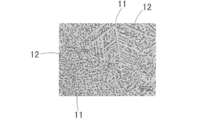
- FIG. 1C is an optical micrograph showing a cross section of the solidified structure in the aluminum porous body obtained in Example 1-1 of the first embodiment.
- FIG. 2A is a cross-sectional view schematically showing an aluminum electrolytic capacitor obtained in the second embodiment of the present invention.
- FIG. 2B is a cross-sectional view schematically showing an aluminum electrolytic capacitor which is a modified example obtained in the second embodiment.
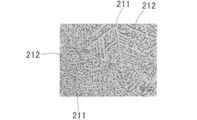
- FIG. 2C is an optical micrograph showing a cross section of the solidified structure in the porous body precursor obtained in Example 2-1 of the second embodiment.
- FIG. 2D is an SEM photograph showing a cross section of the porous replica obtained in Example 2-2 of the second embodiment.
- FIG. 1A is a sectional view schematically showing an aluminum electrolytic capacitor C1 obtained by the present invention.
- the capacitor C1 is wound around the outer periphery of the cylindrical anode material 1 functioning as an anode, the sheet-like or film-like separator 3 wound around the outer periphery of the anode material 1, and the separator 3.
- a foil-like cathode body 2 that functions as a cathode.
- the separator may not be used depending on the structure of the capacitor.
- the separator 3 and the cathode material 2 are made of a conventionally known material, while the anode material 1 is made of a material specific to the present embodiment as will be described later.
- an aluminum electrolytic capacitor is formed by sandwiching a dielectric film made of aluminum oxide formed on an anode material made of aluminum between an anode and a cathode facing the anode.
- porous aluminum body of the present invention As an anode material, a dielectric film is formed on the anode material, and a separator infiltrated with an electrolyte solution serving as a cathode is placed on the dielectric film, whereby an aluminum electrolytic capacitor is obtained. Can be formed.
- separator a known separator such as a porous cellulose membrane can be used.
- the electrolytic solution generally comprises a cation component, an anion component, and a solvent.
- the anion component include weak acids such as boric acid and carboxylic acid
- examples of the cation component include organic bases such as ammonia and amines.
- examples of the solvent include ethylene glycol and ⁇ -butyrolactone.
- the cathode a conventional surface-expanded Al foil or the like can be used.
- the anode material 1 obtained by the present invention is composed of an aluminum porous body (porous material).
- This aluminum porous body has an aluminum alloy cast body formed by casting solidification as a precursor. Then, by eluting (etching) a required portion of the precursor, an aluminum porous body having a large number of voids (pores) open to the surface and communicating from the surface to the inside is obtained.
- An aluminum alloy as a precursor is expressed as an Al—X alloy in which “X” as an additive component (additive element) is added to Al (aluminum) as a main component (main element) as described later. it can.
- the solidification structure of the precursor has an ⁇ phase composed of primary crystals (that is, an ⁇ -Al phase) and a second phase having a eutectic formed continuously with the ⁇ phase.
- the primary crystal refers to a crystal that is first formed from a molten metal during casting solidification.
- the second phase has a eutectic of Al and the additive element “X”. The second phase is virtually all connected. However, the isolated second phase may remain as long as the effects of the present invention are not impaired.
- the content (mass%) of the additive component “X” in the second phase is larger than the content in the ⁇ phase, and the additive component “X” is a base metal with respect to Al, that is, in an aqueous solution than Al.
- a metal having a low standard electrode potential can be used.
- the additive component “X” When the precursor is brought into contact with a solution that dissolves the additive component “X”, the additive component “X” is preferentially eluted, and as a result, the ⁇ phase remains and at least a part, preferably all, of the second phase remains.
- a large number of continuous voids (pores) are formed in the precursor from the surface to the inside, and the porous aluminum body of the present embodiment is obtained.
- Mg can be suitably used because it has a melting point close to that of Al.
- the additive component “X” is not limited to one type, and two or more types may be added.
- the Al—X-based alloy constituting the precursor can be regarded as having a hypoeutectic composition with an Al-based addition amount of “X” below the eutectic point.
- an Al-rich alloy phase is crystallized inside the solidification cell constituting the ⁇ phase, while being added to the final solidification portion of the solidification cell formed on the outer periphery of the ⁇ phase. Since the alloy phase (second phase) containing a large amount of the component “X” crystallizes, the second phase is preferentially eluted by the eluent. Therefore, a desired gap can be formed reliably.
- the ⁇ phase may also be eluted slightly, but this is not a problem as long as a continuous void is formed and the shape of the porous body is maintained.
- the precursor has a hypereutectic composition in which the addition amount of “X” exceeds the eutectic point, a crystallized product whose primary crystal is composed of the additive component “X” or an alloy containing a large amount of the additive component “X” Since it becomes a crystallized product of the phase, many parts of the primary crystal are eluted by the eluent. In this case, the voids are too large, and the surface area cannot be sufficiently expanded or the porous structure cannot be maintained.
- an element other than “X” may be added to the Al—X-based alloy as the precursor within the range of the eutectic composition as necessary or unavoidable.
- the general addition amount of “X” in the precursor is not more than the eutectic composition and is 1% by mass or more, desirably 5% by mass or more, and more desirably 10% by mass or more. That is, when “X” is added in this amount, as described above, an alloy phase containing a large amount of the additive component “X” crystallizes on the outer periphery of the ⁇ phase. When the preferential elution is performed and the second phase is eluted, a desired porous structure (void) can be formed.
- the eutectic composition in the present invention is 35% by mass with the smallest amount of Mg in the phase diagram in the case of an Al—Mg alloy, and 15% by mass in the case of an Al—In alloy. In the case of —Zn alloy, it is 36% by mass.
- the surface area can be increased as the solidification cell composed of the ⁇ phase during casting is smaller. Therefore, it is preferable to reduce the solidification cell during casting solidification.
- the cooling rate in the vicinity of the freezing point may be adjusted to 1 ° C./sec or higher, preferably 5 ° C./sec or higher, more preferably 10 ° C./sec or higher.
- dendrites in at least a part of the ⁇ -phase solidification cell, and it is more preferable to form all of them into dendrites.
- the porous aluminum body related to the present invention has the primary ⁇ phase 11 (light gray portion in the figure) composed of dendritic crystals. Between the ⁇ phases 11, voids 12 (the dark gray portions in the figure) formed by elution of the second phase are continuously formed.
- the precursor may be subjected to a drawing process or a rolling process for shaping the outer shape.
- the precursor is processed with a high deformation rate, the solidified structure collapses, and the crystallized product as the second phase is fragmented.
- the desired void (porous structure) May not be obtained.
- the surface of the precursor may be left as it is, but the cast solidified surface is preferably cut (deleted) so that the second phase etching (elution) can be performed quickly and uniformly.
- an acid aqueous solution can be exemplified as an eluent for dissolving the additive component “X” of the precursor.
- the acid contained in the acid aqueous solution it is preferable to use nitric acid or sulfuric acid in which Al does not easily elute, and hydrochloric acid or the like can also be used.
- An aluminum porous body obtained by treating the precursor with an eluent can be used as a capacitor electrode material.
- a dielectric coating is formed on the anode body.
- the method for forming the dielectric film is not particularly limited, but it is preferable to apply a chemical conversion treatment by anodic oxidation.
- Hydration treatment is generally performed in pure water as pre-chemical treatment.
- Other pretreatment methods include immersion in hydrogen peroxide, cleaning with an acid or alkaline treatment solution, vacuum or atmospheric heat treatment, dechlorination treatment, hydration treatment in an aqueous solution to which an amine is added, thermal oxide film It can be applied alone or in combination from known pretreatment methods including treatment with an acid or alkali solution after formation, and hydration treatment performed after electrolytic etching is applied to the aluminum foil.
- the chemical conversion treatment solution known ones can be used, and examples include an aqueous solution in which one or more of boric acid, ammonium borate, adipic acid, ammonium adipate, phosphoric acid and its salt, citric acid and its salt, etc. are mixed. it can.
- the EIAJ method can be exemplified, but is not limited thereto.
- the chemical conversion treatment may be performed a plurality of times, the chemical conversion liquid may be changed for each chemical conversion treatment according to a known method, and heat treatment or washing may be performed between the chemical conversion treatment and the chemical conversion treatment.
- the conversion voltage may be set to different values in a plurality of conversion processes.
- the precursor is formed in a columnar shape, but is not limited thereto.
- the precursor is a flat shape such as a cylindrical shape, an elliptical columnar shape, an elliptical cylindrical shape, a rectangular columnar shape, a rectangular cylindrical shape, a plate shape, or the like. Any shape such as a shape may be used.
- a shape may be used.
- the precursor is hollow like a cylinder or the like, it can be preferentially eluted from the inner peripheral surface, so that a higher surface area can be obtained.
- a method for producing an aluminum alloy casting as a precursor for example, a method in which a molten aluminum alloy of a predetermined alloy component is cast into a mold close to the final shape and solidified, and then the surface is trimmed slightly to adjust the shape, etc. Can be used.
- a method of manufacturing a precursor having an elliptical cross section by compressing a round bar-shaped aluminum alloy casting body from above and below to such an extent that a solidified structure remains can be employed.
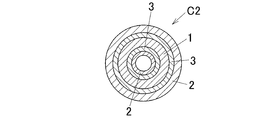
- the aluminum porous body as the anode body 1 constituting the aluminum electrolytic capacitor C1 is formed in a columnar shape, but is not limited thereto, and for example, as shown in FIG. 1B, a cylindrical aluminum porous body You may make it produce the aluminum electrolytic capacitor C2 using the anode material 1 comprised by the mass.
- separators 3 and 3 are attached to the outer peripheral surface and inner peripheral surface of the cylindrical anode material 1, and the inside of the inner peripheral separator 3 and the outer peripheral separator 3 Cathode bodies 2 and 2 are attached to the outside, respectively.
- the porous structure is formed on the inner peripheral surface in addition to the outer peripheral surface of the anode material 1, the surface area can be further increased, and the capacitance can be further improved. Can do.
- an aluminum electrolytic capacitor can be formed by sequentially laminating and placing a semiconductor layer and a conductor layer on the dielectric coating.
- the semiconductor layer can be formed of an inorganic semiconductor such as manganese dioxide or an organic semiconductor such as a conductive polymer, and these can be generally produced by a known method. In the case of forming with a conductive polymer, it can be formed using, for example, a chemical polymerization method and / or an electrolytic polymerization method.
- the solution for forming the semiconductor layer is not particularly limited as long as the solution can form a semiconductor by dipping and / or energization. For example, a solution containing aniline, thiophene, pyrrole and substituted derivatives thereof (for example, 3,4-ethylenedioxythiophene, etc.) can be used. Further, a dopant may be added to this solution.
- arylsulfonic acid or its salt alkylsulfonic acid or its salt, various polymeric sulfonic acid or its salt, etc.
- conductive polymer for example, polyaniline, polythiophene, polypyrrole, polymethylpyrrole, and derivatives thereof
- a semiconductor layer can be formed.
- the conductor layer can be made of, for example, highly conductive carbon or silver, and can be produced by solidifying pasty carbon or silver. These may be laminated.
- Example 1-1 An Al-15 mass% Mg alloy melt was cast and solidified into a cylindrical shape (round bar) having a diameter of 10 mm at a cooling rate of 80 ° C./sec to obtain a cast body.
- the cast body was turned and shaped into a diameter of 5 mm and a length of 20 mm to obtain a round bar-shaped aluminum alloy cast body.
- the cast aluminum alloy was used as a precursor, degreased with ethanol, immersed in a 40% by mass nitric acid aqueous solution at room temperature for 6 hours, washed with water and dried to obtain the porous aluminum body of the present invention.
- FIG. 1C shows an optical micrograph of a cross section of the solidified structure in the precursor of the aluminum porous body.
- an ⁇ -phase 11 of the primary crystal (light gray portion in the figure) is formed in a dendritic crystal, and a second phase 12 (dark in the figure) is formed between the ⁇ -phases 11. (Gray part) is formed continuously.
- the depth (etching depth) of the void formed by elution of the second phase 12 is 0.085 mm from the surface of the porous body, and the width of the void.
- the (pore size) was 2 ⁇ m to 5 ⁇ m.
- the obtained aluminum porous body was immersed in pure water in a boiling state for 5 minutes for chemical conversion pretreatment.
- the aluminum porous body subjected to the chemical conversion pretreatment was immersed in 11 L of pure water to which 1100 g of boric acid and 9.9 g of ammonium pentaborate octahydrate were added, and the initial current value was 500 mA / cm 2 at 90 ° C., constant voltage. Chemical conversion treatment was carried out by holding at 150 V for 10 minutes.
- the aluminum porous body subjected to chemical conversion treatment is immersed in 360 ml of pure water to which 28.8 g of ammonium pentaborate octahydrate is added, and below the surface of the stainless steel container (area: bottom diameter 60 mm ⁇ height 150 mm)
- As a counter electrode 30 ° C., measurement frequency 120 Hz, measurement voltage 0.5 Vr. m. s.
- the capacitance was measured at, it was 8.64 ⁇ F.
- Example 1-2 A molten alloy of Al-9 mass% Mg alloy was cast and solidified into a cylindrical shape (round bar) having a diameter of 10 mm at a cooling rate of 80 ° C./sec to obtain a cast body.
- the cast body was turned and shaped into a diameter of 5 mm and a length of 20 mm to obtain a round bar-shaped aluminum alloy cast body.
- the cast aluminum alloy was used as a precursor, degreased with ethanol, immersed in an 8N aqueous nitric acid solution at 20 ° C. for 6 hours, washed with water and dried to obtain the porous aluminum body of the present invention.
- Example 1-1 After performing chemical conversion pretreatment and chemical conversion treatment in the same manner as in Example 1-1, the capacitance was measured by the same method as in Example 1-1. As a result, it was 4.82 ⁇ F.
- Example 1-3 A molten Al-13 mass% Mg alloy was cast and solidified into a cylindrical shape (round bar) having a diameter of 10 mm at a cooling rate of 30 ° C./sec to obtain a cast body.
- the cast body was turned and shaped into a diameter of 5 mm and a length of 20 mm to obtain a round bar-shaped aluminum alloy cast body.
- the cast aluminum alloy was used as a precursor, degreased with ethanol, immersed in an 8N aqueous nitric acid solution at 20 ° C. for 6 hours, washed with water and dried to obtain the porous aluminum body of the present invention.
- Example 1-1 After performing chemical conversion pretreatment and chemical conversion treatment in the same manner as in Example 1-1, the capacitance was measured by the same method as in Example 1-1, and it was 5.60 ⁇ F.
- Example 1-4 A molten Al-13 mass% Mg alloy was cast and solidified into a cylindrical shape (round bar) having a diameter of 10 mm at a cooling rate of 80 ° C./sec to obtain a cast body.
- the cast body was turned and shaped into a diameter of 5 mm and a length of 20 mm to obtain a round bar-shaped aluminum alloy cast body.
- the cast aluminum alloy was used as a precursor, degreased with ethanol, immersed in a 5N aqueous hydrochloric acid solution at 10 ° C. for 24 hours, washed with water and dried to obtain the porous aluminum body of the present invention.
- Example 1-1 After performing chemical conversion pretreatment and chemical conversion treatment in the same manner as in Example 1-1, the capacitance was measured by the same method as in Example 1-1, and it was 7.00 ⁇ F.
- Example 1-5 A molten Al-13 mass% Mg alloy was cast and solidified into a cylindrical shape (round bar) having a diameter of 10 mm at a cooling rate of 30 ° C./sec to obtain a cast body.
- the cast body was turned and shaped into a diameter of 5 mm and a length of 20 mm to obtain a round bar-shaped aluminum alloy cast body.
- the cast aluminum alloy was used as a precursor, degreased with ethanol, immersed in a 5N aqueous hydrochloric acid solution at 10 ° C. for 24 hours, washed with water and dried to obtain the porous aluminum body of the present invention.
- Example 1-1 After performing chemical conversion pretreatment and chemical conversion treatment in the same manner as in Example 1-1, the capacitance was measured by the same method as in Example 1-1, and it was 5.02 ⁇ F.
- Example 1-6 A molten Al-13 mass% Mg alloy was cast and solidified into a cylindrical shape (round bar) having a diameter of 10 mm at a cooling rate of 80 ° C./sec to obtain a cast body.
- the cast body was turned and shaped into a diameter of 5 mm and a length of 20 mm to obtain a round bar-shaped aluminum alloy cast body.
- the cast aluminum alloy was used as a precursor, degreased with ethanol, immersed in an aqueous solution containing 5N hydrochloric acid and 5N sulfuric acid at 10 ° C. for 24 hours, washed with water and dried to obtain the porous aluminum body of the present invention. Obtained.
- Example 1-1 After performing chemical conversion pretreatment and chemical conversion treatment in the same manner as in Example 1-1, the capacitance was measured by the same method as in Example 1-1, and it was 7.90 ⁇ F.
- the electrode having a high electrostatic capacity can be obtained by elution of the second phase of the coagulated tissue by contacting with an eluent that dissolves the material to form an aluminum porous body having a large number of voids communicating from the surface to the inside. A material can be obtained.
- the reason why the aluminum porous body after the chemical conversion treatment has a high capacitance is that the aluminum porous body has a large surface area.
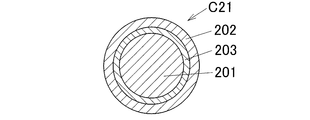
- FIG. 2A is a sectional view schematically showing an aluminum electrolytic capacitor C21 according to the second embodiment of the present invention.
- the capacitor C21 is a cylindrical anode material 201 functioning as an anode, a sheet-like or film-like separator 203 wound around the outer periphery of the anode material 201, and the outer periphery of the separator 203.
- a foil-like cathode material 202 that functions as a cathode.
- the separator 203 and the cathode material 202 are made of a conventionally known material, while the anode material 201 is made of a material specific to this embodiment as will be described later.
- an aluminum electrolytic capacitor is formed by sandwiching a dielectric film made of aluminum oxide formed on an anode body made of aluminum between an anode and a cathode facing the anode.
- porous aluminum body of the present invention As an anode material, a dielectric film is formed on the anode material, and a separator infiltrated with an electrolyte solution serving as a cathode is placed on the dielectric film, whereby an aluminum electrolytic capacitor is obtained. Can be formed.
- separator a known separator such as a porous cellulose membrane can be used.
- the electrolytic solution generally comprises a cation component, an anion component, and a solvent.
- the anion component include weak acids such as boric acid and carboxylic acid
- examples of the cation component include organic bases such as ammonia and amines.
- examples of the solvent include ethylene glycol and ⁇ -butyrolactone.
- the cathode a conventional surface-expanded Al foil or the like can be used.
- the anode material 201 obtained by the present invention is composed of an aluminum porous body (porous material).
- This aluminum porous body has an aluminum alloy cast body formed by casting solidification as a precursor. Then, the precursor is subjected to a predetermined treatment to produce an aluminum intermediate, and a required portion of the aluminum intermediate is eluted (etched) to open a surface, and a large number of continuous voids from the surface to the inside.
- the aluminum porous body of this embodiment having (pores) is obtained.
- An aluminum alloy as a precursor can be expressed as an Al—X alloy in which “X” as an additive component (additive element) is added to Al (aluminum) as a main component (residual component).
- the solidification structure of the precursor has an ⁇ phase composed of primary crystals (that is, an ⁇ -Al phase), and a second phase having a eutectic formed in a continuous manner with the ⁇ phase.
- the primary crystal refers to a crystal that is first formed from a molten metal during casting solidification.
- the second phase has a eutectic of Al and the additive element “X”. The second phase is virtually all connected.
- the isolated second phase may remain as long as the effects of the present invention are not impaired.
- this precursor is immersed in a molten metal bath of “Y” as a bath component (bath metal element) to elute “X”, and a part, preferably all of “X” is expressed as “Y”.
- a molten metal bath of “Y” as a bath component (bath metal element) to elute “X”, and a part, preferably all of “X” is expressed as “Y”.
- Y molten metal bath of “Y”
- Y bath component
- the metal structure of the aluminum intermediate has a residual phase corresponding to the ⁇ phase of the precursor and an elution phase corresponding to the second phase, and the aluminum intermediate is brought into contact with an eluent that dissolves “Y”. And the bath component “Y” elutes preferentially, and the main part of the residual phase corresponding to the ⁇ phase remains, while at least a part, preferably all, of the elution phase corresponding to the second phase elutes. As a result, a large number of continuous voids (pores) are formed in the aluminum intermediate body from the surface to the inside, and the porous aluminum body of this embodiment is obtained.
- additive component “X” examples include elements selected from Ca, Cu, Mg, Zn, Ni, Mn, Bi, In, and Sn. Can be cited as a preferred example.
- the additive component “X” is not limited to one type, and two or more types may be added.
- a part of the additive component “X” to be replaced may be replaced with the bath component “Y”, or all may be replaced with the bath component “Y”.
- the bath component “Y” is a metal element having a melting point lower than that of Al, is less soluble in Al “Y”, and is a different type of element from the additive component “X” to be replaced.
- at least one element selected from Bi and In, that is, Bi and In, and a low-melting-point material in which these are combined can be used.
- Bi can be cited as a preferred example of the bath component “Y”.
- the bath temperature is set lower than the melting point of the Al—X alloy and higher than the melting point of “Y”.
- the bath component “Y” is about 400 to 500 ° C. when Bi is used, and about 200 to 350 ° C. when In is used.
- the precursor component is immersed in the bath component “Y” and the additive component “X” is replaced with the bath component “Y”, it may be performed in an atmospheric atmosphere, but is preferably an oxidation containing a large amount of N 2 , Ar, or the like. This should be done in a controlled atmosphere.
- the Al—X-based alloy constituting the precursor can be regarded as having a hypoeutectic composition with an Al-based addition amount of “X” below the eutectic point.
- the Al-rich alloy phase crystallizes inside the solidification cell structure constituting the ⁇ phase, while the final solidification portion of the solidification cell formed on the outer periphery of the ⁇ phase. Crystallizes an alloy phase (second phase) containing a large amount of additive component “X”.
- the bath component “Y” is placed around the remaining phase of the aluminum intermediate (corresponding to the ⁇ phase).
- the bath component “Y” of the elution phase is preferentially eluted by the eluent, and as a result, the elution phase can be effectively eluted, and a desired void can be reliably formed.
- the ⁇ phase may also be eluted slightly, but this is not a problem as long as a continuous void is formed and the shape of the porous body is maintained.
- the precursor has a hypereutectic composition in which the addition amount of “X” exceeds the eutectic point
- a crystallized product whose primary crystal is composed of the additive component “X” or an alloy containing a large amount of the additive component “X” Become a phase.
- many parts of the primary crystals are eluted by the eluent.
- the voids are too large, and the surface area cannot be sufficiently expanded, or the porosity cannot be maintained, which is not preferable.
- an element other than “X” (third component) is added within the range of the eutectic composition to the Al—X alloy as the precursor as necessary or unavoidable. You can also.
- the general addition amount of “X” in the precursor is not more than the eutectic composition and is 1% by mass or more, desirably 5% by mass or more, and more desirably 10% by mass or more. That is, when “X” is added in this amount, as described above, in the aluminum intermediate in which the additive component “X” is replaced with the bath component “Y”, the bath component “Y” is added to the remaining phase ( ⁇ phase). And the bath component “Y” is preferentially eluted by the eluate, and the desired porous structure (void) can be formed when the elution phase is eluted.
- the eutectic composition in the present invention is, for example, 35% by mass with the smallest amount of Mg in the phase diagram in the case of an Al—Mg alloy, and 15% by mass in the case of an Al—In alloy. In the case of an Al—Zn alloy, the content is 36% by mass.
- the smaller the solidification cell as the ⁇ phase during casting solidification the more porous aluminum is obtained.
- the surface area of the material can be increased. Therefore, it is preferable to reduce the solidification cell during casting solidification.
- the cooling rate in the vicinity of the freezing point may be adjusted to 1 ° C./sec or higher, preferably 5 ° C./sec or higher, more preferably 10 ° C./sec or higher.
- dendrites in at least a part of the ⁇ -phase solidification cell in the precursor, that is, the remaining phase cells in the aluminum intermediate, and more preferably all of them are formed in dendrites.
- the precursor of the aluminum porous body related to the present invention has an ⁇ phase 211 formed by dendrites as shown in the light gray portion of the figure.
- the second phase 212 (the dark gray portion in the figure) is continuously formed between the dendrites.
- the precursor may be subjected to a drawing process or a rolling process for shaping the outer shape.
- the precursor is processed with a high deformation rate, the solidified structure collapses, the crystallized product as the second phase is fragmented, and the eluted phase of the aluminum intermediate (corresponding to the second phase) is eluted.
- a desired void may not be obtained.
- the surface of the precursor may be left as it is, but the cast solidified surface is cut (deleted) so that the additive component “X” can be replaced with the bath component “Y” quickly and uniformly. Is good.
- an acid aqueous solution can be exemplified.
- the acid contained in the acid aqueous solution it is preferable to use nitric acid or sulfuric acid in which Al does not easily elute, and hydrochloric acid or the like can also be used.
- An aluminum porous body obtained by treating the above aluminum intermediate with an eluate can be used as a capacitor electrode material.
- a dielectric coating is formed on the anode body.
- the method for forming the dielectric film is not particularly limited, but it is preferable to apply a chemical conversion treatment by anodic oxidation.
- Hydration treatment is generally performed in pure water as pre-chemical treatment.
- Other pretreatment methods include immersion in hydrogen peroxide, cleaning with an acid or alkaline treatment solution, vacuum or atmospheric heat treatment, dechlorination treatment, hydration treatment in an aqueous solution to which an amine is added, thermal oxide film It can be applied alone or in combination from known pretreatment methods including treatment with an acid or alkali solution after formation, and hydration treatment performed after electrolytic etching is applied to the aluminum foil.
- the chemical conversion treatment solution known ones can be used, and examples include an aqueous solution in which one or more of boric acid, ammonium borate, adipic acid, ammonium adipate, phosphoric acid and its salt, citric acid and its salt, etc. are mixed. it can.
- the EIAJ method can be exemplified, but is not limited thereto.
- the chemical conversion treatment may be performed a plurality of times, the chemical conversion liquid may be changed for each chemical conversion treatment according to a known method, and heat treatment or washing may be performed between the chemical conversion treatment and the chemical conversion treatment.
- the conversion voltage may be set to different values in a plurality of conversion processes.
- the precursor and the aluminum intermediate are formed in a columnar shape, but are not limited thereto.
- the precursor and the aluminum intermediate are cylindrical, elliptical cylinder, elliptical cylinder, prismatic, rectangular cylinder, plate It may be formed in any shape such as a flat shape.
- a flat shape For example, in order to effectively utilize the surface of the precursor and enlarge the surface area, it is advantageous to form the surface in an elliptical shape or a flat shape.
- the precursor and the aluminum intermediate body are hollow like a cylinder or the like, it can be preferentially eluted from the inner peripheral surface, so that a higher surface area can be obtained.
- an aluminum alloy cast body as a precursor for example, a method in which a molten aluminum alloy having a predetermined alloy composition is cast into a mold close to the final shape and solidified, and then the shape is adjusted by slightly shaving the surface, etc. Can be used.
- a method of producing a precursor having an elliptical cross section by compressing a round bar-shaped aluminum alloy cast from above and below to such an extent that a solidified structure remains can be employed.
- the aluminum porous body as the anode material 201 constituting the aluminum electrolytic capacitor C21 is formed in a columnar shape, but is not limited thereto, and for example, as shown in FIG. 2B, a cylindrical aluminum porous body You may make it produce the aluminum electrolytic capacitor C22 using the anode material 201 comprised by the mass.
- the capacitor C22 of this modification has separators 203, 203 attached to the outer peripheral surface and the inner peripheral surface of a cylindrical anode material 201, and the inside of the inner peripheral separator 203 and the outer peripheral separator 203.
- Cathode materials 202 and 202 are respectively attached to the outside.
- the porous structure is formed on the inner peripheral surface in addition to the outer peripheral surface of the anode material 201, the surface area can be further increased, and the capacitance can be further improved. Can do.
- an aluminum electrolytic capacitor can be formed by sequentially laminating and placing a semiconductor layer and a conductor layer on the dielectric coating.
- the semiconductor layer can be formed of an inorganic semiconductor such as manganese dioxide or an organic semiconductor such as a conductive polymer, and these can be generally produced by a known method. In the case of forming with a conductive polymer, it can be formed using, for example, a chemical polymerization method and / or an electrolytic polymerization method.
- the solution for forming the semiconductor layer is not particularly limited as long as the solution can form a semiconductor by dipping and / or energization. For example, a solution containing aniline, thiophene, pyrrole and substituted derivatives thereof (for example, 3,4-ethylenedioxythiophene, etc.) can be used. Further, a dopant may be added to this solution.
- arylsulfonic acid or its salt alkylsulfonic acid or its salt, various polymeric sulfonic acid or its salt, etc.
- conductive polymer for example, polyaniline, polythiophene, polypyrrole, polymethylpyrrole, and derivatives thereof
- a semiconductor layer can be formed.
- the conductor layer can be made of, for example, highly conductive carbon or silver, and can be produced by solidifying pasty carbon or silver. These may be laminated.
- Example 2-1 An Al-15 mass% Mg alloy melt was cast and solidified into a cylindrical shape (round bar) having a diameter of 10 mm at a cooling rate of 80 ° C./sec to obtain a cast body. The cast body was turned and shaped into a diameter of 5 mm and a length of 20 mm to obtain a round bar-shaped aluminum alloy cast body. Then, the aluminum alloy casting was used as a precursor, and immersed in a molten metal bath (500 ° C.) of Bi as a bath component in the atmosphere for 1 minute to obtain an aluminum intermediate. Subsequently, the aluminum intermediate was immersed in nitric acid having a concentration of 40% by mass at room temperature for 6 hours, washed with water and dried to obtain an aluminum porous body of Example 2-1 related to the present invention.
- a molten metal bath 500 ° C.
- Bi molten metal bath
- FIG. 2C shows an optical micrograph of a cross section of the solidified structure in the precursor of the aluminum porous body.
- the ⁇ phase 211 (light gray part in the figure) is formed in a dendritic crystal
- the second phase 212 (dark gray part in the figure) is interposed between the ⁇ phases 211. ) Are formed continuously.
- the depth of the void formed by the elution of the elution phase was 0.2 mm to 0.3 mm from the surface of the porous body.
- the void width was 2 ⁇ m to 5 ⁇ m.
- the obtained aluminum porous body was immersed in boiling pure water for 5 minutes for chemical conversion pretreatment.
- the aluminum porous body subjected to the chemical conversion pretreatment was immersed in 11 L of pure water to which 1100 g of boric acid and 9.9 g of ammonium pentaborate octahydrate were added, and the initial current value was 500 mA / cm 2 at 90 ° C., constant voltage.
- Chemical conversion treatment was carried out by holding at 150 V for 10 minutes.
- the aluminum porous body subjected to the chemical conversion treatment is immersed in 360 ml of pure water to which 28.8 g of ammonium pentaborate octahydrate is added, and below the surface of the stainless steel container (area: diameter 60 mm ⁇ height 150 mm)
- As a counter electrode 30 ° C., measurement frequency 120 Hz, measurement voltage 0.5 Vr. m. s.
- the capacitance was measured, it was 12.94 ⁇ F.
- Example 2 was carried out in the same manner as in Example 2-1 except that the cooling rate during casting was set to 50 ° C./sec, and the immersion time of Bi in the molten metal bath in the aluminum intermediate was set to 5 minutes. 2 porous aluminum was obtained.
- FIG. 2D shows an SEM photograph of the cross section of the metal structure in the replica of the porous aluminum body of Example 2-2.
- the replica is obtained by dissolving and removing the Al base material after forming an oxide film on the pore inner surface of the aluminum porous body.
- voids (corresponding to the residual phase) 213 after removal of the residual phase are formed, and are formed on the inner surfaces of the pores (voids) between the voids 213 after removal of the residual phase.
- An oxide film 214 (the dark gray portion in the figure) is continuously formed.
- Example 2-2 the aluminum porous body of Example 2-2 was analyzed, and as a result, the depth of the void (etching depth) after removal of the eluted phase was 0.35 mm to 0.5 mm from the surface of the porous body.
- the width (pore average diameter) was 10 ⁇ m.
- Example 2-2 the aluminum porous body was subjected to chemical conversion pretreatment and chemical conversion treatment in the same manner as in Example 2-1, and the capacitance was measured. As a result, it was 6.12 ⁇ F.
- Example 2-3 A molten Al-13 mass% Mg alloy was cast and solidified into a cylindrical shape (round bar) having a diameter of 10 mm at a cooling rate of 30 ° C./sec to obtain a cast body. The cast body was turned and shaped into a diameter of 5 mm and a length of 20 mm to obtain a round bar-shaped aluminum alloy cast body. Then, the aluminum alloy casting was used as a precursor, and immersed in a molten metal bath (500 ° C.) of Bi as a bath component in the atmosphere for 1 minute to obtain an aluminum intermediate. Subsequently, the aluminum intermediate was immersed in an 8N aqueous nitric acid solution at 20 ° C. for 6 hours, washed with water and dried to obtain an aluminum porous body of Example 2-3 related to the present invention.
- a molten metal bath 500 ° C.
- Example 2-3 the aluminum porous body was subjected to pre-chemical conversion treatment and chemical conversion treatment in the same manner as in Example 2-1, and the capacitance was measured. As a result, it was 8.70 ⁇ F.
- Example 2-4 An aluminum porous body of Example 2-4 related to the present invention was obtained in the same manner as Example 2-3 except that the immersion time of Bi in a molten metal bath (500 ° C.) was 5 minutes.
- Example 2-4 the aluminum porous body was subjected to chemical conversion pretreatment and chemical conversion treatment in the same manner as in Example 2-1, and the capacitance was measured. As a result, it was 9.10 ⁇ F.
- an aluminum alloy cast body having a solidified structure having an ⁇ -Al phase and a second phase formed in a continuous manner with the ⁇ -Al phase by casting solidification of an aluminum alloy is referred to as “Al”.
- the precursor is immersed in a molten metal bath having a lower melting point than the bath component “Y”, and the element “X” is eluted and replaced with “Y”, and the remaining phase corresponding to the ⁇ phase,
- An aluminum porous body having a large number of voids communicating from the surface to the inside is prepared by preparing an aluminum intermediate having a metallographic structure having an elution phase corresponding to a phase and contacting with an eluent that dissolves “Y” of the intermediate
- An electrode material having a high capacitance can be obtained.
- the reason why the aluminum porous body after the chemical conversion treatment has a high capacitance is that the aluminum porous body has a large surface area.
- the method for producing an aluminum porous body of the present invention can be suitably used when producing an anode material for an aluminum electrolytic capacitor or an aluminum solid electrolytic capacitor.
Landscapes
- Engineering & Computer Science (AREA)
- Chemical & Material Sciences (AREA)
- Power Engineering (AREA)
- Materials Engineering (AREA)
- Mechanical Engineering (AREA)
- Metallurgy (AREA)
- Organic Chemistry (AREA)
- Microelectronics & Electronic Packaging (AREA)
- ing And Chemical Polishing (AREA)
Abstract
La présente invention concerne un procédé de fabrication d'un objet en aluminium poreux présentant une surface élevée. Le procédé de fabrication d'un objet en aluminium poreux selon la présente invention comprend : une étape dans laquelle un alliage d'aluminium est coulé et solidifié pour produire un objet coulé en alliage d'aluminium ayant une structure solidifiée qui comprend une phase α-Al 11 et une deuxième phase 12, qui a été formée de façon continue de façon à s'entremêler avec la phase α-Al ; et une étape dans laquelle l'objet coulé d'alliage d'aluminium en tant que précurseur est mis en contact avec un agent d'extraction pour dissoudre la deuxième phase, de manière à dissoudre la deuxième phase 12 de la structure solidifiée dans le précurseur et à produire un objet en aluminium poreux qui a un nombre élevé de pores s'étendant vers l'intérieur depuis la surface.
Priority Applications (2)
| Application Number | Priority Date | Filing Date | Title |
|---|---|---|---|
| CN201680013398.XA CN107406912B (zh) | 2015-03-02 | 2016-03-02 | 铝多孔质体的制造方法 |
| EP16758954.8A EP3266886A4 (fr) | 2015-03-02 | 2016-03-02 | Procédé de fabrication d'un objet en aluminium poreux |
Applications Claiming Priority (8)
| Application Number | Priority Date | Filing Date | Title |
|---|---|---|---|
| JP2015040435 | 2015-03-02 | ||
| JP2015-040435 | 2015-03-02 | ||
| JP2015040437 | 2015-03-02 | ||
| JP2015-040437 | 2015-03-02 | ||
| JP2016-039601 | 2016-03-02 | ||
| JP2016039601A JP2016166411A (ja) | 2015-03-02 | 2016-03-02 | アルミニウム多孔質体の製造方法 |
| JP2016039602A JP2016166412A (ja) | 2015-03-02 | 2016-03-02 | アルミニウム多孔質体の製造方法 |
| JP2016-039602 | 2016-03-02 |
Publications (1)
| Publication Number | Publication Date |
|---|---|
| WO2016140261A1 true WO2016140261A1 (fr) | 2016-09-09 |
Family
ID=56849346
Family Applications (1)
| Application Number | Title | Priority Date | Filing Date |
|---|---|---|---|
| PCT/JP2016/056410 Ceased WO2016140261A1 (fr) | 2015-03-02 | 2016-03-02 | Procédé de fabrication d'un objet en aluminium poreux |
Country Status (1)
| Country | Link |
|---|---|
| WO (1) | WO2016140261A1 (fr) |
Citations (1)
| Publication number | Priority date | Publication date | Assignee | Title |
|---|---|---|---|---|
| JPS4884043A (fr) * | 1972-02-11 | 1973-11-08 |
-
2016
- 2016-03-02 WO PCT/JP2016/056410 patent/WO2016140261A1/fr not_active Ceased
Patent Citations (1)
| Publication number | Priority date | Publication date | Assignee | Title |
|---|---|---|---|---|
| JPS4884043A (fr) * | 1972-02-11 | 1973-11-08 |
Non-Patent Citations (1)
| Title |
|---|
| See also references of EP3266886A4 * |
Similar Documents
| Publication | Publication Date | Title |
|---|---|---|
| JP4983744B2 (ja) | 固体電解コンデンサの製造方法 | |
| JP4899438B2 (ja) | 固体電解コンデンサ及びその製造方法 | |
| JP6735456B2 (ja) | 電解コンデンサの製造方法 | |
| US8513123B2 (en) | Method of manufacturing solid electrolytic capacitor | |
| JP2000073198A (ja) | バルブ金属を陽極処理するための方法及び電解質 | |
| WO2018043601A1 (fr) | Procédé de production de corps poreux en aluminium | |
| CN107406912B (zh) | 铝多孔质体的制造方法 | |
| KR20130137603A (ko) | 알루미늄 구조체의 제조 방법 및 알루미늄 구조체 | |
| JP2016166412A (ja) | アルミニウム多孔質体の製造方法 | |
| WO2018043602A1 (fr) | Procédé de production d'un corps poreux en aluminium | |
| WO2016140261A1 (fr) | Procédé de fabrication d'un objet en aluminium poreux | |
| JP2000068159A (ja) | 固体電解コンデンサ用電極箔、その製造方法及び固体電解コンデンサ | |
| JP2016166411A (ja) | アルミニウム多孔質体の製造方法 | |
| KR20130139235A (ko) | 알루미늄 구조체의 제조 방법 및 알루미늄 구조체 | |
| WO2018043603A1 (fr) | Procédé de production d'un corps poreux en aluminium | |
| WO2018043604A1 (fr) | Corps poreux en aluminium | |
| JP3092512B2 (ja) | 固体電解コンデンサの製造方法 | |
| WO2022118785A1 (fr) | Condensateur électrolytique et procédé de fabrication de condensateur électrolytique | |
| JP4647744B2 (ja) | コンデンサ用ニオブ粉、それを用いた焼結体及びそれを用いたコンデンサ | |
| JP3750476B2 (ja) | 固体電解コンデンサの製造方法 | |
| JP2008109070A (ja) | 固体電解コンデンサ素子およびその製造方法 | |
| JPH047086B2 (fr) | ||
| JP4771218B2 (ja) | 固体電解コンデンサ及びその製造方法 | |
| JPH0338728B2 (fr) | ||
| JPH0620876A (ja) | 固体電解コンデンサの製造方法 |
Legal Events
| Date | Code | Title | Description |
|---|---|---|---|
| 121 | Ep: the epo has been informed by wipo that ep was designated in this application |
Ref document number: 16758954 Country of ref document: EP Kind code of ref document: A1 |
|
| REEP | Request for entry into the european phase |
Ref document number: 2016758954 Country of ref document: EP |
|
| NENP | Non-entry into the national phase |
Ref country code: DE |