WO2016151908A1 - Écran tactile - Google Patents
Écran tactile Download PDFInfo
- Publication number
- WO2016151908A1 WO2016151908A1 PCT/JP2015/078993 JP2015078993W WO2016151908A1 WO 2016151908 A1 WO2016151908 A1 WO 2016151908A1 JP 2015078993 W JP2015078993 W JP 2015078993W WO 2016151908 A1 WO2016151908 A1 WO 2016151908A1
- Authority
- WO
- WIPO (PCT)
- Prior art keywords
- touch panel
- ultraviolet
- transmittance
- layer
- polymer film
- Prior art date
- Legal status (The legal status is an assumption and is not a legal conclusion. Google has not performed a legal analysis and makes no representation as to the accuracy of the status listed.)
- Ceased
Links
Images




Classifications
-
- G—PHYSICS
- G06—COMPUTING OR CALCULATING; COUNTING
- G06F—ELECTRIC DIGITAL DATA PROCESSING
- G06F3/00—Input arrangements for transferring data to be processed into a form capable of being handled by the computer; Output arrangements for transferring data from processing unit to output unit, e.g. interface arrangements
- G06F3/01—Input arrangements or combined input and output arrangements for interaction between user and computer
- G06F3/03—Arrangements for converting the position or the displacement of a member into a coded form
- G06F3/041—Digitisers, e.g. for touch screens or touch pads, characterised by the transducing means
- G06F3/044—Digitisers, e.g. for touch screens or touch pads, characterised by the transducing means by capacitive means
- G06F3/0446—Digitisers, e.g. for touch screens or touch pads, characterised by the transducing means by capacitive means using a grid-like structure of electrodes in at least two directions, e.g. using row and column electrodes
-
- G—PHYSICS
- G06—COMPUTING OR CALCULATING; COUNTING
- G06F—ELECTRIC DIGITAL DATA PROCESSING
- G06F3/00—Input arrangements for transferring data to be processed into a form capable of being handled by the computer; Output arrangements for transferring data from processing unit to output unit, e.g. interface arrangements
- G06F3/01—Input arrangements or combined input and output arrangements for interaction between user and computer
- G06F3/03—Arrangements for converting the position or the displacement of a member into a coded form
- G06F3/041—Digitisers, e.g. for touch screens or touch pads, characterised by the transducing means
- G06F3/044—Digitisers, e.g. for touch screens or touch pads, characterised by the transducing means by capacitive means
- G06F3/0445—Digitisers, e.g. for touch screens or touch pads, characterised by the transducing means by capacitive means using two or more layers of sensing electrodes, e.g. using two layers of electrodes separated by a dielectric layer
-
- G—PHYSICS
- G06—COMPUTING OR CALCULATING; COUNTING
- G06F—ELECTRIC DIGITAL DATA PROCESSING
- G06F2203/00—Indexing scheme relating to G06F3/00 - G06F3/048
- G06F2203/041—Indexing scheme relating to G06F3/041 - G06F3/045
- G06F2203/04103—Manufacturing, i.e. details related to manufacturing processes specially suited for touch sensitive devices
Definitions
- the present invention relates to a touch panel.
- COP films and COC films have attracted attention as film substrates for optical functional materials.
- a COP film or a COC film is a substrate having high optical transparency and high optical isotropy (low retardation).
- Application of COP films and COC films to various uses has been attempted, and for example, attempts have been made to use them as substrates included in touch panel sensors (Patent Document 1).
- touch panel sensor made of a polyethylene terephthalate (PET) film as a substrate is incorporated in a touch panel
- rainbow-like interference fringes appear depending on the viewing angle when the touch panel screen is observed while wearing sunglasses.
- the visibility of the display screen of the touch panel may be reduced due to visual recognition, or the display may become dark and the touch screen may not be visible (blackout).
- a touch panel sensor produced using a COP film or COC film as a substrate is incorporated in the touch panel, even if the touch panel is observed while wearing sunglasses, there is no occurrence of rainbow unevenness or blackout and excellent visibility.
- the direct bonding method is preferable because a reflection component due to an air interface in the touch panel can be removed and the transmittance of the image display area is improved as compared with the conventional air gap method.
- an ultraviolet curable pressure-sensitive adhesive is suitably used for laminating the touch panel sensor and the image display device. This is because the UV curable adhesive is relatively free to deform in the stage before irradiating with UV light, and it is easy to take the entire surface evenly between the touch panel sensor and the image display device. This is because the adhesion at the interface can be fixed by irradiating ultraviolet rays from the viewing side after establishing the above.
- the present inventor shows that when a touch panel incorporating a touch panel sensor including a COP film or a COC film as a substrate is used outdoors for a long time and then a strong impact is applied, the frequency of the touch sensor function not continuing increases. Found.
- the inventors of the present invention have studied the cause, and the COP film or the COC film is deteriorated by ultraviolet rays in outdoor use, and the brittleness of the substrate is deteriorated, so that when the impact is applied, the COP film or the COC film is deteriorated. This is considered to be because breakage occurred and the conductive layer (detection electrode and lead wiring) disposed on the substrate made of the COP film or COC film was also broken.
- the present inventors have devised a COP film and a COC film to be hardly deteriorated by ultraviolet rays by introducing an ultraviolet absorbing layer into the touch panel.
- the UV-curable adhesive can be sufficiently absorbed by UV light when the touch panel is deteriorated in color tone (changes in color due to the UV-absorbing layer) or when the touch panel is manufactured using the direct bonding method. It has been found that the problem that it cannot be cured occurs.
- a touch panel incorporating a touch panel sensor including a COP film or a COC film as a substrate in order to simultaneously satisfy high drop impact durability, excellent color tone, and high manufacturing aptitude for the direct bonding method, It turns out that further ingenuity is necessary.
- the present invention provides a touch panel incorporating a touch panel sensor including a COP film or a COC film as a substrate, which exhibits high drop impact durability, excellent color tone, and high manufacturing suitability for a direct bonding method.
- a touch panel incorporating a touch panel sensor including a COP film or a COC film as a substrate, which exhibits high drop impact durability, excellent color tone, and high manufacturing suitability for a direct bonding method.
- the present inventors have found that a desired effect can be obtained by using an ultraviolet absorbing layer exhibiting predetermined optical characteristics. That is, it has been found that the above object can be achieved by the following configuration.
- the touch panel sensor includes a polymer film of any one of a cyclic olefin polymer film and a cyclic olefin copolymer film, Between the polymer film and the protective substrate, there is an ultraviolet absorbing layer, The transmittance of the ultraviolet absorbing layer in the wavelength range of 200 to 340 nm is 5% or less, The transmittance of the ultraviolet absorbing layer at a wavelength of 400 nm is 86% or more, The transmittance in the wavelength range of 400 to 800 nm of the ultraviolet absorbing layer is within ⁇ 3% of the transmittance at a wavelength of 400 nm, A touch panel in which an ultraviolet curable pressure-sensitive adhesive is cured by light in a wavelength range of 340 nm to 400 nm or less.
- a touch panel incorporating a touch panel sensor including a COP film or a COC film as a substrate which exhibits high drop impact durability, excellent color tone, and high manufacturing suitability for a direct bonding method.
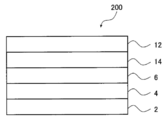
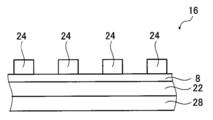
- FIG. 3 is a cross-sectional view taken along a cutting line AA shown in FIG. It is an enlarged plan view of a 1st detection electrode. It is a partial cross section of other embodiment of an electrostatic capacitance type touch panel sensor. It is a partial cross section of other embodiment of an electrostatic capacitance type touch panel sensor. It is sectional drawing of 2nd Embodiment of the touchscreen of this invention. It is sectional drawing of 3rd Embodiment of the touchscreen of this invention. It is sectional drawing of the electrostatic capacitance type touch panel sensor in 3rd Embodiment of the touch panel of this invention. It is a transmission spectrum figure of the sharp cut filter used in the Example.
- (meth) acrylic resin intends acrylic resin and / or methacrylic resin.
- (meth) acrylate intends acrylate and / or methacrylate (methacrylate).
- a numerical range expressed using “to” in this specification means a range including numerical values described before and after “to” as a lower limit value and an upper limit value.
- a feature of the present invention is that an ultraviolet absorbing layer exhibiting predetermined optical characteristics is used.
- an optical characteristic of the ultraviolet absorbing layer first, in order to impart ultraviolet durability to the COP film or the COC film disposed on the image display device side of the ultraviolet absorbing layer, transmission in a wavelength range of 200 to 340 nm. The point which makes the rate below a predetermined value is mentioned.
- the present inventors conducted an investigation using a sharp cut filter manufactured by HOYA in order to clarify the cut wavelength necessary for imparting ultraviolet durability to a COP film or COC film, and a wavelength of 340 nm.
- the ultraviolet deterioration of the polymer film is less likely to occur in a touch panel using a COP film or a COC film as a substrate (polymer film).
- the present inventors further select the ultraviolet absorber that absorbs ultraviolet rays having a wavelength of 340 nm or less and has little absorption of wavelengths of 400 nm or more and use it in the ultraviolet absorbing layer, thereby improving the ultraviolet durability of the COP film or COC film. It was found that the color tone of the touch panel sensor can be kept neutral while guaranteeing.
- an ultraviolet curable adhesive that is cured by light to a wavelength of 340 nm or more and a wavelength of 400 nm or less when uncured is used as an image display device and a touch panel sensor-containing laminate (capacitive touch panel sensor, If it is used for bonding of an adhesive layer and a laminate comprising a protective substrate, the ultraviolet curable adhesive can be cured by ultraviolet irradiation after bonding, and a touch panel can be efficiently produced by a direct bonding method. In this way, by installing an ultraviolet absorbing layer having absorption for a specific wavelength, it was possible to obtain a touch panel having high drop impact durability, excellent color tone, and high manufacturing suitability for the direct bonding method.
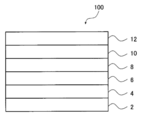
- FIG. 1 is a cross-sectional view of a first embodiment of the touch panel of the present invention.
- the touch panel 100 includes an image display device 2, an adhesive layer 4 (corresponding to a lower adhesive layer) formed by curing an ultraviolet curable adhesive, a capacitive touch panel sensor 6, The ultraviolet absorbing layer 8, the upper adhesive layer 10, and the protective substrate 12 are provided in this order.
- the touch panel 100 is a so-called capacitive touch panel, and when a finger comes close to or comes into contact with the surface (touch surface) of the protective substrate 12, the capacitance between the finger and the detection electrode in the capacitive touch panel sensor 6 is high. Change.
- a position detection driver (not shown) always detects a change in capacitance between the finger and the detection electrode.
- the position detection driver detects a position where the change in capacitance is detected as an input position.
- the touch panel 100 can detect the input position.
- the image display device 2 and the capacitive touch panel sensor 6 are directly stacked via the adhesive layer 4.
- each member of the touch panel 100 will be described in detail.
- the aspect of the ultraviolet absorbing layer 8 which is a feature of the present invention will be described in detail, and then other members will be described in detail.
- the ultraviolet absorbing layer 8 is a layer disposed between the polymer film in the capacitive touch panel sensor 6 described later and the protective substrate 12, and exhibits predetermined optical characteristics.
- the ultraviolet absorbing layer 8 does not exhibit adhesiveness and corresponds to a non-adhesive layer.
- the transmittance of the ultraviolet absorbing layer 8 in the wavelength range of 200 to 340 nm is 5% or less. That is, the maximum transmittance (%) in the wavelength range of 200 to 340 nm is 5% or less. Especially, 3% or less is preferable and 2.5% or less is more preferable at the point which the drop impact durability of a touchscreen is more excellent. Although a minimum in particular is not restrict
- the transmittance of the ultraviolet absorbing layer 8 is obtained by the following measurement and calculation.
- a sample substrate in which the ultraviolet absorbing layer 8 is formed on a glass substrate is prepared, and the total light transmittance (%) of the sample substrate is measured in a wavelength range of 200 to 800 nm using a JASCO V-670. .
- the measurement result of the transmittance (%) is represented by T S ( ⁇ ) ( ⁇ represents the wavelength).
- T B ( ⁇ ) the measurement result of this transmittance
- the transmittance T UV of the ultraviolet absorbing layer 8 is defined by the following calculation formula (1) and can be obtained by calculation.
- T UV ( ⁇ ) ⁇ T S ( ⁇ ) ⁇ T B ( ⁇ ) ⁇ ⁇ 100 (1)
- T UV 98.9. %.
- T S '( ⁇ ) the total light transmittance of the touch panel sensor laminate comprising an ultraviolet absorbing layer
- T S T S instead of (lambda)', in place of T B ( ⁇ ) T B ' ( ⁇ )
- T UV ′ ( ⁇ ) of the ultraviolet absorbing layer included in the touch panel can be obtained.
- the transmittance of the ultraviolet absorption layer 8 at a wavelength of 400 nm is high and the transmittance at a short wavelength is low within a range where the cutoff wavelength does not become 340 nm or less. Therefore, as a necessary condition, the transmittance of the ultraviolet absorbing layer 8 at a wavelength of 400 nm is 86% or more, and 92% or more is preferable, and 96% or more is more preferable in terms of better manufacturing suitability for the direct bonding method. Although an upper limit in particular is not restrict
- the method for measuring transmittance at a wavelength of 400 nm is the same as the method for measuring transmittance at a wavelength in the range of 200 to 340 nm.
- the transmittance of the ultraviolet absorbing layer 8 in the wavelength range of 400 to 800 nm is within ⁇ 3% of the transmittance at the wavelength of 400 nm.
- the maximum transmittance difference between the transmittance in the wavelength range of 400 to 800 nm and the transmittance at the wavelength of 400 nm is intended to be within ⁇ 3%.
- the difference (XZ) between the maximum value X (%) of the transmittance in the wavelength range of 400 to 800 nm and the transmittance Z (%) at the wavelength of 400 nm is within ⁇ 3%
- the wavelength of 400 to This corresponds to the difference (YZ) between the minimum value Y (%) of the transmittance in the range of 800 nm and the transmittance Z (%) at the wavelength of 400 nm being within ⁇ 3%.
- the above numerical range is preferably ⁇ 1.5%, more preferably ⁇ 0.6% in that the color tone of the touch panel is more excellent.
- the above measurement is performed by measuring the transmittance at a wavelength of 200 to 800 nm in the same manner as the method for measuring the transmittance at a wavelength of 200 to 340 nm.
- the thickness of the ultraviolet absorbing layer 8 is not particularly limited as long as the optical characteristics described above are satisfied. Among these, from the viewpoint of the balance between handleability and thinning of the touch panel, it is preferably 100 ⁇ m or less, more preferably 1 to 100 ⁇ m, and even more preferably 10 to 60 ⁇ m.
- the ultraviolet absorbing layer 8 contains an ultraviolet absorber.
- the kind in particular of ultraviolet absorber to be used is not restrict
- UV absorbers include metal oxide fine particles, benzotriazole UV absorbers, benzophenone UV absorbers, salicylate UV absorbers, cyanoacrylate UV absorbers, nickel UV absorbers, and triazine UV absorbers. And hydroxyphenyltriazine-based ultraviolet absorbers. Among them, benzotriazole-based UV absorbers or hydroxyphenyltriazine-based UV absorbers are high in their ability to absorb UV rays and have little effect on the corrosion of metal components contained in conductive thin wires in touch panel sensors. preferable.
- the amount of the ultraviolet absorbent used in the ultraviolet absorbing layer 8 is not particularly limited as long as the ultraviolet absorbing layer 8 exhibits the optical characteristics described above. Of these, 0.1 to 1.5 g / m 2 is preferable and 0.3 to 0.8 g / m 2 is more preferable in terms of easy control of optical characteristics.
- the ultraviolet absorbing layer 8 may contain a component other than the ultraviolet absorber.
- the ultraviolet absorbing layer 8 may contain a binder resin.
- the type of the binder resin is not particularly limited.
- gelatin (meth) acrylic resin, styrene resin, vinyl resin, polyolefin resin, polyester resin, polyurethane resin, polyamide resin, polycarbonate resin, polydiene Resin, epoxy resin, silicone resin, cellulosic polymer and chitosan polymer, at least one resin selected from the group consisting of these, or a copolymer composed of monomers constituting these resins, etc. Is mentioned.
- the absolute value of b * obtained in accordance with JIS-Z8729 of the ultraviolet absorbing layer 8 is not particularly limited, but is preferably less than 1.0 from the viewpoint that the color tone of the touch panel is more excellent.
- the b * of the ultraviolet absorbing layer 8 is measured by using the result of the transmittance T UV ( ⁇ ) of the ultraviolet absorbing layer 8 obtained as described above, and transmitted light by the method defined in JIS-Z8729: 1994. L * value, a * value, and b * value are calculated.
- the formation method in particular of the ultraviolet absorption layer 8 is not restrict
- the composition for ultraviolet absorption layer formation containing the ultraviolet absorber mentioned above is apply
- surfactant may be contained in the composition for ultraviolet absorption layer formation.
- the image display device 2 is a device having a display surface for displaying an image, and each member is arranged on the display screen side.
- the type of the image display device 2 is not particularly limited, and a known image display device can be used.
- cathode ray tube (CRT) display liquid crystal display (LCD), organic light emitting diode (OLED) display, vacuum fluorescent display (VFD), plasma display panel (PDP), surface field display (SED), field emission display (FED) or electronic paper (E-Paper).
- CTR cathode ray tube
- LCD liquid crystal display
- OLED organic light emitting diode
- VFD vacuum fluorescent display
- PDP plasma display panel
- SED surface field display
- FED field emission display
- E-Paper electronic paper
- the adhesive layer 4 is a layer for ensuring adhesion between the image display device 2 and a capacitive touch panel sensor 6 described later.
- the adhesive layer 4 is an adhesive layer formed by curing an ultraviolet curable adhesive. That is, it is a layer obtained by irradiating an ultraviolet curable adhesive with ultraviolet rays and curing it. Note that, as described above, since the ultraviolet curable adhesive is relatively free to be deformed before irradiation with ultraviolet rays, air is involved between the image display device 2 and the capacitive touch panel sensor 6. The entire surface can be uniformly adhered and bonded while suppressing the above.
- the type of ultraviolet curable adhesive is not particularly limited as long as it is cured (photosensitized) by light having a wavelength in the range of 340 nm to 400 nm or less.
- a known ultraviolet curable adhesive can be used.
- the ultraviolet curable adhesive include, for example, an ultraviolet curable component (for example, a monomer and / or polymer having a radical polymerizable unsaturated bond in the molecule) and, if necessary, a photopolymerization initiator. Is mentioned.
- the ultraviolet curable pressure-sensitive adhesive is cured by light having a wavelength in the range of 340 nm to 400 nm. That is, by irradiating the ultraviolet curable adhesive with light having a wavelength of 340 nm or more and a wavelength of 400 nm or less, the curing reaction proceeds to form an adhesive layer (cured layer) exhibiting adhesiveness.
- the thickness of the adhesive layer 4 is not particularly limited, but is preferably 10 to 300 ⁇ m and more preferably 50 to 200 ⁇ m from the viewpoint of the balance between the handleability and the thinning of the touch panel.
- the capacitive touch panel sensor 6 is arranged on the image display device 2 (operator side), and utilizes the change in capacitance that occurs when an external conductor such as a human finger comes into contact (approach)
- a sensor that detects the position of an external conductor such as a human finger is not particularly limited, but usually has a detection electrode (particularly, a detection electrode extending in the X direction and a detection electrode extending in the Y direction), and the static detection electrode is in contact with or close to the finger.
- the coordinates of the finger are specified by detecting the change in capacitance.
- the capacitive touch panel sensor 6 includes one of a cyclic olefin polymer film and a cyclic olefin copolymer film. More specifically, the capacitive touch panel sensor 6 includes a conductive portion (detection electrode and / or lead wiring) composed of the polymer film and a conductive thin wire disposed on at least one surface of the polymer film. ).
- FIG. 2 shows a plan view of the capacitive touch panel sensor 6.
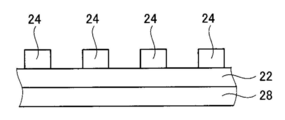
- FIG. 3 is a cross-sectional view taken along the cutting line AA in FIG.
- the capacitive touch panel sensor 6 includes a polymer film 22, a first detection electrode 24 disposed on one main surface (on the surface) of the polymer film 22, a first lead wiring 26, and the other of the polymer film 22.
- the second detection electrode 28, the second lead-out wiring 30, and the flexible printed wiring board 32 are arranged on the main surface (on the back surface).
- the region where the first detection electrode 24 and the second detection electrode 28 are provided constitutes an input region E I (an input region (sensing unit) capable of detecting contact of an object) that can be input by an operator, and input.
- a first lead wiring 26, a second lead wiring 30 and a flexible printed wiring board 32 are arranged in the outer region E O located outside the region E I. Below, the said structure is explained in full detail.
- the polymer film 22 plays a role of supporting the first detection electrode 24 and the second detection electrode 28 in the input region E I , and a role of supporting the first lead wire 26 and the second lead wire 30 in the outer region E O. It is a member that bears.
- the polymer film 22 is one of a cyclic olefin polymer film and a cyclic olefin copolymer film.
- a cyclic olefin polymer film is a film made of a cyclic olefin polymer.
- the cyclic olefin polymer is a polymer composed only of a cyclic olefin having a cyclic structure.
- the cyclic olefin polymer may be a copolymer as long as it is composed only of the cyclic olefin.
- the cyclic olefin include norbornene, methylnorbornene, dimethylnorbornene, ethylnorbornene, ethylidenenorbornene, butylnorbornene, dicyclopentadiene, dihydrodicyclopentadiene, methyldicyclopentadiene, dimethyldicyclopentadiene, tetracyclododecene, methyltetracyclo Polycyclic cyclic olefins such as dodecene, dimethylcyclotetradodecene, tricyclopentadiene, tetracyclopentadiene, and monocyclic such as cyclobutene, cyclopentene, cyclooctene, cyclooctadiene,
- the polymerization method may be ring-opening polymerization or addition polymerization.
- the cyclic olefin copolymer film is a film made of a cyclic olefin copolymer.
- Cyclic olefin copolymers include monomers composed of cyclic olefins (cyclopentene, norbornene, tetracyclododecene, etc.), non-cyclic polyolefin monomers (especially ethylene is preferred), acrylic monomers (methyl methacrylate, methyl acrylate, etc.), etc. It is a polymer obtained by copolymerizing a monomer having an olefinic double bond.
- polymer film 22 examples include, as commercial products, ARTON (cyclic olefin polymer: COP) from JSR Corporation, ZEONOR (COP) from Nippon Zeon Corporation, and TOPAS (cyclic olefin copolymer) from Polyplastics Corporation. : COC), APEL (COC) from Mitsui Chemicals, Inc., F1 film (COC) from Gunze Co., Ltd., and the like.
- the polymer film 22 preferably transmits light appropriately. Specifically, the total light transmittance of the polymer film 22 is preferably 85 to 100%.
- the thickness of the polymer film 22 is not particularly limited, but is preferably 5 to 350 ⁇ m, and more preferably 30 to 150 ⁇ m. Within the above range, desired visible light transmittance can be obtained, and handling is easy. Moreover, in FIG. 2, although the planar view shape of the polymer film 22 is substantially rectangular shape, it is not restricted to this. For example, it may be circular or polygonal.
- the first detection electrode 24 and the second detection electrode 28 are sensing electrodes that sense a change in capacitance, and constitute a sensing unit (sensing unit). That is, when the fingertip is brought into contact with the touch panel, the mutual capacitance between the first detection electrode 24 and the second detection electrode 28 changes, and the position of the fingertip is calculated by an IC (integrated circuit) circuit based on the change amount. To do.
- the first detection electrode 24 has a role of detecting an input position in the X direction of an operator's finger approaching the input area E I and has a function of generating a capacitance between the first detection electrode 24 and the finger. ing.
- the first detection electrodes 24 are electrodes that extend in a first direction (X direction) and are arranged at a predetermined interval in a second direction (Y direction) orthogonal to the first direction. Includes patterns.
- the second detection electrode 28 has a role of detecting an input position in the Y direction of an operator's finger approaching the input area E I and has a function of generating a capacitance between the second detection electrode 28 and the finger. ing.
- the second detection electrodes 28 are electrodes that extend in the second direction (Y direction) and are arranged at a predetermined interval in the first direction (X direction), and include a predetermined pattern as will be described later. In FIG. 2, five first detection electrodes 24 and five second detection electrodes 28 are provided, but the number is not particularly limited and may be plural.
- the first detection electrode 24 and the second detection electrode 28 are composed of conductive thin wires.
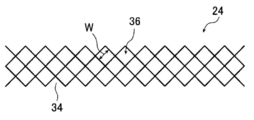
- FIG. 4 shows an enlarged plan view of a part of the first detection electrode 24.
- the first detection electrode 24 is composed of conductive thin wires 34, and includes a plurality of gratings 36 formed of intersecting conductive thin wires 34.
- a so-called conductive thin wire 34 forms a mesh shape (mesh pattern).
- the second detection electrode 28 also includes a plurality of lattices 36 formed by intersecting conductive thin wires 34.
- Examples of the material of the conductive thin wire 34 include metals and alloys such as gold (Au), silver (Ag), copper (Cu), aluminum (Al), and palladium (Pd) (for example, silver palladium alloy, silver palladium copper). Alloys), indium tin oxide (ITO), tin oxide, zinc oxide, cadmium oxide, gallium oxide, titanium oxide, and other metal oxides. Among these, silver is preferable because the conductivity of the conductive thin wire 34 is excellent.
- the conductive fine wire 34 contains a binder.
- the binder is preferably a water-soluble polymer because the adhesion between the conductive thin wire 34 and the polymer film 22 is more excellent.
- binders include gelatin, carrageenan, polyvinyl alcohol (PVA), polyvinyl pyrrolidone (PVP), starch and other polysaccharides, cellulose and its derivatives, polyethylene oxide, polysaccharides, polyvinylamine, chitosan, polylysine, and polyacryl.
- examples include acid, polyalginic acid, polyhyaluronic acid, carboxycellulose, gum arabic, and sodium alginate.
- gelatin is preferable because the adhesion between the conductive thin wire 34 and the polymer film 22 is more excellent.
- the line width of the conductive thin wire 34 is not particularly limited, it is preferably 30 ⁇ m or less, more preferably 15 ⁇ m or less, further preferably 10 ⁇ m or less, and particularly preferably 9 ⁇ m or less, from the viewpoint that a low-resistance electrode can be formed relatively easily. 7 ⁇ m or less is most preferable, 0.5 ⁇ m or more is preferable, and 1 ⁇ m or more is more preferable.
- the thickness of the conductive thin wire 34 is not particularly limited, but can be selected from 0.00001 to 0.2 mm from the viewpoint of conductivity and visibility, but is preferably 30 ⁇ m or less, more preferably 20 ⁇ m or less, and 0.01 Is more preferably from 9 to 9 ⁇ m, most preferably from 0.05 to 5 ⁇ m.
- the lattice 36 includes an opening region surrounded by the thin conductive wires 34.
- the length W of one side of the grating 36 is preferably 1500 ⁇ m or less, more preferably 1300 ⁇ m or less, further preferably 1000 ⁇ m or less, preferably 5 ⁇ m or more, more preferably 30 ⁇ m or more, and further preferably 80 ⁇ m or more.
- the aperture ratio is preferably 85% or more from the viewpoint of visible light transmittance, more preferably 90% or more, and further preferably 95% or more. preferable.
- the aperture ratio corresponds to the ratio of the transmissive portion excluding the conductive thin wires 34 in the first detection electrode 24 or the second detection electrode 28 in the predetermined region.
- the lattice 36 has a substantially rhombus shape.
- other polygonal shapes for example, a triangle, a quadrangle, a hexagon, and a random polygon
- the shape of one side may be a curved shape or a circular arc shape in addition to a linear shape.
- the arc shape for example, the two opposing sides may have an outwardly convex arc shape, and the other two opposing sides may have an inwardly convex arc shape.
- the shape of each side may be a wavy shape in which an outwardly convex arc and an inwardly convex arc are continuous. Of course, the shape of each side may be a sine curve.
- the conductive thin wire 34 is formed as a mesh pattern, but is not limited to this mode, and may be a stripe pattern.
- the first detection electrode 24 and the second detection electrode 28 are configured by the mesh structure of the conductive thin wires 34.
- the present invention is not limited to this mode.
- the first detection electrode 24 and the second detection electrode 28 2 The entire detection electrode 28 may be formed of a metal oxide thin film (transparent metal oxide thin film) such as ITO or ZnO.
- the patterning of the electrode can be selected depending on the material of the electrode, and a photolithography method, a resist mask screen printing-etching method, an ink jet method, a printing method, or the like may be used.
- the first lead wiring 26 and the second lead wiring 30 are members that play a role in applying a voltage to the first detection electrode 24 and the second detection electrode 28, respectively.
- the first lead wiring 26 is disposed on the polymer film 22 in the outer region E 2 O , one end thereof is electrically connected to the corresponding first detection electrode 24, and the other end is electrically connected to the flexible printed wiring board 32. Is done.
- the second lead wiring 30 is disposed on the polymer film 22 in the outer region E 2 O , one end thereof is electrically connected to the corresponding second detection electrode 28, and the other end is electrically connected to the flexible printed wiring board 32. Is done. In FIG. 2, five first lead wires 26 and five second lead wires 30 are shown, but the number thereof is not particularly limited, and a plurality of them are usually arranged according to the number of detection electrodes.
- Examples of the material constituting the first lead wiring 26 and the second lead wiring 30 include metals such as gold (Au), silver (Ag), and copper (Cu), tin oxide, zinc oxide, cadmium oxide, and gallium oxide. And metal oxides such as titanium oxide. Among these, silver is preferable because of its excellent conductivity.
- the binder is contained in the 1st lead-out wiring 26 and the 2nd lead-out wiring 30 from the point which adhesiveness with the polymer film 22 is more excellent.
- the kind of binder is as above-mentioned.
- the flexible printed wiring board 32 is a board in which a plurality of wirings and terminals are provided on a substrate, and is connected to each other end of the first lead wiring 26 and each other end of the second lead wiring 30 to electrostatically It plays a role of connecting the capacitive touch panel sensor 6 and an external device (for example, an image display device).
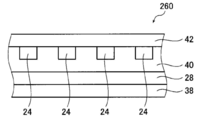
- the capacitive touch panel sensor 260 includes a first polymer film 38, a second detection electrode 28 disposed on the first polymer film 38, and one end of the second detection electrode 28.
- the second lead wiring (not shown) disposed on the first polymer film 38, the adhesive layer 40, the first detection electrode 24, and one end of the first detection electrode 24 are electrically connected.
- a first lead wiring (not shown) connected, a second polymer film 42 adjacent to the first detection electrode 24 and the first lead wiring, and a flexible printed wiring board (not shown) are provided. As shown in FIG.
- the capacitive touch panel sensor 260 has the same configuration as that of the capacitive touch panel sensor 6 except for the first polymer film 38, the second polymer film 42, and the adhesive layer 40. Therefore, the same components are denoted by the same reference numerals, and the description thereof is omitted.
- the definitions of the first polymer film 38 and the second polymer film 42 are the same as the definitions of the polymer film 22 described above.
- the adhesive layer 40 is a layer for bringing the first detection electrode 24 and the second detection electrode 28 into close contact, and is preferably optically transparent (preferably a transparent adhesive layer). As a material constituting the adhesive layer 40, a known material is used. A plurality of first detection electrodes 24 and a plurality of second detection electrodes 28 in FIG.
- the capacitive touch panel sensor 260 shown in FIG. 5 prepares two polymer films with electrodes each having a polymer film, and a detection electrode and a lead wiring arranged on the polymer film surface, and the electrodes face each other. Thus, it corresponds to the electrostatic capacitance type touch panel sensor obtained by bonding through an adhesive layer.
- the capacitive touch panel sensor 360 is electrically connected to the first polymer film 38, the second detection electrode 28 disposed on the first polymer film 38, and one end of the second detection electrode 28.
- a second lead-out wiring (not shown) disposed on the film 38, an adhesive layer 40, a second polymer film 42, a first detection electrode 24 disposed on the second polymer film 42, and a first detection
- a first lead wire (not shown) electrically connected to one end of the electrode 24 and disposed on the second polymer film 42 and a flexible printed wiring board (not shown) are provided.
- the capacitive touch panel sensor 360 shown in FIG. 6 has the same layers as the capacitive touch panel sensor 260 shown in FIG.
- first detection electrodes 24 and second detection electrodes 28 in FIG. 6 are used as shown in FIG. 4, and both are arranged so as to be orthogonal to each other as shown in FIG.
- the capacitive touch panel sensor 360 shown in FIG. 6 prepares two polymer films with electrodes each having a polymer film, and a detection electrode and a lead-out wiring arranged on the surface of the polymer film. This corresponds to a capacitive touch panel sensor obtained by bonding through an adhesive layer so that the polymer film in the polymer film and the electrode of the polymer film with the other electrode face each other.
- the upper adhesive layer 10 is a layer for ensuring adhesion between the ultraviolet absorbing layer 8 and a protective substrate 12 described later.
- a material constituting the upper adhesive layer 10 it is preferable to use a known adhesive, and examples thereof include an acrylic adhesive, a rubber adhesive, and a silicone adhesive. Especially, it is preferable that it is an acrylic adhesive from a viewpoint which is excellent in transparency.
- the thickness of the upper adhesive layer 10 is not particularly limited, but is preferably 5 to 350 ⁇ m, more preferably 30 to 250 ⁇ m, and still more preferably 30 to 150 ⁇ m. Within the above range, desired visible light transmittance can be obtained, and handling is easy.
- the upper adhesive layer 10 is preferably optically transparent. That is, a transparent adhesive layer is preferable. Optically transparent means that the total light transmittance is 85% or more, preferably 90% or more, and more preferably 100%.
- the protective substrate 12 is a substrate disposed on the upper adhesive layer 10 and serves to protect the capacitive touch panel sensor 6 and the image display device 2 described later from the external environment, and the main surface thereof is a touch surface.
- the protective substrate is preferably a transparent substrate, and a glass plate (cover glass), a plastic plate (plastic film), or the like is used. It is desirable that the thickness of the substrate is appropriately selected according to each application.
- polyesters such as polyethylene terephthalate (PET) and polyethylene naphthalate (PEN); polyolefins such as polyethylene (PE), polypropylene (PP) and polystyrene; vinyl resins; Polycarbonate (PC), polyamide, polyimide, acrylic resin, triacetyl cellulose (TAC), cycloolefin resin (COP, COC), and the like can be used.
- a polarizing plate, a circular polarizing plate, or the like may be used as the protective substrate 12.
- the manufacturing method of the touch panel 100 described above is not particularly limited, and a known method can be adopted. Below, the manufacturing method of the electrostatic capacitance type touch panel sensor 6 mentioned above is explained in full detail first.
- Capacitive touch panel sensor manufacturing method The manufacturing method in particular of the capacitive touch panel sensor 6 is not restrict
- the photoresist film on the metal foil formed on both main surfaces of the polymer film 22 is exposed and developed to form a resist pattern, and the metal foil exposed from the resist pattern is etched.
- a method of printing a paste containing metal fine particles or metal nanowires on both main surfaces of the polymer film 22 and performing metal plating on the paste can be mentioned.
- the method of printing and forming on the polymer film 22 with a screen printing plate or a gravure printing plate, or the method of forming with an inkjet is also mentioned.
- a method using silver halide can be mentioned. More specifically, the step (1) of forming a silver halide emulsion layer (hereinafter also simply referred to as a photosensitive layer) containing silver halide and a binder on both sides of the polymer film 22, respectively, Examples of the method include a step (2) of developing after exposure. Below, each process is demonstrated.
- a silver halide emulsion layer hereinafter also simply referred to as a photosensitive layer
- Step (1) is a step of forming a photosensitive layer containing silver halide and a binder on both surfaces of the polymer film 22.
- the method for forming the photosensitive layer is not particularly limited, but from the viewpoint of productivity, the photosensitive layer forming composition containing silver halide and a binder is brought into contact with the polymer film 22, and the photosensitive layer is exposed on both sides of the polymer film 22.
- a method of forming a conductive layer is preferred.
- the photosensitive layer forming composition contains a silver halide and a binder.
- the halogen element contained in the silver halide may be any of chlorine, bromine, iodine and fluorine, or a combination thereof.
- As the silver halide for example, silver halides mainly composed of silver chloride, silver bromide and silver iodide are preferably used, and silver halides mainly composed of silver bromide and silver chloride are preferably used.
- the kind of binder used is as above-mentioned.
- the binder may be contained in the composition for photosensitive layer formation in the form of latex.
- the volume ratio of the silver halide and the binder contained in the composition for forming the photosensitive layer is not particularly limited, and is appropriately adjusted so as to be within a preferable volume ratio range of the metal and the binder in the conductive thin wire 34 described above. Is done.
- the composition for forming a photosensitive layer contains a solvent, if necessary.
- the solvent used include water, organic solvents (for example, alcohols such as methanol, ketones such as acetone, amides such as formamide, sulfoxides such as dimethyl sulfoxide, esters such as ethyl acetate, ethers, and the like. Etc.), ionic liquids, or mixed solvents thereof.
- a method for bringing the composition for forming a photosensitive layer and the polymer film 22 into contact with each other is not particularly limited, and a known method can be adopted.
- coating the composition for photosensitive layer formation to the polymer film 22, the method of immersing the polymer film 22 in the composition for photosensitive layer formation, etc. are mentioned.
- the protective layer By providing the protective layer, scratches can be prevented and mechanical properties can be improved.
- Step (2) Exposure and development step
- the photosensitive layer obtained in the above step (1) is subjected to pattern exposure and then developed to thereby perform the first detection electrode 24 and the first lead wiring 26, and the second detection electrode 28 and the second detection electrode 28.
- This is a step of forming two lead-out wirings 30.
- the pattern exposure process will be described in detail below, and then the development process will be described in detail.
- the silver halide in the photosensitive layer in the exposed region forms a latent image.
- a detection electrode and a lead-out wiring are formed by a development process described later.
- the silver halide dissolves and flows out of the photosensitive layer during the fixing process described later, and a transparent film is obtained.
- the light source used in the exposure is not particularly limited, and examples thereof include light such as visible light and ultraviolet light, and radiation such as X-rays.
- the method for performing pattern exposure is not particularly limited. For example, surface exposure using a photomask may be performed, or scanning exposure using a laser beam may be performed.
- the shape of the pattern is not particularly limited, and is appropriately adjusted according to the pattern of the conductive fine wire to be formed.
- the development processing method is not particularly limited, and a known method can be employed. For example, a usual development processing technique used for silver salt photographic film, photographic paper, film for printing plate making, emulsion mask for photomask, and the like can be used.
- the type of developer used in the development process is not particularly limited. For example, PQ (phenidone hydroquinone) developer, MQ (Metol hydroquinone) developer, MAA (methol / ascorbic acid) developer may be used. it can.
- the development process can include a fixing process performed for the purpose of removing and stabilizing the silver salt in the unexposed part.
- the fixing temperature in the fixing step is preferably 20 to 50 ° C., more preferably 25 to 45 ° C.
- the fixing time is preferably 5 seconds to 1 minute, more preferably 7 to 50 seconds.
- the following undercoat layer forming step, antihalation layer forming step, or heat treatment may be performed as necessary.
- Undercoat layer forming process For the reason of excellent adhesion between the polymer film 22 and the silver halide emulsion layer, it is preferable to carry out a step of forming an undercoat layer containing the binder on both sides of the polymer film 22 before the step (1). .
- the binder used is as described above.
- the thickness of the undercoat layer is not particularly limited, but is preferably from 0.01 to 0.5 ⁇ m, more preferably from 0.01 to 0.1 ⁇ m, from the viewpoint that the adhesiveness and the rate of change in mutual capacitance can be further suppressed.
- Anti-halation layer formation process From the viewpoint of thinning the conductive thin wire 34, it is preferable to carry out a step of forming antihalation layers on both surfaces of the polymer film 22 before the step (1).
- Step (3) is performed as necessary, and is a step of performing heat treatment after the development processing. By performing this step, fusion occurs between the binders, and the hardness of the detection electrode and the lead-out wiring is further increased.
- the binder is polymer particles in latex
- Step (3) fusion occurs between the polymer particles, A detection electrode and a lead wiring having a desired hardness are formed.
- the ultraviolet absorbing layer 8 is formed on one surface of the capacitive touch panel sensor 6.
- the ultraviolet absorbing layer 8 is formed by applying a composition for forming an ultraviolet absorbing layer containing a predetermined ultraviolet absorber on the capacitive touch panel sensor 6 and performing a drying treatment as necessary. A method is mentioned.
- a method of forming the upper adhesive layer 10 on the ultraviolet absorbing layer 8 for example, a method of bonding an adhesive layer sheet (so-called transparent adhesive film (OCA)) to the ultraviolet absorbing layer 8 or There is a method of applying a liquid pressure-sensitive adhesive composition (so-called UV (ultraviolet ray) curable adhesive) or a transparent pressure-sensitive adhesive (OCR) on the ultraviolet absorbing layer 8 and performing a curing treatment as necessary.
- OCA transparent adhesive film
- the protective substrate 12 is bonded onto the upper adhesive layer 10 to form a touch panel sensor-containing laminate including the capacitive touch panel sensor 6, the upper adhesive layer 10, and the protective substrate 12.
- a method for bonding a known method can be adopted.
- the surface of the touch panel sensor-containing laminate on the capacitive touch panel sensor 6 side and the display surface of the image display device 2 are bonded via an ultraviolet curable adhesive to protect the touch panel sensor-containing laminate (protection).
- the touch panel 100 is manufactured by irradiating ultraviolet rays from the substrate 12 side) and curing the ultraviolet curable adhesive to form the adhesive layer 4.
- FIG. 7 is a cross-sectional view of a second embodiment of the touch panel of the present invention.
- the touch panel 200 includes an image display device 2, an adhesive layer 4 formed by curing an ultraviolet curable adhesive, a capacitive touch panel sensor 6, and an ultraviolet absorber-containing adhesive layer 14. And a protective substrate 12 in this order.
- the touch panel 200 has the configuration of the touch panel 100 described above (the image display device 2, the adhesive layer 4 formed by curing the ultraviolet curable adhesive, the electrostatic capacitance type) except that the ultraviolet absorber-containing adhesive layer 14 is included.
- the touch panel sensor 6 and the protective substrate 12) have the same configuration, the same reference numerals are assigned to the same configurations, and descriptions thereof are omitted, and the UV absorber-containing adhesive layer 14 will be mainly described in detail below.
- the ultraviolet absorber-containing adhesive layer 14 is an adhesive layer containing an ultraviolet absorber. That is, the ultraviolet absorber-containing adhesive layer 14 is a layer for ensuring adhesion between the capacitive touch panel sensor 6 and the protective substrate 12 and has a function as an ultraviolet absorbing layer.
- the ultraviolet absorber-containing pressure-sensitive adhesive layer 14 exhibits the optical characteristics exhibited by the ultraviolet absorption layer 8 described in the first embodiment. That is, the transmittance of the ultraviolet absorber-containing pressure-sensitive adhesive layer 14 in the wavelength range of 200 to 340 nm is 5% or less, the transmittance of the ultraviolet absorber-containing pressure-sensitive adhesive layer 14 at the wavelength of 400 nm is 80% or higher, and contains the ultraviolet absorber.
- the transmittance of the pressure-sensitive adhesive layer 14 in the wavelength range of 400 to 800 nm is within ⁇ 3% of the transmittance at the wavelength of 400 nm.
- the preferred embodiment of each range is the same as the first embodiment.
- the kind of ultraviolet absorber in the ultraviolet absorber-containing adhesive layer 14 is as described above. Moreover, as an adhesive which comprises the ultraviolet absorber containing adhesion layer 14, the adhesive which comprises the upper adhesion layer 10 described in the 1st embodiment is mentioned.
- the thickness of the ultraviolet absorber-containing pressure-sensitive adhesive layer 14 is not particularly limited as long as the optical characteristics described above are satisfied. Among these, from the viewpoint of the balance between handleability and thinning of the touch panel, 10 to 300 ⁇ m is preferable, and 50 to 200 ⁇ m is more preferable.
- the method for producing the ultraviolet absorber-containing pressure-sensitive adhesive layer 14 is not particularly limited, and examples thereof include a method of forming the ultraviolet absorber-containing pressure-sensitive adhesive layer 14 using a pressure-sensitive adhesive layer-forming composition containing an ultraviolet absorber.
- FIG. 8 is a cross-sectional view of a third embodiment of the touch panel of the present invention.
- the touch panel 300 includes an image display device 2, an adhesive layer 4 formed by curing an ultraviolet curable adhesive, a capacitive touch panel sensor 16, an upper adhesive layer 10, and protection.
- the substrate 12 is provided in this order.
- the touch panel 300 has the configuration of the touch panel 100 described above (the image display device 2, the adhesive layer 4 formed by curing the ultraviolet curable adhesive, and the upper adhesive layer 10) except that the touch panel sensor 16 includes the capacitive touch panel sensor 16.
- the same configuration as that of the protective substrate 12), the same reference numerals are given to the same configurations, and the description thereof is omitted.
- the capacitive touch panel sensor 16 will be mainly described in detail below.
- FIG. 9 shows a cross-sectional view of the capacitive touch panel sensor 16.
- the capacitive touch panel sensor 16 used in the third embodiment has the ultraviolet absorbing layer 8 disposed on the polymer film 22. It has the same structure except the point.
- the ultraviolet absorbing layer 8 is disposed on the surface of the polymer film 22 on the protective substrate 12 side, and prevents the polymer film 22 from being irradiated with ultraviolet rays having a specific wavelength.
- the configuration of the ultraviolet absorbing layer 8 is the same as that of the ultraviolet absorbing layer 8 in the first embodiment.
- an undercoat layer and an antihalation layer may be disposed on the polymer film 22, but these layers may be made to function as an ultraviolet absorbing layer by containing an ultraviolet absorber.
- the touch panel that has been irradiated with ultraviolet rays through the UV34, UV32, UV30, and UV28 filters has a drop impact durability of B, which will be described later, and the drop impact durability of the touch panel that has been irradiated with ultraviolet rays through the UV36 and L38 filters.
- B drop impact durability
- the ultraviolet ray deterioration of the substrate is less likely to occur in the touch panel using the COP film or the COC film by cutting the ultraviolet ray having a wavelength of 340 nm or less by this verification.
- Example A> (Touch panel 101) Using ZF14-100 (Cyclic olefin polymer film, thickness 100 ⁇ m) manufactured by Nippon Zeon as a COP film, electrode wiring for a touch panel made of a silver mesh pattern is arranged on both sides of the COP film according to the following procedure. A touch panel sensor was produced.
- the emulsion after washing with water and desalting was adjusted to pH 6.4 and pAg 7.5, and gelatin 3.9 g, sodium benzenethiosulfonate 10 mg, sodium benzenethiosulfinate 3 mg, sodium thiosulfate 15 mg and chloroauric acid 10 mg were added.
- Chemical sensitization to obtain optimum sensitivity at 0 ° C. 100 mg of 1,3,3a, 7-tetraazaindene as stabilizer and 100 mg of proxel (trade name, manufactured by ICI Co., Ltd.) as preservative It was.
- the finally obtained emulsion contains 0.08 mol% of silver iodide, and the ratio of silver chlorobromide is 70 mol% of silver chloride and 30 mol% of silver bromide. It was a silver iodochlorobromide cubic grain emulsion having a coefficient of 9%.
- a corona discharge treatment is performed on one surface of the COP film under the condition of 5 kJ / m 2 , and the composition for forming an undercoat layer is applied to the surface on the side subjected to the corona discharge treatment so that the film thickness after drying becomes 60 nm. And dried at 90 ° C. for 1 minute to form an undercoat layer.
- An undercoat layer was similarly formed on the other side of the COP film.
- Photosensitive layer forming step On the COP film having the undercoat layer formed on both sides, an antihalation layer containing a dye having an optical density of about 1.0 and decolorizing with an alkali of the developer was provided on the undercoat layer. On the antihalation layer, the photosensitive layer forming composition was applied, a gelatin layer having a thickness of 0.15 ⁇ m was further provided, and a COP film having a photosensitive layer formed on both sides was obtained. The obtained film is referred to as film A.
- the formed photosensitive layer had a silver amount of 6.0 g / m 2 and a gelatin amount of 1.0 g / m 2 .
- An ultraviolet absorbing layer was provided on one surface of the touch panel sensor using the following composition for forming an ultraviolet absorbing layer. More specifically, first, an emulsion containing an ultraviolet absorber was prepared with the following composition. A composition consisting of ethyl acetate (90 equivalents), Teica Power BN2070M (5 equivalents) manufactured by Teika Co., Ltd., Tinuvin 400 (30 equivalents) manufactured by BASF, and DOS (50 equivalents) manufactured by Daihachi Chemical Industry Co., Ltd. ) And water (500 equivalents) to prepare an emulsion A by emulsifying and dispersing in an aqueous gelatin solution.
- a composition obtained by mixing and dissolving Emulsion A (30 equivalents) in water (90 equivalents) was used as a composition for forming an ultraviolet absorbing layer.
- a bar coater adjust the thickness of the UV absorbing layer as appropriate, adjust the coating amount of the UV absorber around the area to achieve the desired optical spectrum, and then perform a drying process.
- An ultraviolet absorbing layer was formed.
- the drying temperature was 50 ° C. and the drying time was 10 minutes.
- an optical adhesive (8146-3 manufactured by 3M) and a cover glass were laminated in this order to prepare a touch panel sensor-containing laminate.
- the surface of the touch panel sensor on the opposite side of the cover glass surface of the touch panel sensor-containing laminate and the display surface of the image display device are bonded via an ultraviolet curable adhesive (CEF2806 manufactured by 3M), and uniformly After confirming that the bonded state is obtained, the cover glass side is irradiated with ultraviolet light (including light in a wavelength range of 340 nm to 400 nm or less) (energy amount 4 J / cm 2 using a metal halide lamp), The touch panel 101 was produced by curing the ultraviolet curable adhesive.
- the ultraviolet curable pressure-sensitive adhesive (CEF2806 manufactured by 3M) is cured by light having a wavelength in the range of 340 nm and a wavelength of 400 nm or less.
- the transmittance is as shown in Table 1 by changing the polymer film of the touch panel sensor, the type of the UV absorber contained in the emulsion A, the amount of the UV absorber applied per area, etc. as shown in Table 1. A touch panel with a good result was produced.
- ZF14-100 ZEONOR ZF14-100 manufactured by Nippon Zeon Co., Ltd.
- FEKP040 Arton FEKP040 manufactured by JSR (cyclic olefin polymer film, thickness 40 ⁇ m)
- TDF-050 TDF-050 manufactured by Dexerials (cyclic olefin copolymer film, thickness 50 ⁇ m)
- ZF14-40 ZF14-40 manufactured by Zeon Corporation (cyclic olefin polymer film, thickness 40 ⁇ m)
- TINUVIN 400 Hydroxyphenyltriazine UV absorber (manufactured by BASF)
- TINUVIN PS Hydroxyphenyltriazine UV absorber
- TINUVIN 384-2 Benzotriazole UV absorber (manufactured by BASF)
- the transmittance of each wavelength of the ultraviolet absorbing layer is measured by measuring the total light transmittance of the glass substrate and the sample substrate in which the ultraviolet absorbing layer is formed on the glass substrate, and calculating by the equation (1).
- the transmittance of the ultraviolet absorbing layer was determined.
- the L * value, a * value, and b * value of the transmitted light were calculated by the method prescribed in JIS-Z8729: 1994 using the transmittance of the ultraviolet absorbing layer.
- b * is the absolute value
- the color tone is considered to be yellowish or bluish, and the determination is B.
- AA When
- A When
- B When
- the transmittance of the wavelength is obtained by measuring the total light transmittance of the glass substrate and the sample substrate in which the ultraviolet absorbing layer is formed on the glass substrate, and calculating by the equation (1). The rate was determined. Using the transmittance of the ultraviolet absorbing layer, the L * value, a * value, and b * value of the transmitted light were calculated by the method defined in JIS-Z8729: 1994.
- a touch panel sensor-containing laminate, an ultraviolet curable adhesive (3M CEF2806), and an image display device are laminated in this order, and the touch panel sensor-containing laminate is irradiated with UV light (4 J / cm 2 ) from the touch panel sensor-containing laminate. And image display device were fixed. Measure the peel strength when peeling the touch panel sensor-containing laminate from the image display device (90-degree vertical pull-up), and if the maximum peel strength is 5 N / cm or more, the adhesive layer (the UV curable adhesive is cured) It was judged that the adhesive strength of the adhesive layer was high and the curing was sufficiently performed, and the judgment was A, and if the maximum peel strength was 7.5 N / cm or more, the judgment was AA.
- “Maximum% of transmittance difference between 400-800 nm vs. 400 nm” intends the absolute value of the maximum transmittance difference between the transmittance in the wavelength range of 400 to 800 nm and the transmittance at the wavelength of 400 nm. In other words, this corresponds to the absolute value of the difference between the maximum value or the minimum value of the transmittance in the wavelength range of 400 to 800 nm and the transmittance at the wavelength of 400 nm. If the above numerical value is within 3%, the transmittance in the wavelength range of 400 to 800 nm is within ⁇ 3% relative to the transmittance at the wavelength of 400 nm.
- Example B (Touch panel 201)
- the touch panel sensor was produced in the same manner as Example A.
- An optical adhesive layer containing an ultraviolet absorber (ultraviolet absorber-containing optical adhesive layer) was applied to the optical adhesive layer used when the touch panel sensor and the cover glass were bonded, and a touch panel was produced as follows. Kuraray Co., Ltd. Claprene LIR-30 (22 equivalents), EVONIK Co., Ltd.
- Polybest 110 (8 equivalents), 2-ethylhexyl acrylate (7.5 equivalents), isobornyl acrylate (15.5 equivalents), BASF Corporation Lucirin TPO (3 equivalents), Clearon P135 (41 equivalents) manufactured by Yashara Chemical Co., Ltd., Irgafos 168 (0.5 equivalents) manufactured by BASF Corporation, 1,9-nonanediodiacrylate (0.5 equivalents), Cyclomer M100 manufactured by Daicel Corporation A coating solution was prepared by containing Tinuvin 400 (0.1 equivalent) manufactured by BASF as a UV absorber in a composition comprising (2 equivalents).
- the surface of the touch panel sensor opposite to the surface on which the cover glass is bonded and the image display device are bonded via an ultraviolet curable pressure-sensitive adhesive (CEF2806 manufactured by 3M Co., Ltd.), and are uniformly bonded.
- ultraviolet light was irradiated from the cover glass side (energy amount 4 J / cm 2 using a metal halide lamp) to cure the ultraviolet curable adhesive.
- the touch panel 201 was produced (see FIG. 7).
- the touch panel satisfying the predetermined requirements has good results such as drop impact durability, color tone, and direct bonding manufacturing suitability.
- Example C (Touch panel 301)
- an ultraviolet absorber is added by adding an appropriate amount of the emulsion A containing the ultraviolet absorber prepared in Example A.
- An antihalation layer (corresponding to an ultraviolet absorption layer) containing ss was produced.
- the antihalation layer containing the ultraviolet absorber is installed only on one side of the polymer film (this surface is referred to as “A surface”), and the other antihalation layer is configured not to contain the ultraviolet absorber (see FIG. 8 and FIG. 8). 9).
- An optical adhesive (8146-3 manufactured by 3M) and a cover glass were laminated in this order on the surface of the touch panel sensor on the side A to prepare a touch panel sensor-containing laminate.
- ultraviolet light was irradiated from the cover glass side (energy amount 4 J / cm 2 using a metal halide lamp) to cure the ultraviolet curable adhesive.
- the touch panel 301 was produced.
- Touch panel 301-336 By changing the polymer film of the touch panel sensor in the touch panel 301, the type of the ultraviolet absorber included in the emulsion A, the coating amount of the ultraviolet absorber per area, etc. as shown in Table 3, the transmittance is as shown in Table 3. A touch panel with a good result was produced. The evaluation described in Example A above was performed using the obtained touch panel, and the results are summarized in Table 3.
- the touch panel satisfying the predetermined requirements has good drop impact durability, color tone, and direct bonding manufacturing suitability.
Landscapes
- Engineering & Computer Science (AREA)
- General Engineering & Computer Science (AREA)
- Theoretical Computer Science (AREA)
- Human Computer Interaction (AREA)
- Physics & Mathematics (AREA)
- General Physics & Mathematics (AREA)
- Position Input By Displaying (AREA)
- Laminated Bodies (AREA)
Abstract
L'invention concerne un écran tactile qui présente une grande résistance au choc au mouton, d'excellentes tonalités chromatiques, et qui est très facile à fabriquer par rapport à un système à liaison directe. Cet écran tactile comprend, dans l'ordre, un dispositif d'affichage d'image, une couche adhésive qui est formée par durcissement d'un adhésif durcissable aux ultraviolets, un capteur d'écran tactile et un substrat de protection. Dans ledit écran tactile : le capteur d'écran tactile comporte un film de polymère de cyclooléfine ou un film de copolymère de cyclooléfine; une couche absorbant les ultraviolets est disposée entre le film de polymère et le substrat de protection; la couche absorbant les ultraviolets a une transmittance de 5 % ou moins dans la gamme de longueur d'onde de 200 à 340 nm; la couche absorbant les ultraviolets a une transmittance de 86 % ou plus dans la gamme de longueur d'onde de 400 nm; la transmittance de la couche absorbant les ultraviolets dans la gamme de longueur d'onde de 400 à 800 nm est de ± 3 % de la transmittance dans la gamme de longueur d'onde de 400 nm; et l'adhésif durcissable aux ultraviolets est durci par la lumière ayant une longueur d'onde de plus de 340 nm mais de 400 nm maximum.
Priority Applications (3)
| Application Number | Priority Date | Filing Date | Title |
|---|---|---|---|
| CN201580077693.7A CN107407981B (zh) | 2015-03-26 | 2015-10-14 | 触控面板 |
| JP2017507314A JP6355824B2 (ja) | 2015-03-26 | 2015-10-14 | タッチパネル |
| US15/686,176 US20170351362A1 (en) | 2015-03-26 | 2017-08-25 | Touch panel |
Applications Claiming Priority (2)
| Application Number | Priority Date | Filing Date | Title |
|---|---|---|---|
| JP2015-065241 | 2015-03-26 | ||
| JP2015065241 | 2015-03-26 |
Related Child Applications (1)
| Application Number | Title | Priority Date | Filing Date |
|---|---|---|---|
| US15/686,176 Continuation US20170351362A1 (en) | 2015-03-26 | 2017-08-25 | Touch panel |
Publications (1)
| Publication Number | Publication Date |
|---|---|
| WO2016151908A1 true WO2016151908A1 (fr) | 2016-09-29 |
Family
ID=56977165
Family Applications (1)
| Application Number | Title | Priority Date | Filing Date |
|---|---|---|---|
| PCT/JP2015/078993 Ceased WO2016151908A1 (fr) | 2015-03-26 | 2015-10-14 | Écran tactile |
Country Status (5)
| Country | Link |
|---|---|
| US (1) | US20170351362A1 (fr) |
| JP (1) | JP6355824B2 (fr) |
| CN (1) | CN107407981B (fr) |
| TW (1) | TWI649198B (fr) |
| WO (1) | WO2016151908A1 (fr) |
Cited By (2)
| Publication number | Priority date | Publication date | Assignee | Title |
|---|---|---|---|---|
| JP2018151951A (ja) * | 2017-03-14 | 2018-09-27 | シャープ株式会社 | タッチ位置認識回路およびタッチ位置認識回路を備えたタッチ式入力装置 |
| CN109558028A (zh) * | 2017-09-27 | 2019-04-02 | 东友精细化工有限公司 | 触摸传感器及其制造方法 |
Families Citing this family (6)
| Publication number | Priority date | Publication date | Assignee | Title |
|---|---|---|---|---|
| CN110221731B (zh) * | 2018-03-02 | 2023-03-28 | 宸鸿光电科技股份有限公司 | 触控面板的直接图案化方法及其触控面板 |
| CN108519833B (zh) * | 2018-04-03 | 2024-03-15 | 京东方科技集团股份有限公司 | 触控显示面板的形成方法和触控显示母板 |
| JP7112591B2 (ja) * | 2019-03-28 | 2022-08-03 | 富士フイルム株式会社 | 積層体、被めっき層付き基板の製造方法、導電性フィルムの製造方法 |
| KR102894749B1 (ko) * | 2020-12-16 | 2025-12-03 | 삼성디스플레이 주식회사 | 표시 장치와 그의 제조 방법 |
| CN117641746A (zh) * | 2022-08-29 | 2024-03-01 | 杜邦电子公司 | 透明导电基材和使用其的双面光刻方法 |
| JP7573778B1 (ja) * | 2024-02-29 | 2024-10-25 | 富士フイルム株式会社 | タッチセンサ、画像表示装置 |
Citations (5)
| Publication number | Priority date | Publication date | Assignee | Title |
|---|---|---|---|---|
| JP2012068287A (ja) * | 2010-09-21 | 2012-04-05 | Toppan Printing Co Ltd | カラーフィルタ基板及びその製造方法 |
| JP2013111804A (ja) * | 2011-11-28 | 2013-06-10 | Toray Advanced Film Co Ltd | ハードコートフィルムおよびタッチパネル |
| WO2013105163A1 (fr) * | 2012-01-13 | 2013-07-18 | 日本化薬株式会社 | Éléments optiques et adhésif durcissable par ultraviolet utilisé lors de la fabrication de ceux-ci |
| JP2014130289A (ja) * | 2012-12-28 | 2014-07-10 | Panasonic Liquid Crystal Display Co Ltd | タッチパネル付き液晶表示装置 |
| WO2015029350A1 (fr) * | 2013-08-30 | 2015-03-05 | パナソニックIpマネジメント株式会社 | Dispositif d'affichage équipé d'un capteur de toucher et son procédé de fabrication |
Family Cites Families (14)
| Publication number | Priority date | Publication date | Assignee | Title |
|---|---|---|---|---|
| JPH0628104A (ja) * | 1992-07-09 | 1994-02-04 | Matsushita Electric Ind Co Ltd | 透明タッチパネル |
| JP2002259037A (ja) * | 2001-03-06 | 2002-09-13 | Ricoh Co Ltd | 筆記記録システム |
| JP2005044154A (ja) * | 2003-07-23 | 2005-02-17 | Gunze Ltd | タッチパネル |
| JP2006190189A (ja) * | 2005-01-07 | 2006-07-20 | Sumitomo Bakelite Co Ltd | タッチパネル用プラスチック基板及びそれを用いたタッチパネル |
| JP2008209598A (ja) * | 2007-02-26 | 2008-09-11 | Dainippon Printing Co Ltd | 光学フィルム |
| CN102300910B (zh) * | 2008-11-28 | 2014-05-07 | 木本股份有限公司 | 具有被膜的片材及其制造方法 |
| KR101243717B1 (ko) * | 2009-05-20 | 2013-03-13 | 주식회사 엘지화학 | 색감 및/또는 시인성이 우수한 터치 윈도우 |
| WO2010143682A1 (fr) * | 2009-06-11 | 2010-12-16 | 富士フイルム株式会社 | Procédé de production d'un film réfléchissant |
| US20140320770A1 (en) * | 2012-01-13 | 2014-10-30 | Nippon Kayaku Kabushikikaisha | Optical member and ultraviolet-curable adhesive to be used for producing the same |
| JP5887259B2 (ja) * | 2012-12-11 | 2016-03-16 | 富士フイルム株式会社 | 屋外用表示装置 |
| US20140373349A1 (en) * | 2013-06-20 | 2014-12-25 | Carestream Health, Inc. | Laser diode patterning of transparent conductive films |
| JP6227321B2 (ja) * | 2013-08-05 | 2017-11-08 | リンテック株式会社 | プロテクトフィルム付き透明導電性フィルム |
| JP6469948B2 (ja) * | 2013-08-22 | 2019-02-13 | 帝人フィルムソリューション株式会社 | 透明電極用フィルム |
| JP6226652B2 (ja) * | 2013-09-09 | 2017-11-08 | 昭和電工株式会社 | 画像表示装置の製造方法 |
-
2015
- 2015-10-14 WO PCT/JP2015/078993 patent/WO2016151908A1/fr not_active Ceased
- 2015-10-14 CN CN201580077693.7A patent/CN107407981B/zh active Active
- 2015-10-14 JP JP2017507314A patent/JP6355824B2/ja active Active
- 2015-10-20 TW TW104134274A patent/TWI649198B/zh not_active IP Right Cessation
-
2017
- 2017-08-25 US US15/686,176 patent/US20170351362A1/en not_active Abandoned
Patent Citations (5)
| Publication number | Priority date | Publication date | Assignee | Title |
|---|---|---|---|---|
| JP2012068287A (ja) * | 2010-09-21 | 2012-04-05 | Toppan Printing Co Ltd | カラーフィルタ基板及びその製造方法 |
| JP2013111804A (ja) * | 2011-11-28 | 2013-06-10 | Toray Advanced Film Co Ltd | ハードコートフィルムおよびタッチパネル |
| WO2013105163A1 (fr) * | 2012-01-13 | 2013-07-18 | 日本化薬株式会社 | Éléments optiques et adhésif durcissable par ultraviolet utilisé lors de la fabrication de ceux-ci |
| JP2014130289A (ja) * | 2012-12-28 | 2014-07-10 | Panasonic Liquid Crystal Display Co Ltd | タッチパネル付き液晶表示装置 |
| WO2015029350A1 (fr) * | 2013-08-30 | 2015-03-05 | パナソニックIpマネジメント株式会社 | Dispositif d'affichage équipé d'un capteur de toucher et son procédé de fabrication |
Cited By (3)
| Publication number | Priority date | Publication date | Assignee | Title |
|---|---|---|---|---|
| JP2018151951A (ja) * | 2017-03-14 | 2018-09-27 | シャープ株式会社 | タッチ位置認識回路およびタッチ位置認識回路を備えたタッチ式入力装置 |
| CN109558028A (zh) * | 2017-09-27 | 2019-04-02 | 东友精细化工有限公司 | 触摸传感器及其制造方法 |
| CN109558028B (zh) * | 2017-09-27 | 2022-02-11 | 东友精细化工有限公司 | 触摸传感器及其制造方法 |
Also Published As
| Publication number | Publication date |
|---|---|
| US20170351362A1 (en) | 2017-12-07 |
| JP6355824B2 (ja) | 2018-07-11 |
| CN107407981A (zh) | 2017-11-28 |
| TWI649198B (zh) | 2019-02-01 |
| TW201634278A (zh) | 2016-10-01 |
| CN107407981B (zh) | 2020-06-02 |
| JPWO2016151908A1 (ja) | 2018-01-11 |
Similar Documents
| Publication | Publication Date | Title |
|---|---|---|
| JP6355824B2 (ja) | タッチパネル | |
| KR101699602B1 (ko) | 정전 용량식 터치 패널 및 그 제조 방법, 입력 디바이스 | |
| JP6126739B2 (ja) | 導電膜積層体、およびこれを用いるタッチパネル | |
| US9271396B2 (en) | Conductive sheet and touch panel | |
| JP6757417B2 (ja) | タッチパネル用積層体、フレキシブルデバイス、有機電界発光表示装置 | |
| JP6267340B2 (ja) | 静電容量式タッチパネル | |
| JP6026447B2 (ja) | タッチパネル用積層体、フラットパネルディスプレイ | |
| JP5871774B2 (ja) | 静電容量式タッチパネルおよびその製造方法、入力デバイス | |
| KR20140034205A (ko) | 도전성 적층체, 터치패널 및 표시 장치 | |
| WO2015053230A1 (fr) | Stratifié pour panneau tactile | |
| JP6433707B2 (ja) | 透明導電性積層体およびその製造方法、透明導電性フィルムの製造方法、ならびに透明導電性フィルム巻回体の製造方法 | |
| JP6588992B2 (ja) | 導電フィルム積層体 | |
| WO2016009913A1 (fr) | Écran tactile capacitif | |
| JP2015086277A (ja) | 粘着シートの製造方法、粘着シート、タッチパネル用積層体および静電容量式タッチパネル |
Legal Events
| Date | Code | Title | Description |
|---|---|---|---|
| 121 | Ep: the epo has been informed by wipo that ep was designated in this application |
Ref document number: 15886460 Country of ref document: EP Kind code of ref document: A1 |
|
| ENP | Entry into the national phase |
Ref document number: 2017507314 Country of ref document: JP Kind code of ref document: A |
|
| NENP | Non-entry into the national phase |
Ref country code: DE |
|
| 122 | Ep: pct application non-entry in european phase |
Ref document number: 15886460 Country of ref document: EP Kind code of ref document: A1 |