WO2016152802A1 - Terminal sans fil, procédé de communication, et programme - Google Patents
Terminal sans fil, procédé de communication, et programme Download PDFInfo
- Publication number
- WO2016152802A1 WO2016152802A1 PCT/JP2016/058788 JP2016058788W WO2016152802A1 WO 2016152802 A1 WO2016152802 A1 WO 2016152802A1 JP 2016058788 W JP2016058788 W JP 2016058788W WO 2016152802 A1 WO2016152802 A1 WO 2016152802A1
- Authority
- WO
- WIPO (PCT)
- Prior art keywords
- period
- cycle
- reception
- reception operation
- data
- Prior art date
- Legal status (The legal status is an assumption and is not a legal conclusion. Google has not performed a legal analysis and makes no representation as to the accuracy of the status listed.)
- Ceased
Links
Images






Classifications
-
- H—ELECTRICITY
- H04—ELECTRIC COMMUNICATION TECHNIQUE
- H04W—WIRELESS COMMUNICATION NETWORKS
- H04W52/00—Power management, e.g. Transmission Power Control [TPC] or power classes
- H04W52/02—Power saving arrangements
-
- Y—GENERAL TAGGING OF NEW TECHNOLOGICAL DEVELOPMENTS; GENERAL TAGGING OF CROSS-SECTIONAL TECHNOLOGIES SPANNING OVER SEVERAL SECTIONS OF THE IPC; TECHNICAL SUBJECTS COVERED BY FORMER USPC CROSS-REFERENCE ART COLLECTIONS [XRACs] AND DIGESTS
- Y02—TECHNOLOGIES OR APPLICATIONS FOR MITIGATION OR ADAPTATION AGAINST CLIMATE CHANGE
- Y02D—CLIMATE CHANGE MITIGATION TECHNOLOGIES IN INFORMATION AND COMMUNICATION TECHNOLOGIES [ICT], I.E. INFORMATION AND COMMUNICATION TECHNOLOGIES AIMING AT THE REDUCTION OF THEIR OWN ENERGY USE
- Y02D30/00—Reducing energy consumption in communication networks
- Y02D30/70—Reducing energy consumption in communication networks in wireless communication networks
Definitions
- the present invention relates to a wireless terminal, a communication method, and a program.
- 3GPP LTE Long Term Evolution
- DRX discontinuous reception
- References 1, 2 a period constituted by a reception period (On-Duration) called DRX cycle and a subsequent non-reception period (Opportunity for DRX) is defined, and DRX is realized by repeating these periods.
- the wireless terminal needs to always receive a downlink control channel (PDCCH: Physical Downlink Control Channel) in On-duration, and may not receive PDCCH in Opportunity for DRX. If the wireless terminal fails to receive data during the On-Duration period and the data is retransmitted after the On-Duration period, the period for receiving the PDCCH is extended.
- PDCCH Physical Downlink Control Channel
- the period during which the radio terminal in DRX operation receives the PDCCH is called Active Time
- On-Duration is the minimum value of Active Time.
- two DRX states (levels) of “ShortDRX” and “LongDRX” having different lengths of Opportunity for DRX can be set for each wireless terminal.
- DRX state control DRX state control
- a timer drxShortCycleTimer
- the DRX state (level) suitable for the data reception frequency of the wireless terminal can be set, and the power consumption of the wireless terminal can be reduced.
- 3GPP TS36.300v900 Internet ⁇ URL> http: www.3gpp.org/ftp/Specs/html-info/36300.html
- 3GPP TS36.321v860 Internet ⁇ URL> http: www.3gpp.org/ftp/Specs/html-info/36321.html
- the present invention has been invented in view of the above problems, and it is an object of the present invention to provide a wireless terminal capable of realizing power saving of the wireless terminal while rapidly receiving a signal from the network side.
- One aspect of the present invention is a communication processing unit that transmits and receives data, and the non-reception of the second period when the communication processing unit is performing intermittent reception of a second period that is longer than the first period.
- the wireless terminal includes a communication control unit that starts a reception operation at a predetermined timing in a period and causes the communication processing unit to perform a predetermined number of reception operations.
- the data reception operation is started at a predetermined timing in the non-reception period of the second cycle.
- communication processing means for transmitting and receiving data is operating at a predetermined timing in the non-reception period of the second cycle during the operation of intermittent reception of the second cycle having a cycle longer than the first cycle.
- FIG. 1 is a block diagram of the present invention.
- FIG. 2 is a diagram illustrating an example of a schematic configuration of the wireless communication system according to the embodiment of this invention.
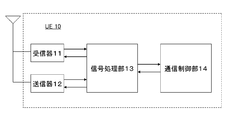
- FIG. 3 is a block diagram of the radio terminal (UE) 1 in the radio communication system of the present embodiment.
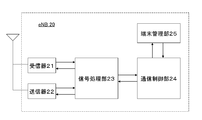
- FIG. 4 is a block diagram of the radio base station (eNB) 20 of the present embodiment.
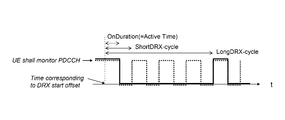
- FIG. 5 is a diagram illustrating an operation of discontinuous reception (DRX) in the wireless communication system according to the present embodiment.
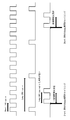
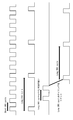
- FIG. 6 is a diagram illustrating a case in which two Wake ups are provided at a constant cycle and performed at every cycle interval of LongDRX within a Long DRX Sleep period.
- FIG. 7 is a diagram illustrating a case where two Wake ups are provided at a constant cycle and performed at every cycle interval of the Long DRX within the Long DRX Sleep period, at a Wake up timing of the Short DRX.
- FIG. 8 is a diagram illustrating a case where a Wake up is provided once at a timing near the center of the Long DRX.
- FIG. 9 is a diagram illustrating a case in which the LongDRX timing is reset after Wake up.
- FIG. 10 is a flowchart of the operation after Wake up performed during the Sleep period of LongDRX.
- FIG. 11 is a diagram illustrating a case where data is received during ShortDRX and transition is made from LongDRX to ShortDRX.
- FIG. 12 is a diagram illustrating another aspect of the radio terminal (UE) 1 in the radio communication system according to the present embodiment.
- FIG. 1 is a block diagram of the present invention.
- the present invention includes a communication processing unit 1 that transmits and receives data, and a second period when the communication processing unit 1 performs an intermittent reception operation of a second period that is longer than the first period.
- the wireless terminal includes a communication control unit 2 that starts reception at a predetermined timing in the non-reception period and causes the communication processing unit 1 to receive an arbitrary number of times.
- the wireless terminal when the wireless terminal is in an intermittent reception operation in the second period that is long between the period in which data can be received (for example, Active Time) and the period (for example, , During the operation of Long DRX), the reception operation is performed for a certain period of time at a predetermined timing of the non-reception period (for example, Opportunity for DRX), with a period shorter than the second period.
- the non-reception period for example, Opportunity for DRX
- ShortDRX as a representative of the first cycle
- LongDRX as a representative of the second cycle
- the predetermined timing of the non-reception period of the second cycle may be an arbitrary timing or a predetermined timing.
- Examples of the predetermined timing include the timing of the synchronized first cycle and the timing at which the non-reception period of the second cycle is constant before and after the timing (for example, the non-reception period of the second cycle). Timing near the center of the).
- the reception operation may be performed only once in the non-reception period of the second cycle, or may be performed multiple times. Also good. However, when it is performed a plurality of times, the reception operation is performed at a cycle shorter than the second cycle. Furthermore, when performing a plurality of times, it is preferable that the non-reception period of the second cycle is constant before and after the reception operation, for example, twice during the non-reception period of the second cycle. When the reception operation is performed, the reception operation is performed with a period that becomes active at a timing near one third or two thirds of the non-reception period of the second period. Thereby, the non-reception period of the timing before and after becomes constant.
- the reception operation may be performed only in the non-reception period of the first cycle in the second cycle, or the non-reception period of the second cycle.
- the reception operation may be performed at regular intervals.
- the intermittent reception operation may be performed while maintaining the timing of the second cycle, or the timing of the second cycle is reset, The intermittent reception operation of the second cycle may be performed at a proper timing. Furthermore, when data is received during the reception operation in the non-reception period of the second cycle, the intermittent reception operation may be performed by transitioning to the first cycle with a shorter cycle.
- the second cycle takes into account the past received data performance (for example, the amount of data and the presence or absence of the most recent data reception). It may be determined whether or not to perform the reception operation during the non-reception period.
- the above-described communication control unit 2 controls the reception operation performed during the non-reception period of the second cycle (the start timing and the number of reception operations and the determination thereof) and the reception operation during the non-reception period of the second cycle. Subsequent control or the like may be preset in the communication control unit 2 or may be an instruction from the network side such as a base station.
- the types of wireless terminals are not limited. For example, not only wireless terminals (UE: User Equipment) and PCs typified by smartphones and mobile phones, but also MTC (Machine Type Communication) terminals, M2M (Machine- To-Machine) terminals or devices or sensors used in IoT (Internet of Things) are also included.
- power saving of a wireless terminal can be realized while quickly receiving a paging signal from the network side.
- 3GPP LTE Long Term Evolution
- cellular system a wireless communication system
- FIG. 2 is a diagram showing an example of a schematic configuration of the wireless communication system according to the embodiment of the present invention.
- the radio communication system includes a radio terminal (UE: User Equipment) UE10 and a radio base station (eNB: evolved NodeB) eNB20.
- UE User Equipment
- eNB evolved NodeB
- the UE 10 has completed connection establishment (RRC Connection) for communicating with the eNB 20.
- RRC Connection connection establishment
- CC1 to CC3 are assigned as component carriers (CC: Component Carrier) capable of carrier aggregation (CA), and CC1 to CC3 are already in a state where data can be received simultaneously.
- CA carrier aggregation
- CC1 to CC3 may be either continuous or discontinuous, and the frequency bands may be the same or different. Further, the eNB 20 notifies the UE 10 of a parameter of intermittent reception (DRX: Discontinuous Reception), and the UE 10 performs necessary settings (for example, setting of an expiration value of a DRX related timer) according to the parameters. At this time, the DRX parameters are common in CC1 to CC3.
- DRX Discontinuous Reception
- FIG. 3 is a block diagram of the radio terminal (UE) 10 in the radio communication system of the present embodiment.
- the UE 10 includes a receiver 11, a transmitter 12, a signal processing unit 13, and a communication control unit 14.
- the receiver 11 and the transmitter 12 are parts that receive and transmit radio signals to and from the eNB 20, respectively.
- the signal processing unit 13 is a part that generates a radio signal for transmitting certain information to the eNB 20 and restores the original information from the received radio signal.
- the communication control unit 14 is a part that instructs the signal processing unit 13 to generate a transmission signal, restore information, and the like, and the DRX control of the UE is also managed by the communication control unit 14.
- FIG. 4 is a block diagram of the radio base station (eNB) 20 of the present embodiment.
- the eNB 20 includes a receiver 21, a transmitter 22, a signal processing unit 23, a communication control unit 24, and a terminal management unit 25.
- the receiver 21, transmitter 22, signal processing unit 23, and communication control unit 24 basically have the same functions as those of the UE 10.
- the terminal management part 25 it manages individually with respect to each of several UE.
- FIG. 5 is a diagram illustrating an operation of discontinuous reception (DRX) in the wireless communication system according to the present embodiment.
- the DRX cycle which is a period of intermittent reception, must receive the PDCCH and the period during which the downlink control channel PDCCH (Physical Downlink Control Channel) must be received continuously (On-Duration). It is composed of a period (Opportunity for DRX). The former is also called a Wake up period, and the latter is also called a Sleep period. The latter may be a period in which no PDCCH is received or a period in which no PDCCH should be received.
- PDCCH Physical Downlink Control Channel
- the data is transmitted by PDSCH (Physical Downlink Shared Channel), and PDSCH scheduling information is included in the PDCCH. Therefore, after receiving the PDCCH and detecting the scheduling information, the designated data can be received.
- PDSCH Physical Downlink Shared Channel
- ShortDRX cycle there are two types of DRX cycle: ShortDRX and LongDRX.
- ShortDRX and LongDRX have the same On-Duration, the lengths of periods in which PDCCHs other than On-Duration need not be received are different, and Short-DRX has a shorter On-Duration interval.
- Long DRX is an integral multiple of Short DRX.
- the length of the On-Duration and DRX cycle can be set, for example, from 10 ms to 1 ms to 200 ms, and the DRX cycle can be set from 2 ms (ShortDRX minimum) to 2560 ms (LongDRX maximum). Dozens of settings are possible for ShortDRX and LongDRX.
- DRX has two DRX states called ShortDRX and LongDRX.
- ShortDRX corresponds to the first period in the present invention
- LongDRX corresponds to the second period in the present invention.
- ShortDRX ShortDRX first, and if there is no data received for a certain period, it transitions to LongDRX.
- the communication control unit 14 performs control so that a Wake up period is provided at a predetermined timing of the Long DRX Sleep period and at a period shorter than the Long DRX period.
- CA carrier aggregation
- the communication control unit 14 is the timing and the number of times of Wake up during the Sleep period of LongDRX, the following control is conceivable.
- Controlling to Wake Up Randomly During Long DRX Sleep Period there is a method of controlling to wake up at random timing within the Sleep period of Long DRX.
- the number of Wake ups may be one time within the Long DRX Sleep period or a plurality of times in a predetermined cycle.
- FIG. 6 shows a case where two Wake ups are provided at a fixed cycle and at a certain cycle within the Long DRX Sleep period, and this operation is performed at each cycle interval of the Long DRX.
- FIG. 7 shows a case where two Wake ups are provided at a constant cycle at a Short DRX Wake up timing within a Long DRX Sleep period, and this operation is performed at each cycle interval of the Long DRX. .
- FIG. 8 is an example in which a Wake up is provided once at the timing near the center of the Long DRX cycle, and shows a case where the Sleep period of the Long DRX is constant before and after the Wake up period.
- the above timing operation is not necessarily limited to one, and may be controlled by combining these methods.
- FIG. 9 shows a case where the LongDRX timing is reset after the Wake up and the LongDRX is continued in the LongDRX cycle.
- the subsequent operation may be determined depending on whether or not data is received during Wake up performed during the Sleep period of LongDRX.
- FIG. 10 is a flowchart of the operation after Wake up performed during the Long DRX Sleep period described above.
- the ShortDRX is operated a predetermined number of times at the ShortDRX Wake up timing within the LongDRX Sleep period will be described as an example.
- ShortDRX is operated during the Sleep period of LongDRX. It is determined whether data is received during this ShortDRX. When data is received, the transition is from Long DRX to Short DRX. On the other hand, when data is not received, the operation of the Long DRX is continued at the timing of the old Long DRX or the new Long DRX.
- FIG. 11 is a diagram showing a case where the ShortDRX is operated during the Sleep period of the LongDRX, data is received during the ShortDRX, and the transition is made from the LongDRX to the ShortDRX.
- the past received data performance (for example, the amount of data and the presence or absence of the most recent data reception) may be considered. For example, if the amount of data received at the time of ShortDRX before transitioning to LongDRX exceeds a predetermined threshold, Wake up is performed during the Sleep period of LongDRX. In addition, when data is received during the short DRX of the last several cycles before the transition to LongDRX, Wake up is performed during the Sleep period of LongDRX.
- each unit is configured by hardware, but may be configured by a program that causes an information processing device (CPU) to perform the above-described operation processing.
- CPU information processing device
- functions and operations similar to those of the above-described embodiment are realized by a processor that operates according to a program stored in the program memory.
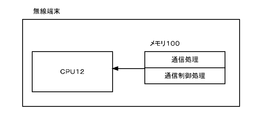
- FIG. 12 it can be realized by a computer system including a memory 100 and a CPU 101.
- the memory 100 stores a program for performing processing corresponding to the signal processing unit 13 and processing corresponding to the communication control unit 14 described above.
- the functions of the signal processing unit 13 and the communication control unit 14 are realized by the CPU 101 executing the program stored in the memory 100.
- [Appendix 1] Communication processing means for transmitting and receiving data; and During the operation of the intermittent reception of the second cycle having a period longer than the first cycle, the communication processing unit starts the reception operation at a predetermined timing of the non-reception period of the second cycle, and receives a predetermined number of times. And a communication control unit that causes the communication processing unit to perform an operation.
- the communication control means causes the communication processing means to perform the data reception operation for a certain period of time before and after the period of the data reception operation, at a timing such that the non-reception period of the second period becomes equal.
- the wireless terminal according to any one of appendix 3 to.
- the communication control means maintains the timing of the second cycle and performs the intermittent reception operation after the data reception operation performed during the non-reception period of the second cycle by the communication processing means.
- the wireless terminal according to any one of appendix 1 to appendix 5, which is to be performed.
- the communication control unit resets the timing of the second cycle and performs the second cycle at a new timing after the data reception operation performed during the non-reception period of the second cycle by the communication processing unit.
- the wireless terminal according to any one of appendix 1 to appendix 5, which causes the communication processing means to perform an intermittent reception operation.
- Appendix 8 The communication control means, based on the past data transmission / reception results, at a predetermined timing of the non-reception period of the second cycle while the communication processing means is in the intermittent reception operation of the second cycle.
- the wireless terminal according to any one of appendix 1 to appendix 7, which determines whether to perform a data reception operation for a certain period with a cycle shorter than the cycle of 2.
- Appendix 10 The communication method according to appendix 9, wherein a data reception operation is started at the timing of the first cycle in the non-reception period of the second cycle.
- Appendix 12 The communication method according to any one of appendix 9 to appendix 11, wherein the data reception operation is performed for a certain period of time before and after the period of the data reception operation, at a timing such that the non-reception period of the second period is equal. .
- Appendix 16 Based on the past data transmission / reception results, during the intermittent reception operation of the second cycle, at a predetermined timing of the non-reception period of the second cycle, for a certain period of time shorter than the second cycle, 16.
- the communication method according to any one of appendix 9 to appendix 15, which determines whether to perform a data reception operation.
- the communication processing means for transmitting and receiving data starts the data reception operation at a predetermined timing in the non-reception period of the second cycle during the intermittent reception operation of the second cycle having a cycle longer than the first cycle.
- the processor is Communication processing to send and receive data; During the intermittent reception operation of the second cycle having a period longer than the first cycle, the reception operation is started at a predetermined timing in the non-reception period of the second cycle, and a predetermined number of reception operations are performed.
- a wireless terminal that executes communication control processing for controlling the communication processing.
- Appendix 19 The wireless terminal according to appendix 18, wherein the communication control process controls the communication process so that a data reception operation is started at a timing of the first period in a non-reception period of the second period.
- Appendix 20 The wireless terminal according to appendix 18 or appendix 19, wherein the communication control process controls the communication process so that a data reception operation is performed for a certain period in the first cycle.
- the communication control process controls the communication process so that the data reception operation is performed for a certain period of time before and after the period of the data reception operation, at a timing such that the non-reception period of the second period becomes equal.
- the wireless terminal according to any one of appendix 18 to appendix 20.
- the communication control process is configured to perform the intermittent reception operation while maintaining the timing of the second period after the data reception operation performed during the non-reception period of the second period by the communication process.
- the wireless terminal according to any one of appendix 18 to appendix 22, which controls communication processing.
- the communication control process is based on the past data transmission / reception results, and the communication process is performed at a predetermined timing in the non-reception period of the second period during the intermittent reception operation of the second period. 25.
- the wireless terminal according to any one of appendix 18 to appendix 24, which determines whether to perform a data reception operation for a certain period with a cycle shorter than the cycle of 2.
- Communication Processing Unit 1 Communication Processing Unit 2 Communication Control Unit 10 UE 20 eNB 11 Receiver 12 Transmitter 13 Signal Processor 14 Communication Controller 21 Receiver 22 Transmitter 23 Signal Processor 24 Communication Controller 25 Terminal Manager 100 Memory 101 CPU
Landscapes
- Engineering & Computer Science (AREA)
- Computer Networks & Wireless Communication (AREA)
- Signal Processing (AREA)
- Mobile Radio Communication Systems (AREA)
Abstract
La présente invention concerne un terminal sans fil comportant un moyen de traitement de communication pour la transmission et la réception de données, et comportant également un moyen de commande de communication pour le démarrage d'une opération de réception à un moment prescrit au cours d'un intervalle de non-réception dans une seconde période, pendant que le moyen de traitement de communication effectue une opération de réception intermittente lors d'une seconde période qui est plus longue qu'une première période, et pour entraîner la réalisation de l'opération de réception par le moyen de traitement de communication un nombre de fois prescrit.
Applications Claiming Priority (2)
| Application Number | Priority Date | Filing Date | Title |
|---|---|---|---|
| JP2015059340A JP2018110275A (ja) | 2015-03-23 | 2015-03-23 | 無線端末、通信方法及びプログラム |
| JP2015-059340 | 2015-03-23 |
Publications (1)
| Publication Number | Publication Date |
|---|---|
| WO2016152802A1 true WO2016152802A1 (fr) | 2016-09-29 |
Family
ID=56978119
Family Applications (1)
| Application Number | Title | Priority Date | Filing Date |
|---|---|---|---|
| PCT/JP2016/058788 Ceased WO2016152802A1 (fr) | 2015-03-23 | 2016-03-18 | Terminal sans fil, procédé de communication, et programme |
Country Status (2)
| Country | Link |
|---|---|
| JP (1) | JP2018110275A (fr) |
| WO (1) | WO2016152802A1 (fr) |
Citations (3)
| Publication number | Priority date | Publication date | Assignee | Title |
|---|---|---|---|---|
| WO2011040516A1 (fr) * | 2009-10-02 | 2011-04-07 | 日本電気株式会社 | Système de communication sans fil, terminaux sans fil, stations de base sans fil, procédé de communication sans fil et programme |
| JP2013176063A (ja) * | 2006-10-30 | 2013-09-05 | Lg Electronics Inc | 多重受信レベル間の遷移方法 |
| WO2014099446A1 (fr) * | 2012-12-17 | 2014-06-26 | Qualcomm Incorporated | Dispositifs et procédés conçus pour faciliter la réduction dynamique de la puissance au cours d'une réception discontinue |
-
2015
- 2015-03-23 JP JP2015059340A patent/JP2018110275A/ja active Pending
-
2016
- 2016-03-18 WO PCT/JP2016/058788 patent/WO2016152802A1/fr not_active Ceased
Patent Citations (3)
| Publication number | Priority date | Publication date | Assignee | Title |
|---|---|---|---|---|
| JP2013176063A (ja) * | 2006-10-30 | 2013-09-05 | Lg Electronics Inc | 多重受信レベル間の遷移方法 |
| WO2011040516A1 (fr) * | 2009-10-02 | 2011-04-07 | 日本電気株式会社 | Système de communication sans fil, terminaux sans fil, stations de base sans fil, procédé de communication sans fil et programme |
| WO2014099446A1 (fr) * | 2012-12-17 | 2014-06-26 | Qualcomm Incorporated | Dispositifs et procédés conçus pour faciliter la réduction dynamique de la puissance au cours d'une réception discontinue |
Also Published As
| Publication number | Publication date |
|---|---|
| JP2018110275A (ja) | 2018-07-12 |
Similar Documents
| Publication | Publication Date | Title |
|---|---|---|
| JP5664887B2 (ja) | 無線通信システム、無線端末、無線基地局及び無線通信方法 | |
| KR101053841B1 (ko) | 불연속 수신 기능 개선 방법 및 관련 통신 기기 | |
| EP2468050B1 (fr) | Réception discontinue pour un système d'ondes porteuses à composantes multiples | |
| US9894705B2 (en) | Self-adjusting discontinuous reception pattern | |
| US9107197B2 (en) | Terminal-based selection of radio parameters among a parameter subset offered by the network | |
| US12262323B2 (en) | Method and apparatus for controlling timer | |
| EP3821677B1 (fr) | Rétablissement de faute de connexion en mode c-drx | |
| CN110199547B (zh) | 用于确定非连续接收状态的方法、终端设备和网络设备 | |
| CN104782218B (zh) | 用于不同流量的不连续接收(drx)的方法和设备 | |
| US20090247203A1 (en) | Method and Apparatus for Improving DRX Functionality | |
| AU2017200813A1 (en) | Communication of preferred power consumption configurations | |
| WO2016024187A1 (fr) | Procédé de partage d'un récepteur ue entre des fonctionnements d2d et cellulaires sur la base de l'activité | |
| WO2021088722A1 (fr) | Dispositif et procédé de configuration de paramètre drx auxiliaire, support de stockage, station de base et terminal | |
| CN110881208A (zh) | 一种通信方法及设备 | |
| CN113273255A (zh) | 非连续接收的方法、终端设备和网络设备 | |
| US11044781B2 (en) | Base station device, communication system, terminal device, communication method, and program | |
| US11224016B2 (en) | First communications device and a method therein for handling of active mode operation | |
| JP6668484B2 (ja) | システム情報送信方法、システム情報更新方法、及びデバイス | |
| JP6414322B2 (ja) | 無線通信システム、無線端末及び無線通信方法 | |
| KR102457499B1 (ko) | 지원 정보 시그널링의 네트워크 관리를 위한 방법 및 장치 | |
| JP7027561B2 (ja) | 間欠伝送の方法と装置 | |
| EP4430889A1 (fr) | Ajustement dynamique d'une opération de réception discontinue pour trafic vidéo de liaison descendante | |
| EP3528555B1 (fr) | Procédé de transmission de données, procédé de réception de données et dispositif | |
| JPWO2016152804A1 (ja) | 無線通信システム、無線通信ネットワーク、無線端末及び無線通信方法 | |
| CN114765837B (zh) | 省电处理方法、装置及设备 |
Legal Events
| Date | Code | Title | Description |
|---|---|---|---|
| 121 | Ep: the epo has been informed by wipo that ep was designated in this application |
Ref document number: 16768705 Country of ref document: EP Kind code of ref document: A1 |
|
| NENP | Non-entry into the national phase |
Ref country code: DE |
|
| 122 | Ep: pct application non-entry in european phase |
Ref document number: 16768705 Country of ref document: EP Kind code of ref document: A1 |
|
| NENP | Non-entry into the national phase |
Ref country code: JP |