WO2016167357A1 - Tôle d'acier pour conteneur et procédé de fabrication de tôle d'acier pour conteneur - Google Patents
Tôle d'acier pour conteneur et procédé de fabrication de tôle d'acier pour conteneur Download PDFInfo
- Publication number
- WO2016167357A1 WO2016167357A1 PCT/JP2016/062146 JP2016062146W WO2016167357A1 WO 2016167357 A1 WO2016167357 A1 WO 2016167357A1 JP 2016062146 W JP2016062146 W JP 2016062146W WO 2016167357 A1 WO2016167357 A1 WO 2016167357A1
- Authority
- WO
- WIPO (PCT)
- Prior art keywords
- chemical conversion
- plating layer
- steel plate
- layer
- ions
- Prior art date
- Legal status (The legal status is an assumption and is not a legal conclusion. Google has not performed a legal analysis and makes no representation as to the accuracy of the status listed.)
- Ceased
Links
Images
Classifications
-
- C—CHEMISTRY; METALLURGY
- C25—ELECTROLYTIC OR ELECTROPHORETIC PROCESSES; APPARATUS THEREFOR
- C25D—PROCESSES FOR THE ELECTROLYTIC OR ELECTROPHORETIC PRODUCTION OF COATINGS; ELECTROFORMING; APPARATUS THEREFOR
- C25D5/00—Electroplating characterised by the process; Pretreatment or after-treatment of workpieces
- C25D5/10—Electroplating with more than one layer of the same or of different metals
- C25D5/12—Electroplating with more than one layer of the same or of different metals at least one layer being of nickel or chromium
-
- B—PERFORMING OPERATIONS; TRANSPORTING
- B32—LAYERED PRODUCTS
- B32B—LAYERED PRODUCTS, i.e. PRODUCTS BUILT-UP OF STRATA OF FLAT OR NON-FLAT, e.g. CELLULAR OR HONEYCOMB, FORM
- B32B15/00—Layered products comprising a layer of metal
- B32B15/01—Layered products comprising a layer of metal all layers being exclusively metallic
-
- B—PERFORMING OPERATIONS; TRANSPORTING
- B32—LAYERED PRODUCTS
- B32B—LAYERED PRODUCTS, i.e. PRODUCTS BUILT-UP OF STRATA OF FLAT OR NON-FLAT, e.g. CELLULAR OR HONEYCOMB, FORM
- B32B15/00—Layered products comprising a layer of metal
- B32B15/01—Layered products comprising a layer of metal all layers being exclusively metallic
- B32B15/013—Layered products comprising a layer of metal all layers being exclusively metallic one layer being formed of an iron alloy or steel, another layer being formed of a metal other than iron or aluminium
-
- B—PERFORMING OPERATIONS; TRANSPORTING
- B32—LAYERED PRODUCTS
- B32B—LAYERED PRODUCTS, i.e. PRODUCTS BUILT-UP OF STRATA OF FLAT OR NON-FLAT, e.g. CELLULAR OR HONEYCOMB, FORM
- B32B15/00—Layered products comprising a layer of metal
- B32B15/01—Layered products comprising a layer of metal all layers being exclusively metallic
- B32B15/013—Layered products comprising a layer of metal all layers being exclusively metallic one layer being formed of an iron alloy or steel, another layer being formed of a metal other than iron or aluminium
- B32B15/015—Layered products comprising a layer of metal all layers being exclusively metallic one layer being formed of an iron alloy or steel, another layer being formed of a metal other than iron or aluminium the said other metal being copper or nickel or an alloy thereof
-
- B—PERFORMING OPERATIONS; TRANSPORTING
- B32—LAYERED PRODUCTS
- B32B—LAYERED PRODUCTS, i.e. PRODUCTS BUILT-UP OF STRATA OF FLAT OR NON-FLAT, e.g. CELLULAR OR HONEYCOMB, FORM
- B32B15/00—Layered products comprising a layer of metal
- B32B15/04—Layered products comprising a layer of metal comprising metal as the main or only constituent of a layer, which is next to another layer of the same or of a different material
-
- B—PERFORMING OPERATIONS; TRANSPORTING
- B32—LAYERED PRODUCTS
- B32B—LAYERED PRODUCTS, i.e. PRODUCTS BUILT-UP OF STRATA OF FLAT OR NON-FLAT, e.g. CELLULAR OR HONEYCOMB, FORM
- B32B15/00—Layered products comprising a layer of metal
- B32B15/04—Layered products comprising a layer of metal comprising metal as the main or only constituent of a layer, which is next to another layer of the same or of a different material
- B32B15/043—Layered products comprising a layer of metal comprising metal as the main or only constituent of a layer, which is next to another layer of the same or of a different material of metal
-
- B—PERFORMING OPERATIONS; TRANSPORTING
- B32—LAYERED PRODUCTS
- B32B—LAYERED PRODUCTS, i.e. PRODUCTS BUILT-UP OF STRATA OF FLAT OR NON-FLAT, e.g. CELLULAR OR HONEYCOMB, FORM
- B32B15/00—Layered products comprising a layer of metal
- B32B15/18—Layered products comprising a layer of metal comprising iron or steel
-
- C—CHEMISTRY; METALLURGY
- C23—COATING METALLIC MATERIAL; COATING MATERIAL WITH METALLIC MATERIAL; CHEMICAL SURFACE TREATMENT; DIFFUSION TREATMENT OF METALLIC MATERIAL; COATING BY VACUUM EVAPORATION, BY SPUTTERING, BY ION IMPLANTATION OR BY CHEMICAL VAPOUR DEPOSITION, IN GENERAL; INHIBITING CORROSION OF METALLIC MATERIAL OR INCRUSTATION IN GENERAL
- C23C—COATING METALLIC MATERIAL; COATING MATERIAL WITH METALLIC MATERIAL; SURFACE TREATMENT OF METALLIC MATERIAL BY DIFFUSION INTO THE SURFACE, BY CHEMICAL CONVERSION OR SUBSTITUTION; COATING BY VACUUM EVAPORATION, BY SPUTTERING, BY ION IMPLANTATION OR BY CHEMICAL VAPOUR DEPOSITION, IN GENERAL
- C23C10/00—Solid state diffusion of only metal elements or silicon into metallic material surfaces
- C23C10/02—Pretreatment of the material to be coated
-
- C—CHEMISTRY; METALLURGY
- C23—COATING METALLIC MATERIAL; COATING MATERIAL WITH METALLIC MATERIAL; CHEMICAL SURFACE TREATMENT; DIFFUSION TREATMENT OF METALLIC MATERIAL; COATING BY VACUUM EVAPORATION, BY SPUTTERING, BY ION IMPLANTATION OR BY CHEMICAL VAPOUR DEPOSITION, IN GENERAL; INHIBITING CORROSION OF METALLIC MATERIAL OR INCRUSTATION IN GENERAL
- C23C—COATING METALLIC MATERIAL; COATING MATERIAL WITH METALLIC MATERIAL; SURFACE TREATMENT OF METALLIC MATERIAL BY DIFFUSION INTO THE SURFACE, BY CHEMICAL CONVERSION OR SUBSTITUTION; COATING BY VACUUM EVAPORATION, BY SPUTTERING, BY ION IMPLANTATION OR BY CHEMICAL VAPOUR DEPOSITION, IN GENERAL
- C23C10/00—Solid state diffusion of only metal elements or silicon into metallic material surfaces
- C23C10/28—Solid state diffusion of only metal elements or silicon into metallic material surfaces using solids, e.g. powders, pastes
-
- C—CHEMISTRY; METALLURGY
- C23—COATING METALLIC MATERIAL; COATING MATERIAL WITH METALLIC MATERIAL; CHEMICAL SURFACE TREATMENT; DIFFUSION TREATMENT OF METALLIC MATERIAL; COATING BY VACUUM EVAPORATION, BY SPUTTERING, BY ION IMPLANTATION OR BY CHEMICAL VAPOUR DEPOSITION, IN GENERAL; INHIBITING CORROSION OF METALLIC MATERIAL OR INCRUSTATION IN GENERAL
- C23C—COATING METALLIC MATERIAL; COATING MATERIAL WITH METALLIC MATERIAL; SURFACE TREATMENT OF METALLIC MATERIAL BY DIFFUSION INTO THE SURFACE, BY CHEMICAL CONVERSION OR SUBSTITUTION; COATING BY VACUUM EVAPORATION, BY SPUTTERING, BY ION IMPLANTATION OR BY CHEMICAL VAPOUR DEPOSITION, IN GENERAL
- C23C2/00—Hot-dipping or immersion processes for applying the coating material in the molten state without affecting the shape; Apparatus therefor
- C23C2/02—Pretreatment of the material to be coated, e.g. for coating on selected surface areas
-
- C—CHEMISTRY; METALLURGY
- C23—COATING METALLIC MATERIAL; COATING MATERIAL WITH METALLIC MATERIAL; CHEMICAL SURFACE TREATMENT; DIFFUSION TREATMENT OF METALLIC MATERIAL; COATING BY VACUUM EVAPORATION, BY SPUTTERING, BY ION IMPLANTATION OR BY CHEMICAL VAPOUR DEPOSITION, IN GENERAL; INHIBITING CORROSION OF METALLIC MATERIAL OR INCRUSTATION IN GENERAL
- C23C—COATING METALLIC MATERIAL; COATING MATERIAL WITH METALLIC MATERIAL; SURFACE TREATMENT OF METALLIC MATERIAL BY DIFFUSION INTO THE SURFACE, BY CHEMICAL CONVERSION OR SUBSTITUTION; COATING BY VACUUM EVAPORATION, BY SPUTTERING, BY ION IMPLANTATION OR BY CHEMICAL VAPOUR DEPOSITION, IN GENERAL
- C23C2/00—Hot-dipping or immersion processes for applying the coating material in the molten state without affecting the shape; Apparatus therefor
- C23C2/02—Pretreatment of the material to be coated, e.g. for coating on selected surface areas
- C23C2/022—Pretreatment of the material to be coated, e.g. for coating on selected surface areas by heating
-
- C—CHEMISTRY; METALLURGY
- C23—COATING METALLIC MATERIAL; COATING MATERIAL WITH METALLIC MATERIAL; CHEMICAL SURFACE TREATMENT; DIFFUSION TREATMENT OF METALLIC MATERIAL; COATING BY VACUUM EVAPORATION, BY SPUTTERING, BY ION IMPLANTATION OR BY CHEMICAL VAPOUR DEPOSITION, IN GENERAL; INHIBITING CORROSION OF METALLIC MATERIAL OR INCRUSTATION IN GENERAL
- C23C—COATING METALLIC MATERIAL; COATING MATERIAL WITH METALLIC MATERIAL; SURFACE TREATMENT OF METALLIC MATERIAL BY DIFFUSION INTO THE SURFACE, BY CHEMICAL CONVERSION OR SUBSTITUTION; COATING BY VACUUM EVAPORATION, BY SPUTTERING, BY ION IMPLANTATION OR BY CHEMICAL VAPOUR DEPOSITION, IN GENERAL
- C23C2/00—Hot-dipping or immersion processes for applying the coating material in the molten state without affecting the shape; Apparatus therefor
- C23C2/02—Pretreatment of the material to be coated, e.g. for coating on selected surface areas
- C23C2/024—Pretreatment of the material to be coated, e.g. for coating on selected surface areas by cleaning or etching
-
- C—CHEMISTRY; METALLURGY
- C23—COATING METALLIC MATERIAL; COATING MATERIAL WITH METALLIC MATERIAL; CHEMICAL SURFACE TREATMENT; DIFFUSION TREATMENT OF METALLIC MATERIAL; COATING BY VACUUM EVAPORATION, BY SPUTTERING, BY ION IMPLANTATION OR BY CHEMICAL VAPOUR DEPOSITION, IN GENERAL; INHIBITING CORROSION OF METALLIC MATERIAL OR INCRUSTATION IN GENERAL
- C23C—COATING METALLIC MATERIAL; COATING MATERIAL WITH METALLIC MATERIAL; SURFACE TREATMENT OF METALLIC MATERIAL BY DIFFUSION INTO THE SURFACE, BY CHEMICAL CONVERSION OR SUBSTITUTION; COATING BY VACUUM EVAPORATION, BY SPUTTERING, BY ION IMPLANTATION OR BY CHEMICAL VAPOUR DEPOSITION, IN GENERAL
- C23C2/00—Hot-dipping or immersion processes for applying the coating material in the molten state without affecting the shape; Apparatus therefor
- C23C2/04—Hot-dipping or immersion processes for applying the coating material in the molten state without affecting the shape; Apparatus therefor characterised by the coating material
-
- C—CHEMISTRY; METALLURGY
- C23—COATING METALLIC MATERIAL; COATING MATERIAL WITH METALLIC MATERIAL; CHEMICAL SURFACE TREATMENT; DIFFUSION TREATMENT OF METALLIC MATERIAL; COATING BY VACUUM EVAPORATION, BY SPUTTERING, BY ION IMPLANTATION OR BY CHEMICAL VAPOUR DEPOSITION, IN GENERAL; INHIBITING CORROSION OF METALLIC MATERIAL OR INCRUSTATION IN GENERAL
- C23C—COATING METALLIC MATERIAL; COATING MATERIAL WITH METALLIC MATERIAL; SURFACE TREATMENT OF METALLIC MATERIAL BY DIFFUSION INTO THE SURFACE, BY CHEMICAL CONVERSION OR SUBSTITUTION; COATING BY VACUUM EVAPORATION, BY SPUTTERING, BY ION IMPLANTATION OR BY CHEMICAL VAPOUR DEPOSITION, IN GENERAL
- C23C2/00—Hot-dipping or immersion processes for applying the coating material in the molten state without affecting the shape; Apparatus therefor
- C23C2/04—Hot-dipping or immersion processes for applying the coating material in the molten state without affecting the shape; Apparatus therefor characterised by the coating material
- C23C2/08—Tin or alloys based thereon
-
- C—CHEMISTRY; METALLURGY
- C23—COATING METALLIC MATERIAL; COATING MATERIAL WITH METALLIC MATERIAL; CHEMICAL SURFACE TREATMENT; DIFFUSION TREATMENT OF METALLIC MATERIAL; COATING BY VACUUM EVAPORATION, BY SPUTTERING, BY ION IMPLANTATION OR BY CHEMICAL VAPOUR DEPOSITION, IN GENERAL; INHIBITING CORROSION OF METALLIC MATERIAL OR INCRUSTATION IN GENERAL
- C23C—COATING METALLIC MATERIAL; COATING MATERIAL WITH METALLIC MATERIAL; SURFACE TREATMENT OF METALLIC MATERIAL BY DIFFUSION INTO THE SURFACE, BY CHEMICAL CONVERSION OR SUBSTITUTION; COATING BY VACUUM EVAPORATION, BY SPUTTERING, BY ION IMPLANTATION OR BY CHEMICAL VAPOUR DEPOSITION, IN GENERAL
- C23C2/00—Hot-dipping or immersion processes for applying the coating material in the molten state without affecting the shape; Apparatus therefor
- C23C2/26—After-treatment
-
- C—CHEMISTRY; METALLURGY
- C23—COATING METALLIC MATERIAL; COATING MATERIAL WITH METALLIC MATERIAL; CHEMICAL SURFACE TREATMENT; DIFFUSION TREATMENT OF METALLIC MATERIAL; COATING BY VACUUM EVAPORATION, BY SPUTTERING, BY ION IMPLANTATION OR BY CHEMICAL VAPOUR DEPOSITION, IN GENERAL; INHIBITING CORROSION OF METALLIC MATERIAL OR INCRUSTATION IN GENERAL
- C23C—COATING METALLIC MATERIAL; COATING MATERIAL WITH METALLIC MATERIAL; SURFACE TREATMENT OF METALLIC MATERIAL BY DIFFUSION INTO THE SURFACE, BY CHEMICAL CONVERSION OR SUBSTITUTION; COATING BY VACUUM EVAPORATION, BY SPUTTERING, BY ION IMPLANTATION OR BY CHEMICAL VAPOUR DEPOSITION, IN GENERAL
- C23C2/00—Hot-dipping or immersion processes for applying the coating material in the molten state without affecting the shape; Apparatus therefor
- C23C2/26—After-treatment
- C23C2/261—After-treatment in a gas atmosphere, e.g. inert or reducing atmosphere
-
- C—CHEMISTRY; METALLURGY
- C23—COATING METALLIC MATERIAL; COATING MATERIAL WITH METALLIC MATERIAL; CHEMICAL SURFACE TREATMENT; DIFFUSION TREATMENT OF METALLIC MATERIAL; COATING BY VACUUM EVAPORATION, BY SPUTTERING, BY ION IMPLANTATION OR BY CHEMICAL VAPOUR DEPOSITION, IN GENERAL; INHIBITING CORROSION OF METALLIC MATERIAL OR INCRUSTATION IN GENERAL
- C23C—COATING METALLIC MATERIAL; COATING MATERIAL WITH METALLIC MATERIAL; SURFACE TREATMENT OF METALLIC MATERIAL BY DIFFUSION INTO THE SURFACE, BY CHEMICAL CONVERSION OR SUBSTITUTION; COATING BY VACUUM EVAPORATION, BY SPUTTERING, BY ION IMPLANTATION OR BY CHEMICAL VAPOUR DEPOSITION, IN GENERAL
- C23C2/00—Hot-dipping or immersion processes for applying the coating material in the molten state without affecting the shape; Apparatus therefor
- C23C2/26—After-treatment
- C23C2/28—Thermal after-treatment, e.g. treatment in oil bath
-
- C—CHEMISTRY; METALLURGY
- C23—COATING METALLIC MATERIAL; COATING MATERIAL WITH METALLIC MATERIAL; CHEMICAL SURFACE TREATMENT; DIFFUSION TREATMENT OF METALLIC MATERIAL; COATING BY VACUUM EVAPORATION, BY SPUTTERING, BY ION IMPLANTATION OR BY CHEMICAL VAPOUR DEPOSITION, IN GENERAL; INHIBITING CORROSION OF METALLIC MATERIAL OR INCRUSTATION IN GENERAL
- C23C—COATING METALLIC MATERIAL; COATING MATERIAL WITH METALLIC MATERIAL; SURFACE TREATMENT OF METALLIC MATERIAL BY DIFFUSION INTO THE SURFACE, BY CHEMICAL CONVERSION OR SUBSTITUTION; COATING BY VACUUM EVAPORATION, BY SPUTTERING, BY ION IMPLANTATION OR BY CHEMICAL VAPOUR DEPOSITION, IN GENERAL
- C23C2/00—Hot-dipping or immersion processes for applying the coating material in the molten state without affecting the shape; Apparatus therefor
- C23C2/26—After-treatment
- C23C2/28—Thermal after-treatment, e.g. treatment in oil bath
- C23C2/285—Thermal after-treatment, e.g. treatment in oil bath for remelting the coating
-
- C—CHEMISTRY; METALLURGY
- C23—COATING METALLIC MATERIAL; COATING MATERIAL WITH METALLIC MATERIAL; CHEMICAL SURFACE TREATMENT; DIFFUSION TREATMENT OF METALLIC MATERIAL; COATING BY VACUUM EVAPORATION, BY SPUTTERING, BY ION IMPLANTATION OR BY CHEMICAL VAPOUR DEPOSITION, IN GENERAL; INHIBITING CORROSION OF METALLIC MATERIAL OR INCRUSTATION IN GENERAL
- C23C—COATING METALLIC MATERIAL; COATING MATERIAL WITH METALLIC MATERIAL; SURFACE TREATMENT OF METALLIC MATERIAL BY DIFFUSION INTO THE SURFACE, BY CHEMICAL CONVERSION OR SUBSTITUTION; COATING BY VACUUM EVAPORATION, BY SPUTTERING, BY ION IMPLANTATION OR BY CHEMICAL VAPOUR DEPOSITION, IN GENERAL
- C23C2/00—Hot-dipping or immersion processes for applying the coating material in the molten state without affecting the shape; Apparatus therefor
- C23C2/34—Hot-dipping or immersion processes for applying the coating material in the molten state without affecting the shape; Apparatus therefor characterised by the shape of the material to be treated
-
- C—CHEMISTRY; METALLURGY
- C23—COATING METALLIC MATERIAL; COATING MATERIAL WITH METALLIC MATERIAL; CHEMICAL SURFACE TREATMENT; DIFFUSION TREATMENT OF METALLIC MATERIAL; COATING BY VACUUM EVAPORATION, BY SPUTTERING, BY ION IMPLANTATION OR BY CHEMICAL VAPOUR DEPOSITION, IN GENERAL; INHIBITING CORROSION OF METALLIC MATERIAL OR INCRUSTATION IN GENERAL
- C23C—COATING METALLIC MATERIAL; COATING MATERIAL WITH METALLIC MATERIAL; SURFACE TREATMENT OF METALLIC MATERIAL BY DIFFUSION INTO THE SURFACE, BY CHEMICAL CONVERSION OR SUBSTITUTION; COATING BY VACUUM EVAPORATION, BY SPUTTERING, BY ION IMPLANTATION OR BY CHEMICAL VAPOUR DEPOSITION, IN GENERAL
- C23C2/00—Hot-dipping or immersion processes for applying the coating material in the molten state without affecting the shape; Apparatus therefor
- C23C2/34—Hot-dipping or immersion processes for applying the coating material in the molten state without affecting the shape; Apparatus therefor characterised by the shape of the material to be treated
- C23C2/36—Elongated material
- C23C2/40—Plates; Strips
-
- C—CHEMISTRY; METALLURGY
- C23—COATING METALLIC MATERIAL; COATING MATERIAL WITH METALLIC MATERIAL; CHEMICAL SURFACE TREATMENT; DIFFUSION TREATMENT OF METALLIC MATERIAL; COATING BY VACUUM EVAPORATION, BY SPUTTERING, BY ION IMPLANTATION OR BY CHEMICAL VAPOUR DEPOSITION, IN GENERAL; INHIBITING CORROSION OF METALLIC MATERIAL OR INCRUSTATION IN GENERAL
- C23C—COATING METALLIC MATERIAL; COATING MATERIAL WITH METALLIC MATERIAL; SURFACE TREATMENT OF METALLIC MATERIAL BY DIFFUSION INTO THE SURFACE, BY CHEMICAL CONVERSION OR SUBSTITUTION; COATING BY VACUUM EVAPORATION, BY SPUTTERING, BY ION IMPLANTATION OR BY CHEMICAL VAPOUR DEPOSITION, IN GENERAL
- C23C28/00—Coating for obtaining at least two superposed coatings either by methods not provided for in a single one of groups C23C2/00 - C23C26/00 or by combinations of methods provided for in subclasses C23C and C25C or C25D
-
- C—CHEMISTRY; METALLURGY
- C23—COATING METALLIC MATERIAL; COATING MATERIAL WITH METALLIC MATERIAL; CHEMICAL SURFACE TREATMENT; DIFFUSION TREATMENT OF METALLIC MATERIAL; COATING BY VACUUM EVAPORATION, BY SPUTTERING, BY ION IMPLANTATION OR BY CHEMICAL VAPOUR DEPOSITION, IN GENERAL; INHIBITING CORROSION OF METALLIC MATERIAL OR INCRUSTATION IN GENERAL
- C23C—COATING METALLIC MATERIAL; COATING MATERIAL WITH METALLIC MATERIAL; SURFACE TREATMENT OF METALLIC MATERIAL BY DIFFUSION INTO THE SURFACE, BY CHEMICAL CONVERSION OR SUBSTITUTION; COATING BY VACUUM EVAPORATION, BY SPUTTERING, BY ION IMPLANTATION OR BY CHEMICAL VAPOUR DEPOSITION, IN GENERAL
- C23C28/00—Coating for obtaining at least two superposed coatings either by methods not provided for in a single one of groups C23C2/00 - C23C26/00 or by combinations of methods provided for in subclasses C23C and C25C or C25D
- C23C28/02—Coating for obtaining at least two superposed coatings either by methods not provided for in a single one of groups C23C2/00 - C23C26/00 or by combinations of methods provided for in subclasses C23C and C25C or C25D only coatings only including layers of metallic material
- C23C28/023—Coating for obtaining at least two superposed coatings either by methods not provided for in a single one of groups C23C2/00 - C23C26/00 or by combinations of methods provided for in subclasses C23C and C25C or C25D only coatings only including layers of metallic material only coatings of metal elements only
-
- C—CHEMISTRY; METALLURGY
- C23—COATING METALLIC MATERIAL; COATING MATERIAL WITH METALLIC MATERIAL; CHEMICAL SURFACE TREATMENT; DIFFUSION TREATMENT OF METALLIC MATERIAL; COATING BY VACUUM EVAPORATION, BY SPUTTERING, BY ION IMPLANTATION OR BY CHEMICAL VAPOUR DEPOSITION, IN GENERAL; INHIBITING CORROSION OF METALLIC MATERIAL OR INCRUSTATION IN GENERAL
- C23C—COATING METALLIC MATERIAL; COATING MATERIAL WITH METALLIC MATERIAL; SURFACE TREATMENT OF METALLIC MATERIAL BY DIFFUSION INTO THE SURFACE, BY CHEMICAL CONVERSION OR SUBSTITUTION; COATING BY VACUUM EVAPORATION, BY SPUTTERING, BY ION IMPLANTATION OR BY CHEMICAL VAPOUR DEPOSITION, IN GENERAL
- C23C28/00—Coating for obtaining at least two superposed coatings either by methods not provided for in a single one of groups C23C2/00 - C23C26/00 or by combinations of methods provided for in subclasses C23C and C25C or C25D
- C23C28/30—Coatings combining at least one metallic layer and at least one inorganic non-metallic layer
-
- C—CHEMISTRY; METALLURGY
- C23—COATING METALLIC MATERIAL; COATING MATERIAL WITH METALLIC MATERIAL; CHEMICAL SURFACE TREATMENT; DIFFUSION TREATMENT OF METALLIC MATERIAL; COATING BY VACUUM EVAPORATION, BY SPUTTERING, BY ION IMPLANTATION OR BY CHEMICAL VAPOUR DEPOSITION, IN GENERAL; INHIBITING CORROSION OF METALLIC MATERIAL OR INCRUSTATION IN GENERAL
- C23C—COATING METALLIC MATERIAL; COATING MATERIAL WITH METALLIC MATERIAL; SURFACE TREATMENT OF METALLIC MATERIAL BY DIFFUSION INTO THE SURFACE, BY CHEMICAL CONVERSION OR SUBSTITUTION; COATING BY VACUUM EVAPORATION, BY SPUTTERING, BY ION IMPLANTATION OR BY CHEMICAL VAPOUR DEPOSITION, IN GENERAL
- C23C28/00—Coating for obtaining at least two superposed coatings either by methods not provided for in a single one of groups C23C2/00 - C23C26/00 or by combinations of methods provided for in subclasses C23C and C25C or C25D
- C23C28/30—Coatings combining at least one metallic layer and at least one inorganic non-metallic layer
- C23C28/32—Coatings combining at least one metallic layer and at least one inorganic non-metallic layer including at least one pure metallic layer
-
- C—CHEMISTRY; METALLURGY
- C23—COATING METALLIC MATERIAL; COATING MATERIAL WITH METALLIC MATERIAL; CHEMICAL SURFACE TREATMENT; DIFFUSION TREATMENT OF METALLIC MATERIAL; COATING BY VACUUM EVAPORATION, BY SPUTTERING, BY ION IMPLANTATION OR BY CHEMICAL VAPOUR DEPOSITION, IN GENERAL; INHIBITING CORROSION OF METALLIC MATERIAL OR INCRUSTATION IN GENERAL
- C23C—COATING METALLIC MATERIAL; COATING MATERIAL WITH METALLIC MATERIAL; SURFACE TREATMENT OF METALLIC MATERIAL BY DIFFUSION INTO THE SURFACE, BY CHEMICAL CONVERSION OR SUBSTITUTION; COATING BY VACUUM EVAPORATION, BY SPUTTERING, BY ION IMPLANTATION OR BY CHEMICAL VAPOUR DEPOSITION, IN GENERAL
- C23C28/00—Coating for obtaining at least two superposed coatings either by methods not provided for in a single one of groups C23C2/00 - C23C26/00 or by combinations of methods provided for in subclasses C23C and C25C or C25D
- C23C28/30—Coatings combining at least one metallic layer and at least one inorganic non-metallic layer
- C23C28/32—Coatings combining at least one metallic layer and at least one inorganic non-metallic layer including at least one pure metallic layer
- C23C28/321—Coatings combining at least one metallic layer and at least one inorganic non-metallic layer including at least one pure metallic layer with at least one metal alloy layer
-
- C—CHEMISTRY; METALLURGY
- C23—COATING METALLIC MATERIAL; COATING MATERIAL WITH METALLIC MATERIAL; CHEMICAL SURFACE TREATMENT; DIFFUSION TREATMENT OF METALLIC MATERIAL; COATING BY VACUUM EVAPORATION, BY SPUTTERING, BY ION IMPLANTATION OR BY CHEMICAL VAPOUR DEPOSITION, IN GENERAL; INHIBITING CORROSION OF METALLIC MATERIAL OR INCRUSTATION IN GENERAL
- C23C—COATING METALLIC MATERIAL; COATING MATERIAL WITH METALLIC MATERIAL; SURFACE TREATMENT OF METALLIC MATERIAL BY DIFFUSION INTO THE SURFACE, BY CHEMICAL CONVERSION OR SUBSTITUTION; COATING BY VACUUM EVAPORATION, BY SPUTTERING, BY ION IMPLANTATION OR BY CHEMICAL VAPOUR DEPOSITION, IN GENERAL
- C23C28/00—Coating for obtaining at least two superposed coatings either by methods not provided for in a single one of groups C23C2/00 - C23C26/00 or by combinations of methods provided for in subclasses C23C and C25C or C25D
- C23C28/30—Coatings combining at least one metallic layer and at least one inorganic non-metallic layer
- C23C28/32—Coatings combining at least one metallic layer and at least one inorganic non-metallic layer including at least one pure metallic layer
- C23C28/322—Coatings combining at least one metallic layer and at least one inorganic non-metallic layer including at least one pure metallic layer only coatings of metal elements only
-
- C—CHEMISTRY; METALLURGY
- C23—COATING METALLIC MATERIAL; COATING MATERIAL WITH METALLIC MATERIAL; CHEMICAL SURFACE TREATMENT; DIFFUSION TREATMENT OF METALLIC MATERIAL; COATING BY VACUUM EVAPORATION, BY SPUTTERING, BY ION IMPLANTATION OR BY CHEMICAL VAPOUR DEPOSITION, IN GENERAL; INHIBITING CORROSION OF METALLIC MATERIAL OR INCRUSTATION IN GENERAL
- C23C—COATING METALLIC MATERIAL; COATING MATERIAL WITH METALLIC MATERIAL; SURFACE TREATMENT OF METALLIC MATERIAL BY DIFFUSION INTO THE SURFACE, BY CHEMICAL CONVERSION OR SUBSTITUTION; COATING BY VACUUM EVAPORATION, BY SPUTTERING, BY ION IMPLANTATION OR BY CHEMICAL VAPOUR DEPOSITION, IN GENERAL
- C23C28/00—Coating for obtaining at least two superposed coatings either by methods not provided for in a single one of groups C23C2/00 - C23C26/00 or by combinations of methods provided for in subclasses C23C and C25C or C25D
- C23C28/30—Coatings combining at least one metallic layer and at least one inorganic non-metallic layer
- C23C28/34—Coatings combining at least one metallic layer and at least one inorganic non-metallic layer including at least one inorganic non-metallic material layer, e.g. metal carbide, nitride, boride, silicide layer and their mixtures, enamels, phosphates and sulphates
-
- C—CHEMISTRY; METALLURGY
- C23—COATING METALLIC MATERIAL; COATING MATERIAL WITH METALLIC MATERIAL; CHEMICAL SURFACE TREATMENT; DIFFUSION TREATMENT OF METALLIC MATERIAL; COATING BY VACUUM EVAPORATION, BY SPUTTERING, BY ION IMPLANTATION OR BY CHEMICAL VAPOUR DEPOSITION, IN GENERAL; INHIBITING CORROSION OF METALLIC MATERIAL OR INCRUSTATION IN GENERAL
- C23C—COATING METALLIC MATERIAL; COATING MATERIAL WITH METALLIC MATERIAL; SURFACE TREATMENT OF METALLIC MATERIAL BY DIFFUSION INTO THE SURFACE, BY CHEMICAL CONVERSION OR SUBSTITUTION; COATING BY VACUUM EVAPORATION, BY SPUTTERING, BY ION IMPLANTATION OR BY CHEMICAL VAPOUR DEPOSITION, IN GENERAL
- C23C28/00—Coating for obtaining at least two superposed coatings either by methods not provided for in a single one of groups C23C2/00 - C23C26/00 or by combinations of methods provided for in subclasses C23C and C25C or C25D
- C23C28/30—Coatings combining at least one metallic layer and at least one inorganic non-metallic layer
- C23C28/34—Coatings combining at least one metallic layer and at least one inorganic non-metallic layer including at least one inorganic non-metallic material layer, e.g. metal carbide, nitride, boride, silicide layer and their mixtures, enamels, phosphates and sulphates
- C23C28/345—Coatings combining at least one metallic layer and at least one inorganic non-metallic layer including at least one inorganic non-metallic material layer, e.g. metal carbide, nitride, boride, silicide layer and their mixtures, enamels, phosphates and sulphates with at least one oxide layer
-
- C—CHEMISTRY; METALLURGY
- C23—COATING METALLIC MATERIAL; COATING MATERIAL WITH METALLIC MATERIAL; CHEMICAL SURFACE TREATMENT; DIFFUSION TREATMENT OF METALLIC MATERIAL; COATING BY VACUUM EVAPORATION, BY SPUTTERING, BY ION IMPLANTATION OR BY CHEMICAL VAPOUR DEPOSITION, IN GENERAL; INHIBITING CORROSION OF METALLIC MATERIAL OR INCRUSTATION IN GENERAL
- C23C—COATING METALLIC MATERIAL; COATING MATERIAL WITH METALLIC MATERIAL; SURFACE TREATMENT OF METALLIC MATERIAL BY DIFFUSION INTO THE SURFACE, BY CHEMICAL CONVERSION OR SUBSTITUTION; COATING BY VACUUM EVAPORATION, BY SPUTTERING, BY ION IMPLANTATION OR BY CHEMICAL VAPOUR DEPOSITION, IN GENERAL
- C23C30/00—Coating with metallic material characterised only by the composition of the metallic material, i.e. not characterised by the coating process
-
- C—CHEMISTRY; METALLURGY
- C23—COATING METALLIC MATERIAL; COATING MATERIAL WITH METALLIC MATERIAL; CHEMICAL SURFACE TREATMENT; DIFFUSION TREATMENT OF METALLIC MATERIAL; COATING BY VACUUM EVAPORATION, BY SPUTTERING, BY ION IMPLANTATION OR BY CHEMICAL VAPOUR DEPOSITION, IN GENERAL; INHIBITING CORROSION OF METALLIC MATERIAL OR INCRUSTATION IN GENERAL
- C23C—COATING METALLIC MATERIAL; COATING MATERIAL WITH METALLIC MATERIAL; SURFACE TREATMENT OF METALLIC MATERIAL BY DIFFUSION INTO THE SURFACE, BY CHEMICAL CONVERSION OR SUBSTITUTION; COATING BY VACUUM EVAPORATION, BY SPUTTERING, BY ION IMPLANTATION OR BY CHEMICAL VAPOUR DEPOSITION, IN GENERAL
- C23C30/00—Coating with metallic material characterised only by the composition of the metallic material, i.e. not characterised by the coating process
- C23C30/005—Coating with metallic material characterised only by the composition of the metallic material, i.e. not characterised by the coating process on hard metal substrates
-
- C—CHEMISTRY; METALLURGY
- C25—ELECTROLYTIC OR ELECTROPHORETIC PROCESSES; APPARATUS THEREFOR
- C25D—PROCESSES FOR THE ELECTROLYTIC OR ELECTROPHORETIC PRODUCTION OF COATINGS; ELECTROFORMING; APPARATUS THEREFOR
- C25D11/00—Electrolytic coating by surface reaction, i.e. forming conversion layers
-
- C—CHEMISTRY; METALLURGY
- C25—ELECTROLYTIC OR ELECTROPHORETIC PROCESSES; APPARATUS THEREFOR
- C25D—PROCESSES FOR THE ELECTROLYTIC OR ELECTROPHORETIC PRODUCTION OF COATINGS; ELECTROFORMING; APPARATUS THEREFOR
- C25D11/00—Electrolytic coating by surface reaction, i.e. forming conversion layers
- C25D11/02—Anodisation
-
- C—CHEMISTRY; METALLURGY
- C25—ELECTROLYTIC OR ELECTROPHORETIC PROCESSES; APPARATUS THEREFOR
- C25D—PROCESSES FOR THE ELECTROLYTIC OR ELECTROPHORETIC PRODUCTION OF COATINGS; ELECTROFORMING; APPARATUS THEREFOR
- C25D11/00—Electrolytic coating by surface reaction, i.e. forming conversion layers
- C25D11/02—Anodisation
- C25D11/26—Anodisation of refractory metals or alloys based thereon
-
- C—CHEMISTRY; METALLURGY
- C25—ELECTROLYTIC OR ELECTROPHORETIC PROCESSES; APPARATUS THEREFOR
- C25D—PROCESSES FOR THE ELECTROLYTIC OR ELECTROPHORETIC PRODUCTION OF COATINGS; ELECTROFORMING; APPARATUS THEREFOR
- C25D11/00—Electrolytic coating by surface reaction, i.e. forming conversion layers
- C25D11/02—Anodisation
- C25D11/34—Anodisation of metals or alloys not provided for in groups C25D11/04 - C25D11/32
-
- C—CHEMISTRY; METALLURGY
- C25—ELECTROLYTIC OR ELECTROPHORETIC PROCESSES; APPARATUS THEREFOR
- C25D—PROCESSES FOR THE ELECTROLYTIC OR ELECTROPHORETIC PRODUCTION OF COATINGS; ELECTROFORMING; APPARATUS THEREFOR
- C25D11/00—Electrolytic coating by surface reaction, i.e. forming conversion layers
- C25D11/36—Phosphatising
-
- C—CHEMISTRY; METALLURGY
- C25—ELECTROLYTIC OR ELECTROPHORETIC PROCESSES; APPARATUS THEREFOR
- C25D—PROCESSES FOR THE ELECTROLYTIC OR ELECTROPHORETIC PRODUCTION OF COATINGS; ELECTROFORMING; APPARATUS THEREFOR
- C25D5/00—Electroplating characterised by the process; Pretreatment or after-treatment of workpieces
- C25D5/34—Pretreatment of metallic surfaces to be electroplated
-
- C—CHEMISTRY; METALLURGY
- C25—ELECTROLYTIC OR ELECTROPHORETIC PROCESSES; APPARATUS THEREFOR
- C25D—PROCESSES FOR THE ELECTROLYTIC OR ELECTROPHORETIC PRODUCTION OF COATINGS; ELECTROFORMING; APPARATUS THEREFOR
- C25D5/00—Electroplating characterised by the process; Pretreatment or after-treatment of workpieces
- C25D5/34—Pretreatment of metallic surfaces to be electroplated
- C25D5/36—Pretreatment of metallic surfaces to be electroplated of iron or steel
-
- C—CHEMISTRY; METALLURGY
- C25—ELECTROLYTIC OR ELECTROPHORETIC PROCESSES; APPARATUS THEREFOR
- C25D—PROCESSES FOR THE ELECTROLYTIC OR ELECTROPHORETIC PRODUCTION OF COATINGS; ELECTROFORMING; APPARATUS THEREFOR
- C25D5/00—Electroplating characterised by the process; Pretreatment or after-treatment of workpieces
- C25D5/34—Pretreatment of metallic surfaces to be electroplated
- C25D5/38—Pretreatment of metallic surfaces to be electroplated of refractory metals or nickel
- C25D5/40—Nickel; Chromium
-
- C—CHEMISTRY; METALLURGY
- C25—ELECTROLYTIC OR ELECTROPHORETIC PROCESSES; APPARATUS THEREFOR
- C25D—PROCESSES FOR THE ELECTROLYTIC OR ELECTROPHORETIC PRODUCTION OF COATINGS; ELECTROFORMING; APPARATUS THEREFOR
- C25D5/00—Electroplating characterised by the process; Pretreatment or after-treatment of workpieces
- C25D5/48—After-treatment of electroplated surfaces
-
- C—CHEMISTRY; METALLURGY
- C25—ELECTROLYTIC OR ELECTROPHORETIC PROCESSES; APPARATUS THEREFOR
- C25D—PROCESSES FOR THE ELECTROLYTIC OR ELECTROPHORETIC PRODUCTION OF COATINGS; ELECTROFORMING; APPARATUS THEREFOR
- C25D5/00—Electroplating characterised by the process; Pretreatment or after-treatment of workpieces
- C25D5/48—After-treatment of electroplated surfaces
- C25D5/50—After-treatment of electroplated surfaces by heat-treatment
-
- C—CHEMISTRY; METALLURGY
- C25—ELECTROLYTIC OR ELECTROPHORETIC PROCESSES; APPARATUS THEREFOR
- C25D—PROCESSES FOR THE ELECTROLYTIC OR ELECTROPHORETIC PRODUCTION OF COATINGS; ELECTROFORMING; APPARATUS THEREFOR
- C25D5/00—Electroplating characterised by the process; Pretreatment or after-treatment of workpieces
- C25D5/48—After-treatment of electroplated surfaces
- C25D5/50—After-treatment of electroplated surfaces by heat-treatment
- C25D5/505—After-treatment of electroplated surfaces by heat-treatment of electroplated tin coatings, e.g. by melting
-
- C—CHEMISTRY; METALLURGY
- C25—ELECTROLYTIC OR ELECTROPHORETIC PROCESSES; APPARATUS THEREFOR
- C25D—PROCESSES FOR THE ELECTROLYTIC OR ELECTROPHORETIC PRODUCTION OF COATINGS; ELECTROFORMING; APPARATUS THEREFOR
- C25D7/00—Electroplating characterised by the article coated
- C25D7/04—Tubes; Rings; Hollow bodies
-
- C—CHEMISTRY; METALLURGY
- C25—ELECTROLYTIC OR ELECTROPHORETIC PROCESSES; APPARATUS THEREFOR
- C25D—PROCESSES FOR THE ELECTROLYTIC OR ELECTROPHORETIC PRODUCTION OF COATINGS; ELECTROFORMING; APPARATUS THEREFOR
- C25D7/00—Electroplating characterised by the article coated
- C25D7/06—Wires; Strips; Foils
-
- C—CHEMISTRY; METALLURGY
- C25—ELECTROLYTIC OR ELECTROPHORETIC PROCESSES; APPARATUS THEREFOR
- C25D—PROCESSES FOR THE ELECTROLYTIC OR ELECTROPHORETIC PRODUCTION OF COATINGS; ELECTROFORMING; APPARATUS THEREFOR
- C25D7/00—Electroplating characterised by the article coated
- C25D7/06—Wires; Strips; Foils
- C25D7/0614—Strips or foils
-
- C—CHEMISTRY; METALLURGY
- C25—ELECTROLYTIC OR ELECTROPHORETIC PROCESSES; APPARATUS THEREFOR
- C25D—PROCESSES FOR THE ELECTROLYTIC OR ELECTROPHORETIC PRODUCTION OF COATINGS; ELECTROFORMING; APPARATUS THEREFOR
- C25D9/00—Electrolytic coating other than with metals
- C25D9/04—Electrolytic coating other than with metals with inorganic materials
- C25D9/08—Electrolytic coating other than with metals with inorganic materials by cathodic processes
-
- C—CHEMISTRY; METALLURGY
- C25—ELECTROLYTIC OR ELECTROPHORETIC PROCESSES; APPARATUS THEREFOR
- C25D—PROCESSES FOR THE ELECTROLYTIC OR ELECTROPHORETIC PRODUCTION OF COATINGS; ELECTROFORMING; APPARATUS THEREFOR
- C25D9/00—Electrolytic coating other than with metals
- C25D9/04—Electrolytic coating other than with metals with inorganic materials
- C25D9/08—Electrolytic coating other than with metals with inorganic materials by cathodic processes
- C25D9/10—Electrolytic coating other than with metals with inorganic materials by cathodic processes on iron or steel
-
- B—PERFORMING OPERATIONS; TRANSPORTING
- B32—LAYERED PRODUCTS
- B32B—LAYERED PRODUCTS, i.e. PRODUCTS BUILT-UP OF STRATA OF FLAT OR NON-FLAT, e.g. CELLULAR OR HONEYCOMB, FORM
- B32B2250/00—Layers arrangement
- B32B2250/03—3 layers
-
- B—PERFORMING OPERATIONS; TRANSPORTING
- B32—LAYERED PRODUCTS
- B32B—LAYERED PRODUCTS, i.e. PRODUCTS BUILT-UP OF STRATA OF FLAT OR NON-FLAT, e.g. CELLULAR OR HONEYCOMB, FORM
- B32B2255/00—Coating on the layer surface
- B32B2255/06—Coating on the layer surface on metal layer
-
- B—PERFORMING OPERATIONS; TRANSPORTING
- B32—LAYERED PRODUCTS
- B32B—LAYERED PRODUCTS, i.e. PRODUCTS BUILT-UP OF STRATA OF FLAT OR NON-FLAT, e.g. CELLULAR OR HONEYCOMB, FORM
- B32B2255/00—Coating on the layer surface
- B32B2255/20—Inorganic coating
- B32B2255/205—Metallic coating
-
- B—PERFORMING OPERATIONS; TRANSPORTING
- B32—LAYERED PRODUCTS
- B32B—LAYERED PRODUCTS, i.e. PRODUCTS BUILT-UP OF STRATA OF FLAT OR NON-FLAT, e.g. CELLULAR OR HONEYCOMB, FORM
- B32B2255/00—Coating on the layer surface
- B32B2255/28—Multiple coating on one surface
-
- B—PERFORMING OPERATIONS; TRANSPORTING
- B32—LAYERED PRODUCTS
- B32B—LAYERED PRODUCTS, i.e. PRODUCTS BUILT-UP OF STRATA OF FLAT OR NON-FLAT, e.g. CELLULAR OR HONEYCOMB, FORM
- B32B2439/00—Containers; Receptacles
- B32B2439/70—Food packaging
-
- Y—GENERAL TAGGING OF NEW TECHNOLOGICAL DEVELOPMENTS; GENERAL TAGGING OF CROSS-SECTIONAL TECHNOLOGIES SPANNING OVER SEVERAL SECTIONS OF THE IPC; TECHNICAL SUBJECTS COVERED BY FORMER USPC CROSS-REFERENCE ART COLLECTIONS [XRACs] AND DIGESTS
- Y10—TECHNICAL SUBJECTS COVERED BY FORMER USPC
- Y10T—TECHNICAL SUBJECTS COVERED BY FORMER US CLASSIFICATION
- Y10T428/00—Stock material or miscellaneous articles
- Y10T428/12—All metal or with adjacent metals
- Y10T428/12493—Composite; i.e., plural, adjacent, spatially distinct metal components [e.g., layers, joint, etc.]
- Y10T428/12535—Composite; i.e., plural, adjacent, spatially distinct metal components [e.g., layers, joint, etc.] with additional, spatially distinct nonmetal component
- Y10T428/12611—Oxide-containing component
-
- Y—GENERAL TAGGING OF NEW TECHNOLOGICAL DEVELOPMENTS; GENERAL TAGGING OF CROSS-SECTIONAL TECHNOLOGIES SPANNING OVER SEVERAL SECTIONS OF THE IPC; TECHNICAL SUBJECTS COVERED BY FORMER USPC CROSS-REFERENCE ART COLLECTIONS [XRACs] AND DIGESTS
- Y10—TECHNICAL SUBJECTS COVERED BY FORMER USPC
- Y10T—TECHNICAL SUBJECTS COVERED BY FORMER US CLASSIFICATION
- Y10T428/00—Stock material or miscellaneous articles
- Y10T428/12—All metal or with adjacent metals
- Y10T428/12493—Composite; i.e., plural, adjacent, spatially distinct metal components [e.g., layers, joint, etc.]
- Y10T428/12535—Composite; i.e., plural, adjacent, spatially distinct metal components [e.g., layers, joint, etc.] with additional, spatially distinct nonmetal component
- Y10T428/12611—Oxide-containing component
- Y10T428/12618—Plural oxides
-
- Y—GENERAL TAGGING OF NEW TECHNOLOGICAL DEVELOPMENTS; GENERAL TAGGING OF CROSS-SECTIONAL TECHNOLOGIES SPANNING OVER SEVERAL SECTIONS OF THE IPC; TECHNICAL SUBJECTS COVERED BY FORMER USPC CROSS-REFERENCE ART COLLECTIONS [XRACs] AND DIGESTS
- Y10—TECHNICAL SUBJECTS COVERED BY FORMER USPC
- Y10T—TECHNICAL SUBJECTS COVERED BY FORMER US CLASSIFICATION
- Y10T428/00—Stock material or miscellaneous articles
- Y10T428/12—All metal or with adjacent metals
- Y10T428/12493—Composite; i.e., plural, adjacent, spatially distinct metal components [e.g., layers, joint, etc.]
- Y10T428/1266—O, S, or organic compound in metal component
-
- Y—GENERAL TAGGING OF NEW TECHNOLOGICAL DEVELOPMENTS; GENERAL TAGGING OF CROSS-SECTIONAL TECHNOLOGIES SPANNING OVER SEVERAL SECTIONS OF THE IPC; TECHNICAL SUBJECTS COVERED BY FORMER USPC CROSS-REFERENCE ART COLLECTIONS [XRACs] AND DIGESTS
- Y10—TECHNICAL SUBJECTS COVERED BY FORMER USPC
- Y10T—TECHNICAL SUBJECTS COVERED BY FORMER US CLASSIFICATION
- Y10T428/00—Stock material or miscellaneous articles
- Y10T428/12—All metal or with adjacent metals
- Y10T428/12493—Composite; i.e., plural, adjacent, spatially distinct metal components [e.g., layers, joint, etc.]
- Y10T428/1266—O, S, or organic compound in metal component
- Y10T428/12667—Oxide of transition metal or Al
-
- Y—GENERAL TAGGING OF NEW TECHNOLOGICAL DEVELOPMENTS; GENERAL TAGGING OF CROSS-SECTIONAL TECHNOLOGIES SPANNING OVER SEVERAL SECTIONS OF THE IPC; TECHNICAL SUBJECTS COVERED BY FORMER USPC CROSS-REFERENCE ART COLLECTIONS [XRACs] AND DIGESTS
- Y10—TECHNICAL SUBJECTS COVERED BY FORMER USPC
- Y10T—TECHNICAL SUBJECTS COVERED BY FORMER US CLASSIFICATION
- Y10T428/00—Stock material or miscellaneous articles
- Y10T428/12—All metal or with adjacent metals
- Y10T428/12493—Composite; i.e., plural, adjacent, spatially distinct metal components [e.g., layers, joint, etc.]
- Y10T428/12708—Sn-base component
-
- Y—GENERAL TAGGING OF NEW TECHNOLOGICAL DEVELOPMENTS; GENERAL TAGGING OF CROSS-SECTIONAL TECHNOLOGIES SPANNING OVER SEVERAL SECTIONS OF THE IPC; TECHNICAL SUBJECTS COVERED BY FORMER USPC CROSS-REFERENCE ART COLLECTIONS [XRACs] AND DIGESTS
- Y10—TECHNICAL SUBJECTS COVERED BY FORMER USPC
- Y10T—TECHNICAL SUBJECTS COVERED BY FORMER US CLASSIFICATION
- Y10T428/00—Stock material or miscellaneous articles
- Y10T428/12—All metal or with adjacent metals
- Y10T428/12493—Composite; i.e., plural, adjacent, spatially distinct metal components [e.g., layers, joint, etc.]
- Y10T428/12708—Sn-base component
- Y10T428/12715—Next to Group IB metal-base component
-
- Y—GENERAL TAGGING OF NEW TECHNOLOGICAL DEVELOPMENTS; GENERAL TAGGING OF CROSS-SECTIONAL TECHNOLOGIES SPANNING OVER SEVERAL SECTIONS OF THE IPC; TECHNICAL SUBJECTS COVERED BY FORMER USPC CROSS-REFERENCE ART COLLECTIONS [XRACs] AND DIGESTS
- Y10—TECHNICAL SUBJECTS COVERED BY FORMER USPC
- Y10T—TECHNICAL SUBJECTS COVERED BY FORMER US CLASSIFICATION
- Y10T428/00—Stock material or miscellaneous articles
- Y10T428/12—All metal or with adjacent metals
- Y10T428/12493—Composite; i.e., plural, adjacent, spatially distinct metal components [e.g., layers, joint, etc.]
- Y10T428/12708—Sn-base component
- Y10T428/12722—Next to Group VIII metal-base component
-
- Y—GENERAL TAGGING OF NEW TECHNOLOGICAL DEVELOPMENTS; GENERAL TAGGING OF CROSS-SECTIONAL TECHNOLOGIES SPANNING OVER SEVERAL SECTIONS OF THE IPC; TECHNICAL SUBJECTS COVERED BY FORMER USPC CROSS-REFERENCE ART COLLECTIONS [XRACs] AND DIGESTS
- Y10—TECHNICAL SUBJECTS COVERED BY FORMER USPC
- Y10T—TECHNICAL SUBJECTS COVERED BY FORMER US CLASSIFICATION
- Y10T428/00—Stock material or miscellaneous articles
- Y10T428/12—All metal or with adjacent metals
- Y10T428/12493—Composite; i.e., plural, adjacent, spatially distinct metal components [e.g., layers, joint, etc.]
- Y10T428/12771—Transition metal-base component
- Y10T428/12861—Group VIII or IB metal-base component
- Y10T428/12931—Co-, Fe-, or Ni-base components, alternative to each other
-
- Y—GENERAL TAGGING OF NEW TECHNOLOGICAL DEVELOPMENTS; GENERAL TAGGING OF CROSS-SECTIONAL TECHNOLOGIES SPANNING OVER SEVERAL SECTIONS OF THE IPC; TECHNICAL SUBJECTS COVERED BY FORMER USPC CROSS-REFERENCE ART COLLECTIONS [XRACs] AND DIGESTS
- Y10—TECHNICAL SUBJECTS COVERED BY FORMER USPC
- Y10T—TECHNICAL SUBJECTS COVERED BY FORMER US CLASSIFICATION
- Y10T428/00—Stock material or miscellaneous articles
- Y10T428/12—All metal or with adjacent metals
- Y10T428/12493—Composite; i.e., plural, adjacent, spatially distinct metal components [e.g., layers, joint, etc.]
- Y10T428/12771—Transition metal-base component
- Y10T428/12861—Group VIII or IB metal-base component
- Y10T428/12937—Co- or Ni-base component next to Fe-base component
-
- Y—GENERAL TAGGING OF NEW TECHNOLOGICAL DEVELOPMENTS; GENERAL TAGGING OF CROSS-SECTIONAL TECHNOLOGIES SPANNING OVER SEVERAL SECTIONS OF THE IPC; TECHNICAL SUBJECTS COVERED BY FORMER USPC CROSS-REFERENCE ART COLLECTIONS [XRACs] AND DIGESTS
- Y10—TECHNICAL SUBJECTS COVERED BY FORMER USPC
- Y10T—TECHNICAL SUBJECTS COVERED BY FORMER US CLASSIFICATION
- Y10T428/00—Stock material or miscellaneous articles
- Y10T428/12—All metal or with adjacent metals
- Y10T428/12493—Composite; i.e., plural, adjacent, spatially distinct metal components [e.g., layers, joint, etc.]
- Y10T428/12771—Transition metal-base component
- Y10T428/12861—Group VIII or IB metal-base component
- Y10T428/12944—Ni-base component
-
- Y—GENERAL TAGGING OF NEW TECHNOLOGICAL DEVELOPMENTS; GENERAL TAGGING OF CROSS-SECTIONAL TECHNOLOGIES SPANNING OVER SEVERAL SECTIONS OF THE IPC; TECHNICAL SUBJECTS COVERED BY FORMER USPC CROSS-REFERENCE ART COLLECTIONS [XRACs] AND DIGESTS
- Y10—TECHNICAL SUBJECTS COVERED BY FORMER USPC
- Y10T—TECHNICAL SUBJECTS COVERED BY FORMER US CLASSIFICATION
- Y10T428/00—Stock material or miscellaneous articles
- Y10T428/12—All metal or with adjacent metals
- Y10T428/12493—Composite; i.e., plural, adjacent, spatially distinct metal components [e.g., layers, joint, etc.]
- Y10T428/12771—Transition metal-base component
- Y10T428/12861—Group VIII or IB metal-base component
- Y10T428/12951—Fe-base component
-
- Y—GENERAL TAGGING OF NEW TECHNOLOGICAL DEVELOPMENTS; GENERAL TAGGING OF CROSS-SECTIONAL TECHNOLOGIES SPANNING OVER SEVERAL SECTIONS OF THE IPC; TECHNICAL SUBJECTS COVERED BY FORMER USPC CROSS-REFERENCE ART COLLECTIONS [XRACs] AND DIGESTS
- Y10—TECHNICAL SUBJECTS COVERED BY FORMER USPC
- Y10T—TECHNICAL SUBJECTS COVERED BY FORMER US CLASSIFICATION
- Y10T428/00—Stock material or miscellaneous articles
- Y10T428/12—All metal or with adjacent metals
- Y10T428/12493—Composite; i.e., plural, adjacent, spatially distinct metal components [e.g., layers, joint, etc.]
- Y10T428/12771—Transition metal-base component
- Y10T428/12861—Group VIII or IB metal-base component
- Y10T428/12951—Fe-base component
- Y10T428/12972—Containing 0.01-1.7% carbon [i.e., steel]
-
- Y—GENERAL TAGGING OF NEW TECHNOLOGICAL DEVELOPMENTS; GENERAL TAGGING OF CROSS-SECTIONAL TECHNOLOGIES SPANNING OVER SEVERAL SECTIONS OF THE IPC; TECHNICAL SUBJECTS COVERED BY FORMER USPC CROSS-REFERENCE ART COLLECTIONS [XRACs] AND DIGESTS
- Y10—TECHNICAL SUBJECTS COVERED BY FORMER USPC
- Y10T—TECHNICAL SUBJECTS COVERED BY FORMER US CLASSIFICATION
- Y10T428/00—Stock material or miscellaneous articles
- Y10T428/12—All metal or with adjacent metals
- Y10T428/12493—Composite; i.e., plural, adjacent, spatially distinct metal components [e.g., layers, joint, etc.]
- Y10T428/12986—Adjacent functionally defined components
-
- Y—GENERAL TAGGING OF NEW TECHNOLOGICAL DEVELOPMENTS; GENERAL TAGGING OF CROSS-SECTIONAL TECHNOLOGIES SPANNING OVER SEVERAL SECTIONS OF THE IPC; TECHNICAL SUBJECTS COVERED BY FORMER USPC CROSS-REFERENCE ART COLLECTIONS [XRACs] AND DIGESTS
- Y10—TECHNICAL SUBJECTS COVERED BY FORMER USPC
- Y10T—TECHNICAL SUBJECTS COVERED BY FORMER US CLASSIFICATION
- Y10T428/00—Stock material or miscellaneous articles
- Y10T428/24—Structurally defined web or sheet [e.g., overall dimension, etc.]
- Y10T428/24942—Structurally defined web or sheet [e.g., overall dimension, etc.] including components having same physical characteristic in differing degree
-
- Y—GENERAL TAGGING OF NEW TECHNOLOGICAL DEVELOPMENTS; GENERAL TAGGING OF CROSS-SECTIONAL TECHNOLOGIES SPANNING OVER SEVERAL SECTIONS OF THE IPC; TECHNICAL SUBJECTS COVERED BY FORMER USPC CROSS-REFERENCE ART COLLECTIONS [XRACs] AND DIGESTS
- Y10—TECHNICAL SUBJECTS COVERED BY FORMER USPC
- Y10T—TECHNICAL SUBJECTS COVERED BY FORMER US CLASSIFICATION
- Y10T428/00—Stock material or miscellaneous articles
- Y10T428/24—Structurally defined web or sheet [e.g., overall dimension, etc.]
- Y10T428/24942—Structurally defined web or sheet [e.g., overall dimension, etc.] including components having same physical characteristic in differing degree
- Y10T428/2495—Thickness [relative or absolute]
-
- Y—GENERAL TAGGING OF NEW TECHNOLOGICAL DEVELOPMENTS; GENERAL TAGGING OF CROSS-SECTIONAL TECHNOLOGIES SPANNING OVER SEVERAL SECTIONS OF THE IPC; TECHNICAL SUBJECTS COVERED BY FORMER USPC CROSS-REFERENCE ART COLLECTIONS [XRACs] AND DIGESTS
- Y10—TECHNICAL SUBJECTS COVERED BY FORMER USPC
- Y10T—TECHNICAL SUBJECTS COVERED BY FORMER US CLASSIFICATION
- Y10T428/00—Stock material or miscellaneous articles
- Y10T428/26—Web or sheet containing structurally defined element or component, the element or component having a specified physical dimension
- Y10T428/263—Coating layer not in excess of 5 mils thick or equivalent
-
- Y—GENERAL TAGGING OF NEW TECHNOLOGICAL DEVELOPMENTS; GENERAL TAGGING OF CROSS-SECTIONAL TECHNOLOGIES SPANNING OVER SEVERAL SECTIONS OF THE IPC; TECHNICAL SUBJECTS COVERED BY FORMER USPC CROSS-REFERENCE ART COLLECTIONS [XRACs] AND DIGESTS
- Y10—TECHNICAL SUBJECTS COVERED BY FORMER USPC
- Y10T—TECHNICAL SUBJECTS COVERED BY FORMER US CLASSIFICATION
- Y10T428/00—Stock material or miscellaneous articles
- Y10T428/26—Web or sheet containing structurally defined element or component, the element or component having a specified physical dimension
- Y10T428/263—Coating layer not in excess of 5 mils thick or equivalent
- Y10T428/264—Up to 3 mils
-
- Y—GENERAL TAGGING OF NEW TECHNOLOGICAL DEVELOPMENTS; GENERAL TAGGING OF CROSS-SECTIONAL TECHNOLOGIES SPANNING OVER SEVERAL SECTIONS OF THE IPC; TECHNICAL SUBJECTS COVERED BY FORMER USPC CROSS-REFERENCE ART COLLECTIONS [XRACs] AND DIGESTS
- Y10—TECHNICAL SUBJECTS COVERED BY FORMER USPC
- Y10T—TECHNICAL SUBJECTS COVERED BY FORMER US CLASSIFICATION
- Y10T428/00—Stock material or miscellaneous articles
- Y10T428/26—Web or sheet containing structurally defined element or component, the element or component having a specified physical dimension
- Y10T428/263—Coating layer not in excess of 5 mils thick or equivalent
- Y10T428/264—Up to 3 mils
- Y10T428/265—1 mil or less
-
- Y—GENERAL TAGGING OF NEW TECHNOLOGICAL DEVELOPMENTS; GENERAL TAGGING OF CROSS-SECTIONAL TECHNOLOGIES SPANNING OVER SEVERAL SECTIONS OF THE IPC; TECHNICAL SUBJECTS COVERED BY FORMER USPC CROSS-REFERENCE ART COLLECTIONS [XRACs] AND DIGESTS
- Y10—TECHNICAL SUBJECTS COVERED BY FORMER USPC
- Y10T—TECHNICAL SUBJECTS COVERED BY FORMER US CLASSIFICATION
- Y10T428/00—Stock material or miscellaneous articles
- Y10T428/27—Web or sheet containing structurally defined element or component, the element or component having a specified weight per unit area [e.g., gms/sq cm, lbs/sq ft, etc.]
Definitions
- the present invention relates to a steel plate for containers and a method for producing a steel plate for containers.
- This application claims priority based on Japanese Patent Application No. 2015-83985 filed in Japan on April 16, 2015 and Japanese Patent Application No. 2015-83986 filed in Japan on April 16, 2015. Is hereby incorporated by reference.
- metal containers made of plated steel sheets such as Ni-plated steel sheets, Sn-plated steel sheets or Sn-based alloy-plated steel sheets are often used.
- a coating may be applied to the surface of such a metal container before or after canning, or a film may be laminated. Paints and films used for surface treatment of metal containers are collectively referred to as coating agents.
- the plated steel sheet used for the base of the coating agent is subjected to a surface treatment using hexavalent chromate or the like (hereinafter referred to as chromate treatment) in order to ensure adhesion and corrosion resistance with the coating agent.
- chromate treatment hexavalent chromate or the like
- the plated steel sheet that has been subjected to chromate treatment has a coating on the film formed by chromate treatment for the purpose of imparting organic solvent resistance, fingerprint resistance, scratch resistance, lubricity, etc., if necessary.
- a coating layer made of an organic resin is formed.
- Patent Literature 2 and Patent Literature 3 below disclose cathode electrolytic treatment using a chemical conversion treatment solution containing Zr ions and F ions as a surface treatment of a plated steel sheet as an alternative to chromate treatment.
- Patent Document 4 discloses a cathodic electrolysis treatment using a chemical conversion treatment solution containing phosphate ions and at least one of Ti ions and Zr ions.
- Patent Document 5 discloses a cathodic electrolytic treatment using a chemical conversion treatment solution containing Zr ions, F ions, and phosphate ions.
- Patent Document 6 discloses a cathodic electrolysis treatment using a chemical conversion treatment solution containing Zr ions and organic substances.
- Patent Document 7 discloses a cathodic electrolysis treatment using a chemical conversion treatment solution containing Zr ions, phosphate ions, and organic substances.
- Patent Document 8 and Patent Document 9 disclose cathode electrolytic treatment using a chemical conversion treatment solution containing Zr ions, phosphate ions, and nitrate ions.
- Patent Document 9 discloses a method for promoting the formation of a film (hereinafter referred to as a chemical conversion film layer) formed by cathodic electrolysis by increasing nitrate ions.
- Patent Documents 2 to 8 have a problem in that suitable productivity cannot be obtained because it takes a long time to form the chemical conversion film layer containing the Zr compound.
- a high concentration of nitrate ions is required, which is not preferable in terms of the environment.
- Patent Documents 2 to 9 do not disclose a method for improving the anti-sulfur blackening resistance.
- the steel plate for containers is used in a food container containing, for example, high-protein food such as fish meat or beans
- the container is subjected to retort treatment (high-temperature heat sterilization treatment in the presence of water vapor) after filling the food.
- retort treatment high-temperature heat sterilization treatment in the presence of water vapor
- at least one of the inner surface and the contents may change to black. This blackening phenomenon is called sulfide blackening.
- S Sulfur contained in food is thermally decomposed by retort treatment, and hydrogen sulfide (H 2 S), thiols (HS ⁇ ) and the like are generated.
- This hydrogen sulfide and thiols react with the constituent metal on the inner surface of the container to produce black metal sulfide, and this blackening of sulfide occurs. Due to this blackening of sulfide, the appearance of the container may deteriorate. Furthermore, the generated black metal sulfide may be misunderstood by consumers as metal corrosion on the inner surface of the container or corrosion of the contents. Therefore, it is necessary to prevent the occurrence of sulfide blackening as much as possible particularly in the steel plate for containers used for food containers.
- the present invention has been made in view of the above circumstances, and an object of the present invention is to provide a steel plate for containers having excellent productivity, environmental friendliness, and resistance to sulfur blackening, and a method for producing a steel plate for containers.
- the present invention adopts the following means in order to solve the above problems and achieve the object.
- a steel plate for containers according to an aspect of the present invention is provided as an upper layer of a steel plate and the steel plate, and is provided as an upper layer of Ni and a plating layer containing Ni, and is converted into a metal Zr amount.
- a chemical conversion film layer containing 3.0 to 30.0 mg / m 2 of Zr compound and 0.50 to 5.00 mg / m 2 of Mg compound in terms of the amount of metallic Mg,
- the plating layer is a Ni plating layer containing 10 to 1000 mg / m 2 of Ni in terms of metal Ni, or 5 to 150 mg / m 2 of Ni in terms of metal Ni and metal Sn. and a of 300 ⁇ 3000mg / m 2 Sn Te, a composite plated layer island Sn plating layer is formed on the Fe-Ni-Sn alloy layer.
- the chemical conversion coating layer has at least one of phosphoric acid and phosphate converted to an amount of P in a total amount of 1.5 to 25.0 mg / m 2 may be further employed a configuration containing.
- the method for producing a steel plate for containers according to one aspect of the present invention includes a Ni plating layer containing 10 to 1000 mg / m 2 of Ni on a steel plate or converted to a metallic Ni content. And an island-like Sn plating layer formed on the Fe—Ni—Sn alloy layer containing 5 to 150 mg / m 2 of Ni and 300 to 3000 mg / m 2 of Sn in terms of the amount of metal Sn.
- the chemical conversion treatment solution may further include a total of 20000 ppm or less of nitrate ions and ammonium ions.
- the Sn plating layer is formed using water at 10 ° C. or higher and lower than 40 ° C. before the main cleaning step.
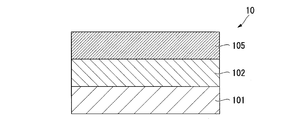
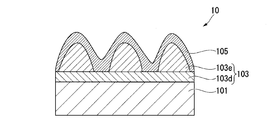
- the container steel plate 10 is one of a steel plate (original plate) 101 used as a base material, a Ni plating layer 102 and a composite plating layer 103 formed on the steel plate 101. A plating layer, and a chemical conversion coating layer 105 formed on the plating layer.
- the steel plate 101 is not particularly limited, and a known steel plate 101 that is generally used as a steel plate for containers can be used.
- the manufacturing method and material of these known steel plates 101 are not particularly limited.
- the steel plate 101 manufactured through known steps such as hot rolling, pickling, cold rolling, annealing, temper rolling, etc. from a normal slab manufacturing process can be used.
- a plating layer that is one of the Ni plating layer 102 and the composite plating layer 103 is formed as an upper layer of the steel plate 101.
- examples of the Ni plating layer 102 and the composite plating layer 103 will be specifically described with reference to FIGS. 1 and 2.
- Ni plating layer 102 is formed on the surface of steel plate 101
- the Ni plating layer 102 contains 10 to 1000 mg / m 2 Ni per side in terms of the amount of metallic Ni.
- Ni has excellent paint adhesion, film adhesion, corrosion resistance, and weldability.
- the Ni plating layer 102 needs to contain 10 mg / m 2 or more of Ni per side in terms of the amount of metallic Ni.
- the above effect is improved with an increase in the Ni content.
- the Ni content of the Ni plating layer 102 is 10 to 1000 mg / m 2 per side in terms of the amount of metallic Ni.
- the Ni content in the Ni plating layer 102 is preferably 30 to 800 mg / m 2 per side in terms of the amount of metallic Ni.
- the Ni content is more preferably 50 to 600 mg / m 2 per side in terms of the amount of metallic Ni.
- the Ni plating layer 102 may be formed on both surfaces of the steel plate 101, or may be formed only on one surface of the steel plate 101 from the viewpoint of manufacturing cost reduction.
- the steel plate 101 on which the Ni plating layer 102 is formed on only one surface is to be canned, it is preferable to process the surface on which the Ni plating layer 102 is formed to be the inner surface of the container, for example. .
- the Ni content of the Ni plating layer 102 can be measured by, for example, the fluorescent X-ray method.
- a calibration curve related to the Ni content is prepared in advance using a sample with a known Ni content, and the Ni content is relatively measured using the calibration curve.
- the composite plating layer 103 contains 5 to 150 mg / m 2 of Ni in terms of the amount of metallic Ni and 300 to 3000 mg / m 2 of Sn in terms of the amount of metal Sn.
- an island-shaped Sn plating layer 103e is formed on the Fe—Ni—Sn alloy layer 103d.
- a Ni plating layer (not shown) is first formed on the steel plate 101.
- the Ni plating layer (not shown) is made of Ni or an Fe—Ni alloy, and is formed to ensure the corrosion resistance of the container steel plate 10.
- the improvement of the corrosion resistance by Ni is determined by the Ni content in the composite plating layer 103. If the Ni content in the composite plating layer 103 is 5 mg / m 2 or more per side in terms of the amount of metal Ni, suitable corrosion resistance can be obtained. Have. On the other hand, the corrosion resistance improves as the Ni content in the composite plating layer 103 increases.
- the Ni content in the composite plating layer 103 is more than 150 mg / m 2 per side in terms of the amount of metal Ni, the corrosion resistance is improved. Is saturated and economically undesirable. Therefore, the Ni content of the composite plating layer 103 is 5 to 150 mg / m 2 per side in terms of the amount of metallic Ni. Preferably, it is 10 to 120 mg / m 2 per side in terms of the amount of metallic Ni, and more preferably 20 to 70 mg / m 2 .
- an Sn plating layer (not shown) is formed on the Ni plating layer (not shown).
- the Sn plating layer (not shown) is formed to ensure the corrosion resistance and weldability of the steel plate for containers 10.
- Sn not only has high corrosion resistance, but also Sn alloy formed by molten tin treatment has excellent corrosion resistance and weldability.
- “Sn plating” in the present embodiment includes not only plating with metal Sn but also a mixture of metal Sn with an irreversible impurity and a mixture of metal Sn with a trace element.
- the composite plating layer 103 is formed by performing molten tin treatment after forming the Sn plating layer (not shown). That is, by performing a molten tin treatment after forming a Sn plating layer (not shown), an Fe—Ni—Sn alloy layer 103d is formed on the steel plate 101, and an island shape is formed on the Fe—Ni—Sn alloy layer 103d. An Sn plating layer 103e is formed. In the island-shaped Sn plating layer 103e, Sn exists in an island shape, and the lower Fe—Ni—Sn alloy layer 103d is exposed in the sea. By the island-shaped Sn plating layer 103e, the film adhesion and paint adhesion of the steel plate 10 for containers are ensured.
- the container steel plate 10 may be heated to a melting point of Sn (232 ° C.) or higher. Unlike this embodiment, when the entire surface of the Fe—Ni—Sn alloy layer 103d is covered with Sn, Sn is melted or oxidized by the heat treatment described above, and the film adhesion and paint adhesion of the steel plate 10 for containers. Is not preferable because there is a possibility that cannot be secured.
- the excellent corrosion resistance of Sn is remarkably improved from 300 mg / m 2 or more per side when the Sn content is converted into the amount of metal Sn, and the corrosion resistance is improved as the Sn content is increased. Therefore, the Sn content in the composite plating layer 103 is 300 mg / m 2 or more per side in terms of the amount of metal Sn. Moreover, the above-mentioned effect by Sn is saturated when the Sn content exceeds 3000 mg / m 2 per side in terms of the amount of metal Sn. Further, when the Sn content exceeds per surface 3000 mg / m 2 in terms of metallic Sn amount, there are cases where formation of the island Sn plating layer 103e becomes difficult, and per side 3000 mg / m 2 or less.
- the Sn content of the composite plating layer 103 is 300 to 3000 mg / m 2 per side in terms of the amount of metal Sn. Preferably, it is 500 to 2000 mg / m 2 per side in terms of the amount of metallic Sn, and more preferably 600 to 1200 mg / m 2 .
- a molten tin treatment (reflow treatment) is performed.
- the purpose of the molten tin treatment is to melt Sn and alloy it with Fe in the steel plate 101 or Ni in the Ni plating layer (not shown) to form the Fe—Ni—Sn alloy layer 103d.
- the corrosion resistance is improved and the island-shaped Sn plating layer 103e is formed.
- the island-shaped Sn plating layer 103e can be formed by appropriately controlling the molten tin treatment conditions (treatment temperature, treatment time, etc.).
- the composite plating layer 103 may be formed on both surfaces of the steel plate 101, or may be formed only on one surface of the steel plate 101 from the viewpoint of manufacturing cost reduction.
- the steel plate 101 on which the composite plating layer 103 is formed on only one surface can be manufactured, for example, it is preferable that the surface on which the composite plating layer 103 is formed be the inner surface of the container. .
- the amount of metallic Ni and the amount of metallic Sn in the composite plating layer 103 can be measured by, for example, the fluorescent X-ray method.
- a calibration curve related to the Ni content is prepared in advance using a sample with a known Ni content, and the Ni content is relatively measured using the calibration curve.
- a calibration curve relating to the amount of metallic Sn is prepared in advance using a sample with a known Sn content, and the amount of metallic Sn is relatively specified using this calibration curve.
- Ni plating layer 102 or the composite plating layer 103 When only the Ni plating layer 102 or the composite plating layer 103 is formed on the surface of the steel plate 101, even if the Ni plating layer 102 or the composite plating layer 103 is surface-treated with a coating agent, sulfur contained in beverages, foods, etc. , May pass through the coating agent and combine with Ni or Sn to form black NiS, SnS, SnS 2 or the like. Further, when there is a plating defect site consisting of a plurality of fine holes in the Ni plating layer 102 or the composite plating layer 103, sulfur and Fe contained in the steel plate 101 are combined to form black FeS, Fe 2 S 3. Or Fe 2 S may be formed.
- sulfide blackening a phenomenon in which a black compound such as NiS, SnS, SnS 2 , FeS, Fe 2 S 3 , or Fe 2 S is formed is referred to as sulfide blackening. Further, the resistance (characteristic) against sulfide blackening is referred to as sulfide blackening resistance.
- the container steel plate 10 includes a chemical conversion treatment film layer 105 as an upper layer of the Ni plating layer 102 or the composite plating layer 103 in order to improve sulfurization blackening resistance.
- Chemical conversion coating layer 105 and in terms of metal Zr content 3.0 ⁇ Zr compound of 30.0 mg / m 2, and in terms of metal Mg content 0.50 ⁇ 5.00mg / m 2 of Mg compound Containing.
- the Zr compound contained in the chemical conversion coating layer 105 has a function of improving sulfide blackening resistance, adhesion and workability.
- Examples of the Zr compound according to this embodiment include oxidized Zr, phosphoric acid Zr, hydroxylated Zr, and fluorided Zr (including hydrates thereof), and the chemical conversion coating layer 105 includes the above-described Zr compound. Contains a plurality.
- the Zr content in the chemical conversion coating layer 105 When the Zr content in the chemical conversion coating layer 105 is increased, the resistance to blackening, adhesion and workability of the steel plate for containers 10 are improved. Specifically, when the Zr content of the chemical conversion coating layer 105 is 3.0 mg / m 2 or more per side in terms of the metal Zr content, practically suitable sulfur blackening resistance is ensured. On the other hand, when the Zr content exceeds 30.0 mg / m 2 per side in terms of the metal Zr content, the chemical conversion coating layer 105 becomes too thick, the adhesion of the chemical conversion coating layer 105 itself deteriorates, and is resistant to sulfuration. Black denaturation is reduced.
- the Zr content of the chemical conversion coating layer 105 is 3.0 to 30.0 mg / m 2 per side in terms of the metal Zr content.
- the lower limit of the Zr content is preferably 5.0 mg / m 2 or more, more preferably 8.0 mg / m 2 or more per side, in terms of metal Zr content.
- the upper limit value of the Zr content is preferably 20.0 mg / m 2 or less, more preferably 15.0 mg / m 2 or less per side in terms of the metal Zr content.
- the chemical conversion film layer 105 contains an Mg compound in addition to the Zr compound.
- the chemical conversion treatment liquid used when forming the chemical conversion treatment film layer 105 contains Mg ions, and the Mg ions in the chemical conversion treatment solution are mixed with the Zr compound as an Mg compound in the chemical conversion treatment film layer 105. It is captured.
- the Mg compound in the chemical conversion coating layer 105 may be partially removed from the chemical conversion coating layer 105 in the cleaning step performed after the chemical conversion coating layer 105 is formed, but the remainder is the chemical conversion coating layer 105. Remains in. The present inventors have found that when the chemical conversion film layer 105 contains a Mg compound, the resistance to sulfur blackening is improved.
- Mg compound contained in the chemical conversion coating layer 105 examples include Mg oxide, Mg hydroxide, Mg fluoride, Mg phosphate (including hydrates thereof), and the chemical conversion coating layer 105 is the above-mentioned.
- a plurality of Mg compounds may be contained. These Mg compounds are generally transparent or white.
- Mg ions combine with thiol ions (HS ⁇ ) or hydrogen sulfide (H 2 S), which are the main component of the sulfide blackening phenomenon, to form a transparent or white compound.
- the Mg compound in the chemical conversion coating layer 105 suppresses the transmission of thiol ions and hydrogen sulfide through the chemical conversion coating layer 105. Moreover, the compound produced
- the chemical conversion coating layer 105 contains 0.50 to 5.00 mg / m 2 of Mg compound per side in terms of the amount of metallic Mg.
- the Mg content in the chemical conversion coating layer 105 is 0.50 mg / m 2 or more per side in terms of the amount of metallic Mg, it has practically suitable sulfur blackening resistance.
- the chemical conversion treatment film layer 105 in order for the chemical conversion treatment film layer 105 to contain Mg compound of more than 5.00 mg / m 2 per side in terms of the amount of metallic Mg, it is necessary to add a large amount of Mg compound to the chemical conversion treatment solution. .
- the chemical conversion treatment film layer 105 may not proceed properly, which is not preferable. Further, since the chemical conversion coating layer 105 contains Mg compound of more than 5.00 mg / m 2 per side in terms of the amount of metal Mg, the adhesion (primary adhesion) with the coating agent is not affected. However, it is not preferable because adhesion (secondary adhesion), rust resistance, or corrosion resistance under the coating film may be deteriorated during high-temperature sterilization treatment in the presence of water vapor such as retort treatment.
- the chemical conversion coating layer 105 contains an Mg compound in excess of 5.00 mg / m 2 per side in terms of the amount of metallic Mg, when the steel plate 10 for containers is used for a food container, the taste or flavor of the contents Is unfavorable because it may damage the process.
- the lower limit of the content of the Mg compound in the chemical conversion film 105 is preferably 0.80 mg / m 2 per side, more preferably 1.00 mg / m 2 in terms of the amount of metallic Mg.
- the upper limit of the amount of the Mg compound of the chemical conversion coating layer 105 is preferably a single-sided per 4.00 mg / m 2 in terms of metallic Mg amount, and more preferably from 3.00 mg / m 2.
- the amount of Zr compound or Mg compound in the chemical conversion coating layer 105 is the total content of metal Zr or metal Mg in the chemical conversion coating layer 105 quantified by, for example, a quantitative analysis method such as fluorescent X-ray analysis, It means the content of the Zr compound or Mg compound remaining in the chemical conversion coating layer 105 after the cleaning step described later.
- the chemical conversion treatment step is performed after measuring the amount of Mg compound in the Ni plating layer 102 or the composite plating layer 103 before performing the chemical conversion treatment step.
- the amount of Mg compound in the steel plate for containers 10 after the measurement is measured, and the amount of Mg compound in the chemical conversion coating layer 105 can be measured from the difference between the two.
- the chemical conversion film layer 105 may contain at least one of phosphoric acid and phosphate in addition to the Zr compound and the Mg compound.
- the phosphate contained in the chemical conversion coating layer 105 include Zr phosphate and Mg phosphate (including hydrates thereof).
- the chemical conversion film layer 105 may contain a plurality of compounds among compounds composed of phosphoric acid and phosphate.
- the chemical conversion treatment film layer 105 contains at least one of phosphoric acid and phosphate, excellent sulfurization blackening resistance and adhesion can be obtained.
- the total content of phosphoric acid and phosphate is 1.5 mg / m 2 or more per side in terms of the amount of P, practically suitable sulfurization blackening resistance and adhesion can be obtained.
- the sulfur blackening resistance and adhesion are also improved.
- the total content of phosphoric acid and phosphate is converted to P amount by 25. If it exceeds 0 mg / m 2 , the adhesiveness of the phosphoric acid or phosphate in the chemical conversion coating layer 105 is deteriorated, so that the adhesiveness with the coating agent and the corrosion resistance under the coating film are lowered. Further, if the total content of phosphoric acid and phosphate exceeds 25.0 mg / m 2 per side in terms of P amount, the electrical resistance increases and the weldability deteriorates, which is not preferable.
- the chemical conversion treatment film layer 105 preferably contains phosphoric acid and phosphate in a total amount of 1.5 to 25.0 mg / m 2 per side in terms of P amount.
- the lower limit of the total content of phosphoric acid and phosphate is more preferably 2.5 mg / m 2 per side in terms of P amount, and even more preferably 5.0 mg / m 2 .
- the upper limit of the total content of phosphoric acid and phosphate is more preferably 20.0 mg / m 2 per side, more preferably 12.5 mg / m 2 in terms of P amount.
- the total amount of phosphoric acid and phosphate contained in the chemical conversion coating layer 105 is the amount of P contained in the chemical conversion coating layer 105 after the cleaning process, for example, a quantitative analysis method such as fluorescent X-ray analysis. Can be quantified.
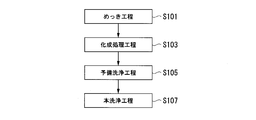
- FIG. 3 is a flowchart showing a method for manufacturing the container steel plate 10 according to the present embodiment.
- the manufacturing method of the steel plate 10 for containers has a plating process, a chemical conversion treatment process, and a washing process.
- the Ni plating layer 102 or the composite plating layer 103 is formed on the surface of the steel plate 101 (step S101).
- the method for forming the Ni plating layer 102 is not particularly limited.
- the method for forming the Ni plating layer 102 include an electroplating method using a watt bath or the like, a vacuum deposition method, or a sputtering method.
- heat treatment may be performed after the Ni plating layer 102 is formed.
- the composite plating layer 103 on the surface of the steel plate 101 When forming the composite plating layer 103 on the surface of the steel plate 101, after forming the Ni plating layer (not shown) on the surface of the steel plate 101, the Sn plating layer (not shown) is formed on the Ni plating layer (not shown). Form and perform molten molten tin treatment.
- the Ni plating layer (not shown) is made of Ni or an Fe—Ni alloy.
- the formation method of Ni plating layer (not shown) is not specifically limited, The well-known method (for example, cathode electrolysis method etc.) generally performed in the electroplating method can be utilized.
- a diffusion treatment for forming a diffusion layer (not shown) is performed in an annealing furnace.
- the nitriding treatment may be performed before or after the diffusion treatment or simultaneously with the diffusion treatment. Even when nitriding is performed, the effect of Ni and the effect of the nitriding layer (not shown) do not interfere with each other, and these effects can be achieved together.
- the formation method of the Sn plating layer is not particularly limited, and a known electroplating method, a method of immersing a steel plate in molten Sn, and the like can be used.
- molten tin treatment reflow treatment
- the purpose of the molten tin treatment is to melt Sn and alloy it with Fe in the steel sheet 101 and Ni in the Ni plating layer (not shown) to form a Fe—Ni—Sn alloy layer 103d, and to form a steel sheet for containers.
- 10 is to improve the corrosion resistance and to form the island-shaped Sn plating layer 103e.
- the island-shaped Sn plating layer 103e can be formed by appropriately controlling the conditions (processing temperature, processing time, etc.) of the molten tin treatment.
- step S103 a chemical conversion treatment process is performed, and a chemical conversion treatment film layer 105 is formed on the Ni plating layer 102 or the composite plating layer 103.
- the chemical conversion treatment step cathodic electrolysis using a chemical conversion solution is performed.
- the immersion treatment method is used as the formation method of the chemical conversion treatment film layer 105, since the base is etched, adhesion of the chemical conversion treatment coating layer 105 becomes non-uniform and the time of the chemical conversion treatment step becomes long. This is not preferable for industrial production.
- the cathode electrolytic treatment is preferable because the surface of the chemical conversion treatment film layer 105 to be formed is cleaned by forced charge transfer and hydrogen generation at the interface between the steel plate 101 and the chemical conversion treatment liquid. Further, cathodic electrolysis is preferable because the adhesion of the chemical conversion treatment film layer 105 is promoted by increasing the pH of the chemical conversion treatment solution.
- the conditions for the cathodic electrolysis are not particularly limited.
- the conditions of the temperature of the chemical conversion treatment solution at 10 ° C. to 60 ° C., the current density of 0.1 to 20.0 A / dm 2 , and the treatment time of 0.01 to 30 seconds. Can be done below.
- the pH of the chemical conversion solution is preferably in the range of 3.0 to 4.5. Nitric acid or hydrofluoric acid or the like is added to lower the pH, and ammonia or the like is added to increase the pH. Adjust it.
- the chemical conversion treatment solution used in the chemical conversion treatment step contains 100 to 3000 ppm of Zr ions.
- Zr ions in the chemical conversion treatment liquid are taken into the chemical conversion treatment film layer 105 as a Zr compound.
- the lower limit value of Zr ions in the chemical conversion liquid is preferably 500 ppm, more preferably 1000 ppm.
- the upper limit value of Zr ions in the chemical conversion treatment liquid is preferably 2500 ppm, more preferably 2000 ppm.
- the chemical conversion treatment solution contains 120 to 4000 ppm of F ions.
- F ions form a complex ion with Zr ions, thereby stabilizing Zr ions in the chemical conversion solution.
- the F ions in the chemical conversion solution are also taken into the chemical conversion coating layer 105 in the same manner as the Zr ions, but it is preferable to remove the F compound in the chemical conversion coating layer 105 as much as possible by a cleaning step described later.
- the chemical conversion treatment solution contains 50 to 300 ppm of Mg ions. It is preferable that the chemical conversion treatment solution contains Mg ions because the chemical conversion treatment film layer 105 contains an Mg compound and improves the resistance to sulfur blackening. Further, Mg ions can promote the precipitation of Zr ions. Specifically, when the amount of Zr compound in the chemical conversion treatment film layer 105 formed by the chemical conversion treatment step is compared between the case where the chemical conversion treatment solution contains Mg ions and the case where it does not contain Mg ions, it contains Mg ions. In some cases, the amount of Zr compound is contained in the chemical conversion coating layer 105 more.
- the cause of the Zr precipitation promoting effect by Mg ions is considered as follows.
- the Zr ions exist stably in the state of complex ions such as [ZrF 6 ] 2 ⁇ together with the F ions.
- the pH rises due to forced charge transfer and hydrogen generation at the interface between the steel plate 101 and the electrolysis solution.
- the complex ions are hydrolyzed to become Zr ions and F ions as shown in the above formula (1), and then the chemical conversion coating layer 105 containing the Zr compound is deposited.
- the reaction of the above formula (1) is an equilibrium (reversible) reaction, when the F ions in the chemical conversion solution increase, the rightward reaction of the above formula (1) (reaction in which complex ions decompose) Is significantly inhibited.
- F -] is such that dissociated into F ions and Mg ions, added during the chemical conversion treatment solution It is preferable to adjust the Mg ion concentration. As described above, when the chemical conversion solution contains Mg ions, the precipitation of Zr is promoted. Therefore, the manufacturing method of the steel plate 10 for containers which concerns on this embodiment can shorten the time which a chemical conversion treatment process requires, and has the outstanding productivity.
- the Mg ion concentration added to the chemical conversion solution is preferably 50 to 300 ppm. If the Mg ion concentration is less than 50 ppm, it is insufficient to exhibit the effect of promoting the precipitation of Zr. On the other hand, when the Mg ion concentration is more than 300 ppm, it is not preferable because it becomes easy to form poorly soluble MgF 2 .
- the Mg ion concentration added to the chemical conversion treatment liquid is more preferably 100 to 200 ppm. In addition, it is preferable to add Mg ion with a water-soluble salt such as Mg nitrate or Mg sulfate.
- the chemical conversion treatment solution may contain 2000 ppm or less of phosphate ions. It is preferable that the chemical conversion treatment liquid contains phosphate ions, because the chemical conversion treatment film layer 105 contains phosphoric acid or a phosphate, which improves sulfurization blackening resistance and adhesion.
- the chemical conversion treatment liquid may contain a total of 20000 ppm or less of nitrate ions and ammonium ions. It is preferable that the chemical conversion treatment solution contains nitrate ions and ammonium ions because the time required for the chemical conversion treatment step can be shortened and productivity is improved. In addition, it is preferable that a chemical conversion liquid contains both a nitrate ion and an ammonium ion instead of any one of a nitrate ion and an ammonium ion. The reason is as follows. When forming the chemical conversion treatment film layer 105 containing Zr, first, H 2 is generated at the cathode by the reaction of the following formula (2), and the pH rises.
- first, cathodic electrolysis using a first chemical conversion treatment solution is performed, and the first chemical conversion coating layer 105 is formed on the Ni plating layer 102 or the composite plating layer 103 side.
- a layer (not shown) is formed, followed by a cathodic electrolytic treatment using a second chemical conversion treatment liquid, so that the second layer of the chemical conversion coating layer 105 ( (Not shown) may be formed.
- a 1st chemical conversion liquid and a 2nd chemical conversion liquid contain the same component, and only temperature differs. Examples of the temperature of the first chemical conversion treatment liquid include 10 ° C.
- the temperature of the second chemical conversion treatment liquid examples include 45 ° C. to 60 ° C. Since the first layer of the chemical conversion coating layer 105 is a dense layer, it is suitable for ensuring characteristics such as resistance to sulfur blackening. Since the second layer of the chemical conversion coating layer 105 has a rough surface, it is suitable for ensuring adhesion between the chemical conversion coating layer 105 and the coating agent.
- a cleaning treatment for 0.5 seconds or more is performed with water of 40 ° C. or higher (step S107).
- the upper limit of the temperature of water used in the main cleaning step is not particularly limited, but the higher the temperature, the more effective, for example, 90 to 100 ° C.
- the upper limit of the cleaning time of the main cleaning step is not particularly limited, but the longer the time is, the more effective, for example, 10 seconds.
- the temperature is 10 ° C. or higher and lower than 40 ° C. It is preferable to perform a cleaning process (hereinafter referred to as a preliminary cleaning process) for 0.5 seconds or more with water (step S105).
- a cleaning process hereinafter referred to as a preliminary cleaning process
- the upper limit of the cleaning time in the preliminary cleaning step is not particularly limited, but the longer the time is, the more effective, for example, 20 seconds.
- Examples of the cleaning method in the preliminary cleaning step and the main cleaning step include an immersion process or a spray process.
- the ionic species eluting at a low temperature are removed by the preliminary washing step, and the ionic species eluting at a high temperature are removed by the main washing step.
- the removal effect is improved by increasing the processing time of the preliminary cleaning step and the main cleaning step.
- the removal effect improves the cleaning liquid used for this cleaning process, so that temperature is high. When each processing time is less than 0.5 seconds, it is difficult to reduce the ionic species.
- F ions, nitrate ions, ammonium ions, and the like are preferably removed from the chemical conversion coating layer 105 as much as possible by a cleaning process, but may not be completely removed and may remain unavoidably.
- Example shown below is only an example of the manufacturing method of the steel plate for containers and the steel plate for containers which concerns on embodiment of this invention, The manufacturing method of the steel plate for containers and the steel plate for containers which concerns on embodiment of this invention is However, the present invention is not limited to the following examples.
- the treatment liquids 1-1 to 3-2 in Table 1 are all at the same temperature and pH, and are subjected to cathodic electrolysis under the same current density and treatment time. As shown in Table 1, the addition of Mg ions increased the Zr content of the formed chemical conversion coating layer, indicating that Mg ions have a Zr precipitation promoting effect. .
- Test materials were prepared using chemical conversion treated steel sheets having a plating layer and a chemical conversion coating layer shown in Table 2, and performance evaluation was performed on the following items (A) to (H). The evaluation results are shown in Table 3.
- the case where the peel area ratio is 0% is “Very Good”, the case where the peel area ratio is more than 0% and 5% or less is “Good”, and the case where the peel area ratio is more than 5% and 30% or less is “ The case where “Fair” and the peeled area ratio exceeded 30% was evaluated as “Poor”.
- (G) Corrosion resistance under coating film An epoxy-phenol resin was applied to the test material, and a baking treatment was performed at a temperature of 200 ° C. for 30 minutes. Thereafter, a grid-like cut having a depth reaching the base iron was made, and immersed in a test solution composed of a 1.5% citric acid-1.5% salt solution at a temperature of 45 ° C. for 72 hours. After washing and drying, the tape was peeled off. The corrosion condition under the coating film and the corrosion condition of the flat plate part were observed at the cut portion, and the corrosion resistance under the coating film was evaluated from the evaluation of the width of the corrosion under the coating film and the corrosion area ratio of the flat plate part.
- the corrosion width under the coating film is less than 0.2 mm and the corrosion area ratio of the flat plate portion is 0% is “Very Good”, the corrosion width under the coating film is 0.2 mm or more and less than 0.3 mm and the flat plate portion.
- (H) Retort rust resistance The test material was retorted at a temperature of 125 ° C. for 30 minutes. Thereafter, the state of rust generation was observed, and the retort rust resistance was evaluated from the rust generation area ratio. Specifically, the case where the rust generation area rate is 0% is “Very Good”, the case where the rust generation area rate is more than 0% and 1% or less is “Good”, and the rust generation area rate is more than 1% and 5% or less. The case was evaluated as “Fair”, and the case where the rust generation area ratio exceeded 5% was evaluated as “Poor”.
- the chemical conversion treatment steel plate was manufactured with the following method. Production conditions are shown in Tables 4 and 5.
- ⁇ Ni plated steel plate> When a Ni plating layer (not a composite plating layer) is formed on a steel plate, a steel plate having a thickness of 0.15 to 0.23 mm is used by the following (Processing Method 1) or (Processing Method 2) method. A Ni-plated layer was formed thereon to produce a Ni-plated steel sheet.
- Reatment method 2 After cold rolling, an annealed and regulated steel substrate (steel plate) with a thickness of 0.15 to 0.23 mm is subjected to Ni plating using a Watt bath to form a Ni diffusion layer during annealing, degreasing, acid After washing, Sn plating was performed using a ferrostan bath, and then molten tin treatment was performed to prepare a composite plated steel sheet having a composite plating layer.
- ⁇ Chemical conversion treatment process> For the Ni-plated steel sheet or composite-plated steel sheet produced by the above-mentioned (Treatment Method 1), (Treatment Method 2), (Treatment Method 1 ′) or (Treatment Method 2 ′), the following (Treatment Method 3) A chemical conversion coating layer containing a Zr compound and a Mg compound was formed on the surface of the Ni-plated steel sheet or the composite-plated steel sheet by performing any one of the methods (processing method 7). In the treatment methods 3 to 6, conditions of a current density of 0.5 to 30.0 A / dm 2 , a cathodic electrolytic treatment time of 0.5 to 5.0 seconds, and a temperature of the chemical conversion treatment solution of 10 to 60 ° C. The cathode electrolysis treatment was performed. Moreover, in the processing method 7, it immersed in the chemical conversion liquid whose temperature is 60 degreeC and pH is 3.5 for 180 second immersion time.
- a chemical conversion treatment film layer was formed by performing cathode electrolytic treatment using a chemical conversion treatment solution in which Zr fluoride and phosphoric acid were dissolved and Mg nitrate was added.
- a chemical conversion treatment film layer was formed by carrying out cathodic electrolytic treatment using a chemical conversion treatment solution in which Zr fluoride and ammonium nitrate were dissolved and Mg nitrate was added.
- a chemical conversion treatment film layer was formed by carrying out cathodic electrolysis treatment using a chemical conversion treatment solution in which Zr fluoride, phosphoric acid and ammonium nitrate were dissolved and Mg nitrate was added.
- a chemical conversion treatment film layer was formed by performing immersion treatment using a chemical conversion treatment solution in which Zr fluoride was dissolved and Mg nitrate was added.
- ⁇ Measurement of adhesion amount> The amount of metallic Ni and the amount of metallic Sn in the plating layer were measured by the fluorescent X-ray method. Further, the Zr content, Mg content, and phosphoric acid or phosphate content (converted to P content) of the chemical conversion coating layer were measured by a quantitative analysis method such as fluorescent X-ray analysis. Table 6 shows the measurement results.
- the Zr adhesion promoting rate obtained by dividing the Zr content of each test material by the Zr content of the steel sheet for Mg-free containers.
- the Zr adhesion promoting rate is 1.3 or more is “Very Good”, the case where it is less than 1.3 to 1.2 or more is “Good”, the case where it is less than 1.2 to 1.1 or more The case where “Fair” was less than 1.1 was evaluated as “Poor”.
- Inventive Examples B1 to B26 all have an effect of promoting Zr adhesion by adding Mg ions, and have excellent sulfur blackening resistance, workability, weldability, film adhesion, primary paint adhesion, and secondary paint adhesion. And had corrosion resistance and corrosion resistance under the coating film. Furthermore, when the chemical conversion coating layer contains 1.5 mg / m 2 or more of phosphoric acid or phosphate as the amount of P, film adhesion (including processability) and undercoat corrosion resistance are further improved.
- Comparative Examples b1 to b16 have no Zr adhesion promoting effect and are also resistant to sulfur blackening, weldability, workability, weldability, film adhesion, primary paint adhesion, secondary paint adhesion, coating film At least some of the properties of undercorrosion resistance and corrosion resistance were inferior.
Landscapes
- Chemical & Material Sciences (AREA)
- Organic Chemistry (AREA)
- Engineering & Computer Science (AREA)
- Materials Engineering (AREA)
- Metallurgy (AREA)
- Chemical Kinetics & Catalysis (AREA)
- Mechanical Engineering (AREA)
- Electrochemistry (AREA)
- Inorganic Chemistry (AREA)
- Physics & Mathematics (AREA)
- Oil, Petroleum & Natural Gas (AREA)
- Thermal Sciences (AREA)
- Other Surface Treatments For Metallic Materials (AREA)
- Electroplating Methods And Accessories (AREA)
- Chemical Treatment Of Metals (AREA)
Abstract
Priority Applications (6)
| Application Number | Priority Date | Filing Date | Title |
|---|---|---|---|
| CN201680015265.6A CN107407001B (zh) | 2015-04-16 | 2016-04-15 | 容器用钢板以及容器用钢板的制造方法 |
| ES16780148T ES2738422T3 (es) | 2015-04-16 | 2016-04-15 | Lámina de acero para recipiente, y método para producir lámina de acero para recipiente |
| EP16780148.9A EP3284850B8 (fr) | 2015-04-16 | 2016-04-15 | Tôle d'acier pour conteneur et procédé de fabrication de tôle d'acier pour conteneur |
| KR1020177025072A KR101982426B1 (ko) | 2015-04-16 | 2016-04-15 | 용기용 강판 및 용기용 강판의 제조 방법 |
| US15/563,208 US10577705B2 (en) | 2015-04-16 | 2016-04-15 | Steel sheet for container and method for producing steel sheet for container |
| JP2016563474A JP6119930B2 (ja) | 2015-04-16 | 2016-04-15 | 容器用鋼板及び容器用鋼板の製造方法 |
Applications Claiming Priority (4)
| Application Number | Priority Date | Filing Date | Title |
|---|---|---|---|
| JP2015-083986 | 2015-04-16 | ||
| JP2015-083985 | 2015-04-16 | ||
| JP2015083986 | 2015-04-16 | ||
| JP2015083985 | 2015-04-16 |
Publications (1)
| Publication Number | Publication Date |
|---|---|
| WO2016167357A1 true WO2016167357A1 (fr) | 2016-10-20 |
Family
ID=57125858
Family Applications (1)
| Application Number | Title | Priority Date | Filing Date |
|---|---|---|---|
| PCT/JP2016/062146 Ceased WO2016167357A1 (fr) | 2015-04-16 | 2016-04-15 | Tôle d'acier pour conteneur et procédé de fabrication de tôle d'acier pour conteneur |
Country Status (8)
| Country | Link |
|---|---|
| US (1) | US10577705B2 (fr) |
| EP (1) | EP3284850B8 (fr) |
| JP (1) | JP6119930B2 (fr) |
| KR (1) | KR101982426B1 (fr) |
| CN (1) | CN107407001B (fr) |
| ES (1) | ES2738422T3 (fr) |
| TW (1) | TWI605155B (fr) |
| WO (1) | WO2016167357A1 (fr) |
Cited By (2)
| Publication number | Priority date | Publication date | Assignee | Title |
|---|---|---|---|---|
| JPWO2016207967A1 (ja) * | 2015-06-23 | 2018-04-19 | 新日鐵住金株式会社 | 容器用鋼板及び容器用鋼板の製造方法 |
| JPWO2016207966A1 (ja) * | 2015-06-23 | 2018-04-26 | 新日鐵住金株式会社 | 容器用鋼板及び容器用鋼板の製造方法 |
Families Citing this family (3)
| Publication number | Priority date | Publication date | Assignee | Title |
|---|---|---|---|---|
| US10294577B2 (en) * | 2014-10-09 | 2019-05-21 | Nippon Steel & Sumitomo Metal Corporation | Chemical treatment steel sheet, and method for producing chemical treatment steel sheet |
| TWI826613B (zh) | 2018-12-14 | 2023-12-21 | 日商三菱化學股份有限公司 | 黏著劑樹脂組合物、黏著劑樹脂硬化物、黏著片材及圖像顯示裝置積層體 |
| EP4382641A1 (fr) * | 2022-12-07 | 2024-06-12 | Henkel AG & Co. KGaA | Procédé de dépôt électrolytique d'une couche de phosphate sur des surfaces de zinc |
Citations (5)
| Publication number | Priority date | Publication date | Assignee | Title |
|---|---|---|---|---|
| JP2005325401A (ja) * | 2004-05-13 | 2005-11-24 | Nippon Paint Co Ltd | 亜鉛又は亜鉛系合金メッキ鋼材の表面処理方法 |
| JP2006336106A (ja) * | 2005-05-04 | 2006-12-14 | Furakuto:Kk | 金属用クロムフリー表面処理剤及び表面処理金属材料 |
| WO2010140711A1 (fr) * | 2009-06-04 | 2010-12-09 | 新日本製鐵株式会社 | Feuille d'acier pour contenants qui présente d'excellentes performances pour les couches organiques et son procédé de fabrication |
| JP2012062521A (ja) * | 2010-09-15 | 2012-03-29 | Jfe Steel Corp | 容器用鋼板の製造方法 |
| WO2015093318A1 (fr) * | 2013-12-18 | 2015-06-25 | 東洋製罐株式会社 | Tôle d'acier traitée en surface, conteneur métallique revêtu de résine organique, et procédé de production de tôle d'acier traitée en surface |
Family Cites Families (16)
| Publication number | Priority date | Publication date | Assignee | Title |
|---|---|---|---|---|
| JPS5468734A (en) | 1977-11-11 | 1979-06-02 | Nippon Packaging Kk | Surface treatment of tin plated steel plate and can |
| JP2000239855A (ja) | 1999-02-18 | 2000-09-05 | Nkk Corp | 錫めっき鋼板の化成処理方法 |
| TWI268965B (en) * | 2001-06-15 | 2006-12-21 | Nihon Parkerizing | Treating solution for surface treatment of metal and surface treatment method |
| JP2003171778A (ja) * | 2001-12-06 | 2003-06-20 | Nippon Hyomen Kagaku Kk | 金属の保護皮膜形成方法及び金属の保護皮膜 |
| JP2005023422A (ja) | 2003-06-09 | 2005-01-27 | Nippon Paint Co Ltd | 金属表面処理方法及び表面処理金属 |
| JP2005325402A (ja) | 2004-05-13 | 2005-11-24 | Nippon Paint Co Ltd | スズ又はスズ系合金めっき鋼材の表面処理方法 |
| JP4492224B2 (ja) | 2004-06-22 | 2010-06-30 | 東洋製罐株式会社 | 表面処理金属材料及びその表面処理方法、並びに樹脂被覆金属材料 |
| JP4923855B2 (ja) | 2006-08-23 | 2012-04-25 | Jfeスチール株式会社 | 表面処理金属板およびその製造方法、ならびに樹脂被覆金属板、金属缶および缶蓋 |
| TWI391530B (zh) * | 2007-04-04 | 2013-04-01 | Nippon Steel Corp | A plated steel sheet for use in a tank and a method for manufacturing the same |
| JP5186814B2 (ja) | 2007-06-20 | 2013-04-24 | 新日鐵住金株式会社 | 容器用鋼板とその製造方法 |
| JP4996409B2 (ja) | 2007-09-28 | 2012-08-08 | 新日本製鐵株式会社 | 化成処理被覆鋼板の製造方法 |
| EP2551377B1 (fr) | 2010-03-23 | 2017-09-13 | Nippon Steel & Sumitomo Metal Corporation | Procédé de fabrication d'une tôle d'acier pour un conteneur |
| US8133594B2 (en) * | 2010-06-04 | 2012-03-13 | Nippon Steel Corporation | Steel sheet for container use |
| TWI449813B (zh) * | 2010-06-29 | 2014-08-21 | Nippon Steel & Sumitomo Metal Corp | 容器用鋼板及其製造方法 |
| JP5994495B2 (ja) | 2011-09-05 | 2016-09-21 | Jfeスチール株式会社 | 容器用鋼板 |
| WO2014189081A1 (fr) | 2013-05-21 | 2014-11-27 | 新日鐵住金株式会社 | Tôles destinées à des contenants et leur procédé de production |
-
2016
- 2016-04-15 WO PCT/JP2016/062146 patent/WO2016167357A1/fr not_active Ceased
- 2016-04-15 US US15/563,208 patent/US10577705B2/en not_active Expired - Fee Related
- 2016-04-15 ES ES16780148T patent/ES2738422T3/es active Active
- 2016-04-15 CN CN201680015265.6A patent/CN107407001B/zh not_active Expired - Fee Related
- 2016-04-15 TW TW105111826A patent/TWI605155B/zh not_active IP Right Cessation
- 2016-04-15 JP JP2016563474A patent/JP6119930B2/ja active Active
- 2016-04-15 KR KR1020177025072A patent/KR101982426B1/ko not_active Expired - Fee Related
- 2016-04-15 EP EP16780148.9A patent/EP3284850B8/fr active Active
Patent Citations (5)
| Publication number | Priority date | Publication date | Assignee | Title |
|---|---|---|---|---|
| JP2005325401A (ja) * | 2004-05-13 | 2005-11-24 | Nippon Paint Co Ltd | 亜鉛又は亜鉛系合金メッキ鋼材の表面処理方法 |
| JP2006336106A (ja) * | 2005-05-04 | 2006-12-14 | Furakuto:Kk | 金属用クロムフリー表面処理剤及び表面処理金属材料 |
| WO2010140711A1 (fr) * | 2009-06-04 | 2010-12-09 | 新日本製鐵株式会社 | Feuille d'acier pour contenants qui présente d'excellentes performances pour les couches organiques et son procédé de fabrication |
| JP2012062521A (ja) * | 2010-09-15 | 2012-03-29 | Jfe Steel Corp | 容器用鋼板の製造方法 |
| WO2015093318A1 (fr) * | 2013-12-18 | 2015-06-25 | 東洋製罐株式会社 | Tôle d'acier traitée en surface, conteneur métallique revêtu de résine organique, et procédé de production de tôle d'acier traitée en surface |
Cited By (4)
| Publication number | Priority date | Publication date | Assignee | Title |
|---|---|---|---|---|
| JPWO2016207967A1 (ja) * | 2015-06-23 | 2018-04-19 | 新日鐵住金株式会社 | 容器用鋼板及び容器用鋼板の製造方法 |
| JPWO2016207966A1 (ja) * | 2015-06-23 | 2018-04-26 | 新日鐵住金株式会社 | 容器用鋼板及び容器用鋼板の製造方法 |
| US10465309B2 (en) | 2015-06-23 | 2019-11-05 | Nippon Steel Corporation | Steel sheet for containers, and method for producing steel sheet for containers |
| US10851467B2 (en) | 2015-06-23 | 2020-12-01 | Nippon Steel Corporation | Steel sheet for containers, and method for producing steel sheet for containers |
Also Published As
| Publication number | Publication date |
|---|---|
| EP3284850A4 (fr) | 2018-09-19 |
| JPWO2016167357A1 (ja) | 2017-04-27 |
| TW201702432A (zh) | 2017-01-16 |
| EP3284850B1 (fr) | 2019-06-19 |
| US20180087172A1 (en) | 2018-03-29 |
| CN107407001A (zh) | 2017-11-28 |
| TWI605155B (zh) | 2017-11-11 |
| ES2738422T3 (es) | 2020-01-22 |
| CN107407001B (zh) | 2019-04-26 |
| KR101982426B1 (ko) | 2019-05-27 |
| JP6119930B2 (ja) | 2017-04-26 |
| US10577705B2 (en) | 2020-03-03 |
| KR20170116079A (ko) | 2017-10-18 |
| EP3284850A1 (fr) | 2018-02-21 |
| EP3284850B8 (fr) | 2019-07-31 |
Similar Documents
| Publication | Publication Date | Title |
|---|---|---|
| JP4886811B2 (ja) | 有機皮膜性能に優れた容器用鋼板およびその製造方法 | |
| CN103108991B (zh) | 容器用钢板的制造方法 | |
| JP5754099B2 (ja) | 容器用鋼板の製造方法 | |
| JP6119930B2 (ja) | 容器用鋼板及び容器用鋼板の製造方法 | |
| JP6146541B2 (ja) | めっき鋼板およびその製造方法 | |
| JPWO2016056621A1 (ja) | 酸性内容物貯蔵容器用化成処理鋼板及び酸性内容物貯蔵容器用化成処理鋼板の製造方法 | |
| TWI424098B (zh) | 具優異耐蝕性之罐用鋼板 | |
| JP6119931B2 (ja) | 容器用鋼板及び容器用鋼板の製造方法 | |
| JPS624879A (ja) | 耐食性、溶接性及び塗装性能にすぐれたSn系多層被覆鋼板とその製造法 | |
| JP6540801B2 (ja) | 容器用鋼板及び容器用鋼板の製造方法 | |
| JP6583538B2 (ja) | 化成処理鋼板及び化成処理鋼板の製造方法 | |
| TWI589732B (zh) | 化學轉化處理鋼板及化學轉化處理鋼板的製造方法 | |
| JP6583539B2 (ja) | 化成処理鋼板及び化成処理鋼板の製造方法 | |
| JP6565308B2 (ja) | 容器用鋼板及び容器用鋼板の製造方法 | |
| JP6468059B2 (ja) | Snめっき鋼板及びSnめっき鋼板の製造方法 | |
| TWI588295B (zh) | 化學轉化處理鋼板及化學轉化處理鋼板的製造方法 |
Legal Events
| Date | Code | Title | Description |
|---|---|---|---|
| ENP | Entry into the national phase |
Ref document number: 2016563474 Country of ref document: JP Kind code of ref document: A |
|
| 121 | Ep: the epo has been informed by wipo that ep was designated in this application |
Ref document number: 16780148 Country of ref document: EP Kind code of ref document: A1 |
|
| ENP | Entry into the national phase |
Ref document number: 20177025072 Country of ref document: KR Kind code of ref document: A |
|
| WWE | Wipo information: entry into national phase |
Ref document number: 15563208 Country of ref document: US |
|
| REEP | Request for entry into the european phase |
Ref document number: 2016780148 Country of ref document: EP |
|
| NENP | Non-entry into the national phase |
Ref country code: DE |