WO2016190420A1 - 糖尿病性腎症を治療又は予防する方法 - Google Patents
糖尿病性腎症を治療又は予防する方法 Download PDFInfo
- Publication number
- WO2016190420A1 WO2016190420A1 PCT/JP2016/065765 JP2016065765W WO2016190420A1 WO 2016190420 A1 WO2016190420 A1 WO 2016190420A1 JP 2016065765 W JP2016065765 W JP 2016065765W WO 2016190420 A1 WO2016190420 A1 WO 2016190420A1
- Authority
- WO
- WIPO (PCT)
- Prior art keywords
- chronic kidney
- kidney disease
- pharmaceutically acceptable
- acceptable salt
- disease
- Prior art date
- Legal status (The legal status is an assumption and is not a legal conclusion. Google has not performed a legal analysis and makes no representation as to the accuracy of the status listed.)
- Ceased
Links
- 0 *C*C(C(C(NC(CCc1ccccc1)=C1)=*C=N)=C1O)=O Chemical compound *C*C(C(C(NC(CCc1ccccc1)=C1)=*C=N)=C1O)=O 0.000 description 3
Images

Classifications
-
- A—HUMAN NECESSITIES
- A61—MEDICAL OR VETERINARY SCIENCE; HYGIENE
- A61K—PREPARATIONS FOR MEDICAL, DENTAL OR TOILETRY PURPOSES
- A61K31/00—Medicinal preparations containing organic active ingredients
- A61K31/33—Heterocyclic compounds
- A61K31/395—Heterocyclic compounds having nitrogen as a ring hetero atom, e.g. guanethidine or rifamycins
- A61K31/435—Heterocyclic compounds having nitrogen as a ring hetero atom, e.g. guanethidine or rifamycins having six-membered rings with one nitrogen as the only ring hetero atom
- A61K31/4353—Heterocyclic compounds having nitrogen as a ring hetero atom, e.g. guanethidine or rifamycins having six-membered rings with one nitrogen as the only ring hetero atom ortho- or peri-condensed with heterocyclic ring systems
- A61K31/437—Heterocyclic compounds having nitrogen as a ring hetero atom, e.g. guanethidine or rifamycins having six-membered rings with one nitrogen as the only ring hetero atom ortho- or peri-condensed with heterocyclic ring systems the heterocyclic ring system containing a five-membered ring having nitrogen as a ring hetero atom, e.g. indolizine, beta-carboline
-
- A—HUMAN NECESSITIES
- A61—MEDICAL OR VETERINARY SCIENCE; HYGIENE
- A61K—PREPARATIONS FOR MEDICAL, DENTAL OR TOILETRY PURPOSES
- A61K31/00—Medicinal preparations containing organic active ingredients
- A61K31/33—Heterocyclic compounds
- A61K31/395—Heterocyclic compounds having nitrogen as a ring hetero atom, e.g. guanethidine or rifamycins
- A61K31/41—Heterocyclic compounds having nitrogen as a ring hetero atom, e.g. guanethidine or rifamycins having five-membered rings with two or more ring hetero atoms, at least one of which being nitrogen, e.g. tetrazole
- A61K31/4196—1,2,4-Triazoles
-
- A—HUMAN NECESSITIES
- A61—MEDICAL OR VETERINARY SCIENCE; HYGIENE
- A61P—SPECIFIC THERAPEUTIC ACTIVITY OF CHEMICAL COMPOUNDS OR MEDICINAL PREPARATIONS
- A61P13/00—Drugs for disorders of the urinary system
- A61P13/12—Drugs for disorders of the urinary system of the kidneys
Definitions
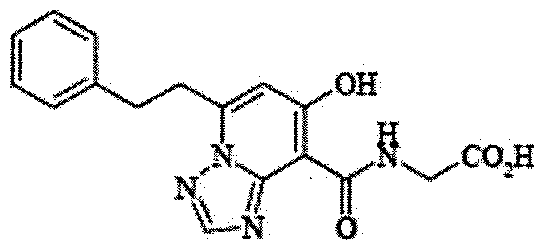
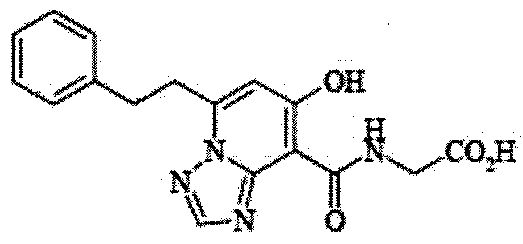
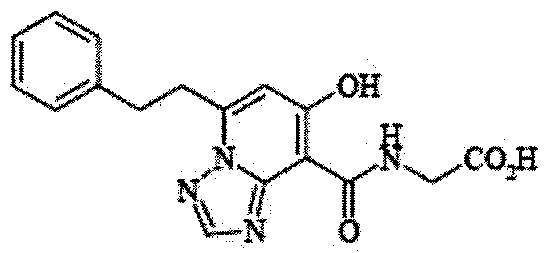
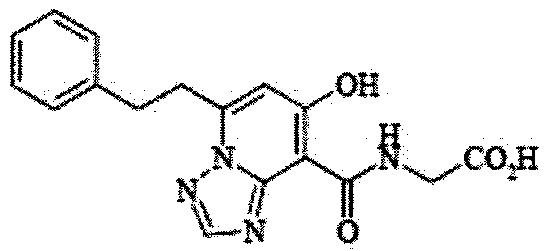
- the present invention relates to 2-( ⁇ [7-hydroxy-5- (2-phenylethyl)-[1,2,4] triazolo [1,5-a] pyridin-8-yl] carbonyl ⁇ amino) acetic acid (2 -( ⁇ [7-Hydroxy-5- (2-phenylethyl)-[1,2,4] triazolo [1,5-a] pyridin-8-yl] carbonyl ⁇ amino) acetic acid) (hereinafter referred to as Compound A Represents) novel pharmaceutical uses.
- the present invention treats or prevents a renal disorder related disease, such as diabetic nephropathy, comprising administering to a mammal a therapeutically effective amount of Compound A or a pharmaceutically acceptable salt thereof. And a method for suppressing fibrosis of the tubulointerstitium.
- the present invention also relates to a pharmaceutical composition for treating or preventing a renal disorder-related disease and an inhibitor of tubulointerstitial fibrosis, comprising Compound A or a pharmaceutically acceptable salt thereof.
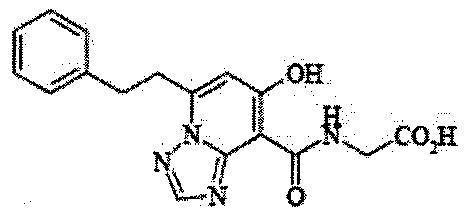
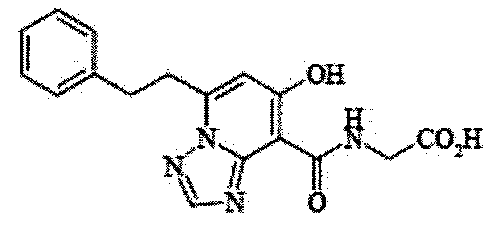
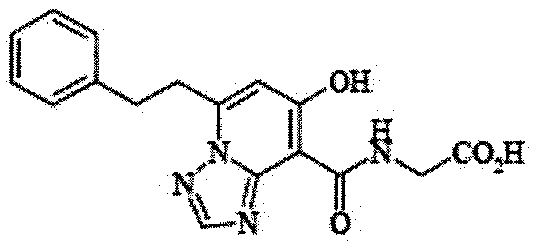
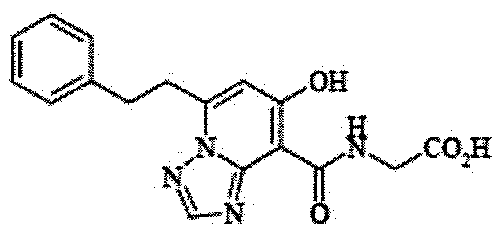
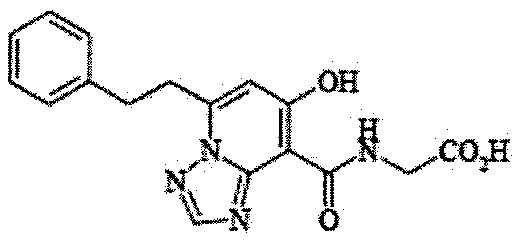
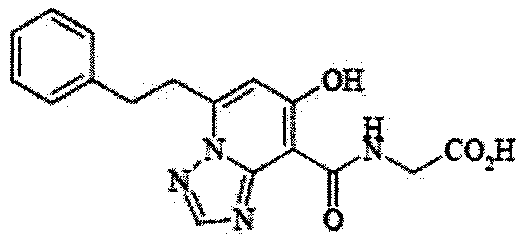
- Compound A has the following chemical structural formula:
- Patent Document 1 discloses that Compound A has an inhibitory action on prolyl hydroxylase (PHD) and stabilizes hypoxia-inducible factor (HIF), and PHD.
- PHD prolyl hydroxylase
- anemia including renal anemia (anemia associated with renal failure), ischemic heart disease (angina, myocardial infarction, etc.), ischemic cerebrovascular disorder (cerebral infarction) , Cerebral embolism, transient ischemic attack, etc.), chronic renal failure (ischemic nephropathy, tubulointerstitial disorder, etc.), diabetic complications (diabetic wound, etc.), cognitive impairment (dementia, Alzheimer) Disease, Parkinson's disease, Huntington's disease, etc.) are expected to be improved.
- anemia including renal anemia (anemia associated with renal failure), ischemic heart disease (angina, myocardial infarction, etc.), ischemic cerebrovascular disorder (cerebral infarction) , Cerebral embo
- CKD Chronic kidney disease
- ESRD end-stage renal disease
- GFR glomerular filtration rate
- the GFR can be accurately obtained from the measured value of inulin clearance or creatinine clearance, but estimated GFR (eGFR) based on the serum creatinine value or the serum cystatin C value can also be used as the GFR.
- Major causes of CKD include diabetic nephropathy, hypertensive nephrosclerosis, and primary and secondary glomerulopathy (including glomerulonephritis).
- Non-Patent Documents 2, 3 and 4 CKD prognosis and reduction in GFR have been shown to correlate well with tubulointerstitial lesions rather than glomerular lesions, which are the main common pathways to final renal failure (final common pathway). The locus is thought to be in the tubulointerstitium (Non-Patent Documents 2, 3 and 4). Despite its abundant blood flow, kidneys have poor oxygen uptake efficiency, and tubules are particularly vulnerable to hypoxia due to high oxygen consumption and high demand (Non-Patent Documents). 3 and 4). It has been shown that hypoxia, fibrosis, and decline in renal function progress in parallel in the kidneys of CKD patients (Non-Patent Document 5).
- Non-Patent Document 4 As the final common pathway leading to the end stage renal failure due to the progressive decline in renal function, the tubulointerstitial lesions deteriorate due to hypoxia, and fibrosis progresses, in addition to the decrease in oxygen supply due to the decrease in capillaries A vicious cycle has also been proposed in which a decrease in oxygen diffusing capacity is also caused, and further falls into hypoxia (Non-Patent Document 4).
- Diabetic nephropathy is glomerular sclerosis and fibrosis caused by metabolic and hemodynamic changes in diabetes, and is one of the common causes of nephrotic syndrome and end-stage renal failure. Diabetic nephropathy is also one of the typical causes of CKD as described above.
- GFR rises at onset (ie, hyperfiltration is observed) and then worsens over time after normalizing with early renal injury and mild hypertension.
- so-called microalbuminuria occurs, in which 30-300 mg / day of albumin, which cannot be detected by routine urinalysis, is excreted in the urine. Thereafter, microalbuminuria progresses to proteinuria exceeding 0.5 g / day.
- These early stages of diabetic nephropathy are asymptomatic, and proteinuria detectable by routine urinalysis is often the earliest warning.
- non-patent document 6 correlates with fibrosis of tubulointerstitium and a decrease in renal function. Therefore, when diabetic nephropathy further progresses in diabetic nephropathy, GFR decreases and leads to end stage renal failure through the final common pathway (ie, deterioration and fibrosis of tubulointerstitial lesions due to hypoxia). It is thought that.
- SHR / NDmcr-cp rats are humans with spontaneous hypertension and overeating and obesity, hyperglycemia, hyperlipidemia, hyperinsulinemia etc. It is an animal model that exhibits metabolic abnormalities similar to type 2 diabetes (Non-patent Document 7).
- SHR / NDmcr-cp rats show a marked increase in urinary protein (ie proteinuria) at 27 weeks of age, although plasma creatinine levels do not vary, and histologically evident glomerular damage and intertubular It causes quality damage and is consistent with the characteristics of diabetic nephropathy (Non-patent Document 7).
- the problem to be solved by the invention is to provide a novel pharmaceutical use of Compound A.
- Compound A inhibits tubulointerstitial fibrosis induced by local hypoxia and suppresses tubulointerstitial fibrosis induced by hyperglycemia. I found it. In addition, the present inventor has found that Compound A is effective against diabetic nephropathy and chronic kidney disease complicated with diabetes based on the suppression of tubulointerstitial fibrosis caused by hypoxia. .
- a method for treating or preventing diabetic nephropathy comprising administering to a mammal a therapeutically effective amount of a compound represented by the formula or a pharmaceutically acceptable salt thereof.
- a method for treating or preventing chronic kidney disease associated with diabetes comprising administering to a mammal a therapeutically effective amount of a compound represented by the formula: or a pharmaceutically acceptable salt thereof.
- a method for treating or preventing chronic kidney disease caused by hypoxia selected from the group consisting of: [4] The method according to [3], wherein the chronic kidney disease caused by hypoxia is chronic kidney disease associated with an immune system or an inflammatory disease. [5] The method according to [3], wherein the chronic kidney disease caused by hypoxia is chronic kidney disease accompanied by hypertension. [6] The following chemical structural formula:
- a method for treating or preventing glomerulonephritis which comprises administering to a mammal a therapeutically effective amount of a compound represented by the above or a pharmaceutically acceptable salt thereof.
- a method for treating or preventing nephrosclerosis comprising administering to a mammal a therapeutically effective amount of a compound represented by the formula: or a pharmaceutically acceptable salt thereof.
- a method of inhibiting tubulointerstitial fibrosis comprising administering to a mammal a therapeutically effective amount of a compound represented by the above or a pharmaceutically acceptable salt thereof.
- Diabetic nephropathy chronic kidney disease complicated with diabetes, glomerulonephritis, chronic kidney disease complicated with immune system or inflammatory disease, nephrosclerosis, and A pharmaceutical composition for treating or preventing a renal disorder-related disease selected from the group consisting of chronic kidney disease accompanied by hypertension.
- a renal disorder-related disease selected from the group consisting of chronic kidney disease accompanied by hypertension.
- a tubulointerstitial fibrosis inhibitor comprising the compound represented by the formula (1) or a pharmaceutically acceptable salt thereof.
- Compound A suppresses tubulointerstitial fibrosis induced by hyperglycemia or local hypoxia, so diabetic nephropathy, chronic kidney disease associated with diabetes, and other chronic kidneys caused by hypoxia It can be used to treat or prevent various renal disorder related diseases such as diseases.
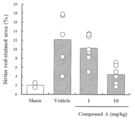
- Example 1 It is the figure which showed the inhibitory effect of the fibrosis of the tubulointerstitium after completion
- shaft shows a sirius red dyeing
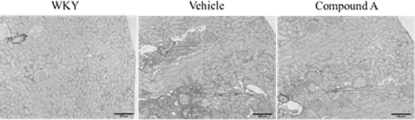
- staining image which concerns on the inhibitory effect of the tubulointerstitial fibrosis after the 28-week administration end by the dietary administration of the compound A (12 weeks old to 28 weeks) in a rat diabetic nephropathy model is shown. (Example 1).
- Compound A is a compound of 2-( ⁇ [7-hydroxy-5- (2-phenylethyl)-[1,2,4] triazolo [1,5-a] pyridin-8-yl] carbonyl ⁇ amino) acetic acid (2 -( ⁇ [7-Hydroxy-5- (2-phenylethyl)-[1,2,4] triazolo [1,5-a] pyridin-8-yl] carbonyl ⁇ amino) acetic acid) and has the following chemical structure formula:
- the “pharmaceutically acceptable salt” may be any salt that forms a non-toxic salt with Compound A.
- a salt with an inorganic acid a salt with an organic acid, a salt with an inorganic base, an organic Examples thereof include salts with bases and salts with amino acids.
- Examples of the salt with an inorganic acid include salts with hydrochloric acid, nitric acid, sulfuric acid, phosphoric acid, hydrobromic acid and the like.
- As salts with organic acids for example, oxalic acid, maleic acid, citric acid, fumaric acid, lactic acid, malic acid, succinic acid, tartaric acid, acetic acid, trifluoroacetic acid, gluconic acid, ascorbic acid, methanesulfonic acid, benzenesulfonic acid And salts with p-toluenesulfonic acid and the like.
- Examples of the salt with an inorganic base include sodium salt, potassium salt, calcium salt, magnesium salt, and ammonium salt.
- salts with organic bases include methylamine, diethylamine, trimethylamine, triethylamine, ethanolamine, diethanolamine, triethanolamine, ethylenediamine, tris (hydroxymethyl) methylamine, dicyclohexylamine, N, N'-dibenzylethylenediamine, guanidine , Salts with pyridine, picoline, choline, cinchonine, meglumine and the like.
- salts with amino acids include salts with lysine, arginine, aspartic acid, glutamic acid and the like.
- each salt can be obtained by reacting Compound A with an inorganic base, organic base, inorganic acid, organic acid or amino acid.
- Compound A or a pharmaceutically acceptable salt thereof is preferably Compound A.
- “Pharmaceutical composition” means a composition that can be used as a pharmaceutical product.
- the pharmaceutical composition for the treatment or prevention of a renal disorder-related disease of the present invention comprises compound A or a pharmaceutically acceptable salt thereof and at least one pharmaceutically acceptable salt according to a method known in the technical field of pharmaceutical preparations. It is manufactured by mixing an appropriate amount with a carrier or the like as appropriate.
- the content of Compound A or a pharmaceutically acceptable salt thereof in the pharmaceutical composition varies depending on the dosage form, dosage and the like.
- the “pharmaceutical composition” of the present invention can be administered orally or parenterally.
- the dosage form include oral administration or parenteral administration such as intravenous administration, transdermal administration, and topical administration.
- dosage forms suitable for oral administration include tablets, capsules, granules, powders, troches, syrups, emulsions, suspensions, and the like.
- the “pharmaceutically acceptable carrier” examples include various organic or inorganic carrier substances that are commonly used as pharmaceutical materials, such as excipients, disintegrants, binders, fluidizing agents, lubricants, etc. in solid formulations, Or the solvent in a liquid formulation, a solubilizing agent, a suspending agent, an isotonic agent, a buffer agent, a soothing agent, etc. are mentioned. Furthermore, additives such as preservatives, antioxidants, colorants, sweeteners and the like are used as necessary.
- excipient examples include lactose, sucrose, D-mannitol, D-sorbitol, corn starch, dextrin, microcrystalline cellulose, crystalline cellulose, carmellose, carmellose calcium, carboxymethyl starch sodium, low substituted hydroxypropyl Examples include cellulose and gum arabic.
- disintegrant examples include carmellose, carmellose calcium, carmellose sodium, sodium carboxymethyl starch, croscarmellose sodium, crospovidone, low-substituted hydroxypropylcellulose, hydroxypropylmethylcellulose, crystalline cellulose and the like.
- binder examples include hydroxypropylcellulose, hydroxypropylmethylcellulose, povidone, crystalline cellulose, sucrose, dextrin, starch, gelatin, carmellose sodium, gum arabic and the like.
- fluidizing agent examples include light anhydrous silicic acid, magnesium stearate and the like.
- lubricant examples include magnesium stearate, calcium stearate, talc and the like.
- solvent examples include purified water, ethanol, propylene glycol, macrogol, sesame oil, corn oil, olive oil and the like.
- dissolution aid examples include propylene glycol, D-mannitol, benzyl benzoate, ethanol, triethanolamine, sodium carbonate, sodium citrate and the like.
- suspending agent examples include benzalkonium chloride, carmellose, hydroxypropylcellulose, propylene glycol, povidone, methylcellulose, glyceryl monostearate and the like.
- isotonic agent examples include glucose, D-sorbitol, sodium chloride, D-mannitol and the like.
- buffering agent examples include sodium hydrogen phosphate, sodium acetate, sodium carbonate, sodium citrate and the like.
- smoothing agent examples include benzyl alcohol and the like.
- examples of the “preservative” include ethyl paraoxybenzoate, chlorobutanol, benzyl alcohol, sodium dehydroacetate, sorbic acid and the like.
- examples of the “antioxidant” include sodium sulfite, ascorbic acid and the like.
- examples of the “coloring agent” include edible pigments (for example, edible red No. 2 or 3 and edible yellow No. 4 or 5), ⁇ -carotene and the like.
- examples of the “sweetening agent” include saccharin sodium, dipotassium glycyrrhizinate, aspartame and the like.
- the pharmaceutical composition of the present invention can be administered orally to mammals other than humans (eg, mice, rats, hamsters, guinea pigs, rabbits, cats, dogs, pigs, cows, horses, sheep, monkeys, etc.) and humans. It can be administered parenterally (for example, topical administration, rectal administration, intravenous administration, etc.).
- the dose varies depending on the administration subject, disease, symptom, dosage form, administration route, etc.
- about 1 mg of compound A, which is an active ingredient, per day ⁇ 1 g can be administered once to several times a day, regardless of before, after, or between meals.
- the administration period is not particularly limited.
- Compound A or a pharmaceutically acceptable salt thereof suppresses tubulointerstitial fibrosis induced by local hypoxia, and suppresses tubulointerstitial fibrosis induced by hyperglycemic conditions Therefore, it can be used as an active ingredient of a therapeutic or prophylactic agent for chronic kidney disease associated with diabetes or diabetic nephropathy.
- compound A or a pharmaceutically acceptable salt thereof suppresses tubulointerstitial fibrosis induced by local hypoxia, chronic kidney disease or glomerulus associated with immune system or inflammatory disease It can also be used as an active ingredient of a therapeutic or prophylactic agent for nephritis, and can also be used as an active ingredient of a therapeutic or prophylactic agent for chronic kidney disease associated with hypertension or nephrosclerosis.
- Immuno system or inflammatory disease means a disease caused by an immune system abnormality or inflammation, resulting in kidney damage, and “immune system or inflammatory disease” itself is It may be any of chronic, subacute, or acute, and may be systemic or local. “Immune system or inflammatory disease” is preferably hereditary nephritis, IgA nephropathy, systemic lupus erythematosus, viral infection, bacterial infection, and parasitic disease.
- Hyperglycemia is a symptom that is consistently seen from the onset to the end of morbidity in both diabetic nephropathy patients and chronic kidney disease patients with diabetes.
- the progression of renal damage caused by hyperglycemia that lasts for a long time, especially tubulointerstitialbrfibrosis, caused by damage caused by hyperglycemia, is the cause of further renal function. It promotes a decline, leading to end-stage renal failure.
- the treatment or prevention of diabetic nephropathy and the treatment or prevention of chronic kidney disease accompanied by diabetes mean suppression of progression at any stage from the onset to the end stage of the disease, respectively.
- it means suppression or delay of the transition from diabetic nephropathy or chronic renal disease associated with diabetes to end stage renal failure.
- Chronic kidney disease caused by hypoxia is the risk of transition to end-stage renal failure due to or risk of tubulointerstitial fibrosis induced by local hypoxia in renal tissue. It means a certain chronic kidney disease.
- the above-mentioned chronic kidney disease associated with the immune system or inflammatory disease and chronic kidney disease associated with hypertension are each one of “chronic kidney disease caused by hypoxia”.
- Chronic kidney disease associated with diabetes is also positioned as “chronic kidney disease caused by hypoxia”.
- “Chronic kidney disease caused by hypoxia” is preferably chronic kidney disease accompanied by immune system or inflammatory disease and chronic kidney disease complicated by hypertension.
- chronic kidney disease may be appropriately expressed as CKD.
- kidney disease-related diseases in the present specification refers to all diseases related to fibrosis of tubulointerstitium, which are targets of treatment or prevention in the present invention.
- Nephropathy-related disease is preferably diabetic nephropathy, chronic kidney disease complicated with diabetes, glomerulonephritis, chronic kidney disease complicated with immune system or inflammatory disease, nephrosclerosis, and chronic complicated with hypertension I have kidney disease.
- co-occurrence means a state in which a certain disease occurs simultaneously with another disease (one disease coexists or is concomitant with another disease), and whether or not a causal relationship exists between the former and the latter In addition, it is not limited to being caused by the former or the latter when present.
- treatment includes improvement of symptoms, prevention of severity, maintenance of remission, prevention of relapse, and prevention of recurrence.
- prevention means suppressing the onset of symptoms.
- ⁇ ективное amount means, for example, the amount of a drug or drug that elicits a biological or medical response of a tissue, system, animal or human.
- a “therapeutically effective amount” refers to a treatment, cure, prevention or amelioration of a disease, disorder or side effect, as compared to a corresponding subject that does not receive such an amount, or Mean any amount that reduces the rate of progression.
- a method of treating or preventing a renal disorder-related disease comprising administering to a mammal a therapeutically effective amount of Compound A or a pharmaceutically acceptable salt thereof, and urine A method for suppressing fibrosis of the tubulointerstitium is included.
- Mammals are mice, rats, hamsters, guinea pigs, rabbits, cats, dogs, pigs, cows, horses, sheep, monkeys, humans, etc., preferably humans.
- Fibrosis induced by hyperglycemia or local hypoxia is an example of tubulointerstitial fibrosis.
- suppressing fibrosis or suppressing fibrosis means suppressing or delaying fibrosis of the tubulointerstitium.
- a pharmaceutical composition for treating or preventing a renal disorder-related disease, a therapeutic or prophylactic agent for a renal disorder-related disease, and tubulointerstitium comprising Compound A or a pharmaceutically acceptable salt thereof These are fibrosis inhibitors. Definitions are the same as described above.
- One embodiment of the present invention includes the use of Compound A or a pharmaceutically acceptable salt thereof for the manufacture of a therapeutic or preventive agent for renal disorder-related diseases and a fibrosis inhibitor of tubulointerstitium. . Definitions are the same as described above.
- One embodiment of the present invention includes Compound A or a pharmaceutically acceptable salt thereof for use in the treatment or prevention of diseases related to renal damage and the suppression of tubulointerstitial fibrosis. Definitions are the same as described above.
- Example 1 Experiment 1. Inhibition of fibrosis of tubulointerstitium by dietary administration of compound A (from 12 weeks of age to 28 weeks) in rat diabetic nephropathy model Rat tubule stroma by compound A using rat diabetic nephropathy model was evaluated for its inhibitory effect on fibrosis.
- As experimental animals males of SHR / NDmcr-cp rats (Japan SLC Co., Ltd.) were used, and males of WKY / Izm rats were used as normal controls (WKY group).
- Iron hematoxylin solution hematoxylin 1g first liquid which was dissolved in ethanol 100 mL, and distilled water 95mL prepared by dissolving ferric chloride (FeCl 3 ⁇ 6H 2 O) 2g of 25% hydrochloric acid 1mL a second liquid
- ferric chloride FeCl 3 ⁇ 6H 2 O
- the first liquid and the second liquid were mixed in equal amounts at the time of use.
- the sections after iron hematoxylin staining were stained with Sirius red solution for 1 hour. Sirius red solution was prepared by dissolving 0.5 g of Direct Red 80 (Sigma-Aldrich Co.) in 500 mL of saturated aqueous picric acid solution.
- the Sirius red stained section was captured using an HS all-in-one fluorescence microscope (BZ-9000, Keyence Corporation), and the Sirius red stained area ratio (%) relative to the kidney slice area was measured by a built-in image analysis function. The average value was calculated from the ratio of Sirius red stained area of each individual, and the results are shown in FIG. A representative stained image is shown in FIG.
- Example 2 Experiment 2. Inhibition of fibrosis of tubulointerstitium after 4 weeks by repeated oral administration of Compound A (6 days before and after ischemia-reperfusion treatment) in rat kidney ischemia-reperfusion model
- Rat kidney ischemia-reperfusion model Were used to evaluate the tubulointerstitial fibrosis inhibitory effect of Compound A.
- 6-week-old male SD rats (Nippon Charles River Co., Ltd.) were used. From 3 days before ischemia-reperfusion, once per day for 6 days, 0.5% (w / v) methylcellulose (MC) was added to the Vehicle group and the Sham group, and 0.5% (w / v) to the Compound A administration group.
- the present invention provides a novel medicinal use of Compound A as a target disease for a renal disorder-related disease.
Landscapes
- Health & Medical Sciences (AREA)
- Animal Behavior & Ethology (AREA)
- Public Health (AREA)
- Veterinary Medicine (AREA)
- Chemical & Material Sciences (AREA)
- General Health & Medical Sciences (AREA)
- Pharmacology & Pharmacy (AREA)
- Medicinal Chemistry (AREA)
- Life Sciences & Earth Sciences (AREA)
- Epidemiology (AREA)
- Bioinformatics & Cheminformatics (AREA)
- Nuclear Medicine, Radiotherapy & Molecular Imaging (AREA)
- General Chemical & Material Sciences (AREA)
- Engineering & Computer Science (AREA)
- Chemical Kinetics & Catalysis (AREA)
- Organic Chemistry (AREA)
- Urology & Nephrology (AREA)
- Pharmaceuticals Containing Other Organic And Inorganic Compounds (AREA)
- Nitrogen Condensed Heterocyclic Rings (AREA)
Abstract
Description
[1]下記化学構造式:
[2]下記化学構造式:

[3]下記化学構造式:
[4]低酸素に起因する慢性腎臓病が、免疫系又は炎症性疾患を併発する慢性腎臓病である、[3]に記載の方法。
[5]低酸素に起因する慢性腎臓病が、高血圧を併発する慢性腎臓病である、[3]に記載の方法。
[6]下記化学構造式:
[7]下記化学構造式:
[8]下記化学構造式:
[9]下記化学構造式:
[10]下記化学構造式:

[11]糖尿病性腎症、糖尿病を併発する慢性腎臓病、糸球体腎炎、免疫系又は炎症性疾患を併発する慢性腎臓病、腎硬化症、及び高血圧を併発する慢性腎臓病からなる群から選択される腎障害関連疾患の治療又は予防剤を製造するための、下記化学構造式:
[12]尿細管間質の線維化抑制剤を製造するための下記化学構造式:

化合物Aは、2-({[7-ヒドロキシ-5-(2-フェニルエチル)-[1,2,4]トリアゾロ[1,5-a]ピリジン-8-イル]カルボニル}アミノ)酢酸(2-({[7-Hydroxy-5-(2-phenylethyl)-[1,2,4]triazolo[1,5-a]pyridin-8-yl]carbonyl}amino)acetic acid)であり、下記化学構造式:
有機酸との塩として、例えば、シュウ酸、マレイン酸、クエン酸、フマル酸、乳酸、リンゴ酸、コハク酸、酒石酸、酢酸、トリフルオロ酢酸、グルコン酸、アスコルビン酸、メタンスルホン酸、ベンゼンスルホン酸、p-トルエンスルホン酸等との塩が挙げられる。
有機塩基との塩として、例えば、メチルアミン、ジエチルアミン、トリメチルアミン、トリエチルアミン、エタノールアミン、ジエタノールアミン、トリエタノールアミン、エチレンジアミン、トリス(ヒドロキシメチル)メチルアミン、ジシクロヘキシルアミン、N,N’-ジベンジルエチレンジアミン、グアニジン、ピリジン、ピコリン、コリン、シンコニン、メグルミン等との塩が挙げられる。
本発明の腎障害関連疾患の治療又は予防用医薬組成物は、医薬製剤の技術分野において公知の方法に従って、化合物A又はその製薬上許容される塩を、少なくとも1種以上の製薬上許容される担体等と、適宜、適量混合等することによって、製造される。該医薬組成物中の化合物A又はその製薬上許容される塩の含量は、剤形、投与量等により異なる。
「崩壊剤」としては、例えば、カルメロース、カルメロースカルシウム、カルメロースナトリウム、カルボキシメチルスターチナトリウム、クロスカルメロースナトリウム、クロスポビドン、低置換度ヒドロキシプロピルセルロース、ヒドロキシプロピルメチルセルロース、結晶セルロース等が挙げられる。
「結合剤」としては、例えば、ヒドロキシプロピルセルロース、ヒドロキシプロピルメチルセルロース、ポビドン、結晶セルロース、白糖、デキストリン、デンプン、ゼラチン、カルメロースナトリウム、アラビアゴム等が挙げられる。
「流動化剤」としては、例えば、軽質無水ケイ酸、ステアリン酸マグネシウム等が挙げられる。
「滑沢剤」としては、例えば、ステアリン酸マグネシウム、ステアリン酸カルシウム、タルク等が挙げられる。
「溶解補助剤」としては、例えば、プロピレングリコール、D-マンニトール、安息香酸ベンジル、エタノール、トリエタノールアミン、炭酸ナトリウム、クエン酸ナトリウム等が挙げられる。
「懸濁化剤」としては、例えば、塩化ベンザルコニウム、カルメロース、ヒドロキシプロピルセルロース、プロピレングリコール、ポビドン、メチルセルロース、モノステアリン酸グリセリン等が挙げられる。
「等張化剤」としては、例えば、ブドウ糖、D-ソルビトール、塩化ナトリウム、D-マンニトール等が挙げられる。
「緩衝剤」としては、例えば、リン酸水素ナトリウム、酢酸ナトリウム、炭酸ナトリウム、クエン酸ナトリウム等が挙げられる。
「無痛化剤」としては、例えば、ベンジルアルコール等が挙げられる。
「抗酸化剤」としては、例えば、亜硫酸ナトリウム、アスコルビン酸等が挙げられる。
「着色剤」としては、例えば、食用色素(例えば食用赤色2号又は3号、食用黄色4号又は5号等)、β-カロテン等が挙げられる。
「甘味剤」としては、例えば、サッカリンナトリウム、グリチルリチン酸二カリウム、アスパルテーム等が挙げられる。
実験1.ラット糖尿病性腎症モデルにおける、化合物Aの混餌投与(12週齢から28週間)による、尿細管間質の線維化の抑制効果
ラット糖尿病性腎症モデルを用いて、化合物Aによる尿細管間質の線維化抑制作用を評価した。実験動物は、SHR/NDmcr-cpラット(日本エスエルシー株式会社)の雄性を用い、正常対照としてWKY/Izmラットの雄性を用いた(WKY群)。
上記した2系統のラットを6週齢で入手し、SHR/NDmcr-cpラットが高血糖、高血圧、高脂血症であることを確認した後、化合物A投与群に化合物Aを0.01%の割合で粉末飼料と混合させて12週齢から40週齢まで混餌投与し、Vehicle群には粉末飼料を同期間与えた。
40週齢の時点でイソフルラン麻酔下にて放血致死させてから腎臓を採取し、10%中性ホルマリン緩衝液で固定後にパラフィン切片を作製した。切片を脱パラフィン処理した後に鉄ヘマトキシリン液で8分間染色した。鉄ヘマトキシリン液は、ヘマトキシリン1gをエタノール100mLに溶かしたものを第1液、蒸留水95mLに塩化第二鉄(FeCl3・6H2O)2gと25%塩酸1mLを溶解したものを第2液として、使用時に第1液と第2液を等量で混合して調製した。
鉄ヘマトキシリン染色後の切片をシリウスレッド液で1時間染色した。シリウスレッド液は、Direct Red 80(Sigma-Aldrich Co.)0.5gを飽和ピクリン酸水溶液500mLで溶解して調製した。
シリウスレッド染色した切片について、HSオールインワン蛍光顕微鏡(BZ-9000、株式会社キーエンス)を用いて画像を取り込み,内蔵の画像解析機能により,腎スライス面積に対するシリウスレッド染色面積比(%)を測定した。各個体のシリウスレッド染色面積比から平均値を算出し、その結果を図1に示した。また、代表的な染色画像を図2に示した。
実験2.ラット腎臓虚血再灌流モデルにおける、化合物Aの経口反復投与(虚血再灌流処置前後6日間)による、4週間経過後の、尿細管間質の線維化の抑制効果
ラット腎臓虚血再灌流モデルを用いて、化合物Aによる尿細管間質の線維化抑制作用を評価した。実験動物は、6週齢の雄性SDラット(日本チャールス・リバー株式会社)を用いた。
虚血再灌流実施の3日前から1日1回6日間、Vehicle群及びSham群に0.5%(w/v)メチルセルロース(MC)を、化合物A投与群に0.5%(w/v)MCに懸濁した0.2mg/mLまたは2mg/mLの化合物Aを5mL/kgの投与用量で経口投与した。
虚血再灌流実施の前日にイソフルラン麻酔下にて右側腎臓を摘出した。虚血再灌流実施日にイソフルラン麻酔下にて左側腎臓を露出させ、腎動脈及び腎静脈をクリップで挟んで虚血し、45分後にクリップを開放して血流を再開させた。Sham群には偽手術処置を施した。虚血再灌流実施の4週間後にイソフルラン麻酔下にて放血致死させてから腎臓を採取し、10%中性ホルマリン緩衝液で固定後にパラフィン切片を作製した。上記と同様の方法で染色及び画像解析を行った。各個体のシリウスレッド染色面積比から平均値を算出し、その結果を図3に示した。
Claims (12)
- 下記化学構造式:

で示される化合物又はその製薬上許容される塩の治療上有効量を哺乳動物に投与することを含んでなる、糖尿病性腎症を治療又は予防する方法。 - 下記化学構造式:

で示される化合物又はその製薬上許容される塩の治療上有効量を哺乳動物に投与することを含んでなる、糖尿病を併発する慢性腎臓病を治療又は予防する方法。 - 下記化学構造式:
で示される化合物又はその製薬上許容される塩の治療上有効量を哺乳動物に投与することを含んでなる、免疫系又は炎症性疾患を併発する慢性腎臓病及び高血圧を併発する慢性腎臓病からなる群から選択される低酸素に起因する慢性腎臓病を治療又は予防する方法。 - 低酸素に起因する慢性腎臓病が、免疫系又は炎症性疾患を併発する慢性腎臓病である、請求項3に記載の方法。
- 低酸素に起因する慢性腎臓病が、高血圧を併発する慢性腎臓病である、請求項3に記載の方法。
- 下記化学構造式:

で示される化合物又はその製薬上許容される塩の治療上有効量を哺乳動物に投与することを含んでなる、糸球体腎炎を治療又は予防する方法。 - 下記化学構造式:
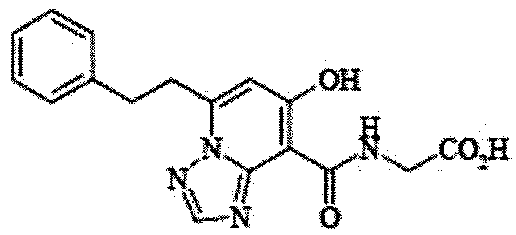
で示される化合物又はその製薬上許容される塩の治療上有効量を哺乳動物に投与することを含んでなる、腎硬化症を治療又は予防する方法。 - 下記化学構造式:
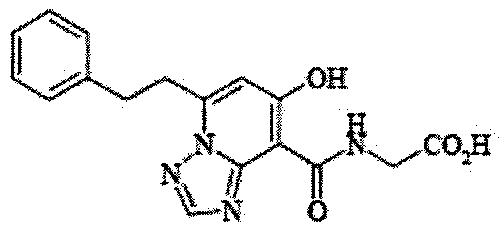
で示される化合物又はその製薬上許容される塩の治療上有効量を哺乳動物に投与することを含んでなる、尿細管間質の線維化を抑制する方法。 - 下記化学構造式:
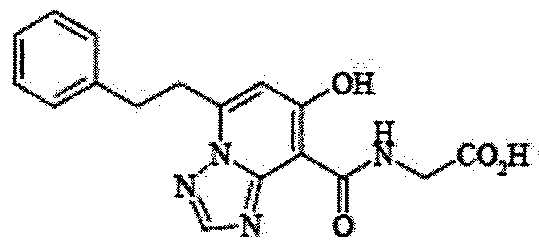
で示される化合物又はその製薬上許容される塩を含む、糖尿病性腎症、糖尿病を併発する慢性腎臓病、糸球体腎炎、免疫系又は炎症性疾患を併発する慢性腎臓病、腎硬化症、及び高血圧を併発する慢性腎臓病からなる群から選択される腎障害関連疾患の治療又は予防用医薬組成物。 - 下記化学構造式:
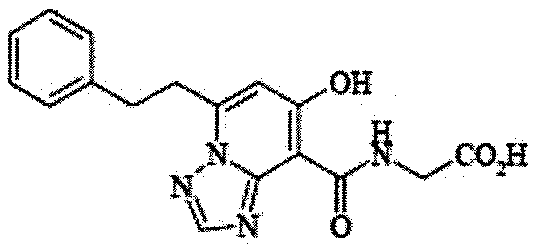
で示される化合物又はその製薬上許容される塩を含む、尿細管間質の線維化抑制剤。 - 糖尿病性腎症、糖尿病を併発する慢性腎臓病、糸球体腎炎、免疫系又は炎症性疾患を併発する慢性腎臓病、腎硬化症、及び高血圧を併発する慢性腎臓病からなる群から選択される腎障害関連疾患の治療又は予防剤を製造するための、下記化学構造式:

で示される化合物又はその製薬上許容される塩の使用。 - 尿細管間質の線維化抑制剤を製造するための下記化学構造式:

で示される化合物又はその製薬上許容される塩の使用。
Priority Applications (7)
| Application Number | Priority Date | Filing Date | Title |
|---|---|---|---|
| EP25207172.5A EP4667059A3 (en) | 2015-05-28 | 2016-05-27 | Method for treating or preventing diabetic nephropathy |
| KR1020177034665A KR102473897B1 (ko) | 2015-05-28 | 2016-05-27 | 당뇨병성 신증을 치료 또는 예방하는 방법 |
| EP16800124.6A EP3305293A4 (en) | 2015-05-28 | 2016-05-27 | METHOD FOR THE TREATMENT OR PREVENTION OF NEPHROPATHIA DIABETICA |
| JP2017520814A JP6814134B2 (ja) | 2015-05-28 | 2016-05-27 | 糖尿病性腎症を治療又は予防する方法 |
| US15/576,927 US20180243271A1 (en) | 2015-05-28 | 2016-05-27 | Method for Treating or Preventing Diabetic Nephropathy |
| US16/997,265 US20210205278A1 (en) | 2015-05-28 | 2020-08-19 | Method for Treating or Preventing Diabetic Nephropathy |
| US18/503,932 US20240342141A1 (en) | 2015-05-28 | 2023-11-07 | Method for Treating or Preventing Diabetic Nephropathy |
Applications Claiming Priority (2)
| Application Number | Priority Date | Filing Date | Title |
|---|---|---|---|
| JP2015109207 | 2015-05-28 | ||
| JP2015-109207 | 2015-05-28 |
Related Child Applications (2)
| Application Number | Title | Priority Date | Filing Date |
|---|---|---|---|
| US15/576,927 A-371-Of-International US20180243271A1 (en) | 2015-05-28 | 2016-05-27 | Method for Treating or Preventing Diabetic Nephropathy |
| US16/997,265 Continuation US20210205278A1 (en) | 2015-05-28 | 2020-08-19 | Method for Treating or Preventing Diabetic Nephropathy |
Publications (1)
| Publication Number | Publication Date |
|---|---|
| WO2016190420A1 true WO2016190420A1 (ja) | 2016-12-01 |
Family
ID=57393596
Family Applications (1)
| Application Number | Title | Priority Date | Filing Date |
|---|---|---|---|
| PCT/JP2016/065765 Ceased WO2016190420A1 (ja) | 2015-05-28 | 2016-05-27 | 糖尿病性腎症を治療又は予防する方法 |
Country Status (5)
| Country | Link |
|---|---|
| US (3) | US20180243271A1 (ja) |
| EP (2) | EP4667059A3 (ja) |
| JP (1) | JP6814134B2 (ja) |
| KR (1) | KR102473897B1 (ja) |
| WO (1) | WO2016190420A1 (ja) |
Cited By (2)
| Publication number | Priority date | Publication date | Assignee | Title |
|---|---|---|---|---|
| WO2018097254A1 (ja) * | 2016-11-25 | 2018-05-31 | 日本たばこ産業株式会社 | トリアゾロピリジン化合物の製造方法 |
| WO2020166710A1 (ja) | 2019-02-15 | 2020-08-20 | 国立大学法人東北大学 | 1,3-ジオキソラン誘導体 |
Citations (5)
| Publication number | Priority date | Publication date | Assignee | Title |
|---|---|---|---|---|
| JPH10168062A (ja) * | 1996-12-04 | 1998-06-23 | Hoechst Ag | 3−ヒドロキシピリジン−2−カルボキサミドエステル、その製造および薬剤としてのその使用 |
| JPH11302257A (ja) * | 1997-10-20 | 1999-11-02 | Hoechst Marion Roussel Deutsche Gmbh | 置換イソキノリン−3−カルボキサミド、その製法および薬剤としてのその使用 |
| JP2000509047A (ja) * | 1996-04-30 | 2000-07-18 | ヘキスト・アクチエンゲゼルシヤフト | 3―アルコキシピリジン―2―カルボキサミドエステル類、その製法および薬剤としてのその使用 |
| WO2011007856A1 (ja) * | 2009-07-17 | 2011-01-20 | 日本たばこ産業株式会社 | トリアゾロピリジン化合物、ならびにそのプロリル水酸化酵素阻害剤およびエリスロポエチン産生誘導剤としての作用 |
| JP2014024759A (ja) * | 2012-07-24 | 2014-02-06 | National Institute Of Advanced Industrial & Technology | 2−ヒドロキシベンズアルデヒド化合物、これを含有するコラーゲン細胞外分泌阻害剤及び医薬品組成物 |
Family Cites Families (2)
| Publication number | Priority date | Publication date | Assignee | Title |
|---|---|---|---|---|
| US8124582B2 (en) * | 2002-12-06 | 2012-02-28 | Fibrogen, Inc. | Treatment of diabetes |
| JP6034776B2 (ja) | 2013-12-05 | 2016-11-30 | 本田技研工業株式会社 | 車両用電力供給システム |
-
2016
- 2016-05-27 EP EP25207172.5A patent/EP4667059A3/en active Pending
- 2016-05-27 KR KR1020177034665A patent/KR102473897B1/ko active Active
- 2016-05-27 EP EP16800124.6A patent/EP3305293A4/en not_active Withdrawn
- 2016-05-27 WO PCT/JP2016/065765 patent/WO2016190420A1/ja not_active Ceased
- 2016-05-27 US US15/576,927 patent/US20180243271A1/en not_active Abandoned
- 2016-05-27 JP JP2017520814A patent/JP6814134B2/ja active Active
-
2020
- 2020-08-19 US US16/997,265 patent/US20210205278A1/en not_active Abandoned
-
2023
- 2023-11-07 US US18/503,932 patent/US20240342141A1/en active Pending
Patent Citations (5)
| Publication number | Priority date | Publication date | Assignee | Title |
|---|---|---|---|---|
| JP2000509047A (ja) * | 1996-04-30 | 2000-07-18 | ヘキスト・アクチエンゲゼルシヤフト | 3―アルコキシピリジン―2―カルボキサミドエステル類、その製法および薬剤としてのその使用 |
| JPH10168062A (ja) * | 1996-12-04 | 1998-06-23 | Hoechst Ag | 3−ヒドロキシピリジン−2−カルボキサミドエステル、その製造および薬剤としてのその使用 |
| JPH11302257A (ja) * | 1997-10-20 | 1999-11-02 | Hoechst Marion Roussel Deutsche Gmbh | 置換イソキノリン−3−カルボキサミド、その製法および薬剤としてのその使用 |
| WO2011007856A1 (ja) * | 2009-07-17 | 2011-01-20 | 日本たばこ産業株式会社 | トリアゾロピリジン化合物、ならびにそのプロリル水酸化酵素阻害剤およびエリスロポエチン産生誘導剤としての作用 |
| JP2014024759A (ja) * | 2012-07-24 | 2014-02-06 | National Institute Of Advanced Industrial & Technology | 2−ヒドロキシベンズアルデヒド化合物、これを含有するコラーゲン細胞外分泌阻害剤及び医薬品組成物 |
Non-Patent Citations (2)
| Title |
|---|
| NANGAKU M.: "HIF AND RENAL DISEASE", NEPHROLOGY, vol. 15, no. Suppl.3, 2010, pages 22 - 23 , S 08-3, XP055332411 * |
| YU X. ET AL.: "Transient Hypoxia-inducible factor activation in rat renal ablation and reduced fibrosis with L-mimosine", NEPHROLOGY, vol. 17, no. 1, 2012, pages 58 - 67, XP055332405 * |
Cited By (5)
| Publication number | Priority date | Publication date | Assignee | Title |
|---|---|---|---|---|
| WO2018097254A1 (ja) * | 2016-11-25 | 2018-05-31 | 日本たばこ産業株式会社 | トリアゾロピリジン化合物の製造方法 |
| JPWO2018097254A1 (ja) * | 2016-11-25 | 2019-10-17 | 日本たばこ産業株式会社 | トリアゾロピリジン化合物の製造方法 |
| JP2020073474A (ja) * | 2016-11-25 | 2020-05-14 | 日本たばこ産業株式会社 | トリアゾロピリジン化合物の製造方法 |
| WO2020166710A1 (ja) | 2019-02-15 | 2020-08-20 | 国立大学法人東北大学 | 1,3-ジオキソラン誘導体 |
| US11912688B2 (en) | 2019-02-15 | 2024-02-27 | Tohoku University | 1, 3-dioxolane derivative |
Also Published As
| Publication number | Publication date |
|---|---|
| EP3305293A4 (en) | 2019-01-16 |
| KR20180011124A (ko) | 2018-01-31 |
| EP3305293A1 (en) | 2018-04-11 |
| JPWO2016190420A1 (ja) | 2018-03-15 |
| EP4667059A2 (en) | 2025-12-24 |
| KR102473897B1 (ko) | 2022-12-06 |
| US20210205278A1 (en) | 2021-07-08 |
| US20240342141A1 (en) | 2024-10-17 |
| JP6814134B2 (ja) | 2021-01-13 |
| EP4667059A3 (en) | 2026-04-08 |
| US20180243271A1 (en) | 2018-08-30 |
Similar Documents
| Publication | Publication Date | Title |
|---|---|---|
| US20240342141A1 (en) | Method for Treating or Preventing Diabetic Nephropathy | |
| US9150489B2 (en) | 1-(2-fluorobiphenyl-4-yl)-alkyl carboxylic acid derivatives for the therapy of transthyretin amyloidosis | |
| CN110167918A (zh) | 新型苯基衍生物 | |
| US11771704B1 (en) | Methods of using rho kinase inhibitors to treat alzheimer's disease | |
| DE69425085T2 (de) | Angiotensin II Antagonisten als prophylaktisches und therapeutisches Mittel für Nierenkrankheiten | |
| KR101587071B1 (ko) | 만성 신부전 처치제 | |
| KR20200139721A (ko) | 섬유성 질환을 치료하는 방법 | |
| CN112292125B (zh) | 蛋白尿的治疗 | |
| EP3804727B1 (en) | Indol-containing compound for use in the treatment of the nephrotic syndrome | |
| US20230405017A1 (en) | Methods of using rho kinase inhibitors to treat frontotemporal dementia | |
| KR20130113921A (ko) | 비알코올성 지방성 간염의 예방 및/또는 치료제 | |
| US20200261443A1 (en) | Use of Anti-Ischemic Compounds in Treating Acute-On-Chronic Liver Failure | |
| WO2020054734A1 (ja) | ピラゾール-アミド化合物を含有する慢性腎臓病の治療又は予防剤 | |
| KR20130088755A (ko) | 서방성 고혈압 및 신 기능 장애 치료제 | |
| JP6907174B2 (ja) | アミロイド線維形成の抑制又は阻害剤 | |
| SG185474A1 (en) | Association of xanthine oxidase inhibitors and angiotensin ii receptor antagonists and use thereof | |
| JPH0119A (ja) | 腎機能改善剤 | |
| JP7118635B2 (ja) | 医薬用組成物 | |
| WO2018203559A1 (ja) | ポリグルタミン病に関する医薬組成物 | |
| JP4564354B2 (ja) | ネフロパシーの処置におけるバソペプチダーゼ阻害剤の使用 | |
| KR20220140268A (ko) | 신규한 인돌라진 유도체 및 이를 포함하는 섬유증의 예방 또는 치료용 조성물 | |
| HK40049573B (en) | Indol-containing compound for use in the treatment of the nephrotic syndrome | |
| JP2008024673A (ja) | 糖化最終産物形成阻害作用を有する1,3−ジチアン誘導体 |
Legal Events
| Date | Code | Title | Description |
|---|---|---|---|
| 121 | Ep: the epo has been informed by wipo that ep was designated in this application |
Ref document number: 16800124 Country of ref document: EP Kind code of ref document: A1 |
|
| ENP | Entry into the national phase |
Ref document number: 2017520814 Country of ref document: JP Kind code of ref document: A |
|
| NENP | Non-entry into the national phase |
Ref country code: DE |
|
| ENP | Entry into the national phase |
Ref document number: 20177034665 Country of ref document: KR Kind code of ref document: A |
|
| WWE | Wipo information: entry into national phase |
Ref document number: 2016800124 Country of ref document: EP |
|
| WWE | Wipo information: entry into national phase |
Ref document number: 15576927 Country of ref document: US |
|
| WWW | Wipo information: withdrawn in national office |
Ref document number: 2016800124 Country of ref document: EP |