WO2016203890A1 - Composition durcissable, procédé de production d'une composition durcissable, film, filtre passe-haut infrarouge, film de transmission dans l'infrarouge, procédé de formation de motif, et dispositif - Google Patents
Composition durcissable, procédé de production d'une composition durcissable, film, filtre passe-haut infrarouge, film de transmission dans l'infrarouge, procédé de formation de motif, et dispositif Download PDFInfo
- Publication number
- WO2016203890A1 WO2016203890A1 PCT/JP2016/064631 JP2016064631W WO2016203890A1 WO 2016203890 A1 WO2016203890 A1 WO 2016203890A1 JP 2016064631 W JP2016064631 W JP 2016064631W WO 2016203890 A1 WO2016203890 A1 WO 2016203890A1
- Authority
- WO
- WIPO (PCT)
- Prior art keywords
- group
- curable composition
- pigment
- mass
- compound
- Prior art date
- Legal status (The legal status is an assumption and is not a legal conclusion. Google has not performed a legal analysis and makes no representation as to the accuracy of the status listed.)
- Ceased
Links
Images



Classifications
-
- G—PHYSICS
- G03—PHOTOGRAPHY; CINEMATOGRAPHY; ANALOGOUS TECHNIQUES USING WAVES OTHER THAN OPTICAL WAVES; ELECTROGRAPHY; HOLOGRAPHY
- G03F—PHOTOMECHANICAL PRODUCTION OF TEXTURED OR PATTERNED SURFACES, e.g. FOR PRINTING, FOR PROCESSING OF SEMICONDUCTOR DEVICES; MATERIALS THEREFOR; ORIGINALS THEREFOR; APPARATUS SPECIALLY ADAPTED THEREFOR
- G03F7/00—Photomechanical, e.g. photolithographic, production of textured or patterned surfaces, e.g. printing surfaces; Materials therefor, e.g. comprising photoresists; Apparatus specially adapted therefor
- G03F7/0005—Production of optical devices or components in so far as characterised by the lithographic processes or materials used therefor
- G03F7/0007—Filters, e.g. additive colour filters; Components for display devices
-
- C—CHEMISTRY; METALLURGY
- C08—ORGANIC MACROMOLECULAR COMPOUNDS; THEIR PREPARATION OR CHEMICAL WORKING-UP; COMPOSITIONS BASED THEREON
- C08G—MACROMOLECULAR COMPOUNDS OBTAINED OTHERWISE THAN BY REACTIONS ONLY INVOLVING UNSATURATED CARBON-TO-CARBON BONDS
- C08G59/00—Polycondensates containing more than one epoxy group per molecule; Macromolecules obtained by polymerising compounds containing more than one epoxy group per molecule using curing agents or catalysts which react with the epoxy groups
- C08G59/18—Macromolecules obtained by polymerising compounds containing more than one epoxy group per molecule using curing agents or catalysts which react with the epoxy groups ; e.g. general methods of curing
- C08G59/20—Macromolecules obtained by polymerising compounds containing more than one epoxy group per molecule using curing agents or catalysts which react with the epoxy groups ; e.g. general methods of curing characterised by the epoxy compounds used
- C08G59/32—Epoxy compounds containing three or more epoxy groups
-
- C—CHEMISTRY; METALLURGY
- C08—ORGANIC MACROMOLECULAR COMPOUNDS; THEIR PREPARATION OR CHEMICAL WORKING-UP; COMPOSITIONS BASED THEREON
- C08G—MACROMOLECULAR COMPOUNDS OBTAINED OTHERWISE THAN BY REACTIONS ONLY INVOLVING UNSATURATED CARBON-TO-CARBON BONDS
- C08G59/00—Polycondensates containing more than one epoxy group per molecule; Macromolecules obtained by polymerising compounds containing more than one epoxy group per molecule using curing agents or catalysts which react with the epoxy groups
- C08G59/18—Macromolecules obtained by polymerising compounds containing more than one epoxy group per molecule using curing agents or catalysts which react with the epoxy groups ; e.g. general methods of curing
- C08G59/20—Macromolecules obtained by polymerising compounds containing more than one epoxy group per molecule using curing agents or catalysts which react with the epoxy groups ; e.g. general methods of curing characterised by the epoxy compounds used
- C08G59/32—Epoxy compounds containing three or more epoxy groups
- C08G59/3218—Carbocyclic compounds
-
- C—CHEMISTRY; METALLURGY
- C08—ORGANIC MACROMOLECULAR COMPOUNDS; THEIR PREPARATION OR CHEMICAL WORKING-UP; COMPOSITIONS BASED THEREON
- C08G—MACROMOLECULAR COMPOUNDS OBTAINED OTHERWISE THAN BY REACTIONS ONLY INVOLVING UNSATURATED CARBON-TO-CARBON BONDS
- C08G59/00—Polycondensates containing more than one epoxy group per molecule; Macromolecules obtained by polymerising compounds containing more than one epoxy group per molecule using curing agents or catalysts which react with the epoxy groups
- C08G59/18—Macromolecules obtained by polymerising compounds containing more than one epoxy group per molecule using curing agents or catalysts which react with the epoxy groups ; e.g. general methods of curing
- C08G59/40—Macromolecules obtained by polymerising compounds containing more than one epoxy group per molecule using curing agents or catalysts which react with the epoxy groups ; e.g. general methods of curing characterised by the curing agents used
- C08G59/50—Amines
- C08G59/5046—Amines heterocyclic
- C08G59/5053—Amines heterocyclic containing only nitrogen as a heteroatom
- C08G59/506—Amines heterocyclic containing only nitrogen as a heteroatom having one nitrogen atom in the ring
-
- C—CHEMISTRY; METALLURGY
- C08—ORGANIC MACROMOLECULAR COMPOUNDS; THEIR PREPARATION OR CHEMICAL WORKING-UP; COMPOSITIONS BASED THEREON
- C08K—Use of inorganic or non-macromolecular organic substances as compounding ingredients
- C08K5/00—Use of organic ingredients
- C08K5/16—Nitrogen-containing compounds
- C08K5/32—Compounds containing nitrogen bound to oxygen
- C08K5/33—Oximes
-
- C—CHEMISTRY; METALLURGY
- C08—ORGANIC MACROMOLECULAR COMPOUNDS; THEIR PREPARATION OR CHEMICAL WORKING-UP; COMPOSITIONS BASED THEREON
- C08K—Use of inorganic or non-macromolecular organic substances as compounding ingredients
- C08K5/00—Use of organic ingredients
- C08K5/16—Nitrogen-containing compounds
- C08K5/34—Heterocyclic compounds having nitrogen in the ring
- C08K5/3412—Heterocyclic compounds having nitrogen in the ring having one nitrogen atom in the ring
- C08K5/3415—Five-membered rings
-
- C—CHEMISTRY; METALLURGY
- C08—ORGANIC MACROMOLECULAR COMPOUNDS; THEIR PREPARATION OR CHEMICAL WORKING-UP; COMPOSITIONS BASED THEREON
- C08L—COMPOSITIONS OF MACROMOLECULAR COMPOUNDS
- C08L101/00—Compositions of unspecified macromolecular compounds
-
- C—CHEMISTRY; METALLURGY
- C08—ORGANIC MACROMOLECULAR COMPOUNDS; THEIR PREPARATION OR CHEMICAL WORKING-UP; COMPOSITIONS BASED THEREON
- C08L—COMPOSITIONS OF MACROMOLECULAR COMPOUNDS
- C08L63/00—Compositions of epoxy resins; Compositions of derivatives of epoxy resins
-
- G—PHYSICS
- G02—OPTICS
- G02B—OPTICAL ELEMENTS, SYSTEMS OR APPARATUS
- G02B5/00—Optical elements other than lenses
- G02B5/20—Filters
- G02B5/201—Filters in the form of arrays
-
- G—PHYSICS
- G02—OPTICS
- G02B—OPTICAL ELEMENTS, SYSTEMS OR APPARATUS
- G02B5/00—Optical elements other than lenses
- G02B5/20—Filters
- G02B5/208—Filters for use with infrared or ultraviolet radiation, e.g. for separating visible light from infrared and/or ultraviolet radiation
-
- G—PHYSICS
- G02—OPTICS
- G02B—OPTICAL ELEMENTS, SYSTEMS OR APPARATUS
- G02B5/00—Optical elements other than lenses
- G02B5/20—Filters
- G02B5/22—Absorbing filters
- G02B5/223—Absorbing filters containing organic substances, e.g. dyes, inks or pigments
-
- G—PHYSICS
- G03—PHOTOGRAPHY; CINEMATOGRAPHY; ANALOGOUS TECHNIQUES USING WAVES OTHER THAN OPTICAL WAVES; ELECTROGRAPHY; HOLOGRAPHY
- G03F—PHOTOMECHANICAL PRODUCTION OF TEXTURED OR PATTERNED SURFACES, e.g. FOR PRINTING, FOR PROCESSING OF SEMICONDUCTOR DEVICES; MATERIALS THEREFOR; ORIGINALS THEREFOR; APPARATUS SPECIALLY ADAPTED THEREFOR
- G03F7/00—Photomechanical, e.g. photolithographic, production of textured or patterned surfaces, e.g. printing surfaces; Materials therefor, e.g. comprising photoresists; Apparatus specially adapted therefor
- G03F7/004—Photosensitive materials
- G03F7/027—Non-macromolecular photopolymerisable compounds having carbon-to-carbon double bonds, e.g. ethylenic compounds
- G03F7/028—Non-macromolecular photopolymerisable compounds having carbon-to-carbon double bonds, e.g. ethylenic compounds with photosensitivity-increasing substances, e.g. photoinitiators
- G03F7/029—Inorganic compounds; Onium compounds; Organic compounds having hetero atoms other than oxygen, nitrogen or sulfur
-
- G—PHYSICS
- G03—PHOTOGRAPHY; CINEMATOGRAPHY; ANALOGOUS TECHNIQUES USING WAVES OTHER THAN OPTICAL WAVES; ELECTROGRAPHY; HOLOGRAPHY
- G03F—PHOTOMECHANICAL PRODUCTION OF TEXTURED OR PATTERNED SURFACES, e.g. FOR PRINTING, FOR PROCESSING OF SEMICONDUCTOR DEVICES; MATERIALS THEREFOR; ORIGINALS THEREFOR; APPARATUS SPECIALLY ADAPTED THEREFOR
- G03F7/00—Photomechanical, e.g. photolithographic, production of textured or patterned surfaces, e.g. printing surfaces; Materials therefor, e.g. comprising photoresists; Apparatus specially adapted therefor
- G03F7/004—Photosensitive materials
- G03F7/027—Non-macromolecular photopolymerisable compounds having carbon-to-carbon double bonds, e.g. ethylenic compounds
- G03F7/028—Non-macromolecular photopolymerisable compounds having carbon-to-carbon double bonds, e.g. ethylenic compounds with photosensitivity-increasing substances, e.g. photoinitiators
- G03F7/031—Organic compounds not covered by group G03F7/029
-
- G—PHYSICS
- G03—PHOTOGRAPHY; CINEMATOGRAPHY; ANALOGOUS TECHNIQUES USING WAVES OTHER THAN OPTICAL WAVES; ELECTROGRAPHY; HOLOGRAPHY
- G03F—PHOTOMECHANICAL PRODUCTION OF TEXTURED OR PATTERNED SURFACES, e.g. FOR PRINTING, FOR PROCESSING OF SEMICONDUCTOR DEVICES; MATERIALS THEREFOR; ORIGINALS THEREFOR; APPARATUS SPECIALLY ADAPTED THEREFOR
- G03F7/00—Photomechanical, e.g. photolithographic, production of textured or patterned surfaces, e.g. printing surfaces; Materials therefor, e.g. comprising photoresists; Apparatus specially adapted therefor
- G03F7/004—Photosensitive materials
- G03F7/027—Non-macromolecular photopolymerisable compounds having carbon-to-carbon double bonds, e.g. ethylenic compounds
- G03F7/032—Non-macromolecular photopolymerisable compounds having carbon-to-carbon double bonds, e.g. ethylenic compounds with binders
- G03F7/033—Non-macromolecular photopolymerisable compounds having carbon-to-carbon double bonds, e.g. ethylenic compounds with binders the binders being polymers obtained by reactions only involving carbon-to-carbon unsaturated bonds, e.g. vinyl polymers
-
- G—PHYSICS
- G03—PHOTOGRAPHY; CINEMATOGRAPHY; ANALOGOUS TECHNIQUES USING WAVES OTHER THAN OPTICAL WAVES; ELECTROGRAPHY; HOLOGRAPHY
- G03F—PHOTOMECHANICAL PRODUCTION OF TEXTURED OR PATTERNED SURFACES, e.g. FOR PRINTING, FOR PROCESSING OF SEMICONDUCTOR DEVICES; MATERIALS THEREFOR; ORIGINALS THEREFOR; APPARATUS SPECIALLY ADAPTED THEREFOR
- G03F7/00—Photomechanical, e.g. photolithographic, production of textured or patterned surfaces, e.g. printing surfaces; Materials therefor, e.g. comprising photoresists; Apparatus specially adapted therefor
- G03F7/004—Photosensitive materials
- G03F7/038—Macromolecular compounds which are rendered insoluble or differentially wettable
-
- G—PHYSICS
- G03—PHOTOGRAPHY; CINEMATOGRAPHY; ANALOGOUS TECHNIQUES USING WAVES OTHER THAN OPTICAL WAVES; ELECTROGRAPHY; HOLOGRAPHY
- G03F—PHOTOMECHANICAL PRODUCTION OF TEXTURED OR PATTERNED SURFACES, e.g. FOR PRINTING, FOR PROCESSING OF SEMICONDUCTOR DEVICES; MATERIALS THEREFOR; ORIGINALS THEREFOR; APPARATUS SPECIALLY ADAPTED THEREFOR
- G03F7/00—Photomechanical, e.g. photolithographic, production of textured or patterned surfaces, e.g. printing surfaces; Materials therefor, e.g. comprising photoresists; Apparatus specially adapted therefor
- G03F7/004—Photosensitive materials
- G03F7/09—Photosensitive materials characterised by structural details, e.g. supports, auxiliary layers
- G03F7/105—Photosensitive materials characterised by structural details, e.g. supports, auxiliary layers having substances, e.g. indicators, for forming visible images
-
- G—PHYSICS
- G03—PHOTOGRAPHY; CINEMATOGRAPHY; ANALOGOUS TECHNIQUES USING WAVES OTHER THAN OPTICAL WAVES; ELECTROGRAPHY; HOLOGRAPHY
- G03F—PHOTOMECHANICAL PRODUCTION OF TEXTURED OR PATTERNED SURFACES, e.g. FOR PRINTING, FOR PROCESSING OF SEMICONDUCTOR DEVICES; MATERIALS THEREFOR; ORIGINALS THEREFOR; APPARATUS SPECIALLY ADAPTED THEREFOR
- G03F7/00—Photomechanical, e.g. photolithographic, production of textured or patterned surfaces, e.g. printing surfaces; Materials therefor, e.g. comprising photoresists; Apparatus specially adapted therefor
- G03F7/16—Coating processes; Apparatus therefor
- G03F7/162—Coating on a rotating support, e.g. using a whirler or a spinner
-
- G—PHYSICS
- G03—PHOTOGRAPHY; CINEMATOGRAPHY; ANALOGOUS TECHNIQUES USING WAVES OTHER THAN OPTICAL WAVES; ELECTROGRAPHY; HOLOGRAPHY
- G03F—PHOTOMECHANICAL PRODUCTION OF TEXTURED OR PATTERNED SURFACES, e.g. FOR PRINTING, FOR PROCESSING OF SEMICONDUCTOR DEVICES; MATERIALS THEREFOR; ORIGINALS THEREFOR; APPARATUS SPECIALLY ADAPTED THEREFOR
- G03F7/00—Photomechanical, e.g. photolithographic, production of textured or patterned surfaces, e.g. printing surfaces; Materials therefor, e.g. comprising photoresists; Apparatus specially adapted therefor
- G03F7/16—Coating processes; Apparatus therefor
- G03F7/168—Finishing the coated layer, e.g. drying, baking, soaking
-
- G—PHYSICS
- G03—PHOTOGRAPHY; CINEMATOGRAPHY; ANALOGOUS TECHNIQUES USING WAVES OTHER THAN OPTICAL WAVES; ELECTROGRAPHY; HOLOGRAPHY
- G03F—PHOTOMECHANICAL PRODUCTION OF TEXTURED OR PATTERNED SURFACES, e.g. FOR PRINTING, FOR PROCESSING OF SEMICONDUCTOR DEVICES; MATERIALS THEREFOR; ORIGINALS THEREFOR; APPARATUS SPECIALLY ADAPTED THEREFOR
- G03F7/00—Photomechanical, e.g. photolithographic, production of textured or patterned surfaces, e.g. printing surfaces; Materials therefor, e.g. comprising photoresists; Apparatus specially adapted therefor
- G03F7/20—Exposure; Apparatus therefor
- G03F7/2037—Exposure with X-ray radiation or corpuscular radiation, through a mask with a pattern opaque to that radiation
- G03F7/2039—X-ray radiation
-
- G—PHYSICS
- G03—PHOTOGRAPHY; CINEMATOGRAPHY; ANALOGOUS TECHNIQUES USING WAVES OTHER THAN OPTICAL WAVES; ELECTROGRAPHY; HOLOGRAPHY
- G03F—PHOTOMECHANICAL PRODUCTION OF TEXTURED OR PATTERNED SURFACES, e.g. FOR PRINTING, FOR PROCESSING OF SEMICONDUCTOR DEVICES; MATERIALS THEREFOR; ORIGINALS THEREFOR; APPARATUS SPECIALLY ADAPTED THEREFOR
- G03F7/00—Photomechanical, e.g. photolithographic, production of textured or patterned surfaces, e.g. printing surfaces; Materials therefor, e.g. comprising photoresists; Apparatus specially adapted therefor
- G03F7/26—Processing photosensitive materials; Apparatus therefor
- G03F7/30—Imagewise removal using liquid means
- G03F7/32—Liquid compositions therefor, e.g. developers
- G03F7/322—Aqueous alkaline compositions
-
- G—PHYSICS
- G03—PHOTOGRAPHY; CINEMATOGRAPHY; ANALOGOUS TECHNIQUES USING WAVES OTHER THAN OPTICAL WAVES; ELECTROGRAPHY; HOLOGRAPHY
- G03F—PHOTOMECHANICAL PRODUCTION OF TEXTURED OR PATTERNED SURFACES, e.g. FOR PRINTING, FOR PROCESSING OF SEMICONDUCTOR DEVICES; MATERIALS THEREFOR; ORIGINALS THEREFOR; APPARATUS SPECIALLY ADAPTED THEREFOR
- G03F7/00—Photomechanical, e.g. photolithographic, production of textured or patterned surfaces, e.g. printing surfaces; Materials therefor, e.g. comprising photoresists; Apparatus specially adapted therefor
- G03F7/26—Processing photosensitive materials; Apparatus therefor
- G03F7/40—Treatment after imagewise removal, e.g. baking
-
- H—ELECTRICITY
- H10—SEMICONDUCTOR DEVICES; ELECTRIC SOLID-STATE DEVICES NOT OTHERWISE PROVIDED FOR
- H10F—INORGANIC SEMICONDUCTOR DEVICES SENSITIVE TO INFRARED RADIATION, LIGHT, ELECTROMAGNETIC RADIATION OF SHORTER WAVELENGTH OR CORPUSCULAR RADIATION
- H10F39/00—Integrated devices, or assemblies of multiple devices, comprising at least one element covered by group H10F30/00, e.g. radiation detectors comprising photodiode arrays
- H10F39/80—Constructional details of image sensors
-
- H—ELECTRICITY
- H10—SEMICONDUCTOR DEVICES; ELECTRIC SOLID-STATE DEVICES NOT OTHERWISE PROVIDED FOR
- H10F—INORGANIC SEMICONDUCTOR DEVICES SENSITIVE TO INFRARED RADIATION, LIGHT, ELECTROMAGNETIC RADIATION OF SHORTER WAVELENGTH OR CORPUSCULAR RADIATION
- H10F39/00—Integrated devices, or assemblies of multiple devices, comprising at least one element covered by group H10F30/00, e.g. radiation detectors comprising photodiode arrays
- H10F39/80—Constructional details of image sensors
- H10F39/805—Coatings
- H10F39/8053—Colour filters
-
- C—CHEMISTRY; METALLURGY
- C08—ORGANIC MACROMOLECULAR COMPOUNDS; THEIR PREPARATION OR CHEMICAL WORKING-UP; COMPOSITIONS BASED THEREON
- C08K—Use of inorganic or non-macromolecular organic substances as compounding ingredients
- C08K5/00—Use of organic ingredients
- C08K5/0008—Organic ingredients according to more than one of the "one dot" groups of C08K5/01 - C08K5/59
- C08K5/0041—Optical brightening agents, organic pigments
-
- C—CHEMISTRY; METALLURGY
- C08—ORGANIC MACROMOLECULAR COMPOUNDS; THEIR PREPARATION OR CHEMICAL WORKING-UP; COMPOSITIONS BASED THEREON
- C08K—Use of inorganic or non-macromolecular organic substances as compounding ingredients
- C08K5/00—Use of organic ingredients
- C08K5/0091—Complexes with metal-heteroatom-bonds
Definitions
- the present invention relates to a curable composition, a method for producing the curable composition, a film, an infrared cut filter, an infrared transmission filter, a pattern forming method, and an apparatus.
- Video cameras, digital still cameras, mobile phones with camera functions, etc. use CCD (Charge Coupled Device) and CMOS (Complementary Metal Oxide Semiconductor), which are solid-state imaging devices for color images. Since these solid-state imaging devices use silicon photodiodes having sensitivity to infrared rays in their light receiving portions, visual sensitivity correction may be performed using an infrared cut filter.
- CCD Charge Coupled Device
- CMOS Complementary Metal Oxide Semiconductor
- Patent Document 1 describes an infrared cut filter using an infrared absorbing composition containing a transparent resin and an oxytitanium phthalocyanine pigment.
- the infrared cut filter using the infrared absorbing composition described in Patent Document 1 has a visible region transmittance and a wavelength of 800 to 900 nm. It was found that the light shielding property was insufficient. Moreover, when the present inventors examined further the infrared cut filter using the infrared absorptive composition of patent document 1, it turned out that the transmittance
- an object of the present invention is to provide a film having good transmittance in the visible region, excellent light blocking property for light with a wavelength of 800 to 900 nm, excellent light blocking property for light with a wavelength of 800 to 900 nm, and wavelength of 900 nm.
- PROBLEM TO BE SOLVED To provide a curable composition, a method for producing a curable composition, a film, an infrared cut filter, an infrared transmission filter, a pattern forming method, and an apparatus capable of producing a film having excellent transparency to light in a wavelength region exceeding It is in.
- the present inventors have found that the oxytitanium phthalocyanine pigment has different spectral characteristics depending on the crystal structure.
- the ⁇ -type oxytitanium phthalocyanine pigment has been found to have good transmittance in the visible region and excellent spectral characteristics in the infrared region, and to complete the present invention. It came.
- the present invention provides the following. ⁇ 1> A curable composition comprising an ⁇ -type oxytitanium phthalocyanine pigment and a curable compound.
- ⁇ -type oxytitanium phthalocyanine pigment is represented by the following formula (1):
- X 1 to X 16 each independently represents a hydrogen atom or a halogen atom.
- the curable compound includes a radical photopolymerizable compound, and The curable composition according to ⁇ 1> or ⁇ 2>, further comprising a photo radical polymerization initiator.
- ⁇ 5> The curable composition according to any one of ⁇ 1> to ⁇ 4>, wherein the curable compound includes a compound having an epoxy group.
- ⁇ 6> The curable composition according to any one of ⁇ 1> to ⁇ 5>, further comprising one or more chromatic colorants.
- ⁇ 7> The curable composition according to any one of ⁇ 1> to ⁇ 6>, which is used for forming an infrared cut filter.
- ⁇ 8> The curable composition according to any one of ⁇ 1> to ⁇ 5>, further comprising two or more chromatic colorants or an organic black colorant.
- ⁇ 9> The curable composition according to ⁇ 8>, which is for forming an infrared transmission filter.
- ⁇ 10> A method for producing a curable composition according to any one of ⁇ 1> to ⁇ 9>, A method for producing a curable composition, comprising a step of dispersing an ⁇ -type oxytitanium phthalocyanine pigment and a pigment other than an oxytitanium phthalocyanine pigment in the presence of a solvent.
- ⁇ 12> An infrared cut filter formed using the curable composition according to ⁇ 7>.
- ⁇ 13> An infrared transmission filter formed using the curable composition according to ⁇ 9>.
- ⁇ 14> A step of forming a curable composition layer on a support using the curable composition according to any one of ⁇ 1> to ⁇ 9>, and a curable composition by a photolithography method or a dry etching method. Forming a pattern on the physical layer.
- ⁇ 15> A device having the film according to ⁇ 11>, wherein the device is a solid-state imaging device, an infrared sensor, or an image display device.
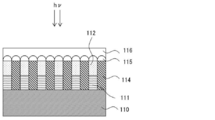
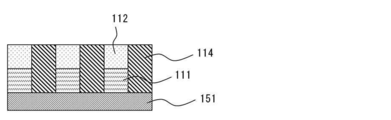
- FIG. 3 is a cross-sectional view taken along line AA in FIG. 2. It is a figure (plan view) showing the formation process of a pattern.
- FIG. 5 is a cross-sectional view taken along the line AA in FIG. 4. It is a figure (plan view) showing the formation process of a pattern.
- FIG. 7 is a cross-sectional view taken along the line AA in FIG. 6. It is the schematic which shows other embodiment of an infrared sensor.
- the total solid content refers to the total mass of the components excluding the solvent from the total composition of the composition.
- solid content means solid content in 25 degreeC.
- the description which does not describe substitution and unsubstituted includes the thing which has a substituent with the thing which does not have a substituent.
- the “alkyl group” includes not only an alkyl group having no substituent (unsubstituted alkyl group) but also an alkyl group having a substituent (substituted alkyl group).
- “Radiation” in the present specification means, for example, an emission line spectrum of a mercury lamp, far ultraviolet rays represented by an excimer laser, extreme ultraviolet rays (EUV light), X-rays, electron beams, and the like.
- light means actinic rays or radiation.
- “exposure” in this specification is not only exposure with a deep ultraviolet ray, an X-ray, EUV light, etc. typified by a mercury lamp or an excimer laser, but also drawing with a particle beam such as an electron beam or an ion beam. Are also included in the exposure.
- infrared refers to light (electromagnetic wave) having a wavelength region of 700 to 2500 nm.
- (meth) acrylate represents both and / or acrylate and methacrylate
- (meth) acryl represents both and / or acryl
- “(meth) acryloyl” "" Represents both and / or acryloyl and methacryloyl.
- Me in the chemical formula represents a methyl group
- Et represents an ethyl group
- Pr represents a propyl group
- Bu represents a butyl group
- Ac represents an acetyl group
- Bn represents a benzyl group
- Ph represents a phenyl group. Show.
- a weight average molecular weight and a number average molecular weight are defined as a polystyrene conversion value by GPC measurement.
- the weight average molecular weight (Mw) and the number average molecular weight (Mn) are, for example, HLC-8220 (manufactured by Tosoh Corporation), and TSKgel Super AWM-H (manufactured by Tosoh Corporation, 6) as a column.
- 0.0 mm ID (inner diameter) ⁇ 15.0 cm) can be obtained by using a 10 mmol / L lithium bromide NMP (N-methylpyrrolidinone) solution as an eluent.
- the curable composition of the present invention includes an ⁇ -type oxytitanium phthalocyanine pigment and a curable compound.
- the ⁇ -type oxytitanium phthalocyanine pigment has a high light-shielding property with respect to light having a wavelength of 850 nm, and is excellent in transmittance with respect to light having a wavelength of 940 nm. Furthermore, the transmittance for light in the visible region (preferably 400 to 700 nm) is also excellent.
- the curable composition of the present invention contains an ⁇ -type oxytitanium phthalocyanine pigment, and thus has good transparency in the visible region and excellent light-shielding property against light having a wavelength in the wavelength range of 800 to 900 nm. It is possible to manufacture a film having excellent light-shielding properties for light having a wavelength in the range of 800 to 900 nm and excellent light-transmitting properties for light having a wavelength region exceeding 900 nm. Moreover, although the detailed reason is unknown, it became possible to obtain the film
- thermosetting compound in combination, the curability of the cured film is improved, and movement and aggregation between ⁇ -type oxytitanium phthalocyanine pigments are suppressed, thereby improving heat resistance.
- the curable composition of the present invention contains an ⁇ -type oxytitanium phthalocyanine pigment.
- the oxytitanium phthalocyanine pigment is a compound having absorption in the infrared region, and is also an infrared absorber.
- ⁇ -type oxytitanium phthalocyanine pigments have good transmittance in the visible region and excellent light blocking properties for light having a wavelength of 800 to 900 nm (particularly in the vicinity of 850 nm). Furthermore, it is excellent also in the transmittance
- the curable composition of the present invention contains at least an oxytitanium phthalocyanine pigment having an ⁇ -type crystal structure ( ⁇ -type oxytitanium phthalocyanine pigment).
- the curable composition of the present invention contains an oxytitanium phthalocyanine pigment having a crystal structure other than ⁇ -type (for example, ⁇ -type, Y-type, etc.) (hereinafter also referred to as “oxytitanium phthalocyanine pigment having another crystal structure”). You may go out.
- a mixture of an ⁇ -type oxytitanium phthalocyanine pigment and an oxytitanium phthalocyanine pigment having another crystal structure may be simply referred to as an oxytitanium phthalocyanine pigment.
- the content of the ⁇ -type oxytitanium phthalocyanine pigment is preferably 50% by mass or more, more preferably 70% by mass or more, and still more preferably 90% by mass or more, based on the total mass of the oxytitanium phthalocyanine pigment.
- the content of the oxytitanium phthalocyanine pigment having another crystal structure is preferably less than 50% by mass, more preferably less than 30% by mass, and still more preferably less than 10% by mass in the total mass of the oxytitanium phthalocyanine pigment.
- the phrase “substantially free of oxytitanium phthalocyanine pigment having another crystal structure” means that the content of oxytitanium phthalocyanine pigment having another crystal structure is preferably 1% by mass or less based on the total mass of the oxytitanium phthalocyanine pigment.
- 0.5 mass% or less is still more preferable, 0.1 mass% or less is more preferable, and it can also be set as the aspect which does not contain the oxytitanium phthalocyanine pigment of another crystal structure.
- the oxytitanium phthalocyanine pigment having an ⁇ -type crystal structure can be synthesized according to the method described in JP-A No. 11-21466, 0011 to 0054. This content is incorporated herein.
- the crystal structure of the oxytitanium phthalocyanine pigment and the content of each crystal structure can be measured by X-ray diffraction.
- X-ray diffractometer RINT-2500 (manufactured by Rigaku Corporation) to measure ⁇ -2 ⁇ of an oxytitanium phthalocyanine pigment at 25 ° C.
- the content of ⁇ -type oxytitanium phthalocyanine pigment in the oxytitanium phthalocyanine pigment can be measured by a calibration curve method using an X-ray diffractometer (RINT-2500 (manufactured by Rigaku Corporation). Oxytitanium having other crystal structure The phthalocyanine pigment can also be measured by the same method as the ⁇ -type oxytitanium phthalocyanine pigment.
- the ⁇ -type oxytitanium phthalocyanine pigment is preferably a compound represented by the following formula (1).
- X 1 to X 16 each independently represents a hydrogen atom or a halogen atom.
- the number of halogen atoms is preferably 0 to 16, more preferably 0 to 4, still more preferably 0 to 1, and particularly preferably 0.
- the content of the oxytitanium phthalocyanine pigment is preferably 1 to 70% by mass in the total solid content of the curable composition.
- the lower limit is preferably 3% by mass or more, and more preferably 5% by mass or more.
- the upper limit is preferably 60% by mass or less, and more preferably 50% by mass or less.
- the content of the ⁇ -type oxytitanium phthalocyanine pigment is preferably 1 to 70% by mass in the total solid content of the curable composition.
- the lower limit is preferably 3% by mass or more, and more preferably 5% by mass or more.
- the upper limit is preferably 60% by mass or less, and more preferably 50% by mass or less.
- the curable composition of the present invention may also contain an infrared absorber other than the oxytitanium phthalocyanine pigment (also referred to as “other infrared absorber”).
- the infrared absorber means a compound having absorption in the infrared region (preferably, wavelength 650 to 1000 nm).
- the infrared absorber is preferably a compound having an absorption maximum at a wavelength of 650 nm or more.
- the absorption maximum of the infrared absorber is preferably in the range of 650 to 1000 nm, more preferably in the range of 700 to 1000 nm, and particularly preferably in the range of 800 to 1000 nm.
- infrared absorbers include, for example, pyrrolopyrrole compounds, copper compounds, cyanine compounds, phthalocyanine compounds, diimmonium compounds, thiol complex compounds, transition metal oxide compounds, squarylium compounds, naphthalocyanine compounds, quatallylene compounds, dithiol metals A complex compound, a croconium compound, an oxole compound, etc. are mentioned.
- phthalocyanine-based compound, naphthalocyanine-based compound, diimmonium compound, cyanine compound, squalium compound, and croconium compound the compounds disclosed in paragraphs 0010 to 0081 of JP 2010-1111750 A may be used. Embedded in the book.
- cyanine compound for example, “functional pigment, Shin Okawara / Ken Matsuoka / Kojiro Kitao / Kensuke Hirashima, Kodansha Scientific”, the contents of which are incorporated herein.
- pyrrolopyrrole compound include compounds described in paragraph Nos. 0049 to 0058 of JP-A-2009-263614, the contents of which are incorporated herein.
- the content of the other infrared absorber is preferably 0.1 to 50 parts by mass with respect to 100 parts by mass of the oxytitanium phthalocyanine pigment. It is more preferably 5 to 30 parts by mass, and further preferably 1.0 to 15 parts by mass. Moreover, it can also be set as the composition which does not contain other infrared absorbers substantially.
- content of another infrared absorber is 0.1 mass part or less, for example with respect to 100 mass parts of oxytitanium phthalocyanine pigments, that other infrared absorbers are not included substantially, 0 0.05 parts by mass or less is more preferable, 0.01 parts by mass or less is more preferable, and even more preferable is not to contain.
- the curable composition of the present invention can contain a chromatic colorant as a colorant other than the ⁇ -type oxytitanium phthalocyanine pigment.
- the curable composition of the present invention when used as, for example, a composition for forming an infrared cut filter, the curable composition of the present invention further includes a chromatic colorant, thereby providing infrared rays having a function as a color filter.
- a cut filter is obtained.
- the infrared cut filter means a filter that transmits light having a wavelength in the visible region (visible light) and shields light having a wavelength in the infrared region (infrared light).
- the infrared cut filter may transmit all light having a wavelength in the visible region, and transmits light in a specific wavelength region out of light having a wavelength in the visible region, and blocks light in the specific wavelength region. It may be a thing.
- the color filter means a filter that transmits a specific wavelength range of visible light and shields the specific wavelength range.
- the chromatic colorant means a colorant other than the white colorant and the black colorant.
- the chromatic colorant is preferably a colorant having an absorption maximum in a wavelength range of 400 nm or more and less than 650 nm.
- the chromatic colorant may be a pigment or a dye.
- the pigment preferably has an average particle diameter (r) of preferably 20 nm ⁇ r ⁇ 300 nm, more preferably 25 nm ⁇ r ⁇ 250 nm, and particularly preferably 30 nm ⁇ r ⁇ 200 nm.
- the “average particle size” here means the average particle size of secondary particles in which primary particles of the pigment are aggregated.
- the particle size distribution of the secondary particles of the pigment that can be used is such that the secondary particles falling into (average particle size ⁇ 100) nm are 70% by mass or more of the whole, Preferably it is 80 mass% or more.
- the particle size distribution of the secondary particles can be measured using the scattering intensity distribution.
- the average particle size of the primary particles is observed with a scanning electron microscope (SEM) or a transmission electron microscope (TEM), and 100 particle sizes are measured at a portion where the particles are not aggregated, and an average value is calculated.
- SEM scanning electron microscope
- TEM transmission electron microscope
- the pigment is preferably an organic pigment, and examples thereof include the following. However, the present invention is not limited to these. Color Index (CI) Pigment Yellow 1, 2, 3, 4, 5, 6, 10, 11, 12, 13, 14, 15, 16, 17, 18, 20, 24, 31, 32, 34, 35, 35: 1, 36, 36: 1, 37, 37: 1, 40, 42, 43, 53, 55, 60, 61, 62, 63, 65, 73, 74, 77, 81, 83, 86, 93, 94, 95, 97, 98, 100, 101, 104, 106, 108, 109, 110, 113, 114, 115, 116, 117, 118, 119, 120, 123, 125, 126, 127, 128, 129, 137, 138, 139, 147, 148, 150, 151, 152, 153, 154, 155, 156, 161, 162, 164, 166, 167, 168, 169, 170 171,172,173,174,175,176,177
- C. I. Pigment Red 1, 2, 3, 4, 5, 6, 7, 9, 10, 14, 17, 22, 23, 31, 38, 41, 48: 1, 48: 2, 48: 3, 48: 4 49, 49: 1, 49: 2, 52: 1, 52: 2, 53: 1, 57: 1, 60: 1, 63: 1, 66, 67, 81: 1, 81: 2, 81: 3 83, 88, 90, 105, 112, 119, 122, 123, 144, 146, 149, 150, 155, 166, 168, 169, 170, 171, 172, 175, 176, 177, 178, 179, 184 185, 187, 188, 190, 200, 202, 206, 207, 208, 209, 210, 216, 220, 224, 22
- the dye is not particularly limited, and a known dye can be used.
- the chemical structure includes pyrazole azo, anilino azo, triphenyl methane, anthraquinone, anthrapyridone, benzylidene, oxonol, pyrazolotriazole azo, pyridone azo, cyanine, phenothiazine, pyrrolopyrazole azomethine, Dyes such as xanthene, phthalocyanine, benzopyran, indigo, and pyromethene can be used. Moreover, you may use the multimer of these dyes. Further, the dyes described in JP-A-2015-028144 and JP-A-2015-34966 can also be used.
- an acid dye and / or a derivative thereof may be suitably used.
- direct dyes, basic dyes, mordant dyes, acid mordant dyes, azoic dyes, disperse dyes, oil-soluble dyes, food dyes, and / or derivatives thereof can also be used effectively.
- acid dye examples include the following dyes and derivatives of these dyes.
- acid alizarin violet N acid blue 1,7,9,15,18,23,25,27,29,40-45,62,70,74,80,83,86,87,90,92,103,112,113,120, 129, 138, 147, 158, 171, 182, 192, 243, 324: 1, acid chroma violet K, acid Fuchsin; acid green 1,3,5,9,16,25,27,50, acid orange 6, 7, 8, 10, 12, 50, 51, 52, 56, 63, 74, 95, acid red 1,4,8,14,17,18,26,27,29,31,34,35,37,42,44,50,51,52,57,66,73,80,87,88, 91, 92, 94, 97, 103, 111, 114, 129, 133, 134, 138, 143, 145, 150,
- azo, xanthene and phthalocyanine acid dyes are also preferred.
- I. Solvent Blue 44, 38; C.I. I. Solvent orange 45; Rhodamine B, Rhodamine 110 and other acid dyes and derivatives of these dyes are also preferably used.
- the dye triarylmethane, anthraquinone, azomethine, benzylidene, oxonol, cyanine, phenothiazine, pyrrolopyrazole azomethine, xanthene, phthalocyanine, benzopyran, indigo, pyrazoleazo
- a colorant selected from anilinoazo, pyrazolotriazole azo, pyridone azo, and anthrapyridone pyromethene is preferable. Further, pigments and dyes may be used in combination.
- the content of the chromatic colorant is 0.01 to 70% by mass in the total solid content of the curable composition of the present invention. It is preferable.
- the lower limit is preferably 0.1% by mass or more, and more preferably 0.5% by mass or more.
- the upper limit is preferably 60% by mass or less, and more preferably 50% by mass or less.
- the content of the chromatic colorant is preferably 10 to 1000 parts by mass and more preferably 50 to 800 parts by mass with respect to 100 parts by mass in total of the oxytitanium phthalocyanine pigment and the other infrared absorbers described above.
- the total amount of the oxytitanium phthalocyanine pigment, the other infrared absorbers described above, and the chromatic colorant is preferably 1 to 70% by mass in the total solid content of the curable composition of the present invention.
- the lower limit is preferably 3% by mass or more, and more preferably 5% by mass or more.
- the upper limit is preferably 60% by mass or less, and more preferably 50% by mass or less.
- the curable composition of the present invention may be an embodiment that does not substantially contain a chromatic colorant, and substantially does not contain a chromatic colorant, the content of the chromatic colorant is,
- the total solid content of the curable composition of the present invention is preferably 0.005% by mass or less, more preferably 0.001% by mass or less, and even more preferably no chromatic colorant.
- the curable composition of the present invention can also contain a colorant that blocks visible light.
- This curable composition can be preferably used, for example, as a composition for forming an infrared transmission filter.
- the infrared transmission filter means a filter that blocks light having a wavelength in the visible region and transmits light having a wavelength in the infrared region (infrared).
- the color material that shields visible light preferably exhibits black, gray, or a color close to them by a combination of a plurality of color materials.
- the colorant that blocks visible light is preferably a material that absorbs light in the wavelength range from purple to red.
- the color material that blocks visible light is preferably a color material that blocks light in the wavelength range of 450 to 650 nm.
- the colorant that blocks visible light preferably satisfies at least one of the following requirements (1) and (2), and more preferably satisfies the requirement (1).
- the organic black colorant as a colorant that shields visible light means a material that absorbs visible light but transmits at least part of infrared light. Therefore, in the present invention, the organic black colorant as a colorant that blocks visible light does not include a black colorant that absorbs both visible light and infrared rays, such as carbon black and titanium black.
- Examples of the chromatic colorant include those described above.
- Examples of the organic black colorant include bisbenzofuranone compounds, azomethine compounds, perylene compounds, and azo compounds, and bisbenzofuranone compounds and perylene compounds are preferable.
- Examples of the bisbenzofuranone compounds include those described in JP-T 2010-534726, JP-A 2012-515233, JP-T 2012-515234, and the like, for example, “Irgaphor Black” manufactured by BASF It is available.
- Examples of perylene compounds include C.I. I. Pigment Black 31, 32 and the like.
- Examples of the azomethine compound include those described in JP-A-1-170601, JP-A-2-34664, etc., and can be obtained, for example, as “Chromofine Black A1103” manufactured by Dainichi Seika Co., Ltd.
- the azo compound is not particularly limited, and preferred examples include a compound represented by the following formula (A-1).
- the bisbenzofuranone compound is preferably a compound represented by the following general formula or a mixture thereof.
- R 1 and R 2 each independently represent a hydrogen atom or a substituent
- R 3 and R 4 each independently represent a substituent
- a and b each independently represent Represents an integer of 0 to 4, and when a is 2 or more, a plurality of R 3 may be the same or different, and a plurality of R 3 may be bonded to form a ring; When b is 2 or more, the plurality of R 4 may be the same or different, and the plurality of R 4 may be bonded to form a ring.
- the substituents represented by R 1 to R 4 are a halogen atom, a cyano group, a nitro group, an alkyl group, an alkenyl group, an alkynyl group, an aralkyl group, an aryl group, a heteroaryl group, —OR 301 , —COR 302 , —COOR 303 , —OCOR 304 , —NR 305 R 306 , —NHCOR 307 , —CONR 308 R 309 , —NHCONR 310 R 311 , —NHCOOR 312 , —SR 313 , —SO 2 R 314 , —SO 2 OR 315 , —NHSO 2 R 316 or —SO 2 NR 317 R 318 , each of R 301 to R 318 independently represents a hydrogen atom, an alkyl group, an alkenyl group, an alkynyl group, an aryl group or a heteroaryl group
- the halogen atom examples include a fluorine atom, a chlorine atom, a bromine atom, and an iodine atom.
- the alkyl group preferably has 1 to 12 carbon atoms.
- the alkyl group may be linear, branched or cyclic.
- the alkenyl group preferably has 2 to 12 carbon atoms.
- the alkenyl group may be linear, branched or cyclic.
- the alkynyl group preferably has 2 to 12 carbon atoms.
- the alkynyl group may be linear or branched.
- the aryl group preferably has 6 to 12 carbon atoms.
- the alkyl group preferably has 1 to 20 carbon atoms, more preferably 1 to 12 carbon atoms, and particularly preferably 1 to 8 carbon atoms.
- the alkyl group may be linear, branched or cyclic.
- the alkenyl group has preferably 2 to 20 carbon atoms, more preferably 2 to 12 carbon atoms, and particularly preferably 2 to 8 carbon atoms.
- the alkenyl group may be linear, branched or cyclic.
- the alkynyl group has preferably 2 to 20 carbon atoms, more preferably 2 to 12 carbon atoms, and particularly preferably 2 to 8 carbon atoms.
- the alkynyl group may be linear or branched.
- the aryl group preferably has 6 to 25 carbon atoms, more preferably 6 to 15 carbon atoms, and most preferably 6 to 12 carbon atoms.
- the alkyl part of the aralkyl group is the same as the above alkyl group.
- the aryl part of the aralkyl group is the same as the above aryl group.
- the number of carbon atoms in the aralkyl group is preferably 7 to 40, more preferably 7 to 30, and still more preferably 7 to 25.
- the heteroaryl group is preferably a single ring or a condensed ring, preferably a single ring or a condensed ring having 2 to 8 condensations, and more preferably a single ring or a condensed ring having 2 to 4 condensations.
- the number of heteroatoms constituting the ring of the heteroaryl group is preferably 1 to 3.
- the hetero atom constituting the ring of the heteroaryl group is preferably a nitrogen atom, an oxygen atom or a sulfur atom.
- the heteroaryl group is preferably a 5-membered ring or a 6-membered ring.
- the heteroaryl group is preferably a 5-membered ring or a 6-membered ring.
- the number of carbon atoms constituting the ring of the heteroaryl group is preferably 3 to 30, more preferably 3 to 18, and more preferably 3 to 12.
- the colorant that blocks visible light has, for example, an A / B that is a ratio of the minimum absorbance A in the wavelength range of 450 to 650 nm and the minimum absorbance B in the wavelength range of 900 to 1300 nm. It is preferable that it is 4.5 or more.
- the above characteristics may be satisfied by one kind of material, or may be satisfied by a combination of a plurality of materials. For example, in the case of the above aspect (1), it is preferable that a plurality of chromatic colorants are combined to satisfy the spectral characteristics.
- the chromatic colorants are red colorants, green colorants, blue colorants, yellow colorants, purple colorants, and orange colorants. It is preferable that it is a coloring agent chosen from these.
- Examples of combinations of chromatic colorants in the case of forming a color material that shields visible light from a combination of two or more chromatic colorants include the following. (1) An embodiment containing a yellow colorant, a blue colorant, a purple colorant and a red colorant. (2) Embodiment containing yellow colorant, blue colorant and red colorant (3) Embodiment containing yellow colorant, purple colorant and red colorant (4) Embodiment containing yellow colorant and purple colorant (5) Embodiment containing green colorant, blue colorant, purple colorant and red colorant (6) Embodiment containing purple colorant and orange colorant (7) Green colorant, purple colorant and red coloration (8) A mode containing a green colorant and a red colorant.
- Specific examples of the above aspect (1) include C.I. I. Pigment Yellow 139 or 185 and C.I. I. Pigment Blue 15: 6 and C.I. I. Pigment Violet 23 and C.I. I. And an embodiment containing Pigment Red 254 or 224.
- Specific examples of the aspect (2) include C.I. I. Pigment Yellow 139 or 185 and C.I. I. Pigment Blue 15: 6 and C.I. I. And an embodiment containing Pigment Red 254 or 224.
- Specific examples of the above aspect (3) include C.I. I. Pigment Yellow 139 or 185 and C.I. I. Pigment Violet 23 and C.I. I. And an embodiment containing Pigment Red 254 or 224.
- Specific examples of the above aspect (4) include C.I. I.
- Specific examples of the above aspect (5) include C.I. I. Pigment Green 7 or 36 and C.I. I. Pigment Blue 15: 6 and C.I. I. Pigment Violet 23 and C.I. I. And an embodiment containing Pigment Red 254 or 224.
- Specific examples of the above aspect (6) include C.I. I. Pigment Violet 23 and C.I. I. The aspect containing Pigment Orange 71 is mentioned.
- Specific examples of the above (7) include C.I. I. Pigment Green 7 or 36 and C.I. I. Pigment Violet 23 and C.I. I. And an embodiment containing Pigment Red 254 or 224.
- Specific examples of the above (8) include C.I. I. Pigment Green 7 or 36 and C.I. I. And an embodiment containing Pigment Red 254 or 224.
- ratio (mass ratio) of each colorant examples include the following.
- the content of the colorant that blocks visible light is 0.01 to 70 in the total solid content of the curable composition of the present invention. It is preferable to set it as the mass%.
- the lower limit is preferably 0.1% by mass or more, and more preferably 0.5% by mass or more.
- the upper limit is preferably 60% by mass or less, and more preferably 50% by mass or less.
- the content of the colorant that blocks visible light is preferably 10 to 1000 parts by weight, and more preferably 50 to 800 parts by weight with respect to a total of 100 parts by weight of the oxytitanium phthalocyanine pigment and the other infrared absorbers described above. .
- the total amount of the oxytitanium phthalocyanine pigment, the other infrared absorber described above, and the colorant that blocks visible light should be 1 to 70% by mass in the total solid content of the curable composition of the present invention. Is preferred.
- the lower limit is preferably 3% by mass or more, and more preferably 5% by mass or more.
- the upper limit is preferably 60% by mass or less, and more preferably 50% by mass or less.
- the spectral characteristics of the curable composition are the minimum absorbance A in the wavelength range of 400 to 830 nm and the wavelength of 1000 to 1300 nm. It is preferable that A / B, which is a ratio with the maximum absorbance B in the range, is 4.5 or more.
- a / B is preferably 10 or more, more preferably 15 or more, and still more preferably 30 or more.
- the maximum value of light transmittance in the thickness direction of the film is 20% or less in the wavelength range of 400 to 830 nm, and the light transmittance in the thickness direction of the film is A film having a spectral characteristic having a minimum value of 70% or more in the wavelength range of 1000 to 1300 nm can be suitably formed.
- This film is suitable as an infrared transmission filter.
- the absorbance A ⁇ at a certain wavelength ⁇ is defined by the following equation (1).
- a ⁇ ⁇ log (T ⁇ ) (1)
- a ⁇ is the absorbance at the wavelength ⁇
- T ⁇ is the transmittance at the wavelength ⁇ .
- the absorbance value may be a value measured in a solution state or may be a value in a film formed using a curable composition.
- a curable composition is applied on a glass substrate by a method such as spin coating so that the film thickness after drying becomes a predetermined film thickness, and is heated at 100 ° C. for 120 seconds. It is preferable to use a membrane prepared by drying on a plate.
- the film thickness of the film can be measured by using a stylus type surface shape measuring instrument (DEKTAK150 manufactured by ULVAC) for the substrate having the film.
- the absorbance can be measured using a conventionally known spectrophotometer.
- the absorbance measurement conditions are not particularly limited, but the absorbance in the wavelength range of 1000 to 1300 nm is adjusted so that the minimum absorbance A in the wavelength range of 400 to 830 nm is 0.1 to 3.0. It is preferable to measure the maximum value B. By measuring the absorbance under such conditions, the measurement error can be further reduced.
- the method for adjusting the absorbance A in the wavelength range of 400 to 830 nm to be 0.1 to 3.0 For example, when measuring the absorbance in the state of the curable composition, a method of adjusting the optical path length of the sample cell can be mentioned. Moreover, when measuring a light absorbency in the state of a film
- the measuring method of the spectral characteristics, film thickness, etc. of the film formed from the curable composition of the present invention is shown below.
- the curable composition of the present invention was applied on a glass substrate by a method such as spin coating so that the film thickness after drying was the above-described predetermined film thickness, and dried on a hot plate at 100 ° C. for 120 seconds.
- the film thickness of the film was measured using a stylus type surface shape measuring instrument (DEKTAK150 manufactured by ULVAC) for the dried substrate having the film.
- the transmittance of the dried substrate having this film was measured in the wavelength range of 300 to 1300 nm using a spectrophotometer of an ultraviolet-visible near-infrared spectrophotometer (U-4100 manufactured by Hitachi High-Technologies Corporation).
- the curable composition of the present invention can contain a pigment derivative.
- the pigment derivative include a compound having a structure in which a part of the pigment is substituted with an acidic group, a basic group, or a phthalimidomethyl group.
- the pigment derivative preferably contains a pigment derivative having an acidic group or a basic group from the viewpoint of dispersibility and dispersion stability.
- organic pigments for constituting the pigment derivative pyrrolopyrrole pigment, diketopyrrolopyrrole pigment, azo pigment, phthalocyanine pigment, anthraquinone pigment, quinacridone pigment, dioxazine pigment, perinone pigment, perylene pigment, thioindigo pigment, isoindoline pigment, Examples thereof include isoindolinone pigments, quinophthalone pigments, selenium pigments, and metal complex pigments.
- a sulfonic acid, carboxylic acid, and its quaternary ammonium salt are preferable, a carboxylic acid group and a sulfonic acid group are more preferable, and a sulfonic acid group is especially preferable.
- the basic group possessed by the pigment derivative is preferably an amino group, particularly preferably a tertiary amino group.
- a pyrrolopyrrole pigment derivative, a quinoline pigment derivative, a benzimidazolone pigment derivative, or an isoindoline pigment derivative is preferable, and a pyrrolopyrrole pigment derivative is particularly preferable.
- the content of the pigment derivative is preferably 1 to 50% by mass, more preferably 3 to 30% by mass, based on the total mass of the pigment. Only one pigment derivative may be used, or two or more pigment derivatives may be used in combination.
- the curable composition of the present invention contains a curable compound.
- a curable compound known compounds that can be cross-linked by radicals, acids, and heat can be used. Examples thereof include compounds having a radical polymerizable group, a cyclic ether (epoxy, oxetane) group, a methylol group, and the like. Examples of the radically polymerizable group include groups having an ethylenically unsaturated bond such as a vinyl group, a (meth) allyl group, and a (meth) acryloyl group.
- the curable compound is preferably a polymerizable compound, and more preferably a radical photopolymerizable compound.
- the content of the curable compound is preferably 0.1 to 50% by mass with respect to the total solid content of the composition.
- the lower limit is more preferably 0.5% by mass or more, and further preferably 1% by mass or more.
- the upper limit is more preferably 45% by mass or less, and still more preferably 40% by mass or less.
- One curable compound may be used alone, or two or more curable compounds may be used in combination. When using 2 or more types together, it is preferable that a total amount becomes the said range.
- the polymerizable compound may be in a chemical form such as a monomer, a prepolymer, that is, a dimer, a trimer and an oligomer, or a mixture thereof and a multimer thereof.
- a monomer is preferable.
- the molecular weight of the polymerizable compound is preferably 100 to 3000.
- the upper limit is preferably 2000 or less, and more preferably 1500 or less.
- the lower limit is preferably 150 or more, and more preferably 250 or more.
- the polymerizable compound is preferably a 3 to 15 functional (meth) acrylate compound, more preferably a 3 to 6 functional (meth) acrylate compound.
- Specific examples of these compounds include paragraphs [0095] to [0108] of JP-A-2009-288705, paragraph 0227 of JP-A-2013-29760, and paragraph number 0254 of JP-A-2008-292970.
- the compounds described in 0257 can be referred to, the contents of which are incorporated herein.
- Polymerizable compounds are dipentaerythritol triacrylate (KAYARAD D-330 as a commercial product; manufactured by Nippon Kayaku Co., Ltd.), dipentaerythritol tetraacrylate (KAYARAD D-320 as a commercial product; manufactured by Nippon Kayaku Co., Ltd.) Dipentaerythritol penta (meth) acrylate (as a commercial product, KAYARAD D-310; manufactured by Nippon Kayaku Co., Ltd.), dipentaerythritol hexa (meth) acrylate (as a commercially available product, KAYARAD DPHA; manufactured by Nippon Kayaku Co., Ltd., A) -DPH-12E (manufactured by Shin-Nakamura Chemical Co., Ltd.), and structures in which these (meth) acryloyl groups are mediated by ethylene glycol and propylene glycol residues (for example, SR454, SR4
- the polymerizable compound may have an acid group such as a carboxyl group, a sulfonic acid group, or a phosphoric acid group.
- an acid group such as a carboxyl group, a sulfonic acid group, or a phosphoric acid group.
- Examples of commercially available products include M-305, M-510, and M-520 as polybasic acid-modified acrylic oligomers manufactured by Toagosei Co., Ltd.
- the preferred acid value of the polymerizable compound having an acid group is 0.1 to 40 mgKOH / g, particularly preferably 5 to 30 mgKOH / g. If the acid value of the polymerizable compound is 0.1 mgKOH / g or more, the development and dissolution characteristics are good, and if it is 40 mgKOH / g or less, it is advantageous in production and handling. Furthermore, the photopolymerization performance is good and the curability is excellent.
- the polymerizable compound is also preferably a compound having a caprolactone structure.
- examples of the polymerizable compound having a caprolactone structure are commercially available from Nippon Kayaku Co., Ltd. as the KAYARAD DPCA series, and examples thereof include DPCA-20, DPCA-30, DPCA-60, DPCA-120 and the like.
- a polymerizable compound having an alkyleneoxy group can also be used.
- the polymerizable compound having an alkyleneoxy group is preferably a polymerizable compound having an ethyleneoxy group and / or a propyleneoxy group, more preferably a polymerizable compound having an ethyleneoxy group, and 3 to 4 having 4 to 20 ethyleneoxy groups.
- a hexafunctional (meth) acrylate compound is more preferable.
- polymerizable compound having an alkyleneoxy group examples include the following compounds.
- Examples of commercially available polymerizable compounds having an alkyleneoxy group include SR-494, which is a tetrafunctional acrylate having four ethyleneoxy groups manufactured by Sartomer, and six pentyleneoxy groups manufactured by Nippon Kayaku Co., Ltd. DPCA-60, which is a hexafunctional acrylate, and TPA-330, which is a trifunctional acrylate having three isobutyleneoxy groups.
- Examples of the polymerizable compound include urethane acrylates described in JP-B-48-41708, JP-A-51-37193, JP-B-2-32293, JP-B-2-16765, Urethane compounds having an ethylene oxide skeleton described in JP-B-58-49860, JP-B-56-17654, JP-B-62-39417, and JP-B-62-39418 are also suitable. Further, addition polymerizable compounds having an amino structure or a sulfide structure in the molecule described in JP-A-63-277653, JP-A-63-260909, and JP-A-1-105238 are used.
- urethane oligomers UAS-10, UAB-140 (manufactured by Sanyo Kokusaku Pulp Co., Ltd.), UA-7200 (manufactured by Shin-Nakamura Chemical Co., Ltd.), DPHA-40H (manufactured by Nippon Kayaku Co., Ltd.), UA-306H, UA- 306T, UA-306I, AH-600, T-600, AI-600 (manufactured by Kyoeisha) and the like.
- the content of the polymerizable compound is preferably 0.1 to 50% by mass with respect to the total solid content of the composition.
- the lower limit is more preferably 0.5% by mass or more, and further preferably 1% by mass or more.
- the upper limit is more preferably 45% by mass or less, and still more preferably 40% by mass or less.
- One curable compound may be used alone, or two or more curable compounds may be used in combination. When using 2 or more types together, it is preferable that a total amount becomes the said range.
- the content of the polymerizable compound is preferably 10 to 100% by mass, more preferably 30 to 100% by mass, based on the total mass of the curable compound.
- a compound having an epoxy group can also be used as the curable compound.
- a compound having an epoxy group in combination with an ⁇ -type oxytitanium phthalocyanine pigment By using a compound having an epoxy group in combination with an ⁇ -type oxytitanium phthalocyanine pigment, the heat resistance of the film can be further improved.
- the compound having an epoxy group is preferably a compound having two or more epoxy groups in one molecule.
- the number of epoxy groups is preferably 2 to 100 per molecule.
- the upper limit may be 10 or less, and may be 5 or less.
- the compound having an epoxy group preferably has a structure having an aromatic ring and / or an aliphatic ring, and more preferably has a structure having an aliphatic ring.
- the epoxy group is preferably bonded to the aromatic ring and / or the aliphatic ring via a single bond or a linking group.
- the linking group include an alkylene group, an arylene group, —O—, —NR ′ — (R ′ represents a hydrogen atom, an alkyl group which may have a substituent, or an aryl group which may have a substituent.
- the epoxy group is preferably a compound formed by directly bonding (single bond) to the aliphatic ring.
- the epoxy group is preferably a compound formed by bonding to an aromatic ring via a linking group.
- the linking group is preferably an alkylene group or a group comprising a combination of an alkylene group and —O—.
- the compound which has an epoxy group can also use the compound which has a structure which two or more aromatic rings connected with the hydrocarbon group.
- the hydrocarbon group is preferably an alkylene group having 1 to 6 carbon atoms. It is preferable that the epoxy group is connected via the connecting group.
- the compound having an epoxy group may be a low molecular weight compound (for example, a molecular weight of less than 2000, or a molecular weight of less than 1000), or a macromolecule (for example, a molecular weight of 1000 or more, in the case of a polymer, the weight average molecular weight is 1000 or more).
- the weight average molecular weight of the compound having an epoxy group is preferably 200 to 100,000, more preferably 500 to 50,000.
- the upper limit of the weight average molecular weight is preferably 3000 or less, more preferably 2000 or less, and still more preferably 1500 or less.
- bisphenol A type epoxy resins jER825, jER827, jER828, jER834, jER1001, jER1002, jER1003, jER1055, jER1007, jER1009, jER1010 (above, manufactured by Mitsubishi Chemical Corporation), EPICLON860, EPICLON1050 , EPICLON1051, EPICLON1055 (manufactured by DIC Corporation), etc.
- bisphenol F-type epoxy resins include jER806, jER807, jER4004, jER4005, jER4007, jER4010 (above, Mitsubishi Chemical Corporation), EPICLON830, EPICLON835.
- Cresol novolac type epoxy resins include EPICLON N-660, EPICLON N-665, EPICLON N-670, EPICLON N-673, EPICLON N-680, EPICLON N-690, EPICLON N-695 (or more DIC Co., Ltd.), EOCN-1020 (Nippon Kayaku Co., Ltd.), etc., and aliphatic epoxy resins are ADEKA RESIN EP-4080S, EP-4085.
- EP-4088S (above, manufactured by ADEKA Corporation), Celoxide 2021P, Celoxide 2081, Celoxide 2083, Celoxide 2085, EHPE3150, EPOLEEAD PB 3600, PB 4700 (above, Daicel Chemical Industries, Ltd.), Denacol EX -212L, EX-214L, EX-216L, EX-321L, EX-850L (manufactured by Nagase ChemteX Corporation).
- ADEKA RESIN EP-4000S, EP-4003S, EP-4010S, EP-4010S, EP-4011S (above, manufactured by ADEKA Corporation), NC-2000, NC-3000, NC-7300, XD-1000, EPPN-501, EPPN-502 (above, manufactured by ADEKA Corporation), jER1031S (manufactured by Mitsubishi Chemical Corporation), and the like.
- the content of the compound having an epoxy group is preferably 0.1 to 40% by mass with respect to the total solid content of the composition.
- the lower limit is more preferably 0.5% by mass or more, and further preferably 1% by mass or more.
- the upper limit is more preferably 30% by mass or less, and still more preferably 20% by mass or less.
- the compound which has an epoxy group may be single 1 type, and may use 2 or more types together. When using 2 or more types together, it is preferable that a total amount becomes the said range.
- the content of the compound having an epoxy group is preferably 1 to 80% by mass and more preferably 1 to 50% by mass with respect to the total mass of the curable compound.
- the curable composition of the present invention preferably contains a photopolymerization initiator.
- the photopolymerization initiator is not particularly limited as long as it has the ability to initiate polymerization of a polymerizable compound, and can be appropriately selected from known photopolymerization initiators. For example, those having photosensitivity to visible light from the ultraviolet region are preferable. Further, it may be an activator that generates some action with a photoexcited sensitizer and generates an active radical, or may be an initiator that initiates cationic polymerization according to the type of monomer.
- the photopolymerization initiator is preferably a photoradical polymerization initiator.
- the photopolymerization initiator preferably contains at least one compound having a molar extinction coefficient of at least about 50 within a range of about 300 nm to 800 nm (more preferably 330 nm to 500 nm).
- Examples of the photopolymerization initiator include halogenated hydrocarbon derivatives (for example, those having a triazine skeleton, those having an oxadiazole skeleton, etc.), acylphosphine compounds such as acylphosphine oxide, hexaarylbiimidazole, and oxime derivatives. Oxime compounds such as organic peroxides, thio compounds, ketone compounds, aromatic onium salts, ketoxime ethers, aminoacetophenone compounds, and hydroxyacetophenones.
- Examples of the halogenated hydrocarbon compound having a triazine skeleton include those described in Wakabayashi et al., Bull. Chem. Soc.
- trihalomethyltriazine compounds trihalomethyltriazine compounds, benzyldimethylketal compounds, ⁇ -hydroxyketone compounds, ⁇ -aminoketone compounds, acylphosphine compounds, phosphine oxide compounds, metallocene compounds, oxime compounds, triallylimidazole dimers, oniums
- compounds selected from the group consisting of compounds, benzothiazole compounds, benzophenone compounds, acetophenone compounds and derivatives thereof, cyclopentadiene-benzene-iron complexes and salts thereof, halomethyloxadiazole compounds, and 3-aryl substituted coumarin compounds are preferred.
- trihalomethyltriazine compound More preferred are trihalomethyltriazine compound, ⁇ -aminoketone compound, acylphosphine compound, phosphine oxide compound, oxime compound, triallylimidazole dimer, onium compound, benzophenone compound, acetophenone compound, trihalomethyltriazine compound, ⁇ -aminoketone
- the film of the present invention when used in a solid-state imaging device, it is necessary to form a fine pattern with a sharp shape. is there. From such a viewpoint, it is particularly preferable to use an oxime compound as the photopolymerization initiator.
- an oxime compound as the photopolymerization initiator.
- stepper exposure is used for curing exposure, but this exposure machine may be damaged by halogen, and the amount of photopolymerization initiator added must be kept low. Therefore, in view of these points, it is particularly preferable to use an oxime compound as a photopolymerization initiator for forming a fine pattern such as a solid-state imaging device.
- hydroxyacetophenone compounds As the photopolymerization initiator, hydroxyacetophenone compounds, aminoacetophenone compounds, and acylphosphine compounds can also be suitably used. More specifically, for example, an aminoacetophenone initiator described in JP-A-10-291969 and an acylphosphine initiator described in Japanese Patent No. 4225898 can also be used.
- hydroxyacetophenone-based initiator IRGACURE-184, DAROCUR-1173, IRGACURE-500, IRGACURE-2959, IRGACURE-127 (trade names: all manufactured by BASF) can be used.
- aminoacetophenone-based initiator commercially available products IRGACURE-907, IRGACURE-369, and IRGACURE-379EG (trade names: all manufactured by BASF) can be used.
- aminoacetophenone-based initiator a compound described in JP-A-2009-191179 in which an absorption wavelength is matched with a long wave light source such as 365 nm or 405 nm can also be used.
- acylphosphine initiator commercially available products such as IRGACURE-819 and DAROCUR-TPO (trade names: both manufactured by BASF) can be used.
- More preferred examples of the photopolymerization initiator include oxime compounds.
- Specific examples of the oxime compound include compounds described in JP-A No. 2001-233842, compounds described in JP-A No. 2000-80068, and compounds described in JP-A No. 2006-342166.
- Examples of the oxime compound that can be suitably used in the present invention include 3-benzoyloxyiminobutan-2-one, 3-acetoxyiminobutan-2-one, 3-propionyloxyiminobutan-2-one, 2-acetoxyiminopentan-3-one, 2-acetoxyimino-1-phenylpropan-1-one, 2-benzoyloxyimino-1-phenylpropan-1-one, 3- (4-toluenesulfonyloxy) iminobutane Examples include -2-one and 2-ethoxycarbonyloxyimino-1-phenylpropan-1-one.
- J.H. C. S. Perkin II (1979) pp. 1653-1660) J.M.
- oxime compounds other than those described above compounds described in JP-A-2009-519904 in which an oxime is linked to the carbazole N-position, compounds described in US Pat. No. 7,626,957 in which a hetero substituent is introduced into the benzophenone moiety, Compounds described in Japanese Patent Application Laid-Open No. 2010-15025 and US Patent Publication No. 2009-292039, in which a nitro group is introduced into the dye moiety, ketoxime compounds described in International Patent Publication No. 2009-131189, a triazine skeleton and an oxime skeleton in the same molecule A compound described in US Pat. No. 7,556,910, a compound described in Japanese Patent Application Laid-Open No.
- the oxime compound is preferably a compound represented by the following formula (OX-1).
- the oxime N—O bond may be an (E) oxime compound, a (Z) oxime compound, or a mixture of (E) and (Z) isomers. .
- R and B each independently represent a monovalent substituent
- A represents a divalent organic group
- Ar represents an aryl group.
- the monovalent substituent represented by R is preferably a monovalent nonmetallic atomic group.
- the monovalent nonmetallic atomic group include an alkyl group, an aryl group, an acyl group, an alkoxycarbonyl group, an aryloxycarbonyl group, a heterocyclic group, an alkylthiocarbonyl group, and an arylthiocarbonyl group.
- these groups may have one or more substituents.
- the substituent mentioned above may be further substituted by another substituent.
- the substituent examples include a halogen atom, an aryloxy group, an alkoxycarbonyl group or an aryloxycarbonyl group, an acyloxy group, an acyl group, an alkyl group, and an aryl group.
- the monovalent substituent represented by B is preferably an aryl group, a heterocyclic group, an arylcarbonyl group, or a heterocyclic carbonyl group. These groups may have one or more substituents. Examples of the substituent include the above-described substituents.
- the divalent organic group represented by A is preferably an alkylene group having 1 to 12 carbon atoms, a cycloalkylene group, or an alkynylene group. These groups may have one or more substituents. Examples of the substituent include the above-described substituents.
- the oxime compound preferably has a maximum absorption wavelength in the wavelength region of 350 nm to 500 nm, more preferably has an absorption wavelength in the wavelength region of 360 nm to 480 nm, and particularly preferably has a high absorbance at 365 nm and 405 nm.
- the molar extinction coefficient at 365 nm or 405 nm of the oxime compound is preferably from 1,000 to 300,000, more preferably from 2,000 to 300,000, more preferably from 5,000 to 200, from the viewpoint of sensitivity. Is particularly preferred.
- a known method can be used for the molar extinction coefficient of the compound. For example, in a UV-visible spectrophotometer (Cary-5 spectrophotometer manufactured by Varian), an ethyl acetate solvent is used at a concentration of 0.01 g / L. It is preferable to measure.
- an oxime compound having a fluorine atom can also be used as a photopolymerization initiator.
- Specific examples of the oxime compound having a fluorine atom include compounds described in JP 2010-262028 A, compounds 24 and 36 to 40 described in JP-A-2014-500852, and compounds described in JP-A 2013-164471 ( C-3). This content is incorporated herein.
- the content of the photopolymerization initiator is preferably 0.1 to 50% by mass, more preferably 0.5 to 30% by mass, and further preferably 1 to 20% by mass with respect to the total solid content of the curable composition. It is. Within this range, better sensitivity and pattern formability can be obtained.
- the curable composition may contain only one type of photopolymerization initiator, or may contain two or more types. When two or more types are included, the total amount is preferably within the above range.
- the curable composition of the present invention can contain a resin.
- Resin is mix
- a resin used mainly for dispersing pigments is also called a dispersant.
- such use of the resin is merely an example, and the resin can be used for other purposes.
- the weight average molecular weight (Mw) of the resin is preferably 2,000 to 2,000,000.
- the upper limit is preferably 1,000,000 or less, and more preferably 500,000 or less.
- the lower limit is preferably 3,000 or more, and more preferably 5,000 or more.
- the resin content is preferably 10 to 80% by mass, more preferably 20 to 60% by mass, based on the total solid content of the curable composition.
- the curable composition may contain only 1 type of resin, and may contain 2 or more types of resin. When two or more types are included, the total amount is preferably within the above range.
- the curable composition of this invention can contain a dispersing agent as resin.
- the dispersant include polymer dispersants [for example, resins having amine groups (polyamideamine and salts thereof), oligoimine resins, polycarboxylic acids and salts thereof, high molecular weight unsaturated acid esters, modified polyurethanes, modified polyesters, Modified poly (meth) acrylate, (meth) acrylic copolymer, naphthalenesulfonic acid formalin condensate] and the like.
- the polymer dispersant can be further classified into a linear polymer, a terminal-modified polymer, a graft polymer, and a block polymer from the structure thereof.
- a resin having an acid value of 60 mgKOH / g or more (more preferably, an acid value of 60 mgKOH / g or more and 300 mgKOH / g or less) can also be suitably exemplified.
- Examples of the terminal-modified polymer include a polymer having a phosphate group at the end described in JP-A-3-112992 and JP-T-2003-533455, and JP-A-2002-273191. Examples thereof include a polymer having a sulfonic acid group at the terminal and a polymer having a partial skeleton of organic dye or a heterocyclic ring described in JP-A-9-77994. In addition, polymers having two or more pigment surface anchor sites (acid groups, basic groups, organic dye partial skeletons, heterocycles, etc.) introduced at the polymer ends described in JP-A-2007-277514 are also available. It is preferable because of excellent dispersion stability.
- graft polymer examples include reaction products of poly (lower alkyleneimine) and polyester described in JP-A-54-37082, JP-A-8-507960, JP-A-2009-258668, and the like. Copolymers of polyallylamine and polyester reaction products described in JP-A-9-169821 and the like, macromonomers described in JP-A-10-339949, JP-A-2004-37986, etc., and nitrogen atom monomers JP-A-2003-238837, JP-A-2008-9426, JP-A-2008-81732, and the like, graft-type polymers having a partial skeleton or a heterocyclic ring of organic dyes, and JP-A-2010-106268 And the like, and the like.
- Macromonomer AA-6 manufactured by Toa Gosei Co., Ltd. Acid-6
- AS-6 polystyrene whose terminal group is a methacryloyl group
- AN-6S a copolymer of styrene and acrylonitrile whose terminal group is a methacryloyl group
- AB-6 polyyester whose terminal group is a methacryloyl group
- Placel FM5 (2-hydroxyethyl methacrylate, ⁇ -caprolactone 5 molar equivalent addition product
- FA10L 2-hydroxyethyl acrylate, ⁇ -caprolactone 10 molar equivalent addition product manufactured by Daicel Chemical Industries, Ltd.
- polyesters described in JP-A-2-272009 Macromonomer etc. are mentioned.
- a polyester-based macromonomer that is particularly flexible and excellent in solvophilicity is particularly preferable from the viewpoint of the dispersibility of the pigment dispersion, the dispersion stability, and the developability exhibited by the curable composition using the pigment dispersion.
- a polyester macromonomer represented by a polyester macromonomer described in JP-A-2-272009 is most preferable.
- block polymer block polymers described in JP-A Nos. 2003-49110 and 2009-52010 are preferable.
- a graft copolymer containing a structural unit represented by any one of the following formulas (1) to (4) can also be used.
- X 1 , X 2 , X 3 , X 4 and X 5 each independently represent a hydrogen atom or a monovalent organic group.
- a hydrogen atom or an alkyl group having 1 to 12 carbon atoms is preferable, a hydrogen atom or a methyl group is more preferable, and a methyl group is particularly preferable.
- W 1 , W 2 , W 3 , and W 4 each independently represent an oxygen atom or NH, preferably an oxygen atom.
- R 3 represents a branched or straight chain alkylene group (having preferably 1 to 10 carbon atoms, more preferably 2 or 3), and —CH 2 —CH (CH 3 ) from the viewpoint of dispersion stability.
- a group represented by — or a group represented by —CH (CH 3 ) —CH 2 — is preferred.
- Y 1 , Y 2 , Y 3 and Y 4 are each independently a divalent linking group and are not particularly limited in structure.
- the description of paragraph numbers 0025 to 0069 of JP2012-255128A can be referred to, and the above contents are incorporated in this specification.
- Specific examples of the graft copolymer include the following. Further, resins described in JP-A-2012-255128, paragraphs 0072 to 0094 can be used.
- an oligoimine dispersant containing a nitrogen atom in at least one of the main chain and the side chain can also be used.
- the oligoimine-based dispersant has a structural unit having a partial structure X having a functional group of pKa14 or less, a side chain containing a side chain Y having 40 to 10,000 atoms, and a main chain and a side chain.
- a resin having at least one basic nitrogen atom is preferred.
- the basic nitrogen atom is not particularly limited as long as it is a basic nitrogen atom.
- the oligoimine dispersant is represented by, for example, a structural unit represented by the following formula (I-1), a structural unit represented by the formula (I-2), and / or a formula (I-2a). Examples thereof include a dispersant containing a structural unit.
- R 1 and R 2 each independently represents a hydrogen atom, a halogen atom or an alkyl group (preferably having 1 to 6 carbon atoms).
- a independently represents an integer of 1 to 5; * Represents a connecting part between structural units.
- R 8 and R 9 are the same groups as R 1 .
- L is a single bond, an alkylene group (preferably having 1 to 6 carbon atoms), an alkenylene group (preferably having 2 to 6 carbon atoms), an arylene group (preferably having 6 to 24 carbon atoms), a heteroarylene group (having 1 to 6 carbon atoms).
- an imino group preferably having a carbon number of 0 to 6
- an ether group preferably having a carbon number of 0 to 6
- a thioether group preferably having a carbonyl group, or a combination group thereof.
- a single bond or —CR 5 R 6 —NR 7 — is preferable.
- R 5 R 6 each independently represents a hydrogen atom, a halogen atom, or an alkyl group (preferably having 1 to 6 carbon atoms).
- R 7 is a hydrogen atom or an alkyl group having 1 to 6 carbon atoms.
- L a is a structural site ring structure formed together with CR 8 CR 9 and N, it is preferable together with the carbon atom of CR 8 CR 9 is a structural site that form a non-aromatic heterocyclic ring having 3 to 7 carbon atoms . More preferably, it is a structural part that forms a 5- to 7-membered non-aromatic heterocyclic ring by combining the carbon atom of CR 8 CR 9 and N (nitrogen atom), more preferably a 5-membered non-aromatic heterocyclic ring. It is a structural part to be formed, and a structural part to form pyrrolidine is particularly preferable. This structural part may further have a substituent such as an alkyl group.
- X represents a group having a functional group of pKa14 or less.
- Y represents a side chain having 40 to 10,000 atoms.
- the dispersant oligoimine-based dispersant
- the dispersant is a copolymer component further comprising at least one selected from structural units represented by formula (I-3), formula (I-4), and formula (I-5) It may contain as. When the dispersant contains such a structural unit, the dispersion performance can be further improved.
- R 1 , R 2 , R 8 , R 9 , L, La, a and * are as defined in the formulas (I-1), (I-2) and (I-2a).
- Ya represents a side chain having an anionic group having 40 to 10,000 atoms.
- the structural unit represented by the formula (I-3) is reacted by adding an oligomer or polymer having a group that reacts with an amine to form a salt to a resin having a primary or secondary amino group in the main chain. Can be formed.
- oligoimine-based dispersant the description in paragraphs 0102 to 0166 of JP 2012-255128 A can be referred to, and the above contents are incorporated in this specification. Specific examples of the oligoimine dispersant include the following. Also, resins described in paragraph numbers 0168 to 0174 of JP 2012-255128 A can be used.
- a resin containing a structural unit represented by the following formula (P1) can also be used.
- the dispersibility of the infrared absorber (particularly, the pyrrolopyrrole dye compound represented by the formula (1)) can be further improved.
- R 1 represents hydrogen or a methyl group
- R 2 represents an alkylene group
- Z represents a nitrogen-containing heterocyclic structure.
- the alkylene group represented by R 2 is not particularly limited.
- methylene group, ethylene group, trimethylene group, tetramethylene group, hexamethylene group, 2-hydroxypropylene group, methyleneoxy group, ethyleneoxy group, methyleneoxycarbonyl Group, a methylenethio group, etc. are mentioned suitably, A methylene group, a methyleneoxy group, a methyleneoxycarbonyl group, and a methylenethio group are more preferable.
- the nitrogen-containing heterocyclic structure represented by Z is, for example, pyridine ring, pyrazine ring, pyrimidine ring, pyrrole ring, imidazole ring, triazole ring, tetrazole ring, indole ring, quinoline ring, acridine ring, phenothiazine ring, phenoxazine ring, acridone Examples thereof include a ring, an anthraquinone ring, a benzimidazole structure, a benztriazole structure, a benzthiazole structure, a cyclic amide structure, a cyclic urea structure, and a cyclic imide structure.
- the nitrogen-containing heterocyclic structure represented by Z is preferably a structure represented by the following general formula (P2) or (P3).
- X represents a single bond, an alkylene group (for example, a methylene group, an ethylene group, a propylene group, a trimethylene group, a tetramethylene group, etc.), —O—, —S—, —NR—, and — Any one selected from the group consisting of C ( ⁇ O) —.
- R represents a hydrogen atom or an alkyl group.
- R represents an alkyl group
- examples of the alkyl group include a methyl group, an ethyl group, an n-propyl group, an i-propyl group, an n-butyl group, Examples thereof include t-butyl group, n-hexyl group, n-octyl group, 2-ethylhexyl group, n-octadecyl group and the like.
- X is preferably a single bond, a methylene group, —O— or —C ( ⁇ O) —, and particularly preferably —C ( ⁇ O) —.
- ring A, ring B, and ring C each independently represent an aromatic ring.
- the aromatic ring include benzene ring, naphthalene ring, indene ring, azulene ring, fluorene ring, anthracene ring, pyridine ring, pyrazine ring, pyrimidine ring, pyrrole ring, imidazole ring, indole ring, quinoline ring, acridine ring, phenothiazine.
- Ring, phenoxazine ring, acridone ring, anthraquinone ring, etc. among others, benzene ring, naphthalene ring, anthracene ring, pyridine ring, phenoxazine ring, acridine ring, phenothiazine ring, phenoxazine ring, acridone ring, anthraquinone ring Are preferable, and a benzene ring, a naphthalene ring, and a pyridine ring are particularly preferable.
- the resin including the structural unit represented by the general formula (P1) may further include a structural unit represented by any one of the above formulas (1) to (4) of the resin. Further, in the above-mentioned resins (I-1), (I-2), (I-2a), (I-3), (I-4), and (I-5) A structural unit represented by any of them may be further included. Specific examples of the resin containing the structural unit represented by the formula (P1) include the following.
- the resin is also available as a commercial product. Specific examples of such resins include “Disperbyk-101 (polyamidoamine phosphate), 107 (carboxylic acid ester), 110, 111 (copolymer containing an acid group) manufactured by BYK Chemie.
- Polymer 130 (polyamide), 161, 162, 163, 164, 165, 166, 170 (polymer copolymer) ”,“ BYK-P104, P105 (high molecular weight unsaturated polycarboxylic acid) ”, manufactured by EFKA “EFKA 4047, 4050-4010-4165 (polyurethane type), EFKA 4330-4340 (block copolymer), 4400-4402 (modified polyacrylate), 5010 (polyesteramide), 5765 (high molecular weight polycarboxylate), 6220 ( Fatty acid polyester), 6745 (phthalocyanine) Derivatives), 6750 (azo pigment derivatives), “Ajisper PB821, PB822, PB880, PB881” manufactured by Ajinomoto Fan Techno Co., Ltd., “Floren TG-710 (urethane oligomer)” manufactured by Kyoeisha Chemical Co., Ltd., “Polyflow No.
- DA-705, DA-725 “ Demol RN, N (Naphthalenesulfonic acid formalin polycondensate), MS, C, SN-B (aromatic sulfonic acid formalin polycondensate) ”manufactured by Kao Corporation,“ Homogenol L- 18 (polymer polycarboxylic acid) "," Emulgen 920, 930, 935, 985 (poly Xylethylene nonylphenyl ether) ”,“ acetamine 86 (stearylamine acetate) ”,“ Solsperse 5000 (phthalocyanine derivative), 22000 (azo pigment derivative), 13240 (polyesteramine), 3000, 17000, manufactured by Nippon Lubrizol Co., Ltd.
- 27000 (polymer having a functional part at the end), 24000, 28000, 32000, 38500 (graft type polymer) ”,“ Nikkor T106 (polyoxyethylene sorbitan monooleate), MYS-IEX (polyoxy) manufactured by Nikko Chemical Co., Ltd.
- Nonionics such as polyoxyethylene lauryl ether, polyoxyethylene stearyl ether, polyoxyethylene oleyl ether, polyoxyethylene octyl phenyl ether, polyoxyethylene nonyl phenyl ether, polyethylene glycol dilaurate, polyethylene glycol distearate, sorbitan fatty acid ester Surfactant, anionic surfactant such as “W004, W005, W017”, “EFKA-46, EFKA-47, EFKA-47EA, EFKA polymer 100, EFKA polymer 400, EFKA polymer 401, manufactured by Morishita Sangyo Co., Ltd.
- Disperse Aid 6 Disperse Aid 8
- Disperse Aid 15 Disperse Aid 9100 “manufactured by San Nopco Polymer dispersant, manufactured by ADEKA Corporation “Adeka Pluronic L31, F38, L42, L44, L61, L64, F68, L72, P95, F77, P84, F87, P94, L101, P103, F108, L121, P-123 And “Ionet S-20” manufactured by Sanyo Chemical Co., Ltd.
- resins may be used alone or in combination of two or more. In the present invention, it is particularly preferable to use a pigment derivative described later in combination with a polymer dispersant.
- the resin may be used in combination with an alkali-soluble resin described later together with a terminal-modified polymer, a graft polymer, or a block polymer having an anchor site to the pigment surface.
- Alkali-soluble resins include (meth) acrylic acid copolymer, itaconic acid copolymer, crotonic acid copolymer, maleic acid copolymer, partially esterified maleic acid copolymer, etc., and carboxylic acid in the side chain.
- the acid cellulose derivative examples include a resin having a hydroxyl group modified with an acid anhydride, and a (meth) acrylic acid copolymer is particularly preferable.
- a resin having a hydroxyl group modified with an acid anhydride examples include a (meth) acrylic acid copolymer is particularly preferable.
- An alkali-soluble resin containing is also preferred.
- the content of the dispersing agent is preferably 1 to 80 parts by mass, more preferably 5 to 70 parts by mass, and still more preferably 10 to 60 parts by mass with respect to 100 parts by mass of the pigment.
- the curable composition of this invention contains alkali-soluble resin as resin. By containing an alkali-soluble resin, developability and pattern formability are improved.
- the alkali-soluble resin can also be used as a dispersant or a binder.
- the molecular weight of the alkali-soluble resin is not particularly defined, but the weight average molecular weight (Mw) is preferably 5000 to 100,000.
- the number average molecular weight (Mn) is preferably 1000 to 20,000.
- the alkali-soluble resin may be a linear organic polymer, and has at least one alkali-soluble polymer in a molecule (preferably a molecule having an acrylic copolymer or a styrene copolymer as a main chain). It can be suitably selected from alkali-soluble resins having groups to promote.
- the alkali-soluble resin is preferably a polyhydroxystyrene resin, a polysiloxane resin, an acrylic resin, an acrylamide resin, or an acrylic / acrylamide copolymer resin from the viewpoint of heat resistance.
- Acrylic resins, acrylamide resins, and acrylic / acrylamide copolymer resins are preferred.
- Examples of the group that promotes alkali solubility include a carboxyl group, a phosphoric acid group, a sulfonic acid group, and a phenolic hydroxyl group. What can be developed is preferable, and (meth) acrylic acid is particularly preferable. These acid groups may be used alone or in combination of two or more.
- a known radical polymerization method can be applied.
- Polymerization conditions such as temperature, pressure, type and amount of radical initiator, type of solvent, etc. when producing an alkali-soluble resin by radical polymerization can be easily set by those skilled in the art, and the conditions are determined experimentally. It can also be done.
- the alkali-soluble resin a polymer having a carboxylic acid in the side chain is preferable, and a methacrylic acid copolymer, an acrylic acid copolymer, an itaconic acid copolymer, a crotonic acid copolymer, a maleic acid copolymer, and a partial esterification are used.
- a methacrylic acid copolymer, an acrylic acid copolymer, an itaconic acid copolymer, a crotonic acid copolymer, a maleic acid copolymer, and a partial esterification are used.
- examples thereof include maleic acid copolymers, alkali-soluble phenol resins such as novolak resins, acidic cellulose derivatives having a carboxyl group in the side chain, and polymers having a hydroxyl group added with an acid anhydride.
- a copolymer of (meth) acrylic acid and another monomer copolymerizable therewith is suitable as the alkali-soluble resin.
- examples of other monomers copolymerizable with (meth) acrylic acid include alkyl (meth) acrylates, aryl (meth) acrylates, and vinyl compounds.
- alkyl (meth) acrylate and aryl (meth) acrylate methyl (meth) acrylate, ethyl (meth) acrylate, propyl (meth) acrylate, butyl (meth) acrylate, isobutyl (meth) acrylate, pentyl (meth) acrylate,
- vinyl compounds such as hexyl (meth) acrylate, octyl (meth) acrylate, phenyl (meth) acrylate, benzyl (meth) acrylate, tolyl (meth) acrylate, naphthyl (meth) acrylate, cyclohexyl (meth) acrylate, styrene, ⁇ -methylstyrene, vinyltoluene, glycidyl methacrylate, acrylonitrile, vinyl acetate, N-vinylpyrrolidone, tetrahydrofurfury
- an alkali-soluble resin having a polymerizable group may be used.
- the polymerizable group include a (meth) allyl group and a (meth) acryloyl group.
- the alkali-soluble resin having a polymerizable group an alkali-soluble resin containing a polymerizable group in a side chain is useful.
- the alkali-soluble resin containing a polymerizable group include: Dial NR series (manufactured by Mitsubishi Rayon Co., Ltd.), Photomer 6173 (produced by COOH-containing polyurethane acrylic oligomer. Diamond Shamrock Co. Ltd., biscort R-264, KS resist).
- Alkali-soluble resins include benzyl (meth) acrylate / (meth) acrylic acid copolymer, benzyl (meth) acrylate / (meth) acrylic acid / 2-hydroxyethyl (meth) acrylate copolymer, benzyl (meth) acrylate / Multi-component copolymers composed of (meth) acrylic acid / other monomers can be preferably used.
- the alkali-soluble resin is a compound represented by the following general formula (ED1) and / or a compound represented by the general formula (1) of JP 2010-168539 A (hereinafter, these compounds are referred to as “ether dimers”). It is also preferable to include a polymer (a) obtained by polymerizing a monomer component including
- R 1 and R 2 each independently represent a hydrogen atom or a hydrocarbon group having 1 to 25 carbon atoms which may have a substituent.
- the hydrocarbon group having 1 to 25 carbon atoms which may have a substituent represented by R 1 and R 2 is not particularly limited, and examples thereof include methyl, ethyl, n Linear or branched alkyl groups such as -propyl, isopropyl, n-butyl, isobutyl, tert-butyl, tert-amyl, stearyl, lauryl, 2-ethylhexyl; aryl groups such as phenyl; cyclohexyl, tert-butylcyclohexyl Alicyclic groups such as dicyclopentadienyl, tricyclodecanyl, isobornyl, adamantyl and 2-methyl-2-adamantyl; alkyl groups substituted with alkoxy such as 1-methoxyethyl and 1-ethoxyethyl; benzyl An alkyl group substituted with an aryl group such as;
- ether dimer for example, paragraph 0317 of JP2013-29760A can be referred to, and the contents thereof are incorporated in the present specification. Only one type of ether dimer may be used, or two or more types may be used.
- the structure derived from the compound represented by the general formula (ED1) may be copolymerized with other monomers.
- the alkali-soluble resin may contain a structural unit derived from a compound represented by the following formula (X).
- R 1 represents a hydrogen atom or a methyl group
- R 2 represents an alkylene group having 2 to 10 carbon atoms
- R 3 represents a hydrogen atom or a benzene ring that may contain a benzene ring.
- n represents an integer of 1 to 15.
- the alkylene group of R 2 preferably has 2 to 3 carbon atoms.
- the alkyl group of R 3 has 1 to 20 carbon atoms, more preferably 1 to 10, and the alkyl group of R 3 may contain a benzene ring.
- Examples of the alkyl group containing a benzene ring represented by R 3 include a benzyl group and a 2-phenyl (iso) propyl group.
- alkali-soluble resin examples include the following.
- the acid value of the alkali-soluble resin is preferably 30 to 500 mgKOH / g.
- the lower limit is more preferably 50 mgKOH / g or more, and still more preferably 70 mgKOH / g or more.
- the upper limit is more preferably 400 mgKOH / g or less, further preferably 200 mgKOH / g or less, particularly preferably 150 mgKOH / g or less, and even more preferably 120 mgKOH / g or less.
- the content of the alkali-soluble resin is preferably 0.1 to 20% by mass with respect to the total solid content of the curable composition.
- the lower limit is preferably 0.5% by mass or more, more preferably 1% by mass or more, further preferably 2% by mass or more, and particularly preferably 3% by mass or more.
- As for an upper limit 12 mass% or less is more preferable, and 10 mass% or less is still more preferable.
- the curable composition of the present invention may contain only one type or two or more types of alkali-soluble resins. When two or more types are included, the total amount is preferably within the above range.
- the curable composition of the present invention can contain a solvent.
- the solvent include organic solvents.
- the solvent is basically not particularly limited as long as it satisfies the solubility of each component and the applicability of the composition, but is preferably selected in consideration of the applicability and safety of the composition.
- Examples of the organic solvent include the following.
- Examples of esters include ethyl acetate, n-butyl acetate, isobutyl acetate, cyclohexyl acetate, amyl formate, isoamyl acetate, isobutyl acetate, butyl propionate, isopropyl butyrate, ethyl butyrate, butyl butyrate, methyl lactate, ethyl lactate, oxy Alkyl acetates (eg, methyl oxyacetate, ethyl oxyacetate, butyl oxyacetate (eg, methyl methoxyacetate, ethyl methoxyacetate, butyl methoxyacetate, methyl ethoxyacetate, ethyl ethoxyacetate)), 3-oxypropionic acid alkyl esters (For example, methyl 3-oxypropionate, ethyl 3-oxypropionate, etc.
- 2-oxypropionic acid alkyl esters eg, methyl 2-oxypropionate, ethyl 2-oxypropionate, propyl 2-oxypropionate, etc.
- diethylene glycol dimethyl ether tetrahydrofuran
- ethylene glycol monomethyl ether ethylene glycol monoethyl ether, methyl cellosolve acetate, ethyl cellosolve acetate
- diethylene glycol monomethyl ether diethylene glycol monoethyl ether, diethylene glycol monobutyl ether
- propylene glycol monomethyl ether propylene glycol monomethyl Ether acetate, propylene glycol monoethyl ether acetate, propylene glycol monopropyl ether acetate, etc.
- ketones such as methyl ethyl ketone, cyclohexanone, cyclopentanone, 2-heptanone, 3-heptanone, and aromatic hydrocarbons
- Preferred examples include toluene and xylene.
- An organic solvent may be used individually by 1 type, and may be used in combination of 2 or more type.
- It is a mixed solution composed of two or more selected from methyl, 2-heptanone, cyclohexanone, ethyl carbitol acetate, butyl carbitol acetate, propylene glycol methyl ether, and propylene glycol methyl ether acetate.
- the organic solvent preferably has a peroxide content of 0.8 mmol / L or less, and more preferably contains substantially no peroxide.
- the content of the solvent is preferably 10 to 90% by mass, more preferably 20 to 80% by mass, and further preferably 25 to 75% by mass with respect to the total amount of the curable composition.
- the curable composition of the present invention may contain a polymerization inhibitor in order to prevent unnecessary thermal polymerization of the curable compound during the production or storage of the curable composition.
- Polymerization inhibitors include hydroquinone, para-methoxyphenol, di-tert-butyl-para-cresol, pyrogallol, tert-butylcatechol, benzoquinone, 4,4′-thiobis (3-methyl-6-tert-butylphenol), 2,2′-methylenebis (4-methyl-6-t-butylphenol), N-nitrosophenylhydroxyamine primary cerium salt and the like. Of these, para-methoxyphenol is preferred.
- the content of the polymerization inhibitor is preferably 0.01 to 5% by mass with respect to the total solid content of the curable composition.
- the curable composition of the present invention can contain a substrate adhesion agent.
- a substrate adhesion agent it is preferable to use a silane coupling agent, a titanate coupling agent, or an aluminum coupling agent.
- silane coupling agents include ⁇ -methacryloxypropyltrimethoxysilane, ⁇ -methacryloxypropyltriethoxysilane, ⁇ -acryloxypropyltrimethoxysilane, ⁇ -acryloxypropyltriethoxysilane, and ⁇ -mercaptopropyl.
- Examples include trimethoxysilane, ⁇ -aminopropyltriethoxysilane, and phenyltrimethoxysilane. Among these, ⁇ -methacryloxypropyltrimethoxysilane is preferable as the substrate adhesive.
- N- ⁇ -aminoethyl- ⁇ -aminopropyl-methyldimethoxysilane (trade name KBM-602 manufactured by Shin-Etsu Chemical Co., Ltd.), N- ⁇ -aminoethyl- ⁇ -aminopropyl-tri Methoxysilane (trade name KBM-603 manufactured by Shin-Etsu Chemical Co., Ltd.), N- ⁇ -aminoethyl- ⁇ -aminopropyl-triethoxysilane (trade name KBE-602 manufactured by Shin-Etsu Chemical Co., Ltd.), ⁇ -aminopropyl-trimethoxy Silane (trade name KBM-903 manufactured by Shin-Etsu Chemical Co., Ltd.), ⁇ -aminopropyl-triethoxysilane (trade name KBE-903 manufactured by Shin-Etsu Chemical Co., Ltd.), 3-methacryloxypropyltrimethoxysilane (product
- a silane coupling agent Y having at least a silicon atom, a nitrogen atom and a curable functional group in the molecule and having a hydrolyzable group bonded to the silicon atom can also be used.
- the hydrolyzable group refers to a substituent that is directly bonded to a silicon atom and can form a siloxane bond by a hydrolysis reaction and / or a condensation reaction.
- Examples of the hydrolyzable group include a halogen atom, an alkoxy group, an acyloxy group, and an alkenyloxy group.
- the hydrolyzable group has a carbon atom, the number of carbon atoms is preferably 6 or less, and more preferably 4 or less. In particular, an alkoxy group having 4 or less carbon atoms or an alkenyloxy group having 4 or less carbon atoms is preferable.
- the silane coupling agent Y only needs to have at least one silicon atom in the molecule, and the silicon atom can be bonded to the following atoms and substituents. They may be the same atom, substituent or different. Atoms and substituents that can be bonded are a hydrogen atom, a halogen atom, a hydroxyl group, an alkyl group having 1 to 20 carbon atoms, an alkenyl group, an alkynyl group, an aryl group, an alkyl group and / or an aryl group, a silyl group Group, an alkoxy group having 1 to 20 carbon atoms, an aryloxy group, and the like.
- substituents further include amino groups, halogen atoms, sulfonamide groups, which can be substituted with silyl groups, alkenyl groups, alkynyl groups, aryl groups, alkoxy groups, aryloxy groups, thioalkoxy groups, alkyl groups and / or aryl groups, It may be substituted with an alkoxycarbonyl group, an amide group, a urea group, an ammonium group, an alkylammonium group, a carboxyl group, a salt thereof, a sulfo group, or a salt thereof.
- at least one hydrolyzable group is bonded to the silicon atom.
- the definition of the hydrolyzable group is as described above.
- the silane coupling agent Y may contain a group represented by the formula (Z).
- R z1 represents an alkyl group
- R z2 represents a hydrolyzable group
- m represents an integer of 1 to 3.
- the alkyl group represented by R z1 preferably has 1 to 5 carbon atoms, and more preferably 1 to 3 carbon atoms.
- the definition of the hydrolyzable group represented by R z2 is as described above.
- the silane coupling agent Y has at least one nitrogen atom in the molecule, and the nitrogen atom is preferably present in the form of a secondary amino group or a tertiary amino group, that is, the nitrogen atom is used as a substituent. It preferably has at least one organic group.
- the amino group structure may exist in the molecule in the form of a partial structure of a nitrogen-containing heterocycle, or may exist as a substituted amino group such as aniline.
- examples of the organic group include an alkyl group, an alkenyl group, an alkynyl group, an aryl group, or a combination thereof.
- substituents that can be introduced include silyl group, alkenyl group, alkynyl group, aryl group, alkoxy group, aryloxy group, thioalkoxy group, amino group, halogen atom, and sulfonamide.
- the nitrogen atom is couple
- Preferred examples of the organic linking group include the above-described nitrogen atom and a substituent that can be introduced into the organic group bonded thereto.
- the curable functional group contained in the silane coupling agent Y is (meth) acryloyloxy group, epoxy group, oxetanyl group, isocyanate group, hydroxyl group, amino group, carboxyl group, thiol group, alkoxysilyl group, methylol group, It is preferably at least one selected from the group consisting of vinyl group, (meth) acrylamide group, styryl group, and maleimide group, and selected from the group consisting of (meth) acryloyloxy group, epoxy group, and oxetanyl group. It is more preferable that it is 1 type or more selected, and 1 or more types selected from the group which consists of a (meth) acryloyloxy group, an epoxy group, and an oxetanyl group are more preferable.
- the silane coupling agent Y only needs to have at least one curable functional group in one molecule, but it is also possible to adopt an embodiment having two or more curable functional groups, sensitivity, stability. From this viewpoint, it is preferable to have 2 to 20 curable functional groups, more preferably 4 to 15, and most preferably 6 to 10 curable functional groups in the molecule.
- Examples of the silane coupling agent Y include compounds represented by the following formula (Y).
- R y1 represents an alkyl group
- R y2 represents a hydrolyzable group
- R y3 represents a curable functional group
- LN represents a (n + 1) -valent linking group having a nitrogen atom
- m represents an integer of 1 to 3
- n represents an integer of 1 or more.
- R y1 , R y2 , R y3 and m in the formula (Y) are synonymous with R z1 , R z2 , R z3 and m in the formula (W), and preferred ranges are also the same.
- N in the formula (Y) represents an integer of 1 or more.
- the upper limit is preferably 20 or less, more preferably 15 or less, and still more preferably 10 or less.
- the lower limit is preferably 2 or more, more preferably 4 or more, and still more preferably 6 or more.
- n can be 1.
- LN in the formula (Y) represents a group having a nitrogen atom.
- the group having a nitrogen atom is at least one selected from the following formulas (LN-1) to (LN-4), or the following formulas (LN-1) to (LN-4), and —CO—, —CO 2 -, - O -, - S- and -SO 2 - groups, which consist of a combination of at least one selected from the like.
- the alkylene group may be linear or branched.
- the alkylene group and the arylene group may be unsubstituted or may have a substituent. Examples of the substituent include a halogen atom and a hydroxyl group.
- * represents a connecting hand.
- silane coupling agent Y examples include the following compounds.
- Et represents an ethyl group.
- compounds described in paragraphs 0018 to 0036 of JP-A-2009-288703 can be mentioned, and the contents thereof are incorporated in the present specification.
- the content of the substrate adhesion agent is preferably 0.1 to 30% by mass, more preferably 0.5 to 20% by mass, and particularly preferably 1 to 10% by mass with respect to the total solid content of the curable composition.
- the curable composition of the present invention may contain various surfactants from the viewpoint of further improving applicability.
- various surfactants such as a fluorine-based surfactant, a nonionic surfactant, a cationic surfactant, an anionic surfactant, and a silicone-based surfactant can be used.
- the liquid properties (particularly fluidity) when prepared as a coating liquid can be further improved, and the uniformity of coating thickness and liquid saving can be further improved. it can. That is, in the case of forming a film using a coating liquid to which a composition containing a fluorosurfactant is applied, the interfacial tension between the coated surface and the coating liquid decreases, and the wettability to the coated surface is reduced. It improves and the applicability
- the fluorine content in the fluorosurfactant is preferably 3 to 40% by mass, more preferably 5 to 30% by mass, and particularly preferably 7 to 25% by mass.
- a fluorine-based surfactant having a fluorine content within this range is effective in terms of uniformity of coating film thickness and liquid-saving properties, and has good solubility in the composition.
- fluorosurfactant examples include Megafac F171, F172, F173, F176, F176, F177, F141, F142, F143, F144, R30, F437, F475, F479, F482, F554, F780, RS-72-K (above DIC Corporation), Florard FC430, FC431, FC171 (above, Sumitomo 3M Limited), Surflon S-382, SC -101, SC-103, SC-104, SC-105, SC1068, SC-381, SC-383, S393, K393, KH-40 (above, manufactured by Asahi Glass Co., Ltd.), PF636, PF656, PF6320, PF6520, PF7002 (made by OMNOVA) etc.
- a block polymer can also be used as the fluorosurfactant, and specific examples thereof include compounds described in JP-A-2011-89090.
- the fluorosurfactant has a repeating unit derived from a (meth) acrylate compound having a fluorine atom and 2 or more (preferably 5 or more) alkyleneoxy groups (preferably ethyleneoxy group or propyleneoxy group) (meth).
- a fluorine-containing polymer compound containing a repeating unit derived from an acrylate compound can also be preferably used, and the following compounds are also exemplified as the fluorine-based surfactant used in the present invention.
- the weight average molecular weight of the above compound is, for example, 14,000.
- nonionic surfactants include glycerol, trimethylolpropane, trimethylolethane, and ethoxylates and propoxylates thereof (for example, glycerol propoxylate, glycerin ethoxylate, etc.), polyoxyethylene lauryl ether, polyoxyethylene Stearyl ether, polyoxyethylene oleyl ether, polyoxyethylene octylphenyl ether, polyoxyethylene nonylphenyl ether, polyethylene glycol dilaurate, polyethylene glycol distearate, sorbitan fatty acid ester (Pluronic L10, L31, L61, L62 manufactured by BASF, 10R5, 17R2, 25R2, Tetronic 304, 701, 704, 901, 904, 150R1, Sparse 20000 (manufactured by Lubrizol Japan Ltd.) and the like. Further, the product of Wako Pure Chemical Industries, Ltd., may be used NCW-101, NCW-1001, NCW-10
- cationic surfactant examples include phthalocyanine derivatives (trade name: EFKA-745, manufactured by Morishita Sangyo Co., Ltd.), organosiloxane polymer KP341 (manufactured by Shin-Etsu Chemical Co., Ltd.), (meth) acrylic acid ( Co) polymer polyflow no. 75, no. 90, no. 95 (manufactured by Kyoeisha Chemical Co., Ltd.), W001 (manufactured by Yusho Co., Ltd.) and the like.
- phthalocyanine derivatives trade name: EFKA-745, manufactured by Morishita Sangyo Co., Ltd.
- organosiloxane polymer KP341 manufactured by Shin-Etsu Chemical Co., Ltd.
- (meth) acrylic acid ( Co) polymer polyflow no. 75, no. 90, no. 95 manufactured by Kyoeisha Chemical Co., Ltd.
- W001 manufactured by Yusho Co., Ltd.
- anionic surfactants include W004, W005, W017 (manufactured by Yusho Co., Ltd.), Sandet BL (manufactured by Sanyo Chemical Co., Ltd.), and the like.
- silicone-based surfactants include Torre Silicone DC3PA, Torre Silicone SH7PA, Torre Silicone DC11PA, Torresilicone SH21PA, Torree Silicone SH28PA, Torree Silicone SH29PA, Torree Silicone SH30PA, Torree Silicone SH8400 (above, Toray Dow Corning Co., Ltd.) )), TSF-4440, TSF-4300, TSF-4445, TSF-4460, TSF-4442 (above, manufactured by Momentive Performance Materials), KP341, KF6001, KF6002 (above, manufactured by Shin-Etsu Silicone Co., Ltd.) , BYK307, BYK323, BYK330 (above, manufactured by BYK Chemie) and the like.
- the content of the surfactant is preferably 0.001 to 2.0% by mass and more preferably 0.005 to 1.0% by mass with respect to the total solid content of the curable composition.
- the curable composition of the present invention may contain an ultraviolet absorber.
- a well-known compound can be used for a ultraviolet absorber.
- the ultraviolet absorber is preferably a conjugated diene compound having an amino group, and examples thereof include compounds described in paragraph numbers 0038 to 0052 of JP-A-2009-217221. For example, the following compounds are mentioned.
- As a commercial item UV503 (Daito Chemical Co., Ltd.) etc. are mentioned, for example.
- the content of the ultraviolet absorber is preferably from 0.01 to 10% by mass, more preferably from 0.01 to 5% by mass, based on the total solid content of the composition.
- the curable composition of the present invention may initiate thermal polymerization of a chain transfer agent such as N, N-dialkylaminobenzoic acid alkyl ester or 2-mercaptobenzothiazole, an azo compound or a peroxide compound.
- a chain transfer agent such as N, N-dialkylaminobenzoic acid alkyl ester or 2-mercaptobenzothiazole, an azo compound or a peroxide compound.
- Various additives such as an agent, a thermal polymerization component, a plasticizer such as dioctyl phthalate, a developability improver such as a low molecular weight organic carboxylic acid, an antioxidant, and an anti-aggregation agent can be contained.
- a thermosetting agent can be added to increase the degree of curing of the film by post-heating after development. Examples of the thermosetting agent include thermal polymerization initiators such as azo compounds and peroxides, novolac resins, resole resins, epoxy compounds, and s
- Metal elements may be contained in the composition depending on the raw materials used, but from the viewpoint of suppressing the occurrence of defects, the content of Group 2 elements (calcium, magnesium, etc.) in the composition may be 50 ppm or less. Preferably, it is preferably controlled to 0.01 to 10 ppm. Further, the total amount of the inorganic metal salt in the composition is preferably 100 ppm or less, and more preferably controlled to 0.5 to 50 ppm.
- the method for producing a pigment dispersion used in the present invention preferably includes a step of dispersing the pigment in the presence of a solvent.
- the dispersion may be performed by further adding a resin (dispersing agent), a pigment derivative, or the like as necessary.
- the dispersion can be performed using a dispersion apparatus such as a bead mill.
- the method for producing the curable composition of the present invention provides an ⁇ -type oxytitanium phthalocyanine pigment.
- a pigment other than the ⁇ -type oxytitanium phthalocyanine pigment is dispersed (co-dispersed) in the presence of a solvent.
- the above dispersion can be performed for each pigment, and a pigment dispersion in which each pigment is dispersed can be mixed to produce.
- pigments other than the ⁇ -type oxytitanium phthalocyanine pigment include chromatic pigments and organic black pigments. Further, the ⁇ -type oxytitanium phthalocyanine pigment may be milled.
- the curable composition is preferably produced by co-dispersing an ⁇ -type oxytitanium phthalocyanine pigment and a pigment other than the ⁇ -type oxytitanium phthalocyanine pigment.
- a chromatic colorant or an organic black colorant to be added later for spectral adjustment is added to the ⁇ -type oxytitanium phthalocyanine.
- chromatic colorants and organic black colorants are generally excellent in dispersion stability.
- the curable composition of the present invention can be obtained by adding each component such as a curable compound to the pigment dispersion.
- Other components may be blended at once, or may be blended sequentially after each component is dissolved and dispersed in a solvent.
- the composition may be prepared by dissolving and dispersing all components in a solvent at the same time. If necessary, each component may be suitably used as two or more solutions / dispersions at the time of use (at the time of application). ) May be mixed to prepare a composition.
- any filter can be used without particular limitation as long as it has been conventionally used for filtration.
- fluororesin such as polytetrafluoroethylene (PTFE), polyamide resin such as nylon (eg nylon-6, nylon-6,6), polyolefin resin such as polyethylene and polypropylene (PP) (high density, ultra high molecular weight) For example).
- PTFE polytetrafluoroethylene
- nylon eg nylon-6, nylon-6,6)
- polyolefin resin such as polyethylene and polypropylene (PP) (high density, ultra high molecular weight)
- polypropylene including high density polypropylene
- nylon are preferable.
- the pore size of the filter is suitably about 0.01 to 7.0 ⁇ m, preferably about 0.01 to 3.0 ⁇ m, more preferably about 0.05 to 0.5 ⁇ m.
- a fiber-shaped filter medium examples include polypropylene fiber, nylon fiber, glass fiber, and the like. , TPR005, etc.) and SHPX type series (SHPX003 etc.) filter cartridges can be used.
- the filtering by the first filter may be performed only once or may be performed twice or more.
- the pore diameter here can refer to the nominal value of the filter manufacturer.
- select from various filters provided by Nippon Pole Co., Ltd. DFA4201NXEY, etc.
- Advantech Toyo Co., Ltd. Japan Integris Co., Ltd. (former Nihon Microlith Co., Ltd.) can do.
- the second filter a filter formed of the same material as the first filter described above can be used.
- the filtering by the first filter may be performed only with the dispersion, and the second filtering may be performed after mixing other components.
- the film of the present invention is formed by curing the above-described curable composition of the present invention.
- the film of the present invention can be used as an infrared cut filter or an infrared transmission filter.
- the film of the present invention may have a pattern, or may be a film without a pattern (flat film).
- the ⁇ -type oxytitanium phthalocyanine pigment has good transmittance in the visible region and excellent light-shielding properties for light having a wavelength of 800 to 900 nm (especially in the vicinity of 850 nm).
- the ⁇ -type oxytitanium phthalocyanine pigment also has excellent transparency to light in the wavelength range exceeding 900 nm, and therefore contains a colorant that shields visible light (preferably containing two or more chromatic colorants).
- a color material When used in combination with a color material, it can be preferably used as an infrared transmission filter, for example, a filter that blocks visible light and transmits light having a wavelength of 900 nm or more.
- an ⁇ -type oxytitanium phthalocyanine pigment and a colorant that shields visible light preferably a colorant containing two or more chromatic colorants, or an organic black coloration
- a layer containing an ⁇ -type oxytitanium phthalocyanine pigment it is preferable that the filter is provided with a layer of a color material that blocks visible light.
- the ⁇ -type oxytitanium phthalocyanine pigment has a red color of transmitted light (infrared). It has the role of limiting the outer region to the longer wavelength side.
- the film of the present invention When used as an infrared transmission filter, it preferably has the following spectral characteristics (1) and / or (2). According to this aspect, a film that can transmit infrared rays (preferably, light having a wavelength of 900 nm or more) can be obtained in a state where there is little noise derived from visible light.
- infrared rays preferably, light having a wavelength of 900 nm or more
- the light transmittance in the thickness direction of the film is 20% or less in the wavelength range of 400 to 830 nm, and the light transmittance in the thickness direction of the film is the minimum in the wavelength range of 1000 to 1300 nm.
- the value is preferably 70% or more.
- the maximum value of light transmittance in the thickness direction of the film in the wavelength range of 400 to 830 nm is preferably 20% or less, and more preferably 10% or less.
- the minimum value of the light transmittance in the thickness direction of the film in the wavelength range of 1000 to 1300 nm is preferably 70% or more, and more preferably 80% or more.
- the maximum value of the light transmittance in the thickness direction of the film is 20% or less in the wavelength range of 450 to 650 nm, and the light transmittance of the wavelength 835 nm in the film thickness direction is 20% or less.
- the minimum value of the light transmittance in the film thickness direction in the wavelength range of 1000 to 1300 nm is preferably 70% or more.
- the maximum value of light transmittance in the thickness direction of the film in the wavelength range of 450 to 650 nm is preferably 20% or less, and more preferably 10% or less.
- the maximum value of the light transmittance in the thickness direction of the film in the wavelength range of 650 to 835 nm is preferably 50% or less, and more preferably 30% or less.
- the transmittance of light having a wavelength of 835 nm in the thickness direction of the film is preferably 20% or less, and more preferably 10% or less.
- the minimum value of the light transmittance in the thickness direction of the film in the wavelength range of 1000 to 1300 nm is preferably 70% or more, and more preferably 80% or more.
- the spectral characteristics of the film of the present invention are values obtained by measuring transmittance in the wavelength range of 300 to 1300 nm using a spectrophotometer of an ultraviolet-visible near-infrared spectrophotometer (U-4100, manufactured by Hitachi High-Technologies Corporation). .
- a chromatic colorant may or may not be contained, but in addition to the ⁇ -type oxytitanium phthalocyanine pigment, a chromatic colorant is further contained.
- a filter having functions as an infrared cut filter and a color filter can be obtained.
- the film of the present invention When the film of the present invention is used as an infrared cut filter or an infrared transmission filter, it can be used in combination with an infrared cut filter and an infrared transmission filter.
- the filter By using a combination of an infrared cut filter and an infrared transmission filter, the filter can be preferably used for an infrared sensor that detects infrared rays having a specific wavelength.
- one of the infrared cut filter and the infrared transmission filter is a film (film of the present invention) formed using the curable composition of the present invention, and the other is the curable composition of the present invention. It is preferable that it is a film
- the infrared cut filter may or may not be adjacent to the color filter in the thickness direction.
- the infrared cut filter may be formed on a base material different from the base material on which the color filter is formed.
- Other members for example, a microlens, a flattening layer, etc. constituting the solid-state imaging device may be interposed between the filter and the filter.
- the film thickness of the film of the present invention can be appropriately adjusted according to the purpose.
- the film thickness is preferably 20 ⁇ m or less, more preferably 10 ⁇ m or less, and even more preferably 5 ⁇ m or less.
- the lower limit of the film thickness is preferably 0.1 ⁇ m or more, more preferably 0.2 ⁇ m or more, and further preferably 0.3 ⁇ m or more.
- the film of the present invention can be used in various devices such as a solid-state imaging device such as a CCD and a CMOS, an infrared sensor, and an image display device.
- the pattern forming method of the present invention comprises a step of forming a curable composition layer on a support using the curable composition of the present invention, and a photolithography method or a dry etching method on the curable composition layer. Forming a pattern.
- pattern formation with the infrared cut filter and pattern formation of the color filter may be performed separately. Further, pattern formation may be performed on the laminate of the infrared cut filter and the color filter (that is, pattern formation of the infrared cut filter and the color filter may be performed simultaneously).
- the case where the infrared cut filter and the color filter pattern are separately formed means the following mode.
- a pattern is formed on one of the infrared cut filter and the color filter.
- the other filter layer is formed on the patterned filter layer.
- pattern formation is performed with respect to the filter layer which has not performed pattern formation.
- the pattern formation method may be a pattern formation method by photolithography or a pattern formation method by dry etching.
- a dry etching process is unnecessary, and thus the number of processes can be reduced.
- the pattern forming method is performed by dry etching, the curable composition does not need a photolithographic function, so that an effect of increasing the concentration of an infrared absorber or the like can be obtained.
- the pattern formation method of each filter layer may be performed only by the photolithography method or only by the dry etching method.
- one filter layer may be patterned by photolithography, and the other filter layer may be patterned by dry etching.
- pattern formation is performed using both dry etching and photolithography, the first layer pattern is formed by dry etching, and the second and subsequent patterns are formed by photolithography. It is preferable.
- Pattern formation by the photolithography method includes forming a curable composition layer on a support using each curable composition, exposing the curable composition layer in a pattern, and developing an unexposed portion. And removing the pattern to form a pattern. As needed, you may provide the process (prebaking process) of baking a curable composition layer, and the process (post-baking process) of baking the developed pattern.
- pattern formation by the dry etching method includes forming a braid layer on a support using each curable composition and curing to form a cured product layer, and forming a photoresist layer on the cured product layer.
- a step of forming a step of forming, a step of patterning a photoresist layer by exposure and development to obtain a resist pattern, and a step of forming a pattern by dry etching the cured product layer using the resist pattern as an etching mask.
- Step of Forming Curable Composition Layer In the step of forming the curable composition layer, the curable composition layer is formed on the support using each curable composition.
- a solid-state image sensor substrate in which a solid-state image sensor (light receiving element) such as a CCD or CMOS is provided on a substrate (for example, a silicon substrate) can be used.
- the pattern in the present invention may be formed on the solid-state image sensor formation surface side (front surface) of the solid-state image sensor substrate, or may be formed on the solid-state image sensor non-formation surface side (back surface).
- an undercoat layer may be provided on the support for improving adhesion with the upper layer, preventing diffusion of substances, or flattening the substrate surface.
- various methods such as slit coating, ink jet method, spin coating, cast coating, roll coating, and screen printing can be used.
- the curable composition layer formed on the support may be dried (prebaked).
- pre-baking may not be performed.
- the prebaking temperature is preferably 150 ° C. or lower, more preferably 120 ° C. or lower, and even more preferably 110 ° C. or lower.
- the lower limit may be 50 ° C. or higher, and may be 80 ° C. or higher.
- the prebake time is preferably 10 seconds to 300 seconds, more preferably 40 to 250 seconds, and even more preferably 80 to 220 seconds. Drying can be performed with a hot plate, oven, or the like.
- Exposure process (When forming a pattern by photolithography) ⁇ Exposure process >> Next, the curable composition layer is exposed in a pattern (exposure process).
- pattern exposure can be performed by exposing the curable composition layer through a mask having a predetermined mask pattern using an exposure apparatus such as a stepper. Thereby, an exposed part can be hardened.
- radiation (light) that can be used for exposure ultraviolet rays such as g-line and i-line are preferable (particularly preferably i-line).
- the irradiation amount (exposure amount) is preferably 30 to 5000 mJ / cm 2 , for example.
- the upper limit is preferably 3000 mJ / cm 2 or less, more preferably 2000 mJ / cm 2 or less, more preferably 1500 mJ / cm 2 or less.
- the lower limit is more preferably 50 mJ / cm 2 or more, 80 mJ / cm 2 or more is particularly preferable.
- the unexposed portion is developed and removed to form a pattern.
- the development removal of the unexposed portion can be performed using a developer.
- the curable composition layer of the unexposed part in an exposure process elutes in a developing solution, and only the photocured part remains.
- the developer an organic alkali developer that does not damage the underlying solid-state imaging device or circuit is desirable.
- the temperature of the developer is preferably 20 to 30 ° C., for example.
- the development time is preferably 20 to 180 seconds.
- the process of shaking off the developer every 60 seconds and supplying a new developer may be repeated several times.
- alkaline agent used in the developer examples include ammonia water, ethylamine, diethylamine, dimethylethanolamine, tetramethylammonium hydroxide, tetraethylammonium hydroxide, tetrapropylammonium hydroxide, tetrabutylammonium hydroxide, benzyltrimethylammonium hydroxide.
- organic alkaline compounds such as choline, pyrrole, piperidine, 1,8-diazabicyclo- [5,4,0] -7-undecene.
- the inorganic alkali for example, sodium hydroxide, potassium hydroxide, sodium carbonate, sodium hydrogen carbonate, sodium oxalate, sodium metasuccinate and the like are preferable.
- a surfactant may be used for the developer. Examples of the surfactant include the surfactant described in the above-described curable composition, and a nonionic surfactant is preferable.
- clean (rinse) with a pure water after image development.
- Post-baking is a heat treatment after development for complete film curing.
- the post-baking temperature is preferably 100 to 240 ° C., for example. From the viewpoint of film curing, 200 to 230 ° C. is more preferable.
- the post-bake temperature is preferably 150 ° C. or lower, more preferably 120 ° C. or lower. Preferably, 100 ° C. or lower is more preferable, and 90 ° C. or lower is particularly preferable.
- the lower limit can be, for example, 50 ° C. or higher.
- Post-baking can be carried out continuously or batchwise using a heating means such as a hot plate, a convection oven (hot air circulation dryer), a high-frequency heater, etc., so that the film after development is in the above-mentioned condition. . Further, when a pattern is formed by a low temperature process, post baking is not necessary.
- Pattern formation by dry etching is performed by curing a curable composition layer formed on a support to form a cured product layer, and then using the patterned photoresist layer as a mask for the resulting cured product layer.
- Etching gas can be used.
- a mode in which heat treatment after exposure and heat treatment after development are desirable.
- a positive radiation sensitive composition sensitive to radiation such as ultraviolet rays (g-rays, h-rays, i-rays), excimer lasers, deep ultraviolet rays, electron beams, ion beams and X-rays. Is preferably used. Of the radiation, g-line, h-line and i-line are preferable, and i-line is particularly preferable.
- the positive radiation sensitive composition a composition containing a quinonediazide compound and an alkali-soluble resin is preferable.
- a positive radiation-sensitive composition containing a quinonediazide compound and an alkali-soluble resin indicates that a quinonediazide group is decomposed by irradiation with light having a wavelength of 500 nm or less to produce a carboxyl group, resulting in alkali-solubility from an alkali-insoluble state. It is what you use. Since this positive photoresist has remarkably excellent resolving power, it is used for manufacturing integrated circuits such as IC (integrated circuit) and LSI (Large Scale Integration). Examples of the quinonediazide compound include a naphthoquinonediazide compound. Examples of commercially available products include FHi622BC (manufactured by FUJIFILM Electronics Materials).
- the thickness of the photoresist layer is preferably from 0.1 to 3 ⁇ m, more preferably from 0.2 to 2.5 ⁇ m, still more preferably from 0.3 to 2 ⁇ m.
- the application method of a positive radiation sensitive composition can be suitably performed using the application
- the photoresist layer is exposed and developed to form a resist pattern (patterned photoresist layer) provided with resist through-hole groups.
- the formation of the resist pattern is not particularly limited, and can be performed by appropriately optimizing a conventionally known photolithography technique.
- a resist through hole group in the photoresist layer By providing a resist through hole group in the photoresist layer by exposure and development, a resist pattern as an etching mask used in the next etching is provided on the cured product layer.
- the exposure of the photoresist layer is performed by exposing the positive-type or negative-type radiation-sensitive composition with g-line, h-line, i-line, etc., preferably i-line, through a predetermined mask pattern. Can do. After the exposure, the photoresist is removed in accordance with a region where a colored pattern is to be formed by developing with a developer.
- Any developer can be used as long as it does not affect the cured product layer and dissolves the exposed portion of the positive resist and the uncured portion of the negative resist.
- a combination of various solvents or an alkaline aqueous solution can be used.
- an alkaline aqueous solution prepared by dissolving an alkaline compound so as to have a concentration of 0.001 to 10% by mass, preferably 0.01 to 5% by mass is suitable.
- alkaline compounds include sodium hydroxide, potassium hydroxide, sodium carbonate, sodium oxalate, sodium metasuccinate, aqueous ammonia, ethylamine, diethylamine, dimethylethanolamine, tetramethylammonium hydroxide, tetraethylammonium hydroxide, choline, Examples include pyrrole, piperidine, 1,8-diazabicyclo [5.4.0] -7-undecene. When an alkaline aqueous solution is used, a washing treatment with water is generally performed after development.
- patterning is performed by dry etching so that a through hole group is formed in the cured product layer.
- the dry etching is preferably performed in the following manner from the viewpoint of forming the pattern cross section closer to a rectangle and reducing the damage to the support.
- a mixed gas of fluorine-based gas and oxygen gas (O 2 ) the first stage etching is performed up to a region (depth) where the support is not exposed, and after this first stage etching, nitrogen gas ( N 2 ) and oxygen gas (O 2 ), and a second stage etching is preferably performed to the vicinity of the region (depth) where the support is exposed, and over-etching is performed after the support is exposed.
- N 2 nitrogen gas
- O 2 oxygen gas
- a second stage etching is preferably performed to the vicinity of the region (depth) where the support is exposed, and over-etching is performed after the support is exposed.
- the form containing these is preferable.
- a specific method of dry etching and the first stage etching, second stage etching, and over-etching will be described.
- Dry etching is performed by obtaining etching conditions in advance by the following method.
- (1) The etching rate (nm / min) in the first stage etching and the etching rate (nm / min) in the second stage etching are calculated respectively.
- (2) The time for etching the desired thickness in the first stage etching and the time for etching the desired thickness in the second stage etching are respectively calculated.
- (3) The first-stage etching is performed according to the etching time calculated in (2) above.
- the second-stage etching is performed according to the etching time calculated in (2) above. Alternatively, the etching time may be determined by endpoint detection, and the second stage etching may be performed according to the determined etching time.
- (5) The overetching time is calculated with respect to the total time of (3) and (4) described above, and overetching is performed.
- the mixed gas used in the first-stage etching process preferably contains a fluorine-based gas and an oxygen gas (O 2 ) from the viewpoint of processing the organic material that is the film to be etched into a rectangular shape.
- the first stage etching process can avoid damage to the support body by etching to a region where the support body is not exposed.
- the second stage etching process and the over etching process after the etching is performed up to the region where the support is not exposed by the mixed gas of fluorine-based gas and oxygen gas in the first stage etching process, damage to the support is avoided. From the viewpoint, it is preferable to perform the etching process using a mixed gas of nitrogen gas and oxygen gas.
- the ratio between the etching amount in the first stage etching process and the etching amount in the second stage etching process is preferably in the range of more than 0% and not more than 50%. 10 to 20% is more preferable.
- the etching amount is an amount calculated from the difference between the remaining film thickness to be etched and the film thickness before etching.
- the etching preferably includes an over-etching process.
- the overetching process is preferably performed by setting an overetching ratio. Moreover, it is preferable to calculate the overetching ratio from the etching process time to be performed first.
- the over-etching ratio can be arbitrarily set, but it is preferably 30% or less of the etching processing time in the etching process, and preferably 5 to 25% from the viewpoint of etching resistance of the photoresist and maintaining the rectangularity of the pattern to be etched. Is more preferable, and 10 to 15% is particularly preferable.
- the resist pattern that is, the etching mask
- the removal of the resist pattern preferably includes a step of applying a stripping solution or a solvent on the resist pattern so that the resist pattern can be removed, and a step of removing the resist pattern using cleaning water.
- Examples of the step of applying a stripping solution or solvent on the resist pattern so that the resist pattern can be removed include, for example, a step of applying a stripping solution or solvent on at least the resist pattern and stagnating for a predetermined time to perform paddle development Can be mentioned.
- time to make stripping solution or a solvent stagnant It is preferable that it is several dozen seconds to several minutes.
- examples of the step of removing the resist pattern using the cleaning water include a step of removing the resist pattern by spraying the cleaning water onto the resist pattern from a spray type or shower type spray nozzle.
- the washing water pure water can be preferably used.
- examples of the injection nozzle include an injection nozzle in which the entire support is included in the injection range, and an injection nozzle that is a movable injection nozzle and in which the movable range includes the entire support. When the spray nozzle is movable, the resist pattern is more effectively removed by moving the support pattern from the center of the support to the end of the support more than twice during the process of removing the resist pattern and spraying the cleaning water. be able to.
- the stripping solution generally contains an organic solvent, but may further contain an inorganic solvent.
- organic solvents include 1) hydrocarbon compounds, 2) halogenated hydrocarbon compounds, 3) alcohol compounds, 4) ether or acetal compounds, 5) ketones or aldehyde compounds, and 6) ester compounds.
- the stripping solution preferably contains a nitrogen-containing compound, and more preferably contains an acyclic nitrogen-containing compound and a cyclic nitrogen-containing compound.
- the acyclic nitrogen-containing compound is preferably an acyclic nitrogen-containing compound having a hydroxyl group.
- Specific examples include monoisopropanolamine, diisopropanolamine, triisopropanolamine, N-ethylethanolamine, N, N-dibutylethanolamine, N-butylethanolamine, monoethanolamine, diethanolamine, and triethanolamine.
- Preferred are monoethanolamine, diethanolamine, and triethanolamine, and more preferred is monoethanolamine (H 2 NCH 2 CH 2 OH).
- cyclic nitrogen-containing compounds include isoquinoline, imidazole, N-ethylmorpholine, ⁇ -caprolactam, quinoline, 1,3-dimethyl-2-imidazolidinone, ⁇ -picoline, ⁇ -picoline, ⁇ -picoline, 2- Preferred examples include pipecoline, 3-pipecoline, 4-pipecoline, piperazine, piperidine, pyrazine, pyridine, pyrrolidine, N-methyl-2-pyrrolidone, N-phenylmorpholine, 2,4-lutidine, and 2,6-lutidine.
- NMP N-methyl-2-pyrrolidone
- NMP N-methyl-2-pyrrolidone
- the stripping solution preferably contains an acyclic nitrogen-containing compound and a cyclic nitrogen-containing compound.
- acyclic nitrogen-containing compound at least one selected from monoethanolamine, diethanolamine, and triethanolamine, and cyclic
- the nitrogen-containing compound preferably includes at least one selected from N-methyl-2-pyrrolidone and N-ethylmorpholine, and more preferably includes monoethanolamine and N-methyl-2-pyrrolidone.
- a deposit means an etching product deposited and deposited on the side wall of a cured product layer.
- the content of the non-cyclic nitrogen-containing compound is 9 parts by weight or more and 11 parts by weight or less with respect to 100 parts by weight of the stripping solution, and the content of the cyclic nitrogen-containing compound is 100 parts by weight of the stripping solution. On the other hand, what is 65 to 70 mass parts is desirable. Further, the stripping solution is preferably obtained by diluting a mixture of an acyclic nitrogen-containing compound and a cyclic nitrogen-containing compound with pure water.
- the solid-state imaging device of the present invention has the above-described film of the present invention.
- the configuration of the solid-state imaging device of the present invention is not particularly limited as long as it is a configuration having the film of the present invention and functions as a solid-state imaging device, and examples thereof include the following configurations.
- CCD charge coupled device
- CMOS complementary metal oxide semiconductor
- Silicon nitride or the like having a light-shielding film made of tungsten or the like that is opened only on the light-receiving portion of the photodiode on the photodiode and the transfer electrode, and covering the entire surface of the light-shielding film and the photodiode light-receiving portion on the light-shielding film
- a device protective film comprising the film of the present invention such as an infrared cut filter or an infrared transmission filter on the device protective film.
- the device protective layer has a condensing means (for example, a microlens, etc., the same applies hereinafter) under the film of the present invention (on the side close to the support), or condensing on the film of the present invention.
- a condensing means for example, a microlens, etc., the same applies hereinafter
- the structure etc. which have a means may be sufficient.
- the infrared sensor of the present invention has the above-described film of the present invention.
- the configuration of the infrared sensor of the present invention is not particularly limited as long as it is a configuration having the film of the present invention and functions as an infrared sensor.
- reference numeral 110 denotes a solid-state image sensor.
- the imaging region provided on the solid-state imaging device 110 includes an infrared cut filter 111 and an infrared transmission filter 114.
- a color filter 112 is laminated on the infrared cut filter 111.
- a micro lens 115 is disposed on the incident light h ⁇ side of the color filter 112 and the infrared transmission filter 114.
- a planarization layer 116 is formed so as to cover the microlens 115.
- the characteristics of the infrared cut filter 111 are selected according to the emission wavelength of an infrared light emitting diode (infrared LED) described later.
- the infrared cut filter 111 is a filter that transmits visible light (for example, light having a wavelength of 400 to 700 nm) and blocks light having a wavelength exceeding 850 nm.
- a film formed using the curable composition of the present invention is preferable.
- the infrared cut filter 111 is a filter that transmits visible light (for example, light having a wavelength of 400 to 700 nm) and shields light having a wavelength exceeding 940 nm. Preferably there is.
- the color filter 112 is a color filter in which pixels that transmit and absorb light of a specific wavelength in the visible light region are formed, and is not particularly limited, and a conventionally known color filter for pixel formation can be used.
- a color filter in which red (R), green (G), and blue (B) pixels are formed is used.
- R red
- G green
- B blue
- the description in paragraphs 0214 to 0263 of JP 2014-043556 A can be referred to, and the contents thereof are incorporated in the present specification.
- the characteristics of the infrared transmission filter 114 are selected according to the emission wavelength of an infrared LED described later.
- the infrared transmission filter 114 preferably has a maximum value of light transmittance in the thickness direction of the film in the wavelength range of 400 to 650 nm of 30% or less. % Or less, more preferably 10% or less, and particularly preferably 0.1% or less.
- This transmittance preferably satisfies the above conditions throughout the wavelength range of 400 to 650 nm.
- the maximum value in the wavelength range of 400 to 650 nm is usually 0.1% or more.
- the minimum value of the light transmittance in the thickness direction of the film in the wavelength range of 800 nm or more is preferably 70% or more, more preferably 80% or more. More preferably, it is 90% or more.
- This transmittance preferably satisfies the above condition in a part of the wavelength range of 800 nm or more, and preferably satisfies the above condition at a wavelength corresponding to the emission wavelength of the infrared LED.
- the minimum value of light transmittance in the wavelength range of 900 to 1300 nm is usually 99.9% or less.
- the film thickness of the infrared transmission filter 114 is preferably 100 ⁇ m or less, more preferably 15 ⁇ m or less, further preferably 5 ⁇ m or less, and particularly preferably 1 ⁇ m or less.
- the lower limit is preferably 0.1 ⁇ m.
- a method for measuring the spectral characteristics, film thickness, etc. of the infrared transmission filter 114 is shown below. The film thickness was measured using a stylus type surface shape measuring instrument (DEKTAK150 manufactured by ULVAC) for the dried substrate having the film.
- the spectral characteristics of the film are values obtained by measuring the transmittance in the wavelength range of 300 to 1300 nm using a spectrophotometer of an ultraviolet-visible near-infrared spectrophotometer (U-4100 manufactured by Hitachi High-Technologies Corporation).
- the infrared transmission filter 114 having the spectral characteristics described above can be formed using a curable composition containing the above-described color material that blocks visible light. About the detail of the color material which shields visible light, it is the same as that of the range demonstrated with the curable composition of this invention mentioned above.
- the infrared transmission filter 114 has a maximum light transmittance in the thickness direction of the film in the wavelength range of 450 to 650 nm of 20% or less.
- the transmittance of light having a wavelength of 835 nm is preferably 20% or less
- the minimum value of the transmittance of light in the thickness direction of the film in the wavelength range of 1000 to 1300 nm is preferably 70% or more.
- the infrared transmission filter 114 having the spectral characteristics described above can be manufactured using a curable composition containing a colorant that blocks visible light and an infrared absorber having an absorption maximum in the wavelength range of 750 to 950 nm.
- a curable composition containing a colorant that blocks visible light and an infrared absorber having an absorption maximum in the wavelength range of 750 to 950 nm.
- the infrared absorber include ⁇ -type oxytitanium phthalocyanine pigment and other infrared absorbers described in the above-described curable composition of the present invention.
- the pattern of the infrared cut filter, the color filter, and the infrared transmission filter used in the infrared sensor shown in FIG. 1 can be formed as follows, for example.
- an infrared ray absorbing composition layer is formed on a support 151 by applying a curable composition (infrared ray absorbing composition) for forming an infrared cut filter.
- a curable composition infrared ray absorbing composition
- the infrared absorbing composition layer is patterned.
- the pattern forming method may be either a photolithography method or a dry etching method.
- the infrared absorbing composition layer has a Bayer (lattice) pattern formed thereon, but the shape of the pattern can be appropriately selected depending on the application.
- a curable composition (coloring composition) for forming a color filter is applied on the Bayer pattern (infrared cut filter 111) of the infrared absorbing composition layer to form a colored composition layer.
- the colored composition layer is patterned, and the Bayer pattern (infrared cut filter 111) of the infrared absorbing composition layer is changed to the Bayer pattern (color filter 112) of the colored composition layer.
- the pattern is formed.
- the pattern forming method may be either photolithography or dry etching, but photolithography is preferred.
- a curable composition layer for forming an infrared transmission filter is applied on the film on which the color filter 112 is formed to form a curable composition layer.
- a pattern of the curable composition layer is formed, and a pattern of the infrared transmission filter 114 is formed in a portion where the Bayer pattern of the infrared cut filter 111 is removed.
- the color filter 112 is provided closer to the incident light h ⁇ than the infrared cut filter 111.
- the infrared cut filter 111 may be provided closer to the incident light h ⁇ than the color filter 112.
- the infrared transmission filter 114 is a single-layer film, but may be composed of two or more layers.
- the infrared cut filter 111 and the color filter 112 are stacked adjacent to each other. However, both filters are not necessarily adjacent to each other, and the support on which the color filter 112 is formed is provided.
- An infrared cut filter 111 may be formed on a support different from the body. If the said support body is a transparent base material, all can be used preferably. Moreover, the transparent base material containing copper, the base material which has a transparent layer containing copper, and the base material in which the band pass filter was formed can also be used. In addition to the ⁇ -type oxytitanium phthalocyanine pigment used as the infrared cut filter 111, a filter containing a chromatic colorant is used. As described above, the color filter 112 may be omitted. In FIG. 8, reference numeral 111a is an infrared cut filter containing a chromatic colorant, and is an infrared cut filter having the function of a color filter.
- membrane (preferably infrared cut filter) of this invention can also be used for image display apparatuses, such as a liquid crystal display device and an organic electroluminescent (organic EL) display apparatus.
- a liquid crystal display device for example, red, green, blue
- organic electroluminescent (organic EL) display apparatus for example, when used with each colored pixel (for example, red, green, blue), the infrared light contained in the backlight of the display device (for example, white light emitting diode (white LED)) is blocked, and malfunction of peripheral devices is prevented. It can be used for the purpose of forming an infrared pixel in addition to each colored display pixel.
- display devices For the definition of display devices and details of each display device, refer to, for example, “Electronic Display Device (Akio Sasaki, Kogyo Kenkyukai, 1990)”, “Display Device (Junsho Ibuki, Industrial Books Co., Ltd.) Issued in the first year).
- the liquid crystal display device is described, for example, in “Next-generation liquid crystal display technology (edited by Tatsuo Uchida, Industrial Research Co., Ltd., published in 1994)”.
- the liquid crystal display device to which the present invention can be applied is not particularly limited, and can be applied to, for example, various types of liquid crystal display devices described in the “next generation liquid crystal display technology”.
- the image display device may have a white organic EL element.
- the white organic EL element preferably has a tandem structure.
- JP 2003-45676 A supervised by Akiyoshi Mikami, “Frontier of Organic EL Technology Development-High Brightness, High Precision, Long Life, Know-how Collection”, Technical Information Association, 326-328 pages, 2008, etc.
- the spectrum of white light emitted from the organic EL element preferably has a strong maximum emission peak in the blue region (430 nm to 485 nm), the green region (530 nm to 580 nm) and the yellow region (580 nm to 620 nm). In addition to these emission peaks, those having a maximum emission peak in the red region (650 nm to 700 nm) are more preferable.
- Oxytitanium Phthalocyanine (TiOPc) Pigment Dispersion 1 12.9 parts by mass of oxytitanium phthalocyanine (TiOPc) pigment, 5.1 parts by mass of resin 3, 82.0 parts by mass of propylene glycol methyl ether acetate (PGMEA), and 0.3 mm diameter zirconia beads Using a bead mill (high-pressure disperser NANO-3000-10 with a decompression mechanism (manufactured by Nippon BEE Co., Ltd.)), mixing and dispersing until the average particle size of the pigment is 100 nm or less, and dispersing the TiOPc pigment Liquid 1 was prepared. The average particle size of the pigment in the pigment dispersion was measured on a volume basis using MICROTRACUPA 150 manufactured by Nikkiso Co., Ltd.
- TiOPc Pigment Dispersion 2 12.9 parts by mass of TiOPc pigment, 5.1 parts by mass of resin 5, and 82.0 parts by mass of PGMEA were added to a bead mill (high-pressure disperser with a decompression mechanism) using 0.3 mm diameter zirconia beads. The mixture was dispersed and dispersed with NANO-3000-10 (manufactured by Nippon BEE Co., Ltd.) until the average particle size of the pigment became 100 nm or less to prepare TiOPc Pigment Dispersion Liquid 2. The average particle size of the pigment in the pigment dispersion was measured on a volume basis using MICROTRACUPA 150 manufactured by Nikkiso Co., Ltd.
- TiOPc Pigment Dispersion 3 (Co-dispersion) 7.7 parts by mass of TiOPc pigment, 5.2 parts by mass of a black colorant (Irgaphoa Black, manufactured by BASF), 5.1 parts by mass of resin 3, and 82.0 parts by mass of PGMEA Using a zirconia bead having a diameter of 3 mm, mixing with a bead mill (high pressure disperser NANO-3000-10 with a decompression mechanism (manufactured by Nippon BEE Co., Ltd.)) until the average particle diameter of the pigment is 100 nm or less, The TiOPc pigment dispersion 3 was prepared by dispersing. The average particle size of the pigment in the pigment dispersion was measured on a volume basis using MICROTRACUPA 150 manufactured by Nikkiso Co., Ltd.
- TiOPc Pigment Dispersion 4 (Co-dispersion) 9.6 parts by weight of TiOPc pigment and 3.3 parts by weight of C.I. I. Pigment Blue 15: 6, 5.1 parts by mass of resin 3 and 82.0 parts by mass of PGMEA were added to a bead mill (high-pressure disperser NANO-3000 with a decompression mechanism) using 0.3 mm diameter zirconia beads. -10 (manufactured by Nippon BEE Co., Ltd.)) was mixed and dispersed until the average particle size of the pigment became 100 nm or less to prepare TiOPc pigment dispersion 4. The average particle size of the pigment in the pigment dispersion was measured on a volume basis using MICROTRACUPA 150 manufactured by Nikkiso Co., Ltd.
- PR254 C.I. I. Pigment Red 254 -PB15: 6: C.I. I. Pigment Blue 15: 6 -PY139: C.I. I. Pigment Yellow 139 Black colorant 1: Irgaphor Black (manufactured by BASF)
- Resin 1 Disperbyk-111 (manufactured by BYKChemie)
- Resin 2 The following structure (Mw: 7950)
- Resin 3 the following structure (Mw: 30000)
- Resin 4 The following structure (Mw: 24000)
- Resin 5 The following structure (Mw: 38900)
- -Resin 6 The following structure (Mw: 12000)
- the TiOPc pigment dispersion liquid 1 ⁇ , the TiOPc pigment dispersion liquid 2 ⁇ , the TiOPc pigment dispersion liquid 3 ⁇ , and the TiOPc pigment dispersion liquid 4 ⁇ are pigment dispersions that contain a TiOPc pigment ( ⁇ -type TiOPc pigment) having an ⁇ -type crystal structure. It is a liquid.
- a pigment dispersion containing approximately 70% by mass of ⁇ -type TiOPc pigment with respect to the mass of all TiOPc pigments was used.
- the TiOPc pigment dispersion 1 ⁇ , the TiOPc pigment dispersion 2 ⁇ , and the TiOPc pigment dispersion 4 ⁇ include a TiOPc pigment ( ⁇ -type TiOPc pigment) whose crystal structure is ⁇ -type, and a pigment dispersion that does not contain an ⁇ -type TiOPc pigment. It is.
- the TiOPc pigment dispersion 1Y, the TiOPc pigment dispersion 2Y, and the TiOPc pigment dispersion 4Y include a TiOPc pigment (Y-type TiOPc pigment) whose crystal structure is Y-type, and a pigment dispersion that does not contain an ⁇ -type TiOPc pigment. It is.
- Red composition Each component shown by the following composition was mixed and stirred, and then the mixture was filtered through a nylon filter (manufactured by Nippon Pole Co., Ltd.) having a pore size of 0.45 ⁇ m to prepare a Red composition.
- Green pigment dispersion liquid ... 73.7 parts by mass Resin 10 (40% PGMEA solution) ... 0.3 parts by mass Polymerizable compound 1 ... 1.2 parts by mass Photopolymerization initiator 1 ... 0. 6 parts by mass Surfactant 1 ... 4.2 parts by mass Ultraviolet absorber 1 ... 0.5 parts by mass PGMEA ... 19.5 parts by mass
- composition for forming infrared transmission filter After mixing and stirring each component shown by the following composition, the mixture was filtered with a nylon filter (manufactured by Nippon Pole Co., Ltd.) having a pore size of 0.45 ⁇ m to prepare an infrared transmission filter forming composition.
- Composition 100 Red pigment dispersion: 46.5 parts by weight Blue pigment dispersion: 37.1 parts by weight
- Resin 10 1.1 parts by weight Photopolymerization initiator 5 ... 0.9 parts by mass Surfactant 1 ... 4.2 parts by mass Polymerization inhibitor 1 ... 0.001 parts by mass
- Substrate adhesion agent 2 ... 0.6 parts by mass PGMEA ... 7.8 parts by mass
- Red pigment dispersion C.I. I. Pigment Red 254, 9.6 parts by mass, C.I. I. Pigment Yellow 139 (4.3 parts by mass), a dispersant (Disperbyk-161 (manufactured by BYK Chemie)) (6.8 parts by mass) and PGMEA (79.3 parts by mass) were mixed with a bead mill (zirconia beads 0.3 mm). The particle dispersion was mixed for 3 hours and dispersed to prepare a pigment dispersion.
- a dispersant Dispersant (Disperbyk-161 (manufactured by BYK Chemie)
- PGMEA 79.3 parts by mass
- the dispersion treatment was further performed at a flow rate of 500 g / min under a pressure of 2000 kg / cm 3 using a high-pressure disperser NANO-3000-10 with a decompression mechanism (manufactured by Nippon BEE Co., Ltd.). This dispersion treatment was repeated 10 times to obtain a Red pigment dispersion.
- Green pigment dispersion C.I. I. 6.4 parts by mass of Pigment Green 36, C.I. I. Pigment Yellow 150 was mixed with 5.3 parts by mass, a dispersant (Disperbyk-161 (manufactured by BYKChemie)) 5.2 parts by mass, and PGMEA 83.1 parts by mass, a bead mill (zirconia beads 0.3 mm diameter) ) For 3 hours, and dispersed to prepare a pigment dispersion.
- a dispersant Dispersant (Disperbyk-161 (manufactured by BYKChemie)
- PGMEA 83.1 parts by mass a bead mill (zirconia beads 0.3 mm diameter)
- the dispersion treatment was further performed at a flow rate of 500 g / min under a pressure of 2000 kg / cm 3 using a high-pressure disperser NANO-3000-10 with a decompression mechanism (manufactured by Nippon BEE Co., Ltd.). This dispersion treatment was repeated 10 times to obtain a Green pigment dispersion.
- Blue pigment dispersion C.I. I. Pigment Blue 15: 6 is 9.7 parts by mass, C.I. I. Pigment Violet 23, 2.4 parts by mass, a dispersant (Disperbyk-161 (manufactured by BYKChemie)) 5.5 parts, and PGMEA 82.4 parts were mixed with a bead mill (zirconia beads 0.3 mm diameter).
- a pigment dispersion was prepared by mixing and dispersing for 3 hours. Thereafter, the dispersion treatment was further performed at a flow rate of 500 g / min under a pressure of 2000 kg / cm 3 using a high-pressure disperser NANO-3000-10 with a decompression mechanism (manufactured by Nippon BEE Co., Ltd.). This dispersion treatment was repeated 10 times to obtain a Blue pigment dispersion.
- each of the polymerizable compound 1, the photopolymerization initiator 1, the surfactant 1, the substrate adhesion agents 1 and 2, the polymerization inhibitor 1 and the ultraviolet absorber 1 used in the formulations 16 to 18 is shown in Tables 3 to 5. It is the same as each component described in 1.
- Polymerizable compound 4 the following structure
- Polymerizable compound 5 The following structure (a mixture in which the molar ratio of the left compound to the right compound is 7: 3)
- Photopolymerization initiator 5 the following structure
- the curable composition having the formulation shown in Table 6 below was applied on a silicon wafer by a spin coat method so that the film thickness after film formation was 0.5 ⁇ m.
- the silicon wafer was heated with a hot plate at 100 ° C. for 2 minutes, and further heated at 200 ° C. for 5 minutes.
- a 2 ⁇ m Bayer pattern infrared cut filter
- the Red composition was applied onto the Bayer pattern of the infrared cut filter by spin coating so that the film thickness after film formation was 1.0 ⁇ m, and then heated on a hot plate at 100 ° C. for 2 minutes. .
- a 2 ⁇ m dot pattern was exposed through a mask at 1000 mJ / cm 2 .
- paddle development was performed at 23 ° C. for 60 seconds using a 0.3% aqueous solution of tetramethylammonium hydroxide (TMAH). Then, it rinsed with the spin shower and further washed with pure water.
- TMAH tetramethylammonium hydroxide
- the Bayer pattern after washing with water was heated on a hot plate at 200 ° C. for 5 minutes to pattern the Red composition on the Bayer pattern of the infrared cut filter.
- the Green composition and the Blue composition were sequentially patterned to form red, blue, and green coloring patterns.
- composition 100 an infrared transmission filter forming composition (composition 100) is applied onto the patterned film by a spin coating method so that the film thickness after film formation becomes 2.0 ⁇ m, and then 2 at 100 ° C. Heated on a hot plate for minutes.
- a Bayer pattern of 2 ⁇ m was exposed through a mask at 1000 mJ / cm 2 .
- paddle development was performed at 23 ° C. for 60 seconds using a 0.3% aqueous solution of tetramethylammonium hydroxide (TMAH). Then, it rinsed with the spin shower and further washed with pure water.
- TMAH tetramethylammonium hydroxide
- the Bayer pattern after washing with water was heated on a hot plate at 200 ° C. for 5 minutes, whereby the infrared transmission filter was patterned on the part where the Bayer pattern of the infrared cut filter was removed.
- This was incorporated into a solid-state imaging device according to a known method.
- the obtained solid-state imaging device was irradiated with an infrared LED light source having an emission wavelength of 850 nm in a low-illuminance environment (0.001 Lux), and an image was captured to compare and evaluate image performance. Evaluation criteria are shown below. ⁇ Evaluation criteria> 4: Good The subject can be clearly recognized on the image. 3: Slightly good The subject can be recognized on the image. 2: Slightly insufficient The subject can be recognized on the image, but there is a lot of noise. 1: Inadequate The subject cannot be recognized on the image.
- a TiOPc pigment ( ⁇ -type TiOPc pigment) having an ⁇ -type crystal structure was used as the TiOPc pigment in the TiOPc pigment dispersion in each formulation. Further, the TiOPc pigment dispersion in each formulation contained approximately 70% by mass of ⁇ -type TiOPc pigment with respect to the mass of all TiOPc pigments.
- a TiOPc pigment having a crystal structure of ⁇ type ( ⁇ type TiOPc pigment) was used as the TiOPc pigment.
- a TiOPc pigment having a Y-type crystal structure (Y-type TiOPc pigment) was used as the TiOPc pigment.
- the TiOPc pigment dispersion used in the formulations of Comparative Examples 1-1 to 1-4 does not contain ⁇ -type TiOPc pigment as the TiOPc pigment.
- the examples were excellent in light shielding properties against infrared light of 850 nm.
- the example was able to achieve both a high level of visible transparency and a light shielding property against infrared light at 850 nm. That is, Comparative Examples 1-1 and 1-2 using a ⁇ -type TiOPc pigment were inferior in light shielding property against infrared light at 850 nm.
- Comparative Examples 1-3 and 1-4 using the Y-type TiOPc pigment were inferior in visible transparency (particularly, transparency to light at 400 nm and 700 nm). Further, the example was superior in spectral recognition as compared with the comparative example.
- Examples 1-1 to 1-3 using oxime compounds as photopolymerization initiators are superior in spectral recognition to Examples 1-4 and 1-5 using polymerization initiators other than oxime compounds. It was.
- Examples 1-1 to 1-3 by using an oxime compound as a photopolymerization initiator, the curability of the film surface can be improved. As a result, in the process of forming a red / blue / green coloring pattern, It is considered that spectral recognition was particularly excellent because it was difficult to be affected by the residual color mixture due to each colored composition.
- Test Example 2 [Spectral characteristics] A curable composition having a formulation shown in Table 7 below was spin-coated on a glass substrate and applied so that the film thickness after post-baking was 1.5 ⁇ m. Next, after drying on a hot plate at 100 ° C. for 120 seconds, a heat treatment (post-baking) was further performed on the hot plate at 200 ° C. for 300 seconds to produce a film. The light transmittance of the obtained film was measured in the wavelength range of 400 to 1200 nm using an ultraviolet-visible near-infrared spectrophotometer U-4100 (manufactured by Hitachi High-Tech).
- Transmittance change
- the silicon wafer on which the exposed coating film is formed is placed on a horizontal rotating table of a spin shower developing machine (DW-30 type, manufactured by Chemitronics), and CD-2060 (Fuji Film Electronics Material).
- the paddle development was performed at 23 ° C. for 60 seconds to form a pattern (infrared transmission pattern) on the silicon wafer.
- the silicon wafer on which the infrared transmission pattern was formed was rinsed with pure water and then spray-dried.
- heat treatment post-baking was performed with a hot plate at 200 ° C. for 300 seconds to obtain a silicon wafer having an infrared transmission pattern.
- the obtained silicon wafer having an infrared transmission pattern was incorporated into a solid-state imaging device as a near infrared transmission filter according to a known method.
- the obtained solid-state imaging device was irradiated with an infrared LED light source having an emission wavelength of 940 nm in a low illuminance environment (0.001 Lux), an image was captured, and the image performance was compared and evaluated. Evaluation criteria are shown below. ⁇ Evaluation criteria> 4: Good The subject can be clearly recognized on the image. 3: Slightly good The subject can be recognized on the image. 2: Slightly insufficient The subject can be recognized on the image, but there is a lot of noise. 1: Inadequate The subject cannot be recognized on the image.
- Examples 2-1 to 2-8 a TiOPc pigment ( ⁇ -type TiOPc pigment) having an ⁇ -type crystal structure was used as the TiOPc pigment in the TiOPc pigment dispersion in each formulation. Further, the TiOPc pigment dispersion in each formulation contained 90% by mass or more of ⁇ -type TiOPc pigment with respect to the mass of all TiOPc pigments. In Comparative Examples 2-1 to 2-3, a TiOPc pigment having a ⁇ -type crystal structure ( ⁇ -type TiOPc pigment) was used as the TiOPc pigment. In Comparative Examples 2-4 to 2-6, a TiOPc pigment having a crystal structure of Y type (Y-type TiOPc pigment) was used as the TiOPc pigment.
- the TiOPc pigment dispersion used in the formulations of Comparative Examples 2-1 to 2-6 does not contain an ⁇ -type TiOPc pigment as the TiOPc pigment.
- the example was superior in spectral recognition as compared with the comparative example. Furthermore, the heat resistance was also excellent. Moreover, the Example was able to make visible light-shielding property and the transmittance
- Example 3 In Example 2-1 of Test Example 2, an infrared transmission filter was produced using Formula 14 ⁇ and the composition of Formula 15 instead of the curable composition of Formula 6 ⁇ . The effect of was obtained.
- the curable composition of formulation 16 was applied by spin coating so that the film thickness after film formation was 1.5 ⁇ m, and then heated at 100 ° C. for 2 minutes on a hot plate.
- a 2 ⁇ m dot pattern was exposed through a mask at 1000 mJ / cm 2 .
- paddle development was performed at 23 ° C. for 60 seconds using a 0.3% aqueous solution of tetramethylammonium hydroxide (TMAH). Then, it rinsed with the spin shower and further washed with pure water. The dot pattern after washing with water was heated on a hot plate at 200 ° C.
- TMAH tetramethylammonium hydroxide
- composition 100 an infrared transmission filter forming composition is applied onto the patterned film by a spin coating method so that the film thickness after film formation becomes 2.0 ⁇ m, and then 2 at 100 ° C. Heated on a hot plate for minutes.
- FPA-3000i5 + manufactured by Canon Inc.
- TMAH tetramethylammonium hydroxide
- 110 Solid-state imaging device
- 111, 111a Infrared cut filter
- 112 Color filter
- 114 Infrared transmission filter
- 115 Micro lens
- 116 Planarization layer
- 151 Support
Landscapes
- Physics & Mathematics (AREA)
- Chemical & Material Sciences (AREA)
- General Physics & Mathematics (AREA)
- Health & Medical Sciences (AREA)
- Chemical Kinetics & Catalysis (AREA)
- Medicinal Chemistry (AREA)
- Polymers & Plastics (AREA)
- Organic Chemistry (AREA)
- Optics & Photonics (AREA)
- Spectroscopy & Molecular Physics (AREA)
- Toxicology (AREA)
- Architecture (AREA)
- Structural Engineering (AREA)
- Engineering & Computer Science (AREA)
- Inorganic Chemistry (AREA)
- Optical Filters (AREA)
- Compositions Of Macromolecular Compounds (AREA)
- Polymerisation Methods In General (AREA)
- Epoxy Resins (AREA)
- Materials For Photolithography (AREA)
Abstract
La présente invention concerne une composition durcissable qui comprend un pigment phtalocyanine d'oxytitane de forme α et un composé durcissable ; un procédé de production d'une composition durcissable qui inclut une étape dans laquelle un pigment phtalocyanine d'oxytitane de forme α et un pigment qui n'est pas un pigment phtalocyanine d'oxytitane sont dispersés en présence d'un solvant ; un film, un filtre passe-haut infrarouge, et un film de transmission dans l'infrarouge qui sont formés en utilisant la composition durcissable ; un procédé de formation de motif comprenant une étape dans laquelle la composition durcissable est utilisée pour former une couche de composition durcissable sur un support et une étape dans laquelle la couche de composition durcissable est munie d'un motif grâce à un procédé photolithographique ou un procédé de gravure à sec ; et un dispositif qui est un élément d'imagerie solide, un capteur infrarouge, ou un dispositif d'affichage d'image incluant chacun le film.
Priority Applications (2)
| Application Number | Priority Date | Filing Date | Title |
|---|---|---|---|
| JP2017524738A JP6591540B2 (ja) | 2015-06-15 | 2016-05-17 | 硬化性組成物、硬化性組成物の製造方法、膜、赤外線カットフィルタ、赤外線透過フィルタ、パターン形成方法および装置 |
| US15/821,160 US10719012B2 (en) | 2015-06-15 | 2017-11-22 | Curable composition, method of manufacturing curable composition, film, infrared cut filter, infrared transmitting filter, pattern forming method, and device |
Applications Claiming Priority (2)
| Application Number | Priority Date | Filing Date | Title |
|---|---|---|---|
| JP2015119994 | 2015-06-15 | ||
| JP2015-119994 | 2015-06-15 |
Related Child Applications (1)
| Application Number | Title | Priority Date | Filing Date |
|---|---|---|---|
| US15/821,160 Continuation US10719012B2 (en) | 2015-06-15 | 2017-11-22 | Curable composition, method of manufacturing curable composition, film, infrared cut filter, infrared transmitting filter, pattern forming method, and device |
Publications (1)
| Publication Number | Publication Date |
|---|---|
| WO2016203890A1 true WO2016203890A1 (fr) | 2016-12-22 |
Family
ID=57545109
Family Applications (1)
| Application Number | Title | Priority Date | Filing Date |
|---|---|---|---|
| PCT/JP2016/064631 Ceased WO2016203890A1 (fr) | 2015-06-15 | 2016-05-17 | Composition durcissable, procédé de production d'une composition durcissable, film, filtre passe-haut infrarouge, film de transmission dans l'infrarouge, procédé de formation de motif, et dispositif |
Country Status (4)
| Country | Link |
|---|---|
| US (1) | US10719012B2 (fr) |
| JP (1) | JP6591540B2 (fr) |
| TW (1) | TWI682973B (fr) |
| WO (1) | WO2016203890A1 (fr) |
Cited By (10)
| Publication number | Priority date | Publication date | Assignee | Title |
|---|---|---|---|---|
| WO2018142804A1 (fr) * | 2017-02-01 | 2018-08-09 | 富士フイルム株式会社 | Composition de résine, film de résine, procédé de production de film de résine, filtre optique, élément d'imagerie à semi-conducteurs, dispositif d'affichage d'image et capteur infrarouge |
| WO2019021790A1 (fr) * | 2017-07-26 | 2019-01-31 | 富士フイルム株式会社 | Composition durcissable, film durci, procédé de production de film durci, filtre bloquant le rayonnement proche infrarouge , élément d'imagerie à semi-conducteurs, dispositif d'affichage d'image et capteur infrarouge |
| CN110018615A (zh) * | 2018-01-10 | 2019-07-16 | 东友精细化工有限公司 | 绿色感光性树脂组合物、彩色滤光片和图像显示装置 |
| CN110109324A (zh) * | 2018-02-01 | 2019-08-09 | 东友精细化工有限公司 | 红色感光性树脂组合物、包含其的滤色器及图像显示装置 |
| CN110133964A (zh) * | 2018-02-09 | 2019-08-16 | 东友精细化工有限公司 | 绿色感光性树脂组合物、彩色滤光片和图像显示装置 |
| TWI677762B (zh) * | 2017-07-31 | 2019-11-21 | 南韓商Lg化學股份有限公司 | 正型光阻組成物、使用該組成物的光阻圖案及光阻圖案的製造方法 |
| WO2021075071A1 (fr) * | 2019-10-16 | 2021-04-22 | 株式会社コバヤシ | Film de démoulage et méthode de fabrication de film de démoulage |
| JP2021091770A (ja) * | 2019-12-09 | 2021-06-17 | 凸版印刷株式会社 | 着色組成物、赤外光カットフィルター、固体撮像素子用フィルター、固体撮像素子、および、固体撮像素子用フィルターの製造方法 |
| KR20220078617A (ko) * | 2019-10-07 | 2022-06-10 | 스미또모 가가꾸 가부시키가이샤 | 착색 경화성 수지 조성물 |
| JPWO2022130773A1 (fr) * | 2020-12-17 | 2022-06-23 |
Citations (4)
| Publication number | Priority date | Publication date | Assignee | Title |
|---|---|---|---|---|
| JPH04193882A (ja) * | 1990-11-26 | 1992-07-13 | Canon Inc | オキシチタニウムフタロシアニンの製造方法 |
| JP2005015682A (ja) * | 2003-06-27 | 2005-01-20 | Konica Minolta Business Technologies Inc | B型チタニルフタロシアニン結晶の製造方法と感光性顔料及び電子写真感光体 |
| JP2006343631A (ja) * | 2005-06-10 | 2006-12-21 | Toyo Ink Mfg Co Ltd | 固体撮像素子用近赤外線吸収組成物およびこれを用いた固体撮像素子 |
| JP2009037058A (ja) * | 2007-08-02 | 2009-02-19 | Orient Chem Ind Ltd | α型チタニルフタロシアニンの製造方法およびα型チタニルフタロシアニンを用いる電子写真感光体 |
Family Cites Families (2)
| Publication number | Priority date | Publication date | Assignee | Title |
|---|---|---|---|---|
| EP0464749B1 (fr) * | 1990-07-02 | 1995-10-04 | Canon Kabushiki Kaisha | Elément de formation d'images |
| JP2008266382A (ja) | 2007-04-17 | 2008-11-06 | Fujifilm Corp | フタロシアニン顔料ナノ粒子分散物の製造方法、及びその分散物を含有するカラーフィルタ用インクジェットインクの製造方法、並びにその分散物を含有する着色感光性樹脂組成物、感光性転写材料、及びカラーフィルタ、それらを用いた液晶表示装置及びccdデバイス |
-
2016
- 2016-05-17 WO PCT/JP2016/064631 patent/WO2016203890A1/fr not_active Ceased
- 2016-05-17 JP JP2017524738A patent/JP6591540B2/ja active Active
- 2016-05-18 TW TW105115240A patent/TWI682973B/zh active
-
2017
- 2017-11-22 US US15/821,160 patent/US10719012B2/en active Active
Patent Citations (4)
| Publication number | Priority date | Publication date | Assignee | Title |
|---|---|---|---|---|
| JPH04193882A (ja) * | 1990-11-26 | 1992-07-13 | Canon Inc | オキシチタニウムフタロシアニンの製造方法 |
| JP2005015682A (ja) * | 2003-06-27 | 2005-01-20 | Konica Minolta Business Technologies Inc | B型チタニルフタロシアニン結晶の製造方法と感光性顔料及び電子写真感光体 |
| JP2006343631A (ja) * | 2005-06-10 | 2006-12-21 | Toyo Ink Mfg Co Ltd | 固体撮像素子用近赤外線吸収組成物およびこれを用いた固体撮像素子 |
| JP2009037058A (ja) * | 2007-08-02 | 2009-02-19 | Orient Chem Ind Ltd | α型チタニルフタロシアニンの製造方法およびα型チタニルフタロシアニンを用いる電子写真感光体 |
Non-Patent Citations (2)
| Title |
|---|
| TETSUYA SATO ET AL.: "A Study on Dispersion of Carrier Generation Material and Electrophotographic Properties for Photoreceptor using a-form Oxotitanium Phthalocyanine(TiOPc", THE JOURNAL OF IMAGING SOCIETY OF JAPAN, vol. 37, no. 4, 1998, pages 535 - 541 * |
| TOSHIO ENOKIDA ET AL.: "Polymorphism of Oxotitanium Phthalocyanines and Applications for Electrophotographic Receptors", ELECTROPHOTOGRAPHY, vol. 29, no. 4, 1990, pages 373 - 383 * |
Cited By (20)
| Publication number | Priority date | Publication date | Assignee | Title |
|---|---|---|---|---|
| JPWO2018142804A1 (ja) * | 2017-02-01 | 2019-12-12 | 富士フイルム株式会社 | 樹脂組成物、樹脂膜、樹脂膜の製造方法、光学フィルタ、固体撮像素子、画像表示装置、および、赤外線センサ |
| JP7049272B2 (ja) | 2017-02-01 | 2022-04-06 | 富士フイルム株式会社 | 樹脂組成物、樹脂膜、樹脂膜の製造方法、光学フィルタ、固体撮像素子、画像表示装置、および、赤外線センサ |
| US10988608B2 (en) | 2017-02-01 | 2021-04-27 | Fujifilm Corporation | Resin composition, resin film, method of manufacturing resin film, optical filter, solid-state imaging element, image display device, and infrared sensor |
| WO2018142804A1 (fr) * | 2017-02-01 | 2018-08-09 | 富士フイルム株式会社 | Composition de résine, film de résine, procédé de production de film de résine, filtre optique, élément d'imagerie à semi-conducteurs, dispositif d'affichage d'image et capteur infrarouge |
| WO2019021790A1 (fr) * | 2017-07-26 | 2019-01-31 | 富士フイルム株式会社 | Composition durcissable, film durci, procédé de production de film durci, filtre bloquant le rayonnement proche infrarouge , élément d'imagerie à semi-conducteurs, dispositif d'affichage d'image et capteur infrarouge |
| JPWO2019021790A1 (ja) * | 2017-07-26 | 2020-07-27 | 富士フイルム株式会社 | 硬化性組成物、硬化膜、硬化膜の製造方法、近赤外線カットフィルタ、固体撮像素子、画像表示装置および赤外線センサ |
| TWI677762B (zh) * | 2017-07-31 | 2019-11-21 | 南韓商Lg化學股份有限公司 | 正型光阻組成物、使用該組成物的光阻圖案及光阻圖案的製造方法 |
| US11531268B2 (en) | 2017-07-31 | 2022-12-20 | Lg Chem, Ltd. | Positive-working photoresist composition, pattern produced therefrom, and method for producing pattern |
| CN110018615A (zh) * | 2018-01-10 | 2019-07-16 | 东友精细化工有限公司 | 绿色感光性树脂组合物、彩色滤光片和图像显示装置 |
| CN110109324A (zh) * | 2018-02-01 | 2019-08-09 | 东友精细化工有限公司 | 红色感光性树脂组合物、包含其的滤色器及图像显示装置 |
| CN110133964A (zh) * | 2018-02-09 | 2019-08-16 | 东友精细化工有限公司 | 绿色感光性树脂组合物、彩色滤光片和图像显示装置 |
| KR20220078617A (ko) * | 2019-10-07 | 2022-06-10 | 스미또모 가가꾸 가부시키가이샤 | 착색 경화성 수지 조성물 |
| KR102800911B1 (ko) | 2019-10-07 | 2025-04-29 | 스미또모 가가꾸 가부시키가이샤 | 착색 경화성 수지 조성물 |
| JP2021062582A (ja) * | 2019-10-16 | 2021-04-22 | 株式会社コバヤシ | 離型フィルム及び離型フィルムの製造方法 |
| WO2021075071A1 (fr) * | 2019-10-16 | 2021-04-22 | 株式会社コバヤシ | Film de démoulage et méthode de fabrication de film de démoulage |
| US12617128B2 (en) | 2019-10-16 | 2026-05-05 | Kobayashi & Co., Ltd. | Release film and method for manufacturing release film |
| JP2021091770A (ja) * | 2019-12-09 | 2021-06-17 | 凸版印刷株式会社 | 着色組成物、赤外光カットフィルター、固体撮像素子用フィルター、固体撮像素子、および、固体撮像素子用フィルターの製造方法 |
| JPWO2022130773A1 (fr) * | 2020-12-17 | 2022-06-23 | ||
| WO2022130773A1 (fr) * | 2020-12-17 | 2022-06-23 | 富士フイルム株式会社 | Composition, film, filtre optique, élément d'imagerie à semi-conducteurs, dispositif d'affichage d'image et capteur infrarouge |
| JP7741819B2 (ja) | 2020-12-17 | 2025-09-18 | 富士フイルム株式会社 | 組成物、膜、光学フィルタ、固体撮像素子、画像表示装置および赤外線センサ |
Also Published As
| Publication number | Publication date |
|---|---|
| TWI682973B (zh) | 2020-01-21 |
| US10719012B2 (en) | 2020-07-21 |
| TW201700625A (zh) | 2017-01-01 |
| JP6591540B2 (ja) | 2019-10-16 |
| JPWO2016203890A1 (ja) | 2018-04-05 |
| US20180094118A1 (en) | 2018-04-05 |
Similar Documents
| Publication | Publication Date | Title |
|---|---|---|
| JP6721578B2 (ja) | 赤外線吸収組成物、赤外線カットフィルタ、積層体、パターン形成方法、および固体撮像素子 | |
| JP6453456B2 (ja) | 着色組成物、膜、カラーフィルタ、パターン形成方法、カラーフィルタの製造方法、固体撮像素子および赤外線センサ | |
| US10908335B2 (en) | Film, film forming method, solid image pickup element, and infrared sensor | |
| JP6591540B2 (ja) | 硬化性組成物、硬化性組成物の製造方法、膜、赤外線カットフィルタ、赤外線透過フィルタ、パターン形成方法および装置 | |
| JP6731475B2 (ja) | 感光性組成物、カラーフィルタ、パターン形成方法、固体撮像素子および画像表示装置 | |
| JP2020126253A (ja) | 着色感光性組成物、硬化膜、パターン形成方法、遮光膜付き赤外光カットフィルタ、固体撮像素子、画像表示装置および赤外線センサ | |
| JP2019174813A (ja) | 近赤外線吸収性色素多量体、組成物、膜、光学フィルタ、パターン形成方法および装置 | |
| JP7126537B2 (ja) | 着色組成物、着色組成物の製造方法、カラーフィルタ、パターン形成方法、固体撮像素子、および、画像表示装置 | |
| JP2020073989A (ja) | 着色硬化性組成物、カラーフィルタ、固体撮像素子、画像表示装置および、硬化膜の製造方法 | |
| WO2018021184A1 (fr) | Composition colorante, filtre de couleur, procédé de formation d'un motif, élément d'imagerie à l'état solide, et dispositif d'affichage d'image | |
| WO2018021313A1 (fr) | Composition colorante, filtre de couleur, procédé de formation d'un motif, élément d'imagerie à semi-conducteurs, et dispositif d'affichage d'image | |
| JP2015151530A (ja) | 複合体およびその製造方法、着色組成物、硬化膜、カラーフィルタ、カラーフィルタの製造方法、固体撮像素子および画像表示装置、ならびに、積層体よび積層体 | |
| WO2015182278A1 (fr) | Composition colorante, film, filtre coloré, procédé de formation de motif, procédé de production de filtre coloré, élément d'imagerie à semi-conducteurs et dispositif de détection de rayons infrarouges | |
| JP2017226709A (ja) | 着色硬化性組成物、カラーフィルタ、パターン形成方法、カラーフィルタの製造方法、固体撮像素子、および、画像表示装置 | |
| WO2015019819A1 (fr) | Composition de résine colorante photosensible, film durci, filtre coloré, procédé de fabrication de filtre coloré, élément d'imagerie à semi-conducteurs et dispositif d'affichage d'image | |
| JP6279745B2 (ja) | 着色組成物、カラーフィルタ、パターン形成方法、カラーフィルタの製造方法、固体撮像素子、画像表示装置および色素多量体の製造方法 | |
| WO2017213028A1 (fr) | Composition colorante et procédé de production d'un film | |
| JP2017125953A (ja) | 感放射線性組成物、膜、カラーフィルタ、遮光膜および固体撮像素子 | |
| JP6587697B2 (ja) | 着色組成物、カラーフィルタ、パターン形成方法、固体撮像素子および画像表示装置 |
Legal Events
| Date | Code | Title | Description |
|---|---|---|---|
| 121 | Ep: the epo has been informed by wipo that ep was designated in this application |
Ref document number: 16811365 Country of ref document: EP Kind code of ref document: A1 |
|
| ENP | Entry into the national phase |
Ref document number: 2017524738 Country of ref document: JP Kind code of ref document: A |
|
| NENP | Non-entry into the national phase |
Ref country code: DE |
|
| 122 | Ep: pct application non-entry in european phase |
Ref document number: 16811365 Country of ref document: EP Kind code of ref document: A1 |