WO2016208739A1 - 共役ジエン系ゴムの製造方法 - Google Patents
共役ジエン系ゴムの製造方法 Download PDFInfo
- Publication number
- WO2016208739A1 WO2016208739A1 PCT/JP2016/068883 JP2016068883W WO2016208739A1 WO 2016208739 A1 WO2016208739 A1 WO 2016208739A1 JP 2016068883 W JP2016068883 W JP 2016068883W WO 2016208739 A1 WO2016208739 A1 WO 2016208739A1
- Authority
- WO
- WIPO (PCT)
- Prior art keywords
- group
- conjugated diene
- general formula
- rubber
- weight
- Prior art date
- Legal status (The legal status is an assumption and is not a legal conclusion. Google has not performed a legal analysis and makes no representation as to the accuracy of the status listed.)
- Ceased
Links
- 0 *N(*)CC1O[*+]CCCOC1 Chemical compound *N(*)CC1O[*+]CCCOC1 0.000 description 1
Classifications
-
- B—PERFORMING OPERATIONS; TRANSPORTING
- B60—VEHICLES IN GENERAL
- B60C—VEHICLE TYRES; TYRE INFLATION; TYRE CHANGING; CONNECTING VALVES TO INFLATABLE ELASTIC BODIES IN GENERAL; DEVICES OR ARRANGEMENTS RELATED TO TYRES
- B60C1/00—Tyres characterised by the chemical composition or the physical arrangement or mixture of the composition
-
- C—CHEMISTRY; METALLURGY
- C08—ORGANIC MACROMOLECULAR COMPOUNDS; THEIR PREPARATION OR CHEMICAL WORKING-UP; COMPOSITIONS BASED THEREON
- C08C—TREATMENT OR CHEMICAL MODIFICATION OF RUBBERS
- C08C19/00—Chemical modification of rubber
- C08C19/25—Incorporating silicon atoms into the molecule
-
- C—CHEMISTRY; METALLURGY
- C08—ORGANIC MACROMOLECULAR COMPOUNDS; THEIR PREPARATION OR CHEMICAL WORKING-UP; COMPOSITIONS BASED THEREON
- C08F—MACROMOLECULAR COMPOUNDS OBTAINED BY REACTIONS ONLY INVOLVING CARBON-TO-CARBON UNSATURATED BONDS
- C08F236/00—Copolymers of compounds having one or more unsaturated aliphatic radicals, at least one having two or more carbon-to-carbon double bonds
- C08F236/02—Copolymers of compounds having one or more unsaturated aliphatic radicals, at least one having two or more carbon-to-carbon double bonds the radical having only two carbon-to-carbon double bonds
- C08F236/04—Copolymers of compounds having one or more unsaturated aliphatic radicals, at least one having two or more carbon-to-carbon double bonds the radical having only two carbon-to-carbon double bonds conjugated
- C08F236/06—Butadiene
-
- C—CHEMISTRY; METALLURGY
- C08—ORGANIC MACROMOLECULAR COMPOUNDS; THEIR PREPARATION OR CHEMICAL WORKING-UP; COMPOSITIONS BASED THEREON
- C08F—MACROMOLECULAR COMPOUNDS OBTAINED BY REACTIONS ONLY INVOLVING CARBON-TO-CARBON UNSATURATED BONDS
- C08F236/00—Copolymers of compounds having one or more unsaturated aliphatic radicals, at least one having two or more carbon-to-carbon double bonds
- C08F236/02—Copolymers of compounds having one or more unsaturated aliphatic radicals, at least one having two or more carbon-to-carbon double bonds the radical having only two carbon-to-carbon double bonds
- C08F236/04—Copolymers of compounds having one or more unsaturated aliphatic radicals, at least one having two or more carbon-to-carbon double bonds the radical having only two carbon-to-carbon double bonds conjugated
- C08F236/08—Isoprene
-
- C—CHEMISTRY; METALLURGY
- C08—ORGANIC MACROMOLECULAR COMPOUNDS; THEIR PREPARATION OR CHEMICAL WORKING-UP; COMPOSITIONS BASED THEREON
- C08F—MACROMOLECULAR COMPOUNDS OBTAINED BY REACTIONS ONLY INVOLVING CARBON-TO-CARBON UNSATURATED BONDS
- C08F297/00—Macromolecular compounds obtained by successively polymerising different monomer systems using a catalyst of the ionic or coordination type without deactivating the intermediate polymer
- C08F297/02—Macromolecular compounds obtained by successively polymerising different monomer systems using a catalyst of the ionic or coordination type without deactivating the intermediate polymer using a catalyst of the anionic type
-
- C—CHEMISTRY; METALLURGY
- C08—ORGANIC MACROMOLECULAR COMPOUNDS; THEIR PREPARATION OR CHEMICAL WORKING-UP; COMPOSITIONS BASED THEREON
- C08F—MACROMOLECULAR COMPOUNDS OBTAINED BY REACTIONS ONLY INVOLVING CARBON-TO-CARBON UNSATURATED BONDS
- C08F297/00—Macromolecular compounds obtained by successively polymerising different monomer systems using a catalyst of the ionic or coordination type without deactivating the intermediate polymer
- C08F297/02—Macromolecular compounds obtained by successively polymerising different monomer systems using a catalyst of the ionic or coordination type without deactivating the intermediate polymer using a catalyst of the anionic type
- C08F297/04—Macromolecular compounds obtained by successively polymerising different monomer systems using a catalyst of the ionic or coordination type without deactivating the intermediate polymer using a catalyst of the anionic type polymerising vinyl aromatic monomers and conjugated dienes
-
- C—CHEMISTRY; METALLURGY
- C08—ORGANIC MACROMOLECULAR COMPOUNDS; THEIR PREPARATION OR CHEMICAL WORKING-UP; COMPOSITIONS BASED THEREON
- C08F—MACROMOLECULAR COMPOUNDS OBTAINED BY REACTIONS ONLY INVOLVING CARBON-TO-CARBON UNSATURATED BONDS
- C08F8/00—Chemical modification by after-treatment
- C08F8/30—Introducing nitrogen atoms or nitrogen-containing groups
-
- C—CHEMISTRY; METALLURGY
- C08—ORGANIC MACROMOLECULAR COMPOUNDS; THEIR PREPARATION OR CHEMICAL WORKING-UP; COMPOSITIONS BASED THEREON
- C08F—MACROMOLECULAR COMPOUNDS OBTAINED BY REACTIONS ONLY INVOLVING CARBON-TO-CARBON UNSATURATED BONDS
- C08F8/00—Chemical modification by after-treatment
- C08F8/42—Introducing metal atoms or metal-containing groups
-
- C—CHEMISTRY; METALLURGY
- C08—ORGANIC MACROMOLECULAR COMPOUNDS; THEIR PREPARATION OR CHEMICAL WORKING-UP; COMPOSITIONS BASED THEREON
- C08G—MACROMOLECULAR COMPOUNDS OBTAINED OTHERWISE THAN BY REACTIONS ONLY INVOLVING UNSATURATED CARBON-TO-CARBON BONDS
- C08G81/00—Macromolecular compounds obtained by interreacting polymers in the absence of monomers, e.g. block polymers
- C08G81/02—Macromolecular compounds obtained by interreacting polymers in the absence of monomers, e.g. block polymers at least one of the polymers being obtained by reactions involving only carbon-to-carbon unsaturated bonds
-
- C—CHEMISTRY; METALLURGY
- C08—ORGANIC MACROMOLECULAR COMPOUNDS; THEIR PREPARATION OR CHEMICAL WORKING-UP; COMPOSITIONS BASED THEREON
- C08G—MACROMOLECULAR COMPOUNDS OBTAINED OTHERWISE THAN BY REACTIONS ONLY INVOLVING UNSATURATED CARBON-TO-CARBON BONDS
- C08G81/00—Macromolecular compounds obtained by interreacting polymers in the absence of monomers, e.g. block polymers
- C08G81/02—Macromolecular compounds obtained by interreacting polymers in the absence of monomers, e.g. block polymers at least one of the polymers being obtained by reactions involving only carbon-to-carbon unsaturated bonds
- C08G81/024—Block or graft polymers containing sequences of polymers of C08C or C08F and of polymers of C08G
-
- C—CHEMISTRY; METALLURGY
- C08—ORGANIC MACROMOLECULAR COMPOUNDS; THEIR PREPARATION OR CHEMICAL WORKING-UP; COMPOSITIONS BASED THEREON
- C08K—Use of inorganic or non-macromolecular organic substances as compounding ingredients
- C08K3/00—Use of inorganic substances as compounding ingredients
- C08K3/34—Silicon-containing compounds
- C08K3/36—Silica
-
- C—CHEMISTRY; METALLURGY
- C08—ORGANIC MACROMOLECULAR COMPOUNDS; THEIR PREPARATION OR CHEMICAL WORKING-UP; COMPOSITIONS BASED THEREON
- C08L—COMPOSITIONS OF MACROMOLECULAR COMPOUNDS
- C08L15/00—Compositions of rubber derivatives
-
- C—CHEMISTRY; METALLURGY
- C08—ORGANIC MACROMOLECULAR COMPOUNDS; THEIR PREPARATION OR CHEMICAL WORKING-UP; COMPOSITIONS BASED THEREON
- C08L—COMPOSITIONS OF MACROMOLECULAR COMPOUNDS
- C08L53/00—Compositions of block copolymers containing at least one sequence of a polymer obtained by reactions only involving carbon-to-carbon unsaturated bonds; Compositions of derivatives of such polymers
- C08L53/02—Compositions of block copolymers containing at least one sequence of a polymer obtained by reactions only involving carbon-to-carbon unsaturated bonds; Compositions of derivatives of such polymers of vinyl-aromatic monomers and conjugated dienes
- C08L53/025—Compositions of block copolymers containing at least one sequence of a polymer obtained by reactions only involving carbon-to-carbon unsaturated bonds; Compositions of derivatives of such polymers of vinyl-aromatic monomers and conjugated dienes modified
-
- C—CHEMISTRY; METALLURGY
- C08—ORGANIC MACROMOLECULAR COMPOUNDS; THEIR PREPARATION OR CHEMICAL WORKING-UP; COMPOSITIONS BASED THEREON
- C08L—COMPOSITIONS OF MACROMOLECULAR COMPOUNDS
- C08L83/00—Compositions of macromolecular compounds obtained by reactions forming in the main chain of the macromolecule a linkage containing silicon with or without sulfur, nitrogen, oxygen or carbon only; Compositions of derivatives of such polymers
- C08L83/04—Polysiloxanes
Definitions
- the present invention relates to a method for producing a conjugated diene rubber, and more particularly to a method for producing a conjugated diene rubber capable of providing a rubber cross-linked product having low heat build-up and excellent wet grip properties.
- the present invention also relates to a conjugated diene rubber obtained by this production method, a rubber composition containing the conjugated diene rubber, and a rubber cross-linked product thereof.
- a crosslinked product of a rubber composition blended with silica as a filler is superior in low heat build-up compared to a crosslinked composition of a rubber composition blended with carbon black, and therefore rolling resistance when a tire is configured is reduced. Therefore, a tire excellent in fuel efficiency can be obtained by constituting a tire using a crosslinked product of a rubber composition containing silica.
- Patent Document 3 and Patent Document 4 when a rubber polymer is obtained by a solution polymerization method, a modifier is reacted with an active end of a polymer chain.
- a technique for giving rubber itself an affinity for silica has been studied.
- a rubber that can provide a rubber cross-linked product that is further excellent in low heat generation and excellent in wet grip properties is desired. ing.
- the present invention has been made in view of such a situation, and an object of the present invention is to provide a method for producing a conjugated diene rubber, which can provide a rubber cross-linked product having low heat build-up and excellent wet grip properties. To do.
- the present inventors have reacted a conjugated diene polymer chain having an active end with a siloxane as a modifier, and then reacted with a siloxane.
- a conjugated diene rubber obtained by reacting a compound chain with a compound having a 1,6-dioxa-2-silacyclooctane structure substituted with a tertiary amine structure-containing group at the 8-position as a modifier
- the present inventors have found that a rubber cross-linked product obtained by using this has excellent low heat build-up and wet grip properties, and has completed the present invention.
- the second step of reacting siloxane with the conjugated diene polymer chain having an active end and the conjugated diene polymer chain obtained by reacting the siloxane obtained in the second step are represented by the following general formula (1).
- a third step of reacting the compound to be produced is provided.
- X 1 represents a functional group selected from a hydrocarbyloxy group, a halogen group and a hydroxyl group
- R 1 represents a hydrocarbon group which may have a substituent
- R 2 and R 3 each independently represents a hydrocarbon group which may have a substituent
- R 2 and R 3 may be bonded to each other to form a ring structure together with the nitrogen atom to which they are bonded.
- a ring structure in addition to the nitrogen atom to which they are bonded, a ring structure may be formed with a hetero atom other than the nitrogen atom to which they are bonded, and r is an integer of 0 to 2. is there.
- R 4 to R 11 are each an alkyl group having 1 to 6 carbon atoms or an aryl group having 6 to 12 carbon atoms, and these may be the same or different from each other.
- X 2 and X 5 are each an alkyl group having 1 to 6 carbon atoms, an aryl group having 6 to 12 carbon atoms, an alkoxy group having 1 to 5 carbon atoms, and a group having 4 to 12 carbon atoms containing an epoxy group
- X 3 is an alkoxy group having 1 to 5 carbon atoms or 4 to 4 carbon atoms containing an epoxy group, which may be the same or different from each other. And when there are a plurality of X 3 groups, they may be the same as or different from each other, and X 4 is a group containing 2 to 20 alkylene glycol repeating units.
- an organic alkali metal amide compound is preferably used as the polymerization initiator.
- the organic alkali metal amide compound is preferably a compound represented by the following general formula (4).
- M 1 represents an alkali metal atom
- R 12 and R 13 each independently represents an alkyl group, a cycloalkyl group, an aryl group, an aralkyl group, an amino group protecting group, or Represents a group capable of decomposing to form a hydroxyl group
- R 12 and R 13 may be bonded to each other to form a ring structure together with the nitrogen atom to which they are bonded;
- a ring structure may be formed together with a hetero atom other than the nitrogen atom to which they are bonded.
- isoprene or a monomer containing isoprene and an aromatic vinyl compound is polymerized with a polymerization initiator in an inert solvent.
- the polymerization reaction is continued by mixing 3-butadiene or a monomer containing 1,3-butadiene and an aromatic vinyl compound, and 50 to 100% by weight of 1,3-butadiene monomer unit and aromatic vinyl are mixed.
- the polymer block (A) and the polymer block (in the conjugated diene polymer chain having an active end having the polymer block (A) and the polymer block (B) ( The weight ratio with respect to B) is preferably 0.001 to 0.1 in terms of (weight of polymer block (A)) / (weight of polymer block (B)).
- gum obtained by said manufacturing method is provided. Furthermore, according to the present invention, there is provided a rubber composition comprising 10 to 200 parts by weight of silica with respect to 100 parts by weight of the rubber component containing the conjugated diene rubber.
- the rubber composition of the present invention preferably contains a crosslinking agent.
- a rubber cross-linked product obtained by cross-linking the rubber composition, and a tire comprising the rubber cross-linked product.
- a conjugated diene rubber capable of giving a rubber cross-linked product excellent in low heat buildup and wet grip
- a rubber composition containing the conjugated diene rubber and the rubber composition obtained by cross-linking
- the method for producing the conjugated diene rubber of the present invention includes: A first step of polymerizing a monomer containing a conjugated diene compound using a polymerization initiator in an inert solvent to obtain a conjugated diene polymer chain having an active end; A second step of reacting siloxane with the conjugated diene polymer chain having an active end; A third step of reacting the conjugated diene polymer chain obtained by reacting the siloxane obtained in the second step with a compound represented by the following general formula (1).
- the first step of the production method of the present invention is a step of polymerizing a monomer containing a conjugated diene compound in an inert solvent using a polymerization initiator to obtain a conjugated diene polymer chain having an active end. is there.
- the conjugated diene compound used as a monomer for obtaining a conjugated diene polymer chain having an active end is not particularly limited, but 1,3-butadiene, isoprene, 2,3-dimethyl-1,3-butadiene, 2-phenyl-1,3-butadiene, 1,3-pentadiene, 2-methyl-1,3-pentadiene, 1,3-hexadiene, 4,5-diethyl- Examples include 1,3-octadiene and 3-butyl-1,3-octadiene. Of these, 1,3-butadiene and isoprene are preferred. These conjugated diene compounds may be used alone or in combination of two or more.
- an aromatic vinyl compound may be used together with the conjugated diene compound as a monomer used for polymerization.
- Aromatic vinyl compounds used as monomers include styrene, methylstyrene, ethylstyrene, t-butylstyrene, ⁇ -methylstyrene, ⁇ -methyl-p-methylstyrene, chlorostyrene, bromostyrene, methoxystyrene, dimethylamino Examples thereof include methyl styrene, dimethylaminoethyl styrene, diethylaminomethyl styrene, diethylaminoethyl styrene, cyanoethyl styrene and vinyl naphthalene.
- the conjugated diene polymer chain having an active end obtained in the first step of the production method of the present invention preferably contains 50 to 100% by weight of conjugated diene monomer units, and contains 55 to 95% by weight. Further, those containing 0 to 50% by weight of aromatic vinyl monomer units are preferred, and those containing 5 to 45% by weight are more preferred.
- a compound copolymerizable with the conjugated diene compound other than the aromatic vinyl compound may be used together with the conjugated diene compound.
- the compound copolymerizable with such a conjugated diene compound include chain olefin compounds such as ethylene, propylene, and 1-butene; cyclic olefin compounds such as cyclopentene and 2-norbornene; 1,5-hexadiene, 1,6- Non-conjugated diene compounds such as heptadiene, 1,7-octadiene, dicyclopentadiene, 5-ethylidene-2-norbornene; (meth) methacrylates such as methyl (meth) acrylate, ethyl (meth) acrylate, and butyl (meth) acrylate ) Acrylic acid ester; (meth) acrylonitrile, other (meth) acrylic acid derivatives such as (me
- the compound copolymerizable with these conjugated diene compounds is 10% by weight or less as a monomer unit in the conjugated diene polymer chain having an active end obtained in the first step of the production method of the present invention. It is preferable to set it to 5% by weight or less.
- the inert solvent used for the polymerization is not particularly limited as long as it is one usually used in solution polymerization and does not inhibit the polymerization reaction.
- Specific examples of the inert solvent include chain aliphatic hydrocarbons such as butane, pentane, hexane, and heptane; alicyclic hydrocarbons such as cyclopentane and cyclohexane; aromatic hydrocarbons such as benzene, toluene, and xylene; Is mentioned. These inert solvents may be used individually by 1 type, and may be used in combination of 2 or more type.
- the amount of the inert solvent to be used is not particularly limited, but the amount is such that the monomer concentration is, for example, 1 to 50% by weight, and preferably 10 to 40% by weight.
- the polymerization initiator used for the polymerization is not particularly limited as long as it can polymerize a monomer containing a conjugated diene compound to give a conjugated diene polymer chain having an active end.
- Specific examples thereof include a polymerization initiator having an organic alkali metal compound, an organic alkaline earth metal compound, a lanthanum series metal compound, or the like as a main catalyst.
- organic alkali metal compound examples include organic monolithium compounds such as n-butyllithium, sec-butyllithium, t-butyllithium, hexyllithium, phenyllithium and stilbenelithium; dilithiomethane, 1,4-dilithiobutane, 1,4 -Organic polyvalent lithium compounds such as dilithio-2-ethylcyclohexane, 1,3,5-trilithiobenzene, 1,3,5-tris (lithiomethyl) benzene; organic sodium compounds such as sodium naphthalene; organic such as potassium naphthalene Potassium compounds; and the like.
- organic monolithium compounds such as n-butyllithium, sec-butyllithium, t-butyllithium, hexyllithium, phenyllithium and stilbenelithium
- dilithiomethane 1,4-dilithiobutane
- organic alkaline earth metal compound examples include di-n-butylmagnesium, di-n-hexylmagnesium, diethoxycalcium, calcium distearate, di-t-butoxystrontium, diethoxybarium, and diisopropoxybarium. Diethyl mercaptobarium, di-t-butoxybarium, diphenoxybarium, diethylaminobarium, barium distearate, diketylbarium and the like.
- a polymerization initiator having a lanthanum series metal compound as a main catalyst for example, a lanthanum series metal comprising a lanthanum series metal such as lanthanum, cerium, praseodymium, neodymium, samarium, gadolinium, a carboxylic acid, and a phosphorus-containing organic acid.
- a polymerization initiator composed of this salt and a cocatalyst such as an alkylaluminum compound, an organoaluminum hydride compound, and an organoaluminum halide compound.
- organic monolithium compounds and organic polyvalent lithium compounds are preferably used, organic monolithium compounds are more preferably used, and n-butyllithium is particularly preferably used.
- Organic alkali metal compounds are used as organic alkali metal amide compounds by reacting with secondary amine compounds such as dibutylamine, dihexylamine, dibenzylamine, pyrrolidine, piperidine, hexamethyleneimine, and heptamethyleneimine in advance. May be.
- secondary amine compounds such as dibutylamine, dihexylamine, dibenzylamine, pyrrolidine, piperidine, hexamethyleneimine, and heptamethyleneimine in advance. May be.
- secondary amine compounds such as dibutylamine, dihexylamine, dibenzylamine, pyrrolidine, piperidine, hexamethyleneimine, and heptamethyleneimine in advance. May be.
- an organic alkali metal amide compound as a polymerization
- Examples of the organic alkali metal amide compound include those obtained by reacting an organic alkali metal compound with a secondary amine compound.
- the production method of the present invention is represented by the following general formula (4). Can be preferably used.
- M 1 represents an alkali metal atom
- R 12 and R 13 are each independently an alkyl group, a cycloalkyl group, an aryl group, an aralkyl group, an amino group protecting group, or a hydrolysis group.
- R 12 and R 13 may be bonded to each other to form a ring structure together with the nitrogen atom to which they are bonded, and in the case of forming the ring structure, these are bonded
- a ring structure may be formed together with a hetero atom other than the nitrogen atom to which they are bonded.
- the alkyl group is not particularly limited, but an alkyl group having 1 to 20 carbon atoms is preferable, and an alkyl group having 1 to 10 carbon atoms is more preferable.
- alkyl groups include methyl, ethyl, n-propyl, isopropyl, n-butyl, isobutyl, sec-butyl, tert-butyl, n-pentyl, and n-hexyl.
- the cycloalkyl group is not particularly limited, but is preferably a cycloalkyl group having 3 to 20 carbon atoms, and more preferably a cycloalkyl group having 3 to 12 carbon atoms.
- Examples of such cycloalkyl groups include a cyclopropyl group, a cyclopentyl group, a cyclohexyl group, a cycloheptyl group, a cyclooctyl group, and a cyclododecyl group.
- the aryl group is not particularly limited, but an aryl group having 6 to 12 carbon atoms is preferable, and an aryl group having 6 to 10 carbon atoms is more preferable.
- Examples of such an aryl group include a phenyl group, a 1-naphthyl group, and a 2-naphthyl group.
- the aralkyl group is not particularly limited, but an aralkyl group having 7 to 13 carbon atoms is preferable, and an aralkyl group having 7 to 9 carbon atoms is more preferable.
- Examples of such aralkyl groups include benzyl group and phenethyl group.
- the amino-protecting group is not particularly limited as long as it is a group that acts as an amino-protecting group, and examples thereof include an alkylsilyl group.
- alkylsilyl groups include trimethylsilyl group, triethylsilyl group, triphenylsilyl group, methyldiphenylsilyl group, ethylmethylphenylsilyl group, tert-butyldimethylsilyl group, and the like.
- R 12 and / or R 13 is an amino group protecting group
- the amino group protecting group is removed, so that at one end of the polymer chain forming the resulting conjugated diene rubber, A structure in which R 14 and / or R 15 in the general formula (6) described later is a hydrogen atom can be introduced.
- the group capable of generating a hydroxyl group by hydrolysis is not particularly limited, and may be any group that generates a hydroxyl group by hydrolysis in the presence of an acid, for example, an alkoxyalkyl group, an epoxy group, and the like.
- a group containing Examples of the alkoxyalkyl group include a methoxymethyl group, an ethoxymethyl group, an ethoxyethyl group, a propoxymethyl group, a butoxymethyl group, a butoxyethyl group, and a propoxyethyl group.
- Examples of the group containing an epoxy group include a group represented by the following general formula (5).
- Z 1 is an alkylene group or alkylarylene group having 1 to 10 carbon atoms
- Z 2 is a methylene group, a sulfur atom or an oxygen atom
- E 1 is a glycidyl group.
- R 12 and R 13 may be bonded to each other to form a ring structure together with the nitrogen atom to which they are bonded.
- R 12 and R 13 are formed from the nitrogen atom that is bonded to this.
- Specific examples of the structure include azetidine ring (R 12 and R 13 are propylene groups), pyrrolidine ring (R 12 and R 13 are butylene groups), piperidine ring (R 12 and R 13 are pentylene groups) And hexamethyleneimine ring (R 12 and R 13 are hexylene groups).
- the ring structure is preferably a 4- to 8-membered ring structure.
- M 1 is an alkali metal atom.
- alkali metal atom examples include a lithium atom, a sodium atom, and a potassium atom. Among these, from the viewpoint of polymerization activity. A lithium atom is preferable.
- the compound represented by the general formula (4) when used as the polymerization initiator, the amine structure forming the organic alkali metal amide compound is the polymerization start of the polymer chain. It will remain attached to the end. Therefore, when the compound represented by the general formula (4) is used as a polymerization initiator, it is represented by the following general formula (6) at one end of the polymer chain forming the resulting conjugated diene rubber. A structure is introduced.
- R 14 and R 15 can each independently form a hydrogen atom, an alkyl group, a cycloalkyl group, an aryl group, an aralkyl group, an amino group protecting group, or a hydroxyl group upon hydrolysis.
- R 14 and R 15 may be bonded to each other to form a ring structure together with the nitrogen atom to which they are bonded, and in the case of forming the ring structure, in addition to the nitrogen atom to which they are bonded, A ring structure may be formed together with a hetero atom other than the nitrogen atom to which they are bonded.
- Examples of the alkyl group, cycloalkyl group, aryl group, aralkyl group, amino group-protecting group, or group capable of hydrolyzing to generate a hydroxyl group that can be R 14 and R 15 include R 12 and R 13 in formula (4).
- R 14 and R 15 are bonded to each other to form a ring structure together with the nitrogen atom to which R 14 and R 15 are bonded, R 12 and R 13 in the general formula (4) Can be the same.
- the hydrogen atom which can become R 14 and R 15 is introduced when the protecting group of the amino group is removed.
- the resulting conjugated diene rubber has an amine structure at one end and is derived from a modifier at the other end. It may have a specific structure. As a result, due to the effect of such an amine structure, the resulting rubber cross-linked product using the conjugated diene rubber is more excellent in low heat generation and wet grip properties.
- the method of adding the organic alkali metal amide compound as a polymerization initiator to the polymerization system is not particularly limited, and a secondary amine compound is reacted with the organic alkali metal compound in advance to obtain an organic alkali metal amide compound.
- a method of mixing this with a monomer containing a conjugated diene compound and allowing the polymerization reaction to proceed can be employed.
- an organic alkali metal amide compound is generated in the polymerization system by adding the organic alkali metal compound and the secondary amine compound separately to the polymerization system and mixing them with a monomer containing a conjugated diene compound.
- a method of advancing the polymerization reaction may be employed.
- the reaction conditions such as the reaction temperature are not particularly limited, and may be according to the intended polymerization reaction conditions, for example.
- the amount of secondary amine compound used may be determined according to the amount of the desired polymerization initiator added, but is usually 0.01 to 1.5 mmol, preferably 0.1, per 1 mmol of the organic alkali metal compound. It is in the range of -1.2 mmol, more preferably 0.5-1.0 mmol.
- the amount of the polymerization initiator used may be determined according to the molecular weight of the target conjugated diene polymer chain, but is usually 1 to 50 mmol, preferably 1.5 to 20 mmol, per 1000 g of monomer. The range of 2 to 15 mmol is preferred.
- the polymerization temperature is usually in the range of ⁇ 80 to + 150 ° C., preferably 0 to 100 ° C., more preferably 30 to 90 ° C.
- any of batch type and continuous type can be adopted.
- a conjugated diene monomer unit and an aromatic vinyl monomer are used.
- the batch method is preferred because it is easy to control the randomness of the bond with the unit.
- a polar compound is added to an inert organic solvent in order to adjust the vinyl bond content in the conjugated diene monomer unit in the resulting conjugated diene polymer chain. It is preferable to add.
- the polar compound include ether compounds such as dibutyl ether, tetrahydrofuran and 2,2-di (tetrahydrofuryl) propane; tertiary amines such as tetramethylethylenediamine; alkali metal alkoxides; phosphine compounds.
- ether compounds and tertiary amines are preferable, tertiary amines are more preferable, and tetramethylethylenediamine is particularly preferable.
- These polar compounds may be used individually by 1 type, and may be used in combination of 2 or more type.
- the amount of the polar compound used may be determined according to the target vinyl bond content, and is preferably 0.001 to 100 mol, more preferably 0.01 to 10 mol, relative to 1 mol of the polymerization initiator. is there. When the amount of the polar compound used is within this range, it is easy to adjust the vinyl bond content in the conjugated diene monomer unit, and problems due to deactivation of the polymerization initiator hardly occur.
- the vinyl bond content in the conjugated diene monomer unit in the conjugated diene polymer chain having an active end obtained in the first step of the production method of the present invention is preferably 1 to 90% by weight, more preferably 3%. It is ⁇ 80 wt%, particularly preferably 5 to 70 wt%.
- the weight average molecular weight (Mw) of the conjugated diene polymer chain having an active end obtained in the first step of the production method of the present invention is not particularly limited, but is a value measured by gel permeation chromatography in terms of polystyrene. 100,000 to 1,000,000 are preferred, 150,000 to 700,000 are more preferred, and 150,000 to 500,000 are particularly preferred.
- Mw weight average molecular weight
- the ratio (Mw / Mn) of the weight average molecular weight (Mw) and the number average molecular weight (Mn) of the conjugated diene polymer chain having an active end obtained in the first step of the production method of the present invention is represented by the ratio (Mw / Mn) of the weight average molecular weight (Mw) and the number average molecular weight (Mn) of the conjugated diene polymer chain having an active end obtained in the first step of the production method of the present invention.
- the molecular weight distribution is not particularly limited, but is preferably 1.0 to 3.0, and more preferably 1.0 to 2.5. When the molecular weight distribution (Mw / Mn) of the conjugated diene polymer chain having an active end is within the above range, the production of the conjugated diene rubber is facilitated.
- a 1st process is made into the following processes from the point that the rubber crosslinked material obtained can be made into the thing excellent in the low exothermic property. That is, isoprene or a monomer containing isoprene and an aromatic vinyl compound is polymerized with a polymerization initiator in an inert solvent, and isoprene monomer units 80 to 100% by weight, and aromatic vinyl monomer units Forming a polymer block (A) having an active end comprising 0 to 20% by weight; The polymer block (A) having an active end and 1,3-butadiene, or a monomer containing 1,3-butadiene and an aromatic vinyl compound are mixed to continue the polymerization reaction, and 1,3 -A polymer block (B) having an active terminal containing 50 to 100% by weight of butadiene monomer units and 0 to 50% by weight of aromatic vinyl monomer units is formed continuously with the polymer block (A). And obtaining a conjugated diene
- the conjugated diene polymer chain having an active terminal obtained in the first step is converted to 80 to 100% by weight of isoprene monomer units and 0 to 20 aromatic vinyl monomer units.
- a polymer block (B) having an active terminal containing 50 to 100% by weight of 1,3-butadiene monomer units and 0 to 50% by weight of aromatic vinyl monomer units (B). ) Can be formed continuously.
- the polymer block (A) in the conjugated diene polymer chain comprises 80 to 100% by weight of isoprene monomer units and 0% of aromatic vinyl monomer units. However, it preferably contains 85 to 95% by weight of isoprene monomer units and 5 to 15% by weight of aromatic vinyl monomer units. More preferably, it contains 95% by weight and 5 to 11% by weight of aromatic vinyl monomer units.
- the content ratio of the isoprene monomer unit and the aromatic vinyl monomer unit is within the above range, the affinity between the conjugated diene rubber and the silica is improved when silica is added to the conjugated diene rubber. The low exothermic property of the rubber cross-linked product obtained by using this can be further improved.
- aromatic vinyl compound used for constituting the aromatic vinyl monomer unit contained in the polymer block (A) the same aromatic vinyl compound as described above can be used, and among these, styrene is used. preferable.
- these aromatic vinyl compounds may be used individually by 1 type, and may be used in combination of 2 or more type.
- the polymer block (A) is preferably composed of only an isoprene monomer unit or an isoprene monomer unit and an aromatic vinyl monomer unit. If desired, the isoprene monomer unit or isoprene is used. In addition to the monomer unit and the aromatic vinyl monomer unit, other monomer units may be included.
- Other compounds used to constitute other monomer units include 1,3-butadiene, 2,3-dimethyl-1,3-butadiene, 2-chloro-1,3-butadiene, 1,3 Conjugated diene compounds other than isoprene such as pentadiene and 1,3-hexadiene; ⁇ , ⁇ -unsaturated nitriles such as acrylonitrile and methacrylonitrile; unsaturated power rubons such as acrylic acid, methacrylic acid and maleic anhydride Acids or anhydrides; unsaturated carboxylic esters such as methyl methacrylate, ethyl acrylate, and butyl acrylate; 1,5-hexadiene, 1,6-heptadiene, 1,7-octadiene, dicyclopentadiene, and 5 Non-conjugated dienes such as ethylidene-2-norbornene; Of these, 1,3-butadiene is preferred.
- the content ratio of the other monomer units in the polymer block (A) is preferably 20% by weight or less, more preferably 10% by weight or less, and further preferably 6% by weight or less. preferable.
- the polymer block (A) in the conjugated diene polymer chain is obtained by polymerizing a monomer containing isoprene or isoprene and an aromatic vinyl compound with a polymerization initiator in an inert solvent. It is formed.
- the formed polymer block (A) has an active end.
- the same inert solvent as described above may be used as the inert solvent used for the polymerization of the monomer containing isoprene or isoprene and an aromatic vinyl compound. it can.
- the amount of the inert solvent used is such that the monomer concentration is preferably 1 to 80% by weight, more preferably 10 to 50% by weight.
- polymerization initiator used to form the polymer block (A) isoprene or a monomer containing isoprene and an aromatic vinyl compound is polymerized to give a polymer chain having an active end. If it can do, it will not specifically limit. As a specific example thereof, the same polymerization initiator as described above can be used.
- the amount of the polymerization initiator used may be determined according to the target molecular weight, but is preferably 4 to 250 mmol, more preferably 6 per 100 g of monomer containing isoprene or isoprene and an aromatic vinyl compound. It is in the range of ⁇ 200 mmol, particularly preferably 10 to 70 mmol.
- the polymerization temperature when polymerizing isoprene or a monomer containing isoprene and an aromatic vinyl compound is preferably in the range of ⁇ 80 to + 150 ° C., more preferably 0 to 100 ° C., and still more preferably 20 to 90 ° C. is there.
- the polymerization mode any mode such as batch mode or continuous mode can be adopted.
- bonding mode it can be set as various coupling
- a polar compound is added to an inert solvent in superposition
- a polar compound the same thing as the polar compound mentioned above can be used.
- the amount of the polar compound used may be determined according to the target vinyl bond content, and is preferably 0.01 to 30 mol, more preferably 0.05 to 10 mol, relative to 1 mol of the polymerization initiator.
- the vinyl bond content in the isoprene monomer unit can be easily adjusted, and problems due to the deactivation of the polymerization initiator hardly occur. Moreover, the vinyl bond content in an isoprene monomer unit can be increased by increasing the usage-amount of a polar compound within the said range.
- the vinyl bond content in the isoprene monomer unit in the polymer block (A) is preferably 5 to 90% by weight, more preferably 5 to 80% by weight.
- the vinyl bond content in the isoprene monomer unit includes the isoprene monomer unit having a 1,2-structure and the 3,4-structure in the isoprene monomer unit. It shall refer to the proportion of the total amount of isoprene monomer units.
- the weight average molecular weight (Mw) of the polymer block (A) is preferably from 500 to 15,000, preferably from 1,000 to 12,000 as a polystyrene-equivalent value measured by gel permeation chromatography. Is more preferably 1,500 to 10,000.
- Mw weight average molecular weight
- the molecular weight distribution represented by the ratio (Mw / Mn) of the weight average molecular weight (Mw) and the number average molecular weight (Mn) of the polymer block (A) is preferably 1.0 to 1.5, More preferably, it is 1.0 to 1.3.
- the value (Mw / Mn) of the molecular weight distribution of the polymer block (A) is within the above range, the production of the conjugated diene rubber becomes easier.
- the polymer block (B) in the conjugated diene polymer chain comprises 50 to 100% by weight of 1,3-butadiene monomer unit and aromatic vinyl unit in the polymer block (B).
- Any monomer unit may be used as long as it contains 0 to 50% by weight, but it preferably contains 55 to 95% by weight of 1,3-butadiene monomer unit and 5 to 45% by weight of aromatic vinyl monomer unit. More preferably, it contains 55 to 90% by weight of 1,3-butadiene monomer units and 10 to 45% by weight of aromatic vinyl monomer units.
- the content ratio of the 1,3-butadiene monomer unit and the aromatic vinyl monomer unit is within the above range, it becomes easier to produce the conjugated diene rubber.
- aromatic vinyl compound used for constituting the aromatic vinyl monomer unit contained in the polymer block (B) the same aromatic vinyl compound as described above can be used, and among these, styrene Is preferred.
- the polymer block (B) is preferably composed only of 1,3-butadiene monomer units or composed of 1,3-butadiene monomer units and aromatic vinyl monomer units. As long as the essential characteristics are not impaired, the 1,3-butadiene monomer unit, or other monomer in addition to the 1,3-butadiene monomer unit and the aromatic vinyl monomer unit, if desired. Units may be included. As other monomers used for constituting other monomer units, the same compounds as those exemplified in the polymer block (A) described above (excluding 1,3-butadiene) are used. be able to. In the polymer block (B), isoprene can be used as another monomer. The content ratio of other monomer units in the polymer block (B) is preferably 50% by weight or less, more preferably 40% by weight or less, and further preferably 35% by weight or less. preferable.
- the polymer block (B) in the conjugated diene polymer chain includes the above-described polymer block (A) having an active end, 1,3-butadiene, or 1,3-butadiene and
- the polymer block (A) is formed continuously by mixing the monomer containing the aromatic vinyl compound and continuing the polymerization reaction.
- the formed polymer block (B) has an active end.
- the solvent is not particularly limited, and the same inert solvent as described above can be used.
- the amount of the polymer block (A) having an active terminal in the formation of the polymer block (B) may be determined according to the target molecular weight, but 1,3-butadiene or 1,3 -It is preferably in the range of 0.1 to 5 mmol, more preferably 0.15 to 2 mmol, and further preferably 0.2 to 1.5 mmol per 100 g of the monomer containing butadiene and an aromatic vinyl compound.
- the mixing method of the polymer block (A) and 1,3-butadiene, or a monomer containing 1,3-butadiene and an aromatic vinyl compound is not particularly limited, and 1,3-butadiene, or 1,3 -
- the polymer block (A) having an active terminal may be added to a solution of a monomer containing butadiene and an aromatic vinyl compound, or 1,3 in the solution of the polymer block (A) having an active terminal.
- -Monomers containing butadiene or 1,3-butadiene and aromatic vinyl compounds may be added. From the viewpoint of controlling the polymerization, a method of adding the polymer block (A) having an active terminal to a solution of monomer containing 1,3-butadiene or 1,3-butadiene and an aromatic vinyl compound is preferable.
- the polymerization temperature in polymerizing 1,3-butadiene or a monomer containing 1,3-butadiene and an aromatic vinyl compound is preferably ⁇ 80 to + 150 ° C., more preferably 0 to 100 ° C., and still more preferably 20 It is in the range of ⁇ 90 ° C.
- any mode such as batch mode or continuous mode can be adopted.
- a batch system is preferable because the randomness of the bonds can be easily controlled.
- the bonding mode of each monomer may be various bonding modes such as a block shape, a taper shape, and a random shape. Among these, a random shape is preferable. By making it random, the low heat build-up of the resulting rubber cross-linked product can be further improved.
- the bonding mode of 1,3-butadiene and aromatic vinyl compound is random, the ratio of the aromatic vinyl compound to the total amount of 1,3-butadiene and aromatic vinyl compound is high in the polymerization system. In order not to become too much, it is preferable to polymerize by supplying 1,3-butadiene or 1,3-butadiene and an aromatic vinyl compound continuously or intermittently into the polymerization system.
- the isoprene monomer unit in the polymer block (A) in order to adjust the vinyl bond content in the 1,3-butadiene monomer unit in the polymer block (B), the isoprene monomer unit in the polymer block (A) is used. It is preferable to add a polar compound to the inert solvent during the polymerization as in the case of adjusting the vinyl bond content therein. However, at the time of preparing the polymer block (A), a polar compound in an amount sufficient to adjust the vinyl bond content in the 1,3-butadiene monomer unit in the polymer block (B) to the inert solvent Is added, a new polar compound may not be added. As the polar compound used for adjusting the vinyl bond content, the same polar compound as described above can be used.
- the amount of the polar compound used may be determined according to the target vinyl bond content, and the polymerization start used for the first polymerization reaction (polymerization reaction for forming the first polymer block (A))
- the amount may be adjusted in the range of preferably 0.01 to 100 mol, more preferably 0.1 to 30 mol per 1 mol of the agent.
- the amount of the polar compound used is within this range, the vinyl bond content in the 1,3-butadiene monomer unit can be easily adjusted, and problems due to the deactivation of the polymerization initiator are unlikely to occur.
- the vinyl bond content in the 1,3-butadiene monomer unit in the polymer block (B) is preferably 1 to 90% by weight, more preferably 3 to 80% by weight, particularly preferably 5 to 70% by weight. is there.
- the vinyl bond content in the 1,3-butadiene monomer unit in the polymer block (B) within the above range, the resulting rubber cross-linked product can be made more excellent in low heat build-up.
- the conjugated diene polymer chain having an active end is composed of a polymer block (A) -polymer block (B) from the viewpoint of productivity, and the polymer block (B ) Is preferably an active end, but may have a plurality of polymer blocks (A) or may have other polymer blocks. Examples thereof include a conjugated diene polymer chain having an active end such as polymer block (A) -polymer block (B) -polymer block (A).
- the amount of isoprene used is the initial polymerization reaction (polymerization reaction for forming the first polymer block (A)). 10 to 100 mol, more preferably 15 to 70 mol, and particularly preferably 20 to 35 mol with respect to 1 mol of the polymerization initiator used in (1).
- the weight ratio of the polymer block (A) to the polymer block (B) in the conjugated diene polymer chain having an active end obtained in one embodiment of the present invention (polymer block (A), polymer block (B )),
- the weight ratio based on the total weight of each of them is (weight of polymer block (A)) / (weight of polymer block (B)) and is 0.001 to 0.00. 1 is preferable, 0.003 to 0.07 is more preferable, and 0.005 to 0.05 is particularly preferable.
- the content ratio with respect to the aromatic vinyl monomer unit is such that the total monomer unit of the isoprene monomer unit and the 1,3-butadiene monomer unit in the conjugated diene polymer chain having an active terminal is 50 to 100.
- aromatic vinyl monomer unit is more preferably 5 to 45% by weight, the total monomer unit of isoprene monomer unit and 1,3-butadiene monomer unit 55 to 90% by weight, and aromatic It is particularly preferred alkenyl is monomeric units 10 to 45 wt%.
- the content is preferably in the same range as the vinyl bond content in the 1,3-butadiene monomer unit in the polymer block (B) described above.
- the second step of the production method of the present invention is a step of reacting siloxane with the conjugated diene polymer chain having an active end obtained in the first step.
- siloxane used in the second step of the production method of the present invention is not particularly limited as long as it has a siloxane structure (—Si—O—) as a main chain, and organosiloxane having an organic group in a side chain is not limited.
- organosiloxane represented by the following general formula (2) is more preferable.
- siloxane acts as a modifier for modifying the conjugated diene polymer chain having an active end obtained in the first step.
- R 4 to R 11 are an alkyl group having 1 to 6 carbon atoms or an aryl group having 6 to 12 carbon atoms, and these may be the same as or different from each other.
- X 2 and X 5 are each an alkyl group having 1 to 6 carbon atoms, an aryl group having 6 to 12 carbon atoms, an alkoxy group having 1 to 5 carbon atoms, and a group having 4 to 12 carbon atoms containing an epoxy group. Any group selected from the group may be the same or different.
- X 3 is an alkoxy group having 1 to 5 carbon atoms or a group having 4 to 12 carbon atoms containing an epoxy group, and when there are a plurality of X 3 , they may be the same as or different from each other.
- X 4 is a group containing 2 to 20 alkylene glycol repeating units, and when there are a plurality of X 4 , they may be the same as or different from each other.
- m is an integer from 0 to 200
- n is an integer from 0 to 200
- k is an integer from 0 to 200
- m + n + k is 1 or more.
- examples of the alkyl group having 1 to 6 carbon atoms that can form R 4 to R 11 , X 2 and X 5 in the general formula (2) include methyl Group, ethyl group, n-propyl group, isopropyl group, butyl group, pentyl group, hexyl group and cyclohexyl group.
- examples of the aryl group having 6 to 12 carbon atoms include a phenyl group and a methylphenyl group. Among these, a methyl group and an ethyl group are preferable from the viewpoint of ease of production of the polyorganosiloxane itself.
- examples of the alkoxy group having 1 to 5 carbon atoms that can constitute X 2 , X 3, and X 5 include a methoxy group, an ethoxy group, a propoxy group, An isopropoxy group, a butoxy group, etc. are mentioned. Among these, a methoxy group and an ethoxy group are preferable from the viewpoint of ease of production of the polyorganosiloxane itself.
- examples of the group having 4 to 12 carbon atoms containing an epoxy group capable of constituting X 2 , X 3 and X 5 include the following general formula (7 ) Is represented. -Z 3 -Z 4 -E 2 (7)
- Z 3 is an alkylene group having 1 to 10 carbon atoms or an alkylarylene group
- Z 4 is a methylene group, a sulfur atom, or an oxygen atom
- E 2 is a carbon having an epoxy group.
- the group represented by the general formula (7) is preferably a Z 4 is an oxygen atom, a Z 4 is an oxygen atom, and is more preferably a E 2 is a glycidyl group, Z 3 is carbon Particularly preferred is an alkylene group having a number of 1 to 3, Z 4 is an oxygen atom, and E 2 is a glycidyl group.
- X 2 and X 5 are, among the above, a group having 4 to 12 carbon atoms containing an epoxy group, or an alkyl having 1 to 6 carbon atoms. Groups are preferred.
- X 3 is preferably a group having 4 to 12 carbon atoms containing an epoxy group. More preferably, X 2 and X 5 are alkyl groups having 1 to 6 carbon atoms, and X 3 is a group having 4 to 12 carbon atoms containing an epoxy group.
- the group represented by the following general formula (8) is preferable as the group containing X 4 , that is, 2 to 20 alkylene glycol repeating units.
- t is an integer of 2 to 20
- X 6 is an alkylene group or alkylarylene group having 2 to 10 carbon atoms
- R 16 is a hydrogen atom or a methyl group
- X 7 is carbon.
- m is an integer of 0 to 200, preferably an integer of 20 to 150, more preferably an integer of 30 to 120.
- m is 200 or less, the production of the polyorganosiloxane itself represented by the general formula (2) becomes easier, the viscosity does not become too high, and handling becomes easier.
- n is an integer of 0 to 200, preferably an integer of 0 to 150, more preferably an integer of 0 to 120.
- k is an integer of 0 to 200, preferably an integer of 0 to 150, more preferably an integer of 0 to 130.
- the total number of m, n and k is 1 or more, preferably 1 to 400, more preferably 20 to 300, and particularly preferably 30 to 250.
- the amount of siloxane used in the second step of the production method of the present invention is such that the siloxane structure (—Si—O—) in the siloxane is repeated with respect to 1 mol of the polymerization initiator used in the polymerization in the first step. In terms of the number of units, it is preferably 0.1 to 10 mol, more preferably 0.2 to 5 mol. When the usage-amount of siloxane exists in the said range, the low exothermic property of the rubber crosslinked material obtained can be improved more.
- the method of reacting the siloxane and the conjugated diene polymer chain having an active end is not particularly limited, and examples thereof include a method of mixing these in a solvent in which each is soluble.
- the solvent used in this case those exemplified as the inert solvent used in the first step described above can be used.
- a method of adding siloxane to a polymerization solution used for polymerization for obtaining a conjugated diene polymer chain having an active end is simple and preferable.
- the siloxane is preferably dissolved in an inert solvent and added to the polymerization system, and the solution concentration is preferably in the range of 1 to 50% by weight.
- the reaction temperature is not particularly limited, but is usually 0 to 120 ° C.
- the reaction time is not particularly limited, but is usually 1 minute to 1 hour.
- the timing of adding siloxane to the solution containing conjugated diene polymer chains having active ends is not particularly limited, but the polymerization reaction is not completed and the solution containing conjugated diene polymer chains having active ends More specifically, the solution containing a conjugated diene polymer chain having an active end contains 100 ppm or more, more preferably 300 to 50,000 ppm of monomer. It is desirable to add siloxane to this solution in the contained state. By adding siloxane in this manner, side reactions between the conjugated diene polymer chain having an active terminal and impurities contained in the polymerization system can be suppressed, and the reaction can be controlled well. .
- the second step of the production method of the present invention by reacting siloxane as a modifier with the active end of the conjugated diene polymer chain having the active end obtained in the first step, at least, Some conjugated diene polymer chains form a new bond between the silicon atom in the siloxane structure and the active end of the conjugated diene polymer chain, and the siloxane structure is at the end of the conjugated diene polymer chain.
- the conjugated diene polymer chain after the reaction obtained by the second step of the production method of the present invention includes those in which a modified structure by siloxane is introduced at the end of the polymer chain. Further, it may contain an unmodified conjugated diene polymer chain that is not modified with siloxane.
- the third step of the production method of the present invention is a step of reacting a compound represented by the following general formula (1) with the conjugated diene polymer chain obtained by reacting the siloxane obtained in the second step.
- X 1 represents a functional group selected from a hydrocarbyloxy group, a halogen group and a hydroxyl group
- R 1 represents a hydrocarbon group which may have a substituent
- R 2 and R 3 Each independently represents an optionally substituted hydrocarbon group, R 2 and R 3 may be bonded to each other to form a ring structure together with the nitrogen atom to which they are bonded;
- the ring structure may be formed with a hetero atom other than the nitrogen atom to which they are bonded.
- r is an integer of 0-2.
- the conjugated diene polymer chain reacted with siloxane used in the third step of the production method of the present invention is not limited as long as it has undergone the above-mentioned second step. It is sufficient that the conjugated diene polymer chain contains a conjugated diene polymer chain having an active end having a modified structure introduced with siloxane, and a conjugate having an unmodified active end not modified with siloxane. A diene polymer chain may also be included. Furthermore, the active end of the conjugated diene polymer chain having an active end introduced with a modified structure by siloxane is hydrolyzed, and the active end is converted to a hydroxyl group. It can also contain coalesced chains.
- a conjugated diene polymer chain reacted with siloxane is abbreviated as a “conjugated diene polymer chain” as appropriate.
- X 1 represents a functional group selected from a hydrocarbyloxy group, a halogen group and a hydroxyl group.
- Hydrocarbyloxy group that can be X 1 is not particularly limited, but alkoxy such as methoxy group, ethoxy group, n-propoxy group, isopropoxy group, n-butoxy group, isobutoxy group, sec-butoxy group, tert-butoxy group, etc. Groups; alkenyloxy groups such as vinyloxy groups and allyloxy groups; aryloxy groups such as phenoxy groups and naphthoxy groups; aralkyloxy groups such as benzyloxy groups; and the like.
- an alkoxy group and an aryloxy group are preferable, an alkoxy group is more preferable, and a methoxy group and an ethoxy group are particularly preferable.
- the halogen group that can be X 1 is not particularly limited, and examples thereof include a fluoro group, a chloro group, a bromo group, and an iodo group, and among these, a chloro group is preferable.
- X 1 may be a hydroxyl group, and the hydroxyl group may be a hydrocarbyloxy group or a halogen group that has been hydrolyzed to form a hydroxyl group.
- r (that is, the number of groups represented by X 1 in the general formula (1)) is an integer of 0 to 2, and r is preferably 2.
- r in the general formula (1) is 2, the two groups represented by X 1 contained in one molecule of the compound represented by the general formula (1) may be the same. May be different from each other.
- R 1 represents may be substituted hydrocarbon group.
- the hydrocarbon group that can be R 1 is not particularly limited, but is an alkyl group such as a methyl group, an ethyl group, an n-propyl group, an isopropyl group, an n-butyl group, an isobutyl group, a sec-butyl group, or a tert-butyl group.
- Alkenyl groups such as vinyl group and allyl group; alkynyl groups such as ethynyl group and propynyl group; aryl groups such as phenyl group and naphthyl group; aralkyl groups such as benzyl group; Among these, an alkyl group and an aryl group are preferable, an alkyl group is more preferable, and a methyl group and an ethyl group are particularly preferable.
- the hydrocarbon group represented by R 1 may have a substituent other than the hydrocarbon group, and the substituent is not particularly limited, but is a carboxyl group, an acid anhydride group, a hydrocarbylcarbonyl group.
- Carbonyl group-containing groups such as alkoxycarbonyl group and acyloxy group, epoxy group, oxy group, cyano group, amino group, halogen group and the like.
- r in the general formula (1) is 0, two groups represented by R 1 contained in one molecule of the compound represented by the general formula (1) are the same. Or they may be different from each other.
- R 2 and R 3 each independently represent a hydrocarbon group which may have a substituent, and R 2 and R 3 are bonded to each other to form a ring structure. , And may form a ring structure together with the nitrogen atom to which they are bonded. When these form a ring structure, in addition to the nitrogen atom to which they are bonded, the ring structure may be formed with a heteroatom other than the nitrogen atom to which they are bonded.
- R 2 and R 3 are not linked together, as the hydrocarbon group that can serve as R 2 and R 3, but are not limited to, methyl group, ethyl group, n- propyl group, an isopropyl group, n- butyl group, isobutyl Groups, sec-butyl groups, alkyl groups such as tert-butyl groups; alkenyl groups such as vinyl groups and allyl groups; alkynyl groups such as ethynyl groups and propynyl groups; aryl groups such as phenyl groups and naphthyl groups; An aralkyl group; and the like.
- an alkyl group and an aryl group are preferable, an alkyl group is more preferable, and a methyl group and an ethyl group are particularly preferable.
- the divalent hydrocarbon group formed by bonding R 2 and R 3 is not particularly limited.
- An alkylene group such as an n-butylene group (when forming a 1-pyrrolidine group together with the nitrogen atom to which they are bonded in the general formula (1)), an n-pentylene group (when forming a 1-piperidine group), And a butadienylene group (when a 1-pyrrole group is formed).
- the ring structure is preferably a 4- to 8-membered ring structure.
- the hydrocarbon group represented by R 2 and R 3 may have a substituent other than the hydrocarbon group regardless of whether or not a ring structure is formed, and the substituent is not particularly limited. , Carboxyl groups, acid anhydride groups, hydrocarbylcarbonyl groups, alkoxycarbonyl groups, acyloxy groups and other carbonyl group-containing groups, epoxy groups, oxy groups, cyano groups, amino groups, halogen groups, and the like.
- R 2 and R 3 when R 2 and R 3 are bonded to each other to form a ring structure together with the nitrogen atom to which they are bonded, the atoms forming the ring structure are hetero atoms other than the carbon atom and the nitrogen atom to which they are bonded.
- An atom may be contained, and examples of such a hetero atom include a nitrogen atom and an oxygen atom.
- a hydrocarbon group represented by R 2 and R 3 is bonded to each other, and together with the nitrogen atom to which these are bonded, a piperazine ring structure is formed.
- a compound represented by the following general formula (3) is particularly preferable.
- the obtained rubber cross-linked product can be made particularly excellent in low heat build-up.
- X 1 , R 1 , and r all represent the same as those in general formula (1), and R 17 represents a hydrocarbon group.
- R 17 in the general formula (3) represents a hydrocarbon group.
- the hydrocarbon group that can be R 17 is not particularly limited, but is an alkyl group such as a methyl group, an ethyl group, an n-propyl group, an isopropyl group, an n-butyl group, an isobutyl group, a sec-butyl group, or a tert-butyl group.
- Alkenyl groups such as vinyl group and allyl group; alkynyl groups such as ethynyl group and propynyl group; aryl groups such as phenyl group and naphthyl group; aralkyl groups such as benzyl group; Among these, an alkyl group and an aryl group are preferable, an alkyl group is more preferable, and a methyl group is particularly preferable.
- Specific examples of the compound represented by the general formula (1) include 2,2-dimethoxy-8- (4-methylpiperazinyl) methyl-1,6-dioxa-2-silacyclooctane, 2,2- Diethoxy-8- (4-methylpiperazinyl) methyl-1,6-dioxa-2-silacyclooctane, 2,2-dimethoxy-8- (N, N-diethyl) methyl-1,6-dioxa-2 -Silacyclooctane, 2-methoxy-2-methyl-8- (4-methylpiperazinyl) methyl-1,6-dioxa-2-silacyclooctane, and the like. These compounds represented by the general formula (1) may be used singly or in combination of two or more.
- the amount of the compound represented by the general formula (1) is not particularly limited, but the amount of the compound represented by the general formula (1) with respect to 1 mol of the active terminal of the conjugated diene polymer chain is 0.1 to The amount is preferably 10.0 mol, more preferably 0.2 to 5.0 mol, and particularly preferably 0.3 to 2.0 mol.
- the resulting conjugated diene rubber gives a rubber cross-linked product particularly excellent in low heat build-up.
- the reaction when the compound represented by the general formula (1) reacts with the conjugated diene polymer chain, the reaction is considered to proceed as follows. That is, first, when the compound represented by the general formula (1) is reacted with the active end of the conjugated diene polymer chain having an active end, the first reaction is as follows: The oxygen-silicon bond in the 8-membered ring structure in the compound represented by the general formula (1) is cleaved to form a new bond between the silicon atom and the active end of the conjugated diene polymer chain, The oxygen atom forms a salt structure with a counter ion at the active terminal (note that this salt structure reacts with a proton derived from a polymerization reaction terminator to generate a hydroxyl group when the polymerization reaction is stopped).
- the compound represented by the general formula (1) has a hydrocarbyloxy group (when r in the general formula (1) is 1 or 2), the hydrocarbyloxy group and the conjugated diene polymer chain As a result, the active end of each of them reacts to desorb from the silicon atom to which the hydrocarbyloxy group was bonded, and a new bond is formed between the silicon atom and the active end of the conjugated diene polymer chain.
- the oxygen-silicon bond in the 8-membered ring structure in the compound represented by the general formula (1) is bonded to the silicon atom without cleavage.
- X 1 is eliminated, and the silicon atom newly forms a bond with the active end of the conjugated diene polymer chain.
- the compound represented by the general formula (1) has a hydrocarbyloxy group (when r in the general formula (1) is 2), the activity of the hydrocarbyloxy group and the conjugated diene polymer chain The terminal is reacted to desorb from the silicon atom to which the hydrocarbyloxy group was bonded, and a new bond is formed between the silicon atom and the active terminal of the conjugated diene polymer chain.
- the general formula X 1 in (1) reacts with the hydroxyl group of the conjugated diene polymer chain in which the modified structure by siloxane is introduced, and X 1 and the hydrogen atom of the hydroxyl group are eliminated respectively, thereby conjugated diene polymer chain. And a new bond is formed between the compound represented by formula (1).
- the method of reacting the compound represented by the general formula (1) with the conjugated diene polymer chain is not particularly limited, and examples thereof include a method of mixing them in a solvent in which each of them can be dissolved.
- the solvent used in this case those exemplified as the inert solvent used in the first step and the second step described above can be used.
- the compound represented by the general formula (1) is added to the reaction solution used for reacting the siloxane with the conjugated diene polymer chain having an active end in the second step described above.
- This method is preferable because it is simple.
- the compound represented by the general formula (1) is preferably dissolved in an inert solvent and added to the polymerization system, and the solution concentration is in the range of 1 to 50% by weight. It is preferable.
- the reaction temperature is not particularly limited, but is usually 0 to 120 ° C.
- the reaction time is not particularly limited, but is usually 1 minute to 1 hour.
- the time when the compound represented by the general formula (1) is added to the solution containing the conjugated diene polymer chain is not particularly limited as long as it is after the siloxane is added in the second step described above.
- the polymerization reaction is not completed and the solution containing the conjugated diene polymer chain also contains the monomer, more specifically, the conjugated diene polymer chain.
- the conjugated diene polymer chain having an active end when the conjugated diene polymer chain having an active end is in a state before reacting the siloxane and the compound represented by the general formula (1), After reacting only the siloxane and before reacting the compound represented by the general formula (1), or both the siloxane and the compound represented by the general formula (1) were reacted. Later, when the conjugated diene polymer chain having an active terminus remains, a part of the active terminus of the conjugated diene polymer chain having an active terminus may be used as long as the effect of the present invention is not impaired.
- the coupling or modification may be carried out by adding a coupling agent or a modifier that has been conventionally used in the polymerization system.
- a polymerization terminator such as alcohol or water such as methanol and isopropanol is added. It is preferable to deactivate the unreacted active terminal.
- the polymerization solvent is separated from the reaction solution by direct drying or steam stripping, and the conjugated diene rubber is recovered.
- an extending oil may be mixed into the polymerization solution and the conjugated diene rubber may be recovered as an oil-extended rubber.
- Examples of the extending oil used when recovering the conjugated diene rubber as an oil-extended rubber include paraffinic, aromatic and naphthenic petroleum softeners, plant softeners, and fatty acids.
- a petroleum softener it is preferable that the content of polycyclic aromatics extracted by the method of IP346 (the inspection method of THE INSTITUTE PETROLEUM in the UK) is less than 3%.
- the amount used is preferably 5 to 100 parts by weight, more preferably 10 to 60 parts by weight, and still more preferably 20 to 50 parts by weight with respect to 100 parts by weight of the conjugated diene rubber. .
- the conjugated diene rubber obtained by the production method of the present invention reacts with siloxane as a modifier in the second step described above, and then as a modifier in the third step described above. It is obtained by carrying out the reaction using the compound represented by the general formula (1). Therefore, the conjugated diene rubber obtained by the production method of the present invention includes those in which a modified structure by siloxane and a modified structure by a compound represented by the general formula (1) are introduced at the polymer chain end. In addition to these, only a modified structure by siloxane was introduced at the polymer chain end, or only a modified structure by the compound represented by the general formula (1) was introduced at the polymer chain end. In addition, those containing no modified structure may be included.
- the modified structure by siloxane and the general formula (1) in all polymers constituting the conjugated diene rubber is introduced (that is, at least the general formula (1) ) Is preferably 10% by weight or more, and more preferably 20% by weight or more.
- the upper limit is not particularly limited.
- the coupling rate of the conjugated diene rubber obtained by the production method of the present invention is not particularly limited, but is preferably 10% by weight or more, more preferably 15% by weight or more, and particularly preferably 20% by weight or more. Further, it is preferably 80% by weight or less, more preferably 75% by weight or less, and particularly preferably 70% by weight or less. When the coupling ratio is in the above range, the mechanical strength and wear resistance of the resulting rubber cross-linked product can be well balanced.
- the coupling rate is conjugated diene polymer having an active terminal before reacting with the siloxane and the compound represented by the general formula (1), and a coupling agent or other modifier used as necessary.
- the weight average molecular weight (Mw) of the conjugated diene rubber obtained by the production method of the present invention is a value measured by gel permeation chromatography in terms of polystyrene, preferably 100,000 to 3,000,000. It is preferably 150,000 to 2,000,000, particularly preferably 200,000 to 1,500,000.
- the molecular weight distribution represented by the ratio (Mw / Mn) of the weight average molecular weight (Mw) to the number average molecular weight (Mn) of the conjugated diene rubber obtained by the production method of the present invention is 1.1 to 3.0. It is preferably 1.2 to 2.5, more preferably 1.2 to 2.2.
- the Mooney viscosity (ML 1 + 4 , 100 ° C.) of the conjugated diene rubber obtained by the production method of the present invention is preferably 20 to 100, more preferably 30 to 90, and particularly preferably 35 to 80.
- the conjugated diene rubber is an oil-extended rubber
- the Mooney viscosity of the oil-extended rubber is preferably in the above range.
- the conjugated diene rubber obtained by the production method of the present invention can be suitably used for various applications after adding compounding agents such as a filler and a crosslinking agent.
- compounding agents such as a filler and a crosslinking agent.
- silica is blended as a filler, a rubber composition capable of giving a crosslinked rubber product having low heat build-up and excellent wet grip properties is provided.
- the rubber composition of the present invention is a composition comprising 10 to 200 parts by weight of silica with respect to 100 parts by weight of the rubber component containing the conjugated diene rubber obtained by the production method of the present invention described above.
- silica used in the present invention examples include dry method white carbon, wet method white carbon, colloidal silica, and precipitated silica.
- wet method white carbon mainly containing hydrous silicic acid is preferable.
- a carbon-silica dual phase filler in which silica is supported on the carbon black surface may be used.
- These silicas can be used alone or in combination of two or more.
- nitrogen adsorption specific surface area of silica used is preferably 50 ⁇ 300m 2 / g, more preferably 80 ⁇ 220m 2 / g, particularly preferably 100 ⁇ 170m 2 / g.
- the pH of the silica is preferably pH 5-10.
- the compounding amount of silica in the rubber composition of the present invention is 10 to 200 parts by weight, preferably 30 to 150 parts by weight, more preferably 50 to 100 parts by weight with respect to 100 parts by weight of the rubber component in the rubber composition. Part.
- the rubber composition of the present invention may further contain a silane coupling agent from the viewpoint of further improving the low heat build-up.
- a silane coupling agent examples include vinyltriethoxysilane, ⁇ - (3,4-epoxycyclohexyl) ethyltrimethoxysilane, N- ( ⁇ -aminoethyl) - ⁇ -aminopropyltrimethoxysilane, 3-octathio- 1-propyl-triethoxysilane, bis (3- (triethoxysilyl) propyl) disulfide, bis (3- (triethoxysilyl) propyl) tetrasulfide, ⁇ -trimethoxysilylpropyldimethylthiocarbamyl tetrasulfide, and ⁇ -Trimethoxysilylpropylbenzothiazyl tetrasulfide and the like.
- These silane coupling agents can be used alone
- the rubber composition of the present invention may further contain carbon black such as furnace black, acetylene black, thermal black, channel black, and graphite. Among these, furnace black is preferable. These carbon blacks can be used alone or in combination of two or more.
- the compounding amount of carbon black is usually 120 parts by weight or less with respect to 100 parts by weight of the rubber component in the rubber composition.
- the method of adding silica to the rubber component containing the conjugated diene rubber obtained by the production method of the present invention is not particularly limited, and a method of adding and kneading the solid rubber component (dry kneading method) Alternatively, a method of adding to a solution containing a conjugated diene rubber and solidifying and drying (wet kneading method) can be applied.
- the rubber composition of the present invention preferably further contains a cross-linking agent.
- the crosslinking agent include sulfur, sulfur halides, organic peroxides, quinonedioximes, organic polyvalent amine compounds, and alkylphenol resins having a methylol group.
- sulfur is preferably used.
- the amount of the crosslinking agent is preferably 0.1 to 15 parts by weight, more preferably 0.5 to 5 parts by weight, and particularly preferably 1 to 4 parts by weight with respect to 100 parts by weight of the rubber component in the rubber composition. It is.
- the rubber composition of the present invention includes a crosslinking accelerator, a crosslinking activator, an anti-aging agent, a filler (excluding silica and carbon black), an activator, and a process oil in accordance with conventional methods.
- a crosslinking accelerator excluding silica and carbon black
- a filler excluding silica and carbon black
- an activator excluding silica and carbon black
- a process oil in accordance with conventional methods.
- Plasticizers, lubricants, tackifiers and the like can be blended in the required amounts.
- crosslinking accelerator When sulfur or a sulfur-containing compound is used as the crosslinking agent, it is preferable to use a crosslinking accelerator and a crosslinking activator in combination.
- the crosslinking accelerator include sulfenamide-based crosslinking accelerators; guanidine-based crosslinking accelerators; thiourea-based crosslinking accelerators; thiazole-based crosslinking accelerators; thiuram-based crosslinking accelerators; dithiocarbamic acid-based crosslinking accelerators; A crosslinking accelerator; and the like. Among these, those containing a sulfenamide-based crosslinking accelerator are preferable. These crosslinking accelerators are used alone or in combination of two or more.
- the amount of the crosslinking accelerator is preferably 0.1 to 15 parts by weight, more preferably 0.5 to 5 parts by weight, and particularly preferably 1 to 4 parts by weight with respect to 100 parts by weight of the rubber component in the rubber composition. Part.
- crosslinking activator examples include higher fatty acids such as stearic acid; zinc oxide. These crosslinking activators are used alone or in combination of two or more.
- the amount of the crosslinking activator is preferably 0.05 to 20 parts by weight, particularly preferably 0.5 to 15 parts by weight based on 100 parts by weight of the rubber component in the rubber composition.
- the rubber composition of the present invention may contain other rubbers other than the conjugated diene rubber obtained by the production method of the present invention described above.
- examples of other rubbers include natural rubber, polyisoprene rubber, emulsion polymerization styrene-butadiene copolymer rubber, solution polymerization styrene-butadiene copolymer rubber, and polybutadiene rubber (high cis-BR and low cis BR).
- polybutadiene rubber containing crystal fibers made of 1,2-polybutadiene polymer
- styrene-isoprene copolymer rubber butadiene-isoprene copolymer rubber
- styrene-isoprene-butadiene copolymer rubber acrylonitrile-butadiene.
- copolymer rubbers acrylonitrile-styrene-butadiene copolymer rubbers, etc., those other than conjugated diene rubbers obtained by the production method of the present invention described above.
- natural rubber, polyisoprene rubber, polybutadiene rubber, and solution-polymerized styrene-butadiene copolymer rubber are preferable. These rubbers can be used alone or in combination of two or more.
- the conjugated diene rubber obtained by the production method of the present invention preferably accounts for 10 to 100% by weight, and preferably 50 to 100% by weight of the rubber component in the rubber composition. Particularly preferred.
- the conjugated diene rubber of the present invention in the rubber component at such a ratio, it is possible to obtain a crosslinked rubber product having improved low heat build-up and wet grip properties.
- each component may be kneaded according to a conventional method.
- a component excluding a thermally unstable component such as a crosslinking agent or a crosslinking accelerator and a conjugated diene rubber are kneaded.
- the kneaded product can be mixed with a thermally unstable component such as a crosslinking agent or a crosslinking accelerator to obtain a desired composition.
- the kneading temperature of the component excluding the heat labile component and the conjugated diene rubber is preferably 80 to 200 ° C., more preferably 120 to 180 ° C., and the kneading time is preferably 30 seconds to 30 minutes. is there.
- the kneaded product and the thermally unstable component are usually mixed after cooling to 100 ° C. or lower, preferably 80 ° C. or lower.
- the rubber cross-linked product of the present invention is obtained by cross-linking the rubber composition of the present invention described above.
- the rubber cross-linked product of the present invention uses the rubber composition of the present invention, for example, is molded by a molding machine corresponding to a desired shape, for example, an extruder, an injection molding machine, a compressor, a roll, and heated. Can be produced by carrying out a crosslinking reaction and fixing the shape as a crosslinked product.
- crosslinking may be performed after molding in advance, or crosslinking may be performed simultaneously with molding.
- the molding temperature is usually 10 to 200 ° C, preferably 25 to 120 ° C.
- the crosslinking temperature is usually 100 to 200 ° C., preferably 130 to 190 ° C.
- the crosslinking time is usually 1 minute to 24 hours, preferably 2 minutes to 12 hours, particularly preferably 3 minutes to 6 hours. .
- a heating method a general method used for crosslinking of rubber such as press heating, steam heating, oven heating, hot air heating, etc. may be appropriately selected.
- the rubber cross-linked product of the present invention thus obtained is obtained by using the conjugated diene rubber obtained by the production method of the present invention described above, and therefore has excellent low heat buildup and wet grip properties.
- the rubber cross-linked product of the present invention makes use of such characteristics, and for example, in tires, materials for tire parts such as cap treads, base treads, carcass, sidewalls and bead parts; hoses, belts, mats, It can be used in various applications such as vibration rubber and other various industrial article materials; resin impact resistance improvers; resin film buffers; shoe soles; rubber shoes; golf balls;
- the rubber cross-linked product of the present invention can be suitably used for each part of the tire such as a tread, a carcass, a sidewall, and a bead portion in various tires such as an all-season tire, a high-performance tire, and a studless tire, In particular, since it is excellent in low heat generation property, it can be particularly suitably used as a tread for a fuel-efficient tire.
- the weight average molecular weight (Mw), the molecular weight distribution (Mw / Mn), and the coupling rate were obtained based on the chart obtained based on the molecular weight in terms of polystyrene by gel permeation chromatography (GPC).
- the specific measurement conditions for gel permeation chromatography were as follows. Measuring instrument: High-performance liquid chromatograph (trade name “HLC-8220” manufactured by Tosoh Corporation) Column: Two polystyrene columns manufactured by Tosoh Corporation, trade name “GMH-HR-H” were connected in series.
- the peak top molecular weight is 1.8 times or more the peak top molecular weight indicated by the peak with the smallest molecular weight relative to the total elution area.
- the area ratio of the peak portion was defined as the value of the coupling rate of the conjugated diene polymer chain.
- a solution prepared by dissolving 2 mg of conjugated diene rubber with 0.5 mg of standard polystyrene having a molecular weight of 2,851,000 (polystyrene does not adsorb to the column) in 5 mL of THF was prepared.
- a sample for measurement was obtained.
- GPC measurement using a polystyrene column and GPC measurement using a silica column were performed using the measurement sample prepared above.
- a high performance liquid chromatograph (trade name “HLC-8220” manufactured by Tosoh Corporation) is used as a measuring instrument, tetrahydrofuran is used as an eluent, and the column temperature is measured.
- HLC-8220 a high performance liquid chromatograph manufactured by Tosoh Corporation
- the chromatogram obtained by each GPC measurement is measured using an RI detector, and the difference between them is calculated to measure the amount adsorbed on the silica-based column.
- the degree of modification with 2,2-dimethoxy-8- (4-methylpiperazinyl) methyl-1,6-dioxa-2-silacyclooctane as the represented compound was determined. Specifically, when the peak area of the chromatogram obtained using a polystyrene column is 100, the sample peak area is P1, the standard polystyrene peak area is P2, and a silica column is used.
- the sample peak area is P3
- the peak area of standard polystyrene is P4, and the compound represented by the general formula (1) according to the following formula:
- the modification rate (%) with 2,2-dimethoxy-8- (4-methylpiperazinyl) methyl-1,6-dioxa-2-silacyclooctane was determined.
- Denaturation rate (%) [1 ⁇ (P2 ⁇ P3) / (P1 ⁇ P4)] ⁇ 100
- the modification rate is the conjugated diene rubber in which the modified structure by polysiloxane and the modified structure by the compound represented by the general formula (1) are introduced in the conjugated diene rubber obtained in each example, This corresponds to the total content ratio with the conjugated diene rubber in which only the modified structure of the compound represented by the general formula (1) is introduced.
- Comparative Examples 1 and 2 instead of 2,2-dimethoxy-8- (4-methylpiperazinyl) methyl-1,6-dioxa-2-silacyclooctane, 2,2-dimethoxy-1 Although -phenyl-1-aza-2-silacyclopentane was used, the modification rate was measured in the same manner as above.
- Example 1 To a 100 ml ampoule bottle purged with nitrogen, 49.6 g of cyclohexane and 0.56 mmol of tetramethylethylenediamine were added, and 5.6 mmol of n-butyllithium was further added. Subsequently, 11.48 g of isoprene and 0.93 g of styrene were slowly added and reacted in an ampoule bottle at 50 ° C. for 120 minutes to obtain a polymer block (A) having an active end.
- This polymer block (A) has a weight average molecular weight (Mw) of 3,700, a molecular weight distribution (Mw / Mn) of 1.09, a styrene monomer unit content of 7.5%, and an isoprene monomer unit content. The amount was 92.5% and the vinyl bond content was 8.1%.
- the polymerization reaction was continued for another 20 minutes, and after confirming that the polymerization conversion was in the range of 95% to 100%, the polyorganosiloxane represented by the following formula (9) was changed to 40 1.11 mol of n-butyllithium converted to 1.81 g (converted to the number of repeating units of siloxane structure (—Si—O—) in polyorganosiloxane) in the weight% concentration of xylene solution And the reaction was allowed to proceed for 30 minutes.
- the polyorganosiloxane represented by the following formula (9) was changed to 40 1.11 mol of n-butyllithium converted to 1.81 g (converted to the number of repeating units of siloxane structure (—Si—O—) in polyorganosiloxane) in the weight% concentration of xylene solution.
- the resulting conjugated diene rubber of Example 1 had a weight average molecular weight (Mw) of 472,000, a styrene monomer unit content of 20.8%, and a coupling rate of 62.3%. Further, the modification rate by 2,2-dimethoxy-8- (4-methylpiperazinyl) methyl-1,6-dioxa-2-silacyclooctane as the compound represented by the general formula (1) is 27. It was 8%.
- Example 2 The amount of 2,2-dimethoxy-8- (4-methylpiperazinyl) methyl-1,6-dioxa-2-silacyclooctane added was 0.91 g (0.5 times mol of n-butyllithium used).
- the solid conjugated diene rubber was obtained in the same manner as in Example 1 except that the solid conjugated diene rubber was changed.
- the obtained conjugated diene rubber of Example 2 had a weight average molecular weight (Mw) of 465,000, a styrene monomer unit content of 20.8%, and a coupling rate of 60.3%.
- the modification rate with 2,2-dimethoxy-8- (4-methylpiperazinyl) methyl-1,6-dioxa-2-silacyclooctane was 28.2%.
- Example 3 The addition amount of the polyorganosiloxane represented by the formula (9) is 1.21 g (in terms of the number of repeating units of the siloxane structure (—Si—O—) in the polyorganosiloxane).
- a solid conjugated diene rubber was obtained in the same manner as in Example 1 except that the amount was changed to 0.75 times mole).
- the obtained conjugated diene rubber of Example 3 had a weight average molecular weight (Mw) of 454,000, a styrene monomer unit content of 20.8%, and a coupling rate of 58.2%.
- the modification rate with 2,2-dimethoxy-8- (4-methylpiperazinyl) methyl-1,6-dioxa-2-silacyclooctane was 32.4%.
- Example 4 The same as in Example 1, except that 5.6 mmol of n-butyllithium was used in place of the polymer block (A) having an active terminal without synthesizing the polymer block (A) having an active terminal.
- a solid conjugated diene rubber was obtained.
- the resulting conjugated diene rubber of Example 4 had a weight average molecular weight (Mw) of 478,000, a styrene monomer unit content of 21.0%, and a coupling rate of 62.0%.
- the modification rate with 2,2-dimethoxy-8- (4-methylpiperazinyl) methyl-1,6-dioxa-2-silacyclooctane was 28.5%.
- Example 5 instead of the polyorganosiloxane represented by the formula (9), 4.25 g of polydimethylsiloxane (trade name “KF-96 3000cs” manufactured by Shin-Etsu Chemical Co., Ltd.) (siloxane structure in polydimethylsiloxane (—Si—O—) The solid conjugated diene rubber was prepared in the same manner as in Example 1 except that the amount corresponding to 10 times the mole of n-butyllithium used was converted into the number of repeating units)). Obtained.
- polydimethylsiloxane trade name “KF-96 3000cs” manufactured by Shin-Etsu Chemical Co., Ltd.
- the obtained conjugated diene rubber of Example 5 had a weight average molecular weight (Mw) of 229,000, a styrene monomer unit content of 20.8%, and a coupling rate of 12.0%.
- the modification rate with 2,2-dimethoxy-8- (4-methylpiperazinyl) methyl-1,6-dioxa-2-silacyclooctane was 52.1%.
- Example 6 An autoclave equipped with a stirrer was charged with 800 g of cyclohexane, 1.90 mmol of tetramethylethylenediamine, 0.95 mmol of di-N-hexylamine, 94.8 g of 1,3-butadiene, and 25.2 g of styrene in a nitrogen atmosphere, and then n- 1.23 mmol of butyl lithium was added and polymerization was started at 60 ° C. The polymerization reaction was continued for 60 minutes, and after confirming that the polymerization conversion was in the range of 95% to 100%, the polyorganosiloxane represented by the formula (9) was added to a 40% strength by weight xylene solution.
- the resulting conjugated diene rubber of Example 6 had a weight average molecular weight (Mw) of 470,000, a molecular weight distribution (Mw / Mn) of 1.30, a styrene monomer unit content of 21.0%, and a coupling. The rate was 59.0%.
- Example 7 A solid conjugated diene rubber was obtained in the same manner as in Example 6 except that 0.95 mmol of pyrrolidine was used instead of di-N-hexylamine.
- the resulting conjugated diene rubber of Example 7 had a weight average molecular weight (Mw) of 455,000, a molecular weight distribution (Mw / Mn) of 1.28, a styrene monomer unit content of 21.0%, and a coupling. The rate was 58.8%.
- Example 8 A solid conjugated diene rubber was obtained in the same manner as in Example 6 except that 0.95 mmol of hexamethyleneimine was used instead of di-N-hexylamine.
- the resulting conjugated diene rubber of Example 8 had a weight average molecular weight (Mw) of 495,000, a molecular weight distribution (Mw / Mn) of 1.34, a styrene monomer unit content of 21.0%, and a coupling. The rate was 61.0%.
- Example 9 In place of the polyorganosiloxane represented by the formula (9), 0.51 g of polydimethylsiloxane (manufactured by Shin-Etsu Chemical Co., Ltd., trade name “KF-96 3000 cs”) (siloxane structure in polydimethylsiloxane (—Si—O—) ) In the same manner as in Example 6 except that the amount corresponding to 5.6 times mol of n-butyllithium used in terms of the number of repeating units) was used. Got rubber.
- KF-96 3000 cs siloxane structure in polydimethylsiloxane (—Si—O—)
- the resulting conjugated diene rubber of Example 9 had a weight average molecular weight (Mw) of 226,000, a molecular weight distribution (Mw / Mn) of 1.23, a styrene monomer unit content of 21.0%, and a coupling. The rate was 15.5%.
- Comparative Example 2 In the same manner as in Comparative Example 1, except that 5.6 mmol of n-butyllithium was used instead of the polymer block (A) having an active terminal without synthesizing the polymer block (A) having an active terminal. By operating, a solid conjugated diene rubber was obtained.
- the resulting conjugated diene rubber of Comparative Example 2 had a weight average molecular weight (Mw) of 488,000, a styrene monomer unit content of 21.0%, and a coupling rate of 63.0%.
- the modification rate with 2,2-dimethoxy-1-phenyl-1-aza-2-silacyclopentane was 27.2%.
- Comparative Example 4 In the same manner as in Comparative Example 3, except that 5.6 mmol of n-butyllithium was used instead of the polymer block (A) having an active end without synthesizing the polymer block (A) having an active end. By operating, a solid conjugated diene rubber was obtained.
- the resulting conjugated diene rubber of Comparative Example 4 had a weight average molecular weight (Mw) of 469,000, a styrene monomer unit content of 21.0%, and a coupling rate of 61.5%.
- the modification rate with 2,2-dimethoxy-8- (4-methylpiperazinyl) methyl-1,6-dioxa-2-silacyclooctane was 0%.
- silane coupling agent bis (3- (triethoxysilyl) propyl) tetrasulfide (trade name “Si69”, manufactured by Degussa)
- silica trade name “Zeosil 1115MP”, manufactured by Rhodia
- anti-aging agent N-phenyl- N '-(1,3-dimethylbutyl) -p-phenylenediamine (manufactured by Ouchi Shinsei Chemical Industry Co., Ltd., trade name “NOCRACK 6C”) 2 parts were added, and kneaded further 2.5 minutes and drained a kneaded material from the mixer.
- the temperature of the kneaded product at the end of kneading was 150 ° C. After the kneaded product was cooled to room temperature, it was kneaded again in a Brabender type mixer at 110 ° C. for 2 minutes, and then the kneaded product was discharged from the mixer. Next, with an open roll at 50 ° C., the obtained kneaded product was mixed with 1.4 parts of sulfur and a crosslinking accelerator: N-tert-butyl-2-benzothiazolylsulfenamide (manufactured by Ouchi Shinsei Chemical Co., Ltd.
- the rubber cross-linked products obtained by using the conjugated diene rubbers (Examples 1 to 9) obtained by the method for producing a conjugated diene rubber of the present invention were reacted with siloxane, A conjugated diene rubber modified with an amine compound other than the compound represented by the general formula (1) (Comparative Examples 1 and 2) and a conjugated diene rubber modified only with siloxane (Comparative Examples 3 and 4) were used.
- the resulting rubber cross-linked product is superior in low heat build-up and wet grip.
- conjugated diene rubbers (Examples 6 to 9) obtained by using the compound represented by the general formula (4) as the polymerization initiator are n-butyllithium as the polymerization initiator. Compared with the conjugated diene rubbers (Examples 1 to 5) obtained using only No. 1, the heat generation and wet grip properties were lower.
Landscapes
- Chemical & Material Sciences (AREA)
- Health & Medical Sciences (AREA)
- Chemical Kinetics & Catalysis (AREA)
- Medicinal Chemistry (AREA)
- Polymers & Plastics (AREA)
- Organic Chemistry (AREA)
- General Chemical & Material Sciences (AREA)
- Inorganic Chemistry (AREA)
- Mechanical Engineering (AREA)
- Engineering & Computer Science (AREA)
- Addition Polymer Or Copolymer, Post-Treatments, Or Chemical Modifications (AREA)
- Tires In General (AREA)
- Compositions Of Macromolecular Compounds (AREA)
- Other Resins Obtained By Reactions Not Involving Carbon-To-Carbon Unsaturated Bonds (AREA)
Abstract
Description

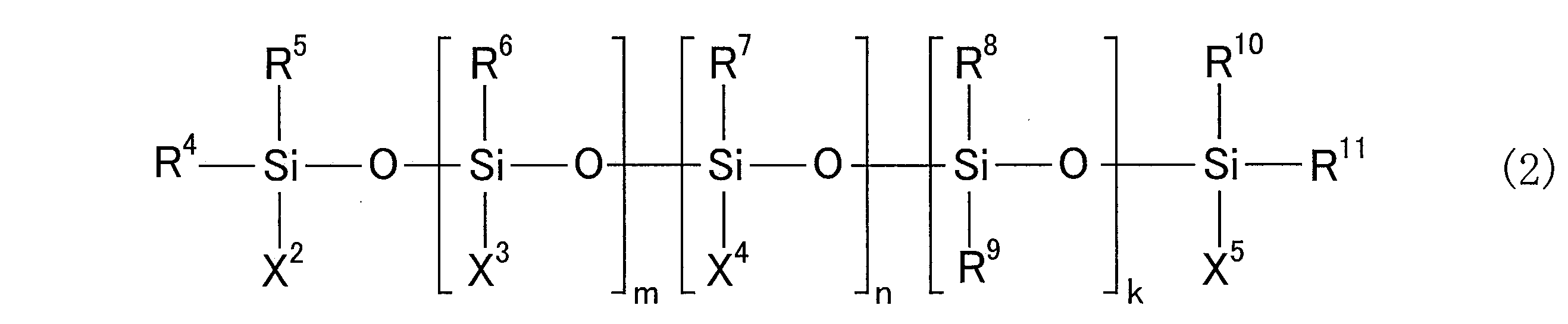

本発明の製造方法において、前記有機アルカリ金属アミド化合物が、下記一般式(4)で表される化合物であることが好ましい。
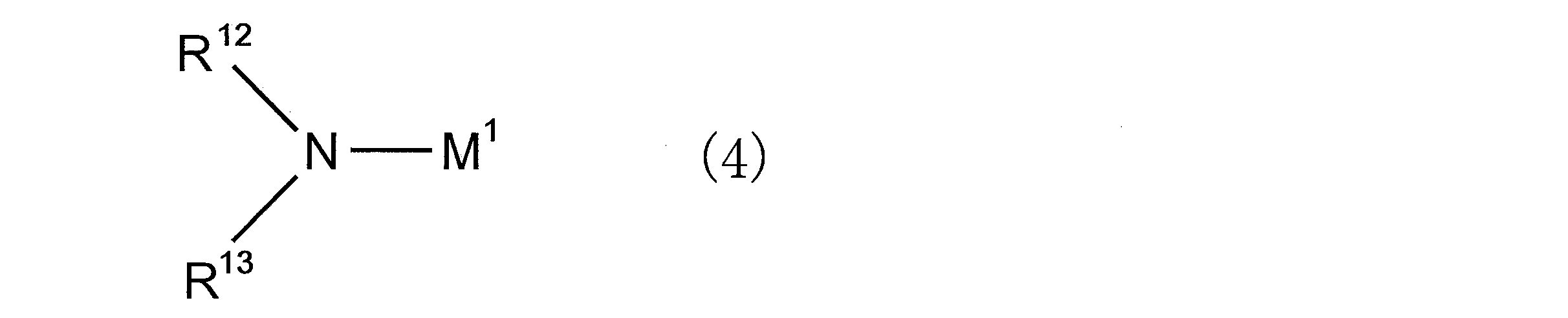
さらに、本発明によれば、上記共役ジエン系ゴムを含むゴム成分100重量部に対して、シリカ10~200重量部を含有してなるゴム組成物が提供される。
本発明のゴム組成物は、架橋剤をさらに含有してなるものであることが好ましい。
本発明の共役ジエン系ゴムの製造方法は、
不活性溶媒中で、重合開始剤を用いて、共役ジエン化合物を含む単量体を重合し、活性末端を有する共役ジエン系重合体鎖を得る第1工程と、
前記活性末端を有する共役ジエン系重合体鎖に、シロキサンを反応させる第2工程と、
前記第2工程で得られるシロキサンを反応させた共役ジエン系重合体鎖に、後述する一般式(1)で表される化合物を反応させる第3工程とを備える。
本発明の製造方法の第1工程は、不活性溶媒中で、重合開始剤を用いて、共役ジエン化合物を含む単量体を重合し、活性末端を有する共役ジエン系重合体鎖を得る工程である。
なお、有機アルカリ金属化合物は、予め、ジブチルアミン、ジヘキシルアミン、ジベンジルアミン、ピロリジン、ピペリジン、ヘキサメチレンイミン、およびヘプタメチレンイミンなどの2級アミン化合物と反応させて、有機アルカリ金属アミド化合物として使用してもよい。有機アルカリ金属アミド化合物を重合開始剤として用いることにより、得られるゴム架橋物を、より低発熱性およびウエットグリップ性に優れたものとすることができる。これらの重合開始剤は、1種を単独で用いてもよいし、2種以上を組み合わせて用いてもよい。
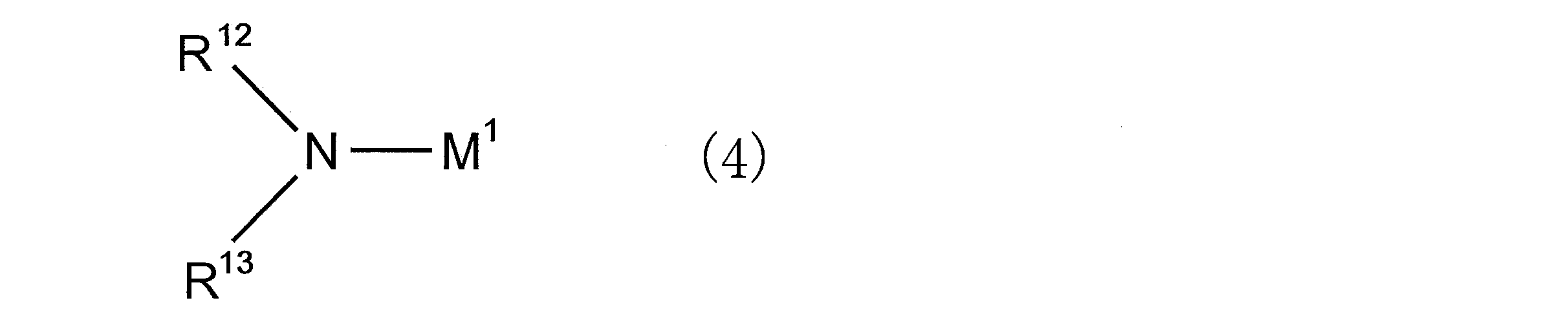
なお、R12、および/またはR13がアミノ基の保護基である場合には、アミノ基の保護基が外れることにより、得られる共役ジエン系ゴムを形成する重合体鎖の一方の末端において、後述する一般式(6)におけるR14、および/またはR15が水素原子である構造を導入することができる。
アルコキシアルキル基としては、メトキシメチル基、エトキシメチル基、エトキシエチル基、プロポキシメチル基、ブトキシメチル基、ブトキシエチル基、プロポキシエチル基などが挙げられる。
また、エポキシ基を含有する基としては、たとえば下記一般式(5)で表される基などが挙げられる。
-Z1-Z2-E1 (5)
一般式(5)中、Z1は炭素数1~10のアルキレン基またはアルキルアリーレン基であり、Z2はメチレン基、硫黄原子または酸素原子であり、E1はグリシジル基である。
R12およびR13が互いに結合して、これらが結合する窒素原子とともに環構造を形成する場合、環構造は、4~8員環構造であることが好ましい。

なお、R14、R15となりうる水素原子は、アミノ基の保護基が外れることにより、導入される。
すなわち、不活性溶媒中で、イソプレン、またはイソプレンおよび芳香族ビニル化合物を含む単量体を、重合開始剤により重合し、イソプレン単量体単位80~100重量%、および芳香族ビニル単量体単位0~20重量%を含む活性末端を有する重合体ブロック(A)を形成させる工程と、
前記活性末端を有する重合体ブロック(A)と、1,3-ブタジエン、または1,3-ブタジエンおよび芳香族ビニル化合物を含む単量体と、を混合して重合反応を継続させ、1,3-ブタジエン単量体単位50~100重量%および芳香族ビニル単量体単位0~50重量%を含む活性末端を有する重合体ブロック(B)を、重合体ブロック(A)と一続きにして形成させることにより、重合体ブロック(A)および重合体ブロック(B)を有する、活性末端を有する共役ジエン系重合体鎖を得る工程と、を備えるものとすることが好ましい。
以下、このような態様について説明する。
本発明の一態様に係る共役ジエン系重合体鎖中の重合体ブロック(A)は、重合体ブロック(A)中、イソプレン単量体単位80~100重量%および芳香族ビニル単量体単位0~20重量%を含むものであればよいが、イソプレン単量体単位85~95重量%および芳香族ビニル単量体単位5~15重量%を含むものであることが好ましく、イソプレン単量体単位89~95重量%および芳香族ビニル単量体単位5~11重量%を含むものであることがより好ましい。イソプレン単量体単位と芳香族ビニル単量体単位との含有割合が上記範囲内にあると、共役ジエン系ゴムにシリカを配合した場合に、共役ジエン系ゴムとシリカとの親和性が良好となり、これを用いて得られるゴム架橋物の低発熱性をより向上させることができる。
本発明の一態様に係る共役ジエン系重合体鎖中の重合体ブロック(B)は、重合体ブロック(B)中、1,3-ブタジエン単量体単位50~100重量%および芳香族ビニル単量体単位0~50重量%を含むものであればよいが、1,3-ブタジエン単量体単位55~95重量%および芳香族ビニル単量体単位5~45重量%を含むものであることが好ましく、1,3-ブタジエン単量体単位55~90重量%および芳香族ビニル単量体単位10~45重量%を含むものであることがより好ましい。1,3-ブタジエン単量体単位と芳香族ビニル単量体単位との含有割合が上記範囲内にあると、共役ジエン系ゴムの製造がより容易となる。
本発明の製造方法の第2工程は、第1工程にて得られた活性末端を有する共役ジエン系重合体鎖に、シロキサンを反応させる工程である。
なお、本発明の製造方法の第2工程において、シロキサンは、第1工程にて得られた活性末端を有する共役ジエン系重合体鎖を変性させるための変性剤として作用する。
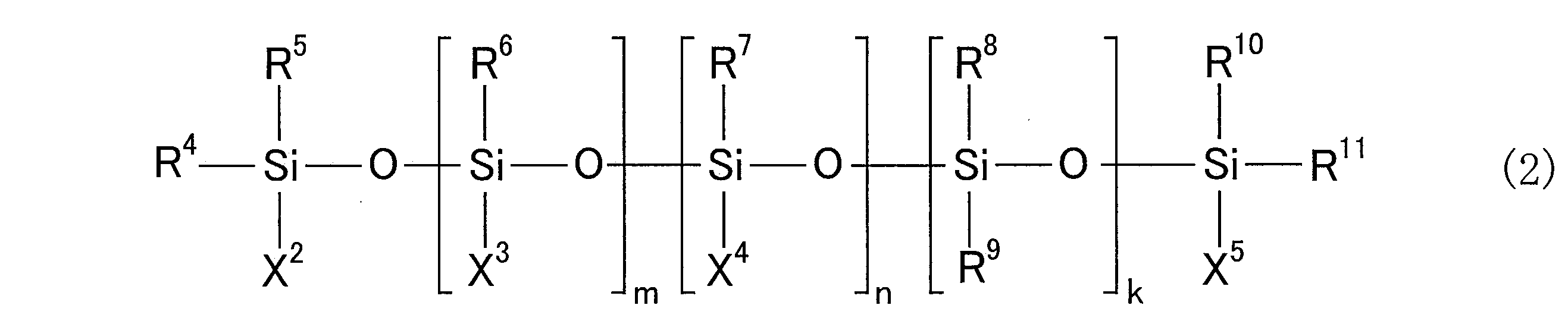
-Z3-Z4-E2 (7)
一般式(7)中、Z3は、炭素数1~10のアルキレン基、またはアルキルアリーレン基であり、Z4はメチレン基、硫黄原子、または酸素原子であり、E2はエポキシ基を有する炭素数2~10の炭化水素基である。

本発明の製造方法の第3工程は、第2工程で得られるシロキサンを反応させた共役ジエン系重合体鎖に、下記一般式(1)で表される化合物を反応させる工程である。

なお、R2およびR3が互いに結合して、これらが結合する窒素原子とともに環構造を形成する場合、環構造としては、4~8員環構造が好ましい。

本発明のゴム組成物は、上述した本発明の製造方法により得られる共役ジエン系ゴムを含むゴム成分100重量部に対して、シリカ10~200重量部を含有してなる組成物である。
本発明のゴム架橋物は、上述した本発明のゴム組成物を架橋してなるものである。
本発明のゴム架橋物は、本発明のゴム組成物を用い、たとえば、所望の形状に対応した成形機、たとえば、押出機、射出成形機、圧縮機、ロールなどにより成形を行い、加熱することにより架橋反応を行い、架橋物として形状を固定化することにより製造することができる。この場合においては、予め成形した後に架橋しても、成形と同時に架橋を行ってもよい。成形温度は、通常、10~200℃、好ましくは25~120℃である。架橋温度は、通常、100~200℃、好ましくは130~190℃であり、架橋時間は、通常、1分~24時間、好ましくは2分~12時間、特に好ましくは3分~6時間である。
重量平均分子量(Mw)、分子量分布(Mw/Mn)、およびカップリング率は、ゲルパーミエーションクロマトグラフィ(GPC)によりポリスチレン換算の分子量に基づくチャートを得て、得られたチャートに基づいて求めた。ゲルパーミエーションクロマトグラフィの具体的な測定条件は、以下のとおりとした。
測定器:高速液体クロマトグラフ(東ソー社製、商品名「HLC-8220」)
カラム:東ソー社製ポリスチレン系カラム、商品名「GMH-HR-H」を二本直列に連結した。
検出器:示差屈折計
溶離液:テトラヒドロフラン
カラム温度:40℃
なお、カップリング率については、上記の条件のゲルパーミエーションクロマトグラフィにより得られた溶出曲線において、全溶出面積に対する、分子量の最も小さいピークが示すピークトップ分子量の1.8倍以上のピークトップ分子量を有するピーク部分の面積比を、共役ジエン系重合体鎖のカップリング率の値とした。
共役ジエン系ゴム中における、一般式(1)で表される化合物としての、2,2-ジメトキシ-8-(4-メチルピペラジニル)メチル-1,6-ジオキサ-2-シラシクロオクタンにより変性された重合体の含有割合を、2,2-ジメトキシ-8-(4-メチルピペラジニル)メチル-1,6-ジオキサ-2-シラシクロオクタンに含まれるアミン構造が、シリカ系ゲルに吸着するという特性を利用し、以下の方法により測定した。
すなわち、まず、共役ジエン系ゴム2mgを、5mLのTHFに対して、分子量2,851,000の標準ポリスチレン(ポリスチレンはカラムに吸着しない)0.5mgとともに溶解した溶液を調製し、この溶液200μLを測定用試料とした。
そして、上記にて調製した測定用試料を用いて、ポリスチレン系カラムを用いたGPC測定と、シリカ系カラムを用いたGPC測定を行った。なお、ポリスチレン系カラムとしては、「GMH-HR-H(東ソー社製)」を二本直列に連結したもの)を使用し、シリカ系カラムとしては、「Zorbax PSM-1000S(アジレント・テクノロジー社製)」、「Zorbax PSM-1000S(アジレント・テクノロジー社製)」、「Zorbax PSM-60S(アジレント・テクノロジー社製)」、および「TSKgel G3000SWXL(東ソー社製)」を、この順に直列に連結したものを使用した。また、いずれのカラムを用いたGPC測定においても、測定器としては、高速液体クロマトグラフ(東ソー社製、商品名「HLC-8220」)を使用し、溶離液としてはテトラヒドロフランを使用し、カラム温度は40℃とし、流量は0.6mL/分とした。
具体的には、ポリスチレン系カラムを用いて得られたクロマトグラムのピーク面積の全体を100とした際の、サンプルピーク面積をP1、標準ポリスチレンのピーク面積をP2とし、また、シリカ系カラムを用いて得られたクロマトグラムのピーク面積の全体を100とした際の、サンプルピーク面積をP3、標準ポリスチレンのピーク面積をP4として、下記式にしたがって、一般式(1)で表される化合物としての、2,2-ジメトキシ-8-(4-メチルピペラジニル)メチル-1,6-ジオキサ-2-シラシクロオクタンによる変性率(%)を求めた。
変性率(%)=[1-(P2×P3)/(P1×P4)]×100
また、比較例1,2においては、2,2-ジメトキシ-8-(4-メチルピペラジニル)メチル-1,6-ジオキサ-2-シラシクロオクタンに代えて、2,2-ジメトキシ-1-フェニル-1-アザ-2-シラシクロペンタンを使用したものであるが、この場合においても上記と同様に変性率を測定した。
芳香族ビニル単量体単位含有量、およびビニル結合含有量は、1H-NMRにより測定した。
ゴム架橋物の低発熱性については、長さ50mm、幅12.7mm、厚さ2mmの試験片を、レオメトリックス社製ARESを用い、動的歪み2.5%、10Hzの条件で60℃におけるtanδを測定することにより評価した。このtanδの値については、比較例2の測定値を100とする指数で示した。この指数が小さいものほど、低発熱性に優れる。
ゴム架橋物のウエットグリップ性については、長さ50mm、幅12.7mm、厚さ2mmの試験片を、レオメトリックス社製ARESを用い、動的歪み0.5%、10Hzの条件で0℃におけるtanδの値を測定することにより評価した。このtanδの値については、比較例2の測定値を100とする指数で示した。この指数が大きいものほど、ウエットグリップ性に優れる。
窒素置換された100mlアンプル瓶に、シクロヘキサン49.6g、およびテトラメチルエチレンジアミン0.56mmolを添加し、さらに、n-ブチルリチウム5.6mmolを添加した。次いで、イソプレン11.48g、およびスチレン0.93gをゆっくりと添加し、50℃のアンプル瓶内で120分反応させることにより、活性末端を有する重合体ブロック(A)を得た。この重合体ブロック(A)の重量平均分子量(Mw)は3,700、分子量分布(Mw/Mn)は1.09、スチレン単量体単位含有量は7.5%、イソプレン単量体単位含有量は92.5%、およびビニル結合含有量は8.1%であった。
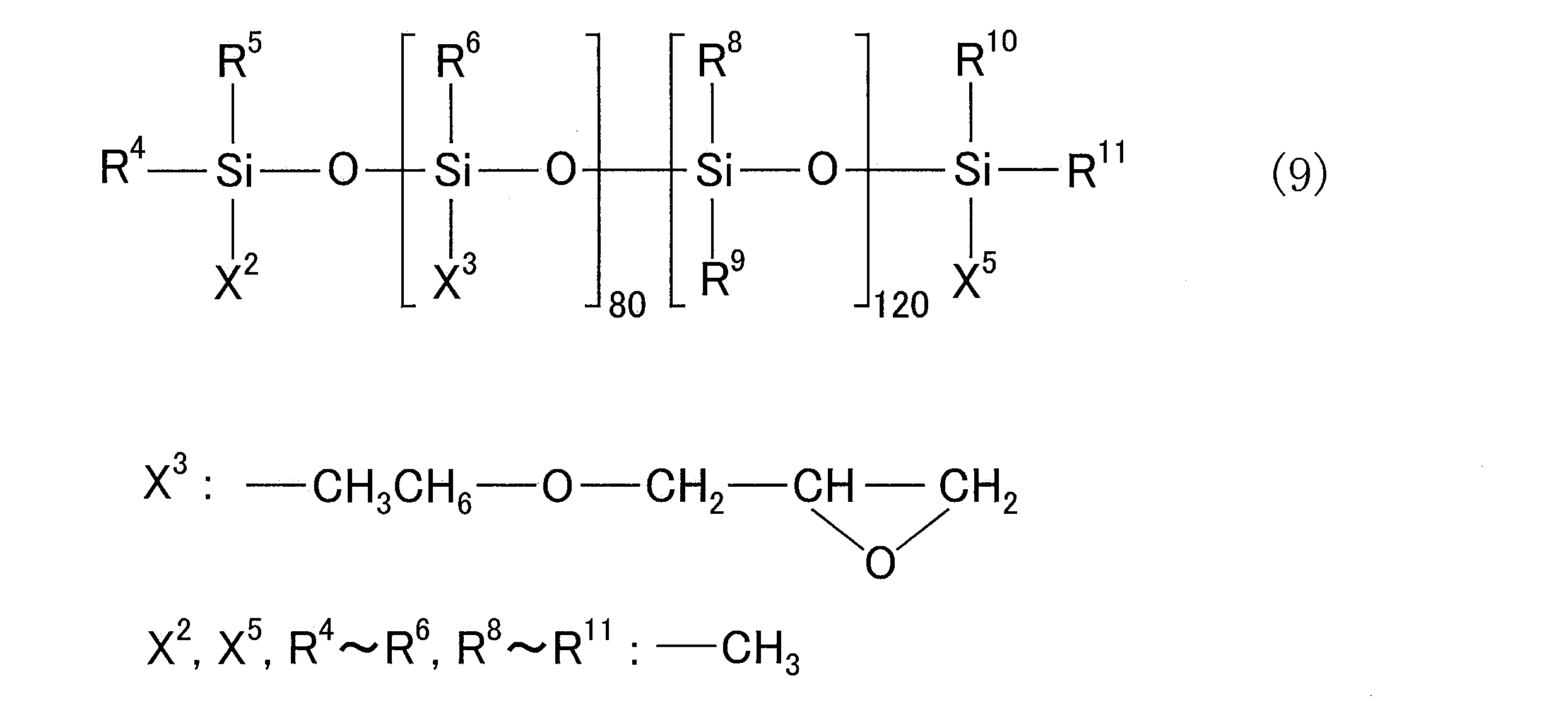
2,2-ジメトキシ-8-(4-メチルピペラジニル)メチル-1,6-ジオキサ-2-シラシクロオクタンの添加量を、0.91g(使用したn-ブチルリチウムの0.5倍モルに相当)に変更したこと以外は、実施例1と同様に操作して、固形状の共役ジエン系ゴムを得た。得られた実施例2の共役ジエン系ゴムの重量平均分子量(Mw)は465,000、スチレン単量体単位含有量は20.8%、カップリング率は60.3%であった。また、2,2-ジメトキシ-8-(4-メチルピペラジニル)メチル-1,6-ジオキサ-2-シラシクロオクタンによる変性率は28.2%であった。
式(9)で表されるポリオルガノシロキサンの添加量を、1.21g(ポリオルガノシロキサン中のシロキサン構造(-Si-O-)の繰り返し単位数に換算して、使用したn-ブチルリチウムの0.75倍モルに相当する量)に変更したこと以外は、実施例1と同様に操作して、固形状の共役ジエン系ゴムを得た。得られた実施例3の共役ジエン系ゴムの重量平均分子量(Mw)は454,000、スチレン単量体単位含有量は20.8%、カップリング率は58.2%であった。また、2,2-ジメトキシ-8-(4-メチルピペラジニル)メチル-1,6-ジオキサ-2-シラシクロオクタンによる変性率は32.4%であった。
活性末端を有する重合体ブロック(A)を合成せずに、活性末端を有する重合体ブロック(A)に代えて、n-ブチルリチウム5.6mmolを用いたこと以外は、実施例1と同様に操作して、固形状の共役ジエン系ゴムを得た。得られた実施例4の共役ジエン系ゴムの重量平均分子量(Mw)は478,000、スチレン単量体単位含有量は21.0%、カップリング率は62.0%であった。また、2,2-ジメトキシ-8-(4-メチルピペラジニル)メチル-1,6-ジオキサ-2-シラシクロオクタンによる変性率は28.5%であった。
式(9)で表されるポリオルガノシロキサンに代えて、ポリジメチルシロキサン(信越化学社製、商品名「KF-96 3000cs」)4.25g(ポリジメチルシロキサン中のシロキサン構造(-Si-O-)の繰り返し単位数に換算して、使用したn-ブチルリチウムの10倍モルに相当する量)を用いたこと以外は、実施例1と同様に操作して、固形状の共役ジエン系ゴムを得た。得られた実施例5の共役ジエン系ゴムの重量平均分子量(Mw)は229,000、スチレン単量体単位含有量は20.8%、カップリング率は12.0%であった。また、2,2-ジメトキシ-8-(4-メチルピペラジニル)メチル-1,6-ジオキサ-2-シラシクロオクタンによる変性率は52.1%であった。
攪拌機付きオートクレーブに、窒素雰囲気下、シクロヘキサン800g、テトラメチルエチレンジアミン1.90mmol、ジ-N-ヘキシルアミン0.95mmol、1,3-ブタジエン94.8g、およびスチレン25.2gを仕込んだ後、n-ブチルリチウム1.23mmolを加え、60℃で重合を開始した。60分間重合反応を継続し、重合転化率が95%から100%の範囲になったことを確認してから、式(9)で表されるポリオルガノシロキサンを、40重量%濃度のキシレン溶液の状態にて、0.22g(ポリオルガノシロキサン中のシロキサン構造(-Si-O-)の繰り返し単位数に換算して、使用したn-ブチルリチウムの1.1倍モルに相当する量)添加し、30分間反応させた。次いで、2,2-ジメトキシ-8-(4-メチルピペラジニル)メチル-1,6-ジオキサ-2-シラシクロオクタン0.37g(使用したn-ブチルリチウムの1.0倍モルに相当)を添加し、15分間反応させた。その後、重合停止剤として、使用したn-ブチルリチウムの2倍モルに相当する量のメタノールを添加して、共役ジエン系ゴムを含有する溶液を得た。この溶液に、老化防止剤として、イルガノックス1520L(チバスペシャリティーケミカルズ社製)を、共役ジエン系ゴム100部に対して0.15部添加した後、スチームストリッピングにより溶媒を除去し、60℃で24時間真空乾燥して、固形状の共役ジエン系ゴムを得た。得られた実施例6の共役ジエン系ゴムの重量平均分子量(Mw)は470,000、分子量分布(Mw/Mn)は1.30、スチレン単量体単位含有量は21.0%、カップリング率は59.0%であった。
ジ-N-ヘキシルアミンに代えて、ピロリジン0.95mmolを用いたこと以外は、実施例6と同様に操作して、固形状の共役ジエン系ゴムを得た。得られた実施例7の共役ジエン系ゴムの重量平均分子量(Mw)は455,000、分子量分布(Mw/Mn)は1.28、スチレン単量体単位含有量は21.0%、カップリング率は58.8%であった。
ジ-N-ヘキシルアミンに代えて、ヘキサメチレンイミン0.95mmolを用いたこと以外は、実施例6と同様に操作して、固形状の共役ジエン系ゴムを得た。得られた実施例8の共役ジエン系ゴムの重量平均分子量(Mw)は495,000、分子量分布(Mw/Mn)は1.34、スチレン単量体単位含有量は21.0%、カップリング率は61.0%であった。
式(9)で表されるポリオルガノシロキサンに代えて、ポリジメチルシロキサン(信越化学社製、商品名「KF-96 3000cs」)0.51g(ポリジメチルシロキサン中のシロキサン構造(-Si-O-)の繰り返し単位数に換算して、使用したn-ブチルリチウムの5.6倍モルに相当する量)を用いたこと以外は、実施例6と同様に操作して、固形状の共役ジエン系ゴムを得た。得られた実施例9の共役ジエン系ゴムの重量平均分子量(Mw)は226,000、分子量分布(Mw/Mn)は1.23、スチレン単量体単位含有量は21.0%、カップリング率は15.5%であった。
2,2-ジメトキシ-8-(4-メチルピペラジニル)メチル-1,6-ジオキサ-2-シラシクロオクタンに代えて、2,2-ジメトキシ-1-フェニル-1-アザ-2-シラシクロペンタン1.25g(使用したn-ブチルリチウムの1.0倍モルに相当)を用いたこと以外は、実施例1と同様に操作して、固形状の共役ジエン系ゴムを得た。得られた比較例1の共役ジエン系ゴムの重量平均分子量(Mw)は468,000、スチレン単量体単位含有量は20.8%、カップリング率は61.5%であった。また、2,2-ジメトキシ-1-フェニル-1-アザ-2-シラシクロペンタンによる変性率は27.0%であった。
活性末端を有する重合体ブロック(A)を合成せずに、活性末端を有する重合体ブロック(A)に代えて、n-ブチルリチウム5.6mmolを用いたこと以外は、比較例1と同様に操作して、固形状の共役ジエン系ゴムを得た。得られた比較例2の共役ジエン系ゴムの重量平均分子量(Mw)は488,000、スチレン単量体単位含有量は21.0%、カップリング率は63.0%であった。また、2,2-ジメトキシ-1-フェニル-1-アザ-2-シラシクロペンタンによる変性率は27.2%であった。
2,2-ジメトキシ-8-(4-メチルピペラジニル)メチル-1,6-ジオキサ-2-シラシクロオクタンを添加しなかったこと以外は、実施例1と同様に操作して、固形状の共役ジエン系ゴムを得た。得られた比較例3の共役ジエン系ゴムの重量平均分子量(Mw)は481,000、スチレン単量体単位含有量は20.8%、カップリング率は62.8%であった。また、2,2-ジメトキシ-8-(4-メチルピペラジニル)メチル-1,6-ジオキサ-2-シラシクロオクタンによる変性率は0%であった。
活性末端を有する重合体ブロック(A)を合成せずに、活性末端を有する重合体ブロック(A)に代えて、n-ブチルリチウム5.6mmolを用いたこと以外は、比較例3と同様に操作して、固形状の共役ジエン系ゴムを得た。得られた比較例4の共役ジエン系ゴムの重量平均分子量(Mw)は469,000、スチレン単量体単位含有量は21.0%、カップリング率は61.5%であった。また、2,2-ジメトキシ-8-(4-メチルピペラジニル)メチル-1,6-ジオキサ-2-シラシクロオクタンによる変性率は0%であった。
容量250mlのブラベンダータイプミキサー中で、実施例1の共役ジエン系ゴム100部を30秒素練りし、次いでシリカ(ローディア社製、商品名「Zeosil1115MP」)50部、プロセスオイル(新日本石油社製、商品名「アロマックス T-DAE」)20部、およびシランカップリング剤:ビス(3-(トリエトキシシリル)プロピル)テトラスルフィド(デグッサ社製、商品名「Si69」)6.0部を添加して、110℃を開始温度として1.5分間混練後、シリカ(ローディア社製、商品名「Zeosil1115MP」)25部、酸化亜鉛3部、ステアリン酸2部および老化防止剤:N-フェニル-N’-(1,3-ジメチルブチル)-p-フェニレンジアミン(大内新興化学工業社製、商品名「ノクラック6C」)2部を添加し、更に2.5分間混練し、ミキサーから混練物を排出させた。混練終了時の混練物の温度は150℃であった。混練物を、室温まで冷却した後、再度ブラベンダータイプミキサー中で、110℃を開始温度として2分間混練した後、ミキサーから混練物を排出させた。次いで、50℃のオープンロールで、得られた混練物に、硫黄1.4部、架橋促進剤:N-tert-ブチル-2-ベンゾチアゾリルスルフェンアミド(大内新興化学工業社製、商品名「ノクセラーNS-P」)1.2部、および1,3-ジフェニルグアニジン(商品名「ノクセラーD」、大内新興化学工業社製)1.2部を加えてこれらを混練した後、シート状のゴム組成物を取り出した。このゴム組成物を、160℃で20分間プレス架橋して、ゴム架橋物の試験片を作製し、この試験片について、上述した方法によりウエットグリップ性および低発熱性の評価を行なった。
また、実施例2~9、比較例1~4の共役ジエン系ゴムについても、それぞれ、同様にして、ゴム組成物およびゴム架橋物の試験片を作製し、これらの試験片について、ウエットグリップ性および低発熱性の評価を行なった。表1にこれらの結果をまとめて示す。

また、表1から判るように、重合開始剤として一般式(4)で表される化合物を用いて得られた共役ジエン系ゴム(実施例6~9)は、重合開始剤としてn-ブチルリチウムのみを用いて得られた共役ジエン系ゴム(実施例1~5)と比較して、より低発熱性およびウエットグリップ性に優れたものとなった。
Claims (12)
- 不活性溶媒中で、重合開始剤を用いて、共役ジエン化合物を含む単量体を重合し、活性末端を有する共役ジエン系重合体鎖を得る第1工程と、
前記活性末端を有する共役ジエン系重合体鎖に、シロキサンを反応させる第2工程と、
前記第2工程で得られるシロキサンを反応させた共役ジエン系重合体鎖に、下記一般式(1)で表される化合物を反応させる第3工程とを備える共役ジエン系ゴムの製造方法。

- 前記シロキサンが、下記一般式(2)で表されるポリオルガノシロキサンである請求項1に記載の共役ジエン系ゴムの製造方法。
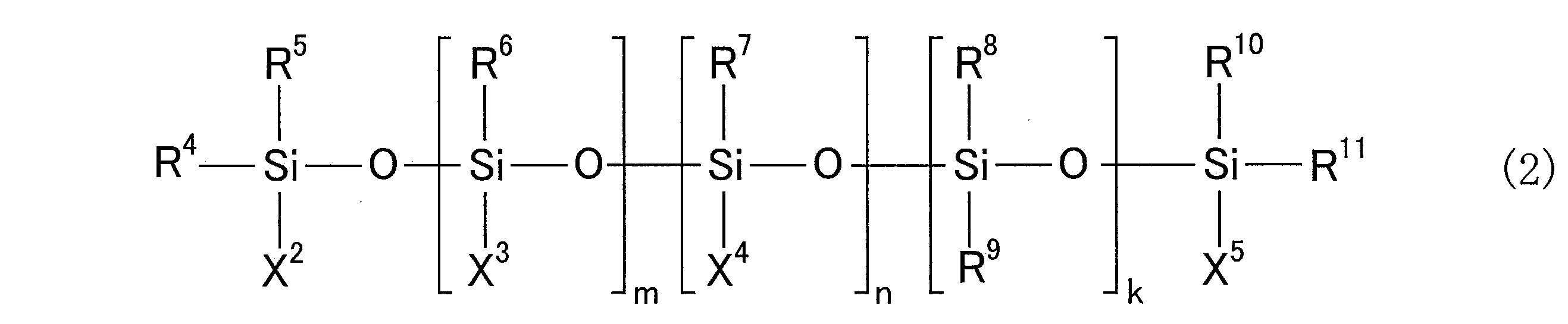
- 一般式(1)で表される化合物として、下記一般式(3)で表される化合物を用いる請求項1または2に記載の共役ジエン系ゴムの製造方法。
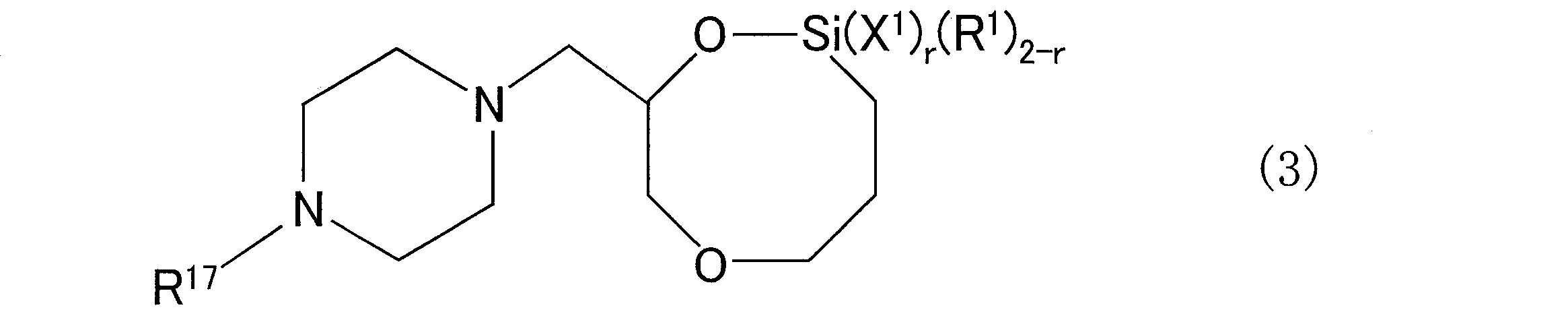
- 前記重合開始剤として有機アルカリ金属アミド化合物を用いる請求項1~3のいずれかに記載の共役ジエン系ゴムの製造方法。
- 前記有機アルカリ金属アミド化合物が、下記一般式(4)で表される化合物である請求項4に記載の共役ジエン系ゴムの製造方法。
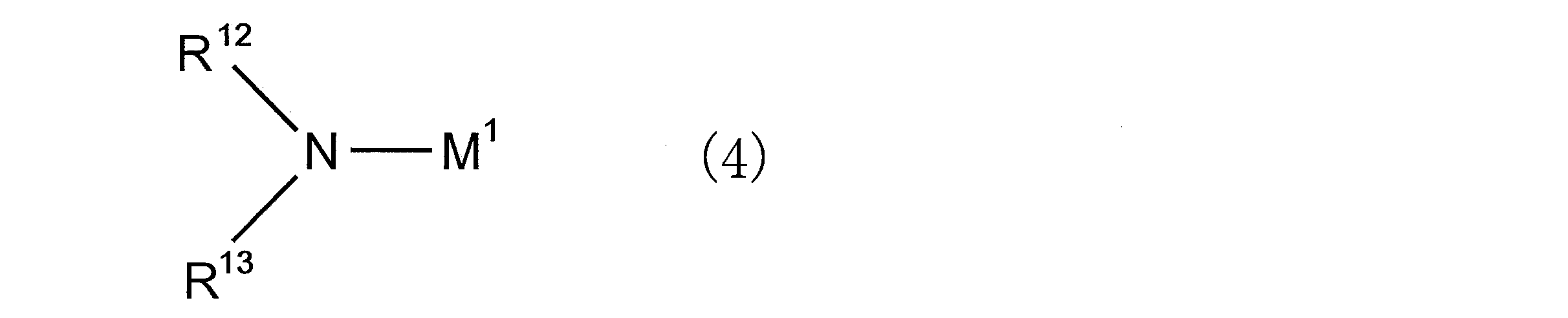
- 前記第1工程が、
不活性溶媒中で、イソプレン、または、イソプレンおよび芳香族ビニル化合物を含む単量体を、重合開始剤により重合し、イソプレン単量体単位80~100重量%、および芳香族ビニル単量体単位0~20重量%を含む活性末端を有する重合体ブロック(A)を形成させる工程と、
前記活性末端を有する重合体ブロック(A)と、1,3-ブタジエン、または1,3-ブタジエンおよび芳香族ビニル化合物を含む単量体と、を混合して重合反応を継続させ、1,3-ブタジエン単量体単位50~100重量%および芳香族ビニル単量体単位0~50重量%を含む活性末端を有する重合体ブロック(B)を、重合体ブロック(A)と一続きにして形成させることにより、重合体ブロック(A)および重合体ブロック(B)を有する、活性末端を有する共役ジエン系重合体鎖を得る工程とを備える請求項1~5のいずれかに記載の共役ジエン系ゴムの製造方法。 - 前記重合体ブロック(A)および前記重合体ブロック(B)を有する、活性末端を有する共役ジエン系重合体鎖における、前記重合体ブロック(A)と前記重合体ブロック(B)との重量比が、(重合体ブロック(A)の重量)/(重合体ブロック(B)の重量)で、0.001~0.1である請求項6に記載の共役ジエン系ゴムの製造方法。
- 請求項1~7のいずれかに記載の製造方法により得られる共役ジエン系ゴム。
- 請求項8に記載の共役ジエン系ゴムを含むゴム成分100重量部に対して、シリカ10~200重量部を含有してなるゴム組成物。
- 架橋剤をさらに含有する請求項9に記載のゴム組成物。
- 請求項10に記載のゴム組成物を架橋してなるゴム架橋物。
- 請求項11に記載のゴム架橋物を含んでなるタイヤ。
Priority Applications (5)
| Application Number | Priority Date | Filing Date | Title |
|---|---|---|---|
| JP2017525454A JPWO2016208739A1 (ja) | 2015-06-26 | 2016-06-24 | 共役ジエン系ゴムの製造方法 |
| KR1020187001821A KR20180022821A (ko) | 2015-06-26 | 2016-06-24 | 공액 디엔계 고무의 제조 방법 |
| US15/739,468 US20180170103A1 (en) | 2015-06-26 | 2016-06-24 | Method of production of conjugated diene rubber |
| CN201680036908.5A CN107709412A (zh) | 2015-06-26 | 2016-06-24 | 共轭二烯系橡胶的制造方法 |
| EP16814508.4A EP3315535B1 (en) | 2015-06-26 | 2016-06-24 | Method of production of conjugated diene rubber |
Applications Claiming Priority (4)
| Application Number | Priority Date | Filing Date | Title |
|---|---|---|---|
| JP2015-128343 | 2015-06-26 | ||
| JP2015128343 | 2015-06-26 | ||
| JP2016-067375 | 2016-03-30 | ||
| JP2016067375 | 2016-03-30 |
Publications (1)
| Publication Number | Publication Date |
|---|---|
| WO2016208739A1 true WO2016208739A1 (ja) | 2016-12-29 |
Family
ID=57585213
Family Applications (1)
| Application Number | Title | Priority Date | Filing Date |
|---|---|---|---|
| PCT/JP2016/068883 Ceased WO2016208739A1 (ja) | 2015-06-26 | 2016-06-24 | 共役ジエン系ゴムの製造方法 |
Country Status (6)
| Country | Link |
|---|---|
| US (1) | US20180170103A1 (ja) |
| EP (1) | EP3315535B1 (ja) |
| JP (1) | JPWO2016208739A1 (ja) |
| KR (1) | KR20180022821A (ja) |
| CN (1) | CN107709412A (ja) |
| WO (1) | WO2016208739A1 (ja) |
Cited By (14)
| Publication number | Priority date | Publication date | Assignee | Title |
|---|---|---|---|---|
| JP2017008241A (ja) * | 2015-06-24 | 2017-01-12 | 日本ゼオン株式会社 | ゴム組成物 |
| WO2018092716A1 (ja) * | 2016-11-16 | 2018-05-24 | 日本ゼオン株式会社 | 共役ジエン系ゴムの製造方法 |
| WO2018128330A1 (ko) * | 2017-01-06 | 2018-07-12 | 주식회사 엘지화학 | 아민 화합물, 이로부터 유래된 작용기를 포함하는 변성 공액디엔계 중합체 및 변성 공액디엔계 중합체의 제조방법 |
| CN108541254A (zh) * | 2017-01-06 | 2018-09-14 | 株式会社Lg化学 | 胺化合物、包含由其衍生的官能团的改性共轭二烯类聚合物、以及该聚合物的制备方法 |
| WO2019221182A1 (ja) * | 2018-05-16 | 2019-11-21 | 横浜ゴム株式会社 | タイヤトレッド用ゴム組成物および空気入りタイヤ |
| JP2019199533A (ja) * | 2018-05-16 | 2019-11-21 | 横浜ゴム株式会社 | タイヤトレッド用ゴム組成物および空気入りタイヤ |
| JP2019199525A (ja) * | 2018-05-16 | 2019-11-21 | 横浜ゴム株式会社 | タイヤトレッド用ゴム組成物および空気入りタイヤ |
| JP2019199548A (ja) * | 2018-05-16 | 2019-11-21 | 横浜ゴム株式会社 | スタッドレスタイヤトレッド用ゴム組成物およびスタッドレスタイヤ |
| WO2019221179A1 (ja) * | 2018-05-16 | 2019-11-21 | 横浜ゴム株式会社 | 冬用タイヤトレッド用ゴム組成物および冬用空気入りタイヤ |
| JP2019199524A (ja) * | 2018-05-16 | 2019-11-21 | 横浜ゴム株式会社 | タイヤトレッド用ゴム組成物および空気入りタイヤ |
| WO2019221180A1 (ja) * | 2018-05-16 | 2019-11-21 | 横浜ゴム株式会社 | タイヤトレッド用ゴム組成物および空気入りタイヤ |
| WO2019221184A1 (ja) * | 2018-05-16 | 2019-11-21 | 横浜ゴム株式会社 | タイヤトレッド用ゴム組成物及び空気入りタイヤ |
| KR20200138209A (ko) | 2018-03-27 | 2020-12-09 | 니폰 제온 가부시키가이샤 | 공액 디엔계 고무의 제조 방법 |
| EP3696204A4 (en) * | 2017-10-13 | 2021-08-04 | Zeon Corporation | RUBBER BASED ON CONJUGATE SERVICE |
Families Citing this family (2)
| Publication number | Priority date | Publication date | Assignee | Title |
|---|---|---|---|---|
| KR102923648B1 (ko) * | 2020-11-24 | 2026-02-05 | 주식회사 엘지화학 | 변성 공액디엔계 중합체, 이의 제조방법 및 이를 포함하는 고무 조성물 |
| CN113493535B (zh) * | 2021-07-30 | 2022-10-14 | 大连海事大学 | 一种含硅氧烷基链端官能化聚合物及其制备方法与应用 |
Citations (5)
| Publication number | Priority date | Publication date | Assignee | Title |
|---|---|---|---|---|
| JP2010120925A (ja) * | 2008-10-22 | 2010-06-03 | Shin-Etsu Chemical Co Ltd | アミノ基を有する有機ケイ素化合物及びその製造方法 |
| WO2014050341A1 (ja) * | 2012-09-28 | 2014-04-03 | 日本ゼオン株式会社 | 共役ジエン系ゴムの製造方法 |
| WO2015098264A1 (ja) * | 2013-12-27 | 2015-07-02 | 日本ゼオン株式会社 | 共役ジエン系重合体および共役ジエン系重合体の製造方法 |
| WO2015199226A1 (ja) * | 2014-06-27 | 2015-12-30 | 日本ゼオン株式会社 | 共役ジエン系ゴムの製造方法 |
| JP2016037543A (ja) * | 2014-08-07 | 2016-03-22 | 日本ゼオン株式会社 | 共役ジエン系ゴムの製造方法 |
Family Cites Families (7)
| Publication number | Priority date | Publication date | Assignee | Title |
|---|---|---|---|---|
| WO2003102053A1 (en) * | 2002-05-31 | 2003-12-11 | Zeon Corporation | Conjugated diene rubber, process for producing the same, and rubber composition |
| US7700693B2 (en) * | 2003-09-01 | 2010-04-20 | Zeon Corporation | Conjugated diene rubber compostion, process for producing the same and rubber vulcanizate |
| CN101107294B (zh) * | 2005-01-14 | 2011-05-25 | 株式会社普利司通 | 官能化聚合物和从其改进的轮胎 |
| US8110635B2 (en) * | 2007-06-27 | 2012-02-07 | Sumitomo Chemical Company, Limited | Method for producing conjugated diene polymer, conjugated diene polymer, and polymer composition |
| CN103237841B (zh) * | 2010-12-03 | 2014-12-24 | 横滨橡胶株式会社 | 轮胎胎面用橡胶组合物 |
| WO2014133096A1 (ja) * | 2013-02-28 | 2014-09-04 | Jsr株式会社 | 変性共役ジエン系重合体及びその製造方法、重合体組成物、架橋重合体並びにタイヤ |
| JPWO2016199842A1 (ja) * | 2015-06-11 | 2018-03-29 | 日本ゼオン株式会社 | 共役ジエン系重合体および共役ジエン系重合体の製造方法 |
-
2016
- 2016-06-24 EP EP16814508.4A patent/EP3315535B1/en active Active
- 2016-06-24 US US15/739,468 patent/US20180170103A1/en not_active Abandoned
- 2016-06-24 WO PCT/JP2016/068883 patent/WO2016208739A1/ja not_active Ceased
- 2016-06-24 KR KR1020187001821A patent/KR20180022821A/ko not_active Withdrawn
- 2016-06-24 JP JP2017525454A patent/JPWO2016208739A1/ja active Pending
- 2016-06-24 CN CN201680036908.5A patent/CN107709412A/zh not_active Withdrawn
Patent Citations (5)
| Publication number | Priority date | Publication date | Assignee | Title |
|---|---|---|---|---|
| JP2010120925A (ja) * | 2008-10-22 | 2010-06-03 | Shin-Etsu Chemical Co Ltd | アミノ基を有する有機ケイ素化合物及びその製造方法 |
| WO2014050341A1 (ja) * | 2012-09-28 | 2014-04-03 | 日本ゼオン株式会社 | 共役ジエン系ゴムの製造方法 |
| WO2015098264A1 (ja) * | 2013-12-27 | 2015-07-02 | 日本ゼオン株式会社 | 共役ジエン系重合体および共役ジエン系重合体の製造方法 |
| WO2015199226A1 (ja) * | 2014-06-27 | 2015-12-30 | 日本ゼオン株式会社 | 共役ジエン系ゴムの製造方法 |
| JP2016037543A (ja) * | 2014-08-07 | 2016-03-22 | 日本ゼオン株式会社 | 共役ジエン系ゴムの製造方法 |
Non-Patent Citations (1)
| Title |
|---|
| See also references of EP3315535A4 * |
Cited By (19)
| Publication number | Priority date | Publication date | Assignee | Title |
|---|---|---|---|---|
| JP2017008241A (ja) * | 2015-06-24 | 2017-01-12 | 日本ゼオン株式会社 | ゴム組成物 |
| WO2018092716A1 (ja) * | 2016-11-16 | 2018-05-24 | 日本ゼオン株式会社 | 共役ジエン系ゴムの製造方法 |
| JPWO2018092716A1 (ja) * | 2016-11-16 | 2019-10-17 | 日本ゼオン株式会社 | 共役ジエン系ゴムの製造方法 |
| US10815314B2 (en) | 2017-01-06 | 2020-10-27 | Lg Chem, Ltd. | Amine compound, modified conjugated diene-based polymer containing functional group derived therefrom, and method of preparing the modified conjugated diene-based polymer |
| WO2018128330A1 (ko) * | 2017-01-06 | 2018-07-12 | 주식회사 엘지화학 | 아민 화합물, 이로부터 유래된 작용기를 포함하는 변성 공액디엔계 중합체 및 변성 공액디엔계 중합체의 제조방법 |
| CN108541254A (zh) * | 2017-01-06 | 2018-09-14 | 株式会社Lg化学 | 胺化合物、包含由其衍生的官能团的改性共轭二烯类聚合物、以及该聚合物的制备方法 |
| EP3696204A4 (en) * | 2017-10-13 | 2021-08-04 | Zeon Corporation | RUBBER BASED ON CONJUGATE SERVICE |
| US11873364B2 (en) | 2018-03-27 | 2024-01-16 | Zeon Corporation | Method for producing conjugated diene rubber |
| KR20200138209A (ko) | 2018-03-27 | 2020-12-09 | 니폰 제온 가부시키가이샤 | 공액 디엔계 고무의 제조 방법 |
| JP2019199548A (ja) * | 2018-05-16 | 2019-11-21 | 横浜ゴム株式会社 | スタッドレスタイヤトレッド用ゴム組成物およびスタッドレスタイヤ |
| JP2019199524A (ja) * | 2018-05-16 | 2019-11-21 | 横浜ゴム株式会社 | タイヤトレッド用ゴム組成物および空気入りタイヤ |
| WO2019221180A1 (ja) * | 2018-05-16 | 2019-11-21 | 横浜ゴム株式会社 | タイヤトレッド用ゴム組成物および空気入りタイヤ |
| WO2019221184A1 (ja) * | 2018-05-16 | 2019-11-21 | 横浜ゴム株式会社 | タイヤトレッド用ゴム組成物及び空気入りタイヤ |
| WO2019221179A1 (ja) * | 2018-05-16 | 2019-11-21 | 横浜ゴム株式会社 | 冬用タイヤトレッド用ゴム組成物および冬用空気入りタイヤ |
| JP2019199525A (ja) * | 2018-05-16 | 2019-11-21 | 横浜ゴム株式会社 | タイヤトレッド用ゴム組成物および空気入りタイヤ |
| CN112166149A (zh) * | 2018-05-16 | 2021-01-01 | 横滨橡胶株式会社 | 冬用轮胎胎面用橡胶组合物及冬用充气轮胎 |
| JP2019199533A (ja) * | 2018-05-16 | 2019-11-21 | 横浜ゴム株式会社 | タイヤトレッド用ゴム組成物および空気入りタイヤ |
| EP3795629A4 (en) * | 2018-05-16 | 2022-01-26 | The Yokohama Rubber Co., Ltd. | Rubber composition for tire tread and pneumatic tire |
| WO2019221182A1 (ja) * | 2018-05-16 | 2019-11-21 | 横浜ゴム株式会社 | タイヤトレッド用ゴム組成物および空気入りタイヤ |
Also Published As
| Publication number | Publication date |
|---|---|
| EP3315535A1 (en) | 2018-05-02 |
| JPWO2016208739A1 (ja) | 2018-04-19 |
| KR20180022821A (ko) | 2018-03-06 |
| EP3315535B1 (en) | 2019-11-13 |
| US20180170103A1 (en) | 2018-06-21 |
| CN107709412A (zh) | 2018-02-16 |
| EP3315535A4 (en) | 2019-01-09 |
Similar Documents
| Publication | Publication Date | Title |
|---|---|---|
| JP7557258B2 (ja) | 共役ジエン系ゴムの製造方法 | |
| EP3315535B1 (en) | Method of production of conjugated diene rubber | |
| JP2017082235A (ja) | 共役ジエン系ゴムの製造方法 | |
| JP6468283B2 (ja) | 変性共役ジエン系ゴムの製造方法 | |
| JP2017133026A (ja) | ゴム組成物 | |
| JP2016037543A (ja) | 共役ジエン系ゴムの製造方法 | |
| JP6597600B2 (ja) | 共役ジエン系ゴムの製造方法 | |
| JP2017082236A (ja) | ポリブタジエンゴムの製造方法 | |
| JP6512107B2 (ja) | 共役ジエン系重合体および共役ジエン系重合体の製造方法 | |
| WO2015199226A1 (ja) | 共役ジエン系ゴムの製造方法 | |
| JP6332279B2 (ja) | 共役ジエン系ゴムの製造方法 | |
| JP6421521B2 (ja) | 共役ジエン系重合体およびゴム組成物 | |
| JP2016011334A (ja) | 変性共役ジエン系ゴムの組成物 | |
| JP2014208805A (ja) | 変性共役ジエン系ゴムの製造方法 | |
| JP6205788B2 (ja) | 変性共役ジエン系ゴムの製造方法 | |
| JP7108460B2 (ja) | 共役ジエン系ゴムの製造方法 | |
| JPWO2016199842A1 (ja) | 共役ジエン系重合体および共役ジエン系重合体の製造方法 | |
| JP7244244B2 (ja) | 共役ジエン系ゴムの製造方法 | |
| JP2018172593A (ja) | 油展変性共役ジエン系ゴムおよびその製造方法 | |
| JP7647990B1 (ja) | 変性共役ジエン系重合体、ゴム組成物、ゴム架橋物およびタイヤの製造方法 | |
| JP6311514B2 (ja) | 共役ジエン系ゴムの製造方法 | |
| JP7370734B2 (ja) | ポリブタジエンゴムの製造方法 | |
| JP7225802B2 (ja) | 変性共役ジエン系ゴムの製造方法 | |
| WO2018088483A1 (ja) | 変性共役ジエン系ゴムの製造方法 |
Legal Events
| Date | Code | Title | Description |
|---|---|---|---|
| 121 | Ep: the epo has been informed by wipo that ep was designated in this application |
Ref document number: 16814508 Country of ref document: EP Kind code of ref document: A1 |
|
| ENP | Entry into the national phase |
Ref document number: 2017525454 Country of ref document: JP Kind code of ref document: A |
|
| WWE | Wipo information: entry into national phase |
Ref document number: 15739468 Country of ref document: US |
|
| NENP | Non-entry into the national phase |
Ref country code: DE |
|
| ENP | Entry into the national phase |
Ref document number: 20187001821 Country of ref document: KR Kind code of ref document: A |