WO2017002751A1 - 甲状腺ホルモン類標準液 - Google Patents
甲状腺ホルモン類標準液 Download PDFInfo
- Publication number
- WO2017002751A1 WO2017002751A1 PCT/JP2016/068982 JP2016068982W WO2017002751A1 WO 2017002751 A1 WO2017002751 A1 WO 2017002751A1 JP 2016068982 W JP2016068982 W JP 2016068982W WO 2017002751 A1 WO2017002751 A1 WO 2017002751A1
- Authority
- WO
- WIPO (PCT)
- Prior art keywords
- standard solution
- concentration
- cyclodextrin
- standard
- solution
- Prior art date
- Legal status (The legal status is an assumption and is not a legal conclusion. Google has not performed a legal analysis and makes no representation as to the accuracy of the status listed.)
- Ceased
Links
Classifications
-
- G—PHYSICS
- G01—MEASURING; TESTING
- G01N—INVESTIGATING OR ANALYSING MATERIALS BY DETERMINING THEIR CHEMICAL OR PHYSICAL PROPERTIES
- G01N33/00—Investigating or analysing materials by specific methods not covered by groups G01N1/00 - G01N31/00
- G01N33/48—Biological material, e.g. blood, urine; Haemocytometers
- G01N33/50—Chemical analysis of biological material, e.g. blood, urine; Testing involving biospecific ligand binding methods; Immunological testing
-
- G—PHYSICS
- G01—MEASURING; TESTING
- G01N—INVESTIGATING OR ANALYSING MATERIALS BY DETERMINING THEIR CHEMICAL OR PHYSICAL PROPERTIES
- G01N33/00—Investigating or analysing materials by specific methods not covered by groups G01N1/00 - G01N31/00
- G01N33/48—Biological material, e.g. blood, urine; Haemocytometers
- G01N33/50—Chemical analysis of biological material, e.g. blood, urine; Testing involving biospecific ligand binding methods; Immunological testing
- G01N33/96—Chemical analysis of biological material, e.g. blood, urine; Testing involving biospecific ligand binding methods; Immunological testing involving blood or serum control standard
Definitions
- the present invention relates to a standard solution used for immunoassay of thyroid hormones.
- Thyroid hormones such as triiodothyronine (T 3 ) and thyroxine (T 4 ) are repeatedly produced and decomposed in blood according to the metabolic cycle. Since T 3 and T 4 concentrations in blood are indicators of various diseases, T 3 and T 4 concentrations are measured in clinical tests. In blood, most of T 3 and T 4 are present in a bound state with a binding protein, and a small amount is present in a free state. Thus, free T 3 (FT 3 ) and free T 4 (FT 4 ) have also been measured. Specifically, the blood FT 3 concentration is used as an indicator of hyperthyroidism (increased), Low T 3 syndrome and hypothyroidism (above, reduced).
- Blood T 3 concentration is used as an indicator of Graves' disease, early subacute thyroiditis and plummer's disease (and above) and severe debilitating diseases, pituitary tumors and Sheehan syndrome (and above) Yes.
- the blood FT 4 concentration is used as an indicator of hyperthyroidism, Graves 'disease (above, and increased) and hypothyroidism (decrease), and the blood T 4 concentration is based on Graves' disease, plummer's disease. It is used as an index for hormone refractory etc. (above, increase) and chronic thyroiditis, iodine deficiency, Sheehan syndrome, etc. (above, decrease).
- the blood concentration of these thyroid hormones has been conventionally measured by immunoassay.
- immunoassay a standard solution containing a known concentration of each thyroid hormone is measured separately for preparing a calibration curve.
- the standard solution is required to have storage stability, but thyroid hormones have a problem of low stability in an aqueous solution.
- a medium similar to blood which is the original environment for thyroid hormones, is used as the medium for the standard solution.
- thyroid hormones and other components similar to the thyroid hormones removed by activated carbon treatment are used as a medium (Patent Document 1).
- Healthy human serum treated with activated charcoal which has been used as a medium for standard solutions of thyroid hormones, is subject to variations in the performance (stability and reproducibility) of the standard solution depending on the lot of human serum used as a raw material. It is difficult to secure raw materials for providing standard solutions of the same quality.
- an object of the present invention is to provide a standard solution of thyroid hormones that can easily achieve performance among lots.
- thyroid hormones can be stably stored for a long period of time without using human serum by coexisting cyclodextrin or a derivative thereof with thyroid hormones.
- the present invention has been completed.
- the present invention provides a thyroid hormone standard solution containing thyroid hormones and cyclodextrin or a derivative thereof in a buffer solution.
- the present invention also provides a reagent for measuring thyroid hormones comprising the standard solution of the present invention.
- the present invention also provides use of a solution containing thyroid hormones and cyclodextrin or a derivative thereof as a thyroid hormone standard solution in a buffer solution.
- the present invention provides a plurality of thyroid hormone standard solutions containing thyroid hormones of known concentrations different from each other and cyclodextrin or a derivative thereof in a buffer, and immunoassays each thyroid hormone standard solution. And providing a calibration curve for immunoassay, which comprises creating a calibration curve based on the relationship between the concentration of thyroid hormones contained in each thyroid hormone standard solution and the signal of immunoassay.
- the thyroid hormone standard solution of the present invention does not use human serum, there is no problem that performance (stability, reproducibility) is likely to be different for each serum lot as a raw material as in the conventional method.
- the standard solution for thyroid hormones of the present invention contains thyroid hormones and cyclodextrin or a derivative thereof in a buffer solution.
- thyroid hormones examples include T 3 , T 4 , FT 3 and FT 4 , with FT 3 and FT 4 being preferred. Since the concentration of thyroid hormones in the standard solution is a standard solution, it is a known set concentration. In the case of FT 3 , it is usually set in several steps at a concentration of 50 pg / mL or less, particularly 30 pg / mL or less. In the case of FT 4 is usually, 20 ng / dL or less, especially several steps set at the following concentrations 10 ng / dL. If of T 3 is usually, 15 ng / mL or less, especially several steps set at the following concentrations 8 ng / mL. In the case of T 4 is usually, 50 [mu] g / dL or less, especially several steps set at the following concentrations 30 [mu] g / dL.
- the cyclodextrin is not particularly limited, but ⁇ -cyclodextrin and ⁇ -cyclodextrin are preferable.
- the cyclodextrin derivative is preferably an alkyl or hydroxyalkyl substituted product, and the alkyl group or hydroxyalkyl group preferably has 1 to 6 carbon atoms.
- hydroxypropyl- ⁇ -cyclodextrin (HPBC) substituted with a hydroxypropyl group is particularly preferable from the viewpoint of storage stability of thyroid hormones. Since these cyclodextrins or derivatives thereof (hereinafter also simply referred to as “cyclodextrins”) are commercially available, commercially available products can be preferably used.
- One kind of cyclodextrins may be used, or a plurality of kinds may be used in combination.
- the concentration of cyclodextrins (the total concentration when multiple types are used) is preferably 0.1% by weight to 10% by weight, more preferably 1.0% by weight to 5.0% by weight. By setting the concentration of cyclodextrins to 0.1% by weight or more, a sufficient stability effect can be exhibited. On the other hand, by setting it to 10% by weight or less, it is possible to reliably perform immunoassay of FT 3 and FT 4 without affecting the measurement value.
- the buffer solution used in the present invention is an aqueous buffer solution containing water as a solvent, and is not particularly limited, but may be a buffer solution having a pH of 6.5 to 10, particularly pH 7.5 to 10, and further pH 8.5 to 9.5. It is preferable to do.
- Examples of a buffer solution having a buffer capacity in such a pH range include sodium hydrogen carbonate, CABS (4- (cyclohexylamino) -1-butanesulfonic acid), ethanolamine, AMP (2-amino-2-methyl- 1-propanol), CAPSO (N-cyclohexyl-2-hydroxy-3-aminopropanesulfonic acid), methylamine and CAPS® (N-cyclohexyl-3-aminopropanesulfonic acid), and other buffer solutions.
- the buffer solution does not have a pH buffering capacity within the range of 6.5 to 10 like the above buffer, it should be used by adjusting the pH within the range of 6.5 to 10 using a pH regulator. Can do.
- other various buffers commonly used in immunoassays such as MES (2-morpholinoethanesulfonic acid monohydrate) and phosphate buffer can also be used.
- the standard solution of the present invention may contain a pH adjuster as necessary.
- the pH adjuster include an inorganic base such as sodium hydroxide, and an appropriate amount that makes the pH in the range of 6.5 to 10.0 can be used.
- the standard solution of the present invention may further contain sodium chloride.
- the concentration of sodium chloride may be about the same as the concentration of sodium chloride in blood, that is, about 0.85% to 0.9% by weight.
- the standard solution of the present invention may further contain a blocking agent.
- Blocking agents are those commonly used in immunoassays to prevent nonspecific adsorption, and include bovine serum albumin (BSA), skim milk, gelatin, and the like, but are not limited thereto.
- BSA bovine serum albumin
- the concentration thereof is not particularly limited and is appropriately set, but is usually about 1.0% to 3.0% by weight, particularly about 1.5% to 2.5% by weight. .
- the standard solution of the present invention may contain an appropriate amount of a general-purpose disinfectant such as sodium azide for preventing spoilage.
- a general-purpose disinfectant such as sodium azide for preventing spoilage.
- the thyroid hormone standard solution of the present invention can be used in the same manner as a conventional thyroid hormone standard solution in immunoassay. Immunoassays themselves for thyroid hormones are well known, and immunoassay kits for this purpose are also commercially available. The standard solution of the present invention can also be used as a standard solution for those commercially available immunoassay kits.
- a preferred immunoassay method includes, for example, quantification of FT 3 Then, a T 2 binding particle in which T 2 (diiodothyronine) is bound to a carrier particle, a specimen containing FT 3 and a labeled anti-T 3 monoclonal antibody are reacted to collect the particle, By measuring the bound labeled anti-T 3 monoclonal antibody, FT 3 in the sample can be quantified (see Example 1 below).
- the carrier particles are preferably magnetic particles in order to facilitate B / F separation, but are not limited to magnetic particles.
- an enzyme commonly used as a labeling enzyme in immunoassay such as alkaline phosphatase can be used.
- a substrate of the labeling enzyme used for quantifying the labeling enzyme a chemiluminescent substrate, a chromogenic substrate or the like commonly used in immunoassay can be used.
- FT 4 includes a particles bound to T 3, the specimens containing FT 4, and a labeled anti-T 4 monoclonal antibody is reacted, by measuring the labeled anti-T 4 monoclonal antibody bound to the particles FT 4 in the sample can be quantified (see Example 2 below).
- These methods are competitive methods based on the competition between thyroid hormone bound to particles and thyroid hormone in the sample, but the immunoassay method is not limited to the competitive method. Other immunoassay methods such as an agglutination method can also be used.
- thyroid hormone standard solution of the present invention When preparing a calibration curve using the thyroid hormone standard solution of the present invention, first, a plurality of thyroid hormones containing thyroid hormones having different known concentrations and cyclodextrin or a derivative thereof in a buffer solution. Prepare a standard solution.
- the number of thyroid hormone standard solutions to be prepared is usually 2 or more, preferably 4 or more. Although there is no upper limit in particular, it is usually 10 types or less.
- each standard solution is subjected to the immunoassay as described above, and the signal is measured.
- the signal is measured.
- a labeling enzyme and a substrate of the enzyme are reacted, and the resulting signal (for example, chemiluminescence intensity in the case of a chemiluminescent substrate) is measured.
- a calibration curve can be prepared by plotting the concentration of thyroid hormones in each standard solution on the horizontal axis and the measured signal on the vertical axis.
- Example 1 Measurement of FT 3
- FT 3 standard solutions having the following compositions were prepared.
- Various cyclodextrins 0.1 or 1.0% by weight (However, it is not included when thyroid hormone is not added (first concentration))
- FT 3 0 pg / mL (no addition, 1st concentration), 1.95 pg / mL ⁇ 20%, 2nd concentration) or 30 pg / mL (6th concentration) (commercial FT 3 immunoassay kit used for immunoassay) (Adjusted to the first, second and sixth concentrations of the first to sixth concentrations of FT 3 standard solution contained in Lumipulse FT3-III (trade name, manufactured by Fuji).
- Each prepared FT 3 standard solution was stored at ⁇ 80 ° C. or 37 ° C. for 1 week or 2 weeks, and FT 3 in the stored standard solution was immunoassayed.
- the measurement was performed using Lumipulse FT3-III (trade name, manufactured by Fujirebio), which is a commercially available FT 3 measurement kit, and using commercially available Lumipulse G1200 (tradename, manufactured by Fujirebio) as a measuring instrument.
- the immunoassay using Lumipulse FT3-III (trade name, manufactured by Fujirebio Inc.) was performed as described in the package insert of this product.
- the reaction was carried out at 37 ° C. for 20 minutes. Next, the ferrite particles were collected with a magnet, the reaction solution was removed, and then the particles were washed.
- ALP alkaline phosphatase
- AMPPD (3- (2′-spiroadamantane) -4-methoxy-4- (3 ′′ -phosphoryloxy) phenyl-1,2-dioxetane disodium salt)
- substrate solution AMPPD, (3- (2′-spiroadamantane) -4-methoxy-4- (3 ′′ -phosphoryloxy) phenyl-1,2-dioxetane disodium salt
- the amount of light having a light emission maximum at a wavelength of 477 nm was measured. The measurement is based on the principle of competitive reaction between FT 2 and FT 3 for a single monoclonal antibody, and the amount of luminescence shows a positive correlation with the amount of FT 2 reacting with the antibody, and the amount of FT 3 present in the reaction system. And a negative correlation. Thus indicating that the FT 3 concentration is low enough amount of light emission is large.
- Table 1-1 The results after 1 week are shown in Table 1-1 below, and the results after 2 weeks are shown in Table 1-2.
- the numerical values in the table are shown as relative values with the amount of luminescence obtained for each standard solution stored at ⁇ 80 ° C. for the same period as 100.
- CD cyclodextrin
- CD cyclodextrin
- the difference in light emission from the case of using the standard solution stored at ⁇ 80 ° C. needs to be within ⁇ 20%, preferably within ⁇ 10%, more preferably within ⁇ 5%. . From the results in Table 1, it was found that the FT 3 standard solution showed good stability even when any cyclodextrins were added. It has also been found that HPBC exhibits good stability.
- Example 1-2 Examination of optimum pH Example except that cyclodextrin is hydroxypropyl- ⁇ -cyclodextrin, the concentration is 1.0% by weight, and the pH is 6.8, 8.0 or 9.0.
- FT3 standard solution was prepared in the same manner as 1-1.
- Example 1-3 Examination of Optimal Concentration Cyclodextrins are HPBC or ⁇ -cyclodextrin, and concentrations are 0.02%, 0.1%, 0.5%, 1.0%, 5.0
- An FT3 standard solution was prepared in the same manner as in Example 1-1, except that wt% or 10.0 wt% and pH was 8.0.
- CD cyclodextrin D. : Not implemented due to insolubility *: FT 3 concentration 4.52 pg / mL ⁇ 20%
- the optimum concentration is around 5.0% by weight when HPBC is used, and the optimum concentration is around 0.1% by weight when ⁇ -cyclodextrin is used. It has been found.
- Example 1-4 Long-Term Storage Stability Test An FT 3 standard solution (A standard solution) having the following composition was prepared.
- the A standard solution is a standard solution using conventional activated carbon-treated healthy human serum as a base.
- an FT 3 standard solution (B1 standard solution) having the following composition was prepared.
- the B1 standard solution is a standard solution according to the present invention.
- Each prepared FT 3 standard solution was stored at ⁇ 80 ° C., 10 ° C. or 25 ° C. for 1 month, 2 months, 3 months, 4 months or 5 months, and FT 3 in the stored standard solution was immunoassayed. The results are shown in Table 4 below.
- the FT 3 standard solution of the present invention showed excellent long-term storage stability that could withstand practical use even when compared with a conventional serum-based standard solution.
- Example 1-5 Examination of buffer solution FT 3 standard solution (A standard solution) having the following composition was prepared.
- the A standard solution is a standard solution using conventional activated carbon-treated healthy human serum as a base.
- FT 3 standard solutions (B1 to B3 standard solutions) having the following compositions were prepared.
- B1-B3 standard solutions are standard solutions according to the present invention.
- Each prepared FT 3 standard solution was stored at ⁇ 80 ° C., 10 ° C. or 25 ° C. for 6 months, and FT 3 in the standard solution after storage was immunoassayed. The results are shown in Table 5 below.
- Example 2 Measurement of FT 4
- Example 2-1 Stability test of various cyclodextrin-containing standard solutions
- FT 4 standard solutions having the following compositions were prepared.
- MES 10.7g / L NaCl 8.77g / L NaN 3 1.00g / L 4N NaOH 9mL / L
- Various cyclodextrins 0.1 or 1.0% by weight (However, it is not included when thyroid hormone is not added (first concentration))
- FT 40 ng / dL no addition, first concentration), 0.24 ng / dL ⁇ 20%, second concentration) or 10 ng / dL (sixth concentration)
- commercial FT 4 immunoassay kit used for immunoassay (Adjusted to the first, second and sixth concentrations of the first to sixth concentrations of FT 4 standard solution contained in Lumipulse FT4-N (trade name
- Each prepared FT 4 standard solution was stored at ⁇ 80 ° C. or 37 ° C. for 1 week or 2 weeks, and FT 4 in the standard solution after storage was immunoassayed.
- the measurement was performed using Lumipulse FT4-N (trade name, manufactured by Fujirebio), which is a commercially available FT 4 measurement kit, and using commercially available Lumipulse G1200 (trade name, manufactured by Fujirebio) as a measuring instrument.
- the immunoassay using Lumipulse FT4-N (trade name, manufactured by Fujirebio Inc.) was performed as described in the package insert of this product.
- AMPPD (3- (2′-spiroadamantane) -4-methoxy-4- (3 ′′ -phosphoryloxy) phenyl-1,2-dioxetane disodium salt)
- substrate solution AMPPD, (3- (2′-spiroadamantane) -4-methoxy-4- (3 ′′ -phosphoryloxy) phenyl-1,2-dioxetane disodium salt
- the amount of light having a light emission maximum at a wavelength of 477 nm was measured. This measurement is based on the competitive reaction of FT 3 and FT 4 for a single monoclonal antibody, and the amount of luminescence shows a positive correlation with the amount of FT 3 reacting with the antibody, and the amount of FT 4 present in the reaction system. And a negative correlation. Thus indicating that the FT 4 concentration is low enough amount of light emission is large.
- Table 6-1 The results after 1 week are shown in Table 6-1 below, and the results after 2 weeks are shown in Table 6-2.
- the numerical values in the table are shown as relative values with the amount of luminescence obtained for each concentration of standard solution stored at ⁇ 80 ° C. for the same period as 100.
- CD cyclodextrin
- CD cyclodextrin
- the difference in light emission from the case of using the standard solution stored at ⁇ 80 ° C. needs to be within ⁇ 20%, preferably within ⁇ 10%, more preferably within ⁇ 5%. . From the results in Table 1, it was found that the FT 4 standard solution exhibits good stability by adjusting the concentration even when any cyclodextrins are added. It was also found that ⁇ -cyclodextrin and hydroxypropyl- ⁇ -cyclodextrin showed good stability.
- Example 2-2 Examination of optimum pH Example except that the cyclodextrin is hydroxypropyl- ⁇ -cyclodextrin, the concentration is 1.0% by weight, and the pH is 6.8, 8.0 or 9.0.
- FT 4 standard solution was prepared in the same manner as in 2-1.
- Example 2-3 Examination of Optimal Concentration Cyclodextrins are HPBC or ⁇ -cyclodextrin, and concentrations are 0.02 wt%, 0.1 wt%, 0.5 wt%, 1.0 wt%, 5.0
- An FT4 standard solution was prepared in the same manner as in Example 2-1, except that wt% or 10.0 wt% and pH was 8.0.
- CD cyclodextrin D. : Not implemented due to insolubility *: FT 4 concentration 0.57 ng / dL ⁇ 20%
- the optimum concentration is around 5.0% by weight when HPBC is used, and the optimum concentration is around 0.5% by weight when ⁇ -cyclodextrin is used. It has been found.
- the C standard solution is a standard solution using a conventional activated carbon-treated healthy human serum as a base.
- the D1 standard solution is a standard solution according to the present invention.
- FT 40 ng / dL no addition, first concentration), 0.24 ng / dL ⁇ 20%, second concentration) or 10 ng / dL (sixth concentration) (commercial FT 4 immunoassay kit used for immunoassay) (Adjusted to the first, second and sixth concentrations of the first to sixth concentrations of FT 4 standard solution contained in Lumipulse FT4-N (trade name, manufactured by Fuji Rebio))
- Each prepared FT 4 standard solution was stored at ⁇ 80 ° C., 10 ° C. or 25 ° C. for 1 month, 2 months, 3 months, 4 months or 5 months, and FT 4 in the standard solution after storage was immunoassayed.
- the FT 4 standard solution of the present invention showed excellent storage stability that could withstand practical use even when compared with a conventional serum-based standard solution.
- FT 4 standard solution (C standard solution) having the following composition was prepared.
- the C standard solution is a standard solution using a conventional activated carbon-treated healthy human serum as a base.
- FT 40 ng / dL no addition, 1st concentration), 0.24 ng / dL ⁇ 20%, 2nd concentration) or 10 ng / dL (6th concentration)
- D1-D3 standard solutions are standard solutions according to the present invention.
- ⁇ D3 standard solution (CAPS)> CAPS 22.1g / L NaCl 8.77g / L NaN 3 1.00g / L 4N NaOH (Titration to pH 9.0) HPBC 2.00% by weight (not included when thyroid hormone is not added (first concentration)) BSA 20.0g / L FT 40 ng / dL (no addition, first concentration), 0.24 ng / dL ⁇ 20%, second concentration) or 10 ng / dL (sixth concentration)
- Each prepared FT 4 standard solution was stored at ⁇ 80 ° C., 10 ° C. or 25 ° C. for 6 months, and FT 4 in the standard solution after storage was immunoassayed. The results are shown in Table 10 below.
- the present invention provides a standard solution useful for enhancing the reliability of measurement of thyroid hormones in a blood sample, which is important in diagnosing various diseases related to thyroid hormone.
Landscapes
- Health & Medical Sciences (AREA)
- Life Sciences & Earth Sciences (AREA)
- Engineering & Computer Science (AREA)
- Hematology (AREA)
- Molecular Biology (AREA)
- Biomedical Technology (AREA)
- Chemical & Material Sciences (AREA)
- Immunology (AREA)
- Urology & Nephrology (AREA)
- Biotechnology (AREA)
- Microbiology (AREA)
- Cell Biology (AREA)
- Food Science & Technology (AREA)
- Medicinal Chemistry (AREA)
- Physics & Mathematics (AREA)
- Analytical Chemistry (AREA)
- Biochemistry (AREA)
- General Health & Medical Sciences (AREA)
- General Physics & Mathematics (AREA)
- Pathology (AREA)
- Investigating Or Analysing Biological Materials (AREA)
Abstract
ロット間の性能を揃えやすい甲状腺ホルモン類の標準液及びそれを用いた免疫測定における検量線の作成方法が開示されている。甲状腺ホルモン類標準液は、甲状腺ホルモン類と、シクロデキストリン又はその誘導体とを緩衝液中に含む。検量線の作成方法は、互いに異なる既知濃度の甲状腺ホルモン類と、シクロデキストリン又はその誘導体とを緩衝液中に含む、複数の甲状腺ホルモン類標準液を準備することと、各甲状腺ホルモン類標準液を免疫測定に供し、各甲状腺ホルモン類標準液に含まれる甲状腺ホルモン類の濃度と、免疫測定のシグナルとの関係に基づき検量線を作成することとを含む。
Description
本発明は、甲状腺ホルモン類の免疫測定に用いられる標準液に関する。
トリヨードサイロニン(T3)やサイロキシン(T4)のような甲状腺ホルモン類は、血液中では代謝サイクルに従って生産、分解が繰り返されている。血中のT3やT4濃度は、様々な疾患の指標となるので、臨床検査においてT3やT4の濃度が測定されている。また、血液中では、T3やT4は、大部分が結合タンパク質と結合した状態で存在し、少量が遊離状態で存在するが、細胞内に入ってその機能を発揮するのは遊離型であるので、遊離型のT3(FT3)や遊離型のT4(FT4)も測定されている。具体的には、血中FT3濃度は、甲状腺機能亢進症(上昇)並びにLow T3症候群及び甲状腺機能低下症(以上、減少)の指標として利用されている。血中T3濃度は、バセドウ病、初期の亜急性甲状腺炎及びプランマー病等(以上、上昇)並びに重症消耗性疾患、下垂体腫瘍及びシーハン症候群など(以上、減少)の指標として利用されている。また、血中FT4濃度は、甲状腺機能亢進症及びバセドウ病(以上、上昇)並びに甲状腺機能低下症(減少)の指標として利用されており、血中T4濃度は、バセドウ病、プランマー病及びホルモン不応症等(以上、上昇)並びに慢性甲状腺炎、ヨード欠乏、シーハン症候群など(以上、減少)の指標として利用されている。
これらの甲状腺ホルモン類の血中濃度は、従来から、免疫測定により測定されている。免疫測定においては、検体とは別に、検量線作成用に、既知濃度の各甲状腺ホルモン類を含む標準液の測定が行われる。より正確な免疫測定を可能とするため、標準液には、保存安定性が要求されるが、甲状腺ホルモン類は水溶液中での安定性が低いことが問題となる。現在、甲状腺ホルモン類にとって本来の環境である血液と類似した媒体が標準液の媒体として用いられている。具体的には、活性炭処理により甲状腺ホルモン類、及びこれに類似した成分を除去した健常ヒト血清を媒体としている(特許文献1)。
従来から甲状腺ホルモン類の標準液の媒体として用いられている、活性炭処理した健常ヒト血清では、原料となるヒト血清のロットにより標準液の性能(安定性、再現性)にバラつきが生じやすく、安定的に同等の品質の標準液を提供するにあたり、原料確保が困難な状況にある。
従って、本発明の目的は、ロット間の性能を揃えやすい甲状腺ホルモン類の標準液を提供することである。
本願発明者らは、鋭意研究の結果、シクロデキストリン又はその誘導体を甲状腺ホルモン類と共存させることにより、ヒト血清を用いることなく、甲状腺ホルモン類を長期に亘って安定に保存することができることを見出し、本発明を完成した。
すなわち、本発明は、甲状腺ホルモン類と、シクロデキストリン又はその誘導体とを緩衝液中に含む甲状腺ホルモン類標準液を提供する。また、本発明は、上記本発明の標準液を含む、甲状腺ホルモン類測定試薬を提供する。
また、本発明は、甲状腺ホルモン類と、シクロデキストリン又はその誘導体とを緩衝液中に含む液の、甲状腺ホルモン類標準液としての使用を提供する。
さらに本発明は、互いに異なる既知濃度の甲状腺ホルモン類と、シクロデキストリン又はその誘導体とを緩衝液中に含む、複数の甲状腺ホルモン類標準液を準備することと、各甲状腺ホルモン類標準液を免疫測定に供し、各甲状腺ホルモン類標準液に含まれる甲状腺ホルモン類の濃度と、免疫測定のシグナルとの関係に基づき検量線を作成することとを含む、免疫測定における検量線の作成方法を提供する。
本発明により、ロット間の性能を揃えやすい甲状腺ホルモン類の標準液が提供された。本発明の甲状腺ホルモン類標準液は、ヒト血清を用いていないので、従来法のように原料となる血清ロットごとに性能(安定性、再現性)の差異が生じやすいという問題が起きない。
上記の通り、本発明の甲状腺ホルモン類の標準液は、緩衝液中に甲状腺ホルモン類と、シクロデキストリン又はその誘導体とを含むものである。
甲状腺ホルモン類としては、T3,T4、FT3及びFT4を挙げることができ、FT3及びFT4が好ましい。標準液中の甲状腺ホルモン類の濃度は、標準液であるので、既知の設定濃度である。FT3の場合は、通常、50pg/mL以下、特に30pg/mL以下の濃度で数段階設定される。FT4の場合には、通常、20ng/dL以下、特に10ng/dL以下の濃度で数段階設定される。T3の場合には、通常、15ng/mL以下、特に8ng/mL以下の濃度で数段階設定される。T4の場合には、通常、50μg/dL以下、特に30μg/dL以下の濃度で数段階設定される。
シクロデキストリンは、特に限定されないが、β-シクロデキストリン及びγ-シクロデキストリンが好ましい。また、シクロデキストリン誘導体としては、アルキル若しくはヒドロキシアルキル置換体が好ましく、これらのアルキル基又はヒドロキシアルキル基中の炭素数は1~6が好ましい。これらの中でも、甲状腺ホルモン類の保存安定性の観点から、ヒドロキシプロピル基で置換された、ヒドロキシプロピル-β-シクロデキストリン(HPBC)が特に好ましい。これらのシクロデキストリン又はその誘導体(以下、単に「シクロデキストリン類」とも称する)は市販もされているので、市販品を好ましく用いることができる。シクロデキストリン類は、1種類でもよいし、複数種類を組み合わせて用いることもできる。
シクロデキストリン類の濃度(複数種類を用いる場合にはその合計濃度)は、0.1重量%~10重量%が好ましく、さらに好ましくは1.0重量%~5.0重量%である。シクロデキストリン類の濃度を0.1重量%以上とすることで、十分な安定性効果を示すことができる。一方、10重量%以下とすることで、測定値に影響を与えることなく、FT3、FT4の免疫測定の確実な実施を可能とすることができる。
本発明において用いられる緩衝液は、水を溶媒とする水系緩衝液であり、特に限定されないが、pH6.5~10、特にpH7.5~10、さらにpH8.5~9.5の緩衝液とすることが好ましい。このようなpHの範囲で緩衝能を有する緩衝液の例として、炭酸水素ナトリウム、CABS(4-(シクロヘキシルアミノ)-1-ブタンスルホン酸)、エタノールアミン、AMP(2-アミノ-2-メチル-1-プロパノール)、CAPSO(N-シクロヘキシル-2-ヒドロキシ-3-アミノプロパンスルホン酸)、メチルアミン及びCAPS (N-シクロヘキシル-3-アミノプロパンスルホン酸)等の緩衝液を挙げることができ、これらの緩衝液を使用することが好ましいが、これらに限定されるものではない。上記の緩衝液のようにpH緩衝能が6.5~10の範囲内にない緩衝液であっても、pH調節剤を用いてpH6.5~10の範囲内に調節することで使用することができる。例えば、MES(2-モルフォリノエタンスルホン酸一水塩)及びリン酸緩衝液のような免疫測定において常用されている他の種々の緩衝液も用いることができる。
本発明の標準液は、必要に応じ、pH調節剤を含んでいてもよい。pH調節剤としては、水酸化ナトリウムのような無機塩基を挙げることができ、pHが6.5~10.0の範囲内になる適量を用いることができる。
本発明の標準液は、さらに、塩化ナトリウムを含んでいてもよい。塩化ナトリウムの濃度は、血液中の塩化ナトリウム濃度と同程度、すなわち、0.85重量%~0.9重量%程度でよい。
本発明の標準液は、さらに、ブロッキング剤を含んでいてもよい。ブロッキング剤は、非特異吸着を防止するために免疫測定において常用されているものであり、ウシ血清アルブミン(BSA)、スキムミルク、ゼラチン等を挙げることができるがこれらに限定されるものではない。ブロッキング剤を含む場合、その濃度は特に限定されず、適宜設定されるが、通常1.0重量%~3.0重量%程度、特には1.5重量%~2.5重量%程度である。
本発明の標準液は、腐敗防止のため、アジ化ナトリウムのような汎用される殺菌剤を適量含んでいてもよい。
本発明の甲状腺ホルモン類標準液は、免疫測定において、従来の甲状腺ホルモン類標準液と全く同様に用いることができる。甲状腺ホルモン類の免疫測定自体は周知であり、そのための免疫測定キットも市販されている。本発明の標準液は、それらの市販の免疫測定キットの標準液としても利用可能である。
甲状腺ホルモン類の免疫測定自体は周知であり、そのための免疫測定キットも市販されているので、ここで詳しく記載する必要はないが、好ましい免疫測定方法について簡単に述べると、例えば、FT3の定量では、担体である粒子にT2(ジヨードサイロニン)を結合したT2結合粒子と、FT3を含む検体と、標識抗T3モノクローナル抗体とを反応させ、粒子を回収して、粒子に結合した標識抗T3モノクローナル抗体を測定することにより、検体中のFT3を定量することができる(下記実施例1参照)。担体粒子としては、B/F分離を容易にするために磁性粒子が好ましいが、磁性粒子に限定されるものではない。また、標識としては、アルカリフォスファターゼ等の免疫測定において標識酵素として常用されている酵素を用いることができる。標識酵素を定量するために用いる、標識酵素の基質としても、免疫測定において常用されている、化学発光基質や発色基質等を用いることができる。FT4の定量のためには、T3を結合した粒子と、FT4を含む検体と、標識抗T4モノクローナル抗体とを反応させ、粒子に結合した標識抗T4モノクローナル抗体を測定することにより、検体中のFT4を定量することができる(下記実施例2参照)。なお、これらの方法は、粒子に結合された甲状腺ホルモンと、検体中の甲状腺ホルモンとの競合に基づく競合法であるが、免疫測定方法は、競合法に限定されるものではなく、サンドイッチ法や凝集法等の他の免疫測定方法も用いることができる。
本発明の甲状腺ホルモン類標準液を用いて検量線を作成する場合には、まず、互いに異なる既知濃度の甲状腺ホルモン類と、シクロデキストリン又はその誘導体とを緩衝液中に含む、複数の甲状腺ホルモン類標準液を準備する。準備する甲状腺ホルモン類標準液の数は、通常、2種類以上、好ましくは4種類以上である。上限は特にないが、通常、10種類以下である。
次に、各標準液を、上記のような免疫測定に供して、シグナルを測定する。例えば、上記した競合法では、標識酵素と、該酵素の基質とを反応させ、生じたシグナル(例えば、化学発光基質の場合には化学発光強度)を測定する。
次に、各標準液中の甲状腺ホルモン類の濃度を横軸に、測定されたシグナルを縦軸にプロットして検量線を作成することができる。
以下、本発明を実施例に基づき具体的に説明する。もっとも、本発明は下記実施例に限定されるものではない。
実施例1 FT3の測定
実施例1-1 各種シクロデキストリン類含有標準液の安定性試験
以下の組成を有するFT3標準液を調製した。
MES 10.7g/L
NaCl 8.77g/L
NaN3 1.00g/L
4N NaOH 9mL/L
シクロデキストリン類各種 0.1または1.0重量%
(ただし、甲状腺ホルモン無添加(1濃度目)の場合は含有せず)
BSA 20.0g/L
1N NaOH 適量(pHが6.8になるまでの微調整用)
FT3 0pg/mL(無添加、1濃度目)、1.95 pg/mL±20%、2濃度目)又は30pg/mL(6濃度目)(免疫測定に用いた市販のFT3免疫測定キットであるルミパルスFT3-III(商品名、富士レビオ社製)に含まれるFT3標準液の1濃度目~6濃度目のうちの1濃度目、2濃度目及び6濃度目の濃度に調製)
実施例1-1 各種シクロデキストリン類含有標準液の安定性試験
以下の組成を有するFT3標準液を調製した。
MES 10.7g/L
NaCl 8.77g/L
NaN3 1.00g/L
4N NaOH 9mL/L
シクロデキストリン類各種 0.1または1.0重量%
(ただし、甲状腺ホルモン無添加(1濃度目)の場合は含有せず)
BSA 20.0g/L
1N NaOH 適量(pHが6.8になるまでの微調整用)
FT3 0pg/mL(無添加、1濃度目)、1.95 pg/mL±20%、2濃度目)又は30pg/mL(6濃度目)(免疫測定に用いた市販のFT3免疫測定キットであるルミパルスFT3-III(商品名、富士レビオ社製)に含まれるFT3標準液の1濃度目~6濃度目のうちの1濃度目、2濃度目及び6濃度目の濃度に調製)
調製した各FT3標準液を、-80℃または37℃で1週間または2週間保存し、保存後の標準液中のFT3を免疫測定した。測定は、市販のFT3測定キットであるルミパルスFT3-III(商品名、富士レビオ社製)を用い、測定機器として市販のルミパルスG1200(商品名、富士レビオ社製)を用いて行った。なお、ルミパルスFT3-III(商品名、富士レビオ社製)を用いた免疫測定は、この商品の添付文書に記載されたとおりに行った。
具体的には、次のように行った。まず、キットに含まれるT2結合フェライト粒子懸濁液250μLと、調製した上記各FT3標準液30μLと、キットに含まれるアルカリホスファターゼ(ALP)標識抗T3モノクローナル抗体(ヒツジ)溶液50μLとを37℃で20分間反応させた。次に、フェライト粒子を磁石で集め、反応液を除去した後、粒子の洗浄を行った。次いで、基質液(AMPPD、(3-(2'-スピロアダマンタン)-4-メトキシ-4-(3''-ホスホリルオキシ)フェニル-1,2-ジオキセタン・2ナトリウム塩))200μLを粒子に加え、37℃で5分間反応させた。次に波長477nmに発光極大を持つ光の発光量を測定した。なお、当該測定は、単一モノクローナル抗体に対するFT2とFT3の競合反応を原理としており、発光量は抗体に反応するFT2量と正の相関を示し、反応系中に存在するFT3量と負の相関を示す。したがって、発光量が多いほどFT3濃度が低いことを示す。
1週間後の結果を下記表1-1に、2週間後の結果を表1-2に示す。なお、本明細書において、特に説明のない限り、表中の数値は、-80℃で同期間保存した各濃度の標準液について得られた発光量を100とした相対値で示すものとする。
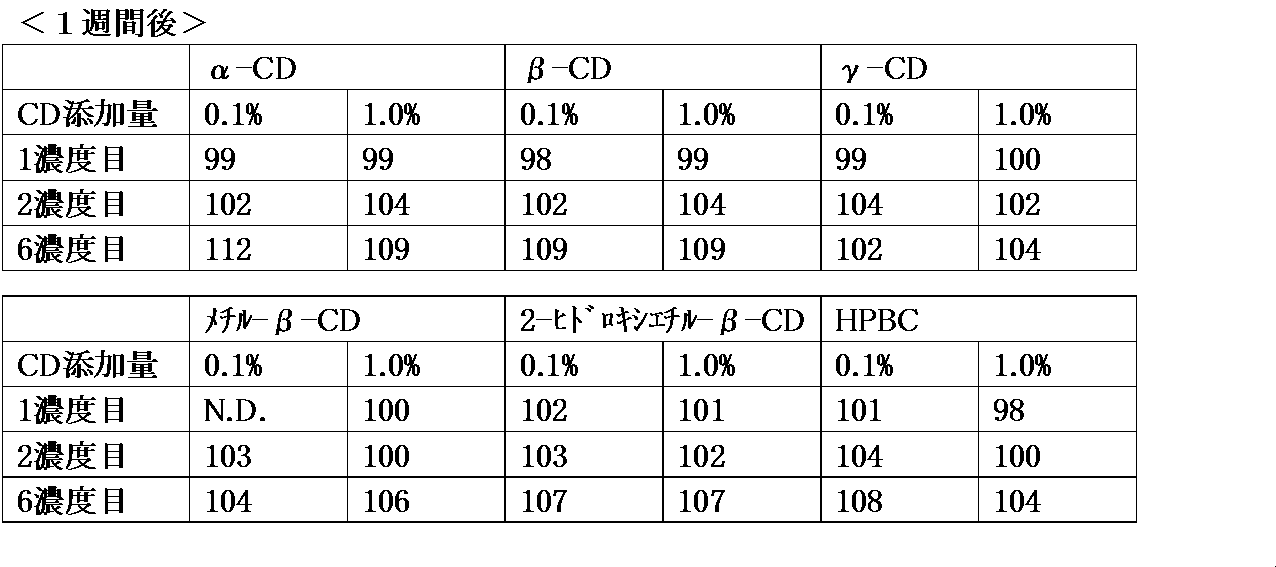
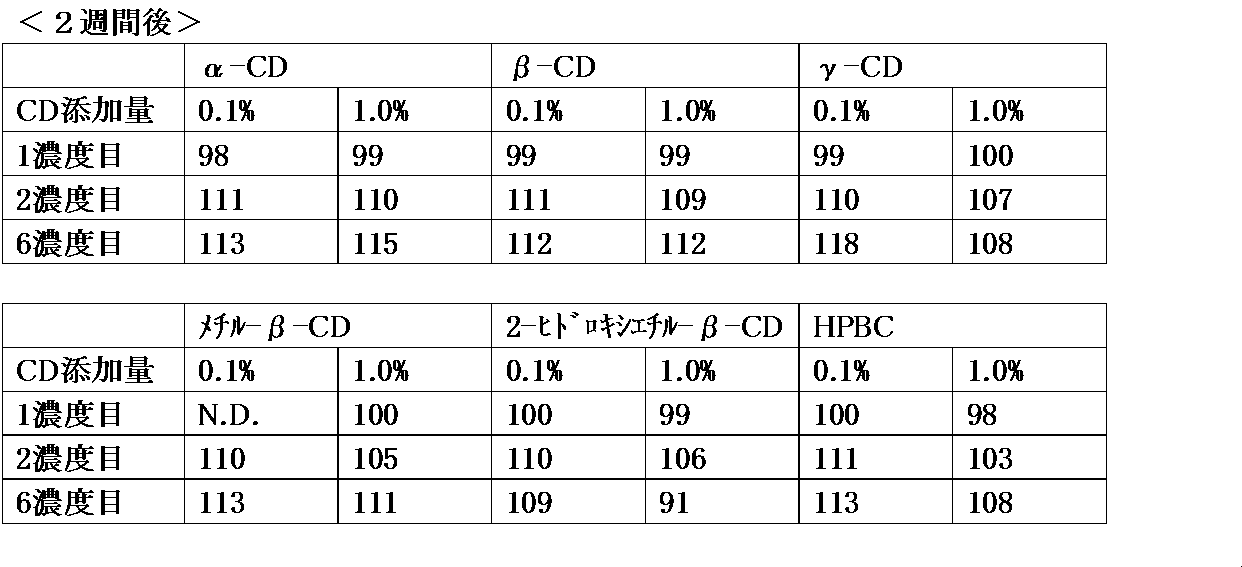
-80℃保存の標準液を用いた場合との発光量の相違は、±20%以内であることを要し、±10%以内であることが好ましく、±5%以内であることがより好ましい。表1の結果より、FT3標準液は、いずれのシクロデキストリン類を添加しても良好な安定性を示すことが判明した。また、特にHPBCで良好な安定性を示すことが判明した。
実施例1-2 至適pHの検討
シクロデキストリン類をヒドロキシプロピル-β-シクロデキストリン、濃度を1.0重量%、pHを6.8、8.0又は9.0とした以外は、実施例1-1と同様の方法でFT3標準液を調製した。
シクロデキストリン類をヒドロキシプロピル-β-シクロデキストリン、濃度を1.0重量%、pHを6.8、8.0又は9.0とした以外は、実施例1-1と同様の方法でFT3標準液を調製した。
調製した各FT3標準液を、-80℃または37℃で1週間保存し、保存後の標準液中のFT3を免疫測定した。結果を下記表2に示す。
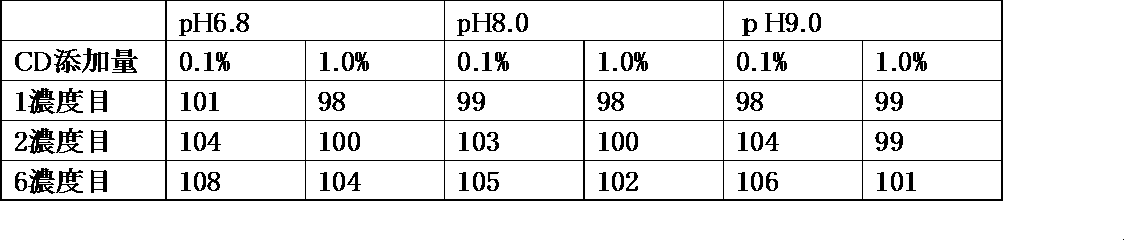
表2の結果より、FT3標準液において、pH8.0~pH9.0が至適pHであることが判明した。
実施例1-3 至適濃度の検討
シクロデキストリン類をHPBCまたはβ-シクロデキストリン、濃度を0.02重量%、0.1重量%、0.5重量%、1.0重量%、5.0重量%、または10.0重量%、pHを8.0とした以外は、実施例1-1と同様の方法でFT3標準液を調製した。
シクロデキストリン類をHPBCまたはβ-シクロデキストリン、濃度を0.02重量%、0.1重量%、0.5重量%、1.0重量%、5.0重量%、または10.0重量%、pHを8.0とした以外は、実施例1-1と同様の方法でFT3標準液を調製した。
調製した各FT3標準液を、-80℃または37℃で1週間保存し、保存後の標準液中のFT3を免疫測定した。結果を下記表3に示す。
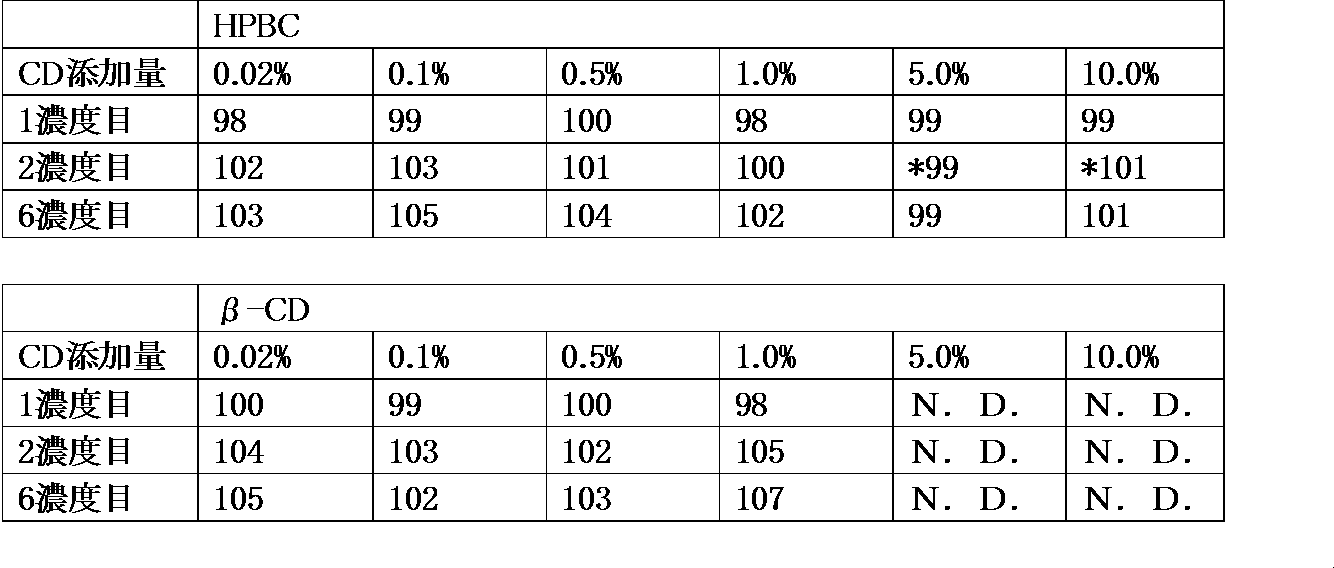
N.D.:溶解不能により実施せず
*:FT3濃度 4.52 pg/mL ±20%
表3に示すように、HPBCを用いた場合においては5.0重量%付近が至適濃度であり、β-シクロデキストリンを用いた場合においては、0.1重量%付近が至適濃度であることが判明した。
実施例1-4 長期保存安定性試験
以下の組成を有するFT3標準液(A標準液)を調製した。A標準液は、従来の活性炭処理健常ヒト血清をベースとして用いた標準液である。
<A標準液>
活性炭処理健常ヒト血清に0.1%(w/v)のアジ化ナトリウムを加え、FT3濃度が下記の濃度となるようにT3を添加した。
FT3 0pg/mL(無添加、1濃度目)、1.95 pg/mL±20%、2濃度目)又は30pg/mL(6濃度目)
以下の組成を有するFT3標準液(A標準液)を調製した。A標準液は、従来の活性炭処理健常ヒト血清をベースとして用いた標準液である。
<A標準液>
活性炭処理健常ヒト血清に0.1%(w/v)のアジ化ナトリウムを加え、FT3濃度が下記の濃度となるようにT3を添加した。
FT3 0pg/mL(無添加、1濃度目)、1.95 pg/mL±20%、2濃度目)又は30pg/mL(6濃度目)
一方、以下の組成を有するFT3標準液(B1標準液)を調製した。B1標準液は、本発明に係る標準液である。
<B1標準液>
MES 10.7g/L
NaCl 8.77g/L
NaN3 1.00g/L
4N NaOH 9mL/L (pH 8.0まで滴定)
HPBC 1.00重量%(ただし、甲状腺ホルモン無添加(1濃度目)の場合は含有しない)
BSA 20.0g/L
FT3 0pg/mL(無添加、1濃度目)、1.95 pg/mL±20%、2濃度目)又は30pg/mL(6濃度目)
<B1標準液>
MES 10.7g/L
NaCl 8.77g/L
NaN3 1.00g/L
4N NaOH 9mL/L (pH 8.0まで滴定)
HPBC 1.00重量%(ただし、甲状腺ホルモン無添加(1濃度目)の場合は含有しない)
BSA 20.0g/L
FT3 0pg/mL(無添加、1濃度目)、1.95 pg/mL±20%、2濃度目)又は30pg/mL(6濃度目)
調製した各FT3標準液を、-80℃、10℃又は25℃で1ヶ月、2ヶ月、3ヶ月、4ヶ月又は5ヶ月保存し、保存後の標準液中のFT3を免疫測定した。
結果を下記表4に示す。
結果を下記表4に示す。

表4に示されるように、本発明のFT3標準液は、従来の血清ベースの標準液と比しても、実用に耐える優れた長期保存安定性を示した。
実施例1-5 緩衝液の検討
以下の組成を有するFT3標準液(A標準液)を調製した。A標準液は、従来の活性炭処理健常ヒト血清をベースとして用いた標準液である。
<A標準液>
活性炭処理健常ヒト血清に0.1%(w/v)のアジ化ナトリウムを加え、FT3濃度が下記の濃度となるようにT3を添加した。
FT3 0pg/mL(無添加、1濃度目)、1.95 pg/mL±20%、2濃度目)又は30pg/mL(6濃度目)
以下の組成を有するFT3標準液(A標準液)を調製した。A標準液は、従来の活性炭処理健常ヒト血清をベースとして用いた標準液である。
<A標準液>
活性炭処理健常ヒト血清に0.1%(w/v)のアジ化ナトリウムを加え、FT3濃度が下記の濃度となるようにT3を添加した。
FT3 0pg/mL(無添加、1濃度目)、1.95 pg/mL±20%、2濃度目)又は30pg/mL(6濃度目)
一方、以下の組成を有するFT3標準液(B1~B3標準液)を調製した。B1~B3標準液は、本発明に係る標準液である。
<B1標準液(MES:pKa=6.15)>
MES 10.7g/L
NaCl 8.77g/L
NaN3 1.00g/L
4N NaOH (pH 8.0まで滴定)
HPBC 1.00重量%(ただし、甲状腺ホルモン無添加(1濃度目)の場合は含有しない)
BSA 20.0g/L
FT3 0pg/mL(無添加、1濃度目)、1.95 pg/mL±20%、2濃度目)又は30pg/mL(6濃度目)
<B1標準液(MES:pKa=6.15)>
MES 10.7g/L
NaCl 8.77g/L
NaN3 1.00g/L
4N NaOH (pH 8.0まで滴定)
HPBC 1.00重量%(ただし、甲状腺ホルモン無添加(1濃度目)の場合は含有しない)
BSA 20.0g/L
FT3 0pg/mL(無添加、1濃度目)、1.95 pg/mL±20%、2濃度目)又は30pg/mL(6濃度目)
<B2標準液(NaHCO3:pKa=10.3)>
NaHCO3 8.40g/L
NaCl 8.77g/L
NaN3 1.00g/L
4N NaOH (pH 9.0まで滴定)
HPBC 2.00重量%(ただし、甲状腺ホルモン無添加(1濃度目)の場合は含有しない)
BSA 20.0g/L
FT3 0pg/mL(無添加、1濃度目)、1.95 pg/mL±20%、2濃度目)又は30pg/mL(6濃度目)
NaHCO3 8.40g/L
NaCl 8.77g/L
NaN3 1.00g/L
4N NaOH (pH 9.0まで滴定)
HPBC 2.00重量%(ただし、甲状腺ホルモン無添加(1濃度目)の場合は含有しない)
BSA 20.0g/L
FT3 0pg/mL(無添加、1濃度目)、1.95 pg/mL±20%、2濃度目)又は30pg/mL(6濃度目)
<B3標準液(CAPS:pKa=10.4)>
CAPS 22.1g/L
NaCl 8.77g/L
NaN3 1.00g/L
4N NaOH (pH 9.0まで滴定)
HPBC 2.00重量%(ただし、甲状腺ホルモン無添加(1濃度目)の場合は含有しない)
BSA 20.0g/L
FT3 0pg/mL(無添加、1濃度目)、1.95 pg/mL±20%、2濃度目)又は30pg/mL(6濃度目)
CAPS 22.1g/L
NaCl 8.77g/L
NaN3 1.00g/L
4N NaOH (pH 9.0まで滴定)
HPBC 2.00重量%(ただし、甲状腺ホルモン無添加(1濃度目)の場合は含有しない)
BSA 20.0g/L
FT3 0pg/mL(無添加、1濃度目)、1.95 pg/mL±20%、2濃度目)又は30pg/mL(6濃度目)
調製した各FT3標準液を、-80℃、10℃又は25℃で6ヶ月保存し、保存後の標準液中のFT3を免疫測定した。
結果を下記表5に示す。
結果を下記表5に示す。
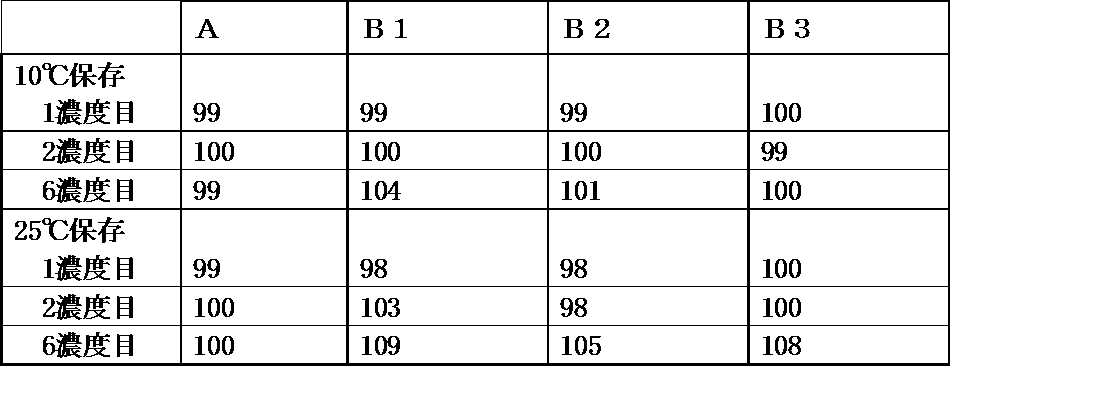
表5に示す通り、pKa値の高いNaHCO3バッファー、CAPSバッファーを用いてpH9.0付近で標準液を調製した場合に、pKa値の低いMESを用いてpH8.0付近で標準液を調製した場合と比して、高い安定性を示すことが示唆された。
実施例2 FT4の測定
実施例2-1 各種シクロデキストリン類含有標準液の安定性試験
以下の組成を有するFT4標準液を調製した。
MES 10.7g/L
NaCl 8.77g/L
NaN3 1.00g/L
4N NaOH 9mL/L
シクロデキストリン類各種 0.1または1.0重量%
(ただし、甲状腺ホルモン無添加(1濃度目)の場合は含有せず)
BSA 20.0g/L
1N NaOH 適量(pHが6.8になるまでの微調整用)
FT4 0ng/dL(無添加、1濃度目)、0.24ng/dL±20%、2濃度目)又は10ng/dL(6濃度目)(免疫測定に用いた市販のFT4免疫測定キットであるルミパルスFT4-N(商品名、富士レビオ社製)に含まれるFT4標準液の1濃度目~6濃度目のうちの1濃度目、2濃度目及び6濃度目の濃度に調製)
実施例2-1 各種シクロデキストリン類含有標準液の安定性試験
以下の組成を有するFT4標準液を調製した。
MES 10.7g/L
NaCl 8.77g/L
NaN3 1.00g/L
4N NaOH 9mL/L
シクロデキストリン類各種 0.1または1.0重量%
(ただし、甲状腺ホルモン無添加(1濃度目)の場合は含有せず)
BSA 20.0g/L
1N NaOH 適量(pHが6.8になるまでの微調整用)
FT4 0ng/dL(無添加、1濃度目)、0.24ng/dL±20%、2濃度目)又は10ng/dL(6濃度目)(免疫測定に用いた市販のFT4免疫測定キットであるルミパルスFT4-N(商品名、富士レビオ社製)に含まれるFT4標準液の1濃度目~6濃度目のうちの1濃度目、2濃度目及び6濃度目の濃度に調製)
調製した各FT4標準液を、-80℃又は37℃で1週間又は2週間保存し、保存後の標準液中のFT4を免疫測定した。測定は、市販のFT4測定キットであるルミパルスFT4-N(商品名、富士レビオ社製)を用い、測定機器として市販のルミパルスG1200(商品名、富士レビオ社製)を用いて行った。なお、ルミパルスFT4-N(商品名、富士レビオ社製)を用いた免疫測定は、この商品の添付文書に記載されたとおりに行った。
具体的には、次のように行った。まず、キットに含まれるT3結合フェライト粒子250μLと、調製した上記各FT4標準液10μLと、キットに含まれるアルカリホスファターゼ(ALP)標識抗T4モノクローナル抗体(マウス)50μLとを37℃で20分間反応させた。次に、フェライト粒子を磁石で集め、反応液を除去した後、粒子の洗浄を行った。次いで、基質液(AMPPD、(3-(2'-スピロアダマンタン)-4-メトキシ-4-(3''-ホスホリルオキシ)フェニル-1,2-ジオキセタン・2ナトリウム塩))200μLを粒子に加え、37℃で5分間反応させた。次に波長477nmに発光極大を持つ光の発光量を測定した。なお、当該測定は、単一モノクローナル抗体に対するFT3とFT4の競合反応を原理としており、発光量は抗体に反応するFT3量と正の相関を示し、反応系中に存在するFT4量と負の相関を示す。したがって、発光量が多いほどFT4濃度が低いことを示す。
1週間後の結果を下記表6-1に、2週間後の結果を表6-2に示す。なお、表中の数値は、-80℃で同期間保存した各濃度の標準液について得られた発光量を100とした相対値で示す。
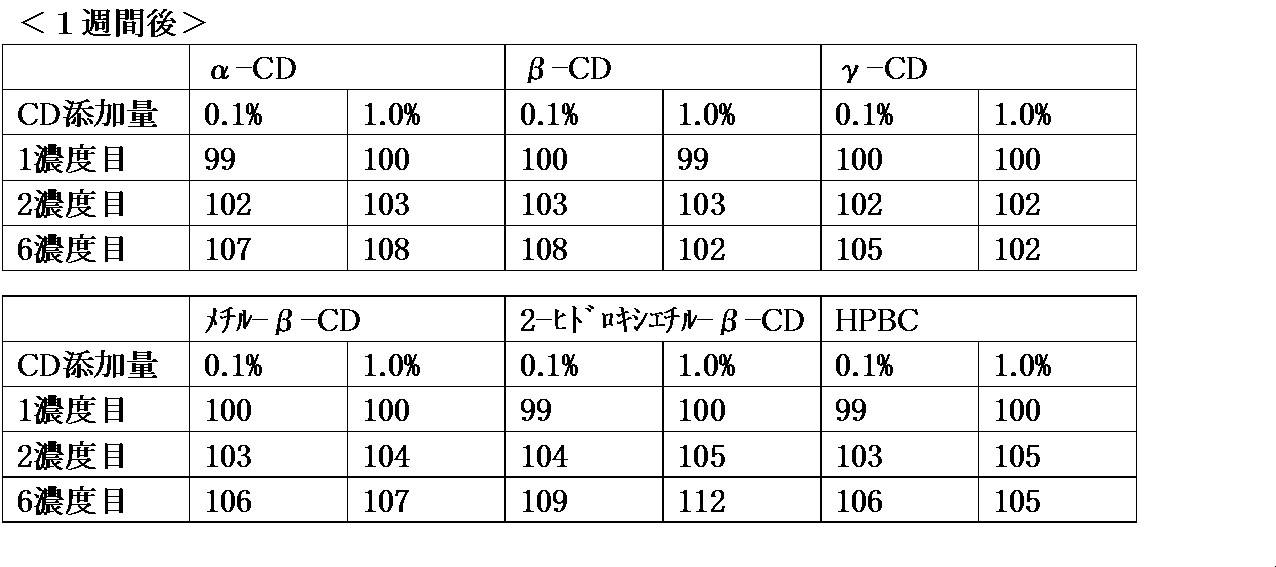

-80℃保存の標準液を用いた場合との発光量の相違は、±20%以内であることを要し、±10%以内であることが好ましく、±5%以内であることがより好ましい。表1の結果より、FT4標準液は、いずれのシクロデキストリン類を添加しても濃度を調整することで良好な安定性を示すことが判明した。また、特にγ-シクロデキストリン、ヒドロキシプロピル-β-シクロデキストリンで良好な安定性を示すことが判明した。
実施例2-2 至適pHの検討
シクロデキストリン類をヒドロキシプロピル-β-シクロデキストリン、濃度を1.0重量%、pHを6.8、8.0又は9.0とした以外は、実施例2-1と同様の方法でFT4標準液を調製した。
シクロデキストリン類をヒドロキシプロピル-β-シクロデキストリン、濃度を1.0重量%、pHを6.8、8.0又は9.0とした以外は、実施例2-1と同様の方法でFT4標準液を調製した。
調製した各FT4標準液を、-80℃または37℃で1週間保存し、保存後の標準液中のFT4を免疫測定した。結果を下記表7に示す。
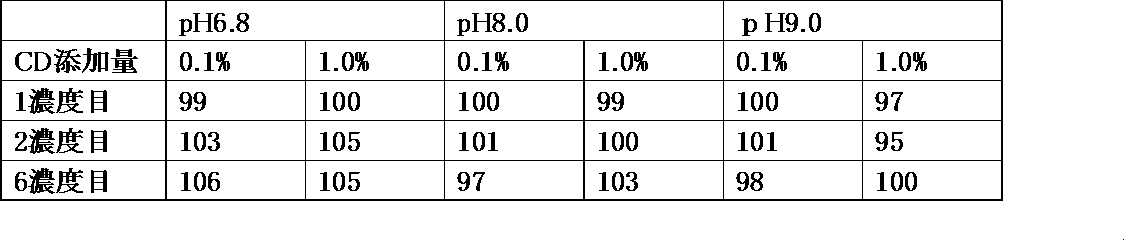
表7の結果より、FT4標準液において、pH8.0~pH9.0が至適pHであることが判明した。
実施例2-3 至適濃度の検討
シクロデキストリン類をHPBCまたはβ-シクロデキストリン、濃度を0.02重量%、0.1重量%、0.5重量%、1.0重量%、5.0重量%、または10.0重量%、pHを8.0とした以外は、実施例2-1と同様の方法でFT4標準液を調製した。
シクロデキストリン類をHPBCまたはβ-シクロデキストリン、濃度を0.02重量%、0.1重量%、0.5重量%、1.0重量%、5.0重量%、または10.0重量%、pHを8.0とした以外は、実施例2-1と同様の方法でFT4標準液を調製した。
調製した各FT4標準液を、-80℃または37℃で1週間保存し、保存後の標準液中のFT3を免疫測定した。結果を下記表8に示す。
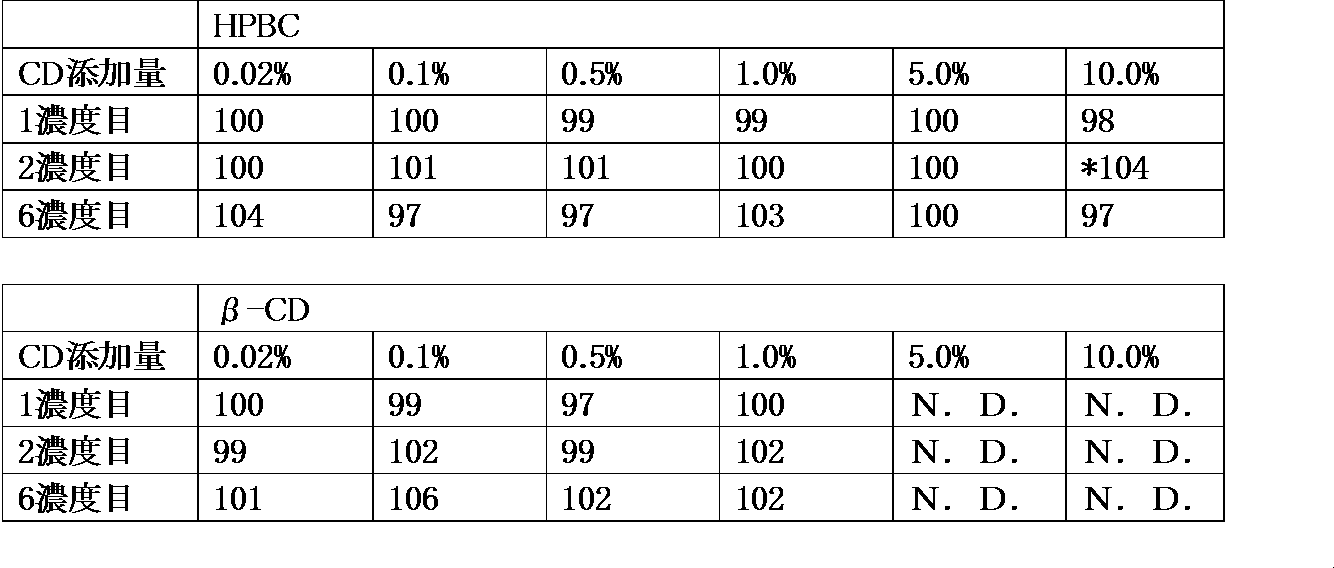
N.D.:溶解不能により実施せず
*:FT4濃度 0.57 ng/dL ± 20%
表8に示すように、HPBCを用いた場合においては5.0重量%付近が至適濃度であり、β-シクロデキストリンを用いた場合においては、0.5重量%付近が至適濃度であることが判明した。
実施例2-4 長期保存安定性試験
以下の組成を有するFT4標準液(C標準液)を調製した。C標準液は、従来の活性炭処理健常ヒト血清をベースとして用いた標準液である。
<C標準液>
活性炭処理健常ヒト血清に0.1%(w/v)のアジ化ナトリウム(NaN3)を加え、FT4濃度が下記の濃度となるようにT4を添加した。
FT4 0ng/dL(無添加、1濃度目)、0.24 ng/dL±20%、2濃度目)又は10ng/dL(6濃度目)
以下の組成を有するFT4標準液(C標準液)を調製した。C標準液は、従来の活性炭処理健常ヒト血清をベースとして用いた標準液である。
<C標準液>
活性炭処理健常ヒト血清に0.1%(w/v)のアジ化ナトリウム(NaN3)を加え、FT4濃度が下記の濃度となるようにT4を添加した。
FT4 0ng/dL(無添加、1濃度目)、0.24 ng/dL±20%、2濃度目)又は10ng/dL(6濃度目)
以下の組成を有するFT4標準液(D1標準液)を調製した。D1標準液は、本発明に係る標準液である。
<D1標準液>
MES 10.7g/L
NaCl 8.77g/L
NaN3 1.00g/L
4N NaOH 9mL/L
HPBC 1.00重量%(ただし、甲状腺ホルモン無添加(1濃度目)の場合は含有しない)
BSA 20.0g/L
1N NaOH 適量(pHが8.0になるまでの微調整用)
FT4 0ng/dL(無添加、1濃度目)、0.24ng/dL±20%、2濃度目)又は10ng/dL(6濃度目)(免疫測定に用いた市販のFT4免疫測定キットであるルミパルスFT4-N(商品名、富士レビオ社製)に含まれるFT4標準液の1濃度目~6濃度目のうちの1濃度目、2濃度目及び6濃度目の濃度に調製)
<D1標準液>
MES 10.7g/L
NaCl 8.77g/L
NaN3 1.00g/L
4N NaOH 9mL/L
HPBC 1.00重量%(ただし、甲状腺ホルモン無添加(1濃度目)の場合は含有しない)
BSA 20.0g/L
1N NaOH 適量(pHが8.0になるまでの微調整用)
FT4 0ng/dL(無添加、1濃度目)、0.24ng/dL±20%、2濃度目)又は10ng/dL(6濃度目)(免疫測定に用いた市販のFT4免疫測定キットであるルミパルスFT4-N(商品名、富士レビオ社製)に含まれるFT4標準液の1濃度目~6濃度目のうちの1濃度目、2濃度目及び6濃度目の濃度に調製)
調製した各FT4標準液を、-80℃、10℃又は25℃で1ヶ月、2ヶ月、3ヶ月、4ヶ月又は5ヶ月保存し、保存後の標準液中のFT4を免疫測定した。
結果を下記表9に示す。

表9に示されるように、本発明のFT4標準液は、従来の血清ベースの標準液と比しても、実用に耐える優れた保存安定性を示した。
(実施例2-5) 緩衝液組成の検討
以下の組成を有するFT4標準液(C標準液)を調製した。C標準液は、従来の活性炭処理健常ヒト血清をベースとして用いた標準液である。
<C標準液>
活性炭処理健常ヒト血清に0.1%(w/v)のアジ化ナトリウム(NaN3)を加え、FT4濃度が下記の濃度となるようにT4を添加した。
FT4 0ng/dL(無添加、1濃度目)、0.24 ng/dL±20%、2濃度目)又は10ng/dL(6濃度目)
以下の組成を有するFT4標準液(C標準液)を調製した。C標準液は、従来の活性炭処理健常ヒト血清をベースとして用いた標準液である。
<C標準液>
活性炭処理健常ヒト血清に0.1%(w/v)のアジ化ナトリウム(NaN3)を加え、FT4濃度が下記の濃度となるようにT4を添加した。
FT4 0ng/dL(無添加、1濃度目)、0.24 ng/dL±20%、2濃度目)又は10ng/dL(6濃度目)
一方、以下の組成を有するFT4標準液(D1~D3標準液)を調製した。D1~D3標準液は、本発明に係る標準液である。
<D1標準液(MES:pKa=6.15)>
MES 10.7g/L
NaCl 8.77g/L
NaN3 1.00g/L
4N NaOH (pH8.0まで滴定)
HPBC 1.00重量%(ただし、甲状腺ホルモン無添加(1濃度目)の場合は含有しない)
BSA 20.0g/L
FT4 0ng/dL(無添加、1濃度目)、0.24ng/dL±20%、2濃度目)又は10ng/dL(6濃度目)
<D1標準液(MES:pKa=6.15)>
MES 10.7g/L
NaCl 8.77g/L
NaN3 1.00g/L
4N NaOH (pH8.0まで滴定)
HPBC 1.00重量%(ただし、甲状腺ホルモン無添加(1濃度目)の場合は含有しない)
BSA 20.0g/L
FT4 0ng/dL(無添加、1濃度目)、0.24ng/dL±20%、2濃度目)又は10ng/dL(6濃度目)
<D2標準液(NaHCO3:pKa=10.3)>
NaHPO4 8.40g/L
NaCl 8.77g/L
NaN3 1.00g/L
4N NaOH (pH 9.0まで滴定)
HPBC 2.00重量%(ただし、甲状腺ホルモン無添加(1濃度目)の場合は含有しない)
BSA 20.0g/L
FT4 0ng/dL(無添加、1濃度目)、0.24ng/dL±20%、2濃度目)又は10ng/dL(6濃度目)
NaHPO4 8.40g/L
NaCl 8.77g/L
NaN3 1.00g/L
4N NaOH (pH 9.0まで滴定)
HPBC 2.00重量%(ただし、甲状腺ホルモン無添加(1濃度目)の場合は含有しない)
BSA 20.0g/L
FT4 0ng/dL(無添加、1濃度目)、0.24ng/dL±20%、2濃度目)又は10ng/dL(6濃度目)
<D3標準液(CAPS)>
CAPS 22.1g/L
NaCl 8.77g/L
NaN3 1.00g/L
4N NaOH (pH 9.0まで滴定)
HPBC 2.00重量%(ただし、甲状腺ホルモン無添加(1濃度目)の場合は含有しない)
BSA 20.0g/L
FT4 0ng/dL(無添加、1濃度目)、0.24ng/dL±20%、2濃度目)又は10ng/dL(6濃度目)
CAPS 22.1g/L
NaCl 8.77g/L
NaN3 1.00g/L
4N NaOH (pH 9.0まで滴定)
HPBC 2.00重量%(ただし、甲状腺ホルモン無添加(1濃度目)の場合は含有しない)
BSA 20.0g/L
FT4 0ng/dL(無添加、1濃度目)、0.24ng/dL±20%、2濃度目)又は10ng/dL(6濃度目)
調製した各FT4標準液を、-80℃、10℃又は25℃で6ヶ月保存し、保存後の標準液中のFT4を免疫測定した。
結果を下記表10に示す。
結果を下記表10に示す。
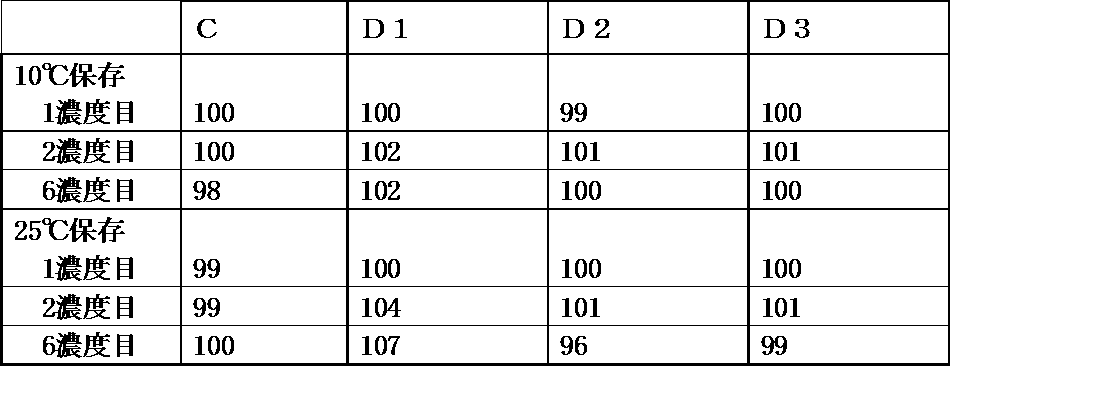
表10に示す通り、pKa値の高いNaHCO3バッファー、CAPSバッファーを用いてpH9.0付近で標準液を調製した場合に、pKa値の低いMESを用いてpH8.0付近で標準液を調製した場合と比して、高い安定性を示すことが示唆された。
本発明は、甲状腺ホルモンに関連する多様な疾患を診断する上で重要な、血液サンプル中の甲状腺ホルモン類の測定の信頼性を高めるのに有用な標準液を提供するものである。
Claims (9)
- 甲状腺ホルモン類と、シクロデキストリン又はその誘導体とを緩衝液中に含む甲状腺ホルモン類標準液。
- 前記甲状腺ホルモン類が、トリヨードサイロニン、遊離トリヨードサイロニン、サイロキシン又は遊離サイロキシンである請求項1記載の標準液。
- 前記シクロデキストリン又はその誘導体が、β-シクロデキストリン、γ-シクロデキストリン又はこれらのアルキル若しくはヒドロキシアルキル置換体である請求項1又は2に記載の標準液。
- 前記シクロデキストリン又はその誘導体が、ヒドロキシプロピル-β-シクロデキストリンである請求項3記載の標準液。
- 前記シクロデキストリン又はその誘導体の濃度が、0.1重量%~10重量%である請求項1~4のいずれか1項に記載の標準液。
- pHが6.5~10である請求項1~5のいずれか1項に記載の標準液。
- 請求項1~6のいずれか1項に記載の標準液を含む、甲状腺ホルモン類測定試薬。
- 甲状腺ホルモン類と、シクロデキストリン又はその誘導体とを緩衝液中に含む液の、甲状腺ホルモン類標準液としての使用。
- 互いに異なる既知濃度の甲状腺ホルモン類と、シクロデキストリン又はその誘導体とを緩衝液中に含む、複数の甲状腺ホルモン類標準液を準備することと、各甲状腺ホルモン類標準液を免疫測定に供し、各甲状腺ホルモン類標準液に含まれる甲状腺ホルモン類の濃度と、免疫測定のシグナルとの関係に基づき検量線を作成することとを含む、免疫測定における検量線の作成方法。
Priority Applications (2)
| Application Number | Priority Date | Filing Date | Title |
|---|---|---|---|
| EP16817859.8A EP3315966A4 (en) | 2015-06-29 | 2016-06-27 | Standard thyroid gland hormone solution |
| JP2017526335A JP6733671B2 (ja) | 2015-06-29 | 2016-06-27 | 甲状腺ホルモン類標準液 |
Applications Claiming Priority (2)
| Application Number | Priority Date | Filing Date | Title |
|---|---|---|---|
| JP2015130037 | 2015-06-29 | ||
| JP2015-130037 | 2015-06-29 |
Publications (1)
| Publication Number | Publication Date |
|---|---|
| WO2017002751A1 true WO2017002751A1 (ja) | 2017-01-05 |
Family
ID=57608418
Family Applications (1)
| Application Number | Title | Priority Date | Filing Date |
|---|---|---|---|
| PCT/JP2016/068982 Ceased WO2017002751A1 (ja) | 2015-06-29 | 2016-06-27 | 甲状腺ホルモン類標準液 |
Country Status (3)
| Country | Link |
|---|---|
| EP (1) | EP3315966A4 (ja) |
| JP (1) | JP6733671B2 (ja) |
| WO (1) | WO2017002751A1 (ja) |
Citations (5)
| Publication number | Priority date | Publication date | Assignee | Title |
|---|---|---|---|---|
| JPH06213898A (ja) * | 1992-08-14 | 1994-08-05 | Boehringer Mannheim Gmbh | チロキシン(t4)またはトリヨードチロニン(t3) の測定法およびそのための標準溶液 |
| JPH11510598A (ja) * | 1995-07-27 | 1999-09-14 | アボツト・ラボラトリーズ | シクロデキストリン類を用い安定化した水性ステロイド免疫検定スタンダード |
| JP2000516344A (ja) * | 1997-06-04 | 2000-12-05 | デイド、ベーリング、インコーポレイテッド | 甲状腺機能の測定のための標準液 |
| JP2003024098A (ja) * | 2001-07-19 | 2003-01-28 | Toyobo Co Ltd | イヌリン測定キャリブレータ、精度管理用試料およびイヌリン測定方法 |
| JP2014010102A (ja) * | 2012-07-02 | 2014-01-20 | Tosoh Corp | ハプテン標準液およびそれを含むハプテン定量試薬 |
Family Cites Families (3)
| Publication number | Priority date | Publication date | Assignee | Title |
|---|---|---|---|---|
| US4121975A (en) * | 1976-08-20 | 1978-10-24 | Syva Company | Pretreatment of samples for polyiodothyronine assays |
| US5342788A (en) * | 1988-04-15 | 1994-08-30 | Boehringer Mannheim Gmbh | Method and standard solution for the determination of thyroxine (T4) or triiodothyronine (T3) |
| CA2634993A1 (en) * | 2006-01-06 | 2007-07-12 | Intervet International B.V. | Concentrated liquid thyroid hormone composition |
-
2016
- 2016-06-27 EP EP16817859.8A patent/EP3315966A4/en not_active Withdrawn
- 2016-06-27 WO PCT/JP2016/068982 patent/WO2017002751A1/ja not_active Ceased
- 2016-06-27 JP JP2017526335A patent/JP6733671B2/ja not_active Expired - Fee Related
Patent Citations (5)
| Publication number | Priority date | Publication date | Assignee | Title |
|---|---|---|---|---|
| JPH06213898A (ja) * | 1992-08-14 | 1994-08-05 | Boehringer Mannheim Gmbh | チロキシン(t4)またはトリヨードチロニン(t3) の測定法およびそのための標準溶液 |
| JPH11510598A (ja) * | 1995-07-27 | 1999-09-14 | アボツト・ラボラトリーズ | シクロデキストリン類を用い安定化した水性ステロイド免疫検定スタンダード |
| JP2000516344A (ja) * | 1997-06-04 | 2000-12-05 | デイド、ベーリング、インコーポレイテッド | 甲状腺機能の測定のための標準液 |
| JP2003024098A (ja) * | 2001-07-19 | 2003-01-28 | Toyobo Co Ltd | イヌリン測定キャリブレータ、精度管理用試料およびイヌリン測定方法 |
| JP2014010102A (ja) * | 2012-07-02 | 2014-01-20 | Tosoh Corp | ハプテン標準液およびそれを含むハプテン定量試薬 |
Non-Patent Citations (1)
| Title |
|---|
| See also references of EP3315966A4 * |
Also Published As
| Publication number | Publication date |
|---|---|
| JP6733671B2 (ja) | 2020-08-05 |
| EP3315966A1 (en) | 2018-05-02 |
| JPWO2017002751A1 (ja) | 2018-05-24 |
| EP3315966A4 (en) | 2018-11-14 |
Similar Documents
| Publication | Publication Date | Title |
|---|---|---|
| US10472400B2 (en) | Cardiac troponin I ultra-sensitive detection reagent kit, and ultra-sensitive detection method therefor | |
| JP5735615B2 (ja) | 免疫学的測定における感度増強方法及びそのための試薬 | |
| CN106501515A (zh) | Ca215检测试剂盒及其制备方法和使用方法 | |
| CN104634980A (zh) | 心肌肌钙蛋白i超敏检测试剂盒及超敏检测方法 | |
| CN105651990A (zh) | 一种17α-羟孕酮的化学发光检测试剂盒及其制备方法和应用 | |
| EP3258269B1 (en) | Reagent kit used for detecting lipoprotein-associated phospholipase a2, and preparation method and application for reagent kit | |
| CN115327137B (zh) | 一种人免疫球蛋白g4亚型化学发光免疫检测试剂盒 | |
| JP2022152733A (ja) | 抗体結合磁性粒子の保存安定化方法 | |
| JP4668768B2 (ja) | 免疫測定方法及び非特異反応抑制方法 | |
| JP2019191187A (ja) | 標的物質の検出用試薬、検出方法および標的物質を検出するために用いられる担体ならびにその製造方法 | |
| US4299812A (en) | Immunoassay of thyroxine in neonates using dried blood samples | |
| CN104634970B (zh) | 用于检测脂蛋白相关磷脂酶a2的试剂盒及其制备和应用 | |
| JP6601932B2 (ja) | 体液による抗原抗体反応阻害を防止する物質 | |
| WO2024244456A1 (zh) | 一种检测fgf21的发光试剂及其应用 | |
| EP2660603B1 (en) | Immunological assay method | |
| JP6733671B2 (ja) | 甲状腺ホルモン類標準液 | |
| CN104749355B (zh) | 一种磺胺类的检测方法及其检测试剂盒 | |
| CN117147530A (zh) | 一种磁微粒化学发光法检测神经纤维丝轻链蛋白的试剂盒及其非诊断检测方法 | |
| JP6472789B2 (ja) | 受容体含有安定化液剤 | |
| JP2003207512A (ja) | イムノアッセイに用いるための第三級アミン化合物 | |
| CN107478854B (zh) | 一种脂蛋白a检测试剂盒及检测方法 | |
| CN111896756A (zh) | 一种用于测定游离甲状腺素的试剂盒 | |
| CN115327099B (zh) | 一种抗线粒体抗体m2的检测试剂盒 | |
| US5821074A (en) | Method and compositions for enhancing aminolevulinic acid dehydratase assay | |
| JPH10221341A (ja) | 体液中の遊離リガンドの測定方法 |
Legal Events
| Date | Code | Title | Description |
|---|---|---|---|
| 121 | Ep: the epo has been informed by wipo that ep was designated in this application |
Ref document number: 16817859 Country of ref document: EP Kind code of ref document: A1 |
|
| ENP | Entry into the national phase |
Ref document number: 2017526335 Country of ref document: JP Kind code of ref document: A |
|
| NENP | Non-entry into the national phase |
Ref country code: DE |
|
| WWE | Wipo information: entry into national phase |
Ref document number: 2016817859 Country of ref document: EP |